EP3725785B1 - Dérivé de glutarimide, son utilisation, composition pharmaceutique basée sur celui-ci et procédés de production du dérivé de glutarimide - Google Patents
Dérivé de glutarimide, son utilisation, composition pharmaceutique basée sur celui-ci et procédés de production du dérivé de glutarimide Download PDFInfo
- Publication number
- EP3725785B1 EP3725785B1 EP20178488.1A EP20178488A EP3725785B1 EP 3725785 B1 EP3725785 B1 EP 3725785B1 EP 20178488 A EP20178488 A EP 20178488A EP 3725785 B1 EP3725785 B1 EP 3725785B1
- Authority
- EP
- European Patent Office
- Prior art keywords
- compound
- cch
- virus
- nmr
- dmso
- Prior art date
- Legal status (The legal status is an assumption and is not a legal conclusion. Google has not performed a legal analysis and makes no representation as to the accuracy of the status listed.)
- Active
Links
Classifications
-
- C—CHEMISTRY; METALLURGY
- C07—ORGANIC CHEMISTRY
- C07D—HETEROCYCLIC COMPOUNDS
- C07D401/00—Heterocyclic compounds containing two or more hetero rings, having nitrogen atoms as the only ring hetero atoms, at least one ring being a six-membered ring with only one nitrogen atom
- C07D401/02—Heterocyclic compounds containing two or more hetero rings, having nitrogen atoms as the only ring hetero atoms, at least one ring being a six-membered ring with only one nitrogen atom containing two hetero rings
- C07D401/06—Heterocyclic compounds containing two or more hetero rings, having nitrogen atoms as the only ring hetero atoms, at least one ring being a six-membered ring with only one nitrogen atom containing two hetero rings linked by a carbon chain containing only aliphatic carbon atoms
-
- A—HUMAN NECESSITIES
- A61—MEDICAL OR VETERINARY SCIENCE; HYGIENE
- A61P—SPECIFIC THERAPEUTIC ACTIVITY OF CHEMICAL COMPOUNDS OR MEDICINAL PREPARATIONS
- A61P11/00—Drugs for disorders of the respiratory system
-
- A—HUMAN NECESSITIES
- A61—MEDICAL OR VETERINARY SCIENCE; HYGIENE
- A61P—SPECIFIC THERAPEUTIC ACTIVITY OF CHEMICAL COMPOUNDS OR MEDICINAL PREPARATIONS
- A61P11/00—Drugs for disorders of the respiratory system
- A61P11/02—Nasal agents, e.g. decongestants
-
- A—HUMAN NECESSITIES
- A61—MEDICAL OR VETERINARY SCIENCE; HYGIENE
- A61P—SPECIFIC THERAPEUTIC ACTIVITY OF CHEMICAL COMPOUNDS OR MEDICINAL PREPARATIONS
- A61P11/00—Drugs for disorders of the respiratory system
- A61P11/04—Drugs for disorders of the respiratory system for throat disorders
-
- A—HUMAN NECESSITIES
- A61—MEDICAL OR VETERINARY SCIENCE; HYGIENE
- A61P—SPECIFIC THERAPEUTIC ACTIVITY OF CHEMICAL COMPOUNDS OR MEDICINAL PREPARATIONS
- A61P31/00—Antiinfectives, i.e. antibiotics, antiseptics, chemotherapeutics
- A61P31/12—Antivirals
-
- A—HUMAN NECESSITIES
- A61—MEDICAL OR VETERINARY SCIENCE; HYGIENE
- A61P—SPECIFIC THERAPEUTIC ACTIVITY OF CHEMICAL COMPOUNDS OR MEDICINAL PREPARATIONS
- A61P31/00—Antiinfectives, i.e. antibiotics, antiseptics, chemotherapeutics
- A61P31/12—Antivirals
- A61P31/14—Antivirals for RNA viruses
-
- A—HUMAN NECESSITIES
- A61—MEDICAL OR VETERINARY SCIENCE; HYGIENE
- A61P—SPECIFIC THERAPEUTIC ACTIVITY OF CHEMICAL COMPOUNDS OR MEDICINAL PREPARATIONS
- A61P31/00—Antiinfectives, i.e. antibiotics, antiseptics, chemotherapeutics
- A61P31/12—Antivirals
- A61P31/14—Antivirals for RNA viruses
- A61P31/16—Antivirals for RNA viruses for influenza or rhinoviruses
-
- C—CHEMISTRY; METALLURGY
- C07—ORGANIC CHEMISTRY
- C07D—HETEROCYCLIC COMPOUNDS
- C07D401/00—Heterocyclic compounds containing two or more hetero rings, having nitrogen atoms as the only ring hetero atoms, at least one ring being a six-membered ring with only one nitrogen atom
- C07D401/14—Heterocyclic compounds containing two or more hetero rings, having nitrogen atoms as the only ring hetero atoms, at least one ring being a six-membered ring with only one nitrogen atom containing three or more hetero rings
-
- C—CHEMISTRY; METALLURGY
- C07—ORGANIC CHEMISTRY
- C07D—HETEROCYCLIC COMPOUNDS
- C07D405/00—Heterocyclic compounds containing both one or more hetero rings having oxygen atoms as the only ring hetero atoms, and one or more rings having nitrogen as the only ring hetero atom
- C07D405/02—Heterocyclic compounds containing both one or more hetero rings having oxygen atoms as the only ring hetero atoms, and one or more rings having nitrogen as the only ring hetero atom containing two hetero rings
- C07D405/06—Heterocyclic compounds containing both one or more hetero rings having oxygen atoms as the only ring hetero atoms, and one or more rings having nitrogen as the only ring hetero atom containing two hetero rings linked by a carbon chain containing only aliphatic carbon atoms
-
- C—CHEMISTRY; METALLURGY
- C07—ORGANIC CHEMISTRY
- C07D—HETEROCYCLIC COMPOUNDS
- C07D409/00—Heterocyclic compounds containing two or more hetero rings, at least one ring having sulfur atoms as the only ring hetero atoms
- C07D409/02—Heterocyclic compounds containing two or more hetero rings, at least one ring having sulfur atoms as the only ring hetero atoms containing two hetero rings
- C07D409/06—Heterocyclic compounds containing two or more hetero rings, at least one ring having sulfur atoms as the only ring hetero atoms containing two hetero rings linked by a carbon chain containing only aliphatic carbon atoms
-
- C—CHEMISTRY; METALLURGY
- C07—ORGANIC CHEMISTRY
- C07D—HETEROCYCLIC COMPOUNDS
- C07D413/00—Heterocyclic compounds containing two or more hetero rings, at least one ring having nitrogen and oxygen atoms as the only ring hetero atoms
- C07D413/02—Heterocyclic compounds containing two or more hetero rings, at least one ring having nitrogen and oxygen atoms as the only ring hetero atoms containing two hetero rings
- C07D413/06—Heterocyclic compounds containing two or more hetero rings, at least one ring having nitrogen and oxygen atoms as the only ring hetero atoms containing two hetero rings linked by a carbon chain containing only aliphatic carbon atoms
-
- C—CHEMISTRY; METALLURGY
- C07—ORGANIC CHEMISTRY
- C07D—HETEROCYCLIC COMPOUNDS
- C07D417/00—Heterocyclic compounds containing two or more hetero rings, at least one ring having nitrogen and sulfur atoms as the only ring hetero atoms, not provided for by group C07D415/00
- C07D417/02—Heterocyclic compounds containing two or more hetero rings, at least one ring having nitrogen and sulfur atoms as the only ring hetero atoms, not provided for by group C07D415/00 containing two hetero rings
- C07D417/06—Heterocyclic compounds containing two or more hetero rings, at least one ring having nitrogen and sulfur atoms as the only ring hetero atoms, not provided for by group C07D415/00 containing two hetero rings linked by a carbon chain containing only aliphatic carbon atoms
-
- C—CHEMISTRY; METALLURGY
- C07—ORGANIC CHEMISTRY
- C07D—HETEROCYCLIC COMPOUNDS
- C07D453/00—Heterocyclic compounds containing quinuclidine or iso-quinuclidine ring systems, e.g. quinine alkaloids
- C07D453/02—Heterocyclic compounds containing quinuclidine or iso-quinuclidine ring systems, e.g. quinine alkaloids containing not further condensed quinuclidine ring systems
-
- C—CHEMISTRY; METALLURGY
- C07—ORGANIC CHEMISTRY
- C07D—HETEROCYCLIC COMPOUNDS
- C07D471/00—Heterocyclic compounds containing nitrogen atoms as the only ring hetero atoms in the condensed system, at least one ring being a six-membered ring with one nitrogen atom, not provided for by groups C07D451/00 - C07D463/00
- C07D471/02—Heterocyclic compounds containing nitrogen atoms as the only ring hetero atoms in the condensed system, at least one ring being a six-membered ring with one nitrogen atom, not provided for by groups C07D451/00 - C07D463/00 in which the condensed system contains two hetero rings
- C07D471/04—Ortho-condensed systems
-
- C—CHEMISTRY; METALLURGY
- C07—ORGANIC CHEMISTRY
- C07D—HETEROCYCLIC COMPOUNDS
- C07D487/00—Heterocyclic compounds containing nitrogen atoms as the only ring hetero atoms in the condensed system, not provided for by groups C07D451/00 - C07D477/00
- C07D487/02—Heterocyclic compounds containing nitrogen atoms as the only ring hetero atoms in the condensed system, not provided for by groups C07D451/00 - C07D477/00 in which the condensed system contains two hetero rings
- C07D487/04—Ortho-condensed systems
Definitions
- the invention relates to a novel biologically active compound, which is a glutarimide derivative, or pharmaceutically acceptable salt thereof, to said compound and a pharmaceutical composition, which comprises an effective amount of said compound, for use in a method of treatment of an upper respiratory tract disease, and to a method for preparing said compound.
- Upper respiratory tract chronic diseases are the most common diseases in children and adults throughout the world.
- the upper respiratory tract chronic diseases include, in particular, rhinosinusitis.
- Rhinosinusitis is an inflammation of the mucous tunic of the nose and paranasal sinuses (PNS) and is the most actual problem in the otorhinoryngology ( Fokkens W.J., Lund V.J., Mullol J. et al., European Position Paper on Rhinosinusitis and Nasal Polyps. Rhinology 2007; 45; 20:1-139 ).
- a cause of rhinosinusitis almost always is mucous congestion, blockage of natural ostia of the PNS, and a disturbance in their ventilation when the mechanism of mucociliary clearance suffers since said mechanism is an important primary innate mechanism protecting the respiratory tract from damaging action of inhaled pollutions, allergens and causal organisms.
- Acute rhinosinusitis is a frequent complication of an acute respiratory viral infection (ARVI).
- corticosteroids are used as monotherapy or in combination with antibiotics. More severe forms of rhinosinusitis require the use of antibiotics.
- Main corticosteroids are fluticasone, budesonide and mometasone.
- corticosteroids are prescribed for long-term use, which may cause side effects and tolerance. Side effects are, as a rule, the manifestation of the intrinsic glucocorticosteroid action of these medicaments but in a degree that exceeds the physiological norm.
- the prescribed antibiotics are, in general, penicillin antibiotics (amoxicillin, penicillin V) or non-penicillin antibiotics (macrolides, tetracycline) ( Fokkens W.J., Lund V.J., Mullol J. et al., European Position Paper on Rhinosinusitis and Nasal Polyps. Rhinology 2007; 45; 20:1-139 ).
- the objective of the present invention is to develop and introduce into practice novel medicaments for the treatment of rhinosinusitis.
- Classes IV and V of the Baltimore virus classification system include viruses containing single-stranded (+) or (-) RNA.
- Class IV includes representatives of the Enterovirus genus of the Picornaviridae family and the Coronaviridae family, and class V includes a respiratory syncytial virus (RSV) of the Paramyxoviridae family and influenza virus of the Orthomyxoviridae family.
- RSV respiratory syncytial virus
- Rhinoviruses which are replicated in the nasopharyngeal mucosal cells, are a causative agent of upper respiratory tract diseases in humans. Rhinoviruses are causative agents of at least 80% of cold-related diseases.
- rhinovirus infections cause a large number of complications such as sinusitis and otitis media and are frequently detected in virological examination of children with pneumonia.
- asthmatic children rhinovirus infection is also a cause of acerbations in 80% cases.
- rhinovirus may cause exacerbations of both asthma and chronic obstructive pulmonary disease, chronic bronchitis, and mucoviscidosis.
- Rhinovirus was isolated in pneumonia patients with immunodeficiency conditions.
- Coxsackie virus infection is a large group of diseases characterized by pronounced clinical polymorphism. Coxsackie virus infection can manifest itself in meningitis, paralysis, acute respiratory disorders, pneumonia, haemorrhagic conjunctivitis, myocarditis, hepatitis, diabetes and other syndromes. According to the modern classification of viruses, human enteroviruses belonging to the Enterovirus genus are divided into 5 species: 1) poliovirus; 2) human enteroviruses A; 3) human enteroviruses B; 4) human enteroviruses C; and 5) human enteroviruses D.
- Coxsackie virus belongs to the following enterovirus species: Human enterovirus A (Coxsackie viruses A2-8, 10, 12, 14, and 16); Human enterovirus B (Coxsackie viruses A9, B1-6); Human enterovirus C (Coxsackie viruses A1, 11, 13, 15, 17-22, and 24).
- Human enterovirus A Coxsackie viruses A2-8, 10, 12, 14, and 16
- Human enterovirus B Coxsackie viruses A9, B1-6
- Human enterovirus C Coxsackie viruses A1, 11, 13, 15, 17-22, and 24.
- Coxsackie viruses like other human enteroviruses, are ubiquitous throughout the world. In the temperate countries, their maximum circulation is observed in the summer-autumn season. The viruses are characterized by a high invasiveness, thus promoting their rapid spread in the human population. Coxsackie viruses are often the cause of "sudden" outbreaks in organized children's groups and hospitals; interfamilial spread of the infection occurs as well. A high variability of the viral genome plays an important role in the epidemiology of Coxsackie virus and other enterovirus infections. As a consequence, various serotypes are able to cause different pathology in certain circumstances. On the other hand, the same clinical syndrome may be caused by different serotypes and different enterovirus species. Genetic variability, selection and rapid spread of modified viruses result in large-scale outbreaks of the diseases, the etiology of which has no relation to these viruses, or their circulation was not recorded for a long time.
- Coxsackie virus occurs in the nasopharynx- and gut-associated lymphoid tissue. It causes local lesions expressed in the symptoms of ARD, herpangina, and pharyngitis. In the throat the virus is detected until the seventh day, and is excreted with faeces for 3-4 weeks (in case of immunodeficiency for several years). Viremia, as a result of which the virus penetrates the target organs, follows the primary replication of the virus.
- target organs may be the brain and spinal cord, meninges, upper respiratory tract, lungs, heart, liver, and skin.
- Coxsackie virus B can cause severe generalized pathological processes in newborns, resulting in necrosis in the heart, brain and spinal cord, liver and kidneys.
- the viruses cause the following clinic syndromes: aseptic meningitis (Coxsackie viruses A2, 3, 4, 6, 7, 9, 10, and B1-6); acute systemic disease in children with myocarditis and meningoencephalitis (Coxsackie viruses D1-5); paralysis (Coxsackie viruses A1, 2, 5, 7, 8, 9, 21, and B2-5); herpangina (Coxsackie viruses A2, 3, 4, 5, 6, 8, and 10); acute pharyngitis (Coxsackie viruses A10, 21); contagious rhinitis (Coxsackie viruses A21, 24); damage of the upper respiratory tract (Coxsackie viruses A9, 16, and B2-5) (16); pericarditis, myocarditis (Coxsackie viruses B1-5); hepatitis (Coxsackie viruses A4, 9, 20, and B5); diarrhea of newborn
- the Paramyxoviridae family includes the representatives of the genus Respirovirus (human parainfluenza virus types 1, 2, 3, 4, and 5) and genus Pneumovirus (respiratory-syncytial virus).
- RSV Respiratory-syncytial virus
- RSV is a pathogen in newborns and infants and is a causative agent of at least 70% of severe viral bronchitis and/or pneumonias, the majority part of which is characterized by wheezing and dyspnea. These bronchiolites are the most common cause of hospitalization in the winter season during the first year of child's life. RSV also causes bronchiolitis, pneumonia and chronic obstructive respiratory disease in humans of all-ages and makes a significant contribution to an excess mortality in the winter season.
- RSV is the main inducer of rales and exacerbations of asthma.
- RSV-infected adults are reported to have an increased risk of exacerbations of asthma leading to hospitalization, relative to health patients ( Falsey AR, Hennessey PA, Formica MA, Cox C, Walsh EE. Respiratory syncytial virus infection in elderly and high-risk adults. N Engl J Med. 2005; 352(17):1749-1759 ).
- RSV takes a leading position on the number of fatal cases among viral infections. Only the U.S. spends $2.4 billion on the treatment of viral lower respiratory tract diseases in children. By one year of age, 50-65% of children have been infected with this virus, and by two years of age, almost 100% of children have been infected. In addition to premature newborns and older persons, a high-risk group includes persons with diseases of the cardiovascular, respiratory and immune systems.
- RSV causes in the world 33.8 millions of cases of episodic acute lower respiratory tract infections (LRTI), 3.4 millions of severe LRTI cases requiring hospitalization, and 66,000-99,000 of fatal cases among children under the age of 5
- LRTI episodic acute lower respiratory tract infections
- Roca A Wright PF, Bruce N, Chandran A, Theodoratou E, Sutanto A, Sedyaningsih ER, Ngama M, Munywoki PK, Kartasasmita C, Simoes EA, Rudan I, Weber MW, Campbell H.
- ribavirin is a relatively toxic drug frequently causing anemia. Its main feature is a long-term storage in red blood cells. As a result, traces of ribavirin are detected even 6 months after the end of therapy. Also, there are reports about teratogenicity of ribavirin.
- Influenza virus belongs to the Orthomyxoviridae family comprising four genera: influenza viruses A, B, and C and thogotoviruses (sometimes referred to as influenza D virus). Humans can be infected by influenza viruses A, B and C, but only type A causes pandemics posing a serious threat for humans. According to the WHO data, influenza causes 3-5 million cases of severe diseases and 250,000 to 500,000 fatal cases every year throughout the world.
- Influenza virus is also exhaled by patients with exacerbations of asthma; however, the number of cases is 1-9% of other viruses.
- Type A viruses are subdivided into subtypes on the basis of different combinations of 16 variants of hemagglutinin and 9 variants of neuraminidase. All known subtypes have been confirmed for wild birds which are considered to be a natural host for influenza type A viruses. Only three subtypes, in particular A (H1N1), A (H2N2) and A (H3N2), are known in the human population. These viruses together with influenza type B viruses are responsible for annual epidemics of various severities.
- influenza viruses The diversity of influenza viruses is a genetically determined feature.
- the segmented negative-sense RNA genome organization of influenza virus facilitates the exchange of genomic segments (so-called re-assortment) between different strains during mixed infection.
- the lack of proofreading activity in the polymerase of influenza virus leads to a high mutation rate in the virus genes, thus leading to regular appearance of influenza strains with "new" antigenic properties. If the change is sufficient to overcome the pre-existing immunity in the human population, the virus is capable of causing an epidemic. When the human population is completely naive to a newly emerging variant, the virus can readily cause infection and be transmitted from infected to uninfected persons, and cause a pandemic.
- the most common method for synthesis of dicarboxylic acid imides is a method of thermal cyclization comprising heating a dicarboxylic acid or a derivative thereof, such as anhydride or diester, with a primary amine or an amide thereof.
- the yield of cyclic imides is usually 80%; however, since the process is conducted under a high temperature, it may be used only for the synthesis of thermally stable imides [ Weigand-Hilgetag, Experimental Methods in Organic Chemistry [Russian translation], (N. N. Suvorov, ed.), Moscow, Khimiya, 1968; p.446 ].
- said article provides a scheme of the synthesis of glutarimidotryptamine and succinimidotryptamine from tryptamine and anhydride of a corresponding acid under boiling in acetic acid.
- the yield of glutarimidotryptamine and succinimidotryptamine prepared by said method is 67% and 81%, respectively.
- the objective of the present invention is to provide a novel non-toxic glutarimide derivative which is effective in the treatment of upper respiratory tract diseases.
- WO 02/092575 A1 is concerned with benzimidazole compounds which are supposed to be useful for treating, preventing or ameliorating symptoms associated with respiratory infection, for example caused by Respiratory Syncytial Virus.
- the following compound 224 is disclosed:
- US 2010/069420 A1 is concerned with piperidine compounds, which are supposed to be capable of modulating the activity of the influenza A virus.
- the present invention relates to a compound having the following formula: or a pharmaceutically acceptable salt thereof.
- the present invention also relates to a compound for use in a method of treatment of an upper respiratory tract disease, which is a compound of the following formula: or a pharmaceutically acceptable salt thereof.
- the present invention also relates to a pharmaceutical composition for use in a method of treatment of an upper respiratory tract disease, comprising an effective amount of a compound having the following formula:
- the present invention also relates to a method for preparing a compound having the following formula: or a pharmaceutically acceptable salt thereof comprising heating of 5- ⁇ [2-(1-methyl-1H-imidazol-4-yl)ethyl]amino ⁇ -5-oxopentanoic acid of formula with a dehydrating agent in an organic solvent.
- the present invention relates to a compound having the following formula: or a pharmaceutically acceptable salt thereof.
- the pharmaceutically acceptable salts of the compound according to the present invention can be selected from additive salts of organic acids (for example, formiate, acetate, maleate, tartrate, methanesulfonate, benzenesulfonate, and toluenesulfonate), additive salts of inorganic acids (for example, hydrochloride, hydrobromide, sulphate, and phosphate), and salts with amino acids (for example, an aspartic acid salt and a glutamic acid salt), preferably chlorohydrates and acetates.
- organic acids for example, formiate, acetate, maleate, tartrate, methanesulfonate, benzenesulfonate, and toluenesulfonate
- additive salts of inorganic acids for example, hydrochloride, hydrobromide, sulphate, and phosphate
- salts with amino acids for example, an aspartic acid salt and a glutamic acid salt
- the compound according to the present invention can be prepared by a method comprising heating of an initial dicarboxylic acid monoamide of the following formula with a dehydrating agent in an organic solvent, optionally with sodium acetate.
- the step of heating is preferably performed at temperature of 90 to 120°C, more preferably at 100°C, and more preferably under boiling.
- the dehydrating agent used in the method may be selected from dixarboxylic acid anhydrides, organic acid chloroanhydrides, and carbonyldiimidazole.
- a preferred dehydrating agent used in the method is glutaric anhydride, propionic anhydride, acetic anhydride, acetic acid chloroanhydride, or carbonyldiimidazole.
- the most preferred variant is propionic anhydride in toluene, glutaric anhydride preferably in dimethylformamide, acetic anhydride in dioxane, or acetic acid chloroanhydride in acetic acid.
- the most preferred variant of the method is a method, wherein a dehydrating agent and a solvent are acetic acid and heating is performed at 90-100°C.
- the claimed method for preparing the N-substituted glutarimide of the present invention substituted on the nitrogen atom is simple in implementation, conducted under quite mild conditions, is free of by-products, readily reproducible, and provides the target product with a high yield (up to 82%) and of a high purity.
- the glutarimide derivative of the present invention is therapeutically active against upper respiratory tract diseases.
- the compound according to the present invention is useful in the treatment of the upper respiratory tract diseases of bacterial, viral, or viral and bacterial etiology, or caused by other factors.
- diseases are rhinosinusitis and diseases caused by RNA-comprising viruses, such as rhinovirus, Coxsackie virus, respiratory syncytial virus and influenza virus, for example, exacerbations of asthma, chronic obstructive pulmonary disease, bronchitis and mucoviscidosis, which are caused by rhinovirus, influenza virus and/or respiratory syncytial virus.
- the compound according to the present invention is administered in an effective amount that provides a desired therapeutic effect.
- the compound of the present invention may be administered orally, topically, parenterally, intranasally, by inhalation, and rectally in a unit dosage form comprising non-toxic pharmaceutically acceptable carriers.
- oral administration as used in the present invention means subcutaneous, intravenous, intramuscular or intrathoric injection or infusion.
- the compound according to the present invention can be administered to a patient at a dose of from 0.1 to 100 mg/kg of the body weight once daily, preferably at a dose of from 0.25 to 25 mg/kg one or more times a day.
- a particular dose for a particular patient depends on many factors, including the activity of a certain compound, patient's age, body weight, gender, general health condition and diet, the time and route of administration of a pharmaceutical agent and the rate of its excretion from the body, a specific combination of drugs, and the severity of a disease in an individual to be treated.
- compositions according to the present invention comprise the compound of the present invention in an amount effective to achieve a desired technical result, and can be administered in a unite dosage form (for example, in a solid, semi-solid, or liquid form) comprising the compound according to the present invention as an active agent in a mixture with a carrier or an excipient suitable for intramuscular, intravenous, oral and sublingual administration, administration by inhalation, intranasal and intrarectal administration.
- the active ingredient can be in a composition together with conventional nontoxic pharmaceutically acceptable carriers suitable for the manufacture of solutions, tablets, pills, capsules, coated pills, emulsions, suspensions, ointments, gels, and any other dosage forms.
- various compounds can be used, such as saccharides, for example, glucose, lactose, of sucrose; mannitol or sorbitol; cellulose derivatives; and/or calcium phosphates, for example, tricalcium phosphate or calcium hydrophosphate.
- a binder the following compounds can be used, such as a starch paste (for example, corn, wheat, rice, or potato starch), gelatin, tragacanth, methylcellulose, hydroxypropylmethylcellulose, sodium carboxymethylcellulose, and/or polyvinylpyrrolidone.
- disintegrants are the above-mentioned starches and carboxymethylstarch, crosslinked polyvinylpyrrolidone, agar-agar, or alginic acid or a salt thereof, such as sodium alginate.
- Additives that can be optionally used are flowability-control agents and lubricants, such as silicon dioxide, talc, stearic acid and salts thereof, such as magnesium stearate or calcium stearate, and/or propylene glycol.
- flowability-control agents and lubricants such as silicon dioxide, talc, stearic acid and salts thereof, such as magnesium stearate or calcium stearate, and/or propylene glycol.
- the core of a coted pill is usually coated with a layer that is resistant to the action of gastric acid.
- a concentrated solution of saccharides can be used, wherein said solutions can optionally comprise gum arabic, talc, polyvinylpyrrolidone, polyethylene glycol, and/or titanium dioxide, and suitable organic solvents or a mixture thereof.
- Stabilizers thickening agents, colorants, and fragrances also can be used as additives.
- hydrocarbon ointment bases such as white Vaseline and yellow Vaseline (Vaselinum album and Vaselinum flavum, respectively), Vaseline oil (Oleum Vaselini), and white ointment and liquid ointment (Unguentum album and Unguentum flavum, respectively), wherein solid paraffin or wax can be used as an additive providing a firmer texture; absorptive ointment bases, such as hydrophilic Vaseline (Vaselinum hydrophylicum), lanoline (Lanolinum), and cold cream (Unguentum leniens); water-removable ointment bases, such as hydrophilic ointment (Unguentum hydrophylum); water-soluble ointment bases, such as polyethylene glycol ointment (Unguentum Glycolis Polyaethyleni); bentonite bases; and others.
- white Vaseline and yellow Vaseline Vaseline oil (Oleum
- a base for gels may be selected from methylcellulose, sodium caboxymethylcellulose, oxypropylcellulose, polyethylene glycol or polyethylene oxide, and carbopol.
- the amount of an active agent used in combination with a carrier can vary depending on a recipient to be treated and on a particular route of administration of a therapeutic agent.
- the amount of the active agent in this solution is up to 5 wt.%.
- a diluent may be selected from a 0.9% sodium chloride solution, distilled water, a Novocain solution for injection, Ringer's solution, a glucose solution, and specific solubilizing adjuvants.
- the compound according to the present invention is administered in tablet or suppository form, its amount is up to 200 mg per unit dosage form.
- Dosage forms according to the present invention are prepared by conventional procedures, such as blending, granulation, forming coating pills, dissolution, and lyophilization.
- the compound according to the present invention is biologically active in doses by two-three orders of magnitude lower than the doses of comparative known medicaments and have almost the same efficiency.
- the toxicity tests of the compound according to the present invention showed no registered fatal cases among experimental animals at an oral dose of 3000 mg/kg.
- Chromatograms and electrophoregrams were stained with chloro-tetramethylbenzene reagent and Pauly's reagent.
- Analytical-scale reversed phase HPLC was performed on a Shimadzu HPLC chromatograph under the following conditions: column: Symmetry C18, 250x4.6 mm; elution gradient system: water with 0.1% HCOOH:acetonitrile with 0.1% HCOOH (condition A); column: Merk.LiChroCART 250 ⁇ 4mm 5 pm.
- HPLC under condition A an individual peak at a retention time of 15.5 min.
- the resulting solution was concentrated under vacuum to evaporate of about 70% of methylene chloride and then was allowed to stand for 18 hours at 0 to +4°C.
- the residue was filtered, washed three times with isopropanol cooled to from 0 to -5°C.
- the crude product was recrystallized, and a hot solution of the product was simultaneously treated with carbon black/carbon.
- the degree of purity was controlled by a TLC method (Rf product , 0.54; (1)).
- the solution of the product was subjected to a hot filtration on a "MILLIPORE" filtration system (0.45 ⁇ m), and dried under vacuum in a drying oven at +70°C.
- N ⁇ -Glutarylhistamine (5.0 g; 0.022 mol) was heated in 12 ml of acetic anhydride to 100°C for 4-6 hours. The completeness of the reaction was checked by a TLC or electrophoresis method. The solvent was removed from the reaction mixture under vacuum, and the resulting solid residue was recrystallized from isopropanol alcohol. The amount of the obtained 1-(2-(1H-imidazol-4-yl)ethyl)piperidine-2,6-dione was 3.7 g (80%). Rf 0.43 (2). Found %: C 57.73; H 6.15; N 20.17. C 10 H 13 N 3 O 2 . Calculated %: S, 57.96; H, 6.32; N, 20.28.
- N,N'-dimethylformamide (60 ml) and 2-(imidazol-4-yl)-ethanamide of pentandioic-1,5 acid (20 g) were filled in a flat-bottom flask (250 ml).
- Carbonyldiimidazole (17.3 g; 1.2 equiv.) was added under vigorous stirring.
- the reaction mixture was heated to 90°C for 2 hours.
- the reaction was controlled by 1 H-NMR spectroscopy (a sample (0.5 ml) was diluted with a sulphuric ether, and the precipitate was dissolved in DMSO-d 6 ).
- Acute rhinosinusitis was induced by intranasal administration of 20 ⁇ l of 7.5% formalin solution (aqueous solution comprising 40% formaldehyde, 8% methyl alcohol, and 52% water) to each nasal passage of rats.
- the mucous and submucous membranes of both nasal passages (respiratory and olfactory regions) of the experimental animals were subjected to a morphological analysis to evaluate a specific activity of the compounds.
- the material derived from the animals was dissected out and fixed in a 10% formalin solution for 24 hours and then decalcified in a 12% "De Castro" solution, after that the material was subjected to a standard treatment in alcohols with progressively increasing concentrations (70-95%), xylene and paraffin to produce histologic preparations with a thickness of serial paraffin sections of 3-5 ⁇ m.
- the sections were stained with hematoxylin and eosin. Detection of acid mukopolysaccharides, the production of which is increased in an inflammation, was performed by histochemical staining of the preparation with Alcian Blue (pH 2.5). The comparison and histological evaluation of changes were performed versus the group of intact rats.
- the compounds effectively maintain the efficiency of the mucociliary system and show therapeutic efficiency in the rhinosinusitis model.
- the pharmacological action of the studied compounds was expressed in more pronounced regeneration of the epithelium, a reduction in the number of caliciform cells and mucus hypersecretion.
- the experiment was carried out by using white mice weighed 6 to 7 g. The animals were infected intramuscularly with a dose of 0.1 ml/mouse. The infectious dose used in the experiment was 10LD 50 causing lethality in mice.
- the ability of the compounds to provide a therapeutic effect was evaluated by the mortality rate in HCXV A2 virusinfected mice in the control group, relative to the untreated group of mice.
- mice The studied compounds and placebo were administered orally according to the treatment scheme.
- the placebo administered to mice consisted of a saline solution. Intact animals served as a negative control were hold under the same conditions as the experimental animals, in separate rooms.
- the animals used in the experiment were divided into groups by 14-15 animals. Compounds were administered at a dose of 30 mg/kg of body weight. The studied compounds were administered orally once daily for 7 days (first administration was performed at 24 hours after the infection). The animals were monitored for 15 days, during which the animals were weighed every day and the mortality rate was registered.
- the compounds had a protective effect against the experimental Coxsackie virus infection by decreasing the mortality rate among the animals and increasing their averageexpectancy life. Data of some particular compounds are represented in the table (Table 4).
- the described antiviral activity of the tested compounds demonstrates that these chemical compounds may be used as effective medicaments in HCXV enterovirus infection.
- Table 4 Efficiency of the compounds against Coxsackie A2-virus infection in the mice model. Tested compounds Dose of tested compounds and reference preparation mg/kg Total number of animals in a group Total mortality rate, % Average expectancy life (days) Protective index (%) Relative Vs.
- Antiviral efficiency of chemical compounds against RSV in experimental mouse model in vivo was determined for human virus hRSV that was previously adapted to the growth in mouse lungs.
- the animals were infected with the virus at a dose of 0.5 logTCID 50 intranasally under brief ether anesthesia in a volume of 0.05 ml/mouse.
- the tested compounds were administered orally once daily for 5 days according to the treatment scheme at a dose of 30 mg/kg.
- the first administration was performed at 24 hours after infection.
- the placebo administered to mice consisted of a saline solution. Intact animals served as a negative control were hold under the same conditions as the experimental animals, in separate rooms.
- Experimental groups comprised 12 animals. Ribavirin at dose of 40 mg/kg was used as a reference preparation.
- the antiviral activity of the tested compounds was determined by the efficiency for the prevention of a weight loss and by the suppression of the reproduction of hRSV in the mouse lungs by measuring a viral titer in the experimental groups versus the control group on days 5 and 7 after infection.
- the results of measuring the weight of animals for some particular compounds are represented in the table 5.
- the virus control group had a statistically significant weight loss in the mice, compared to the intact animals.
- the antiviral activity of the compounds was evident in a body weight gain of the mice, compared to the control animals.
- the therapeutic action of the compounds was evaluated by their ability to suppress the reproduction of hRSV virus in the mouse lungs on days 5 and 7 after infection.
- a viral titer was determined by the titration of a 10% suspension of lungs in Hep-2 cell culture. The result was recorded at 2 days after incubation at 37°C by TCID.
- the results of the determination of the infectious activity of hRSV in the mouse lung suspensions in Hep-2 cell culture after administration of the tested compounds and the reference preparation are given in Table 6. The administration of the compounds to the animals led to a reduction in the hRSV infectious activity.
- Antiviral activity of the chemical compounds against human respiratory syncytial virus was assessed in a viral pneumonia model in Balb/c mice.
- the virus was inoculated to animals intranasally in a volume of 50 ⁇ l under brief ether anesthesia.
- animals were abdominally administered cyclophosphan at a dose of 100 mg/kg 5 days before infection.
- the tested compounds were administered according to the treatment scheme once daily at a dose of 30 mg/kg for 5 days, starting at 24 hours after infection.
- the activity of the compounds was assessed by a reduction in edema of the lungs infected with respiratory syncytial virus compared to the control, on day 5 after infection.
- Table 7 The results represented in Table 7 for some particular compounds show that infection of the animals with the virus led to the formation of severe pulmonary edema (3.15-2.05 score from possible 4).
- the used compounds had a normalizing action on the structure of the lung tissue.
- GKV State Collection of viruses
- the virus was previously titrated in mice to determine the efficiency of the compounds against hRV in an in vivo experimental model, then the mice were infected, and the preparation was administered orally. On days 2, 3 and 4 after infection, an infectious titer was assessed by titration of a lung suspension in Hela cell culture.
- the studied compounds and placebo were orally administered to the mice once daily for 5 days, starting 12 hours after induction.
- the compounds were administered at a dose of 30 mg/kg of body weight.
- Ten intact animals that were kept under the same conditions as experimental animals in a separate room served as a negative control.
- the antiviral activity of the tested compounds was evaluated on days 2, 3 and 4 after infection by the dynamics of weight changes of the body and lungs in mice and by a reduction of the virus infectious activity determined in Hela cell culture.
- a criterion of the antiviral efficiency of the preparations was a difference between titers in the control (without preparation) and experimental groups expressed in logarithm units - ⁇ lg TCID 50 . The difference was calculated according to the formula: (log A) - (log B).
- mice Body weight of the mice after infection with hRV Preparation Dose (mg/kg) Day after infection 0 1 2 3 4 Compound 4** 30 7.77 ⁇ 1.02 7.27 ⁇ 1.27# 12.66 ⁇ 2.32# 13.14 ⁇ 1.5*# 13.23 ⁇ 1.38* Compound 1 30 7.36 ⁇ 0.97 8.2 ⁇ 4.25# 13.03 ⁇ 3.51# 13.47 ⁇ 1.36* 13.99 ⁇ 1.53* Ribavirin 40 7.66 ⁇ 0.89 8.81 ⁇ 5.94# 13.87 ⁇ 5.11* 13.11 ⁇ 1.37# 13.37 ⁇ 1.22* Intact 7.52 ⁇ 0.05 8.41 ⁇ 0.84* 13.63 ⁇ 1.22* 14.33 ⁇ 1.23* 14.48 ⁇ 0.9* Virus control 7.72 ⁇ 0.98 7.54 ⁇ 0.89# 12.57 ⁇ 1.58# 12.63 ⁇ 1.13# 12.39 ⁇ 0.72# # - statistically significant differences vs the intact animals (t
- the development of the infectious process was associated with a reduction in the body weight of the animals in the virus control group, wherein the body weight of the mice treated with the tested compounds was statistically significantly different from the body weight of the control animals on days 3 and 4.
- mice Lung weight of the mice after infection with hRV Preparation Dose (mg/kg ) Day after infection 2 3 4 Compound 4** 30 14214.81*# 135.914.18*# 134.2 ⁇ 3.68* # Compound 1 30 136.915.93*# 140.815.14*# 128.2 ⁇ 5.81* Ribavirin 40 152.6 ⁇ 4.55# 130.1 ⁇ 5.4*# 120.5 ⁇ 3.37* Intact 120.2 ⁇ 2.39* 123.712.75* 125.3 ⁇ 3.65* Virus control 153.8 ⁇ 3.55# 167.814.16# 183.5 ⁇ 3.03# # - statistically significant differences vs. the intact animals (t-criterion, p ⁇ 0.05); * - statistically significant differences vs. the control animals (t-criterion, p ⁇ 0.05); ** reference compound.
- the treatment with the compounds resulted to a reduction in hRV infectious activity on days 3 and 4 after infection.
- influenza virus strain A/California/07/09 H1N1
- White outbred female mice used in the experiment weighing 14-16 g were divided to groups by 20 animals.
- each animal was observed every day.
- the observation included the assessment of the general behavior and body condition of the animals.
- days of administration of preparations the observation was conducted before administration of a preparation in a certain time and at about two hours after administration.
- the animals were handled according to the International Standards.
- mice were infected with influenza virus A/California/07/09 (H1N1) pdm09 intranasally in a volume of 0.05 ml comprising 5 LD50.
- the therapeutic effect of the compounds was studied by oral administration of the compounds to the infected mice once daily at a dose of 30 mg/kg/mouse at 24, 48, 72, 96, and 120 hours after infection with the virus.
- Mice of the control group were administered placebo under the same conditions (0.2 ml of a saline solution).
- the animals were monitored for 14 days after infection and fatal cases caused by influenza pneumonia in the treated and control groups were registered.
- the specificity of animal death from influenza pneumonia was supported by the registration of anatomo-pathological changes in the lungs of dead animals.
- the activity of the compounds was evaluated by comparison of the mortality rates between the groups of animals administered a preparation and placebo.
- the expectancy life of the infected animals administered placebo was 7.2 ⁇ 2.2 days at a mortality rate of 95%.
- the compound according to the invention may be administered orally, intramuscularly or intravenously in a unit dosage form comprising non-toxic pharmaceutically acceptable carriers.
- the compound may be administered to a patient in daily doses of from 0.1 to 10 mg/kg of body weight, preferably in doses of from 0.5 to 5 mg/kg, one or more times a day.
- a particular dose for a particular patient depends on many factors, including the activity of a certain compound, patient's age, body weight, gender, general health condition and diet, the time and route of administration of a pharmaceutical agent and the rate of its excretion from the body, a specific combination of drugs and the severity of a disease in an individual to be treated.
- compositions according to the present invention comprise a compound according to the present invention in an amount effective to achieve a desired technical result, and can be administered in a unite dosage form (for example, in a solid, semi-solid, or liquid form) comprising the compound according to the present invention as an active agent in a mixture with a carrier or an excipient suitable for intramuscular, intravenous, oral and sublingual administration, administration by inhalation, intranasal and intrarectal administration.
- the active ingredient can be in a composition together with conventional nontoxic pharmaceutically acceptable carriers suitable for the manufacture of solutions, tablets, pills, capsules, coated pills, emulsions, suspensions, ointments, gels, and any other dosage forms.
- various compounds can be used, such as saccharides, for example, glucose, lactose, of sucrose; mannitol or sorbitol; cellulose derivatives; and/or calcium phosphates, for example, tricalcium phosphate or calcium hydrophosphate.
- a binder the following compounds can be used, such as a starch paste (for example, corn, wheat, rice, or potato starch), gelatin, tragacanth, methylcellulose, hydroxypropylmethylcellulose, sodium carboxymethylcellulose, and/or polyvinylpyrrolidone.
- disintegrants are the above-mentioned starches and carboxymethylstarch, crosslinked polyvinylpyrrolidone, agar-agar, or alginic acid or a salt thereof, such as sodium alginate.
- Additives that can be optionally used are flowabilitycontrol agents and lubricants, such as silicon dioxide, talc, stearic acid and salts thereof, such as magnesium stearate or calcium stearate, and/or propylene glycol.
- flowabilitycontrol agents and lubricants such as silicon dioxide, talc, stearic acid and salts thereof, such as magnesium stearate or calcium stearate, and/or propylene glycol.
- the amount of an active agent used in combination with a carrier can vary depending on a recipient to be treated and on a particular route of administration of a therapeutic agent.
- the amount of the active agent in this solution is up to 5 wt.%.
- a diluent may be selected from a 0.9% sodium chloride solution, distilled water, a Novocain solution for injection, Ringer's solution, a glucose solution, and specific solubilizing adjuvants.
- the compound according to the present invention is administered in tablet form, its amount is from 5.0 to 500 mg per unit dosage form.
- Dosage forms according to the present invention are prepared by conventional procedures, such as blending, granulation, forming coating pills, dissolution, and lyophilization.
- a tableted form is prepared by using the following ingredients: Active agent: Compound according to the invention or a pharmaceutically acceptable salt thereof 2.00 mg 10 mg 100 mg Additives: Microcrystalline cellulose, MCC 102 (USP, Ph. Eur.); 47.70 mg 70.55 mg 95.90 mg Lactose monohydrate (USP, Ph. Eur.); 49.00 mg 67.50 mg 99.00 mg Sodium starch glycolate (USP, Ph. Eur.); 0.50 mg 0.75 mg 1.50 mg Talc (USP, Ph. Eur.); 0.40 mg 0.60 mg 1.20 mg Magnesium stearate (USP, Ph. Eur.) 0.40 mg 0.60 mg 2.40 mg Weight of the tablet core 100.00 mg 150.00 mg 300.00 mg Coating (USP, Ph. Eur.) 3.00 mg 4.50 mg 9.00 mg Tablet weight 103.00 mg 154.50 mg 309.00 mg
- the components are mixed and compressed to form tablets.
- rectal, vaginal, and urethral suppositories are prepared by using corresponding excipients.
- Example of the composition of a solution for injections Compound according to the invention or a pharmaceutically acceptable salt thereof 1-50 mg Water for injection 2 ml
Landscapes
- Organic Chemistry (AREA)
- Chemical & Material Sciences (AREA)
- Health & Medical Sciences (AREA)
- Life Sciences & Earth Sciences (AREA)
- Virology (AREA)
- Public Health (AREA)
- Veterinary Medicine (AREA)
- General Health & Medical Sciences (AREA)
- Chemical Kinetics & Catalysis (AREA)
- General Chemical & Material Sciences (AREA)
- Medicinal Chemistry (AREA)
- Nuclear Medicine, Radiotherapy & Molecular Imaging (AREA)
- Pharmacology & Pharmacy (AREA)
- Animal Behavior & Ethology (AREA)
- Pulmonology (AREA)
- Oncology (AREA)
- Communicable Diseases (AREA)
- Engineering & Computer Science (AREA)
- Bioinformatics & Cheminformatics (AREA)
- Molecular Biology (AREA)
- Otolaryngology (AREA)
- Pharmaceuticals Containing Other Organic And Inorganic Compounds (AREA)
- Hydrogenated Pyridines (AREA)
- Nitrogen Condensed Heterocyclic Rings (AREA)
- Plural Heterocyclic Compounds (AREA)
- Nitrogen And Oxygen Or Sulfur-Condensed Heterocyclic Ring Systems (AREA)
- Organic Low-Molecular-Weight Compounds And Preparation Thereof (AREA)
Claims (15)
- Composé ayant la formule suivante :

- Composé pour utilisation dans un procédé de traitement d'une maladie des voies respiratoires supérieures, qui est un composé de la formule suivante :

- Composé pour utilisation dans un procédé de traitement selon la revendication 2, dans lequel la maladie des voies respiratoires supérieures est la rhinosinusite.
- Composé pour utilisation dans un procédé de traitement selon la revendication 2, dans lequel la maladie des voies respiratoires supérieures est causée par un virus comprenant un ARN, dans lequel le virus est sélectionné dans le groupe constitué du rhinovirus, du virus Coxsackie, du virus respiratoire syncytial et du virus de la grippe.
- Composé pour utilisation dans un procédé de traitement selon la revendication 2, dans lequel la maladie des voies respiratoires supérieures est des exacerbations d'asthme, la bronchopneumopathie chronique obstructive, la bronchite ou la mucoviscidose, qui sont causées par un rhinovirus, le virus de la grippe et/ou le virus respiratoire syncytial.
- Composition pharmaceutique pour utilisation dans un procédé de traitement d'une maladie des voies respiratoires supérieures, comprenant une quantité efficace d'un composé ayant la formule suivante :
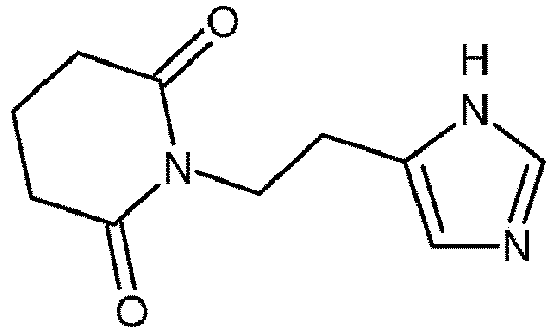 ou d'un sel pharmaceutiquement acceptable de celui-ci ; etun vecteur pharmaceutiquement acceptable.
 - Composition pharmaceutique pour utilisation dans un procédé de traitement selon la revendication 6, dans laquelle la maladie des voies respiratoires supérieures est la rhinosinusite
- Composition pharmaceutique pour utilisation dans un procédé de traitement selon la revendication 6, dans laquelle la maladie des voies respiratoires supérieures est causée par un virus comprenant un ARN, dans laquelle le virus est sélectionné dans le groupe constitué du rhinovirus, du virus Coxsackie, du virus respiratoire syncytial et du virus de la grippe.
- Composition pharmaceutique pour utilisation dans un procédé de traitement selon la revendication 6, dans laquelle la maladie des voies respiratoires supérieures est des exacerbations d'asthme, la bronchopneumopathie chronique obstructive, la bronchite ou la mucoviscidose, qui sont causées par un rhinovirus, le virus de la grippe et/ou le virus respiratoire syncytial.
- Procédé de préparation d'un composé ayant la formule suivante
 ou d'un sel pharmaceutiquement acceptable de celui-ci, comprenant le chauffage d'un monoamide d'acide dicarboxylique de formule
 acide 5-{[2-(1H-imidazol-5-yl)éthyl]amino}-5-oxopentanoïque,avec un agent déshydratant dans un solvant organique.
 - Procédé selon la revendication 10, dans lequel l'agent déshydratant est de l'anhydride glutarique, de l'anhydride propionique, de l'anhydride acétique, du chloroanhydride d'acide acétique ou du carbonyldiimidazole, et le procédé est réalisé sous chauffage dans un solvant organique.
- Procédé selon la revendication 10, dans lequel l'agent déshydratant est de l'anhydride glutarique, et le procédé est mis en oeuvre sous chauffage dans un solvant organique qui est du diméthylformamide.
- Procédé selon la revendication 10, dans lequel l'agent déshydratant est de l'anhydride propionique, et le procédé est réalisé sous chauffage dans un solvant organique qui est du toluène.
- Procédé selon la revendication 13, qui est mis en oeuvre avec ajout d'acétate de sodium.
- Procédé selon la revendication 10, dans lequel l'agent déshydratant est du chloroanhydride d'acide acétique, et le procédé est mis en oeuvre sous chauffage dans un solvant organique qui est de l'acide acétique ; ou
dans lequel l'agent déshydratant et le solvant sont de l'anhydride d'acide acétique, et le procédé est mis en oeuvre à 90-100 °C.
Applications Claiming Priority (3)
| Application Number | Priority Date | Filing Date | Title |
|---|---|---|---|
| RU2013116826A RU2562773C3 (ru) | 2013-04-12 | Производные глутаримидов, их применение, фармацевтическая композиция на их основе, способы их получения | |
| EP14782170.6A EP2985282A4 (fr) | 2013-04-12 | 2014-04-10 | Dérivés de glutarimides, leur utilisation, composition pharmaceutique sur leur base et procédés de fabrication |
| PCT/RU2014/000264 WO2014168522A1 (fr) | 2013-04-12 | 2014-04-10 | Dérivés de glutarimides, leur utilisation, composition pharmaceutique sur leur base et procédés de fabrication |
Related Parent Applications (1)
| Application Number | Title | Priority Date | Filing Date |
|---|---|---|---|
| EP14782170.6A Division EP2985282A4 (fr) | 2013-04-12 | 2014-04-10 | Dérivés de glutarimides, leur utilisation, composition pharmaceutique sur leur base et procédés de fabrication |
Publications (3)
| Publication Number | Publication Date |
|---|---|
| EP3725785A1 EP3725785A1 (fr) | 2020-10-21 |
| EP3725785C0 EP3725785C0 (fr) | 2024-04-10 |
| EP3725785B1 true EP3725785B1 (fr) | 2024-04-10 |
Family
ID=51689819
Family Applications (3)
| Application Number | Title | Priority Date | Filing Date |
|---|---|---|---|
| EP14782170.6A Withdrawn EP2985282A4 (fr) | 2013-04-12 | 2014-04-10 | Dérivés de glutarimides, leur utilisation, composition pharmaceutique sur leur base et procédés de fabrication |
| EP20178488.1A Active EP3725785B1 (fr) | 2013-04-12 | 2014-04-10 | Dérivé de glutarimide, son utilisation, composition pharmaceutique basée sur celui-ci et procédés de production du dérivé de glutarimide |
| EP20178489.9A Active EP3722290B1 (fr) | 2013-04-12 | 2014-04-10 | Dérivé de glutarimide, son utilisation, composition pharmaceutique basée sur celui-ci et procédés de production du dérivé de glutarimide |
Family Applications Before (1)
| Application Number | Title | Priority Date | Filing Date |
|---|---|---|---|
| EP14782170.6A Withdrawn EP2985282A4 (fr) | 2013-04-12 | 2014-04-10 | Dérivés de glutarimides, leur utilisation, composition pharmaceutique sur leur base et procédés de fabrication |
Family Applications After (1)
| Application Number | Title | Priority Date | Filing Date |
|---|---|---|---|
| EP20178489.9A Active EP3722290B1 (fr) | 2013-04-12 | 2014-04-10 | Dérivé de glutarimide, son utilisation, composition pharmaceutique basée sur celui-ci et procédés de production du dérivé de glutarimide |
Country Status (16)
| Country | Link |
|---|---|
| US (8) | US9815814B2 (fr) |
| EP (3) | EP2985282A4 (fr) |
| JP (4) | JP6529958B2 (fr) |
| KR (3) | KR102254315B1 (fr) |
| CN (4) | CN110128406B (fr) |
| AU (5) | AU2014251442A1 (fr) |
| BR (3) | BR122020010210B1 (fr) |
| CA (1) | CA2909057C (fr) |
| EA (4) | EA032938B1 (fr) |
| ES (1) | ES2988541T3 (fr) |
| IL (4) | IL266301B2 (fr) |
| MX (4) | MX380619B (fr) |
| SG (4) | SG10201802650WA (fr) |
| UA (1) | UA121299C2 (fr) |
| WO (1) | WO2014168522A1 (fr) |
| ZA (3) | ZA201508278B (fr) |
Families Citing this family (13)
| Publication number | Priority date | Publication date | Assignee | Title |
|---|---|---|---|---|
| CN110128406B (zh) * | 2013-04-12 | 2021-08-27 | 制药有限责任公司 | 戊二酰亚胺衍生物、其用途、基于所述衍生物的药物组合物及戊二酰亚胺衍生物的制备方法 |
| RU2552929C1 (ru) | 2013-11-14 | 2015-06-10 | Общество С Ограниченной Ответственностью "Фарминтерпрайсез" | Фармацевтическая композиция, содержащая производные глутаримидов, и их применение для лечения эозинофильных заболеваний |
| RU2628800C2 (ru) * | 2014-03-12 | 2017-08-22 | Общество С Ограниченной Ответственностью "Фарминтерпрайсез" | Амидные соединения, способы получения, применение в качестве средств для лечения и профилактики заболеваний, вызываемых рнк-содержащими вирусами |
| CN106539792B (zh) * | 2016-11-07 | 2017-08-25 | 王晓旭 | 一种治疗高血脂症的药物 |
| GEP20227402B (en) * | 2017-09-07 | 2022-08-10 | Valenta Intellekt Ltd | Use of glutarimide derivative to treat diseases related to aberrant activity of cytokines |
| US12378203B2 (en) | 2018-11-01 | 2025-08-05 | Ahammune Biosciences Private Limited | Imidazole compounds, process for the synthesis and uses thereof |
| RU2712281C1 (ru) * | 2018-11-23 | 2020-01-28 | Общество С Ограниченной Ответственностью "Хемиммьюн Терапьютикс" | Применение производного глутаримида для преодоления резистентности к стероидам и терапии заболеваний, ассоциированных с аберрантным сигналингом интерферона гамма |
| WO2021262040A1 (fr) * | 2020-06-26 | 2021-12-30 | Общество С Ограниченной Ответственностью "Валента-Интеллект" | Utilisation d'un dérivé de glutarimide pour traiter des maladies liées à l'activité aberrante d'interleukine-6 |
| WO2023121519A1 (fr) * | 2021-12-23 | 2023-06-29 | Общество С Ограниченной Ответственностью "Валента-Интеллект" | Utilisation de 1-[2-(1-méthyylimidazol-4-yl)-éthyl]perhydroazine-2,6-dione pour le traitement de la covid-19 |
| WO2023177329A1 (fr) * | 2022-03-18 | 2023-09-21 | Общество С Ограниченной Ответственностью "Валента-Интеллект" | Utilisation de 1-(2-(1н-imidazol-4-yl)éthyl)pipéridine-2,6-dione pour le traitement de la toux induite par des infections virales |
| WO2023191666A1 (fr) * | 2022-03-29 | 2023-10-05 | Общество С Ограниченной Ответственностью "Валента-Интеллект" | Forme cristalline de 1-(2-(1н-imidazol-4-yl)éthyl)pipéridine-2,6-dione, et utilisation de celle-ci |
| WO2023249516A1 (fr) * | 2022-06-24 | 2023-12-28 | Общество С Ограниченной Ответственностью "Валента-Интеллект" | Nouvelle forme cristalline de 1-[2-(1-méthylimidazol-4-yl)éthyl]perhydroazine-2,6-dione et utilisation pharmaceutique de celle-ci |
| US12425371B2 (en) * | 2022-09-16 | 2025-09-23 | Cisco Technology, Inc. | System and method for providing SCHC-based edge firewalling |
Family Cites Families (31)
| Publication number | Priority date | Publication date | Assignee | Title |
|---|---|---|---|---|
| US3081308A (en) * | 1959-12-29 | 1963-03-12 | Searle & Co | 5-carbocyclic-3-imidomethyloxazolidines and process |
| US3171839A (en) * | 1961-05-18 | 1965-03-02 | Searle & Co | 4-alkyl-1-(cyclic imidoalkyl) piperidines |
| GB1033251A (en) * | 1961-09-07 | 1966-06-22 | Distillers Co Yeast Ltd | Glutarimide derivatives |
| US3963691A (en) * | 1974-10-07 | 1976-06-15 | Merck & Co., Inc. | Synthetic antigens of luteinizing hormone releasing hormone |
| US4261990A (en) * | 1979-03-09 | 1981-04-14 | Ciba-Geigy Corporation | N-alkyleneiminoalkyl-dicarboximides as antiallergics and antiasthmatics |
| JPS606686A (ja) * | 1983-06-27 | 1985-01-14 | Kissei Pharmaceut Co Ltd | チオフエン誘導体及びその製造方法 |
| JPS6066686A (ja) | 1983-09-19 | 1985-04-16 | Toshiba Corp | ライン駆動電動機の速度制御装置 |
| SE8600261D0 (sv) * | 1986-01-21 | 1986-01-21 | Lundblad Leif | Indolokinoxaliner med substituenter i 6-position som innehaller cykliska grupper |
| SU1836365A3 (ru) * | 1991-01-24 | 1993-08-23 | Физиko-Xиmичeckий Иhctиtуt Иm.A.B.Бoгatckoгo;Hии@ Фapmakoлoгии Poccийckoй Amh | Способ получения ν-0-пиперазинил)бутилглутаримидов |
| FR2737725B1 (fr) | 1995-08-08 | 1997-10-31 | Valentonine | Nouveaux derives acyles de la melatonine et d'analogues melatoninergiques, leur procede de preparation et leur utilisation en tant que medicament |
| RU2141483C1 (ru) | 1997-07-04 | 1999-11-20 | Небольсин Владимир Евгеньевич | Производные пептидов или их фармацевтически приемлемые соли, способ их получения, применение и фармацевтическая композиция |
| WO1999012910A1 (fr) * | 1997-09-11 | 1999-03-18 | Nissan Chemical Industries, Ltd. | Composes a base de pyrazole et agent de lutte contre les maladies vegetales |
| ITMI991578A1 (it) * | 1999-07-15 | 2001-01-15 | Recordati Ind Chimica E Farma | Amidi e imidi cicliche dotate di attivita' antagonista selettiva per il recettore adrenergico |
| US6413428B1 (en) | 1999-09-16 | 2002-07-02 | Berger Instruments, Inc. | Apparatus and method for preparative supercritical fluid chromatography |
| DE10002509A1 (de) * | 2000-01-21 | 2001-07-26 | Gruenenthal Gmbh | Substituierte Glutarimide |
| US7030150B2 (en) * | 2001-05-11 | 2006-04-18 | Trimeris, Inc. | Benzimidazole compounds and antiviral uses thereof |
| WO2004022536A1 (fr) * | 2002-09-04 | 2004-03-18 | Glenmark Pharmaceuticals Limited | Nouveaux composes amides heterocycliques utilises pour le traitement d'affections inflammatoires et allergiques; procede permettant de les fabriquer et compositions pharmaceutiques les contenant |
| RU2337908C2 (ru) * | 2003-06-12 | 2008-11-10 | Ново Нордиск А/С | Пиридинилкарбаматы в качестве ингибиторов гормон-чувствительной липазы |
| CN1260218C (zh) * | 2003-11-06 | 2006-06-21 | 天津药物研究院 | 一类pdf酶抑制剂-异羟肟酸系列化合物及其合成方法与用途 |
| WO2006040646A1 (fr) * | 2004-10-14 | 2006-04-20 | Pfizer, Inc. | Amides de benzimidazole ou d'indole en tant qu'inhibiteurs de pin1 |
| BRPI0607062A2 (pt) * | 2005-02-28 | 2009-08-04 | Japan Tobacco Inc | composto de aminopiridina com atividade inibidora de syk, composição farmacêutica e agente terapêutico compreendendo os mesmos |
| EP1741709A1 (fr) * | 2005-06-28 | 2007-01-10 | Sanofi-Aventis Deutschland GmbH | Amides heterocycliques substitués contenant un linker saturé, et leur utilisation comme agent pharmaceutique |
| WO2007007054A1 (fr) | 2005-07-08 | 2007-01-18 | Cancer Research Technology Limited | Phthalamides, succinimides, composes apparentes et leur utilisation en tant que produits pharmaceutiques |
| US20120157387A1 (en) * | 2006-11-28 | 2012-06-21 | Apotex Technologies Inc. | Orally bioavailable d-gamma-glutamyl-d-tryptophan |
| US8557836B2 (en) * | 2008-09-16 | 2013-10-15 | The Trustees Of The University Of Pennsylvania | Spiro-piperidine inhibitors |
| AU2011241478B2 (en) * | 2010-04-15 | 2016-12-01 | Biota Scientific Management Pty Ltd | Compound for treatment of respiratory condition or disease |
| TW201217312A (en) * | 2010-09-22 | 2012-05-01 | Gruenenthal Gmbh | Substituted benzamide compounds |
| US20120157382A1 (en) * | 2010-12-21 | 2012-06-21 | Siegfried Krimmer | Pharmaceutical glp-1 compositions having an improved release profile |
| RU2665688C2 (ru) * | 2013-04-12 | 2018-09-04 | Общество С Ограниченной Ответственностью "Фарминтерпрайсез" | Производные бисамидов дикарбоновых кислот, их применение, фармацевтическая композиция на их основе, способы их получения |
| CN110128406B (zh) | 2013-04-12 | 2021-08-27 | 制药有限责任公司 | 戊二酰亚胺衍生物、其用途、基于所述衍生物的药物组合物及戊二酰亚胺衍生物的制备方法 |
| RU2552929C1 (ru) * | 2013-11-14 | 2015-06-10 | Общество С Ограниченной Ответственностью "Фарминтерпрайсез" | Фармацевтическая композиция, содержащая производные глутаримидов, и их применение для лечения эозинофильных заболеваний |
-
2014
- 2014-04-10 CN CN201910437242.XA patent/CN110128406B/zh active Active
- 2014-04-10 EP EP14782170.6A patent/EP2985282A4/fr not_active Withdrawn
- 2014-04-10 EP EP20178488.1A patent/EP3725785B1/fr active Active
- 2014-04-10 SG SG10201802650WA patent/SG10201802650WA/en unknown
- 2014-04-10 MX MX2015014336A patent/MX380619B/es unknown
- 2014-04-10 MX MX2020005736A patent/MX383551B/es unknown
- 2014-04-10 EA EA201792597A patent/EA032938B1/ru not_active IP Right Cessation
- 2014-04-10 SG SG10201802648SA patent/SG10201802648SA/en unknown
- 2014-04-10 BR BR122020010210-1A patent/BR122020010210B1/pt not_active IP Right Cessation
- 2014-04-10 KR KR1020207016268A patent/KR102254315B1/ko active Active
- 2014-04-10 EA EA201591957A patent/EA031392B1/ru unknown
- 2014-04-10 BR BR112015025804-2A patent/BR112015025804B1/pt not_active IP Right Cessation
- 2014-04-10 MX MX2020005738A patent/MX385329B/es unknown
- 2014-04-10 MX MX2020005735A patent/MX383762B/es unknown
- 2014-04-10 JP JP2016507512A patent/JP6529958B2/ja active Active
- 2014-04-10 SG SG10201802647QA patent/SG10201802647QA/en unknown
- 2014-04-10 EA EA201792071A patent/EA033054B1/ru unknown
- 2014-04-10 CN CN201910437243.4A patent/CN110172055B/zh active Active
- 2014-04-10 US US14/783,911 patent/US9815814B2/en active Active
- 2014-04-10 UA UAA201511008A patent/UA121299C2/uk unknown
- 2014-04-10 BR BR122020010204-7A patent/BR122020010204B1/pt active IP Right Grant
- 2014-04-10 WO PCT/RU2014/000264 patent/WO2014168522A1/fr not_active Ceased
- 2014-04-10 AU AU2014251442A patent/AU2014251442A1/en not_active Abandoned
- 2014-04-10 ES ES20178488T patent/ES2988541T3/es active Active
- 2014-04-10 EA EA201792072A patent/EA032951B1/ru unknown
- 2014-04-10 CA CA2909057A patent/CA2909057C/fr active Active
- 2014-04-10 KR KR1020207016274A patent/KR102296182B1/ko active Active
- 2014-04-10 CN CN201480032755.8A patent/CN106061962B/zh not_active Expired - Fee Related
- 2014-04-10 KR KR1020157032457A patent/KR102255929B1/ko not_active Expired - Fee Related
- 2014-04-10 EP EP20178489.9A patent/EP3722290B1/fr active Active
- 2014-04-10 IL IL266301A patent/IL266301B2/en unknown
- 2014-04-10 SG SG11201508394UA patent/SG11201508394UA/en unknown
- 2014-04-10 CN CN201910437241.5A patent/CN110229140B/zh not_active Expired - Fee Related
-
2015
- 2015-10-11 IL IL241998A patent/IL241998B/en active IP Right Grant
- 2015-11-10 ZA ZA2015/08278A patent/ZA201508278B/en unknown
-
2016
- 2016-05-10 ZA ZA2016/03108A patent/ZA201603108B/en unknown
- 2016-05-10 ZA ZA2016/03109A patent/ZA201603109B/en unknown
-
2017
- 2017-09-28 US US15/718,252 patent/US10155745B2/en active Active
- 2017-09-28 US US15/718,226 patent/US10155744B2/en active Active
- 2017-09-28 US US15/718,316 patent/US10155747B2/en active Active
- 2017-09-28 US US15/718,295 patent/US10155746B2/en active Active
- 2017-09-28 US US15/718,207 patent/US10155743B2/en active Active
- 2017-09-28 US US15/718,274 patent/US10196377B2/en active Active
-
2018
- 2018-09-27 AU AU2018236805A patent/AU2018236805C1/en not_active Ceased
- 2018-11-07 JP JP2018209575A patent/JP6843103B2/ja not_active Expired - Fee Related
- 2018-11-07 JP JP2018209573A patent/JP6627039B2/ja not_active Expired - Fee Related
- 2018-11-07 JP JP2018209574A patent/JP6620324B2/ja active Active
- 2018-11-15 US US16/192,065 patent/US10377739B2/en active Active
-
2019
- 2019-04-29 IL IL266302A patent/IL266302B/en unknown
- 2019-04-29 IL IL266300A patent/IL266300B/en unknown
-
2020
- 2020-06-02 AU AU2020203632A patent/AU2020203632B2/en active Active
- 2020-06-02 AU AU2020203630A patent/AU2020203630B2/en active Active
- 2020-06-15 AU AU2020203968A patent/AU2020203968B2/en not_active Ceased
Also Published As
Similar Documents
| Publication | Publication Date | Title |
|---|---|---|
| EP3725785B1 (fr) | Dérivé de glutarimide, son utilisation, composition pharmaceutique basée sur celui-ci et procédés de production du dérivé de glutarimide |
Legal Events
| Date | Code | Title | Description |
|---|---|---|---|
| PUAI | Public reference made under article 153(3) epc to a published international application that has entered the european phase |
Free format text: ORIGINAL CODE: 0009012 |
|
| STAA | Information on the status of an ep patent application or granted ep patent |
Free format text: STATUS: REQUEST FOR EXAMINATION WAS MADE |
|
| 17P | Request for examination filed |
Effective date: 20200605 |
|
| AC | Divisional application: reference to earlier application |
Ref document number: 2985282 Country of ref document: EP Kind code of ref document: P |
|
| AK | Designated contracting states |
Kind code of ref document: A1 Designated state(s): AL AT BE BG CH CY CZ DE DK EE ES FI FR GB GR HR HU IE IS IT LI LT LU LV MC MK MT NL NO PL PT RO RS SE SI SK SM TR |
|
| AX | Request for extension of the european patent |
Extension state: BA ME |
|
| STAA | Information on the status of an ep patent application or granted ep patent |
Free format text: STATUS: EXAMINATION IS IN PROGRESS |
|
| 17Q | First examination report despatched |
Effective date: 20220302 |
|
| GRAP | Despatch of communication of intention to grant a patent |
Free format text: ORIGINAL CODE: EPIDOSNIGR1 |
|
| STAA | Information on the status of an ep patent application or granted ep patent |
Free format text: STATUS: GRANT OF PATENT IS INTENDED |
|
| INTG | Intention to grant announced |
Effective date: 20230103 |
|
| GRAJ | Information related to disapproval of communication of intention to grant by the applicant or resumption of examination proceedings by the epo deleted |
Free format text: ORIGINAL CODE: EPIDOSDIGR1 |
|
| STAA | Information on the status of an ep patent application or granted ep patent |
Free format text: STATUS: EXAMINATION IS IN PROGRESS |
|
| GRAP | Despatch of communication of intention to grant a patent |
Free format text: ORIGINAL CODE: EPIDOSNIGR1 |
|
| STAA | Information on the status of an ep patent application or granted ep patent |
Free format text: STATUS: GRANT OF PATENT IS INTENDED |
|
| INTC | Intention to grant announced (deleted) | ||
| INTG | Intention to grant announced |
Effective date: 20230525 |
|
| GRAJ | Information related to disapproval of communication of intention to grant by the applicant or resumption of examination proceedings by the epo deleted |
Free format text: ORIGINAL CODE: EPIDOSDIGR1 |
|
| STAA | Information on the status of an ep patent application or granted ep patent |
Free format text: STATUS: EXAMINATION IS IN PROGRESS |
|
| GRAP | Despatch of communication of intention to grant a patent |
Free format text: ORIGINAL CODE: EPIDOSNIGR1 |
|
| STAA | Information on the status of an ep patent application or granted ep patent |
Free format text: STATUS: GRANT OF PATENT IS INTENDED |
|
| INTC | Intention to grant announced (deleted) | ||
| INTG | Intention to grant announced |
Effective date: 20231019 |
|
| GRAS | Grant fee paid |
Free format text: ORIGINAL CODE: EPIDOSNIGR3 |
|
| GRAA | (expected) grant |
Free format text: ORIGINAL CODE: 0009210 |
|
| STAA | Information on the status of an ep patent application or granted ep patent |
Free format text: STATUS: THE PATENT HAS BEEN GRANTED |
|
| RAP1 | Party data changed (applicant data changed or rights of an application transferred) |
Owner name: NEBOLSIN, VLADIMIR |
|
| AC | Divisional application: reference to earlier application |
Ref document number: 2985282 Country of ref document: EP Kind code of ref document: P |
|
| AK | Designated contracting states |
Kind code of ref document: B1 Designated state(s): AL AT BE BG CH CY CZ DE DK EE ES FI FR GB GR HR HU IE IS IT LI LT LU LV MC MK MT NL NO PL PT RO RS SE SI SK SM TR |
|
| REG | Reference to a national code |
Ref country code: GB Ref legal event code: FG4D |
|
| REG | Reference to a national code |
Ref country code: CH Ref legal event code: EP |
|
| REG | Reference to a national code |
Ref country code: DE Ref legal event code: R096 Ref document number: 602014089941 Country of ref document: DE |
|
| REG | Reference to a national code |
Ref country code: IE Ref legal event code: FG4D |
|
| U01 | Request for unitary effect filed |
Effective date: 20240429 |
|
| U07 | Unitary effect registered |
Designated state(s): AT BE BG DE DK EE FI FR IT LT LU LV MT NL PT SE SI Effective date: 20240506 |
|
| U20 | Renewal fee for the european patent with unitary effect paid |
Year of fee payment: 11 Effective date: 20240703 |
|
| PG25 | Lapsed in a contracting state [announced via postgrant information from national office to epo] |
Ref country code: IS Free format text: LAPSE BECAUSE OF FAILURE TO SUBMIT A TRANSLATION OF THE DESCRIPTION OR TO PAY THE FEE WITHIN THE PRESCRIBED TIME-LIMIT Effective date: 20240810 |
|
| PG25 | Lapsed in a contracting state [announced via postgrant information from national office to epo] |
Ref country code: HR Free format text: LAPSE BECAUSE OF FAILURE TO SUBMIT A TRANSLATION OF THE DESCRIPTION OR TO PAY THE FEE WITHIN THE PRESCRIBED TIME-LIMIT Effective date: 20240410 |
|
| PG25 | Lapsed in a contracting state [announced via postgrant information from national office to epo] |
Ref country code: GR Free format text: LAPSE BECAUSE OF FAILURE TO SUBMIT A TRANSLATION OF THE DESCRIPTION OR TO PAY THE FEE WITHIN THE PRESCRIBED TIME-LIMIT Effective date: 20240711 |
|
| PG25 | Lapsed in a contracting state [announced via postgrant information from national office to epo] |
Ref country code: PL Free format text: LAPSE BECAUSE OF FAILURE TO SUBMIT A TRANSLATION OF THE DESCRIPTION OR TO PAY THE FEE WITHIN THE PRESCRIBED TIME-LIMIT Effective date: 20240410 |
|
| PG25 | Lapsed in a contracting state [announced via postgrant information from national office to epo] |
Ref country code: PL Free format text: LAPSE BECAUSE OF FAILURE TO SUBMIT A TRANSLATION OF THE DESCRIPTION OR TO PAY THE FEE WITHIN THE PRESCRIBED TIME-LIMIT Effective date: 20240410 Ref country code: NO Free format text: LAPSE BECAUSE OF FAILURE TO SUBMIT A TRANSLATION OF THE DESCRIPTION OR TO PAY THE FEE WITHIN THE PRESCRIBED TIME-LIMIT Effective date: 20240710 Ref country code: IS Free format text: LAPSE BECAUSE OF FAILURE TO SUBMIT A TRANSLATION OF THE DESCRIPTION OR TO PAY THE FEE WITHIN THE PRESCRIBED TIME-LIMIT Effective date: 20240810 Ref country code: HR Free format text: LAPSE BECAUSE OF FAILURE TO SUBMIT A TRANSLATION OF THE DESCRIPTION OR TO PAY THE FEE WITHIN THE PRESCRIBED TIME-LIMIT Effective date: 20240410 Ref country code: GR Free format text: LAPSE BECAUSE OF FAILURE TO SUBMIT A TRANSLATION OF THE DESCRIPTION OR TO PAY THE FEE WITHIN THE PRESCRIBED TIME-LIMIT Effective date: 20240711 Ref country code: RS Free format text: LAPSE BECAUSE OF FAILURE TO SUBMIT A TRANSLATION OF THE DESCRIPTION OR TO PAY THE FEE WITHIN THE PRESCRIBED TIME-LIMIT Effective date: 20240710 |
|
| REG | Reference to a national code |
Ref country code: ES Ref legal event code: FG2A Ref document number: 2988541 Country of ref document: ES Kind code of ref document: T3 Effective date: 20241120 |
|
| REG | Reference to a national code |
Ref country code: DE Ref legal event code: R097 Ref document number: 602014089941 Country of ref document: DE |
|
| PG25 | Lapsed in a contracting state [announced via postgrant information from national office to epo] |
Ref country code: SK Free format text: LAPSE BECAUSE OF FAILURE TO SUBMIT A TRANSLATION OF THE DESCRIPTION OR TO PAY THE FEE WITHIN THE PRESCRIBED TIME-LIMIT Effective date: 20240410 Ref country code: RO Free format text: LAPSE BECAUSE OF FAILURE TO SUBMIT A TRANSLATION OF THE DESCRIPTION OR TO PAY THE FEE WITHIN THE PRESCRIBED TIME-LIMIT Effective date: 20240410 |
|
| PG25 | Lapsed in a contracting state [announced via postgrant information from national office to epo] |
Ref country code: SM Free format text: LAPSE BECAUSE OF FAILURE TO SUBMIT A TRANSLATION OF THE DESCRIPTION OR TO PAY THE FEE WITHIN THE PRESCRIBED TIME-LIMIT Effective date: 20240410 |
|
| PG25 | Lapsed in a contracting state [announced via postgrant information from national office to epo] |
Ref country code: SM Free format text: LAPSE BECAUSE OF FAILURE TO SUBMIT A TRANSLATION OF THE DESCRIPTION OR TO PAY THE FEE WITHIN THE PRESCRIBED TIME-LIMIT Effective date: 20240410 Ref country code: SK Free format text: LAPSE BECAUSE OF FAILURE TO SUBMIT A TRANSLATION OF THE DESCRIPTION OR TO PAY THE FEE WITHIN THE PRESCRIBED TIME-LIMIT Effective date: 20240410 Ref country code: RO Free format text: LAPSE BECAUSE OF FAILURE TO SUBMIT A TRANSLATION OF THE DESCRIPTION OR TO PAY THE FEE WITHIN THE PRESCRIBED TIME-LIMIT Effective date: 20240410 Ref country code: MC Free format text: LAPSE BECAUSE OF FAILURE TO SUBMIT A TRANSLATION OF THE DESCRIPTION OR TO PAY THE FEE WITHIN THE PRESCRIBED TIME-LIMIT Effective date: 20240410 |
|
| PLBE | No opposition filed within time limit |
Free format text: ORIGINAL CODE: 0009261 |
|
| STAA | Information on the status of an ep patent application or granted ep patent |
Free format text: STATUS: NO OPPOSITION FILED WITHIN TIME LIMIT |
|
| 26N | No opposition filed |
Effective date: 20250113 |
|
| PG25 | Lapsed in a contracting state [announced via postgrant information from national office to epo] |
Ref country code: IE Free format text: LAPSE BECAUSE OF NON-PAYMENT OF DUE FEES Effective date: 20240410 |
|
| U20 | Renewal fee for the european patent with unitary effect paid |
Year of fee payment: 12 Effective date: 20250424 |
|
| PGFP | Annual fee paid to national office [announced via postgrant information from national office to epo] |
Ref country code: GB Payment date: 20250423 Year of fee payment: 12 Ref country code: ES Payment date: 20250519 Year of fee payment: 12 |
|
| PGFP | Annual fee paid to national office [announced via postgrant information from national office to epo] |
Ref country code: CH Payment date: 20250501 Year of fee payment: 12 |
|
| PGFP | Annual fee paid to national office [announced via postgrant information from national office to epo] |
Ref country code: TR Payment date: 20250502 Year of fee payment: 12 |
|
| PGFP | Annual fee paid to national office [announced via postgrant information from national office to epo] |
Ref country code: CZ Payment date: 20250428 Year of fee payment: 12 |
|
| PG25 | Lapsed in a contracting state [announced via postgrant information from national office to epo] |
Ref country code: CY Free format text: LAPSE BECAUSE OF FAILURE TO SUBMIT A TRANSLATION OF THE DESCRIPTION OR TO PAY THE FEE WITHIN THE PRESCRIBED TIME-LIMIT; INVALID AB INITIO Effective date: 20140410 |
|
| PG25 | Lapsed in a contracting state [announced via postgrant information from national office to epo] |
Ref country code: HU Free format text: LAPSE BECAUSE OF FAILURE TO SUBMIT A TRANSLATION OF THE DESCRIPTION OR TO PAY THE FEE WITHIN THE PRESCRIBED TIME-LIMIT; INVALID AB INITIO Effective date: 20140410 |