EP3732329B1 - Verfahren zum betreiben eines stopfaggregats einer gleisbaumaschine sowie stopfvorrichtung zur gleisbettverdichtung und gleisbaumaschine - Google Patents
Verfahren zum betreiben eines stopfaggregats einer gleisbaumaschine sowie stopfvorrichtung zur gleisbettverdichtung und gleisbaumaschine Download PDFInfo
- Publication number
- EP3732329B1 EP3732329B1 EP18811768.3A EP18811768A EP3732329B1 EP 3732329 B1 EP3732329 B1 EP 3732329B1 EP 18811768 A EP18811768 A EP 18811768A EP 3732329 B1 EP3732329 B1 EP 3732329B1
- Authority
- EP
- European Patent Office
- Prior art keywords
- tamping
- unit
- tamping unit
- damage
- track
- Prior art date
- Legal status (The legal status is an assumption and is not a legal conclusion. Google has not performed a legal analysis and makes no representation as to the accuracy of the status listed.)
- Active
Links
Images




Classifications
-
- E—FIXED CONSTRUCTIONS
- E01—CONSTRUCTION OF ROADS, RAILWAYS, OR BRIDGES
- E01B—PERMANENT WAY; PERMANENT-WAY TOOLS; MACHINES FOR MAKING RAILWAYS OF ALL KINDS
- E01B27/00—Placing, renewing, working, cleaning, or taking-up the ballast, with or without concurrent work on the track; Devices therefor; Packing sleepers
- E01B27/12—Packing sleepers, with or without concurrent work on the track; Compacting track-carrying ballast
- E01B27/13—Packing sleepers, with or without concurrent work on the track
- E01B27/16—Sleeper-tamping machines
-
- E—FIXED CONSTRUCTIONS
- E01—CONSTRUCTION OF ROADS, RAILWAYS, OR BRIDGES
- E01B—PERMANENT WAY; PERMANENT-WAY TOOLS; MACHINES FOR MAKING RAILWAYS OF ALL KINDS
- E01B35/00—Applications of measuring apparatus or devices for track-building purposes
-
- E—FIXED CONSTRUCTIONS
- E01—CONSTRUCTION OF ROADS, RAILWAYS, OR BRIDGES
- E01B—PERMANENT WAY; PERMANENT-WAY TOOLS; MACHINES FOR MAKING RAILWAYS OF ALL KINDS
- E01B2203/00—Devices for working the railway-superstructure
- E01B2203/12—Tamping devices
Definitions
- the invention relates to a method for operating a tamping unit of a track construction machine and further to a tamping device for track bed compaction and a track construction machine.
- Rail-guided track construction machines are used to maintain a track bed.
- Such track construction machines have a tamping unit that can be moved in a vertical direction for track bed compaction, with a unit frame and at least two tamping tines that can be moved relative to the unit frame.
- the tamping unit is repeatedly moved in a vertical direction between a reset position in which the tamping unit is disengaged from the track bed and an engagement position in which the tamping unit is engaged with the track bed.
- the at least two tamping tines are moved cyclically relative to the unit frame. This places a great deal of stress on the tamping unit, which can lead to damage to the tamping unit, in particular to a tamping tine breaking.
- the track bed is not compacted sufficiently and functional components of the tamping unit can be overstressed.
- time-consuming and costly inspection and maintenance work is carried out regularly.
- Tamping units and methods for track bed treatment are known, for example, from GB 2,451,310 A , from the EP 2 770 108 A1 , from the EP 3 239 398 A1 , from the WO 2014/102401 A1 , from the WO 2017/097390 A1 and from the WO 2017/129215 A1 .
- the invention is based on the object of creating a method for operating a tamping unit of a track construction machine, which increases the reliability and economic efficiency of the tamping unit during operation.
- a state of damage to a tamping pick of the tamping unit designed to interact with the track bed can be determined using the at least one measured variable.
- the at least one part of the tamping unit can be understood to mean a component or part of a component of the tamping unit.
- the tamping unit can comprise an unit frame, at least two tamping pick supports attached to the unit frame and displaceable relative to it, and a tamping pick drive for displacing the at least two tamping pick supports relative to the unit frame.
- the tamping pick can be attached to one of the at least two tamping pick supports.
- the at least two tamping picks are subjected to particularly high stress when the tamping unit is in operation.
- the at least two tamping picks are therefore subjected to high levels of wear, which means that breakage of the at least two tamping picks cannot be ruled out. If one of the at least two tamping tines breaks, the track bed is only partially compacted and therefore inadequate.
- By quickly and reliably identifying the damage to the at least two tamping tines they can be replaced as soon as the damage occurs.
- the damage to the tamping unit, in particular the tamping tine can thus be identified particularly reliably and promptly after the damage occurs, in particular automatically.
- the tamping unit can be displaced in a vertical direction by means of a unit drive.
- the tamping unit can be accelerated as a whole, in particular by means of the unit drive.
- the acceleration of at least one part of the tamping unit can also be achieved by accelerating at least one of the components, in particular the unit frame and/or the at least two tamping tine supports and/or the at least two tamping tines and/or the tamping tine drive or a part of this at least one component.
- Acceleration can be achieved by means of the drive device and/or by means of a separate exciter drive and/or by means of an exciter brake.
- the drive device can comprise the unit drive and the tamping tine drive.
- the exciter drive can be positioned anywhere on the tamping unit and operated independently of the track bed compaction. A movement of at least part of the tamping unit can be braked by means of the exciter brake.
- the acceleration can be discrete and/or cyclical. During acceleration, a movement speed of at least one part can be increased and/or reduced.
- a driving force required for acceleration and/or an acceleration can be recorded.
- the driving force is also understood to mean a braking force required for negative acceleration and for deceleration.
- the at least one measured variable can be recorded on the at least one part of the tamping unit.
- the at least one measured variable can also be recorded on a part of the at least one part spaced position.
- the at least one measured variable can also be a variable that correlates with the driving force, in particular a hydraulic pressure in a hydraulic cylinder and/or a current flow in an electric motor.
- the at least one measured variable can also be a measured variable that correlates with the acceleration, in particular a speed and/or an angular velocity.
- the at least one measured variable can be recorded continuously over time or at discrete points in time.
- the damage state can be determined analogously or digitally.
- the at least one measured variable is recorded at at least two, in particular at least three, in particular at least four, measuring positions on the tamping unit.
- the damage status of the tamping unit can be determined by distinguishing between functionality and damage to the tamping unit.
- a functional tamping unit is understood to be an undamaged tamping unit.
- the damage status can also be determined by determining the type and/or position and/or severity of the damage. For example, the damage status can be determined for at least one of the components of the tamping unit. The advantage of this is that damaged components of the tamping unit can be identified and replaced quickly and reliably.
- a change in at least one measured variable can be determined.
- the speed of the change in at least one measured variable can also be used to determine the state of damage of the tamping unit. Wear of the tamping unit that increases over time can thus be distinguished from a sudden failure of the tamping unit, in particular of a component of the tamping unit.
- a method according to claim 2 ensures the increased reliability and efficiency of the track construction machine.
- Damage to one of the at least two tamping tines can, for example, lead to a change in a Bearing play and/or a change in the mass of the tamping tine.
- the at least one measured variable correlating with the acceleration changes along with the damage to the tamping tine. Damage to the tamping unit, in particular to one of the at least two tamping tines, can thus be detected particularly reliably by accelerating the at least two tamping tines.
- the at least two tamping tines can be accelerated by means of the drive device, in particular relative to the unit frame.
- the tamping tines are preferably accelerated via the tamping tine drive.
- the at least one measured variable can be recorded directly on the at least two tamping tines.
- the at least one measured variable can also be recorded on the at least two tamping tine supports and/or on the drive device, in particular on the tamping tine drive, in particular on a drive housing of the tamping tine drive, and/or on the unit frame.
- the drive housing can at least partially enclose a gear of the tamping tine drive and is also referred to as a gear box.
- a method according to claim 3 ensures the increased reliability and cost-effectiveness of the track construction machine.
- the position and/or the orientation of the tamping unit in particular of a component of the tamping unit, can be detected particularly easily and reliably.
- the position can be, for example, the vertical position of the tamping unit relative to the unit carrier.
- the orientation can be an angle of rotation of the tamping pick carrier.
- sensors of the drive device required to drive the tamping unit can be used to detect the at least one measured variable.
- the position and/or the orientation can be detected, for example, by means of a position sensor and/or a rotary encoder.
- a Hall sensor and/or a Potentiometer and/or a cable length sensor and/or an ultrasonic sensor and/or a laser sensor may be used.
- a method according to claim 4 ensures the increased reliability and cost-effectiveness of the track construction machine.
- the acceleration of at least one part takes place by means of the drive device.
- the measured variable that correlates with the acceleration can be reliably recorded directly on the drive device.
- the drive device acts on the at least two tamping tines via the at least two tamping tine supports. By recording the at least one measured variable on one of the at least two tamping tine supports, it is recorded along the load flow, between the drive device and the at least two tamping tines that are subject to particularly high loads. In particular, damage to the at least two tamping tines can thus be determined particularly reliably.
- the at least one measured variable can be an angular acceleration of the at least two tamping tine supports and/or a linear acceleration, in particular of the support bearing via which the at least one tamping tine support is connected to the tamping tine drive.
- the at least one measured variable can also be a travel of the drive device, in particular of the unit drive and/or the tamping tine drive. The at least one measured variable can thus be recorded particularly robustly and reliably.
- a method according to claim 5 ensures the reliability and cost-effectiveness of the track construction machine.
- the hydraulic pressure can be the pressure of a hydraulic fluid of the tamping tine drive and/or the unit drive.
- the hydraulic pressure can thus correlate with the drive force. Since the drive force correlates with the acceleration via the inertia of the tamping unit, the at least one measured variable can be determined particularly easily and robustly using the hydraulic pressure.
- a moment acting on the at least two tamping tines and/or a force acting on the at least two tamping tines can be determined.
- the at least one measured variable can also be in the form of the
- the damage status of the tamping unit can be determined based on a change in the force and/or the torque.
- a method according to claim 6 ensures the increased reliability and cost-effectiveness of the track construction machine.
- the tamping unit In the reset position, the tamping unit is not engaged with the track bed.
- influences of the track bed on the acceleration of at least one part of the tamping unit can be excluded.
- a varying condition of the track bed along the track has no influence on the at least one measured variable. The damage status of the tamping unit can thus be detected particularly robustly and reliably.
- the at least one reference variable can correspond to the at least one measured variable for a specific damage state.
- the at least one reference variable corresponds to the at least one measured variable for the functional state and/or for the damaged state of the tamping unit and/or for the damaged state of at least one component of the tamping unit.
- the at least one measured variable is compared with several reference variables.
- At least two reference variables can correspond to several specific damage states.
- it can be determined not only whether, but also to what extent, at which point and at which component damage to the tamping unit is present.
- the at least one reference variable is recorded by recording the at least one measured variable in a specific damage state.
- the at least one reference variable can also be determined once, in particular during installation and/or after maintenance of the tamping unit.
- the at least one reference variable can be determined regularly, in particular after a maximum of 100, in particular after a maximum of 10, in particular after each tamping cycle.
- a tamping cycle includes moving the tamping unit from the reset position to the engagement position and back to the reset position.
- the at least one reference variable is thus available for later comparison with the at least one measured variable. This also advantageously ensures that the at least one reference variable can be individually adapted to the respective tamping unit, in particular to the individual kinematic and mechanical properties of the tamping unit, and in particular to normal wear.
- a method according to claim 8 ensures the reliability and cost-effectiveness of the track construction machine.
- Damage to the tamping unit can be determined particularly easily and reliably if the at least one measured variable deviates from the at least one reference variable in the form of at least one previously recorded measured variable.
- the reference variable can also include several measured variables recorded at an earlier point in time. Several measured variables spaced apart in time can also be compared with the at least one reference variable to determine the state of damage. The determination of the state of damage is therefore particularly robust against random measurement deviations.
- the at least two tamping tines can be removed from the tamping unit before it is operated.
- the at least one measurement variable can be the position and/or orientation of the at least one part.
- the acceleration of the at least one part can be determined from the position and/or orientation.
- the recording of the at least one measured variable is particularly simple and robust.
- a change in the at least one measured variable over time can be recorded based on the time course. For example, it can be determined how much the tamping unit, in particular an individual component of the tamping unit, has already worn out and/or whether there is sudden damage to the tamping unit, in particular a break in one of the at least two tamping picks.
- an amplitude and/or a phase shift and/or a frequency of the at least one measured variable can be determined to determine the damage state.
- an amplitude of a linear acceleration and/or an angular acceleration can be determined to determine the damage state.
- a phase shift of a linear acceleration and/or an angular acceleration is determined to determine the damage state of the tamping unit.
- a method according to claim 10 ensures the increased reliability and cost-effectiveness of the track construction machine.
- the structural model preferably includes information about the geometric design and/or the bearing and/or the materials, in particular the density and/or the rigidity, of the tamping unit.
- the structural model and the at least one measured variable can be used to determine the state of damage particularly reliably and/or the extent of the damage can be determined.
- the structural model can be used to determine which component, in particular whether the at least two tamping picks and/or a bearing point and/or the drive device, is damaged and/or how severely it is damaged.
- the state of wear of the tamping unit can also be determined. The operability of the tamping unit can thus be exploited to the greatest extent possible, thereby increasing the economic efficiency of the track construction machine.
- a method according to claim 11 ensures the increased reliability and cost-effectiveness of the track construction machine.
- the damage to the tamping unit is preferably detected when the at least one measured variable exceeds the at least one threshold value.
- the at least one measured variable can be low when the tamping unit is in working order and increase when the tamping unit is damaged.
- the damage can be determined immediately, in particular without further comparison with other values.
- the threshold value can be fixed. The damage can thus be determined particularly easily and reliably.
- the at least one sensor for detecting the at least one measured variable can be attached to the tamping unit at a distance from a center of gravity of the tamping unit, for example.
- the at least one sensor can be designed as an acceleration sensor for detecting acceleration in the vertical direction. When the tamping unit is in working order, the acceleration acting on the at least one sensor is low. If the at least two tamping picks break, the acceleration of the at least one sensor in the vertical direction can increase significantly. If the at least one threshold value is exceeded, damage to the tamping unit can be detected.
- a difference between the measured value and the reference value can also be compared with a threshold value.
- a method according to claim 12 ensures the increased reliability and cost-effectiveness of the track construction machine. By interrupting the operation of the tamping unit after the damage has been detected, it can be prevented that the track bed is only insufficiently compacted and that the tamping unit is exposed to increased stress.
- a signal in particular a A warning tone and/or a visual signal are provided for a user. This has the advantage that the damage to the tamping unit is noticed by the user promptly after the damage occurs.
- a loss of mass of the tamping unit in particular in the dynamic system of the tamping unit, can be concluded. Based on the loss of mass, the state of damage of the tamping unit can be determined.
- a movement pattern of the tamping unit in particular of a part of the tamping unit, can be determined using the at least one measured variable.
- the damage state of the tamping unit can be determined based on a change in the movement pattern.
- the invention is further based on the object of creating a tamping device for track bed compaction which has increased reliability and economic efficiency in operation.
- a tamping device with the features of claim 13.
- the advantages of the tamping device according to the invention correspond to the advantages of the method according to the invention.
- the tamping device can be further developed in particular with the features of at least one of claims 1 to 12.
- the tamping unit is attached to the unit carrier so that it can be displaced in the vertical direction.
- the at least one sensor can be designed as an acceleration sensor and/or as a pressure sensor and/or as a position sensor and/or as a rotary encoder and/or as a current sensor.
- the at least one sensor is preferably in signal connection with the evaluation unit.
- the tamping device can have a control unit for controlling the drive device and/or for signaling a damage state of the tamping unit.
- the control unit can have a user interface for signaling the damage state.
- the control unit is preferably designed for this purpose. designed to interrupt the operation of the tamping device, in particular of the tamping unit, when damage is signaled by the evaluation unit.
- the control unit can also be designed to output a signal, in particular a signal tone and/or a visual signal, to the user via the user interface when the evaluation unit signals damage to the tamping unit.
- the invention is further based on the object of creating a track construction machine with a tamping device which has increased reliability and economic efficiency.
- a track construction machine 1 has a machine frame 2, at least two axles 3 mounted on the machine frame 2, a machine drive 4 and a tamping device 5 for track bed compaction.
- the axles 3 are arranged on the track construction machine 1 at a distance from one another along a horizontal x-direction.
- the x-direction together with a vertical z-direction and a horizontal y-direction, forms a machine-fixed coordinate system.
- Rail-guided wheels 6 are rotatably mounted on the axles 3.
- the machine drive 2 is designed to drive the wheels 6 of at least one of the axles 3 in rotation.
- the tamping device 5 has an aggregate carrier 7, a tamping aggregate 8 mounted on the aggregate carrier 7, a drive device 9, a sensor 10 and an evaluation unit 11.
- a linear guide 12 is arranged between the aggregate carrier 7 and the tamping aggregate 8.
- the tamping aggregate 8 can be displaced along the z-direction relative to the aggregate carrier 7 via the linear guide 12.
- the drive device 9 comprises an aggregate drive 13 and a tamping tine drive 14.
- the aggregate drive 13 acts between the aggregate carrier 7 and the tamping aggregate 8 and provides an aggregate force F A for displacing the tamping aggregate 8 relative to the aggregate carrier 7.
- the tamping aggregate 8 has an aggregate frame 15.
- Two tamping tine carriers 16 are attached to the aggregate frame 15 at a distance from one another in the x direction.
- the tamping tine carriers 16 are each rotatably mounted on the aggregate frame 15 via a carrier axis 17 oriented parallel to the y direction.
- the tamping tine drive 14 is designed as a linear drive and acts between the unit frame 15 and one of the tamping tine supports 16.
- the tamping tine drive 14 has a hydraulic drive and an eccentric drive.
- the hydraulic drive ensures a high displacement amplitude at a low displacement frequency.
- the eccentric drive is designed to provide a low displacement amplitude and a high displacement frequency, in particular a compaction frequency f V .
- Both the hydraulic drive and the eccentric drive act between the unit frame 15 and the respective Tamping tine carrier 16.
- the tamping tine drive 14 is designed to provide a driving force F V to the respective tamping tine carrier 16.
- Two tamping tines 18 are attached to an underside of the respective tamping tine carrier 16. The driving force F V can thus be transferred to a track bed 19 via the respective tamping tine carrier 16 and the tamping tines 18 attached to it.
- the sensor 10 is in signal connection with the evaluation unit 11 via a signal line 20.
- the evaluation unit 11 is in turn in signal connection with a control unit 21.
- the control unit 21 has a user interface 22 for exchanging information with a user.
- the evaluation unit 11 comprises a storage means 23 for storing at least one reference variable.
- the sensor 10 is designed as an acceleration sensor and is arranged on a drive housing 24 of the tamping pick drive 14.
- the track construction machine 1 To create or maintain the track bed 19, the track construction machine 1 is moved along the x-direction on a track 25 by means of the machine drive 4.
- a central axis 26 of the tamping device 5 is positioned centrally above a railway sleeper 27 arranged on the track bed 19 to support the tracks 25.
- the tamping unit 8 is in a reset position 28.
- the tamping unit 8 is located at an upper end position of the linear guide 12 and the tamping picks 18 attached to the tamping unit 8 are not engaged with the track bed 19.
- the tamping unit 8 is functional and shows no damage.
- the tamping tine drive 14 is activated by a signal from the control unit 21.
- the tamping tine drive 14 is connected to the two Tamping tine carriers 16.
- the tamping tine drive 14 transmits a cyclic lifting movement to the respective tamping tine carrier 16.
- the rotatably mounted tamping tine carriers 16 move cyclically about the respective carrier axis 17.
- the cyclical lifting movement transmitted from the tamping tine drive 14 to the two tamping tine supports 16 has a compression frequency f V of 35 Hertz to 45 Hertz.
- Bearing forces are transmitted to the unit frame 15 via the bearing axes 17 of the tamping tine supports 16 and via the drive housing 24 of the tamping tine drive 14 and excite the tamping unit 8 to oscillate at an unit frequency f A .
- the unit frequency f A essentially corresponds to the compression frequency f V .
- the unit frequency f A also acts on the drive housing 24 and causes it to oscillate.
- the sensor 10 attached to the drive housing 24 records six measured variables in the form of the vector of the linear accelerations a and the vector of the angular accelerations ⁇ .
- the accelerations a , ⁇ recorded by the sensor 10 are dependent on a mass m A of the tamping unit 8, in particular on masses m S of the respective tamping tines 18.
- the drive force F V in the return position 28 is only counteracted by the inertial force F T.
- M V is a drive torque
- I is an inertial moment
- M T is a moment of inertia acting due to the angular acceleration ⁇ and due to the inertial moment I.
- the aggregate amplitudes S a of the linear accelerations a and the aggregate amplitudes S a of the angular accelerations ⁇ are dependent on the mass m A of the tamping unit 8, in particular on the mass m S of the tamping pick 18.
- the courses of the measured variables a , ⁇ are determined for the undamaged tamping unit 8 and stored in the storage means 23 as reference variables a 0 , ⁇ 0 .
- the reference variables and the resulting further variables are marked with the index 0 below.
- the curves of the linear accelerations a 0 of the functional tamping unit 8 are shown over a time t.
- the tamping unit 8 is moved towards the track bed 19 by means of the unit drive 13 in the opposite direction to the z-direction.
- the tamping unit 8 In an engagement position 30, the tamping unit 8 is located at a lower end of the linear guide 12. The four tamping picks 18 penetrate into the track bed 19.
- the tamping unit 8 arranged in the engagement position 30 is in Fig. 3 and Fig. 4
- the operation of the tamping tine drive 14 is maintained during the displacement between the reset position 28 and the engagement position 30 as well as in the engagement position 30.
- the tamping tines 18 spaced apart in the x-direction are moved towards each other by means of the tamping tine drive 14 in the engagement position 30.
- the compaction of the track bed 19 takes place by the superposition of these two displacement components of the tamping tines 18.
- the tamping unit 8 is moved back from the engagement position 30 to the reset position 28 by means of the unit drive 13. The tamping cycle is thus completed.
- the Track construction machine 1 in particular the tamping device 5, is displaced in the x-direction such that the central axis 26 is arranged centrally above the next railway sleeper 27 in the x-direction.
- the breakage of the tamping pick 18 reduces its mass m S. This also reduces the mass of the tamping unit m A. This changes the inertia forces F T and moments of inertia M T that counteract the driving force F V. This in turn affects the vibration behavior of the tamping unit 8.
- the measured variables a , ⁇ are recorded again using the sensor 10.
- the measured variables a, ⁇ recorded using the damaged tamping unit 8 and the other variables resulting from them are identified below with the index 1.
- the current measured variables a 1 , ⁇ 1 are compared with the reference variables a 0 , ⁇ 0.
- the aggregate amplitudes S a,1 , S ⁇ ,1 and the phase shifts ⁇ a,1 , ⁇ ⁇ ,1 of the measured variables a 1 , ⁇ 1 are compared with the aggregate amplitudes S a,0 , S ⁇ ,0 and the phase shifts ⁇ a,0 , ⁇ ⁇ ,0 of the reference variables a 0 , ⁇ 0 .
- Damage to the tamping unit 8 is detected if a difference between the measured unit amplitudes S a,1 , S ⁇ ,1 and the reference values of the unit amplitudes S a,0 , S ⁇ ,0 reaches or exceeds a threshold value SW S.
- Damage to the tamping unit 8 is also detected if a difference between the measured phase shifts ⁇ a,1 , ⁇ ⁇ ,1 and the reference values of the phase shifts ⁇ a,0 , ⁇ ⁇ ,0 exceeds a threshold value SW ⁇ for the phase shifts. Damage to the tamping unit is therefore determined if the following applies: S 1 ⁇ S 0 ⁇ SW S ⁇ 1 ⁇ ⁇ 0 ⁇ SW ⁇
- Fig. 6 the curves of the linear accelerations a 1 recorded at the sensor 10 for the damaged tamping unit 8 with the broken tamping pick 18 are shown over time. From the Fig. 6 the aggregate amplitudes S a,1 and the phase shifts ⁇ a,1 of the linear accelerations emerge. In Fig. 8 are the courses of the Angular accelerations ⁇ 1 of the damaged tamping unit 8 are shown over time t. From the Fig. 8 the aggregate amplitudes S ⁇ ,1 and the phase shifts ⁇ ⁇ ,1 of the angular accelerations ⁇ 1 emerge.
- the evaluation unit 11 detects damage to the tamping unit 8. Based on a signal from the evaluation unit 11, the control unit 21 interrupts the operation of the tamping unit 8. The user is notified of the damage to the tamping unit 8 via the user interface 22.
- the tamping device 5 comprises two sensors 10, which are designed as position sensors.
- the two sensors 10 are each arranged on a tamping tine drive 14 and are designed to detect a travel s of the tamping tine drive 14.
- the sensors 10 are in signal connection with the evaluation unit 11 via a signal line 20.
- the measured variable s is recorded in the form of the travel s.
- the actuating acceleration s" d 2 s/dt 2 is determined.
- the setting acceleration s" is used in the same way as the accelerations a , ⁇ according to the previous embodiment.
- a position in the x-direction and/or in the y-direction and/or in the z-direction can also be recorded.
- An orientation around the x-direction and/or around the y-direction and/or the z-direction, for example from one of the tamping pick carriers 16, can be detected.
- FIG. 10 A further embodiment of the stuffing device 5 is shown in Fig. 10 shown.
- the tamping device 5 has two sensors 10 in the form of pressure sensors.
- the two sensors 10 are designed to detect a pressure of a hydraulic fluid in a hydraulic cylinder 31 of the tamping tine drive 14.
- the two sensors 10 are connected to the hydraulic cylinders 31 via pressure lines 32.
- the sensors 10 are in signal connection with the evaluation unit 11 via the signal lines 20.
- a temporal progression of the pressure p is compared with a temporal progression of a reference pressure p 0 .
- the change in the mass m of the tamping unit 8 leads to a change in the inertial force F T and thus to a change in the driving force F V required for the acceleration a. Damage to the tamping unit 8 is detected if the amount of the difference between the measured variable p and the reference variable p 0 exceeds a threshold value SW p .
- a structural model of the tamping unit 8 is stored in the evaluation unit 11.
- the structural model includes the components of the tamping unit 8, their masses, their bearings, and their materials and rigidities. Based on the driving force F V acting on the tamping unit 8 and the recorded at least one measured variable a , ⁇ , p, s , the structural model can be used to infer specific damage to the tamping unit 8. For example, the reduction in the mass m S of a specific tamping pick 18 can be recognized.
- a type of damage in particular a position of the damage on the tamping unit 8, is determined.
- damage to the tamping unit 8 can be detected particularly reliably.
- the damage can be automatically detected by means of the evaluation unit 11.
- the need for a regular visual inspection of the tamping unit 8 is eliminated and the risk of operating the tamping unit 8 in a damaged state, whereby sufficient compaction of the track bed 19 cannot be guaranteed and undamaged components of the tamping unit 8 can be overstressed, is avoided.
- the track construction machine 1, in particular the tamping unit 8, is therefore particularly efficient and economical in operation.
Landscapes
- Engineering & Computer Science (AREA)
- Architecture (AREA)
- Civil Engineering (AREA)
- Structural Engineering (AREA)
- Machines For Laying And Maintaining Railways (AREA)
Description
- Die Erfindung betrifft ein Verfahren zum Betreiben eines Stopfaggregats einer Gleisbaumaschine und ferner eine Stopfvorrichtung zur Gleisbettverdichtung sowie eine Gleisbaumaschine.
- Schienengeführte Gleisbaumaschinen werden zum Instandhalten eines Gleisbetts verwendet. Derartige Gleisbaumaschinen weisen zur Gleisbettverdichtung ein in vertikaler Richtung verlagerbares Stopfaggregat mit einem Aggregatrahmen und mindestens zwei relativ zu dem Aggregatrahmen verlagerbaren Stopfpickeln auf. Das Stopfaggregat wird im Betrieb wiederholt zwischen einer Rückstellposition, in der das Stopfaggregat außer Eingriff mit dem Gleisbett steht, und einer Eingriffsposition, in der das Stopfaggregat in Eingriff mit dem Gleisbett steht, in vertikaler Richtung verlagert. Zudem werden die mindestens zwei Stopfpickel relativ zu dem Aggregatrahmen zyklisch bewegt. Hierbei wird das Stopfaggregat stark beansprucht, wobei es zu Schädigungen des Stopfaggregats, insbesondere zum Bruch eines Stopfpickels, kommen kann. Bei einer Schädigung des Stopfaggregats wird das Gleisbett nur unzureichend verdichtet und es kann zu einer Überbeanspruchung funktionsfähiger Komponenten des Stopfaggregats kommen. Um eine Schädigung des Stopfaggregats möglichst frühzeitig zu erkennen, werden deshalb regelmäßig zeit- und kostenintensive Kontroll- und Wartungsarbeiten durchgeführt.
- Stopfaggregate sowie Verfahren zur Gleisbettbearbeitung sind beispielsweise bekannt aus der
GB 2,451,310 A EP 2 770 108 A1 , aus derEP 3 239 398 A1 , aus derWO 2014/102401 A1 , aus derWO 2017/097390 A1 und aus derWO 2017/129215 A1 . - Der Erfindung liegt die Aufgabe zugrunde, ein Verfahren zum Betreiben eines Stopfaggregats einer Gleisbaumaschine zu schaffen, das die Zuverlässigkeit und Wirtschaftlichkeit des Stopfaggregats im Betrieb erhöht.
- Diese Aufgabe wird durch ein Verfahren mit den Merkmalen des Anspruchs 1 gelöst. Erfindungsgemäß wurde erkannt, dass durch Beschleunigen mindestens eines Teils des Stopfaggregats und durch Erfassen mindestens einer mit der Beschleunigung korrelierenden Messgröße ein Schädigungszustand eines zum Zusammenwirken mit dem Gleisbett ausgebildeten Stopfpickels des Stopfaggregats anhand der mindesten einen Messgröße ermittelt werden kann. Unter dem mindestens einen Teil des Stopfaggregats können eine Komponente oder ein Teil einer Komponente des Stopfaggregats verstanden werden. Das Stopfaggregat kann einen Aggregatrahmen, mindestens zwei an dem Aggregatrahmen angebrachte und relativ zu diesem verlagerbare Stopfpickelträger und einen Stopfpickel-Antrieb zum Verlagern der mindestens zwei Stopfpickelträger relativ zu dem Aggregatrahmen umfassen. An je einem der mindestens zwei Stopfpickelträger kann der Stopfpickel angebracht sein. Die mindestens zwei Stopfpickel werden beim Betrieb des Stopfaggregats besonders stark beansprucht. Die mindestens zwei Stopfpickel sind daher einem hohen Verschleiß ausgesetzt, wodurch ein Bruch der mindestens zwei Stopfpickel nicht auszuschließen ist. Beim Bruch eines der mindestens zwei Stopfpickel erfolgt die Gleisbettverdichtung nur noch teilweise und damit unzureichend. Durch das zeitnahe und zuverlässige Ermitteln der Schädigung der mindestens zwei Stopfpickel können diese zeitnah nach der Schädigung ausgewechselt werden. Die Beschädigung des Stopfaggregats, insbesondere des Stopfpickels, kann somit besonders zuverlässig und zeitnah nach Eintreten der Schädigung, insbesondere automatisiert, ermittelt werden. Durch das zuverlässige und frühzeitige Erkennen der Schädigung können eine Überbeanspruchung funktionsfähiger Komponenten des Stopfaggregats und eine unzureichende Gleisbettverdichtung über unbestimmbare Abschnitte entlang eines Gleises zuverlässig verhindert werden. Regelmäßige Sichtprüfungen des Stopfaggregats zum Ermitteln des Schädigungszustands können entfallen. Die Gleisbaumaschine, insbesondere das Stopfaggregat kann somit besonders zuverlässig und wirtschaftlich betrieben werden.
- Vorzugsweise ist das Stopfaggregat mittels eines Aggregatantriebs in vertikaler Richtung verlagerbar. Das Stopfaggregat kann, insbesondere mittels des Aggregatantriebs, als Ganzes beschleunigt werden. Das Beschleunigen mindestens eines Teils des Stopfaggregats kann auch dadurch erfolgen, dass mindestens eine der Komponenten, insbesondere der Aggregatrahmen und/oder die mindestens zwei Stopfpickelträger und/oder die mindestens zwei Stopfpickel und/oder der Stopfpickel-Antrieb oder ein Teil dieser mindestens einen Komponente beschleunigt wird.
- Das Beschleunigen kann mittels der Antriebseinrichtung und/oder mittels eines separaten Erregerantriebs und/oder mittels einer Erregerbremse erfolgen. Die Antriebseinrichtung kann den Aggregatantrieb und den Stopfpickel-Antrieb umfassen. Der Erregerantrieb kann beliebig an dem Stopfaggregat positioniert sein und unabhängig von der Gleisbettverdichtung betrieben werden. Mittels der Erregerbremse kann eine Bewegung mindestens eines Teils des Stopfaggregats abgebremst werden.
- Das Beschleunigen kann diskret und/oder zyklisch erfolgen. Beim Beschleunigen kann eine Bewegungsgeschwindigkeit des mindestens einen Teils erhöht und/oder reduziert werden.
- Zum Erfassen der mindestens einen mit der Beschleunigung korrelierenden Messgröße kann eine zum Beschleunigen erforderliche Antriebskraft und/oder eine Beschleunigung erfasst werden. Unter der Antriebskraft ist auch eine zum negativen Beschleunigen, als zum Verzögern erforderliche Abbremskraft zu verstehen. Die mindestens eine Messgröße kann an dem mindestens einen Teil des Stopfaggregats erfasst werden. Die mindestens eine Messgröße kann auch an einer zu dem mindesten einen Teil beabstandeten Position erfasst werden. Die mindestens eine Messgröße kann auch eine mit der Antriebskraft korrelierende Größe, insbesondere ein Hydraulikdruck in einem Hydraulikzylinder und/oder ein Stromfluss in einem Elektromotor, sein. Die mindestens eine Messgröße kann auch eine mit der Beschleunigung korrelierende Messgröße, insbesondere eine Geschwindigkeit und/oder eine Winkelgeschwindigkeit, sein.
- Das Erfassen der mindestens einen Messgröße kann kontinuierlich über die Zeit oder zu diskreten Zeitpunkten erfolgen. Das Ermitteln des Schädigungszustands kann analog oder digital erfolgen. Vorzugsweise wird die mindestens eine Messgröße an mindestens zwei, insbesondere mindestens drei, insbesondere mindestens vier, Messpositionen an dem Stopfaggregat erfasst.
- Das Ermitteln des Schädigungszustands des Stopfaggregats kann derart erfolgen, dass zwischen einer Funktionsfähigkeit und einer Schädigung des Stopfaggregats unterschieden wird. Unter einem funktionsfähigen Stopfaggregat wird ein unbeschädigtes Stopfaggregat verstanden. Der Schädigungszustand kann auch derart ermittelt werden, dass die Art und/oder die Position und/oder die Schwere der Schädigung ermittelt werden. Beispielsweise kann der Schädigungszustand für mindestens eine der Komponenten des Stopfaggregats ermittelt werden. Vorteilhaft wird hierdurch erreicht, dass beschädigte Komponenten des Stopfaggregats schnell und zuverlässig identifiziert und ausgetauscht werden können.
- Zum Ermitteln des Schädigungszustands kann eine Änderung der mindestens einen Messgröße ermittelt werden. Beispielsweise kann auch die Geschwindigkeit der Änderung der mindestens einen Messgröße zum Ermitteln des Schädigungszustands des Stopfaggregats herangezogen werden. Ein über die Zeit zunehmender Verschleiß des Stopfaggregats kann somit von einem plötzlichen Versagen des Stopfaggregats, insbesondere einer Komponente des Stopfaggregats, unterschieden werden.
- Ein Verfahren nach Anspruch 2 gewährleistet die erhöhte Zuverlässigkeit und Wirtschaftlichkeit der Gleisbaumaschine. Eine Schädigung eines der mindestens zwei Stopfpickel kann beispielsweise zu einer Änderung eines Lagerspiels und/oder zu einer Änderung einer Masse des Stopfpickels führen. Bei einer konstanten Antriebskraft zum Beschleunigen des Stopfpickels ändert sich die mit der Beschleunigung korrelierende mindestens eine Messgröße zusammen mit der Schädigung des Stopfpickels. Eine Schädigung des Stopfaggregats, insbesondere eines der mindestens zwei Stopfpickel, kann durch Beschleunigung der mindestens zwei Stopfpickel somit besonders zuverlässig erkannt werden. Zur Gleisbettverdichtung können die mindestens zwei Stopfpickel mittels der Antriebseinrichtung, insbesondere relativ zu dem Aggregatrahmen, beschleunigt werden. Vorzugsweise erfolgt das Beschleunigen der Stopfpickel über den Stopfpickel-Antrieb.
- Die mindestens eine Messgröße kann unmittelbar an den mindestens zwei Stopfpickeln erfasst werden. Die mindestens eine Messgröße kann auch an den mindestens zwei Stopfpickelträgern und/oder an der Antriebseinrichtung, insbesondere an dem Stopfpickel-Antrieb, insbesondere an einem Antriebsgehäuse des Stopfpickel-Antriebs, und/oder an dem Aggregatrahmen erfasst werden. Das Antriebsgehäuse kann ein Getriebe des Stopfpickel-Antriebs zumindest teilweise umschließenden und wird auch als Getriebekasten bezeichnet.
- Ein Verfahren nach Anspruch 3 gewährleistet die erhöhte Zuverlässigkeit und Wirtschaftlichkeit der Gleisbaumaschine. Die Position und/oder die Orientierung des Stopfaggregats, insbesondere einer Komponente des Stopfaggregats, können besonders einfach und zuverlässig erfasst werden. Die Position kann beispielsweise die vertikale Position des Stopfaggregats relativ zu dem Aggregatträger sein. Die Orientierung kann ein Drehwinkel des Stopfpickelträgers sein. Beispielsweise können zum Antrieb des Stopfaggregats notwendige Sensoren der Antriebseinrichtung zum Erfassen der mindestens einen Messgröße verwendet werden. Die Position und/oder die Orientierung können beispielsweise mittels eines Positions-Sensors und/oder eines Drehgebers erfasst werden. Beispielsweise können zum Erfassen der mindestens einen Messgröße ein Hall-Sensor und/oder ein Potentiometer und/oder ein Seillängengeber und/oder ein Ultraschallsensor und/oder ein Lasersensor verwendet werden.
- Ein Verfahren nach Anspruch 4 gewährleistet die erhöhte Zuverlässigkeit und Wirtschaftlichkeit der Gleisbaumaschine. Das Beschleunigen des mindestens einen Teils erfolgt mittels der Antriebseinrichtung. Unmittelbar an der Antriebseinrichtung kann die mit der Beschleunigung korrelierende Messgröße zuverlässig erfasst werden. Die Antriebseinrichtung wirkt über die mindestens zwei Stopfpickelträger auf die mindestens zwei Stopfpickel. Durch Erfassen der mindestens einen Messgröße an einem der mindestens zwei Stopfpickelträger wird diese entlang des Lastflusses, zwischen der Antriebseinrichtung und den besonders stark beanspruchten mindestens zwei Stopfpickel, erfasst. Insbesondere eine Schädigung der mindestens zwei Stopfpickel kann somit besonders zuverlässig ermittelt werden.
- Die mindestens eine Messgröße kann eine Winkelbeschleunigung der mindestens zwei Stopfpickelträger und/oder eine Linearbeschleunigung, insbesondere des Trägerlagers, über welches der mindestens eine Stopfpickelträger mit dem Stopfpickel-Antrieb verbunden ist, sein. Die mindestens eine Messgröße kann auch ein Stellweg der Antriebseinrichtung, insbesondere des Aggregatantriebs und/oder des Stopfpickel-Antriebs, sein. Die mindestens eine Messgröße kann somit besonders robust und zuverlässig erfasst werden.
- Ein Verfahren nach Anspruch 5 gewährleistet die Zuverlässigkeit und Wirtschaftlichkeit der Gleisbaumaschine. Der Hydraulikdruck kann der Druck einer hydraulischen Flüssigkeit des Stopfpickel-Antriebs und/oder des Aggregatantriebs sein. Der Hydraulikdruck kann somit mit der Antriebskraft korrelieren. Da die Antriebskraft über die Trägheit des Stopfaggregats mit der Beschleunigung korreliert, kann die mindestens eine Messgröße anhand des Hydraulikdrucks besonders einfach und robust ermittelt werden.
- Anhand der mindestens einen Messgröße kann ein auf die mindestens zwei Stopfpickel wirkendes Moment und/oder eine auf die mindestens zwei Stopfpickel wirkende Kraft bestimmt werden. Die mindestens eine Messgröße kann auch in Form der von der Antriebseinrichtung bereitgestellten Antriebskraft und/oder des Antriebsmoments ermittelt werden. Anhand einer Änderung der Kraft und/oder des Moments kann der Schädigungszustand des Stopfaggregats bestimmt werden.
- Ein Verfahren nach Anspruch 6 gewährleistet die erhöhte Zuverlässigkeit und Wirtschaftlichkeit der Gleisbaumaschine. In der Rückstellposition steht das Stopfaggregat außer Eingriff mit dem Gleisbett. Durch das Erfassen der mindestens einen Messgröße in der Rückstellposition können Einflüsse des Gleisbetts auf die Beschleunigung des mindestens einen Teils des Stopfaggregats ausgeschlossen werden. Beispielsweise hat eine entlang des Gleises variierende Beschaffenheit des Gleisbetts damit keinen Einfluss auf die mindestens eine Messgröße. Der Schädigungszustand des Stopfaggregats kann somit besonders robust und zuverlässig erkannt werden.
- Ein Verfahren nach Anspruch 7 gewährleistet die Zuverlässigkeit und Wirtschaftlichkeit der Gleisbaumaschine. Die mindestens eine Referenzgröße kann der mindestens einen Messgröße bei einem bestimmten Schädigungszustand entsprechen. Vorzugsweise entspricht die mindestens eine Referenzgröße der mindestens einen Messgröße für den funktionsfähigen Zustand und/oder für den geschädigten Zustand des Stopfaggregats und/oder für den geschädigten Zustand mindestens einer Komponente des Stopfaggregats. Durch Vergleichen der mindestens einen Messgröße und der mindestens einen Referenzgröße kann somit ein von der Funktionsfähigkeit abweichender Schädigungszustand des Stopfaggregats zuverlässig ermittelt werden.
- Vorzugsweise erfolgt der Vergleich der mindestens einen Messgröße mit mehreren Referenzgrößen. Mindestens zwei Referenzgrößen können mehreren bestimmten Schädigungszuständen entsprechen. Durch Vergleichen der mindestens einen Messgröße mit den Referenzgrößen kann somit ermittelt werden, nicht nur ob, sondern auch inwiefern, an welcher Stelle und an welcher Komponente eine Schädigung des Stopfaggregats vorliegt.
- Vorzugsweise wird die mindestens eine Referenzgröße durch Erfassen der mindestens einen Messgröße bei einem bestimmten Schädigungszustand erfasst. Die mindestens eine Referenzgröße kann auch einmalig, insbesondere beim Einbau und/oder nach einer Wartung des Stopfaggregats, ermittelt werden. Die mindestens eine Referenzgröße kann regelmäßig, insbesondere nach höchstens 100, insbesondere nach höchstens 10, insbesondere nach jedem Stopfzyklus, ermittelt werden. Ein Stopfzyklus umfasst das Verlagern des Stopfaggregats von der Rückstellposition in die Eingriffsposition und zurück in die Rückstellposition. Die mindestens eine Referenzgröße steht somit zum späteren Vergleich mit der mindestens einen Messgröße zur Verfügung. Vorteilhaft wird hierdurch auch erreicht, dass die mindestens eine Referenzgröße individuell an das jeweilige Stopfaggregat, insbesondere an die individuellen kinematischen und mechanischen Eigenschaften des Stopfaggregats, und insbesondere an einen üblichen Verschleiß anpassbar ist.
- Ein Verfahren nach Anspruch 8 gewährleistet die Zuverlässigkeit und Wirtschaftlichkeit der Gleisbaumaschine. Eine Schädigung des Stopfaggregats kann bei einer Abweichung der mindestens einen Messgröße von der mindestens einen Referenzgröße, in Form einer zuvor erfassten mindestens einen Messgröße, besonders einfach und zuverlässig bestimmt werden. Die Referenzgröße kann auch mehrere zu einem früheren Zeitpunkt erfasste Messgrößen umfassen. Es können auch mehrere zeitlich zueinander beabstandete Messgrößen zum Ermitteln des Schädigungszustands mit der mindestens einen Referenzgröße verglichen werden. Das Ermitteln des Schädigungszustands ist somit besonders robust gegenüber zufälligen Messabweichungen.
- Zum Ermitteln der mindestens einen Referenzgröße anhand der mindestens einen Messgröße können die mindestens zwei Stopfpickel vor dem Betrieb des Stopfaggregats von diesem abgenommen werden.
- Ein Verfahren nach Anspruch 9 gewährleistet die erhöhte Zuverlässigkeit und Wirtschaftlichkeit der Gleisbaumaschine. Beispielsweise kann die mindestens eine Messgröße die Position und/oder die Orientierung des mindestens einen Teils sein. Durch Ermitteln des zeitlichen Verlaufs der mindestens einen Messgröße kann von der Position und/oder der Orientierung auf die Beschleunigung des mindestens einen Teils geschlossen werden. Das Erfassen der mindestens einen Messgröße ist dabei besonders einfach und robust.
- Anhand des zeitlichen Verlaufs kann eine zeitliche Änderung der mindestens einen Messgröße erfasst werden. Beispielsweise kann ermittelt werden, wie stark das Stopfaggregat, insbesondere eine einzelne Komponente des Stopfaggregats, bereits verschlissen ist und/oder ob eine plötzliche Schädigung des Stopfaggregats, insbesondere ein Bruch eines der mindestens zwei Stopfpickel, vorliegt.
- Beispielsweise kann zum Ermitteln des Schädigungszustands eine Amplitude und/oder eine Phasenverschiebung und/oder eine Frequenz der mindestens einen Messgröße ermittelt werden. Beispielswiese kann eine Amplitude einer Linearbeschleunigung und/oder einer Winkelbeschleunigung zum Ermitteln des Schädigungszustands bestimmt werden. Vorzugsweise wird eine Phasenverschiebung einer Linearbeschleunigung und/oder einer Winkelbeschleunigung zum Ermitteln des Schädigungszustands des Stopfaggregats bestimmt.
- Ein Verfahren nach Anspruch 10 gewährleistet die erhöhte Zuverlässigkeit und Wirtschaftlichkeit der Gleisbaumaschine. Das Strukturmodell umfasst vorzugsweise Informationen über die geometrische Ausgestaltung und/oder die Lagerung und/oder die Materialien, insbesondere die Dichte und/oder die Steifigkeit, des Stopfaggregats. Anhand des Strukturmodells und der mindestens einen Messgröße kann besonders zuverlässig auf den Schädigungszustand geschlossen werden und/oder eine Ausprägung der Schädigung kann ermittelt werden. Beispielsweise kann anhand des Strukturmodells ermittelt werden, welche Komponente, insbesondere ob die mindestens zwei Stopfpickel und/oder eine Lagerstelle und/oder die Antriebseinrichtung, beschädigt ist und/oder wie stark diese geschädigt ist. Neben dem Schädigungszustand kann auch ein Verschleißzustand des Stopfaggregats ermittelt werden. Die Betriebsfähigkeit des Stopfaggregats kann somit besonders weitgehend ausgeschöpft werden, wodurch die Wirtschaftlichkeit der Gleisbaumaschine erhöht ist.
- Ein Verfahren nach Anspruch 11 gewährleistet die erhöhte Zuverlässigkeit und Wirtschaftlichkeit der Gleisbaumaschine. Die Schädigung des Stopfaggregats wird vorzugsweise detektiert, wenn die mindestens eine Messgröße den mindestens einen Schwellenwert überschreitet. Beispielsweise kann die mindestens eine Messgröße im funktionsfähigen Zustand des Stopfaggregats gering sein und bei einer Schädigung des Stopfaggregats zunehmen. Beim Überschreiten des vorgegebenen mindestens einen Schwellenwerts kann die Schädigung, insbesondere ohne weiteren Abgleich mit weiteren Werten, unmittelbar bestimmt werden. Der Schwellenwert kann fest vorgegeben sein. Die Schädigung kann somit besonders einfach und zuverlässig bestimmt werden.
- Der mindestens eine Sensor zum Erfassen der mindestens einen Messgröße kann hierzu beispielweise beabstandet zu einem Schwerpunkt des Stopfaggregats an diesem angebracht sein. Der mindestens eine Sensor kann als Beschleunigungssensor zum Erfassen einer Beschleunigung in vertikaler Richtung ausgerichtet sein. Im funktionsfähigen Zustand des Stopfaggregats ist die auf den mindestens einen Sensor wirkende Beschleunigung gering. Beim Bruch der mindestens zwei Stopfpickel kann die Beschleunigung des mindestens einen Sensors in vertikaler Richtung stark zunehmen. Beim Überschreiten des mindestens einen Schwellwerts kann die Schädigung des Stopfaggregats detektiert werden.
- Zum Ermitteln der Schädigung des Stopfaggregats kann auch eine Differenz zwischen der Messgröße und der Referenzgröße mit einem Schwellenwert verglichen werden.
- Ein Verfahren nach Anspruch 12 gewährleistet die erhöhte Zuverlässigkeit und Wirtschaftlichkeit der Gleisbaumaschine. Durch das Unterbrechen des Betriebs des Stopfaggregats nach dem Detektieren der Schädigung kann verhindert werden, dass das Gleisbett nur unzureichend verdichtet wird und dass das Stopfaggregat einer erhöhten Beanspruchung ausgesetzt wird. Beim Detektieren der Schädigung kann auch ein Signal, insbesondere ein Warnton und/oder ein optisches Signal, für einen Benutzer bereitgestellt werden. Vorteilhaft wird hierdurch erreicht, dass die Schädigung des Stopfaggregats vom Benutzer zeitnah nach Eintritt der Schädigung wahrgenommen wird.
- Die folgenden Details und Merkmale des Verfahrens können beliebig untereinander und mit den bereits genannten Merkmalen kombiniert werden:
- Anhand der mindestens einen Messgröße kann auf einen Verlust einer Masse des Stopfaggregats, insbesondere im dynamischen System des Stopfaggregats, geschlossen werden. Anhand des Verlusts der Masse kann der Schädigungszustand des Stopfaggregats ermittelt werden.
- Anhand der mindestens einen Messgröße kann ein Bewegungsmuster des Stopfaggregats, insbesondere eines Teils des Stopfaggregats, ermittelt werden. Der Schädigungszustand des Stopfaggregats kann anhand einer Veränderung des Bewegungsmusters bestimmt werden.
- Der Erfindung liegt ferner die Aufgabe zugrunde, eine Stopfvorrichtung zur Gleisbettverdichtung zu schaffen, die eine erhöhte Zuverlässigkeit und Wirtschaftlichkeit im Betrieb aufweist.
- Diese Aufgabe wird durch eine Stopfvorrichtung mit den Merkmalen des Anspruchs 13 gelöst. Die Vorteile der erfindungsgemäßen Stopfvorrichtung entsprechen den Vorteilen des erfindungsgemäßen Verfahrens. Die Stopfvorrichtung kann insbesondere mit den Merkmalen aus mindestens einem der Ansprüche 1 bis 12 weitergebildet werden. Vorzugsweise ist das Stopfaggregat an dem Aggregatträger in vertikaler Richtung verlagerbar angebracht. Der mindestens eine Sensor kann als Beschleunigungssensor und/oder als Drucksensor und/oder als Positionssensor und/oder als Drehgeber und/oder als Stromstärken-Sensor ausgebildet sein. Der mindestens eine Sensor steht vorzugsweise mit der Auswerteeinheit in Signalverbindung. Die Stopfvorrichtung kann eine Steuereinheit zum Steuern der Antriebseinrichtung und/oder zum Signalisieren eines Schädigungszustands des Stopfaggregats aufweisen. Zum Signalisieren des Schädigungszustands kann die Steuereinheit eine Benutzerschnittstelle aufweisen. Vorzugsweise ist die Steuereinheit dazu ausgebildet, den Betrieb der Stopfvorrichtung, insbesondere des Stopfaggregats, bei einer Signalisierung einer Schädigung von der Auswerteeinheit zu unterbrechen. Die Steuereinheit kann auch dazu ausgebildet sein, über die Benutzerschnittstelle ein Signal, insbesondere einen Signalton und/oder ein visuelles Signal, an den Benutzer auszugeben, wenn die Auswerteeinheit eine Schädigung des Stopfaggregats signalisiert.
- Der Erfindung liegt ferner die Aufgabe zugrunde, eine Gleisbaumaschine mit einer Stopfvorrichtung zu schaffen, die eine erhöhte Zuverlässigkeit und Wirtschaftlichkeit aufweist.
- Diese Aufgabe wird durch eine Gleisbaumaschine mit den Merkmalen des Anspruchs 14 gelöst. Die Vorteile der erfindungsgemäßen Gleisbaumaschine entsprechen den Vorteilen der erfindungsgemäßen Stopfvorrichtung. Die Gleisbaumaschine kann insbesondere mit den Merkmalen aus mindestens einem der Ansprüche 1 bis 13 weitergebildet werden.
- Weitere Merkmale, Vorteile und Einzelheiten der Erfindung ergeben sich aus der nachfolgenden Beschreibung mehrerer Ausführungsbeispiele. Es zeigen:
- Fig. 1
- eine schematische Darstellung einer schienengeführten Gleisbaumaschine mit einer Stopfvorrichtung zur Gleisbettverdichtung,
- Fig. 2
- eine schematische Vorderansicht der Stopfvorrichtung in
Fig. 1 , wobei ein Stopfaggregat der Stopfvorrichtung in einer Rückstellposition angeordnet ist, in der vier Stopfpickel des Stopfaggregats außer Eingriff mit einem Gleisbett stehen, - Fig. 3
- eine schematische Vorderansicht der Stopfvorrichtung in
Fig. 1 , wobei das Stopfaggregat in einer Eingriffsposition angeordnet ist, in der die vier Stopfpickel in Eingriff mit dem Gleisbett stehen, - Fig. 4
- eine schematische Seitenansicht der Stopfvorrichtung in
Fig. 1 , wobei das Stopfaggregat in der Eingriffsposition angeordnet ist, - Fig. 5
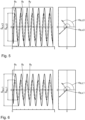
- Verläufe von Linearbeschleunigungen an einem Stopfpickelantrieb des Stopfaggregats über der Zeit und Zeigerdiagramm bei für ein funktionsfähiges Stopfaggregat,
- Fig. 6
- Verläufe der Linearbeschleunigungen an dem Stopfpickelantrieb über der Zeit und Zeigerdiagramm für ein beschädigtes Stopfaggregat,
- Fig. 7
- Verläufe der Winkelbeschleunigungen des Stopfaggregats über der Zeit und Zeigerdiagramm für das funktionsfähige Stopfaggregat,
- Fig. 8
- Verläufe der Winkelbeschleunigungen des Stopfaggregats über der Zeit und Zeigerdiagramm für das beschädigte Stopfaggregat,
- Fig. 9
- eine schematische Vorderansicht eines Stopfaggregats gemäß einem weiteren Ausführungsbeispiel mit einem Stopfpickel-Antrieb und zwei an dem Stopfpickel-Antrieb angeordneten Positions-Sensoren und
- Fig. 10
- ein Stopfaggregat gemäß einem weiteren Ausführungsbeispiel, wobei der Stopfpickel-Antrieb zwei Hydraulikzylinder umfasst und wobei je ein Druck-Sensor an den zwei Hydraulikzylindern angeordnet ist.
- Eine Gleisbaumaschine 1 weist einen Maschinenrahmen 2, mindestens zwei an dem Maschinenrahmen 2 gelagerte Achsen 3, einen Maschinenantrieb 4 und eine Stopfvorrichtung 5 zur Gleisbettverdichtung auf. Die Achsen 3 sind entlang einer horizontalen x-Richtung zueinander beabstandet an der Gleisbaumaschine 1 angeordnet. Die x-Richtung bildet zusammen mit einer vertikalen z-Richtung und einer horizontalen y-Richtung ein maschinenfestes Koordinatensystem. An den Achsen 3 sind schienenführbare Räder 6 drehbar gelagert. Der Maschinenantrieb 2 ist zum Drehantreiben der Räder 6 mindestens einer der Achsen 3 ausgebildet.
- Die Stopfvorrichtung 5 weist einen Aggregatträger 7, ein an dem Aggregatträger 7 gelagertes Stopfaggregat 8, eine Antriebsvorrichtung 9, einen Sensor 10 und eine Auswerteeinheit 11 auf. Zwischen dem Aggregatträger 7 und dem Stopfaggregat 8 ist eine Linearführung 12 angeordnet. Über die Linearführung 12 ist das Stopfaggregat 8 entlang der z-Richtung, relativ zu dem Aggregatträger 7 verschiebbar verlagerbar.
- Die Antriebseinrichtung 9 umfasst einen Aggregatantrieb 13 und einen Stopfpickel-Antrieb 14. Der Aggregatantrieb 13 wirkt zwischen dem Aggregatträger 7 und dem Stopfaggregat 8 und stellt eine Aggregatkraft FA zur Verlagerung des Stopfaggregats 8 relativ zu dem Aggregatträger 7 bereit. Das Stopfaggregat 8 weist einen Aggregatrahmen 15 auf. An dem Aggregatrahmen 15 sind in x-Richtung zueinander beabstandet zwei Stopfpickelträger 16 angebracht. Die Stopfpickelträger 16 sind an dem Aggregatrahmen 15 jeweils über eine parallel zu der y-Richtung orientierte Trägerachse 17 drehbar gelagert.
- Der Stopfpickel-Antrieb 14 ist als Linear-Antrieb ausgebildet und wirkt jeweils zwischen dem Aggregatrahmen 15 und einem der Stopfpickelträger 16. Der Stopfpickel-Antrieb 14 weist einen Hydraulik-Antrieb und einen Exzenter-Antrieb auf. Der Hydraulik-Antrieb gewährleistet eine hohe Verlagerungs-Amplitude bei einer geringen Verlagerungs-Frequenz. Der Exzenter-Antrieb ist zum Bereitstellen einer geringen Verlagerungs-Amplitude und einer hohen Verlagerungs-Frequenz, insbesondere einer Verdichtungsfrequenz fV, ausgebildet. Sowohl der Hydraulik-Antrieb als auch der Exzenter-Antrieb wirken zwischen dem Aggregatrahmen 15 und dem jeweiligen Stopfpickelträger 16. Der Stopfpickel-Antrieb 14 ist zum Bereitstellen einer Antriebskraft FV an dem jeweiligen Stopfpickelträger 16 ausgebildet. An einer Unterseite des jeweiligen Stopfpickelträgers 16 sind je zwei Stopfpickel 18 angebracht. Über den jeweiligen Stopfpickelträger 16 und die daran angebrachten Stopfpickel 18 ist die Antriebskraft FV somit auf ein Gleisbett 19 übertragbar.
- Der Sensor 10 steht über eine Signalleitung 20 mit der Auswerteeinheit 11 in Signalverbindung. Die Auswerteeinheit 11 steht wiederum in Signalverbindung mit einer Steuereinheit 21. Die Steuereinheit 21 weist eine Benutzerschnittstelle 22 zum Austausch von Informationen mit einem Benutzer auf. Die Auswerteeinheit 11 umfasst ein Speichermittel 23 zum Speichern mindestens einer Referenzgröße.
- Der Sensor 10 ist als Beschleunigungssensor ausgebildet und an einem Antriebsgehäuse 24 des Stopfpickel-Antriebs 14 angeordnet. Der Sensor 10 ist zum Erfassen von Linearbeschleunigungen a = [ax, ay, az] in x-Richtung, in y-Richtung und in z-Richtung sowie zum Erfassen von Winkelbeschleunigungen α = [αx, αy, αz] um die x-Richtung, die y-Richtung und die z-Richtung ausgebildet.
- Nachfolgend sind der Betrieb der Gleisbaumaschine 1 und der Betrieb der Stopfvorrichtung 5 beschrieben:
Zum Anlegen bzw. Instandhalten des Gleisbetts 19 wird die Gleisbaumaschine 1 mittels des Maschinenantriebs 4 auf einem Gleis 25 entlang der x-Richtung verfahren. Eine Mittelachse 26 der Stopfvorrichtung 5 wird dabei mittig über einer zum Tragen der Gleise 25 auf dem Gleisbett 19 angeordneten Bahnschwelle 27 positioniert. - Zu Beginn des Prozesses zur Gleisbettverdichtung befindet sich das Stopfaggregat 8 in einer Rückstellposition 28. Das Stopfaggregat 8 befindet sich an einer oberen Endlage der Linearführung 12 und die an dem Stopfaggregat 8 angebrachten Stopfpickel 18 stehen außer Eingriff mit dem Gleisbett 19. Das Stopfaggregat 8 ist funktionsfähig und weist keine Schädigung auf.
- Über ein Signal der Steuereinheit 21 wird der Stopfpickel-Antrieb 14 aktiviert. Der Stopfpickel-Antrieb 14 ist über Trägerlager 29 mit den beiden Stopfpickelträgern 16 verbunden. Der Stopfpickel-Antrieb 14 überträgt eine zyklische Hubbewegung auf den jeweiligen Stopfpickelträger 16. Die drehbar gelagerten Stopfpickelträger 16 bewegen sich dabei zyklisch um die jeweilige Trägerachse 17. Die in x-Richtung zueinander beabstandeten Stopfpickel 18 bewegen sich zyklisch aufeinander zu bzw. voneinander weg.
- Die von dem Stopfpickel-Antrieb 14 auf die beiden Stopfpickelträger 16 übertragene zyklische Hubbewegung weist eine Verdichtungsfrequenz fV von 35 Hertz bis 45 Hertz auf. Über die Lagerachsen 17 der Stopfpickelträger 16 und über das Antriebsgehäuse 24 des Stopfpickel-Antriebs 14 werden Lagerkräfte auf den Aggregatrahmen 15 übertragen und regen das Stopfaggregat 8 zu einer Schwingung mit einer Aggregatfrequenz fA an. Die Aggregatfrequenz fA entspricht im Wesentlichen der Verdichtungsfrequenz fV. Die Aggregatfrequenz fA wirkt auch auf das Antriebsgehäuse 24 und versetzt dieses in Schwingung.
- Der an dem Antriebsgehäuse 24 angebrachte Sensor 10 erfasst sechs Messgrößen in Form des Vektors der Linearbeschleunigungen a und des Vektors der Winkelbeschleunigungen α. Die von dem Sensor 10 erfassten Beschleunigungen a, α sind abhängig von einer Masse mA des Stopfaggregats 8, insbesondere von Massen mS der jeweiligen Stopfpickel 18. Beim Antreiben der beiden Stopfpickelträger 16 mittels des Stopfpickel-Antriebs 14 wirkt der Antriebskraft FV in der Rückstellposition 28 lediglich die Trägheitskraft FT entgegen. Für eine lineare Beschleunigung einer Masse m gilt im Allgemeinen:

- Hieraus wird ersichtlich, dass sich bei einer Änderung der Masse m auch die Beschleunigung a und/oder die Antriebskraft FV ändert. Analog gilt für die Winkelbeschleunigung:

- MV ist ein Antriebsmoment, I ist ein Inertialmoment und MT ist ein aufgrund der Winkelbeschleunigung α und aufgrund des Inertialmoments I wirkendes Trägheitsmoment. Insbesondere sind die Aggregatamplituden Sa der Linearbeschleunigungen a und die Aggregatamplituden Sa der Winkelbeschleunigungen α abhängig von der Masse mA des Stopfaggregats 8, insbesondere von der Masse mS der Stopfpickel 18.
- Die Verläufe der Messgrößen a, α werden für das unbeschädigte Stopfaggregat 8 ermittelt und in dem Speichermittel 23 als Referenzgrößen a 0, α 0 gespeichert. Die Referenzgrößen und die daraus hervorgehenden weiteren Größen werden im Folgenden mit dem Index 0 gekennzeichnet. In
Fig. 5 sind die Verläufe der Linearbeschleunigungen a 0 des funktionsfähigen Stopfaggregats 8 über einer Zeit t dargestellt. Ein Zeigerdiagramm gibt zusätzlich Auskunft über eine Phasenverschiebung ϕ a,0 = [ϕa,x,0, ϕ a,y,0, ϕ a,z,0] der Linearbeschleunigungen a 0. InFig. 7 sind die Verläufe der Winkelbeschleunigungen α 0 für das unbeschädigte, funktionsfähige Stopfaggregat 8 über der Zeit t zusammen mit einem Zeigerdiagramm zur Darstellung der Phasenverschiebungen ϕα,0 = [ϕ α,x,0, ϕ α,y,0, ϕ α,z,0] zwischen den Winkelbeschleunigungen α0 gezeigt. - Zu Beginn eines Stopfzyklus zum Verdichten des Gleisbetts 19 wird das Stopfaggregat 8 mittels des Aggregatantriebs 13 entgegen der z-Richtung auf das Gleisbett 19 zu verlagert.
- In einer Eingriffsposition 30 befindet sich das Stopfaggregat 8 an einem unteren Ende der Linearführung 12. Die vier Stopfpickel 18 dringen in das Gleisbett 19 ein. Das in der Eingriffsposition 30 angeordnete Stopfaggregat 8 ist in
Fig. 3 undFig. 4 dargestellt. Der Betrieb des Stopfpickel-Antriebs 14 wird während des Verlagerns zwischen der Rückstellposition 28 und der Eingriffsposition 30 als auch in der Eingriffsposition 30 aufrechterhalten. Zusätzlich zu der hochfrequenten Verlagerung des Stopfpickels 18 mit der Verdichtungsfrequenz fV werden die in x-Richtung zueinander beabstandeten Stopfpickel 18 mittels des Stopfpickel-Antriebs 14 in der Eingriffsposition 30 aufeinander zu bewegt. Die Verdichtung des Gleisbetts 19 erfolgt durch die Überlagerung dieser beiden Verlagerungskomponenten der Stopfpickel 18. - Bei der Verdichtung des Gleisbetts 19 wirken hohe statische und dynamische Lasten auf das Stopfaggregat 8, insbesondere auf die Stopfpickel 18. Hierdurch kommt es zur Schädigung des Stopfaggregats 8 durch einen Bruch von einem der vier Stopfpickel 18 kommen.
- Das Stopfaggregat 8 wird mittels des Aggregatantriebs 13 aus der Eingriffsposition 30 in die Rückstellposition 28 zurückverlagert. Der Stopfzyklus ist somit abgeschlossen. Vor Beginn des nächsten Stopfzyklus wird die Gleisbaumaschine 1, insbesondere die Stopfvorrichtung 5 derart in x-Richtung verlagert, dass die Mittelachse 26 mittig über der in x-Richtung nächsten Bahnschwelle 27 angeordnet ist.
- Durch den Bruch des Stopfpickels 18 ist dessen Masse mS reduziert. Somit ist auch die Masse des Stopfaggregats mA reduziert. Hierdurch verändern sich die der Antriebskraft FV entgegenwirkenden Trägheitskräfte FT und Trägheitsmomente MT. Dies hat wiederum Auswirkungen auf das Schwingungsverhalten des Stopfaggregats 8.
- Zu Beginn des nächsten Stopfzyklus werden die Messgrößen a, α mittels des Sensors 10 von neuem erfasst. Die anhand des beschädigten Stopfaggregats 8 erfassten Messgrößen a, α und die daraus hervorgehenden weiteren Größen werden im Folgenden mit dem Index 1 gekennzeichnet. Zum Ermitteln eines Schädigungszustands werden die aktuellen Messgrößen a1, α1 mit den Referenzgrößen a0, α0 verglichen. Insbesondere werden die Aggregatamplituden Sa,1, Sα,1 und die Phasenverschiebungen ϕa,1, ϕα,1 der Messgrößen a1, α1 mit den Aggregatamplituden Sa,0, Sα,0 und den Phasenverschiebungen ϕa,0, ϕα,0 der Referenzgrößen a0, α0 verglichen. Eine Schädigung des Stopfaggregats 8 wird detektiert, sofern eine Differenz zwischen den gemessenen Aggregatamplituden Sa,1, Sα,1 und den Referenzgrößen der Aggregatamplituden Sa,0, Sα,0 einen Schwellenwert SWS erreichen oder überschreiten. Ebenso wird eine Schädigung des Stopfaggregats 8 detektiert, sofern eine Differenz zwischen den gemessenen Phasenverschiebungen ϕ a,1, ϕ α,1 und den Referenzgrößen der Phasenverschiebungen ϕ a,0, ϕ α,0 einen Schwellenwert SW ϕ für die Phasenverschiebungen überschreiten. Eine Beschädigung des Stopfaggregats wird also bestimmt, sofern gilt:


- In der
Fig. 6 sind die Verläufe der an dem Sensor 10 erfassten Linearbeschleunigungen a1 für das beschädigte Stopfaggregat 8 mit dem gebrochenen Stopfpickel 18 über der Zeit dargestellt. Aus derFig. 6 gehen die Aggregatamplituden Sa,1 und die Phasenverschiebungen ϕa,1 der Linearbeschleunigungen hervor. InFig. 8 sind die Verläufe der Winkelbeschleunigungen α 1 des geschädigten Stopfaggregats 8 über der Zeit t dargestellt. Aus derFig. 8 gehen die Aggregatamplituden S α,1 und die Phasenverschiebungen ϕ α,1 der Winkelbeschleunigungen α1 hervor. - Aus den
Fig. 5 bis Fig. 8 wird ersichtlich, dass der Bruch eines Stopfpickels 18 und die damit verbundene Reduktion der Masse mA des Stopfaggregats zu einer deutlichen Änderung der Messgrößen a 1, α 1 im Vergleich zu den Referenzgrößen a 0, α 0 führt. Die Beschädigung des Stopfaggregats 8, insbesondere der Verlust des Stopfpickels 18, kann somit zuverlässig erkannt werden. - Die Auswerteeinheit 11 detektiert die Beschädigung des Stopfaggregats 8. Aufgrund eines Signals der Auswerteeinheit 11 unterbricht die Steuereinheit 21 den Betrieb des Stopfaggregats 8. Über die Benutzerschnittstelle 22 wird dem Benutzer die Beschädigung des Stopfaggregats 8 signalisiert.
- in
Fig. 9 ist eine weitere Ausführungsform der Stopfvorrichtung 5 beschrieben. Im Unterschied zu der vorangegangenen Ausführungsform umfasst die Stopfvorrichtung 5 zwei Sensoren 10, welche als Positions-Sensoren ausgebildet sind. Die beiden Sensoren 10 sind jeweils an einem Stopfpickel-Antrieb 14 angeordnet und zum Erfassen eines Stellwegs s des Stopfpickel-Antriebs 14 ausgebildet. Die Sensoren 10 stehen über eine Signalleitung 20 in Signalverbindung mit der Auswerteeinheit 11. - Die Messgröße s wird in Form des Stellwegs s erfasst. Anhand der Messgröße s wird zunächst die Stellgeschwindigkeit s' = ds/dt durch Bestimmen einer Änderung des Stellwegs ds über einen diskreten Zeitschritt dt bestimmt. Anhand der Änderung der Stellgeschwindigkeit ds' über einen disktreten Zeitschritt dt wird die Stellbeschleunigung s" = d2s/dt2 bestimmt.
- Zum Bestimmen, ob das Stopfaggregat 8 eine Schädigung aufweist, wird mit der Stellbeschleunigung s" ebenso verfahren, wie gemäß der vorangegangenen Ausführungsform mit den Beschleunigungen a, α.
- Alternativ zum Erfassen des Stellwegs s kann auch eine Position in x-Richtung und/oder in y-Richtung und/oder in z-Richtung, beispielsweise des Trägerlagers 29 oder einer anderen Komponente des Stopfaggregats 8, erfasst werden. Auch eine Orientierung um die x-Richtung und/oder um die y-Richtung und/oder um die z-Richtung, beispielsweise von einem der Stopfpickelträger 16, kann erfasst werden.
- Eine weitere Ausführungsform der Stopfvorrichtung 5 ist in
Fig. 10 dargestellt. Im Unterschied zu den vorangegangenen Ausführungsformen weist die Stopfvorrichtung 5 zwei Sensoren 10 in Form von Druck-Sensoren auf. Die beiden Sensoren 10 sind zum Erfassen eines Drucks einer Hydraulikflüssigkeit in je einem Hydraulikzylinder 31 des Stopfpickel-Antriebs 14 ausgebildet. Die beiden Sensoren 10 stehen über Druckleitungen 32 in Verbindung mit den Hydraulikzylindern 31. Über die Signalleitungen 20 stehen die Sensoren 10 in Signalverbindung mit der Auswerteeinheit 11. - Zum Bestimmen einer Schädigung des Stopfaggregats 8 wird ein zeitlicher Verlauf des Drucks p mit einem zeitlichen Verlauf eines Referenzdrucks p0 verglichen. Die Änderung der Masse m des Stopfaggregats 8 führt zu einer Änderung der Trägheitskraft FT und damit zu einer Änderung der für die Beschleunigung a notwendigen Antriebskraft FV. Eine Schädigung des Stopfaggregats 8 wird erkannt, sofern der Betrag der Differenz zwischen der Messgröße p und der Referenzgröße p0 einen Schwellenwert SWp überschreitet.
- Gemäß einer weiteren Ausführungsform ist in der Auswerteeinheit 11 ein Strukturmodell des Stopfaggregats 8 hinterlegt. Das Strukturmodell umfasst die Komponenten des Stopfaggregats 8, deren Massen, deren Lagerung sowie deren Materialen und Steifigkeiten. Anhand der auf das Stopfaggregat 8 wirkenden Antriebskraft FV und der erfassten mindesten einen Messgröße a, α, p, s kann mittels des Strukturmodells auf eine spezifische Schädigung des Stopfaggregats 8 geschlossen werden. Beispielsweise kann die Reduktion der Masse mS eines bestimmten Stopfpickels 18 erkannt werden. Anhand der mindestens einen Messgröße a, α, p, s und anhand des in der Auswerteeinheit 11 hinterlegten Strukturmodells wird zusätzlich zum Bestimmen der Schädigung eine Art des Schadens, insbesondere eine Position des Schadens an dem Stopfaggregat 8, bestimmt.
- Durch Übermitteln des Schädigungszustands des Stopfaggregats 8 anhand der mindestens einen Messgröße a, α, p, s kann eine Schädigung des Stopfaggregats 8 besonders zuverlässig erkannt werden. Insbesondere kann die Schädigung mittels der Auswerteeinheit 11 automatisiert erkannt werden. Die Notwenigkeit einer regelmäßigen Sichtprüfung des Stopfaggregats 8 entfällt und die Gefahr eines Betriebs des Stopfaggregats 8 im beschädigten Zustand, wobei eine ausreichende Verdichtung des Gleisbetts 19 nicht gewährleistet werden kann und wobei unbeschädigte Komponenten des Stopfaggregats 8 überbeansprucht werden können, wird vermieden. Die Gleisbaumaschine 1, insbesondere das Stopfaggregat 8, ist im Betrieb somit besonders leistungsfähig und wirtschaftlich.
Claims (14)
- Verfahren zum Betreiben eines Stopfaggregats einer Gleisbaumaschine, umfassend die Schritte:- Bereitstellen der Gleisbaumaschine (1) mit dem Stopfaggregat (8) auf einem Gleisbett (19),- Beschleunigen mindestens eines Teils (18, 24) des Stopfaggregats (8),- Erfassen mindestens einer mit der Beschleunigung korrelierenden Messgröße (a, α, p, s) und- Ermitteln eines Schädigungszustands des Stopfaggregats (8) anhand der mindestens einen Messgröße (a, α, p, s),dadurch gekennzeichnet, dass
anhand der mindestens einen Messgröße (a, α, p, s) ein Schädigungszustand eines zum Zusammenwirken mit dem Gleisbett (19) ausgebildeten Stopfpickels (18) ermittelt wird. - Verfahren nach Anspruch 1, dadurch gekennzeichnet, dass das mindestens eine Teil (18, 24) ein Stopfpickel (18) zum Zusammenwirken mit dem Gleisbett (19) ist.
- Verfahren nach einem der Ansprüche 1 bis 2, dadurch gekennzeichnet, dass die mindestens eine Messgröße (a, α, p, s) eine Position und/oder eine Orientierung ist.
- Verfahren nach einem der Ansprüche 1 bis 3, dadurch gekennzeichnet, dass die mindestens eine Messgröße (a, α, p, s) an einem Stopfpickelträger (16) des Stopfaggregats (8) und/oder an einer Antriebseinrichtung (9) des Stopfaggregats (8) erfasst wird.
- Verfahren nach einem der Ansprüche 1 bis 4, dadurch gekennzeichnet, dass die mindestens eine Messgröße (a, α, p, s) ein Hydraulikdruck (p) zum Beschleunigen des mindestens einen Teils (18, 24) ist.
- Verfahren nach einem der Ansprüche 1 bis 5, dadurch gekennzeichnet, dass das Erfassen der mindestens einen Messgröße (a, α, p, s) in einer Rückstellposition (28) erfolgt, in der das Stopfaggregat (8) außer Eingriff mit dem Gleisbett (19) steht.
- Verfahren nach einem der Ansprüche 1 bis 6, dadurch gekennzeichnet, dass zum Ermitteln des Schädigungszustands die mindestens eine Messgröße (a, α, p, s) mit mindestens einer Referenzgröße (a 0, α 0, p0, s0) verglichen wird.
- Verfahren nach Anspruch 7, dadurch gekennzeichnet, dass die mindestens eine Referenzgröße (a 0, α 0, p0, s0) anhand der mindestens einen Messgröße (a, α, p, s) in einem unbeschädigten Zustand des Stopfaggregats (8) ermittelt wird.
- Verfahren nach einem der Ansprüche 1 bis 8, dadurch gekennzeichnet, dass das Ermitteln des Schädigungszustands anhand eines zeitlichen Verlaufs der mindestens einen Messgröße (a, α, p, s) erfolgt.
- Verfahren nach einem der Ansprüche 1 bis 9, dadurch gekennzeichnet, dass das Ermitteln des Schädigungszustands anhand eines Strukturmodells des Stopfaggregats (8) erfolgt.
- Verfahren nach einem der Ansprüche 1 bis 10, dadurch gekennzeichnet, dass beim Überschreiten mindestens eines Schwellenwerts (SW a, SW α, SWp, SWs) der mindestens einen Messgröße (a, α, p, s) eine Schädigung des Stopfaggregats (8) detektiert wird.
- Verfahren nach einem der Ansprüche 1 bis 11, dadurch gekennzeichnet, dass nach einem Detektieren einer Schädigung ein Betrieb des Stopfaggregats (5) unterbrochen wird.
- Stopfvorrichtung zur Gleisbettverdichtung, aufweisend- einen Aggregatträger (7)- ein an dem Aggregatträger (7) verschiebbar gelagertes Stopfaggregat (8),- eine Antriebseinrichtung (9) zum Bereitstellen einer Antriebskraft (Fv) und zum erwirken einer Beschleunigung (a, α) mindestens eines Teils des Stopfaggregats (8),- mindestens einen Sensor (10) zum Erfassen mindestens einer mit der Beschleunigung (a, α) korrelierenden Messgröße (a, α, p, s),- eine Auswerteeinheit (11) zum Ermitteln eines Schädigungszustands des Stopfaggregats (8) anhand der mindestens einen Messgröße (a, α, p, s),dadurch gekennzeichnet, dass
die Auswerteeinheit (11) zum Ermitteln eines Schädigungszustands eines zum Zusammenwirken mit dem Gleisbett (19) ausgebildeten Stopfpickels (18) ausgebildet ist. - Gleisbaumaschine, aufweisend- einen Maschinenrahmen (2),- mindestens zwei an dem Maschinenrahmen (2) gelagerte Achsen (3) mit daran angeordneten schienenführbaren Rädern (6),- einen Maschinenantrieb (4) zum Drehantreiben der Räder (6) mindestens einer der Achsen (3) und- mindestens eine an dem Maschinenrahmen (2) angebrachte Stopfvorrichtung (5) nach Anspruch 13.
Applications Claiming Priority (2)
| Application Number | Priority Date | Filing Date | Title |
|---|---|---|---|
| ATA502/2017A AT520771B1 (de) | 2017-12-28 | 2017-12-28 | Verfahren zum Betreiben eines Stopfaggregats einer Gleisbaumaschine sowie Stopfvorrichtung zur Gleisbettverdichtung und Gleisbaumaschine |
| PCT/EP2018/082523 WO2019129448A1 (de) | 2017-12-28 | 2018-11-26 | Verfahren zum betreiben eines stopfaggregats einer gleisbaumaschine sowie stopfvorrichtung zur gleisbettverdichtung und gleisbaumaschine |
Publications (3)
| Publication Number | Publication Date |
|---|---|
| EP3732329A1 EP3732329A1 (de) | 2020-11-04 |
| EP3732329C0 EP3732329C0 (de) | 2025-01-08 |
| EP3732329B1 true EP3732329B1 (de) | 2025-01-08 |
Family
ID=64564855
Family Applications (1)
| Application Number | Title | Priority Date | Filing Date |
|---|---|---|---|
| EP18811768.3A Active EP3732329B1 (de) | 2017-12-28 | 2018-11-26 | Verfahren zum betreiben eines stopfaggregats einer gleisbaumaschine sowie stopfvorrichtung zur gleisbettverdichtung und gleisbaumaschine |
Country Status (4)
| Country | Link |
|---|---|
| EP (1) | EP3732329B1 (de) |
| CN (1) | CN111527263A (de) |
| AT (1) | AT520771B1 (de) |
| WO (1) | WO2019129448A1 (de) |
Families Citing this family (2)
| Publication number | Priority date | Publication date | Assignee | Title |
|---|---|---|---|---|
| CN111562762B (zh) * | 2019-09-25 | 2025-02-18 | 金鹰重型工程机械股份有限公司 | 一种捣固作业机构自动复位控制系统 |
| AT525614B1 (de) * | 2021-11-10 | 2025-10-15 | Hp3 Real Gmbh | Vorrichtung zum Detektieren von Schwellen eines Gleises |
Family Cites Families (8)
| Publication number | Priority date | Publication date | Assignee | Title |
|---|---|---|---|---|
| ES2072132T3 (es) * | 1991-06-12 | 1995-07-01 | Plasser Bahnbaumasch Franz | Procedimiento y maquina bateadora para la compactacion del balastro de una via ferrea. |
| DE59201285D1 (de) * | 1991-10-24 | 1995-03-09 | Plasser Bahnbaumasch Franz | Stopfaggregat. |
| GB0714379D0 (en) * | 2007-07-21 | 2007-09-05 | Monition Ltd | Tamping bank monitoring apparatus and method |
| WO2014102401A1 (es) * | 2012-12-27 | 2014-07-03 | Acciona Infraestructuras, S.A. | Método predictivo de análisis de un equipo de bateado y equipo de bateado. |
| AT513973B1 (de) * | 2013-02-22 | 2014-09-15 | System7 Railsupport Gmbh | Stopfaggregat für eine Gleisstopfmaschine |
| AT518025A1 (de) * | 2015-12-10 | 2017-06-15 | Plasser & Theurer Export Von Bahnbaumaschinen Gmbh | Stopfaggregat und Verfahren zum Unterstopfen eines Gleises |
| AT518195B1 (de) * | 2016-01-26 | 2017-11-15 | Plasser & Theurer Export Von Bahnbaumaschinen Gmbh | Verfahren zur Verdichtung der Schotterbettung eines Gleises sowie Stopfaggregat |
| AT518072B1 (de) * | 2016-04-29 | 2017-07-15 | Hp3 Real Gmbh | Stopfaggregat für eine Gleisstopfmaschine |
-
2017
- 2017-12-28 AT ATA502/2017A patent/AT520771B1/de active
-
2018
- 2018-11-26 WO PCT/EP2018/082523 patent/WO2019129448A1/de not_active Ceased
- 2018-11-26 EP EP18811768.3A patent/EP3732329B1/de active Active
- 2018-11-26 CN CN201880083240.9A patent/CN111527263A/zh active Pending
Also Published As
| Publication number | Publication date |
|---|---|
| WO2019129448A1 (de) | 2019-07-04 |
| AT520771A1 (de) | 2019-07-15 |
| CN111527263A (zh) | 2020-08-11 |
| AT520771B1 (de) | 2020-08-15 |
| EP3732329C0 (de) | 2025-01-08 |
| EP3732329A1 (de) | 2020-11-04 |
Similar Documents
| Publication | Publication Date | Title |
|---|---|---|
| EP0391174B2 (de) | Vorrichtung und Verfahren zum Erfassen von physikalischen Kenngrössen eines Aufzuges | |
| EP3631087B1 (de) | Verfahren und vorrichtung zum verdichten eines gleisschotterbetts | |
| EP3728736B1 (de) | Verfahren zum betreiben eines stopfaggregats einer gleisbaumaschine sowie stopfvorrichtung zur gleisbettverdichtung und gleisbaumaschine | |
| AT518195B1 (de) | Verfahren zur Verdichtung der Schotterbettung eines Gleises sowie Stopfaggregat | |
| EP0688902B1 (de) | Verfahren zur kontinuierlichen Messung des Querverschiebewiderstandes eines Gleises | |
| EP2770108B1 (de) | Stopfaggregat für eine Gleisstopfmaschine | |
| WO2011032948A1 (de) | Verfahren und vorrichtung zur überwachung des fahrverhaltens eines schienenfahrzeugs | |
| AT521798B1 (de) | Verfahren und Vorrichtung zum Verdichten eines Schotterbettes | |
| AT524861B1 (de) | Verfahren und Maschine zum Stopfen eines Gleises | |
| AT520698A1 (de) | Verfahren und System zur Belastungsüberwachung eines Stopfaggregates | |
| WO2017016899A1 (de) | Verfahren und system zur analyse des verschleissverhaltens von bremsbelägen | |
| EP2101156A2 (de) | Verfahren und Vorrichtung zum Überwachen von Fahrwerkregelsystemen | |
| AT520771B1 (de) | Verfahren zum Betreiben eines Stopfaggregats einer Gleisbaumaschine sowie Stopfvorrichtung zur Gleisbettverdichtung und Gleisbaumaschine | |
| DE60303303T2 (de) | Fallgewichtverdichtung | |
| AT515507B1 (de) | Verfahren zum Arbeitseinsatz von Gleisbaumaschinen | |
| EP3239368B1 (de) | Verfahren zur kalibrierung der aufliegekraft eines abtragorgans eines ballenöffners und ballenöffner | |
| DD293363A5 (de) | Verfahren und vorrichtung zur kontinuierlichen hubueberwachung | |
| DE102020106460A1 (de) | Verfahren und Vorrichtung zum Bestimmen der Funktionsfähigkeit einer Füllstandssensorik sowie ein die Vorrichtung umfassendes System | |
| DE102016106292B3 (de) | Verfahren zur zustandsorientierten Instandhaltung einer Nadelmaschine | |
| AT18149U1 (de) | Verfahren und Vorrichtung zum Bestimmen der Beschaffenheit, insbesondere des Verdichtungsgrads, eines Gleisbetts | |
| EP4298004B1 (de) | Verfahren und anordnung zur bestimmung des bewegungszustands eines schienenfahrzeug-rads | |
| AT524860B1 (de) | Vorrichtung und Verfahren zum Verdichten eines Gleisbettes | |
| DE10338593A1 (de) | Verfahren sowie System zur Überwachung und/oder Steuerung des Nachlaufweges eines Fahrantriebs oder Verfahrachse | |
| DE102021203606B4 (de) | Verfahren zum Steuern eines Getriebes | |
| DE102019130324A1 (de) | Verfahren zum Betrieb eines Arbeitsprozesses |
Legal Events
| Date | Code | Title | Description |
|---|---|---|---|
| STAA | Information on the status of an ep patent application or granted ep patent |
Free format text: STATUS: UNKNOWN |
|
| STAA | Information on the status of an ep patent application or granted ep patent |
Free format text: STATUS: THE INTERNATIONAL PUBLICATION HAS BEEN MADE |
|
| PUAI | Public reference made under article 153(3) epc to a published international application that has entered the european phase |
Free format text: ORIGINAL CODE: 0009012 |
|
| STAA | Information on the status of an ep patent application or granted ep patent |
Free format text: STATUS: REQUEST FOR EXAMINATION WAS MADE |
|
| 17P | Request for examination filed |
Effective date: 20200728 |
|
| AK | Designated contracting states |
Kind code of ref document: A1 Designated state(s): AL AT BE BG CH CY CZ DE DK EE ES FI FR GB GR HR HU IE IS IT LI LT LU LV MC MK MT NL NO PL PT RO RS SE SI SK SM TR |
|
| AX | Request for extension of the european patent |
Extension state: BA ME |
|
| DAV | Request for validation of the european patent (deleted) | ||
| DAX | Request for extension of the european patent (deleted) | ||
| STAA | Information on the status of an ep patent application or granted ep patent |
Free format text: STATUS: EXAMINATION IS IN PROGRESS |
|
| 17Q | First examination report despatched |
Effective date: 20220506 |
|
| P01 | Opt-out of the competence of the unified patent court (upc) registered |
Effective date: 20230530 |
|
| GRAP | Despatch of communication of intention to grant a patent |
Free format text: ORIGINAL CODE: EPIDOSNIGR1 |
|
| STAA | Information on the status of an ep patent application or granted ep patent |
Free format text: STATUS: GRANT OF PATENT IS INTENDED |
|
| RIC1 | Information provided on ipc code assigned before grant |
Ipc: E01B 35/00 20060101ALI20240628BHEP Ipc: B06B 1/18 20060101ALI20240628BHEP Ipc: E01B 27/12 20060101ALI20240628BHEP Ipc: E01B 27/16 20060101AFI20240628BHEP |
|
| INTG | Intention to grant announced |
Effective date: 20240731 |
|
| GRAS | Grant fee paid |
Free format text: ORIGINAL CODE: EPIDOSNIGR3 |
|
| GRAA | (expected) grant |
Free format text: ORIGINAL CODE: 0009210 |
|
| STAA | Information on the status of an ep patent application or granted ep patent |
Free format text: STATUS: THE PATENT HAS BEEN GRANTED |
|
| AK | Designated contracting states |
Kind code of ref document: B1 Designated state(s): AL AT BE BG CH CY CZ DE DK EE ES FI FR GB GR HR HU IE IS IT LI LT LU LV MC MK MT NL NO PL PT RO RS SE SI SK SM TR |
|
| REG | Reference to a national code |
Ref country code: GB Ref legal event code: FG4D Free format text: NOT ENGLISH |
|
| REG | Reference to a national code |
Ref country code: CH Ref legal event code: EP |
|
| REG | Reference to a national code |
Ref country code: DE Ref legal event code: R096 Ref document number: 502018015493 Country of ref document: DE |
|
| REG | Reference to a national code |
Ref country code: IE Ref legal event code: FG4D Free format text: LANGUAGE OF EP DOCUMENT: GERMAN |
|
| U01 | Request for unitary effect filed |
Effective date: 20250116 |
|
| P04 | Withdrawal of opt-out of the competence of the unified patent court (upc) registered |
Free format text: CASE NUMBER: APP_3195/2025 Effective date: 20250121 |
|
| U07 | Unitary effect registered |
Designated state(s): AT BE BG DE DK EE FI FR IT LT LU LV MT NL PT RO SE SI Effective date: 20250123 |
|
| PG25 | Lapsed in a contracting state [announced via postgrant information from national office to epo] |
Ref country code: RS Free format text: LAPSE BECAUSE OF FAILURE TO SUBMIT A TRANSLATION OF THE DESCRIPTION OR TO PAY THE FEE WITHIN THE PRESCRIBED TIME-LIMIT Effective date: 20250408 |
|
| PG25 | Lapsed in a contracting state [announced via postgrant information from national office to epo] |
Ref country code: PL Free format text: LAPSE BECAUSE OF FAILURE TO SUBMIT A TRANSLATION OF THE DESCRIPTION OR TO PAY THE FEE WITHIN THE PRESCRIBED TIME-LIMIT Effective date: 20250108 |
|
| PG25 | Lapsed in a contracting state [announced via postgrant information from national office to epo] |
Ref country code: ES Free format text: LAPSE BECAUSE OF FAILURE TO SUBMIT A TRANSLATION OF THE DESCRIPTION OR TO PAY THE FEE WITHIN THE PRESCRIBED TIME-LIMIT Effective date: 20250108 |
|
| PG25 | Lapsed in a contracting state [announced via postgrant information from national office to epo] |
Ref country code: NO Free format text: LAPSE BECAUSE OF FAILURE TO SUBMIT A TRANSLATION OF THE DESCRIPTION OR TO PAY THE FEE WITHIN THE PRESCRIBED TIME-LIMIT Effective date: 20250408 Ref country code: IS Free format text: LAPSE BECAUSE OF FAILURE TO SUBMIT A TRANSLATION OF THE DESCRIPTION OR TO PAY THE FEE WITHIN THE PRESCRIBED TIME-LIMIT Effective date: 20250508 |
|
| PG25 | Lapsed in a contracting state [announced via postgrant information from national office to epo] |
Ref country code: HR Free format text: LAPSE BECAUSE OF FAILURE TO SUBMIT A TRANSLATION OF THE DESCRIPTION OR TO PAY THE FEE WITHIN THE PRESCRIBED TIME-LIMIT Effective date: 20250108 |
|
| PG25 | Lapsed in a contracting state [announced via postgrant information from national office to epo] |
Ref country code: GR Free format text: LAPSE BECAUSE OF FAILURE TO SUBMIT A TRANSLATION OF THE DESCRIPTION OR TO PAY THE FEE WITHIN THE PRESCRIBED TIME-LIMIT Effective date: 20250409 |
|
| PG25 | Lapsed in a contracting state [announced via postgrant information from national office to epo] |
Ref country code: SM Free format text: LAPSE BECAUSE OF FAILURE TO SUBMIT A TRANSLATION OF THE DESCRIPTION OR TO PAY THE FEE WITHIN THE PRESCRIBED TIME-LIMIT Effective date: 20250108 |
|
| PG25 | Lapsed in a contracting state [announced via postgrant information from national office to epo] |
Ref country code: CZ Free format text: LAPSE BECAUSE OF FAILURE TO SUBMIT A TRANSLATION OF THE DESCRIPTION OR TO PAY THE FEE WITHIN THE PRESCRIBED TIME-LIMIT Effective date: 20250108 |
|
| PG25 | Lapsed in a contracting state [announced via postgrant information from national office to epo] |
Ref country code: SK Free format text: LAPSE BECAUSE OF FAILURE TO SUBMIT A TRANSLATION OF THE DESCRIPTION OR TO PAY THE FEE WITHIN THE PRESCRIBED TIME-LIMIT Effective date: 20250108 |
|
| PLBE | No opposition filed within time limit |
Free format text: ORIGINAL CODE: 0009261 |
|
| STAA | Information on the status of an ep patent application or granted ep patent |
Free format text: STATUS: NO OPPOSITION FILED WITHIN TIME LIMIT |
|
| REG | Reference to a national code |
Ref country code: CH Ref legal event code: L10 Free format text: ST27 STATUS EVENT CODE: U-0-0-L10-L00 (AS PROVIDED BY THE NATIONAL OFFICE) Effective date: 20251119 |
|
| REG | Reference to a national code |
Ref country code: CH Ref legal event code: U11 Free format text: ST27 STATUS EVENT CODE: U-0-0-U10-U11 (AS PROVIDED BY THE NATIONAL OFFICE) Effective date: 20251201 |
|
| 26N | No opposition filed |
Effective date: 20251009 |
|
| U20 | Renewal fee for the european patent with unitary effect paid |
Year of fee payment: 8 Effective date: 20251201 |
|
| PGFP | Annual fee paid to national office [announced via postgrant information from national office to epo] |
Ref country code: GB Payment date: 20251022 Year of fee payment: 8 |
|
| PGFP | Annual fee paid to national office [announced via postgrant information from national office to epo] |
Ref country code: CH Payment date: 20251201 Year of fee payment: 8 |