EP3732829B1 - Verfahren zur durchführung von daten aus einer initialisierten sitzung zwischen terminal und server - Google Patents
Verfahren zur durchführung von daten aus einer initialisierten sitzung zwischen terminal und server Download PDFInfo
- Publication number
- EP3732829B1 EP3732829B1 EP18827208.2A EP18827208A EP3732829B1 EP 3732829 B1 EP3732829 B1 EP 3732829B1 EP 18827208 A EP18827208 A EP 18827208A EP 3732829 B1 EP3732829 B1 EP 3732829B1
- Authority
- EP
- European Patent Office
- Prior art keywords
- session
- terminal
- server
- data
- routing
- Prior art date
- Legal status (The legal status is an assumption and is not a legal conclusion. Google has not performed a legal analysis and makes no representation as to the accuracy of the status listed.)
- Active
Links
Images





Classifications
-
- H—ELECTRICITY
- H04—ELECTRIC COMMUNICATION TECHNIQUE
- H04L—TRANSMISSION OF DIGITAL INFORMATION, e.g. TELEGRAPHIC COMMUNICATION
- H04L41/00—Arrangements for maintenance, administration or management of data switching networks, e.g. of packet switching networks
- H04L41/08—Configuration management of networks or network elements
- H04L41/0803—Configuration setting
- H04L41/0806—Configuration setting for initial configuration or provisioning, e.g. plug-and-play
-
- H—ELECTRICITY
- H04—ELECTRIC COMMUNICATION TECHNIQUE
- H04L—TRANSMISSION OF DIGITAL INFORMATION, e.g. TELEGRAPHIC COMMUNICATION
- H04L45/00—Routing or path finding of packets in data switching networks
- H04L45/24—Multipath
-
- H—ELECTRICITY
- H04—ELECTRIC COMMUNICATION TECHNIQUE
- H04L—TRANSMISSION OF DIGITAL INFORMATION, e.g. TELEGRAPHIC COMMUNICATION
- H04L45/00—Routing or path finding of packets in data switching networks
- H04L45/38—Flow based routing
-
- H—ELECTRICITY
- H04—ELECTRIC COMMUNICATION TECHNIQUE
- H04L—TRANSMISSION OF DIGITAL INFORMATION, e.g. TELEGRAPHIC COMMUNICATION
- H04L63/00—Network architectures or network communication protocols for network security
- H04L63/04—Network architectures or network communication protocols for network security for providing a confidential data exchange among entities communicating through data packet networks
- H04L63/0428—Network architectures or network communication protocols for network security for providing a confidential data exchange among entities communicating through data packet networks wherein the data content is protected, e.g. by encrypting or encapsulating the payload
-
- H—ELECTRICITY
- H04—ELECTRIC COMMUNICATION TECHNIQUE
- H04L—TRANSMISSION OF DIGITAL INFORMATION, e.g. TELEGRAPHIC COMMUNICATION
- H04L67/00—Network arrangements or protocols for supporting network services or applications
- H04L67/01—Protocols
- H04L67/02—Protocols based on web technology, e.g. hypertext transfer protocol [HTTP]
-
- H—ELECTRICITY
- H04—ELECTRIC COMMUNICATION TECHNIQUE
- H04L—TRANSMISSION OF DIGITAL INFORMATION, e.g. TELEGRAPHIC COMMUNICATION
- H04L67/00—Network arrangements or protocols for supporting network services or applications
- H04L67/14—Session management
- H04L67/141—Setup of application sessions
-
- H—ELECTRICITY
- H04—ELECTRIC COMMUNICATION TECHNIQUE
- H04L—TRANSMISSION OF DIGITAL INFORMATION, e.g. TELEGRAPHIC COMMUNICATION
- H04L67/00—Network arrangements or protocols for supporting network services or applications
- H04L67/14—Session management
- H04L67/146—Markers for unambiguous identification of a particular session, e.g. session cookie or URL-encoding
-
- H—ELECTRICITY
- H04—ELECTRIC COMMUNICATION TECHNIQUE
- H04L—TRANSMISSION OF DIGITAL INFORMATION, e.g. TELEGRAPHIC COMMUNICATION
- H04L67/00—Network arrangements or protocols for supporting network services or applications
- H04L67/50—Network services
- H04L67/60—Scheduling or organising the servicing of application requests, e.g. requests for application data transmissions using the analysis and optimisation of the required network resources
- H04L67/61—Scheduling or organising the servicing of application requests, e.g. requests for application data transmissions using the analysis and optimisation of the required network resources taking into account QoS or priority requirements
-
- H—ELECTRICITY
- H04—ELECTRIC COMMUNICATION TECHNIQUE
- H04L—TRANSMISSION OF DIGITAL INFORMATION, e.g. TELEGRAPHIC COMMUNICATION
- H04L67/00—Network arrangements or protocols for supporting network services or applications
- H04L67/50—Network services
- H04L67/60—Scheduling or organising the servicing of application requests, e.g. requests for application data transmissions using the analysis and optimisation of the required network resources
- H04L67/63—Routing a service request depending on the request content or context
-
- H—ELECTRICITY
- H04—ELECTRIC COMMUNICATION TECHNIQUE
- H04L—TRANSMISSION OF DIGITAL INFORMATION, e.g. TELEGRAPHIC COMMUNICATION
- H04L69/00—Network arrangements, protocols or services independent of the application payload and not provided for in the other groups of this subclass
- H04L69/30—Definitions, standards or architectural aspects of layered protocol stacks
- H04L69/32—Architecture of open systems interconnection [OSI] 7-layer type protocol stacks, e.g. the interfaces between the data link level and the physical level
- H04L69/322—Intralayer communication protocols among peer entities or protocol data unit [PDU] definitions
- H04L69/326—Intralayer communication protocols among peer entities or protocol data unit [PDU] definitions in the transport layer [OSI layer 4]
-
- H—ELECTRICITY
- H04—ELECTRIC COMMUNICATION TECHNIQUE
- H04L—TRANSMISSION OF DIGITAL INFORMATION, e.g. TELEGRAPHIC COMMUNICATION
- H04L9/00—Cryptographic mechanisms or cryptographic arrangements for secret or secure communications; Network security protocols
- H04L9/40—Network security protocols
-
- H—ELECTRICITY
- H04—ELECTRIC COMMUNICATION TECHNIQUE
- H04W—WIRELESS COMMUNICATION NETWORKS
- H04W12/00—Security arrangements; Authentication; Protecting privacy or anonymity
- H04W12/02—Protecting privacy or anonymity, e.g. protecting personally identifiable information [PII]
-
- H—ELECTRICITY
- H04—ELECTRIC COMMUNICATION TECHNIQUE
- H04W—WIRELESS COMMUNICATION NETWORKS
- H04W48/00—Access restriction; Network selection; Access point selection
- H04W48/18—Selecting a network or a communication service
-
- H—ELECTRICITY
- H04—ELECTRIC COMMUNICATION TECHNIQUE
- H04W—WIRELESS COMMUNICATION NETWORKS
- H04W76/00—Connection management
- H04W76/10—Connection setup
- H04W76/11—Allocation or use of connection identifiers
-
- H—ELECTRICITY
- H04—ELECTRIC COMMUNICATION TECHNIQUE
- H04L—TRANSMISSION OF DIGITAL INFORMATION, e.g. TELEGRAPHIC COMMUNICATION
- H04L63/00—Network architectures or network communication protocols for network security
- H04L63/16—Implementing security features at a particular protocol layer
- H04L63/166—Implementing security features at a particular protocol layer at the transport layer
-
- H—ELECTRICITY
- H04—ELECTRIC COMMUNICATION TECHNIQUE
- H04L—TRANSMISSION OF DIGITAL INFORMATION, e.g. TELEGRAPHIC COMMUNICATION
- H04L67/00—Network arrangements or protocols for supporting network services or applications
- H04L67/01—Protocols
- H04L67/06—Protocols specially adapted for file transfer, e.g. file transfer protocol [FTP]
-
- H—ELECTRICITY
- H04—ELECTRIC COMMUNICATION TECHNIQUE
- H04L—TRANSMISSION OF DIGITAL INFORMATION, e.g. TELEGRAPHIC COMMUNICATION
- H04L69/00—Network arrangements, protocols or services independent of the application payload and not provided for in the other groups of this subclass
- H04L69/14—Multichannel or multilink protocols
Definitions
- the application for invention is in the field of telecommunications infrastructures and techniques relating to network slices .
- 5G networks are intended to concern both mobile networks and fixed networks. Consequently, the techniques inherent in the development of 5G networks concern both fixed and mobile infrastructures.
- 5G will indeed have to support very diverse use cases and will face extreme requirements (e.g. in terms of speed, energy efficiency, variety of equipment, splitting of actors, etc.) for which flexibility and scalability networks will be essential.
- the object of the present invention is to remedy the drawbacks of the techniques used today.
- the dynamic selection of a network slice is either carried out by the terminal, in the case where it holds information allowing it to select a slice corresponding to characteristics of traffic, terminal, application or a combination of this information, either made by the operator of the communication infrastructure.
- the remote server detects that a network slice selected for the session is not suited to the parameters of the communication.
- a session can be single-path or multi-path and is characterized by end-to-end communication between the terminal and the server for one or more applications.
- a communication parameter of a session is characterized by information transmitted or received by one or the other of the ends of the session, in this case the terminal or the server.
- a communication parameter is not specific to a layer of the OSI (Open Systems Interconnection) model.
- the first slice chosen by the terminal may in particular be unsuitable because the session data will not be processed by the correct equipment during their routing. Thus, this data may not benefit from advanced processing functions or, for example, may not be secure.
- the server determines that a new slice must be used by the terminal for this session. This determination is made as a function of communication parameters, present either in the headers of the packets or the frames used for routing the data or else in the application data of the session. Once the server has determined one or more new routing identifiers, it informs the terminal thereof. It should be noted that a session can be multi-path and therefore also multi-slices and that for a session, several network slices will be used for routing the data of the session. For example, a slice is used for the real-time type data and a slice for the non-real-time type data of the session.
- the terminal transmits the additional session data by modifying this data by configuring session information and thus allowing the routing of this data on one or more different slots, depending on the configured session information.
- the terminal can configure information from a field of the SFC (Service Function Chaining) protocol.
- the session data is thus transmitted on the slices of networks corresponding to the configured parameter, the network manager assigning one or more slots corresponding to the configured information.
- the terminal can itself select the new network slice or the new network slices.
- the session information is one or more slice identifiers.
- the selection of a second or more network slice(s) is carried out by another device within the infrastructure routing the session data.
- This process thus allows a terminal to be able to route session data according to the recommendations of a remote server, which can thus, for example, provide specific processing to the session data without systematically analyzing the content of the packets or frames of the session, thus saving it resources and allowing increased processing speed.
- the session is encrypted by the terminal and decrypted by the server.
- the information useful for routing the data is thus generally unencrypted while the information relating to the applications is encrypted.
- the server is the only device to be able to access the encrypted data, it is able to exploit them to intervene in the choice of the network slice which routes the data in the infrastructure.
- the session is initialized by the terminal by configuring default session information.
- the data of a session must nevertheless be transmitted over a first slice of the communication infrastructure. If the terminal does not configures no information, the communications network manager selects a first slot by default. The terminal thus selects default information, in correspondence for example with the application or the remote server of the session, so that the session data transmitted before the sending of a routing identifier by the remote server, or in the absence of sending such an identifier, benefits from a first network slice for the routing of the data.
- the session information is data relating to NSSAI information.
- the session information configured by the terminal can advantageously relate to the NSSAI (Network Slice Selection Assistance Information) information.
- NSSAI Network Slice Selection Assistance Information
- This information defined in 3GPP (document TS 23.501 version 1.5.0, November 13, 2017) can advantageously be used, in particular because of its probable wide use in communication networks.
- the data comprising this NSSAI information can be routed over a network slice implemented by an infrastructure manager, independently of the contracts or relations between the infrastructure manager and the user of the terminal.
- the terminal stores the at least one identifier received as a function of the communication parameters of the session.
- the terminal can advantageously memorize the routing identifiers received for previous sessions as well as the communication parameters of the corresponding sessions so as to exploit these identifiers again during a next session with the same communication parameters.
- the first data transmitted can thus be routed over a network slice adapted to the data of the session by configuring session information corresponding to the stored identifier.
- the server may nevertheless send another identifier to the terminal for this new session, in the event that another slot is more adapted or if the first slice initially used for routing the data has problems, for example.
- a server Upon receipt of data transmitted by a terminal, a server identifies that the first network slice used for routing the data is not suitable. In the case, for example, where a set of processing operations is associated with a network slice, the selection of a first network slice not adapted by the terminal leads to the processing operations not being applied to the data of the session. From communication parameters, such as a terminal address, a quality of service parameter, or a transport protocol parameter, the server finds that one (or more) second more suitable slice must be selected and determines this new slice based on different parameters. This method allows the server to dynamically update a use of one or more second network slices for the data of a session sent by a terminal.
- This method can for example be implemented to take into account problems occurring on the infrastructure or to take into account new needs expressed by the entity in charge of the server or by an external entity having expressed a request to the server.
- the server is the only entity able to access encrypted communication parameters, which gives it the possibility of determining routing identifiers that intermediate devices do not have.
- the at least one parameter relates to the transport layer of the session.
- the transport layer of communication networks is changing rapidly, and includes more and more basic processing functions.
- “Multi-path” transport protocols are also under development.
- the server can advantageously take advantage of the functional richness of the transport parameters to determine one or more second network slices making it possible to route the data as a function of these parameters. These parameters are moreover more and more encrypted and it is interesting for the server to take advantage of the access to these parameters that it will have decrypted to adapt the processing of the data by determining a routing identifier making it possible to route the data on one or more network slices.
- the TLS protocol in English Transport Layer Security
- the data transported in the TLS protocol being only accessible by the terminal and the server, the latter can for example use the TLS parameters to determine a routing identifier adapted to the parameters of the TLS protocol, these data possibly being common to several applications.
- the at least one parameter relates to the QUIC protocol.
- the QUIC (Quick UDP Internet Connections) transport protocol specified in the document “draft-ietf-quic-transport-07”, October 13, 2017, is a transport protocol increasingly used in communication networks.
- This protocol includes a large amount of information including information relating to the multi-attachment context, security information as well as information relating to the data flow. Its richness in terms of elementary functions and its increasing use make this protocol particularly relevant for determining a routing identifier.
- the at least one parameter relates to the protocol version of the transport layer.
- the transport protocols in particular those currently being specified by the standardization bodies, evolve quite regularly as the versions are proposed.
- a version of a protocol can thus integrate quality of service or security parameters that do not exist in the previous version. This is particularly the case for the different versions of the QUIC protocol.
- the data of a session may thus require specific processing depending on the characteristic parameters of a protocol version.
- the protocol version can advantageously provide information on the processing required and the determination of the routing identifier as a function of the protocol version can be adapted to the needs of the server manager.
- the at least one identifier is transmitted in a datum of a transport protocol.
- the server can use a transport protocol.
- the transport protocol is quite scalable and regularly includes new functions. This is the case for example of the QUIC or MPTCP (MultiPath Transport Control Protocol) protocols.
- the transport protocols are end-to-end protocols, without possible modification in the case where the protocol is encrypted. It therefore seems interesting to transmit the routing identifier in the transport protocol, so that it reaches the terminal securely and unmodified, which can then use it to configure session information.
- This device is able to implement in all its embodiments the determination method which has just been described.
- This device is intended to be implemented in end equipment, of the data server type.
- the invention also relates to a computer program comprising instructions for implementing the steps of the routing method which has just been described, when this program is executed by a processor.
- the invention further relates to a computer program comprising instructions for implementing the steps of the determination method which has just been described, when this program is executed by a processor.
- These programs can use any programming language, and be in the form of source code, object code, or intermediate code between code source and object code, such as in partially compiled form, or in any other desirable form.
- the invention also relates to an information medium readable by a computer, and comprising instructions of the computer programs as mentioned above.
- the information medium can be any entity or device capable of storing the programs.
- the medium may include a storage medium, such as a ROM, for example a CD ROM or a microelectronic circuit ROM, or even a magnetic recording medium, for example a floppy disk or a disk. hard.
- the information medium can be a transmissible medium such as an electrical or optical signal, which can be conveyed via an electrical or optical cable, by radio or by other means.
- the program according to the invention can in particular be downloaded from an Internet-type network.
- the information medium may be an integrated circuit in which the program is incorporated, the circuit being adapted to execute or to be used in the execution of the methods in question.
- FIG 1 presents a simplified view of a communications infrastructure implementing the data routing method according to one aspect of the invention.
- two terminals 51 and 53 are attached to a communications infrastructure 10 .
- three applications App1, App2 and App3 are activated.
- the data flows relating to the App1 and App2 applications are routed by a Transi transport layer.
- the data streams of the application App3 of the terminal 51 are routed over another transport layer Trans2.
- the transport layers Trans1 and Trans 2 can be completely distinct, that is to say based on different protocols, such as for example TCP (in English Transport Control Protocol) and UDP (in English User Datagram Protocol).
- the two transport layers Trans1 and Trans2 can be different versions of the same protocol, such as for example QUIC version1 and QUIC version2.
- Trans1 and Trans2 can be the same protocol version but with different configurations.
- the applications App4 and App5 whose data streams are routed by the transport layers Trans4 and Trans3 respectively.
- the data of an application App1 on a transport layer Trans1 will be denoted the data App1/Trans1.
- the App1/Trans1 application of the terminal 51 establishes a data session with the server 40 installed in a local network 42.
- the server can for example be an HTTP (HyperText Transfer Protocol) server and the local infrastructure 42 a server farm.
- the App2/Trans1 application establishes a session with the server 40.
- the App3/trans2 application establishes a session with the server 40.
- the App5/trans3 application establishes a data session with the server 50 of the local network 52.
- the App4/Trans4 application establishes a session with the server 60 of the local network 62.
- the local network 42 like the networks 52 and 62, may also include data flow processing devices such as firewalls or optimization functions, in a non-limiting way.
- the communications infrastructure 10 is organized in slices allowing data streams having common characteristics in terms of routing, quality of service or security, to be routed on the same slice. It should be noted that the structuring of the slices and the association of the data streams on the different slices is the responsibility of the manager of the communications infrastructure 10 .
- the slices of the infrastructure can, according to an alternative, be implemented solely in the infrastructure 10 or else be instantiated in the infrastructure 10 and the terminals 51 and 53 and/or the local networks 42, 52, 62.
- the App1/Trans1 data streams are routed to the server 40 on a network slice Tr1.
- App2/Trans2 data streams and App3/Trans2 data streams are routed on a TR2 slot to the same server 40.
- App5/Trans3 data streams are routed to server 40 on a TR3 slot and App4/Trans4 streams to the server 60 on a slice TR4.
- the same server can host several applications, as is the case on the figure 1 for the server 40 which hosts the applications App1, App2 and App3.
- the network slices implemented can be specific to the infrastructure 10.
- the manager does not transmit information on the network slices of the infrastructure to the terminals, nor to the servers.
- a terminal and/or a server can be aware of the slices deployed by the infrastructure manager 10.
- a terminal initiates a session with a server.
- This may be an application session of the HTTP, FTP (File Transfer Protocol) type or, in a non-limiting way, a P2P (Point-to-Point) session.
- the terminal configures default session information in the messages sent to the server.
- this session information can also be the last information obtained from a server.
- This information can be a specific field of a service chaining protocol, such as SFC (Service Function Chaining in English) or data added in a protocol, for example transport or application, which can be used by the infrastructure of communication carrying data to the server.
- the session information cannot be directly exploited to route the session data on a slice, it is then interpreted by a network device, in charge of directing the flows of the different sessions in the slices of communications infrastructure.
- This device upon receipt of the session data transmitted by the terminal, establishes a correspondence between the session information and a slice, to transmit the session data on a slice, called the first slice.
- the data of the session are here conveyed on a first slot by default in accordance with the default information configured by the terminal.
- the terminal adds NSSAI1 session information and the communication infrastructure device adds a first slice identifier, corresponding to the NSSAI1 session information configured by the terminal. It adds it for example in a field of the transport protocol used for routing session data.
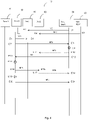
- the server receives the session data transmitted by the terminal during phase P1 and determines that a new routing identifier must be used by the terminal for the remaining data of the session.
- the server analyzes the communication parameters of the session. Among these parameters, the server identifies, for example, the NSSAI1 session information added by the terminal as well as possibly other fields of the transport protocol and/or fields of the application protocol, various examples of which will be given in the figure 3 and 4 . It can also use, for the determination of an identifier, the first slice identifier used by the communication infrastructure in the case where this identifier is communicated to it.
- the server determines a routing identifier corresponding to the parameters analyzed during phase P2.
- the server manager will have had prior knowledge of the network slices implemented in the communication network routing the session data as well as their characteristics.
- the server selects at least one routing identifier whose characteristics correspond to the parameters of the session and transmits it to the terminal.
- the routing identifier can be a slice identifier of the communication infrastructure but it can also be a routing identifier specific to the server and to the terminal for which a correspondence with a slice identifier of the communication infrastructure must be made.
- the server transmits the identifier to the terminal in a field of a protocol used for the session or else it transmits this information using a specific protocol. If the session is an HTTP/TCP type session, the server can return the information in the HTTP protocol or the TCP protocol, or even use a different protocol.
- the terminal On receipt of the new identifier transmitted by the server, during phase P4, the terminal configures new session information NSSAI2, corresponding to the routing identifier received.
- the session information can be identical to the routing identifier. It can also be information to be updated in a protocol, such as for example a quality of service parameter. Session data is now output with this updated session information.
- the terminal transmits the session data with the updated session information, allowing the session data to be routed over a second network slice corresponding to the characteristics of the session, these characteristics being formalized with session information.
- the session information is interpreted by a network device and the device adds a second slice identifier to the data transported in the communication infrastructure, allowing them to be routed in a slice adapted to the characteristics of the session during the phase.
- the server and the device of the communication infrastructure possibly select a routing and second slice identifier according to session information. It is therefore necessary for these two entities to coordinate beforehand so that their respective selections are consistent.
- the server 50 App1 transmits during a step E1 transmits a message to a device 80 Acc1 of the communication infrastructure 10 to communicate to it in a message M0 routing identifiers that the device 80 must interpret to route the data from the data sessions to the server 50.
- the message M0 is directly transmitted to the device 80 in the picture 3 .
- the message M0 can be sent to an infrastructure management server 10 which in turn will transmit this information to the various access devices of the infrastructure 10, in particular to prevent the various servers from communicating directly with the access devices.
- the message M0 can further comprise session characteristics relating to the routing identifiers so that the device 80 can select a network slice adapted to the characteristics of the sessions.
- the routing identifiers can correspond to slice identifiers used in the communication infrastructure and/or to data relating to routing options, for example when architectures of the CDN type (in English Content Delivery Networks) are implemented.
- the device 80 Upon receipt of the message M0 during step E2, the device 80 is capable of routing the data of the sessions intended for the server 50 on the network slices of the communication infrastructure.
- the server 40 App2 sends a message M'0 to the device 90 during a step E3 which the device 90 receives during a step E4.
- the server 40 is thus able to route the data to the server 40.
- the exchanges are not represented in the figure but the respective servers 50 and 40 also respectively inform the devices 90 and 80 in such a way corresponding.
- the terminal 51 Term1 registers with the communication infrastructure by transmitting a message M1 to the device 90.
- the terminal 51 informs the device 90 in this message about the default session information used so that a default network slice is pre-assigned by the device 90.
- the device 90 upon receipt of message M1 during step E6, communicates this information to the other devices so that any device receiving the data from the terminal is able to associate the default network slice.
- the terminal 51 sends a message M2 to the server 40 App2.
- This message M2 is an HTTP/QUIC/UDP/IP type HELLO message.
- the message M2 is routed in the communication infrastructure 10 in accordance with the default session information added by the terminal 51 and for which the device 90 of the communication infrastructure associates a slot.
- the message M2, initially transmitted to the device 90 which then retransmits it to the server 40, comprises transport information of the QUIC protocol among which information relating to the version of the QUIC protocol used as well as a version of the signaling compression algorithm .
- the server 40 App2 detects that the version of the QUIC protocol used is not suitable, for example because a new version exists or else because it is not appropriate for the application.
- the server further wishes that the following data sent from the terminal be transported over a second network slice more suited to the characteristics of the application.
- the server 40 uses information of the metadata type, for example of the CDNI type (in English Content Distribution Network Information) present in the data routed by the QUIC protocol to determine the route identifier.
- the data may relate to the QUIC protocol or else be application data routed using the QUIC protocol.
- the session information present in the message M2 and corresponding here to the QUIC version must therefore be modified by the terminal 51.
- the server 40 determines during a step E9 a new routing identifier allowing the session data to be be routed over a second slice of the communication network 10 that is more suitable.
- the server transmits it in a message M3 to the device 90 during a step E10, as well as the characteristics associated with this identifier, to ensure that the data having characteristics corresponding to this identifier are routed in an adequate second network slice.
- the device 90 upon receipt of this message during step E11, is capable of routing the session data, updated by the terminal as a function of the routing identifier received, in a second slice of infrastructure network 10.
- the server 40 transmits a message M4 intended for the terminal 51 comprising a routing identifier.
- the server 40 transmits, according to this example, an HTTP/QUIC/UDP/IP message comprising information on the routing identifier to be used for the session, the identifier being inserted in a datum of the QUIC protocol.
- the server 40 transmits information on the NSSAI to the terminal 51 which receives it during step E13.
- the server 40 also indicates to the terminal in the message M4 to use a more recent version of the QUIC protocol.
- the routing identifier will consist of the NSSAI information and the version of the QUIC protocol to be used.
- the terminal 51 configures session information according to the routing identifier received in the message M4.
- the terminal 51 updates the version of the QUIC protocol in accordance with the content of the message M4 and inserts the identifier NSSAI into a datum of the QUIC protocol.
- the session information is identical to the routing identifier received but according to other examples, the session information can be different from the routing identifier received.
- the terminal 51 updates the version of QUIC and possibly also inserts additional information, for example in a field of the message transmitted. , for example a Flow Label and/or Traffic Class field of the IPv6 datagram header or the Type of service field of the IPv4 datagram header.
- the terminal 51 updates its registration with the communication infrastructure by transmitting a message M5 to the device 90.
- the terminal 51 informs the device 90 in this message about the session information configured during step E14 so that a second network slice is assigned by the device 90.
- the device 90 upon receipt of the message M5 during step E16, communicates this information to the other devices of the infrastructure 10 in such a way that any device receiving the data from the terminal is able to associate the second network slice associated with the session information.
- This communication to the other devices can be carried out, according to an alternative, via a server 70 for managing the infrastructure 10 which will then be responsible for informing the various access devices.
- the device 90 transmits during step F1 a message G1 comprising the session information to the management server 71 which, once it receives it during step F2, retransmits it to the device 80 during of a step F3.
- the device 80 receives the message G1 in step F4 and is able to associate a second slice with a message comprising the session information coming from the terminal 51.
- the device 90 informs during the step E17 the server 40 of the update of the second network slice for the data of the session by transmitting a message M6.
- This message M6 includes the session information configured by the terminal 51 and the associated slot, which allows the server 40 to ensure on the one hand that the device 40 routes the session data on a suitable slot and to the other hand to know the session information configured by the terminal 51 for the session.
- the terminal stores the routing identifier received for the session.
- This storage allows the terminal to directly configure appropriate session information, when launching a new session which would have communication parameters identical to the previous one.
- the first data of this new session are directly routed on a network slice corresponding to the characteristics of this new session.
- the terminal 51 transmits the session data in a message M7 to the server 40, these data being updated with the session information configured by the terminal 51.
- These data are transmitted via the infrastructure communication device 10, and more precisely the device 90, which routes the session data on a second network slice adapted to the characteristics of the session to the server 40.
- the device 90 of the infrastructure when the device 90 of the infrastructure associates a slice with session information of the message M7 transmitted by the terminal, it keeps in memory data of the message M7 received in order to be able to associate the same slice with sessions having the same data.
- the device 90 can store data from the M7 message (source IP address, destination IP address, source port, destination port, protocol, version, slot identifier, TLS session ticket, QUIC connection identifier) in the purpose of being able to associate messages with the selected slot.
- some QUIC messages use short headers, not having the version field, but can nevertheless be associated with the slice selected for the M7 message thanks to the memorization of the data associated with the slice during a previous session by example.
- the stored data can also be advantageously used for allocating a slot to messages transmitted by the server 40 intended for the terminal 51.
- the server 40 upon receipt of the message M7 during step E21, receives the session data transmitted by the terminal 51 and verifies that the session information configured by the terminal corresponds to the routing identifier transmitted in message M4, if necessary also referring to message M6. According to this embodiment, the server E21 verifies that the version of the QUIC protocol and the NSSAI information correspond to the information that it transmitted previously.
- FIG 4 provides an overview of the process data routing, according to a third embodiment of the invention.
- Steps E1 to E4 are identical to the corresponding steps of the picture 3 .
- the terminal 53 Term2 registers with the device 80 Acc2 by sending a message M′1.
- This registration step allows, in the case of a 5G network, in particular the terminal 53 to register with the NGRAN (in English New Generation Radio Access Networks) and, upon receipt of the message M′1 at step E'6, NGRAN to select an AMF (Access and Mobility Management Function) device in accordance with the 3GPP TR 23.799 specification (version 14.0 12/16/2016).
- AMF Access and Mobility Management Function
- the terminal 53 transmits a message M'2 to the server 50 Serv App2.
- the message M'2 is a (HTTP/2)/TLS/IP type message.
- the server 50 analyzes the communication parameters of the message M'2. In particular, it examines the parameters of the TLS transport protocol and the parameters of the HTTP2 protocol of the message M'2 transmitted by the terminal 53.
- the communication parameters of the TLS protocol as defined in section 5 of the document IETF RFC 8095 (March 2017) as well as in the IETF document https://tools.ietf.org/html/draft-pauly-taps-transport- security-00 (07/03/2015) are analyzed in particular.
- the HTTP/2 parameters as defined in the document IETF RFC 7540 (March 2015) are also analyzed by the server upon receipt of the message M'2 during step E'8. It should also be noted that the terminal 53 has used a default first network slice identifier to send the message M′2. According to this alternative, the terminal 53 itself inserts a first network slice identifier that the communication infrastructure 10 is able to use to route the data transmitted by the terminal 53.
- the server has analyzed the various parameters and has found that the network slice having routed the message M'2, and from which it obtained the identifier in the message M'2, is not not suitable for certain TLS settings and/or HTTP/2 of message M'2.
- the server 50 determines, from the parameters, a new routing identifier for the next messages to be sent by the terminal 53 for this session (HTTP/2)/TLS/IP.
- the determined routing identifier takes into account parameters for example of encryption (TLS), of flow control and of multiplexing of the HTTP/2 application flows, of compression.
- the server 50 considers only the versions of the protocols to determine a routing identifier since a protocol version corresponds to a set of parameters. By referring to a protocol version in the message M'2 received from the terminal 53, the server 50 knows that a certain number of parameters, among those defined in the documents cited above, are present or not in the message M '2.
- Steps E'10 to E'13 are equivalent to steps E10 to E13 of the picture 3 with the difference that the message M′4 comprises a routing identifier comprising a slot identifier of the communication network 10 as well as the communication parameters to be updated for the terminal.
- the server 50 can determine several routing identifiers so that the data sent by the terminal is routed over several network slices, called second slices, within the communication infrastructure. This alternative is notably motivated by the development of multi-path protocols and the possibility for terminals to be simultaneously attached to several communication infrastructures.
- the terminal 53 upon receipt of the message M'4 during step E'13 configures the second slice identifier received in the message M'4 in the messages of the data session to be sent to the server 50.
- This second slice identifier replaces the default first slice identifier originally used.
- the terminal 53 also updates the communication parameters transmitted by the server 50. This update is optional. Indeed, the terminal in the case where it is not able to use these parameters, will not be able to configure them in the messages to be transmitted. Steps E'15 to E'19 correspond to steps E15 to E19 of the picture 3 .
- the terminal 53 transmits the session data to the server 50, these having been configured with the identifier of the second network slice of the communication infrastructure 10 received from the server 50.
- This embodiment is in particular implemented in the case where the terminal 53 and the server 50 on the one hand, and the communication infrastructure 10 are administered by a single manager or else that a collaboration exists between the managers of the terminal 53 , the server manager 50 and the infrastructure manager 10.
- the terminal 53 is able to manage several network slices and transmits the session data on the second network slice(s) whose the identifier (or identifiers) has (have) been communicated to it by the server 50.
- figure 2 , 3 , 4 are not exclusive and combinations of these modes are possible.
- the routing device 100 implements the routing method, various embodiments of which have just been described.
- Such a device 100 can be implemented in a terminal or more generally in an infrastructure access device (fixed terminal, mobile terminal, box).
- the access device can be equipment for residential customers or professional customers, connected to a fixed network or to a mobile network.
- the device 100 comprises a processing unit 106, equipped for example with a microprocessor ⁇ P, and controlled by a computer program 105, stored in a memory 107 and implementing the routing method according to the invention.
- a computer program 105 stored in a memory 107 and implementing the routing method according to the invention.
- the code instructions of the computer program 105 are for example loaded into a RAM memory, before being executed by the processor of the processing unit 106.
- the routing device 200 implements the determination method of which different embodiments have just been described.
- Such a device 200 can be implemented in a server or more broadly in an end device capable of establishing a session with a terminal.
- the device 200 comprises a processing unit 206, equipped for example with a microprocessor ⁇ P, and controlled by a computer program 205, stored in a memory 207 and implementing the routing method according to the invention.
- a computer program 205 stored in a memory 207 and implementing the routing method according to the invention.
- the code instructions of the computer program 205 are for example loaded into a RAM memory, before being executed by the processor of the processing unit 206.
- the implementation of the routing method and of the determination method is valid for any type of infrastructure, fixed or mobile and including for hybrid networks, fixed and mobile, when a terminal is simultaneously attached to a fixed infrastructure and mobile infrastructure.
- a multi-path session makes it possible in particular to improve the speed of data transmission as well as the reliability of data routing.
- the routing method authorizes the implementation of multi-path architectures and makes it possible to select a network slice based on several different paths or even several network slices, each slice allowing the routing of data on one or more paths.
Landscapes
- Engineering & Computer Science (AREA)
- Computer Networks & Wireless Communication (AREA)
- Signal Processing (AREA)
- Computer Security & Cryptography (AREA)
- Computer Hardware Design (AREA)
- Computing Systems (AREA)
- General Engineering & Computer Science (AREA)
- Data Exchanges In Wide-Area Networks (AREA)
- Mobile Radio Communication Systems (AREA)
Claims (15)
- Verfahren zur Übermittlung von Daten einer Sitzung, die zwischen einem Endgerät und einem Server initialisiert ist, auf einem ersten Netzwerk-Slice, der einem Satz von Funktionen zur Verarbeitung der Daten einer Kommunikationsinfrastruktur entspricht, das vom Endgerät durchgeführt wird und dadurch gekennzeichnet ist, dass es die folgenden Schritte umfasst:- Empfangen, von dem Server, wenigstens einer Übermittlungskennung, die in Abhängigkeit von wenigstens einem Kommunikationsparameter der Sitzung bestimmt wird,- Konfigurieren einer Sitzungsinformation in Abhängigkeit von der empfangenen wenigstens einen Kennung,- Senden, an den Server, der folgenden Daten der Sitzung, die auf wenigstens einem zweiten Slice übermittelt werden, der der konfigurierten Information entspricht.
- Übermittlungsverfahren nach Anspruch 1, wobei die Sitzung vom Endgerät verschlüsselt und vom Server entschlüsselt wird.
- Übermittlungsverfahren nach Anspruch 1, wobei die Sitzung vom Endgerät initialisiert wird, indem eine Standardsitzungsinformation konfiguriert wird.
- Übermittlungsverfahren nach Anspruch 1, wobei die Information der Sitzung ein Datenelement in Bezug auf eine NSSAI-Information ist.
- Übermittlungsverfahren nach Anspruch 1, wobei das Endgerät die wenigstens eine empfangene Kennung in Abhängigkeit von den Kommunikationsparametern der Sitzung einspeichert.
- Verfahren zur Bestimmung wenigstens einer Kennung zur Übermittlung von Daten einer Sitzung, die zwischen einem Endgerät und einem Server initialisiert ist, auf einem ersten Netzwerk-Slice, der einem Satz von Funktionen zur Verarbeitung der Daten einer Kommunikationsinfrastruktur entspricht, das vom Server durchgeführt wird und dadurch gekennzeichnet ist, dass es die folgenden Schritte umfasst:- Bestimmen wenigstens einer Übermittlungskennung in Abhängigkeit von wenigstens einem Kommunikationsparameter der Sitzung,- Senden der bestimmten wenigstens einen Kennung an das Endgerät,- Empfangen, vom Endgerät, der folgenden Daten der Sitzung, die auf wenigstens einem zweiten Slice übermittelt werden.
- Bestimmungsverfahren nach Anspruch 6, wobei der wenigstens eine Parameter auf die Transportschicht der Sitzung bezogen ist.
- Bestimmungsverfahren nach Anspruch 6, wobei der wenigstens eine Parameter auf das QUIC-Protokoll bezogen ist.
- Bestimmungsverfahren nach Anspruch 6, wobei der wenigstens eine Parameter auf die Protokollversion der Transportschicht bezogen ist.
- Bestimmungsverfahren nach Anspruch 6, wobei die wenigstens eine Kennung in einem Datenelement eines Transportprotokolls gesendet wird.
- Vorrichtung zur Übermittlung von Daten einer Sitzung, die zwischen einem Endgerät und einem Server initialisiert ist, auf einem ersten Netzwerk-Slice, der einem Satz von Funktionen zur Verarbeitung der Daten einer Kommunikationsinfrastruktur entspricht, die vom Endgerät eingesetzt wird und dadurch gekennzeichnet ist, dass sie Folgendes umfasst:- einen Empfänger, der geeignet ist, von dem Server wenigstens eine Übermittlungskennung zu empfangen, die in Abhängigkeit von wenigstens einem Kommunikationsparameter der Sitzung bestimmt wird,- ein Konfigurationsmodul, das geeignet ist, eine Sitzungsinformation in Abhängigkeit von der empfangenen wenigstens einen Kennung zu konfigurieren,- einen Sender, der geeignet ist, an den Server die folgenden Daten der Sitzung zu senden, die auf wenigstens einem zweiten Slice übermittelt werden, der der konfigurierten Information entspricht.
- Vorrichtung zur Bestimmung wenigstens einer Kennung zur Übermittlung von Daten einer Sitzung, die zwischen einem Endgerät und einem Server initialisiert ist, auf einem ersten Netzwerk-Slice, der einem Satz von Funktionen zur Verarbeitung der Daten einer Kommunikationsinfrastruktur entspricht, die vom Server eingesetzt wird und dadurch gekennzeichnet ist, dass sie Folgendes umfasst:- ein Bestimmungsmodul, das geeignet ist, wenigstens eine Übermittlungskennung in Abhängigkeit von wenigstens einem Kommunikationsparameter der Sitzung zu bestimmen,- einen Sender, der geeignet ist, die bestimmte wenigstens eine Kennung an das Endgerät zu senden,- einen Empfänger, der geeignet ist, vom Endgerät die folgenden Daten der Sitzung zu empfangen, die auf wenigstens einem zweiten Slice übermittelt werden.
- System zur Übermittlung von Daten einer Sitzung, die zwischen einem Endgerät und einem Server initialisiert ist, auf einem ersten Netzwerk-Slice, der einem Satz von Funktionen zur Verarbeitung der Daten einer Kommunikationsinfrastruktur entspricht:- ein Endgerät, das eine Übermittlungsvorrichtung nach Anspruch 11 umfasst,- einen Server, der eine Bestimmungsvorrichtung nach Anspruch 12 umfasst.
- Computerprogramm, dadurch gekennzeichnet, dass es Anweisungen zur Durchführung der Schritte des Übermittlungsverfahrens nach Anspruch 1, wenn dieses Verfahren von einem Prozessor ausgeführt wird, umfasst.
- Speichermedium, das von einer Übermittlungsvorrichtung nach Anspruch 11 gelesen werden kann, auf dem das Programm nach Anspruch 14 gespeichert ist.
Priority Applications (1)
| Application Number | Priority Date | Filing Date | Title |
|---|---|---|---|
| EP22194508.2A EP4132177B1 (de) | 2017-12-01 | 2018-11-29 | Verfahren zur weiterleitung von daten einer iniziierten sitzung zwischen einem endgerät und einem server |
Applications Claiming Priority (2)
| Application Number | Priority Date | Filing Date | Title |
|---|---|---|---|
| FR1761552A FR3074626A1 (fr) | 2017-12-01 | 2017-12-01 | Procede d'acheminement de donnees d'une session initialisee entre un terminal et un serveur |
| PCT/FR2018/053047 WO2019106308A1 (fr) | 2017-12-01 | 2018-11-29 | Procédé d'acheminement de données d'une session initialisée entre un terminal et un serveur |
Related Child Applications (1)
| Application Number | Title | Priority Date | Filing Date |
|---|---|---|---|
| EP22194508.2A Division EP4132177B1 (de) | 2017-12-01 | 2018-11-29 | Verfahren zur weiterleitung von daten einer iniziierten sitzung zwischen einem endgerät und einem server |
Publications (2)
| Publication Number | Publication Date |
|---|---|
| EP3732829A1 EP3732829A1 (de) | 2020-11-04 |
| EP3732829B1 true EP3732829B1 (de) | 2022-09-14 |
Family
ID=61224071
Family Applications (2)
| Application Number | Title | Priority Date | Filing Date |
|---|---|---|---|
| EP22194508.2A Active EP4132177B1 (de) | 2017-12-01 | 2018-11-29 | Verfahren zur weiterleitung von daten einer iniziierten sitzung zwischen einem endgerät und einem server |
| EP18827208.2A Active EP3732829B1 (de) | 2017-12-01 | 2018-11-29 | Verfahren zur durchführung von daten aus einer initialisierten sitzung zwischen terminal und server |
Family Applications Before (1)
| Application Number | Title | Priority Date | Filing Date |
|---|---|---|---|
| EP22194508.2A Active EP4132177B1 (de) | 2017-12-01 | 2018-11-29 | Verfahren zur weiterleitung von daten einer iniziierten sitzung zwischen einem endgerät und einem server |
Country Status (8)
| Country | Link |
|---|---|
| US (4) | US11394787B2 (de) |
| EP (2) | EP4132177B1 (de) |
| CN (4) | CN116684463B (de) |
| ES (1) | ES2933261T3 (de) |
| FR (1) | FR3074626A1 (de) |
| PL (1) | PL3732829T3 (de) |
| PT (1) | PT3732829T (de) |
| WO (1) | WO2019106308A1 (de) |
Families Citing this family (5)
| Publication number | Priority date | Publication date | Assignee | Title |
|---|---|---|---|---|
| FR3074626A1 (fr) * | 2017-12-01 | 2019-06-07 | Orange | Procede d'acheminement de donnees d'une session initialisee entre un terminal et un serveur |
| WO2020243533A1 (en) * | 2019-05-31 | 2020-12-03 | Apple Inc. | Systems and methods for performance data streaming, performance data file reporting, and performance threshold monitoring |
| US12213063B2 (en) * | 2019-07-30 | 2025-01-28 | Nippon Telegraph And Telephone Corporation | Slice gateway, quality calculation apparatus, inspection packet processing method and program |
| FR3101498A1 (fr) * | 2019-09-30 | 2021-04-02 | Orange | Procédé de contrôle d’un flux de données associé à un processus au sein d’un réseau mutualisé |
| FR3155398A1 (fr) * | 2023-11-15 | 2025-05-16 | Orange | Procédé de contrôle d’une communication au cours de laquelle sont échangées des données relatives à un service, et dispositifs électroniques associés |
Family Cites Families (60)
| Publication number | Priority date | Publication date | Assignee | Title |
|---|---|---|---|---|
| US8266294B2 (en) * | 2003-08-13 | 2012-09-11 | Microsoft Corporation | Routing hints |
| US8626926B2 (en) * | 2008-02-26 | 2014-01-07 | Qualcomm Incorporated | Method and apparatus for performing session info query for user plane location |
| FR3000336A1 (fr) * | 2012-12-20 | 2014-06-27 | France Telecom | Mecanisme de gestion d'une session de communication |
| US9497132B2 (en) * | 2013-04-23 | 2016-11-15 | Telefonaktiebolaget Lm Ericsson (Publ) | Method and system of implementing conversation-sensitive collection for a link aggregation group |
| US9985799B2 (en) * | 2014-09-05 | 2018-05-29 | Alcatel-Lucent Usa Inc. | Collaborative software-defined networking (SDN) based virtual private network (VPN) |
| US10951519B2 (en) * | 2015-06-17 | 2021-03-16 | Oracle International Corporation | Methods, systems, and computer readable media for multi-protocol stateful routing |
| CN108141756A (zh) * | 2015-09-29 | 2018-06-08 | 瑞典爱立信有限公司 | 促成网络切片管理 |
| US10028168B2 (en) * | 2015-12-08 | 2018-07-17 | Huawei Technologies Co., Ltd. | Method and apparatus for remote buffer status maintenance |
| US9961713B2 (en) * | 2016-02-23 | 2018-05-01 | Motorola Mobility Llc | Procedures to support network slicing in a wireless communication system |
| FR3048574A1 (fr) * | 2016-03-07 | 2017-09-08 | Orange | Selection d'une instanciation de tranche de reseau pour la transmission de paquets montants |
| EP3435729B1 (de) * | 2016-03-23 | 2020-11-25 | LG Electronics Inc. -1- | Verfahren zur änderung des verbindungsmodus in einer basisstation und basisstation davon sowie verfahren zum ändern des verbindungsmodus in einem benutzergerät und benutzergerät dafür |
| US20170289791A1 (en) * | 2016-04-05 | 2017-10-05 | Electronics And Telecommunications Research Institute | Communication method and apparatus using network slice |
| BR112018070365A8 (pt) * | 2016-04-05 | 2023-04-25 | Sharp Kk | Equipamento de usuário e método de comunicação executado por um equipamento de usuário |
| CN110401972B (zh) * | 2016-04-08 | 2022-04-22 | 大唐移动通信设备有限公司 | 在多网络切片的网络中路由消息的方法、设备及系统 |
| US10142994B2 (en) * | 2016-04-18 | 2018-11-27 | Electronics And Telecommunications Research Institute | Communication method and apparatus using network slicing |
| US10028128B2 (en) * | 2016-04-29 | 2018-07-17 | Motorola Mobility Llc | Procedures to support network slicing in a wireless communication system |
| US10986675B2 (en) * | 2016-05-12 | 2021-04-20 | Convida Wireless, Llc | Connecting to virtualized mobile core networks |
| WO2017200978A1 (en) * | 2016-05-16 | 2017-11-23 | Idac Holdings, Inc. | Security-based slice selection and assignment |
| US10362511B2 (en) * | 2016-05-17 | 2019-07-23 | Lg Electronics Inc. | Method and apparatus for determining PDU session identity in wireless communication system |
| CN107517488B (zh) * | 2016-06-15 | 2020-10-23 | 华为技术有限公司 | 报文处理的方法及设备 |
| KR101981909B1 (ko) * | 2016-07-04 | 2019-05-23 | 애플 인크. | 네트워크 슬라이스 선택 |
| US10757576B2 (en) * | 2016-08-05 | 2020-08-25 | Nxgen Partners Ip, Llc | SDR-based massive MIMO with V-RAN cloud architecture and SDN-based network slicing |
| KR102172118B1 (ko) * | 2016-08-12 | 2020-10-30 | 후아웨이 테크놀러지 컴퍼니 리미티드 | 네트워크 슬라이스 선택 방법, 무선 액세스 네트워크 장치, 및 단말 |
| JP6925411B2 (ja) * | 2016-08-16 | 2021-08-25 | アイディーエーシー ホールディングス インコーポレイテッド | ネットワークスライス再選択 |
| EP3944675A1 (de) * | 2016-08-22 | 2022-01-26 | Huawei Technologies Co., Ltd. | Verfahren und vorrichtung zur auswahl von netzwerk-slices |
| ES2945485T3 (es) * | 2016-11-04 | 2023-07-03 | Huawei Tech Co Ltd | Método y terminal de cambio entre redes |
| CN106851589B (zh) * | 2016-12-30 | 2019-02-19 | 北京小米移动软件有限公司 | 无线网络接入方法、装置及系统 |
| CN108282352B (zh) * | 2017-01-05 | 2021-03-23 | 华为技术有限公司 | 管理网络切片实例的方法、装置和系统 |
| GB2558585A (en) * | 2017-01-06 | 2018-07-18 | Nec Corp | Communication system |
| KR102549946B1 (ko) * | 2017-01-09 | 2023-06-30 | 삼성전자주식회사 | 이동통신 환경에서 단말의 초기 접속 요청 메시지를 라우팅하는 방법 및 관련 파라미터 |
| US12063559B2 (en) * | 2017-01-23 | 2024-08-13 | Nokia Technologies Oy | Method and apparatus for complementary and equivalent network slice deployment in a network environment |
| US10531336B2 (en) * | 2017-02-26 | 2020-01-07 | Mariana Goldhamer | Link control in centralized deployments |
| CN110214459B (zh) * | 2017-03-01 | 2021-02-12 | 华为技术有限公司 | 业务处理的方法和设备 |
| CN106982458B (zh) * | 2017-03-09 | 2019-12-17 | 华为技术有限公司 | 一种网络切片的选择方法及装置 |
| CN108632808B (zh) * | 2017-03-17 | 2023-04-21 | 华为技术有限公司 | 核心网控制面设备选择方法和装置 |
| CN110419240B (zh) * | 2017-03-24 | 2023-09-29 | 华为技术有限公司 | 切片兼容的切换控制设备和方法 |
| EP3616468A4 (de) * | 2017-04-27 | 2020-11-18 | Intel IP Corporation | Verbesserte verwaltung von netzwerk-slices für drahtlose kommunikationen |
| US10673751B2 (en) * | 2017-04-27 | 2020-06-02 | At&T Intellectual Property I, L.P. | Method and apparatus for enhancing services in a software defined network |
| WO2018202274A1 (en) * | 2017-05-02 | 2018-11-08 | Huawei Technologies Co., Ltd. | Devices, systems and methods for accessing and providing network slices in a mobile communication network |
| US11122470B2 (en) * | 2017-05-04 | 2021-09-14 | Ofinno, Llc | Network slice information for handover procedure |
| US10820185B2 (en) * | 2017-05-08 | 2020-10-27 | Qualcomm Incorporated | Mobility between areas with heterogeneous network slices |
| US10382903B2 (en) * | 2017-05-09 | 2019-08-13 | At&T Intellectual Property I, L.P. | Multi-slicing orchestration system and method for service and/or content delivery |
| FR3067197A1 (fr) * | 2017-06-01 | 2018-12-07 | Orange | Procede de selection d'une tranche de reseau relative a une application |
| WO2018231125A1 (en) * | 2017-06-16 | 2018-12-20 | Telefonaktiebolaget Lm Ericsson (Publ) | Network, network nodes, wireless communication devices and method therein for handling network slices in a wireless communication network |
| CN109151906B (zh) * | 2017-06-16 | 2021-02-12 | 华为技术有限公司 | 通信方法、网络设备、终端设备和系统 |
| US10764951B2 (en) * | 2017-06-17 | 2020-09-01 | Lg Electronics Inc. | Registration method of user terminal in wireless communication system and apparatus therefor |
| WO2019004929A2 (zh) * | 2017-06-29 | 2019-01-03 | 华为国际有限公司 | 网络切片分配方法、设备及系统 |
| US11039321B2 (en) * | 2017-07-05 | 2021-06-15 | Huawei Technologies Co., Ltd. | Methods and systems for network slicing |
| US10268474B2 (en) * | 2017-07-18 | 2019-04-23 | Cisco Technology, Inc. | Network slice selection in a mobile network |
| CN109391648B (zh) * | 2017-08-04 | 2020-12-22 | 华为技术有限公司 | 一种应用与网络切片的关联方法、装置和通信系统 |
| CN109548098B (zh) * | 2017-08-15 | 2023-10-24 | 华为技术有限公司 | 会话处理方法及相关设备 |
| CN109429274B (zh) * | 2017-09-04 | 2021-10-01 | 华为技术有限公司 | 一种配置方法以及对应装置 |
| EP3688953B1 (de) * | 2017-09-29 | 2022-12-21 | Telefonaktiebolaget LM Ericsson (Publ) | Erzeugung eines pseudonyms zur anforderung eines netzwerk-slices |
| FR3072241A1 (fr) * | 2017-10-05 | 2019-04-12 | Orange | Procede de mutation d'un terminal mobile entre stations d'acces dans un contexte multi-operateurs |
| CN111034266A (zh) * | 2017-10-16 | 2020-04-17 | 株式会社Ntt都科摩 | 通信系统、通信控制装置及通信方法 |
| US11026128B2 (en) * | 2017-10-19 | 2021-06-01 | Qualcomm Incorporated | Mechanism to enable interworking between network slicing and evolved packet core connectivity |
| CN109769269B (zh) * | 2017-11-09 | 2021-01-12 | 华为技术有限公司 | 通信方法和网络设备 |
| US10834668B2 (en) * | 2017-11-14 | 2020-11-10 | Ofinno, Llc | AMF selection for isolated network slice |
| FR3074626A1 (fr) * | 2017-12-01 | 2019-06-07 | Orange | Procede d'acheminement de donnees d'une session initialisee entre un terminal et un serveur |
| EP3836506A1 (de) * | 2019-12-09 | 2021-06-16 | Orange | Bereitstellung von cybersicherheitsdiensten durch ein netzwerk und automatisierte bereitstellung davon |
-
2017
- 2017-12-01 FR FR1761552A patent/FR3074626A1/fr not_active Ceased
-
2018
- 2018-11-29 CN CN202310684962.2A patent/CN116684463B/zh active Active
- 2018-11-29 EP EP22194508.2A patent/EP4132177B1/de active Active
- 2018-11-29 CN CN202310684974.5A patent/CN116684464A/zh active Pending
- 2018-11-29 CN CN201880077715.3A patent/CN111418186B/zh active Active
- 2018-11-29 US US16/768,410 patent/US11394787B2/en active Active
- 2018-11-29 CN CN202310684843.7A patent/CN116684462B/zh active Active
- 2018-11-29 PL PL18827208.2T patent/PL3732829T3/pl unknown
- 2018-11-29 EP EP18827208.2A patent/EP3732829B1/de active Active
- 2018-11-29 PT PT188272082T patent/PT3732829T/pt unknown
- 2018-11-29 ES ES18827208T patent/ES2933261T3/es active Active
- 2018-11-29 WO PCT/FR2018/053047 patent/WO2019106308A1/fr not_active Ceased
-
2022
- 2022-06-14 US US17/839,799 patent/US11785095B2/en active Active
-
2023
- 2023-08-29 US US18/457,669 patent/US12250276B2/en active Active
- 2023-08-29 US US18/457,667 patent/US12143451B2/en active Active
Also Published As
| Publication number | Publication date |
|---|---|
| US11394787B2 (en) | 2022-07-19 |
| PT3732829T (pt) | 2022-12-09 |
| FR3074626A1 (fr) | 2019-06-07 |
| US20230403329A1 (en) | 2023-12-14 |
| EP4132177C0 (de) | 2025-12-24 |
| US12250276B2 (en) | 2025-03-11 |
| US11785095B2 (en) | 2023-10-10 |
| US20230403330A1 (en) | 2023-12-14 |
| EP4132177B1 (de) | 2025-12-24 |
| EP3732829A1 (de) | 2020-11-04 |
| PL3732829T3 (pl) | 2023-01-09 |
| CN116684464A (zh) | 2023-09-01 |
| CN116684463A (zh) | 2023-09-01 |
| CN111418186A (zh) | 2020-07-14 |
| WO2019106308A1 (fr) | 2019-06-06 |
| US20220311829A1 (en) | 2022-09-29 |
| CN111418186B (zh) | 2023-06-09 |
| CN116684462A (zh) | 2023-09-01 |
| EP4132177A1 (de) | 2023-02-08 |
| CN116684463B (zh) | 2026-03-17 |
| US12143451B2 (en) | 2024-11-12 |
| CN116684462B (zh) | 2026-03-17 |
| US20200389527A1 (en) | 2020-12-10 |
| ES2933261T3 (es) | 2023-02-03 |
Similar Documents
| Publication | Publication Date | Title |
|---|---|---|
| EP3632087B1 (de) | Auswahl einer netzwerkscheibe in bezug auf eine anwendung | |
| EP3732829B1 (de) | Verfahren zur durchführung von daten aus einer initialisierten sitzung zwischen terminal und server | |
| EP3739843B1 (de) | Udp-kommunikationsverfahren über multiple kommunikationswege zwischen zwei endgeräten | |
| WO2019002754A1 (fr) | Procédé de communication quic via des chemins multiples | |
| EP3643044B1 (de) | Verfahren zur aktivierung von auf eine datensitzung angewandten prozessen | |
| FR3053197A1 (fr) | Procede de communication udp via des chemins multiples entre deux terminaux | |
| EP3603024B1 (de) | Verfahren zur empfehlung eines kommunikationsstapels | |
| EP3430777B1 (de) | Verfahren und verfugung zur dynamischen verwaltung von kommunikationspfaden zwischen routern je nach anwendungsanforderung | |
| FR3062013A1 (fr) | Procedes et dispositifs de verification de la validite d'une delegation de diffusion de contenus chiffres | |
| EP3560168B1 (de) | Klassifizierung und routing von steuerungsnachrichten für eine kommunikationsinfrastruktur | |
| WO2025061515A1 (fr) | Procédés, dispositifs et système de contrôle d'une communication dans un réseau | |
| FR3115644A1 (fr) | Procédé et dispositif d’aiguillage d’une donnée applicative | |
| WO2022084606A1 (fr) | Procédé et dispositif de médiation d'un ensemble d'applications | |
| FR3154893A1 (fr) | Procédés et dispositifs pour la configuration et l’utilisation d’un réseau supportant des tranches réseau | |
| WO2025133029A1 (fr) | Procédé d'accès à un service par un dispositif de communication via au moins un réseau de communication | |
| WO2003071759A1 (fr) | Systeme de transmission de contenus multimedias apte a accorder les contenus au cours de leur transmission | |
| FR2965132A1 (fr) | Procede de configuration de parametres de gestion de paquets de donnees appartenant a un flux de donnees |
Legal Events
| Date | Code | Title | Description |
|---|---|---|---|
| STAA | Information on the status of an ep patent application or granted ep patent |
Free format text: STATUS: UNKNOWN |
|
| STAA | Information on the status of an ep patent application or granted ep patent |
Free format text: STATUS: THE INTERNATIONAL PUBLICATION HAS BEEN MADE |
|
| PUAI | Public reference made under article 153(3) epc to a published international application that has entered the european phase |
Free format text: ORIGINAL CODE: 0009012 |
|
| STAA | Information on the status of an ep patent application or granted ep patent |
Free format text: STATUS: REQUEST FOR EXAMINATION WAS MADE |
|
| 17P | Request for examination filed |
Effective date: 20200626 |
|
| AK | Designated contracting states |
Kind code of ref document: A1 Designated state(s): AL AT BE BG CH CY CZ DE DK EE ES FI FR GB GR HR HU IE IS IT LI LT LU LV MC MK MT NL NO PL PT RO RS SE SI SK SM TR |
|
| AX | Request for extension of the european patent |
Extension state: BA ME |
|
| DAV | Request for validation of the european patent (deleted) | ||
| DAX | Request for extension of the european patent (deleted) | ||
| RAP3 | Party data changed (applicant data changed or rights of an application transferred) |
Owner name: ORANGE |
|
| REG | Reference to a national code |
Ref country code: DE Ref legal event code: R079 Ref document number: 602018040746 Country of ref document: DE Free format text: PREVIOUS MAIN CLASS: H04L0012240000 Ipc: H04L0041080000 |
|
| RIC1 | Information provided on ipc code assigned before grant |
Ipc: H04W 72/04 20090101ALI20220209BHEP Ipc: H04L 41/08 20220101AFI20220209BHEP |
|
| GRAP | Despatch of communication of intention to grant a patent |
Free format text: ORIGINAL CODE: EPIDOSNIGR1 |
|
| STAA | Information on the status of an ep patent application or granted ep patent |
Free format text: STATUS: GRANT OF PATENT IS INTENDED |
|
| INTG | Intention to grant announced |
Effective date: 20220419 |
|
| GRAS | Grant fee paid |
Free format text: ORIGINAL CODE: EPIDOSNIGR3 |
|
| GRAA | (expected) grant |
Free format text: ORIGINAL CODE: 0009210 |
|
| STAA | Information on the status of an ep patent application or granted ep patent |
Free format text: STATUS: THE PATENT HAS BEEN GRANTED |
|
| AK | Designated contracting states |
Kind code of ref document: B1 Designated state(s): AL AT BE BG CH CY CZ DE DK EE ES FI FR GB GR HR HU IE IS IT LI LT LU LV MC MK MT NL NO PL PT RO RS SE SI SK SM TR |
|
| REG | Reference to a national code |
Ref country code: GB Ref legal event code: FG4D Free format text: NOT ENGLISH |
|
| REG | Reference to a national code |
Ref country code: CH Ref legal event code: EP |
|
| REG | Reference to a national code |
Ref country code: DE Ref legal event code: R096 Ref document number: 602018040746 Country of ref document: DE |
|
| REG | Reference to a national code |
Ref country code: IE Ref legal event code: FG4D Free format text: LANGUAGE OF EP DOCUMENT: FRENCH |
|
| REG | Reference to a national code |
Ref country code: AT Ref legal event code: REF Ref document number: 1519373 Country of ref document: AT Kind code of ref document: T Effective date: 20221015 |
|
| REG | Reference to a national code |
Ref country code: PT Ref legal event code: SC4A Ref document number: 3732829 Country of ref document: PT Date of ref document: 20221209 Kind code of ref document: T Free format text: AVAILABILITY OF NATIONAL TRANSLATION Effective date: 20221130 |
|
| REG | Reference to a national code |
Ref country code: SE Ref legal event code: TRGR |
|
| REG | Reference to a national code |
Ref country code: NL Ref legal event code: FP |
|
| REG | Reference to a national code |
Ref country code: LT Ref legal event code: MG9D |
|
| PG25 | Lapsed in a contracting state [announced via postgrant information from national office to epo] |
Ref country code: RS Free format text: LAPSE BECAUSE OF FAILURE TO SUBMIT A TRANSLATION OF THE DESCRIPTION OR TO PAY THE FEE WITHIN THE PRESCRIBED TIME-LIMIT Effective date: 20220914 Ref country code: NO Free format text: LAPSE BECAUSE OF FAILURE TO SUBMIT A TRANSLATION OF THE DESCRIPTION OR TO PAY THE FEE WITHIN THE PRESCRIBED TIME-LIMIT Effective date: 20221214 Ref country code: LV Free format text: LAPSE BECAUSE OF FAILURE TO SUBMIT A TRANSLATION OF THE DESCRIPTION OR TO PAY THE FEE WITHIN THE PRESCRIBED TIME-LIMIT Effective date: 20220914 Ref country code: LT Free format text: LAPSE BECAUSE OF FAILURE TO SUBMIT A TRANSLATION OF THE DESCRIPTION OR TO PAY THE FEE WITHIN THE PRESCRIBED TIME-LIMIT Effective date: 20220914 Ref country code: FI Free format text: LAPSE BECAUSE OF FAILURE TO SUBMIT A TRANSLATION OF THE DESCRIPTION OR TO PAY THE FEE WITHIN THE PRESCRIBED TIME-LIMIT Effective date: 20220914 |
|
| REG | Reference to a national code |
Ref country code: ES Ref legal event code: FG2A Ref document number: 2933261 Country of ref document: ES Kind code of ref document: T3 Effective date: 20230203 Ref country code: GR Ref legal event code: EP Ref document number: 20220402443 Country of ref document: GR Effective date: 20230110 |
|
| REG | Reference to a national code |
Ref country code: AT Ref legal event code: MK05 Ref document number: 1519373 Country of ref document: AT Kind code of ref document: T Effective date: 20220914 |
|
| PG25 | Lapsed in a contracting state [announced via postgrant information from national office to epo] |
Ref country code: HR Free format text: LAPSE BECAUSE OF FAILURE TO SUBMIT A TRANSLATION OF THE DESCRIPTION OR TO PAY THE FEE WITHIN THE PRESCRIBED TIME-LIMIT Effective date: 20220914 |
|
| PG25 | Lapsed in a contracting state [announced via postgrant information from national office to epo] |
Ref country code: SM Free format text: LAPSE BECAUSE OF FAILURE TO SUBMIT A TRANSLATION OF THE DESCRIPTION OR TO PAY THE FEE WITHIN THE PRESCRIBED TIME-LIMIT Effective date: 20220914 Ref country code: AT Free format text: LAPSE BECAUSE OF FAILURE TO SUBMIT A TRANSLATION OF THE DESCRIPTION OR TO PAY THE FEE WITHIN THE PRESCRIBED TIME-LIMIT Effective date: 20220914 |
|
| PG25 | Lapsed in a contracting state [announced via postgrant information from national office to epo] |
Ref country code: SK Free format text: LAPSE BECAUSE OF FAILURE TO SUBMIT A TRANSLATION OF THE DESCRIPTION OR TO PAY THE FEE WITHIN THE PRESCRIBED TIME-LIMIT Effective date: 20220914 Ref country code: IS Free format text: LAPSE BECAUSE OF FAILURE TO SUBMIT A TRANSLATION OF THE DESCRIPTION OR TO PAY THE FEE WITHIN THE PRESCRIBED TIME-LIMIT Effective date: 20230114 Ref country code: EE Free format text: LAPSE BECAUSE OF FAILURE TO SUBMIT A TRANSLATION OF THE DESCRIPTION OR TO PAY THE FEE WITHIN THE PRESCRIBED TIME-LIMIT Effective date: 20220914 |
|
| REG | Reference to a national code |
Ref country code: DE Ref legal event code: R097 Ref document number: 602018040746 Country of ref document: DE |
|
| PG25 | Lapsed in a contracting state [announced via postgrant information from national office to epo] |
Ref country code: AL Free format text: LAPSE BECAUSE OF FAILURE TO SUBMIT A TRANSLATION OF THE DESCRIPTION OR TO PAY THE FEE WITHIN THE PRESCRIBED TIME-LIMIT Effective date: 20220914 |
|
| PLBE | No opposition filed within time limit |
Free format text: ORIGINAL CODE: 0009261 |
|
| STAA | Information on the status of an ep patent application or granted ep patent |
Free format text: STATUS: NO OPPOSITION FILED WITHIN TIME LIMIT |
|
| PG25 | Lapsed in a contracting state [announced via postgrant information from national office to epo] |
Ref country code: DK Free format text: LAPSE BECAUSE OF FAILURE TO SUBMIT A TRANSLATION OF THE DESCRIPTION OR TO PAY THE FEE WITHIN THE PRESCRIBED TIME-LIMIT Effective date: 20220914 |
|
| 26N | No opposition filed |
Effective date: 20230615 |
|
| PG25 | Lapsed in a contracting state [announced via postgrant information from national office to epo] |
Ref country code: SI Free format text: LAPSE BECAUSE OF FAILURE TO SUBMIT A TRANSLATION OF THE DESCRIPTION OR TO PAY THE FEE WITHIN THE PRESCRIBED TIME-LIMIT Effective date: 20220914 |
|
| PG25 | Lapsed in a contracting state [announced via postgrant information from national office to epo] |
Ref country code: CY Free format text: LAPSE BECAUSE OF FAILURE TO SUBMIT A TRANSLATION OF THE DESCRIPTION OR TO PAY THE FEE WITHIN THE PRESCRIBED TIME-LIMIT Effective date: 20220914 |
|
| PG25 | Lapsed in a contracting state [announced via postgrant information from national office to epo] |
Ref country code: MK Free format text: LAPSE BECAUSE OF FAILURE TO SUBMIT A TRANSLATION OF THE DESCRIPTION OR TO PAY THE FEE WITHIN THE PRESCRIBED TIME-LIMIT Effective date: 20220914 Ref country code: HU Free format text: LAPSE BECAUSE OF FAILURE TO SUBMIT A TRANSLATION OF THE DESCRIPTION OR TO PAY THE FEE WITHIN THE PRESCRIBED TIME-LIMIT; INVALID AB INITIO Effective date: 20181129 |
|
| PG25 | Lapsed in a contracting state [announced via postgrant information from national office to epo] |
Ref country code: BG Free format text: LAPSE BECAUSE OF FAILURE TO SUBMIT A TRANSLATION OF THE DESCRIPTION OR TO PAY THE FEE WITHIN THE PRESCRIBED TIME-LIMIT Effective date: 20220914 |
|
| PG25 | Lapsed in a contracting state [announced via postgrant information from national office to epo] |
Ref country code: MT Free format text: LAPSE BECAUSE OF FAILURE TO SUBMIT A TRANSLATION OF THE DESCRIPTION OR TO PAY THE FEE WITHIN THE PRESCRIBED TIME-LIMIT Effective date: 20220914 |
|
| PGFP | Annual fee paid to national office [announced via postgrant information from national office to epo] |
Ref country code: NL Payment date: 20251022 Year of fee payment: 8 Ref country code: LU Payment date: 20251022 Year of fee payment: 8 |
|
| REG | Reference to a national code |
Ref country code: CH Ref legal event code: U11 Free format text: ST27 STATUS EVENT CODE: U-0-0-U10-U11 (AS PROVIDED BY THE NATIONAL OFFICE) Effective date: 20251201 |
|
| PGFP | Annual fee paid to national office [announced via postgrant information from national office to epo] |
Ref country code: PT Payment date: 20251024 Year of fee payment: 8 |
|
| PGFP | Annual fee paid to national office [announced via postgrant information from national office to epo] |
Ref country code: DE Payment date: 20251022 Year of fee payment: 8 |
|
| PGFP | Annual fee paid to national office [announced via postgrant information from national office to epo] |
Ref country code: GB Payment date: 20251023 Year of fee payment: 8 |
|
| PGFP | Annual fee paid to national office [announced via postgrant information from national office to epo] |
Ref country code: MC Payment date: 20251028 Year of fee payment: 8 |
|
| PGFP | Annual fee paid to national office [announced via postgrant information from national office to epo] |
Ref country code: IT Payment date: 20251022 Year of fee payment: 8 |
|
| PGFP | Annual fee paid to national office [announced via postgrant information from national office to epo] |
Ref country code: FR Payment date: 20251022 Year of fee payment: 8 |
|
| PGFP | Annual fee paid to national office [announced via postgrant information from national office to epo] |
Ref country code: TR Payment date: 20251031 Year of fee payment: 8 Ref country code: GR Payment date: 20251024 Year of fee payment: 8 Ref country code: BE Payment date: 20251022 Year of fee payment: 8 |
|
| PGFP | Annual fee paid to national office [announced via postgrant information from national office to epo] |
Ref country code: SE Payment date: 20251022 Year of fee payment: 8 Ref country code: CH Payment date: 20251201 Year of fee payment: 8 |
|
| PGFP | Annual fee paid to national office [announced via postgrant information from national office to epo] |
Ref country code: IE Payment date: 20251024 Year of fee payment: 8 Ref country code: CZ Payment date: 20251104 Year of fee payment: 8 |
|
| PGFP | Annual fee paid to national office [announced via postgrant information from national office to epo] |
Ref country code: PL Payment date: 20251024 Year of fee payment: 8 |
|
| PGFP | Annual fee paid to national office [announced via postgrant information from national office to epo] |
Ref country code: RO Payment date: 20251119 Year of fee payment: 8 |
|
| PGFP | Annual fee paid to national office [announced via postgrant information from national office to epo] |
Ref country code: ES Payment date: 20251201 Year of fee payment: 8 |