EP3733143A1 - Article absorbant - Google Patents
Article absorbant Download PDFInfo
- Publication number
- EP3733143A1 EP3733143A1 EP18894352.6A EP18894352A EP3733143A1 EP 3733143 A1 EP3733143 A1 EP 3733143A1 EP 18894352 A EP18894352 A EP 18894352A EP 3733143 A1 EP3733143 A1 EP 3733143A1
- Authority
- EP
- European Patent Office
- Prior art keywords
- sheet
- cells
- polymer particles
- absorbent polymer
- super absorbent
- Prior art date
- Legal status (The legal status is an assumption and is not a legal conclusion. Google has not performed a legal analysis and makes no representation as to the accuracy of the status listed.)
- Granted
Links
Images










Classifications
-
- A—HUMAN NECESSITIES
- A61—MEDICAL OR VETERINARY SCIENCE; HYGIENE
- A61F—FILTERS IMPLANTABLE INTO BLOOD VESSELS; PROSTHESES; DEVICES PROVIDING PATENCY TO, OR PREVENTING COLLAPSING OF, TUBULAR STRUCTURES OF THE BODY, e.g. STENTS; ORTHOPAEDIC, NURSING OR CONTRACEPTIVE DEVICES; FOMENTATION; TREATMENT OR PROTECTION OF EYES OR EARS; BANDAGES, DRESSINGS OR ABSORBENT PADS; FIRST-AID KITS
- A61F13/00—Bandages or dressings; Absorbent pads
- A61F13/15—Absorbent pads, e.g. sanitary towels, swabs or tampons for external or internal application to the body; Supporting or fastening means therefor; Tampon applicators
- A61F13/53—Absorbent pads, e.g. sanitary towels, swabs or tampons for external or internal application to the body; Supporting or fastening means therefor; Tampon applicators characterised by the absorbing medium
- A61F13/534—Absorbent pads, e.g. sanitary towels, swabs or tampons for external or internal application to the body; Supporting or fastening means therefor; Tampon applicators characterised by the absorbing medium having an inhomogeneous composition through the thickness of the pad
- A61F13/535—Absorbent pads, e.g. sanitary towels, swabs or tampons for external or internal application to the body; Supporting or fastening means therefor; Tampon applicators characterised by the absorbing medium having an inhomogeneous composition through the thickness of the pad inhomogeneous in the plane of the pad, e.g. core absorbent layers being of different sizes
- A61F13/536—Absorbent pads, e.g. sanitary towels, swabs or tampons for external or internal application to the body; Supporting or fastening means therefor; Tampon applicators characterised by the absorbing medium having an inhomogeneous composition through the thickness of the pad inhomogeneous in the plane of the pad, e.g. core absorbent layers being of different sizes having discontinuous areas of compression
-
- A—HUMAN NECESSITIES
- A61—MEDICAL OR VETERINARY SCIENCE; HYGIENE
- A61F—FILTERS IMPLANTABLE INTO BLOOD VESSELS; PROSTHESES; DEVICES PROVIDING PATENCY TO, OR PREVENTING COLLAPSING OF, TUBULAR STRUCTURES OF THE BODY, e.g. STENTS; ORTHOPAEDIC, NURSING OR CONTRACEPTIVE DEVICES; FOMENTATION; TREATMENT OR PROTECTION OF EYES OR EARS; BANDAGES, DRESSINGS OR ABSORBENT PADS; FIRST-AID KITS
- A61F13/00—Bandages or dressings; Absorbent pads
- A61F13/15—Absorbent pads, e.g. sanitary towels, swabs or tampons for external or internal application to the body; Supporting or fastening means therefor; Tampon applicators
- A61F13/53—Absorbent pads, e.g. sanitary towels, swabs or tampons for external or internal application to the body; Supporting or fastening means therefor; Tampon applicators characterised by the absorbing medium
- A61F13/531—Absorbent pads, e.g. sanitary towels, swabs or tampons for external or internal application to the body; Supporting or fastening means therefor; Tampon applicators characterised by the absorbing medium having a homogeneous composition through the thickness of the pad
- A61F13/532—Absorbent pads, e.g. sanitary towels, swabs or tampons for external or internal application to the body; Supporting or fastening means therefor; Tampon applicators characterised by the absorbing medium having a homogeneous composition through the thickness of the pad inhomogeneous in the plane of the pad
- A61F13/5323—Absorbent pads, e.g. sanitary towels, swabs or tampons for external or internal application to the body; Supporting or fastening means therefor; Tampon applicators characterised by the absorbing medium having a homogeneous composition through the thickness of the pad inhomogeneous in the plane of the pad having absorbent material located in discrete regions, e.g. pockets
-
- A—HUMAN NECESSITIES
- A61—MEDICAL OR VETERINARY SCIENCE; HYGIENE
- A61F—FILTERS IMPLANTABLE INTO BLOOD VESSELS; PROSTHESES; DEVICES PROVIDING PATENCY TO, OR PREVENTING COLLAPSING OF, TUBULAR STRUCTURES OF THE BODY, e.g. STENTS; ORTHOPAEDIC, NURSING OR CONTRACEPTIVE DEVICES; FOMENTATION; TREATMENT OR PROTECTION OF EYES OR EARS; BANDAGES, DRESSINGS OR ABSORBENT PADS; FIRST-AID KITS
- A61F13/00—Bandages or dressings; Absorbent pads
- A61F13/15—Absorbent pads, e.g. sanitary towels, swabs or tampons for external or internal application to the body; Supporting or fastening means therefor; Tampon applicators
- A61F13/53—Absorbent pads, e.g. sanitary towels, swabs or tampons for external or internal application to the body; Supporting or fastening means therefor; Tampon applicators characterised by the absorbing medium
- A61F13/534—Absorbent pads, e.g. sanitary towels, swabs or tampons for external or internal application to the body; Supporting or fastening means therefor; Tampon applicators characterised by the absorbing medium having an inhomogeneous composition through the thickness of the pad
-
- A—HUMAN NECESSITIES
- A61—MEDICAL OR VETERINARY SCIENCE; HYGIENE
- A61F—FILTERS IMPLANTABLE INTO BLOOD VESSELS; PROSTHESES; DEVICES PROVIDING PATENCY TO, OR PREVENTING COLLAPSING OF, TUBULAR STRUCTURES OF THE BODY, e.g. STENTS; ORTHOPAEDIC, NURSING OR CONTRACEPTIVE DEVICES; FOMENTATION; TREATMENT OR PROTECTION OF EYES OR EARS; BANDAGES, DRESSINGS OR ABSORBENT PADS; FIRST-AID KITS
- A61F13/00—Bandages or dressings; Absorbent pads
- A61F13/15—Absorbent pads, e.g. sanitary towels, swabs or tampons for external or internal application to the body; Supporting or fastening means therefor; Tampon applicators
- A61F13/53—Absorbent pads, e.g. sanitary towels, swabs or tampons for external or internal application to the body; Supporting or fastening means therefor; Tampon applicators characterised by the absorbing medium
- A61F13/534—Absorbent pads, e.g. sanitary towels, swabs or tampons for external or internal application to the body; Supporting or fastening means therefor; Tampon applicators characterised by the absorbing medium having an inhomogeneous composition through the thickness of the pad
- A61F13/537—Absorbent pads, e.g. sanitary towels, swabs or tampons for external or internal application to the body; Supporting or fastening means therefor; Tampon applicators characterised by the absorbing medium having an inhomogeneous composition through the thickness of the pad characterised by a layer facilitating or inhibiting flow in one direction or plane, e.g. a wicking layer
-
- A—HUMAN NECESSITIES
- A61—MEDICAL OR VETERINARY SCIENCE; HYGIENE
- A61F—FILTERS IMPLANTABLE INTO BLOOD VESSELS; PROSTHESES; DEVICES PROVIDING PATENCY TO, OR PREVENTING COLLAPSING OF, TUBULAR STRUCTURES OF THE BODY, e.g. STENTS; ORTHOPAEDIC, NURSING OR CONTRACEPTIVE DEVICES; FOMENTATION; TREATMENT OR PROTECTION OF EYES OR EARS; BANDAGES, DRESSINGS OR ABSORBENT PADS; FIRST-AID KITS
- A61F13/00—Bandages or dressings; Absorbent pads
- A61F13/15—Absorbent pads, e.g. sanitary towels, swabs or tampons for external or internal application to the body; Supporting or fastening means therefor; Tampon applicators
- A61F13/53—Absorbent pads, e.g. sanitary towels, swabs or tampons for external or internal application to the body; Supporting or fastening means therefor; Tampon applicators characterised by the absorbing medium
- A61F13/534—Absorbent pads, e.g. sanitary towels, swabs or tampons for external or internal application to the body; Supporting or fastening means therefor; Tampon applicators characterised by the absorbing medium having an inhomogeneous composition through the thickness of the pad
- A61F13/537—Absorbent pads, e.g. sanitary towels, swabs or tampons for external or internal application to the body; Supporting or fastening means therefor; Tampon applicators characterised by the absorbing medium having an inhomogeneous composition through the thickness of the pad characterised by a layer facilitating or inhibiting flow in one direction or plane, e.g. a wicking layer
- A61F13/53708—Absorbent pads, e.g. sanitary towels, swabs or tampons for external or internal application to the body; Supporting or fastening means therefor; Tampon applicators characterised by the absorbing medium having an inhomogeneous composition through the thickness of the pad characterised by a layer facilitating or inhibiting flow in one direction or plane, e.g. a wicking layer the layer having a promotional function on liquid propagation in at least one direction
-
- A—HUMAN NECESSITIES
- A61—MEDICAL OR VETERINARY SCIENCE; HYGIENE
- A61F—FILTERS IMPLANTABLE INTO BLOOD VESSELS; PROSTHESES; DEVICES PROVIDING PATENCY TO, OR PREVENTING COLLAPSING OF, TUBULAR STRUCTURES OF THE BODY, e.g. STENTS; ORTHOPAEDIC, NURSING OR CONTRACEPTIVE DEVICES; FOMENTATION; TREATMENT OR PROTECTION OF EYES OR EARS; BANDAGES, DRESSINGS OR ABSORBENT PADS; FIRST-AID KITS
- A61F13/00—Bandages or dressings; Absorbent pads
- A61F13/15—Absorbent pads, e.g. sanitary towels, swabs or tampons for external or internal application to the body; Supporting or fastening means therefor; Tampon applicators
- A61F13/53—Absorbent pads, e.g. sanitary towels, swabs or tampons for external or internal application to the body; Supporting or fastening means therefor; Tampon applicators characterised by the absorbing medium
- A61F13/534—Absorbent pads, e.g. sanitary towels, swabs or tampons for external or internal application to the body; Supporting or fastening means therefor; Tampon applicators characterised by the absorbing medium having an inhomogeneous composition through the thickness of the pad
- A61F13/537—Absorbent pads, e.g. sanitary towels, swabs or tampons for external or internal application to the body; Supporting or fastening means therefor; Tampon applicators characterised by the absorbing medium having an inhomogeneous composition through the thickness of the pad characterised by a layer facilitating or inhibiting flow in one direction or plane, e.g. a wicking layer
- A61F13/53743—Absorbent pads, e.g. sanitary towels, swabs or tampons for external or internal application to the body; Supporting or fastening means therefor; Tampon applicators characterised by the absorbing medium having an inhomogeneous composition through the thickness of the pad characterised by a layer facilitating or inhibiting flow in one direction or plane, e.g. a wicking layer characterised by the position of the layer relative to the other layers
- A61F13/53752—Absorbent pads, e.g. sanitary towels, swabs or tampons for external or internal application to the body; Supporting or fastening means therefor; Tampon applicators characterised by the absorbing medium having an inhomogeneous composition through the thickness of the pad characterised by a layer facilitating or inhibiting flow in one direction or plane, e.g. a wicking layer characterised by the position of the layer relative to the other layers the layer is embedded in the absorbent core
-
- A—HUMAN NECESSITIES
- A61—MEDICAL OR VETERINARY SCIENCE; HYGIENE
- A61F—FILTERS IMPLANTABLE INTO BLOOD VESSELS; PROSTHESES; DEVICES PROVIDING PATENCY TO, OR PREVENTING COLLAPSING OF, TUBULAR STRUCTURES OF THE BODY, e.g. STENTS; ORTHOPAEDIC, NURSING OR CONTRACEPTIVE DEVICES; FOMENTATION; TREATMENT OR PROTECTION OF EYES OR EARS; BANDAGES, DRESSINGS OR ABSORBENT PADS; FIRST-AID KITS
- A61F13/00—Bandages or dressings; Absorbent pads
- A61F13/15—Absorbent pads, e.g. sanitary towels, swabs or tampons for external or internal application to the body; Supporting or fastening means therefor; Tampon applicators
- A61F13/53—Absorbent pads, e.g. sanitary towels, swabs or tampons for external or internal application to the body; Supporting or fastening means therefor; Tampon applicators characterised by the absorbing medium
- A61F13/534—Absorbent pads, e.g. sanitary towels, swabs or tampons for external or internal application to the body; Supporting or fastening means therefor; Tampon applicators characterised by the absorbing medium having an inhomogeneous composition through the thickness of the pad
- A61F13/537—Absorbent pads, e.g. sanitary towels, swabs or tampons for external or internal application to the body; Supporting or fastening means therefor; Tampon applicators characterised by the absorbing medium having an inhomogeneous composition through the thickness of the pad characterised by a layer facilitating or inhibiting flow in one direction or plane, e.g. a wicking layer
- A61F13/5376—Absorbent pads, e.g. sanitary towels, swabs or tampons for external or internal application to the body; Supporting or fastening means therefor; Tampon applicators characterised by the absorbing medium having an inhomogeneous composition through the thickness of the pad characterised by a layer facilitating or inhibiting flow in one direction or plane, e.g. a wicking layer characterised by the performance of the layer, e.g. acquisition rate, distribution time, transfer time
-
- A—HUMAN NECESSITIES
- A61—MEDICAL OR VETERINARY SCIENCE; HYGIENE
- A61F—FILTERS IMPLANTABLE INTO BLOOD VESSELS; PROSTHESES; DEVICES PROVIDING PATENCY TO, OR PREVENTING COLLAPSING OF, TUBULAR STRUCTURES OF THE BODY, e.g. STENTS; ORTHOPAEDIC, NURSING OR CONTRACEPTIVE DEVICES; FOMENTATION; TREATMENT OR PROTECTION OF EYES OR EARS; BANDAGES, DRESSINGS OR ABSORBENT PADS; FIRST-AID KITS
- A61F13/00—Bandages or dressings; Absorbent pads
- A61F13/15—Absorbent pads, e.g. sanitary towels, swabs or tampons for external or internal application to the body; Supporting or fastening means therefor; Tampon applicators
- A61F13/53—Absorbent pads, e.g. sanitary towels, swabs or tampons for external or internal application to the body; Supporting or fastening means therefor; Tampon applicators characterised by the absorbing medium
- A61F13/539—Absorbent pads, e.g. sanitary towels, swabs or tampons for external or internal application to the body; Supporting or fastening means therefor; Tampon applicators characterised by the absorbing medium characterised by the connection of the absorbent layers with each other or with the outer layers
-
- A—HUMAN NECESSITIES
- A61—MEDICAL OR VETERINARY SCIENCE; HYGIENE
- A61F—FILTERS IMPLANTABLE INTO BLOOD VESSELS; PROSTHESES; DEVICES PROVIDING PATENCY TO, OR PREVENTING COLLAPSING OF, TUBULAR STRUCTURES OF THE BODY, e.g. STENTS; ORTHOPAEDIC, NURSING OR CONTRACEPTIVE DEVICES; FOMENTATION; TREATMENT OR PROTECTION OF EYES OR EARS; BANDAGES, DRESSINGS OR ABSORBENT PADS; FIRST-AID KITS
- A61F13/00—Bandages or dressings; Absorbent pads
- A61F13/15—Absorbent pads, e.g. sanitary towels, swabs or tampons for external or internal application to the body; Supporting or fastening means therefor; Tampon applicators
- A61F13/15203—Properties of the article, e.g. stiffness or absorbency
- A61F2013/15284—Properties of the article, e.g. stiffness or absorbency characterized by quantifiable properties
- A61F2013/15463—Absorbency
-
- A—HUMAN NECESSITIES
- A61—MEDICAL OR VETERINARY SCIENCE; HYGIENE
- A61F—FILTERS IMPLANTABLE INTO BLOOD VESSELS; PROSTHESES; DEVICES PROVIDING PATENCY TO, OR PREVENTING COLLAPSING OF, TUBULAR STRUCTURES OF THE BODY, e.g. STENTS; ORTHOPAEDIC, NURSING OR CONTRACEPTIVE DEVICES; FOMENTATION; TREATMENT OR PROTECTION OF EYES OR EARS; BANDAGES, DRESSINGS OR ABSORBENT PADS; FIRST-AID KITS
- A61F13/00—Bandages or dressings; Absorbent pads
- A61F13/15—Absorbent pads, e.g. sanitary towels, swabs or tampons for external or internal application to the body; Supporting or fastening means therefor; Tampon applicators
- A61F13/15203—Properties of the article, e.g. stiffness or absorbency
- A61F2013/15284—Properties of the article, e.g. stiffness or absorbency characterized by quantifiable properties
- A61F2013/15544—Permeability
- A61F2013/1556—Water permeability
-
- A—HUMAN NECESSITIES
- A61—MEDICAL OR VETERINARY SCIENCE; HYGIENE
- A61F—FILTERS IMPLANTABLE INTO BLOOD VESSELS; PROSTHESES; DEVICES PROVIDING PATENCY TO, OR PREVENTING COLLAPSING OF, TUBULAR STRUCTURES OF THE BODY, e.g. STENTS; ORTHOPAEDIC, NURSING OR CONTRACEPTIVE DEVICES; FOMENTATION; TREATMENT OR PROTECTION OF EYES OR EARS; BANDAGES, DRESSINGS OR ABSORBENT PADS; FIRST-AID KITS
- A61F13/00—Bandages or dressings; Absorbent pads
- A61F13/15—Absorbent pads, e.g. sanitary towels, swabs or tampons for external or internal application to the body; Supporting or fastening means therefor; Tampon applicators
- A61F13/53—Absorbent pads, e.g. sanitary towels, swabs or tampons for external or internal application to the body; Supporting or fastening means therefor; Tampon applicators characterised by the absorbing medium
- A61F2013/530481—Absorbent pads, e.g. sanitary towels, swabs or tampons for external or internal application to the body; Supporting or fastening means therefor; Tampon applicators characterised by the absorbing medium having superabsorbent materials, i.e. highly absorbent polymer gel materials
-
- A—HUMAN NECESSITIES
- A61—MEDICAL OR VETERINARY SCIENCE; HYGIENE
- A61F—FILTERS IMPLANTABLE INTO BLOOD VESSELS; PROSTHESES; DEVICES PROVIDING PATENCY TO, OR PREVENTING COLLAPSING OF, TUBULAR STRUCTURES OF THE BODY, e.g. STENTS; ORTHOPAEDIC, NURSING OR CONTRACEPTIVE DEVICES; FOMENTATION; TREATMENT OR PROTECTION OF EYES OR EARS; BANDAGES, DRESSINGS OR ABSORBENT PADS; FIRST-AID KITS
- A61F13/00—Bandages or dressings; Absorbent pads
- A61F13/15—Absorbent pads, e.g. sanitary towels, swabs or tampons for external or internal application to the body; Supporting or fastening means therefor; Tampon applicators
- A61F13/53—Absorbent pads, e.g. sanitary towels, swabs or tampons for external or internal application to the body; Supporting or fastening means therefor; Tampon applicators characterised by the absorbing medium
- A61F2013/530481—Absorbent pads, e.g. sanitary towels, swabs or tampons for external or internal application to the body; Supporting or fastening means therefor; Tampon applicators characterised by the absorbing medium having superabsorbent materials, i.e. highly absorbent polymer gel materials
- A61F2013/530569—Absorbent pads, e.g. sanitary towels, swabs or tampons for external or internal application to the body; Supporting or fastening means therefor; Tampon applicators characterised by the absorbing medium having superabsorbent materials, i.e. highly absorbent polymer gel materials characterized by the particle size
-
- A—HUMAN NECESSITIES
- A61—MEDICAL OR VETERINARY SCIENCE; HYGIENE
- A61F—FILTERS IMPLANTABLE INTO BLOOD VESSELS; PROSTHESES; DEVICES PROVIDING PATENCY TO, OR PREVENTING COLLAPSING OF, TUBULAR STRUCTURES OF THE BODY, e.g. STENTS; ORTHOPAEDIC, NURSING OR CONTRACEPTIVE DEVICES; FOMENTATION; TREATMENT OR PROTECTION OF EYES OR EARS; BANDAGES, DRESSINGS OR ABSORBENT PADS; FIRST-AID KITS
- A61F13/00—Bandages or dressings; Absorbent pads
- A61F13/15—Absorbent pads, e.g. sanitary towels, swabs or tampons for external or internal application to the body; Supporting or fastening means therefor; Tampon applicators
- A61F13/53—Absorbent pads, e.g. sanitary towels, swabs or tampons for external or internal application to the body; Supporting or fastening means therefor; Tampon applicators characterised by the absorbing medium
- A61F2013/530481—Absorbent pads, e.g. sanitary towels, swabs or tampons for external or internal application to the body; Supporting or fastening means therefor; Tampon applicators characterised by the absorbing medium having superabsorbent materials, i.e. highly absorbent polymer gel materials
- A61F2013/530583—Absorbent pads, e.g. sanitary towels, swabs or tampons for external or internal application to the body; Supporting or fastening means therefor; Tampon applicators characterised by the absorbing medium having superabsorbent materials, i.e. highly absorbent polymer gel materials characterized by the form
- A61F2013/530591—Absorbent pads, e.g. sanitary towels, swabs or tampons for external or internal application to the body; Supporting or fastening means therefor; Tampon applicators characterised by the absorbing medium having superabsorbent materials, i.e. highly absorbent polymer gel materials characterized by the form in granules or particles
- A61F2013/530605—Absorbent pads, e.g. sanitary towels, swabs or tampons for external or internal application to the body; Supporting or fastening means therefor; Tampon applicators characterised by the absorbing medium having superabsorbent materials, i.e. highly absorbent polymer gel materials characterized by the form in granules or particles in sheet
-
- A—HUMAN NECESSITIES
- A61—MEDICAL OR VETERINARY SCIENCE; HYGIENE
- A61F—FILTERS IMPLANTABLE INTO BLOOD VESSELS; PROSTHESES; DEVICES PROVIDING PATENCY TO, OR PREVENTING COLLAPSING OF, TUBULAR STRUCTURES OF THE BODY, e.g. STENTS; ORTHOPAEDIC, NURSING OR CONTRACEPTIVE DEVICES; FOMENTATION; TREATMENT OR PROTECTION OF EYES OR EARS; BANDAGES, DRESSINGS OR ABSORBENT PADS; FIRST-AID KITS
- A61F13/00—Bandages or dressings; Absorbent pads
- A61F13/15—Absorbent pads, e.g. sanitary towels, swabs or tampons for external or internal application to the body; Supporting or fastening means therefor; Tampon applicators
- A61F13/53—Absorbent pads, e.g. sanitary towels, swabs or tampons for external or internal application to the body; Supporting or fastening means therefor; Tampon applicators characterised by the absorbing medium
- A61F2013/530868—Absorbent pads, e.g. sanitary towels, swabs or tampons for external or internal application to the body; Supporting or fastening means therefor; Tampon applicators characterised by the absorbing medium characterized by the liquid distribution or transport means other than wicking layer
- A61F2013/530875—Absorbent pads, e.g. sanitary towels, swabs or tampons for external or internal application to the body; Supporting or fastening means therefor; Tampon applicators characterised by the absorbing medium characterized by the liquid distribution or transport means other than wicking layer having holes
-
- A—HUMAN NECESSITIES
- A61—MEDICAL OR VETERINARY SCIENCE; HYGIENE
- A61F—FILTERS IMPLANTABLE INTO BLOOD VESSELS; PROSTHESES; DEVICES PROVIDING PATENCY TO, OR PREVENTING COLLAPSING OF, TUBULAR STRUCTURES OF THE BODY, e.g. STENTS; ORTHOPAEDIC, NURSING OR CONTRACEPTIVE DEVICES; FOMENTATION; TREATMENT OR PROTECTION OF EYES OR EARS; BANDAGES, DRESSINGS OR ABSORBENT PADS; FIRST-AID KITS
- A61F13/00—Bandages or dressings; Absorbent pads
- A61F13/15—Absorbent pads, e.g. sanitary towels, swabs or tampons for external or internal application to the body; Supporting or fastening means therefor; Tampon applicators
- A61F13/53—Absorbent pads, e.g. sanitary towels, swabs or tampons for external or internal application to the body; Supporting or fastening means therefor; Tampon applicators characterised by the absorbing medium
- A61F13/539—Absorbent pads, e.g. sanitary towels, swabs or tampons for external or internal application to the body; Supporting or fastening means therefor; Tampon applicators characterised by the absorbing medium characterised by the connection of the absorbent layers with each other or with the outer layers
- A61F2013/53908—Absorbent pads, e.g. sanitary towels, swabs or tampons for external or internal application to the body; Supporting or fastening means therefor; Tampon applicators characterised by the absorbing medium characterised by the connection of the absorbent layers with each other or with the outer layers with adhesive
- A61F2013/53933—Absorbent pads, e.g. sanitary towels, swabs or tampons for external or internal application to the body; Supporting or fastening means therefor; Tampon applicators characterised by the absorbing medium characterised by the connection of the absorbent layers with each other or with the outer layers with adhesive with water-soluble binder
-
- A—HUMAN NECESSITIES
- A61—MEDICAL OR VETERINARY SCIENCE; HYGIENE
- A61F—FILTERS IMPLANTABLE INTO BLOOD VESSELS; PROSTHESES; DEVICES PROVIDING PATENCY TO, OR PREVENTING COLLAPSING OF, TUBULAR STRUCTURES OF THE BODY, e.g. STENTS; ORTHOPAEDIC, NURSING OR CONTRACEPTIVE DEVICES; FOMENTATION; TREATMENT OR PROTECTION OF EYES OR EARS; BANDAGES, DRESSINGS OR ABSORBENT PADS; FIRST-AID KITS
- A61F13/00—Bandages or dressings; Absorbent pads
- A61F13/15—Absorbent pads, e.g. sanitary towels, swabs or tampons for external or internal application to the body; Supporting or fastening means therefor; Tampon applicators
- A61F13/53—Absorbent pads, e.g. sanitary towels, swabs or tampons for external or internal application to the body; Supporting or fastening means therefor; Tampon applicators characterised by the absorbing medium
- A61F13/539—Absorbent pads, e.g. sanitary towels, swabs or tampons for external or internal application to the body; Supporting or fastening means therefor; Tampon applicators characterised by the absorbing medium characterised by the connection of the absorbent layers with each other or with the outer layers
- A61F2013/5395—Absorbent pads, e.g. sanitary towels, swabs or tampons for external or internal application to the body; Supporting or fastening means therefor; Tampon applicators characterised by the absorbing medium characterised by the connection of the absorbent layers with each other or with the outer layers with thermoplastic agent, i.e. softened by heat
Definitions
- the present invention relates to an absorbent article such as a disposable diaper and a sanitary napkin.
- the absorbent article includes an absorber and a liquid-pervious top sheet covering the front surface side of the absorber.
- Excretion liquid such as urine and menstrual blood passes through the top sheet and is absorbed and held by the absorber.
- An absorber obtained by mixing super absorbent polymer (SAP) particles with hydrophilic short fibers such as fluff pulp and accumulating them in a cotton form has been widely used.
- SAP super absorbent polymer
- hydrophilic short fibers such as fluff pulp
- Such an absorber includes a large number of cells (small chambers), which are surrounded by bonded portions of the liquid pervious upper sheet and the lower sheet and in each of which the upper sheet and the lower sheet are not bonded, and particulate materials including super absorbent polymer particles contained in the cells (for example, refer to Patent Literatures 1 to 6 below).
- the cell absorber at least one of the upper sheet and the lower sheet in the cell is formed into a concave depressed outside the cell, and a large cell volume is ensured (for example, refer to Patent Literatures 5 and 6 below).
- a structure is proposed in which the bonded portions are peeled off during absorption, and the volume of each cell is enlarged by coalescence of adjacent cells (for example, refer to Patent Literatures 1 to 6 below).
- a main object of the invention is to improve the absorption rate in the absorbent article including the cell absorber.
- the absorbent article that solves the above problems is as follows.
- An absorbent article including an absorber having an upper sheet, a lower sheet disposed on a back surface side of the upper sheet, a plurality of cells surrounded by bonded portions of the upper sheet and the lower sheet, the upper sheet and the lower sheet not bonded at the cells, and a particulate material including super absorbent polymer particles contained in the cells, at least one of the upper sheet and the lower sheet in the cells is formed into concaves depressed to outsides of the cells in a spread state, in which a middle sheet made of a nonwoven fabric is interposed between the upper sheet and the lower sheet, and the middle sheet is compressed in a thickness direction at the bonded portions and expands to insides of the concaves at portions located inside the cells.
- the cell absorber even when at least one of the upper sheet and the lower sheet in the cells is formed into concaves depressed to the outsides of the cells to ensure large volumes of the cells, if the concaves are crushed by the pressure applied in the package state of the product or the pressure applied during wearing, there is concern that shapes of the concaves may be difficult to recover and swelling of the super absorbent polymer particles may be hindered.
- the inhibition of swelling occurs at an initial stage of absorption, and thus has a large effect on the absorption rate.
- the middle sheet made of the nonwoven fabric is compressed in the thickness direction at the bonded portions and expands to the insides of the concaves at portions located inside the cells, the concaves are rarely crushed by the pressure applied in the package state of the product or the pressure applied during wearing. Even when the concaves are crushed, elasticity of the middle sheet promotes restoration of the shapes of the concaves to at least a portion where the middle sheet enters or a volume close to the portion.
- the super absorbent polymer expands the fiber gap and can swell while entering the gap, easily compressing the middle sheet, or entering the gap and compressing the middle sheet, and thus the presence of the middle sheet is unlikely to hinder swelling of the super absorbent polymer particles. Therefore, by the synergistic action thereof, the absorption rate of the absorbent article including the cell absorber of the present aspect (particularly, an initial stage of absorption) is improved.
- the absorbent article according to the first aspect in which the super absorbent polymer particles are not attached to any of the upper sheet, the middle sheet, and the lower sheet, and a surface of the middle sheet facing the concaves is in contact with inner surfaces of the concaves.
- the super absorbent polymer particles do not adhere to each other, and the surface of the middle sheet facing the concaves is brought into contact with the inner surfaces of the concaves, in other words, almost all of the cells including the concaves are filled with the fibers of the middle sheet, the super absorbent polymer particles are trapped by the fibers of the middle sheet, or pressed against the upper sheet or the lower sheet, or trapped and pressed, and thus free movement is less likely to occur. Therefore, while preventing inhibition of swelling of the super absorbent polymer particles, it is possible to prevent generation of noise due to movement of the super absorbent polymer particles and inhibition of absorption due to uneven distribution of the super absorbent polymer particles in the cells.
- the absorbent article according to the first or second aspect in which the bonded portions are provided in a dotted line pattern along a direction of surrounding the cells.
- a fiber group of the middle sheet passes between adjacent bonded portions and extends between a large number of cells. Therefore, since a liquid diffusion passage is formed between the adjacent bonded portions, the liquid diffusibility between cells is improved, so that the absorption rate is improved.
- the absorbent article according to any one of the first to third aspects, in which the super absorbent polymer particles in the cells are most present on an upper surface of the middle sheet and decrease downward therefrom.
- the distribution of the super absorbent polymer particles in the cells is not particularly limited.
- scratchy feeling (uncomfortable feeling) of the super absorbent polymer particles is rarely transmitted to the hand due to intervention of the middle sheet.
- the middle sheet is a bulky nonwoven fabric having a high porosity
- the super absorbent polymer particles can enter the fiber gap of the middle sheet before absorption of the excretion liquid and during absorption of the excretion liquid, the absorption rate is further improved. That is, in an initial stage of the absorption, the absorption proceeds on the upper surface of the middle sheet where a large number of the super absorbent polymer particles are distributed, and a rate thereof is limited.
- the excretion liquid rapidly spreads over a wide area of the cell absorber and is in a state of being received inside the cell absorber.
- the absorption rate is improved, but also a reflowing prevention property is excellent.
- the bonded portions include weak bonded portions allowed to be peeled off by swelling forces of super absorbent polymer particles in adjacent cells, and a peel strength of one of a facing surface between the upper sheet and the middle sheet and a facing surface between the middle sheet and the lower sheet is lower than a peel strength of the other one in the weak bonded portions.
- the bonded portions are peeled off during absorption, and the volume of each cell is enlarged by coalescence of adjacent cells.
- the middle sheet is provided between the upper sheet and the lower sheet, when there are weak bonded portions where the upper sheet and the middle sheet peel off first, or weak bonded portions where the middle sheet and the lower sheet peel off first in the bonded portions, the shape of swelling of the cell absorber becomes irregular, and there is concern that swelling may be hindered or the wearing feeling may deteriorate.
- the cell absorber swells uniformly and smoothly, which is preferable.
- the middle sheet is formed of a nonwoven fabric having a fineness of 1.6 to 7.0 dtex and a porosity of 80 to 98%.
- the super absorbent polymer particles can easily enter the fiber gap of the middle sheet before absorption of the excretion liquid and during absorption of the excretion liquid while ensuring the elasticity of the middle sheet as much as possible. Therefore, during absorption, the fibers of the middle sheet spreading in the concaves ensure a liquid passage to the individual super absorbent polymer particles. Thus, even after the super absorbent polymer particles start to swell, a decrease in diffusibility is suppressed, and gel blocking is less likely to occur.
- a ratio of particles having a particle size of more than 500 ⁇ m is 30% by weight or less
- a ratio of particles having a particle size of 500 ⁇ m or less and more than 180 ⁇ m is 60% by weight or more
- a ratio of particles having a particle size of more than 106 ⁇ m and 180 ⁇ m or less is 10% by weight or less
- a ratio of particles having a particle size of 106 ⁇ m or less is 10% by weight or less in the super absorbent polymer particles.
- the super absorbent polymer particles are not particularly limited as long as the super absorbent polymer particles are commonly used in this technical field. However, those having the particle size distribution according to the present aspect are preferable.
- a tape-type disposable diaper will be described as an example of an absorbent article with reference to the accompanying drawings.
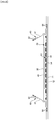
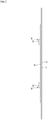
- Figs. 1 to 6 illustrate examples of a tape-type disposable diaper, in which the reference sign X indicates the maximum width of the diaper excluding a fastening tape, and the reference sign L indicates the maximum length of the diaper.
- Each component member is fixed or bonded in the same manner as known diapers as necessary except for the fixing or bonded portion described below.
- a hot melt adhesive or welding heat welding, ultrasonic welding
- an application method of the hot melt adhesive in addition to an application method such as a solid, bead, curtain, small spiral, or spiral application, it is possible to appropriately adopt a method of application to an outer peripheral surface of an elastic member such as a comb gun or wrap application.
- This tape type disposable diaper has a basic structure in which an absorber 50 is interposed between a top sheet having a liquid pervious property and a liquid impervious sheet positioned on the back surface side.
- the tape type disposable diaper includes end flap portions EF and a pair of side flap portions SF.
- the end flap portions EF are portions extending to the front side and the back side of the absorber 50 respectively and do not include the absorber 50.
- the pair of the side flap portions SF extends laterally from the side edges of the absorber 50.
- a fastening tape 13 is provided in each of the side flap portions SF in a dorsal side portion B.
- the fastening tape 13 is engaged at an appropriate place on the external surface of the ventral side portion F in a state in which the side flap portion SF of the dorsal side portion B is overlaid on the external side of the side flap portion SF of the ventral side portion F.
- the entire external surface other than the fastening tape 13 is formed by an outer sheet 12.
- a liquid impervious sheet 11 is fixed to the internal surface side of the outer sheet 12 with an adhesive such as a hot melt adhesive.
- the absorber 50, an intermediate sheet 40, and a top sheet 30 are stacked in this order on the internal surface side of the liquid impervious sheet 11.
- the top sheet 30 and the liquid impervious sheet 11 are rectangular in shape and have somewhat larger sizes in the front-back direction LD and the width direction WD than the absorber 50.
- peripheral edge portion protruding from the side edges of the absorber 50 in the top sheet 30 and peripheral edge portions protruding from the side edges of the absorber 50 in the liquid impervious sheet 11 are bonded by a hot melt adhesive or the like. Further, the liquid impervious sheet 11 is formed to be slightly wider than the top sheet 30.
- three-dimensional gathers 60 rising to the skin side of a wearer are provided, and gather sheets 62 forming the three-dimensional gathers 60 are fixed in ranges from the upper both sides of the top sheet 30 to the inner surfaces of the side flap portions SF.
- the outer sheet 12 is a sheet constituting the external surface of a product.
- the outer sheet 12 has a shape in which the intermediate portions in the front-back direction LD on both the side portions are narrowed, and these sites surround the wearer's legs.
- a nonwoven fabric is suitable for the outer sheet 12, but it is not limited thereto.
- the type of the nonwoven fabric is not particularly limited.
- As a raw material fiber for example, in addition to synthetic fibers such as olefin type such as polyethylene or polypropylene, polyester type, and polyamide type, regenerated fibers such as rayon and cupra, and natural fibers such as cotton can be used.
- a spun lace method As a processing method, a spun lace method, a spun bond method, a thermal bond method, an air through method, a needle punch method, and the like can be used.
- a long-fiber nonwoven fabric such as a spunbonded nonwoven fabric, an SMS nonwoven fabric, and an SMMS nonwoven fabric is preferable in that good texture and strength can be compatible.
- the nonwoven fabrics are adhered to each other with a hot melt adhesive or the like.
- the basis weight of the fiber is desirably 10 to 50 g/m 2 , particularly desirably 15 to 30 g/m 2 .
- the outer sheet 12 can be omitted, and in that case, the liquid impervious sheet 11 can have the same shape as that of the outer sheet 12, such that the external surface of a product can be formed.
- the material of the liquid impervious sheet 11 is not particularly limited, for example, an olefin resin such as polyethylene or polypropylene, a laminated nonwoven fabric obtained by stacking a nonwoven fabric on a polyethylene sheet or the like, a nonwoven fabric in which liquid impermeability is substantially secured through a water proof film (in this case, a liquid impervious sheet is formed by the waterproof film and the nonwoven fabric) can be exemplified.
- an olefin resin such as polyethylene or polypropylene
- a laminated nonwoven fabric obtained by stacking a nonwoven fabric on a polyethylene sheet or the like a nonwoven fabric in which liquid impermeability is substantially secured through a water proof film (in this case, a liquid impervious sheet is formed by the waterproof film and the nonwoven fabric)
- a liquid impervious sheet is formed by the waterproof film and the nonwoven fabric
- a microporous sheet As a sheet of this liquid-impervious and moisture-permeable material, for example, a microporous sheet can be exemplified which is obtained by kneading an olefin resin such as polyethylene or polypropylene and an inorganic filler, forming a sheet with the kneaded materials and monoaxially or biaxially stretching the sheet. Further, nonwoven fabrics using micro denier fibers and a liquid impervious sheet that is not using a water proof film can also be used as the liquid impervious sheet 11.
- the liquid impervious sheet includes the sheet obtained by high leak proof treatment by heating or applying pressure to reduce air gaps of fibers, and the sheet obtained by applying a superabsorbent resin, a hydrophobic resin, or a water repellent agent.
- a porous or non-porous nonwoven fabric having liquid permeability can be used as the top sheet 30, a porous or non-porous nonwoven fabric having liquid permeability can be used.
- the type of constituent fibers of the nonwoven fabric is not particularly limited.
- the constituent fibers can include synthetic fibers such as olefin type such as polyethylene and polypropylene, polyester type, and polyamide type, regenerated fibers such as rayon and cupra, natural fibers such as cotton, mixed fibers and conjugate fibers in which two or more of these are used, and the like.
- the nonwoven fabric may be manufactured by any processing. Examples of processing methods can include known methods such as a spun lace method, a spun bond method, a thermal bond method, a melt blown method, a needle punch method, an air through method, and a point bond method.
- the spun lace method is preferable when flexibility and drapeability are required
- the thermal bond method is preferable when bulkiness and softness are required.
- the intermediate sheet 40 is bonded to the back surface of the top sheet 30 to promptly move excretion liquid passing through the top sheet 30 to the side of the absorber 50 and to prevent returning.
- heat embossing or ultrasonic welding can be used in addition to using a hot melt adhesive.
- a resin film having a large number of through holes can be used in addition to using a nonwoven fabric.
- a nonwoven fabric a material similar to that described in the section of the top sheet 30 can be used. However, the material having a higher hydrophilicity than that of the top sheet 30 or the material having a high fiber density is preferable since those have excellent liquid transfer characteristics from the top sheet 30 to the intermediate sheet 40.
- the intermediate sheet 40 in the illustrated embodiment is shorter than the width of the absorber 50 and disposed at the center portion, it may be provided over the maximum width.
- the length of the intermediate sheet 40 in the front-back direction LD may be the same as the maximum length of a diaper, may be the same as the length of the absorber 50, or may be within a short length range around a region receiving a liquid.
- the three-dimensional gathers 60 projecting (standing) from the inner faces on both the sides of a product in the width direction WD.
- Each three-dimensional gather 60 is composed of a gather sheet 62 and an elongated gather elastic member 63 fixed to the gather sheet 62 in a stretched state along the front-back direction LD.
- this gather sheet 62 a water repellent nonwoven fabric can be used, and rubber thread or the like can be used as the elastic member 63.
- a plurality of the elastic members may be provided on each side, or only one elastic member may be provided on each side.
- the inner surface of the gather sheet 62 has a fixed start point in the width direction WD on the side portion of the top sheet 30. A portion outside in the width direction WD from this fixed start point is fixed with a hot melt adhesive or the like to the side portion of the liquid impervious sheet 11 and the side portion of the outer sheet 12 positioned at the outside portion.
- the inside in the width direction WD from the fixed start point of each three-dimensional gather 60 is fixed on the top sheet 30 at both ends of the product in the front-back direction LD.
- this free portion is erected by contraction force of one or plurality of the elastic members 63. Since a diaper is attached to the body in a boat shape in wearing the diaper, and the contraction force of one or plurality of the elastic members 63 acts, the three-dimensional gathers 60 erect by the contraction force of one or plurality of the elastic members 63 and come in close contact with the legs. As a result, so-called lateral leakage from around the legs is prevented.
- both end portions in the front-back direction LD in the portion of the inside in the width direction WD of each gather sheet 62 are fixed in a state folded in two having a base end side portion, which extends inward from a portion outside in the width direction WD and a tip side portion, which is folded back on the body side from the end edge on the center side in the width direction WD of the base end side portion and extending outward in the width direction WD, and the portion therebetween may be a non-fixed free portion.
- each side flap portion SF on the outside in the width direction WD in the vicinity of the fixed start point of the fixed portion of the gather sheet 62, between the gather sheet 62 and the liquid impervious sheet 11, the elastic members 64, which are made of elongated elastic members such as rubber threads, around the leg portions are fixed in a state stretching along the front-back direction LD, whereby the leg portion of each side flap portion SF is formed as a flat gather.
- the elastic members 64 around each leg portion can also be disposed between the liquid impervious sheet 11 and the outer sheet 12 in the side flap portion SF.
- a plurality of elastic members 64 around the leg portions may be provided on each side, or only one elastic member 64 may be provided on each side.
- each fastening tape 13 includes a sheet base material forming a tape attaching portion 13C fixed to the side portion of a diaper and a tape main unit section 13B projecting from the tape attaching portion 13C, and an engagement portion 13A with respect to the ventral side, which is provided in the intermediate portion in the width direction WD of the tape main unit section 13B in the seat base material.
- a tip end side from the engagement portion 13A is a tab part.
- the tape attaching portion 13C of the fastening tape 13 is sandwiched between the gather sheet 62 forming an inner layer in the side flap portion and the outer sheet 12 forming an outer layer.
- the tape attaching portion 13C is adhered to both the sheets 62 and 12 with a hot melt adhesive.
- the engagement portion 13A is bonded to the sheet base material with an adhesive so that it cannot be removed.
- a hook member (male member) of a mechanical fastener (hook and loop fastener) is suitable as the engagement portion 13A.
- the hook member has a large number of engagement projections on its external surface side.
- the engagement projection has a check mark shape, a J shape, a mushroom shape, a T shape, and a double J shape (a shape bonded back to back of a J shape), but may have any shape.
- a pressure sensitive adhesion material layer can also be provided as an engagement portion of the fastening tape 13.
- the sheet base material forming from the tape attaching portion to the tape main unit section in addition to various nonwoven fabrics such as a spunbonded nonwoven fabric, an air through nonwoven fabric, and a spunlace nonwoven fabric, a plastic film, a polyethylene laminated nonwoven fabric, paper, or a composite material thereof can be used.
- various nonwoven fabrics such as a spunbonded nonwoven fabric, an air through nonwoven fabric, and a spunlace nonwoven fabric, a plastic film, a polyethylene laminated nonwoven fabric, paper, or a composite material thereof can be used.
- a target sheet 12T having a target for facilitating engagement at the engagement portion of each fastening tape 13 in the ventral side portion F.
- the engagement portion 13A is the hook member
- the target sheet 12T having a large number of loops made of threads to which engagement projections of the hook member are tangled and which is provided on a surface of the sheet base member made of a plastic film or a nonwoven fabric.
- an adhesive layer it is possible to use a sheet base material made of a plastic film having a smooth surface with high adhesiveness and subjected to a release treatment.
- the target sheet 12T may be omitted, and the hook member can be entangled and engaged with the nonwoven fabric of the outer sheet 12.
- the target sheet 12T may be provided between the outer sheet 12 and the liquid impervious sheet 11.
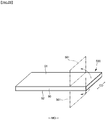
- the absorber 50 is a part that absorbs and retains liquid content of excrement.
- the absorber 50 can be adhered to the components on at least one of the front surface side and back surfaces side via an adhesive such as a hot melt adhesive.
- the absorber 50 is a cell absorber including the upper sheet 51, the lower sheet 52 disposed on the back surface side of the upper sheet, cells (small chambers) 55 which are surrounded by the bonded portions 54 of the upper sheet 51 and the lower sheet 52 and at which the upper sheet 51 and the lower sheet 52 are not bonded, and super absorbent polymer particles 53 contained in the cells 55.
- cells small chambers
- the super absorbent polymer particles 53 contained in the cells 55.
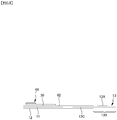
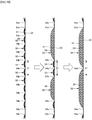
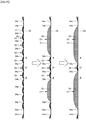
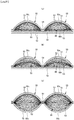
- At least one of the upper sheet 51 and the lower sheet 52 in the cells 55 corresponds to concaves 50c depressed to the outsides of the cells 55 in the spread state. It is preferable that the concaves 50c are formed in parts of the upper sheet 51 included in the respective cells 55. However, additionally or alternatively, as in an example illustrated in Fig. 20(c) and an example illustrated in Fig. 21(c) , the concaves 50c may be formed in parts of the lower sheet 52 included in the respective cells 55.
- a depth 50d of the concaves 50c is not particularly limited, and is preferably 2 to 10 mm, particularly preferably about 8 to 10 mm.
- the concaves 50c can be formed by embossing as described later.
- a middle sheet 80 made of a nonwoven fabric is interposed between the upper sheet 51 and the lower sheet 52. Therefore, the three layers of the upper sheet 51, the middle sheet 80, and the lower sheet 52 are bonded at the bonded portions 54. Further, the middle sheet 80 is compressed in a thickness direction at the bonded portions 54 and expands to the inside of the concaves 50c in a part located in the cell 55 (in other words, the fiber density decreases as the distance from the bonded portions increases). In this way, the concaves 50c are less likely to be crushed by a pressure applied in a package state of a product or a pressure applied during wearing.
- the concaves 50c are crushed, due to the elasticity of the middle sheet 80, restoration of shapes of the concaves 50c is promoted to at least a part where the middle sheet 80 enters or a volume close thereto. Further, during absorption of the excretion liquid, the super absorbent polymer expands the fiber gap and can swell while entering the gap, easily compressing the middle sheet 80, or entering the gap and compressing the middle sheet 80, and thus the presence of the middle sheet 80 is unlikely to hinder swelling of the super absorbent polymer particles 53. Further, the fibers of the middle sheet 80 spreading in the concaves 50c ensure a liquid passage to the individual super absorbent polymer particles 53.
- the absorption rate of the disposable diaper including the present cells 55 absorber 50 (particularly, an initial stage of absorption) is improved.
- the upper sheet 51 is not particularly limited as long as the upper sheet 51 is a liquid pervious material.
- a porous or non-porous nonwoven fabric or a porous plastic sheet can be used for the upper sheet 51.
- a nonwoven fabric for the upper sheet 51 for example, synthetic fibers (including not only single component fibers but also conjugate fibers) such as olefin type such as polyethylene or polypropylene, polyester type, and polyamide type, regenerated fibers such as rayon and cupra, and natural fibers such as cotton and pulp can be selected without limitation, and it is preferable to use a thermoplastic resin fiber because of excellent thermal processability.
- a fiber stacking method for the nonwoven fabric can be used irrespective of a wet type or a dry type. Since the upper sheet 51 affects the absorption rate, hydrophilic fibers, particularly dry nonwoven fabrics using natural fibers such as cotton and pulp as a raw material, more particularly air-laid pulp nonwoven fabrics of 70% by weight or more of pulp (remaining amount in the case of less than 100% by weight may be occupied by appropriate synthetic fibers) are particularly suitable for the upper sheet 51.
- the fiber bonding method of the nonwoven fabric is not particularly limited, but to prevent the super absorbent polymer particles 53 from being detached, it is preferable to use a bonding method which increases fiber density, such as a spun bond method, a melt blown method, and a needle punch method.
- the fineness, basis weight, and thickness of the nonwoven fabric are preferably about 2.0 to 7.0 dtex, about 18 to 50 g/m 2 , and about 0.10 to 0.60 mm, respectively.
- its pore size is preferably smaller than the outer shape of the super absorbent polymer particles 53 to prevent the super absorbent polymer particles 53 from falling off through the sheet.
- a hydrophilic agent can also be contained.
- the lower sheet 52 may be formed of the same material as that of the upper sheet 51. However, it is possible to adopt a liquid impervious material.
- the liquid impervious material usable for the lower sheet 52 can be appropriately selected and used from the materials described in the section of the liquid impervious sheet 11.
- the upper sheet 51 and the lower sheet 52 may be one side layer and another side layer in which one sheet of material is folded in two.
- the middle sheet 80 is not particularly limited as long as the middle sheet 80 is a nonwoven fabric.
- the fineness of the constituent fibers of the nonwoven fabric is preferably about 1.6 to 7.0 dtex, and more preferably 5.6 to 6.6 dtex.
- the porosity of the nonwoven fabric of the middle sheet 80 is preferably 80 to 98%, and more preferably 90 to 95%.
- the thickness of the middle sheet 80 may be appropriately determined in consideration of the depth 50d of the concaves 50c, the degree of penetration into the concaves 50c, etc.
- the thickness is preferably 10% to 90% of the depth 50d of the concaves 50c, and more preferably 70% to 90% thereof.
- the basis weight of the middle sheet 80 may be appropriately determined for the same reason, and is preferably about 25 to 40 g/m 2 in the above thickness range.
- constituent fibers of the nonwoven fabric used for the middle sheet 80 for example, synthetic fibers (including not only single component fibers but also conjugate fibers such as core sheath) such as olefin type such as polyethylene or polypropylene, polyester type, and polyamide type, regenerated fibers such as rayon and cupra, and natural fibers such as cotton can be selected without limitation, and a combination thereof can be used.
- synthetic fibers including not only single component fibers but also conjugate fibers such as core sheath
- olefin type such as polyethylene or polypropylene
- polyester type polyester type
- polyamide type polyamide type
- regenerated fibers such as rayon and cupra
- natural fibers such as cotton
- the constituent fibers are crimped fibers.
- the constituent fibers of the nonwoven fabric of the middle sheet 80 are hydrophilic fibers (including hydrophobic fibers becoming hydrophilic by a hydrophilizing agent), the water retention is increased. When the constituent fibers are hydrophobic fibers, the diffusibility is improved.
- a fiber bonding method of the nonwoven fabric is not particularly limited. However, to sufficiently bind the fibers to ensure elasticity while increasing the porosity (widening the fiber gap), an air through nonwoven fabric in which fibers are bound by hot air heating is preferable for the middle sheet 80.
- a separation distance 80s can be determined as appropriate, and is preferably 30% or less of the depth 50d of the concaves 50c.
- the middle sheet 80 may adhere to at least one of the upper sheet 51 and the lower sheet 52 by a hot melt adhesive 80h both in the cells 55 and at the bonded portions 54 as illustrated in Figs. 20(a) to 20(c) and Figs. 21(a) and 21(b) , or may not adhere to both the upper sheet 51 and the lower sheet 52 as illustrated in Fig. 21(c) .
- the super absorbent polymer particles 53 are not fixed to the upper sheet 51, the lower sheet 52, and the middle sheet 80, and are freely movable. However, a part or almost all (for example, 95% or more) of the super absorbent polymer particles 53 can be bonded or adhered to at least one of the upper sheet 51, the lower sheet 52, and the middle sheet 80. Further, the super absorbent polymer particles 53 may be agglomerated to some extent. In particular, in a case where the super absorbent polymer particles 53 are freely movable in the cells 55, when the cells 55 have hollow portions, the super absorbent polymer particles 53 move in the cells 55 during use.
- the absorption proceeds on the upper surface of the middle sheet 80 where a large number of the super absorbent polymer particles 53 are distributed, and a rate there of is limited. Therefore, in the initial stage of the absorption, a large amount of excretion liquid penetrates into the middle sheet 80 having a small number of the super absorbent polymer particles 53, and absorbed by the super absorbent polymer particles 53 in the middle sheet 80, temporarily stored until absorbed by the super absorbent polymer particles 53, or diffuse to the surrounding cells 55. The excretion liquid diffused to the surroundings is absorbed by the super absorbent polymer particles 53 in the middle sheet 80 existing there or sucked up by the super absorbent polymer particles 53 abundant thereabove.
- the super absorbent polymer particles 53 absorbs the excretion liquid
- the super absorbent polymer expands the fiber gap and swells while penetrating into the gap or compressing the middle sheet 80. Due to such an absorption mechanism, the excretion liquid rapidly spreads over a wide area of the cell 55 absorber 50 and is in a state of being received inside the cell 55 absorber 50. Thus, not only the absorption rate is improved, but also a reflowing prevention property is excellent.
- the concaves 50c are formed at least in a part of each cell 55 in the upper sheet 51.
- a degree of distribution of the super absorbent polymer particles 53 in the cell 55 can be determined as appropriate.
- a weight ratio of the super absorbent polymer particles 53 present on the upper surface of the middle sheet 80 is preferably 50% or more of the total amount, and a weight ratio of the super absorbent polymer held in the middle sheet 80 (that is, not on the lower sheet 52) is preferably 45% or more of the total amount.
- the distribution of the super absorbent polymer particles 53 in the cell 55 is not limited thereto. Therefore, as illustrated in Fig. 20(c) , it is possible to adopt a distribution in which the super absorbent polymer particles 53 are most present on the upper surface of the lower sheet 52 and decrease upward therefrom. Alternatively, as illustrated in Fig. 21(a) , it is possible to adopt a distribution in which the number of super absorbent polymer particles 53 present on the upper surface of the middle sheet 80 and the upper surface of the lower sheet 52 is larger than that in a part therebetween. Further, as illustrated in Fig.
- This mode can be formed by forming the middle sheet 80 into a two-layer nonwoven fabric and interposing the super absorbent polymer particles 53 between the layers.
- a particle size of the super absorbent polymer particles is not particularly limited. For example, it is preferable that a ratio of particles having a particle size of more than 500 ⁇ m is 30% by weight or less, a ratio of particles having a particle size of 500 ⁇ m or less and more than 180 ⁇ m is 60% by weight or more, a ratio of particles having a particle size of more than 106 ⁇ m and 180 ⁇ m or less is 10% by weight or less, and a ratio of particles having a particle size of 106 ⁇ m or less is 10% by weight or less. Note that measurement of the particle size is performed as follows.
- weight ratios with respect to input amounts of the samples remaining on the respective sieves of 500 ⁇ m, 180 ⁇ m, and 106 ⁇ m and the sample remaining on the saucer are set to the ratio of particles of more than 500 ⁇ m, the ratio of particles of 500 ⁇ m or less and more than 180 ⁇ m, the ratio of particles of more than 106 ⁇ m and 180 ⁇ m or less, and the ratio of particles of 106 ⁇ m or less, respectively.
- the material of the super absorbent polymer particles 53 can be used without particular limitation, but the material having the water absorption capacity of 40 g/g or more is suitable.
- As the super absorbent polymer particles 53 starch-based, cellulose-based, and synthetic polymer-based, and starch-acrylic acid (salt) graft copolymers, saponified starch-acrylonitrile copolymers, sodium carboxymethyl cellulose crosslinked products, acrylic acid (salt) polymers, and the like can be used.
- the shape of the super absorbent polymer particles 53 the shapes of particulate materials which are usually used are suitable, but other shapes can also be used.
- the super absorbent polymer particles 53 having the gel strength of 1,000 Pa or more are preferably used. Thereby, even when the absorber 50 is bulky, it is possible to effectively suppress stickiness after liquid absorption.
- the basis weight of the super absorbent polymer particles 53 can be appropriately determined according to the absorption amount required for the use of the absorber 50. Therefore, although it cannot be said unconditionally, the basis weight can be 50 to 350 g/m 2 . When the basis weight of the polymer is less than 50 g/m 2 , it is difficult to secure the absorption amount. When it exceeds 350 g/m 2 , the effect is saturated.
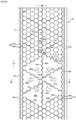
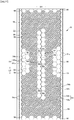
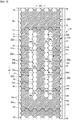
- a planar shape of each of the cells 55 can be determined as appropriate, and can be set to a hexagonal shape, a rhombic shape, a square shape, a rectangular shape, a circular shape, an elliptical shape, etc. as illustrated in Fig. 8 , Fig. 12 , Fig. 19 , etc. It is desirable to form a polygon to achieve denser arrangement, and arrangement without gaps as in the illustrated example is desirable.
- the cells 55 may be arranged by combining a plurality of types of cells 55 different in at least one of the shape and dimension as illustrated in Fig. 12 .
- the planar arrangement of the cells 55 (that is, the same applies to an aggregated part of the super absorbent polymer particles 53) can be appropriately determined.
- a regularly repeated planar arrangement is preferable.
- a regularly repeated shape such as an oblique lattice shape illustrated in Fig. 19(a) , a hexagonal lattice shape illustrated in Fig. 19(b) (these shapes are also referred to as staggered shapes), a square lattice shape illustrated in Fig. 19(c) , a rectangular lattice shape illustrated in Fig. 19(d) , or a parallel body lattice shape illustrated in Fig.
- each cell 55 can be appropriately determined, and for example, the length 55L of the front-back direction LD can be about 8 to 30 mm, and the length 55W of the width direction WD can be about 10 to 50 mm.
- the area of each cell 55 can be set to about 65 to 1,650 mm 2 .
- the bonded portion 54 for bonding the upper sheet 51 and the lower sheet 52 be bonded by welding the upper sheet 51 and the lower sheet 52 like ultrasonic welding or heat sealing, but it may be bonded with a hot melt adhesive.
- the bonded portions 54 of the upper sheet 51 and the lower sheet 52 are disposed to surround each cell 55 and may be formed in a dotted line pattern (intermittently in a direction surrounding each cell 55) as in the illustrated example or in a continuous line shape as long as the bonded portions 54 correspond to the boundary between adjacent cells.
- the bonded portions 54 are formed intermittently, it is preferable that the super absorbent polymer particles 53 are not present between the bonded portions 54 in the direction surrounding each of the cells 55 or are supposed to be less than those in the cell 55 even if they are present therein.
- a fiber group of the middle sheet passes between adjacent bonded portions and extends between a large number of cells. Therefore, since a liquid diffusion passage is formed between the adjacent bonded portions, the liquid diffusibility between cells is improved, so that the absorption rate is improved.
- the bonded portions 54 may correspond to weak bonded portions 54b that can be peeled off by swelling forces of the super absorbent polymer particles 53 in the adjacent cells 55, or correspond to strong bonded portions 54a that do not basically peeled off by the swelling forces of the super absorbent polymer particles 53 in the adjacent cells 55.
- the cells 55 adjacent to each other with the weak bonded portions 54b interposed therebetween can become one large cell 55 by being peeled off and united due to absorption and swelling pressures of the super absorbent polymer particles 53 in the cells 55.
- Peel strengths of a facing surface between the upper sheet 51 and the middle sheet 80 and a facing surface between the middle sheet 80 and the lower sheet 52 in the weak bonded portions 54b can be determined as appropriate. However, in a normal case, the peel strengths are preferably about 0.800 N/4 cm.
- peel strengths of a facing surface between the upper sheet 51 and the middle sheet 80 and a facing surface between the middle sheet 80 and the lower sheet 52 in the strong bonded portions 54a can be appropriately determined. However, it is preferable that the peel strength is 1.1 times or more a higher one of the peel strengths of the facing surface between the upper sheet 51 and the middle sheet 80 and the facing surface between the middle sheet 80 and the lower sheet 52 in the weak bonded portions 54b.
- the middle sheet 80 is provided between the upper sheet 51 and the lower sheet 52 as in the cell 55 absorber 50
- the shape of swelling of the cell 55 absorber 50 becomes irregular, and there is concern that swelling may be hindered or the wearing feeling may deteriorate. Therefore, in the weak bonded portions 54b, it is preferable that the peel strength of one of the facing surface between the upper sheet 51 and the middle sheet 80 and the facing surface between the middle sheet 80 and the lower sheet 52 is lower than the peel strength of the other one.
- such a structure can be constructed by bonding only the facing surface between the upper sheet 51 and the middle sheet 80 or bonding only the facing surface between the middle sheet 80 and the lower sheet 52 in both the inside of the cell 55 and the bonded portions 54, thereby setting the peel strength of one of the facing surface between the upper sheet 51 and the middle sheet 80 and the facing surface between the middle sheet 80 and the lower sheet 52 in the weak bonded portions 54b not subjected to bonding to be lower than the peel strength of the other one subjected to bonding.
- Peel strengths of a facing surface between the upper sheet 51 and the middle sheet 80 and a facing surface between the middle sheet 80 and the lower sheet 52 in the weak bonded portions 54b can be determined as appropriate.
- the higher peel strength is preferably about 0.040 to 0.800 N/4 cm, and the lower peel strength is preferably 0.5 times or less the higher peel strength.
- the peel strength of the facing surface between the upper sheet 51 and the middle sheet 80 is lower than the peel strength of the facing surface between the middle sheet 80 and the lower sheet 52.
- the strong bonded portions 54a are portions basically not peel off even when the cells 55 on both sides absorb and swell, and thus have effects that diffusibility is improved by continuing in a specific direction, a flow of a gelled material of the super absorbent polymer particles 53 is prevented, and the contact area on the front surface side is reduced. Therefore, by combining these portions with the weak bonded portions, it is possible to construct a cell absorber having various characteristics as described later.
- the bonded portions 54 positioned on the outermost side in the width direction WD are peeled off, there is concern that the super absorbent polymer particles 53 or the gelled super absorbent polymer particles 53 may leak laterally to the outside of the absorber 50, and therefore it is desirable that the bonded portions are the strong bonded portions 54a.
- the upper sheet 51 and the lower sheet 52 are extended to the outside in the width direction WD to some extent beyond the region where the cells 55 are formed, and the edge bonded portions 54c are provided in the extended portions for the reinforcement.
- the difference in bonding strength may be easily formed by changing the area of each of the bonded portions 54 but is not limited thereto.
- a method in which the type of the hot melt adhesive is varied depending on the sites of the cells can be adopted.
- the weak bonded portions 54b can be formed only by forming the bonded portions 54 into the dotted line pattern and widening the point interval 54D.
- the bonded portions 54 can be formed at the boundary between the adjacent cells 55, if the point interval 54D becomes too large, the gaps are increased at the boundary between the adjacent cells 55, which causes the super absorbent polymer particles 53 to move easily. Therefore, when the weak bonded portions 54b of dotted line shape are formed by combining wide or narrow line width 54W of the bonded portions 54 and wide or narrow point interval 54D, the weak bonded portions 54b are likely to be peeled off in spite of narrow gaps.
- the size of the bonded portion 54 for bonding the upper sheet 51 and the lower sheet 52 can be appropriately determined, and for example, the line width (dimension in the direction orthogonal to the direction surrounding the cell 55) 54W can be about 0.6 to 8.0 mm.
- the length 54L of the bonded portion 54 in the direction surrounding the cell 55 is about 0.6 to 8.0 mm, and the point interval 54D is about 0.8 to 10.0 mm.
- the line width 54W is about 1.0 to 4.0 mm
- the length 54L of the bonded portion 54 is about 1.5 to 4.0 mm
- the point interval 54D is about 0.8 to 2.5 mm.
- the line width 54W is about 0.6 to 3.5 mm
- the length 54L of the bonded portion 54 is about 0.6 to 2.5 mm
- the point interval 54D is about 1.0 to 4.0 mm.
- the weak bonded portions 54b To allow the weak bonded portions 54b to be peeled off, it is possible to determine the type and amount of the super absorbent polymer particles 53 disposed in each cell 55 such that the volume of the super absorbent polymer particles 53 in the cell 55 upon the saturation absorption, becomes sufficiently larger than the volume of the cell 55 adjacent to the weak bonded portions 54b.
- the type and amount of the super absorbent polymer particles 53 disposed in each cell 55 such that the volume of the super absorbent polymer particles 53 included in the unitable cells 55 upon the saturation absorption is smaller than the united volume of the unitable cells 55 due to peeling of the weak bonded portions 54b.
- the width of the bonded portion 54 in a case where the bonded portions 54 are formed in a continuous line, and the line width 54W in a case where the bonded portions 54 are formed in a dotted line pattern, are constant in the direction surrounding the cell 55, or also can be changed.
- the shape of each bonded portion 54 can be appropriately determined, and all of the bonded portions have the same shape, or the bonded portions may have different shapes depending on the site.
- each cell 55 has a polygonal shape, it is preferable to provide the bonded portion 54 at least at one of the intermediate position of each side and each vertex position.
- the strong bonded portion 54a it is preferable to provide it at each vertex position, but in the case of the weak bonded portion 54b, it is preferable not to provide the weak bonded portion 54b at each vertex position, because the weak bonded portion 54b can be peeled off easily and the cells 55 are smoothly coalesced.
- the bonded portion 54 it is desirable that the bonded portion 54 have a radial (star) shape protruding in the direction of each side.
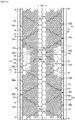
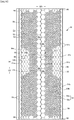
- a longitudinal-strong-bond line 58 in which the strong bonded portions 54a are continuously aligned in the front-back direction LD, and a diffusibility improving portion 57 including low-expanding cells 55s adjacent to both sides thereof are provided in a middle area of the absorber 50 in the width direction WD.
- the low-expanding cells 55s of the diffusibility improving portion 57 have a smaller amount of contained super absorbent polymer particles 53 per unit area than that of the cells 55 adjacent to both the sides of the diffusibility improving portion 57, and the bonded portions 54 between the low-expanding cells 55s and the cells 55 adjacent to both the sides of the diffusibility improving portion 57 correspond to the weak bonded portions 54b.
- a wide groove having the diffusibility improving portion 57 as a bottom is formed, and the groove promotes liquid diffusion.
- the amount of the super absorbent polymer particles 53 contained in the low-expanding cells 55s is preferably 1/3 or less of the adjacent cells 55 in terms of weight ratio, and it is particularly preferable that the super absorbent polymer particles 53 are not contained at all in the low-expanding cells 55s.
- the weak bonded portions 54e between the low-expanding cells 55s of the diffusibility improving portion 57 and the cells 55 adjacent to both the sides of the diffusibility improving portion 57 have higher bonding strength than that of other weak bonded portions 54f and lower bonding strength than that of the strong bonded portions 54a
- the weak bonded portions 54e between the low-expanding cells 55s of the diffusibility improving portion 57 and the cells 55 adjacent to both the sides of the diffusibility improving portion 57 are less likely to come off, and the groove formed by the diffusibility improving portion 57 is maintained in a wide state for a longer time, which is preferable.
- the strong bonded portions 54a and the weak bonded portions 54e having the relatively high bonding strength are represented by thick dotted lines
- the other weak bonded portions 54b and 54f are represented by thin dotted lines
- the cells 55 containing the super absorbent polymer particles 53 that is, the cells 55 excluding the low-expanding cells 55s and empty cells 56 described later
- the diffusibility improving portion 57 may be provided over the maximum length of the absorber 50 as illustrated in Fig. 8 , and Fig. 11 to Fig. 15 , or provided only in an intermediate portion in the front-back direction LD (particularly, a range including the crotch portion and extending over both the front and back sides thereof) as illustrated in Fig. 17 and Fig. 18 .
- the diffusibility improving portion 57 may be provided at a plurality of positions with intervals in the width direction WD as illustrated in Fig. 18 .
- a pair of longitudinal-strong-bond lines 58 may be provided along both side edges of the cells 55 arranged in the front-back direction LD, and the cells 55 between the longitudinal-strong-bond lines 58 and adjacent to both sides thereof in the width direction WD may be set to low-expanding cells 55s.
- the gelled material of the super absorbent polymer particles 53 swelling during absorption can largely move in the front-back direction LD in the united cells 55, and there is concern that the gelled material may gather in a low place such as the crotch portion to degrade the wearing feeling. Therefore, as illustrated in Fig. 8 , Fig. 11 , Fig. 14 to Fig. 16 , and Fig.
- a plurality of lateral-strong-bond lines 59 in each of which the strong bonded portions 54a are continuously or intermittently aligned in the width direction WD or the oblique direction, are provided at intervals in the front-back direction LD.
- the strong bonded portions 54a that do not basically peel off at the time of absorption, thereby preventing the shape of the absorber 50 from being collapsed.
- the cells 55 adjacent to both front and back sides of the lateral-strong-bond lines 59 can be set to low-expanding cells 55s to provide the diffusibility improving portion 57 in the lateral direction.
- the longitudinal-strong-bond line 58 in which the strong bonded portions 54a continue in the front-back direction LD over the maximum length of the absorber 50, are provided on both sides in the width direction WD along the side edges of the cells 55 located on the outermost side in the width direction WD and provided in the middle thereof in the width direction WD, and the lateral-strong-bond lines 59 are portions continuing in the width direction WD and the oblique direction to extend between the longitudinal-strong-bond lines 58 adjacent in the width direction WD, the cells 55 do not unite with a maximum enlargement section 55G or more surrounded by the strong bonded portions 54a.
- the gelled material of the super absorbent polymer particles 53 swelling during absorption does not move to the outside of the maximum enlargement section 55G, and it is possible to effectively prevent shape collapse of the absorber 50 during absorption.
- the liquid diffusibility in the longitudinal direction is improved by the longitudinal-strong-bond lines 58 in each of which the strong bonded portions 54a are continuously arranged in the front-back direction LD
- the liquid diffusibility in the lateral direction is improved by the lateral-strong-bond lines 59 in each of which the strong bonded portions 54a are continuously arranged in the width direction WD or oblique direction.
- the size, shape, arrangement (that is, arrangement of the strong bonded portion 54a) of the maximum enlargement section 55G can be appropriately determined, but if the maximum enlargement section 55G is too small, it becomes insignificant to provide the strong bonded portions 54a, and even if a large number of the cells 55 are provided, when the maximum enlargement section is formed to be elongated, after the cells 55 are coalesced, the maximum enlargement section comes to have a shape in which it is difficult for the cells to be expanded.
- the cell 55 is a regular hexagon as in the illustrated example, it is preferable that, as illustrated in Fig. 11 , Fig. 14 , Fig. 15 , and Fig.
- the peripheral edge of the maximum enlargement section forms a closed shape formed by connecting the sides of the cells 55 along the peripheral edge thereof while two to four consecutive sides are connected per each cell 55.
- the cells 55 can be successively coalesced and smoothly enlarged to the maximum enlargement section 55G, and the maximum enlargement section 55G becomes to be expanded easily.
- the increase in the volume of the cell 55 relative to the number of coalesced cells 55 becomes excellent.
- regular hexagon includes a deformed hexagon extending and contracting to ⁇ 5% in the front-back direction due to an influence of extension and contraction of the upper sheet 51 and the lower sheet 52 during manufacturing.
- a part connecting two consecutive sides per each cell 55 can be a linear part, and a part connecting three consecutive sides per each cell 55 can be linear or a corner portion (turning portion) with an internal angle of 120° and a part connecting four consecutive sides per each cell 55 can be a turning portion with an internal angle of 60° or 180°. Therefore, by combining these linear portions and corner portions, the peripheral edge shapes (arrangements of the strong bonded portions 54a) of the maximum enlargement sections 55G can be formed in substantially equilateral triangular shapes as illustrated in Fig. 11 , substantially parallelogram shapes as illustrated in Figs. 14 and 15 , or substantially quadrangular shapes as illustrated in Fig. 18 .
- the longitudinal-strong-bond lines 58 are provided at the center and both sides in the width direction WD of the absorber 50, respectively, and the lateral-strong-bond lines 59 are formed in a zigzag shape extending in the front-back direction while repeatedly bending left and right between the longitudinal-strong-bond line 58 in the center portion and each of the longitudinal-strong-bond lines 58 in both the side portions.
- the maximum enlargement section 55G having a substantially triangular shape with one of the vertexes positioned in the longitudinal-strong-bond line 58 in the center portion and the maximum enlargement section 55G having a substantially triangular shape with one of the vertexes positioned in each of the longitudinal-strong-bond lines 58 on both the side portions are repeatedly formed alternately in the front-back direction.
- the lateral-strong-bond lines 59 are formed in the zigzag shape as described above, it is preferable because the liquid diffusion in the lateral direction can be efficiently facilitated with the small number of the lateral-strong-bond lines 59, and the maximum enlargement section 55G has a substantially triangular shape which is easily expanded, and the increase in the volume of the cells 55 relative to the number of coalesced cells 55 is excellent.
- the empty cells 56 which contain a smaller amount of the super absorbent polymer particles 53 per unit area than other cells.
- the cells 55 containing the super absorbent polymer particles 53 that is, cells 55 excluding the low-expanding cells 55s and the empty cells 56 described later
- Fig. 8 an area having a pattern of hatched lines in Fig.
- the amount of the super absorbent polymer particles 53 contained in the empty cell 56 is preferably 1/2 or less of the other cells in terms of weight ratio, and it is particularly preferable that the super absorbent polymer particles 53 are not contained at all in the empty cell.
- the front end and the back end of the absorber 50 are formed by cutting into the individual absorbers 50 in the manufacturing, if the super absorbent polymer particles 53 are contained in portions where the cutting is performed, there is concern that the life of a blade of a cutting device may be shortened. Therefore, it is desirable that at least the cells 55 located at the positions through which the front and back ends of the absorber 50 pass be the empty cells 56. Further, in the absorber 50 obtained by mixing the super absorbent polymer particles 53 with a hydrophilic short fiber such as fluff pulp, and accumulating them in a cotton form, generally, the intermediate portion in the front-back direction LD is formed in a narrow shape so as to be along the legs.
- the absorber 50 by setting, the cells 55 on both the sides in the intermediate portion in the front-back direction LD, as the empty cells 56, the intermediate portion in the front-back direction LD will be less expanded even after absorption, and therefore, the absorber 50 has a shape that fits around the legs even after the absorption.
- the super absorbent polymer particles 53 are uniformly dispersed throughout the entire region for containing the super absorbent polymer particles 53 (the region excluding the portions to be the empty cells 56) on the upper sheet 51 or the lower sheet 52, and then the bonded portions 54 are formed to bond the upper sheet 51 and the lower sheet 52 as one unit and to confine the super absorbent polymer particles 53 in each cell 55.
- the amount of the super absorbent polymer particles 53 contained in the cells 55 located at the peripheral edges of the region for containing the super absorbent polymer particles 53 is smaller than that of the cells 55 located on the inside of the cells 55 located at the peripheral edges of the region for containing the super absorbent polymer particles 53.
- these outer cells 55 become the empty cells 56 which do not substantially contain the super absorbent polymer particles 53.
- the super absorbent polymer particles 53 are contained in the cells 55, but it is also possible to contain the super absorbent polymer particles 53 together with particulate materials other than the super absorbent polymer particles, such as deodorant particles.
- the absorber 50 can be wrapped with a wrapping sheet (not illustrated).
- a wrapping sheet (not illustrated).
- one wrapping sheet can be wrapped in a cylindrical shape so as to surround the absorber on the front and back surfaces and both the side surfaces of the absorber 50 and two wrapping sheets can be also wrapped so as to sandwich the absorber from both the front surface side and the back surface side.
- tissue paper particularly crepe paper, a nonwoven fabric, a polyethylene laminated nonwoven fabric, a sheet with small holes, and the like can be used.
- the wrapping sheet be a sheet through which the super absorbent polymer particles do not pass.
- a nonwoven fabric When a nonwoven fabric is used for the wrapping sheet, a hydrophilic SMS nonwoven fabric (SMS, SSMMS, etc.) is particularly suitable, and polypropylene and polyethylene/polypropylene composite material can be used as a material.
- the basis weight of the nonwoven fabric used for the wrapping sheet is desirably 5 to 40 g/m 2 , particularly desirably 10 to 30 g/m 2 .
- pulp fibers can be accumulated on one side of the front surface side and the back surface side of the cell absorber, and the cell absorber together with the pulp fibers can be wrapped with the wrapping sheet(s) collectively.
- the above-described absorber 50 can be manufactured by conveying a continuous belt shaped first sheet in a continuous direction, successively forming a large number of recesses at intervals in the CD (Cross Direction) on the first sheet in the conveying process, supplying a particulate material containing the super absorbent polymer particles to the recesses of the first sheet on the downstream side of the recess forming positions, superimposing a belt shaped second sheet continuous in the MD (Machine Direction) on the first sheet on the downstream side of the supply position of the particulate material, bonding a portion between the recesses of the first sheet to the second sheet on the downstream side of a position where the second sheet is superimposed to successively form a continuum of absorbers in which a large number of cells including the particulate material are arranged, cutting the continuum of absorbers into individual absorbers at intervals in the MD, and bonding a belt shaped third sheet continuous in the MD to the second sheet before supplying the particulate material.
- the first sheet is set to the upper sheet 51 and the second sheet is set to the lower sheet 52 in the above-described absorber 50, but the opposite is also possible.
- the third sheet corresponds to the middle sheet 80 described above.
- the third sheet may be bonded to the second sheet before supplying the particulate material or bonded to the first sheet before supplying the particulate material together with or in place of bonding to the second sheet.
- Fig. 22 illustrates a specific example of an apparatus for manufacturing the cell absorber.
- This manufacturing apparatus is based on an anvil roll 70 driven to rotate about a horizontal rotation axis, and includes first sheet supply means (not illustrated), recess forming means 90, particulate material supply device (not illustrated), and second and third sheet supply means 150 in order from the upstream side in a rotation direction within a rotation direction range of an upper half of the anvil roll 70.
- welding means 160 is included on the downstream side of the second and third sheet supply means 150 in the rotation direction.
- the anvil roll 70 On an outer peripheral surface, the anvil roll 70 has a large number of concaves 71 arranged at intervals and projections 72 provided at portions between the concaves 71 to surround the respective concaves 71.
- the concaves 71 on the outer peripheral surface of the anvil roll 70 communicate with an inner space partitioned into an intake section 73 and a non-intake section 74 in the rotation direction, and an intake device such as a suction fan (not illustrated) is connected to the intake section 73 in the inner space of the anvil roll 70 so that the insides of the concaves 71 can be sucked.
- an intake port and a fume port are not formed in a portion between the concaves 71 on the outer peripheral surface of the anvil roll 70.
- the first sheet supply means supplies a continuous belt shaped first sheet 201 formed of a liquid pervious nonwoven fabric in the rotation direction of the anvil roll 70 so as to be along the outer peripheral surface of the anvil roll 70, and includes various devices such as a guide roll and a drive roll in a path from a raw roll (not illustrated) of the first sheet 201 to the outer peripheral surface of the anvil roll 70.
- the recess forming means 90 in the illustrated example faces the anvil roll 70, has push pins 91 entering the respective concaves 71 of the anvil roll 70, and serves as a push roll that forms concaves 201c on the first sheet 201 by passing the continuous belt shaped first sheet 201 in the rotation direction of the anvil roll 70 between the recess forming means 90 and the anvil roll 70 and pushing the first sheet 201 into the concaves 71 using the push pins 91.
- another type of embossing may be applied.
- the particulate material supply device can be used without particular limitation as long as the particulate material 203 containing the super absorbent polymer particles 53 is supplied by dropping.
- the drop supply includes not only a free fall due to the own weight, but also a drop at a speed higher than the free fall.
- the particulate material supply device 100 it is possible to use both a device that continuously discharges the particulate material over a whole in the CD at a drop position and a device that can perform intermittent supply for at least a part of a drop outlet in the CD.
- the second and third sheet supply means 150 are disposed on the downstream side of the supply position of the particulate material 203 in the rotation direction.
- the second and third sheet supply means 150 bond a third sheet 280 (refer to the middle sheet 80 described above) having a high porosity to a surface of the continuous belt shaped second sheet 202 formed of the liquid pervious nonwoven fabric on the first sheet 201 side, and then supply the sheet in the rotation direction of the anvil roll 70 along the outer peripheral surface of the anvil roll 70.
- the second and third sheet supply means 150 include various devices such as a guide roll and a drive roll on a path from a raw roll of the second sheet 202 and a raw roll of the third sheet 280 (not illustrated) to the outer peripheral surface of the anvil roll 70.
- a hot melt adhesive is applied from a nozzle 153 to a bonding surface of the third sheet 280, and then the third sheet 280 and the second sheet 202 are overlapped and bonded by a bonding roll 152.
- the hot melt adhesive may be applied to the second sheet 202 instead of the third sheet 280.
- the second sheet 202 and the third sheet 280 integrated by this bonding are supplied to the anvil roll 70.
- a guide plate 151 approaching along a tangential direction up to the vicinity of the outer peripheral surface of the anvil roll 70 is disposed, and the second sheet 202 and the third sheet 280 pass above the guide plate 151, are folded at tips thereof, and are then supplied in the rotation direction along the outer peripheral surface of the anvil roll 70.
- a tip of the guide plate 151 is a curved arc surface along a guide direction of the second sheet 202 and the third sheet 280.
- the welding means 160 is not particularly limited as long as the welding means 160 welds the first sheet 201, the second sheet 202, and the third sheet 280.
- a heating roll (not illustrated) may be used.
- the first sheet 201 is supplied to the anvil roll 70 by the first sheet supply means, and the concaves 201c are successively formed in the first sheet 201 by the recess forming means 90.
- a degree of a concaves 201c forming processing and wave-form working by the push roll can be determined as appropriate. In normal case, it is desirable that a push depth 91d of the first sheet 201 by the push pins 91 is 2 to 10 mm.
- the first sheet 201 on which the concaves 201c are formed rotates and moves to a subsequent supply position of the particulate material supply device 100 while being wound around the anvil roll 70.
- the concaves 71 are located in the intake section 73 from a stage of forming the concaves 201c, and intake of the concaves 71 is maintained, the concaves 201c are firmly held in the concaves 71 without change from the formation.
- This intake is maintained at least up to a subsequent supply position of the second sheet 202, preferably up to a welding position.
- the particulate material 203 is dropped and supplied from the particulate material supply device 100 to the concaves 201c of the first sheet 201.
- the particulate material 203 can be supplied continuously or intermittently at least in a part in the CD.
- the third sheet 280 and the second sheet 202 are immediately wound around the outside of the first sheet 201, on which the particulate material 203 is supplied to the concaves 201c, by the second and third sheet supply means 150, at least a CD range of the first sheet 201 having the concaves 201c is covered with the second sheet 202, and the third sheet 280 is interposed between the first sheet 201 and the second sheet 202.
- first sheet 201, second sheet 202, and third sheet 280 are wound around the anvil roll 70, the portions between the concaves 201c of the first sheet 201, the second sheet 202, and the third sheet 280 located therebetween are immediately welded and bonded at sites of the dot-shaped projections 72 of the anvil roll 70 by the welding means 160, so that a continuum 200 of the absorbers 50 in which a large number of cells 55 including the particulate material 203 are arranged is successively formed.
- the continuum 200 of the absorbers 50 is sent out from the anvil roll 70, and then cut into individual absorbers 50 at intervals in the MD by a cutter device (not illustrated).
- MD and CD mean the flow direction (MD) in a manufacturing facility and the lateral direction (CD) orthogonal to the flow direction, and either one is the front-back direction of a product, and the other is the width direction of the product.
- the MD of a nonwoven fabric is the direction of fiber orientation of the nonwoven fabric.
- Fiber orientation is a direction along which a fiber of a nonwoven fabric runs and determined by, for example, a measurement method in accordance with the fiber orientation test method based on the zero span tensile strength of TAPPI T481 and a simple measurement method for determining the direction of fiber orientation from the ratio of the tensile strength in the front-back direction to the width direction.
- Spread state means a flatly spread state without contraction or slack.
- Articleificial urine is prepared by mixing urea: 2 wt%, sodium chloride: 0.8 wt%, calcium chloride dihydrate: 0.03 wt%, magnesium sulfate heptahydrate: 0.08 wt%, and ion exchanged water: 97.09 wt%, and those are used at a temperature of 37°C unless otherwise specified.
- Gel strength is measured as follows: 1.0 g of super absorbent polymer is added to 49.0 g of artificial urine and the mixture is stirred with a stirrer. The resulting gel is left for three hours in a thermohygrostat bath at 40°C, 60%RH and then cooled to room temperature. The gel strength of the gel is measured with a curd meter (Curdmeter-MAX ME-500, manufactured by I.techno Engineering).
- Basis weight is measured as follows. After the sample or test piece is preliminary dried, it is allowed to stand in a test room or apparatus under normal conditions (the test location is at a temperature: 23 ⁇ 1°C, relative humidity: 50 ⁇ 2%) until the constant mass. The preliminary drying is to make the sample or test piece be constant mass in an environment of a temperature of 100°C. The fibers of an official moisture regain of 0.0% do not need preliminary drying. From a test piece having a constant weight, a sample having a size of 100 mm ⁇ 100 mm is cut out using a template for sampling (100 mm ⁇ 100 mm). The sample is weighed and the weight is multiplied by 100 into the weight per one square meter. The resulting value is defined as the basis weight.
- Thickness is automatically measured under the conditions of a load of 0.098 N/cm 2 in a pressurized area of 2 cm 2 using an automatic thickness measuring device (KES-G5 handy compression tester).
- Water absorption capacity is measured according to JIS K7223-1996 "Testing method for water absorption capacity of super absorbent polymers”.
- Water absorption rate is the "time that elapses before the end point" measured in accordance with JIS K7224-1996 "Testing method for water absorption rate of super absorbent polymers” has been carried out using 2 g of superabsorbent polymer and 50 g of physiological saline solution.
- a test piece 500 of 350 mm in the MD ⁇ 40 mm in the CD is cut from the absorber 50. Then, a target sheet (the above-described upper sheet 51 and the middle sheet 80, or the middle sheet 80 and the lower sheet 52) in a portion of 100 mm from one end in the MD to a multi-end side of the test piece 500 is peeled off to form a tong hold 501, each tong hold 501 is gripped by upper and lower grips of a tensile testing machine, and a remaining measurement portion 502 is peeled off as illustrated in Fig.
- a target sheet the above-described upper sheet 51 and the middle sheet 80, or the middle sheet 80 and the lower sheet 52
- a maximum value of the tensile force is used as the measured value.
- the above measurement is performed three times, and the average value is defined as the peel strength. Note that in a case where a size of a test target site is small and a size of the test piece in the CD is less than 40 mm, the peel strength obtained by performing the test in the same manner is converted to about 40 mm.
- test and measurements shall be carried out in a test room or apparatus under normal conditions (the test location is at a temperature: 23 ⁇ 1°C, relative humidity: 50 ⁇ 2%).
- each part means the dimension in the spread state, not the natural length state, unless otherwise stated.
Landscapes
- Health & Medical Sciences (AREA)
- Epidemiology (AREA)
- Engineering & Computer Science (AREA)
- Biomedical Technology (AREA)
- Heart & Thoracic Surgery (AREA)
- Vascular Medicine (AREA)
- Life Sciences & Earth Sciences (AREA)
- Animal Behavior & Ethology (AREA)
- General Health & Medical Sciences (AREA)
- Public Health (AREA)
- Veterinary Medicine (AREA)
- Absorbent Articles And Supports Therefor (AREA)
Applications Claiming Priority (2)
| Application Number | Priority Date | Filing Date | Title |
|---|---|---|---|
| CN201711431157.XA CN109953853B (zh) | 2017-12-26 | 2017-12-26 | 吸收性物品 |
| PCT/JP2018/001388 WO2019130601A1 (fr) | 2017-12-26 | 2018-01-18 | Article absorbant |
Publications (3)
| Publication Number | Publication Date |
|---|---|
| EP3733143A1 true EP3733143A1 (fr) | 2020-11-04 |
| EP3733143A4 EP3733143A4 (fr) | 2021-10-20 |
| EP3733143B1 EP3733143B1 (fr) | 2026-04-15 |
Family
ID=67021856
Family Applications (1)
| Application Number | Title | Priority Date | Filing Date |
|---|---|---|---|
| EP18894352.6A Active EP3733143B1 (fr) | 2017-12-26 | 2018-01-18 | Article absorbant |
Country Status (7)
| Country | Link |
|---|---|
| US (1) | US20210093489A1 (fr) |
| EP (1) | EP3733143B1 (fr) |
| JP (1) | JP7094304B2 (fr) |
| KR (1) | KR102451335B1 (fr) |
| CN (1) | CN109953853B (fr) |
| RU (1) | RU2754248C1 (fr) |
| WO (1) | WO2019130601A1 (fr) |
Families Citing this family (14)
| Publication number | Priority date | Publication date | Assignee | Title |
|---|---|---|---|---|
| US11160696B2 (en) * | 2017-02-21 | 2021-11-02 | Clarence Wheeler | Liquid and solid porous-absorbent article |
| JP6492145B1 (ja) * | 2017-09-29 | 2019-03-27 | 大王製紙株式会社 | 吸収性物品 |
| ES3021234T3 (en) * | 2018-05-14 | 2025-05-26 | Drylock Tech Nv | Absorbent article with spacer element |
| JP2020081339A (ja) * | 2018-11-22 | 2020-06-04 | ユニ・チャーム株式会社 | 低体重児用吸収パッド |
| JP7291053B2 (ja) * | 2019-09-27 | 2023-06-14 | 大王製紙株式会社 | 吸収性物品 |
| JP6942771B2 (ja) * | 2019-09-27 | 2021-09-29 | 大王製紙株式会社 | 吸収性物品 |
| JP7578394B2 (ja) * | 2019-09-27 | 2024-11-06 | 大王製紙株式会社 | 吸収性物品 |
| JP7159144B2 (ja) * | 2019-09-27 | 2022-10-24 | 大王製紙株式会社 | 吸収性物品 |
| JP7475918B2 (ja) * | 2020-03-25 | 2024-04-30 | 大王製紙株式会社 | 吸収性物品 |
| CN111603315A (zh) * | 2020-05-18 | 2020-09-01 | 上海护理佳实业有限公司 | 吸收芯体及制造方法、制造装置 |
| JP7499661B2 (ja) * | 2020-09-16 | 2024-06-14 | 大王製紙株式会社 | 吸収性物品 |
| US12569374B2 (en) * | 2021-06-09 | 2026-03-10 | Essity Hygiene And Health Aktiebolag | Absorbent article having channels |
| JP7845852B2 (ja) * | 2021-12-28 | 2026-04-14 | 株式会社リブドゥコーポレーション | 吸収性物品 |
| WO2025236494A1 (fr) * | 2024-05-11 | 2025-11-20 | 黄山富田精工智造股份有限公司 | Âme absorbante |
Family Cites Families (26)
| Publication number | Priority date | Publication date | Assignee | Title |
|---|---|---|---|---|
| JPH06190003A (ja) * | 1992-12-25 | 1994-07-12 | Sekisui Plastics Co Ltd | 吸水シートおよびその製造方法 |
| JP3408566B2 (ja) * | 1992-12-25 | 2003-05-19 | 積水化成品工業株式会社 | 吸水シートおよびその製造方法 |
| JPH06315501A (ja) * | 1993-05-07 | 1994-11-15 | Sekisui Plastics Co Ltd | 吸水シートおよびその製造方法 |
| IT1272480B (it) * | 1993-07-21 | 1997-06-23 | Korma S R L Ora Korma S P A | Procedimento e apparecchiatura per fabbricare prodotti assorbenti intermedi, prodotti cosi' ottenuti, e articoli assorbenti finiti che impiegano questi prodotti. |
| US5433715A (en) | 1993-10-29 | 1995-07-18 | Kimberly-Clark Corporation | Absorbent article which includes superabsorbent material located in discrete pockets having water-sensitive and water-insensitive containment structures |
| JP3675601B2 (ja) | 1996-09-12 | 2005-07-27 | ユニ・チャーム株式会社 | 吸収体 |
| KR0137291B1 (en) | 1996-11-21 | 1998-05-15 | Samsung Electronics Co Ltd | Apparatus of connecting drawing unit to printed circuit board vcr |
| JP3196933B2 (ja) * | 1999-09-29 | 2001-08-06 | 株式会社日本吸収体技術研究所 | 繊維状化ホットメルトにより表面被覆加工された吸水性複合体、その製造法及び吸収体物品 |
| US7938813B2 (en) * | 2004-06-30 | 2011-05-10 | Kimberly-Clark Worldwide, Inc. | Absorbent article having shaped absorbent core formed on a substrate |
| PL1974705T3 (pl) | 2007-03-26 | 2014-06-30 | Fameccanica Data Spa | Element absorpcyjny dla produktów higienicznych, posiadający rozszerzalne kieszenie zawierające materiał superabsorpcyjny oraz proces produkcji |
| US20110172507A1 (en) * | 2009-08-25 | 2011-07-14 | Sns Nano Fiber Technology, Llc | Textile Composite Material Comprising Nanofiber Nonwoven |
| JP5517682B2 (ja) | 2010-03-16 | 2014-06-11 | 大王製紙株式会社 | 吸収性物品 |
| JP2012010980A (ja) | 2010-06-30 | 2012-01-19 | Unicharm Corp | 薄型吸収性物品 |
| EP2444046A1 (fr) | 2010-10-20 | 2012-04-25 | Vynka Bvba | Structure absorbante sans danger pour l'environnement |
| WO2013152809A1 (fr) * | 2012-04-13 | 2013-10-17 | Libeltex | Structures absorbantes unitaires comportant une couche centrale absorbante et/ou une couche d'acquisition et de dispersion pour articles absorbants |
| EP2679210B1 (fr) * | 2012-06-28 | 2015-01-28 | The Procter & Gamble Company | Articles absorbants avec noyau amélioré |
| CN104379102B (zh) * | 2012-07-04 | 2016-08-24 | 株式会社瑞光 | 吸收性物品的超声波接合方法、吸收性物品的超声波接合装置以及吸收性物品 |
| US9566198B2 (en) * | 2013-03-15 | 2017-02-14 | Dsg Technology Holdings Ltd. | Method of making an absorbent composite and absorbent articles employing the same |
| ITBO20130176A1 (it) * | 2013-04-18 | 2014-10-19 | Gdm Spa | Articolo igienico assorbente e macchina per realizzare tale articolo. |
| CA2916628C (fr) * | 2013-07-03 | 2023-03-21 | Dsg Technology Holdings Ltd | Composite absorbant, article absorbant l'utilisant, et procedes, systemes et appareil pour la fabrication du composite et/ou de l'article absorbant |
| EP3069703A4 (fr) * | 2013-11-14 | 2017-06-14 | Zuiko Corporation | Corps absorbant et dispositif pour sa production |
| JP5957566B1 (ja) * | 2015-03-27 | 2016-07-27 | 大王製紙株式会社 | 吸収性物品 |
| JP6366565B2 (ja) * | 2015-12-09 | 2018-08-01 | 大王製紙株式会社 | 吸収性物品 |
| CN205494179U (zh) * | 2016-03-25 | 2016-08-24 | 黄山富田精工制造有限公司 | 一种吸收体 |
| JP6219436B2 (ja) * | 2016-03-30 | 2017-10-25 | 大王製紙株式会社 | 吸収性物品 |
| CN106137555A (zh) * | 2016-07-29 | 2016-11-23 | 杭州珂瑞特机械制造有限公司 | 全包超薄吸液芯体及制作方法 |
-
2017
- 2017-12-26 CN CN201711431157.XA patent/CN109953853B/zh active Active
-
2018
- 2018-01-18 WO PCT/JP2018/001388 patent/WO2019130601A1/fr not_active Ceased
- 2018-01-18 KR KR1020207016791A patent/KR102451335B1/ko active Active
- 2018-01-18 JP JP2019562719A patent/JP7094304B2/ja active Active
- 2018-01-18 EP EP18894352.6A patent/EP3733143B1/fr active Active
- 2018-01-18 RU RU2020120840A patent/RU2754248C1/ru active
- 2018-01-18 US US16/769,168 patent/US20210093489A1/en not_active Abandoned
Also Published As
| Publication number | Publication date |
|---|---|
| EP3733143B1 (fr) | 2026-04-15 |
| CN109953853A (zh) | 2019-07-02 |
| KR20200102434A (ko) | 2020-08-31 |
| JP7094304B2 (ja) | 2022-07-01 |
| JPWO2019130601A1 (ja) | 2020-12-10 |
| WO2019130601A1 (fr) | 2019-07-04 |
| EP3733143A4 (fr) | 2021-10-20 |
| US20210093489A1 (en) | 2021-04-01 |
| KR102451335B1 (ko) | 2022-10-06 |
| CN109953853B (zh) | 2021-10-22 |
| RU2754248C1 (ru) | 2021-08-31 |
| BR112020011080A2 (pt) | 2020-11-17 |
Similar Documents
| Publication | Publication Date | Title |
|---|---|---|
| EP3733143B1 (fr) | Article absorbant | |
| US20200214908A1 (en) | Absorbent article | |
| US10952906B2 (en) | Device and method for feeding particulate materials and device and method for manufacturing absorber | |
| EP3437611B1 (fr) | Article absorbant | |
| US12239516B2 (en) | Absorbent article | |
| EP3437599B1 (fr) | Procédé de fabrication de corps absorbant et dispositif de fabrication de corps absorbant | |
| EP3437610B1 (fr) | Article absorbant | |
| EP4035639B1 (fr) | Article absorbant | |
| US12186172B2 (en) | Absorbent article | |
| CN114206290B (zh) | 吸收性物品 | |
| JP7499661B2 (ja) | 吸収性物品 | |
| BR112020011080B1 (pt) | Artigo absorvente | |
| JP2021052901A5 (fr) |
Legal Events
| Date | Code | Title | Description |
|---|---|---|---|
| STAA | Information on the status of an ep patent application or granted ep patent |
Free format text: STATUS: THE INTERNATIONAL PUBLICATION HAS BEEN MADE |
|
| PUAI | Public reference made under article 153(3) epc to a published international application that has entered the european phase |
Free format text: ORIGINAL CODE: 0009012 |
|
| STAA | Information on the status of an ep patent application or granted ep patent |
Free format text: STATUS: REQUEST FOR EXAMINATION WAS MADE |
|
| 17P | Request for examination filed |
Effective date: 20200626 |
|
| AK | Designated contracting states |
Kind code of ref document: A1 Designated state(s): AL AT BE BG CH CY CZ DE DK EE ES FI FR GB GR HR HU IE IS IT LI LT LU LV MC MK MT NL NO PL PT RO RS SE SI SK SM TR |
|
| AX | Request for extension of the european patent |
Extension state: BA ME |
|
| DAV | Request for validation of the european patent (deleted) | ||
| DAX | Request for extension of the european patent (deleted) | ||
| A4 | Supplementary search report drawn up and despatched |
Effective date: 20210917 |
|
| RIC1 | Information provided on ipc code assigned before grant |
Ipc: A61F 13/537 20060101ALI20210914BHEP Ipc: A61F 13/532 20060101ALI20210914BHEP Ipc: A61F 13/539 20060101ALI20210914BHEP Ipc: A61F 13/534 20060101AFI20210914BHEP |
|
| STAA | Information on the status of an ep patent application or granted ep patent |
Free format text: STATUS: EXAMINATION IS IN PROGRESS |
|
| 17Q | First examination report despatched |
Effective date: 20221104 |
|
| GRAP | Despatch of communication of intention to grant a patent |
Free format text: ORIGINAL CODE: EPIDOSNIGR1 |
|
| STAA | Information on the status of an ep patent application or granted ep patent |
Free format text: STATUS: GRANT OF PATENT IS INTENDED |
|
| INTG | Intention to grant announced |
Effective date: 20251107 |
|
| P01 | Opt-out of the competence of the unified patent court (upc) registered |
Free format text: CASE NUMBER: UPC_APP_0003022_3733143/2026 Effective date: 20260128 |
|
| GRAS | Grant fee paid |
Free format text: ORIGINAL CODE: EPIDOSNIGR3 |
|
| GRAA | (expected) grant |
Free format text: ORIGINAL CODE: 0009210 |
|
| STAA | Information on the status of an ep patent application or granted ep patent |
Free format text: STATUS: THE PATENT HAS BEEN GRANTED |
|
| AK | Designated contracting states |
Kind code of ref document: B1 Designated state(s): AL AT BE BG CH CY CZ DE DK EE ES FI FR GB GR HR HU IE IS IT LI LT LU LV MC MK MT NL NO PL PT RO RS SE SI SK SM TR |
|
| REG | Reference to a national code |
Ref country code: CH Ref legal event code: F10 Free format text: ST27 STATUS EVENT CODE: U-0-0-F10-F00 (AS PROVIDED BY THE NATIONAL OFFICE) Effective date: 20260415 Ref country code: GB Ref legal event code: FG4D |
|
| REG | Reference to a national code |
Ref country code: DE Ref legal event code: R096 Ref document number: 602018090668 Country of ref document: DE |
|
| REG | Reference to a national code |
Ref country code: IE Ref legal event code: FG4D |