EP3737663B1 - Mangan-katalysierte hydrierung von estern - Google Patents
Mangan-katalysierte hydrierung von estern Download PDFInfo
- Publication number
- EP3737663B1 EP3737663B1 EP19704380.5A EP19704380A EP3737663B1 EP 3737663 B1 EP3737663 B1 EP 3737663B1 EP 19704380 A EP19704380 A EP 19704380A EP 3737663 B1 EP3737663 B1 EP 3737663B1
- Authority
- EP
- European Patent Office
- Prior art keywords
- ferrocene
- ethyl
- bis
- mixture
- ester
- Prior art date
- Legal status (The legal status is an assumption and is not a legal conclusion. Google has not performed a legal analysis and makes no representation as to the accuracy of the status listed.)
- Active
Links
Classifications
-
- C—CHEMISTRY; METALLURGY
- C07—ORGANIC CHEMISTRY
- C07C—ACYCLIC OR CARBOCYCLIC COMPOUNDS
- C07C213/00—Preparation of compounds containing amino and hydroxy, amino and etherified hydroxy or amino and esterified hydroxy groups bound to the same carbon skeleton
-
- C—CHEMISTRY; METALLURGY
- C07—ORGANIC CHEMISTRY
- C07D—HETEROCYCLIC COMPOUNDS
- C07D307/00—Heterocyclic compounds containing five-membered rings having one oxygen atom as the only ring hetero atom
- C07D307/77—Heterocyclic compounds containing five-membered rings having one oxygen atom as the only ring hetero atom ortho- or peri-condensed with carbocyclic rings or ring systems
-
- C—CHEMISTRY; METALLURGY
- C07—ORGANIC CHEMISTRY
- C07C—ACYCLIC OR CARBOCYCLIC COMPOUNDS
- C07C29/00—Preparation of compounds having hydroxy or O-metal groups bound to a carbon atom not belonging to a six-membered aromatic ring
- C07C29/132—Preparation of compounds having hydroxy or O-metal groups bound to a carbon atom not belonging to a six-membered aromatic ring by reduction of an oxygen containing functional group
- C07C29/136—Preparation of compounds having hydroxy or O-metal groups bound to a carbon atom not belonging to a six-membered aromatic ring by reduction of an oxygen containing functional group of >C=O containing groups, e.g. —COOH
- C07C29/147—Preparation of compounds having hydroxy or O-metal groups bound to a carbon atom not belonging to a six-membered aromatic ring by reduction of an oxygen containing functional group of >C=O containing groups, e.g. —COOH of carboxylic acids or derivatives thereof
- C07C29/149—Preparation of compounds having hydroxy or O-metal groups bound to a carbon atom not belonging to a six-membered aromatic ring by reduction of an oxygen containing functional group of >C=O containing groups, e.g. —COOH of carboxylic acids or derivatives thereof with hydrogen or hydrogen-containing gases
-
- B—PERFORMING OPERATIONS; TRANSPORTING
- B01—PHYSICAL OR CHEMICAL PROCESSES OR APPARATUS IN GENERAL
- B01J—CHEMICAL OR PHYSICAL PROCESSES, e.g. CATALYSIS OR COLLOID CHEMISTRY; THEIR RELEVANT APPARATUS
- B01J31/00—Catalysts comprising hydrides, coordination complexes or organic compounds
- B01J31/16—Catalysts comprising hydrides, coordination complexes or organic compounds containing coordination complexes
- B01J31/18—Catalysts comprising hydrides, coordination complexes or organic compounds containing coordination complexes containing nitrogen, phosphorus, arsenic or antimony as complexing atoms, e.g. in pyridine ligands, or in resonance therewith, e.g. in isocyanide ligands C=N-R or as complexed central atoms
- B01J31/189—Catalysts comprising hydrides, coordination complexes or organic compounds containing coordination complexes containing nitrogen, phosphorus, arsenic or antimony as complexing atoms, e.g. in pyridine ligands, or in resonance therewith, e.g. in isocyanide ligands C=N-R or as complexed central atoms containing both nitrogen and phosphorus as complexing atoms, including e.g. phosphino moieties, in one at least bidentate or bridging ligand
-
- B—PERFORMING OPERATIONS; TRANSPORTING
- B01—PHYSICAL OR CHEMICAL PROCESSES OR APPARATUS IN GENERAL
- B01J—CHEMICAL OR PHYSICAL PROCESSES, e.g. CATALYSIS OR COLLOID CHEMISTRY; THEIR RELEVANT APPARATUS
- B01J31/00—Catalysts comprising hydrides, coordination complexes or organic compounds
- B01J31/16—Catalysts comprising hydrides, coordination complexes or organic compounds containing coordination complexes
- B01J31/22—Organic complexes
- B01J31/2282—Unsaturated compounds used as ligands
- B01J31/2295—Cyclic compounds, e.g. cyclopentadienyls
-
- C—CHEMISTRY; METALLURGY
- C07—ORGANIC CHEMISTRY
- C07D—HETEROCYCLIC COMPOUNDS
- C07D213/00—Heterocyclic compounds containing six-membered rings, not condensed with other rings, with one nitrogen atom as the only ring hetero atom and three or more double bonds between ring members or between ring members and non-ring members
- C07D213/02—Heterocyclic compounds containing six-membered rings, not condensed with other rings, with one nitrogen atom as the only ring hetero atom and three or more double bonds between ring members or between ring members and non-ring members having three double bonds between ring members or between ring members and non-ring members
- C07D213/04—Heterocyclic compounds containing six-membered rings, not condensed with other rings, with one nitrogen atom as the only ring hetero atom and three or more double bonds between ring members or between ring members and non-ring members having three double bonds between ring members or between ring members and non-ring members having no bond between the ring nitrogen atom and a non-ring member or having only hydrogen or carbon atoms directly attached to the ring nitrogen atom
- C07D213/60—Heterocyclic compounds containing six-membered rings, not condensed with other rings, with one nitrogen atom as the only ring hetero atom and three or more double bonds between ring members or between ring members and non-ring members having three double bonds between ring members or between ring members and non-ring members having no bond between the ring nitrogen atom and a non-ring member or having only hydrogen or carbon atoms directly attached to the ring nitrogen atom with hetero atoms or with carbon atoms having three bonds to hetero atoms with at the most one bond to halogen, e.g. ester or nitrile radicals, directly attached to ring carbon atoms
- C07D213/72—Nitrogen atoms
- C07D213/74—Amino or imino radicals substituted by hydrocarbon or substituted hydrocarbon radicals
-
- C—CHEMISTRY; METALLURGY
- C07—ORGANIC CHEMISTRY
- C07D—HETEROCYCLIC COMPOUNDS
- C07D307/00—Heterocyclic compounds containing five-membered rings having one oxygen atom as the only ring hetero atom
- C07D307/77—Heterocyclic compounds containing five-membered rings having one oxygen atom as the only ring hetero atom ortho- or peri-condensed with carbocyclic rings or ring systems
- C07D307/92—Naphthofurans; Hydrogenated naphthofurans
-
- B—PERFORMING OPERATIONS; TRANSPORTING
- B01—PHYSICAL OR CHEMICAL PROCESSES OR APPARATUS IN GENERAL
- B01J—CHEMICAL OR PHYSICAL PROCESSES, e.g. CATALYSIS OR COLLOID CHEMISTRY; THEIR RELEVANT APPARATUS
- B01J2531/00—Additional information regarding catalytic systems classified in B01J31/00
- B01J2531/02—Compositional aspects of complexes used, e.g. polynuclearity
- B01J2531/0202—Polynuclearity
- B01J2531/0208—Bimetallic complexes, i.e. comprising one or more units of two metals, with metal-metal bonds but no all-metal (M)n rings, e.g. Cr2(OAc)4
-
- B—PERFORMING OPERATIONS; TRANSPORTING
- B01—PHYSICAL OR CHEMICAL PROCESSES OR APPARATUS IN GENERAL
- B01J—CHEMICAL OR PHYSICAL PROCESSES, e.g. CATALYSIS OR COLLOID CHEMISTRY; THEIR RELEVANT APPARATUS
- B01J2531/00—Additional information regarding catalytic systems classified in B01J31/00
- B01J2531/70—Complexes comprising metals of Group VII (VIIB) as the central metal
- B01J2531/72—Manganese
-
- B—PERFORMING OPERATIONS; TRANSPORTING
- B01—PHYSICAL OR CHEMICAL PROCESSES OR APPARATUS IN GENERAL
- B01J—CHEMICAL OR PHYSICAL PROCESSES, e.g. CATALYSIS OR COLLOID CHEMISTRY; THEIR RELEVANT APPARATUS
- B01J2531/00—Additional information regarding catalytic systems classified in B01J31/00
- B01J2531/80—Complexes comprising metals of Group VIII as the central metal
- B01J2531/84—Metals of the iron group
- B01J2531/842—Iron
-
- C—CHEMISTRY; METALLURGY
- C07—ORGANIC CHEMISTRY
- C07B—GENERAL METHODS OF ORGANIC CHEMISTRY; APPARATUS THEREFOR
- C07B2200/00—Indexing scheme relating to specific properties of organic compounds
- C07B2200/07—Optical isomers
Definitions
- the present invention relates to the field of catalytic hydrogenation and, more particularly, to methods of manganese-catalysed hydrogenation of esters to alcohols.
- the esters are chiral, the hydrogenations proceed with high or complete stereochemical integrity.
- the reduction of carbonyl group-containing compounds to alcohols is a fundamental transformation in organic chemistry, and is an integral part of the synthesis of a number of industrial products, including fragrances, pharmaceuticals and fine chemicals.
- Traditional methods of ester reduction involve reaction of the ester with typically at least two equivalents of a metal or semi-metal hydride.
- hydride sources include lithium aluminium hydride, diisobutylaluminium hydride and, in some cases, sodium borohydride. Such reagents are inherently unsafe, have a low atom economy, and a high cost.
- Typical heterogeneous hydrogenation pre-catalysts include Raney nickel, and copper chromite, which require harsh reaction conditions.
- the use of homogeneous catalysis reviewed by S Werkmeister et al. (Org. Process Res. Dev., 18, 289-302 (2014 )) is generally considered to permit use of lower reaction temperatures and hydrogen pressures, giving rise to greater selectivity.
- ruthenium complexes are typically employed as pre-catalysts, stabilised by a variety of ligands.
- ruthenium catalysts have been reported to catalyse the reduction of esters to their corresponding alcohols in patent publications WO 2006/106484 A1 and WO 2006/106484 A1 (both Firmenich SA) and WO 2013/171302 A1 (Givaudan SA ), each of which employ catalytic quantities of sodium or potassium methoxide bases for catalyst reformation.
- the vast majority of the literature concerned with the catalytic hydrogenation of esters teaches the use of strong alkoxide bases such as these so as to activate the pre-catalyst into a sensitive metal hydride that facilitates the reduction.
- MB Widegren et al. describe the use of a hydrogenation catalyst based on a manganese complex of a chiral P,N,N ligand in the hydrogenation of esters and enantioselective hydrogenation of pro-chiral ketones.
- potassium phosphate and potassium carbonate is described in connection with the reduction of ketones, all of the reported examples of ester hydrogenation involve use of potassium tert-butoxide as base.
- the invention provides a method comprising hydrogenating an ester in the presence of (i) a base, wherein the conjugate acid of the base has a pKa, determined in water at 25 °C, of from 6.4 to 14, (ii) hydrogen gas and (iii) a catalyst comprising a charged or neutral complex of formula (I): wherein:
- particular catalysts are used to catalyse the hydrogenation of esters in the presence of weak bases.
- the expression "used to catalyse” herein indicates that that the catalyst is used to promote the hydrogenation reaction, with use of molecular hydrogen (H 2 ), in a substoichiometric amount (relative to the ester substrate being hydrogenated), i.e. that the catalyst is present in an amount of less than 1 molar equivalent (100 mol %) relative to the ester.
- the expression "used to catalyse” does not require that the catalyst with which the ester is contacted is the actual catalytic species, but simply that the catalyst is used in order to promote the hydrogenation reaction.
- the catalyst defined as such in connection with the practice of this invention, may therefore be a so-called pre-catalyst, which may be converted to the actual catalytic species during the course of the hydrogenation reaction.
- Catalysts which may be used in connection with the method of the invention can, for example, be prepared by mixing a manganese salt and additional ligand(s) appropriate to form a catalyst comprising a complex of formula (I), in the same reaction vessel in which a hydrogenation of the present invention is conducted.
- This is an example of an in situ preparative method.
- the catalyst may be prepared ex situ, by first forming an isolable complex, which may optionally be isolated, and then used as the catalyst in the method of the invention.
- ex situ-prepared catalysts may therefore be regarded as well-defined, the term well-defined denoting herein (as the term is used customarily in the art) a compound that has been isolated such that it is susceptible to characterisation (i.e. definition) and analysis (e.g. to determine its structure and degree of purity).
- a catalyst that is not well-defined is one that is prepared without isolation from the medium (e.g. reaction medium) in which it is prepared, for example catalysts prepared in situ.
- Typical substoichiometric amounts of catalysts that may be used in accordance with this invention will be in the range of about 0.001 to about 10 mol%, e.g. about 0.01 to about 5 mol%, typically about 0.05 to about 2 mol%, relative to the molar amount of the ester substrate. It will be understood that greater amounts of the catalyst will generally accelerate (i.e. promote to a greater extent) the hydrogenation reaction and that hydrogenation reactions may therefore be subject to routine optimisation by adjustment of the amount of catalyst used (as well as other features of the hydrogenation reaction described herein, for example concentration of the ester in the reaction medium) in accordance with the normal ability of the skilled person.
- C 1-20 hydrocarbyl is meant an aliphatic or aromatic radical comprising hydrogen atoms and from 1 and 20 carbon atoms.
- the hydrocarbyl may be straight-chain or branched and/or comprise one or more sites of unsaturation (e.g. one or more carbon-carbon double or triple bonds).
- a C 1-6 hydrocarbyl moiety may be a C 1-6 alkyl, C 2-6 alkenyl, C 2-6 alkynyl or C 3-6 cycloalkyl moiety.
- hydrocarbyl moieties may be cyclic or a portion of their structure may be cyclic.
- cyclohexylmethyl and cyclohexenylmethyl are both examples of an aliphatic C 7 hydrocarbyl.
- hydrocarbyl moieties described herein are saturated and aliphatic, i.e. are straight-chain and/or branched, cyclic or comprise one or more cyclic portions within a straight-chain or branched architecture.
- heterocyclyl is meant a univalent group formed formally by abstraction of a hydrogen atom from any ring atom of a heterocyclic compound, which may be heteroaromatic.
- a heterocyclyl moiety herein is based on a mono- bi- or tricyclic heterocycle, generally a monocyclic heterocycle.
- halide reference is being made to fluoride, chloride, bromide or iodide, typically chloride, bromide or iodide.
- halo denotes fluoro, chloro, bromo or iodo, typically chloro, bromo or iodo.
- trihalomethyl denotes trifluoromethyl
- Aryl denotes a monovalent group formed formally by abstraction of one hydrogen atom from an aromatic moiety (used synonymously herein with the term arene, to denote a mono- or polycyclic aromatic hydrocarbon).
- heteroaryl denotes a monovalent group formed formally by abstraction of one hydrogen atom from a heteroaryl moiety (used synonymously herein with the term heteroarene, to denote a mono- or polycyclic heteraromatic hydrocarbon).
- Aryl groups are typically monocyclic groups, unless the context specifically dictates to the contrary, for example phenyl, although bicyclic aryl groups, such as naphthyl, and tricyclic aryl groups, such as phenanthryl and anthracyl, are also embraced by the term aryl.
- aromatic groups herein are to be similarly interpreted, i.e. as denoting monocyclic aromatic groups absent an express indication to the contrary.
- heteroaromatic moieties are derived formally from aromatic moieties by substitution of one or more (generally one or two) heteroatoms, typically O, N or S, in place of one or more carbon atoms together with any hydrogen atoms attached thereto.
- Illustrative heteroaromatic moieties include pyridine, furan, pyrrole and pyrimidine.
- heteroaromatic rings include pyridazine (in which two nitrogen atoms are adjacent in an aromatic 6-membered ring); pyrazine (in which two nitrogens are 1,4-disposed in a 6-membered aromatic ring); pyrimidine (in which two nitrogen atoms are 1,3-disposed in a 6-membered aromatic ring); or 1,3,5-triazine (in which three nitrogen atoms are 1,3,5-disposed in a 6-membered aromatic ring).
- Heteroaryl groups are typically monocyclic groups, unless the context specifically dictates to the contrary, for example pyridyl, although bicyclic heteroaryl groups, for example such as indolyl, are also embraced by the term heteroaryl. References to heteroaromatic groups herein are to be similarly interpreted, i.e. as denoting monocyclic heteroaromatic groups absent an express indication to the contrary.
- each R 4 independently denotes hydrogen or C 1-6 hydrocarbyl or heteroaryl, or the two R 4 moieties together form an alkylene diradical, derived formally from an alkane from which two hydrogen atoms have been abstracted, typically from terminal carbon atoms, whereby to form a ring together with the nitrogen atom of the amine.
- R 4 is other than hydrogen (including those embodiments where the two R 4 moieties together form an alkylene diradical)
- one or more of its carbon atoms may be optionally substituted one or more times with one or more substituents independently selected from the group consisting of halo, C 1-6 hydrocarbyl, trihalomethyl, aryl, heteroaryl, hydroxy, nitro, amino, alkoxy, alkylthio, carboxylate, sulfonate, phosphate, cyano, thio, formyl, ester, acyl, thioacyl, carbamido and sulfonamido, more typically within the optional substituents are selected from the group consisting of halo, C 1-6 hydrocarbyl, trihalomethyl, aryl and heteroaryl.
- amino herein denotes -N(R 4 ) 2 , wherein each R 4 independently denotes hydrogen or C 1-6 hydrocarbyl.
- R 4 independently denotes hydrogen or C 1-6 hydrocarbyl.
- amino denotes -NH 2 , or simple monoalkyl- or dialkylamino moieties (for example the dialkylamino moiety dimethylamino (-N(CH 3 ) 2 )).
- references to amino herein are also to be understood as embracing within their ambit quaternised or protonated derivatives of the amines resultant from compounds comprising such amino groups. Examples of the latter may be understood to be salts such as hydrochloride salts.
- Alkoxy (synonymous with alkyloxy) and alkylthio moieties are of the formulae -OR 5 and -SR 5 respectively, wherein R 5 is a saturated aliphatic hydrocarbyl group, typically a C 1-6 alkyl or C 3-6 cycloalkyl group, optionally substituted with one or more substituents selected from the group consisting of halo, aryl and heteroaryl.
- carboxylate By carboxylate, sulfonate and phosphate are meant herein the functional groups -CO 2 - , -SO 3 - and -PO 4 2- respectively, which may be in their protonated forms.
- formyl is meant a group of formula -C(H)O.
- acyl is meant the functional group of formula -C(O)R 5 , wherein R 5 is as hereinbefore defined.
- thioacyl denotes a functional group of the formula -C(O)R 5 , again wherein R 5 is as hereinbefore defined.
- carbamido is meant herein a functional group, either of formula -NHCOR 5 or of formula -CONHR 5 , wherein R 5 is as hereinbefore defined.
- sulfonamido denotes a functional group, either of formula -NHSO 2 R 5 , or of formula -SO 2 NHR 5 , wherein R 5 is as hereinbefore defined.
- a ligand is stated to be monodentate, it is capable of coordinating (i.e. to the manganese centre) through one donor site. Where a ligand is bidentate, it is capable of coordinating through two discrete donor sites.
- the catalyst used in accordance with the invention is characterised by comprising a complex of formula (I), as described herein.
- the nature of the complex is discussed in detail below.
- the catalytic species that constitutes the starting point of the catalytic hydrogenation reaction may be one comprising a manganese ion in oxidation state (I)
- oxidation state (I) it is well-known in the field of transition metal catalysis that initial pre-catalysts may be presented with a transition metal centre in a variety of oxidation states. These may be converted, with appropriate oxidation or reduction of the transition metal (here a manganese) atom or ion to a catalytically active species during the course of the reaction being catalysed, i.e. with any necessary oxidation or reduction of the manganese centre. Appropriate oxidation or reduction of the manganese atom or ion may be achieved, for example, with a suitable reducing or oxidising agent, or reactive ligand.
- manganese (0) species such as Mn 2 (CO) 10 undergo oxidation to the desired Mn species.
- Mn 2 (CO) 10 undergo oxidation to the desired Mn species.
- Nguyen et al. report on such an oxidation with amino ligand to produce reduction catalysts ( ACS Catal., 7, 2022-2032 (2017 )).
- the complex of formula (I) may therefore comprise a manganese atom or a manganese ion in oxidation state (I) to (VII), typically a manganese ion, often a manganese ion in oxidation state (I) or (II), and very often a manganese ion in oxidation state (I).
- manganese (I) salt bromopentacarbonylmanganese (I) (Mn(CO) 5 Br) may also be used to prepare complexes for use in the method of the invention.
- R 1 and R 2 are substituents of the phosphine moiety within the tridentate ligand of formula R 1 (R 2 )PFcC(CH 3 )N(H)ZN x within the complex of formula (I).
- R 1 and R 2 are substituents of the phosphine moiety within the tridentate ligand of formula R 1 (R 2 )PFcC(CH 3 )N(H)ZN x within the complex of formula (I).
- R 1 and R 2 ligands may be aliphatic or aromatic (or heteroaromatic) with significant substitution possible, without disrupting the function of catalysts comprising such moieties in their role as hydrogenation catalysts.
- R 1 - and R 2 -containing ligands may be prepared.
- R 1 R 2 P-Fc-CH(Me)-NH- moiety of the complex of formula (I) is:
- R 1 and R 2 are each independently optionally substituted C 1-10 hydrocarbyl or monocyclic heteroaryl moieties.
- R 1 and R 2 moieties may be dialkylphosphino moieties such as diethylphosphino or di-tert-butylphosphino.
- R 1 and R 2 are each independently optionally substituted C 5-10 cycloalkyl, monocyclic aryl or monocyclic heteroaryl moieties, for example optionally substituted phenyl, furanyl or cyclohexyl moieties.
- phenyl, furanyl or cyclohexyl moieties, and in particular phenyl moieties, as well as other C 1-20 hydrocarbyl or heterocyclyl possibilities for R 1 and R 2 may be independently unsubstituted or substituted with one or more substituents selected from the group consisting of C 1-6 alkyl, C 1-6 alkyloxy, halo, and trihalomethyl. According to still more particular embodiments where there is substitution, this is often with one or more C 1-6 alkyl and/or C 1-6 alkyloxy substituents.
- moieties which can independently constitute R 1 and R 2 are 4-methoxy-3,5-dimethylphenyl, phenyl, 3,5-dimethylphenyl, 4-methoxy-3,5-di-tert-butylphenyl, 3,5-di( tert -butyl)phenyl, furanyl or cyclohexyl. According to these and other R 1 and R 2 moieties, both R 1 and R 2 will generally, but not necessarily, be the same moiety.
- one or more carbon atoms of either cyclopentadienyl ring of the ferrocene moiety Fc may be substituted with one or more halo and/or C 1-6 alkyl substituents, in addition that is to the inherent substitution of the Fc moiety at those carbon atoms of one of its cyclopentadienyl rings, which connect Fc with the remainder of the complex of formula (I).
- neither cyclopentadienyl ring of the Fc moiety within formula (I) is substituted (other than the inherent substitution through the ferrocene's points of connectivity with the remainder of the complex of formula (I) that is).
- N , N -dimethyl-1-ferrocenylethylamine may be reacted, using methodology described for example by H Nie et al. (supra), to access the corresponding 2-phosphino derivatives (which may incorporate the R 1 and R 2 moieties described herein), by selection of an appropriate chlorophosphine as described above.
- the N , N- dimethylamino moieties of the resultant 2-phosphino derivatives may then be transformed to the corresponding unsubstituted amino moieties before effecting reductive amination with an appropriate N x -containing aldehyde (wherein N" is as defined herein), as also described by H Nie et al. (supra) and described herein to allow access to ligands of formula R 1 (R 2 )PFc-CH(Me)-NH-Z-N x described herein.
- the unsubstituted amino moieties may be reacted with an amine of formula N x -Z-NH 2 , wherein N" and Z are as defined herein, in order to access the ligands of formula R 1 (R 2 )PFc-CH(Me)-NH-Z-N x .
- N amine of formula N x -Z-NH 2
- N amine of formula N x -Z-NH 2
- -Z- is an alkylene linker of the formula -(CH 2 ) 1-6 -in which one or more of the hydrogen atoms of the alkylene may be independently substituted with an alkyl, aryl, heteroaryl, hydroxy, nitro, amino, alkoxy, alkylthio or thiol substituent.
- access to different N x groups may additionally (to varying the Z group that is) or alternatively be achieved by reacting compounds of formula R 1 (R 2 )PFc-CH(Me)-LG with different primary amines having N x groups other than the 2-pyridyl present in 2-picolylamine).
- N x groups different to 2-pyridyl may additionally (to varying the Z group that is) or alternatively be achieved by reacting compounds of formula R 1 (R 2 )PFc-CH(Me)-NH 2 with derivatives of the 1-(2-pyridinyl)ethylmethanesulfonate and the 2-acylpyridines having N x groups other than 2-pyridyl).
- -Z- is of the formula -(CH 2 )-, -(CHR 3 )- or -(CH 2 ) 2 -, wherein R 3 is an alkyl, aryl, heteroaryl, hydroxy, nitro, amino, alkoxy, alkylthio or thiol substituent.
- -Z- is of the formula -(CH 2 )-, -(CHR 3 )- or -(CH 2 ) 2 -, wherein R 3 is a C 1-6 alkyl substituent or phenyl optionally substituted one or more times with C 1-6 alkyl and/or halo.
- -Z- is of the formula -(CH 2 )-, -(CHR 3 )- or -(CH 2 ) 2 -, wherein R 3 is methyl or phenyl optionally substituted one or more times with C 1-6 alkyl and/or halo.
- -Z- is unsubstituted.
- -Z- may be of the formula -(CH 2 )- or -(CH 2 ) 2 -, often -(CH 2 )-.
- N x moiety within the ligands of formula R 1 (R 2 )PFc-CH(Me)-NH-Z-N x may be varied have been described above.
- W Wu et al. (Org. Lett., 18, 2938-2941 (2016 )) illustrate a further strategy for constructing such ligands, wherein -Z- is methylene and N" is a substituted oxazolyl by reacting a primary amine of formula R 1 (R 2 )PFc-CH(Me)-NH 2 with a variety of substituted chloromethyloxazoles.
- both the -Z- and N x moieties may be varied according to such a synthetic strategy.
- the nitrogen atom of N x is within a heterocyclyl ring, which is optionally substituted one or more times with one or more substituents independently selected from the group consisting of amino, halo, C 1-6 hydrocarbyl, trihalomethyl, aryl, heteroaryl, hydroxy, nitro, alkoxy, alkylthio, carboxylate, sulfonate, phosphate, cyano, thio, formyl, ester, acyl, thioacyl, carbamido and sulfonamido.
- the heterocyclyl ring comprising N" is optionally substituted one or more times with one or more substituents independently selected from the group consisting of amino, halo, C 1-6 alkyl and aryl.
- the heterocyclyl ring comprising N" is a pyridyl, indolyl, quinolinyl, isoquinolinyl, pyrimidinyl, pyrrolyl, pyrrolidinyl, pyrrolinyl, oxazolyl, isooxazolyl, imidazolyl, pyrazolyl, quinoxalinyl, pyridazinyl, triazolyl, triazinyl, imidazolidinyl or oxadiazolyl ring, for example a pyridyl, indolyl, quinolinyl, isoquinolinyl, pyrimidinyl, pyrrolyl,
- the heterocyclyl ring comprising N" is an optionally substituted pyridyl ring, for example a pyridyl ring optionally substituted one or more times with an amino substituent, which is substituted with Z at a carbon atom adjacent to the nitrogen atom of the pyridyl ring.
- the amino substituent is often a tertiary amino, substituted with two C 1-6 alkyl substituents.
- the two C 1-6 alkyl substituents are the same and are selected from the group consisting of methyl, ethyl, propyl, iso-propyl, n-butyl, sec-butyl, isobutyl and tert-butyl.
- -N x is 4-dimethylaminopyridin-2yl or 2-pyridyl.
- the complex additionally comprises the ligands L 1 -L 3 .
- each of L 1 -L 3 independently may represent a monodentate neutral or anionic ligand; one of L 1 -L 3 may represent a monodentate neutral or anionic ligand and the other two of L 1 -L 3 together represent a bidentate neutral or anionic ligand; or L 1 -L 3 together may represent a tridentate neutral or anionic ligand.
- L 1 -L 3 ligands are not of particular significance to the present invention: any convenient neutral or anionic ligands may be used, which may be monodentate, bidentate or tridentate, typically monodentate or bidentate.
- the ligands L 1 -L 3 may be, for example, selected from the group consisting of (i) neutral ligands selected from the group consisting of carbon monoxide, nitrogen monoxide, amines, ethers, thioethers, sulfoxides, nitriles, for example acetonitrile, isocyanides, for example methyl isocyanide, phosphorus-containing ligands based on either phosphorus (III) or phosphorus (V) and water; and (ii) anionic ligands selected from the group consisting of halides, alkoxides, anions of carboxylic, sulfonic and phosphoric acids, amido ligands, thiolates, phosphides, cyan
- L 1 -L 3 constitute three ligands selected from neutral monodentate ligands. According to these and other embodiments, L 1 -L 3 may be the same. For example, L 1 -L 3 may constitute three carbon monoxide ligands.
- the catalyst comprises one or more additional counterions to balance the charge of the complex, i.e. the charge resultant from the complex formed by the manganese centre Mn, and the ligand or ligands L 1 -L 3 and R 1 (R 2 )PFc-CH(Me)-NH-Z-N x .
- the nature of any such additional counterions is not of particular importance to the working of the present invention.
- tetraarylborates SbF 6 - , SbCl 6 - , AsF 6 - , BF 4 - , PF 6 - , ClO 4 - and CF 3 SO 3 - , optionally wherein the tetraarylborate ligands are selected from the group consisting of [B ⁇ 3,5-(CF 3 ) 2 C 6 H 3 ⁇ 4 ] - , [B ⁇ 3,5-(CH 3 ) 2 C 6 H 3 ⁇ 4 ] - , [B(C 6 F 5 ) 4 ] - and [B(C 6 H 5 ) 4 ] - , for example where the tetraarylborate ligand is [B ⁇ 3,5-(CF 3 ) 2 C 6 H 3 ⁇ 4 ] - , which is known as tetrakis (3,5-bis(trifluoromethyl)
- the complex has a single positive charge (for example resultant from the manganese centre being a manganese ion in oxidation state (I) and the ligand or ligands L 1 -L 3 being three neutral monodentate ligands, for example three carbon monoxide ligands) and the catalyst further comprises one halide or tetrarylborate counteranion.
- the counteranion is bromide or BARF.
- the complexes of formula (I) exhibit chirality, both on account of the stereogenic centre adjacent to the Fc moiety (which bears the methyl group depicted within the compounds of formula (I)), and also on account of the planar chirality resultant from the 1,2-connectivity to the remainder of the complex of formula (I), from one of the two cyclopentadienyl rings of the Fc moiety.
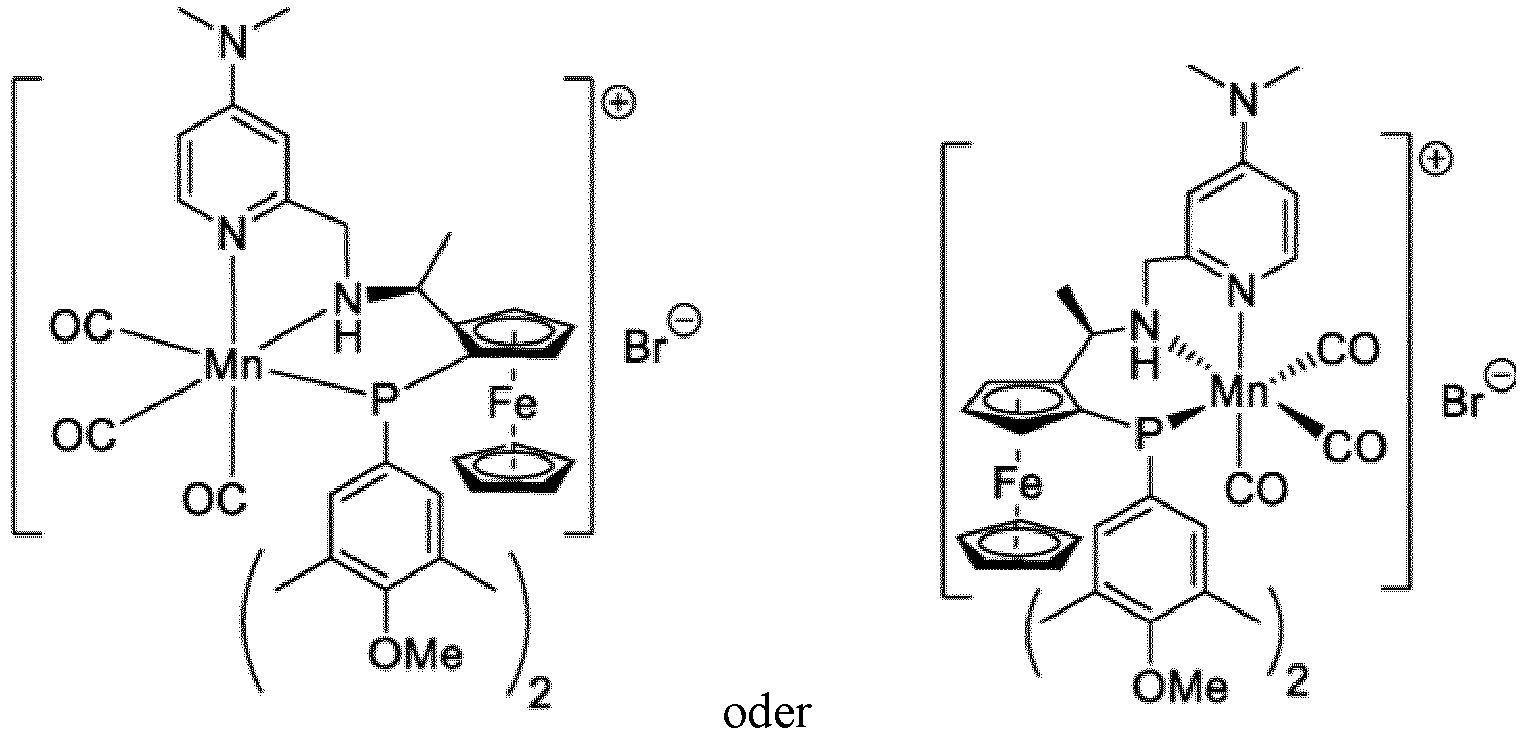
- the catalyst has one of the formulae: wherein t Bu is tert -butyl.
- the catalyst may equally be a mixture of each enantiomeric pair, for example a racemic mixture, or mixture of other catalysts comprising complexes of formula (I).
- the catalyst has one of the formulae:
- catalysts useful in connection with the present invention can, for example, be prepared by mixing an appropriate manganese salt, which may or may not comprise the ligand or ligands L 1 -L 3 , and additional ligand(s), e.g. a ligand of the formula R 1 (R 2 )PFc-CH(Me)-NH-Z-N x , suitable to form a catalyst comprising a complex of formula (I), in the same reaction vessel in which a hydrogenation of the present invention is conducted.
- additional ligand(s) e.g. a ligand of the formula R 1 (R 2 )PFc-CH(Me)-NH-Z-N x
- an optionally well-defined catalyst may be prepared ex situ, as briefly described above. It is readily within the ability of those of normal skill in the art to prepare such catalysts, using the guidance herein, including with reference to the experimental section and prior art with which the skilled person is aware, including that cited herein.
- a characteristic feature of the method of the present invention involves the use of a base wherein the conjugate acid of the base has a pKa, determined in water at 25 °C, of from 6.3 to 14.
- these pKa values relate to determinations conducted in water, at 25°C, for the reaction wherein BH + denotes the conjugate acid of the base concerned, as described in the CRC Handbook of Chemistry and Physics, 91st edition, 2010 , Dissociation Constants of Organic Acids and Bases, and Dissociation Constants of Inorganic Acids and Bases, and the references cited therein.
- the base used is potassium bicarbonate (KHCO 3 ), for example, the conjugate acid is carbonic acid (H 2 CO 3 ); where the base used is potassium carbonate (K 2 CO 3 ), for example, the conjugate acid is bicarbonate (HCO 3 - ).
- the pKa of water at 25°C is defined herein, as is generally recognised in the art, as being 14.0. Accordingly, for example, the pKa of the conjugate acid of both sodium hydroxide and potassium hydroxide (i.e. water) is 14.0.
- the pKa of water is indicated as being 15.74 (higher than that of methanol (15.50) for reasons explained in detail as being incorrect by TP Silverstein et al. (J. Chem. Educ., 94(6), 690-695 (2017 )).
- the present invention does not embrace, for use as the base in accordance with the method of the invention, any metal alkoxide, such as sodium methoxide, potassium tert -butoxide and the like. Accordingly, viewed from a second aspect, the invention provides a method comprising hydrogenating an ester in the presence of (i) a base other than a metal alkoxide, (ii) hydrogen gas and (iii) a catalyst comprising a charged or neutral complex of formula (I) as defined in connection with the first aspect of the invention, and elsewhere herein.
- the base is selected from the group consisting of a lithium, beryllium, sodium, magnesium, potassium, calcium or cesium carbonate, phosphate, hydroxide or bicarbonate (i.e one of these four salts of these six metals) or a mixture thereof, e.g. is selected from the group consisting of a lithium, sodium, magnesium, potassium, calcium or cesium carbonate, phosphate, hydroxide or bicarbonate, or a mixture thereof.
- a lithium, beryllium, sodium, magnesium, potassium, calcium or cesium carbonate, phosphate, hydroxide or bicarbonate i.e.
- the base is selected from the group consisting of potassium carbonate, potassium phosphate, potassium hydroxide, sodium carbonate, cesium carbonate, sodium hydroxide, lithium carbonate, lithium hydroxide, calcium hydroxide, potassium bicarbonate, sodium bicarbonate and lithium bicarbonate.
- the conjugate acid of the base has a pKa from 10.3 to 14.
- pKas exclude, for example, bicarbonates.
- the base is selected from the group consisting of potassium carbonate, potassium phosphate, potassium hydroxide, sodium carbonate, cesium carbonate, sodium hydroxide, lithium carbonate, lithium hydroxide, and calcium hydroxide, for example the group consisting of potassium carbonate, potassium phosphate, potassium hydroxide, sodium carbonate and cesium carbonate.
- the base used in accordance with these methods of hydrogenation may be a tertiary amine, typically of the formula N(C 1-6 alkyl) 3 , in which each alkyl group need not necessarily be the same.
- tertiary amines that may be used include triethylamine, N,N-dimethylamine and N,N-diisopropylethylamine (also known as Hünig's base).
- the invention provides a method comprising hydrogenating an ester in the presence of (i) a base, which is a lithium, beryllium, sodium, magnesium, potassium calcium or cesium carbonate, phosphate, hydroxide or bicarbonate, or a tertiary amine, for example of the formula N(C 1-6 alkyl) 3 defined above (ii) hydrogen gas and (iii) a catalyst comprising a charged or neutral complex of formula (I) as defined in connection with the first aspect of the invention, and elsewhere herein.
- a base which is a lithium, beryllium, sodium, magnesium, potassium calcium or cesium carbonate, phosphate, hydroxide or bicarbonate, or a tertiary amine, for example of the formula N(C 1-6 alkyl) 3 defined above
- hydrogen gas and
- a catalyst comprising a charged or neutral complex of formula (I) as defined in connection with the first aspect of the invention, and elsewhere herein.
- the base is selected from the group consisting of potassium carbonate, potassium phosphate, potassium hydroxide, sodium carbonate, cesium carbonate, sodium hydroxide, lithium carbonate, lithium hydroxide, calcium hydroxide, potassium bicarbonate, sodium bicarbonate and lithium bicarbonate, for example wherein the base is selected from the group consisting of potassium carbonate, potassium phosphate, potassium hydroxide, sodium carbonate, cesium carbonate, sodium hydroxide, lithium carbonate, lithium hydroxide, and calcium hydroxide, and, according to particular embodiments, wherein the base is selected from the group consisting of potassium carbonate, potassium phosphate, potassium hydroxide, sodium carbonate and cesium carbonate.
- the methods of the invention are conducted in the presence of hydrogen gas, under pressure.
- the pressure at which the reactions are conducted is in the range of about 1 bar (100 kPa) to about 100 bar (10,000 kPa), for example from about 20 bar (2,000 kPa) to about 80 bar (8,000 kPa), although higher or lower pressures may on occasion be convenient.
- the reactions may be carried out in any convenient solvent as may be suitable for the substrate for the reaction (i.e. the ester). In certain embodiments, it may be convenient to conduct hydrogenations in the absence of solvent. Any of the commonly encountered solvents in organic chemistry can potentially be utilised. However, solvents comprising ketone or ester functionalities, such as acetone or ethyl acetate respectively, are preferably avoided.
- Typical solvents for use in the present invention include simple alcohols, such as C 1-10 hydrocarbyl alcohols, often saturated aliphatic C 2-8 alcohols, for example, ethanol, isopropanol and tert -butanol; polyvalent alcohols such as ethylene glycol, propylene glycol, 1,2-propanediol and glycerol; ethers, for example tetrahydrofuran (THF) 1,4-dioxane, methyl tert -butyl ether, cyclopentyl methyl ether; aliphatic and aromatic hydrocarbon solvents, for example C 5-12 alkanes, benzene, toluene and xylene and halogenated (typically chlorinated) hydrocarbon solvents, for example dichloromethane and chlorobenzene, or mixtures thereof, in particular, mixtures of alcohols, for example ethanol or isopropanol, and hydrocarbon solvents such as hexanes,
- hydrogenation reactions of the present invention can typically be conducted in C 1-10 hydrocarbyl alcohols alone (i.e. in which the only solvent is the alcohol, or there is minimal (e.g. less than 10 vol%, more typically less than 5 vol%) contamination with other liquid, for example water), in particular in ethanol or isopropanol.
- the solvent for the reaction is isopropanol.
- the solvent is ethanol.
- any given hydrogenation reaction may be varied within the routine ability of those of normal skill in the art.
- concentration of catalyst and hydrogen pressure may typically be varied within the ranges already discussed.
- Operating temperatures that may be used typically vary from about -20 °C to about 200 °C, often from about 20 °C to about 120 °C, for example from about 50 °C to about 110 °C; and durations of reaction may vary from about 5 minutes to about 36 hours, for example from about 1 hour to about 24 hours or from about 2 hours to about 18 hours.
- Suitable amounts of base that may be used can likewise be determined by the skilled person.
- One of the advantages of the present invention is that the costs of many of the bases are significantly lower than those of metal alkoxides.
- Another advantage is the greatly reduced sensitivity of the basis described herein to water.
- the use of larger amounts of bases in connection with the present invention is therefore less problematic than with metal alkoxides.
- suitable amounts of base to use may vary from about 0.1 mol% to about 1000 mol%, with respect to the ester reactant, for example from about 1 mol% and about 100 mol%, e.g. from about 5 and about 50 mol%. It may on occasion be convenient or advantageous to use greater quantities of base, however, for example up to 2000 mol% or more. Combinations of more than one base may also be used.
- esters that may therefore serve as the substrate for the hydrogenation reactions in accordance with the present invention are therefore not particularly limited.
- the ester functionality is connected to one or more hydrocarbyl moieties (for the avoidance of doubt, esters that may be hydrogenated in accordance with the scope of the present invention include cyclic esters (i.e. lactones)), optionally comprising amino or halo functionality.
- the hydrocarbyl moieties to which the ester functional group is connected do not comprise an unsaturated aliphatic portion, although they may comprise aromatic or heteroaromatic moieties in addition to one or more saturated aliphatic portions.
- a particular advantage resultant from the avoidance of strong bases in hydrogenation reactions in accordance with the present invention is the ability to hydrogenate optically active substrates, for example those susceptible to racemisation via deprotonation of relatively acidic C-H bonds, e.g. alpha to carbonyl moieties, with at least less disruption to optical purity than corresponding reactions in which strong bases have hitherto been used.
- the ester is optically active.
- the ester comprises a stereogenic centre adjacent to its carbonyl group.
- the enantiomeric excess within the optically active ester submitted to the hydrogenation is typically maintained, or diminished no more than about 10% by the hydrogenation (i.e. the ⁇ e.e. is 0 or less than about 10%), for example by no more than about 5%.
- the ⁇ e.e. in accordance with the present invention is frequently ⁇ 0%.
- the ester hydrogenated is the commercially available (e.g. from Sigma-Aldrich) lactone sclareolide, which has the formula:
- the CAS # for sclareolide is [564-20-5 ] and it is known by a number of names, including (+)-Norambreinolide, (3a R )-(+)-Sclareolide, (R)-(+)-sclareolide, (3aR,5aS,9aS,9bR)-decahydro-3a,6,6,9a-tetramethyl-naphtha[2,I-b]furan-2(1H)-one, 3a,4,5,5a ⁇ ,6,7,8,9,9a,9b ⁇ -decahydro-3a ⁇ ,6,6,9a ⁇ -tetramethyl-naphtho[2,I-b]furan-2(1H)-one and [3aR-(3a ⁇ ,5a ⁇ ,9a ⁇ ,9b ⁇ )]-decahydro-3a,6,6,9a-tetramethyl-naphtho[2,1-b]furan-2(1H)-one.
- Sclareolide may be used in the synthesis of ambroxide, by hydrogenation of the ester to form the corresponding diol (known under a number of synonyms including ambradiol, which can then be dehydrated to form ambroxide: which is highly valued in perfumery as a sensualising fixative.
- the use of hydrogenations of the present invention in conjunction with ambroxide manufacture therefore represents a fourth aspect of the present invention.
- This fourth aspect provides a method of making ambroxide comprising hydrogenating sclareolide in accordance with any of the 1 st to 3 rd aspect of the invention and thereafter cyclising the resultant diol (ambradiol) so as to provide ambroxide.
- Reported temperature is the oil bath or heating block temperature and not internal temperature unless stated and was measured using a contact thermometer (PT-1000).
- PT-1000 contact thermometer
- In vacuo refers to either the use of a Heidolph Laborota 4001 rotary evaporator or the use of a high-vacuum line.
- Analytical thin layer chromatography (TLC) was carried out on pre-coated plastic plates (Kieselgel 60 F254 silica). TLC visualisation was carried out using a UV lamp (254nm) or using a 1% potassium permanganate aqueous solution. Flash silica chromatography was performed using Kieselgel 60 silica.
- Infrared spectra were recorded on a Shimadzu !RAffinity-1 using Pike attenuated total reflectance (ATR) accessory. Peaks are reported as weak (w), medium (m) or strong (s). The abbreviation “br” denote a broad peak shape and “sh” denote a sharp peak shape. All units are reported in cm-1.
- Mass spectrometric (m/z) data were acquired by electrospray ionisation (ESI) or electron impact (El) either at the University of St Andrews Mass Spectrometry facility (using Micromass LCT spectrometer or Micromass GCT spectrometer) or at the EPRSC National Mass Spectrometry Service Centre, Swansea (using Orbitrap nano-ESI, Finnigan MAT 900 XLT or Finnigan MAT 95 XP). Values are reported as a ratio of mass to charge in Daltons.
- ESI electrospray ionisation
- El electron impact
- HPLC analysis has been determined using a Varian Prostar operated by Galaxie workstation PC software.
- the crude material was taken up in dichloromethane (20 mL) and washed with saturated aqueous sodium bicarbonate solution (15 mL). The aqueous layer was extracted with dichloromethane (20 mL). The combined solutions were dried over magnesium sulfate, filtered through a cannula equipped with a filter, and concentrated.
- the product was purified by silica chromatography (The silica was deactivated using triethylamine) using a gradient of n -hexane / ethyl acetate (5/1 to 1/1 to 0/1) to give 1 as an orange-yellow solid (0.94 g, 1.86 mmol, 73 % yield). Analytical data was found to be identical to the reported above using the other synthetic route to compound (1).
- N -2-Picolyl (Sc, Rp)-1-(-2-diphenylphosphino)ferrocenylethylamine (280 mg, 0.56 mmol, 1.2 equivalents) was added to pentacarbonylbromomanganese (I) (128 mg, 0.47 mmol, 1.0 equivalents) in a round bottom flask at ambient temperature.
- Degassed toluene (10 mL) was added and the mixture was heated to reflux and kept at that temperature for 16 h. The mixture was cooled to ambient temperature and concentrated to dryness.
- Table 1 immediately below summarises the results of the following hydrogenation reactions (described thereafter): Table 1 Example No Substrate Catalyst load (mol%) a T (°C) Conversion (%) Isolated yield (%) e.e. product (%) ⁇ e.e.
- Degassed isopropanol (6.3 mL) was added through the charging port and the autoclave was pressurised with hydrogen gas (50 bar) and vented to the atmosphere. This was repeated twice.
- the pressure was set to 50 bar using hydrogen gas and the autoclave sealed and placed in a pre-heated oil bath (50 °C) and the stirring as set to 1200 rpm and left for 16 h.
- the vessel was cooled to ambient temperature and vented to the atmosphere, the reaction was analysed by 1 H-NMR and conversion was estimated using the internal standard (1-methylnaphthalene).
- Chiral analysis was performed using a Chiralcel OD-H column using n-hexane / isopropanol (96/4) mobile phase, flow 1.0 mL/min; t R (S-enantiomer, major): 17.0 min; t R (R-enantiomer, minor): 18.4 min, e.e. 98 %.
- Degassed isopropanol (2.4 mL) was added and the vial septum as pierced with 2x18G needles and placed in a stainless-steel autoclave under argon atmosphere.
- the vessel was pressurised with hydrogen gas (50 bar) and vented to the atmosphere. This was repeated twice.
- the pressure was set to 50 bar using hydrogen gas and the autoclave sealed and placed in a pre-heated oil bath (50 °C) and the stirring as set to 1200 rpm and left for 16 h.
- the vessel was cooled to ambient temperature and vented to the atmosphere, the reaction was analysed by 1 H-NMR and conversion was estimated using the internal standard (1-methylnaphthalene).
- Chiral analysis was performed using a Chiralcel AD-H column using n-hexane / isopropanol (98/2) mobile phase, flow 1.0 mL/min; t R (R-enantiomer, major): 14.9 min; t R (S-enantiomer, minor): 16.3 min, e.e. 98 %.
- Degassed isopropanol (2.4 mL) was added and the vial septum as pierced with 2x18G needles and placed in a stainless-steel autoclave under argon atmosphere.
- the vessel was pressurised with hydrogen gas (50 bar) and vented to the atmosphere. This was repeated twice.
- the pressure was set to 50 bar using hydrogen gas and the autoclave sealed and placed in a pre-heated oil bath (50 °C) and the stirring as set to 1200 rpm and left for 16 h.
- the vessel was cooled to ambient temperature and vented to the atmosphere, the reaction was analysed by 1 H-NMR and conversion was estimated using the internal standard (1-methylnaphthalene).
- Chiral analysis was performed using a Chiralcel OD-H column using n-hexane / isopropanol (98/2) mobile phase, flow 1.0 mL/min; t R (S-enantiomer, minor): 21,2 min; t R ( R -enantiomer, major): 25.1 min, e.e. 99 %.
- Degassed isopropanol (2.5 mL) was added and the vial septum as pierced with 2x18G needles and placed in a stainless-steel autoclave under argon atmosphere.
- the vessel was pressurised with hydrogen gas (50 bar) and vented to the atmosphere. This was repeated twice.
- the pressure was set to 50 bar using hydrogen gas and the autoclave sealed and placed in a pre-heated oil bath (110 °C) and the stirring as set to 1200 rpm and left for 16 h.
- the vessel was cooled to ambient temperature and vented to the atmosphere, the reaction was analysed by 1 H-NMR and conversion was estimated using the internal standard (1-methylnaphthalene).
- Chiral analysis was performed using a Chiralcel OD-H column using n-hexane / isopropanol (90/10) mobile phase, flow 1.0 mL/min; t R (R-enantiomer, minor): 7.5 min; t R (S-enantiomer, major): 7.9 min, e.e. 99.8 %.
- the substrate solution was added via the charging port, and the vessel pressurised with hydrogen gas (50 bar) and vented to the atmosphere. This was repeated twice.
- the pressure was set to 50 bar using hydrogen gas and the autoclave sealed and placed in a pre-heated oil bath (110 °C) and the stirring as set to 1200 rpm and left for 16 h.
- the vessel was cooled to ambient temperature and vented to the atmosphere, the reaction was analysed by 1 H-NMR and conversion was estimated using the internal standard (1-methyl naphthalene).
- Chiral analysis was performed using a Chiralcel OD-H column using n-hexane / isopropanol (90/10) mobile phase, flow 1.0 mL/min; t R (R-enantiomer, minor): 10,2 min; t R (S-enantiomer, major): 13.3 min, e.e. 99.8 %.
- Degassed isopropanol (6.0 mL) was added via the charging port and the vessel was pressurised with hydrogen gas (50 bar) and vented to the atmosphere. This was repeated twice. The pressure was set to 50 bar using hydrogen gas and the autoclave sealed and placed in a pre-heated oil bath (50 °C) and the stirring as set to 1200 rpm and left for 16 h. After the reaction, the vessel was cooled to ambient temperature and vented to the atmosphere, the reaction was analysed by 1 H-NMR and conversion was estimated using the internal standard (1-methylnaphthalene).
- Chiral analysis was performed using a Chiralcel OD-H column using n-hexane / isopropanol (90/10) mobile phase, flow 0.5 mL/min; t R (R-enantiomer, minor): 10.9 min; t R (S-enantiomer, major): 16.1 min, e.e. 98 %.
- Degassed ethanol 50 mL was added to an autoclave, containing a glass insert and a magnetic stirrer bar, followed by manganese catalyst (14 mg, 0.020 mmol, 0.001 equiv.), potassium carbonate (276 mg, 2.00 mmol, 0.10 equiv.) and (R)-sclareolide (5000 mg, 20.0 mmol, 1.0 equiv.) under an argon atmosphere.
- the vessel was sealed and pressurised to 50 bar using hydrogen gas and vented. This was repeated twice followed by a final pressurisation to 50 bar using hydrogen gas.
- the vessel was placed in a pre-heated oil bath at 90 °C and left for 16 h with stirring (1000 rpm), then cooled to ambient temperature and vented.
- the reaction was analysed by 1 H-NMR.
- the clear yellow solution was concentrated to 15 mL volume and water (75 mL) was added to precipitate the product.
- the product was filtered off and washed with water (30 mL) and petroleum ether (60/40, 50 mL) and dried to give (R)-sclareoldiol as a white solid (3.8 g, 75 %).
- the substrate solution was added via the charging port, and the vessel pressurised with hydrogen gas (50 bar) and vented to the atmosphere. This was repeated twice.
- the pressure was set to 50 bar using hydrogen gas and the autoclave sealed and placed in a pre-heated oil bath (110 °C) and the stirring was set to 1200 rpm and left for 16 h.
- the vessel was cooled to ambient temperature and vented to the atmosphere, the reaction was analysed by 1 H-NMR and conversion was estimated using the internal standard (1-methylnaphthalene).
- Chiral analysis was performed using a Chiralcel AD-H column using n-hexane / isopropanol (90/10) mobile phase, flow 1.0 mL/min; t R (R-enantiomer, minor): 27.0 min; t R (S-enantiomer, major): 31.0 min, e.e. 99.8 %.
- the vessel was pressurised with hydrogen gas (50 bar) and vented to the atmosphere. This was repeated twice.
- the pressure was set to 50 bar using hydrogen gas and the autoclave sealed and placed in a pre-heated oil bath (50 °C) and the stirring was set to 1200 rpm and left for 16 h.
- the vessel was cooled to ambient temperature and vented to the atmosphere, the reaction was analysed by 1 H-NMR and conversion was estimated using the internal standard (1-methylnaphthalene).
- Chiral analysis was performed using a Chiralcel AD-H column using n-hexane / isopropanol (90/10) mobile phase, flow 1.0 mL/min; t R (R-enantiomer, minor): 20.0 min; t R (S-enantiomer, major): 21.2 min, e.e. 98.5 %.
- Degassed isopropanol (2.8 mL) was added and the vial septum was pierced with 2x18G needles and placed in a stainless-steel autoclave under argon atmosphere.
- the vessel was pressurised with hydrogen gas (50 bar) and vented to the atmosphere. This was repeated twice.
- the pressure was set to 50 bar using hydrogen gas and the autoclave sealed and placed in a pre-heated oil bath (50 °C) and the stirring was set to 1200 rpm and left for 16 h.
- the vessel was cooled to ambient temperature and vented to the atmosphere, the reaction was analysed by 1 H-NMR and conversion was estimated using the internal standard (1-methylnaphthalene).
- Chiral analysis was performed using a Chiralcel AD-H column using n -hexane / isopropanol (99/1) mobile phase, flow 1.0 mL/min; t R (R-enantiomer, minor): 27.1 min; t R (S-enantiomer, major): 34.0 min, e.e. 96 %.
- the mixture was refluxed for 4 h then cooled to room temperature and volatiles removed in vacuo.
- the crude material was added to degassed dichloromethane (10 mL) and degassed saturated aqueous sodium bicarbonate (10 mL).
- the organic layer was cannulated to a Schlenk flask containing magnesium sulfate.
- the aqueous layer was extracted with dichloromethane (10 mL) two times, each layer cannulated to the same Schlenk flask as described above.
- the combined dried organic layer was filtered using a cannula fitted with a filter paper to a round bottom flask and evaporated to dryness.
- the crude material was purified by column chromatography using dichloromethane / methanol (9/1) to give the target compound as a yellow foam (0.84 g, 1.35 mmol, 76 %).
- Ethyl p-fluorobenzoate (3.5 g, 20.81 mmol, 1.0 equiv.) was dissolved in ethanol (30 mL) and degassed by bubbling argon gas through the solution for 1 h.
- the vessel was sealed and pressurised with hydrogen gas (5 bar) and vented. This was repeated twice.
- the degassed ethanol solution was added via an injection port and stirring was started (1300 rpm).
- the vessel was pressurised to 20 bar using hydrogen gas and then vented. This was repeated twice.
- the vessel was pressurised to 2 bar of hydrogen gas and heated to an internal temperature of 90 °C, at which time the pressure was increased to 20 bar and the reaction started. After 18 h the vessel was cooled to room temperature and vented to atmospheric pressure. The yellow solution was analysed by 1 H-NMR to confirm full conversion.
- Substrate (1.0 equivalent) was added to a Schlenk flask together with 1-methylnaphthalene (0.25 equiv.) and ethanol (3.2 mL) and degassed by bubbling argon gas through the solution for at least 30 min.
- a microwave vial containing a magnetic bead was added catalyst and base (0.10 equiv.).
- the vial was capped and put under an inert atmosphere using vacuum / argon cycles (3).
- the degassed substrate solution was added to the vial under argon.
- the vial was pierced by two 18G needles and placed in a stainless-steel autoclave under argon atmosphere. The vessel was sealed and pressurized with hydrogen gas to 50 bar.
- the pressure was released, and the procedure repeated twice.
- the vessel was pressurized with hydrogen gas (50 bar), sealed and placed in a pre-heated oil-bath at the designated reaction temperature (90 °C) for 16 h.
- the vessel was cooled to ambient temperature and the pressure slowly released.
- the vial was uncapped, and an aliquot was taken, diluted with deuterated chloroform and analysed by 1 H-NMR to assess the conversion using 1-methyl naphthalene as internal standard.
- the crude products were purified by column chromatography (as detailed below).
- the crude mixture was treated with degassed saturated aqueous sodium bicarbonate (60 mL) and extracted with degassed dichloromethane (3x 60mL).
- the organic extracts were cannulated to a Schlenck flask containing magnesium sulfate under an argon atmosphere.
- the combined extracts were filtered using a cannula fitted with a filter paper into a flask and the solvent removed.
- the crude material was dissolved in degassed ethanol (60 mL) and L-tartaric acid (1.44 g, 9.6 mmol, 0.85 equiv.) added.
- 2-dimethylaminoethanol (1.7 mL, 17.0 mmol, 2.1 equiv.) was dissolved in n hexane (20 mL) and cooled to -10 °C under an inert atmosphere.
- N-Butyl lithium (1.6 M, 20 mL, 32 mmol, 3.9 equiv.) was slowly added to the cold solution.
- the resulting clear colourless solution was stirred at -10 °C for 30 min then 4-dimethylaminopyridine (1.0 g, 8.2 mmol, 1.0 equiv.) was added as a solid.
- Ethyl p-fluorobenzoate (3.5 g, 20.81 mmol, 1.0 equiv.) was dissolved in ethanol (30 mL) and degassed for 1 h using argon gas bubbling.
- the catalyst (0.021 mmol, 0.001 equiv.) and potassium carbonate (288 mg, 2.08 mmol, 0.10 equiv.) was charged to an autoclave fitted with an overhead stirred, internal thermometer and a gas burette.
- the vessel was sealed and pressurised with hydrogen gas (5 bar) and vented. This was repeated twice.
- the degassed ethanol solution was added via an injection port and stirring was started (1300 rpm).
- the vessel was pressurised to 20 bar using hydrogen gas and then vented. This was repeated twice.
- the vessel was pressurised to 2 bar of hydrogen gas and heated to an internal temperature of 90 °C at which time the pressure was increased to 20 bar and the reaction started. Gas uptake was monitored by reduction of the pressure in the burette. The reaction was assumed complete when no uptake of gas was observed for >2 h.
- the vessel was cooled to room temperature, vented and the content concentrated to dryness and analysed by 1 H-NMR to confirm full conversion.
- the uptake curve was converted to conversion by dividing the gas uptake at a time-point by the total uptake and multiplying the result by 100 to get percentage conversion. From the data, substrate and product concentrations could be calculated and from those, the turnover frequency (TOF, see Table 3 below).
- Table 3 Comparsion of the catalytic activity of 2 and 8 in the hydrogenation of ethyl p-fluorobenzoate Catalyst Temperature (°C) Catalyst Loading (mol%) Reaction time (h) Conversion (%) TOF c (h -1 ) 2 70 0.2 16 100 104 8 70 0.1 16 96 368 8 50 0.2 15.5 100 155 c. The TOF is equal to the number of molecules reacting per active site per hour, recorded at 20 % conversion.
- Catalysts 2 and 8 successfully catalyse the hydrogenation of ethyl p-fluorobenzoate in the presence of a weak base (potassium carbonate).
- Catalyst 8 is effective at temperatures of 70 and 50 °C, thereby allowing for some flexibility in the temperature used for hydrogenation, and potentially broadening the substrate scope to cover esters that are unstable at higher temperatures.
- the vessel was pressurised with hydrogen gas (50 bar) and vented to the atmosphere. This was repeated twice.
- the pressure was set to 50 bar using hydrogen gas and the autoclave was sealed and placed in a pre-heated oil bath (50 °C).
- the stirring was set to 1200 rpm and the reaction was left for 16 h.
- the vessel was cooled to ambient temperature and vented to the atmosphere, the reaction was analysed by 1 H-NMR and conversion was estimated using the internal standard (1-methylnaphthalene). Water was added to precipitate the product which was filtered off and washed with hexanes to give the product as a white solid (229 mg, 75 %).
Landscapes
- Chemical & Material Sciences (AREA)
- Organic Chemistry (AREA)
- Inorganic Chemistry (AREA)
- Engineering & Computer Science (AREA)
- Materials Engineering (AREA)
- Chemical Kinetics & Catalysis (AREA)
- Organic Low-Molecular-Weight Compounds And Preparation Thereof (AREA)
- Catalysts (AREA)
- Low-Molecular Organic Synthesis Reactions Using Catalysts (AREA)
- Furan Compounds (AREA)
- Indole Compounds (AREA)
Claims (15)
- Verfahren, umfassend die Hydrierung eines Esters in Gegenwart von (i) einer Base, wobei die konjugierte Säure der Base einen pKa-Wert, bestimmt in Wasser bei 25°C, von 6,4 bis 14 aufweist, (ii) Wasserstoffgas und (iii) einem Katalysator, umfassend einen geladenen oder neutralen Komplex der Formel (I):
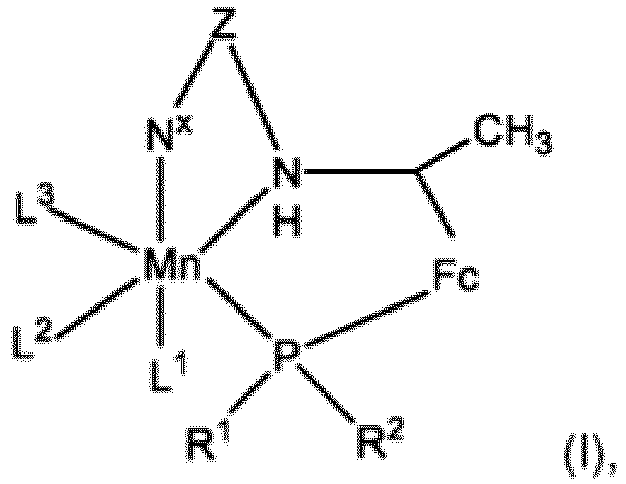 Mn ein Manganatom oder ein Manganion im Oxidationszustand (I) bis (VII) ist;R1 und R2 jeweils unabhängig C1-20-Kohlenwasserstoff oder Heterocyclyl-Einheiten sind, die optional ein- oder mehrfach mit einem Substituenten substituiert sind, ausgewählt aus der Gruppe, bestehend aus Halogen, aliphatischem C1-6-Kohlenwasserstoff, Trihalogenmethyl, Aryl, Heteroaryl, Hydroxy, Nitro, Amino, Alkoxy, Alkylthio, Carboxylat, Sulfonat, Phosphat, Cyano, Thio, Formyl, Ester, Acyl, Thioacyl, Carbamido und Sulfonamido;-Fc- eine Ferrocen-(bis(η5-cyclopentadienyl)eisen)-Einheit bezeichnet, die über benachbarte Kohlenstoffatome einer der zwei Cyclopentadienyl-Einheiten kovalent gebunden ist und die weiter optional in jedem Cyclopentadienylring ein- oder mehrfach mit einem Substituenten substituiert sein kann, ausgewählt aus der Gruppe, bestehend aus Halogen, aliphatischem C1-6-Kohlenwasserstoff, Trihalogenmethyl, Aryl, Heteroaryl, Hydroxy, Nitro, Amino, Alkoxy, Alkylthio, Carboxylat, Sulfonat, Phosphat, Cyano, Thio, Formyl, Ester, Acyl, Thioacyl, Carbamido und Sulfonamido;-Z- ein Alkylenlinker der Formel -(CH2)1-6- ist, in dem ein oder mehrere der Wasserstoffatome des Alkylens unabhängig voneinander mit einem Alkyl-, Aryl-, Heteroaryl-, Hydroxy-, Nitro-, Amino-, Alkoxy-, Alkylthio- oder Thiolsubstituenten substituiert sein können;-Nx eine stickstoffhaltige Amino-, Imino- oder Heteroaryl-Einheit ist; undL1-L3 einen, zwei oder drei Liganden darstellen, wobei jeder von L1-L3 unabhängig einen einzähnigen neutralen oder anionischen Liganden darstellt; oder einer von L1-L3 einen einzähnigen neutralen oder anionischen Liganden darstellt und die anderen zwei von L1-L3 zusammen einen zweizähnigen neutralen oder anionischen Liganden darstellen, oder L1-L3 zusammen einen dreizähnigen neutralen oder anionischen Liganden darstellen,wobei, wenn der Komplex der Formel (I) geladen ist, der Katalysator ein oder mehrere zusätzliche Gegenionen umfasst, um die Ladung des Komplexes auszugleichen.
 - Verfahren nach Anspruch 1, wobei die Base ausgewählt ist aus der Gruppe, bestehend aus Kaliumcarbonat, Kaliumphosphat, Kaliumhydroxid, Natriumcarbonat, Cäsiumcarbonat, Natriumhydroxid, Lithiumcarbonat, Lithiumhydroxid, Calciumhydroxid, Kaliumbicarbonat, Natriumbicarbonat, Lithiumbicarbonat und tertiären Aminen.
- Verfahren nach Anspruch 1 oder Anspruch 2, wobei die konjugierte Säure der Base einen pKa-Wert, bestimmt in Wasser bei 25°C, von 10,3 bis 14 aufweist.
- Verfahren nach Anspruch 3, wobei die Base ausgewählt ist aus der Gruppe, bestehend aus Kaliumcarbonat, Kaliumphosphat, Kaliumhydroxid, Natriumcarbonat, Cäsiumcarbonat, Natriumhydroxid, Lithiumcarbonat, Lithiumhydroxid und Calciumhydroxid, wobei die Base beispielsweise ausgewählt ist aus der Gruppe, bestehend aus Kaliumcarbonat, Kaliumphosphat, Kaliumhydroxid, Natriumcarbonat und Cäsiumcarbonat.
- Verfahren nach einem der Ansprüche 1 bis 4, wobei die R1R2P-Fc-CH(Me)-NH-Komponente des Komplexes 1-[Bis(4-methoxy-3,5-dimethylphenyl)phosphino]-2-[1-(HN)ethyl]ferrocen; 1-[1-(HN)Ethyl]-2-(diphenylphosphino)ferrocen; 1-[Bis(4-methoxy-3,5-di-tert-butylphenyl)phosphino]-2-[1-(HN)ethyl]ferrocen; 1-(Difuranylphosphino)-2-[1-(HN)ethyl]ferrocen; 1-[Bis[3,5-bis(trifluormethyl)phenyl]phosphino]-2-[1-(HN)ethyl]ferrocen oder 1-(Dicyclohexylphosphino)-2-[1-(HN)ethyl]ferrocen ist, wobei beispielsweise die R1R2P-Fc-CH(Me)-NH-Komponente des Komplexes (S)-1-[Bis(4-methoxy-3,5-dimethylphenyl)phosphino]-2-[(R)-1-(HN)ethyl]ferrocen, (R)-1-[Bis(4-methoxy-3,5-dimethylphenyl)phosphino]-2-[(S)-1-(HN)ethyl]ferrocen oder ein Gemisch davon; (S)-1-[(R)-1-(HN)Ethyl]-2-(diphenylphosphino)ferrocen, (R)-1-[(S)-1-(HN)Ethyl]-2-(diphenylphosphino)ferrocen oder ein Gemisch davon; (S)-1-[Bis(4-methoxy-3,5-di-tert-butylphenyl)phosphino]-2-[(R)-1-(HN)ethyl]ferrocen, (R)-1-Bis(4-methoxy-3,5-di-tert-butylphenyl)phosphino]-2-[(S)-1-(HN)ethyl]ferrocen oder ein Gemisch davon; (S)-1-(Difuranylphosphino)-2-[(R)-1-(HN)ethyl]ferrocen, (R)-1-(Difuranylphosphino)-2-[(S)-1-(HN)ethyl]ferrocen oder ein Gemisch davon; (S)-1-[Bis[3,5-bis(trifluormethyl)phenyl]phosphino]-2-[(R)-1-(HN)ethyl]ferrocen, (R)-1-[Bis[3,5-bis(trifluormethyl)phenyl]phosphino]-2-[(S)-1-(HN)ethyl]ferrocen oder ein Gemisch davon; oder (S)-1-(Dicyclohexylphosphino)-2-[(R)-1-(HN)ethyl]ferrocen, (R)-1-(Dicyclohexylphosphino)-2-[(S)-1-(HN)ethyl]ferrocen oder ein Gemisch davon ist.
- Verfahren nach einem der Ansprüche 1 bis 5, wobei -Nx ein Heterocyclylring ist, der optional ein- oder mehrfach mit einem oder mehreren Substituenten substituiert ist, unabhängig voneinander ausgewählt aus der Gruppe, bestehend aus Amino, Halogen, C1-6-Kohlenwasserstoff, Trihalogenmethyl, Aryl, Heteroaryl, Hydroxy, Nitro, Alkoxy, Alkylthio, Carboxylat, Sulfonat, Phosphat, Cyano, Thio, Formyl, Ester, Acyl, Thioacyl, Carbamido und Sulfonamido.
- Verfahren nach Anspruch 6, wobei -Nx ein Pyridylring ist, der optional ein- oder mehrfach mit einem Aminosubstituenten substituiert ist, wobei -Nx beispielsweise 2-Pyridyl oder 4-Dimethylaminopyridin-2-yl ist.
- Verfahren nach einem der Ansprüche 1 bis 7, wobei L1-L3 drei Liganden bilden, ausgewählt aus neutralen einzähnigen Liganden, wobei beispielsweise jeder von L1-L3 Kohlenmonoxid ist.
- Verfahren nach einem der Ansprüche 1 bis 8, wobei der Komplex eine einzige positive Ladung aufweist und der Katalysator ferner ein Halogenid- oder Tetrarylborat-Gegenanion umfasst, wobei das Gegenanion beispielsweise Bromid oder [B{3,5-(CF3)2C6H3}4]- ist.
- Verfahren nach einem der Ansprüche 1 bis 4, wobei der Katalysator eine der Formeln aufweist:


- Verfahren nach einem der Ansprüche 1 bis 10, wobei der Ester optisch aktiv ist.
- Verfahren nach Anspruch 11, wobei der Ester ein stereogenes Zentrum neben der Carbonylgruppe des Esters umfasst.
- Verfahren nach Anspruch 11, wobei der Ester Sclareolid ist, mit der Formel

- Verfahren nach einem der Ansprüche 11 bis 13, wobei der Enantiomerenüberschuß des optisch aktiven Esters durch die Hydrierung um nicht mehr als 10 % erhalten oder vermindert wird.
- Verfahren zur Herstellung von Ambroxid, umfassend die Hydrierung von Sclareolid durch ein Verfahren gemäß Anspruch 13 oder 14 und anschließende Cyclisierung des resultierenden Diols (Ambradiol), wodurch Ambroxid bereitgestellt wird.
Applications Claiming Priority (2)
| Application Number | Priority Date | Filing Date | Title |
|---|---|---|---|
| GBGB1800276.6A GB201800276D0 (en) | 2018-01-08 | 2018-01-08 | Maganese-catalysed hydrogenation of esters |
| PCT/GB2019/050042 WO2019138216A1 (en) | 2018-01-08 | 2019-01-08 | Manganese-catalysed hydrogenation of esters |
Publications (2)
| Publication Number | Publication Date |
|---|---|
| EP3737663A1 EP3737663A1 (de) | 2020-11-18 |
| EP3737663B1 true EP3737663B1 (de) | 2023-02-22 |
Family
ID=61190427
Family Applications (1)
| Application Number | Title | Priority Date | Filing Date |
|---|---|---|---|
| EP19704380.5A Active EP3737663B1 (de) | 2018-01-08 | 2019-01-08 | Mangan-katalysierte hydrierung von estern |
Country Status (7)
| Country | Link |
|---|---|
| US (1) | US12421200B2 (de) |
| EP (1) | EP3737663B1 (de) |
| JP (1) | JP7308864B2 (de) |
| CN (2) | CN111587238A (de) |
| ES (1) | ES2941541T3 (de) |
| GB (1) | GB201800276D0 (de) |
| WO (1) | WO2019138216A1 (de) |
Families Citing this family (6)
| Publication number | Priority date | Publication date | Assignee | Title |
|---|---|---|---|---|
| GB201900253D0 (en) * | 2019-01-08 | 2019-02-27 | Univ Court Univ St Andrews | Catalysts and uses thereof |
| CN110590859B (zh) * | 2019-08-19 | 2022-06-03 | 河北师范大学 | 一种锰络合物、制备方法及其应用 |
| PL4359372T3 (pl) * | 2021-06-21 | 2025-11-24 | Basf Se | Uwodornianie estrów do alkoholi w obecności kompleksu mn-pnn |
| JPWO2023153494A1 (de) * | 2022-02-14 | 2023-08-17 | ||
| GB202206460D0 (en) * | 2022-05-03 | 2022-06-15 | Johnson Matthey Plc | Process |
| CN117003663A (zh) * | 2023-07-28 | 2023-11-07 | 浙江大学 | 催化加氢反应以及锰基催化剂的应用 |
Family Cites Families (14)
| Publication number | Priority date | Publication date | Assignee | Title |
|---|---|---|---|---|
| SU988817A1 (ru) | 1980-12-18 | 1983-01-15 | Ордена Трудового Красного Знамени Институт Химии Ан Мсср | Способ получени тетрагидрофуранов |
| ATE72457T1 (de) | 1983-07-13 | 1992-02-15 | Basf K & F Corp | Verfahren zur herstellung eines diols und eines furans und dazu faehiger mikroorganismus. |
| JPS60239481A (ja) | 1984-05-14 | 1985-11-28 | T Hasegawa Co Ltd | (±)−アンブロツクスの製法及びその利用 |
| JPH0761976B2 (ja) * | 1987-01-21 | 1995-07-05 | 住友化学工業株式会社 | 光学活性アリ−ル酢酸誘導体の製造法 |
| DE3912318A1 (de) | 1989-04-14 | 1990-10-18 | Henkel Kgaa | Verfahren zur stereoselektiven herstellung von 8(alpha),12-oxido-13,14,15,16-tetranorlabdan |
| ES2044780B1 (es) | 1992-04-10 | 1994-08-01 | Univ Granada | Procedimientos de obtencion de ambrox a partir de diterpenos labdanicos naturales. |
| US5463089A (en) | 1994-07-22 | 1995-10-31 | Quest International B.V. | Preparation of ambrox |
| ES2195777B1 (es) | 2002-03-22 | 2005-03-16 | Universidad De Granada | Procedimiento para la obtencion de productos olorosos tipo ambar gris a partir de esclareol. |
| RU2007140870A (ru) | 2005-04-05 | 2009-05-20 | Фирмениш Са (Ch) | Гидрирование сложных эфиров в присутствии комплексов ru c тетрадентатными лигандами |
| US20100248316A1 (en) | 2009-03-25 | 2010-09-30 | Csir | Process for the Production of Ambrafuran |
| GB201208589D0 (en) | 2012-05-16 | 2012-06-27 | Givaudan Sa | Improvements in or relating to organic compounds |
| ES2686723T3 (es) | 2013-12-18 | 2018-10-19 | Firmenich Sa | Hidrogenación de ésteres con complejos de Fe/ligandos tridentados |
| GB201401230D0 (en) * | 2014-01-24 | 2014-03-12 | Givaudan Sa | Improvements in or relating to organic compounds |
| MX361536B (es) | 2015-10-23 | 2018-12-10 | Univ Michoacana De San Nicolas De Hidalgo | Proceso de sintesis de ambrox a partir de ageratina jocotepecana. |
-
2018
- 2018-01-08 GB GBGB1800276.6A patent/GB201800276D0/en not_active Ceased
-
2019
- 2019-01-08 CN CN201980007452.3A patent/CN111587238A/zh active Pending
- 2019-01-08 US US16/960,187 patent/US12421200B2/en active Active
- 2019-01-08 ES ES19704380T patent/ES2941541T3/es active Active
- 2019-01-08 JP JP2020557004A patent/JP7308864B2/ja active Active
- 2019-01-08 EP EP19704380.5A patent/EP3737663B1/de active Active
- 2019-01-08 CN CN202510216195.1A patent/CN120136669A/zh active Pending
- 2019-01-08 WO PCT/GB2019/050042 patent/WO2019138216A1/en not_active Ceased
Non-Patent Citations (2)
| Title |
|---|
| IAN CARPENTER ET AL: "Convenient and improved protocols for the hydrogenation of esters using Ru catalysts derived from (P,P), (P,N,N) and (P,N,O) ligands", DALTON TRANSACTIONS, vol. 41, no. 34, 1 January 2012 (2012-01-01), pages 10136, XP055077763, ISSN: 1477-9226, DOI: 10.1039/c2dt30973d * |
| SARAVANAKUMAR ELANGOVAN ET AL: "Hydrogenation of Esters to Alcohols Catalyzed by Defined Manganese Pincer Complexes", ANGEWANDTE CHEMIE, WILEY - V C H VERLAG GMBH & CO. KGAA, DE, vol. 128, no. 49, 30 September 2016 (2016-09-30), pages 15590 - 15594, XP071369727, ISSN: 0044-8249, DOI: 10.1002/ANGE.201607233 * |
Also Published As
| Publication number | Publication date |
|---|---|
| US12421200B2 (en) | 2025-09-23 |
| ES2941541T3 (es) | 2023-05-23 |
| EP3737663A1 (de) | 2020-11-18 |
| CN111587238A (zh) | 2020-08-25 |
| CN120136669A (zh) | 2025-06-13 |
| WO2019138216A1 (en) | 2019-07-18 |
| JP2021509684A (ja) | 2021-04-01 |
| GB201800276D0 (en) | 2018-02-21 |
| US20210053932A1 (en) | 2021-02-25 |
| JP7308864B2 (ja) | 2023-07-14 |
Similar Documents
| Publication | Publication Date | Title |
|---|---|---|
| EP3737663B1 (de) | Mangan-katalysierte hydrierung von estern | |
| de Boer et al. | Ruthenium PNN (O) Complexes: Cooperative Reactivity and Application as Catalysts for Acceptorless Dehydrogenative Coupling Reactions | |
| EP2855494B1 (de) | Eisenkatalysatoren mit asymmetrischen pnn 'p-liganden | |
| US8716507B2 (en) | Iron(II) catalysts containing diimino-diphosphine tetradentate ligands and their synthesis | |
| Dubey et al. | Base free N-alkylation of anilines with ArCH 2 OH and transfer hydrogenation of aldehydes/ketones catalyzed by the complexes of η 5-Cp* Ir (III) with chalcogenated Schiff bases of anthracene-9-carbaldehyde | |
| CN114080379B (zh) | 在Ru-PNN配合物存在下将酯类氢化为醇类 | |
| US12281058B2 (en) | Manganese catalysts and their use in hydrogenation of ketones | |
| Ruan et al. | Catalytic Asymmetric Alkynylation and Arylation of Aldehydes by an H8‐Binaphthyl‐Based Amino Alcohol Ligand | |
| EP2865446B1 (de) | Verfahren zur herstellung von optisch aktivem sekundärem alkohol | |
| Hui et al. | Synthesis of new C2-symmetric bis (β-hydroxy amide) ligands and their applications in the enantioselective addition of alkynylzinc to aldehydes | |
| Luo et al. | Enantioselective Carbonyl‐Ene Reactions of Arylglyoxals with a Chiral Palladium (II)‐BINAP Catalyst | |
| JP2024527512A (ja) | Mn-PNN錯体存在下でのエステルからアルコールへの水素化反応 | |
| US9340519B2 (en) | Paracyclophane-based ligands, their preparation and use in catalysis | |
| CN109824600A (zh) | 一种钯催化2-羟基嘧啶化合物的不对称氢化合成手性环状脲的方法 | |
| Doraghi et al. | Six-membered cyclic sulfamidate imines: functionalization and cyclization reactions | |
| Quezada-Márquez et al. | Synthesis and Catalytic Application of Homoleptic Bis (triazol-5-ylidene)-Silver Complexes | |
| WO2024100405A1 (en) | Catalytic hydrogenation process | |
| CN117946161A (zh) | 一种亚膦酰胺结构三齿p,n,n-配体及其制备方法与应用 | |
| CN115340441A (zh) | 一种手性环丁醇化合物的合成方法、手性环丁醇及用途 | |
| Chu et al. | Synthesis of nitrogen-containing molecules by zinc-catalyzed [4+ 2] cycloaddition and photoredox-catalyzed CH functionalization | |
| Class et al. | Patent application title: PRECATALYST FOR SHIBASAKI'S RARE EARTH METAL BINOLATE CATALYSTS Inventors: Patrick Walsh (Bala Cynwyd, PA, US) Eric J. Schelter (Philadelphia, PA, US) Jerome Robinson (Philadelphia, PA, US) | |
| Phan | Enantioselective Rhodium-Catalyzed Hydroacylation of Alkenes and Ketones & Silver-Catalyzed Hydroamination of Cyclopropenes | |
| Liao | Asymmetric counteranion-directed transition metal catalysis: Enantioselective epoxidation and sulfoxidation with ion-pair catalysts | |
| Takebayashi | Developments and Mechanistic Investigations of Ester, Imide, and Ketone Hydrogenations | |
| WO2014205437A1 (en) | Precatalyst for shibasaki's rare earth metal binolate catalysts |
Legal Events
| Date | Code | Title | Description |
|---|---|---|---|
| STAA | Information on the status of an ep patent application or granted ep patent |
Free format text: STATUS: UNKNOWN |
|
| STAA | Information on the status of an ep patent application or granted ep patent |
Free format text: STATUS: THE INTERNATIONAL PUBLICATION HAS BEEN MADE |
|
| PUAI | Public reference made under article 153(3) epc to a published international application that has entered the european phase |
Free format text: ORIGINAL CODE: 0009012 |
|
| STAA | Information on the status of an ep patent application or granted ep patent |
Free format text: STATUS: REQUEST FOR EXAMINATION WAS MADE |
|
| 17P | Request for examination filed |
Effective date: 20200810 |
|
| AK | Designated contracting states |
Kind code of ref document: A1 Designated state(s): AL AT BE BG CH CY CZ DE DK EE ES FI FR GB GR HR HU IE IS IT LI LT LU LV MC MK MT NL NO PL PT RO RS SE SI SK SM TR |
|
| AX | Request for extension of the european patent |
Extension state: BA ME |
|
| DAV | Request for validation of the european patent (deleted) | ||
| DAX | Request for extension of the european patent (deleted) | ||
| RIC1 | Information provided on ipc code assigned before grant |
Ipc: C07D 213/74 20060101ALI20220708BHEP Ipc: C07C 33/34 20060101ALI20220708BHEP Ipc: C07C 29/149 20060101ALI20220708BHEP Ipc: C07C 215/08 20060101ALI20220708BHEP Ipc: C07C 215/28 20060101ALI20220708BHEP Ipc: C07C 215/24 20060101ALI20220708BHEP Ipc: C07D 209/20 20060101ALI20220708BHEP Ipc: C07C 213/00 20060101AFI20220708BHEP |
|
| GRAP | Despatch of communication of intention to grant a patent |
Free format text: ORIGINAL CODE: EPIDOSNIGR1 |
|
| STAA | Information on the status of an ep patent application or granted ep patent |
Free format text: STATUS: GRANT OF PATENT IS INTENDED |
|
| INTG | Intention to grant announced |
Effective date: 20220831 |
|
| GRAS | Grant fee paid |
Free format text: ORIGINAL CODE: EPIDOSNIGR3 |
|
| GRAA | (expected) grant |
Free format text: ORIGINAL CODE: 0009210 |
|
| STAA | Information on the status of an ep patent application or granted ep patent |
Free format text: STATUS: THE PATENT HAS BEEN GRANTED |
|
| AK | Designated contracting states |
Kind code of ref document: B1 Designated state(s): AL AT BE BG CH CY CZ DE DK EE ES FI FR GB GR HR HU IE IS IT LI LT LU LV MC MK MT NL NO PL PT RO RS SE SI SK SM TR |
|
| REG | Reference to a national code |
Ref country code: GB Ref legal event code: FG4D |
|
| REG | Reference to a national code |
Ref country code: CH Ref legal event code: EP |
|
| REG | Reference to a national code |
Ref country code: DE Ref legal event code: R096 Ref document number: 602019025509 Country of ref document: DE |
|
| REG | Reference to a national code |
Ref country code: AT Ref legal event code: REF Ref document number: 1549429 Country of ref document: AT Kind code of ref document: T Effective date: 20230315 Ref country code: IE Ref legal event code: FG4D |
|
| REG | Reference to a national code |
Ref country code: ES Ref legal event code: FG2A Ref document number: 2941541 Country of ref document: ES Kind code of ref document: T3 Effective date: 20230523 |
|
| REG | Reference to a national code |
Ref country code: LT Ref legal event code: MG9D |
|
| REG | Reference to a national code |
Ref country code: NL Ref legal event code: MP Effective date: 20230222 |
|
| P01 | Opt-out of the competence of the unified patent court (upc) registered |
Effective date: 20230529 |
|
| REG | Reference to a national code |
Ref country code: AT Ref legal event code: MK05 Ref document number: 1549429 Country of ref document: AT Kind code of ref document: T Effective date: 20230222 |
|
| PG25 | Lapsed in a contracting state [announced via postgrant information from national office to epo] |
Ref country code: RS Free format text: LAPSE BECAUSE OF FAILURE TO SUBMIT A TRANSLATION OF THE DESCRIPTION OR TO PAY THE FEE WITHIN THE PRESCRIBED TIME-LIMIT Effective date: 20230222 Ref country code: PT Free format text: LAPSE BECAUSE OF FAILURE TO SUBMIT A TRANSLATION OF THE DESCRIPTION OR TO PAY THE FEE WITHIN THE PRESCRIBED TIME-LIMIT Effective date: 20230622 Ref country code: NO Free format text: LAPSE BECAUSE OF FAILURE TO SUBMIT A TRANSLATION OF THE DESCRIPTION OR TO PAY THE FEE WITHIN THE PRESCRIBED TIME-LIMIT Effective date: 20230522 Ref country code: NL Free format text: LAPSE BECAUSE OF FAILURE TO SUBMIT A TRANSLATION OF THE DESCRIPTION OR TO PAY THE FEE WITHIN THE PRESCRIBED TIME-LIMIT Effective date: 20230222 Ref country code: LV Free format text: LAPSE BECAUSE OF FAILURE TO SUBMIT A TRANSLATION OF THE DESCRIPTION OR TO PAY THE FEE WITHIN THE PRESCRIBED TIME-LIMIT Effective date: 20230222 Ref country code: LT Free format text: LAPSE BECAUSE OF FAILURE TO SUBMIT A TRANSLATION OF THE DESCRIPTION OR TO PAY THE FEE WITHIN THE PRESCRIBED TIME-LIMIT Effective date: 20230222 Ref country code: HR Free format text: LAPSE BECAUSE OF FAILURE TO SUBMIT A TRANSLATION OF THE DESCRIPTION OR TO PAY THE FEE WITHIN THE PRESCRIBED TIME-LIMIT Effective date: 20230222 Ref country code: AT Free format text: LAPSE BECAUSE OF FAILURE TO SUBMIT A TRANSLATION OF THE DESCRIPTION OR TO PAY THE FEE WITHIN THE PRESCRIBED TIME-LIMIT Effective date: 20230222 |
|
| PG25 | Lapsed in a contracting state [announced via postgrant information from national office to epo] |
Ref country code: SE Free format text: LAPSE BECAUSE OF FAILURE TO SUBMIT A TRANSLATION OF THE DESCRIPTION OR TO PAY THE FEE WITHIN THE PRESCRIBED TIME-LIMIT Effective date: 20230222 Ref country code: PL Free format text: LAPSE BECAUSE OF FAILURE TO SUBMIT A TRANSLATION OF THE DESCRIPTION OR TO PAY THE FEE WITHIN THE PRESCRIBED TIME-LIMIT Effective date: 20230222 Ref country code: IS Free format text: LAPSE BECAUSE OF FAILURE TO SUBMIT A TRANSLATION OF THE DESCRIPTION OR TO PAY THE FEE WITHIN THE PRESCRIBED TIME-LIMIT Effective date: 20230622 Ref country code: GR Free format text: LAPSE BECAUSE OF FAILURE TO SUBMIT A TRANSLATION OF THE DESCRIPTION OR TO PAY THE FEE WITHIN THE PRESCRIBED TIME-LIMIT Effective date: 20230523 Ref country code: FI Free format text: LAPSE BECAUSE OF FAILURE TO SUBMIT A TRANSLATION OF THE DESCRIPTION OR TO PAY THE FEE WITHIN THE PRESCRIBED TIME-LIMIT Effective date: 20230222 |
|
| PG25 | Lapsed in a contracting state [announced via postgrant information from national office to epo] |
Ref country code: SM Free format text: LAPSE BECAUSE OF FAILURE TO SUBMIT A TRANSLATION OF THE DESCRIPTION OR TO PAY THE FEE WITHIN THE PRESCRIBED TIME-LIMIT Effective date: 20230222 Ref country code: RO Free format text: LAPSE BECAUSE OF FAILURE TO SUBMIT A TRANSLATION OF THE DESCRIPTION OR TO PAY THE FEE WITHIN THE PRESCRIBED TIME-LIMIT Effective date: 20230222 Ref country code: EE Free format text: LAPSE BECAUSE OF FAILURE TO SUBMIT A TRANSLATION OF THE DESCRIPTION OR TO PAY THE FEE WITHIN THE PRESCRIBED TIME-LIMIT Effective date: 20230222 Ref country code: DK Free format text: LAPSE BECAUSE OF FAILURE TO SUBMIT A TRANSLATION OF THE DESCRIPTION OR TO PAY THE FEE WITHIN THE PRESCRIBED TIME-LIMIT Effective date: 20230222 Ref country code: CZ Free format text: LAPSE BECAUSE OF FAILURE TO SUBMIT A TRANSLATION OF THE DESCRIPTION OR TO PAY THE FEE WITHIN THE PRESCRIBED TIME-LIMIT Effective date: 20230222 |
|
| REG | Reference to a national code |
Ref country code: DE Ref legal event code: R097 Ref document number: 602019025509 Country of ref document: DE |
|
| PG25 | Lapsed in a contracting state [announced via postgrant information from national office to epo] |
Ref country code: SK Free format text: LAPSE BECAUSE OF FAILURE TO SUBMIT A TRANSLATION OF THE DESCRIPTION OR TO PAY THE FEE WITHIN THE PRESCRIBED TIME-LIMIT Effective date: 20230222 |
|
| PLBE | No opposition filed within time limit |
Free format text: ORIGINAL CODE: 0009261 |
|
| STAA | Information on the status of an ep patent application or granted ep patent |
Free format text: STATUS: NO OPPOSITION FILED WITHIN TIME LIMIT |
|
| 26N | No opposition filed |
Effective date: 20231123 |
|
| PG25 | Lapsed in a contracting state [announced via postgrant information from national office to epo] |
Ref country code: SI Free format text: LAPSE BECAUSE OF FAILURE TO SUBMIT A TRANSLATION OF THE DESCRIPTION OR TO PAY THE FEE WITHIN THE PRESCRIBED TIME-LIMIT Effective date: 20230222 |
|
| PG25 | Lapsed in a contracting state [announced via postgrant information from national office to epo] |
Ref country code: MC Free format text: LAPSE BECAUSE OF FAILURE TO SUBMIT A TRANSLATION OF THE DESCRIPTION OR TO PAY THE FEE WITHIN THE PRESCRIBED TIME-LIMIT Effective date: 20230222 |
|
| PG25 | Lapsed in a contracting state [announced via postgrant information from national office to epo] |
Ref country code: MC Free format text: LAPSE BECAUSE OF FAILURE TO SUBMIT A TRANSLATION OF THE DESCRIPTION OR TO PAY THE FEE WITHIN THE PRESCRIBED TIME-LIMIT Effective date: 20230222 |
|
| PG25 | Lapsed in a contracting state [announced via postgrant information from national office to epo] |
Ref country code: LU Free format text: LAPSE BECAUSE OF NON-PAYMENT OF DUE FEES Effective date: 20240108 |
|
| PG25 | Lapsed in a contracting state [announced via postgrant information from national office to epo] |
Ref country code: LU Free format text: LAPSE BECAUSE OF NON-PAYMENT OF DUE FEES Effective date: 20240108 |
|
| PG25 | Lapsed in a contracting state [announced via postgrant information from national office to epo] |
Ref country code: BE Free format text: LAPSE BECAUSE OF NON-PAYMENT OF DUE FEES Effective date: 20240131 |
|
| PG25 | Lapsed in a contracting state [announced via postgrant information from national office to epo] |
Ref country code: BE Free format text: LAPSE BECAUSE OF NON-PAYMENT OF DUE FEES Effective date: 20240131 |
|
| REG | Reference to a national code |
Ref country code: BE Ref legal event code: MM Effective date: 20240131 |
|
| PG25 | Lapsed in a contracting state [announced via postgrant information from national office to epo] |
Ref country code: BG Free format text: LAPSE BECAUSE OF FAILURE TO SUBMIT A TRANSLATION OF THE DESCRIPTION OR TO PAY THE FEE WITHIN THE PRESCRIBED TIME-LIMIT Effective date: 20230222 |
|
| PG25 | Lapsed in a contracting state [announced via postgrant information from national office to epo] |
Ref country code: BG Free format text: LAPSE BECAUSE OF FAILURE TO SUBMIT A TRANSLATION OF THE DESCRIPTION OR TO PAY THE FEE WITHIN THE PRESCRIBED TIME-LIMIT Effective date: 20230222 |
|
| PG25 | Lapsed in a contracting state [announced via postgrant information from national office to epo] |
Ref country code: IE Free format text: LAPSE BECAUSE OF NON-PAYMENT OF DUE FEES Effective date: 20240108 |
|
| PG25 | Lapsed in a contracting state [announced via postgrant information from national office to epo] |
Ref country code: IE Free format text: LAPSE BECAUSE OF NON-PAYMENT OF DUE FEES Effective date: 20240108 |
|
| PGFP | Annual fee paid to national office [announced via postgrant information from national office to epo] |
Ref country code: CH Payment date: 20250201 Year of fee payment: 7 |
|
| PG25 | Lapsed in a contracting state [announced via postgrant information from national office to epo] |
Ref country code: CY Free format text: LAPSE BECAUSE OF FAILURE TO SUBMIT A TRANSLATION OF THE DESCRIPTION OR TO PAY THE FEE WITHIN THE PRESCRIBED TIME-LIMIT; INVALID AB INITIO Effective date: 20190108 |
|
| PG25 | Lapsed in a contracting state [announced via postgrant information from national office to epo] |
Ref country code: HU Free format text: LAPSE BECAUSE OF FAILURE TO SUBMIT A TRANSLATION OF THE DESCRIPTION OR TO PAY THE FEE WITHIN THE PRESCRIBED TIME-LIMIT; INVALID AB INITIO Effective date: 20190108 |
|
| PG25 | Lapsed in a contracting state [announced via postgrant information from national office to epo] |
Ref country code: TR Free format text: LAPSE BECAUSE OF FAILURE TO SUBMIT A TRANSLATION OF THE DESCRIPTION OR TO PAY THE FEE WITHIN THE PRESCRIBED TIME-LIMIT Effective date: 20230222 |
|
| REG | Reference to a national code |
Ref country code: CH Ref legal event code: U11 Free format text: ST27 STATUS EVENT CODE: U-0-0-U10-U11 (AS PROVIDED BY THE NATIONAL OFFICE) Effective date: 20260201 |
|
| PGFP | Annual fee paid to national office [announced via postgrant information from national office to epo] |
Ref country code: GB Payment date: 20260114 Year of fee payment: 8 |
|
| PGFP | Annual fee paid to national office [announced via postgrant information from national office to epo] |
Ref country code: ES Payment date: 20260217 Year of fee payment: 8 |
|
| PGFP | Annual fee paid to national office [announced via postgrant information from national office to epo] |
Ref country code: DE Payment date: 20260120 Year of fee payment: 8 |
|
| PGFP | Annual fee paid to national office [announced via postgrant information from national office to epo] |
Ref country code: IT Payment date: 20260130 Year of fee payment: 8 |
|
| PGFP | Annual fee paid to national office [announced via postgrant information from national office to epo] |
Ref country code: FR Payment date: 20260128 Year of fee payment: 8 |