EP3738937B1 - Procédé de fabrication d'un verre de montre doté d'au moins un évidement et outil pour un tel procédé - Google Patents
Procédé de fabrication d'un verre de montre doté d'au moins un évidement et outil pour un tel procédé Download PDFInfo
- Publication number
- EP3738937B1 EP3738937B1 EP20170904.5A EP20170904A EP3738937B1 EP 3738937 B1 EP3738937 B1 EP 3738937B1 EP 20170904 A EP20170904 A EP 20170904A EP 3738937 B1 EP3738937 B1 EP 3738937B1
- Authority
- EP
- European Patent Office
- Prior art keywords
- glass
- starting glass
- region
- recess
- thickness
- Prior art date
- Legal status (The legal status is an assumption and is not a legal conclusion. Google has not performed a legal analysis and makes no representation as to the accuracy of the status listed.)
- Active
Links
Images


Classifications
-
- C—CHEMISTRY; METALLURGY
- C03—GLASS; MINERAL OR SLAG WOOL
- C03B—MANUFACTURE, SHAPING, OR SUPPLEMENTARY PROCESSES
- C03B23/00—Re-forming shaped glass
- C03B23/02—Re-forming glass sheets
-
- C—CHEMISTRY; METALLURGY
- C03—GLASS; MINERAL OR SLAG WOOL
- C03B—MANUFACTURE, SHAPING, OR SUPPLEMENTARY PROCESSES
- C03B11/00—Pressing molten glass or performed glass reheated to equivalent low viscosity without blowing
- C03B11/06—Construction of plunger or mould
- C03B11/08—Construction of plunger or mould for making solid articles, e.g. lenses
- C03B11/082—Construction of plunger or mould for making solid articles, e.g. lenses having profiled, patterned or microstructured surfaces
-
- B—PERFORMING OPERATIONS; TRANSPORTING
- B24—GRINDING; POLISHING
- B24B—MACHINES, DEVICES, OR PROCESSES FOR GRINDING OR POLISHING; DRESSING OR CONDITIONING OF ABRADING SURFACES; FEEDING OF GRINDING, POLISHING, OR LAPPING AGENTS
- B24B1/00—Processes of grinding or polishing; Use of auxiliary equipment in connection with such processes
-
- C—CHEMISTRY; METALLURGY
- C03—GLASS; MINERAL OR SLAG WOOL
- C03C—CHEMICAL COMPOSITION OF GLASSES, GLAZES OR VITREOUS ENAMELS; SURFACE TREATMENT OF GLASS; SURFACE TREATMENT OF FIBRES OR FILAMENTS MADE FROM GLASS, MINERALS OR SLAGS; JOINING GLASS TO GLASS OR OTHER MATERIALS
- C03C19/00—Surface treatment of glass, not in the form of fibres or filaments, by mechanical means
-
- G—PHYSICS
- G04—HOROLOGY
- G04B—MECHANICALLY-DRIVEN CLOCKS OR WATCHES; MECHANICAL PARTS OF CLOCKS OR WATCHES IN GENERAL; TIME PIECES USING THE POSITION OF THE SUN, MOON OR STARS
- G04B39/00—Watch crystals; Fastening or sealing of crystals; Clock glasses
- G04B39/002—Watch crystals; Fastening or sealing of crystals; Clock glasses made of glass
-
- G—PHYSICS
- G04—HOROLOGY
- G04B—MECHANICALLY-DRIVEN CLOCKS OR WATCHES; MECHANICAL PARTS OF CLOCKS OR WATCHES IN GENERAL; TIME PIECES USING THE POSITION OF THE SUN, MOON OR STARS
- G04B47/00—Time-pieces combined with other articles which do not interfere with the running or the time-keeping of the time-piece
- G04B47/04—Time-pieces combined with other articles which do not interfere with the running or the time-keeping of the time-piece with attached ornaments or amusement apparatus
-
- G—PHYSICS
- G04—HOROLOGY
- G04D—APPARATUS OR TOOLS SPECIALLY DESIGNED FOR MAKING OR MAINTAINING CLOCKS OR WATCHES
- G04D3/00—Watchmakers' or watch-repairers' machines or tools for working materials
-
- G—PHYSICS
- G04—HOROLOGY
- G04D—APPARATUS OR TOOLS SPECIALLY DESIGNED FOR MAKING OR MAINTAINING CLOCKS OR WATCHES
- G04D3/00—Watchmakers' or watch-repairers' machines or tools for working materials
- G04D3/0002—Watchmakers' or watch-repairers' machines or tools for working materials for mechanical working other than with a lathe
- G04D3/0061—Watchmakers' or watch-repairers' machines or tools for working materials for mechanical working other than with a lathe for components for protecting the mechanism against external influences
-
- C—CHEMISTRY; METALLURGY
- C03—GLASS; MINERAL OR SLAG WOOL
- C03B—MANUFACTURE, SHAPING, OR SUPPLEMENTARY PROCESSES
- C03B2215/00—Press-moulding glass
- C03B2215/40—Product characteristics
- C03B2215/41—Profiled surfaces
-
- C—CHEMISTRY; METALLURGY
- C03—GLASS; MINERAL OR SLAG WOOL
- C03B—MANUFACTURE, SHAPING, OR SUPPLEMENTARY PROCESSES
- C03B2215/00—Press-moulding glass
- C03B2215/50—Structural details of the press-mould assembly
Definitions
- the invention relates to a method for producing a watch glass with at least one recess and a tool which is used in such a method.
- Watch glasses with recesses for receiving gemstones, indices or other (decorative) elements are known from the prior art.
- Such a watch glass is, for example, in the DE 10 2015 204613 described.
- WO2013081119 A1 teaches a method for pressing a cover glass with indentations, which can be polished after pressing.
- the press stamp comprises an at least partially circumferential projection and smaller projections within this circumferential projection.
- US5049177 A discloses a tool for pressing glass comprising a base body with a circumferential projection and further projections within the circumferential projection.
- the recesses are drilled into the watch glass using a mechanical drill, an ultrasound, a laser beam or a water jet.
- a mechanical drill an ultrasound, a laser beam or a water jet.
- these methods have some disadvantages.
- Drilling a recess or hole requires very strict positioning of the tool, which can be time-consuming and/or difficult using the methods described. This then results in the recess not being placed in the exact location intended, which means that the watch glass can no longer be used for quality reasons.
- a recess in a watch glass with a number of recesses deviates in size and/or shape or generally does not meet the expected manufacturing requirements, this means that the entire glass is worthless. For example, in a watch glass with twelve recesses, this would mean that a 5% error rate in the recesses would lead to more than 50% of the watch glasses being rejected. A deviation from a perfect recess can occur, for example, due to a chip in the glass.
- the recesses are roughened on the inside after drilling, regardless of the drilling medium used. If a decorative element is to be inserted into the recess, the Roughness of the inner surface of the recesses impairs the optical effect of the watch glass.
- the recess must be polished in a second step using polishing paste and a flexible polishing pin.
- the internal dimensions of the recess can no longer have an absolutely precise shape after this step.
- the first object is achieved by a method for producing a watch glass with at least one recess according to claim 1.
- the method comprises the steps of providing a starting glass which has a greater original thickness than a predetermined thickness of the watch glass, heating the starting glass to a predetermined temperature below the melting temperature of the starting glass, pressing at least one recess into the starting glass and processing the starting glass with the at least one recess pressed into it so that the thickness of the starting glass is reduced to the predetermined thickness of the watch glass for shaping/forming the watch glass.
- Heating the starting glass serves to soften the starting glass so that the recess can be pressed in.
- the predetermined temperature is in particular selected such that the starting glass becomes so soft or has such a viscosity that the recess can be pressed into the starting glass without the glass melting during pressing or the glass deforming after the corresponding tool for pressing in the recess is removed.
- the predetermined Temperature greater than or equal to 90% of the melting temperature and less than the melting temperature of the starting glass.
- the starting glass advantageously has a stabilization area which has an original thickness which corresponds to the difference between the original thickness of the starting glass and the predetermined thickness of the watch glass.
- the proposed method can avoid deformation as described above, since the starting glass can be stabilized in place via the stabilization area during the pressing in of the at least one recess.
- the proposed method makes it possible to produce recesses of different shapes/cross sections, for example square recesses, and thus also to use elements, in particular gemstones, of different shapes in the watch glass. This offers a wide variety of appearances for the watch glass, particularly due to the different lighting effects achieved from the combination of recesses and elements inserted therein.
- the end product is particularly meant as a watch glass.
- the watch glass is the glass after the end of the proposed manufacturing process.
- the starting glass is to be understood in particular as the glass that is processed or has to be processed in order to finally obtain the watch glass.
- the term "starting glass" is used for the glass in every step of the proposed process until the watch glass is obtained.
- the term "original" with reference to the thickness of the starting glass or the stabilization region of the starting glass means in particular that the starting glass and thus also the stabilization region are those before any step of the proposed method where processing of the starting block takes place.
- the starting glass has the shape of a glass block, a glass plate, a glass rod or the like before the start of its processing.
- the at least one recess further has a base. This applies both to the recess in the starting glass and in the finished watch glass.
- the recess is advantageously not a continuous recess.
- the recess in the original glass i.e. the recess directly after the pressing process
- the pressing process does not create a continuous recess, but that this then becomes a continuous recess in the finished watch glass, especially if the underside of the original glass is ground back during further processing.
- a pressing direction i.e. a direction in which the recess extends, is preferred, parallel to the direction of the thickness of the starting glass.
- a plurality of recesses are pressed into the starting glass.
- the at least one recess is pressed into the watch glass to a depth greater than a predetermined depth of the recess.
- the recess is formed deeper than the recess in the watch glass in a first step.
- the step of processing the starting glass with the at least one recess pressed into it so that the thickness of the starting glass is reduced to the predetermined thickness of the watch glass for forming the watch glass also includes reducing the depth of the recess to the predetermined depth of the recess in the watch glass.
- the initially greater depth of the recess can ensure that a dimensional and/or shape deviation that could possibly be caused by the pressing process in the area of an edge of the recess will only be present in the starting glass and not in the finished watch glass. This can have a direct positive influence on the manufacturing precision of the at least one recess.
- the depth during pressing is also referred to here as the pressing depth.
- the starting glass is reshaped so that a first region with a first cross section and a second region with a second cross section are formed in the starting glass.
- the first region has at least one recess, the first cross section being smaller than the second cross section.
- the first cross section particularly preferably corresponds to a predetermined cross section of the watch glass.
- the starting glass is pressed to form the first region and the second region.
- the starting glass is pressed to a depth that is smaller than the thickness or original thickness of the starting glass.
- the pressing preferably corresponds to the forming of the starting glass.
- the pressing to form the first region and the second region can preferably take place in one step.
- the direction of pressing the starting glass is referred to as the pressing direction in the context of the present invention.
- first cross-section and the second cross-section are substantially perpendicular to the press-in direction.
- the starting glass is formed such that the first region has a first thickness and the second region has a second thickness.
- the first thickness is preferably smaller than the second thickness.
- the sum of the first thickness and the second thickness is in particular greater than the predetermined thickness of the watch glass.
- the depth to which the starting glass is pressed corresponds to the first thickness of the first region.
- the thickness of the starting glass after forming or pressing the starting glass to form the first region and the second region is preferably smaller than the original thickness of the starting glass and larger than the predetermined thickness of the watch glass.
- the difference between the thickness of the starting glass after forming or pressing the starting glass to form the first region and the second region corresponds to the thickness of the stabilization region in this stage of the process.
- the second region can preferably be part of the stabilization region.
- the second region and part of the first region preferably correspond to the stabilization region.
- the thickness of the stabilization region in this state of the starting glass is advantageously smaller than the original thickness of the stabilization region due to the pressing process.
- the first thickness of the first region is advantageously greater than the predetermined thickness of the watch glass.
- the second thickness of the second region is smaller than the original thickness of the stabilization region.
- a ratio of the original thickness of the starting glass and the predetermined thickness of the watch glass is in a range between “2 to 1" and “4 to 1", particularly preferably between “4 to 1" and “6 to 1".
- a ratio of the thickness of the starting glass after forming or pressing the starting glass, whereby the first region and the second region are formed, and the predetermined thickness of the watch glass is in a range between “2 to 1" and “4 to 1", particularly preferably between “4 to 1” and “6 to 1".
- the finished watch glass has a thickness of between 1.4 mm and 1.8 mm, in particular 1.7 mm.
- the upper region preferably has a thickness that is (approximately) 0.5 mm greater than the thickness of the finished watch glass.
- the second region is in particular (approximately) 6 mm thick.
- the starting glass according to this preferred embodiment of the invention has a thickness between 7.9 mm and 8.3, in particular equal to 8.2 mm.
- the formation of the first region and the second region takes place in one step with the pressing in of the recess.
- the additional forming of the starting glass to form the first region with a first cross section and the second region with a second cross section in the starting glass preferably takes place at the same time as the pressing in of the recess. The entire process is thus accelerated.
- a direction of pressing the starting glass to form the first region and the second region is parallel to the pressing direction of the recess.
- the starting glass is cooled.
- the starting glass is cooled to a temperature at which the starting glass is hard and no longer bendable.
- At least the second region is preferably ground off. “At least” means that either only the second region or the second region and part of the first region can be ground off.
- the starting glass thus takes on the final outer shape (outer contour) of the watch glass and an upper side and a lower side of the starting glass are formed parallel to one another after this step.
- the starting glass advantageously corresponds to the first region if only the second region is ground or to the remaining part of the first region if the second region and part of the first region are ground.
- an underside of the starting glass is polished.
- a bottom surface of the starting glass is polished so that after polishing, a thickness of the starting glass corresponds to a sum of the predetermined thickness of the watch glass and a difference between the offset and the predetermined depth of the recess.
- an upper side of the starting glass is preferably ground and/or polished.
- an upper side of the starting glass is ground and/or polished by the difference between the offset depth and the predetermined depth of the recess for forming the watch glass.
- the grinding and polishing of the top side of the starting glass take place before grinding of at least the second region.
- the grinding of at least the second region and the polishing of the bottom side of the starting glass can preferably take place before grinding and/or polishing of the top side of the starting glass.
- the steps of cooling, grinding and/or polishing the underside of the starting glass, and grinding and/or polishing the top side of the starting glass can advantageously be carried out when producing many glasses at once.
- the glass coins can be applied to grinding wheels in quantities of 40 to 100 and all ground together in a single operation.
- the top side of the starting glass is in front of the underside of the starting glass in the pressing direction and/or the pressing direction.
- the top side is in particular the side into which the at least one recess is pressed and/or on which the starting glass is pressed.
- the pressing direction corresponds to the pressing direction.
- a tool according to claim 10 which comprises a base body which has a first at least partially circumferential projection for pressing a starting glass and at least one second projection for pressing at least one recess in the starting glass.
- the second projection is arranged in an inner region of the first projection.
- the second projection is also referred to as a pin.
- the first at least partially circumferential projection and the at least second projection extend in the same direction.
- the first projection is formed completely circumferentially.
- the first at least partially circumferential projection advantageously projects beyond the second projection.
- the first at least partially circumferential projection is preferably ring-shaped. However, other shapes are also possible.
- the second projection is made of highly polished stamping steel.
- the tool has a plurality of second projections.
- all second projections are identical to one another, particularly in terms of shape and dimensions. However, it is also possible to provide different second projections in the tool.
- the finished watch glass 10, which has a predetermined thickness d10, is in Figure 7 shown, where Figures 1 to 6 show the steps of the preferred embodiment of the method.
- the method uses a tool 100 which is in Figures 1 to 3 can be seen.
- Figure 1 shows a first step of the procedure.
- a starting glass 1 which has a greater original thickness d1 than the predetermined thickness d10 of the watch glass 10.
- a ratio of the original thickness d1 of the starting glass 1 to the predetermined thickness d10 of the watch glass 10 is two to one, preferably three to one, particularly preferably 4 to 1. Due to the oversize of the starting glass 1, a more precise manufacture of the watch glass and its recess(es) can be made possible. This will be explained in more detail later with reference to the further steps of the method.
- the starting glass 1 is in particular designed in the form of a glass block. However, it is also possible for the starting glass 1 to have the form of a glass rod, a glass plate or the like.
- the starting glass 1 is to be understood as the glass which is processed or has to be further processed in order to finally obtain the watch glass 10.
- the term "starting glass” is used for the glass in every step of the proposed method up to the production of the watch glass 10.
- the term "original thickness” means the thickness of the starting glass 1 before any processing of the starting glass 1. This means that a thickness of the starting glass 1 in the further steps of the method differs from the original thickness d1.
- the tool 100 comprises a base body 103 which has a first circumferential projection 101 for pressing the starting glass 1 and at least one second projection 102 for pressing the at least one recess 2 into the starting glass 1.
- the tool 100 is provided with two second projections 102, which are in particular identically designed.
- the second projections 102 are arranged in an inner region 104 of the first circumferential projection 101 and are designed to press two recesses into the starting glass.
- the first circumferential projection 101 and the two second projections 102 extend in the same direction.
- first circumferential projection 101 projects beyond the second projections 102 in the press-in direction 150.
- Figure 2 shows a second step of the procedure.
- the starting glass 1 is heated to a predetermined temperature below the melting temperature of the starting glass 1, so that the starting glass 1 becomes soft and its further processing is thus facilitated.
- Two identical recesses 2 are then pressed into the starting glass 1 by means of the second projections 102 of the tool 100.
- the tool 100 is preferably lowered (arrows 151) until the recesses 2 are completely formed in the starting glass 1.
- the pressing depth t1 is greater than a predetermined depth t10 of the recesses 2 to be achieved in the watch glass 1 ( Figure 7 ).
- the depth t1 corresponds to a length of the second projections 102 (measured from the base body 103).
- the starting glass 1 is reshaped so that a first region 11 with a first cross section Q1 and a second region 12 with a second cross section Q2 are formed in the starting glass 1.
- the first region 11 has the recesses 2.
- the starting glass 1 is pressed to form the first region 11 and the second region 12 by means of the first circumferential projection 101 of the tool 100.
- the pressing direction of the starting glass 1 corresponds to the pressing direction 150.
- the second projections 102 and the first circumferential projection 101 extend in the pressing direction or pressing direction 150 of the starting glass 1.
- the first region 11 is created with a smaller first cross section Q1 than the second cross section Q2 of the second region 12.
- the first cross section Q1 corresponds to a predetermined cross section Q10 of the watch glass 10.
- the tool 100 is preferably designed such that an inner contour of the first circumferential projection 101 corresponds to an outer contour of the watch glass 10 to be achieved or is complementary to the outer contour of the watch glass 10 to be achieved.
- the starting glass 1 is formed such that the first region 11 has a first thickness d3 and the second region 12 has a second thickness d4, the first thickness d3 being smaller than the second thickness d4. Due to the pressing process, the sum of the first thickness d3 and the second thickness d4 is in particular smaller than the original thickness d1 of the starting glass 1 and greater than the predetermined thickness d10 of the watch glass 10 to be achieved. Furthermore, the first thickness d3 is greater than the predetermined thickness d10 of the watch glass 10.
- the oversize of the starting glass 1 makes it possible that when the recesses 2 are pressed into the starting glass 1, the area of the starting glass 1 that should ultimately correspond to the watch glass 10 is not deformed. This means that the recesses 2 can also be formed precisely in this area.
- a ratio of the original thickness d1 of the starting glass 1 to the predetermined thickness d10 of the watch glass 10 is two to one, preferably three to one, particularly preferably four to one.
- the tool 100 is removed from the starting glass 1 (arrows 152). Furthermore, the starting glass 1 is cooled according to a predetermined cooling curve to relax the starting glass 1.
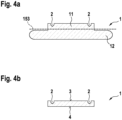
- Figure 4a illustrates a fourth step of the method, where Figure 4b the output glass 1 shows after the end of the fourth step.
- the second area 12 is ground together with a part of the first area 11. This is in Figure 4a indicated by the dashed line 153.
- the starting glass 1 takes on the desired outer contour of the watch glass 10, whereby an upper side 3 and a lower side 4 of the starting glass 1 are formed parallel to each other ( Figure 4b ).
- a cross-section of the starting glass 1 after the fourth step corresponds to the predetermined cross-section Q10 of the watch glass 10.
- the bottom 4 of the starting glass 1 is polished. This is in Figure 5 indicated by the dashed line 154.
- the underside 4 is polished so that after polishing a thickness of the starting glass 1 corresponds to a sum of the predetermined thickness d10 of the watch glass 10 and a difference between the offset t1 and the predetermined depth t10 of the recesses 2.
- the top surface 3 of the starting glass 1 is ground and/or polished. This is in Figure 6 indicated by the dashed line 155.
- the upper side 3 is ground and/or polished by the difference between the offset depth t1 and the predetermined depth t10 of the recesses 2 for forming the watch glass 10.
- the grinding of the second region 12 and a part of the first region 11 as well as the polishing of the underside 4 of the starting glass 1 takes place before the grinding and/or polishing of the upper side 3 of the starting glass 1.
Landscapes
- Engineering & Computer Science (AREA)
- Chemical & Material Sciences (AREA)
- General Physics & Mathematics (AREA)
- Physics & Mathematics (AREA)
- Organic Chemistry (AREA)
- Materials Engineering (AREA)
- Mechanical Engineering (AREA)
- Life Sciences & Earth Sciences (AREA)
- Chemical Kinetics & Catalysis (AREA)
- General Chemical & Material Sciences (AREA)
- Geochemistry & Mineralogy (AREA)
- Manufacturing & Machinery (AREA)
- Re-Forming, After-Treatment, Cutting And Transporting Of Glass Products (AREA)
Claims (10)
- Procédé de fabrication d'un verre de montre (10) avec au moins un évidement pour un élément décoratif, en particulier une gemme, comprenant les étapes :- de fourniture d'un verre initial (1), lequel présente une épaisseur d'origine (d1) plus grande qu'une épaisseur prédéfinie (d10) du verre de montre (10),- de chauffage du verre initial (1) à une température prédéfinie sous la température de fusion du verre initial (1) de telle sorte que le verre initial (1) est mou de telle sorte qu'un enfoncement d'un évidement dans le verre initial (1) peut être effectué,- d'enfoncement d'au moins un évidement (2) pour un élément décoratif, en particulier une gemme, dans le verre initial (1), et- d'usinage du verre initial (1) avec l'au moins un évidement (2) enfoncé de telle sorte que l'épaisseur du verre initial (1) est réduite à l'épaisseur prédéfinie (d10) du verre de montre (10) pour former le verre de montre (10),dans lequel l'au moins un évidement (2) est enfoncé jusqu'à une profondeur (t1) plus grande qu'une profondeur prédéfinie (t10) de l'évidement (2) dans le verre de montre (10), etdans lequel le verre initial (1) est façonné de telle sorte qu'une première zone (11) avec une première section transversale (Q1) et une deuxième zone (12) avec une deuxième section transversale (Q2) sont formées dans le verre initial (1), dans lequel la première section transversale (Q1) est plus petite que la deuxième section transversale (Q2) et correspond à une section transversale prédéfinie (Q10) du verre de montre (10), et la première zone (11) présente l'au moins un évidement (2).
- Procédé selon la revendication 1, dans lequel le verre initial (1) est façonné de telle sorte que la première zone (11) présente une première épaisseur (d3) et la deuxième zone (12) présente une deuxième épaisseur (d4), dans lequel la première épaisseur (d3) est plus petite que la deuxième épaisseur (d4).
- Procédé selon la revendication 2, dans lequel un rapport entre l'épaisseur d'origine (d1) du verre initial (1) et l'épaisseur prédéfinie (d10) du verre de montre (10) est de 2:1, de manière préférée au moins de 3:1, de manière particulièrement préférée de 4:1.
- Procédé selon l'une quelconque des revendications 1 à 3, dans lequel le formage de la première zone (11) et de la deuxième zone (12) est effectué dans une étape avec l'enfoncement de l'évidement (2).
- Procédé selon l'une quelconque des revendications précédentes, dans lequel le verre initial (1) est refroidi après l'enfoncement de l'évidement (2) ou le formage de la première zone (11) et de la deuxième zone (12) et avant l'usinage du verre initial (1).
- Procédé selon l'une quelconque des revendications 1 à 5, dans lequel au moins la deuxième zone (12) est meulée.
- Procédé selon la revendication 6, dans lequel un côté inférieur (4) du verre initial (1) est poli après le meulage d'au moins la deuxième zone (12).
- Procédé selon l'une quelconque des revendications précédentes, dans lequel un côté supérieur (3) du verre initial (1) est meulé et/ou poli.
- Procédé selon l'une quelconque des revendications 6 à 8, dans lequel :- le meulage et/ou le polissage du côté supérieur (3) du verre initial (1) sont effectués avant le meulage d'au moins la deuxième zone (12), ou- le meulage d'au moins la deuxième zone (12) et le polissage du côté inférieur (4) du verre initial (1) sont effectués avant le meulage et/ou le polissage du côté supérieur (3) du verre initial (1).
- Outil (100), lequel est mis au point pour être utilisé lors d'un procédé selon l'une quelconque des revendications 1 à 9, comprenant un corps de base (103), qui présente une première partie faisant saillie (101) au moins en partie périphérique pour presser un verre initial (1) et au moins une deuxième partie faisant saillie (102) pour enfoncer au moins un évidement (2) pour un élément décoratif, en particulier une gemme, dans le verre initial (1), dans lequel la deuxième partie faisant saillie (102) est disposée dans une zone intérieure (104) de la première partie faisant saillie (101), dans lequel la première partie faisant saillie (101) au moins en partie périphérique et l'au moins une deuxième partie faisant saillie (102) s'étendent dans la même direction.
Applications Claiming Priority (1)
| Application Number | Priority Date | Filing Date | Title |
|---|---|---|---|
| DE102019207119.8A DE102019207119A1 (de) | 2019-05-16 | 2019-05-16 | Verfahren zum Herstellen eines Uhrglases mit mindestens einer Ausnehmung und Werkzeug für ein derartiges Verfahren |
Publications (2)
| Publication Number | Publication Date |
|---|---|
| EP3738937A1 EP3738937A1 (fr) | 2020-11-18 |
| EP3738937B1 true EP3738937B1 (fr) | 2024-10-09 |
Family
ID=70417338
Family Applications (1)
| Application Number | Title | Priority Date | Filing Date |
|---|---|---|---|
| EP20170904.5A Active EP3738937B1 (fr) | 2019-05-16 | 2020-04-22 | Procédé de fabrication d'un verre de montre doté d'au moins un évidement et outil pour un tel procédé |
Country Status (3)
| Country | Link |
|---|---|
| EP (1) | EP3738937B1 (fr) |
| CN (1) | CN111943486B (fr) |
| DE (1) | DE102019207119A1 (fr) |
Family Cites Families (16)
| Publication number | Priority date | Publication date | Assignee | Title |
|---|---|---|---|---|
| DE566965C (de) * | 1930-12-25 | 1932-12-24 | Sendlinger Optische Glaswerke | Verfahren zum Herstellen gemusterter Glaskoerper |
| DE3883181T2 (de) * | 1987-12-14 | 1993-12-02 | Ichiko Industries Ltd | Verfahren zum Herstellen einer prismatischen Linse vom Fresnel-Typ. |
| EP0503102A1 (fr) * | 1991-03-08 | 1992-09-16 | BOCK & SCHUPP GMBH & CO. KG | Verre de montre et son procédé de fabrication |
| JPH0948626A (ja) * | 1995-08-02 | 1997-02-18 | Namiki Precision Jewel Co Ltd | 腕時計用カバーガラス及びその製造方法 |
| JPH09218277A (ja) * | 1996-02-10 | 1997-08-19 | Namiki Precision Jewel Co Ltd | 腕時計用カバーガラス及びその製造方法 |
| JP3991682B2 (ja) * | 2001-12-28 | 2007-10-17 | 松下電器産業株式会社 | ガラスの精密孔あけ方法、光ファイバーコネクタ用フェルールの製造方法および磁気ディスクガラス基板の製造方法 |
| CN1564729A (zh) * | 2002-07-29 | 2005-01-12 | 尤斯比奥·莫洛·弗兰科 | 装饰陶瓷片的方法和设备以及获得的产品 |
| DE10344440B4 (de) * | 2003-09-25 | 2006-07-20 | Schott Ag | Verfahren zum Herstellen von Öffnungen in einem flächigen Glaskeramikkörper |
| DE102005041033B4 (de) * | 2005-08-26 | 2010-10-28 | Schott Ag | Verfahren zur Herstellung eines Pressglasproduktes |
| JP2011157258A (ja) * | 2010-01-06 | 2011-08-18 | Nippon Electric Glass Co Ltd | ガラスプリフォームおよびその製造方法 |
| WO2013081119A1 (fr) * | 2011-11-30 | 2013-06-06 | Hoya株式会社 | Ebauche de cache de verre de dispositif électronique, procédé pour sa fabrication, cache de verre de dispositif électronique et procédé pour sa fabrication |
| JP5435018B2 (ja) * | 2011-12-15 | 2014-03-05 | コニカミノルタ株式会社 | 板ガラスブランクス,その製造方法及びカバーガラス板の製造方法 |
| JPWO2013191096A1 (ja) * | 2012-06-21 | 2016-05-26 | コニカミノルタ株式会社 | ガラス成形品の製造方法および製造装置 |
| DE102015204613B4 (de) * | 2015-03-13 | 2018-03-15 | Levitation AG | Verfahren zum Herstellen eines Uhrglases mit mindestens einem Schmuckstein |
| US10112861B2 (en) * | 2015-07-30 | 2018-10-30 | Infineon Technologies Ag | Method of manufacturing a plurality of glass members, a method of manufacturing an optical member, and array of glass members in a glass substrate |
| JP7155582B2 (ja) * | 2017-04-04 | 2022-10-19 | Agc株式会社 | 開口部材の製造方法、加工部材の製造方法及び板状部材 |
-
2019
- 2019-05-16 DE DE102019207119.8A patent/DE102019207119A1/de active Pending
-
2020
- 2020-04-22 EP EP20170904.5A patent/EP3738937B1/fr active Active
- 2020-05-15 CN CN202010411754.1A patent/CN111943486B/zh active Active
Also Published As
| Publication number | Publication date |
|---|---|
| CN111943486A (zh) | 2020-11-17 |
| CN111943486B (zh) | 2024-04-26 |
| EP3738937A1 (fr) | 2020-11-18 |
| DE102019207119A1 (de) | 2020-11-19 |
Similar Documents
| Publication | Publication Date | Title |
|---|---|---|
| DE102011112148B4 (de) | Extruder und Verfahren zum Herstellen eines Extruders | |
| DE3119455A1 (de) | "verfahren zum gesenkschmieden von werkstuecken" | |
| WO2013127425A1 (fr) | Arbre creux de transmission pourvu d'une bride et son procédé de fabrication | |
| DE2747382A1 (de) | Verfahren und vorrichtung zur herstellung hohler, mit flanschen versehener gegenstaende | |
| DE69714793T2 (de) | Verfahren zur herstellung einer hülse für einen auststossstift | |
| DE102013015677A1 (de) | Verfahren zur Herstellung eines Sinterteils mit hochgenauer radialer Präzision sowie Teilesatz mit Sinterfügeteilen | |
| DE102013014346A1 (de) | Verfahren zur Herstellung eines Kolbens für einen Verbrennungsmotor und mittels dieses Verfahrens hergestellter Kolben | |
| WO2007031052A2 (fr) | Arbre creux et procede de fabrication | |
| WO2014191286A1 (fr) | Ébauche de prothèse pour la production d'un corps de prothèse dentaire | |
| EP2148752B1 (fr) | Procédé de fabrication d'élément de base d'arbre creux | |
| EP3738937B1 (fr) | Procédé de fabrication d'un verre de montre doté d'au moins un évidement et outil pour un tel procédé | |
| DE102016123407A1 (de) | Verfahren zum Oberflächenverdichten und Kalibrieren eines Sinterbauteils | |
| DE19922046C2 (de) | Verfahren zum Formen einer Kurbelwelle und Verfahren zum Herstellen einer Kurbelwelle | |
| DE19737629B4 (de) | Prozeß zum Ausbilden eines axial dehnfähigen Bolzens durch Stauchen | |
| DE19723634A1 (de) | Verfahren zur Herstellung von Verbindungsschrauben und eine entsprechende Verbindungsschraube | |
| DE102013017126A1 (de) | Verfahren zum Herstellen eines Lochs eines Bauteils | |
| DE3911441C2 (de) | Verfahren zur Herstellung eines halbgeteilten Lagers | |
| DE69313302T2 (de) | Verfahren zur herstellung von pleuelstangen | |
| DE102012020646A1 (de) | Verfahren zur Herstellung eines Bauteils für ein Kraftfahrzeug | |
| DE102008053474B4 (de) | Verfahren zum Formen eines Nockenvorsprungs | |
| DE102017117717A1 (de) | Lenkungszahnstange und Verfahren um diese herzustellen | |
| DE102006041273A1 (de) | Hohlwelle und Verfahren zur Herstellung | |
| DE19581042B4 (de) | Verfahren zum Herstellen eines Teils mit einer Hinterschneidung | |
| DE10101934B4 (de) | Verfahren zur Herstellung von scheibenförmigen Steuernocken oder dergleichen sowie Räumbügel zur Durchführung eines solchen Verfahrens | |
| DE102018129155B4 (de) | Verfahren zum Erzeugen eines Schmuckstückes |
Legal Events
| Date | Code | Title | Description |
|---|---|---|---|
| PUAI | Public reference made under article 153(3) epc to a published international application that has entered the european phase |
Free format text: ORIGINAL CODE: 0009012 |
|
| STAA | Information on the status of an ep patent application or granted ep patent |
Free format text: STATUS: THE APPLICATION HAS BEEN PUBLISHED |
|
| AK | Designated contracting states |
Kind code of ref document: A1 Designated state(s): AL AT BE BG CH CY CZ DE DK EE ES FI FR GB GR HR HU IE IS IT LI LT LU LV MC MK MT NL NO PL PT RO RS SE SI SK SM TR |
|
| AX | Request for extension of the european patent |
Extension state: BA ME |
|
| STAA | Information on the status of an ep patent application or granted ep patent |
Free format text: STATUS: REQUEST FOR EXAMINATION WAS MADE |
|
| 17P | Request for examination filed |
Effective date: 20210518 |
|
| RBV | Designated contracting states (corrected) |
Designated state(s): AL AT BE BG CH CY CZ DE DK EE ES FI FR GB GR HR HU IE IS IT LI LT LU LV MC MK MT NL NO PL PT RO RS SE SI SK SM TR |
|
| STAA | Information on the status of an ep patent application or granted ep patent |
Free format text: STATUS: EXAMINATION IS IN PROGRESS |
|
| 17Q | First examination report despatched |
Effective date: 20230517 |
|
| GRAP | Despatch of communication of intention to grant a patent |
Free format text: ORIGINAL CODE: EPIDOSNIGR1 |
|
| STAA | Information on the status of an ep patent application or granted ep patent |
Free format text: STATUS: GRANT OF PATENT IS INTENDED |
|
| RIC1 | Information provided on ipc code assigned before grant |
Ipc: G04D 3/00 20060101ALI20240628BHEP Ipc: G04B 39/00 20060101ALI20240628BHEP Ipc: C03C 19/00 20060101ALI20240628BHEP Ipc: C03B 11/08 20060101AFI20240628BHEP |
|
| INTG | Intention to grant announced |
Effective date: 20240710 |
|
| GRAS | Grant fee paid |
Free format text: ORIGINAL CODE: EPIDOSNIGR3 |
|
| GRAA | (expected) grant |
Free format text: ORIGINAL CODE: 0009210 |
|
| STAA | Information on the status of an ep patent application or granted ep patent |
Free format text: STATUS: THE PATENT HAS BEEN GRANTED |
|
| AK | Designated contracting states |
Kind code of ref document: B1 Designated state(s): AL AT BE BG CH CY CZ DE DK EE ES FI FR GB GR HR HU IE IS IT LI LT LU LV MC MK MT NL NO PL PT RO RS SE SI SK SM TR |
|
| REG | Reference to a national code |
Ref country code: CH Ref legal event code: EP |
|
| REG | Reference to a national code |
Ref country code: DE Ref legal event code: R096 Ref document number: 502020009408 Country of ref document: DE |
|
| REG | Reference to a national code |
Ref country code: IE Ref legal event code: FG4D Free format text: LANGUAGE OF EP DOCUMENT: GERMAN |
|
| REG | Reference to a national code |
Ref country code: LT Ref legal event code: MG9D |
|
| REG | Reference to a national code |
Ref country code: NL Ref legal event code: MP Effective date: 20241009 |
|
| PG25 | Lapsed in a contracting state [announced via postgrant information from national office to epo] |
Ref country code: NL Free format text: LAPSE BECAUSE OF FAILURE TO SUBMIT A TRANSLATION OF THE DESCRIPTION OR TO PAY THE FEE WITHIN THE PRESCRIBED TIME-LIMIT Effective date: 20241009 |
|
| PG25 | Lapsed in a contracting state [announced via postgrant information from national office to epo] |
Ref country code: NL Free format text: LAPSE BECAUSE OF FAILURE TO SUBMIT A TRANSLATION OF THE DESCRIPTION OR TO PAY THE FEE WITHIN THE PRESCRIBED TIME-LIMIT Effective date: 20241009 |
|
| PG25 | Lapsed in a contracting state [announced via postgrant information from national office to epo] |
Ref country code: IS Free format text: LAPSE BECAUSE OF FAILURE TO SUBMIT A TRANSLATION OF THE DESCRIPTION OR TO PAY THE FEE WITHIN THE PRESCRIBED TIME-LIMIT Effective date: 20250209 Ref country code: HR Free format text: LAPSE BECAUSE OF FAILURE TO SUBMIT A TRANSLATION OF THE DESCRIPTION OR TO PAY THE FEE WITHIN THE PRESCRIBED TIME-LIMIT Effective date: 20241009 Ref country code: PT Free format text: LAPSE BECAUSE OF FAILURE TO SUBMIT A TRANSLATION OF THE DESCRIPTION OR TO PAY THE FEE WITHIN THE PRESCRIBED TIME-LIMIT Effective date: 20250210 |
|
| PG25 | Lapsed in a contracting state [announced via postgrant information from national office to epo] |
Ref country code: FI Free format text: LAPSE BECAUSE OF FAILURE TO SUBMIT A TRANSLATION OF THE DESCRIPTION OR TO PAY THE FEE WITHIN THE PRESCRIBED TIME-LIMIT Effective date: 20241009 |
|
| PG25 | Lapsed in a contracting state [announced via postgrant information from national office to epo] |
Ref country code: BG Free format text: LAPSE BECAUSE OF FAILURE TO SUBMIT A TRANSLATION OF THE DESCRIPTION OR TO PAY THE FEE WITHIN THE PRESCRIBED TIME-LIMIT Effective date: 20241009 |
|
| PG25 | Lapsed in a contracting state [announced via postgrant information from national office to epo] |
Ref country code: ES Free format text: LAPSE BECAUSE OF FAILURE TO SUBMIT A TRANSLATION OF THE DESCRIPTION OR TO PAY THE FEE WITHIN THE PRESCRIBED TIME-LIMIT Effective date: 20241009 |
|
| PG25 | Lapsed in a contracting state [announced via postgrant information from national office to epo] |
Ref country code: NO Free format text: LAPSE BECAUSE OF FAILURE TO SUBMIT A TRANSLATION OF THE DESCRIPTION OR TO PAY THE FEE WITHIN THE PRESCRIBED TIME-LIMIT Effective date: 20250109 |
|
| PG25 | Lapsed in a contracting state [announced via postgrant information from national office to epo] |
Ref country code: LV Free format text: LAPSE BECAUSE OF FAILURE TO SUBMIT A TRANSLATION OF THE DESCRIPTION OR TO PAY THE FEE WITHIN THE PRESCRIBED TIME-LIMIT Effective date: 20241009 Ref country code: GR Free format text: LAPSE BECAUSE OF FAILURE TO SUBMIT A TRANSLATION OF THE DESCRIPTION OR TO PAY THE FEE WITHIN THE PRESCRIBED TIME-LIMIT Effective date: 20250110 |
|
| PG25 | Lapsed in a contracting state [announced via postgrant information from national office to epo] |
Ref country code: PL Free format text: LAPSE BECAUSE OF FAILURE TO SUBMIT A TRANSLATION OF THE DESCRIPTION OR TO PAY THE FEE WITHIN THE PRESCRIBED TIME-LIMIT Effective date: 20241009 |
|
| PG25 | Lapsed in a contracting state [announced via postgrant information from national office to epo] |
Ref country code: RS Free format text: LAPSE BECAUSE OF FAILURE TO SUBMIT A TRANSLATION OF THE DESCRIPTION OR TO PAY THE FEE WITHIN THE PRESCRIBED TIME-LIMIT Effective date: 20250109 |
|
| PG25 | Lapsed in a contracting state [announced via postgrant information from national office to epo] |
Ref country code: SM Free format text: LAPSE BECAUSE OF FAILURE TO SUBMIT A TRANSLATION OF THE DESCRIPTION OR TO PAY THE FEE WITHIN THE PRESCRIBED TIME-LIMIT Effective date: 20241009 |
|
| PGFP | Annual fee paid to national office [announced via postgrant information from national office to epo] |
Ref country code: DE Payment date: 20250428 Year of fee payment: 6 |
|
| PG25 | Lapsed in a contracting state [announced via postgrant information from national office to epo] |
Ref country code: DK Free format text: LAPSE BECAUSE OF FAILURE TO SUBMIT A TRANSLATION OF THE DESCRIPTION OR TO PAY THE FEE WITHIN THE PRESCRIBED TIME-LIMIT Effective date: 20241009 |
|
| REG | Reference to a national code |
Ref country code: DE Ref legal event code: R097 Ref document number: 502020009408 Country of ref document: DE |
|
| PG25 | Lapsed in a contracting state [announced via postgrant information from national office to epo] |
Ref country code: EE Free format text: LAPSE BECAUSE OF FAILURE TO SUBMIT A TRANSLATION OF THE DESCRIPTION OR TO PAY THE FEE WITHIN THE PRESCRIBED TIME-LIMIT Effective date: 20241009 |
|
| PGFP | Annual fee paid to national office [announced via postgrant information from national office to epo] |
Ref country code: FR Payment date: 20250422 Year of fee payment: 6 |
|
| PGFP | Annual fee paid to national office [announced via postgrant information from national office to epo] |
Ref country code: CH Payment date: 20250501 Year of fee payment: 6 |
|
| PG25 | Lapsed in a contracting state [announced via postgrant information from national office to epo] |
Ref country code: RO Free format text: LAPSE BECAUSE OF FAILURE TO SUBMIT A TRANSLATION OF THE DESCRIPTION OR TO PAY THE FEE WITHIN THE PRESCRIBED TIME-LIMIT Effective date: 20241009 |
|
| PG25 | Lapsed in a contracting state [announced via postgrant information from national office to epo] |
Ref country code: SK Free format text: LAPSE BECAUSE OF FAILURE TO SUBMIT A TRANSLATION OF THE DESCRIPTION OR TO PAY THE FEE WITHIN THE PRESCRIBED TIME-LIMIT Effective date: 20241009 |
|
| PG25 | Lapsed in a contracting state [announced via postgrant information from national office to epo] |
Ref country code: CZ Free format text: LAPSE BECAUSE OF FAILURE TO SUBMIT A TRANSLATION OF THE DESCRIPTION OR TO PAY THE FEE WITHIN THE PRESCRIBED TIME-LIMIT Effective date: 20241009 |
|
| PG25 | Lapsed in a contracting state [announced via postgrant information from national office to epo] |
Ref country code: IT Free format text: LAPSE BECAUSE OF FAILURE TO SUBMIT A TRANSLATION OF THE DESCRIPTION OR TO PAY THE FEE WITHIN THE PRESCRIBED TIME-LIMIT Effective date: 20241009 |
|
| PLBE | No opposition filed within time limit |
Free format text: ORIGINAL CODE: 0009261 |
|
| STAA | Information on the status of an ep patent application or granted ep patent |
Free format text: STATUS: NO OPPOSITION FILED WITHIN TIME LIMIT |
|
| PG25 | Lapsed in a contracting state [announced via postgrant information from national office to epo] |
Ref country code: SE Free format text: LAPSE BECAUSE OF FAILURE TO SUBMIT A TRANSLATION OF THE DESCRIPTION OR TO PAY THE FEE WITHIN THE PRESCRIBED TIME-LIMIT Effective date: 20241009 |
|
| 26N | No opposition filed |
Effective date: 20250710 |
|
| PG25 | Lapsed in a contracting state [announced via postgrant information from national office to epo] |
Ref country code: LU Free format text: LAPSE BECAUSE OF NON-PAYMENT OF DUE FEES Effective date: 20250422 |
|
| PG25 | Lapsed in a contracting state [announced via postgrant information from national office to epo] |
Ref country code: MC Free format text: LAPSE BECAUSE OF FAILURE TO SUBMIT A TRANSLATION OF THE DESCRIPTION OR TO PAY THE FEE WITHIN THE PRESCRIBED TIME-LIMIT Effective date: 20241009 |
|
| REG | Reference to a national code |
Ref country code: BE Ref legal event code: MM Effective date: 20250430 |
|
| PG25 | Lapsed in a contracting state [announced via postgrant information from national office to epo] |
Ref country code: BE Free format text: LAPSE BECAUSE OF NON-PAYMENT OF DUE FEES Effective date: 20250430 |
|
| PGFP | Annual fee paid to national office [announced via postgrant information from national office to epo] |
Ref country code: GB Payment date: 20260324 Year of fee payment: 7 |
|
| PG25 | Lapsed in a contracting state [announced via postgrant information from national office to epo] |
Ref country code: IE Free format text: LAPSE BECAUSE OF NON-PAYMENT OF DUE FEES Effective date: 20250422 |