EP3743406B9 - Modulateurs de tmem16a - Google Patents
Modulateurs de tmem16a Download PDFInfo
- Publication number
- EP3743406B9 EP3743406B9 EP19702958.0A EP19702958A EP3743406B9 EP 3743406 B9 EP3743406 B9 EP 3743406B9 EP 19702958 A EP19702958 A EP 19702958A EP 3743406 B9 EP3743406 B9 EP 3743406B9
- Authority
- EP
- European Patent Office
- Prior art keywords
- compound
- amino
- carboxamide
- pyridine
- acetyl
- Prior art date
- Legal status (The legal status is an assumption and is not a legal conclusion. Google has not performed a legal analysis and makes no representation as to the accuracy of the status listed.)
- Active
Links
Images

Classifications
-
- C—CHEMISTRY; METALLURGY
- C07—ORGANIC CHEMISTRY
- C07D—HETEROCYCLIC COMPOUNDS
- C07D213/00—Heterocyclic compounds containing six-membered rings, not condensed with other rings, with one nitrogen atom as the only ring hetero atom and three or more double bonds between ring members or between ring members and non-ring members
- C07D213/02—Heterocyclic compounds containing six-membered rings, not condensed with other rings, with one nitrogen atom as the only ring hetero atom and three or more double bonds between ring members or between ring members and non-ring members having three double bonds between ring members or between ring members and non-ring members
- C07D213/04—Heterocyclic compounds containing six-membered rings, not condensed with other rings, with one nitrogen atom as the only ring hetero atom and three or more double bonds between ring members or between ring members and non-ring members having three double bonds between ring members or between ring members and non-ring members having no bond between the ring nitrogen atom and a non-ring member or having only hydrogen or carbon atoms directly attached to the ring nitrogen atom
- C07D213/60—Heterocyclic compounds containing six-membered rings, not condensed with other rings, with one nitrogen atom as the only ring hetero atom and three or more double bonds between ring members or between ring members and non-ring members having three double bonds between ring members or between ring members and non-ring members having no bond between the ring nitrogen atom and a non-ring member or having only hydrogen or carbon atoms directly attached to the ring nitrogen atom with hetero atoms or with carbon atoms having three bonds to hetero atoms with at the most one bond to halogen, e.g. ester or nitrile radicals, directly attached to ring carbon atoms
- C07D213/78—Carbon atoms having three bonds to hetero atoms, with at the most one bond to halogen, e.g. ester or nitrile radicals
- C07D213/81—Amides; Imides
-
- C—CHEMISTRY; METALLURGY
- C07—ORGANIC CHEMISTRY
- C07D—HETEROCYCLIC COMPOUNDS
- C07D213/00—Heterocyclic compounds containing six-membered rings, not condensed with other rings, with one nitrogen atom as the only ring hetero atom and three or more double bonds between ring members or between ring members and non-ring members
- C07D213/02—Heterocyclic compounds containing six-membered rings, not condensed with other rings, with one nitrogen atom as the only ring hetero atom and three or more double bonds between ring members or between ring members and non-ring members having three double bonds between ring members or between ring members and non-ring members
- C07D213/04—Heterocyclic compounds containing six-membered rings, not condensed with other rings, with one nitrogen atom as the only ring hetero atom and three or more double bonds between ring members or between ring members and non-ring members having three double bonds between ring members or between ring members and non-ring members having no bond between the ring nitrogen atom and a non-ring member or having only hydrogen or carbon atoms directly attached to the ring nitrogen atom
- C07D213/60—Heterocyclic compounds containing six-membered rings, not condensed with other rings, with one nitrogen atom as the only ring hetero atom and three or more double bonds between ring members or between ring members and non-ring members having three double bonds between ring members or between ring members and non-ring members having no bond between the ring nitrogen atom and a non-ring member or having only hydrogen or carbon atoms directly attached to the ring nitrogen atom with hetero atoms or with carbon atoms having three bonds to hetero atoms with at the most one bond to halogen, e.g. ester or nitrile radicals, directly attached to ring carbon atoms
- C07D213/72—Nitrogen atoms
-
- A—HUMAN NECESSITIES
- A61—MEDICAL OR VETERINARY SCIENCE; HYGIENE
- A61K—PREPARATIONS FOR MEDICAL, DENTAL OR TOILETRY PURPOSES
- A61K31/00—Medicinal preparations containing organic active ingredients
- A61K31/33—Heterocyclic compounds
- A61K31/395—Heterocyclic compounds having nitrogen as a ring hetero atom, e.g. guanethidine or rifamycins
- A61K31/535—Heterocyclic compounds having nitrogen as a ring hetero atom, e.g. guanethidine or rifamycins having six-membered rings with at least one nitrogen and one oxygen as the ring hetero atoms, e.g. 1,2-oxazines
- A61K31/5375—1,4-Oxazines, e.g. morpholine
- A61K31/5377—1,4-Oxazines, e.g. morpholine not condensed and containing further heterocyclic rings, e.g. timolol
-
- A—HUMAN NECESSITIES
- A61—MEDICAL OR VETERINARY SCIENCE; HYGIENE
- A61K—PREPARATIONS FOR MEDICAL, DENTAL OR TOILETRY PURPOSES
- A61K31/00—Medicinal preparations containing organic active ingredients
- A61K31/16—Amides, e.g. hydroxamic acids
- A61K31/165—Amides, e.g. hydroxamic acids having aromatic rings, e.g. colchicine, atenolol, progabide
- A61K31/167—Amides, e.g. hydroxamic acids having aromatic rings, e.g. colchicine, atenolol, progabide having the nitrogen of a carboxamide group directly attached to the aromatic ring, e.g. lidocaine, paracetamol
-
- A—HUMAN NECESSITIES
- A61—MEDICAL OR VETERINARY SCIENCE; HYGIENE
- A61K—PREPARATIONS FOR MEDICAL, DENTAL OR TOILETRY PURPOSES
- A61K31/00—Medicinal preparations containing organic active ingredients
- A61K31/33—Heterocyclic compounds
- A61K31/335—Heterocyclic compounds having oxygen as the only ring hetero atom, e.g. fungichromin
- A61K31/35—Heterocyclic compounds having oxygen as the only ring hetero atom, e.g. fungichromin having six-membered rings with one oxygen as the only ring hetero atom
- A61K31/351—Heterocyclic compounds having oxygen as the only ring hetero atom, e.g. fungichromin having six-membered rings with one oxygen as the only ring hetero atom not condensed with another ring
-
- A—HUMAN NECESSITIES
- A61—MEDICAL OR VETERINARY SCIENCE; HYGIENE
- A61K—PREPARATIONS FOR MEDICAL, DENTAL OR TOILETRY PURPOSES
- A61K31/00—Medicinal preparations containing organic active ingredients
- A61K31/33—Heterocyclic compounds
- A61K31/395—Heterocyclic compounds having nitrogen as a ring hetero atom, e.g. guanethidine or rifamycins
- A61K31/40—Heterocyclic compounds having nitrogen as a ring hetero atom, e.g. guanethidine or rifamycins having five-membered rings with one nitrogen as the only ring hetero atom, e.g. sulpiride, succinimide, tolmetin, buflomedil
- A61K31/4025—Heterocyclic compounds having nitrogen as a ring hetero atom, e.g. guanethidine or rifamycins having five-membered rings with one nitrogen as the only ring hetero atom, e.g. sulpiride, succinimide, tolmetin, buflomedil not condensed and containing further heterocyclic rings, e.g. cromakalim
-
- A—HUMAN NECESSITIES
- A61—MEDICAL OR VETERINARY SCIENCE; HYGIENE
- A61K—PREPARATIONS FOR MEDICAL, DENTAL OR TOILETRY PURPOSES
- A61K31/00—Medicinal preparations containing organic active ingredients
- A61K31/33—Heterocyclic compounds
- A61K31/395—Heterocyclic compounds having nitrogen as a ring hetero atom, e.g. guanethidine or rifamycins
- A61K31/40—Heterocyclic compounds having nitrogen as a ring hetero atom, e.g. guanethidine or rifamycins having five-membered rings with one nitrogen as the only ring hetero atom, e.g. sulpiride, succinimide, tolmetin, buflomedil
- A61K31/403—Heterocyclic compounds having nitrogen as a ring hetero atom, e.g. guanethidine or rifamycins having five-membered rings with one nitrogen as the only ring hetero atom, e.g. sulpiride, succinimide, tolmetin, buflomedil condensed with carbocyclic rings, e.g. carbazole
- A61K31/404—Indoles, e.g. pindolol
- A61K31/4045—Indole-alkylamines; Amides thereof, e.g. serotonin, melatonin
-
- A—HUMAN NECESSITIES
- A61—MEDICAL OR VETERINARY SCIENCE; HYGIENE
- A61K—PREPARATIONS FOR MEDICAL, DENTAL OR TOILETRY PURPOSES
- A61K31/00—Medicinal preparations containing organic active ingredients
- A61K31/33—Heterocyclic compounds
- A61K31/395—Heterocyclic compounds having nitrogen as a ring hetero atom, e.g. guanethidine or rifamycins
- A61K31/41—Heterocyclic compounds having nitrogen as a ring hetero atom, e.g. guanethidine or rifamycins having five-membered rings with two or more ring hetero atoms, at least one of which being nitrogen, e.g. tetrazole
- A61K31/415—1,2-Diazoles
- A61K31/416—1,2-Diazoles condensed with carbocyclic ring systems, e.g. indazole
-
- A—HUMAN NECESSITIES
- A61—MEDICAL OR VETERINARY SCIENCE; HYGIENE
- A61K—PREPARATIONS FOR MEDICAL, DENTAL OR TOILETRY PURPOSES
- A61K31/00—Medicinal preparations containing organic active ingredients
- A61K31/33—Heterocyclic compounds
- A61K31/395—Heterocyclic compounds having nitrogen as a ring hetero atom, e.g. guanethidine or rifamycins
- A61K31/435—Heterocyclic compounds having nitrogen as a ring hetero atom, e.g. guanethidine or rifamycins having six-membered rings with one nitrogen as the only ring hetero atom
- A61K31/44—Non condensed pyridines; Hydrogenated derivatives thereof
-
- A—HUMAN NECESSITIES
- A61—MEDICAL OR VETERINARY SCIENCE; HYGIENE
- A61K—PREPARATIONS FOR MEDICAL, DENTAL OR TOILETRY PURPOSES
- A61K31/00—Medicinal preparations containing organic active ingredients
- A61K31/33—Heterocyclic compounds
- A61K31/395—Heterocyclic compounds having nitrogen as a ring hetero atom, e.g. guanethidine or rifamycins
- A61K31/435—Heterocyclic compounds having nitrogen as a ring hetero atom, e.g. guanethidine or rifamycins having six-membered rings with one nitrogen as the only ring hetero atom
- A61K31/44—Non condensed pyridines; Hydrogenated derivatives thereof
- A61K31/4427—Non condensed pyridines; Hydrogenated derivatives thereof containing further heterocyclic ring systems
- A61K31/443—Non condensed pyridines; Hydrogenated derivatives thereof containing further heterocyclic ring systems containing a five-membered ring with oxygen as a ring hetero atom
-
- A—HUMAN NECESSITIES
- A61—MEDICAL OR VETERINARY SCIENCE; HYGIENE
- A61K—PREPARATIONS FOR MEDICAL, DENTAL OR TOILETRY PURPOSES
- A61K31/00—Medicinal preparations containing organic active ingredients
- A61K31/33—Heterocyclic compounds
- A61K31/395—Heterocyclic compounds having nitrogen as a ring hetero atom, e.g. guanethidine or rifamycins
- A61K31/435—Heterocyclic compounds having nitrogen as a ring hetero atom, e.g. guanethidine or rifamycins having six-membered rings with one nitrogen as the only ring hetero atom
- A61K31/44—Non condensed pyridines; Hydrogenated derivatives thereof
- A61K31/4427—Non condensed pyridines; Hydrogenated derivatives thereof containing further heterocyclic ring systems
- A61K31/4439—Non condensed pyridines; Hydrogenated derivatives thereof containing further heterocyclic ring systems containing a five-membered ring with nitrogen as a ring hetero atom, e.g. omeprazole
-
- A—HUMAN NECESSITIES
- A61—MEDICAL OR VETERINARY SCIENCE; HYGIENE
- A61K—PREPARATIONS FOR MEDICAL, DENTAL OR TOILETRY PURPOSES
- A61K31/00—Medicinal preparations containing organic active ingredients
- A61K31/33—Heterocyclic compounds
- A61K31/395—Heterocyclic compounds having nitrogen as a ring hetero atom, e.g. guanethidine or rifamycins
- A61K31/435—Heterocyclic compounds having nitrogen as a ring hetero atom, e.g. guanethidine or rifamycins having six-membered rings with one nitrogen as the only ring hetero atom
- A61K31/44—Non condensed pyridines; Hydrogenated derivatives thereof
- A61K31/4427—Non condensed pyridines; Hydrogenated derivatives thereof containing further heterocyclic ring systems
- A61K31/444—Non condensed pyridines; Hydrogenated derivatives thereof containing further heterocyclic ring systems containing a six-membered ring with nitrogen as a ring heteroatom, e.g. amrinone
-
- A—HUMAN NECESSITIES
- A61—MEDICAL OR VETERINARY SCIENCE; HYGIENE
- A61K—PREPARATIONS FOR MEDICAL, DENTAL OR TOILETRY PURPOSES
- A61K31/00—Medicinal preparations containing organic active ingredients
- A61K31/33—Heterocyclic compounds
- A61K31/395—Heterocyclic compounds having nitrogen as a ring hetero atom, e.g. guanethidine or rifamycins
- A61K31/495—Heterocyclic compounds having nitrogen as a ring hetero atom, e.g. guanethidine or rifamycins having six-membered rings with two or more nitrogen atoms as the only ring heteroatoms, e.g. piperazine or tetrazines
- A61K31/498—Pyrazines or piperazines ortho- and peri-condensed with carbocyclic ring systems, e.g. quinoxaline, phenazine
-
- A—HUMAN NECESSITIES
- A61—MEDICAL OR VETERINARY SCIENCE; HYGIENE
- A61K—PREPARATIONS FOR MEDICAL, DENTAL OR TOILETRY PURPOSES
- A61K45/00—Medicinal preparations containing active ingredients not provided for in groups A61K31/00 - A61K41/00
- A61K45/06—Mixtures of active ingredients without chemical characterisation, e.g. antiphlogistics and cardiaca
-
- A—HUMAN NECESSITIES
- A61—MEDICAL OR VETERINARY SCIENCE; HYGIENE
- A61P—SPECIFIC THERAPEUTIC ACTIVITY OF CHEMICAL COMPOUNDS OR MEDICINAL PREPARATIONS
- A61P11/00—Drugs for disorders of the respiratory system
-
- C—CHEMISTRY; METALLURGY
- C07—ORGANIC CHEMISTRY
- C07C—ACYCLIC OR CARBOCYCLIC COMPOUNDS
- C07C1/00—Preparation of hydrocarbons from one or more compounds, none of them being a hydrocarbon
-
- C—CHEMISTRY; METALLURGY
- C07—ORGANIC CHEMISTRY
- C07C—ACYCLIC OR CARBOCYCLIC COMPOUNDS
- C07C233/00—Carboxylic acid amides
-
- C—CHEMISTRY; METALLURGY
- C07—ORGANIC CHEMISTRY
- C07C—ACYCLIC OR CARBOCYCLIC COMPOUNDS
- C07C233/00—Carboxylic acid amides
- C07C233/64—Carboxylic acid amides having carbon atoms of carboxamide groups bound to carbon atoms of six-membered aromatic rings
- C07C233/76—Carboxylic acid amides having carbon atoms of carboxamide groups bound to carbon atoms of six-membered aromatic rings having the nitrogen atom of at least one of the carboxamide groups bound to a carbon atom of a hydrocarbon radical substituted by doubly-bound oxygen atoms
-
- C—CHEMISTRY; METALLURGY
- C07—ORGANIC CHEMISTRY
- C07C—ACYCLIC OR CARBOCYCLIC COMPOUNDS
- C07C237/00—Carboxylic acid amides, the carbon skeleton of the acid part being further substituted by amino groups
- C07C237/28—Carboxylic acid amides, the carbon skeleton of the acid part being further substituted by amino groups having the carbon atom of at least one of the carboxamide groups bound to a carbon atom of a non-condensed six-membered aromatic ring of the carbon skeleton
- C07C237/30—Carboxylic acid amides, the carbon skeleton of the acid part being further substituted by amino groups having the carbon atom of at least one of the carboxamide groups bound to a carbon atom of a non-condensed six-membered aromatic ring of the carbon skeleton having the nitrogen atom of the carboxamide group bound to hydrogen atoms or to acyclic carbon atoms
-
- C—CHEMISTRY; METALLURGY
- C07—ORGANIC CHEMISTRY
- C07C—ACYCLIC OR CARBOCYCLIC COMPOUNDS
- C07C237/00—Carboxylic acid amides, the carbon skeleton of the acid part being further substituted by amino groups
- C07C237/28—Carboxylic acid amides, the carbon skeleton of the acid part being further substituted by amino groups having the carbon atom of at least one of the carboxamide groups bound to a carbon atom of a non-condensed six-membered aromatic ring of the carbon skeleton
- C07C237/32—Carboxylic acid amides, the carbon skeleton of the acid part being further substituted by amino groups having the carbon atom of at least one of the carboxamide groups bound to a carbon atom of a non-condensed six-membered aromatic ring of the carbon skeleton having the nitrogen atom of the carboxamide group bound to an acyclic carbon atom of a hydrocarbon radical substituted by oxygen atoms
-
- C—CHEMISTRY; METALLURGY
- C07—ORGANIC CHEMISTRY
- C07C—ACYCLIC OR CARBOCYCLIC COMPOUNDS
- C07C237/00—Carboxylic acid amides, the carbon skeleton of the acid part being further substituted by amino groups
- C07C237/28—Carboxylic acid amides, the carbon skeleton of the acid part being further substituted by amino groups having the carbon atom of at least one of the carboxamide groups bound to a carbon atom of a non-condensed six-membered aromatic ring of the carbon skeleton
- C07C237/38—Carboxylic acid amides, the carbon skeleton of the acid part being further substituted by amino groups having the carbon atom of at least one of the carboxamide groups bound to a carbon atom of a non-condensed six-membered aromatic ring of the carbon skeleton having the nitrogen atom of the carboxamide group bound to a carbon atom of a ring other than a six-membered aromatic ring
-
- C—CHEMISTRY; METALLURGY
- C07—ORGANIC CHEMISTRY
- C07C—ACYCLIC OR CARBOCYCLIC COMPOUNDS
- C07C237/00—Carboxylic acid amides, the carbon skeleton of the acid part being further substituted by amino groups
- C07C237/28—Carboxylic acid amides, the carbon skeleton of the acid part being further substituted by amino groups having the carbon atom of at least one of the carboxamide groups bound to a carbon atom of a non-condensed six-membered aromatic ring of the carbon skeleton
- C07C237/42—Carboxylic acid amides, the carbon skeleton of the acid part being further substituted by amino groups having the carbon atom of at least one of the carboxamide groups bound to a carbon atom of a non-condensed six-membered aromatic ring of the carbon skeleton having nitrogen atoms of amino groups bound to the carbon skeleton of the acid part, further acylated
-
- C—CHEMISTRY; METALLURGY
- C07—ORGANIC CHEMISTRY
- C07D—HETEROCYCLIC COMPOUNDS
- C07D209/00—Heterocyclic compounds containing five-membered rings, condensed with other rings, with one nitrogen atom as the only ring hetero atom
- C07D209/02—Heterocyclic compounds containing five-membered rings, condensed with other rings, with one nitrogen atom as the only ring hetero atom condensed with one carbocyclic ring
- C07D209/04—Indoles; Hydrogenated indoles
- C07D209/10—Indoles; Hydrogenated indoles with substituted hydrocarbon radicals attached to carbon atoms of the hetero ring
- C07D209/18—Radicals substituted by carbon atoms having three bonds to hetero atoms with at the most one bond to halogen, e.g. ester or nitrile radicals
-
- C—CHEMISTRY; METALLURGY
- C07—ORGANIC CHEMISTRY
- C07D—HETEROCYCLIC COMPOUNDS
- C07D211/00—Heterocyclic compounds containing hydrogenated pyridine rings, not condensed with other rings
- C07D211/04—Heterocyclic compounds containing hydrogenated pyridine rings, not condensed with other rings with only hydrogen or carbon atoms directly attached to the ring nitrogen atom
- C07D211/06—Heterocyclic compounds containing hydrogenated pyridine rings, not condensed with other rings with only hydrogen or carbon atoms directly attached to the ring nitrogen atom having no double bonds between ring members or between ring members and non-ring members
- C07D211/36—Heterocyclic compounds containing hydrogenated pyridine rings, not condensed with other rings with only hydrogen or carbon atoms directly attached to the ring nitrogen atom having no double bonds between ring members or between ring members and non-ring members with hetero atoms or with carbon atoms having three bonds to hetero atoms with at the most one bond to halogen, e.g. ester or nitrile radicals, directly attached to ring carbon atoms
- C07D211/56—Nitrogen atoms
-
- C—CHEMISTRY; METALLURGY
- C07—ORGANIC CHEMISTRY
- C07D—HETEROCYCLIC COMPOUNDS
- C07D211/00—Heterocyclic compounds containing hydrogenated pyridine rings, not condensed with other rings
- C07D211/04—Heterocyclic compounds containing hydrogenated pyridine rings, not condensed with other rings with only hydrogen or carbon atoms directly attached to the ring nitrogen atom
- C07D211/06—Heterocyclic compounds containing hydrogenated pyridine rings, not condensed with other rings with only hydrogen or carbon atoms directly attached to the ring nitrogen atom having no double bonds between ring members or between ring members and non-ring members
- C07D211/36—Heterocyclic compounds containing hydrogenated pyridine rings, not condensed with other rings with only hydrogen or carbon atoms directly attached to the ring nitrogen atom having no double bonds between ring members or between ring members and non-ring members with hetero atoms or with carbon atoms having three bonds to hetero atoms with at the most one bond to halogen, e.g. ester or nitrile radicals, directly attached to ring carbon atoms
- C07D211/56—Nitrogen atoms
- C07D211/58—Nitrogen atoms attached in position 4
-
- C—CHEMISTRY; METALLURGY
- C07—ORGANIC CHEMISTRY
- C07D—HETEROCYCLIC COMPOUNDS
- C07D231/00—Heterocyclic compounds containing 1,2-diazole or hydrogenated 1,2-diazole rings
- C07D231/54—Heterocyclic compounds containing 1,2-diazole or hydrogenated 1,2-diazole rings condensed with carbocyclic rings or ring systems
- C07D231/56—Benzopyrazoles; Hydrogenated benzopyrazoles
-
- C—CHEMISTRY; METALLURGY
- C07—ORGANIC CHEMISTRY
- C07D—HETEROCYCLIC COMPOUNDS
- C07D233/00—Heterocyclic compounds containing 1,3-diazole or hydrogenated 1,3-diazole rings, not condensed with other rings
-
- C—CHEMISTRY; METALLURGY
- C07—ORGANIC CHEMISTRY
- C07D—HETEROCYCLIC COMPOUNDS
- C07D239/00—Heterocyclic compounds containing 1,3-diazine or hydrogenated 1,3-diazine rings
- C07D239/02—Heterocyclic compounds containing 1,3-diazine or hydrogenated 1,3-diazine rings not condensed with other rings
- C07D239/24—Heterocyclic compounds containing 1,3-diazine or hydrogenated 1,3-diazine rings not condensed with other rings having three or more double bonds between ring members or between ring members and non-ring members
- C07D239/28—Heterocyclic compounds containing 1,3-diazine or hydrogenated 1,3-diazine rings not condensed with other rings having three or more double bonds between ring members or between ring members and non-ring members with hetero atoms or with carbon atoms having three bonds to hetero atoms with at the most one bond to halogen, directly attached to ring carbon atoms
- C07D239/32—One oxygen, sulfur or nitrogen atom
- C07D239/42—One nitrogen atom
-
- C—CHEMISTRY; METALLURGY
- C07—ORGANIC CHEMISTRY
- C07D—HETEROCYCLIC COMPOUNDS
- C07D307/00—Heterocyclic compounds containing five-membered rings having one oxygen atom as the only ring hetero atom
- C07D307/02—Heterocyclic compounds containing five-membered rings having one oxygen atom as the only ring hetero atom not condensed with other rings
- C07D307/04—Heterocyclic compounds containing five-membered rings having one oxygen atom as the only ring hetero atom not condensed with other rings having no double bonds between ring members or between ring members and non-ring members
- C07D307/18—Heterocyclic compounds containing five-membered rings having one oxygen atom as the only ring hetero atom not condensed with other rings having no double bonds between ring members or between ring members and non-ring members with hetero atoms or with carbon atoms having three bonds to hetero atoms with at the most one bond to halogen, e.g. ester or nitrile radicals, directly attached to ring carbon atoms
- C07D307/22—Nitrogen atoms not forming part of a nitro radical
-
- C—CHEMISTRY; METALLURGY
- C07—ORGANIC CHEMISTRY
- C07D—HETEROCYCLIC COMPOUNDS
- C07D309/00—Heterocyclic compounds containing six-membered rings having one oxygen atom as the only ring hetero atom, not condensed with other rings
- C07D309/02—Heterocyclic compounds containing six-membered rings having one oxygen atom as the only ring hetero atom, not condensed with other rings having no double bonds between ring members or between ring members and non-ring members
- C07D309/08—Heterocyclic compounds containing six-membered rings having one oxygen atom as the only ring hetero atom, not condensed with other rings having no double bonds between ring members or between ring members and non-ring members with hetero atoms or with carbon atoms having three bonds to hetero atoms with at the most one bond to halogen, e.g. ester or nitrile radicals, directly attached to ring carbon atoms
- C07D309/10—Oxygen atoms
-
- C—CHEMISTRY; METALLURGY
- C07—ORGANIC CHEMISTRY
- C07D—HETEROCYCLIC COMPOUNDS
- C07D309/00—Heterocyclic compounds containing six-membered rings having one oxygen atom as the only ring hetero atom, not condensed with other rings
- C07D309/02—Heterocyclic compounds containing six-membered rings having one oxygen atom as the only ring hetero atom, not condensed with other rings having no double bonds between ring members or between ring members and non-ring members
- C07D309/08—Heterocyclic compounds containing six-membered rings having one oxygen atom as the only ring hetero atom, not condensed with other rings having no double bonds between ring members or between ring members and non-ring members with hetero atoms or with carbon atoms having three bonds to hetero atoms with at the most one bond to halogen, e.g. ester or nitrile radicals, directly attached to ring carbon atoms
- C07D309/14—Nitrogen atoms not forming part of a nitro radical
-
- C—CHEMISTRY; METALLURGY
- C07—ORGANIC CHEMISTRY
- C07D—HETEROCYCLIC COMPOUNDS
- C07D401/00—Heterocyclic compounds containing two or more hetero rings, having nitrogen atoms as the only ring hetero atoms, at least one ring being a six-membered ring with only one nitrogen atom
- C07D401/02—Heterocyclic compounds containing two or more hetero rings, having nitrogen atoms as the only ring hetero atoms, at least one ring being a six-membered ring with only one nitrogen atom containing two hetero rings
- C07D401/12—Heterocyclic compounds containing two or more hetero rings, having nitrogen atoms as the only ring hetero atoms, at least one ring being a six-membered ring with only one nitrogen atom containing two hetero rings linked by a chain containing hetero atoms as chain links
-
- C—CHEMISTRY; METALLURGY
- C07—ORGANIC CHEMISTRY
- C07D—HETEROCYCLIC COMPOUNDS
- C07D405/00—Heterocyclic compounds containing both one or more hetero rings having oxygen atoms as the only ring hetero atoms, and one or more rings having nitrogen as the only ring hetero atom
- C07D405/02—Heterocyclic compounds containing both one or more hetero rings having oxygen atoms as the only ring hetero atoms, and one or more rings having nitrogen as the only ring hetero atom containing two hetero rings
- C07D405/12—Heterocyclic compounds containing both one or more hetero rings having oxygen atoms as the only ring hetero atoms, and one or more rings having nitrogen as the only ring hetero atom containing two hetero rings linked by a chain containing hetero atoms as chain links
-
- C—CHEMISTRY; METALLURGY
- C07—ORGANIC CHEMISTRY
- C07D—HETEROCYCLIC COMPOUNDS
- C07D405/00—Heterocyclic compounds containing both one or more hetero rings having oxygen atoms as the only ring hetero atoms, and one or more rings having nitrogen as the only ring hetero atom
- C07D405/14—Heterocyclic compounds containing both one or more hetero rings having oxygen atoms as the only ring hetero atoms, and one or more rings having nitrogen as the only ring hetero atom containing three or more hetero rings
-
- C—CHEMISTRY; METALLURGY
- C07—ORGANIC CHEMISTRY
- C07D—HETEROCYCLIC COMPOUNDS
- C07D409/00—Heterocyclic compounds containing two or more hetero rings, at least one ring having sulfur atoms as the only ring hetero atoms
- C07D409/02—Heterocyclic compounds containing two or more hetero rings, at least one ring having sulfur atoms as the only ring hetero atoms containing two hetero rings
- C07D409/12—Heterocyclic compounds containing two or more hetero rings, at least one ring having sulfur atoms as the only ring hetero atoms containing two hetero rings linked by a chain containing hetero atoms as chain links
-
- C—CHEMISTRY; METALLURGY
- C07—ORGANIC CHEMISTRY
- C07D—HETEROCYCLIC COMPOUNDS
- C07D409/00—Heterocyclic compounds containing two or more hetero rings, at least one ring having sulfur atoms as the only ring hetero atoms
- C07D409/14—Heterocyclic compounds containing two or more hetero rings, at least one ring having sulfur atoms as the only ring hetero atoms containing three or more hetero rings
-
- C—CHEMISTRY; METALLURGY
- C07—ORGANIC CHEMISTRY
- C07D—HETEROCYCLIC COMPOUNDS
- C07D413/00—Heterocyclic compounds containing two or more hetero rings, at least one ring having nitrogen and oxygen atoms as the only ring hetero atoms
- C07D413/02—Heterocyclic compounds containing two or more hetero rings, at least one ring having nitrogen and oxygen atoms as the only ring hetero atoms containing two hetero rings
- C07D413/12—Heterocyclic compounds containing two or more hetero rings, at least one ring having nitrogen and oxygen atoms as the only ring hetero atoms containing two hetero rings linked by a chain containing hetero atoms as chain links
-
- C—CHEMISTRY; METALLURGY
- C07—ORGANIC CHEMISTRY
- C07D—HETEROCYCLIC COMPOUNDS
- C07D417/00—Heterocyclic compounds containing two or more hetero rings, at least one ring having nitrogen and sulfur atoms as the only ring hetero atoms, not provided for by group C07D415/00
- C07D417/02—Heterocyclic compounds containing two or more hetero rings, at least one ring having nitrogen and sulfur atoms as the only ring hetero atoms, not provided for by group C07D415/00 containing two hetero rings
- C07D417/12—Heterocyclic compounds containing two or more hetero rings, at least one ring having nitrogen and sulfur atoms as the only ring hetero atoms, not provided for by group C07D415/00 containing two hetero rings linked by a chain containing hetero atoms as chain links
-
- C—CHEMISTRY; METALLURGY
- C07—ORGANIC CHEMISTRY
- C07C—ACYCLIC OR CARBOCYCLIC COMPOUNDS
- C07C2601/00—Systems containing only non-condensed rings
- C07C2601/04—Systems containing only non-condensed rings with a four-membered ring
-
- C—CHEMISTRY; METALLURGY
- C07—ORGANIC CHEMISTRY
- C07C—ACYCLIC OR CARBOCYCLIC COMPOUNDS
- C07C2601/00—Systems containing only non-condensed rings
- C07C2601/12—Systems containing only non-condensed rings with a six-membered ring
- C07C2601/14—The ring being saturated
-
- C—CHEMISTRY; METALLURGY
- C07—ORGANIC CHEMISTRY
- C07C—ACYCLIC OR CARBOCYCLIC COMPOUNDS
- C07C2603/00—Systems containing at least three condensed rings
- C07C2603/56—Ring systems containing bridged rings
- C07C2603/58—Ring systems containing bridged rings containing three rings
- C07C2603/70—Ring systems containing bridged rings containing three rings containing only six-membered rings
- C07C2603/74—Adamantanes
Definitions
- the present invention relates to novel compounds which have activity as positive modulators of the calcium-activated chloride channel (CaCC), TMEM16A.
- the invention also relates to methods of preparing the compounds and pharmaceutical compositions containing them as well as these compounds for use in treating diseases and conditions modulated by TMEM16A, particularly respiratory diseases and conditions.
- the hydration of the mucus gel is critical to enable mucus clearance (Boucher 2007; Matsui et al, 1998).
- the mucus gel In a normal, healthy airway, the mucus gel is typically 97% water and 3% w/v solids under which conditions the mucus is cleared by mucociliary action.
- the hydration of the airway mucosa is regulated by the coordinated activity of a number of ion channels and transporters.
- the % solids of the mucus gel is increased as the hydration is reduced and mucus clearance is reduced (Boucher, 2007).
- cystic fibrosis where loss of function mutations in CFTR attenuates ability of the airway to secrete fluid, the % solids can be increased to 15% which is believed to contribute towards the plugging of small airways and failure of mucus clearance.
- Strategies to increase the hydration of the airway mucus include either the stimulation of anion and thereby fluid secretion or the inhibition of Na + absorption. To this end, stimulating the activity of TMEM16A channels will increase anion secretion and therefore increase fluid accumulation in the airway mucosa, hydrate mucus and enhance mucus clearance mechanisms.
- TMEM16A also referred to as Anoctamin-1 (Ano1), is the molecular identity of calcium-activated chloride channels (Caputo et al, 2008; Yang et al, 2008).
- TMEM16A channels open in response to elevation of intracellular calcium levels and allow the bidirectional flux of chloride, bicarbonate and other anions across the cell membrane.
- Functionally TMEM16A channels have been proposed to modulate transepithelial ion transport, gastrointestinal peristalsis, nociception and cell migration/proliferation (Pedemonte & Galietta, 2014).
- TMEM16A channels are expressed by the epithelial cells of different organs including the lungs, liver, kidney, pancreas and salivary glands. In the airway epithelium TMEM16A is expressed at high levels in mucus producing goblet cells, ciliated cells and in submucosal glands. Physiologically TMEM16A is activated by stimuli which mobilise intracellular calcium, particularly purinergic agonists (ATP, UTP), which are released by the respiratory epithelium in response to cyclical shear stress caused by breathing and other mechanical stimuli such as cough. In addition to increasing anion secretion leading to enhanced hydration of the airways, activation of TMEM16A plays an important role in bicarbonate secretion. Bicarbonate secretion is reported to be an important regulator of mucus properties and in controlling airway lumen pH and hence the activity of native antimicrobials such as defensins (Pezzulo et al, 2012).
- TMEM16A positive modulators have the potential to deliver clinical benefit to all CF patients and non-CF respiratory diseases characterised by mucus congestion including chronic bronchitis and severe asthma.
- TMEM16A modulation has been implicated as a therapy for dry mouth (xerostomia), resultant from salivary gland dysfunction in Sjorgen's syndrome and radiation therapy, dry eye, cholestasis and gastrointestinal motility disorders.
- WO 2008/002671 describes compounds which are inhibitors of MMP-13.
- EP 1403235 describes N-arylphenylacetamide derivatives and medical compositions containing the same.
- WO 2013/030802 describes compounds which are inhibitors of PGDF receptor mediated biological activity.
- WO 2017/083971 describes compounds which are of use in the treatment of influenza A virus infections by inhibition or downregulation of the Wnt/ ⁇ -catenin signalling pathway.
- WO 2016/029136 describes compounds which are useful for increasing levels of APOBEC3G and are therefore useful in treating HIV-1 infection or cancer.
- US 2016/272577 describes compounds which are inhibitors of the endothelial differentiation gene receptor 2 (EDG2) and are useful for treating diseases such as atherosclerosis, myocardial infarction and heart failure.
- EDG2 endothelial differentiation gene receptor 2
- WO 2009/080203 describes a composition containing at least one amino benzamide derivative for controlling animal parasites.
- the present inventors have developed novel compounds which are positive modulators of TMEM16A and which are therefore of use in the treatment of diseases and conditions in which modulation of TMEM16A plays a role, particularly respiratory diseases and conditions.
- references to "pharmaceutical use” refer to use for administration to a human or an animal, in particular a human or a mammal, for example a domesticated or livestock mammal, for the treatment or prophylaxis of a disease or medical condition.
- pharmaceutical composition refers to to a composition which is suitable for pharmaceutical use and “pharmaceutically acceptable” refers to an agent which is suitable for use in a pharmaceutical composition. Other similar terms should be construed accordingly.
- C 1-6 alkyl refers to a straight or branched fully saturated hydrocarbon group having from 1 to 6 carbon atoms.
- the term encompasses methyl, ethyl, n-propyl, isopropyl, n-butyl, isobutyl and t-butyl.
- Other alkyl groups for example C 1-10 alkyl are as defined above but contain different numbers of carbon atoms.
- C 2-6 alkenyl refers to a straight or branched hydrocarbon group having from 1 to 6 carbon atoms and at least one carbon-carbon double bond.
- the term encompasses ethenyl, propen-1-yl, propen-2-yl, buten-1-yl and buten-2-yl.
- Other alkenyl groups for example C 2-10 alkenyl are as defined above but contain different numbers of carbon atoms.
- C 2-6 alkynyl refers to a straight or branched hydrocarbon group having from 1 to 6 carbon atoms and at least one carbon-carbon triple bond.
- the term encompasses ethynyl, propyn-1-yl, propyn-2-yl, butyn-1-yl and butyn-2-yl.
- Other alkynyl groups, for example C 2-10 alkynyl are as defined above but contain different numbers of carbon atoms.
- C 1-6 alkylene refers to a straight or branched fully saturated hydrocarbon chain having from 1 to 6 carbon atoms.
- alkylene groups include -CH 2 -, -CH 2 CH 2 -, CH(CH 3 )-CH 2 -, CH 2 CH(CH 3 )-, -CH 2 CH 2 CH 2 -, -CH 2 CH(CH 2 CH 3 )- and - CH 2 CH(CH 2 CH 3 )CH 2 -.
- Other alkylene groups, for example C 1-3 alkylene are as defined above except that they contain the specified number (e.g. 1 to 3) carbon atoms.
- carbocyclic and “carbocyclyl” refer to a non-aromatic hydrocarbon ring system containing from 3 to 10 ring carbon atoms, unless otherwise indicated, and optionally one or more double bond.
- the carbocyclic group may be a single ring or may contain two or three rings which may be fused or bridged, where carbon atoms in a bridge are included in the number of ring carbon atoms.
- Examples include cyclopropyl, cyclobutyl, cyclopentyl, cyclohexyl, cyclopentenyl and cyclohexenyl as well as bridged systems such as bicyclo[1.1.1]pentyl, bicyclo-[2.2.1]heptyl, bicyclo-[2.2.2]octyl and adamantyl.
- heterocyclic and “heterocyclyl” refer to a non-aromatic ring system containing 3 to 10 ring atoms including at least one heteroatom selected from N, O and S.
- the heterocyclic group may be a single ring or may contain two or three rings which may be fused or bridged, where bridge atoms are included in the number of ring atoms. Examples include tetrahydrofuranyl, tetrahydropyranyl, pyrrolidinyl, piperidinyl, morpholinyl, piperazinyl and thiomorpholinyl, as well as fused systems such as cyclopropyl-fused pyrrolidine.
- aryl and aromatic in the context of the present specification refer to a ring system with aromatic character having from 5 to 14 ring carbon atoms and containing up to three rings. Where an aryl group contains more than one ring, not all rings must be fully aromatic in character. Examples of aromatic moieties are benzene, naphthalene, fluorene, tetrahydronaphthalene, indane and indene.
- heteroaryl and “heteroaromatic” in the context of the specification refer to a ring system with aromatic character having from 5 to 14 ring atoms, at least one of which is a heteroatom selected from N, O and S, and containing up to three rings. Where a heteroaryl group contains more than one ring, not all rings must be aromatic in character. Examples of heteroaryl groups include pyridine, pyrimidine, indole, indazole, thiophene, benzothiophene, benzoxazole, benzofuran, dihydrobenzofuran, tetrahydrobenzofuran, benzimidazole, benzimidazoline, quinoline and indolene.
- halogen refers to fluorine, chlorine, bromine or iodine and the term “halo” to fluoro, chloro, bromo or iodo groups.
- halide refers to fluoride, chloride, bromide or iodide.
- C 1-6 haloalkyl refers to a C 1-6 alkyl group as defined above in which one or more of the hydrogen atoms is replaced by a halo group. Any number of hydrogen atoms may be replaced, up to perhalo substitution. Examples include trifluoromethyl, chloroethyl and 1,1-difluoroethyl.
- a fluoroalkyl group is a haloalkyl group in which halo is fluoro.
- isotopic variant refers to isotopically-labelled compounds which are identical to those recited in formula (I) but for the fact that one or more atoms are replaced by an atom having an atomic mass or mass number different from the atomic mass or mass number most commonly found in nature, or in which the proportion of an atom having an atomic mass or mass number found less commonly in nature has been increased (the latter concept being referred to as “isotopic enrichment”).
- isotopes that can be incorporated into compounds of the invention include isotopes of hydrogen, carbon, nitrogen, oxygen, fluorine, iodine and chlorine such as 2H (deuterium), 3H, 11C, 13C, 14C, 18F, 1231 or 1251 (e.g. 3H, 11C, 14C, 18F, 1231 or 1251), which may be naturally occurring or non-naturally occurring isotopes.
- the compounds of general formula (I) are modulators of TMEM16A and therefore, in a further aspect of the invention, there is provided a compound of general formula (I) as defined above for use in the treatment or prophylaxis of diseases and conditions affected by modulation of TMEM16A.
- TMEM16A The diseases and conditions affected by modulation of TMEM16A include respiratory diseases and conditions, dry mouth (xerostomia), intestinal hypermobility, cholestasis and ocular conditions.
- Respiratory diseases and conditions which may be treated or prevented by the compounds of general formula (I) include cystic fibrosis, chronic obstructive pulmonary disease (COPD), chronic bronchitis, emphysema, bronchiectasis, including non-cystic fibrosis bronchiectasis, asthma and primary ciliary dyskinesia.
- COPD chronic obstructive pulmonary disease
- COPD chronic bronchitis
- emphysema bronchiectasis
- non-cystic fibrosis bronchiectasis asthma and primary ciliary dyskinesia.
- Dry mouth which may be treated or prevented by the compounds of general formula (I) may result from Sjorgens syndrome, radiotherapy treatment and xerogenic drugs.
- Intestinal hypermobility which may be treated or prevented by the compounds of general formula (I) may be associated with gastric dyspepsia, gastroparesis, chronic constipation and irritable bowel syndrome.
- Ocular conditions which may be treated or prevented by the compounds of by the compounds of general formula (I) include dry eye disease.
- Z is -C(O)- and R 5b is H, such that the compound is of formula (Iz): wherein R 1 , R 2 , R 3 , R 4 , R 5a and Y are as defined for general formula (I).
- Z is -C(O)NH-
- R 5b is H such that the compound is of general formula (Iy): wherein R 1 , R 2 , R 3 , R 4 , R 5a and Y are as defined for general formula (I).
- Y is not a bond.
- R 1 is H, CN, C(O)OR 12 or methyl, ethyl or ethynyl optionally substituted with one or more substituents selected from fluoro, OR 12 , N(R 12 ) 2 , C(O)OR 12 , C(O)N(R 12 ) 2 , C(O)R 12 and N(R 13 )C(O)R 12 ; wherein each R 12 and R 13 is independently as defined above but is more suitably H or C 1-4 alkyl.
- R 1 is H, CN, C(O)OH, C(O)OMe or methyl, ethyl or ethynyl any of which may be unsubstituted or substituted with one or more substituents selected from fluoro, OH, methoxy, C(O)OC 1-4 alkyl, NHC(O)C 1-4 alkyl, C(O)NHC 1-4 alkyl, NHC 1-4 alkyl and NHC 1-4 fluoroalkyl.
- R 1 is H, CN, ethynyl or methyl either of which may be unsubstituted or substituted with OH; especially H, CN or methyl.
- R 3 is unsubstituted or substituted with a single substituent selected from methoxy, ethoxy and -N(H)C(O)O-(C 1-4 alkyl), particularly methoxy or and - N(H)C(O)O-(C 1-4 alkyl).
- R 1 is suitably methyl.
- R 2 is H or C 1-4 alkyl, more suitably H, methyl or ethyl, especially H or methyl.
- R 3 is C 1-10 alkyl, more suitably C 1-6 alkyl, C 2-6 alkenyl or C 2-6 alkynyl, any of which is optionally substituted as described above.
- R 3 is C 1-10 alkyl, more suitably C 1-6 alkyl, or C 2-3 alkynyl.
- R 3 is an alkyl, alkenyl or alkynyl group, it is unsubstituted or substituted with a single substituent selected from fluoro, R 14 OR 14 , OR 15 , C(O)OR 15 , N(R 16 )S(O) 2 R 15 and N(R 16 )C(O)OR 15 ; wherein R 14 , R 15 and R 16 are as described above.
- R 14 it is still more suitable for R 14 to be selected from phenyl, pyridyl and a 5- or 6-membered heterocyclic ring, especially a nitrogen containing ring and more especially a 6-membered nitrogen containing ring such as morpholine, piperidine or piperazine. More suitably, R 15 is selected from H, or C 1-4 alkyl. R 16 is suitably H.
- R 3 groups examples include:
- R 3 is a 3- to 7-membered carbocyclic or heterocyclic ring system, in particular a C 3-7 cycloalkyl group, for example cyclopropyl, which may be substituted as defined above but is more suitably unsubstituted.
- R 3 is a 6- to 10 membered aryl or 5- to 10-membered heteroaryl ring system, either of which is optionally substituted as defined above.
- R 3 is phenyl or a 5- or 6-membered heteroaryl group optionally substituted as defined above, in particular phenyl or pyridyl.
- R 3 groups may be unsubstituted or substituted as defined above, with particularly suitable substituents being selected from OR 17 and N(R 17 ) 2 , wherein each R 17 is independently as defined above but is more suitably H or methyl.
- R 1 is methyl or CN and R 2 and R 3 are both methyl.
- R 2 and R 3 combine with the carbon atom to which they are attached to form a carbocyclic or heterocyclic ring system.
- Suitable carbocyclic rings formed by R 2 and R 3 include: cyclopropyl, cyclobutyl, cyclopentyl, cyclohexyl; and bridged systems such as bicyclo[1.1.1]pentyl, bicyclo-[2.2.1]heptyl, bicyclo-[2.2.2]octyl and adamantyl, (provided that the atom to which R 2 and R 3 are attached is not a bridge atom).
- More suitable carbocyclic rings formed by R 2 and R 3 include cyclopropyl, cyclobutyl, cyclopentyl and cyclohexyl.
- Suitable heterocyclic rings formed by R 2 and R 3 include; tetrahydropyran-yl, for example tetrahydropyran-4-yl; tetrahydrofuranyl, for example tetrahydrofuran-3-yl; oxetanyl, for example oxetan-3-yl; piperidinyl, for example piperidin-2-yl and piperidin-4-yl; morpholinyl, piperazinyl and cyclopropyl-fused pyrrolidine.
- More suitable heterocyclic rings formed by R 2 and R 3 include; tetrahydropyran-yl, for example tetrahydropyran-4-yl; tetrahydrofuranyl, for example tetrahydrofuran-3-yl; oxetanyl, for example oxetan-3-yl; piperidinyl, for example piperidin-2-yl and piperidin-4-yl; and cyclopropyl-fused pyrrolidine.
- any of the ring systems formed by R 2 and R 3 may be substituted as described above.
- the ring system is unsubstituted or are substituted with a single substituent selected from OR 9 and C(O)OR 9 , where R 9 is as defined above but is suitably C 1-4 alkyl, for example tert -butyl.
- the carbocyclic or heterocyclic ring system formed by R 2 and R 3 may be unsubstituted or substituted with one or more substituents, for example 1 or 2 substituents, selected from halo, OR 9 , C(O)OR 9 , unsubstituted C 1-4 alkyl and C 1-4 alkyl substituted with halo or OR 9 , more suitably with 1 or 2 substituents selected from fluoro, OR 9 , C(O)OR 9 , unsubstituted C 1-4 alkyl and C 1-4 alkyl substituted with fluoro or OR 9 .
- substituents for example 1 or 2 substituents, selected from halo, OR 9 , C(O)OR 9 , unsubstituted C 1-4 alkyl and C 1-4 alkyl substituted with halo or OR 9 , more suitably with 1 or 2 substituents selected from fluoro, OR 9 , C(O)OR 9 , unsubstituted C 1-4 alky
- the carbocyclic or heterocyclic ring system formed by R 2 and R 3 may be unsubstituted or substituted with one or more substituents, for example 1 or 2 substituents, selected from fluoro, OH, C(O)O(C 1-4 alkyl), unsubstituted C 1-4 alkyl or C 1-4 alkyl substituted with OH.
- R 1 is H
- R 1 is methyl
- R 1 is methyl substituted with OH.
- R 1 is CN
- R 1 is ethynyl
- R 1 is C(O)OR 12 , for example C(O)OCH 3 .
- R 1 is H or cyano and R 2 and R 3 form a 5- or 6-membered carbocyclic or heterocyclic ring system, particularly a 6-membered ring system, for example cyclohexyl or tetrahydropyranyl, such as tetrahydropyran-4yl.
- R 1 , R 2 and R 3 combine with the carbon atom to which they are attached to form a bridged carbocyclic or heterocyclic ring system, especially a carbocyclic system such as bicyclo[1.1.1]pentanyl, bicyclo[2.1.1]hexanyl, bicyclo-[2.2.1]heptanyl, bicyclo-[2.2.2]octanyl or adamantyl.
- a carbocyclic system such as bicyclo[1.1.1]pentanyl, bicyclo[2.1.1]hexanyl, bicyclo-[2.2.1]heptanyl, bicyclo-[2.2.2]octanyl or adamantyl.
- the carbocyclic system may be selected from 3-bicyclo[1.1.1]pentanyl, bicyclo-[2.2.1]heptanyl, bicyclo-[2.2.2]octanyl and 1-adamantyl.
- the carbocyclic ring system may be selected from bicyclo[1.1.1]pentanyl, bicyclo[2.1.1]hexanyl and adamantyl, especially, 3-bicyclo[1.1.1]pentanyl, 1-bicyclo[2.1.1]hexanyl and 1-adamantyl,
- the ring system is unsubstituted or substituted with a single substituent selected from OR 9 and C(O)OR 9 , where R 9 is as defined above but is suitably H, methyl or ethyl, especially H or methyl and more particularly methyl. More suitably, the ring system is unsubstituted.
- the ring system may be unsubstituted or substituted with one or more substituents, suitably one or two substituents and more suitably with a single substituent selected from fluoro, cyano, C 1-4 alkyl, OR 9 and C(O)OR 9 , where R 9 is as defined above but is suitably H, methyl or ethyl, especially H or methyl and more particularly methyl.
- R 1 , R 2 and R 3 combine with the carbon atom to which they are attached to form a phenyl group which may be substituted as defined above but is more suitably unsubstituted.
- X 1 is N and X 2 is CR 8 , where R 8 is as defined above.
- X 1 is N and X 2 is CH.
- R 4 is not a 5- to 10-membered heteroaryl ring system which is attached to the linker Y via a ring nitrogen atom.
- R 4 is suitably phenyl having an OH substituent at the 2- or 3-position and optionally one or more further substituents as defined above.
- R 4 is phenyl having an OH substituent at the 2-position and optionally one or more further substituents as defined above.
- Z is -C(O)- and Y is not a bond.
- Y may be a straight C 1-6 alkylene chain optionally substituted with one or more substituents R 18 as defined above.
- R 3 is not substituted or unsubstituted phenyl.
- R 8 is suitably H or halo, for example H or fluoro.
- R 8 is H, halo, OH, methoxy or ethoxy, especially H, fluoro, chloro, OH or methoxy.
- Z is -C(O)- or C(O)NH and that the compound is of general formula (Iz) or (Iy).
- Y is C 1-3 alkylene, still more suitably -CH 2 -, -CH(CH 3 )CH 2 - or -CH 2 CH 2 -. More suitably, Y is -CH 2 - or -CH 2 CH 2 - and in particularly suitable compounds, Y is -CH 2 -.
- Y is a bond.
- Y is a straight C 1-3 alkylene optionally substituted with one or more substituents R 18 , wherein R 18 is as defined above and wherein two substituents R 18 may be attached to the same or to different carbon atoms.
- each R 18 is independently methyl or ethyl or two R 18 groups attached to the same carbon atom combine to form a cyclopropyl, cyclobutyl or cyclopentyl ring.
- Y is a bond or -C 1-3 alkylene-.
- linkers Y include a bond, -CH 2 -, -CH(CH3)-, -CH 2 CH 2 - and .
- Y is -CH 2 -, -CH 2 CH 2 -, -CH(CH 3 )CH 2 -, -CH2CH(CH3)- or -CH2CH2CH2-, especially -CH2- or -CH 2 CH 2 - and more especially -CH 2 -.
- R 5b is H or halo, for example fluoro.
- R 5b is H such that the compound is a compound of general formula (Iz) or (Iy) above.
- R 5a is H, C 1-4 alkyl or halo, for example fluoro.
- R 5a is methyl or ethyl, especially methyl.
- R 5a is halo, especially fluoro
- R 5a is H.
- R 5 is halo, especially fluoro.
- both R 5a and R 5b are H.
- R 4 is a 6-14-membered aryl, 5-14-membered heteroaryl or a 5- to 10-membered carbocyclic ring system, any of which is optionally substituted as defined above. More suitably, R 4 is 6-10-membered aryl, 5- to 10-membered heteroaryl or a 5- to 10-membered carbocyclic ring system, any of which is optionally substituted with one or more substituents as described above.
- R 4 is a 6- to 11-membered aryl group, for example a group selected from phenyl, naphthyl, indanyl, 1,2,3,4-tetrahydronaphthyl and benzocycloheptanyl, any of which is optionally substituted as described above.
- R 4 is a 5- to 10-membered heteroaryl group, for example a group selected from pyridyl, quinolinyl, quinoxalinyl, indazolyl, indolyl, benzoxazolyl, dihydrobenzofuranyl, furyl and thienyl, any of which is optionally substituted as described above.
- R 4 is a carbocyclyl group, for example a group selected from cyclohexyl and adamantyl, any of which is unsubstituted or substituted as described above.
- R 4 is phenyl optionally substituted with one or more substituents as described above.
- R 4 is 5-10-membered heteroaryl optionally substituted with one or more substituents as described above. More suitably in this case R 4 is pyridyl, pyrrolyl, thienyl, furyl, benzoxazolyl, imidazolyl, indolyl or indazolyl.
- R 4 is substituted with one or more substituents selected from:
- R 4 is an aryl group
- R 4 is more suitably unsubstituted or substituted with one or more substituents selected from:
- R 6 is H, C 1-4 alkyl or C 1-4 haloalkyl or, for a moiety NR 6 R 7 , R 6 and R 7 combine with the nitrogen atom to which they are attached to form a 5- or 6-membered heterocyclic ring, optionally containing one or more further heteroatoms and optionally substituted with one or more halo substituents.
- R 19 is more suitably a 3- to 6- membered carbocyclyl group or phenyl, either or which is optionally substituted with one or more substituents selected from halo, methyl and methoxy.
- R 4 is phenyl substituted with an OH group at either the 2- or the 3-position and optionally with one or more further substituents as defined for general formula (I), more suitably with one or more further substituents, for example one further substituent, selected from those defined immediately above.
- R 4 is a bicyclic aryl group it is more suitably unsubstituted or substituted with one or two substituents selected from OH and halo.
- R 4 is a heteroaryl group, it is more suitably unsubstituted or substituted with one or more substituents selected from OH and halo.
- R 4 is a carbocyclic group it is more suitably unsubstituted or substituted with one or more substituents selected from OH and halo. Still more suitably, it is unsubstituted.
- Y is-CH 2 -
- R 4 is phenyl and the compound is a compound of general formula (Ia): wherein
- the compound is a compound of general formula (Ib) or (Ic): wherein
- R 11a and R 11b are H.
- R 11a is H, halo, C 1-4 alkyl or C(O)O(C 1-4 alkyl) and R 11b is H.
- R 11a is H, chloro, C 1-4 alkyl or C(O)OCH 3 and R 11b is H.
- R 11a is chloro and R 11b is H.
- R 11a is H and R 11b is H, halo or C 1-6 haloalkyl.
- R 11a is H and R 11b is H, chloro, bromo or trifluoromethyl.
- R 11a and R 11b are halo, particularly chloro or bromo.
- R 11a is H.
- R 11b is C 1-4 alkyl or C 1-4 halo alkyl, for example t -butyl.
- R 1 , R 2 , R 3 , R 5 , X 1 and X 2 groups are as set out above for the compounds of general formula (I).
- X 1 is N
- X 2 is CH
- R 5b is H
- the compounds is of general formula (Id) or (Ie): wherein R 1 , R 2 , R 3 , R 11a , R 11b and R 11c are as defined above for compounds of general formulae (Ib) and (Ic).
- Particularly suitable groups R 11a and R 11b for general formula (Id) are as described above for general formula (Ib) and particularly suitable groups R 11a and R 11b for general formula (le) are as described above for general formula (Ic).
- Suitable compounds of general formula (I) include: Specific examples of compounds of general formula (I) include the following:
- X 1 is N and X 2 is CH.
- the compound of general formula (I) may be prepared as described below and the processes for its preparation form a further aspect of the invention.
- a compound of general formula (I) in which Z is -C(O)- may be prepared from a compound of general formula (II):
- reaction is suitably conducted in the presence of a coupling reagent and this method is particularly suitable for compounds of general formula (I) in which X 1 is N and X 2 is CR 8 , wherein R 8 is halo, and Y is a bond or alkylene.
- a suitable coupling reagent is a carbodiimide such as 1-ethyl-3-(3-dimethylaminopropyl)carbodiimide (EDCI) and a triazole such as 1-hydroxy-7-azabenzotriazole (HOAt) or hydroxybenzotriazole (HOBt).
- EDCI 1-ethyl-3-(3-dimethylaminopropyl)carbodiimide
- a triazole such as 1-hydroxy-7-azabenzotriazole (HOAt) or hydroxybenzotriazole (HOBt).
- the reaction is conducted under basic conditions, for example in the presence of an amine such as diisopropylethylamine (DIPEA) and in an organic solvent such as DMF.
- DIPEA diisopropylethylamine
- the coupling reagent may be propylphosphonic anhydride (T3P ® ).
- T3P ® propylphosphonic anhydride
- the reaction may be conducted under basic conditions, for example in the presence of an amine such as diisopropylethylamine (DIPEA) or triethylamine (TEA) and in an organic solvent such as dioxane.
- DIPEA diisopropylethylamine
- TEA triethylamine
- peptide coupling agents such as O-(Benzotriazol-1-yl)-N,N,N',N'-tetramethyluronium hexafluorophosphate (HBTU), O-(Benzotriazol-1-yl)- N,N,N',N'-tetramethyluronium tetrafluoroborate (TBTU), O-(7-Azabenzotriazol-1-yl)-N,N,N',N'-tetramethyluronium hexafluorophosphate (HATU), O-(7-Azabenzotriazol-1-yl)- N,N,N',N'-tetramethyluronium tetrafluoroborate (TATU), (Benzotriazol-1-yloxy)tris(dimethylamino)phosphonium hexafluorophosphate (BOP), (Benzotriazol-1-yloxy)tripyrrolidinophosphonium hexa
- the reaction is suitably carried out in an aqueous solution and is heated to reflux temperature.
- a nitrile of general formula (XXIII) may be prepared from a compound of general formula (XXIV):
- the reaction may be carried out at a temperature of about 15 to 25°C, typically at room temperature, in an organic solvent such as N , N -dimethylformamide.
- a compound of general formula (XXIV) can be prepared by halogenation a compound of general formula (XXV):
- Suitable halogenating agents for use in the reaction will depend upon which halo group R 27 is required.
- the halogenating agent may be thionyl chloride.
- the reaction may be carried out at a temperature of about 15 to 25°C, typically at room temperature, in an organic solvent such as dichloromethane.
- a compound of general formula (XXV) may be obtained by reduction of a compound of general formula (III) in which Y is a bond, ie which has the formula: wherein R 4 is as defined for general formula (I).
- the reduction may be carried out using any suitable reducing agent, for example borane-THF and is suitably conducted at elevated temperature, for example 30-60°C, typically about 50°C.
- suitable reducing agent for example borane-THF
- elevated temperature for example 30-60°C, typically about 50°C.
- a compound of general formula (II) as defined above may be reacted with an acid chloride of general formula (IV): wherein R 4 and Y are as defined for general formula (I).
- the reaction is suitably conducted under basic conditions, for example in the presence of an amine such as DIPEA.
- This method is particularly suitable for compounds in which Y is a bond or alkylene.
- the acid chloride of general formula (IV) may be commercially available or may be obtained from the carboxylic acid of general formula (III) by reaction with a chlorinating agent, for example thionyl chloride.
- a chlorinating agent for example thionyl chloride.
- the reaction is carried out in an anhydrous organic solvent such as N,N- dimethylformamide at elevated temperature, for example about 70 to 85 °C.
- anhydrous organic solvent such as N,N- dimethylformamide
- An alternative method for the preparation of a compound of general formula (Ia) or (Ib) is by reacting a compound of general formula (II) with a compound of general formula (XIII): wherein R 10 , R 11 and n are as defined for a compound of general formula (Ia).
- the compound of general formula (XIII) may be 5-chloro-2( 3H )-benzofuranone, which has the structure:
- the reaction may be carried out in an organic solvent such as toluene, typically at elevated temperature, for example about 90 to 120 °C, for example about 100 to 110°C and under pressurised conditions such as in a sealed tube.
- organic solvent such as toluene
- the compound of general formula (II) may be formed by the reaction of a compound of general formula (VIII):
- reaction is conducted in the presence of a coupling agent as described above for the reaction between the compounds of general formulae (II) and (III).
- TBTU is a particularly suitable coupling agent for this reaction, although EDCI and HOAt or HOBt may also be used.
- the compound of general formula (VIII) may be protected as a carbamate ester of general formula (VI): wherein R 5a , R 5b , X 1 and X 2 are as defined for general formula (I); and R 20 is C 1-8 alkyl or benzyl.
- reaction with the compound of general formula (VII) produces a carbamate ester of general formula (V): wherein R 1 , R 2 , R 3 , R 5a , R 5b , X 1 and X 2 are as defined for general formula (I); and R 20 is as defined for general formula (VI).
- the carbamate protecting group may be removed by hydrolysis, suitably acid hydrolysis, for example using hydrochloric acid and may be conducted in an organic solvent such as dichloromethane.
- a compound of general formula (VIII) in which X 2 is C-CI may be prepared from a compound of general formula (VIII) in which X 2 is CH by reaction with a chlorinating agent such as N-chlorosuccinimide.
- a chlorinating agent such as N-chlorosuccinimide.
- the reaction takes place in an organic solvent such as N , N -dimethylformamide at elevated temperature, for example about 50 to 70°C.
- a compound of general formula (VII) in which R 1 is ethynyl and R 2 and R 2 together form a carbocyclic or heterocyclic ring may be prepared by reacting a compound of general formula (XVII):
- Suitable bases include strong bases such as n-butyl lithium and a suitable acid for the deprotection step is hydrochloric acid, suitably in an organic solvent such as dioxane.
- the compound of general formula (XVII) may be prepared by reaction of a compound of general formula (XIX):
- the reaction is catalysed with titanium (IV) catalyst, for example titanium (IV) ethoxide.
- titanium (IV) catalyst for example titanium (IV) ethoxide.
- the hydrogenation is typically carried out in an alcoholic solvent such as ethanol at a temperature of about 15 to 25 °C, for example at room temperature.
- an alcoholic solvent such as ethanol
- the reaction may be carried out in the presence of a coupling agent, for example one of the coupling agents described above for the reaction between the compounds of general formulae (II) and (III).
- a coupling agent for example one of the coupling agents described above for the reaction between the compounds of general formulae (II) and (III).
- This method is particularly suitable for compounds in which X 1 is N and X 2 is CR 8 , wherein R 8 is H, OH or O(C 1-4 alkyl) and/or R 5a is H or F.
- the reaction is conducted under basic conditions, for example in the presence of an amine such as DIPEA or TEA, and in the presence of a coupling agent as described above for the reaction between the compounds of general formulae (II) and (III).
- EDCI and HOAt or HOBt is a suitable coupling agent for this reaction, as are HATU TBTU and HBTU.
- a compound of general formula (X) may be prepared by deprotecting a compound of general formula (XI): wherein X 1 , X 2 , Y, R 4 , R 5a and R 5b are as defined for general formula (I); and R 25 is C 1-8 alkyl or benzyl.
- a suitable deprotecting agent is boron tribromide, although other methods of deprotecting carboxylic acid are known in the art and/or are discussed below.
- This method using boron tribromide for deprotection is particularly suitable when the target compound is a compound of general formula (I) in which R 4 is substituted with OH, for example a compound of general formula (lb), (Ic), (d) or (le) or a compound of general formula (Ia) in which R 10 and/or one or more R 11 groups is/are OH.
- the OH group on the R 4 moiety in the compound of general formula (XI) may be protected as a group OR 26 , where R 26 is C 1-8 alkyl or benzyl.
- This protecting group can also be removed using boron tribromide.
- boron tribromide deprotection is also suitable for the preparation of a compound of general formula (X) in which X 2 is CR 8 , wherein R 8 is OH.
- the deprotection is carried out by hydrolysis, particularly base hydrolysis, for example using an alkali metal hydroxide such as lithium hydroxide. This ensures that the C(O)OR 25 group is hydrolysed to C(O)OH without effecting alkoxy substituents in other parts of the molecule.
- a compound of general formula (XI) may be prepared from a compound of general formula (XII):
- reaction with the compound of general formula (III) is suitably carried out under basic conditions, for example in the presence of an amine such as DIPEA or TEA and a coupling agent is used as described above for the reaction between the compounds of general formulae (II) and (III).
- EDCI with HOAt or HOBt is a particularly suitable coupling agent.
- the reaction with the compound of general formula (IV) will usually be conducted in an organic solvent such as dichloromethane.
- the compound of general formula (IV) may be generated in situ by reacting a compound of general formula (III) with thionyl chloride.
- reaction with the compound of general formula (XIII) may be carried out in an organic solvent such as toluene, typically at elevated temperature, for example about 90 to 120 °C, for example about 100 to 110°C and under pressurised conditions such as in a sealed tube.
- organic solvent such as toluene
- a compound of general formula (I) may be prepared by the reaction of a compound of general formula (XV):
- a compound of general formula (XV) may be prepared by reacting a compound of general formula (XVI):
- the reaction may be carried out under an inert atmosphere in an organic solvent such as N , N -dimethylformamide at a temperature of about 15 to 25 °C, suitably at room temperature.
- organic solvent such as N , N -dimethylformamide
- a compound of general formula (IV) When a compound of general formula (IV) is used, it may be produced in situ by reaction o f a compound of general formula (III) with thionyl chloride.
- the compound of general formula (XVI) may be reacted with a lactone of general formula (XIII).
- a compound of general formula (I) in which R 4 has an OH substituent may be prepared from an equivalent compound of general formula (I) in which the OH is protected, for example as a C 1-6 alkoxy, benzyloxy or substituted benzyloxy group, wherein the benzyloxy group may be substituted with C 1-6 alkoxy or halo.
- the protecting group may be present in the precursors of general formulae (III), (IV), (X), (XI), (XIII), (XIV) and (XV) and may be removed using aqueous acid, for example aqueous hydrochloric acid or by hydrogenation, for example under a hydrogen atmosphere in the presence of a metal catalyst such as palladium on carbon.
- aqueous acid for example aqueous hydrochloric acid
- a metal catalyst such as palladium on carbon
- a compound of general formula (I) or (Ia) in which R 4 is an aryl or heteroaryl ring system substituted with one or more -O(C 1-6 alkyl) substituents may be converted to a compound of general formula (I) or (Ia) in which the -O(C 1-6 alkyl) substituents are replaced by OH substituents by reaction with boron tribromide.
- This method is useful for preparing a compounds of general formulae (lb), (Ic), (Id) and (le).
- a compound of general formula (I) or (Ia) in which R 4 is an aryl or heteroaryl ring system substituted with OH may also be prepared by reaction of an equivalent compound of general formula (I) in which R 4 is an aryl or heteroaryl ring system substituted with NH 2 by a diazotisation reaction with nitrous acid, generated in situ from sodium nitrite and a strong acid such as sulfuric acid.
- the resulting diazonium salt reacts with water to form an OH substituent on the R 4 group in a reaction which is suitably catalysed by copper (I), for example in the form of copper (I) oxide.
- a compound of general formula (I) or (Ia) in which R 4 is an aryl or heteroaryl ring system substituted with NH 2 may be prepared by the reduction of an equivalent compound of general formula (I) in which R 4 is an aryl or heteroaryl ring system substituted with nitro. Typically, the reduction is achieved by hydrogenation, suitably catalysed with palladium.
- a compound of general formula (I) or (Ia) in which R 4 is an aryl or heteroaryl ring system substituted with nitro may be prepared by nitration of equivalent compound of general formula (I), for example using concentrated nitric acid mixed with sulfuric acid.
- nitration may be carried out at an earlier stage of the process.
- nitration may be carried out on a compound of general formula (III) or general formula (IV) and these nitrated derivatives may then be converted to compounds of general formula (I).
- a compound of general formula (I) in which R 4 is an aryl or heteroaryl group with a halide substituent may be converted to a compound of general formula (I) in which the halide substituent is replaced with CN, C(O)R 6 , C(O)OR 6 , C(O)N(R 6 )(R 7 ), N(R 7 )C(O)R 6 , R 19 or C 1-6 alkyl optionally substituted with one or more substituents selected from halo, CN, nitro, cycloalkyl, OR 6 , SR 6 , NR 6 R 7 , C(O)R 6 C(O)OR 6 , C(O)N(R 6 )(R 7 ) and N(R 7 )C(O)R 6 , wherein R 6 and R 7 are as defined above for general formula (I) by using a palladium catalysed carbon-carbon coupling reaction, for example a Heck, Suzuki-Miyaura, Stille, Hi
- a compound of general formula (I) in which R 4 has a halo substituent can be converted to an analogue in which R 4 has a cyano substituent by reaction with a metal cyanide salt, for example zinc cyanide.
- a metal cyanide salt for example zinc cyanide.
- the reaction is suitably catalysed by a palladium/phosphine complex such as tetrakis(triphenylphosphine)palladium(0).
- a compound of general formula (I) in which R 4 has a C(O)R 6 substituent may be prepared from the equivalent halo substituted compound by a palladium/phosphine catalysed reaction with a 1-vinyloxyalkane or a vinyloxysilane.
- the reaction with the vinyloxyalkane is carried out in the presence of a base such as triethylamine and is conducted at elevated temperature, for example about 90 to 120°C, under pressurised conditions, for example in a sealed tube.
- Reaction with a vinyloxysilane may be carried out in the presence of zinc fluoride and in an anhydrous solvent such as N,N- dimethylformamide at elevated temperature, for example about 60 to 80°C, under pressurised conditions such as in a sealed tube.
- anhydrous solvent such as N,N- dimethylformamide
- the carbonyl group can be reduced to an OH group, for example using a hydride reducing agent such as sodium borohydride.
- compounds of general formula (I) in which R 4 has a halo substituent can be converted to compounds in which R 4 is substituted with CH 2 CH 2 -C(O)OR 6 by a palladium/phosphine catalysed reaction with a compound of general formula (XXII): wherein R 6 is as defined for general formula (I) but is more suitably not hydrogen; followed by catalytic hydrogenation.
- reaction with the compound of general formula (XXII) may be conducted under a nitrogen atmosphere in the presence of a base such as triethylamine and at elevated temperature, for example about 60 to 80°C.
- a base such as triethylamine
- Hydrogenation may be catalysed by palladium or palladium/carbon.
- the resultant compounds in R 6 is other than hydrogen can be converted to compounds in which R 6 is hydrogen by hydrolysis, typically base hydrolysis, for example using an aqueous alkali metal hydroxide such as lithium hydroxide.
- the product of general formula (I) in which R 4 is substituted with CH 2 CH 2 -C(O)OH can be reduced to give compounds of general formula (I) in which R 4 is substituted with CH 2 CH 2 -CH 2 OH.
- the acid can be first converted into a mixed anhydride with an appropriate alkyl chloroformate regent such as methyl chloroformate followed by in situ reduction to the desired alcohol with an appropriate reducing agent such as sodium borohydride.
- the reaction may be conducted in the presence of a base such as triethylamine.
- Compounds of general formula (I) in which R 4 has a C(O)OR 6 substituent, where R 6 is not H, may be prepared from compounds of general formula (I) in which R 4 is substituted with halo in a palladium/phosphine catalysed reaction with carbon monoxide and an appropriate alcohol.
- the catalyst may be generated from a pre-catalyst, suitably a third generation Buchwald precatalyst such as XantPhos.
- the carbon monoxide may be prepared by reacting formic acid with an agent such as methane sulfonyl chloride and a base such as triethylamine.
- the C(O)OR 6 group can be converted to C(O)OH by hydrolysis, for example base hydrolysis using an alkali metal hydroxide such as lithium hydroxide
- the reaction is conducted under mildly basic conditions, for example in the presence of sodium carbonate at elevated temperature, for example about 70 to 90 °C.
- R 4 is phenyl
- R 4 is phenyl
- a Friedel Crafts type alkylation by reaction with the appropriate alcohol or alkyl halide in the presence of a strong Lewis acid catalyst, for example sulfuric acid.
- a strong Lewis acid catalyst for example sulfuric acid.
- the position of alkylation will depend upon the position of other substituents in the ring. For example, when R 4 is 2-fluoro-5-hydroxyphenyl, alkylation will occur at the 4-position as illustrated in Example 91.
- R 4 group of compounds of general formula (I) in which R 4 is an aryl or heteroaryl ring system substituted with a group OR 6 can be halogenated by reaction with halogenating agent, for example an N-halo succinimide or bromine.
- the reaction with an N-halo succinimide may be conducted in a polar organic solvent such as acetonitrile and at elevated temperature, for example about 50 to 70°C.
- a reaction with bromine can take place in solution in a solvent such as acetic acid and at reduced temperature, for example about -5 to 5°C.
- a compound of general formula (I) in which R 4 is substituted with haloalkyl can be converted to an analogue in which R 4 is substituted with cyanoalkyl by reaction with a group I or group II metal cyanide salt, for example sodium cyanide in the presence of tetrabutylammonium bromide.
- the reaction is suitably conducted at a temperature of about 15 to 80°C. In some cases, the reaction may take a room temperature.
- the reaction solvent may be an aqueous solvent, typically a mixture of water and an organic solvent such as dichloromethane.
- Reactions for interconverting the substituent groups on R 4 can also be carried out at an earlier stage of the process.
- compounds of general formulae (III), (IV), (VI), (X), (XI) or (XV) can also be interconverted in the same way as compounds of general formula (I).
- the C(O)OH group can be reduced to an OH group using any suitable method.
- Hydride reducing agents such as lithium aluminium hydride are particularly suitable.
- the amino group can be converted to a group -N(R)-C(O)-alkyl (where R is a group R 6 , R 12 or R 15 depending on the position of the amino group in the molecule) a by reaction with a carboxylic acid in the presence of a coupling agent or with a base followed by an anhydride.
- Primary and secondary amine groups in these compounds can be converted to a group - N(R)-C(O)O-alkyl by reaction with a carboxylic anhydride.
- the process can be reversed by treatment of the compound containing an alkyloxycarbonyl amino substituent with an acid or with boron tribromide to yield a primary or secondary amine.
- the compounds of the present invention will generally be administered as part of a pharmaceutical composition and therefore the invention further provides a pharmaceutical composition comprising a compound of general formula ((I), (Iz), (Iy), (Ia), (Ib), (Ic), (Id) or (Ie) together with a pharmaceutically acceptable excipient.
- the pharmaceutical composition may be formulated for oral, rectal, nasal, bronchial (inhaled), topical (including dermal, transdermal, eye drops, buccal and sublingual), vaginal or parenteral (including subcutaneous, intramuscular, intravenous and intradermal) administration and may be prepared by any methods well known in the art of pharmacy.
- the composition may be prepared by bringing into association the above defined active agent with the excipient.
- the formulations are prepared by uniformly and intimately bringing into association the active agent with liquid carriers or finely divided solid carriers or both, and then if necessary shaping the product.
- the invention extends to methods for preparing a pharmaceutical composition comprising bringing a compound of general formula (I) in conjunction or association with a pharmaceutically acceptable carrier or vehicle.
- Formulations for oral administration in the present invention may be presented as: discrete units such as capsules, sachets or tablets each containing a predetermined amount of the active agent; as a powder or granules; as a solution or a suspension of the active agent in an aqueous liquid or a non-aqueous liquid; or as an oil-in-water liquid emulsion or a water in oil liquid emulsion; or as a bolus etc.
- the term "acceptable carrier” includes vehicles such as common excipients e.g. binding agents, for example syrup, acacia, gelatin, sorbitol, tragacanth, polyvinylpyrrolidone (Povidone), methylcellulose, ethylcellulose, sodium carboxymethylcellulose, hydroxypropylmethylcellulose, sucrose and starch; fillers and carriers, for example corn starch, gelatin, lactose, sucrose, microcrystalline cellulose, kaolin, mannitol, dicalcium phosphate, sodium chloride and alginic acid; and lubricants such as magnesium stearate, sodium stearate and other metallic stearates, glycerol stearate, stearic acid, silicone fluid, talc waxes, oils and colloidal silica.
- Flavouring agents such as peppermint, oil of wintergreen, cherry flavouring and the like can also be used. It may be desirable
- a tablet may be made by compression or moulding, optionally with one or more accessory ingredients.
- Compressed tablets may be prepared by compressing in a suitable machine the active agent in a free flowing form such as a powder or granules, optionally mixed with a binder, lubricant, inert diluent, preservative, surface-active or dispersing agent.
- Moulded tablets may be made by moulding in a suitable machine a mixture of the powdered compound moistened with an inert liquid diluent.
- the tablets may optionally be coated or scored and may be formulated so as to provide slow or controlled release of the active agent.
- compositions suitable for oral administration include lozenges comprising the active agent in a flavoured base, usually sucrose and acacia or tragacanth; pastilles comprising the active agent in an inert base such as gelatin and glycerin, or sucrose and acacia; and mouthwashes comprising the active agent in a suitable liquid carrier.
- compounds of general formula (I) may be made up into a cream, ointment, jelly, solution or suspension etc.
- Cream or ointment formulations that may be used for the drug are conventional formulations well known in the art, for example, as described in standard text books of pharmaceutics such as the British Pharmacopoeia.
- Aerosol formulations typically comprise the active ingredient suspended or dissolved in a suitable aerosol propellant, such as a chlorofluorocarbon (CFC) or a hydrofluorocarbon (HFC).
- a suitable aerosol propellant such as a chlorofluorocarbon (CFC) or a hydrofluorocarbon (HFC).
- CFC propellants include trichloromonofluoromethane (propellant 11), dichlorotetrafluoromethane (propellant 114), and dichlorodifluoromethane (propellant 12).
- Suitable HFC propellants include tetrafluoroethane (HFC-134a) and heptafluoropropane (HFC-227).
- the propellant typically comprises 40%-99.5% e.g.
- the formulation may comprise excipients including co-solvents (e.g. ethanol) and surfactants (e.g. lecithin, sorbitan trioleate and the like).
- excipients include polyethylene glycol, polyvinylpyrrolidone, glycerine and the like. Aerosol formulations are packaged in canisters and a suitable dose is delivered by means of a metering valve (e.g. as supplied by Bespak, Valois or 3M or alternatively by Aptar, Coster or Vari).
- Topical administration to the lung may also be achieved by use of a non-pressurised formulation such as an aqueous solution or suspension.
- a non-pressurised formulation such as an aqueous solution or suspension.
- the formulation may comprise excipients such as water, buffers, tonicity adjusting agents, pH adjusting agents, surfactants and co-solvents.
- Suspension liquid and aerosol formulations (whether pressurised or unpressurised) will typically contain the compound of the invention in finely divided form, for example with a D 50 of 0.5-10 ⁇ m e.g. around 1-5 ⁇ m.
- Particle size distributions may be represented using D 10 , D 50 and D 90 values.
- the D 50 median value of particle size distributions is defined as the particle size in microns that divides the distribution in half.
- the measurement derived from laser diffraction is more accurately described as a volume distribution, and consequently the D 50 value obtained using this procedure is more meaningfully referred to as a Dv 50 value (median for a volume distribution).
- Dv values refer to particle size distributions measured using laser diffraction.
- D 10 and D 90 values used in the context of laser diffraction, are taken to mean Dv 10 and Dv 90 values and refer to the particle size whereby 10% of the distribution lies below the D 10 value, and 90% of the distribution lies below the D 90 value, respectively.
- Topical administration to the lung may also be achieved by use of a dry-powder formulation.
- a dry powder formulation will contain the compound of the disclosure in finely divided form, typically with a mass mean diameter (MMAD) of 1-10 ⁇ m or a D 50 of 0.5-10 ⁇ m e.g. around 1-5 ⁇ m.
- Powders of the compound of the invention in finely divided form may be prepared by a micronization process or similar size reduction process. Micronization may be performed using a jet mill such as those manufactured by Hosokawa Alpine. The resultant particle size distribution may be measured using laser diffraction (e.g. with a Malvern Mastersizer 2000S instrument).
- the formulation will typically contain a topically acceptable diluent such as lactose, glucose or mannitol (preferably lactose), usually of comparatively large particle size e.g. a mass mean diameter (MMAD) of 50 ⁇ m or more, e.g. 100 ⁇ m or more or a D 50 of 40-150 ⁇ m.
- a topically acceptable diluent such as lactose, glucose or mannitol (preferably lactose)
- MMAD mass mean diameter
- lactose refers to a lactose-containing component, including ⁇ -lactose monohydrate, ⁇ -lactose monohydrate, ⁇ -lactose anhydrous, ⁇ -tactose anhydrous and amorphous lactose.
- Lactose components may be processed by micronization, sieving, milling, compression, agglomeration or spray drying.
- Commercially available forms of lactose in various forms are also encompassed, for example Lactohale ® (inhalation grade lactose; DFE Pharma), InhaLac ® 70 (sieved lactose for dry powder inhaler; Meggle), Pharmatose ® (DFE Pharma) and Respitose ® (sieved inhalation grade lactose; DFE Pharma) products.
- the lactose component is selected from the group consisting of ⁇ -lactose monohydrate, ⁇ -lactose anhydrous and amorphous lactose.
- the lactose is ⁇ -lactose monohydrate.
- Dry powder formulations may also contain other excipients.
- a dry powder formulation according the present disclosure comprises magnesium or calcium stearate.
- Such formulations may have superior chemical and/or physical stability especially when such formulations also contain lactose.
- a dry powder formulation is typically delivered using a dry powder inhaler (DPI) device.
- DPI dry powder inhaler
- Example dry powder delivery systems include SPINHALER ® , DISKHALER ® , TURBOHALER ® , DISKUS ® , SKYEHALER ® , ACCUHALER ® and CLICKHALER ® .
- dry powder delivery systems include ECLIPSE ® , NEXT ® , ROTAHALER ® , HANDIHALER ® , AEROLISER ® , CYCLOHALER ® , BREEZHALER ® /NEOHALER ® , MONODOSE ® , FLOWCAPS ® , TWINCAPS ® , X-CAPS ® , TURBOSPIN ® , ELPENHALER ® , MIATHALER ® , TWISTHALER ® , NOVOLIZER ® , PRESSAIR ® , ELLIPTA ® , ORIEL ® dry powder inhaler, MICRODOSE ® , PULVINAL ® , EASYHALER ® , ULTRAHALER ® , TAIFUN ® , PULMOJET ® , OMNIHALER ® , GYROHALER ® , TAPER ®
- a compound of general formula (I) is provided as a micronized dry powder formulation, for example comprising lactose of a suitable grade.
- composition comprising a compound of general formula (I) in particulate form in combination with particulate lactose, said composition optionally comprising magnesium stearate.
- a compound of general formula (I) is provided as a micronized dry powder formulation, comprising lactose of a suitable grade and magnesium stearate, filled into a device such as DISKUS ® .
- a device such as DISKUS ® .
- a device is a multidose device, for example the formulation is filled into blisters for use in a multi-unit dose device such as DISKUS ® .
- a compound of general formula (I) is provided as a micronized dry powder formulation, for example comprising lactose of a suitable grade, filled into hard shell capsules for use in a single dose device such as AEROLISER ® .
- a compound of general formula (I) is provided as a micronized dry powder formulation, comprising lactose of a suitable grade and magnesium stearate, filled into hard shell capsules for use in a single dose device such as AEROLISER ® .
- a compound of general formula (I) is provided as a fine powder for use in an inhalation dosage form wherein the powder is in fine particles with a D 50 of 0.5-10 ⁇ m e.g. around 1-5 ⁇ m, that have been produced by a size reduction process other than jet mill micronisation e.g. spray drying, spray freezing, microfluidisation, high pressure homogenisation, super critical fluid crystallisation, ultrasonic crystallisation or combinations of these methods thereof, or other suitable particle formation methods known in the art that are used to produce fine particles with an aerodynamic particle size of 0.5-10 ⁇ m.
- the resultant particle size distribution may be measured using laser diffraction (e.g. with a Malvern Mastersizer 2000S instrument).
- the particles may either comprise the compound alone or in combination with suitable other excipients that may aid the processing.
- the resultant fine particles may form the final formulation for delivery to humans or may optionally be further formulated with other suitable excipients to facilitate delivery in an acceptable dosage form.
- the compound of the invention may also be administered rectally, for example in the form of suppositories or enemas, which include aqueous or oily solutions as well as suspensions and emulsions and foams.
- suppositories can be prepared by mixing the active ingredient with a conventional suppository base such as cocoa butter or other glycerides.
- the drug is mixed with a suitable nonirritating excipient which is solid at ordinary temperatures but liquid at the rectal temperature and will therefore melt in the rectum to release the drug.
- a suitable nonirritating excipient which is solid at ordinary temperatures but liquid at the rectal temperature and will therefore melt in the rectum to release the drug.
- Such materials are cocoa butter and polyethylene glycols.
- compositions intended to be administered topically to the eye in the form of eye drops or eye ointments the total amount of the compound of general formula (I) will be about 0.0001 to less than 4.0% (w/w).
- compositions administered according to general formula (I) will be formulated as solutions, suspensions, emulsions and other dosage forms.
- Aqueous solutions are generally preferred, based on ease of formulation, as well as a patient's ability to administer such compositions easily by means of instilling one to two drops of the solutions in the affected eyes.
- the compositions may also be suspensions, viscous or semi-viscous gels, or other types of solid or semi-solid compositions. Suspensions may be preferred for compounds that are sparingly soluble in water.
- an alternative for administration to the eye is intravitreal injection of a solution or suspension of the compound of general formula (I).
- the compound of general formula (I) may also be introduced by means of ocular implants or inserts.
- compositions administered according to general formula (I) may also include various other ingredients, including, but not limited to, tonicity agents, buffers, surfactants, stabilizing polymer, preservatives, co-solvents and viscosity building agents.
- Suitable pharmaceutical compositions of general formula (I) include a compound of the invention formulated with a tonicity agent and a buffer.
- the pharmaceutical compositions of general formula (I) may further optionally include a surfactant and/or a palliative agent and/or a stabilizing polymer.
- tonicity agents may be employed to adjust the tonicity of the composition, preferably to that of natural tears for ophthalmic compositions.
- sodium chloride, potassium chloride, magnesium chloride, calcium chloride, simple sugars such as dextrose, fructose, galactose, and/or simply polyols such as the sugar alcohols mannitol, sorbitol, xylitol, lactitol, isomaltitol, maltitol, and hydrogenated starch hydrolysates may be added to the composition to approximate physiological tonicity.
- Such an amount of tonicity agent will vary, depending on the particular agent to be added.
- compositions will have a tonicity agent in an amount sufficient to cause the final composition to have an ophthalmically acceptable osmolality (generally about 150-450 mOsm, preferably 250-350 mOsm and most preferably at approximately 290 mOsm).
- ophthalmically acceptable osmolality generally about 150-450 mOsm, preferably 250-350 mOsm and most preferably at approximately 290 mOsm.
- the tonicity agents of the invention will be present in the range of 2 to 4% w/w.
- Preferred tonicity agents of the invention include the simple sugars or the sugar alcohols, such as D-mannitol.
- An appropriate buffer system e.g. sodium phosphate, sodium acetate, sodium citrate, sodium borate or boric acid
- the particular concentration will vary, depending on the agent employed.
- the buffer will be chosen to maintain a target pH within the range of pH 5 to 8, and more preferably to a target pH of pH 5 to 7.
- Surfactants may optionally be employed to deliver higher concentrations of compound of general formula (I).
- the surfactants function to solubilise the compound and stabilise colloid dispersion, such as micellar solution, microemulsion, emulsion and suspension.
- examples of surfactants which may optionally be used include polysorbate, poloxamer, polyosyl 40 stearate, polyoxyl castor oil, tyloxapol, Triton, and sorbitan monolaurate.
- Preferred surfactants to be employed in the invention have a hydrophile/lipophile/balance "HLB" in the range of 12.4 to 13.2 and are acceptable for ophthalmic use, such as TritonX114 and tyloxapol.
- Additional agents that may be added to the ophthalmic compositions of compounds of general formula (I) are demulcents which function as a stabilising polymer.
- the stabilizing polymer should be an ionic/charged example with precedence for topical ocular use, more specifically, a polymer that carries negative charge on its surface that can exhibit a zetapotential of (-)10-50 mV for physical stability and capable of making a dispersion in water (i.e. water soluble).
- a preferred stabilising polymer of the invention would be polyelectrolyte, or polyelectrolytes if more than one, from the family of cross-linked polyacrylates, such as carbomers and Pemulen ® , specifically Carbomer 974p (polyacrylic acid), at 0.1-0.5% w/w.
- viscosity enhancing agents include, but are not limited to: polysaccharides, such as hyaluronic acid and its salts, chondroitin sulfate and its salts, dextrans, various polymers of the cellulose family; vinyl polymers; and acrylic acid polymers.
- Topical ophthalmic products are typically packaged in multidose form. Preservatives are thus required to prevent microbial contamination during use. Suitable preservatives include: benzalkonium chloride, chlorobutanol, benzododecinium bromide, methyl paraben, propyl paraben, phenylethyl alcohol, edentate disodium, sorbic acid, polyquaternium-1, or other agents known to those skilled in the art. Such preservatives are typically employed at a level of from 0.001 to 1.0% w/v. Unit dose compositions of general formula (I) will be sterile, but typically unpreserved. Such compositions, therefore, generally will not contain preservatives.
- Parenteral formulations will generally be sterile.
- Compounds of general formula (I) may be used in combination with one or more other active agents which are useful in the treatment or prophylaxis of respiratory diseases and conditions.
- An additional active agent of this type may be included in the pharmaceutical composition described above but alternatively it may be administered separately, either at the same time as the compound of general formula (I) or at an earlier or later time.
- a product comprising a compound of general formula (I) and an additional agent useful in the treatment or prevention of respiratory conditions as a combined preparation for simultaneous, sequential or separate use in the treatment of a disease or condition affected by modulation of TMEM16A and especially a respiratory disease or condition, for example one of the diseases and conditions mentioned above.
- a compound of general formula (I) in combination with an additional agent useful in the treatment or prevention of respiratory conditions as a combined preparation for simultaneous, sequential or separate use in the treatment of a disease or condition affected by modulation of TMEM16A and especially a respiratory disease or condition, for example one of the diseases and conditions mentioned above.
- Suitable additional active agents which may be included in a pharmaceutical composition or a combined preparation with the compounds of general formula (I) include:
- the additional active agent when it is an ENaC modulator, it may be an ENaC inhibitor such as amiloride, VX-371, AZD5634, QBW276, SPX-101, BI443651 and ETD001.
- ENaC blockers are disclosed in our applications WO 2017/221008 , WO 2018/096325 , PCT/GB2018/052982 and GB 1808093.7 and any of the example compounds of those applications may be used in combination with the compounds of general formula (I).
- Particularly suitable compounds for use in combination with the compounds of general formula (I) include compounds having a cation selected from:
- FIGURE 1 is an example trace from a whole-cell patch clamp (Qpatch) TMEM16A potentiator assay as used in Biological Example 95 and illustrates the methodology used in the assay.
- S is Saline; V is Vehicle; #1 is Test Compound concentration #1; #2 is Test Compound concentration 2; #3 is Test Compound concentration 3; #4 is Test Compound concentration 4; #5 is Test Compound concentration #5; and R is Reference.
- the arrow in column V represents the baseline current, I BL .
- the arrows in each of the columns #1, #2, #3, #4, #5 and R represent I [#1] , I [#2] , I [#3] , I [#4] , I [#5] and I [Ref] , which are the peak currents during the incubation periods for test compounds conentrations #1 to #5 and the Reference.
- Mass spectra were run on LC-MS systems using electrospray ionization. These were run using either a Waters Acquity uPLC ® system with Waters PDA and ELS detectors or Shimadzu LCMS-2010EV systems. [M+H]+ refers to mono-isotopic molecular weights.
- NMR spectra were recorded on a Bruker Avance III HD 500 MHz with a 5mm Broad Band Inverse probe, a Bruker Avance III HD 250 MHz or a 400MHz Avance III HD Nanobay fitted with a 5mm Broad Band Observed SmartProbe using the solvent as internal deuterium lock. Spectra were recorded at room temperature unless otherwise stated and were referenced using the solvent peak.
- the various starting materials, intermediates, and compounds of the preferred embodiments may be isolated and purified, where appropriate, using conventional techniques such as precipitation, filtration, crystallization, evaporation, distillation, and chromatography. Unless otherwise stated, all starting materials are obtained from commercial suppliers and used without further purification. Salts may be prepared from compounds by known salt-forming procedures.
- step 1 A solution of methyl 4-[[2-(2-methoxyphenyl)acetyl]amino]pyridine-2-carboxylate (step 1) (119 mg, 0.4 mmol) in DCM (1.2 mL) was cooled to 0°C and treated with 1M BBr3 in DCM (2.38 mL, 2.38 mmol) over 15 minutes and stirred at 0°C for 1 hr. After warming to room temperature and the reaction was stirred was further 19 hours. A further portion of 1M BBr3 in DCM (1.19 mL, 1.19 mmol) was added at room temperature and stirring continued for a further 72 hours. Water (25 mL) was slowly added to the reaction mixture and then the biphasic solution was concentrated in vacuo to yield the titled compound as a brown solid.
- step 2 A solution of 4-[[2-(2-hydroxyphenyl)acetyl]amino]pyridine-2-carboxylic acid (step 2) (138 mg, 0.43 mmol) in DMF (1.5 mL) was treated with EDCI (107 mg, 0.56 mmol), HOAt (59 mg, 0.43 mmol), DIPEA (113 ⁇ L, 0.65 mmol) and 2-methylpropan-2-amine (45 ⁇ L, 0.43 mmol). The reaction mixture was stirred for 21 hours at room temperature and then concentrated in vacuo. The crude residue was purified by preparative HPLC (acidic pH, early elution method) and the product containing fractions freeze-dried to afford the titled compound as a white solid.
- step 1 A solution of methyl 3-[[2-(2-methoxyphenyl)acetyl]amino]benzoate (step 1) (1.21 g, 4.04 mmol) in DCM (15 mL) was cooled to 0°C and treated with 1M BBr 3 in DCM (16.17 mL, 16.17 mmol) over 15 minutes. After completion of addition, the mixture was stirred at 0°C for 1 hour and then stirred at room temperature for 19 hours. Water (50 mL) was slowly added to the mixture and the DCM concentrated in vacuo.
- the aqueous residue was extracted with EtOAc (2 x 50 mL) and the combined organic extracts were washed with brine (15 mL), dried over Na 2 SO 4 , filtered and concentrated in vacuo.
- the recovered material was suspended in DCM (7.5 mL), cooled to 0°C and treated with 1M BBr3 in DCM (7.0 mL, 7.0 mmol) over 10 minutes. The reaction mixture was stirred at 0°C for 1 hour and then at room temperature for 4 hours. Water (100 mL) was slowly added to the reaction mixture and the DCM was concentrated in vacuo. The resulting mixture was extracted with EtOAc (2 x 100 mL). The combined organic extracts were washed with brine (15 mL), dried over Na 2 SO 4 , filtered and concentrated in vacuo to afford the titled compound as a straw-coloured solid.
- step 2 To a solution of 3-[[2-(2-hydroxyphenyl)acetyl]amino]benzoic acid (step 2) (70 mg, 0.24 mmol) in DMF (1 mL) was added EDCI (59 mg, 0.31 mmol), HOAt (32 mg, 0.24 mmol), DIPEA (62.2 ⁇ L, 0.36 mmol) and 2-methylbutan-2-amine (36.1 ⁇ L, 0.31 mmol) and the mixture stirred at room temperature for 17 hours. The resulting mixture was partitioned between water (5 mL) and DCM (5 mL). The organic layer was collected using a hydrophobic frit and concentrated in vacuo. The residue was purified by preparative HPLC (acidic pH, early elution method) and the product fractions lyophilised overnight to afford the titled compound as an off-white powder.
- EDCI 60 mg, 0.31 mmol
- HOAt 32 mg, 0.24 mmol
- DIPEA 62.2 ⁇ L, 0.36
- Table 1 The compounds of the following tabulated Examples (Table 1) were prepared analogously to Example 1 by replacing 2-(2-methoxyphenyl)acetic acid (step 1) and methyl 4-aminopyridine-2-carboxylate (step 1) with the appropriate commercially available acid and amine and by replacing 2-methylpropan-2-amine (step 3) with the appropriate amine.
- Table 1 (* denotes a reference compound that is not claimed) Ex. Structure and Name 1H NMR, LCMS Retention Time, [M+H]+, 1.2* 1H NMR (500 MHz, DMSO-d6) ⁇ 10.20 (br. s, 1H), 9.81 (br.
- Example 31 step 1 To a solution of 4-[[2-(5-chloro-2-hydroxy-phenyl)acetyl]amino]pyridine-2-carboxylic acid (Example 31 step 1)(800 mg, 2.61 mmol), 1-methylcyclobutanamine hydrochloride (381 mg, 3.13 mmol) and TEA (800 ⁇ L, 5.74 mmol) in DMF (15 mL) was added HATU (1.19 g, 3.13 mmol) and the mixture was stirred at room temperature overnight. The resulting mixture was concentrated in vacuo and the residue was dissolved in EtOAc and washed sequentially with aqueous 1M HCl, sat. aqueous NaHCO 3 , brine and 1M NaOH solution.
- Step 1 4-[[2-(5-Chloro-2-methoxy-phenyl)acetyl]amino]-N-cyclohexyl-pyridine-2-carboxamide
- Step 2 4-[[2-(5-Chloro-2-hydroxy-phenyl)acetyl]amino]-N-cyclohexyl-pyridine-2-carboxamide
- step 1 1M BBr 3 in DCM (21.26 mL, 21.26 mmol) was added to a stirred suspension of 4-[[2-(5-chloro-2-methoxy-phenyl)acetyl]amino]-N-cyclohexyl-pyridine-2-carboxamide (step 1) (3.2 g, 7.09 mmol) in DCM (50 mL) at 0°C. After addition the ice bath was removed and the reaction was stirred at room temperature for 2 hours. The reaction was quenched by slow addition of water ( ⁇ 70 mL) and the mixture was partially concentrated in vacuo to remove volatile solvent. EtOAc (200 mL) was added followed by water (100 mL).
- Step 1a tert-Butyl N-[3-(tert-butylcarbamoyl)phenyl]carbamate
- step 1a (5.3 g, 18.13 mmol) was suspended in 1,4-dioxane (20mL) and then 4M HCl in dioxane (9.59 mL, 271.92 mmol) was added. After stirring at room temperature for 24 hours, the resulting mixture was concentrated in vacuo and azeotroped with methanol. The resulting foam was dried in the vacuum oven at 40 °C for a further 3 hours to afford the titled compound as a light orange foam.
- step 2 To 2-(5-chloro-2-methoxy-phenyl)acetic acid (step 2) (114 mg, 0.57 mmol) in DMF (3 mL) was added HOAt (77 mg, 0.57 mmol), EDCI (142 mg, 0.74 mmol), DIPEA (248 ⁇ L, 1.42 mmol) and 3-amino-N-tert-butyl-benzamide hydrochloride (step 1b) (130 mg, 0.57 mmol). The reaction mixture was stirred at room temperature for 1 hour. The resulting mixture was partitioned between water (8 mL) and (DCM (8 mL) and the phases separated using a PTFE-fritted phase separator. The organic layer was concentrated in vacuo and the crude product purified by chromatography on silica eluting with EtOAc in heptane. The product fractions were in vacuo to afford the titled compound as a white solid.
- step 3 A solution of N-tert-butyl-3-[[2-(5-chloro-2-methoxy-phenyl)acetyl]amino]benzamide (step 3) (3.83 g, 10.2 mmol) in DCM (80 mL) was cooled to 0 °C and 1M BBr 3 in DCM (20.4 mL, 20.4 mmol) was added. The reaction mixture was allowed to warm to room temperature and stirred for 4 hours. The resulting mixture was diluted with water (10 mL) and the volatile solvent was removed in vacuo to afford a gummy residue. The residue was dissolved in EtOAc (60 mL) and saturated sodium bicarbonate (60 mL) and stirred for 1 hour to ensure full dissolution.
- EtOAc 60 mL
- saturated sodium bicarbonate 60 mL
- Table 2 The compounds of the following tabulated Examples (Table 2) were prepared analogously to Example 2 by replacing 2-(5-chloro-2-methoxy-phenyl)acetic acid (step 2) with the appropriate commercially available acid.
- Table 2 (* denotes a reference compound that is not claimed) Ex. Structure and Name 1H NMR, LCMS Retention Time, [M+H]+, 2.1 * 1H NMR (500 MHz, DMSO-d6) ⁇ 10.17 (br. s, 1H), 9.49 (br.
- Step 2 N-tert-Butyl-4-[[2-(5-chloro-2-methoxy-phenyl)acetyl]amino]pyridine-2-carboxamide
- Step 3 N-tert-Butyl-4-[[2-(5-chloro-2-hydroxy-phenyl)acetyl]amino]pyridine-2-carboxamide
- step 2 N-tert-butyl-4-[[2-(5-chloro-2-methoxy-phenyl)acetyl]amino]pyridine-2-carboxamide (step 2) (2.7 g, 6.82 mmol, 95%) in DCM (10 mL) at 0 °C was added dropwise 1M BBr3 in DCM (27.3 mL, 27.3 mmol). Once addition was complete the mixture was allowed to warm to room temperature and stirred for 1 hour. The reaction was quenched by slow addition of water (10 mL) and the DCM removed in vacuo. The resulting residue was dissolved in EtOAc and washed with sat. NaHCO 3 solution (50 mL) and brine (50 mL).
- Table 3a Compounds of the following tabulated Examples (Table 3a) were prepared analogously to Example 3 by replacing 2-methylpropan-2-amine (step 1) with the appropriate amine and by replacing 2-(5-chloro-2-methoxy-phenyl)acetic acid (step 2) with the appropriate commercially available acid.
- Table 3a Ex. Structure and Name 1H NMR, LCMS Retention Time, [M+H]+, 3.1a 1H NMR (500 MHz, DMSO-d6) ⁇ 10.69 (s, 1H), 10.05 (br.
- Step 1 N-tert-butyl-4-[[2-[2-methoxy-5-(trifluoromethyl)phenyl]acetyl]amino]pyridine-2-carboxamide
- Example 3 step 1 To a solution of 4-amino-N-tert-butyl-pyridine-2-carboxamide (Example 3 step 1) (70 mg, 0.36 mmol), TEA (127 ⁇ L, 0.72 mmol) and 2-[2-methoxy-5-(trifluoromethyl)phenyl]acetic acid (102 mg, 0.43 mmol) in 1,4-dioxane (1 mL) was added T3P ® 50% solution in EtOAc (948 ⁇ L, 0.8 mmol) and the reaction mixture was stirred at room temperature for 1 hour. The resulting mixture was partitioned between water (25 mL) and EtOAc (25 mL).
- the titled compound was prepared from N-tert-butyl-4-[[2-[2-methoxy-5-(trifluoromethyl)phenyl]acetyl]amino]pyridine-2-carboxamide (step 2) analogously to Example 3 step 3.
- Example 5 The compounds of the following tabulated Examples (Table 5) were prepared analogously to either Example 5 (using T3P ® ) or Example 5.1 (using thionyl chloride) from 4-amino-N-tert-butyl-pyridine-2-carboxamide (Example 3 step 1) and the appropriate commercially available acid. Table 5 Ex.
- the titled compound was prepared from 4-amino-N-(1,1-dimethylprop-2-ynyl)pyridine-2-carboxamide (Example 78 step 1) and 2-isochroman-1-ylacetic acid analogously to Example 5.1
- the titled compound was prepared from 4-amino-N-(1,1-dimethylprop-2-ynyl)pyridine-2-carboxamide (Example 78 step 1) and 2-(4,4-difluorocyclohexyl)acetic acid analogously to Example 5.1
- Example 78 step 1 The titled compound was prepared from 4-amino-N-(1,1-dimethylprop-2-ynyl)pyridine-2-carboxamide (Example 78 step 1) and 2-[4-(trifluoromethyl)phenyl]acetic acid analogously to Example 5
- Step 2 N-(1,1-Dimethylprop-2-ynyl)-4-[[2-[3-(trifluoromethyl)-1H-pyrazol-4-yl]acetyl] amino] pyridine-2-carboxamide
- the titled compound was prepared from 4-amino-N-(1,1-dimethylprop-2-ynyl)pyridine-2-carboxamide (Example 78 step 1) and 2-[3-(trifluoromethyl)-1H-pyrazol-4-yl]acetic acid (step 1) analogously to Example 5.
- the titled compound was prepared from 4-amino-N-(1,1-dimethylprop-2-ynyl)pyridine-2-carboxamide (Example 78 step 1) and 2-[3-(trifluoromethyl)phenyl]acetic acid analogously to Example 5.
- the titled compound was prepared from 4-amino-N-(1,1-dimethylprop-2-ynyl)pyridine-2-carboxamide (Example 78 step 1) and 2-[2-(trifluoromethyl)phenyl]acetic acid analogously to Example 5.
- the titled compound was prepared from 4-amino-N-(1,1-dimethylprop-2-ynyl)pyridine-2-carboxamide (Example 78 step 1) and 2-(2,3-dihydro-1,4-benzoxazin-4-yl)acetic acid analogously to Example 5.
- Step 1 4-[[2-(5-Bromo-2-methoxy-phenyl)acetyl]amino]-N-tert-butyl-pyridine-2-carboxamide
- the reaction mixture was stirred under an inert atmosphere at room temperature. After 1 hour, the mixture was diluted with DCM (25 mL) and washed with water (2 x 25 mL). The organic extracts were dried over Na 2 SO 4 and concentrated in vacuo.
- the resulting crude oil was purified by chromatography on silica eluting with EtOAc in heptane. The column was flushed with methanol and the eluent collected and concentrated in vacuo to afford a beige solid. The solid was re-purified by chromatography on silica eluting with 0-10% MeOH in DCM and the product fractions concentrated in vacuo and dried in a vacuum oven at 40 °C for 2 hours to afford the titled compound.
- Step 2 N-tert-Butyl-4-[[2-(5-cyano-2-methoxy-phenyl)acetyl]amino]pyridine-2-carboxamide
- step 1 A solution of 4-[[2-(5-bromo-2-methoxy-phenyl)acetyl]amino]-N-tert-butyl-pyridine-2-carboxamide (step 1) (75 mg, 0.18 mmol) in DMF (2 mL) was de-gassed with nitrogen for 5 minutes before addition of tetrakis(triphenylphosphine)palladium(0) (21 mg, 0.02 mmol). The mixture was purged with nitrogen for a further 5 minutes then treated with zinc cyanide (27 mg, 0.23 mmol). The resulting mixture was stirred at 100 °C for 16 hours.
- step 2 N-tert-butyl-4-[[2-(5-cyano-2-methoxy-phenyl)acetyl]amino]pyridine-2-carboxamide (step 2) (20 mg, 0.05 mmol) in DCM (2 mL) was added1M BBr3 in DCM (164 ⁇ L, 0.16 mmol). The resulting mixture was stirred under an inert atmosphere for 2 hours. Additional 1M BBr 3 in DCM (164 ⁇ L, 0.16 mmol) was added and the mixture stirred at room temperature for a further 16 hours. Further 1M BBr 3 in DCM (164 ⁇ L, 0.16 mmol) was added and the mixture stirred for 24 hours at room temperature under nitrogen.
- the mixture was diluted with DCM (20 mL) and washed with water (2 x 20 mL). The organic portion was dried over Na 2 SO 4 and concentrated in vacuo.
- the crude product was purified by C18 reverse phase chromatography eluting with 0-100% MeCN in water with 0.1% formic acid. The product fractions were freeze-dried to afford the titled compound as a white solid.
- Step 3 3-[[2-(5-Chloro-2-methoxy-phenyl)acetyl]amino]-N-(1,1,2,2-tetramethylpropyl) benzamide
- step 2 A solution of 3-[[2-(5-chloro-2-methoxy-phenyl)acetyl]amino]benzoic acid (step 2) (70 mg, 0.22 mmol), EDCI (50 mg, 0.26 mmol), HOAt (36 mg, 0.26 mmol), DIPEA (0.11 mL, 0.66 mmol) and 2,3,3-trimethylbutan-2-amine hydrochloride (33 mg, 0.22 mmol) in DMF (0.5 mL) was stirred at room temperature for 3 hours. The resulting mixture was diluted with EtOAc (5 mL) and water (5 mL).
- Step 4 3-[[2-(5-Chloro-2-hydroxy-phenyl)acetyl]amino]-N-(1,1,2,2-tetramethylpropyl) benzamide
- step 3 To a cooled (0 °C) solution of 3-[[2-(5-chloro-2-methoxy-phenyl)acetyl]amino]-N-(1,1,2,2-tetramethylpropyl)benzamide (step 3) (53 mg, 0.13 mmol) in DCM (0.5 mL) was added 1M BBr3 in DCM (0.38 mL, 0.38 mmol) and the mixture was stirred at room temperature for 1 hour. The resulting mixture was diluted with water (5 mL) and extracted with EtOAc (2 x 8 mL). The combined organic extracts were dried over Na 2 SO 4 and concentrated in vacuo. The crude residue was purified by preparative HPLC (acidic pH, early elution method) and the product fractions concentrated in vacuo to afford the titled compound as an an off-white powder.
- step 3 To a cooled (0 °C) solution of 3-[[2-(5-chloro-2-methoxy-phenyl)acety
- Example 6 The compounds of the following tabulated Examples (Table 6) were prepared analogously to Example 7 from the appropriate amino ester and acid (step 1) and by replacing 2,3,3-trimethylbutan-2-amine hydrochloride (step 3) with the appropriate commercially available amine.
- the amide coupling step was carried out using either (i) EDCI/HOAt/DIPEA or (ii) TBTU/TEA or (iii) T3P ® /TEA Table 6 ( ⁇ denotes a reference compound that is not claimed) Ex.
- the titled compound was prepared analogously to Example 7 by replacing 2,3,3-trimethylbutan-2-amine hydrochloride (step 3) with tert-butyl 3-aminopiperidine-1-carboxylate.
- Step 2 tert-Butyl-3-[[3-[[2-(5-chloro-2-hydroxy-phenyl)acetyl]amino]benzoyl]amino] piperidine-1-carboxylate
- step 1 To a solution of 3-[[2-(5-chloro-2-hydroxy-phenyl)acetyl]amino]-N-(3-piperidyl)benzamide (step 1)(19 mg, 0.05 mmol) in THF (0.5 mL) was added BOC anhydride (12 mg, 0.06 mmol). The resulting mixture was stirred at room temperature for 3 hr. Additional BOC anhydride (12 mg, 0.06 mmol) was added and stirring continued for a further hour. The reaction mixture was concentrated in vacuo and purification of the crude product by chromatography on silica eluting with EtOAc in heptane afforded the titled compound as an off-white powder.
- Step 2 4-[[2-(5-Chloro-2-methoxy-phenyl)acetyl]amino]pyridine-2-carboxylic acid
- step 1 To a solution of methyl 4-[[2-(5-chloro-2-methoxy-phenyl)acetyl]amino]pyridine-2-carboxylate (step 1) (95%, 38.09 g, 108.1 mmol) in THF (200 mL) was added a 2M aqueous solution of lithium hydroxide hydrate (162.15 mL, 324.29 mmol) and the resulting mixture was stirred at room temperature for 1 hour. The volatile organics were removed in vacuo and the aqueous residue cooled (ice-bath) and treated with the gradual addition of 3M aqueous HCl (150 mL).
- the resulting suspension was filtered, washed with water (3 x 200 mL), diethyl ether (2 x 250 mL), dried under suction and then further dried in a high vacuum oven at 40 °C to afford the titled compound as a beige solid.
- Step 3 tert-Butyl 3-[[4-[[2-(5-chloro-2-methoxy-phenyl)acetyl]amino]pyridine-2-carbonyl]am ino]piperidine-1-carboxylate
- step 2 A solution of 4-[[2-(5-chloro-2-methoxy-phenyl)acetyl]amino]pyridine-2-carboxylic acid (step 2) (70 mg, 0.22 mmol), EDCI (50 mg, 0.26 mmol), HOAt (36 mg, 0.26 mmol), DIPEA (0.08 mL, 0.44 mmol) and tert-butyl 3-aminopiperidine-1-carboxylate (27.2 ⁇ L, 0.26 mmol) in DMF (0.5 mL) was stirred at room temperature for 20 hours. The resulting mixture was diluted with EtOAc (5 mL) and water (5 mL).
- the titled compound was prepared analogously to Example 8 from tert-butyl 3-[[4-[[2-(5-chloro-2-methoxy-phenyl)acetyl]amino]pyridine-2-carbonyl]amino]piperidine-1-carboxylate (step 3).
- Example 7 The compounds of the following tabulated Examples (Table 7) were prepared analogously to Example 8 from the appropriate aryl acid and by replacing tert-butyl 3-aminopiperidine-1-carboxylate (Example 8, step 1) with the appropriate commercially available amine.
- Table 7 ( ⁇ denotes a reference compound that is not claimed) Ex.
- Step 2 N-tert-Butyl-3-[[2-(5-chloro-2-hydroxy-phenyl)acetyl]amino]-4-fluoro-benzamide
- step 1 A suspension of 3-amino-N-tert-butyl-4-fluoro-benzamide (step 1) (105 mg, 0.5 mmol) and 5-chloro-3H-benzofuran-2-one (84 mg, 0.5 mmol) in toluene (3 mL) was heated to 110°C in a sealed tube for 4 days. After cooling to room temperature, the mixture was concentrated in vacuo and crude residue was purified by preparative HPLC (acidic pH, early elution method) to afford the titled compound as an off-white powder.
- step 2 A suspension of 3-amino-N-tert-butyl-4-fluoro-benzamide (step 1) (105 mg, 0.5 mmol) and 5-chloro-3H-benzofuran-2-one (84 mg, 0.5 mmol) in toluene (3 mL) was heated to 110°C in a sealed tube for 4 days. After cooling to room temperature, the mixture was concentrated in vacuo and crude residue was purified by preparat
- the titled compound was prepared analogously to Example 9 by replacing 3-amino-4-fluoro-benzoic acid (step 1) with 3-amino-5-methyl-benzoic acid.
- Step 2 4-[[2-(5-Chloro-2-hydroxy-phenyl)acetyl]amino]-N-(1, 1-dimethylpropyl)pyridine-2- carboxamide
- the titled compound was prepared analogously to Example 9 (step 2) from 4-amino-N-(1,1-dimethylpropyl)pyridine-2-carboxamide and 5-chloro-3H-benzofuran-2-one.
- Step 1 N-tert-Butyl-4-[[2-(5-tert-butyl-2-methoxy-phenyl)acetyl]amino]pyridine-2-carboxamide
- the titled compound was prepared from 4-amino-N-tert-butyl-pyridine-2-carboxamide (Example 3 step 1) and commercially available 2-(5-tert-butyl-2-methoxy-phenyl)acetic acid analogously to Example 4.
- Step 2 N-tert-Butyl-4-[[2-(5-tert-butyl-2-hydroxy-phenyl)acetyl]amino]pyridine-2-carboxamide
- the titled compound was prepared analogously to Example 3 (step 3) from N-tert-Butyl-4-[[2-(5-tert-butyl-2-methoxy-phenyl)acetyl]amino]pyridine-2-carboxamide.
- step 1 To a solution of methyl 5-[[2-(5-chloro-2-hydroxy-phenyl)acetyl]amino]-2-methoxybenzoate (step 1) (105 mg, 0.29 mmol) in 1,4-dioxane (2 mL) was added aqueous 2M LiOH (0.29 mL, 0.59 mmol) and the mixture was shaken at room temperature for 5 hours. A further equivalence of aqueous 2M LiOH (0.15 mL, 0.29 mmol) was added and shaking continued for an hour. Dioxane was removed in vacuo and the resulting mixture acidified to pH 1 with 1M HCl (1 mL). The mixture was extracted with EtOAc (2x5 mL) and the combined extracts were dried over Na 2 SO 4 and concentrated in vacuo to afford the titled compound as an off-white solid.
- the titled compound was prepared from 5-[[2-(5-chloro-2-hydroxy-phenyl)acetyl]amino]-2-methoxy-benzoic acid (step 2) analogously to Example 1 step 3.
- the titled compound was prepared analogously to Example 4 from 3-amino-N-tert-butyl-benzamide hydrochloride (Example 2 step 1b) and 2-(5-bromo-2-methoxy-phenyl)acetic acid.
- the titled compound was prepared analogously to Example 6 steps 2 and 3 from 3-[[2-(5-bromo-2-methoxy-phenyl)acetyl]amino]-N-tert-butyl-benzamide (step 1).
- Step 1 4-[[2-(5-Bromo-2-hydroxy-phenyl)acetyl]amino]-N-tert-butyl-pyridine-2-carboxamide
- Step 2 Methyl 3-[2-[[2-(tert-butylcarbamoyl)-4-pyridyl]amino]-2-oxo-ethyl]-4-hydroxybenzoate
- Step 1 Methyl 3-[[2-(5-chloro-2-methoxy-phenyl)acetyl]amino]-4-methoxy-benzoate
- the titled compound was prepared analogously to Example 6 (step1) from methyl 3-amino-4-methoxy-benzoate and 2-(5-chloro-2-methoxy-phenyl)acetic acid.
- Step 2 3-[[2-(5-Chloro-2-methoxy-phenyl)acetyl]amino]-4-methoxy-benzoic acid
- step 1 To a solution of methyl 3-[[2-(5-chloro-2-methoxy-phenyl)acetyl]amino]-4-methoxybenzoate (step 1)(301 mg, 0.83 mmol) in 1,4-dioxane (4 mL) was added aqueous 2M LiOH (1.24 mL, 2.48 mmol) and the mixture was shaken at room temperature overnight. The dioxane was removed in vacuo and the resulting mixture acidified to pH 1 with 1M HCl. The mixture was washed with EtOAc (2x5 mL). The aqueous phase was concentrated in vacuo and the resultant solid sonicated with MeOH (20 mL). The suspension was filtered, washed with further MeOH (5 mL) and the combined filtrate concentrated in vacuo to give an off-white solid.
- step 2 To a solution of 3-[[2-(5-chloro-2-methoxy-phenyl)acetyl]amino]-4-methoxy-benzoic acid (step 2)(201 mg, 0.57 mmol) in DMF (2 mL) was added EDCI (110 mg, 0.57 mmol), HOAt (78 mg, 0.57 mmol), DIPEA (251 ⁇ L, 1.44 mmol) and 2-methylpropan-2-amine (79 ⁇ L, 0.75 mmol). The reaction mixture was shaken at room temperature overnight and then partitioned between DCM (6 mL) and water (6 mL). The organic layer collected using a hydrophobic frit and concentrated in vacuo. Chromatography on silica eluting with EtOAc in heptane afforded the titled compound as a colourless glass.
- Example 6 step 1 To a solution of 4-[[2-(5-bromo-2-methoxy-phenyl)acetyl]amino]-N-tert-butyl-pyridine-2-carboxamide (Example 6 step 1) (200 mg, 0.48 mmol) and potassium carbonate (132 mg, 0.95 mmol) in diglyme (5 mL) was added Pd(dppf) 2 Cl 2 (17 mg, 0.02 mmol) followed by 2,4,6-trimethyl-1,3,5,2,4,6-trioxatriborinane in THF (50%, 0.16 mL, 0.57 mmol). The resulting mixture was degassed with nitrogen for 5 minutes and then stirred in a pressure tube at 100 °C for 16 hours.
- the titled compound was prepared from N-tert-Butyl-4-[[2-(2-methoxy-5-methylphenyl)acetyl]amino]pyridine-2-carboxamide (step 1) analogously to Example 3 (step 3).
- the titled compound was prepared from methyl 3-amino-4-methoxy-benzoate and 5-chloro-3H-benzofuran-2-one analogously to Example 11 steps 1-3.
- Steps 1-2 5-[[2-(5-Chloro-2-methoxy-phenyl)acetyl]amino]-2-fluoro-benzoic acid
- the titled compound was prepared from methyl 5-amino-2-fluoro-benzoate and 2-(5-chloro-2-methoxy-phenyl)acetic acid analogously to Example 7 steps 1 and 2.
- Step 3 N-tert-Butyl-5-[[2-(5-chloro-2-methoxy-phenyl)acetyl]amino]-2-fluoro-benzamide
- step 2 To a mixture of 5-[[2-(5-chloro-2-methoxy-phenyl)acetyl]amino]-2-fluoro-benzoic acid (step 2) (100 mg, 0.28 mmol), TBTU (108 mg, 0.34 mmol) and TEA (0.08 mL, 0.56 mmol) in DMF (1.5 mL) was added 2-methylpropan-2-amine (35 ⁇ L, 0.34 mmol) and the mixture was stirred at room temperature for 3 hours. The resulting mixture was concentrated in vacuo and the residue was partitioned between water (10 mL) and DCM (10 mL). The organic phase was separated and concentrated in vacuo. Purification of the crude product by chromatography on silica eluting with EtOAc in heptane afforded the titled compound as a white solid.
- Step 4 N-tert-Butyl-5-[[2-(5-chloro-2-hydroxy-phenyl)acetyl]amino]-2-fluoro-benzamide
- the titled compound was prepared from N-tert-butyl-5-[[2-(5-chloro-2-methoxyphenyl)acetyl]amino]-2-fluoro-benzamide (step 3) analogously to Example 7, step 4.
- the titled compound was prepared from 3-amino-5-fluoro-benzoic acid analogously to Example 9 step 1.
- Steps 2-3 N-tert-Butyl-3-[[2-(5-chloro-2-hydroxy-phenyl)acetyl]amino]-5-fluoro-benzamide
- the titled compound was prepared from 3-amino-N-tert-butyl-5-fluoro-benzamide (step 1) analogously to Example 3 steps 2 and 3.
- Step 1 N-tert-Butyl-4-[[2-(3-methoxy-2-pyridyl)acetyl]amino]pyridine-2-carboxamide
- the titled compound was prepared from 4-amino-N-tert-butyl-pyridine-2-carboxamide (Example 3 step 1) and 2-(3-methoxy-2-pyridyl)acetic acid analogously to Example 5.
- the titled compound was prepared from N-tert-Butyl-4-[[2-(3-methoxy-2-pyridyl)acetyl]amino]pyridine-2-carboxamide (step 1) analogously to Example 7, step 4.
- Step 1 N-tert-Butyl-4-[[2-(5-fluoro-2-methoxy-phenyl)acetyl]amino]pyridine-2-carboxamide
- Step 2 N-tert-Butyl-4-[[2-(5-fluoro-2-hydroxy-phenyl)acetyl]amino]pyridine-2-carboxamide
- step 1 N-tert-butyl-4-[[2-(5-fluoro-2-methoxy-phenyl)acetyl]amino]pyridine-2-carboxamide (step 1) (54.1 mg, 0.15 mmol) in DCM (1.3 mL) was added 1M BBr3 in DCM (452 ⁇ L, 0.45 mmol) slowly at room temperature. The reaction was stirred at room temperature for 2.5 hours and then concentrated in vacuo. The residue was partitioned between H 2 O (10 mL) and EtOAc (10 mL) and the organic portion separated and concentrated in vacuo. The crude product was purified by preparative HPLC (acidic pH, early elution method) to afford the titled compound as a white solid.
- Example 3 step 1 A mixture of 4-amino-N-tert-butyl-pyridine-2-carboxamide (Example 3 step 1) (100 mg, 0.52 mmol) and indane-1-carboxylic acid (84 mg, 0.52 mmol) in 1,4-dioxane (1 mL) was treated with 50% T3P ® solution in EtOAc (616 ⁇ L, 1.03 mmol) and TEA (181 ⁇ L, 1.03 mmol) and stirred at room temperature for 1.5 hours. The resulting mixture was diluted with EtOAc (20 mL) and water (20 mL). The organic portion was separated, dried over Na 2 SO 4 , filtered and concentrated in vacuo.
- Example 21a N-tert-Butyl-4-[[(1R) or (1S)-indane-1-carbonyl]amino]pyridine-2-carboxamide and Example 21b: N-tert-Butyl-4-[[(1R) or (1S)-indane-1-carbonyl]amino]pyridine-2-carboxamide
- Example 21b Second eluted peak: N-tert-Butyl-4-[[(1R)-indane-1-carbonyl]amino]pyridine-2-carboxamide or N-tert-Butyl-4-[[(1S)-indane-1-carbonyl]amino]pyridine-2-carboxamide
- Example 3 step 1 To a mixture of 4-amino-N-tert-butyl-pyridine-2-carboxamide (Example 3 step 1) (50 mg, 0.26 mmol) in DCM (2.59 mL) was added TEA (113 ⁇ L, 0.65 mmol) and 2-phenylacetyl chloride (41 ⁇ L, 0.31 mmol) and the mixture was stirred for 16 hours. The resulting mixture was diluted with DCM (10 mL) and washed with water (2 ⁇ 10 mL) followed by saturated aqueous NaHCO 3 (10 mL). The organic layer was separated and dried over Na 2 SO 4 , filtered and concentrated in vacuo.
- the titled compound was prepared from 4-amino-N-(1,1-dimethylprop-2-ynyl)pyridine-2-carboxamide (Example 78 step 1) and 3,3-dimethylbutanoyl chloride analogously to Example 22.
- the titled compound was prepared from 4-amino-N-(1,1-dimethylprop-2-ynyl)pyridine-2-carboxamide (Example 78 step 1) and 2-cyclopentylacetyl chloride analogously to Example 22.
- the titled compound was prepared from 4-amino-N-(1,1-dimethylprop-2-ynyl)pyridine-2-carboxamide (Example 78 step 1) and 2-(3-chloro-4-pyridyl)acetic acid hydrochloride analogously to Example 22.
- Step 1 4-Amino-N-(1-cyanocyclopropyl)pyridine-2-carboxamide
- Step 2 4-[[2-(4-Chlorophenyl)acetyl]amino]-N-(1-cyanocyclopropyl)pyridine-2-carboxamide
- step 1 4-amino-N-(1-cyanocyclopropyl)pyridine-2-carboxamide (step 1) (100 mg, 0.45 mmol), 2-(4-chlorophenyl)acetic acid (83.52 mg, 0.49 mmol) and TEA (155 ⁇ L, 0.89 mmol) in 1,4-dioxane (2 mL) was slowly added 50% T3P ® solution in EtOAc (529.41 ⁇ L, 0.89 mmol). The reaction mixture was stirred at room temperature for 1 hour and concentrated in vacuo.
- Steps 1 and 2 N-(1-Cyanocyclopropyl)-4-[[2-(3-methoxyphenyl)acetyl]amino]pyridine-2-carboxamide
- the titled compound was prepared analogously to Example 23 by replacing 2-(4-chlorophenyl)acetic acid (step 2) with 2-(3-methoxyphenyl)acetic acid.
- Step 2 4-[[2-(2-Chloro-5-methoxy-phenyl)acetyl] amino]-N-(1-cyanocyclopropyl)pyridine-2-carboxam ide
- step 1 N-(1-cyanocyclopropyl)-4-[[2-(3-methoxyphenyl)acetyl]amino]pyridine-2-carboxamide (step 1) (81 mg, 0.23 mmol) in MeCN (33.7 mL) was added NCS (77 mg, 0.58 mmol) and the mixture was stirred at 60°C for 16 hours. The resulting mixture was concentrated in vacuo to yield a crude dry residue. The dry residue was dissolved in EtOAc (10 mL), washed with water (10 mL), NaHCO 3 (10 ml) and concentrated in vacuo. Purification by preparative HPLC (acidic pH, standard elution method) afforded the titled compound as an off-white solid.
- Step 1 Methyl 4-[[2-(5-tert-butyl-2-methoxy-phenyl)acetyl]amino]pyridine-2-carboxylate
- Step 2 4-[[2-(5-tert-Butyl-2-methoxy-phenyl)acetyl]amino]pyridine-2-carboxylic acid
- step 1 To a solution of methyl 4-[[2-(5-tert-butyl-2-methoxy-phenyl)acetyl]amino]pyridine-2-carboxylate (step 1) (594 mg, 1.55 mmol) in THF (12 mL) was added 1M sodium hydroxide solution (1.86 mL, 1.86 mmol) and the mixture stirred for 30 mins. The pH of resulting mixture was adjusted to pH 4 by addition of hydrochloric acid. The mixture was partitioned between EtOAc (20 mL) and water (20 mL) at which point a precipitate formed in the organic layer.
- Step 3 4-[[2-(5-tert-Butyl-2-hydroxy-phenyl)acetyl]amino]pyridine-2-carboxylic acid
- step 2 An ice-cooled suspension of 4-[[2-(5-tert-butyl-2-methoxy-phenyl)acetyl]amino]pyridine-2-carboxylic acid (step 2) (330 mg, 0.93 mmol) in DCM (9 mL) was treated with 1M BBr3 in DCM (1.85 mL, 1.85 mmol) and stirred for 70 mins. The reaction was quenched with methanol (1 mL) and the mixture was partitioned between EtOAc (20 mL) and water (20 mL) resulting in the formation of a fine white precipitate. The precipitate was filtered and dried to afford the titled compound as a solid.
- Step 4 N-(3-Bicyclo[1.1.1]pentanyl)-4-[[2-(5-tert-butyl-2-hydroxy-phenyl)acetyl]amino] pyridine-2-carboxam ide
- step 3 To a suspension of 4-[[2-(5-tert-butyl-2-hydroxy-phenyl)acetyl]amino]pyridine-2-carboxylic acid (step 3) (25 mg, 0.08 mmol) in DMF (0.5 mL) was added bicyclo[1.1.1]pentan-3-amine hydrochloride (11 mg, 0.09 mmol), DIPEA (0.05 mL, 0.3 mmol) and HATU (43 mg, 0.11 mmol). After stirring at room temperature for 18 hours, the mixture was partitioned between EtOAc (10 mL) and water (10 mL) and the aqueous portion extracted with EtOAc (2 ⁇ 20 mL).
- the titled compound was prepared from 4-[[2-(5-tert-butyl-2-hydroxyphenyl)acetyl]amino]pyridine-2-carboxylic acid (Example 25, step 3) and 4-aminotetrahydropyran-4-carbonitrile analogously to Example 25 step 4.
- Step 1 N-tert-butyl-4-[[2-(2-methoxy-5-phenyl-phenyl)acetyl]amino]pyridine-2-carboxamide
- a pressure tube was charged with 4-[[2-(5-bromo-2-methoxy-phenyl)acetyl]amino]-N-tert-butyl-pyridine-2-carboxamide (Example 6, step 1) (250 mg, 0.59 mmol), tripotassium phosphate (379 mg, 1.78 mmol), phenylboronic acid (80 mg, 0.65 mmol) in 1,4-dioxane (4 mL) and the suspension was degassed with nitrogen.
- step 1 N-tert-butyl-4-[[2-(2-methoxy-5-phenyl-phenyl)acetyl]amino]pyridine-2-carboxamide (step 1) (160 mg, 0.38 mmol) in DCM (2.5 mL) was added dropwise 1M BBr 3 in DCM (1.92 mL, 1.92 mmol). After stirring for 10 mins, the reaction was quenched by addition of methanol (1 mL). The resulting mixture was concentrated in vacuo and the residue partitioned between EtOAc (20 mL) and water (20 mL). The organic layer was separated and the aqueous portion re-extracted with EtOAc (2 ⁇ 20 mL). The combined organic extracts were washed with water (20 mL), brine (20 mL), dried over Na 2 SO 4 and concentrated in vacuo to afford the titled compound as an amber-coloured glass.
- Step 2 4-[[2-(4-Bromo-5-chloro-2-methoxy-phenyl)acetyl]amino]-N-tert-butyl-pyridine-2-carboxamide
- the titled compound was prepared from 4-amino-N-tert-butyl-pyridine-2-carboxamide and 2-(4-bromo-5-chloro-2-methoxy-phenyl)acetic acid (step1) analogously to Example 3.5b step 1
- Step 3 N-tert-Butyl-4-[[2-[5-chloro-2-methoxy-4-(pyrrolidin-1-ylmethyl)phenyl]acetyl] amino]pyridine-2-carboxamide
- a vessel was charged with 4-[[2-(4-bromo-5-chloro-2-methoxy-phenyl)acetyl]amino]-N-tert-butyl-pyridine-2-carboxamide (step 2)(100 mg, 0.21 mmol), potassium trifluoropyrrolin-1-ylmethyl)boranuide (45 mg, 0.23 mmol), Xphos (6 mg, 0.01 mmol), Pd(Oac) 2 (1.4 mg, 0.01 mmol) and Cs 2 CO 3 (209 mg, 0.64 mmol) and placed under an atmosphere of nitrogen. THF:water (1 mL of a 10:1 mixture) was added and the mixture was heated at 80 °C for 20 hours.
- Step 4 N-tert-Butyl-4-[[2-[5-chloro-2-hydroxy-4-(pyrrolidin-1-ylmethyl)phenyl]acetyl] amino]pyridine-2-carboxamide
- the titled compound was prepared from N-tert-Butyl-4-[[2-[5-chloro-2-methoxy-4-(pyrrolidin-1-ylmethyl)phenyl]acetyl] amino]pyridine-2-carboxamide N-tert-butyl-4-[[2-[5-(step 3) analogously to Example 26 step 2.
- Step 1 N-(2-Chloro-5-fluoro-4-pyridyl)-2-(5-chloro-2-methoxy-phenyl)acetamide
- Step 2 N-tert-Butyl-4-[[2-(5-chloro-2-methoxy-phenyl)acetyl]amino]-5-fluoro-pyridine-2-carboxamide
Landscapes
- Chemical & Material Sciences (AREA)
- Organic Chemistry (AREA)
- Health & Medical Sciences (AREA)
- Public Health (AREA)
- Pharmacology & Pharmacy (AREA)
- Veterinary Medicine (AREA)
- General Health & Medical Sciences (AREA)
- Medicinal Chemistry (AREA)
- Animal Behavior & Ethology (AREA)
- Life Sciences & Earth Sciences (AREA)
- Epidemiology (AREA)
- Bioinformatics & Cheminformatics (AREA)
- Nuclear Medicine, Radiotherapy & Molecular Imaging (AREA)
- General Chemical & Material Sciences (AREA)
- Engineering & Computer Science (AREA)
- Chemical Kinetics & Catalysis (AREA)
- Pulmonology (AREA)
- Pain & Pain Management (AREA)
- Pharmaceuticals Containing Other Organic And Inorganic Compounds (AREA)
- Pyridine Compounds (AREA)
- Acyclic And Carbocyclic Compounds In Medicinal Compositions (AREA)
- Organic Low-Molecular-Weight Compounds And Preparation Thereof (AREA)
- Plural Heterocyclic Compounds (AREA)
- Medicines That Contain Protein Lipid Enzymes And Other Medicines (AREA)
- Amplifiers (AREA)
- Medicinal Preparation (AREA)
- Indole Compounds (AREA)
- Pyrane Compounds (AREA)
Claims (22)
- Composé de formule générale (I) y compris toutes les formes tautomères, tous les énantiomères et toutes les variantes isotopiques et tous les sels et les solvates correspondants :
 R1 étant H, CN, C(O)OR12, C1-3 alkyle, C2-3 alcényle ou C2-3 alcynyle, l'un quelconque parmi lesquels groupes alkyle, alcényle ou alcynyle étant éventuellement substitué par un ou plusieurs substituants, de manière appropriée un substituant, choisis parmi fluoro, OR12, N(R12)2, C(O)OR12, C(O)N(R12)2, C(O)R12 et N(R13)C(O)R12 ;
chaque R12 et R13 étant indépendamment choisi parmi H, C1-6 alkyle et C1-6 fluoroalkyleR2 étant H ou C1-6 alkyle éventuellement substitué par OR12 ;R3 étant :C1-10 alkyle, C2-10 alcényle ou C2-10 alcynyle, l'un quelconque parmi lesquels étant éventuellement substitué par un ou plusieurs substituants, de manière appropriée un substituant, choisis parmi fluoro, CN, R14 OR14, OR15, N(R15)2, C(O)OR15, C(O)N(R15)2, N(R16)C(O)R15, N(R15)S(O)2R14, N(R15)S(O)2R16 et N(R15)C(O)OR16 ; ouun système cyclique carbocyclique ou hétérocyclique à 3 à 7 chaînons ou un système cyclique aryle à 6 à 10 chaînons ou hétéroaryle à 5 à 10 chaînons, l'un ou l'autre étant éventuellement substitué par un ou plusieurs substituants choisis parmi halogéno, CN, C1-4 alkyle, C1-4 halogénoalkyle, OR17 et N(R17)2 ;
R14 étant un système cyclique aryle à 6 à 10 chaînons ou hétéroaryle à 5 à 10 chaînons ou un système cyclique carbocyclique ou hétérocyclique à 3 à 7 chaînons, l'un quelconque parmi lesquels étant éventuellement substitué par un ou plusieurs substituants choisis parmi halogéno, C1-4 alkyle, C1-4 halogénoalkyle, OR17 et N(R17)2 ; chaque R17 étant indépendamment H, C1-4 alkyle ou C1-4 halogénoalkyle ; chaque R15 et R16 étant indépendamment H, C1-6 alkyle ou C1-6 halogénoalkyle ; ouR2 et R3, conjointement avec l'atome de carbone auquel ils sont fixés, se combinant pour former un système cyclique carbocyclique ou hétérocyclique à 3 à 10 chaînons éventuellement substitué par un ou plusieurs substituants choisis parmi halogéno, CN, OR9, N(R9)2, C(O)OR9, C(O)N(R9)2, C(O)R9, N(R9)C(O)R9 et C1-4 alkyle éventuellement substitué par halogéno, OR9 ou N(R9)2 ; ouR1, R2 et R3, conjointement avec l'atome de carbone auquel ils sont fixés, se combinant pour former un système cyclique carbocyclique ou hétérocyclique à 5 à 10 chaînons ponté ou phényle, l'un quelconque parmi lesquels étant éventuellement substitué par un ou plusieurs substituants choisis parmi halogéno, CN, OR9, N(R9)2, C(O)OR9, C(O)N(R9)2, C(O)R9, N(R9)C(O)R9 et C1-4 alkyle éventuellement substitué par halogéno, OR9 ou N(R9)2 ;
chaque R9 étant indépendamment choisi parmi H, C1-6 alkyle ou C1-6 halogénoalkyle ;X1 étant N ;X2 étant CR8
R8 étant H, halogéno, OH, O(C1-4 alkyle), CN ou NH2 ;Y étant une liaison ou une chaîne C1-6 alkylène linéaire qui est éventuellement substituée par un ou plusieurs substituants R18, deux substituants R18 pouvant être fixés au même atome de carbone ou à des atomes de carbone différents ;
chaque R18 étant indépendamment C1-3 alkyle ou C1-3 halogénoalkyle dans lequel un -CH2- est éventuellement remplacé par -NH- ou -O- et deux groupes R18 pouvant se combiner avec l'atome ou les atomes auquel/auxquels ils sont fixés pour former un système cyclique carbocyclique ou hétérocyclique à 3 à 6 chaînons ;Z étant -C(O)- ou -C(O)NH- ;R4 étant un aryle à 6 à 14 chaînons, un hétéroaryle à 5 à 14 chaînons ou un système cyclique carbocyclique à 5 à 10 chaînons, l'un quelconque parmi lesquels étant éventuellement substitué par un ou plusieurs substituants choisis parmi :halogéno, CN, nitro, R19, OR19, OR6, SR6, NR6R7, C(O)R6, C(O)R19, C(O)OR6, C(O)N(R6)(R7), N(R7)C(O)R6 ;C1-6 alkyle ou O(C1-6 alkyle), l'un ou l'autre parmi lesquels étant éventuellement substitué par un ou plusieurs substituants choisis parmi halogéno, CN, nitro, R19, OR6, SR6, NR6R7, C(O)R6C(O)OR6, C(O)N(R6)(R7) et N(R7)C(O)R6 ; etlorsque R4 n'est pas de caractère totalement aromatique, oxo ;R19 étant un système cyclique aryle ou hétéroaryle à 5 ou 6 chaînons ou un système cyclique carbocyclique ou hétérocyclique à 3 à 7 chaînons, l'un quelconque parmi lesquels étant éventuellement substitué par un ou plusieurs substituants choisis parmi halogéno, C1-4 alkyle, C1-4 halogénoalkyle, OH, O(C1-4 alkyle), O(C1-4 halogénoalkyle) ;R6 étant H, C1-6 alkyle, C1-6 halogénoalkyle, benzyle, carbocyclyle à 3 à 7 chaînons ou hétérocyclyle à 3 à 7 chaînons ;R7 étant H, C1-6 alkyle ou C1-6 halogénoalkyle ; ou R6 et R7, conjointement avec l'atome d'azote auquel ils sont fixés pouvant former un cycle hétérocyclique à 4 à 7 chaînons contenant éventuellement un ou plusieurs hétéroatomes supplémentaires et éventuellement substitué par un ou plusieurs substituants choisis parmi oxo et halogéno ; etchacun parmi R5a et R5b étant indépendamment H, C1-4 alkyle ou halogéno ;étant entendu que :lorsque X2 est CH, Z est -C(0)- et Y est une liaison, R4 n'est pas un cycle hétéroaryle à 5 à 10 chaînons lié à Y via un atome d'azote, etles composés de formule (A) : R1a étant éthyle ; R2a étant tert-butyle ; T, U et Y étant CH et Z étant N ; et R5 étant C(O)NHEt, C(O)NH(CH2)2CH3, C(O)NH(CH2)2CH2F, C(O)NH(CH2)3CH3, C(O)NH(CH2)3CH2F, C(O)NHCH2C=CH ou C(O)NHCH2CH=CH2 étant exclus et toutes les formes tautomères, tous les énantiomères et toutes les variantes isotopiques et tous les sels et les solvates des composés de formule (A) n'étant pas exclus.
 - Composé selon la revendication 1,Z étant -C(O)- et R5b étant H, de sorte que le composé est de formule (Iz) :
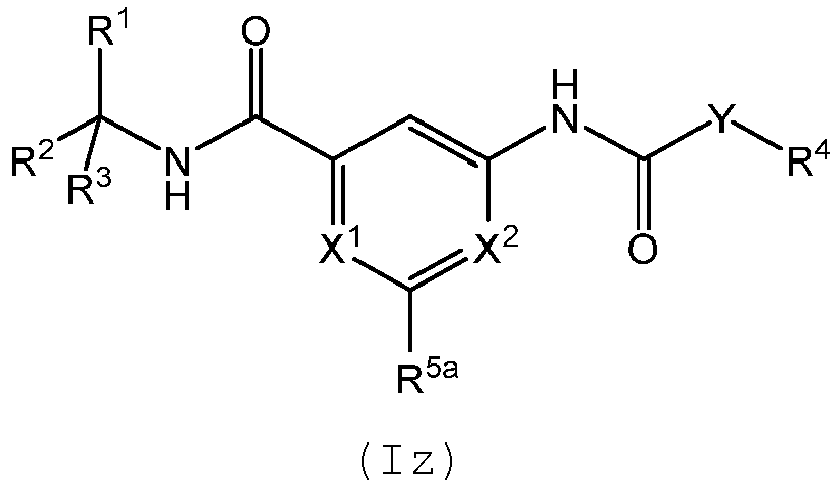 R1, R2, R3, R4, R5a, X1, X2 et Y étant tels que définis dans la revendication 1 ; ouZ étant -C(0)NH-, et R5b étant H de sorte que le composé est de formule générale (Iy) :
 R1, R2, R3, R4, R5a, X1, X2 et Y étant tels que définis dans la revendication 1.
 - Composé selon la revendication 1 ou la revendication 2, R1 étant H, CN, éthynyle ou méthyle, l'un ou l'autre parmi lesquels étant non substitué ou étant substitué par OH.
- Composé selon l'une quelconque des revendications 1 à 3,R2 étant méthyle ou éthyle ; etR3 étant C1-4 alkyle éventuellement substitué par un ou plusieurs substituants choisis parmi hydroxyle, méthoxy, éthoxy, -C(O)O-(C1-4 alkyle) et -N(H)C(O)O-(C1-4 alkyle) ; ou :R3 étant C1-10 alkyle ou C2-3 alcynyle, l'un ou l'autre parmi lesquels étant non substitué ou substitué par un unique substituant choisi parmi fluoro, R14 OR14, OR15, C(O)OR15, N(R16)S(O)2R15 et N(R16)C(O)OR15 ;R14 étant choisi parmi phényle, pyridinyle et un cycle hétérocyclique à 5 ou 6 chaînons ;R15 étant choisi parmi H, ou C1-4 alkyle ; etR16 étant H ; ouR3 étant un système cyclique carbocyclique ou hétérocyclique à 3 à 7 chaînons, qui est non substitué ou substitué comme défini dans la revendication 1 ; ouR3 étant phényle ou pyridinyle, chacun desquels étant non substitué ou substitué par un ou plusieurs substituants choisis parmi OR17 et N(R17)2, chaque R17 étant H ou méthyle.
- Composé selon la revendication 4,R1 étant méthyle ou CN et R2 et R3 étant tous deux méthyle ; ouR2 et R3 se combinant avec l'atome de carbone auquel ils sont fixés pour former un système cyclique carbocyclique ou hétérocyclique et R1 étant H, méthyle, méthyle substitué par OH, CN, éthynyle ou C(O)OR12, où R12 est comme défini dans la revendication 1.
- Composé selon l'une quelconque des revendications 1 à 5, Y étant -CH2-, -CH2CH2-, -CH(CH3)CH2-, -CH2CH(CH3)- ou -CH2CH2CH2-, notamment -CH2- ; et/ouR5a et R5b étant tous deux H et/ouX2 étant CH ; et/ou :R4 étant un groupe aryle à 6 à 11 chaînons choisi parmi phényle, naphtyle, indanyle, 1,2,3,4-tétrahydronaphtyle et benzocycloheptanyle, l'un quelconque parmi lesquels étant éventuellement substitué comme défini dans la revendication 1 ; ouR4 étant un groupe hétéroaryle à 5 à 10 chaînons choisi parmi pyridinyle, quinoléinyle, quinoxalinyle, indazolyle, indolyle, benzoxazolyle, dihydrobenzofurannyle, furyle et thiényle, l'un quelconque parmi lesquels étant éventuellement substitué comme défini dans la revendication 1 ;R4 étant un groupe carbocyclyle choisi parmi cyclohexyle et adamantyle, l'un quelconque parmi lesquels étant éventuellement substitué comme défini dans la revendication 1 ; ouR4 étant phényle éventuellement substitué par un ou plusieurs substituants tels que définis dans la revendication 1 ; ouR4 étant un hétéroaryle à 5 à 10 chaînons choisi parmi pyridinyle, pyrrolyle, thiényle, furyle, benzoxazolyle, imidazolyle, indolyle ou indazolyle, l'un quelconque parmi lesquels étant éventuellement substitué comme défini dans la revendication 1.
- Composé selon la revendication 6, R4 étant phényle qui est substitué par un groupe OH au niveau soit de la position 2, soit de la position 3 et éventuellement par un ou plusieurs substituants supplémentaires choisis parmi :halogéno, CN, R19, OR19;OR6, C(O)OR6 ;C1-4 alkyle ou O(C1-4 alkyle), l'un ou l'autre parmi lesquels étant éventuellement substitué par un ou plusieurs substituants choisis parmi halogéno, CN, R19, OR19, OR6 et NR6R7 ;R6 étant H, C1-4 alkyle ou C1-4 halogénoalkyle ou, pour un groupement NR6R7, R6 et R7 se combinant avec l'atome d'azote auquel ils sont fixés pour former un cycle hétérocyclique à 5 ou 6 chaînons, contenant éventuellement un ou plusieurs hétéroatomes supplémentaires et éventuellement substitué par un ou plusieurs substituants halogéno ;R7 étant tel que défini dans la revendication 1 ; et R19 étant un groupe carbocyclyle à 3 à 6 chaînons ou phényle, chacun desquels étant éventuellement substitué par un ou plusieurs substituants choisis parmi halogéno, méthyle et méthoxy.
- Composé selon l'une quelconque des revendications 1 à 7, Y étant -CH2-, R4 étant phényle et le composé étant un composé de formule générale (Ia) :
 R1, R2, R3, R5a, X1 et X2 étant tels que définis dans la revendication 1 ;R10 étant H, OH, halogéno, C1-6 alkyle, -O(C1-6 alkyle) ;chaque R11 étant indépendamment H, halogéno, OH, CN, C1-6 alkyle, C1-6 halogénoalkyle, -O(C1-6 alkyle) ou C(O)O-(C1-6 alkyle) ; etn étant 1 ou 2 ; ouun composé de formule générale (Id) ou (Ie) :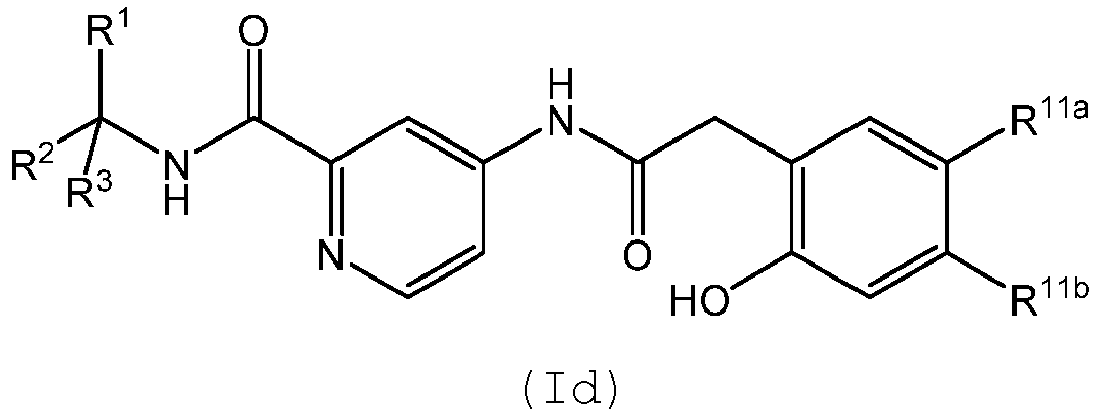
 R1, R2 et R3 étant tels que définis dans la revendication 1 ;R11a étant H, halogéno, C1-4 alkyle, C1-4 halogénoalkyle ou C(O)O(C1-4 alkyle) ;R11b étant H, halogéno, C1-4 alkyle ou C1-4 halogénoalkyle ; etR11c étant H, halogéno, CN, C1-4 alkyle ou C1-4 halogénoalkyle.
 - Composé selon la revendication 1 choisi parmi :N-tert-Butyl-4-[[2-(2-hydroxyphényl)acétyl]amino]pyridine-2-carboxamide (Composé 1) ;N-(1-Adamantyl)-4-[[2-(5-chloro-2-hydroxy-phényl)acétyl]amino]pyridine-2-carboxamide (Composé 1.3) ;4-[[2-(5-Chloro-2-hydroxy-phényl)acétyl]amino]-N-(3-méthoxy-1,1-diméthyl-propyl)pyridine-2-carboxamide (Composé 1.4) ;4-[[2-(5-Chloro-2-hydroxy-phényl)acétyl]amino]-N-(1-méthylcyclobutyl)pyridine-2-carboxamide (Composé 1.6) ;4-[[2-(5-Chloro-2-hydroxy-phényl)acétyl]amino]-N-(1-méthylcyclohexyl)pyridine-2-carboxamide (Composé 1.7) ;N-[3-[[4-[[2-(5-chloro-2-hydroxy-phényl)acétyl]amino]pyridine-2-carbonyl]amino]-3-méthyl-butyl]carbamate de tert-butyle (Composé 1.8) ;4-[[2-(5-Chloro-2-hydroxy-phényl)acétyl]amino]-N-cyclohexyl-pyridine-2-carboxamide (Composé 1.10) ;N-tert-Butyl-4-[[2-(5-chloro-2-hydroxy-phényl)acétyl]amino]pyridine-2-carboxamide (Composé 3) ;N-(1,1-Diméthylpropyl)-4-[[2-(4-fluoro-2-hydroxy-phényl)acétyl]amino]pyridine-2-carboxamide (Composé 3.1a) ;N-tert-Butyl-4-[[2-(4-fluoro-2-hydroxy-phényl)acétyl]amino]pyridine-2-carboxamide (Composé 3.2a) ;N-tert-Butyl-4-[[2-(2-chloro-6-hydroxy-phényl)acétyl]amino]pyridine-2-carboxamide (Composé 3.3a) ;4-[[2-(4-Bromo-5-chloro-2-hydroxy-phényl)acétyl]amino]-N-tert-butyl-pyridine-2-carboxamide (Composé 3.4a) ;4-[[2-(5-tert-Butyl-2-hydroxy-phényl)acétyl]amino]-N-(1-cyanocyclobutyl)pyridine-2-carboxamide (Composé 3.5a) ;4-[[2-(5-tert-Butyl-2-hydroxy-phényl)acétyl]amino]-N-(1-méthylcyclobutyl)pyridine-2-carboxamide (Composé 3.6a) ;N-tert-butyl-4-[2-(2,5-dibromo-3-fluoro-6-hydroxyphényl)acétamido]pyridine-2-carboxamide (Composé 3.7a) ;N-tert-Butyl-4-[[2-[2-hydroxy-5-(trifluorométhyl)phényl]acétyl]amino]pyridine-2-carboxamide (Composé 3.5b) ;N-tert-Butyl-4-[[2-(4-chloro-2-hydroxy-phényl)acétyl]amino]pyridine-2-carboxamide (Composé 3.6b) ;N-tert-Butyl-4-[[2-[2-hydroxy-4-(trifluorométhyl)phényl]acétyl]amino]pyridine-2-carboxamide (Composé 3.7b) ;N-tert-Butyl-4-[[2-(2-hydroxy-5-méthoxy-phényl)acétyl]amino]pyridine-2-carboxamide (Composé 3.8b) ;N-tert-Butyl-4-[(6-hydroxyindane-1-carbonyl)amino]pyridine-2-carboxamide (Composé 3.9b) ;N-tert-Butyl-4-[(7-hydroxyindane-1-carbonyl)amino]pyridine-2-carboxamide (Composé 3.10b) ;N-tert-Butyl-4-[[2-(2,5-dibromo-3-chloro-6-hydroxy-phényl)acétyl]amino]pyridine-2-carboxamide (Composé 3.11b);N-tert-Butyl-4-[[2-(3-hydroxyphényle)acétyl]amino]pyridine-2-carboxamide (Composé 3.12b) ;N-tert-Butyl-4-[[2-(2-fluoro-5-hydroxy-phényle)acétyl]amino]pyridine-2-carboxamide (Composé 3.13b) ;N-tert-Butyl-4-[[2-(4-chloro-3-hydroxy-phényl)acétyl]amino]pyridine-2-carboxamide (Composé 3.14b) ;N-tert-Butyl-4-[[2-(2-chloro-3-hydroxy-phényl)acétyl]amino]pyridine-2-carboxamide (Composé 3.15b) ;N-tert-Butyl-4-[[2-(2-chloro-5-hydroxy-phényle)acétyl]amino]pyridine-2-carboxamide (Composé 3.16b) ;N-tert-Butyl-4-[[2-(3-chloro-5-hydroxy-phényl)acétyl]amino]pyridine-2-carboxamide (Composé 3.17b) ;N-tert-Butyl-4-[[2-(2-thiényl)acétyl]amino]pyridine-2-carboxamide (Composé 5) ;4-[[2-(2-Adamantyl)acétyl]amino]-N-tert-butyl-pyridine-2-carboxamide (Composé 5.1) ;N-tert-Butyl-4-[[2-(4-fluoro-2-méthoxy-phényl)acétyl]amino]pyridine-2-carboxamide (Composé 5.2) ;N-tert-Butyl-4-[[2-(5-chloro-2-fluoro-phényl)acétyl]amino]pyridine-2-carboxamide (Composé 5.3) ;N-tert-Butyl-4-[[2-(2-furyl)acétyl]amino]pyridine-2-carboxamide (Composé 5.4) ;N-tert-Butyl-4-[[2-(3-chlorophényle)acétyl]amino]pyridine-2-carboxamide (Composé 5.5) ;N-tert-Butyl-4-[[2-(1H-indol-3-yl)acétyl]amino]pyridine-2-carboxamide (Composé 5.6) ;N-tert-Butyl-4-[[2-(o-tolyl)acétyl]amino]pyridine-2-carboxamide (Composé 5.7) ;N-tert-Butyl-4-[[2-(3,4-dichlorophényle)acétyl]amino]pyridine-2-carboxamide (Composé 5.8) ;N-tert-Butyl-4-[[2-(3-fluorophényl)acétyl]amino]pyridine-2-carboxamide (Composé 5.9) ;N-tert-Butyl-4-[[2-(5-chloro-2-méthoxy-phényl)acétyl]amino]pyridine-2-carboxamide (Composé 5.10) ;N-tert-Butyl-4-[[2-(p-tolyl)acétyl]amino]pyridine-2-carboxamide (Composé 5.11) ;N-tert-Butyl-4-[[2-(2-fluorophényle)acétyl]amino]pyridine-2-carboxamide (Composé 5.12) ;N-tert-Butyl-4-[[2-(4-fluorophényle)acétyl]amino]pyridine-2-carboxamide (Composé 5.13) ;N-tert-Butyl-4-[[2-(m-tolyl)acétyl]amino]pyridine-2-carboxamide (Composé 5.14) ;4-[[2-(1,3-Benzoxazol-6-yl)acétyl]amino]-N-tert-butyl-pyridine-2-carboxamide (Composé 5.15) ;N-tert-Butyl-4-[[2-(2-chloro-3-pyridinyle)acétyl]amino]pyridine-2-carboxamide (Composé 5.16) ;N-tert-Butyl-4-[[2-(2,6-dichlorophényle)acétyl]amino]pyridine-2-carboxamide (Composé 5.17) ;N-tert-Butyl-4-[[2-(4-chloro-3-fluoro-phényl)acétyl]amino]pyridine-2-carboxamide (Composé 5.18) ;N-tert-Butyl-4-[[2-(3,5-dichlorophényl)acétyl]amino]pyridine-2-carboxamide (Composé 5.19) ;N-tert-Butyl-4-[[2-(2-chlorophényle)acétyl]amino]pyridine-2-carboxamide (Composé 5.20) ;N-tert-Butyl-4-[[2-(3-chloro-4-hydroxy-phényl)acétyl]amino]pyridine-2-carboxamide (Composé 5.21) ;N-tert-Butyl-4-(indane-1-carbonyle amino)pyridine-2-carboxamide (Composé 5.22) ;N-tert-Butyl-4-[(2-quinoxalin-6-ylacétyle) amino]pyridine-2-carboxamide (Composé 5.23) ;N-tert-Butyl-4-[[2-(2-naphtyle)acétyl]amino]pyridine-2-carboxamide (Composé 5.24) ;N-tert-Butyl-4-(2,3-dihydrobenzofuran-3-carbonylamino)pyridine-2-carboxamide (Composé 5.25) ;N-tert-Butyl-4-(6,7,8,9-tétrahydro-5H-benzo[7]annulène-5-carbonylamino) pyridine-2-carboxamide (Composé 5.26) ;N-tert-Butyl-4-(tétralin-1-carbonylamino) pyridine-2-carboxamide (Composé 5.27) ;N-tert-Butyl-4-[[2-(6-quinolyl)acétyl]amino]pyridine-2-carboxamide (Composé 5.29) ;N-tert-butyl-4-[[1-(3-chlorophényle)cyclopropanecarbonyl]amino]pyridine-2-carboxamide (Composé 5.31) ;N-tert-Butyl-4-[[2-(2,3-dihydro-1,4-benzodioxin-6-yl)acétyl]amino]pyridine-2-carboxamide (Composé 5.32) ;N-(1,1-Diméthylprop-2-ynyl)-4-[(2-isochroman-1-ylacétyl)amino]pyridine-2-carboxamide (Composé 5.33) ;4-[[2-(4,4-Difluorocyclohexyl)acétyl]amino]-N-(1,1-diméthylprop-2-ynyl)pyridine-2-carboxamide (Composé 5.34) ;N-(1,1-Diméthylprop-2-ynyl)-4-[[2-[4-(trifluorométhyl)phényl]acétyl]amino]pyridine-2-carboxamide (Composé 5.35) ;N-(1,1-Diméthylprop-2-ynyl)-4-[[2-[3-(trifluorométhyl)-1H-pyrazol-4-yl]acétyl]amino]pyridine-2-carboxamide (Composé 5.36) ;N-(1,1-Diméthylprop-2-ynyl)-4-[[2-[3-(trifluorométhyl)phényl]acétyl]amino]pyridine-2-carboxamide (Composé 5.37) ;N-(1,1-Diméthylprop-2-ynyl)-4-[[2-[2-(trifluorométhyl)phényl]acétyl]amino]pyridine-2-carboxamide (Composé 5.38) ;4-[[2-(2,3-Dihydro-1,4-benzoxazin-4-yl)acétyl]amino]-N-(1,1-diméthylprop-2-ynyl)pyridine-2-carboxamide (Composé 5.39) ;N-tert-Butyl-4-[[2-(5-cyano-2-hydroxy-phényl)acétyl]amino]pyridine-2-carboxamide (Composé 6) ;4-[[2-(5-Chloro-2-hydroxy-phényl)acétyl]amino]-N-(1,1-diméthylbutyl)pyridine-2-carboxamide (Composé 7.2) ;4-[[2-(5-Chloro-2-hydroxy-phényl)acétyl]amino]-N-(1,1,2-triméthylpropyl)pyridine-2-carboxamide (Composé 7.6) ;4-[[2-(5-Chloro-2-hydroxy-phényl)acétyl]amino]-N-isopropyl-pyridine-2-carboxamide (Composé 7.7) ;4-[[2-(5-Chloro-2-hydroxy-phényl)acétyl]amino]-N-(4-méthyltétrahydropyran-4-yl)pyridine-2-carboxamide (Composé 7.9) ;4-[[2-(5-Chloro-2-hydroxy-phényl)acétyl]amino]-N-tétrahydropyran-4-yl-pyridine-2-carboxamide (Composé 7.11) ;4-[2-(5-Chloro-2-hydroxyphényl)acétamido]-N-[(1s,4s)-4-hydroxycyclohexyl]pyridine-2-carboxamide (Composé 7.12) ;4-[[2-(5-Chloro-2-hydroxy-phényl)acétyl]amino]-N-sec-butyl-pyridine-2-carboxamide (Composé 7.13) ;4-[[2-(5-Chloro-2-hydroxy-phényl)acétyl]amino]-N-(2-hydroxy-1,1,2-triméthyl-propyl)pyridine-2-carboxamide (Composé 7.14) ;N-(3-Bicyclo[1.1.1]pentanyl)-4-[[2-(5-chloro-2-hydroxy-phényl)acétyl]amino]pyridine-2-carboxamide (Composé 7.15) ;4-[[2-(5-Chloro-2-hydroxy-phényl)acétyl]amino]-N-(1-cyanocyclobutyl)pyridine-2-carboxamide (Composé 7.16) ;3-[[4-[[2-(5-chloro-2-hydroxy-phényl)acétyl]amino]pyridine-2-carbonyl]amino]pipéridine-1-carboxylate de tert-butyle (Composé 8.1) ;(1r,5s,6s)-6-{4-[2-(5-chloro-2-hydroxyphényl)acétamido]pyridine-2-amido}-3-azabicyclo[3.1.0]hexane-3-carboxylate de tert-butyle (Composé 8.3) ;4-[[2-(5-Chloro-2-hydroxy-phényl)acétyl]amino]-N-(1,1-diméthylpropyl)pyridine-2-carboxamide (Composé 9.2) ;N-tert-Butyl-4-[[2-(5-tert-butyl-2-hydroxy-phényl)acétyl]amino]pyridine-2-carboxamide (Composé 10) ;3-[2-[[2-(tert-butylcarbamoyl)-4-pyridinyl]amino]-2-oxo-éthyl]-4-hydroxy-benzoate de méthyle (Composé 13) ;N-tert-Butyl-4-[[2-(2-hydroxy-5-méthyl-phényl)acétyl]amino]pyridine-2-carboxamide (Composé 15) ;N-tert-Butyl-4-[[2-(3-hydroxy-2-pyridinyl)acétyl]amino]pyridine-2-carboxamide (Composé 19) ;N-tert-Butyl-4-[[2-(5-fluoro-2-hydroxy-phényl)acétyl]amino]pyridine-2-carboxamide (Composé 20) ;N-tert-Butyl-4-[[(1R) ou (1S)-indane-1-carbonyl]amino]pyridine-2-carboxamide (Composé 21a) ;N-tert-Butyl-4-[[(1R) ou (1S)-indane-1-carbonyl]amino]pyridine-2-carboxamide (Composé 21b) ;N-tert-Butyl-4-[(2-phénylacétyl)amino]pyridine-2-carboxamide (Composé 22) ;4-(3,3-Diméthylbutanoylamino)-N-(1,1-diméthylprop-2-ynyl)pyridine-2-carboxamide (Composé 22.1) ;4-[(2-Cyclopentylacétyl)amino]-N-(1,1-diméthylprop-2-ynyl)pyridine-2-carboxamide (Composé 22.2) ;4-[[2-(3-Chloro-4-pyridinyl)acétyl]amino]-N-(1,1-diméthylprop-2-ynyl)pyridine-2-carboxamide (Composé 22.3) ;4-[[2-(4-Chlorophényl)acétyl]amino]-N-(1-cyanocyclopropyl)pyridine-2-carboxamide (Composé 23) ;4-[[2-(3-Chlorophényl)acétyl]amino]-N-(1-cyanocyclopropyl)pyridine-2-carboxamide (Composé 23.1) ;4-[[2-(2-Chloro-5-fluoro-phényle)acétyl]amino]-N-(1-cyanocyclopropyl)pyridine-2-carboxamide (Composé 23.2) ;N-tert-Butyl-4-(indane-2-carbonyle amino)pyridine-2-carboxamide (Composé 23.3) ;N-tert-Butyl-4-[[2-[2-(difluorométhoxy)phényl]acétyl]amino]pyridine-2-carboxamide (Composé 23.4) ;N-tert-Butyl-4-[[2-[2-(difluorométhyle)phényl]acétyl]amino]pyridine-2-carboxamide (Composé 23.5) ;N-tert-Butyl-4-[[2-(3,4-difluorophényle)acétyl]amino]pyridine-2-carboxamide (Composé 23.6) ;N-tert-Butyl-4-[[2-(3,5-difluorophényle)acétyl]amino]pyridine-2-carboxamide (Composé 23.7) ;N-tert-Butyl-4-[[2-(2,3-difluorophényle)acétyl]amino]pyridine-2-carboxamide (Composé 23.8) ;4-[[2-(2-Chlorophényl)acétyl]amino]-N-tétrahydropyran-4-yl-pyridine-2-carboxamide (Composé 23.9) ;N-(1-Cyanocyclobutyl)-4-[[2-(6-quinolyle)acétyl]amino]pyridine-2-carboxamide (Composé 23.11) ;N-tert-Butyl-4-[[2-[2-(trifluorométhyle)phényl]acétyl]amino]pyridine-2-carboxamide (Composé 23.12) ;4-[[2-(2-Bromophényl)acétyl]amino]-N-tert-butyl-pyridine-2-carboxamide (Composé 23.13) ;N-tert-Butyl-4-[[2-(2-cyanophényle)acétyl]amino]pyridine-2-carboxamide (Composé 23.14) ;4-[[2-(2-Chlorophényl)acétyl]amino]-N-(4-cyanotétrahydropyran-4-yl)pyridine-2-carboxamide (Composé 23.15) ;N-(4-Cyanotétrahydropyran-4-yl)-4-[[2-(6-quinolyl)acétyl]amino]pyridine-2-carboxamide (Composé 23.16) ;4-[[2-(2-Chloro-5-méthoxy-phényl)acétyl]amino]-N-(1-cyanocyclopropyl)pyridine-2-carboxamide (Composé 24) ;N-(3-Bicyclo[1.1.1]pentanyl)-4-[[2-(5-tert-butyl-2-hydroxy-phényl)acétyl]amino]pyridine-2-carboxamide (Composé 25) ;-[[2-(5-tert-Butyl-2-hydroxy-phényl)acétyl]amino]-N-(4-cyanotétrahydropyran-4-yl)pyridine-2-carboxamide (Composé 25.1) ;N-tert-Butyl-4-[[2-(2-hydroxy-5-phényl-phényl)acétyl]amino]pyridine-2-carboxamide (Composé 26) ;N-tert-Butyl-4-[[2-[5-chloro-2-hydroxy-4-(pyrrolidin-1-ylméthyl)phényl]acétyl]amino]pyridine-2-carboxamide (Composé 27) ;N-tert-Butyl-4-[[2-[4-[(tert-butylamino)méthyl]-5-chloro-2-hydroxy-phényl]acétyl]amino]pyridine-2-carboxamide (Composé 27.1) ;N-tert-Butyl-4-[[2-[5-chloro-2-hydroxy-4-(morpholinométhyl)phényl]acétyl]amino]pyridine-2-carboxamide (Composé 27.2) ;N-tert-Butyl-4-[[2-[5-chloro-4-[(3,3-difluoropyrrolidin-1-yl)méthyl]-2-hydroxy-phényl]acétyl]amino]pyridine-2-carboxamide (Composé 27.3) ;N-tert-butyl-4-[[2-(5-chloro-2-hydroxy-phényl)acétyl]amino]-5-fluoro-pyridine-2-carboxamide (Composé 28) ;N-tert-Butyl-4-[[2-(5-chloro-2-hydroxy-phényl)acétyl]amino]-3-fluoro-pyridine-2-carboxamide (Composé 28.1) ;4-[[2-(2-Chlorophényl)acétyl]amino]-N-(1-cyanocyclobutyl)pyridine-2-carboxamide (Composé 30) ;4-[[2-(2-Chlorophényl)acétyl]amino]-N-(1,1-diméthylprop-2-ynyl)pyridine-2-carboxamide (Composé 30.1) ;4-[[2-(2-Chlorophényl)acétyl]amino]-N-(4-fluoro-1-bicyclo[2.1.1]hexanyl)pyridine-2-carboxamide (Composé 30.2) ;4-[[2-(2-Chlorophényl)acétyl]amino]-N-(1-cyclopropyl-1-méthyl-éthyl)pyridine-2-carboxamide (Composé 30.3) ;4-[[2-(2-Chlorophényl)acétyl]amino]-N-(1-cyano-1-méthyl-éthyl)pyridine-2-carboxamide (Composé 30.3a) ;4-[[2-(2-Chlorophényl)acétyl]amino]-N-(1-méthyl-3-bicyclo[1.1.1]pentanyl)pyridine-2-carboxamide (Composé 30.4) ;4-[[2-(2-Chlorophényl)acétyl]amino]-N-(1-cyano-3-bicyclo[1.1.1]pentanyle) pyridine-2-carboxamide (Composé 30.5) ;4-[[2-(2-Chlorophényl)acétyl]amino]-N-(2,2-difluorocyclopropyl)pyridine-2-carboxamide (Composé 30.6) ;4-[[2-(2-Chlorophényl)acétyl]amino]-N-(1-cyanocyclopropyl)pyridine-2-carboxamide (Composé 30.7) ;4-[[2-(2-Chlorophényl)acétyl]amino]-N-(1-méthylcyclopropyl)pyridine-2-carboxamide (Composé 30.8) ;4-[[2-(2-Chlorophényl)acétyl]amino]-N-(3-fluoro-1-bicyclo[1.1.1]pentanyl)pyridine-2-carboxamide (Composé 30.9) ;4-[[2-(2-Chlorophényl)acétyl]amino]-N-(2-fluoro-1,1-diméthyl-éthyl)pyridine-2-carboxamide (Composé 30.10) ;4-[[2-(2-Chlorophényl)acétyl]amino]-N-(4-éthynyltétrahydropyran-4-yl)pyridine-2-carboxamide (Composé 30.11) ;4-[[2-(2-Chlorophényl)acétyl]amino]-N-(1-cyanocyclopentyl)pyridine-2-carboxamide (Composé 30.12) ;4-[[2-(2-Chlorophényl)acétyl]amino]-N-(2,2-difluoro-1,1-diméthyl-éthyl)pyridine-2-carboxamide (Composé 30.13) ;4-[[2-(5-Chloro-2-hydroxy-phényl)acétyl]amino]-N-(4-cyanotétrahydropyran-4-yl)pyridine-2-carboxamide (Composé 31) ;4-[[2-(5-Chloro-2-hydroxy-phényl)acétyl]amino]-N-(1-éthynylcyclopentyl)pyridine-2-carboxamide (Composé 31.2) ;4-[2-(5-Chloro-2-hydroxyphényl)acétamido]-N-[(ls,2s)-2-hydroxycyclohexyl]pyridine-2-carboxamide (Composé 31.3) ;4-[[2-(5-Chloro-2-hydroxy-phényl)acétyl]amino]-N-[(1S,2S)-2-hydroxycyclohexyl]pyridine-2-carboxamide ou 4-[[2-(5-Chloro-2-hydroxy-phényl)acétyl]amino]-N-[(1R,2R)-2-hydroxycyclohexyl]pyridine-2-carboxamide (Composé 31.3a) ;4-[[2-(5-Chloro-2-hydroxy-phényl)acétyl]amino]-N-(4-éthynyltétrahydropyran-4-yl)pyridine-2-carboxamide (Composé 31.4) ;N-[(6-Amino-2-pyridinyl)méthyl]-4-[[2-(5-chloro-2-hydroxy-phényl)acétyl]amino]pyridine-2-carboxamide (Composé 32) ;acide 12-[[4-[[2-(5-Chloro-2-hydroxy-phényl)acétyl]amino]pyridine-2-carbonyl]amino] dodécanoïque (Composé 32.1) ;4-[[2-(5-Chloro-2-hydroxy-phényle)acétyl]amino]-N-(3-pyridinylméthyl)pyridine-2-carboxamide (Composé 32.2) ;4-[[2-(5-Chloro-2-hydroxy-phényl)acétyl]amino]-N-(2-pyridinylméthyl)pyridine-2-carboxamide (Composé 32.3) ;4-[[2-(5-Chloro-2-hydroxy-phényle)acétyl]amino]-N-(4-pyridinylméthyl)pyridine-2-carboxamide (Composé 32.4) ;4-[[2-(5-Chloro-2-hydroxy-phényle)acétyl]amino]-N-[(2-hydroxyphényle) méthyl]pyridine-2-carboxamide (Composé 32.5) ;4-[[2-(5-Chloro-2-hydroxy-phényl)acétyl]amino]-N-(1,1-diméthyl-2-morpholino-éthyl)pyridine-2-carboxamide (Composé 32.6) ;4-[[2-(5-Chloro-2-hydroxy-phényle)acétyl]amino]-N-(2-hydroxy-1,1-diméthyl-éthyl)pyridine-2-carboxamide (Composé 32.7) ;4-[[2-(5-Chloro-2-hydroxy-phényle)acétyl]amino]-N-(3,3-difluoro-4-pipéridyl)pyridine-2-carboxamide (Composé 32.8) ;4-[[2-(5-Chloro-2-hydroxy-phényle)acétyl]amino]-N-(1H-imidazol-2-yl)pyridine-2-carboxamide (Composé 32.9) ;4-[[2-(5-Chloro-2-hydroxy-phényl)acétyl]amino]-N-[(1R,2R)-2-hydroxycyclopentyl]pyridine-2-carboxamide (Composé 33) ;4-[[2-(5-Chloro-2-hydroxy-phényl)acétyl]amino]-N-(1-cyano-1-méthyl-éthyl)pyridine-2-carboxamide (Composé 34) ;4-[[2-(5-Chloro-2-hydroxy-phényl)acétyl]amino]-N-[3-(hydroxyméthyle) tétrahydrofuran-3-yl]pyridine-2-carboxamide (Composé 35) ;4-[[2-(5-Chloro-2-hydroxy-phényl)acétyl]amino]-N-[(3R)-3-(hydroxyméthyl)tétrahydro furan-3-yl]pyridine-2-carboxamide ou 4-[[2-(5-chloro-2-hydroxy-phényl)acétyl]amino]-N-[(3S)-3-(hydroxyméthyl)tétrahydrofuran-3-yl]pyridine-2-carboxamide (Composé 35a) ;4-[[2-(5-Chloro-2-hydroxy-phényl)acétyl]amino]-N-[(3R)-3-(hydroxyméthyl)tétrahydro furan-3-yl]pyridine-2-carboxamide ou 4-[[2-(5-chloro-2-hydroxy-phényl)acétyl]amino]-N-[(3S)-3-(hydroxyméthyl)tétrahydrofuran-3-yl]pyridine-2-carboxamide (Composé 35b) ;4-[[2-(5-Chloro-2-hydroxy-phényl)acétyl]amino]-N-(4-hydroxy-4-méthyl-cyclohexyle) pyridine-2-carboxamide en tant que mélange 6 : 4 de stéréoisomères (Composé 35.1) ;4-[[2-(5-Chloro-2-hydroxy-phényle)acétyl]amino]-N-[(1s,2r)-2-(hydroxyméthyl)cyclohexyl]pyridine-2-carboxamide (Composé 35.2) ;4-[[2-(5-Chloro-2-hydroxy-phényl)acétyl]amino]-N-[(1s,3r)-3-hydroxycyclopentyl]pyridine-2-carboxamide (Composé 35.3) ;4-[[2-(5-Chloro-2-hydroxy-phényl)acétyl]amino]-N-[2-hydroxy-1-(hydroxy méthyl)-1-méthyl-éthyl]pyridine-2-carboxamide (Composé 35.4) ;4-[[2-(5-Chloro-2-hydroxy-phényl)acétyl]amino]-N-(3-hydroxycyclohexyl)pyridine-2-carboxamide en tant que mélange de stéréoisomères (Composé 35.6) ;4-[[2-(5-Chloro-2-hydroxy-phényl)acétyl]amino]-N-(3-phénoxypropyl)pyridine-2-carboxamide (Composé 35.7) ;4-[[2-(5-Chloro-2-hydroxy-phényl)acétyl]amino]-N-(1-méthylcyclopropyl)pyridine-2-carboxamide (Composé 35.8) ;4-[[2-(5-Chloro-2-hydroxy-phényl)acétyl]amino]-N-[1-méthyl-1-(2-pyridinyle) éthyl]pyridine-2-carboxamide (Composé 35.9) ;4-[[2-(5-Chloro-2-hydroxy-phényl)acétyl]amino]-N-(3-phénylpropyl)pyridine-2-carboxamide (Composé 35.10) ;4-[[2-(5-Chloro-2-hydroxy-phényl)acétyl]amino]-N-[2-hydroxy-1-(2-pyridinyl)éthyl]pyridine-2-carboxamide (Composé 35.11) ;4-[[2-(5-Chloro-2-hydroxy-phényle)acétyl]amino]-N-[(5-méthoxy-2-pyridinyl)méthyl]pyridine-2-carboxamide (Composé 35.12) ;3-[[4-[[2-(5-chloro-2-hydroxy-phényle)acétyl]amino]pyridine-2-carbonyl]amino]-3-méthyl-butanoate d'éthyle (Composé 35.13) ;4-[[2-(5-Chloro-2-hydroxy-phényle)acétyl]amino]-N-(3-hydroxy-1,1-diméthyl-propyl)pyridine-2-carboxamide (Composé 35.14) ;N-Benzyl-4-[[2-(5-chloro-2-hydroxy-phényle)acétyl]amino]pyridine-2-carboxamide (Composé 35.15) ;4-[[2-(5-Chloro-2-hydroxy-phényle)acétyl]amino]-N-phényl-pyridine-2-carboxamide (Composé 35.16) ;4-[[2-(5-Chloro-2-hydroxy-phényl)acétyl]amino]-N-[(1S,2S)-2-hydroxycyclopentyl]pyridine-2-carboxamide (Composé 35.17) ;4-[[2-(5-Chloro-2-hydroxy-phényle)acétyl]amino]-N-[(1R,2S)-2-hydroxycyclopentyl]pyridine-2-carboxamide (Composé 35.18) ;4-[[2-(5-Chloro-2-hydroxy-phényl)acétyl]amino]-N-[(1S,2R)-2-hydroxycyclopentyl]pyridine-2-carboxamide (Composé 35.19) ;4-[[2-(5-Chloro-2-hydroxy-phényl)acétyl]amino]-N-(1-éthynylcyclohexyl)pyridine-2-carboxamide (Composé 35.24) ;4-[[2-(5-Chloro-2-hydroxy-phényl)acétyl]amino]-N-[1-(hydroxyméthyl)cyclobutyl]pyridine-2-carboxamide (Composé 35.25) ;4-[[2-(5-Chloro-2-hydroxy-phényl)acétyl]amino]-N-[3-(hydroxyméthyl)oxétan-3-yl]pyridine-2-carboxamide (Composé 35.26) ;4-[[2-(5-Chloro-2-hydroxy-phényl)acétyl]amino]-N-(1-cyano-2-méthoxy-1-méthyl-éthyl)pyridine-2-carboxamide (Composé 35.27) ;4-[[2-(5-Chloro-2-hydroxy-phényl)acétyl]amino]-N-[(1-hydroxycyclobutyl)méthyl]pyridine-2-carboxamide (Composé 35.28) ;4-[[2-(5-Chloro-2-hydroxy-phényl)acétyl]amino]-N-(1,1-diméthylprop-2-ynyl)pyridine-2-carboxamide (Composé 36) ;4-[[2-(5-Chloro-2-hydroxy-phényl)acétyl]amino]-N-(1-cyano-1,2-diméthyl-propyl)pyridine-2-carboxamide (Composé 37) ;4-[[2-(5-Chloro-2-hydroxy-phényl)acétyl]amino]-N-(1-méthylcyclopentyl)pyridine-2-carboxamide (Composé 38) ;N-(4-tert-Butylcyclohexyl)-4-[[2-(5-chloro-2-hydroxy-phényl)acétyl]amino]pyridine-2-carboxamide (Composé 39) ;N-tert-Butyl-4-[[2-(2-chloro-3-fluoro-phényl)acétyl]amino]pyridine-2-carboxamide (Composé 40) ;N-tert-Butyl-4-[[2-(2-chloro-5-fluoro-phényl)acétyl]amino]pyridine-2-carboxamide (Composé 40.1) ;4-[[2-(5-Chloro-2-hydroxy-phényl)acétyl]amino]-N-[4-(2-hydroxyéthyle) tétrahydropyran-4-yl]pyridine-2-carboxamide (Composé 42) ;4-[[2-(5-Chloro-2-hydroxy-phényl)acétyl]amino]-N-[1,1-diméthyl-3-(2,2,2-trifluoroéthylamino)propyl]pyridine-2-carboxamide (Composé 43) ;4-[[2-(5-Chloro-2-hydroxy-phényl)acétyl]amino]-N-(4-fluoro-1-bicyclo[2.1.1]hexanyl)pyridine-2-carboxamide (Composé 44) ;4-[[2-(5-Chloro-2-hydroxy-phényl)acétyl]amino]-N-[3-(2,2-diméthylpropanoylamino)-1,1-diméthyl-propyl]pyridine-2-carboxamide (Composé 45) ;4-[[2-(5-Chloro-2-hydroxy-phényl)acétyl]amino]-N-(1-cyano-2-hydroxy-1-méthyl-éthyl)pyridine-2-carboxamide (Composé 46) ;4-[[2-(5-Chloro-2-hydroxy-phényl)acétyl]amino]-N-[(1S)-1-cyano-2-hydroxy-1-méthyl-éthyl]pyridine-2-carboxamide ou 4-[[2-(5-chloro-2-hydroxy-phényl)acétyl]amino]-N-[(1R)-1-cyano-2-hydroxy-1-méthyl-éthyl]pyridine-2-carboxamide (Composé 46a) ;4-[[2-(5-Chloro-2-hydroxy-phényl)acétyl]amino]-N-[(1S)-1-cyano-2-hydroxy-1-méthyl-éthyl]pyridine-2-carboxamide ou 4-[[2-(5-chloro-2-hydroxy-phényl)acétyl]amino]-N-[(1R)-1-cyano-2-hydroxy-1-méthyl-éthyl]pyridine-2-carboxamide (Composé 46b) ;4-[[2-(5-Chloro-2-hydroxy-phényl)acétyl]amino]-N-(3-cyanotétrahydrofuran-3-yl)pyridine-2-carboxamide (Composé 47) ;2-[4-[[4-[[2-(5-chloro-2-hydroxy-phényle)acétyl]amino]pyridine-2-carbonyl]amino]tétrahydropyran-4-yl]acétate de méthyle (Composé 47.1) ;4-[[4-[[2-(5-chloro-2-hydroxy-phényl)acétyl]amino]pyridine-2-carbonyl]amino]tétrahydropyran-4-carboxylate de méthyle (Composé 47.2) ;4-[[2-(5-Chloro-2-hydroxy-phényl)acétyl]amino]-N-(3-cyanooxétan-3-yl)pyridine-2-carboxamide (Composé 47.3) ;4-[[2-(5-Fluoro-2-hydroxy-phényl)acétyl]amino]-N-(1-méthylcyclobutyl)pyridine-2-carboxamide (Composé 48) ;N-(4-Cyanotétrahydropyran-4-yl)-4-[[2-(5-fluoro-2-hydroxy-phényl)acétyl]amino]pyridine-2-carboxamide (Composé 48.1) ;N-[3-(tert-Butylamino)-1,1-diméthyl-3-oxo-propyl]-4-[[2-(5-chloro-2-hydroxy-phényle)acétyl]amino]pyridine-2-carboxamide (Composé 49) ;4-[[2-(5-Chloro-2-hydroxy-phényl)acétyl]amino]-N-[3-(méthanesulfonamido)-1,1-diméthyl-propyl]pyridine-2-carboxamide (Composé 50) ;N-(3-Acétamido-1,1-diméthyl-propyl)-4-[[2-(5-chloro-2-hydroxy-phényl)acétyl]amino]pyridine-2-carboxamide (Composé 51) ;4-[[2-(5-Chloro-2-hydroxy-phényl)acétyl]amino]-N-[4-(hydroxyméthyl)tétrahydro pyran-4-yl]pyridine-2-carboxamide (Composé 53) ;N-tert-Butyl-4-[[2-[3-(1-hydroxyéthyl)phényl]acétyl]amino]pyridine-2-carboxamide (Composé 54) ;N-tert-Butyl-5-chloro-4-[[2-(5-chloro-2-hydroxy-phényl)acétyl]amino]pyridine-2-carboxamide (Composé 55) ;N-tert-Butyl-4-[[2-[5-chloro-2-[(4-méthoxyphényl)méthoxy]phényl]acétyl]amino]pyridine-2-carboxamide (Composé 56) ;N-tert-butyl-4-[[(1S) ou (1R)-4-chloro-7-hydroxy-indane-1-carbonyl]amino]pyridine-2-carboxamide (Composé 57a) ;N-tert-butyl-4-[[(1S) ou (1R)-4-chloro-7-hydroxy-indane-1-carbonyl]amino]pyridine-2-carboxamide (Composé 57b) ;N-tert-Butyl-4-[[2-(2-cyclopropylphényl)acétyl]amino]pyridine-2-carboxamide (Composé 58) ;4-[[2-(3-Bromo-5-chloro-2-hydroxy-phényl)acétyl]amino]-N-tert-butyl-pyridine-2-carboxamide (Composé 59) ;N-(4-Fluoro-1-bicyclo[2.1.1]hexanyl)-4-[[2-(2-fluorophényl)acétyl]amino]pyridine-2-carboxamide (Composé 60) ;N-(1-Cyano-2-hydroxy-1-méthyl-éthyl)-4-[[2-(2-fluorophényl)acétyl]amino]pyridine-2-carboxamide (Composé 60.1) ;N-(1,1-Diméthylprop-2-ynyl)-4-[[2-(2-fluorophényl)acétyl]amino]pyridine-2-carboxamide (Composé 60.2) ;N-tert-Butyl-4-[[2-(5-chloro-2-hydroxy-3-isopropyl-phényl)acétyl]amino]pyridine-2-carboxamide (Composé 61) ;N-tert-Butyl-4-[[2-[5-chloro-2-hydroxy-3-(1-méthoxyéthyl)phényl]acétyl]amino]pyridine-2-carboxamide (Composé 62) ;4-[[2-(6-Quinolyl)acétyl]amino]-N-tétrahydropyran-4-yl-pyridine-2-carboxamide (Composé 63) ;4-(Benzylcarbamoylamino)-N-tert-butyl-pyridine-2-carboxamide (Composé 64) ;N-tert-Butyl-4-(cyclohexylméthylcarbamoylamino)pyridine-2-carboxamide (Composé 64.1) ;N-tert-Butyl-4-(2-phényléthylcarbamoylamino)pyridine-2-carboxamide (Composé 64.2) ;N-tert-Butyl-4-[[(1R)-1-phényléthyl]carbamoylamino]pyridine-2-carboxamide (Composé 64.3) ;N-tert-Butyl-4-[[(1S)-1-phényléthyl]carbamoylamino]pyridine-2-carboxamide (Composé 64.4) ;N-tert-Butyl-4-[(2-chlorophényle)méthylcarbamoylamino]pyridine-2-carboxamide (Composé 64.5) ;N-tert-butyl-4-(1H-indol-3-ylcarbamoylamino)pyridine-2-carboxamide (Composé 64.6) ;N-tert-Butyl-4-[(3-chlorophényl)méthylcarbamoylamino]pyridine-2-carboxamide (Composé 64.7) ;N-tert-butyl-4-[(4-chlorophényl)méthylcarbamoylamino]pyridine-2-carboxamide (Composé 64.8) ;N-tert-Butyl-4-[(2-hydroxyphényl)carbamoylamino]pyridine-2-carboxamide (Composé 65) ;N-tert-Butyl-4-[(2-méthoxyphényl)méthylcarbamoylamino]pyridine-2-carboxamide (Composé 65.1) ;N-tert-Butyl-4-[(2-hydroxyphényl)méthylcarbamoylamino]pyridine-2-carboxamide (Composé 65.2) ;N-tert-Butyl-4-[(3-hydroxyphényl)méthylcarbamoylamino]pyridine-2-carboxamide (Composé 65.3) ;N-tert-Butyl-4-[(4-hydroxyphényl)méthylcarbamoylamino]pyridine-2-carboxamide (Composé 65.4) ;N-tert-Butyl-4-[[2-[2-hydroxy-5-(1-hydroxyéthyl)phényl]acétyl]amino]pyridine-2-carboxamide (Composé 66) ;N-tert-Butyl-4-[[2-[2-hydroxy-5-[1-(2,2,2-trifluoroéthylamino)éthyl]phényl]acétyl]amino]pyridine-2-carboxamide (Composé 67) ;N-tert-Butyl-4-[[2-[3-(cyanométhyl)phényl]acétyl]amino]pyridine-2-carboxamide (Composé 68) ;N-tert-Butyl-4-[[2-[3-(méthoxyméthyl)phényl]acétyl]amino]pyridine-2-carboxamide (Composé 69) ;N-tert-Butyl-4-[[2-[2-hydroxy-5-(morpholinométhyl)phényl]acétyl]amino]pyridine-2-carboxamide (Composé 70) ;4-[[2-(5-Fluoro-2-hydroxy-phényl)acétyl]amino]-N-[3-(hydroxyméthyl)tétrahydro furan-3-yl]pyridine-2-carboxamide (Composé 72) ;4-[[2-(5-Chloro-2-hydroxy-phényl)acétyl]amino]-N-[1-(hydroxyméthyl)-2-méthoxy-1-méthyl-éthyl]pyridine-2-carboxamide (Composé 73) ;4-[[2-(5-Chloro-2-hydroxy-phényl)acétyl]amino]-N-(1,1-diméthylbut-2-ynyle) pyridine-2-carboxamide (Composé 73.1) ;N-tert-Butyl-4-[[2-[2-hydroxy-5-(3-hydroxypropyl)phényl]acétyl]amino]pyridine-2-carboxamide (Composé 75) ;4-[[2-(5-Chloro-4-fluoro-2-hydroxy-phényl)acétyl]amino]-N-(1-méthylcyclobutyl)pyridine-2-carboxamide (Composé 76) ;4-[[2-(2,5-Difluorophényl)acétyl]amino]-N-(1,1-diméthylprop-2-ynyl)pyridine-2-carboxamide (Composé 77) ;4-[[2-(2,5-Difluorophényl)acétyl]amino]-N-(4-fluoro-1-bicyclo[2.1.1]hexanyle) pyridine-2-carboxamide (Composé 77.1) ;4-[[2-(4-Chloro-2-hydroxy-phényl)acétyl]amino]-N-(1,1-diméthylprop-2-ynyl)pyridine-2-carboxamide (Composé 78) ;N-(1,1-Diméthylprop-2-ynyl)-4-[[2-[2-hydroxy-4-(trifluorométhyl)phényl]acétyl]amino]pyridine-2-carboxamide (Composé 78.1) ;N-(1,1-Diméthylprop-2-ynyl)-4-[[2-[2-hydroxy-5-(trifluorométhyl)phényl]acétyl]amino]pyridine-2-carboxamide (Composé 78.2) ;4-[(2-Chroman-4-ylacétyl)amino]-N-(1,1-diméthylprop-2-ynyl)pyridine-2-carboxamide (Composé 79) ;N-(1,1-Diméthylprop-2-ynyl)-4-[[2-(1-isopropyl-3,5-diméthyl-pyrazol-4-yl)acétyl]amino]pyridine-2-carboxamide (Composé 79.1) ;N-(1,1-Diméthylprop-2-ynyl)-4-[[2-(1H-indazol-4-yl)acétyl]amino]pyridine-2-carboxamide (Composé 79.2) ;N-(1,1-Diméthylprop-2-ynyl)-4-[[2-(1H-indol-7-yl)acétyl]amino]pyridine-2-carboxamide (Composé 79.3) ;N-(1-Cyano-1-méthyl-éthyl)-4-[[2-(5-fluoro-2-hydroxy-phényl)acétyl]amino]pyridine-2-carboxamide (Composé 81) ;N-(1-Cyano-2-hydroxy-1-méthyl-éthyl)-4-[[2-(5-fluoro-2-hydroxy-phényl)acétyl]amino]pyridine-2-carboxamide (Composé 81.1) ;4-[[2-(5-Fluoro-2-hydroxy-phényl)acétyl]amino]-N-isopropyl-pyridine-2-carboxamide (Composé 81.2) ;N-(1,1-Diméthylprop-2-ynyl)-4-[[2-(5-fluoro-2-hydroxy-phényl)acétyl]amino]pyridine-2-carboxamide (Composé 81.3) ;N-(4-Fluoro-1-bicyclo[2.1.1]hexanyl)-4-[[2-(5-fluoro-2-hydroxy-phényl)acétyl]amino]pyridine-2-carboxamide (Composé 81.4) ;4-[[2-(5-Fluoro-2-hydroxy-phényl)acétyl]amino]-N-[1-(hydroxyméthyl)cyclobutyl]pyridine-2-carboxamide (Composé 81.5) ;N-(1-Cyano-1-méthyl-éthyl)-4-(thiophéne-3-carbonylamino)pyridine-2-carboxamide (Composé 83) ;N-(1-Cyano-1-méthyl-éthyl)-4-[(2-cyclohexylacétyle) amino]pyridine-2-carboxamide (Composé 83.1) ;N-(1-Cyano-1-méthyl-éthyl)-4-(cyclohexanecarbonylamino)pyridine-2-carboxamide (Composé 83.2) ;N-(1-Cyano-1-méthyl-éthyl)-4-[(3,3-difluorocyclopentanecarbonyl)amino]pyridine-2-carboxamide (Composé 83.3) ;N-(1-Cyano-1-méthyl-éthyl)-4-[(1-méthylcyclopentanecarbonyl)amino]pyridine-2-carboxamide (Composé 83.4) ;N-(1-Cyano-1-méthyl-éthyl)-4-(3-cyclohexylpropanoylamino)pyridine-2-carboxamide (Composé 83.5) ;4-(2-{Bicyclo[2.2.1]heptan-2-yl}acétamido)-N-(1-cyano-1-méthyléthyl)pyridine-2-carboxamide (Composé 83.6) ;N-(1-Cyano-1-méthyl-éthyl)-4-[[2-(1-méthylcyclohexyl)acétyl]amino]pyridine-2-carboxamide (Composé 83.7) ;N-[2-[(1-Cyano-1-méthyl-éthyl)carbamoyl]-4-pyridinyl]-2-cyclopropyl-pyrimidine-5-carboxamide (Composé 83.8) ;N-[2-[(1-Cyano-1-méthyl-éthyl)carbamoyl]-4-pyridinyl]-3-isobutyl-isoxazole-5-carboxamide (Composé 83.9) ;N-(1-Cyano-1-méthyl-éthyl)-4-[[2-(4,4-difluorocyclohexyl)acétyl]amino]pyridine-2-carboxamide (Composé 83.10) ;4-[(1-Benzylcyclopropanecarbonyl)amino]-N-(1-cyano-1-méthyl-éthyl)pyridine-2-carboxamide (Composé 83.11) ;N-(1-Cyano-1-méthyl-éthyl)-4-[3-(2-méthoxy-4-pyridinyl)propanoylamino]pyridine-2-carboxamide (Composé 83.13) ;4-[(5-tert-Butyl-2-méthyl-pyrazole-3-carbonyl)amino]-N-(1-cyano-1-méthyl-éthyl)pyridine-2-carboxamide (Composé 83.14) ;N-(1-Cyano-1-méthyl-éthyl)-4-[(2-pyrazol-1-ylbenzoyl)amino]pyridine-2-carboxamide (Composé 83.15) ;N-[2-[(1-Cyano-1-méthyl-éthyl)carbamoyl]-4-pyridinyl]-6-(trifluorométhyl)pyridine-2-carboxamide (Composé 83.16) ;N-[2-[(1-Cyano-1-méthyl-éthyl)carbamoyl]-4-pyridinyl]-3-oxo-4H-1,4-benzoxazine-7-carboxamide (Composé 83.17) ;N-[2-[(1-Cyano-1-méthyl-éthyl)carbamoyl]-4-pyridinyl]-1-éthyl-indole-2-carboxamide (Composé 83.18) ;N-(1-Cyano-1-méthyl-éthyl)-4-[[2-(2,2,2-trifluoroéthyl)pyrazole-3-carbonyl]amino]pyridine-2-carboxamide (Composé 83.19) ;N-[2-[(1-Cyano-1-méthyl-éthyl)carbamoyl]-4-pyridinyl]-3-phényl-isoxazole-4-carboxamide (Composé 83.20) ;4-[(1-Benzylpyrazole-4-carbonyl)amino]-N-(1-cyano-1-méthyl-éthyl)pyridine-2-carboxamide (Composé 83.21) ;N-(1-Cyano-1-méthyl-éthyl)-4-[(2-méthyl-5-phényl-pyrazole-3-carbonyl)amino]pyridine-2-carboxamide (Composé 83.22) ;N-(1-Cyano-1-méthyl-éthyl)-4-[[2-(3-méthyl-1,2,4-oxadiazol-5-yl)benzoyl]amino]pyridine-2-carboxamide (Composé 83.23) ;N-(1-Cyano-1-méthyl-éthyl)-4-[(3-méthyl-1-phényl-pyrazole-4-carbonyl)amino]pyridine-2-carboxamide (Composé 83.24) ;N-[2-[(1-Cyano-1-méthyl-éthyl)carbamoyl]-4-pyridinyl]-2-phénoxy-pyridine-3-carboxamide (Composé 83.25) ;N-(1-Cyano-1-méthyl-éthyl)-4-[[2,5-diméthyl-1-(2-thiénylméthyl)pyrrole-3-carbonyl]amino]pyridine-2-carboxamide (Composé 83.26) ;N-[2-[(1-Cyano-1-méthyl-éthyl)carbamoyl]-4-pyridinyl]-5-(2-méthoxyphényl)isoxazole-3-carboxamide (Composé 83.27) ;N-[2-[(1-Cyano-1-méthyl-éthyl)carbamoyl]-4-pyridinyl]-4-méthyl-2-phényl-thiazole-5-carboxamide (Composé 83.28) ;4-[(4-Acétamidobenzoyl)amino]-N-(1-cyano-1-méthyl-éthyl)pyridine-2-carboxamide (Composé 83.29) ;N-[2-[(1-Cyano-1-méthyl-éthyl)carbamoyl]-4-pyridinyl]-1,3-benzothiazole-7-carboxamide (Composé 83.30) ;N-(1-Cyano-1-méthyl-éthyl)-4-[3-(4-fluorophényle)butanoylamino]pyridine-2-carboxamide (Composé 83.31) ;N-[2-[(1-Cyano-1-méthyl-éthyl)carbamoyl]-4-pyridinyl]-1-méthyl-2-oxo-quinoléine-3-carboxamide (Composé 83.32) ;4-[[2-(5-Chloro-2-hydroxy-phényl)acétyl]amino]-N-[1-cyano-2-méthoxy-1-(méthoxy méthyl)éthyl]pyridine-2-carboxamide (Composé 86) ;4-[[2-(3-Amino-4-tert-butyl-phényl)acétyl]amino]-N-tert-butyl-pyridine-2-carboxamide (Composé 87) ;4-[[2-(2-Amino-4-tert-butyl-phényl)acétyl]amino]-N-tert-butyl-pyridine-2-carboxamide (Composé 88) ;N-tert-Butyl-4-[[2-(4-tert-butyl-3-hydroxy-phényl)acétyl]amino]pyridine-2-carboxamide (Composé 89) ;N-tert-Butyl-4-[[2-(4-tert-butyl-2-hydroxy-phényl)acétyl]amino]pyridine-2-carboxamide (Composé 90) ;N-tert-Butyl-4-[[2-(4-tert-butyl-2-fluoro-5-hydroxy-phényl)acétyl]amino]pyridine-2-carboxamide (Composé 91) ;4-[[2-(4-Chloro-3-hydroxy-phényl)acétyl]amino]-N-(4-cyanotétrahydropyran-4-yl)pyridine-2-carboxamide (Composé 92) ;4-[[2-(4-Chloro-3-hydroxy-phényl)acétyl]amino]-N-(1-cyano-1-méthyl-éthyl)pyridine-2-carboxamide (Composé 92.1) ;4-[[2-(4-Chloro-3-hydroxy-phényl)acétyl]amino]-N-(1,1-diméthylprop-2-ynyl)pyridine-2-carboxamide (Composé 92.2) ;4-[[2-(4-Chloro-3-hydroxy-phényl)acétyl]amino]-N-[(1s,2s)-2-hydroxycyclopentyl]pyridine-2-carboxamide (Composé 92.3) ;4-[[2-(4-tert-Butyl-3-hydroxy-phényl)acétyl]amino]-N-[3-(hydroxyméthyle) tétrahydrofuran-3-yl]pyridine-2-carboxamide (Composé 93) ;4-[[2-(4-tert-Butyl-3-hydroxy-phényl)acétyl]amino]-N-[(2S)-2-hydroxycyclohexyl]pyridine-2-carboxamide (Composé 93.1) ;4-[[2-(4-tert-Butyl-3-hydroxy-phényl)acétyl]amino]-N-[(2S)-2-hydroxycyclopentyl]pyridine-2-carboxamide (Composé 93.2) ;4-[[2-(4-tert-Butyl-3-hydroxy-phényl)acétyl]amino]-N-(4-cyanotétrahydropyran-4-yl)pyridine-2-carboxamide (Composé 93.3) ;4-[[2-(4-tert-Butyl-3-hydroxy-phényl)acétyl]amino]-N-(1-cyano-1-méthyl-éthyl)pyridine-2-carboxamide (Composé 93.4) ;4-[[2-(4-tert-Butyl-3-hydroxy-phényl)acétyl]amino]-N-(1,1-diméthylprop-2-ynyl)pyridine-2-carboxamide (Composé 93.5) ; et4-[[2-(5-Chloro-2-hydroxy-phényl)acétyl]amino]-N-(1-méthyl-1-phényl-éthyle) pyridine-2-carboxamide (Composé 94) ;et sels et solvates de l'un quelconque parmi les composés ci-dessus.
- Composé selon la revendication 1 qui est N-tert-Butyl-4-[[2-(5-chloro-2-hydroxy-phényl)acétyl]amino]pyridine-2-carboxamide (Composé 3) ou un sel ou un solvate correspondant.
- Composé selon la revendication 1 qui est 4-[[2-(5-Chloro-2-hydroxy-phényl)acétyl]amino]-N-[(3R)-3-(hydroxyméthyl)tétrahydrofuran-3-yl]pyridine-2-carboxamide ou 4-[[2-(5-chloro-2-hydroxy-phényl)acétyl]amino]-N-[(3S)-3-(hydroxyméthyl)tétrahydrofuran-3-yl]pyridine-2-carboxamide (Composé 35a) ou un sel ou un solvate correspondant.
- Composé selon la revendication 1 qui est 4-[[2-(5-Chloro-2-hydroxy-phényl)acétyl]amino]-N-(1,1-diméthylprop-2-ynyl)pyridine-2-carboxamide (Composé 36) ou un sel ou un solvate correspondant.
- Composé selon la revendication 1 qui est N-(1,1-Diméthylprop-2-ynyl)-4-[[2-[3-(trifluorométhyl)-1H-pyrazol-4-yl]acétyl]amino]pyridine-2-carboxamide (Composé 5.36) ou un sel ou un solvate correspondant.
- Composé de formule générale (I) y compris toutes les formes tautomères, tous les énantiomères et toutes les variantes isotopiques et tous les sels et les solvates correspondants :
 R1 étant H, CN, C(O)OR12, C1-3 alkyle, C2-3 alcényle ou C2-3 alcynyle, l'un quelconque parmi lesquels groupes alkyle, alcényle ou alcynyle étant éventuellement substitué par un ou plusieurs substituants, de manière appropriée un substituant, choisis parmi fluoro, OR12, N(R12)2, C(O)OR12, C(O)N(R12)2, C(O)R12 et N(R13)C(O)R12 ; chaque R12 et R13 étant indépendamment choisi parmi H, C1-6 alkyle et C1-6 fluoroalkyleR2 étant H ou C1-6 alkyle éventuellement substitué par OR12;R3 étant :C1-10 alkyle, C2-10 alcényle ou C2-10 alcynyle, l'un quelconque parmi lesquels étant éventuellement substitué par un ou plusieurs substituants, de manière appropriée un substituant, choisis parmi fluoro, CN, R14 OR14, OR15, N(R15)2, C(O)OR15, C(O)N(R15)2, N(R16)C(O)R15, N(R15)S(O)2R14, N(R15)S(O)2R16 et N(R15)C(O)OR16 ; ouun système cyclique carbocyclique ou hétérocyclique à 3 à 7 chaînons ou un système cyclique aryle à 6 à 10 chaînons ou hétéroaryle à 5 à 10 chaînons, l'un ou l'autre parmi lesquels étant éventuellement substitué par un ou plusieurs substituants choisis parmi halogéno, CN, C1-4 alkyle, C1-4 halogénoalkyle, OR17 et N(R17)2 ;R14 étant un système cyclique aryle à 6 à 10 chaînons ou hétéroaryle à 5 à 10 chaînons ou un système cyclique carbocyclique ou hétérocyclique à 3 à 7 chaînons, l'un quelconque parmi lesquels étant éventuellement substitué par un ou plusieurs substituants choisis parmi halogéno, C1-4 alkyle, C1-4 halogénoalkyle, OR17 et N(R17)2 ; chaque R17 étant indépendamment H, C1-4 alkyle ou C1-4 halogénoalkyle ;chaque R15 et R16 étant indépendamment H, C1-6 alkyle ou C1-6 halogénoalkyle ; ouR2 et R3, conjointement avec l'atome de carbone auquel ils sont fixés, se combinant pour former un système cyclique carbocyclique ou hétérocyclique à 3 à 10 chaînons éventuellement substitué par un ou plusieurs substituants choisis parmi halogéno, CN, OR9, N(R9)2, C(O)OR9, C(O)N(R9)2, C(O)R9, N(R9)C(O)R9 et C1-4 alkyle éventuellement substitué par halogéno, OR9 ou N(R9)2 ; ou R1, R2 et R3, conjointement avec l'atome de carbone auquel ils sont fixés, se combinant pour former un système cyclique carbocyclique ou hétérocyclique à 5 à 10 chaînons ponté ou phényle, l'un quelconque parmi lesquels étant éventuellement substitué par un ou plusieurs substituants choisis parmi halogéno, CN, OR9, N(R9)2, C(O)OR9, C(O)N(R9)2, C(O)R9, N(R9)C(O)R9 et C1-4 alkyle éventuellement substitué par halogéno, OR9 ou N(R9)2 ;chaque R9 étant indépendamment choisi parmi H, C1-6 alkyle ou C1-6 halogénoalkyle ;X1 étant N ;X2 étant CR8R8 étant H, halogéno, OH, O (C1-4 alkyle), CN ou NH2 ;Y étant une liaison ou une chaîne C1-6 alkylène linéaire qui est éventuellement substituée par un ou plusieurs substituants R18, deux substituants R18 pouvant être fixés au même atome de carbone ou à des atomes de carbone différents ;chaque R18 étant indépendamment C1-3 alkyle ou C1-3 halogénoalkyle dans lequel un -CH2- est éventuellement remplacé par -NH- ou -O- et deux groupes R18 pouvant se combiner avec l'atome ou les atomes auquel/auxquels ils sont fixés pour former un système cyclique carbocyclique ou hétérocyclique à 3 à 6 chaînons ;Z étant -C(O)- ou -C(O)NH- ;R4 étant un aryle à 6 à 14 chaînons, un hétéroaryle à 5 à 14 chaînons ou un système cyclique carbocyclique à 5 à 10 chaînons, l'un quelconque parmi lesquels étant éventuellement substitué par un ou plusieurs substituants choisis parmi :halogéno, CN, nitro, R19, OR19, OR6, SR6, NR6R7, C(O)R6, C(O)R19, C(O)OR6, C(O)N(R6)(R7), N(R7)C(O)R6 ;C1-6 alkyle ou O(C1-6 alkyle), l'un ou l'autre parmi lesquels étant éventuellement substitué par un ou plusieurs substituants choisis parmi halogéno, CN, nitro, R19, OR6, SR6, NR6R7, C(O)R6C(O)OR6, C(O)N(R6)(R7) et N(R7)C(O)R6 ; etlorsque R4 n'est pas de caractère totalement aromatique, oxo ;R19 étant un système cyclique aryle ou hétéroaryle à 5 ou 6 chaînons ou un système cyclique carbocyclique ou hétérocyclique à 3 à 7 chaînons, l'un quelconque parmi lesquels étant éventuellement substitué par un ou plusieurs substituants choisis parmi halogéno, C1-4 alkyle, C1-4 halogénoalkyle, OH, O(C1-4 alkyle), O(C1-4 halogénoalkyle) ;R6 étant H, C1-6 alkyle, C1-6 halogénoalkyle, benzyle, carbocyclyle à 3 à 7 chaînons ou hétérocyclyle à 3 à 7 chaînons ;R7 étant H, C1-6 alkyle ou C1-6 halogénoalkyle ; ouR6 et R7, conjointement avec l'atome d'azote auquel ils sont fixés, pouvant former un cycle hétérocyclique à 4 à 7 chaînons contenant éventuellement un ou plusieurs hétéroatomes supplémentaires et éventuellement substitué par un ou plusieurs substituants choisis parmi oxo et halogéno ; etchacun parmi R5a et R5b étant indépendamment H, C1-4 alkyle ou halogéno ; oucomposé selon l'une quelconque des revendications 1 à 13 ;pour une utilisation en médecine, notamment dans le traitement ou la prophylaxie de maladies et d'affections affectées par la modulation de TMEM16A, par exemple des maladies et des affections respiratoires, la sécheresse de la bouche (xérostomie), l'hypermobilité intestinale, la cholestase et les affections oculaires ; et éventuellement, le composé de formule générale (I) étant utilisé en combinaison avec un agent actif supplémentaire utile dans le traitement ou la prévention d'affections respiratoires.
 - Composé pour une utilisation selon la revendication 14, les maladies et affections respiratoires étant choisies parmi la mucoviscidose, la bronchopneumopathie chronique obstructive (COPD), la bronchite chronique, l'emphysème, la bronchiectasie, y compris la bronchiectasie sans mucoviscidose, l'asthme et la dyskinésie ciliaire primaire ;la bouche sèche (xérostomie) résultant du syndrome de Sjorgens, d'un traitement par radiothérapie ou de médicaments xérogènes ;l'hypermobilité intestinale étant associée à une dyspepsie gastrique, une gastroparésie, une constipation chronique ou un syndrome du côlon irritable ;la maladie oculaire étant une maladie de l'œil sec.
- Procédé pour la préparation d'un composé selon l'une quelconque des revendications 1 à 13, le procédé comprenant :A. pour un composé de formule générale (I) dans laquelle Z est -C(O)- :la mise en réaction d'un composé de formule générale (II) :
 R1, R2, R3, R5a, R5b, X1 et X2 étant tels que définis dans la revendication 1 ;avec un composé de formule générale (III) :
 R4 et Y étant tels que définis dans la revendication 1 ; en la présence d'un agent de couplage ; oula mise en réaction d'un composé de formule générale (II) avec un chlorure d'acide de formule générale (IV) :
 R4 et Y étant tels que définis dans la revendication 1 ; ouB. pour des composés de formule générale (I) dans laquelle Z est C(O)NH et Y est -C1-2 alkylène- :la mise en réaction d'un composé de formule générale (II) avec un composé de formule générale (XIV) :
 R4 étant tel que défini dans la revendication 1 et Y1 étant -CH2- ou -CH2CH2-.C. pour des composés de formule générale (Id) tels que définis dans la revendication 8 dans laquelle R11a est Cl et R11b est H :
la mise en réaction d'un composé de formule générale (II) avec de la 5-chloro-2(3H)-benzofuranone, qui possède la structure :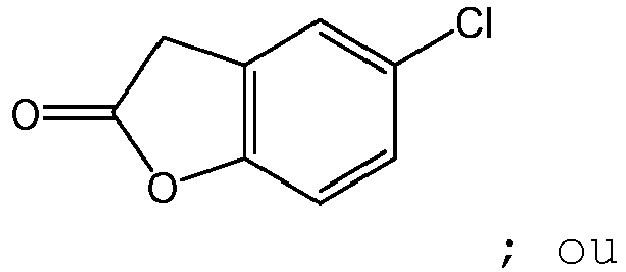 D. la mise en réaction d'un composé de formule générale (X) :
 X1, X2, Y, R4, R5a et R5b étant tels que définis dans la revendication 1 ;avec un composé de formule générale (VII) :
 R1, R2 et R3 étant tels que définis dans la revendication 1 ; ouE. la mise en réaction d'un composé de formule générale (X) :
 X1, X2, Y, R4, R5a et R5b étant tels que définis dans la revendication 1 ;avec un composé de formule générale (VII) tel que défini ci-dessus ; ouF. la mise en réaction d'un composé de formule générale (XV) :
 X1, X2, Y, R4, R5a et R5b étant tels que définis dans la revendication 1 et R22 étant halogéno ;avec une amine de formule générale (VII) telle que définie ci-dessus et du monoxyde de carbone en la présence d'un ligand au phosphore et d'un catalyseur au palladium ; ouG. la conversion d'un composé de formule générale (I) en un autre composé de formule générale (I).
 - Composition pharmaceutique comprenant un composé selon l'une quelconque des revendications 1 à 13 conjointement avec un excipient pharmaceutiquement acceptable et éventuellement en outre comprenant un agent actif supplémentaire utile dans le traitement ou la prévention d'affections respiratoires.
- Produit comprenant un composé selon l'une quelconque des revendications 1 à 13
et un agent supplémentaire utile dans le traitement ou la prévention d'affections respiratoires en tant que préparation combinée pour une utilisation simultanée, séquentielle ou séparée dans le traitement d'une maladie ou d'une affection affectée par la modulation de TMEM16A. - Composé pour une utilisation selon la revendication 14 ou la revendication 15, composition pharmaceutique selon la revendication 17 ou produit selon la revendication 18, l'agent supplémentaire utile dans le traitement ou la prévention d'affections respiratoires étant choisi parmi :des agonistes des adrénorécepteurs β2 tels que le métaprotérénol, l'isoprotérénol, l'isoprénaline, l'albutérol, le salbutamol, le formotérol, le salmétérol, l'indacatérol, la terbutaline, l'orciprénaline, le mésylate de bitoltérol, le pirbutérol, l'olodatérol, le vilantérol et l'abéditérol ;des antihistaminiques, par exemple les antagonistes des récepteurs H1 de l'histamine tels que la loratadine, la cétirizine, la desloratadine, la lévocétirizine, la fexofénadine, l'astémizole, l'azélastine et la chlorphéniramine ou les antagonistes des récepteurs H4 ; la dornase alpha ;des corticostéroïdes tels que la prednisone, la prednisolone, le flunisolide, l'acétonide de triamcinolone, le dipropionate de béclométhasone, le budésonide, le propionate de fluticasone, le furoate de mométasone et le furoate de fluticasone ;des antagonistes des leucotriènes tels que le montelukast et le zafirlukast ;des composés anticholinergiques, notamment les antagonistes muscariniques tels que l'ipratropium, le tiotropium, le glycopyrrolate, l'aclidinium et l'umeclidinium ;des thérapies de réparation de la CFTR (par exemple, des potentialisateurs, des correcteurs ou des amplificateurs de la CFTR) telles que l'Ivacaftor, QBW251, VX659, VX445, VX561/CPT-656, VX152, VX440, GLP2737, GLP2222, GLP2451, PTI438, PTI801, PTI808, FDL-169 et FDL-176 et des correcteurs de la CFTR tels que le Lumacaftor et le Tezacaftor ;des modulateurs d'ENaC, particulièrement des inhibiteurs d'ENaC tels que :
amiloride, VX-371, AZD5634, QBW276, SPX-101, BI443651, ETD001 et des composés possédant un cation choisi parmi :2-[({3-amino-5H-pyrrolo[2,3-b]pyrazin-2-yl}formamido)éthyl]-6-(4-{bis[(2S,3R,4R,5R)-2,3,4,5,6-pentahydroxyhexyl]amino}pipéridine-1-carbonyl)-1,3-diéthyl-1H-1,3-benzodiazol-3-ium ;2-[({3-amino-5H-pyrrolo[2,3-b]pyrazin-2-yl}formamido)méthyl]-6-{[2-(4-{bis[(2S,3R,4R,5R)-2,3,4,5,6-pentahydroxyhexyl]amino}pipéridin-1-yl)éthyl]carbamoyl}-1,3-diéthyl-1H-1,3-benzodiazol-3-ium ;2-[({3-amino-5H-pyrrolo[2,3-b]pyrazin-2-yl}formamido)méthyl]-5-[4-({bis[(2S,3R,4R,5R)-2,3,4,5,6-pentahydroxyhexyl]amino}méthyl)pipéridine-1-carbonyl]-1,3-diéthyl-1H-1,3-benzodiazol-3-ium ;2-[({3-amino-5H-pyrrolo[2,3-b]pyrazin-2-yl}formamido)méthyl]-6-[(3R)-3-{bis[(2S,3R,4R,5R)-2,3,4,5,6-pentahydroxyhexyl]amino}pyrrolidine-1-carbonyl]-1,3-diéthyl-1H-1,3-benzodiazol-3-ium ;2-[({3-amino-5H-pyrrolo[2,3-b]pyrazin-2-yl}formamido)méthyl]-6-[(3S)-3-{bis[(2S,3R,4R,5R)-2,3,4,5,6-pentahydroxyhexyl]amino}pyrrolidine-1-carbonyl]-1,3-diéthyl-1H-1,3-benzodiazol-3-ium ;2-[({3-amino-5H-pyrrolo[2,3-b]pyrazin-2-yl}formamido)méthyl]-1,3-diéthyl-6-{[(1r,4r)-4-{bis[(2S,3R,4R,5R)-2,3,4,5,6-pentahydroxyhexyl]amino}cyclohexyl]carbamoyl}-1H-1,3-benzodiazol-3-ium ;2-[({3-amino-5H-pyrrolo[2,3-b]pyrazin-2-yl}formamido)méthyl]-1,3-diéthyl-6-{[(1s,4s)-4-{bis[(2S,3R,4R,5R)-2,3,4,5,6-pentahydroxyhexyl]amino}cyclohexyl]carbamoyl}-1H-1,3-benzodiazol-3-ium ;et un anion approprié, par exemple halogénure, sulfate, nitrate, phosphate, formiate, acétate, trifluoroacétate, fumarate, citrate, tartrate, oxalate, succinate, mandélate, méthane sulfonate ou p-toluènesulfonate ; des antibiotiques ;des agents d'hydratation des voies respiratoires (osmolytes) tels qu'une solution saline hypertonique et le mannitol (Bronchitol®) ; etdes agents mucolytiques par ex. la N-acétylcystéine. - Composé selon la revendication 2, le composé étant un composé de formule (Iz) et Y n'étant pas une liaison.
- Composé selon la revendication 1, Y étant un C1-3 alkylène linéaire éventuellement substitué par un ou plusieurs substituants R18, R18 étant tel que défini ci-dessus et deux substituants R18 pouvant être fixés au même atome de carbone ou à des atomes de carbone différents.
- Composé selon la revendication 1, R4 étant un groupe aryle à 6 à 11 chaînons choisi parmi phényle, naphtyle, indanyle, 1,2,3,4-tétrahydronaphtyle et benzocycloheptanyle, l'un quelconque parmi lesquels étant éventuellement substitué comme défini dans la revendication 1.
Priority Applications (5)
| Application Number | Priority Date | Filing Date | Title |
|---|---|---|---|
| EP22214010.5A EP4215520A1 (fr) | 2018-01-26 | 2019-01-25 | Modulateurs de tmem16a |
| HRP20230294TT HRP20230294T1 (hr) | 2018-01-26 | 2019-01-25 | Modulatori tmem16a |
| SI201930440T SI3743406T1 (sl) | 2018-01-26 | 2019-01-25 | Modulatorji TMEM16A |
| EP25202575.4A EP4699655A3 (fr) | 2018-01-26 | 2019-01-25 | Composés |
| RS20230225A RS64073B1 (sr) | 2018-01-26 | 2019-01-25 | Modulatori tmem16a |
Applications Claiming Priority (2)
| Application Number | Priority Date | Filing Date | Title |
|---|---|---|---|
| GBGB1801355.7A GB201801355D0 (en) | 2018-01-26 | 2018-01-26 | Compounds |
| PCT/GB2019/050209 WO2019145726A1 (fr) | 2018-01-26 | 2019-01-25 | Composés |
Related Child Applications (3)
| Application Number | Title | Priority Date | Filing Date |
|---|---|---|---|
| EP25202575.4A Division EP4699655A3 (fr) | 2018-01-26 | 2019-01-25 | Composés |
| EP22214010.5A Division-Into EP4215520A1 (fr) | 2018-01-26 | 2019-01-25 | Modulateurs de tmem16a |
| EP22214010.5A Division EP4215520A1 (fr) | 2018-01-26 | 2019-01-25 | Modulateurs de tmem16a |
Publications (3)
| Publication Number | Publication Date |
|---|---|
| EP3743406A1 EP3743406A1 (fr) | 2020-12-02 |
| EP3743406B1 EP3743406B1 (fr) | 2022-12-28 |
| EP3743406B9 true EP3743406B9 (fr) | 2023-03-08 |
Family
ID=61558141
Family Applications (3)
| Application Number | Title | Priority Date | Filing Date |
|---|---|---|---|
| EP25202575.4A Pending EP4699655A3 (fr) | 2018-01-26 | 2019-01-25 | Composés |
| EP19702958.0A Active EP3743406B9 (fr) | 2018-01-26 | 2019-01-25 | Modulateurs de tmem16a |
| EP22214010.5A Withdrawn EP4215520A1 (fr) | 2018-01-26 | 2019-01-25 | Modulateurs de tmem16a |
Family Applications Before (1)
| Application Number | Title | Priority Date | Filing Date |
|---|---|---|---|
| EP25202575.4A Pending EP4699655A3 (fr) | 2018-01-26 | 2019-01-25 | Composés |
Family Applications After (1)
| Application Number | Title | Priority Date | Filing Date |
|---|---|---|---|
| EP22214010.5A Withdrawn EP4215520A1 (fr) | 2018-01-26 | 2019-01-25 | Modulateurs de tmem16a |
Country Status (32)
| Country | Link |
|---|---|
| US (2) | US11364246B2 (fr) |
| EP (3) | EP4699655A3 (fr) |
| JP (2) | JP2021512143A (fr) |
| KR (1) | KR102827138B1 (fr) |
| CN (2) | CN119490451A (fr) |
| AU (2) | AU2019213211B2 (fr) |
| BR (1) | BR112020015169A2 (fr) |
| CA (1) | CA3086747A1 (fr) |
| CL (1) | CL2020001945A1 (fr) |
| CO (1) | CO2020010552A2 (fr) |
| CR (1) | CR20200373A (fr) |
| DK (1) | DK3743406T3 (fr) |
| EA (1) | EA202091576A1 (fr) |
| ES (1) | ES2943636T3 (fr) |
| FI (1) | FI3743406T3 (fr) |
| GB (4) | GB201801355D0 (fr) |
| HR (1) | HRP20230294T1 (fr) |
| HU (1) | HUE061394T2 (fr) |
| IL (1) | IL276034B2 (fr) |
| LT (1) | LT3743406T (fr) |
| MA (1) | MA51669B1 (fr) |
| MX (1) | MX2020007899A (fr) |
| PE (1) | PE20210657A1 (fr) |
| PH (1) | PH12020551327A1 (fr) |
| PL (1) | PL3743406T3 (fr) |
| PT (1) | PT3743406T (fr) |
| RS (1) | RS64073B1 (fr) |
| SG (1) | SG11202006067XA (fr) |
| SI (1) | SI3743406T1 (fr) |
| TW (1) | TWI908705B (fr) |
| WO (1) | WO2019145726A1 (fr) |
| ZA (1) | ZA202003856B (fr) |
Families Citing this family (19)
| Publication number | Priority date | Publication date | Assignee | Title |
|---|---|---|---|---|
| GB201801355D0 (en) | 2018-01-26 | 2018-03-14 | Enterprise Therapeutics Ltd | Compounds |
| GB201908453D0 (en) * | 2019-06-12 | 2019-07-24 | Enterprise Therapeutics Ltd | Compounds for treating respiratory disease |
| PH12021553110A1 (en) * | 2019-06-12 | 2022-08-01 | Tmem16A Ltd | Compounds for treating respiratory disease |
| AU2020317036A1 (en) * | 2019-07-24 | 2022-03-17 | Tmem16A Limited | Pyridine derivatives as TMEM16A modulators for use in the treatment of respiratory conditions |
| GB201910608D0 (en) * | 2019-07-24 | 2019-09-04 | Enterprise Therapeutics Ltd | Compounds |
| GB201910664D0 (en) * | 2019-07-25 | 2019-09-11 | Enterprise Therapeutics Ltd | Novel forms of compound |
| GB201910666D0 (en) * | 2019-07-25 | 2019-09-11 | Enterprise Therapeutics Ltd | Novel form of compounds |
| GB201910665D0 (en) * | 2019-07-25 | 2019-09-11 | Enterprise Therapeutics Ltd | Novel form of compounds |
| PH12022550468A1 (en) * | 2019-08-28 | 2023-03-06 | Novartis Ag | Substituted 1,3-phenyl heteroaryl derivatives and their use in the treatment of disease |
| US12612367B2 (en) * | 2019-12-10 | 2026-04-28 | Akebia Therapeutics, Inc. | Method for producing nitrogen-containing heteroarylcarboxamide acetic acid derivative |
| IL297625B2 (en) | 2020-04-29 | 2026-05-01 | Relay Therapeutics Inc | PI3K-alpha inhibitors and methods of using them |
| WO2022013684A1 (fr) | 2020-07-11 | 2022-01-20 | Pfizer Inc. | Dérivés d'hétéroaryl cétone antiviraux |
| CA3191166A1 (fr) * | 2020-08-10 | 2022-02-17 | Dana-Farber Cancer Institute, Inc. | 3-amino-4-methylbenzenesulfonamides substitues en tant qu'inhibiteurs a petites molecules de la protease 28 specifique a l'ubiquitine |
| US11351149B2 (en) | 2020-09-03 | 2022-06-07 | Pfizer Inc. | Nitrile-containing antiviral compounds |
| AR124316A1 (es) * | 2020-12-11 | 2023-03-15 | Tmem16A Ltd | Compuestos para tratar una enfermedad respiratoria |
| EP4274828A1 (fr) | 2021-01-06 | 2023-11-15 | AbbVie Global Enterprises Ltd. | Modulateurs de la protéine régulatrice de la conductance transmembranaire fibrokystique et méthodes d'utilisation |
| WO2022150173A1 (fr) | 2021-01-06 | 2022-07-14 | AbbVie Global Enterprises Ltd. | Modulateurs de la protéine régulatrice de la conductance transmembranaire de la fibrose kystique et procédés d'utilisation |
| TW202440544A (zh) * | 2022-12-20 | 2024-10-16 | 中國大陸商杭州中美華東製藥有限公司 | 具有sting抑制作用的含肟化合物及其藥物組合物和用途 |
| WO2025106788A1 (fr) * | 2023-11-15 | 2025-05-22 | Relay Therapeutics, Inc. | INHIBITEURS DE PI3Kα ET LEURS PROCÉDÉS DE FABRICATION ET D'UTILISATION |
Family Cites Families (31)
| Publication number | Priority date | Publication date | Assignee | Title |
|---|---|---|---|---|
| DE59106766D1 (de) | 1990-11-19 | 1995-11-30 | Christ Ag | Verfahren und Einrichtung zur Entsalzung von wässrigen Flüssigkeiten. |
| US6388054B1 (en) * | 1998-08-20 | 2002-05-14 | John M. Stewart | Anti-cancer compounds |
| TWI243164B (en) | 2001-02-13 | 2005-11-11 | Aventis Pharma Gmbh | Acylated indanyl amines and their use as pharmaceuticals |
| TWI239942B (en) * | 2001-06-11 | 2005-09-21 | Dainippon Pharmaceutical Co | N-arylphenylacetamide derivative and pharmaceutical composition containing the same |
| GB0129267D0 (en) | 2001-12-06 | 2002-01-23 | Syngenta Ltd | Fungicides |
| JPWO2004011430A1 (ja) * | 2002-07-25 | 2005-11-24 | アステラス製薬株式会社 | ナトリウムチャネル阻害剤 |
| WO2004035545A2 (fr) * | 2002-10-18 | 2004-04-29 | E.I. Du Pont De Nemours And Company | Herbicides a base d'azolecarboxamide |
| WO2004106324A1 (fr) * | 2003-05-27 | 2004-12-09 | E.I. Dupont De Nemours And Company | Herbicides a base d'azolecarboxamide |
| CN100545161C (zh) * | 2003-08-15 | 2009-09-30 | 中国科学院上海药物研究所 | 一类杂环衍生物、制备方法及其用途 |
| US20060069132A1 (en) * | 2004-04-07 | 2006-03-30 | Armel Gregory R | Azolecarboxamide herbicides |
| CN101180858B (zh) * | 2005-04-25 | 2012-05-30 | Lg电子株式会社 | 用于在读取器控制器与读取器之间接收并处理消息的方法 |
| US7754717B2 (en) * | 2005-08-15 | 2010-07-13 | Amgen Inc. | Bis-aryl amide compounds and methods of use |
| US20080021024A1 (en) * | 2006-06-29 | 2008-01-24 | Alantos Pharmaceuticals Holding, Inc. | Metalloprotease inhibitors |
| EP2072501A1 (fr) * | 2007-12-21 | 2009-06-24 | Bayer CropScience AG | Dérivés d'aminobenzamide en tant qu'agents utiles pour contrôler les parasites d'animaux |
| US8642660B2 (en) * | 2007-12-21 | 2014-02-04 | The University Of Rochester | Method for altering the lifespan of eukaryotic organisms |
| LT2303270T (lt) | 2008-05-05 | 2017-09-11 | Sanofi | Acilamino-pakeistieji sulieti ciklopentankarboksirūgšties dariniai ir jų panaudojimas kaip vaistų |
| US20100035875A1 (en) * | 2008-06-20 | 2010-02-11 | Bing-Yan Zhu | Triazolopyridine jak inhibitor compounds and methods |
| WO2010036316A1 (fr) | 2008-09-24 | 2010-04-01 | Yangbo Feng | Composés d’urée et de carbamate et analogues utilisés comme inhibiteurs de kinase |
| EP2184273A1 (fr) * | 2008-11-05 | 2010-05-12 | Bayer CropScience AG | Composés substitués par l'halogène comme pesticides |
| US8883819B2 (en) * | 2011-09-01 | 2014-11-11 | Irm Llc | Bicyclic heterocycle derivatives for the treatment of pulmonary arterial hypertension |
| JP2014525462A (ja) | 2011-09-01 | 2014-09-29 | アイアールエム・リミテッド・ライアビリティ・カンパニー | Pdgfrキナーゼ阻害剤としての化合物および組成物 |
| ES2929283T3 (es) | 2012-05-04 | 2022-11-28 | Us Health | Moduladores del receptor de relaxina 1 |
| WO2014181287A1 (fr) | 2013-05-09 | 2014-11-13 | Piramal Enterprises Limited | Composés hétérocyclyliques et leurs utilisations |
| WO2016029136A1 (fr) * | 2014-08-21 | 2016-02-25 | Northwestern University | 3-amidobenzamides et leurs utilisations pour augmenter les taux cellulaires d'a3g |
| ES2746839T3 (es) | 2014-12-18 | 2020-03-09 | Pfizer | Derivados de pirimidina y triazina y su uso como inhibidores de AXL |
| WO2017083971A1 (fr) * | 2015-11-16 | 2017-05-26 | University Of Manitoba | Compositions et méthodes pour le traitement de la grippe |
| GB201610854D0 (en) | 2016-06-21 | 2016-08-03 | Entpr Therapeutics Ltd | Compounds |
| GB201619694D0 (en) | 2016-11-22 | 2017-01-04 | Entpr Therapeutics Ltd | Compounds |
| US20200361871A1 (en) | 2018-01-26 | 2020-11-19 | Enterprise Therapeutics Ltd. | Compounds |
| GB201801355D0 (en) | 2018-01-26 | 2018-03-14 | Enterprise Therapeutics Ltd | Compounds |
| GB201910665D0 (en) | 2019-07-25 | 2019-09-11 | Enterprise Therapeutics Ltd | Novel form of compounds |
-
2018
- 2018-01-26 GB GBGB1801355.7A patent/GB201801355D0/en not_active Ceased
-
2019
- 2019-01-25 FI FIEP19702958.0T patent/FI3743406T3/fi active
- 2019-01-25 PE PE2020001115A patent/PE20210657A1/es unknown
- 2019-01-25 LT LTEPPCT/GB2019/050209T patent/LT3743406T/lt unknown
- 2019-01-25 EP EP25202575.4A patent/EP4699655A3/fr active Pending
- 2019-01-25 SI SI201930440T patent/SI3743406T1/sl unknown
- 2019-01-25 EP EP19702958.0A patent/EP3743406B9/fr active Active
- 2019-01-25 CN CN202411465530.3A patent/CN119490451A/zh active Pending
- 2019-01-25 CR CR20200373A patent/CR20200373A/es unknown
- 2019-01-25 TW TW108102837A patent/TWI908705B/zh active
- 2019-01-25 BR BR112020015169-6A patent/BR112020015169A2/pt unknown
- 2019-01-25 IL IL276034A patent/IL276034B2/en unknown
- 2019-01-25 MA MA51669A patent/MA51669B1/fr unknown
- 2019-01-25 AU AU2019213211A patent/AU2019213211B2/en active Active
- 2019-01-25 PT PT197029580T patent/PT3743406T/pt unknown
- 2019-01-25 PL PL19702958.0T patent/PL3743406T3/pl unknown
- 2019-01-25 EA EA202091576A patent/EA202091576A1/ru unknown
- 2019-01-25 GB GB2108469.4A patent/GB2600512A/en not_active Withdrawn
- 2019-01-25 HU HUE19702958A patent/HUE061394T2/hu unknown
- 2019-01-25 SG SG11202006067XA patent/SG11202006067XA/en unknown
- 2019-01-25 GB GB2013290.8A patent/GB2583882B/en active Active
- 2019-01-25 DK DK19702958.0T patent/DK3743406T3/da active
- 2019-01-25 EP EP22214010.5A patent/EP4215520A1/fr not_active Withdrawn
- 2019-01-25 CN CN201980010318.9A patent/CN111683926B/zh active Active
- 2019-01-25 RS RS20230225A patent/RS64073B1/sr unknown
- 2019-01-25 GB GBGB2105206.3A patent/GB202105206D0/en not_active Ceased
- 2019-01-25 KR KR1020207020956A patent/KR102827138B1/ko active Active
- 2019-01-25 JP JP2020560615A patent/JP2021512143A/ja active Pending
- 2019-01-25 ES ES19702958T patent/ES2943636T3/es active Active
- 2019-01-25 WO PCT/GB2019/050209 patent/WO2019145726A1/fr not_active Ceased
- 2019-01-25 CA CA3086747A patent/CA3086747A1/fr active Pending
- 2019-01-25 HR HRP20230294TT patent/HRP20230294T1/hr unknown
- 2019-01-25 MX MX2020007899A patent/MX2020007899A/es unknown
- 2019-11-22 US US16/501,493 patent/US11364246B2/en active Active
-
2020
- 2020-06-25 ZA ZA2020/03856A patent/ZA202003856B/en unknown
- 2020-07-23 CL CL2020001945A patent/CL2020001945A1/es unknown
- 2020-08-25 PH PH12020551327A patent/PH12020551327A1/en unknown
- 2020-08-26 CO CONC2020/0010552A patent/CO2020010552A2/es unknown
-
2022
- 2022-05-17 US US17/663,716 patent/US12377105B2/en active Active
-
2023
- 2023-01-20 AU AU2023200327A patent/AU2023200327A1/en not_active Abandoned
- 2023-11-10 JP JP2023191935A patent/JP2024023271A/ja active Pending
Also Published As
Similar Documents
| Publication | Publication Date | Title |
|---|---|---|
| EP3743406B1 (fr) | Modulateurs de tmem16a | |
| US12415793B2 (en) | Modulators of TMEM16A for treating respiratory disease | |
| US20200361871A1 (en) | Compounds | |
| US12552770B2 (en) | Compounds for treating respiratory disease | |
| HK40042091B (en) | Tmem16a modulators | |
| HK40042091A (en) | Tmem16a modulators | |
| EP4003977B1 (fr) | Dérivés de pyridine utilisés comme modulateurs des canaux chlorure activés par le calcium | |
| EA046966B1 (ru) | Соединения | |
| HK40067765A (en) | Modulators of tmem16a for treating respiratory disease | |
| TW202237090A (zh) | 治療呼吸道疾病之化合物 | |
| HK40067765B (zh) | 用於治疗呼吸系统疾病的tmem16a的调节剂 |
Legal Events
| Date | Code | Title | Description |
|---|---|---|---|
| REG | Reference to a national code |
Ref country code: HR Ref legal event code: TUEP Ref document number: P20230294T Country of ref document: HR |
|
| STAA | Information on the status of an ep patent application or granted ep patent |
Free format text: STATUS: UNKNOWN |
|
| STAA | Information on the status of an ep patent application or granted ep patent |
Free format text: STATUS: THE INTERNATIONAL PUBLICATION HAS BEEN MADE |
|
| PUAI | Public reference made under article 153(3) epc to a published international application that has entered the european phase |
Free format text: ORIGINAL CODE: 0009012 |
|
| STAA | Information on the status of an ep patent application or granted ep patent |
Free format text: STATUS: REQUEST FOR EXAMINATION WAS MADE |
|
| 17P | Request for examination filed |
Effective date: 20200825 |
|
| AK | Designated contracting states |
Kind code of ref document: A1 Designated state(s): AL AT BE BG CH CY CZ DE DK EE ES FI FR GB GR HR HU IE IS IT LI LT LU LV MC MK MT NL NO PL PT RO RS SE SI SK SM TR |
|
| AX | Request for extension of the european patent |
Extension state: BA ME |
|
| REG | Reference to a national code |
Ref country code: HK Ref legal event code: DE Ref document number: 40042091 Country of ref document: HK |
|
| STAA | Information on the status of an ep patent application or granted ep patent |
Free format text: STATUS: EXAMINATION IS IN PROGRESS |
|
| 17Q | First examination report despatched |
Effective date: 20211029 |
|
| GRAP | Despatch of communication of intention to grant a patent |
Free format text: ORIGINAL CODE: EPIDOSNIGR1 |
|
| STAA | Information on the status of an ep patent application or granted ep patent |
Free format text: STATUS: GRANT OF PATENT IS INTENDED |
|
| RAP1 | Party data changed (applicant data changed or rights of an application transferred) |
Owner name: TMEM16A LIMITED |
|
| INTG | Intention to grant announced |
Effective date: 20220718 |
|
| GRAS | Grant fee paid |
Free format text: ORIGINAL CODE: EPIDOSNIGR3 |
|
| GRAA | (expected) grant |
Free format text: ORIGINAL CODE: 0009210 |
|
| STAA | Information on the status of an ep patent application or granted ep patent |
Free format text: STATUS: THE PATENT HAS BEEN GRANTED |
|
| REG | Reference to a national code |
Ref country code: DE Ref legal event code: R082 Ref document number: 602019023656 Country of ref document: DE |
|
| AK | Designated contracting states |
Kind code of ref document: B1 Designated state(s): AL AT BE BG CH CY CZ DE DK EE ES FI FR GB GR HR HU IE IS IT LI LT LU LV MC MK MT NL NO PL PT RO RS SE SI SK SM TR |
|
| REG | Reference to a national code |
Ref country code: GB Ref legal event code: FG4D |
|
| REG | Reference to a national code |
Ref country code: CH Ref legal event code: EP |
|
| REG | Reference to a national code |
Ref country code: DE Ref legal event code: R096 Ref document number: 602019023656 Country of ref document: DE |
|
| REG | Reference to a national code |
Ref country code: AT Ref legal event code: REF Ref document number: 1540401 Country of ref document: AT Kind code of ref document: T Effective date: 20230115 |
|
| REG | Reference to a national code |
Ref country code: IE Ref legal event code: FG4D |
|
| REG | Reference to a national code |
Ref country code: MA Ref legal event code: VAGR Ref document number: 51669 Country of ref document: MA Kind code of ref document: B1 |
|
| REG | Reference to a national code |
Ref country code: SE Ref legal event code: TRGR |
|
| REG | Reference to a national code |
Ref country code: NL Ref legal event code: FP |
|
| REG | Reference to a national code |
Ref country code: CH Ref legal event code: PK Free format text: BERICHTIGUNG B9 |
|
| REG | Reference to a national code |
Ref country code: PT Ref legal event code: SC4A Ref document number: 3743406 Country of ref document: PT Date of ref document: 20230322 Kind code of ref document: T Free format text: AVAILABILITY OF NATIONAL TRANSLATION Effective date: 20230317 |
|
| REG | Reference to a national code |
Ref country code: DK Ref legal event code: T3 Effective date: 20230320 |
|
| REG | Reference to a national code |
Ref country code: SK Ref legal event code: T3 Ref document number: E 41342 Country of ref document: SK |
|
| REG | Reference to a national code |
Ref country code: HR Ref legal event code: ODRP Ref document number: P20230294T Country of ref document: HR Payment date: 20230322 Year of fee payment: 5 |
|
| REG | Reference to a national code |
Ref country code: GR Ref legal event code: EP Ref document number: 20230400470 Country of ref document: GR Effective date: 20230410 |
|
| REG | Reference to a national code |
Ref country code: NO Ref legal event code: T2 Effective date: 20221228 |
|
| REG | Reference to a national code |
Ref country code: HR Ref legal event code: T1PR Ref document number: P20230294 Country of ref document: HR |
|
| PG25 | Lapsed in a contracting state [announced via postgrant information from national office to epo] |
Ref country code: LV Free format text: LAPSE BECAUSE OF FAILURE TO SUBMIT A TRANSLATION OF THE DESCRIPTION OR TO PAY THE FEE WITHIN THE PRESCRIBED TIME-LIMIT Effective date: 20221228 |
|
| REG | Reference to a national code |
Ref country code: ES Ref legal event code: FG2A Ref document number: 2943636 Country of ref document: ES Kind code of ref document: T3 Effective date: 20230615 |
|
| REG | Reference to a national code |
Ref country code: HU Ref legal event code: AG4A Ref document number: E061394 Country of ref document: HU |
|
| PG25 | Lapsed in a contracting state [announced via postgrant information from national office to epo] |
Ref country code: SM Free format text: LAPSE BECAUSE OF FAILURE TO SUBMIT A TRANSLATION OF THE DESCRIPTION OR TO PAY THE FEE WITHIN THE PRESCRIBED TIME-LIMIT Effective date: 20221228 Ref country code: EE Free format text: LAPSE BECAUSE OF FAILURE TO SUBMIT A TRANSLATION OF THE DESCRIPTION OR TO PAY THE FEE WITHIN THE PRESCRIBED TIME-LIMIT Effective date: 20221228 |
|
| PG25 | Lapsed in a contracting state [announced via postgrant information from national office to epo] |
Ref country code: IS Free format text: LAPSE BECAUSE OF FAILURE TO SUBMIT A TRANSLATION OF THE DESCRIPTION OR TO PAY THE FEE WITHIN THE PRESCRIBED TIME-LIMIT Effective date: 20230428 Ref country code: AL Free format text: LAPSE BECAUSE OF FAILURE TO SUBMIT A TRANSLATION OF THE DESCRIPTION OR TO PAY THE FEE WITHIN THE PRESCRIBED TIME-LIMIT Effective date: 20221228 |
|
| PG25 | Lapsed in a contracting state [announced via postgrant information from national office to epo] |
Ref country code: MC Free format text: LAPSE BECAUSE OF FAILURE TO SUBMIT A TRANSLATION OF THE DESCRIPTION OR TO PAY THE FEE WITHIN THE PRESCRIBED TIME-LIMIT Effective date: 20221228 Ref country code: LU Free format text: LAPSE BECAUSE OF NON-PAYMENT OF DUE FEES Effective date: 20230125 |
|
| REG | Reference to a national code |
Ref country code: DE Ref legal event code: R097 Ref document number: 602019023656 Country of ref document: DE |
|
| VS25 | Lapsed in a validation state [announced via postgrant information from nat. office to epo] |
Ref country code: MD Free format text: LAPSE BECAUSE OF FAILURE TO SUBMIT A TRANSLATION OF THE DESCRIPTION OR TO PAY THE FEE WITHIN THE PRESCRIBED TIME-LIMIT Effective date: 20221228 |
|
| PLBE | No opposition filed within time limit |
Free format text: ORIGINAL CODE: 0009261 |
|
| STAA | Information on the status of an ep patent application or granted ep patent |
Free format text: STATUS: NO OPPOSITION FILED WITHIN TIME LIMIT |
|
| 26N | No opposition filed |
Effective date: 20230929 |
|
| REG | Reference to a national code |
Ref country code: HR Ref legal event code: ODRP Ref document number: P20230294 Country of ref document: HR Payment date: 20240116 Year of fee payment: 6 |
|
| P01 | Opt-out of the competence of the unified patent court (upc) registered |
Free format text: CASE NUMBER: UPC_APP_325100/2023 Effective date: 20230523 |
|
| REG | Reference to a national code |
Ref country code: AT Ref legal event code: UEP Ref document number: 1540401 Country of ref document: AT Kind code of ref document: T Effective date: 20221228 |
|
| REG | Reference to a national code |
Ref country code: HR Ref legal event code: ODRP Ref document number: P20230294 Country of ref document: HR Payment date: 20250109 Year of fee payment: 7 |
|
| PG25 | Lapsed in a contracting state [announced via postgrant information from national office to epo] |
Ref country code: CY Free format text: LAPSE BECAUSE OF FAILURE TO SUBMIT A TRANSLATION OF THE DESCRIPTION OR TO PAY THE FEE WITHIN THE PRESCRIBED TIME-LIMIT; INVALID AB INITIO Effective date: 20190125 |
|
| VSFP | Annual fee paid to validation state [announced via postgrant information from national office to epo] |
Ref country code: MA Payment date: 20230125 Year of fee payment: 5 |
|
| VSFP | Annual fee paid to validation state [announced via postgrant information from national office to epo] |
Ref country code: MA Payment date: 20231227 Year of fee payment: 6 |
|
| VSFP | Annual fee paid to validation state [announced via postgrant information from national office to epo] |
Ref country code: MA Payment date: 20250106 Year of fee payment: 7 |
|
| PGFP | Annual fee paid to national office [announced via postgrant information from national office to epo] |
Ref country code: LT Payment date: 20251217 Year of fee payment: 8 Ref country code: GB Payment date: 20251217 Year of fee payment: 8 |
|
| PGFP | Annual fee paid to national office [announced via postgrant information from national office to epo] |
Ref country code: NO Payment date: 20251218 Year of fee payment: 8 |
|
| PGFP | Annual fee paid to national office [announced via postgrant information from national office to epo] |
Ref country code: PT Payment date: 20251218 Year of fee payment: 8 |
|
| PGFP | Annual fee paid to national office [announced via postgrant information from national office to epo] |
Ref country code: FI Payment date: 20251217 Year of fee payment: 8 Ref country code: DK Payment date: 20251217 Year of fee payment: 8 |
|
| PGFP | Annual fee paid to national office [announced via postgrant information from national office to epo] |
Ref country code: NL Payment date: 20251217 Year of fee payment: 8 Ref country code: FR Payment date: 20251217 Year of fee payment: 8 |
|
| PGFP | Annual fee paid to national office [announced via postgrant information from national office to epo] |
Ref country code: BE Payment date: 20251217 Year of fee payment: 8 Ref country code: GR Payment date: 20251218 Year of fee payment: 8 |
|
| PGFP | Annual fee paid to national office [announced via postgrant information from national office to epo] |
Ref country code: SE Payment date: 20251217 Year of fee payment: 8 |
|
| PGFP | Annual fee paid to national office [announced via postgrant information from national office to epo] |
Ref country code: IE Payment date: 20251218 Year of fee payment: 8 |
|
| PGFP | Annual fee paid to national office [announced via postgrant information from national office to epo] |
Ref country code: PL Payment date: 20251219 Year of fee payment: 8 |
|
| PGFP | Annual fee paid to national office [announced via postgrant information from national office to epo] |
Ref country code: BG Payment date: 20251229 Year of fee payment: 8 |
|
| PGFP | Annual fee paid to national office [announced via postgrant information from national office to epo] |
Ref country code: SK Payment date: 20251223 Year of fee payment: 8 |
|
| REG | Reference to a national code |
Ref country code: HR Ref legal event code: ODRP Ref document number: P20230294 Country of ref document: HR Payment date: 20260112 Year of fee payment: 8 |
|
| REG | Reference to a national code |
Ref country code: CH Ref legal event code: U11 Free format text: ST27 STATUS EVENT CODE: U-0-0-U10-U11 (AS PROVIDED BY THE NATIONAL OFFICE) Effective date: 20260201 |
|
| PGFP | Annual fee paid to national office [announced via postgrant information from national office to epo] |
Ref country code: HU Payment date: 20260119 Year of fee payment: 8 |
|
| PGFP | Annual fee paid to national office [announced via postgrant information from national office to epo] |
Ref country code: ES Payment date: 20260202 Year of fee payment: 8 |
|
| PGFP | Annual fee paid to national office [announced via postgrant information from national office to epo] |
Ref country code: DE Payment date: 20251217 Year of fee payment: 8 |
|
| PGFP | Annual fee paid to national office [announced via postgrant information from national office to epo] |
Ref country code: AT Payment date: 20251218 Year of fee payment: 8 Ref country code: HR Payment date: 20260112 Year of fee payment: 8 |
|
| PGFP | Annual fee paid to national office [announced via postgrant information from national office to epo] |
Ref country code: RO Payment date: 20260119 Year of fee payment: 8 Ref country code: IT Payment date: 20260107 Year of fee payment: 8 |
|
| VSFP | Annual fee paid to validation state [announced via postgrant information from national office to epo] |
Ref country code: MA Payment date: 20260123 Year of fee payment: 8 |
|
| PGFP | Annual fee paid to national office [announced via postgrant information from national office to epo] |
Ref country code: RS Payment date: 20260120 Year of fee payment: 8 |
|
| PGFP | Annual fee paid to national office [announced via postgrant information from national office to epo] |
Ref country code: TR Payment date: 20260105 Year of fee payment: 8 |
|
| PGFP | Annual fee paid to national office [announced via postgrant information from national office to epo] |
Ref country code: CZ Payment date: 20260105 Year of fee payment: 8 Ref country code: CH Payment date: 20260201 Year of fee payment: 8 |
|
| PGFP | Annual fee paid to national office [announced via postgrant information from national office to epo] |
Ref country code: SI Payment date: 20260106 Year of fee payment: 8 |