EP3747634A1 - Procédé de fabrication d'au moins un composant par impression 3d et imprimante 3d - Google Patents
Procédé de fabrication d'au moins un composant par impression 3d et imprimante 3d Download PDFInfo
- Publication number
- EP3747634A1 EP3747634A1 EP19179085.6A EP19179085A EP3747634A1 EP 3747634 A1 EP3747634 A1 EP 3747634A1 EP 19179085 A EP19179085 A EP 19179085A EP 3747634 A1 EP3747634 A1 EP 3747634A1
- Authority
- EP
- European Patent Office
- Prior art keywords
- temperature
- building platform
- platform
- component
- particulate material
- Prior art date
- Legal status (The legal status is an assumption and is not a legal conclusion. Google has not performed a legal analysis and makes no representation as to the accuracy of the status listed.)
- Granted
Links
Images




Classifications
-
- B—PERFORMING OPERATIONS; TRANSPORTING
- B29—WORKING OF PLASTICS; WORKING OF SUBSTANCES IN A PLASTIC STATE IN GENERAL
- B29C—SHAPING OR JOINING OF PLASTICS; SHAPING OF MATERIAL IN A PLASTIC STATE, NOT OTHERWISE PROVIDED FOR; AFTER-TREATMENT OF THE SHAPED PRODUCTS, e.g. REPAIRING
- B29C64/00—Additive manufacturing, i.e. manufacturing of three-dimensional [3D] objects by additive deposition, additive agglomeration or additive layering, e.g. by 3D printing, stereolithography or selective laser sintering
- B29C64/10—Processes of additive manufacturing
- B29C64/165—Processes of additive manufacturing using a combination of solid and fluid materials, e.g. a powder selectively bound by a liquid binder, catalyst, inhibitor or energy absorber
-
- B—PERFORMING OPERATIONS; TRANSPORTING
- B22—CASTING; POWDER METALLURGY
- B22C—FOUNDRY MOULDING
- B22C9/00—Moulds or cores; Moulding processes
- B22C9/02—Sand moulds or like moulds for shaped castings
-
- B—PERFORMING OPERATIONS; TRANSPORTING
- B22—CASTING; POWDER METALLURGY
- B22F—WORKING METALLIC POWDER; MANUFACTURE OF ARTICLES FROM METALLIC POWDER; MAKING METALLIC POWDER; APPARATUS OR DEVICES SPECIALLY ADAPTED FOR METALLIC POWDER
- B22F10/00—Additive manufacturing of workpieces or articles from metallic powder
- B22F10/10—Formation of a green body
- B22F10/14—Formation of a green body by jetting of binder onto a bed of metal powder
-
- B—PERFORMING OPERATIONS; TRANSPORTING
- B22—CASTING; POWDER METALLURGY
- B22F—WORKING METALLIC POWDER; MANUFACTURE OF ARTICLES FROM METALLIC POWDER; MAKING METALLIC POWDER; APPARATUS OR DEVICES SPECIALLY ADAPTED FOR METALLIC POWDER
- B22F12/00—Apparatus or devices specially adapted for additive manufacturing; Auxiliary means for additive manufacturing; Combinations of additive manufacturing apparatus or devices with other processing apparatus or devices
- B22F12/10—Auxiliary heating means
- B22F12/17—Auxiliary heating means to heat the build chamber or platform
-
- B—PERFORMING OPERATIONS; TRANSPORTING
- B22—CASTING; POWDER METALLURGY
- B22F—WORKING METALLIC POWDER; MANUFACTURE OF ARTICLES FROM METALLIC POWDER; MAKING METALLIC POWDER; APPARATUS OR DEVICES SPECIALLY ADAPTED FOR METALLIC POWDER
- B22F12/00—Apparatus or devices specially adapted for additive manufacturing; Auxiliary means for additive manufacturing; Combinations of additive manufacturing apparatus or devices with other processing apparatus or devices
- B22F12/30—Platforms or substrates
-
- B—PERFORMING OPERATIONS; TRANSPORTING
- B22—CASTING; POWDER METALLURGY
- B22F—WORKING METALLIC POWDER; MANUFACTURE OF ARTICLES FROM METALLIC POWDER; MAKING METALLIC POWDER; APPARATUS OR DEVICES SPECIALLY ADAPTED FOR METALLIC POWDER
- B22F12/00—Apparatus or devices specially adapted for additive manufacturing; Auxiliary means for additive manufacturing; Combinations of additive manufacturing apparatus or devices with other processing apparatus or devices
- B22F12/90—Means for process control, e.g. cameras or sensors
-
- B—PERFORMING OPERATIONS; TRANSPORTING
- B28—WORKING CEMENT, CLAY, OR STONE
- B28B—SHAPING CLAY OR OTHER CERAMIC COMPOSITIONS; SHAPING SLAG; SHAPING MIXTURES CONTAINING CEMENTITIOUS MATERIAL, e.g. PLASTER
- B28B1/00—Producing shaped prefabricated articles from the material
- B28B1/001—Rapid manufacturing of 3D objects by additive depositing, agglomerating or laminating of material
-
- B—PERFORMING OPERATIONS; TRANSPORTING
- B29—WORKING OF PLASTICS; WORKING OF SUBSTANCES IN A PLASTIC STATE IN GENERAL
- B29C—SHAPING OR JOINING OF PLASTICS; SHAPING OF MATERIAL IN A PLASTIC STATE, NOT OTHERWISE PROVIDED FOR; AFTER-TREATMENT OF THE SHAPED PRODUCTS, e.g. REPAIRING
- B29C64/00—Additive manufacturing, i.e. manufacturing of three-dimensional [3D] objects by additive deposition, additive agglomeration or additive layering, e.g. by 3D printing, stereolithography or selective laser sintering
- B29C64/10—Processes of additive manufacturing
- B29C64/188—Processes of additive manufacturing involving additional operations performed on the added layers, e.g. smoothing, grinding or thickness control
- B29C64/194—Processes of additive manufacturing involving additional operations performed on the added layers, e.g. smoothing, grinding or thickness control during lay-up
-
- B—PERFORMING OPERATIONS; TRANSPORTING
- B29—WORKING OF PLASTICS; WORKING OF SUBSTANCES IN A PLASTIC STATE IN GENERAL
- B29C—SHAPING OR JOINING OF PLASTICS; SHAPING OF MATERIAL IN A PLASTIC STATE, NOT OTHERWISE PROVIDED FOR; AFTER-TREATMENT OF THE SHAPED PRODUCTS, e.g. REPAIRING
- B29C64/00—Additive manufacturing, i.e. manufacturing of three-dimensional [3D] objects by additive deposition, additive agglomeration or additive layering, e.g. by 3D printing, stereolithography or selective laser sintering
- B29C64/20—Apparatus for additive manufacturing; Details thereof or accessories therefor
- B29C64/245—Platforms or substrates
-
- B—PERFORMING OPERATIONS; TRANSPORTING
- B29—WORKING OF PLASTICS; WORKING OF SUBSTANCES IN A PLASTIC STATE IN GENERAL
- B29C—SHAPING OR JOINING OF PLASTICS; SHAPING OF MATERIAL IN A PLASTIC STATE, NOT OTHERWISE PROVIDED FOR; AFTER-TREATMENT OF THE SHAPED PRODUCTS, e.g. REPAIRING
- B29C64/00—Additive manufacturing, i.e. manufacturing of three-dimensional [3D] objects by additive deposition, additive agglomeration or additive layering, e.g. by 3D printing, stereolithography or selective laser sintering
- B29C64/20—Apparatus for additive manufacturing; Details thereof or accessories therefor
- B29C64/295—Heating elements
-
- B—PERFORMING OPERATIONS; TRANSPORTING
- B29—WORKING OF PLASTICS; WORKING OF SUBSTANCES IN A PLASTIC STATE IN GENERAL
- B29C—SHAPING OR JOINING OF PLASTICS; SHAPING OF MATERIAL IN A PLASTIC STATE, NOT OTHERWISE PROVIDED FOR; AFTER-TREATMENT OF THE SHAPED PRODUCTS, e.g. REPAIRING
- B29C64/00—Additive manufacturing, i.e. manufacturing of three-dimensional [3D] objects by additive deposition, additive agglomeration or additive layering, e.g. by 3D printing, stereolithography or selective laser sintering
- B29C64/30—Auxiliary operations or equipment
- B29C64/386—Data acquisition or data processing for additive manufacturing
- B29C64/393—Data acquisition or data processing for additive manufacturing for controlling or regulating additive manufacturing processes
-
- B—PERFORMING OPERATIONS; TRANSPORTING
- B33—ADDITIVE MANUFACTURING TECHNOLOGY
- B33Y—ADDITIVE MANUFACTURING, i.e. MANUFACTURING OF THREE-DIMENSIONAL [3D] OBJECTS BY ADDITIVE DEPOSITION, ADDITIVE AGGLOMERATION OR ADDITIVE LAYERING, e.g. BY 3D PRINTING, STEREOLITHOGRAPHY OR SELECTIVE LASER SINTERING
- B33Y10/00—Processes of additive manufacturing
-
- B—PERFORMING OPERATIONS; TRANSPORTING
- B33—ADDITIVE MANUFACTURING TECHNOLOGY
- B33Y—ADDITIVE MANUFACTURING, i.e. MANUFACTURING OF THREE-DIMENSIONAL [3D] OBJECTS BY ADDITIVE DEPOSITION, ADDITIVE AGGLOMERATION OR ADDITIVE LAYERING, e.g. BY 3D PRINTING, STEREOLITHOGRAPHY OR SELECTIVE LASER SINTERING
- B33Y30/00—Apparatus for additive manufacturing; Details thereof or accessories therefor
-
- B—PERFORMING OPERATIONS; TRANSPORTING
- B33—ADDITIVE MANUFACTURING TECHNOLOGY
- B33Y—ADDITIVE MANUFACTURING, i.e. MANUFACTURING OF THREE-DIMENSIONAL [3D] OBJECTS BY ADDITIVE DEPOSITION, ADDITIVE AGGLOMERATION OR ADDITIVE LAYERING, e.g. BY 3D PRINTING, STEREOLITHOGRAPHY OR SELECTIVE LASER SINTERING
- B33Y40/00—Auxiliary operations or equipment, e.g. for material handling
-
- B—PERFORMING OPERATIONS; TRANSPORTING
- B33—ADDITIVE MANUFACTURING TECHNOLOGY
- B33Y—ADDITIVE MANUFACTURING, i.e. MANUFACTURING OF THREE-DIMENSIONAL [3D] OBJECTS BY ADDITIVE DEPOSITION, ADDITIVE AGGLOMERATION OR ADDITIVE LAYERING, e.g. BY 3D PRINTING, STEREOLITHOGRAPHY OR SELECTIVE LASER SINTERING
- B33Y50/00—Data acquisition or data processing for additive manufacturing
- B33Y50/02—Data acquisition or data processing for additive manufacturing for controlling or regulating additive manufacturing processes
-
- B—PERFORMING OPERATIONS; TRANSPORTING
- B33—ADDITIVE MANUFACTURING TECHNOLOGY
- B33Y—ADDITIVE MANUFACTURING, i.e. MANUFACTURING OF THREE-DIMENSIONAL [3D] OBJECTS BY ADDITIVE DEPOSITION, ADDITIVE AGGLOMERATION OR ADDITIVE LAYERING, e.g. BY 3D PRINTING, STEREOLITHOGRAPHY OR SELECTIVE LASER SINTERING
- B33Y70/00—Materials specially adapted for additive manufacturing
- B33Y70/10—Composites of different types of material, e.g. mixtures of ceramics and polymers or mixtures of metals and biomaterials
-
- B—PERFORMING OPERATIONS; TRANSPORTING
- B33—ADDITIVE MANUFACTURING TECHNOLOGY
- B33Y—ADDITIVE MANUFACTURING, i.e. MANUFACTURING OF THREE-DIMENSIONAL [3D] OBJECTS BY ADDITIVE DEPOSITION, ADDITIVE AGGLOMERATION OR ADDITIVE LAYERING, e.g. BY 3D PRINTING, STEREOLITHOGRAPHY OR SELECTIVE LASER SINTERING
- B33Y80/00—Products made by additive manufacturing
-
- B—PERFORMING OPERATIONS; TRANSPORTING
- B22—CASTING; POWDER METALLURGY
- B22F—WORKING METALLIC POWDER; MANUFACTURE OF ARTICLES FROM METALLIC POWDER; MAKING METALLIC POWDER; APPARATUS OR DEVICES SPECIALLY ADAPTED FOR METALLIC POWDER
- B22F2999/00—Aspects linked to processes or compositions used in powder metallurgy
-
- B—PERFORMING OPERATIONS; TRANSPORTING
- B22—CASTING; POWDER METALLURGY
- B22F—WORKING METALLIC POWDER; MANUFACTURE OF ARTICLES FROM METALLIC POWDER; MAKING METALLIC POWDER; APPARATUS OR DEVICES SPECIALLY ADAPTED FOR METALLIC POWDER
- B22F5/00—Manufacture of workpieces or articles from metallic powder characterised by the special shape of the product
- B22F5/007—Manufacture of workpieces or articles from metallic powder characterised by the special shape of the product of moulds
-
- Y—GENERAL TAGGING OF NEW TECHNOLOGICAL DEVELOPMENTS; GENERAL TAGGING OF CROSS-SECTIONAL TECHNOLOGIES SPANNING OVER SEVERAL SECTIONS OF THE IPC; TECHNICAL SUBJECTS COVERED BY FORMER USPC CROSS-REFERENCE ART COLLECTIONS [XRACs] AND DIGESTS
- Y02—TECHNOLOGIES OR APPLICATIONS FOR MITIGATION OR ADAPTATION AGAINST CLIMATE CHANGE
- Y02P—CLIMATE CHANGE MITIGATION TECHNOLOGIES IN THE PRODUCTION OR PROCESSING OF GOODS
- Y02P10/00—Technologies related to metal processing
- Y02P10/25—Process efficiency
Definitions
- the present invention relates to a method for producing at least one component using 3D printing and a 3D printer.
- a construction space in which the component or components are manufactured can be defined, for example, by a so-called construction box (also called a “job box”, for example designed as a so-called “swap body”).
- a construction box also called a “job box”, for example designed as a so-called “swap body”.
- Such a building box can have a circumferential wall structure which is open at the top and extends in the vertical direction (for example formed by four vertical side walls) which, for example, can be rectangular in plan view.
- a height-adjustable construction platform can be accommodated in the construction box.
- the space above the construction platform and between the vertical peripheral wall structure can, for example, at least contain the construction space with training.
- An upper area of the installation space can, for example, be referred to as a construction field.
- One or more three-dimensional components can be built up in layers in one / the building space, for example, by selectively consolidating several adjoining building material layers in a respective sub-area thereof, for example by binder jetting, i.e. by (selective) "gluing" the (particulate) building material with a (for example liquid) treatment agent, for example binding agent, for example binder.
- binder jetting i.e. by (selective) "gluing" the (particulate) building material with a (for example liquid) treatment agent, for example binding agent, for example binder.
- a coater also called a "recoater”
- Different coaters are known for use in a 3D printer, with which a particulate building material can be applied to the construction field (also called construction area or construction area) in the form of a uniform, full-area / continuous layer.
- roller coater for short
- the roller can be rotated in the opposite direction.
- Another type of coater uses a container that defines an internal cavity for receiving particulate building material and has a (e.g. elongated) discharge area, for example having a dispensing slot (e.g. elongated) for dispensing the particulate building material.
- the container coater can, for example, be moved across a construction field (for example horizontally, for example transversely to its longitudinal direction), with the particulate building material being able to be dispensed through the (elongated) output area onto the construction field in order to achieve a uniform, full-surface / to apply a continuous layer of building material to the construction site or the construction platform.
- the coater can, for example, be elongated in order to span or cover the length or width of a rectangular construction field.
- a printing device with a print head can be used, for example, which applies a (for example liquid) treatment agent (so-called "binder jetting") in a controlled manner to a partial area of a previously applied layer of building material.
- the treatment agent contributes to a (immediate and / or later) consolidation of the building material layer in the partial area.
- the treatment agent can be / contain a binder, for example a binder, for example a binder component of a multicomponent binder.
- the present invention provides a method for producing at least one component in 3D printing according to claim 1 and a 3D printer according to claim 13. Further refinements according to the invention are the subject of the dependent claims.
- heat is thus entered into the layer composite arranged on the building platform during the construction of the component, namely from below, starting from the construction platform or the heating device thereof, a temperature of the construction platform during the construction of the component in the direction of a predetermined maximum building platform temperature increases in order to set a surface temperature of the last applied layer.
- a large amount of heat can be introduced into the layer composite (already) during the construction of the component, which in turn contributes to (pre) curing of the component or the treatment agent / binder, without the component and / or components of the Damage the 3D printer.
- the temperature of the building platform can be increased with increasing thickness of the layer composite in order to introduce a large amount of heat into the layer composite over time, with the temperature at the surface nevertheless still increasing due to the increasing thickness of the layer composite made of particulate material a set area can be kept, which is harmless, for example, for a print head and / or with regard to a binder system used (for example an area in which evaporation of solvent of the treatment agent is not critical for the print head) and / or a defined Reaction environment and / or a defined treatment agent application environment creates, which in turn can contribute to a reliable production of the component with good adhesive forces between the layers.
- a binder system used for example an area in which evaporation of solvent of the treatment agent is not critical for the print head
- the maximum building platform temperature damage to the component in an area directly on / above the building platform can also be avoided.
- the rise in the temperature of the building platform during the construction of the component in the direction of a predetermined maximum building platform temperature enables the component to be reliably manufactured without damage to the component (in particular by suitable selection of the maximum value) and / or to components of the 3D printer (in particular risk by suitable selection of the course of the temperature rise of the construction platform or by suitable selection of the setting of the temperature on the construction site surface).
- the above steps can, for example, overlap in time.
- the three steps mentioned are carried out, for example, for each of a large number of layers forming the component (for example for all layers forming the component or a predominant number (more than half) of the layers forming the component or for a substantial number (e.g.
- the above three steps can be repeated for a number of at least 250 (for example) consecutive layers.
- the rise in the temperature of the building platform during the construction of the component in the direction of the predetermined maximum building platform temperature can, for example, take place gradually, for example steadily / continuously, for example in steps or linearly or according to another function.
- the temperature of the building platform can rise during the construction of the component, for example, starting from a temperature less than or equal to 70 ° C.
- the building platform temperature is less than or equal to 70 ° C, for example less than or equal to 65 ° C, for example less than or equal to 60 ° C, for example less than or equal to 55 ° C.
- a temperature of the building platform during the construction of the component can rise / a temperature difference of greater than or equal to 100 ° C., for example greater than or equal to 125 ° C, for example greater than or equal to 150 ° C, for example greater than or equal to 175 ° C.
- the (gradual) increase in the building platform temperature up to the maximum temperature can extend, for example, over the application of more than 100 layers, for example more than 150, for example more than 200.
- the heating by means of the heating device of the building platform can be carried out, for example, in such a way that the building platform is heated until the predetermined maximum building platform temperature is reached, in particular if the component to be manufactured has a component thickness that is sufficient / appropriate for this.
- the temperature of the building platform can, for example, be kept at the predetermined maximum building platform temperature. This can lead to a certain drop in the temperature of the construction field surface for the remaining layers to be applied (compared to a temperature of the construction field surface for the layers before the maximum construction platform temperature is reached or during the rise in the construction platform temperature; for particularly thick components, the construction field surface temperature for Component layers applied later fall essentially to ambient temperature due to the layer composite arranged in between), which has proven to be acceptable in practice, however, with regard to a suitable treatment agent application environment (moreover, additional heating could also be carried out from above if necessary, for Example using an infrared heater). This can further promote the hardening of the component.
- the predetermined maximum building platform temperature can for example be in a range of 180-320 ° C, for example 200-300 ° C, for example 220-280 ° C, for example 240-260 ° C, and / or depending on the Treatment agent and / or the Particulate material be / are selected.
- a user can specify a corresponding maximum building platform temperature for the 3D printer via a corresponding user interface, for example by entering or selecting the temperature or by entering or selecting a treatment agent or a material pairing, etc.
- the specified maximum building platform temperature can also be preset, for example.
- the specified maximum building platform temperature can be a constant value, for example, and be 250 ° C., for example.
- the surface temperature of the last applied layer can (as a result of the heating of the layer composite by means of the heating device), for example, to a temperature less than or equal to 70 ° C (for example less than or equal to 65 ° C, for example less than or equal to 60 ° C, for example less than or equal to 55 ° C), for example during (the implementation) of the entire process and / or during the entire construction of the component, i.e. for example until the specified maximum building platform temperature is reached by the building platform temperature and also afterwards ( while maintaining the build platform temperature at the maximum temperature).
- the surface temperature of the last applied layer can (due to the heating of the layer composite by means of the heating device), for example, to a temperature in a range of 30-70 ° C, for example 35-65 ° C, for example 40-60 ° C, for example Example 45-55 ° C, (at least) as long as the predetermined maximum building platform temperature is not reached / until the predetermined maximum building platform temperature is reached. Subsequently, i.e. after reaching the maximum building platform temperature, the surface temperature may drop as described above (despite further heating by means of the heating device at the specified maximum building platform temperature), due to the application of fresh layers and due to the increasing thickness of the layer composite, and ultimately also to leaving the said area.
- the surface temperature of the respectively last applied layer can be set to an essentially constant temperature as long as the specified maximum building platform temperature is not reached.
- the surface temperature can be, for example, a temperature selected depending on the treatment agent.
- a suitable course of the building platform temperature or its rise can be determined in advance, for example experimentally, in order to achieve the above setting of the surface temperature in the area.
- the building platform temperature can then be controlled for the production of the component according to / on the determined course.
- the setting of the surface temperature of the respectively last applied layer can take place, for example, by means of a temperature control (by the heating device) using a setpoint specification for the surface temperature, as long as the specified maximum building platform temperature is not reached.
- a temperature control by the heating device
- a setpoint specification for the surface temperature as long as the specified maximum building platform temperature is not reached.
- a user can specify a corresponding surface temperature setpoint for the 3D printer (before the start of the construction job) via a corresponding user interface, for example by entering or selecting the temperature or by entering or selecting a treatment agent (for the a corresponding setpoint temperature is stored).
- the specified surface temperature target value can also be preset, for example.
- the surface temperature can be compared with the setpoint one or more times, followed by a setting of the heating power corresponding to the calibration.
- the temperature control can then be set, for example, and the building platform temperature can be kept at the maximum building platform temperature.
- the surface temperature can still be determined in order to be able to intervene accordingly if the target value and / or a critical value is exceeded To take action.
- this embodiment is It is possible to make the heat input into the layer composite particularly high, since a high heat input adjusted by a suitable setpoint value is guaranteed until the maximum building platform temperature is reached, but this avoids damage to the print head, for example.
- the surface temperature can be recorded / monitored by at least one first temperature sensor (this can be done, for example, for each applied component layer or, for example, for every second or third applied component layer, for example one or more times in each case) and / or the temperature of the building platform can be detected / monitored by at least one second temperature sensor.
- the second temperature sensor can for example have a PTC or be formed by such a PTC.
- the second temperature sensor can for example be provided on or in the building platform, for example on the underside of the building platform.
- the first temperature sensor can for example have an infrared sensor or be formed by one.
- the first temperature sensor can be provided, for example, above the construction field and facing it.
- a first temperature value detected by the first temperature sensor can be compared with the setpoint value specification and / or a second temperature value detected by the second temperature sensor can be compared with the predetermined maximum building platform temperature. For example, based on the result of the comparison, the heating power of the heating device can be set / adjusted.
- the construction platform can be made fluid-impermeable and / or the applied layers of loose particulate material can be heated in the absence of a (heat) fluid flow and / or the applied layers of loose particulate material can be heated in the absence of one over the last applied layer Layer provided heating device take place.
- the heating device can be arranged on, for example on, and / or in the construction platform.
- the heating device can for example be set up to heat the building platform over the entire area, ie essentially the entire surface thereof, in particular evenly.
- the liquid treating agent can be an organic binder, for example a phenol-based binder, for example a phenolic resin, or a furan-based binder, for example a furan resin, or an inorganic binder, for example a waterglass-based binder , for example a water glass, and / or the particulate material have sand particles and / or salt particles and / or metal particles, and / or the component can be a casting core and / or a casting mold.
- organic binder for example a phenol-based binder, for example a phenolic resin, or a furan-based binder, for example a furan resin
- an inorganic binder for example a waterglass-based binder , for example a water glass
- the particulate material have sand particles and / or salt particles and / or metal particles
- / or the component can be a casting core and / or a casting mold.
- the building platform can be kept at the predetermined maximum temperature for a specified period of time, for example before the component is unpacked, i.e. while the component is manufactured, which is formed from the solidified / treated partial areas , is surrounded by the loose, unconsolidated particulate matter.
- the building platform can be designed to be fluid-impermeable and / or the heating device can be arranged on, for example, on and / or in the building platform.
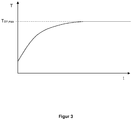
- the time t is plotted on the horizontal axis and the temperature T of the construction platform is plotted on the vertical axis.
- the time t is plotted on the horizontal axis and the temperature T of the surface of the last layer applied is plotted on the vertical axis.
- a method for producing at least one component in 3D printing on a building platform which is provided with a heating device can have the following steps: (1) applying a layer of loose particulate material to the building platform, (2) heating the applied layer of loose Particulate material by means of the heating device of the construction platform, (3) dispensing a liquid treatment agent onto a portion of the heated layer of loose particulate material (according to a section of the component to be manufactured), (4) repeating steps (1) to (3) to achieve the at least to build a component.
- the heating of the building platform with the heating device can be carried out in such a way that a temperature of the building platform T BP rises during the building of the component in the direction of a predetermined maximum building platform temperature T BP, max , whereby a surface temperature of the respectively most recently applied layer T OF is set, for example to a certain value or to a certain temperature range (ie the surface temperature is kept within a certain temperature range).
- the temperature of the building platform T BP can increase linearly (for example at a constant rate of temperature change).
- the temperature of the building platform T BP can rise in steps or in steps, for example.
- the temperature of the building platform T BP can, for example, initially be kept at a first temperature for a first period of time and then kept at a second, elevated temperature for a second period of time, etc.
- the temperature of the building platform T BP can rise in a curve, for example.
- the temperature curve can for example have a temperature gradient, in which the temperature change rate is lower when the Bauthtemperatur T BP of the build platform-maximum temperature T BP, max approaches.
- the building platform temperature can rise linearly for a first period of time at a first rate of temperature change and then rise linearly for a second period of time at a second rate of temperature change.
- the temperature profile can have a temperature curve, in which the temperature change rate is greater when the Bauthtemperatur T BP the building platform-maximum temperature T BP, max approaches.
- the temperature profile of the building platform temperature can, for example, be determined (for example experimentally) before the 3D printing process is carried out and set (using the heating device) in such a way that a surface temperature of the respectively last applied layer T OF is set to a specified value (for example in Essentially constant) temperature value or a corresponding range is set.
- the predetermined temperature value or range can be selected depending on the liquid treatment agent, for example.
- the specified temperature value can be selected, for example, so that a print head of the 3D printer, from which the liquid treatment agent is dispensed, is not damaged or impaired (for example, by sticking the print module openings due to the evaporation of a solvent component).
- the temperature of the building platform T BP can be heated, for example, until the predetermined maximum building platform temperature T BP, max is reached.
- the temperature of the build platform T BP for example, after reaching the predetermined maximum temperature T BP-building platform may, max at the predetermined maximum temperature T BP-building platform, are held max.
- the predetermined maximum building platform temperature can be, for example, in a range of 100-320 ° C, for example 125-250 ° C, for example 150-200 ° C.
- the predetermined maximum building platform temperature can be selected, for example, as a function of the treatment agent and / or the particulate material.
- the surface temperature of the respectively most recently applied layer T OF can, for example, be at a temperature in a range of 30-70 ° C, for example 30-60 ° C, for example 30-50 ° C, for example 30-40 ° C, for example Example 35 ° C., at least as long as the predetermined maximum building platform temperature T BP, max is not reached.
- the surface temperature of the respectively most recently applied layer T OF can for example be set to a (essentially) constant temperature, but it can also move / fluctuate in one of the named or stressed areas.
- the surface temperature of the respectively most recently applied layer T OF can be set, for example, as a function of the treatment agent.
- the setting of the surface temperature of the respectively most recently applied layer T OF via the temperature profile of the heating device can take place, for example, by means of a control in that the heating device is operated in accordance with a temperature profile determined in advance.
- the setting of the surface temperature can take place, for example, by means of a temperature control using a setpoint specification for the surface temperature, for example until the specified maximum building platform temperature T BP, max is reached. Then the temperature profile of the building platform temperature results from the regulation of the surface temperature.
- the surface temperature of the respectively last applied layer T OF can be set to a target value for the surface temperature T OF, should . This can be done, for example, by means of the temperature control.
- the temperature profile of the building platform temperature can be set / controlled in such a way that the surface temperature of the respectively most recently applied layer T OF corresponds (essentially) to the target value for the surface temperature T OF, setpoint.
- the surface temperature of the respectively most recently applied layer T OF can rise up to the target value for the surface temperature T OF, should and then be kept at this target value.
- the surface temperature of the last applied layer T OF may decrease (if the layer application continues), since the The amount of heat given off by the building platform may then be too small to keep the surface temperature of the respectively last applied layer T OF at the target value.
- the surface temperature of the respectively most recently applied layer T OF can be detected, for example, by at least one first temperature sensor.
- the temperature of the building platform T BP can be detected by at least one second temperature sensor, for example. See for example Figure 6 .
- the first temperature sensor can be an infrared sensor, for example.
- the first temperature sensor can, for example, essentially detect the surface temperature of the entire construction field or a mean value or maximum value thereof.
- the first temperature sensor can, for example, detect the surface temperature of a certain section of the construction field, wherein the section comprises, for example, an area of 20% or less (for example 10% or less, for example 5% or less) of the total area of the construction field.
- a plurality of first temperature sensors can also be provided, each of which records a temperature of a predefined sub-area of the construction field surface, it being possible, for example, to use a mean value or maximum value of the recorded temperature values as the surface temperature.
- the second temperature sensor can have at least one PTC resistor, for example.
- a plurality of second temperature sensors can be provided which each detect a temperature of a predetermined position of the building platform, it being possible, for example, to use an average or maximum value of the detected temperature values as the building platform temperature.
- a detected by the first temperature sensor first temperature value T OF can, for example, with the preset value T OF, to be compared (in the case of control).
- a second temperature value T BP detected by the second temperature sensor can be compared, for example, with the predetermined maximum building platform temperature T BP, max .
- the setpoint for the surface temperature T OF, setpoint and the maximum building platform temperature T BP, max can be set or specified as part of a regulation, for example as a function of the binder system and / or particulate material used.
- the temperature of the building platform T BP can then be determined in the method, for example with the second temperature sensor.
- the determined building platform temperature T BP can then be compared with the maximum building platform temperature T BP, max .
- the Baudtemperatur T BP determined is equal to the build platform-maximum temperature T BP, max (or larger)
- the Bauotemperatur T BP in the further course of the process for example, on the building platform-maximum temperature T BP can be kept max.
- the Baudtemperatur T BP determined is greater max as the build platform-maximum temperature T BP
- the Baudtemperatur T BP can be, for example, to the build platform-maximum temperature T BP be max reduced, and then the build platform-maximum temperature T BP are held max.
- max is less than the maximum temperature T BP-building platform
- the surface temperature of the last-applied layer of each T OF can be determined, for example, with the first temperature sensor.
- the determined surface temperature T OF can then be compared with the target value for the surface temperature T OF, should . If the determined surface temperature T OF is less than the setpoint value for the surface temperature T OF, setpoint, the building platform temperature T BP can be increased, for example.
- the building platform temperature T BP can be maintained, for example. If the determined surface temperature T OF is greater than the setpoint value for the surface temperature T OF, setpoint, the building platform temperature T BP can be reduced, for example.
- the construction platform can, for example, be designed to be fluid-impermeable.
- the applied layers of loose particulate material can be heated, for example, in the absence of a fluid flow.
- the heating of the applied layers from loose particulate material can be carried out, for example, in the absence of a heating device provided over the respectively most recently applied layer.
- the heating device (of the building platform) can be, for example, an electrical heating device and can be arranged on and / or in the building platform.
- the liquid treating agent can be, for example, an organic binder, for example a phenol-based binder (for example a phenolic resin) or a furan-based binder (for example a furan resin).
- the liquid treating agent can be, for example, an inorganic binder, for example a water glass-based binder (for example a water glass).
- the building platform temperature can, for example, after completion of the at least one component, be kept at the predefined maximum building platform temperature for a predefined period of time before the component is unpacked. After unpacking, the component can be further hardened if necessary.
- a 3D printer can, for example, have a (for example height-adjustable) construction platform which is provided with a heating device, a coater for applying a layer of loose particulate material to the construction platform, a print head for dispensing a liquid treatment agent onto a portion of a layer that was applied last of loose particulate material, and a control device which is adapted to carry out the method described above.
- a construction platform which is provided with a heating device
- a coater for applying a layer of loose particulate material to the construction platform
- a print head for dispensing a liquid treatment agent onto a portion of a layer that was applied last of loose particulate material
- a control device which is adapted to carry out the method described above.
- the 3D printer can for example have at least one first temperature sensor for detecting a surface temperature of the last applied layer of loose particulate material T OF and / or at least one second temperature sensor for detecting a temperature of the building platform T BP .
- the first and / or second temperature sensor can be designed as described above, for example.
- the construction platform can, for example, be designed to be fluid-impermeable.
- the heating device can for example be arranged on and / or in the construction platform.
Landscapes
- Engineering & Computer Science (AREA)
- Chemical & Material Sciences (AREA)
- Materials Engineering (AREA)
- Manufacturing & Machinery (AREA)
- Mechanical Engineering (AREA)
- Physics & Mathematics (AREA)
- Optics & Photonics (AREA)
- Automation & Control Theory (AREA)
- Analytical Chemistry (AREA)
- Ceramic Engineering (AREA)
- Civil Engineering (AREA)
- Composite Materials (AREA)
- Structural Engineering (AREA)
- Powder Metallurgy (AREA)
- Producing Shaped Articles From Materials (AREA)
Priority Applications (8)
| Application Number | Priority Date | Filing Date | Title |
|---|---|---|---|
| EP19179085.6A EP3747634B1 (fr) | 2019-06-07 | 2019-06-07 | Procédé de fabrication d'au moins un composant par impression 3d et imprimante 3d |
| US17/616,665 US20220314327A1 (en) | 2019-06-07 | 2020-06-04 | Method For Producing At Least One Component In A 3D Printing Method, And 3D Printer |
| CN202080041828.5A CN114007848A (zh) | 2019-06-07 | 2020-06-04 | 通过3d打印制造至少一个部件的方法及3d打印机 |
| EP20733903.7A EP3980245B1 (fr) | 2019-06-07 | 2020-06-04 | Procédé de fabrication d'au moins un composant par impression 3d et imprimante 3d |
| CA3140454A CA3140454A1 (fr) | 2019-06-07 | 2020-06-04 | Procede pour la fabrication d'au moins un composant en impression 3d et imprimante 3d |
| KR1020227000324A KR20220018011A (ko) | 2019-06-07 | 2020-06-04 | 3d 인쇄에 의해 적어도 하나의 구성요소를 제조하는 방법 및 3d 프린터 |
| PCT/EP2020/065536 WO2020245301A1 (fr) | 2019-06-07 | 2020-06-04 | Procédé pour la fabrication d'au moins un composant en impression 3d et imprimante 3d |
| JP2021572521A JP7344320B2 (ja) | 2019-06-07 | 2020-06-04 | 3d印刷による少なくとも1つの部品の製造方法および3dプリンタ |
Applications Claiming Priority (1)
| Application Number | Priority Date | Filing Date | Title |
|---|---|---|---|
| EP19179085.6A EP3747634B1 (fr) | 2019-06-07 | 2019-06-07 | Procédé de fabrication d'au moins un composant par impression 3d et imprimante 3d |
Publications (2)
| Publication Number | Publication Date |
|---|---|
| EP3747634A1 true EP3747634A1 (fr) | 2020-12-09 |
| EP3747634B1 EP3747634B1 (fr) | 2022-05-04 |
Family
ID=66793877
Family Applications (2)
| Application Number | Title | Priority Date | Filing Date |
|---|---|---|---|
| EP19179085.6A Active EP3747634B1 (fr) | 2019-06-07 | 2019-06-07 | Procédé de fabrication d'au moins un composant par impression 3d et imprimante 3d |
| EP20733903.7A Active EP3980245B1 (fr) | 2019-06-07 | 2020-06-04 | Procédé de fabrication d'au moins un composant par impression 3d et imprimante 3d |
Family Applications After (1)
| Application Number | Title | Priority Date | Filing Date |
|---|---|---|---|
| EP20733903.7A Active EP3980245B1 (fr) | 2019-06-07 | 2020-06-04 | Procédé de fabrication d'au moins un composant par impression 3d et imprimante 3d |
Country Status (7)
| Country | Link |
|---|---|
| US (1) | US20220314327A1 (fr) |
| EP (2) | EP3747634B1 (fr) |
| JP (1) | JP7344320B2 (fr) |
| KR (1) | KR20220018011A (fr) |
| CN (1) | CN114007848A (fr) |
| CA (1) | CA3140454A1 (fr) |
| WO (1) | WO2020245301A1 (fr) |
Cited By (1)
| Publication number | Priority date | Publication date | Assignee | Title |
|---|---|---|---|---|
| SE2100060A1 (en) * | 2021-04-22 | 2022-10-23 | Sandvik Machining Solutions Ab | Additive manufacturing device and method for controlling an additive manufacturing device |
Families Citing this family (7)
| Publication number | Priority date | Publication date | Assignee | Title |
|---|---|---|---|---|
| US12441052B2 (en) * | 2013-10-17 | 2025-10-14 | Xjet Ltd. | 3D particle printing |
| DE102020101783A1 (de) | 2020-01-24 | 2021-07-29 | Additive elements GmbH | Verfahren zum Herstellen eines dreidimensionalen Formteils |
| US12285798B2 (en) | 2020-06-01 | 2025-04-29 | LightSpeed Concepts Inc. | Tool-less method for making molds, cores, and temporary tools |
| JP2023537872A (ja) * | 2020-08-14 | 2023-09-06 | マントル インク | 付加及び除去製造時の乾燥 |
| CN114770932A (zh) * | 2022-03-30 | 2022-07-22 | 共享智能装备有限公司 | 用于3d打印产品的高效固化方法 |
| EP4554748A1 (fr) * | 2022-07-15 | 2025-05-21 | Erico International Corporation | Système de soudage exothermique |
| DE102022132201B4 (de) | 2022-12-05 | 2026-03-19 | Bach Resistor Ceramics GmbH | Bauplatte mit Hochtemperaturheizung für die additive Fertigung von insbesondere metallischen und keramischen Baukörpern |
Citations (4)
| Publication number | Priority date | Publication date | Assignee | Title |
|---|---|---|---|---|
| DE102011053205A1 (de) * | 2011-09-01 | 2013-03-07 | Prometal Rct Gmbh | Verfahren zum herstellen eines bauteils in ablagerungstechnik |
| DE102015006363A1 (de) * | 2015-05-20 | 2016-12-15 | Voxeljet Ag | Phenolharzverfahren |
| WO2017196328A1 (fr) * | 2016-05-12 | 2017-11-16 | Hewlett-Packard Development Company, L.P. | Impression en trois dimensions (3d) |
| DE102017006860A1 (de) * | 2017-07-21 | 2019-01-24 | Voxeljet Ag | Verfahren und Vorrichtung zum Herstellen von 3D-Formteilen mit Spektrumswandler |
Family Cites Families (11)
| Publication number | Priority date | Publication date | Assignee | Title |
|---|---|---|---|---|
| DE102011105688A1 (de) | 2011-06-22 | 2012-12-27 | Hüttenes-Albertus Chemische Werke GmbH | Verfahren zum schichtweisen Aufbau von Modellen |
| US10544311B2 (en) * | 2014-01-16 | 2020-01-28 | Hewlett-Packard Development Company, L.P. | Polymeric powder composition for three-dimensional (3D) printing |
| JP6470542B2 (ja) | 2014-10-23 | 2019-02-13 | 旭有機材株式会社 | 積層鋳型の造型方法 |
| DE102014118577A1 (de) * | 2014-12-12 | 2016-06-16 | Ask Chemicals Gmbh | Verfahren zum schichtweisen Aufbau von Formen und Kernen mit einem wasserglashaltigen Bindemittel und ein wasserglashaltiges Bindemittel |
| EP3199268A1 (fr) * | 2016-01-28 | 2017-08-02 | Siemens Aktiengesellschaft | Procede de fabrication generative de composants a l'aide d'une plateforme de construction pouvant etre chauffee et installation pour ledit procede |
| WO2018017072A1 (fr) * | 2016-07-20 | 2018-01-25 | Hewlett-Packard Development Company, L.P. | Ensembles de matériaux |
| WO2018109735A2 (fr) | 2016-12-18 | 2018-06-21 | Csir | Préchauffage de matériau dans un appareil de fabrication additive |
| JP6841695B2 (ja) | 2017-03-15 | 2021-03-10 | 旭有機材株式会社 | 積層鋳型の改良された製造方法 |
| WO2018215113A1 (fr) | 2017-05-23 | 2018-11-29 | Exone Gmbh | Procédé de retraitement destiné à l'augmentation de la résistance à chaud d'une pièce moulée réalisée avec un matériau pulvérulent et un liant, un ensemble d'impression 3d et une pièce moulée |
| US10710307B2 (en) | 2017-08-11 | 2020-07-14 | Applied Materials, Inc. | Temperature control for additive manufacturing |
| US12103229B2 (en) * | 2019-03-15 | 2024-10-01 | Ricoh Company, Ltd. | Jettable temporary binders to create removable support materials |
-
2019
- 2019-06-07 EP EP19179085.6A patent/EP3747634B1/fr active Active
-
2020
- 2020-06-04 CA CA3140454A patent/CA3140454A1/fr active Pending
- 2020-06-04 CN CN202080041828.5A patent/CN114007848A/zh active Pending
- 2020-06-04 WO PCT/EP2020/065536 patent/WO2020245301A1/fr not_active Ceased
- 2020-06-04 EP EP20733903.7A patent/EP3980245B1/fr active Active
- 2020-06-04 US US17/616,665 patent/US20220314327A1/en not_active Abandoned
- 2020-06-04 KR KR1020227000324A patent/KR20220018011A/ko not_active Ceased
- 2020-06-04 JP JP2021572521A patent/JP7344320B2/ja active Active
Patent Citations (4)
| Publication number | Priority date | Publication date | Assignee | Title |
|---|---|---|---|---|
| DE102011053205A1 (de) * | 2011-09-01 | 2013-03-07 | Prometal Rct Gmbh | Verfahren zum herstellen eines bauteils in ablagerungstechnik |
| DE102015006363A1 (de) * | 2015-05-20 | 2016-12-15 | Voxeljet Ag | Phenolharzverfahren |
| WO2017196328A1 (fr) * | 2016-05-12 | 2017-11-16 | Hewlett-Packard Development Company, L.P. | Impression en trois dimensions (3d) |
| DE102017006860A1 (de) * | 2017-07-21 | 2019-01-24 | Voxeljet Ag | Verfahren und Vorrichtung zum Herstellen von 3D-Formteilen mit Spektrumswandler |
Cited By (2)
| Publication number | Priority date | Publication date | Assignee | Title |
|---|---|---|---|---|
| SE2100060A1 (en) * | 2021-04-22 | 2022-10-23 | Sandvik Machining Solutions Ab | Additive manufacturing device and method for controlling an additive manufacturing device |
| SE545644C2 (en) * | 2021-04-22 | 2023-11-21 | Sandvik Machining Solutions Ab | Additive manufacturing device and method for controlling an additive manufacturing device |
Also Published As
| Publication number | Publication date |
|---|---|
| WO2020245301A1 (fr) | 2020-12-10 |
| CA3140454A1 (fr) | 2020-12-10 |
| EP3747634B1 (fr) | 2022-05-04 |
| CN114007848A (zh) | 2022-02-01 |
| EP3980245B1 (fr) | 2023-04-26 |
| KR20220018011A (ko) | 2022-02-14 |
| JP7344320B2 (ja) | 2023-09-13 |
| JP2022535913A (ja) | 2022-08-10 |
| EP3980245A1 (fr) | 2022-04-13 |
| US20220314327A1 (en) | 2022-10-06 |
Similar Documents
| Publication | Publication Date | Title |
|---|---|---|
| EP3980245B1 (fr) | Procédé de fabrication d'au moins un composant par impression 3d et imprimante 3d | |
| EP2864108B1 (fr) | Dispositif et procédé de fabrication par couches d'un objet tridimensionnel | |
| EP2714354B1 (fr) | Procédé pour produire un corps moulé et dispositif correspondant | |
| EP3285988B1 (fr) | Procédé et dispositif de fabrication d'un objet tridimensionnel | |
| DE102014201818A1 (de) | Verfahren und Vorrichtung zur verbesserten Steuerung des Energieeintrags in einem generativen Schichtbauverfahren | |
| EP3053675B1 (fr) | Unite d'application de poudre, dispositif correspondant et utilisation d'une unite d'application de poudre | |
| EP3275654A1 (fr) | Unité de revêtement, procédé de revêtement, dispositif et procédé et dispositif de fabrication additive d'un objet tridimensionnel | |
| WO2019063094A1 (fr) | Pièces façonnées imprimées en 3d à partir de plus d'un matériau silicone | |
| EP3277482B1 (fr) | Procédé et dispositif de fabrication additive d'un corps | |
| WO2017063886A1 (fr) | Dispositif et procédé de fabrication d'un objet en trois dimensions | |
| WO2017093136A1 (fr) | Procédé et dispositif de détermination des besoins en matière de construction | |
| DE102017202101A1 (de) | System und verfahren zum bauen gedruckter 3d-objekte mit verschiedenen materialien mit verschiedenen eigenschaften | |
| WO2016154644A1 (fr) | Procédé et dispositif de fabrication additive d'un corps | |
| DE3012988A1 (de) | Vorrichtung und verfahren zur herstellung eines druckplattenrohlings | |
| EP4100235A1 (fr) | Procédé de fabrication additive d'un composant au moyen d'au moins une chambre de volume qui est remplie d'une matière de remplissage | |
| EP4048467A1 (fr) | Système et procédé de génération d'une couche d'un matériau de construction particulaire dans une imprimante 3d | |
| EP3854570B1 (fr) | Procédé de fabrication d'une pièce moulée tridimensionnelle | |
| EP3560713A1 (fr) | Procédé de montage des composants en matière plastique | |
| DE102017205903B4 (de) | Verfahren und Vorrichtung zur Herstellung eines Bauteils aus mindestens zwei unterschiedlichen Materialien durch Drucken im Pulverbettverfahren | |
| EP4188680A1 (fr) | Procédé de production d'un article façonné en 3d et dispositif utilisant un plateau perforé | |
| DE102020120319A1 (de) | Verfahren und Vorrichtung zur additiven Herstellung eines Werkstücks | |
| WO2024251319A1 (fr) | Ensemble et procédé de production d'une structure 3d dans une imprimante 3d | |
| DE102021004139A1 (de) | Verfahren zur Beeinflussung von Bauteilen oder Baugruppen in einem 3D-Drucker | |
| DE102020003536A1 (de) | Verfahren zum Erzeugen einer 3D-Struktur | |
| DE102015122005A1 (de) | Vorrichtung und Verfahren zum schichtweisen Aufbau einer dreidimensionalen Struktur |
Legal Events
| Date | Code | Title | Description |
|---|---|---|---|
| STAA | Information on the status of an ep patent application or granted ep patent |
Free format text: STATUS: EXAMINATION IS IN PROGRESS |
|
| PUAI | Public reference made under article 153(3) epc to a published international application that has entered the european phase |
Free format text: ORIGINAL CODE: 0009012 |
|
| 17P | Request for examination filed |
Effective date: 20200316 |
|
| AK | Designated contracting states |
Kind code of ref document: A1 Designated state(s): AL AT BE BG CH CY CZ DE DK EE ES FI FR GB GR HR HU IE IS IT LI LT LU LV MC MK MT NL NO PL PT RO RS SE SI SK SM TR |
|
| AX | Request for extension of the european patent |
Extension state: BA ME |
|
| REG | Reference to a national code |
Ref country code: DE Ref legal event code: R079 Ref document number: 502019004246 Country of ref document: DE Free format text: PREVIOUS MAIN CLASS: B29C0064165000 Ipc: B29C0064295000 |
|
| GRAP | Despatch of communication of intention to grant a patent |
Free format text: ORIGINAL CODE: EPIDOSNIGR1 |
|
| STAA | Information on the status of an ep patent application or granted ep patent |
Free format text: STATUS: GRANT OF PATENT IS INTENDED |
|
| RIC1 | Information provided on ipc code assigned before grant |
Ipc: B22F 5/00 20060101ALI20211025BHEP Ipc: B29C 64/245 20170101ALI20211025BHEP Ipc: B29C 64/194 20170101ALI20211025BHEP Ipc: B29C 64/165 20170101ALI20211025BHEP Ipc: B22F 10/10 20210101ALI20211025BHEP Ipc: B22F 10/00 20210101ALI20211025BHEP Ipc: B29C 64/393 20170101ALI20211025BHEP Ipc: B33Y 10/00 20150101ALI20211025BHEP Ipc: B33Y 30/00 20150101ALI20211025BHEP Ipc: B33Y 40/00 20200101ALI20211025BHEP Ipc: B33Y 50/02 20150101ALI20211025BHEP Ipc: B29C 64/295 20170101AFI20211025BHEP |
|
| INTG | Intention to grant announced |
Effective date: 20211124 |
|
| GRAS | Grant fee paid |
Free format text: ORIGINAL CODE: EPIDOSNIGR3 |
|
| GRAA | (expected) grant |
Free format text: ORIGINAL CODE: 0009210 |
|
| STAA | Information on the status of an ep patent application or granted ep patent |
Free format text: STATUS: THE PATENT HAS BEEN GRANTED |
|
| AK | Designated contracting states |
Kind code of ref document: B1 Designated state(s): AL AT BE BG CH CY CZ DE DK EE ES FI FR GB GR HR HU IE IS IT LI LT LU LV MC MK MT NL NO PL PT RO RS SE SI SK SM TR |
|
| REG | Reference to a national code |
Ref country code: GB Ref legal event code: FG4D Free format text: NOT ENGLISH |
|
| REG | Reference to a national code |
Ref country code: CH Ref legal event code: EP |
|
| REG | Reference to a national code |
Ref country code: AT Ref legal event code: REF Ref document number: 1488576 Country of ref document: AT Kind code of ref document: T Effective date: 20220515 |
|
| REG | Reference to a national code |
Ref country code: DE Ref legal event code: R096 Ref document number: 502019004246 Country of ref document: DE |
|
| REG | Reference to a national code |
Ref country code: IE Ref legal event code: FG4D Free format text: LANGUAGE OF EP DOCUMENT: GERMAN |
|
| REG | Reference to a national code |
Ref country code: NL Ref legal event code: FP |
|
| REG | Reference to a national code |
Ref country code: LT Ref legal event code: MG9D |
|
| PG25 | Lapsed in a contracting state [announced via postgrant information from national office to epo] |
Ref country code: SE Free format text: LAPSE BECAUSE OF FAILURE TO SUBMIT A TRANSLATION OF THE DESCRIPTION OR TO PAY THE FEE WITHIN THE PRESCRIBED TIME-LIMIT Effective date: 20220504 Ref country code: PT Free format text: LAPSE BECAUSE OF FAILURE TO SUBMIT A TRANSLATION OF THE DESCRIPTION OR TO PAY THE FEE WITHIN THE PRESCRIBED TIME-LIMIT Effective date: 20220905 Ref country code: NO Free format text: LAPSE BECAUSE OF FAILURE TO SUBMIT A TRANSLATION OF THE DESCRIPTION OR TO PAY THE FEE WITHIN THE PRESCRIBED TIME-LIMIT Effective date: 20220804 Ref country code: LT Free format text: LAPSE BECAUSE OF FAILURE TO SUBMIT A TRANSLATION OF THE DESCRIPTION OR TO PAY THE FEE WITHIN THE PRESCRIBED TIME-LIMIT Effective date: 20220504 Ref country code: HR Free format text: LAPSE BECAUSE OF FAILURE TO SUBMIT A TRANSLATION OF THE DESCRIPTION OR TO PAY THE FEE WITHIN THE PRESCRIBED TIME-LIMIT Effective date: 20220504 Ref country code: GR Free format text: LAPSE BECAUSE OF FAILURE TO SUBMIT A TRANSLATION OF THE DESCRIPTION OR TO PAY THE FEE WITHIN THE PRESCRIBED TIME-LIMIT Effective date: 20220805 Ref country code: FI Free format text: LAPSE BECAUSE OF FAILURE TO SUBMIT A TRANSLATION OF THE DESCRIPTION OR TO PAY THE FEE WITHIN THE PRESCRIBED TIME-LIMIT Effective date: 20220504 Ref country code: BG Free format text: LAPSE BECAUSE OF FAILURE TO SUBMIT A TRANSLATION OF THE DESCRIPTION OR TO PAY THE FEE WITHIN THE PRESCRIBED TIME-LIMIT Effective date: 20220804 |
|
| PG25 | Lapsed in a contracting state [announced via postgrant information from national office to epo] |
Ref country code: RS Free format text: LAPSE BECAUSE OF FAILURE TO SUBMIT A TRANSLATION OF THE DESCRIPTION OR TO PAY THE FEE WITHIN THE PRESCRIBED TIME-LIMIT Effective date: 20220504 Ref country code: PL Free format text: LAPSE BECAUSE OF FAILURE TO SUBMIT A TRANSLATION OF THE DESCRIPTION OR TO PAY THE FEE WITHIN THE PRESCRIBED TIME-LIMIT Effective date: 20220504 Ref country code: LV Free format text: LAPSE BECAUSE OF FAILURE TO SUBMIT A TRANSLATION OF THE DESCRIPTION OR TO PAY THE FEE WITHIN THE PRESCRIBED TIME-LIMIT Effective date: 20220504 Ref country code: IS Free format text: LAPSE BECAUSE OF FAILURE TO SUBMIT A TRANSLATION OF THE DESCRIPTION OR TO PAY THE FEE WITHIN THE PRESCRIBED TIME-LIMIT Effective date: 20220904 |
|
| PG25 | Lapsed in a contracting state [announced via postgrant information from national office to epo] |
Ref country code: SM Free format text: LAPSE BECAUSE OF FAILURE TO SUBMIT A TRANSLATION OF THE DESCRIPTION OR TO PAY THE FEE WITHIN THE PRESCRIBED TIME-LIMIT Effective date: 20220504 Ref country code: SK Free format text: LAPSE BECAUSE OF FAILURE TO SUBMIT A TRANSLATION OF THE DESCRIPTION OR TO PAY THE FEE WITHIN THE PRESCRIBED TIME-LIMIT Effective date: 20220504 Ref country code: RO Free format text: LAPSE BECAUSE OF FAILURE TO SUBMIT A TRANSLATION OF THE DESCRIPTION OR TO PAY THE FEE WITHIN THE PRESCRIBED TIME-LIMIT Effective date: 20220504 Ref country code: ES Free format text: LAPSE BECAUSE OF FAILURE TO SUBMIT A TRANSLATION OF THE DESCRIPTION OR TO PAY THE FEE WITHIN THE PRESCRIBED TIME-LIMIT Effective date: 20220504 Ref country code: EE Free format text: LAPSE BECAUSE OF FAILURE TO SUBMIT A TRANSLATION OF THE DESCRIPTION OR TO PAY THE FEE WITHIN THE PRESCRIBED TIME-LIMIT Effective date: 20220504 Ref country code: DK Free format text: LAPSE BECAUSE OF FAILURE TO SUBMIT A TRANSLATION OF THE DESCRIPTION OR TO PAY THE FEE WITHIN THE PRESCRIBED TIME-LIMIT Effective date: 20220504 Ref country code: CZ Free format text: LAPSE BECAUSE OF FAILURE TO SUBMIT A TRANSLATION OF THE DESCRIPTION OR TO PAY THE FEE WITHIN THE PRESCRIBED TIME-LIMIT Effective date: 20220504 |
|
| REG | Reference to a national code |
Ref country code: CH Ref legal event code: PL |
|
| REG | Reference to a national code |
Ref country code: DE Ref legal event code: R097 Ref document number: 502019004246 Country of ref document: DE |
|
| REG | Reference to a national code |
Ref country code: BE Ref legal event code: MM Effective date: 20220630 |
|
| PG25 | Lapsed in a contracting state [announced via postgrant information from national office to epo] |
Ref country code: MC Free format text: LAPSE BECAUSE OF FAILURE TO SUBMIT A TRANSLATION OF THE DESCRIPTION OR TO PAY THE FEE WITHIN THE PRESCRIBED TIME-LIMIT Effective date: 20220504 |
|
| PLBE | No opposition filed within time limit |
Free format text: ORIGINAL CODE: 0009261 |
|
| STAA | Information on the status of an ep patent application or granted ep patent |
Free format text: STATUS: NO OPPOSITION FILED WITHIN TIME LIMIT |
|
| PG25 | Lapsed in a contracting state [announced via postgrant information from national office to epo] |
Ref country code: AL Free format text: LAPSE BECAUSE OF FAILURE TO SUBMIT A TRANSLATION OF THE DESCRIPTION OR TO PAY THE FEE WITHIN THE PRESCRIBED TIME-LIMIT Effective date: 20220504 |
|
| 26N | No opposition filed |
Effective date: 20230207 |
|
| PG25 | Lapsed in a contracting state [announced via postgrant information from national office to epo] |
Ref country code: LU Free format text: LAPSE BECAUSE OF NON-PAYMENT OF DUE FEES Effective date: 20220607 Ref country code: LI Free format text: LAPSE BECAUSE OF NON-PAYMENT OF DUE FEES Effective date: 20220630 Ref country code: IE Free format text: LAPSE BECAUSE OF NON-PAYMENT OF DUE FEES Effective date: 20220607 Ref country code: CH Free format text: LAPSE BECAUSE OF NON-PAYMENT OF DUE FEES Effective date: 20220630 |
|
| PG25 | Lapsed in a contracting state [announced via postgrant information from national office to epo] |
Ref country code: SI Free format text: LAPSE BECAUSE OF FAILURE TO SUBMIT A TRANSLATION OF THE DESCRIPTION OR TO PAY THE FEE WITHIN THE PRESCRIBED TIME-LIMIT Effective date: 20220504 Ref country code: BE Free format text: LAPSE BECAUSE OF NON-PAYMENT OF DUE FEES Effective date: 20220630 |
|
| P01 | Opt-out of the competence of the unified patent court (upc) registered |
Effective date: 20230523 |
|
| PGFP | Annual fee paid to national office [announced via postgrant information from national office to epo] |
Ref country code: TR Payment date: 20230606 Year of fee payment: 5 |
|
| PG25 | Lapsed in a contracting state [announced via postgrant information from national office to epo] |
Ref country code: IT Free format text: LAPSE BECAUSE OF FAILURE TO SUBMIT A TRANSLATION OF THE DESCRIPTION OR TO PAY THE FEE WITHIN THE PRESCRIBED TIME-LIMIT Effective date: 20220504 |
|
| PG25 | Lapsed in a contracting state [announced via postgrant information from national office to epo] |
Ref country code: MK Free format text: LAPSE BECAUSE OF FAILURE TO SUBMIT A TRANSLATION OF THE DESCRIPTION OR TO PAY THE FEE WITHIN THE PRESCRIBED TIME-LIMIT Effective date: 20220504 Ref country code: CY Free format text: LAPSE BECAUSE OF FAILURE TO SUBMIT A TRANSLATION OF THE DESCRIPTION OR TO PAY THE FEE WITHIN THE PRESCRIBED TIME-LIMIT Effective date: 20220504 |
|
| PG25 | Lapsed in a contracting state [announced via postgrant information from national office to epo] |
Ref country code: HU Free format text: LAPSE BECAUSE OF FAILURE TO SUBMIT A TRANSLATION OF THE DESCRIPTION OR TO PAY THE FEE WITHIN THE PRESCRIBED TIME-LIMIT; INVALID AB INITIO Effective date: 20190607 |
|
| PG25 | Lapsed in a contracting state [announced via postgrant information from national office to epo] |
Ref country code: MT Free format text: LAPSE BECAUSE OF FAILURE TO SUBMIT A TRANSLATION OF THE DESCRIPTION OR TO PAY THE FEE WITHIN THE PRESCRIBED TIME-LIMIT Effective date: 20220504 |
|
| PG25 | Lapsed in a contracting state [announced via postgrant information from national office to epo] |
Ref country code: BG Free format text: LAPSE BECAUSE OF FAILURE TO SUBMIT A TRANSLATION OF THE DESCRIPTION OR TO PAY THE FEE WITHIN THE PRESCRIBED TIME-LIMIT Effective date: 20220504 |
|
| PG25 | Lapsed in a contracting state [announced via postgrant information from national office to epo] |
Ref country code: BG Free format text: LAPSE BECAUSE OF FAILURE TO SUBMIT A TRANSLATION OF THE DESCRIPTION OR TO PAY THE FEE WITHIN THE PRESCRIBED TIME-LIMIT Effective date: 20220504 |
|
| PGFP | Annual fee paid to national office [announced via postgrant information from national office to epo] |
Ref country code: DE Payment date: 20250618 Year of fee payment: 7 |
|
| PGFP | Annual fee paid to national office [announced via postgrant information from national office to epo] |
Ref country code: GB Payment date: 20250618 Year of fee payment: 7 |
|
| PGFP | Annual fee paid to national office [announced via postgrant information from national office to epo] |
Ref country code: NL Payment date: 20250618 Year of fee payment: 7 |
|
| PGFP | Annual fee paid to national office [announced via postgrant information from national office to epo] |
Ref country code: FR Payment date: 20250626 Year of fee payment: 7 |
|
| PGFP | Annual fee paid to national office [announced via postgrant information from national office to epo] |
Ref country code: AT Payment date: 20250620 Year of fee payment: 7 |