EP3748257A1 - Dispositif pour la performance sûre d'un procédé circulaire thermodynamique à rotation à gauche au moyen d'un fluide de travail inflammable avec adsorption de fluide - Google Patents
Dispositif pour la performance sûre d'un procédé circulaire thermodynamique à rotation à gauche au moyen d'un fluide de travail inflammable avec adsorption de fluide Download PDFInfo
- Publication number
- EP3748257A1 EP3748257A1 EP20171754.3A EP20171754A EP3748257A1 EP 3748257 A1 EP3748257 A1 EP 3748257A1 EP 20171754 A EP20171754 A EP 20171754A EP 3748257 A1 EP3748257 A1 EP 3748257A1
- Authority
- EP
- European Patent Office
- Prior art keywords
- working fluid
- housing part
- gas
- closed
- inner housing
- Prior art date
- Legal status (The legal status is an assumption and is not a legal conclusion. Google has not performed a legal analysis and makes no representation as to the accuracy of the status listed.)
- Granted
Links
Images

Classifications
-
- F—MECHANICAL ENGINEERING; LIGHTING; HEATING; WEAPONS; BLASTING
- F25—REFRIGERATION OR COOLING; COMBINED HEATING AND REFRIGERATION SYSTEMS; HEAT PUMP SYSTEMS; MANUFACTURE OR STORAGE OF ICE; LIQUEFACTION SOLIDIFICATION OF GASES
- F25B—REFRIGERATION MACHINES, PLANTS OR SYSTEMS; COMBINED HEATING AND REFRIGERATION SYSTEMS; HEAT PUMP SYSTEMS
- F25B25/00—Machines, plants or systems, using a combination of modes of operation covered by two or more of the groups F25B1/00 - F25B23/00
- F25B25/005—Machines, plants or systems, using a combination of modes of operation covered by two or more of the groups F25B1/00 - F25B23/00 using primary and secondary systems
-
- F—MECHANICAL ENGINEERING; LIGHTING; HEATING; WEAPONS; BLASTING
- F25—REFRIGERATION OR COOLING; COMBINED HEATING AND REFRIGERATION SYSTEMS; HEAT PUMP SYSTEMS; MANUFACTURE OR STORAGE OF ICE; LIQUEFACTION SOLIDIFICATION OF GASES
- F25B—REFRIGERATION MACHINES, PLANTS OR SYSTEMS; COMBINED HEATING AND REFRIGERATION SYSTEMS; HEAT PUMP SYSTEMS
- F25B2339/00—Details of evaporators; Details of condensers
- F25B2339/04—Details of condensers
- F25B2339/047—Water-cooled condensers
-
- F—MECHANICAL ENGINEERING; LIGHTING; HEATING; WEAPONS; BLASTING
- F25—REFRIGERATION OR COOLING; COMBINED HEATING AND REFRIGERATION SYSTEMS; HEAT PUMP SYSTEMS; MANUFACTURE OR STORAGE OF ICE; LIQUEFACTION SOLIDIFICATION OF GASES
- F25B—REFRIGERATION MACHINES, PLANTS OR SYSTEMS; COMBINED HEATING AND REFRIGERATION SYSTEMS; HEAT PUMP SYSTEMS
- F25B2400/00—Component parts or details not otherwise provided for in this subclass
- F25B2400/12—Inflammable refrigerants
-
- F—MECHANICAL ENGINEERING; LIGHTING; HEATING; WEAPONS; BLASTING
- F25—REFRIGERATION OR COOLING; COMBINED HEATING AND REFRIGERATION SYSTEMS; HEAT PUMP SYSTEMS; MANUFACTURE OR STORAGE OF ICE; LIQUEFACTION SOLIDIFICATION OF GASES
- F25B—REFRIGERATION MACHINES, PLANTS OR SYSTEMS; COMBINED HEATING AND REFRIGERATION SYSTEMS; HEAT PUMP SYSTEMS
- F25B2500/00—Problems to be solved
- F25B2500/22—Preventing, detecting or repairing leaks of refrigeration fluids
Definitions
- the invention relates to irregular states in refrigeration circuits in which a working fluid acting as a refrigerant is conducted in a thermodynamic cycle, such as the Rankine cycle, for example.
- thermodynamic cycle such as the Rankine cycle
- These are mainly heat pumps, air conditioning systems and cooling devices, as are common in residential buildings.
- Residential buildings are understood to mean private houses, apartment complexes, hospitals, hotel facilities, restaurants and combined residential and commercial buildings in which people live and work permanently, in contrast to mobile devices such as car air conditioning systems or transport boxes, or industrial systems or medical devices. What these cycle processes have in common is that they generate useful heat or useful cooling using energy and form heat displacement systems.
- thermodynamic cycle processes used have been known for a long time, as have the safety problems that can arise when using suitable working fluids. Apart from water, the most popular working fluids of the time are flammable and poisonous. In the past century, they led to the development of safety refrigerants, which consisted of fluorinated hydrocarbons. It turned out, however, that these safety refrigerants damage the ozone layer, lead to global warming, and that their safety-related harmlessness led to constructive inattention. Up to 70% of the turnover was accounted for by the need to refill leaky systems and their leakage losses, which was accepted as long as this was perceived as economically justifiable in individual cases and encouraged the need for replacement.
- the problems that arise in the safety design of such systems are in the WO 2015/032905 A1 clearly described.
- the lower ignition limit of propane as a working fluid is around 1.7 percent by volume in air, which corresponds to 38 g / m 3 in air. If the refrigeration process is carried out in a hermetically sealed, but otherwise air-filled space with the working fluid propane, the problem arises of recognizing a critical, explosive situation after a fault in which the working fluid escapes into this hermetically sealed space.
- Electrical sensors for detecting critical concentrations are difficult to design with explosion protection, which is why the propane detection by the sensors themselves increases the risk of explosion considerably, with the exception of infrared sensors.
- Propane is also poisonous; inhalation above a concentration of approx. 2 g / m 3 results in narcotic effects, headaches and nausea. This affects people who are supposed to solve a recognized problem on site before there is a risk of explosion.
- Propane is also heavier than air, so it sinks to the floor in still air and collects there, although it mixes in the room air after a certain time, which also depends on the leakage rate and room height. So if some of the propane collects under very unfavorable conditions in a low-flow zone of the closed space in which the disturbed unit is located, the local explosion limits can be reached much faster than the quotient of the total volume of the space to the amount of propane that has escaped suggests.
- the WO 2015/032905 A1 seeks to solve this problem by integrating a generator for electrical current into the opening or locking of this room and, when activated, in a first step generates and provides the electrical energy with which the sensor is activated, and in the event of an alarm the The lock then does not release, but causes ventilation of the locked room, and only allows unlocking and opening in a second step.
- the DE-PS 553 295 describes an encapsulated compression refrigeration machine in which the refrigerant compressor 1, its drive motor 2, evaporator 3, condenser 4 and control valve 5 are enclosed in a double-walled capsule 6 and 7, respectively.
- a negative pressure is created in the space between the double-walled capsule and leaks that could occur at the openings for cooling water and brine are sucked out.
- the extracted working fluid can then be recovered if necessary. It should be noted here that there is no ambient air inside the encapsulated space and, due to the negative pressure in the double jacket, it cannot penetrate into the encapsulated interior.
- the DE 10 2011 116 863 A1 describes a method for securing a device for a thermodynamic cycle that is operated with a process fluid, that contains or consists of at least one environmentally hazardous, toxic and / or flammable substance.
- a process fluid that contains or consists of at least one environmentally hazardous, toxic and / or flammable substance.
- an adsorbent is brought into contact with the process fluid, in particular ammonia, propane or propene, and the substance is selectively bound by the adsorbent.
- the adsorbent is regenerated after use.
- Zeolite also in combination with imidazole or phosphates, and also CuBTC are proposed as adsorbents; the adsorbent can be in the form of a bed, a molded body, a paint, a spray film or a coating.
- the support structure of the molded body can consist of a microstructure, lamellar structure, tube bundle, tube register and sheet metal and must be mechanically stable and greatly increase the surface area.
- the potentially contaminated air is usually circulated continuously, but it can also be initiated by a sensor that switches on the ventilation when a threshold value is reached or when an accident is detected.
- the adsorption can be carried out inside or outside a closed space.
- the DE 195 25 064 C1 describes a refrigeration machine with a gas-tight housing which accommodates all refrigerant-carrying components of the machine, a space connecting the interior of the gas-tight housing with an outlet is provided, and the space is filled with a substance that sorbs the refrigerant.
- the amount of sorbent material is dimensioned in such a way that the entire amount of any refrigerant that may escape can be absorbed and kept away from the environment.
- the space filled with the sorbent material is open to the surroundings. With refrigerants that are heavier than air, the room is open at the bottom, with those that are lighter, it is open at the top, so that a conveying fan is not required.
- the sorbent is introduced into the housing and completely encloses the refrigeration machine or the refrigerant-carrying devices. On its way to the outside, baffles are provided which prevent short-circuit currents and force escaping gas through the sorbent. Also one double-walled embodiment in which the sorbent is arranged in the double jacket is possible.
- a measuring device for refrigerant can be provided at the exit of the space filled with the sorbent substance to the environment.
- the EP 3 106 780 A1 describes a heat pump system which is housed in an airtight housing lined with a binder.
- An adsorption unit with forced ventilation can be arranged inside this housing, which cleans the air in the housing in recirculation mode.
- This recirculation mode can be carried out continuously or only in the event of a fault or at regular intervals.
- a pilot burner, a pilot flame, a catalytic burner or a heating wire can also be arranged, which burns any remaining combustible impurities.
- a fresh air supply in connection with the discharge of purified exhaust air is also conceivable.
- a binding agent be it an adsorbent or a chemical binding agent
- a binding agent should be able to absorb all of the working fluid even at low partial pressures. This is best done with a slow flow through a finely divided medium.
- a large amount of working fluid is released under high pressure in a very short time, which suddenly pressurizes the mostly pressure-tight housing. Tests showed peak pressure values of up to 25 hPa, which would lead to deformations of typical designs and subsequent leakage of working fluid.
- the object of the invention is therefore to provide an improved device which better solves the problems presented, including the conflict of objectives, and no longer has the disadvantages.
- a Clausius-Rankine process which is operated with R290, is used as the counterclockwise circular process.
- the adsorbent activated carbon is preferably used as the binding agent.
- Heat transfer fluids are to be understood here as all gaseous or liquid media with which heat is transferred, for example air, water, brine, heat transfer oils or the like.
- the nesting of the two housing parts can be done in different ways.
- the outer housing part can be placed from above onto the lower, inner housing part, the underside of the outer housing part being completely open.
- the aggregates of the cycle are then all arranged in the inner housing part and the connections are made underneath and do not pierce the outer housing part.
- the outer housing part can also be arranged at the bottom and form a type of trough for the inner housing part, the inner housing part being placed on from above.
- the aggregates of the cycle are then all arranged in the outer housing part, the connections are made underneath and do not pierce the inner housing part.
- the outer housing part can also be pushed laterally over the inner housing part.
- one housing part is always fixed and the other is movable along an axis, this movement being guided by suitable bearings in order to prevent tilting. If an overpressure event now occurs, the overpressure causes the movable housing part to move as a result of this pressure and to clear the path to the space between the two housing parts.
- An adsorbent is arranged in this intermediate space, which is preferably a bed with low flow resistance.
- the movement of the movable housing part opens the way for the outflowing gas, but this does not mean that the housing must first be gas-tight got to.
- So sieves can be used to support the movable housing part, which bring about a pressure equilibrium with the environment, and diffusion can also take place.
- ventilation is mainly provided by the sorption bed.
- rounded channels and flow straighteners are preferably provided so that a homogeneous gas flow is created.
- a limit stop is preferably provided in order to limit the movement of the movable housing part.
- the movable housing part is mounted on a molded body or a bed of adsorbent which, in the event of small leakages, causes the working fluid that has leaked to be bound without the gas path being released into the space. This results in a different treatment of occasional small and very rare large leakage events.
- the space between the two housing parts is provided on 4 sides. In this way, a high flow cross-section can be achieved with a great smoothing effect. This results in a circumferential interspace, the opposing surfaces of the two housing parts, however, neither needing to be parallel to one another nor even, but can also have structures.
- the pressure at which the gas path is to open into the space can be defined by the weight of the moving housing part. If this does not fit, however, springs can compensate for the necessary difference.
- elements such as retaining sieves, bases and assembly aids or the like can also be used in the usual way and the two housing parts themselves can also have covers, removable side parts, service openings, safety valves and the like for assembly purposes.
- Fig. 1a shows a first embodiment variant in the closed state using a schematic diagram of a refrigeration circuit 1 with a compressor 2, a condenser 3, a pressure reduction 4 and an evaporator 5 in a closed housing, which is formed from an inner housing part 6 and an outer housing part 11.
- the inner housing part 6 is open at the bottom and closed at the top, while the outer housing part 11 is open at the top and closed at the bottom.
- the inner housing part 6 rests in a trough-like manner in the outer housing part 11.
- the housing has a heat source connection 7, a heat source flow 8, a heat sink flow 9 and a heat sink connection 10.
- the refrigeration circuit 1 is supplied with the flammable working fluid propane, which is also known as R290, operated.
- Propane is heavier than air, so in the event of a leak in the refrigeration circuit 1 it tends to sink down in the inner housing 6, although it mixes well with small leaks. In the event of small leakages, it can be caught and bound there by the adsorbent layer 13. In the closed state, the inner housing part 6 rests loosely on the adsorbent layer 13.
- Figure 1b shows the first variant in the open state after a sudden significant leakage event.
- the pressure in the interior of the inner housing part 6 rises so quickly that the adsorbent layer cannot absorb the emerging working fluid quickly enough.
- the inner housing part 6 is raised until the internal pressure and the weight of the inner housing part 6 are in equilibrium.
- the gas which consists of a mixture of working fluid and air, enters the space 12 through the passage opening 14 at the bottom, where it is passed upwards through another adsorption layer, which has only a very low flow resistance. Most of the working fluid is adsorbed therein. A small residual flow emerges through the passage opening 15 into the environment. After the end of the overpressure event, the inner housing part 6 moves back into its starting position. The loaded adsorbent is then professionally removed.
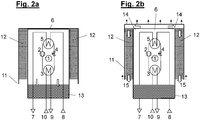
- Fig. 2a shows an alternative embodiment in the closed state
- the main difference to the first variant is that the inner housing part 6 is not inserted in the outer housing part 11 like in a tub, but that the outer housing part 11 is arranged like a hat over the inner housing part 6. Otherwise the structure is similar.
- Figure 2b shows the alternative embodiment in the open state.
- the outer housing part is lifted by the excess pressure that occurs and releases a passage opening 14 which, in contrast to the first embodiment variant, is arranged at the top. Due to the increase in pressure, the outer housing part 11 is raised until the internal pressure and the weight of the housing part 11 are in equilibrium.
- the gas which consists of a mixture of working fluid and air, enters the intermediate space 12 through the passage opening 14 at the top, where it is passed down through another adsorption layer that offers only a very low flow resistance. Most of the working fluid is adsorbed therein. A small residual flow emerges through the passage opening 15 into the environment. After the end of the overpressure event, the outer housing part 11 moves back into its starting position. The loaded adsorbent is then professionally removed.
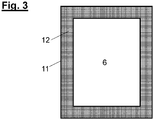
- Fig. 3 shows a greatly simplified representation of a plan view of the first and second embodiment variants.
- the outer housing part 11 encloses the inner housing part 6 and forms a circumferential gap 12 in which the adsorbent is arranged.
- the adsorbent is preferably attached in a detachable manner to the non-moving housing part.
- the circumferential space can also be formed from a plurality of compartments, for example one on each of the outside, which makes it easier to detach them after loading.
Landscapes
- Engineering & Computer Science (AREA)
- Physics & Mathematics (AREA)
- Mechanical Engineering (AREA)
- Thermal Sciences (AREA)
- General Engineering & Computer Science (AREA)
- Separation Of Gases By Adsorption (AREA)
- Electrical Discharge Machining, Electrochemical Machining, And Combined Machining (AREA)
Priority Applications (1)
| Application Number | Priority Date | Filing Date | Title |
|---|---|---|---|
| HRP20221496TT HRP20221496T1 (hr) | 2019-06-03 | 2020-04-28 | Uređaj za sigurno provođenje lijevokretnog termodinamičkog kružnog procesa uz pomoć zapaljivog radnog fluida uz upotrebu adsorpcije fluida |
Applications Claiming Priority (1)
| Application Number | Priority Date | Filing Date | Title |
|---|---|---|---|
| DE102019114744.1A DE102019114744A1 (de) | 2019-06-03 | 2019-06-03 | Fluidadsorption |
Publications (2)
| Publication Number | Publication Date |
|---|---|
| EP3748257A1 true EP3748257A1 (fr) | 2020-12-09 |
| EP3748257B1 EP3748257B1 (fr) | 2022-10-19 |
Family
ID=70475985
Family Applications (1)
| Application Number | Title | Priority Date | Filing Date |
|---|---|---|---|
| EP20171754.3A Active EP3748257B1 (fr) | 2019-06-03 | 2020-04-28 | Dispositif pour la performance sûre d'un procédé circulaire thermodynamique à rotation à gauche au moyen d'un fluide de travail inflammable avec adsorption de fluide |
Country Status (7)
| Country | Link |
|---|---|
| EP (1) | EP3748257B1 (fr) |
| DE (1) | DE102019114744A1 (fr) |
| DK (1) | DK3748257T3 (fr) |
| ES (1) | ES2933612T3 (fr) |
| FI (1) | FI3748257T3 (fr) |
| HR (1) | HRP20221496T1 (fr) |
| PL (1) | PL3748257T3 (fr) |
Cited By (2)
| Publication number | Priority date | Publication date | Assignee | Title |
|---|---|---|---|---|
| EP4209728A1 (fr) | 2022-01-07 | 2023-07-12 | Vaillant GmbH | Pompe à chaleur avec adsorbeur et catalyseur |
| EP4667845A1 (fr) | 2024-06-11 | 2025-12-24 | Vaillant GmbH | Chauffage électrique ptc à isolation céramique |
Families Citing this family (5)
| Publication number | Priority date | Publication date | Assignee | Title |
|---|---|---|---|---|
| US20230264178A1 (en) * | 2022-02-23 | 2023-08-24 | Robert Bosch Gmbh | Propane gas removal material |
| DE102022132792A1 (de) * | 2022-12-09 | 2024-06-20 | Vaillant Gmbh | Adsorberpartitionierung |
| DE102022132800A1 (de) * | 2022-12-09 | 2024-06-20 | Vaillant Gmbh | Adsorptionsvorrichtung |
| DE102023112279A1 (de) | 2023-05-10 | 2024-11-14 | Vaillant Gmbh | Zweistufig adsorptiv wirksames Sicherheitskonzept |
| EP4620816A1 (fr) * | 2024-03-22 | 2025-09-24 | Airbus Operations GmbH | Système de réfrigération à compression de vapeur, unité de cuisine de bord d'aéronef, cuisine de bord d'aéronef et aéronef |
Citations (6)
| Publication number | Priority date | Publication date | Assignee | Title |
|---|---|---|---|---|
| DE553295C (de) | 1931-02-03 | 1932-06-23 | Bbc Brown Boveri & Cie | Gekapselte Kompressionskaeltemaschine |
| DE19525064C1 (de) | 1995-07-10 | 1996-08-01 | Joachim Dr Ing Paul | Kältemaschine |
| DE102011116863A1 (de) | 2011-10-25 | 2013-04-25 | Fraunhofer-Gesellschaft zur Förderung der angewandten Forschung e.V. | Verfahren zur Sicherung einer Vorrichtung für einen thermodynamischen Kreisprozess und abgesicherte Vorrichtung für einen thermodynamischen Kreisprozess |
| WO2015032905A1 (fr) | 2013-09-05 | 2015-03-12 | Holger König | Procédé permettant d'empêcher une fuite d'un contenant et contenant pourvu d'un dispositif anti-fuite |
| EP3106780A1 (fr) | 2015-06-17 | 2016-12-21 | Vaillant GmbH | Installation de pompes a chaleur |
| EP3486564A1 (fr) * | 2017-11-16 | 2019-05-22 | Vaillant GmbH | Adsorption de fluide à refoulement de gaz inerte |
Family Cites Families (1)
| Publication number | Priority date | Publication date | Assignee | Title |
|---|---|---|---|---|
| DE10352957B3 (de) * | 2003-11-13 | 2005-02-03 | Audi Ag | Klimaanlage für Kraftfahrzeuge |
-
2019
- 2019-06-03 DE DE102019114744.1A patent/DE102019114744A1/de not_active Withdrawn
-
2020
- 2020-04-28 HR HRP20221496TT patent/HRP20221496T1/hr unknown
- 2020-04-28 EP EP20171754.3A patent/EP3748257B1/fr active Active
- 2020-04-28 FI FIEP20171754.3T patent/FI3748257T3/de active
- 2020-04-28 DK DK20171754.3T patent/DK3748257T3/da active
- 2020-04-28 PL PL20171754.3T patent/PL3748257T3/pl unknown
- 2020-04-28 ES ES20171754T patent/ES2933612T3/es active Active
Patent Citations (6)
| Publication number | Priority date | Publication date | Assignee | Title |
|---|---|---|---|---|
| DE553295C (de) | 1931-02-03 | 1932-06-23 | Bbc Brown Boveri & Cie | Gekapselte Kompressionskaeltemaschine |
| DE19525064C1 (de) | 1995-07-10 | 1996-08-01 | Joachim Dr Ing Paul | Kältemaschine |
| DE102011116863A1 (de) | 2011-10-25 | 2013-04-25 | Fraunhofer-Gesellschaft zur Förderung der angewandten Forschung e.V. | Verfahren zur Sicherung einer Vorrichtung für einen thermodynamischen Kreisprozess und abgesicherte Vorrichtung für einen thermodynamischen Kreisprozess |
| WO2015032905A1 (fr) | 2013-09-05 | 2015-03-12 | Holger König | Procédé permettant d'empêcher une fuite d'un contenant et contenant pourvu d'un dispositif anti-fuite |
| EP3106780A1 (fr) | 2015-06-17 | 2016-12-21 | Vaillant GmbH | Installation de pompes a chaleur |
| EP3486564A1 (fr) * | 2017-11-16 | 2019-05-22 | Vaillant GmbH | Adsorption de fluide à refoulement de gaz inerte |
Cited By (3)
| Publication number | Priority date | Publication date | Assignee | Title |
|---|---|---|---|---|
| EP4209728A1 (fr) | 2022-01-07 | 2023-07-12 | Vaillant GmbH | Pompe à chaleur avec adsorbeur et catalyseur |
| DE102022100269A1 (de) | 2022-01-07 | 2023-07-13 | Vaillant Gmbh | Katalytische Abluftbehandlung für eine Wärmepumpe |
| EP4667845A1 (fr) | 2024-06-11 | 2025-12-24 | Vaillant GmbH | Chauffage électrique ptc à isolation céramique |
Also Published As
| Publication number | Publication date |
|---|---|
| DE102019114744A1 (de) | 2020-12-03 |
| FI3748257T3 (en) | 2023-01-13 |
| EP3748257B1 (fr) | 2022-10-19 |
| PL3748257T3 (pl) | 2023-01-30 |
| DK3748257T3 (da) | 2022-12-19 |
| HRP20221496T1 (hr) | 2023-02-17 |
| ES2933612T3 (es) | 2023-02-10 |
Similar Documents
| Publication | Publication Date | Title |
|---|---|---|
| EP3748257B1 (fr) | Dispositif pour la performance sûre d'un procédé circulaire thermodynamique à rotation à gauche au moyen d'un fluide de travail inflammable avec adsorption de fluide | |
| EP3486582B1 (fr) | Dispositif de détection des fuites au moyen de capacité adsorbante | |
| EP3578895B1 (fr) | Dispositif et procédé pour le rinçage sûr et économique d'une enceinte | |
| EP3581861B1 (fr) | Sorption du fluide | |
| EP4008979B1 (fr) | Dispositif pour effectuer en toute sécurité un cycle thermodynamique du sens anti-horaire | |
| EP3705823B1 (fr) | Dispositif pour une intervention de service en toute sécurité pour un boîtier et procédé d'ouverture du boîtier. | |
| EP3486564B1 (fr) | DISPOSITIF POUR UNE MISE EN OEUVRE SÉCURITAIRE D'UN PROCESSUS DE RANKINE CLAUSIUS THERMODYNAMIQUE À COMMUTATION GAUCHE
BASÉ SUR UNE ADSORPTION DE FLUIDE DE TRAVAIL À REFOULEMENT DE GAZ INERTE | |
| EP3543629B1 (fr) | Boîtier étanche aux fuites pour un processus cyclique | |
| EP3792572A1 (fr) | Dispositif de rinçage de sécurité pour une pompe à chaleur | |
| EP3693687B1 (fr) | Refroidissement d'adsorbant | |
| DE102021111808A1 (de) | Adsorber-Regeneration mit VOC-Abreicherung | |
| DE102019114738A1 (de) | Fluidadsorption | |
| EP3486575B1 (fr) | Dispositif et procédé d'évacuation de sécurité du flux de travail | |
| EP3657104A1 (fr) | Pièces moulées pour pompes à chaleur | |
| DE102022124089A1 (de) | Adsorberentladung | |
| EP3647684B1 (fr) | Zone de sécurité du condenseur | |
| EP4575332A1 (fr) | Adaptateur encapsulé pour pompe à chaleur divisée | |
| EP3492846B1 (fr) | Dispositif pour effectuer en toute sécurité un cycle de rankine thermodynamique en virage à gauche et sa vidange et son remplissage en toute sécurité au moyen d'un fluide de travail inflammable et procédé pour vider en toute sécurité un fluide de travail inflammable | |
| EP3647685B1 (fr) | Dispositif | |
| EP3712531A1 (fr) | Dispositif de rinçage de sécurité pour une pompe à chaleur | |
| EP3719416A1 (fr) | Pompe à chaleur avec fluide de travail inflammable | |
| EP3657102A1 (fr) | Gestion de liquides de travail |
Legal Events
| Date | Code | Title | Description |
|---|---|---|---|
| PUAI | Public reference made under article 153(3) epc to a published international application that has entered the european phase |
Free format text: ORIGINAL CODE: 0009012 |
|
| STAA | Information on the status of an ep patent application or granted ep patent |
Free format text: STATUS: THE APPLICATION HAS BEEN PUBLISHED |
|
| AK | Designated contracting states |
Kind code of ref document: A1 Designated state(s): AL AT BE BG CH CY CZ DE DK EE ES FI FR GB GR HR HU IE IS IT LI LT LU LV MC MK MT NL NO PL PT RO RS SE SI SK SM TR |
|
| AX | Request for extension of the european patent |
Extension state: BA ME |
|
| STAA | Information on the status of an ep patent application or granted ep patent |
Free format text: STATUS: REQUEST FOR EXAMINATION WAS MADE |
|
| 17P | Request for examination filed |
Effective date: 20210608 |
|
| RBV | Designated contracting states (corrected) |
Designated state(s): AL AT BE BG CH CY CZ DE DK EE ES FI FR GB GR HR HU IE IS IT LI LT LU LV MC MK MT NL NO PL PT RO RS SE SI SK SM TR |
|
| GRAP | Despatch of communication of intention to grant a patent |
Free format text: ORIGINAL CODE: EPIDOSNIGR1 |
|
| STAA | Information on the status of an ep patent application or granted ep patent |
Free format text: STATUS: GRANT OF PATENT IS INTENDED |
|
| RIC1 | Information provided on ipc code assigned before grant |
Ipc: F25B 25/00 20060101AFI20220331BHEP |
|
| INTG | Intention to grant announced |
Effective date: 20220421 |
|
| GRAS | Grant fee paid |
Free format text: ORIGINAL CODE: EPIDOSNIGR3 |
|
| GRAA | (expected) grant |
Free format text: ORIGINAL CODE: 0009210 |
|
| STAA | Information on the status of an ep patent application or granted ep patent |
Free format text: STATUS: THE PATENT HAS BEEN GRANTED |
|
| AK | Designated contracting states |
Kind code of ref document: B1 Designated state(s): AL AT BE BG CH CY CZ DE DK EE ES FI FR GB GR HR HU IE IS IT LI LT LU LV MC MK MT NL NO PL PT RO RS SE SI SK SM TR |
|
| REG | Reference to a national code |
Ref country code: GB Ref legal event code: FG4D Free format text: NOT ENGLISH |
|
| REG | Reference to a national code |
Ref country code: CH Ref legal event code: EP |
|
| REG | Reference to a national code |
Ref country code: DE Ref legal event code: R096 Ref document number: 502020001853 Country of ref document: DE |
|
| REG | Reference to a national code |
Ref country code: IE Ref legal event code: FG4D Free format text: LANGUAGE OF EP DOCUMENT: GERMAN |
|
| REG | Reference to a national code |
Ref country code: AT Ref legal event code: REF Ref document number: 1525770 Country of ref document: AT Kind code of ref document: T Effective date: 20221115 |
|
| REG | Reference to a national code |
Ref country code: DK Ref legal event code: T3 Effective date: 20221216 |
|
| REG | Reference to a national code |
Ref country code: NL Ref legal event code: FP |
|
| REG | Reference to a national code |
Ref country code: SE Ref legal event code: TRGR |
|
| REG | Reference to a national code |
Ref country code: NO Ref legal event code: T2 Effective date: 20221019 |
|
| REG | Reference to a national code |
Ref country code: LT Ref legal event code: MG9D Ref country code: ES Ref legal event code: FG2A Ref document number: 2933612 Country of ref document: ES Kind code of ref document: T3 Effective date: 20230210 |
|
| REG | Reference to a national code |
Ref country code: HR Ref legal event code: T1PR Ref document number: P20221496 Country of ref document: HR |
|
| REG | Reference to a national code |
Ref country code: SK Ref legal event code: T3 Ref document number: E 41103 Country of ref document: SK |
|
| PG25 | Lapsed in a contracting state [announced via postgrant information from national office to epo] |
Ref country code: PT Free format text: LAPSE BECAUSE OF FAILURE TO SUBMIT A TRANSLATION OF THE DESCRIPTION OR TO PAY THE FEE WITHIN THE PRESCRIBED TIME-LIMIT Effective date: 20230220 Ref country code: LT Free format text: LAPSE BECAUSE OF FAILURE TO SUBMIT A TRANSLATION OF THE DESCRIPTION OR TO PAY THE FEE WITHIN THE PRESCRIBED TIME-LIMIT Effective date: 20221019 |
|
| REG | Reference to a national code |
Ref country code: HR Ref legal event code: ODRP Ref document number: P20221496 Country of ref document: HR Payment date: 20230327 Year of fee payment: 4 |
|
| PG25 | Lapsed in a contracting state [announced via postgrant information from national office to epo] |
Ref country code: RS Free format text: LAPSE BECAUSE OF FAILURE TO SUBMIT A TRANSLATION OF THE DESCRIPTION OR TO PAY THE FEE WITHIN THE PRESCRIBED TIME-LIMIT Effective date: 20221019 Ref country code: LV Free format text: LAPSE BECAUSE OF FAILURE TO SUBMIT A TRANSLATION OF THE DESCRIPTION OR TO PAY THE FEE WITHIN THE PRESCRIBED TIME-LIMIT Effective date: 20221019 Ref country code: IS Free format text: LAPSE BECAUSE OF FAILURE TO SUBMIT A TRANSLATION OF THE DESCRIPTION OR TO PAY THE FEE WITHIN THE PRESCRIBED TIME-LIMIT Effective date: 20230219 Ref country code: GR Free format text: LAPSE BECAUSE OF FAILURE TO SUBMIT A TRANSLATION OF THE DESCRIPTION OR TO PAY THE FEE WITHIN THE PRESCRIBED TIME-LIMIT Effective date: 20230120 |
|
| PGFP | Annual fee paid to national office [announced via postgrant information from national office to epo] |
Ref country code: HR Payment date: 20230327 Year of fee payment: 4 Ref country code: BE Payment date: 20230328 Year of fee payment: 4 |
|
| PGFP | Annual fee paid to national office [announced via postgrant information from national office to epo] |
Ref country code: NL Payment date: 20230328 Year of fee payment: 4 |
|
| REG | Reference to a national code |
Ref country code: DE Ref legal event code: R097 Ref document number: 502020001853 Country of ref document: DE |
|
| PG25 | Lapsed in a contracting state [announced via postgrant information from national office to epo] |
Ref country code: SM Free format text: LAPSE BECAUSE OF FAILURE TO SUBMIT A TRANSLATION OF THE DESCRIPTION OR TO PAY THE FEE WITHIN THE PRESCRIBED TIME-LIMIT Effective date: 20221019 Ref country code: RO Free format text: LAPSE BECAUSE OF FAILURE TO SUBMIT A TRANSLATION OF THE DESCRIPTION OR TO PAY THE FEE WITHIN THE PRESCRIBED TIME-LIMIT Effective date: 20221019 Ref country code: EE Free format text: LAPSE BECAUSE OF FAILURE TO SUBMIT A TRANSLATION OF THE DESCRIPTION OR TO PAY THE FEE WITHIN THE PRESCRIBED TIME-LIMIT Effective date: 20221019 |
|
| PGFP | Annual fee paid to national office [announced via postgrant information from national office to epo] |
Ref country code: NO Payment date: 20230421 Year of fee payment: 4 |
|
| PLBE | No opposition filed within time limit |
Free format text: ORIGINAL CODE: 0009261 |
|
| STAA | Information on the status of an ep patent application or granted ep patent |
Free format text: STATUS: NO OPPOSITION FILED WITHIN TIME LIMIT |
|
| PG25 | Lapsed in a contracting state [announced via postgrant information from national office to epo] |
Ref country code: AL Free format text: LAPSE BECAUSE OF FAILURE TO SUBMIT A TRANSLATION OF THE DESCRIPTION OR TO PAY THE FEE WITHIN THE PRESCRIBED TIME-LIMIT Effective date: 20221019 |
|
| PGFP | Annual fee paid to national office [announced via postgrant information from national office to epo] |
Ref country code: FI Payment date: 20230420 Year of fee payment: 4 |
|
| 26N | No opposition filed |
Effective date: 20230720 |
|
| PG25 | Lapsed in a contracting state [announced via postgrant information from national office to epo] |
Ref country code: SI Free format text: LAPSE BECAUSE OF FAILURE TO SUBMIT A TRANSLATION OF THE DESCRIPTION OR TO PAY THE FEE WITHIN THE PRESCRIBED TIME-LIMIT Effective date: 20221019 |
|
| PG25 | Lapsed in a contracting state [announced via postgrant information from national office to epo] |
Ref country code: LU Free format text: LAPSE BECAUSE OF NON-PAYMENT OF DUE FEES Effective date: 20230428 |
|
| PG25 | Lapsed in a contracting state [announced via postgrant information from national office to epo] |
Ref country code: MC Free format text: LAPSE BECAUSE OF FAILURE TO SUBMIT A TRANSLATION OF THE DESCRIPTION OR TO PAY THE FEE WITHIN THE PRESCRIBED TIME-LIMIT Effective date: 20221019 |
|
| PG25 | Lapsed in a contracting state [announced via postgrant information from national office to epo] |
Ref country code: MC Free format text: LAPSE BECAUSE OF FAILURE TO SUBMIT A TRANSLATION OF THE DESCRIPTION OR TO PAY THE FEE WITHIN THE PRESCRIBED TIME-LIMIT Effective date: 20221019 |
|
| REG | Reference to a national code |
Ref country code: IE Ref legal event code: MM4A |
|
| PG25 | Lapsed in a contracting state [announced via postgrant information from national office to epo] |
Ref country code: IE Free format text: LAPSE BECAUSE OF NON-PAYMENT OF DUE FEES Effective date: 20230428 |
|
| PG25 | Lapsed in a contracting state [announced via postgrant information from national office to epo] |
Ref country code: IE Free format text: LAPSE BECAUSE OF NON-PAYMENT OF DUE FEES Effective date: 20230428 |
|
| PGFP | Annual fee paid to national office [announced via postgrant information from national office to epo] |
Ref country code: TR Payment date: 20240329 Year of fee payment: 5 |
|
| PGFP | Annual fee paid to national office [announced via postgrant information from national office to epo] |
Ref country code: DK Payment date: 20240419 Year of fee payment: 5 |
|
| PGFP | Annual fee paid to national office [announced via postgrant information from national office to epo] |
Ref country code: CH Payment date: 20240501 Year of fee payment: 5 |
|
| PGFP | Annual fee paid to national office [announced via postgrant information from national office to epo] |
Ref country code: ES Payment date: 20240503 Year of fee payment: 5 |
|
| PGFP | Annual fee paid to national office [announced via postgrant information from national office to epo] |
Ref country code: IT Payment date: 20240426 Year of fee payment: 5 |
|
| PGFP | Annual fee paid to national office [announced via postgrant information from national office to epo] |
Ref country code: SE Payment date: 20240424 Year of fee payment: 5 |
|
| REG | Reference to a national code |
Ref country code: HR Ref legal event code: PBON Ref document number: P20221496 Country of ref document: HR Effective date: 20240428 |
|
| PG25 | Lapsed in a contracting state [announced via postgrant information from national office to epo] |
Ref country code: BG Free format text: LAPSE BECAUSE OF FAILURE TO SUBMIT A TRANSLATION OF THE DESCRIPTION OR TO PAY THE FEE WITHIN THE PRESCRIBED TIME-LIMIT Effective date: 20221019 |
|
| PG25 | Lapsed in a contracting state [announced via postgrant information from national office to epo] |
Ref country code: BG Free format text: LAPSE BECAUSE OF FAILURE TO SUBMIT A TRANSLATION OF THE DESCRIPTION OR TO PAY THE FEE WITHIN THE PRESCRIBED TIME-LIMIT Effective date: 20221019 |
|
| REG | Reference to a national code |
Ref country code: NL Ref legal event code: MM Effective date: 20240501 |
|
| REG | Reference to a national code |
Ref country code: BE Ref legal event code: MM Effective date: 20240430 |
|
| PG25 | Lapsed in a contracting state [announced via postgrant information from national office to epo] |
Ref country code: NO Free format text: LAPSE BECAUSE OF NON-PAYMENT OF DUE FEES Effective date: 20240430 |
|
| PG25 | Lapsed in a contracting state [announced via postgrant information from national office to epo] |
Ref country code: BE Free format text: LAPSE BECAUSE OF NON-PAYMENT OF DUE FEES Effective date: 20240430 Ref country code: NL Free format text: LAPSE BECAUSE OF NON-PAYMENT OF DUE FEES Effective date: 20240501 Ref country code: FI Free format text: LAPSE BECAUSE OF NON-PAYMENT OF DUE FEES Effective date: 20240428 |
|
| PG25 | Lapsed in a contracting state [announced via postgrant information from national office to epo] |
Ref country code: HR Free format text: LAPSE BECAUSE OF NON-PAYMENT OF DUE FEES Effective date: 20240428 |
|
| PG25 | Lapsed in a contracting state [announced via postgrant information from national office to epo] |
Ref country code: NO Free format text: LAPSE BECAUSE OF NON-PAYMENT OF DUE FEES Effective date: 20240430 Ref country code: NL Free format text: LAPSE BECAUSE OF NON-PAYMENT OF DUE FEES Effective date: 20240501 Ref country code: HR Free format text: LAPSE BECAUSE OF NON-PAYMENT OF DUE FEES Effective date: 20240428 Ref country code: FI Free format text: LAPSE BECAUSE OF NON-PAYMENT OF DUE FEES Effective date: 20240428 Ref country code: BE Free format text: LAPSE BECAUSE OF NON-PAYMENT OF DUE FEES Effective date: 20240430 |
|
| PGFP | Annual fee paid to national office [announced via postgrant information from national office to epo] |
Ref country code: CZ Payment date: 20250326 Year of fee payment: 6 |
|
| PGFP | Annual fee paid to national office [announced via postgrant information from national office to epo] |
Ref country code: DE Payment date: 20250401 Year of fee payment: 6 |
|
| PGFP | Annual fee paid to national office [announced via postgrant information from national office to epo] |
Ref country code: FR Payment date: 20250426 Year of fee payment: 6 |
|
| PGFP | Annual fee paid to national office [announced via postgrant information from national office to epo] |
Ref country code: AT Payment date: 20250721 Year of fee payment: 5 |
|
| PG25 | Lapsed in a contracting state [announced via postgrant information from national office to epo] |
Ref country code: CY Free format text: LAPSE BECAUSE OF FAILURE TO SUBMIT A TRANSLATION OF THE DESCRIPTION OR TO PAY THE FEE WITHIN THE PRESCRIBED TIME-LIMIT; INVALID AB INITIO Effective date: 20200428 |
|
| PG25 | Lapsed in a contracting state [announced via postgrant information from national office to epo] |
Ref country code: HU Free format text: LAPSE BECAUSE OF FAILURE TO SUBMIT A TRANSLATION OF THE DESCRIPTION OR TO PAY THE FEE WITHIN THE PRESCRIBED TIME-LIMIT; INVALID AB INITIO Effective date: 20200428 |
|
| REG | Reference to a national code |
Ref country code: DK Ref legal event code: EBP Effective date: 20250430 |
|
| REG | Reference to a national code |
Ref country code: CH Ref legal event code: H13 Free format text: ST27 STATUS EVENT CODE: U-0-0-H10-H13 (AS PROVIDED BY THE NATIONAL OFFICE) Effective date: 20251125 |
|
| REG | Reference to a national code |
Ref country code: SE Ref legal event code: EUG |
|
| PG25 | Lapsed in a contracting state [announced via postgrant information from national office to epo] |
Ref country code: CH Free format text: LAPSE BECAUSE OF NON-PAYMENT OF DUE FEES Effective date: 20250430 |
|
| PG25 | Lapsed in a contracting state [announced via postgrant information from national office to epo] |
Ref country code: SE Free format text: LAPSE BECAUSE OF NON-PAYMENT OF DUE FEES Effective date: 20250429 |
|
| PGFP | Annual fee paid to national office [announced via postgrant information from national office to epo] |
Ref country code: GB Payment date: 20260323 Year of fee payment: 7 |
|
| PG25 | Lapsed in a contracting state [announced via postgrant information from national office to epo] |
Ref country code: DK Free format text: LAPSE BECAUSE OF NON-PAYMENT OF DUE FEES Effective date: 20250430 |
|
| PG25 | Lapsed in a contracting state [announced via postgrant information from national office to epo] |
Ref country code: IT Free format text: LAPSE BECAUSE OF NON-PAYMENT OF DUE FEES Effective date: 20250428 |
|
| PGFP | Annual fee paid to national office [announced via postgrant information from national office to epo] |
Ref country code: PL Payment date: 20260330 Year of fee payment: 7 |
|
| PGFP | Annual fee paid to national office [announced via postgrant information from national office to epo] |
Ref country code: SK Payment date: 20260331 Year of fee payment: 7 |