EP3750901B1 - Organometallische verbindung, organische lichtemittierende vorrichtung damit und diagnosezusammensetzung mit der organometallischen verbindung - Google Patents
Organometallische verbindung, organische lichtemittierende vorrichtung damit und diagnosezusammensetzung mit der organometallischen verbindung Download PDFInfo
- Publication number
- EP3750901B1 EP3750901B1 EP20179663.8A EP20179663A EP3750901B1 EP 3750901 B1 EP3750901 B1 EP 3750901B1 EP 20179663 A EP20179663 A EP 20179663A EP 3750901 B1 EP3750901 B1 EP 3750901B1
- Authority
- EP
- European Patent Office
- Prior art keywords
- group
- substituted
- salt
- unsubstituted
- sec
- Prior art date
- Legal status (The legal status is an assumption and is not a legal conclusion. Google has not performed a legal analysis and makes no representation as to the accuracy of the status listed.)
- Active
Links
Images

Classifications
-
- C—CHEMISTRY; METALLURGY
- C07—ORGANIC CHEMISTRY
- C07F—ACYCLIC, CARBOCYCLIC OR HETEROCYCLIC COMPOUNDS CONTAINING ELEMENTS OTHER THAN CARBON, HYDROGEN, HALOGEN, OXYGEN, NITROGEN, SULFUR, SELENIUM OR TELLURIUM
- C07F15/00—Compounds containing elements of Groups 8, 9, 10 or 18 of the Periodic Table
- C07F15/0006—Compounds containing elements of Groups 8, 9, 10 or 18 of the Periodic Table compounds of the platinum group
- C07F15/0086—Platinum compounds
-
- H—ELECTRICITY
- H05—ELECTRIC TECHNIQUES NOT OTHERWISE PROVIDED FOR
- H05B—ELECTRIC HEATING; ELECTRIC LIGHT SOURCES NOT OTHERWISE PROVIDED FOR; CIRCUIT ARRANGEMENTS FOR ELECTRIC LIGHT SOURCES, IN GENERAL
- H05B33/00—Electroluminescent light sources
- H05B33/12—Light sources with substantially two-dimensional [2D] radiating surfaces
- H05B33/14—Light sources with substantially two-dimensional [2D] radiating surfaces characterised by the chemical or physical composition or the arrangement of the electroluminescent material, or by the simultaneous addition of the electroluminescent material in or onto the light source
-
- C—CHEMISTRY; METALLURGY
- C09—DYES; PAINTS; POLISHES; NATURAL RESINS; ADHESIVES; COMPOSITIONS NOT OTHERWISE PROVIDED FOR; APPLICATIONS OF MATERIALS NOT OTHERWISE PROVIDED FOR
- C09K—MATERIALS FOR MISCELLANEOUS APPLICATIONS, NOT PROVIDED FOR ELSEWHERE
- C09K11/00—Luminescent materials, e.g. electroluminescent or chemiluminescent
- C09K11/06—Luminescent materials, e.g. electroluminescent or chemiluminescent containing organic luminescent materials
-
- G—PHYSICS
- G01—MEASURING; TESTING
- G01N—INVESTIGATING OR ANALYSING MATERIALS BY DETERMINING THEIR CHEMICAL OR PHYSICAL PROPERTIES
- G01N21/00—Investigating or analysing materials by the use of optical means, i.e. using sub-millimetre waves, infrared, visible or ultraviolet light
- G01N21/62—Systems in which the material investigated is excited whereby it emits light or causes a change in wavelength of the incident light
- G01N21/63—Systems in which the material investigated is excited whereby it emits light or causes a change in wavelength of the incident light optically excited
- G01N21/64—Fluorescence; Phosphorescence
-
- G—PHYSICS
- G01—MEASURING; TESTING
- G01N—INVESTIGATING OR ANALYSING MATERIALS BY DETERMINING THEIR CHEMICAL OR PHYSICAL PROPERTIES
- G01N21/00—Investigating or analysing materials by the use of optical means, i.e. using sub-millimetre waves, infrared, visible or ultraviolet light
- G01N21/62—Systems in which the material investigated is excited whereby it emits light or causes a change in wavelength of the incident light
- G01N21/63—Systems in which the material investigated is excited whereby it emits light or causes a change in wavelength of the incident light optically excited
- G01N21/64—Fluorescence; Phosphorescence
- G01N21/6428—Measuring fluorescence of fluorescent products of reactions or of fluorochrome labelled reactive substances, e.g. measuring quenching effects, using measuring "optrodes"
-
- H—ELECTRICITY
- H10—SEMICONDUCTOR DEVICES; ELECTRIC SOLID-STATE DEVICES NOT OTHERWISE PROVIDED FOR
- H10K—ORGANIC ELECTRIC SOLID-STATE DEVICES
- H10K50/00—Organic light-emitting devices
- H10K50/10—OLEDs or polymer light-emitting diodes [PLED]
- H10K50/11—OLEDs or polymer light-emitting diodes [PLED] characterised by the electroluminescent [EL] layers
-
- H—ELECTRICITY
- H10—SEMICONDUCTOR DEVICES; ELECTRIC SOLID-STATE DEVICES NOT OTHERWISE PROVIDED FOR
- H10K—ORGANIC ELECTRIC SOLID-STATE DEVICES
- H10K85/00—Organic materials used in the body or electrodes of devices covered by this subclass
- H10K85/30—Coordination compounds
- H10K85/341—Transition metal complexes, e.g. Ru(II)polypyridine complexes
- H10K85/346—Transition metal complexes, e.g. Ru(II)polypyridine complexes comprising platinum
-
- C—CHEMISTRY; METALLURGY
- C09—DYES; PAINTS; POLISHES; NATURAL RESINS; ADHESIVES; COMPOSITIONS NOT OTHERWISE PROVIDED FOR; APPLICATIONS OF MATERIALS NOT OTHERWISE PROVIDED FOR
- C09K—MATERIALS FOR MISCELLANEOUS APPLICATIONS, NOT PROVIDED FOR ELSEWHERE
- C09K2211/00—Chemical nature of organic luminescent or tenebrescent compounds
- C09K2211/10—Non-macromolecular compounds
- C09K2211/1018—Heterocyclic compounds
- C09K2211/1025—Heterocyclic compounds characterised by ligands
- C09K2211/1029—Heterocyclic compounds characterised by ligands containing one nitrogen atom as the heteroatom
-
- C—CHEMISTRY; METALLURGY
- C09—DYES; PAINTS; POLISHES; NATURAL RESINS; ADHESIVES; COMPOSITIONS NOT OTHERWISE PROVIDED FOR; APPLICATIONS OF MATERIALS NOT OTHERWISE PROVIDED FOR
- C09K—MATERIALS FOR MISCELLANEOUS APPLICATIONS, NOT PROVIDED FOR ELSEWHERE
- C09K2211/00—Chemical nature of organic luminescent or tenebrescent compounds
- C09K2211/10—Non-macromolecular compounds
- C09K2211/1018—Heterocyclic compounds
- C09K2211/1025—Heterocyclic compounds characterised by ligands
- C09K2211/1044—Heterocyclic compounds characterised by ligands containing two nitrogen atoms as heteroatoms
-
- C—CHEMISTRY; METALLURGY
- C09—DYES; PAINTS; POLISHES; NATURAL RESINS; ADHESIVES; COMPOSITIONS NOT OTHERWISE PROVIDED FOR; APPLICATIONS OF MATERIALS NOT OTHERWISE PROVIDED FOR
- C09K—MATERIALS FOR MISCELLANEOUS APPLICATIONS, NOT PROVIDED FOR ELSEWHERE
- C09K2211/00—Chemical nature of organic luminescent or tenebrescent compounds
- C09K2211/18—Metal complexes
- C09K2211/185—Metal complexes of the platinum group, i.e. Os, Ir, Pt, Ru, Rh or Pd
-
- H—ELECTRICITY
- H10—SEMICONDUCTOR DEVICES; ELECTRIC SOLID-STATE DEVICES NOT OTHERWISE PROVIDED FOR
- H10K—ORGANIC ELECTRIC SOLID-STATE DEVICES
- H10K2101/00—Properties of the organic materials covered by group H10K85/00
- H10K2101/10—Triplet emission
-
- H—ELECTRICITY
- H10—SEMICONDUCTOR DEVICES; ELECTRIC SOLID-STATE DEVICES NOT OTHERWISE PROVIDED FOR
- H10K—ORGANIC ELECTRIC SOLID-STATE DEVICES
- H10K2101/00—Properties of the organic materials covered by group H10K85/00
- H10K2101/30—Highest occupied molecular orbital [HOMO], lowest unoccupied molecular orbital [LUMO] or Fermi energy values
-
- H—ELECTRICITY
- H10—SEMICONDUCTOR DEVICES; ELECTRIC SOLID-STATE DEVICES NOT OTHERWISE PROVIDED FOR
- H10K—ORGANIC ELECTRIC SOLID-STATE DEVICES
- H10K2101/00—Properties of the organic materials covered by group H10K85/00
- H10K2101/40—Interrelation of parameters between multiple constituent active layers or sublayers, e.g. HOMO values in adjacent layers
-
- H—ELECTRICITY
- H10—SEMICONDUCTOR DEVICES; ELECTRIC SOLID-STATE DEVICES NOT OTHERWISE PROVIDED FOR
- H10K—ORGANIC ELECTRIC SOLID-STATE DEVICES
- H10K50/00—Organic light-emitting devices
- H10K50/10—OLEDs or polymer light-emitting diodes [PLED]
- H10K50/14—Carrier transporting layers
- H10K50/15—Hole transporting layers
-
- H—ELECTRICITY
- H10—SEMICONDUCTOR DEVICES; ELECTRIC SOLID-STATE DEVICES NOT OTHERWISE PROVIDED FOR
- H10K—ORGANIC ELECTRIC SOLID-STATE DEVICES
- H10K50/00—Organic light-emitting devices
- H10K50/10—OLEDs or polymer light-emitting diodes [PLED]
- H10K50/14—Carrier transporting layers
- H10K50/16—Electron transporting layers
-
- H—ELECTRICITY
- H10—SEMICONDUCTOR DEVICES; ELECTRIC SOLID-STATE DEVICES NOT OTHERWISE PROVIDED FOR
- H10K—ORGANIC ELECTRIC SOLID-STATE DEVICES
- H10K50/00—Organic light-emitting devices
- H10K50/10—OLEDs or polymer light-emitting diodes [PLED]
- H10K50/17—Carrier injection layers
-
- H—ELECTRICITY
- H10—SEMICONDUCTOR DEVICES; ELECTRIC SOLID-STATE DEVICES NOT OTHERWISE PROVIDED FOR
- H10K—ORGANIC ELECTRIC SOLID-STATE DEVICES
- H10K50/00—Organic light-emitting devices
- H10K50/10—OLEDs or polymer light-emitting diodes [PLED]
- H10K50/17—Carrier injection layers
- H10K50/171—Electron injection layers
-
- H—ELECTRICITY
- H10—SEMICONDUCTOR DEVICES; ELECTRIC SOLID-STATE DEVICES NOT OTHERWISE PROVIDED FOR
- H10K—ORGANIC ELECTRIC SOLID-STATE DEVICES
- H10K50/00—Organic light-emitting devices
- H10K50/10—OLEDs or polymer light-emitting diodes [PLED]
- H10K50/18—Carrier blocking layers
Definitions
- One or more embodiments relate to organometallic compounds, organic light-emitting devices including the same, and diagnostic compositions including the same.
- Organic light-emitting devices are self-emission devices, which have improved characteristics in terms of a viewing angle, a response time, brightness, a driving voltage, and a response speed, and produce full-color images.
- an organic light-emitting device includes an anode, a cathode, and an organic layer between the anode and the cathode, wherein the organic layer includes an emission layer.
- a hole transport region may be between the anode and the emission layer, and an electron transport region may be between the emission layer and the cathode.
- Holes provided from the anode may move toward the emission layer through the hole transport region, and electrons provided from the cathode may move toward the emission layer through the electron transport region.
- the holes and the electrons recombine in the emission layer to produce excitons. These excitons transit from an excited state to a ground state to thereby generate light.
- luminescent compounds for example, phosphorescent compounds
- US2019119312 discloses compounds which differ in that there is no substituent attached to the ring system.
- One or more embodiments relate to organometallic compounds, organic light-emitting devices including the same, and diagnostic compositions including the same.
- an organometallic compound represented by Formula 1 is provided. ⁇ Formula 1> M 1 (L 11 ) n11 (L 12 ) n12 .
- an organic light-emitting device including a first electrode; a second electrode; and an organic layer including an emission layer between the first electrode and the second electrode, wherein the organic layer includes at least one organometallic compound represented by Formula 1.
- Another aspect provides a diagnostic composition including at least one organometallic compound represented by Formula 1.
- FIGURE shows a schematic cross-sectional view of an organic light-emitting device according to an exemplary embodiment.
- relative terms such as “lower” or “bottom” and “upper” or “top,” may be used herein to describe one element's relationship to another element as illustrated in the Figures It will be understood that relative terms are intended to encompass different orientations of the device in addition to the orientation depicted in the Figures
- the exemplary term “lower,” can therefore, encompasses both an orientation of “lower” and “upper,” depending on the particular orientation of the figure
- elements described as “below” or “beneath” other elements would then be oriented “above” the other elements
- the exemplary terms “below” or “beneath” can, therefore, encompass both an orientation of above and below.
- An aspect of the present disclosure provides an organometallic compound represented by Formula 1 below: ⁇ Formula 1> M 1 (L 11 ) n11 (L 12 ) n12 .
- M 1 in Formula 1 may be a first-row transition metal of the Periodic Table of Elements, a second-row transition metal of the Periodic Table of Elements, or a third-row transition metal of the Periodic Table of Elements.
- M 1 in Formula 1 may be beryllium (Be), magnesium (Mg), aluminum (Al), calcium (Ca), titanium (Ti), manganese (Mn), cobalt (Co), copper (Cu), zinc (Zn), gallium (Ga), germanium (Ge), zirconium (Zr), ruthenium (Ru), rhodium (Rh), palladium (Pd), silver (Ag), rhenium (Re), platinum (Pt), or gold (Au).
- M 1 may be Pd, Pt, or Au.
- M 1 in Formula 1 may be Pt or Pd.
- M 1 in Formula 1 may be Pt.
- L 11 in Formula 1 may be a ligand represented by Formula 1-1:
- *1 to *4 in Formula 1-1 may each independently be a binding site to M 1 .
- a 20 and A 30 may each independently be a benzene group, a naphthalene group, an anthracene group, a phenanthrene group, a triphenylene group, a pyrene group, a chrysene group, cyclopentadiene group, a 1,2,3,4-tetrahydronaphthalene group, a furan group, a thiophene group, a silole group, a pyrrole group, an indene group, a fluorene group, an indole group, a carbazole group, a benzofuran group, a dibenzofuran group, a benzothiophene group, a dibenzothiophene group, a benzosilole group, a dibenzosilole group, an azafluorene group, an azacarbazole group, an azadibenzofuran group, an azad
- T 1 may be a single bond, *-N[(L 1 ) a1 -(R 6 ) b6 ]-*', *-B(R 6 )-*', *-C(R 6 )(R 7 )-*', *-Si(R 6 )(R 7 )-*', *-O-*', or *-S-*'.
- T 2 may be a single bond, *-N[(L 2 ) a2 -(R 8 ) b8 ]-*', *-C(R 8 )(R 9 )-*', *-Si(R 8 )(R 9 )-*', *-O-*', or *-S-*'.
- L 1 and L 2 in Formula 1-1 may each independently be a single bond, a substituted or unsubstituted C 5 -C 30 carbocyclic group, or a substituted or unsubstituted C 1 -C 30 heterocyclic group, and a1 may be an integer from 1 to 3, and when a1 is 2 or more, two or more of L 1 (s) may be identical to or different from each other, and a2 may be an integer from 1 to 3, and when a2 is 2 or more, two or more of L 2 (s) may be identical to or different from each other.
- L 1 and L 2 may each independently a phenylene group, a pentalenylene group, an indenylene group, a naphthylene group, an azulenylene group, a heptalenylene group, an acenaphthylene group, a fluorenylene group, a phenalenylene group, a phenanthrenylene group, an anthracenylene group, a fluoranthenylene group, a triphenylenylene group, a pyrenylene group, a chrysenylenylene group, a naphthacenylene group, a picenylene group, a perylenylene group, or a pentacenylene group; or a phenylene group, a pentalenylene group, an indenylene group, a naphthylene group, an azulenylene group, a heptalenylene group, an acen
- X 11 to X 14 in Formula 1-1 may each be C or N.
- X 11 may be C. In one or more embodiments, X 11 may be N.
- X 14 may be C. In one or more embodiments, X 14 may be N.
- X 30 may be C. In one or more embodiments, X 30 may be N.
- X 21 , X 22 , X 31 , and X 32 may each independently be C or N.
- a bond between M 1 and moiety may be a coordination bond.
- a bond between M 1 and A 20 and a bond between M 1 and A 30 may be a covalent bond.
- organometallic compound represented by Formula 1 may be electrically neutral.
- R 1 to R 9 , R 10 , R 20 , R 30 , and R 41 to R 44 in Formula 1-1 may each independently be hydrogen, deuterium, -F, -Cl, -Br, -I, -SF 5 , a hydroxyl group, a cyano group, a nitro group, an amidino group, a hydrazine group, a hydrazone group, a carboxylic acid group or a salt thereof, a sulfonic acid group or a salt thereof, a phosphoric acid group or a salt thereof, a substituted or unsubstituted C 1 -C 60 alkyl group, a substituted or unsubstituted C 2 -C 60 alkenyl group, a substituted or unsubstituted C 2 -C 60 alkynyl group, a substituted or unsubstituted C 1 -C 60 alkoxy group, a substituted or unsubstituted C 1 -C
- Two or more neighboring R 1 to R 9 , R 10 , R 20 , R 30 , and R 41 to R 44 in Formula 1-1 may optionally be linked to form a substituted or unsubstituted C 5 -C 30 carbocyclic group or a substituted or unsubstituted C 1 -C 30 heterocyclic group.
- R 2 and R 43 may each independently be :
- R 1 , R 3 , and R 5 may each be hydrogen.
- R 4 may be identical to R 2 .
- R 4 may be hydrogen
- R 10 and R 30 may be : deuterium, -F, -Cl, -Br, -I, a cyano group, a methyl group, an ethyl group, an n-propyl group, an isopropyl group, an n-butyl group, an isobutyl group, a sec-butyl group, a tert-butyl group, an n-pentyl group, an isopentyl group, a sec-pentyl group, a tert-pentyl group, an n-hexyl group, an isohexyl group, a sec-hexyl group, a tert-hexyl group, an n-heptyl group, an isoheptyl group, a sec-heptyl group, a tert-heptyl group, an n-octyl group, an isooc
- R 20 may be hydrogen
- R 20 may be : deuterium, -F, -Cl, -Br, -I, a hydroxyl group, a cyano group, a nitro group, an amino group, an amidino group, a hydrazine group, a hydrazone group, a carboxylic acid group or a salt thereof, a sulfonic acid group or a salt thereof, a phosphoric acid group or a salt thereof, -SF 5 , C 1 -C 20 alkyl group, or a C 1 -C 20 alkoxy group;
- At least one of R 10 and R 30 may be one of Formulae 9-1 to 9-19 and 10-1 to 10-194.
- R 41 , R 42 , and R 44 may each be hydrogen.
- R 1 to R 9 , R 10 , R 20 , R 30 , and R 41 to R 44 may each independently be hydrogen, a substituted or unsubstituted C 2 -C 60 alkyl group, a substituted or unsubstituted C 2 -C 60 alkenyl group, a substituted or unsubstituted C 2 -C 60 alkynyl group, a substituted or unsubstituted C-C 60 alkoxy group, a substituted or unsubstituted C 3 -C 10 cycloalkyl group, a substituted or unsubstituted C 1 -C 10 heterocycloalkyl group, a substituted or unsubstituted C 3 -C 10 cycloalkenyl group, a substituted or unsubstituted C 2 -C 10 heterocycloalkenyl group, a substituted or unsubstituted C 6 -C 60 aryl group, a substituted or unsubstitute
- the organometallic compound represented by Formula 1 may be represented by one of Formulae 2-1 and 2-2:
- neighboring two or more of R 1 to R 9 , R 10 , R 20 , R 30 , and R 41 to R 44 may optionally be linked together to form, via a single bond, a double bond or first linking group, a C 5 -C 30 carbocyclic group that is unsubstituted or substituted with at least one R 10a or a C 1 -C 30 heterocyclic group that is unsubstituted or substituted with at least one R 10a (for example, a fluorene group, a xanthene group, an acridine group, or the like, each unsubstituted or substituted with at least one R 10a ).
- R 10a is the same as described in connection with R 1
- neighboring two or more of R 1 to R 9 , R 10 , R 20 , R 30 and R 41 to R 44 in Formula 1 may optionally be linked to form a cyclopentane group, a cyclopentadiene group, a furan group, a thiophene group, a pyrrole group, a silole group, an adamantane group, a norbornane group, a norbornene group, a cyclohexane group, a cyclohexene group, a benzene group, a naphthalene group, an indene group, an indole group, a benzofuran group, a benzothiophene group, a benzosilole group, a fluorene group, a carbazole group, a dibenzofuran group, a dibenzothiophene group, or a dibenzosilole group, each unsubsti
- L 12 in Formula 1 may be a ligand represented by one of Formulae 7-1 to 7-11, but embodiments are not limited thereto:
- a 71 and A 72 in Formula 7-1 may each independently be a benzene group, a naphthalene group, an imidazole group, a benzimidazole group, a pyridine group, a pyrimidine group, a pyridazine group, a pyrazine group, a triazine group, a quinoline group, or an isoquinoline group, but embodiments of the present disclosure are not limited thereto.
- X 78 may be N(Q 78 ); and X 79 may be N(Q 79 ), but embodiments of the present disclosure are not limited thereto.
- Y 71 and Y 72 in Formulae 7-2, 7-3 and 7-8 may each independently be a substituted or unsubstituted methylene group, or a substituted or unsubstituted phenylene group, but embodiments of the present disclosure are not limited thereto.
- Z 73 in Formula 7-4 may be P, but embodiments of the present disclosure are not limited thereto.
- R 71 to R 80 and Q 73 to Q 79 in Formulae 7-1 to 7-11 may each independently be:
- n11 is 1, and n12 may be 0, 1, or 2.
- M 1 in Formula 1 may be Pt, n11 may be 1, and n12 may be 0, but embodiments of the present disclosure are not limited thereto.
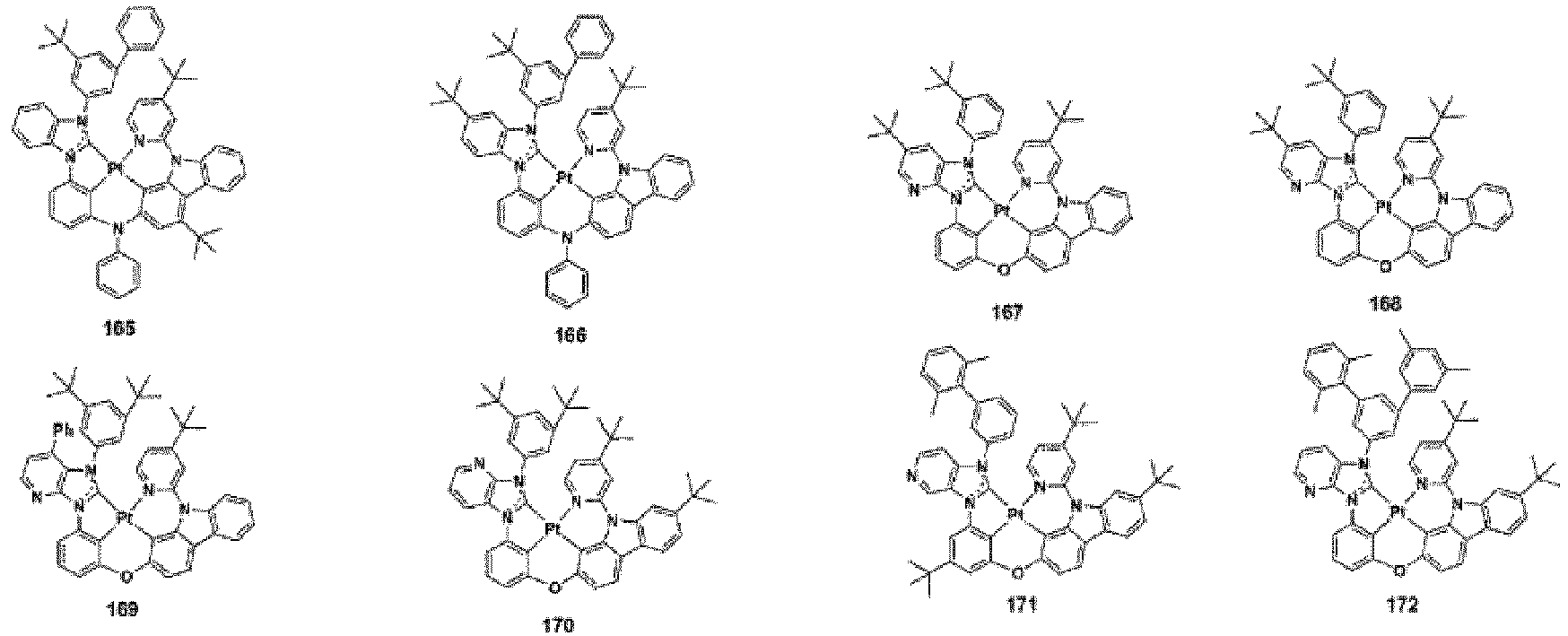
- the organometallic compound may be one of Compounds 1 to 176:
- the organometallic compound represented by Formula 1 may satisfy the structure of Formula 1 described above, and due to the structure in which the (e.g., benzimidazole moiety in L 11 ligand represented by Formula 1-1 has an N-substituent, the organometallic compound may have improved photochemical stability, and may be suitable for deep blue light emission.
- An electronic device, for example, an organic light-emitting device, using the organometallic compound represented by Formula 1 may be excellent in luminescence efficiency, lifespan, and color purity.
- R 10 and R 30 in the L 11 ligand represented by Formula 1-1 is a substituent that is not hydrogen, the electron donating characteristics with respect to the L 11 ligand may be enhanced, and thus, the charge transfer may be improved, thereby improving the efficiency and lifespan of an organic light-emitting device.
- the organometallic compound represented by Formula 1 has such electric characteristics that are suitable for use as a material for an emission layer for an electronic device, for example, an organic light-emitting device.
- Synthesis methods of the organometallic compound represented by Formula 1 may be recognizable by one of ordinary skill in the art by referring to Synthesis Examples provided below.
- the organic light-emitting device may have, due to the inclusion of an organic layer including the organometallic compound represented by Formula 1, a low driving voltage, high efficiency, high power efficiency, high quantum efficiency, a long lifespan, a low roll-off ratio, and excellent color purity.
- the first electrode is an anode
- the second electrode is a cathode
- the organic layer further includes a hole transport region between the first electrode and the emission layer and an electron transport region between the emission layer and the second electrode
- the hole transport region includes a hole injection layer, a hole transport layer, an electron blocking layer, or any combination thereof
- the electron transport region includes a hole blocking layer, an electron transport layer, an electron injection layer, or any combination thereof.
- the organometallic compound represented by Formula 1 may be included in the emission layer.
- the organometallic compound included in the emission layer may act as an emitter.
- an emission layer including the organometallic compound represented by Formula 1 may emit phosphorescent light generated by the transfer of the triplet excitons of the organometallic compound into the ground state.
- the emission layer including the organometallic compound represented by Formula 1 may further include a host.
- the host may be any host, and details of the host may be the same as described below.
- the amount of the host in the emission layer may be greater than the amount of the organometallic compound represented by Formula 1.
- the emission layer may include a host and a dopant, the host may be any host, and the dopant may include the organometallic compound represented by Formula 1.
- the emission layer may emit phosphorescent light generated by the transfer of triplet excitons of the organometallic compound, which acts as a dopant, to the ground state.
- the amount of the host may be greater than the amount of the organometallic compound.
- the emission layer may include a host and a dopant, the host may be any host, and the dopant may include the organometallic compound represented by Formula 1, and the emission layer may further include a fluorescent dopant.
- the emission layer may emit fluorescent light that is generated by the transfer of the triplet excitons of the organometallic compound to the fluorescent dopant and then transition thereof.
- the emission layer may emit blue light having the maximum luminescence wavelength of about 410 nm to about 490 nm.
- (an organic layer) includes at least one organometallic compound represented by Formula 1" used herein may include a case in which "(an organic layer) includes identical organometallic compounds represented by Formula 1" and a case in which "(an organic layer) includes two or more different organometallic compounds represented by Formula 1.”
- the organic layer may include, as the organometallic compound, only Compound 1.
- Compound 1 may be included in the emission layer of the organic light-emitting device.
- the organic layer may include, as the organometallic compound, Compound 1 and Compound 2.
- Compound 1 and Compound 2 may exist in an identical layer (for example, Compound 1 and Compound 2 all may exist in an emission layer).
- organic layer refers to a single layer and/or a plurality of layers between the first electrode and the second electrode of the organic light-emitting device.
- the “organic layer” may include, in addition to an organic compound, an organometallic complex including metal.
- FIGURE is a schematic cross-sectional view of an organic light-emitting device 10 according to an exemplary embodiment.
- the organic light-emitting device 10 includes a first electrode 11, an organic layer 15, and a second electrode 19, which are sequentially stacked.
- a substrate may be additionally located under the first electrode 11 or above the second electrode 19.
- the substrate any substrate that is used in organic light-emitting devices available in the art may be used, and the substrate may be a glass substrate or a transparent plastic substrate, each having excellent mechanical strength, thermal stability, transparency, surface smoothness, ease of handling, and water resistance.
- the first electrode 11 may be formed by depositing or sputtering a material for forming the first electrode 11 on the substrate.
- the first electrode 11 may be an anode.
- the material for forming the first electrode 11 may be materials with a high work function to facilitate hole injection.
- the first electrode 11 may be a reflective electrode, a semi-transmissive electrode, or a transmissive electrode.
- the material for forming the first electrode 11 may be indium tin oxide (ITO), indium zinc oxide (IZO), tin oxide (SnO 2 ), or zinc oxide (ZnO).
- the material for forming the first electrode 11 may be metal, such as magnesium (Mg), aluminum (Al), aluminum-lithium (Al-Li), calcium (Ca), magnesium-indium (Mg-In), or magnesium-silver (Mg-Ag).
- metal such as magnesium (Mg), aluminum (Al), aluminum-lithium (Al-Li), calcium (Ca), magnesium-indium (Mg-In), or magnesium-silver (Mg-Ag).
- the first electrode 11 may have a single-layered structure or a multi-layered structure including two or more layers.
- the first electrode 11 may have a three-layered structure of ITO/Ag/ITO, but the structure of the first electrode 11 is not limited thereto.
- the organic layer 15 is located on the first electrode 11.
- the organic layer 15 may include a hole transport region, an emission layer, and an electron transport region.
- the hole transport region may be between the first electrode 11 and the emission layer.
- the hole transport region may include a hole injection layer, a hole transport layer, an electron blocking layer, a buffer layer, or any combination thereof.
- the hole transport region may include only either a hole injection layer or a hole transport layer.
- the hole transport region may have a hole injection layer/hole transport layer structure or a hole injection layer/hole transport layer/electron blocking layer structure, wherein, for each structure, each layer is sequentially stacked in this stated order from the first electrode 11.
- the deposition conditions may vary according to a material that is used to form the hole injection layer, and the structure and thermal characteristics of the hole injection layer.
- the deposition conditions may include a deposition temperature of about 100 °C to about 500 °C, a vacuum pressure of about 10 -8 torr to about 10 -3 torr, (0,133 to 1,333.10 -6 Pa) and a deposition rate of about 0.01 ⁇ /sec to about 100 ⁇ /sec.
- the deposition conditions are not limited thereto.
- coating conditions may vary according to the material used to form the hole injection layer, and the structure and thermal properties of the hole injection layer.
- a coating speed may be from about 2,000 rpm to about 5,000 rpm
- a temperature at which a heat treatment is performed to remove a solvent after coating may be from about 80 °C to about 200 °C.
- the coating conditions are not limited thereto.
- Conditions for forming a hole transport layer and an electron blocking layer may be understood by referring to conditions for forming the hole injection layer.
- the hole transport region may include at least one m-MTDATA, TDATA, 2-TNATA, NPB, ⁇ -NPB, TPD, Spiro-TPD, Spiro-NPB, methylated-NPB, TAPC, HMTPD, 4,4',4"-tris(N-carbazolyl)triphenylamine (TCTA), polyaniline/dodecylbenzenesulfonic acid (PANI/DBSA), poly(3,4-ethylenedioxythiophene)/poly(4-styrenesulfonate) (PEDOT/PSS), polyaniline/camphor sulfonicacid (PANI/CSA), polyaniline/poly(4-styrenesulfonate) (PANI/PSS), a compound represented by Formula 201 below, a compound represented by Formula 202 below, or any combination thereof:
- Ar 101 to Ar 102 in Formula 201 may each independently be :
- xa and xb in Formula 201 may each independently be an integer from 0 to 5, or 0, 1, or 2.
- xa may be 1 and xb may be 0, but xa and xb are not limited thereto.
- the compound represented by Formula 201 may be represented by Formula 201A below, but embodiments of the present disclosure are not limited thereto:
- R 101 , R 111 , R 112 , and R 109 in Formula 201A may be understood by referring to the description provided herein.
- the compound represented by Formula 201 and the compound represented by Formula 202 may include compounds HT1 to HT20 illustrated below, but are not limited thereto:
- a thickness of the hole transport region may be in a range of about 100 ⁇ to about 10,000 ⁇ , for example, about 100 ⁇ to about 1,000 ⁇ .
- a thickness of the hole injection layer may be in a range of about 100 ⁇ to about 10,000 ⁇ , for example, about 100 ⁇ to about 1,000 ⁇
- a thickness of the hole transport layer may be in a range of about 50 ⁇ to about 2,000 ⁇ , for example, about 100 ⁇ to about 1,500 ⁇ .
- the charge-generation material may be, for example, a p-dopant.
- the p-dopant may be a quinone derivative, a metal oxide, or a cyano group-containing compound, but embodiments of the present disclosure are not limited thereto.
- p-dopant examples include: a quinone derivative, such as tetracyanoquinonedimethane (TCNQ) or 2,3,5,6-tetrafluoro-tetracyano-1,4-benzoquinonedimethane (F4-TCNQ); a metal oxide, such as a tungsten oxide or a molybdenum oxide; and a cyano group-containing compound, such as Compound HT-D1 below, but are not limited thereto.
- a quinone derivative such as tetracyanoquinonedimethane (TCNQ) or 2,3,5,6-tetrafluoro-tetracyano-1,4-benzoquinonedimethane (F4-TCNQ)
- a metal oxide such as a tungsten oxide or a molybdenum oxide
- a cyano group-containing compound such as Compound HT-D1 below, but are not limited thereto.
- the hole transport region may include a buffer layer.
- the buffer layer may compensate for an optical resonance distance according to a wavelength of light emitted from the emission layer, and thus, efficiency of a formed organic light-emitting device may be improved.
- a material for the electron blocking layer may be materials for the hole transport region described above and materials for a host to be explained later.
- the material for the electron blocking layer is not limited thereto.
- a material for the electron blocking layer may be mCP, which will be explained later.
- the host may include at least one TPBi, TBADN, ADN (also referred to as "DNA”), CBP, CDBP, TCP, mCP, Compound H50, Compound H51, or any combination thereof:
- the host may further include a compound represented by Formula 301 below.
- Ar 111 and Ar 112 in Formula 301 may each independently be :
- Ar 113 and Ar 116 in Formula 301 may each independently be :
- Ar 122 to Ar 125 in Formula 302 are the same as described in detail in connection with Ar 113 in Formula 301.
- an amount of the dopant may be in a range of about 0.01 parts by weight to about 15 parts by weight based on 100 parts by weight of the host, but embodiments of the present disclosure are not limited thereto.
- the organic layer of the organic light-emitting device may further include a fluorescent dopant in addition to the organometallic compound represented by Formula 1.
- the fluorescent dopant may be a condensation polycyclic compound and a styryl compound.
- the fluorescent dopant may be a styryl-amine-based compound and a styryl-carbazole-based compound, but embodiments of the present disclosure are not limited thereto.
- the fluorescent dopant may be compounds represented by Formula 501:
- the hole blocking layer may include, for example, at least one of BCP, Bphen, BAIq, or any combination thereof but embodiments of the present disclosure are not limited thereto.
- a thickness of the hole blocking layer may be in a range of about 20 ⁇ to about 1,000 ⁇ , for example, about 30 ⁇ to about 300 ⁇ . When the thickness of the hole blocking layer is within these ranges, the hole blocking layer may have excellent hole blocking characteristics without a substantial increase in driving voltage.
- a thickness of the electron transport layer may be in a range of about 100 ⁇ to about 1,000 ⁇ , for example, about 150 ⁇ to about 500 ⁇ . When the thickness of the electron transport layer is within the range described above, the electron transport layer may have satisfactory electron transport characteristics without a substantial increase in driving voltage.
- the electron transport layer may further include, in addition to the materials described above, a metal-containing material.
- the metal-containing material may include a Li complex.
- the Li complex may include, for example, Compound ET-D1 (lithium quinolate, LiQ) or ET-D2:
- the electron injection layer may include at least one LiF, NaCl, CsF, Li 2 O, BaO, or any combination thereof.
- a thickness of the electron injection layer may be in a range of about 1 ⁇ to about 100 ⁇ , and, for example, about 3 ⁇ to about 90 ⁇ . When the thickness of the electron injection layer is within the range described above, the electron injection layer may have satisfactory electron injection characteristics without a substantial increase in driving voltage.
- the second electrode 19 is located on the organic layer 15.
- the second electrode 19 may be a cathode.
- a material for forming the second electrode 19 may be metal, an alloy, an electrically conductive compound, or a combination thereof, which have a relatively low work function.
- lithium (Li), magnesium (Mg), aluminum (Al), aluminum-lithium (Al-Li), calcium (Ca), magnesium-indium (Mg-In), or magnesium-silver (Mg-Ag) may be used as the material for forming the second electrode 19.
- a transmissive electrode formed using ITO or IZO may be used as the second electrode 19.
- Another aspect provides a diagnostic composition including at least one organometallic compound represented by Formula 1.
- the organometallic compound represented by Formula 1 provides high luminescent efficiency. Accordingly, a diagnostic composition including the organometallic compound may have high diagnostic efficiency.
- the diagnostic composition may be used in various applications including a diagnosis kit, a diagnosis reagent, a biosensor, and a biomarker.
- C 1 -C 60 alkyl group refers to a linear or branched saturated aliphatic hydrocarbon monovalent group having 1 to 60 carbon atoms, and non-limiting examples thereof include a methyl group, an ethyl group, a propyl group, an isobutyl group, a sec-butyl group, a tert-butyl group, a pentyl group, an isoamyl group, and a hexyl group.
- C 1 -C 60 alkylene group refers to a divalent group having the same structure as the C 1 -C 60 alkyl group.
- C 1 -C 60 alkoxy group refers to a monovalent group represented by -OA 101 (wherein A 101 is the C 1 -C 60 alkyl group), and examples thereof include a methoxy group, an ethoxy group, and an isopropyloxy group.
- C 1 -C 60 alkylthio group refers to a monovalent group represented by -SA 102 (wherein A 102 is the C 1 -C 60 alkyl group), and examples thereof include a methylthio group, an ethylthio group, and an isopropylthio group.
- C 2 -C 60 alkenyl group refers to a hydrocarbon group formed by substituting at least one carbon-carbon double bond in the middle or at the terminus of the C 2 -C 60 alkyl group, and examples thereof include an ethenyl group, a propenyl group, and a butenyl group.
- C 2 -C 60 alkenylene group refers to a divalent group having the same structure as the C 2 -C 60 alkenyl group.
- C 2 -C 60 alkynyl group refers to a hydrocarbon group formed by substituting at least one carbon-carbon triple bond in the middle or at the terminus of the C 2 -C 60 alkyl group, and examples thereof include an ethynyl group, and a propynyl group.
- C 2 -C 60 alkynylene group refers to a divalent group having the same structure as the C 2 -C 60 alkynyl group.
- C 3 -C 10 cycloalkyl group refers to a monovalent saturated hydrocarbon monocyclic group having 3 to 10 carbon atoms, and examples thereof include a cyclopropyl group, a cyclobutyl group, a cyclopentyl group, a cyclohexyl group, and a cycloheptyl group.
- C 3 -C 10 cycloalkylene group refers to a divalent group having the same structure as the C 3 -C 10 cycloalkyl group.
- C 1 -C 10 heterocycloalkyl group refers to a monovalent saturated monocyclic group having at least one N, O, P, Si, B, Se, Ge, Te, S, or any combination thereof as a ring-forming atom and 1 to 10 carbon atoms, and non-limiting examples thereof include a tetrahydrofuranyl group, and a tetrahydrothiophenyl group.
- C 1 -C 10 heterocycloalkylene group refers to a divalent group having the same structure as the C 1 -C 10 heterocycloalkyl group.
- C 3 -C 10 cycloalkenyl group refers to a monovalent monocyclic group that has 3 to 10 carbon atoms and at least one carbon-carbon double bond in the ring thereof and no aromaticity, and non-limiting examples thereof include a cyclopentenyl group, a cyclohexenyl group, and a cycloheptenyl group.
- C 3 -C 10 cycloalkenylene group refers to a divalent group having the same structure as the C 3 -C 10 cycloalkenyl group.
- C 6 -C 60 aryl group refers to a monovalent group having a carbocyclic aromatic system having 6 to 60 carbon atoms
- C 6 -C 60 arylene group refers to a divalent group having a carbocyclic aromatic system having 6 to 60 carbon atoms.
- Examples of the C 6 -C 60 aryl group include a phenyl group, a naphthyl group, an anthracenyl group, a phenanthrenyl group, a pyrenyl group, and a chrysenyl group.
- the C 7 -C 60 alkylaryl group refers to a C 6 -C 60 aryl group substituted with at least one C 1 -C 60 alkyl group.
- C 1 -C 60 heteroaryl group refers to a monovalent group having a cyclic aromatic system that has at least one N, O, P, Si, B, Se, Ge, Te, S, or any combination thereof as a ring-forming atom, and 1 to 60 carbon atoms.
- C 1 -C 60 heteroarylene group refers to a divalent group having a cyclic aromatic system that has at least one N, O, P, Si, B, Se, Ge, Te, S, or any combination thereof as a ring-forming atom, and 1 to 60 carbon atoms.
- Examples of the C 1 -C 60 heteroaryl group include a pyridinyl group, a pyrimidinyl group, a pyrazinyl group, a pyridazinyl group, a triazinyl group, a quinolinyl group, and an isoquinolinyl group.
- the C 1 -C 60 heteroaryl group and the C 1 -C 60 heteroarylene group each include two or more rings, the rings may be fused to each other.
- the C 2 -C 60 alkylheteroaryl group refers to a C 1 -C 60 heteroaryl group substituted with at least one C 1 -C 60 alkyl group.
- C 6 -C 60 aryloxy group indicates -OA 102 (wherein A 102 is the C 6 -C 60 aryl group), and the term “C 6 -C 60 arylthio group” as used herein indicates - SA 103 (wherein A 103 is the C 6 -C 60 aryl group).
- C 5 -C 30 carbocyclic group refers to a saturated or unsaturated cyclic group having, as a ring-forming atom, 5 to 30 carbon atoms only.
- the C 6 -C 30 carbocyclic group may be a monocyclic group or a polycyclic group.
- C 1 -C 30 heterocyclic group refers to a saturated or unsaturated cyclic group having, as a ring-forming atom, at least one N, O, Si, P, B, Se, Ge, Te, S, or any combination thereof other than 1 to 30 carbon atoms.
- the C 1 -C 30 heterocyclic group may be a monocyclic group or a polycyclic group.
- ITO glass substrate was cut to a size of 50 mm x 50 mm x 0.5 mm and then, sonicated in acetone isopropyl alcohol and pure water, each for 15 minutes, and then, washed by exposure to UV and ozone for 30 minutes.
- m-MTDATA was deposited on an ITO electrode (anode) of the glass substrate at a deposition speed of 1 ⁇ /sec to form a hole injection layer having a thickness of 600 ⁇
- ⁇ -NPD was deposited on the hole injection layer at a deposition speed of 1 ⁇ /sec to form a hole transport layer having a thickness of 250 ⁇ .
- Compound 1 (dopant) and CBP (host) were co-deposited on the hole transport layer at a deposition speed of 0.1 ⁇ /sec and a deposition speed of 1 ⁇ /sec, respectively, to form an emission layer having a thickness of 400 ⁇ .
- the organometallic compound has excellent photochemical stability, and an organic light-emitting device using the organometallic compound may have improved efficiency and lifespan.
- Such organometallic compounds have excellent phosphorescent luminescent characteristics, and thus, when used, a diagnostic composition having a high diagnostic efficiency may be provided.
Landscapes
- Chemical & Material Sciences (AREA)
- Organic Chemistry (AREA)
- Engineering & Computer Science (AREA)
- Materials Engineering (AREA)
- Health & Medical Sciences (AREA)
- Physics & Mathematics (AREA)
- Inorganic Chemistry (AREA)
- Crystallography & Structural Chemistry (AREA)
- Immunology (AREA)
- General Health & Medical Sciences (AREA)
- Analytical Chemistry (AREA)
- Biochemistry (AREA)
- Life Sciences & Earth Sciences (AREA)
- General Physics & Mathematics (AREA)
- Nuclear Medicine, Radiotherapy & Molecular Imaging (AREA)
- Pathology (AREA)
- Optics & Photonics (AREA)
- Chemical Kinetics & Catalysis (AREA)
- Electroluminescent Light Sources (AREA)
Claims (15)
- Metallorganische Verbindung, dargestellt durch Formel 1:
Formel 1 M1(L11)n11(L12)n12
wobei in Formel 1M1 ein Übergangsmetall der ersten Reihe des Periodensystems der Elemente, ein Übergangsmetall der zweiten Reihe des Periodensystems der Elemente oder ein Übergangsmetall der dritten Reihe des Periodensystems der Elemente ist;L11 ein Ligand ist, der durch Formel 1-1 dargestellt ist;L12 ein einzähniger Ligand oder ein zweizähniger Ligand ist;n11 1 ist,n12 0, 1 oder 2 ist;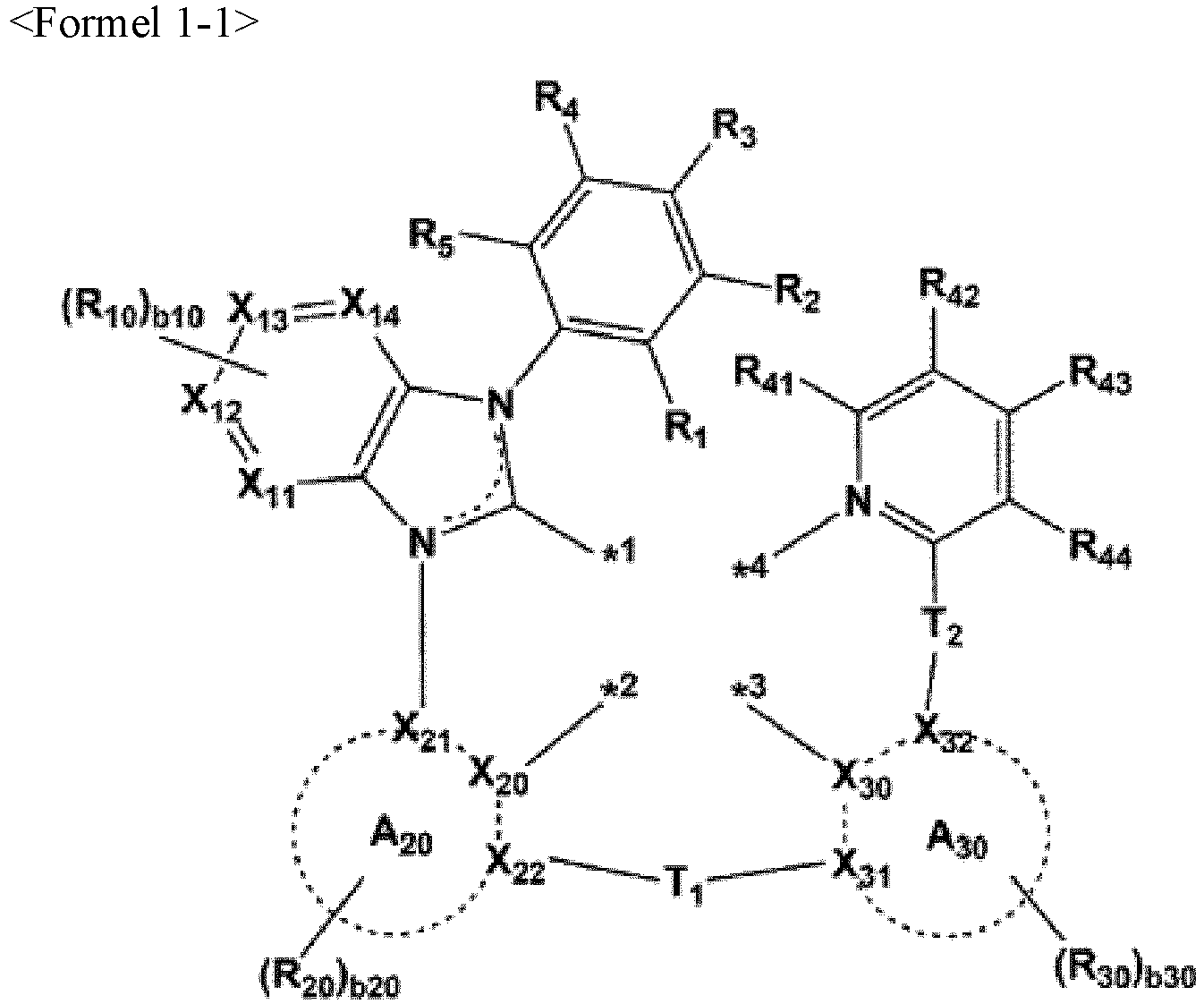 wobei in Formel 1-1*1 bis *4 jeweils eine Bindungsstelle für M1 angeben;A20 und A30 jeweils unabhängig eine carbocyclische C5-C30-Gruppe oder eine heterocyclische C1-C30-Gruppe sind,T1 eine Einfachbindung, *-N[(L1)a1-(R6)b6]-*', *-B(R6)-*', *-P(R6)-*', *-C(R6)(R7)-*', *-Si(R6)(R7)-*', *-Ge(R6)(R7)-*', *-S-*', *-Se-*', *-O-*', *-C(=O)-*', *-S(=O)-*', *-S(=O)2-*', *-C(R6)=C(R7)-*', *-C(=S)-*' oder *-C=C-*' ist,T2 eine Einfachbindung, *-N[(L2)a2-(R8)b8]-*', *-B(R8)-*', *-P(R8)-*', *-C(R8)(R9)-*', *-Si(R8)(R9)-*', *-Ge(R8)(R9)-*', *-S-*', *-Se-*', *-O-*', *-C(=O)-*', *-S(=O)-*', *-S(=O)2-*', *-C(R8)=C(R9)-*', *-C(=S)-*' oder *-C=C*' ist,L1 und L2 jeweils unabhängig eine Einfachbindung, eine substituierte oder unsubstituierte carbocyclische C5-C30-Gruppe oder eine substituierte oder unsubstituierte heterocyclische C1-C30-Gruppe sind,a1 eine ganze Zahl von 1 bis 3 ist, und wenn a1 2 oder höher ist, sind zwei oder mehr der L1 identisch oder verschieden, und a2 eine ganze Zahl von 1 bis 3 ist, und wenn a2 2 oder höher ist, sind zwei oder mehr der L2 identisch oder verschieden,X11 bis X14 jeweils unabhängig C oder N sind,X20 C oder N ist und X30 C oder N ist,X21, X22, X31 und X32 jeweils unabhängig C oder N sind,R1 bis R9, R10, R20, R30 und R41 bis R44 jeweils unabhängig Wasserstoff, Deuterium, -F, -Cl, - Br, -I, -SF5, eine Hydroxylgruppe, eine Cyanogruppe, eine Nitrogruppe, eine Amidinogruppe, eine Hydrazingruppe, eine Hydrazongruppe, eine Carbonsäuregruppe oder ein Salz davon, eine Sulfonsäuregruppe oder ein Salz davon, eine Phosphorsäuregruppe oder ein Salz davon, eine substituierte oder unsubstituierte C1-C60-Alkylgruppe, eine substituierte oder unsubstituierte C2-C60-Alkenylgruppe, eine substituierte oder unsubstituierte C2-C60-Alkinylgruppe, eine substituierte oder unsubstituierte C1-C60-Alkoxygruppe, eine substituierte oder unsubstituierte C1-C60-Alkylthiogruppe, eine substituierte oder unsubstituierte C3-C10-Cycloalkylgruppe, eine substituierte oder unsubstituierte C1-C10-Heterocycloalkylgruppe, eine substituierte oder unsubstituierte C3-C10-Cycloalkenylgruppe, eine substituierte oder unsubstituierte C2-C10-Heterocycloalkenylgruppe, eine substituierte oder unsubstituierte C6-C60-Arylgruppe, eine substituierte oder unsubstituierte C6-C60-Aryloxygruppe, eine substituierte oder unsubstituierte C6-C60-Arylthiogruppe, eine substituierte oder unsubstituierte C1-C60-Heteroarylgruppe, eine substituierte oder unsubstituierte einwertige, nichtaromatische, kondensierte, polycyclische Gruppe, eine substituierte oder unsubstituierte einwertige, nichtaromatische, kondensierte, heteropolycyclische Gruppe, -N(Q1)(Q2), -Si(Q3)(Q4)(Q5), - B(Q6)(Q7) oder -P(=O)(Q8)(Q9) sind,R2 und R43 jeweils unabhängig eine substituierte oder unsubstituierte C1-C60-Alkylgruppe oder eine substituierte oder unsubstituierte C6-C60-Arylgruppe sind, undmindestens eines von R10 und R30 nicht Wasserstoff ist,zwei oder mehr benachbarte R1 bis R9, R10, R20, R30 und R41 bis R44 optional unter Bildung einer substituierten oder unsubstituierten carbocyclischen C5-C30-Gruppe oder einer substituierten oder unsubstituierten heterocyclischen C1-C30-Gruppe verknüpft sind,b6 und b8 jeweils unabhängig eine ganze Zahl von 1 bis 5 sind,wenn b6 2 oder höher ist, sind zwei oder mehr der R6 identisch oder verschieden, und wenn b8 2 oder höher ist, sind zwei oder mehr der R8 identisch oder verschieden,b20 und b30 jeweils unabhängig eine ganze Zahl von 1 bis 10 sind,wenn b20 2 oder höher ist, sind zwei oder mehr von R20 identisch oder verschieden und wenn b30 2 oder höher ist, sind zwei oder mehr von R30 gleich oder verschieden,* und *' jeweils eine Bindungsstelle zu einem Nachbaratom angeben,mindestens ein Substituent der substituierten carbocyclischen C5-C30-Gruppe, der substituierten heterocyclischen C1-C30-Gruppe, der substituierten C1-C60-Alkylgruppe, der substituierten C2-C60-Alkenylgruppe, der substituierten C2-C60-Alkinylgruppe, der substituierten C1-C60-Alkoxygruppe, der substituierten C1-C60-Alkylthiogruppe, der substituierten C3-C10-Cycloalkylgruppe, der substituierten C1-C10-Heterocycloalkylgruppe, der substituierten C3-C10-Cycloalkenylgruppe, der substituierten C2-C10-Heterocycloalkenylgruppe, der substituierten C6-C60-Arylgruppe, der substituierten C6-C60-Aryloxygruppe, der substituierten C6-C60-Arylthiogruppe, der substituierten C1-C60-Heteroarylgruppe, der substituierten einwertigen nichtaromatischen kondensierten polycyclischen Gruppe und der substituierten einwertigen nichtaromatischen kondensierten heteropolycyclischen Folgendes ist:Deuterium, -F, -Cl, -Br, -I, -CD3, -CD2H, -CDH2, -CF3, -CF2H, -CFH2, eine Hydroxylgruppe, eine Cyanogruppe, ein Nitrogruppe, eine Amidinogruppe, eine Hydrazingruppe, eine Hydrazongruppe, eine Carbonsäuregruppe oder ein Salz davon, eine Sulfonsäuregruppe oder ein Salz davon, eine Phosphorsäuregruppe oder ein Salz davon, eine C1-C60-Alkylgruppe, eine C2-C60-Alkenylgruppe, eine C2-C60-Alkinylgruppe oder eine C1-C60-Alkoxygruppe;eine C1-C60-Alkylgruppe, eine C2-C60-Alkenylgruppe, eine C2-C60-Alkinylgruppe oder eine C1-C60-Alkoxygruppe, jeweils substituiert mit mindestens einem von Deuterium, -F, -Cl, -Br, -I, - CD3, -CD2H, -CDH2, -CF3, -CF2H, -CFH2, einer Hydroxylgruppe, einer Cyanogruppe, einer Nitrogruppe, einer Amidinogruppe, einer Hydrazingruppe, einer Hydrazongruppe, einer Carbonsäuregruppe oder einem Salz davon, einer Sulfonsäuregruppe oder einem Salz davon, einer Phosphorsäuregruppe oder einem Salz davon, einer C3-C10-Cycloalkylgruppe, einer C1-C10-Heterocycloalkylgruppe, einer C3-C10-Cycloalkenylgruppe, einer C2-C10-Heterocycloalkenylgruppe, einer C6-C60-Arylgruppe, einer C6-C60-Aryloxygruppe, einer C6-C60-Arylthiogruppe, einer C1-C60-Heteroarylgruppe, einer einwertigen, nichtaromatischen, kondensierten, polycyclischen Gruppe, einer einwertigen, nichtaromatischen, kondensierten, heteropolycyclischen Gruppe, -N(Q11)(Q12), - Si(Q13)(Q14)(Q15), -B(Q16)(Q17), -P(=O)(Q18)(Q19) oder einer beliebigen Kombination davon,eine C3-C10-Cycloalkylgruppe, eine C1-C10-Heterocycloalkylgruppe, eine C3-C10-Cycloalkenylgruppe, eine C2-C10-Heterocycloalkenylgruppe, eine C6-C60-Arylgruppe, eine C6-C60-Aryloxygruppe, eine C6-C60-Arylthiogruppe, eine C1-C60-Heteroarylgruppe, eine einwertige, nichtaromatische, kondensierte, polycyclische Gruppe oder eine einwertige, nichtaromatische, kondensierte, heteropolycyclische Gruppe,eine C3-C10-Cycloalkylgruppe, eine C1-C10-Heterocycloalkylgruppe, eine C3-C10-Cycloalkenylgruppe, eine C2-C10-Heterocycloalkenylgruppe, eine C6-C60-Arylgruppe, eine C6-C60-Aryloxygruppe, eine C6-C60-Arylthiogruppe, eine C1-C60-Heteroarylgruppe, eine einwertige, nichtaromatische, kondensierte, polycyclische Gruppe oder eine einwertige, nichtaromatische, kondensierte, heteropolycyclische Gruppe, jeweils substituiert mit mindestens einem von Deuterium, -F, -Cl, -Br, -I, -CD3, -CD2H, -CDH2, -CF3, -CF2H, -CFH2, einer Hydroxylgruppe, einer Cyanogruppe, einer Nitrogruppe, einer Amidinogruppe, einer Hydrazingruppe, einer Hydrazongruppe, einer Carbonsäuregruppe oder einem Salz davon, einer Sulfonsäuregruppe oder einem Salz davon, einer Phosphorsäuregruppe oder einem Salz davon, einer C1-C60-Alkylgruppe, einer C2-C60-Alkenylgruppe, einer C2-C60-Alkinylgruppe, einer C1-C60-Alkoxygruppe, einer C3-C10-Cycloalkylgruppe, einer C1-C10-Heterocycloalkylgruppe, einer C3-C10-Cycloalkenylgruppe, einer C2-C10-Heterocycloalkenylgruppe, einer C6-C60-Arylgruppe, einer C6-C60-Aryloxygruppe, einer C6-C60-Arylthiogruppe, einer C1-C60-Heteroarylgruppe, einer einwertigen, nichtaromatischen, kondensierten, polycyclischen Gruppe, einer einwertigen, nichtaromatischen, kondensierten, heteropolycyclischen Gruppe, -N(Q21)(Q22), -Si(Q23)(Q24)(Q25), -B(Q26)(Q27), -P(=O)(Q28)(Q29) oder einer beliebigen Kombination davon, oder-N(Q31)(Q32), -Si(Q33)(Q34)(Q35), -B(Q36)(Q37) oder -P(=O)(Q38)(Q39),wobei Q1 bis Q9, Q11 bis Q19, Q21 bis Q29 und Q31 bis Q39 jeweils unabhängig Wasserstoff, Deuterium, -F, -Cl, -Br, -I, eine Hydroxylgruppe, eine Cyanogruppe, eine Nitrogruppe, eine Amidinogruppe, eine Hydrazingruppe, eine Hydrazongruppe, eine Carbonsäuregruppe oder ein Salz davon, eine Sulfonsäuregruppe oder ein Salz davon, eine Phosphorsäuregruppe oder ein Salz davon, eine C1-C60-Alkylgruppe, eine C2-C60-Alkenylgruppe, eine C2-C60-Alkinylgruppe, eine C1-C60-Alkoxygruppe, eine C3-C10-Cycloalkylgruppe, eine C1-C10-Heterocycloalkylgruppe, eine C3-C10-Cycloalkenylgruppe, eine C2-C10-Heterocycloalkenylgruppe, eine C6-C60-Arylgruppe, eine C6-C60-Arylgruppe, substituiert mit mindestens einer C1-C60-Alkylgruppe, einer C6-C60-Arylgruppe oder einer beliebigen Kombination davon, eine C6-C60-Aryloxygruppe, eine C6-C60-Arylthiogruppe, eine C1-C60-Heteroarylgruppe, eine einwertige, nichtaromatische, kondensierte, polycyclische Gruppe, eine einwertige, nichtaromatische, kondensierte, heteropolycyclische Gruppe oder eine beliebige Kombination davon sind.
 - Organometallische Verbindung nach Anspruch 1, wobei M1 Pt, Pd oder Au ist; und/oderwobei A20 und A30 jeweils unabhängig eine Benzolgruppe, eine Naphthalingruppe, eine Anthracengruppe, eine Phenanthrengruppe, eine Triphenylengruppe, eine Pyrengruppe, eine Chrysengruppe, Cyclopentadiengruppe, eine 1,2,3,4-Tetrahydronaphthalingruppe, eine Furangruppe, eine Thiophengruppe, eine Silolgruppe, eine Pyrrolgruppe, eine Indengruppe, eine Fluorengruppe, eine Indolgruppe, eine Carbazolgruppe, eine Benzofurangruppe, eine Dibenzofurangruppe, eine Benzothiophengruppe, eine Dibenzothiophengruppe, eine Benzosilolgruppe, eine Dibenzosilolgruppe, eine Azafluorengruppe, eine Azacarbazolgruppe, eine Azadibenzofurangruppe, eine Azadibenzothiophengruppe, eine Azadibenzosilolgruppe, eine Pyridingruppe, eine Pyrimidingruppe, eine Pyrazingruppe, eine Pyridazingruppe, eine Triazingruppe, eine Chinolingruppe, eine Isochinolingruppe, eine Chinoxalingruppe, eine Chinazolingruppe, eine Phenanthrolingruppe, eine Pyrrolgruppe, eine Pyrazolgruppe, eine Imidazolgruppe, eine Triazolgruppe, eine Tetrazolgruppe, eine Oxazolgruppe, eine Isooxazolgruppe, eine Thiazolgruppe, eine Isothiazolgruppe, eine Oxadiazolgruppe, eine Thiadiazolgruppe, eine Benzopyrazolgruppe, eine Benzimidazolgruppe, eine Indazolgruppe, eine Benzoxazolgruppe, eine Benzothiazolgruppe, eine Benzoxadiazolgruppe, eine Benzothiadiazolgruppe, eine Benzotriazolgruppe, eine Diazaindengruppe, eine Triazaindengruppe, eine 5,6,7,8-Tetrahydroisochinolingruppe oder eine 5,6,7,8-Tetrahydrochinolingruppe sind, und/oderwobei T1 eine Einfachbindung, *-N[(L1)a1-(R6)b6]-*', *-B(R6)-*', *-C(R6)(R7)-*', *-Si(R6)(R7)-*', *-O-*' oder *-S-*' ist undT2 eine Einfachbindung, *-N[(L2)a2-(R8)b8]-*', *-C(R8)(R9)-*', *-Si(R8)(R9)-*', *-O-*' oder *-S-*' ist.
- Organometallische Verbindung nach Anspruch 1 oder 2, wobei L1 und L2 jeweils unabhängig Folgendes sind:eine Phenylengruppe, eine Pentalenylengruppe, eine Indenylengruppe, eine Naphthylengruppe, eine Azulenylengruppe, eine Heptalenylengruppe, eine Acenaphthylengruppe, eine Fluorenylengruppe, eine Phenalenylengruppe, eine Phenanthrenylengruppe, eine Anthracenylengruppe, eine Fluoranthenylengruppe, eine Triphenylenylengruppe, eine Pyrenylengruppe, eine Chrysenylenylengruppegruppe, eine Naphthacenylengruppe, eine Picenylengruppe, eine Perylenylengruppe oder eine Pentacenylengruppe; odereine Phenylengruppe, eine Pentalenylengruppe, eine Indenylengruppe, eine Naphthylengruppe, eine Azulenylengruppe, eine Heptalenylengruppe, eine Acenaphthylengruppe, eine Fluorenylengruppe, eine Phenalenylengruppe, eine Phenanthrenylengruppe, eine Anthracenylengruppe, eine Fluoranthenylengruppe, eine Triphenylenylengruppe, eine Pyrenylengruppe, eine Chrysenylenylengruppe, eine Naphthacenylengruppe, eine Picenylengruppe, eine Perylenylengruppe oder eine Pentacenylengruppe, jeweils substituiert mit mindestens einem Deuterium, -F, -Cl, -Br, -I, einer Hydroxylgruppe, einer Cyanogruppe, einer Nitrogruppe, einer Aminogruppe, einer Amidinogruppe, einer Hydrazingruppe, einer Hydrazongruppe, einer Carbonsäuregruppe oder einem Salz davon, einer Sulfonsäuregruppe oder einem Salz davon, einer Phosphorsäuregruppe oder einem Salz davon, einer C1-C60-Alkylgruppe, einer C2-C60-Alkenylgruppe, einer C2-C60-Alkinylgruppe, einer C1-C60-Alkoxygruppe, einer C1-C60-Alkylthiogruppe, einer C3-C10-Cycloalkylgruppe, einer C3-C10-Cycloalkenylgruppe, einer C1-C10-Heterocycloalkylgruppe, einer C2-C10-Heterocycloalkenylgruppe, einer C6-C60-Arylgruppe, einer C6-C60-Aryloxygruppe, einer C6-C60-Arylthiogruppe, einer C1-C60-Heteroarylgruppe, einer einwertigen, nichtaromatischen, kondensierten, polycyclischen Gruppe, einer einwertigen, nichtaromatischen, kondensierten, heteropolycyclischen Gruppe oder einer beliebigen Kombination davon.
- Organometallische Verbindung nach einem der Ansprüche 1-3, wobei eine Bindung zwischen M1 und A20 und eine Bindung zwischen M1 und A30 jeweils eine kovalente Bindung sind.
- Organometallische Verbindung nach einem der Ansprüche 1-4, wobei R1 bis R9, R10, R20, R30 und R41 bis R44 jeweils unabhängig Folgendes sind:Wasserstoff, Deuterium, -F, -Cl, -Br, -I, eine Hydroxylgruppe, eine Cyanogruppe, eine Nitrogruppe, eine Aminogruppe, eine Amidinogruppe, eine Hydrazingruppe, eine Hydrazongruppe, eine Carbonsäuregruppe oder ein Salz davon, eine Sulfonsäuregruppe oder ein Salz davon, eine Phosphorsäuregruppe oder ein Salz davon, -SF5, C1-C20-Alkylgruppe oder eine C1-C20-Alkoxygruppe,eine C1-C20-Alkylgruppe oder eine C1-C20-Alkoxygruppe, jeweils substituiert mit mindestens einem Deuterium, -F, -Cl, -Br, -I, -CD3, -CD2H, -CDH2, -CF3, -CF2H, -CFH2, eine Hydroxylgruppe, eine Cyanogruppe, eine Nitrogruppe, eine Aminogruppe, eine Amidinogruppe, eine Hydrazingruppe, eine Hydrazongruppe, eine Carbonsäuregruppe oder ein Salz davon, eine Sulfonsäuregruppe oder ein Salz davon, eine Phosphorsäuregruppe oder ein Salz davon, eine C1-C10-Alkylgruppe, eine Cyclopentylgruppe, eine Cyclohexylgruppe, eine Cycloheptylgruppe, eine Cyclooctylgruppe, eine Adamantanylgruppe, eine Norbornanylgruppe, ein Norbornenylgruppe, eine Cyclopentenylgruppe, eine Cyclohexenylgruppe, eine Cycloheptenylgruppe, eine Phenylgruppe, eine Naphthylgruppe, eine Pyridinylgruppe, eine Pyrimidinylgruppe oder eine beliebige Kombination davon,eine Cyclopentylgruppe, eine Cyclohexylgruppe, eine Cycloheptylgruppe, eine Cyclooctylgruppe, eine Adamantanylgruppe, eine Norbornanylgruppe, eine Norbornenylgruppe, eine Cyclopentenylgruppe, eine Cyclohexenylgruppe, eine Cycloheptenylgruppe, eine Phenylgruppe, eine Naphthylgruppe, eine Fluorenylgruppe, eine Phenanthrenylgruppe, eine Anthracenylgruppe, eine Fluoranthenylgruppe, eine Triphenylenylgruppe, eine Pyrenylgruppe, eine Chrysenylgruppe, eine Pyrrolylgruppe, eine Thiophenylgruppe, eine Furanylgruppe, eine Imidazolylgruppe, eine Pyrazolylgruppe, eine Thiazolylgruppe, eine Isothiazolylgruppe, eine Oxazolylgruppe, eine Isoxazolylgruppe, eine Pyridinylgruppe, eine Pyrazinylgruppe, eine Pyrimidinylgruppe, eine Pyridazinylgruppe, eine Isoindolylgruppe, eine Indolylgruppe, eine Indazolylgruppe, eine Purinylgruppe, eine Chinolinylgruppe, eine Isochinolinylgruppe, eine Benzochinolinylgruppe, eine Chinoxalinylgruppe, eine Chinazolinylgruppe, eine Cinnolinylgruppe, eine Carbazolylgruppe, eine Phenanthrolinylgruppe, eine Benzimidazolylgruppe, eine Benzofuranylgruppe, eine Benzothiophenylgruppe, eine Isobenzothiazolylgruppe, eine Benzoxazolylgruppe, eine Isobenzoxazolylgruppe, eine Triazolylgruppe, eine Tetrazolylgruppe, eine Oxadiazolylgruppe, eine Triazinylgruppe, eine Dibenzofuranylgruppe, eine Dibenzothiophenylgruppe, eine Benzocarbazolylgruppe, eine Dibenzocarbazolylgruppe, eine Imidazopyridinylgruppe oder eine Imidazopyrimidinylgruppe;eine Cyclopentylgruppe, eine Cyclohexylgruppe, eine Cycloheptylgruppe, eine Cyclooctylgruppe, eine Adamantanylgruppe, eine Norbornanylgruppe, eine Norbornenylgruppe, eine Cyclopentenylgruppe, eine Cyclohexenylgruppe, eine Cycloheptenylgruppe, eine Phenylgruppe, eine Naphthylgruppe, eine Fluorenylgruppe, eine Phenanthrenylgruppe, eine Anthracenylgruppe, eine Fluoranthenylgruppe, eine Triphenylenylgruppe, eine Pyrenylgruppe, eine Chrysenylgruppe, eine Pyrrolylgruppe, eine Thiophenylgruppe, eine Furanylgruppe, eine Imidazolylgruppe, eine Pyrazolylgruppe, eine Thiazolylgruppe, eine Isothiazolylgruppe, eine Oxazolylgruppe, eine Isoxazolylgruppe, eine Pyridinylgruppe, eine Pyrazinylgruppe, eine Pyrimidinylgruppe, eine Pyridazinylgruppe, eine Isoindolylgruppe, eine Indolylgruppe, eine Indazolylgruppe, eine Purinylgruppe, eine Chinolinylgruppe, eine Isochinolinylgruppe, eine Benzochinolinylgruppe, eine Chinoxalinylgruppe, eine Chinazolinylgruppe, eine Cinnolinylgruppe, ein Carbazolylgruppe, eine Phenanthrolinylgruppe, eine Benzimidazolylgruppe, eine Benzofuranylgruppe, eine Benzothiophenylgruppe, eine Isobenzothiazolylgruppe, eine Benzoxazolylgruppe, eine Isobenzoxazolylgruppe, eine Triazolylgruppe, eine Tetrazolylgruppe, eine Oxadiazolylgruppe, eine Triazinylgruppe, eine Dibenzofuranylgruppe, eine Dibenzothiophenylgruppe, eine Benzocarbazolylgruppe, eine Dibenzocarbazolylgruppe, eine Imidazopyridinylgruppe oder eine Imidazopyrimidinylgruppe, jeweils substituiert mit mindestens einem Deuterium, -F, -Cl, -Br, -I, - CD3, -CD2H, -CDH2, -CF3, -CF2H, -CFH2, einer Hydroxylgruppe, einer Cyanogruppe, einer Nitrogruppe, einer Aminogruppe, einer Amidinogruppe, einer Hydrazingruppe, einer Hydrazongruppe, einer Carbonsäuregruppe oder einem Salz davon, einer Sulfonsäuregruppe oder einem Salz davon, einer Phosphorsäuregruppe oder einem Salz davon, einer C1-C20-Alkylgruppe, einer C1-C20-Alkoxygruppe, einer Cyclopentylgruppe, einer Cyclohexylgruppe, einer Cycloheptylgruppe, einer Cyclooctylgruppe, einer Adamantanylgruppe, einer Norbornanylgruppe, einer Norbornenylgruppe, einer Cyclopentenylgruppe, einer Cyclohexenylgruppe, einer Cycloheptenylgruppe, einer Phenylgruppe, einer Naphthylgruppe, einer Fluorenylgruppe, einer Phenanthrenylgruppe, einer Anthracenylgruppe, einer Fluoranthenylgruppe, einer Triphenylenylgruppe, einer Pyrenylgruppe, einer Chrysenylgruppe, einer Pyrrolylgruppe, einer Thiophenylgruppe, einer Furanylgruppe, einer Imidazolylgruppe, einer Pyrazolylgruppe, einer Thiazolylgruppe, einer Isothiazolylgruppe, einer Oxazolylgruppe, einer Isoxazolylgruppe, einer Pyridinylgruppe, einer Pyrazinylgruppe, einer Pyrimidinylgruppe, einer Pyridazinylgruppe, einer Isoindolylgruppe, einer Indolylgruppe, einer Indazolylgruppe, einer Purinylgruppe, einer Chinolinylgruppe, einer Isochinolinylgruppe, einer Benzochinolinylgruppe, einer Chinoxalinylgruppe, einer Chinazolinylgruppe, einer Cinnolinylgruppe, einer Carbazolylgruppe, einer Phenanthrolinylgruppe, einer Benzimidazolylgruppe, einer Benzofuranylgruppe, einer Benzothiophenylgruppe, einer Isobenzothiazolylgruppe, einer Benzoxazolylgruppe, einer Isobenzoxazolylgruppe, einer Triazolylgruppe, einer Tetrazolylgruppe, einer Oxadiazolylgruppe, einer Triazinylgruppe, einer Dibenzofuranylgruppe, einer Dibenzothiophenylgruppe, einer Benzocarbazolylgruppe, einer Dibenzocarbazolylgruppe, einer Imidazopyridinylgruppe, einer Imidazopyrimidinylgruppe oder einer beliebigen Kombination davon, oder-N(Q1)(Q2), -Si(Q3)(Q4)(Q5), -B(Q6)(Q7), oder -P(=O)(Q8)(Q9),wobei Q1 bis Q9 jeweils unabhängig Folgendes sind:-CH3, -CD3, -CD2H, -CDH2, -CH2CH3, -CH2CD3, -CH2CD2H, -CH2CDH2, -CHDCH3, - CHDCD2H, -CHDCDH2, -CHDCD3, -CD2CH3, -CD2CD3, -CD2CD2H oder -CD2CDH2;eine n-Propylgruppe, eine Isopropylgruppe, eine n-Butylgruppe, eine Isobutylgruppe, eine sec-Butylgruppe, eine tert-Butylgruppe, eine n-Pentylgruppe, eine Isopentylgruppe, eine sec-Pentylgruppe, eine tert-Pentylgruppe, eine Phenylgruppe oder eine Naphthylgruppe; odereine n-Propylgruppe, eine Isopropylgruppe, eine n-Butylgruppe, eine Isobutylgruppe, eine sec-Butylgruppe, eine tert-Butylgruppe, eine n-Pentylgruppe, eine Isopentylgruppe, eine sec-Pentylgruppe, eine tert-Pentylgruppe, eine Phenylgruppe oder eine Naphthylgruppe, jeweils substituiert mit mindestens einem Deuterium, einer C1-C10-Alkylgruppe, einer Phenylgruppe oder einer beliebigen Kombination davon.
- Organometallische Verbindung nach einem der Ansprüche 1-5, wobei R2 und R43 jeweils unabhängig Folgendes sind:eine Methylgruppe, eine Ethylgruppe, eine n-Propylgruppe, eine Isopropylgruppe, eine n-Butylgruppe, eine Isobutylgruppe, eine sec-Butylgruppe, eine tert-Butylgruppe, eine n-Pentylgruppe, eine Isopentylgruppe, ein sec-Pentylgruppe, eine tert-Pentylgruppe, eine n-Hexylgruppe, eine Isohexylgruppe, eine sec-Hexylgruppe, eine tert-Hexylgruppe, eine n-Heptylgruppe, eine Isoheptylgruppe, eine sec-Heptylgruppe, eine tert-Heptylgruppe, eine n-Octylgruppe, eine Isooctylgruppe, eine sec-Octylgruppe, eine tert-Octylgruppe, eine n-Nonylgruppe, eine Isononylgruppe, eine sec-Nonylgruppe, eine tert-Nonylgruppe, eine n-Decylgruppe, eine Isodecylgruppe, eine sec-Decylgruppe, eine tert-Decylgruppe, eine Phenylgruppe, eine Naphthylgruppe, eine Fluorenylgruppe, eine Phenanthrenylgruppe, eine Anthracenylgruppe, eine Fluoranthenylgruppe, eine Triphenylenylgruppe, eine Pyrenylgruppe oder eine Chrysenylgruppe, odereine Methylgruppe, eine Ethylgruppe, eine n-Propylgruppe, eine Isopropylgruppe, eine n-Butylgruppe, eine Isobutylgruppe, eine sec-Butylgruppe, eine tert-Butylgruppe, eine n-Pentylgruppe, eine Isopentylgruppe, ein sec-Pentylgruppe, eine tert-Pentylgruppe, eine n-Hexylgruppe, eine Isohexylgruppe, eine sec-Hexylgruppe, eine tert-Hexylgruppe, eine n-Heptylgruppe, eine Isoheptylgruppe, eine sec-Heptylgruppe, eine tert-Heptylgruppe, eine n-Octylgruppe, eine Isooctylgruppe, eine sec-Octylgruppe, eine tert-Octylgruppe, eine n-Nonylgruppe, eine Isononylgruppe, eine sec-Nonylgruppe, eine tert-Nonylgruppe, eine n-Decylgruppe, eine Isodecylgruppe, eine sec-Decylgruppe, eine tert-Decylgruppe, eine Phenylgruppe, eine Naphthylgruppe, eine Fluorenylgruppe, eine Phenanthrenylgruppe, eine Anthracenylgruppe, eine Fluoranthenylgruppe, eine Triphenylenylgruppe, eine Pyrenylgruppe oder eine Chrysenylgruppe, jeweils substituiert mit mindestens einem Deuterium, -F, -Cl, -Br, -I, -CD3, -CD2H, -CDH2, -CF3, - CF2H, -CFH2, einer Hydroxylgruppe, einer Cyanogruppe, einer Nitrogruppe, einer Aminogruppe, einer Amidinogruppe, einer Hydrazingruppe, einer Hydrazongruppe, einer Carbonsäuregruppe oder einem Salz davon, einer Sulfonsäuregruppe oder einem Salz davon, einer Phosphorsäuregruppe oder einem Salz davon, einer Methylgruppe, einer Ethylgruppe, einer n-Propylgruppe, einer Isopropylgruppe, einer n-Butylgruppe, einer Isobutylgruppe, einer sec-Butylgruppe, einer tert-Butylgruppe, einer n-Pentylgruppe, einer Isopentylgruppe, einer sec-Pentylgruppe, einer tert-Pentylgruppe, einer n-Hexylgruppe, einer Isohexylgruppe, einer sec-Hexylgruppe, einer tert-Hexylgruppe, einer n-Heptylgruppe, einer Isoheptylgruppe, einer sec-Heptylgruppe, einer tert-Heptylgruppe, einer n-Octylgruppe, einer Isooctylgruppe, einer sec-Octylgruppe, einer tert-Octylgruppe, einer n-Nonylgruppe, einer Isononylgruppe, einer sec-Nonylgruppe, einer tert-Nonylgruppe, einer n-Decylgruppe, einer Isodecylgruppe, einer sec-Decylgruppe, einer tert-Decylgruppe, einer Phenylgruppe, einer Naphthylgruppe, einer Fluorenylgruppe, einer Phenanthrenylgruppe, einer Anthracenylgruppe, einer Auoranthenylgruppe, einer Triphenylenylgruppe, einer Pyrenylgruppe, einer Chrysenylgruppe oder einer beliebigen Kombination davon.
- Organometallische Verbindung nach einem der Ansprüche 1-6, wobei R1 bis R9, R10, R20, R30 und R41 bis R44 jeweils unabhängig Wasserstoff, Deuterium, -F, eine Cyanogruppe, eine Nitrogruppe, -SF5, -CH3, -CD3, -CD2H, -CDH2, -CF3, -CF2H, -CFH2, eine Gruppe, dargestellt durch eine der Formeln 9-1 bis 9-19, oder eine Gruppe, dargestellt durch eine der Formeln 10-1 bis 10-194 sind:













 wobei in den Formeln 9-1 bis 9-19 und 10-1 bis 10-194 * eine Bindungsstelle zu einem benachbarten Atom angibt, Ph eine Phenylgruppe ist und TMS eine Trimethylsilylgruppe ist;wobei vorzugsweise mindestens ein R10, R30 oder eine Kombination davon eine der Formeln 9-1 bis 9-19 und 10-1 bis 10-194 ist.
 - Organometallische Verbindung nach einem der Ansprüche 1-7, wobei R41, R42 und R44 jeweils Wasserstoff sind.
- Organometallische Verbindung nach einem der Ansprüche 1-8, wobei die durch Formel 1 dargestellte organometallische Verbindung durch eine der Formeln 2-1 und 2-2 dargestellt wird:

 M1, R1 bis R5 und R41 bis R44 die gleichen sind wie in Anspruch 1 beschrieben,X1 O oder S ist und X2 eine Einfachbindung, O oder S ist,R11 bis R14 jeweils die gleichen wie im Zusammenhang mit R10 in Anspruch 1 beschrieben sind,R21 bis R23 jeweils unabhängig die gleichen wie im Zusammenhang mit R20 in Anspruch 1 beschrieben sind,R31 bis R37 jeweils unabhängig die gleichen wie im Zusammenhang mit R30 in Anspruch 1 beschrieben sind, undbenachbarte zwei oder mehr von R1 bis R5, R11 bis R14, R21 bis R23, R31 bis R33 und R41 bis R44 optional miteinander verbunden sind, um einen Benzolring oder einen Naphthalinring zu bilden.
 - Organometallische Verbindung nach Anspruch 1, wobei die organometallische Verbindung ausgewählt ist aus den Verbindungen 1 bis 176












- Organische lichtemittierende Vorrichtung, umfassend:eine erste Elektrode,eine zweite Elektrode, undeine organische Schicht, die sich zwischen der ersten Elektrode und der zweiten Elektrode befindet und eine Emissionsschicht umfasst,wobei die organische Schicht mindestens eine metallorganische Verbindung nach einem der Ansprüche 1-10 umfasst.
- Organische lichtemittierende Vorrichtung nach Anspruch 11, wobei die erste Elektrode eine Anode ist,die zweite Elektrode eine Kathode ist,die organische Schicht ferner einen Lochtransportbereich zwischen der ersten Elektrode und der Emissionsschicht und einen Elektronentransportbereich zwischen der Emissionsschicht und der zweiten Elektrode umfasst,der Lochtransportbereich eine Lochinjektionsschicht, eine Lochtransportschicht, eine Elektronenblockierschicht oder eine beliebige Kombination davon umfasst, undder Elektronentransportbereich eine Lochblockierschicht, eine Elektronentransportschicht, eine Elektroneninjektionsschicht oder eine beliebige Kombination davon umfasst.
- Organische lichtemittierende Vorrichtung nach Anspruch 11 oder 12, wobei die metallorganische Verbindung in der Emissionsschicht enthalten ist.
- Organische lichtemittierende Vorrichtung nach Anspruch 13, wobei die Emissionsschicht ferner einen Host umfasst und die Menge des Hosts größer als die Menge der metallorganischen Verbindung ist; und/oderwobei die Emissionsschicht ferner einen fluoreszierenden Dotierstoff umfasst, und/oderwobei die Emissionsschicht blaues Licht mit einer maximalen Lumineszenzwellenlänge von 410 nm bis 490 nm emittiert.
- Diagnostische Zusammensetzung, umfassend mindestens eine metallorganische Verbindung nach einem der Ansprüche 1-10.
Applications Claiming Priority (2)
| Application Number | Priority Date | Filing Date | Title |
|---|---|---|---|
| KR20190070074 | 2019-06-13 | ||
| KR1020200050330A KR20200143237A (ko) | 2019-06-13 | 2020-04-24 | 유기금속 화합물, 이를 포함한 유기 발광 소자 및 이를 포함한 진단용 조성물 |
Publications (2)
| Publication Number | Publication Date |
|---|---|
| EP3750901A1 EP3750901A1 (de) | 2020-12-16 |
| EP3750901B1 true EP3750901B1 (de) | 2023-12-20 |
Family
ID=71092463
Family Applications (1)
| Application Number | Title | Priority Date | Filing Date |
|---|---|---|---|
| EP20179663.8A Active EP3750901B1 (de) | 2019-06-13 | 2020-06-12 | Organometallische verbindung, organische lichtemittierende vorrichtung damit und diagnosezusammensetzung mit der organometallischen verbindung |
Country Status (3)
| Country | Link |
|---|---|
| US (1) | US11778899B2 (de) |
| EP (1) | EP3750901B1 (de) |
| CN (1) | CN112079872A (de) |
Families Citing this family (14)
| Publication number | Priority date | Publication date | Assignee | Title |
|---|---|---|---|---|
| EP3689888B1 (de) * | 2019-01-31 | 2021-09-22 | Samsung Electronics Co., Ltd. | Organometallische verbindung und organische lichtemittierende vorrichtung damit |
| US11858949B2 (en) * | 2019-06-13 | 2024-01-02 | Samsung Electronics Co., Ltd. | Organometallic compound, organic light-emitting device including the same, and diagnostic composition including the organometallic compound |
| EP3750899A1 (de) * | 2019-06-13 | 2020-12-16 | Samsung Electronics Co., Ltd. | Organometallische verbindung, organische lichtemittierende vorrichtung damit und diagnosezusammensetzung mit der organometallischen verbindung |
| US12247039B2 (en) | 2019-11-27 | 2025-03-11 | Samsung Electronics Co., Ltd. | Organometallic compound, organic light-emitting device including organometallic compound and electronic apparatus including the organic light-emitting device |
| EP3971261A1 (de) * | 2020-09-17 | 2022-03-23 | Samsung Electronics Co., Ltd. | Organometallische verbindung, organische lichtemittierende vorrichtung damit und diagnosezusammensetzung mit der organometallischen verbindung |
| CN112920209B (zh) * | 2021-01-29 | 2025-05-30 | 上海弗屈尔光电科技有限公司 | 一种有机金属配合物及含有该化合物的有机光电元件 |
| KR20220119909A (ko) | 2021-02-22 | 2022-08-30 | 삼성전자주식회사 | 헤테로시클릭 화합물, 이를 포함한 유기 발광 소자 및 상기 유기 발광 소자를 포함한 전자 장치 |
| US20220396596A1 (en) * | 2021-05-24 | 2022-12-15 | Universal Display Corporation | Organic electroluminescent materials and devices |
| KR20230012369A (ko) * | 2021-07-15 | 2023-01-26 | 삼성전자주식회사 | 유기금속 화합물 및 이를 포함한 유기 발광 소자 |
| EP4120381A1 (de) | 2021-07-16 | 2023-01-18 | Samsung Electronics Co., Ltd. | Organische lichtemittierende vorrichtung |
| EP4122999B1 (de) | 2021-07-22 | 2024-04-10 | Samsung Electronics Co., Ltd. | Organometallische verbindung, organische lichtemittierende vorrichtung damit und elektronisches gerät mit der organischen lichtemittierenden vorrichtung |
| CN114933616B (zh) * | 2022-06-07 | 2024-04-30 | 宇瑞(上海)化学有限公司 | 有机金属配合物、有机光电器件及显示或照明装置 |
| CN115850344A (zh) * | 2022-11-30 | 2023-03-28 | 浙江工业大学 | 有机发光二极管材料、器件及装置 |
| CN116903677B (zh) * | 2023-07-18 | 2026-02-17 | 浙江工业大学 | 一种基于吡啶并卡宾的四齿环金属铂(ii)配合物及应用 |
Family Cites Families (15)
| Publication number | Priority date | Publication date | Assignee | Title |
|---|---|---|---|---|
| EP1325671B1 (de) | 2000-08-11 | 2012-10-24 | The Trustees Of Princeton University | Organometallische verbdindungen und emissionsverschobene organische elektrolumineszens |
| US6939624B2 (en) | 2000-08-11 | 2005-09-06 | Universal Display Corporation | Organometallic compounds and emission-shifting organic electrophosphorescence |
| DE10338550A1 (de) | 2003-08-19 | 2005-03-31 | Basf Ag | Übergangsmetallkomplexe mit Carbenliganden als Emitter für organische Licht-emittierende Dioden (OLEDs) |
| US9461254B2 (en) | 2012-01-03 | 2016-10-04 | Universal Display Corporation | Organic electroluminescent materials and devices |
| JP6804823B2 (ja) | 2013-10-14 | 2020-12-23 | アリゾナ・ボード・オブ・リージェンツ・オン・ビハーフ・オブ・アリゾナ・ステイト・ユニバーシティーArizona Board of Regents on behalf of Arizona State University | 白金錯体およびデバイス |
| US9923155B2 (en) | 2014-07-24 | 2018-03-20 | Arizona Board Of Regents On Behalf Of Arizona State University | Tetradentate platinum (II) complexes cyclometalated with functionalized phenyl carbene ligands and their analogues |
| US11152579B2 (en) | 2016-12-28 | 2021-10-19 | Universal Display Corporation | Organic electroluminescent materials and devices |
| US11552261B2 (en) | 2017-06-23 | 2023-01-10 | Universal Display Corporation | Organic electroluminescent materials and devices |
| US11725022B2 (en) | 2017-06-23 | 2023-08-15 | Universal Display Corporation | Organic electroluminescent materials and devices |
| US11814403B2 (en) | 2017-06-23 | 2023-11-14 | Universal Display Corporation | Organic electroluminescent materials and devices |
| KR20190014187A (ko) | 2017-07-27 | 2019-02-12 | 삼성디스플레이 주식회사 | 유기금속 화합물 및 이를 포함하는 유기 발광 소자 |
| KR102654922B1 (ko) | 2018-03-09 | 2024-04-05 | 삼성디스플레이 주식회사 | 유기금속 화합물 및 이를 포함한 유기 발광 소자 |
| CN108840886A (zh) | 2018-06-22 | 2018-11-20 | 南京工业大学 | 一种铂配合物蓝光材料以及有机发光器件 |
| US20200199164A1 (en) | 2018-12-19 | 2020-06-25 | Samsung Electronics Co., Ltd. | Organometallic compound, organic light-emitting device including the organometallic compound, and diagnostic composition including the organometallic compound |
| CN109748938B (zh) | 2019-02-01 | 2021-08-03 | 南京工业大学 | 二价铂配合物、其应用及有机光电装置 |
-
2020
- 2020-06-12 US US16/899,776 patent/US11778899B2/en active Active
- 2020-06-12 EP EP20179663.8A patent/EP3750901B1/de active Active
- 2020-06-15 CN CN202010541607.6A patent/CN112079872A/zh active Pending
Also Published As
| Publication number | Publication date |
|---|---|
| US20200395560A1 (en) | 2020-12-17 |
| CN112079872A (zh) | 2020-12-15 |
| US11778899B2 (en) | 2023-10-03 |
| EP3750901A1 (de) | 2020-12-16 |
Similar Documents
| Publication | Publication Date | Title |
|---|---|---|
| EP3750901B1 (de) | Organometallische verbindung, organische lichtemittierende vorrichtung damit und diagnosezusammensetzung mit der organometallischen verbindung | |
| EP3750900A1 (de) | Organometallische verbindung, organische lichtemittierende vorrichtung damit und diagnosezusammensetzung mit der organometallischen verbindung | |
| EP3960747B1 (de) | Organometallische verbindung und organische lichtemittierende vorrichtung damit | |
| EP3613752B1 (de) | Organometallische verbindung, organische lichtemittierende vorrichtung mit der organometallischen verbindung und diagnostische zusammensetzung mit der organometallischen verbindung | |
| US12606581B2 (en) | Organometallic compound, organic light-emitting device including the same, and diagnostic composition including the organometallic compound | |
| EP3750898A1 (de) | Organometallische verbindung, organische lichtemittierende vorrichtung damit und diagnosezusammensetzung mit der organometallischen verbindung | |
| EP3205659A1 (de) | Organometallische verbindung, organische lichtemittierende vorrichtung mit der organometallischen verbindung und diagnosezusammensetzung mit der organometallischen verbindung | |
| EP3705483B1 (de) | Organometallische verbindung, organische lichtemittierende vorrichtung damit und elektronische vorrichtung mit der organischen lichtemittierenden vorrichtung | |
| US20220081457A1 (en) | Organometallic compound, organic light-emitting device including the same, and diagnostic composition including the organometallic compound | |
| KR20180056314A (ko) | 유기금속 화합물, 이를 포함한 유기 발광 소자 및 이를 포함한 진단용 조성물 | |
| EP3750899A1 (de) | Organometallische verbindung, organische lichtemittierende vorrichtung damit und diagnosezusammensetzung mit der organometallischen verbindung | |
| EP3461831B1 (de) | Organometallische verbindung, organische lichtemittierende vorrichtung mit der organometallischen verbindung und diagnostische zusammensetzung mit der organometallischen verbindung | |
| EP3381926B1 (de) | Organometallische verbindung, organische lichtemittierende vorrichtung mit der organometallischen verbindung und diagnosezusammensetzung mit der organometallischen verbindung | |
| KR20200143237A (ko) | 유기금속 화합물, 이를 포함한 유기 발광 소자 및 이를 포함한 진단용 조성물 | |
| US20230107905A1 (en) | Organometallic compound and organic light-emitting device including the same | |
| EP3617216A1 (de) | Organometallische verbindung, organische lichtemittierende vorrichtung damit und diagnosezusammensetzung mit der organometallischen verbindung | |
| EP4186913B1 (de) | Organometallische verbindung und organische lichtemittierende vorrichtung damit | |
| EP3130595A1 (de) | Organometallische verbindung, organische lichtemittierende vorrichtung mit der organometallischen verbindung und diagnosezusammensetzung mit der organometallischen verbindung | |
| US20210347798A1 (en) | Organometallic compound, organic light-emitting device including the same, and diagnostic composition including the organometallic compound | |
| KR20210073250A (ko) | 유기금속 화합물, 이를 포함한 유기 발광 소자 및 이를 포함한 진단용 조성물 | |
| EP4711374A2 (de) | Organometallische verbindung und organische lichtemittierende vorrichtung damit | |
| EP4026839A1 (de) | Organometallische verbindung, organische lichtemittierende vorrichtung damit und elektronisches gerät mit der organischen lichtemittierenden vorrichtung | |
| KR20240143610A (ko) | 유기금속 금 착화합물을 포함하는 유기발광소자 |
Legal Events
| Date | Code | Title | Description |
|---|---|---|---|
| PUAI | Public reference made under article 153(3) epc to a published international application that has entered the european phase |
Free format text: ORIGINAL CODE: 0009012 |
|
| STAA | Information on the status of an ep patent application or granted ep patent |
Free format text: STATUS: THE APPLICATION HAS BEEN PUBLISHED |
|
| AK | Designated contracting states |
Kind code of ref document: A1 Designated state(s): AL AT BE BG CH CY CZ DE DK EE ES FI FR GB GR HR HU IE IS IT LI LT LU LV MC MK MT NL NO PL PT RO RS SE SI SK SM TR |
|
| AX | Request for extension of the european patent |
Extension state: BA ME |
|
| STAA | Information on the status of an ep patent application or granted ep patent |
Free format text: STATUS: REQUEST FOR EXAMINATION WAS MADE |
|
| 17P | Request for examination filed |
Effective date: 20210616 |
|
| RBV | Designated contracting states (corrected) |
Designated state(s): AL AT BE BG CH CY CZ DE DK EE ES FI FR GB GR HR HU IE IS IT LI LT LU LV MC MK MT NL NO PL PT RO RS SE SI SK SM TR |
|
| GRAP | Despatch of communication of intention to grant a patent |
Free format text: ORIGINAL CODE: EPIDOSNIGR1 |
|
| STAA | Information on the status of an ep patent application or granted ep patent |
Free format text: STATUS: GRANT OF PATENT IS INTENDED |
|
| INTG | Intention to grant announced |
Effective date: 20220721 |
|
| GRAJ | Information related to disapproval of communication of intention to grant by the applicant or resumption of examination proceedings by the epo deleted |
Free format text: ORIGINAL CODE: EPIDOSDIGR1 |
|
| STAA | Information on the status of an ep patent application or granted ep patent |
Free format text: STATUS: REQUEST FOR EXAMINATION WAS MADE |
|
| INTC | Intention to grant announced (deleted) | ||
| GRAJ | Information related to disapproval of communication of intention to grant by the applicant or resumption of examination proceedings by the epo deleted |
Free format text: ORIGINAL CODE: EPIDOSDIGR1 |
|
| GRAP | Despatch of communication of intention to grant a patent |
Free format text: ORIGINAL CODE: EPIDOSNIGR1 |
|
| RIC1 | Information provided on ipc code assigned before grant |
Ipc: H05B 33/14 20060101ALI20221229BHEP Ipc: H01L 51/50 20060101ALI20221229BHEP Ipc: H01L 51/00 20060101ALI20221229BHEP Ipc: C09K 11/06 20060101ALI20221229BHEP Ipc: C07F 15/00 20060101AFI20221229BHEP |
|
| GRAP | Despatch of communication of intention to grant a patent |
Free format text: ORIGINAL CODE: EPIDOSNIGR1 |
|
| STAA | Information on the status of an ep patent application or granted ep patent |
Free format text: STATUS: GRANT OF PATENT IS INTENDED |
|
| INTG | Intention to grant announced |
Effective date: 20230210 |
|
| RIC1 | Information provided on ipc code assigned before grant |
Ipc: H05B 33/14 20060101ALI20230202BHEP Ipc: C09K 11/06 20060101ALI20230202BHEP Ipc: C07F 15/00 20060101AFI20230202BHEP |
|
| GRAS | Grant fee paid |
Free format text: ORIGINAL CODE: EPIDOSNIGR3 |
|
| P01 | Opt-out of the competence of the unified patent court (upc) registered |
Effective date: 20230519 |
|
| GRAA | (expected) grant |
Free format text: ORIGINAL CODE: 0009210 |
|
| STAA | Information on the status of an ep patent application or granted ep patent |
Free format text: STATUS: THE PATENT HAS BEEN GRANTED |
|
| AK | Designated contracting states |
Kind code of ref document: B1 Designated state(s): AL AT BE BG CH CY CZ DE DK EE ES FI FR GB GR HR HU IE IS IT LI LT LU LV MC MK MT NL NO PL PT RO RS SE SI SK SM TR |
|
| REG | Reference to a national code |
Ref country code: GB Ref legal event code: FG4D |
|
| REG | Reference to a national code |
Ref country code: DE Ref legal event code: R096 Ref document number: 602020022953 Country of ref document: DE |
|
| REG | Reference to a national code |
Ref country code: CH Ref legal event code: EP |
|
| REG | Reference to a national code |
Ref country code: IE Ref legal event code: FG4D |
|
| PG25 | Lapsed in a contracting state [announced via postgrant information from national office to epo] |
Ref country code: GR Free format text: LAPSE BECAUSE OF FAILURE TO SUBMIT A TRANSLATION OF THE DESCRIPTION OR TO PAY THE FEE WITHIN THE PRESCRIBED TIME-LIMIT Effective date: 20240321 |
|
| REG | Reference to a national code |
Ref country code: LT Ref legal event code: MG9D |
|
| PG25 | Lapsed in a contracting state [announced via postgrant information from national office to epo] |
Ref country code: LT Free format text: LAPSE BECAUSE OF FAILURE TO SUBMIT A TRANSLATION OF THE DESCRIPTION OR TO PAY THE FEE WITHIN THE PRESCRIBED TIME-LIMIT Effective date: 20231220 |
|
| REG | Reference to a national code |
Ref country code: NL Ref legal event code: MP Effective date: 20231220 |
|
| PG25 | Lapsed in a contracting state [announced via postgrant information from national office to epo] |
Ref country code: ES Free format text: LAPSE BECAUSE OF FAILURE TO SUBMIT A TRANSLATION OF THE DESCRIPTION OR TO PAY THE FEE WITHIN THE PRESCRIBED TIME-LIMIT Effective date: 20231220 |
|
| PG25 | Lapsed in a contracting state [announced via postgrant information from national office to epo] |
Ref country code: LT Free format text: LAPSE BECAUSE OF FAILURE TO SUBMIT A TRANSLATION OF THE DESCRIPTION OR TO PAY THE FEE WITHIN THE PRESCRIBED TIME-LIMIT Effective date: 20231220 Ref country code: GR Free format text: LAPSE BECAUSE OF FAILURE TO SUBMIT A TRANSLATION OF THE DESCRIPTION OR TO PAY THE FEE WITHIN THE PRESCRIBED TIME-LIMIT Effective date: 20240321 Ref country code: FI Free format text: LAPSE BECAUSE OF FAILURE TO SUBMIT A TRANSLATION OF THE DESCRIPTION OR TO PAY THE FEE WITHIN THE PRESCRIBED TIME-LIMIT Effective date: 20231220 Ref country code: ES Free format text: LAPSE BECAUSE OF FAILURE TO SUBMIT A TRANSLATION OF THE DESCRIPTION OR TO PAY THE FEE WITHIN THE PRESCRIBED TIME-LIMIT Effective date: 20231220 Ref country code: BG Free format text: LAPSE BECAUSE OF FAILURE TO SUBMIT A TRANSLATION OF THE DESCRIPTION OR TO PAY THE FEE WITHIN THE PRESCRIBED TIME-LIMIT Effective date: 20240320 |
|
| REG | Reference to a national code |
Ref country code: AT Ref legal event code: MK05 Ref document number: 1642391 Country of ref document: AT Kind code of ref document: T Effective date: 20231220 |
|
| PG25 | Lapsed in a contracting state [announced via postgrant information from national office to epo] |
Ref country code: NL Free format text: LAPSE BECAUSE OF FAILURE TO SUBMIT A TRANSLATION OF THE DESCRIPTION OR TO PAY THE FEE WITHIN THE PRESCRIBED TIME-LIMIT Effective date: 20231220 |
|
| PG25 | Lapsed in a contracting state [announced via postgrant information from national office to epo] |
Ref country code: SE Free format text: LAPSE BECAUSE OF FAILURE TO SUBMIT A TRANSLATION OF THE DESCRIPTION OR TO PAY THE FEE WITHIN THE PRESCRIBED TIME-LIMIT Effective date: 20231220 Ref country code: RS Free format text: LAPSE BECAUSE OF FAILURE TO SUBMIT A TRANSLATION OF THE DESCRIPTION OR TO PAY THE FEE WITHIN THE PRESCRIBED TIME-LIMIT Effective date: 20231220 Ref country code: NO Free format text: LAPSE BECAUSE OF FAILURE TO SUBMIT A TRANSLATION OF THE DESCRIPTION OR TO PAY THE FEE WITHIN THE PRESCRIBED TIME-LIMIT Effective date: 20240320 Ref country code: NL Free format text: LAPSE BECAUSE OF FAILURE TO SUBMIT A TRANSLATION OF THE DESCRIPTION OR TO PAY THE FEE WITHIN THE PRESCRIBED TIME-LIMIT Effective date: 20231220 Ref country code: LV Free format text: LAPSE BECAUSE OF FAILURE TO SUBMIT A TRANSLATION OF THE DESCRIPTION OR TO PAY THE FEE WITHIN THE PRESCRIBED TIME-LIMIT Effective date: 20231220 Ref country code: HR Free format text: LAPSE BECAUSE OF FAILURE TO SUBMIT A TRANSLATION OF THE DESCRIPTION OR TO PAY THE FEE WITHIN THE PRESCRIBED TIME-LIMIT Effective date: 20231220 |
|
| PG25 | Lapsed in a contracting state [announced via postgrant information from national office to epo] |
Ref country code: IS Free format text: LAPSE BECAUSE OF FAILURE TO SUBMIT A TRANSLATION OF THE DESCRIPTION OR TO PAY THE FEE WITHIN THE PRESCRIBED TIME-LIMIT Effective date: 20240420 |
|
| PG25 | Lapsed in a contracting state [announced via postgrant information from national office to epo] |
Ref country code: AT Free format text: LAPSE BECAUSE OF FAILURE TO SUBMIT A TRANSLATION OF THE DESCRIPTION OR TO PAY THE FEE WITHIN THE PRESCRIBED TIME-LIMIT Effective date: 20231220 Ref country code: CZ Free format text: LAPSE BECAUSE OF FAILURE TO SUBMIT A TRANSLATION OF THE DESCRIPTION OR TO PAY THE FEE WITHIN THE PRESCRIBED TIME-LIMIT Effective date: 20231220 |
|
| PG25 | Lapsed in a contracting state [announced via postgrant information from national office to epo] |
Ref country code: SK Free format text: LAPSE BECAUSE OF FAILURE TO SUBMIT A TRANSLATION OF THE DESCRIPTION OR TO PAY THE FEE WITHIN THE PRESCRIBED TIME-LIMIT Effective date: 20231220 |
|
| PG25 | Lapsed in a contracting state [announced via postgrant information from national office to epo] |
Ref country code: SM Free format text: LAPSE BECAUSE OF FAILURE TO SUBMIT A TRANSLATION OF THE DESCRIPTION OR TO PAY THE FEE WITHIN THE PRESCRIBED TIME-LIMIT Effective date: 20231220 Ref country code: SK Free format text: LAPSE BECAUSE OF FAILURE TO SUBMIT A TRANSLATION OF THE DESCRIPTION OR TO PAY THE FEE WITHIN THE PRESCRIBED TIME-LIMIT Effective date: 20231220 Ref country code: RO Free format text: LAPSE BECAUSE OF FAILURE TO SUBMIT A TRANSLATION OF THE DESCRIPTION OR TO PAY THE FEE WITHIN THE PRESCRIBED TIME-LIMIT Effective date: 20231220 Ref country code: IT Free format text: LAPSE BECAUSE OF FAILURE TO SUBMIT A TRANSLATION OF THE DESCRIPTION OR TO PAY THE FEE WITHIN THE PRESCRIBED TIME-LIMIT Effective date: 20231220 Ref country code: IS Free format text: LAPSE BECAUSE OF FAILURE TO SUBMIT A TRANSLATION OF THE DESCRIPTION OR TO PAY THE FEE WITHIN THE PRESCRIBED TIME-LIMIT Effective date: 20240420 Ref country code: EE Free format text: LAPSE BECAUSE OF FAILURE TO SUBMIT A TRANSLATION OF THE DESCRIPTION OR TO PAY THE FEE WITHIN THE PRESCRIBED TIME-LIMIT Effective date: 20231220 Ref country code: CZ Free format text: LAPSE BECAUSE OF FAILURE TO SUBMIT A TRANSLATION OF THE DESCRIPTION OR TO PAY THE FEE WITHIN THE PRESCRIBED TIME-LIMIT Effective date: 20231220 Ref country code: AT Free format text: LAPSE BECAUSE OF FAILURE TO SUBMIT A TRANSLATION OF THE DESCRIPTION OR TO PAY THE FEE WITHIN THE PRESCRIBED TIME-LIMIT Effective date: 20231220 |
|
| PG25 | Lapsed in a contracting state [announced via postgrant information from national office to epo] |
Ref country code: PT Free format text: LAPSE BECAUSE OF FAILURE TO SUBMIT A TRANSLATION OF THE DESCRIPTION OR TO PAY THE FEE WITHIN THE PRESCRIBED TIME-LIMIT Effective date: 20240422 Ref country code: PL Free format text: LAPSE BECAUSE OF FAILURE TO SUBMIT A TRANSLATION OF THE DESCRIPTION OR TO PAY THE FEE WITHIN THE PRESCRIBED TIME-LIMIT Effective date: 20231220 |
|
| PG25 | Lapsed in a contracting state [announced via postgrant information from national office to epo] |
Ref country code: PT Free format text: LAPSE BECAUSE OF FAILURE TO SUBMIT A TRANSLATION OF THE DESCRIPTION OR TO PAY THE FEE WITHIN THE PRESCRIBED TIME-LIMIT Effective date: 20240422 Ref country code: PL Free format text: LAPSE BECAUSE OF FAILURE TO SUBMIT A TRANSLATION OF THE DESCRIPTION OR TO PAY THE FEE WITHIN THE PRESCRIBED TIME-LIMIT Effective date: 20231220 |
|
| REG | Reference to a national code |
Ref country code: DE Ref legal event code: R097 Ref document number: 602020022953 Country of ref document: DE |
|
| PG25 | Lapsed in a contracting state [announced via postgrant information from national office to epo] |
Ref country code: DK Free format text: LAPSE BECAUSE OF FAILURE TO SUBMIT A TRANSLATION OF THE DESCRIPTION OR TO PAY THE FEE WITHIN THE PRESCRIBED TIME-LIMIT Effective date: 20231220 |
|
| PLBE | No opposition filed within time limit |
Free format text: ORIGINAL CODE: 0009261 |
|
| STAA | Information on the status of an ep patent application or granted ep patent |
Free format text: STATUS: NO OPPOSITION FILED WITHIN TIME LIMIT |
|
| PG25 | Lapsed in a contracting state [announced via postgrant information from national office to epo] |
Ref country code: SI Free format text: LAPSE BECAUSE OF FAILURE TO SUBMIT A TRANSLATION OF THE DESCRIPTION OR TO PAY THE FEE WITHIN THE PRESCRIBED TIME-LIMIT Effective date: 20231220 |
|
| PG25 | Lapsed in a contracting state [announced via postgrant information from national office to epo] |
Ref country code: SI Free format text: LAPSE BECAUSE OF FAILURE TO SUBMIT A TRANSLATION OF THE DESCRIPTION OR TO PAY THE FEE WITHIN THE PRESCRIBED TIME-LIMIT Effective date: 20231220 Ref country code: DK Free format text: LAPSE BECAUSE OF FAILURE TO SUBMIT A TRANSLATION OF THE DESCRIPTION OR TO PAY THE FEE WITHIN THE PRESCRIBED TIME-LIMIT Effective date: 20231220 |
|
| 26N | No opposition filed |
Effective date: 20240923 |
|
| PG25 | Lapsed in a contracting state [announced via postgrant information from national office to epo] |
Ref country code: MC Free format text: LAPSE BECAUSE OF FAILURE TO SUBMIT A TRANSLATION OF THE DESCRIPTION OR TO PAY THE FEE WITHIN THE PRESCRIBED TIME-LIMIT Effective date: 20231220 |
|
| REG | Reference to a national code |
Ref country code: CH Ref legal event code: PL |
|
| PG25 | Lapsed in a contracting state [announced via postgrant information from national office to epo] |
Ref country code: LU Free format text: LAPSE BECAUSE OF NON-PAYMENT OF DUE FEES Effective date: 20240612 |
|
| PG25 | Lapsed in a contracting state [announced via postgrant information from national office to epo] |
Ref country code: IE Free format text: LAPSE BECAUSE OF NON-PAYMENT OF DUE FEES Effective date: 20240612 |
|
| PG25 | Lapsed in a contracting state [announced via postgrant information from national office to epo] |
Ref country code: CH Free format text: LAPSE BECAUSE OF NON-PAYMENT OF DUE FEES Effective date: 20240630 Ref country code: BE Free format text: LAPSE BECAUSE OF NON-PAYMENT OF DUE FEES Effective date: 20240630 |
|
| REG | Reference to a national code |
Ref country code: BE Ref legal event code: MM Effective date: 20240630 |
|
| PGFP | Annual fee paid to national office [announced via postgrant information from national office to epo] |
Ref country code: DE Payment date: 20250507 Year of fee payment: 6 |
|
| PGFP | Annual fee paid to national office [announced via postgrant information from national office to epo] |
Ref country code: GB Payment date: 20250508 Year of fee payment: 6 |
|
| PGFP | Annual fee paid to national office [announced via postgrant information from national office to epo] |
Ref country code: FR Payment date: 20250508 Year of fee payment: 6 |
|
| PG25 | Lapsed in a contracting state [announced via postgrant information from national office to epo] |
Ref country code: CY Free format text: LAPSE BECAUSE OF FAILURE TO SUBMIT A TRANSLATION OF THE DESCRIPTION OR TO PAY THE FEE WITHIN THE PRESCRIBED TIME-LIMIT; INVALID AB INITIO Effective date: 20200612 |
|
| PG25 | Lapsed in a contracting state [announced via postgrant information from national office to epo] |
Ref country code: HU Free format text: LAPSE BECAUSE OF FAILURE TO SUBMIT A TRANSLATION OF THE DESCRIPTION OR TO PAY THE FEE WITHIN THE PRESCRIBED TIME-LIMIT; INVALID AB INITIO Effective date: 20200612 |