EP3778616A1 - Optisch aktives segment für stereokontrollierte oligonukleotidsynthese, verfahren zu seiner herstellung und stereogesteuertes oligonukleotidsyntheseverfahren unter verwendung desselben - Google Patents
Optisch aktives segment für stereokontrollierte oligonukleotidsynthese, verfahren zu seiner herstellung und stereogesteuertes oligonukleotidsyntheseverfahren unter verwendung desselben Download PDFInfo
- Publication number
- EP3778616A1 EP3778616A1 EP19796157.6A EP19796157A EP3778616A1 EP 3778616 A1 EP3778616 A1 EP 3778616A1 EP 19796157 A EP19796157 A EP 19796157A EP 3778616 A1 EP3778616 A1 EP 3778616A1
- Authority
- EP
- European Patent Office
- Prior art keywords
- group
- substituted
- protecting group
- independently
- formula
- Prior art date
- Legal status (The legal status is an assumption and is not a legal conclusion. Google has not performed a legal analysis and makes no representation as to the accuracy of the status listed.)
- Pending
Links
- 238000000034 method Methods 0.000 title claims abstract description 31
- 238000004519 manufacturing process Methods 0.000 title claims abstract description 8
- 238000002515 oligonucleotide synthesis Methods 0.000 title description 5
- 108091034117 Oligonucleotide Proteins 0.000 claims abstract description 73
- 230000015572 biosynthetic process Effects 0.000 claims abstract description 51
- 238000003786 synthesis reaction Methods 0.000 claims abstract description 50
- 239000002777 nucleoside Substances 0.000 claims abstract description 43
- 150000003833 nucleoside derivatives Chemical class 0.000 claims abstract description 37
- 125000001181 organosilyl group Chemical group [SiH3]* 0.000 claims abstract description 35
- 125000003118 aryl group Chemical group 0.000 claims abstract description 33
- 125000000217 alkyl group Chemical group 0.000 claims abstract description 20
- 125000002252 acyl group Chemical group 0.000 claims abstract description 19
- 125000001931 aliphatic group Chemical group 0.000 claims abstract description 19
- 230000002194 synthesizing effect Effects 0.000 claims abstract description 14
- 125000002887 hydroxy group Chemical group [H]O* 0.000 claims abstract description 13
- 229910052736 halogen Inorganic materials 0.000 claims abstract description 12
- 150000002367 halogens Chemical class 0.000 claims abstract description 12
- 125000006239 protecting group Chemical group 0.000 claims description 60
- 150000001875 compounds Chemical class 0.000 claims description 31
- -1 phenylacetyl group Chemical group 0.000 claims description 21
- 238000010511 deprotection reaction Methods 0.000 claims description 17
- 230000002378 acidificating effect Effects 0.000 claims description 15
- 238000009833 condensation Methods 0.000 claims description 14
- 230000005494 condensation Effects 0.000 claims description 14
- 239000002773 nucleotide Substances 0.000 claims description 13
- 125000003729 nucleotide group Chemical group 0.000 claims description 12
- 125000001072 heteroaryl group Chemical group 0.000 claims description 10
- 125000002777 acetyl group Chemical group [H]C([H])([H])C(*)=O 0.000 claims description 9
- 125000002023 trifluoromethyl group Chemical group FC(F)(F)* 0.000 claims description 9
- 125000001997 phenyl group Chemical group [H]C1=C([H])C([H])=C(*)C([H])=C1[H] 0.000 claims description 7
- 125000001033 ether group Chemical group 0.000 claims description 6
- 229910052717 sulfur Inorganic materials 0.000 claims description 6
- KXDHJXZQYSOELW-UHFFFAOYSA-M Carbamate Chemical compound NC([O-])=O KXDHJXZQYSOELW-UHFFFAOYSA-M 0.000 claims description 5
- 125000003342 alkenyl group Chemical group 0.000 claims description 5
- 125000003368 amide group Chemical group 0.000 claims description 5
- 125000000956 methoxy group Chemical group [H]C([H])([H])O* 0.000 claims description 5
- 125000003835 nucleoside group Chemical group 0.000 claims description 5
- 229910052760 oxygen Inorganic materials 0.000 claims description 5
- 238000005987 sulfurization reaction Methods 0.000 claims description 5
- 125000003545 alkoxy group Chemical group 0.000 claims description 4
- 125000001449 isopropyl group Chemical group [H]C([H])([H])C([H])(*)C([H])([H])[H] 0.000 claims description 4
- 125000002496 methyl group Chemical group [H]C([H])([H])* 0.000 claims description 4
- DHKHKXVYLBGOIT-UHFFFAOYSA-N acetaldehyde Diethyl Acetal Chemical group CCOC(C)OCC DHKHKXVYLBGOIT-UHFFFAOYSA-N 0.000 claims description 3
- 125000004453 alkoxycarbonyl group Chemical group 0.000 claims description 3
- 125000002103 4,4'-dimethoxytriphenylmethyl group Chemical group [H]C1=C([H])C([H])=C(C([H])=C1[H])C(*)(C1=C([H])C([H])=C(OC([H])([H])[H])C([H])=C1[H])C1=C([H])C([H])=C(OC([H])([H])[H])C([H])=C1[H] 0.000 abstract description 2
- RTZKZFJDLAIYFH-UHFFFAOYSA-N Diethyl ether Chemical compound CCOCC RTZKZFJDLAIYFH-UHFFFAOYSA-N 0.000 abstract 2
- YMWUJEATGCHHMB-UHFFFAOYSA-N Dichloromethane Chemical compound ClCCl YMWUJEATGCHHMB-UHFFFAOYSA-N 0.000 description 69
- 239000000047 product Substances 0.000 description 18
- UIIMBOGNXHQVGW-UHFFFAOYSA-M Sodium bicarbonate Chemical compound [Na+].OC([O-])=O UIIMBOGNXHQVGW-UHFFFAOYSA-M 0.000 description 16
- 239000011541 reaction mixture Substances 0.000 description 16
- 238000006243 chemical reaction Methods 0.000 description 14
- 239000000203 mixture Substances 0.000 description 14
- 239000000243 solution Substances 0.000 description 13
- WEVYAHXRMPXWCK-UHFFFAOYSA-N Acetonitrile Chemical compound CC#N WEVYAHXRMPXWCK-UHFFFAOYSA-N 0.000 description 12
- RYYWUUFWQRZTIU-UHFFFAOYSA-N Thiophosphoric acid Chemical group OP(O)(S)=O RYYWUUFWQRZTIU-UHFFFAOYSA-N 0.000 description 12
- 229920006395 saturated elastomer Polymers 0.000 description 12
- 238000004440 column chromatography Methods 0.000 description 11
- 239000012043 crude product Substances 0.000 description 11
- 150000008300 phosphoramidites Chemical class 0.000 description 11
- 125000004437 phosphorous atom Chemical group 0.000 description 11
- 239000012044 organic layer Substances 0.000 description 10
- 229910052698 phosphorus Inorganic materials 0.000 description 10
- 238000000746 purification Methods 0.000 description 10
- RYYWUUFWQRZTIU-UHFFFAOYSA-K thiophosphate Chemical compound [O-]P([O-])([O-])=S RYYWUUFWQRZTIU-UHFFFAOYSA-K 0.000 description 10
- 239000003795 chemical substances by application Substances 0.000 description 9
- 238000002330 electrospray ionisation mass spectrometry Methods 0.000 description 9
- PMZURENOXWZQFD-UHFFFAOYSA-L Sodium Sulfate Chemical compound [Na+].[Na+].[O-]S([O-])(=O)=O PMZURENOXWZQFD-UHFFFAOYSA-L 0.000 description 8
- IQFYYKKMVGJFEH-XLPZGREQSA-N Thymidine Chemical compound O=C1NC(=O)C(C)=CN1[C@@H]1O[C@H](CO)[C@@H](O)C1 IQFYYKKMVGJFEH-XLPZGREQSA-N 0.000 description 8
- 239000007864 aqueous solution Substances 0.000 description 8
- JXTHNDFMNIQAHM-UHFFFAOYSA-N dichloroacetic acid Chemical compound OC(=O)C(Cl)Cl JXTHNDFMNIQAHM-UHFFFAOYSA-N 0.000 description 8
- 239000011734 sodium Substances 0.000 description 8
- 229910000030 sodium bicarbonate Inorganic materials 0.000 description 8
- 235000017557 sodium bicarbonate Nutrition 0.000 description 8
- 229910052938 sodium sulfate Inorganic materials 0.000 description 8
- 235000011152 sodium sulphate Nutrition 0.000 description 8
- HPALAKNZSZLMCH-UHFFFAOYSA-M sodium;chloride;hydrate Chemical class O.[Na+].[Cl-] HPALAKNZSZLMCH-UHFFFAOYSA-M 0.000 description 8
- 238000010521 absorption reaction Methods 0.000 description 7
- 239000006227 byproduct Substances 0.000 description 7
- 230000000865 phosphorylative effect Effects 0.000 description 7
- WFDIJRYMOXRFFG-UHFFFAOYSA-N Acetic anhydride Chemical compound CC(=O)OC(C)=O WFDIJRYMOXRFFG-UHFFFAOYSA-N 0.000 description 6
- JGFZNNIVVJXRND-UHFFFAOYSA-N N,N-Diisopropylethylamine (DIPEA) Chemical compound CCN(C(C)C)C(C)C JGFZNNIVVJXRND-UHFFFAOYSA-N 0.000 description 6
- NBIIXXVUZAFLBC-UHFFFAOYSA-N Phosphoric acid Chemical compound OP(O)(O)=O NBIIXXVUZAFLBC-UHFFFAOYSA-N 0.000 description 6
- VYPSYNLAJGMNEJ-UHFFFAOYSA-N Silicium dioxide Chemical compound O=[Si]=O VYPSYNLAJGMNEJ-UHFFFAOYSA-N 0.000 description 6
- YXFVVABEGXRONW-UHFFFAOYSA-N Toluene Chemical compound CC1=CC=CC=C1 YXFVVABEGXRONW-UHFFFAOYSA-N 0.000 description 6
- 239000012156 elution solvent Substances 0.000 description 6
- IXGZXXBJSZISOO-UHFFFAOYSA-N s-(2-phenylacetyl)sulfanyl 2-phenylethanethioate Chemical compound C=1C=CC=CC=1CC(=O)SSC(=O)CC1=CC=CC=C1 IXGZXXBJSZISOO-UHFFFAOYSA-N 0.000 description 6
- 239000002904 solvent Substances 0.000 description 6
- 238000001308 synthesis method Methods 0.000 description 6
- 239000004215 Carbon black (E152) Substances 0.000 description 5
- HVVNJUAVDAZWCB-RXMQYKEDSA-N D-prolinol Chemical class OC[C@H]1CCCN1 HVVNJUAVDAZWCB-RXMQYKEDSA-N 0.000 description 5
- 229910019142 PO4 Inorganic materials 0.000 description 5
- 239000012190 activator Substances 0.000 description 5
- 239000003814 drug Substances 0.000 description 5
- 229930195733 hydrocarbon Natural products 0.000 description 5
- 150000002430 hydrocarbons Chemical class 0.000 description 5
- 230000003647 oxidation Effects 0.000 description 5
- 238000007254 oxidation reaction Methods 0.000 description 5
- 239000010452 phosphate Substances 0.000 description 5
- SYTBZMRGLBWNTM-SNVBAGLBSA-N (R)-flurbiprofen Chemical compound FC1=CC([C@H](C(O)=O)C)=CC=C1C1=CC=CC=C1 SYTBZMRGLBWNTM-SNVBAGLBSA-N 0.000 description 4
- MCTWTZJPVLRJOU-UHFFFAOYSA-N 1-methyl-1H-imidazole Chemical compound CN1C=CN=C1 MCTWTZJPVLRJOU-UHFFFAOYSA-N 0.000 description 4
- KJUGUADJHNHALS-UHFFFAOYSA-N 1H-tetrazole Chemical compound C=1N=NNN=1 KJUGUADJHNHALS-UHFFFAOYSA-N 0.000 description 4
- IWYHWZTYVNIDAE-UHFFFAOYSA-N 1h-benzimidazol-1-ium;trifluoromethanesulfonate Chemical compound OS(=O)(=O)C(F)(F)F.C1=CC=C2NC=NC2=C1 IWYHWZTYVNIDAE-UHFFFAOYSA-N 0.000 description 4
- DWRXFEITVBNRMK-UHFFFAOYSA-N Beta-D-1-Arabinofuranosylthymine Natural products O=C1NC(=O)C(C)=CN1C1C(O)C(O)C(CO)O1 DWRXFEITVBNRMK-UHFFFAOYSA-N 0.000 description 4
- KAESVJOAVNADME-UHFFFAOYSA-N Pyrrole Chemical compound C=1C=CNC=1 KAESVJOAVNADME-UHFFFAOYSA-N 0.000 description 4
- WYURNTSHIVDZCO-UHFFFAOYSA-N Tetrahydrofuran Chemical compound C1CCOC1 WYURNTSHIVDZCO-UHFFFAOYSA-N 0.000 description 4
- QGZKDVFQNNGYKY-UHFFFAOYSA-N ammonia Natural products N QGZKDVFQNNGYKY-UHFFFAOYSA-N 0.000 description 4
- 125000003236 benzoyl group Chemical group [H]C1=C([H])C([H])=C(C([H])=C1[H])C(*)=O 0.000 description 4
- IQFYYKKMVGJFEH-UHFFFAOYSA-N beta-L-thymidine Natural products O=C1NC(=O)C(C)=CN1C1OC(CO)C(O)C1 IQFYYKKMVGJFEH-UHFFFAOYSA-N 0.000 description 4
- HQABUPZFAYXKJW-UHFFFAOYSA-N butan-1-amine Chemical compound CCCCN HQABUPZFAYXKJW-UHFFFAOYSA-N 0.000 description 4
- 125000002837 carbocyclic group Chemical group 0.000 description 4
- 238000007796 conventional method Methods 0.000 description 4
- 229960005215 dichloroacetic acid Drugs 0.000 description 4
- 230000000694 effects Effects 0.000 description 4
- AZLPEJUVWWGLHA-UHFFFAOYSA-N ethyl acetate;hexane;methanol Chemical compound OC.CCCCCC.CCOC(C)=O AZLPEJUVWWGLHA-UHFFFAOYSA-N 0.000 description 4
- 239000007791 liquid phase Substances 0.000 description 4
- BDAGIHXWWSANSR-UHFFFAOYSA-N methanoic acid Natural products OC=O BDAGIHXWWSANSR-UHFFFAOYSA-N 0.000 description 4
- 108020004707 nucleic acids Proteins 0.000 description 4
- 150000007523 nucleic acids Chemical class 0.000 description 4
- 102000039446 nucleic acids Human genes 0.000 description 4
- 238000010532 solid phase synthesis reaction Methods 0.000 description 4
- 229940104230 thymidine Drugs 0.000 description 4
- RIOQSEWOXXDEQQ-UHFFFAOYSA-N triphenylphosphine Chemical compound C1=CC=CC=C1P(C=1C=CC=CC=1)C1=CC=CC=C1 RIOQSEWOXXDEQQ-UHFFFAOYSA-N 0.000 description 4
- 238000004679 31P NMR spectroscopy Methods 0.000 description 3
- OKKJLVBELUTLKV-UHFFFAOYSA-N Methanol Chemical compound OC OKKJLVBELUTLKV-UHFFFAOYSA-N 0.000 description 3
- ZMANZCXQSJIPKH-UHFFFAOYSA-N Triethylamine Chemical compound CCN(CC)CC ZMANZCXQSJIPKH-UHFFFAOYSA-N 0.000 description 3
- JLCPHMBAVCMARE-UHFFFAOYSA-N [3-[[3-[[3-[[3-[[3-[[3-[[3-[[3-[[3-[[3-[[3-[[5-(2-amino-6-oxo-1H-purin-9-yl)-3-[[3-[[3-[[3-[[3-[[3-[[5-(2-amino-6-oxo-1H-purin-9-yl)-3-[[5-(2-amino-6-oxo-1H-purin-9-yl)-3-hydroxyoxolan-2-yl]methoxy-hydroxyphosphoryl]oxyoxolan-2-yl]methoxy-hydroxyphosphoryl]oxy-5-(5-methyl-2,4-dioxopyrimidin-1-yl)oxolan-2-yl]methoxy-hydroxyphosphoryl]oxy-5-(6-aminopurin-9-yl)oxolan-2-yl]methoxy-hydroxyphosphoryl]oxy-5-(6-aminopurin-9-yl)oxolan-2-yl]methoxy-hydroxyphosphoryl]oxy-5-(6-aminopurin-9-yl)oxolan-2-yl]methoxy-hydroxyphosphoryl]oxy-5-(6-aminopurin-9-yl)oxolan-2-yl]methoxy-hydroxyphosphoryl]oxyoxolan-2-yl]methoxy-hydroxyphosphoryl]oxy-5-(5-methyl-2,4-dioxopyrimidin-1-yl)oxolan-2-yl]methoxy-hydroxyphosphoryl]oxy-5-(4-amino-2-oxopyrimidin-1-yl)oxolan-2-yl]methoxy-hydroxyphosphoryl]oxy-5-(5-methyl-2,4-dioxopyrimidin-1-yl)oxolan-2-yl]methoxy-hydroxyphosphoryl]oxy-5-(5-methyl-2,4-dioxopyrimidin-1-yl)oxolan-2-yl]methoxy-hydroxyphosphoryl]oxy-5-(6-aminopurin-9-yl)oxolan-2-yl]methoxy-hydroxyphosphoryl]oxy-5-(6-aminopurin-9-yl)oxolan-2-yl]methoxy-hydroxyphosphoryl]oxy-5-(4-amino-2-oxopyrimidin-1-yl)oxolan-2-yl]methoxy-hydroxyphosphoryl]oxy-5-(4-amino-2-oxopyrimidin-1-yl)oxolan-2-yl]methoxy-hydroxyphosphoryl]oxy-5-(4-amino-2-oxopyrimidin-1-yl)oxolan-2-yl]methoxy-hydroxyphosphoryl]oxy-5-(6-aminopurin-9-yl)oxolan-2-yl]methoxy-hydroxyphosphoryl]oxy-5-(4-amino-2-oxopyrimidin-1-yl)oxolan-2-yl]methyl [5-(6-aminopurin-9-yl)-2-(hydroxymethyl)oxolan-3-yl] hydrogen phosphate Polymers Cc1cn(C2CC(OP(O)(=O)OCC3OC(CC3OP(O)(=O)OCC3OC(CC3O)n3cnc4c3nc(N)[nH]c4=O)n3cnc4c3nc(N)[nH]c4=O)C(COP(O)(=O)OC3CC(OC3COP(O)(=O)OC3CC(OC3COP(O)(=O)OC3CC(OC3COP(O)(=O)OC3CC(OC3COP(O)(=O)OC3CC(OC3COP(O)(=O)OC3CC(OC3COP(O)(=O)OC3CC(OC3COP(O)(=O)OC3CC(OC3COP(O)(=O)OC3CC(OC3COP(O)(=O)OC3CC(OC3COP(O)(=O)OC3CC(OC3COP(O)(=O)OC3CC(OC3COP(O)(=O)OC3CC(OC3COP(O)(=O)OC3CC(OC3COP(O)(=O)OC3CC(OC3COP(O)(=O)OC3CC(OC3COP(O)(=O)OC3CC(OC3CO)n3cnc4c(N)ncnc34)n3ccc(N)nc3=O)n3cnc4c(N)ncnc34)n3ccc(N)nc3=O)n3ccc(N)nc3=O)n3ccc(N)nc3=O)n3cnc4c(N)ncnc34)n3cnc4c(N)ncnc34)n3cc(C)c(=O)[nH]c3=O)n3cc(C)c(=O)[nH]c3=O)n3ccc(N)nc3=O)n3cc(C)c(=O)[nH]c3=O)n3cnc4c3nc(N)[nH]c4=O)n3cnc4c(N)ncnc34)n3cnc4c(N)ncnc34)n3cnc4c(N)ncnc34)n3cnc4c(N)ncnc34)O2)c(=O)[nH]c1=O JLCPHMBAVCMARE-UHFFFAOYSA-N 0.000 description 3
- 150000001793 charged compounds Chemical class 0.000 description 3
- DQTRYXANLKJLPK-UHFFFAOYSA-N chlorophosphonous acid Chemical compound OP(O)Cl DQTRYXANLKJLPK-UHFFFAOYSA-N 0.000 description 3
- 229940079593 drug Drugs 0.000 description 3
- 238000001914 filtration Methods 0.000 description 3
- 238000004949 mass spectrometry Methods 0.000 description 3
- 238000005259 measurement Methods 0.000 description 3
- 239000000178 monomer Substances 0.000 description 3
- 239000002994 raw material Substances 0.000 description 3
- 239000000741 silica gel Substances 0.000 description 3
- 229910002027 silica gel Inorganic materials 0.000 description 3
- 150000003512 tertiary amines Chemical class 0.000 description 3
- XGDRLCRGKUCBQL-UHFFFAOYSA-N 1h-imidazole-4,5-dicarbonitrile Chemical compound N#CC=1N=CNC=1C#N XGDRLCRGKUCBQL-UHFFFAOYSA-N 0.000 description 2
- NOGFHTGYPKWWRX-UHFFFAOYSA-N 2,2,6,6-tetramethyloxan-4-one Chemical compound CC1(C)CC(=O)CC(C)(C)O1 NOGFHTGYPKWWRX-UHFFFAOYSA-N 0.000 description 2
- OSWFIVFLDKOXQC-UHFFFAOYSA-N 4-(3-methoxyphenyl)aniline Chemical compound COC1=CC=CC(C=2C=CC(N)=CC=2)=C1 OSWFIVFLDKOXQC-UHFFFAOYSA-N 0.000 description 2
- GONFBOIJNUKKST-UHFFFAOYSA-N 5-ethylsulfanyl-2h-tetrazole Chemical compound CCSC=1N=NNN=1 GONFBOIJNUKKST-UHFFFAOYSA-N 0.000 description 2
- VHUUQVKOLVNVRT-UHFFFAOYSA-N Ammonium hydroxide Chemical compound [NH4+].[OH-] VHUUQVKOLVNVRT-UHFFFAOYSA-N 0.000 description 2
- LSNNMFCWUKXFEE-UHFFFAOYSA-M Bisulfite Chemical compound OS([O-])=O LSNNMFCWUKXFEE-UHFFFAOYSA-M 0.000 description 2
- OAICVXFJPJFONN-UHFFFAOYSA-N Phosphorus Chemical group [P] OAICVXFJPJFONN-UHFFFAOYSA-N 0.000 description 2
- HVVNJUAVDAZWCB-YFKPBYRVSA-N [(2s)-pyrrolidin-2-yl]methanol Chemical compound OC[C@@H]1CCCN1 HVVNJUAVDAZWCB-YFKPBYRVSA-N 0.000 description 2
- 239000008186 active pharmaceutical agent Substances 0.000 description 2
- 238000005859 coupling reaction Methods 0.000 description 2
- 125000004122 cyclic group Chemical group 0.000 description 2
- 239000000539 dimer Substances 0.000 description 2
- 235000019253 formic acid Nutrition 0.000 description 2
- 238000010438 heat treatment Methods 0.000 description 2
- 125000004430 oxygen atom Chemical group O* 0.000 description 2
- OJMIONKXNSYLSR-UHFFFAOYSA-N phosphorous acid Chemical compound OP(O)O OJMIONKXNSYLSR-UHFFFAOYSA-N 0.000 description 2
- 239000011574 phosphorus Substances 0.000 description 2
- FAIAAWCVCHQXDN-UHFFFAOYSA-N phosphorus trichloride Chemical compound ClP(Cl)Cl FAIAAWCVCHQXDN-UHFFFAOYSA-N 0.000 description 2
- 125000001436 propyl group Chemical group [H]C([*])([H])C([H])([H])C([H])([H])[H] 0.000 description 2
- 150000003839 salts Chemical class 0.000 description 2
- 238000001228 spectrum Methods 0.000 description 2
- 238000010189 synthetic method Methods 0.000 description 2
- YLQBMQCUIZJEEH-UHFFFAOYSA-N tetrahydrofuran Natural products C=1C=COC=1 YLQBMQCUIZJEEH-UHFFFAOYSA-N 0.000 description 2
- 125000001412 tetrahydropyranyl group Chemical group 0.000 description 2
- 125000004044 trifluoroacetyl group Chemical group FC(C(=O)*)(F)F 0.000 description 2
- SZUVGFMDDVSKSI-WIFOCOSTSA-N (1s,2s,3s,5r)-1-(carboxymethyl)-3,5-bis[(4-phenoxyphenyl)methyl-propylcarbamoyl]cyclopentane-1,2-dicarboxylic acid Chemical compound O=C([C@@H]1[C@@H]([C@](CC(O)=O)([C@H](C(=O)N(CCC)CC=2C=CC(OC=3C=CC=CC=3)=CC=2)C1)C(O)=O)C(O)=O)N(CCC)CC(C=C1)=CC=C1OC1=CC=CC=C1 SZUVGFMDDVSKSI-WIFOCOSTSA-N 0.000 description 1
- 125000003161 (C1-C6) alkylene group Chemical group 0.000 description 1
- UNILWMWFPHPYOR-KXEYIPSPSA-M 1-[6-[2-[3-[3-[3-[2-[2-[3-[[2-[2-[[(2r)-1-[[2-[[(2r)-1-[3-[2-[2-[3-[[2-(2-amino-2-oxoethoxy)acetyl]amino]propoxy]ethoxy]ethoxy]propylamino]-3-hydroxy-1-oxopropan-2-yl]amino]-2-oxoethyl]amino]-3-[(2r)-2,3-di(hexadecanoyloxy)propyl]sulfanyl-1-oxopropan-2-yl Chemical compound O=C1C(SCCC(=O)NCCCOCCOCCOCCCNC(=O)COCC(=O)N[C@@H](CSC[C@@H](COC(=O)CCCCCCCCCCCCCCC)OC(=O)CCCCCCCCCCCCCCC)C(=O)NCC(=O)N[C@H](CO)C(=O)NCCCOCCOCCOCCCNC(=O)COCC(N)=O)CC(=O)N1CCNC(=O)CCCCCN\1C2=CC=C(S([O-])(=O)=O)C=C2CC/1=C/C=C/C=C/C1=[N+](CC)C2=CC=C(S([O-])(=O)=O)C=C2C1 UNILWMWFPHPYOR-KXEYIPSPSA-M 0.000 description 1
- 125000003903 2-propenyl group Chemical group [H]C([*])([H])C([H])=C([H])[H] 0.000 description 1
- 0 C[N+]([C@]1(COC)O[C@](*)C(*)=C1O)[O-] Chemical compound C[N+]([C@]1(COC)O[C@](*)C(*)=C1O)[O-] 0.000 description 1
- KXDHJXZQYSOELW-UHFFFAOYSA-N Carbamic acid Chemical group NC(O)=O KXDHJXZQYSOELW-UHFFFAOYSA-N 0.000 description 1
- GHASVSINZRGABV-UHFFFAOYSA-N Fluorouracil Chemical group FC1=CNC(=O)NC1=O GHASVSINZRGABV-UHFFFAOYSA-N 0.000 description 1
- KWYHDKDOAIKMQN-UHFFFAOYSA-N N,N,N',N'-tetramethylethylenediamine Chemical compound CN(C)CCN(C)C KWYHDKDOAIKMQN-UHFFFAOYSA-N 0.000 description 1
- 125000003047 N-acetyl group Chemical group 0.000 description 1
- ISAKRJDGNUQOIC-UHFFFAOYSA-N Uracil Chemical group O=C1C=CNC(=O)N1 ISAKRJDGNUQOIC-UHFFFAOYSA-N 0.000 description 1
- WREOTYWODABZMH-DTZQCDIJSA-N [[(2r,3s,4r,5r)-3,4-dihydroxy-5-[2-oxo-4-(2-phenylethoxyamino)pyrimidin-1-yl]oxolan-2-yl]methoxy-hydroxyphosphoryl] phosphono hydrogen phosphate Chemical compound O[C@@H]1[C@H](O)[C@@H](COP(O)(=O)OP(O)(=O)OP(O)(O)=O)O[C@H]1N(C=C\1)C(=O)NC/1=N\OCCC1=CC=CC=C1 WREOTYWODABZMH-DTZQCDIJSA-N 0.000 description 1
- 239000003929 acidic solution Substances 0.000 description 1
- 230000003213 activating effect Effects 0.000 description 1
- GFFGJBXGBJISGV-UHFFFAOYSA-N adenyl group Chemical group N1=CN=C2N=CNC2=C1N GFFGJBXGBJISGV-UHFFFAOYSA-N 0.000 description 1
- 229910000147 aluminium phosphate Inorganic materials 0.000 description 1
- 125000003277 amino group Chemical group 0.000 description 1
- 229910021529 ammonia Inorganic materials 0.000 description 1
- 125000001797 benzyl group Chemical group [H]C1=C([H])C([H])=C(C([H])=C1[H])C([H])([H])* 0.000 description 1
- 229910052799 carbon Inorganic materials 0.000 description 1
- 125000004432 carbon atom Chemical group C* 0.000 description 1
- 239000003153 chemical reaction reagent Substances 0.000 description 1
- 239000007810 chemical reaction solvent Substances 0.000 description 1
- 238000004587 chromatography analysis Methods 0.000 description 1
- 229940125904 compound 1 Drugs 0.000 description 1
- 229940125773 compound 10 Drugs 0.000 description 1
- 229940126543 compound 14 Drugs 0.000 description 1
- 229940125758 compound 15 Drugs 0.000 description 1
- 229940125898 compound 5 Drugs 0.000 description 1
- 238000006482 condensation reaction Methods 0.000 description 1
- 230000008878 coupling Effects 0.000 description 1
- 238000010168 coupling process Methods 0.000 description 1
- 125000004093 cyano group Chemical group *C#N 0.000 description 1
- 125000000753 cycloalkyl group Chemical group 0.000 description 1
- 229940000406 drug candidate Drugs 0.000 description 1
- OAYLNYINCPYISS-UHFFFAOYSA-N ethyl acetate;hexane Chemical compound CCCCCC.CCOC(C)=O OAYLNYINCPYISS-UHFFFAOYSA-N 0.000 description 1
- UREBWPXBXRYXRJ-UHFFFAOYSA-N ethyl acetate;methanol Chemical compound OC.CCOC(C)=O UREBWPXBXRYXRJ-UHFFFAOYSA-N 0.000 description 1
- 230000001747 exhibiting effect Effects 0.000 description 1
- 229960002949 fluorouracil Drugs 0.000 description 1
- ZLVXBBHTMQJRSX-VMGNSXQWSA-N jdtic Chemical compound C1([C@]2(C)CCN(C[C@@H]2C)C[C@H](C(C)C)NC(=O)[C@@H]2NCC3=CC(O)=CC=C3C2)=CC=CC(O)=C1 ZLVXBBHTMQJRSX-VMGNSXQWSA-N 0.000 description 1
- 238000002156 mixing Methods 0.000 description 1
- 125000001624 naphthyl group Chemical group 0.000 description 1
- 125000000449 nitro group Chemical group [O-][N+](*)=O 0.000 description 1
- 229910052757 nitrogen Inorganic materials 0.000 description 1
- 125000004433 nitrogen atom Chemical group N* 0.000 description 1
- 239000007800 oxidant agent Substances 0.000 description 1
- YJVFFLUZDVXJQI-UHFFFAOYSA-L palladium(ii) acetate Chemical compound [Pd+2].CC([O-])=O.CC([O-])=O YJVFFLUZDVXJQI-UHFFFAOYSA-L 0.000 description 1
- NFHFRUOZVGFOOS-UHFFFAOYSA-N palladium;triphenylphosphane Chemical compound [Pd].C1=CC=CC=C1P(C=1C=CC=CC=1)C1=CC=CC=C1.C1=CC=CC=C1P(C=1C=CC=CC=1)C1=CC=CC=C1.C1=CC=CC=C1P(C=1C=CC=CC=1)C1=CC=CC=C1.C1=CC=CC=C1P(C=1C=CC=CC=1)C1=CC=CC=C1 NFHFRUOZVGFOOS-UHFFFAOYSA-N 0.000 description 1
- NRNCYVBFPDDJNE-UHFFFAOYSA-N pemoline Chemical compound O1C(N)=NC(=O)C1C1=CC=CC=C1 NRNCYVBFPDDJNE-UHFFFAOYSA-N 0.000 description 1
- 239000012071 phase Substances 0.000 description 1
- 150000003013 phosphoric acid derivatives Chemical class 0.000 description 1
- 230000000704 physical effect Effects 0.000 description 1
- 239000002244 precipitate Substances 0.000 description 1
- 238000000039 preparative column chromatography Methods 0.000 description 1
- CAEWJEXPFKNBQL-UHFFFAOYSA-N prop-2-enyl carbonochloridate Chemical compound ClC(=O)OCC=C CAEWJEXPFKNBQL-UHFFFAOYSA-N 0.000 description 1
- 125000000719 pyrrolidinyl group Chemical group 0.000 description 1
- 239000007790 solid phase Substances 0.000 description 1
- 239000007858 starting material Substances 0.000 description 1
- 230000000707 stereoselective effect Effects 0.000 description 1
- 238000003756 stirring Methods 0.000 description 1
- 239000000126 substance Substances 0.000 description 1
- 125000001424 substituent group Chemical group 0.000 description 1
- 125000004434 sulfur atom Chemical group 0.000 description 1
- 239000013638 trimer Substances 0.000 description 1
- 125000000026 trimethylsilyl group Chemical group [H]C([H])([H])[Si]([*])(C([H])([H])[H])C([H])([H])[H] 0.000 description 1
- 125000002221 trityl group Chemical group [H]C1=C([H])C([H])=C([H])C([H])=C1C([*])(C1=C(C(=C(C(=C1[H])[H])[H])[H])[H])C1=C([H])C([H])=C([H])C([H])=C1[H] 0.000 description 1
- 238000004704 ultra performance liquid chromatography Methods 0.000 description 1
- 238000001946 ultra-performance liquid chromatography-mass spectrometry Methods 0.000 description 1
- XLYOFNOQVPJJNP-UHFFFAOYSA-N water Substances O XLYOFNOQVPJJNP-UHFFFAOYSA-N 0.000 description 1
Images
Classifications
-
- C—CHEMISTRY; METALLURGY
- C07—ORGANIC CHEMISTRY
- C07H—SUGARS; DERIVATIVES THEREOF; NUCLEOSIDES; NUCLEOTIDES; NUCLEIC ACIDS
- C07H1/00—Processes for the preparation of sugar derivatives
-
- C—CHEMISTRY; METALLURGY
- C07—ORGANIC CHEMISTRY
- C07H—SUGARS; DERIVATIVES THEREOF; NUCLEOSIDES; NUCLEOTIDES; NUCLEIC ACIDS
- C07H1/00—Processes for the preparation of sugar derivatives
- C07H1/02—Phosphorylation
-
- C—CHEMISTRY; METALLURGY
- C07—ORGANIC CHEMISTRY
- C07H—SUGARS; DERIVATIVES THEREOF; NUCLEOSIDES; NUCLEOTIDES; NUCLEIC ACIDS
- C07H21/00—Compounds containing two or more mononucleotide units having separate phosphate or polyphosphate groups linked by saccharide radicals of nucleoside groups, e.g. nucleic acids
-
- C—CHEMISTRY; METALLURGY
- C07—ORGANIC CHEMISTRY
- C07H—SUGARS; DERIVATIVES THEREOF; NUCLEOSIDES; NUCLEOTIDES; NUCLEIC ACIDS
- C07H21/00—Compounds containing two or more mononucleotide units having separate phosphate or polyphosphate groups linked by saccharide radicals of nucleoside groups, e.g. nucleic acids
- C07H21/04—Compounds containing two or more mononucleotide units having separate phosphate or polyphosphate groups linked by saccharide radicals of nucleoside groups, e.g. nucleic acids with deoxyribosyl as saccharide radical
-
- C—CHEMISTRY; METALLURGY
- C07—ORGANIC CHEMISTRY
- C07B—GENERAL METHODS OF ORGANIC CHEMISTRY; APPARATUS THEREFOR
- C07B2200/00—Indexing scheme relating to specific properties of organic compounds
- C07B2200/07—Optical isomers
-
- Y—GENERAL TAGGING OF NEW TECHNOLOGICAL DEVELOPMENTS; GENERAL TAGGING OF CROSS-SECTIONAL TECHNOLOGIES SPANNING OVER SEVERAL SECTIONS OF THE IPC; TECHNICAL SUBJECTS COVERED BY FORMER USPC CROSS-REFERENCE ART COLLECTIONS [XRACs] AND DIGESTS
- Y02—TECHNOLOGIES OR APPLICATIONS FOR MITIGATION OR ADAPTATION AGAINST CLIMATE CHANGE
- Y02P—CLIMATE CHANGE MITIGATION TECHNOLOGIES IN THE PRODUCTION OR PROCESSING OF GOODS
- Y02P20/00—Technologies relating to chemical industry
- Y02P20/50—Improvements relating to the production of bulk chemicals
- Y02P20/55—Design of synthesis routes, e.g. reducing the use of auxiliary or protecting groups
Definitions
- the present invention relates to an optically active segment for use in synthesis of a stereocontrolled phosphorus atom-modified oligonucleotide, a method for producing the same, and a method for synthesizing a stereocontrolled phosphorus atom-modified oligonucleotide using the optically active segment.
- nucleic acid drugs having a natural or non-natural oligonucleotide as basic skeleton.
- Chemical synthesis methods are widely used to obtain nucleic acid drugs designed to obtain an intended effect.
- the thiophosphate oligonucleotide In the case where a thiophosphate oligonucleotide widely used as nucleic acid drug has a thiophosphate in a phosphodiester bond, the thiophosphate oligonucleotide has an asymmetric center on a phosphorus atom that forms a phosphodiester bond due to the presence of a sulfur atom substituting for one of the non-bridging oxygen atoms of the phosphodiester bond.
- Nonpatent Literature 1 In a widely used method for synthesizing thiophosphate oligonucleotides, it is difficult to synthesize thiophosphate oligonucleotides having a desired stereochemistry onlyby controlling the configuration on the phosphorus atom. For this reason, in actuality, a diastereomeric mixture is directly used as active pharmaceutical ingredient (API) (refer to Nonpatent Literature 1) .
- API active pharmaceutical ingredient
- a synthesis method uses a unit including prolinol as an asymmetric source introduced into the phosphite-binding position of a nucleoside phosphoramidite.
- the method as described in Patent Literature 1 uses a nucleoside monomer-type unit as synthesis unit, so that the monomer-type unit needs to be subjected to step by step condensation.
- a stereoisomer on the phosphorus atom may be mixed. This adds another problem of the burden imposed by purification by which by-products having a different stereochemistry must be separated from a thiophosphate oligonucleotide having the target stereochemistry.
- synthetic methods known to date there is no synthetic method that can withstand the practical use of oligonucleotide synthesis with the thiophosphate moiety stereocontrolled to a desired stereochemistry.
- a first aspect of the present invention relates to an optically active segment for use in synthesis of a stereocontrolled oligonucleotide, represented by the following formula (I).
- B is independently a nucleoside base unprotected or protected with a protecting group;
- R 1 is a substituted or unsubstituted aliphatic group, a substituted or unsubstituted aromatic group, or a substituted or unsubstituted heteroaryl group;
- R 3 is -P(R 11 ) ⁇ N(R 12 ) 2 ⁇ in the case where R 2 is a protecting group removable under acidic conditions or a silyl protecting group, or R 3 is a protecting group removable under acidic conditions or a silyl protecting group in the case where R 2 is -P(R 11 ) ⁇ N(R 12 ) 2 ⁇ ;
- R 4 and R 5 are independently H, an alkyl, an alkenyl, a substituted or unsubstituted aromatic group, a substituted or unsubstituted heteroaryl group, a -CH 2 -substituted or unsubstituted aryl, or a -CH 2
- R 1 may be an alkyloxy, methyl, trifluoromethyl, phenyl, or phenylacetyl group, preferably a phenyl group or an acetyl group;
- X may be H;
- Y may be preferably H or a hydroxyl group protected with a t-butyldimethylsilyl group;
- Z may be O; and
- R 12 may be an isopropyl group.
- a second aspect of the present invention relates to a method for producing an optically active segment for use in synthesis of a stereocontrolled oligonucleotide, represented by the following formula (I).
- the production method comprises:
- the protecting group may be an acyl protecting group.
- the method according to the third aspect comprises (a) a condensation step of condensing an amidite moiety of the optically active segment represented by formula (I) with a hydroxyl group of a nucleoside or nucleotide, and (b) a deprotection step of deprotecting the terminal protecting group of the segment for use in synthesis of an oligonucleotide condensed with a nucleoside or nucleotide in the condensation step.
- each of the steps may be performed in a solution.
- each of the steps may be performed on a solid-support.
- An optically active segment for use in synthesis of a stereocontrolled oligonucleotide in the present embodiment has a structure represented by the following formula (I):
- the protecting group for the 3'-hydroxyl group of the phosphorothioate dimer obtained in the step (3) is deprotected to cause a reaction with a phosphitylatingagent, so that an optically active segment, which is 3'-phosphoramidite of a phosphorothioate dimer with a configuration on a phosphorus atom of the thiophosphate bond controlled to be in an S- or R-form, is synthesized.
- the protecting group for the 5'-hydroxyl group of the phosphorothioate dimer obtained in the step (3) is deprotected, and the step (3) is repeated as many times as necessary (n times) to synthesize an optically active segment, which is 3'-phosphoramidite of a phosphorothioate (n+1)-mer with a configuration on a phosphorus atom of the phosphate bond controlled to be in an S- or R-form.
- an optically active 5'-phosphoramidite By using an acyl, alkyloxycarbonyl, alkyl, acetal, or silyl protecting group as R 2 of the compound represented by formula (II), and using a protecting group removable under acidic conditions or a silyl protecting group as R 6 of the compound represented by formula (V), an optically active 5'-phosphoramidite can be synthesized.
- oligonucleotide with all of the phosphate bond moieties thiophosphated is synthesized using a monomer-type optically active segment
- condensation steps are required m times for m phosphate bonds.
- the optically active segment in the present embodiment is subjected to condensation n times in advance, so that a thiophosphated oligonucleotide having the same length can be obtained simply by performing condensation steps m/n times.
- the nucleoside base in the present embodiment includes a natural base such as an adenyl group, a guanyl group, a cytosinyl group, a thyminyl group and an uracil group, and a modified base such as a 5-methylcytosinyl group, a 5-fluorouracil group, a 7-methylguanyl group and a 7-deazaadenyl group.
- the amino group in these nucleoside bases includes a benzyl protecting group, an allyl protecting group, a carbamate protecting group and an acyl protecting group.
- an acyl protecting group such as an acetyl group, a benzoyl group, a phenoxyacetyl group, and an isopropylcarbonyl group is used.
- the aliphatic group in the present embodiment includes a saturated or unsaturated, linear or branched C 1 -C 18 hydrocarbon, and a saturated or unsaturated cyclic C 3 -C 18 hydrocarbon.
- a saturated or unsaturated C 1 -C 8 hydrocarbon or a cyclic C 3 -C 8 hydrocarbon is preferred.
- the aromatic group in the present embodiment includes a carbocyclic aromatic ring such as a phenyl group, and a carbocyclic aromatic ring condensed with a carbocyclic aromatic ring or a non-carbocyclic aromatic ring such as a naphthyl group.
- the aliphatic group and the aromatic group in the present embodiment may be substituted with a substituent such as a saturated or unsaturated C 1 -C 8 hydrocarbon or C 3 -C 8 cyclic hydrocarbon, a halogen, a cyano group, a nitro group, and an aromatic ring.
- a substituent such as a saturated or unsaturated C 1 -C 8 hydrocarbon or C 3 -C 8 cyclic hydrocarbon, a halogen, a cyano group, a nitro group, and an aromatic ring.
- the protecting groups for 5'-, 3'- or 2'-hydroxyl group in the present embodiment include a protecting group removable under acidic conditions, an acyl protecting group, and a silyl protecting group.
- the protecting groups removable under acidic conditions include an ether protecting group including a substituted or unsubstituted trityl group and a substituted or unsubstituted tetrahydropyranyl (THP) group, and 4,4'-dimethoxytrityl group is a typical protecting group.
- the silyl protecting groups include a trimethylsilyl group, a triethylsilyl group, a t-butyldimethylsilyl group, a t-butyldiphenylsilyl group, and a triphenylsilyl group.
- the acyl protecting groups include an acetyl group and a benzoyl group.
- a nucleoside with a crosslink bond between the 5'-position and the 2'-position may be used as a raw material.
- a bond of (5'-position)-L-O-(2'-position) can be formed, and examples of L include a C 1 -C 6 alkylene group, wherein the intermediate carbon atom may be substituted with an oxygen atom or a nitrogen atom to which an alkyl group is bonded.
- step (1) it is possible to synthesize an optically active phosphorylating agent according to a known synthesis example using a commercially available L- or D-prolinol or an L- or D-prolinol derivative that can be synthesized by a known method as a starting material.
- step (2) the 3'-hydroxy group of a 5'-protected/3'-unprotected nucleoside is reacted with the optically active phosphorylating agent obtained in the step (1) to obtain an optically active 3'-phosphoramidite crude product.
- the crude product is directly confirmed to be a single stereoisomer.
- step (2) to a 5'-protected/3'-unprotected nucleoside solution (0.1 to 0.3 M), an optically active phosphorylating agent (1.05 to 2.0 equivalents of 5'-protected/3'-unprotected nucleoside) and a tertiary amine (1.05 to 2.0 equivalents of 5'-protected/3'-unprotected nucleoside) are added at -78°C and then stirred at 0°C for 1 to 2 hours.
- the optically active 3'-phosphoramidite obtained is used in the next step (3) after purification on silica gel.
- segments already being a dimer or more may be condensed to each other to achieve extension by two or more base units at a time.
- the 5'-protecting group of the resulting stereocontrolled nucleotide is deprotected, and, after purification on silica gel, reacted with a phosphitylating agent to produce a 3'-phosphoramidite.
- the activator include 1H-tetrazole, S- ethylthiotetrazole, dicyanoimidazole, and a salt of sulfonic acid and azole or a tertiary amine, though not limited thereto.
- the step (3) is further performed to obtain an optically active 3'-phosphoramidite tetramer or more.
- Synthesis of an oligonucleotide using the segment for use in synthesis of oligonucleotide represented by formula (I) may be performed in a solution (hereinafter referred to as “liquid-phase synthesis method”), or may be performed on a solid-support (hereinafter referred to as “solid-phase synthesis method”).
- the 3'-protected/5'-unprotected nucleoside having a hydroxyl group at the 3' end to which a silyl protecting group or an aliphatic- -containing protecting group introduced to increase the solubility in the reaction solvent is used to be subjected to repetition of a condensation step (a) of condensation with an optically active segment, an oxidation step (b), and a deprotection step (c).
- a condensation step (a) of condensation with an optically active segment, a capping step (b), an oxidation step (c), and a deprotection step (d) are repeated.
- a step of activating the 3'-terminal amidite of a compound represented by formula (I) with an activator so as to be condensed with a 3'-protected/5'-unprotected nucleoside or nucleotide is performed.
- an activator a commonly used phosphite activator may be used, and examples thereof include 1 H -tetrazole, S- ethylthiotetrazole, dicyanoimidazole, and a salt of sulfonic acid and azole or a tertiary amine, though not limited thereto.
- the time required for the coupling reaction is generally about 1 minute to 30 minutes, depending on the scale of the reaction.
- the reaction mixture obtained was washed with a saturated aqueous solution of sodium hydrogen carbonate and saturated brine, dried over sodium sulfate, and the solvent was distilled away to obtain a target optically active phosphoramidite 2 (16 g) as a crude product.
- the product was presumed to be almost a signal stereoisomer, resulting from observation of one signal at 154 ppm in 31 PNMR measurement.
- Step 4 Synthesis of dinucleotide having optically active thiophosphate bond
- Optically active phosphoramidite 2 (2.7 g, 4.0 mmol) and 5'-hydroxyl unprotected nucleoside 3 (1.0 g, 3.1 mmol) were dissolved in acetonitrile (20 mL), and benzoimidazolium triflate (1.2 g, 4.6 mmol) was added thereto. After 30 minutes, N-methylimidazole (0.49 mL, 510 mg, 6.2 mmol) was added and then benzoic anhydride (1.7 g, 7.7 mmol) was added. The mixture was further stirred for 30 minutes. Finally, phenylacetyl disulfide (1.9 g, 6.2 mmol) was added and stirred for 30 minutes.
- Step 5 Deprotection of 5' protecting group of optically active phosphoric acid moiety of dinucleotide
- the optically active dinucleotide 4 (3.2 g, 2.8 mmol) was dissolved in dichloromethane (28 mL) and brought to a temperature of 0°C.
- Dichloroacetic acid (4.6 mL, 7.2 g, 56 mmol) dissolved in dichloromethane (24 mL) was slowly added thereto, and after confirming that the reaction mixture was colored in red to indicate the release of trityl cations, the mixture was stirred for 30 minutes and then the reaction mixture was directly subjected to column chromatography to obtain a target compound 5 (1.9 g, 2.2 mmol, 79% yield).
- optically active phosphoramidite 2 (1.9 g, 2.9 mmol) and the 5'-hydroxyl unprotected dinucleotide 5 (1.8 g, 2.2 mmol) were dissolved in acetonitrile (14 mL), and benzoimidazolium triflate (870 mg, 3.2 mmol) was added thereto. After 30 minutes, N-methylimidazole (0.35 mL, 340 mg, 4.3 mmol) was added, and then benzoic anhydride (1.2 g, 5.4 mmol) was added. The mixture was further stirred for 30 minutes. Finally, phenylacetyl disulfide (1.3 g, 4.3 mmol) was added and stirred for 30 minutes.
- the optically active trinucleotide 6 (330 mg, 0.2 mmol) was dissolved in tetrahydrofuran (5 mL), and triphenylphosphine (20 mg, 0.1 mmol), butylamine (23 ⁇ L, 0.6 mmol), formic acid (60 ⁇ L, 0.6 mmol), and palladium acetate (4.5 mg, 0.02 mmol) were sequentially added thereto to initiate the reaction. After 6 hours, the solvent was distilled off, and the product was dissolved in dichloromethane. After celite filtration of the solution, the resulting crude product was subjected to column chromatography. As a result, a 3'-unprotected trinucleotide 7 (280 mg, 0.18 mmol, 90% yield) was obtained.
- the 3'-unprotected trinucleotide 7 (280 mg, 0.18 mmol) was dissolved in dichloromethane (9 mL), to which diisopropylethylamine (37 ⁇ L, 28 mg, 0.22 mmol) was added, and the mixture was cooled to a temperature of -78°C.
- the compound 1 (36 mg, 0.22 mmol) was dissolved in dichloromethane (9 mL) and added dropwise to the reaction solution over 30 minutes. After raising the temperature to 0°C over 12 hours, the mixture was stirred at 0°C for 1 hour to complete the reaction.
- the reaction mixture obtained was washed with a saturated aqueous solution of sodium hydrogen carbonate and saturated brine, and dried over sodium sulfate.
- the solvent was distilled to obtain a target trinucleotide amidite 8 (230 mg, 0.14 mmol, 60% yield) . From the 31 PNMR measurement, formation of the target product was suggested.
- optically active phosphoramidite 2 (2.7 g, 4.0 mmol) and the 5'-hydroxyl unprotected nucleoside 3 (1.0 g, 3.1 mmol) were dissolved in acetonitrile (20 mL), and benzoimidazolium triflate (1.2 g, 4.6 mmol) was added thereto. After 30 minutes, N-methylimidazole (0.49 mL, 510 mg, 6.2 mmol) was added, and subsequently acetic anhydride (0.73 mL, 790 mg, 7.7 mmol) was added thereto. The mixture was further stirred for 30 minutes.
- phenylacetyl disulfide (1.9 g, 6.2 mmol) was added and stirred for 30 minutes.
- the reaction mixture was partitioned between dichloromethane (100 mL) and saturated aqueous solution of sodium hydrogen carbonate (100 mL), and an organic layer was collected. The organic layer was washed with saturated brine (50 mL) and dried over sodium sulfate to obtain a crude product.
- the product was purified by column chromatography using hexane-ethyl acetate-methanol as an elution solvent to obtain a target compound 9 (2.4 g, 2.2 mmol, 72% yield).
- ESI-MS 1096.8 [(M+Na) + ].
- Step 10 Deprotection of 5'-protecting group of optically active phosphoric acid moiety of dinucleotide
- the optically active dinucleotide 9 (780 mg, 0.73 mmol) obtained in Step 9 was dissolved in dichloromethane (7.3 mL) and brought to a temperature of 0°C.
- Dichloroacetic acid (1.2 mL, 1.9 g, 14 mmol) dissolved in dichloromethane (6.1 mL) was slowly added thereto, and after confirming that the reaction mixture was colored in red indicating the release of trityl cations. After stirring for 30 minutes, the reaction mixture was directly subjected to column chromatography to obtain a target compound 10 (500 mg, 0.65 mmol, 89% yield).
- ESI-MS 794.6 [(M+Na) + ].
- the optically active dinucleotide 9 (1.5 g, 1.4 mmol) was dissolved in tetrahydrofuran (15 mL), to which triphenylphosphine (370 mg, 1.4 mmol), butylamine (700 ⁇ L, 7.0 mmol), formic acid (260 ⁇ L, 7. 0 mmol), and tetrakis triphenylphosphine palladium (81 mg, 0.07 mmol) were sequentially added to initiate a reaction. After 17 hours, the solvent was distilled off, and a product was dissolved in dichloromethane.
- the dinucleotide 11 (990 mg, 1.0 mmol) was dissolved in dichloromethane (10 mL), to which diisopropylethylamine (340 ⁇ L, 260 mg, 2.0 mmol) was added, and the mixture was cooled to a temperature of -78°C.
- the phosphorochloridite 1 250 mg, 1.5 mmol was dissolved in dichloromethane (10 mL) and added dropwise to the reaction solution over 30 minutes. After heating up to 0°C over 12 hours, the solution was stirred at 0°C for 1 hour and then the reaction was completed.
- the reaction mixture obtained was washed with saturated aqueous solution of sodium hydrogen carbonate and saturated brine and dried over sodium sulfate. The solvent was distilled off to obtain an optically active dinucleotide phosphoramidite 12 (1.2 g) as target product. From 31 PNMR measurement, the formation of the target product was suggested.
- Step 13 Synthesis of optically active tetranucleotide by condensation of segments to each other
- phenylacetyl disulfide (370 mg, 1.2 mmol) was added and stirred for 30 minutes.
- the reaction mixture was partitioned between dichloromethane (100 mL) and saturated aqueous solution of sodium hydrogen carbonate (100 mL), and an organic layer was collected. The organic layer was washed with saturated brine (50 mL) and dried over sodium sulfate to obtain a crude product.
- the product was purified by column chromatography using hexane-ethyl acetate-methanol as an elution solvent to obtain a target compound 13 (1.0 g, 0.51 mmol, 63% yield).
- ESI-MS 1988.0 [(M+Na) + ].
- Step 14 Deprotection of 5'-protecting group of tetranucleotide having optically active phosphorus atoms
- the optically active tetranucleotide 13 (980 mg, 0.50 mmol) was dissolved in dichloromethane (10 mL) and brought to a temperature of 0°C.
- Dichloroacetic acid (0.83 mL, 1.3 g, 10 mmol) dissolved in dichloromethane (9.2 mL) was slowly added thereto, and after confirming that the reaction mixture was colored in red indicating the release of trityl cations, the solution was stirred for 30 minutes.
- the reaction mixture was then directly subjected to column chromatography to obtain a target compound 14 (380 mg, 0.23 mmol, 46% yield).
- ESI-MS 1684.6 [(M+Na) + ].
- Step 15 Synthesis of tetranucleotide having optically active phosphorus atoms
- the optically active tetranucleotide 14 having a protected 3'-hydroxyl group (31 mg, 0.019 mmol) was dissolved in methanol (0.5 mL) and 28% aqueous ammonia (0.5 mL), and brought to a temperature of 65°C. After heating for 16 hours, the solution was subjected to centrifugal concentration to distill off ammonia. The product was dissolved in pure water and subjected to reverse phase preparative column chromatography to obtain a target compound 15 (3.8 mg, 0.003 mmol, 17% yield).
- ESI-MS 1201 [(M-H) - ].
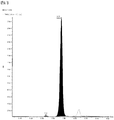
- FIG. 1 a UPLC-MS spectrum of the resulting nucleotide tetramer having optically active phosphorus atoms 15 is shown.
- the main absorption that appeared at 5.75 minutes showed a molecular ion peak 1201 in mass spectrometry, so that the target product 15 was identified.
- the absorption that appeared at 6.07 minutes after appearance of the target product showed a molecular ion peak 1244 in mass spectrometry, so that a tetramer with insufficient deprotection was identified.
- the absorption that appeared at 5.47 minutes was a molecular ion peak 1201 similar to that of the target product in mass spectrometry, suggesting the identification of a diastereomer, and no other absorption was observed.
- oligonucleotide solid-phase synthesizer a stereocontrolled oligonucleotide is synthesized using the optically active phosphoramidite obtained in the present embodiment. After performing a condensation reaction, a capping reaction, and on an as needed basis, an oxidation or sulfurization reaction, according to the standard protocol of the synthesizer, the solid-support is taken out, and the resulting oligonucleotide is detached from the solid-support and subjected to deprotection using concentrated aqueous ammonia.
- segments already being dimers or more may be condensed to each other to extend two or more base units at a time.
- the optically active segment for synthesis of a stereocontrolled oligonucleotide in the present embodiment has a thiophosphate moiety stereocontrolled in advance. For this reason, it is possible to synthesize an oligonucleotide having a desired stereochemistry by using the optically active segment of the present invention only for a moiety to be stereocontrolled and using a commercially available phosphoramidite for other moieties.
- the segment for use in synthesis of an oligonucleotide in the present embodiment enables to reduce the number of steps required for synthesizing the same N-mer oligonucleotide in comparison with the conventional method of extending one base each at a time.
- the yield of the stereocontrolled oligonucleotide having a target length can be therefore improved.
- the load for separating stereoisomers after synthesis of an oligonucleotide can be therefore greatly reduced, and particularly the purification load after synthesis of an N-mer oligonucleotide having a long chain can be reduced by a more convenient purification to obtain a reliably stereocontrolled oligonucleotide.
Landscapes
- Chemical & Material Sciences (AREA)
- Organic Chemistry (AREA)
- Health & Medical Sciences (AREA)
- Life Sciences & Earth Sciences (AREA)
- Biochemistry (AREA)
- Molecular Biology (AREA)
- Engineering & Computer Science (AREA)
- Biotechnology (AREA)
- General Health & Medical Sciences (AREA)
- Genetics & Genomics (AREA)
- Saccharide Compounds (AREA)
Applications Claiming Priority (2)
| Application Number | Priority Date | Filing Date | Title |
|---|---|---|---|
| JP2018088911 | 2018-05-02 | ||
| PCT/JP2019/018307 WO2019212063A1 (ja) | 2018-05-02 | 2019-05-07 | 立体制御オリゴヌクレオチド合成用光学活性セグメントおよびその製造方法、ならびにそれを用いた立体制御オリゴヌクレオチドの合成方法 |
Publications (2)
| Publication Number | Publication Date |
|---|---|
| EP3778616A1 true EP3778616A1 (de) | 2021-02-17 |
| EP3778616A4 EP3778616A4 (de) | 2021-06-16 |
Family
ID=68386041
Family Applications (1)
| Application Number | Title | Priority Date | Filing Date |
|---|---|---|---|
| EP19796157.6A Pending EP3778616A4 (de) | 2018-05-02 | 2019-05-07 | Optisch aktives segment für stereokontrollierte oligonukleotidsynthese, verfahren zu seiner herstellung und stereogesteuertes oligonukleotidsyntheseverfahren unter verwendung desselben |
Country Status (5)
| Country | Link |
|---|---|
| US (2) | US20210317158A1 (de) |
| EP (1) | EP3778616A4 (de) |
| JP (1) | JP7075681B2 (de) |
| CN (1) | CN114269764A (de) |
| WO (1) | WO2019212063A1 (de) |
Families Citing this family (2)
| Publication number | Priority date | Publication date | Assignee | Title |
|---|---|---|---|---|
| US12139507B2 (en) | 2018-05-02 | 2024-11-12 | Natias Inc. | Segment for use in synthesis of oligonucleotide, method for producing the same, and method for synthesizing oligonucleotide using the same |
| TW202241454A (zh) * | 2021-02-01 | 2022-11-01 | 日商第一三共股份有限公司 | 抗體-免疫賦活化劑共軛物之新穎製造方法 |
Family Cites Families (7)
| Publication number | Priority date | Publication date | Assignee | Title |
|---|---|---|---|---|
| WO1993021203A1 (en) * | 1992-04-15 | 1993-10-28 | The Johns Hopkins University | Synthesis of diverse and useful collections of oligonucleotides |
| US6294664B1 (en) * | 1993-07-29 | 2001-09-25 | Isis Pharmaceuticals, Inc. | Synthesis of oligonucleotides |
| WO2011108682A1 (ja) | 2010-03-05 | 2011-09-09 | 国立大学法人 東京大学 | リボヌクレオシドホスホロチオエートの製造方法 |
| CN103237805B (zh) * | 2010-08-23 | 2016-10-19 | 皇家学习促进学会/麦吉尔大学 | 寡核糖核苷酸的嵌段合成 |
| WO2017111137A1 (ja) * | 2015-12-22 | 2017-06-29 | 味の素株式会社 | オリゴヌクレオチドの製造方法 |
| US12139507B2 (en) * | 2018-05-02 | 2024-11-12 | Natias Inc. | Segment for use in synthesis of oligonucleotide, method for producing the same, and method for synthesizing oligonucleotide using the same |
| CN113924309A (zh) * | 2019-05-21 | 2022-01-11 | 株式会社纳蒂亚斯 | 寡核苷酸合成中使用的多氟嵌段聚体以及使用其的寡核苷酸合成方法 |
-
2019
- 2019-05-07 EP EP19796157.6A patent/EP3778616A4/de active Pending
- 2019-05-07 US US17/051,936 patent/US20210317158A1/en active Pending
- 2019-05-07 JP JP2020517080A patent/JP7075681B2/ja active Active
- 2019-05-07 WO PCT/JP2019/018307 patent/WO2019212063A1/ja not_active Ceased
- 2019-05-07 CN CN201980029516.XA patent/CN114269764A/zh active Pending
-
2024
- 2024-09-19 US US18/890,236 patent/US20250026780A1/en active Pending
Also Published As
| Publication number | Publication date |
|---|---|
| WO2019212063A1 (ja) | 2019-11-07 |
| US20250026780A1 (en) | 2025-01-23 |
| US20210317158A1 (en) | 2021-10-14 |
| CN114269764A (zh) | 2022-04-01 |
| EP3778616A4 (de) | 2021-06-16 |
| JPWO2019212063A1 (ja) | 2021-07-29 |
| JP7075681B2 (ja) | 2022-05-26 |
Similar Documents
| Publication | Publication Date | Title |
|---|---|---|
| JP7803520B2 (ja) | オリゴヌクレオチド合成用セグメントおよびその製造方法、ならびにそれを用いたオリゴヌクレオチドの合成方法 | |
| JP3207915B2 (ja) | オリゴヌクレオチドとオリゴヌクレオチド類似体の固相合成のための方法と化合物 | |
| JP7484951B2 (ja) | オリゴヌクレオチドの製造方法 | |
| JP2552048B2 (ja) | ヌクレオチド鎖合成用試薬 | |
| US20250026780A1 (en) | Optically Active Segment for Use in Synthesis of Stereocontrolled Oligonucleotide, Method for Producing the Same, and Method for Synthesizing Stereocontrolled Oligonucleotide Using the Same | |
| JPS62116593A (ja) | インビトロにおけるオリゴヌクレオチド合成法並びにそれに用いる試薬 | |
| EP3960749B1 (de) | Multifluorblocker für die oligonukleotidsynthese und verfahren zur oligonukleotidsynthese unter verwendung desselben | |
| FI111265B (fi) | Menetelmä lääkeaineina käyttökelpoisten modifioitujen oligodeoksiribonukleotidien valmistamiseksi ja niiden välituotteita | |
| EP1317466B1 (de) | Synthone zur herstellung von oligonukleotiden | |
| KR20010080991A (ko) | 폴리뉴클레오티드 가교제 | |
| JP7371829B2 (ja) | 重合性化合物、化合物、及び、ボラノホスフェートオリゴマーの製造方法 | |
| AU659078B2 (en) | Polynucleotide phosphorodithioates as therapeutic agents for retroviral infections | |
| US6486313B1 (en) | Oligonucleotides having alkylphosphonate linkages and methods for their preparation | |
| JPS6251695A (ja) | ホスホロアミダイト類の合成法 | |
| Wang et al. | Stereoselective Synthesis of a Cyano Alkylphosphonate by Intramolecular Rearrangement | |
| JP2002501929A (ja) | オリゴヌクレオチド合成用の新規なシントン | |
| JPS6363694A (ja) | ヌクレオシドホスホロチオイットおよびその合成法 | |
| JPH10204097A (ja) | H−ホスホネートオリゴヌクレオチド誘導体、及び該誘導体の製造方法 |
Legal Events
| Date | Code | Title | Description |
|---|---|---|---|
| STAA | Information on the status of an ep patent application or granted ep patent |
Free format text: STATUS: THE INTERNATIONAL PUBLICATION HAS BEEN MADE |
|
| PUAI | Public reference made under article 153(3) epc to a published international application that has entered the european phase |
Free format text: ORIGINAL CODE: 0009012 |
|
| STAA | Information on the status of an ep patent application or granted ep patent |
Free format text: STATUS: REQUEST FOR EXAMINATION WAS MADE |
|
| 17P | Request for examination filed |
Effective date: 20201028 |
|
| AK | Designated contracting states |
Kind code of ref document: A1 Designated state(s): AL AT BE BG CH CY CZ DE DK EE ES FI FR GB GR HR HU IE IS IT LI LT LU LV MC MK MT NL NO PL PT RO RS SE SI SK SM TR |
|
| AX | Request for extension of the european patent |
Extension state: BA ME |
|
| A4 | Supplementary search report drawn up and despatched |
Effective date: 20210519 |
|
| RIC1 | Information provided on ipc code assigned before grant |
Ipc: C07H 1/00 20060101AFI20210512BHEP Ipc: C07H 1/02 20060101ALI20210512BHEP Ipc: C07H 21/04 20060101ALI20210512BHEP |
|
| DAV | Request for validation of the european patent (deleted) | ||
| DAX | Request for extension of the european patent (deleted) | ||
| STAA | Information on the status of an ep patent application or granted ep patent |
Free format text: STATUS: EXAMINATION IS IN PROGRESS |
|
| 17Q | First examination report despatched |
Effective date: 20221114 |