EP3781576B1 - Dérivés d'acide boronique et leurs utilisations thérapeutiques - Google Patents
Dérivés d'acide boronique et leurs utilisations thérapeutiques Download PDFInfo
- Publication number
- EP3781576B1 EP3781576B1 EP19789187.2A EP19789187A EP3781576B1 EP 3781576 B1 EP3781576 B1 EP 3781576B1 EP 19789187 A EP19789187 A EP 19789187A EP 3781576 B1 EP3781576 B1 EP 3781576B1
- Authority
- EP
- European Patent Office
- Prior art keywords
- compound
- group
- optionally substituted
- alkyl
- formula
- Prior art date
- Legal status (The legal status is an assumption and is not a legal conclusion. Google has not performed a legal analysis and makes no representation as to the accuracy of the status listed.)
- Active
Links
Classifications
-
- C—CHEMISTRY; METALLURGY
- C07—ORGANIC CHEMISTRY
- C07F—ACYCLIC, CARBOCYCLIC OR HETEROCYCLIC COMPOUNDS CONTAINING ELEMENTS OTHER THAN CARBON, HYDROGEN, HALOGEN, OXYGEN, NITROGEN, SULFUR, SELENIUM OR TELLURIUM
- C07F5/00—Compounds containing elements of Groups 3 or 13 of the Periodic Table
- C07F5/02—Boron compounds
- C07F5/025—Boronic and borinic acid compounds
-
- A—HUMAN NECESSITIES
- A61—MEDICAL OR VETERINARY SCIENCE; HYGIENE
- A61K—PREPARATIONS FOR MEDICAL, DENTAL OR TOILETRY PURPOSES
- A61K31/00—Medicinal preparations containing organic active ingredients
- A61K31/69—Boron compounds
-
- A—HUMAN NECESSITIES
- A61—MEDICAL OR VETERINARY SCIENCE; HYGIENE
- A61K—PREPARATIONS FOR MEDICAL, DENTAL OR TOILETRY PURPOSES
- A61K31/00—Medicinal preparations containing organic active ingredients
- A61K31/185—Acids; Anhydrides, halides or salts thereof, e.g. sulfur acids, imidic, hydrazonic or hydroximic acids
- A61K31/19—Carboxylic acids, e.g. valproic acid
- A61K31/194—Carboxylic acids, e.g. valproic acid having two or more carboxyl groups, e.g. succinic, maleic or phthalic acid
-
- A—HUMAN NECESSITIES
- A61—MEDICAL OR VETERINARY SCIENCE; HYGIENE
- A61K—PREPARATIONS FOR MEDICAL, DENTAL OR TOILETRY PURPOSES
- A61K31/00—Medicinal preparations containing organic active ingredients
- A61K31/33—Heterocyclic compounds
- A61K31/395—Heterocyclic compounds having nitrogen as a ring hetero atom, e.g. guanethidine or rifamycins
- A61K31/40—Heterocyclic compounds having nitrogen as a ring hetero atom, e.g. guanethidine or rifamycins having five-membered rings with one nitrogen as the only ring hetero atom, e.g. sulpiride, succinimide, tolmetin, buflomedil
- A61K31/407—Heterocyclic compounds having nitrogen as a ring hetero atom, e.g. guanethidine or rifamycins having five-membered rings with one nitrogen as the only ring hetero atom, e.g. sulpiride, succinimide, tolmetin, buflomedil condensed with other heterocyclic ring systems, e.g. ketorolac, physostigmine
-
- A—HUMAN NECESSITIES
- A61—MEDICAL OR VETERINARY SCIENCE; HYGIENE
- A61K—PREPARATIONS FOR MEDICAL, DENTAL OR TOILETRY PURPOSES
- A61K31/00—Medicinal preparations containing organic active ingredients
- A61K31/33—Heterocyclic compounds
- A61K31/395—Heterocyclic compounds having nitrogen as a ring hetero atom, e.g. guanethidine or rifamycins
- A61K31/41—Heterocyclic compounds having nitrogen as a ring hetero atom, e.g. guanethidine or rifamycins having five-membered rings with two or more ring hetero atoms, at least one of which being nitrogen, e.g. tetrazole
- A61K31/4196—1,2,4-Triazoles
-
- A—HUMAN NECESSITIES
- A61—MEDICAL OR VETERINARY SCIENCE; HYGIENE
- A61K—PREPARATIONS FOR MEDICAL, DENTAL OR TOILETRY PURPOSES
- A61K31/00—Medicinal preparations containing organic active ingredients
- A61K31/33—Heterocyclic compounds
- A61K31/395—Heterocyclic compounds having nitrogen as a ring hetero atom, e.g. guanethidine or rifamycins
- A61K31/41—Heterocyclic compounds having nitrogen as a ring hetero atom, e.g. guanethidine or rifamycins having five-membered rings with two or more ring hetero atoms, at least one of which being nitrogen, e.g. tetrazole
- A61K31/425—Thiazoles
- A61K31/427—Thiazoles not condensed and containing further heterocyclic rings
-
- A—HUMAN NECESSITIES
- A61—MEDICAL OR VETERINARY SCIENCE; HYGIENE
- A61K—PREPARATIONS FOR MEDICAL, DENTAL OR TOILETRY PURPOSES
- A61K31/00—Medicinal preparations containing organic active ingredients
- A61K31/33—Heterocyclic compounds
- A61K31/395—Heterocyclic compounds having nitrogen as a ring hetero atom, e.g. guanethidine or rifamycins
- A61K31/41—Heterocyclic compounds having nitrogen as a ring hetero atom, e.g. guanethidine or rifamycins having five-membered rings with two or more ring hetero atoms, at least one of which being nitrogen, e.g. tetrazole
- A61K31/425—Thiazoles
- A61K31/429—Thiazoles condensed with heterocyclic ring systems
- A61K31/43—Compounds containing 4-thia-1-azabicyclo [3.2.0] heptane ring systems, i.e. compounds containing a ring system of the formula, e.g. penicillins, penems
-
- A—HUMAN NECESSITIES
- A61—MEDICAL OR VETERINARY SCIENCE; HYGIENE
- A61K—PREPARATIONS FOR MEDICAL, DENTAL OR TOILETRY PURPOSES
- A61K31/00—Medicinal preparations containing organic active ingredients
- A61K31/33—Heterocyclic compounds
- A61K31/395—Heterocyclic compounds having nitrogen as a ring hetero atom, e.g. guanethidine or rifamycins
- A61K31/41—Heterocyclic compounds having nitrogen as a ring hetero atom, e.g. guanethidine or rifamycins having five-membered rings with two or more ring hetero atoms, at least one of which being nitrogen, e.g. tetrazole
- A61K31/425—Thiazoles
- A61K31/429—Thiazoles condensed with heterocyclic ring systems
- A61K31/43—Compounds containing 4-thia-1-azabicyclo [3.2.0] heptane ring systems, i.e. compounds containing a ring system of the formula, e.g. penicillins, penems
- A61K31/431—Compounds containing 4-thia-1-azabicyclo [3.2.0] heptane ring systems, i.e. compounds containing a ring system of the formula, e.g. penicillins, penems containing further heterocyclic rings, e.g. ticarcillin, azlocillin, oxacillin
-
- A—HUMAN NECESSITIES
- A61—MEDICAL OR VETERINARY SCIENCE; HYGIENE
- A61K—PREPARATIONS FOR MEDICAL, DENTAL OR TOILETRY PURPOSES
- A61K31/00—Medicinal preparations containing organic active ingredients
- A61K31/33—Heterocyclic compounds
- A61K31/395—Heterocyclic compounds having nitrogen as a ring hetero atom, e.g. guanethidine or rifamycins
- A61K31/435—Heterocyclic compounds having nitrogen as a ring hetero atom, e.g. guanethidine or rifamycins having six-membered rings with one nitrogen as the only ring hetero atom
- A61K31/44—Non condensed pyridines; Hydrogenated derivatives thereof
- A61K31/4427—Non condensed pyridines; Hydrogenated derivatives thereof containing further heterocyclic ring systems
- A61K31/4439—Non condensed pyridines; Hydrogenated derivatives thereof containing further heterocyclic ring systems containing a five-membered ring with nitrogen as a ring hetero atom, e.g. omeprazole
-
- A—HUMAN NECESSITIES
- A61—MEDICAL OR VETERINARY SCIENCE; HYGIENE
- A61K—PREPARATIONS FOR MEDICAL, DENTAL OR TOILETRY PURPOSES
- A61K31/00—Medicinal preparations containing organic active ingredients
- A61K31/33—Heterocyclic compounds
- A61K31/395—Heterocyclic compounds having nitrogen as a ring hetero atom, e.g. guanethidine or rifamycins
- A61K31/54—Heterocyclic compounds having nitrogen as a ring hetero atom, e.g. guanethidine or rifamycins having six-membered rings with at least one nitrogen and one sulfur as the ring hetero atoms, e.g. sulthiame
- A61K31/542—Heterocyclic compounds having nitrogen as a ring hetero atom, e.g. guanethidine or rifamycins having six-membered rings with at least one nitrogen and one sulfur as the ring hetero atoms, e.g. sulthiame ortho- or peri-condensed with heterocyclic ring systems
- A61K31/545—Compounds containing 5-thia-1-azabicyclo [4.2.0] octane ring systems, i.e. compounds containing a ring system of the formula:, e.g. cephalosporins, cefaclor, or cephalexine
-
- A—HUMAN NECESSITIES
- A61—MEDICAL OR VETERINARY SCIENCE; HYGIENE
- A61K—PREPARATIONS FOR MEDICAL, DENTAL OR TOILETRY PURPOSES
- A61K31/00—Medicinal preparations containing organic active ingredients
- A61K31/33—Heterocyclic compounds
- A61K31/395—Heterocyclic compounds having nitrogen as a ring hetero atom, e.g. guanethidine or rifamycins
- A61K31/54—Heterocyclic compounds having nitrogen as a ring hetero atom, e.g. guanethidine or rifamycins having six-membered rings with at least one nitrogen and one sulfur as the ring hetero atoms, e.g. sulthiame
- A61K31/542—Heterocyclic compounds having nitrogen as a ring hetero atom, e.g. guanethidine or rifamycins having six-membered rings with at least one nitrogen and one sulfur as the ring hetero atoms, e.g. sulthiame ortho- or peri-condensed with heterocyclic ring systems
- A61K31/545—Compounds containing 5-thia-1-azabicyclo [4.2.0] octane ring systems, i.e. compounds containing a ring system of the formula:, e.g. cephalosporins, cefaclor, or cephalexine
- A61K31/546—Compounds containing 5-thia-1-azabicyclo [4.2.0] octane ring systems, i.e. compounds containing a ring system of the formula:, e.g. cephalosporins, cefaclor, or cephalexine containing further heterocyclic rings, e.g. cephalothin
-
- A—HUMAN NECESSITIES
- A61—MEDICAL OR VETERINARY SCIENCE; HYGIENE
- A61K—PREPARATIONS FOR MEDICAL, DENTAL OR TOILETRY PURPOSES
- A61K45/00—Medicinal preparations containing active ingredients not provided for in groups A61K31/00 - A61K41/00
- A61K45/06—Mixtures of active ingredients without chemical characterisation, e.g. antiphlogistics and cardiaca
-
- C—CHEMISTRY; METALLURGY
- C07—ORGANIC CHEMISTRY
- C07F—ACYCLIC, CARBOCYCLIC OR HETEROCYCLIC COMPOUNDS CONTAINING ELEMENTS OTHER THAN CARBON, HYDROGEN, HALOGEN, OXYGEN, NITROGEN, SULFUR, SELENIUM OR TELLURIUM
- C07F5/00—Compounds containing elements of Groups 3 or 13 of the Periodic Table
- C07F5/02—Boron compounds
- C07F5/04—Esters of boric acids
-
- A—HUMAN NECESSITIES
- A61—MEDICAL OR VETERINARY SCIENCE; HYGIENE
- A61P—SPECIFIC THERAPEUTIC ACTIVITY OF CHEMICAL COMPOUNDS OR MEDICINAL PREPARATIONS
- A61P31/00—Antiinfectives, i.e. antibiotics, antiseptics, chemotherapeutics
- A61P31/04—Antibacterial agents
-
- Y—GENERAL TAGGING OF NEW TECHNOLOGICAL DEVELOPMENTS; GENERAL TAGGING OF CROSS-SECTIONAL TECHNOLOGIES SPANNING OVER SEVERAL SECTIONS OF THE IPC; TECHNICAL SUBJECTS COVERED BY FORMER USPC CROSS-REFERENCE ART COLLECTIONS [XRACs] AND DIGESTS
- Y02—TECHNOLOGIES OR APPLICATIONS FOR MITIGATION OR ADAPTATION AGAINST CLIMATE CHANGE
- Y02A—TECHNOLOGIES FOR ADAPTATION TO CLIMATE CHANGE
- Y02A50/00—TECHNOLOGIES FOR ADAPTATION TO CLIMATE CHANGE in human health protection, e.g. against extreme weather
- Y02A50/30—Against vector-borne diseases, e.g. mosquito-borne, fly-borne, tick-borne or waterborne diseases whose impact is exacerbated by climate change
Definitions
- the present invention relates to the fields of chemistry and medicine. More particularly, the present invention relates to boronic acid antimicrobial compounds, compositions, their preparation, and their use as therapeutic agents.
- WO 2016/149393 A1 describes compounds that are said to be antimicrobial, compositions, pharmaceutical compositions, the use and preparation thereof.
- Antibiotics have been effective tools in the treatment of infectious diseases during the last half-century. From the development of antibiotic therapy to the late 1980s there was almost complete control over bacterial infections in developed countries. However, in response to the pressure of antibiotic usage, multiple resistance mechanisms have become widespread and are threatening the clinical utility of anti-bacterial therapy.
- the increase in antibiotic resistant strains has been particularly common in major hospitals and care centers. The consequences of the increase in resistant strains include higher morbidity and mortality, longer patient hospitalization, and an increase in treatment costs.
- ⁇ -lactamases Various bacteria have evolved ⁇ -lactam deactivating enzymes, namely, ⁇ -lactamases, that counter the efficacy of the various ⁇ -lactam antibiotics.
- ⁇ -lactamases can be grouped into 4 classes based on their amino acid sequences, namely, Ambler classes A, B, C, and D.
- Enzymes in classes A, C, and D include active-site serine ⁇ -lactamases, and class B enzymes, which are encountered less frequently, are Zn-dependent. These enzymes catalyze the chemical degradation of ⁇ -lactam antibiotics, rendering them inactive.
- Some ⁇ -lactamases can be transferred within and between various bacterial strains and species. The rapid spread of bacterial resistance and the evolution of multi-resistant strains severely limits ⁇ -lactam treatment options available.
- class D ⁇ -lactamase-expressing bacterium strains such as Acinetobacter baumannii has become an emerging multidrug-resistant threat.
- A. baumannii strains express A, C, and D class ⁇ -lactamases.
- the class D ⁇ -lactamases such as the OXA families are particularly effective at destroying carbapenem type ⁇ -lactam antibiotics, e.g., imipenem, the active carbapenems component of Merck's Primaxin ® ( Montefour, K.; et al. Crit. Care Nurse 2008, 28, 15 ; Perez, F. et al. Expert Rev. Anti Infect. Ther. 2008, 6, 269 ; Bou, G.; Martinez-Beltran, J.
- New ⁇ -lactamases have recently evolved that hydrolyze the carbapenem class of antimicrobials, including imipenem, biapenem, doripenem, meropenem, and ertapenem, as well as other ⁇ -lactam antibiotics.
- carbapenemases belong to molecular classes A, B, and D.
- Class A carbapenemases of the KPC-type predominantly in Klebsiella pneumoniae but now also reported in other Enterobacteriaceae, Pseudomonas aeruginosa and Acinetobacter baumannii.
- the KPC carbapenemase was first described in 1996 in North Carolina, but since then has disseminated widely in the US.
- the zinc-dependent class B metallo- ⁇ -lactamases are represented mainly by the VIM, IMP, and NDM types.
- IMP and VIM-producing K. pneumonia were first observed in 1990s in Japan and 2001 in Southern Europe, respectively.
- IMP-positive strains remain frequent in Japan and have also caused hospital outbreaks in China and Australia.
- dissemination of IMP-producing Enterobacteriaceae in the rest of the word appears to be somewhat limited.
- VIM-producing enterobacteria can be frequently isolated in Mediterranean countries, reaching epidemic proportions in Greece. Isolation of VIM-producing strains remains low in Northern Europe and in the United States.
- a characteristic of NDM-producing K. pneumonia isolates has been their rapid dissemination from their epicenter, the Indian subcontinent, to Western Europe, North America, Australia and Far East.
- NDM genes have spread rapidly to various species other than K . pneumonia.
- the plasmid-expressed class D carbapenemases belong to OXA-48 type.
- OXA-48 producing K. pneumonia was first detected in Turkey, in 2001.
- the Middle East and North Africa remain the main centers of infection.
- recent isolation of OXA-48-type producing organisms in India, Senegal and Argentina suggest the possibility of a global expansion. Isolation of OXA-48 in bacteria other than K. pneumonia underlines the spreading potential of OXA-48.
- Another mechanism of ⁇ -lactamase mediated resistance to carbapenems involves permeability or efflux mechanisms combined with hyper production of ⁇ -lactamases.
- One example is the loss of a porin combined with hyperproduction of ampC ⁇ -lactamase resulting in resistance to imipenem in Pseudomonas aeruginosa.
- Efflux pump overexpression combined with hyperproduction of the ampC ⁇ -lactamase can also result in resistance to a carbapenem such as meropenem.
- Some embodiments disclosed herein relate to a compound having the structure of the Formula ( I ) or Formula ( II ): or a pharmaceutically acceptable salt thereof, wherein:
- compositions comprising a therapeutically effective amount of a compound disclosed herein and a pharmaceutically acceptable excipient.
- inventions disclosed herein include a compound for use in a method of treating or preventing a bacterial infection, comprising administering to a subject in need thereof a compound disclosed herein.
- compounds that contain a boronic acid moiety that act as antimicrobial agents and/or as potentiators of antimicrobial agents.
- Various embodiments of these compounds include compounds having the structures of Formula (I) as described above or pharmaceutically acceptable salts thereof.
- Some embodiments of compounds of Formulas ( I ) and ( II ) or their pharmaceutically acceptable salts have the following stereochemistry as shown in the structure of Formula ( Ia ) or Formula ( IIa ):
- Some embodiments of compounds of Formulas ( I ) and ( II ) or their pharmaceutically acceptable salts have the following stereochemistry as shown in the structure of Formula ( Ib ) or Formula ( IIb ):
- Some embodiments of compounds of Formulas ( I ) and ( II ) or their pharmaceutically acceptable salts include compounds having the structure of Formula ( Ic ) or Formula ( IIc ):
- G is selected from the group consisting of -OR 1 , N 3 , -NR 1 R 2 , NR 1 C(O)R 2 , optionally substituted C 1-4 alkyl, and optionally substituted 5-10 membered heteroaryl;
- compounds of Formula ( I ), ( Ia ), ( Ib ), ( Ic ), ( II ), ( IIa ), ( IIb ), or ( IIc ) G is selected from the group consisting of -OH and -OBn.
- R 8 is optionally substituted C 1-4 alkyl.
- compounds of Formula ( I ), ( Ia ), ( Ib ), ( Ic ), ( II ), ( IIa ), ( IIb ), or ( IIc ) M is selected from the group consisting of -CH, -COMe, CF, and N.
- R is -H.
- Some embodiments include a compound selected from the group consisting of: or a pharmaceutically acceptable salt thereof.
- the compounds disclosed herein may exist as individual enantiomers and diastereomers or as mixtures of such isomers, including racemates. Separation of the individual isomers or selective synthesis of the individual isomers is accomplished by application of various methods which are well known to practitioners in the art. Unless otherwise indicated, all such isomers and mixtures thereof are included in the scope of the compounds disclosed herein. Furthermore, compounds disclosed herein may exist in one or more crystalline or amorphous forms. Unless otherwise indicated, all such forms are included in the scope of the compounds disclosed herein including any polymorphic forms. In addition, some of the compounds disclosed herein may form solvates with water (i.e., hydrates) or common organic solvents. Unless otherwise indicated, such solvates are included in the scope of the compounds disclosed herein.
- the compounds described herein may convert to or exist in equilibrium with alternate forms. Accordingly, in some embodiments, the compounds described herein may exist in combination with one or more of these forms. For example, as shown below, the compounds disclosed herein may exist in cyclic boronate monoesters as formula I or in acyclic form as boronic acids as formula II, or may exist as a mixture of the two forms depending on the medium. When G is -OH or NHR 2 , compounds of formula II may also cyclize to give compounds of formula III where G" is O or NR 2 . In this case, the compounds may exist as a mixture of all three forms depending on the medium.
- the compounds described herein may exist in cyclic dimeric form as Formula (A) or trimeric form as Formula (B), tetrameric form as Formula (C) as shown below, or acylic dimeric, trimeric or tetrameric forms and the like.
- Isotopes may be present in the compounds described. Each chemical element as represented in a compound structure may include any isotope of said element.
- a hydrogen atom may be explicitly disclosed or understood to be present in the compound.
- the hydrogen atom can be any isotope of hydrogen, including but not limited to hydrogen-1 (protium) and hydrogen-2 (deuterium).
- reference herein to a compound encompasses all potential isotopic forms unless the context clearly dictates otherwise.
- prodrug refers to an agent that is converted into the parent drug in vivo. Prodrugs are often useful because, in some situations, they may be easier to administer than the parent drug. They may, for instance, be bioavailable by oral administration whereas the parent is not. The prodrug may also have improved solubility in pharmaceutical compositions over the parent drug.
- An example, without limitation, of a prodrug would be a compound which is administered as an ester (the "prodrug") to facilitate transmittal across a cell membrane where water solubility is detrimental to mobility but which then is metabolically hydrolyzed to the carboxylic acid, the active entity, once inside the cell where water-solubility is beneficial.
- a further example of a prodrug might be a short peptide (polyaminoacid) bonded to an acid group where the peptide is metabolized to reveal the active moiety.
- a prodrug derivative Conventional procedures for the selection and preparation of suitable prodrug derivatives are described, for example, in Design of Prodrugs, (ed. H. Bundgaard, Elsevier, 1985 ).
- pro-drug ester refers to derivatives of the compounds disclosed herein formed by the addition of any of several ester-forming groups that are hydrolyzed under physiological conditions.
- pro-drug ester groups include pivoyloxymethyl, acetoxymethyl, phthalidyl, indanyl and methoxymethyl, as well as other such groups known in the art, including a (5-R-2-oxo-1,3-dioxolen-4-yl)methyl group.
- Other examples of pro-drug ester groups can be found in, for example, T. Higuchi and V. Stella, in "Pro-drugs as Novel Delivery Systems", Vol. 14, A.C.S.
- Methods of the compounds disclosed herein include active species that are produced upon introduction of the compounds into the biological milieu.
- Solidvate refers to the compound formed by the interaction of a solvent and a compound described herein, a metabolite, or salt thereof. Suitable solvates are pharmaceutically acceptable solvates including hydrates.
- pharmaceutically acceptable salt refers to salts that retain the biological effectiveness and properties of a compound, which are not biologically or otherwise undesirable for use in a pharmaceutical.
- the compounds herein are capable of forming acid and/or base salts by virtue of the presence of amino and/or carboxyl groups or groups similar thereto.
- Pharmaceutically acceptable acid addition salts can be formed with inorganic acids and organic acids. Inorganic acids from which salts can be derived include, for example, hydrochloric acid, hydrobromic acid, sulfuric acid, nitric acid, phosphoric acid, and the like.
- Organic acids from which salts can be derived include, for example, acetic acid, propionic acid, glycolic acid, pyruvic acid, oxalic acid, maleic acid, malonic acid, succinic acid, fumaric acid, tartaric acid, citric acid, benzoic acid, cinnamic acid, mandelic acid, methanesulfonic acid, ethanesulfonic acid, p-toluenesulfonic acid, salicylic acid, and the like.
- Pharmaceutically acceptable base addition salts can be formed with inorganic and organic bases.
- Inorganic bases from which salts can be derived include, for example, sodium, potassium, lithium, ammonium, calcium, magnesium, iron, zinc, copper, manganese, aluminum, and the like; particularly preferred are the ammonium, potassium, sodium, calcium and magnesium salts.
- Organic bases from which salts can be derived include, for example, primary, secondary, and tertiary amines, substituted amines including naturally occurring substituted amines, cyclic amines, basic ion exchange resins, and the like, specifically such as isopropylamine, trimethylamine, diethylamine, triethylamine, tripropylamine, and ethanolamine.
- C a to C b “ or “C a-b “ in which "a” and “b” are integers refer to the number of carbon atoms in the specified group. That is, the group can contain from “a” to “b", inclusive, carbon atoms.
- a “C 1 to C 4 alkyl” or “C 1-4 alkyl” group refers to all alkyl groups having from 1 to 4 carbons, that is, CH 3 -, CH 3 CH 2 -, CH 3 CH 2 CH 2 -, (CH 3 ) 2 CH-, CH 3 CH 2 CH 2 CH 2 -, CH 3 CH 2 CH(CH 3 )- and (CH 3 ) 3 C-.
- halogen or "halo,” as used herein, means any one of the radio-stable atoms of column 7 of the Periodic Table of the Elements, e.g., fluorine, chlorine, bromine, or iodine, with fluorine and chlorine being preferred.
- alkyl refers to a straight or branched hydrocarbon chain that is fully saturated (i.e., contains no double or triple bonds).
- the alkyl group may have 1 to 20 carbon atoms (whenever it appears herein, a numerical range such as “1 to 20" refers to each integer in the given range; e.g., "1 to 20 carbon atoms” means that the alkyl group may consist of 1 carbon atom, 2 carbon atoms, 3 carbon atoms, etc., up to and including 20 carbon atoms, although the present definition also covers the occurrence of the term "alkyl” where no numerical range is designated).
- the alkyl group may also be a medium size alkyl having 1 to 9 carbon atoms.
- the alkyl group could also be a lower alkyl having 1 to 4 carbon atoms.
- the alkyl group of the compounds may be designated as "C 1-4 alkyl” or similar designations.
- C 1-4 alkyl indicates that there are one to four carbon atoms in the alkyl chain, i.e., the alkyl chain is selected from the group consisting of methyl, ethyl, propyl, iso-propyl, n-butyl, iso-butyl, sec-butyl, and t-butyl.
- Typical alkyl groups include, but are in no way limited to, methyl, ethyl, propyl, isopropyl, butyl, isobutyl, tertiary butyl, pentyl, hexyl, and the like.
- alkoxy refers to the formula -OR wherein R is an alkyl as is defined above, such as “C 1-9 alkoxy”, including but not limited to methoxy, ethoxy, n-propoxy, 1-methylethoxy (isopropoxy), n-butoxy, iso-butoxy, sec-butoxy, tert-butoxy, and the like.
- alkylthio refers to the formula -SR wherein R is an alkyl as is defined above, such as “C 1-9 alkylthio” and the like, including but not limited to methylmercapto, ethylmercapto, n-propylmercapto, 1-methylethylmercapto (isopropylmercapto), n-butylmercapto, iso-butylmercapto, sec-butylmercapto, tert-butylmercapto, and the like.
- alkenyl refers to a straight or branched hydrocarbon chain containing one or more double bonds.
- the alkenyl group may have 2 to 20 carbon atoms, although the present definition also covers the occurrence of the term "alkenyl” where no numerical range is designated.
- the alkenyl group may also be a medium size alkenyl having 2 to 9 carbon atoms.
- the alkenyl group could also be a lower alkenyl having 2 to 4 carbon atoms.
- the alkenyl group of the compounds may be designated as "C 2-4 alkenyl" or similar designations.
- C 2-4 alkenyl indicates that there are two to four carbon atoms in the alkenyl chain, i.e., the alkenyl chain is selected from the group consisting of ethenyl, propen-1-yl, propen-2-yl, propen-3-yl, buten-1-yl, buten-2-yl, buten-3-yl, buten-4-yl, 1-methyl-propen-1-yl, 2-methyl-propen-1-yl, 1-ethyl-ethen-1-yl, 2-methyl-propen-3-yl, buta-1,3-dienyl, buta-1,2,-dienyl, and buta-1,2-dien-4-yl.
- Typical alkenyl groups include, but are in no way limited to, ethenyl, propenyl, butenyl, pentenyl, hexenyl, and the like.
- alkynyl refers to a straight or branched hydrocarbon chain containing one or more triple bonds.
- the alkynyl group may have 2 to 20 carbon atoms, although the present definition also covers the occurrence of the term "alkynyl” where no numerical range is designated.
- the alkynyl group may also be a medium size alkynyl having 2 to 9 carbon atoms.
- the alkynyl group could also be a lower alkynyl having 2 to 4 carbon atoms.
- the alkynyl group of the compounds may be designated as "C 2-4 alkynyl" or similar designations.
- C 2-4 alkynyl indicates that there are two to four carbon atoms in the alkynyl chain, i.e., the alkynyl chain is selected from the group consisting of ethynyl, propyn-1-yl, propyn-2-yl, butyn-1-yl, butyn-3-yl, butyn-4-yl, and 2-butynyl.
- Typical alkynyl groups include, but are in no way limited to, ethynyl, propynyl, butynyl, pentynyl, hexynyl, and the like.
- heteroalkyl refers to a straight or branched hydrocarbon chain containing one or more heteroatoms, that is, an element other than carbon, including but not limited to, nitrogen, oxygen and sulfur, in the chain backbone.
- the heteroalkyl group may have 1 to 20 carbon atoms although the present definition also covers the occurrence of the term "heteroalkyl” where no numerical range is designated.
- the heteroalkyl group may also be a medium size heteroalkyl having 1 to 9 carbon atoms.
- the heteroalkyl group could also be a lower heteroalkyl having 1 to 4 carbon atoms.
- the heteroalkyl group of the compounds may be designated as "C 1-4 heteroalkyl" or similar designations.
- the heteroalkyl group may contain one or more heteroatoms.
- C 1-4 heteroalkyl indicates that there are one to four carbon atoms in the heteroalkyl chain and additionally one or more heteroatoms in the backbone of the chain.
- aromatic refers to a ring or ring system having a conjugated pi electron system and includes both carbocyclic aromatic (e.g., phenyl) and heterocyclic aromatic groups (e.g., pyridine).
- carbocyclic aromatic e.g., phenyl
- heterocyclic aromatic groups e.g., pyridine
- the term includes monocyclic or fused-ring polycyclic (i.e., rings which share adjacent pairs of atoms) groups provided that the entire ring system is aromatic.
- aryl refers to an aromatic ring or ring system (i.e., two or more fused rings that share two adjacent carbon atoms) containing only carbon in the ring backbone. When the aryl is a ring system, every ring in the system is aromatic.
- the aryl group may have 6 to 18 carbon atoms, although the present definition also covers the occurrence of the term "aryl” where no numerical range is designated. In some embodiments, the aryl group has 6 to 10 carbon atoms.
- the aryl group may be designated as "C 6-10 aryl,” “C 6 or C 10 aryl,” or similar designations. Examples of aryl groups include, but are not limited to, phenyl, naphthyl, azulenyl, and anthracenyl.
- aryloxy and arylthio refers to RO- and RS-, in which R is an aryl as is defined above, such as “C 6-10 aryloxy” or “C 6-10 arylthio” and the like, including but not limited to phenyloxy.
- an “aralkyl” or “arylalkyl” is an aryl group connected, as a substituent, via an alkylene group, such "C 7-14 aralkyl” and the like, including but not limited to benzyl, 2-phenylethyl, 3-phenylpropyl, and naphthylalkyl.
- the alkylene group is a lower alkylene group (i.e., a C 1-4 alkylene group).
- heteroaryl refers to an aromatic ring or ring system (i.e., two or more fused rings that share two adjacent atoms) that contain(s) one or more heteroatoms, that is, an element other than carbon, including but not limited to, nitrogen, oxygen and sulfur, in the ring backbone.
- heteroaryl is a ring system, every ring in the system is aromatic.
- the heteroaryl group may have 5-18 ring members (i.e., the number of atoms making up the ring backbone, including carbon atoms and heteroatoms), although the present definition also covers the occurrence of the term "heteroaryl" where no numerical range is designated.
- the heteroaryl group has 5 to 10 ring members or 5 to 7 ring members.
- the heteroaryl group may be designated as "5-7 membered heteroaryl,” "5-10 membered heteroaryl,” or similar designations.
- heteroaryl rings include, but are not limited to, furyl, thienyl, phthalazinyl, pyrrolyl, oxazolyl, thiazolyl, imidazolyl, pyrazolyl, isoxazolyl, isothiazolyl, triazolyl, thiadiazolyl, pyridinyl, pyridazinyl, pyrimidinyl, pyrazinyl, triazinyl, quinolinyl, isoquinlinyl, benzimidazolyl, benzoxazolyl, benzothiazolyl, indolyl, isoindolyl, and benzothienyl.
- heteroarylkyl or “heteroarylalkyl” is heteroaryl group connected, as a substituent, via an alkylene group. Examples include but are not limited to 2-thienylmethyl, 3-thienylmethyl, furylmethyl, thienylethyl, pyrrolylalkyl, pyridylalkyl, isoxazollylalkyl, and imidazolylalkyl.
- the alkylene group is a lower alkylene group (i.e., a C 1-4 alkylene group).
- carbocyclyl means a non-aromatic cyclic ring or ring system containing only carbon atoms in the ring system backbone. When the carbocyclyl is a ring system, two or more rings may be joined together in a fused, bridged or spiro-connected fashion. Carbocyclyls may have any degree of saturation provided that at least one ring in a ring system is not aromatic. Thus, carbocyclyls include cycloalkyls, cycloalkenyls, and cycloalkynyls.
- the carbocyclyl group may have 3 to 20 carbon atoms, although the present definition also covers the occurrence of the term "carbocyclyl” where no numerical range is designated.
- the carbocyclyl group may also be a medium size carbocyclyl having 3 to 10 carbon atoms.
- the carbocyclyl group could also be a carbocyclyl having 3 to 6 carbon atoms.
- the carbocyclyl group may be designated as "C 3-6 carbocyclyl" or similar designations.
- carbocyclyl rings include, but are not limited to, cyclopropyl, cyclobutyl, cyclopentyl, cyclohexyl, cyclohexenyl, 2,3-dihydro-indene, bicycle[2.2.2]octanyl, adamantyl, and spiro[4.4]nonanyl.
- a “(carbocyclyl)alkyl” is a carbocyclyl group connected, as a substituent, via an alkylene group, such as "C 4-10 (carbocyclyl)alkyl” and the like, including but not limited to, cyclopropylmethyl, cyclobutylmethyl, cyclopropylethyl, cyclopropylbutyl, cyclobutylethyl, cyclopropylisopropyl, cyclopentylmethyl, cyclopentylethyl, cyclohexylmethyl, cyclohexylethyl, cycloheptylmethyl, and the like.
- the alkylene group is a lower alkylene group.
- cycloalkyl means a fully saturated carbocyclyl ring or ring system. Examples include cyclopropyl, cyclobutyl, cyclopentyl, and cyclohexyl.
- cycloalkenyl means a carbocyclyl ring or ring system having at least one double bond, wherein no ring in the ring system is aromatic.
- An example is cyclohexenyl.
- heterocyclyl means a non-aromatic cyclic ring or ring system containing at least one heteroatom in the ring backbone. Heterocyclyls may be joined together in a fused, bridged or spiro-connected fashion. Heterocyclyls may have any degree of saturation provided that at least one ring in the ring system is not aromatic. The heteroatom(s) may be present in either a non-aromatic or aromatic ring in the ring system.
- the heterocyclyl group may have 3 to 20 ring members (i.e., the number of atoms making up the ring backbone, including carbon atoms and heteroatoms), although the present definition also covers the occurrence of the term "heterocyclyl” where no numerical range is designated.
- the heterocyclyl group may also be a medium size heterocyclyl having 3 to 10 ring members.
- the heterocyclyl group could also be a heterocyclyl having 3 to 6 ring members.
- the heterocyclyl group may be designated as "3-6 membered heterocyclyl" or similar designations.
- the heteroatom(s) are selected from one up to three of O, N or S, and in preferred five membered monocyclic heterocyclyls, the heteroatom(s) are selected from one or two heteroatoms selected from O, N, or S.
- heterocyclyl rings include, but are not limited to, azepinyl, acridinyl, carbazolyl, cinnolinyl, dioxolanyl, imidazolinyl, imidazolidinyl, morpholinyl, oxiranyl, oxepanyl, thiepanyl, piperidinyl, piperazinyl, dioxopiperazinyl, pyrrolidinyl, pyrrolidonyl, pyrrolidionyl, 4-piperidonyl, pyrazolinyl, pyrazolidinyl, 1,3-dioxinyl, 1,3-dioxanyl, 1,4-dioxinyl, 1,4-dioxanyl, 1,3-oxathianyl, 1,4-oxathiinyl, 1,4-oxathianyl, 2 H -1,2-oxazinyl, trioxanyl, hexa
- a “(heterocyclyl)alkyl” is a heterocyclyl group connected, as a substituent, via an alkylene group. Examples include, but are not limited to, imidazolinylmethyl and indolinylethyl.
- R is hydrogen, C 1-6 alkyl, C 2-6 alkenyl, C 2-6 alkynyl, C 3-7 carbocyclyl, aryl, 5-10 membered heteroaryl, and 5-10 membered heterocyclyl, as defined herein.
- Non-limiting examples include formyl, acetyl, propanoyl, benzoyl, and acryl.
- R is selected from hydrogen, C 1-6 alkyl, C 2-6 alkenyl, C 2-6 alkynyl, C 3-7 carbocyclyl, aryl, 5-10 membered heteroaryl, and 5-10 membered heterocyclyl, as defined herein.
- a “cyano” group refers to a "-CN” group.
- a “cyanato” group refers to an "-OCN” group.
- An “isocyanato” group refers to a "-NCO” group.
- a “thiocyanato” group refers to a "-SCN” group.
- An “isothiocyanato” group refers to an " -NCS” group.
- a “sulfonyl” group refers to an "-SO 2 R” group in which R is selected from hydrogen, C 1-6 alkyl, C 2-6 alkenyl, C 2-6 alkynyl, C 3-7 carbocyclyl, C 6-10 aryl, 5-10 membered heteroaryl, and 5-10 membered heterocyclyl, as defined herein.
- S-sulfonamido refers to a "-SO 2 NR A R B " group in which R A and R B are each independently selected from hydrogen, C 1-6 alkyl, C 2-6 alkenyl, C 2-6 alkynyl, C 3-7 carbocyclyl, C 6-10 aryl, 5-10 membered heteroaryl, and 5-10 membered heterocyclyl, as defined herein.
- N-sulfonamido refers to a "-N(R A )SO 2 R B " group in which R A and R b are each independently selected from hydrogen, C 1-6 alkyl, C 2-6 alkenyl, C 2-6 alkynyl, C 3-7 carbocyclyl, C 6-10 aryl, 5-10 membered heteroaryl, and 5-10 membered heterocyclyl, as defined herein.
- amino group refers to a "-NR A R B " group in which R A and R B are each independently selected from hydrogen, C 1-6 alkyl, C 2-6 alkenyl, C 2-6 alkynyl, C 3-7 carbocyclyl, C 6-10 aryl, 5-10 membered heteroaryl, and 5-10 membered heterocyclyl, as defined herein.
- aminoalkyl refers to an amino group connected via an alkylene group.
- alkoxyalkyl refers to an alkoxy group connected via an alkylene group, such as a “C 2-8 alkoxyalkyl” and the like.
- a substituted group is derived from the unsubstituted parent group in which there has been an exchange of one or more hydrogen atoms for another atom or group.
- substituted it is meant that the group is substituted with one or more subsitutents independently selected from C 1 -C 6 alkyl, C 1 -C 6 alkenyl, C 1 -C 6 alkynyl, C 1 -C 6 heteroalkyl, C 3 -C 7 carbocyclyl (optionally substituted with halo, C 1 -C 6 alkyl, C 1 -C 6 alkoxy, C 1 -C 6 haloalkyl, and C 1 -C 6 haloalkoxy), C 3 -C 7 -carbocyclyl-C 1 -C 6 -alkyl (optionally substituted with halo, C 1 -C 6 alkyl, C 1 -C 6 alkoxy
- substituted group(s) is (are) substituted with one or more substituent(s) individually and independently selected from C 1 -C 4 alkyl, amino, hydroxy, and halogen.
- radical naming conventions can include either a mono-radical or a di-radical, depending on the context.
- a substituent requires two points of attachment to the rest of the molecule, it is understood that the substituent is a di-radical.
- a substituent identified as alkyl that requires two points of attachment includes di-radicals such as -CH 2 -, -CH 2 CH 2 -, -CH 2 CH(CH 3 )CH 2 -, and the like.
- Other radical naming conventions clearly indicate that the radical is a di-radical such as "alkylene” or "alkenylene.”
- alkylene means a branched, or straight chain fully saturated di-radical chemical group containing only carbon and hydrogen that is attached to the rest of the molecule via two points of attachment (i.e., an alkanediyl).
- the alkylene group may have 1 to 20 carbon atoms, although the present definition also covers the occurrence of the term alkylene where no numerical range is designated.
- the alkylene group may also be a medium size alkylene having 1 to 9 carbon atoms.
- the alkylene group could also be a lower alkylene having 1 to 4 carbon atoms.
- the alkylene group may be designated as "C 1-4 alkylene" or similar designations.
- C 1-4 alkylene indicates that there are one to four carbon atoms in the alkylene chain, i.e., the alkylene chain is selected from the group consisting of methylene, ethylene, ethan-1,1-diyl, propylene, propan-1,1-diyl, propan-2,2-diyl, 1-methyl-ethylene, butylene, butan-1,1-diyl, butan-2,2-diyl, 2-methyl-propan-1,1-diyl, 1-methyl-propylene, 2-methyl-propylene, 1,1-dimethyl-ethylene, 1,2-dimethyl-ethylene, and 1-ethyl-ethylene.
- alkenylene means a straight or branched chain di-radical chemical group containing only carbon and hydrogen and containing at least one carbon-carbon double bond that is attached to the rest of the molecule via two points of attachment.
- the alkenylene group may have 2 to 20 carbon atoms, although the present definition also covers the occurrence of the term alkenylene where no numerical range is designated.
- the alkenylene group may also be a medium size alkenylene having 2 to 9 carbon atoms.
- the alkenylene group could also be a lower alkenylene having 2 to 4 carbon atoms.
- the alkenylene group may be designated as "C 2-4 alkenylene" or similar designations.
- C 2-4 alkenylene indicates that there are two to four carbon atoms in the alkenylene chain, i.e., the alkenylene chain is selected from the group consisting of ethenylene, ethen-1,1-diyl, propenylene, propen-1,1-diyl, prop-2-en-1,1-diyl, 1-methyl-ethenylene, but-1-enylene, but-2-enylene, but-1,3-dienylene, buten-1,1-diyl, but-1,3-dien-1,1-diyl, but-2-en-1,1-diyl, but-3-en-1,1-diyl, 1-methyl-prop-2-en-1,1-diyl, 2-methyl-prop-2-en-1,1-diyl, 1-ethyl-ethenylene, 1,2-dimethyl-ethenylene, 1-methyl-propenylene, 2-methyl
- R groups are said to form a ring (e.g., a carbocyclyl, heterocyclyl, aryl, or heteroaryl ring) "together with the atom to which they are attached," it is meant that the collective unit of the atom and the two R groups are the recited ring.
- the ring is not otherwise limited by the definition of each R group when taken individually.
- R 1 and R 2 are defined as selected from the group consisting of hydrogen and alkyl, or R 1 and R 2 together with the nitrogen to which they are attached form a heterocyclyl
- R 1 and R 2 can be selected from hydrogen or alkyl, or alternatively, the substructure has structure: where ring A is a heterocyclyl ring containing the depicted nitrogen.
- R 1 and R 2 are defined as selected from the group consisting of hydrogen and alkyl, or R 1 and R 2 together with the atoms to which they are attached form an aryl or carbocylyl, it is meant that R 1 and R 2 can be selected from hydrogen or alkyl, or alternatively, the substructure has structure: where A is an aryl ring or a carbocylyl containing the depicted double bond.
- a substituent is depicted as a di-radical (i.e., has two points of attachment to the rest of the molecule), it is to be understood that the substituent can be attached in any directional configuration unless otherwise indicated.
- isosteres of a chemical group are other chemical groups that exhibit the same or similar properties.
- tetrazole is an isostere of carboxylic acid because it mimics the properties of carboxylic acid even though they both have very different molecular formulae. Tetrazole is one of many possible isosteric replacements for carboxylic acid.
- carboxylic acid isosteres contemplated include -SO 3 H, -SO 2 HNR, - PO 2 (R) 2 , -PO 3 (R) 2 , -CONHNHSO 2 R, -COHNSO 2 R, and -CONRCN, where R is selected from hydrogen, C 1-6 alkyl, C 2-6 alkenyl, C 2-6 alkynyl, C 3-7 carbocyclyl, C 6-10 aryl, 5-10 membered heteroaryl, and 3-10 membered heterocyclyl, as defined herein.
- carboxylic acid isosteres can include 5-7 membered carbocycles or heterocycles containing any combination of CH 2 , O, S, or N in any chemically stable oxidation state, where any of the atoms of said ring structure are optionally substituted in one or more positions.
- the following structures are non-limiting examples of carbocyclic and heterocyclic isosteres contemplated.
- the atoms of said ring structure may be optionally substituted at one or more positions with R as defined above.
- the compound when chemical substituents are added to a carboxylic isostere, the compound retains the properties of a carboxylic isostere. It is contemplated that when a carboxylic isostere is optionally substituted with one or more moieties selected from R as defined above, then the substitution and substitution position is selected such that it does not eliminate the carboxylic acid isosteric properties of the compound.
- the placement of one or more R substituents upon a carbocyclic or heterocyclic carboxylic acid isostere is not a substitution at one or more atom(s) that maintain(s) or is/are integral to the carboxylic acid isosteric properties of the compound, if such substituent(s) would destroy the carboxylic acid isosteric properties of the compound.
- agent includes any substance, molecule, element, compound, entity, or a combination thereof. It includes, but is not limited to, e.g., protein, polypeptide, peptide or mimetic, small organic molecule, polysaccharide, polynucleotide, and the like. It can be a natural product, a synthetic compound, or a chemical compound, or a combination of two or more substances. Unless otherwise specified, the terms “agent”, “substance”, and “compound” are used interchangeably herein.
- analog is used herein to refer to a molecule that structurally resembles a reference molecule but which has been modified in a targeted and controlled manner, by replacing a specific substituent of the reference molecule with an alternate substituent. Compared to the reference molecule, an analog would be expected, by one skilled in the art, to exhibit the same, similar, or improved utility. Synthesis and screening of analogs, to identify variants of known compounds having improved characteristics (such as higher binding affinity for a target molecule) is an approach that is well known in pharmaceutical chemistry.
- mammal is used in its usual biological sense. Thus, it specifically includes, but is not limited to, primates, including simians (chimpanzees, apes, monkeys) and humans, cattle, horses, sheep, goats, swine, rabbits, dogs, cats, rats and mice but also includes many other species.
- microbial infection refers to the invasion of the host organism, whether the organism is a vertebrate, invertebrate, fish, plant, bird, or mammal, by pathogenic microbes. This includes the excessive growth of microbes that are normally present in or on the body of a mammal or other organism. More generally, a microbial infection can be any situation in which the presence of a microbial population(s) is damaging to a host mammal. Thus, a mammal is "suffering" from a microbial infection when excessive numbers of a microbial population are present in or on a mammal's body, or when the effects of the presence of a microbial population(s) is damaging the cells or other tissue of a mammal.
- pharmaceutically acceptable carrier or “pharmaceutically acceptable excipient” includes any and all solvents, dispersion media, coatings, antibacterial and antifungal agents, isotonic and absorption delaying agents and the like.
- the use of such media and agents for pharmaceutically active substances is well known in the art. Except insofar as any conventional media or agent is incompatible with the active ingredient, its use in the therapeutic compositions is contemplated.
- various adjuvants such as are commonly used in the art may be included. Considerations for the inclusion of various components in pharmaceutical compositions are described, e.g., in Gilman et al. (Eds.) (1990); Goodman and Gilman's: The Pharmacological Basis of Therapeutics, 8th Ed., Pergamon Press .
- Subject as used herein, means a human or a non-human mammal, e.g., a dog, a cat, a mouse, a rat, a cow, a sheep, a pig, a goat, a non-human primate or a bird, e.g., a chicken, as well as any other vertebrate or invertebrate.
- an “effective amount” or a “therapeutically effective amount” as used herein refers to an amount of a therapeutic agent that is effective to relieve, to some extent, or to reduce the likelihood of onset of, one or more of the symptoms of a disease or condition, and includes curing a disease or condition. “Curing” means that the symptoms of a disease or condition are eliminated; however, certain long-term or permanent effects may exist even after a cure is obtained (such as extensive tissue damage).
- Treatment refers to administering a pharmaceutical composition for prophylactic and/or therapeutic purposes.
- prophylactic treatment refers to treating a subject who does not yet exhibit symptoms of a disease or condition, but who is susceptible to, or otherwise at risk of, a particular disease or condition, whereby the treatment reduces the likelihood that the patient will develop the disease or condition.
- therapeutic treatment refers to administering treatment to a subject who exhibits symptoms of a disease or condition.
- the compounds disclosed herein may be synthesized by methods described below, or by modification of these methods. Ways of modifying the methodology include, among others, temperature, solvent, reagents etc., known to those skilled in the art.
- it may be necessary and/or desirable to protect sensitive or reactive groups on any of the molecules concerned. This may be achieved by means of conventional protecting groups, such as those described in Protective Groups in Organic Chemistry (ed. J.F.W. McOmie, Plenum Press, 1973 ); and P.G.M. Green, T.W. Wutts, Protecting Groups in Organic Synthesis (3rd ed.) Wiley, New York (1999 ).
- the protecting groups may be removed at a convenient subsequent stage using methods known from the art.
- Synthetic chemistry transformations useful in synthesizing applicable compounds are known in the art and include e.g. those described in R. Larock, Comprehensive Organic Transformations, VCH Publishers, 1989 , or L. Paquette, ed., Encyclopedia of Reagents for Organic Synthesis, John Wiley and Sons, 1995 .
- the routes shown and described herein are illustrative only and are not intended, nor are they to be construed, to limit the scope of the claims in any manner whatsoever. Those skilled in the art will be able to recognize modifications of the disclosed syntheses and to devise alternate routes based on the disclosures herein; all such modifications and alternate routes are within the scope of the claims.
- protecting groups for oxygen atoms are selected for their compatibility with the requisite synthetic steps as well as compatibility of the introduction and deprotection steps with the overall synthetic schemes ( P.G.M. Green, T.W. Wutts, Protecting Groups in Organic Synthesis (3rd ed.) Wiley, New York (1999 )). Handling of protecting and/or stereodirecting groups specific to boronic acid derivatives is described in a recent review of chemistry of boronic acids: D.G. Hall (Ed.), Boronic Acids. Preparation and Application in Organic Synthesis and Medicine, Wiley VCH (2005 ) and in earlier reviews: Matteson, D. S. (1988). Asymmetric synthesis with boronic esters.
- Compounds of Formula ( Ia ) can be made starting from protected aryl or heteroaryl intermediates of Formula II' via a double Matteson homologation sequence ( J. Org. Chem., 2013, 78, 10009-10023 ).
- the compounds of Formula II' may be attained from compounds of Formula I' by means of several earlier known methods ( WO0458679 ) with conventional protecting groups for R' and R", such as those described in Protective Groups in Organic Chemistry (ed. J.F.W. McOmie, Plenum, 1973 ); and Protecting Groups in Organic Synthesis P.G.M. Wutts, T.W. Green, Wiley, New York, 1999 ) from commercially available salicylic acid derivatives.
- Aryl compounds of Formula I' upon boronation by well-known available methods ( Chem. Rev. 2010, 110, 890-931 ) and boronate ester formation with desired chiral auxiliary give precursor for Matteson homologation.
- Compounds of Formula III' where X is bromo may be made analogously to the chloro compounds of Scheme 1, utilizing dibromomethane ( J. Am.
- Simultaneous deprotection of pinane ester and salicylic acid protective groups of compounds of Formula V' can be achieved by heating with dilute HCl, affording the desired compounds of Formula ( Ia ). This transformation may also be achieved by treatment with BCl 3 or BBr 3 ( WO09064414 ). Alternatively, the deprotection may be attained via trans-esterification with isobutyl boronic acid in presence of dilute acid ( WO09064413 ) or via other known methods ( J. Org. Chem. (2010), 75, 468-471 ).
- Salicylic acid derivatives of Formula I' where Y' is a leaving group undergo coupling reaction with Reformatsky reagent of acetate in Negishi conditions to give intermediates of Formula VI' where X' is OR′′′ ( Tetrahedron, 2014, 1508-1515 , J. Org. Chem., 2013, 78, 8250-8266 ) (Scheme 2).
- Such intermediates may be alkylated with halomethylene boronate derivative VIIA, followed by modification of ester by selective hydrolysis and reduction to give compounds of Formula V' in high stereoselectivity ( J. Am. Chem. Soc., 2011, 133, 11936-11939 ).
- Intermediates of Formula VI' undergo methylenation to give derivatives of VII' ( J. Org.
- compounds of Formula ( Ia ) can be made via boracarboxylation followed by asymmetric hydrogenation of acetylene intermediates of Formula VIII' as shown in Scheme 3.
- Aryl or heteroaryl derivatives Formula I' undergo a Pd-mediated coupling reaction to give an acetylene-substituted compound with TMS-acetylene.
- Boracarboxylation of alkynes with a diborane compound and carbon dioxide in presence of an N-heterocyclic carbene copper (I) complex as a catalyst gives ⁇ , ⁇ -unsaturated ⁇ -boralactone derivatives regio- and stereoselectively via a borylcupration/carboxylation ( J. Am. Chem. Soc.
- compounds of Formula ( Ia ) can be obtained via intermediates of Formula XVII'.
- Such intermediates of Formula XVII' can be assembled by asymmetric hydroboration ( J. Am. Chem. Soc. 2014, 136, 15501-15504 ) and trans-esterification of 1,1'-disubstituted alkenes of Formula XVI'.
- Intermediates of Formula XVI' can be obtained by coupling of substituted 2-bromo-propene derivatives with boronic acids of Formula XIV' by palladium-catalyzed reactions.
- Intermediates of Formula XVII' can be further transformed to compounds of Formula V' by converting the G' group to G (from esters to acids by selective hydrolysis followed by conversion to alcohols or amides) utilizing transformations shown in Schemes 3 and 4.
- Compounds of Formula ( Ia ) can also be assembled in a convergent method as shown in Scheme 6 via intermediates of Formula XX'.
- Such intermediates of Formula XX' are made by coupling of substituted diboronate precursors of Formula XIX' ( Org. Lett., 2014, 16, 6240-6243 ) with precursors of Formula I' by palladium catalysis.
- Diboronates of Formula XIX' are prepared from propargyl derivatives of Formula XVIII' by utilizing an Ir-catalyzed method ( J. Am. Chem. Soc., 2010, 132, 2548-2549 ).
- compounds of Formula ( Ia ) can be made via nickel-catalyzed boron-insertion ( J. Am. Chem. Soc., 2016, 138, 15315-15318 ) of benzofuran derivatives of Formula XXV' to give intermediates of Formula XXVI'.
- Such oxaborinane intermediates upon enantioselective hydrogenation ( Angew. Chem. Int. Ed., 2011, 50, 1-6 ; Chem. Eur. J., 2012, 18, 6724-6728 ) followed by modification of G' group and deprotection give compounds of Formula ( Ia ).
- Benzofuran derivatives of Formula XXV' can be made by several known diverse methods including cyclization of intermediates of Formula XXIV' ( Org. Biomol. Chem., 2016, 14, 8074-8087 ). Such intermediates of Formula XXIV' can be obtained via alkylation of appropriately substituted phenol derivatives of Formula XXIII' with substituted bromoacetone derivatives of Formula XXII' ( Tetrahedron, 2013, 69, 5937-5944 ).
- the compounds of Formula XXXII' can be prepared from a salicylic acid derivative of a compound of Formula XXXI'.
- the compounds of Formula XXX' upon diallylation under basic conditions followed by thermal Claisen rearrangement ( Org. React. 1975, 22, 1-252 ) and ester hydrolysis give compounds of Formula XXXI'.
- Such compounds upon protection and oxidation followed by esterification result in phenylacetic acid derivatives of Formula XXXII'.
- Compounds of Formula XXXII' can be further transformed as shown above in Scheme 2.
- the compound of formula XXX' can also undergo the steps listed above in Scheme 8 to form an ortho-carboxylate-substituted compound of Formula XXIX'.
- Compounds of Formula ( Ia ) where the R is a prodrug moiety may be synthesized by a variety of known methods of producing different carboxylic acid prodrugs ( Prodrugs: Challenges and Rewards, V. J. Stella, et al., ed., Springer, New York, 2007 ). These prodrugs include but are not limited to substituted or non-substituted alkyl esters, (acyloxy)alkyl esters ( Synthesis 2012, 44, 207 ), [(alkoxycarbonyl)oxy]methyl esters ( WO10097675 ), or (oxodioxolyl)methyl esters ( J. Med. Chem. 1996, 39, 323-338 ).
- prodrug moiety R can be -C 1-9 alkyl, -CR 9 R 10 OC(O)C 1-9 alkyl, -CR 9 R 10 OC(O)OC 1-9 alkyl, -CR 9 R 10 OC(O) C 3-7 carbocyclyl, - CR 9 R 10 OC(O)O C 3-7 carbocyclyl; -CR 9 R 10 OC(O)(5-10 membered heterocyclyl), - CR 9 R 10 OC(O)O(5-10 membered heterocyclyl), and
- boronate esters of Formula XXXIV' or corresponding trifluoroborates may be also utilized for introduction of prodrugs and to convert them to final prodrugs (Scheme 11).
- Such carboxylic acids ( XXXIV ') can be made from compounds of Formula V' by selective deprotection of OR'.
- the prodrug group may also be introduced earlier in the sequence in compounds of Formula IV' where R' is R. Such a sequence in which a prodrug is introduced in earlier intermediates is only feasible when the ester is stable enough under the final deprotection conditions to remove the phenol protective group and boronate ester group.
- a daily dose may be from about 0.25 mg/kg to about 120 mg/kg or more of body weight, from about 0.5 mg/kg or less to about 70 mg/kg, from about 1.0 mg/kg to about 50 mg/kg of body weight, or from about 1.5 mg/kg to about 10 mg/kg of body weight.
- the dosage range would be from about 17 mg per day to about 8000 mg per day, from about 35 mg per day or less to about 7000 mg per day or more, from about 70 mg per day to about 6000 mg per day, from about 100 mg per day to about 5000 mg per day, or from about 200 mg to about 3000 mg per day.
- the amount of active compound administered will, of course, be dependent on the subject and disease state being treated, the severity of the affliction, the manner and schedule of administration and the judgment of the prescribing physician.
- Administration of the compounds disclosed herein or the pharmaceutically acceptable salts thereof can be via any of the accepted modes of administration for agents that serve similar utilities including, but not limited to, orally, subcutaneously, intravenously, intranasally, topically, transdermally, intraperitoneally, intramuscularly, intrapulmonarilly, vaginally, rectally, or intraocularly.
- Oral and parenteral administrations are customary in treating the indications that are the subject of the preferred embodiments.
- compositions comprising: (a) a safe and therapeutically effective amount of a compound described herein (including enantiomers, diastereoisomers, tautomers, polymorphs, and solvates thereof), or pharmaceutically acceptable salts thereof; and (b) a pharmaceutically acceptable carrier, diluent, excipient or combination thereof.
- compositions containing a pharmaceutically-acceptable carrier include compositions containing a pharmaceutically-acceptable carrier.
- pharmaceutically acceptable carrier or “pharmaceutically acceptable excipient” includes any and all solvents, dispersion media, coatings, antibacterial and antifungal agents, isotonic and absorption delaying agents and the like. The use of such media and agents for pharmaceutically active substances is well known in the art. Except insofar as any conventional media or agent is incompatible with the active ingredient, its use in the therapeutic compositions is contemplated. In addition, various adjuvants such as are commonly used in the art may be included. Considerations for the inclusion of various components in pharmaceutical compositions are described, e.g., in Gilman et al. (Eds.) (1990); Goodman and Gilman's: The Pharmacological Basis of Therapeutics, 8th Ed., Pergamon Press .
- substances which can serve as pharmaceutically-acceptable carriers or components thereof, are sugars, such as lactose, glucose and sucrose; starches, such as corn starch and potato starch; cellulose and its derivatives, such as sodium carboxymethyl cellulose, ethyl cellulose, and methyl cellulose; powdered tragacanth; malt; gelatin; talc; solid lubricants, such as stearic acid and magnesium stearate; calcium sulfate; vegetable oils, such as peanut oil, cottonseed oil, sesame oil, olive oil, corn oil and oil of theobroma; polyols such as propylene glycol, glycerine, sorbitol, mannitol, and polyethylene glycol; alginic acid; emulsifiers, such as the TWEENS; wetting agents, such sodium lauryl sulfate; coloring agents; flavoring agents; tableting agents, stabilizers; antioxidants; preservatives; pyrogen-free sugars,
- a pharmaceutically-acceptable carrier to be used in conjunction with the subject compound is basically determined by the way the compound is to be administered.
- compositions described herein are preferably provided in unit dosage form.
- a "unit dosage form" is a composition containing an amount of a compound that is suitable for administration to an animal, preferably mammal subject, in a single dose, according to good medical practice.
- the preparation of a single or unit dosage form does not imply that the dosage form is administered once per day or once per course of therapy.
- Such dosage forms are contemplated to be administered once, twice, thrice or more per day and may be administered as infusion over a period of time (e.g., from about 30 minutes to about 2-6 hours), or administered as a continuous infusion, and may be given more than once during a course of therapy, though a single administration is not specifically excluded.
- the skilled artisan will recognize that the formulation does not specifically contemplate the entire course of therapy and such decisions are left for those skilled in the art of treatment rather than formulation.
- compositions useful as described above may be in any of a variety of suitable forms for a variety of routes for administration, for example, for oral, nasal, rectal, topical (including transdermal), ocular, intracerebral, intracranial, intrathecal, intra-arterial, intravenous, intramuscular, or other parental routes of administration.
- oral and nasal compositions comprise compositions that are administered by inhalation, and made using available methodologies.
- pharmaceutically-acceptable carriers include, for example, solid or liquid fillers, diluents, hydrotropies, surface-active agents, and encapsulating substances.
- Optional pharmaceutically-active materials may be included, which do not substantially interfere with the inhibitory activity of the compound.
- the amount of carrier employed in conjunction with the compound is sufficient to provide a practical quantity of material for administration per unit dose of the compound.
- Techniques and compositions for making dosage forms useful in the methods described herein are described in the following references: Modern Pharmaceutics, 4th Ed., Chapters 9 and 10 (Banker & Rhodes, editors, 2002 ); Lieberman et al., Pharmaceutical Dosage Forms: Tablets (1989 ); and Ansel, Introduction to Pharmaceutical Dosage Forms 8th Edition (2004 ).
- Various oral dosage forms can be used, including such solid forms as tablets, capsules, granules and bulk powders. Tablets can be compressed, tablet triturates, enteric-coated, sugar-coated, film-coated, or multiple-compressed, containing suitable binders, lubricants, diluents, disintegrating agents, coloring agents, flavoring agents, flow-inducing agents, and melting agents.
- Liquid oral dosage forms include aqueous solutions, emulsions, suspensions, solutions and/or suspensions reconstituted from non-effervescent granules, and effervescent preparations reconstituted from effervescent granules, containing suitable solvents, preservatives, emulsifying agents, suspending agents, diluents, sweeteners, melting agents, coloring agents and flavoring agents.
- the pharmaceutically-acceptable carrier suitable for the preparation of unit dosage forms for peroral administration is well-known in the art.
- Tablets typically comprise conventional pharmaceutically-compatible adjuvants as inert diluents, such as calcium carbonate, sodium carbonate, mannitol, lactose and cellulose; binders such as starch, gelatin and sucrose; disintegrants such as starch, alginic acid and croscarmelose; lubricants such as magnesium stearate, stearic acid and talc.
- Glidants such as silicon dioxide can be used to improve flow characteristics of the powder mixture.
- Coloring agents such as the FD&C dyes, can be added for appearance.
- Sweeteners and flavoring agents such as aspartame, saccharin, menthol, peppermint, and fruit flavors, are useful adjuvants for chewable tablets.
- Capsules typically comprise one or more solid diluents disclosed above. The selection of carrier components depends on secondary considerations like taste, cost, and shelf stability, which are not critical, and can be readily made by a person skilled in the art.
- Peroral compositions also include liquid solutions, emulsions, suspensions, and the like.
- the pharmaceutically-acceptable carriers suitable for preparation of such compositions are well known in the art.
- Typical components of carriers for syrups, elixirs, emulsions and suspensions include ethanol, glycerol, propylene glycol, polyethylene glycol, liquid sucrose, sorbitol and water.
- typical suspending agents include methyl cellulose, sodium carboxymethyl cellulose, AVICEL RC-591, tragacanth and sodium alginate;
- typical wetting agents include lecithin and polysorbate 80; and typical preservatives include methyl paraben and sodium benzoate.
- Peroral liquid compositions may also contain one or more components such as sweeteners, flavoring agents and colorants disclosed above.
- compositions may also be coated by conventional methods, typically with pH or time-dependent coatings, such that the subject compound is released in the gastrointestinal tract in the vicinity of the desired topical application, or at various times to extend the desired action.
- dosage forms typically include, but are not limited to, one or more of cellulose acetate phthalate, polyvinylacetate phthalate, hydroxypropyl methyl cellulose phthalate, ethyl cellulose, Eudragit coatings, waxes and shellac.
- compositions described herein may optionally include other drug actives.
- a liquid composition which is formulated for topical ophthalmic use, is formulated such that it can be administered topically to the eye.
- the comfort should be maximized as much as possible, although sometimes formulation considerations (e.g. drug stability) may necessitate less than optimal comfort.
- the liquid should be formulated such that the liquid is tolerable to the patient for topical ophthalmic use.
- an ophthalmically acceptable liquid should either be packaged for single use, or contain a preservative to prevent contamination over multiple uses.
- solutions or medicaments are often prepared using a physiological saline solution as a major vehicle.
- Ophthalmic solutions should preferably be maintained at a comfortable pH with an appropriate buffer system.
- the formulations may also contain conventional, pharmaceutically acceptable preservatives, stabilizers and surfactants.
- Preservatives that may be used in the pharmaceutical compositions disclosed herein include, but are not limited to, benzalkonium chloride, PHMB, chlorobutanol, thimerosal, phenylmercuric, acetate and phenylmercuric nitrate.
- a useful surfactant is, for example, Tween 80.
- various useful vehicles may be used in the ophthalmic preparations disclosed herein. These vehicles include, but are not limited to, polyvinyl alcohol, povidone, hydroxypropyl methyl cellulose, poloxamers, carboxymethyl cellulose, hydroxyethyl cellulose and purified water.
- Tonicity adjustors may be added as needed or convenient. They include, but are not limited to, salts, particularly sodium chloride, potassium chloride, mannitol and glycerin, or any other suitable ophthalmically acceptable tonicity adjustor.
- buffers include acetate buffers, citrate buffers, phosphate buffers and borate buffers. Acids or bases may be used to adjust the pH of these formulations as needed.
- an ophthalmically acceptable antioxidant includes, but is not limited to, sodium metabisulfite, sodium thiosulfate, acetylcysteine, butylated hydroxyanisole and butylated hydroxy toluene.
- excipient components which may be included in the ophthalmic preparations, are chelating agents.
- a useful chelating agent is edetate disodium, although other chelating agents may also be used in place or in conjunction with it.
- Topical formulations may generally be comprised of a pharmaceutical carrier, co-solvent, emulsifier, penetration enhancer, preservative system, and emollient.
- the compounds and compositions described herein may be dissolved or dispersed in a pharmaceutically acceptable diluent, such as a saline or dextrose solution.
- a pharmaceutically acceptable diluent such as a saline or dextrose solution.
- Suitable excipients may be included to achieve the desired pH, including but not limited to NaOH, sodium carbonate, sodium acetate, HCl, and citric acid.
- the pH of the final composition ranges from 2 to 8, or preferably from 4 to 7.
- Antioxidant excipients may include sodium bisulfite, acetone sodium bisulfite, sodium formaldehyde, sulfoxylate, thiourea, and EDTA.
- excipients found in the final intravenous composition may include sodium or potassium phosphates, citric acid, tartaric acid, gelatin, and carbohydrates such as dextrose, mannitol, and dextran. Further acceptable excipients are described in Powell, et al., Compendium of Excipients for Parenteral Formulations, PDA J Pharm Sci and Tech 1998, 52 238-311 and Nema et al., Excipients and Their Role in Approved Injectable Products: Current Usage and Future Directions, PDA J Pharm Sci and Tech 2011, 65 287-332 .
- Antimicrobial agents may also be included to achieve a bacteriostatic or fungistatic solution, including but not limited to phenylmercuric nitrate, thimerosal, benzethonium chloride, benzalkonium chloride, phenol, cresol, and chlorobutanol.
- compositions for intravenous administration may be provided to caregivers in the form of one more solids that are reconstituted with a suitable diluent such as sterile water, saline or dextrose in water shortly prior to administration.
- a suitable diluent such as sterile water, saline or dextrose in water shortly prior to administration.
- the compositions are provided in solution ready to administer parenterally.
- the compositions are provided in a solution that is further diluted prior to administration.
- the combination may be provided to caregivers as a mixture, or the caregivers may mix the two agents prior to administration, or the two agents may be administered separately.
- Some embodiments of the present invention include compounds for use in methods of treating bacterial infections with the compounds and compositions comprising the compounds described herein. Some methods include administering a compound, composition, pharmaceutical composition described herein to a subject in need thereof.
- a subject can be an animal, e.g., a mammal (including a human).
- the bacterial infection comprises a bacterium described herein.
- methods of treating a bacterial infection include methods for preventing bacterial infection in a subject at risk thereof.
- the subject is a human.
- a combination can include a compound, composition, pharmaceutical composition described herein with an additional medicament.
- Some embodiments include co-administering a compound, composition, and/or pharmaceutical composition described herein, with an additional medicament.
- co-administration it is meant that the two or more agents may be found in the patient's bloodstream at the same time, regardless of when or how they are actually administered.
- the agents are administered simultaneously.
- administration in combination is accomplished by combining the agents in a single dosage form.
- the agents are administered sequentially.
- the agents are administered through the same route, such as orally.
- the agents are administered through different routes, such as one being administered orally and another being administered intravenously.
- additional medicaments include an antibacterial agent, antifungal agent, an antiviral agent, an anti-inflammatory agent and an anti-allergic agent.
- Preferred embodiments include combinations of a compound, composition or pharmaceutical composition described herein with an antibacterial agent such as a ⁇ -lactam.
- ⁇ -lactams include Amoxicillin, Ampicillin (e.g., Pivampicillin, Hetacillin, Bacampicillin, Metampicillin, Talampicillin), Epicillin, Carbenicillin (Carindacillin), Ticarcillin, Temocillin, Azlocillin, Piperacillin, Mezlocillin, Mecillinam (Pivmecillinam), Sulbenicillin, Benzylpenicillin (G), Clometocillin, Benzathine benzylpenicillin, Procaine benzylpenicillin, Azidocillin, Penamecillin, Phenoxymethylpenicillin (V), Propicillin, Benzathine phenoxymethylpenicillin, Pheneticillin, Cloxacillin (e.g., Dicloxacillin, Flucloxacillin), Oxacillin,
- Preferred embodiments include ⁇ -lactams such as Ceftazidime, Biapenem, Doripenem, Ertapenem, Imipenem, Meropenem, Tebipenem, Tebipenem pivoxil, Apapenem, and Panipenem.
- ⁇ -lactams such as Ceftazidime, Biapenem, Doripenem, Ertapenem, Imipenem, Meropenem, Tebipenem, Tebipenem pivoxil, Apapenem, and Panipenem.
- Additional preferred embodiments include ⁇ -lactams such as Aztreonam, Tigemonam, and Carumonam.
- Some embodiments include a combination of the compounds, compositions and/or pharmaceutical compositions described herein with an additional agent, wherein the additional agent comprises a monobactam.
- additional agent comprises a monobactam.
- monobactams include aztreonam, tigemonam, nocardicin A, carumonam, and tabtoxin.
- the compound, composition and/or pharmaceutical composition comprises a class A, C, or D ⁇ -lactamase inhibitor.
- Some embodiments include co-administering the compound, composition or pharmaceutical composition described herein with one or more additional agents.
- Some embodiments include a combination of the compounds, compositions and/or pharmaceutical compositions described herein with an additional agent, wherein the additional agent comprises a class B ⁇ -lactamase inhibitor.
- An example of a class B ⁇ -lactamase inhibitor includes ME1071 ( Yoshikazu Ishii et al, "In Vitro Potentiation of Carbapenems with ME1071, a Novel Metallo- ⁇ -Lactamase Inhibitor, against Metallo- ⁇ -lactamase Producing Pseudomonas aeruginosa Clinical Isolates.” Antimicrob. Agents Chemother. doi:10.1128/AAC.01397-09 (July 2010 )).
- Some embodiments include co-administering the compound, composition or pharmaceutical composition described herein with one or more additional agents.
- Some embodiments include a combination of the compounds, compositions and/or pharmaceutical compositions described herein with an additional agent, wherein the additional agent comprises one or more agents that include a class A, B, C, or D ⁇ -lactamase inhibitor. Some embodiments include co-administering the compound, composition or pharmaceutical composition described herein with the one or more additional agents.
- Bacterial infections that can be treated with the compounds and compositions described herein can comprise a wide spectrum of bacteria.
- Example organisms include gram-positive bacteria, gram-negative bacteria, aerobic and anaerobic bacteria, such as Staphylococcus, Lactobacillus, Streptococcus, Sarcina, Escherichia, Enterobacter, Klebsiella, Pseudomonas, Acinetobacter, Mycobacterium, Proteus, Campylobacter, Citrobacter, Nisseria, Baccillus, Bacteroides, Peptococcus, Clostridium, Salmonella, Shigella, Serratia, Haemophilus, Brucella, and other organisms.
- More examples of bacterial infections include Pseudomonas aeruginosa, Pseudomonas fluorescens, Pseudomonas acidovorans, Pseudomonas alcaligenes, Pseudomonas putida, Stenotrophomonas maltophilia, Burkholderia cepacia, Aeromonas hydrophilia, Escherichia coli, Citrobacter freundii, Salmonella typhimurium, Salmonella typhi, Salmonella paratyphi, Salmonella enteritidis, Shigella dysenteriae, Shigella flexneri, Shigella sonnei, Enterobacter cloacae, Enterobacter aerogenes, Klebsiella pneumoniae, Klebsiella oxytoca, Serratia marcescens, Francisella tularensis, Morganella morganii, Proteus mirabilis, Proteus vulgaris
- Compound 6A was prepared from a Boc-t-Butyl ester intermediate (previously disclosed in WO 2015/179308 ) by TFA deprotection (as described in step 3 of Example 1) followed by isopropylidene protection (as described in step 2 of Example 2).
- HBr Gaseous HBr was produced by adding PBr 3 (10.5 mL, 110 mmol) dropwise to water (6.0 mL, 330 mmol) at room temperature.
- the HBr gas produced was bubbled into a solution of Et 4 N + Br - (97.0 g, 0.3 mol, 1.2 eq) in DCM (300 mL) at 0 °C.
- To the HBr solution was added 3-butyn-1-ol ( 12A , 19.0 mL, 0.25 mol, 1.0 eq) and the solution was heated at 40 °C for 5 hrs. Removal of the solvent, followed by distillation, afforded 3-bromo-3-buten-1-ol, 12B (27.9 g, 73%).
- ⁇ -lactamase inhibitors The potency and spectrum of ⁇ -lactamase inhibitors (BLIs) was determined by assessing their aztreonam potentiation activity in a dose titration potentiation assay using strains of various bacteria that are resistant to aztreonam due to expression of various ⁇ -lactamases.
- Aztreonam is a monobactam antibiotic and is hydrolyzed by the majority of ⁇ -lactamases that belong to class A or C (but not class B or D).
- the potentiation effect was observed as the ability of BLI compounds to inhibit growth in the presence of sub-inhibitory concentration of aztreonam.
- MICs of test strains varied from 64 ⁇ g/mL to > 128 ⁇ g/mL.
- Aztreonam was present in the test medium at 4 ⁇ g/mL. Compounds were tested at concentrations up to 20 ⁇ g/mL. In this assay, potency of compounds was reported as the minimum concentration of BLI required to inhibit growth of bacteria in the presence of 4 ⁇ g/mL of aztreonam (MPC @4 ). Table 1 summarizes the BLI potency of aztreonam potentiation (MPC @4 ) for various strains overexpressing class A (ESBL and KPC), and class C ⁇ -lactamases. Aztreonam MIC for each strain is also shown. Table 1. Activity of BLIs to potentiate aztreonam against strains expressing class A and class C enzymes. Table 1.
- Aztreonam MIC >128 >128 >128 64 128 >128 64 >128 Compound AZT MPC4 CTX-M-14 KP1005 AZT MPC4 CTX-M-15 KP 1009 AZT MPC4 SHV-5 ec308 AZT MPC4 SHV-12 KP1010 AZT MPC4 TEM-10 ec302 AZT MPC4 KPC-2 KP 1004 AZT MPC4 ECL1002 AZT MPC4 CMY-6 EC1010 1 Z Y Y X Y X 2 Z Z Z X Y Y Y Y 3 X X X X X X X 4 X X X X X X X X 5 X X X X X X X X 6 X X X X X X X 7 X X X X X X X X X X X X X X
- Selected ⁇ -lactamase inhibitors were also tested for their ability to potentiate the monobactam tigemonam.
- the potentiation effect was observed as the ability of BLI compounds to inhibit growth in the presence of sub-inhibitory concentration of tigemonam.
- MICs of test strains varied from 16 ⁇ g/mL to > 64 ⁇ g/mL.
- Tigemonam was present in the test medium at 4 ⁇ g/mL.
- Compounds were tested at concentrations up to 20 ⁇ g/mL. In this assay, potency of compounds was reported as the minimum concentration of BLI required to inhibit growth of bacteria in the presence of 4 ⁇ g/mL of tigemonam (MPC @4 ).
- Table 2 summarizes the BLI potency of tigemonam potentiation (MPC @4 ) for various strains overexpressing class A (ESBL) and class C ⁇ -lactamases. Tigemonam MIC for each strain is also shown. Table 2. Activity of BLIs to potentiate tigemonam against strains expressing class A and class C enzymes. Table 2.
- ⁇ -lactamase inhibitors were also tested for their ability to potentiate the carbapenem biapenem against strains producing class A (KPC), class D (OXA-48), and class B (metallo ⁇ -lactamases, NDM-1 and VIM-1) carbapenemases.
- KPC class A
- OXA-48 class D
- class B metalo ⁇ -lactamases, NDM-1 and VIM-1 carbapenemases.
- the potentiation effect was observed as the ability of BLI compounds to inhibit growth in the presence of a sub-inhibitory concentration of biapenem.
- Biapenem MIC of test strains were 16-32 ⁇ g/mL. Biapenem was present in the test medium at 1 ⁇ g/mL. Compounds were tested at concentrations up to 20 ⁇ g/mL.
- ⁇ -lactamase inhibitors were also tested for their ability to potentiate the carbapenem meropenem against strains of Acinetobacter baumannii producing class D (OXA-23 and OXA-72) carbapenemases.
- the potentiation effect was observed as the ability of BLI compounds to inhibit growth in the presence of a sub-inhibitory concentration of meropenem.
- Meropenem MIC of test strains were 32 to >64 ⁇ g/mL.
- Meropenem was present in the test medium at 8 ⁇ g/mL. Compounds were tested at concentrations up to 20 ⁇ g/mL.
Landscapes
- Health & Medical Sciences (AREA)
- Chemical & Material Sciences (AREA)
- Animal Behavior & Ethology (AREA)
- Veterinary Medicine (AREA)
- Public Health (AREA)
- Medicinal Chemistry (AREA)
- General Health & Medical Sciences (AREA)
- Pharmacology & Pharmacy (AREA)
- Life Sciences & Earth Sciences (AREA)
- Epidemiology (AREA)
- Organic Chemistry (AREA)
- Oncology (AREA)
- Nuclear Medicine, Radiotherapy & Molecular Imaging (AREA)
- General Chemical & Material Sciences (AREA)
- Chemical Kinetics & Catalysis (AREA)
- Communicable Diseases (AREA)
- Pharmaceuticals Containing Other Organic And Inorganic Compounds (AREA)
- Medicines That Contain Protein Lipid Enzymes And Other Medicines (AREA)
Claims (21)
- Composé ayant la structure de la Formule (I) ou de la Formule (II) :
 G étant choisi dans le groupe constitué par -OR1 -C(O)R1, -C(O)(CH2)0-3SR1, -C(O)(CH2)1-3R1, -C(O)OR1, -C(O)NR1R2, - C(O)NR1OR2, -N3, -NR1R2, -NR1C(O)R2, -NR2C(O)NR2R3, - NR1C(O)OR2, -NR1S(O)2R2, -NR1S(O)2NR2R3, -C(=NR2)R2, - C(=NR2)NR2R3, -NR2CR2(=NR3), -NR2C(=NR2)NR3R4, -S(O)2R1, C1-10 alkyle éventuellement substitué, C2-10 alcényle éventuellement substitué, C2-10 alcynyle éventuellement substitué, C3-7 carbocyclyle éventuellement substitué, hétérocyclyle à 5 à 10 chaînons éventuellement substitué, C6-10 aryle éventuellement substitué, hétéroaryle à 5 à 10 chaînons éventuellement substitué, C3-7 carbocyclyl-C1-6 alkyle éventuellement substitué, hétérocyclyle à 5 à 10 chaînons-C1-6 alkyle éventuellement substitué, C6-10 aryl-C1-6 alkyle éventuellement substitué, et hétéroaryle à 5 à 10 chaînons-C1-6 alkyle éventuellement substitué ;R1, R2, R3, et R4 étant chacun indépendamment choisis dans le groupe constitué par -H, C1-4 alkyle éventuellement substitué, C3-7 carbocyclyle éventuellement substitué, hétérocyclyle à 4 à 10 chaînons éventuellement substitué, C6-10 aryle éventuellement substitué, C6-10 aryl-C1-6 alkyle éventuellement substitué, et hétéroaryle à 5 à 10 chaînons éventuellement substitué ;J étant choisi dans le groupe constitué par CR5 et N ;L étant choisi dans le groupe constitué par CR6 et N ;M étant choisi dans le groupe constitué par CR7 et N ;R5, R6, et R7 étant chacun indépendamment choisis dans le groupe constitué par -H, -OR8, halogène, -CF3, C2-C6 alcényle éventuellement substitué, C2-C6 alcynyle éventuellement substitué, C1-C6 hétéroalkyle éventuellement substitué, C3-C7 carbocyclyle éventuellement substitué, hétérocyclyle à 5 à 10 chaînons éventuellement substitué, C6-10 aryle éventuellement substitué, hétéroaryle à 5 à 10 chaînons éventuellement substitué, cyano, C1-C6 alcoxy(C1-C6) alkyle éventuellement substitué, aryloxy, et sulfhydryle (mercapto) ;R8 étant choisi dans le groupe constitué par hydrogène, C1-4 alkyle éventuellement substitué, C3-7 carbocyclyle éventuellement substitué, hétérocyclyle à 4 à 10 chaînons éventuellement substitué, C6-10 aryle éventuellement substitué, et hétéroaryle à 5 à 10 chaînons éventuellement substitué ;R étant choisi dans le groupe constitué par -H, -C1-9 alk yle, -CR9R10OC(O)C1-9alkyle, -CR9R10OC(O)OC1-9alkyle, -CR9R1 0OC(O)C6-10aryle, -CR9R10OC(O)OC6-10aryle,
 R9 et R10 étant indépendamment choisis dans le groupe constitué par -H, C1-4 alkyle éventuellement substitué, C3-7 carbocyclyle éventuellement substitué, hétérocyclyle à 5 à 10 chaînons éventuellement substitué, C6-10 aryle éventuellement substitué, et hétéroaryle à 5 à 10 chaînons éventuellement substitué.
 - Composé selon la Revendication 1 ayant la structure de Formule (Ia) ou de Formule (IIa) :

- Composé selon la Revendication 1 ayant la structure de Formule (Ib) ou de Formule (IIb) :
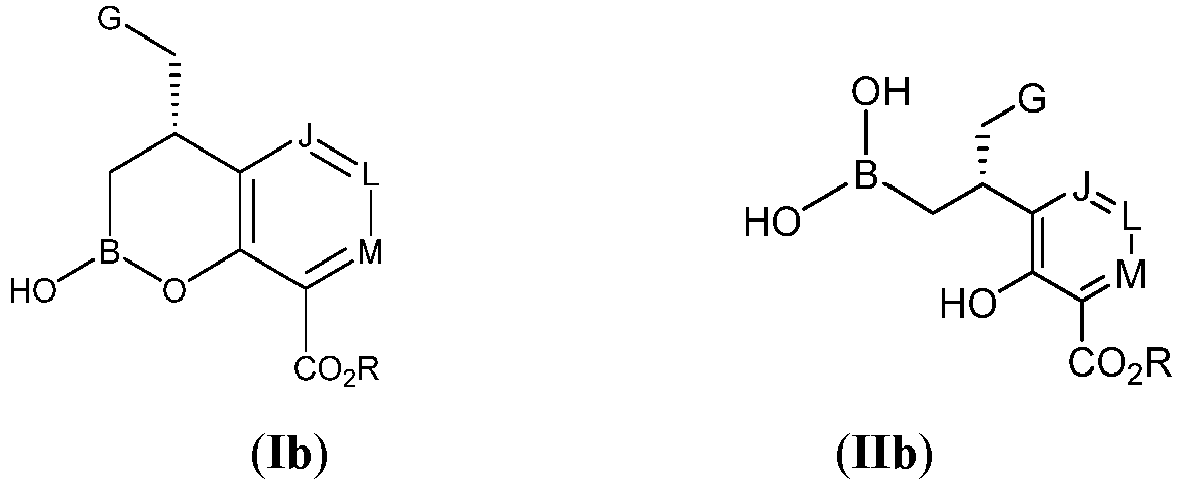
- Composé selon la Revendication 1 ayant la structure de Formule (Ic) ou de Formule (IIc) :
 M étant choisi dans le groupe constitué par -CR7 et N ; etR7 étant choisi dans le groupe constitué par -H, -OR8, et halogène.
 - Composé selon l'une quelconque des Revendications 1 à 4, G étant choisi dans le groupe constitué par -OR1, N3, -NR1R2, NR1C(O)R2, C1-4 alkyle éventuellement substitué, et hétéroaryle à 5 à 10 chaînons éventuellement substitué ; éventuellement, G étant choisi dans le groupe constitué par -OH, -OMe, -OBn, - CH2OH, N3, NH2, -NHC(=O)H, -NHC(=O)CH3, et

- Composé selon l'une quelconque des Revendications 1 à 5, G étant -OR1.
- Composé selon l'une quelconque des Revendications 1 à 6, G étant -OH.
- Composé selon l'une quelconque des Revendications 1 à 7, M étant CR7 et R7 étant choisi dans le groupe constitué par -H, -OR8, et halogène ; éventuellement, M étant choisi dans le groupe constitué par -CH, -COMe, CF, et N ; en outre éventuellement, M étant -COMe.
- Composé selon la Revendication 8, R8 étant C1-4 alkyle éventuellement substitué.
- Composé selon l'une quelconque des Revendications 1 à 9, R étant -H.
- Composé selon la Revendication 1, ayant la structure choisie dans le groupe constitué par :




- Composition pharmaceutique comprenant une quantité thérapeutiquement efficace d'un composé selon l'une quelconque des Revendications 1 à 11 et un excipient pharmaceutiquement acceptable.
- Composition pharmaceutique selon la Revendication 12, comprenant en outre un médicament supplémentaire ; éventuellement, le médicament supplémentaire étant choisi dans le groupe constitué par un agent antibactérien, un agent antifongique, un agent antiviral, un agent anti-inflammatoire et un agent antiallergique ; en outre éventuellement, le médicament supplémentaire étant un agent antibactérien de type β-lactame ; éventuellement, l'agent antibactérien de type β-lactame étant choisi dans le groupe constitué par Amoxicilline, Ampicilline (Pivampicilline, Hétacilline, Bacampicilline, Métampicilline, Talampicilline), Epicilline, Carbénicilline (Carindacilline), Ticarcilline, Témocilline, Azlocilline, Pipéracilline, Mezlocilline, Mecillinam (Pivmecillinam), Sulbénicilline, Benzylpénicilline (G), Clométocilline, Benzathine benzylpénicilline, Procaïne benzylpénicilline, Azidocilline, Pénamecilline, Phénoxyméthylpénicilline (V), Propicilline, Benzathine phénoxyméthylpénicilline, Phénéticilline, Cloxacilline (Dicloxacilline, Flucloxacilline), Oxacilline, Méticilline, Nafcilline, Faropenem, Tomopenem, Razupenem, Céfazoline, Céfacetrile, Céfalexine, Céphaloglycine, Céphalonium, Céfaloridine, Céfalotine, Céfapirine, Céfatrizine, Céfazédone, Céfazaflur, Céfradine, Céfroxadine, Ceftezole, Céfaclor, Céfamandole, Cefminox, Céfonicide, Céforanide, Céfotiam, Cefprozil, Cefbuperazone, Céfuroxime, Céfuzonam, Céfoxitine, Céfotétan, Cefmétazole, Loracarbef, Céfixime, Ceftriaxone, Cefcapène, Cefdaloxime, Cefdinir, Cefditoren, Cefetamet, Cefmenoxime, Cefodizime, Cefoperazone, Cefotaxime, Cefpimizole, Cefpiramide, Cefpodoxime, Cefsulodin, Cefteram, Ceftibuten, Ceftiolene, Ceftizoxime, Flomoxef, Latamoxef, Cefepime, Cefozopran, Cefpirome, Cefquinome, Ceftobiprole, Ceftaroline, CXA- 101, RWJ-54428, MC-04,546, ME1036, Ceftiofur, Cefquinome, Cefovécine, RWJ-442831, RWJ-333441, et RWJ-333442 ; en outre éventuellement, l'agent antibactérien de type β-lactame étant choisi dans le groupe constitué par Ceftazidime, Biapénem, Doripénem, Ertapenem, Imipénem, Méropénem, Tebipenem, Tebipenem pivoxil, Apapenem et Panipenem ; en outre éventuellement, l'agent antibactérien de type β-lactame étant choisi parmi Aztréonam, Tigemonam, BAL30072, SYN 2416, ou Carumonam.
- Composé selon l'une quelconque des Revendications 1-11 pour une utilisation dans un procédé de traitement d'une infection bactérienne ; éventuellement l'infection comprenant une bactérie choisie dans le groupe constitué par Pseudomonas acidovorans, Pseudomonas alcaligenes, Pseudomonas putida, Burkholderia cepacia, Aeromonas hydrophilia, Francisella tularensis, Morganella morganii, Proteus mirabilis, Proteus vulgaris, Providencia alcalifaciens, Providencia rettgeri, Providencia stuartii, Acinetobacter baumannii, Bordetella pertussis, Bordetella para pertussis, Bordetella bronchiseptica, Haemophilus ducreyi, Pasteurella multocida, Pasteurella haemolytica, Branhamella catarrhalis, Borrelia burgdorferi, Kingella, Gardnerella vaginalis, Bacteroides distasonis, Bacteroides 3452A homology group, Clostridium difficile, Mycobacterium tuberculosis, Mycobacterium avium, Mycobacterium intracellulare, Mycobacterium leprae, Corynebacterium diphtheriae, Corynebacterium ulcerans, Streptococcus pneumoniae, Streptococcus agalactiae, Streptococcus pyogenes, Enterococcus faecalis, Enterococcus faecium, Staphylococcus aureus, Staphylococcus epidermidis, Staphylococcus saprophyticus, Staphylococcus intermedius, Staphylococcus hyicus subsp. hyicus, Staphylococcus haemolyticus, Staphylococcus hominis, et Staphylococcus saccharolyticus ; en outre éventuellement, l'infection comprenant une bactérie choisie dans le groupe constitué par Pseudomonas aeruginosa, Pseudomonas fluorescens, Stenotrophomonas maltophilia, Escherichia coli, Citrobacter freundii, Salmonella typhimurium, Salmonella typhi, Salmonella paratyphi, Salmonella enteritidis, Shigella dysenteriae, Shigella flexneri, Shigella sonnei, Enterobacter cloacae, Enterobacter aerogenes, Klebsiella pneumoniae, Klebsiella oxytoca, Serratia marcescens, Acinetobacter calcoaceticus, Acinetobacter haemolyticus, Yersinia enterocolitica, Yersinia pestis, Yersinia pseudotuberculosis, Yersinia intermedia, Haemophilus influenzae, Haemophilus parainfluenzae, Haemophilus haemolyticus, Haemophilus parahaemolyticus, Helicobacter pylori, Campylobacter fétus, Campylobacter jejuni, Campylobacter coli, Vibrio cholerae, Vibrio parahaemolyticus, Legionella pneumophila, Listeria monocytogenes, Neisseria gonorrhoeae, Neisseria meningitidis, Moraxella, Bacteroides fragilis, Bacteroides vulgatus, Bacteroides ovalus, Bacteroides thetaiotaomicron, Bacteroides uniformis, Bacteroides eggerthii et Bacteroides splanchnicus.
- Composé pour une utilisation selon la Revendication 14, le procédé comprenant en outre une administration au sujet d'un médicament supplémentaire ; éventuellement, le médicament supplémentaire étant choisi dans le groupe constitué par un agent antibactérien, un agent antifongique, un agent antiviral, un agent anti-inflammatoire et un agent antiallergique ; en outre éventuellement, le médicament supplémentaire étant un agent antibactérien de type β-lactame ; éventuellement, l'agent antibactérien de type β-lactame étant choisi dans le groupe constitué par Amoxicilline, Ampicilline (Pivampicilline, Hétacilline, Bacampicilline, Métampicilline, Talampicilline), Epicilline, Carbénicilline (Carindacilline), Ticarcilline, Témocilline, Azlocilline, Pipéracilline, Mezlocilline, Mecillinam (Pivmecillinam), Sulbénicilline, Benzylpénicilline (G), Clométocilline, Benzathine benzylpénicilline, Procaïne benzylpénicilline, Azidocilline, Pénamecilline, Phénoxyméthylpénicilline (V), Propicilline, Benzathine phénoxyméthylpénicilline, Phénéticilline, Cloxacilline (Dicloxacilline, Flucloxacilline), Oxacilline, Méticilline, Nafcilline, Faropenem, Tomopenem, Razupenem, Céfazoline, Céfacetrile, Céfalexine, Céphaloglycine, Céphalonium, Céfaloridine, Céfalotine, Céfapirine, Céfatrizine, Céfazédone, Céfazaflur, Céfradine, Céfroxadine, Ceftezole, Céfaclor, Céfamandole, Cefminox, Céfonicide, Céforanide, Céfotiam, Cefprozil, Cefbuperazone, Céfuroxime, Céfuzonam, Céfoxitine, Céfotétan, Cefmétazole, Loracarbef, Céfixime, Ceftriaxone, Cefcapène, Cefdaloxime, Cefdinir, Cefditoren, Cefetamet, Cefmenoxime, Cefodizime, Cefoperazone, Cefotaxime, Cefpimizole, Cefpiramide, Cefpodoxime, Cefsulodin, Cefteram, Ceftibuten, Ceftiolene, Ceftizoxime, Flomoxef, Latamoxef, Cefepime, Cefozopran, Cefpirome, Cefquinome, Ceftobiprole, Ceftaroline, CXA- 101, RWJ-54428, MC-04,546, ME1036, Ceftiofur, Cefquinome, Cefovécine, RWJ-442831, RWJ-333441, et RWJ-333442 ; en outre éventuellement, l'agent antibactérien de type β-lactame étant choisi dans le groupe constitué par Ceftazidime, Biapénem, Doripénem, Ertapenem, Imipénem, Méropénem, Tebipenem, Tebipenem pivoxil, Apapenem et Panipenem ; en outre éventuellement, l'agent antibactérien de type β-lactame étant choisi parmi Aztréonam, Tigemonam, BAL30072, SYN 2416, et Carumonam.
- Composé selon la Revendication 1, ayant la structure de :

- Composé selon la Revendication 1, ayant la structure de :

- Composé selon la Revendication 1, ayant la structure de :

- Composé selon la Revendication 1, ayant la structure de :

- Composé selon la Revendication 1, ayant la structure de :

- Composé selon la Revendication 1, ayant la structure de :

Applications Claiming Priority (2)
| Application Number | Priority Date | Filing Date | Title |
|---|---|---|---|
| US201862660729P | 2018-04-20 | 2018-04-20 | |
| PCT/US2019/027844 WO2019204419A1 (fr) | 2018-04-20 | 2019-04-17 | Dérivés d'acide boronique et leurs utilisations thérapeutiques |
Publications (4)
| Publication Number | Publication Date |
|---|---|
| EP3781576A1 EP3781576A1 (fr) | 2021-02-24 |
| EP3781576A4 EP3781576A4 (fr) | 2022-03-02 |
| EP3781576C0 EP3781576C0 (fr) | 2024-06-12 |
| EP3781576B1 true EP3781576B1 (fr) | 2024-06-12 |
Family
ID=68240303
Family Applications (1)
| Application Number | Title | Priority Date | Filing Date |
|---|---|---|---|
| EP19789187.2A Active EP3781576B1 (fr) | 2018-04-20 | 2019-04-17 | Dérivés d'acide boronique et leurs utilisations thérapeutiques |
Country Status (9)
| Country | Link |
|---|---|
| US (2) | US12016868B2 (fr) |
| EP (1) | EP3781576B1 (fr) |
| JP (3) | JP7329260B2 (fr) |
| CN (1) | CN112424209A (fr) |
| AU (1) | AU2019256351B2 (fr) |
| CA (1) | CA3097127A1 (fr) |
| TW (1) | TW201945005A (fr) |
| WO (1) | WO2019204419A1 (fr) |
| ZA (1) | ZA202006377B (fr) |
Families Citing this family (10)
| Publication number | Priority date | Publication date | Assignee | Title |
|---|---|---|---|---|
| ES2894251T3 (es) | 2016-06-30 | 2022-02-14 | Qpex Biopharma Inc | Derivados de ácido borónico y usos terapéuticos de los mismos |
| US12016868B2 (en) * | 2018-04-20 | 2024-06-25 | Qpex Biopharma, Inc. | Boronic acid derivatives and therapeutic uses thereof |
| BR112022022367A2 (pt) | 2020-05-05 | 2023-01-10 | Qpex Biopharma Inc | Derivados e síntese de ácido borônico, formas polimórficas e usos terapêuticos dos mesmos |
| CN113880871B (zh) * | 2020-10-16 | 2022-08-23 | 中国科学院兰州化学物理研究所 | 一种饱和单硼类化合物的制备方法 |
| CN117377470A (zh) | 2021-03-08 | 2024-01-09 | 伊莱利利公司 | 美维达林和其他d1正向别构调节剂在幻觉和痴呆相关精神病的治疗中的用途 |
| EP4304577A1 (fr) | 2021-03-09 | 2024-01-17 | Eli Lilly And Co. | Utilisation de mevidalen et d'autres modulateurs allostériques positifs de d1 pour ralentir la progression de la maladie de parkinson |
| TW202404610A (zh) * | 2022-06-24 | 2024-02-01 | 大陸商瑞石生物醫藥有限公司 | 一種硼酸酯衍生物的結晶、其製備方法及用途 |
| US20250099495A1 (en) * | 2023-09-22 | 2025-03-27 | City University Of Hong Kong | Methods of inhibiting klebsiella pneumoniae carbapenemase-2 |
| WO2025119216A1 (fr) * | 2023-12-04 | 2025-06-12 | 珠海联邦制药股份有限公司 | INHIBITEUR DE β-LACTAMASE D'ACIDE BORONIQUE, PROCÉDÉ DE PRÉPARATION ASSOCIÉ ET UTILISATION ASSOCIÉE |
| CN119119096B (zh) * | 2024-09-09 | 2025-09-16 | 郑州药领医药科技有限公司 | 一种4-((4,4,5,5-四甲基-1,3,2-二氧硼杂环戊烷-2-基)甲基)哌啶-1-甲酸叔丁酯的合成方法 |
Family Cites Families (110)
| Publication number | Priority date | Publication date | Assignee | Title |
|---|---|---|---|---|
| US3686398A (en) | 1970-07-20 | 1972-08-22 | Chevron Res | 10,9-boroxarophenanthrene as fungicides |
| US4194047A (en) | 1975-11-21 | 1980-03-18 | Merck & Co., Inc. | Substituted N-methylene derivatives of thienamycin |
| US4260543A (en) | 1978-07-03 | 1981-04-07 | Merck & Co., Inc. | Crystalline N-formimidoyl thienamycin |
| US4409214A (en) | 1979-11-19 | 1983-10-11 | Fujisawa Pharmaceutical, Co., Ltd. | 7-Acylamino-3-vinylcephalosporanic acid derivatives and processes for the preparation thereof |
| US4353807A (en) | 1981-03-24 | 1982-10-12 | Mobil Oil Corporation | Lubricants and fuels containing boroxarophenanthrene compounds |
| FR2573070B1 (fr) | 1984-11-13 | 1987-01-30 | Rhone Poulenc Sante | Procede de preparation de composes carbonyles |
| US4783443A (en) | 1986-03-03 | 1988-11-08 | The University Of Chicago | Amino acyl cephalosporin derivatives |
| CA1283404C (fr) | 1986-07-01 | 1991-04-23 | Shigeru Sanai | Composes de cephalosporine, procede de preparation et agents antibacteriens |
| ZA893284B (en) | 1988-05-04 | 1990-03-28 | Igen Inc | Peptide analogs and their use as haptens to elicit catalytic antibodies |
| US5442100A (en) | 1992-08-14 | 1995-08-15 | The Procter & Gamble Company | β-aminoalkyl and β-N-peptidylaminoalkyl boronic acids |
| US5888998A (en) | 1997-04-24 | 1999-03-30 | Synphar Laboratories, Inc. | 2-oxo-1-azetidine sulfonic acid derivatives as potent β-lactamase inhibitors |
| AU8140898A (en) | 1997-06-13 | 1998-12-30 | Northwestern University | Inhibitors of beta-lactamases and uses therefor |
| US6184363B1 (en) | 1997-06-13 | 2001-02-06 | Northwestern University | Inhibitors of β-lactamases and uses therefor |
| AU2190400A (en) | 1998-12-16 | 2000-07-03 | Northwestern University | Inhibitors of beta-lactamases and uses therefor |
| WO2000035904A1 (fr) | 1998-12-16 | 2000-06-22 | Northwestern University | INHIBITEURS DE β-LACTAMASES ET LEUR UTILISATION |
| TR200200795T2 (tr) | 1999-09-25 | 2002-07-22 | Smithkline Beecham P. L. C. | 5-HT1B antagonistleri olarak piperazin türevleri |
| JP2003513890A (ja) | 1999-10-28 | 2003-04-15 | メルク エンド カムパニー インコーポレーテッド | 新規なコハク酸系メタロ−β−ラクタマーゼ阻害薬およびそれの細菌感染治療での使用 |
| WO2002022137A1 (fr) | 2000-09-12 | 2002-03-21 | Shoichet Brian K | Analogues de $g(b)-lactamine et utilisations de ceux-ci |
| ATE298750T1 (de) | 2000-09-14 | 2005-07-15 | Pantherix Ltd | 3-(heteroarylacetamido)-2-oxo-azetidin-1- sulfonsäure derivate als antibakterielle mittel |
| AU2002243508A1 (en) | 2001-01-10 | 2002-07-24 | Bristol-Myers Squibb Company Patent Department | Alpha-aminoboronic acids prepared by novel synthetic methods |
| DE10118698A1 (de) | 2001-04-17 | 2002-11-07 | Jerini Ag | Verfahren zur Immobilisierung und damit hergestellte Anordnungen von Verbindungen auf einer planaren Oberfläche |
| AU2002360732A1 (en) | 2001-12-26 | 2003-07-24 | Guilford Pharmaceuticals | Change inhibitors of dipeptidyl peptidase iv |
| FR2835186B1 (fr) | 2002-01-28 | 2006-10-20 | Aventis Pharma Sa | Nouveaux composes heterocycliques, actifs comme inhibiteurs de beta-lactamases |
| JP2003229277A (ja) | 2002-02-04 | 2003-08-15 | Matsushita Electric Ind Co Ltd | 発光素子材料およびそれを用いた発光素子並びに装置 |
| AUPS065102A0 (en) | 2002-02-20 | 2002-03-14 | Unisearch Limited | Fluorous acetalation |
| AU2003261974A1 (en) | 2002-09-11 | 2004-04-30 | Kureha Chemical Industry Company, Limited | Amine compounds and use thereof |
| AU2003268752A1 (en) | 2002-10-30 | 2004-05-25 | Sumitomo Chemical Company, Limited | High-molecular compounds and polymerer light emitting devices made by using the same |
| US7439253B2 (en) | 2002-12-06 | 2008-10-21 | Novexel | Heterocyclic compounds, their preparation and their use as medicaments, in particular as antibacterials and beta-lactamase inhibitors |
| US7271186B1 (en) | 2002-12-09 | 2007-09-18 | Northwestern University | Nanomolar β-lactamase inhibitors |
| MXPA05006798A (es) | 2002-12-20 | 2006-03-09 | Migenix Corp | Ligandos de adenina nucleotido translocasa (ant) y composiciones y metodos relacionados a estos. |
| TW200418791A (en) | 2003-01-23 | 2004-10-01 | Bristol Myers Squibb Co | Pharmaceutical compositions for inhibiting proteasome |
| JP4233365B2 (ja) | 2003-03-25 | 2009-03-04 | 三井化学株式会社 | アザジオール錯体化合物、及び該化合物を用いる光記録媒体 |
| US7842941B2 (en) | 2003-10-06 | 2010-11-30 | Sumitomo Chemical Company, Limited | Aromatic compound |
| BRPI0415185A (pt) | 2003-10-10 | 2006-11-28 | Pfizer Prod Inc | 2h-[1,2,4]triazol[4,3-a]pirazinas substituìdas como inibidores da gsk-3 |
| SG134333A1 (en) | 2003-11-12 | 2007-08-29 | Phenomix Corp | Heterocyclic boronic acid compounds |
| TW200600494A (en) | 2004-03-08 | 2006-01-01 | Chugai Pharmaceutical Co Ltd | Bisphenyl compounds useful as vitamin d3 receptor agonists |
| US20060019116A1 (en) | 2004-07-22 | 2006-01-26 | Eastman Kodak Company | White electroluminescent device with anthracene derivative host |
| TW200618820A (en) | 2004-11-05 | 2006-06-16 | Alza Corp | Liposome formulations of boronic acid compounds |
| US20060178357A1 (en) | 2005-02-10 | 2006-08-10 | Buynak John D | Chphalosporin-derived mercaptans as inhibitors of serine and metallo-beta-lactamases |
| EP2343304B1 (fr) | 2005-02-16 | 2015-06-10 | Anacor Pharmaceuticals, Inc. | Composés boronophthalide biocides |
| US7612203B2 (en) | 2005-02-22 | 2009-11-03 | Teva Pharmaceutical Industries Ltd. | Rosuvastatin and salts thereof free of rosuvastatin alkylether and a process for the preparation thereof |
| WO2006101779A2 (fr) | 2005-03-15 | 2006-09-28 | The University Of Chicago | Electrolytes non aqueux destines a des batteries au lithium-ion |
| US7825139B2 (en) | 2005-05-25 | 2010-11-02 | Forest Laboratories Holdings Limited (BM) | Compounds and methods for selective inhibition of dipeptidyl peptidase-IV |
| TW200734311A (en) | 2005-11-21 | 2007-09-16 | Astrazeneca Ab | New compounds |
| CA2783572C (fr) | 2005-12-07 | 2016-08-09 | Basilea Pharmaceutica Ag | Associations utiles d'antibiotiques monobactames et d'inhibiteurs de la beta-lactamase |
| PT1988779E (pt) | 2006-02-16 | 2015-09-04 | Anacor Pharmaceuticals Inc | Moléculas pequenas contendo boro como agentes antiinflamatórios |
| AU2007300531A1 (en) | 2006-09-27 | 2008-04-03 | Merck Sharp & Dohme Corp. | Novel inhibitors of beta-lactamase |
| RU2488394C2 (ru) | 2007-03-23 | 2013-07-27 | Базилеа Фармацойтика Аг | Комбинированные лекарственные средства для лечения бактериальных инфекций |
| GB0719366D0 (en) | 2007-10-03 | 2007-11-14 | Smithkline Beecham Corp | Compounds |
| US20100120715A1 (en) | 2007-11-13 | 2010-05-13 | Burns Christopher J | Beta-lactamase inhibitors |
| JP2011504468A (ja) | 2007-11-13 | 2011-02-10 | プロテズ・ファーマシューティカルズ・インコーポレイテッド | β−ラクタマーゼ阻害剤 |
| ES2533826T3 (es) | 2008-01-18 | 2015-04-15 | Merck Sharp & Dohme Corp. | Inhibidores de beta-lactamasa |
| US8129398B2 (en) | 2008-03-19 | 2012-03-06 | Bristol-Myers Squibb Company | HIV integrase inhibitors |
| EP2285384A4 (fr) | 2008-05-12 | 2012-04-25 | Anacor Pharmaceuticals Inc | Petites molécules contenant du bore |
| CN102098918A (zh) | 2008-05-13 | 2011-06-15 | 帕纳德制药公司 | 用于治疗癌症和神经退行性疾病的生物活性化合物 |
| US20120046242A1 (en) | 2008-12-24 | 2012-02-23 | Massachusetts Institute Of Technology | Molecular activators of the wnt/beta-catenin pathway |
| WO2010097675A1 (fr) | 2009-02-27 | 2010-09-02 | Dhanuka Laboratories Ltd. | Procédé de préparation amélioré pour le cefpodoxime proxétil |
| EP2406233B1 (fr) | 2009-03-09 | 2013-11-13 | Bristol-Myers Squibb Company | Analogues d'aza-pyridone utiles en tant que antagonistes des récepteurs de l'hormone concentrant la mélanine |
| US20100292185A1 (en) | 2009-05-12 | 2010-11-18 | Burns Christopher J | Beta-lactamase inhibitors |
| WO2010144338A1 (fr) | 2009-06-08 | 2010-12-16 | Abraxis Bioscience, Llc | Dérivés de triazine et leurs applications thérapeutiques |
| MX2012001156A (es) | 2009-07-28 | 2012-05-08 | Anacor Pharmaceuticals Inc | Moleculas que contienen boro trisustituidas. |
| EP2539348A4 (fr) | 2010-02-26 | 2013-07-24 | Gary Igor Dmitrienko | Dérivés de la céphalosporine utiles comme inhibiteurs de la -lactamase et leurs compositions et procédés d'utilisation |
| MX2012011298A (es) | 2010-03-31 | 2012-11-06 | Millennium Pharm Inc | Derivados del acido 1-amino-2-ciclopropiletilboronico. |
| US20110288063A1 (en) | 2010-05-19 | 2011-11-24 | Naeja Pharmaceutical Inc. | Novel fused bridged bicyclic heteroaryl substituted 6-alkylidene penems as potent beta-lactamase inhibitors |
| US8822516B2 (en) | 2010-06-10 | 2014-09-02 | Technion Research & Development Foundation Limited | Process for the preparation of iodides |
| RS60310B1 (sr) | 2010-08-10 | 2020-07-31 | Rempex Pharmaceuticals Inc | Ciklični derivati estra boronske kiseline, postupak za pripremu injihove terapeutske upotrebe |
| HRP20160305T1 (hr) | 2010-10-26 | 2016-07-01 | Mars, Incorporated | Borati kao inhibitori arginaze |
| WO2012067664A1 (fr) | 2010-11-18 | 2012-05-24 | Glaxo Group Limited | Composés |
| EP2487159A1 (fr) | 2011-02-11 | 2012-08-15 | MSD Oss B.V. | Inhibiteurs du RORgammaT |
| EP2508506A1 (fr) | 2011-04-08 | 2012-10-10 | LEK Pharmaceuticals d.d. | Préparation d'intermédiaires de la sitagliptine |
| CN102320960A (zh) | 2011-08-02 | 2012-01-18 | 安徽东健化工科技有限公司 | 一种6-氟水杨酸的制备方法 |
| US9012491B2 (en) | 2011-08-31 | 2015-04-21 | Rempex Pharmaceuticals, Inc. | Heterocyclic boronic acid ester derivatives and therapeutic uses thereof |
| WO2013053372A1 (fr) | 2011-10-13 | 2013-04-18 | Therabor Pharmaceuticals | Inhibiteurs de type acide boronique de bêta-lactamases |
| WO2013056163A1 (fr) | 2011-10-14 | 2013-04-18 | The Regents Of The University Of California | Inhibiteurs de bêta-lactamase |
| SG11201403254QA (en) | 2011-12-22 | 2014-07-30 | Ares Trading Sa | Alpha-amino boronic acid derivatives, selective immunoproteasome inhibitors |
| EP2802593A1 (fr) | 2012-01-09 | 2014-11-19 | The University of Tromsoe | Composés thérapeutiques contenant du bore |
| EP2615080A1 (fr) | 2012-01-12 | 2013-07-17 | LEK Pharmaceuticals d.d. | Préparation d'ingrédients pharmaceutiques actifs de type acide aminés ß purs optiquement et intermédiaires associés |
| EP2814483A2 (fr) | 2012-02-15 | 2014-12-24 | Rempex Pharmaceuticals, Inc. | Méthodes de traitement d'infections bactériennes |
| US9156858B2 (en) | 2012-05-23 | 2015-10-13 | Rempex Pharmaceuticals, Inc. | Boronic acid derivatives and therapeutic uses thereof |
| US10561675B2 (en) | 2012-06-06 | 2020-02-18 | Rempex Pharmaceuticals, Inc. | Cyclic boronic acid ester derivatives and therapeutic uses thereof |
| CN105026407B (zh) | 2012-12-07 | 2017-09-08 | 维纳拓尔斯制药公司 | β‑内酰胺酶抑制剂 |
| KR20150103270A (ko) * | 2013-01-04 | 2015-09-09 | 렘펙스 파머수티클스 인코퍼레이티드 | 보론산 유도체 및 그의 치료적 용도 |
| KR20150103269A (ko) | 2013-01-04 | 2015-09-09 | 렘펙스 파머수티클스 인코퍼레이티드 | 보론산 유도체 및 그의 치료적 용도 |
| US9101638B2 (en) | 2013-01-04 | 2015-08-11 | Rempex Pharmaceuticals, Inc. | Boronic acid derivatives and therapeutic uses thereof |
| US9241947B2 (en) * | 2013-01-04 | 2016-01-26 | Rempex Pharmaceuticals, Inc. | Boronic acid derivatives and therapeutic uses thereof |
| EP2943204B1 (fr) | 2013-01-10 | 2019-03-13 | Venatorx Pharmaceuticals Inc | Inhibiteurs de bêta-lactamase |
| WO2014151958A1 (fr) | 2013-03-14 | 2014-09-25 | VenatoRx Pharmaceuticals, Inc. | Inhibiteurs de bêta-lactamase |
| US9127024B2 (en) | 2013-03-15 | 2015-09-08 | Intrexon Corporation | Boron-containing diacylhydrazines |
| SI3140310T1 (sl) | 2014-05-05 | 2020-01-31 | Rempex Pharmaceuticals, Inc. | Sinteza boronatnih soli in njihova uporaba |
| EP3139930B1 (fr) | 2014-05-05 | 2024-08-14 | Melinta Therapeutics, Inc. | Sels et polymorphes de dérivés cycliques d'ester d'acide boronique, et leurs utilisations thérapeutiques |
| WO2015179308A1 (fr) | 2014-05-19 | 2015-11-26 | Rempex Pharmaceuticals, Inc. | Dérivés d'acide boronique et leurs utilisations thérapeutiques |
| PT3154989T (pt) | 2014-06-11 | 2021-05-18 | Venatorx Pharmaceuticals Inc | Inibidores de beta-lactamase |
| US9511142B2 (en) | 2014-06-11 | 2016-12-06 | VenatoRx Pharmaceuticals, Inc. | Beta-lactamase inhibitors |
| EA201692301A1 (ru) * | 2014-07-01 | 2017-06-30 | Ремпекс Фармасьютикалз, Инк. | Производные бороновой кислоты и их терапевтическое применение |
| WO2016065282A1 (fr) | 2014-10-24 | 2016-04-28 | The Regents Of The University Of Michigan | Formulation nasale, kit nasal, et procédé d'augmentation des taux nasaux d'oxyde nitrique (no) |
| WO2016081297A1 (fr) | 2014-11-18 | 2016-05-26 | Rempex Pharmaceuticals, Inc. | Dérivés d'esters d'acide boronique cycliques et leurs utilisations thérapeutiques |
| WO2016116892A1 (fr) | 2015-01-24 | 2016-07-28 | Wockhardt Limited | Compositions antibactériennes |
| US20180051041A1 (en) | 2015-03-17 | 2018-02-22 | Rempex Pharmaceuticals, Inc. | Boronic acid derivatives and therapeutic uses thereof |
| ES2942329T3 (es) | 2015-04-24 | 2023-05-31 | Melinta Therapeutics Inc | Régimen de dosificación de vaborbactam y meropenem para el tratamiento de infecciones bacterianas en sujetos con función renal reducida |
| WO2017100537A1 (fr) | 2015-12-10 | 2017-06-15 | VenatoRx Pharmaceuticals, Inc. | Inhibiteurs de bêta-lactamases |
| ES2894251T3 (es) | 2016-06-30 | 2022-02-14 | Qpex Biopharma Inc | Derivados de ácido borónico y usos terapéuticos de los mismos |
| AU2017295866A1 (en) | 2016-07-14 | 2019-01-17 | Achaogen, Inc. | Combination of ceftibuten and clavulanic acid for use in the treatment of bacterial infections |
| CN114591223B (zh) | 2016-09-16 | 2025-01-24 | 恩塔西斯治疗有限公司 | β-内酰胺酶抑制剂化合物 |
| US10085999B1 (en) | 2017-05-10 | 2018-10-02 | Arixa Pharmaceuticals, Inc. | Beta-lactamase inhibitors and uses thereof |
| MX2020003495A (es) | 2017-10-11 | 2020-09-18 | Qpex Biopharma Inc | Derivados de acido boronico y sintesis de los mismos. |
| WO2019093450A1 (fr) | 2017-11-10 | 2019-05-16 | 塩野義製薬株式会社 | Dérivé de diazabicyclooctane |
| US12016868B2 (en) * | 2018-04-20 | 2024-06-25 | Qpex Biopharma, Inc. | Boronic acid derivatives and therapeutic uses thereof |
| CN113382713A (zh) | 2018-11-29 | 2021-09-10 | 维纳拓尔斯制药公司 | 包含β-内酰胺酶抑制剂的组合式组合物及其用途 |
| PL3986419T3 (pl) | 2019-06-19 | 2025-09-08 | Qpex Biopharma, Inc. | Pochodne kwasu boronowego i ich zastosowania terapeutyczne |
| MX2022002537A (es) | 2019-08-29 | 2022-03-22 | Arixa Pharmaceuticals Inc | Combinaciones administradas via oral de antibioticos beta-lactama y derivados de avibactam para tratar infecciones bacterianas. |
-
2019
- 2019-04-17 US US17/048,052 patent/US12016868B2/en active Active
- 2019-04-17 CN CN201980027040.6A patent/CN112424209A/zh active Pending
- 2019-04-17 JP JP2020557178A patent/JP7329260B2/ja active Active
- 2019-04-17 AU AU2019256351A patent/AU2019256351B2/en active Active
- 2019-04-17 WO PCT/US2019/027844 patent/WO2019204419A1/fr not_active Ceased
- 2019-04-17 CA CA3097127A patent/CA3097127A1/fr active Pending
- 2019-04-17 EP EP19789187.2A patent/EP3781576B1/fr active Active
- 2019-04-19 TW TW108113700A patent/TW201945005A/zh unknown
-
2020
- 2020-10-14 ZA ZA2020/06377A patent/ZA202006377B/en unknown
-
2023
- 2023-08-08 JP JP2023129305A patent/JP7651203B2/ja active Active
-
2024
- 2024-05-15 US US18/665,333 patent/US20240307422A1/en active Pending
-
2025
- 2025-03-06 JP JP2025035562A patent/JP2025083398A/ja active Pending
Also Published As
| Publication number | Publication date |
|---|---|
| EP3781576A1 (fr) | 2021-02-24 |
| JP2021522167A (ja) | 2021-08-30 |
| JP7329260B2 (ja) | 2023-08-18 |
| EP3781576C0 (fr) | 2024-06-12 |
| BR112020021356A2 (pt) | 2021-01-19 |
| AU2019256351A1 (en) | 2020-11-12 |
| JP2023159197A (ja) | 2023-10-31 |
| WO2019204419A1 (fr) | 2019-10-24 |
| JP7651203B2 (ja) | 2025-03-26 |
| US20240307422A1 (en) | 2024-09-19 |
| JP2025083398A (ja) | 2025-05-30 |
| CN112424209A (zh) | 2021-02-26 |
| AU2019256351B2 (en) | 2024-02-29 |
| ZA202006377B (en) | 2024-02-28 |
| TW201945005A (zh) | 2019-12-01 |
| CA3097127A1 (fr) | 2019-10-24 |
| US12016868B2 (en) | 2024-06-25 |
| US20210361682A1 (en) | 2021-11-25 |
| EP3781576A4 (fr) | 2022-03-02 |
Similar Documents
| Publication | Publication Date | Title |
|---|---|---|
| EP3781576B1 (fr) | Dérivés d'acide boronique et leurs utilisations thérapeutiques | |
| US12509475B2 (en) | Boronic acid derivatives and therapeutic uses thereof | |
| US10618918B2 (en) | Substituted boronic acids as antimicrobials | |
| EP3145936B1 (fr) | Dérivés d'acide boronique et leurs utilisations thérapeutiques | |
| US9101638B2 (en) | Boronic acid derivatives and therapeutic uses thereof | |
| AU2014204045B2 (en) | Boronic acid derivatives and therapeutic uses thereof | |
| US9241947B2 (en) | Boronic acid derivatives and therapeutic uses thereof | |
| US10662205B2 (en) | Cyclic boronic acid ester derivatives and therapeutic uses thereof | |
| HK40045753B (en) | Boronic acid derivatives and therapeutic uses thereof | |
| HK40045753A (en) | Boronic acid derivatives and therapeutic uses thereof | |
| BR112020021356B1 (pt) | Derivados de ácido borônico e usos terapêuticos dos mesmos | |
| HK40000809B (en) | Boronic acid derivatives and therapeutic uses thereof |
Legal Events
| Date | Code | Title | Description |
|---|---|---|---|
| STAA | Information on the status of an ep patent application or granted ep patent |
Free format text: STATUS: THE INTERNATIONAL PUBLICATION HAS BEEN MADE |
|
| PUAI | Public reference made under article 153(3) epc to a published international application that has entered the european phase |
Free format text: ORIGINAL CODE: 0009012 |
|
| STAA | Information on the status of an ep patent application or granted ep patent |
Free format text: STATUS: REQUEST FOR EXAMINATION WAS MADE |
|
| 17P | Request for examination filed |
Effective date: 20201111 |
|
| AK | Designated contracting states |
Kind code of ref document: A1 Designated state(s): AL AT BE BG CH CY CZ DE DK EE ES FI FR GB GR HR HU IE IS IT LI LT LU LV MC MK MT NL NO PL PT RO RS SE SI SK SM TR |
|
| AX | Request for extension of the european patent |
Extension state: BA ME |
|
| DAV | Request for validation of the european patent (deleted) | ||
| DAX | Request for extension of the european patent (deleted) | ||
| REG | Reference to a national code |
Ref country code: HK Ref legal event code: DE Ref document number: 40045753 Country of ref document: HK |
|
| A4 | Supplementary search report drawn up and despatched |
Effective date: 20220131 |
|
| RIC1 | Information provided on ipc code assigned before grant |
Ipc: A61K 45/06 20060101ALI20220125BHEP Ipc: A61K 31/194 20060101ALI20220125BHEP Ipc: A61P 31/04 20060101ALI20220125BHEP Ipc: A61K 31/69 20060101ALI20220125BHEP Ipc: C07F 5/02 20060101AFI20220125BHEP |
|
| GRAP | Despatch of communication of intention to grant a patent |
Free format text: ORIGINAL CODE: EPIDOSNIGR1 |
|
| STAA | Information on the status of an ep patent application or granted ep patent |
Free format text: STATUS: GRANT OF PATENT IS INTENDED |
|
| INTG | Intention to grant announced |
Effective date: 20230320 |
|
| GRAJ | Information related to disapproval of communication of intention to grant by the applicant or resumption of examination proceedings by the epo deleted |
Free format text: ORIGINAL CODE: EPIDOSDIGR1 |
|
| STAA | Information on the status of an ep patent application or granted ep patent |
Free format text: STATUS: REQUEST FOR EXAMINATION WAS MADE |
|
| INTC | Intention to grant announced (deleted) | ||
| GRAP | Despatch of communication of intention to grant a patent |
Free format text: ORIGINAL CODE: EPIDOSNIGR1 |
|
| STAA | Information on the status of an ep patent application or granted ep patent |
Free format text: STATUS: GRANT OF PATENT IS INTENDED |
|
| INTG | Intention to grant announced |
Effective date: 20230824 |
|
| GRAJ | Information related to disapproval of communication of intention to grant by the applicant or resumption of examination proceedings by the epo deleted |
Free format text: ORIGINAL CODE: EPIDOSDIGR1 |
|
| STAA | Information on the status of an ep patent application or granted ep patent |
Free format text: STATUS: REQUEST FOR EXAMINATION WAS MADE |
|
| GRAP | Despatch of communication of intention to grant a patent |
Free format text: ORIGINAL CODE: EPIDOSNIGR1 |
|
| STAA | Information on the status of an ep patent application or granted ep patent |
Free format text: STATUS: GRANT OF PATENT IS INTENDED |
|
| INTC | Intention to grant announced (deleted) | ||
| INTG | Intention to grant announced |
Effective date: 20240104 |
|
| GRAS | Grant fee paid |
Free format text: ORIGINAL CODE: EPIDOSNIGR3 |
|
| GRAA | (expected) grant |
Free format text: ORIGINAL CODE: 0009210 |
|
| STAA | Information on the status of an ep patent application or granted ep patent |
Free format text: STATUS: THE PATENT HAS BEEN GRANTED |
|
| AK | Designated contracting states |
Kind code of ref document: B1 Designated state(s): AL AT BE BG CH CY CZ DE DK EE ES FI FR GB GR HR HU IE IS IT LI LT LU LV MC MK MT NL NO PL PT RO RS SE SI SK SM TR |
|
| REG | Reference to a national code |
Ref country code: GB Ref legal event code: FG4D |
|
| REG | Reference to a national code |
Ref country code: CH Ref legal event code: EP |
|
| REG | Reference to a national code |
Ref country code: IE Ref legal event code: FG4D |
|
| REG | Reference to a national code |
Ref country code: DE Ref legal event code: R096 Ref document number: 602019053615 Country of ref document: DE |
|
| RAP4 | Party data changed (patent owner data changed or rights of a patent transferred) |
Owner name: QPEX BIOPHARMA, INC. |
|
| U01 | Request for unitary effect filed |
Effective date: 20240712 |
|
| U07 | Unitary effect registered |
Designated state(s): AT BE BG DE DK EE FI FR IT LT LU LV MT NL PT RO SE SI Effective date: 20240902 |
|
| PG25 | Lapsed in a contracting state [announced via postgrant information from national office to epo] |
Ref country code: HR Free format text: LAPSE BECAUSE OF FAILURE TO SUBMIT A TRANSLATION OF THE DESCRIPTION OR TO PAY THE FEE WITHIN THE PRESCRIBED TIME-LIMIT Effective date: 20240612 |
|
| PG25 | Lapsed in a contracting state [announced via postgrant information from national office to epo] |
Ref country code: GR Free format text: LAPSE BECAUSE OF FAILURE TO SUBMIT A TRANSLATION OF THE DESCRIPTION OR TO PAY THE FEE WITHIN THE PRESCRIBED TIME-LIMIT Effective date: 20240913 |
|
| PG25 | Lapsed in a contracting state [announced via postgrant information from national office to epo] |
Ref country code: ES Free format text: LAPSE BECAUSE OF FAILURE TO SUBMIT A TRANSLATION OF THE DESCRIPTION OR TO PAY THE FEE WITHIN THE PRESCRIBED TIME-LIMIT Effective date: 20240612 |
|
| PG25 | Lapsed in a contracting state [announced via postgrant information from national office to epo] |
Ref country code: NO Free format text: LAPSE BECAUSE OF FAILURE TO SUBMIT A TRANSLATION OF THE DESCRIPTION OR TO PAY THE FEE WITHIN THE PRESCRIBED TIME-LIMIT Effective date: 20240912 Ref country code: HR Free format text: LAPSE BECAUSE OF FAILURE TO SUBMIT A TRANSLATION OF THE DESCRIPTION OR TO PAY THE FEE WITHIN THE PRESCRIBED TIME-LIMIT Effective date: 20240612 Ref country code: GR Free format text: LAPSE BECAUSE OF FAILURE TO SUBMIT A TRANSLATION OF THE DESCRIPTION OR TO PAY THE FEE WITHIN THE PRESCRIBED TIME-LIMIT Effective date: 20240913 Ref country code: ES Free format text: LAPSE BECAUSE OF FAILURE TO SUBMIT A TRANSLATION OF THE DESCRIPTION OR TO PAY THE FEE WITHIN THE PRESCRIBED TIME-LIMIT Effective date: 20240612 Ref country code: RS Free format text: LAPSE BECAUSE OF FAILURE TO SUBMIT A TRANSLATION OF THE DESCRIPTION OR TO PAY THE FEE WITHIN THE PRESCRIBED TIME-LIMIT Effective date: 20240912 |
|
| PG25 | Lapsed in a contracting state [announced via postgrant information from national office to epo] |
Ref country code: PL Free format text: LAPSE BECAUSE OF FAILURE TO SUBMIT A TRANSLATION OF THE DESCRIPTION OR TO PAY THE FEE WITHIN THE PRESCRIBED TIME-LIMIT Effective date: 20240612 |
|
| PG25 | Lapsed in a contracting state [announced via postgrant information from national office to epo] |
Ref country code: IS Free format text: LAPSE BECAUSE OF FAILURE TO SUBMIT A TRANSLATION OF THE DESCRIPTION OR TO PAY THE FEE WITHIN THE PRESCRIBED TIME-LIMIT Effective date: 20241012 |
|
| PG25 | Lapsed in a contracting state [announced via postgrant information from national office to epo] |
Ref country code: CZ Free format text: LAPSE BECAUSE OF FAILURE TO SUBMIT A TRANSLATION OF THE DESCRIPTION OR TO PAY THE FEE WITHIN THE PRESCRIBED TIME-LIMIT Effective date: 20240612 |
|
| PG25 | Lapsed in a contracting state [announced via postgrant information from national office to epo] |
Ref country code: SK Free format text: LAPSE BECAUSE OF FAILURE TO SUBMIT A TRANSLATION OF THE DESCRIPTION OR TO PAY THE FEE WITHIN THE PRESCRIBED TIME-LIMIT Effective date: 20240612 |
|
| PG25 | Lapsed in a contracting state [announced via postgrant information from national office to epo] |
Ref country code: SM Free format text: LAPSE BECAUSE OF FAILURE TO SUBMIT A TRANSLATION OF THE DESCRIPTION OR TO PAY THE FEE WITHIN THE PRESCRIBED TIME-LIMIT Effective date: 20240612 |
|
| PG25 | Lapsed in a contracting state [announced via postgrant information from national office to epo] |
Ref country code: SM Free format text: LAPSE BECAUSE OF FAILURE TO SUBMIT A TRANSLATION OF THE DESCRIPTION OR TO PAY THE FEE WITHIN THE PRESCRIBED TIME-LIMIT Effective date: 20240612 Ref country code: SK Free format text: LAPSE BECAUSE OF FAILURE TO SUBMIT A TRANSLATION OF THE DESCRIPTION OR TO PAY THE FEE WITHIN THE PRESCRIBED TIME-LIMIT Effective date: 20240612 Ref country code: PL Free format text: LAPSE BECAUSE OF FAILURE TO SUBMIT A TRANSLATION OF THE DESCRIPTION OR TO PAY THE FEE WITHIN THE PRESCRIBED TIME-LIMIT Effective date: 20240612 Ref country code: IS Free format text: LAPSE BECAUSE OF FAILURE TO SUBMIT A TRANSLATION OF THE DESCRIPTION OR TO PAY THE FEE WITHIN THE PRESCRIBED TIME-LIMIT Effective date: 20241012 Ref country code: CZ Free format text: LAPSE BECAUSE OF FAILURE TO SUBMIT A TRANSLATION OF THE DESCRIPTION OR TO PAY THE FEE WITHIN THE PRESCRIBED TIME-LIMIT Effective date: 20240612 |
|
| U20 | Renewal fee for the european patent with unitary effect paid |
Year of fee payment: 7 Effective date: 20250310 |
|
| PLBE | No opposition filed within time limit |
Free format text: ORIGINAL CODE: 0009261 |
|
| STAA | Information on the status of an ep patent application or granted ep patent |
Free format text: STATUS: NO OPPOSITION FILED WITHIN TIME LIMIT |
|
| 26N | No opposition filed |
Effective date: 20250313 |
|
| REG | Reference to a national code |
Ref country code: CH Ref legal event code: H13 Free format text: ST27 STATUS EVENT CODE: U-0-0-H10-H13 (AS PROVIDED BY THE NATIONAL OFFICE) Effective date: 20251125 |
|
| PG25 | Lapsed in a contracting state [announced via postgrant information from national office to epo] |
Ref country code: MC Free format text: LAPSE BECAUSE OF FAILURE TO SUBMIT A TRANSLATION OF THE DESCRIPTION OR TO PAY THE FEE WITHIN THE PRESCRIBED TIME-LIMIT Effective date: 20240612 |
|
| PG25 | Lapsed in a contracting state [announced via postgrant information from national office to epo] |
Ref country code: CH Free format text: LAPSE BECAUSE OF NON-PAYMENT OF DUE FEES Effective date: 20250430 |
|
| PGFP | Annual fee paid to national office [announced via postgrant information from national office to epo] |
Ref country code: GB Payment date: 20260310 Year of fee payment: 8 |
|
| PG25 | Lapsed in a contracting state [announced via postgrant information from national office to epo] |
Ref country code: IE Free format text: LAPSE BECAUSE OF NON-PAYMENT OF DUE FEES Effective date: 20250417 |
|
| U20 | Renewal fee for the european patent with unitary effect paid |
Year of fee payment: 8 Effective date: 20260310 |