EP4516624A1 - Véhicule guidé avec un dispositif de déverrouillage de porte - Google Patents
Véhicule guidé avec un dispositif de déverrouillage de porte Download PDFInfo
- Publication number
- EP4516624A1 EP4516624A1 EP23194201.2A EP23194201A EP4516624A1 EP 4516624 A1 EP4516624 A1 EP 4516624A1 EP 23194201 A EP23194201 A EP 23194201A EP 4516624 A1 EP4516624 A1 EP 4516624A1
- Authority
- EP
- European Patent Office
- Prior art keywords
- door
- vehicle
- criterion
- release
- computer
- Prior art date
- Legal status (The legal status is an assumption and is not a legal conclusion. Google has not performed a legal analysis and makes no representation as to the accuracy of the status listed.)
- Pending
Links
Images

Classifications
-
- B—PERFORMING OPERATIONS; TRANSPORTING
- B61—RAILWAYS
- B61L—GUIDING RAILWAY TRAFFIC; ENSURING THE SAFETY OF RAILWAY TRAFFIC
- B61L3/00—Devices along the route for controlling devices on the vehicle or train, e.g. to release brake or to operate a warning signal
- B61L3/02—Devices along the route for controlling devices on the vehicle or train, e.g. to release brake or to operate a warning signal at selected places along the route, e.g. intermittent control simultaneous mechanical and electrical control
- B61L3/08—Devices along the route for controlling devices on the vehicle or train, e.g. to release brake or to operate a warning signal at selected places along the route, e.g. intermittent control simultaneous mechanical and electrical control controlling electrically
- B61L3/12—Devices along the route for controlling devices on the vehicle or train, e.g. to release brake or to operate a warning signal at selected places along the route, e.g. intermittent control simultaneous mechanical and electrical control controlling electrically using magnetic or electrostatic induction; using radio waves
- B61L3/127—Devices along the route for controlling devices on the vehicle or train, e.g. to release brake or to operate a warning signal at selected places along the route, e.g. intermittent control simultaneous mechanical and electrical control controlling electrically using magnetic or electrostatic induction; using radio waves for remote control of locomotives
-
- B—PERFORMING OPERATIONS; TRANSPORTING
- B61—RAILWAYS
- B61L—GUIDING RAILWAY TRAFFIC; ENSURING THE SAFETY OF RAILWAY TRAFFIC
- B61L15/00—Indicators provided on the vehicle or train for signalling purposes
-
- B—PERFORMING OPERATIONS; TRANSPORTING
- B61—RAILWAYS
- B61L—GUIDING RAILWAY TRAFFIC; ENSURING THE SAFETY OF RAILWAY TRAFFIC
- B61L15/00—Indicators provided on the vehicle or train for signalling purposes
- B61L15/0072—On-board train data handling
-
- B—PERFORMING OPERATIONS; TRANSPORTING
- B61—RAILWAYS
- B61L—GUIDING RAILWAY TRAFFIC; ENSURING THE SAFETY OF RAILWAY TRAFFIC
- B61L15/00—Indicators provided on the vehicle or train for signalling purposes
- B61L15/0081—On-board diagnosis or maintenance
Definitions
- the vehicle is not only on the road during regular operations. Outside of operating hours and/or for the purpose of maintaining and cleaning the vehicle, the operator organizes a background operation (also known as service operation). Background operations include, among other things, bringing vehicles to and from the route for regular operations as required. The vehicles are also parked in depots where cleaning and maintenance work can be carried out, among other things.
- Background operations include, among other things, bringing vehicles to and from the route for regular operations as required.
- the vehicles are also parked in depots where cleaning and maintenance work can be carried out, among other things.
- the door release device can send a message via the first interface that contains the door release and, if necessary, further information.
- the further information can, for example, consist of only certain doors being released, preferably only the doors on one side of the vehicle.
- the information can also be transmitted that the door release is running as part of background operation.
- the trackside device or the mobile terminal which can be carried by the maintenance and repair personnel, for example, establishes a connection to the vehicle, preferably via an interface, for the purpose of transmitting the request. Doors are to be opened. After the request has been transmitted, the door can be released if the specified requirements are met. This is checked by the door release device.
- the aspects of the invention explained above are determined in that the criterion contains location information that the vehicle is located in a predetermined release zone for the doors.
- the location information can be interpreted by the door release device to determine whether or not a door can be released for the purpose of maintenance and servicing. It is therefore possible, for example, to define a release zone in a depot within which the vehicle must be located so that a door can be released at all. If the vehicle is not parked exactly in the release zone, for example, the door will not be released in order not to endanger the personnel entrusted with maintenance and servicing. A risk can arise if the conditions for maintenance and servicing are not met outside the release zone or if access to the vehicle doors is obstructed.
- the aspects of the invention explained above are determined in that the criterion contains location information that the vehicle is located at a predetermined parking position.
- Specifying a parking position helps to monitor the movement of the vehicle as precisely as possible.
- a parking position does not necessarily have to correspond to the definition of a release zone as described above.
- the vehicle can be parked outside the release zone in a specific parking position to wait for the release zone to become free if a vehicle is already undergoing maintenance or servicing there. It is also possible for a release zone to accommodate several vehicles, whereby the parking position can be used to determine in which area of the release zone the vehicle in question was stopped.
- the aspects of the invention explained above are determined in that the criterion contains status information that the vehicle is in a parking mode.
- the status information that the vehicle is in a parking mode can be linked to different conditions
- a minimum requirement is that the vehicle's traction is switched off. In other words, it must be possible to rule out the possibility of the vehicle still moving when the door is opened. This is ensured by switching off the traction.
- Other criteria can be the shutdown of potentially dangerous operating systems in the vehicle, the maintenance of which would otherwise not be permitted, for example.
- the advantage of taking the parking mode, in which the vehicle is parked or, in other words, held in the parking position, into account as status information and thus as part of the criterion is that the door release device can process this information directly. This is particularly advantageous if safety-relevant systems that are parked in the vehicle's parking position can no longer provide this information. As already mentioned, the door release device is equipped with a security level that allows this status information to be taken into account.
- the aspects of the invention explained above are determined in that the criterion contains status information that maintenance and/or servicing is to be carried out.
- the advantage of including this status information in the criterion is that door release can be denied if no maintenance and/or repair is planned.
- the aspects of the invention explained above are determined in that the criterion contains a condition on which side of the vehicle the door release may take place.
- This can, for example, be made dependent on whether the access requirements are met on the side of the vehicle on which the doors are released. This is advantageously associated with an increase in safety.
- the components of the embodiments described each represent individual variants of the invention that are to be considered independently of one another, which also develop the invention independently of one another and are therefore to be considered as part of the invention individually or in a combination other than that shown. Furthermore, the components described can also be combined with the variants of the invention described above.
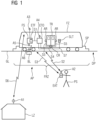
- a vehicle FZ is shown in a depot DP, which has been parked on a track GL.
- the vehicle FZ is located at a parking position AP, which is marked by a trackside device in the form of a balise BL.
- the parking position AP is located in a release zone FRZ, in which services can be provided for the vehicle FZ.
- the services are maintenance and repair measures that can be carried out by personnel, exemplified by a person PS. So that the person PS can get into the vehicle interior through doors TR of the vehicle FZ, a service platform SP is provided, which is at the level of a platform.
- the vehicle FZ is provided with a vehicle control FS, which also includes a door release device ETF as a component.
- the door release device ETF is connected to a door opening device ETO via a first interface S1.
- the door opening device ETO is provided to coordinate the opening of all doors TR of the vehicle FZ (only one of the doors TR is shown for the sake of clarity).
- the door opening device ETO is connected to a control CR via a fourth interface S4, which in turn is connected to actuators AR via fifth interfaces S5, which are mechanically connected to the doors TR in order to open them.
- Various devices can communicate with the vehicle FZ to request a door opening.
- This can be done by a control center LZ, which has a first antenna A1 forms a sixth interface S6 with a third antenna A3 of the vehicle control system FS.
- the person PS can use a device for requesting a door opening EAT, which forms a second interface S2 with a fourth antenna A4 of the door opening device ETO via a second antenna A2 and forms a third interface S3 via the second antenna A2 with the third antenna A3.
- a switch SLT on the outside of the vehicle FZ, which is directly connected to the door opening device ETO via a seventh interface S7.
- a door release In order to trigger a door opening, a door release must first be present. This is generated by the door release device ETF.
- the prerequisite for this is a request for door release from the control center LZ, the person PS with their portable device for requesting a door opening EAT, the switch SLT or, under certain conditions, the trackside device BL.
- said devices can also be used to confirm the parking position AP within the release zone FRZ, which is included as status information in the second criterion K2, which must be fulfilled as a prerequisite for door release.
- the first criterion K1 that the vehicle FZ is not in regular operation RB at a platform, but background operation HB is possible for the purpose of service work, is also met.
- step 1 the procedure is started (short: START).
- step 2 the presence of the first Criterion K1 is queried (abbreviated: CHK_K1).
- step 3 it is checked whether the first criterion K1 is present (abbreviated: K1?). If the first criterion K1 is present, this means that the vehicle FZ, which usually consists of a train, is on the route or is at a station, but is not parked in a depot DP.
- step 4 it is queried whether the vehicle FZ is currently at a station (abbreviated: CHK_ST).
- a subsequent query step 5 it is checked whether this query has shown that the vehicle FZ is on the platform of a station. If this is not the case, step 2 is repeated as part of a recursion and the process continues from there as described above.
- step 5 If it emerges in query step 5 that the vehicle FZ is at a platform, a door release is issued in a known manner in step 6 (TF for short) provided that all the requirements are met.
- the door is released, as already mentioned, by the door release device ETF in the vehicle control FS.
- a door opening command is then generated and transmitted in step 7 (TO for short). This door opening command is generated in the door opening device ETO, as already explained, and passed on to the control CR, which controls the actuators AR to open the door (in Figure 2 not shown).
- the door opening device ETO causes the door TR to be closed (TS for short) in a step 8 by generating a door closing command and sending it to the control unit CR via the fourth interface S4 in the same way as for the door opening (see Figure 1 ), which in turn controls the actuators so that the doors TR are closed.
- the process runs through a recursion and continues by repeating step 2 and the subsequent steps.
- step 3 If query step 3 leads to the result that the first criterion K1 is not present, the second criterion K2 is queried in step 9 (abbreviated to CHK_K2). In a subsequent query step 10, it is checked whether the second criterion K2 is present. If this is not the case, the vehicle FZ is in a parked position in the depot DP and no service measures are required. The process is terminated in step 15 (abbreviated to END).
- the second criterion K2 also contains the conditions that the vehicle FZ is in a release zone FRZ and preferably also that the parking position AP of the vehicle FZ has been confirmed.
- CHK_AN a door release is issued (TF for short).
- TF door release is issued (TF for short).
- TO door opening command
- the door TR is closed in a step 14.
Landscapes
- Engineering & Computer Science (AREA)
- Mechanical Engineering (AREA)
- Health & Medical Sciences (AREA)
- Biomedical Technology (AREA)
- General Health & Medical Sciences (AREA)
- Management, Administration, Business Operations System, And Electronic Commerce (AREA)
Priority Applications (1)
| Application Number | Priority Date | Filing Date | Title |
|---|---|---|---|
| EP23194201.2A EP4516624A1 (fr) | 2023-08-30 | 2023-08-30 | Véhicule guidé avec un dispositif de déverrouillage de porte |
Applications Claiming Priority (1)
| Application Number | Priority Date | Filing Date | Title |
|---|---|---|---|
| EP23194201.2A EP4516624A1 (fr) | 2023-08-30 | 2023-08-30 | Véhicule guidé avec un dispositif de déverrouillage de porte |
Publications (1)
| Publication Number | Publication Date |
|---|---|
| EP4516624A1 true EP4516624A1 (fr) | 2025-03-05 |
Family
ID=87863553
Family Applications (1)
| Application Number | Title | Priority Date | Filing Date |
|---|---|---|---|
| EP23194201.2A Pending EP4516624A1 (fr) | 2023-08-30 | 2023-08-30 | Véhicule guidé avec un dispositif de déverrouillage de porte |
Country Status (1)
| Country | Link |
|---|---|
| EP (1) | EP4516624A1 (fr) |
Citations (3)
| Publication number | Priority date | Publication date | Assignee | Title |
|---|---|---|---|---|
| DE69610494T2 (de) * | 1995-04-28 | 2001-05-03 | Westinghouse Brake And Signal Holdings Ltd., Chippenham | Fahrzeugsteuerungssystem |
| CN104176066A (zh) * | 2014-09-10 | 2014-12-03 | 上海自仪泰雷兹交通自动化系统有限公司 | 列车屏蔽门的冗余控制系统及控制方法 |
| DE102021211019A1 (de) * | 2021-09-30 | 2023-03-30 | Siemens Mobility GmbH | Verfahren zur Ansteuerung einer Vielzahl von Türen in einem Fahrzeug |
-
2023
- 2023-08-30 EP EP23194201.2A patent/EP4516624A1/fr active Pending
Patent Citations (3)
| Publication number | Priority date | Publication date | Assignee | Title |
|---|---|---|---|---|
| DE69610494T2 (de) * | 1995-04-28 | 2001-05-03 | Westinghouse Brake And Signal Holdings Ltd., Chippenham | Fahrzeugsteuerungssystem |
| CN104176066A (zh) * | 2014-09-10 | 2014-12-03 | 上海自仪泰雷兹交通自动化系统有限公司 | 列车屏蔽门的冗余控制系统及控制方法 |
| DE102021211019A1 (de) * | 2021-09-30 | 2023-03-30 | Siemens Mobility GmbH | Verfahren zur Ansteuerung einer Vielzahl von Türen in einem Fahrzeug |
Similar Documents
| Publication | Publication Date | Title |
|---|---|---|
| EP3584140A1 (fr) | Procédé et dispositif de commande d'un processus de sécurité ainsi que véhicule | |
| DE102007024877A1 (de) | Verfahren zur Bildung und Steuerung eines Fahrzeugverbandes | |
| EP4126633B1 (fr) | Procédé de surveillance de la position d'un véhicule ferroviaire en stationnement, et programme informatique, en particulier pour un système de sécurité de train | |
| EP3798090A1 (fr) | Procédé de surveillance d'une communication parlée dans le trafic ferroviaire et système d'acheminement des trains associé | |
| EP1308366A1 (fr) | Dispositif d'avertissement de personnes travaillant sur la voie | |
| DE102018207542A1 (de) | Verfahren und Vorrichtung für die Steuerung eines sicherheitsrelevanten Vorganges, sowie Fahrzeug | |
| EP3964419A1 (fr) | Transmission des données entre un véhicule guidé sur rails et un dispositif terrestre | |
| EP4408720A1 (fr) | Procédé d'activation d'une pluralité de portes dans un véhicule | |
| EP4331943A1 (fr) | Réseau de transport et procédé de fonctionnement de véhicules ferroviaires dans un réseau de transport comprenant une combinaison de sections de voie avec et sans protection contre les trains | |
| EP4146576B1 (fr) | Procédé de fonctionnement d'une installation de transport de personnes par configuration fiable d'un dispositif de sécurité électronique | |
| EP1197418A1 (fr) | Pocédé de commande pour un processus à sécurité critique dans le service ferroviaire et dispositif pour mettre en oeuvre ce procédé | |
| EP4504573B1 (fr) | Système de dételage, attelage automatique simple traction, véhicule ferroviaire doté d'un attelage automatique simple traction pourvu d'un système de dételage de ce type, et procédé de dételage d'un attelage automatique qui est attelé mécaniquement à un attelage simple traction homologue | |
| DE102007011498A1 (de) | Verfahren zum Öffnen einer Kraftfahrzeugtür mit schlüssellosem Zugangssystem | |
| EP4117977B1 (fr) | Installation ferroviaire avec système de diagnostic et son procédé de fonctionnement | |
| DE102019208403A1 (de) | Verfahren und Vorrichtung zum Betreiben eines Fahrzeuges | |
| EP3823878B1 (fr) | Système et procédé pour une véhicule ferroviaire pour l'opération autonome surveillée par une personne surveillante | |
| EP3943363B1 (fr) | Système de commande ferroviaire à blocage de commande | |
| DE112018005796B4 (de) | System und Verfahren zum Steuern eines Kraftfahrzeugs zum autonomen Fahren | |
| DE102009019640B4 (de) | Verfahren, Vorrichtung und System zur Herstellung eines Schlüssels für ein Fahrzeug sowie Verfahren und Vorrichtung zur Erzeugung einer Fräsinformation zur Herstellung eines Schlüssels | |
| EP1396413B1 (fr) | Procédé pour commande auxiliaire d'éléments de voie | |
| EP4254281A1 (fr) | Procédé et agencement d'entretien des unités fonctionnelles dans une voie ferrée | |
| WO2020057918A1 (fr) | Utilisation d'une interface utilisateur d'un système d'information de passager et/ou d'un système de divertissement | |
| EP4339071A1 (fr) | Procédé pour déplacer et maintenir un véhicule guidé dans un dépôt de véhicule | |
| EP4434845A1 (fr) | Procédé mis en uvre par ordinateur pour un véhicule autonome comprenant un opérateur distant | |
| EP3871944A1 (fr) | Procédé de documentation de la communication vocale |
Legal Events
| Date | Code | Title | Description |
|---|---|---|---|
| PUAI | Public reference made under article 153(3) epc to a published international application that has entered the european phase |
Free format text: ORIGINAL CODE: 0009012 |
|
| STAA | Information on the status of an ep patent application or granted ep patent |
Free format text: STATUS: THE APPLICATION HAS BEEN PUBLISHED |
|
| STAA | Information on the status of an ep patent application or granted ep patent |
Free format text: STATUS: REQUEST FOR EXAMINATION WAS MADE |
|
| AK | Designated contracting states |
Kind code of ref document: A1 Designated state(s): AL AT BE BG CH CY CZ DE DK EE ES FI FR GB GR HR HU IE IS IT LI LT LU LV MC ME MK MT NL NO PL PT RO RS SE SI SK SM TR |
|
| 17P | Request for examination filed |
Effective date: 20250220 |
|
| RAP3 | Party data changed (applicant data changed or rights of an application transferred) |
Owner name: SIEMENS MOBILITY GMBH |