EP3812865B1 - Procédé d'ordonnancement de robot et de commande de trajet de robot, serveur et support de stockage - Google Patents
Procédé d'ordonnancement de robot et de commande de trajet de robot, serveur et support de stockage Download PDFInfo
- Publication number
- EP3812865B1 EP3812865B1 EP19822999.9A EP19822999A EP3812865B1 EP 3812865 B1 EP3812865 B1 EP 3812865B1 EP 19822999 A EP19822999 A EP 19822999A EP 3812865 B1 EP3812865 B1 EP 3812865B1
- Authority
- EP
- European Patent Office
- Prior art keywords
- robot
- target range
- determining
- scheduling
- target
- Prior art date
- Legal status (The legal status is an assumption and is not a legal conclusion. Google has not performed a legal analysis and makes no representation as to the accuracy of the status listed.)
- Active
Links
Images



Classifications
-
- G—PHYSICS
- G05—CONTROLLING; REGULATING
- G05D—SYSTEMS FOR CONTROLLING OR REGULATING NON-ELECTRIC VARIABLES
- G05D1/00—Control of position, course, altitude or attitude of land, water, air or space vehicles, e.g. using automatic pilots
- G05D1/60—Intended control result
- G05D1/644—Optimisation of travel parameters, e.g. of energy consumption, journey time or distance
-
- G—PHYSICS
- G05—CONTROLLING; REGULATING
- G05D—SYSTEMS FOR CONTROLLING OR REGULATING NON-ELECTRIC VARIABLES
- G05D1/00—Control of position, course, altitude or attitude of land, water, air or space vehicles, e.g. using automatic pilots
- G05D1/0011—Control of position, course, altitude or attitude of land, water, air or space vehicles, e.g. using automatic pilots associated with a remote control arrangement
- G05D1/0044—Control of position, course, altitude or attitude of land, water, air or space vehicles, e.g. using automatic pilots associated with a remote control arrangement by providing the operator with a computer generated representation of the environment of the vehicle, e.g. virtual reality, maps
-
- B—PERFORMING OPERATIONS; TRANSPORTING
- B25—HAND TOOLS; PORTABLE POWER-DRIVEN TOOLS; MANIPULATORS
- B25J—MANIPULATORS; CHAMBERS PROVIDED WITH MANIPULATION DEVICES
- B25J9/00—Program-controlled manipulators
- B25J9/16—Program controls
- B25J9/1656—Program controls characterised by programming, planning systems for manipulators
- B25J9/1661—Program controls characterised by programming, planning systems for manipulators characterised by task planning, object-oriented languages
-
- B—PERFORMING OPERATIONS; TRANSPORTING
- B25—HAND TOOLS; PORTABLE POWER-DRIVEN TOOLS; MANIPULATORS
- B25J—MANIPULATORS; CHAMBERS PROVIDED WITH MANIPULATION DEVICES
- B25J9/00—Program-controlled manipulators
- B25J9/16—Program controls
- B25J9/1656—Program controls characterised by programming, planning systems for manipulators
- B25J9/1664—Program controls characterised by programming, planning systems for manipulators characterised by motion, path, trajectory planning
- B25J9/1666—Avoiding collision or forbidden zones
-
- B—PERFORMING OPERATIONS; TRANSPORTING
- B25—HAND TOOLS; PORTABLE POWER-DRIVEN TOOLS; MANIPULATORS
- B25J—MANIPULATORS; CHAMBERS PROVIDED WITH MANIPULATION DEVICES
- B25J9/00—Program-controlled manipulators
- B25J9/16—Program controls
- B25J9/1679—Program controls characterised by the tasks executed
- B25J9/1682—Dual arm manipulator; Coordination of several manipulators
-
- G—PHYSICS
- G05—CONTROLLING; REGULATING
- G05D—SYSTEMS FOR CONTROLLING OR REGULATING NON-ELECTRIC VARIABLES
- G05D1/00—Control of position, course, altitude or attitude of land, water, air or space vehicles, e.g. using automatic pilots
- G05D1/02—Control of position or course in two dimensions
- G05D1/021—Control of position or course in two dimensions specially adapted to land vehicles
- G05D1/0212—Control of position or course in two dimensions specially adapted to land vehicles with means for defining a desired trajectory
- G05D1/0214—Control of position or course in two dimensions specially adapted to land vehicles with means for defining a desired trajectory in accordance with safety or protection criteria, e.g. avoiding hazardous areas
-
- G—PHYSICS
- G05—CONTROLLING; REGULATING
- G05D—SYSTEMS FOR CONTROLLING OR REGULATING NON-ELECTRIC VARIABLES
- G05D1/00—Control of position, course, altitude or attitude of land, water, air or space vehicles, e.g. using automatic pilots
- G05D1/02—Control of position or course in two dimensions
- G05D1/021—Control of position or course in two dimensions specially adapted to land vehicles
- G05D1/0287—Control of position or course in two dimensions specially adapted to land vehicles involving a plurality of land vehicles, e.g. fleet or convoy travelling
- G05D1/0291—Fleet control
- G05D1/0297—Fleet control by controlling means in a control room
-
- G—PHYSICS
- G05—CONTROLLING; REGULATING
- G05D—SYSTEMS FOR CONTROLLING OR REGULATING NON-ELECTRIC VARIABLES
- G05D1/00—Control of position, course, altitude or attitude of land, water, air or space vehicles, e.g. using automatic pilots
- G05D1/20—Control system inputs
- G05D1/22—Command input arrangements
- G05D1/221—Remote-control arrangements
- G05D1/222—Remote-control arrangements operated by humans
- G05D1/224—Output arrangements on the remote controller, e.g. displays, haptics or speakers
- G05D1/2244—Optic
- G05D1/2245—Optic providing the operator with a purely computer-generated representation of the environment of the vehicle, e.g. virtual reality
-
- G—PHYSICS
- G05—CONTROLLING; REGULATING
- G05D—SYSTEMS FOR CONTROLLING OR REGULATING NON-ELECTRIC VARIABLES
- G05D1/00—Control of position, course, altitude or attitude of land, water, air or space vehicles, e.g. using automatic pilots
- G05D1/60—Intended control result
- G05D1/617—Safety or protection, e.g. defining protection zones around obstacles or avoiding hazards
-
- G—PHYSICS
- G05—CONTROLLING; REGULATING
- G05D—SYSTEMS FOR CONTROLLING OR REGULATING NON-ELECTRIC VARIABLES
- G05D1/00—Control of position, course, altitude or attitude of land, water, air or space vehicles, e.g. using automatic pilots
- G05D1/60—Intended control result
- G05D1/69—Coordinated control of the position or course of two or more vehicles
- G05D1/698—Control allocation
- G05D1/6987—Control allocation by centralised control off-board any of the vehicles
-
- G—PHYSICS
- G06—COMPUTING OR CALCULATING; COUNTING
- G06Q—INFORMATION AND COMMUNICATION TECHNOLOGY [ICT] SPECIALLY ADAPTED FOR ADMINISTRATIVE, COMMERCIAL, FINANCIAL, MANAGERIAL OR SUPERVISORY PURPOSES; SYSTEMS OR METHODS SPECIALLY ADAPTED FOR ADMINISTRATIVE, COMMERCIAL, FINANCIAL, MANAGERIAL OR SUPERVISORY PURPOSES, NOT OTHERWISE PROVIDED FOR
- G06Q10/00—Administration; Management
- G06Q10/04—Forecasting or optimisation specially adapted for administrative or management purposes, e.g. linear programming or "cutting stock problem"
- G06Q10/047—Optimisation of routes or paths, e.g. travelling salesman problem
-
- G—PHYSICS
- G06—COMPUTING OR CALCULATING; COUNTING
- G06Q—INFORMATION AND COMMUNICATION TECHNOLOGY [ICT] SPECIALLY ADAPTED FOR ADMINISTRATIVE, COMMERCIAL, FINANCIAL, MANAGERIAL OR SUPERVISORY PURPOSES; SYSTEMS OR METHODS SPECIALLY ADAPTED FOR ADMINISTRATIVE, COMMERCIAL, FINANCIAL, MANAGERIAL OR SUPERVISORY PURPOSES, NOT OTHERWISE PROVIDED FOR
- G06Q10/00—Administration; Management
- G06Q10/06—Resources, workflows, human or project management; Enterprise or organisation planning; Enterprise or organisation modelling
Definitions
- the embodiments of the present application relate to the robot technology, for example, to a robot scheduling method a server and a storage medium.
- the development of robot technology has brought new technologies and innovations to the logistics industry.
- the use of robots to replace a large number of workers can realize the automation in the logistics field, reduce the labor cost and promote the increase in productivity.
- the robot based sorting system in the related technology transforms the traditional sorting model of "person-to-goods" into the mode of "goods-to-person” by moving the robots to transfer goods to the preset worker positions, breaking the traditional goods sorting model and effectively improving the work efficiency.
- the robots Since most warehouses do not operate continuously for 24 hours a day, the robots need to be turned on and off every day. However, the robots may be randomly distributed in the warehouse. During turning on and off, there is a need to search the robots everywhere in the site or manually schedule the robots to the designated positions through a control terminal, that is, select a robot by the control terminal and determine the designated position corresponding to this robot, schedule this robot to the designated position, then select a next robot that needs to be scheduled, and repeat the above operations until all the robots in the site are scheduled to the designated positions.
- these two methods undoubtedly increase the usage cost and reduce the work efficiency of the staff.
- Patent application US2012/0303180A1 discloses a conventional robot scheduling method. When a workstation needs a certain kind of goods, select corresponding robots from multiple robots in the warehouse environment to transport goods. The selection is based on whether there are goods needed on the AGV, whether the AGV is idle, and the distance from the workstation.
- the present application provides a robot scheduling method a server and a storage medium, so as to solve the above problems.
- Embodiments of the present application provide a robot scheduling method.
- the method includes: receiving a scheduling instruction for robot collection; determining a working state and a current position of a robot in a working area in response to the scheduling instruction; wherein the working state includes an idle state and a non-idle state; when the working state of the robot is the idle state and the current position is outside a preset target range, scheduling the robot from the current position into the target range; wherein the target range refers to an idle area, and the idle area is an area closer to work station; wherein the scheduling the robot from the current position into the target range includes: determining a target position of the robot within the target range; wherein the operation of determining a target position of the robot within the target range includes: determining a planned position of the robot within the target range; determining whether the planned position of the robot satisfies a preset scheduling condition, and determining the planned position of the robot as the target position of the robot in response to determining that the planned position of the robot satisfies
- Embodiments of the present application further provide a server.
- the server includes: at least one processor and a memory communicatively connected to the at least one processor.
- the memory stores instructions that can be executed by the at least one processor, and the instructions are executed by the at least one processor to enable the at least one processor to perform the method described in any one of the foregoing embodiments.
- Embodiments of the present application further provide a storage medium storing the computer-executable instructions, where the computer-executable instructions are used to perform the method described in any one of the foregoing embodiments.
- the embodiments of the present application propose a robot scheduling method, a server and a storage medium.
- the working state of the robot and the current position of the robot are determined; where the working state includes: the idle state and the non-idle state; and when the working state of the robot is idle and the current position is outside the preset target range, the robot can be scheduled from the current position into the target range; wherein the target range refers to an idle area, and the idle area is an area closer to work station; wherein the scheduling the robot from the current position into the target range includes: determining a target position of the robot within the target range; wherein the operation of determining a target position of the robot within the target range includes: determining a planned position of the robot within the target range; determining whether the planned position of the robot satisfies a preset scheduling condition, and determining the planned position of the robot as the target position of the robot in response to determining that the planned position of the robot satisfies the scheduling condition; wherein the preset scheduling condition is not affecting the operations
- the robot when the working state of the robot is idle and the current position is outside the preset target range, the robot can be scheduled into the designated area for collection, and the robot can be automatically scheduled to the designated area, thereby reducing the operation and maintenance cost and improving the work efficiency.
- FIG. 1 is a structural schematic diagram of a robot scheduling system in an embodiment.
- the robot scheduling system generally includes: an operating terminal 101, a server 102 and at least one robot 103.
- the server 102 establishes the communication links with the operating terminal 101 and the robot 103 respectively.
- the operating terminal 101 is configured to receive the operation information input by the staff. For example, a user can input the operation information at the operating terminal through a human-computer interaction interface to realize the scheduling control of the robot 103 in the warehouse.
- the server 102 is configured to generate and send a work instruction to the robot 103 according to the operation information received by the operating terminal 101 and the actual situation in the warehouse, and the robot 103 is configured to complete the work task corresponding to the work instruction according to the received work instruction.
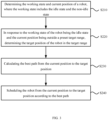
- FIG. 2 is a flowchart of a robot scheduling method in an embodiment. This embodiment is applicable to the case of scheduling robots, and this method can be performed by a robot scheduling device. As shown in FIG. 2 , the robot scheduling method can include The following operations.
- Operation 110 determining the working state and current position of a robot, where the working state includes: the idle state and the non-idle state.
- the method before determining the working state and current position of the robot, the method further includes: receiving a scheduling instruction; and the operation of determining the working state and current position of the robot includes: determining the working state and current position of the robot in the working area in response to the scheduling instruction.
- the robot refers to a target robot.
- the target robot refers to any robot in the warehouse but not in the target area.
- the target robot can be a robot with a serial number entered by a staff at the operating terminal.
- the server traverses all the robots in the warehouse, and the robot currently inquired by the server is determined as the target robot.
- the determination of the working state of the robot can be achieved by the following method: determining whether the robot has a task to be performed or a task in progress; determining that the working state of the robot is the idle state in response to determining that the robot has neither task to be performed nor task in progress; and determining that the working state of the robot is the non-idle state in response to determining that the robot has the task to be performed or task in progress.
- the task to be performed refers to the task corresponding to a work instruction that cannot be performed immediately after receiving the work instruction sent by the server because the robot is performing a task and that will be performed after the task currently being performed is completed; or the robot receives the work instruction sent by the server and is on the way to perform the task.
- the method for determining the current position of the robot may adopt different technical solutions according to the working environment of the robot or the main work of the robot.
- Embodiments of the present application provide a method for determining the current position of the robot according to a two-dimensional code.
- Two-dimensional codes with different coordinate values are used for covering the robot work area in advance, that is, the robot work area is evenly divided into cells with the same side length, and the cells are covered by two-dimensional codes with different coordinate values in sequence.
- the coordinate value corresponding to each two-dimensional code corresponds to the position of the two-dimensional code on the ground.
- the robot obtains the two-dimensional code corresponding to the position where it is currently located, and then the current position of the robot is determined according to the coordinate value corresponding to the obtained two-dimensional code.
- Operation 120 in response to that the working state of the robot is idle and the current position is outside a preset target range, scheduling the robot from the current position into the target range.
- the shape of the target range is a rectangle, and the target range is determined by a preset starting position, a preset width and a preset height.
- the preset target range refers to an idle area on the warehouse floor, and the idle area can be set at any time according to the position of the robot in the warehouse. That is, when the staff enters the collection command at the operating terminal, the server searches for an idle area in the warehouse. In one embodiment, the idle area is preferentially an area closer to the work station of the staff. Exemplarily, the selection of the preset target range is realized by the following command.
- the working state of the robot is determined, and when the working state of the robot is the idle state, the robot is scheduled from the current position into the target range.
- the working state of the robot is determined, and when the working state of the robot is the non-idle state, the non-idle robot is skipped and it is continued to inquire the work state and current position of the next robot, where nothing is done for the robot in the non-idle state.
- the robot in the preset target range is skipped, and it is continued to inquire the working state and current position of the next robot, where nothing is done for the robot in the preset target range.
- a new target range is re-determined, and when the working state of the robot is idle and the current position is outside the preset target range, the robot is scheduled from the current position into the new target range.
- the embodiments of the present application provide a robot scheduling method.
- the working state of the robot and the current position of the robot are determined at first, the working state including the idle state and the non-idle state.
- the robot can be scheduled from the current position into the target range. That is, in the technical solution proposed by the embodiments of the present application, when the working state of the robot is idle and the current position is outside the preset target range, the robot target can be scheduled into the designated area for collection, and the robot can be automatically scheduled to the designated area, thereby reducing the operation and maintenance cost and improving the work efficiency.
- FIG. 3 is a flowchart of another robot scheduling method in some embodiments. On the basis of the above embodiments, this embodiment describes the operation of "scheduling the robot from the current position into the target range". As shown in FIG. 3 , the robot scheduling method may include the following operations.
- Operation S210 determining the working state and current position of a robot, where the working state includes: the idle state and the non-idle state.
- Operation S220 when the working state of the robot is idle and the current position is outside a preset target range, determining the target position of the robot in the target range.
- the target range is divided into at least one cell, and the target position of the robot is determined in units of cells.
- the target range is determined by the starting position of the target range and the scheduling condition.
- the working state of the robot is determined, and when the working state of the robot is the idle state, the target position of the target robot is determined in the target range.
- the target position refers to the position where the robot stays within the target range.
- This embodiment provides a method for distributing positions of robots when they gather within a target range.
- FIG. 4 is a schematic diagram of the distribution of robots within the target range in an embodiment. As shown in FIG. 4 , the circles 301 represent the positions where robots stay when gathering in the target range, the dotted rectangles 302 represent the positions of shelves in the warehouse, and the blank cells 303 represent the empty channels in the warehouse yard for robots to run.
- This embodiment only shows one case, and does not limit the positions of items in the warehouse. Passages must be formed between the blank cells 303 to facilitate the provision of a running channel for the robots.
- the circles 301 may be arranged horizontally or vertically, and the shape of the target area is not limited as long as the robots in the idle state are collected in an idle area.
- the operation of determining the target position of the robot within the target range includes: determining a planned position of the robot within the target range; determining whether the planned position of the robot satisfies a preset scheduling condition, and determining the planned position of the robot as the target position of the robot in response to determining that the planned position of the robot satisfies the scheduling condition.
- the planned position of the robot refers to a position selected by the server arbitrarily within the target range, or may be a position selected as required based on the starting point of the target range.
- the preset scheduling condition is not affecting the operations of other robots when the robot stays at the planned position. When a robot is required to run, there is no need to adjust positions of other robots, and this robot can come out quickly.
- the preset scheduling condition includes: when the robot is arranged vertically, the cells adjacent horizontally to the planned position of the robot are idle; when the robot is arranged horizontally, the cells adjacent vertically to the planned position of the robot are idle. In the case when the planned position of the robot meets the scheduling condition, the planned position of the robot is determined as the target position of the robot.
- the target positions of the robots meeting the scheduling condition are all separated by one position, that is, the target positions of the robots meeting the scheduling condition are separated by one cell.
- the coordinates of the cells in FIG. 4 from left to right are marked as (1,1), (1,2), (1,3), (1,4), (1,5), (1,6), (1,7), (1,8), (1,9), (1,10), and the coordinates of the cells in FIG. 4 from bottom to top are marked as (1,1), (2,1), (3,1), (4,1), (5,1), (6,1), (7,1), (8,1), (9,1), (10,1), (11,1). Taking the cell with the coordinate values (1,1) as the starting point of the target range and taking the cell with the coordinate values (1,1) as the planned position, determining whether the cell with the coordinate values (1,1) is the target position of robots other than the current robot.
- the cell with the coordinate values (1,1) When the cell with the coordinate values (1,1) is not the target position of robots other than the current robot, determining whether the cell with the coordinate values (1,1) is the path cell that other robots need to pass when running. When the cell with the coordinate values (1,1) is not the path cell that other robots need to pass when running, the cell with the coordinate values (1,1) is taken as the target position of the current robot. When the cell with the coordinate values (1,1) is the path cell that other robots need to pass when running, it means that the current planned position is unreasonable, and another position in the site is reselected as the planned position.
- the planned position corresponding to the next robot can be selected as the position apart by one cell from the cell with the coordinate values (1,1), that is, the cell with the coordinate values (1,3) or (3,1) is taken as the planned position.
- All the robots in the warehouse are traversed until no robots in the idle state are outside the target range, that is, all the robots in the idle state are collected within the target range. Or there is no target position that meets the scheduling condition within the target range.
- Operation S230 calculating the best path from the current position to the target position.
- the initialized path diagram consists of many horizontal and vertical line segments, which form the sequence of robot walking.
- the robot can walk arbitrarily back and forth along the left-right or up-down direction on the ground with no obstacle.
- the shortest path between the current position and the target position is determined as the planned path of the robot. It is determined whether the running paths of other robots except the current robot have cells that overlap with the planned path of the current robot. When the running paths of other robots except the current robot have no cell that overlaps with the planned path of the current robot, the shortest path between the current position and the target position is taken as the best path of the current robot.
- the time durations for the current robot to reach the overlapped cells and the time durations for other robots to reach the overlapped cells are calculated.
- the time duration for the current robot to reach each overlapped cell is different from the time duration for other robots to reach the corresponding overlapping cell, the shortest path between the current position and the target position is taken as the best path of the current robot.
- Operation S240 scheduling the robot from the current position to the target position according to the best path.
- the solution of the best path is sent to the robot, so that the robot drives from the current position to the target position according to the best path to complete the collection of robots.
- the embodiment of the present application proposes a robot scheduling method, in which the working state of the robot and the current position of the robot are determined at first, the working state including the idle state and the non-idle state.
- the target position of the robot is determined within the target range; the best path from the current position to the target position is calculated; and the robot is scheduled from the current position to the target position according to the best path.
- the robot when the current position of the robot is outside the preset target range and the working state is idle, the robot can be scheduled into the designated area for collection, and the robot can be automatically scheduled to the designated area, thereby reducing the operation and maintenance cost and improving the work efficiency.
- FIG. 5 is a structural schematic diagram of a robot scheduling device in an embodiment. This embodiment is applicable to the case of scheduling robots. As shown in FIG. 5 , the robot scheduling device may include the following parts: a determining module 410 and a scheduling module 420.
- the above-mentioned device further includes a receiving module configured to receive a scheduling instruction.
- the determining module 410 is configured to determine the working state and current position of the robot in the working area in response to the scheduling instruction.
- the determining module 410 includes: a judgment sub-module (not shown in FIG. 5 ) and a determining sub-module (not shown in FIG. 5 ).
- the judgment sub-module is configured to determine whether the robot has a task to be performed or a task in progress.
- the determining sub-module 4102 is configured to determine that the working state of the robot is the idle state in response to determining that the robot has neither task to be performed nor task in progress; and determine that the working state of the robot is the non-idle state in response to determining that the robot has task to be performed or task in progress.
- the scheduling module 420 includes: a calculation sub-module (not shown in FIG. 5 ) and a scheduling sub-module (not shown in FIG. 5 ).
- the calculation sub-module 4201 is configured to determine the target position of the robot in the target range when the working state of the robot is idle and the current position is outside the preset target range; and calculate the best path from the current position to the target position.
- the scheduling sub-module 4202 is configured to schedule the robot from the current position to the target position according to the best path.
- the calculation sub-module is configured to determine the target position of the robot within the target range by way of: determining a planned position of the robot within the target range; determining whether the planned position of the robot satisfies a preset scheduling condition, and determining the planned position of the robot as the target position of the robot when the planned position of the robot satisfies the scheduling condition.
- the target range is divided into at least one cell, and the target position of the robot is determined in units of cells; where the target range is determined by the starting position of the target range and the scheduling condition.
- the shape of the target range is a rectangle, and the target range is determined by a preset starting position, a preset width and a preset height.
- the preset scheduling condition includes: when the robot is arranged vertically, the cells adjacent horizontally to the planned position of the robot are idle; when the robot is arranged horizontally, the cells adjacent vertically to the planned position of the robot are idle.
- the device is further configured to: when the number of robots is greater than the number of robots that can be accommodated in the target range, re-determine a new target range, and when the working state of the robot is idle and the current position is outside the preset target range, schedule the robot from the current position into the new target range.
- the robot scheduling device provided in the embodiment of the present application can perform the robot scheduling method provided in any embodiment of the present application, and has the corresponding functional modules performing the method and beneficial effects.
- FIG. 6 is a structural schematic diagram of a server provided by an embodiment.
- FIG. 6 shows a block diagram of an exemplary server 512 suitable for implementing the embodiments of the present application.
- the server 512 shown in FIG. 6 is only one example, and should not bring any limitation to the functions and usage scope of the embodiments of the present application.
- the server 512 is represented in the form of a general-purpose device.
- the components of the server 512 may include but not limited to: one or more processors or a processor 515, a system memory 528, and a bus 518 connecting different system components (including the system memory 528 and the processor 515).
- the bus 518 represents one or more of several types of bus structures, including a memory bus or a memory controller, a peripheral bus, a graphics acceleration port, a processor, or a local bus using any of multiple bus structures.
- these architectures include but not limited to: Industry Standard Architecture (ISA) bus, MicroChannel Architecture (MCA) bus, enhanced ISA bus, Video Electronics Standards Association (VESA) local bus, and Peripheral Component Interconnect (PCI) bus.
- the server 512 includes a variety of computer system readable media. These media can be any available media that can be accessed by the server 512, including volatile and non-volatile media, removable and non-removable media.
- the system memory 528 may include a computer system readable medium in the form of volatile memory, such as a Random Access Memory (RAM) 530 and/or a cache memory 532.
- the server 512 may include other removable/non-removable, volatile/nonvolatile computer system storage media.
- the storage system 534 may be used to read from and write to the non-removable and non-volatile magnetic media (not shown in FIG. 6 , and commonly referred to as "hard drives").
- a magnetic disk drive for reading from and writing to a removable and non-volatile magnetic disk (such as "floppy disk") and an optical disk drive for reading from and writing to a removable and non-volatile optical disk (such as Compact Disc Read-Only Memory (CD-ROM), Digital Video Disc-Read Only Memory (DVD-ROM) or other optical media)
- each drive may be connected to the bus 518 through one or more data medium interfaces.
- the system memory 528 may include at least one program product that has a set of (for example, at least one) program modules configured to perform the functions of any embodiment of the present application.
- a program/utility tool 550 having a set of (at least one) program modules 552 can be stored in, for example, the system memory 528.
- Such program module 552 includes but not limited to: operating system, one or more application programs, other program modules and program data. Each or a combination of these examples may include the realization of a network environment.
- the program module 552 generally executes the functions and/or methods in the described embodiments of the present invention.
- the server 512 may also communicate with one or more external devices 514 (such as keyboard, pointing device, display 525, etc.), and may also communicate with one or more devices that enable users to interact with the server 512, and/or communicate with any device (e.g., network card, modem, etc.) that enables the server 512 to communicate with one or more other computing devices. Such communication may be performed through an input/output (I/O) interface 522.
- the server 512 may also communicate with one or more networks (for example, Local Area Network (LAN), Wide Area Network (WAN) and/or public network such as Internet) through a network adapter 520. As shown in FIG. 6 , the network adapter 520 communicates with other modules of the server 512 through the bus 518.
- LAN Local Area Network
- WAN Wide Area Network
- Internet public network such as Internet
- server 512 can be used in conjunction with the server 512, including but not limited to: microcode, device driver, redundant processing unit, external disk drive array, Redundant Arrays of Independent Drives (RAID) system, tape drive, and data backup storage system, etc.
- RAID Redundant Arrays of Independent Drives
- the processor 515 executes a variety of functional applications and data processing by running the programs stored in the system memory 528, for example, to implement the robot scheduling method provided in the embodiments of the present application: determining the working state and the current position of the robot; wherein the working state includes: the idle state and the non-idle state; and when the working state of the robot is idle and the current position is outside the preset target range, scheduling the robot from the current position into the target range.
- Embodiments of the present application provide a server.
- This server determines the working state and the current position of the robot at first; wherein the working state includes: the idle state and the non-idle state; and can schedule the robot from the current position into the target range when the working state of the target robot is idle and the current position is outside the preset target range. That is, in the technical solution proposed by the embodiments of the present application, when the working state of the robot is idle and the current position is outside the preset target range, the robot can be scheduled into the designated area for collection, and the robot can be automatically scheduled to the designated area, thereby reducing the operation and maintenance cost and improving the work efficiency.
- Embodiments of the present application further provide a computer-readable storage medium on which a computer program is stored, where the program, when executed by a processor, implements the robot scheduling method as provided in all the embodiments of the present application: determining the working state and the current position of the robot; wherein the working state includes: the idle state and the non-idle state; and when the working state of the robot is idle and the current position is outside the preset target range, scheduling the robot from the current position into the target range.
- the computer storage media of the embodiment of the present application may adopt any combination of one or more computer-readable media.
- the computer-readable medium may be a computer-readable signal medium or a computer-readable storage medium.
- the computer-readable storage medium may be, for example but not limited to, electrical, magnetic, optical, electromagnetic, infrared, or semiconductor system, apparatus or device, or any combination thereof. Examples of the computer-readable storage media (non-exhaustive list) include: electrical connection with one or more wires, portable computer disk, hard disk, RAM, Read-Only Memory (ROM), Erasable Programmable Read Only Memory (EPROM) or flash memory, optical fiber, portable CD-ROM, optical storage device, magnetic storage device, or any suitable combination thereof.
- the computer-readable storage medium can be any tangible medium that contains or stores a program, where the program can be used by or used in combination with the instruction execution system, apparatus or device.
- the computer-readable signal medium may include data signals propagated in the baseband or as a part of carrier waves, and the computer-readable signal medium bears the computer-readable program codes. Such propagated data signals can be in many forms, including but not limited to electromagnetic signals, optical signals, or any suitable combination thereof.
- the computer-readable signal medium may also be any computer-readable medium other than the computer-readable storage medium, and the computer-readable medium may send, propagate or transmit the programs used by or used in combination with the instruction execution system, apparatus or device.
- the program codes contained on the computer-readable medium can be transmitted by any suitable medium, including but not limited to wireless, wire, optical cable, Radio Frequency (RF), etc., or any suitable combination thereof.
- any suitable medium including but not limited to wireless, wire, optical cable, Radio Frequency (RF), etc., or any suitable combination thereof.
- the computer program codes for performing the operations of the present application can be compiled in one or more programming languages or a combination of multiple programming languages, where the programming languages include the object-oriented programming languages such as Java, Smalltalk, C++, and also include the conventional procedural programming languages such as "C" language or similar programming languages.
- the program codes can be executed entirely on a user computer, executed partly on a user computer, executed as an independent software package, executed partly on a user computer and partly on a remote computer, or executed entirely on a remote computer or server.
- the remote computer can be connected to the user computer through any kind of network including LAN or WAN, or can be connected to an external computer (for example, using the Internet service provider to connect via the Internet).
Landscapes
- Engineering & Computer Science (AREA)
- Physics & Mathematics (AREA)
- General Physics & Mathematics (AREA)
- Remote Sensing (AREA)
- Radar, Positioning & Navigation (AREA)
- Business, Economics & Management (AREA)
- Automation & Control Theory (AREA)
- Aviation & Aerospace Engineering (AREA)
- Human Resources & Organizations (AREA)
- Economics (AREA)
- Strategic Management (AREA)
- Robotics (AREA)
- Mechanical Engineering (AREA)
- Entrepreneurship & Innovation (AREA)
- Game Theory and Decision Science (AREA)
- General Business, Economics & Management (AREA)
- Tourism & Hospitality (AREA)
- Theoretical Computer Science (AREA)
- Marketing (AREA)
- Development Economics (AREA)
- Quality & Reliability (AREA)
- Operations Research (AREA)
- Educational Administration (AREA)
- General Engineering & Computer Science (AREA)
- Manipulator (AREA)
- Control Of Position, Course, Altitude, Or Attitude Of Moving Bodies (AREA)
- Warehouses Or Storage Devices (AREA)
Claims (9)
- Procédé d'ordonnancement de robot, comprenant :la réception d'une instruction d'ordonnancement pour une collecte par robot ;la détermination d'un état de travail et d'une position actuelle d'un robot dans une zone de travail en réponse à l'instruction d'ordonnancement, dans lequel l'état de travail comprend un état inactif et un état non inactif ;en réponse au fait que l'état de travail du robot est l'état inactif et que la position actuelle est en dehors d'une plage cible prédéfinie, l'ordonnancement du robot depuis la position actuelle jusque dans la plage cible,dans lequel la plage cible fait référence à une zone inactive, et la zone inactive est une zone plus proche du poste de travail ;dans lequel l'ordonnancement du robot depuis la position actuelle jusque dans la plage cible inclut : la détermination d'une position cible du robot au sein de la plage cible ;caractérisé en ce que l'opération de détermination d'une position cible du robot au sein de la plage cible inclut : la détermination d'une position planifiée du robot au sein de la plage cible ; la détermination du fait que la position planifiée du robot satisfait ou non une condition d'ordonnancement prédéfinie, et la détermination de la position planifiée du robot en tant que position cible du robot en réponse à la détermination du fait que la position planifiée du robot satisfait la condition d'ordonnancement ;dans lequel la condition d'ordonnancement prédéfinie n'affecte pas les opérations des autres robots lorsque le robot reste à la position planifiée ; lorsque le robot doit fonctionner, il n'est pas nécessaire d'ajuster les positions des autres robots.
- Procédé selon la revendication 1, dans lequel la détermination de l'état de travail du robot dans la zone de travail comprend :la détermination du fait que le robot dans la zone de travail a ou n'a pas une tâche à effectuer ou une tâche en cours ;en réponse à la détermination du fait que le robot n'a ni la tâche à effectuer ni la tâche en cours, la détermination que l'état de travail du robot est l'état inactif ; et en réponse à la détermination que le robot a la tâche à effectuer ou la tâche en cours, la détermination que l'état de travail du robot est l'état non inactif.
- Procédé selon la revendication 1 ou 2, dans lequel l'ordonnancement du robot depuis la position actuelle jusque dans la plage cible, comprend :la détermination d'une position cible du robot au sein de la plage cible ;le calcul d'un meilleur trajet depuis la position actuelle vers la position cible ;l'ordonnancement du robot depuis la position actuelle vers la position cible selon le meilleur trajet.
- Procédé selon la revendication 3, dans lequel la détermination de la position cible du robot au sein de la plage cible, comprend :la détermination d'une position planifiée du robot au sein de la plage cible ;la détermination du fait que la position planifiée du robot satisfait ou non une condition d'ordonnancement prédéfinie, et la détermination de la position planifiée du robot en tant que position cible du robot en réponse à la détermination que la position planifiée du robot satisfait la condition d'ordonnancement.
- Procédé selon la revendication 4, dans lequel la plage cible est divisée en au moins une cellule, et la position cible du robot est déterminée en unités de cellules ; dans lequel une forme de la plage cible est un rectangle, la plage cible est déterminée par une position de départ prédéfinie, une largeur et une hauteur.
- Procédé selon la revendication 5, dans lequel la condition d'ordonnancement prédéfinie comprend :dans un cas où le robot est agencé verticalement, les cellules adjacentes horizontalement à la position planifiée du robot sont à l'état inactif ;dans un cas où le robot est agencé horizontalement, les cellules adjacentes verticalement à la position planifiée du robot sont à l'état inactif.
- Procédé selon la revendication 1, comprenant en outre :
en réponse au fait qu'une quantité de robots est supérieure à une quantité de robots qui peuvent être logés dans la plage cible, la re-détermination d'une nouvelle plage cible ; et en réponse au fait que l'état de travail du robot est l'état inactif et que la position actuelle est en dehors de la plage cible prédéfinie, l'ordonnancement du robot depuis la position actuelle jusque dans la nouvelle plage cible. - Serveur, incluant :au moins un processeur ;une mémoire configurée pour stocker au moins un programme ;dans lequel, lorsque l'au moins un programme est exécuté par l'au moins un processeur, l'au moins un processeur réalise le procédé selon l'une quelconque des revendications 1 à 7.
- Support de stockage lisible par ordinateur stockant un programme informatique qui, lorsqu'il est exécuté par un processeur, met en oeuvre le procédé selon l'une quelconque des revendications 1 à 7.
Applications Claiming Priority (4)
| Application Number | Priority Date | Filing Date | Title |
|---|---|---|---|
| CN201810643118.4A CN108958241B (zh) | 2018-06-21 | 2018-06-21 | 机器人路径的控制方法、装置、服务器和存储介质 |
| CN201810708903.3A CN108960506B (zh) | 2018-07-02 | 2018-07-02 | 一种机器人调度方法、装置、服务器和存储介质 |
| CN201810785131.3A CN108646762B (zh) | 2018-07-17 | 2018-07-17 | 机器人的消防控制方法、装置、服务器和存储介质 |
| PCT/CN2019/091920 WO2019242652A1 (fr) | 2018-06-21 | 2019-06-19 | Procédé d'ordonnancement de robot et de commande de trajet de robot, serveur et support de stockage |
Publications (3)
| Publication Number | Publication Date |
|---|---|
| EP3812865A1 EP3812865A1 (fr) | 2021-04-28 |
| EP3812865A4 EP3812865A4 (fr) | 2022-07-13 |
| EP3812865B1 true EP3812865B1 (fr) | 2024-10-23 |
Family
ID=68982718
Family Applications (1)
| Application Number | Title | Priority Date | Filing Date |
|---|---|---|---|
| EP19822999.9A Active EP3812865B1 (fr) | 2018-06-21 | 2019-06-19 | Procédé d'ordonnancement de robot et de commande de trajet de robot, serveur et support de stockage |
Country Status (7)
| Country | Link |
|---|---|
| US (1) | US11969896B2 (fr) |
| EP (1) | EP3812865B1 (fr) |
| JP (3) | JP7005794B2 (fr) |
| KR (1) | KR102542218B1 (fr) |
| AU (1) | AU2019290096B2 (fr) |
| MX (1) | MX2020014269A (fr) |
| WO (1) | WO2019242652A1 (fr) |
Families Citing this family (33)
| Publication number | Priority date | Publication date | Assignee | Title |
|---|---|---|---|---|
| KR102542218B1 (ko) | 2018-06-21 | 2023-06-13 | 베이징 긱플러스 테크놀러지 씨오., 엘티디. | 로봇 스케줄링, 로봇 경로 제어 방법, 서버 및 저장 매체 |
| CN110929911B (zh) * | 2018-09-20 | 2025-01-17 | 北京京东尚科信息技术有限公司 | 无人设备路径规划方法和装置 |
| CN111176296B (zh) * | 2020-01-20 | 2022-06-03 | 重庆邮电大学 | 一种基于条形码码盘的移动机器人编队的控制方法 |
| CN113627703B (zh) * | 2020-05-08 | 2024-12-10 | 北京京东乾石科技有限公司 | 移动装置的调度方法和设备、计算机系统和存储介质 |
| CN111596661B (zh) * | 2020-05-26 | 2023-09-08 | 深圳优地科技有限公司 | 一种消毒控制方法、装置、电子设备及系统 |
| CN112214018B (zh) * | 2020-09-10 | 2024-08-20 | 深圳优地科技有限公司 | 机器人路径规划方法及装置 |
| CN113065820B (zh) * | 2021-03-25 | 2025-02-28 | 北京京东乾石科技有限公司 | 信息生成方法、装置、电子设备和计算机可读介质 |
| CN113172625A (zh) * | 2021-04-29 | 2021-07-27 | 塔米智能科技(北京)有限公司 | 一种机器人调度方法、装置、设备及存储介质 |
| JP7375791B2 (ja) * | 2021-05-19 | 2023-11-08 | 村田機械株式会社 | 走行車システム |
| CN113031629B (zh) * | 2021-05-27 | 2022-11-04 | 德阳恒博秸油科技有限公司 | 一种餐饮行业的智能传送终端及其工作方法 |
| CN113627775B (zh) * | 2021-08-04 | 2024-01-19 | 昆山塔米机器人有限公司 | 机器人的调度方法、装置、设备和存储介质 |
| CN113835431B (zh) * | 2021-09-23 | 2024-03-19 | 江苏智库智能科技有限公司 | 一种用于多台四向穿梭同区域作业的调度方法和系统 |
| CN113902271A (zh) * | 2021-09-26 | 2022-01-07 | 上海擎朗智能科技有限公司 | 配送机器人的调度方法、配送系统及计算机可读存储介质 |
| JP7499226B2 (ja) * | 2021-12-14 | 2024-06-13 | 清水建設株式会社 | 制御装置 |
| CN114330903A (zh) * | 2021-12-31 | 2022-04-12 | 广州佳帆计算机有限公司 | 一种移动机器人运输调度方法、装置、设备及存储介质 |
| CN114770494A (zh) * | 2022-03-01 | 2022-07-22 | 深圳市普渡科技有限公司 | 机器人调度方法、计算机设备及存储介质 |
| CN115343990A (zh) * | 2022-08-11 | 2022-11-15 | 一汽解放汽车有限公司 | 机器人切换系统控制方法、装置、计算机设备及存储介质 |
| CN115464645A (zh) * | 2022-09-13 | 2022-12-13 | 达闼机器人股份有限公司 | 任务执行方法、装置、设备和存储介质 |
| CN115271556B (zh) * | 2022-09-27 | 2022-12-30 | 江西萤火虫微电子科技有限公司 | 机器人任务调度方法、装置、可读存储介质及电子设备 |
| CN115351803B (zh) * | 2022-10-20 | 2023-04-21 | 湖北信通通信有限公司 | 仓储物流机器人的路径规划方法及装置 |
| CN115877844A (zh) * | 2022-12-09 | 2023-03-31 | 深圳优地科技有限公司 | 机器人脱离火灾险情方法、装置和终端设备 |
| KR20240105166A (ko) | 2022-12-28 | 2024-07-05 | 국민대학교산학협력단 | Led 매트릭스를 이용한 실내 위치 추적 방법 및 장치 |
| CN116202523A (zh) * | 2022-12-30 | 2023-06-02 | 深圳玑之智能科技有限公司 | 机器人控制方法、装置、设备及计算机可读存储介质 |
| KR102566417B1 (ko) * | 2023-01-30 | 2023-08-11 | 주식회사 마키나락스 | 작업 수행 로봇의 작업 경로의 길이를 계산하는 방법 |
| US12545517B1 (en) * | 2023-06-22 | 2026-02-10 | Amazon Technologies, Inc. | Dynamic robot scheduler |
| CN116700282A (zh) * | 2023-06-30 | 2023-09-05 | 华南理工大学 | 无人车间中的多个机器人的集群控制方法及系统 |
| CN117549295A (zh) * | 2023-11-16 | 2024-02-13 | 上海宜硕网络科技有限公司 | 一种机器人开/关灯控制方法、装置及电子设备 |
| KR20250075232A (ko) * | 2023-11-21 | 2025-05-28 | 현대자동차주식회사 | 차량 생산 시스템 및 차량 생산 시스템 제어 방법 |
| WO2025187429A1 (fr) * | 2024-03-06 | 2025-09-12 | パナソニックIpマネジメント株式会社 | Procédé de gestion d'entrepôt et système de gestion d'entrepôt |
| CN117874739B (zh) * | 2024-03-13 | 2024-05-07 | 中国标准化研究院 | 一种智能制造服务的信息推送方法及系统 |
| CN119105487B (zh) * | 2024-08-28 | 2025-04-18 | 广州航海学院 | 一种基于多机器人协同的道路铺设方法及装置 |
| CN119283044B (zh) * | 2024-12-10 | 2025-06-24 | 天津港第二集装箱码头有限公司 | 水平运输机器人自动实现冷箱调箱门的路径规划方法 |
| CN120516721B (zh) * | 2025-07-23 | 2025-10-28 | 中岩数字科技(浙江)有限公司 | 一种墙体工程建筑机器人协同施工作业方法及系统 |
Family Cites Families (49)
| Publication number | Priority date | Publication date | Assignee | Title |
|---|---|---|---|---|
| DE3544705A1 (de) | 1984-12-27 | 1986-07-17 | Mannesmann Demag Corp., Grand Rapids, Mich. | Passive programmierbare responder fuer fuehrungssysteme |
| JPH01253009A (ja) * | 1988-04-01 | 1989-10-09 | Fanuc Ltd | 走行体の走行制御装置 |
| JPH10161744A (ja) | 1996-12-02 | 1998-06-19 | Matsushita Electric Ind Co Ltd | 無人搬送車および無人搬送車システム |
| US5974348A (en) | 1996-12-13 | 1999-10-26 | Rocks; James K. | System and method for performing mobile robotic work operations |
| JPH1185281A (ja) | 1997-09-09 | 1999-03-30 | Murata Mach Ltd | 無人搬送車システム |
| JPH1185278A (ja) * | 1997-09-09 | 1999-03-30 | Murata Mach Ltd | 無人搬送車システム |
| JP2003044138A (ja) | 2001-07-30 | 2003-02-14 | Murata Mach Ltd | 無人搬送車システム |
| US7627394B2 (en) | 2005-12-20 | 2009-12-01 | Kuka Roboter Gmbh | Robot trajectory control including emergency evacuation path system and method |
| US8220710B2 (en) * | 2006-06-19 | 2012-07-17 | Kiva Systems, Inc. | System and method for positioning a mobile drive unit |
| US8649899B2 (en) | 2006-06-19 | 2014-02-11 | Amazon Technologies, Inc. | System and method for maneuvering a mobile drive unit |
| JP2010176607A (ja) | 2009-02-02 | 2010-08-12 | Toyohashi Univ Of Technology | 移動体システム及びそのデッドロック回復手法 |
| JP2011128899A (ja) | 2009-12-17 | 2011-06-30 | Murata Machinery Ltd | 自律移動装置 |
| CN102799177A (zh) * | 2011-05-23 | 2012-11-28 | 捷达世软件(深圳)有限公司 | 自动引导小车控制系统及方法 |
| CN102406998A (zh) | 2011-07-27 | 2012-04-11 | 江苏中瑞电保智能装备有限公司 | 智能机器人灭火系统及方法 |
| SG11201400963SA (en) * | 2012-02-08 | 2014-04-28 | Adept Technology Inc | Job management sytem for a fleet of autonomous mobile robots |
| CN103873539A (zh) | 2012-12-18 | 2014-06-18 | 天津云源科技有限公司 | 一种自主式物品云管理系统 |
| GB201409883D0 (en) * | 2014-06-03 | 2014-07-16 | Ocado Ltd | Methods, systems, and apparatus for controlling movement of transporting devices |
| JP2016055964A (ja) * | 2014-09-08 | 2016-04-21 | 株式会社日立製作所 | 入出荷支援システム、自動倉庫及び入出荷支援方法 |
| CN104199450A (zh) * | 2014-09-17 | 2014-12-10 | 上海畔慧信息技术有限公司 | 群体机器人的控制系统 |
| CN104317293B (zh) | 2014-09-19 | 2017-04-12 | 南京邮电大学 | 一种改进蚁群算法的城市救援智能体动态路径规划方法 |
| WO2016103452A1 (fr) | 2014-12-26 | 2016-06-30 | 株式会社日立製作所 | Véhicule de transport et système de transport |
| KR101660162B1 (ko) * | 2015-03-05 | 2016-10-04 | 고려대학교 산학협력단 | 자율 주행 기반 무인 운반차 시스템 및 이의 제어 방법 |
| CN105224996A (zh) | 2015-08-31 | 2016-01-06 | 湖南汇博电子技术有限公司 | 人群疏散方法及系统 |
| CA3002911A1 (fr) * | 2015-10-22 | 2017-04-27 | Grey Orange Pte Ltd | Diagnostic de panne automatise et recuperation automatisee de machines |
| CN105446342B (zh) | 2016-01-04 | 2019-02-05 | 杭州亚美利嘉科技有限公司 | 用于机器人终端场地回流的方法和装置 |
| SG11201805378XA (en) * | 2016-01-04 | 2018-07-30 | Zhejiang Libiao Robots Co Ltd | Method and device for returning robots from site |
| CN105459117B (zh) | 2016-01-04 | 2017-05-03 | 杭州亚美利嘉科技有限公司 | 控制大量机器人急停的方法及装置 |
| CN105404231B (zh) | 2016-01-12 | 2018-08-14 | 西北工业大学 | 一种基于物联网的智能楼宇监控管理系统 |
| CN107025491B (zh) | 2016-01-29 | 2020-12-29 | 江苏苏宁物流有限公司 | 一种自动化仓储中agv运输车的调度方法及系统 |
| CN105853085B (zh) | 2016-03-25 | 2018-11-16 | 向瑜 | 一种疏散机器人 |
| US9776324B1 (en) | 2016-03-25 | 2017-10-03 | Locus Robotics Corporation | Robot queueing in order-fulfillment operations |
| US9513627B1 (en) * | 2016-04-25 | 2016-12-06 | inVia Robotics, LLC | Autonomous coordination of resources amongst robots |
| CN105858045B (zh) | 2016-06-03 | 2019-01-29 | 北京极智嘉科技有限公司 | 货物自动拣选系统和货物自动拣选方法 |
| CN106228302A (zh) | 2016-07-21 | 2016-12-14 | 上海仙知机器人科技有限公司 | 一种用于在目标区域内进行任务调度的方法与设备 |
| CN106355345A (zh) | 2016-09-08 | 2017-01-25 | 京东方科技集团股份有限公司 | 自动售货机器人智能调度系统及方法 |
| US10168709B2 (en) | 2016-09-14 | 2019-01-01 | Irobot Corporation | Systems and methods for configurable operation of a robot based on area classification |
| CN106647734B (zh) | 2016-10-12 | 2020-11-24 | 北京京东乾石科技有限公司 | 自动导引车、路径规划方法与装置 |
| CN106514661A (zh) | 2016-10-28 | 2017-03-22 | 天津城建大学 | 地下火灾巡检机器人系统 |
| CN106444588B (zh) | 2016-11-30 | 2019-04-26 | 国家电网公司 | 基于视频监控联动系统的阀厅机器人巡检方法 |
| WO2018108178A1 (fr) * | 2016-12-15 | 2018-06-21 | 苏州宝时得电动工具有限公司 | Procédé de retour de dispositif automoteur, dispositif automoteur, support de stockage et serveur |
| CN107092255A (zh) | 2017-05-19 | 2017-08-25 | 安徽工程大学 | 一种基于改进遗传算法的多移动机器人路径规划方法 |
| CN107036618A (zh) | 2017-05-24 | 2017-08-11 | 合肥工业大学(马鞍山)高新技术研究院 | 一种基于最短路径深度优化算法的agv路径规划方法 |
| CN107145153A (zh) | 2017-07-03 | 2017-09-08 | 北京海风智能科技有限责任公司 | 一种基于ros的服务机器人及其室内导航方法 |
| CN107515606A (zh) | 2017-07-20 | 2017-12-26 | 北京格灵深瞳信息技术有限公司 | 机器人实现方法、控制方法及机器人、电子设备 |
| CN107899957B (zh) | 2017-09-30 | 2024-05-17 | 北京极智嘉科技股份有限公司 | 自动物流分拣系统和自动物流分拣方法 |
| KR102542218B1 (ko) | 2018-06-21 | 2023-06-13 | 베이징 긱플러스 테크놀러지 씨오., 엘티디. | 로봇 스케줄링, 로봇 경로 제어 방법, 서버 및 저장 매체 |
| CN108958241B (zh) * | 2018-06-21 | 2020-09-04 | 北京极智嘉科技有限公司 | 机器人路径的控制方法、装置、服务器和存储介质 |
| CN108960506B (zh) * | 2018-07-02 | 2020-06-05 | 北京极智嘉科技有限公司 | 一种机器人调度方法、装置、服务器和存储介质 |
| CN108646762B (zh) * | 2018-07-17 | 2020-01-14 | 北京极智嘉科技有限公司 | 机器人的消防控制方法、装置、服务器和存储介质 |
-
2019
- 2019-06-19 KR KR1020217002072A patent/KR102542218B1/ko active Active
- 2019-06-19 WO PCT/CN2019/091920 patent/WO2019242652A1/fr not_active Ceased
- 2019-06-19 EP EP19822999.9A patent/EP3812865B1/fr active Active
- 2019-06-19 JP JP2020571647A patent/JP7005794B2/ja active Active
- 2019-06-19 US US17/252,282 patent/US11969896B2/en active Active
- 2019-06-19 AU AU2019290096A patent/AU2019290096B2/en active Active
- 2019-06-19 MX MX2020014269A patent/MX2020014269A/es unknown
-
2022
- 2022-01-04 JP JP2022000172A patent/JP2022037222A/ja active Pending
- 2022-01-04 JP JP2022000173A patent/JP2022037223A/ja active Pending
Also Published As
| Publication number | Publication date |
|---|---|
| EP3812865A1 (fr) | 2021-04-28 |
| JP7005794B2 (ja) | 2022-01-24 |
| US20210252705A1 (en) | 2021-08-19 |
| EP3812865A4 (fr) | 2022-07-13 |
| JP2021522618A (ja) | 2021-08-30 |
| KR20210024576A (ko) | 2021-03-05 |
| US11969896B2 (en) | 2024-04-30 |
| AU2019290096A1 (en) | 2021-01-14 |
| JP2022037222A (ja) | 2022-03-08 |
| WO2019242652A1 (fr) | 2019-12-26 |
| MX2020014269A (es) | 2021-03-25 |
| JP2022037223A (ja) | 2022-03-08 |
| KR102542218B1 (ko) | 2023-06-13 |
| AU2019290096B2 (en) | 2022-12-01 |
| CA3104505A1 (fr) | 2019-12-26 |
Similar Documents
| Publication | Publication Date | Title |
|---|---|---|
| EP3812865B1 (fr) | Procédé d'ordonnancement de robot et de commande de trajet de robot, serveur et support de stockage | |
| CN108960506B (zh) | 一种机器人调度方法、装置、服务器和存储介质 | |
| US11052539B2 (en) | Method, server and storage medium for robot routing | |
| EP3886014B1 (fr) | Procédé, dispositif, terminal et système d'enlèvement de zonage logistique reposant sur un robot | |
| CN108469786B (zh) | 大规模智能仓储分布式拣选系统 | |
| JP6925075B1 (ja) | ロボットの順番待ち方法、ロボット及びコンピュータ読み取り可能な記憶媒体 | |
| EP3892423B1 (fr) | Procédé et dispositif de commande basés sur un robot de transfert | |
| CN111596658A (zh) | 一种多agv无碰撞运行的路径规划方法及调度系统 | |
| JP7261859B2 (ja) | マンマシンインタラクションの待ち時間を短縮する方法、機器及び記憶媒体 | |
| CN108958241B (zh) | 机器人路径的控制方法、装置、服务器和存储介质 | |
| CA3193121A1 (fr) | Procede et appareil de coordination de multiples trajectoires de vehicule cooperatives sur des reseaux routiers partages | |
| CN109116847A (zh) | 路径调度方法、装置、后台服务端及存储介质 | |
| CN114578812B (zh) | 机器人调度方法、装置、控制器、系统及存储介质 | |
| CN103926928A (zh) | 一种模块动态调度的机器人控制器 | |
| CN104914875A (zh) | 一种多飞行设备协同飞行的控制方法及控制装置 | |
| US20200110603A1 (en) | Expandable mobile platform | |
| TWI701622B (zh) | 用於機器人場地回流的方法和裝置 | |
| WO2020103810A1 (fr) | Système de communication de type à point de base pour vag et procédé de communication, et support de stockage lisible par ordinateur | |
| HK40052411B (en) | Robot scheduling and robot path control method, server and storage medium | |
| WO2023174096A1 (fr) | Procédé et système de répartition de robots mobiles autonomes, et dispositif électronique et support de stockage | |
| HK40052411A (en) | Robot scheduling and robot path control method, server and storage medium | |
| CA3104505C (fr) | Procede d'ordonnancement de robot et de commande de trajet de robot, serveur et support de stockage | |
| CN119960412B (zh) | 一种任务调度方法、装置、计算机设备及介质 | |
| CN119863833B (zh) | 果蔬运输车及跟随转运控制方法、电子设备和存储介质 | |
| CN121541596A (zh) | 一种离散制造车间生产仿真模块化建模方法 |
Legal Events
| Date | Code | Title | Description |
|---|---|---|---|
| STAA | Information on the status of an ep patent application or granted ep patent |
Free format text: STATUS: THE INTERNATIONAL PUBLICATION HAS BEEN MADE |
|
| PUAI | Public reference made under article 153(3) epc to a published international application that has entered the european phase |
Free format text: ORIGINAL CODE: 0009012 |
|
| STAA | Information on the status of an ep patent application or granted ep patent |
Free format text: STATUS: REQUEST FOR EXAMINATION WAS MADE |
|
| 17P | Request for examination filed |
Effective date: 20201216 |
|
| AK | Designated contracting states |
Kind code of ref document: A1 Designated state(s): AL AT BE BG CH CY CZ DE DK EE ES FI FR GB GR HR HU IE IS IT LI LT LU LV MC MK MT NL NO PL PT RO RS SE SI SK SM TR |
|
| AX | Request for extension of the european patent |
Extension state: BA ME |
|
| DAV | Request for validation of the european patent (deleted) | ||
| DAX | Request for extension of the european patent (deleted) | ||
| REG | Reference to a national code |
Ref country code: HK Ref legal event code: DE Ref document number: 40052411 Country of ref document: HK |
|
| A4 | Supplementary search report drawn up and despatched |
Effective date: 20220614 |
|
| RIC1 | Information provided on ipc code assigned before grant |
Ipc: G05D 1/02 20200101AFI20220609BHEP |
|
| STAA | Information on the status of an ep patent application or granted ep patent |
Free format text: STATUS: EXAMINATION IS IN PROGRESS |
|
| 17Q | First examination report despatched |
Effective date: 20230509 |
|
| REG | Reference to a national code |
Ref country code: DE Ref legal event code: R079 Free format text: PREVIOUS MAIN CLASS: G05D0001020000 Ipc: G05D0001000000 Ref country code: DE Ref legal event code: R079 Ref document number: 602019060870 Country of ref document: DE Free format text: PREVIOUS MAIN CLASS: G05D0001020000 Ipc: G05D0001000000 |
|
| GRAP | Despatch of communication of intention to grant a patent |
Free format text: ORIGINAL CODE: EPIDOSNIGR1 |
|
| STAA | Information on the status of an ep patent application or granted ep patent |
Free format text: STATUS: GRANT OF PATENT IS INTENDED |
|
| RIC1 | Information provided on ipc code assigned before grant |
Ipc: G05D 1/00 20060101AFI20240503BHEP |
|
| INTG | Intention to grant announced |
Effective date: 20240522 |
|
| GRAS | Grant fee paid |
Free format text: ORIGINAL CODE: EPIDOSNIGR3 |
|
| GRAA | (expected) grant |
Free format text: ORIGINAL CODE: 0009210 |
|
| STAA | Information on the status of an ep patent application or granted ep patent |
Free format text: STATUS: THE PATENT HAS BEEN GRANTED |
|
| AK | Designated contracting states |
Kind code of ref document: B1 Designated state(s): AL AT BE BG CH CY CZ DE DK EE ES FI FR GB GR HR HU IE IS IT LI LT LU LV MC MK MT NL NO PL PT RO RS SE SI SK SM TR |
|
| REG | Reference to a national code |
Ref country code: GB Ref legal event code: FG4D |
|
| REG | Reference to a national code |
Ref country code: CH Ref legal event code: EP |
|
| REG | Reference to a national code |
Ref country code: DE Ref legal event code: R096 Ref document number: 602019060870 Country of ref document: DE |
|
| REG | Reference to a national code |
Ref country code: IE Ref legal event code: FG4D |
|
| P01 | Opt-out of the competence of the unified patent court (upc) registered |
Free format text: CASE NUMBER: APP_59618/2024 Effective date: 20241104 |
|
| REG | Reference to a national code |
Ref country code: LT Ref legal event code: MG9D |
|
| REG | Reference to a national code |
Ref country code: NL Ref legal event code: MP Effective date: 20241023 |
|
| REG | Reference to a national code |
Ref country code: AT Ref legal event code: MK05 Ref document number: 1735348 Country of ref document: AT Kind code of ref document: T Effective date: 20241023 |
|
| PG25 | Lapsed in a contracting state [announced via postgrant information from national office to epo] |
Ref country code: NL Free format text: LAPSE BECAUSE OF FAILURE TO SUBMIT A TRANSLATION OF THE DESCRIPTION OR TO PAY THE FEE WITHIN THE PRESCRIBED TIME-LIMIT Effective date: 20241023 |
|
| PG25 | Lapsed in a contracting state [announced via postgrant information from national office to epo] |
Ref country code: NL Free format text: LAPSE BECAUSE OF FAILURE TO SUBMIT A TRANSLATION OF THE DESCRIPTION OR TO PAY THE FEE WITHIN THE PRESCRIBED TIME-LIMIT Effective date: 20241023 |
|
| PG25 | Lapsed in a contracting state [announced via postgrant information from national office to epo] |
Ref country code: PT Free format text: LAPSE BECAUSE OF FAILURE TO SUBMIT A TRANSLATION OF THE DESCRIPTION OR TO PAY THE FEE WITHIN THE PRESCRIBED TIME-LIMIT Effective date: 20250224 Ref country code: IS Free format text: LAPSE BECAUSE OF FAILURE TO SUBMIT A TRANSLATION OF THE DESCRIPTION OR TO PAY THE FEE WITHIN THE PRESCRIBED TIME-LIMIT Effective date: 20250223 Ref country code: HR Free format text: LAPSE BECAUSE OF FAILURE TO SUBMIT A TRANSLATION OF THE DESCRIPTION OR TO PAY THE FEE WITHIN THE PRESCRIBED TIME-LIMIT Effective date: 20241023 |
|
| PG25 | Lapsed in a contracting state [announced via postgrant information from national office to epo] |
Ref country code: FI Free format text: LAPSE BECAUSE OF FAILURE TO SUBMIT A TRANSLATION OF THE DESCRIPTION OR TO PAY THE FEE WITHIN THE PRESCRIBED TIME-LIMIT Effective date: 20241023 |
|
| PG25 | Lapsed in a contracting state [announced via postgrant information from national office to epo] |
Ref country code: BG Free format text: LAPSE BECAUSE OF FAILURE TO SUBMIT A TRANSLATION OF THE DESCRIPTION OR TO PAY THE FEE WITHIN THE PRESCRIBED TIME-LIMIT Effective date: 20241023 |
|
| PG25 | Lapsed in a contracting state [announced via postgrant information from national office to epo] |
Ref country code: ES Free format text: LAPSE BECAUSE OF FAILURE TO SUBMIT A TRANSLATION OF THE DESCRIPTION OR TO PAY THE FEE WITHIN THE PRESCRIBED TIME-LIMIT Effective date: 20241023 |
|
| PG25 | Lapsed in a contracting state [announced via postgrant information from national office to epo] |
Ref country code: NO Free format text: LAPSE BECAUSE OF FAILURE TO SUBMIT A TRANSLATION OF THE DESCRIPTION OR TO PAY THE FEE WITHIN THE PRESCRIBED TIME-LIMIT Effective date: 20250123 |
|
| PG25 | Lapsed in a contracting state [announced via postgrant information from national office to epo] |
Ref country code: LV Free format text: LAPSE BECAUSE OF FAILURE TO SUBMIT A TRANSLATION OF THE DESCRIPTION OR TO PAY THE FEE WITHIN THE PRESCRIBED TIME-LIMIT Effective date: 20241023 Ref country code: AT Free format text: LAPSE BECAUSE OF FAILURE TO SUBMIT A TRANSLATION OF THE DESCRIPTION OR TO PAY THE FEE WITHIN THE PRESCRIBED TIME-LIMIT Effective date: 20241023 Ref country code: GR Free format text: LAPSE BECAUSE OF FAILURE TO SUBMIT A TRANSLATION OF THE DESCRIPTION OR TO PAY THE FEE WITHIN THE PRESCRIBED TIME-LIMIT Effective date: 20250124 |
|
| PG25 | Lapsed in a contracting state [announced via postgrant information from national office to epo] |
Ref country code: PL Free format text: LAPSE BECAUSE OF FAILURE TO SUBMIT A TRANSLATION OF THE DESCRIPTION OR TO PAY THE FEE WITHIN THE PRESCRIBED TIME-LIMIT Effective date: 20241023 |
|
| PG25 | Lapsed in a contracting state [announced via postgrant information from national office to epo] |
Ref country code: RS Free format text: LAPSE BECAUSE OF FAILURE TO SUBMIT A TRANSLATION OF THE DESCRIPTION OR TO PAY THE FEE WITHIN THE PRESCRIBED TIME-LIMIT Effective date: 20250123 |
|
| PG25 | Lapsed in a contracting state [announced via postgrant information from national office to epo] |
Ref country code: SM Free format text: LAPSE BECAUSE OF FAILURE TO SUBMIT A TRANSLATION OF THE DESCRIPTION OR TO PAY THE FEE WITHIN THE PRESCRIBED TIME-LIMIT Effective date: 20241023 |
|
| PGFP | Annual fee paid to national office [announced via postgrant information from national office to epo] |
Ref country code: DE Payment date: 20250618 Year of fee payment: 7 |
|
| PG25 | Lapsed in a contracting state [announced via postgrant information from national office to epo] |
Ref country code: DK Free format text: LAPSE BECAUSE OF FAILURE TO SUBMIT A TRANSLATION OF THE DESCRIPTION OR TO PAY THE FEE WITHIN THE PRESCRIBED TIME-LIMIT Effective date: 20241023 |
|
| PGFP | Annual fee paid to national office [announced via postgrant information from national office to epo] |
Ref country code: GB Payment date: 20250618 Year of fee payment: 7 |
|
| PG25 | Lapsed in a contracting state [announced via postgrant information from national office to epo] |
Ref country code: EE Free format text: LAPSE BECAUSE OF FAILURE TO SUBMIT A TRANSLATION OF THE DESCRIPTION OR TO PAY THE FEE WITHIN THE PRESCRIBED TIME-LIMIT Effective date: 20241023 |
|
| PGFP | Annual fee paid to national office [announced via postgrant information from national office to epo] |
Ref country code: FR Payment date: 20250627 Year of fee payment: 7 |
|
| PG25 | Lapsed in a contracting state [announced via postgrant information from national office to epo] |
Ref country code: RO Free format text: LAPSE BECAUSE OF FAILURE TO SUBMIT A TRANSLATION OF THE DESCRIPTION OR TO PAY THE FEE WITHIN THE PRESCRIBED TIME-LIMIT Effective date: 20241023 |
|
| REG | Reference to a national code |
Ref country code: DE Ref legal event code: R097 Ref document number: 602019060870 Country of ref document: DE |
|
| PG25 | Lapsed in a contracting state [announced via postgrant information from national office to epo] |
Ref country code: SK Free format text: LAPSE BECAUSE OF FAILURE TO SUBMIT A TRANSLATION OF THE DESCRIPTION OR TO PAY THE FEE WITHIN THE PRESCRIBED TIME-LIMIT Effective date: 20241023 |
|
| PG25 | Lapsed in a contracting state [announced via postgrant information from national office to epo] |
Ref country code: CZ Free format text: LAPSE BECAUSE OF FAILURE TO SUBMIT A TRANSLATION OF THE DESCRIPTION OR TO PAY THE FEE WITHIN THE PRESCRIBED TIME-LIMIT Effective date: 20241023 |
|
| PG25 | Lapsed in a contracting state [announced via postgrant information from national office to epo] |
Ref country code: IT Free format text: LAPSE BECAUSE OF FAILURE TO SUBMIT A TRANSLATION OF THE DESCRIPTION OR TO PAY THE FEE WITHIN THE PRESCRIBED TIME-LIMIT Effective date: 20241023 |
|
| PLBE | No opposition filed within time limit |
Free format text: ORIGINAL CODE: 0009261 |
|
| STAA | Information on the status of an ep patent application or granted ep patent |
Free format text: STATUS: NO OPPOSITION FILED WITHIN TIME LIMIT |
|
| PG25 | Lapsed in a contracting state [announced via postgrant information from national office to epo] |
Ref country code: SE Free format text: LAPSE BECAUSE OF FAILURE TO SUBMIT A TRANSLATION OF THE DESCRIPTION OR TO PAY THE FEE WITHIN THE PRESCRIBED TIME-LIMIT Effective date: 20241023 |
|
| 26N | No opposition filed |
Effective date: 20250724 |
|
| REG | Reference to a national code |
Ref country code: CH Ref legal event code: H13 Free format text: ST27 STATUS EVENT CODE: U-0-0-H10-H13 (AS PROVIDED BY THE NATIONAL OFFICE) Effective date: 20260127 |
|
| PG25 | Lapsed in a contracting state [announced via postgrant information from national office to epo] |
Ref country code: MC Free format text: LAPSE BECAUSE OF FAILURE TO SUBMIT A TRANSLATION OF THE DESCRIPTION OR TO PAY THE FEE WITHIN THE PRESCRIBED TIME-LIMIT Effective date: 20241023 |
|
| PG25 | Lapsed in a contracting state [announced via postgrant information from national office to epo] |
Ref country code: LU Free format text: LAPSE BECAUSE OF NON-PAYMENT OF DUE FEES Effective date: 20250619 |
|
| REG | Reference to a national code |
Ref country code: BE Ref legal event code: MM Effective date: 20250630 |
|
| PG25 | Lapsed in a contracting state [announced via postgrant information from national office to epo] |
Ref country code: IE Free format text: LAPSE BECAUSE OF NON-PAYMENT OF DUE FEES Effective date: 20250619 |
|
| PG25 | Lapsed in a contracting state [announced via postgrant information from national office to epo] |
Ref country code: BE Free format text: LAPSE BECAUSE OF NON-PAYMENT OF DUE FEES Effective date: 20250630 |
|
| PG25 | Lapsed in a contracting state [announced via postgrant information from national office to epo] |
Ref country code: CH Free format text: LAPSE BECAUSE OF NON-PAYMENT OF DUE FEES Effective date: 20250630 |