EP3816833A1 - Procédé et système de traitement des données permettant de sécuriser des données contre un accès non autorisé - Google Patents
Procédé et système de traitement des données permettant de sécuriser des données contre un accès non autorisé Download PDFInfo
- Publication number
- EP3816833A1 EP3816833A1 EP19205656.2A EP19205656A EP3816833A1 EP 3816833 A1 EP3816833 A1 EP 3816833A1 EP 19205656 A EP19205656 A EP 19205656A EP 3816833 A1 EP3816833 A1 EP 3816833A1
- Authority
- EP
- European Patent Office
- Prior art keywords
- data
- fragments
- storage devices
- access
- storage
- Prior art date
- Legal status (The legal status is an assumption and is not a legal conclusion. Google has not performed a legal analysis and makes no representation as to the accuracy of the status listed.)
- Pending
Links
Images


Classifications
-
- G—PHYSICS
- G06—COMPUTING OR CALCULATING; COUNTING
- G06F—ELECTRIC DIGITAL DATA PROCESSING
- G06F21/00—Security arrangements for protecting computers, components thereof, programs or data against unauthorised activity
- G06F21/60—Protecting data
- G06F21/64—Protecting data integrity, e.g. using checksums, certificates or signatures
-
- G—PHYSICS
- G06—COMPUTING OR CALCULATING; COUNTING
- G06F—ELECTRIC DIGITAL DATA PROCESSING
- G06F21/00—Security arrangements for protecting computers, components thereof, programs or data against unauthorised activity
- G06F21/60—Protecting data
- G06F21/62—Protecting access to data via a platform, e.g. using keys or access control rules
- G06F21/6218—Protecting access to data via a platform, e.g. using keys or access control rules to a system of files or objects, e.g. local or distributed file system or database
-
- G—PHYSICS
- G06—COMPUTING OR CALCULATING; COUNTING
- G06F—ELECTRIC DIGITAL DATA PROCESSING
- G06F21/00—Security arrangements for protecting computers, components thereof, programs or data against unauthorised activity
- G06F21/60—Protecting data
- G06F21/602—Providing cryptographic facilities or services
-
- G—PHYSICS
- G06—COMPUTING OR CALCULATING; COUNTING
- G06F—ELECTRIC DIGITAL DATA PROCESSING
- G06F21/00—Security arrangements for protecting computers, components thereof, programs or data against unauthorised activity
- G06F21/60—Protecting data
- G06F21/62—Protecting access to data via a platform, e.g. using keys or access control rules
- G06F21/6218—Protecting access to data via a platform, e.g. using keys or access control rules to a system of files or objects, e.g. local or distributed file system or database
- G06F21/6245—Protecting personal data, e.g. for financial or medical purposes
-
- H—ELECTRICITY
- H04—ELECTRIC COMMUNICATION TECHNIQUE
- H04L—TRANSMISSION OF DIGITAL INFORMATION, e.g. TELEGRAPHIC COMMUNICATION
- H04L9/00—Cryptographic mechanisms or cryptographic arrangements for secret or secure communications; Network security protocols
- H04L9/32—Cryptographic mechanisms or cryptographic arrangements for secret or secure communications; Network security protocols including means for verifying the identity or authority of a user of the system or for message authentication, e.g. authorization, entity authentication, data integrity or data verification, non-repudiation, key authentication or verification of credentials
- H04L9/3236—Cryptographic mechanisms or cryptographic arrangements for secret or secure communications; Network security protocols including means for verifying the identity or authority of a user of the system or for message authentication, e.g. authorization, entity authentication, data integrity or data verification, non-repudiation, key authentication or verification of credentials using cryptographic hash functions
- H04L9/3239—Cryptographic mechanisms or cryptographic arrangements for secret or secure communications; Network security protocols including means for verifying the identity or authority of a user of the system or for message authentication, e.g. authorization, entity authentication, data integrity or data verification, non-repudiation, key authentication or verification of credentials using cryptographic hash functions involving non-keyed hash functions, e.g. modification detection codes [MDCs], MD5, SHA or RIPEMD
-
- H—ELECTRICITY
- H04—ELECTRIC COMMUNICATION TECHNIQUE
- H04L—TRANSMISSION OF DIGITAL INFORMATION, e.g. TELEGRAPHIC COMMUNICATION
- H04L9/00—Cryptographic mechanisms or cryptographic arrangements for secret or secure communications; Network security protocols
- H04L9/50—Cryptographic mechanisms or cryptographic arrangements for secret or secure communications; Network security protocols using hash chains, e.g. blockchains or hash trees
Definitions
- the present invention relates to a method and a data processing system for securing data, such as in particular medical patient data, against unauthorized access and a method for accessing such secured data.
- the invention relates to a computer program configured to execute the method or a computer program product which has such a computer program.
- Asymmetric cryptography is a well-known technology based on a cryptographic system that uses key pairs, each key pair having a public key and a private key includes.
- the public keys can and are widely distributed usually even publicly available, while the private keys are kept secret and are usually only known to their owner or owner.
- Asymmetric cryptography enables both (i) authentication, ie when the public key is used to check whether a holder of the paired private key has received certain information, e.g. a message or stored data containing the information, by means of a digital signature his private key, as well as (ii) the protection of information, e.g.
- distributed ledger are techniques for the decentralized creation and management of transaction-related databases or digital ledgers.
- a general ledger is usually managed by only one instance, here any number of principally equivalent copies of the so-called “ledger” are maintained by different parties in a decentralized manner. Suitable measures are taken to ensure that new transactions to be added are adopted in all copies of the ledger and that an agreement (consensus) about the current status of the ledger is reached.
- a blockchain is a public ledger in the form of a distributed database that contains a large number of data blocks and keeps a constantly growing list of data records and is secured against manipulation and revision by cryptographic means.
- a prominent application of blockchain technology is the virtual bitcoin currency for payment transactions on the Internet.
- Another well-known blockchain platform is provided, for example, by the Ethereum project.
- a blockchain can be described as a decentralized protocol for logging transactions between partners, which transparently records, saves and "forever” saves all changes to its distributed database, ie as long as the blockchain exists.
- Storing information in a blockchain involves digitally signing the information that is to be stored in a block of the blockchain.
- Maintaining the blockchain involves a process called “blockchain mining”, in which so-called “miners” as part of the blockchain infrastructure check and seal each block so that the information it contains is stored "forever” and the block is no longer changed can.
- Tangle a blockless and authorizationless distributed ledger architecture that is scalable and lightweight and enables consensus in a decentralized peer-to-peer system .
- IOTA a transactional processing and data integrity layer for the Internet of Things.
- the present invention is based on the object of specifying an improved method and a data processing system for securing data against unauthorized access, with which data that are verifiably hosted separately from one another can be made jointly available in a manner secured against unauthorized access.
- a first aspect of the invention relates to a method, in particular a computer-implemented method, for securing data by means of a data processing system against unauthorized access.
- the method comprises: (i) Acquiring or generating the data to be secured and encrypting the same by means of an encryption method - such as, for example, an asymmetrical encryption method such as the RSA or related method - which is designed so that the resulting encrypted data is even if known the secret cryptographic key provided for their decryption cannot be decrypted piece by piece, but only in its entirety; (ii) fragmenting the encrypted data into at least two data fragments which each individually represent a true subset and together represent the entirety of the encrypted data; and (iii) storing the data fragments distributed over a plurality of respectively non-volatile first data storage devices, with at least two of the data fragments being hosted independently of one another, in particular by data storage devices from the plurality of first data storage devices hosted by various independent operators.
- an encryption method - such as
- “Acquiring the data to be backed up” can be understood here in the context of the invention to mean, in particular, acquiring an input of the data at a man-machine interface or receiving the data via a communication interface, or a combination of both.
- a “data storage device” or “storage device” for short in the context of the invention is to be understood as meaning (i) an individual device or (ii) a system having a plurality of data storage devices, each for storing data.
- a data storage device can have one or more hard disk memories, semiconductor memories (e.g. RAM or flash memory devices) or several different types of data storage devices as well as one or more memory controllers.
- a "non-volatile" data storage device is to be understood as a data storage device which - unlike volatile information memories such as random access memories (RAM) - the data stored in them does not lose if its power supply is interrupted.
- Two or more data storage devices are "hosted independently" within the meaning of the invention if they do not belong to the same computer system or are operated by the same system, e.g. B. the same computer system such as a server or server network can be controlled. They are thus operated independently of one another, in particular in such a way that the data storage devices can be operated or controlled by different independent operators or their independent computer systems and, in particular, access to the various data storage devices is or can be controlled independently of one another.
- the data to be backed up assigned to a user is encrypted, with only the user having or being able to have the cryptographic key required for decryption (first security layer). Furthermore, the data to be backed up is fragmented after encryption and stored in a distributed manner on separately hosted data storage devices (second data link layer). Hosting on only one system, eg server, or under the control of only one entity is thus avoided, so that the above legal requirements are met.
- the method further comprises: storing or causing event data to be stored, which without representing the data or data fragments to be backed up or their respective storage locations themselves, the fragmentation that took place, storing the data fragments, or both, in particular one A combination of these, in each case permanently documented as an event that has occurred, in at least one distributed ledger, such as one or more blockchains.
- a distributed ledger such as one or more blockchains.
- two or more of the independently hosted data storage devices are placed in different jurisdictions. It can thus be made more difficult or even prevented that a single jurisdiction can arrange for all the data fragments distributed across the various data storage devices to be made available.
- the method furthermore includes storing references or reference chains (ie chained or serially linked references), each of which is a link between an identity - for example an assigned name or another assigned designation - of the data to be backed up and the respective storage locations of the associated data fragments stored in the first data storage devices, in at least one reference management instance (hereinafter also referred to as "librarian"), preferably formed separately from the first storage devices.
- references or reference chains ie chained or serially linked references
- references or reference chains can be used in the data-technical sense, in particular, as an intermediate layer between the data providers or data receivers of the data to be backed up on the one hand and the actual distributed storage locations on the other hand are considered. This can be done, for example, by creating two or three intermediate assignment rules in the form of a chain of references, each of which individually represents a directory that maps a transformation within the framework of the chain of references between an input page and an output page of the reference, and which together as a chain of references as a whole Represent intermediate layer. However, this intermediate layer itself does not know the data to be backed up.
- One or more of the references can be implemented in particular by means of tables or related, in particular equivalent, data structures and / or data links (eg hyperlinks or the like) or pointers.
- the storage of reference chains a storage (i) of a first group of references (“first instance”), each of which is a link between an identity of the data to be backed up and an assigned one of the data fragments, as well as a data storage device for backing up the respective Defining data fragments, and (ii) a second set of references (“second instance”) each defining an association between the data fragments and their respective storage locations in the first data storage devices.
- first group of referrals and the second group of referrals are each hosted separately from one another by different hosts.
- the reference chains formed from a reference from the first group and a corresponding reference from the second group together implement a reference from an identity of the data to be saved to the respective storage locations of the data fragments associated with the data to be saved in the first data storage devices.
- the implementation of the references of the second group, which is separate from the first group, can in particular be used to increase the achievable level of security. This is especially true if the two groups are hosted separately from each other.
- One or more, in particular all of the reference chains can, without being restricted thereto, in particular consist of exactly one reference from the first group and a corresponding reference from the second group.
- the references of the first and second groups can thus be dynamically changed independently of one another, which can in particular be used by changing the references of the second group independently of the first group to keep the reference provided by the respective reference chain to dynamically changing storage locations for the data fragments up-to-date.
- a second aspect of the invention relates to a method for accessing data saved according to the aforementioned method according to the first aspect.
- the access method which can be implemented in particular as a method section or module of the method according to the first aspect or separately therefrom, has: (i) generating or receiving an access request for read access to the data to be backed up; (ii) determining the respective storage locations of the data fragments assigned to the data to be read and stored in the first data storage devices by means of the at least one reference management entity; (iii) Providing, on the basis of their determined storage locations, (iii-1) the data fragments themselves, (iii-2) respective addresses of the storage locations for read access to the data fragments.
- read access to the data fragments is provided by means of corresponding temporary addresses for their respective storage locations or takes place by means of these. After read access to the data fragments has taken place, the temporary addresses are then changed in such a way that subsequent access to the same data fragments with repeated use of the same temporary addresses becomes impossible.
- the change can in particular concern all temporary addresses of the data storage devices involved or only the temporary addresses involved in the read access.
- the information available in the context of the first access about the storage locations of a data fragment from the associated first access request ("query") thus becomes worthless after this access request because the routes to the data change with each further access request due to the change in the temporary addresses. As a result, the same data cannot be accessed twice over the same route.
- the impossibility of renewed access to the data fragments by means of the previously used temporary addresses can in particular take place in that the temporary addresses are modified in such a way that they do not refer to a valid storage location from which data could be retrieved. In this way, no more data is found with every subsequent attempt to access the same temporary address, i.e. the same routes.
- the address information used for the first access thus corresponds to a one-time link that leads to "nowhere" after the first access. In this way, the security of the data to be backed up can be further increased.
- the method furthermore includes storing or causing event data to be stored in the at least one distributed ledger, which event data document one or more of the following steps associated with the access request as an event as a whole or individually: (i) generating or receiving the access request; (ii) providing read access, the data fragments or the reconstructed data itself; (iii) an attempt to access or an actual access to one or more of the data fragments.
- attempted and successful access to the saved data is documented in the at least one distributed ledger, e.g. a blockchain, without the storage location or data content being disclosed.
- the method further comprises: (i) performing read access to the data fragments stored in the first data storage devices and reconstructing the data to be backed up by combining and decrypting the entirety of the data fragments read in the process; (ii) re-encrypting the reconstructed data using a different cryptographic key than the one originally used to encrypt the data to be backed up; (iii) fragmenting the data resulting from this new encryption into at least two new data fragments, which each individually represent a true subset and together represent the entirety of this newly encrypted data; (iv) distributing the new data fragments over a plurality of respectively non-volatile second data storage devices for respective storage there, at least two of the data fragments being stored in independently hosted data storage devices from the plurality of second data storage devices; (v) Saving or initiating a saving of event data which, without representing the reconstructed data or the data fragments or their respective storage locations themselves, the read access, the fragmentation of the re-encrypted reconstructed data or the
- the successfully read data are thus renewed according to the method originally used to back them up, but using a different cryptographic key, possibly a different fragmentation, and / or a different distribution to second data storage devices that are either different from the first data storage devices can or can be at least partially identical to these, distributed.
- a renewed access based on the access information used for the first access is no longer possible, which also contributes to increasing the achievable security of the data to be backed up.
- the method furthermore comprises providing the cryptographic key used for the new encryption exclusively to one or more authorized users provided as the key holder. In this way, unauthorized access to the secured data can be countered.
- the read access takes place in response to an access request from an authorized user (or user device) by a key management entity separate from the latter, so that the key management entity uses the cryptographic keys required for decryption and re-encryption on the basis of an authorization by the authorized user due to the access request is made available without these keys being made accessible to the authorized user himself.
- a central key management instance that is well secured against unauthorized access can be used to store the keys of different users and to make them available selectively after an authorization from one of the users for the respective encryption or decryption of the data of this user.
- the method can provide that, as part of the new storage of the data fragments in the second storage devices, storage locations that are no longer required in the first data storage devices are released for another use, in particular for storing other data to be backed up.
- the method furthermore comprises storing duplicates of the data fragments in third, non-volatile data storage devices hosted independently of one another and by the first storage devices, so that at least two of the duplicates for different data fragments across two non-jointly hosted third data storage devices can be stored in a distributed manner.
- the secure availability of the secured data can be further increased by redundancy, in particular with regard to possible technical defects in the first storage devices or the access paths to them.
- two or more of the independently hosted third data storage devices are located in different jurisdictions. It can thus be made more difficult or even prevented that a single jurisdiction can arrange for all duplicates of the data fragments distributed across the various third data storage devices to be made available.
- the data to be backed up or already backed up in the entire course of the procedure insofar as they are temporarily stored in whole or in part in unencrypted form in the data processing system outside of the fragmented and distributed storage in the data storage devices, are exclusively volatile in one or more volatile ones Data storage temporarily cached.
- the same can optionally also apply to the cryptographic keys used for your encryption or decryption.
- non-volatile storage of the data in their entirety, which could be viewed as hosting is avoided, so that the relevant legal requirements for "non-hosting" of certain, in particular personal, data can be satisfied.
- the secure handling of the keys can be improved, which applies in particular to keys whose secrecy is security-relevant, such as a private key of an asymmetric encryption method or the one key of a symmetric encryption method.
- the method furthermore has an active deletion of any representations of the data to be backed up or of the cryptographic key (s) used to encrypt or decrypt them, which are stored in unencrypted form in one or more volatile buffer stores during the course of the method. In this way, any unauthorized reading of the data from the storage devices that is otherwise still possible can be countered.
- Active deletion for example by overwriting one or more times with random values, can be particularly advantageous if (i) during (non-active) normal deletion the data itself is not regularly deleted, but the storage locations concerned are only identified as "free” in the memory management "are marked, or (ii) despite a change in the contents of the storage locations during normal deletion, residuals still remain in the memory which, at least with forensic means or other special analysis means, still allow conclusions to be drawn about the data content previously stored. In this way, the security that can be achieved can be increased even further with active deletion.
- a third aspect of the invention relates to a data processing system that is configured to use the method according to an aforementioned first and / or second aspect of the invention, in particular according to one or more of those described herein for this purpose Embodiments to perform.
- the data processing system can in particular have one or more user-side data collection devices, as well as one or more central computer-implemented entities, such as in particular the reference management entity and the aforementioned first and possibly also second and / or third data storage devices.
- the data processing system has one or more data acquisition devices for at least partial acquisition or generation of the data to be saved, each of which is designed as a medical device or as a device for acquiring patient data.
- patient-related data can be transferred to the data processing system directly at the point of origin and without intermediate storage and, as described above, secured there reliably and protected against unauthorized access in compliance with the statutory provisions on "non-hosting".
- At least one of the data collection devices is designed as a medical device and has at least one of the following functionalities: (i) fluid management; (ii) purification of body fluids; (iii) blood purification, especially dialysis.
- Medical fluid management devices are understood here to mean in particular devices for conducting, treating and / or distributing liquids and / or gases, in which fluid is transported between a patient and a fluid treatment component and / or a fluid source via a fluid line.
- Fluid management devices are also understood to mean, in particular, fluid treatment devices such as blood treatment devices in which a patient's fluid is supplied to a fluid treatment component via a fluid line, treated by the fluid treatment component and returned to the patient via the fluid line, which can be divided into an arterial and a venous branch .
- fluid treatment devices such as blood treatment devices in which a patient's fluid is supplied to a fluid treatment component via a fluid line, treated by the fluid treatment component and returned to the patient via the fluid line, which can be divided into an arterial and a venous branch .
- blood treatment devices are in particular Hemodialysis machines.
- Such a blood treatment device is the subject of DE 198 49 787 C1 by the applicant, the content of which is hereby fully incorporated into the disclosure content of the present application.
- Dialysis is a blood purification procedure for patients with acute or chronic kidney failure. Basically, a distinction is made here between methods with an extracorporeal blood circuit, such as hemodialysis, hemofiltration or hemodiafiltration and peritoneal dialysis, which does not have an extracorporeal blood circuit.
- the blood is passed in an extracorporeal circuit through the blood chamber of a dialyzer, which is separated from a dialysis fluid chamber by a semipermeable membrane.
- the dialysis fluid chamber is flowed through by a dialysis fluid containing the blood electrolytes in a certain concentration.
- the concentration of the blood electrolytes in the dialysis fluid corresponds to the concentration in the blood of a healthy person.
- the patient's blood and the dialysis fluid are fed past both sides of the semipermeable membrane, generally in countercurrent at a predetermined flow rate.
- the urinary substances diffuse through the membrane from the blood chamber into the chamber for dialysis fluid, while at the same time electrolytes present in the blood and in the dialysis fluid diffuse from the chamber of higher concentration to the chamber of lower concentration. If a pressure gradient is built up on the dialysis membrane from the blood side to the dialysate side, for example by a pump that withdraws dialysate from the dialysate circuit downstream of the dialysis filter on the dialysate side, water from the patient's blood passes over the dialysis membrane into the dialysate circuit. This process of ultrafiltration leads to the desired drainage of the patient's blood.
- ultrafiltrate is withdrawn from the patient's blood by applying a transmembrane pressure in the dialyzer, without the dialysis fluid being led past the side of the dialyzer's membrane opposite the patient's blood.
- a sterile and pyrogen-free substitute solution can be added to the patient's blood. Depending on whether this substituate solution is added upstream of the dialyzer or downstream, one speaks of pre- or post-dilution. In hemofiltration, the exchange of substances takes place convectively.
- Hemodiafiltration combines the methods of hemodialysis and hemofiltration. There is both a diffusive exchange of substances between the patient's blood and dialysis fluid via the semipermeable membrane of a dialyzer and a filtration of plasma water by means of a pressure gradient on the membrane of the dialyzer.
- hemodialysis The methods of hemodialysis, hemofiltration and hemodiafiltration, which are summarized below under the term hemodialysis, are generally carried out with automatic hemodialysis devices, such as those sold by the applicant under the designation 5008, for example.
- Plasmapheresis is a blood treatment method in which the patient's blood is separated into the blood plasma and its corpuscular components (cells). The separated blood plasma is cleaned or replaced with a substitution solution and the cleaned blood plasma or the substitution solution is returned to the patient.
- peritoneal dialysis the abdominal cavity of a patient is filled with a dialysis fluid, which has a concentration gradient compared to the body's own fluids, via a catheter passed through the abdominal wall.
- the toxins present in the body pass into the abdominal cavity via the peritoneum, which acts as a membrane.
- the now used dialysis fluid in the patient's abdominal cavity is exchanged.
- water from the patient's blood can pass through the peritoneum into the dialysis fluid and thus dehydrate the patient.
- the method for peritoneal dialysis is usually carried out with the aid of automatic peritoneal dialysis devices such as those sold by the applicant under the name sleep.safe.
- a fourth aspect of the invention relates to a computer program which has instructions which, when executed on a data processing system according to the third aspect of the invention, cause the latter to carry out the method according to the first and / or second aspect of the invention.
- the computer program can in particular be stored on a non-volatile data carrier.
- a non-volatile data carrier is preferably a data carrier in the form of an optical data carrier or a flash memory module.
- the computer program can be present as a file on a data processing unit, in particular on a server, and can be downloaded via a data connection, for example the Internet or a dedicated data connection, such as a proprietary or local network.
- the computer program can have a plurality of interacting individual program modules.
- the data processing system can accordingly have one or more program memories in which the computer program is stored, possibly also distributed over several program memories.
- the data processing system can also be set up to access an externally available computer program, for example on one or more servers or other data processing units, via a communication connection, in particular to exchange data with it that are used during the course of the method or computer program or outputs of the computer program represent.
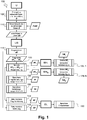
- Fig. 1 the following components of a data processing system according to the invention are included in the flowchart shown, which interact with one another as shown in order to achieve the Fig. 1 illustrated method 100 jointly execute: (i) data collection device U of a user, for example a patient or which is used for treatment, for example for dialysis, of a specific patient, (ii) reference management entity ("Librarian") LIB, Distributed Ledger DL, z. B. Blockchain, (iii) Data Storage Devices ("Data Warehouse”) WH 1 ... WH M.
- the method 100 can in particular be implemented by means of one or more computer programs that run on one or more components of the system.
- the data processing system in particular its relevant components, can have one or more integrated or external program memories (not shown) or other computer program products, in particular non-volatile data carriers, for storing the computer program or programs.
- data D to be saved are generated by the user, or more precisely his data collection device U, in a step 105.
- This can in particular include that medical information that is collected by means of a medical measurement carried out using the data collection device U for diagnostic purposes or a therapy carried out by the device on the patient, together with associated patient data, such as name, age, gender, etc., in the form one or more corresponding data records are provided as data D to be backed up.
- the data collection device U can thus in particular be a medical device or a device for recording patient-related data or a combination of both.
- This device U can in particular have a fluid management functionality and for this purpose, for example, can be set up for cleaning body fluids, in particular for blood cleaning (for example by dialysis).
- the data collection device U can also be designed in such a way that it can be signal-coupled for the purpose of data collection with a, in particular mobile, computer, so that inputs or data queries from or to the computer are possible and the data generation or retrieval functionality in the interplay between the Data collection device U and the computer coupled to it can take place.
- a medical fluid management device serving as a data collection device can be equipped with: a control device, an interface that is designed for data exchange with a mobile computer, and with a mechanical coupling device that is designed for coupling to a correspondingly designed counterpart on the mobile computer, with the control device is set up to send information relating to the medical fluid management device and / or a treatment that is carried out with the medical fluid management device to the mobile device via the interface To send computers and / or operating inputs that are entered on the mobile computer, or to receive control signals from the mobile computer.
- the data D to be backed up are encrypted in a further step 110.
- this can be done by means of any sufficiently secure encryption method, with symmetrical or asymmetrical encryption methods being able to be used.
- an asymmetrical encryption method was selected so that the data D to be secured are encrypted using a public key PubK of a public / private key pair in order to receive encrypted data eD and to send them to the reference management entity LIB to transfer.
- the key pair is preferably assigned to the user or the patient using the device U. Accordingly, only this authorized user or patient should be able to dispose of the associated private key PrivK of the key pair, be it directly or indirectly via an intermediate key management entity K.
- the reference management entity LIB which is ideally carried out separately from the data collection device U, for example on a central server of the data management system with which a plurality of data collection devices U can be in communication, fragmented the encrypted data eD in a step 115 in order to convert a plurality of N. of data fragments, or "fragments" for short, DF 1 ... DF N.
- any fragmentation rule can be used for this, such as a serial splitting of the encrypted data eD into successive data sections of the same size or different sizes as individual fragments, as long as the information is obtained as to how the encrypted data eD is reconstructed from the individual fragments can.
- the N previously generated fragments DF 1 ... DF N are assigned by the reference management instance LIB within the framework of an N: M assignment to M different data storage devices (data warehouses) WH 1 , in particular randomly selectable or following a secret assignment scheme. .. WH M distributed for storage there, so that each of the data storage devices WH 1 ... WH M receives at most a real subset of the set ⁇ DF 1 , ... , DF N ⁇ of the fragments and stores and thus a real distribution of the fragments over at least two data storage devices results.
- the data fragments can optionally be stored in parallel in further non-volatile data storage devices (not shown).
- the data storage devices themselves can each have one or more physical data storage devices, for example hard disks, semiconductor memory chips or modules, magnetic tapes, etc., which are logically combined to form a data storage device, in particular by means of appropriate addressing.
- an associated temporary address A ⁇ ⁇ A 1 ... A N ⁇ is assigned to each of the fragments within the associated data storage device in which it is stored, via which it is addressable within the data storage devices.
- the assignment of the temporary addresses to the respective fragments is saved for each data storage device as an associated assignment rule TW 1 ... TW M , which can take place in particular in the form of a respective table or another data structure equivalent to it.
- TW 1 ... TW M In order to be able to access the fragment later, a route must therefore be known for the access which contains both an address of the data storage device concerned and the associated temporary address A of the fragment sought within this data storage device.
- the reference management entity LIB stores in a step 130 the fragmentation rule T F used for fragmentation and, in a step 135, the distribution rule T D used to distribute the fragments to the data storage device in a memory assigned to the reference management entity LIB itself. This can also take place, for example, by means of a data table or an equivalent data structure.
- event data EF which characterize the fragmentation that has occurred, are transmitted to at least one distributed ledger DL, for example a predetermined blockchain, in a step 140.
- distributed ledger DL for example a predetermined blockchain
- event data ED characterizing it is transmitted to the distributed ledger DL, where EF and ED in one or more steps 150 can be stored.
- This can be done in a known manner, in the case of a blockchain, in particular by means of blockchain mining, for which one or more other entities, so-called “miners”, can also be used.
- the data to be backed up itself is not stored in the distributed ledger in any way, in particular neither in unencrypted nor in encrypted or fragmented form.
- data D to be backed up are thus generated and with the help of several security layers, to which in particular encryption, fragmentation, distribution of the fragments to different data storage devices, temporary addressing there and undistorted documentation of at least part of the aforementioned processes belong, secured.
- the data is retained for later authorized access without the data being hosted by a single host.
- For a later successful access a number of different pieces of information are required, which together form a chain of references and to which in particular the data requested for the access assigned in TW 1 ... TW M , TF, and TD , as well as the information stored for decryption within the scope of access (see Fig. 4 )
- Reconstructed data eD include required private key PrivK .
- Fig. 2 an alternative embodiment 200 of a method according to the invention for storing data to be backed up is shown.
- the data D to be backed up is not generated here by the user or his data collection device U himself, but by another entity DS, which can in particular be a specially provided server and is therefore referred to below as (data source server) .
- data D to be backed up is accordingly generated by data source server DS in step 205 and encrypted in a further step 210 using the public key PubK of an authorized data owner, for example a specific patient, in order to obtain encrypted data eD .
- the data source server DS also performs the fragmentation of the encrypted data eD in step 215 in order to obtain N data fragments DF 1 ... DF N and these in a still further step 220 for the respective storage on a plurality M of data storage devices WH 1 to distribute to WH M.
- This fragmentation and distribution taking place in steps 215 and 220 as well as the subsequently in steps 225-1 to 225-N subsequent assignment of a respective temporary address A ⁇ ⁇ A 1 ... A N ⁇ to the individual fragments in the respective data storage devices WH 1 to WH M correspond to their type according to the corresponding steps 115, 120 or 125-1 to 125-N Fig. 1 .
- steps 260-1 to 260-N a confirmation of a successfully completed storage of the data fragments DF 1 ... DF N of each of a real subset of the set is provided ⁇ DF 1 , ..., DF N ⁇ of the data storage devices WH 1 ... WH M storing data fragments are transmitted to the data source server DS in order to inform the latter thereof.
- the fragmentation rule TF and in step 235 the distribution rule TD are transmitted to the reference management instance LIB, which stores this information in step 255 (registration) and reports this storage to the data source server DS after its successful execution.
- the data source server DS When the data source server DS has received the confirmation messages from steps 255 and 260-1 to 260-M, it interprets this as confirmation of successful storage of the encrypted, fragmented and distributed data D to be saved, so that it no longer receives the data D previously held by itself deletes original version of the data D that is more required in step 265.
- This deletion can in particular include an active deletion in which the actual contents of the relevant memory locations, for example memory cells in a semiconductor memory, are physically deleted, which can be done in particular by means of multiple overwriting with random data. Other possibilities for active deletion of data memory contents known to the person skilled in the art can also be used instead or in addition.
- step 270 the user to whom the data is assigned or belongs is informed of the successful data generation and storage, and in step 275 the private key PrivK is also made available in a manner secured against unauthorized access.
- the private key can also instead be transferred to a key management entity K, which is optionally also provided in the data processing system, so that the user can indirectly have his private key PrivK at his disposal, without having to know and have to have it himself, however.
- Both methods 100 and 200 are preferably implemented in such a way that none of the system components of the data processing system involved in them stores or has the entirety of the data D to be backed up at any point in time in a non-volatile data memory.
- the data access method 300 described below.
- at no point in time is there a non-volatile storage or hosting of the entirety of the data by a single entity and thus under uniform control.
- event data are stored in the distributed ledger DL, which are used for the unalterable documentation of the generation (fragmentation) and distribution of the data fragments.
- Fig. 3 illustrates an exemplary embodiment of a method or method section 300 for accessing data D already saved according to method 100 or 200.
- a user wants to use his device U, which is the device used in method 100 for data collection, or another device can be suitable device to access a data record S stored in the data processing system from previously saved data D.
- the data record S can relate, for example, to a specific medical measurement or therapy for the user or patient, such as a dialysis session.
- a step 305 the user transmits the request for the data record S to the reference management entity LIB.
- a check then takes place there in step 310 to determine whether U is authorized to access data record S.
- This authorization can take place in various ways, in which case conventional, known and authentication methods can also be used, for example entering a secret number PIN or other secret information suitable for identification or recording one or more biometric features. If it is determined in the course of the check that the request is not authorized (315 - no), access to data record S is rejected in step 335 and the access request is rejected in step 340, preferably with the information that it was unsuccessful, reported as an access event EZ to the distributed ledger DL and stored there in step 350. Optionally (not shown), the occurrence of the access request for the data record S can also be reported to the distributed ledger DL beforehand during or after step 305 and stored there.
- the reference management entity LIB carries out a search in the assignment rule T F for the fragmentation belonging to the data record S in step 320. Furthermore, in step 325, the associated distribution for the fragmentation belonging to S is searched for in the assignment rule T D in a similar manner.
- steps 320 and 325 which together represent part of a chain of references and also a respective fragment name FN 1 , .., FN N (hereinafter collectively referred to as FN) or, alternatively, a respective other unique designation or identifier for each of the data fragments DF 1 ,..., DF N (hereinafter referred to collectively as DF) are transmitted to the user or his device U in step 330.
- the fragment names FN concerned according to the associated distribution for the fragmentation belonging to S are then transmitted to the storage locations WH 1 ,..., WH M (collectively referred to below as WH) that are involved in their storage .
- WH storage locations
- This can be done globally, in particular, in such a way that all fragment names are transmitted to all of the storage locations involved, or selectively so that each storage location only receives the fragment name or names associated with the one or more fragments stored in it correspond.
- step 355 The respective information transmitted in step 355 is received in the respective storage locations WH and an authorization check is then initially carried out again locally in step 360 to determine whether the user or his device U is authorized to access the data record S. If this authorization fails (375 - no), access to the data record S or its associated fragments is rejected in step 365 and the failed access request is transmitted as an access event EZ to the distributed ledger LD for storage in step 350. Otherwise (375 - yes) the then successfully authorized access request is also transmitted in step 370 as a corresponding access event EZ to the distributed ledger LD for storage in step 350.
- the occurrence of the access request for the data record S can also be reported to the distributed ledger DL beforehand during or after step 305 and stored there.
- step 380 following a successful authorization, the respective assignment rules TW1... TW M are used to identify the temporary addresses A 1 ,..., A N associated with the fragment names FN (hereinafter referred to collectively as A) of the data fragments DF and these transmitted to the user or his device U in step 385.
- A fragment names FN
- the user can now, in step 390, call up the various data fragments DF with the aid of their now known temporary addresses A from the various storage locations WH , which then transmit them to U.
- the secured encrypted data eD can then first be reconstructed from the retrieved data fragments DF and in a further step 400 decrypted using the private key PrivK either known to the user or provided by a key management entity K on his behalf, in order to finally obtain the desired original Get data D.
- a change in the temporary addressing can be carried out in the individual data storage devices WH in step 405, so that the previously valid temporary addresses A can be used in a further attempt to access the data D or more precisely eD , can no longer be used successfully.
- the address change takes place in such a way that the previous addresses no longer refer to any valid destinations and thus lead to "nowhere".
- the reconstructed data D is re-encrypted using a new key PubK ' which is different from the previous key PubK (which forms a key pair with a corresponding new private key PrivK') and using one of the Save procedure 100 or 200 again.
- PubK a new key which is different from the previous key PubK (which forms a key pair with a corresponding new private key PrivK')
- Save procedure 100 or 200 it can be provided in a step 410 that the reconstructed data D is re-encrypted using a new key PubK ' which is different from the previous key PubK (which forms a key pair with a corresponding new private key PrivK') and using one of the Save procedure 100 or 200 again.
- the Fig. 4 provides a tabular overview of the procedures 100, 200 and 300 from the Figs. 1 to 3 Information PubK and PrivK used for encryption and decryption, TF for fragmentation, TD for fragment distribution and TW 1 ... TW N for temporary addressing, as well as their preferred storage location and the transformations or assignments they mediate.
Landscapes
- Engineering & Computer Science (AREA)
- Computer Security & Cryptography (AREA)
- Theoretical Computer Science (AREA)
- Health & Medical Sciences (AREA)
- Bioethics (AREA)
- General Health & Medical Sciences (AREA)
- Physics & Mathematics (AREA)
- Software Systems (AREA)
- Computer Hardware Design (AREA)
- General Engineering & Computer Science (AREA)
- General Physics & Mathematics (AREA)
- Computer Networks & Wireless Communication (AREA)
- Signal Processing (AREA)
- Databases & Information Systems (AREA)
- Medical Informatics (AREA)
- Storage Device Security (AREA)
Priority Applications (3)
| Application Number | Priority Date | Filing Date | Title |
|---|---|---|---|
| EP19205656.2A EP3816833A1 (fr) | 2019-10-28 | 2019-10-28 | Procédé et système de traitement des données permettant de sécuriser des données contre un accès non autorisé |
| US17/771,838 US20220374537A1 (en) | 2019-10-28 | 2020-10-27 | Method and data processing system for safeguarding data against unauthorized access |
| PCT/EP2020/080122 WO2021083861A1 (fr) | 2019-10-28 | 2020-10-27 | Procédé et système de traitement de données pour la sauvegarde de données contre un accès non autorisé |
Applications Claiming Priority (1)
| Application Number | Priority Date | Filing Date | Title |
|---|---|---|---|
| EP19205656.2A EP3816833A1 (fr) | 2019-10-28 | 2019-10-28 | Procédé et système de traitement des données permettant de sécuriser des données contre un accès non autorisé |
Publications (1)
| Publication Number | Publication Date |
|---|---|
| EP3816833A1 true EP3816833A1 (fr) | 2021-05-05 |
Family
ID=68382320
Family Applications (1)
| Application Number | Title | Priority Date | Filing Date |
|---|---|---|---|
| EP19205656.2A Pending EP3816833A1 (fr) | 2019-10-28 | 2019-10-28 | Procédé et système de traitement des données permettant de sécuriser des données contre un accès non autorisé |
Country Status (3)
| Country | Link |
|---|---|
| US (1) | US20220374537A1 (fr) |
| EP (1) | EP3816833A1 (fr) |
| WO (1) | WO2021083861A1 (fr) |
Families Citing this family (4)
| Publication number | Priority date | Publication date | Assignee | Title |
|---|---|---|---|---|
| IL313398A (en) * | 2021-12-08 | 2024-08-01 | Xinsere Inc | A highly distributed data storage method, based on cryptography |
| US11620393B1 (en) * | 2022-05-14 | 2023-04-04 | Aswath Premaradj | System and method for facilitating distributed peer to peer storage of data |
| EP4303748A1 (fr) | 2022-07-08 | 2024-01-10 | Fresenius Medical Care AG & Co. KGaA | Procédé et système de gestion de données déclenchées par une activité de soins de santé |
| CN117195300B (zh) * | 2023-09-20 | 2024-03-29 | 全拓科技(杭州)股份有限公司 | 一种大数据安全防护方法、装置及系统 |
Citations (2)
| Publication number | Priority date | Publication date | Assignee | Title |
|---|---|---|---|---|
| DE19849787C1 (de) | 1998-10-28 | 2000-02-24 | Fresenius Medical Care De Gmbh | Blutbehandlungsgerät |
| US20190109706A1 (en) * | 2017-10-09 | 2019-04-11 | Data Republic Pty Ltd | System and Method to Protect Sensitive Information via Distributed Trust |
Family Cites Families (6)
| Publication number | Priority date | Publication date | Assignee | Title |
|---|---|---|---|---|
| US20050273629A1 (en) * | 2004-06-04 | 2005-12-08 | Vitalsource Technologies | System, method and computer program product for providing digital rights management of protected content |
| DE102013002231A1 (de) * | 2013-02-11 | 2014-08-14 | Fresenius Medical Care Deutschland Gmbh | Vorrichtung und Verfahren zur Erzeugung und Anzeige von für medizinische Geräte und medizinische Behandlungen spezifischen Grafikkodierungen |
| US9245137B2 (en) * | 2013-03-04 | 2016-01-26 | International Business Machines Corporation | Management of digital information |
| US20150178007A1 (en) * | 2013-03-15 | 2015-06-25 | Cloudifyd, Inc. | Method and system for integrated cloud storage management |
| WO2017044595A1 (fr) * | 2015-09-08 | 2017-03-16 | OverNest, Inc. | Systèmes et procédés permettant de stocker des blocs de données à l'aide d'un ensemble d'identifiants de mémoire logique générés |
| WO2019032556A1 (fr) * | 2017-08-10 | 2019-02-14 | Ctm Insights Llc | Procédé de sécurisation de données utilisant une fragmentation microshard™ |
-
2019
- 2019-10-28 EP EP19205656.2A patent/EP3816833A1/fr active Pending
-
2020
- 2020-10-27 US US17/771,838 patent/US20220374537A1/en not_active Abandoned
- 2020-10-27 WO PCT/EP2020/080122 patent/WO2021083861A1/fr not_active Ceased
Patent Citations (2)
| Publication number | Priority date | Publication date | Assignee | Title |
|---|---|---|---|---|
| DE19849787C1 (de) | 1998-10-28 | 2000-02-24 | Fresenius Medical Care De Gmbh | Blutbehandlungsgerät |
| US20190109706A1 (en) * | 2017-10-09 | 2019-04-11 | Data Republic Pty Ltd | System and Method to Protect Sensitive Information via Distributed Trust |
Non-Patent Citations (2)
| Title |
|---|
| FUKUMITSU MASAYUKI ET AL: "A Proposal of a Secure P2P-Type Storage Scheme by Using the Secret Sharing and the Blockchain", 2014 IEEE 28TH INTERNATIONAL CONFERENCE ON ADVANCED INFORMATION NETWORKING AND APPLICATIONS, IEEE, 27 March 2017 (2017-03-27), pages 803 - 810, XP033094291, ISSN: 1550-445X, [retrieved on 20170505], DOI: 10.1109/AINA.2017.11 * |
| LI CHUNMIAO ET AL: "Blockchain-Based Bidirectional Updates on Fine-Grained Medical Data", 2019 IEEE 35TH INTERNATIONAL CONFERENCE ON DATA ENGINEERING WORKSHOPS (ICDEW), IEEE, 8 April 2019 (2019-04-08), pages 22 - 27, XP033571658, DOI: 10.1109/ICDEW.2019.00-40 * |
Also Published As
| Publication number | Publication date |
|---|---|
| US20220374537A1 (en) | 2022-11-24 |
| WO2021083861A1 (fr) | 2021-05-06 |
Similar Documents
| Publication | Publication Date | Title |
|---|---|---|
| WO2021083861A1 (fr) | Procédé et système de traitement de données pour la sauvegarde de données contre un accès non autorisé | |
| DE102009001719B4 (de) | Verfahren zur Erzeugung von asymmetrischen kryptografischen Schlüsselpaaren | |
| EP3452941B1 (fr) | Procédé de documentation électronique d'informations de licence | |
| DE69731338T2 (de) | Verfahren und System zum sicheren Übertragen und Speichern von geschützter Information | |
| DE19925910A1 (de) | Verfahren zum Be- oder Verarbeiten von Daten | |
| DE112020002859T5 (de) | Verschlüsselter wissens-graph | |
| DE112021002747T5 (de) | Sicheres wiederherstellen von geheimen schlüsseln | |
| DE202015104128U1 (de) | Datenzugriffssystem | |
| EP3637345A1 (fr) | Mise en relation d'identités dans une base de données distribuée | |
| DE112022000906T5 (de) | Trennen von blockchain-daten | |
| DE102017109424A1 (de) | Verfahren zum gesicherten Zugriff auf Daten | |
| DE10156877B4 (de) | Verfahren und System zum gesicherten Speichern und Auslesen von Nutzdaten | |
| EP3552140A1 (fr) | Index de bases de données constitué de plusieurs champs | |
| EP3552141A1 (fr) | Système de serveur de type ordinateur destiné à fournir des ensembles de données | |
| EP3588357B1 (fr) | Système avec contrôle d'accès au moyen de certificat | |
| EP3785159A1 (fr) | Procédé de fusion de données partielles différentes | |
| DE102008011882B4 (de) | Vorrichtung und Verfahren zum kontrollierten Datenaustausch zwischen mindestens zwei Datenträgern | |
| DE102023109178B3 (de) | System und Verfahren zur Speicherung von Daten, insbesondere von personenbezogenen Daten | |
| DE102018204447B4 (de) | Automatisiertes Verfahren zum Schutz von elektronischen Daten zum Zwecke der Datenverarbeitung durch Dritte unter Einbezug transparenter und unterbrechungssicherer Vergütung | |
| DE112021007711B4 (de) | Suchausführungseinrichtung, suchausführungsverfahren, suchausführungsprogramm, und durchsuchbares verschlüsselungssystem | |
| WO2020169634A1 (fr) | Documentation à l'épreuve de manipulation de l'utilisation de consommables dans le fonctionnement d'un appareil de dialyse | |
| DE102007054649A1 (de) | Validierung elektronischer Objekte durch öffentliche vertrauenswürdige Filter | |
| EP3886025A1 (fr) | Procédé destiné à l'exécution de transactions | |
| AT528373B1 (de) | Verfahren zur Pseudonymisierung von Patientendaten | |
| EP3105703B1 (fr) | Procédé et système de sécurisation de relations de bases de données contre un accès non autorisé |
Legal Events
| Date | Code | Title | Description |
|---|---|---|---|
| PUAI | Public reference made under article 153(3) epc to a published international application that has entered the european phase |
Free format text: ORIGINAL CODE: 0009012 |
|
| STAA | Information on the status of an ep patent application or granted ep patent |
Free format text: STATUS: REQUEST FOR EXAMINATION WAS MADE |
|
| 17P | Request for examination filed |
Effective date: 20191028 |
|
| AK | Designated contracting states |
Kind code of ref document: A1 Designated state(s): AL AT BE BG CH CY CZ DE DK EE ES FI FR GB GR HR HU IE IS IT LI LT LU LV MC MK MT NL NO PL PT RO RS SE SI SK SM TR |
|
| RBV | Designated contracting states (corrected) |
Designated state(s): AL AT BE BG CH CY CZ DE DK EE ES FI FR GB GR HR HU IE IS IT LI LT LU LV MC MK MT NL NO PL PT RO RS SE SI SK SM TR |
|
| P01 | Opt-out of the competence of the unified patent court (upc) registered |
Effective date: 20230524 |
|
| STAA | Information on the status of an ep patent application or granted ep patent |
Free format text: STATUS: EXAMINATION IS IN PROGRESS |
|
| 17Q | First examination report despatched |
Effective date: 20230929 |
|
| RAP3 | Party data changed (applicant data changed or rights of an application transferred) |
Owner name: FRESENIUS MEDICAL CARE AG Owner name: FRESENIUS MEDICAL CARE DEUTSCHLAND GMBH |
|
| RAP1 | Party data changed (applicant data changed or rights of an application transferred) |
Owner name: NEWPORT FISCHER, GEROME Owner name: DR. HELLHUND, JONAS Owner name: LINDEMANN, ROBERT |
|
| STAA | Information on the status of an ep patent application or granted ep patent |
Free format text: STATUS: THE APPLICATION IS DEEMED TO BE WITHDRAWN |