EP3827734A1 - Adaptateur stérilisé - Google Patents
Adaptateur stérilisé Download PDFInfo
- Publication number
- EP3827734A1 EP3827734A1 EP19840866.8A EP19840866A EP3827734A1 EP 3827734 A1 EP3827734 A1 EP 3827734A1 EP 19840866 A EP19840866 A EP 19840866A EP 3827734 A1 EP3827734 A1 EP 3827734A1
- Authority
- EP
- European Patent Office
- Prior art keywords
- sterilization
- adaptor
- vent valve
- main body
- endoscope
- Prior art date
- Legal status (The legal status is an assumption and is not a legal conclusion. Google has not performed a legal analysis and makes no representation as to the accuracy of the status listed.)
- Withdrawn
Links
Images






Classifications
-
- A—HUMAN NECESSITIES
- A61—MEDICAL OR VETERINARY SCIENCE; HYGIENE
- A61B—DIAGNOSIS; SURGERY; IDENTIFICATION
- A61B1/00—Instruments for performing medical examinations of the interior of cavities or tubes of the body by visual or photographical inspection, e.g. endoscopes; Illuminating arrangements therefor
- A61B1/12—Instruments for performing medical examinations of the interior of cavities or tubes of the body by visual or photographical inspection, e.g. endoscopes; Illuminating arrangements therefor with cooling or rinsing arrangements
- A61B1/121—Instruments for performing medical examinations of the interior of cavities or tubes of the body by visual or photographical inspection, e.g. endoscopes; Illuminating arrangements therefor with cooling or rinsing arrangements provided with means for cleaning post-use
- A61B1/122—Instruments for performing medical examinations of the interior of cavities or tubes of the body by visual or photographical inspection, e.g. endoscopes; Illuminating arrangements therefor with cooling or rinsing arrangements provided with means for cleaning post-use using cleaning tools, e.g. brushes
-
- A—HUMAN NECESSITIES
- A61—MEDICAL OR VETERINARY SCIENCE; HYGIENE
- A61B—DIAGNOSIS; SURGERY; IDENTIFICATION
- A61B1/00—Instruments for performing medical examinations of the interior of cavities or tubes of the body by visual or photographical inspection, e.g. endoscopes; Illuminating arrangements therefor
- A61B1/00064—Constructional details of the endoscope body
- A61B1/00066—Proximal part of endoscope body, e.g. handles
- A61B1/00068—Valve switch arrangements
-
- A—HUMAN NECESSITIES
- A61—MEDICAL OR VETERINARY SCIENCE; HYGIENE
- A61B—DIAGNOSIS; SURGERY; IDENTIFICATION
- A61B1/00—Instruments for performing medical examinations of the interior of cavities or tubes of the body by visual or photographical inspection, e.g. endoscopes; Illuminating arrangements therefor
- A61B1/00112—Connection or coupling means
- A61B1/00121—Connectors, fasteners and adapters, e.g. on the endoscope handle
- A61B1/00128—Connectors, fasteners and adapters, e.g. on the endoscope handle mechanical, e.g. for tubes or pipes
-
- A—HUMAN NECESSITIES
- A61—MEDICAL OR VETERINARY SCIENCE; HYGIENE
- A61B—DIAGNOSIS; SURGERY; IDENTIFICATION
- A61B1/00—Instruments for performing medical examinations of the interior of cavities or tubes of the body by visual or photographical inspection, e.g. endoscopes; Illuminating arrangements therefor
- A61B1/00142—Instruments for performing medical examinations of the interior of cavities or tubes of the body by visual or photographical inspection, e.g. endoscopes; Illuminating arrangements therefor with means for preventing contamination, e.g. by using a sanitary sheath
-
- A—HUMAN NECESSITIES
- A61—MEDICAL OR VETERINARY SCIENCE; HYGIENE
- A61L—METHODS OR APPARATUS FOR STERILISING MATERIALS OR OBJECTS IN GENERAL; DISINFECTION, STERILISATION OR DEODORISATION OF AIR; CHEMICAL ASPECTS OF BANDAGES, DRESSINGS, ABSORBENT PADS OR SURGICAL ARTICLES; MATERIALS FOR BANDAGES, DRESSINGS, ABSORBENT PADS OR SURGICAL ARTICLES
- A61L2/00—Disinfection or sterilisation of materials or objects, in general; Accessories therefor
- A61L2/16—Disinfection or sterilisation of materials or objects, in general; Accessories therefor using chemical substances
- A61L2/20—Gaseous substances, e.g. vapours
-
- A—HUMAN NECESSITIES
- A61—MEDICAL OR VETERINARY SCIENCE; HYGIENE
- A61L—METHODS OR APPARATUS FOR STERILISING MATERIALS OR OBJECTS IN GENERAL; DISINFECTION, STERILISATION OR DEODORISATION OF AIR; CHEMICAL ASPECTS OF BANDAGES, DRESSINGS, ABSORBENT PADS OR SURGICAL ARTICLES; MATERIALS FOR BANDAGES, DRESSINGS, ABSORBENT PADS OR SURGICAL ARTICLES
- A61L2/00—Disinfection or sterilisation of materials or objects, in general; Accessories therefor
- A61L2/26—Accessories
-
- G—PHYSICS
- G02—OPTICS
- G02B—OPTICAL ELEMENTS, SYSTEMS OR APPARATUS
- G02B23/00—Telescopes, e.g. binoculars; Periscopes; Instruments for viewing the inside of hollow bodies; Viewfinders; Optical aiming or sighting devices
- G02B23/24—Instruments or systems for viewing the inside of hollow bodies, e.g. fibrescopes
- G02B23/2476—Non-optical details, e.g. housings, mountings, supports
-
- A—HUMAN NECESSITIES
- A61—MEDICAL OR VETERINARY SCIENCE; HYGIENE
- A61L—METHODS OR APPARATUS FOR STERILISING MATERIALS OR OBJECTS IN GENERAL; DISINFECTION, STERILISATION OR DEODORISATION OF AIR; CHEMICAL ASPECTS OF BANDAGES, DRESSINGS, ABSORBENT PADS OR SURGICAL ARTICLES; MATERIALS FOR BANDAGES, DRESSINGS, ABSORBENT PADS OR SURGICAL ARTICLES
- A61L2103/00—Materials or objects being the target of disinfection or sterilisation
- A61L2103/15—Laboratory, medical or dentistry appliances, e.g. catheters or sharps
-
- A—HUMAN NECESSITIES
- A61—MEDICAL OR VETERINARY SCIENCE; HYGIENE
- A61L—METHODS OR APPARATUS FOR STERILISING MATERIALS OR OBJECTS IN GENERAL; DISINFECTION, STERILISATION OR DEODORISATION OF AIR; CHEMICAL ASPECTS OF BANDAGES, DRESSINGS, ABSORBENT PADS OR SURGICAL ARTICLES; MATERIALS FOR BANDAGES, DRESSINGS, ABSORBENT PADS OR SURGICAL ARTICLES
- A61L2202/00—Aspects relating to methods or apparatus for disinfecting or sterilising materials or objects
- A61L2202/10—Apparatus features
- A61L2202/14—Means for controlling sterilisation processes, data processing, presentation and storage means, e.g. sensors, controllers, programs
-
- A—HUMAN NECESSITIES
- A61—MEDICAL OR VETERINARY SCIENCE; HYGIENE
- A61M—DEVICES FOR INTRODUCING MEDIA INTO, OR ONTO, THE BODY; DEVICES FOR TRANSDUCING BODY MEDIA OR FOR TAKING MEDIA FROM THE BODY; DEVICES FOR PRODUCING OR ENDING SLEEP OR STUPOR
- A61M39/00—Tubes, tube connectors, tube couplings, valves, access sites or the like, specially adapted for medical use
- A61M39/22—Valves or arrangement of valves
- A61M39/24—Check- or non-return valves
- A61M2039/2433—Valve comprising a resilient or deformable element, e.g. flap valve, deformable disc
- A61M2039/2446—Flexible disc
-
- A—HUMAN NECESSITIES
- A61—MEDICAL OR VETERINARY SCIENCE; HYGIENE
- A61M—DEVICES FOR INTRODUCING MEDIA INTO, OR ONTO, THE BODY; DEVICES FOR TRANSDUCING BODY MEDIA OR FOR TAKING MEDIA FROM THE BODY; DEVICES FOR PRODUCING OR ENDING SLEEP OR STUPOR
- A61M39/00—Tubes, tube connectors, tube couplings, valves, access sites or the like, specially adapted for medical use
- A61M39/22—Valves or arrangement of valves
- A61M39/24—Check- or non-return valves
Definitions
- the present invention relates to a sterilization adaptor configured to be attachable to and detachable from a medical device.
- Medical devices such as endoscopes, need to be cleaned and disinfected by using a washer disinfector, since the medical devices will be reused after use.
- a conditioning step the air in a chamber of a sterilization apparatus is removed, and the pressure in the chamber is brought close to a vacuum state.
- the endoscope sterilization process is carried out by pouring gas into the chamber, and then in a desorption step after completion of the sterilization process, the gas in the chamber is replaced with water vapor.
- the pressure in the chamber is restored to the atmospheric pressure by pouring air into the chamber.
- the gas used in the sterilization step corrodes the components in the endoscope. Accordingly, there is a need to prevent the gas from entering into the endoscope.
- the check valve unit inhibits the circulation of gas from the outside of the endoscope to the inside of the endoscope, thereby preventing the gas from entering into the endoscope in the sterilization step.
- the check valve is opened due to a difference in pressure, thereby circulating the gas from the inside of the endoscope to the outside of the endoscope.
- the pressure in the endoscope can be set to be equal to the pressure in the chamber, thereby making it possible to prevent the bending rubber from being blown out.
- the pressure outside the endoscope when the pressure in the chamber, i.e., the pressure outside the endoscope, is increased to the atmospheric pressure after the completion of the sterilization step, the pressure outside the endoscope is equal to the atmospheric pressure although the inside of the endoscope is close to the vacuum state.
- the check valve unit is not opened and the bending rubber is crimped to a plurality of bending pieces.
- the bending rubber is still crimped to the plurality of bending pieces. Accordingly, if a bending portion is bent, the bending rubber may bite into the bending pieces and may be damaged.
- Japanese Patent Application Laid-Open Publication No. 2013-46701 discloses a configuration of an endoscope in which a vent pipe sleeve is provided with a check valve unit, as well as a vent valve unit for setting the pressure in the endoscope to be equal to the pressure outside the endoscope when a known sterilization adaptor to be attached to the vent pipe sleeve of the endoscope in the sterilization process is attached to or detached from the vent pipe sleeve.
- the vent pipe sleeve of the endoscope is provided with the check valve unit and the vent valve unit, which leads to an increase in the size of the vent pipe sleeve.
- the present invention has been made in view of the above-described problems, and an object of the present invention is to provide a downsized sterilization adaptor capable of preventing gas from entering into a medical device in a sterilization process and setting a pressure in the medical device to be equal to a pressure outside the medical device.
- a sterilization adaptor configured to be attachable to and detachable from a medical device, the sterilization adaptor including: a check valve unit for inhibiting circulation of gas from an outside of the medical device to an inside of the medical device when the sterilization adaptor is attached to the medical device, and for circulating the gas from the inside to the outside; a main body portion including a hole portion; and a vent valve unit disposed in the hole portion, the vent valve unit causing the inside and the outside to communicate with each other through a gap formed between the vent valve unit and the main body portion and blocking the gap.
- the check valve unit is disposed in the vent valve unit.
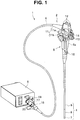
- Fig. 1 is a perspective view of an endoscope apparatus including an endoscope to and from which a sterilization adaptor according to the present embodiment is attachable and detachable.
- an endoscope apparatus 1 includes a main part configured by an endoscope 2 and a camera control unit 3.
- the endoscope 2 includes a main part configured by an insertion portion 4, an operation portion 5, a universal cable 6, and an endoscope connector 16.
- the insertion portion 4 is an elongated long member to be inserted into an observation target section.
- the insertion portion 4 has a configuration in which a distal end portion 7, a bending portion 8, and a flexible tube portion 9 are connected to each other.
- the operation portion 5 includes a grasping portion 5a.
- the grasping portion 5a is connected to a proximal end of the insertion portion 4.
- the operation portion 5 is provided with a bending operation portion 11, various switches 12, an air/water feeding button 13, a suction button 14, and the like.
- the bending operation portion 11 includes, for example, vertical bending operation knob 11a and a horizontal bending operation knob 11b, which are used to perform a bending operation on the bending portion 8.
- Examples of the switches 12 include a release switch, a freeze switch, and an observation mode selection switch for switching between normal observation and fluorescence observation.
- the operation portion 5 is provided with a treatment instrument insertion opening 15 through which a treatment instrument is inserted into or removed from a treatment instrument insertion conduit, not illustrated, provided in the insertion portion 4.
- the universal cable 6 extends from a side portion of the operation portion 5.
- the endoscope connector 16 is provided at an extending end of the universal cable 6.
- a signal transmission cable 17 extends from the endoscope connector 16, an electric connector 18 that is attachable to and detachable from the camera control unit 3 is provided at an end portion of the signal transmission cable 17.
- the endoscope connector 16 is provided with a vent pipe sleeve 20.
- the vent pipe sleeve 20 may be provided on the operation portion 5.
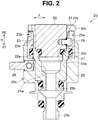
- Fig. 2 is a sectional view illustrating a state where the vent pipe sleeve provided on the endoscope connector illustrated in Fig. 1 is closed.
- Fig. 3 is a sectional view of the vent pipe sleeve illustrated in Fig. 2 in a state where the vent pipe sleeve is opened.
- the vent pipe sleeve 20 includes a main part configured by a pipe sleeve main body 22 to be attached to the endoscope connector 16, a rotary ring 23, a sliding member 24, and a valve body 25 which are provided in the pipe sleeve main body 22.
- the pipe sleeve main body 22 is composed of an elongated stepped pipe formed in a longitudinal axis direction H of the pipe sleeve main body 22, and a stepped through-hole 22b that allows the inside of the endoscope 2 to communicate with the outside is formed in the pipe sleeve main body 22. Further, a guide pin 26 protrudes from an outer peripheral surface 22c of the pipe sleeve main body 22.
- a screw 22n formed in a section on one end side H1 in the longitudinal axis direction H of the pipe sleeve main body 22 is screwed into a fixation member, not illustrated, provided in the endoscope connector 16, so that the pipe sleeve main body 22 is attached to the endoscope connector 16.
- the rotary ring 23 is composed of an annular member and is rotatably disposed in a recessed portion 22a formed in a section on another end side H2 in the longitudinal axis direction H of the pipe sleeve main body 22.
- a long hole 23a is formed on an outer peripheral surface of the rotary ring 23 along the longitudinal axis direction H.
- the sliding member 24 is formed in an elongated pipe shape along the longitudinal axis direction H, and is disposed in a through-hole 23c of the rotary ring 23 and in the stepped through-hole 22b of the pipe sleeve main body 22.
- the section on the one end side H1 in the longitudinal axis direction H of the sliding member 24 is fixed to the stepped through-hole 22b with a screw.
- a peripheral groove 24d having a cam shape is formed on an outer peripheral portion of the sliding member 24.
- the sliding member 24 is integrally formed with the pipe sleeve main body 22. Further, a flange portion 24c is formed on the other end side H2 in the longitudinal axis direction H of the sliding member 24.
- the sliding member 24 includes, inside thereof, a through-hole 24w that is formed along the longitudinal axis direction H and has a tapered surface 24k formed at a part of the sliding member 24 in the longitudinal axis direction H.
- valve body 25 is rotatably provided in the through-hole 24w.
- a peripheral groove 25a is formed on an outer peripheral surface of the valve body 25 in the section on the one end side H1 in the longitudinal axis direction H, and a seal member 27, such as an O-shaped ring, is fitted into the peripheral groove 25a.
- the seal member 27 comes into close contact with the tapered surface 24k, thereby maintaining water-tightness between the sliding member 24 and the valve body 25.
- a screw hole is formed on the outer peripheral surface of the valve body 25 in the section on the other end side H2 in the longitudinal axis direction H, and a cam receiving pin 28 is screwed into the screw hole and is attached thereto.
- the cam receiving pin 28 protrudes to the outside in a radial direction K of the vent pipe sleeve 20 through the peripheral groove 24d formed on the sliding member 24, and a head portion of the cam receiving pin is fitted into the above-described long hole 23a.
- a sterilization adaptor 29 (see Fig. 4 ) is attached to the vent pipe sleeve 20 configured as described above, and a cam pin 44 (see Fig. 4 ) to be described below is fitted into a peripheral groove 23b of the rotary ring 23.
- the cam receiving pin 28 that is fitted into the peripheral groove 24d having a cam shape is rotated along the cam shape.
- valve body 25 is moved to a position illustrated in Fig. 3 along the longitudinal axis direction H.
- vent pipe sleeve 20 described above is merely an example and is not limited to the above-described configuration.
- valve body 25 may be provided in the valve body 25.
- check valve unit may be provided in the valve body 25.
- vent pipe sleeve 20 may have a structure in which the valve body 25 is omitted and the vent pipe sleeve is opened during the sterilization process and can be sealed with a cap or the like during the cleaning and disinfection process.
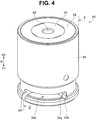
- Fig. 4 is a perspective view of the sterilization adaptor that is attachable to and detachable from the vent pipe sleeve illustrated in Fig. 2 .
- Fig. 5 is a sectional view of the sterilization adaptor taken along the line V-V in Fig. 4 .
- Fig. 6 is a sectional view illustrating a state where the sterilization adaptor illustrated in Fig. 4 is attached to the vent pipe sleeve illustrated in Fig. 2 and the guide pin illustrated in Fig. 2 is fitted into a first position of the guide groove formed in the sterilization adaptor illustrated in Fig. 4 .
- Fig. 7 is a sectional view of the vent pipe sleeve and the sterilization adaptor in a direction different by 90° from the section of the vent pipe sleeve illustrated in Fig. 2 , and illustrates the state where the guide pin illustrated in Fig. 2 is moved to a second position of the guide groove.
- Fig. 8 is a sectional view of the vent pipe sleeve and the sterilization adaptor in a direction different by 90° from the section of the vent pipe sleeve illustrated in Fig. 2 , and illustrates the state where the guide pin illustrated in Fig. 2 is moved to a third position of the guide groove and the check valve unit is closed.
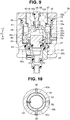
- Fig. 9 is a sectional view of the vent pipe sleeve and the sterilization adaptor in a state where the check valve unit illustrated in Fig. 8 is opened.
- Fig. 10 is a sectional view of the sterilization adaptor taken along the line X-X in Fig. 5 .
- the sterilization adaptor 29 includes a main part configured by a main body portion 30 including a hole portion 30a along the longitudinal axis direction, a vent valve unit 32 disposed in the hole portion 30a of the main body portion 30, and a check valve unit 33 disposed in the vent valve unit 32.
- the sterilization adaptor 29 is attachable to and detachable from the vent pipe sleeve 20.
- the main body portion 30 includes a main part configured by a main body member 34, a spring pressing member 35, engaging pins 36, a first seal member 37, a second seal member 38, and a retaining ring 39.
- the main body member 34 is formed of a cylindrical member in which a through-hole is formed in a stepped shape along the longitudinal axis direction H.
- the main body member 34 is provided with a guide groove 34d as an engaging portion on the outer peripheral surface in the section on the one end side H1 in the longitudinal axis direction H.
- the guide pin 26 of the vent pipe sleeve 20 is inserted into the guide groove 34d, thereby enabling engagement by a spring member 45 to be described below.
- the main body member 34 is provided with a groove 34c formed on an inner peripheral surface which is formed by a through-hole in the section on the one end side H1 in the longitudinal axis direction H.
- the first seal member 37 which is formed of, for example, an O-shaped ring, is disposed in the groove 34c.
- the sterilization adaptor 29 When the sterilization adaptor 29 is attached to the vent pipe sleeve 20, as illustrated in Figs. 6 to 9 , the first seal member 37 contacts the outer peripheral surface 22c of the pipe sleeve main body 22. With this configuration, the water-tightness between the vent pipe sleeve 20 and the main body portion 30 is maintained.
- the spring pressing member 35 is formed of a ring-shaped member having a tapered surface 35a in the section on the one end side H1 in the longitudinal axis direction H.
- the spring pressing member 35 is disposed on a bottom surface 34b of the recessed portion formed in the section on the other end side H2 in the longitudinal axis direction H in the through-hole of the main body member 34.
- a groove 35b is formed on the outer peripheral surface of the spring pressing member 35, and the second seal member 38, which is formed of, for example, an O-shaped ring, is disposed in the groove 35b in a state where the second seal member 38 contacts the inner peripheral surface of the main body member 34.
- the retaining ring 39 of the ring-shaped member which includes on the outer peripheral surface thereof a male screw portion not illustrated, is screwed and fixed into a female screw portion which is formed in the inner peripheral surface of the main body member 34.
- the retaining ring 39 regulates the movement of the spring pressing member 35 in the longitudinal axis direction H.
- the hole portion 30a described above is formed in the inner peripheral surface of each of the spring pressing member 35 and the retaining ring 39.
- a vent valve 31 to be described below is provided in the hole portion 30a.
- a gap 32a which causes the inside and the outside of the sterilization adaptor 29 communicate with each other, is formed between the inner peripheral surface of each of the spring pressing member 35 and the retaining ring 39 and a vent valve body 40, which is described below, of the vent valve 31.
- the vent valve unit 32 includes a main part configured by the vent valve 31, a rotation prevention member 43, the spring member 45 as an elastic member, and a valve body holding member 42 as a vent valve holding member.
- the vent valve 31 is formed of the vent valve body 40 and a seal member 41.
- the vent valve body 40 is formed of a cylindrical member including a stepped through-hole 40a as a fluid channel for circulating gas in the vent valve body along the longitudinal axis direction H.
- the seal member 41 which is formed of, for example, an O-shaped ring, is disposed in a peripheral groove 40b formed on the outer peripheral surface in the section on the one end side H1 in the longitudinal axis direction H.
- a screw hole 40c is formed in the inner peripheral surface of the vent valve body 40 in the section on the one end side H1 in the longitudinal axis direction H.
- the valve body holding member 42 is formed of a stepped cylindrical member, a protruding portion 42a provided with a male screw is formed on the outer peripheral surface in the section on the other end side H2 in the longitudinal axis direction H, and a flange portion 42b is formed on the outer peripheral surface in the section on the one end side H1 in the longitudinal axis direction H.
- the valve body holding member 42 is fixed to the vent valve body 40 by the protruding portion 42a being screwed into the screw hole 40c of the vent valve body 40.
- valve body holding member 42 is provided with a plurality of through-holes 42c as communication paths for causing a space 42d to communicate with the gap 32a described above. Note that the through-holes 42c also communicates with the through-hole 40a.
- the rotation prevention member 43 is formed of a stepped cylindrical member, and includes an inward flange which is formed in the section on the other end side H2 in the longitudinal axis direction H.
- the flange portion 42b of the valve body holding member 42 is in contact with and is fixed by bonding to a surface of the inward flange, the surface of the inward flange being located in the section on the one end side H1 in the longitudinal axis direction H.
- a step 43a is formed on the outer peripheral surface in the section on the other end side H2 in the longitudinal axis direction H of the rotation prevention member 43.
- the spring member 45 is disposed along the longitudinal axis direction H in a state where the spring member 45 is contracted between the step 43a and grooves 35c formed on the surface of the spring pressing member 35 in the section on the one end side H1 in the longitudinal axis direction H.
- the cam pin 44 is disposed in the through-hole formed in the radial direction K such that a distal end of the cam pin protrudes toward the inside of the rotation prevention member 43.
- grooves 43b into which distal end portions of the engaging pins 36 each protruding from the main body portion 30 toward the inside in the radial direction K are respectively fitted are formed along the longitudinal axis direction H.
- a plurality of grooves 43b are formed along the peripheral direction of the rotation prevention member 43. That is, also three engaging pins 36 to be fitted into the grooves 43b are provided.
- the rotation prevention member 43 is moved separately from the main body member 34 in the longitudinal axis direction H, and is moved in the same direction as the main body member 34 in the rotation direction.
- the number of the grooves 43b formed in the rotation prevention member 43 and the number of the engaging pins 36 are not limited to three, but instead may be one, two, or four or more.
- the rotation prevention member 43 is biased to the one end side H1 in the longitudinal axis direction H by a biasing force of the spring member 45 to the one end side H1 in the longitudinal axis direction H.
- valve body holding member 42 and the vent valve body 40 which are fixed to the rotation prevention member 43, are also biased to the one end side H1 in the longitudinal axis direction H. Accordingly, the seal member 41 is pressed against the tapered surface 35a formed on the inner peripheral surface of the spring pressing member 35.
- the gap 32a is blocked, thereby maintaining the water-tightness between the spring pressing member 35 and the vent valve body 40.
- the check valve unit 33 is provided in the through-hole 40a of the vent valve body 40.
- check valve unit 33 inhibits circulation of gas from the outside to the inside of the endoscope 2 through the through-hole 40a, and allows gas to circulate from the inside to the outside of the endoscope 2 when the pressure in the endoscope 2 is higher than the pressure outside the endoscope 2.
- the check valve unit 33 includes a main part configured by a shaft body 46, a spring member 47, a seal member 49, and a spring presser 48.
- the shaft body 46 is slidably provided along the longitudinal axis direction H within the through-hole 40a.
- a male screw portion 46a is formed on the outer peripheral surface of the shaft body 46 in the section on the one end side H1 in the longitudinal axis direction H, and the spring presser 48 is screwed into the male screw portion 46a.
- the spring member 47 is disposed in the longitudinal axis direction H, with the spring member being contracted between the spring presser 48 and a recessed portion formed in the section on the one end side H1 in the longitudinal axis direction H in the vent valve body 40.
- seal member 49 which is formed of, for example, an O-shaped ring, is disposed in an annular groove 46b formed on the outer peripheral surface of the shaft body 46 in the section on the other end side H2 in the longitudinal axis direction H.
- the seal member 49 contacts and is pressed against a tapered surface 40t, which is formed at the through-hole 40a in the vent valve body 40, when the spring presser 48 and the shaft body 46 are biased to the one end side H1 in the longitudinal axis direction by a biasing force of the spring member 47 to the one end side H1 in the longitudinal axis direction H.
- the cam pin 26 of the vent pipe sleeve 20 is inserted into the guide groove 34d along the longitudinal axis direction H until the guide pin 26 contacts the guide groove 34d at a first position 34f of the guide groove 34d formed in the main body member 34, against the biasing force of the spring member 45 toward the one end side H1 in the longitudinal axis direction H.
- the cam pin 44 is fitted into the peripheral groove 23b of the rotary ring 23.
- the flange portion 24c of the sliding member 24 lifts the valve body holding member 42 toward the other end side H2 in the longitudinal axis direction H, against the biasing force of the spring member 45 to the one end side H1 in the longitudinal axis direction H.
- vent valve body 40 is also moved toward the one end side H1 in the longitudinal axis direction H, so that the seal member 41 is spaced apart from the tapered surface 35a.
- the gap 32a and the through-holes 42c communicate with each other.
- the vent valve body 40 is opened.
- the vent pipe sleeve 20 is in the closed state, and thus the inside and the outside of the endoscope 2 do not communicate with each other.
- the operator rotates the main body member 34 in the peripheral direction until the guide pin 26 is guided to a second position 34g of the guide groove 34d, as illustrated in Fig. 4 , while keeping the state against the biasing force of the spring member 45 toward the one end side H1 along the longitudinal axis direction H.
- the seal member 27 is spaced apart from the tapered surface 24k of the sliding member 24, so that the vent pipe sleeve 20 is opened.
- the inside of the endoscope 2 communicates with the space 42d of the valve body holding member 42, and the through-holes 42c communicates with the outside of the endoscope 2 through the gap 32a.
- the main body portion 30 is moved to the other end side H2 in the longitudinal axis direction H until the guide pin 26 contacts the guide groove 34d at a third position 34h of the guide groove 34d by the biasing force of the spring member 45 to the one end side H1 in the longitudinal axis direction H.
- the seal member 41 is pressed against the tapered surface 35a of the spring pressing member 35 by the spring member 45, so that the gap 32a is blocked and the inside of the endoscope 2 is blocked from the outside. In other words, the vent valve body 40 is closed.
- the sterilization adaptor 29 is attached to the vent pipe sleeve 20.
- the endoscope 2 is put in a gas sterilization apparatus.
- the cam pin 26 engages with the guide groove 34d that is formed at a depth where the cam pin can be easily hooked. This configuration prevents the sterilization adaptor 29 from being rotated and detached during the sterilization process.
- the pressure in the sterilization apparatus is decreased to be brought close to the vacuum state.
- the check valve unit 33 and the vent valve body 40 are in the closed state even when the vent pipe sleeve 20 is opened. Accordingly, the inside of the endoscope 2 and the inside of the sterilization apparatus do not communicate with each other. Therefore, the pressure in the endoscope 2 becomes higher than the pressure in the sterilization apparatus.
- a fluid passage 40d that causes the inside and the outside of the sterilization adaptor 29 to communicate with each other is formed between the vent valve body 40 and the shaft body 46.
- the inside of the endoscope 2 communicates with the inside of the sterilization apparatus through the gap between the sliding member 24 and the valve body 25, the space 42d in the sterilization adaptor 29, and the fluid passage 40d, from the inside of the endoscope 2.
- the pressure in the endoscope 2 is not higher than, that is, is equal to the pressure in the sterilization apparatus in the conditioning step. Accordingly, as described above, the bending rubber constituting the bending portion 8 can be prevented from being blown out.
- the inside of the endoscope 2 and the inside of the sterilization apparatus are blocked from each other and thus sterilization gas is not introduced into the endoscope 2, thereby making it possible to prevent deterioration of internal members of the endoscope due to the gas.
- the operator detaches the sterilization adaptor 29 from the vent pipe sleeve 20.
- the operator grips the main body portion 30 and depresses the main body portion 30 against the biasing force of the spring member 45 toward the one end side H1 in the longitudinal axis direction H so that the state is shifted from the state illustrated in Fig. 8 to the state illustrated in Fig. 7 .
- a communication path 32b is formed by the through-holes 42c formed around the valve body holding member 42, and the gap 32a communicates with the space 42d in the main body portion 30, so that the gap 32a and the space 42d communicate with each other.
- the vent valve body 40 is opened.
- the operator grips the main body member 34 and rotates the main body member 34 in a direction opposite to that at the time of the attachment, and moves the guide pin 26 to the first position 34f illustrated in Fig. 6 from the second position 34g illustrated in Fig. 7 .
- valve body 25 is moved from the state illustrated in Fig. 3 to the state illustrated in Fig. 2 by the rotary ring 23 being rotated in the direction opposite to that described above, and the seal member 27 is brought into contact with the tapered surface 24k, and thereby the vent pipe sleeve 20 is closed.
- the main body member 34 is drawn out toward the other end side H2 in the longitudinal axis direction H, thereby detaching the cam pin 26 from the guide groove 34d.
- the sterilization adaptor 29 is removed from the vent pipe sleeve 20.
- the configuration of the sterilization adaptor 29 according to the present embodiment prevents the bending rubber constituting the bending portion 8 from being crimped to the plurality of bending pieces when the sterilization adaptor 29 is removed from the vent pipe sleeve 20 after the sterilization process.
- the communication path 32b allows the gap 32a and the fluid passage 40d to communicate with each other, which eliminates the need for separately providing two channels, i.e., a channel leading to the inside of the endoscope 2 from the vent valve unit 32 and a channel leading to the inside of the endoscope 2 from the check valve unit 33. Consequently, downsizing of the sterilization adaptor 29 is achieved.
- the seal member 41 is constantly spaced apart from the tapered surface 35a. Therefore, it is possible to efficiently replace air between the inside and the outside of the endoscope 2.
- the vent pipe sleeve 20 is reliably closed, thereby making it possible to prevent medicinal solution from entering into the endoscope 2 during the cleaning and disinfection process.
- the main body member 34 and the valve body holding member 42 are rotated separately, a force in the rotation direction is applied to the spring member 45 when attaching and detaching the sterilization adaptor.
- the force to be applied to the spring member can be reduced. Accordingly, even when the attachment and detachment are repeated, the spring member 45 and the seal member 41 are less likely to deteriorate and thus it is possible to prevent a failure from occurring in the sterilization adaptor 29.
- the sterilization adaptor 29 can be detached from the vent pipe sleeve 20 without causing any problem and the endoscope 2 can be put into the cleaning and disinfection apparatus to perform the cleaning and disinfection process.
- the check valve unit 33 is disposed in the vent valve unit 32, thereby reducing the size of the sterilization adaptor 29 in the longitudinal axis direction H, as compared with a configuration in which the check valve unit 33 is disposed on the other end side H2 in the longitudinal axis direction H with respect to the vent valve unit 32.
- the sterilization adaptor 29 can be downsized.
- the sterilization adaptor 29 including the vent valve unit 32 and the check valve unit 33 like in the present embodiment described above can be applied to various endoscopes provided with the vent pipe sleeve 20, and thus the gas sterilization process can be performed on various types of endoscopes.
- the configuration according to the present embodiment can also be applied to a configuration in which a vent valve is provided on a side of the vent pipe sleeve 20.
- the downsized sterilization adaptor 29 capable of preventing gas from entering into the endoscope 2 in the sterilization process and setting the pressure in the endoscope 2 to be equal to the pressure outside the endoscope 2 in the attachment to or detachment from the endoscope 2.
- Fig. 11 is a perspective view of a sterilization adaptor configured to be attachable to and detachable from a vent pipe sleeve according to the present embodiment.
- Fig. 12 is a sectional view illustrating a state where the sterilization adaptor illustrated in Fig. 11 is attached to the vent pipe sleeve and the guide pin is fitted into the first position of the guide groove formed in the sterilization adaptor.
- Fig. 13 is a sectional view of the vent pipe sleeve and the sterilization adaptor in a state where the guide pin illustrated in Fig. 12 is moved to the second position of the guide groove.
- Fig. 14 is a sectional view of the vent pipe sleeve and the sterilization adaptor in a state where the guide pin illustrated in Fig. 13 is moved to the third position of the guide groove.
- FIG. 15 is a sectional view of the sterilization adaptor taken along the line XV-XV in Fig. 12 .
- Fig. 16 is a perspective view of the vent pipe sleeve illustrated in Fig. 12 .
- the configuration of the sterilization adaptor according to the second embodiment is different in the configuration of the vent valve unit from the sterilization adaptor according to the first embodiment illustrated in Figs. 1 to 11 described above. Accordingly, only the difference will be described, and components similar to those of the first embodiment are denoted by the same reference numerals and the descriptions thereof are omitted.
- the sterilization adaptor 29 includes a main part configured by the vent valve unit 32, the check valve unit 33, and the main body portion 30 like in the first embodiment described above.
- the main body portion 30 includes a main part configured by the main body member 34, the spring pressing member 35, the cam pin 44, and the first seal member 37.
- the main body member 34 is formed of a pipe-shaped member including a stepped portion on the inner peripheral surface.
- the main body member 34 is provided with the guide groove 34d into which the guide pin 26 of the vent pipe sleeve 20 is fitted when the sterilization adaptor 29 is attached to the vent pipe sleeve 20, like in the first embodiment, on the outer peripheral surface in the section on the one end side H1 in the longitudinal axis direction H.
- the cam pin 44 is provided on the main body member 34 along the radial direction K such that the distal end of the cam pin protrudes toward the inside of the main body member 34.
- first seal member 37 is disposed in an annular groove formed on the inner peripheral surface of the main body member 34 in the section on the one end side H1 in the longitudinal axis direction H.
- the spring pressing member 35 is formed of a pipe-shaped member with an inner peripheral surface formed in a stepped shape.
- a male screw formed on the outer peripheral surface of the spring pressing member is screwed and fixed into a female screw 34o formed on the inner peripheral surface of the main body member 34 in the section on the other end side H2 in the longitudinal axis direction H.
- grooves 35c leading from an end portion on the one end side H1 in the longitudinal axis direction H of the spring pressing member 35 to a stepped bottom surface 35d provided on the section on the other end side H2 in the longitudinal axis direction H are formed on the inner peripheral surface of the spring pressing member 35 at predetermined intervals in the peripheral direction of the spring pressing member 35 as illustrated in Fig. 15 .
- the main body portion 30 includes inside thereof a bottom surface 34r formed along the radial direction K and the hole portion 30a formed along the longitudinal axis direction H.
- the vent valve unit 32 including the main part formed of the spring member 45 and the vent valve 31 is disposed.
- the vent valve 31 includes a main part configured by the seal member 41 and the vent valve body 40.
- Flange portions 40f are formed in the section on the one end side H1 in the longitudinal axis direction H of the vent valve body 40, and the gap 32a is formed between each of the flange portions 40f and the spring pressing member 35 as illustrated in Fig. 15 .
- the flange portions 40f are fitted into the respective grooves 35c of the spring pressing member 35.
- the vent valve body 40 is movable in the longitudinal axis direction with respect to the spring pressing member 35, and is formed to be integrally turnable in the peripheral direction.
- each of the flange portions 40f is formed between each of the flange portions 40f and the spring pressing member 35, a part of each of the flange portions 40f may be formed into a D-cut shape.
- the number of the flange portions 40f and the number of the grooves 35c are not limited to four, but instead a plurality of flange portions 40f and a plurality of grooves 35c may be provided.
- the spring member 45 is disposed along the longitudinal axis direction H in a state where the spring member is contracted between the flange portions 40f and the stepped bottom surface 35d of the spring pressing member 35.
- the main body member 34 is fixed to the outer peripheral surface of the vent pipe sleeve 20 by the first seal member 37.
- vent valve body 40 is moved to the one end side H1 in the longitudinal axis direction H by the biasing force of the spring member 45 toward the one end side H1 in the longitudinal axis direction H.
- the seal member 41 is pressed against the tapered surface 34k formed on the bottom surface 34r of the main body member 34, thereby maintaining air-tightness between the main body member 34 and the vent valve body 40. In other words, the vent valve body 40 is closed.
- the check valve unit 33 is disposed in the vent valve unit 32.
- the check valve unit 33 includes a main part configured by the shaft body 46, the spring member 47, the spring presser 48, the seal member 49, a valve body 52, and a seal member 153.
- the configuration of the check valve unit 33 is the same as that of the first embodiment, and the seal member 153 maintains air-tightness between the vent valve body 40 and the valve body 52.
- the communication path 32b is formed in the protruding portion formed in the section on the one end side H1 in the longitudinal axis direction H of the vent valve body 40.
- a groove 24a into which the cam pin 44 is fitted is formed at two positions, i.e., the position corresponding to the cam pin 26 in the peripheral direction and the position shifted in the peripheral direction by 90° from the position corresponding to the cam pin 26.
- the operator presses the main body member 34 toward the one end side H1 in the longitudinal axis direction H to cause the guide pin 26 of the vent pipe sleeve 20 to be fitted into the first position 34f of the guide groove 34d illustrated in Fig. 12 , like in the first embodiment.
- the operator rotates to move the main body member 34 to the second position 34g of the guide groove 34d illustrated in Fig. 13 , and then releases the grip to move the main body member 34 to the third position 34h of the guide groove 34d as illustrated in Fig. 14 .
- gas is discharged from the inside of the endoscope 2 into the sterilization apparatus through the gap between the sliding member 24 and the valve body 25 of the vent pipe sleeve 20, the space 42d in the main body portion 30, the communication path 32b, and the fluid passage 40d.
- the pressure in the endoscope 2 is not higher than, or is equal to the pressure in the sterilization apparatus in the conditioning step. Accordingly, as described above, the bending rubber constituting the bending portion 8 can be prevented from being blown out.
- the check valve unit 33 automatically closes due to the difference in pressure, so that the inside of the endoscope 2 and the inside of the sterilization apparatus are blocked from each other.
- the inside of the endoscope 2 and the inside of the sterilization apparatus are blocked from each other, and thus sterilization gas is not introduced into the endoscope 2, thereby making it possible to prevent deterioration of internal members of the endoscope due to the gas.
- the protruding portion 42a is brought into contact with the valve body 25 of the vent pipe sleeve 20 and the seal member 41 is spaced apart from the tapered surface 34k against the biasing force of the spring member 45 toward the one end side H1 in the longitudinal axis direction H, so that the gap 32a is formed between the main body member 34 and the vent valve body 40 and the inside and the outside of the endoscope 2 communicate with each other.
- the vent valve body 40 is opened.
- the frictional force between the vent pipe sleeve 20 and the protruding portion 42a at the time of rotation is smaller than that in the first embodiment, which enables the operator to detach the sterilization adaptor 29 with a small force.
- the main body portion 30 and the vent valve body 40 are rotated together.
- the spring member 45 and the seal member 41 are less likely to deteriorate and thus it is possible to prevent a failure from occurring in the sterilization adaptor 29.
- the configuration in which the spring pressing member 35 and the vent valve body 40 are screwed together has the same functions as the engaging pins 36 and the rotation prevention member 43 illustrated in the first embodiment described above.
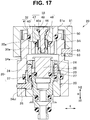
- Fig. 17 is a sectional view illustrating a state where a sterilization adaptor according to the present embodiment is attached to the vent pipe sleeve.
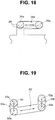
- Fig. 18 is a diagram schematically illustrating the guide groove formed in the main body member of the sterilization adaptor illustrated in Fig. 17 , and the guide pin provided on the vent pipe sleeve.
- Fig. 19 is a diagram schematically illustrating the cam groove which is different from the one illustrated in Fig. 18 and is formed in the main body member of the sterilization adaptor illustrated in Fig. 17 , and the cam pin provided on the grasping portion.
- Fig. 20 is a sectional view of the vent pipe sleeve and the sterilization adaptor in a state where the vent valve body illustrated in Fig. 17 is opened.
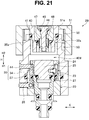
- Fig. 21 is a sectional view of the vent pipe sleeve and the sterilization adaptor in a state where the vent pipe sleeve is closed from the state illustrated in Fig. 20 .
- the configuration of the sterilization adaptor according to the third embodiment is different in the configuration of the vent valve unit, from the sterilization adaptor of the first embodiment illustrated in Figs. 1 to 11 described above and the sterilization adaptor of the second embodiment illustrated in Figs. 12 to 16 . Accordingly, only the difference will be described, and components which are the same as those of the first and second embodiments are denoted by the same reference numerals and the descriptions thereof are omitted.
- the sterilization adaptor 29 includes a main part configured by the vent valve unit 32, the check valve unit 33, the main body portion 30, and a grasping portion 51.
- the main body portion 30 includes a main part configured by the main body member 34, the first seal member 37, and the cam pin 44.
- the main body member 34 is formed of a pipe-shaped member in which the hole portion 30a, which is a stepped through-hole, is formed on the inner peripheral surface along the longitudinal axis direction H, and the tapered surface 35a is formed on the inner peripheral surface of the main body member.
- a groove is formed on the inner peripheral surface of the main body member 34 in the section on the one end side H1 in the longitudinal axis direction H, and the first seal member 37, such as an O-shaped ring, is disposed in the groove.
- the main body member 34 includes the guide groove 34d, as illustrated in Fig. 18 , formed in the section on the one end side H1 in the longitudinal axis direction H with respect to the groove in which the first seal member 37 is disposed, and a cam groove 53 illustrated in Fig. 19 is formed in the section on the other end side H2 in the longitudinal axis direction H.
- the cam pin 44 is provided along the radial direction K such that the distal end of the cam pin protrudes toward the hole portion 30a at the same position as the position illustrated in the second embodiment described above.
- the grasping portion 51 is formed in a pipe shape including an inward flange in the section on the other end side H2 in the longitudinal axis direction H, and a pin 54 is disposed in a hole penetrating through in the radial direction K in the section on the one end side H1 in the longitudinal axis direction H such that the pin protrudes toward the inside the grasping portion 51.
- the pin 54 is engageable with the guide groove 53 as illustrated in Fig. 19 , and is slidable to positions 53a to 53c along the guide groove 53.
- the vent valve unit 32 includes a main part configured by the vent valve body 40 and the seal member 41.
- the vent valve body 40 is formed of a pipe-shaped member, and includes, on the groove formed on the outer peripheral surface thereof, the seal member 41 such as an O-shaped ring.
- vent valve body 40 is fixed by bonding to a hole 51a in a hole portion of the inward flange portion provided on the grasping portion 51. Such a configuration enables the vent valve body 40 to move and rotate integrally with the grasping portion 51.
- a spring member 50 is disposed so as to be contracted between a recessed portion 34i formed on an end face on the other end side H2 in the longitudinal axis direction H of the main body member 34 in the longitudinal axis direction H and the inward flange portion of the grasping portion 51.
- the spring member 50 causes the pin 54 to be fitted into the positions 53a and 53c illustrated in Fig. 19 .
- the gap 32a causes the inside of the endoscope 2 to communicate with the outside of the endoscope 2.
- check valve unit 33 has the same structure as that of the second embodiment described above, and is disposed in the vent valve body 40 in the vent valve unit 32.
- the fluid passage 40d in the vent valve unit 32 and the hole portion 30a communicate with each other through the space 42d in the main body member 34.
- the grasping portion 51 is also moved to the one end side H1 in the longitudinal axis direction H, and the pin 54 is moved from the position 53c to the position 53d in the guide groove 53 illustrated in Fig. 19 .
- the vent valve unit 32 is opened.
- the main body member 34 is integrally rotated with the grasping portion 51, so that the cam pin 26 is guided to a position 34p in the guide groove 34d illustrated in Fig. 18 and thus the vent pipe sleeve 20 is opened.
- the sterilization adaptor 29 is attached in two stages in which the grasping portion 51 is rotated and thereafter the main body member 34 is rotated.
- the sterilization adaptor 29 engages with the guide groove 53 at a depth where the pin 54 can be easily hooked by the biasing force of the spring member 50 toward the one end side H1 in the longitudinal axis direction H, thereby preventing the grasping portion 51 from being rotated and detached during the sterilization process.
- This configuration can prevent a situation where the vent valve body 40 is opened during the sterilization process and gas enters into the endoscope 2 and deteriorates the components.
- the operator first presses the grasping portion 51 into the one end side H1 in the longitudinal axis direction H against the biasing force of the spring member 50 toward the one end side H1 in the longitudinal axis direction H.
- the pin 54 is moved from the position 53a to the position 53b in the guide groove 53. After that, when the grasping portion 51 is rotated along the guide groove 53 in the direction opposite to that at the time of attachment, the pin 54 is moved to the position 53d.
- the pressure in the endoscope 2 is a negative pressure, and thus air flows into the endoscope 2 through the gap 32a, the space 42d, and the gap between the valve body 25 and the sliding member 24 of the vent pipe sleeve 20.
- the vent valve body 40 can be reliably opened before the vent pipe sleeve 20 starts to be closed when the sterilization adaptor 29 is detached, thereby making it possible to reliably release the negative pressure state in the endoscope 2.
- valve body 25 of the vent pipe sleeve 20 is moved to the one end side H1 in the longitudinal axis direction H by the cam pin 44, so that the seal member 27 contacts the tapered surface 24k and the vent pipe sleeve 20 is closed.
- Such a configuration can also provide advantageous effects similar to those of the first and second embodiments described above.
- the first to third embodiments are described by taking an endoscope as an example of a medical device.
- the medical device is not limited to an endoscope.
- the present invention is also applicable to medical devices provided with a vent pipe sleeve, other than an endoscope.
Landscapes
- Health & Medical Sciences (AREA)
- Life Sciences & Earth Sciences (AREA)
- Surgery (AREA)
- Veterinary Medicine (AREA)
- Public Health (AREA)
- General Health & Medical Sciences (AREA)
- Animal Behavior & Ethology (AREA)
- Physics & Mathematics (AREA)
- Heart & Thoracic Surgery (AREA)
- Engineering & Computer Science (AREA)
- Biomedical Technology (AREA)
- Optics & Photonics (AREA)
- Molecular Biology (AREA)
- Medical Informatics (AREA)
- Radiology & Medical Imaging (AREA)
- Pathology (AREA)
- Nuclear Medicine, Radiotherapy & Molecular Imaging (AREA)
- Biophysics (AREA)
- Epidemiology (AREA)
- Pulmonology (AREA)
- Anesthesiology (AREA)
- Hematology (AREA)
- Chemical & Material Sciences (AREA)
- Chemical Kinetics & Catalysis (AREA)
- General Chemical & Material Sciences (AREA)
- Astronomy & Astrophysics (AREA)
- General Physics & Mathematics (AREA)
- Mechanical Engineering (AREA)
- Endoscopes (AREA)
- Instruments For Viewing The Inside Of Hollow Bodies (AREA)
Applications Claiming Priority (2)
| Application Number | Priority Date | Filing Date | Title |
|---|---|---|---|
| JP2018140530 | 2018-07-26 | ||
| PCT/JP2019/007349 WO2020021751A1 (fr) | 2018-07-26 | 2019-02-26 | Adaptateur stérilisé |
Publications (2)
| Publication Number | Publication Date |
|---|---|
| EP3827734A1 true EP3827734A1 (fr) | 2021-06-02 |
| EP3827734A4 EP3827734A4 (fr) | 2022-04-06 |
Family
ID=69180655
Family Applications (1)
| Application Number | Title | Priority Date | Filing Date |
|---|---|---|---|
| EP19840866.8A Withdrawn EP3827734A4 (fr) | 2018-07-26 | 2019-02-26 | Adaptateur stérilisé |
Country Status (5)
| Country | Link |
|---|---|
| US (1) | US12017037B2 (fr) |
| EP (1) | EP3827734A4 (fr) |
| JP (1) | JP6974619B2 (fr) |
| CN (1) | CN112449578B (fr) |
| WO (1) | WO2020021751A1 (fr) |
Cited By (1)
| Publication number | Priority date | Publication date | Assignee | Title |
|---|---|---|---|---|
| EP4295747A1 (fr) * | 2022-06-22 | 2023-12-27 | Karl Storz Endovision, Inc. | Dispositif de tension et endoscope assemblé avec celui-ci |
Family Cites Families (16)
| Publication number | Priority date | Publication date | Assignee | Title |
|---|---|---|---|---|
| JPS61293417A (ja) * | 1985-06-21 | 1986-12-24 | 旭光学工業株式会社 | 気密型内視鏡の内圧調整装置 |
| JP3559325B2 (ja) * | 1994-07-22 | 2004-09-02 | ペンタックス株式会社 | 内視鏡の内圧調整装置 |
| JP3947270B2 (ja) * | 1997-05-29 | 2007-07-18 | ペンタックス株式会社 | 内視鏡の内圧調整装置 |
| JP2000157483A (ja) * | 1998-11-25 | 2000-06-13 | Olympus Optical Co Ltd | 内視鏡装置 |
| JP2000225089A (ja) * | 1999-02-05 | 2000-08-15 | Olympus Optical Co Ltd | 電子内視鏡 |
| JP2002017657A (ja) * | 2000-07-11 | 2002-01-22 | Olympus Optical Co Ltd | 内視鏡 |
| DE60239150D1 (de) * | 2001-12-07 | 2011-03-24 | Olympus Corp | Hochdruck-dampfsterilisationssystem für medizinische geräte und vorrichtung und verfahren zur sterilisierung der medizinischen geräte |
| JP2004089232A (ja) * | 2002-08-29 | 2004-03-25 | Olympus Corp | 連通制御装置 |
| US8329098B2 (en) * | 2009-03-16 | 2012-12-11 | Atrion Medical Products, Inc. | Additive effect enhanced hydrogen peroxide disinfection method and apparatus |
| JP5659106B2 (ja) | 2011-08-29 | 2015-01-28 | オリンパスメディカルシステムズ株式会社 | 内視鏡 |
| JP5497138B2 (ja) * | 2011-12-01 | 2014-05-21 | 富士フイルム株式会社 | 内視鏡用洗浄アダプタ |
| US10245042B2 (en) * | 2012-03-13 | 2019-04-02 | Medtronic Xomed, Inc. | Check valve vented sterilizable powered surgical handpiece |
| JP6223081B2 (ja) * | 2013-09-10 | 2017-11-01 | オリンパス株式会社 | 内視鏡通気口金 |
| JP5914783B1 (ja) * | 2014-06-19 | 2016-05-11 | オリンパス株式会社 | 内視鏡 |
| JP2016064050A (ja) * | 2014-09-25 | 2016-04-28 | Hoya株式会社 | 内視鏡の内圧調整装置 |
| JP2018140530A (ja) | 2017-02-27 | 2018-09-13 | ローランドディー.ジー.株式会社 | 印刷装置 |
-
2019
- 2019-02-26 CN CN201980048177.XA patent/CN112449578B/zh active Active
- 2019-02-26 EP EP19840866.8A patent/EP3827734A4/fr not_active Withdrawn
- 2019-02-26 WO PCT/JP2019/007349 patent/WO2020021751A1/fr not_active Ceased
- 2019-02-26 JP JP2020532144A patent/JP6974619B2/ja active Active
-
2021
- 2021-01-22 US US17/155,389 patent/US12017037B2/en active Active
Cited By (1)
| Publication number | Priority date | Publication date | Assignee | Title |
|---|---|---|---|---|
| EP4295747A1 (fr) * | 2022-06-22 | 2023-12-27 | Karl Storz Endovision, Inc. | Dispositif de tension et endoscope assemblé avec celui-ci |
Also Published As
| Publication number | Publication date |
|---|---|
| JP6974619B2 (ja) | 2021-12-01 |
| US20210138226A1 (en) | 2021-05-13 |
| JPWO2020021751A1 (ja) | 2021-05-13 |
| CN112449578A (zh) | 2021-03-05 |
| CN112449578B (zh) | 2024-07-26 |
| US12017037B2 (en) | 2024-06-25 |
| EP3827734A4 (fr) | 2022-04-06 |
| WO2020021751A1 (fr) | 2020-01-30 |
Similar Documents
| Publication | Publication Date | Title |
|---|---|---|
| US12310551B2 (en) | Apparatus for improved visualization for endoscopic procedures | |
| US7220227B2 (en) | Adapter for endoscope and endoscope | |
| EP3952714B1 (fr) | Adaptateur de rinçage à l'air/eau d'endoscope et procédé | |
| EP1547641A2 (fr) | Dispositif de commande pour un ballonnet | |
| US11832795B2 (en) | Fluid control device for endoscope, and endoscope | |
| JP2009022444A (ja) | 内視鏡装置 | |
| JP2008278968A (ja) | 内視鏡用挿入補助具 | |
| US11930998B2 (en) | Vent control valve for endoscope and endoscope | |
| JP2007252589A (ja) | 内視鏡の吸引装置 | |
| EP3827734A1 (fr) | Adaptateur stérilisé | |
| US7850603B2 (en) | Endoscope for sterilizing built-in elongated channel with high-temperature and high-pressure vapor | |
| JP4334885B2 (ja) | 内視鏡装置および内視鏡用導管 | |
| JP2016055103A (ja) | 内視鏡用フード及び内視鏡システム | |
| EP4566511A1 (fr) | Connecteur pour embout buccal d'endoscope d'alimentation en eau subordonné | |
| US12357157B2 (en) | Endoscope with working channel and a control body | |
| US20120253126A1 (en) | Stopper and endoscope | |
| GB2628817A (en) | Cleaning adaptor for an endoscope | |
| JP3794813B2 (ja) | 内視鏡用鉗子栓 | |
| US20190336119A1 (en) | Retractor for endoscopic surgery | |
| JP4786985B2 (ja) | 内視鏡 | |
| EP4370008B1 (fr) | Dispositifs médicaux modulaires | |
| JP2010029317A (ja) | 内視鏡の洗浄補助具および内視鏡、並びに内視鏡の洗浄方法 | |
| JP4358379B2 (ja) | 内視鏡 | |
| JP2026504556A (ja) | 使い捨て機構を備えた医療システムおよび装置 | |
| JP2000157483A (ja) | 内視鏡装置 |
Legal Events
| Date | Code | Title | Description |
|---|---|---|---|
| STAA | Information on the status of an ep patent application or granted ep patent |
Free format text: STATUS: THE INTERNATIONAL PUBLICATION HAS BEEN MADE |
|
| PUAI | Public reference made under article 153(3) epc to a published international application that has entered the european phase |
Free format text: ORIGINAL CODE: 0009012 |
|
| STAA | Information on the status of an ep patent application or granted ep patent |
Free format text: STATUS: REQUEST FOR EXAMINATION WAS MADE |
|
| 17P | Request for examination filed |
Effective date: 20210121 |
|
| AK | Designated contracting states |
Kind code of ref document: A1 Designated state(s): AL AT BE BG CH CY CZ DE DK EE ES FI FR GB GR HR HU IE IS IT LI LT LU LV MC MK MT NL NO PL PT RO RS SE SI SK SM TR |
|
| DAV | Request for validation of the european patent (deleted) | ||
| DAX | Request for extension of the european patent (deleted) | ||
| A4 | Supplementary search report drawn up and despatched |
Effective date: 20220307 |
|
| RIC1 | Information provided on ipc code assigned before grant |
Ipc: A61M 39/24 20060101ALI20220301BHEP Ipc: A61L 2/26 20060101ALI20220301BHEP Ipc: G02B 23/24 20060101ALI20220301BHEP Ipc: A61B 1/015 20060101ALI20220301BHEP Ipc: A61B 1/00 20060101ALI20220301BHEP Ipc: A61B 1/12 20060101AFI20220301BHEP |
|
| GRAP | Despatch of communication of intention to grant a patent |
Free format text: ORIGINAL CODE: EPIDOSNIGR1 |
|
| STAA | Information on the status of an ep patent application or granted ep patent |
Free format text: STATUS: GRANT OF PATENT IS INTENDED |
|
| INTG | Intention to grant announced |
Effective date: 20221125 |
|
| STAA | Information on the status of an ep patent application or granted ep patent |
Free format text: STATUS: THE APPLICATION IS DEEMED TO BE WITHDRAWN |
|
| 18D | Application deemed to be withdrawn |
Effective date: 20230406 |