EP3847962A1 - Dispositif de mesure de glycémie et système de mesure de glycémie faisant appel à celui-ci - Google Patents
Dispositif de mesure de glycémie et système de mesure de glycémie faisant appel à celui-ci Download PDFInfo
- Publication number
- EP3847962A1 EP3847962A1 EP18932860.2A EP18932860A EP3847962A1 EP 3847962 A1 EP3847962 A1 EP 3847962A1 EP 18932860 A EP18932860 A EP 18932860A EP 3847962 A1 EP3847962 A1 EP 3847962A1
- Authority
- EP
- European Patent Office
- Prior art keywords
- blood glucose
- glucose measurement
- sweat
- measurement device
- housing
- Prior art date
- Legal status (The legal status is an assumption and is not a legal conclusion. Google has not performed a legal analysis and makes no representation as to the accuracy of the status listed.)
- Pending
Links
- 239000008280 blood Substances 0.000 title claims abstract description 154
- 210000004369 blood Anatomy 0.000 title claims abstract description 154
- WQZGKKKJIJFFOK-GASJEMHNSA-N Glucose Natural products OC[C@H]1OC(O)[C@H](O)[C@@H](O)[C@@H]1O WQZGKKKJIJFFOK-GASJEMHNSA-N 0.000 title claims abstract description 147
- 239000008103 glucose Substances 0.000 title claims abstract description 147
- 238000005259 measurement Methods 0.000 title claims abstract description 95
- 210000004243 sweat Anatomy 0.000 claims abstract description 82
- 230000001939 inductive effect Effects 0.000 claims abstract description 22
- 229940079593 drug Drugs 0.000 claims abstract description 12
- 239000003814 drug Substances 0.000 claims abstract description 12
- 210000001124 body fluid Anatomy 0.000 claims abstract description 3
- 239000011796 hollow space material Substances 0.000 claims description 17
- 239000002245 particle Substances 0.000 claims description 13
- 238000004891 communication Methods 0.000 claims description 10
- 239000011347 resin Substances 0.000 claims description 8
- 229920005989 resin Polymers 0.000 claims description 8
- 230000008859 change Effects 0.000 claims description 7
- 238000010521 absorption reaction Methods 0.000 claims description 6
- 239000000463 material Substances 0.000 claims description 6
- 238000003780 insertion Methods 0.000 claims description 5
- 230000037431 insertion Effects 0.000 claims description 5
- 239000012528 membrane Substances 0.000 claims description 4
- 239000007788 liquid Substances 0.000 claims description 3
- OKTJSMMVPCPJKN-UHFFFAOYSA-N Carbon Chemical compound [C] OKTJSMMVPCPJKN-UHFFFAOYSA-N 0.000 claims description 2
- 239000010839 body fluid Substances 0.000 claims description 2
- 229910052799 carbon Inorganic materials 0.000 claims description 2
- 230000000994 depressogenic effect Effects 0.000 claims description 2
- 230000000149 penetrating effect Effects 0.000 claims 1
- 208000002193 Pain Diseases 0.000 abstract description 10
- 238000000034 method Methods 0.000 abstract description 7
- 208000015181 infectious disease Diseases 0.000 abstract description 6
- 206010012601 diabetes mellitus Diseases 0.000 abstract description 5
- 230000000694 effects Effects 0.000 abstract description 5
- 230000028327 secretion Effects 0.000 abstract description 5
- 230000008569 process Effects 0.000 abstract description 4
- 238000012544 monitoring process Methods 0.000 abstract description 2
- 230000037390 scarring Effects 0.000 abstract 1
- 210000000106 sweat gland Anatomy 0.000 description 10
- 210000005036 nerve Anatomy 0.000 description 6
- 230000000638 stimulation Effects 0.000 description 6
- 210000000707 wrist Anatomy 0.000 description 5
- 208000032544 Cicatrix Diseases 0.000 description 3
- 206010059866 Drug resistance Diseases 0.000 description 3
- OIPILFWXSMYKGL-UHFFFAOYSA-N acetylcholine Chemical compound CC(=O)OCC[N+](C)(C)C OIPILFWXSMYKGL-UHFFFAOYSA-N 0.000 description 3
- 229960004373 acetylcholine Drugs 0.000 description 3
- 238000001647 drug administration Methods 0.000 description 3
- 235000012054 meals Nutrition 0.000 description 3
- 230000007246 mechanism Effects 0.000 description 3
- 210000004379 membrane Anatomy 0.000 description 3
- 231100000241 scar Toxicity 0.000 description 3
- 230000037387 scars Effects 0.000 description 3
- 230000035900 sweating Effects 0.000 description 3
- 230000005856 abnormality Effects 0.000 description 2
- 230000006698 induction Effects 0.000 description 2
- 238000012360 testing method Methods 0.000 description 2
- 239000002699 waste material Substances 0.000 description 2
- QCHFTSOMWOSFHM-WPRPVWTQSA-N (+)-Pilocarpine Chemical compound C1OC(=O)[C@@H](CC)[C@H]1CC1=CN=CN1C QCHFTSOMWOSFHM-WPRPVWTQSA-N 0.000 description 1
- 206010033799 Paralysis Diseases 0.000 description 1
- QCHFTSOMWOSFHM-UHFFFAOYSA-N SJ000285536 Natural products C1OC(=O)C(CC)C1CC1=CN=CN1C QCHFTSOMWOSFHM-UHFFFAOYSA-N 0.000 description 1
- 208000006981 Skin Abnormalities Diseases 0.000 description 1
- 230000002159 abnormal effect Effects 0.000 description 1
- 239000002134 carbon nanofiber Substances 0.000 description 1
- 201000010099 disease Diseases 0.000 description 1
- 208000037265 diseases, disorders, signs and symptoms Diseases 0.000 description 1
- 238000000635 electron micrograph Methods 0.000 description 1
- 230000003203 everyday effect Effects 0.000 description 1
- 210000004392 genitalia Anatomy 0.000 description 1
- 210000004907 gland Anatomy 0.000 description 1
- 238000010438 heat treatment Methods 0.000 description 1
- 208000002557 hidradenitis Diseases 0.000 description 1
- 238000012905 input function Methods 0.000 description 1
- 210000003734 kidney Anatomy 0.000 description 1
- 239000002184 metal Substances 0.000 description 1
- VNWKTOKETHGBQD-UHFFFAOYSA-N methane Chemical compound C VNWKTOKETHGBQD-UHFFFAOYSA-N 0.000 description 1
- 238000012986 modification Methods 0.000 description 1
- 230000004048 modification Effects 0.000 description 1
- 210000000056 organ Anatomy 0.000 description 1
- 230000008520 organization Effects 0.000 description 1
- 210000000578 peripheral nerve Anatomy 0.000 description 1
- 229960001416 pilocarpine Drugs 0.000 description 1
- 239000011148 porous material Substances 0.000 description 1
- 230000036186 satiety Effects 0.000 description 1
- 235000019627 satiety Nutrition 0.000 description 1
- 230000003248 secreting effect Effects 0.000 description 1
- 238000004092 self-diagnosis Methods 0.000 description 1
- 239000000126 substance Substances 0.000 description 1
- 238000006467 substitution reaction Methods 0.000 description 1
- 239000000758 substrate Substances 0.000 description 1
- XLYOFNOQVPJJNP-UHFFFAOYSA-N water Substances O XLYOFNOQVPJJNP-UHFFFAOYSA-N 0.000 description 1
- 230000003442 weekly effect Effects 0.000 description 1
Images





Classifications
-
- A—HUMAN NECESSITIES
- A61—MEDICAL OR VETERINARY SCIENCE; HYGIENE
- A61B—DIAGNOSIS; SURGERY; IDENTIFICATION
- A61B5/00—Measuring for diagnostic purposes; Identification of persons
- A61B5/145—Measuring characteristics of blood in vivo, e.g. gas concentration or pH-value ; Measuring characteristics of body fluids or tissues, e.g. interstitial fluid or cerebral tissue
- A61B5/14532—Measuring characteristics of blood in vivo, e.g. gas concentration or pH-value ; Measuring characteristics of body fluids or tissues, e.g. interstitial fluid or cerebral tissue for measuring glucose, e.g. by tissue impedance measurement
-
- A—HUMAN NECESSITIES
- A61—MEDICAL OR VETERINARY SCIENCE; HYGIENE
- A61B—DIAGNOSIS; SURGERY; IDENTIFICATION
- A61B10/00—Instruments for taking body samples for diagnostic purposes; Other methods or instruments for diagnosis, e.g. for vaccination diagnosis, sex determination or ovulation-period determination; Throat striking implements
- A61B10/0045—Devices for taking samples of body liquids
-
- A—HUMAN NECESSITIES
- A61—MEDICAL OR VETERINARY SCIENCE; HYGIENE
- A61B—DIAGNOSIS; SURGERY; IDENTIFICATION
- A61B5/00—Measuring for diagnostic purposes; Identification of persons
- A61B5/0002—Remote monitoring of patients using telemetry, e.g. transmission of vital signals via a communication network
- A61B5/0004—Remote monitoring of patients using telemetry, e.g. transmission of vital signals via a communication network characterised by the type of physiological signal transmitted
-
- A—HUMAN NECESSITIES
- A61—MEDICAL OR VETERINARY SCIENCE; HYGIENE
- A61B—DIAGNOSIS; SURGERY; IDENTIFICATION
- A61B5/00—Measuring for diagnostic purposes; Identification of persons
- A61B5/0002—Remote monitoring of patients using telemetry, e.g. transmission of vital signals via a communication network
- A61B5/0015—Remote monitoring of patients using telemetry, e.g. transmission of vital signals via a communication network characterised by features of the telemetry system
- A61B5/0022—Monitoring a patient using a global network, e.g. telephone networks, internet
-
- A—HUMAN NECESSITIES
- A61—MEDICAL OR VETERINARY SCIENCE; HYGIENE
- A61B—DIAGNOSIS; SURGERY; IDENTIFICATION
- A61B5/00—Measuring for diagnostic purposes; Identification of persons
- A61B5/145—Measuring characteristics of blood in vivo, e.g. gas concentration or pH-value ; Measuring characteristics of body fluids or tissues, e.g. interstitial fluid or cerebral tissue
- A61B5/14507—Measuring characteristics of blood in vivo, e.g. gas concentration or pH-value ; Measuring characteristics of body fluids or tissues, e.g. interstitial fluid or cerebral tissue specially adapted for measuring characteristics of body fluids other than blood
- A61B5/14517—Measuring characteristics of blood in vivo, e.g. gas concentration or pH-value ; Measuring characteristics of body fluids or tissues, e.g. interstitial fluid or cerebral tissue specially adapted for measuring characteristics of body fluids other than blood for sweat
- A61B5/14521—Measuring characteristics of blood in vivo, e.g. gas concentration or pH-value ; Measuring characteristics of body fluids or tissues, e.g. interstitial fluid or cerebral tissue specially adapted for measuring characteristics of body fluids other than blood for sweat using means for promoting sweat production, e.g. heating the skin
-
- A—HUMAN NECESSITIES
- A61—MEDICAL OR VETERINARY SCIENCE; HYGIENE
- A61B—DIAGNOSIS; SURGERY; IDENTIFICATION
- A61B10/00—Instruments for taking body samples for diagnostic purposes; Other methods or instruments for diagnosis, e.g. for vaccination diagnosis, sex determination or ovulation-period determination; Throat striking implements
- A61B10/0045—Devices for taking samples of body liquids
- A61B10/0064—Devices for taking samples of body liquids for taking sweat or sebum samples
-
- A—HUMAN NECESSITIES
- A61—MEDICAL OR VETERINARY SCIENCE; HYGIENE
- A61B—DIAGNOSIS; SURGERY; IDENTIFICATION
- A61B2560/00—Constructional details of operational features of apparatus; Accessories for medical measuring apparatus
- A61B2560/04—Constructional details of apparatus
-
- H—ELECTRICITY
- H04—ELECTRIC COMMUNICATION TECHNIQUE
- H04M—TELEPHONIC COMMUNICATION
- H04M1/00—Substation equipment, e.g. for use by subscribers
- H04M1/72—Mobile telephones; Cordless telephones, i.e. devices for establishing wireless links to base stations without route selection
- H04M1/724—User interfaces specially adapted for cordless or mobile telephones
- H04M1/72403—User interfaces specially adapted for cordless or mobile telephones with means for local support of applications that increase the functionality
- H04M1/72409—User interfaces specially adapted for cordless or mobile telephones with means for local support of applications that increase the functionality by interfacing with external accessories
- H04M1/72412—User interfaces specially adapted for cordless or mobile telephones with means for local support of applications that increase the functionality by interfacing with external accessories using two-way short-range wireless interfaces
Definitions
- the present invention relates to a blood glucose measurement device and a blood glucose measurement system using the same and, more particularly, to a blood glucose measurement device and a blood glucose measurement system using the same, the blood glucose measurement device being non-invasive, measuring blood glucose with sweat rather than blood, and being provided with a sweat-inducing means that requires no drug in a sweat induction process.
- Diabetes is a disease old enough to be confirmed in ancient Egyptian records, but it may be said that the history of a blood glucose measurement device enabling patients to measure blood glucose by themselves began in 1965 when the first blood glucose test strip, Dextrosticx, was marketed.
- a blood glucose measurement device generally is composed by a structure in which blood glucose is measured with blood collected by puncturing the skin with a needle.
- blood glucose measurement in order to obtain a more accurate blood glucose measurement value, frequent blood glucose measurement should be performed.
- the blood collection causes a puncture on the skin due to the needle, so the pain caused by the needle increases as much as a patient is trying to measure blood glucose.
- a blood glucose measurement device capable of collecting blood with a micro-needle having a minimized needle diameter has been developed, and there is also a trend of developing a non-invasive blood glucose measurement device.
- the blood glucose measurement device using the micro-needle may lessen the pain, but since a needle is also used as before, there may occur a problem in that scars may remain due to frequent tests, and infection may be caused by the use of the needle.
- a non-invasive blood glucose measurement device is provided with a sweat induction part 101 and a sweat collection part 103, wherein the sweat gland control nerves are stimulated by infiltrating the skin with drugs such as pilocarpine or acetylcholine that may induce sweat secretion from the skin, and the secreted sweat is collected so as to check a level of blood glucose contained in the sweat.
- drugs such as pilocarpine or acetylcholine that may induce sweat secretion from the skin, and the secreted sweat is collected so as to check a level of blood glucose contained in the sweat.
- the chemical stimulation for inducing sweat secretion is so strong that drug resistance may be caused in the user's skin. Accordingly, as the non-invasive blood glucose measurement device using drugs to more accurately measure blood glucose levels is frequently used, abnormalities may occur in the normal sweat-inducing mechanism in an increasingly larger area of the skin.
- an invasive blood glucose measurement device has a problem in that pain, infection, and scars are caused, and a non-invasive blood glucose measurement device has a concern in that drug resistance to the skin and an abnormal sweat secretion mechanism caused by drug administration may occur, and thus it is difficult for such frequent blood glucose measurements to be performed.
- the present invention is to solve the problems of the related art, and an objective of the present invention is to provide a blood glucose measurement device that uses a non-invasive method causing no problem of pain and infection, and does not use drugs that may cause abnormalities such as sequelae or drug resistance to the skin.
- a blood glucose measurement device includes: a sweat-inducing part having two electrodes arranged to be spaced apart from each other and to which opposite polarities are respectively applied; a housing for fixing the sweat-inducing part allowing the two electrodes to be exposed on one surface of the housing; and a blood glucose sensor inserted into the housing and in contact with body fluids induced by the sweat-inducing part.
- a heater may be installed inside the housing close to the one surface of the housing, and in this case, the heater may preferably have a micro hot wire, or a Peltier element, or a PTC element.
- the blood glucose sensor may be detachably inserted into the housing from an outer side of the housing.
- a fine channel may be formed through the housing between the two electrodes in the housing, and the blood glucose sensor may be formed long in a longitudinal direction, so that one end of the blood glucose sensor may be inserted into the housing to be exposed to the fine channel.
- an elastic pump having a hollow space therein communicating with the fine channel may be provided on the other surface of the housing.
- an air outlet for communicating the inside of the hollow space to the outside may be formed in the elastic pump, and preferably, a one-way valve may be provided on the air outlet to allow air to pass from the inside to the outside but not from the outside to the inside.
- a curved surface may be preferably formed on the one surface of the housing in a shape depressed toward the elastic pump between the two electrodes, and the fine channel may be arranged at a center of the curved surface.
- an air permeable membrane for passing the air but not liquid may be preferably provided between the fine channel and the hollow space inside the elastic pump.
- each electrode may be preferably a flexible electrode made of a resin of a flexible material with uniformly diffused conductive particles.
- a wearing band for wearing on a body may be preferably coupled to the housing.
- the blood glucose measurement system includes: a blood glucose measurement device according to any one of claims 1 to 10; a communication module provided in the blood glucose measurement device to transmit blood glucose measurement data; a server for computing and storing the blood glucose measurement data received from the communication module; and a mobile terminal for receiving the blood glucose measurement data from both of the communication module and the computing and storing module of the server and displaying the blood glucose measurement data as an image.
- the computing and storing module or the mobile terminal may preferably compute both a rate of change in blood glucose for a predetermined period and a time when to take a blood glucose control drug by using the received blood glucose measurement data, and may display the rate and the time on the mobile terminal.
- blood glucose measurement is not performed with blood collection, but performed with glucose contained in sweat secreted due to electrical stimulation using electrodes, so as not to cause pain, infection, and scars, which are caused by a needle, and the drugs that may affect the normal sweat-inducing mechanism in the skin are not used, so as not to leave any sequelae on the skin, and even when a small amount of sweat is secreted, the sweat is efficiently collected, so as to allow all the collected sweat to be used to measure the blood glucose with high-accuracy, whereby there is an effect in that frequent blood glucose monitoring, which is important for diabetics, may be performed without sequelae.
- the present invention includes: a sweat-inducing part having electrodes; a housing 20 for fixing the sweat-inducing part; and a blood glucose sensor 30 inserted into the housing 20.
- two electrodes 10 to which opposite polarities are applied are arranged to be spaced apart from each other at a predetermined interval. Accordingly, one of two electrodes 10 corresponds to an anode, and the other electrode 10 corresponds to a cathode.
- the two electrodes 10 are in contact with the skin and an electric current flows between the electrodes 10 through the skin. At this time, the electric current flowing through the skin due to the electrodes 10 induces the sweating in the skin.
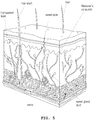
- eccrine sweat glands There are two types of sweat glands that secrete sweat: eccrine sweat glands and apocrine sweat glands. In humans, in order to secrete sweat, eccrine sweat glands are distributed throughout the skin except for areas around the armpits, navel, and genitals.
- Eccrine sweat glands which are general glands, shown in FIG. 5 act as an excretory organ, like the kidneys, that excretes waste materials.
- waste materials filtered from the blood of capillaries are sent along with water to the eccrine sweat glands to generate sweat, and then sweat D is discharged through the pores on the skin surface. Accordingly, glucose contained in the blood is secreted by sweat, and the blood glucose content in the sweat may be measured.
- the sudomotor nerve In order for sweat D to be discharged from eccrine sweat glands, stimulation to the sudomotor nerve that controls eccrine sweat glands is required.
- acetylcholine In the normal activity situation, in the process of secreting sweat D, acetylcholine is first secreted to stimulate the sudomotor nerve, and then the stimulated sudomotor nerve stimulates eccrine sweat glands.
- the sudomotor nerve is stimulated by allowing an electric current of the electrodes 10 to flow, instead of applying acetylcholine, so as to cause the eccrine sweat glands to secrete sweat D.
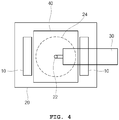
- the electrodes 10 are arranged at regular intervals as shown in the plan view of FIG. 4 .
- the electrode 10 is manufactured to have a predetermined area.
- the reason is that when the area of the electrode 10 is formed too small, in a condition of applying electrical stimulation, the pain caused to the skin S increases. Accordingly, after the electrode 10 is formed in more than the predetermined area, and as the electrode 10 is in close contact with the skin S over the entire area of the electrode 10, the pain caused to the skin S disappears and the electric current may flow more reliably to the skin S between the electrodes 10.
- each electrode 10 in the present invention may be made of a flexible material so that the electrode 10 may be more reliably positioned in close contact with the skin S.
- a flexible material and a material capable of ensuring an electric current to flow as shown in FIGS. 7a and 7b , each electrode 10 in the present invention preferably uses a conductive flexible electrode made of a resin 11 of a flexible material with uniformly diffused conductive particles 12, such as metal or carbon nanofiber particles, inside a substrate of the resin 11.
- FIG. 7a is a conceptual view showing a principle in which the conductive particles 12 are uniformly diffused into a resin so as to allow the electric current to continue to flow between the conductive particles 12 without being interrupted.
- a distance between the conductive particles 12 through which the electric current is able to flow may be determined by the density of the conductive particles 12 diffused in the resin 11.
- the conductive particles 12 distributed in the resin 11 are not in close contact with each other, and are distributed at minute intervals as shown in FIG. 7b , so that the electric current flows between the conductive particles along a path formed by the conductive particles 12 having the smallest possible distance between adjacent conductive particles 12 when viewed in the electric current flow direction as shown in the conceptual view on the bottom right side of FIG. 7a .
- a heater 40 for causing sweating may be provided together with the electrodes 10 constituting a sweat-inducing part, so that an amount of sweat D secreted by the sweating promotion function of the electrode 10 may be secured as much as the amount required for blood glucose measurement with guaranteed accuracy.
- the heater 40 is inserted into the interior of the housing 20, which will be described later, and is installed on a side close to the skin S.
- the heater 40 may has a micro heating wire, or a carbon film, or a PTC element, or a Peltier element.
- the heater 40 may share the same power supply as that of the electrode 10 constituting the sweat-inducing part, and their circuits may be connected to each other.
- FIG. 3 shows the housing 20 configured to be a plate shape that is widely formed to directly cover the skin S.
- the housing 20 fixes the sweat-inducing part, and the electrodes 10 constituting the sweat-inducing part are arranged in close contact with the skin S in FIG. 3 and fixed to contact the skin S.
- a blood glucose sensor 30 is coupled to the housing 20 in a way of being inserted into an insertion hole 23 that is formed on the right side of the housing 20.
- the housing 20 is provided with a fine channel 22 in a direction perpendicular to the center between the electrodes 10 so that sweat D secreted from a surface of the skin S under the housing 20 may contact a first end of the blood glucose sensor.
- the wall of the fine channel 22 is formed to communicate with the insertion hole 23 into which the blood glucose sensor 30 is inserted, whereby the first end of the blood glucose sensor 30 may contact the collected sweat D.
- the sweat D is secreted from the skin S due to electrical stimulation, the amount of secretion is small. In order for most of the sweat D secreted in a small amount in this way to be used to measure blood glucose, it is preferable to provide a means for suctioning the secreted sweat D to be concentrated into the fine channel 22.
- an elastic pump 50 may be provided on an upper part of the fine channel 22, so that high-accuracy blood glucose measurement may be sufficiently performed even with the sweat D secreted in a small amount.
- the elastic pump 50 has a hollow space 52 formed therein, and as the hollow space 52 is contracted and then expanded, the shape of the hollow space 52 is restored to its original shape, whereby a vacuum is generated between the skin S and an area between the electrodes 10 in the housing 20, and thus the sweat D secreted from the skin S may be concentrated into the fine channel 22.
- the secreted amount is as small as about 5 ⁇ l .
- the hollow space 52 formed therein communicates with a cavity between the housing 20 and the skin S through the fine channel 22, the cavity being provided between the two electrodes 10.
- the elastic pump 50 is contracted and then expanded, the inside of the hollow space 52 formed in the elastic pump 50 is restored to its shape, thereby suctioning the sweat D collected between the skin S and the housing 20.
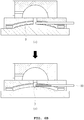
- the elastic pump 50 may be provided with an air outlet 53 and a one-way valve 54 on a side surface thereof, as shown in FIG. 6a(b) .
- the air originally in the hollow space 52 inside the elastic pump 50 is not blown into the skin S direction through the fine channel 22, but escapes to the outside through the air outlet 53.
- the elastic pump 50 when a finger is removed from the elastic pump 50, the elastic pump 50 returns to its original shape, and at this time, in the process of restoring the volume of the hollow space 52 inside the elastic pump 50 again, the external air is blocked due to the one-way valve 54 and may not enter the air outlet 53, whereby only the sweat D formed between the skin S and the housing 20 is collected while gathering in the fine channel 22.
- FIG. 6a(a) is the same view as FIG. 3 , showing a scene in which the electrodes 10 stimulate the skin S nerve and the heater 40 starts to operate simultaneously together with the electrodes 10.
- FIG. 6a (b) shows a scene in which the elastic pump 50 is contracted while the electrodes 10 and the heater 40 are operated.
- FIG. 6b(c) is a view showing a scene in which sweat D is formed on the skin S by the operation of the electrodes 10 and the heater 40
- FIG. 6b(d) is a view showing a scene in which the sweat D formed in FIG. 6b(c) is gathered into the fine channel 22 due to the operation of the elastic pump 50.
- FIG. 6a(b) substantially showing the operation of the elastic pump 50 is arranged between FIG. 6b(c) and FIG. 6b (d) , but in order to clearly express the operation of the elastic pump 50 and the one-way valve 54, for convenience, FIG. 6a(b) is first shown before FIG. 6b(c) and FIG. 6b (d) , unlike the actual sequence.
- FIG. 6c (e) shows a scene in which the blood glucose sensor is separated from the housing 20, in order to be replaced after the blood glucose measurement is completed.
- a part of the surface between the electrodes 10 may be formed as a curved surface 24.
- the curved surface 24 has a curved shape in the form of an arch facing upward.
- the reason why the curved surface 24 is formed in this way is that since the area of a surface in the housing 20 in contact with the skin S is larger when the surface is curved than when the surface is flat, when the surface of the housing 20 in contact with the skin S, that is, the surface of the housing 20 between the electrodes 10, is formed in a curved shape, the area of the skin S in contact with the housing 20 is increased, so that a greater amount of sweat D is collected into the fine channel 22, whereby the greater amount of sweat D may be secured for more accurate blood glucose measurement.
- an air permeable membrane 25 through which gas may pass but liquid does not pass may be provided at a position between the hollow space 52 and the fine channel 22 of the elastic pump 50, so as to prevent a phenomenon where sweat D is suctioned into the hollow space 52 inside the elastic pump 50 due to a large suction force of the elastic pump 50 when the sweat D is concentrated in the fine channel 22 by the operation of the elastic pump 50.
- the reason is that since the entire amount of sweat D should be used for the purpose of measuring blood glucose, the fact that sweat D is absorbed into the hollow space 52 inside the elastic pump 50 may result in problems in that unnecessary loss of sweat D occurs and also the inside of the elastic pump 50 needs to be cleaned more often.
- the blood glucose sensor has a long groove formed from one end thereof to a predetermined length so that sweat D may be quickly absorbed, whereby it may be possible to promote the absorption of the sweat D and check an absorption amount of the sweat D.
- the absorption amount of sweat D is an important data to check a generated amount of sweat D, and in the case of diabetic patients, the generated amount of sweat may be significantly reduced in comparison with normal people due to peripheral nerve paralysis, so that the absorption amount of sweat D may be used as data for self-diagnosis of diabetes.
- a wearing band is connected to the housing 20 so as to be worn on the wrist, whereby blood glucose may be measured while wearing the wearing band on the wrist whenever necessary.
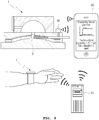
- FIG. 9 it is not shown in detail whether the blood glucose measurement device 1 according to the present invention is worn on the wrist, but a device positioned on an upper part of the wrist is the blood glucose measurement device 1 according to the present invention and a wearing band is wrapped around the wrist.
- the blood glucose measurement system is configured to include: a blood glucose measurement device 1 configured as described above; a communication module 60 provided in the blood glucose measurement device 1 to transmit blood glucose measurement data; a server 70 for computing and storing the blood glucose measurement data received from the communication module 60; and a mobile terminal 80 for receiving the blood glucose measurement data from the communication module 60 and server 70, and displaying the data as an image.
- the mobile terminal 80 in this case may be typically a smart phone or a mobile smart device combined with the blood glucose measurement device 1 itself.
- the mobile terminal 80 by itself may compute a blood glucose measurement value detected by the blood glucose measurement device and display the value in a graph so that a trend of blood glucose increase and decrease by time may be displayed at a glance as shown in FIG. 9 .
- the server 70 in a remote area may compute the blood glucose measurement value, so as to allow information, indicating a rate of change in blood glucose and a time when to take a blood glucose control drug according to the rate of change in blood glucose, to be displayed on the mobile terminal 80.
- the server 70 in the remote area may show the rate of change in blood glucose over a long period of time.
Landscapes
- Health & Medical Sciences (AREA)
- Life Sciences & Earth Sciences (AREA)
- Physics & Mathematics (AREA)
- Engineering & Computer Science (AREA)
- Public Health (AREA)
- Animal Behavior & Ethology (AREA)
- Pathology (AREA)
- Veterinary Medicine (AREA)
- Biomedical Technology (AREA)
- Heart & Thoracic Surgery (AREA)
- Medical Informatics (AREA)
- Molecular Biology (AREA)
- Surgery (AREA)
- General Health & Medical Sciences (AREA)
- Biophysics (AREA)
- Optics & Photonics (AREA)
- Computer Networks & Wireless Communication (AREA)
- Emergency Medicine (AREA)
- Dermatology (AREA)
- Physiology (AREA)
- Hematology (AREA)
- Measurement Of The Respiration, Hearing Ability, Form, And Blood Characteristics Of Living Organisms (AREA)
Applications Claiming Priority (1)
| Application Number | Priority Date | Filing Date | Title |
|---|---|---|---|
| PCT/KR2018/010359 WO2020050433A1 (fr) | 2018-09-05 | 2018-09-05 | Dispositif de mesure de glycémie et système de mesure de glycémie faisant appel à celui-ci |
Publications (2)
| Publication Number | Publication Date |
|---|---|
| EP3847962A1 true EP3847962A1 (fr) | 2021-07-14 |
| EP3847962A4 EP3847962A4 (fr) | 2022-03-23 |
Family
ID=69722562
Family Applications (1)
| Application Number | Title | Priority Date | Filing Date |
|---|---|---|---|
| EP18932860.2A Pending EP3847962A4 (fr) | 2018-09-05 | 2018-09-05 | Dispositif de mesure de glycémie et système de mesure de glycémie faisant appel à celui-ci |
Country Status (4)
| Country | Link |
|---|---|
| US (1) | US20210338117A1 (fr) |
| EP (1) | EP3847962A4 (fr) |
| CN (1) | CN112638252B (fr) |
| WO (1) | WO2020050433A1 (fr) |
Families Citing this family (3)
| Publication number | Priority date | Publication date | Assignee | Title |
|---|---|---|---|---|
| EP4074263A1 (fr) * | 2021-04-14 | 2022-10-19 | Anke Görgner | Aspiration de corps vitreux destiné à l'utilisation dans le diagnostic |
| CN117159038A (zh) * | 2023-06-28 | 2023-12-05 | 南京子麒舜生物科技有限公司 | 集催汗和采汗于一体且负极可永久使用的汗液采集装置 |
| CN120713568B (zh) * | 2025-08-20 | 2025-11-11 | 天津工业大学 | 汗液采集检测装置以及方法 |
Family Cites Families (15)
| Publication number | Priority date | Publication date | Assignee | Title |
|---|---|---|---|---|
| US5140985A (en) * | 1989-12-11 | 1992-08-25 | Schroeder Jon M | Noninvasive blood glucose measuring device |
| US7647237B2 (en) * | 1998-04-29 | 2010-01-12 | Minimed, Inc. | Communication station and software for interfacing with an infusion pump, analyte monitor, analyte meter, or the like |
| US7344499B1 (en) * | 1998-06-10 | 2008-03-18 | Georgia Tech Research Corporation | Microneedle device for extraction and sensing of bodily fluids |
| EP1776035A2 (fr) * | 2004-07-01 | 2007-04-25 | Vivomedical, Inc. | Mesure non invasive du glucose |
| JP2009047616A (ja) * | 2007-08-22 | 2009-03-05 | Hiihaisuto Seiko Kk | 液体収集具 |
| US20100063372A1 (en) * | 2008-09-09 | 2010-03-11 | Potts Russell O | Sweat collection devices for glucose measurement |
| JP2010167130A (ja) * | 2009-01-23 | 2010-08-05 | Omron Healthcare Co Ltd | 体液収集装置および体液分析装置 |
| US20170224232A1 (en) * | 2009-12-08 | 2017-08-10 | Medical Screening Corporation | Measuring homeostatic risk |
| US9554736B2 (en) * | 2011-11-29 | 2017-01-31 | Teleflex Medical Incorporated | Device with integrated allergy testing |
| WO2016080804A1 (fr) * | 2014-11-20 | 2016-05-26 | Samsung Electronics Co., Ltd. | Appareil de mesure de signaux bioélectriques |
| KR102335739B1 (ko) * | 2014-12-19 | 2021-12-06 | 삼성전자주식회사 | 비 침습적 혈당 측정 방법 및 이를 위한 장치 |
| KR20160089718A (ko) * | 2015-01-20 | 2016-07-28 | 삼성전자주식회사 | 센서 모듈 및 그를 구비하는 착용형 체성분 분석 장치 |
| JP2018029696A (ja) * | 2016-08-23 | 2018-03-01 | セイコーエプソン株式会社 | ゲルセンサーおよび成分濃度推定方法 |
| KR101947586B1 (ko) * | 2017-05-31 | 2019-04-29 | 광운대학교 산학협력단 | 혈당 측정기 및 이를 이용한 혈당 측정 시스템 |
| WO2019170776A1 (fr) * | 2018-03-06 | 2019-09-12 | Xsensio SA | Système de collecte et d'analyse de biofluide à partir de la peau et son procédé d'utilisation |
-
2018
- 2018-09-05 CN CN201880097178.9A patent/CN112638252B/zh active Active
- 2018-09-05 EP EP18932860.2A patent/EP3847962A4/fr active Pending
- 2018-09-05 US US17/272,358 patent/US20210338117A1/en not_active Abandoned
- 2018-09-05 WO PCT/KR2018/010359 patent/WO2020050433A1/fr not_active Ceased
Also Published As
| Publication number | Publication date |
|---|---|
| US20210338117A1 (en) | 2021-11-04 |
| CN112638252A (zh) | 2021-04-09 |
| CN112638252B (zh) | 2024-05-03 |
| WO2020050433A1 (fr) | 2020-03-12 |
| EP3847962A4 (fr) | 2022-03-23 |
Similar Documents
| Publication | Publication Date | Title |
|---|---|---|
| CN109199400B (zh) | 基于微针阵列的血糖电化学传感器 | |
| US6843254B2 (en) | Sensor controlled analysis and therapeutic delivery system | |
| EP3207871B1 (fr) | Appareil de collecte de glucose en continu | |
| JP4562920B2 (ja) | 分析物センサを有するホルタ型モニタシステム | |
| JP2021180905A (ja) | 身体着用可能な医療用装置 | |
| WO2021216614A1 (fr) | Timbre portable pour analyse continue de la sueur à un taux de sécrétion naturel | |
| BRPI0718065A2 (pt) | Penso flexível para a entrega de líquidos e monitoramento de analitos corpóreos | |
| KR101947586B1 (ko) | 혈당 측정기 및 이를 이용한 혈당 측정 시스템 | |
| TW201033611A (en) | Physiological parameter sensors | |
| EP3847962A1 (fr) | Dispositif de mesure de glycémie et système de mesure de glycémie faisant appel à celui-ci | |
| US20220273240A1 (en) | Needle sensor and method of manufacturing the same | |
| CN113164104B (zh) | 多位置囊状部 | |
| KR20170038351A (ko) | 유연 탐침 센서를 구비하는 연속혈당감시시스템 | |
| US20190021659A1 (en) | Wireless Medical Evaluation Device | |
| US20180235522A1 (en) | Mechanically co-located sweat stimulation and sensing | |
| CN113546294A (zh) | 一种微针自助检测治疗装置 | |
| CN107530008B (zh) | 传感器单元 | |
| KR101760899B1 (ko) | 자동 검교정 기능을 갖는 혈당 측정 센싱 모듈 및 이를 이용한 연속 혈당 측정 장치 | |
| EP4512310A1 (fr) | Systèmes de capteur de biomarqueur de fluide interstitiel à micro-aiguilles intégrées et procédés associés | |
| CN110831500A (zh) | 医疗系统 | |
| CN204542143U (zh) | 微型动态血糖仪探针 | |
| CN110876624A (zh) | 一种分析物监测与自动给药系统 | |
| McAdams et al. | Wearable and implantable monitoring systems: 10 years experience at University of Ulster | |
| WO2013076745A1 (fr) | Dispositif de surveillance de fonctions physiologiques |
Legal Events
| Date | Code | Title | Description |
|---|---|---|---|
| STAA | Information on the status of an ep patent application or granted ep patent |
Free format text: STATUS: THE INTERNATIONAL PUBLICATION HAS BEEN MADE |
|
| PUAI | Public reference made under article 153(3) epc to a published international application that has entered the european phase |
Free format text: ORIGINAL CODE: 0009012 |
|
| STAA | Information on the status of an ep patent application or granted ep patent |
Free format text: STATUS: REQUEST FOR EXAMINATION WAS MADE |
|
| 17P | Request for examination filed |
Effective date: 20210315 |
|
| AK | Designated contracting states |
Kind code of ref document: A1 Designated state(s): AL AT BE BG CH CY CZ DE DK EE ES FI FR GB GR HR HU IE IS IT LI LT LU LV MC MK MT NL NO PL PT RO RS SE SI SK SM TR |
|
| DAV | Request for validation of the european patent (deleted) | ||
| DAX | Request for extension of the european patent (deleted) | ||
| A4 | Supplementary search report drawn up and despatched |
Effective date: 20220221 |
|
| RIC1 | Information provided on ipc code assigned before grant |
Ipc: A61B 10/00 20060101ALI20220216BHEP Ipc: H04M 1/725 20210101ALI20220216BHEP Ipc: A61B 5/00 20060101ALI20220216BHEP Ipc: A61B 5/145 20060101AFI20220216BHEP |
|
| STAA | Information on the status of an ep patent application or granted ep patent |
Free format text: STATUS: EXAMINATION IS IN PROGRESS |
|
| 17Q | First examination report despatched |
Effective date: 20241017 |