EP3848209B1 - Reifen und verfahren zur bewertung der haftleistung eines reifens - Google Patents
Reifen und verfahren zur bewertung der haftleistung eines reifens Download PDFInfo
- Publication number
- EP3848209B1 EP3848209B1 EP19864813.1A EP19864813A EP3848209B1 EP 3848209 B1 EP3848209 B1 EP 3848209B1 EP 19864813 A EP19864813 A EP 19864813A EP 3848209 B1 EP3848209 B1 EP 3848209B1
- Authority
- EP
- European Patent Office
- Prior art keywords
- mass
- tire
- parts
- rubber
- tread
- Prior art date
- Legal status (The legal status is an assumption and is not a legal conclusion. Google has not performed a legal analysis and makes no representation as to the accuracy of the status listed.)
- Active
Links
Images


Classifications
-
- B—PERFORMING OPERATIONS; TRANSPORTING
- B60—VEHICLES IN GENERAL
- B60C—VEHICLE TYRES; TYRE INFLATION; TYRE CHANGING; CONNECTING VALVES TO INFLATABLE ELASTIC BODIES IN GENERAL; DEVICES OR ARRANGEMENTS RELATED TO TYRES
- B60C1/00—Tyres characterised by the chemical composition or the physical arrangement or mixture of the composition
- B60C1/0016—Compositions of the tread
-
- B—PERFORMING OPERATIONS; TRANSPORTING
- B60—VEHICLES IN GENERAL
- B60C—VEHICLE TYRES; TYRE INFLATION; TYRE CHANGING; CONNECTING VALVES TO INFLATABLE ELASTIC BODIES IN GENERAL; DEVICES OR ARRANGEMENTS RELATED TO TYRES
- B60C11/00—Tyre tread bands; Tread patterns; Anti-skid inserts
- B60C11/0008—Tyre tread bands; Tread patterns; Anti-skid inserts characterised by the tread rubber
- B60C2011/0016—Physical properties or dimensions
Definitions
- the present invention relates to tires and methods for evaluating tire grip performance.
- Good wet grip performance is desired as an important property of tires. It is generally known to improve wet grip performance by increasing the hysteresis loss of a tire tread rubber. For this purpose, it is well known to increase the tan ⁇ peak temperature (Tg) of the temperature dependence curve of the rubber (see, for example, Patent Literature 1). It is also known to incorporate a resin to improve wet grip performance.
- Tg tan ⁇ peak temperature
- Patent Literature 1 JP 2006-056979 A
- the present invention aims to solve this problem and provide tires which exhibit satisfactory grip performance both before and after running-in (running-in period).
- the present inventors have extensively studied the new problem discovered by the inventors, and found that satisfactory grip performance can be exhibited both before and after running-in by adjusting the Martens hardnesses of a specific part of a tread rubber to have a specific relationship. This finding has led to the completion of the present invention.
- the present invention relates to tires, including a tread rubber, the tread rubber satisfying the following relationship (I): a / b ⁇ 0.75 wherein the symbols (a) and (b) represent minimum and maximum Martens hardnesses, respectively, of a tire tread contact portion measured in a region from 10 um to 200 um deep in a tire radial direction from a tire surface.
- the tread rubber is formed from a rubber composition which comprises, per 100 parts by mass of a rubber component therein, 3.4 parts by mass or more of at least one phenylenediamine antioxidant, and the tread rubber is formed from a rubber composition which comprises, per 100 parts by mass of a rubber component therein, 20 parts by mass or more of at least one liquid plasticizer.
- the minimum Martens hardness (a) is preferably 0.35 mgf/ ⁇ m 2 or less.
- the maximum Martens hardness (b) is preferably 0.05 mgf/ ⁇ m 2 or more.
- the tread rubber is preferably formed from a rubber composition which contains, per 100 parts by mass of a rubber component therein, 0.1 parts by mass or more of at least one amide compound or at least one nonionic surfactant having an SP value of 9.0 or higher.
- the present invention also relates to methods for evaluating tire grip performance, the methods including:
- the measurement step preferably includes measuring the Martens hardness in a region of the measurement face corresponding to 10 um to 200 um deep in the tire radial direction from a tire surface.
- the methods preferably include, before measuring the Martens hardness, removing a surface of the measurement face of the specimen prepared in the specimen preparation step to a depth of 20 um or more to form a new measurement face, and measuring the Martens hardness of the new measurement face.
- the tires according to the first aspect of the present invention include a tread rubber satisfying relationship (I). Such tires can exhibit satisfactory grip performance both before and after running-in.
- the methods for evaluating tire grip performance include preparing a specimen cut out of a tire tread rubber, wherein the specimen has a ground contact face that formed a tire tread contact portion, and a measurement face that is perpendicular to the ground contact face and extends in the tire radial direction; and measuring the Martens hardness of the measurement face of the specimen prepared in the specimen preparation step along the tire radial direction using a microhardness tester or a thin film hardness tester. Tire grip performance can be evaluated by such methods.
- the tires according to the first aspect of the invention include a tread rubber which satisfies the following relationship (I): a / b ⁇ 0.75 wherein the symbols (a) and (b) represent the minimum and maximum Martens hardnesses, respectively, of a tire tread contact portion measured in a region from 10 um to 200 um deep in the tire radial direction from the tire surface.
- the tires can exhibit satisfactory grip performance both before and after running-in.
- the minimum Martens hardness (a) is also referred to simply as “Martens hardness (a)”
- the maximum Martens hardness (b) is also referred to simply as “Martens hardness (b)”
- both hardnesses are also collectively referred to as “Martens hardnesses (a) and (b)”.
- a tread rubber be rigid on the inside and soft on the outside.
- the inner part of a tread is preferably hard from the standpoints of preventing deformation of the rubber to allow the rubber to maintain a large actual contact area with the road surface and of ensuring cornering power for handling stability.
- the surface part of the tread is preferably soft from the standpoint of allowing the rubber to conform to the micro irregularities (80 um to 0.1 mm) of stone aggregates (8 mm pitch) on the road surface. Such conformity will lead to an increased actual contact area between the rubber and the road surface, resulting in a higher hysteresis loss and thus good grip.
- the tread is soft immediately after vulcanization, namely immediately after manufacture of the tire; however, it can be easily hardened during storage of the tire due to penetration of oxygen, particularly when it has a low crosslink density or a low antioxidant content.
- the surface layer of the tread hardens during the period between manufacture and use of the tire, thereby resulting in reduced grip performance before running-in.
- the present inventors have found that although tires are usually used several months to about a year after they are manufactured, the storage for several months to about a year in a warehouse or the like allows the surface layer to harden while at the same time the additives such as antioxidants, plasticizers, and waxes migrate to the surface layer to soften the surface layer or inhibit it from hardening.
- the additives such as antioxidants, plasticizers, and waxes migrate to the surface layer to soften the surface layer or inhibit it from hardening.
- phenylenediamine antioxidants may migrate and bleed to the surface layer to inhibit it from hardening due to oxygen, ozone, or ultraviolet rays.
- liquid plasticizers, amide compounds, and nonionic surfactants may migrate and bleed to the surface layer to soften the surface layer and also to uniformly distribute the phenylenediamine antioxidants in the surface layer so that its hardening can be more suitably inhibited.
- the liquid plasticizers may serve as carriers of the antioxidants to promote the migration of the antioxidants to the surface layer.
- the amide compounds and nonionic surfactants may also serve to soften the bleed layer on the outermost surface. Here, additives with a larger SP value difference from the rubber component are more likely to bleed.
- liquid plasticizers and nonionic surfactants themselves do not provide grip, but function to improve the dispersibility of the resins in the rubber and to plasticize the resin bleed or film.
- relationship (I) means a small difference between the minimum and maximum Martens hardnesses in a region from 10 um to 200 um deep in the tire radial direction from the tire surface.
- relationship (I) means that local hardening is inhibited in a region from 10 um to 200 um deep in the tire radial direction from the tire surface.
- relationship (I) makes it possible to conform to the micro irregularities on the road surface to increase the actual contact area, thus making grip performance before running-in closer to grip performance after running-in so that good grip performance can be exhibited before running-in; additionally, it also makes it possible to reduce deformation of the rubber blocks to reduce lifting of the block edges, so that good grip performance can be exhibited after running-in. Thus, satisfactory grip performance can be exhibited both before and after running-in.
- tires including a tread rubber satisfying relationship (I) can exhibit satisfactory grip performance both before and after running-in. Accordingly, the present invention solves the problem (purpose) consisting in providing satisfactory grip performance both before and after running-in by a tire structure including a tread rubber satisfying the parameter of relationship (I). In other words, this parameter does not define the problem (purpose), and the problem herein is to provide satisfactory grip performance both before and after running-in.
- a tread rubber structure satisfying the parameter of relationship (I) has been devised.
- the essential feature is to satisfy the parameter of relationship (I).
- the tires according to the first aspect of the invention include a tread rubber, the tread rubber satisfying the following relationship (I): a / b ⁇ 0.75 wherein the symbols (a) and (b) represent the minimum and maximum Martens hardnesses, respectively, of a tire tread contact portion measured in a region from 10 um to 200 um deep in the tire radial direction from the tire surface.
- tire tread contact portion refers to a tread part which will come into contact with the road surface.
- the tire tread contact portion means a tread face 20 of a tread 4 and does not correspond to a groove 22 which will not come into contact with the road surface.
- the tires according to the first aspect of the invention include a tread rubber which satisfies relationship (I) wherein the symbols (a) and (b) represent the minimum and maximum Martens hardnesses, respectively, of a tire tread contact portion measured in a region from 10 um (the position "a” in Fig. 3) to 200 um (the position "b” in Fig. 3 ) deep in the tire radial direction from the tire surface (i.e., from position a to position b in Fig. 3 ) .
- the lower limit of relationship (I) is preferably 0.75, more preferably 0.76, still more preferably 0.78, particularly preferably 0.79, most preferably 0.80, further preferably 0.83, further preferably 0.85, further preferably 0.90, further preferably 0.92, further preferably 0.93, further preferably 0.94.
- the upper limit of relationship (I) is not limited but is preferably 1.00. When the value is within the range indicated above, the advantageous effect can be more suitably achieved.
- the minimum Martens hardness (a) is not limited as long as it satisfies relationship (I).
- the lower limit of the minimum Martens hardness (a) is not limited, but is preferably 0.05 mgf/ ⁇ m 2 or more, more preferably 0.10 mgf/ ⁇ m 2 or more, still more preferably 0.12 mgf/ ⁇ m 2 or more, while the minimum Martens hardness (a) is preferably 0.35 mgf/ ⁇ m 2 or less, more preferably 0.30 mgf/ ⁇ m 2 or less, still more preferably 0.25 mgf/ ⁇ m 2 or less.
- the advantageous effect can be more suitably achieved.
- the maximum Martens hardness (b) is not limited as long as it satisfies relationship (I).
- Minimum Martens hardness (a) and maximum Martens hardness (b) roughly correlate with Shore (A) Hs (Shore A hardness) used in the field of tire technology, which is the macrohardness measured at an indentation depth of several millimeters. Generally, an Hs of 60 to 75 corresponds to a maximum Martens hardness (b) of 0.10 to 0.30.
- the maximum Martens hardness (b) is preferably 0.05 mgf/ ⁇ m 2 or more, more preferably 0.10 mgf/ ⁇ m 2 or more, still more preferably 0.13 mgf/ ⁇ m 2 or more.
- the upper limit is not limited but is preferably 0.50 mgf/ ⁇ m 2 or less, more preferably 0.45 mgf/ ⁇ m 2 or less, still more preferably 0.40 mgf/ ⁇ m 2 or less, particularly preferably 0.35 mgf/ ⁇ m 2 or less, most preferably 0.30 mgf/ ⁇ m 2 or less, further most preferably 0.25 mgf/ ⁇ m 2 or less.
- the advantageous effect can be more suitably achieved.
- the Martens hardnesses (a) and (b) are determined by the measurement method described later in
- the Martens hardnesses (a) and (b) may be controlled by varying the types or amounts of the chemicals (in particular, phenylenediamine antioxidants, liquid plasticizers, amide compounds, or nonionic surfactants having an SP value of 9.0 or higher) to be incorporated in the rubber composition for forming a tread rubber (hereinafter, also referred to as "tread rubber composition"), specifically as indicated in Table 1.
- the chemicals in particular, phenylenediamine antioxidants, liquid plasticizers, amide compounds, or nonionic surfactants having an SP value of 9.0 or higher
- the specified ratio (a)/(b) and Martens hardnesses (a) and (b) may be imparted to the rubber composition for forming a tread rubber, for example, by appropriately selecting the chemicals (in particular, phenylenediamine antioxidants, liquid plasticizers, amide compounds, or nonionic surfactants having an SP value of 9.0 or higher) to be incorporated in the rubber composition, or appropriately controlling the amounts of the chemicals.
- the chemicals in particular, phenylenediamine antioxidants, liquid plasticizers, amide compounds, or nonionic surfactants having an SP value of 9.0 or higher
- the specified ratio (a)/(b) and Martens hardnesses (a) and (b) may be imparted by: (1) adjusting the amount of phenylenediamine antioxidants to 2.1 parts by mass or more per 100 parts by mass of the rubber component; (2) adjusting the amount of liquid plasticizers to 20 parts by mass or more per 100 parts by mass of the rubber component; and/or (3) adjusting the amount of amide compounds or nonionic surfactants having an SP value of 9.0 or higher to 0.1 parts by mass or more per 100 parts by mass of the rubber component.
- the techniques (1) and (2), especially (2) are important.
- the technique (3) is also important because the additives have a large effect for their amount.
- a combination of the techniques (1) and (2), a combination of the techniques (1) and (3), and a combination of the techniques (1), (2), and (3) are suitable as well.
- a tire including a tread rubber that satisfies the specified ratio (a)/(b) and Martens hardnesses (a) and (b) can be produced by preparing a tread rubber composition according to the above-mentioned techniques, and preparing a tire including a tread formed from the rubber composition.
- a tire including a tread rubber that satisfies the specified ratio (a)/(b) and Martens hardnesses (a) and (b) can be produced by: preparing a tread rubber composition according to the above techniques; preparing a tire including a tread formed from the rubber composition; and storing the tire in a warehouse or the like until use, during which migration of the compounding additives to the surface layer and hardening of the surface layer progress within the tread rubber.
- Rubber composition for forming a tread rubber
- diene rubbers such as isoprene-based rubbers, polybutadiene rubber (BR), styrene-butadiene rubber (SBR), styrene-isoprene-butadiene rubber (SIBR), acrylonitrile-butadiene rubber (NBR), chloroprene rubber (CR), and butyl rubber (IIR).
- the rubber component may consist of a single rubber or a combination of two or more rubbers. Among these, SBR, BR, and isoprene-based rubbers are
- SBR emulsion-polymerized SBR
- S-SBR solution-polymerized SBR
- the rubber component preferably has a weight average molecular weight (Mw) of 150,000 or more, more preferably 350,000 or more.
- Mw weight average molecular weight
- the upper limit of the Mw is not limited, but is preferably 4,000,000 or less, more preferably 3,000,000 or less.
- the styrene content of the SBR is preferably 5% by mass or higher, more preferably 10% by mass or higher, still more preferably 15% by mass or higher, but is preferably 50% by mass or lower, more preferably 40% by mass or lower, still more preferably 35% by mass or lower.
- the advantageous effect tends to be more suitably achieved.
- the vinyl content of the SBR is preferably 10% by mass or higher, more preferably 15% by mass or higher, but is preferably 50% by mass or lower, more preferably 40% by mass or lower. When the vinyl content is within the range indicated above, the advantageous effect tends to be more suitably achieved.
- the SBR may be either unmodified or modified SBR.
- the modified SBR may be any SBR having a functional group interactive with a filler such as silica.
- it may be a chain end-modified SBR obtained by modifying at least one chain end of SBR with a compound (modifier) having the functional group (i.e., a chain end-modified SBR terminated with the functional group); a backbone-modified SBR having the functional group in the backbone; a backbone- and chain end-modified SBR having the functional group in both the backbone and chain end (e.g., a backbone- and chain end-modified SBR in which the backbone has the functional group and at least one chain end is modified with the modifier); or a chain end-modified SBR that has been modified (coupled) with a polyfunctional compound having two or more epoxy groups in the molecule so that a hydroxy or epoxy group is introduced.
- modify the functional group i.e., a chain end-modified SBR terminated with the functional group
- Examples of the functional group include amino, amide, silyl, alkoxysilyl, isocyanate, imino, imidazole, urea, ether, carbonyl, oxycarbonyl, mercapto, sulfide, disulfide, sulfonyl, sulfinyl, thiocarbonyl, ammonium, imide, hydrazo, azo, diazo, carboxyl, nitrile, pyridyl, alkoxy, hydroxy, oxy, and epoxy groups. These functional groups may be substituted.
- amino groups preferably amino groups whose hydrogen atom is replaced with a C1-C6 alkyl group
- alkoxy groups preferably C1-C6 alkoxy groups
- alkoxysilyl groups preferably C1-C6 alkoxysilyl groups
- amide groups preferably amino groups whose hydrogen atom is replaced with a C1-C6 alkyl group
- SBR products manufactured or sold by Sumitomo Chemical Co., Ltd., JSR Corporation, Asahi Kasei Corporation, Zeon Corporation, etc. may be used as the SBR.
- the amount of SBR based on 100% by mass of the rubber component is preferably 40% by mass or more, more preferably 50% by mass or more, still more preferably 70% by mass or more, but is preferably 95% by mass or less, more preferably 90% by mass or less. When the amount is within the range indicated above, the advantageous effect tends to be better achieved.
- BR any BR, including those commonly used in the tire industry, may be used.
- examples include those commonly used in the tire industry, such as high-cis BR, BR containing 1,2-syndiotactic polybutadiene crystals (SPB-containing BR), polybutadiene rubbers synthesized using rare earth catalysts (rare earth-catalyzed BR), and tin-modified polybutadiene rubbers (tin-modified BR) obtained by modification with tin compounds. These may be used alone or in combinations of two or more. Rare earth-catalyzed BR is preferred among these.
- Rare earth-catalyzed BR refers to polybutadiene rubbers synthesized using rare earth catalysts and characterized by having a high cis content and a low vinyl content.
- the rare earth-catalyzed BR may be one generally used in tire manufacture.
- rare earth catalysts may be used. Examples include catalysts containing lanthanide rare earth compounds, organoaluminum compounds, aluminoxanes, or halogen-containing compounds, optionally with Lewis bases. Neodymium (Nd) catalysts using Nd-containing compounds as lanthanide rare earth compounds are particularly preferred among these.
- the cis content of the BR is preferably 90% by mass or higher, more preferably 93% by mass or higher, still more preferably 95% by mass or higher.
- the advantageous effect can be more suitably achieved.
- the vinyl content of the BR is preferably 1.8% by mass or lower, more preferably 1.0% by mass or lower, still more preferably 0.5% by mass or lower, particularly preferably 0.3% by mass or lower.
- the advantageous effect can be more suitably achieved.
- the BR may be either unmodified or modified BR.
- modified BR examples include modified BR in which the above-listed functional groups are introduced. Preferred embodiments are as described for the modified SBR.
- the BR may be commercially available from Ube Industries, Ltd., JSR Corporation, Asahi Kasei Corporation, Zeon Corporation, etc.
- the amount of BR based on 100% by mass of the rubber component is preferably 5% by mass or more, more preferably 10% by mass or more, but is preferably 60% by mass or less, more preferably 50% by mass or less, still more preferably 30% by mass or less. When the amount is within the range indicated above, the advantageous effect tends to be more suitably achieved.
- Examples of the isoprene-based rubbers include natural rubber (NR), polyisoprene rubber (IR), refined NR, modified NR, and modified IR.
- the NR may be one commonly used in the tire industry such as SIR20, RSS#3, or TSR20. Any IR may be used, and examples include those commonly used in the tire industry such as IR2200.
- Examples of the refined NR include deproteinized natural rubber (DPNR) and highly purified natural rubber (UPNR).
- Examples of the modified NR include epoxidized natural rubber (ENR), hydrogenated natural rubber (HNR), and grafted natural rubber.
- Examples of the modified IR include epoxidized polyisoprene rubber, hydrogenated polyisoprene rubber, and grafted polyisoprene rubber. These may be used alone or in combinations of two or more. Natural rubber is preferred among these.
- the combined amount of the SBR and BR based on 100% by mass of the rubber component is preferably 30% by mass or more, more preferably 50% by mass or more, still more preferably 70% by mass or more, particularly preferably 90% by mass or more, most preferably 100% by mass.
- the advantageous effect tends to be more suitably achieved.
- the weight average molecular weight (Mw) and number average molecular weight (Mn) may be determined by gel permeation chromatography (GPC) (GPC-8000 series available from Tosoh Corporation, detector: differential refractometer, column: TSKGEL SUPERMULTIPORE HZ-M available from Tosoh Corporation) calibrated with polystyrene standards.
- GPC gel permeation chromatography
- the cis content (cis-1,4-butadiene unit content) and vinyl content (1,2-butadiene unit content) may be determined by infrared absorption spectrometry.
- the styrene content may be determined by 1 H-NMR analysis.
- the rubber composition preferably contains at least one wax.
- Any wax may be used, and examples include petroleum waxes such as paraffin waxes and microcrystalline waxes; naturally-occurring waxes such as plant waxes and animal waxes; and synthetic waxes such as polymers of ethylene, propylene, or other similar monomers. These may be used alone or in combinations of two or more. Petroleum waxes are preferred among these, with paraffin waxes or microcrystalline waxes being more preferred. Also preferred are microcrystalline waxes containing, based on 100% by mass thereof, 50% by mass or more of branched alkanes.
- the waxes may be commercially available from Ouchi Shinko Chemical Industrial Co., Ltd., Nippon Seiro Co., Ltd., Seiko Chemical Co., Ltd., etc.
- the amount of paraffin waxes per 100 parts by mass of the rubber component is preferably 2.3 parts by mass or less, more preferably 2.0 parts by mass or less, still more preferably 1.5 parts by mass or less, particularly preferably 1.3 parts by mass or less.
- the amount is preferably 0.3 parts by mass or more, more preferably 0.5 parts by mass or more, still more preferably 0.8 parts by mass or more, particularly preferably 1.0 part by mass or more.
- the amount of microcrystalline waxes per 100 parts by mass of the rubber component is preferably 0.3 parts by mass or more, more preferably 0.5 parts by mass or more, still more preferably 0.8 parts by mass or more, to improve grip performance before running-in, while it is preferably 3 parts by mass or less, more preferably 2 parts by mass or less, still more preferably 1.5 parts by mass or less, to improve grip performance after running-in.
- the rubber composition contains at least one phenylenediamine antioxidant(p-phenylenediamine antioxidants) such as N-isopropyl-N'-phenyl-p-phenylenediamine, N-(1,3-dimethylbutyl)-N'-phenyl-p-phenylenediamine, N,N'-di-2-naphthyl-p-phenylenediamine, and N,N'-bis(1,4-dimethylpentyl)-p-phenylenediamine.
- p-phenylenediamine antioxidants such as N-isopropyl-N'-phenyl-p-phenylenediamine, N-(1,3-dimethylbutyl)-N'-phenyl-p-phenylenediamine, N,N'-di-2-naphthyl-p-phenylenediamine, and N,N'-bis(1,4-dimethylpentyl)-p
- antioxidants include naphthylamine antioxidants such as phenyl- ⁇ -naphthylamine; diphenylamine antioxidants such as octylated diphenylamine and 4,4'-bis( ⁇ , ⁇ '-dimethylbenzyl)diphenylamine; quinoline antioxidants such as 2,2,4-trimethyl-1,2-dihydroquinoline polymer; monophenolic antioxidants such as 2,6-di-t-butyl-4-methylphenol and styrenated phenol; and bis-, tris-, or polyphenolic antioxidants such as tetrakis[methylene-3-(3',5'-di-t-butyl-4'-hydroxyphenyl)propionate]methane.
- naphthylamine antioxidants such as phenyl- ⁇ -naphthylamine
- diphenylamine antioxidants such as octylated diphenylamine and 4,4'-bis( ⁇ , ⁇ '-di
- Phenylenediamine antioxidants are preferred among these, with N-(1,3-dimethylbutyl)-N'-phenyl-p-phenylenediamine or N,N'-bis(1,4-dimethylpentyl)-p-phenylenediamine being more preferred.
- quinoline antioxidants may be used with phenylenediamine antioxidants, quinoline antioxidants tend to migrate slower than phenylenediamine antioxidants and thus to have a smaller effect in softening the surface layer.
- the antioxidants may be commercially available from Seiko Chemical Co., Ltd., Sumitomo Chemical Co., Ltd., Ouchi Shinko Chemical Industrial Co., Ltd., Flexsys, etc.
- the amount of phenylenediamine antioxidants per 100 parts by mass of the rubber component is 3.4 parts by mass or more, preferably 4 parts by mass or more, more preferably 5 parts by mass or more, but is preferably 20 parts by mass or less, more preferably 15 parts by mass or less, still more preferably 7 parts by mass or less.
- the ratio (a)/(b) and the Martens hardnesses (a) and (b) can be adjusted within the predetermined ranges, and the advantageous effect can be more suitably achieved.
- the amount (total amount) of antioxidants per 100 parts by mass of the rubber component is preferably 3 parts by mass or more, more preferably 4 parts by mass or more, still more preferably 6 parts by mass or more, but is preferably 20 parts by mass or less, more preferably 15 parts by mass or less, still more preferably 8 parts by mass or less. When the amount is within the range indicated above, the advantageous effect tends to be better achieved.
- the rubber composition contains at least one liquid plasticizer.
- Any liquid plasticizer that is liquid at 20°C may be used, and examples include oils, liquid resins, and liquid polymers. These may be used alone or in combinations of two or more. Oils or liquid resins are preferred among these.
- the amount of liquid plasticizers per 100 parts by mass of the rubber component is 20 parts by mass or more, preferably 25 parts by mass or more, more preferably 30 parts by mass or more, still more preferably 35 parts by mass or more, but is preferably 100 parts by mass or less, more preferably 80 parts by mass or less, still more preferably 60 parts by mass or less, particularly preferably 50 parts by mass or less.
- the amount of liquid plasticizers includes the amount of the oils contained in the oil extended rubbers, if used.
- oils include process oils, plant oils, and mixtures thereof.
- process oils include paraffinic process oils, aromatic process oils, naphthenic process oils, mild extraction solvates (MES), and treated distillate aromatic extracts (TDAE).
- plant oils include castor oil, cotton seed oil, linseed oil, rapeseed oil, soybean oil, palm oil, coconut oil, peanut oil, rosin, pine oil, pine tar, tall oil, corn oil, rice oil, safflower oil, sesame oil, olive oil, sunflower oil, palm kernel oil, camellia oil, jojoba oil, macadamia nut oil, tung oil, and oleic acid-containing oils. These may be used alone or in combinations of two or more. To achieve the advantageous effect well, process oils are preferred among these, with aromatic process oils or oleic acid-containing oils being preferred.
- the oils may be commercially available from Idemitsu Kosan Co., Ltd., Sankyo Yuka Kogyo K.K., Japan Energy Corporation, Olisoy, H&R, Hokoku Corporation, Showa Shell Sekiyu K.K., Fuji Kosan Co., Ltd., etc.
- liquid resins include resins that are liquid at 20°C, such as terpene resins (including terpene phenol resins and aromatic modified terpene resins), styrene resins, C5 resins, C9 resins, C5/C9 resins, dicyclopentadiene (DCPD) resins, coumarone-indene resins (including resins based on coumarone or indene alone), phenol resins, olefin resins, polyurethane resins, and acrylic resins. These may be used alone or in combinations of two or more. Coumarone-indene resins are preferred among these.
- liquid polymers include liquid polymers that are liquid at 20°C, such as liquid styrene-butadiene copolymers (liquid SBR), liquid polybutadiene polymers (liquid BR), liquid polyisoprene polymers (liquid IR), liquid styrene-isoprene copolymers (liquid SIR), liquid styrene-butadiene-styrene block copolymers (liquid SBS block polymers), liquid styrene-isoprene-styrene block copolymers (liquid SIS block polymers), liquid farnesene polymers, and liquid farnesene-butadiene copolymers.
- the chain end or backbone of these polymers may be modified with a polar group.
- the rubber composition preferably contains at least one resin (solid resin: resin that is solid at room temperature (25°C)). In this case, better grip performance tends to be obtained.
- the resin preferably has a softening point of 60°C or higher, more preferably 65°C or higher, still more preferably 80°C or higher.
- the upper limit of the softening point is not limited, but is preferably 160°C or lower, more preferably 135°C or lower. When the softening point is within the range indicated above, the advantageous effect tends to be more suitably achieved.
- the softening point of the resin is determined in accordance with JIS K 6220-1:2001 using a ring and ball softening point measuring apparatus and defined as the temperature at which the ball drops down.
- Any resin may be used, and examples include aromatic vinyl polymers, coumarone-indene resins, terpene resins, dicyclopentadiene resins (DCPD resins), C5 petroleum resins, C9 petroleum resins, C5/C9 petroleum resins, p-t-butylphenol acetylene resins, and acrylic resins. These may be used alone or in combinations of two or more.
- these resins may be hydrogenated.
- Aromatic vinyl polymers or terpene resins are preferred among these.
- the aromatic vinyl polymers refer to resins produced by polymerizing ⁇ -methylstyrene and/or styrene. Examples include styrene homopolymers (styrene resins), ⁇ -methylstyrene homopolymers ( ⁇ -methylstyrene resins), copolymers of ⁇ -methylstyrene and styrene, and copolymers of styrene and other monomers.
- terpene resin having units derived from a terpene compound may be used.
- examples include polyterpenes (resins produced by polymerization of terpene compounds), terpene aromatic resins (resins produced by copolymerization of terpene compounds and aromatic compounds), and aromatic modified terpene resins (resins obtained by modification of terpene resins with aromatic compounds). These may be used alone or in combinations of two or more. Terpene aromatic resins or aromatic modified terpene resins are preferred among these, with aromatic modified terpene resins being more preferred.
- the terpene compounds refer to hydrocarbons having a composition represented by (C 5 H 8 ) n or oxygen-containing derivatives thereof, which have a terpene backbone and are classified into monoterpenes (C 10 H 16 ), sesquiterpenes (C 15 H 24 ), diterpenes (C 20 H 32 ), or other terpenes.
- Examples include ⁇ -pinene, ⁇ -pinene, dipentene, limonene, myrcene, alloocimene, ocimene, ⁇ -phellandrene, ⁇ -terpinene, ⁇ -terpinene, terpinolene, 1,8-cineole, 1,4-cineole, ⁇ -terpineol, ⁇ -terpineol, and ⁇ -terpineol.
- Other examples of the terpene compounds include resin acids (rosin acids) such as abietic acid, neoabietic acid, palustric acid, levopimaric acid, pimaric acid, and isopimaric acid.
- the terpene resins include rosin resins mainly containing rosin acids obtained by processing pine resin.
- the rosin resins include natural rosin resins (polymerized rosins) such as gum rosins, wood rosins, and tall oil rosins; modified rosin resins such as maleic acid-modified rosin resins and rosin-modified phenol resins; rosin esters such as rosin glycerol esters; and disproportionated rosin resins obtained by disproportionation of rosin resins.
- the aromatic compounds may be any compound having an aromatic ring, and examples include phenol compounds such as phenol, alkylphenols, alkoxyphenols, and unsaturated hydrocarbon group-containing phenols; naphthol compounds such as naphthol, alkylnaphthols, alkoxynaphthols, and unsaturated hydrocarbon group-containing naphthols; styrene and styrene derivatives such as alkylstyrenes, alkoxystyrenes, and unsaturated hydrocarbon group-containing styrenes. Styrene is preferred among these.
- the resins and liquid resins may be commercially available from Maruzen Petrochemical Co., Ltd., Sumitomo Bakelite Co., Ltd., Yasuhara Chemical Co., Ltd., Tosoh Corporation, Rutgers Chemicals, BASF, Arizona Chemical, Nitto Chemical Co., Ltd., Nippon Shokubai Co., Ltd., JXTG Energy Corporation, Arakawa Chemical Industries, Ltd., Taoka Chemical Co., Ltd., etc.
- the amount of resins per 100 parts by mass of the rubber component is preferably 5 parts by mass or more, more preferably 7 parts by mass or more, still more preferably 10 parts by mass or more, particularly preferably 20 parts by mass or more, but is preferably 60 parts by mass or less, more preferably 50 parts by mass or less, still more preferably 40 parts by mass or less. When the amount is within the range indicated above, the advantageous effect tends to be better achieved.
- the rubber composition preferably contains at least one amide compound and/or at least one nonionic surfactant having an SP value of 9.0 or higher.
- Any amide compound may be used, and examples include fatty acid amides and fatty acid amide esters. These may be used alone or in combinations of two or more. Among these, fatty acid amides are preferred, and mixtures of fatty acid amides with fatty acid amide esters are more preferred.
- Mixtures of amide compounds with fatty acid metal salts may also be used. Mixtures of amide compounds with fatty acid metal salts are preferred in order to more suitably achieve the advantageous effect.
- metals of the fatty acid metal salts include potassium, sodium, magnesium, calcium, barium, zinc, nickel, and molybdenum. These may be used alone or in combinations of two or more. Alkaline earth metals such as calcium and zinc are preferred among these, with calcium being more preferred.
- the fatty acids of the fatty acid metal salts may be saturated or unsaturated fatty acid.
- saturated fatty acids include decanoic acid, dodecanoic acid, and stearic acid.
- unsaturated fatty acids include oleic acid and elaidic acid. These may be used alone or in combinations of two or more. Saturated fatty acids are preferred, with stearic acid being more preferred. Among the unsaturated fatty acids, oleic acid is preferred.
- the fatty acid amides may be saturated or unsaturated fatty acid amides.
- saturated fatty acid amides include stearamide and behenamide.
- unsaturated fatty acid amides include oleamide and erucamide. These may be used alone or in combinations of two or more. Unsaturated fatty acid amides are preferred among these, with oleamide being more preferred.
- the fatty acid amide esters may be saturated or unsaturated fatty acid amide esters.
- saturated fatty acid amide esters include stearic acid amide esters and behenic acid amide esters.
- unsaturated fatty acid amide esters include oleic acid amide esters and erucic acid amide esters. These may be used alone or in combinations of two or more. Unsaturated fatty acid amide esters are preferred among these, with oleic acid amide esters being more preferred.
- the amide compounds may be commercially available from NOF Corporation, Struktol, Lanxess, etc.
- the amount of amide compounds per 100 parts by mass of the rubber component is preferably 0.1 parts by mass or more, more preferably 0.5 parts by mass or more, still more preferably 0.8 parts by mass or more, but is preferably 5 parts by mass or less, more preferably 4 parts by mass or less, still more preferably 3 parts by mass or less, particularly preferably 2 parts by mass or less.
- the ratio (a)/(b) and the Martens hardnesses (a) and (b) can be adjusted within the predetermined ranges, and the advantageous effect can be more suitably achieved.
- the amount of amide compounds, when in the form of mixtures with fatty acid metal salts includes the amount of the fatty acid metal salts contained in the amide compounds.
- nonionic surfactant having an SP value of 9.0 or higher examples include nonionic surfactants represented by the formula (1) below and/or by the formula (2) below; Pluronic-type nonionic surfactants; sorbitan fatty acid esters such as polyoxyethylene sorbitan monostearate, polyoxyethylene sorbitan monooleate, polyoxyethylene sorbitan monopalmitate, polyoxyethylene sorbitan trioleate, polyoxyethylene sorbitan tristearate, and polyoxyethylene sorbitan tripalmitate; and polyoxyethylene alkyl ethers such as polyoxyethylene dodecyl ether, polyoxyethylene lauryl ether, polyoxyethylene 2-ethylhexyl ether, polyoxyethylene oleyl ether, ethylene glycol dibutyl ether, ethylene glycol dilauryl ether, ethylene glycol di-2-ethylhexyl ether, and ethylene glycol dioleyl ether.
- These nonionic surfactants represented by the
- R 1 represents a C6-C26 hydrocarbon group
- d represents an integer
- R 2 and R 3 are the same or different and each represent a C6-C26 hydrocarbon group, and e represents an integer.
- nonionic surfactants of formula (1) include ethylene glycol monooleate, ethylene glycol monopalmeate, ethylene glycol monopalmitate, ethylene glycol monovaccenate, ethylene glycol monolinoleate, ethylene glycol monolinolenate, ethylene glycol monoarachidonate, ethylene glycol monostearate, ethylene glycol monocetylate, and ethylene glycol monolaurate.
- nonionic surfactants of formula (2) include ethylene glycol dioleate, ethylene glycol dipalmeate, ethylene glycol dipalmitate, ethylene glycol divaccenate, ethylene glycol dilinoleate, ethylene glycol dilinolenate, ethylene glycol diarachidonate, ethylene glycol distearate, ethylene glycol dicetylate, and ethylene glycol dilaurate.
- the Pluronic-type nonionic surfactants are also called polyoxyethylene polyoxypropylene glycols, polyoxyethylene polyoxypropylene block polymers, or polypropylene glycol ethylene oxide adducts, generally represented by the formula (I) below. As shown in formula (I), the Pluronic-type nonionic surfactants contain on both sides thereof a hydrophilic group having an ethylene oxide structure, and also contain a hydrophobic group having a propylene oxide structure between the hydrophilic groups.
- the degree of polymerization of the polypropylene oxide block (b in formula (I)) and the number of polyethylene oxide units added (a+c in formula (I)) of the Pluronic-type nonionic surfactants are not limited, and may be chosen appropriately according to the service conditions, purpose, or other factors.
- a surfactant with a higher proportion of the polypropylene oxide block tends to have higher affinity for rubber and thus to migrate to the rubber surface at a slower rate.
- the degree of polymerization of the polypropylene oxide block (b in formula (I)) is preferably 100 or less and more preferably 10 to 70, still more preferably 10 to 60, particularly preferably 20 to 60, most preferably 20 to 45.
- the number of polyethylene oxide units added (a+c in formula (I)) is preferably 100 or less and more preferably 3 to 65, still more preferably 5 to 55, particularly preferably 5 to 40, most preferably 10 to 40.
- Pluronic-type nonionic surfactants examples include Pluronic series available from BASF Japan Ltd., Newpol PE series available from Sanyo Chemical Industries, Ltd., Adeka Pluronic L or F series available from Adeka Corporation, Epan series available from DKS Co. Ltd., and Unilub or Pronon series available from NOF corporation. These may be used alone or in combinations of two or more.
- the SP value of the nonionic surfactants is 9.0 or higher, preferably 9.1 or higher, more preferably 9.2 or higher, but is preferably 12 or lower, more preferably 11 or lower, still more preferably 10.5 or lower.
- the advantageous effect can be more suitably achieved.
- SP value refers to the solubility parameter calculated based on the structure of the compound by a Hoy method described in, for example, K. L. Hoy, "Table of Solubility Parameters", Solvent and Coatings Materials Research and Development Department, Union Carbites Corp. (1985 ).
- the amount of nonionic surfactants having an SP value of 9.0 or higher per 100 parts by mass of the rubber component is preferably 0.1 parts by mass or more, more preferably 0.5 parts by mass or more, still more preferably 0.8 parts by mass or more, but is preferably 5 parts by mass or less, more preferably 3 parts by mass or less, still more preferably 2 parts by mass or less.
- the ratio (a)/(b) and the Martens hardnesses (a) and (b) can be adjusted within the predetermined ranges, and more suitable overall grip performance can be obtained without impairing adhesion grip.
- the rubber composition may contain at least one silica.
- silica examples include dry silica (anhydrous silica) and wet silica (hydrous silica).
- dry silica anhydrous silica
- wet silica is preferred because it has a large number of silanol groups. These may be used alone or in combinations of two or more.
- the nitrogen adsorption specific surface area (N 2 SA) of the silica is preferably 80 m 2 /g or more, more preferably 110 m 2 /g or more, but is preferably 300 m 2 /g or less, more preferably 280 m 2 /g or less, still more preferably 200 m 2 /g or less.
- N 2 SA is within the range indicated above, the advantageous effect tends to be better achieved.
- the N 2 SA of the silica is measured by the BET method in accordance with ASTM D3037-81.
- the silica may be commercially available from Degussa, Rhodia, Tosoh Silica Corporation, Solvay Japan, Tokuyama Corporation, etc.
- the amount of silica per 100 parts by mass of the rubber component is preferably 30 parts by mass or more, more preferably 50 parts by mass or more, still more preferably 70 parts by mass or more, particularly preferably 90 parts by mass or more, but is preferably 200 parts by mass or less, more preferably 160 parts by mass or less, still more preferably 150 parts by mass or less, particularly preferably 130 parts by mass or less.
- the advantageous effect tends to be better achieved.
- the amount of silica based on 100% by mass of fillers is preferably 60% by mass or more, more preferably 70% by mass or more, still more preferably 80% by mass or more, particularly preferably 90% by mass or more.
- the upper limit is not limited and may be 100% by mass.
- the rubber composition which contains silica preferably further contains at least one silane coupling agent.
- silane coupling agent examples include sulfide silane coupling agents such as bis(3-triethoxysilylpropyl)tetrasulfide, bis(2-triethoxysilylethyl)tetrasulfide, bis(4-triethoxysilylbutyl)tetrasulfide, bis(3-trimethoxysilylpropyl)tetrasulfide, bis(2-trimethoxysilylethyl)tetrasulfide, bis(2-triethoxysilylethyl)trisulfide, bis(4-trimethoxysilylbutyl)trisulfide, bis(3-triethoxysilylpropyl)disulfide, bis(2-triethoxysilylethyl)disulfide, bis(4-triethoxysilyl-butyl)disulfide, bis(3-trimethoxysilylpropyl
- the amount of silane coupling agents per 100 parts by mass of the silica is preferably 3 parts by mass or more, more preferably 5 parts by mass or more, but is preferably 20 parts by mass or less, more preferably 15 parts by mass or less. When the amount is within the range indicated above, the advantageous effect tends to be better achieved.
- the rubber composition may contain at least one carbon black as a reinforcing filler.
- Any carbon black may be used, and examples include N134, N110, N220, N234, N219, N339, N330, N326, N351, N550, and N762. These may be used alone or in combinations of two or more.
- the nitrogen adsorption specific surface area (N 2 SA) of the carbon black is preferably 80 m 2 /g or more, more preferably 100 m 2 /g or more, but is preferably 400 m 2 /g or less, more preferably 300 m 2 /g or less, still more preferably 150 m 2 /g or less, particularly preferably 130 m 2 /g or less.
- N 2 SA is within the range indicated above, the advantageous effect tends to be better achieved.
- the N 2 SA of the carbon black is measured in accordance with JIS K6217-2:2001.
- the carbon black may be commercially available from Asahi Carbon Co., Ltd., Cabot Japan K.K., Tokai Carbon Co., Ltd., Mitsubishi Chemical Corporation, Lion Corporation, NSCC Carbon Co., Ltd., Columbia Carbon, etc.
- the amount of carbon black per 100 parts by mass of the rubber component is preferably 3 parts by mass or more, more preferably 5 parts by mass or more, but is preferably 60 parts by mass or less, more preferably 50 parts by mass or less, still more preferably 40 parts by mass or less, particularly preferably 20 parts by mass or less, most preferably 10 parts by mass or less.
- the advantageous effect can be more suitably achieved.
- the rubber composition may contain at least one aluminum hydroxide, magnesium sulfate, alumina, magnesium oxide, talc, or diatomaceous earth as a reinforcing filler. In this case, better grip performance tends to be obtained.
- the nitrogen adsorption specific surface area (N 2 SA) of the aluminum hydroxide is preferably 3 to 60 m 2 /g.
- the lower limit of the N 2 SA is preferably 6 m 2 /g or more, more preferably 12 m 2 /g or more, while the upper limit is preferably 50 m 2 /g or less, more preferably 40 m 2 /g or less, still more preferably 20 m 2 /g or less.
- the N 2 SA of the aluminum hydroxide is measured by the BET method in accordance with ASTM D3037-81.
- the amount of aluminum hydroxide per 100 parts by mass of the rubber component is preferably 3 parts by mass or more, more preferably 4 parts by mass or more, but is preferably 60 parts by mass or less, more preferably 50 parts by mass or less, still more preferably 40 parts by mass or less, particularly preferably 20 parts by mass or less, most preferably 15 parts by mass or less.
- the advantageous effect tends to be more suitably achieved.
- the rubber composition may contain at least one stearic acid.
- the stearic acid may be a conventional one, e.g., available from NOF Corporation, Kao Corporation, FUJIFILM Wako Pure Chemical Corporation, or Chiba Fatty Acid Co., Ltd.
- the amount of stearic acid per 100 parts by mass of the rubber component is preferably 0.5 parts by mass or more, more preferably 1 part by mass or more, but is preferably 10 parts by mass or less, more preferably 5 parts by mass or less. When the amount is within the range indicated above, the advantageous effect tends to be better achieved.
- the rubber composition may contain at least one zinc oxide.
- the zinc oxide may be a conventional one, e.g., available from Mitsui Mining & Smelting Co., Ltd., Toho Zinc Co., Ltd., HakusuiTech Co., Ltd., Seido Chemical Industry Co., Ltd., or Sakai Chemical Industry Co., Ltd.
- the amount of zinc oxide per 100 parts by mass of the rubber component is preferably 0.5 parts by mass or more, more preferably 1 part by mass or more, but is preferably 10 parts by mass or less, more preferably 5 parts by mass or less. When the amount is within the range indicated above, the advantageous effect tends to be better achieved.
- the rubber composition may contain at least one sulfur.
- sulfur examples include those commonly used in the rubber industry, such as powdered sulfur, precipitated sulfur, colloidal sulfur, insoluble sulfur, highly dispersible sulfur, and soluble sulfur. These may be used alone or in combinations of two or more.
- the sulfur may be commercially available from Tsurumi Chemical Industry Co., Ltd., Karuizawa Sulfur Co., Ltd., Shikoku Chemicals Corporation, Flexsys, Nippon Kanryu Industry Co., Ltd., Hosoi Chemical Industry Co., Ltd., etc.
- the amount of sulfur per 100 parts by mass of the rubber component is preferably 0.1 parts by mass or more, more preferably 0.5 parts by mass or more, but is preferably 10 parts by mass or less, more preferably 5 parts by mass or less, still more preferably 3 parts by mass or less. When the amount is within the range indicated above, the advantageous effect tends to be better achieved.
- the rubber composition may contain at least one vulcanization accelerator.
- vulcanization accelerator examples include thiazole vulcanization accelerators such as 2-mercaptobenzothiazole, di-2-benzothiazolyldisulfide, and N-cyclohexyl-2-benzothiazylsulfenamide; thiuram vulcanization accelerators such as tetramethylthiuram disulfide (TMTD), tetrabenzylthiuram disulfide (TBzTD), and tetrakis(2-ethylhexyl)thiuram disulfide (TOT-N); sulfenamide vulcanization accelerators such as N-cyclohexyl-2-benzothiazole sulfenamide, N-t-butyl-2-benzothiazolylsulfenamide, N-oxyethylene-2-benzothiazole sulfenamide, and N,N'-diisopropyl-2-benzothiazole sulfenamide; and guanidine
- sulfenamide and/or guanidiene vulcanization accelerators are preferred among these, with combinations of sulfenamide and guanidine vulcanization accelerators being more preferred.
- the vulcanization accelerators may be commercially available from Kawaguchi Chemical Industry Co., Ltd., Ouchi Shinko Chemical Industrial Co., Ltd., etc.
- the amount of vulcanization accelerators per 100 parts by mass of the rubber component is preferably 1 part by mass or more, more preferably 2 parts by mass or more, but is preferably 10 parts by mass or less, more preferably 7 parts by mass or less. When the amount is within the range indicated above, the advantageous effect tends to be better achieved.
- the rubber composition may further contain additives commonly used in the tire industry, including, for example, organic peroxides, and fillers such as calcium carbonate, clay, and mica.
- additives commonly used in the tire industry including, for example, organic peroxides, and fillers such as calcium carbonate, clay, and mica.
- the amount of each of the additives per 100 parts by mass of the rubber component is preferably 0.1 to 200 parts by mass.
- the rubber composition may be prepared, for example, by kneading the components in a rubber kneading machine such as an open roll mill or Banbury mixer, and vulcanizing the kneaded mixture as needed.
- a rubber kneading machine such as an open roll mill or Banbury mixer
- the kneading conditions are as follows: in a base kneading step of kneading additives other than vulcanizing agents and vulcanization accelerators, the kneading temperature is usually 100 to 180°C, preferably 120 to 170°C, while in a final kneading step of kneading vulcanizing agents and vulcanization accelerators, the kneading temperature is usually 120°C or lower and preferably 80 to 110°C. Then, the composition obtained by kneading vulcanizing agents and vulcanization accelerators is usually vulcanized by press vulcanization, for example.
- the vulcanization temperature is usually 140 to 190°C, preferably 150 to 185°C, for passenger vehicle tires, and is usually 130 to 160°C, preferably 135 to 155°C, for truck and bus tires.
- the vulcanization time is usually 5 to 15 minutes for passenger vehicle tires, and is usually 25 to 60 minutes for truck and bus tires.
- the rubber composition is for use in a tread of a tire.
- the rubber composition may be suitably used in the cap tread.
- the tires (pneumatic tires, etc.) of the present invention may be produced from the above-described rubber compositions by usual methods. Specifically, the unvulcanized rubber composition may be extruded into the shape of a tire component such as a tread and then assembled with other tire components in a tire building machine in a usual manner to build an unvulcanized tire, which may then be heated and pressurized in a vulcanizer to produce a tire.
- a tire component such as a tread
- other tire components in a tire building machine in a usual manner to build an unvulcanized tire, which may then be heated and pressurized in a vulcanizer to produce a tire.
- the tread of the tire at least partially includes the rubber composition.
- the entire tread may include the rubber composition.
- the tread rubber is at least partially formed from the rubber composition, and the entire tread rubber may be formed from the rubber composition.
- the thickness of the tread rubber in the tire radial direction is 5 to 12 mm for passenger vehicle tires and 7 to 25 mm for truck and bus tires.
- the present application focuses on the physical properties of the surface layer within a depth of 1 mm and thus can be applied to any application.
- the tires may be suitably used as tires for passenger vehicles, large passenger vehicles, large SUVs, trucks and buses, or two-wheeled vehicles, or as racing tires, studless winter tires (winter tires), all-season tires, run-flat tires, aircraft tires, mining tires, etc.
- Shore (A) Hs (Shore A hardness) conventionally used in the field of tire technology is measured at an indentation needle length of about 2 mm and also correlates with rubber tests and tensile properties, and therefore is commonly used as an indicator of tire handling performance.
- Hs may not correlate with grip performance (in particular, initial grip performance).
- the second aspect of the present invention solves this problem and relates to methods for evaluating tire grip performance based on the above-mentioned findings.
- the methods for evaluating tire grip performance according to the second aspect of the invention include:
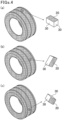
- a rubber piece may be cut out of a tire tread rubber, as shown in Figs. 4 .
- the cutting is carried out so that a ground contact face (tread face 20 in Figs. 4 ) that formed a tire tread contact portion is left in the rubber piece.
- the cut rubber piece may be used to prepare a specimen shaped to have the ground contact face (tread face 20 in Figs. 4 ) that formed a tire tread contact portion, and a measurement face that is perpendicular to the ground contact face and extends in the tire radial direction (see Figs. 4 ).
- the measurement face of the specimen there are a total of four possible faces, including two faces shown in Figs. 4 (measurement faces 30 in Figs. 4 ) and two faces not shown in the figure, i.e., the hidden back sides, and any of these faces may be used as the measurement face.
- the rubber piece may be cut out of any part of the tire as long as the cut rubber piece has the tread face 20, as shown in Figs. 4 (a) to (c) .
- the rubber piece may be cut out along the tire circumferential direction or at an angle different from the tire circumferential direction.
- the measurement face may be formed by cutting out the rubber piece as shown in Figs. 4 , or by further processing the cut rubber piece.
- the Martens hardness of the measurement face of the specimen prepared in the specimen preparation step may be measured along the tire radial direction using a microhardness tester or a thin film hardness tester.
- the Martens hardness may be measured at any interval. It is preferably measured at intervals of 20 um because then both efficiency and accuracy can be provided.
- microhardness tester examples include indenter microhardness testers, TI-950 Triboindenter available from Hysitron, Picodentor HM500 available from Fischer, DUH-W201S dynamic ultra micro hardness tester available from Shimadzu Corporation, HM-2000 available from Fischer Instruments, and Fischerscope H100 available from Fischer Instruments.
- Any thin film hardness tester may be used, and examples include Martens hardness testers, ENT-2100 nanoindenter available from Elionix Inc., and MHA-400 thin film hardness tester available from NEC Corporation. Thin film hardness testers are preferred among these.
- the Martens hardness may be measured in any region, but preferably in a region of the measurement face corresponding to 10 um to 200 um (preferably 20 um to 200 um) deep in the tire radial direction from the tire surface. In this case, grip performance can be efficiently evaluated.
- the surface roughness (um) of the measurement face is preferably 2 or less, more preferably 1 or less, still more preferably 0.5 or less, while the lower limit is not limited. In this case, grip performance can be more suitably evaluated.
- surface roughness refers to the center line surface roughness Ra defined in JIS B0601-2001.
- the load applied to the indenter is preferably 30 mgf or more, more preferably 50 mgf or more, but is preferably 200 mgf or less, more preferably 100 mgf or less. In this case, grip performance can be more suitably evaluated.
- the indentation depth of the indenter may be appropriately controlled, but is preferably 10 um or less, more preferably 8 um or less, but preferably 2 um or more, more preferably 5 um or more. In this case, grip performance can be more suitably evaluated.
- the surface of the measurement face of the specimen prepared in the specimen preparation step to a depth of 20 um or more (preferably 200 um or more, more preferably 500 um or more, with no limitation on the upper limit) to form a new measurement face, and measure the Martens hardness of the new measurement face.
- grip performance can be more suitably evaluated.
- the Martens hardness is preferably measured within six hours from the formation of the measurement face to be actually measured.
- grip performance may be evaluated based on the Martens hardness distribution determined in the measurement step. Specifically, grip performance (in particular, grip performance both before and after running-in) may be evaluated based on whether relationship (I) is satisfied or not by the minimum (a) and maximum (b) Martens hardnesses in a region from 10 um to 200 um deep in the tire radial direction from the tire surface.
- the methods for evaluating tire grip performance include: preparing a specimen cut out of a tire tread rubber, wherein the specimen has a ground contact face that formed a tire tread contact portion, and a measurement face that is perpendicular to the ground contact face and extends in the tire radial direction; and measuring the Martens hardness of the measurement face of the specimen prepared in the specimen preparation step along the tire radial direction using a microhardness tester or a thin film hardness tester.
- the methods can evaluate tire grip performance (in particular, grip performance both before and after running-in).
- the chemicals other than the sulfur and vulcanization accelerators were kneaded using a 1.7 L Banbury mixer (Kobe Steel, Ltd.) at 150°C for five minutes to give a kneaded mixture. Then, the kneaded mixture was kneaded with the sulfur and vulcanization accelerators in an open roll mill at 80°C for five minutes to give an unvulcanized rubber composition.
- the unvulcanized rubber composition was formed into the shape of a cap tread and assembled with other tire components to build an unvulcanized tire.
- the unvulcanized tire was press-vulcanized at 170°C for 10 minutes to obtain a tire (size: 225/50R17, thickness of tread rubber in tire radial direction: 9 mm).
- the tire was left in a warehouse at an air temperature of 20 to 40°C for three months and then used as a test tire.
- test tires prepared as above were evaluated as described below.
- Table 2 shows the results.
- a rubber piece was cut out of the tread rubber of the test tire. The cutting was carried out so that a ground contact face that had formed a tire tread contact portion was left in the rubber piece. Then, the cut rubber piece was used to prepare a specimen shaped to have the ground contact face that had formed a tire tread contact portion, and a measurement face that was perpendicular to the ground contact face and extended in the tire radial direction (see Figs. 4 ).
- the surface of the measurement face of the specimen was removed to a depth of 500 ⁇ m to form a new measurement face immediately before (one hour before) the measurement. Then, the Martens hardness was measured along the tire radial direction in a region of the new measurement face corresponding to 10 um to 200 um deep in the tire radial direction from the tire surface. Then, the minimum (a) and maximum (b) Martens hardnesses in a region from 10 um to 200 ⁇ m deep in the tire radial direction from the tire surface were determined.
- the Martens hardnesses were measured as follows.
- the measurement was carried out using ENT-2100 nanoindenter (thin film hardness tester) available from Elionix Inc.
- the measurement conditions are as follows.
- Martens hardness F / As h .
- a set of the test tires was mounted on each wheel of a car (2500 cc, 4WD, made in Japan).
- a driver drove the car on wet asphalt and subjectively evaluated grip, response, deceleration upon braking, and circuit trace performance.
- a higher index indicates better grip performance (wet grip performance) before running-in.
- the driver After the evaluation of grip performance (wet grip performance) before running-in, the driver further drove the car about 70 km for 0.5 hours on the circuit so that the tread face was worn to a depth of about 10 um. Thereafter, the driver made a subjective evaluation as in the evaluation of grip performance (wet grip performance) before running-in.
- Table 2 shows that the tires of the examples including a tread rubber satisfying relationship (I) exhibited satisfactory grip performance both before and after running-in.
- the phenylenediamine antioxidants tend to be distributed more uniformly over the surface, resulting in a further reduced Martens hardness (a).
- the use of the surfactants, microcrystalline wax, or other additives tends to reduce the Martens hardness (a), even when the liquid plasticizer content is low and the resin content is high.
- a higher silica content tends to be accompanied by a higher liquid plasticizer content, resulting in a reduced Martens hardness (a).
- Grip performance (in particular, grip performance both before and after running-in) can be evaluated based on whether relationship (I) is satisfied or not by the minimum (a) and maximum (b) Martens hardnesses in a region from 10 um to 200 um deep in the tire radial direction from the tire surface.
Landscapes
- Engineering & Computer Science (AREA)
- Mechanical Engineering (AREA)
- Compositions Of Macromolecular Compounds (AREA)
- Tires In General (AREA)
Claims (7)
- Reifen, umfassend einen Laufstreifenkautschuk,wobei der Laufstreifenkautschuk dem folgenden Verhältnis (I) genügt:
 wobei der Laufstreifenkautschuk mit einer Kautschukzusammensetzung gebildet ist, die, pro 100 Massenteile einer Kautschukkomponente darin, 3,4 Massenteile oder mehr mindestens eines Phenylendiamin-Antioxidans umfasst; undwobei der Laufstreifenkautschuk mit einer Kautschukzusammensetzung gebildet ist, die, pro 100 Massenteile einer Kautschukkomponente darin, 20 Massenteile oder mehr mindestens eines flüssigen Weichmachers umfasst.
 - Reifen nach Anspruch 1,
wobei die minimale Martenshärte (a) 0,35 mgf/µm2 oder weniger beträgt. - Reifen nach Anspruch 1 oder 2,
wobei die maximale Martenshärte (b) 0,05 mgf/µm2 oder mehr beträgt. - Reifen nach einem der Ansprüche 1 bis 3,
wobei der Laufstreifenkautschuk mit einer Kautschukzusammensetzung gebildet ist, die, pro 100 Massenteile einer Kautschukkomponente darin, 0,1 Massenteile oder mehr mindestens einer Amidverbindung oder mindestens eines nicht-ionischen Tensids mit einem SP-Wert von 9,0 oder höher umfasst. - Verfahren zur Bewertung von Reifengriffigkeitsleistung, welches umfasst:Herstellen eines aus einem Reifenlaufstreifenkautschuk ausgeschnittenen Prüfkörpers, wobei der Prüfkörper eine Bodenkontaktfläche, die einen Reifenlaufstreifenkontaktabschnitt bildete, und eine Messfläche, die senkrecht zu der Bodenkontaktfläche ist und sich in einer Reifenradialrichtung erstreckt, aufweist; undMessen einer Martenshärte der Messfläche des in dem Prüfkörper-Herstellungsschritt hergestellten Prüfkörpers entlang der Reifenradialrichtung unter Verwendung eines Mikrohärteprüfgeräts oder eines Dünnschichthärteprüfgeräts.
- Verfahren zur Bewertung von Reifengriffigkeitsleistung nach Anspruch 5,
wobei der Messschritt Messen der Martenshärte in einem Bereich der Messfläche umfasst, der 10 µm bis 200 µm Tiefe in der Reifenradialrichtung von einer Reifenoberfläche aus entspricht. - Verfahren zur Bewertung von Reifengriffigkeitsleistung nach Anspruch 5 oder 6,
wobei das Verfahren, vor dem Messen der Martenshärte, Entfernen einer Oberfläche der Messfläche des im Prüfkörper-Herstellungsschritt hergestellten Prüfkörpers bis zu einer Tiefe von 20 µm oder mehr, um eine neue Messfläche zu bilden, und Messen der Martenshärte der neuen Messfläche umfasst.
Applications Claiming Priority (2)
| Application Number | Priority Date | Filing Date | Title |
|---|---|---|---|
| JP2018182770 | 2018-09-27 | ||
| PCT/JP2019/034993 WO2020066527A1 (ja) | 2018-09-27 | 2019-09-05 | タイヤ及びタイヤのグリップ性能の評価方法 |
Publications (3)
| Publication Number | Publication Date |
|---|---|
| EP3848209A1 EP3848209A1 (de) | 2021-07-14 |
| EP3848209A4 EP3848209A4 (de) | 2022-06-08 |
| EP3848209B1 true EP3848209B1 (de) | 2023-11-01 |
Family
ID=69953416
Family Applications (1)
| Application Number | Title | Priority Date | Filing Date |
|---|---|---|---|
| EP19864813.1A Active EP3848209B1 (de) | 2018-09-27 | 2019-09-05 | Reifen und verfahren zur bewertung der haftleistung eines reifens |
Country Status (4)
| Country | Link |
|---|---|
| EP (1) | EP3848209B1 (de) |
| JP (1) | JP7517151B2 (de) |
| CN (1) | CN112672891A (de) |
| WO (1) | WO2020066527A1 (de) |
Families Citing this family (11)
| Publication number | Priority date | Publication date | Assignee | Title |
|---|---|---|---|---|
| CN111303480B (zh) * | 2020-04-26 | 2021-07-13 | 常州市五洲化工有限公司 | 一种硫化促进型综合防护材料及其制备方法 |
| US20250026914A1 (en) * | 2021-08-06 | 2025-01-23 | Bridgestone Corporation | Rubber composition for tire and tire |
| JPWO2023013780A1 (de) * | 2021-08-06 | 2023-02-09 | ||
| JP2023024192A (ja) * | 2021-08-06 | 2023-02-16 | 株式会社ブリヂストン | タイヤ用ゴム組成物及びタイヤ |
| EP4382566A4 (de) * | 2021-08-06 | 2024-10-30 | Bridgestone Corporation | Reifenkautschukzusammensetzung und reifen |
| EP4382567A4 (de) * | 2021-08-06 | 2024-10-30 | Bridgestone Corporation | Reifenkautschukzusammensetzung und reifen |
| EP4428189A4 (de) * | 2021-11-05 | 2025-02-26 | Bridgestone Corporation | Kautschukzusammensetzung für reifen, kautschukelement für reifen und reifen |
| JP7779095B2 (ja) * | 2021-11-12 | 2025-12-03 | 住友ゴム工業株式会社 | タイヤ用ゴム組成物及びタイヤ |
| US20260035547A1 (en) * | 2022-08-10 | 2026-02-05 | The Yokohama Rubber Co., Ltd. | Rubber composition |
| KR102931937B1 (ko) * | 2024-02-08 | 2026-03-03 | 넥센타이어 주식회사 | 공명기를 적용한 타이어 시험용 시편 및 타이어 소음 시험법 |
| WO2026042756A1 (ja) * | 2024-08-22 | 2026-02-26 | 株式会社Eneosマテリアル | ゴム組成物及びタイヤ |
Family Cites Families (29)
| Publication number | Priority date | Publication date | Assignee | Title |
|---|---|---|---|---|
| JP4405874B2 (ja) | 2004-08-19 | 2010-01-27 | 住友ゴム工業株式会社 | ゴム組成物およびそれを用いたタイヤ |
| WO2007019561A1 (en) * | 2005-08-09 | 2007-02-15 | Arizona Chemical Company | Rubber compositions containing improved tackifiers |
| JP5144017B2 (ja) * | 2006-02-27 | 2013-02-13 | 住友ゴム工業株式会社 | トレッド用ゴム組成物およびそれを用いたトレッドを有する空気入りタイヤ |
| JP5200134B2 (ja) | 2010-07-16 | 2013-05-15 | 住友ゴム工業株式会社 | トレッド用ゴム組成物及び空気入りタイヤ |
| FR2968307B1 (fr) * | 2010-11-26 | 2018-04-06 | Societe De Technologie Michelin | Bande de roulement de pneumatique |
| JP5559234B2 (ja) | 2011-08-09 | 2014-07-23 | 住友ゴム工業株式会社 | タイヤ用ゴム組成物及び空気入りタイヤ |
| JP5391312B2 (ja) * | 2011-09-26 | 2014-01-15 | 住友ゴム工業株式会社 | タイヤ外層用ゴム組成物及び空気入りタイヤ |
| JP6025494B2 (ja) | 2012-02-07 | 2016-11-16 | 住友ゴム工業株式会社 | 空気入りタイヤ |
| JP2014213508A (ja) | 2013-04-24 | 2014-11-17 | 住友ゴム工業株式会社 | 空気入りタイヤの製造方法および空気入りタイヤ |
| JP5767753B2 (ja) * | 2013-04-30 | 2015-08-19 | 住友ゴム工業株式会社 | タイヤ用ゴム組成物及び空気入りタイヤ |
| JP5946798B2 (ja) | 2013-06-18 | 2016-07-06 | 住友ゴム工業株式会社 | タイヤ用ゴム組成物、及び空気入りタイヤ |
| JP6151992B2 (ja) | 2013-07-05 | 2017-06-21 | 住友ゴム工業株式会社 | 空気入りタイヤ |
| JP2015013975A (ja) | 2013-07-08 | 2015-01-22 | 住友ゴム工業株式会社 | タイヤ用ゴム組成物及び空気入りタイヤ |
| JP2015125034A (ja) * | 2013-12-26 | 2015-07-06 | 住友ゴム工業株式会社 | ゴム組成物の評価方法 |
| JP6055118B2 (ja) * | 2014-01-07 | 2016-12-27 | 住友ゴム工業株式会社 | 空気入りタイヤ |
| JP6282915B2 (ja) | 2014-04-03 | 2018-02-21 | 住友ゴム工業株式会社 | 空気入りタイヤ |
| JP2015232110A (ja) * | 2014-05-13 | 2015-12-24 | 住友ゴム工業株式会社 | ゴム組成物およびタイヤ |
| JP6228157B2 (ja) * | 2014-05-15 | 2017-11-08 | 住友ゴム工業株式会社 | ゴム組成物及び空気入りタイヤ |
| JP6030696B1 (ja) * | 2015-04-21 | 2016-11-24 | 住友ゴム工業株式会社 | ゴム組成物及び空気入りタイヤ |
| US9441098B1 (en) | 2015-11-18 | 2016-09-13 | The Goodyear Tire & Rubber Company | Tire with tread for low temperature performance and wet traction |
| JP6769028B2 (ja) | 2015-12-04 | 2020-10-14 | 住友ゴム工業株式会社 | タイヤ |
| JP6552454B2 (ja) | 2016-06-01 | 2019-07-31 | 住友ゴム工業株式会社 | タイヤ用ゴム組成物、及び空気入りタイヤ |
| JP6834195B2 (ja) | 2016-07-04 | 2021-02-24 | 住友ゴム工業株式会社 | ゴム組成物 |
| JP6288172B2 (ja) * | 2016-07-05 | 2018-03-07 | 横浜ゴム株式会社 | タイヤ用ゴム組成物の製造方法およびスタッドレスタイヤの製造方法 |
| US11015041B2 (en) | 2016-08-17 | 2021-05-25 | Continental Reifen Deutschland Gmbh | Rubber blend, sulfur-crosslinkable rubber mixture, and vehicle tire |
| JP6285520B1 (ja) | 2016-09-30 | 2018-02-28 | 住友ゴム工業株式会社 | 空気入りタイヤ |
| JP6897080B2 (ja) | 2016-12-09 | 2021-06-30 | 住友ゴム工業株式会社 | ゴム組成物及び空気入りタイヤ |
| EP3569651B1 (de) | 2017-01-12 | 2022-04-27 | The Yokohama Rubber Co., Ltd. | Kautschukzusammensetzung für reifenlaufflächen und luftreifen |
| JP7275526B2 (ja) * | 2018-10-18 | 2023-05-18 | 住友ゴム工業株式会社 | タイヤ |
-
2019
- 2019-09-05 EP EP19864813.1A patent/EP3848209B1/de active Active
- 2019-09-05 WO PCT/JP2019/034993 patent/WO2020066527A1/ja not_active Ceased
- 2019-09-05 JP JP2020548311A patent/JP7517151B2/ja active Active
- 2019-09-05 CN CN201980059188.8A patent/CN112672891A/zh active Pending
Also Published As
| Publication number | Publication date |
|---|---|
| WO2020066527A1 (ja) | 2020-04-02 |
| JPWO2020066527A1 (ja) | 2021-09-02 |
| EP3848209A4 (de) | 2022-06-08 |
| JP7517151B2 (ja) | 2024-07-17 |
| CN112672891A (zh) | 2021-04-16 |
| EP3848209A1 (de) | 2021-07-14 |
Similar Documents
| Publication | Publication Date | Title |
|---|---|---|
| EP3848209B1 (de) | Reifen und verfahren zur bewertung der haftleistung eines reifens | |
| EP3978269B1 (de) | Reifen | |
| EP4046819B1 (de) | Reifen | |
| EP3950387A1 (de) | Reifen | |
| EP3872129A1 (de) | Reifenzusammensetzung und reifen | |
| EP4177082A1 (de) | Luftreifen | |
| EP4035905B1 (de) | Kautschukzusammensetzung und reifen | |
| JP7275526B2 (ja) | タイヤ | |
| EP3950813B1 (de) | Kautschukzusammensetzung und reifen | |
| EP3808570B1 (de) | Basislaufflächenzusammensetzung und reifen | |
| EP3683259B1 (de) | Vulkanisierte kautschukzusammensetzung und reifen | |
| EP4296094A1 (de) | Reifen | |
| EP3808569B1 (de) | Reifenzusammensetzung und reifen | |
| JP2024121697A (ja) | タイヤ | |
| EP4296082A1 (de) | Reifen | |
| JP2024126537A (ja) | タイヤ | |
| JP2024126539A (ja) | タイヤ | |
| JP7792745B2 (ja) | タイヤ用組成物及びタイヤ | |
| US11993716B2 (en) | Rubber composition and tire | |
| EP4190597A1 (de) | Luftreifen | |
| JP2024121698A (ja) | タイヤ | |
| JP2024121696A (ja) | タイヤ | |
| JP2025007118A (ja) | タイヤ | |
| JP2025007119A (ja) | タイヤ | |
| JP2024121699A (ja) | タイヤ |
Legal Events
| Date | Code | Title | Description |
|---|---|---|---|
| STAA | Information on the status of an ep patent application or granted ep patent |
Free format text: STATUS: THE INTERNATIONAL PUBLICATION HAS BEEN MADE |
|
| PUAI | Public reference made under article 153(3) epc to a published international application that has entered the european phase |
Free format text: ORIGINAL CODE: 0009012 |
|
| STAA | Information on the status of an ep patent application or granted ep patent |
Free format text: STATUS: REQUEST FOR EXAMINATION WAS MADE |
|
| 17P | Request for examination filed |
Effective date: 20210408 |
|
| AK | Designated contracting states |
Kind code of ref document: A1 Designated state(s): AL AT BE BG CH CY CZ DE DK EE ES FI FR GB GR HR HU IE IS IT LI LT LU LV MC MK MT NL NO PL PT RO RS SE SI SK SM TR |
|
| DAV | Request for validation of the european patent (deleted) | ||
| DAX | Request for extension of the european patent (deleted) | ||
| A4 | Supplementary search report drawn up and despatched |
Effective date: 20220511 |
|
| RIC1 | Information provided on ipc code assigned before grant |
Ipc: C08L 21/00 20060101ALI20220505BHEP Ipc: C08K 5/18 20060101ALI20220505BHEP Ipc: B60C 19/00 20060101ALI20220505BHEP Ipc: B60C 1/00 20060101ALI20220505BHEP Ipc: B60C 11/00 20060101AFI20220505BHEP |
|
| P01 | Opt-out of the competence of the unified patent court (upc) registered |
Effective date: 20230510 |
|
| GRAP | Despatch of communication of intention to grant a patent |
Free format text: ORIGINAL CODE: EPIDOSNIGR1 |
|
| STAA | Information on the status of an ep patent application or granted ep patent |
Free format text: STATUS: GRANT OF PATENT IS INTENDED |
|
| INTG | Intention to grant announced |
Effective date: 20230712 |
|
| GRAS | Grant fee paid |
Free format text: ORIGINAL CODE: EPIDOSNIGR3 |
|
| GRAA | (expected) grant |
Free format text: ORIGINAL CODE: 0009210 |
|
| STAA | Information on the status of an ep patent application or granted ep patent |
Free format text: STATUS: THE PATENT HAS BEEN GRANTED |
|
| AK | Designated contracting states |
Kind code of ref document: B1 Designated state(s): AL AT BE BG CH CY CZ DE DK EE ES FI FR GB GR HR HU IE IS IT LI LT LU LV MC MK MT NL NO PL PT RO RS SE SI SK SM TR |
|
| REG | Reference to a national code |
Ref country code: GB Ref legal event code: FG4D |
|
| REG | Reference to a national code |
Ref country code: CH Ref legal event code: EP |
|
| REG | Reference to a national code |
Ref country code: IE Ref legal event code: FG4D |
|
| REG | Reference to a national code |
Ref country code: DE Ref legal event code: R096 Ref document number: 602019040789 Country of ref document: DE |
|
| REG | Reference to a national code |
Ref country code: LT Ref legal event code: MG9D |
|
| REG | Reference to a national code |
Ref country code: NL Ref legal event code: MP Effective date: 20231101 |
|
| PG25 | Lapsed in a contracting state [announced via postgrant information from national office to epo] |
Ref country code: GR Free format text: LAPSE BECAUSE OF FAILURE TO SUBMIT A TRANSLATION OF THE DESCRIPTION OR TO PAY THE FEE WITHIN THE PRESCRIBED TIME-LIMIT Effective date: 20240202 |
|
| PG25 | Lapsed in a contracting state [announced via postgrant information from national office to epo] |
Ref country code: IS Free format text: LAPSE BECAUSE OF FAILURE TO SUBMIT A TRANSLATION OF THE DESCRIPTION OR TO PAY THE FEE WITHIN THE PRESCRIBED TIME-LIMIT Effective date: 20240301 |
|
| PG25 | Lapsed in a contracting state [announced via postgrant information from national office to epo] |
Ref country code: LT Free format text: LAPSE BECAUSE OF FAILURE TO SUBMIT A TRANSLATION OF THE DESCRIPTION OR TO PAY THE FEE WITHIN THE PRESCRIBED TIME-LIMIT Effective date: 20231101 |
|
| REG | Reference to a national code |
Ref country code: AT Ref legal event code: MK05 Ref document number: 1626802 Country of ref document: AT Kind code of ref document: T Effective date: 20231101 |
|
| PG25 | Lapsed in a contracting state [announced via postgrant information from national office to epo] |
Ref country code: NL Free format text: LAPSE BECAUSE OF FAILURE TO SUBMIT A TRANSLATION OF THE DESCRIPTION OR TO PAY THE FEE WITHIN THE PRESCRIBED TIME-LIMIT Effective date: 20231101 |
|
| PG25 | Lapsed in a contracting state [announced via postgrant information from national office to epo] |
Ref country code: AT Free format text: LAPSE BECAUSE OF FAILURE TO SUBMIT A TRANSLATION OF THE DESCRIPTION OR TO PAY THE FEE WITHIN THE PRESCRIBED TIME-LIMIT Effective date: 20231101 |
|
| PG25 | Lapsed in a contracting state [announced via postgrant information from national office to epo] |
Ref country code: ES Free format text: LAPSE BECAUSE OF FAILURE TO SUBMIT A TRANSLATION OF THE DESCRIPTION OR TO PAY THE FEE WITHIN THE PRESCRIBED TIME-LIMIT Effective date: 20231101 |
|
| PG25 | Lapsed in a contracting state [announced via postgrant information from national office to epo] |
Ref country code: NL Free format text: LAPSE BECAUSE OF FAILURE TO SUBMIT A TRANSLATION OF THE DESCRIPTION OR TO PAY THE FEE WITHIN THE PRESCRIBED TIME-LIMIT Effective date: 20231101 Ref country code: LT Free format text: LAPSE BECAUSE OF FAILURE TO SUBMIT A TRANSLATION OF THE DESCRIPTION OR TO PAY THE FEE WITHIN THE PRESCRIBED TIME-LIMIT Effective date: 20231101 Ref country code: IS Free format text: LAPSE BECAUSE OF FAILURE TO SUBMIT A TRANSLATION OF THE DESCRIPTION OR TO PAY THE FEE WITHIN THE PRESCRIBED TIME-LIMIT Effective date: 20240301 Ref country code: GR Free format text: LAPSE BECAUSE OF FAILURE TO SUBMIT A TRANSLATION OF THE DESCRIPTION OR TO PAY THE FEE WITHIN THE PRESCRIBED TIME-LIMIT Effective date: 20240202 Ref country code: ES Free format text: LAPSE BECAUSE OF FAILURE TO SUBMIT A TRANSLATION OF THE DESCRIPTION OR TO PAY THE FEE WITHIN THE PRESCRIBED TIME-LIMIT Effective date: 20231101 Ref country code: BG Free format text: LAPSE BECAUSE OF FAILURE TO SUBMIT A TRANSLATION OF THE DESCRIPTION OR TO PAY THE FEE WITHIN THE PRESCRIBED TIME-LIMIT Effective date: 20240201 Ref country code: AT Free format text: LAPSE BECAUSE OF FAILURE TO SUBMIT A TRANSLATION OF THE DESCRIPTION OR TO PAY THE FEE WITHIN THE PRESCRIBED TIME-LIMIT Effective date: 20231101 Ref country code: PT Free format text: LAPSE BECAUSE OF FAILURE TO SUBMIT A TRANSLATION OF THE DESCRIPTION OR TO PAY THE FEE WITHIN THE PRESCRIBED TIME-LIMIT Effective date: 20240301 |
|
| PG25 | Lapsed in a contracting state [announced via postgrant information from national office to epo] |
Ref country code: SE Free format text: LAPSE BECAUSE OF FAILURE TO SUBMIT A TRANSLATION OF THE DESCRIPTION OR TO PAY THE FEE WITHIN THE PRESCRIBED TIME-LIMIT Effective date: 20231101 Ref country code: RS Free format text: LAPSE BECAUSE OF FAILURE TO SUBMIT A TRANSLATION OF THE DESCRIPTION OR TO PAY THE FEE WITHIN THE PRESCRIBED TIME-LIMIT Effective date: 20231101 Ref country code: PL Free format text: LAPSE BECAUSE OF FAILURE TO SUBMIT A TRANSLATION OF THE DESCRIPTION OR TO PAY THE FEE WITHIN THE PRESCRIBED TIME-LIMIT Effective date: 20231101 Ref country code: NO Free format text: LAPSE BECAUSE OF FAILURE TO SUBMIT A TRANSLATION OF THE DESCRIPTION OR TO PAY THE FEE WITHIN THE PRESCRIBED TIME-LIMIT Effective date: 20240201 Ref country code: LV Free format text: LAPSE BECAUSE OF FAILURE TO SUBMIT A TRANSLATION OF THE DESCRIPTION OR TO PAY THE FEE WITHIN THE PRESCRIBED TIME-LIMIT Effective date: 20231101 Ref country code: HR Free format text: LAPSE BECAUSE OF FAILURE TO SUBMIT A TRANSLATION OF THE DESCRIPTION OR TO PAY THE FEE WITHIN THE PRESCRIBED TIME-LIMIT Effective date: 20231101 |
|
| PG25 | Lapsed in a contracting state [announced via postgrant information from national office to epo] |
Ref country code: DK Free format text: LAPSE BECAUSE OF FAILURE TO SUBMIT A TRANSLATION OF THE DESCRIPTION OR TO PAY THE FEE WITHIN THE PRESCRIBED TIME-LIMIT Effective date: 20231101 |
|
| PG25 | Lapsed in a contracting state [announced via postgrant information from national office to epo] |
Ref country code: CZ Free format text: LAPSE BECAUSE OF FAILURE TO SUBMIT A TRANSLATION OF THE DESCRIPTION OR TO PAY THE FEE WITHIN THE PRESCRIBED TIME-LIMIT Effective date: 20231101 |
|
| PG25 | Lapsed in a contracting state [announced via postgrant information from national office to epo] |
Ref country code: SK Free format text: LAPSE BECAUSE OF FAILURE TO SUBMIT A TRANSLATION OF THE DESCRIPTION OR TO PAY THE FEE WITHIN THE PRESCRIBED TIME-LIMIT Effective date: 20231101 |
|
| PG25 | Lapsed in a contracting state [announced via postgrant information from national office to epo] |
Ref country code: SM Free format text: LAPSE BECAUSE OF FAILURE TO SUBMIT A TRANSLATION OF THE DESCRIPTION OR TO PAY THE FEE WITHIN THE PRESCRIBED TIME-LIMIT Effective date: 20231101 Ref country code: SK Free format text: LAPSE BECAUSE OF FAILURE TO SUBMIT A TRANSLATION OF THE DESCRIPTION OR TO PAY THE FEE WITHIN THE PRESCRIBED TIME-LIMIT Effective date: 20231101 Ref country code: IT Free format text: LAPSE BECAUSE OF FAILURE TO SUBMIT A TRANSLATION OF THE DESCRIPTION OR TO PAY THE FEE WITHIN THE PRESCRIBED TIME-LIMIT Effective date: 20231101 Ref country code: EE Free format text: LAPSE BECAUSE OF FAILURE TO SUBMIT A TRANSLATION OF THE DESCRIPTION OR TO PAY THE FEE WITHIN THE PRESCRIBED TIME-LIMIT Effective date: 20231101 Ref country code: DK Free format text: LAPSE BECAUSE OF FAILURE TO SUBMIT A TRANSLATION OF THE DESCRIPTION OR TO PAY THE FEE WITHIN THE PRESCRIBED TIME-LIMIT Effective date: 20231101 Ref country code: CZ Free format text: LAPSE BECAUSE OF FAILURE TO SUBMIT A TRANSLATION OF THE DESCRIPTION OR TO PAY THE FEE WITHIN THE PRESCRIBED TIME-LIMIT Effective date: 20231101 |
|
| REG | Reference to a national code |
Ref country code: DE Ref legal event code: R097 Ref document number: 602019040789 Country of ref document: DE |
|
| PLBE | No opposition filed within time limit |
Free format text: ORIGINAL CODE: 0009261 |
|
| STAA | Information on the status of an ep patent application or granted ep patent |
Free format text: STATUS: NO OPPOSITION FILED WITHIN TIME LIMIT |
|
| 26N | No opposition filed |
Effective date: 20240802 |
|
| PG25 | Lapsed in a contracting state [announced via postgrant information from national office to epo] |
Ref country code: SI Free format text: LAPSE BECAUSE OF FAILURE TO SUBMIT A TRANSLATION OF THE DESCRIPTION OR TO PAY THE FEE WITHIN THE PRESCRIBED TIME-LIMIT Effective date: 20231101 |
|
| PG25 | Lapsed in a contracting state [announced via postgrant information from national office to epo] |
Ref country code: SI Free format text: LAPSE BECAUSE OF FAILURE TO SUBMIT A TRANSLATION OF THE DESCRIPTION OR TO PAY THE FEE WITHIN THE PRESCRIBED TIME-LIMIT Effective date: 20231101 |
|
| PG25 | Lapsed in a contracting state [announced via postgrant information from national office to epo] |
Ref country code: MC Free format text: LAPSE BECAUSE OF FAILURE TO SUBMIT A TRANSLATION OF THE DESCRIPTION OR TO PAY THE FEE WITHIN THE PRESCRIBED TIME-LIMIT Effective date: 20231101 |
|
| REG | Reference to a national code |
Ref country code: CH Ref legal event code: PL |
|
| PG25 | Lapsed in a contracting state [announced via postgrant information from national office to epo] |
Ref country code: LU Free format text: LAPSE BECAUSE OF NON-PAYMENT OF DUE FEES Effective date: 20240905 |
|
| GBPC | Gb: european patent ceased through non-payment of renewal fee |
Effective date: 20240905 |
|
| PG25 | Lapsed in a contracting state [announced via postgrant information from national office to epo] |
Ref country code: GB Free format text: LAPSE BECAUSE OF NON-PAYMENT OF DUE FEES Effective date: 20240905 |
|
| REG | Reference to a national code |
Ref country code: BE Ref legal event code: MM Effective date: 20240930 |
|
| PG25 | Lapsed in a contracting state [announced via postgrant information from national office to epo] |
Ref country code: BE Free format text: LAPSE BECAUSE OF NON-PAYMENT OF DUE FEES Effective date: 20240930 |
|
| PG25 | Lapsed in a contracting state [announced via postgrant information from national office to epo] |
Ref country code: CH Free format text: LAPSE BECAUSE OF NON-PAYMENT OF DUE FEES Effective date: 20240930 |
|
| PG25 | Lapsed in a contracting state [announced via postgrant information from national office to epo] |
Ref country code: IE Free format text: LAPSE BECAUSE OF NON-PAYMENT OF DUE FEES Effective date: 20240905 |
|
| PG25 | Lapsed in a contracting state [announced via postgrant information from national office to epo] |
Ref country code: FI Free format text: LAPSE BECAUSE OF FAILURE TO SUBMIT A TRANSLATION OF THE DESCRIPTION OR TO PAY THE FEE WITHIN THE PRESCRIBED TIME-LIMIT Effective date: 20231101 |
|
| PGFP | Annual fee paid to national office [announced via postgrant information from national office to epo] |
Ref country code: DE Payment date: 20250730 Year of fee payment: 7 |
|
| PGFP | Annual fee paid to national office [announced via postgrant information from national office to epo] |
Ref country code: FR Payment date: 20250808 Year of fee payment: 7 |
|
| PG25 | Lapsed in a contracting state [announced via postgrant information from national office to epo] |
Ref country code: RO Free format text: LAPSE BECAUSE OF FAILURE TO SUBMIT A TRANSLATION OF THE DESCRIPTION OR TO PAY THE FEE WITHIN THE PRESCRIBED TIME-LIMIT Effective date: 20231101 |
|
| PG25 | Lapsed in a contracting state [announced via postgrant information from national office to epo] |
Ref country code: CY Free format text: LAPSE BECAUSE OF FAILURE TO SUBMIT A TRANSLATION OF THE DESCRIPTION OR TO PAY THE FEE WITHIN THE PRESCRIBED TIME-LIMIT; INVALID AB INITIO Effective date: 20190905 |
|
| PG25 | Lapsed in a contracting state [announced via postgrant information from national office to epo] |
Ref country code: HU Free format text: LAPSE BECAUSE OF FAILURE TO SUBMIT A TRANSLATION OF THE DESCRIPTION OR TO PAY THE FEE WITHIN THE PRESCRIBED TIME-LIMIT; INVALID AB INITIO Effective date: 20190905 |