EP3848992B1 - Heterocyclische verbindung und organische lichtemittierende vorrichtung damit - Google Patents
Heterocyclische verbindung und organische lichtemittierende vorrichtung damit Download PDFInfo
- Publication number
- EP3848992B1 EP3848992B1 EP21159426.2A EP21159426A EP3848992B1 EP 3848992 B1 EP3848992 B1 EP 3848992B1 EP 21159426 A EP21159426 A EP 21159426A EP 3848992 B1 EP3848992 B1 EP 3848992B1
- Authority
- EP
- European Patent Office
- Prior art keywords
- group
- substituted
- unsubstituted
- aromatic condensed
- monovalent non
- Prior art date
- Legal status (The legal status is an assumption and is not a legal conclusion. Google has not performed a legal analysis and makes no representation as to the accuracy of the status listed.)
- Active
Links
Images
Classifications
-
- C—CHEMISTRY; METALLURGY
- C07—ORGANIC CHEMISTRY
- C07F—ACYCLIC, CARBOCYCLIC OR HETEROCYCLIC COMPOUNDS CONTAINING ELEMENTS OTHER THAN CARBON, HYDROGEN, HALOGEN, OXYGEN, NITROGEN, SULFUR, SELENIUM OR TELLURIUM
- C07F7/00—Compounds containing elements of Groups 4 or 14 of the Periodic Table
- C07F7/02—Silicon compounds
- C07F7/08—Compounds having one or more C—Si linkages
- C07F7/0803—Compounds with Si-C or Si-Si linkages
- C07F7/081—Compounds with Si-C or Si-Si linkages comprising at least one atom selected from the elements N, O, halogen, S, Se or Te
- C07F7/0812—Compounds with Si-C or Si-Si linkages comprising at least one atom selected from the elements N, O, halogen, S, Se or Te comprising a heterocyclic ring
- C07F7/0814—Compounds with Si-C or Si-Si linkages comprising at least one atom selected from the elements N, O, halogen, S, Se or Te comprising a heterocyclic ring said ring is substituted at a C ring atom by Si
-
- C—CHEMISTRY; METALLURGY
- C07—ORGANIC CHEMISTRY
- C07F—ACYCLIC, CARBOCYCLIC OR HETEROCYCLIC COMPOUNDS CONTAINING ELEMENTS OTHER THAN CARBON, HYDROGEN, HALOGEN, OXYGEN, NITROGEN, SULFUR, SELENIUM OR TELLURIUM
- C07F7/00—Compounds containing elements of Groups 4 or 14 of the Periodic Table
- C07F7/02—Silicon compounds
- C07F7/08—Compounds having one or more C—Si linkages
- C07F7/0803—Compounds with Si-C or Si-Si linkages
- C07F7/081—Compounds with Si-C or Si-Si linkages comprising at least one atom selected from the elements N, O, halogen, S, Se or Te
- C07F7/0812—Compounds with Si-C or Si-Si linkages comprising at least one atom selected from the elements N, O, halogen, S, Se or Te comprising a heterocyclic ring
-
- C—CHEMISTRY; METALLURGY
- C09—DYES; PAINTS; POLISHES; NATURAL RESINS; ADHESIVES; COMPOSITIONS NOT OTHERWISE PROVIDED FOR; APPLICATIONS OF MATERIALS NOT OTHERWISE PROVIDED FOR
- C09K—MATERIALS FOR MISCELLANEOUS APPLICATIONS, NOT PROVIDED FOR ELSEWHERE
- C09K11/00—Luminescent materials, e.g. electroluminescent or chemiluminescent
- C09K11/06—Luminescent materials, e.g. electroluminescent or chemiluminescent containing organic luminescent materials
-
- H—ELECTRICITY
- H10—SEMICONDUCTOR DEVICES; ELECTRIC SOLID-STATE DEVICES NOT OTHERWISE PROVIDED FOR
- H10K—ORGANIC ELECTRIC SOLID-STATE DEVICES
- H10K50/00—Organic light-emitting devices
- H10K50/10—OLEDs or polymer light-emitting diodes [PLED]
- H10K50/11—OLEDs or polymer light-emitting diodes [PLED] characterised by the electroluminescent [EL] layers
- H10K50/12—OLEDs or polymer light-emitting diodes [PLED] characterised by the electroluminescent [EL] layers comprising dopants
-
- H—ELECTRICITY
- H10—SEMICONDUCTOR DEVICES; ELECTRIC SOLID-STATE DEVICES NOT OTHERWISE PROVIDED FOR
- H10K—ORGANIC ELECTRIC SOLID-STATE DEVICES
- H10K85/00—Organic materials used in the body or electrodes of devices covered by this subclass
- H10K85/40—Organosilicon compounds, e.g. TIPS pentacene
-
- H—ELECTRICITY
- H10—SEMICONDUCTOR DEVICES; ELECTRIC SOLID-STATE DEVICES NOT OTHERWISE PROVIDED FOR
- H10K—ORGANIC ELECTRIC SOLID-STATE DEVICES
- H10K85/00—Organic materials used in the body or electrodes of devices covered by this subclass
- H10K85/60—Organic compounds having low molecular weight
-
- H—ELECTRICITY
- H10—SEMICONDUCTOR DEVICES; ELECTRIC SOLID-STATE DEVICES NOT OTHERWISE PROVIDED FOR
- H10K—ORGANIC ELECTRIC SOLID-STATE DEVICES
- H10K85/00—Organic materials used in the body or electrodes of devices covered by this subclass
- H10K85/60—Organic compounds having low molecular weight
- H10K85/631—Amine compounds having at least two aryl rest on at least one amine-nitrogen atom, e.g. triphenylamine
-
- H—ELECTRICITY
- H10—SEMICONDUCTOR DEVICES; ELECTRIC SOLID-STATE DEVICES NOT OTHERWISE PROVIDED FOR
- H10K—ORGANIC ELECTRIC SOLID-STATE DEVICES
- H10K85/00—Organic materials used in the body or electrodes of devices covered by this subclass
- H10K85/60—Organic compounds having low molecular weight
- H10K85/631—Amine compounds having at least two aryl rest on at least one amine-nitrogen atom, e.g. triphenylamine
- H10K85/636—Amine compounds having at least two aryl rest on at least one amine-nitrogen atom, e.g. triphenylamine comprising heteroaromatic hydrocarbons as substituents on the nitrogen atom
-
- H—ELECTRICITY
- H10—SEMICONDUCTOR DEVICES; ELECTRIC SOLID-STATE DEVICES NOT OTHERWISE PROVIDED FOR
- H10K—ORGANIC ELECTRIC SOLID-STATE DEVICES
- H10K85/00—Organic materials used in the body or electrodes of devices covered by this subclass
- H10K85/60—Organic compounds having low molecular weight
- H10K85/649—Aromatic compounds comprising a hetero atom
- H10K85/654—Aromatic compounds comprising a hetero atom comprising only nitrogen as heteroatom
-
- H—ELECTRICITY
- H10—SEMICONDUCTOR DEVICES; ELECTRIC SOLID-STATE DEVICES NOT OTHERWISE PROVIDED FOR
- H10K—ORGANIC ELECTRIC SOLID-STATE DEVICES
- H10K85/00—Organic materials used in the body or electrodes of devices covered by this subclass
- H10K85/60—Organic compounds having low molecular weight
- H10K85/649—Aromatic compounds comprising a hetero atom
- H10K85/657—Polycyclic condensed heteroaromatic hydrocarbons
- H10K85/6572—Polycyclic condensed heteroaromatic hydrocarbons comprising only nitrogen in the heteroaromatic polycondensed ring system, e.g. phenanthroline or carbazole
-
- H—ELECTRICITY
- H10—SEMICONDUCTOR DEVICES; ELECTRIC SOLID-STATE DEVICES NOT OTHERWISE PROVIDED FOR
- H10K—ORGANIC ELECTRIC SOLID-STATE DEVICES
- H10K85/00—Organic materials used in the body or electrodes of devices covered by this subclass
- H10K85/60—Organic compounds having low molecular weight
- H10K85/649—Aromatic compounds comprising a hetero atom
- H10K85/657—Polycyclic condensed heteroaromatic hydrocarbons
- H10K85/6574—Polycyclic condensed heteroaromatic hydrocarbons comprising only oxygen in the heteroaromatic polycondensed ring system, e.g. cumarine dyes
-
- H—ELECTRICITY
- H10—SEMICONDUCTOR DEVICES; ELECTRIC SOLID-STATE DEVICES NOT OTHERWISE PROVIDED FOR
- H10K—ORGANIC ELECTRIC SOLID-STATE DEVICES
- H10K85/00—Organic materials used in the body or electrodes of devices covered by this subclass
- H10K85/60—Organic compounds having low molecular weight
- H10K85/649—Aromatic compounds comprising a hetero atom
- H10K85/657—Polycyclic condensed heteroaromatic hydrocarbons
- H10K85/6576—Polycyclic condensed heteroaromatic hydrocarbons comprising only sulfur in the heteroaromatic polycondensed ring system, e.g. benzothiophene
-
- C—CHEMISTRY; METALLURGY
- C09—DYES; PAINTS; POLISHES; NATURAL RESINS; ADHESIVES; COMPOSITIONS NOT OTHERWISE PROVIDED FOR; APPLICATIONS OF MATERIALS NOT OTHERWISE PROVIDED FOR
- C09K—MATERIALS FOR MISCELLANEOUS APPLICATIONS, NOT PROVIDED FOR ELSEWHERE
- C09K2211/00—Chemical nature of organic luminescent or tenebrescent compounds
- C09K2211/10—Non-macromolecular compounds
- C09K2211/1018—Heterocyclic compounds
-
- H—ELECTRICITY
- H10—SEMICONDUCTOR DEVICES; ELECTRIC SOLID-STATE DEVICES NOT OTHERWISE PROVIDED FOR
- H10K—ORGANIC ELECTRIC SOLID-STATE DEVICES
- H10K2101/00—Properties of the organic materials covered by group H10K85/00
- H10K2101/10—Triplet emission
-
- H—ELECTRICITY
- H10—SEMICONDUCTOR DEVICES; ELECTRIC SOLID-STATE DEVICES NOT OTHERWISE PROVIDED FOR
- H10K—ORGANIC ELECTRIC SOLID-STATE DEVICES
- H10K2101/00—Properties of the organic materials covered by group H10K85/00
- H10K2101/30—Highest occupied molecular orbital [HOMO], lowest unoccupied molecular orbital [LUMO] or Fermi energy values
-
- H—ELECTRICITY
- H10—SEMICONDUCTOR DEVICES; ELECTRIC SOLID-STATE DEVICES NOT OTHERWISE PROVIDED FOR
- H10K—ORGANIC ELECTRIC SOLID-STATE DEVICES
- H10K50/00—Organic light-emitting devices
- H10K50/10—OLEDs or polymer light-emitting diodes [PLED]
- H10K50/11—OLEDs or polymer light-emitting diodes [PLED] characterised by the electroluminescent [EL] layers
-
- H—ELECTRICITY
- H10—SEMICONDUCTOR DEVICES; ELECTRIC SOLID-STATE DEVICES NOT OTHERWISE PROVIDED FOR
- H10K—ORGANIC ELECTRIC SOLID-STATE DEVICES
- H10K50/00—Organic light-emitting devices
- H10K50/10—OLEDs or polymer light-emitting diodes [PLED]
- H10K50/11—OLEDs or polymer light-emitting diodes [PLED] characterised by the electroluminescent [EL] layers
- H10K50/125—OLEDs or polymer light-emitting diodes [PLED] characterised by the electroluminescent [EL] layers specially adapted for multicolour light emission, e.g. for emitting white light
- H10K50/13—OLEDs or polymer light-emitting diodes [PLED] characterised by the electroluminescent [EL] layers specially adapted for multicolour light emission, e.g. for emitting white light comprising stacked EL layers within one EL unit
-
- H—ELECTRICITY
- H10—SEMICONDUCTOR DEVICES; ELECTRIC SOLID-STATE DEVICES NOT OTHERWISE PROVIDED FOR
- H10K—ORGANIC ELECTRIC SOLID-STATE DEVICES
- H10K50/00—Organic light-emitting devices
- H10K50/10—OLEDs or polymer light-emitting diodes [PLED]
- H10K50/14—Carrier transporting layers
- H10K50/15—Hole transporting layers
-
- H—ELECTRICITY
- H10—SEMICONDUCTOR DEVICES; ELECTRIC SOLID-STATE DEVICES NOT OTHERWISE PROVIDED FOR
- H10K—ORGANIC ELECTRIC SOLID-STATE DEVICES
- H10K50/00—Organic light-emitting devices
- H10K50/10—OLEDs or polymer light-emitting diodes [PLED]
- H10K50/14—Carrier transporting layers
- H10K50/16—Electron transporting layers
-
- H—ELECTRICITY
- H10—SEMICONDUCTOR DEVICES; ELECTRIC SOLID-STATE DEVICES NOT OTHERWISE PROVIDED FOR
- H10K—ORGANIC ELECTRIC SOLID-STATE DEVICES
- H10K50/00—Organic light-emitting devices
- H10K50/10—OLEDs or polymer light-emitting diodes [PLED]
- H10K50/14—Carrier transporting layers
- H10K50/16—Electron transporting layers
- H10K50/165—Electron transporting layers comprising dopants
-
- H—ELECTRICITY
- H10—SEMICONDUCTOR DEVICES; ELECTRIC SOLID-STATE DEVICES NOT OTHERWISE PROVIDED FOR
- H10K—ORGANIC ELECTRIC SOLID-STATE DEVICES
- H10K50/00—Organic light-emitting devices
- H10K50/10—OLEDs or polymer light-emitting diodes [PLED]
- H10K50/17—Carrier injection layers
-
- H—ELECTRICITY
- H10—SEMICONDUCTOR DEVICES; ELECTRIC SOLID-STATE DEVICES NOT OTHERWISE PROVIDED FOR
- H10K—ORGANIC ELECTRIC SOLID-STATE DEVICES
- H10K50/00—Organic light-emitting devices
- H10K50/10—OLEDs or polymer light-emitting diodes [PLED]
- H10K50/17—Carrier injection layers
- H10K50/171—Electron injection layers
-
- H—ELECTRICITY
- H10—SEMICONDUCTOR DEVICES; ELECTRIC SOLID-STATE DEVICES NOT OTHERWISE PROVIDED FOR
- H10K—ORGANIC ELECTRIC SOLID-STATE DEVICES
- H10K50/00—Organic light-emitting devices
- H10K50/10—OLEDs or polymer light-emitting diodes [PLED]
- H10K50/18—Carrier blocking layers
-
- H—ELECTRICITY
- H10—SEMICONDUCTOR DEVICES; ELECTRIC SOLID-STATE DEVICES NOT OTHERWISE PROVIDED FOR
- H10K—ORGANIC ELECTRIC SOLID-STATE DEVICES
- H10K85/00—Organic materials used in the body or electrodes of devices covered by this subclass
- H10K85/30—Coordination compounds
- H10K85/341—Transition metal complexes, e.g. Ru(II)polypyridine complexes
- H10K85/342—Transition metal complexes, e.g. Ru(II)polypyridine complexes comprising iridium
Definitions
- One or more embodiments of the present disclosure relate to a condensed heterocyclic compound and an organic light-emitting device including the same.
- Organic light-emitting devices are self-emission devices that produce full-color images, and also have wide viewing angles, high contrast ratios, short response times, and excellent characteristics in terms of brightness, driving voltage, and response speed, as compared to other devices in the art.
- organic light-emitting devices may include a first electrode located on a substrate, and a hole transport region, an emission layer, an electron transport region, and a second electrode, which are sequentially located on the first electrode. Holes provided from the first electrode may move toward the emission layer through the hole transport region, and electrons provided from the second electrode may move toward the emission layer through the electron transport region. Carriers, such as holes and electrons, recombine in the emission layer to produce excitons. These excitons transit (e.g., transition or relax) from an excited state to a ground state, thereby generating light.
- One or more embodiments include a novel heterocyclic compound and an organic light-emitting device including the same.
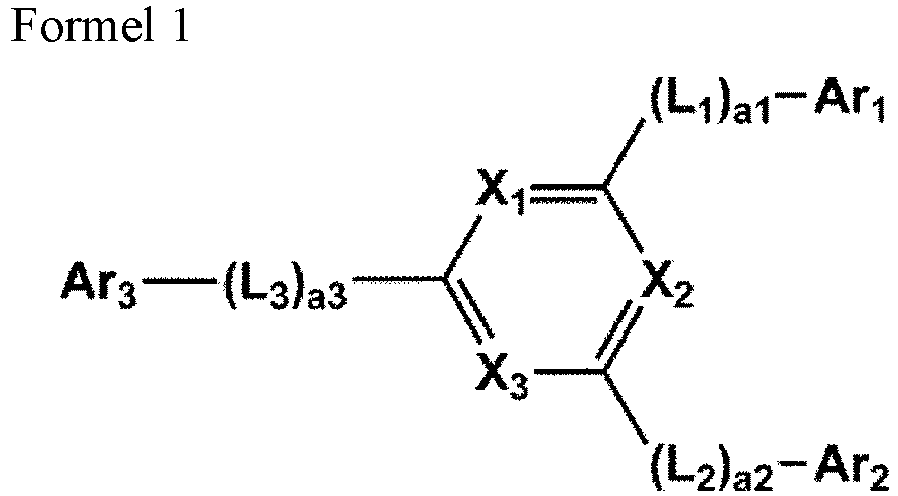
- An aspect of an embodiment provides a heterocyclic compound represented by Formula 1 below:
- an organic light-emitting device including: a first electrode; a second electrode facing the first electrode; and an organic layer between the first electrode and the second electrode and including an emission layer, wherein the organic light-emitting device further includes at least one of the heterocyclic compound.
- X 1 to X 3 are each independently N or C(R 15 ), and at least one selected from X 1 to X 3 is N.
- L 1 to L 3 are each independently a substituted or unsubstituted C 3 -C 60 carbocyclic group or a substituted or unsubstituted C 1 -C 60 heterocyclic group.
- L 1 to L 3 are each independently a substituted or unsubstituted C 3 -C 30 carbocyclic group or a substituted or unsubstituted C 1 -C 30 heterocyclic group.
- L 1 to L 3 are each independently a substituted or unsubstituted C 3 -C 30 carbocyclic group or a substituted or unsubstituted C 1 -C 20 heterocyclic group.
- L 1 to L 3 are each independently a substituted or unsubstituted C 3 -C 20 carbocyclic group or a substituted or unsubstituted C 1 -C 20 heterocyclic group.
- L 1 to L 3 are each independently a substituted or unsubstituted C 3 -C 12 carbocyclic group or a substituted or unsubstituted C 1 -C 20 heterocyclic group.
- L 1 to L 3 are each independently a substituted or unsubstituted C 3 -C 12 carbocyclic group or a substituted or unsubstituted C 1 -C 12 heterocyclic group.
- L 1 to L 3 may each independently be selected from:
- L 1 to L 3 may each independently be selected from:
- L 1 to L 3 may each independently be selected from groups represented by Formulae 3-1 to 3-27:
- L 1 to L 3 may each independently be a group represented by one of Formulae 3-1 and 3-2.
- a1 to a3 are each independently an integer from 0 to 3.
- a1 to a3 may each independently be 0 or 1.
- Y 1 is O or S.
- R 1 to R 16 are each independently selected from hydrogen, deuterium, -F, -Cl, -Br, -I, a hydroxyl group, a cyano group, a nitro group, an amino group, an amidino group, a hydrazine group, a hydrazone group, a carboxylic acid group or a salt thereof, a sulfonic acid group or a salt thereof, a phosphoric acid group or a salt thereof, a substituted or unsubstituted C 1 -C 60 (e.g. C 1 -C 20 ) alkyl group, a substituted or unsubstituted C 2 -C 60 (e.g.
- C 2 -C 20 alkenyl group, a substituted or unsubstituted C 2 -C 60 (e.g. C 2 -C 20 ) alkynyl group, a substituted or unsubstituted C 1 -C 60 (e.g.
- C 1 -C 20 alkoxy group, a substituted or unsubstituted C 3 -C 10 cycloalkyl group, a substituted or unsubstituted C 2 -C 10 heterocycloalkyl group, a substituted or unsubstituted C 3 -C 10 cycloalkenyl group, a substituted or unsubstituted C 2 -C 10 heterocycloalkenyl group, a substituted or unsubstituted C 6 -C 60 (e.g. C 6 -C 30 ) aryl group, a substituted or unsubstituted C 6 -C 60 (e.g.
- C 6 -C 30 aryloxy group, a substituted or unsubstituted C 6 -C 60 (e.g. C 6 -C 30 ) arylthio group, a substituted or unsubstituted C 2 -C 60 (e.g.
- b3 is an integer from 0 to 3
- b4 is an integer from 0 to 4
- b5 is an integer from 0 to 5
- At least one selected from R 1 (s) in the number of b5 may be -Si(Q 1 )(Q 2 )(Q 3 ), and
- Ar 1 is a group represented by one selected from Formulae 4-1 to 4-5
- Ar 2 is a group represented by one selected from Formulae 4-11 to 4-15
- Ar 3 is a group represented by one selected from Formulae 4-6 to 4-21:
- Ph indicates a phenyl group
- t-Bu indicates a tert-butyl group
- * indicates a binding site to a neighboring atom.
- b3, b4, and b5 may each independently be 0 or 1.
- R 1 to R 16 may each independently be selected from hydrogen, a cyano group, a substituted or unsubstituted C 1 -C 60 (e.g. C 1 -C 20 ) alkyl group, a substituted or unsubstituted C 6 -C 60 ( e . g . C 6 -C 30 ) aryl group, and -Si(Q 1 )(Q 2 )(Q 3 ).
- R 1 to R 16 may each independently be selected from:
- X 1 to X 3 may each be N, and R 15 may be hydrogen; ii) X 1 and X 2 may each be N, and X 3 may be C(R 15 ), and R 15 may be hydrogen; iii) X 1 and X 3 may each be N, and X 2 may be C(R 15 ), and R 15 may be hydrogen; iv) X 2 and X 3 may each be N, and X 1 may be C(R 15 ), and R 15 may be hydrogen; v) X 1 may be N, and X 2 and X 3 may each be C(R 15 ), and R 15 may be hydrogen; vi) X 2 may be N, and X 1 and X 3 may each be C(R 15 ), and R 15 may be hydrogen; or vii) X 3 may be N, and X 1 and X 2 may each be C(R 15 ), and R 15 may be hydrogen.
- C 1 -C 20 alkoxy group, the substituted C 3 -C 10 cycloalkyl group, the substituted C 2 -C 10 heterocycloalkyl group, the substituted C 3 -C 10 cycloalkenyl group, the substituted C 2 -C 10 heterocycloalkenyl group, the substituted C 6 -C 60 ( e . g . C 6 -C 30 ) aryl group, the substituted C 6 -C 60 ( e . g . C 6 -C 30 ) aryloxy group, the substituted C 6 -C 60 ( e . g .
- C 6 -C 30 arylthio group, the substituted C 2 -C 60 ( e . g . C 2 -C 20 ) heteroaryl group, the substituted monovalent non-aromatic condensed polycyclic group, and the substituted monovalent non-aromatic condensed heteropolycyclic group is selected from:
- the heterocyclic compound may be selected from Compounds 3 to 6, 13, 14, 17 to 20, 27 to 29, 32 to 34, 43 to 49, and 59, but embodiments of the present disclosure are not limited thereto:
- the heterocyclic compound of embodiments of the present disclosure has an azine-based core including at least one N atom, and the heterocyclic compound further includes substituents according to the claims having a large size, such as the groups represented by Formulae 2-1 to 2-7. Therefore, because intermolecular attraction is reduced through steric hindrance caused by the substituents having a large size and because the heterocyclic compound has a relatively high triplet energy level, the heterocyclic compound may be suitable as a phosphorescent host.
- the silyl group substituted benzene group when included in the substituent of the azine-based core, the silyl group is substituted at an ortho or meta position with respect to a linked position between the benzene group and the azine-based core, and a triplet energy level difference may be increased, as compared with a case in which the silyl group is substituted at a para position, thereby providing excellent phosphorescence.
- an electronic device such as, for example, an organic light-emitting device, which includes the heterocyclic compound represented by Formula 1, may have a low driving voltage, high efficiency, and a long lifespan.
- At least one of the heterocyclic compound of Formula 1 may be used between a pair of electrodes of an organic light-emitting device.
- the heterocyclic compound may be included in an emission layer.
- the heterocyclic compound represented by Formula 1 may be used as a material for forming a capping layer positioned outside the pair of electrodes of the organic light-emitting device.
- an organic light-emitting device including: a first electrode; a second electrode facing the first electrode; and an organic layer between the first electrode and the second electrode, the organic layer including an emission layer and at least one heterocyclic compound represented by Formula 1.
- (an organic layer) includes at least one of the heterocyclic compounds may include a case in which "(an organic layer) includes identical heterocyclic compounds represented by Formula 1" and a case in which "(an organic layer) includes two or more different heterocyclic compounds represented by Formula 1.”
- the organic layer may include, as the heterocyclic compound, only Compound 1.
- Compound 1 may be included in an emission layer of the organic light-emitting device.
- the organic layer may include, as the heterocyclic compound, Compound 1 and Compound 2.
- Compound 1 and Compound 2 may be included in an identical layer (for example, Compound 1 and Compound 2 may both be included in an emission layer), or different layers (for example, Compound 1 may be included in an emission layer and Compound 2 may be included in an electron transport layer).
- the emission layer may include the heterocyclic compound represented by Formula 1.
- an amount of the heterocyclic compound may be in a range of about 50 parts by weight to about 99.9 parts by weight based on 100 parts by weight of the emission layer.
- an amount of the heterocyclic compound may be in a range of about 90 parts by weight to about 99.9 parts by weight based on 100 parts by weight of the emission layer.
- the dopant may be a phosphorescent dopant.
- the dopant may include an organometallic complex represented by Formula 401: Formula 401 M(L 401 ) xc1 (L 402 ) xc2
- the hole transport region may include a p-dopant having a lowest unoccupied molecular orbital (LUMO) energy level of about -3.5 eV or less.
- LUMO lowest unoccupied molecular orbital
- the electron transport region may include an alkali metal, an alkaline earth metal, a rare earth metal, an alkali metal compound, an alkaline earth metal compound, a rare earth metal compound, an alkali metal complex, alkaline earth metal complex, a rare earth metal complex, or any combination thereof.
- the emission layer may be a first emission layer configured to emit a first color light
- the organic light-emitting device may further include i) at least one second emission layer configured to emit a second color light or ii) at least one second emission layer configured to emit a second color light and at least one third emission layer configured to emit a third color light, between the first electrode and the second electrode.
- a maximum emission wavelength of the first color light, a maximum emission wavelength of the second color light, and a maximum emission wavelength of the third color light may be identical to or different from each other, and the first color light and the second color light may be emitted in the form of mixed light, or the first color light, the second color light, and the third color light may be emitted in the form of mixed light.
- organic layer refers to a single layer and/or a plurality of layers between the first electrode and the second electrode of an organic light-emitting device.
- a material included in the "organic layer” is not limited to an organic material.
- the organic layer may include an inorganic material.
- the organic light-emitting device may have i) a stacked structure including a first electrode, an organic layer, a second electrode, and a second capping layer which are sequentially stacked in this stated order, ii) a stacked structure including a first capping layer, a first electrode, an organic layer, and a second electrode which are sequentially stacked in this stated order, or iii) a stacked structure including a first capping layer, a first electrode, an organic layer, a second electrode, and a second capping layer which are sequentially stacked in this stated order, and at least one selected from the first capping layer and the second capping layer may include the heterocyclic compound.
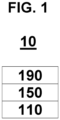
- FIG. 1 is a schematic view of an organic light-emitting device 10 according to an embodiment.
- the organic light-emitting device 10 includes a first electrode 110, an organic layer 150, and a second electrode 190.
- a substrate may be additionally located under the first electrode 110 or above the second electrode 190.
- the substrate may be a glass substrate or a plastic substrate, each having excellent mechanical strength, thermal stability, transparency, surface smoothness, ease of handling, and water resistance.
- the first electrode 110 may be formed by depositing or sputtering a material for forming the first electrode 110 on the substrate.
- the material for a first electrode 110 may be selected from materials with a high work function to facilitate hole injection.
- the hole transport region may have i) a single-layered structure including a single layer including a single material, ii) a single-layered structure including a single layer including a plurality of different materials, or iii) a multi-layered structure having a plurality of layers including a plurality of different materials.
- the hole transport region may include at least one selected from m-MTDATA, TDATA, 2-TNATA, NPB(NPD), ⁇ -NPB, TPD, Spiro-TPD, Spiro-NPB, methylated-NPB, TAPC, HMTPD, 4,4',4"-tris(N-carbazolyl)triphenylamine (TCTA), polyaniline/dodecylbenzenesulfonic acid (PANI/DBSA), poly(3,4-ethylenedioxythiophene)/poly(4-styrenesulfonate) (PEDOT/PSS), polyaniline/camphor sulfonic acid (PANI/CSA), polyaniline/poly(4-styrenesulfonate) (PANI/PSS), a compound represented by Formula 201, and a compound represented by Formula 202:
- xa1 to xa4 may each independently be 0, 1, or 2.
- At least one selected from R 201 to R 203 may each independently be selected from:
- R 201 and R 202 may be linked via a single bond, and/or ii) R 203 and R 204 may be linked via a single bond.
- At least one selected from R 201 to R 204 may be selected from:
- the compound represented by Formula 201 may be represented by Formula 201A:
- the compound represented by Formula 202 may be represented by Formula 202A:
- the hole transport region may include at least one compound selected from Compounds HT1 to HT39, but embodiments of the present disclosure are not limited thereto:
- the thickness of the hole injection layer may be in a range of about 100 ⁇ to about 9,000 ⁇ , and for example, about 100 ⁇ to about 7,000 ⁇ , about 100 ⁇ to about 5,000 ⁇ , about 100 ⁇ to about 3,000 ⁇ , about 100 ⁇ to about 2,000 ⁇ , about 100 ⁇ to about 1,000 ⁇ or about 200 ⁇ to about 400 ⁇ , and the thickness of the hole transport layer may be in a range of about 50 ⁇ to about 2,000 ⁇ , and for example, about 100 ⁇ to about 1500 ⁇ about 100 ⁇ to about 1,000 ⁇ , about 100 ⁇ to about 800 ⁇ , about 100 ⁇ to about 500 ⁇ , or about 100 ⁇ to about 300 ⁇ .
- suitable or satisfactory hole transporting characteristics may be obtained without a substantial increase in driving voltage.
- the emission auxiliary layer may increase light-emission efficiency by compensating for an optical resonance distance according to the wavelength of light emitted by an emission layer, and the electron blocking layer may block the flow of electrons from an electron transport region.
- the emission auxiliary layer and the electron blocking layer may include the materials as described above.
- the charge-generation material may be, for example, a p-dopant.
- the p-dopant may have a LUMO energy level of about - 3.5 eV or less.
- the p-dopant may include at least one selected from a quinone derivative, a metal oxide, and a cyano group-containing compound, but embodiments of the present disclosure are not limited thereto.
- the p-dopant may include at least one selected from:
- R 221 to R 223 may each independently be selected from a substituted or unsubstituted C 3 -C 10 cycloalkyl group, a substituted or unsubstituted C 1 -C 10 heterocycloalkyl group, a substituted or unsubstituted C 3 -C 10 cycloalkenyl group, a substituted or unsubstituted C 1 -C 10 heterocycloalkenyl group, a substituted or unsubstituted C 6 -C 60 ( e . g . C 6 -C 32 ) aryl group, a substituted or unsubstituted C 1 -C 60 ( e . g .
- C 1 -C 20 heteroaryl group, a substituted or unsubstituted monovalent non-aromatic condensed polycyclic group, and a substituted or unsubstituted monovalent non-aromatic condensed heteropolycyclic group, provided that at least one selected from R 221 to R 223 has at least one substituent selected from a cyano group, -F, -Cl, -Br, -I, a C 1 -C 20 alkyl group substituted with -F, a C 1 -C 20 alkyl group substituted with -Cl, a C 1 -C 20 alkyl group substituted with -Br, and a C 1 -C 20 alkyl group substituted with -I.
- the emission layer may be patterned into a red emission layer, a green emission layer, or a blue emission layer, according to a sub-pixel.
- the emission layer may have a stacked structure of two or more layers selected from a red emission layer, a green emission layer, and a blue emission layer, in which the two or more layers contact each other or are separated from each other.
- the emission layer may include two or more materials selected from a red light-emitting material, a green light-emitting material, and a blue light-emitting material, in which the two or more materials are mixed with each other in a single layer to emit white light.
- the emission layer may include the heterocyclic compound represented by Formula 1.
- the host may include the heterocyclic compound represented by Formula 1.
- the host may further include a compound represented by Formula 301 below.
- Formula 301 [Ar 301 ] xb11 -[(L 301 ) xb1 -R 301 ] xb21
- Ar 301 may be a substituted or unsubstituted C 6 -C 32 carbocyclic group or a substituted or unsubstituted C 1 -C 12 heterocyclic group, but embodiments are not limited thereto.
- Ar 301 in Formula 301 may be selected from:
- the compound represented by Formula 301 may be represented by Formula 301-1 or 301-2:
- L 301 to L 304 in Formulae 301, 301-1, and 301-2 may each independently be selected from: a substituted or unsubstituted C 3 -C 10 cycloalkylene group, a substituted or unsubstituted C 1 -C 10 heterocycloalkylene group, a substituted or unsubstituted C 3 -C 10 cycloalkenylene group, a substituted or unsubstituted C 1 -C 10 heterocycloalkenylene group, a substituted or unsubstituted C 6 -C 30 arylene group, a substituted or unsubstituted C 1 -C 20 heteroarylene group, a substituted or unsubstituted divalent non-aromatic condensed polycyclic group, and a substituted or unsubstituted divalent non-aromatic condensed heteropolycyclic group, but embodiments are not limited thereto.
- L 301 to L 304 may each independently be selected from:
- R 301 to R 304 in Formulae 301, 301-1, and 301-2 may each independently be selected from: deuterium, -F, -Cl, -Br, -I, a hydroxyl group, a cyano group, a nitro group, an amidino group, a hydrazino group, a hydrazono group, a substituted or unsubstituted C 1 -C 60 (e.g. C 1 -C 10 ) alkyl group, a substituted or unsubstituted C 2 -C 60 (e.g. C 2 -C 10 ) alkenyl group, a substituted or unsubstituted C 2 -C 60 (e.g.
- C 2 -C 10 alkynyl group, a substituted or unsubstituted C 1 -C 60 (e.g. C 1 -C 10 ) alkoxy group, a substituted or unsubstituted C 3 -C 10 cycloalkyl group, a substituted or unsubstituted C 1 -C 10 heterocycloalkyl group, a substituted or unsubstituted C 3 -C 10 cycloalkenyl group, a substituted or unsubstituted C 1 -C 10 heterocycloalkenyl group, a substituted or unsubstituted C 6 -C 30 aryl group, a substituted or unsubstituted C 6 -C 30 aryloxy group, a substituted or unsubstituted C 6 -C 30 arylthio group, a substituted or unsubstituted C 1 -C 20 heteroaryl group, a substituted or unsubstituted mono
- R 301 to R 304 may each independently be selected from:
- the host may include an alkaline earth metal complex.
- the host may include a complex selected from a Be complex (for example, Compound H55), a Mg complex, and a Zn complex.
- the host may be selected from a Be complex (for example, Compound H55), a Mg complex, and a Zn complex.
- the host may include at least one selected from 9,10-di(2-naphthyl)anthracene) (ADN), 2-methyl-9,10-bis(naphthalen-2-yl)anthracene (MADN), 9,10-di-(2-naphthyl)-2-t-butyl-anthracene (TBADN), 4,4'-bis(N-carbazolyl)-1,1'-biphenyl (CBP), 1,3-di-9-carbazolylbenzene (mCP), 1,3,5-tri(carbazol-9-yl)benzene (TCP), and Compounds H1 to H55, but embodiments of the present disclosure are not limited thereto:
- Phosphorescent dopant included in emission layer in organic layer 150 includes Phosphorescent dopant included in emission layer in organic layer 150
- the phosphorescent dopant may include the organometallic complex represented by Formula 401.
- a 401 and A 402 may each independently be selected from a benzene group, a naphthalene group, a fluorene group, a spiro-bifluorene group, an indene group, a pyrrole group, a thiophene group, a furan group, an imidazole group, a pyrazole group, a thiazole group, an isothiazole group, an oxazole group, an isoxazole group, a pyridine group, a pyrazine group, a pyrimidine group, a pyridazine group, a quinoline group, an isoquinoline group, a benzoquinoline group, a quinoxaline group, a quinazoline group, a carbazole group, a benzimidazole group, a benzofuran group, a benzothiophene group, an isobenzothiophene
- X 401 may be nitrogen
- X 402 may be carbon
- X 401 and X 402 may each be nitrogen concurrently (e.g., at the same time).
- R 401 and R 402 in Formula 402 may each independently be selected from:
- two A 401 (s) in two or more L 401 (s) may optionally be linked via X 407 , which is a linking group, or two A 402 (s) in two or more L 401 (s) may optionally be linked via X 408 , which is a linking group (see Compounds PD1 to PD4 and PD7).
- L 402 in Formula 401 may be a monovalent, divalent, or trivalent organic ligand.
- the phosphorescent dopant may be selected from, for example, Compounds PD1 to PD26, but embodiments of the present disclosure are not limited thereto:
- the fluorescent dopant may include an arylamine compound or a styrylamine compound.
- Ar 501 in Formula 501 may be selected from:
- L 501 to L 503 in Formula 501 may each independently be selected from:
- xd4 in Formula 501 may be 2 or more (e.g. 2), but embodiments of the present disclosure are not limited thereto.
- the fluorescent dopant may be selected from Compounds FD1 to FD22:
- the fluorescent dopant may be selected from the following compounds, but embodiments of the present disclosure are not limited thereto.
- Electron transport region in organic layer 150 is Electron transport region in organic layer 150
- the electron transport region may have i) a single-layered structure including a single layer including a single material, ii) a single-layered structure including a single layer including a plurality of different materials, or iii) a multi-layered structure having a plurality of layers including a plurality of different materials.
- the electron transport region may include at least one selected from a buffer layer, a hole blocking layer, an electron control layer, an electron transport layer, and an electron injection layer, but embodiments of the present disclosure are not limited thereto.
- the electron transport region may have an electron transport layer/electron injection layer structure, a hole blocking layer/electron transport layer/electron injection layer structure, an electron control layer/electron transport layer/electron injection layer structure, or a buffer layer/electron transport layer/electron injection layer structure, wherein for each structure, constituting layers are sequentially stacked from an emission layer in this stated order.
- embodiments of the structure of the electron transport region are not limited thereto.
- the electron transport region (for example, a buffer layer, a hole blocking layer, an electron control layer, or an electron transport layer in the electron transport region) may include a metal-free compound containing at least one ⁇ electron-depleted nitrogen-containing ring.
- Examples of the ⁇ electron-depleted nitrogen-containing ring include an imidazole, a pyrazole, a thiazole, an isothiazole, an oxazole, an isoxazole, a pyridine, a pyrazine, a pyrimidine, a pyridazine, an indazole, a purine, a quinoline, an isoquinoline, a benzoquinoline, a phthalazine, a naphthyridine, a quinoxaline, a quinazoline, a cinnoline, a phenanthridine, an acridine, a phenanthroline, a phenazine, a benzimidazole, an isobenzothiazole, a benzoxazole, an isobenzoxazole, a triazole, a tetrazole, an oxadiazole, a triazine
- the electron transport region may include a compound represented by Formula 601: Formula 601 [Ar 601 ] xe11 -[(L 601 ) xe1 -R 601 ] xe21 .
- At least one of Ar 601 (s) in the number of xe11 and R 601 (s) in the number of xe21 may include the ⁇ electron-depleted nitrogen-containing ring.
- Ar 601 may be a substituted or unsubstituted C 5 -C 30 carbocyclic group or a substituted or unsubstituted C 1 -C 20 heterocyclic group, but embodiments are not limited thereto.
- Ar 601 in Formula 601 may be selected from:
- xe11 in Formula 601 is two or more, two or more Ar 601 (s) may be linked via a single bond.
- Ar 601 in Formula 601 may be an anthracene group.
- L 601 and L 611 to L 613 in Formulae 601 and 601-1 may each independently be selected from: a substituted or unsubstituted C 3 -C 10 cycloalkylene group, a substituted or unsubstituted C 1 -C 10 heterocycloalkylene group, a substituted or unsubstituted C 3 -C 10 cycloalkenylene group, a substituted or unsubstituted C 1 -C 10 heterocycloalkenylene group, a substituted or unsubstituted C 6 -C 30 arylene group, a substituted or unsubstituted C 1 -C 20 heteroarylene group, a substituted or unsubstituted divalent non-aromatic condensed polycyclic group, and a substituted or unsubstituted divalent non-aromatic condensed heteropolycyclic group, but embodiments are not limited thereto.
- L 601 and L 611 to L 613 in Formulae 601 and 601-1 may each independently be selected from:
- xe1 and xe611 to xe613 in Formulae 601 and 601-1 may each independently be 0, 1, or 2.
- R 601 and R 611 to R 613 may each independently be selected from:
- the electron transport region may include at least one selected from 2,9-dimethyl-4,7-diphenyl-1,10-phenanthroline (BCP), 4,7-diphenyl-1,10-phenanthroline (Bphen), Alq 3 , BAlq, 3-(biphenyl-4-yl)-5-(4-tert-butylphenyl)-4-phenyl-4H-1,2,4-triazole (TAZ), and NTAZ.
- a thickness of the electron transport layer may be in a range of about 100 ⁇ to about 1,000 ⁇ , for example, about 100 ⁇ to about 700 ⁇ , about 100 ⁇ to about 600 ⁇ , about 150 ⁇ to about 600 ⁇ , about 150 ⁇ to about 500 ⁇ or about 150 ⁇ to about 250 ⁇ .
- the electron transport layer may have suitable or satisfactory electron transport characteristics without a substantial increase in driving voltage.
- the electron transport region (for example, the electron transport layer in the electron transport region) may further include, in addition to the materials described above, a metal-containing material.
- the metal-containing material may include at least one selected from alkali metal complex and alkaline earth-metal complex.
- the alkali metal complex may include a metal ion selected from a Li ion, a Na ion, a K ion, a Rb ion, and a Cs ion
- the alkaline earth-metal complex may include a metal ion selected from a Be ion, a Mg ion, a Ca ion, a Sr ion, and a Ba ion.
- a ligand coordinated with the metal ion of the alkali metal complex or the alkaline earth-metal complex may be selected from hydroxy quinoline, hydroxy isoquinoline, hydroxy benzoquinoline, hydroxy acridine, hydroxy phenanthridine, hydroxy phenyloxazole, hydroxy phenylthiazole, hydroxy diphenyloxadiazole, hydroxy diphenylthiadiazole, hydroxy phenylpyridine, hydroxy phenylbenzimidazole, hydroxy phenylbenzothiazole, a bipyridine, a phenanthroline, and a cyclopentadiene, but embodiments of the present disclosure are not limited thereto.
- the metal-containing material may include a Li complex.
- the Li complex may include, for example, Compound ET-D1 (lithium quinolate, LiQ) or ET-D2.
- the electron transport region may include an electron injection layer that facilitates injection of electrons from the second electrode 190.
- the electron injection layer may directly contact the second electrode 190.
- the electron injection layer may include an alkali metal, an alkaline earth metal, a rare earth metal, an alkali metal compound, an alkaline earth-metal compound, a rare earth metal compound, an alkali metal complex, an alkaline earth-metal complex, a rare earth metal complex, or any combinations thereof.
- the alkali metal may be selected from Li, Na, K, Rb, and Cs. In one embodiment, the alkali metal may be Li, Na, or Cs. In one or more embodiments, the alkali metal may be Li or Cs, but embodiments of the present disclosure are not limited thereto.
- the alkaline earth metal may be selected from Mg, Ca, Sr, and Ba.
- the rare earth metal may be selected from Sc, Y, Ce, Tb, Yb, and Gd.
- the alkaline earth-metal compound may be selected from alkaline earth-metal oxides, such as BaO, SrO, CaO, Ba x Sr 1-x O (0 ⁇ x ⁇ 1), or Ba x Ca 1-x O (0 ⁇ x ⁇ 1).
- the alkaline earth-metal compound may be selected from BaO, SrO, and CaO, but embodiments of the present disclosure are not limited thereto.
- the alkali metal complex, the alkaline earth-metal complex, and the rare earth metal complex may include an ion of alkali metal, alkaline earth-metal, and rare earth metal as described above, and a ligand coordinated with a metal ion of the alkali metal complex, the alkaline earth-metal complex, or the rare earth metal complex may be selected from hydroxy quinoline, hydroxy isoquinoline, hydroxy benzoquinoline, hydroxy acridine, hydroxy phenanthridine, hydroxy phenyloxazole, hydroxy phenylthiazole, hydroxy diphenyloxadiazole, hydroxy diphenylthiadiazole, hydroxy phenylpyridine, hydroxy phenylbenzimidazole, hydroxy phenylbenzothiazole, bipyridine, phenanthroline, and cyclopentadiene, but embodiments of the present disclosure are not limited thereto.
- the electron injection layer may consist of an alkali metal, an alkaline earth metal, a rare earth metal, an alkali metal compound, an alkaline earth-metal compound, a rare earth metal compound, an alkali metal complex, an alkaline earth-metal complex, a rare earth metal complex, or any combinations thereof, as described above.
- the electron injection layer may further include an organic material.
- an alkali metal, an alkaline earth metal, a rare earth metal, an alkali metal compound, an alkaline earth-metal compound, a rare earth metal compound, an alkali metal complex, an alkaline earth-metal complex, a rare earth metal complex, or any combinations thereof may be homogeneously or non-homogeneously dispersed in a matrix including the organic material.
- a thickness of the electron injection layer may be in a range of about 1 ⁇ to about 100 ⁇ , for example, about 3 ⁇ to about 90 ⁇ or about 3 ⁇ to about 20 ⁇ .
- the electron injection layer may have suitable or satisfactory electron injection characteristics without a substantial increase in driving voltage.
- the second electrode 190 may be located on the organic layer 150 having such a structure.
- the second electrode 190 may be a cathode which is an electron injection electrode, and in this regard, a material for forming the second electrode 190 may be selected from metal, an alloy, an electrically conductive compound, and a combination thereof, which have a relatively low work function.
- the second electrode 190 may have a single-layered structure, or a multi-layered structure including two or more layers.
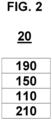
- An organic light-emitting device 20 of FIG. 2 includes a first capping layer 210, a first electrode 110, an organic layer 150, and a second electrode 190 which are sequentially stacked in this stated order.
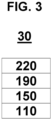
- An organic light-emitting device 30 of FIG. 3 includes a first electrode 110, an organic layer 150, a second electrode 190, and a second capping layer 220 which are sequentially stacked in this stated order.
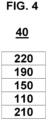
- An organic light-emitting device 40 of FIG. 4 includes a first capping layer 210, a first electrode 110, an organic layer 150, a second electrode 190, and a second capping layer 220.
- the first electrode 110, the organic layer 150, and the second electrode 190 may be understood by referring to the description presented in connection with FIG. 1 .
- the organic layer 150 of each of the organic light-emitting devices 20 and 40 light generated in an emission layer may pass through the first electrode 110, which is a semi-transmissive electrode or a transmissive electrode, and the first capping layer 210 toward the outside, and in the organic layer 150 of each of the organic light-emitting devices 30 and 40, light generated in an emission layer may pass through the second electrode 190, which is a semi-transmissive electrode or a transmissive electrode, and the second capping layer 220 toward the outside.
- the first capping layer 210 and the second capping layer 220 may increase external luminescent efficiency according to the principle of constructive interference.
- the first capping layer 210 and the second capping layer 220 may each independently be an organic capping layer including an organic material, an inorganic capping layer including an inorganic material, or a composite capping layer including an organic material and an inorganic material.
- At least one selected from the first capping layer 210 and the second capping layer 220 may each independently include at least one material selected from carbocyclic compounds, heterocyclic compounds, amine-based compounds, porphyrine derivatives, phthalocyanine derivatives, a naphthalocyanine derivatives, alkali metal complexes, and alkaline earth-based complexes.
- the carbocyclic compound, the heterocyclic compound, and the amine-based compound may be optionally substituted with a substituent containing at least one element selected from O, N, S, Se, Si, F, Cl, Br, and I.
- at least one selected from the first capping layer 210 and the second capping layer 220 may each independently include an amine-based compound.
- At least one selected from the first capping layer 210 and the second capping layer 220 may each independently include the compound represented by Formula 201 or the compound represented by Formula 202.
- At least one selected from the first capping layer 210 and the second capping layer 220 may each independently include a compound selected from Compounds HT28 to HT33 and Compounds CP1 to CP5, but embodiments of the present disclosure are not limited thereto.
- Layers constituting the hole transport region, an emission layer, and layers constituting the electron transport region may be formed in a certain region by using one or more suitable methods selected from vacuum deposition, spin coating, casting, Langmuir-Blodgett (LB) deposition, ink-jet printing, laser-printing, and laser-induced thermal imaging.
- suitable methods selected from vacuum deposition, spin coating, casting, Langmuir-Blodgett (LB) deposition, ink-jet printing, laser-printing, and laser-induced thermal imaging.
- the vacuum deposition may be performed at a deposition temperature of about 100 °C to about 500 °C, a vacuum degree of about 10 -8 torr to about 10 -3 torr, and a deposition speed of about 0.01 ⁇ /sec to about 100 ⁇ /sec by taking into account a material to be included in a layer to be formed, and the structure of a layer to be formed.
- the spin coating may be performed at a coating speed of about 2,000 rpm to about 5,000 rpm and at a heat treatment temperature of about 80 °C to about 200 °C by taking into account a material to be included in a layer to be formed, and the structure of a layer to be formed.
- C 1 -C 60 alkyl group refers to a linear or branched aliphatic saturated hydrocarbon monovalent group having 1 to 60 carbon atoms, and examples thereof include a methyl group, an ethyl group, a propyl group, an isobutyl group, a sec-butyl group, a tert-butyl group, a pentyl group, an isoamyl group, and a hexyl group.
- C 1 -C 60 alkylene group refers to a divalent group having substantially the same structure as the C 1 -C 60 alkyl group. Corresponding definitions apply to other ranges given for the number of carbon atoms in an alkyl/alkylene group.
- C 2 -C 60 alkenyl group refers to a hydrocarbon group having at least one double bond at a main chain (e.g., in the middle) or at the terminus (e.g., a terminal end) of the C 2 -C 60 alkyl group, and examples thereof include an ethenyl group, a propenyl group, and a butenyl group.
- C 2 -C 60 alkenylene group refers to a divalent group having substantially the same structure as the C 2 -C 60 alkenyl group. Corresponding definitions apply to other ranges given for the number of carbon atoms in an alkenyl/alkenylene group.
- C 2 -C 60 alkynyl group refers to a hydrocarbon group having at least one triple bond at a main chain (e.g., in the middle) or at the terminus (e.g., at a terminal end) of the C 2 -C 60 alkyl group, and examples thereof include an ethynyl group, and a propynyl group.
- C 2 -C 60 alkynylene group refers to a divalent group having substantially the same structure as the C 2 -C 60 alkynyl group. Corresponding definitions apply to other ranges given for the number of carbon atoms in an alkynyl/alkynylene group.
- C 1 -C 60 alkoxy group refers to a monovalent group represented by -OA 101 (wherein A 101 is the C 1 -C 60 alkyl group), and examples thereof include a methoxy group, an ethoxy group, and an isopropyloxy group. Corresponding definitions apply to other ranges given for the number of carbon atoms in an alkoxy group.
- C 3 -C 10 cycloalkyl group refers to a monovalent saturated hydrocarbon monocyclic group having 3 to 10 carbon atoms, and examples thereof include a cyclopropyl group, a cyclobutyl group, a cyclopentyl group, a cyclohexyl group, and a cycloheptyl group.
- C 3 -C 10 cycloalkylene group refers to a divalent group having substantially the same structure as the C 3 -C 10 cycloalkyl group.
- C 1 -C 10 heterocycloalkyl group refers to a monovalent monocyclic group having at least one heteroatom selected from N, O, Si, P, and S as a ring-forming atom and 1 to 10 carbon atoms, and examples thereof include a 1,2,3,4-oxatriazolidinyl group, a tetrahydrofuranyl group, and a tetrahydrothiophenyl group.
- C 1 -C 10 heterocycloalkylene group refers to a divalent group having substantially the same structure as the C 1 -C 10 heterocycloalkyl group.
- C 3 -C 10 cycloalkenyl group refers to a monovalent monocyclic group that has 3 to 10 carbon atoms and at least one double bond in a ring thereof and no aromaticity (e.g., the entire ring and/or group is not aromatic), and examples thereof include a cyclopentenyl group, a cyclohexenyl group, and a cycloheptenyl group.
- C 3 -C 10 cycloalkenylene group refers to a divalent group having substantially the same structure as the C 3 -C 10 cycloalkenyl group.
- C 1 -C 10 heterocycloalkenyl group refers to a monovalent monocyclic group that has at least one heteroatom selected from N, O, Si, P, and S as a ring-forming atom, 1 to 10 carbon atoms, and at least one double bond in its ring.
- Non-limiting examples of the C 1 -C 10 heterocycloalkenyl group include a 4,5-dihydro-1 ,2,3,4-oxatriazolyl group, a 2,3-dihydrofuranyl group, and a 2,3-dihydrothiophenyl group.
- C 1 -C 10 heterocycloalkenylene group refers to a divalent group having substantially the same structure as the C 1 -C 10 heterocycloalkenyl group.
- C 6 -C 60 aryl group refers to a monovalent group having a carbocyclic aromatic system having 6 to 60 carbon atoms
- a C 6 -C 60 arylene group used herein refers to a divalent group having a carbocyclic aromatic system having 6 to 60 carbon atoms.
- Non-limiting examples of the C 6 -C 60 aryl group include a phenyl group, a naphthyl group, an anthracenyl group, a phenanthrenyl group, a pyrenyl group, and a chrysenyl group.
- the rings may be fused to each other (e.g., combined together).
- Corresponding definitions apply to other ranges given for the number of carbon atoms in an aryl/arylene group.
- C 1 -C 60 heteroaryl group refers to a monovalent group having a carbocyclic aromatic system that has at least one heteroatom selected from N, O, Si, P, and S as a ring-forming atom, in addition to 1 to 60 carbon atoms.
- C 1 -C 60 heteroarylene group refers to a divalent group having a carbocyclic aromatic system that has at least one heteroatom selected from N, O, Si, P, and S as a ring-forming atom, in addition to 1 to 60 carbon atoms.
- Non-limiting examples of the C 1 -C 60 heteroaryl group include a pyridinyl group, a pyrimidinyl group, a pyrazinyl group, a pyridazinyl group, a triazinyl group, a quinolinyl group, and an isoquinolinyl group.
- the C 1 -C 60 heteroaryl group and the C 1 -C 60 heteroarylene group each include two or more rings, the rings may be condensed with each other (e.g., combined together).
- Corresponding definitions apply to other ranges given for the number of carbon atoms in an heteroaryl/heteroarylene group.
- C 6 -C 60 aryloxy group refers to -OA 102 (wherein A 102 is the C 6 -C 60 aryl group), and the term “C 6 -C 60 arylthio group,” as used herein, refers to -SA 103 (wherein A 103 is the C 6 -C 60 aryl group).
- C 6 -C 60 aryloxy group refers to -OA 102 (wherein A 102 is the C 6 -C 60 aryl group)
- C 6 -C 60 arylthio group refers to -SA 103 (wherein A 103 is the C 6 -C 60 aryl group).
- Corresponding definitions apply to other ranges given for the number of carbon atoms in an aryloxy group and an arylthio group.
- An example of the monovalent non-aromatic condensed polycyclic group is a fluorenyl group.
- divalent non-aromatic condensed polycyclic group refers to a divalent group having substantially the same structure as the monovalent non-aromatic condensed polycyclic group.
- An example of the monovalent non-aromatic condensed heteropolycyclic group is a carbazolyl group.
- divalent non-aromatic condensed heteropolycyclic group refers to a divalent group having substantially the same structure as the monovalent non-aromatic condensed heteropolycyclic group.
- C 3 -C 60 carbocyclic group refers to a monocyclic or polycyclic group having 3 to 60 carbon atoms in which a ring-forming atom is a carbon atom only.
- the C 3 -C 60 carbocyclic group may be an aromatic carbocyclic group or a non-aromatic carbocyclic group.
- the C 3 -C 60 carbocyclic group may be a ring, such as benzene, a monovalent group, such as a phenyl group, or a divalent group, such as a phenylene group.
- the C 3 -C 60 carbocyclic group may be a trivalent group or a quadrivalent group.
- Corresponding definitions apply to other ranges given for the number of carbon atoms in a carbocyclic group.
- C 1 -C 60 heterocyclic group refers to a monovalent monocyclic group that has substantially the same structure as the C 3 -C 60 carbocyclic group and has at least one heteroatom selected from N, O, Si, P, and S as a ring-forming atom and 1 to 60 carbon atoms. Corresponding definitions apply to other ranges given for the number of carbon atoms in a heterocyclic group.
- At least one substituent of the substituted C 3 -C 60 e.g. C 3 -C 30 ) carbocyclic group, the substituted C 5 -C 60 (e.g. C 5 -C 30 ) carbocyclic group, the substituted C 1 -C 60 (e.g.
- C 1 -C 20 heterocyclic group, the substituted C 1 -C 20 alkylene group, the substituted C 2 -C 20 alkenylene group, the substituted C 3 -C 10 cycloalkylene group, the substituted C 1 -C 10 heterocycloalkylene group, the substituted C 3 -C 10 cycloalkenylene group, the substituted C 1 -C 10 heterocycloalkenylene group, the substituted C 6 -C 60 ( e.g. C 6 -C 30 ) arylene group, the substituted C 1 -C 60 ( e.g.
- C 1 -C 20 heteroarylene group, the substituted divalent non-aromatic condensed polycyclic group, the substituted divalent non-aromatic condensed heteropolycyclic group, the substituted C 1 -C 60 ( e.g. C 1 -C 20 ) alkyl group, the substituted C 2 -C 60 ( e.g. C 2 -C 20 ) alkenyl group, the substituted C 2 -C 60 ( e.g. C 2 -C 20 ) alkynyl group, the substituted C 1 -C 60 ( e.g.
- C 1 -C 20 alkoxy group
- the substituted C 3 -C 10 cycloalkyl group, the substituted C 1 -C 10 heterocycloalkyl group, the substituted C 3 -C 10 cycloalkenyl group, the substituted C 1 -C 10 heterocycloalkenyl group, the substituted C 6 -C 60 ( e.g. C 6 -C 30 ) aryl group, the substituted C 6 -C 60 ( e.g. C 6 -C 30 ) aryloxy group, the substituted C 6 -C 60 ( e.g. C 6 -C 30 ) arylthio group, the substituted C 1 -C 60 ( e.g. C 1 -C 20 ) heteroaryl group, the substituted monovalent non-aromatic condensed polycyclic group, and the substituted monovalent non-aromatic condensed heteropolycyclic group may be selected from:
- Ph refers to a phenyl group
- Me refers to a methyl group
- Et refers to an ethyl group
- ter-Bu refers to a tert-butyl group
- OMe refers to a methoxy group
- biphenyl group refers to "a phenyl group substituted with a phenyl group.”
- the "biphenyl group” is a substituted phenyl group having a C 6 -C 60 aryl group as a substituent.
- terphenyl group refers to "a phenyl group substituted with a biphenyl group.”
- the "terphenyl group” is a phenyl group having, as a substituent, a C 6 -C 60 aryl group substituted with a C 6 -C 60 aryl group.
- Synthesis Example 3 Synthesis of Reference Compound 8 not forming part of the present invention.
- a Corning 15 ⁇ /cm 2 (1,200 ⁇ ) indium tin oxide (ITO) glass substrate was cut to a size of 50 mm ⁇ 50 mm ⁇ 0.5 mm, sonicated with isopropyl alcohol and pure water each for 5 minutes, and then cleaned by exposure to ultraviolet rays and ozone for 30 minutes.
- the ITO glass substrate was provided to a vacuum deposition apparatus.
- Compound 3 and a phosphorescent dopant PD26 were codeposited on the hole transport layer at a weight ratio of 92:8 to form an emission layer having a thickness of 250 ⁇ .
- 3-(4-biphenylyl)-4-phenyl-5-tert-butylphenyl-1,2,4-triazole (TAZ) was deposited on the emission layer to form an electron transport layer having a thickness of 200 ⁇
- an alkali metal halide LiF was deposited on the electron transport layer to form an electron injection layer having a thickness of 10 ⁇
- Al was vacuum-deposited on the electron injection layer to form an LiF/Al electrode having a thickness of 100 ⁇ , thereby completing the manufacture of an organic light-emitting device.
- Organic light-emitting devices were manufactured in substantially the same manner as in Example 1, except that Compounds shown in Table 2 were each used instead of Compound 3 in forming an emission layer.
- Reference examples 6 and 7 do not form part of the present invention.
- Organic light-emitting devices were manufactured in substantially the same manner as in Example 1, except that Compounds A to E were used in Comparative Examples 1 to 5, respectively, instead of Compound 3 in forming an emission layer.
- first,” “second,” “third,” etc. may be used herein to describe various elements, components, regions, layers and/or sections, these elements, components, regions, layers and/or sections should not be limited by these terms. These terms are used to distinguish one element, component, region, layer or section from another element, component, region, layer or section. Thus, a first element, component, region, layer or section described below could be termed a second element, component, region, layer or section, without departing from the scope of the present disclosure.
- spatially relative terms such as “beneath,” “below,” “lower,” “under,” “above,” “upper,” and the like, may be used herein for ease of explanation to describe one element or feature's relationship to another element(s) or feature(s) as illustrated in the figures. It will be understood that the spatially relative terms are intended to encompass different orientations of the device in use or in operation, in addition to the orientation depicted in the figures. For example, if the device in the figures is turned over, elements described as “below” or “beneath” or “under” other elements or features would then be oriented “above” the other elements or features. Thus, the example terms “below” and “under” can encompass both an orientation of above and below. The device may be otherwise oriented (e.g., rotated 90 degrees or at other orientations) and the spatially relative descriptors used herein should be interpreted accordingly.
- any numerical range recited herein is intended to include all subranges of the same numerical precision subsumed within the recited range.
- a range of "1.0 to 10.0" is intended to include all subranges between (and including) the recited minimum value of 1.0 and the recited maximum value of 10.0, that is, having a minimum value equal to or greater than 1.0 and a maximum value equal to or less than 10.0, such as, for example, 2.4 to 7.6.
- Any maximum numerical limitation recited herein is intended to include all lower numerical limitations subsumed therein, and any minimum numerical limitation recited in this specification is intended to include all higher numerical limitations subsumed therein.
Landscapes
- Chemical & Material Sciences (AREA)
- Organic Chemistry (AREA)
- Engineering & Computer Science (AREA)
- Materials Engineering (AREA)
- Physics & Mathematics (AREA)
- Spectroscopy & Molecular Physics (AREA)
- Optics & Photonics (AREA)
- Electroluminescent Light Sources (AREA)
Claims (15)
- Organische, lichtemittierende Vorrichtung, Folgendes umfassend:eine erste Elektrode,eine zweite Elektrode, welche der ersten Elektrode zugewandt ist,eine organische Schicht zwischen der ersten Elektrode und der zweiten Elektrode und welche eine Emissionsschicht umfasst, undmindestens eine heterozyklische Verbindung, dargestellt durch Formel 1:


 wobei, in den Formeln 1 und 2-1 bis 2-7,X1 bis X3 jeweils unabhängig N oder C(R15) sind, wobei mindestens eines, ausgewählt aus X1 bis X3, N ist,L1 bis L3 jeweils unabhängig eine substituierte oder unsubstituierte C3-C60 carbozyklische Gruppe oder eine substituierte oder unsubstituierte C1-C60 heterozyklische Gruppe sind,a1 bis a3 jeweils unabhängig eine Ganzzahl von 0 bis 3 sind,Ar1 eine durch Formel 2-1 dargestellte Gruppe ist,Ar2 eine durch Formel 2-3 dargestellte Gruppe ist,Ar3 eine Gruppe ist, dargestellt durch eine, ausgewählt aus den Formeln 2-2 bis 2-7,Y1 O oder S ist,R1 bis R16 jeweils unabhängig ausgewählt sind aus Wasserstoff, Deuterium, -F, -Cl, -Br, -I, einer Hydroxylgruppe, einer Cyanogruppe, einer Nitrogruppe, einer Aminogruppe, einer Amidinogruppe, einer Hydrazingruppe, einer Hydrazongruppe, einer Carbonsäuregruppe oder einem Salz davon, einer Sulfonsäuregruppe oder einem Salz davon, einer Phosphorsäuregruppe oder einem Salz davon, einer substituierten oder unsubstituierten C1-C60 Alkylgruppe, einer substituierten oder unsubstituierten C2-C60 Alkenylgruppe, einer substituierten oder unsubstituierten C2-C60 Alkynylgruppe, einer substituierten oder unsubstituierten C1-C60 Alkoxygruppe, einer substituierten oder unsubstituierten C3-C10 Cycloalkylgruppe, einer substituierten oder unsubstituierten C2-C10 Heterocycloalkylgruppe, einer substituierten oder unsubstituierten C3-C10 Cycloalkenylgruppe, einer substituierten oder unsubstituierten C2-C10 Heterocycloalkenylgruppe, einer substituierten oder unsubstituierten C6-C60 Arylgruppe, einer substituierten oder unsubstituierten C6-C60 Aryloxygruppe, einer substituierten oder unsubstituierten C6-C60 Arylthiogruppe, einer substituierten oder unsubstituierten C2-C60 Heteroarylgruppe, einer substituierten oder unsubstituierten, einwertigen, nicht-aromatischen, kondensierten polyzyklischen Gruppe, einer substituierten oder unsubstituierten, einwertigen, nicht-aromatischen, kondensierten heteropolyzyklischen Gruppe, -Si(Q1)(Q2)(Q3), -N(Q1)(Q2), -B(Q1)(Q2), -S(=O)2(Q1) und -P(=O)(Q1)(Q2),b3 eine Ganzzahl von 0 bis 3 ist, b4 eine Ganzzahl von 0 bis 4 ist und b5 eine Ganzzahl von 0 bis 5 ist,in den in der heterozyklische Verbindung eingeschlossenen Gruppen, welche durch Formel 1 dargestellt ist, mindestens einer, ausgewählt aus den Substituenten R1 bis Rn der Formeln 2-1 bis 2-6 -Si(Q1)(Q2)(Q3) ist,wenn Ar3 eine durch Formel 2-7 dargestellte Gruppe ist, a3 0 ist,wenn Ar3 eine durch Formel 2-7 dargestellte Gruppe ist, L1 und L2 keine Benzolgruppe ist,mindestens ein Substituent der substituierten C3-C60 carbozyklischen Gruppe, der substituierten C1-C60 heterozyklischen Gruppe, der substituierten C1-C60 Alkylgruppe, der substituierten C2-C60 Alkenylgruppe, der substituierten C2-C60 Alkynylgruppe, der substituierten C1-C60 Alkoxygruppe, der substituierten C3-C10 Cycloalkylgruppe, der substituierten C2-C10 Heterocycloalkylgruppe, der substituierten C3-C10 Cycloalkenylgruppe, der substituierten C2-C10 Heterocycloalkenylgruppe, der substituierten C6-C60 Arylgruppe, der substituierten C6-C60 Aryloxygruppe, der substituierten C6-C60 Arylthiogruppe, der substituierten C2-C60 Heteroarylgruppe, der substituierten, einwertigen, nicht-aromatischen, kondensierten polyzyklischen Gruppe und der substituierten, einwertigen, nicht-aromatischen, kondensierten heteropolyzyklischen Gruppe ausgewählt ist aus:Deuterium, -F, -Cl, -Br, -I, einer Hydroxylgruppe, einer Cyanogruppe, einer Nitrogruppe, einer Amidinogruppe, einer Hydrazinogruppe, einer Hydrazonogruppe, einer C1-C60 Alkylgruppe, einer C2-C60 Alkenylgruppe, einer C2-C60 Alkynylgruppe und einer C1-C60 Alkoxygruppe,einer C1-C60 Alkylgruppe, einer C2-C60 Alkenylgruppe, einer C2-C60 Alkynylgruppe und einer C1-C60 Alkoxygruppe, jeweils substituiert mit mindestens einem, ausgewählt aus Deuterium, -F, -Cl, -Br, -I, einer Hydroxylgruppe, einer Cyanogruppe, einer Nitrogruppe, einer Amidinogruppe, einer Hydrazinogruppe, einer Hydrazonogruppe, einer C3-C10 Cycloalkylgruppe, einer C1-C10 Heterocycloalkylgruppe, einer C3-C10 Cycloalkenylgruppe, einer C1-C10 Heterocycloalkenylgruppe, einer C6-C60 Arylgruppe, einer C6-C60 Aryloxygruppe, einer C6-C60 Arylthiogruppe, einer C1-C60 Heteroarylgruppe, einer einwertigen, nicht-aromatischen, kondensierten polyzyklischen Gruppe, einer einwertigen, nicht-aromatischen, kondensierten heteropolyzyklischen Gruppe, -Si(Q11)(Q12)(Q13), - N(Q11)(Q12), -B(Q11)(Q12), -C(=O)(Q11), -S(=O)2(Q11) und -P(=O)(Q11)(Q12);einer C3-C10 Cycloalkylgruppe, einer C1-C10 Heterocycloalkylgruppe, einer C3-C10 Cycloalkenylgruppe, einer C1-C10 Heterocycloalkenylgruppe, einer C6-C60 Arylgruppe, einer C6-C60 Aryloxygruppe, einer C6-C60 Arylthiogruppe, einer C1-C60 Heteroarylgruppe, einer einwertigen, nicht-aromatischen, kondensierten polyzyklischen Gruppe, einer einwertigen, nicht-aromatischen, kondensierten heteropolyzyklischen Gruppe, einer Biphenylgruppe und einer Terphenylgruppe,einer C3-C10 Cycloalkylgruppe, einer C1-C10 Heterocycloalkylgruppe, einer C3-C10 Cycloalkenylgruppe, einer C1-C10 Heterocycloalkenylgruppe, einer C6-C60 Arylgruppe, einer C6-C60 Aryloxygruppe, einer C6-C60 Arylthiogruppe, einer C1-C60 Heteroarylgruppe, einer einwertigen, nicht-aromatischen, kondensierten polyzyklischen Gruppe, einer einwertigen, nicht-aromatischen, kondensierten heteropolyzyklischen Gruppe, einer Biphenylgruppe und einer Terphenylgruppe, jeweils substituiert mit mindestens einem, ausgewählt aus Deuterium, -F, -Cl, -Br, -I, einer Hydroxylgruppe, einer Cyanogruppe, einer Nitrogruppe, einer Amidinogruppe, einer Hydrazinogruppe, einer Hydrazonogruppe, einer C1-C60 Alkylgruppe, einer C2-C60 Alkenylgruppe, einer C2-C60 Alkynylgruppe, einer C1-C60 Alkoxygruppe, einer C3-C10 Cycloalkylgruppe, einer C1-C10 Heterocycloalkylgruppe, einer C3-C10 Cycloalkenylgruppe, einer C1-C10 Heterocycloalkenylgruppe, einer C6-C60 Arylgruppe, einer C6-C60 Aryloxygruppe, einer C6-C60 Arylthiogruppe, einer C1-C60 Heteroarylgruppe, einer einwertigen, nicht-aromatischen, kondensierten polyzyklischen Gruppe, einer einwertigen, nicht-aromatischen, kondensierten heteropolyzyklischen Gruppe, einer Biphenylgruppe, einer Terphenylgruppe, -Si(Q21)(Q22)(Q23), -N(Q21)(Q22), - B(Q21)(Q22), -C(=O)(Q21), -S(=O)2(Q21) und -P(=O)(Q21)(Q22); und-Si(Q31)(Q32)(Q33), -N(Q31)(Q32), -B(Q31)(Q32), -C(=O)(Q31), -S(=O)2(Q31) und -P(=O)(Q31)(Q32),Q1 bis Q3, Q11 bis Q13, Q21 bis Q23 und Q31 bis Q33 jeweils unabhängig ausgewählt sind aus:Wasserstoff, Deuterium, -F, -Cl, -Br, -I, einer Hydroxylgruppe, einer Cyanogruppe, einer Nitrogruppe, einer Amidinogruppe, einer Hydrazinogruppe, einer Hydrazonogruppe, einer C1-C60 Alkylgruppe, einer C2-C60 Alkenylgruppe, einer C2-C60 Alkynylgruppe, einer C1-C60 Alkoxygruppe, einer C3-C10 Cycloalkylgruppe, einer C1-C10 Heterocycloalkylgruppe, einer C3-C10 Cycloalkenylgruppe, einer C1-C10 Heterocycloalkenylgruppe, einer C6-C60 Arylgruppe, einer C6-C60 Arylgruppe, welche substituiert ist mit einer C1-C60 Alkylgruppe, einer C1-C60 Heteroarylgruppe, einer einwertigen, nicht-aromatischen, kondensierten polyzyklischen Gruppe, einer einwertigen, nicht-aromatischen, kondensierten heteropolyzyklischen Gruppe, einer Biphenylgruppe und einer Terphenylgruppe, undeiner C1-C60 Alkylgruppe, einer C2-C60 Alkenylgruppe, einer C2-C60 Alkynylgruppe, einer C1-C60 Alkoxygruppe, einer C3-C10 Cycloalkylgruppe, einer C1-C10 Heterocycloalkylgruppe, einer C3-C10 Cycloalkenylgruppe, einer C1-C10 Heterocycloalkenylgruppe, einer C6-C60 Arylgruppe, einer C6-C60 Arylgruppe, welche substituiert ist mit einer C1-C60 Alkylgruppe, einer C1-C60 Heteroarylgruppe, einer einwertigen, nicht-aromatischen, kondensierten polyzyklischen Gruppe, einer einwertigen, nicht-aromatischen, kondensierten heteropolyzyklischen Gruppe, einer Biphenylgruppe und einer Terphenylgruppe, jeweils substituiert mit mindestens einem, ausgewählt aus Deuterium, -F, -Cl, -Br, -I, einer Hydroxylgruppe, einer Cyanogruppe, einer Nitrogruppe, einer Amidinogruppe, einer Hydrazinogruppe, einer Hydrazonogruppe, einer C1-C60 Alkylgruppe und -Si(Ra)(Rb)(Rc),Ra bis Rc jeweils unabhängig ausgewählt sind aus Wasserstoff, Deuterium, -F, -Cl, -Br, -I, einer Hydroxylgruppe, einer Cyanogruppe, einer Nitrogruppe, einer Aminogruppe, einer Amidinogruppe, einer Hydrazingruppe, einer Hydrazongruppe, einer Carbonsäuregruppe oder einem Salz davon, einer Sulfonsäuregruppe oder einem Salz davon, einer Phosphorsäuregruppe oder einem Salz davon, einer substituierten oder unsubstituierten C1-C60 Alkylgruppe, einer substituierten oder unsubstituierten C2-C60 Alkenylgruppe, einer substituierten oder unsubstituierten C2-C60 Alkynylgruppe, einer substituierten oder unsubstituierten C1-C60 Alkoxygruppe, einer substituierten oder unsubstituierten C3-C10 Cycloalkylgruppe, einer substituierten oder unsubstituierten C2-C10 Heterocycloalkylgruppe, einer substituierten oder unsubstituierten C3-C10 Cycloalkenylgruppe, einer substituierten oder unsubstituierten C2-C10 Heterocycloalkenylgruppe, einer substituierten oder unsubstituierten C6-C60 Arylgruppe, einer substituierten oder unsubstituierten C6-C60 Aryloxygruppe, einer substituierten oder unsubstituierten C6-C60 Arylthiogruppe, einer substituierten oder unsubstituierten C2-C60 Heteroarylgruppe, einer substituierten oder unsubstituierten, einwertigen, nicht-aromatischen, kondensierten polyzyklischen Gruppe und einer substituierten oder unsubstituierten, einwertigen, nicht-aromatischen, kondensierten heteropolyzyklischen Gruppe, und∗ eine Bindungsstelle an einem benachbarten Atom angibt.
 - Organische, lichtemittierende Vorrichtung nach Anspruch 1, wobei:die erste Elektrode eine Anode ist,die zweite Elektrode eine Kathode ist,die organische Schicht mindestens eine der durch Formel 1 dargestellten heterozyklischen Verbindung umfasst,die organische Schicht ferner einen Lochtransportbereich zwischen der ersten Elektrode und der Emissionsschicht und einen Elektronentransportbereich zwischen der Emissionsschicht und der zweiten Elektrode umfasst,der Lochtransportbereich eine Lochinjektionsschicht, eine Lochtransportschicht, eine Emissionshilfsschicht, eine Elektronensperrschicht oder eine beliebige Kombination davon umfasst, undder Elektronentransportbereich eine Lochsperrschicht, eine Elektronentransportschicht, eine Elektroneninjektionsschicht oder eine Kombination davon umfasst.
- Organische, lichtemittierende Vorrichtung nach Anspruch 1 oder 2, wobei:die Emissionsschicht ein Dotierungsmittel und einen Wirt umfasst, undder Wirt mindestens eine der durch Formel 1 dargestellten heterozyklischen Verbindung umfasst, wobei vorzugsweise:
das Dotierungsmittel ein phosphoreszierendes Dotierungsmittel ist, und/oder wobei:das Dotierungsmittel einen organometallischen Komplex umfasst, dargestellt durch Formel 401:
Formel 401 M(L401)xc1(L402)xc2
 wobei in den Formeln 401 und 402,M ausgewählt ist aus Iridium (Ir), Platin (Pt), Palladium (Pd), Osmium (Os), Titan (Ti), Zirkon (Zr), Hafnium (Hf), Europium (Eu), Terbium (Tb), Rhodium (Rh) und Thulium (Tm),L401 ausgewählt ist aus Liganden, dargestellt durch Formel 402, und xc1 1, 2 oder 3 ist, wobei, wenn xc1 zwei oder mehr beträgt, zwei oder mehr L401(s) miteinander identisch oder unterschiedlich voneinander sind,L402 ein organischer Ligand ist und xc2 eine Ganzzahl von 0 bis 4 ist, wobei, wenn xc2 zwei oder mehr beträgt, zwei oder mehr L402(s) miteinander identisch oder unterschiedlich voneinander sind,X401 bis X404 jeweils unabhängig Stickstoff oder Kohlenstoff sind,X401 und X403 über eine Einfachbindung oder eine Doppelbindung verbunden sind, und X402 und X404 über eine Einfachbindung oder eine Doppelbindung verbunden sind,A401 und A402 jeweils unabhängig eine C5-C60 carbozyklische Gruppe oder eine C1-C60 heterozyklische Gruppe sind,X405 eine Einfachbindung, ∗-O-∗', ∗-S-∗', ∗-C(=O)-∗', ∗-N(Q411)-∗', ∗-C(Q411)(Q412)-∗', ∗-C(Q411)=C(Q412)-∗', ∗-C(Q411)=∗' oder ∗=C=∗' ist, wobei Q411 und Q412 jeweils unabhängig Wasserstoff, Deuterium, eine C1-C20 Alkylgruppe, eine C1-C20 Alkoxygruppe, eine Phenylgruppe, eine Biphenylgruppe, eine Terphenylgruppe oder eine Naphthylgruppe sind,X406 eine Einfachbindung, O oder S ist,R401 und R402 jeweils unabhängig ausgewählt sind aus Wasserstoff, Deuterium, -F, -Cl, -Br, -I, einer Hydroxylgruppe, einer Cyanogruppe, einer Nitrogruppe, einer Amidinogruppe, einer Hydrazinogruppe, einer Hydrazonogruppe, einer substituierten oder unsubstituierten C1-C20 Alkylgruppe, einer substituierten oder unsubstituierten C1-C20 Alkoxygruppe, einer substituierten oder unsubstituierten C3-C10 Cycloalkylgruppe, einer substituierten oder unsubstituierten C1-C10 Heterocycloalkylgruppe, einer substituierten oder unsubstituierten C3-C10 Cycloalkenylgruppe, einer substituierten oder unsubstituierten C1-C10 Heterocycloalkenylgruppe, einer substituierten oder unsubstituierten C6-C60 Arylgruppe, einer substituierten oder unsubstituierten C6-C60 Aryloxygruppe, einer substituierten oder unsubstituierten C6-C60 Arylthiogruppe, einer substituierten oder unsubstituierten C1-C60 Heteroarylgruppe, einer substituierten oder unsubstituierten, einwertigen, nicht-aromatischen, kondensierten polyzyklischen Gruppe, einer substituierten oder unsubstituierten, einwertigen, nicht-aromatischen, kondensierten heteropolyzyklischen Gruppe, -Si(Q401)(Q402)(Q403), -N(Q401)(Q402), -B(Q401)(Q402), - C(=O)(Q401), -S(=O)2(Q401) und -P(=O)(Q401)(Q402), wobei Q401 bis Q403 jeweils unabhängig ausgewählt sind aus einer C1-C10 Alkylgruppe, einer C1-C10 Alkoxygruppe, einer C6-C20 Arylgruppe und einer C1-C20 Heteroarylgruppe,xc11 und xc12 jeweils unabhängig eine Ganzzahl von 0 bis 10 sind, und∗ und ∗' in Formel 402 jeweils eine Bindungsstelle an M in Formel 401 angeben.
 - Organische, lichtemittierende Vorrichtung nach Anspruch 2 oder 3, wobei:
der Lochtransportbereich ferner ein p-Dotierungsmittel umfasst, welches ein niedrigstes unbesetztes Molekülorbital (LUMO) von ungefähr -3,5 eV oder darunter aufweist. - Organische, lichtemittierende Vorrichtung nach einem der Ansprüche 2 bis 4, wobei:
der Elektronentransportbereich ein Alkalimetall, ein Erdalkalimetall, ein Seltenerdenmetall, eine Alkalimetallverbindung, eine Erdalkalimetallverbindung, eine Seltenerdenmetallverbindung, einen Alkalimetallkomplex, einen Erdalkalimetallkomplex, einen Seltenerdenmetallkomplex oder eine Kombination davon umfasst. - Organische, lichtemittierende Vorrichtung nach einem der Ansprüche 1 bis 5, wobei:die Emissionsschicht eine erste Emissionsschicht umfasst, welche konfiguriert ist, um ein Licht einer ersten Farbe zu emittieren,die organische lichtemittierende Vorrichtung ferner zwischen der ersten und der zweiten Elektrode i) mindestens eine zweite Emissionsschicht umfasst, welche konfiguriert ist, um ein Licht einer zweiten Farbe zu emittieren oder ii) mindestens eine zweite Emissionsschicht umfasst, welche konfiguriert ist, um ein Licht einer zweiten Farbe zu emittieren und mindestens eine dritte Emissionsschicht, welche konfiguriert ist, um ein Licht einer dritten Farbe zu emittieren,wobei eine maximale Emissionswellenlänge des Lichts der ersten Farbe, eine maximale Emissionswellenlänge des Lichts der zweiten Farbe und eine maximale Emissionswellenlänge des Lichts der dritten Farbe miteinander identisch sind oder sich voneinander unterscheiden, unddas Licht der ersten Farbe und das Licht der zweiten Farbe in einer Form von gemischtem Licht emittiert werden, oder das Licht der ersten Farbe, das Licht der zweiten Farbe und das Licht der dritten Farbe in einer Form von gemischtem Licht emittiert werden.
- Heterozyklische Verbindung, dargestellt durch Formel 1:
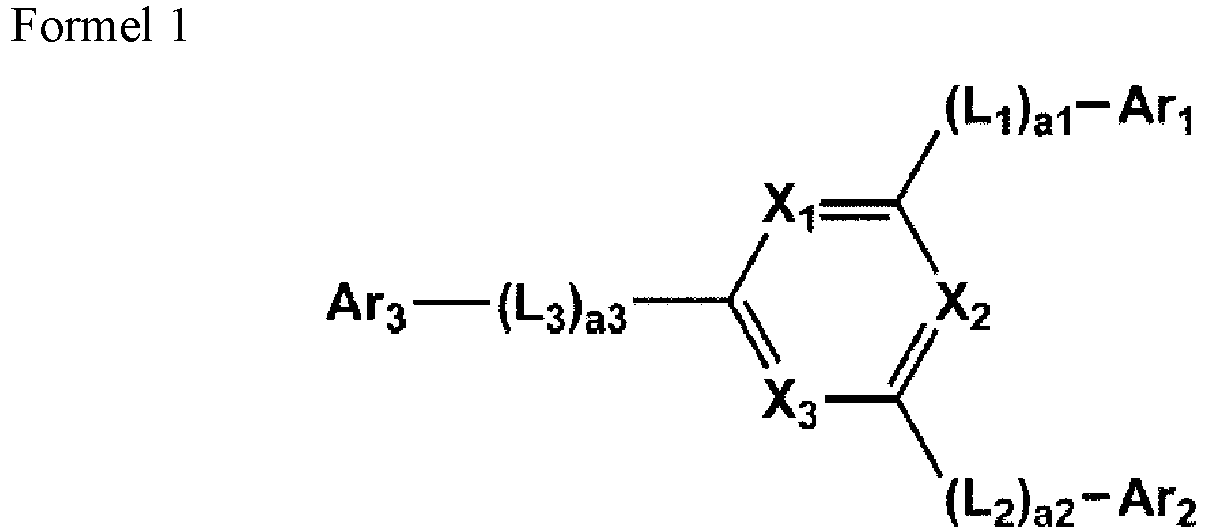

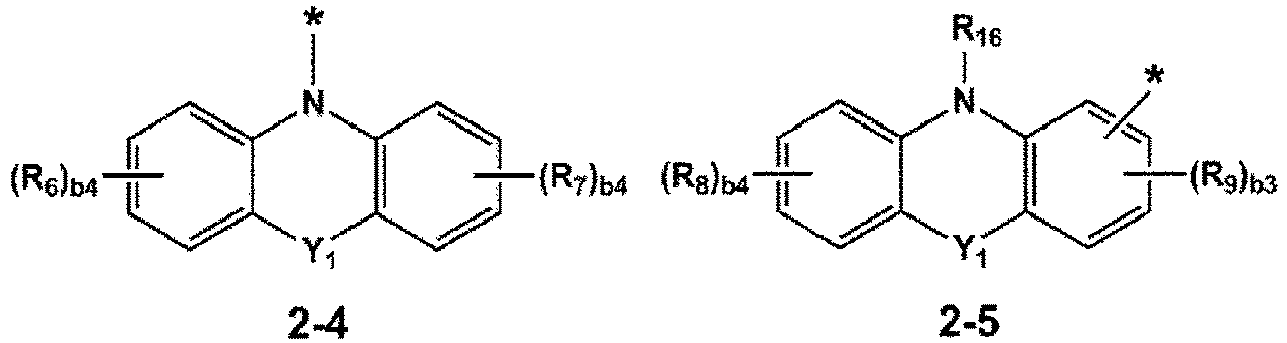
 X1 bis X3 jeweils unabhängig N oder C(R15) sind, wobei mindestens eines, ausgewählt aus X1 bis X3, N ist,L1 bis L3 jeweils unabhängig eine substituierte oder unsubstituierte C3-C60 carbozyklische Gruppe oder eine substituierte oder unsubstituierte C1-C60 heterozyklische Gruppe sind,a1 bis a3 jeweils unabhängig eine Ganzzahl von 0 bis 3 sind,An eine durch Formel 2-1 dargestellte Gruppe ist,Ar2 eine durch Formel 2-3 dargestellte Gruppe ist,Ar3 eine Gruppe ist, dargestellt durch eine, ausgewählt aus den Formeln 2-2 bis 2-7,Y1 O oder S ist,R1 bis R16 jeweils unabhängig ausgewählt sind aus Wasserstoff, Deuterium, -F, -Cl, -Br, -I, einer Hydroxylgruppe, einer Cyanogruppe, einer Nitrogruppe, einer Aminogruppe, einer Amidinogruppe, einer Hydrazingruppe, einer Hydrazongruppe, einer Carbonsäuregruppe oder einem Salz davon, einer Sulfonsäuregruppe oder einem Salz davon, einer Phosphorsäuregruppe oder einem Salz davon, einer substituierten oder unsubstituierten C1-C60 Alkylgruppe, einer substituierten oder unsubstituierten C2-C60 Alkenylgruppe, einer substituierten oder unsubstituierten C2-C60 Alkynylgruppe, einer substituierten oder unsubstituierten C1-C60 Alkoxygruppe, einer substituierten oder unsubstituierten C3-C10 Cycloalkylgruppe, einer substituierten oder unsubstituierten C2-C10 Heterocycloalkylgruppe, einer substituierten oder unsubstituierten C3-C10 Cycloalkenylgruppe, einer substituierten oder unsubstituierten C2-C10 Heterocycloalkenylgruppe, einer substituierten oder unsubstituierten C6-C60 Arylgruppe, einer substituierten oder unsubstituierten C6-C60 Aryloxygruppe, einer substituierten oder unsubstituierten C6-C60 Arylthiogruppe, einer substituierten oder unsubstituierten C2-C60 Heteroarylgruppe, einer substituierten oder unsubstituierten, einwertigen, nicht-aromatischen, kondensierten polyzyklischen Gruppe, einer substituierten oder unsubstituierten, einwertigen, nicht-aromatischen, kondensierten heteropolyzyklischen Gruppe, -Si(Q1)(Q2)(Q3), -N(Q1)(Q2), -B(Q1)(Q2), -S(=O)2(Q1) und -P(=O)(Q1)(Q2),b3 eine Ganzzahl von 0 bis 3 ist, b4 eine Ganzzahl von 0 bis 4 ist und b5 eine Ganzzahl von 0 bis 5 ist,in den in der heterozyklische Verbindung eingeschlossenen Gruppen, welche durch Formel 1 dargestellt ist, mindestens einer, ausgewählt aus den Substituenten R1 bis Rn der Formeln 2-1 bis 2-6 -Si(Q1)(Q2)(Q3) ist,wenn Ar3 eine durch Formel 2-7 dargestellte Gruppe ist, a3 0 ist,wenn Ar3 eine durch Formel 2-7 dargestellte Gruppe ist, L1 und L2 keine Benzolgruppen sind,mindestens ein Substituent der substituierten C3-C60 carbozyklischen Gruppe, der substituierten C1-C60 heterozyklischen Gruppe, der substituierten C1-C60 Alkylgruppe, der substituierten C2-C60 Alkenylgruppe, der substituierten C2-C60 Alkynylgruppe, der substituierten C1-C60 Alkoxygruppe, der substituierten C3-C10 Cycloalkylgruppe, der substituierten C2-C10 Heterocycloalkylgruppe, der substituierten C3-C10 Cycloalkenylgruppe, der substituierten C2-C10 Heterocycloalkenylgruppe, der substituierten C6-C60 Arylgruppe, der substituierten C6-C60 Aryloxygruppe, der substituierten C6-C60 Arylthiogruppe, der substituierten C2-C60 Heteroarylgruppe, der substituierten, einwertigen, nicht-aromatischen, kondensierten polyzyklischen Gruppe und der substituierten, einwertigen, nicht-aromatischen, kondensierten heteropolyzyklischen Gruppe ausgewählt ist aus:Deuterium, -F, -Cl, -Br, -I, einer Hydroxylgruppe, einer Cyanogruppe, einer Nitrogruppe, einer Amidinogruppe, einer Hydrazinogruppe, einer Hydrazonogruppe, einer C1-C60 Alkylgruppe, einer C2-C60 Alkenylgruppe, einer C2-C60 Alkynylgruppe und einer C1-C60 Alkoxygruppe,einer C1-C60 Alkylgruppe, einer C2-C60 Alkenylgruppe, einer C2-C60 Alkynylgruppe und einer C1-C60 Alkoxygruppe, jeweils substituiert mit mindestens einem, ausgewählt aus Deuterium, -F, -Cl, -Br, -I, einer Hydroxylgruppe, einer Cyanogruppe, einer Nitrogruppe, einer Amidinogruppe, einer Hydrazinogruppe, einer Hydrazonogruppe, einer C3-C10 Cycloalkylgruppe, einer C1-C10 Heterocycloalkylgruppe, einer C3-C10 Cycloalkenylgruppe, einer C1-C10 Heterocycloalkenylgruppe, einer C6-C60 Arylgruppe, einer C6-C60 Aryloxygruppe, einer C6-C60 Arylthiogruppe, einer C1-C60 Heteroarylgruppe, einer einwertigen, nicht-aromatischen, kondensierten polyzyklischen Gruppe, einer einwertigen, nicht-aromatischen, kondensierten heteropolyzyklischen Gruppe, -Si(Q11)(Q12)(Q13), - N(Q11)(Q12), -B(Q11)(Q12), -C(=O)(Q11), -S(=O)2(Q11) und -P(=O)(Q11)(Q12);einer C3-C10 Cycloalkylgruppe, einer C1-C10 Heterocycloalkylgruppe, einer C3-C10 Cycloalkenylgruppe, einer C1-C10 Heterocycloalkenylgruppe, einer C6-C60 Arylgruppe, einer C6-C60 Aryloxygruppe, einer C6-C60 Arylthiogruppe, einer C1-C60 Heteroarylgruppe, einer einwertigen, nicht-aromatischen, kondensierten polyzyklischen Gruppe, einer einwertigen, nicht-aromatischen, kondensierten heteropolyzyklischen Gruppe, einer Biphenylgruppe und einer Terphenylgruppe,einer C3-C10 Cycloalkylgruppe, einer C1-C10 Heterocycloalkylgruppe, einer C3-C10 Cycloalkenylgruppe, einer C1-C10 Heterocycloalkenylgruppe, einer C6-C60 Arylgruppe, einer C6-C60 Aryloxygruppe, einer C6-C60 Arylthiogruppe, einer C1-C60 Heteroarylgruppe, einer einwertigen, nicht-aromatischen, kondensierten polyzyklischen Gruppe, einer einwertigen, nicht-aromatischen, kondensierten heteropolyzyklischen Gruppe, einer Biphenylgruppe und einer Terphenylgruppe, jeweils substituiert mit mindestens einem, ausgewählt aus Deuterium, -F, -Cl, -Br, -I, einer Hydroxylgruppe, einer Cyanogruppe, einer Nitrogruppe, einer Amidinogruppe, einer Hydrazinogruppe, einer Hydrazonogruppe, einer C1-C60 Alkylgruppe, einer C2-C60 Alkenylgruppe, einer C2-C60 Alkynylgruppe, einer C1-C60 Alkoxygruppe, einer C3-C10 Cycloalkylgruppe, einer C1-C10 Heterocycloalkylgruppe, einer C3-C10 Cycloalkenylgruppe, einer C1-C10 Heterocycloalkenylgruppe, einer C6-C60 Arylgruppe, einer C6-C60 Aryloxygruppe, einer C6-C60 Arylthiogruppe, einer C1-C60 Heteroarylgruppe, einer einwertigen, nicht-aromatischen, kondensierten polyzyklischen Gruppe, einer einwertigen, nicht-aromatischen, kondensierten heteropolyzyklischen Gruppe, einer Biphenylgruppe, einer Terphenylgruppe, -Si(Q21)(Q22)(Q23), -N(Q21)(Q22), - B(Q21)(Q22), -C(=O)(Q21), -S(=O)2(Q21) und -P(=O)(Q21)(Q22); und-Si(Q31)(Q32)(Q33), -N(Q31)(Q32), -B(Q31)(Q32), -C(=O)(Q31), -S(=O)2(Q31) und -P(=O)(Q31)(Q32),Q1 bis Q3, Q11 bis Q13, Q21 bis Q23 und Q31 bis Q33 jeweils unabhängig ausgewählt sind aus:Wasserstoff, Deuterium, -F, -Cl, -Br, -I, einer Hydroxylgruppe, einer Cyanogruppe, einer Nitrogruppe, einer Amidinogruppe, einer Hydrazinogruppe, einer Hydrazonogruppe, einer C1-C60 Alkylgruppe, einer C2-C60 Alkenylgruppe, einer C2-C60 Alkynylgruppe, einer C1-C60 Alkoxygruppe, einer C3-C10 Cycloalkylgruppe, einer C1-C10 Heterocycloalkylgruppe, einer C3-C10 Cycloalkenylgruppe, einer C1-C10 Heterocycloalkenylgruppe, einer C6-C60 Arylgruppe, einer C6-C60 Arylgruppe, welche substituiert ist mit einer C1-C60 Alkylgruppe, einer C1-C60 Heteroarylgruppe, einer einwertigen, nicht-aromatischen, kondensierten polyzyklischen Gruppe, einer einwertigen, nicht-aromatischen, kondensierten heteropolyzyklischen Gruppe, einer Biphenylgruppe und einer Terphenylgruppe; undeiner C1-C60 Alkylgruppe, einer C2-C60 Alkenylgruppe, einer C2-C60 Alkynylgruppe, einer C1-C60 Alkoxygruppe, einer C3-C10 Cycloalkylgruppe, einer C1-C10 Heterocycloalkylgruppe, einer C3-C10 Cycloalkenylgruppe, einer C1-C10 Heterocycloalkenylgruppe, einer C6-C60 Arylgruppe, einer C6-C60 Arylgruppe, welche substituiert ist mit einer C1-C60 Alkylgruppe, einer C1-C60 Heteroarylgruppe, einer einwertigen, nicht-aromatischen, kondensierten polyzyklischen Gruppe, einer einwertigen, nicht-aromatischen, kondensierten heteropolyzyklischen Gruppe, einer Biphenylgruppe und einer Terphenylgruppe, jeweils substituiert mit mindestens einem, ausgewählt aus Deuterium, -F, -Cl, -Br, -I, einer Hydroxylgruppe, einer Cyanogruppe, einer Nitrogruppe, einer Amidinogruppe, einer Hydrazinogruppe, einer Hydrazonogruppe, einer C1-C60 Alkylgruppe und -Si(Ra)(Rb)(Rc),Ra bis Rc jeweils unabhängig ausgewählt sind aus Wasserstoff, Deuterium, -F, -Cl, -Br, -I, einer Hydroxylgruppe, einer Cyanogruppe, einer Nitrogruppe, einer Aminogruppe, einer Amidinogruppe, einer Hydrazingruppe, einer Hydrazongruppe, einer Carbonsäuregruppe oder einem Salz davon, einer Sulfonsäuregruppe oder einem Salz davon, einer Phosphorsäuregruppe oder einem Salz davon, einer substituierten oder unsubstituierten C1-C60 Alkylgruppe, einer substituierten oder unsubstituierten C2-C60 Alkenylgruppe, einer substituierten oder unsubstituierten C2-C60 Alkynylgruppe, einer substituierten oder unsubstituierten C1-C60 Alkoxygruppe, einer substituierten oder unsubstituierten C3-C10 Cycloalkylgruppe, einer substituierten oder unsubstituierten C2-C10 Heterocycloalkylgruppe, einer substituierten oder unsubstituierten C3-C10 Cycloalkenylgruppe, einer substituierten oder unsubstituierten C2-C10 Heterocycloalkenylgruppe, einer substituierten oder unsubstituierten C6-C60 Arylgruppe, einer substituierten oder unsubstituierten C6-C60 Aryloxygruppe, einer substituierten oder unsubstituierten C6-C60 Arylthiogruppe, einer substituierten oder unsubstituierten C2-C60 Heteroarylgruppe, einer substituierten oder unsubstituierten, einwertigen, nicht-aromatischen, kondensierten polyzyklischen Gruppe und einer substituierten oder unsubstituierten, einwertigen, nicht-aromatischen, kondensierten heteropolyzyklischen Gruppe, und∗ eine Bindungsstelle an einem benachbarten Atom angibt.
 - Heterozyklische Verbindung nach Anspruch 7, wobei:
L1 bis L3 jeweils unabhängig ausgewählt sind aus:einer Benzolgruppe, einer Pentalengruppe, einer Indengruppe, einer Naphthalengruppe, einer Azulengruppe, einer Heptalengruppe, einer Indacengruppe, einer Acenaphthalengruppe, einer Fluorengruppe, einer Spiro-Bifluorengruppe, einer Spiro-Benzofluoren-Fluorengruppe, einer Benzofluorengruppe, einer Dibenzofluorengruppe, einer Phenalengruppe, einer Phenanthrengruppe, einer Anthracengruppe, einer Fluoranthengruppe, einer Pyrengruppe, einer Chrysengruppe, einer Naphthacengruppe, einer Picengruppe, einer Perylengruppe, einer Pyrrolgruppe, einer Thiophengruppe, einer Furangruppe, einer Silolgruppe, einer Imidazolgruppe, einer Pyrazolgruppe, einer Thiazolgruppe, einer Isothiazolgruppe, einer Oxazolgruppe, einer Isoxazolgruppe, einer Pyridingruppe, einer Pyrazingruppe, einer Pyrimidingruppe, einer Pyridazingruppe, einer Triazingruppe, einer Benzofurangruppe, einer Benzothiophengruppe, einer Benzosilolgruppe, einer Dibenzosilolgruppe, einer Quinolingruppe, einer Isoquinolingruppe, einer Benzimidazolgruppe, einer Imidazopyridingruppe und einer Imidazopyrimidingruppe;einer Benzolgruppe, einer Pentalengruppe, einer Indengruppe, einer Naphthalengruppe, einer Azulengruppe, einer Heptalengruppe, einer Indacengruppe, einer Acenaphthalengruppe, einer Fluorengruppe, einer Spiro-Bifluorengruppe, einer Spiro-Benzofluoren-Fluorengruppe, einer Benzofluorengruppe, einer Dibenzofluorengruppe, einer Phenalengruppe, einer Phenanthrengruppe, einer Anthracengruppe, einer Fluoranthengruppe, einer Pyrengruppe, einer Chrysengruppe, einer Naphthacengruppe, einer Picengruppe, einer Perylengruppe, einer Pyrrolgruppe, einer Thiophengruppe, einer Furangruppe, einer Silolgruppe, einer Imidazolgruppe, einer Pyrazolgruppe, einer Thiazolgruppe, einer Isothiazolgruppe, einer Oxazolgruppe, einer Isoxazolgruppe, einer Pyridingruppe, einer Pyrazingruppe, einer Pyrimidingruppe, einer Pyridazingruppe, einer Triazingruppe, einer Benzofurangruppe, einer Benzothiophengruppe, einer Benzosilolgruppe, einer Dibenzosilolgruppe, einer Quinolingruppe, einer Isoquinolingruppe, einer Benzimidazolgruppe, einer Imidazopyridingruppe und einer Imidazopyrimidingruppe, jeweils substituiert mit mindestens einem, ausgewählt aus Deuterium, -F, -Cl, -Br, -I, einer Hydroxylgruppe, einer Cyanogruppe, einer C1-C20 Alkylgruppe, einer C1-C20 Alkoxygruppe, einer Cyclopentylgruppe, einer Cyclohexylgruppe, einer Cycloheptylgruppe, einer Cyclopentenylgruppe, einer Cyclohexenylgruppe, einer Phenylgruppe, einer Biphenylgruppe, einer Terphenylgruppe, einer Pentalenylgruppe, einer Indenylgruppe, einer Naphthylgruppe, einer Azulenylgruppe, einer Heptalenylgruppe, einer Indacenylgruppe, einer Acenaphthylgruppe, einer Fluorenylgruppe, einer Spiro-Bifluorenylgruppe, einer Benzofluorenylgruppe, einer Dibenzofluorenylgruppe, einer Phenalenylgruppe, einer Phenanthrenylgruppe, einer Anthracenylgruppe, einer Fluoranthenylgruppe, einer Pyrenylgruppe, einer Chrysenylgruppe, einer Naphthacenylgruppe, einer Picenylgruppe, einer Perylenylgruppe, einer Pentaphenylgruppe, einer Hexacenylgruppe, einer Pentacenylgruppe, einer Rubicenylgruppe, einer Coronenylgruppe, einer Ovalenylgruppe, einer Pyrrolylgruppe, einer Thiophenylgruppe, einer Furanylgruppe, einer Pyridinylgruppe, einer Pyrazinylgruppe, einer Pyrimidinylgruppe, einer Pyridazinylgruppe, einer Quinolinylgruppe, einer Isoquinolinylgruppe, einer Benzofuranylgruppe, einer Benzothiophenylgruppe, -Si(Q31)(Q32)(Q33), -N(Q31)(Q32) und -B(Q31)(Q32), undQ31 bis Q33 jeweils unabhängig ausgewählt sind aus einer C1-C20 Alkylgruppe, einer C1-C20 Alkoxygruppe, einer Phenylgruppe, einer Biphenylgruppe, einer Terphenylgruppe, einer Naphthylgruppe und einer Pyridinylgruppe, wobei vorzugsweise:L1 bis L3 jeweils unabhängig ausgewählt sind aus Gruppen, dargestellt durch die Formeln 3-1 bis 3-27: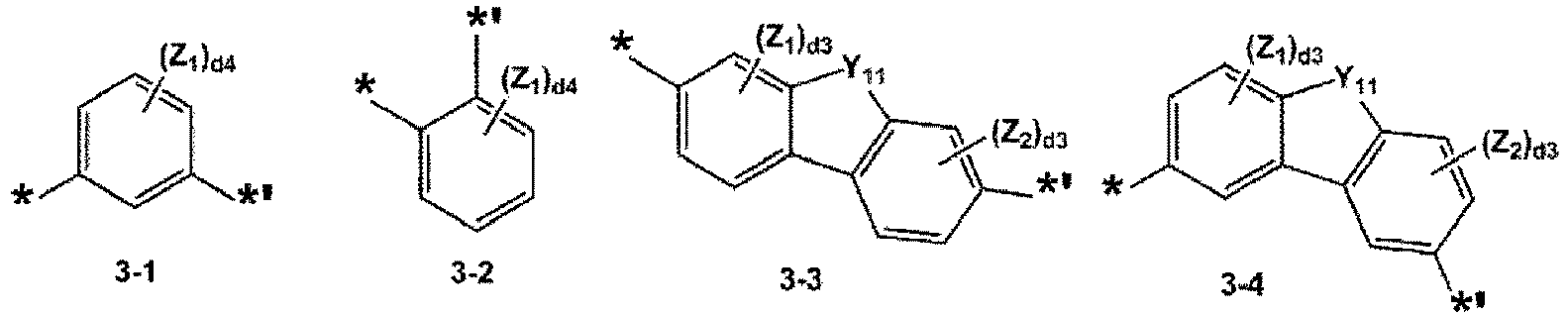


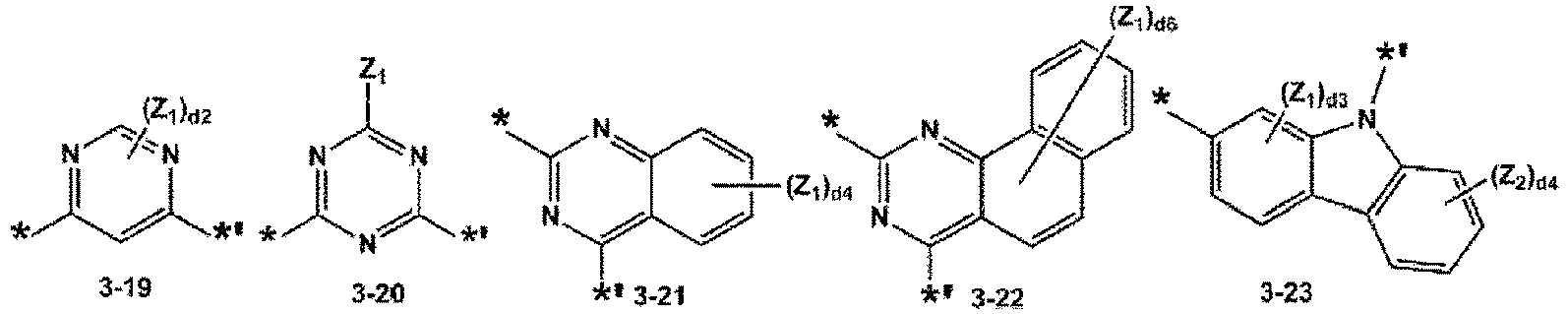
 wobei, in den Formeln 3-1 bis 3-27,Y11 ausgewählt ist aus C(Z3)(Z4), N(Z5), Si(Z6)(Z7), O und S,Z1 bis Z7 jeweils unabhängig ausgewählt sind aus Wasserstoff, Deuterium, -F, -Cl, -Br, -I, einer Hydroxylgruppe, einer Cyanogruppe, einer C1-C20 Alkylgruppe, einer C1-C20 Alkoxygruppe, einer Cyclopentylgruppe, einer Cyclohexylgruppe, einer Cycloheptylgruppe, einer Cyclopentenylgruppe, einer Cyclohexenylgruppe, einer Phenylgruppe, einer Biphenylgruppe, einer Terphenylgruppe, einer Naphthylgruppe, einer Fluorenylgruppe, einer Spiro-Bifluorenylgruppe, einer Benzofluorenylgruppe, einer Dibenzofluorenylgruppe, einer Phenanthrenylgruppe, einer Anthracenylgruppe, einer Fluoranthenylgruppe, einer Pyrenylgruppe, einer Chrysenylgruppe, einer Pyrrolylgruppe, einer Thiophenylgruppe, einer Furanylgruppe, einer Silolylgruppe, einer Imidazolylgruppe, einer Pyrazolylgruppe, einer Thiazolylgruppe, einer Isothiazolylgruppe, einer Oxazolylgruppe, einer Isoxazolylgruppe, einer Pyridinylgruppe, einer Pyrazinylgruppe, einer Pyrimidinylgruppe, einer Pyridazinylgruppe, einer Benzofuranylgruppe, einer Benzothiophenylgruppe, einer Benzosilolylgruppe, einer Dibenzosilolylgruppe und - Si(Q31)(Q32)(Q33),Q31 bis Q33 jeweils unabhängig ausgewählt sind aus einer C1-C20 Alkylgruppe, einer C1-C20 Alkoxygruppe, einer Phenylgruppe, einer Biphenylgruppe, einer Terphenylgruppe, einer Naphthylgruppe und einer Pyridinylgruppe,d2 eine Ganzzahl von 0 bis 2 ist,d3 eine Ganzzahl von 0 bis 3 ist,d4 eine Ganzzahl von 0 bis 4 ist,d6 eine Ganzzahl von 0 bis 6 ist,d8 eine Ganzzahl von 0 bis 8 ist, und* und *' jeweils eine Bindungsstelle einer einem benachbarten Atom angeben.
 - Heterozyklische Verbindung nach Anspruch 7 oder 8, wobei:i) Ar1 eine Gruppe ist, dargestellt durch Formel 2-1, und Ar2 und Ar3 jeweils eine Gruppe sind, dargestellt durch Formel 2-3; oderii) Ar1 eine Gruppe ist, dargestellt durch Formel 2-1, Ar2 eine Gruppe ist, dargestellt durch Formel 2-3, und Ar3 eine Gruppe ist, dargestellt durch Formel 2-6.
- Heterozyklische Verbindung nach einem der Ansprüche 7 bis 9, wobei:
mindestens eines, ausgewählt aus R1(s) aus der Anzahl von b5 -Si(Q1)(Q2)(Q3) ist. - Heterozyklische Verbindung nach einem der Ansprüche 7 bis 10, wobei:Ar1 eine Gruppe ist, dargestellt durch eine, ausgewählt aus den Formeln 2-1(1) bis 2-1(3), Ar2 eine Gruppe ist, dargestellt durch eine, ausgewählt aus den Formeln 2-3(1) ist 2-3(2) und Ar3 eine Gruppe ist, dargestellt durch eine, ausgewählt aus den Formeln 2-2(1) bis 2-2(2), 2-3(1) bis 2-3(2), 2-4(1) bis 2-4(2) und 2-6(1) bis 2-6(4):



 wobei in den Formeln 2-1(1) bis 2-1(3), 2-2(1) bis 2-2(2), 2-3(1) bis 2-3(2), 2-4(1) bis 2-4(2) und 2-6(1) bis 2-6(4),Z11 bis Z15 jeweils unabhängig ausgewählt sind aus Wasserstoff, Deuterium, -F, -Cl, -Br, -I, einer Hydroxylgruppe, einer Cyanogruppe, einer C1-C20 Alkylgruppe, einer C1-C20 Alkoxygruppe, einer Cyclopentylgruppe, einer Cyclohexylgruppe, einer Cycloheptylgruppe, einer Cyclopentenylgruppe, einer Cyclohexenylgruppe, einer Phenylgruppe, einer Biphenylgruppe, einer Terphenylgruppe, einer Naphthylgruppe, einer Fluorenylgruppe, einer Spiro-Bifluorenylgruppe, einer Benzofluorenylgruppe, einer Dibenzofluorenylgruppe, einer Phenanthrenylgruppe, einer Anthracenylgruppe, einer Fluoranthenylgruppe, einer Pyrenylgruppe, einer Chrysenylgruppe, einer Pyrrolylgruppe, einer Thiophenylgruppe, einer Furanylgruppe, einer Silolylgruppe, einer Imidazolylgruppe, einer Pyrazolylgruppe, einer Thiazolylgruppe, einer Isothiazolylgruppe, einer Oxazolylgruppe, einer Isoxazolylgruppe, einer Pyridinylgruppe, einer Pyrazinylgruppe, einer Pyrimidinylgruppe, einer Pyridazinylgruppe, einer Benzofuranylgruppe, einer Benzothiophenylgruppe, einer Benzosilolylgruppe, einer Dibenzosilolylgruppe und - Si(Q31)(Q32)(Q33),Q31 bis Q33 jeweils unabhängig ausgewählt sind aus einer C1-C20 Alkylgruppe, einer C1-C20 Alkoxygruppe, einer Phenylgruppe, einer Biphenylgruppe, einer Terphenylgruppe, einer Naphthylgruppe und einer Pyridinylgruppe,e3 eine Ganzzahl von 0 bis 3 ist,e4 eine Ganzzahl von 0 bis 4 ist,e5 eine Ganzzahl von 0 bis 5 ist,Ph eine Phenylgruppe angibt, und* und *' jeweils eine Bindungsstelle einer einem benachbarten Atom angeben.
 - Heterozyklische Verbindung nach Anspruch 11, wobei:
Ar1 eine Gruppe ist, dargestellt durch eine, ausgewählt aus den Formeln 2-1(2) bis 2-1(3), Ar2 eine Gruppe ist, dargestellt durch Formel 2-3(2) und Ar3 eine Gruppe ist, dargestellt durch eine, ausgewählt aus den Formeln 2-2(2), 2-3(2), 2-6(3) und 2-6(4). - Heterozyklische Verbindung nach einem der Ansprüche 7 bis 12, wobei:Ar1 eine Gruppe ist, dargestellt durch eine, ausgewählt aus den Formeln 4-1 bis 4-5, Ar2 eine Gruppe ist, dargestellt durch eine, ausgewählt aus den Formeln 4-11 bis 4-15 und Ar3 eine Gruppe ist, dargestellt durch eine, ausgewählt aus den Formeln 4-6 bis 4-21:

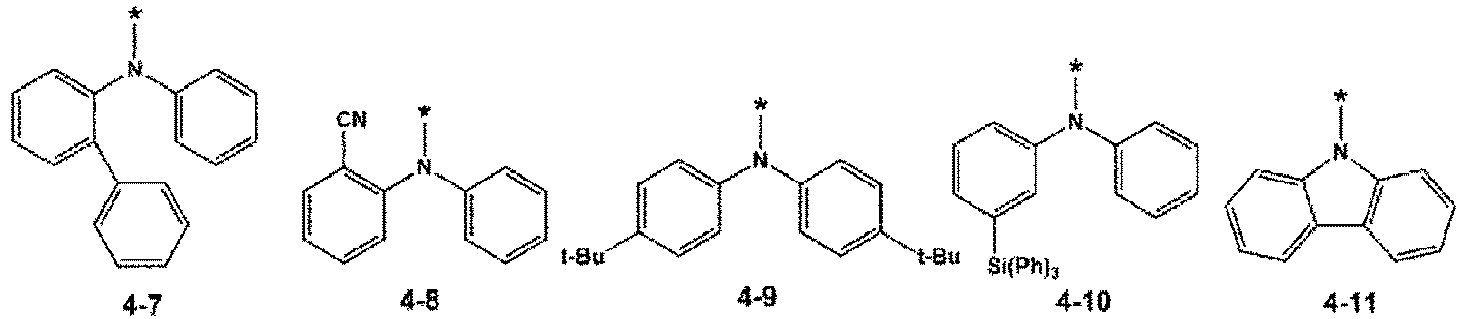

 wobei, in den Formeln 4-1 bis 4-21,Ph eine Phenylgruppe angibt und t-Bu eine tert-Butylgruppe angibt.
 - Heterozyklische Verbindung nach einem der Ansprüche 7 bis 13, wobei:i) X1 bis X3 jeweils N sind;ii) X1 und X2 jeweils N sind und X3 C(R15) ist;iii) X1 und X3 jeweils N sind und X2 C(R15) ist;iv) X2 und X3 jeweils N sind und X1 C(R15) ist;v) X1 N, ist, und X2 und X3 jeweils C(R15) sind;vi) X2 N ist, und X1 und X3 jeweils C(R15) sind; odervii) X3 N ist, und X1 und X2 jeweils C(R15) sind,und R15 Wasserstoff ist.
- Heterozyklische Verbindung nach Anspruch 7, wobei:
die heterozyklische Verbindung aus den Verbindungen 3 bis 6, 13, 14, 17 bis 20, 27 bis 29, 32 bis 34, 43 bis 49 und 59 ausgewählt ist:


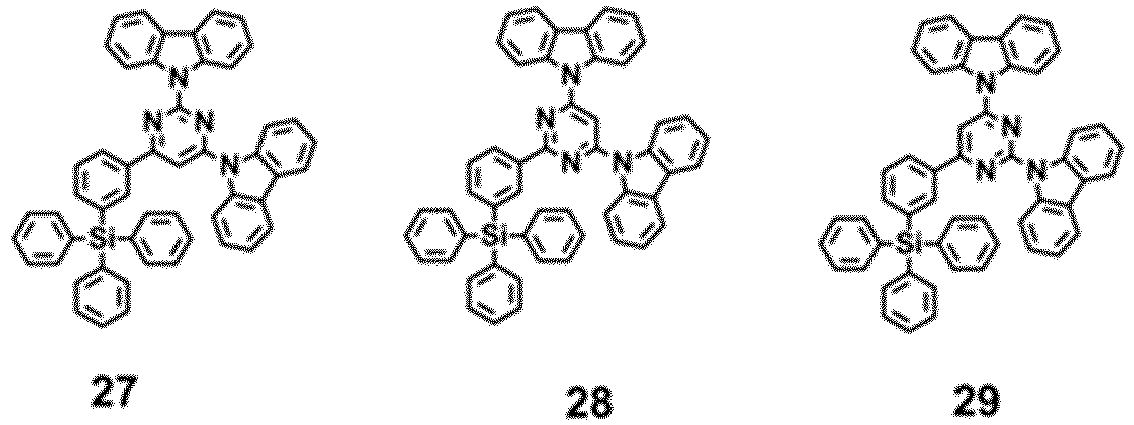
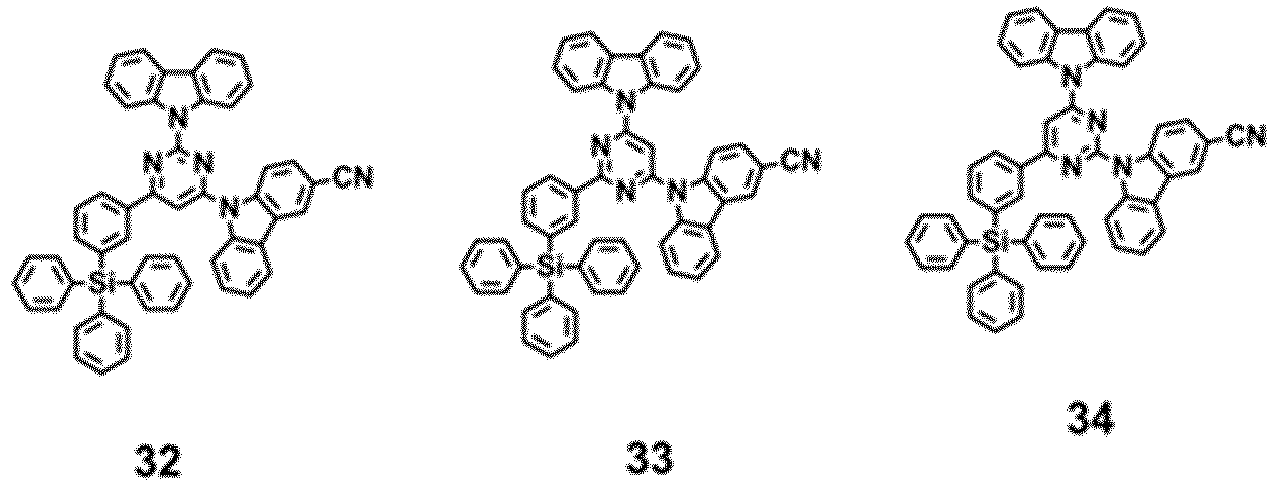


Applications Claiming Priority (2)
| Application Number | Priority Date | Filing Date | Title |
|---|---|---|---|
| KR1020180147692A KR102261645B1 (ko) | 2018-11-26 | 2018-11-26 | 헤테로시클릭 화합물 및 이를 포함한 유기 발광 소자 |
| EP19210317.4A EP3657563B1 (de) | 2018-11-26 | 2019-11-20 | Heterocyclische verbindung und organische lichtemittierende vorrichtung damit |
Related Parent Applications (2)
| Application Number | Title | Priority Date | Filing Date |
|---|---|---|---|
| EP19210317.4A Division EP3657563B1 (de) | 2018-11-26 | 2019-11-20 | Heterocyclische verbindung und organische lichtemittierende vorrichtung damit |
| EP19210317.4A Division-Into EP3657563B1 (de) | 2018-11-26 | 2019-11-20 | Heterocyclische verbindung und organische lichtemittierende vorrichtung damit |
Publications (2)
| Publication Number | Publication Date |
|---|---|
| EP3848992A1 EP3848992A1 (de) | 2021-07-14 |
| EP3848992B1 true EP3848992B1 (de) | 2023-04-19 |
Family
ID=68834932
Family Applications (5)
| Application Number | Title | Priority Date | Filing Date |
|---|---|---|---|
| EP21159425.4A Active EP3872888B1 (de) | 2018-11-26 | 2019-11-20 | Heterocyclische verbindung und organische lichtemittierende vorrichtung damit |
| EP21159426.2A Active EP3848992B1 (de) | 2018-11-26 | 2019-11-20 | Heterocyclische verbindung und organische lichtemittierende vorrichtung damit |
| EP19210317.4A Active EP3657563B1 (de) | 2018-11-26 | 2019-11-20 | Heterocyclische verbindung und organische lichtemittierende vorrichtung damit |
| EP23161893.5A Pending EP4215536A1 (de) | 2018-11-26 | 2019-11-20 | Heterocyclische verbindung und organische lichtemittierende vorrichtung damit |
| EP22191576.2A Active EP4113644B1 (de) | 2018-11-26 | 2019-11-20 | Heterocyclische verbindung und organische lichtemittierende vorrichtung damit |
Family Applications Before (1)
| Application Number | Title | Priority Date | Filing Date |
|---|---|---|---|
| EP21159425.4A Active EP3872888B1 (de) | 2018-11-26 | 2019-11-20 | Heterocyclische verbindung und organische lichtemittierende vorrichtung damit |
Family Applications After (3)
| Application Number | Title | Priority Date | Filing Date |
|---|---|---|---|
| EP19210317.4A Active EP3657563B1 (de) | 2018-11-26 | 2019-11-20 | Heterocyclische verbindung und organische lichtemittierende vorrichtung damit |
| EP23161893.5A Pending EP4215536A1 (de) | 2018-11-26 | 2019-11-20 | Heterocyclische verbindung und organische lichtemittierende vorrichtung damit |
| EP22191576.2A Active EP4113644B1 (de) | 2018-11-26 | 2019-11-20 | Heterocyclische verbindung und organische lichtemittierende vorrichtung damit |
Country Status (4)
| Country | Link |
|---|---|
| US (2) | US12598909B2 (de) |
| EP (5) | EP3872888B1 (de) |
| KR (1) | KR102261645B1 (de) |
| CN (1) | CN111224005B (de) |
Families Citing this family (29)
| Publication number | Priority date | Publication date | Assignee | Title |
|---|---|---|---|---|
| US11716899B2 (en) * | 2018-11-28 | 2023-08-01 | Universal Display Corporation | Organic electroluminescent materials and devices |
| KR102541446B1 (ko) * | 2019-01-22 | 2023-06-09 | 삼성디스플레이 주식회사 | 유기 발광 소자 및 이를 포함하는 표시 장치 |
| WO2021033724A1 (ja) | 2019-08-19 | 2021-02-25 | 出光興産株式会社 | 化合物、有機エレクトロルミネッセンス素子用材料、有機エレクトロルミネッセンス素子及び電子機器 |
| US12545690B2 (en) | 2019-10-25 | 2026-02-10 | Universal Display Corporation | Organic electroluminescent materials and devices |
| US12577202B2 (en) | 2021-02-26 | 2026-03-17 | Universal Display Corporation | Organic electroluminescent materials and devices |
| KR102839003B1 (ko) * | 2020-04-21 | 2025-07-30 | 엘티소재주식회사 | 헤테로고리 화합물, 이를 포함하는 유기 발광 소자, 이의 제조 방법 및 유기물층용 조성물 |
| KR102552269B1 (ko) | 2020-05-14 | 2023-07-07 | 삼성디스플레이 주식회사 | 헤테로시클릭 화합물 및 이를 포함한 유기 발광 소자 |
| KR102929423B1 (ko) * | 2020-07-17 | 2026-02-23 | 삼성디스플레이 주식회사 | 발광 소자 및 상기 발광 소자를 포함한 전자 장치 |
| CN116391456A (zh) | 2020-09-18 | 2023-07-04 | 三星显示有限公司 | 有机电致发光器件 |
| KR102883176B1 (ko) | 2020-10-07 | 2025-11-11 | 삼성디스플레이 주식회사 | 유기 전계 발광 소자 |
| CN112300162B (zh) * | 2020-10-30 | 2022-04-05 | 武汉天马微电子有限公司 | 化合物、电子传输材料、显示面板和显示装置 |
| KR20220063558A (ko) * | 2020-11-10 | 2022-05-17 | 솔루스첨단소재 주식회사 | 유기 화합물 및 이를 포함하는 유기 전계 발광 소자 |
| KR102647437B1 (ko) * | 2020-11-20 | 2024-03-12 | 단국대학교 천안캠퍼스 산학협력단 | 다이벤조유도체 및 시아노기를 포함하는 유기 발광 재료 및 소자 |
| EP4723858A2 (de) * | 2021-02-26 | 2026-04-08 | Universal Display Corporation | Organische elektrolumineszente materialien und vorrichtungen |
| KR102927095B1 (ko) * | 2021-06-01 | 2026-02-12 | 삼성디스플레이 주식회사 | 유기금속 화합물, 이를 포함한 발광 소자 및 상기 발광 소자를 포함한 전자 장치 |
| KR20230033748A (ko) * | 2021-08-27 | 2023-03-09 | 삼성디스플레이 주식회사 | 헤테로고리 화합물, 이를 포함한 발광 소자 및 상기 발광 소자를 포함한 전자 장치 |
| KR20230039821A (ko) | 2021-09-13 | 2023-03-22 | 삼성디스플레이 주식회사 | 발광 소자 |
| KR102472899B1 (ko) * | 2021-09-16 | 2022-12-02 | 삼성디스플레이 주식회사 | 유기 전계 발광 소자 및 유기 전계 발광 소자용 축합 다환 화합물 |
| KR102951877B1 (ko) * | 2021-09-17 | 2026-04-14 | 삼성디스플레이 주식회사 | 발광 소자 |
| KR102929418B1 (ko) | 2021-11-02 | 2026-02-23 | 삼성디스플레이 주식회사 | 발광 소자 및 이를 포함하는 전자 장치 |
| EP4203645A3 (de) * | 2021-12-27 | 2023-08-30 | LG Display Co., Ltd. | Organische lichtemittierende diode und organische lichtemittierende anzeigevorrichtung damit |
| KR102651058B1 (ko) * | 2022-01-05 | 2024-03-26 | 삼성디스플레이 주식회사 | 헤테로고리 화합물, 이를 포함한 발광 소자 및 상기 발광 소자를 포함한 전자 장치 |
| WO2024010280A1 (ko) * | 2022-07-05 | 2024-01-11 | 덕산네오룩스 주식회사 | 유기전기 소자용 화합물, 이를 이용한 유기전기소자 및 그 전자 장치 |
| EP4464759A3 (de) * | 2023-05-16 | 2025-03-19 | SFC Co., Ltd. | Organische verbindungen und organische lichtemittierende vorrichtung damit |
| KR20240166676A (ko) | 2023-05-18 | 2024-11-26 | 주식회사 엘지화학 | 유기화합물 및 이를 포함하는 유기 발광 소자 |
| KR20250095063A (ko) * | 2023-12-19 | 2025-06-26 | 솔루스첨단소재 주식회사 | 유기 발광 화합물 및 이를 포함하는 유기 전계 발광 소자 |
| KR20250154132A (ko) | 2024-04-19 | 2025-10-28 | 주식회사 엘지화학 | 유기화합물 및 이를 포함하는 유기 발광 소자 |
| KR20250163494A (ko) | 2024-05-14 | 2025-11-21 | 주식회사 엘지화학 | 유기화합물 및 이를 포함하는 유기 발광 소자 |
| KR20260009242A (ko) * | 2024-07-10 | 2026-01-19 | 솔루스첨단소재 주식회사 | 유기 화합물 및 이를 포함하는 유기 전계 발광 소자 |
Family Cites Families (90)
| Publication number | Priority date | Publication date | Assignee | Title |
|---|---|---|---|---|
| US6310360B1 (en) | 1999-07-21 | 2001-10-30 | The Trustees Of Princeton University | Intersystem crossing agents for efficient utilization of excitons in organic light emitting devices |
| US6507026B2 (en) | 2000-01-12 | 2003-01-14 | Kabushiki Kaisha Toshiba | Planar X-ray detector |
| US6939624B2 (en) | 2000-08-11 | 2005-09-06 | Universal Display Corporation | Organometallic compounds and emission-shifting organic electrophosphorescence |
| EP2770036B1 (de) | 2002-03-15 | 2017-12-20 | Idemitsu Kosan Co., Ltd | Material für organische Elektrolumineszenzvorrichtungen und daraus hergestellte organische Elektrolumineszenzvorrichtungen |
| JP2004234952A (ja) | 2003-01-29 | 2004-08-19 | Konica Minolta Holdings Inc | 有機エレクトロルミネッセンス素子及び表示装置 |
| KR100537621B1 (ko) | 2004-02-02 | 2005-12-19 | 삼성에스디아이 주식회사 | 이리듐 화합물 및 이를 이용한 유기 전계 발광 소자 |
| US7393599B2 (en) | 2004-05-18 | 2008-07-01 | The University Of Southern California | Luminescent compounds with carbene ligands |
| US7279704B2 (en) | 2004-05-18 | 2007-10-09 | The University Of Southern California | Complexes with tridentate ligands |
| KR100730115B1 (ko) | 2004-06-23 | 2007-06-19 | 삼성에스디아이 주식회사 | 이리듐 화합물 및 이를 이용한 유기 전계 발광 소자 |
| JP2006013222A (ja) | 2004-06-28 | 2006-01-12 | Fuji Photo Film Co Ltd | 有機電界発光素子、およびその製造方法 |
| KR100721565B1 (ko) | 2004-11-17 | 2007-05-23 | 삼성에스디아이 주식회사 | 저분자 유기 전계 발광 소자 및 그의 제조 방법 |
| DE102004057072A1 (de) | 2004-11-25 | 2006-06-01 | Basf Ag | Verwendung von Übergangsmetall-Carbenkomplexen in organischen Licht-emittierenden Dioden (OLEDs) |
| KR101223717B1 (ko) | 2005-04-12 | 2013-01-18 | 삼성디스플레이 주식회사 | 실릴 치환된 시클로메탈화 전이금속 착물 및 이를 이용한 유기 전계 발광 소자 |
| US9051344B2 (en) | 2005-05-06 | 2015-06-09 | Universal Display Corporation | Stability OLED materials and devices |
| US20100219397A1 (en) | 2005-08-05 | 2010-09-02 | Idemitsu Kosan Co., Ltd. | Transition metal complex compound and organic electroluminescent device using same |
| CN101253185A (zh) | 2005-08-05 | 2008-08-27 | 出光兴产株式会社 | 过渡金属配位化合物及使用该化合物的有机电致发光元件 |
| JP2007045742A (ja) | 2005-08-10 | 2007-02-22 | Mitsubishi Chemicals Corp | 遷移金属錯体の製造方法及び遷移金属錯体 |
| KR101263505B1 (ko) | 2006-04-28 | 2013-05-13 | 동우 화인켐 주식회사 | 유기실란계 화합물, 이를 포함하는 발광 물질, 및 유기발광 소자 |
| WO2008096609A1 (ja) | 2007-02-05 | 2008-08-14 | Idemitsu Kosan Co., Ltd. | 遷移金属錯体化合物及びそれを用いた有機エレクトロルミネッセンス素子 |
| US8106199B2 (en) | 2007-02-13 | 2012-01-31 | Arizona Board Of Regents For And On Behalf Of Arizona State University | Organometallic materials for optical emission, optical absorption, and devices including organometallic materials |
| JP5209604B2 (ja) | 2007-03-27 | 2013-06-12 | 新日鉄住金化学株式会社 | 有機電界発光素子用化合物及び有機電界発光素子 |
| WO2009086209A2 (en) | 2007-12-21 | 2009-07-09 | Arizona Board Of Regents For And On Behalf Of Arizona State University | Platinum(ii) di(2-pyrazolyl)benzene chloride analogs and uses |
| US20090295274A1 (en) | 2008-02-04 | 2009-12-03 | Kuo-Chu Hwang | Deuterated Semiconducting Organic Compounds for Use in Light-Emitting Devices |
| US8389725B2 (en) | 2008-02-29 | 2013-03-05 | Arizona Board Of Regents For And On Behalf Of Arizona State University | Tridentate platinum (II) complexes |
| WO2010079051A1 (de) | 2009-01-07 | 2010-07-15 | Basf Se | Silyl- und heteroatom-substituierte verbindungen ausgewählt aus carbazolen, dibenzofuranen, dibenzothiophenen und dibenzophospholen und ihre anwendung in der organischen elektronik |
| WO2010118026A2 (en) | 2009-04-06 | 2010-10-14 | Arizona Board Of Regents Acting For And On Behalf Of Arizona State University | Synthesis of four coordinated platinum complexes and their applications in light emitting devices thereof |
| TWI419955B (zh) | 2009-04-23 | 2013-12-21 | Chien Hong Cheng | β-二酮類輔助配位基與其金屬錯合物在有機光電元件之應用 |
| US8557400B2 (en) | 2009-04-28 | 2013-10-15 | Universal Display Corporation | Iridium complex with methyl-D3 substitution |
| KR20100118700A (ko) | 2009-04-29 | 2010-11-08 | 다우어드밴스드디스플레이머티리얼 유한회사 | 신규한 유기 발광 화합물 및 이를 채용하고 있는 유기 전계 발광 소자 |
| JP5753658B2 (ja) | 2010-01-08 | 2015-07-22 | ユー・ディー・シー アイルランド リミテッド | 電荷輸送材料及び有機電界発光素子 |
| JP2013530135A (ja) | 2010-04-30 | 2013-07-25 | アリゾナ ボード オブ リージェンツ アクティング フォー アンド オン ビハーフ オブ アリゾナ ステイト ユニバーシティ | 四配位パラジウム錯体の合成およびその発光素子におけるその適用 |
| JP2013525436A (ja) | 2010-04-30 | 2013-06-20 | アリゾナ ボード オブ リージェンツ アクティング フォー アンド オン ビハーフ オブ アリゾナ ステイト ユニバーシティ | 四配位金錯体の合成およびその発光素子におけるその適用 |
| KR20120021215A (ko) | 2010-08-31 | 2012-03-08 | 롬엔드하스전자재료코리아유한회사 | 신규한 유기 전자 재료용 화합물 및 이를 포함하는 유기 전계 발광 소자 |
| DE102010048497A1 (de) | 2010-10-14 | 2012-04-19 | Merck Patent Gmbh | Formulierungen für organische Elektrolumineszenzvorrichtungen |
| TWI541247B (zh) | 2011-02-18 | 2016-07-11 | 美國亞利桑那州立大學董事會 | 具有幾何失真電荷轉移態之四配位鉑及鈀錯合物及彼等於發光裝置中之應用 |
| US8883322B2 (en) | 2011-03-08 | 2014-11-11 | Universal Display Corporation | Pyridyl carbene phosphorescent emitters |
| US9221857B2 (en) | 2011-04-14 | 2015-12-29 | Arizona Board Of Regents Acting For And On Behalf Of Arizona State University | Pyridine-oxyphenyl coordinated iridium (III) complexes and methods of making and using |
| WO2012162488A1 (en) | 2011-05-26 | 2012-11-29 | Arizona Board Of Regents Acting For And On Behalf Of Arizona State University | Synthesis of platinum and palladium complexes as narrow-band phosphorescent emitters for full color displays |
| JPWO2012165256A1 (ja) | 2011-05-27 | 2015-02-23 | 出光興産株式会社 | 有機エレクトロルミネッセンス素子 |
| EP3415521A1 (de) | 2011-06-14 | 2018-12-19 | UDC Ireland Limited | Metallkomplexe mit azabenzimidazolcarbenliganden und verwendung davon in oleds |
| JP5659094B2 (ja) | 2011-07-04 | 2015-01-28 | 東芝三菱電機産業システム株式会社 | 誘導加熱装置 |
| KR101976104B1 (ko) | 2011-11-01 | 2019-05-09 | 유니버셜 디스플레이 코포레이션 | 저휘도에서의 oled 디바이스 효율 감소 |
| KR101419810B1 (ko) | 2012-04-10 | 2014-07-15 | 서울대학교산학협력단 | 엑시플렉스를 형성하는 공동 호스트를 포함하는 유기 발광 소자 |
| KR102004388B1 (ko) | 2012-04-19 | 2019-10-17 | 에스에프씨 주식회사 | 방향족 화합물 및 이를 포함하는 유기전계발광소자 |
| GB201207866D0 (en) | 2012-05-04 | 2012-06-20 | Cambridge Display Tech Ltd | Organic light emitting device and method |
| KR101431645B1 (ko) | 2012-06-26 | 2014-08-20 | 롬엔드하스전자재료코리아유한회사 | 발광층 및 이를 포함하는 유기 전계 발광 소자 |
| US9312502B2 (en) | 2012-08-10 | 2016-04-12 | Arizona Board Of Regents Acting For And On Behalf Of Arizona State University | Iridium complexes demonstrating broadband emission through controlled geometric distortion and applications thereof |
| JP2016122672A (ja) | 2013-03-18 | 2016-07-07 | 出光興産株式会社 | 発光装置 |
| KR102109485B1 (ko) | 2013-05-15 | 2020-05-12 | 덕산네오룩스 주식회사 | 유기전기 소자용 화합물, 이를 이용한 유기전기소자 및 그 전자 장치 |
| US20160372687A1 (en) | 2013-07-02 | 2016-12-22 | Basf Se | Monosubstituted diazabenzimidazole carbene metal complexes for use in organic light emitting diodes |
| KR102145886B1 (ko) | 2013-08-12 | 2020-08-20 | 삼성디스플레이 주식회사 | 헤테로고리 화합물 및 이를 포함한 유기 발광 소자 |
| JP6804823B2 (ja) | 2013-10-14 | 2020-12-23 | アリゾナ・ボード・オブ・リージェンツ・オン・ビハーフ・オブ・アリゾナ・ステイト・ユニバーシティーArizona Board of Regents on behalf of Arizona State University | 白金錯体およびデバイス |
| US10033000B2 (en) | 2013-11-15 | 2018-07-24 | Universal Display Corporation | Organic electroluminescent materials and devices |
| US9224963B2 (en) | 2013-12-09 | 2015-12-29 | Arizona Board Of Regents On Behalf Of Arizona State University | Stable emitters |
| JP6417689B2 (ja) | 2014-03-25 | 2018-11-07 | 凸版印刷株式会社 | 有機el発光装置 |
| KR101627211B1 (ko) | 2014-04-02 | 2016-06-13 | 주식회사 이엘엠 | 방향족 화합물을 포함하는 유기 전기 발광 조성물 및 이를 이용한 유기 전기 발광 소자 |
| KR101502316B1 (ko) | 2014-04-18 | 2015-03-13 | 롬엔드하스전자재료코리아유한회사 | 복수종의 호스트 재료 및 이를 포함하는 유기 전계 발광 소자 |
| KR102255197B1 (ko) | 2014-05-02 | 2021-05-25 | 삼성디스플레이 주식회사 | 유기 발광 소자 |
| KR102395933B1 (ko) | 2014-05-07 | 2022-05-11 | 롬엔드하스전자재료코리아유한회사 | 복수종의 호스트 재료와 이를 포함하는 유기 전계 발광 소자 |
| US9929365B2 (en) | 2014-05-28 | 2018-03-27 | The Regents Of The University Of Michigan | Excited state management |
| KR20160010333A (ko) * | 2014-07-17 | 2016-01-27 | 롬엔드하스전자재료코리아유한회사 | 전자전달재료 및 이를 포함하는 유기 전계 발광 소자 |
| US20170309841A1 (en) | 2014-10-17 | 2017-10-26 | Rohm And Haas Electronic Materials Korea Ltd. | A plurality of host materials and an organic electroluminescence device comprising the same |
| WO2016080749A1 (en) | 2014-11-18 | 2016-05-26 | Rohm And Haas Electronic Materials Korea Ltd. | A plurality of dopant materials and organic electroluminescent device comprising the same |
| WO2016080791A1 (en) | 2014-11-20 | 2016-05-26 | Rohm And Haas Electronic Materials Korea Ltd. | A plurality of host materials and an organic electroluminescent device comprising the same |
| KR20160060569A (ko) * | 2014-11-20 | 2016-05-30 | 롬엔드하스전자재료코리아유한회사 | 복수종의 호스트 재료 및 이를 포함하는 유기 전계 발광 소자 |
| CN104370974B (zh) | 2014-12-04 | 2018-01-23 | 南京大学 | 一类以含氮杂环卡宾为第二主配体的铱配合物及其制备方法 |
| KR102343146B1 (ko) | 2014-12-16 | 2021-12-27 | 삼성디스플레이 주식회사 | 유기금속 화합물 및 이를 포함한 유기 발광 소자 |
| JP6823372B2 (ja) | 2015-01-30 | 2021-02-03 | 株式会社半導体エネルギー研究所 | 発光装置 |
| US9929361B2 (en) | 2015-02-16 | 2018-03-27 | Universal Display Corporation | Organic electroluminescent materials and devices |
| KR101745491B1 (ko) | 2015-03-12 | 2017-06-13 | 덕산네오룩스 주식회사 | 유기발광소자 및 유기발광 표시장치 |
| WO2017010749A1 (ko) | 2015-07-13 | 2017-01-19 | 에스에프씨 주식회사 | 고효율의 유기 발광 소자 |
| KR20170008358A (ko) | 2015-07-13 | 2017-01-24 | 삼성디스플레이 주식회사 | 유기 발광 표시 장치 |
| US10211411B2 (en) | 2015-08-25 | 2019-02-19 | Arizona Board Of Regents On Behalf Of Arizona State University | Thermally activated delayed fluorescent material based on 9,10-dihydro-9,9-dimethylacridine analogues for prolonging device longevity |
| KR101919194B1 (ko) * | 2015-09-15 | 2018-11-15 | 주식회사 엘지화학 | 헤테로고리 화합물 및 이를 포함하는 유기 발광 소자 |
| WO2017082169A1 (ja) | 2015-11-10 | 2017-05-18 | シャープ株式会社 | 発光素子およびその製造方法並びに発光方法 |
| KR101837825B1 (ko) | 2016-03-04 | 2018-04-26 | 성균관대학교산학협력단 | 지연형광 재료 및 이를 포함하는 유기 발광장치 |
| KR102300027B1 (ko) | 2017-03-10 | 2021-09-09 | 삼성디스플레이 주식회사 | 유기 발광 소자 |
| FR3073309B1 (fr) * | 2017-11-03 | 2022-09-09 | Vulog | Procede de mise a disposition d'un vehicule et de sa restitution dans un parc de vehicules disponibles a la reservation, procede de reservation d'un vehicule, systeme |
| WO2020096167A1 (ko) | 2018-11-05 | 2020-05-14 | 삼성디스플레이주식회사 | 유기 발광 소자 |
| KR102787863B1 (ko) | 2018-11-05 | 2025-04-01 | 삼성디스플레이 주식회사 | 유기 발광 소자 |
| CN112912304B (zh) | 2019-01-08 | 2023-09-15 | 日本制铁株式会社 | 外装板以及具备外装板的汽车 |
| KR102922029B1 (ko) * | 2019-04-15 | 2026-02-03 | 삼성디스플레이 주식회사 | 유기금속 화합물, 이를 포함하는 유기 발광 소자 및 이를 포함하는 장치 |
| KR102460911B1 (ko) * | 2019-10-01 | 2022-11-01 | 삼성디스플레이 주식회사 | 유기 전계 발광 소자 |
| KR102556834B1 (ko) * | 2019-10-01 | 2023-07-19 | 삼성디스플레이 주식회사 | 유기 전계 발광 소자 |
| KR102472168B1 (ko) * | 2019-10-01 | 2022-11-30 | 삼성디스플레이 주식회사 | 유기 전계 발광 소자 |
| US20230279029A1 (en) * | 2019-10-25 | 2023-09-07 | Universal Display Corporation | Organic electroluminescent materials and devices |
| KR20210143987A (ko) * | 2020-05-20 | 2021-11-30 | 삼성디스플레이 주식회사 | 유기금속 화합물 및 이를 포함하는 유기 발광 소자 |
| KR102801011B1 (ko) * | 2020-07-13 | 2025-04-30 | 삼성디스플레이 주식회사 | 발광 소자 및 이를 포함한 전자 장치 |
| US12302748B2 (en) * | 2020-08-14 | 2025-05-13 | Samsung Display Co., Ltd. | Light-emitting device and electronic apparatus including the same |
| US12225816B2 (en) * | 2020-09-02 | 2025-02-11 | Samsung Display Co., Ltd. | Light-emitting device and electronic apparatus including the same |
-
2018
- 2018-11-26 KR KR1020180147692A patent/KR102261645B1/ko active Active
-
2019
- 2019-08-01 US US16/529,327 patent/US12598909B2/en active Active
- 2019-11-11 CN CN201911093081.3A patent/CN111224005B/zh active Active
- 2019-11-20 EP EP21159425.4A patent/EP3872888B1/de active Active
- 2019-11-20 EP EP21159426.2A patent/EP3848992B1/de active Active
- 2019-11-20 EP EP19210317.4A patent/EP3657563B1/de active Active
- 2019-11-20 EP EP23161893.5A patent/EP4215536A1/de active Pending
- 2019-11-20 EP EP22191576.2A patent/EP4113644B1/de active Active
-
2023
- 2023-08-18 US US18/452,297 patent/US20230403928A1/en active Pending
Also Published As
| Publication number | Publication date |
|---|---|
| US12598909B2 (en) | 2026-04-07 |
| EP3872888A3 (de) | 2021-12-22 |
| EP3872888A2 (de) | 2021-09-01 |
| US20200168819A1 (en) | 2020-05-28 |
| EP3872888B1 (de) | 2024-05-22 |
| KR20200062465A (ko) | 2020-06-04 |
| EP3657563A2 (de) | 2020-05-27 |
| CN111224005A (zh) | 2020-06-02 |
| EP4215536A1 (de) | 2023-07-26 |
| EP3848992A1 (de) | 2021-07-14 |
| CN111224005B (zh) | 2024-12-03 |
| US20230403928A1 (en) | 2023-12-14 |
| EP3657563A3 (de) | 2020-08-19 |
| EP4113644B1 (de) | 2024-02-07 |
| KR102261645B1 (ko) | 2021-06-08 |
| EP3657563B1 (de) | 2023-03-15 |
| EP4113644A1 (de) | 2023-01-04 |
Similar Documents
| Publication | Publication Date | Title |
|---|---|---|
| EP3848992B1 (de) | Heterocyclische verbindung und organische lichtemittierende vorrichtung damit | |
| EP3447062B1 (de) | Organometallverbindung, organische lichtemittierende vorrichtung mit der organometallverbindung und organische lichtemittierende vorrichtung mit der organischen lichtemittierenden vorrichtung | |
| EP3441391B1 (de) | Heterocyclische verbindung und organische lichtemittierende vorrichtung damit | |
| EP3723151B1 (de) | Kondensierte cyclische verbindung und organische lichtemittierende vorrichtung damit | |
| EP3406597B1 (de) | Kondensierte zyklische verbindung und organische lichtemittierende vorrichtung damit | |
| EP3444241B1 (de) | Aminbasierte verbindung und diese enthaltende organisches lichtemittierendes element | |
| EP3389109B1 (de) | Heterozyklisch substituierte phosphor-verbindungen und organische leuchtdiode diese enthaltend | |
| EP3736278B1 (de) | Organometallische verbindung und organische lichtemittierende vorrichtung damit | |
| EP3561894B1 (de) | Diaminverbindung und organische lichtemittierende vorrichtung damit | |
| EP3502107B1 (de) | 1-aminodibenzofuran-basierte verbindung und organische lichtemittierende vorrichtung damit | |
| EP3537495B1 (de) | Organische lichtemittierende vorrichtung | |
| EP3428149A2 (de) | Kondensierte cyclische verbindung und organische lichtemittierende vorrichtung damit | |
| EP3467894B1 (de) | Organische lichtemittierende vorrichtung | |
| EP3783007A1 (de) | Organometallische verbindung und organische lichtemittierende vorrichtung damit | |
| EP3296288B1 (de) | Kondensierte cyclische verbindung und organische lichtemittierende vorrichtung damit | |
| EP3748706B1 (de) | Heterocyclische verbindung und organische lichtemittierende vorrichtung damit | |
| EP3741763B1 (de) | Verbindung und organische lichtemittierende vorrichtung damit | |
| EP3575295B1 (de) | Heterocyclische verbindung und organische lichtemittierende vorrichtung damit | |
| EP3333168B1 (de) | Kondensierte cyclische verbindung und organische lichtemittierende vorrichtung damit |
Legal Events
| Date | Code | Title | Description |
|---|---|---|---|
| PUAI | Public reference made under article 153(3) epc to a published international application that has entered the european phase |
Free format text: ORIGINAL CODE: 0009012 |
|
| STAA | Information on the status of an ep patent application or granted ep patent |
Free format text: STATUS: THE APPLICATION HAS BEEN PUBLISHED |
|
| AC | Divisional application: reference to earlier application |
Ref document number: 3657563 Country of ref document: EP Kind code of ref document: P |
|
| AK | Designated contracting states |
Kind code of ref document: A1 Designated state(s): AL AT BE BG CH CY CZ DE DK EE ES FI FR GB GR HR HU IE IS IT LI LT LU LV MC MK MT NL NO PL PT RO RS SE SI SK SM TR |
|
| STAA | Information on the status of an ep patent application or granted ep patent |
Free format text: STATUS: REQUEST FOR EXAMINATION WAS MADE |
|
| 17P | Request for examination filed |
Effective date: 20220106 |
|
| RBV | Designated contracting states (corrected) |
Designated state(s): AL AT BE BG CH CY CZ DE DK EE ES FI FR GB GR HR HU IE IS IT LI LT LU LV MC MK MT NL NO PL PT RO RS SE SI SK SM TR |
|
| GRAP | Despatch of communication of intention to grant a patent |
Free format text: ORIGINAL CODE: EPIDOSNIGR1 |
|
| STAA | Information on the status of an ep patent application or granted ep patent |
Free format text: STATUS: GRANT OF PATENT IS INTENDED |
|
| INTG | Intention to grant announced |
Effective date: 20221102 |
|
| GRAS | Grant fee paid |
Free format text: ORIGINAL CODE: EPIDOSNIGR3 |
|
| GRAA | (expected) grant |
Free format text: ORIGINAL CODE: 0009210 |
|
| STAA | Information on the status of an ep patent application or granted ep patent |
Free format text: STATUS: THE PATENT HAS BEEN GRANTED |
|
| AC | Divisional application: reference to earlier application |
Ref document number: 3657563 Country of ref document: EP Kind code of ref document: P |
|
| AK | Designated contracting states |
Kind code of ref document: B1 Designated state(s): AL AT BE BG CH CY CZ DE DK EE ES FI FR GB GR HR HU IE IS IT LI LT LU LV MC MK MT NL NO PL PT RO RS SE SI SK SM TR |
|
| REG | Reference to a national code |
Ref country code: GB Ref legal event code: FG4D |
|
| REG | Reference to a national code |
Ref country code: DE Ref legal event code: R096 Ref document number: 602019027921 Country of ref document: DE |
|
| REG | Reference to a national code |
Ref country code: CH Ref legal event code: EP |
|
| REG | Reference to a national code |
Ref country code: IE Ref legal event code: FG4D |
|
| REG | Reference to a national code |
Ref country code: AT Ref legal event code: REF Ref document number: 1561860 Country of ref document: AT Kind code of ref document: T Effective date: 20230515 |
|
| P01 | Opt-out of the competence of the unified patent court (upc) registered |
Effective date: 20230516 |
|
| REG | Reference to a national code |
Ref country code: LT Ref legal event code: MG9D |
|
| REG | Reference to a national code |
Ref country code: NL Ref legal event code: MP Effective date: 20230419 |
|
| REG | Reference to a national code |
Ref country code: AT Ref legal event code: MK05 Ref document number: 1561860 Country of ref document: AT Kind code of ref document: T Effective date: 20230419 |
|
| PG25 | Lapsed in a contracting state [announced via postgrant information from national office to epo] |
Ref country code: NL Free format text: LAPSE BECAUSE OF FAILURE TO SUBMIT A TRANSLATION OF THE DESCRIPTION OR TO PAY THE FEE WITHIN THE PRESCRIBED TIME-LIMIT Effective date: 20230419 |
|
| PG25 | Lapsed in a contracting state [announced via postgrant information from national office to epo] |
Ref country code: SE Free format text: LAPSE BECAUSE OF FAILURE TO SUBMIT A TRANSLATION OF THE DESCRIPTION OR TO PAY THE FEE WITHIN THE PRESCRIBED TIME-LIMIT Effective date: 20230419 Ref country code: PT Free format text: LAPSE BECAUSE OF FAILURE TO SUBMIT A TRANSLATION OF THE DESCRIPTION OR TO PAY THE FEE WITHIN THE PRESCRIBED TIME-LIMIT Effective date: 20230821 Ref country code: NO Free format text: LAPSE BECAUSE OF FAILURE TO SUBMIT A TRANSLATION OF THE DESCRIPTION OR TO PAY THE FEE WITHIN THE PRESCRIBED TIME-LIMIT Effective date: 20230719 Ref country code: ES Free format text: LAPSE BECAUSE OF FAILURE TO SUBMIT A TRANSLATION OF THE DESCRIPTION OR TO PAY THE FEE WITHIN THE PRESCRIBED TIME-LIMIT Effective date: 20230419 Ref country code: AT Free format text: LAPSE BECAUSE OF FAILURE TO SUBMIT A TRANSLATION OF THE DESCRIPTION OR TO PAY THE FEE WITHIN THE PRESCRIBED TIME-LIMIT Effective date: 20230419 |
|
| PG25 | Lapsed in a contracting state [announced via postgrant information from national office to epo] |
Ref country code: RS Free format text: LAPSE BECAUSE OF FAILURE TO SUBMIT A TRANSLATION OF THE DESCRIPTION OR TO PAY THE FEE WITHIN THE PRESCRIBED TIME-LIMIT Effective date: 20230419 Ref country code: PL Free format text: LAPSE BECAUSE OF FAILURE TO SUBMIT A TRANSLATION OF THE DESCRIPTION OR TO PAY THE FEE WITHIN THE PRESCRIBED TIME-LIMIT Effective date: 20230419 Ref country code: LV Free format text: LAPSE BECAUSE OF FAILURE TO SUBMIT A TRANSLATION OF THE DESCRIPTION OR TO PAY THE FEE WITHIN THE PRESCRIBED TIME-LIMIT Effective date: 20230419 Ref country code: LT Free format text: LAPSE BECAUSE OF FAILURE TO SUBMIT A TRANSLATION OF THE DESCRIPTION OR TO PAY THE FEE WITHIN THE PRESCRIBED TIME-LIMIT Effective date: 20230419 Ref country code: IS Free format text: LAPSE BECAUSE OF FAILURE TO SUBMIT A TRANSLATION OF THE DESCRIPTION OR TO PAY THE FEE WITHIN THE PRESCRIBED TIME-LIMIT Effective date: 20230819 Ref country code: HR Free format text: LAPSE BECAUSE OF FAILURE TO SUBMIT A TRANSLATION OF THE DESCRIPTION OR TO PAY THE FEE WITHIN THE PRESCRIBED TIME-LIMIT Effective date: 20230419 Ref country code: GR Free format text: LAPSE BECAUSE OF FAILURE TO SUBMIT A TRANSLATION OF THE DESCRIPTION OR TO PAY THE FEE WITHIN THE PRESCRIBED TIME-LIMIT Effective date: 20230720 Ref country code: AL Free format text: LAPSE BECAUSE OF FAILURE TO SUBMIT A TRANSLATION OF THE DESCRIPTION OR TO PAY THE FEE WITHIN THE PRESCRIBED TIME-LIMIT Effective date: 20230419 |
|
| PG25 | Lapsed in a contracting state [announced via postgrant information from national office to epo] |
Ref country code: FI Free format text: LAPSE BECAUSE OF FAILURE TO SUBMIT A TRANSLATION OF THE DESCRIPTION OR TO PAY THE FEE WITHIN THE PRESCRIBED TIME-LIMIT Effective date: 20230419 |
|
| PG25 | Lapsed in a contracting state [announced via postgrant information from national office to epo] |
Ref country code: SK Free format text: LAPSE BECAUSE OF FAILURE TO SUBMIT A TRANSLATION OF THE DESCRIPTION OR TO PAY THE FEE WITHIN THE PRESCRIBED TIME-LIMIT Effective date: 20230419 |
|
| REG | Reference to a national code |
Ref country code: DE Ref legal event code: R097 Ref document number: 602019027921 Country of ref document: DE |
|
| PG25 | Lapsed in a contracting state [announced via postgrant information from national office to epo] |
Ref country code: SM Free format text: LAPSE BECAUSE OF FAILURE TO SUBMIT A TRANSLATION OF THE DESCRIPTION OR TO PAY THE FEE WITHIN THE PRESCRIBED TIME-LIMIT Effective date: 20230419 Ref country code: SK Free format text: LAPSE BECAUSE OF FAILURE TO SUBMIT A TRANSLATION OF THE DESCRIPTION OR TO PAY THE FEE WITHIN THE PRESCRIBED TIME-LIMIT Effective date: 20230419 Ref country code: RO Free format text: LAPSE BECAUSE OF FAILURE TO SUBMIT A TRANSLATION OF THE DESCRIPTION OR TO PAY THE FEE WITHIN THE PRESCRIBED TIME-LIMIT Effective date: 20230419 Ref country code: EE Free format text: LAPSE BECAUSE OF FAILURE TO SUBMIT A TRANSLATION OF THE DESCRIPTION OR TO PAY THE FEE WITHIN THE PRESCRIBED TIME-LIMIT Effective date: 20230419 Ref country code: DK Free format text: LAPSE BECAUSE OF FAILURE TO SUBMIT A TRANSLATION OF THE DESCRIPTION OR TO PAY THE FEE WITHIN THE PRESCRIBED TIME-LIMIT Effective date: 20230419 Ref country code: CZ Free format text: LAPSE BECAUSE OF FAILURE TO SUBMIT A TRANSLATION OF THE DESCRIPTION OR TO PAY THE FEE WITHIN THE PRESCRIBED TIME-LIMIT Effective date: 20230419 |
|
| PLBE | No opposition filed within time limit |
Free format text: ORIGINAL CODE: 0009261 |
|
| STAA | Information on the status of an ep patent application or granted ep patent |
Free format text: STATUS: NO OPPOSITION FILED WITHIN TIME LIMIT |
|
| 26N | No opposition filed |
Effective date: 20240122 |
|
| PG25 | Lapsed in a contracting state [announced via postgrant information from national office to epo] |
Ref country code: SI Free format text: LAPSE BECAUSE OF FAILURE TO SUBMIT A TRANSLATION OF THE DESCRIPTION OR TO PAY THE FEE WITHIN THE PRESCRIBED TIME-LIMIT Effective date: 20230419 |
|
| PG25 | Lapsed in a contracting state [announced via postgrant information from national office to epo] |
Ref country code: SI Free format text: LAPSE BECAUSE OF FAILURE TO SUBMIT A TRANSLATION OF THE DESCRIPTION OR TO PAY THE FEE WITHIN THE PRESCRIBED TIME-LIMIT Effective date: 20230419 Ref country code: IT Free format text: LAPSE BECAUSE OF FAILURE TO SUBMIT A TRANSLATION OF THE DESCRIPTION OR TO PAY THE FEE WITHIN THE PRESCRIBED TIME-LIMIT Effective date: 20230419 |
|
| REG | Reference to a national code |
Ref country code: CH Ref legal event code: PL |
|
| PG25 | Lapsed in a contracting state [announced via postgrant information from national office to epo] |
Ref country code: MC Free format text: LAPSE BECAUSE OF FAILURE TO SUBMIT A TRANSLATION OF THE DESCRIPTION OR TO PAY THE FEE WITHIN THE PRESCRIBED TIME-LIMIT Effective date: 20230419 |
|
| PG25 | Lapsed in a contracting state [announced via postgrant information from national office to epo] |
Ref country code: LU Free format text: LAPSE BECAUSE OF NON-PAYMENT OF DUE FEES Effective date: 20231120 |
|
| PG25 | Lapsed in a contracting state [announced via postgrant information from national office to epo] |
Ref country code: CH Free format text: LAPSE BECAUSE OF NON-PAYMENT OF DUE FEES Effective date: 20231130 |
|
| PG25 | Lapsed in a contracting state [announced via postgrant information from national office to epo] |
Ref country code: MC Free format text: LAPSE BECAUSE OF FAILURE TO SUBMIT A TRANSLATION OF THE DESCRIPTION OR TO PAY THE FEE WITHIN THE PRESCRIBED TIME-LIMIT Effective date: 20230419 Ref country code: LU Free format text: LAPSE BECAUSE OF NON-PAYMENT OF DUE FEES Effective date: 20231120 Ref country code: CH Free format text: LAPSE BECAUSE OF NON-PAYMENT OF DUE FEES Effective date: 20231130 |
|
| REG | Reference to a national code |
Ref country code: BE Ref legal event code: MM Effective date: 20231130 |
|
| REG | Reference to a national code |
Ref country code: IE Ref legal event code: MM4A |
|
| PG25 | Lapsed in a contracting state [announced via postgrant information from national office to epo] |
Ref country code: IE Free format text: LAPSE BECAUSE OF NON-PAYMENT OF DUE FEES Effective date: 20231120 |
|
| PG25 | Lapsed in a contracting state [announced via postgrant information from national office to epo] |
Ref country code: BE Free format text: LAPSE BECAUSE OF NON-PAYMENT OF DUE FEES Effective date: 20231130 |
|
| PG25 | Lapsed in a contracting state [announced via postgrant information from national office to epo] |
Ref country code: IE Free format text: LAPSE BECAUSE OF NON-PAYMENT OF DUE FEES Effective date: 20231120 Ref country code: BE Free format text: LAPSE BECAUSE OF NON-PAYMENT OF DUE FEES Effective date: 20231130 |
|
| PG25 | Lapsed in a contracting state [announced via postgrant information from national office to epo] |
Ref country code: BG Free format text: LAPSE BECAUSE OF FAILURE TO SUBMIT A TRANSLATION OF THE DESCRIPTION OR TO PAY THE FEE WITHIN THE PRESCRIBED TIME-LIMIT Effective date: 20230419 |
|
| PG25 | Lapsed in a contracting state [announced via postgrant information from national office to epo] |
Ref country code: BG Free format text: LAPSE BECAUSE OF FAILURE TO SUBMIT A TRANSLATION OF THE DESCRIPTION OR TO PAY THE FEE WITHIN THE PRESCRIBED TIME-LIMIT Effective date: 20230419 |
|
| PG25 | Lapsed in a contracting state [announced via postgrant information from national office to epo] |
Ref country code: CY Free format text: LAPSE BECAUSE OF FAILURE TO SUBMIT A TRANSLATION OF THE DESCRIPTION OR TO PAY THE FEE WITHIN THE PRESCRIBED TIME-LIMIT; INVALID AB INITIO Effective date: 20191120 |
|
| PG25 | Lapsed in a contracting state [announced via postgrant information from national office to epo] |
Ref country code: HU Free format text: LAPSE BECAUSE OF FAILURE TO SUBMIT A TRANSLATION OF THE DESCRIPTION OR TO PAY THE FEE WITHIN THE PRESCRIBED TIME-LIMIT; INVALID AB INITIO Effective date: 20191120 |
|
| PG25 | Lapsed in a contracting state [announced via postgrant information from national office to epo] |
Ref country code: TR Free format text: LAPSE BECAUSE OF FAILURE TO SUBMIT A TRANSLATION OF THE DESCRIPTION OR TO PAY THE FEE WITHIN THE PRESCRIBED TIME-LIMIT Effective date: 20230419 |
|
| PGFP | Annual fee paid to national office [announced via postgrant information from national office to epo] |
Ref country code: DE Payment date: 20251020 Year of fee payment: 7 |
|
| PGFP | Annual fee paid to national office [announced via postgrant information from national office to epo] |
Ref country code: GB Payment date: 20251023 Year of fee payment: 7 |
|
| PGFP | Annual fee paid to national office [announced via postgrant information from national office to epo] |
Ref country code: FR Payment date: 20251021 Year of fee payment: 7 |