EP3868761A1 - Imidazolonylchinoline und deren verwendung als atm kinase inhibitoren - Google Patents
Imidazolonylchinoline und deren verwendung als atm kinase inhibitoren Download PDFInfo
- Publication number
- EP3868761A1 EP3868761A1 EP21165573.3A EP21165573A EP3868761A1 EP 3868761 A1 EP3868761 A1 EP 3868761A1 EP 21165573 A EP21165573 A EP 21165573A EP 3868761 A1 EP3868761 A1 EP 3868761A1
- Authority
- EP
- European Patent Office
- Prior art keywords
- methyl
- methoxy
- imidazo
- quinolin
- dihydro
- Prior art date
- Legal status (The legal status is an assumption and is not a legal conclusion. Google has not performed a legal analysis and makes no representation as to the accuracy of the status listed.)
- Granted
Links
- 0 COC(C(*)C=C12)C=C1N=CC(N1*)=C2N(*)C1=O Chemical compound COC(C(*)C=C12)C=C1N=CC(N1*)=C2N(*)C1=O 0.000 description 9
- RQMFNRFPIMJZBR-UHFFFAOYSA-N CN(c(cnc1c2cc(-c3c[nH]nc3)c(OC)c1)c2N1c(c(F)cnc2)c2F)C1=O Chemical compound CN(c(cnc1c2cc(-c3c[nH]nc3)c(OC)c1)c2N1c(c(F)cnc2)c2F)C1=O RQMFNRFPIMJZBR-UHFFFAOYSA-N 0.000 description 2
- SEKSLWMIXSYKOZ-UHFFFAOYSA-N C[n]1ncc(-c(c(OC)cc2ncc3N(C)C4=O)cc2c3N4c(ncc(OC(F)F)c2)c2F)c1 Chemical compound C[n]1ncc(-c(c(OC)cc2ncc3N(C)C4=O)cc2c3N4c(ncc(OC(F)F)c2)c2F)c1 SEKSLWMIXSYKOZ-UHFFFAOYSA-N 0.000 description 2
- PDOVIKPVUUAHGD-UHFFFAOYSA-N C[n]1ncc(-c(c(OC)cc2ncc3N(C)C4=O)cc2c3N4c(ncc(OCS(C)(=O)=O)c2)c2F)c1 Chemical compound C[n]1ncc(-c(c(OC)cc2ncc3N(C)C4=O)cc2c3N4c(ncc(OCS(C)(=O)=O)c2)c2F)c1 PDOVIKPVUUAHGD-UHFFFAOYSA-N 0.000 description 2
- MOJRPHLPRSKOFV-UHFFFAOYSA-N Cc1n[n](C)cc1-c(c(OC)c1)cc2c1ncc(N(C)C1=O)c2N1c(ncc(C(NC)=O)c1)c1F Chemical compound Cc1n[n](C)cc1-c(c(OC)c1)cc2c1ncc(N(C)C1=O)c2N1c(ncc(C(NC)=O)c1)c1F MOJRPHLPRSKOFV-UHFFFAOYSA-N 0.000 description 2
- JGJAAWHJOWNRBD-UHFFFAOYSA-N CC(C)(C)OC(N(C1)CC1[n]1ncc(B2OC(C)(C)C(C)(C)O2)c1)=O Chemical compound CC(C)(C)OC(N(C1)CC1[n]1ncc(B2OC(C)(C)C(C)(C)O2)c1)=O JGJAAWHJOWNRBD-UHFFFAOYSA-N 0.000 description 1
- QKWMPTDDLWJVTI-UHFFFAOYSA-N CC1(C)OB(C2=CN(C)NN2)OC1(C)C Chemical compound CC1(C)OB(C2=CN(C)NN2)OC1(C)C QKWMPTDDLWJVTI-UHFFFAOYSA-N 0.000 description 1
- CPQGLMCLTALRHF-UHFFFAOYSA-N CC1(C)OB(c(cc2)cc3c2[nH]c(C)n3)OC1(C)C Chemical compound CC1(C)OB(c(cc2)cc3c2[nH]c(C)n3)OC1(C)C CPQGLMCLTALRHF-UHFFFAOYSA-N 0.000 description 1
- TVOJIBGZFYMWDT-UHFFFAOYSA-N CC1(C)OB(c2c[nH]nc2)OC1(C)C Chemical compound CC1(C)OB(c2c[nH]nc2)OC1(C)C TVOJIBGZFYMWDT-UHFFFAOYSA-N 0.000 description 1
- MSJAEFFWTBMIKT-UHFFFAOYSA-N CC1(C)OB(c2c[nH]nc2C)OC1(C)C Chemical compound CC1(C)OB(c2c[nH]nc2C)OC1(C)C MSJAEFFWTBMIKT-UHFFFAOYSA-N 0.000 description 1
- UCNGGGYMLHAMJG-UHFFFAOYSA-N CC1(C)OB(c2c[n](C)nc2)OC1(C)C Chemical compound CC1(C)OB(c2c[n](C)nc2)OC1(C)C UCNGGGYMLHAMJG-UHFFFAOYSA-N 0.000 description 1
- FBNAMBTYMSWTIB-UHFFFAOYSA-N CC1(C)OB(c2c[n](C)nc2C)OC1(C)C Chemical compound CC1(C)OB(c2c[n](C)nc2C)OC1(C)C FBNAMBTYMSWTIB-UHFFFAOYSA-N 0.000 description 1
- GMGDKPSNALAMPQ-UHFFFAOYSA-N CC1(C)OB(c2cc(nc(C)[nH]3)c3nc2)OC1(C)C Chemical compound CC1(C)OB(c2cc(nc(C)[nH]3)c3nc2)OC1(C)C GMGDKPSNALAMPQ-UHFFFAOYSA-N 0.000 description 1
- YJFDJTNGFPHWAM-UHFFFAOYSA-N CC1(C)OB(c2n[nH]c(C)c2)OC1(C)C Chemical compound CC1(C)OB(c2n[nH]c(C)c2)OC1(C)C YJFDJTNGFPHWAM-UHFFFAOYSA-N 0.000 description 1
- GWJPUVCNERANFJ-UHFFFAOYSA-N CC1(C)OB(c2n[nH]c(N)c2)OC1(C)C Chemical compound CC1(C)OB(c2n[nH]c(N)c2)OC1(C)C GWJPUVCNERANFJ-UHFFFAOYSA-N 0.000 description 1
- KWLOIDOKWUESNM-UHFFFAOYSA-N CC1(C)OB(c2n[nH]cc2)OC1(C)C Chemical compound CC1(C)OB(c2n[nH]cc2)OC1(C)C KWLOIDOKWUESNM-UHFFFAOYSA-N 0.000 description 1
- HQYVEZWZGLCNIU-UHFFFAOYSA-N CC1(C)OB(c2n[nH]cc2C)OC1(C)C Chemical compound CC1(C)OB(c2n[nH]cc2C)OC1(C)C HQYVEZWZGLCNIU-UHFFFAOYSA-N 0.000 description 1
- CVVJAPXYYRXAAO-UHFFFAOYSA-N CC1(C)OB(c2n[nH]nc2)OC1(C)C Chemical compound CC1(C)OB(c2n[nH]nc2)OC1(C)C CVVJAPXYYRXAAO-UHFFFAOYSA-N 0.000 description 1
- VJXZDGMYWQVRBF-UHFFFAOYSA-N CC1(C)OB(c2n[n](C)nc2)OC1 Chemical compound CC1(C)OB(c2n[n](C)nc2)OC1 VJXZDGMYWQVRBF-UHFFFAOYSA-N 0.000 description 1
- GTCUJLABKRXHMD-UHFFFAOYSA-N CCOc1cc(F)c(N(c(c(cc(-c2c[n](C)nc2)c(OC)c2)c2nc2)c2N2C)C2=O)nc1 Chemical compound CCOc1cc(F)c(N(c(c(cc(-c2c[n](C)nc2)c(OC)c2)c2nc2)c2N2C)C2=O)nc1 GTCUJLABKRXHMD-UHFFFAOYSA-N 0.000 description 1
- XSOLSBSVCSWTEM-UHFFFAOYSA-N CC[n]1nc(C)c(B2OC(C)(C)C(C)(C)O2)c1 Chemical compound CC[n]1nc(C)c(B2OC(C)(C)C(C)(C)O2)c1 XSOLSBSVCSWTEM-UHFFFAOYSA-N 0.000 description 1
- VTAYJYIAZSVXTE-UHFFFAOYSA-N CC[n]1nc(C)c(N(c(c(cc(-c2c[n](C)nc2)c(OC)c2)c2nc2)c2N2C)C2=O)c1 Chemical compound CC[n]1nc(C)c(N(c(c(cc(-c2c[n](C)nc2)c(OC)c2)c2nc2)c2N2C)C2=O)c1 VTAYJYIAZSVXTE-UHFFFAOYSA-N 0.000 description 1
- UMMXZEQEFVNZCL-UHFFFAOYSA-N CC[n]1ncc(-c(c(OC)c2)cc3c2ncc(N(C)C2=O)c3N2c(c(C)cnc2)c2F)c1 Chemical compound CC[n]1ncc(-c(c(OC)c2)cc3c2ncc(N(C)C2=O)c3N2c(c(C)cnc2)c2F)c1 UMMXZEQEFVNZCL-UHFFFAOYSA-N 0.000 description 1
- NQLBXSWAZKIXFY-UHFFFAOYSA-N CC[n]1ncc(-c(c(OC)cc2ncc3N(C)C4=O)cc2c3N4c2ccncc2F)c1 Chemical compound CC[n]1ncc(-c(c(OC)cc2ncc3N(C)C4=O)cc2c3N4c2ccncc2F)c1 NQLBXSWAZKIXFY-UHFFFAOYSA-N 0.000 description 1
- PAYZSSMJUGFEDU-UHFFFAOYSA-N CC[n]1ncc(-c(c(OC)cc2ncc3N4C)cc2c3N(c2c[n](C)nc2C)C4=O)c1 Chemical compound CC[n]1ncc(-c(c(OC)cc2ncc3N4C)cc2c3N(c2c[n](C)nc2C)C4=O)c1 PAYZSSMJUGFEDU-UHFFFAOYSA-N 0.000 description 1
- UGCRHVPUHAXAAE-UHFFFAOYSA-N CC[n]1ncc(B2OC(C)(C)C(C)(C)O2)c1 Chemical compound CC[n]1ncc(B2OC(C)(C)C(C)(C)O2)c1 UGCRHVPUHAXAAE-UHFFFAOYSA-N 0.000 description 1
- CPRFJKHAQLMTDV-UHFFFAOYSA-N CC[n]1ncc(B2OC(C)(C)C(C)(C)O2)c1C Chemical compound CC[n]1ncc(B2OC(C)(C)C(C)(C)O2)c1C CPRFJKHAQLMTDV-UHFFFAOYSA-N 0.000 description 1
- DUESLNYSACKFOS-UHFFFAOYSA-N CCc1cncc(C)c1N(c1c(cc(-c2c[n](CC)nc2)c(OC)c2)c2ncc1N1C)C1=O Chemical compound CCc1cncc(C)c1N(c1c(cc(-c2c[n](CC)nc2)c(OC)c2)c2ncc1N1C)C1=O DUESLNYSACKFOS-UHFFFAOYSA-N 0.000 description 1
- JRPOQJULIAPLDC-UHFFFAOYSA-N CCc1cncc(F)c1N(c(c(cc(-c1c[n](CC)nc1)c(OC)c1)c1nc1)c1N1C)C1=O Chemical compound CCc1cncc(F)c1N(c(c(cc(-c1c[n](CC)nc1)c(OC)c1)c1nc1)c1N1C)C1=O JRPOQJULIAPLDC-UHFFFAOYSA-N 0.000 description 1
- JSEYQZVEPWFSCB-UHFFFAOYSA-N CCc1cnccc1N(c(c(cc(-c1c[n](C)nc1)c(OC)c1)c1nc1)c1N1C)C1=O Chemical compound CCc1cnccc1N(c(c(cc(-c1c[n](C)nc1)c(OC)c1)c1nc1)c1N1C)C1=O JSEYQZVEPWFSCB-UHFFFAOYSA-N 0.000 description 1
- ZSCFGFBBQBRJAE-NCAUGAEKSA-N CN(C)/N=C\C(c(c(OC)c1)cc2c1ncc(N(C)C1=O)c2N1c(c(F)c1)ncc1S(C)(=O)=O)=C Chemical compound CN(C)/N=C\C(c(c(OC)c1)cc2c1ncc(N(C)C1=O)c2N1c(c(F)c1)ncc1S(C)(=O)=O)=C ZSCFGFBBQBRJAE-NCAUGAEKSA-N 0.000 description 1
- BQDPTQITTPMTBX-UHFFFAOYSA-N CN(C1)c(cnc2c3cc(-c4ccc5nc[nH]c5c4)c(OC)c2)c3N1c(ncc(OC)c1)c1F Chemical compound CN(C1)c(cnc2c3cc(-c4ccc5nc[nH]c5c4)c(OC)c2)c3N1c(ncc(OC)c1)c1F BQDPTQITTPMTBX-UHFFFAOYSA-N 0.000 description 1
- IYXKWUUHJWAEHV-UHFFFAOYSA-N CN(c(cnc(c1c2)cc(OC)c2-c2c[nH]nc2)c1N1c2ccncc2F)C1=O Chemical compound CN(c(cnc(c1c2)cc(OC)c2-c2c[nH]nc2)c1N1c2ccncc2F)C1=O IYXKWUUHJWAEHV-UHFFFAOYSA-N 0.000 description 1
- GUFRDMWBPQYKAU-UHFFFAOYSA-N CN(c(cnc1c2cc(-c3ccc4nc[nH]c4c3)c(OC)c1)c2N1c(ncc(OC)c2)c2F)C1=O Chemical compound CN(c(cnc1c2cc(-c3ccc4nc[nH]c4c3)c(OC)c1)c2N1c(ncc(OC)c2)c2F)C1=O GUFRDMWBPQYKAU-UHFFFAOYSA-N 0.000 description 1
- CTXREHVQVWZUNF-UHFFFAOYSA-N CN(c(cnc1c2cc(-c3n[n](C)nc3)c(OC)c1)c2N1c(ncc(F)c2)c2F)C1=O Chemical compound CN(c(cnc1c2cc(-c3n[n](C)nc3)c(OC)c1)c2N1c(ncc(F)c2)c2F)C1=O CTXREHVQVWZUNF-UHFFFAOYSA-N 0.000 description 1
- MFRNBWHMGWSKTH-UHFFFAOYSA-N CN(c1cnc(cc(c(-c2cnn[nH]2)c2)OC)c2c1N1c(ncc(OC)c2)c2F)C1=O Chemical compound CN(c1cnc(cc(c(-c2cnn[nH]2)c2)OC)c2c1N1c(ncc(OC)c2)c2F)C1=O MFRNBWHMGWSKTH-UHFFFAOYSA-N 0.000 description 1
- BBQVFDFDNLMUDZ-UHFFFAOYSA-N C[n](cc1N(c2c(cc(-c(cc3)cnc3OC)c(OC)c3)c3ncc2N2C)C2=O)nc1F Chemical compound C[n](cc1N(c2c(cc(-c(cc3)cnc3OC)c(OC)c3)c3ncc2N2C)C2=O)nc1F BBQVFDFDNLMUDZ-UHFFFAOYSA-N 0.000 description 1
- YOZHXSGTZAUUOQ-UHFFFAOYSA-N C[n]1ncc(-c(c(OC)c2)cc3c2ncc(N(C)C2=O)c3N2c2ccncc2)c1 Chemical compound C[n]1ncc(-c(c(OC)c2)cc3c2ncc(N(C)C2=O)c3N2c2ccncc2)c1 YOZHXSGTZAUUOQ-UHFFFAOYSA-N 0.000 description 1
- FVGQBRODKYXBIC-UHFFFAOYSA-N C[n]1ncc(-c(c(OC)c2)cc3c2ncc(N(C)C2=O)c3N2c2ccncc2Cl)c1 Chemical compound C[n]1ncc(-c(c(OC)c2)cc3c2ncc(N(C)C2=O)c3N2c2ccncc2Cl)c1 FVGQBRODKYXBIC-UHFFFAOYSA-N 0.000 description 1
- QCOUWAOVWARDKY-UHFFFAOYSA-N C[n]1ncc(-c(c(OC)c2)cc3c2ncc(N2C)c3N(c3c[nH]nc3)C2=O)c1 Chemical compound C[n]1ncc(-c(c(OC)c2)cc3c2ncc(N2C)c3N(c3c[nH]nc3)C2=O)c1 QCOUWAOVWARDKY-UHFFFAOYSA-N 0.000 description 1
- HMXLJQDDEJPUMO-UHFFFAOYSA-N C[n]1ncc(-c(c(OC)cc2ncc3N(C)C4=O)cc2c3N4c(ncc(N2CCNCC2)c2)c2F)c1 Chemical compound C[n]1ncc(-c(c(OC)cc2ncc3N(C)C4=O)cc2c3N4c(ncc(N2CCNCC2)c2)c2F)c1 HMXLJQDDEJPUMO-UHFFFAOYSA-N 0.000 description 1
- CKCSDYJZNSELPC-UHFFFAOYSA-N C[n]1ncc(-c(c(OC)cc2ncc3N(C)C4=O)cc2c3N4c(ncc(OC)c2)c2F)c1 Chemical compound C[n]1ncc(-c(c(OC)cc2ncc3N(C)C4=O)cc2c3N4c(ncc(OC)c2)c2F)c1 CKCSDYJZNSELPC-UHFFFAOYSA-N 0.000 description 1
- ZJVJNXDLDBYHED-UHFFFAOYSA-N C[n]1ncc(-c(c(OC)cc2ncc3N(C)C4=O)cc2c3N4c2ncc(cc[nH]3)c3c2)c1 Chemical compound C[n]1ncc(-c(c(OC)cc2ncc3N(C)C4=O)cc2c3N4c2ncc(cc[nH]3)c3c2)c1 ZJVJNXDLDBYHED-UHFFFAOYSA-N 0.000 description 1
- MUZTVEIWORNOGT-UHFFFAOYSA-N C[n]1ncc(-c(cc(c(N2c(ncc(OCC3CNC3)c3)c3F)c(cn3)N(C)C2=O)c3c2)c2OC)c1 Chemical compound C[n]1ncc(-c(cc(c(N2c(ncc(OCC3CNC3)c3)c3F)c(cn3)N(C)C2=O)c3c2)c2OC)c1 MUZTVEIWORNOGT-UHFFFAOYSA-N 0.000 description 1
- OBMNZDZFTCUJIB-UHFFFAOYSA-N C[n]1nnc([Sn](C)(C)C)c1 Chemical compound C[n]1nnc([Sn](C)(C)C)c1 OBMNZDZFTCUJIB-UHFFFAOYSA-N 0.000 description 1
- LZGLFAYZAQJKOH-UHFFFAOYSA-N Cc([nH]c1c2)nc1ccc2-c(c(OC)cc1ncc2N(C)C3=O)cc1c2N3c(c(OC)cnc1)c1F Chemical compound Cc([nH]c1c2)nc1ccc2-c(c(OC)cc1ncc2N(C)C3=O)cc1c2N3c(c(OC)cnc1)c1F LZGLFAYZAQJKOH-UHFFFAOYSA-N 0.000 description 1
- AZMWUICPDDTMBX-CNHKJKLMSA-N Cc1c(/C=C(\C(c2c[n](C)nc2F)=C)/OC)ncc(N(C)C2=O)c1N2c(c(OC)cnc1)c1F Chemical compound Cc1c(/C=C(\C(c2c[n](C)nc2F)=C)/OC)ncc(N(C)C2=O)c1N2c(c(OC)cnc1)c1F AZMWUICPDDTMBX-CNHKJKLMSA-N 0.000 description 1
- MGDMUXNEKNMVCH-UHFFFAOYSA-N Cc1n[n](C)cc1-c(c(OC)c1)cc2c1ncc(NC1=O)c2N1c(ncc(F)c1)c1F Chemical compound Cc1n[n](C)cc1-c(c(OC)c1)cc2c1ncc(NC1=O)c2N1c(ncc(F)c1)c1F MGDMUXNEKNMVCH-UHFFFAOYSA-N 0.000 description 1
- GFKLOJSUKYWIOS-UHFFFAOYSA-N Cc1n[n](C)cc1-c(c(OC)cc1ncc2N(C)C3=O)cc1c2N3c(ncc(OCS(C)(=O)=O)c1)c1F Chemical compound Cc1n[n](C)cc1-c(c(OC)cc1ncc2N(C)C3=O)cc1c2N3c(ncc(OCS(C)(=O)=O)c1)c1F GFKLOJSUKYWIOS-UHFFFAOYSA-N 0.000 description 1
- UWHOOEVIOOCFKF-UHFFFAOYSA-N Cc1n[n](C)cc1-c(c(OC)cc1ncc2N(C)C3=O)cc1c2N3c1ncccc1F Chemical compound Cc1n[n](C)cc1-c(c(OC)cc1ncc2N(C)C3=O)cc1c2N3c1ncccc1F UWHOOEVIOOCFKF-UHFFFAOYSA-N 0.000 description 1
- JYKUWPCEIFEDOG-UHFFFAOYSA-N Cc1n[n](C)cc1N(c(c(cc(-c1cc([nH]c(C)n2)c2nc1)c(OC)c1)c1nc1)c1N1C)C1=O Chemical compound Cc1n[n](C)cc1N(c(c(cc(-c1cc([nH]c(C)n2)c2nc1)c(OC)c1)c1nc1)c1N1C)C1=O JYKUWPCEIFEDOG-UHFFFAOYSA-N 0.000 description 1
Classifications
-
- A—HUMAN NECESSITIES
- A61—MEDICAL OR VETERINARY SCIENCE; HYGIENE
- A61K—PREPARATIONS FOR MEDICAL, DENTAL OR TOILETRY PURPOSES
- A61K31/00—Medicinal preparations containing organic active ingredients
- A61K31/33—Heterocyclic compounds
- A61K31/395—Heterocyclic compounds having nitrogen as a ring hetero atom, e.g. guanethidine or rifamycins
- A61K31/435—Heterocyclic compounds having nitrogen as a ring hetero atom, e.g. guanethidine or rifamycins having six-membered rings with one nitrogen as the only ring hetero atom
- A61K31/4353—Heterocyclic compounds having nitrogen as a ring hetero atom, e.g. guanethidine or rifamycins having six-membered rings with one nitrogen as the only ring hetero atom ortho- or peri-condensed with heterocyclic ring systems
- A61K31/4375—Heterocyclic compounds having nitrogen as a ring hetero atom, e.g. guanethidine or rifamycins having six-membered rings with one nitrogen as the only ring hetero atom ortho- or peri-condensed with heterocyclic ring systems the heterocyclic ring system containing a six-membered ring having nitrogen as a ring heteroatom, e.g. quinolizines, naphthyridines, berberine, vincamine
-
- A—HUMAN NECESSITIES
- A61—MEDICAL OR VETERINARY SCIENCE; HYGIENE
- A61K—PREPARATIONS FOR MEDICAL, DENTAL OR TOILETRY PURPOSES
- A61K31/00—Medicinal preparations containing organic active ingredients
- A61K31/33—Heterocyclic compounds
- A61K31/395—Heterocyclic compounds having nitrogen as a ring hetero atom, e.g. guanethidine or rifamycins
- A61K31/435—Heterocyclic compounds having nitrogen as a ring hetero atom, e.g. guanethidine or rifamycins having six-membered rings with one nitrogen as the only ring hetero atom
- A61K31/47—Quinolines; Isoquinolines
- A61K31/4738—Quinolines; Isoquinolines ortho- or peri-condensed with heterocyclic ring systems
- A61K31/4745—Quinolines; Isoquinolines ortho- or peri-condensed with heterocyclic ring systems condensed with ring systems having nitrogen as a ring hetero atom, e.g. phenantrolines
-
- A—HUMAN NECESSITIES
- A61—MEDICAL OR VETERINARY SCIENCE; HYGIENE
- A61K—PREPARATIONS FOR MEDICAL, DENTAL OR TOILETRY PURPOSES
- A61K31/00—Medicinal preparations containing organic active ingredients
- A61K31/33—Heterocyclic compounds
- A61K31/395—Heterocyclic compounds having nitrogen as a ring hetero atom, e.g. guanethidine or rifamycins
- A61K31/495—Heterocyclic compounds having nitrogen as a ring hetero atom, e.g. guanethidine or rifamycins having six-membered rings with two or more nitrogen atoms as the only ring heteroatoms, e.g. piperazine or tetrazines
- A61K31/505—Pyrimidines; Hydrogenated pyrimidines, e.g. trimethoprim
- A61K31/506—Pyrimidines; Hydrogenated pyrimidines, e.g. trimethoprim not condensed and containing further heterocyclic rings
-
- A—HUMAN NECESSITIES
- A61—MEDICAL OR VETERINARY SCIENCE; HYGIENE
- A61K—PREPARATIONS FOR MEDICAL, DENTAL OR TOILETRY PURPOSES
- A61K45/00—Medicinal preparations containing active ingredients not provided for in groups A61K31/00 - A61K41/00
- A61K45/06—Mixtures of active ingredients without chemical characterisation, e.g. antiphlogistics and cardiaca
-
- A—HUMAN NECESSITIES
- A61—MEDICAL OR VETERINARY SCIENCE; HYGIENE
- A61P—SPECIFIC THERAPEUTIC ACTIVITY OF CHEMICAL COMPOUNDS OR MEDICINAL PREPARATIONS
- A61P35/00—Antineoplastic agents
-
- A—HUMAN NECESSITIES
- A61—MEDICAL OR VETERINARY SCIENCE; HYGIENE
- A61P—SPECIFIC THERAPEUTIC ACTIVITY OF CHEMICAL COMPOUNDS OR MEDICINAL PREPARATIONS
- A61P35/00—Antineoplastic agents
- A61P35/02—Antineoplastic agents specific for leukemia
-
- A—HUMAN NECESSITIES
- A61—MEDICAL OR VETERINARY SCIENCE; HYGIENE
- A61P—SPECIFIC THERAPEUTIC ACTIVITY OF CHEMICAL COMPOUNDS OR MEDICINAL PREPARATIONS
- A61P35/00—Antineoplastic agents
- A61P35/04—Antineoplastic agents specific for metastasis
-
- C—CHEMISTRY; METALLURGY
- C07—ORGANIC CHEMISTRY
- C07D—HETEROCYCLIC COMPOUNDS
- C07D471/00—Heterocyclic compounds containing nitrogen atoms as the only ring hetero atoms in the condensed system, at least one ring being a six-membered ring with one nitrogen atom, not provided for by groups C07D451/00 - C07D463/00
- C07D471/02—Heterocyclic compounds containing nitrogen atoms as the only ring hetero atoms in the condensed system, at least one ring being a six-membered ring with one nitrogen atom, not provided for by groups C07D451/00 - C07D463/00 in which the condensed system contains two hetero rings
- C07D471/04—Ortho-condensed systems
-
- C—CHEMISTRY; METALLURGY
- C07—ORGANIC CHEMISTRY
- C07D—HETEROCYCLIC COMPOUNDS
- C07D519/00—Heterocyclic compounds containing more than one system of two or more relevant hetero rings condensed among themselves or condensed with a common carbocyclic ring system not provided for in groups C07D453/00 or C07D455/00
-
- A—HUMAN NECESSITIES
- A61—MEDICAL OR VETERINARY SCIENCE; HYGIENE
- A61K—PREPARATIONS FOR MEDICAL, DENTAL OR TOILETRY PURPOSES
- A61K2300/00—Mixtures or combinations of active ingredients, wherein at least one active ingredient is fully defined in groups A61K31/00 - A61K41/00
Definitions
- the present invention relates to specific imidazolonylquinoline compounds and their use in the inhibition, regulation and / or modulation of the signal transduction of kinases, in particular ATM kinase, furthermore pharmaceutical compositions which contain these compounds, and the use of the compounds for the treatment of diseases which be related to ATM kinase, particularly cancer.
- ATM Ataxia Telangiectasia Mutated Kinase
- PI3-Kinase PI3K
- PI3K phosphoinositide-3-kinases
- DDR DNA Damage Response
- ATM is a product of the ATM gene and plays a key role in the repair of damage to the DNA double strand (DSB. Double strand breaks) through homologous recombination and non-homologous end-to-end connection (NHEJ: non-homologous end joining). Such double strand damage is particularly cytotoxic.
- KU-55933 was found to be unsuitable for in vivo use, presumably due to its high lipophilicity. Based on KU-55933, with slight modification of the basic structure, KU-60019 (2 - ((2S, 6R) -2,6-dimethylmorpholino) -N- (5- (6-morpholino-4-oxo-4H-pyran-2 -yl) -9H-thioxanthen-2-yl) acetamide) and KU-559403 (2- (4-methylpiperazin-1-yl) -N- [5- (6-morpholino-4-oxo-pyran-2-yl ) thioxanthen-2-yl] acetamide), whereby solubility and potency could be improved.
- KU-60019 was able to safely and effectively sensitize glioblastoma-initiating cells to radiation, from which it was concluded that KU-60019 can act for the radiation sensitization of a number of brain tumors ( Vecchio D. et al. (2015), Int. J. Cancer 136: 1445 , incorporated herein by reference in its entirety).
- kinase inhibitors are selective, that is to say that they have no or a significantly lower activity compared to other kinases. In this way, off-target effects or related toxicities can be reduced.
- the compounds are to be understood to the effect that the atoms, such as, for example, H, C, N, in each case also include the heavier isotopes of these atoms.
- H whereby deuterium can advantageously be used, as is shown by the examples.
- Compounds according to the invention have surprisingly proven to be potent inhibitors of ATM kinase.
- the international patent application WO 2010/139731 for the imidazolonylquinoline compounds described and claimed there discloses that they are preferably inhibitors of class I PI3 kinases and / or mTOR kinase.
- Class I PI3 kinases are Lipid kinases. Accordingly, experimental data show IC 50 values for mTOR in the range down to less than 3 nM, that is to say very strong inhibition.
- the compounds according to the invention are also distinguished by the absence of the frequently observed, undesired inhibition of cardiac ion channels, in particular of Kv1.11 hERG, the blockage of which can lead to life-threatening arrhythmias.
- the compounds according to the invention thus open up completely new possibilities in cancer therapy, for example as monotherapy for tumors with defective DNA double-strand repairability or in combination with radio- or chemotherapy, in particular as radio- and chemosensitizers in the treatment of cancer, particularly preferably as radiosensitizers.
- the compounds of the formula (I) can therefore be used for the inhibition of and for the sensitization of cancer cells to anticancer agents and / or ionizing radiation.
- the invention also relates to the use of the compounds of the formula (I) in the treatment of cancer, tumors and / or metastases, in combination with radiotherapy and / or an anticancer agent, preferably radiotherapy.
- radicals R1, R3, Y, A, Z, CyA, Het 1 , Het 2 , HET and Hal and p and t have the meanings given above for formula (I), unless expressly stated otherwise .
- radicals YY in the radical -NYY, in which they occur several times are identical or different, but are preferably selected independently in each case from the meanings given above and / or below (for example methyl and / or ethyl), unless something is expressly selected other is indicated.
- cycloalkyl radical can be simply substituted by one of the substituents mentioned, or can have several substituents that are independent are selected from one another from the substituents mentioned, in the case of the cycloalkyl Hal, A, CN, - (CY 2 ) p -OY, - (CY 2 ) p -NYY, - (CY 2 ) p -COOY, - (CY 2 ) p -CO-NYY and / or - (CY 2 ) p -NY-COY, for example a cyclohexyl with the three substituents fluorine, chlorine and -CH 2 -NH 2 .
- unsubstituted means that a radical, a group or a radical does not have any substituents.
- substituted means that a radical, a group or a radical bears one or more substituents. If only "substituted” is mentioned below with respect to a certain group or a certain radical, the substitution of which is specifically defined in connection with the above formula (I), it is understood that this substitution corresponds to that mentioned above, unless specifically stated otherwise is. It is understood here in the context of the invention that a radical by reference to “the meaning given above” can assume all meanings mentioned in the previous course of the description for the corresponding radical without specifying the same.
- “A” stands for a straight or branched alkyl having 1, 2, 3, 4, 5, 6, 7, 8, 9 or 10 carbon atoms, where 1, 2, 3, 4, 5, 6 or 7, independently of one another H atoms can be replaced by Hal.
- Particularly preferred as “A” is unbranched or branched alkyl having 1, 2, 3, 4, 5 or 6 carbon atoms, with 1, 2, 3, 4 or 5 H atoms independently of one another by Hal, i.e. F, Cl, Br and / or I can be replaced.
- Hal in this context can stand for various halogens F, Cl, Br, I, that is to say, for example, 1 H can be replaced by F and another H can be replaced by Cl.
- C 1-4 -alkyl is very particularly preferred, it being possible for 1, 2 or 3 H atoms, independently of one another, to be replaced by Hal.
- a C 1-4 -alkyl is, for example, methyl, ethyl, propyl, isopropyl, butyl, isobutyl, sec-butyl, tert-butyl, fluoromethyl, difluoromethyl, trifluoromethyl, pentafluoroethyl, 1,1,1-trifluoroethyl or bromomethyl, most preferably methyl, ethyl, fluoromethyl, difluoromethyl or trifluoromethyl.
- the respective "A" meanings independently of one another in the radicals of a formula according to the invention.
- Alkyl refers to a saturated hydrocarbon radical which is unbranched (linear) or branched and preferably has 1, 2, 3, 4, 5, 6, 7, 8, 9 or 10 carbon atoms, ie C 1-10 -alkyl .
- alkyl radicals are methyl, ethyl, propyl, isopropyl, 1,1-, 1,2- or 2,2-dimethylpropyl, 1-ethylpropyl, 1-ethyl-1-methylpropyl, 1-ethyl-2-methylpropyl, 1, 1,2- or 1,2,2-trimethylpropyl, butyl, isobutyl, sec-butyl, tert-butyl, 1-, 2- or 3-methylbutyl, 1,1-, 1,2-, 1,3 -, 2,2-, 2,3- or 3,3-dimethylbutyl, 1- or 2-ethylbutyl, pentyl, isopentyl, neopentyl, tert-pentyl, 1-, 2-eth
- Z here denotes unbranched or branched alkenyl having 2, 3, 4, 5, 6, 7, 8, 9 or 10 carbon atoms, independently of one another 1, 2, 3, 4, 5, 6 or 7 hydrogen atoms can be replaced by Hal.
- Alkenyls have at least one CC double bond and, in particular, can also have two double bonds (dienes).
- CyA here denotes cycloalkyl, in particular cyclic alkyl with 3, 4, 5, 6, 7 or 8 ring carbon atoms, ie C 3-6 cycloalkyl that is unsubstituted or one or more times, for example two or three times, independently of one another by Hal, A, CN, - (CY 2 ) p -OY, - (CY 2 ) p -NYY, - (CY 2 ) p -COOY, - (CY 2 ) p -CO-NYY and / or - (CY 2 ) p -NY-COY can be substituted.
- unsubstituted cycloalkyls are cyclopropyl, cyclobutyl, cyclopentyl, cyclohexyl, cycloheptyl and cyclooctyl.
- Unsubstituted cycloalkyl groups are preferred herein, especially cyclopropyl.
- Het 1 denotes a mono- or binuclear aromatic heterocycle, that is, hetaryl or heteroaryl, with 2, 3, 4, 5, 6, 7, 8 or 9 carbon atoms and 1, 2, 3 or 4 N-, O - and / or S atoms, i.e.
- Het 1 denotes a 5, 6, 7, 8, 9, 10, 11, 12, 13, 14 or 15, preferably 5-10-membered mono- or bicyclic aromatic hydrocarbon radical that contains at least 1, if appropriate also 2, 3, 4 or comprises 5 heteroatoms, in particular nitrogen, oxygen and / or sulfur, the heteroatoms being identical or different can.
- the number of nitrogen atoms is preferably 0, 1, 2, 3 or 4, and that of the oxygen and sulfur atoms is, independently of one another, 0 or 1, with at least one heteroatom having to be present. Nitrogen atom-containing heterocycles are preferred.
- Het 1 can, regardless of further substitutions, be selected, for example, from: furyl, in particular 2- or 3-furyl, thienyl, in particular 2- or 3-thienyl, pyrrolyl, in particular 1-, 2- or 3-pyrrolyl, imidazolyl, especially 1-, 2-, 4- or 5-imidazolyl, pyrazolyl, especially 1-, 3-, 4- or 5-pyrazolyl, oxazolyl, especially 2-, 4- or 5-oxazolyl, isoxazolyl, especially 3-, 4 - Or 5-isoxazolyl, thiazolyl, especially 2-, 4- or 5-thiazolyl, isothiazolyl, especially 3-, 4- or 5-isothiazolyl, pyridyl, especially 2-,
- the link "-" Het 1 can take place via any ring member of the heteroaryl group, provided that it appears chemically sensible, a bond via a carbon atom being preferred. If only one of the two nuclei (fused rings) in a binuclear aromatic heterocycle contains one or more heteroatoms, the linkage is preferably carried out via the ring which contains the heteroatom or atoms.
- a nucleus does not contain a heteroatom if none of the atoms forming the nucleus or ring is a heteroatom, including the atoms that can be assigned to both rings. Particularly preferred embodiments of Het1 are mentioned below.
- Het 2 is a mononuclear saturated heterocycle with 2, 3, 4, 5, 6 or 7 carbon atoms and 1, 2, 3 or 4 N, O and / or S atoms, which is unsubstituted or simply by A can be substituted. It is preferred that “Het 2 ” means a mononuclear saturated heterocycle with 3, 4 or 5 carbon atoms and 1 or 2 N and / or O atoms.
- Het 2 examples are aziridinyl, oxiranyl, thiaranyl, azetidinyl, oxetanyl, dioxetanyl, thietanyl, pyrrolidinyl, tetrahydrofuranyl, dithiolanyl, oxazolidinyl, piperidinyl, tetrahydropyranyl, piperazinyl, dioxanyl, oxpanyl, thiomorpholinyl, azanyl, thiomorpholinyl, dioxanyl, oxpanyl, and oxpanyl, oxpanyl, oxetanyl, dioxetanyl, dioxetanyl, thiomorpholinyl, dioxetanyl, thiomorpholinyl, dioxetanyl, thiomorpholinyl, dioxetanyl, thiomorpholinyl,
- Unsubstituted azetidinyl, pyrrolidinyl, piperidinyl, piperazinyl and morpholinyl are preferred embodiments, particularly preferably azetidinyl and piperazinyl. Tetrahydropyranyl is also preferred.
- the "-" Het 2 linkage in the -SO 2 -Het 2 group is typically via a carbon atom. Otherwise, for example as a substituent of HET, the linkage can take place via any ring member of the heterocycle group, provided that it appears chemically sensible, a bond via a carbon atom being preferred here as well.
- HET stands for a 5- or 6-membered aromatic heterocycle with 1, 2 or 3 N atoms and optionally an O atom or S atom, this heterocycle having a ring carbon atom is linked to the N atom of the basic structure and this heterocycle can be unsubstituted or substituted by one, two or three substituents which are independently selected from the group consisting of: Hal, A, Het 2 , CN, - (CY 2 ) p -OY, - (CY 2 ) p -OZ, - (CY 2 ) p -O-Het 2 , - (CY 2 ) p -O- (CY 2 ) t -Het 2 , - (CY 2 ) p -O- (CY 2 ) t -NYY, - (CY 2 ) p -O- (CY 2 ) t -OY, - (CY 2 ) p -O- (CY 2 ) p -O- (CY
- the second nucleus of the dinuclear aromatic heterocycle can also be correspondingly substituted.
- HET is a mononuclear 5- or 6-membered aromatic heterocycle
- it is a binuclear 11- or 12-membered aromatic heterocycle, it being understood that the linkage to the imidazolonylquinoline skeleton takes place via the nucleus of the binuclear heterocycle, which corresponds to the mononuclear HET.
- Hal or also “halogen”, “halogen atom”, “halogen substituent” denotes one or more atoms of fluorine (F), bromine (Br), chlorine (Cl) or iodine (I).
- dihalogen trihalogen
- perhalogen refer to two, three or four substituents, each substituent being independently selected from the group consisting of F, Cl, Br or I.
- Halogen preferably means F, Cl or Br.
- F and Cl are particularly preferred, especially when the halogens are substituents on an alkyl (haloalkyl) or alkoxy group (for example CF 3 and CF 3 O).
- CN can stand for both cyano and isocyano, the meaning cyano (-CN) being preferred.
- the index p preferably denotes 0, 1, 2 or 3, particularly preferably 0.
- the index t preferably means 1, 2, 3 or 4, particularly preferably 2.
- the invention accordingly relates to those compounds of the formula (I) in which at least one of the radicals mentioned has one of the meanings given above.
- Unspecified radicals in the context of one of the formula (I), partial formula thereof or any radical therein should have the meaning given for the formula (I), as disclosed herein, in order to achieve the object of the invention.
- the radicals mentioned can assume all meanings assigned to them, as described above or below, including any preferred embodiments without being restricted to these and regardless of their occurrence in another specific context.
- each embodiment of a particular radical can be combined with each embodiment of one or more other radicals.
- R3 denotes H or, more preferably, unbranched or branched alkyl having 1, 2 or 3 carbon atoms, independently of one another 1, 2, 3 , 4, or 5 H atoms can be replaced by Hal.
- R3 is particularly preferably methyl.
- Het 1 is preferably a mononuclear heteroaryl having 2, 3 or 4 carbon atoms and 1, 2 or 3 N atoms, which is unsubstituted or as defined in connection with formula (I) can be substituted.
- Het 1 (in each of the formulas listed) is particularly preferably further selected from pyridinyl, pyrimidinyl, pyrazolyl, triazolyl and imidazolyl, which can be unsubstituted or substituted as defined above, pyrazolyl and triazolyl, in particular [1,2,3] triazolyl, are particularly preferred.
- Het 1 can, for example, be unsubstituted or substituted by one or two substituents, which are preferably selected independently of one another from: Hal, A, - (CY 2 ) p -OY, - (CY 2 ) p -NYY, and -Het 2 , in particular preferably alkyl, which can be unsubstituted or substituted one or more times by halogen, in particular F; -OY, -NYY, halogen, and -Het 2 , particularly preferably methyl, ethyl, amino, methoxy, fluoromethyl, difluoromethyl, fluorine, azetidinyl, methyl and ethyl being particularly preferred.
- substituents which are preferably selected independently of one another from: Hal, A, - (CY 2 ) p -OY, - (CY 2 ) p -NYY, and -Het 2 , in particular preferably alkyl, which can be un
- Het 1 is particularly preferably selected from: 1H-pyrazol-4-yl, 2H-pyrazol-3-yl, 1H-pyrazol-3-yl, 1-methyl-1H-pyrazol-4-yl , 3-methyl-1H-pyrazol-4-yl, 5-methyl-1H-pyrazol-3-yl, 4-methyl-1H-pyrazol-3-yl, 1-fluoromethyl-1H-pyrazol-4-yl, 1 -Difluoromethyl-1H-pyrazol-4-yl, 1,3-dimethyl-1H-pyrazol-4-yl, 1-ethyl-1H-pyrazol-4-yl, 1-ethyl-3-methyl-1H-pyrazolyl, 3 -Fluoro-1-methyl-1H-pyrazol-4-yl, 3-amino-1H-pyrazol-5-yl, 2H- [1,2,3] triazol-4-yl, 3H- [1,2,3 ] Triazol
- Het 1 pyrazolyl which can be unsubstituted or substituted as defined above, and can, for example, be selected from 1H-pyrazol-4-yl, 2H-pyrazol-3-yl, 1H-pyrazol-3-yl, 1-methyl, is highly preferred -1H-pyrazol-4-yl, 3-methyl-1H-pyrazol-4-yl, 5-methyl-1H-pyrazol-3-yl, 4-methyl-1H-pyrazol-3-yl, 1-fluoromethyl-1H -pyrazol-4-yl, 1-diluomethyl-1H-pyrazol-4-yl, 1,3-dimethyl-1H-pyrazol-4-yl, 1-ethyl-1H-pyrazol-4-yl, 1-ethyl-3-methyl-1H-pyrazolyl, 3-fluoro-1-methyl-1H-pyrazol-4-yl, 3-amino-1H-pyrazol-5-yl, where 1H-pyrazol-4-yl, 2H-
- Het 1 is preferably triazolyl, which can be unsubstituted or substituted as defined above, and can be selected, for example, from 2H- [1,2,3] triazol-4-yl, 3H- [1,2,3] triazol-4 -yl-, 1-methyl-1H- [1,2,3] triazol-4-yl, 2-methyl-2H- [1,2,3] triazol-4-yl, particularly preferably 2-methyl-2H- [1,2,3] triazol-4-yl.
- Het 1 can be a dinuclear heteroaryl having 6, 7 or 8 carbon atoms and 1, 2, or 3 N- Be atoms, which may be unsubstituted or substituted as defined above.
- Preferred substituents are analogous to the mononuclear heteroaryls Hal, A, - (CY 2 ) p -OY, - (CY 2 ) p -NYY, and -Het 2 , particularly preferably alkyl.
- Het 1 can be selected from bezimidazolyl, imidazo [4,5-b] pyridinyl, benzodiazolyl, which can be unsubstituted or substituted as mentioned above as preferred in relation to formula (I), preferably, for example, 2-methyl-3H-benzimidazole -5-yl, 3H-benzimidazol-5-yl, 2-methyl-1H-imidazo [4,5- b] pyridin-6-yl.
- HET is selected from the following aromatic heterocycles, each of which can be unsubstituted or substituted as defined above: HET means regardless of one possible substitution pyrrolyl, oxazolyl, isoxazolyl, thiazolyl, isothiazolyl, pyrazolyl, imidazolyl, 1-oxa-2,3-diazolyl, 1-oxa-2,4-diazolyl, 1-oxa-3,4-diazolyl, 1-oxa- 2,5-diazolyl, 1-thia-2,3-diazolyl, 1-thia-2,4-diazolyl, 1-thia-3,4-diazolyl, 1-thia-2,5-diazolyl, 1,2, 3-triazolyl, 1,3,4-triazolyl, and tetrazolyl; Pyridinyl, pyrimidiny
- HET is particularly preferably selected from the following 5- or 6-membered mononuclear aromatic heterocycles, each of which can be unsubstituted or substituted as defined above: pyridinyl, pyrimidinyl, pyrazolyl, thiazolyl, imidazolyl.
- HET also apply in particular to compounds of the formulas (I), (II), (III), (IV), in combination with the preferred embodiments for Het 1 , in particular the selection of Het 1 from pyridinyl, pyrimidinyl, pyrazolyl, Triazolyl and imidazolyl, and also bezimidazolyl, imidazo [4,5-b] pyridinyl, benzodiazolyl, each of which can be unsubstituted or substituted as defined above, for example 1H-pyrazol-4-yl, 2H-pyrazol-3-yl, 1H-pyrazole -3-yl, 1-methyl-1H-pyrazol-4-yl, 3-methyl-1H-pyrazol-4-yl, 5-methyl-1H-pyrazol-3-yl, 4-methyl-1H-pyrazol-3 -yl, 1-fluoromethyl-1H-pyrazol-4-yl, 1-diluomethyl-1H-pyrazol-4-yl, 1,3-
- a preferred embodiment of HET is unsubstituted or substituted pyridinyl, for example mono- or disubstituted pyridinyl.
- Monosubstituted pyridinyls are preferably substituted in position 3 of the pyridine ring and linked via positions 2 or 4
- disubstituted pyridinyls are preferably substituted in positions 3 and 5 of the pyridine ring and linked via positions 2 or 4.
- This preferred embodiment can advantageously be combined with the preferred embodiments of Het 1 , in particular the preferred embodiments in which Het 1 is unsubstituted or substituted pyrazolyl or unsubstituted or substituted triazolyl, and in particular with the above-mentioned particularly preferred embodiments.
- HET is an unsubstituted, but preferably mono- or disubstituted, pyrazole.
- This embodiment can also be advantageously combined with the preferred embodiments of Het 1 , in particular the preferred embodiments in which Het 1 is unsubstituted or substituted pyrazolyl or unsubstituted or substituted triazolyl, and in particular with the above-mentioned particularly preferred embodiments.
- HET is an unsubstituted, but preferably monosubstituted, pyrimidine, the pyrimidine preferably being substituted in position 5 and linked via positions 2 or 4.
- This embodiment can also be advantageously combined with the preferred embodiments of Het 1 , in particular the preferred embodiments in which Het 1 is unsubstituted or substituted pyrazolyl or unsubstituted or substituted triazolyl, and in particular with the above-mentioned particularly preferred embodiments.
- HET can be selected, for example, from the following 5- or 6-membered mononuclear aromatic heterocycles: pyridin-2-yl, pyridin-4 -yl, 5-allyloxy-3-fluoro-pyridin-2-yl, 5- (azetidin-3-yloxy) -3-fluoro-pyridin-2-yl, 5-chloro-3-fluoro-pyridin-2-yl , 3-cyclopropyl-pyridin-4-yl, 3-Cyclopropyl-5-fluoropyridin-4-yl, 3,5-difluoropyridin-2-yl, 3,5-difluoropyridin-4-yl, 5-difluoromethoxy-3-fluoropyridin-2- yl, 3-difluoromethoxy-5-fluoro-pyridin-4-yl, 5-ethoxy-3-fluoro-pyr
- HET can be selected from pyrrolo [3,2-c] pyridinyl, pyrrolo [2,3-b] pyridinyl and quinolinyl , which in each case can be unsubstituted or substituted as mentioned for compound (I) and in particular for the mononuclear preferred embodiments.
- Examples are 1H-pyrrolo [3,2-c] pyridin-6-yl, 1H-pyrrolo [2,3-b] pyridin-6-yl or 5-fluoro-1H-pyrrolo [2,3-b] pyridin- 6-yl, in each case in particular also in combination with one of the above-mentioned preferred embodiments of Het 1 .
- R1, R3, HET, and Het1 disclosed in the context of the above preferred compounds is to be regarded as the preferred meaning of the corresponding radical also independently of the other substitution of the basic molecular structure, i.e. as possible meanings of R1, R3, HET, and Het1 in each case independent of each other.
- the compounds of the formula (I) and also the starting materials for their preparation are prepared by methods known per se, as described in the literature (for example in standard works such as Houben-Weyl, Methods of Organic Chemistry, Georg-Thieme-Verlag, Stuttgart) and / or are known to those skilled in the art, and under reaction conditions which are known and suitable for the reactions mentioned.
- the compounds according to the invention can be prepared by suitable choice or adaptation of the starting materials by means of or analogously to the syntheses described in detail in EXAMPLES 1 to 13. For most of the compounds according to the invention, the synthesis shown in EXAMPLE 1 can be modified appropriately and thus used analogously.
- the process and the subsequent work-up of the reaction mixture can in principle be carried out as a batch reaction or in a continuous reaction mode.
- the continuous mode of reaction includes, for example, the reaction in a continuous stirred tank reactor, a stirred tank cascade, a loop or cross-flow reactor, a flow tube or in a microreactor.
- the reaction mixtures can be worked up, as required, by filtration through solid phases, chromatography, separation between immiscible phases (e.g. extraction), adsorption on solid supports, distilling off solvents and / or azeotropic mixtures, selective distillation, sublimation, Crystallization, co-crystallization or by nanofiltration on membranes.
- the starting compounds are usually known. If they are new, they can be manufactured using methods known per se. If desired, the starting materials can be formed in situ, so that they are not isolated from the reaction mixture but are immediately reacted further to give the compounds according to the invention. It is also possible to carry out the reaction step by step.
- the compounds according to the invention are defined such that pharmaceutically usable derivatives, salts, solvates including hydrates, precursors of the compounds, tautomers and optically active forms (such as, for example, stereoisomers, diastereomers, enantiomers, racemates) are included.
- the invention also relates to the use of mixtures of the compounds of the formula (I), for example mixtures of two diastereomers, for example in the ratio 1: 1, 1: 2, 1: 3, 1: 4, 1: 5, 1:10, 1 : 100 or 1: 1000. These are particularly preferably mixtures of stereoisomeric compounds.
- Solvates of the compounds are understood as meaning additions of inert solvent molecules to the compounds, which form due to their mutual attraction. Solvates are, for example, mono- or dihydrates or alcoholates.
- compositions are understood as meaning, for example, the salts of the compounds according to the invention as well as so-called precursors or prodrugs of the compounds.
- Prodrugs or precursors are understood as meaning, for example, compounds of the formula (I) modified with alkyl or acyl groups, sugars or oligopeptides, which are rapidly cleaved in the organism to give the active compounds according to the invention.
- This also includes biodegradable polymer derivatives of the compounds according to the invention, as described, for example, in Int. J. Pharm. 115, 61-67 (1995 ) is described.
- Any compound which can be converted in vivo into a bioactive agent, ie compounds of the formula (I) is a precursor for the purposes of this invention.
- Any biologically active compound that results from the in vivo metabolism of a compound according to the invention is a metabolite for the purposes of the present invention.
- the compounds according to the invention mentioned can be used in their final non-salt form.
- the present invention also encompasses the use of these compounds in the form of their pharmaceutically acceptable salts, which can be derived from various organic and inorganic acids and bases according to procedures known in the art.
- Pharmaceutically acceptable salt forms of the compounds according to the invention are for the most part produced conventionally. If the compounds contain a carboxylic acid group, one of their suitable salts can be formed by reacting the compound with a suitable base to give the corresponding base addition salt.
- bases are, for example, alkali metal hydroxides (e.g. potassium hydroxide, sodium hydroxide and lithium hydroxide), alkaline earth metal hydroxides (e.g.
- alkali metal alcoholates e.g. potassium ethoxide and sodium propoxide
- various organic bases such as piperidine, diethanolutamine and N-methylglutamine.
- a base can be converted into the associated acid addition salt with an acid, for example by reacting equivalent amounts of the base and the acid in an inert solvent, such as, for example, ethanol, and then evaporating.
- acids that provide physiologically harmless salts such as hydrogen halides (e.g. hydrogen chloride, hydrogen bromide or hydrogen iodide), other mineral acids and their corresponding salts (e.g.
- alkyl and monoarylsulfonates e.g. Ethanesulfonate, toluenesulfonate and Benzene sulfonate
- other organic acids and their corresponding salts e.g. acetate, trifluoroacetate, tartrate, maleate, succinate, citrate, benzoate, salicylate, ascorbate and the like.
- Salts with physiologically questionable acids e.g. picrates, can be used for the isolation and / or purification of the invention Connections are used.
- the expression “pharmaceutically usable salt” or also “pharmaceutically acceptable” or “pharmaceutically acceptable” salt is to be understood in the present context as a compound according to the invention which is in the form of one of its salts especially when this salt form imparts improved pharmacokinetic properties to the compound compared to its free form.
- the pharmaceutically acceptable salt form of the compound can also give this compound a desired pharmacokinetic property and can even positively influence the pharmacodynamics of the compound with regard to its therapeutic effectiveness in the body.
- Compounds according to the invention can be chiral due to their molecular structure and accordingly occur in different enantiomeric forms. They can therefore exist in racemic or in optically active form. Since the pharmaceutical activity of the racemates or the stereoisomers of the compounds of the formula (I) can differ, it may be desirable to use the enantiomers. In these cases, the end product or even the intermediate product can be separated into enantiomeric compounds by chemical or physical measures known to the person skilled in the art, or used as such in the synthesis.
- isotopes which are commercially available and which can be incorporated into a compound according to the invention by known methods are isotopes of hydrogen, carbon, nitrogen, oxygen, phosphorus, fluorine and chlorine, for example 2 H, 3 H, 13 C, 14 C, 15 N, 18 O, 17 O, 31 P, 32 P, 35 S, 18 F and 36 Cl.
- the incorporation of heavier isotopes, in particular deuterium ( 2 H), into a compound according to the invention has therapeutic advantages which are based on the higher metabolic stability of this isotope-labeled compound. Higher metabolic stability leads directly to an increased in vivo half-life, which enables a lower dosage.
- the definitions of the atoms H, C, N etc., as used in the compounds according to the invention, also relate to the heavier isotopes of these atoms.
- D deuterium, 2 H
- hydrogen 1 H
- Deuterium can, for example, be incorporated into the compounds according to the invention by means of a suitable substituent on HET, for example trideuteriomethyl or trideuteriomethoxy.
- the compounds according to the invention bring about a specific inhibition of protein kinases, especially ATM kinase. Accordingly, the present invention provides ATM inhibitors which are selected from the compounds according to the invention.
- novel 2,3-dihydro-1H-imidazole [4,5-c] quinoline compounds were provided for the first time.
- the compounds according to the invention control serine-threonine protein kinases, in particular ATM kinase, in an affine and / or selective manner.
- the compounds from formula (I) and their derivatives are distinguished by a high specificity and stability, low production costs and easy handling. Such properties form the basis for a reproducible mode of action and the reliable and safe interaction with the corresponding target structures.
- the invention also includes the use of the present 2,3-dihydro-1 H- imidazole [4,5-c] quinoline derivatives for inhibiting, regulating and / or modulating the signal cascade of serine-threonine protein kinases, in particular ATM kinase, and thus offers novel tools for research and / or diagnostics.
- the invention therefore also relates to the use of compounds according to the invention and / or their physiologically acceptable derivatives, solvates, salts, tautomers and / or stereoisomers, including mixtures thereof in all ratios, for inhibiting serine-threonine protein kinases, in particular ATM kinase.
- inhibitor refers to any reduction in activity based on the action of the specific compounds according to the invention, in that the latter are able to interact with the target molecule in such a way that recognition, binding and blocking is made possible.
- the compounds are characterized by a high affinity for ATM kinase, which ensures reliable binding and preferably complete blockade of the kinase activity.
- the compounds are also very selective and thus enable an exclusive and immediate recognition of the ATM kinase.
- recognition here refers to any type of interaction between the compound and the target molecules mentioned, in particular covalent or non-covalent bonds, such as a covalent bond, hydrophobic / hydrophilic interactions, van der Waals forces, ionic relationships, hydrogen bonds, Ligand-receptor interactions, base pairing of nucleotides or interactions between epitope and antibody binding site.
- Compounds according to the invention and / or their physiologically acceptable salts, tautomers and / or stereoisomers, including mixtures thereof in all ratios, are suitable for use in the treatment of diseases caused by the activity of serine-threonine protein kinases, in particular ATM, conveyed and / or disseminated.
- the present invention relates to the compounds according to the invention and / or their physiologically acceptable derivatives, solvates, salts, tautomers and / or stereoisomers, including their mixtures in all proportions for use as a medicament.
- the compounds according to the invention and / or their physiologically acceptable salts, tautomers and / or stereoisomers, including their mixtures in all ratios, for use in the treatment of diseases caused by the activity of serine-threonine protein kinases, in particular ATM Kinase caused, mediated and / or disseminated.
- the present invention therefore also relates to the compounds according to the invention and / or their physiologically acceptable derivatives, solvates, salts, tautomers and / or stereoisomers, including mixtures thereof in all ratios, for use in the treatment of diseases caused by the activity of serine Threonine protein kinases, in particular ATM kinase, caused, mediated and / or disseminated.
- the present invention accordingly also relates to the use of compounds according to the invention and / or their physiologically acceptable derivatives, solvates, salts, tautomers and / or stereoisomers, including mixtures thereof in all ratios, for the production of a medicament for the treatment of diseases caused by the activity caused, mediated and / or disseminated by serine-threonine protein kinases, in particular ATM kinase.
- the present invention also discloses one Compound according to the invention and / or pharmaceutically acceptable derivative, salt, solvate, tautomer or stereoisomer thereof for use in the treatment of diseases which are influenced by inhibition of ATM kinase.
- Suitable models or model systems have been developed to identify a corresponding signal transmission path and to demonstrate interactions between different signal transmission paths, e.g. cell culture models ( Khwaja et al. (1997) EMBO 16: 2783 ) and models of transgenic animals ( White et al. (2001) Oncogene 20: 7064 ). To determine certain stages in the signal transmission cascade, interacting connections can be used to modulate the signal ( Stephens et al. (2000) Biochemical J 351: 95 ).
- the compounds according to the invention can also be used as reagents for testing kinase-dependent signal transmission pathways in animals and / or cell culture models or in the clinical diseases mentioned in this application. As discussed herein, these signaling pathways are relevant to various diseases. Accordingly, the compounds according to the invention are useful in the prophylaxis, therapy and / or follow-up of diseases which are dependent on signal pathways involving serine-threonine protein kinases, preferably ATM kinase.
- the present invention also relates to the compounds according to the invention and / or their physiologically acceptable derivatives, solvates, salts, tautomers and / or stereoisomers, including their mixtures in all proportions, for use in the treatment of cancer, tumors and / or metastases or their use in the manufacture of a drug for these very uses.
- the tumor is selected in particular from the group of diseases of the squamous epithelium, bladder, stomach, kidneys, head, neck, esophagus, cervix, thyroid, intestine, liver, brain, prostate, urogenital tract, lymphatic system, larynx, lungs, skin, blood and Immune system and / or the cancer is selected from the group of monocyte leukemia, lung adenocarcinoma, small cell lung carcinoma, pancreatic cancer, glioblastoma, colon carcinoma, breast carcinoma, acute myelotic leukemia, chronic myelotic leukemia, acute lymphocytic leukemia and non-lymphatic leukemia, chronic lymphocytic leukemia, Hodgkin lymphoma.
- the 50% inhibition of the activity of ATM kinase is preferably determined with the aid of the assay described here (IC50 ATM).
- Compounds according to the invention and / or their physiologically acceptable derivatives, solvates, salts, tautomers and / or stereoisomers, including mixtures thereof in all ratios, can also be suitable for use in slowing down aging processes, the slowing down based on the comparison of the life span of the host treated or whose cells, cell cultures, tissues or organs are carried out with corresponding positive or negative controls and / or statistics.
- the invention also teaches a method for treating cancer, tumors and / or metastases, using an effective amount of at least one compound according to the invention and / or its physiologically acceptable derivatives, solvates, salts, tautomers and / or stereoisomers, including mixtures thereof in all ratios to be administered to a subject to be treated.
- Preferred subjects for the purposes of the invention are humans or animals, particularly preferably humans.
- the person skilled in the art is aware that he can administer the compounds according to the invention, which of course can also be used as the pharmaceutical agent according to the invention, in various dosages to an organism, in particular a human patient.
- the effective amount and the type of application can be determined by the person skilled in the art by means of routine experiments.
- the previous teaching of the invention and its embodiments are valid and can be applied to the treatment method without restrictions, insofar as it appears sensible.
- the compounds according to the invention are not only effective in the clinical pictures mentioned, but also in the diagnosis and therapy of all diseases in connection with the ATM signal cascade , especially with regard to the inhibition of cell proliferation and migration.
- inhibitors according to the invention can be used in the treatment of retroviral diseases by suppressing retroviral integration ( R. Daniel (1999) Science 284: 644 ).
- inhibitors according to the invention can be used as immunomodulators and modulators of telomeric maintenance.
- the present invention furthermore relates to the use of a compound according to the invention and / or a pharmaceutically usable derivative, salt, solvate, tautomer or stereoisomer thereof for inhibiting a protein kinase, in particular ATM kinase in vitro.
- the mentioned use of compounds according to the invention and / or their pharmaceutically usable derivatives, solvates, salts, tautomers and / or stereoisomers, including mixtures thereof in all ratios, for the inhibition of serine-threonine protein kinases, in particular ATM kinase, can be carried out in vitro or in vivo models.
- the susceptibility of a particular cell to treatment with the compounds according to the invention can be determined by testing in vitro. Typically, a culture of the cell is incubated with a compound of the invention at various concentrations for a period of time sufficient to allow the active agents to induce cell death or to inhibit cell proliferation, cell vitality or migration, usually between about an hour and a week.
- Cultured cells from a biopsy sample can be used for testing in vitro. The amount of cells remaining after treatment is then determined.
- the in vitro use takes place in particular on samples from mammalian species which suffer from cancer, tumors, metastases, angiogenesis disorders, retroviral diseases, immune diseases and / or pathogenic aging processes.
- the host or patient can be of any mammalian species, e.g. B. a primate species, especially humans, but also rodents (including mice, rats and hamsters), rabbits, horses, cattle, dogs, cats, etc. Animal models are of interest for experimental studies, where they are a model for the treatment of a disease in humans Provide.
- the testing of several specific compounds enables the selection of the compound or the active ingredient which appears to be most suitable for the treatment of the patient.
- the in vivo dose of the selected compound is advantageously matched to the susceptibility of the kinase and / or the severity of the patient's disease with a view to the in vitro data, as a result of which the therapeutic effectiveness is markedly increased.
- the dose will vary depending on the specific compound used, the specific disease, patient status, etc.
- a therapeutic dose is sufficient to significantly reduce the undesirable cell population in the target tissue while maintaining patient viability.
- the treatment is generally continued until there is a significant reduction, for example at least about 50% reduction in the cell load, and can be continued until essentially no more undesired cells are detected in the body.
- the compounds according to the invention show and cause an inhibiting effect, which is usually documented by IC 50 values in a suitable range, preferably in the micromolar range and more preferably in the nanomolar range.
- the kinase is inhibited by 50% in particular when the concentration of the compounds is less than 1 ⁇ M, preferably equal to or less than 0.5 ⁇ M, particularly preferably less than 0.1 ⁇ M, 0.05 ⁇ M or 0.001 ⁇ M.
- IC 50 value This concentration is referred to as the IC 50 value and is preferably determined with the aid of the assay described herein (IC 50 ATM).
- IC 50 ATM IC 50 ATM
- ⁇ M micromoles per liter
- nM nanomoles per liter
- the compounds of the invention exhibit beneficial biological activity which is detectable in the tests described herein, such as enzyme-based assays.
- kinase activity is a technique well known to those skilled in the art.
- Generic test systems for determining the kinase activity with substrates e.g. histone ( Alessi et al. (1996) FEBS Lett. 399 (3): 333 ) or the basic myelin protein are described in the literature ( Campos-González & Glenney (1992) JBC 267: 14535 ).
- Various assay systems are available for the identification of kinase inhibitors. In the Scintillation Proximity Assay ( Sorg et al.
- the radioactive phosphorylation of a protein or peptide as a substrate is measured with ATP. If an inhibitory compound is present, no or a reduced radioactive signal can be detected.
- HTR-FRET Homogeneous Time-resolved Fluorescence Resonance Energy Transfer
- FP Fluorescence Polarization
- Other non-radioactive ELISA methods use specific phospho-antibodies (phospho-AK). The phospho-AB only binds the phosphorylated substrate. This binding can be detected by chemiluminescence with a second peroxidase-conjugated anti-sheep antibody.
- the inhibition of the activity of ATM is preferably determined with the aid of the following assay:
- the IC 50 value was determined with the aid of a biochemical ATM kinase assay.
- the assay consists of two steps: the enzymatic reaction and the detection step. First, ATM protein ( Ataxia Telangiectasia Mutated) and the test substance are incubated in different concentrations plus substrate protein p53 and ATP. ATM mediates the phosphorylation of p53 at several positions, including the amino acid S15. The amount of phosphorylated p53 is detected with the help of specific antibodies and the TR-FRET technique.
- the ATM enzymatic assay is carried out as a TR-FRET (HTRF TM, Cisbio Bioassays) based 384-well assay.
- purified human recombinant ATM (human ATM, full length, GenBank-ID NM_000051, expressed in a mammalian cell line) is incubated in assay buffer for 15 minutes with the ATM inhibitor in various concentrations and without test substance as a negative or neutral control.
- the assay buffer contains 25 mM HEPES pH 8.0, 10 mM Mg (CH 3 COO) 2 , 1 mM MnCl 2, 0.1% BSA, 0.01% Brij® 35, 5 mM dithiothreitol (DTT).
- the test substance solutions were dispensed into the microtiter plates with an ECHO 555 (Labcyte).
- the reaction mixture is incubated at 22 ° C. for 30-35 minutes.
- the pharmacologically relevant assay volume is 5 ⁇ l.
- the final concentrations in the assay during incubation of the reaction mixture are 0.3-0.4 nM ATM, 50-75 nM p53 and 10 ⁇ M ATP.
- the enzymatic reaction is stopped by adding EDTA.
- the plates are analyzed for signal development in a plate reader (EnVision, PerkinElmer) using the TRF mode (as well as with laser excitation).
- the fluorescent light emitted both from the acceptor d2 at 665 nm and from the donor Eu at 615 nm are measured.
- the amount of phosphorylated p53 is directly proportional to the quotient of the emitted light amounts, ie the relative fluorescence units (RFU) at 665 nm and 615 nm.
- the measurement data were processed using the Genedata Screener software.
- IC 50 determinations are determined in particular by fitting a dose-effect curve to the data points using non-linear regression analysis.
- TR-FRET Time-Resolved Fluorescence Resonance Energy Transfer
- HTRF® Homogeneous Time Resolved Fluorescence
- HEPES 2- (4- (2-hydroxyethyl) -1-piperazinyl) ethanesulfonic acid
- Mg (CH 3 COO) 2 magnesium acetate
- MnCl 2 manganese (II) chloride
- TRF Time Resolved Fluorescence
- HCT116 cells are sown with a defined cell density in 384-well multiwell plates in culture medium (DMEM high glucose, 2mM GlutaMax, 1mM Na pyruvate, 10% FCS) and incubated overnight at 37 ° C. and 10% CO 2. The next day, the test substances are in in a defined concentration range (1nM to 30 ⁇ M) in combination with 10 ⁇ M bleomycin, the concentration of the DMSO solvent being kept constant at 0.5%.
- culture medium DMEM high glucose, 2mM GlutaMax, 1mM Na pyruvate, 10% FCS
- the cells are fixed (15 min 4% formaldehyde in PBS), permeabilized (10 min 0.2% Triton X-100 in PBS) and, after blocking non-specific binding sites (10% goat serum, 1% BSA in PBS) incubated overnight at 4 ° C. with a specific anti-pCHK2 antibody (Cell Signaling # 2661).
- a specific anti-pCHK2 antibody Cell Signaling # 2661.
- the detection of pCHK2 (Thr68) is carried out with an Alexa488-labeled secondary anti-rabbit IgG antibody. Parallel staining of DNA with propidium iodide enables cell counts to be determined.
- the pCHK2 signal is detected with a high-content imager (IMX Ultra from Molecular Devices) and automatic image analysis with the MetaXpress software belonging to the device.
- IMX Ultra from Molecular Devices
- MetaXpress software belonging to the device.
- the number of cell nuclei is determined which have a pCHK2 signal over a defined background.
- mTOR human was treated with 50 mM HEPES pH 7.5, 1 mM EGTA, 0.01% Tween 20, 2 mg / mL of the substrate, 3 mM MnCl 2 and [ ⁇ - 33 P-ATP] (specific activity about 500 cpm / pmol, Concentration as required). The reaction was initiated by adding a MgATP solution. After incubation for 40 minutes at room temperature, the reaction was stopped by adding 3% phosphoric acid. 10 ⁇ L of the reaction solution were then dropped onto a P30 filter mat and washed three times for 5 min in 75 mM phosphoric acid and once in methanol, dried and evaluated by means of liquid scintillation counting.
- HTRF homogeneous time-resolved fluorescence
- HTRF homogeneous time-resolved fluorescence
- the invention also relates to a medicament or medicament comprising at least one compound according to the invention and / or its physiologically acceptable derivatives, solvates, salts, tautomers and / or stereoisomers, including mixtures thereof in all ratios.
- the invention also relates to a pharmaceutical composition
- a pharmaceutical composition comprising an effective amount of at least one compound according to the invention and / or one of its physiologically acceptable derivatives, salts, solvates, tautomers and / or stereoisomers, including mixtures thereof in all ratios, optionally together with at least one pharmaceutically acceptable one Auxiliary or optionally a carrier and / or auxiliary.
- a “medicament”, “medicament” and a “pharmaceutical composition” or “pharmaceutical formulation” is to be understood as any agent which can be used in the prophylaxis, therapy, follow-up or follow-up treatment of patients who at least temporarily have a pathogenic modification of the overall condition or show the condition of individual parts of the patient's organism, preferably as a result of cancer, tumors and / or metastases.
- any substance which enables, intensifies or modifies an effect with the compounds according to the invention is an “adjuvant”.
- Known adjuvants are, for example, aluminum compounds such as aluminum hydroxide or aluminum phosphate, saponins such as QS 21, muramyl dipeptide or muramyl tripeptide, proteins such as gamma interferon or TNF, MF 59, phosphate dibylcholine, squalene or polyols.
- the Co-application of egg albumin in complete Freund's adjuvant induce increased cell-mediated immunity and thus support the effect of neutralizing antibodies formed.
- DNA that has an immunostimulatory property or that encodes a protein with an adjuvant effect, such as a cytokine can be applied in parallel or in a construct.
- the pharmaceutical agent can be introduced into a cell or an organism in any way that enables the kinases to be brought into contact with the compounds contained in the composition, as a result of which a response is induced.
- the pharmaceutical agent of the present invention can be used orally, transdermally, transmucosally, transuretally, vaginally, rectally, pulmonarily, enterally and / or parenterally.
- the selected type of administration depends on the indication, the dose to be administered, individual-specific parameters, etc.
- the different types of administration enable site-specific therapy that minimizes side effects and reduces the dose of active ingredient.
- Very particularly preferred injections are intradermal, subcutaneous, intramuscular or intravenous injection.
- the application can take place e.g. with the help of so-called vaccination guns or with syringes. It is also possible to provide the substance as an aerosol which is inhaled by the organism, preferably a human patient.
- the dosage forms of the pharmaceutical agent are produced with the usual solid or liquid carriers and / or diluents and the usually used auxiliaries according to the desired type of application in a suitable dosage and in a manner known per se.
- pharmaceutically acceptable excipients known to those skilled in the art can thus form part of the pharmaceutical agent according to the invention, the amount of the excipient material which is combined with the active ingredient to produce a single dose, depending on the individual to be treated and the type of administration.
- pharmaceutically acceptable additives include salts, buffers, fillers, stabilizers, complexing agents, antioxidants, solvents, binders, lubricants, tablet coatings, flavorings, colorants, preservatives, suspending agents and the like.
- excipients examples include water, vegetable oils, benzyl alcohols, alkylene glycol, polyethylene glycol, Kolliphor, glycerol triacetate, gelatin, carbohydrates such as lactose or starch, hydroxypropylmethyl cellulose (HPMC), magnesium stearate, talc and petrolatum.
- HPMC hydroxypropylmethyl cellulose
- the pharmaceutical formulation can take the form of a tablet, film tablet, coated tablet, lozenge, capsule, pill, powder, granulate, syrup, juice, drop, solution, dispersion, suspension, suppositor, emulsion, implant, cream, gel, ointment, paste, lotion, serum , Oil, spray, aerosol, glue, plaster or bandage.
- Tablets, film-coated tablets, coated tablets, lozenges, capsules, pills, powders, granulates, syrups, juices, drops, solutions, dispersions or suspensions - also as depot form - are preferably prepared as oral dosage forms.
- parenteral dosage forms such as suppositories, suspensions, emulsions, implants or solutions
- the active pharmaceutical ingredient is combined with at least one pharmaceutically acceptable carrier, such as microcrystalline cellulose, and possibly other auxiliaries, such as moisturizers, to form solid formulations that can be applied to the skin, such as creams, gels, ointments, pastes, powders or emulsions or Formulated in the customary manner into liquid formulations which can be applied to the skin, such as, for example, solutions, suspensions, lotions, serums, oils, sprays or aerosols.
- the pharmaceutical agent is preferably in the form of an injection solution.
- Aqueous media such as distilled water or physiological salt solutions can be used for the preparation of the injection solution, the latter including acidic and basic addition salts.
- the pharmaceutical agent can also be in the form of a solid composition, for example in the lyophilized state, and then prepared by adding a dissolving agent, such as distilled water, before use.
- a dissolving agent such as distilled water
- the concentration of the active compound in the formulation can be 0.1 to 100 percent by weight. It is crucial that the pharmaceutical composition comprises, as active ingredient, an effective amount of the compound together with the pharmaceutically acceptable excipients.
- the terms "effective amount”, “effective amount” or “effective dose” are used interchangeably herein and denote an amount of the pharmaceutically active ingredient which has a prophylactically or therapeutically relevant effect on a disease or pathological change in a cell, tissue, organ or mammal .
- a “prophylactic effect” prevents the outbreak of a disease or even infection with a pathogen after the penetration of individual representatives in such a way that their subsequent spread is greatly reduced or they are even completely inactivated.
- a “prophylactic effect” also includes an increase in normal physiological function.
- Prophylaxis is particularly advisable if an individual is predisposed to the onset of the aforementioned diseases, such as a family history, a genetic defect or a recently overcome one Illness.
- a "therapeutically relevant effect” partially or completely frees from one, several or all symptoms of the disease or leads to the partial or complete return of one, several or all physiological or biochemical parameters that are related to the disease or pathological change or are the cause of it the normal state.
- Progress monitoring is also understood as a type of therapeutic treatment when the compounds are administered at certain intervals, for example in order to completely eliminate the symptoms of a disease.
- the respective dose or the dose range for the administration of the compounds according to the invention is large enough to achieve the desired prophylactic or therapeutic effect of inducing a biological or medical response.
- the dose will vary with the age, constitution, and sex of the patient, and will take into account the severity of the disease. It goes without saying that the specific dose, frequency and duration of administration also depend on a large number of factors, such as the ability of the compounds to target and bind, nutritional habits of the individual to be treated, type of administration, excretion rate and combination with other medicaments.
- the individual dose can be adjusted both in relation to the primary disease and in relation to the occurrence of possible complications.
- the exact dose can be determined by a person skilled in the art using known means and methods. This teaching of the invention is valid and can be applied without restrictions to the pharmaceutical composition comprising the compounds according to the invention, insofar as it appears sensible.
- the compounds are administered in a dose of 0.01 mg to 1 g per dosage unit, preferably between 1 to 700 mg, particularly preferably 5 to 100 mg.
- the daily dosage is in particular between 0.02 and 100 mg / kg of body weight.
- the compounds of the invention can be administered in advantageously low doses, while they are less potent in comparison with or less selective inhibitors achieve a similar or even superior biological effectiveness.
- a reduced dose is typically associated with reduced medical side effects.
- a highly selective inhibition is generally also reflected by a reduction in undesirable side effects.
- the pharmaceutical composition can accordingly in one embodiment of the invention also comprise one or more further active ingredients, for example an anti-cancer agent, simultaneous or successive administration being conceivable.
- the therapeutic effect of the pharmaceutical composition according to the invention can consist, for example, in the fact that certain anticancer agents have a better effect due to the kinase inhibition or the number of side effects of these medicaments is reduced by reducing the dose.
- the compounds of the invention can be administered in combination with other active ingredients, including anti-cancer agents.
- the pharmaceutical composition according to the invention is combined with or comprises an anti-cancer agent.
- the present invention also relates to a compound according to the invention and / or pharmaceutically usable derivative, salt, solvate, tautomer or stereoisomer thereof for use in the treatment of cancer, tumors and / or metastases in combination with at least one anti-cancer agent.
- anti-cancer agent refers to any agent administered to a patient with cancer, tumors and / or metastases for the purpose of treating the cancer.
- the anti-cancer agent is particularly preferably selected from the group comprising cytokines, chemokines, pro-apoptotic agents, interferons, radioactive compounds, estrogen receptor modulators, androgen receptor modulators, retinoid receptor modulators, cytotoxics, cytostatics, prenyl protein transferase inhibitors and angiogenesis inhibitors or Combinations of these. It is preferred that the anticancer agent changes, in particular attenuates, nucleic acid and / or protein metabolism, cell division, DNA replication, purine, pyrimidine and / or amino acid biosynthesis, gene expression, mRNA processing, protein synthesis, apoptosis or combinations thereof .
- Bleomycin, alpharadin, and DDR inhibitors e.g. etoposide, irinotecan, razoxan, sobuzoxan, topotecan, camptothecin, doxorubicin, amsacrine are particularly preferred; Talazoparib, olaparib, veliparib, rucaparib, CEP 9722, MK4827, BGB-290; VE-822, AZ20, AZD6738.
- the invention can also be practiced as a kit containing the compounds of the invention.
- the kit consists of separate packs of (a) an effective amount of a compound according to the invention and / or a physiologically acceptable derivative, salt, solvate, tautomer and / or stereoisomer thereof, including mixtures in all proportions, and (b) an effective amount of a further active ingredient .
- the further active ingredient is preferably an anti-cancer agent.
- the kit contains suitable containers, such as boxes or cartons, individual bottles, bags or ampoules.
- the kit can contain, for example, separate ampoules, in each of which an effective amount of a compound according to the invention and / or its pharmaceutically acceptable derivatives, solvates, salts, tautomers and / or stereoisomers, including their mixtures in all proportions, and an effective amount of a further active pharmaceutical ingredient are dissolved or in lyophilized form.
- the kit of the invention can also include an article containing written instructions or directing the user to written instructions explaining how to use the compounds of the invention.
- Another embodiment of the present invention relates to the compounds according to the invention in combination with radiotherapy and / or with at least one further active ingredient, preferably in combination with radiotherapy and / or an anti-cancer agent.
- a further embodiment of the present invention relates to the compounds according to the invention for use in the treatment of cancer, tumors and / or metastases in combination with radiotherapy.
- the present invention also provides a compound according to the invention and / or a pharmaceutically acceptable derivative, salt, solvate, tautomer or stereoisomer thereof for use in sensitizing cancer cells to an anti-cancer agent and / or ionizing radiation.
- Radiotherapies and other suitable radiation therapies within the meaning of the invention are known, for example from Herrmann et al. (2006) Clinical Radiation Biology, Elsevier Kunststoff, 4th edition, 67-68 ; Bhide & Nutting (2010) BMC Medicine 8:25 ; Choi & Hung (2010) Current Urology Reports 11 (3): 172 .
- Yet another embodiment of the invention relates to the use of at least one compound and / or its pharmaceutically acceptable derivatives, salts, solvates, tautomers and / or stereoisomers, including mixtures thereof in all ratios, for sensitizing cancer cells to an anti-cancer agent and / or ionizing radiation (radiotherapy) provided that the sensitization does not take place in vivo on the human or animal body.
- the sensitization is preferably carried out ex vivo or in vitro by administering the compounds to cells, cell cultures, tissues or organs which comprise serine-threonine protein kinases.
- the ex vivo use is applied in particular to animal cells which originate from an animal organism which is affected by a disease selected from the group of cancer, tumors, metastases and / or angiogenesis disorders.
- the ex vivo -treated cells can either be kept in culture for follow-up examinations or transferred to an animal, which can be the host animal or another animal.
- the ex vivo sensitization according to the invention is particularly advantageous in order to test the specific effect of the compounds, so that the in vivo dose can be preset accordingly by evaluating these ex vivo data.
- the invention is also designed for use in vivo and relates to at least one compound according to the invention and / or its physiologically acceptable salts, tautomers and / or stereoisomers, including mixtures thereof in all ratios, for use to sensitize cancer cells to an anticancer agent and / or ionizing radiation.
- the compounds according to the invention can be used individually and / or in combination with other treatment measures, such as, for example, surgical interventions, immunotherapy, radiation therapy and / or chemotherapy.
- Latter refer to targeted therapy with any NME (ie, NCE and / or NBE) as mono and / or on-target / off-target combination therapy.
- Alk denotes unbranched or branched alkenylene with 2, 3, 4, 5 or 6 carbon atoms, ie C 2-6 alkenyls, with 1, 2, 3 or 4 H atoms being replaced by Hal and / or OY can be replaced.
- Alkenyls have at least one CC double bond and, in particular, can also have two double bonds (dienes).
- “Ar” means herein unsubstituted or one, two or three times independently of one another by Hal, A, CN, NO 2 , - (CY 2 ) p -OY, - (CY 2 ) p -NYY, - (CY 2 ) p -COOY, - (CY 2 ) p -CO-NYY or - (CY 2 ) p -NY-COY substituted phenyl. It is particularly preferred that “Ar” denotes phenyl which is unsubstituted or monosubstituted or disubstituted by Hal. It goes without saying that the respective meanings of "Ar" are independently of one another in the Radicals of a formula according to the invention.
- Suitable "Ar” are in particular (unsubstituted) phenyl, o-, m- or p-tolyl, o-, m- or p-ethylphenyl, o-, m- or p-propylphenyl, o-, m- or p -Isopropylphenyl, o-, m- or p-tert-butylphenyl, o-, m- or p-trifluoromethylphenyl, o-, m- or p-fluorophenyl, o-, m- or p-bromophenyl, o-, m - Or p-chlorophenyl, o-, m- or p-hydroxyphenyl, o-, m- or p-methoxyphenyl, o-, m- or p-nitrophenyl, o-, m- or p-a
- R1 can stand for A, preferably unsubstituted or substituted C 1 -C 3 -alkyl, particularly preferably methyl. Accordingly, the present invention provides compounds of the following formulas:
- R3 more preferably stands for Y, that is to say H or A, or Hal.
- R3 particularly preferably represents A, in particular unbranched or branched alkyl having 1, 2 or 3 C atoms, it being possible for 1, 2, 3, 4 or 5 H atoms, independently of one another, to be replaced by Hal.
- R3 is particularly preferably unsubstituted C 1-3 alkyl and particularly preferably methyl.
- 6-Bromo-7-methoxy-3-nitro-1H-quinolin-4-one (2.50 g, 8.36 mmol) was placed under a dry nitrogen atmosphere. Phosphoryl chloride (20 mL, 215 mmol) and N, N-dimethylformamide (0.13 mL, 1.68 mmol) were then added. The reaction solution was heated with stirring at 115 ° C. for 12 hours.
- 3-fluoropyridin-2-amine (390 mg, 3.48 mmol), dissolved in N, N-dimethylformamide (10 mL), were initially introduced under a dry nitrogen atmosphere.
- Sodium hydride (630 mg, 26.3 mmol) was then added to the solution and the mixture was stirred at room temperature for a further 5 minutes.
- 6-bromo-4-chloro-7-methoxy-3-nitro-quinoline (1.00 g, 3.15 mmol) was added to the reaction mixture, stirred for 30 minutes at room temperature and then terminated by adding ice water (100 ml) .
- the aqueous solution was extracted three times with 100 mL each time with ethyl acetate.
- 6-Bromo-N- (3-fluoro-2-pyridyl) -7-methoxy-3-nitroquinolin-4-amine (1.0 g, 2.54 mmol) was dissolved in methanol (50 ml) under a nitrogen blanket . Raney Ni (100 mg, 1.17 mmol) was then added to the solution and the reaction mixture was stirred under a hydrogen atmosphere for 30 minutes at normal pressure. After purging with nitrogen, the suspension was filtered and the filtrate was concentrated to dryness in vacuo, giving 0.8 g (87%) of 6-bromo-N-4- (3-fluoro-2-pyridyl) -7-methoxy-quinoline -3,4-diamine were obtained as a yellow solid.
- 6-Bromo-N-4- (3-fluoro-2-pyridyl) -7-methoxy-quinoline-3,4-diamine (0.8 g, 2.20 mmol) were dissolved in tetrahydrofuran (25 ml). Then 1,1'-carbonyldiimidazole (1.78 g, 11.0 mmol) and Hunig base (1.42 g, 11.0 mmol) were added. The reaction solution was heated with stirring at 40 ° C. for 2 hours. Thereafter, it was terminated by adding ice water (200 ml). The aqueous phase was extracted three times with 50 mL each time with ethyl acetate.
- 6-Bromo-N- (3-fluoro-5-methoxy-4-pyridyl) -7-methoxy-3-nitro-quinolin-4-amine (990 mg, 2.20 mmol) was dissolved in methanol (100%) under a nitrogen blanket mL) dissolved. Raney Ni (100 mg, 1.17 mmol) was then added to the solution and the reaction mixture was stirred under a hydrogen atmosphere for 30 minutes at normal pressure. After purging with nitrogen, the suspension was filtered and the filtrate was concentrated to dryness in vacuo.
- 6-Bromo-N4- (3-fluoro-5-methoxy-4-pyridyl) -7-methoxy-quinoline-3,4-diamine (0.85 g, 2.20 mmol) were dissolved in tetrahydrofuran (20 ml). 1,1'-Carbonyldiimidazole (1.84 g, 11.3 mmol) and Hunig base (1.46 g, 11.3 mmol) were then added. The reaction solution was heated with stirring at 40 ° C. for 16 hours. Thereafter, it was terminated by adding ice water (200 ml).
- EXAMPLE 14 Examples of compounds which were prepared in accordance with or analogously to EXAMPLES 1 to 13 can be found in Table 2 below.
- the amine derivatives, boronic acid esters or analogs used are summarized in Scheme 4 below.
- connection examples have an IC50 (ATM) that is at least 2000 times higher (with regard to IC50 (mTOR)), whereby in some connection examples the ratio IC50 (ATM): IC50 (mTOR) even exceeds 100,000: 114, 118, 120, 121, 122, 125, 126, 136, 138, 140, 141, 145, 147, 149, 157, 159, 201.
- ATM IC50
- mTOR IC50
- connection examples have an IC50 (ATM) that is at least 2000 times higher: 66, 67, 105, 108, 110, 114, 117, 120, 122, 123, 125, 126, 155, 201, 205.
- ATM IC50
- connection examples have an IC50 (ATM) that is at least 2000 times higher (with regard to IC50 (PI3Kbeta)), whereby in some connection examples the ratio IC50 (ATM): IC50 (PI3Kbeta) exceeds 10,000: 108, 118, 125 , 136, 137, 140, 145, 149, 159, 201.
- connection examples have an IC50 (ATM) that is at least 2000 times higher: 66, 67, 105, 108, 110, 114, 117, 120, 122, 123, 125, 126, 145, 155, 201, 205.
- ATM IC50
- connection examples have an IC50 (ATM) that is at least 2000 times higher: 66, 67, 105, 108, 110, 114, 117, 120, 122, 123, 125, 126, 136, 145, 149, 155, 201, 205.
- ATM IC50
- EXAMPLE 15 Further compounds which can be prepared correspondingly or analogously to EXAMPLES 1 to 12 can be found in Table 4 below.
- Table 4 300 1- (3-fluoro-5-methoxypyridin-4-yl) -7-methoxy-3-methyl-8- (3-fluoro-1-methyl-1H-pyrazol-4-yl) -1, 3 -dihydro-imidazo [4,5-c] quinolin-2-one 301 1- (1,3-Dimethyl-1H-pyrazol-4-yl) -7-methoxy-3-methyl-8- (3-fluoro-1-methyl-1H-pyrazol-4-yl) -1, 3-dihydro-imidazo [4,5-c] quinolin-2-one 302 1- (5-Fluoro-1H-pyrrolo [2,3-b] pyridin-6-yl) -7-methoxy-3-methyl-8- (1-methyl-1H-pyrazol-4-yl) - 1,3-dihydro-imidazo [4,5-c] quinolin-2-one 303 1- [3-Fluoro-5- (trifluoromethoxy) -4
- Example A injection glasses
- a solution of 100 g of the active ingredient according to the invention and 5 g of disodium hydrogen phosphate is adjusted to pH 6.8 in 3 l of double-distilled water with 2N hydrochloric acid, sterile filtered, filled into injection glasses, lyophilized under sterile conditions and sterile sealed. Each injection glass contains 5 mg of active ingredient according to the invention.
- Example B suppositories
- a mixture of 20 g of the active ingredient according to the invention with 100 g of soy lecithin and 1400 g of cocoa butter is melted, poured into molds and allowed to cool.
- Each suppository contains 20 mg of active ingredient according to the invention.
- a solution is prepared from 1 g of the active ingredient according to the invention, 9.38 g of NaH 2 PO 4 * 2 H 2 O, 28.48 g of Na 2 HPO 4 * 12 H 2 O and 0.1 g of benzalkonium chloride in 940 ml of double-distilled water. The pH is adjusted to 6.8, made up to 1 l and sterilized by irradiation. This solution can be used in the form of eye drops.
- Example D ointment
- 500 mg of active ingredient according to the invention are mixed with 99.5 g of petroleum jelly under aseptic conditions.
- a mixture of 1 kg of active ingredient according to the invention, 4 kg of lactose, 1.2 kg of potato starch, 0.2 kg of talc and 0.1 kg of magnesium stearate is compressed into tablets in the usual way, such that each tablet contains 10 mg of active ingredient according to the invention
- Example E tablets are pressed, which are then coated in the usual way with a coating of sucrose, potato starch, talc, tragacanth and dye.
- Example G capsules
- a solution of 1 kg of active ingredient according to the invention in 60 l of doubly distilled water is sterile filtered, filled into ampoules, lyophilized under sterile conditions and sealed under sterile conditions. Each ampoule contains 10 mg of active ingredient according to the invention.
Landscapes
- Health & Medical Sciences (AREA)
- Chemical & Material Sciences (AREA)
- Organic Chemistry (AREA)
- Life Sciences & Earth Sciences (AREA)
- Animal Behavior & Ethology (AREA)
- General Health & Medical Sciences (AREA)
- Public Health (AREA)
- Veterinary Medicine (AREA)
- Medicinal Chemistry (AREA)
- Pharmacology & Pharmacy (AREA)
- Epidemiology (AREA)
- Chemical Kinetics & Catalysis (AREA)
- Nuclear Medicine, Radiotherapy & Molecular Imaging (AREA)
- General Chemical & Material Sciences (AREA)
- Oncology (AREA)
- Hematology (AREA)
- Pharmaceuticals Containing Other Organic And Inorganic Compounds (AREA)
- Nitrogen Condensed Heterocyclic Rings (AREA)
- Nitrogen And Oxygen Or Sulfur-Condensed Heterocyclic Ring Systems (AREA)
- Plural Heterocyclic Compounds (AREA)
Abstract
Description
- Die vorliegende Erfindung betrifft spezifische Imidazolonylchinolin-Verbindungen und deren Verwendung bei der Hemmung, Regulierung und/oder Modulation der Signaltransduktion von Kinasen, insbesondere der ATM Kinase, ferner pharmazeutische Zusammensetzungen, die diese Verbindungen enthalten, sowie die Verwendung der Verbindungen zur Behandlung von Krankheiten, die einen Bezug zu ATM Kinase aufweisen, insbesondere Krebs.
- Die Serin/Threonin Protein-Kinase ATM (Ataxia Telangiectasia Mutated Kinase) gehört zur PIKK- Familie von Kinasen mit katalytische Domänen, die Homologie zu den Phosphoinositid-3-Kinasen (PI3-Kinase, PI3K) aufweisen. Diese Kinasen sind an einer Vielzahl von zellulären Schlüsselfunktionen, wie Zellwachstum, Zellproliferation, Migration, Differenzierung, Überleben und Zelladhäsion beteiligt. Insbesondere reagieren diese Kinasen auf DNA-Schädigung durch Aktivierung des Zellzyklus-Arrests und DNA-Reparaturprogrammen (DDR: DNA Damage Response). ATM ist ein Produkt des ATM Gens und spielt eine Schlüsselrolle bei der Reparatur von Schäden am DNA-Doppelstrang (DSB. Double strand breaks) durch homologe Rekombination und nicht homologe End-zu-End-Verbindung (NHEJ: non-homologous end joining). Derartige Doppelstrangschäden sind besonders zytotoxisch.
- Eines der durchgängigen Merkmale von Tumoren beim Menschen ist deren genomische Instabilität, wobei die spezifischen Defekte des DNA-Reparaturmechanismus bei den meisten Krebsarten bislang nicht bekannt sind. Diese Instabilität stellt den therapeutischen Ansatzpunkt für die seit langem vorherrschend praktizierte Chemotherapie dar. Es gibt darüber hinaus einige wenige Syndrome, bei denen der zugrundeliegende genetische Einflussfaktor auf eine mit Funktionsverlust einhergehende Mutation eines Gens zurück zu führen ist, welches die Reaktion auf Schäden am DNA-Doppelstrang moduliert. Dazu gehört Ataxia Telangiectasia, welches durch ein defektes ATM Gen hervorgerufen wird. Eine Gemeinsamkeit all dieser Syndrome ist, dass sie eine extreme Strahlungsempfindlichkeit verursachen (Lavin & Shiloh (1997) Annu. Rev. Immunol. 15: 177; Rotman & Shiloh (1998) Hum. Mol. Genet. 7: 1555, in ihrer Gesamtheit durch Bezugnahme hierin aufgenommen). ATM-defektive Zellen sind entsprechend empfindlich gegenüber Mitteln bzw. Maßnahmen, die Schäden am DNA-Doppelstrang hervorrufen, was ATM zu einem attraktiven Target für die Chemo- und Strahlungssensibilisierung bei der Krebsbehandlung macht.
- Die zunächst vor diesem Hintergrund untersuchten Moleküle Koffein und Wortmannin zeigten zwar die unter anderem auf eine Inhibierung von ATM zurück geführte Radiosensibilisierung, sie sind jedoch in vivo zu toxisch für eine mögliche therapeutische Anwendung. Ausgehend von der chemischen Struktur des PI3K-Inhibitors LY294002 wurde von KuDOS Pharmaceuticals der erste potente und selektive ATM Inhibitor entwickelt: KU-55933 (2-Morpholino-6-(thianthren-1-yl)-4H-pyran-4-one). Mit ihm gelang eine Sensibilisierung gegenüber ionisierender Strahlung und DNA-Doppelstrangschädigenden Chemotherapeutika (Hickson, I., et al. (2004).Cancer Res 64, 9152-9159, in seiner Gesamtheit durch Bezugnahme hierin aufgenommen). Allerdings erwies sich KU-55933 mutmaßlich aufgrund hoher Lipophilie als ungeeignet für eine in vivo Anwendung. Basierend auf KU-55933 wurden unter leichter Modifizierung des Grundgerüsts KU-60019 (2-((2S,6R)-2,6-Dimethylmorpholino)-N-(5-(6-morpholino-4-oxo-4H-pyran-2-yl)-9H-thioxanthen-2-yl)acetamid) und KU-559403 (2-(4-Methylpiperazin-1-yl)-N-[5-(6-morpholino-4-oxo-pyran-2-yl)thioxanthen-2-yl]acetamid) entwickelt, wobei Löslichkeit und Potenz verbessert werden konnten. Zwischenzeitlich wurde beispielsweise berichtet, dass Glioblastoma-initiierende Zellen durch KU-60019 sicher und effektiv für Bestrahlung sensibilisiert werden konnten, woraus geschlossen wurde, dass KU-60019 für die Strahlungssensibilisierung einer ganzen Reihe von Hirntumoren fungieren kann (Vecchio D. et al. (2015), Int. J. Cancer 136: 1445, in seiner Gesamtheit durch Bezugnahme hierin aufgenommen).
- Die Bereitstellung von kleinen Molekülen, die die Signaltransduktion von Kinasen, und zwar insbesondere ATM Kinase, wirksam hemmen, regulieren und/oder modulieren, ist daher wünschenswert und Aufgabe der vorliegenden Erfindung.
- Weiter ist es wünschenswert, dass derartige Kinase-Inhibitoren selektiv sind, das heißt keine bzw. eine deutlich geringere Aktivität gegenüber anderen Kinasen aufweisen. So können Off-Target-Effekte bzw. damit zusammenhängende Toxizitäten verringert werden.
- Die Aufgabe wurde überraschend gelöst durch Verbindungen der Formel (I)

- R1
- A bedeutet,
- R3
- A oder H bedeutet,
- A
- jeweils unabhängig unverzweigtes oder verzweigtes Alkyl mit 1, 2, 3, 4, 5, 6, 7, 8, 9 oder 10 C-Atomen bedeutet, wobei unabhängig voneinander 1, 2, 3, 4, 5, 6 oder 7 H-Atome durch Hal ersetzt sein können,
- Het1
- ein- oder zweikerniges Heteroaryl mit 2, 3, 4, 5, 6, 7, 8 oder 9 C-Atomen und 1, 2, 3 oder 4 N-, O- und/oder S-Atomen bedeutet, das unsubstituiert oder ein-, zwei- oder dreifach unabhängig voneinander durch Hal, A, CN, -(CY2)p-OY, -(CY2)p-NYY, -(CY2)p-COOY, -(CY2)p-CO-NYY, -(CY2)p-NY-COY, -Het2 und/oder -SO2-Het2 substituiert sein kann,
- Het2
- einen einkernigen gesättigten Heterozyklus mit 2, 3, 4, 5, 6 oder 7 C-Atomen und 1, 2, 3 oder 4 N-, O- und/oder S-Atomen bedeutet, der unsubstituiert oder einfach durch A substituiert sein kann,
- HET
- einen 5- oder 6-gliedrigen aromatischen Heterozyklus mit 1, 2 oder 3 N-Atomen und optional einem O-Atom oder S-Atom bedeutet, wobei dieser Heterozyklus über ein Ring-C-Atom mit dem N-Atom des Grundgerüsts verknüpft ist und wobei dieser Heterozyklus unsubstituiert oder durch einen, zwei oder drei Substituenten substituiert sein kann, die unabhängig voneinander ausgewählt sind aus der Gruppe bestehend aus: Hal, A, Het2, CN, -(CY2)p-OY, -(CY2)p-OZ, -(CY2)p-O-Het2, -(CY2)p-O-(CY2)t-Het2, -(CY2)p-O-(CY2)t-NYY, -(CY2)p-O-(CY2)t-OY, -(CY2)p-O-(CY2)t-POAA, -(CY2)p-NYY, -(CY2)p-COOY, -(CY2)p-CO-NYY, -(CY2)p-NY-COY, -SO2-Het2, CyA, -(CY2)p-O-(CY2)t-SO2-Y, -(CY2)p-NY-SO2-Y, und -(CY2)p-SO2-Y, und wobei dieser Heterozyklus Teil eines zweikernigen 11-oder 12-gliedrigen aromatischen Heterozyklus sein kann, wobei dieser zweikernige aromatische Heterozyklus insgesamt unsubstituiert oder durch einen, zwei, drei oder mehr Substituenten substituiert sein kann, die unabhängig voneinander ausgewählt sind aus der Gruppe bestehend aus: Hal, A, Het2, -CN, -(CY2)p-OY, -(CY2)p-OZ, -(CY2)p-O-Het2, -(CY2)p-O-(CY2)t-Het2, -(CY2)p-O-(CY2)t-NYY, -(CY2)p-O-(CY2)t-OY, -(CY2)p-O-(CY2)t-POAA, -(CY2)p-NYY, -(CY2)p-COOY, -(CY2)p-CO-NYY, -(CY2)p-NY-COY, -SO2-Het2, CyA, -(CY2)p-O-(CY2)t-SO2-Y, -(CY2)p-NY-SO2-Y, und -(CY2)p-SO2-Y,
- Y
- H oder A bedeutet,
- Z
- unverzweigtes oder verzweigtes Alkenyl mit 2, 3, 4, 5, 6, 7, 8, 9 oder 10 C-Atomen bedeutet, wobei unabhängig voneinander 1, 2, 3, 4, 5, 6 oder 7 H-Atome durch Hal ersetzt sein können,
- CyA
- unsubstituiertes oder ein- oder mehrfach unabhängig voneinander durch Hal, A, CN, -(CY2)p-OY, -(CY2)p-NYY, -(CY2)p-COOY, -(CY2)p-CO-NYY und/oder -(CY2)p-NY-COY substituiertes Cycloalkyl mit 3, 4, 5, 6, 7 oder 8 Ring-C-Atomen bedeutet,
- Hal
- F, Cl, Br oder I bedeutet, und
- p
- 0, 1, 2, 3, 4, 5 oder 6
- t
- 1, 2, 3, 4, 5 oder 6 bedeuten,
- Wie nachfolgend detaillierter ausgeführt wird, sind die Verbindungen dahingehend zu verstehen, dass die Atome, wie etwa H, C, N, jeweils auch die schwereren Isotope dieser Atome umfassen. Das gilt insbesondere für H, wobei Deuterium vorteilhaft eingesetzt werden kann, wie durch die Beispiele aufgezeigt wird.
- Erfindungsgemäße Verbindungen haben sich überraschend als potente Inhibitoren von ATM Kinase erwiesen. Noch überraschender ist die Selektivität gegenüber anderen verwandten Kinasen, wie etwa mTOR (mammalian target of rapamycin) Kinase, einer weiteren Protein-Kinase aus der Familie der PIK-Kinasen (auch als Klasse IV PI3K bezeichnet).
- Ganz im Gegensatz zur vorliegenden Erfindung wird in der internationalen Patentanmeldung
WO 2010/139731 für die dort beschriebenen und beanspruchten Imidazolonylchinolin-Verbindungen offenbart, dass es sich bevorzugt um Inhibitoren von Klasse I PI3 Kinasen und/oder mTOR Kinase handelt. Klasse I PI3 Kinasen sind Lipidkinasen. Entsprechend zeigen experimentellen Daten IC50-Werte für mTOR im Bereich bis hinunter zu weniger als 3 nM, also sehr starke Inhibition. - Die erfindungsgemäßen Verbindungen belegen wieder einmal eindrucksvoll, wie auf den ersten Blick relativ gering erscheinende strukturelle Unterschiede einen entscheidenden Einfluss auf die biologische Aktivität ausüben.
- Darüber hinaus zeichnen sich die erfindungsgemäßen Verbindungen auch durch das Fehlen der häufig beobachteten, unerwünschten Hemmung kardialer lonenkanäle, insbesondere des Kv1.11 hERG aus, dessen Blockade zu lebensbedrohlichen Arrhytmien führen kann.
- Die erfindungsgemäßen Verbindungen eröffnen damit völlig neue Möglichkeiten bei der Krebstherapie, beispielsweise als Monotherapie bei Tumoren mit defektiver DNA-Doppelstrang-Reparaturfähigkeit oder in Kombination mit Radio- oder Chemotherapie, insbesondere als Radio- und Chemosensibilisierer bei der Behandlung von Krebs, besonders bevorzugt als Radiosensibilisierer.
- Die Verbindungen der Formel (I) können mithin zur Hemmung von sowie zur Sensibilisierung von Krebszellen gegenüber Antikrebsmitteln und/oder ionisierender Strahlung verwendet werden. Gegenstand der Erfindung ist auch die Verwendung der Verbindungen der Formel (I) bei der Behandlung von Krebs, Tumoren, und/oder Metastasen, in Kombination mit Radiotherapie und/oder einem Antikrebsmittel, bevorzugt Radiotherapie.
- Vor- und nachstehend haben die Radikale R1, R3, Y, A, Z, CyA, Het1, Het2, HET und Hal sowie p und t die bei der Formel (I) oben angegebenen Bedeutungen, sofern nicht ausdrücklich etwas anderes angegeben ist. Bei mehrfachem Auftreten einzelner Reste innerhalb einer Verbindung oder eines Radikals nehmen die Reste unabhängig voneinander die angegebenen Bedeutungen an, sofern nicht ausdrücklich etwas anderes angegeben ist. Beispielsweise sind die Reste YY im Radikal -NYY, in dem sie mehrfach vorkommen, identisch oder verschieden, aber vorzugsweise in jedem Fall unabhängig voneinander unter den vorstehend und/oder nachstehend angegebenen Bedeutungen ausgewählt (z.B. Methyl und/oder Ethyl), sofern nicht ausdrücklich etwas anderes angegeben ist. Bei mehrfachem Auftreten von Y kann das Radikal alternativ auch mit Y', Y", Y"' und Y"" bezeichnet werden. Entsprechendes gilt für die anderen Reste bzw. Zahlenvariablen. Entsprechend bedeutet die Formulierung "unsubstituiertes oder ein- oder mehrfach unabhängig voneinander durch Hal, A, ... und/oder -(CY2)p-NY-COY substituiertes Cycloalkyl", dass der Cycloalkylrest einfach durch einen der genannten Substituenten substituiert sein kann, oder aber mehrere Substituenten aufweisen kann, die unabhängig voneinander ausgewählt sind aus den genannten Substituenten, im Falle des Cycloalkyls Hal, A, CN, -(CY2)p-OY, -(CY2)p-NYY, -(CY2)p-COOY, -(CY2)p-CO-NYY und/oder -(CY2)p-NY-COY, also zum Beispiel ein Cyclohexyl mit den drei Substituenten Fluor, Chlor und -CH2-NH2.
- Den vorliegend verwendeten Bezeichnungen zur Definition der Verbindungen liegen im Allgemeinen die Regeln der IUPAC-Organisation für chemische Verbindungen und insbesondere organische Verbindungen zugrunde. Die Bezeichnungen zur Erläuterung der o.g. Verbindungen der Erfindung haben immer die nachstehenden Bedeutungen, sofern die Beschreibung oder die Ansprüche nicht etwas anderes anzeigen.
- Der Begriff "unsubstituiert" bedeutet, dass ein Radikal, eine Gruppe oder ein Rest keine Substituenten trägt. Der Begriff "substituiert" bedeutet, dass ein Radikal, eine Gruppe oder ein Rest einen oder mehrere Substituenten trägt. Wird im Folgenden bezüglich einer bestimmten Gruppe oder eines bestimmten Radikals, dessen Substitution in Zusammenhang mit obiger Formel (I) spezifisch definiert ist, lediglich "substituiert" erwähnt, so versteht sich, dass diese Substitution der oben genannten entspricht, sofern nicht spezifisch etwas anderes angegeben ist. Es versteht sich hierbei im Sinne der Erfindung auch, dass ein Radikal durch Verweis auf "die oben angegebene Bedeutung" ohne nähere Spezifizierung derselben sämtliche im bisherigen Verlauf der Beschreibung genannte Bedeutungen für das entsprechende Radikal annehmen kann.
- "A" steht für ein unverzweigtes oder verzweigtes Alkyl mit 1, 2, 3, 4, 5, 6, 7, 8, 9 oder 10 C-Atomen, wobei unabhängig voneinander 1, 2, 3, 4, 5, 6 oder 7 H-Atome durch Hal ersetzt sein können. Besonders bevorzugt als "A" ist unverzweigtes oder verzweigtes Alkyl mit 1, 2, 3, 4, 5 oder 6 C-Atomen, wobei unabhängig voneinander 1, 2, 3, 4 oder 5 H-Atome durch Hal, also F, Cl, Br und/oder I, ersetzt sein können. Es versteht sich, dass Hal in diesem Zusammenhang für verschiedene Halogene F, Cl, Br, I stehen kann, also beispielsweise 1 H durch F ersetzt sein kann, ein anderes H durch Cl. Ganz besonders bevorzugt ist C1-4-Alkyl, wobei unabhängig voneinander 1, 2 oder 3 H-Atome durch Hal ersetzt sein können. Ein solches C1-4-Alkyl ist beispielsweise Methyl, Ethyl, Propyl, Isopropyl, Butyl, Isobutyl, sek.-Butyl, tert.-Butyl, Fluormethyl, Difluormethyl, Trifluormethyl, Pentafluorethyl, 1,1,1-Trifluorethyl oder Brommethyl, höchst bevorzugt Methyl, Ethyl, Fluormethyl, Difluormethyl oder Trifluormethyl. Es versteht sich, dass die jeweiligen Bedeutungen von "A" unabhängig voneinander in den Radikalen einer erfindungsgemäßen Formel sind.
- "Alkyl" bezeichnet hierin ein gesättigtes Kohlenwasserstoffradikal, das unverzweigt (linear) oder verzweigt ist und vorzugsweise 1, 2, 3, 4, 5, 6, 7, 8, 9 oder 10 C-Atome besitzt, d.h. C1-10-Alkyl. Beispiele für Alkylradikale sind Methyl, Ethyl, Propyl, Isopropyl, 1,1-, 1,2- oder 2,2-Dimethylpropyl, 1-Ethylpropyl, 1-Ethyl-1-methylpropyl, 1-Ethyl-2-methylpropyl, 1,1,2- oder 1,2,2-Trimethylpropyl, Butyl, Isobutyl, sek.-Butyl, tert.-Butyl, 1-, 2- oder 3-Methylbutyl, 1,1-, 1,2-, 1,3-, 2,2-, 2,3- oder 3,3-Dimethylbutyl, 1- oder 2-Ethylbutyl, Pentyl, Isopentyl, Neopentyl, tert.-Pentyl, 1-, 2-, 3- oder 4-Methylpentyl, Hexyl.
- "Z" bezeichnet hierin unverzweigtes oder verzweigtes Alkenyl mit 2, 3, 4, 5, 6, 7, 8, 9 oder 10 C-Atomen, wobei unabhängig voneinander 1, 2, 3, 4, 5, 6 oder 7 H-Atome durch Hal ersetzt sein können. Alkenyle haben mindestens eine C-C Doppelbindung, können insbesondere auch zwei Doppelbindungen aufweisen (Diene). Beispiele für geeignete Alkenyle sind Vinyl, Allyl, Propenyl (-CH2CH=CH2; -CH=CH-CH3; -C(=CH2)-CH3), 1-, 2- oder 3-Butenyl, Isobutenyl, 2-Methyl-1- oder 2-Butenyl, 3-Methyl-1-butenyl, 1,3-Butadienyl, 2-Methyl-1,3-butadienyl, 2,3-Dimethyl-1,3-butadienyl, 1-, 2-, 3- oder 4-Pentenyl and Hexenyl, besonders bevorzugt Allyl.
- Der Begriff "CyA" bezeichnet hierin Cycloalkyl, insbesondere cyclisches Alkyl mit 3, 4, 5 6, 7 oder 8 Ring-C-Atomen, d.h. C3-6-Cycloalkyl das unsubstituiert oder ein- oder mehrfach, z.B. zwei- oder dreifach, unabhängig voneinander durch Hal, A, CN, -(CY2)p-OY, -(CY2)p-NYY, -(CY2)p-COOY, -(CY2)p-CO-NYY und/oder -(CY2)p-NY-COY substituiert sein kann. Beispiele für unsubstituierte Cycloalkyle sind Cyclopropyl, Cyclobutyl, Cyclopentyl, Cyclohexyl, Cycloheptyl and Cyclooctyl. Unsubstituierte Cyycloalkyl-Gruppen sind hierin bevorzugt, insbesondere Cyclopropyl.
- "Het1" bezeichnet hierin einen ein- oder zweikernigen aromatischen Heterozyklus, also Hetaryl oder Heteroaryl, mit 2, 3, 4, 5, 6, 7, 8 oder 9 C-Atomen und 1, 2, 3 oder 4 N-, O- und/oder S-Atomen, also mindestens einem Heteroatom, der unsubstituiert oder ein-, zwei- oder dreifach unabhängig voneinander durch Hal, A, CN, -(CY2)p-OY, -(CY2)p-NYY, -(CY2)p-COOY, -(CY2)p-CO-NYY, -(CY2)p-NY-COY, -Het2 und/oder -SO2-Het2 substituiert sein kann "Het1" bezeichnet also ein 5, 6, 7, 8, 9, 10, 11, 12, 13, 14 oder 15, vorzugsweise 5-10-gliedriges mono- oder bizyklisches aromatisches Kohlenwasserstoffradikal, das mindestens 1, wenn passend auch 2, 3, 4 oder 5 Heteroatome umfasst, insbesondere Stickstoff, Sauerstoff und/oder Schwefel, wobei die Heteroatome identisch oder verschieden sein können. Die Anzahl der Stickstoffatome ist vorzugsweise 0, 1, 2, 3 oder 4, und die der Sauerstoff- und Schwefelatome ist unabhängig voneinander 0 oder 1, wobei mindestens ein Heteroatom vorhanden sein muss. Stickstoffatom-haltige Heterozyklen sind bevorzugt. "Het1" kann, ungeachtet weiterer Substitutionen, z.B. ausgewählt sein aus: Furyl, insbesondere 2- oder 3-Furyl, Thienyl, insbesondere 2- oder 3-Thienyl, Pyrrolyl, insbesondere 1-, 2- oder 3-Pyrrolyl, Imidazolyl, insbesondere 1-, 2-, 4- oder 5-Imidazolyl, Pyrazolyl, insbesondere 1-, 3-, 4- oder 5-Pyrazolyl, Oxazolyl, insbesondere 2-, 4- oder 5-Oxazolyl, Isoxazolyl, insbesondere 3-, 4- oder 5-Isoxazolyl, Thiazolyl, insbesondere 2-, 4- oder 5-Thiazolyl, Isothiazolyl, insbesondere 3-, 4- oder 5-Isothiazolyl, Pyridyl, insbesondere 2-, 3- oder 4-Pyridyl, wobei Pyridyl und Pyridinyl hierin synonym verwendet werden, Pyrimidinyl, insbesondere 2-, 4-, 5- oder 6-Pyrimidinyl, Triazolyl, insbesondere 1,2,3-Triazol-1-, -4- oder -5-yl, 1,2,4-Triazol-1-, -3- oder 5-yl, Triazinyl, Tetrazolyl, insbesondere 1- oder 5-Tetrazolyl, Oxadiazolyl, insbesondere 1,2,3-Oxadiazol-4- oder -5-yl, 1,2,4-Oxadiazol-3- oder -5-yl, Thiadiazolyl, insbesondere 1,3,4-Thiadiazol-2- oder -5-yl, 1,2,4-Thiadiazol-3- oder -5-yl, 1,2,3-Thiadiazol-4- oder -5-yl, Pyridazinyl, insbesondere 3- oder 4-Pyridazinyl, Pyrazinyl, Indolyl, insbesondere 1-, 2-, 3-, 4-, 5-, 6- oder 7-Indolyl, Isoindolyl, insbesondere 4- oder 5-Isoindolyl, Benzimidazolyl, insbesondere 1-, 2-, 4- oder 5-Benzimidazolyl, Indazolyl, insbesondere 1-, 2-, 3-, 4-, 5-, 6- oder 7-Indazolyl, Benzopyrazolyl, insbesondere 1-, 3-, 4-, 5-, 6- oder 7-Benzopyrazolyl, Benzoxyazolyl, insbesondere 2-, 4-, 5-, 6- oder 7-Benzoxazolyl, Benzisoxazolyl, insbesondere 3-, 4-, 5-, 6-, oder 7- Benzisoxazolyl, Benzothiazolyl, insbesondere 2-, 4-, 5-, 6- oder 7-Benzothiazolyl, Benzisothiazolyl, insbesondere 2-, 4-, 5-, 6- oder 7-Benzisothiazolyl, 4-, 5-, 6- oder 7-Benz-2,1,3-oxadiazolyl, Chinolyl, insbesondere 2-, 3-, 4-, 5-, 6-, 7- oder 8-Chinolyl, Isochinolyl, insbesondere 1-, 3-, 4-, 5-, 6-, 7- oder 8-Isochinolyl, Cinolinyl, insbesondere 3-, 4-, 5-, 6-, 7- oder 8-Cinolinyl, Chinazolinyl, insbesondere 2-, 4-, 5-, 6-, 7- oder 8-Chinazolinyl, Chinoxalinyl, insbesondere 5- oder 6-Chinoxalinyl, 2-, 3-, 5-, 6-, 7- oder 8-2H-Benzo[1,4]-oxazinyl, 1,3-Benzodioxol-5-yl, 1,4-Benzodioxan-6-yl, 2,1,3-Benzothiadiazol-4- oder -5-yl, 2,1,3-Benzoxadiazol-5-yl, Phthalazinyl, Indolizinyl, und Pteridinyl. Die Verknüpfung "-"Het1 kann über jedes Ringmitglied der Heteroarylgruppe erfolgen, sofern es chemisch sinnvoll erscheint, wobei eine Bindung über ein C-Atom bevorzugt ist. Enthält in einem zweikernigen aromatischen Heterozyklus nur einer der beiden Kerne (annellierten Ringe) ein oder mehrere Heteroatome, erfolgt die Verknüpfung vorzugsweise über den Ring, der das oder die Heteroatome enthält. Ein Kern enthält kein Heteroatom, wenn keines der den Kern bzw. Ring bildenden Atome ein Heteroatom ist, einschließlich der Atome, die beiden Ringen zuzuordnen sind. Besonders bevorzugte Ausführungsformen von Het1 werden im Folgenden genannt.
- Hierin ist "Het2" ein einkerniger gesättigter Heterozyklus mit 2, 3, 4, 5, 6 oder 7 C-Atomen und 1, 2, 3 oder 4 N-, O- und/oder S-Atomen, der unsubstituiert oder einfach durch A substituiert sein kann. Es ist bevorzugt, dass "Het2" einen einkernigen gesättigten Heterozyklus mit 3, 4 oder 5 C-Atomen und 1 oder 2 N- und/oder O-Atomen bedeutet. Beispiele für Het2 sind Aziridinyl, Oxiranyl, Thiaranyl, Azetidinyl, Oxetanyl, Dioxetanyl, Thietanyl, Pyrrolidinyl, Tetrahydrofuranyl, Dithiolanyl, Oxazolidinyl, Piperidinyl, Tetrahydropyranyl, Piperazinyl, Dioxanyl, Thiomorpholinyl, Morpholinyl, Oxepanyl, Thiepanyl, und Azepanyl. N-haltige einkernige gesättigte Heterozyklen sind bevorzugt, z.B. Azetidinyl, Pyrrolidinyl, Piperidinyl, Piperazinyl und Morpholinyl, wobei diese entsprechend der allgemeinen Definition unsubstituiert oder einfach durch A substituiert sein können. Unsubstituiertes Azetidinyl, Pyrrolidinyl, Piperidinyl, Piperazinyl und Morpholinyl zählen zu bevorzugten Ausführungsformen, besonders bevorzugt Azetidinyl und Piperazinyl. Weiterhin ist auch Tetrahydropyranyl bevorzugt. Die Verknüpfung "-"Het2 in der Gruppierung -SO2-Het2 erfolgt typischerweise über ein C-Atom. Andernfalls, also beispielsweise als Substituent von HET kann die Verknüpfung über jedes Ringmitglied der Heterozyklusgruppe erfolgen, sofern es chemisch sinnvoll erscheint, wobei auch hier eine Bindung über ein C-Atom bevorzugt ist.
- "HET" steht im Rahmen der vorliegenden Erfindung für einen 5- oder 6-gliedrigen aromatischen Heterozyklus mit 1, 2 oder 3 N-Atomen und optional einem O-Atom oder S-Atom bedeutet, wobei dieser Heterozyklus über ein Ring-C-Atom mit dem N-Atom des Grundgerüsts verknüpft ist und wobei dieser Heterozyklus unsubstituiert oder durch einen, zwei oder drei Substituenten substituiert sein kann, die unabhängig voneinander ausgewählt sind aus der Gruppe bestehend aus: Hal, A, Het2, CN, -(CY2)p-OY, -(CY2)p-OZ, -(CY2)p-O-Het2, -(CY2)p-O-(CY2)t-Het2, -(CY2)p-O-(CY2)t-NYY, -(CY2)p-O-(CY2)t-OY, -(CY2)p-O-(CY2)t-POAA, -(CY2)p-NYY, -(CY2)p-COOY, -(CY2)p-CO-NYY, -(CY2)p-NY-COY, -SO2-Het2, CyA, -(CY2)p-O-(CY2)t-SO2-Y, -(CY2)p-NY-SO2-Y, und -(CY2)p-SO2-Y, und wobei dieser Heterozyklus Teil eines zweikernigen 11-oder 12-gliedrigen aromatischen Heterozyklus sein kann, wobei dieser zweikernige aromatische Heterozyklus insgesamt unsubstituiert oder durch einen, zwei, drei oder mehr Substituenten substituiert sein kann, die unabhängig voneinander ausgewählt sind aus der Gruppe bestehend aus: Hal, A, Het2, -CN, -(CY2)p-OY, -(CY2)p-OZ, -(CY2)p-O-Het2, -(CY2)p-O-(CY2)t-Het2, -(CY2)p-O-(CY2)t-NYY, -(CY2)p-O-(CY2)t-OY, -(CY2)p-O-(CY2)t-POAA, -(CY2)p-NYY, -(CY2)p-COOY, -(CY2)p-CO-NYY, -(CY2)p-NY-COY, -SO2-Het2, CyA, -(CY2)p-O-(CY2)t-SO2-Y, -(CY2)p-NY-SO2-Y, und -(CY2)p-SO2-Y. Anders ausgedrückt kann auch der zweite Kern des zweikernigen aromatischen Heterozyklus entsprechend substituiert sein. In einer ersten Ausführungsform handelt es sich bei "HET" also um einen einkernigen 5- oder 6-gliedrigen aromatischen Heterozyklus, in einer zweiten Ausführungsform um einen zweikernigen 11- oder 12-gliedrigen aromatischen Heterozyklus, wobei zu verstehen ist, dass die Anknüpfung an das Imidazolonylchinolin-Grundgerüst über den Kern des zweikernigen Heterozyklus erfolgt, der dem einkernigen HET entspricht. Das bedeutet konkret, dass im Falle beispielsweise benzannellierter Systeme die Verknüpfung über den Ring erfolgt, der das oder die Heteroatome enthält, soweit das oder die Heteroatome nur einem Ring zuzuordnen sind (und nicht an der Verknüpfung an den zweiten Ring beteiligt sind). Im zweikernigen 11-oder 12-gliedrigen aromatischen Heterozyklus sind beide Ringe aromatisch. "Einkernig" wird synonym mit monocyclisch und "zweikernig" synonym mit bicyclisch verwendet. Dass der zweikernige Heterozyklus insgesamt durch einen, zwei, drei oder mehr Substituenten substituiert sein kann, ist gleichbedeutend damit, dass diese Substituenten an beliebiger Stelle des Heterozyklus insgesamt positioniert sein können (also beliebig an einem jeden der Ringteile).
- Der Begriff "Hal", oder auch "Halogen", "Halogenatom", "Halogensubstituent", bezeichnet hierin ein oder mehrere Atome von Fluor (F), Brom (Br), Chlor (Cl) oder Iod (I). Die Bezeichnungen "Dihalogen", "Trihalogen" und "Perhalogen" beziehen sich auf zwei, drei oder vier Substituenten, wobei jeder Substituent unabhängig voneinander aus der Gruppe von F, Cl, Br oder I ausgewählt werden kann. "Halogen" meint vorzugsweise F, Cl oder Br. F und Cl sind besonders bevorzugt, insbesondere wenn die Halogene Substituenten an einer Alkyl- (Haloalkyl) oder Alkoxygruppe sind (z.B. CF3 und CF3O).
- "CN" kann sowohl für Cyano wie auch für Isocyano stehen, wobei die Bedeutung Cyano (-CN) bevorzugt ist.
- -POAA, -COOY, -CO-NYY, -COOY und -NY-COY sind übliche Schreibweisen für die folgenden Gruppen:
- -POAA

- -CO-NYY

- -COOY

- -NY-COY

- Der Index p bedeutet vorzugsweise 0, 1, 2 oder 3, besonders bevorzugt 0.
Der Index t bedeutet vorzugsweise 1, 2, 3 oder 4, besonders bevorzugt 2. - Beispiele für -(CY2)p-OY, -(CY2)p-OZ, -(CY2)p-O-Het2, -(CY2)p-O-(CY2)t-Het2, -(CY2)p-O-(CY2)t-NYY, -(CY2)p-O-(CY2)t-OY, -(CY2)p-O-(CY2)t-POAA, -(CY2)p-NYY, -(CY2)p-COOY, -(CY2)p-CO-NYY, -(CY2)p-NY-COY, -(CY2)p-O-(CY2)t-SO2-Y, -(CY2)p-NY-SO2-Y, und -(CY2)p-SO2-Y sind somit: -OY, -OH, -O-A, -O-CH3, -O-CHF2, -O-CH2F, -O-CH2CH3, -(CH2)p-OY, -CH2-O-CH3 -CH2-O-CH2CH3, -O-CH=CH2, -CH2-O-CH=CH2, -O-CH2-CH=CH2, -CH2-O-CH2-CH=CH2, -O-Het2, -O-CH2-Het2, -O-CH2CH2-Het2, -O-CH2-NYY, -O-CH2CH2-NYY, -O-CH2-NH2, -O-CH2CH2-NH2, -O-CH2-NHCH3, -O-CH2CH2-NHCH3, -O-CH2-OY, -O-CH2CH2-OY, -O-CH2CH2CH2-OY, -O-CH2-OH, -O-CH2CH2-OH, -O-CH2CH2CH2-OH, -O-CH2-OA, -O-CH2CH2-OA, -O-CH2CH2CH2-OA, -O-CH2-OCH3, -O-CH2CH2-OCH3, -O-CH2CH2CH2-OCH3, -O-CH2-SO2-Y, -O-CH2-SO2-CH3, -NYY, -NH2, -NHA, -NAA, -NHCH3, -N(CH3)2, -CH2-NYY, -CH2-NH2, -CH2-NHA, -CH2-NAA, -CH2-NHCH3, -CH2-N(CH3)2, -COOY, -COOA, -CH2-COOY, -CH2-COOA, -CH2-COOCH3, -CO-NYY, -CO-NAA, -CO-NHA, -CO-NH-CH3, -CH2-CO-NYY, -CH2-CO-NAA, -(CH2)p-NY-COY, -(CH2)p-NY-COA.
- Dementsprechend sind Gegenstand der Erfindung diejenigen Verbindungen der Formel (I), in denen mindestens eines der genannten Radikale eine der vorstehend angegebenen Bedeutungen hat. Nicht näher bezeichneten Radikale im Kontext einer der Formel (I), Teilformel davon oder irgendeines Restes daran sollen die bei der Formel (I) angegebene Bedeutung haben, wie sie hierin offenbart ist, um die Aufgabe der Erfindung zu lösen. Das heißt, dass die genannten Radikale sämtliche ihnen zugeordneten Bedeutungen annehmen können, wie sie vor- oder nachstehend beschrieben sind, einschließlich jeglicher bevorzugter Ausführungsformen, ohne auf diese beschränkt zu sein und unabhängig von ihrem Auftreten in einem anderen bestimmten Kontext. Es versteht sich insbesondere, dass jede Ausführungsform eines bestimmten Radikals mit jeder Ausführungsform eines oder mehrerer anderer Radikale kombiniert werden kann.
- In einer beispielhaften Ausführungsform bedeutet:
- Het1
- ein- oder zweikerniges Heteroaryl mit 2, 3, 4, 5, 6, 7, 8 oder 9 C-Atomen und 1, 2, 3 oder 4 N-, O- und/oder S-Atomen, das unsubstituiert oder ein-, zwei- oder dreifach unabhängig voneinander durch Hal, A, CN, -(CY2)p-OY, -(CY2)p-NYY,-(CY2)p-COOY, -(CY2)p-CO-NYY, -(CY2)p-NY-COY und/oder -SO2-Het2 substituiert sein kann,
- HET
- einen 5- oder 6-gliedrigen aromatischen Heterozyklus mit 1, 2 oder 3 N-Atomen und optional einem O-Atom oder S-Atom, wobei dieser Heterozyklus über ein Ring-C-Atom mit dem N-Atom des Grundgerüsts verknüpft ist und wobei dieser Heterozyklus unsubstituiert oder durch einen, zwei oder drei Substituenten substituiert sein kann, die unabhängig voneinander ausgewählt sind aus der Gruppe bestehend aus: Hal, A, Het2, CN, -(CY2)p-OY, -(CY2)p-O-(CY2)t-OY, -(CY2)p-O-(CY2)t-POAA, -(CY2)p-NYY, -(CY2)p-COOY, -(CY2)p-CO-NYY, -(CY2)p-NY-COY oder -SO2-Het2; und Teil eines zweikernigen 11-oder 12-gliedrigen aromatischen Heterozyklus sein kann, wobei dieser zweikernige aromatische Heterozyklus insgesamt unsubstituiert oder durch einen, zwei, drei oder mehr Substituenten substituiert sein kann, die unabhängig voneinander ausgewählt sind aus der Gruppe bestehend aus: Hal, A, Het2, -CN, -(CY2)p-OY, -(CY2)p-O-(CY2)t-OY, -(CY2)p-O-(CY2)t-POAA, -(CY2)p-NYY, -(CY2)p-COOY, -(CY2)p-CO-NYY, -(CY2)p-NY-COY oder -SO2-Het2,
- Hal
- F, Cl, Br oder I,
- p
- unabhängig voneinander 0, 1, 2, 3, 4, 5 oder 6 und
- t
- 1, 2, 3, 4, 5 oder 6.
- Verbindungen der Formel (I) mit R3 = A lassen sich auch wie folgt darstellen:

- In bevorzugten Ausführungsformen der Verbindungen gemäß Formel (I) bzw. (IA) steht R1 für unsubstituiertes oder substituiertes C1-C3-Alkyl, besonders bevorzugt Methyl. Entsprechend stellt die vorliegende Erfindung bevorzugte Verbindungen der folgenden Formeln (II) bereit:
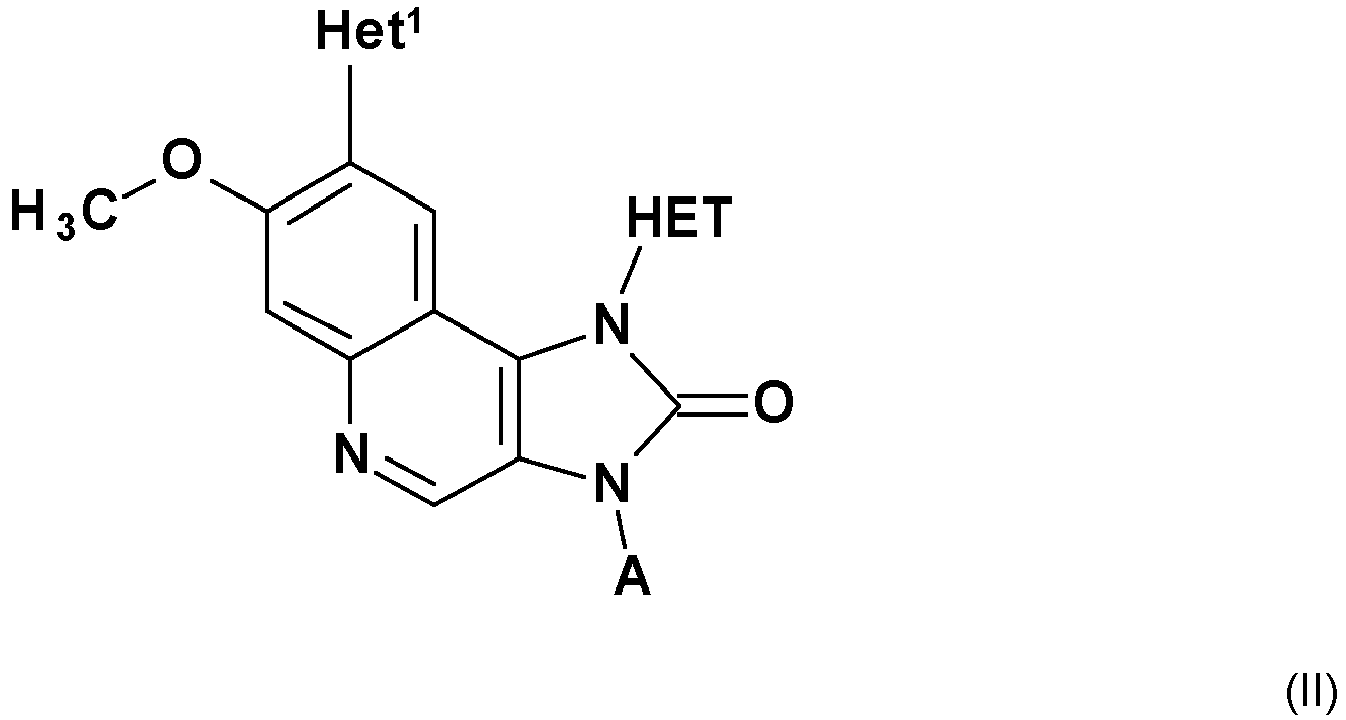
- In bevorzugten Ausführungsformen der Verbindungen der Formeln (I) bzw. (IA) und (II) bedeutet R3 H oder, stärker bevorzugt, unverzweigtes oder verzweigtes Alkyl mit 1, 2, oder 3 C-Atomen, wobei unabhängig voneinander 1, 2, 3, 4, oder 5 H-Atome durch Hal ersetzt sein können. Besonders bevorzugt bedeutet R3 Methyl. Damit stellt die vorliegende Erfindung auch Verbindungen der folgenden Formeln (III) und (IV) bereit:


- In jeder der Formeln (I), (II), (III) und (IV) ist Het1 bevorzugt ein einkerniges Heteroaryl mit 2, 3, oder 4 C-Atomen und 1, 2, oder 3 N-Atomen, das unsubstituiert oder wie in Verbindung mit Formel (I) angegeben definiert substituiert sein kann. Besonders bevorzugt ist Het1 (in jeder der aufgeführten Formeln) weiter ausgewählt aus Pyridinyl, Pyrimidinyl, Pyrazolyl, Triazolyl und Imidazolyl, welche unsubstituiert oder wie oben definiert substituiert sein können, wobei Pyrazolyl und Triazolyl, insbesondere [1,2,3]Triazolyl, besonders bevorzugt sind.
- Het1 kann beispielsweise unsubstituiert oder mit einem oder zwei Substituenten substituiert sein, die bevorzugt unabhängig voneinander ausgewählt sind aus: Hal, A, -(CY2)p-OY, -(CY2)p-NYY, und -Het2, besonders bevorzugt Alkyl, welches unsubstituiert oder ein- oder mehrfach durch Halogen, insbesondere F substituiert sein kann; -OY, -NYY, Halogen, und -Het2, besonders bevorzugt Methyl, Ethyl, Amino, Methoxy, Fluormethyl, Difluormethyl, Fluor, Azetidinyl, wobei Methyl und Ethyl besonders bevorzugt sind.
- Besonders bevorzugt ist Het1 (in jeder der aufgeführten Formeln) ausgewählt aus: 1H-Pyrazol-4-yl, 2H-Pyrazol-3-yl, 1H-Pyrazol-3-yl, 1-Methyl-1H-pyrazol-4-yl, 3-Methyl-1H-pyrazol-4-yl, 5-Methyl-1H-pyrazol-3-yl, 4-Methyl-1H-pyrazol-3-yl, 1-Fluormethyl-1H-pyrazol-4-yl, 1-Difluormethyl-1H-pyrazol-4-yl, 1,3-Dimethyl-1H-pyrazol-4-yl, 1-Ethyl-1H-pyrazol-4-yl, 1-Ethyl-3-methyl-1H-pyrazolyl, 3-Fluor-1-methyl-1H-pyrazol-4-yl, 3-Amino-1H-pyrazol-5-yl, 2H-[1,2,3]Triazol-4-yl, 3H-[1,2,3]Triazol-4-yl-, 1-Methyl-1H-[1,2,3]triazol-4-yl, 2-Methyl-2H-[1,2,3]triazol-4-yl, 2-Amino-1H-imidazol-4-yl, 6-Methoxy-pyridin-3-yl, und 1-(Azetidin-3-yl)-3-methyl-1H-pyrazol-4-yl. Stark bevorzugt ist Het1 Pyrazolyl, welches unsubstituiert oder wie oben definiert substituiert sein kann, und beispielsweise ausgewählt sein kann aus 1H-Pyrazol-4-yl, 2H-Pyrazol-3-yl, 1H-Pyrazol-3-yl, 1-Methyl-1H-pyrazol-4-yl, 3-Methyl-1H-pyrazol-4-yl, 5-Methyl-1H-pyrazol-3-yl, 4-Methyl-1H-pyrazol-3-yl, 1-Fluormethyl-1H-pyrazol-4-yl, 1-Diluormethyl-1H-pyrazol-4-yl, 1,3-Dimethyl-1H-pyrazol-4-yl, 1-Ethyl-1H-pyrazol-4-yl, 1-Ethyl-3-methyl-1H-pyrazolyl, 3-Fluor-1-methyl-1H-pyrazol-4-yl, 3-Amino-1H-pyrazol-5-yl, wobei 1H-Pyrazol-4-yl, 2H-Pyrazol-3-yl, 1H-Pyrazol-3-yl, 1-Methyl-1H-pyrazol-4-yl, 3-Methyl-1H-pyrazol-4-yl, 5-Methyl-1H-pyrazol-3-yl, 4-Methyl-1H-pyrazol-3-yl, 1-Fluormethyl-1H-pyrazol-4-yl, 1,3-Dimethyl-1H-pyrazol-4-yl, 1-Ethyl-1H-pyrazol-4-yl und besonders bevorzugt sind. Alternativ ist Het1 bevorzugt Triazolyl, welches unsubstituiert oder wie oben definiert substituiert sein kann, und beispielsweise ausgewählt sein kann aus 2H-[1,2,3]Triazol-4-yl, 3H-[1,2,3]Triazol-4-yl-, 1-Methyl-1H-[1,2,3]triazol-4-yl, 2-Methyl-2H-[1,2,3]triazol-4-yl, besonders bevorzugt 2-Methyl-2H-[1,2,3]triazol-4-yl.
- In anderen Ausführungsformen der Verbindungen gemäß einer jeden der der Formeln (I), (II), (III) und (IV) kann Het1 ein zweikerniges Heteroaryl mit 6, 7 oder 8 C-Atomen und 1, 2, oder 3 N-Atomen sein, das unsubstituiert oder wie vorstehend definiert substituiert sein kann. Bevorzugte Substituenten sind analog den einkernigen Heteroarylen Hal, A, -(CY2)p-OY, -(CY2)p-NYY, und -Het2, besonders bevorzugt Alkyl. Beispielsweise kann Het1 ausgewählt sein aus Bezimidazolyl, Imidazo[4,5-b]pyridinyl, Benzodiazolyl, welche unsubstituiert oder wie in Bezug auf Formel (I) und zuvor als bevorzugt genannt substituiert sein können, bevorzugt beispielsweise 2-Methyl-3H-benzimidazol-5-yl, 3H-Benzimidazol-5-yl, 2-Methyl-1H-Imidazo[4,5-b]pyridin-6-yl.
- In bevorzugten Ausführungsformen von Verbindungen gemäß einer jeden der der Formeln (I), (II), (III) und (IV) ist HET aus den nachfolgenden aromatischen Heterozyklen ausgewählt, welche jeweils unsubstituiert oder wie zuvor definiert substituiert sein können: HET bedeutet ungeachtet einer möglichen Substitution Pyrrolyl, Oxazolyl, Isoxazolyl, Thiazolyl, Isothiazolyl, Pyrazolyl, Imidazolyl, 1-Oxa-2,3-diazolyl, 1-Oxa-2,4-diazolyl, 1-Oxa-3,4-diazolyl, 1-Oxa-2,5-diazolyl, 1-Thia-2,3-diazolyl, 1-Thia-2,4-diazolyl, 1-Thia-3,4-diazolyl, 1-Thia-2,5-diazolyl, 1,2,3-Triazolyl, 1,3,4-Triazolyl, und Tetrazolyl; Pyridinyl, Pyrimidinyl, Pyrazinyl und Pyridazinyl; Indolyl, Isoindolyl, Benzimidazolyl, Indazolyl, Benzoxazolyl, Benzothiazolyl, Benzotriazolyl, Pyrrolo[2,3-b]pyridinyl, Pyrrolo[2,3-c]pyridinyl, Pyrrolo[3,2-b]pyridinyl, Pyrrolo[3,2-c]pyridinyl, Imidazo[4,5-b]pyridinyl, Imidazo[4,5-c]pyridinyl, Pyrazolo[4,3-d]pyridinyl, Pyrazolo[4,3-c]pyridinyl, Pyrazolo[3,4-c]pyridinyl, Pyrazolo[3,4-b]pyridinyl, Purinyl, Indozilinyl, Imidazo[1,2-a]pyridinyl, Imidazo[1,5-a]pyridinyl, Pyrazolo[1,5-a[pyridinyl, Pyrrolo[1,2-b]pyridazinyl, Imidazo[1,2-c]pyrimidinyl, Chinolinyl, Isochinolinyl, Cinnolinyl, Chinazolinyl, Chinoxalinyl, Phtalazinyl, 1,6-Naphtyridinyl, 1,7-Naphtyridinyl, 1,8-Naphtyridinyl, 1,5-Naphtyridinyl, 2,6-Naphthyridinyl, 2,7-Naphthyridinyl, Pyrido[3,2-d]pyrimidinyl, Pyrido[4,3-d]pyrimidinyl, Pyrido[3,4-d]pyrimidinyl, Pyrido[2,3-d]pyrimidinyl, Pyrido[2,3-d]pyrazinyl, Pyrido[3,4-b]pyrazinyl, Pyrazino[2,3-b]pyrazinyl, Pyrimido[5,4-d]pyrimidinyl, Pyrimido[4,5-d]pyrimidinyl, Benzoxazolyl, Benzothiazolyl, Benzisoxazolyl, Benzisothiazolyl, Furopyridinyl, und Thienopyridinyl.
- Besonders bevorzugt ist HET aus den folgenden 5- oder 6-gliedrigen einkernigen aromatischen Heterozyklen ausgewählt, welche jeweils unsubstituiert oder wie zuvor definiert substituiert sein können: Pyridinyl, Pyrimidinyl, Pyrazolyl, Thiazolyl, Imidazolyl.
- Diese Präferenzen für HET gelten insbesondere auch für Verbindungen der Formeln (I), (II), (III), (IV), in Kombination mit den bevorzugten Ausführungsformen für Het1, insbesondere der Auswahl von Het1 aus Pyridinyl, Pyrimidinyl, Pyrazolyl, Triazolyl und Imidazolyl, sowie Bezimidazolyl, Imidazo[4,5-b]pyridinyl, Benzodiazolyl, welche jeweils unsubstituiert oder wie oben definiert substituiert sein können, beispielsweise 1H-Pyrazol-4-yl, 2H-Pyrazol-3-yl, 1H-Pyrazol-3-yl, 1-Methyl-1H-pyrazol-4-yl, 3-Methyl-1H-pyrazol-4-yl, 5-Methyl-1H-pyrazol-3-yl, 4-Methyl-1H-pyrazol-3-yl, 1-Fluormethyl-1H-pyrazol-4-yl, 1-Diluormethyl-1H-pyrazol-4-yl, 1,3-Dimethyl-1H-pyrazol-4-yl, 1-Ethyl-1H-pyrazol-4-yl, 1-Ethyl-3-methyl-1H-pyrazolyl, 3-Fluor-1-methyl-1H-pyrazol-4-yl, 3-Amino-1H-pyrazol-5-yl, 2H-[1,2,3]Triazol4-yl, 3H-[1,2,3]Triazol-4-yl-, 1-Methyl-1H-[1,2,3]triazol-4-yl, 2-Methyl-2H-[1,2,3]triazol-4-yl, 2-Amino-1H-imidazol-4-yl, 6-Methoxy-pyridin-3-yl, und 1-(Azetidin-3-yl)-3-methyl-1H-pyrazol-4-yl, 2-Methyl-3H-benzimidazol-5-yl, 3H-benzimidazol-5-yl, 2-Methyl-1 H-Imidazo[4,5-b]pyridin-6-yl, und gerade und insbesondere auch für die Ausführungsformen, in denen Het1 für Pyrazolyl steht, welches unsubstituiert oder wie oben definiert substituiert sein kann und beispielsweise ausgewählt sein kann aus 1H-Pyrazol-4-yl, 2H-Pyrazol-3-yl, 1H-Pyrazol-3-yl, 1-Methyl-1H-pyrazol-4-yl, 3-Methyl-1H-pyrazol-4-yl, 5-Methyl-1H-pyrazol-3-yl, 4-Methyl-1H-pyrazol-3-yl, 1-Fluormethyl-1H-pyrazol-4-yl, 1,3-Dimethyl-1H-pyrazol-4-yl, 1-Ethyl-1H-pyrazol-4-yl.
- Von den möglichen Substituenten an HET sind bevorzugt: Hal, insbesondere F, Cl; A, insbesondere Methyl, Ethyl, Propyl; Het2, insbesondere Azetidinyl, Tetrahydropyranyl, Piperazinyl; CN; -(CY2)p-OY, -(CY2)p-OA, -(CY2)p-OH, bevorzugt jeweils mit p = 0, 1, 2, 3; -(CY2)p-OZ, -(CY2)p-O-Het2, -O-Het2, -(CY2)p-O-(CY2)t-Het2, -O-(CY2)t-Het2, -O-(CH2)t-Het2, -(CY2)p-O-(CY2)t-NYY, -O-(CY2)t-NYY, -(CY2)p-O-(CY2)t-OY, -O-(CY2)t-OY, -O-(CY2)t-OA, -O-(CY2)t-OH, -O-(CH2)t-OA, -O-(CH2)t-OH, -(CY2)p-CO-NYY, -(CY2)p-CO-NHA, CyA, -(CY2)p-O-(CY2)t-SO2-Y, -O-(CY2)t-SO2-Y, -O-(CY2)t-SO2-A, -(CY2)p-SO2-Y, -(CY2)p-SO2-A. Beispielsweise können die aromatischen Heterozyklen HET allgemein, und die bevorzugten Ausführungsformen im Besonderen, beispielsweise Pyridinyl, Pyrimidinyl, Pyrazolyl, Thiazolyl, Imidazolyl, jeweils substituiert sein durch einen, zwei, drei oder mehr Substituenten, die unabhängig voneinander ausgewählt sind aus der Gruppe bestehend aus: F, Cl, Methyl, Ethyl, Propyl, Isopropyl, Methoxy, Ethoxy, Propoxy, Piperazinyl, Tetrahydropyranyl, -CN, 2-Methoxyethoxy, 2-Hydroxyethoxy, Fluormethoxy, Difluormethoxy, N-Methylcarbamoyl (-C(=O)-NH-CH3), 2-Methylamino-ethoxy, 1-Methyl-azetidin-3-ylmethoxy, Trideuteriomethoxy, Trifluormethoxy, Methylsulfonylmethoxy, Methylsulfonyl, Cyclopropyl, Allyloxy, Piperazinyl, und Azetidinyloxy. Keine, einfache oder zweifache Substitution sind bevorzugt.
- Eine bevorzugte Ausführungsform von HET ist unsubstituiertes oder substituiertes Pyridinyl, beispielsweise mono- oder disubstituiertes Pyridinyl. Monosubstituierte Pyridinyle sind vorzugsweise in Position 3 des Pyridin-Rings substituiert und über Positionen 2 oder 4 verknüpft, disubstituierte Pyridinyle sind vorzugsweise in Positionen 3 und 5 des Pyridin-Rings substituiert und über Positionen 2 oder 4 verknüpft. Diese bevorzugte Ausführungsform kann vorteilhaft kombiniert werden mit den bevorzugten Ausführungsformen von Het1, insbesondere den bevorzugten Ausführungsformen, in denen Het1 unsubstituiertes oder substituiertes Pyrazolyl oder aber unsubstituiertes oder substituiertes Triazolyl ist, und insbesondere mit den oben genannten besonders bevorzugten Ausführungsformen.
- In anderen bevorzugten Ausführungsformen ist HET ein unsubstituiertes, bevorzugt jedoch mono- oder disubstituiertes Pyrazol. Auch diese Ausführungsform kann vorteilhaft kombiniert werden mit den bevorzugten Ausführungsformen von Het1, insbesondere den bevorzugten Ausführungsformen, in denen Het1 unsubstituiertes oder substituiertes Pyrazolyl oder aber unsubstituiertes oder substituiertes Triazolyl ist, und insbesondere mit den oben genannten besonders bevorzugten Ausführungsformen.
- In einer weiteren bevorzugten Ausfürungsform ist HET ein unsubstituiertes, bevorzugt jedoch monosubstituiertes Pyrimidin, wobei das Pyrimidin bevorzugt in Position 5 substituiert und über Positionen 2 oder 4 verknüpft ist. Auch diese Ausführungsform kann vorteilhaft kombiniert werden mit den bevorzugten Ausführungsformen von Het1, insbesondere den bevorzugten Ausführungsformen, in denen Het1 unsubstituiertes oder substituiertes Pyrazolyl oder aber unsubstituiertes oder substituiertes Triazolyl ist, und insbesondere mit den oben genannten besonders bevorzugten Ausführungsformen.
- HET kann in bevorzugten Ausführungsfomen gemäß einer jeden der Formeln (I), (II), (III), (IV) beispielsweise ausgewählt sein aus den folgenden 5- oder 6-gliedrigen einkernigen aromatischen Heterozyklen: Pyridin-2-yl, Pyridin-4-yl, 5-Allyloxy-3-fluor-pyridin-2-yl, 5-(Azetidin-3-yloxy)-3-fluor-pyridin-2-yl, 5-Chlor-3-fluor-pyridin-2-yl, 3-Cyclopropyl-pyridin-4-yl, 3-Cyclopropyl-5-fluor-pyridin-4-yl, 3,5-Difluor-pyridin-2-yl, 3,5-Difluor-pyridin-4-yl, 5-Difluormethoxy-3-fluor-pyridin-2-yl, 3-Difluormethoxy-5-fluor-pyridin-4-yl, 5-Ethoxy-3-fluor-pyridin-2-yl, 3-Fluor-5-(1-methyl-azetidin-3-ylmethoxy)-pyridin-2-yl, 3-Fluor-5-methoxy-pyridin-4-yl, 3-Fluor-5-methoxy-pyridin-2-yl, 3-Fluor-5-fluormethoxy-pyridin-2-yl, 3-Fluor-5-fluormethoxy-pyridin-4-yl, 3-Fluor-pyridin-2-yl, 3-Fluor-5-methylsulfonylmethoxy-pyridin-2-yl, 3-Fluor-5-methylsulfonyl-pyridin-2-yl 3-Fluor-5-(2-methylamino-ethoxy)-pyridin-2-yl, 3-Fluor-5-methyl-pyridin-4-yl, 3-Fluor-5-methyl-pyridin-2-yl, 3-Fluor-pyridin-4-yl, 3-Fluor-pyridin-2-yl, 3-Fluor-5-piperazin-1-yl-pyridin-2-yl, 3-Chlor-pyridin-4-yl, 3-Ethyl-pyridin-4-yl, 3-Ethyl-5-fluor-pyridin-4-yl, 3-Ethyl-5-methyl-pyridin-4-yl, 5-Fluor-pyridin-2-yl, 3-Methyl-pyridin-4-yl, 3-Methoxy-pyridin-4-yl, 2-Cyano-pyridin-4-yl, 3-Cyano-pyridin-4-yl, 3-Cyano-pyridin-6-yl, 3-Cyano-5-fluor-pyridin-4-yl, 3-Fluor-5-(2-methoxyethoxy)-pyridin-2-yl, 3-Fluor-5-(2-hydroxyethoxy)-pyridin-2-yl, 3-Fluor-5-(trideuteriomethoxy)-pyridin-4-yl, 3-Fluor-5-(trideuteriomethoxy)-pyridin-2-yl, 5-Fluor-3-(N-Methyl-carbamoyl)-pyridin-6-yl, 5-Fluorpyrimidin-2-yl, 5-Fluorpyrimidin-4-yl, Pyrimidin-2-yl, Pyrimidin-5-yl, 1H-Pyrazol-4-yl, 1-Ethyl-3-methyl-1 H-pyrazol-4-yl, 1,2-Dimethyl-1 H-pyrazol-4-yl, 1,3-Dimethyl-1H-pyrazol-4-yl, 1-Methyl-1H-pyrazol-4-yl, 1-(Tetrahydro-pyran-4-yl)-1H-pyrazol-4-yl, 2-Methyl-2H-pyrazol-3-yl, 3-Methyl-1H-pyrazol-4-yl, 3,5-Dimethyl-1H-pyrazol-4-yl, 3-Fluor-1-methyl-pyrazol-4-yl, Thiazol-2-yl, 2-Methyl-thiazol-4-yl,und 1-Methyl-1H-imidazolyl. Besonders bevorzugt sind: 5-Chlor-3-fluor-pyridin-2-yl, 3,5-Difluor-pyridin-2-yl, 3,5-Difluor-pyridin-4-yl, 5-Difluormethoxy-3-fluor-pyridin-2-yl, 3-Difluormethoxy-5-fluor-pyridin-4-yl, 5-Ethoxy-3-fluor-pyridin-2-yl, 3-Fluor-5-methoxy-pyridin-4-yl, 3-Fluor-5-methoxy-pyridin-2-yl, 3-Fluor-5-fluormethoxy-pyridin-2-yl, 3-Fluor-5-fluormethoxy-pyridin-4-yl, 3-Fluor-pyridin-2-yl, 3-Fluor-5-methylsulfonylmethoxy-pyridin-2-yl, 3-Fluor-5-methyl-pyridin-4-yl, 3-Fluor-5-methyl-pyridin-2-yl, 3-Fluor-pyridin-4-yl, 3-Ethyl-pyridin-4-yl, 3-Ethyl-5-fluor-pyridin-4-yl, 3-Methyl-pyridin-4-yl, 3-Methoxy-pyridin-4-yl, 3-Fluor-5-(2-methoxyethoxy)-pyridin-2-yl, 3-Fluor-5-(2-hydroxyethoxy)-pyridin-2-yl, 3-Fluor-5-(trideuteriomethoxy)-pyridin-4-yl, 3-Fluor-5-(trideuteriomethoxy)-pyridin-2-yl, 5-Fluorpyrimidin-2-yl, 5-Fluorpyrimidin-4-yl, 1,3-Dimethyl-1H-pyrazol-4-yl, 1-Methyl-1H-pyrazol-4-yl, 1-(Tetrahydro-pyran-4-yl)-1H-pyrazol-4-yl, und 2-Methyl-thiazol-4-yl.
- Die Präferenz für die oben genannten 5- oder 6-gliedrigen einkernigen aromatischen Heterozyklen gilt insbesondere auch für Verbindungen der Formeln (I), (II), (III), (IV) in Kombination mit den bevorzugten Ausführungsformen für Het1, insbesondere der Auswahl von Het1 aus Pyridinyl, Pyrimidinyl, Pyrazolyl, Triazolyl und Imidazolyl, welche unsubstituiert oder wie oben definiert substituiert sein können und gerade und insbesondere auch für die Ausführungsformen, in denen Het1 für Pyrazolyl steht, welches unsubstituiert oder wie oben definiert substituiert sein kann und beispielsweise ausgewählt sein kann aus den oben explizit genannten Beispielen. Sie gelten insbesondere auch für die Ausführungsformen, in denen Het1 für Triazolyl steht, und beispielsweise ausgewählt sein kann aus den oben explizit genannten Beispielen.
- In anderen beispielhaften Ausführungsformen gemäß einer jeden der Formeln (I), (II), (III), (IV) kann HET ausgewählt sein aus Pyrrolo[3,2-c]pyridinyl, Pyrrolo[2,3-b]pyridinyl und Chinolinyl, , welche jeweils unsubstituiert oder wie für Verbindung (I) und insbesondere für die einkernigen bevorzugten Ausführungsformen genannt substituiert sein können. Beispiele sind 1H-Pyrrolo[3,2-c]pyridin-6-yl, 1H-Pyrrolo[2,3-b]pyridin-6-yl oder 5-Fluor-1H-pyrrolo[2,3-b]pyridin-6-yl, jeweils insbesondere auch jeweils in Kombination mit einer der oben genannten bevorzugten Ausführungsformen von Het1.
- Ganz besonders bevorzugt sind die in der nachfolgenden Tabelle 1 aufgeführten Verbindungen, sowie deren pharmazeutisch verwendbaren Derivate, Salze, Solvate, Tautomere und/oder Stereoisomere, bzw. freien Formen einschließlich deren Mischungen in allen Verhältnissen.
Tab. 1: Besonders bevorzugte Verbindungen 
1-(3,5-Difluor-pyridin-2-yl)-7-methoxy-3-methyl-8-(1-methyl-1 H-pyrazol-4-yl)-1,3-dihydro-imidazo[4,5-c]chinolin-2-on 
1-(3,5-Difluor-pyridin-4-yl)-7-methoxy-3-methyl-8-(1 H-pyrazol-4-yl)-1,3-dihydro-imidazo[4,5-c]chinolin-2-on 
1-(1,3-Dimethyl-1 H-pyrazol-4-yl)-7-methoxy-3-methyl-8-(1 H-pyrazol-4-yl)-1,3-dihydro-imidazo[4,5-c]chinolin-2-on 
8-(1,3-Dimethyl-1 H-pyrazol-4-yl)-1-(3-fluor-5-methoxy-pyridin-4-yl)-7-methoxy-3-methyl-1,3-dihydro-imidazo[4,5-c]chinolin-2-on 
1-(1,3-Dimethyl-1 H-pyrazol-4-yl)-7-methoxy-3-methyl-8-(1-methyl-1 H-pyrazol-4-yl)-1,3-dihydro-imidazo[4,5-c]chinolin-2-on 
1-(3,5-Difluor-pyridin-2-yl)-7-methoxy-3-methyl-8-(1 H-pyrazol-4-yl)-1,3-dihydro-imidazo[4,5-c]chinolin-2-on 
1-(3-Fluor-pyridin-2-yl)-7-methoxy-3-methyl-8-(1 H-pyrazol-4-yl)-1,3-dihydro-imidazo[4,5-c]chinolin-2-on 
1-(3-Fluor-5-methyl-pyridin-4-yl)-7-methoxy-3-methyl-8-(1H-pyrazol-4-yl)-1,3-dihydro-imidazo[4,5-c]chinolin-2-on 
1-(3-Fluor-pyridin-4-yl)-7-methoxy-3-methyl-8-(1 H-pyrazol-4-yl)-1,3-dihydro-imidazo[4,5-c]chinolin-2-on 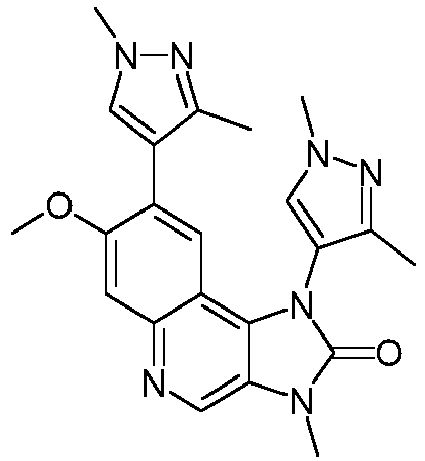
1,8-Bis-(1,3-dimethyl-1 H-pyrazol-4-yl)-7-methoxy-3-methyl-1,3-dihydro-imidazo[4,5-c]chinolin-2-on 
1-(3,5-Difluor-pyridin-2-yl)-8-(1,3-dimethyl-1 H-pyrazol-4-yl)-7-methoxy-3-methyl-1,3-dihydro-imidazo[4,5-c]chinolin-2-on 
1-(3-Ethyl-5-fluor-pyridin-4-yl)-7-methoxy-3-methyl-8-(1-methyl-1 H-pyrazol-4-yl)-1,3-dihydro-imidazo[4,5-c]chinolin-2-on 
8-(1-Ethyl-1H-pyrazol-4-yl)-1-(3-fluor-5-methoxy-pyridin-4-yl)-7-methoxy-3-methyl-1,3-dihydro-imidazo[4,5-c]chinolin-2-on 
1-(3-Fluor-pyridin-2-yl)-7-methoxy-3-methyl-8-(1-methyl-1 H-pyrazol-4-yl)-1,3-dihydro-imidazo[4,5-c]chinolin-2-on 
1-(3-Fluor-5-methoxy-pyridin-4-yl)-7-methoxy-3-methyl-8-(1-methyl-1H-pyrazol-4-yl)-1,3-dihydro-imidazo[4,5-c]chinolin-2-on 
8-(1,3-Dimethyl-1 H-pyrazol-4-yl)-1-(3-fluor-pyridin-2-yl)-7-methoxy-3-methyl-1,3-dihydro-imidazo[4,5-c]chinolin-2-on 
7-Methoxy-3-methyl-1-(1-methyl-1 H-pyrazol-4-yl)-8-(1H-pyrazol-4-yl)-1,3-dihydro-imidazo[4,5-c]chinolin-2-on 
1-(3-Fluor-5-methyl-pyridin-4-yl)-7-methoxy-3-methyl-8-(1-methyl-1 H-pyrazol-4-yl)-1,3-dihydro-imidazo[4,5-c]chinolin-2-on 
7-Methoxy-3-methyl-1-(3-methyl-pyridin-4-yl)-8-(1 H-pyrazol-4-yl)-1,3-dihydro-imidazo[4,5-c]chinolin-2-on 
1-(3-Fluor-5-methyl-pyridin-2-yl)-7-methoxy-3-methyl-8-(1 H-pyrazol-4-yl)-1,3-dihydro-imidazo[4,5-c]chinolin-2-on 
1-(1,3-Dimethyl-1H-pyrazol-4-yl)-8-(1-ethyl-1H-pyrazol-4-yl)-7-methoxy-3-methyl-1,3-dihydro-imidazo[4,5-c]chinolin-2-on 
1-(3,5-Difluor-pyridin-4-yl)-7-methoxy-3-methyl-8-(1-methyl-1 H-pyrazol-4-yl)-1,3-dihydro-imidazo[4,5-c]chinolin-2-on 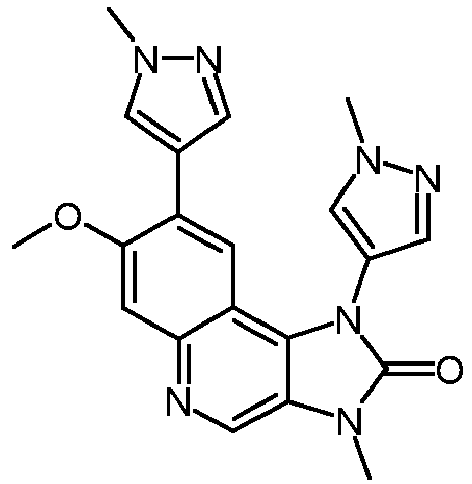
7-Methoxy-3-methyl-1,8-bis-(1-methyl-1 H-pyrazol-4-yl)-1,3-dihydro-imidazo[4,5-c]chinolin-2-on 
8-(1-Ethyl-1 H-pyrazol-4-yl)-1-(3-fluor-pyridin-2-yl)-7-methoxy-3-methyl-1,3-dihydro-imidazo[4,5-c]chinolin-2-on 
1-(3-Ethyl-5-fluor-pyridin-4-yl)-8-(1-ethyl-1 H-pyrazol-4-yl)-7-methoxy-3-methyl-1,3-dihydro-imidazo[4,5-c]chinolin-2-on 
1-(3,5-Difluor-pyridin-4-yl)-8-(1-ethyl-1 H-pyrazol-4-yl)-7-methoxy-3-methyl-1,3-dihydro-imidazo[4,5-c]chinolin-2-on 
1-(3-Fluor-5-methyl-pyridin-2-yl)-7-methoxy-3-methyl-8-(1-methyl-1 H-pyrazol-4-yl)-1,3-dihydro-imidazo[4,5-c]chinolin-2-on 
7-Methoxy-1-(3-methoxy-pyridin-4-yl)-3-methyl-8-(1-methyl-1 H-pyrazol-4-yl)-1,3-dihydro-imidazo[4,5-c]chinolin-2-on 
1-(3-Fluor-pyridin-2-yl)-7-methoxy-3-methyl-8-(5-methyl-1H-pyrazol-3-yl)-1,3-dihydro-imidazo[4,5-c]chinolin-2-on 
7-Methoxy-3-methyl-1-(2-methyl-thiazol-4-yl)-8-(1 H-pyrazol-4-yl)-1,3-dihydro-imidazo[4,5-c]chinolin-2-on 
1-(5-Fluorpyrimidin-4-yl)-7-methoxy-3-methyl-8-(1-methyl-1 H-pyrazol-4-yl)-1H,2H,3H-imidazo[4,5-c]chinolin-2-on hydrochlorid 
7-Methoxy-1-(3-methoxy-pyridin-4-yl)-3-methyl-8-(1 H-pyrazol-4-yl)-1,3-dihydro-imidazo[4,5-c]chinolin-2-on 
8-(1-Ethyl-1 H-pyrazol-4-yl)-1-(3-fluor-pyridin-4-yl)-7-methoxy-3-methyl-1,3-dihydro-imidazo[4,5-c]chinolin-2-on 
8-(1-Ethyl-1 H-pyrazol-4-yl)-7-methoxy-3-methyl-1-(3-methyl-pyridin-4-yl)-1,3-dihydro-imidazo[4,5-c]chinolin-2-on 
1-(3-Fluor-pyridin-4-yl)-7-methoxy-3-methyl-8-(1-methyl-1 H-pyrazol-4-yl)-1,3-dihydro-imidazo[4,5-c]chinolin-2-on 
1-(5-Fluor-pyrimidin-2-yl)-7-methoxy-3-methyl-8-(1-methyl-1H-pyrazol-4-yl)-1,3-dihydro-imidazo[4,5-c]chinolin-2-on 
7-Methoxy-3-methyl-8-(1 H-pyrazol-4-yl)-1-[1-(tetrahydropyran-4-yl)-1 H-pyrazol-4-yl]-1,3-dihydro-imidazo[4,5-c]chinolin-2-on 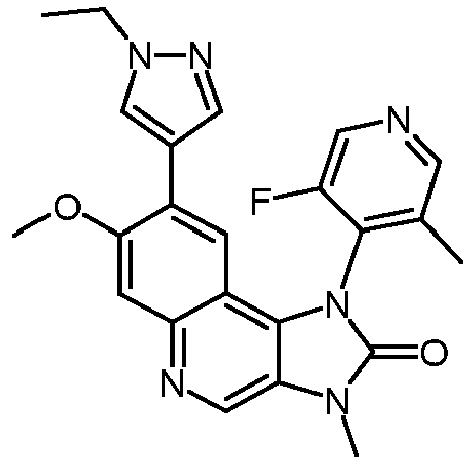
8-(1-Ethyl-1 H-pyrazol-4-yl)-1-(3-fluor-5-methyl-pyridin-4-yl)-7-methoxy-3-methyl-1,3-dihydro-imidazo[4,5-c]chinolin-2-on 
8-(1,3-Dimethyl-1 H-pyrazol-4-yl)-1-(3-fluor-5-methyl-pyridin-4-yl)-7-methoxy-3-methyl-1,3-dihydro-imidazo[4,5-c]chinolin-2-on 
7-Methoxy-3-methyl-8-(1-methyl-1 H-pyrazol-4-yl)-1-(3-methyl-pyridin-4-yl)-1,3-dihydro-imidazo[4,5-c]chinolin-2-on 
7-Methoxy-3-methyl-1-(2-methyl-2H-pyrazol-3-yl)-8-(1 H-pyrazol-4-yl)-1,3-dihydro-imidazo[4,5-c]chinolin-2-on 
1-(1,3-Dimethyl-1 H-pyrazol-4-yl)-7-methoxy-3-methyl-8-(1-methyl-1 H-[1,2,3]triazol-4-yl)-1,3-dihydro-imidazo[4,5-c]chinolin-2-on 
7-Methoxy-3-methyl-1-(3-methyl-1 H-pyrazol-4-yl)-8-(1-methyl-1 H-pyrazol-4-yl)-1,3-dihydro-imidazo[4,5-c]chinolin-2-on 
5-Fluor-4-[7-methoxy-3-methyl-8-(1-methyl-1 H-pyrazol-4-yl)-2-oxo-2,3-dihydro-imidazo[4,5-c]chinolin-1-yl]-nicotinonitril 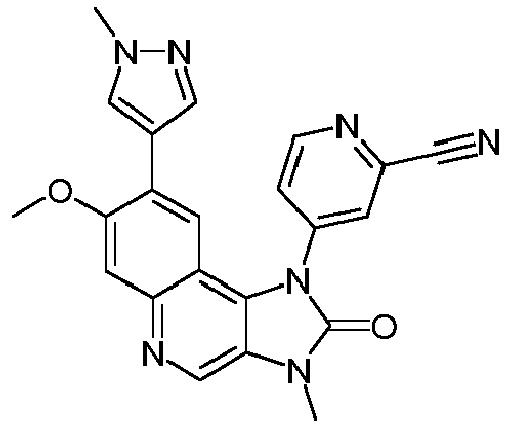
4-[7-Methoxy-3-methyl-8-(1-methyl-1 H-pyrazol-4-yl)-2-oxo-2,3-dihydro-imidazo[4,5-c]chinolin-1-yl]-pyridine-2-carbonitril 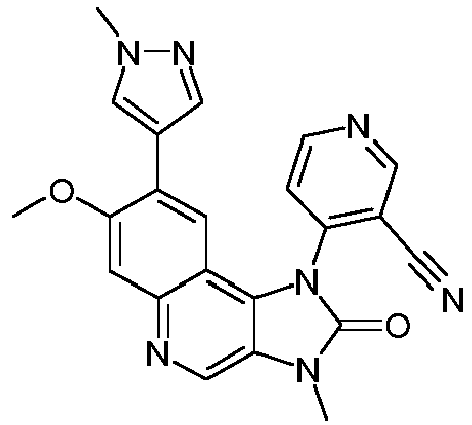
4-[7-Methoxy-3-methyl-8-(1-methyl-1 H-pyrazol-4-yl)-2-oxo-2,3-dihydro-imidazo[4,5-c]chinolin-1-yl]-nicotinonitril 
7-Methoxy-3-methyl-8-(1-methyl-1 H-pyrazol-4-yl)-1-thiazol-2-yl-1,3-dihydro-imidazo[4,5-c]chinolin-2-on 
6-[7-Methoxy-3-methyl-8-(1-methyl-1 H-pyrazol-4-yl)-2-oxo-2,3-dihydro-imidazo[4,5-c]chinolin-1-yl]-nicotinonitril 
7-Methoxy-3-methyl-1-(2-methyl-2H-pyrazol-3-yl)-8-(1-methyl-1 H-pyrazol-4-yl)-1,3-dihydro-imidazo[4,5-c]chinolin-2-on 
1-(5-Fluor-pyridin-2-yl)-7-methoxy-3-methyl-8-(1-methyl-1 H-pyrazol-4-yl)-1,3-dihydro-imidazo[4,5-c]chinolin-2-on 
1-(3-Fluor-pyridin-2-yl)-7-methoxy-3-methyl-8-(1-methyl-1 H-[1,2,3]triazol-4-yl)-1,3-dihydro-imidazo[4,5-c]chinolin-2-on 
7-Methoxy-3-methyl-8-(1-methyl-1 H-pyrazol-4-yl)-1-pyrimidin-2-yl-1,3-dihydro-imidazo[4,5-c]chinolin-2-on 
7-Methoxy-3-methyl-8-(1-methyl-1 H-pyrazol-4-yl)-1-(1H-pyrazol-4-yl)-1,3-dihydro-imidazo[4,5-c]chinolin-2-on 
1-(3-Ethyl-5-methyl-pyridin-4-yl)-7-methoxy-3-methyl-8-(1-methyl-1 H-pyrazol-4-yl)-1,3-dihydro-imidazo[4,5-c]chinolin-2-on 
7-Methoxy-3-methyl-8-(1-methyl-1 H-pyrazol-4-yl)-1-[1-(tetrahydro-pyran-4-yl)-1 H-pyrazol-4-yl]-1 ,3-dihydro-imidazo[4,5-c]chinolin-2-on 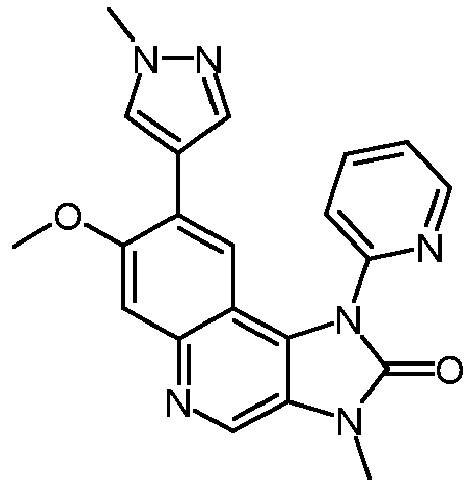
7-Methoxy-3-methyl-8-(1-methyl-1 H-pyrazol-4-yl)-1-pyridin-2-yl-1,3-dihydro-imidazo[4,5-c]chinolin-2-on 
7-Methoxy-3-methyl-8-(1-methyl-1 H-pyrazol-4-yl)-1-pyrimidin-5-yl-1,3-dihydro-imidazo[4,5-c]chinolin-2-on 
7-Methoxy-3-methyl-8-(1-methyl-1 H-pyrazol-4-yl)-1-pyridin-4-yl-1,3-dihydro-imidazo[4,5-c]chinolin-2-on 
7-Methoxy-3-methyl-1-(1-methyl-1 H-imidazol-4-yl)-8-(1-methyl-1 H-pyrazol-4-yl)-1,3-dihydro-imidazo[4,5-c]chinolin-2-on 
1-(3-Chlor-pyridin-4-yl)-7-methoxy-3-methyl-8-(1-methyl-1 H-pyrazol-4-yl)-1,3-dihydro-imidazo[4,5-c]chinolin-2-on 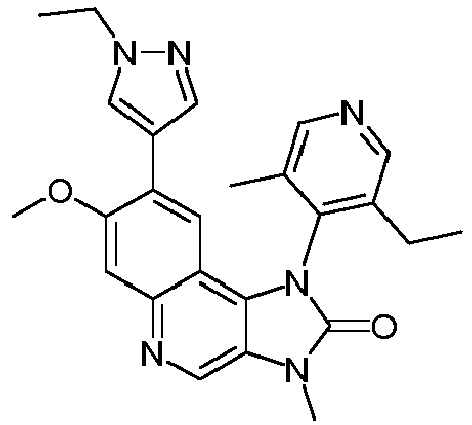
1-(3-Ethyl-5-methyl-pyridin-4-yl)-8-(1-ethyl-1H-pyrazol-4-yl)-7-methoxy-3-methyl-1,3-dihydro-imidazo[4,5-c]chinolin-2-on 
8-(1-Ethyl-1H-pyrazol-4-yl)-7-methoxy-3-methyl-1-pyridin-4-yl-1,3-dihydro-imidazo[4,5-c]chinolin-2-on 
1-(3-Fluor-5-methyl-pyridin-4-yl)-7-methoxy-3-methyl-8-(1-methyl-1H-[1,2,3]triazol-4-yl)-1,3-dihydro-imidazo[4,5-c]chinolin-2-on 
1-(3-Fluor-pyridin-4-yl)-7-methoxy-3-methyl-8-(1-methyl-1 H-[1,2,3]triazol-4-yl)-1,3-dihydro-imidazo[4,5-c]chinolin-2-on 
8-(3-Amino-1 H-pyrazol-5-yl)-1-(3-fluor-2-pyridyl)-7-methoxy-3-methyl-imidazo[4,5-c]chinolin-2-on 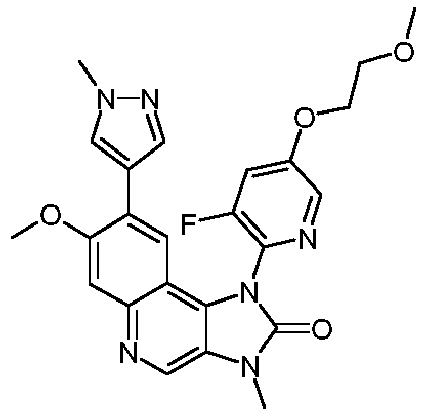
1-[3-Fluor-5-(2-methoxyethoxy)-2-pyridyl]-7-methoxy-3-methyl-8-(1-methylpyrazol-4-yl)imidazo[4,5-c]chinolin-2-on 
1-[3-Fluor-5-(2-hydroxyethoxy)-2-pyridyl]-7-methoxy-3-methyl-8-(1-methylpyrazol-4-yl)imidazo[4,5-c]chinolin-2-on 
7-Methoxy-3-methyl-8-(1-methyl-1 H-pyrazol-4-yl)-1-chinolin-2-yl-1,3-dihydro-imidazo[4,5-c]chinolin-2-on 
7-Methoxy-3-methyl-8-(1-methyl-1 H-pyrazol-4-yl)-1-(1H-pyrrolo[2,3-b]pyridin-6-yl)1,3-dihydro-imidazo[4,5-c]chinolin-2-on 
1-(3,5-Difluor-pyridin-2-yl)-7-methoxy-3-methyl-8-(2-methyl-2H-[1,2,3]triazol-4-yl)-1,3-dihydro-imidazo[4,5-c] chinolin-2-on 
1-(1,3-Dimethyl-1 H-pyrazol-4-yl)-7-methoxy-3-methyl-8-(2-methyl-2H-[1,2,3]triazol-4-yl)-1,3-dihydro-imidazo[4,5-c]chinolin-2-on 
1-(3-Fluor-5-methyl-pyridin-4-yl)-7-methoxy-3-methyl-8-(2-methyl-2H-[1,2,3]triazol-4-yl)-1,3-dihydro-imidazo[4,5-c] chinolin-2-on 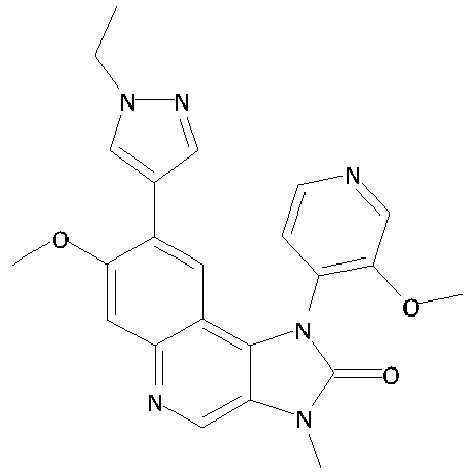
8-(1-Ethyl-1H-pyrazol-4-yl)-7-methoxy-1-(3-methoxy-pyridin-4-yl)-3-methyl-1,3-dihydro-imidazo[4,5-c] chinolin-2-on 
1-(3-Fluor-5-methoxy-pyridin-2-yl)-7-methoxy-3-methyl-8-(1-methyl-1H-pyrazol-4-yl)-1,3-dihydro-imidazo[4,5-c]chinolin-2-on 
8-(1,3-Dimethyl-1H-pyrazol-4-yl)-1-(3-fluor-5-methoxy-pyridin-2-yl)-7-methoxy-3-methyl-1,3-dihydro-imidazo[4,5-c]chinolin-2-on 
1-(3,5-Difluor-pyridin-2-yl)-7-methoxy-8-(1-methyl-1 H-pyrazol-4-yl)-1,3-dihydro-imidazo[4,5-c]chinolin-2-on 
1-(3,5-Difluor-pyridin-2-yl)-8-(1,3-dimethyl-1 H-pyrazol-4-yl)-7-methoxy-1,3-dihydro-imidazo[4,5-c]chinolin-2-on 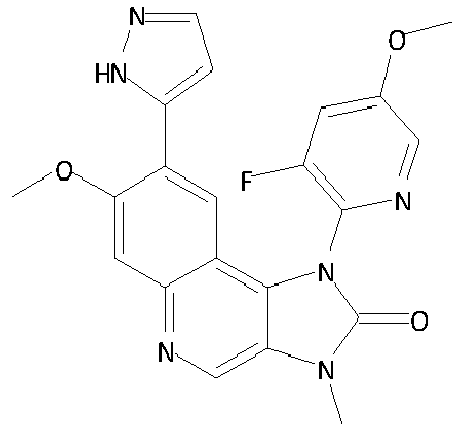
1-(3-Fluor-5-methoxy-pyridin-2-yl)-7-methoxy-3-methyl-8-(2H-pyrazol-3-yl)-1,3-dihydro-imidazo[4,5-c] chinolin-2-on 
1-(3-Fluor-5-fluormethoxy-pyridin-2-yl)-7-methoxy-3-methyl-8-(1-methyl-1 H-pyrazol-4-yl)-1,3-dihydro-imidazo[4,5-c]chinolin-2-on 
8-(1-Ethyl-1H-pyrazol-4-yl)-1-(3-fluor-5-methoxy-pyridin-2-yl)-7-methoxy-3-methyl-1,3-dihydro-imidazo[4,5-c] chinolin-2-on 
1-(3-Ethyl-5-fluor-pyridin-4-yl)-7-methoxy-3-methyl-8-(2-methyl-2H-[1,2,3]triazol-4-yl)-1,3-dihydro-imidazo[4,5-c] chinolin-2-on 
1 -(5-Ethoxy-3-fluor-pyridin-2-yl)-7-methoxy-3-methyl-8-(1-methyl-1 H-pyrazol-4-yl)-1,3-dihydro-imidazo[4,5-c]chinolin-2-on 
1-(5-Difluormethoxy-3-fluor-pyridin-2-yl)-7-methoxy-3-methyl-8-(1-methyl-1 H-pyrazol-4-yl)-1,3-dihydro-imidazo[4,5-c]chinolin-2-on 
1-(3-Fluor-5-methoxy-pyridin-2-yl)-7-methoxy-8-(1-methyl-1H-pyrazol-4-yl)-1,3-dihydro-imidazo[4,5-c]chinolin-2-on 
1-(3-Fluor-5-methoxy-pyridin-4-yl)-7-methoxy-8-(1-methyl-1H-pyrazol-4-yl)-1,3-dihydro-imidazo[4,5-c]chinolin-2-on 
1-(3,5-Difluor-pyridin-2-yl)-7-methoxy-3-methyl-8-(3-methyl-1 H-pyrazol-4-yl)-1,3-dihydro-imidazo[4,5-c]chinolin-2-on 
1-(3,5-Dimethyl-1 H-pyrazol-4-yl)-7-methoxy-3-methyl-8-(1-methyl-1 H-pyrazol-4-yl)-1,3-dihydro-imidazo[4,5-c]chinolin-2-on 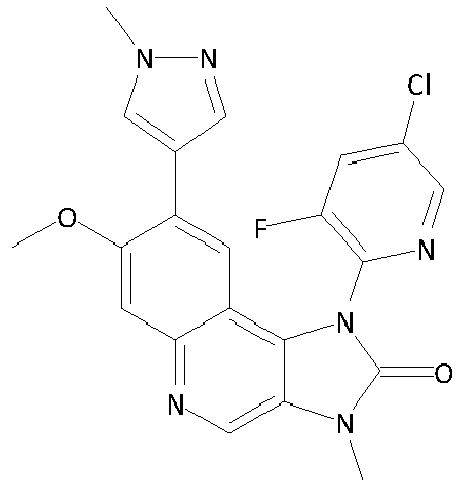
1-(5-Chlor-3-fluor-pyridin-2-yl)-7-methoxy-3-methyl-8-(1-methyl-1 H-pyrazol-4-yl)-1,3-dihydro-imidazo[4,5-c]chinolin-2-on 
7-Methoxy-3-methyl-8-(1-methyl-1H-pyrazol-4-yl)-1-(1H-pyrrolo[3,2-c]pyridin-6-yl)-1,3-dihydro-imidazo[4,5-c]chinolin-2-on 
1-(1,3-Dimethyl-1 H-pyrazol-4-yl)-7-methoxy-3-methyl-8-(1 H-pyrazol-3-yl)-1,3-dihydro-imidazo[4,5-c]chinolin-2-on 
1-(3-Fluor-5-methoxy-pyridin-2-yl)-7-methoxy-3-methyl-8-(3-methyl-1H-pyrazol-4-yl)-1,3-dihydro-imidazo[4,5-c] chinolin-2-on 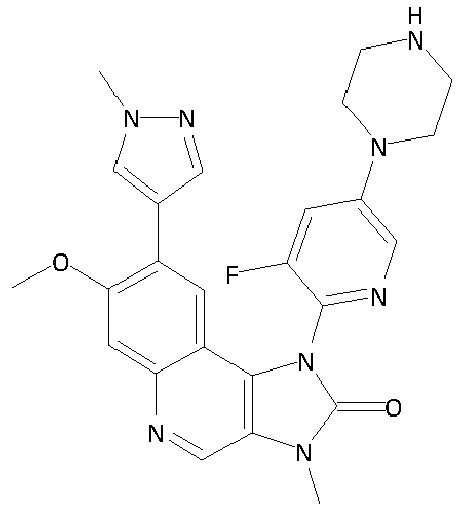
1-(3-Fluor-5-piperazin-1-yl-pyridin-2-yl)-7-methoxy-3-methyl-8-(1-methyl-1 H-pyrazol-4-yl)-1,3-dihydro-imidazo[4,5-c]chinolin-2-on 
1-(3-Fluor-5-methoxy-pyridin-4-yl)-7-methoxy-3-methyl-8-(2H-pyrazol-3-yl)-1,3-dihydro-imidazo[4,5-c] chinolin-2-on 
1-(3-Ethyl-5-fluor-pyridin-4-yl)-7-methoxy-3-methyl-8-(2H-[1,2,3]triazol-4-yl)-1,3-dihydro-imidazo[4,5-c]chinolin-2-on 
1-(3-Ethyl-5-fluor-pyridin-4-yl)-7-methoxy-3-methyl-8-(1-methyl-1 H-[1,2,3]triazol-4-yl)-1,3-dihydro-imidazo[4,5-c] chinolin-2-on 
1-(3-Fluor-5-methoxy-pyridin-4-yl)-7-methoxy-3-methyl-8-(2-methyl-2H-[1,2,3]triazol-4-yl)-1,3-dihydro-imidazo[4,5-c] chinolin-2-on 
1-(3-Fluor-5-methoxy-pyridin-2-yl)-7-methoxy-3-methyl-8-(3H-[1,2,3]triazol-4-yl)-1,3-dihydro-imidazo[4,5-c] chinolin-2-on 
8-(1,3-Dimethyl-1 H-pyrazol-4-yl)-1-(3-fluor-5-methoxy-pyridin-4-yl)-7-methoxy-1,3-dihydro-imidazo[4,5-c]chinolin-2-on 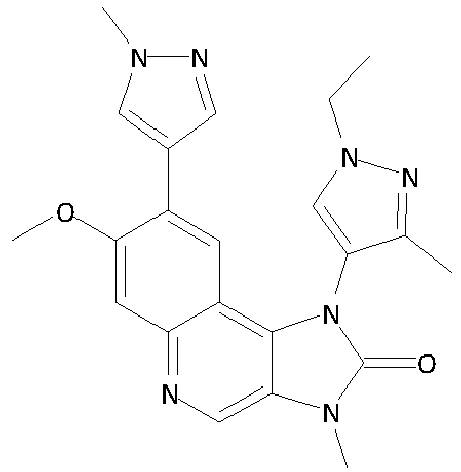
1-(1-Ethyl-3-methyl-1 H-pyrazol-4-yl)-7-methoxy-3-methyl-8-(1-methyl-1 H-pyrazol-4-yl)-1,3-dihydro-imidazo[4,5-c]chinolin-2-on 
1-(3-Fluor-5-methoxy-pyridin-4-yl)-7-methoxy-3-methyl-8-(1-methyl-1 H-[1,2,3]triazol-4-yl)-1,3-dihydro-imidazo[4,5-c]chinolin-2-on 
1-(1,3-Dimethyl-1 H-pyrazol-4-yl)-7-methoxy-3-methyl-8-(2-methyl-3H-benzoimidazol-5-yl)-1,3-dihydro-imidazo[4,5-c]chinolin-2-on 
1-(3-Fluor-5-methoxy-pyridin-2-yl)-7-methoxy-3-methyl-8-(1-methyl-1H-[1,2,3]triazol-4-yl)-1,3-dihydro-imidazo[4,5-c] chinolin-2-on 
1-(3-Fluor-5-methoxy-pyridin-4-yl)-7-methoxy-3-methyl-8-(3H-[1,2,3]triazol-4-yl)-1,3-dihydro-imidazo[4,5-c] chinolin-2-on 
8-(1,3-Dimethyl-1H-pyrazol-4-yl)-1-(1-ethyl-3-methyl-1H-pyrazol-4-yl)-7-methoxy-3-methyl-1,3-dihydro-imidazo[4,5-c]chinolin-2-on 
1-(3-Fluor-5-methoxy-pyridin-4-yl)-7-methoxy-3-methyl-8-(2-methyl-3H-benzoimidazol-5-yl)-1,3-dihydro-imidazo[4,5-c]chinolin-2-on 
1-(3-Fluor-5-methoxy-pyridin-4-yl)-7-methoxy-8-(6-methoxy-pyridin-3-yl)-3-methyl-1,3-dihydro-imidazo[4,5-c]chinolin-2-on 
5-Fluor-6-[7-methoxy-3-methyl-8-(1-methyl-1 H-pyrazol-4-yl)-2-oxo-2,3-dihydro-imidazo[4,5-c]chinolin-1-yl]-N-methyl-nicotinamid 
6-[8-(1,3-Dimethyl-1 H-pyrazol-4-yl)-7-methoxy-3-methyl-2-oxo-2,3-dihydro-imidazo[4,5-c]chinolin-1-yl]-5-fluor-N-methyl-nicotinamid 
1-(3-Fluor-5-methoxy-pyridin-4-yl)-8-(1-fluormethyl-1 H-pyrazol-4-yl)-7-methoxy-3-methyl-1,3-dihydro-imidazo[4,5-c]chinolin-2-on 
1-(3-Fluor-1-methyl-1 H-pyrazol-4-yl)-7-methoxy-3-methyl-8-(1-methyl-1 H-pyrazol-4-yl)-1,3-dihydro-imidazo[4,5-c]chinolin-2-on 
8-(1-Ethyl-3-methyl-1 H-pyrazol-4-yl)-1-(3-fluor-5-methoxy-pyridin-4-yl)-7-methoxy-3-methyl-1,3-dihydro-imidazo[4,5-c] chinolin-2-on 
8-(1-Difluormethyl-1H-pyrazol-4-yl)-1-(3-fluor-5-methoxy-pyridin-4-yl)-7-methoxy-3-methyl-1,3-dihydro-imidazo[4,5-c] chinolin-2-on 
1-(3-Fluor-5-methoxy-pyridin-2-yl)-7-methoxy-3-methyl-8-(2-methyl-3H-benzoimidazol-5-yl)-1,3-dihydro-imidazo[4,5-c]chinolin-2-on 
1-[3-Fluor-5-(trideuteriomethoxy)-4-pyridyl]-7-methoxy-3-methyl-8-(1-methylpyrazol-4-yl)imidazo[4,5-c]chinolin-2-on 
1-(3-Difluormethoxy-5-fluor-pyridin-4-yl)-7-methoxy-3-methyl-8-(1-methyl-1 H-pyrazol-4-yl)-1,3-dihydro-imidazo[4,5-c]chinolin-2-on 
1-(3-Difluormethoxy-5-fluor-pyridin-4-yl)-8-(1,3-dimethyl-1 H-pyrazol-4-yl)-7-methoxy-3-methyl-1,3-dihydro-imidazo[4,5-c]chinolin-2-on 
1-(3-Fluor-5-fluormethoxy-pyridin-4-yl)-7-methoxy-3-methyl-8-(1-methyl-1 H-pyrazol-4-yl)-1,3-dihydro-imidazo[4,5-c]chinolin-2-on 
8-(1,3-Dimethyl-1H-pyrazol-4-yl)-1-(3-fluor-5-fluormethoxy-pyridin-4-yl)-7-methoxy-3-methyl-1,3-dihydro-imidazo[4,5-c]chinolin-2-on 
8-(1,3-Dimethylpyrazol-4-yl)-1-[3-fluor-5-(trideuteriomethoxy)-4-pyridyl]-7-methoxy-3-methyl-imidazo[4,5-c]chinolin-2-on 
1-(1,3-Dimethyl-1 H-pyrazol-4-yl)-7-methoxy-3-methyl-8-(4-methyl-1 H-pyrazol-3-yl)-1,3-dihydro-imidazo[4,5-c] chinolin-2-on 
1-(3-Fluor-5-methoxy-pyridin-4-yl)-7-methoxy-3-methyl-8-(2-methyl-1H-imidazo[4,5-b]pyridin-6-yl)-1,3-dihydro-imidazo[4,5-c]chinolin-2-on 
8-(3H-Benzimidazol-5-yl)-1-(3-fluor-5-methoxy-pyridin-2-yl)-7-methoxy-3-methyl-1,3-dihydro-imidazo[4,5-c]chinolin-2-on 
1-(1,3-Dimethyl-1 H-pyrazol-4-yl)-7-methoxy-3-methyl-8-(2-methyl-1 H-imidazo[4,5-b]pyridin-6-yl)-1,3-dihydro-imidazo[4,5-c]chinolin-2-on 
1-[3-Fluor-5-(trideuteriomethoxy)-2-pyridyl]-7-methoxy-3-methyl-8-(1-methylpyrazol-4-yl) imidazo[4,5-c]chinolin-2-on 
1-(3-Ethyl-pyridin-4-yl)-7-methoxy-3-methyl-8-(1-methyl-1H-pyrazol-4-yl)-1,3-dihydro-imidazo[4,5-c] chinolin-2-on 
8-(1-Ethyl-1 H-pyrazol-4-yl)-1-(3-ethyl-pyridin-4-yl)-7-methoxy-3-methyl-1,3-dihydro-imidazo[4,5-c] chinolin-2-on 
1-(3-Fluor-pyridin-2-yl)-7-methoxy-3-methyl-8-(2-methyl-2H-[1,2,3]triazol-4-yl)-1,3-dihydro-imidazo[4,5-c] chinolin-2-on 
1-(3-Fluor-1-methyl-1H-pyrazol-4-yl)-7-methoxy-8-(6-methoxy-pyridin-3-yl)-3-methyl-1,3-dihydro-imidazo[4,5-c]chinolin-2-on 
1-(3-Cyclopropyl-pyridin-4-yl)-7-methoxy-3-methyl-8-(1-methyl-1 H-pyrazol-4-yl)-1,3-dihydro-imidazo[4,5-c] chinolin-2-on 
1-(3-Fluor-5-methylsulfonylmethoxy-pyridin-2-yl)-7-methoxy-3-methyl-8-(1-methyl-1 H-pyrazol-4-yl)-1 ,3-dihydro-imidazo[4,5-c]chinolin-2-on 
1-(3-Cyclopropyl-5-fluor-pyridin-4-yl)-7-methoxy-3-methyl-8-(1-methyl-1 H-pyrazol-4-yl)-1,3-dihydro-imidazo[4,5-c]chinolin-2-on 
8-(1,3-Dimethyl-1 H-pyrazol-4-yl)-1-(3-fluor-5-methylsulfonylmethoxy-pyridin-2-yl)-7-methoxy-3-methyl-1,3-dihydro-imidazo[4,5-c]chinolin-2-on 
1-(5-Allyloxy-3-fluor-pyridin-2-yl)-7-methoxy-3-methyl-8-(1-methyl-1 H-pyrazol-4-yl)-1,3-dihydro-imidazo[4,5-c]chinolin-2-on 
1-[5-(Azetidin-3-yloxy)-3-fluor-pyridin-2-yl]-7-methoxy-3-methyl-8-(1-methyl-1 H-pyrazol-4-yl)-1,3-dihydro-imidazo[4,5-c]chinolin-2-on 
1-[3-Fluor-5-(2-methylamino-ethoxy)-pyridin-2-yl]-7-methoxy-3-methyl-8-(1-methyl-1 H-pyrazol-4-yl)-1 ,3-dihydro-imidazo[4,5-c] chinolin-2-on 
1-[3-Fluor-5-(1-methyl-azetidin-3-ylmethoxy)-pyridin-2-yl]-7-methoxy-3-methyl-8-(1-methyl-1 H-pyrazol-4-yl)-1 ,3-dihydro-imidazo[4,5-c]chinolin-2-on 
8-[1-(Azetidin-3-yl)-1 H-pyrazol-4-yl]-1-(3-fluor-5-methoxypyridin-4-yl)-7-methoxy-3-methyl-1 H,2H,3H-imidazo[4,5-c]chinolin-2-on 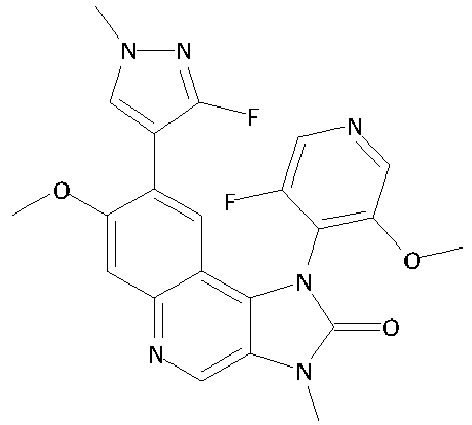
1-(3-Fluor-5-methoxy-pyridin-4-yl)-7-methoxy-3-methyl-8-(3-fluor-1-methyl-1H-pyrazol-4-yl)-1,3-dihydro-imidazo[4,5-c]chinolin-2-on 
1-(1,3-Dimethyl-1 H-pyrazol-4-yl)-7-methoxy-3-methyl-8-(3-fluor-1-methyl-1 H-pyrazol-4-yl)-1,3-dihydro-imidazo[4,5-c]chinolin-2-on 
1-(5-Fluor-1 H-pyrrolo[2,3-b]pyridin-6-yl)-7-methoxy-3-methyl-8-(1-methyl-1 H-pyrazol-4-yl)-1,3-dihydro-imidazo[4,5-c]chinolin-2-on 
1-[3-Fluor-5-(trifluormethoxy)-4-pyridyl]-7-methoxy-3-methyl-8-(1-methyl-1 H-pyrazol-4-yl)-1,3-dihydro-imidazo[4,5-c]chinolin-2-on 
1-[3-Fluor-5-(trifluormethoxy)-4-pyridyl]-7-methoxy-3-methyl-8-(1,3-dimethylpyrazol-4-yl)-1,3-dihydro-imidazo[4,5-c]chinolin-2-on 
1-(3-Fluor-5-methylsulfonyl-pyridin-2-yl)-7-methoxy-3-methyl-8-(1-methyl-1H-pyrazol-4-yl)-1H,2H,3H-imidazo[4,5-c]chinolin-2-on 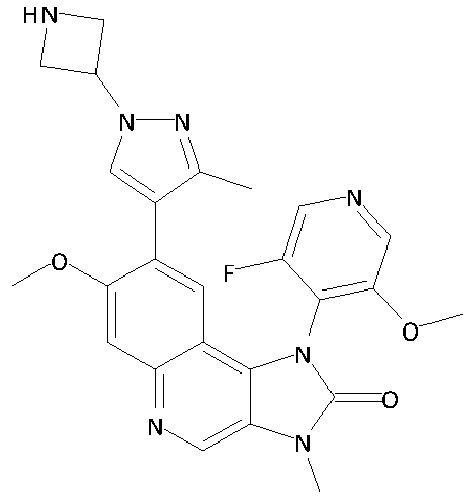
8-[1-(Azetidin-3-yl)-3-methyl-1 H-pyrazol-4-yl]-1-(3-fluor-5-methoxypyridin-4-yl)-7-methoxy-3-methyl-1 H,2H,3H-imidazo[4,5-c]chinolin-2-on - Jede der im Rahmen der obigen bevorzugten Verbindungen offenbarten Bedeutungen für R1, R3, HET, und Het1 ist als bevorzugte Bedeutung des entsprechenden Radikals auch unabhängig von der sonstigen Substitution der Molekülgrundstruktur anzusehen, also als mögliche Bedeutungen von R1, R3, HET, und Het1 jeweils unabhängig voneinander.
- Die Verbindungen der Formel (I) und auch die Ausgangsstoffe zu ihrer Herstellung werden nach an sich bekannten Methoden hergestellt, wie sie in der Literatur (z.B. in Standardwerken wie Houben-Weyl, Methoden der organischen Chemie, Georg-Thieme-Verlag, Stuttgart) beschrieben und/oder Fachmann bekannt sind, sowie unter Reaktionsbedingungen, die für die genannten Umsetzungen bekannt und geeignet sind. Dabei kann man auch von an sich bekannten, hier nicht näher erwähnten Varianten Gebrauch machen. Die erfindungsgemäßen Verbindungen können durch geeignete Wahl bzw. Anpassung der Ausgangsmaterialien mittels bzw. analog der in den BEISPIELEN 1 bis 13 detailliert beschriebenen Synthesen hergestellt werden. Für die meisten erfindungsgemäßen Verbindungen kann die in BEISPIEL 1 dargestellte Synthese geeignet abgewandelt werden und damit analog eingesetzt werden. In den entsprechenden Synthesen einsetzbare Amin-Derivate und Boronsäureester oder Analoga sind im Schema 4 unten zusammengefasst. Ergänzend wird auch auf die Offenbarung
WO 2010/139731 verwiesen, welche durch Bezugnahme vollumfänglich in die vorliegende Offenbarung aufgenommen sei. - Das Verfahren und die anschließende Aufarbeitung des Reaktionsgemisches können grundsätzlich als Batch-Reaktion oder in kontinuierlicher Reaktionsweise durchgeführt werden. Die kontinuierliche Reaktionsweise umfasst z.B. die Reaktion in einem kontinuierlichen Rührkesselreaktor, einer Rührkesselkaskade, einem Schlaufen- oder Querstromreaktor, einem Strömungsrohr oder in einem Mikroreaktor. Die Aufarbeitung der Reaktionsgemische erfolgt wahlweise, je nach Bedarf, durch Filtration über feste Phasen, Chromatographie, Separation zwischen unmischbaren Phasen (z. B. Extraktion), Adsorption an festen Trägern, Abdestillieren von Lösungsmitteln und/oder azeotropen Gemischen, selektive Destillation, Sublimation, Kristallisation, Co-Kristallisation oder durch Nanofiltration an Membranen.
- Die Ausgangsverbindungen sind in der Regel bekannt. Sind sie neu, so können sie nach an sich bekannten Methoden hergestellt werden. Falls gewünscht, können die Ausgangsstoffe in-situ gebildet werden, so dass man sie aus dem Reaktionsgemisch nicht isoliert, sondern sofort weiter zu den erfindungsgemäßen Verbindungen umsetzt. Es ist ebenso möglich, die Reaktion schrittweise durchzuführen.
- Im Rahmen der Erfindung sind die erfindungsgemäßen Verbindungen so definiert, dass auch pharmazeutisch verwendbare Derivate, Salze, Solvate einschl. Hydrate, Vorstufen der Verbindungen, Tautomere und optisch aktive Formen (wie z.B. Stereoisomere, Diastereomere, Enantiomere, Racemate) umfasst sind. Gegenstand der Erfindung ist auch die Verwendung von Mischungen der Verbindungen der Formel (I), z.B. Gemische zweier Diastereomere, z.B. im Verhältnis 1:1, 1:2, 1:3, 1:4, 1:5, 1:10, 1:100 oder 1:1000. Besonders bevorzugt handelt es sich dabei um Mischungen stereoisomerer Verbindungen. Unter Solvaten der Verbindungen werden Anlagerungen von inerten Lösungsmittelmolekülen an die Verbindungen verstanden, die sich aufgrund ihrer gegenseitigen Anziehungskraft ausbilden. Solvate sind z.B. Mono- oder Dihydrate oder Alkoholate.
- Unter pharmazeutisch verwendbaren Derivaten versteht man z.B. die Salze der erfindungsgemäßen Verbindungen wie auch sogenannte Vorstufen oder Prodrugs der Verbindungen. Unter Prodrugs oder Vorstufen versteht man z.B. mit Alkyl- oder Acylgruppen, Zuckern oder Oligopeptiden abgewandelte Verbindungen der Formel (I), die im Organismus rasch zu den wirksamen erfindungsgemäßen Verbindungen gespalten werden. Hierzu gehören auch bioabbaubare Polymerderivate der erfindungsgemäßen Verbindungen, wie dies z.B. in Int. J. Pharm. 115, 61-67 (1995) beschrieben ist. Jegliche Verbindung, die in vivo in ein bioaktives Mittel, d.h. Verbindungen der Formel (I) umgewandelt werden kann, ist eine Vorstufe im Sinne dieser Erfindung. Jegliche biologisch aktive Verbindung, die aus der in vivo Verstoffwechslung einer erfindungsgemäßen Verbindung resultiert, ist ein Metabolit im Sinne der vorliegenden Erfindung.
- Die genannten erfindungsgemäßen Verbindungen lassen sich in ihrer endgültigen Nichtsalzform verwenden. Andererseits umfasst die vorliegende Erfindung auch die Verwendung dieser Verbindungen in Form ihrer pharmazeutisch unbedenklichen Salze, die von verschiedenen organischen und anorganischen Säuren und Basen nach fachbekannten Vorgehensweisen abgeleitet werden können. Pharmazeutisch unbedenkliche Salzformen der erfindungsgemäßen Verbindungen werden größtenteils konventionell hergestellt. Sofern die Verbindungen eine Carbonsäuregruppe enthalten, lässt sich eines ihrer geeigneten Salze dadurch bilden, dass man die Verbindung mit einer geeigneten Base zum entsprechenden Basenadditionssalz umsetzt. Solche Basen sind zum Beispiel Alkalimetallhydroxide (z.B. Kaliumhydroxid, Natriumhydroxid und Lithiumhydroxid), Erdalkalimetallhydroxide (z.B. Bariumhydroxid und Calciumhydroxid), Alkalimetallalkoholate (z.B. Kaliumethanolat und Natriumpropanolat) sowie verschiedene organische Basen wie Piperidin, Diethanolamin und N-Methylglutamin. Eine Base kann mit einer Säure in das zugehörige Säureadditionssalz übergeführt werden, beispielsweise durch Umsetzung äquivalenter Mengen der Base und der Säure in einem inerten Lösungsmittel, wie z.B. Ethanol, und Eindampfen im Anschluss. Für diese Umsetzung kommen insbesondere Säuren in Frage, die physiologisch unbedenkliche Salze liefern, wie z.B. Halogenwasserstoffe (z.B. Chlorwasserstoff, Bromwasserstoff oder Jodwasserstoff), andere Mineralsäuren und ihre entsprechenden Salzen (z.B. Sulfat, Nitrat oder Phosphat und dergleichen), Alkyl- und Monoarylsulfonaten (z.B. Ethansulfonat, Toluolsulfonat und Benzolsulfonat) sowie andere organische Säuren und ihre entsprechenden Salze (z.B. Acetat, Trifluoracetat, Tartrat, Maleat, Succinat, Citrat, Benzoat, Salicylat, Ascorbat und dergleichen. Salze mit physiologisch bedenklichen Säuren, z.B. Pikrate, können zur Isolierung und/oder Aufreinigung der erfindungsgemäßen Verbindungen verwendet werden.
- Im Hinblick auf das oben Gesagte sieht man, dass unter dem Ausdruck "pharmazeutisch verwendbares Salz", oder auch "pharmazeutisch unbedenkliches" oder "pharmazeutisch akzeptables" Salz, im vorliegenden Zusammenhang eine erfindungsgemäße Verbindung zu verstehen ist, die in der Form eines ihrer Salze vorliegt, insbesondere dann, wenn diese Salzform der Verbindung im Vergleich zu ihrer freien Form verbesserte pharmakokinetische Eigenschaften verleiht. Die pharmazeutisch unbedenkliche Salzform der Verbindung kann dieser Verbindung auch erst eine gewünschte pharmakokinetische Eigenschaft verleihen und kann sogar die Pharmakodynamik der Verbindung in Bezug auf ihre therapeutische Wirksamkeit im Körper positiv beeinflussen.
- Erfindungsgemäße Verbindungen können aufgrund ihrer Molekülstruktur chiral sein und dementsprechend in verschiedenen enantiomeren Formen auftreten. Sie können daher in racemischer oder in optisch aktiver Form vorliegen. Da sich die pharmazeutische Wirksamkeit der Racemate bzw. der Stereoisomeren der Verbindungen der Formel (I) unterscheiden kann, kann es wünschenswert sein, die Enantiomere zu verwenden. In diesen Fällen kann das Endprodukt oder bereits das Zwischenprodukt in enantiomere Verbindungen, durch dem Fachmann bekannte chemische oder physikalische Maßnahmen, aufgetrennt oder bereits als solche bei der Synthese eingesetzt werden.
- Es ist allgemein bekannt, dass Atome atomare Massen oder Massenzahlen haben können, die von den üblicherweise natürlich vorkommenden atomaren Massen oder Massenzahlen abweichen können. Beispiele für Isotope, die kommerziell verfügbar sind und die durch bekannte Methoden in eine erfindungsgemäße Verbindung inkorporiert werden können, sind Isotope von Wasserstoff, Kohlenstoff, Stickstoff, Sauerstoff, Phosphor, Fluor und Chor, bspw. 2H, 3H, 13C, 14C, 15N, 18O, 17O, 31P, 32P, 35S, 18F und 36Cl. Der Einbau von schwereren Isotopen, insbesondere Deuterium (2H) in eine erfindungsgemäße Verbindung hat therapeutische Vorteile, die in der höheren metabolischen Stabilität dieser isotopenmarkierten Verbindung begründet liegen. Höhere metabolische Stabilität führt unmittelbar zu einer erhöhten in vivo Halbwertszeit, was eine geringere Dosierung ermöglicht.
- Daher beziehen sich die Definitionen der Atome H, C, N usw., wie in den erfindungsgemäßen Verbindungen benutzt, auch auf die schwereren Isotope dieser Atome.
- Erfindungsgemäß besonders bevorzugt ist die Verwendung von D (Deuterium, 2H) anstelle von Wasserstoff (1H). Deuterium kann beispielsweise mittels eines geeigneten Substituenten an HET in den erfindungsgemäßen Verbindungen eingebaut werden, z.B.Trideuteriomethyl oder Trideuteriomethoxy.
- Es wurde überraschend gefunden, dass die erfindungsgemäßen Verbindungen eine spezifische Hemmung von Proteinkinasen, speziell ATM Kinase, bewirken. Entsprechend stellt die vorliegende Erfindung ATM Inhibitoren bereit, welche aus den erfindungsgemäßen Verbindungen ausgewählt sind.
- Im Rahmen der hier vorgestellten Erfindung wurden erstmals neuartige 2,3-Dihydro-1H-imidazol[4,5-c]chinolin-Verbindungen bereitgestellt. Die erfindungsgemäßen Verbindungen steuern affin und/oder selektiv Serin-Threonin-Proteinkinasen, und zwar insbesondere ATM Kinase, an. Die Verbindungen aus Formel (I) und deren Derivate zeichnen sich durch eine hohe Spezifität und Stabilität, niedrige Herstellungskosten und leichte Handhabung aus. Solche Eigenschaften bilden die Grundlage für eine reproduzierbaren Wirkungsweise und die verlässliche und sichere Wechselwirkung mit den entsprechenden Zielstrukturen. Die Erfindung beinhaltet auch die Verwendung der vorliegenden 2,3-Dihydro-1H-imidazol[4,5-c]chinolin-Derivate zur Hemmung, Regulation und/oder Modulation der Signalkaskade von Serin-Threonin-Proteinkinasen, insbesondere ATM Kinase, und bietet damit neuartige Werkzeuge für Forschung und/oder Diagnostik.
- Ein weiterer Gegenstand der Erfindung betrifft deshalb die Verwendung von erfindungsgemäßen Verbindungen und/oder ihrer physiologisch unbedenklichen Derivate, Solvate, Salze, Tautomere und/oder Stereoisomere, einschließlich deren Mischungen in allen Verhältnissen, zur Hemmung von Serin-Threonin-Proteinkinasen, insbesondere ATM Kinase. Der Begriff "Hemmung" bezieht sich auf jede Verringerung der Aktivität, die auf der Wirkung der spezifischen erfindungsgemäßen Verbindungen basiert, indem letztere in der Lage sind, mit dem Zielmolekül derart zu interagieren, dass eine Erkennung, Bindung und Blockierung ermöglicht wird. Die Verbindungen zeichnen sich durch hohe Affinität zu ATM Kinase aus, wodurch eine verlässliche Bindung und vorzugsweise vollständige Blockade der Kinaseaktivität sichergestellt wird. Die Verbindungen sind ferner sehr selektiv und ermöglichen damit eine ausschließliche und unmittelbare Erkennung der ATM Kinase. Der Begriff der "Erkennung" bezieht sich hierbei auf jede Art der Wechselwirkung zwischen der Verbindung und den genannten Zielmolekülen, insbesondere kovalente oder nichtkovalente Bindungen, wie z.B. eine kovalente Bindung, hydrophobe/ hydrophile Wechselwirkungen, van der Waals'sche Kräfte, Ionenbeziehung, Wasserstoffbrücken, Ligand-Rezeptor-Wechselwirkungen, Basenpaarungen von Nukleotiden oder Wechselwirkungen zwischen Epitop und Antikörper-Bindungsstelle.
- Erfindungsgemäße Verbindungen und/oder ihre physiologisch unbedenklichen Salze, Tautomere und/oder Stereoisomere, einschließlich deren Mischungen in allen Verhältnissen, sind zur Verwendung bei der Behandlung von Erkrankungen geeignet, die durch Aktivität von Serin-Threonin-Proteinkinasen, und zwar insbesondere ATM, hervorgerufen, vermittelt und/oder verbreitet werden.
- Die vorliegende Erfindung betrifft die erfindungsgemäßen Verbindungen und/oder ihrer physiologisch unbedenklichen Derivate, Solvate, Salze, Tautomere und/oder Stereoisomere, einschließlich deren Mischungen in allen Verhältnissen zur Verwendung als Medikament.
- Erfindungsgemäß offenbart werden die erfindungsgemäßen Verbindungen und/oder ihre physiologisch unbedenklichen Salze, Tautomere und/oder Stereoisomere, einschließlich deren Mischungen in allen Verhältnissen, zur Verwendung bei der Behandlung von Erkrankungen, die durch die Aktivität von Serin-Threonin-Proteinkinasen, und zwar insbesondere ATM Kinase hervorgerufen, vermittelt und/oder verbreitet werden.
- Gegenstand der vorliegenden Erfindung sind deshalb auch die erfindungsgemäßen Verbindungen und/oder ihre physiologisch unbedenklichen Derivate, Solvate, Salze, Tautomere und/oder Stereoisomere, einschließlich deren Mischungen in allen Verhältnissen, zur Verwendung bei der Behandlung von Erkrankungen, die durch die Aktivität von Serin-Threonin-Proteinkinasen, und zwar insbesondere ATM Kinase, hervorgerufen, vermittelt und/oder verbreitet werden. Gegenstand der vorliegenden Erfindung ist entsprechend auch die Verwendung von erfindungsgemäßen Verbindungen und/oder ihrer physiologisch unbedenklichen Derivate, Solvate, Salze, Tautomere und/oder Stereoisomere, einschließlich deren Mischungen in allen Verhältnissen, zur Herstellung eines Arzneimittels zur Behandlung von Erkrankungen, die durch die Aktivität von Serin-Threonin-Proteinkinasen, insbesondere ATM Kinase, hervorgerufen, vermittelt und/oder verbreitet werden. Anders ausgedrückt offenbart die vorliegende Erfindung auch eine erfindungsgemäße Verbindung und/oder pharmazeutisch verwendbares Derivat, Salz, Solvat, Tautomer oder Stereoisomer davon, zur Verwendung bei der Behandlung von Krankheiten, die durch Inhibierung von ATM Kinase beeinflusst werden.
- Zur Identifizierung eines entsprechenden Signalübertragungswegs und zum Nachweis von Wechselwirkungen zwischen verschiedenen Signalübertragungswegen sind geeignete Modelle oder Modellsysteme entwickelt worden, z.B. Zellkulturmodelle (Khwaja et al. (1997) EMBO 16: 2783) und Modelle transgener Tiere (White et al. (2001) Oncogene 20: 7064). Zur Bestimmung bestimmter Stufen in der Signalübertragungskaskade können wechselwirkende Verbindungen genutzt werden, um das Signal zu modulieren (Stephens et al. (2000) Biochemical J 351: 95). Darüber hinaus können die erfindungsgemäßen Verbindungen auch als Reagenzien zur Testung kinaseabhängiger Signalübertragungswege in Tieren und/oder Zellkulturmodellen oder in den in dieser Anmeldung genannten klinischen Erkrankungen verwendet werden. Wie hierin besprochen, sind diese Signalwege für verschiedene Erkrankungen relevant. Dementsprechend sind die erfindungsgemäßen Verbindungen nützlich bei der Prophylaxe, Therapie und/oder Verlaufskontrolle von Erkrankungen, die von Signalwegen mit Beteiligung von Serin-Threonin-Proteinkinasen, vorzugsweise ATM Kinase, abhängig sind.
- Gegenstand der vorliegenden Erfindung sind auch die erfindungsgemäßen Verbindungen und/oder ihre physiologisch unbedenklichen Derivate, Solvate, Salze, Tautomere und/oder Stereoisomere, einschließlich deren Mischungen in allen Verhältnissen, zur Verwendung bei der Behandlung von Krebs, Tumoren, und/oder Metastasen bzw. deren Verwendung bei der Herstellung eines Arzneimittels für ebendiese Verwendungen.
- Der Tumor ist insbesondere ausgewählt aus der Gruppe von Erkrankungen von Plattenepithel, Blase, Magen, Nieren, Kopf, Hals, Ösophagus, Gebärmutterhals, Schilddrüse, Darm, Leber, Gehirn, Prostata, Urogenitaltrakts, lymphatisches System, Kehlkopf, Lunge, Haut, Blut und Immunsystem, und/oder der Krebs ist ausgewählt aus der Gruppe von Monozytenleukämie, Lungenadenokarzinom, kleinzelliges Lungenkarzinom, Bauchspeicheldrüsenkrebs, Glioblastom, Darmkarzinom, Brustkarzinom, akute myelotische Leukämie, chronische myelotische Leukämie, akute lymphatische Leukämie, chronische lymphatische Leukämie, Hodgkin-Lymphom und non-Hodgkin-Lymphom.
- Gegenstand der vorliegenden Erfindung ist darüber hinaus ein Verfahren zur Herstellung eines Medikaments, vorzugsweise zur Verwendung bei der Behandlung von Krebs und/oder Tumoren, bevorzugt der zuvor genannten Krebs- bzw. Tumorarten, umfassend:
- i. Ermitteln, dass eine Konzentration, bei der eine erfindungsgemäße Verbindung und/oder pharmazeutisch verwendbares Derivat, Salz, Solvat, Tautomer oder Stereoisomer davon, eine 50%ige Hemmung der Aktivität von ATM Kinase erzielt, 500 nM oder weniger beträgt, vorzugsweise 100 nM, 10 nM, 1 nM oder weniger, und ii. Herstellen einer pharmazeutischen Zusammensetzung, die die Verbindung enthält.
- Die Ermittlung der 50%igen Hemmung der Aktivität von ATM Kinase erfolgt dabei bevorzugt mit Hilfe des hierein beschriebenen Assays (IC50 ATM).
- Erfindungsgemäße Verbindungen und/oder ihre physiologisch unbedenklichen Derivate, Solvate, Salze, Tautomere und/oder Stereoisomere, einschließlich deren Mischungen in allen Verhältnissen, können auch zur Verwendung bei der Verlangsamung von Alterungsprozessen geeignet sein, wobei die Verlangsamung anhand des Vergleichs der Lebenspanne des behandelten Wirts oder dessen Zellen, Zellkulturen, Geweben oder Organen mit entsprechenden Positiv- oder Negativkontrollen und/oder Statistiken erfolgt.
- Die Erfindung lehrt ferner ein Verfahren zur Behandlung von Krebs, Tumoren, und/oder Metastasen, wobei eine wirksame Menge mindestens einer erfindungsgemäßen Verbindung und/oder ihrer physiologisch unbedenklichen Derivate, Solvate, Salze, Tautomere und/oder Stereoisomere, einschließlich deren Mischungen in allen Verhältnissen, einem zu behandelnden Probanden verabreicht wird. Bevorzugte Probanden im Sinne der Erfindung sind Mensch oder Tier, besonders bevorzugt der Mensch. Dem Fachmann ist hierbei bekannt, dass er die erfindungsgemäßen Verbindungen, die selbstverständlich auch als das erfindungsgemäße pharmazeutische Mittel verwendet werden können, in verschiedenen Dosierungen einem Organismus, insbesondere einem humanen Patienten, applizieren kann. Die wirksame Menge und die Art der Applikation können vom Fachmann durch Routineversuche bestimmt werden. Die vorherige Lehre der Erfindung und deren Ausführungsformen sind gültig und ohne Einschränkungen auf das Behandlungsverfahren anwendbar, sofern es sinnvoll erscheint.
- Die erfindungsgemäßen Verbindungen, ihre Salze, Isomere, Tautomere, Enantiomere, Diastereomere, Racemate, Derivate, Prodrugs und/oder Metaboliten sind nicht nur bei den genannten klinischen Krankheitsbildern wirkungsvoll, sondern ebenso in der Diagnose und Therapie sämtlicher Erkrankungen in Zusammenhang mit der ATM-Signalkaskade, vor allem im Hinblick auf die Hemmung von Zellproliferation und -migration.
- Darüber hinaus sind die erfindungsgemäßen Inhibitoren in der Behandlung von retroviralen Erkrankungen durch ein Zurückdrängen der retroviralen Integration nutzbar (R. Daniel (1999) Science 284: 644). Schließlich können die erfindungsgemäßen Hemmstoffe als Immunmodulatoren sowie Modulatoren der telomeren Wartung eingesetzt werden.
- Gegenstand der vorliegenden Erfindung ist weiterhin die Verwendung einer erfindungsgemäßen Verbindung und/oder pharmazeutisch verwendbarem Derivat, Salz, Solvat, Tautomer oder Stereoisomer davon, zur Hemmung einer Proteinkinase, und zwar insbesondere ATM Kinase in vitro.
- Die genannte Verwendung von erfindungsgemäßen Verbindungen und/oder ihrer pharmazeutisch verwendbaren Derivate, Solvate, Salze, Tautomere und/oder Stereoisomere, einschließlich deren Mischungen in allen Verhältnissen, zur Hemmung von Serin-Threonin-Proteinkinasen,und zwar insbesondere ATM Kinase, kann in in vitro oder in vivo Modellen geschehen. Die Suszeptibilität einer bestimmten Zelle gegenüber der Behandlung mit den erfindungsgemäßen Verbindungen kann durch Testen in vitro bestimmt werden. Typischerweise wird eine Kultur der Zelle mit einer erfindungsgemäßen Verbindung bei verschiedenen Konzentrationen für eine Zeitdauer inkubiert, die ausreicht, um den aktiven Mitteln zu ermöglichen, Zelltod zu induzieren oder Zellproliferation, Zellvitalität oder Migration zu inhibieren, gewöhnlich zwischen ungefähr einer Stunde und einer Woche. Zum Testen in vitro können kultivierte Zellen aus einer Biopsieprobe verwendet werden. Die Menge der nach der Behandlung zurückbleibenden Zellen wird dann bestimmt. Die Verwendung in vitro erfolgt insbesondere an Proben von Säugerspezies, die an Krebs, Tumoren, Metastasen, Störungen der Angiogenese, retroviralen Erkrankungen, Immunerkrankungen und/oder pathogenen Alterungsprozessen leiden. Der Wirt oder Patient kann jeglicher Säugerspezies angehören, z. B. einer Primatenspezies, insbesondere Menschen, aber auch Nagetieren (einschließlich Mäusen, Ratten und Hamstern), Kaninchen, Pferden, Rindern, Hunden, Katzen usw. Tiermodelle sind für experimentelle Untersuchungen von Interesse, wobei sie ein Modell zur Behandlung einer Krankheit des Menschen zur Verfügung stellen.
- Das Testen mehrerer spezifischer Verbindungen ermöglicht die Auswahl der Verbindung bzw. des Wirkstoffs, der am besten für die Behandlung des Patienten geeignet erscheint. Die in vivo Dosis der gewählten Verbindung wird vorteilhaft auf die Suszeptibilität der Kinase und/oder Schwere der Erkrankung des Patienten mit Blick auf die in vitro Daten abgestimmt, wodurch die therapeutische Wirksamkeit merklich erhöht ist. Die Dosis variiert abhängig von der verwendeten spezifischen Verbindung, der spezifischen Erkrankung, dem Patientenstatus usw. Typischerweise ist eine therapeutische Dosis ausreichend, um die unerwünschte Zellpopulation im Zielgewebe erheblich zu vermindern, während die Lebensfähigkeit des Patienten aufrechterhalten wird.
- Die hierin offenbarte Lehre der Erfindung und deren Ausführungsformen betreffend die Verwendung von Verbindungen als bzw. für die Herstellung eines Arzneimittels zur Behandlung ist gültig und ohne Einschränkungen auf die Verwendung der Verbindungen zur Hemmung der Kinaseaktivität anwendbar, sofern es sinnvoll erscheint.
- Die Behandlung wird im Allgemeinen fortgesetzt, bis eine erhebliche Reduktion vorliegt, z.B. mindestens ca. 50 % Verminderung der Zelllast und kann fortgesetzt werden, bis im Wesentlichen keine unerwünschten Zellen mehr im Körper nachgewiesen werden. In derartigen Tests zeigen und bewirken die erfindungsgemäßen Verbindungen einen inhibierenden Effekt, der gewöhnlich durch IC50-Werte in einem geeigneten Bereich, bevorzugt im mikromolaren Bereich und bevorzugter im nanomolaren Bereich dokumentiert wird. Die Kinase wird insbesondere zu 50 % gehemmt, wenn die Konzentration der Verbindungen kleiner als 1 µM ist, vorzugsweise gleich oder kleiner als 0,5 µM, besonders bevorzugt kleiner als 0,1 µM, 0,05 µM oder 0,001 µM. Diese Konzentration wird als IC50-Wert bezeichnet und bevorzugt mit Hilfe des hierin beschriebenen Assays ermittelt (IC50 ATM). "µM" steht gemäß der üblichen Nomenklatur für Micromol pro Liter, "nM" für Nanomol pro Liter.
- Die erfindungsgemäßen Verbindungen zeigen eine vorteilhafte biologische Aktivität, die in den hierin beschriebenen Tests nachweisbar ist, wie z.B. auf Enzymen basierenden Assays.
- Die Messung der Kinaseaktivität ist eine dem Fachmann wohlbekannte Technik. Generische Testsysteme zur Bestimmung der Kinaseaktivität mit Substraten, z.B. Histon (Alessi et al. (1996) FEBS Lett. 399(3): 333) oder dem basischen Myelinprotein sind in der Literatur beschrieben (Campos-González & Glenney (1992) JBC 267: 14535). Zur Identifikation von Kinase-Inhibitoren stehen verschiedene Assay-Systeme zur Verfügung. Beim Scintillation Proximity Assay (Sorg et al. (2002) J Biomolecular Screening 7: 11) und dem FlashPlate Assay werden die radioaktive Phosphorylierung eines Proteins oder Peptids als Substrat mit ATP gemessen. Bei Vorliegen einer inhibitorischen Verbindung ist kein oder ein vermindertes radioaktives Signal nachweisbar. Ferner sind die Homogeneous Time-resolved Fluorescence Resonance Energy Transfer- (HTR-FRET-) und Fluoreszenzpolarisations- (FP-) Technologien als Assay-Verfahren nützlich (Sills et al. (2002) J Biomolecular Screening 191). Andere nicht-radioaktive ELISA-Verfahren verwenden spezifische Phospho-Antikörper (Phospho-AK). Der Phospho-AK bindet nur das phosphorylierte Substrat. Diese Bindung ist mit einem zweiten Peroxidase-konjugierten Anti-Schaf-Antikörper durch Chemilumineszens nachweisbar.
- Im Rahmen der vorliegenden Erfindung wird die Hemmung (Inhibition) der Aktivität von ATM bevorzugt mit Hilfe des folgenden Assays bestimmt:
- Der IC50-Wert wurde mit Hilfe eines biochemischen ATM-Kinaseassays bestimmt. Der Assay besteht aus zwei Schritten: der enzymatischen Reaktion und dem Detektionsschritt. Zunächst werden ATM Protein (Ataxia Telangiectasia Mutated) und die Testsubstanz in unterschiedlichen Konzentrationen zzgl. Substratprotein p53 und ATP inkubiert. ATM vermittelt die Phosphorylierung von p53 an mehreren Positionen, u.a. an der Aminosäure S15. Die Menge an phosphoryliertem p53 wird mit Hilfe von spezifischen Antikörpern und der TR-FRET-Technik nachgewiesen. Der enzymatische ATM Assay wird als TR-FRET-(HTRF™, Cisbio Bioassays) basierter 384-Well-Assay durchgeführt. Im ersten Schritt wird aufgereinigtes humanes rekombinantes ATM (humane ATM, volle Länge, GenBank-ID NM_000051, exprimiert in einer Säugerzelllinie) in Assaypuffer 15 Minuten lang mit dem ATM Inhibitor in verschiedenen Konzentrationen sowie ohne Testsubstanz als Negativ- bzw. Neutralkontrolle inkubiert. Der Assaypuffer enthält 25 mM HEPES pH 8,0, 10 mM Mg(CH3COO)2, 1 mM MnCI2, 0,1% BSA, 0,01% Brij® 35, 5mM Dithiothreitol (DTT). Die Testsubstanzlösungen wurden mit einem ECHO 555 (Labcyte) in die Mikrotiterplatten dispensiert. Im zweiten Schritt werden aufgereinigtes humanes rekombinantes cmycmarkiertes p53 (humanes p53, volle Länge, GenBank-ID BC003596, exprimiert in Sf21 Insektenzellen) und ATP hinzugefügt und das Reaktionsgemisch 30 - 35 Minuten bei 22°C inkubiert. Das pharmakologisch relevante Assayvolumen beträgt 5 µl. Die finalen Konzentrationen im Assay während der Inkubation des Reaktionsgemisches sind 0,3 - 0,4 nM ATM, 50 - 75 nM p53 und 10 µM ATP. Die enzymatische Reaktion wird durch die Zugabe von EDTA gestoppt. Die Bildung von phosphoryliertem p53 als Resultat der ATMvermittelten Reaktion in Gegenwart von ATP wird über spezifische Antikörper [markiert mit den Fluorophoren Europium (Eu) als Donor und d2 als Akzeptor (Cisbio Bioassays)] nachgewiesen, welche FRET ermöglichen. Hierzu werden 2 µl Antikörper-haltige Stopplösung (12,5 mM HEPES pH 8,0, 125 mM EDTA, 30 mM Natriumchlorid, 300mM Kaliumfluorid, 0,006 % Tween-20, 0,005 % Brij® 35, 0,21 nM anti-phospho-p53(ser15)-Eu Antikörper, 15 nM anti-cmyc-d2 Antikörper) zum Reaktionsgemisch zugegeben. Die Platten werden nach gewöhnlich 2 Stunden Inkubation (zwischen 1,5 und 15h) zur Signalentwicklung in einem Plattenlesegerät (EnVision, PerkinElmer) unter Verwendung des TRF-Modus (sowie mit Laser-Anregung) analysiert. Nach Anregung des Donors Europium bei einer Wellenlänge von 340 nm werden das emittierte Fluoreszenzlicht sowohl des Akzeptors d2 bei 665 nm als auch des Donors Eu bei 615 nm gemessen. Die Menge an phosphoryliertem p53 ist direkt proportional zum Quotienten aus den emittierten Lichtmengen, d.h. den relativen Fluoreszenzeinheiten (RFU) bei 665 nm und 615 nm. Die Messdaten wurden mittels der Genedata Screener Software verarbeitet. IC50 Bestimmungen werden insbesondere durch Anpassen einer Dosiswirkungskurve an die Datenpunkte mittels nichtlinearer Regressionsanalyse bestimmt.
IC50 = halbmaximale inhibitorische Konzentration
ATP = Adenosintriphosphat
TR-FRET = Time-Resolved Fluorescence Resonance Energy Transfer
HTRF® = Homogeneous Time Resolved Fluorescence
HEPES = 2-(4-(2-Hydroxyethyl)-1-piperazinyl)-ethansulfonsäure
Mg(CH3COO)2= Magnesiumacetat
MnCl2 = Mangan(II)-chlorid
BSA = Bovines Serum Albumin
EDTA = Ethylendiamintetraacetat
TRF = Time Resolved Fluorescence - Die Aktivität der erfindungsgemäßen Substanzen in zellulärem Umfeld kann mit Hilfe des folgenden Assays bestimmt werden:
- Zur Identifizierung von Substanzen, welche die Phosphorylierung der Proteinkinase CHK2 an der Aminosäure Threonin68 hemmen, wurde in HCT116 Zellen ein Immunfluoreszenzbasierter "high content" Analyse Assay verwendet.
- In vitro zellbasierter Immunfluoreszenz-Assay zur Identifizierung von Inhibitoren der Bleomycin-induzierten Phosphorylierung von CHK2 (phospho-Thr68) in der humanen Kolonkarzinomzelllinie HCT116:
HCT116 Zellen werden in definierter Zelldichte in 384er Multiwell-Platten in Kulturmedium (DMEM high glucose, 2mM GlutaMax, 1mM Na-Pyruvat, 10% FCS) ausgesät und über Nacht bei 37°C und 10% CO2 inkubiert. Am Folgetag werden die Testsubstanzen in definiertem Konzentrationsbereich (1nM bis 30µM) in Kombination mit 10µM Bleomycin zugegeben, wobei die Konzentration des Lösungsmittels DMSO konstant bei 0.5% gehalten wird. Nach vier Stunden Inkubation bei 37°C und 10% CO2 werden die Zellen fixiert (15min 4% Formaldehyd in PBS), permeabilisiert (10min 0.2% Triton X-100 in PBS) und nach Blockierung unspezifischer Bindungsstellen (10% Ziegenserum, 1% BSA in PBS) über Nacht bei 4°C mit einem spezifischen anti-pCHK2 Antikörper inkubiert (Cell Signaling #2661). Der Nachweis von pCHK2 (Thr68) erfolgt mit einem Alexa488-markierten sekundären anti-Kaninchen-lgG-Antikörper. Paralleles Anfärben von DNA mit Propidiumjodid ermöglicht die Zellzahlbestimmung. Die Detektion des pCHK2-Signals erfolgt mit einem high-content-Imager (IMX Ultra von Molecular Devices) und automatische Imageanalyse mit der zum Gerät gehörenden MetaXpress Software. Es wird die Anzahl an Zellkernen bestimmt, die ein pCHK2 Signal über einem definierten Hintergrund aufweisen. - Ferner kann die Wirkung, insbesondere Hemmung, anderer Kinasen und damit die Selektivität der erfindungsgemäßen Verbindungen mit Hilfe der folgenden Assays bestimmt werden:
- mTOR (human) wurde mit 50 mM HEPES pH 7.5, 1 mM EGTA, 0.01% Tween 20, 2 mg/mL des Substrates, 3 mM MnCl2 und [γ-33P-ATP] (spezifische Aktivität ungefähr 500 cpm/pmol, Konzentration wie erforderlich) inkubiert. Die Reaktion wurde durch Zugabe einer MgATP-Lösung initiiert. Nach einer 40 minütigen Inkubation bei Raumtemperatur wurde die Reaktion durch Zugabe von 3% Phosphorsäure gestoppt. 10 µL der Reaktionslösung wurden dann auf ein P30 Filtermat getropft und drei Mal für 5 min in 75 mM Phosphorsäure und einmal in Methanol gewaschen, getrocknet und mittels Flüssigszintillationszählung ausgewertet.
- PI3K p110α/p85α (human) wurde in einem Assaypuffer aus 10 µM Phosphatidylinositol-4,5-bisphosphat und MgATP (Konzentration wie erforderlich) inkubiert. Die Reaktion wurde durch Zugabe von ATP-Lösung initiiert. Nach einer 40 minütigen Inkubation bei Raumtemperatur wurde die Reaktion durch Zugabe einer Lösung bestehend aus EDTA und biotinyliertem Phosphatidylinositol-3,4,5-trisphosphat zum Stillstand gebracht. Schließlich wurde der Detektionspuffer, bestehend aus einem Europium-gelabelten anti-GST monoklonalen Antikörper, einer GST-markierten GRP1 PH Domäne und Streptavidin Allophycocyanin, zugefügt. Die Platte wurde über homogene zeitaufgelöste Fluoreszenz (HTRF) ausgelesen und die entsprechenden Signale mit Hilfe der Formel HTRF = 10000 x (Em665nm/Em620nm) ausgewertet.
- PI3K p110β/p85α (human) wurde in einem Assay Puffer aus 10 µM Phosphatidylinositol-4,5-bisphosphat und MgATP (Konzentration wie erforderlich) inkubiert. Die Reaktion wurde durch Zugabe von MgATP-Lösung initiiert. Nach einer Inkubationszeit von 30 min bei Raumtemperatur wurde die Reaktion durch Zugabe einer Lösung bestehend aus EDTA und biotinyliertem Phosphatidylinositol-3,4,5-trisphosphat zum Stillstand gebracht. Letztendlich wurde der Detektion Puffer, bestehend aus einem Europium-gelabelten anti-GST monoklonalen Antikörper, einer GST-markierten GRP1 PH Domäne und Streptavidin Allophycocyanin, zugefügt. Die Platte wurde über homogene zeitaufgelöste Fluoreszenz (HTRF) ausgelesen und die entsprechenden Signale über die Formel HTRF = 10000 x (Em665nm/Em620nm) ausgewertet.
- PI3K p110δ/p85α (human) wurde in einem Assay Puffer aus 10 µM Phosphatidylinositol-4,5-bisphosphat und MgATP (Konzentration wie erforderlich) inkubiert. Die Reaktion wurde durch Zugabe von MgATP-Lösung initiiert. Nach einer Inkubationszeit von 30 min bei Raumtemperatur wurde die Reaktion durch Zugabe einer Lösung bestehend aus EDTA und biotinyliertem Phosphatidylinositol-3,4,5-trisphosphat zum Stillstand gebracht. Letztendlich wurde der Detektion Puffer, bestehend aus einem Europium-gelabelten anti-GST monoklonalen Antikörper, einer GST-markierten GRP1 PH Domäne und Streptavidin Allophycocyanin, zugefügt. Die Platte wurde über homogene zeitaufgelöste Fluoreszenz (HTRF) ausgelesen und die entsprechenden Signale über die Formel HTRF = 10000 x (Em665nm/Em620nm) ausgewertet.
- PI3K (p120γ) (human) wurde in einem Assay Puffer aus 10 µM Phosphatidylinositol-4,5-bisphosphat und MgATP (Konzentration wie erforderlich) inkubiert. Die Reaktion wurde durch Zugabe von MgATP-Lösung initiiert. Nach einer Inkubationszeit von 30 min bei Raumtemperatur wurde die Reaktion durch Zugabe einer Lösung bestehend aus EDTA und biotinyliertem Phosphatidylinositol-3,4,5-trisphosphat zum Stillstand gebracht. Letztendlich wurde der Detektion Puffer, bestehend aus einem Europium-gelabelten anti-GST monoklonalen Antikörper, einer GST-markierten GRP1 PH Domäne und Streptavidin Allophycocyanin, zugefügt. Die Platte wurde über homogene zeitaufgelöste Fluoreszenz (HTRF) ausgelesen und die entsprechenden Signale über die Formel HTRF = 10000 x (Em665nm/Em620nm) ausgewertet.
- MgATP = Magnesium 5'-O-[hydroxy({[(hydroxyphosphinato)oxy]phosphinato}oxy)-phosphoryl]adenosine
MgCl2= Magnesiumdichlorid
EGTA = Ethylenglycol-bis(aminoethylether)-N,N,N',N'-tetraessigsäure
Tween 20 = Polysorbat 20 - Gegenstand der Erfindung ist auch ein Arzneimittel bzw. Medikament umfassend mindestens eine erfindungsgemäße Verbindung und/oder ihre physiologisch unbedenklichen Derivate, Solvate, Salze, Tautomere und/oder Stereoisomere, einschließlich deren Mischungen in allen Verhältnissen.
- Gegenstand der Erfindung ist ferner eine pharmazeutische Zusammensetzung umfassend eine wirksame Menge von mindestens einer erfindungsgemäßen Verbindung und/oder eines ihrer physiologisch unbedenklichen Derivate, Salze, Solvate, Tautomere und/oder Stereoisomere, einschließlich deren Mischungen in allen Verhältnissen, optional zusammen mit mindestens einem pharmazeutisch verträglichen Hilfsstoff bzw. optional einem Träger- und/oder Hilfsstoff.
- Ein "Arzneimittel", "Medikament" sowie eine "pharmazeutische Zusammensetzung" oder "pharmazeutische Formulierung" ist zu verstehen jedes Mittel, welches in der Prophylaxe, Therapie, Verlaufskontrolle oder Nachbehandlung von Patienten eingesetzt werden kann, die zumindest zeitweise eine pathogene Modifikation des Gesamtzustandes bzw. des Zustandes einzelner Teile des Patientenorganismus zeigen, vorzugsweise infolge von Krebs, Tumoren und/oder Metastasen.
- Um die protektive oder therapeutische Wirkung der erfindungsgemäßen Verbindungen zu erhöhen, können pharmazeutisch verträgliche Adjuvantien zugesetzt werden. Im Sinne der Erfindung ist jede Substanz, die mit den Verbindungen gemäß der Erfindung eine Wirkung ermöglicht, verstärkt oder modifiziert, ein "Adjuvans". Bekannte Adjuvantien sind z.B. Aluminiumverbindungen, wie z.B. Aluminiumhydroxid oder Aluminiumphosphat, Saponine, wie z.B. QS 21, Muramyldipeptid oder Muramyltripeptid, Proteine, wie z.B. Gammainterferon oder TNF, MF 59, Phosphatdibylcholin, Squalen oder Polyole. Ebenfalls kann die Co-Applikation von Ei-Albumin in komplettem Freund'schen Adjuvans eine gesteigerte zellvermittelte Immunität hervorrufen und somit die Wirkung gebildeter neutralisierender Antikörper unterstützen. Des Weiteren kann DNA, die eine immunstimulatorische Eigenschaft hat, oder die ein Protein mit Adjuvanseffekt kodiert, wie z.B. ein Cytokin, parallel oder in einem Konstrukt appliziert werden.
- Das Einbringen des pharmazeutischen Mittels in eine Zelle respektive einen Organismus kann erfindungsgemäß auf jede Art und Weise geschehen, die es ermöglicht, dass die Kinasen mit den in der Zusammensetzung enthaltenen Verbindungen in Kontakt gebracht werden, infolgedessen eine Antwort induziert wird. Das pharmazeutische Mittel der vorliegenden Erfindung kann oral, transdermal, transmucosal, transurethal, vaginal, rektal, pulmonal, enteral und/oder parenteral angewendet werden. Die gewählte Art der Verabreichung richtet sich nach der Indikation, der zu verabreichenden Dosis, Individuumsspezifischen Parametern etc. Insbesondere ermöglichen die verschiedenen Arten der Verabreichung eine ortsspezifische Therapie, die Nebenwirkungen minimiert und die Wirkstoffdosis verringert. Ganz besonders bevorzugte Injektionen sind die intradermale, subkutane, intramuskuläre oder intravenöse Injektion. Die Applikation kann z.B. mit Hilfe so genannter Impfpistolen oder mittels Spritzen geschehen. Es ist auch möglich, die Substanz als Aerosol bereitzustellen, welches von dem Organismus, bevorzugt einem humanen Patienten, inhaliert wird.
- Die Darreichungsformen des pharmazeutischen Mittels werden mit den üblichen festen oder flüssigen Trägerstoffen und/oder Verdünnungsmitteln und den üblicherweise eingesetzten Hilfsstoffen entsprechend der gewünschten Applikationsart in einer geeigneten Dosierung und in an sich bekannter Weise hergestellt. Grundsätzlich können also pharmazeutisch annehmbare und dem Fachkundigen bekannte Exzipienten einen Teil des erfindungsgemäßen pharmazeutischen Mittels bilden, wobei die Menge des Exzipientenmaterials, die mit dem Wirkstoff kombiniert wird, um eine Einzeldosierung herzustellen, in Abhängigkeit vom zu behandelnden Individuum und der Art der Verabreichung variiert. Diese pharmazeutisch verträglichen Zusätze umfassen Salze, Puffer, Füllstoffe, Stabilisatoren, Komplexbildner, Antioxidantien, Lösungsmittel, Bindemittel, Gleitmittel, Tablettenüberzüge, Geschmacksstoffe, Farbstoffe, Konservierungsmittel, Stellmittel und dergleichen. Beispiele für solche Exzipienten sind Wasser, pflanzliche Öle, Benzylalkohole, Alkylenglycol, Polyethylenglycol, Kolliphor, Glycerintriacetat, Gelatine, Kohlenhydrate, wie z.B. Laktose oder Stärke, Hydroxypropylmethylcellulose (HPMC), Magnesiumstearat, Talk und Vaseline.
- Die pharmazeutische Formulierung kann als Tablette, Filmtablette, Dragee, Lutschtablette, Kapsel, Pille, Pulver, Granulat, Sirup, Saft, Tropfen, Lösung, Dispersion, Suspension, Suppositor, Emulsion, Implantat, Creme, Gel, Salbe, Paste, Lotion, Serum, Öl, Spray, Aerosol, Kleber, Pflaster oder Verband vorliegen. Als orale Darreichungsform werden vorzugsweise Tabletten, Filmtabletten, Dragees, Lutschtabletten, Kapseln, Pillen, Pulver, Granulate, Sirupe, Säfte, Tropfen, Lösungen, Dispersionen oder Suspensionen - auch als Depotform - zubereitet. Des Weiteren sind parenterale Arzneiformen, wie z.B. Suppositorien, Suspensionen, Emulsionen, Implantate oder Lösungen, in Betracht zu ziehen, vorzugsweise ölige oder wässrige Lösungen. Zur topischen Applikation wird der Arzneimittelwirkstoff mit mindestens einem pharmazeutisch annehmbaren Trägerstoff, wie z.B. mikrokristalliner Cellulose, und ggf. weiteren Hilfsstoffen, wie z.B. Feuchtigkeitsspendern, zu auf die Haut auftragbaren festen Formulierungen, wie z.B. Cremes, Gelen, Salben, Pasten, Pulver oder Emulsionen bzw. zu auf die Haut auftragbaren flüssigen Formulierungen, wie z.B. Lösungen, Suspensionen, Lotionen, Seren, Ölen, Sprays oder Aerosole in üblicher Weise formuliert. Vorzugsweise liegt das pharmazeutische Mittel als Injektionslösung vor. Für die Herstellung der Injektionslösung können wässrige Medien, wie z.B. destilliertes Wasser oder physiologische Salzlösungen verwendet werden, wobei letztere saure und basische Additionssalze einschließen. Das pharmazeutische Mittel kann auch als feste Zusammensetzung, beispielsweise im lyophilisierten Zustand vorliegen, und dann durch Zugabe eines auflösenden Mittels, wie z.B. destilliertes Wasser, vor der Verwendung bereitet werden. Die Grundlagen der Herstellung von Lyophilisaten sind dem Fachmann vertraut.
- Die Konzentration der aktiven Verbindung in der Formulierung kann 0,1 bis 100 Gewichtsprozente betragen. Entscheidend ist, dass die pharmazeutische Zusammensetzung als Wirkstoff eine effektive Menge der Verbindung zusammen mit den pharmazeutisch verträglichen Hilfsstoffen umfasst. Die Begriffe "effektive Menge", "wirksame Menge" oder "wirksame Dosis" werden hierin austauschbar verwendet und bezeichnen eine Menge des pharmazeutischen Wirkstoffs, die eine prophylaktisch oder therapeutisch relevante Wirkung auf eine Krankheit oder pathologische Veränderung in Zelle, Gewebe, Organ oder Säuger hat. Eine "prophylaktische Wirkung" verhindert das Ausbrechen einer Krankheit oder sogar die Infektion mit einem Pathogen nach dem Eindringen einzelner Vertreter derart, dass deren nachfolgende Ausbreitung stark verringert wird oder sie sogar vollständig inaktiviert werden. Eine "prophylaktische Wirkung" umfasst auch die Erhöhung der normalen physiologischen Funktion. Eine Prophylaxe ist insbesondere ratsam, wenn ein Individuum Veranlagungen für den Ausbruch der vorgenannten Krankheiten aufweist, wie z.B. eine familiäre Vorbelastung, einen Gendefekt oder eine kürzlich überstandene Krankheit. Eine "therapeutisch relevante Wirkung" befreit teilweise oder vollständig von einem, mehreren oder allen Krankheitssymptomen oder führt zur teilweisen oder vollständigen Rückkehr eines, mehrerer oder aller physiologischer oder biochemischer Parameter, die mit der Krankheit oder pathologischen Veränderung in Zusammenhang stehen oder ursächlich dafür sind, in den Normalzustand. Auch wird die Verlaufskontrolle als Art der therapeutischen Behandlung verstanden, wenn die Verbindungen in bestimmten Intervallen verabreicht werden, z.B. um die Symptome einer Krankheit vollständig zu beseitigen. Die jeweilige Dosis bzw. der Dosisbereich für die Gabe der erfindungsgemäßen Verbindungen ist groß genug, um den gewünschten prophylaktischen oder therapeutischen Effekt der Induktion einer biologischen oder medizinischen Antwort zu erreichen. Im Allgemeinen wird die Dosis mit dem Alter, der Konstitution und dem Geschlecht des Patienten variieren sowie die Schwere der Erkrankung berücksichtigen. Es versteht sich, dass die spezifische Dosis, Häufigkeit und Dauer der Verabreichung darüber hinaus von einer Vielzahl an Faktoren abhängen, wie z.B. der Zielsteuerungs- und Bindungsfähigkeit der Verbindungen, Ernährungsgewohnheiten des zu behandelnden Individuums, Art der Verabreichung, Ausscheidungsrate und Kombination mit anderen Medikamenten. Die individuelle Dosis kann sowohl in Bezug auf die primäre Erkrankung als auch in Bezug auf das Eintreten eventueller Komplikationen eingestellt werden. Die exakte Dosis ist durch einen Fachmann mit bekannten Mitteln und Methoden feststellbar. Diese Lehre der Erfindung ist gültig und ohne Einschränkungen auf die pharmazeutische Zusammensetzung umfassend die erfindungsgemäßen Verbindungen anwendbar, sofern es sinnvoll erscheint.
- In einer Ausführungsform der Erfindung werden die Verbindungen in einer Dosis von 0,01 mg bis 1 g pro Dosierungseinheit verabreicht, vorzugsweise zwischen 1 bis 700 mg, besonders bevorzugt 5 bis 100 mg. Die tägliche Dosierung liegt insbesondere zwischen 0,02 und 100 mg/kg Körpergewicht.
- Aufgrund ihrer überraschend starken und/oder selektiven Kinase-Hemmung, insbesondere Hemmung von ATM-Kinase, die über die Reparatur von Doppelstrang-DNA zelluläre Prozesse regeln, können die Verbindungen der Erfindung in vorteilhaft niedriger Dosierung verabreicht werden, während sie im Vergleich mit weniger potenten bzw. weniger selektiven Inhibitoren eine ähnliche oder sogar überlegene biologische Wirksamkeit erzielen. Eine reduzierte Dosis geht typischerweise mit verringerten medizinischen Nebenwirkungen einher. Darüber hinaus wird eine hoch selektive Hemmung generell auch durch eine Verringerung unerwünschter Nebenwirkungen reflektiert.
- Sämtliche genannte sowie weitere Bestandteile bzw. Komponenten eines Medikaments bzw. einer pharmazeutischen Formulierung sind dem Fachmann geläufig und können in Routineversuchen eine spezielle Ausgestaltung für die erfindungsgemäße Lehre erfahren.
- Arzneimittel und pharmazeutische Zusammensetzungen, die die erfindungsgemäßen Verbindungen enthalten, und der Einsatz dieser Verbindungen zur Behandlung Kinasevermittelter Störungen sind ein vielversprechenden Ansatz für ein breites Spektrum von Therapien, wodurch sich bei Mensch und Tier eine direkte und unmittelbare Linderung von Symptomen erreichen lässt. Dies ist besonders für die wirksame Bekämpfung schwerer Krankheiten wie Krebs von Vorteil, entweder als Monotherapie, wie oben geschildert, oder in Kombination mit anderen Therapien, wie beispielsweise Chemo- oder Radiotherapie. Die Schlüsselbeteiligung von ATM an DNA-Reparaturprozessen und der Nachweis, dass ATM-Kinase-Mangel Säugerzellen strahlungsempfindlicher werden lässt, ermöglicht eine therapeutische Anwendung der ATM spezifischen Inhibitoren im Rahmen der Behandlung von z.B. soliden Krebstumoren durch Bestrahlungs- und/oder einer vorzugswiese auf DNA-Doppelstrang-Schäden abzielenden Chemotherapie.
- Zur Unterstützung der medizinischen Wirkung kann die pharmazeutische Zusammensetzung entsprechend in einer Ausgestaltung der Erfindung auch einen oder mehrere weitere Wirkstoffe umfassen, beispielsweise ein Antikrebsmittel, wobei eine gleichzeitige oder aufeinander folgende Verabreichung denkbar ist. Die therapeutische Wirkung der erfindungsgemäßen pharmazeutischen Zusammensetzung kann beispielsweise darin bestehen, dass durch die Kinasehemmung bestimmte Antikrebsmittel besser wirken oder durch die Verminderung der Dosis die Anzahl der Nebenwirkungen dieser Medikamente reduziert wird. Entsprechend können die erfindungsgemäßen Verbindungen in Kombination mit anderen Wirkstoffen, einschließlich Antikrebsmitteln, verabreicht werden.
- In einer bevorzugten Ausführungsform der Erfindung wird die erfindungsgemäße pharmazeutische Zusammensetzung mit einem Antikrebsmittel kombiniert bzw. umfasst dieses. Entsprechend ist Gegenstand der vorliegenden Erfindung auch eine erfindungsgemäße Verbindung und/oder pharmazeutisch verwendbares Derivat, Salz, Solvat, Tautomer oder Stereoisomer davon zur Verwendung bei der Behandlung von Krebs, Tumoren und/oder Metastasen in Kombination mit mindestens einem Antikrebsmittel.
- Wie hier verwendet, betrifft der Begriff "Antikrebsmittel" jedes Mittel, das einem Patienten mit Krebs, Tumoren und/oder Metastasen zum Zweck der Behandlung des Krebses verabreicht wird.
- Das Antikrebsmittel ist besonders bevorzugt ausgewählt aus der Gruppe umfassend Cytokine, Chemokine, pro-apoptotische Mittel, Interferone, radioaktive Verbindungen, Östrogenrezeptor-Modulatoren, Androgenrezeptor-Modulatoren, Retinoidrezeptor-Modulatoren, Zytotoxika, Zytostatika, Prenyl-Proteintransferase-Hemmer und Angiogenese-Hemmer oder Kombinationen davon. Es ist bevorzugt, dass das Antikrebsmittel den Nukleinsäure- und/oder Proteinstoffwechsel, die Zellteilung, DNA-Replikation, Purin-, Pyrimidin- und/oder Aminosäure-Biosynthese, Genexpression, mRNA-Prozessierung, Proteinsynthese, Apoptose oder Kombinationen davon verändert, insbesondere abschwächt.
- Erfindungsgemäß bevorzugte Antikrebsmittel sind solche, die die DNA von Tumorzellen schädigen und damit in DNA-Replikation, DNA-Transkription oder die Genexpression eingreifen. Hierfür kommen insbesondere in Frage:
- Alkylierungsagentien, wie Altretamin, Bendamustin, Busulfan, Carmustin, Chlorambucil, Chlormethine, Cyclophosphamid, Dacarbazin, Ifosfamid, Improsulfantosylat, Lomustin, Melphalan, Mitobronitol, Mitolactol, Nimustin, Ranimustin, Temozolomid, Thiotepa, Treosulfan, Mechloretamin, Carboquon, Apaziquon, Fotemustin, Glufosfamid, Palifosfamid, Pipobroman, Trofosfamid, Uramustin,
- Platinverbindungen, wie Carboplatin, Cisplatin, Eptaplatin, Miriplatinhydrat, Oxaliplatin, Lobaplatin, Nedaplatin, Picoplatin, Satraplatin;
- DDR (DNA damage response) Inhibitoren, wie Topoisomerase-Inhibitoren, z.B. Etoposid, Irinotecan, Razoxan, Sobuzoxan, Topotecan, Camptothecin, Doxorubicin, Amsacrin; Poly-(ADP-ribose)-polymerase (PARP) Inhibitoren, z.B. Talazoparib, Olaparib, Veliparib, Rucaparib, CEP 9722, MK4827, BGB-290; ATR (Ataxiatelangiectasia and Rad3 related) Inhibitoren, z.B. VE-822, AZ20, AZD6738;
- DNA-verändernde Agentien, wie Amrubicin, Bisantren, Decitabin, Mitoxantron, Procarbazin, Trabectedin, Clofarabin, Amsacrin, Brostallicin, Pixantron, Laromustine;
- Antikrebs-Antibiotica, wie Bleomycin, Dactinomycin, Doxorubicin, Epirubicin, Idarubicin, Levamisol, Miltefosin, Mitomycin C,Romidepsin, Streptozocin, Valrubicin, Zinostatin, Zorubicin, Daunurobicin, Plicamycin, Aclarubicin, Peplomycin, Pirarubicin;
- Alpha-Emitter, wie Alpharadin (223Ra Dichlorid, Xofgio), 211At, 213Bi, 225Ac, 227Th.
- Besonders bevorzugt sind Bleomycin, Alpharadin, und DDR Inhibitoren, z.B. Etoposid, Irinotecan, Razoxan, Sobuzoxan, Topotecan, Camptothecin, Doxorubicin, Amsacrin; Talazoparib, Olaparib, Veliparib, Rucaparib, CEP 9722, MK4827, BGB-290; VE-822, AZ20, AZD6738.
- Die Erfindung kann auch als Kit praktiziert werden, das die erfindungsgemäßen Verbindungen enthält. Das Kit besteht aus getrennten Packungen (a) einer wirksamen Menge einer erfindungsgemäßen Verbindung und/oder ein physiologisch unbedenklichen Derivats, Salzes, Solvats, Tautomers und/oder Stereoisomers davon, einschließlich Mischungen in allen Verhältnissen, und (b) einer wirksamen Menge eines weiteren Wirkstoffs. Der weitere Wirkstoff ist bevorzugt ein Antikrebsmittel.
- Das Kit enthält geeignete Behälter, wie z.B. Schachteln oder Kartons, individuelle Flaschen, Beutel oder Ampullen. Das Kit kann z.B. separate Ampullen enthalten, in denen jeweils eine wirksame Menge einer erfindungsgemäßen Verbindung und/oder ihrer pharmazeutisch verwendbaren Derivate, Solvate, Salze, Tautomere und/oder Stereoisomere, einschließlich deren Mischungen in allen Verhältnissen, und einer wirksamen Menge eines weiteren Arzneimittelwirkstoffs gelöst oder in lyophilisierter Form vorliegt. Das Kit der Erfindung kann auch einen Artikel beinhalten, der schriftliche Anweisungen enthält oder den Anwender auf schriftliche Anweisungen hinweist, die den Umgang mit den Verbindungen der Erfindung erläutern.
- Eine weitere Ausgestaltung der vorliegenden Erfindung betrifft die erfindungsgemäßen Verbindungen in Kombination mit Radiotherapie und/oder mit mindestens einem weiteren Wirkstoff, vorzugsweise in Kombination mit Radiotherapie und/oder einem Antikrebsmittel. Anders ausgedrückt betrifft eine weitere Ausgestaltung der vorliegenden Erfindung die erfindungsgemäßen Verbindungen zur Verwendung bei der Behandlung von Krebs, Tumoren und/oder Metastasen in Kombination mit Radiotherapie. Ferner ist Gegenstand der vorliegenden Erfindung eine erfindungsgemäße Verbindung und/oder pharmazeutisch verwendbares Derivat, Salz, Solvat, Tautomer oder Stereoisomer davon, zur Verwendung bei der Sensibilisierung von Krebszellen gegenüber einem Antikrebsmittel und/oder ionisierender Strahlung.
- Technische Bestrahlungsmethoden, die klinisch Verwendung finden, umfassen vorzugsweise Photonenbestrahlung (klassische, elektromagnetische Röntgen-/GammaStrahlung), Protonenbestrahlung, Schwerionenbestrahlung (ionisierter Kohlenstoff) sowie Neutronenbestrahlung, ohne hierauf beschränkt zu sein. Dem Fachmann sind diese Radiotherapien und weitere geeignete Bestrahlungstherapien im Sinne der Erfindung bekannt, wie z.B. aus Herrmann et al. (2006) Klinische Strahlenbiologie, Elsevier München, 4. Auflage, 67-68; Bhide & Nutting (2010) BMC Medicine 8: 25; Choi & Hung (2010) Current Urology Reports 11(3): 172. Als häufigste Anwendung ist die Photonenbestrahlung technisch durch die Verfahren IMRT (Intensitäts-modulierte Radiotherapie) sowie durch bildgebende Verfahren (dreidimensional konforme Radiotherapie) bei der Bestrahlungsplanung und -durchführung zur möglichst exakten Fokussierung verfeinert worden. Die erfindungsgemäßen Verbindungen erzielen bei existierenden Therapien und Bestrahlungen synergistische Effekte und/oder stellen die Wirksamkeit existierender Therapien und Bestrahlungen wieder her. Noch eine weitere Ausgestaltung der Erfindung bezieht sich auf die Verwendung von mindestens einer Verbindung und/oder ihrer pharmazeutisch verwendbaren Derivate, Salze, Solvate, Tautomere und/oder Stereoisomere, einschließlich deren Mischungen in allen Verhältnissen, zur Sensibilisierung von Krebszellen gegenüber einem Antikrebsmittel und/oder ionisierender Strahlung (Radiotherapie) unter der Maßgabe, dass die Sensibilisierung nicht in vivo am menschlichen oder tierischen Körper erfolgt.
- Die Sensibilisierung erfolgt vorzugsweise ex vivo oder in vitro, indem die Verbindungen Zellen, Zellkulturen, Geweben oder Organen verabreicht werden, die Serin-Threonin-Proteinkinasen umfassen. Die ex vivo-Verwendung wird insbesondere bei tierischen Zellen angewandt, die aus einem tierischen Organismus stammen, der von einer Krankheit betroffen ist, die ausgewählt ist aus der Gruppe von Krebs, Tumoren, Metastasen und/oder Störungen der Angiogenese. Die ex vivo-behandelten Zellen können entweder für Folgeuntersuchungen weiter in Kultur gehalten oder in ein Tier überführt werden, wobei es sich um das Wirtstier oder ein anderes Tier handeln kann. Die erfindungsgemäße ex vivo-Sensibilisierung ist insbesondere von Vorteil, um den spezifische Wirkung der Verbindungen zu testen, so dass unter Auswertung dieser ex vivo-Daten die in vivo-Dosis entsprechend voreingestellt werden kann. Im Ergebnis dessen wird der therapeutische Effekt signifikant erhöht. Alternativ ist die Erfindung auch für die Anwendung in vivo ausgestaltet und betrifft mindestens eine erfindungsgemäße Verbindung und/oder ihre physiologisch unbedenklichen Salze, Tautomere und/oder Stereoisomere, einschließlich deren Mischungen in allen Verhältnissen, zur Verwendung zur Sensibilisierung von Krebszellen gegenüber einem Antikrebsmittel und/oder ionisierender Strahlung.
- Zusammenfassend ist fest zu halten, dass die erfindungsgemäßen Verbindungen einzeln und/oder in Kombination mit anderen Behandlungsmaßnahmen verwendet werden können, wie z.B. chirurgischen Eingriffen, Immun-, Strahlen- und/oder Chemotherapie. Letztere beziehen sich auf eine zielgerichtete Therapie mit einem beliebigen NME (d.h. NCE und/oder NBE) als Mono- und/oder On-Target-/Off-Target-Kombinationstherapie.
- Sämtliche in der Beschreibung zitierten Dokumente sollen hiermit in ihrer Gesamtheit in die Offenbarung der vorliegenden Erfindung als Referenz einbezogen werden.
- Es versteht sich, dass diese Erfindung nicht auf die spezifischen Verbindungen, pharmazeutischen Zusammensetzungen, Verwendungen und Verfahren beschränkt ist, wie sie hierin beschrieben sind, da solche Dinge variieren können. Es versteht sich des Weiteren, dass die vorliegend verwendete Terminologie ausschließlich dem Zweck der Beschreibung besonderer Ausführungsformen dient und nicht den Schutzumfang der Erfindung einschränken soll. Wie vorliegend in der Spezifikation einschließlich der anhängigen Ansprüche verwendet, schließen Wortformen im Singular, wie z. B. "ein", "eine", "einer", "der" oder "das" die Entsprechung im Plural ein, sofern der Kontext nicht eindeutig etwas anderes vorgibt. Beispielsweise enthält der Bezug auf "eine Verbindung" ein einzelne Verbindung oder mehrere Verbindungen, die wiederum identisch oder verschieden sein können, oder der Bezug auf "ein Verfahren" schließt äquivalente Schritte und Verfahren ein, die dem Fachmann bekannt sind.
- Neben den oben genannten Verbindungen der Formel (I) umfasst die Erfindung Verbindungen der folgenden allgemeinen Formel (X):

- R1
- A oder -(CY2)n-Ar bedeutet,
- R2
- Y, -(CY2)p-(C[YR4])s-R5 oder -Alk-R5 bedeutet,
- R3
- Y, -(CY2)p-COOY oder -(CY2)p-CO-NYY bedeutet,
- R4
- Y, Hal, -(CY2)n-NYY, -(CY2)n-NY-COO-(CY2)n-SiA3, -(CY2)n-COOY, -CO-NYY, -CO-NY-(CY2)n-OY, -CO-NY-(CY2)n-NYY oder -SO2A bedeutet,
- R5
- -(CY2)p-Ar oder -(CY2)p-Het1 bedeutet,
- X
- CH2, O, S oder eine Einfachbindung bedeutet,
- Y
- H oder A bedeutet,
- A
- unverzweigtes oder verzweigtes Alkyl mit 1, 2, 3, 4, 5, 6, 7, 8, 9 oder 10 C-Atomen bedeutet, wobei unabhängig voneinander 1, 2, 3, 4, 5, 6 oder 7 H-Atome durch Hal ersetzt sein können,
- Alk
- Alkenylen mit 2, 3, 4, 5 oder 6 C-Atomen bedeutet, wobei unabhängig voneinander 1, 2, 3 oder 4 H-Atome durch Hal und/oder OY ersetzt sein können,
- CyA
- unsubstituiertes oder ein- oder mehrfach unabhängig voneinander durch Hal, A, CN, -(CY2)p-OY, -(CY2)p-NYY, -(CY2)p-COOY, -(CY2)p-CO-NYY und/oder -(CY2)p-NY-COY substituiertes Cycloalkyl mit 3, 4, 5, 6, 7 oder 8 Ring-C-Atomen bedeutet,
- Ar
- unsubstituiertes oder ein-, zwei- oder dreifach unabhängig voneinander durch Hal, A, CN, -NO2, -(CY2)p-OY, -(CY2)p-NYY, -(CY2)p-COOY, -(CY2)p-CO-NYY und/oder-(CY2)p-NY-COY substituiertes Phenyl bedeutet,
- Het1
- ein- oder zweikerniges Heteroaryl mit 2, 3, 4, 5, 6, 7, 8 oder 9 C-Atomen und 1, 2, 3 oder 4 N-, O- und/oder S-Atomen bedeutet, das unsubstituiert oder ein-, zwei- oder dreifach unabhängig voneinander durch Hal, A, CN, -(CY2)p-OY, -(CY2)p-NYY,-(CY2)p-COOY, -(CY2)p-CO-NYY, -(CY2)p-NY-COY und/oder -SO2-Het2 substituiert sein kann,
- Het2
- einen einkernigen gesättigten Heterozyklus mit 2, 3, 4, 5, 6 oder 7 C-Atomen und 1, 2, 3 oder 4 N-, O- und/oder S-Atomen bedeutet, der unsubstituiert oder einfach durch A substituiert sein kann,
- HET
- einen 5- oder 6-gliedrigen aromatischen Heterozyklus mit 1, 2 oder 3 N-Atomen und optional einem O-Atom oder S-Atom bedeutet, wobei dieser Heterozyklus über ein Ring-C-Atom mit dem N-Atom des Grundgerüsts verknüpft ist und wobei dieser Heterozyklus unsubstituiert oder durch einen, zwei oder drei Substituenten substituiert sein kann, die unabhängig voneinander ausgewählt sind aus der Gruppe bestehend aus: Hal, A, Het2, -CN, -(CY2)p-OY, -(CY2)p-O-(CY2)t-OY, -(CY2)p-O-(CY2)t-POAA, -(CY2)p-NYY, -(CY2)p-COOY, -(CY2)p-CO-NYY, -(CY2)p-NY-COY oder -SO2-Het2; und Teil eines zweikernigen 11-oder 12-gliedrigen aromatischen Heterozyklus sein kann, wobei dieser zweikernige aromatische Heterozyklus insgesamt unsubstituiert oder durch einen, zwei, drei oder mehr Substituenten substituiert sein kann, die unabhängig voneinander ausgewählt sind aus der Gruppe bestehend aus: Hal, A, Het2, CN, -(CY2)p-OY, -(CY2)p-O-(CY2)t-OY, -(CY2)p-O-(CY2)t-POAA, -(CY2)p-NYY, -(CY2)p-COOY, -(CY2)p-CO-NYY, -(CY2)p-NY-COY oder -SO2-Het2,
- Hal
- F, Cl, Br oder I bedeutet,
- m
- 0, 1, 2, 3 oder 4 bedeutet,
- n, p, s,
- unabhängig voneinander 0, 1, 2, 3, 4, 5 oder 6 und
- t
- 1, 2, 3, 4, 5 oder 6 bedeuten,
- Der Begriff "Alk" bezeichnet dabei unverzweigtes oder verzweigtes Alkenylen mit 2, 3, 4, 5 oder 6 C-Atomen, d.h. C2-6-Alkenyle, wobei unabhängig voneinander 1, 2, 3 oder 4 H-Atome durch Hal und/oder OY ersetzt sein können. Alkenyle haben mindestens eine C-C Doppelbindung, können insbesondere auch zwei Doppelbindungen aufweisen (Diene). Beispiele für geeignete Alkenylene sind auf Vinyl, Allyl, Propenyl (-CH2CH=CH2; -CH=CH-CH3; -C(=CH2)-CH3), 1-, 2- oder 3-Butenyl, Isobutenyl, 2-Methyl-1- oder 2-Butenyl, 3-Methyl-1-butenyl, 1,3-Butadienyl, 2-Methyl-1,3-butadienyl, 2,3-Dimethyl-1,3-butadienyl, 1-, 2-, 3- oder 4-Pentenyl and Hexenyl basierende divalente Alken-Reste, also -CH=CH-, - CH2-CH=CH-, -CH=CH-CH2-, -C(=CH2)-CH2-, -C(CH3)=CH-,.-CH=C(CH3)-, -CH=CH-CH2-CH2-, -CH2-CH=CH-CH2-, -CH2-CH2-CH=CH-, -CH=C(CH3)-CH2-, -CH2-C(CH3)=CH-, -CH=CH-CH(CH3)-, -C(CH3)=CH-CH2-, -CH=CH-CH=CH-, -CH=C(CH3)-CH=CH-, -CH=C(CH3)-C(CH3)=CH-, -CH=CH-CH2-CH2- CH2-, -CH2-CH=CH-CH2-CH2-, -CH2-CH2-CH=CH-CH2-, -CH2-CH2-CH2-CH=CH-, -CH=CH-CH2-CH2-CH2-CH2-, -CH2-CH=CH-CH2-CH2-CH2-, -CH2-CH2-CH=CH-CH2-CH2-, -CH2-CH2-CH2-CH=CH-CH2-, -CH2-CH2-CH2-CH2-CH=CH-. Es ist besonders bevorzugt, dass "Alk" Alkenylen mit 2 oder 3 C-Atomen bedeutet, wobei 1 oder 2 H-Atome durch Hal und/oder OH ersetzt sein können, bedeutet. Ganz besonders bevorzugte Beispiele hierfür sind Ethenylen (-CH=CH-) und Propenylen (Propendiyl, -CH=CH-CH2-). Es versteht sich, dass die jeweiligen Bedeutungen von "Alk" unabhängig voneinander in den Radikalen einer erfindungsgemäßen Formel sind.
- "Ar" bedeutet hierin unsubstituiertes oder ein-, zwei- oder dreifach unabhängig voneinander durch Hal, A, CN, NO2, -(CY2)p-OY, -(CY2)p-NYY, -(CY2)p-COOY, -(CY2)p-CO-NYY oder - (CY2)p-NY-COY substituiertes Phenyl. Es ist besonders bevorzugt, dass "Ar" unsubstituiertes oder ein- oder zweifach durch Hal substituiertes Phenyl bedeutet. Es versteht sich, dass die jeweiligen Bedeutungen von "Ar" unabhängig voneinander in den Radikalen einer erfindungsgemäßen Formel sind. Beispiele für geeignetes "Ar" sind insbesondere (unsubstituiertes) Phenyl, o-, m- oder p-Tolyl, o-, m- oder p-Ethylphenyl, o-, m- oder p-Propylphenyl, o-, m- oder p-Isopropylphenyl, o-, m- oder p-tert.-Butylphenyl, o-, m- oder p-Trifluormethylphenyl, o-, m- oder p-Fluorphenyl, o-, m- oder p-Bromphenyl, o-, m- oder p-Chlorphenyl, o-, m- oder p-Hydroxyphenyl, o-, m- oder p-Methoxyphenyl, o-, m- oder p-Nitrophenyl, o-, m- oder p-Aminophenyl, o-, m- oder p-Methylaminophenyl, o-, m- oder p-Dimethylaminophenyl, o-, m- oder p-Aminocarbonylphenyl, o-, m- oder p-Carboxyphenyl, o-, m- oder p-Methoxycarbonylphenyl, o-, m- oder p-Ethoxycarbonylphenyl, o-, m- oder p-Acetylphenyl, o-, m- oder p-Formylphenyl, o-, m- oder p-Cyanphenyl, 2,3-, 2,4-, 2,5-, 2,6-, 3,4- oder 3,5-Difluorphenyl, 2,3-, 2,4-, 2,5-, 2,6-, 3,4- oder 3,5-Dichlorphenyl, 2,3-, 2,4-, 2,5-, 2,6-, 3,4- oder 3,5-Dibromphenyl, 2,3,4-, 2,3,5-, 2,3,6-, 2,4,6- oder 3,4,5-Trichlorphenyl, p-lodphenyl, 4-Fluor-3-chlorphenyl, 2-Fluor-4-bromphenyl, 2,5-Difluor-4-bromphenyl oder 2,5-Dimethyl-4-chlorphenyl.
- Bezüglich der anderen Variablen, Radikale und Substituenten gelten die im Zusammenhang mit den Verbindungen gemäß Formel (I) aufgeführten Definitionen und bevorzugten Bedeutungen bzw. Ausführungsformen.
- Es kann in Verbindungen gemäß Formel (X) R1 für A stehen, bevorzugt unsubstituiertes oder substituiertes C1-C3-Alkyl, besonders bevorzugt Methyl. Entsprechend stellt die vorliegende Erfindung Verbindungen der folgenden Formeln zur Verfügung:


- Weiter bevorzugt steht R3 für Y, also H oder A, oder Hal. Besonders bevorzugt steht R3 für A, insbesondere unverzweigtes oder verzweigtes Alkyl mit 1, 2, oder 3 C-Atomen bedeutet, wobei unabhängig voneinander 1, 2, 3, 4, oder 5 H-Atome durch Hal ersetzt sein können. Besonders bevorzugt bedeutet R3 unsubstituiertes C1-3 Alkyl und besonders bevorzugt Methyl.
- Entsprechend stellt die vorliegende Erfindung Verbindungen der folgenden Formeln zur Verfügung:


- Im Folgenden wird die Erfindung anhand nicht limitierender Beispiele für konkrete Ausführungsformen näher erläutert. Die Beispiele (insbesondere Verbindungsbeispiele) sind insbesondere dahingehend zu interpretieren, dass sie nicht auf die konkret veranschaulichten Merkmalskombinationen beschränkt sind, sondern die beispielhaften Merkmale wiederum frei kombiniert werden können, solange die Aufgabe der Erfindung gelöst wird.
- NMR (1H) wurde mit den folgenden Parametern durchgeführt.
Geräte: Bruker Avance DRX 500, Bruker Avance 400, Bruker DPX 300 Standartbedingungen (im Einzelfall abweichend)
Referenz: TMS
TD (Time Domaine = Anzahl der Datenpunkte oder digitale Auflösung): 65536 Lösungsmittel: DMSO-d6
NS (Number of Scans = Häufigkeit der Abtastung): 32
SF (Spectrometer Frequence = Sendefrequenz): siehe oben
TE (Temperatur): 297 K
Kopplungskonstanten (J) werden in Hertz (Hz) angegeben
HPLC-MS wurde mit den folgenden Parametern durchgeführt.
Geräte: - Shimadzu LCMS-2020,
- Shimadzu SP-M20A 2010EV
- Shimadzu UFLC-MS 2010EV
- Shim-pack VP-ODS,
- Shim-pack XR-ODS,
- Kinetex XB-C18 100A,
- Xbridge BEH C18,
- Gemini-NX 3u C18 110A
- ACE UltraCore 2.5 SuperC18
- A: Wasser + 0.1% Ameisensäure, B: Acetonitril + 0.1% Ameisensäure;
- A :Wasser + 0.05% Trifluoressigsäure, B : Acetonitril + 0.05% Trifluoressigsäure
- A: Wasser + 5mM Ammoniumcarbonat, B: Acetonitrile
-

- Einer Lösung von Natriumhydroxid (14,7 g, 368 mmol) in Wasser (33 mL) wurde unter Rühren Nitromethan (0,63 mL, 11,7 mmol) bei Raumtemperatur zugetropft. Anschließend wurde langsam für 5 Minuten auf 45°C unter Rühren erwärmt. Die Reaktionslösung wurde danach auf Raumtemperatur abgekühlt und erneut Nitromethan (0,63 mL, 11,7 mmol) zugetropft. Die Reaktionsmischung wurde anschließend für 10 Minuten weitergerührt, wobei eine klare, rötliche Lösung entstand. Nach kurzem Erwärmen (5 Minuten) auf 50°C wurde auf Raumtemperatur abgekühlt und auf Eis (11 g) abdekantiert. Die wässrige Lösung wurde mit konz. Salzsäure vorsichtig auf pH < 2 angesäuert und anschließend sofort einer Lösung aus 2-Amino-5-brom-4-methoxy-benzoesäure (8,00 g, 32,5 mmol) in Wasser (259 mL), angesäuert mit konz. Salzsäure (126 mL, 2,75 mol), unter Rühren zugefügt. Die erhaltene Suspension wurde über Nacht gerührt und anschließend filtriert. Der Rückstand wurde bei 50° getrocknet, wobei 9,60 g (93 %) 5-Brom-4-methoxy-2-[[(E)-2-nitrovinyl]amino]benzoesäure als farbloser Feststoff erhalten wurde.
- 5-Brom-4-methoxy-2-((E)-2-nitro-vinylamino)-benzoesäure (4,0 g, 12,6 mmol) wurde in N,N-Dimethylformamid (150 mL) gelöst. Anschließend wurde 1,1'-Carbonyldiimidazol (3,07 g, 18,9 mmol) bei Raumtemperatur unter Rühren zugefügt. Die Reaktionslösung wurde über Nacht bei Raumtemperatur gerührt. Anschließend wurde Acetonitril (120 mL) zugefügt. Die erhaltene Suspension wurde gekühlt und danach abfiltriert. Der gelbe Rückstand wurde mit Diethylether gewaschen und bei 40°C über Nacht getrocknet, wobei 3,0 g (80 %) 6-Brom-7-methoxy-3-nitro-1H-chinolin-4-on als farbloser Feststoff erhalten wurde.
- Unter einer trockenen Stickstoffatmosphäre wurde 6-Brom-7-methoxy-3-nitro-1H-chinolin-4-on (2,50 g, 8,36 mmol) vorgelegt. Anschließend wurden Phosphorylchlorid (20 mL, 215 mmol) und N,N-Dimethylformamid (0,13 mL, 1,68 mmol) zugefügt. Die Reaktionslösung wurde 12 Stunden bei 115°C unter Rühren erhitzt. Anschließend wurde im Vakuum eingeengt und der erhaltene Rückstand an Kieselgel chromatographisch (Petrolether/Essigsäureethylester = 87:13, Volumenanteile) aufgereinigt, wobei 2,40 g (90 %) 6-Brom-4-chlor-7-methoxy-3-nitro-chinolin als farbloser Feststoff erhalten wurden.
- Unter einer trockenen Stickstoffatmosphäre wurden 3-Fluorpyridin-2-amin (390 mg, 3,48 mmol), gelöst in N,N-Dimethylformamid (10 mL), vorgelegt. Anschließend wurde der Lösung Natriumhydrid (630 mg, 26,3 mmol) zugefügt und weitere 5 Minuten bei Raumtemperatur gerührt. Danach wurde 6-Brom-4-chlor-7-methoxy-3-nitro-chinolin (1,00 g, 3,15 mmol) zur Reaktionsmischung gegeben, 30 Minuten bei Raumtemperatur gerührt und anschließend durch Zugabe von Eiswasser (100 mL) abgebrochen. Die wässrige Lösung wurde mit Essigsäureethylester dreimal mit je 100 mL extrahiert. Die vereinten organischen Phasen wurden über wasserfreiem Natriumsulfat getrocknet, abfiltriert und im Vakuum zur Trockne eingeengt, wobei 1,0 g (81 %) 6-Brom-N-(3-fluor-2-pyridyl)-7-methoxy-3-nitro-chinolin-4-amin als gelber Feststoff erhalten wurden.
- 6-Brom-N-(3-fluor-2-pyridyl)-7-methoxy-3-nitrochinolin-4-amin (1,0 g, 2,54 mmol) wurde unter einer Stickstoffschutzgasatmosphäre in Methanol (50 mL) gelöst vorgelegt. Anschließend wurde der Lösung Raney-Ni (100 mg, 1,17 mmol) zugefügt und die Reaktionsmischung unter einer Wasserstoffatmosphäre 30 Minuten bei Normaldruck gerührt. Nach Belüftung mit Stickstoff, wurde die Suspension filtriert und das Filtrat im Vakuum zur Trockne eingeengt, wobei 0,8 g (87 %) 6-Brom-N-4-(3-fluor-2-pyridyl)-7-methoxy-chinolin-3,4-diamin als gelber Feststoff erhalten wurden.
- 6-Brom-N-4-(3-fluor-2-pyridyl)-7-methoxy-chinolin-3,4-diamin (0,8 g, 2,20 mmol) wurden in Tetrahydrofuran (25 mL) gelöst vorgelegt. Anschließend wurden 1,1'-Carbonyldiimidazol (1,78 g, 11,0 mmol) und Hünig-Base (1,42 g, 11,0 mmol) zugefügt. Die Reaktionslösung wurde 2 Stunden bei 40°C unter Rühren erwärmt. Danach wurde durch Zugabe von Eiswasser (200 mL) abgebrochen. Die wässrige Phase wurde mit Essigsäureethylester dreimal mit je 50 mL extrahiert. Die vereinten organischen Phasen wurden über wasserfreiem Natriumsulfat getrocknet, abfiltriert und im Vakuum zur Trockne eingeengt, wobei 0,8 g (93 %) 8-Brom-1-(3-fluor-2-pyridyl)-7-methoxy-3H-imidazo[4,5-c]chinolin-2-on als hellgelber Feststoff erhalten wurden.
- Unter einer trockenen Stickstoffschutzatmosphäre wurde 8-Brom-1-(3-fluor-2-pyridyl)-7-methoxy-3H-imidazo[4,5-c]chinolin-2-on (0,8 g, 2,06 mmol), gelöst in N,N-Dimethylformamid (10 mL), vorgelegt. Anschließend wurden Natriumhydrid (412 mg, 17,2 mmol) und Methyliodid (1,46 g, 10,3 mmol) zugefügt. Die Reaktionsmischung wurde eine Stunde lang bei Raumtemperatur gerührt. Anschließend wurde durch Zugabe von Eiswasser (100 mL) abgebrochen. Der erhaltene Niederschlag wurde abfiltriert und unter Vakuum getrocknet, wobei 0,6 g (72%) 8-Brom-1-(3-fluor-2-pyridyl)-7-methoxy-3-methyl-imidazo[4,5-c]chinolin-2-on als hellgelber Feststoff erhalten wurden.
- Unter einer Argon-Inertgasatmosphäre wurden in einer geschlossenen Apparatur 8-Brom-1-(3-fluor-2-pyridyl)-7-methoxy-3-methyl-imidazo[4,5-c]chinolin-2-on (150 mg, 0,37 mmol), 1-Methyl-4-(tetramethyl-1,3,2-dioxaborolan-2-yl)-1H-pyrazol (93 mg, 0,45 mmol), Pd(PPh3)4 (43 mg, 0,04 mmol) und Kaliumcarbonat (103 mg, 0,75 mmol) in 1,4-Dioxan (10 mL) und Wasser (3 mL) vorgelegt. Die Reaktionsmischung wurde 2 Stunden lang unter Rühren auf 80°C erhitzt. Anschließend wurde auf Raumtemperatur abgekühlt und die Reaktionsmischung im Vakuum zur Trockne eingeengt. Der Rückstand wurde an Kieselgel chromatographisch (Essigsäureethylester/Methanol = 10:1, Volumenanteile) vorgereinigt. Das Eluat wurde zur Trockne eingeengt und das erhaltene Rohprodukt mittels präparativer RP-HPLC (Wasser/Acetonitril) endgereinigt. Nach Einengen der Produktfraktionen wurde 1-(3-Fluor-2-pyridyl)-7-methoxy-3-methyl-8-(1-methylpyrazol-4-yl)imidazo[4,5-c]chinolin-2-on (60 mg, 40%, Verbindungsbeispiel 14) als farbloser Feststoff erhalten.
-

- Tert-Butyl N-(3-amino-6-brom-7-methoxychinolin-4-yl)carbamat (50,0 mg, 0,14 mmol), Ditrichlormethylcarbonat (119 mg, 0,40 mmol) und Triethylamin (0,18 mL, 1,29 mmol) wurden in Dichlormethan (3 mL) gelöst und 2 Stunden lang bei 25°C gerührt. Die Mischung wurde unter Vakuum zur Trockne eingeengt und der Rückstand an Kieselgel chromatographisch aufgereinigt (Essigsäureethylester:Methanol = 10:1, Volumenanteile). Man erhielt 50,0 mg (93 %) tert-Butyl 8-brom-7-methoxy-2-oxo-3H-imidazo[4,5-c]chinolin-1-carboxylat als farblosen Feststoff.
- Unter Argon wurden in einem verschließbaren Reaktionsgefäß 7-Methoxy-3-methyl-8-(1-methylpyrazol-4-yl)-1H-imidazo[4,5-c]chinolin-2-on (20 mg, 0,06 mmol), 2-Brom-1,3-thiazol (20 mg, 0,12 mmol), Cul (20,00 mg, 0,11 mmol), K3PO4 (50 mg, 0,24 mmol) in Toluol (4 mL) aufgenommen. Anschließend wurde bei Raumtemperatur (1S,2S)-1-N,2-N-Dimethylcyclohexan-1,2-diamin (30 mg, 0,21 mmol) zugefügt. Die Mischung wurde unter Rühren 18 Stunden lang auf 100°C erhitzt. Die abgekühlte Lösung wurde unter Vakuum zur Trockne eingeengt und der Rückstand an Kieselgel chromatographisch aufgereinigt (Wasser/0,05% NH4HCO3 : Acetonitril = 10:1). Man erhielt 10 mg (43 %) 7-Methoxy-3-methyl-8-(1-methylpyrazol-4-yl)-1-thiazol-2-yl-imidazo[4,5-c]chinolin-2-on als farblosen Feststoff.
-

- i. In einem 500 mL Rundhalskolben wurden 1-(5-Benzyloxy-3-fluor-2-pyridyl)-7-methoxy-3-methyl-8-(1-methylpyrazol-4-yl)imidazo[4,5-c]chinolin-2-on (1,1 g, 2,15 mmol), MeOH (200 mL), und Pd/C (229 mg, 2,15 mmol) vorgelegt, es wurde mit H2 gespült und eine H2-Atmosphäre aufrechterhalten. Die Lösung wurde 8 Stunden lang bei Raumtemperatur gerührt. Feststoff wurde abfiltriert und das Gemisch im Vakuum eingeengt. Man erhielt 740 mg (80%) 1-(3-Fluor-5-hydroxy-2-pyridyl)-7-methoxy-3-methyl-8-(1-methylpyrazol-4-yl)imidazo[4,5-c]chinolin-2-on als weißen Feststoff.
- ii. In einem 30 mL Reaktionsgefäß wurden 1-(3-Fluor-5-hydroxy-2-pyridyl)-7-methoxy-3-methyl-8-(1-methylpyrazol-4-yl)imidazo[4,5-c]chinolin-2-on (100 mg, 0,23 mmol, 98%), 3-(Brom-methyl)azetidin-1-tert-butylcarbamat (80 mg, 0,32 mmol), Kaliumcarbonat (66,2 mg, 0,48 mmol) and N,N-Dimethylformamid (10 mL) vorgelegt. Die Lösung wurde bei 50°C über Nacht gerührt. Die Reaktion wurde dann durch Zugabe von 10 mL Wasser beendet. Die Lösung wurde dann dreimal mit je 10 mL Ethylacetat extrahiert, die vereinten organischen Phasen über wasserfreiem Natriumsulfat getrocknet, abfiltriert und im Vakuum eingeengt. Man erhielt 160 mg (>100%) 3-[[5-fluor-6-[7-methoxy-3-methyl-8-(1-methylpyrazol-4-yl)-2-oxo-imidazo[4,5-c]chinolin-1-yl]-3-pyridyl]oxymethyl]azetidin-1-tert-butylcarbamat als gelbes Öl.
- iii. In einem 50 mL Rundkolben wurden 3-[[5-Fluor-6-[7-methoxy-3-methyl-8-(1-methylpyrazol-4-yl)-2-oxo-imidazo[4,5-c]chinolin-1-yl]-3-pyridyl]oxymethyl]azetidin-1-tert-butylcarbamat (160 mg, 0,27 mmol, 99%), Dichlormethan (5 mL) und Trifluoressigsäure (1 mL) vorgelegt. Die Lösung wurde bei 25°C über Nacht gerührt. Das erhaltene Rohprodukt wurde mittels präparativer HPLC aufgereinigt. Man erhielt 30 mg (21%) 1-[5-(Azetidin-3-ylmethoxy)-3-fluor-pyridin-2-yl]-7-methoxy-3-methyl-8-(1-methyl-1H-pyrazol-4-yl)-1,3-dihydro-imidazo[4,5-c]chinolin-2-on als gelben Feststoff.
-

- In einem verschlossenen 30 mL Reaktionsgefäß wurden 1-(3-Fluor-5-hydroxy-2-pyridyl)-7-methoxy-3-methyl-8-(1-methylpyrazol-4-yl)imidazo[4,5-c]chinolin-2-on (80 mg, 0,19 mmol, 98%), Kaliumcarbonat (52,4 mg, 0,38 mmol), N,N-Dimethylformamid (5 mL) und Bromfluormethan (43,0 mg, 0,36 mmol, 95%) vorgelegt. Die Lösung wurde 2 Stunden lang bei Raumtemperatur gerührt. Dann wurde die Reaktion durch Zugabe von Wasser abgebrochen. Die Lösung wurde dann dreimal mit je 10 mL Ethylacetat extrahiert und die organischen Phasen vereint. Der Rückstand wurde an Kieselgel mit EtOAC/MeOH (97/3) vorgereinigt. Das Rohprodukt wurde mittels präparativer HPLC aufgereinigt. Man erhielt 45 mg (53%) 1-(3-Fluor-5-fluormethoxy-pyridin-2-yl)-7-methoxy-3-methyl-8-(1-methyl-1H-pyrazol-4-yl)-1,3-dihydro-imidazo[4,5-c]chinolin-2-on als weißen Feststoff.
-

- In einem verschlossenen 8 mL Reaktionsgefäß wurden 1-(3-Fluor-5-hydroxy-2-pyridyl)-7-methoxy-3-methyl-8-(1-methylpyrazol-4-yl)imidazo[4,5-c]chinolin-2-on (80 mg, 0,18 mmol, 95%), Kaliumcarbonat (52,5 mg, 0,36 mmol, 95%), N,N-Dimethylformamid (5 mL) vorgelegt, es wurde mit Chlordifluormethan gespült und eine Chlordifluormethan-Atmosphäre bei -30°C aufrecht erhalten. Die Lösung wurde 2 Tage lang bei 40°C gerührt. Dann wurde die Reaktion durch Zugabe von 20 mL Eiswasser abgebrochen. Die Lösung wurde dreimal mit je 50 mL Ethylacetat extrahiert und die organischen Phasen vereint. Das Gemisch wurde einmal mit 20 mL Salzlösung gewaschen, über wasserfreiem Natriumsulfat getrocknet und unter Vakuum eingeengt. Das Rohprodukt wurde mittels präparativer HPLC aufgereinigt. Man erhielt 27,7 mg (32%) of 1-(5-Difluormethoxy-3-fluor-pyridin-2-yl)-7-methoxy-3-methyl-8-(1-methyl-1H-pyrazol-4-yl)-1,3-dihydro-imidazo[4,5-c]chinolin-2-on als weißen Feststoff.
-

- In einem 8 mL Reaktionsgefäß, welches mit Argon gespült und unter Argon-Inertgasatmosphäre gehalten wurde, wurden 8-(1,3-Dimethylpyrazol-4-yl)-1-(3-fluor-5-hydroxy-2-pyridyl)-7-methoxy-3-methyl-imidazo[4,5-c]chinolin-2-on (80 mg, 0,18 mmol, 98%), Chlor-(dimethylphosphoryl)-methan (76,3 mg, 0,54 mmol, 90%), Kaliumcarbonat (50 mg, 0,36 mmol) und N,N-Dimethylformamid (5 mL) vorgelegt. Das Reaktionsgemisch wurde 2 Stunden lang bei 180°C erhitzt (Mikrowelle). Die erhaltenen Feststoffe wurden abfiltriert. Das Rohprodukt wurde mittels präparativer HPLC aufgereinigt. Man erhielt 11,7 mg (12%) 1-[5-(Dimethyl-phosphinoylmethoxy)-3-fluor-pyridin-2-yl]-8-(1,3-dimethyl-1H-pyrazol-4-yl)-7-methoxy-3-methyl-1,3-dihydro-imidazo[4,5-c]chinolin-2-on als Feststoff.
-
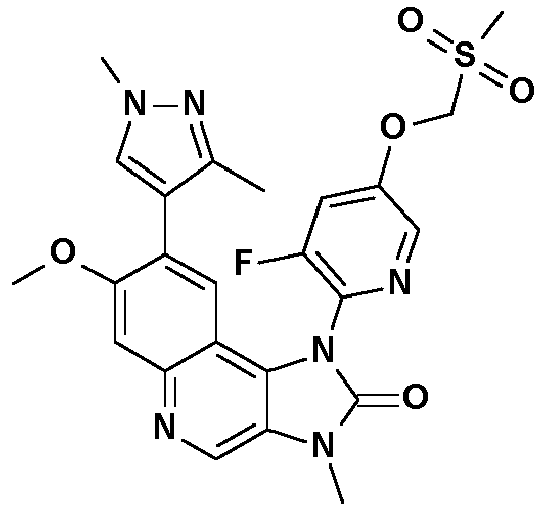
- i. In einem 25 mL Rundkolben wurden 8-(1,3-Dimethylpyrazol-4-yl)-1-(3-fluor-5-hydroxy-2-pyridyl)-7-methoxy-3-methyl-imidazo[4,5-c]chinolin-2-on (80 mg, 0,18 mmol, 98%), N,N-Dimethylformamid (5 mL), Kaliumcarbonat (50 mg, 0,36 mmol) und Chlor(methylsulfanyl)methan (110 mg, 1,09 mmol, 95%) vorgelegt. Die Lösung wurde bei 25°C über Nacht gerührt. Dann wurde die Reaktion durch Zugabe von 50 mL Wasser abgebrochen. Die Lösung wurde viermal mit je 30 mL Ethylacetat extrahiert und die organischen Phasen vereint. Das Gemisch wurde unter Vakuum eingeengt. Der Rückstand wurde an Kieselgel mit MeOH:EtOAc (6:94) vorgereinigt. Man erhielt 80 mg (85%) 8-(1,3-Dimethylpyrazol-4-yl)-1-[3-fluor-5-(methylsulfanylmethoxy)-2-pyridyl]-7-methoxy-3-methyl-imidazo[4,5-c]chinolin-2-on als gelben Feststoff.
- ii. In einem 25 mL Rundkolben wurde 8-(1,3-Dimethylpyrazol-4-yl)-1-[3-fluor-5-(methylsulfanylmethoxy)-2-pyridyl]-7-methoxy-3-methyl-imidazo[4,5-c]chinolin-2-on (80 mg, 0,15 mmol, 95%), MeOH (5,00 mL) und eine Lösung von Kaliumperoxodisulfat (220 mg, 0,77 mmol, 95%) in Wasser (0,5 mL) vorgelegt. Die Lösung wurde 3 Stunden lang bei 25°C gerührt. Der Rückstand wurde an Kieselgel mit EtOAc:MeOH (70:30) vorgereinigt und das Rohprodukt mittels präparativer HPLC aufgereinigt. Man erhielt 15 mg (18%) 8-(1,3-Dimethyl-1H-pyrazol-4-yl)-1-(3-fluor-5-methylsulfonylmethoxy-pyridin-2-yl)-7-methoxy-3-methyl-1,3-dihydro-imidazo[4,5-c]chinolin-2-on als weißen Feststoff.
-

- In einem 25 mL Rundkolben wurden 1-(3-Fluor-5-hydroxy-2-pyridyl)-7-methoxy-3-methyl-8-(1-methylpyrazol-4-yl)imidazo[4,5-c]chinolin-2-on (80 mg, 0,19 mmol, 98%), N,N-Dimethylformamid (5,00 mL), Kaliumcarbonat (51,7 mg, 0,37 mmol) und lod(D3)methan (57,1 mg, 0,37 mmol, 95%) vorgelegt. Die Lösung wurde 30 Minuten lang bei Raumtemperatur gerührt. Der Reaktionsfortschritt wurde mittels LCMS verfolgt (Dichlormethan/MeOH = 10:1). Die Reaktion wurde dann durch die Zugabe von 50 mL Eiswasser abgebrochen. Die Lösung wurde dreimal mit je 20 mL Ethylacetat extrahiert und die organischen Phasen vereint. Das Gemisch wurde unter Vakuum eingeengt. Man erhielt 38,5 mg (47%) 1-[3-Fluor-5-(trideuteriomethoxy)-2-pyridyl]-7-methoxy-3-methyl-8-(1-methylpyrazol-4-yl)imidazo[4,5-c]chinolin-2-on als weißen Feststoff.
-
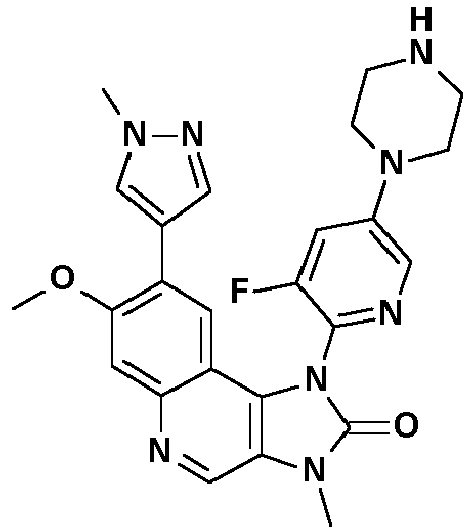
- In einem verschlossenen 30 mL Reaktionsgefäß, welches mit Argon gespült und unter Argon-Inertgasatmosphäre gehalten wurde, wurden 1-(5-Chlor-3-fluor-2-pyridyl)-7-methoxy-3-methyl-8-(1-methylpyrazol-4-yl)imidazo[4,5-c]chinolin-2-on (100 mg, 0,22 mmol, 95%), Piperazin-1-tert-butylcarbamat (128 mg, 0,65 mmol, 95%), Pd2(dba)3 (21 mg, 0,02 mmol), Xantphos (27 mg, 0,05 mmol), Cs2CO3 (150 mg, 0,46 mmol) und Toluol (10 mL) vorgelegt. Das Gemisch wurde bei 90°C über Nacht gerührt und anschließend unter Vakuum eingeengt. Der Rückstand wurde an Kieselgel mit EtOAc/MeOH (95:5, Volumeneinheiten) gereinigt. Man erhielt 120 mg (94%) 4-[5-Fluor-6-[7-methoxy-3-methyl-8-(1-methylpyrazol-4-yl)-2-oxo-imidazo[4,5-c]chinolin-1-yl]-3-pyridyl]piperazin-1-tert-butylcarbamat als gelben Feststoff.
- ii. In einem 25 mL Rundkolben wurden 4-[5-Fluor-6-[7-methoxy-3-methyl-8-(1-methylpyrazol-4-yl)-2-oxo-imidazo[4,5-c]chinolin-1-yl]-3-pyridyl]piperazin-1-tert-butylcarbamat (115 mg, 0,18 mmol, 92%), Dichlormethan (10 mL) und Trifluoressigsäure (4 mL) vorgelegt. Das Gemisch wurde 30 Minuten lang bei 0°C in einem Wasser/Eis-Bad gerührt und unter Vakuum eingeengt. Das Rohprodukt wurde mittels präparativer HPLC aufgereinigt. Man erhielt 50 mg (55%) 1-(3-Fluor-5-piperazin-1-yl-pyridin-2-yl)-7-methoxy-3-methyl-8-(1-methyl-1H-pyrazol-4-yl)-1,3-dihydro-imidazo[4,5-c]chinolin-2-on als weißen Feststoff.
-

- i. In einem 8 mL Reaktionsgefäß wurden eine Lösung von Schwefelsäure (2 mL, 98%) in Wasser (2 mL) und 5-Fluor-6-[7-methoxy-3-methyl-8-(1-methylpyrazol-4-yl)-2-oxo-imidazo[4,5-c]chinolin-1-yl]pyridin-3-nitril (110 mg, 0,26 mmol) vorgelegt. Das Gemisch wurde bei 80°C über Nacht gerührt. Natriumhydroxid (4 mol/L) wurde verwendet, um den pH-Wert auf 8 einzustellen. Das Gemisch wurde unter Vakuum eingeengt und der Rückstand an Kieselgel mit einer 0,5% wäßrigen NH4HCO3-Lösung und CH3CN (82/18) gereinigt. Man erhielt 70 mg (61%) 5-Fluor-6-[7-methoxy-3-methyl-8-(1-methylpyrazol-4-yl)-2-oxo-imidazo[4,5-c]chinolin-1-yl]pyridin-3-carbonsäure als weißen Feststoff.
- ii. In einem verschlossenen 30 mL Reaktionsgefäß wurden 5-Fluor-6-[7-methoxy-3-methyl-8-(1-methylpyrazol-4-yl)-2-oxo-imidazo[4,5-c]chinolin-1-yl]pyridin-3-carbonsäure (65,0 mg, 0,14 mmol), eine Lösung von Methylamin (10 mg, 0,32 mmol) in Tetrahydrofuran (0,5 mL), Triethylamin (44 mg, 0,43 mmol), BOP (64,9 mg, 0,15 mmol), und Tetrahydrofuran (5 mL) vorgelegt. Die Lösung wurde 18 Stunden lang bei Raumtemperatur gerührt und unter Vakuum eingeengt, der Rückstand mit 10 mL EtOAc verdünnt. Das Gemisch wurde über wasserfreiem Natriumsulfat getrocknet und unter Vakuum eingeengt. Das Rohprodukt wurde mittels präparativer HPLC aufgereinigt. Man erhielt 20 mg (30%) 5-Fluor-6-[7-methoxy-3-methyl-8-(1-methyl-1H-pyrazol-4-yl)-2-oxo-2,3-dihydro-imidazo[4,5-c]chinolin-1-yl]-N-methyl-nicotinamid als weißen Feststoff.
-

- In einem verschlossenen 8 mL Reaktionsgefäß wurden 1-(3-Fluor-5-hydroxy-4-pyridyl)-7-methoxy-3-methyl-8-(1-methylpyrazol-4-yl)imidazo[4,5-c]chinolin-2-on (145 mg, 0,33 mmol, 97%), CD3OD (0,3 mL), Kaliumcarbonat (143 mg, 1,03 mmol) und N,N-Dimethylformamid (3 mL) vorgelegt. Das Gemisch wurde bei 100°C über Nacht gerührt. Die Reaktion wurde dann durch Zugabe von 10 mL Wasser abgebrochen. Die Lösung wurde dreimal mit je 10 mL Ethylacetat extrahiert. Die organischen Phasen wurden vereint, über wasserfreiem Natriumsulfat getrocknet und unter Vakuum eingeengt. Das Rohprodukt wurde mittels präparativer HPLC aufgereinigt. Man erhielt 20 mg (14%) 1-[3-Fluor-5-(trideuteriomethoxy)-4-pyridyl]-7-methoxy-3-methyl-8-(1-methylpyrazol-4-yl)imidazo[4,5-c]chinolin-2-on als weißen Feststoff.
-
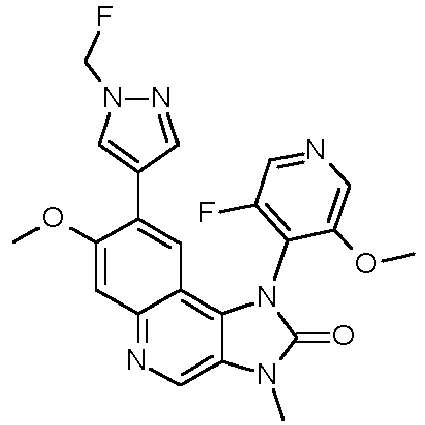
- In einem verschlossenen 30 mL Reaktionsgefäß wurden 1-(3-Fluor-5-methoxy-4-pyridyl)-7-methoxy-3-methyl-8-(1H-pyrazol-4-yl)imidazo[4,5-c]chinolin-2-on (60 mg, 0,14 mmol, 97%), Kaliumcarbonat (57,6 mg, 0,42 mmol) und N,N-Dimethylformamid (5 mL) vorgelegt. Das Gemisch wurde 5 Minuten lang bei Raumtemperatur gerührt und auf 0°C gekühlt. Bromfluormethan (165 mg, 1.39 mmol, 95%) wurde zugegeben, das Gemisch auf Raumtemperatur erwärmt und eine Stunde lang weiter gerührt. Die Reaktion wurde dann durch die Zugabe von 50 mL Wasser abgebrochen. Die Lösung wurde dreimal mit je 30 mL Ethylacetat extrahiert, die organischen Phasen vereint und unter Vakuum eingeengt. Das Rohprodukt wurde mittels präparativer HPLC aufgereinigt. Man erhielt 5 mg (8%) 1-(3-Fluor-5-methoxy-pyridin-4-yl)-8-(1-fluormethyl-1H-pyrazol-4-yl)-7-methoxy-3-methyl-1,3-dihydro-imidazo[4,5-c]chinolin-2-on als weißen Feststoff.
-

- Unter einer trockenen Stickstoffatmosphäre wurden 3-Fluor-5-methoxypyridin-4-amin (447 mg, 3,02 mmol), gelöst in N,N-Dimethylformamid (5 mL), vorgelegt. Anschließend wurde der Lösung Natriumhydrid (504 mg, 12,6 mmol, 60%) zugefügt und weitere 5 Minuten bei Raumtemperatur gerührt. Danach wurde 6-Brom-4-chlor-7-methoxy-3-nitro-chinolin (800 mg, 2,52 mmol) zur Reaktionsmischung gegeben, 15 Minuten bei Raumtemperatur gerührt und anschließend durch Zugabe von Eiswasser (100 mL) abgebrochen. Der ausgefallene Niederschlag wurde abfiltriert, mit Eiswasser gewaschen und getrocknet, wobei 1,0 g (94 %) 6-Brom-N-(3-fluor-5-methoxy-4-pyridyl)-7-methoxy-3-nitro-chinolin-4-amin als gelber Feststoff erhalten wurden.
- 6-Brom-N-(3-fluor-5-methoxy-4-pyridyl)-7-methoxy-3-nitro-chinolin-4-amin (990 mg, 2,20 mmol) wurde unter einer Stickstoffschutzgasatmosphäre in Methanol (100 mL) gelöst vorgelegt. Anschließend wurde der Lösung Raney-Ni (100 mg, 1,17 mmol) zugefügt und die Reaktionsmischung unter einer Wasserstoffatmosphäre 30 Minuten bei Normaldruck gerührt. Nach Belüftung mit Stickstoff wurde die Suspension filtriert und das Filtrat im Vakuum zur Trockne eingeengt. Der Rückstand wurde aus Ethylacetat/Petrolether kristallisiert, wobei 0,86 g (99 %) 6-Brom-N4-(3-fluor-5-methoxy-4-pyridyl)-7-methoxy-chinolin-3,4-diamin als gelber Feststoff erhalten wurden.
- 6-Brom-N4-(3-fluor-5-methoxy-4-pyridyl)-7-methoxy-chinolin-3,4-diamin (0.85 g, 2,20 mmol) wurden in Tetrahydrofuran (20 mL) gelöst vorgelegt. Anschließend wurden 1,1'-Carbonyldiimidazol (1,84 g, 11,3 mmol) und Hünig-Base (1,46 g, 11,3 mmol) zugefügt. Die Reaktionslösung wurde 16 Stunden bei 40°C unter Rühren erwärmt. Danach wurde durch Zugabe von Eiswasser (200 mL) abgebrochen. Der ausgefalle Niederschlag wurde abfiltriert, mit Eiswasser gewaschen und getrocknet, wobei 0,87 g (94 %) 8-Brom-1-(3-fluor-5-methoxy-4-pyridyl)-7-methoxy-3H-imidazo[4,5-c]chinolin-2-on als hellgelber Feststoff erhalten wurden.
- Unter einer trockenen Stickstoffschutzatmosphäre wurde 8-Brom-1-(3-fluor-5-methoxy-4-pyridyl)-7-methoxy-3H-imidazo[4,5-c]chinolin-2-on (0,86 g, 1,94 mmol), gelöst in N,N-Dimethylformamid (5 mL) vorgelegt. Anschließend wurden Natriumhydrid (388 mg, 9,71 mmol, 60%) und Methyliodid (2,76 g, 19,4 mmol) zugefügt. Die Reaktionsmischung wurde 10 Minuten bei Raumtemperatur gerührt. Anschließend wurde durch Zugabe von Eiswasser (100 mL) abgebrochen. Der erhaltene Niederschlag wurde abfiltriert und unter Vakuum getrocknet, wobei 0,70 g (80%) 8-Brom-1-(3-fluor-5-methoxy-4-pyridyl)-7-methoxy-3-methyl-imidazo[4,5-c]chinolin-2-on als hellgelber Feststoff erhalten wurden.
- Unter einer Argon-Inertgasatmosphäre wurden in einer geschlossenen Apparatur 8-Brom-1-(3-fluor-5-methoxy-4-pyridyl)-7-methoxy-3-methyl-imidazo[4,5-c]chinolin-2-on (150 mg, 0,33 mmol), 1-Methyl-4-(tetramethyl-1,3,2-dioxaborolan-2-yl)-1H-pyrazol (88,4 mg, 0,44 mmol), Pd(PPh3)4 (76,6 mg, 0,07 mmol) und Kaliumcarbonat (91,6 mg, 0,66 mmol) in 1,4-Dioxan (15 mL) und Wasser (5 mL) vorgelegt. Die Reaktionsmischung wurde 2 Stunden unter Rühren auf 80°C erhitzt. Anschließend wurde auf Raumtemperatur abgekühlt und die Reaktionsmischung im Vakuum zur Trockne eingeengt. Der Rückstand wurde an Kieselgel chromatographisch (Essigsäureethylester/Methanol = 97:3, Volumenanteile) vorgereinigt. Das Eluat wurde zur Trockne eingeengt und das erhaltene Rohprodukt mittels präparativer RP-HPLC (Wasser/Acetonitril) endgereinigt. Nach Einengen der Produktfraktionen wurde 1-(3-Fluor-5-methoxy-4-pyridyl)-7-methoxy-3-methyl-8-(1-methylpyrazol-4-yl)imidazo[4,5-c]chinolin-2-on (70 mg, 47%, Verbindungsbeispiel 4) als farbloser Feststoff erhalten.
- Die vorstehend benutzten, im Fachbereich üblichen Abkürzungen haben die folgenden Bedeutungen: MeOH: Methanol; Pd(PPh3)4: Tetrakis(triphenylphosphin)palladium; EtOAc: Ethylacetat; BOP: Benzotriazolyloxytris(dimethylamino)-phosphonium hexafluorophosphat; Pd2(dba)3: Tris(dibenzylideneacetone)dipalladium
-


Tabelle 2 Bsp. Strukturformel Name IC50 (pCHK2) IC50 (ATM) [µM] 1 
1-(3,5-Difluor-pyridin-2-yl)-7-methoxy-3-methyl-8-(1-methyl-1 H-pyrazol-4-yl)-1,3-dihydro-imidazo[4,5-c] chinolin-2-on +++ < 0,01 MS: 423 (M+H+) 1H NMR (400 MHz, DMSO-d6, ppm): 8.915 (s, 1H), 8.855-8.849 (d, J=2.4Hz,1 H), 8.544-8.495 (m,1H), 8.016 (s,1H), 7.538 (s,1H), 7.339 (s,1H), 6.944 (s,1H), 4.005 (s,3H), 3.864 (s,3H), 3.597 (s,3H) 2 
1-(3,5-Difluor-pyridin-4-yl)-7-methoxy-3-methyl-8-(1 H-pyrazol-4-yl)-1,3-dihydro-imidazo[4,5-c]chinolin-2-on +++ < 0,001 MS: 409 (M+H+) 1H NMR (400MHz, DMSO, ppm): 13.036 (s,1H), 9.050 (s,2H), 8.944 (s,1H), 7.992 (s,1H), 7.563 (s, 1H) 7.440 (s,1H), 7.281 (s, 1H), 4.012 (s,3H), 3.613 (s,3H) 3 
1-(1,3-Dimethyl-1 H-pyrazol-4-yl)-7-methoxy-3-methyl-8-(1 H-pyrazol-4-yl)-1,3-dihydro-imidazo[4,5-c] chinolin-2-on +++ < 0,001 MS: 390 (M+H+) 1H NMR (400MHz,DMSO,ppm): 13.03(s,1H), 8.80 (s,1H), 8.13 (s,1H), 7.96 (br,1H), 7.45 (d,3H), 3.97 (m,6H), 3.53 (s,3H), 1.94 (s,3H) 4 
8-(1,3-Dimethyl-1H-pyrazol-4-yl)-1-(3-fluor-5-methoxy-pyridin-4-yl)-7-methoxy-3-methyl-1,3-dihydro-imidazo[4,5-c]chinolin-2-on +++ < 0,001 MS: 449 (M+H+) 1H NMR (400MHz,DMSO,ppm): 8.912 (s,1H),8.707-8.681 (m,2H),7.822 (s,1H),7.527 (s, 1H), 6.985 (s, 1H), 3.927 (s,3H), 3.861 (s,3H), 3.766(s,3H), 3.595 (s,3H), 1.744 (s,3H) 5 
1-(1,3-Dimethyl-1 H-pyrazol-4-yl)-7-methoxy-3-methyl-8-(1-methyl-1 H-pyrazol-4-yl)-1,3-dihydro-imidazo[4,5-c]chinolin-2-on +++ < 0,001 MS: 404 (M+H+) 1H NMR (400MHz,DMSO,ppm): 8.80 (s,1H), 8.13 (s,1H), 8.00 (s,1H), 7.41(m,3H), 3.97 (m,6H), 3.87 (d,3H), 3.54 (s,3H), 1.94 (s,3H) 6 
1-(3,5-Difluor-pyridin-2-yl)-7-methoxy-3-methyl-8-(1 H-pyrazol-4-yl)-1,3-dihydro-imidazo[4,5-c]chinolin-2-on +++ < 0,001 MS: 410 (M+H+) 1H NMR (400MHz,DMSO,ppm): 12.95 (br,1H), 8.86 (d,2H), 8.51 (m,1 H),7.71 (s,2H), 7.52 (s,1H), 6.96 (s,1H), 3.99 (s,3H), 3.29 (s.3H) 7 
1-(3-Fluor-pyridin-2-yl)-7-methoxy-3-methyl-8-(1H-pyrazol-4-yl)-1,3-dihydro-imidazo[4,5-c]chinolin-2-on +++ < 0,001 MS: 391 (M+H+) 1H NMR (300MHz,DMSO,ppm): 13.007 (s,1H), 8.907 (s,1H), 8.727 (s,1H), 8.305-8.241 (m,1H), 7.981-7.939 (m,2H), 7.526 (s,1H), 7.321 (s,1H), 6.934 (s,1H), 3.997 (s,3H), 3.597 (s,3H) 8 
1-(3-Fluor-5-methyl-pyridin-4-yl)-7-methoxy-3-methyl-8-(1 H-pyrazol-4-yl)-1,3-dihydro-imidazo[4,5-c] chinolin-2-on +++ < 0,001 MS: 405 (M+H+) 1H NMR (400MHz,DMSO,ppm): 13.035 (s,1H), 8.930 (s, 1H), 8.901 (s,1H), 8.805 (s,1H), 7.920 (s, 1H), 7.544 (s, 1H), 7.271 (s,1H), 7.030 (s,1H), 3.999 (s,3H), 3.615 (s,3H), 2.220 (s,3H) 9 
1-(3-Fluor-pyridin-4-yl)-7-methoxy-3-methyl-8-(1 H-pyrazol-4-yl)-1,3-dihydro-imidazo[4,5-c]chinolin-2-on +++ < 0,001 MS: 391 (M+H+) 1H NMR (400MHz, DMSO, ppm): 13.023 (s,1H), 9.075 (s, 1H), 8.908 (s,1H), 8.838-8.825 (d, J=5.2Hz, 1H), 7.997-7.940 (m,2H), 7.537 (s,1H), 7.337 (s,1H), 7.195 (s,1H), 4.000 (s,3H), 3.589 (s,3H) 10 
1,8-Bis-(1,3-dimethyl-1 H-pyrazol-4-yl)-7-methoxy-3-methyl-1,3-dihydro-imidazo[4,5-c]chinolin-2-on +++ < 0,001 MS: 418 (M+H+) 1H NMR (400MHz, DMSO, ppm): 8.82 (s,1H), 8.08 (s,1H), 7.86 (s,1H), 7.48 (s,1H), 7.35 (s,1H), 3.92 (d,3H), 3.87 (s,3H), 3.78 (s,3H), 3.54 (s,3H), 1.90 (d,6H) 11 
1-(3,5-Difluor-pyridin-2-yl)-8-(1,3-dimethyl-1H-pyrazol-4-yl)-7-methoxy-3-methyl-1,3-dihydro-imidazo[4,5-c]chinolin-2-on +++ < 0,001 MS: 437 (M+H+) 1H NMR (400MHz, DMSO, ppm): 8.829 (s,1H), 8.605-8.599 (d, J=2.4Hz,1H), 8.133-8.085 (m, 1H), 7.700 (s,1H), 7.499 (s,1H), 6.874 (s,1H), 3.985 (s,3H), 3.852 (s,3H), 3.680 (s,3H), 1.948 (s,3H) 12 
1-(3-Ethyl-5-fluor-pyridin-4-yl)-7-methoxy-3-methyl-8-(1-methyl-1 H-pyrazol-4-yl)-1,3-dihydro-imidazo[4,5-c]chinolin-2-on +++ < 0,001 MS: 433 (M+H+) 1H NMR (400MHz,DMSO,ppm): 8.935 (s,2H), 8.853 (s,1H), 7.986 (s,1H), 7.545 (s,1H), 7.062 (s,1H), 6.960 (s,1H), 3.994 (s,3H), 3.844 (s,3H), 3.618 (s,3H), 2.672-2.600 (m,2H),1.069-1.002 (m,3H) 13 
8-(1-Ethyl-1H-pyrazol-4-yl)-1-(3-fluor-5-methoxy-pyridin-4-yl)-7-methoxy-3-methyl-1,3-dihydro-imidazo[4,5-c]chinolin-2-on +++ < 0,001 MS: 449 (M+H+) 1H NMR (400MHz,DMSO,ppm): 8.896 (s,1H), 8.789 (s,1H), 8.744 (s,1H), 8.024 (s,1H), 7.527 (s,1H), 7.206 (s,1H), 7.158 (s,1H), 4.175-4.120 (m,2H), 4.002 (s,3H), 3.877 (s,3H), 3.333 (s,3H), 1.390-1.354 (m,3H) 14 
1-(3-Fluor-pyridin-2-yl)-7-methoxy-3-methyl-8-(1-methyl-1 H-pyrazol-4-yl)-1,3-dihydro-imidazo[4,5-c]chinolin-2-on +++ < 0,001 MS: 405 (M+H+) 1H NMR (400MHz,DMSO,ppm): 8.908 (s,1H), 8.719-8.708 (m,1H), 8.295-8.271 (m,1H), 7.977-7.930 (m, 2H), 7.525 (s,1H), 7.195-7.194 (s,1H), 6.896 (s,1H), 4.033 (s,3H), 3.994 (s,3H), 3.595 (s,3H) 15 
1-(3-Fluor-5-methoxy-pyridin-4-yl)-7-methoxy-3-methyl-8-(1-methyl-1 H-pyrazol-4-yl)-1,3-dihydro-imidazo[4,5-c]chinolin-2-on +++ < 0,001 MS: 435 (M+H+) 1H NMR (400MHz,DMSO,ppm): 8.896 (s,1H), 8.780 (s, 1H), 8.739 (s,1H), 8.007 (s,1H), 7.528 (s, 1H), 7.176-7.149 (m,2H), 3.998 (s,3H), 3.870 (s,6H), 3.596 (s,3H) 16 
8-(1,3-Dimethyl-1H-pyrazol-4-yl)-1-(3-fluor-pyridin-2-yl)-7-methoxy-3-methyl-1,3-dihydro-imidazo[4,5-c] chinolin-2-on +++ < 0,001 MS: 419 (M+H+) 1H NMR (400 MHz, DMSO-d6) ppm = 8.93 (s, 1H), 8.63-8.62 (d, J=4.8Hz, 1H), 8.25-8.20 (m, 1H), 7.89-7.85 (m, 1H), 7.77 (s, 1H), 7.53 (s, 1H), 6.77 (s, 1H), 3.92 (s, 3H), 3.76 (s, 3H), 3.59 (s, 3H), 1.75 (s, 3H) 17 
7-Methoxy-3-methyl-1-(1-methyl-1 H-pyrazol-4-yl)-8-(1 H-pyrazol-4-yl)-1,3-dihydro-imidazo[4,5-c] chinolin-2-on +++ < 0,001 MS: 375 (M+H+) 1H NMR (300MHz,DMSO,ppm): 13.009 (s,1H), 8.802 (s, 1H), 8.239 (s,1H), 7.818 (s,1H), 7.729 (s,2H), 7.476 (m,2H), 4.034 (s,3H), 3.987 (s,3H), 3.532 (s,3H) 18 
1-(3-Fluor-5-methyl-pyridin-4-yl)-7-methoxy-3-methyl-8-(1-methyl-1 H-pyrazol-4-yl)-1,3-dihydro-imidazo[4,5-c] chinolin-2-on +++ < 0,01 MS: 419 (M+H+) 1H NMR (400MHz,DMSO,ppm): 8.930 (s,1H), 8.895 (s, 1H), 8.800 (s,1H), 7.981 (s,1H), 7.544 (s,1H), 7.109 (s,1H), 6.999 (s,1H), 3.996 (s,3H), 3.844 (s,3H), 3.613 (s,3H), 2.215 (s,3H) 19 
7-Methoxy-3-methyl-1-(3-methyl-pyridin-4-yl)-8-(1 H-pyrazol-4-yl)-1,3-dihydro-imidazo[4,5-c]chinolin-2-on +++ < 0,01 MS: 387 (M+H+) 1H NMR (400Hz, DMSO, ppm): 2.141 (s, 3H), 3.596 (s, 3H), 3.991 (s, 3H), 6.970 (s, 1H), 7.202 (s, 1H), 7.517 (s, 1H), 7.682-7.695 (d, J=5.2Hz, 1H), 7.883 (s, 1 H),8.777-8.789 (d, J=4.8Hz, 1H), 8.900 (s, 2H), 13.016 (s, 1H) 20 
1-(3-Fluor-5-methyl-pyridin-2-yl)-7-methoxy-3-methyl-8-(1 H-pyrazol-4-yl)-1,3-dihydro-imidazo[4,5-c] chinolin-2-on +++ < 0,001 MS: 405 (M+H+) 1H NMR (400MHz,MeOD,ppm): 8.747 (s,1H), 8.514 (s,1H), 7.941-7.914 (d,J=10.8,2H), 7.422 (s,2H), 6.947 (s,1H), 4.019 (s,3H), 3.654 (s,3H), 2.618 (s,3H) 21 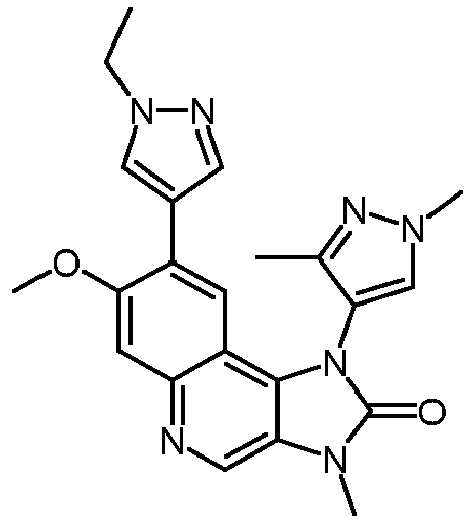
1-(1,3-Dimethyl-1 H-pyrazol-4-yl)-8-(1-ethyl-1 H-pyrazol-4-yl)-7-methoxy-3-methyl-1,3-dihydro-imidazo[4,5-c] chinolin-2-on +++ < 0,001 MS: 418 (M+H+) 1H NMR (400MHz,DMSO,ppm): 8.81 (s,1H), 8.14 (s, 1H), 8.03 (s, 1H), 7.78-7.38 (m,3H), 4.16 (m,2H), 3.99 (d,6H), 3.55 (s,3H), 1.95 (s,3H), 1.40 (m,3H) 22 
1-(3,5-Difluor-pyridin-4-yl)-7-methoxy-3-methyl-8-(1-methyl-1 H-pyrazol-4-yl)-1,3-dihydro-imidazo[4,5-c] chinolin-2-on +++ < 0,001 MS: 423 (M+H+) 1H NMR (400MHz,DMSO,ppm): 9.050 (s,2H), 8.499 (s.,1H), 8.030 (s,1H), 7.562 (s,1H), 7.312-7.254 (d,J=23.2,2H), 4.010 (s,3H), 3.854 (s,3H), 3.611 (s,3H). 23 
7-Methoxy-3-methyl-1,8-bis-(1-methyl-1H-pyrazol-4-yl)-1,3-dihydro-imidazo[4,5-c] chinolin-2-on +++ < 0,01 MS: 390 (M+H+) 1H NMR (300MHz,DMSO,ppm): 8.798 (s,1H), 8.241 (s,1H), 8.005 (s,1H), 7.811 (s,1H), 7.471-7.462 (d, J=2.7Hz,2H), 7.348 (s,1H), 4.037 (s,3H), 3.984 (s,3H), 3.874 (s,3H), 3.525 (s,3H) 24 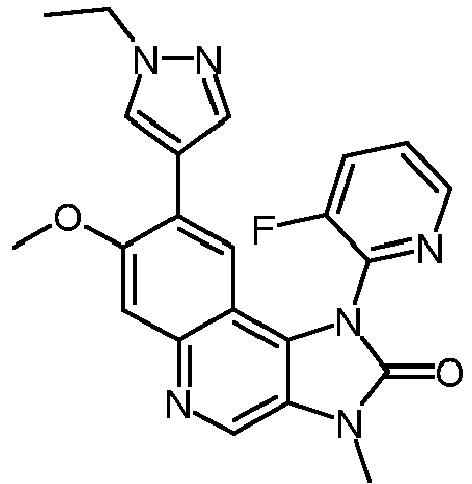
8-(1-Ethyl-1 H-pyrazol-4-yl)-1-(3-fluor-pyridin-2-yl)-7-methoxy-3-methyl-1,3-dihydro-imidazo[4,5-c] chinolin-2-on +++ < 0,001 MS: 419 (M+H+) 1H NMR (400MHz,DMSO,ppm): 8.907 (s,1H), 8.732-8.721 (m,1H), 8.300-8.252 (m,1H), 7.997-7.936 (m,2H), 7.524 (s,1H), 7.226 (s,1H), 6.907 (s,1H), 4.165-40125 (m,2H), 3.998 (s,3H), 3.596 (s,3H), 1.387-1.350 (m,3H) 25 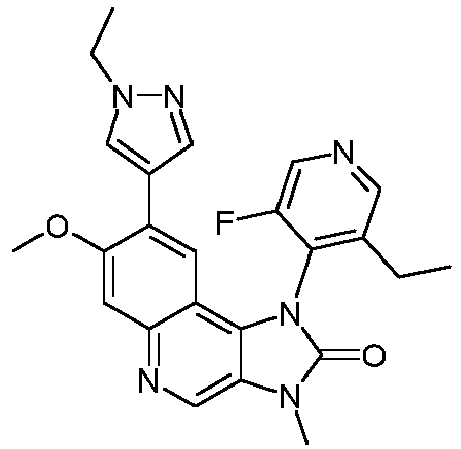
1-(3-Ethyl-5-fluor-pyridin-4-yl)-8-(1-ethyl-1H-pyrazol-4-yl)-7-methoxy-3-methyl-1,3-dihydro-imidazo[4,5-c] chinolin-2-on +++ < 0,001 MS: 447 (M+H+) 1H NMR (400MHz,DMSO,ppm): 8.934 (s,2H), 8.860 (s,1H), 8.001 (s,1H), 7.544 (s,1H), 7.098 (s,1H), 6.973 (s,1H), 4.165-4.111 (m,2H), 3.999 (s,3H), 3.619 (s,3H), 2.678-2.605 (m,2H), 1.384-1.348 (m,3H), 1.045-1.007 (m,3H) 26 
1-(3,5-Difluor-pyridin-4-yl)-8-(1-ethyl-1H-pyrazol-4-yl)-7-methoxy-3-methyl-1,3-dihydro-imidazo[4,5-c] chinolin-2-on +++ < 0,001 MS: 437 (M+H+) 1H NMR (300MHz,DMSO,ppm): 9.162 (s,1H), 9.078 (s,2H), 8.101 (s.,1H), 7.618 (s,1H), 7.380 (s,2H), 4.192-4.120 (m,2H), 4.062 (s,3H), 3.631 (s,3H), 1.398-1.351 (m,3H). 27 
1-(3-Fluor-5-methyl-pyridin-2-yl)-7-methoxy-3-methyl-8-(1-methyl-1 H-pyrazol-4-yl)-1,3-dihydro-imidazo[4,5-c] chinolin-2-on +++ < 0,001 MS: 419 (M+H+) 1H NMR (400MHz,DMSO,ppm): 8.896 (s,1H), 8.577 (s,1H), 8.144-8.118 (d, J=10.4,1H), 7.948 (s,1H), 7.517 (s,1H), 7.218 (s,1H), 6.857 (s,1H), 3.992 (s,3H), 3.852 (s,3H), 3.588 (s,3H), 2.672 (s,3H) 28 
7-Methoxy-1-(3-methoxy-pyridin-4-yl)-3-methyl-8-(1-methyl-1 H-pyrazol-4-yl)-1 ,3-dihydro-imidazo[4,5-c] chinolin-2-on +++ < 0,01 MS: 417 (M+H+) 1H NMR (300MHz,DMSO,ppm): 8.855 (m,2H), 8.581 (s,1H), 7.973 (s.,1 H), 7.758 (s,1H), 7.492 (s,1H), 7.093 (s,2H), 4.021 (s,3H), 3.843 (m,3H), 3.570 (s,3H), 3.319 (s,3H) 29 
1-(3-Fluor-pyridin-2-yl)-7-methoxy-3-methyl-8-(5-methyl-1 H-pyrazol-3-yl)-1,3-dihydro-imidazo[4,5-c] chinolin-2-on +++ < 0,01 MS: 405 (M+H+) 1H NMR (400MHz,DMSO,ppm): 8.936 (s,1H), 8.628 (s,1H), 8.263-8.239 (m,1H), 7.891-7.841 (m,2H), 7.541 (s,1H), 7.376 (s,1H), 6.319 (s,1H), 5.980 (s,1H), 4.016 (s,3H), 3.595 (s,3H), 2.220 (s,3H) 30 
7-Methoxy-3-methyl-1-(2-methyl-thiazol-4-yl)-8-(1H-pyrazol-4-yl)-1,3-dihydro-imidazo[4,5-c]chinolin-2-on +++ < 0,01 MS: 393 (M+H+) 1H NMR (400MHz,DMSO,ppm): 12.96 (br,1H), 8.84 (s,1H), 8.00 (s,1H), 7.73 (s,2H), 7.48 (s,1H), 7.15 (s,1H), 3.99 (s,3H), 3.55 (s,3H), 2.79 (s,3H) 31 
1-(5-Fluorpyrimidin-4-yl)-7-methoxy-3-methyl-8-(1-methyl-1 H-pyrazol-4-yl)-1 H,2H,3H-imidazo[4,5-c] chinolin-2-on hydrochlorid +++ < 0,01 MS: 406 (M+H+) 1H NMR (400MHz,DMSO,ppm): 9.43-9.31 (m,3H), 8.14 (s,1H), 7.75 (s,1H), 7.56 (d,2H), 4.08 (s,3H), 3.88 (s,3H), 3.62 (s,3H) 32 
7-Methoxy-1-(3-methoxy-pyridin-4-yl)-3-methyl-8-(1 H-pyrazol-4-yl)-1,3-dihydro-imidazo[4,5-c]chinolin-2-on +++ < 0,01 MS: 403 (M+H+) 1H NMR (300MHz,DMSO,ppm): 13.016 (s,1H), 8.856 (s,2H), 8.584 (s.,1 H), 7.908 (s,1H), 7.766 (s,1H), 7.492 (s,1H), 7.255 (s,1H), 7.119 (s,1H), 3.986 (s,3H), 3.801 (s,3H), 3.571 (s,3H) 33 
8-(1-Ethyl-1 H-pyrazol-4-yl)-1-(3-fluor-pyridin-4-yl)-7-methoxy-3-methyl-1,3-dihydro-imidazo[4,5-c] chinolin-2-on +++ < 0,001 MS: 419 (M+H+) 1H NMR (400MHz,DMSO,ppm): 9.076 (s,1H), 8.908 (s,1H), 8.842-8.829 (d, J=5.2Hz,1H), 8.009 (s,1H), 7.997-7.969 (m,1H), 7.535 (s,1H), 7.217 (s,1H), 7.175 (s,1H), 4.166-4.112 (m,2H), 4.000 (s,3H), 3.587 (s,3H), 1.383-1.347 (m,3H) 34 
8-(1-Ethyl-1 H-pyrazol-4-yl)-7-methoxy-3-methyl-1-(3-methyl-pyridin-4-yl)-1,3-dihydro-imidazo[4,5-c] chinolin-2-on +++ < 0,01 MS: 415 (M+H+) 1H NMR (400MHz, DMSO, ppm): 1.349-1.386 (t, J=7.4Hz, 3H), 2.139 (s, 3H), 3.597 (s, 3H), 3.994 (s, 3H), 4.1-4.2 (m, 2H), 6.949 (s, 1H), 7.066 (s, 1H), 7.517 (s, 1H), 7.682-7.695 (d, J=5.2Hz, 1H), 7.968 (s, 1H), 8.780-8.793 (d, J=5.2Hz, 1H), 8.900 (s, 2H) 35 
1-(3-Fluor-pyridin-4-yl)-7-methoxy-3-methyl-8-(1-methyl-1 H-pyrazol-4-yl)-1,3-dihydro-imidazo[4,5-c] chinolin-2-on +++ < 0,01 MS: 405 (M+H+) 1H NMR (400MHz,DMSO,ppm): 9.073-9.070 (d, J=1.2Hz,1H), 8.901 (s,1H), 8.838-8.825 (d, J=5.2Hz,1H), 7.993-7.964 (m,2H), 7.532 (s,1H), 7.185 (s,1H), 7.164 (s,1H), 3.995 (s,3H), 3.847 (s,3H), 3.583 (s,3H) 36 
1-(5-Fluor-pyrimidin-2-yl)-7-methoxy-3-methyl-8-(1-methyl-1 H-pyrazol-4-yl)-1,3-dihydro-imidazo[4,5-c] chinolin-2-on +++ < 0,01 MS: 406 (M+H+) 1H NMR (400MHz,DMSO,ppm): 9.33 (s,2H), 8.89 (s,1H), 8.08 (s,1H), 7.51 (s,1H), 7.42 (s,1H), 6.92 (s,1H), 4.11 (s,3H), 3.99 (s,3H), 3.57 (s,3H) 37 
7-Methoxy-3-methyl-8-(1 H-pyrazol-4-yl)-1-[1-(tetrahydro-pyran-4-yl)-1 H-pyrazol-4-yl]-1,3-dihydro-imidazo[4,5-c] chinolin-2-on +++ < 0,01 MS: 446 (M+H+) 1H NMR (400MHz,DMSO,ppm): 12.98 (br,1H), 8.79 (s, 1H), 8.35 (s,1H), 7.84 (s,1H), 7.69 (s,2H), 7.44 (d,2H), 4.58 (m,1H), 4.00 (m,5H), 3.52 (m,5H), 2.07 (m,4H) 38 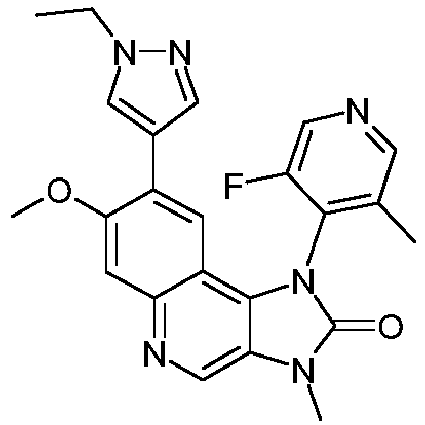
8-(1-Ethyl-1H-pyrazol-4-yl)-1-(3-fluor-5-methyl-pyridin-4-yl)-7-methoxy-3-methyl-1,3-dihydro-imidazo[4,5-c] chinolin-2-on ++ < 0,001 MS: 433 (M+H+) 1H NMR (400MHz,DMSO,ppm): 8.929 (s,1H), 8.904 (s, 1H), 8.806 (s,1H), 7.993 (s,1H), 7.543 (s,1H), 7.144 (s,1H), 7.010 (s,1H), 4.165-4.111 (m,2H), 4.000 (s,3H), 3.614 (s,3H), 2.218 (s,3H), 1.384-1.348 (m,3H) 39 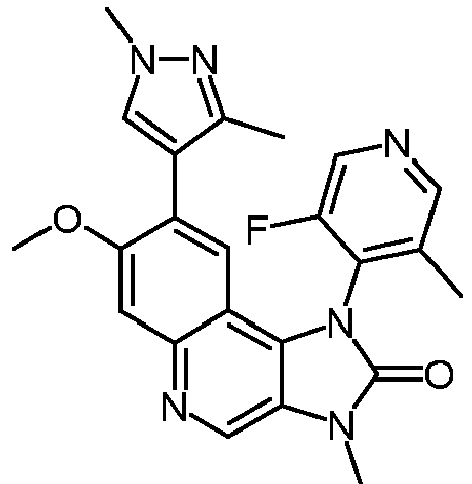
8-(1,3-Dimethyl-1H-pyrazol-4-yl)-1-(3-fluor-5-methyl-pyridin-4-yl)-7-methoxy-3-methyl-1,3-dihydro-imidazo[4,5-c]chinolin-2-on ++ < 0,001 MS: 433 (M+H+) 1H NMR (400MHz,DMSO,ppm): 8.948 (s,1H), 8.833 (s, 1H), 8.732 (s,1H), 7.824 (s,1H), 7.545 (s, 1H), 6.874 (s, 1H), 3.929 (s,3H), 3.759 (s,3H) ,3.611 (s,3H), 2.189 (s,3H), 1.702 (s,3H) 40 
7-Methoxy-3-methyl-8-(1-methyl-1 H-pyrazol-4-yl)-1-(3-methyl-pyridin-4-yl)-1,3-dihydro-imidazo[4,5-c] chinolin-2-on ++ < 0,01 MS: 401 (M+H+) 1H NMR (400MHz, DMSO, ppm): 2.128 (s, 3H), 3.589 (s, 3H), 3.833 (s, 3H), 3.982 (s, 3H), 6.933 (s, 1H), 7.018 (s, 1H), 7.511 (s, 1H), 7.665-7.678 (d, J=5.2Hz, 1H), 7.953 (s, 1H), 8.764-8.777 (d, J=5.2Hz, 1H), 8.886-8.893 (d, J=2.8Hz, 2H). 41 
7-Methoxy-3-methyl-1-(2-methyl-2 H-pyrazol-3-yl)-8-(1 H-pyrazol-4-yl)-1,3-dihydro-imidazo[4,5-c] chinolin-2-on ++ < 0,01 MS: 376 (M+H+) 1H NMR (400MHz,DMSO,ppm): 8.77 (s,1H), 7.85 (s,1H), 6.04 (s,1H), 3.99 (s,3H), 3.73 (s,3H), 3.62 (s,3H) 42 
1-(1,3-Dimethyl-1 H-pyrazol-4-yl)-7-methoxy-3-methyl-8-(1-methyl-1 H-[1,2,3]triazol-4-yl)-1,3-dihydro-imidazo[4,5-c]chinolin-2-on ++ < 0,01 MS: 405 (M+H+) 1H NMR (400MHz,DMSO,ppm): 8.85 (s,1H), 8.40 (s, 1H), 8.28 (s, 1H), 8.08 (s,1H), 7.52 (s,1H), 4.07 (s,3H), 4.01 (s,3H), 3.91 (s,3H), 3.54 (s,3H), 1.93 (s,3H) 43 
7-Methoxy-3-methyl-1-(3-methyl-1 H-pyrazol-4-yl)-8-(1-methyl-1 H-pyrazol-4-yl)-1,3-dihydro-imidazo[4,5-c]chinolin-2-on ++ < 0,001 MS: 390 (M+H+) 1H NMR 1H NMR (400 MHz, DMSO): 13.21 (s, 1H), 8.80 (s, 1H), 7.98 (d, J = 25.3 Hz, 2H), 7.47 (s, 1H), 7.36 (s, 1H), 7.31 (s, 1H), 3.98 (s, 3H), 3.87 (s, 3H), 3.54 (s, 3H), 2.05 (s, 3H). 44 
5-Fluor-4-[7-methoxy-3-methyl-8-(1-methyl-1 H-pyrazol-4-yl)-2-oxo-2, 3-dihydro-imidazo[4,5-c]chinolin-1-yl]-nicotinonitril ++ < 0,01 MS: 430 (M+H+) 1H NMR (400MHz,DMSO,ppm): 9.399 (s,1H), 9.346 (s, 1H), 8.968 (s,1H), 8.036 (s,1H), 7.578 (s, 1H), 7.404 (s, 1H), 7.215 (s,1H), 4.020 (s,3H), 3.851 (s,3H), 3.636 (s,3H) 45 
4-[7-Methoxy-3-methyl-8-(1-methyl-1H-pyrazol-4-yl)-2-oxo-2,3-dihydro-imidazo[4,5-c]chinolin-1-yl]-pyridin-2-carbonitril ++ < 0,05 MS: 412 (M+H+) 1H NMR (400MHz,DMSO,ppm): 9.099 (s,1H), 8.913 (s,1H), 8.497 (s,1H), 8.106 (s,1H), 8.097 (s, 1H), 7.549 (s,1 H), 7.332 (s,1H), 7.269 (s,1H), 4.007 (s,3H), 3.857 (s,3H), 3.574 (s,3H) 46 
4-[7-Methoxy-3-methyl-8-(1-methyl-1 H-pyrazol-4-yl)-2-oxo-2,3-dihydro-imidazo[4,5-c]chinolin-1-yl]-nicotinonitril ++ < 0,05 MS: 412 (M+H+) 1H NMR (400MHz,CDCl3,ppm): 9.219 (s,1H), 9.122 (s,1H), 8.718 (s,1H), 7.767 (s,1H), 7.689 (s,2H), 7.300 (s, 1H), 7.140 (s,1H), 4.071 (s,3H), 3.924 (s,3H), 3.686 (s,3H) 47 
7-Methoxy-3-methyl-8-(1-methyl-1 H-pyrazol-4-yl)-1-thiazol-2-yl-1,3-dihydro-imidazo[4,5-c]chinolin-2-on ++ < 0,01 MS: 393 (M+H+) 1H NMR (400HMz,DMSO,ppm): 8.82 (s,1H), 8.04 (s,2H), 7.98 (s,1H), 7.60 (s,1H), 7.40 (d,2H), 3.94 (s,3H), 3.81 (s,3H), 3.50 (s,3H) 48 
6-[7-Methoxy-3-methyl-8-(1-methyl-1 H-pyrazol-4-yl)-2-oxo-2,3-dihydro-imidazo[4,5-c]chinolin-1-yl]-nicotinonitril ++ < 0,01 MS: 412 (M+H+) 1H NMR (300MHz,DMSO,ppm): 9.308 (s,1H), 8.909 (s,1H), 8.744 (m,1H), 8.090 (m,1H), 8.009 (s,1H), 7.524 (s,1H), 7.402 (s,1H), 7.242 (s,1H), 4.003 (s,3H), 3.865 (s,3H), 3.576 (s,3H) 49 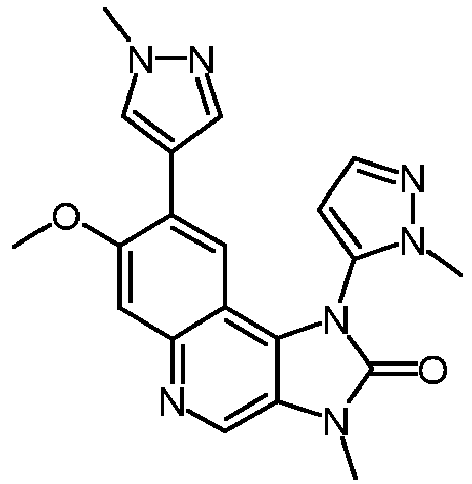
7-Methoxy-3-methyl-1-(2-methyl-2 H-pyrazol-3-yl)-8-(1-methyl-1 H-pyrazol-4-yl)-1,3-dihydro-imidazo[4,5-c]chinolin-2-on ++ < 0,01 MS: 390 (M+H+) 1H NMR (300MHz,MeOD,ppm): 8.79 (s,1H), 7.90 (m,2H), 7.51 (s,2H), 7.04 (s,1H), 6.72 (s,1H), 4.06 (s,3H), 3.92 (s,3H), 3.73 (s,3H), 3.66 (s,3H) 50 
1-(5-Fluoro-pyridin-2-yl)-7-methoxy-3-methyl-8-(1-methyl-1 H-pyrazol-4-yl)-1,3-dihydro-imidazo[4,5-c]chinolin-2-on ++ < 0,01 MS: 405 (M+H+) 1H NMR (400MHz,DMSO,ppm): 8.916 (m,2H), 8.240 (m,1H), 7.963 (m,2H), 7.515 (s,1H), 7.258 (m,1H), 6.993 (s,1H), 4.174 (s,3H), 3.854 (s,3H), 3.523 (s,3H) 51 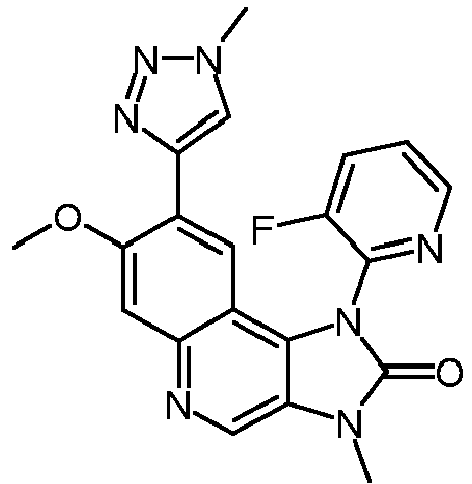
1-(3-Fluoro-pyridin-2-yl)-7-methoxy-3-methyl-8-(1-methyl-1 H-[1,2,3]triazol-4-yl)-1,3-dihydro-imidazo[4,5-c]chinolin-2-on ++ < 0,01 MS: 406 (M+H+) 1H NMR (400MHz,DMSO,ppm): 8.964 (s,1H), 8.643 (s,1H), 8.424 (s,1H), 8.287-8.239(m,1H), 7.939-7.907(m,1H), 7.769 (s,1H), 7.593 (s,1H), 4.057 (s,6H), 3.606 (s,3H) 52 
7-Methoxy-3-methyl-8-(1-methyl-1 H-pyrazol-4-yl)-1-pyrimidin-2-yl-1,3-dihydro-imidazo[4,5-c]chinolin-2-on ++ < 0,01 MS: 388 (M+H+) 1H NMR (300MHz,DMSO): 3.57 (s,3H), 3.85 (s,3H), 3.99 (s,3H), 6.83 (s,1H), 7.26 (s,1H), 7.51 (s,1H), 7.93 (t, J=4.8,1H), 7.98 (s,1H), 8.89 (s,1H), 9.23 (d, J=4.8,2H). 53 
7-Methoxy-3-methyl-8-(1-methyl-1 H-pyrazol-4-yl)-1-(1 H-pyrazol-4-yl)-1,3-dihydro-imidazo[4,5-c]chinolin-2-on ++ < 0,01 MS: 376 (M+H+) 1H NMR (400 MHz, DMSO): 8.80 (s,1H), 8.03 (d, J = 20.4 Hz, 2H), 7.46 (s,1H), 7.39 (s,1H), 7.29 (s,1H), 3.97 (s,3H), 3.85 (s,3H), 3.53 (s,3H). 54 
1-(3-Ethyl-5-methyl-pyridin-4-yl)-7-methoxy-3-methyl-8-(1-methyl-1 H-pyrazol-4-yl)-1,3-dihydro-imidazo[4,5-c]chinolin-2-on ++ < 0,01 MS: 429 (M+H+) 1H NMR (400MHz,DMSO,ppm): 8.918 (s,1H), 8.751 (s, 1H), 8.714 (s,1H), 7.952 (s,1H), 7.514 (s,1H), 6.963 (s,1H), 6.831(s,1H), 3.982 (s,3H), 3.833 (s,3H), 3.681 (s,3H), 2.469-2.329 (m,3H), 1.977 (s,3H), 0.966-0.928 (m,3H) 55 
7-Methoxy-3-methyl-8-(1-methyl-1H-pyrazol-4-yl)-1-[1-(tetrahydro-pyran-4-yl)-1H-pyrazol-4-yl]-1,3-dihydro-imidazo[4,5-c]chinolin-2-on ++ < 0,01 MS: 460 (M+H+) 1H NMR (300MHz,DMSO,ppm): 8.80 (s,1H), 8.35 (s, 1H), 7.96 (s, 1H), 7.83 (s,1H), 7.40 (m,3H), 4.60 (m,1H), 3.97 (m,5H), 3.84 (s,3H), 3.53 (m,5H), 2.07 (m,4H) 56 
7-Methoxy-3-methyl-8-(1-methyl-1 H-pyrazol-4-yl)-1-pyridin-2-yl-1,3-dihydro-imidazo[4,5-c]chinolin-2-on ++ < 0,01 MS: 387 (M+H+) 1H NMR (DMSO, 400MHz, ppm): 8.874 (s,1H), 8.816-8.832 (m,1H), 8.2-8.3 (t,1H), 7.964 (s,1H), 7.822-7.842 (d, J=8.0Hz,1H), 7.758-7.789 (m,1H), 7.494 (s,1H), 7.160 (s,1H), 6.984 (s,1H), 3.986 (s,3H), 3.842 (s,3H), 3.575 (s,3H) 57 
7-Methoxy-3-methyl-8-(1-methyl-1 H-pyrazol-4-yl)-1-pyrimidin-5-yl-1,3-dihydro-imidazo[4,5-c]chinolin-2-on ++ < 0,05 MS: 388 (M+H+) 1H NMR (400MHz,DMSO,ppm): 9.512 (s,1H), 9.241 (s,2H), 8.906 (s,1H), 7.991 (s,1H), 7.541 (s,1H), 7.247 (s,1H), 7.134 (s,1H), 4.035-4.004 (s,3H), 3.884-3.857 (s,3H), 3.590 (s,3H) 58 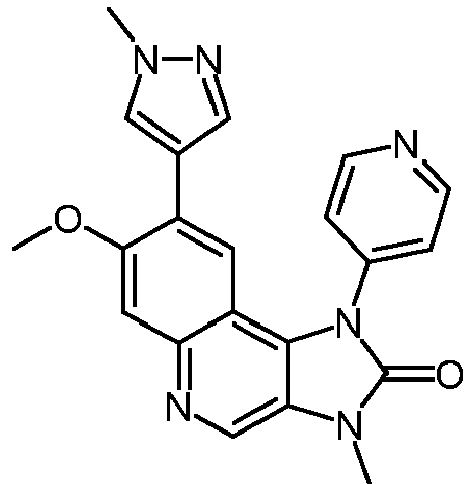
7-Methoxy-3-methyl-8-(1-methyl-1 H-pyrazol-4-yl)-1-pyridin-4-yl-1,3-dihydro-imidazo[4,5-c]chinolin-2-on ++ < 0,01 MS: 387 (M+H+) 1H NMR (300MHZ,DMSO): 3.57 (s,3H), 3.84 (s,3H), 3.99 (s,3H), 7.11 (s,1H), 7.20 (s,1H), 7.50 (s,1 H),7.75 (d, J=6.0Hz,2H), 8.00 (s,1H), 8.90 (s,1H), 8.99 (d, J=6.0Hz,2H) 59 
7-Methoxy-3-methyl-1-(1-methyl-1 H-imidazol-4-yl)-8-(1-methyl-1 H-pyrazol-4-yl)-1,3-dihydro-imidazo[4,5-c] chinolin-2-on + < 0,01 MS: 390 (M+H+) 1H NMR (400MHz,DMSO,ppm): 8.79 (s,1H), 7.96 (1d,2H), 7.58 (s,1H), 7.45 (s,1H), 7.39 (d,2H), 4.00 (s,3H), 3.88 (m,6H), 3.53 (s,3H) 60 
1-(3-Chlor-pyridin-4-yl)-7-methoxy-3-methyl-8-(1-methyl-1 H-pyrazol-4-yl)-1,3-dihydro-imidazo[4,5-c] chinolin-2-on + < 0,01 MS: 421 (M+H+) 1H NMR (300 MHz, DMSO,ppm): 9.43 (s,1H), 9.24 (s, 1H), 9.03 (d, J = 5.1 Hz, 1H), 8.10 (d, J = 5.1 Hz, 2H), 7.98 (s,1H), 7.13 (s,1H), 7.06 (s,1H), 4.07 (s,3H), 3.87 (s,3H), 3.67 (s,3H) 61 
1-(3-Ethyl-5-methyl-pyridin-4-yl)-8-(1-ethyl-1 H-pyrazol-4-yl)-7-methoxy-3-methyl-1,3-dihydro-imidazo[4,5-c] chinolin-2-on + < 0,01 MS: 443 (M+H+) 1H NMR (400MHz,DMSO,ppm): 8.918 (s,1H), 8.760 (s,1H), 8.723 (s,1H), 7.963 (s,1H), 7.516 (s,1H), 7.009 (s,1H), 6.847 (s,1H), 4.156-4.102 (m,2H), 3.989 (s,3H), 3.622 (s,3H), 2.514-2.458 (m,2H), 2.004 (s,3H), 1.382-1.345 (m,3H), 0.973-0.936 (m,3H) 62 
8-(1-Ethyl-1H-pyrazol-4-yl)-7-methoxy-3-methyl-1-pyridin-4-yl-1,3-dihydro-imidazo[4,5-c]chinolin-2-on + < 0,01 MS: 401 (M+H+) 1H NMR (400MHZ,DMSO,ppm): 1.35 (t, J=7.6Hz, 3H), 3.56 (s,3H), 3.98 (s,3H), 4.12 (q, J=7.6,2H), 7.17 (d, J=8.8Hz,2H), 7.51 (s,1H), 7.74 (d, J=6Hz,2H), 7.98 (s,1H), 8.87 (s,1H), 8.95 (br,2H) 63 
1-(3-Fluor-5-methyl-pyridin-4-yl)-7-methoxy-3-methyl-8-(1-methyl-1H-[1,2,3]triazol-4-yl)-1,3-dihydro-imidazo[4,5-c] chinolin-2-on ++ < 0,01 MS: 420 (M+H+) 1H NMR (400 MHz, DMSO-d6) ppm = 8.97 (s,1H), 8.83 (s,1H), 8.74 (s,1H), 8.42 (s,1H) 7.91 (s, 1H), 7.60 (s, 1H), 4.10 (s,6H), 3.61 (s,3H), 2.19 (s,3H) 64 
1-(3-Fluor-pyridin-4-yl)-7 - methoxy-3-methyl-8-(1-methyl-1H-[1,2,3]triazol-4-yl)-1,3-dihydro-imidazo[4,5-c] chinolin-2-on ++ < 0,01 MS: 406 (M+H+) 1H NMR (400 MHz, DMSO-d6) ppm = 9.01 (s,1H), 8.94 (s,1H), 8.78-8.77(m-1H), 8.42 (s,1H), 8.04 (s,1H),7.94-7.92 (m,1H), 7.58 (s,1H), 4.05 (s,6H), 3.58 (s,3H) 65 
8-(3-Amino-1 H-pyrazol-5-yl)-1-(3-fluor-2-pyridyl)-7-methoxy-3-methyl-imidazo[4,5-c]chinolin-2-on ++ < 0,001 MS: 406 (M+H+) 1H NMR (400MHz, DMSO) ppm = 11.3 (s, 1H), 8.87 (s, 1H), 8.60-8.59 (m,1H), 8.17-8.10 (m,1H), 7.86-7.80 (m,1H), 7.52 (s,1H), 7.16 (s,1H), 5.50 (s,1H), 4.40 (s,2H), 3.97 (s,3H), 3.58 (s,3H). 66 
1-[3-Fluor-5-(2-methoxyethoxy)-2-pyridyl]-7-methoxy-3-methyl-8-(1-methylpyrazol-4-yl)imidazo[4,5-c]chinolin-2-on +++ < 0,001 MS: 479 (M+H+) 1H NMR (400MHz, DMSO) ppm = 8.90 (s,1H), 8.48 (s,1H), 8.02-7.97 (m,2H), 7.52 (s,1H), 7.29 (s, 1H), 6.92 (s, 1H), 4.43 (d, J = 4,2H), 4.00 (s,3H), 3.86 (s,3H), 3.79-3.77 (m,2H), 3.59 (s,3H), 3.37 (s,3H) 67 
1-[3-Fluor-5-(2-hydroxyethoxy)-2-pyridyl]-7-methoxy-3-methyl-8-(1-methylpyrazol-4-yl)imidazo[4,5-c]chinolin-2-on +++ < 0,001 MS: 465 (M+H+) 1H NMR (400MHz, DMSO) ppm = 8.89 (s,1H), 8.46 (s,1H), 7.95 (m,2H), 7.51 (s,1H), 7.29 (s,1H), 6.92 (s, 1H), 5.07 (m,1H), 4.30 (m,2H), 3.99 (s,3H), 3.85-3.82 (m,5H), 3.58 (s,3H) 68 
7-Methoxy-3-methyl-8-(1-methyl-1 H-pyrazol-4-yl)-1-chinolin-2-yl-1,3-dihydro-imidazo[4,5-c]chinolin-2-on + < 0,01 MS. 437 (M+H+) 1H NMR (400 MHz, DMSO-d6) ppm = 8.905 (s,1H), 8.801-8.780 (m,1H), 8.254-8.235 (m,1H), 8.0-032 (m,1H), 7.949-7.928 (s,2H), 7.850-7.829 (m,1H), 7.829 (s,1H), 7.700 (s,1H), 7.113 (s,1H), 6.674 (s,1H), 3.965 (s,3H), 3.671 (s,3H), 3.596 (s,3H) 69 
7-Methoxy-3-methyl-8-(1-methyl-1H-pyrazol-4-yl)-1-(1H-pyrrolo[2,3-b]pyridin-6-yl)1,3-dihydro-imidazo[4,5-c]chinolin-2-on ++ < 0,001 MS. 426 (M+H+) 1H NMR (400 MHz, DMSO-d6) ppm = 8.85 (s, 1H), 8.36 (d, J = 8,1 H), 7.76-7.71 (m,2H), 7.46-7.41 (m,2H), 6.75-6.67 (m,3H), 3.96 (s,3H), 3.74 (s,3H), 3.52 (s,3H) 101 
1-(3,5-Difluor-pyridin-2-yl)-7-methoxy-3-methyl-8-(2-methyl-2H-[1,2,3]triazol-4-yl)-1,3-dihydro-imidazo[4,5-c] chinolin-2-on +++ < 0,05 MS: 424 (M+H+) 1H NMR (300 MHz, DMSO-d6) ppm = 8.97 (s,1H), 8.84 (s,1H), 8.57 -8.51 (m,1H), 7.59 (s,1H), 7.45 (s, 1H), 4.13 (s,3H), 4.04 (s,3H), 3.61 (s,3H) 102 
1-(1,3-Dimethyl-1 H-pyrazol-4-yl)-7-methoxy-3-methyl-8-(2-methyl-2H-[1,2,3]triazol-4-yl)-1,3-dihydro-imidazo[4,5-c]chinolin-2-on +++ < 0,05 MS: 405 (M+H+) 1H NMR (400 MHz, DMSO-d6) ppm = 8.88 (s, 1H), 8.14-8.11 (s,2H), 8.04 (s,1H), 7.54 (s,1H), 4.19 (s,3H), 4.03-3.99 (d,6H), 3.56 (s,3H), 1.56 (s,3H) 103 
1-(3-Fluor-5-methyl-pyridin-4-yl)-7-methoxy-3-methyl-8-(2-methyl-2H-[1,2,3]triazol-4-yl)-1,3-dihydro-imidazo[4,5-c] chinolin-2-on ++ < 0,05 MS: 420 (M+H+) 1H NMR (300 MHz, DMSO-d6) ppm = 9.04 (s,1H), 8.87 (s,1H), 8.77 (s,1H), 8.09 (s,1H), 7.68 (s, 1H), 7.61 (s, 1H), 4.40 (s,3H), 4.04 (s,3H), 3.62 (s,3H), 2.20 (s,3H) 104 
8-(1-Ethyl-1 H-pyrazol-4-yl)-7-methoxy-1-(3-methoxy-pyridin-4-yl)-3-methyl-1,3-dihydro-imidazo[4,5-c] chinolin-2-on ++ < 0,01 MS: 431 (M+H+) 1H NMR (300MHz,DMSO) ppm = 8.85 -8.84 (d, J=4.5, 2H), 8.58-8.57 (d,J=4.8, 1H), 7.98 (s,1H), 7.76-7.74 (d, J=5.1, 1H), 7.49 (s,1H), 7.12-7.10 (d, J=6.6, 2H), 4.17 (m,2H), 3.98 (s,3H), 3.57 (s,3H), 3.36 (s,3H), 1.39 (m,3H) 105 
1-(3-Fluor-5-methoxy-pyridin-2-yl)-7-methoxy-3-methyl-8-(1-methyl-1 H-pyrazol-4-yl)-1,3-dihydro-imidazo[4,5-c]chinolin-2-on ++ < 0,001 MS: 435 (M+H+) 1H NMR (400MHz,DMSO) ppm = 8.89 (s,1H), 8.45 (s,1H), 7.98 (m,2H), 7.51 (s,1H), 7.25 (s,1H), 6.88 (s,1H), 4.04 (s,3H), 3.99 (s,3H), 3.85 (s,3H), 3.58 (s,3H) 106 
8-(1,3-Dimethyl-1H-pyrazol-4-yl)-1-(3-fluor-5-methoxy-pyridin-2-yl)-7-methoxy-3-methyl-1,3-dihydro-imidazo[4,5-c]chinolin-2-on ++ < 0,001 MS: 449 (M+H+) 1H NMR (400MHz,DMSO) ppm = 8.89 (s,1H), 8.35 (s,1H), 7.94 (s,1H), 7.78 (s,1H), 7.50 (s,1H), 6.78 (s,1H), 3.98 (m,3H), 3.90 (s,3H), 3.75 (s,3H), 3.63 (s,3H), 1.78 (s,3H) 107 
1-(3,5-Difluor-pyridin-2-yl)-7-methoxy-8-(1-methyl-1 H-pyrazol-4-yl)-1,3-dihydro-imidazo[4,5-c]chinolin-2-on ++ < 0,001 MS: 409 (M+H+) 1H NMR (400MHz,DMSO) ppm = 11.81 (s,1H), 8.84 (d ,J= 2.6Hz, 1H), 8.68 (s, 1H), 8.00 (s, 1H), 7.49 (s, 1H), 7.33 (d, J= 0.8Hz, 1H), 6.93 (s,1H), 3.99 (s,3H), 3.85 (s,3H). 108 
1-(3,5-Difluor-pyridin-2-yl)-8-(1,3-dimethyl-1H-pyrazol-4-yl)-7-methoxy-1,3-dihydro-imidazo[4,5-c]chinolin-2-on ++ < 0,001 MS: 423 (M+H+) 1H NMR (400MHz,DMSO) ppm = 11.84 (s,1H), 8.77 (d,J= 2.5Hz, 1H), 8.70 (s,1H), 8.48 (m,1H), 7.79 (s, 1H), 7.50 (s,1H), 6.76 (s,1H), 3.91 (s,3H), 3.77 (s,3H), 1.82 (s,3H). 109 
1-(3-Fluor-5-methoxy-pyridin-2-yl)-7-methoxy-3-methyl-8-(2H-pyrazol-3-yl)-1,3-dihydro-imidazo[4,5-c] chinolin-2-on +++ < 0,01 MS: 421 (M+H+) 1H NMR (400 MHz, DMSO) ppm = 8.91 (s,1H), 8.36 (d, J= 2.6Hz, 1H), 7.93 (m,1H), 7.64 (s,1H), 7.53 (s, 1H), 7.40 (s,1H), 6.54 (s,1H), 4.01 (s,3H), 3.97 (s,3H), 3.57 (s,3H). 110 
1-(3-Fluor-5-fluormethoxy-pyridin-2-yl)-7-methoxy-3-methyl-8-(1-methyl-1 H-pyrazol-4-yl)-1,3-dihydro-imidazo[4,5-c]chinolin-2-on +++ < 0,001 MS: 453 (M+H+) 1H NMR (400MHz,DMSO) ppm = 8.90 (s,1H), 8.65-8.62 (s, 1H), 8.23-8.20 (m,1H), 7.95 (s,1H), 7.52 (s, 1H), 7.30 (s,1H), 6.90 (s,1H), 6.23-6.20 (m,1H), 6.10-6.01 (s, 1H), 3.99 (s,3H), 3.84 (s,3H), 3.59 (s,3H) 111 
8-(1-Ethyl-1H-pyrazol-4-yl)-1-(3-fluor-5-methoxy-pyridin-2-yl)-7-methoxy-3-methyl-1,3-dihydro-imidazo[4,5-c] chinolin-2-on ++ < 0,01 MS: 449 (M+H+) 1H NMR (400MHz,DMSO) ppm = 8.87 (s,1H), 8.47 (s,1H), 7.96 (m,2H), 7.50 (s,1H), 7.29 (s,1H), 6.88 (s,1H), 4.16 (m,2H), 4.03 (s,3H), 3.98 (s,3H), 3.57 (s,3H), 1.36 (m,3H) 112 
1-(3-Ethyl-5-fluor-pyridin-4-yl)-7-methoxy-3-methyl-8-(2-methyl-2H-[1,2,3]triazol-4-yl)-1,3-dihydro-imidazo[4,5-c] chinolin-2-on ++ < 0,01 MS: 434 (M+H+) 1H NMR (400MHz,DMSO) ppm = 9.00 (s,1H), 8.88 (s,1H), 8.82 (s,1H), 8.08 (s,1H), 7.64-7.06 (d, J=16, 2H), 4.08 (s,3H), 4.03 (s,3H), 3.62 (s,3H), 2.57-2.55 (m,2H), 1.03-1.00 (m,3H) 113 
1-(5-Ethoxy-3-fluor-pyridin-2-yl)-7-methoxy-3-methyl-8-(1-methyl-1 H-pyrazol-4-yl)-1,3-dihydro-imidazo[4,5-c]chinolin-2-on +++ < 0,001 MS: 449 (M+H+) 1H NMR (400MHz,DMSO) ppm = 8.87 (s,1H), 8.43 (s, 1H), 7.94 (m,2H), 7.50 (s,1H), 7.24 (s,1H), 6.87 (s,1H), 4.32 (m,2 H), 3.98 (s,3H), 3.84 (s,3H), 3.57 (s,3H), 1.44 (m,3H) 114 
1-(5-Difluormethoxy-3-fluor-pyridin-2-yl)-7-methoxy-3-methyl-8-(1-methyl-1 H-pyrazol-4-yl)-1,3-dihydro-imidazo[4,5-c]chinolin-2-on +++ < 0,001 MS: 471 (M+H+) 1H NMR (400MHz,DMSO) ppm = 8.92 (s,1H), 8.71 (s,1H), 8.35 (m,1H), 7.96 (s,1H), 7.78 (s,2H), 7.34 (s,1H), 6.94 (s,1H), 4.00 (s,3H), 3.84 (s,3H), 3.32 (s,3H) 115 
1-(3-Fluor-5-methoxy-pyridin-2-yl)-7-methoxy-8-(1-methyl-1 H-pyrazol-4-yl)-1,3-dihydro-imidazo[4,5-c]chinolin-2-on ++ < 0,01 MS: 421 (M+H+) 1H NMR (400MHz,DMSO) ppm = 11.71 (s,1H), 8.65 (s, 1H), 8.46 (s,1H), 7.98 (m,2H), 7.47 (s,1H), 7.24 (s,1H), 6.87 (s,1H), 4.04 (s,3H), 3.98 (s,3H), 3.85 (s,3H) 116 
1-(3-Fluor-5-methoxy-pyrid in-4-yl)-7-methoxy-8-(1-methyl-1 H-pyrazol-4-yl)-1,3-dihydro-imidazo[4,5-c]chinolin-2-on + < 0,01 MS: 421 (M+H+) 1H NMR (400 MHz, DMSO-d6) ppm = 11.77 (s, 1H), 8.72 (d,J = 16.7 Hz, 2H), 8.64 (s,1H), 7.98 (s,1H), 7.47 (s,1H), 7.13 (d, J = 14.7 Hz, 2H), 3.97 (s,3H), 3.84 (d, J = 8.0 Hz, 6H). 117 
1-(3,5-Difluor-pyridin-2-yl)-7-methoxy-3-methyl-8-(3-methyl-1H-pyrazol-4-yl)-1,3-dihydro-imidazo[4,5-c]chinolin-2-on ++ < 0,01 MS: 423 (M+H+) 1H NMR (300MHz, DMSO) ppm = 12.34-12.31 (s,1H), 8.64-8.41 (s,1H), 8.78 (s,1H), 8.67-8.59 (m,1H), 7.52-7.44 (s,2H), 6.74 (s,1H), 3.91-3.82 (s,3H), 3.57-3.49 (s,3H), 2.02-1.87 (m,3H) 118 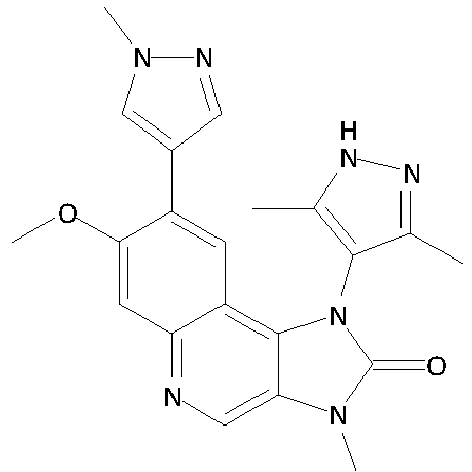
1-(3,5-Dimethyl-1 H-pyrazol-4-yl)-7-methoxy-3-methyl-8-(1-methyl-1 H-pyrazol-4-yl)-1,3-dihydro-imidazo[4,5-c]chinolin-2-on ++ < 0,01 MS: 404 (M+H+) 1H NMR (400MHz,DMSO) ppm = 12.9 (s,1H), 8.80 (s, 1H), 8.00 (s, 1H), 7.47 (s,1H), 7.33 (s,1H), 7.30 (d, J=0.8Hz, 1H), 3.97 (s,3H), 3.86 (s,3H), 3.55 (s,3H), 1.98 (s,6H). 119 
1-(5-Chlor-3-fluor-pyridin-2-yl)-7-methoxy-3-methyl-8-(1-methyl-1 H-pyrazol-4-yl)-1,3-dihydro-imidazo[4,5-c]chinolin-2-on +++ < 0,001 MS: 440 (M+H+) 1H NMR (400MHz, DMSO) ppm = 8.91 (s,1H), 8.85 (s,1H), 8.66 (m,1H), 8.00 (s,1H), 7.53 (s,1 H), 7.33 (s, 1H), 6.96 (s, 1H), 4.00 (s,3H), 3.86 (s,3H), 3.59 (s,3H) 120 
7-Methoxy-3-methyl-8-(1-methyl-1 H-pyrazol-4-yl)-1-(1 H-pyrrolo[3,2-c]pyridin-6-yl)-1,3-dihydro-imidazo[4,5-c]chinolin-2-on ++ < 0,001 MS: 426 (M+H+) 1H NMR (400MHz, DMSO) ppm = 11.97 (s,1H), 9.00 (s,1H), 8.84 (s,1H), 7.78 (s,2H), 7.71 (d, J=2.2Hz, 1H), 7.44 (s, 1H), 6.84 (d, J=2.9Hz, 1H), 6.80 (d,1H), 6.73 (s,1H), 3.95 (s,3H), 3.74 (s,3H), 3.57 (s,3H) 121 
1-(1,3-Dimethyl-1 H-pyrazol-4-yl)-7-methoxy-3-methyl-8-(1 H-pyrazol-3-yl)-1,3-dihydro-imidazo[4,5-c]chinolin-2-on +++ < 0,01 MS: 390 (M+H+) 1H NMR (400MHz, DMSO) ppm = 12.97 (s,1H), 8.84 (d, J=40, 1H), 8.07-7.72 (m,2H), 7.54-6.72 (m,2H), 6.15 (s, 1H), 4.00-3.92 (m,6H), 3.55 (s,3H), 1.95 (s,3H) 122 
1-(3-Fluor-5-methoxy-pyridin-2-yl)-7-methoxy-3-methyl-8-(3-methyl-1 H-pyrazol-4-yl)-1,3-dihydro-imidazo[4,5-c] chinolin-2-on +++ < 0,001 MS: 435 (M+H+) 1H NMR (300MHz,DMSO) ppm = 8.84 (s, 1H), 8.31-8.30 (s, 1H), 7.81-7.77 (d, J=12, 1H), 7.50 (s,2H), 6.76 (s,1H), 3.99 (s,3H), 3.90 (s,3H), 3.56 (s,3H), 1.93 (s,3H) 123 
1-(3-Fluor-5-piperazin-1-yl-pyridin-2-yl)-7-methoxy-3-methyl-8-(1-methyl-1 H-pyrazol-4-yl)-1,3-dihydro-imidazo[4,5-c]chinolin-2-on ++ < 0,01 MS: 490(M+H+) 1H NMR (400MHz, DMSO) ppm = 8.85 (s,1H), 8.36 (d, J = 2.5Hz, 1H), 7.95 (s,1H), 7.64 (dd, J = 12.7, 2.6Hz, 1H), 7.48 (s,1H), 7.28 (s,1H), 6.89 (s,1H), 3.97 (s,3H), 3.84 (s,3H), 3.56 (s,3H), 3.36 (dd, J = 6.1,3.8Hz, 4H), 2.88 (t, J = 5.0Hz, 4H) 124 
1-(3-Fluor-5-methoxy-pyridin-4-yl)-7-methoxy-3-methyl-8-(2H-pyrazol-3-yl)-1,3-dihydro-imidazo[4,5-c] chinolin-2-on ++ < 0,05 MS: 421 (M+H+) 1H NMR (400MHz,DMSO) ppm = 13.0 (d, J = 22.4Hz, 1H), 8.92 (d, J = 16.3Hz, 1H), 8.68 (dd, J = 15.0, 10.1Hz, 2H), 7.82 (s,1H), 7.70 (t, J = 1.9Hz, 1H), 7.61-7.45 (m,1H), 6.73 (t, J = 2.1Hz, 1H), 3.98 (d, J = 7.6Hz, 3H), 3.84 (d, J = 12.8Hz, 3H), 3.58 (s,3H). 125 
1-(3-Ethyl-5-fluor-pyridin-4-yl)-7-methoxy-3-methyl-8-(2H-[1,2,3]triazol-4-yl)-1,3-dihydro-imidazo[4,5-c] chinolin-2-on ++ < 0,001 MS: 420 (M+H+) 1H NMR (400 MHz, DMSO) ppm = 15.25 (s,1H), 9.00 (s, 1H), 8.88 (s, 1H), 8.82 (s,1H), 8.26 (s,1H), 7.83 (s,1H), 7.62 (s,1H), 4.05 (s,3H), 3.64 (s,3H), 2.67 - 2.51 (m,2H), 1.03 (m,3H). 126 
1-(3-Ethyl-5-fluor-pyridin-4-yl)-7-methoxy-3-methyl-8-(1-methyl-1H-[1,2,3]triazol-4-yl)-1,3-dihydro-imidazo[4,5-c] chinolin-2-on ++ < 0,01 MS: 434 (M+H+) 1H NMR (400 MHz, DMSO) ppm = 9.00 (s,1H), 8.87 (s, 1H), 8.82 (s,1H), 8.44 (s,1H), 7.92 (s,1H), 7.62 (s, 1H), 4.06 (d, J = 6.0 Hz, 6H), 3.64 (s,3H), 2.59 (m,2H), 1.03 (t, J = 7.6 Hz, 3H) 127 
1-(3-Fluor-5-methoxy-pyridin-4-yl)-7-methoxy-3-methyl-8-(2-methyl-2H-[1,2,3]triazol-4-yl)-1,3-dihydro-imidazo[4,5-c] chinolin-2-on ++ < 0,01 MS: 436 (M+H+) 1H NMR (400 MHz, DMSO-d6) ppm = 8.94 (s, 1H), 8.76 (s, 1H), 8.68 (s,1H), 8.08 (s,1H), 7.81 (s,1H), 7.57 (s,1H), 4.11 (s,3H), 4.02 (s,3H), 3.86 (s,3H), 3.59 (s,3H). 128 
1-(3-Fluor-5-methoxy-pyridin-2-yl)-7-methoxy-3-methyl-8-(3H-[1,2,3]triazol-4-yl)-1,3-dihydro-imidazo[4,5-c] chinolin-2-on ++ < 0,01 MS: 422 (M+H+) 1H NMR (400 MHz, DMSO-d6) ppm = 15.16 (s, 1H), 8.93 (s, 1H), 8.38 (d, J = 2.6 Hz, 1H), 8.23 (s, 1H), 7.96 (dd, J = 11.0, 2.6 Hz, 1H), 7.66 (s, 1H), 7.57 (s, 1H), 4.02 (s,6H), 3.58 (s,3H). 129 
8-(1,3-Dimethyl-1H-pyrazol-4-yl)-1-(3-fluor-5-methoxy-pyridin-4-yl)-7-methoxy-1,3-dihydro-imidazo[4,5-c]chinolin-2-on + < 0,001 MS: 435 (M+H+) 1H NMR (400 MHz, DMSO-d6) ppm = 11.8 (s,1H), 6.95 (s,1H), 3.90 (s,3H), 3.84 (s,3H), 3.75 (s,3H), 1.72 (s,3H). 130 
1-(1-Ethyl-3-methyl-1 H-pyrazol-4-yl)-7-methoxy-3-methyl-8-(1-methyl-1 H-pyrazol-4-yl)-1,3-dihydro-imidazo[4,5-c]chinolin-2-on ++ < 0,001 MS: 418 (M+H+) 1H NMR (400MHz,DMSO) ppm = 8.83 (s,1H), 8.19 (s,1H), 8.01 (s,1H), 7.49 (s,1H), 7.43 (s,1H), 7.36 (s,1H), 4.30-4.20 (m,2H), 4.00 (s,3H), 3.88 (s,3H), 3.56 (s,3H), 1.96 (s,3H), 1.50 (m,3H) 131 
1-(3-Fluor-5-methoxy-pyridin-4-yl)-7-methoxy-3-methyl-8-(1-methyl-1 H-[1,2,3]triazol-4-yl)-1,3-dihydro-imidazo[4,5-c]chinolin-2-on ++ < 0,01 ' MS: 436 (M+H+) 1H NMR (400 MHz, DMSO-d6) ppm = 8.93 (s,1H), 8.72 (s,1H), 8.67 (s,1H), 8.42 (s,1H), 8.05 (s, 1H), 7.57 (s, 1H), 4.04 (d, J = 9.80 Hz, 6H), 3.84 (s,3H), 3.59 (s,3H). 132 
1-(1,3-Dimethyl-1 H-pyrazol-4-yl)-7-methoxy-3-methyl-8-(2-methyl-3H-benzoimidazol-5-yl)-1,3-dihydro-imidazo[4,5-c]chinolin-2-on ++ < 0,001 MS: 455 (M+H+) 1H NMR (400 MHz, DMSO) ppm = 12.24 (d, J = 6.5 Hz, 1H), 8.85 (d, J = 2.1 Hz, 1H), 8.13 (d, J = 4.9 Hz, 1H), 7.55 - 7.47 (m,2H), 7.45 -7.36 (m,1H), 7.26 (d, J = 2.2 Hz, 1H), 7.10 (m,1H), 3.94 - 3.77 (m,6H), 3.55 (s,3H), 2.49 (s,3H), 1.94 (s,3H). 133 
1-(3-Fluor-5-methoxy-pyridin-2-yl)-7-methoxy-3-methyl-8-(1-methyl-1 H-[1,2,3]triazol-4-yl)-1,3-dihydro-imidazo[4,5-c] chinolin-2-on ++ < 0,01 MS: 436 (M+H+) 1H NMR (400 MHz, DMSO-d6) ppm = 8.92 (s, 1H), 8.43 - 8.34 (m,2H), 7.96 (dd, J = 11.0, 2.6 Hz, 1H), 7.73 (s,1H), 7.56 (s,1H), 4.04 (d, J = 13.4 Hz, 9H), 3.58 (s,3H) 134 
1-(3-Fluor-5-methoxy-pyridin-4-yl)-7-methoxy-3-methyl-8-(3H-[1,2,3]triazol-4-yl)-1,3-dihydro-imidazo[4,5-c] chinolin-2-on ++ < 0,001 MS: 422 (M+H+) 1H NMR (400 MHz, DMSO-d6) ppm = 15.11 (s,1H), 7.96 (s,1H), 7.58 (s,1H), 4.03 (s,3H), 3.85 (s,3H), 3.59 (s,3H), 2.06 (s,1H). 135 
8-(1,3-Dimethyl-1 H-pyrazol-4-yl)-1-(1-ethyl-3-methyl-1 H-pyrazol-4-yl)-7-methoxy-3-methyl-1,3-dihydro-imidazo[4,5-c]chinolin-2-on ++ < 0,001 MS: 432 (M+H+) 1H NMR (400 MHz, DMSO) ppm = 8.84 (s,1H), 8.13 (s,1H), 7.82 (s,1H), 7.49 (s,1H), 7.32 (s,1H), 4.15 (q, J = 7.2 Hz, 2H), 3.92 (s,3H), 3.78 (s,3H), 3.55 (s,3H), 1.91 (d, J = 15.3 Hz, 6H), 1.40 (t, J = 7.2 Hz, 3H). 136 
1-(3-Fluor-5-methoxy-pyridin-4-yl)-7-methoxy-3-methyl-8-(2-methyl-3H-benzoimidazol-5-yl)-1,3-dihydro-imidazo[4,5-c]chinolin-2-on +++ < 0,001 MS: 485 (M+H+) 1H NMR (400 MHz, DMSO) ppm = 12.23 (s,1H), 8.93 (s, 1H), 8.65 (d, J = 1.9 Hz, 1H), 8.60 (s,1H), 7.56 (s, 1H), 7.50-7.28 (m,2H), 7.07 - 6.94 (m,2H), 3.89 (d, J = 2.0 Hz, 6H), 3.59 (s,3H), 2.49 (s,3H). 137 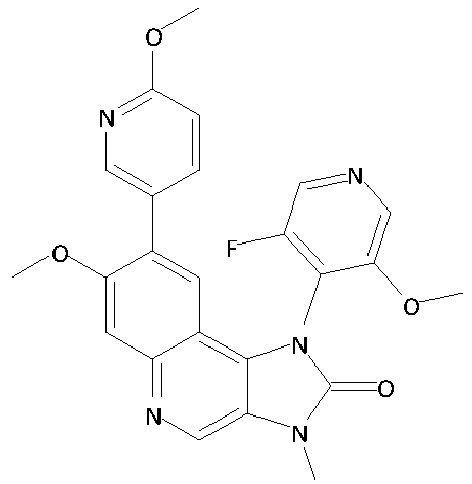
1-(3-Fluor-5-methoxy-pyridin-4-yl)-7-methoxy-8-(6-methoxy-pyridin-3-yl)-3-methyl-1,3-dihydro-imidazo[4,5-c]chinolin-2-on ++ < 0,01 MS: 462 (M+H+) 1H NMR (400MHz, DMSO) ppm = 8.95 (s,1H), 8.65 (d, J = 15.8Hz, 2H), 8.00 (d, J = 2.4Hz, 1H), 7.65 (dd, J = 8.6, 2.5Hz, 1H), 7.57 (s,1H), 6.93 (s, 1H), 6.83 (d, J = 8.6Hz, 1H), 3.87 (d, J = 15.0Hz, 9H), 3.59 (s,3H) 138 
5-Fluor-6-[7-methoxy-3-methyl-8-(1-methyl-1 H-pyrazol-4-yl)-2-oxo-2, 3-dihydro-imidazo[4,5-c]chinolin-1-yl]-N-methyl-nicotinamid ++ < 0,01 MS: 462 (M+H+) 1H NMR (400 MHz, DMSO) ppm = 9.08 - 8.96 (m,2H), 8.93 (s,1H), 8.55 (dd, J = 9.6, 1.9 Hz, 1H), 7.94 (s,1H), 7.54 (s,1H), 7.30 (s,1H), 6.95 (s,1H), 4.01 (s,3H), 3.84 (s,3H), 3.61 (s,3H), 2.92 (d, J = 4.5 Hz, 3H) 139 
6-[8-(1,3-Dimethyl-1H-pyrazol-4-yl)-7-methoxy-3-methyl-2-oxo-2,3-dihydro-imidazo[4,5-c]chinolin-1-yl]-5-fluor-N-methylnicotinamid ++ < 0,001 MS: 476 (M+H+) 1H NMR (400 MHz, DMSO) ppm = 9.02 - 8.93 (m,3H), 8.52 (dd, J = 9.5, 1.9 Hz, 1H), 7.80 (s,1H), 7.55 (s,1H), 6.81 (s,1H), 3.94 (s,3H), 3.76 (s,3H), 3.61 (s,3H), 2.90 (d, J = 4.5 Hz, 3H), 1.76 (s,3H) 140 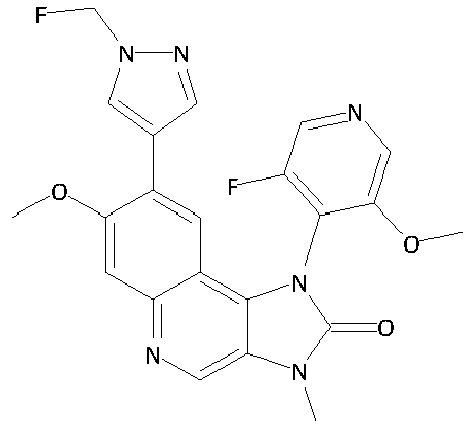
1-(3-Fluor-5-methoxy-pyridin-4-yl)-8-(1-fluormethyl-1 H-pyrazol-4-yl)-7-methoxy-3-methyl-1 ,3-dihydro-imidazo[4,5-c]chinolin-2-on +++ < 0,001 MS: 453 (M+H+) 1H NMR (400 MHz, DMSO-d6) 8.91 (s,1H), 8.74 (d, J = 16.3 Hz, 2H), 8.40 (s,1H), 7.55 (s,1H), 7.40 - 7.35 (m,1H), 7.19 (s,1H), 6.22 (s,1H), 6.09 (s,1H), 4.00 (s,3H), 3.85 (s,3H), 3.59 (s,3H). 141 
1-(3-Fluor-1-methyl-1H-pyrazol-4-yl)-7-methoxy-3-methyl-8-(1-methyl-1H-pyrazol-4-yl)-1,3-dihydro-imidazo[4,5-c]chinolin-2-on ++ < 0,01 MS: 408 (M+H+) 1H NMR (400 MHz, DMSO) ppm = 8.82 (s,1H), 8.03 (s, 1H), 7.89 (d, J = 2.4 Hz, 1H), 7.60 (s,1H), 7.49 (s,1H), 7.46 (s,1H), 3.98 (s,3H), 3.91 (s,3H), 3.86 (s,3H), 3.53 (s,3H). 142 
8-(1-Ethyl-3-methyl-1H-pyrazol-4-yl)-1-(3-fluor-5-methoxy-pyridin-4-yl)-7-methoxy-3-methyl-1,3-dihydro-imidazo[4,5-c] chinolin-2-on ++ < 0,001 MS: 463 (M+H+) 1H NMR (400 MHz, DMSO) ppm = 8.92 (s,1H), 8.71 (d, J = 11.5 Hz, 2H), 7.86 (s,1H), 7.54 (s,1H), 7.01 (s,1H), 4.07 (m,2H), 3.94 (s,3H), 3.88 (s,3H), 3.61 (s,3H), 1.78 (s,3H), 1.36 (t, J = 7.2 Hz, 3H). 143 
8-(1-Difluormethyl-1H-pyrazol-4-yl)-1-(3-fluor-5-methoxy-pyridin-4-yl)-7-methoxy-3-methyl-1,3-dihydro-imidazo[4,5-c] chinolin-2-on ++ < 0,001 MS: 471 (M+H+) 1H NMR (400 MHz, DMSO-d6) ppm = 8.93 (s, 1H), 8.72 (d, J = 14.3 Hz, 2H), 8.47 (s,1H), 7.83 (t, J = 58.9 Hz, 1H), 7.57 (s,1H), 7.52 (s,1H), 7.21 (s,1H), 4.01 (s,3H), 3.85 (s,3H), 3.59 (s,3H). 144 
1-(3-Fluor-5-methoxy-pyridin-2-yl)-7-methoxy-3-methyl-8-(2-methyl-3H-benzoimidazol-5-yl)-1,3-dihydro-imidazo[4,5-c]chinolin-2-on ++ < 0,001 MS: 485 (M+H+) 1H NMR (400 MHz, DMSO-d6) ppm = 12.21 (s, 1H), 8.93 (s, 1H), 8.35 (d, J = 2.6 Hz, 1H), 7.95 - 7.81 (m,1H), 7.55 (s,1H), 7.38 (d, J = 21.1 Hz, 2H), 7.01 (d, J = 32.5 Hz, 1H), 6.72 (s,1H), 3.93 (d,J = 27.1 Hz, 6H), 3.58 (s,3H), 2.48 (d, J = 1.9 Hz, 3H). 145 
1-[3-Fluor-5-(trideuteriomethoxy)-4-pyridyl]-7-methoxy-3-methyl-8-(1-methyl pyrazol-4-yl)imidazo[4,5-c]chinolin-2-on ++ < 0,001 MS: 438 (M+H+) 1H NMR (300 MHz, DMSO-d6) ppm = 8.89 (s, 1H), 8.75 (d, J = 12.1 Hz, 2H), 7.99 (s,1H), 7.52 (s, 1H), 7.20 - 7.11 (m,2H), 3.99 (s,3H), 3.85 (s,3H), 3.31 (s,3H). 146 
1-(3-Difluormethoxy-5-fluor-pyridin-4-yl)-7-methoxy-3-methyl-8-(1-methyl-1 H-pyrazol-4-yl)-1,3-dihydro-imidazo[4,5-c]chinolin-2-on +++ < 0,001 MS: 471 (M+H+) 1H NMR (400 MHz, DMSO-d6) ppm = 9.06 (s, 1H), 8.93 (d, J = 3.7 Hz, 2H), 8.02 (s,1H), 7.58 (s,0H), 7.54 (s,1H), 7.42 (d, J = 1.6 Hz, 0H), 7.27 - 7.20 (m,1H), 7.16 (s,1H), 4.01 (s,3H), 3.86 (s,3H), 3.62 (s,3H) 147 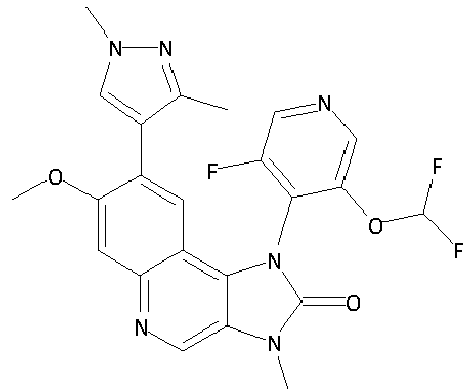
1-(3-Difluormethoxy-5-fluor-pyridin-4-yl)-8-(1,3-dimethyl-1 H-pyrazol-4-yl)-7-methoxy-3-methyl-1,3-dihydro-imidazo[4,5-c]chinolin-2-on +++ < 0,001 MS: 485 (M+H+) 1H NMR (400 MHz, DMSO-d6) ppm = 9.03 (s, 1H), 8.96 (s, 1H), 8.88 (s,1H), 7.84 (s,1H), 7.56 (d, J = 3.5 Hz, 1H), 7.39 (d, J = 1.7 Hz, 1H), 7.21 (s,0H), 7.00 (s,1H), 3.95 (s,3H), 3.78 (s,3H), 3.62 (s,3H), 1.75 (s,3H) 148 
1-(3-Fluor-5-fluormethoxy-pyridin-4-yl)-7-methoxy-3-methyl-8-(1-methyl-1 H-pyrazol-4-yl)-1,3-dihydro-imidazo[4,5-c]chinolin-2-on +++ < 0,001 MS: 453 (M+H+) 1H NMR (400 MHz, DMSO-d6) ppm = 9.04 - 8.79 (m,3H), 8.00 (s, 1H), 7.54 (s,1H), 7.18 (d, J = 21.6 Hz, 2H), 5.95 (m,2H), 4.01 (s,3H), 3.86 (s,3H), 3.61 (s,3H). 149 
8-(1,3-Dimethyl-1H-pyrazol-4-yl)-1-(3-fluor-5-fluormethoxy-pyridin-4-yl)-7-methoxy-3-methyl-1,3-dihydro-imidazo[4,5-c]chinolin-2-on +++ < 0,001 MS: 467 (M+H+) 1H NMR (400 MHz, DMSO-d6) ppm = 9.00 - 8.75 (m,2H), 3.94 (s,3H), 3.77 (s,3H), 3.61 (s,3H), 1.74 (s,3H) 150 
8-(1,3-Dimethylpyrazol-4-yl)-1-[3-fluor-5-(trideuteriomethoxy)-4-pyridyl]-7-methoxy-3-methyl-imidazo[4,5-c]chinolin-2-on +++ < 0,001 MS: 452 (M+H+) 1H NMR (400 MHz, DMSO-d6) ppm = 8.92 (s, 1H), 8.70 (d, J = 9.5 Hz, 2H), 7.83 (s,1H), 7.54 (s, 1H), 7.00 (s, 1H), 3.94 (s,3H), 3.78 (s,3H), 3.60 (s,3H), 1.75 (s, 3H). 151 
1-(1,3-Dimethyl-1 H-pyrazol-4-yl)-7-methoxy-3-methyl-8-(4-methyl-1 H-pyrazol-3-yl)-1,3-dihydro-imidazo[4,5-c] chinolin-2-on +++ < 0,05 MS: 404 (M+H+) 152 
1-(3-Fluor-5-methoxy-pyridin-4-yl)-7-methoxy-3-methyl-8-(2-methyl-1 H-imidazo[4,5-b]pyridin-6-yl)-1,3-dihydro-imidazo[4,5-c]chinolin-2-on +++ < 0,001 MS: 486 (M+H+) 1H NMR (400 MHz, DMSO-d6) ppm = 12.87 - 12.50 (m,1H), 8.99 (s,1H), 8.65 (d, J = 14.3 Hz, 2H), 8.11 (d, J = 23.8 Hz, 1H), 7.78 (d, J = 12.4 Hz, 1H), 7.62 (d, J = 2.4 Hz, 1H), 7.06 - 6.98 (d, J = 20 Hz, 1H), 3.93 (s,3H), 3.89 (d, J = 6.8 Hz, 3H), 3.63 (s,3H), 2.55 (d, J = 14.3 Hz, 3H). 153 
8-(3H-Benzimidazol-5-yl)-1-(3- fluor-5-methoxy-pyridin-2-yl)-7-methoxy-3-methyl-1,3-dihydro-imidazo[4,5-c]chinolin-2-on ++ < 0,01 MS: 471 (M+H+) 1H NMR (400 MHz, DMSO-d6) ppm = 12.47 (s, 1H), 8.93 (s, 1H), 8.36 (d, J = 2.6 Hz, 1H), 8.24 (s,1H), 7.88 (d, J = 10.9 Hz, 1H), 7.56 (s,3H), 7.19 - 7.00 (m,1H), 6.75 (s,1H), 3.90 (s,3H), 3.59 (s,3H), 3.31 (s,3H). 154 
1-(1,3-Dimethyl-1 H-pyrazol-4-yl)-7-methoxy-3-methyl-8-(2-methyl-1 H-imidazo[4,5-b]pyridin-6-yl)-1,3-dihydro-imidazo[4,5-c]chinolin-2-on + < 0,001 MS: 455 (M+H+) 1H NMR (400 MHz, DMSO-d6) ppm =8.91 (s,1H), 8.21 (s,1H), 8.15 (s,1H), 7.87 (s,1H), 7.59 (s,1H), 7.29 (s,1H), 3.93 (s,3H), 3.87 (s,3H), 3.58 (s,3H), 2.56 (s,3H), 1.97 (s,3H). 155 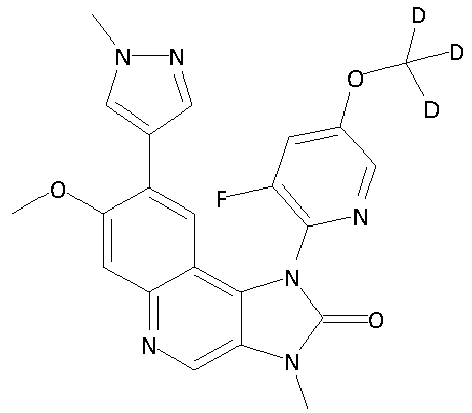
1-[3-Fluor-5-(trideuteriomethoxy)-2-pyridyl]-7-methoxy-3-methyl-8-(1-methyl pyrazol-4-yl) imidazo[4,5-c]chinolin-2-on +++ < 0,001 MS: 438 (M+H+) 1H NMR (400 MHz,DMSO) ppm = 8.89 (s,1H), 8.47 (s,1H), 7.98 (m,2H), 7.52 (s,1H), 7.25 (s,1H), 6.88(s,1H), 3.99 (s,3H), 3.85 (s,3H), 3.59 (s,3H) 156 
1-(3-Ethyl-pyridin-4-yl)-7-methoxy-3-methyl-8-(1-methyl-1 H-pyrazol-4-yl)-1,3-dihydro-imidazo[4,5-c] chinolin-2-on ++ < 0,001 MS: 415 (M+H+) 1H NMR (400 MHz, DMSO-d6) ppm = 8.93 (s,1H), 8.89 (s,1H), 8.78 (d,1H), 7.95 (s,1H), 7.65 (d,1H), 7.50 (s,1H), 6.97 (s,1H), 6.89 (s,1H), 3.98 (s,3H), 3.83 (s,3H), 3.59 (s,3H), 2.50 (m,2H), 0.99-0.95 (m,3H) 157 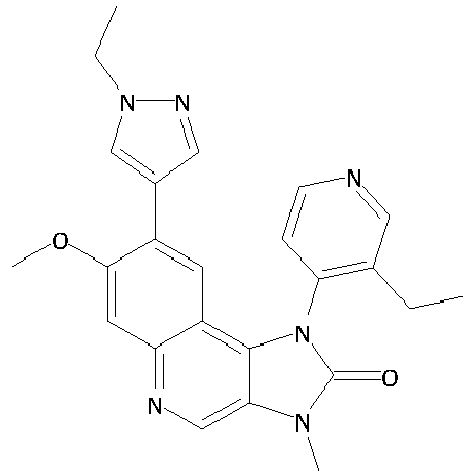
8-(1-Ethyl-1 H-pyrazol-4-yl)-1-(3-ethyl-pyridin-4-yl)-7-methoxy-3-methyl-1,3-dihydro-imidazo[4,5-c] chinolin-2-on +++ < 0,01 MS:429 (M+H+) 1H NMR (400 MHz, DMSO-d6) ppm = 8.88 (s, 1H), 8.14-8.11 (s,2H), 8.04 (s,1H), 7.54 (s,1H), 4.19 (s,3H), 4.03-3.99 (d,6H), 3.56 (s,3H), 1.56 (s,3H) 158 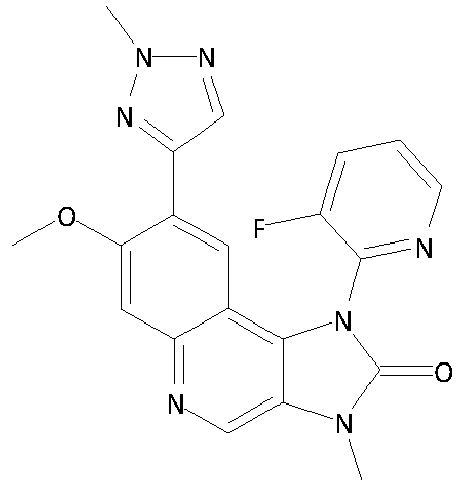
1-(3-Fluor-pyridin-2-yl)-7-methoxy-3-methyl-8-(2-methyl-2H-[1,2,3]triazol-4-yl)-1,3-dihydro-imidazo[4,5-c] chinolin-2-on ++ < 0,5 MS: 406 (M+H+) 1H NMR (400 MHz, DMSO-d6) ppm = 8.96 (s,1H), 8.68 (s,1H), 8.27-8.23 (m,1H), 8.07 (s,1H), 7.96-7.92 (m,1H), 7.57 (s,1H), 7.51 (s,1H), 4.10 (s,3H), 4.02 (s,3H), 3.59 (s,3H) 159 
1-(3-Fluor-1-methyl-1 H-pyrazol-4-yl)-7-methoxy-8-(6-methoxy-pyridin-3-yl)-3-methyl-1,3-dihydro-imidazo[4,5-c]chinolin-2-on + < 0,01 MS: 435 (M+H+) 1H NMR (400 MHz, DMSO-d6) ppm = 8.90 (s,1H), 8.19 (dd, J = 2.4, 0.8 Hz, 1H), 7.89 (d, J = 2.4 Hz, 1H), 7.76 (dd, J = 8.6, 2.5 Hz, 1H), 7.56 (s,1H), 7.42 (s,1H), 6.92 - 6.84 (m, 1H), 3.89 (d, J = 8.2 Hz, 6H), 3.82 (d, J = 1.1 Hz, 3H), 3.55 (s,3H). 200 
1-(3-Cyclopropyl-pyridin-4-yl)-7-methoxy-3-methyl-8-(1-methyl-1 H-pyrazol-4-yl)-1,3-dihydro-imidazo[4,5-c] chinolin-2-on ++ < 0,05 MS: 427 (M+H+) 1H NMR (400MHz,DMSO) ppm = 8.87 (s,1H), 8.73 (d, J= 5.1, 1H), 8.61 (s,1H), 7.95 (s,1H), 7.64 (d, J= 5.1Hz, 1H), 7.49 (s,1H), 6.98-6.92 (m,2H), 3.97 (s,3H), 3.82 (s,3H), 3.58 (s,3H), 1.59 (m,1H), 0.91 (m,1H), 0.82-0.73 (m,1H), 0.62-0.49 (m,2H). 201 
1-(3-Fluor-5-methylsulfonylmethoxy-pyridin-2-yl)-7-methoxy-3-methyl-8-(1-methyl-1H-pyrazol-4-yl)-1,3-dihydro-imidazo[4,5-c]chinolin-2-on +++ < 0,001 MS: 514 (M+H+) 1H NMR (400MHz,DMSO) ppm = 8.91 (s,1H), 8.66 (s, 1H), 8.28 (m,1H), 7.89 (s,1H), 7.53 (s,1H), 7.41 (s,1H), 6.95 (s,1H), 5.70 (s,2H), 4.02 (s,3H), 4.00 (s,3H), 3.59 (s,3H), 3.21 (s,3H) 202 
1-(3-Cyclopropyl-5-fluor-pyridin-4-yl)-7-methoxy-3-methyl-8-(1-methyl-1 H-pyrazol-4-yl)-1,3-dihydro-imidazo[4,5-c]chinolin-2-on ++ < 0,001 MS: 445 (M+H+) 1H NMR (400MHz,DMSO) ppm = 8,91 (s,1H), 8.83 (s, 1H), 8.50 (s,1H), 7.98 (s,1H), 7.52 (s,1H), 7.08-6.99 (m,2H), 3.98 (s,3H), 3.83 (s,3H), 3.60 (s,3H), 1.71-1.61 (m,1H), 1.04-0.95 (m,1H), 0.87 (m,1H), 0.37-0.62 (m,2H). 203 
8-(1,3-Dimethyl-1H-pyrazol-4-yl)-1-(3-fluor-5-methylsulfonylmethoxy-pyridin-2-yl)-7-methoxy-3-methyl-1,3-dihydro-imidazo[4,5-c]chinolin-2-on ++ < 0,001 MS: 528 (M+H+) 1H NMR (400MHz,DMSO) ppm = 8.92 (s,1H), 8.56 (s, 1H), 8.22 (m,1H), 7.75 (s,1H), 7.53 (s,1H), 6.83 (s,1H), 5.64 (s,2H), 3.92 (s,3H), 3.76 (s,3H), 3.58 (s,3H), 3.17 (s,3H), 1.826(s,3H) 204 
1-(5-Allyloxy-3-fluor-pyridin-2-yl)-7-methoxy-3-methyl-8-(1-methyl-1 H-pyrazol-4-yl)-1,3-dihydro-imidazo[4,5-c]chinolin-2-on ++ < 0,001 MS: 461 (M+H+) 1H NMR (400 MHz,DMSO) ppm = 8.87 (s,1H), 8.46 (d, J = 2.6Hz, 1H), 8.01-7.93 (m,2H), 7.50 (s, 1H), 7.24 (d, J = 0.8Hz, 1H), 6.87 (s,1H), 6.11 (ddt, J = 17.2, 10.6, 5.3Hz, 1H), 5.51 (dq, J = 17.3, 1.6Hz, 1H), 5.38 (dq, J = 10.5, 1.4Hz, 1H), 4.88 205 
1-[5-(Azetidin-3-yloxy)-3-fluor-pyridin-2-yl]-7-methoxy-3-methyl-8-(1-methyl-1 H-pyrazol-4-yl)-1,3-dihydro-imidazo[4,5-c]chinolin-2-on ++ < 0,001 MS: 476 (M+H+) 1H NMR (400MHz,DMSO) ppm = 8.87 (s,1H), 8.40 (s, 1H), 7.98 (s,1H), 7.84 (m,1H), 7.50 (s,1H), 7.27 (s, 1H), 6.89 (s,1H), 5.28 (m,1H), 3.98 (s,3H), 3.85 (s,2H), 3.84 (s,3H), 3.62 (s,2H), 3.57 (s,3H) 206 
1-[3-Fluor-5-(2-methylamino-ethoxy)-pyridin-2-yl]-7-methoxy-3-methyl-8-(1-methyl-1H-pyrazol-4-yl)-1,3-dihydro-imidazo[4,5-c] chinolin-2-on ++ < 0,01 MS: 478 (M+H+) 1H NMR (400 MHz, DMSO-d6) ppm = 8.87 (s, 1H), 8.44 (d, J = 2.6 Hz, 1H), 7.97 (d, J = 13.0 Hz, 2H), 7.50 (s, 1H), 7.26 (d, J = 0.8 Hz, 1H), 6.89 (s, 1H), 4.36 - 4.27 (m,2H), 3.97 (s,3H), 3.84 (s,3H), 3.57 (s,3H), 2.97 - 2.89 (m,2H), 2.37 (s,3H). 207 
1-[3-Fluor-5-(1-methyl-azetidin-3-ylmethoxy)-pyridin-2-yl]-7-methoxy-3-methyl-8-(1-methyl-1H-pyrazol-4-yl)-1,3-dihydro-imidazo[4,5-c]chinolin-2-on ++ <0,01 MS: 505 (M+H+) 1H NMR (400 MHz, DMSO) ppm = 8.87 (s,1H), 8.45 (d, J = 2.5 Hz, 1H), 7.98 (d, J = 12.0 Hz, 2H), 7.50 (s, 1H), 7.25 (s,1H), 6.86 (s,1H), 4.42 - 4.35 (m,2H), 3.97 (s,3H), 3.84 (s,3H), 3.57 (s,3H), 3.35 (s,2H), 3.02 (t, J = 6.20 Hz, 2H), 2.84 (m,1H), 2.22 (s,3H). 208 
8-[1-(Azetidin-3-yl)-1 H-pyrazol-4-yl]-1-(3-fluor-5-methoxypyridin-4-yl)-7-methoxy-3-methyl-1H,2H,3H-imidazo[4,5-c]chinolin-2-on + < 0,01 MS: 476 (M+H+) H NMR (400 MHz, DMSO-d6) ppm = 8.90 (s,1H), 8.78 (s,1H), 8.74 (s,1H), 8.11 (s,1H), 7.53 (s,1H), 7.28 (s,1H), 7.17 (s,1H), 5.21 (m,1H), 4.00 (s,3H), 3.96 - 3.84 (m,5H), 3.71 (t, J = 7.9 Hz, 2H), 3.59 (s,3H) +++: 0,2 µM oder weniger
++: > 0,2 µM bis 1 µM
+: > 1 µM bis 2 µM - Erfindungsgemäße Verbindungen weisen nicht nur eine sehr gute Hemmung von ATM Kinase auf, sie sind auch zusätzlich noch sehr selektiv gegenüber anderen Kinasen, wie beispielsweise mTOR, PIK3 alpha, PI3K beta, PI3K delta und PI3K gamma, was anhand der in der nachfolgenden Tabelle 3 aufgeführten experimentellen Daten belegt wird:
Tabelle 3 Bsp. IC50 (ATM) [µM] IC50 (PI3Kalpha) [µM] IC50 (PI3Kbeta) [µM] IC50 (PI3Kdelta) [µM] IC50 (PI3Kgamm a) [µM] IC50 (mTOR) [µM] 1 < 0,01 > 30 > 30 > 30 > 30 > 30 2 < 0,001 > 30 > 30 > 30 > 30 > 5 3 < 0,001 > 30 > 30 > 30 > 30 > 5 4 < 0,001 > 5 > 30 > 10 > 30 > 30 5 < 0,001 > 30 > 30 > 30 > 30 > 30 6 < 0,001 > 30 > 30 > 30 > 30 > 30 7 < 0,001 > 30 > 30 > 30 > 30 > 30 8 < 0,001 > 30 > 30 > 30 > 30 > 5 9 < 0,001 > 30 > 30 > 30 > 30 > 10 10 < 0,001 > 30 > 30 > 30 > 30 > 30 11 < 0,001 > 30 > 30 > 30 > 30 > 30 12 < 0,001 > 30 > 30 > 30 > 30 > 30 13 < 0,001 > 5 > 30 > 10 > 30 > 10 14 < 0,001 >30 > 30 > 30 > 30 > 30 15 < 0,001 > 30 > 30 > 30 > 30 > 30 16 < 0,001 > 30 > 30 > 30 > 30 > 30 17 < 0,01 > 30 > 30 > 30 > 30 > 10 18 < 0,001 > 10 > 30 > 30 > 5 > 5 19 < 0,01 > 30 > 30 > 30 > 5 20 < 0,001 > 30 > 30 > 30 > 30 > 30 21 < 0,001 > 20 > 30 > 30 > 300 > 5 22 < 0,001 > 30 > 30 > 30 > 30 23 < 0,01 > 20 > 30 > 30 > 30 > 20 24 < 0,001 > 30 > 30 > 30 > 30 > 30 25 < 0,001 > 30 > 30 > 30 > 30 > 30 26 < 0,001 > 30 > 30 > 30 > 30 27 < 0,001 > 30 > 30 > 30 > 30 > 30 28 < 0,01 > 30 > 30 > 30 > 30 > 30 29 < 0,01 > 30 > 30 > 30 > 30 > 30 30 < 0,01 > 30 > 30 > 30 > 30 > 30 31 < 0,01 > 30 > 30 > 30 > 30 > 30 32 < 0,01 > 30 > 30 > 30 > 10 33 < 0,001 > 30 > 30 > 30 > 30 > 30 34 < 0,01 > 30 > 30 > 30 > 30 > 30 35 < 0,01 > 30 > 30 > 30 > 30 > 30 36 < 0,001 > 30 > 30 > 30 > 30 > 30 37 < 0,01 > 30 > 30 > 30 > 30 > 10 38 < 0,001 > 30 > 30 > 30 > 30 > 30 39 < 0,001 > 30 > 30 > 30 > 30 40 < 0,01 > 30 > 30 > 30 > 30 > 30 41 < 0,01 > 30 > 30 > 30 > 30 > 10 43 < 0,001 > 30 > 30 > 30 > 30 > 30 44 < 0,01 > 30 > 30 > 30 > 30 > 30 45 < 0,05 > 30 > 30 > 30 > 30 > 30 46 < 0,05 > 30 > 30 > 30 > 30 > 30 47 < 0,01 > 30 > 30 > 30 > 30 > 30 49 < 0,01 > 30 > 30 > 30 > 30 > 30 51 < 0,01 > 30 > 30 > 30 > 30 > 30 53 < 0,01 > 30 > 30 > 30 > 30 > 30 54 < 0,01 > 30 > 30 > 30 > 30 55 < 0,01 > 30 > 30 > 30 > 30 > 30 57 < 0,05 > 30 > 30 > 30 > 30 > 30 58 < 0,01 > 30 > 30 > 30 > 30 > 30 59 < 0,01 > 30 > 30 > 30 > 30 > 30 60 < 0,01 > 30 > 30 > 30 > 30 > 30 61 < 0,01 > 30 > 30 > 30 62 < 0,01 > 30 > 30 > 30 > 30 > 30 - Für die übrigen Verbindungsbeispiele konnten bereits folgende vorteilhaften Werte festgestellt werden:
Bezüglich mTOR weisen die folgenden Verbindungsbeispiele einen mindestens 2000-fach höhren IC50 (ATM) auf (in Bezug auf IC50 (mTOR)), wobei bei einigen Verbindungsbeispielen das Verhältnis IC50 (ATM) : IC50(mTOR) sogar 100.000 übersteigt: 114, 118, 120, 121, 122, 125, 126, 136, 138, 140, 141, 145, 147, 149, 157, 159, 201. - Bezüglich PI3Kalpha weisen die folgenden Verbindungsbeispiele einen mindestens 2000-fach höhren IC50 (ATM) auf: 66, 67, 105, 108, 110, 114, 117, 120, 122, 123, 125, 126, 155, 201, 205.
- Bezüglich PI3Kbeta weisen die folgenden Verbindungsbeispiele einen mindestens 2000-fach höhren IC50 (ATM) auf (in Bezug auf IC50 (PI3Kbeta)), wobei bei einigen Verbindungsbeispielen das Verhältnis IC50 (ATM) : IC50(PI3Kbeta) 10.000 übersteigt: 108, 118, 125, 136, 137, 140, 145, 149, 159, 201.
- Bezüglich PI3Kdelta weisen die folgenden Verbindungsbeispiele einen mindestens 2000-fach höhren IC50 (ATM) auf: 66, 67, 105, 108, 110, 114, 117, 120, 122, 123, 125, 126, 145, 155, 201, 205.
- Bezüglich PI3Kgamma weisen die folgenden Verbindungsbeispiele einen mindestens 2000-fach höhren IC50 (ATM) auf: 66, 67, 105, 108, 110, 114, 117, 120, 122, 123, 125, 126, 136, 145, 149, 155, 201, 205.
-
Tabelle 4 300 
1-(3-Fluor-5-methoxy-pyridin-4-yl)-7-methoxy-3-methyl-8-(3-fluor-1-methyl-1 H-pyrazol-4-yl)-1 ,3-dihydro-imidazo[4,5-c]chinolin-2-on 301 
1-(1, 3-Dimethyl-1 H-pyrazol-4-yl)-7-methoxy-3-methyl-8-(3-fluor-1-methyl-1 H-pyrazol-4-yl)-1,3-dihydro-imidazo[4,5-c]chinolin-2-on 302 
1-(5-Fluor-1 H-pyrrolo[2,3-b]pyridin-6-yl)-7-methoxy-3-methyl-8-(1-methyl-1 H-pyrazol-4-yl)-1,3-dihydro-imidazo[4,5-c]chinolin-2-on 303 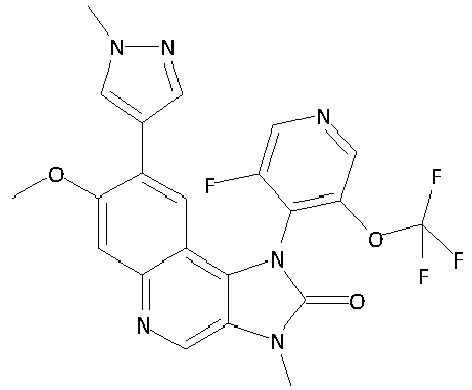
1-[3-Fluor-5-(trifluormethoxy)-4-pyridyl]-7-methoxy-3-methyl-8-(1-methyl-1 H-pyrazol-4-yl)-1 ,3-dihydro-imidazo[4,5-c] chinolin-2-on 304 
1-[3-Fluor-5-(trifluormethoxy)-4-pyridyl]-7-methoxy-3-methyl-8-(1,3-dimethylpyrazol-4-yl)-1,3-dihydro-imidazo[4,5-c]chinolin-2-on 400 
1-(3-Fluor-5-methylsulfonyl-pyridin-2-yl)-7-methoxy-3-methyl-8-(1-methyl-1 H-pyrazol-4-yl)-1H,2H,3H-imidazo[4,5-c]chinolin-2-on 401 
8-[1-(Azetidin-3-yl)-3-methyl-1H-pyrazol-4-yl]-1-(3-fluor-5-methoxypyridin-4-yl)-7-methoxy-3-methyl-1H,2H,3H-imidazo[4,5-c]chinolin-2-on - Eine Lösung von 100 g erfindungsgemäßem Wirkstoff und 5 g Dinatriumhydrogenphosphat wird in 3 I zweifach destilliertem Wasser mit 2 N Salzsäure auf pH 6,8 eingestellt, steril filtriert, in Injektionsgläser abgefüllt, unter sterilen Bedingungen lyophilisiert und steril verschlossen. Jedes Injektionsglas enthält 5 mg erfindungsgemäßen Wirkstoff.
- Man schmilzt ein Gemisch von 20 g erfindungsgemäßem Wirkstoff mit 100 g Sojalecithin und 1400 g Kakaobutter, gießt es in Formen und lässt es erkalten. Jedes Suppositorium enthält 20 mg erfindungsgemäßen Wirkstoff.
- Man bereitet eine Lösung aus 1 g erfindungsgemäßem Wirkstoff, 9,38 g NaH2PO4*2 H2O, 28,48 g Na2HPO4*12 H2O und 0,1 g Benzalkoniumchlorid in 940 ml zweifach destilliertem Wasser. Man stellt auf pH 6,8 ein, füllt auf 1 I auf und sterilisiert durch Bestrahlung. Diese Lösung kann in Form von Augentropfen verwendet werden.
- Man mischt 500 mg erfindungsgemäßen Wirkstoff mit 99,5 g Vaseline unter aseptischen Bedingungen.
- Ein Gemisch von 1 kg erfindungsgemäßem Wirkstoff, 4 kg Laktose, 1,2 kg Kartoffelstärke, 0,2 kg Talk und 0,1 kg Magnesiumstearat wird in üblicher Weise zu Tabletten verpresst, derart, dass jede Tablette 10 mg erfindungsgemäßen Wirkstoff enthält
- Analog Beispiel E werden Tabletten gepresst, die danach in üblicher Weise mit einem Überzug aus Saccharose, Kartoffelstärke, Talk, Tragant und Farbstoff überzogen werden.
- 2 kg erfindungsgemäßer Wirkstoff werden in üblicher Weise in Hartgelatinekapseln gefüllt, so dass jede Kapsel 20 mg erfindungsgemäßen Wirkstoff enthält.
- Eine Lösung von 1 kg erfindungsgemäßem Wirkstoff in 60 I zweifach destilliertem Wasser wird steril filtriert, in Ampullen abgefüllt, unter sterilen Bedingungen lyophilisiert und steril verschlossen. Jede Ampulle enthält10 mg erfindungsgemäßen Wirkstoff.
- Man löst 14 g erfindungsgemäßen Wirkstoff in 10 I isotonischer NaCl-Lösung und füllt die Lösung in handelsübliche Sprühgefäße mit Pump-Mechanismus. Die Lösung kann in Mund oder Nase gesprüht werden. Ein Sprühstoß (ca. 0,1 ml) entspricht einer Dosis von ca. 0,14 mg.
- Die vorliegende Erfindung betrifft die folgenden Aspekte:
1. Verbindung der Formel (I)
- R1
- A bedeutet,
- R3
- A oder H bedeutet,
- A
- jeweils unabhängig unverzweigtes oder verzweigtes Alkyl mit 1, 2, 3, 4, 5, 6, 7, 8, 9 oder 10 C-Atomen bedeutet, wobei unabhängig voneinander 1, 2, 3, 4, 5, 6 oder 7 H-Atome durch Hal ersetzt sein können,
- Het1
- ein- oder zweikerniges Heteroaryl mit 2, 3, 4, 5, 6, 7, 8 oder 9 C-Atomen und 1, 2, 3 oder 4 N-, O- und/oder S-Atomen bedeutet, das unsubstituiert oder ein-, zwei- oder dreifach unabhängig voneinander durch Hal, A, CN, -(CY2)p-OY, -(CY2)p-NYY, -(CY2)p-COOY, -(CY2)p-CO-NYY, -(CY2)p-NY-COY, -Het2 und/oder -SO2-Het2 substituiert sein kann,
- Het2
- einen einkernigen gesättigten Heterozyklus mit 2, 3, 4, 5, 6 oder 7 C-Atomen und 1, 2, 3 oder 4 N-, O- und/oder S-Atomen bedeutet, der unsubstituiert oder einfach durch A substituiert sein kann,
- HET
- einen 5- oder 6-gliedrigen aromatischen Heterozyklus mit 1, 2 oder 3 N-Atomen und optional einem O-Atom oder S-Atom bedeutet, wobei dieser Heterozyklus über ein Ring-C-Atom mit dem N-Atom des Grundgerüsts verknüpft ist und wobei dieser Heterozyklus unsubstituiert oder durch einen, zwei oder drei Substituenten substituiert sein kann, die unabhängig voneinander ausgewählt sind aus der Gruppe bestehend aus: Hal, A, Het2, CN, -(CY2)p-OY, -(CY2)p-OZ, -(CY2)p-O-Het2, -(CY2)p-O-(CY2)t-Het2,-(CY2)p-O-(CY2)t-NYY, -(CY2)p-O-(CY2)t-OY, -(CY2)p-O-(CY2)t-POAA, -(CY2)p-NYY, -(CY2)p-COOY, -(CY2)p-CO-NYY, -(CY2)p-NY-COY, -SO2-Het2, CyA, -(CY2)p-O-(CY2)t-SO2-Y, -(CY2)p-NY-SO2-Y, und -(CY2)p-SO2-Y, und wobei dieser Heterozyklus Teil eines zweikernigen 11-oder 12-gliedrigen aromatischen Heterozyklus sein kann, wobei dieser zweikernige aromatische Heterozyklus insgesamt unsubstituiert oder durch einen, zwei, drei oder mehr Substituenten substituiert sein kann, die unabhängig voneinander ausgewählt sind aus der Gruppe bestehend aus: Hal, A, Het2, -CN, -(CY2)p-OY, -(CY2)p-OZ, -(CY2)p-O-Het2, -(CY2)p-O-(CY2)t-Het2, -(CY2)p-O-(CY2)t-NYY, -(CY2)p-O-(CY2)t-OY, -(CY2)p-O-(CY2)t-POAA, -(CY2)p-NYY, -(CY2)p-COOY, -(CY2)p-CO-NYY, -(CY2)p-NY-COY, -SO2-Het2, und CyA, -(CY2)p-O-(CY2)t-SO2-Y, -(CY2)p-NY-SO2-Y, und -(CY2)p-SO2-Y,
- Y
- H oder A bedeutet,
- Z
- unverzweigtes oder verzweigtes Alkenyl mit 2, 3, 4, 5, 6, 7, 8, 9 oder 10 C-Atomen bedeutet, wobei unabhängig voneinander 1, 2, 3, 4, 5, 6 oder 7 H-Atome durch Hal ersetzt sein können,
- CyA
- unsubstituiertes oder ein- oder mehrfach unabhängig voneinander durch Hal, A, CN, -(CY2)p-OY, -(CY2)p-NYY, -(CY2)p-COOY, -(CY2)p-CO-NYY und/oder -(CY2)p-NY-COY substituiertes Cycloalkyl mit 3, 4, 5, 6, 7 oder 8 Ring-C-Atomen bedeutet,
- Hal
- F, Cl, Br oder I bedeutet, und
- p,
- 0, 1, 2, 3, 4, 5 oder 6
- t
- 1, 2, 3, 4, 5 oder 6 bedeuten,
- Het1
- ein- oder zweikerniges Heteroaryl mit 2, 3, 4, 5, 6, 7, 8 oder 9 C-Atomen und 1, 2, 3 oder 4 N-, O- und/oder S-Atomen, das unsubstituiert oder ein-, zwei- oder dreifach unabhängig voneinander durch Hal, A, CN, -(CY2)p-OY, -(CY2)p-NYY, -(CY2)p-COOY, -(CY2)p-CO-NYY, -(CY2)p-NY-COY und/oder -SO2-Het2 substituiert sein kann,
- HET
- einen 5- oder 6-gliedrigen aromatischen Heterozyklus mit 1, 2 oder 3 N-Atomen und optional einem O-Atom oder S-Atom, wobei dieser Heterozyklus über ein Ring-C-Atom mit dem N-Atom des Grundgerüsts verknüpft ist und wobei dieser Heterozyklus unsubstituiert oder durch einen, zwei oder drei Substituenten substituiert sein kann, die unabhängig voneinander ausgewählt sind aus der Gruppe bestehend aus: Hal, A, Het2, CN, -(CY2)p-OY, -(CY2)p-O-(CY2)t-OY, -(CY2)p-O-(CY2)t-POAA, -(CY2)p-NYY, -(CY2)p-COOY, -(CY2)p-CO-NYY, -(CY2)p-NY-COY oder -SO2-Het2; und Teil eines zweikernigen 11-oder 12-gliedrigen aromatischen Heterozyklus sein kann, wobei dieser zweikernige aromatische Heterozyklus insgesamt unsubstituiert oder durch einen, zwei, drei oder mehr Substituenten substituiert sein kann, die unabhängig voneinander ausgewählt sind aus der Gruppe bestehend aus: Hal, A, Het2, -CN, -(CY2)p-OY, -(CY2)p-O-(CY2)t-OY, -(CY2)p-O-(CY2)t-POAA, -(CY2)p-NYY, -(CY2)p-COOY, -(CY2)p-CO-NYY, -(CY2)p-NY-COY oder -SO2-Het2,
- Hal
- F, Cl, Br oder I,
- p
- unabhängig voneinander 0, 1, 2, 3, 4, 5 oder 6 und
- t
- 1, 2, 3, 4, 5 oder 6
- Pyrrolyl, Oxazolyl, Isoxazolyl, Thiazolyl, Isothiazolyl, Pyrazolyl, Imidazolyl, 1-Oxa-2,3-diazolyl, 1-Oxa-2,4-diazolyl, 1-Oxa-3,4-diazolyl, 1-Oxa-2,5-diazolyl, 1-Thia-2,3-diazolyl, 1-Thia-2,4-diazolyl, 1-Thia-3,4-diazolyl, 1-Thia-2,5-diazolyl, 1,2,3-Triazolyl, 1,3,4-Triazolyl, und Tetrazolyl; Pyridinyl, Pyrimidinyl, Pyrazinyl und Pyridazinyl; Indolyl, Isoindolyl, Benzimidazolyl, Indazolyl, Benzoxazolyl, Benzothiazolyl, Benzotriazolyl, Pyrrolo[2,3-b]pyridinyl, Pyrrolo[2,3-c]pyridinyl, Pyrrolo[3,2-b]pyridinyl, Pyrrolo[3,2-c]pyridinyl, Imidazo[4,5-b]pyridinyl, Imidazo[4,5-c]pyridinyl, Pyrazolo[4,3-d]pyridinyl, Pyrazolo[4,3-c]pyridinyl, Pyrazolo[3,4-c]pyridinyl, Pyrazolo[3,4-b]pyridinyl, Purinyl, Indozilinyl, Imidazo[1,2-a]pyridinyl, Imidazo[1,5-a]pyridinyl, Pyrazolo[1,5-a[pyridinyl, Pyrrolo[1,2-b]pyridazinyl, Imidazo[1,2-c]pyrimidinyl, Chinolinyl, Isochinolinyl, Cinnolinyl, Chinazolinyl, Chinoxalinyl, Phtalazinyl, 1,6-Naphtyridinyl, 1,7-Naphtyridinyl, 1,8-Naphtyridinyl, 1,5-Naphtyridinyl, 2,6-Naphthyridinyl, 2,7-Naphthyridinyl, Pyrido[3,2-d]pyrimidinyl, Pyrido[4,3-d]pyrimidinyl, Pyrido[3,4-d]pyrimidinyl, Pyrido[2,3-d]pyrimidinyl, Pyrido[2,3-d]pyrazinyl, Pyrido[3,4-b]pyrazinyl, Pyrazino[2,3-b]pyrazinyl, Pyrimido[5,4-d]pyrimidinyl, Pyrimido[4,5-d]pyrimidinyl, Benzoxazolyl, Benzothiazolyl, Benzisoxazolyl, Benzisothiazolyl, Furopyridinyl, und Thienopyridinyl,
- und/oder pharmazeutisch verwendbares Derivat, Salz, Solvat, Tautomer, Stereoisomer davon, einschließlich deren Mischungen in allen Verhältnissen.
- (a) einer wirksamen Menge einer Verbindung nach einem der Aspekte 1 bis 18 und/oder pharmazeutisch verwendbares Derivat, Salz, Solvat, Tautomer, oder Stereoisomer davon, und
- (b) einer wirksamen Menge eines weiteren Arzneimittelwirkstoffs, bevorzugt eines Antikrebsmittels.
- i. Ermitteln, dass eine Konzentration, bei der eine Verbindung gemäß einem der Aspekte 1 bis 18 und/oder pharmazeutisch verwendbares Derivat, Salz, Solvat, Tautomer, oder Stereoisomer davon, eine 50%ige Hemmung der Aktivität von ATM Kinase erzielt, 500 nM oder weniger beträgt, vorzugsweise 100 nM oder weniger, und ii. Herstellen einer pharmazeutischen Zusammensetzung, die die Verbindung enthält.
wobei, ergänzend zu bzw. im Gegensatz zu Formel (I), nicht gleichzeitig
R1 und R3 A sowie X eine Einfachbindung, R2 -(CY2)p-(C[YR4])s-R5 mit p und s = 0 und R5 -(CY2)p-Het1 mit p=0 ist sein dürfen.
MS-Typ: API-ES
2. Verbindung der Formel (I) nach Aspekt 1, worin
3. Verbindung der Formel (I) nach Aspekt 1 oder 2, wobei HET aus den folgenden aromatischen Heterozyklen ausgewählt ist, welche jeweils unsubstituiert oder wie in Anspruch 1 oder 2 definiert substituiert sein können:
und/oder pharmazeutisch verwendbares Derivat, Salz, Solvat, Tautomer, Stereoisomer davon, einschließlich deren Mischungen in allen Verhältnissen.
5. Verbindung der Formel (I) nach Aspekt 1, 2 oder 3, wobei HET ausgewählt ist aus Pyrrolo[3,2-c]pyridinyl, Pyrrolo[2,3-b]pyridinyl und Chinolinyl, welche jeweils unsubstituiert oder wie in Anspruch 1 oder 2 definiert substituiert sein können, bevorzugt 1H- Pyrrolo[3,2-c]pyridin-6-yl, 1H-pyrrolo[2,3-b]pyridin-6-yl oder 5-Fluor-1H-pyrrolo[2,3-b]pyridin-6-yl,
und/oder pharmazeutisch verwendbares Derivat, Salz, Solvat, Tautomer, Stereoisomer davon, einschließlich deren Mischungen in allen Verhältnissen.
6. Verbindung der Formel (I) nach Aspekt 3, 4 oder 5, wobei die aromatischen Heterozyklen HET substituiert sein können durch einen, zwei, drei oder mehr Substituenten, die unabhängig voneinander ausgewählt sind aus der Gruppe bestehend aus: F, Cl, Methyl, Ethyl, Propyl, Isopropyl, Methoxy, Ethoxy, Propoxy, Piperazinyl, Tetrahydropyranyl, -CN, 2-Methoxyethoxy, 2-Hydroxyethoxy, Fluormethoxy, Difluormethoxy, N-Methylcarbamoyl (-C(=O)-NH-CH3), 2-Methylamino-ethoxy, 1-Methyl-azetidin-3-ylmethoxy, Trideuteriomethoxy, Trifluormethoxy, Methylsulfonylmethoxy, Methylsulfonyl, Cyclopropyl, Allyloxy, Piperazinyl, und Azetidinyloxy,
und/oder pharmazeutisch verwendbares Derivat, Salz, Solvat, Tautomer, Stereoisomer davon, einschließlich deren Mischungen in allen Verhältnissen.
7. Verbindung der Formel (I) nach Aspekt 1, 2, 3, oder 4 6 wobei HET aus den folgenden 5- oder 6-gliedrigen einkernigen aromatischen Heterozyklen ausgewählt ist: Pyridin-2-yl, Pyridin-4-yl, 5-Allyloxy-3-fluor-pyridin-2-yl, 5-(Azetidin-3-yloxy)-3-fluor-pyridin-2-yl, 5-Chlor-3-fluor-pyridin-2-yl, 3-Cyclopropyl-pyridin-4-yl, 3-Cyclopropyl-5-fluor-pyridin-4-yl, 3,5-Difluor-pyridin-2-yl, 3,5-Difluor-pyridin-4-yl, 5-Difluormethoxy-3-fluor-pyridin-2-yl, 3-Difluormethoxy-5-fluor-pyridin-4-yl, 5-Ethoxy-3-fluor-pyridin-2-yl, 3-Fluor-5-(1-methyl-azetidin-3-ylmethoxy)-pyridin-2-yl, 3-Fluor-5-methoxy-pyridin-4-yl, 3-Fluor-5-methoxy-pyridin-2-yl, 3-Fluor-5-fluormethoxy-pyridin-2-yl, 3-Fluor-5-fluormethoxy-pyridin-4-yl, 3-Fluor-pyridin-2-yl, 3-Fluor-5-methylsulfonylmethoxy-pyridin-2-yl, 3-Fluor-5-methylsulfonyl-pyridin-2-yl 3-Fluor-5-(2-methylamino-ethoxy)-pyridin-2-yl, 3-Fluor-5-methyl-pyridin-4-yl, 3-Fluor-5-methyl-pyridin-2-yl, 3-Fluor-pyridin-4-yl, 3-Fluor-pyridin-2-yl, 3-Fluor-5-piperazin-1-yl-pyridin-2-yl, 3-Chlor-pyridin-4-yl, 3-Ethyl-pyridin-4-yl, 3-Ethyl-5-fluor-pyridin-4-yl, 3-Ethyl-5-methyl-pyridin-4-yl, 5-Fluor-pyridin-2-yl, 3-Methyl-pyridin-4-yl, 3-Methoxy-pyridin-4-yl, 2-Cyano-pyridin-4-yl, 3-Cyano-pyridin-4-yl, 3-Cyano-pyridin-6-yl, 3-Cyano-5-fluor-pyridin-4-yl, 3-Fluor-5-(2-methoxyethoxy)-pyridin-2-yl, 3-Fluor-5-(2-hydroxyethoxy)-pyridin-2-yl, 3-Fluor-5-(trideuteriomethoxy)-pyridin-4-yl, 3-Fluor-5-(trideuteriomethoxy)-pyridin-2-yl, 5-Fluor-3-(N-Methyl-carbamoyl)-pyridin-6-yl, 5-Fluorpyrimidin-2-yl, 5-Fluorpyrimidin-4-yl, Pyrimidin-2-yl, Pyrimidin-5-yl, 1H-Pyrazol-4-yl, 1-Ethyl-3-methyl-1H-pyrazol-4-yl, 1,2-Dimethyl-1H-pyrazol-4-yl, 1,3-Dimethyl-1H-pyrazol-4-yl, 1-Methyl-1H-pyrazol-4-yl, 1-(Tetrahydro-pyran-4-yl)-1H-pyrazol-4-yl, 2-Methyl-2H-pyrazol-3-yl, 3-Methyl-1H-pyrazol-4-yl, 2-Methyl-thiazol-4-yl, 3,5-Dimethyl-1H-pyrazol-4-yl, 3-Fluor-1-methyl-pyrazol-4-yl, Thiazol-2-yl, und 1-Methyl-1H-imidazolyl,
und/oder pharmazeutisch verwendbares Derivat, Salz, Solvat, Tautomer, Stereoisomer davon, einschließlich deren Mischungen in allen Verhältnissen.
8. Verbindung der Formel (I) nach Aspekt 1, 2, 3, 4, 5, 6 oder 7, wobei R1 Methyl ist, und/oder pharmazeutisch verwendbares Derivat, Salz, Solvat, Tautomer, Stereoisomer davon, einschließlich deren Mischungen in allen Verhältnissen.
9. Verbindung der Formel (I) nach Aspekt 1, 2, 3, 4, 5, 6, 7, oder 8, wobei Het1 ein einkerniges Heteroaryl mit 2, 3, oder 4 C-Atomen und 1, 2, oder 3 N-Atomen ist, das unsubstituiert oder wie in Anspruch 1 oder 2 definiert substituiert sein kann, und/oder pharmazeutisch verwendbares Derivat, Salz, Solvat, Tautomer, Stereoisomer davon, einschließlich deren Mischungen in allen Verhältnissen.
10. Verbindung der Formel (I) nach Aspekt 9, wobei Het1 ausgewählt ist aus Pyridinyl, Pyrimidinyl, Pyrazolyl, Triazolyl und Imidazolyl, welche unsubstituiert oder wie in Anspruch 1 oder 2 definiert substituiert sein können, und/oder pharmazeutisch verwendbares Derivat, Salz, Solvat, Tautomer, Stereoisomer davon, einschließlich deren Mischungen in allen Verhältnissen.
11. Verbindung der Formel (I) nach Aspekt 10, wobei Het1 Pyrazolyl ist, welches unsubstituiert oder wie in Anspruch 1 oder 2 definiert substituiert sein kann, und/oder pharmazeutisch verwendbares Derivat, Salz, Solvat, Tautomer, Stereoisomer davon, einschließlich deren Mischungen in allen Verhältnissen.
12. Verbindung der Formel (I) nach Aspekt 10, wobei Het1 Triazolyl ist, bevorzugt [1,2,3]Triazolyl, welches unsubstituiert oder wie in Anspruch 1 oder 2 definiert substituiert sein kann, und/oder pharmazeutisch verwendbares Derivat, Salz, Solvat, Tautomer, Stereoisomer davon, einschließlich deren Mischungen in allen Verhältnissen.
13. Verbindung der Formel (I) nach Aspekt 9, 10, 11 oder 12, wobei Het1 unsubstituiert oder mit einem oder zwei Substituenten substituiert ist, die unabhängig voneinander ausgewählt sind aus Alkyl, welches unsubstituiert oder ein- oder mehrfach durch Halogen, insbesondere F substituiert sein kann, -OY, -NYY, Halogen, und -Het2, besonders bevorzugt Methyl, Ethyl, Amino, Methoxy, Fluormethyl, Difluormethyl, Fluor, Azetidinyl,
und/oder pharmazeutisch verwendbares Derivat, Salz, Solvat, Tautomer, Stereoisomer davon, einschließlich deren Mischungen in allen Verhältnissen.
14. Verbindung der Formel (I) nach Aspekt 10, wobei Het1 ausgewählt ist aus: 1H-Pyrazol-4-yl, 2H-Pyrazol-3-yl, 1H-Pyrazol-3-yl, 1-Methyl-1H-pyrazol-4-yl, 3-Methyl-1H-pyrazol-4-yl, 5-Methyl-1H-pyrazol-3-yl, 4-Methyl-1H-pyrazol-3-yl, 1-Fluormethyl-1H-pyrazol-4-yl, 1-Difluormethyl-1H-pyrazol-4-yl, 1,3-Dimethyl-1H-pyrazol-4-yl, 1-Ethyl-1H-pyrazol-4-yl, 1-Ethyl-3-methyl-1H-pyrazolyl, 3-Fluor-1-methyl-1H-pyrazol-4-yl, 3-Amino-1H-pyrazol-5-yl, 2H-[1,2,3]Triazol-4-yl, 3H-[1,2,3]Triazol-4-yl-, 1-Methyl-1H-[1,2,3]triazol-4-yl, 2-Methyl-2H-[1,2,3]triazol-4-yl, 2-Amino-1H-imidazol-4-yl, 6-Methoxy-pyridin-3-yl, und 1-(Azetidin-3-yl)-3-methyl-1H-pyrazol-4-yl, und/oder pharmazeutisch verwendbares Derivat, Salz, Solvat, Tautomer, Stereoisomer davon, einschließlich deren Mischungen in allen Verhältnissen.
15. Verbindung der Formel (I) nach Aspekten 1, 2, 3, 4, 5, 6, 7, oder 8, wobei Het1 ein zweikerniges Heteroaryl mit 6, 7 oder 8 C-Atomen und 1, 2, oder 3 N-Atomen ist, das unsubstituiert oder wie in Anspruch 1 oder 2 definiert substituiert sein kann, und/oder pharmazeutisch verwendbares Derivat, Salz, Solvat, Tautomer, Stereoisomer davon, einschließlich deren Mischungen in allen Verhältnissen.
16. Verbindung der Formel (I) nach Aspekt 15, wobei Het1 ausgewählt ist aus Bezimidazolyl, Imidazo[4,5-b]pyridinyl, Benzodiazolyl, welche unsubstituiert oder wie in Anspruch 1 oder 2 substituiert sein können, bevorzugt 2-Methyl-3H-benzimidazol-5-yl, , 2-Methyl-1H-Imidazo[4,5-b]pyridin-6-yl,
und/oder pharmazeutisch verwendbares Derivat, Salz, Solvat, Tautomer, Stereoisomer davon, einschließlich deren Mischungen in allen Verhältnissen
17. Verbindung der Formel (I) nach Aspekt 1, 2, 3, 4, 5, 6, 7, 8, 9, 10, 11, 12, 13, 14, 15 oder 16, wobei R3 unverzweigtes oder verzweigtes Alkyl mit 1, 2, oder 3 C-Atomen bedeutet, wobei unabhängig voneinander 1, 2, 3, 4, oder 5 H-Atome durch Hal ersetzt sein können, und besonders bevorzugt Methyl bedeutet,
und/oder pharmazeutisch verwendbares Derivat, Salz, Solvat, Tautomer, Stereoisomer davon, einschließlich deren Mischungen in allen Verhältnissen.
18. Verbindung nach Aspekt 1, ausgewählt aus:
 | 1-(3,5-Difluor-pyridin-2-yl)-7-methoxy-3-methyl-8-(1-methyl-1 H-pyrazol-4-yl)-1,3-dihydro-imidazo[4,5-c]chinolin-2-on |
 | 1-(3,5-Difluor-pyridin-4-yl)-7-methoxy-3-methyl-8-(1 H-pyrazol-4-yl)-1,3-dihydro-imidazo[4,5-c]chinolin-2-on |
 | 1-(1,3-Dimethyl-1 H-pyrazol-4-yl)-7-methoxy-3-methyl-8-(1 H-pyrazol-4-yl)-1,3-dihydro-imidazo[4,5-c]chinolin-2-on |
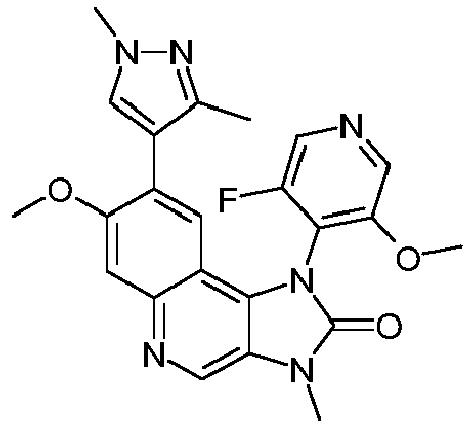 | 8-(1, 3-Dimethyl-1 H-pyrazol-4-yl)-1-(3-fluor-5-methoxy-pyridin-4-yl)-7-methoxy-3-methyl-1,3-dihydro-imidazo[4,5-c]chinolin-2-on |
 | 1-(1,3-Dimethyl-1 H-pyrazol-4-yl)-7-methoxy-3-methyl-8-(1-methyl-1 H-pyrazol-4-yl)-1,3-dihydro-imidazo[4,5-c]chinolin-2-on |
 | 1-(3,5-Difluor-pyridin-2-yl)-7-methoxy-3-methyl-8-(1 H-pyrazol-4-yl)-1,3-dihydro-imidazo[4,5-c]chinolin-2-on |
 | 1-(3-Fluor-pyridin-2-yl)-7-methoxy-3-methyl-8-(1H-pyrazol-4-yl)-1,3-dihydro-imidazo[4,5-c]chinolin-2-on |
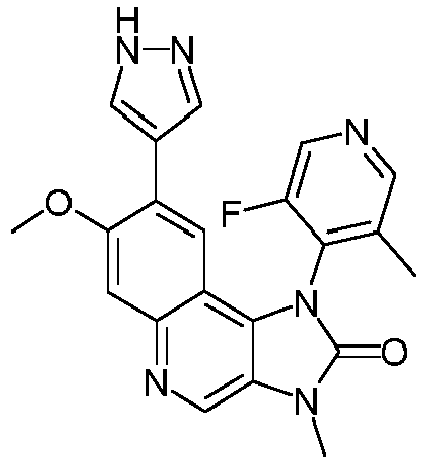 | 1-(3-Fluor-5-methyl-pyridin-4-yl)-7-methoxy-3-methyl-8-(1 H-pyrazol-4-yl)-1,3-dihydro-imidazo[4,5-c]chinolin-2-on |
 | 1-(3-Fluor-pyridin-4-yl)-7-methoxy-3-methyl-8-(1 H-pyrazol-4-yl)-1,3-dihydro-imidazo[4,5-c]chinolin-2-on |
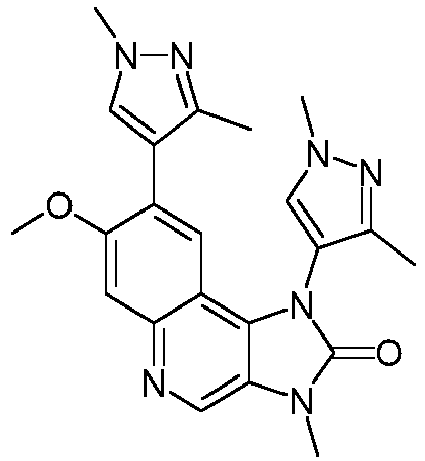 | 1,8-Bis-(1 ,3-dimethyl-1 H-pyrazol-4-yl)-7-methoxy-3-methyl-1,3-dihydro-imidazo[4,5-c]chinolin-2-on |
 | 1-(3,5-Difluor-pyridin-2-yl)-8-(1,3-dimethyl-1 H-pyrazol-4-yl)-7-methoxy-3-methyl-1,3-dihydro-imidazo[4,5-c]chinolin-2-on |
 | 1-(3-Ethyl-5-fluor-pyridin-4-yl)-7-methoxy-3-methyl-8-(1-methyl-1 H-pyrazol-4-yl)-1,3-dihydro-imidazo[4,5-c]chinolin-2-on |
 | 8-(1-Ethyl-1 H-pyrazol-4-yl)-1-(3-fluor-5-methoxy-pyridin-4-yl)-7-methoxy-3-methyl-1,3-dihydro-imidazo[4,5-c]chinolin-2-on |
 | 1-(3-Fluor-pyridin-2-yl)-7-methoxy-3-methyl-8-(1-methyl-1H-pyrazol-4-yl)-1 ,3-dihydro-imidazo[4,5-c]chinolin-2-on |
 | 1-(3-Fluor-5-methoxy-pyridin-4-yl)-7-methoxy-3-methyl-8-(1-methyl-1 H-pyrazol-4-yl)-1,3-dihydro-imidazo[4,5-c]chinolin-2-on |
 | 8-(1, 3-Dimethyl-1 H-pyrazol-4-yl)-1-(3-fluor-pyridin-2-yl)-7-methoxy-3-methyl-1,3-dihydro-imidazo[4,5-c]chinolin-2-on |
 | 7-Methoxy-3-methyl-1-(1-methyl-1 H-pyrazol-4-yl)-8-(1 H-pyrazol-4-yl)-1,3-dihydro-imidazo[4,5-c]chinolin-2-on |
 | 1-(3-Fluor-5-methyl-pyridin-4-yl)-7-methoxy-3-methyl-8-(1-methyl-1 H-pyrazol-4-yl)-1,3-dihydro-imidazo[4,5-c]chinolin-2-on |
 | 7-Methoxy-3-methyl-1-(3-methyl-pyridin-4-yl)-8-(1 H-pyrazol-4-yl)-1 ,3-dihydro-imidazo[4,5-c]chinolin-2-on |
 | 1-(3-Fluor-5-methyl-pyridin-2-yl)-7-methoxy-3-methyl-8-(1H-pyrazol-4-yl)-1,3-dihydro-imidazo[4,5-c]chinolin-2-on |
 | 1-(1,3-Dimethyl-1 H-pyrazol-4-yl)-8-(1-ethyl-1 H-pyrazol-4-yl)-7-methoxy-3-methyl-1,3-dihydro-imidazo[4,5-c]chinolin-2-on |
 | 1-(3,5-Difluor-pyridin-4-yl)-7-methoxy-3-methyl-8-(1-methyl-1 H-pyrazol-4-yl)-1 ,3-dihydro-imidazo[4,5-c]chinolin-2-on |
 | 7-Methoxy-3-methyl-1,8-bis-(1-methyl-1H-pyrazol-4-yl)-1,3-dihydro-imidazo[4,5-c]chinolin-2-on |
 | 8-(1-Ethyl-1H-pyrazol-4-yl)-1-(3-fluor-pyridin-2-yl)-7-methoxy-3-methyl-1,3-dihydro-imidazo[4,5-c]chinolin-2-on |
 | 1 -(3-Ethyl-5-fluor-pyridin-4-yl)-8-(1-ethyl-1 H-pyrazol-4-yl)-7-methoxy-3-methyl-1,3-dihydro-imidazo[4,5-c]chinolin-2-on |
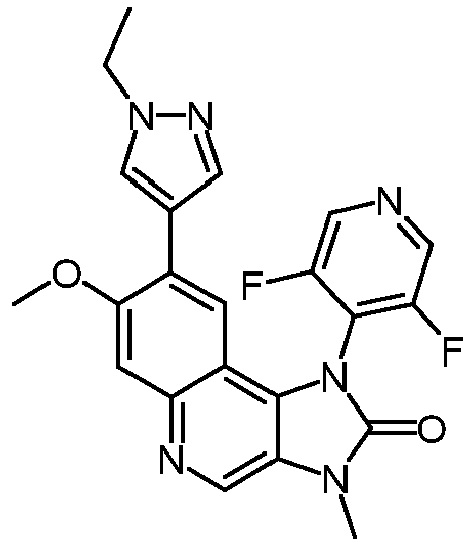 | 1-(3,5-Difluor-pyridin-4-yl)-8-(1-ethyl-1 H-pyrazol-4-yl)-7-methoxy-3-methyl-1 ,3-dihydro-imidazo[4,5-c]chinolin-2-on |
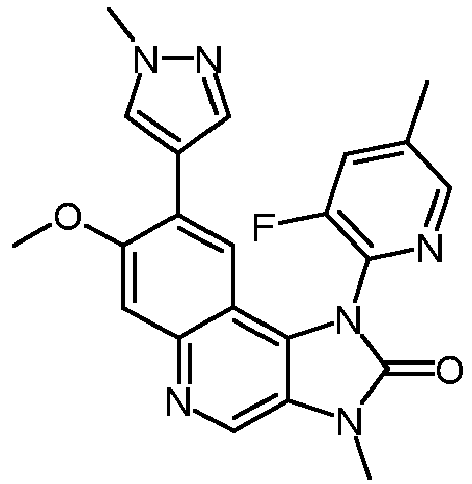 | 1-(3-Fluor-5-methyl-pyridin-2-yl)-7-methoxy-3-methyl-8-(1-methyl-1 H-pyrazol-4-yl)-1,3-dihydro-imidazo[4,5-c]chinolin-2-on |
 | 7-Methoxy-1-(3-methoxy-pyridin-4-yl)-3-methyl-8-(1-methyl-1 H-pyrazol-4-yl)-1 ,3-dihydro-imidazo[4,5-c]chinolin-2-on |
 | 1-(3-Fluor-pyridin-2-yl)-7-methoxy-3-methyl-8-(5-methyl-1 H-pyrazol-3-yl)-1,3-dihydro-imidazo[4,5-c]chinolin-2-on |
 | 7-Methoxy-3-methyl-1-(2-methyl-thiazol-4-yl)-8-(1 H-pyrazol-4-yl)-1 ,3-dihydro-imidazo[4,5-c]chinolin-2-on |
 | 1-(5-Fluorpyrimidin-4-yl)-7-methoxy-3-methyl-8-(1-methyl-1 H-pyrazol-4-yl)-1 H,2H,3H-imidazo[4,5-c]chinolin-2-on |
 | 7-Methoxy-1-(3-methoxy-pyridin-4-yl)-3-methyl-8-(1 H-pyrazol-4-yl)-1,3-dihydro-imidazo[4,5-c]chinolin-2-on |
 | 8-(1-Ethyl-1H-pyrazol-4-yl)-1-(3-fluor-pyridin-4-yl)-7-methoxy-3-methyl-1,3-dihydro-imidazo[4,5-c]chinolin-2-on |
 | 8-(1-Ethyl-1 H-pyrazol-4-yl)-7-methoxy-3-methyl-1-(3-methyl-pyridin-4-yl)-1,3-dihydro-imidazo[4,5-c]chinolin-2-on |
 | 1-(3-Fluor-pyridin-4-yl)-7-methoxy-3-methyl-8-(1-methyl-1H-pyrazol-4-yl)-1 ,3-dihydro-imidazo[4,5-c]chinolin-2-on |
 | 1-(5-Fluor-pyrimidin-2-yl)-7-methoxy-3-methyl-8-(1-methyl-1 H-pyrazol-4-yl)-1 ,3-dihydro-imidazo[4,5-c]chinolin-2-on |
 | 7-Methoxy-3-methyl-8-(1 H-pyrazol-4-yl)-1-[1-(tetrahydro-pyran-4-yl)-1 H-pyrazol-4-yl]-1,3-dihydro-imidazo[4,5-c]chinolin-2-on |
 | 8-(1-Ethyl-1 H-pyrazol-4-yl)-1-(3-fluor-5-methyl-pyridin-4-yl)-7-methoxy-3-methyl-1,3-dihydro-imidazo[4,5-c]chinolin-2-on |
 | 8-(1, 3-Dimethyl-1 H-pyrazol-4-yl)-1-(3-fluor-5-methyl-pyridin-4-yl)-7-methoxy-3-methyl-1,3-dihydro-imidazo[4,5-c]chinolin-2-on |
 | 7-Methoxy-3-methyl-8-(1-methyl-1 H-pyrazol-4-yl)-1-(3-methyl-pyridin-4-yl)-1,3-dihydro-imidazo[4,5-c]chinolin-2-on |
 | 7-Methoxy-3-methyl-1-(2-methyl-2H-pyrazol-3-yl)-8-(1 H-pyrazol-4-yl)-1,3-dihydro-imidazo[4,5-c]chinolin-2-on |
 | 1-(1,3-Dimethyl-1 H-pyrazol-4-yl)-7-methoxy-3-methyl-8-(1-methyl-1 H-[1,2,3]triazol-4-yl)-1,3-dihydro-imidazo[4,5-c]chinolin-2-on |
 | 7-Methoxy-3-methyl-1-(3-methyl-1 H-pyrazol-4-yl)-8-(1-methyl-1 H-pyrazol-4-yl)-1,3-dihydro-imidazo[4,5-c]chinolin-2-on |
 | 5-Fluor-4-[7-methoxy-3-methyl-8-(1-methyl-1 H-pyrazol-4-yl)-2-oxo-2,3-dihydro-imidazo[4,5-c]chinolin-1-yl]-nicotinonitril |
 | 4-[7-Methoxy-3-methyl-8-(1-methyl-1 H-pyrazol-4-yl)-2-oxo-2, 3-di hyd roimidazo[4,5-c]chinolin-1-yl]-pyridine-2-carbonitril |
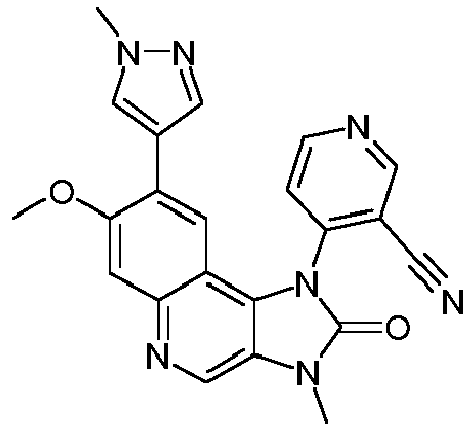 | 4-[7-Methoxy-3-methyl-8-(1-methyl-1 H-pyrazol-4-yl)-2-oxo-2, 3-di hyd roimidazo[4,5-c]chinolin-1-yl]-nicotinonitril |
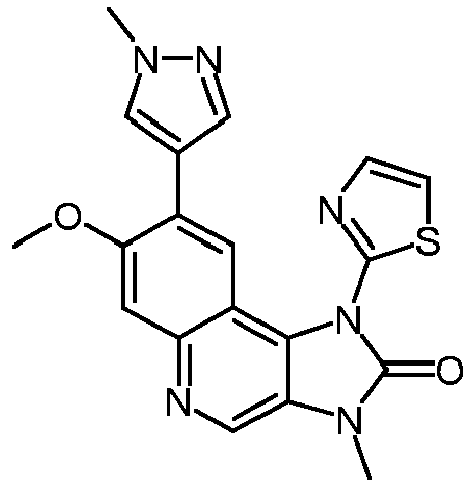 | 7-Methoxy-3-methyl-8-(1-methyl-1 H-pyrazol-4-yl)-1-thiazol-2-yl-1,3-dihydro-imidazo[4,5-c]chinolin-2-on |
 | 6-[7-Methoxy-3-methyl-8-(1-methyl-1 H-pyrazol-4-yl)-2-oxo-2, 3-di hyd roimidazo[4,5-c]chinolin-1-yl]-nicotinonitril |
 | 7-Methoxy-3-methyl-1-(2-methyl-2H-pyrazol-3-yl)-8-(1-methyl-1 H-pyrazol-4-yl)-1,3-dihydro-imidazo[4,5-c]chinolin-2-on |
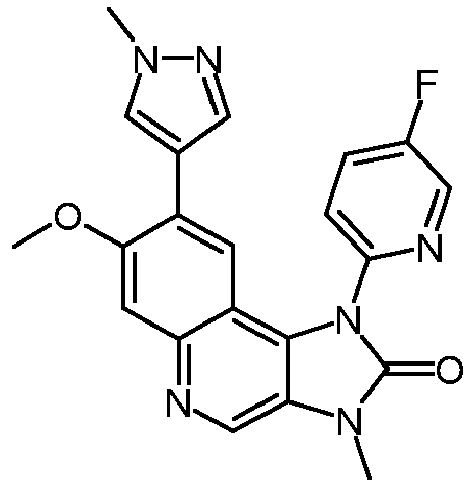 | 1-(5-Fluor-pyridin-2-yl)-7-methoxy-3-methyl-8-(1-methyl-1 H-pyrazol-4-yl)-1,3-dihydro-imidazo[4,5-c]chinolin-2-on |
 | 1-(3-Fluor-pyridin-2-yl)-7-methoxy-3-methyl-8-(1-methyl-1 H-[1,2,3]triazol-4-yl)-1,3-dihydro-imidazo[4,5-c]chinolin-2-on |
 | 7-Methoxy-3-methyl-8-(1-methyl-1 H-pyrazol-4-yl)-1-pyrimidin-2-yl-1,3-dihydro-imidazo[4,5-c]chinolin-2-on |
 | 7-Methoxy-3-methyl-8-(1-methyl-1 H-pyrazol-4-yl)-1-( 1 H-pyrazol-4-yl)-1 ,3-dihydro-imidazo[4,5-c]chinolin-2-on |
 | 1-(3-Ethyl-5-methyl-pyridin-4-yl)-7-methoxy-3-methyl-8-(1-methyl-1 H-pyrazol-4-yl)-1,3-dihydro-imidazo[4,5-c]chinolin-2-on |
 | 7-Methoxy-3-methyl-8-(1-methyl-1 H-pyrazol-4-yl)-1 -[1-(tetrahydro-pyran-4-yl)-1 H-pyrazol-4-yl]-1,3-dihydro-imidazo[4,5-c]chinolin-2-on |
 | 7-Methoxy-3-methyl-8-(1-methyl-1 H-pyrazol-4-yl)-1-pyridin-2-yl-1,3-dihydro-imidazo[4,5-c]chinolin-2-on |
 | 7-Methoxy-3-methyl-8-(1-methyl-1 H-pyrazol-4-yl)-1-pyrimidin-5-yl-1,3-dihydro-imidazo[4,5-c]chinolin-2-on |
 | 7-Methoxy-3-methyl-8-(1-methyl-1 H-pyrazol-4-yl)-1-pyridin-4-yl-1,3-dihydro-imidazo[4,5-c]chinolin-2-on |
 | 7-Methoxy-3-methyl-1-(1-methyl-1 H-imidazol-4-yl)-8-(1-methyl-1 H-pyrazol-4-yl)-1,3-dihydro-imidazo[4,5-c]chinolin-2-on |
 | 1-(3-Chlor-pyridin-4-yl)-7-methoxy-3-methyl-8-(1-methyl-1 H-pyrazol-4-yl)-1 ,3-dihydro-imidazo[4,5-c]chinolin-2-on |
 | 1-(3-Ethyl-5-methyl-pyridin-4-yl)-8-(1-ethyl-1 H-pyrazol-4-yl)-7-methoxy-3-methyl-1,3-dihydro-imidazo[4,5-c]chinolin-2-on |
 | 8-(1-Ethyl-1H-pyrazol-4-yl)-7-methoxy-3-methyl-1-pyridin-4-yl-1,3-dihydro-imidazo[4,5-c]chinolin-2-on |
 | 1-(3-Fluor-5-methyl-pyridin-4-yl)-7-methoxy-3-methyl-8-(1-methyl-1 H-[1,2,3]triazol-4-yl)-1,3-dihydro-imidazo[4,5-c]chinolin-2-on |
 | 1-(3-Fluor-pyridin-4-yl)-7-methoxy-3-methyl-8-(1-methyl-1 H-[1,2,3]triazol-4-yl)-1,3-dihydro-imidazo[4,5-c]chinolin-2-on |
 | 8-(3-Amino-1 H-pyrazol-5-yl)-1-(3-fluor-2-pyridyl)-7-methoxy-3-methyl-imidazo[4,5-c]chinolin-2-on |
 | 1-[3-Fluor-5-(2-methoxyethoxy)-2-pyridyl]-7-methoxy-3-methyl-8-(1-methyl pyrazol-4-yl)imidazo[4,5-c]chinolin-2-on |
 | 1-[3-Fluor-5-(2-hydroxyethoxy)-2-pyridyl]-7-methoxy-3-methyl-8-(1-methyl pyrazol-4-yl)imidazo[4,5-c]chinolin-2-on |
 | 7-Methoxy-3-methyl-8-(1-methyl- 1H-pyrazol-4-yl)-1-chinolin-2-yl-1,3-dihydro-imidazo[4,5-c]chinolin-2-on |
 | 7-Methoxy-3-methyl-8-(1-methyl-1 H-pyrazol-4-yl)-1-(1 H-pyrrolo[2,3-b]pyridin-6-yl)1,3-dihydro-imidazo[4,5-c]chinolin-2-on |
 | 1-(3,5-Difluor-pyridin-2-yl)-7-methoxy-3-methyl-8-(2-methyl-2H-[1,2,3]triazol-4-yl)-1,3-dihydro-imidazo[4,5-c] chinolin-2-on |
 | 1-(1,3-Dimethyl-1 H-pyrazol-4-yl)-7-methoxy-3-methyl-8-(2-methyl-2 H-[1,2,3]triazol-4-yl)-1,3-dihydro-imidazo[4,5-c]chinolin-2-on |
 | 1-(3-Fluor-5-methyl-pyridin-4-yl)-7-methoxy-3-methyl-8-(2-methyl-2 H-[1,2,3]triazol-4-yl)-1,3-dihydro-imidazo[4,5-c] chinolin-2-on |
 | 8-(1-Ethyl-1 H-pyrazol-4-yl)-7-methoxy-1-(3-methoxy-pyridin-4-yl)-3-methyl-1,3-dihydro-imidazo[4,5-c] chinolin-2-on |
 | 1-(3-Fluor-5-methoxy-pyridin-2-yl)-7-methoxy-3-methyl-8-(1-methyl-1 H-pyrazol-4-yl)-1,3-dihydro-imidazo[4,5-c]chinolin-2-on |
 | 8-(1, 3-Dimethyl-1 H-pyrazol-4-yl)-1-(3-fluor-5-methoxy-pyridin-2-yl)-7-methoxy-3-methyl-1,3-dihydro-imidazo[4,5-c]chinolin-2-on |
 | 1-(3,5-Difluor-pyridin-2-yl)-7-methoxy-8-(1-methyl-1 H-pyrazol-4-yl)-1,3-dihydro-imidazo[4,5-c]chinolin-2-on |
 | 1-(3,5-Difluor-pyridin-2-yl)-8-(1,3-dimethyl-1 H-pyrazol-4-yl)-7-methoxy-1,3-dihydro-imidazo[4,5-c]chinolin-2-on |
 | 1-(3-Fluor-5-methoxy-pyridin-2-yl)-7-methoxy-3-methyl-8-(2H-pyrazol-3-yl)-1,3-dihydro-imidazo[4,5-c] chinolin-2-on |
 | 1-(3-Fluor-5-fluormethoxy-pyridin-2-yl)-7-methoxy-3-methyl-8-(1-methyl-1 H-pyrazol-4-yl)-1,3-dihydro-imidazo[4,5-c]chinolin-2-on |
 | 8-(1-Ethyl-1 H-pyrazol-4-yl)-1-(3-fluor-5-methoxy-pyridin-2-yl)-7-methoxy-3-methyl-1,3-dihydro-imidazo[4,5-c] chinolin-2-on |
 | 1-(3-Ethyl-5-fluor-pyridin-4-yl)-7-methoxy-3-methyl-8-(2-methyl-2 H-[1,2,3]triazol-4-yl)-1,3-dihydro-imidazo[4,5-c] chinolin-2-on |
 | 1-(5-Ethoxy-3-fluor-pyridin-2-yl)-7-methoxy-3-methyl-8-(1-methyl-1 H-pyrazol-4-yl)-1,3-dihydro-imidazo[4,5-c]chinolin-2-on |
 | 1-(5-Difluormethoxy-3-fluor-pyridin-2-yl)-7-methoxy-3-methyl-8-(1-methyl-1 H-pyrazol-4-yl)-1,3-dihydro-imidazo[4,5-c]chinolin-2-on |
 | 1-(3-Fluor-5-methoxy-pyridin-2-yl)-7-methoxy-8-(1-methyl-1 H-pyrazol-4-yl)-1,3-dihydro-imidazo[4,5-c]chinolin-2-on |
 | 1-(3-Fluor-5-methoxy-pyridin-4-yl)-7-methoxy-8-(1-methyl-1 H-pyrazol-4-yl)-1,3-dihydro-imidazo[4,5-c]chinolin-2-on |
 | 1-(3,5-Difluor-pyridin-2-yl)-7-methoxy-3-methyl-8-(3-methyl-1 H-pyrazol-4-yl)-1,3-dihydro-imidazo[4,5-c]chinolin-2-on |
 | 1-(3,5-Dimethyl-1 H-pyrazol-4-yl)-7-methoxy-3-methyl-8-(1-methyl-1 H-pyrazol-4-yl)-1,3-dihydro-imidazo[4,5-c]chinolin-2-on |
 | 1-(5-Chlor-3-fluor-pyridin-2-yl)-7-methoxy-3-methyl-8-(1-methyl-1 H-pyrazol-4-yl)-1,3-dihydro-imidazo[4,5-c]chinolin-2-on |
 | 7-Methoxy-3-methyl-8-(1-methyl-1 H-pyrazol-4-yl)-1-(1 H-pyrrolo[3,2-c]pyridin-6-yl)-1,3-dihydro-imidazo[4,5-c]chinolin-2-on |
 | 1-(1,3-Dimethyl-1 H-pyrazol-4-yl)-7-methoxy-3-methyl-8-(1 H-pyrazol-3-yl)-1,3-dihydro-imidazo[4,5-c]chinolin-2-on |
 | 1-(3-Fluor-5-methoxy-pyridin-2-yl)-7-methoxy-3-methyl-8-(3-methyl-1H-pyrazol-4-yl)-1,3-dihydro-imidazo[4,5-c] chinolin-2-on |
 | 1-(3-Fluor-5-piperazin-1-yl-pyridin-2-yl)-7-methoxy-3-methyl-8-(1-methyl-1 H-pyrazol-4-yl)-1,3-dihydro-imidazo[4,5-c]chinolin-2-on |
 | 1-(3-Fluor-5-methoxy-pyridin-4-yl)-7-methoxy-3-methyl-8-(2H-pyrazol-3-yl)-1,3-dihydro-imidazo[4,5-c] chinolin-2-on |
 | 1-(3-Ethyl-5-fluor-pyridin-4-yl)-7-methoxy-3-methyl-8-(2H-[1,2,3]triazol-4-yl)-1,3-dihydro-imidazo[4,5-c] chinolin-2-on |
 | 1-(3-Ethyl-5-fluor-pyridin-4-yl)-7-methoxy-3-methyl-8-(1-methyl-1H-[1,2,3]triazol-4-yl)-1,3-dihydro-imidazo[4,5-c] chinolin-2-on |
 | 1-(3-Fluor-5-methoxy-pyridin-4-yl)-7-methoxy-3-methyl-8-(2-methyl-2 H-[1,2,3]triazol-4-yl)-1,3-dihydro-imidazo[4,5-c] chinolin-2-on |
 | 1-(3-Fluor-5-methoxy-pyridin-2-yl)-7-methoxy-3-methyl-8-(3H-[1,2,3]triazol-4-yl)-1,3-dihydro-imidazo[4,5-c] chinolin-2-on |
 | 8-(1,3-Dimethyl-1 H-pyrazol-4-yl)-1-(3-fluor-5-methoxy-pyridin-4-yl)-7-methoxy-1,3-dihydro-imidazo[4,5-c]chinolin-2-on |
 | 1-(1-Ethyl-3-methyl-1 H-pyrazol-4-yl)-7-methoxy-3-methyl-8-(1-methyl-1 H-pyrazol-4-yl)-1,3-dihydro-imidazo[4,5-c]chinolin-2-on |
 | 1-(3-Fluor-5-methoxy-pyridin-4-yl)-7-methoxy-3-methyl-8-(1-methyl-1H-[1,2,3]triazol-4-yl)-1,3-dihydro-imidazo[4,5-c]chinolin-2-on |
 | 1-(1,3-Dimethyl-1 H-pyrazol-4-yl)-7-methoxy-3-methyl-8-(2-methyl-3H-benzoimidazol-5-yl)-1,3-dihydro-imidazo[4,5-c]chinolin-2-on |
 | 1-(3-Fluor-5-methoxy-pyridin-2-yl)-7-methoxy-3-methyl-8-(1-methyl-1 H-[1,2,3]triazol-4-yl)-1,3-dihydro-imidazo[4,5-c] chinolin-2-on |
 | 1-(3-Fluor-5-methoxy-pyridin-4-yl)-7-methoxy-3-methyl-8-(3H-[1,2,3]triazol-4-yl)-1,3-dihydro-imidazo[4,5-c] chinolin-2-on |
 | 8-(1,3-Dimethyl-1 H-pyrazol-4-yl)-1-(1-ethyl-3-methyl-1 H-pyrazol-4-yl)-7-methoxy-3-methyl-1,3-dihydro-imidazo[4,5-c]chinolin-2-on |
 | 1-(3-Fluor-5-methoxy-pyridin-4-yl)-7-methoxy-3-methyl-8-(2-methyl-3H-benzoimidazol-5-yl)-1,3-dihydro-imidazo[4,5-c]chinolin-2-on |
 | 1-(3-Fluor-5-methoxy-pyridin-4-yl)-7-methoxy-8-(6-methoxy-pyridin-3-yl)-3-methyl-1,3-dihydro-imidazo[4,5-c]chinolin-2-on |
 | 5-Fluor-6-[7-methoxy-3-methyl-8-(1-methyl-1 H-pyrazol-4-yl)-2-oxo-2,3-dihydro-imidazo[4,5-c]chinolin-1-yl]-N-methyl-nicotinamid |
 | 6-[8-(1, 3-Di methyl-1 H-pyrazol-4-yl)-7-methoxy-3-methyl-2-oxo-2, 3-di hyd roimidazo[4,5-c]chinolin-1-yl]-5-fluor-N-methyl-nicotinamid |
 | 1-(3-Fluor-5-methoxy-pyridin-4-yl)-8-(1-fluormethyl-1 H-pyrazol-4-yl)-7-methoxy-3-methyl-1,3-dihydro-imidazo[4,5-c]chinolin-2-on |
 | 1-(3-Fluor-1-methyl-1 H-pyrazol-4-yl)-7-methoxy-3-methyl-8-(1-methyl-1 H-pyrazol-4-yl)-1,3-dihydro-imidazo[4,5-c]chinolin-2-on |
 | 8-(1-Ethyl-3-methyl-1 H-pyrazol-4-yl)-1-(3-fluor-5-methoxy-pyridin-4-yl)-7-methoxy-3-methyl-1,3-dihydro-imidazo[4,5-c] chinolin-2-on |
 | 8-(1-Difluormethyl-1 H-pyrazol-4-yl)-1-(3-fluor-5-methoxy-pyridin-4-yl)-7-methoxy-3-methyl-1,3-dihydro-imidazo[4,5-c] chinolin-2-on |
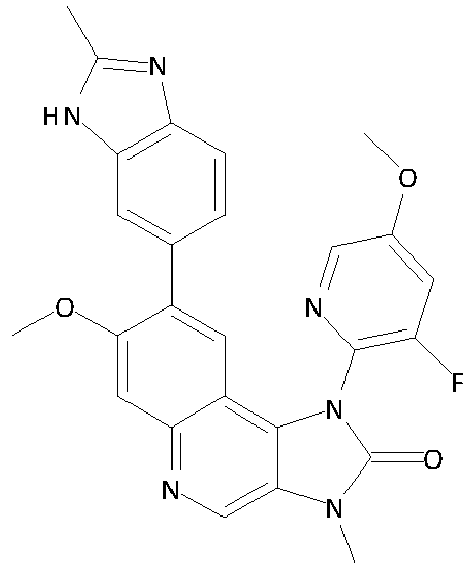 | 1-(3-Fluor-5-methoxy-pyridin-2-yl)-7-methoxy-3-methyl-8-(2-methyl-3H-benzoimidazol-5-yl)-1,3-dihydro-imidazo[4,5-c]chinolin-2-on |
 | 1-[3-Fluor-5-(trideuteriomethoxy)-4-pyridyl]-7-methoxy-3-methyl-8-(1-methyl pyrazol-4-yl)imidazo[4,5-c]chinolin-2-on |
 | 1-(3-Difluormethoxy-5-fluor-pyridin-4-yl)-7-methoxy-3-methyl-8-(1-methyl-1 H-pyrazol-4-yl)-1,3-dihydro-imidazo[4,5-c]chinolin-2-on |
 | 1-(3-Difluormethoxy-5-fluor-pyridin-4-yl)-8-(1,3-dimethyl-1 H-pyrazol-4-yl)-7-methoxy-3-methyl-1,3-dihydro-imidazo[4,5-c]chinolin-2-on |
 | 1-(3-Fluor-5-fluormethoxy-pyridin-4-yl)-7-methoxy-3-methyl-8-(1 -methyl- 1 H-pyrazol-4-yl)-1,3-dihydro-imidazo[4,5-c]chinolin-2-on |
 | 8-(1,3-Dimethyl-1 H-pyrazol-4-yl)-1-(3-fluor-5-fluormethoxy-pyridin-4-yl)-7-methoxy-3-methyl-1,3-dihydro-imidazo[4,5-c]chinolin-2-on |
 | 8-(1,3-Dimethylpyrazol-4-yl)-1-[3-fluor-5-(trideuteriomethoxy)-4-pyridyl]-7-methoxy-3-methyl-imidazo[4,5-c]chinolin-2-on |
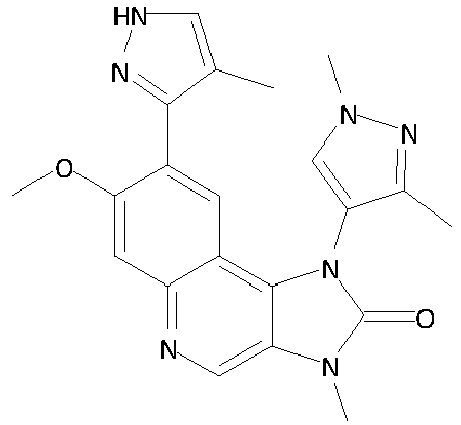 | 1-(1,3-Dimethyl-1 H-pyrazol-4-yl)-7-methoxy-3-methyl-8-(4-methyl-1 H-pyrazol-3-yl)-1,3-dihydro-imidazo[4,5-c] chinolin-2-on |
 | 1-(3-Fluor-5-methoxy-pyridin-4-yl)-7-methoxy-3-methyl-8-(2-methyl-1H-imidazo[4,5-b]pyridin-6-yl)-1,3-dihydro-imidazo[4,5-c]chinolin-2-on |
 | 8-(3H-Benzimidazol-5-yl)-1-(3-fluor-5-methoxy-pyridin-2-yl)-7-methoxy-3-methyl-1,3-dihydro-imidazo[4,5-c]chinolin-2-on |
 | 1-(1,3-Dimethyl-1 H-pyrazol-4-yl)-7-methoxy-3-methyl-8-(2-methyl-1 H-imidazo[4,5-b]pyridin-6-yl)-1,3-dihydro-imidazo[4,5-c]chinolin-2-on |
 | 1-[3-Fluor-5-(trideuteriomethoxy)-2-pyridyl]-7-methoxy-3-methyl-8-(1-methylpyrazol-4-yl) imidazo[4,5-c]chinolin-2-on |
 | 1-(3-Ethyl-pyridin-4-yl)-7-methoxy-3-methyl-8-(1-methyl-1 H-pyrazol-4-yl)-1 ,3-dihydro-imidazo[4,5-c] chinolin-2-on |
 | 8-(1-Ethyl-1H-pyrazol-4-yl)-1-(3-ethyl-pyridin-4-yl)-7-methoxy-3-methyl-1,3-dihydro-imidazo[4,5-c] chinolin-2-on |
 | 1-(3-Fluor-pyridin-2-yl)-7-methoxy-3-methyl-8-(2-methyl-2H-[1,2,3]triazol-4-yl)-1,3-dihydro-imidazo[4,5-c] chinolin-2-on |
 | 1-(3-Fluor-1-methyl-1 H-pyrazol-4-yl)-7-methoxy-8-(6-methoxy-pyridin-3-yl)-3-methyl-1,3-dihydro-imidazo[4,5-c]chinolin-2-on |
 | 1-(3-Cyclopropyl-pyridin-4-yl)-7-methoxy-3-methyl-8-(1-methyl-1 H-pyrazol-4-yl)-1,3-dihydro-imidazo[4,5-c] chinolin-2-on |
 | 1-(3-Fluor-5-methylsulfonylmethoxy-pyridin-2-yl)-7-methoxy-3-methyl-8-(1-methyl-1 H-pyrazol-4-yl)-1,3-dihydro-imidazo[4,5-c]chinolin-2-on |
 | 1-(3-Cyclopropyl-5-fluor-pyridin-4-yl)-7-methoxy-3-methyl-8-(1-methyl-1 H-pyrazol-4-yl)-1,3-dihydro-imidazo[4,5-c]chinolin-2-on |
 | 8-(1, 3-Dimethyl-1 H-pyrazol-4-yl)-1-(3-fluor-5-methylsulfonylmethoxy-pyridin-2-yl)-7-methoxy-3-methyl-1,3-dihydro-imidazo[4,5-c]chinolin-2-on |
 | 1-(5-Allyloxy-3-fluor-pyridin-2-yl)-7-methoxy-3-methyl-8-(1-methyl-1 H-pyrazol-4-yl)-1,3-dihydro-imidazo[4,5-c]chinolin-2-on |
 | 1-[5-(Azetidin-3-yloxy)-3-fluor-pyridin-2-yl]-7-methoxy-3-methyl-8-(1 -methyl-1 H-pyrazol-4-yl)-1,3-dihydro-imidazo[4,5-c]chinolin-2-on |
 | 1-[3-Fluor-5-(2-methylamino-ethoxy)-pyridin-2-yl]-7-methoxy-3-methyl-8-(1-methyl-1 H-pyrazol-4-yl)-1,3-dihydro-imidazo[4,5-c] chinolin-2-on |
 | 1-[3-Fluor-5-(1-methyl-azetidin-3-ylmethoxy)-pyridin-2-yl]-7-methoxy-3-methyl-8-(1-methyl-1 H-pyrazol-4-yl)-1 ,3-dihydro-imidazo[4,5-c]chinolin-2-on |
 | 8-[1-(Azetidin-3-yl)-1 H-pyrazol-4-yl]-1-(3-fluor-5-methoxypyridin-4-yl)-7-methoxy-3-methyl-1 H,2H,3H-imidazo[4,5-c]chinolin-2-on |
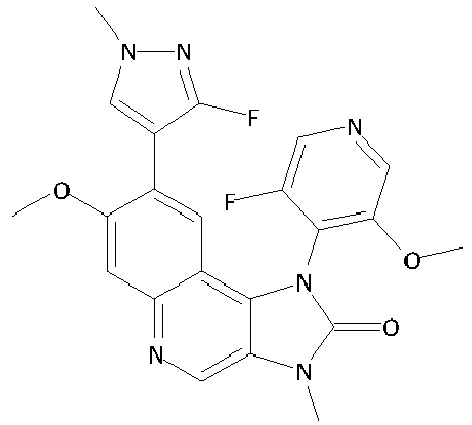 | 1-(3-Fluor-5-methoxy-pyridin-4-yl)-7-methoxy-3-methyl-8-(3-fluor-1-methyl-1 H-pyrazol-4-yl)-1,3-dihydro-imidazo[4,5-c]chinolin-2-on |
 | 1-(1,3-Dimethyl-1 H-pyrazol-4-yl)-7-methoxy-3-methyl-8-(3-fluor-1-methyl-1 H-pyrazol-4-yl)-1,3-dihydro-imidazo[4,5-c]chinolin-2-on |
 | 1-(5-Fluor-1 H-pyrrolo[2,3-b]pyridin-6-yl)-7-methoxy-3-methyl-8-(1-methyl-1 H-pyrazol-4-yl)-1,3-dihydro-imidazo[4,5-c]chinolin-2-on |
 | 1-[3-Fluor-5-(trifluormethoxy)-4-pyridyl]-7-methoxy-3-methyl-8-(1-methyl-1 H-pyrazol-4-yl)-1,3-dihydro-imidazo[4,5-c] chinolin-2-on |
 | 1-[3-Fluor-5-(trifluormethoxy)-4-pyridyl]-7-methoxy-3-methyl-8-(1,3-dimethylpyrazol-4-yl)-1,3-dihydro-imidazo[4,5-c]chinolin-2-on |
 | 1-(3-Fluor-5-methylsulfonyl-pyridin-2-yl)-7-methoxy-3-methyl-8-(1-methyl-1 H-pyrazol-4-yl)-1 H,2H,3H-imidazo[4,5-c]chinolin-2-on |
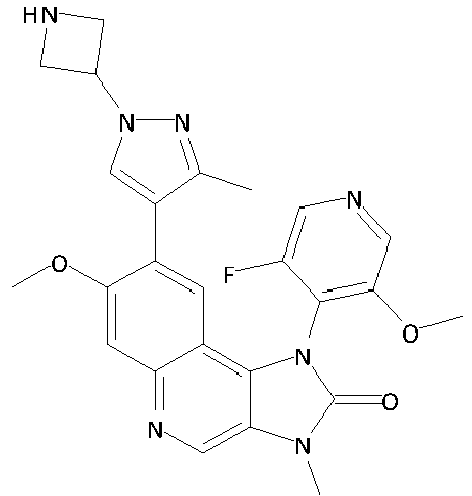 | 8-[1-(Azetidin-3-yl)-3-methyl-1 H-pyrazol-4-yl]-1-(3-fluor-5-methoxypyridin-4-yl)-7-methoxy-3-methyl-1 H,2H,3H-imidazo[4,5-c]chinolin-2-on |
19. Verbindung nach einem der Aspekte 1 bis 18 und/oder pharmazeutisch verwendbares Derivat, Salz, Solvat, Tautomer, oder Stereoisomer davon, zur Verwendung als Medikament.
20. Verbindung nach einem der Aspekte 1 bis 18 und/oder pharmazeutisch verwendbares Derivat, Salz, Solvat, Tautomer, oder Stereoisomer davon, zur Verwendung bei der Behandlung von Krankheiten, bei denen die Hemmung/Regulierung und/oder Modulation der Signaltransduktion von ATM-Kinase eine Rolle spielt oder zur Verwendung bei der Behandlung von Krankheiten, die durch Inhibierung von ATM Kinase beeinflusst werden.
21. Verbindung nach einem der Aspekte 1 bis 18 und/oder pharmazeutisch verwendbares Derivat, Salz, Solvat, Tautomer, oder Stereoisomer davon, zur Verwendung bei der Behandlung von Krebs, Tumoren und/oder Metastasen.
22. Verbindung nach einem der Aspekte 1 bis 21 und/oder pharmazeutisch verwendbares Derivat, Salz, Solvat, Tautomer, Stereoisomer davon, zur Verwendung bei der Behandlung von Krebs, Tumoren und/oder Metastasen in Kombination mit Radiotherapie.
23. Verbindung Verbindung nach einem der Aspekte 1 bis 21 und/oder pharmazeutisch verwendbares Derivat, Salz, Solvat, Tautomer, Stereoisomer davon zur Verwendung bei der Behandlung von Krebs, Tumoren und/oder Metastasen in Kombination mit mindestens einem Antikrebsmittel.
24. Verbindung nach einem der Aspekte 1 bis 18 und/oder pharmazeutisch verwendbares Derivat, Salz, Solvat, Tautomer, oder Stereoisomer davon, zur Verwendung in der Sensibilisierung von Krebszellen gegenüber einem Antikrebsmittel und/oder ionisierender Strahlung.
25. Verbindung nach einem der Aspekte 1 bis 18, 21, 22 oder 23, und/oder pharmazeutisch verwendbares Derivat, Salz, Solvat, Tautomer, Stereoisomer davon, wobei der Tumor ausgewählt ist aus der Gruppe von Erkrankungen von Plattenepithel, Blase, Magen, Nieren, Kopf, Hals, Ösophagus, Gebärmutterhals, Schilddrüse, Darm, Knochen, Leber, Gehirn, Prostata, Urogenitaltrakts, lymphatisches System, Kehlkopf, Lunge, Haut, Blut und Immunsystem, und/oder der Krebs ausgewählt ist aus der Gruppe von Monozytenleukämie, Lungenadenokarzinom, kleinzelliges Lungenkarzinom, Bauchspeicheldrüsenkrebs, Glioblastom, Darmkarzinom, Brustkarzinom, akute myelotische Leukämie, chronische myelotische Leukämie, akute lymphatische Leukämie, chronische lymphatische Leukämie, Hodgkin-Lymphom und non-Hodgkin-Lymphom
26. Pharmazeutische Zusammensetzung, enthaltend eine wirksame Menge mindestens einer Verbindung nach einem der Aspekte 1 bis 18 und/oder einem pharmazeutisch verwendbaren Derivat, Salz, Solvat, Tautomer, oder Stereoisomer davon, optional zusammen mit mindestens einem pharmazeutisch verträglichen Hilfsstoff.
27. Pharmazeutische Zusammensetzung nach Aspekt 26, ferner enthaltend mindestens einen weiteren Arzneimittelwirkstoff, bevorzugt mindestens ein Antikrebsmittel.
28. Kit, bestehend aus getrennten Packungen von
30. Verfahren zur Herstellung eines Medikaments, vorzugsweise zur Verwendung bei der Behandlung von Krebs und/oder Tumoren, umfassend:
Claims (11)
- Verbindung, ausgewählt aus:
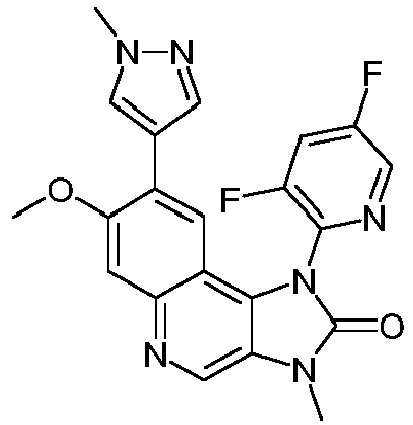
1-(3,5-Difluor-pyridin-2-yl)-7-methoxy-3-methyl-8-(1-methyl-1 H-pyrazol-4-yl)-1 ,3-dihydro-imidazo[4,5-c]chinolin-2-on 
1-(3,5-Difluor-pyridin-4-yl)-7-methoxy-3-methyl-8-(1 H-pyrazol-4-yl)-1,3-dihydro-imidazo[4,5-c]chinolin-2-on 
1-(3,5-Difluor-pyridin-2-yl)-7-methoxy-3-methyl-8-(1 H-pyrazol-4-yl)-1,3-dihydro-imidazo[4,5-c]chinolin-2-on 
1-(3-Fluor-pyridin-2-yl)-7-methoxy-3-methyl-8-(1H-pyrazol-4-yl)-1,3-dihydro-imidazo[4,5-c]chinolin-2-on 
1-(3-Fluor-5-methyl-pyridin-4-yl)-7-methoxy-3-methyl-8-(1H-pyrazol-4-yl)-1,3-dihydro-imidazo[4,5-c]chinolin-2-on 
1-(3-Fluor-pyridin-4-yl)-7-methoxy-3-methyl-8-(1 H-pyrazol-4-yl)-1,3-dihydro-imidazo[4,5-c]chinolin-2-on 
1,8-Bis-(1 ,3-dimethyl-1 H-pyrazol-4-yl)-7-methoxy-3-methyl-1,3-dihydro-imidazo[4,5-c]chinolin-2-on 
1-(3,5-Difluor-pyridin-2-yl)-8-(1,3-dimethyl-1 H-pyrazol-4-yl)-7-methoxy-3-methyl-1,3-dihydro-imidazo[4,5-c]chinolin-2-on 
1-(3-Ethyl-5-fluor-pyridin-4-yl)-7-methoxy-3-methyl-8-(1-methyl-1 H-pyrazol-4-yl)-1 ,3-dihydro-imidazo[4,5-c]chinolin-2-on 
1-(3-Fluor-pyridin-2-yl)-7-methoxy-3-methyl-8-(1-methyl-1 H-pyrazol-4-yl)-1,3-dihydro-imidazo[4,5-c]chinolin-2-on 
8-(1,3-Dimethyl-1H-pyrazol-4-yl)-1-(3-fluor-pyridin-2-yl)-7-methoxy-3-methyl-1,3-dihydro-imidazo[4,5-c]chinolin-2-on 
1-(3-Fluor-5-methyl-pyridin-4-yl)-7-methoxy-3-methyl-8-(1-methyl-1 H-pyrazol-4-yl)-1 ,3-dihydro-imidazo[4,5-c]chinolin-2-on 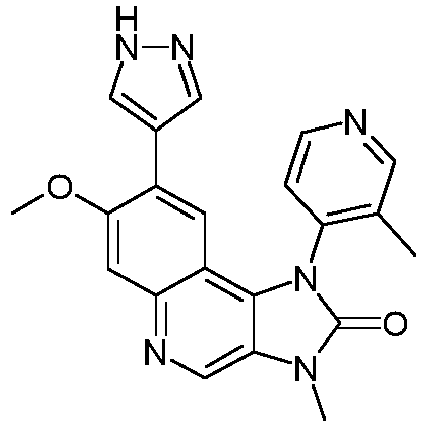
7-Methoxy-3-methyl-1-(3-methyl-pyridin-4-yl)-8-(1 H-pyrazol-4-yl)-1,3-dihydro-im idazo[4,5-c]chinolin-2-on 
1-(3-Fluor-5-methyl-pyridin-2-yl)-7-methoxy-3-methyl-8-(1H-pyrazol-4-yl)-1,3-dihydro-imidazo[4,5-c]chinolin-2-on 
1-(3,5-Difluor-pyridin-4-yl)-7-methoxy-3-methyl-8-(1-methyl-1 H-pyrazol-4-yl)-1 ,3-dihydro-imidazo[4,5-c]chinolin-2-on 
8-(1-Ethyl-1H-pyrazol-4-yl)-1-(3-fluor-pyridin-2-yl)-7-methoxy-3-methyl-1,3-dihydro-imidazo[4,5-c]chinolin-2-on 
1-(3-Ethyl-5-fluor-pyridin-4-yl)-8-(1-ethyl-1H-pyrazol-4-yl)-7-methoxy-3-methyl-1,3-dihydro-imidazo[4,5-c]chinolin-2-on 
1-(3,5-Difluor-pyridin-4-yl)-8-(1-ethyl-1 H-pyrazol-4-yl)-7-methoxy-3-methyl-1 ,3-dihydro-imidazo[4,5-c]chinolin-2-on 
1-(3-Fluor-5-methyl-pyridin-2-yl)-7-methoxy-3-methyl-8-(1-methyl-1 H-pyrazol-4-yl)-1 ,3-dihydro-imidazo[4,5-c]chinolin-2-on 
7-Methoxy-1-(3-methoxy-pyridin-4-yl)-3-methyl-8-(1-methyl-1 H-pyrazol-4-yl)-1 ,3-dihydro-imidazo[4,5-c]chinolin-2-on 
1-(3-Fluor-pyridin-2-yl)-7-methoxy-3-methyl-8-(5-methyl-1 H-pyrazol-3-yl)-1,3-dihydro-imidazo[4,5-c]chinolin-2-on 
1-(5-Fluorpyrimidin-4-yl)-7-methoxy-3-methyl-8-(1-methyl-1 H-pyrazol-4-yl)-1 H,2H,3H-imidazo[4,5-c]chinolin-2-on 
7-Methoxy-1-(3-methoxy-pyridin-4-yl)-3-methyl-8-(1 H-pyrazol-4-yl)-1,3-dihydro-imidazo[4,5-c]chinolin-2-on 
8-(1-Ethyl-1H-pyrazol-4-yl)-1-(3-fluor-pyridin-4-yl)-7-methoxy-3-methyl-1,3-dihydro-imidazo[4,5-c]chinolin-2-on 
8-(1-Ethyl-1 H-pyrazol-4-yl)-7-methoxy-3-methyl-1-(3-methyl-pyridin-4-yl)-1,3-dihydro-imidazo[4,5-c]chinolin-2-on 
1-(3-Fluor-pyridin-4-yl)-7-methoxy-3-methyl-8-(1-methyl-1 H-pyrazol-4-yl)-1,3-dihydro-imidazo[4,5-c]chinolin-2-on 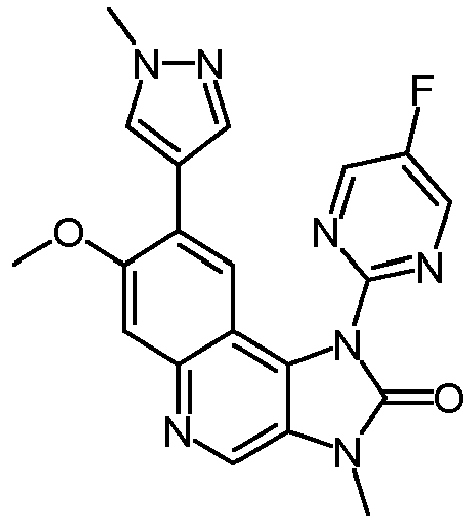
1-(5-Fluor-pyrimidin-2-yl)-7-methoxy-3-methyl-8-(1-methyl-1H-pyrazol-4-yl)-1 ,3-dihydro-imidazo[4,5-c]chinolin-2-on 
8-(1-Ethyl-1 H-pyrazol-4-yl)-1-(3-fluor-5-methyl-pyridin-4-yl)-7-methoxy-3-methyl-1,3-dihydro-imidazo[4,5-c]chinolin-2-on 
8-(1,3-Dimethyl-1 H-pyrazol-4-yl)-1-(3-fluor-5-methyl-pyridin-4-yl)-7-methoxy-3-methyl-1,3-dihydro-imidazo[4,5-c]chinolin-2-on 
7-Methoxy-3-methyl-8-(1-methyl-1 H-pyrazol-4-yl)-1-(3-methyl-pyridin-4-yl)-1,3-dihydro-imidazo[4,5-c]chinolin-2-on 
1-(5-Fluor-pyridin-2-yl)-7-methoxy-3-methyl-8-(1-methyl-1 H-pyrazol-4-yl)-1 ,3-dihydro-imidazo[4,5-c]chinolin-2-on 
1-(3-Fluor-pyridin-2-yl)-7-methoxy-3-methyl-8-(1-methyl-1 H-[1 ,2,3]triazol-4-yl)-1,3-dihydro-imidazo[4,5-c]chinolin-2-on 
7-Methoxy-3-methyl-8-(1-methyl-1 H-pyrazol-4-yl)-1-pyrimidin-2-yl-1,3-dihydro-imidazo[4,5-c]chinolin-2-on 
1-(3-Ethyl-5-methyl-pyridin-4-yl)-7-methoxy-3-methyl-8-(1-methyl-1 H-pyrazol-4-yl)-1 ,3-dihydro-imidazo[4,5-c]chinolin-2-on 
7-Methoxy-3-methyl-8-(1-methyl-1 H-pyrazol-4-yl)-1-pyridin-2-yl-1,3-dihydro-imidazo[4,5-c]chinolin-2-on 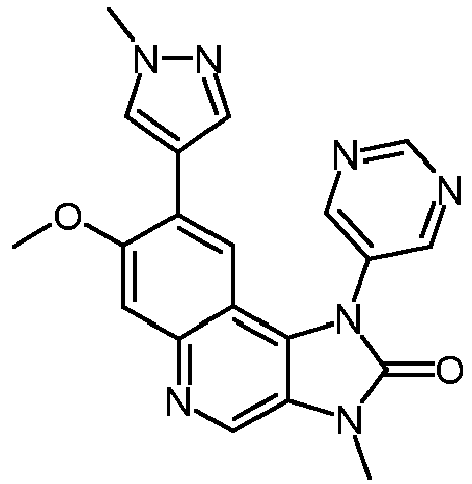
7-Methoxy-3-methyl-8-(1-methyl-1 H-pyrazol-4-yl)-1-pyrimidin-5-yl-1,3-dihydro-imidazo[4,5-c]chinolin-2-on 
7-Methoxy-3-methyl-8-(1-methyl-1 H-pyrazol-4-yl)-1-pyridin-4-yl-1,3-dihydro-imidazo[4,5-c]chinolin-2-on 
1-(3-Chlor-pyridin-4-yl)-7-methoxy-3-methyl-8-(1-methyl-1 H-pyrazol-4-yl)-1,3-dihydro-imidazo[4,5-c]chinolin-2-on 
1-(3-Ethyl-5-methyl-pyridin-4-yl)-8-(1-ethyl-1 H-pyrazol-4-yl)-7-methoxy-3-methyl-1,3-dihydro-imidazo[4,5-c]chinolin-2-on 
8-(1-Ethyl-1H-pyrazol-4-yl)-7-methoxy-3-methyl-1-pyridin-4-yl-1,3-dihydro-imidazo[4,5-c]chinolin-2-on 
1-(3-Fluor-5-methyl-pyridin-4-yl)-7-methoxy-3-methyl-8-(1-methyl-1 H-[1,2,3]triazol-4-yl)-1,3-dihydro-imidazo[4,5-c]chinolin-2-on 
1-(3-Fluor-pyridin-4-yl)-7-methoxy-3-methyl-8-(1-methyl-1H-[1,2,3]triazol-4-yl)-1,3-dihydro-imidazo[4,5-c]chinolin-2-on 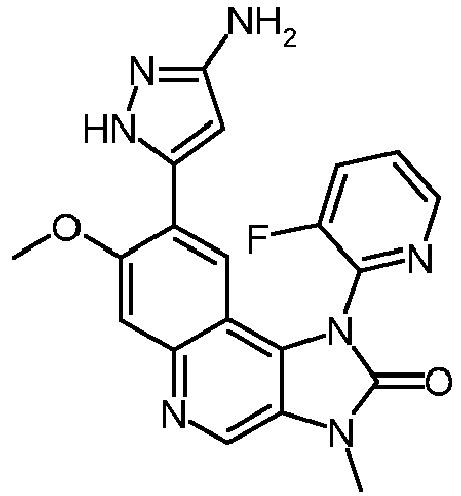
8-(3-Amino-1 H-pyrazol-5-yl)-1-(3-fluor-2-pyridyl)-7-methoxy-3-methyl-imidazo[4,5-c]chinolin-2-on 
1-[3-Fluor-5-(2-methoxyethoxy)-2-pyridyl]-7-methoxy-3-methyl-8-(1-methyl pyrazol-4-yl)imidazo[4,5-c]chinolin-2-on 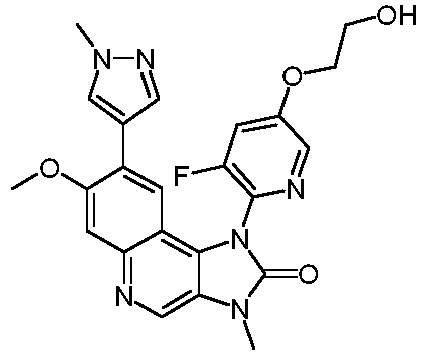
1-[3-Fluor-5-(2-hydroxyethoxy)-2-pyridyl]-7-methoxy-3-methyl-8-(1-methyl pyrazol-4-yl)imidazo[4,5-c]chinolin-2-on 
7-Methoxy-3-methyl-8-(1-methyl-1 H-pyrazol-4-yl)-1-chinolin-2-yl-1,3-dihydro-imidazo[4,5-c]chinolin-2-on 
7-Methoxy-3-methyl-8-(1-methyl-1 H-pyrazol-4-yl)-1-(1 H-pyrrolo[2,3-b]pyridin-6-yl)1,3-dihydro-imidazo[4,5-c]chinolin-2-on 
1-(3,5-Difluor-pyridin-2-yl)-7-methoxy-3-methyl-8-(2-methyl-2H-[1,2,3]triazol-4-yl)-1,3-dihydro-imidazo[4,5-c] chinolin-2-on 
1-(3-Fluor-5-methyl-pyridin-4-yl)-7-methoxy-3-methyl-8-(2-methyl-2H-[1,2,3]triazol-4-yl)-1,3-dihydro-imidazo[4,5-c] chinolin-2-on 
8-(1-Ethyl-1H-pyrazol-4-yl)-7-methoxy-1-(3-methoxy-pyridin-4-yl)-3-methyl-1,3-dihydro-imidazo[4,5-c] chinolin-2-on 
1-(3-Fluor-5-methoxy-pyridin-2-yl)-7-methoxy-3-methyl-8-(1-methyl-1H-pyrazol-4-yl)-1,3-dihydro-imidazo[4,5-c]chinolin-2-on 
8-(1,3-Dimethyl-1H-pyrazol-4-yl)-1-(3-fluor-5-methoxy-pyridin-2-yl)-7-methoxy-3-methyl-1,3-dihydro-imidazo[4,5-c]chinolin-2-on 
1-(3,5-Difluor-pyridin-2-yl)-7-methoxy-8-(1-methyl-1 H-pyrazol-4-yl)-1,3-dihydro-imidazo[4,5-c]chinolin-2-on 
1-(3,5-Difluor-pyridin-2-yl)-8-(1,3-dimethyl-1 H-pyrazol-4-yl)-7-methoxy-1,3-dihydro-imidazo[4,5-c]chinolin-2-on 
1-(3-Fluor-5-methoxy-pyridin-2-yl)-7-methoxy-3-methyl-8-(2H-pyrazol-3-yl)-1,3-dihydro-imidazo[4,5-c] chinolin-2-on 
1-(3-Fluor-5-fluormethoxy-pyridin-2-yl)-7-methoxy-3-methyl-8-(1-methyl-1H-pyrazol-4-yl)-1,3-dihydro-imidazo[4,5-c]chinolin-2-on 
8-(1-Ethyl-1 H-pyrazol-4-yl)-1-(3-fluor-5-methoxy-pyridin-2-yl)-7-methoxy-3-methyl-1,3-dihydro-imidazo[4,5-c] chinolin-2-on 
1-(3-Ethyl-5-fluor-pyridin-4-yl)-7-methoxy-3-methyl-8-(2-methyl-2H-[1,2,3]triazol-4-yl)-1,3-dihydro-imidazo[4,5-c] chinolin-2-on 
1-(5-Ethoxy-3-fluor-pyridin-2-yl)-7-methoxy-3-methyl-8-(1-methyl-1 H-pyrazol-4-yl)-1 ,3-dihydro-imidazo[4,5-c]chinolin-2-on 
1-(5-Difluormethoxy-3-fluor-pyridin-2-yl)-7-methoxy-3-methyl-8-(1-methyl-1 H-pyrazol-4-yl)-1,3-dihydro-imidazo[4,5-c]chinolin-2-on 
1-(3-Fluor-5-methoxy-pyridin-2-yl)-7-methoxy-8-(1-methyl-1 H-pyrazol-4-yl)-1 ,3-dihydro-imidazo[4,5-c]chinolin-2-on 
1-(3-Fluor-5-methoxy-pyridin-4-yl)-7-methoxy-8-(1-methyl-1 H-pyrazol-4-yl)-1 ,3-dihydro-imidazo[4,5-c]chinolin-2-on 
1-(3,5-Difluor-pyridin-2-yl)-7-methoxy-3-methyl-8-(3-methyl-1 H-pyrazol-4-yl)-1,3-dihydro-imidazo[4,5-c]chinolin-2-on 
1-(5-Chlor-3-fluor-pyridin-2-yl)-7-methoxy-3-methyl-8-(1-methyl-1 H-pyrazol-4-yl)-1 ,3-dihydro-imidazo[4,5-c]chinolin-2-on 
7-Methoxy-3-methyl-8-(1-methyl-1 H-pyrazol-4-yl)-1-(1 H-pyrrolo[3,2-c]pyridin-6-yl)-1,3-dihydro-imidazo[4,5-c]chinolin-2-on 
1-(3-Fluor-5-methoxy-pyridin-2-yl)-7-methoxy-3-methyl-8-(3-methyl-1 H-pyrazol-4-yl)-1,3-dihydro-imidazo[4,5-c] chinolin-2-on 
1-(3-Fluor-5-piperazin-1-yl-pyridin-2-yl)-7-methoxy-3-methyl-8-(1-methyl-1H-pyrazol-4-yl)-1,3-dihydro-imidazo[4,5-c]chinolin-2-on 
1-(3-Ethyl-5-fluor-pyridin-4-yl)-7-methoxy-3-methyl-8-(2H-[1,2,3]triazol-4-yl)-1,3-dihydro-imidazo[4,5-c] chinolin-2-on 
1-(3-Ethyl-5-fluor-pyridin-4-yl)-7-methoxy-3-methyl-8-(1-methyl-1 H-[1,2,3]triazol-4-yl)-1,3-dihydro-imidazo[4,5-c] chinolin-2-on 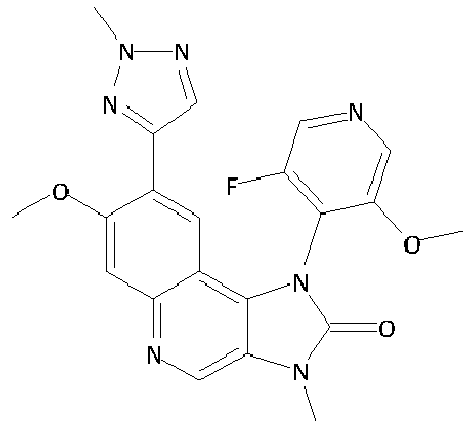
1-(3-Fluor-5-methoxy-pyridin-4-yl)-7-methoxy-3-methyl-8-(2-methyl-2H-[1,2,3]triazol-4-yl)-1,3-dihydro-imidazo[4,5-c] chinolin-2-on 
1-(3-Fluor-5-methoxy-pyridin-2-yl)-7-methoxy-3-methyl-8-(3H-[1,2,3]triazol-4-yl)-1,3-dihydro-imidazo[4,5-c] chinolin-2-on 
1-(3-Fluor-5-methoxy-pyridin-4-yl)-7-methoxy-3-methyl-8-(1-methyl-1H-[1,2,3]triazol-4-yl)-1,3-dihydro-imidazo[4,5-c]chinolin-2-on 
1-(1,3-Dimethyl-1 H-pyrazol-4-yl)-7-methoxy-3-methyl-8-(2-methyl-3H-benzoimidazol-5-yl)-1,3-dihydro-imidazo[4,5-c]chinolin-2-on 
1-(3-Fluor-5-methoxy-pyridin-2-yl)-7-methoxy-3-methyl-8-(1-methyl-1H-[1,2,3]triazol-4-yl)-1,3-dihydro-imidazo[4,5-c] chinolin-2-on 
1-(3-Fluor-5-methoxy-pyridin-4-yl)-7-methoxy-3-methyl-8-(3H-[1,2,3]triazol-4-yl)-1,3-dihydro-imidazo[4,5-c] chinolin-2-on 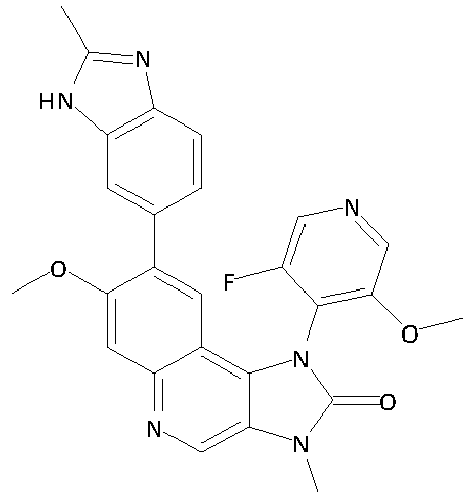
1-(3-Fluor-5-methoxy-pyridin-4-yl)-7-methoxy-3-methyl-8-(2-methyl-3H-benzoimidazol-5-yl)-1,3-dihydro-imidazo[4,5-c]chinolin-2-on 
1-(3-Fluor-5-methoxy-pyridin-4-yl)-7-methoxy-8-(6-methoxy-pyridin-3-yl)-3-methyl-1,3-dihydro-imidazo[4,5-c]chinolin-2-on 
5-Fluor-6-[7-methoxy-3-methyl-8-(1-methyl-1 H-pyrazol-4-yl)-2-oxo-2,3-dihydro-imidazo[4,5-c]chinolin-1-yl]-N-methyl-nicotinamid 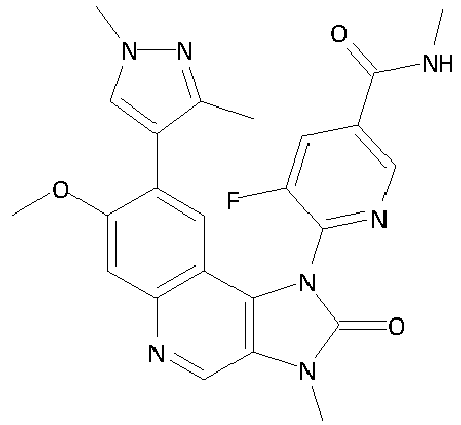
6-[8-(1,3-Dimethyl-1 H-pyrazol-4-yl)-7-methoxy-3-methyl-2-oxo-2,3-di hyd roimidazo[4,5-c]chinolin-1-yl]-5-fluor-N-methyl-nicotinamid 
1-(3-Fluor-1-methyl-1H-pyrazol-4-yl)-7-methoxy-3-methyl-8-(1-methyl-1H-pyrazol-4-yl)-1,3-dihydro-imidazo[4,5-c]chinolin-2-on 
1-(3-Fluor-5-methoxy-pyridin-2-yl)-7-methoxy-3-methyl-8-(2-methyl-3H-benzoimidazol-5-yl)-1,3-dihydro-imidazo[4,5-c]chinolin-2-on 
1-(3-Fluor-5-methoxy-pyridin-4-yl)-7-methoxy-3-methyl-8-(2-methyl-1 H-imidazo[4,5-b]pyridin-6-yl)-1,3-dihydro-imidazo[4,5-c]chinolin-2-on 
8-(3H-Benzimidazol-5-yl)-1-(3-fluor-5-methoxy-pyridin-2-yl)-7-methoxy-3-methyl-1,3-dihydro-imidazo[4,5-c]chinolin-2-on 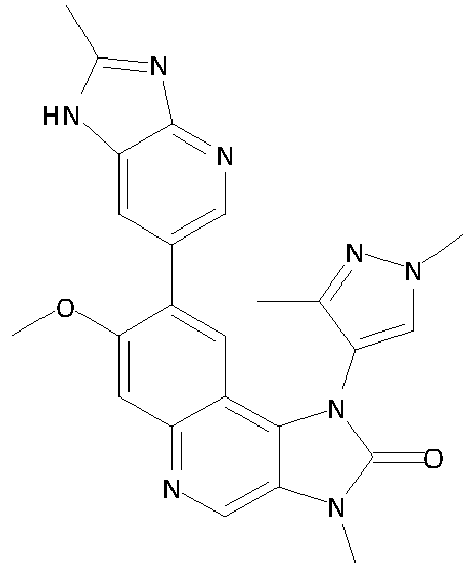
1-(1,3-Dimethyl-1 H-pyrazol-4-yl)-7-methoxy-3-methyl-8-(2-methyl-1 H-imidazo[4,5-b]pyridin-6-yl)-1,3-dihydro-imidazo[4,5-c]chinolin-2-on 
1-[3-Fluor-5-(trideuteriomethoxy)-2-pyridyl]-7-methoxy-3-methyl-8-(1-methylpyrazol-4-yl) imidazo[4,5-c]chinolin-2-on 
1-(3-Ethyl-pyridin-4-yl)-7-methoxy-3-methyl-8-(1-methyl-1 H-pyrazol-4-yl)-1,3-dihydro-imidazo[4,5-c] chinolin-2-on 
8-(1-Ethyl-1H-pyrazol-4-yl)-1-(3-ethyl-pyridin-4-yl)-7-methoxy-3-methyl-1,3-dihydro-imidazo[4,5-c] chinolin-2-on 
1-(3-Fluor-pyridin-2-yl)-7-methoxy-3-methyl-8-(2-methyl-2H-[1,2,3]triazol-4-yl)-1,3-dihydro-imidazo[4,5-c] chinolin-2-on 
1-(3-Fluor-1-methyl-1 H-pyrazol-4-yl)-7-methoxy-8-(6-methoxy-pyridin-3-yl)-3-methyl-1,3-dihydro-imidazo[4,5-c]chinolin-2-on 
1-(3-Cyclopropyl-pyridin-4-yl)-7-methoxy-3-methyl-8-(1-methyl-1 H-pyrazol-4-yl)-1 ,3-dihydro-imidazo[4,5-c] chinolin-2-on 
1-(3-Fluor-5-methylsulfonylmethoxy-pyridin-2-yl)-7-methoxy-3-methyl-8-(1-methyl-1 H-pyrazol-4-yl)-1,3-dihydro-imidazo[4,5-c]chinolin-2-on 
1-(3-Cyclopropyl-5-fluor-pyridin-4-yl)-7-methoxy-3-methyl-8-(1-methyl-1 H-pyrazol-4-yl)-1,3-dihydro-imidazo[4,5-c]chinolin-2-on 
8-(1,3-Dimethyl-1 H-pyrazol-4-yl)-1-(3-fluor-5-methylsulfonylmethoxy-pyridin-2-yl)-7-methoxy-3-methyl-1,3-dihydro-imidazo[4,5-c]chinolin-2-on 
1-(5-Allyloxy-3-fluor-pyridin-2-yl)-7-methoxy-3-methyl-8-(1-methyl-1 H-pyrazol-4-yl)-1 ,3-dihydro-imidazo[4,5-c]chinolin-2-on 
1-[5-(Azetidin-3-yloxy)-3-fluor-pyridin-2-yl]-7-methoxy-3-methyl-8-(1-methyl- 1 H-pyrazol-4-yl)-1,3-dihydro-imidazo[4,5-c]chinolin-2-on 
1-[3-Fluor-5-(2-methylamino-ethoxy)-pyridin-2-yl]-7-methoxy-3-methyl-8-(1-methyl-1 H-pyrazol-4-yl)-1,3-dihydro-imidazo[4,5-c] chinolin-2-on 
1-[3-Fluor-5-(1-methyl-azetidin-3-ylmethoxy)-pyridin-2-yl]-7-methoxy-3-methyl-8-(1-methyl-1 H-pyrazol-4-yl)-1 ,3-dihydro-imidazo[4,5-c]chinolin-2-on 
8-[1-(Azetidin-3-yl)-1 H-pyrazol-4-yl]-1-(3-fluor-5-methoxypyridin-4-yl)-7-methoxy-3-methyl-1 H,2H,3H-imidazo[4,5-c]chinolin-2-on - Verbindung nach Anspruch 1 und/oder pharmazeutisch verwendbares Salz, Solvat, oder Tautomer davon zur Verwendung als Medikament.
- Verbindung nach Anspruch 1 und/oder pharmazeutisch verwendbares Salz, Solvat, oder Tautomer davon zur Verwendung bei der Behandlung von Krankheiten, bei denen die Hemmung/Regulierung und/oder Modulation der Signaltransduktion von ATM-Kinase eine Rolle spielt oder zur Verwendung bei der Behandlung von Krankheiten, die durch Inhibierung von ATM Kinase beeinflusst werden.
- Verbindung nach Anspruch 1 und/oder pharmazeutisch verwendbares Salz, Solvat, oder Tautomer davon zur Verwendung bei der Behandlung von Krebs, Tumoren und/oder Metastasen.
- Verbindung nach Anspruch 1 und/oder pharmazeutisch verwendbares Salz, Solvat, oder Tautomer davon zur Verwendung bei der Behandlung von Krebs, Tumoren und/oder Metastasen in Kombination mit Radiotherapie.
- Verbindung nach Anspruch 1 und/oder pharmazeutisch verwendbares Salz, Solvat, oder Tautomer davon zur Verwendung bei der Behandlung von Krebs, Tumoren und/oder Metastasen in Kombination mit mindestens einem Antikrebsmittel.
- Verbindung nach Anspruch 1 und/oder pharmazeutisch verwendbares Salz, Solvat, oder Tautomer davon zur Verwendung in der Sensibilisierung von Krebszellen gegenüber einem Antikrebsmittel und/oder ionisierender Strahlung.
- Verbindung zur Verwendung nach einem der Ansprüche 4 bis 6, und/oder pharmazeutisch verwendbares Salz, Solvat, oder Tautomer davon, wobei der Tumor ausgewählt ist aus der Gruppe von Erkrankungen von Plattenepithel, Blase, Magen, Nieren, Kopf, Hals, Ösophagus, Gebärmutterhals, Schilddrüse, Darm, Knochen, Leber, Gehirn, Prostata, Urogenitaltrakts, lymphatisches System, Kehlkopf, Lunge, Haut, Blut und Immunsystem, und/oder der Krebs ausgewählt ist aus der Gruppe von Monozytenleukämie, Lungenadenokarzinom, kleinzelliges Lungenkarzinom, Bauchspeicheldrüsenkrebs, Glioblastom, Darmkarzinom, Brustkarzinom, akute myelotische Leukämie, chronische myelotische Leukämie, akute lymphatische Leukämie, chronische lymphatische Leukämie, Hodgkin-Lymphom und non-Hodgkin-Lymphom
- Pharmazeutische Zusammensetzung, enthaltend eine wirksame Menge mindestens einer Verbindung nach Anspruch 1 und/oder einem pharmazeutisch verwendbaren Salz, Solvat, oder Tautomer davon, optional zusammen mit mindestens einem pharmazeutisch verträglichen Hilfsstoff.
- Pharmazeutische Zusammensetzung nach Anspruch 9, ferner enthaltend mindestens einen weiteren Arzneimittelwirkstoff, bevorzugt mindestens ein Antikrebsmittel.
- Kit, bestehend aus getrennten Packungen von(a) einer wirksamen Menge einer Verbindung nach Anspruch 1 und/oder pharmazeutisch verwendbares Salz, Solvat, oder Tautomer, davon, und(b) einer wirksamen Menge eines weiteren Arzneimittelwirkstoffs, bevorzugt eines Antikrebsmittels.
Applications Claiming Priority (4)
| Application Number | Priority Date | Filing Date | Title |
|---|---|---|---|
| EP15000968 | 2015-04-02 | ||
| PCT/EP2016/000542 WO2016155884A1 (de) | 2015-04-02 | 2016-03-31 | Imidazolonylchinoline und deren verwendung als atm kinase inhibitoren |
| EP16717560.3A EP3277681B1 (de) | 2015-04-02 | 2016-03-31 | Imidazolonylchinoline und deren verwendung als atm kinase inhibitoren |
| EP19172903.7A EP3560924B1 (de) | 2015-04-02 | 2016-03-31 | Imidazolonylchinoline und deren verwendung als atm-kinase-inhibitoren |
Related Parent Applications (2)
| Application Number | Title | Priority Date | Filing Date |
|---|---|---|---|
| EP19172903.7A Division EP3560924B1 (de) | 2015-04-02 | 2016-03-31 | Imidazolonylchinoline und deren verwendung als atm-kinase-inhibitoren |
| EP16717560.3A Division EP3277681B1 (de) | 2015-04-02 | 2016-03-31 | Imidazolonylchinoline und deren verwendung als atm kinase inhibitoren |
Publications (2)
| Publication Number | Publication Date |
|---|---|
| EP3868761A1 true EP3868761A1 (de) | 2021-08-25 |
| EP3868761B1 EP3868761B1 (de) | 2023-03-01 |
Family
ID=52814780
Family Applications (3)
| Application Number | Title | Priority Date | Filing Date |
|---|---|---|---|
| EP21165573.3A Active EP3868761B1 (de) | 2015-04-02 | 2016-03-31 | Imidazolonylchinoline und deren verwendung als atm kinase inhibitoren |
| EP16717560.3A Active EP3277681B1 (de) | 2015-04-02 | 2016-03-31 | Imidazolonylchinoline und deren verwendung als atm kinase inhibitoren |
| EP19172903.7A Active EP3560924B1 (de) | 2015-04-02 | 2016-03-31 | Imidazolonylchinoline und deren verwendung als atm-kinase-inhibitoren |
Family Applications After (2)
| Application Number | Title | Priority Date | Filing Date |
|---|---|---|---|
| EP16717560.3A Active EP3277681B1 (de) | 2015-04-02 | 2016-03-31 | Imidazolonylchinoline und deren verwendung als atm kinase inhibitoren |
| EP19172903.7A Active EP3560924B1 (de) | 2015-04-02 | 2016-03-31 | Imidazolonylchinoline und deren verwendung als atm-kinase-inhibitoren |
Country Status (23)
| Country | Link |
|---|---|
| US (5) | US10457677B2 (de) |
| EP (3) | EP3868761B1 (de) |
| JP (2) | JP6791873B2 (de) |
| KR (2) | KR102652052B1 (de) |
| CN (3) | CN107889488B (de) |
| AU (4) | AU2016239270B2 (de) |
| BR (1) | BR122019005502B1 (de) |
| DK (2) | DK3277681T3 (de) |
| ES (3) | ES2880626T3 (de) |
| HR (2) | HRP20191396T1 (de) |
| HU (2) | HUE054745T2 (de) |
| IL (3) | IL254714B (de) |
| LT (2) | LT3277681T (de) |
| MX (2) | MX390537B (de) |
| PL (2) | PL3560924T3 (de) |
| PT (2) | PT3277681T (de) |
| RS (2) | RS62082B1 (de) |
| RU (1) | RU2743343C2 (de) |
| SG (2) | SG10202002181UA (de) |
| SI (2) | SI3277681T1 (de) |
| TR (1) | TR201911244T4 (de) |
| WO (1) | WO2016155884A1 (de) |
| ZA (1) | ZA201707423B (de) |
Families Citing this family (40)
| Publication number | Priority date | Publication date | Assignee | Title |
|---|---|---|---|---|
| RS62082B1 (sr) * | 2015-04-02 | 2021-08-31 | Merck Patent Gmbh | Imidazolonilhinolini i njihova primena kao inhibitora atm kinaze |
| GB201516504D0 (en) | 2015-09-17 | 2015-11-04 | Astrazeneca Ab | Imadazo(4,5-c)quinolin-2-one Compounds and their use in treating cancer |
| GB201519406D0 (en) * | 2015-11-03 | 2015-12-16 | Astrazeneca Ab | Imidazo[4,5-c]quinolin-2-one compounds and their use in treating cancer |
| CN110312717B (zh) * | 2017-02-27 | 2022-04-12 | 上海瑛派药业有限公司 | 取代的稠合杂芳三环化合物作为激酶抑制剂及其应用 |
| JOP20190209A1 (ar) * | 2017-03-16 | 2019-09-12 | Astrazeneca Ab | مركبات إيميدازو [ 4، 5-c ] كينولين-2-أون ديوترومية واستخدامها في علاج السرطان |
| MX2020007442A (es) | 2018-01-12 | 2020-09-14 | Prolynx Llc | Protocolo para minimizar la toxicidad de dosificaciones de combinacion y agente formador de imagen para verificacion. |
| EP3765019A1 (de) | 2018-03-14 | 2021-01-20 | Merck Patent GmbH | Verbindungen und verwendungen davon zur behandlung von tumoren in einem subjekt |
| FI3904350T3 (fi) | 2018-04-12 | 2023-11-15 | Bayer Ag | N-(syklopropyylimetyyli)-5-(metyylisulfonyyli)-n-{1-[1-(pyrimidin-2-yyli)-1h-1,2,4-triatsol-5-yyli]etyyli}bentsamidijohdannaisia ja vastaavia pyridiinikarboksamidijohdannaisia tuholaistorjunta-aineina |
| WO2019201283A1 (en) * | 2018-04-20 | 2019-10-24 | Xrad Therapeutics, Inc. | Dual atm and dna-pk inhibitors for use in anti-tumor therapy |
| CN110386932A (zh) * | 2018-04-20 | 2019-10-29 | 艾科思莱德制药公司 | 用于抗肿瘤疗法中的双重atm和dna-pk抑制剂 |
| GB201814487D0 (en) * | 2018-09-06 | 2018-10-24 | Cycle Pharmaceuticals Ltd | Cancer |
| CN109045042A (zh) * | 2018-09-21 | 2018-12-21 | 上海交通大学医学院附属上海儿童医学中心 | Atm抑制剂在制备抑制急性淋巴细胞性白血病复发的药物中的应用 |
| CN112771045B (zh) * | 2018-09-30 | 2022-04-19 | 南京明德新药研发有限公司 | 喹啉并吡咯烷-2-酮类衍生物及其应用 |
| RS65518B1 (sr) | 2019-03-27 | 2024-06-28 | Merck Patent Gmbh | Jedinjenja imidazolonilhinolina i njihova terapijska upotreba |
| ES3008232T3 (en) * | 2019-07-30 | 2025-03-21 | Xrad Therapeutics Inc | Dual atm and dna-pk inhibitors for use in anti-tumor therapy |
| WO2021084124A1 (en) | 2019-11-01 | 2021-05-06 | Ares Trading S.A. | COMBINED INHIBITION OF PD-1, TGFβ AND ATM TOGETHER WITH RADIOTHERAPY FOR THE TREATMENT OF CANCER |
| JP7727627B2 (ja) * | 2019-12-04 | 2025-08-21 | シーエイチディーアイ ファウンデーション,インコーポレーテッド | Atmキナーゼ阻害剤及び組成物並びにそれらの使用の方法 |
| WO2021139814A1 (zh) * | 2020-01-09 | 2021-07-15 | 南京明德新药研发有限公司 | 喹啉并咪唑类化合物及其应用 |
| CN115380031A (zh) * | 2020-03-30 | 2022-11-22 | 南京明德新药研发有限公司 | 作为atm抑制剂的喹啉并吡咯烷-2-酮类化合物的晶型及其应用 |
| IL299178A (en) * | 2020-06-18 | 2023-02-01 | Merck Patent Gmbh | Atm inhibitors for use in treatment of viral infections |
| US20230256110A1 (en) | 2020-06-24 | 2023-08-17 | Astrazeneca Uk Limited | Combination of antibody-drug conjugate and atm inhibitor |
| MX2023002792A (es) | 2020-09-18 | 2023-03-16 | Merck Patent Gmbh | Preparacion farmaceutica. |
| EP4142710B1 (de) | 2020-09-21 | 2024-01-31 | Wei Zhong | Substituierte 1-(3,3-difluorpiperidin-4-yl)-imidazo[4,5-c chinolin-2-on-verbindungen mit blut-hirn-schranke-durchdringbarer fähigkeit |
| EP3992191A1 (de) | 2020-11-03 | 2022-05-04 | Deutsches Krebsforschungszentrum | Imidazo[4,5-c]chinolin-verbindungen und deren verwendung als atm-kinase-inhibitoren |
| CN115232122B (zh) * | 2021-04-23 | 2024-05-31 | 石药集团中奇制药技术(石家庄)有限公司 | 炔类化合物及其制备和应用 |
| CN115716829B (zh) * | 2022-11-13 | 2024-05-31 | 药康众拓(江苏)医药科技有限公司 | 一种喹啉并咪唑酮联氘代吡唑类化合物及其应用 |
| AU2023385854A1 (en) | 2022-11-23 | 2025-06-12 | Forward Therapeutics, Inc. | MODULATORS OF TNF-α ACTIVITY |
| WO2025157979A1 (en) | 2024-01-26 | 2025-07-31 | Merck Patent Gmbh | Synthesis route for preparing 8-(1,3-dimethyl-1h-pyrazol-4-yl)-1-(sa)-(3-fluoro-5-methoxy-pyridin-4-yl)-7-methoxy-3-methyl-1,3-dihydro-imidazo[4,5-c]quinolin-2-one |
| WO2025212627A1 (en) | 2024-04-03 | 2025-10-09 | Forward Therapeutics, Inc. | Modulators of tnf-alpha activity |
| WO2025217307A1 (en) | 2024-04-09 | 2025-10-16 | Revolution Medicines, Inc. | Methods for predicting response to a ras(on) inhibitor and combination therapies |
| TW202547461A (zh) | 2024-05-17 | 2025-12-16 | 美商銳新醫藥公司 | Ras抑制劑 |
| WO2025255438A1 (en) | 2024-06-07 | 2025-12-11 | Revolution Medicines, Inc. | Methods of treating a ras protein-related disease or disorder |
| WO2025265060A1 (en) | 2024-06-21 | 2025-12-26 | Revolution Medicines, Inc. | Therapeutic compositions and methods for managing treatment-related effects |
| WO2026006747A1 (en) | 2024-06-28 | 2026-01-02 | Revolution Medicines, Inc. | Ras inhibitors |
| WO2026015801A1 (en) | 2024-07-12 | 2026-01-15 | Revolution Medicines, Inc. | Methods of treating a ras related disease or disorder |
| WO2026015796A1 (en) | 2024-07-12 | 2026-01-15 | Revolution Medicines, Inc. | Methods of treating a ras related disease or disorder |
| WO2026015790A1 (en) | 2024-07-12 | 2026-01-15 | Revolution Medicines, Inc. | Methods of treating a ras related disease or disorder |
| WO2026015825A1 (en) | 2024-07-12 | 2026-01-15 | Revolution Medicines, Inc. | Use of ras inhibitor for treating pancreatic cancer |
| WO2026050446A1 (en) | 2024-08-29 | 2026-03-05 | Revolution Medicines, Inc. | Ras inhibitors |
| WO2026072904A2 (en) | 2024-09-26 | 2026-04-02 | Revolution Medicines, Inc. | Compositions and methods for treating lung cancer |
Citations (3)
| Publication number | Priority date | Publication date | Assignee | Title |
|---|---|---|---|---|
| WO2010139731A1 (en) | 2009-06-04 | 2010-12-09 | Novartis Ag | 1H-IMIDAZO[4,5-c]QUINOLINONE DERIVATIVES |
| WO2011054846A1 (en) * | 2009-11-05 | 2011-05-12 | Glaxosmithkline Llc | Imidazo [4, 5-c] quinoline derivates as bromodomain inhibitors |
| WO2012028233A1 (de) * | 2010-08-28 | 2012-03-08 | Merck Patent Gmbh | Imidazo [4,5-c]chinoline als dna-pk-inhibitoren |
Family Cites Families (22)
| Publication number | Priority date | Publication date | Assignee | Title |
|---|---|---|---|---|
| US6221335B1 (en) * | 1994-03-25 | 2001-04-24 | Isotechnika, Inc. | Method of using deuterated calcium channel blockers |
| PT1104760E (pt) * | 1999-12-03 | 2003-06-30 | Pfizer Prod Inc | Compostos de sulfamoil-heteroarilpirazole como agentes analgesicos e anti-inflamatorios |
| GB0211649D0 (en) | 2002-05-21 | 2002-07-03 | Novartis Ag | Organic compounds |
| PL1879893T3 (pl) | 2005-03-21 | 2010-11-30 | Ferrer Int | Sposób otrzymywania podstawionych w pozycji 1, związków 1H-imidazo[4,5-c]chinolino-4-aminowych i związki pośrednie |
| GB0510390D0 (en) | 2005-05-20 | 2005-06-29 | Novartis Ag | Organic compounds |
| EP1934201A1 (de) * | 2005-10-06 | 2008-06-25 | Auspex Pharmaceuticals Inc. | Deuterierte hemmer von gastrischer h+, k+-atpase mit verstärkten therapeutischen eigenschaften |
| US7750168B2 (en) * | 2006-02-10 | 2010-07-06 | Sigma-Aldrich Co. | Stabilized deuteroborane-tetrahydrofuran complex |
| AU2008218806B2 (en) | 2007-02-20 | 2011-12-01 | Novartis Ag | Imidazoquinolines as dual lipid kinase and mTOR inhibitors |
| KR20100126553A (ko) | 2008-03-26 | 2010-12-01 | 노파르티스 아게 | Vegf-유도성 혈관신생 과정의 유력한 조절제로서의 이미다조퀴놀린 및 피리미딘 유도체 |
| CN104592231A (zh) | 2008-06-10 | 2015-05-06 | Abbvie公司 | 新的三环化合物 |
| CN102170873B (zh) | 2008-10-01 | 2014-07-30 | 诺华股份有限公司 | 用于治疗与hedgehog通路有关的病症的smoothened拮抗 |
| JP2012528829A (ja) | 2009-06-04 | 2012-11-15 | ノバルティス アーゲー | 1H−イミダゾ[4,5−c]キノリノン化合物 |
| BR112012022868A2 (pt) * | 2010-03-16 | 2018-06-05 | Merck Patent Gmbh | morfolinilquinazolinas |
| AU2011273931B2 (en) * | 2010-06-28 | 2015-04-23 | Merck Patent Gmbh | 2,4- diaryl - substituted [1,8] naphthyridines as kinase inhibitors for use against cancer |
| CN102372711B (zh) | 2010-08-18 | 2014-09-17 | 山东轩竹医药科技有限公司 | 咪唑并喹啉类PI3K和mTOR双重抑制剂 |
| CN102399218A (zh) | 2010-09-16 | 2012-04-04 | 和记黄埔医药(上海)有限公司 | 一类并合三杂环及其作为pi3k抑制剂的用途 |
| WO2012075253A2 (en) | 2010-12-03 | 2012-06-07 | Novartis Ag | Pharmaceutical compositions |
| CN103012398B (zh) | 2011-09-19 | 2015-10-14 | 上海恒瑞医药有限公司 | 咪唑并喹啉类衍生物及其可药用盐、其制备方法及其在医药上的应用 |
| US9879003B2 (en) | 2012-04-11 | 2018-01-30 | Dana-Farber Cancer Institute, Inc. | Host targeted inhibitors of dengue virus and other viruses |
| RU2014154009A (ru) | 2012-06-06 | 2016-08-10 | Новартис Аг | Комбинация ингибитора 17-альфа-гидроксилазы (с17,20-лиазы) и специфического ингибитора pi-3k для лечения онкологического заболевания |
| NO2714752T3 (de) * | 2014-05-08 | 2018-04-21 | ||
| RS62082B1 (sr) | 2015-04-02 | 2021-08-31 | Merck Patent Gmbh | Imidazolonilhinolini i njihova primena kao inhibitora atm kinaze |
-
2016
- 2016-03-31 RS RS20210817A patent/RS62082B1/sr unknown
- 2016-03-31 RU RU2017138100A patent/RU2743343C2/ru active
- 2016-03-31 US US15/563,680 patent/US10457677B2/en active Active
- 2016-03-31 TR TR2019/11244T patent/TR201911244T4/tr unknown
- 2016-03-31 EP EP21165573.3A patent/EP3868761B1/de active Active
- 2016-03-31 ES ES19172903T patent/ES2880626T3/es active Active
- 2016-03-31 SI SI201630345T patent/SI3277681T1/sl unknown
- 2016-03-31 PL PL19172903T patent/PL3560924T3/pl unknown
- 2016-03-31 HR HRP20191396 patent/HRP20191396T1/hr unknown
- 2016-03-31 SG SG10202002181UA patent/SG10202002181UA/en unknown
- 2016-03-31 CN CN201680031887.8A patent/CN107889488B/zh active Active
- 2016-03-31 HU HUE19172903A patent/HUE054745T2/hu unknown
- 2016-03-31 KR KR1020177031770A patent/KR102652052B1/ko active Active
- 2016-03-31 PT PT16717560T patent/PT3277681T/pt unknown
- 2016-03-31 BR BR122019005502-5A patent/BR122019005502B1/pt active IP Right Grant
- 2016-03-31 EP EP16717560.3A patent/EP3277681B1/de active Active
- 2016-03-31 ES ES21165573T patent/ES2946507T3/es active Active
- 2016-03-31 SI SI201631240T patent/SI3560924T1/sl unknown
- 2016-03-31 JP JP2017551589A patent/JP6791873B2/ja active Active
- 2016-03-31 HU HUE16717560A patent/HUE045477T2/hu unknown
- 2016-03-31 KR KR1020247009513A patent/KR20240044525A/ko active Pending
- 2016-03-31 WO PCT/EP2016/000542 patent/WO2016155884A1/de not_active Ceased
- 2016-03-31 PL PL16717560T patent/PL3277681T3/pl unknown
- 2016-03-31 AU AU2016239270A patent/AU2016239270B2/en active Active
- 2016-03-31 LT LTEP16717560.3T patent/LT3277681T/lt unknown
- 2016-03-31 MX MX2020011558A patent/MX390537B/es unknown
- 2016-03-31 SG SG11201708065QA patent/SG11201708065QA/en unknown
- 2016-03-31 CN CN202010644109.4A patent/CN111747952A/zh active Pending
- 2016-03-31 PT PT191729037T patent/PT3560924T/pt unknown
- 2016-03-31 ES ES16717560T patent/ES2741853T3/es active Active
- 2016-03-31 MX MX2017012613A patent/MX376947B/es active IP Right Grant
- 2016-03-31 LT LTEP19172903.7T patent/LT3560924T/lt unknown
- 2016-03-31 RS RS20190993A patent/RS59139B1/sr unknown
- 2016-03-31 CN CN202010644289.6A patent/CN111689963A/zh active Pending
- 2016-03-31 EP EP19172903.7A patent/EP3560924B1/de active Active
- 2016-03-31 DK DK16717560.3T patent/DK3277681T3/da active
- 2016-03-31 DK DK19172903.7T patent/DK3560924T3/da active
-
2017
- 2017-09-26 IL IL254714A patent/IL254714B/en active IP Right Grant
- 2017-11-01 ZA ZA2017/07423A patent/ZA201707423B/en unknown
-
2019
- 2019-03-14 US US16/353,559 patent/US10745399B2/en active Active
- 2019-12-17 IL IL271494A patent/IL271494B/en active IP Right Grant
-
2020
- 2020-06-24 US US16/910,438 patent/US10975075B2/en active Active
- 2020-06-25 AU AU2020204241A patent/AU2020204241B2/en active Active
- 2020-11-05 JP JP2020185129A patent/JP7111790B2/ja active Active
-
2021
- 2021-03-17 US US17/204,619 patent/US11608338B2/en active Active
- 2021-04-22 IL IL282584A patent/IL282584B/en unknown
- 2021-06-23 HR HRP20210981TT patent/HRP20210981T1/hr unknown
-
2022
- 2022-10-21 AU AU2022256215A patent/AU2022256215A1/en not_active Abandoned
-
2023
- 2023-03-01 US US18/116,094 patent/US20230203034A1/en active Pending
-
2025
- 2025-01-20 AU AU2025200385A patent/AU2025200385A1/en active Pending
Patent Citations (3)
| Publication number | Priority date | Publication date | Assignee | Title |
|---|---|---|---|---|
| WO2010139731A1 (en) | 2009-06-04 | 2010-12-09 | Novartis Ag | 1H-IMIDAZO[4,5-c]QUINOLINONE DERIVATIVES |
| WO2011054846A1 (en) * | 2009-11-05 | 2011-05-12 | Glaxosmithkline Llc | Imidazo [4, 5-c] quinoline derivates as bromodomain inhibitors |
| WO2012028233A1 (de) * | 2010-08-28 | 2012-03-08 | Merck Patent Gmbh | Imidazo [4,5-c]chinoline als dna-pk-inhibitoren |
Non-Patent Citations (15)
| Title |
|---|
| ALESSI ET AL., FEBS LETT, vol. 399, no. 3, 1996, pages 333 |
| BHIDENUTTING, BMC MEDICINE, vol. 8, 2010, pages 25 |
| CAMPOS-GONZÄLEZGLENNEY, JBC, vol. 267, 1992, pages 14535 |
| CHOIHUNG, CURRENT UROLOGY REPORTS, vol. 11, no. 3, 2010, pages 172 |
| HERRMANN ET AL.: "Klinische Strahlenbiologie", 2006, ELSEVIER, pages: 67 - 68 |
| HICKSON, I. ET AL., CANCER RES, vol. 64, 2004, pages 9152 - 9159 |
| INT. J. PHARM., vol. 115, 1995, pages 61 - 67 |
| KHWAJA ET AL., EMBO, vol. 16, 1997, pages 2783 |
| LAVINSHILOH, ANNU. REV. IMMUNOL., vol. 15, 1997, pages 177 |
| R. DANIEL, SCIENCE, vol. 284, 1999, pages 644 |
| ROTMANSHILOH, HUM. MOL. GENET., vol. 7, 1998, pages 1555 |
| SILLS ET AL., J BIOMOLECULAR SCREENING, vol. 7, 2002, pages 191 |
| STEPHENS ET AL., BIOCHEMICAL J, vol. 351, 2000, pages 95 |
| VECCHIO D ET AL., INT. J. CANCER, vol. 136, 2015, pages 1445 |
| WHITE ET AL., ONCOGENE, vol. 20, 2001, pages 7064 |
Also Published As
Similar Documents
| Publication | Publication Date | Title |
|---|---|---|
| EP3868761B1 (de) | Imidazolonylchinoline und deren verwendung als atm kinase inhibitoren | |
| EP2609082B1 (de) | Imidazo[4,5-c]chinoline als dna-pk-inhibitoren | |
| EP2780332B1 (de) | Morpholinylbenzotriazine zur anwendung in der krebstherapie | |
| EP2588457B1 (de) | Pyrazolochinolinderivate als dna-pk-inhibitoren | |
| DE102013008118A1 (de) | Arylchinazoline | |
| EP2794602A1 (de) | 3-cyanaryl-1h-pyrazolo-(2,3-b-)pyridinderivate | |
| DE60106947T2 (de) | Oxindolderivate | |
| CA2981365C (en) | Imidazolonylquinolines and the use thereof as atm kinase inhibitors | |
| BR112017020941B1 (pt) | Imidazolonilquinolinas, seus usos, composições farmacêuticas, e kit |
Legal Events
| Date | Code | Title | Description |
|---|---|---|---|
| PUAI | Public reference made under article 153(3) epc to a published international application that has entered the european phase |
Free format text: ORIGINAL CODE: 0009012 |
|
| STAA | Information on the status of an ep patent application or granted ep patent |
Free format text: STATUS: REQUEST FOR EXAMINATION WAS MADE |
|
| 17P | Request for examination filed |
Effective date: 20210329 |
|
| AC | Divisional application: reference to earlier application |
Ref document number: 3560924 Country of ref document: EP Kind code of ref document: P Ref document number: 3277681 Country of ref document: EP Kind code of ref document: P |
|
| AK | Designated contracting states |
Kind code of ref document: A1 Designated state(s): AL AT BE BG CH CY CZ DE DK EE ES FI FR GB GR HR HU IE IS IT LI LT LU LV MC MK MT NL NO PL PT RO RS SE SI SK SM TR |
|
| GRAP | Despatch of communication of intention to grant a patent |
Free format text: ORIGINAL CODE: EPIDOSNIGR1 |
|
| STAA | Information on the status of an ep patent application or granted ep patent |
Free format text: STATUS: GRANT OF PATENT IS INTENDED |
|
| INTG | Intention to grant announced |
Effective date: 20220920 |
|
| GRAS | Grant fee paid |
Free format text: ORIGINAL CODE: EPIDOSNIGR3 |
|
| GRAA | (expected) grant |
Free format text: ORIGINAL CODE: 0009210 |
|
| STAA | Information on the status of an ep patent application or granted ep patent |
Free format text: STATUS: THE PATENT HAS BEEN GRANTED |
|
| AC | Divisional application: reference to earlier application |
Ref document number: 3277681 Country of ref document: EP Kind code of ref document: P Ref document number: 3560924 Country of ref document: EP Kind code of ref document: P |
|
| AK | Designated contracting states |
Kind code of ref document: B1 Designated state(s): AL AT BE BG CH CY CZ DE DK EE ES FI FR GB GR HR HU IE IS IT LI LT LU LV MC MK MT NL NO PL PT RO RS SE SI SK SM TR |
|
| REG | Reference to a national code |
Ref country code: GB Ref legal event code: FG4D Free format text: NOT ENGLISH |
|
| REG | Reference to a national code |
Ref country code: CH Ref legal event code: EP Ref country code: AT Ref legal event code: REF Ref document number: 1550911 Country of ref document: AT Kind code of ref document: T Effective date: 20230315 |
|
| REG | Reference to a national code |
Ref country code: DE Ref legal event code: R096 Ref document number: 502016015625 Country of ref document: DE |
|
| REG | Reference to a national code |
Ref country code: IE Ref legal event code: FG4D Free format text: LANGUAGE OF EP DOCUMENT: GERMAN |
|
| REG | Reference to a national code |
Ref country code: LT Ref legal event code: MG9D |
|
| P01 | Opt-out of the competence of the unified patent court (upc) registered |
Effective date: 20230519 |
|
| REG | Reference to a national code |
Ref country code: NL Ref legal event code: MP Effective date: 20230301 |
|
| REG | Reference to a national code |
Ref country code: ES Ref legal event code: FG2A Ref document number: 2946507 Country of ref document: ES Kind code of ref document: T3 Effective date: 20230720 |
|
| PG25 | Lapsed in a contracting state [announced via postgrant information from national office to epo] |
Ref country code: RS Free format text: LAPSE BECAUSE OF FAILURE TO SUBMIT A TRANSLATION OF THE DESCRIPTION OR TO PAY THE FEE WITHIN THE PRESCRIBED TIME-LIMIT Effective date: 20230301 Ref country code: NO Free format text: LAPSE BECAUSE OF FAILURE TO SUBMIT A TRANSLATION OF THE DESCRIPTION OR TO PAY THE FEE WITHIN THE PRESCRIBED TIME-LIMIT Effective date: 20230601 Ref country code: LV Free format text: LAPSE BECAUSE OF FAILURE TO SUBMIT A TRANSLATION OF THE DESCRIPTION OR TO PAY THE FEE WITHIN THE PRESCRIBED TIME-LIMIT Effective date: 20230301 Ref country code: LT Free format text: LAPSE BECAUSE OF FAILURE TO SUBMIT A TRANSLATION OF THE DESCRIPTION OR TO PAY THE FEE WITHIN THE PRESCRIBED TIME-LIMIT Effective date: 20230301 Ref country code: HR Free format text: LAPSE BECAUSE OF FAILURE TO SUBMIT A TRANSLATION OF THE DESCRIPTION OR TO PAY THE FEE WITHIN THE PRESCRIBED TIME-LIMIT Effective date: 20230301 |
|
| PG25 | Lapsed in a contracting state [announced via postgrant information from national office to epo] |
Ref country code: SE Free format text: LAPSE BECAUSE OF FAILURE TO SUBMIT A TRANSLATION OF THE DESCRIPTION OR TO PAY THE FEE WITHIN THE PRESCRIBED TIME-LIMIT Effective date: 20230301 Ref country code: PL Free format text: LAPSE BECAUSE OF FAILURE TO SUBMIT A TRANSLATION OF THE DESCRIPTION OR TO PAY THE FEE WITHIN THE PRESCRIBED TIME-LIMIT Effective date: 20230301 Ref country code: NL Free format text: LAPSE BECAUSE OF FAILURE TO SUBMIT A TRANSLATION OF THE DESCRIPTION OR TO PAY THE FEE WITHIN THE PRESCRIBED TIME-LIMIT Effective date: 20230301 Ref country code: GR Free format text: LAPSE BECAUSE OF FAILURE TO SUBMIT A TRANSLATION OF THE DESCRIPTION OR TO PAY THE FEE WITHIN THE PRESCRIBED TIME-LIMIT Effective date: 20230602 Ref country code: FI Free format text: LAPSE BECAUSE OF FAILURE TO SUBMIT A TRANSLATION OF THE DESCRIPTION OR TO PAY THE FEE WITHIN THE PRESCRIBED TIME-LIMIT Effective date: 20230301 |
|
| PG25 | Lapsed in a contracting state [announced via postgrant information from national office to epo] |
Ref country code: SM Free format text: LAPSE BECAUSE OF FAILURE TO SUBMIT A TRANSLATION OF THE DESCRIPTION OR TO PAY THE FEE WITHIN THE PRESCRIBED TIME-LIMIT Effective date: 20230301 Ref country code: RO Free format text: LAPSE BECAUSE OF FAILURE TO SUBMIT A TRANSLATION OF THE DESCRIPTION OR TO PAY THE FEE WITHIN THE PRESCRIBED TIME-LIMIT Effective date: 20230301 Ref country code: PT Free format text: LAPSE BECAUSE OF FAILURE TO SUBMIT A TRANSLATION OF THE DESCRIPTION OR TO PAY THE FEE WITHIN THE PRESCRIBED TIME-LIMIT Effective date: 20230703 Ref country code: EE Free format text: LAPSE BECAUSE OF FAILURE TO SUBMIT A TRANSLATION OF THE DESCRIPTION OR TO PAY THE FEE WITHIN THE PRESCRIBED TIME-LIMIT Effective date: 20230301 Ref country code: CZ Free format text: LAPSE BECAUSE OF FAILURE TO SUBMIT A TRANSLATION OF THE DESCRIPTION OR TO PAY THE FEE WITHIN THE PRESCRIBED TIME-LIMIT Effective date: 20230301 |
|
| PG25 | Lapsed in a contracting state [announced via postgrant information from national office to epo] |
Ref country code: SK Free format text: LAPSE BECAUSE OF FAILURE TO SUBMIT A TRANSLATION OF THE DESCRIPTION OR TO PAY THE FEE WITHIN THE PRESCRIBED TIME-LIMIT Effective date: 20230301 Ref country code: IS Free format text: LAPSE BECAUSE OF FAILURE TO SUBMIT A TRANSLATION OF THE DESCRIPTION OR TO PAY THE FEE WITHIN THE PRESCRIBED TIME-LIMIT Effective date: 20230701 |
|
| REG | Reference to a national code |
Ref country code: BE Ref legal event code: MM Effective date: 20230331 |
|
| REG | Reference to a national code |
Ref country code: DE Ref legal event code: R097 Ref document number: 502016015625 Country of ref document: DE |
|
| PG25 | Lapsed in a contracting state [announced via postgrant information from national office to epo] |
Ref country code: LU Free format text: LAPSE BECAUSE OF NON-PAYMENT OF DUE FEES Effective date: 20230331 |
|
| PLBE | No opposition filed within time limit |
Free format text: ORIGINAL CODE: 0009261 |
|
| STAA | Information on the status of an ep patent application or granted ep patent |
Free format text: STATUS: NO OPPOSITION FILED WITHIN TIME LIMIT |
|
| PG25 | Lapsed in a contracting state [announced via postgrant information from national office to epo] |
Ref country code: MC Free format text: LAPSE BECAUSE OF FAILURE TO SUBMIT A TRANSLATION OF THE DESCRIPTION OR TO PAY THE FEE WITHIN THE PRESCRIBED TIME-LIMIT Effective date: 20230301 |
|
| REG | Reference to a national code |
Ref country code: IE Ref legal event code: MM4A |
|
| PG25 | Lapsed in a contracting state [announced via postgrant information from national office to epo] |
Ref country code: SI Free format text: LAPSE BECAUSE OF FAILURE TO SUBMIT A TRANSLATION OF THE DESCRIPTION OR TO PAY THE FEE WITHIN THE PRESCRIBED TIME-LIMIT Effective date: 20230301 Ref country code: MC Free format text: LAPSE BECAUSE OF FAILURE TO SUBMIT A TRANSLATION OF THE DESCRIPTION OR TO PAY THE FEE WITHIN THE PRESCRIBED TIME-LIMIT Effective date: 20230301 Ref country code: IE Free format text: LAPSE BECAUSE OF NON-PAYMENT OF DUE FEES Effective date: 20230331 Ref country code: DK Free format text: LAPSE BECAUSE OF FAILURE TO SUBMIT A TRANSLATION OF THE DESCRIPTION OR TO PAY THE FEE WITHIN THE PRESCRIBED TIME-LIMIT Effective date: 20230301 |
|
| 26N | No opposition filed |
Effective date: 20231204 |
|
| PG25 | Lapsed in a contracting state [announced via postgrant information from national office to epo] |
Ref country code: BE Free format text: LAPSE BECAUSE OF NON-PAYMENT OF DUE FEES Effective date: 20230331 |
|
| REG | Reference to a national code |
Ref country code: AT Ref legal event code: MM01 Ref document number: 1550911 Country of ref document: AT Kind code of ref document: T Effective date: 20230331 |
|
| PG25 | Lapsed in a contracting state [announced via postgrant information from national office to epo] |
Ref country code: AT Free format text: LAPSE BECAUSE OF NON-PAYMENT OF DUE FEES Effective date: 20230331 |
|
| PG25 | Lapsed in a contracting state [announced via postgrant information from national office to epo] |
Ref country code: AT Free format text: LAPSE BECAUSE OF NON-PAYMENT OF DUE FEES Effective date: 20230331 |
|
| PG25 | Lapsed in a contracting state [announced via postgrant information from national office to epo] |
Ref country code: BG Free format text: LAPSE BECAUSE OF FAILURE TO SUBMIT A TRANSLATION OF THE DESCRIPTION OR TO PAY THE FEE WITHIN THE PRESCRIBED TIME-LIMIT Effective date: 20230301 |
|
| PG25 | Lapsed in a contracting state [announced via postgrant information from national office to epo] |
Ref country code: BG Free format text: LAPSE BECAUSE OF FAILURE TO SUBMIT A TRANSLATION OF THE DESCRIPTION OR TO PAY THE FEE WITHIN THE PRESCRIBED TIME-LIMIT Effective date: 20230301 |
|
| PGFP | Annual fee paid to national office [announced via postgrant information from national office to epo] |
Ref country code: ES Payment date: 20250403 Year of fee payment: 10 |
|
| PGFP | Annual fee paid to national office [announced via postgrant information from national office to epo] |
Ref country code: CH Payment date: 20250401 Year of fee payment: 10 |
|
| PG25 | Lapsed in a contracting state [announced via postgrant information from national office to epo] |
Ref country code: CY Free format text: LAPSE BECAUSE OF FAILURE TO SUBMIT A TRANSLATION OF THE DESCRIPTION OR TO PAY THE FEE WITHIN THE PRESCRIBED TIME-LIMIT; INVALID AB INITIO Effective date: 20160331 |
|
| PG25 | Lapsed in a contracting state [announced via postgrant information from national office to epo] |
Ref country code: HU Free format text: LAPSE BECAUSE OF FAILURE TO SUBMIT A TRANSLATION OF THE DESCRIPTION OR TO PAY THE FEE WITHIN THE PRESCRIBED TIME-LIMIT; INVALID AB INITIO Effective date: 20160331 |
|
| PG25 | Lapsed in a contracting state [announced via postgrant information from national office to epo] |
Ref country code: TR Free format text: LAPSE BECAUSE OF FAILURE TO SUBMIT A TRANSLATION OF THE DESCRIPTION OR TO PAY THE FEE WITHIN THE PRESCRIBED TIME-LIMIT Effective date: 20230301 |
|
| REG | Reference to a national code |
Ref country code: CH Ref legal event code: U11 Free format text: ST27 STATUS EVENT CODE: U-0-0-U10-U11 (AS PROVIDED BY THE NATIONAL OFFICE) Effective date: 20260401 |
|
| PGFP | Annual fee paid to national office [announced via postgrant information from national office to epo] |
Ref country code: GB Payment date: 20260220 Year of fee payment: 11 |
|
| PGFP | Annual fee paid to national office [announced via postgrant information from national office to epo] |
Ref country code: DE Payment date: 20260219 Year of fee payment: 11 |
|
| PGFP | Annual fee paid to national office [announced via postgrant information from national office to epo] |
Ref country code: IT Payment date: 20260219 Year of fee payment: 11 |
|
| PGFP | Annual fee paid to national office [announced via postgrant information from national office to epo] |
Ref country code: FR Payment date: 20260219 Year of fee payment: 11 |