EP3876312B1 - Électrode positive pour batterie secondaire entièrement solide et batterie secondaire tout solide la comprenant - Google Patents
Électrode positive pour batterie secondaire entièrement solide et batterie secondaire tout solide la comprenant Download PDFInfo
- Publication number
- EP3876312B1 EP3876312B1 EP21160577.9A EP21160577A EP3876312B1 EP 3876312 B1 EP3876312 B1 EP 3876312B1 EP 21160577 A EP21160577 A EP 21160577A EP 3876312 B1 EP3876312 B1 EP 3876312B1
- Authority
- EP
- European Patent Office
- Prior art keywords
- active material
- negative
- positive
- secondary battery
- layer
- Prior art date
- Legal status (The legal status is an assumption and is not a legal conclusion. Google has not performed a legal analysis and makes no representation as to the accuracy of the status listed.)
- Active
Links
Images





Classifications
-
- C—CHEMISTRY; METALLURGY
- C01—INORGANIC CHEMISTRY
- C01G—COMPOUNDS CONTAINING METALS NOT COVERED BY SUBCLASSES C01D OR C01F
- C01G53/00—Compounds of nickel
- C01G53/40—Complex oxides containing nickel and at least one other metal element
- C01G53/42—Complex oxides containing nickel and at least one other metal element containing alkali metals, e.g. LiNiO2
-
- H—ELECTRICITY
- H01—ELECTRIC ELEMENTS
- H01M—PROCESSES OR MEANS, e.g. BATTERIES, FOR THE DIRECT CONVERSION OF CHEMICAL ENERGY INTO ELECTRICAL ENERGY
- H01M10/00—Secondary cells; Manufacture thereof
- H01M10/05—Accumulators with non-aqueous electrolyte
- H01M10/052—Li-accumulators
-
- H—ELECTRICITY
- H01—ELECTRIC ELEMENTS
- H01M—PROCESSES OR MEANS, e.g. BATTERIES, FOR THE DIRECT CONVERSION OF CHEMICAL ENERGY INTO ELECTRICAL ENERGY
- H01M10/00—Secondary cells; Manufacture thereof
- H01M10/05—Accumulators with non-aqueous electrolyte
- H01M10/052—Li-accumulators
- H01M10/0525—Rocking-chair batteries, i.e. batteries with lithium insertion or intercalation in both electrodes; Lithium-ion batteries
-
- H—ELECTRICITY
- H01—ELECTRIC ELEMENTS
- H01M—PROCESSES OR MEANS, e.g. BATTERIES, FOR THE DIRECT CONVERSION OF CHEMICAL ENERGY INTO ELECTRICAL ENERGY
- H01M10/00—Secondary cells; Manufacture thereof
- H01M10/05—Accumulators with non-aqueous electrolyte
- H01M10/056—Accumulators with non-aqueous electrolyte characterised by the materials used as electrolytes, e.g. mixed inorganic/organic electrolytes
- H01M10/0561—Accumulators with non-aqueous electrolyte characterised by the materials used as electrolytes, e.g. mixed inorganic/organic electrolytes the electrolyte being constituted of inorganic materials only
- H01M10/0562—Solid materials
-
- H—ELECTRICITY
- H01—ELECTRIC ELEMENTS
- H01M—PROCESSES OR MEANS, e.g. BATTERIES, FOR THE DIRECT CONVERSION OF CHEMICAL ENERGY INTO ELECTRICAL ENERGY
- H01M4/00—Electrodes
- H01M4/02—Electrodes composed of, or comprising, active material
- H01M4/13—Electrodes for accumulators with non-aqueous electrolyte, e.g. for lithium-accumulators; Processes of manufacture thereof
- H01M4/131—Electrodes based on mixed oxides or hydroxides, or on mixtures of oxides or hydroxides, e.g. LiCoOx
-
- H—ELECTRICITY
- H01—ELECTRIC ELEMENTS
- H01M—PROCESSES OR MEANS, e.g. BATTERIES, FOR THE DIRECT CONVERSION OF CHEMICAL ENERGY INTO ELECTRICAL ENERGY
- H01M4/00—Electrodes
- H01M4/02—Electrodes composed of, or comprising, active material
- H01M4/36—Selection of substances as active materials, active masses, active liquids
- H01M4/362—Composites
- H01M4/366—Composites as layered products
-
- H—ELECTRICITY
- H01—ELECTRIC ELEMENTS
- H01M—PROCESSES OR MEANS, e.g. BATTERIES, FOR THE DIRECT CONVERSION OF CHEMICAL ENERGY INTO ELECTRICAL ENERGY
- H01M4/00—Electrodes
- H01M4/02—Electrodes composed of, or comprising, active material
- H01M4/36—Selection of substances as active materials, active masses, active liquids
- H01M4/38—Selection of substances as active materials, active masses, active liquids of elements or alloys
- H01M4/40—Alloys based on alkali metals
- H01M4/405—Alloys based on lithium
-
- H—ELECTRICITY
- H01—ELECTRIC ELEMENTS
- H01M—PROCESSES OR MEANS, e.g. BATTERIES, FOR THE DIRECT CONVERSION OF CHEMICAL ENERGY INTO ELECTRICAL ENERGY
- H01M4/00—Electrodes
- H01M4/02—Electrodes composed of, or comprising, active material
- H01M4/36—Selection of substances as active materials, active masses, active liquids
- H01M4/48—Selection of substances as active materials, active masses, active liquids of inorganic oxides or hydroxides
- H01M4/485—Selection of substances as active materials, active masses, active liquids of inorganic oxides or hydroxides of mixed oxides or hydroxides for inserting or intercalating light metals, e.g. LiTi2O4 or LiTi2OxFy
-
- H—ELECTRICITY
- H01—ELECTRIC ELEMENTS
- H01M—PROCESSES OR MEANS, e.g. BATTERIES, FOR THE DIRECT CONVERSION OF CHEMICAL ENERGY INTO ELECTRICAL ENERGY
- H01M4/00—Electrodes
- H01M4/02—Electrodes composed of, or comprising, active material
- H01M4/36—Selection of substances as active materials, active masses, active liquids
- H01M4/48—Selection of substances as active materials, active masses, active liquids of inorganic oxides or hydroxides
- H01M4/50—Selection of substances as active materials, active masses, active liquids of inorganic oxides or hydroxides of manganese
- H01M4/505—Selection of substances as active materials, active masses, active liquids of inorganic oxides or hydroxides of manganese of mixed oxides or hydroxides containing manganese for inserting or intercalating light metals, e.g. LiMn2O4 or LiMn2OxFy
-
- H—ELECTRICITY
- H01—ELECTRIC ELEMENTS
- H01M—PROCESSES OR MEANS, e.g. BATTERIES, FOR THE DIRECT CONVERSION OF CHEMICAL ENERGY INTO ELECTRICAL ENERGY
- H01M4/00—Electrodes
- H01M4/02—Electrodes composed of, or comprising, active material
- H01M4/36—Selection of substances as active materials, active masses, active liquids
- H01M4/48—Selection of substances as active materials, active masses, active liquids of inorganic oxides or hydroxides
- H01M4/52—Selection of substances as active materials, active masses, active liquids of inorganic oxides or hydroxides of nickel, cobalt or iron
- H01M4/525—Selection of substances as active materials, active masses, active liquids of inorganic oxides or hydroxides of nickel, cobalt or iron of mixed oxides or hydroxides containing iron, cobalt or nickel for inserting or intercalating light metals, e.g. LiNiO2, LiCoO2 or LiCoOxFy
-
- H—ELECTRICITY
- H01—ELECTRIC ELEMENTS
- H01M—PROCESSES OR MEANS, e.g. BATTERIES, FOR THE DIRECT CONVERSION OF CHEMICAL ENERGY INTO ELECTRICAL ENERGY
- H01M4/00—Electrodes
- H01M4/02—Electrodes composed of, or comprising, active material
- H01M4/62—Selection of inactive substances as ingredients for active masses, e.g. binders, fillers
-
- C—CHEMISTRY; METALLURGY
- C01—INORGANIC CHEMISTRY
- C01P—INDEXING SCHEME RELATING TO STRUCTURAL AND PHYSICAL ASPECTS OF SOLID INORGANIC COMPOUNDS
- C01P2002/00—Crystal-structural characteristics
- C01P2002/50—Solid solutions
- C01P2002/52—Solid solutions containing elements as dopants
-
- C—CHEMISTRY; METALLURGY
- C01—INORGANIC CHEMISTRY
- C01P—INDEXING SCHEME RELATING TO STRUCTURAL AND PHYSICAL ASPECTS OF SOLID INORGANIC COMPOUNDS
- C01P2002/00—Crystal-structural characteristics
- C01P2002/80—Crystal-structural characteristics defined by measured data other than those specified in group C01P2002/70
- C01P2002/85—Crystal-structural characteristics defined by measured data other than those specified in group C01P2002/70 by XPS, EDX or EDAX data
-
- C—CHEMISTRY; METALLURGY
- C01—INORGANIC CHEMISTRY
- C01P—INDEXING SCHEME RELATING TO STRUCTURAL AND PHYSICAL ASPECTS OF SOLID INORGANIC COMPOUNDS
- C01P2004/00—Particle morphology
- C01P2004/80—Particles consisting of a mixture of two or more inorganic phases
- C01P2004/82—Particles consisting of a mixture of two or more inorganic phases two phases having the same anion, e.g. both oxidic phases
- C01P2004/84—Particles consisting of a mixture of two or more inorganic phases two phases having the same anion, e.g. both oxidic phases one phase coated with the other
-
- C—CHEMISTRY; METALLURGY
- C01—INORGANIC CHEMISTRY
- C01P—INDEXING SCHEME RELATING TO STRUCTURAL AND PHYSICAL ASPECTS OF SOLID INORGANIC COMPOUNDS
- C01P2006/00—Physical properties of inorganic compounds
- C01P2006/40—Electric properties
-
- H—ELECTRICITY
- H01—ELECTRIC ELEMENTS
- H01M—PROCESSES OR MEANS, e.g. BATTERIES, FOR THE DIRECT CONVERSION OF CHEMICAL ENERGY INTO ELECTRICAL ENERGY
- H01M4/00—Electrodes
- H01M4/02—Electrodes composed of, or comprising, active material
- H01M2004/021—Physical characteristics, e.g. porosity, surface area
-
- H—ELECTRICITY
- H01—ELECTRIC ELEMENTS
- H01M—PROCESSES OR MEANS, e.g. BATTERIES, FOR THE DIRECT CONVERSION OF CHEMICAL ENERGY INTO ELECTRICAL ENERGY
- H01M4/00—Electrodes
- H01M4/02—Electrodes composed of, or comprising, active material
- H01M2004/026—Electrodes composed of, or comprising, active material characterised by the polarity
- H01M2004/028—Positive electrodes
-
- H—ELECTRICITY
- H01—ELECTRIC ELEMENTS
- H01M—PROCESSES OR MEANS, e.g. BATTERIES, FOR THE DIRECT CONVERSION OF CHEMICAL ENERGY INTO ELECTRICAL ENERGY
- H01M2300/00—Electrolytes
- H01M2300/0017—Non-aqueous electrolytes
- H01M2300/0065—Solid electrolytes
- H01M2300/0068—Solid electrolytes inorganic
-
- H—ELECTRICITY
- H01—ELECTRIC ELEMENTS
- H01M—PROCESSES OR MEANS, e.g. BATTERIES, FOR THE DIRECT CONVERSION OF CHEMICAL ENERGY INTO ELECTRICAL ENERGY
- H01M4/00—Electrodes
- H01M4/02—Electrodes composed of, or comprising, active material
- H01M4/13—Electrodes for accumulators with non-aqueous electrolyte, e.g. for lithium-accumulators; Processes of manufacture thereof
- H01M4/133—Electrodes based on carbonaceous material, e.g. graphite-intercalation compounds or CFx
-
- H—ELECTRICITY
- H01—ELECTRIC ELEMENTS
- H01M—PROCESSES OR MEANS, e.g. BATTERIES, FOR THE DIRECT CONVERSION OF CHEMICAL ENERGY INTO ELECTRICAL ENERGY
- H01M4/00—Electrodes
- H01M4/02—Electrodes composed of, or comprising, active material
- H01M4/13—Electrodes for accumulators with non-aqueous electrolyte, e.g. for lithium-accumulators; Processes of manufacture thereof
- H01M4/134—Electrodes based on metals, Si or alloys
-
- H—ELECTRICITY
- H01—ELECTRIC ELEMENTS
- H01M—PROCESSES OR MEANS, e.g. BATTERIES, FOR THE DIRECT CONVERSION OF CHEMICAL ENERGY INTO ELECTRICAL ENERGY
- H01M4/00—Electrodes
- H01M4/02—Electrodes composed of, or comprising, active material
- H01M4/36—Selection of substances as active materials, active masses, active liquids
- H01M4/362—Composites
- H01M4/364—Composites as mixtures
-
- H—ELECTRICITY
- H01—ELECTRIC ELEMENTS
- H01M—PROCESSES OR MEANS, e.g. BATTERIES, FOR THE DIRECT CONVERSION OF CHEMICAL ENERGY INTO ELECTRICAL ENERGY
- H01M4/00—Electrodes
- H01M4/02—Electrodes composed of, or comprising, active material
- H01M4/36—Selection of substances as active materials, active masses, active liquids
- H01M4/38—Selection of substances as active materials, active masses, active liquids of elements or alloys
-
- H—ELECTRICITY
- H01—ELECTRIC ELEMENTS
- H01M—PROCESSES OR MEANS, e.g. BATTERIES, FOR THE DIRECT CONVERSION OF CHEMICAL ENERGY INTO ELECTRICAL ENERGY
- H01M4/00—Electrodes
- H01M4/02—Electrodes composed of, or comprising, active material
- H01M4/36—Selection of substances as active materials, active masses, active liquids
- H01M4/58—Selection of substances as active materials, active masses, active liquids of inorganic compounds other than oxides or hydroxides, e.g. sulfides, selenides, tellurides, halogenides or LiCoFy; of polyanionic structures, e.g. phosphates, silicates or borates
- H01M4/583—Carbonaceous material, e.g. graphite-intercalation compounds or CFx
- H01M4/587—Carbonaceous material, e.g. graphite-intercalation compounds or CFx for inserting or intercalating light metals
-
- Y—GENERAL TAGGING OF NEW TECHNOLOGICAL DEVELOPMENTS; GENERAL TAGGING OF CROSS-SECTIONAL TECHNOLOGIES SPANNING OVER SEVERAL SECTIONS OF THE IPC; TECHNICAL SUBJECTS COVERED BY FORMER USPC CROSS-REFERENCE ART COLLECTIONS [XRACs] AND DIGESTS
- Y02—TECHNOLOGIES OR APPLICATIONS FOR MITIGATION OR ADAPTATION AGAINST CLIMATE CHANGE
- Y02E—REDUCTION OF GREENHOUSE GAS [GHG] EMISSIONS, RELATED TO ENERGY GENERATION, TRANSMISSION OR DISTRIBUTION
- Y02E60/00—Enabling technologies; Technologies with a potential or indirect contribution to GHG emissions mitigation
- Y02E60/10—Energy storage using batteries
Definitions
- One or more aspects of embodiments of the present disclosure relate to a positive electrode for an all-solid secondary battery and an all-solid secondary battery including the positive electrode.
- lithium secondary batteries utilize a liquid electrolyte and may be readily ignited when exposed to water in the air, thus posing a stability problem.
- This stability issue is becoming more important as electric vehicles become more commercially viable.
- All-solid-state secondary batteries are receiving attention as next-generation secondary batteries with the goals of improved stability, high energy density, high power output, long life, simplification of manufacturing processes, formation of large/compact batteries, and/or reduced costs.
- An example all-solid-state secondary battery includes a positive electrode, a solid electrolyte layer, and a negative electrode, and the all-solid secondary battery has high internal resistance in a battery electrode and thus generally uses a small-particle positive active material having small-size particles to facilitate ionic conductivity.
- resistance in the positive electrode may be high because the positive electrode has a low mixture density, which may decreases high-rate characteristics and/or lifetime characteristics of the battery, and thus improvements in this regard are desired.
- SHIN JI-WOONG EL AL J. of the Korean Phys. Doc., vol. 74, no. 1, 14 January 2019, pages 53-56, ISSN: 037-4884, DOI: 10.3939/PKPS.74.52 ) discloses a positive electrode comprising a core-shell structure with a LiNi 0.95 Al 0.05 O 2 core and a Li[Ni 0.87 Co 0.08 Al 0.05 ]O 2 shell.
- US2016049646 discloses a lithium secondary battery wherein the cathode layer comprises a cathode active material particle having a coating layer that is on at least a portion of a surface of the cathode active material particle, and a solid electrolyte particle which is in contact with the coating layer, wherein an average particle diameter of the cathode active material secondary particle is in a range of about 3 micrometers to about 10 micrometers, wherein the coating layer is amorphous and contains at least one element selected from metal elements not including nickel, and semi-metal elements, and wherein a mole ratio of the at least one element of the coating layer and all of the metal elements, not including lithium, or semi-metal elements in the cathode active material particle is in a range of about 0.1 mole percent to about 10 mole percent.
- One or more aspects of embodiments of the present disclosure are directed toward a novel positive electrode for an all-solid secondary battery and an all-solid secondary battery including the positive electrode.
- One or more embodiments of the present disclosure provide a positive electrode for an all-solid secondary battery as set out in claim 1. Additional features are set out in claims 2 to 9. One or more embodiments of the present disclosure provide an all-solid secondary battery as set out in claim 10. Additional features are set out in claims 11 to 15.
- a positive electrode for an all-solid secondary battery an all-solid secondary battery including the positive electrode, and a method of preparing the all-solid secondary battery will be described in more detail with reference to the attached drawings.
- a positive electrode for an all-solid secondary battery includes a positive active material and a sulfide-based solid electrolyte
- the positive active material is (e.g., a nickel-based active material) having a structure containing a core and a shell
- the shell includes a (e.g., first) nickel-based active material containing cobalt
- a surface of the positive active material includes a coating layer including at least one lithium ion conductor selected from a lanthanum oxide and a lithium lanthanum oxide, and an amount of the lithium ion conductor is in a range of about 0.1 parts to about 10 parts by weight based on 100 parts by weight of the total weight of the positive active material (e.g., nickel-based active material) and the lithium ion conductor.
- an amount of cobalt in the nickel-based active material containing cobalt in the shell may be about 30 mol% or higher.
- the term "100 parts by weight of the total weight of the positive active material and the lithium ion conductor" refers to 100 parts by weight of the total amount of the nickel-based active material containing a core and a shell and the lithium ion conductor.
- An amount of the lithium ion conductor in the coating layer may be in a range of about 0.1 parts to about 10 parts by weight.
- the amount of the lithium ion conductor is less than about 0.1 parts by weight, the effect of suppressing diffusion of cobalt (Co), sulfur (S), and/or phosphorus (P) between the positive electrode and the sulfide-based solid electrolyte may be insignificant, and thus the effect of decreasing interfacial resistance may not be satisfactory.
- the amount of the lithium ion conductor is higher than about 10 parts by weight, the capacity characteristics of the battery may be degraded.
- a lanthanum oxide may be represented by the formula, LaO 2
- a lithium lanthanum oxide may be represented by Formula 1: Formula 1 aLi 2 O-LaO 2
- the positive active material is coated with at least one lithium ion conductor selected from a lanthanum oxide and a lithium lanthanum oxide, diffusion of Co, P, and/or S between the positive electrode and the sulfide-based solid electrolyte may be suppressed or reduced, thereby preventing or reducing generation of a lithium depletion layer, which thus may decrease interfacial resistance in the lithium battery.
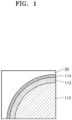
- FIG. 1 shows a partial structure of a sulfide-based solid electrolyte disposed on a positive active material, according to an embodiment.
- a shell 113 containing a (first) nickel-based active material containing cobalt may be disposed on a core 112 including at least one selected from a first positive active material and a second positive active material (e.g., a second nickel-based active material), and a coating layer 114 including at least one lithium ion conductor selected from a lanthanum oxide and a lithium lanthanum oxide may exist on the shell 113.
- the coating layer 114 may be in contact (e.g., direct contact) with the sulfide-based solid electrolyte 30.
- the positive active material may have improved capacity and/or high-rate characteristics.
- first positive active material and “a second positive active material” are selected identically or differently from each other, and may be selected from general positive electrode active materials.
- the general positive active material will be described later.
- An amount of cobalt in the nickel-based active material containing cobalt of the shell may be about 30 mol% or higher.
- the presence of lanthanum in the coating layer 114 and the presence of cobalt in the shell 113 of the positive active material according to an embodiment may be confirmed by energy-dispersive X-ray (EDAX) analysis.
- EDAX energy-dispersive X-ray
- interfacial resistance may decrease, and capacity and/or high-rate characteristics of the lithium battery may further be improved.
- An amount of cobalt in the nickel-based active material containing cobalt may be about 30 mol% or higher.
- a thickness of the shell 113 including a nickel-based active material containing cobalt may be in a range of about 5 nm to about 100 nm, and a thickness of the coating layer 114 including the lithium ion conductor may be in a range of about 1 nm to about 50 nm.
- an amount of cobalt in the nickel-based active material containing cobalt may be, for example, in a range of about 30 mol% to about 60 mol%, or, for example, about 35 mol% to about 55 mol%.
- An amount of the nickel-based active material containing cobalt may be in a range of about 0.3 parts to about 10 parts by weight based on 100 parts by weight of the total weight of the nickel-based active material having a structure containing a core and a shell.
- the nickel-based active material containing cobalt may be, for example, a compound represented by Formula 2: Formula 2 Li a Ni 1-x-y-z Co x M1 y M2 z O 2 .
- M1 may be Mn or Al
- M2 may be boron (B), magnesium (Mg), calcium (Ca), strontium (Sr), barium (Ba), titanium (Ti), vanadium (V), chromium (Cr), iron (Fe), copper (Cu), zirconium (Zr), aluminum (Al), or a combination thereof, 0.3 ⁇ x ⁇ 0.6, 0.002 ⁇ y ⁇ 0.05, 0 ⁇ z ⁇ 1, and x+y+z ⁇ 1.
- an amount of nickel may be in a range of about 40 mol% to about 70 mol%
- an amount of cobalt may be in a range of about 30 mol% to about 60 mol%
- an amount of M1 may be in a range of about 0.2 mol% to about 5 mol%.
- the compound represented by Formula 2 may be, for example, LiNi 0.47 Co 0.5 Al 0.03 O 2 , LiNi 0.88 CO 0.105 Al 0.015 O 2 , LiNi 0.915 CO 0.07 Al 0.015 O 2 , LiNi 0.917 Co 0.069 Al 0.014 O 2 (NCA), or LiNi 0.93 Co 0.055 Al 0.015 O 2 .
- an amount of the solid electrolyte 30 may be in a range of about 5 parts to about 15 parts by weight, the total amount of the positive active material may be in a range of about 80 parts to about 93 parts by weight, an amount of a conducting agent may be in a range of about 0.1 parts to about 1 part by weight, and an amount of a binder may be in a range of about 0.1 part to about 2 parts by weight, each based on 100 parts by weight of the total weight of the positive electrode.
- the positive active material according to an embodiment and/or the second nickel-based active material of the core may be, for example, a compound represented by Formula 3: Formula 3 Li a (Ni 1-x-y-z Co x M1 y M2 z )O 2 .
- M1 may be manganese (Mn), aluminum (Al), or a combination thereof
- M2 may be boron (B), magnesium (Mg), calcium (Ca), strontium (Sr), barium (Ba), titanium (Ti), vanadium (V), chromium (Cr), iron (Fe), copper (Cu), zirconium (Zr), aluminum (Al), or a combination thereof, 0.95 ⁇ a: ⁇ 1.3, x ⁇ (1-x-y-z), y ⁇ (1-x-y-z), 0 ⁇ x ⁇ 1, 0 ⁇ y ⁇ 1, and 0 ⁇ z ⁇ 1.
- 0 ⁇ x ⁇ 0.5, and x may be in a range of about 0.005 to about 0.3, about 0.01 to about 0.25, or about 0.03 to about 0.20.
- 0 ⁇ y ⁇ 0.5, and y may be in a range of about 0.002 to about 0.05, about 0.003 to about 0.04, or about 0.004 to about 0.03.
- 0 ⁇ z ⁇ 0.5, and z may be in a range of about 0.002 to about 0.05, about 0.003 to about 0.04, or about 0.005 to about 0.03.
- An amount of nickel in Formula 3 may be higher than the amounts of each of cobalt, M1, and M2.
- 1-x-y may be in a range of about 0.8 to about 0.98 or about 0.8 to about 0.95.
- an amount of nickel may be in a range of about 80 mol% to about 98 mol%, for example, about 80 mol% to about 95 mol%. When the amount of nickel is this high, a positive electrode having good capacity characteristics may be obtained. In some embodiments, an amount of cobalt may be in a range of about 0.5 mol% to about 30 mol%, for example, about 1 mol% to about 25 mol% or about 3 mol% to about 20 mol%.
- an amount of manganese may be in a range of about 0.2 mol% to about 5 mol%, for example, about 0.3 mol% to about 4 mol% or about 0.4 mol% to about 3 mol%.
- an amount of aluminum may be in a range of about 0.2 mol% to about 5 mol%, for example, about 0.3 mol% to about 4 mol%, or about 0.5 mol% to about 3 mol%.
- the compound represented by Formula 3 may be, for example, a compound represented by Formula 4 or a compound represented by Formula 5: Formula 4 LiNi 1-x-y Co x Al y O 2 .
- the compound represented by Formula 4 is a cobalt-rich compound, 0.3 ⁇ x ⁇ 0.6 and 0.002 ⁇ y ⁇ 0.05. in some embodiments, in Formula 4, 0.005 ⁇ x ⁇ 0.3 and 0.002 ⁇ y ⁇ 0.05.
- the compound represented by Formula 4 may include an amount of nickel in a range of about 40 mol% to about 80 mol%, an amount of cobalt in a range of about 30 mol% to about 60 mol%, and an amount of aluminum in a range of about 0.2 mol% to about 5 mol%. In some embodiments, the compound represented by Formula 4 may include an amount of nickel in a range of about 80 mol% to about 98 mol%, an amount of cobalt in a range of about 30 mol% to about 60 mol%, and an amount of aluminum in a range of about 0.2 mol% to about 5 mol%.
- the compound represented by Formula 5 may include an amount of nickel in a range of about 40 mol% to about 80 mol%, an amount of cobalt in a range of about 30 mol% to about 60 mol%, and an amount of manganese in a range of about 0.2 mol% to about 5 mol%. In some embodiments, the compound represented by Formula 5 may include an amount of nickel in a range of about 80 mol% to about 98 mol%, an amount of cobalt in a range of about 30 mol% to about 60 mol%, and an amount of manganese in a range of about 0.2 mol% to about 5 mol%.
- the compound represented by Formula 3 may be, for example, LiNi 0.896 Co 0.072 Mn 0.032 O 2 , LiNi 0.917 CO 0.069 Al 0.014 O 2 , LiNi 0.88 Co 0.105 Al 0.015 O 2 , LiNi 0.88 Co 0.105 Mn 0.015 O 2 , or LiNi 0.845 Co 0.105 Mn 0.05 O 2 .
- the method may include adding and mixing a cobalt precursor to a nickel-based active material to obtain a mixture, and heat-treating the mixture at a temperature in a range of about 600 °C to about 800 °C, or, for example, about 650 °C to about 750 °C to obtain a positive active material including a core including a nickel-based active material (e.g., a second nickel-based active material) and a shell including a nickel-based active material containing cobalt (e.g., a first nickel-based active material).
- the heat-treating may be performed under an oxygen atmosphere or air.
- Sodium hydroxide may be added to the precursor mixture to control the pH of the mixture.
- the cobalt precursor may be cobalt sulfate, cobalt acetate, cobalt nitrate, or cobalt oxide.
- An average particle diameter of the positive active material is not particularly limited, but may be in a range of about 5 ⁇ m to about 50 ⁇ m or about 10 ⁇ m to about 100 ⁇ m.
- a coating layer containing at least one lithium ion conductor selected from a lanthanum oxide and a lithium lanthanum oxide may be formed on the positive active material.
- the lithium ion conductor is the compound represented by Formula 1
- the coating layer containing a lithium ion conductor may be formed on the nickel-based active material containing cobalt, for example according to the preparation method disclosed in the Korean Patent No. 10-2014-0074174 A and US Patent No. 10,128,507 , the entire content of each of which is incorporated herein by reference.
- a lanthanum alkoxide may be dissolved and dispersed in an organic solvent to obtain a composition (e.g., coating composition), the composition may be coated on a surface of the positive active material, and the resultant may be heat-treated according to an organic liquid-phase method to form the coating layer in the form of a substantially continuous film that is substantially evenly formed on a surface of the positive active material.
- a composition e.g., coating composition
- a temperature of the heat-treatment may be, for example, in a range of about 300 °C to about 450 °C, or, for example, about 300 °C to about 400 °C.
- the heat-treatment may be performed under an oxygen atmosphere or air, and a time of the heat-treatment may be selected depending on the heat-treatment temperature and may be, for example, in a range of about 0.5 hours to about 20 hours.
- Non-limiting examples of the lanthanum alkoxide include lanthanum methoxide, lanthanum ethoxide, lanthanum propoxide, lanthanum butoxide, or a combination thereof
- non-limiting examples of the organic solvent include ethanol, isopropanol, and/or methanol.
- the coating layer may be prepared in the form of a substantially even and continuous film utilizing the organic liquid-phase method as described.
- a thickness of the coating layer may be, for example, in a range of about 0.1 nm to about 100 nm, about 5 nm to about 100 nm, about 5 nm to about 50 nm, about 5 nm to about 30 nm, about 5 nm to about 20 nm, or about 10 nm.
- a positive electrode having a mixture density in a range of about 3.4 g/cm 3 to about 3.7 g/cm 3 may be prepared utilizing the positive active material.
- a nickel-based active material as a starting material subjected to be mixed with the cobalt precursor may be prepared by following any suitable preparation method.
- an aluminum precursor and/or a manganese precursor, a nickel cobalt hydroxide, and a lithium precursor may be mixed to obtain a mixture, and the mixture may be heat-treated to prepare the nickel-based active material as the starting material.
- a precursor containing a metal to be doped may be added to the mixture.
- Non-limiting examples of the precursor include barium hydroxide, magnesium hydroxide, and/or titanium oxide.
- the heat-treatment conditions may be selected according to a type or kind of the precursor, and a temperature of the heat-treatment may be, for example, in a range of about 600 °C to about 900 °C, or, for example, about 650 °C to about 750 °C.
- the oxidizing gas atmosphere may refer to, for example, air or an oxygen atmosphere.
- the nickel cobalt hydroxide may be prepared by following any suitable preparation method, for example, a co-precipitation method.
- the nickel cobalt hydroxide obtained by following this preparation method may be divided into a large-particle nickel cobalt hydroxide and a small-particle nickel cobalt hydroxide.
- an all-solid secondary battery includes the positive electrode, a sulfide-based solid electrolyte, and a negative electrode.
- an all-solid secondary battery includes a positive electrode; a negative electrode; and a solid electrolyte layer disposed between the positive electrode and the negative electrode, wherein the positive electrode includes a positive current collector and a positive active material layer disposed on the positive current collector, wherein the negative electrode includes a negative current collector and a negative active material layer disposed on the negative current collector.
- the positive electrode includes a positive electrode active material according to an embodiment.
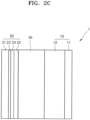
- an all-solid secondary battery 1 includes a positive electrode 10; a negative electrode 20; and a solid electrolyte layer 30 disposed between the positive electrode 10 and the negative electrode 20, wherein the positive electrode 10 includes a positive current collector 11 and a positive active material layer 12 disposed on the positive current collector 11, wherein the negative electrode 20 includes a negative current collector 21 and a negative active material layer 22 disposed on the negative current collector 21.
- Positive electrode Positive current collector
- the positive current collector 11 may be, for example, a plate or a foil formed of indium (In), copper (Cu), magnesium (Mg), stainless steel, titanium (Ti), iron (Fe), cobalt (Co), nickel (Ni), zinc (Zn), aluminum (Al), germanium (Ge), lithium (Li), or an alloy thereof. In some embodiments, the positive current collector 11 may be omitted (e.g., may not be included).
- Positive active material Positive active material
- the positive active material layer 12 may include, for example, a positive active material and a solid electrolyte.
- the solid electrolyte in the positive electrode 10 may be similar to or different from the solid electrolyte in the solid electrolyte layer 30. A detailed description of the solid electrolyte is provided in relation to the solid electrolyte layer 30.
- the positive electrode may be a positive electrode according to an embodiment.
- the positive electrode may further include a positive active material described hereafter.
- the positive active material may include a first positive active material and a second positive active material.
- the positive active material may be a positive active material capable of reversibly absorbing and desorbing lithium ions.
- the positive active material include a lithium transition metal oxide (such as a lithium cobalt oxide (LCO), a lithium nickel oxide, a lithium nickel cobalt oxide, a lithium nickel cobalt aluminum oxide (NCA), a lithium nickel cobalt manganese oxide (NCM), a lithium manganate, and/or a lithium iron phosphate; a nickel sulfide; a copper sulfide; a lithium sulfide; an iron oxide; and/or a vanadium oxide), but embodiments are not limited thereto, and any material available as a positive active material in the art may be utilized.
- the positive active material may be utilized alone or in a mixture of at least two selected from these examples.
- the lithium transition metal oxide may be or include, for example, a compound represented by one of the following formulae:
- Li a A 1-b B' b D 2 (where 0.90 ⁇ a ⁇ 1 and 0 ⁇ b ⁇ 0.5); Li a E 1-b B' b O 2-c D c (where 0.90 ⁇ a ⁇ 1, 0 ⁇ b ⁇ 0.5, and 0 ⁇ c ⁇ 0.05); LiE 2-b B' b O 4-c D c (where 0 ⁇ b ⁇ 0.5 and 0 ⁇ c ⁇ 0.05); Li a Ni 1-b-c Co b B' c D ⁇ (where 0.90 ⁇ a ⁇ 1, 0 ⁇ b ⁇ 0.5, 0 ⁇ c ⁇ 0.05, and 0 ⁇ ⁇ ⁇ 2); Li a Ni 1-b-c Co b B' c O 2- ⁇ F' ⁇ (where 0.90 ⁇ a ⁇ 1, 0 ⁇ b ⁇ 0.5, 0 ⁇ c ⁇ 0.05, and 0 ⁇ ⁇ ⁇ 2); Li a
- A may be nickel (Ni), cobalt (Co), manganese (Mn), or a combination thereof
- B' may be aluminum (Al), nickel (Ni), cobalt (Co), manganese (Mn), chromium (Cr), iron (Fe), magnesium (Mg), strontium (Sr), vanadium (V), a rare earth element, or a combination thereof
- D may be oxygen (O), fluorine (F), sulfur (S), phosphorus (P), or a combination thereof
- E may be cobalt (Co), manganese (Mn), or a combination thereof
- F' may be fluorine (F), sulfur (S), phosphorus (P), or a combination thereof
- G' may be (Al), chromium (Cr), manganese (Mn), iron (Fe), magnesium (Mg), lanthanum (La), cerium (Ce), strontium (Sr), vanadium (V), or a combination thereof
- Q may be titanium (Ti), mo
- the compounds may have a surface coating layer (hereinafter, also referred to as "coating layer").
- coating layer a mixture of a compound without a coating layer and a compound having a coating layer, the compounds being selected from the compounds listed, may be utilized.
- the coating layer may include at least one compound of a coating element selected from the group consisting of oxide, hydroxide, oxyhydroxide, oxycarbonate, and hydroxycarbonate of the coating element.
- the compounds for the coating layer may be amorphous or crystalline.
- the coating element for the coating layer may be magnesium (Mg), aluminum (Al), cobalt (Co), potassium (K), sodium (Na), calcium (Ca), silicon (Si), titanium (Ti), vanadium (V), tin (Sn), germanium (Ge), gallium (Ga), boron (B), arsenic (As), zirconium (Zr), niobium (Nb), or a mixture thereof.
- the coating layer may be formed utilizing any method that does not adversely affect the physical properties of the positive active material when a compound of the coating element is utilized.
- the coating layer may be formed utilizing a spray coating method or a dipping method. The coating methods may be well understood by one of ordinary skill in the art, and thus a detailed description thereof will not be provided.
- the positive active material may include, for example, a lithium salt of a transition metal oxide that has a layered rock-salt structure (e.g., crystal lattice or crystal structure), among the examples of the lithium transition metal oxide.
- layered rock-salt structure refers to a structure in which an oxygen atom layer and a metal atom layer are alternately and regularly arranged in a ⁇ 111> direction in a cubic rock-salt structure, where each of the atom layers forms (e.g., is present as) a two-dimensional flat plane.
- the term "cubic rock-salt structure” refers to a sodium chloride (NaCl) structure, which is a crystalline structure in which face-centered cubic (fee) lattices respectively formed of anions and cations are shifted by a half unit of each unit lattice.
- the positive active material includes a ternary transition metal oxide having the layered rock- structure, the energy density and/or thermal stability of the all-solid secondary battery 1 may be improved.
- the positive active material may be covered by a coating layer as described above.
- the coating layer may be any material that can be utilized as a coating layer of a positive active material of an all-solid secondary battery in the art.
- the coating layer may be, for example, Li 2 O-ZrO 2 (LZO), Li 2 O-LaO 2 (LLaO) or a combination thereof.
- the positive active material includes a ternary lithium transition metal oxide including nickel (Ni) (such as NCA and/or NCM)
- a capacity density of the all-solid secondary battery 1 may be increased, and metal elution from the positive active material in a charged state may be reduced.
- the all-solid secondary battery 1 according to an embodiment may have improved cycle characteristics in a charged state.
- a particle shape of the positive active material may be a true spherical shape, an elliptical shape, and/or a spherical shape.
- a particle diameter of the positive active material is not particularly limited but may be in a range applicable to a positive active material of an all-solid secondary battery in the art.
- An amount of the positive active material of the positive electrode 10 is not particularly limited and may be in a range applicable to a positive electrode layer of an all-solid secondary battery in the art.
- An average particle diameter (D50) of the positive active material is not particularly limited, but may be in a range of about 5 ⁇ m to about 50 ⁇ m or about 10 ⁇ m to about 100 ⁇ m.
- the average particle diameter of the positive active material may be, for example, a median diameter (D50) measured by utilizing a laser diffraction particle diameter distribution meter, scanning electron microscope (SEM), and/or a transmission electron microscope (TEM).
- D50 median diameter measured by utilizing a laser diffraction particle diameter distribution meter, scanning electron microscope (SEM), and/or a transmission electron microscope (TEM).
- SEM scanning electron microscope
- TEM transmission electron microscope
- the average particle diameter of the positive active material may be mainly measured by utilizing a laser diffraction particle diameter distribution meter.
- the positive active material layer 12 may include a solid electrolyte.
- the solid electrolyte in the positive electrode 10 may be identical to or different from a solid electrolyte in the solid electrolyte layer 30. A detailed description of the solid electrolyte is provided in relation to the solid electrolyte layer 30.
- An average particle diameter (D50) of the solid electrolyte in the positive active material layer 12 may be smaller than that of the solid electrolyte in the solid electrolyte layer 30.
- an average particle diameter (D50) of the solid electrolyte in the positive active material layer 12 may be about 90% or less, about 80% or less, about 70% or less, about 60% or less, about 50% or less, about 40% or less, about 30% or less, or about 20% or less of an average particle diameter (D50) of the solid electrolyte in the solid electrolyte layer 30.
- the positive active material layer 12 may include a binder.
- the binder include styrene-butadiene rubber (SBR), polytetrafluoroethylene, polyvinylidene fluoride, and/or polyethylene.
- the positive active material layer 12 may include a conducting agent.
- the conducting agent include graphite, carbon black, acetylene black, ketjen black, carbon fiber, and/or metal powder.
- the positive electrode 10 may further include additives such as a filler, a coating agent, a dispersant, and/or an ionic conducting agent in addition to the positive active material, solid electrolyte, binder, and conducting agent described above.
- additives such as a filler, a coating agent, a dispersant, and/or an ionic conducting agent in addition to the positive active material, solid electrolyte, binder, and conducting agent described above.
- the filler, coating agent, dispersant, and ion conducting agent that may be included in the positive electrode 10 may be the same materials that are generally utilized for similar purposes in an electrode of an all-solid secondary battery in the art.
- an amount of the positive active material may be in a range of about 80 parts to about 93 parts by weight
- an amount of the solid electrolyte may be in a range of about 5 parts to about 10 parts by weight
- an amount of the conducting agent may be in a range of about 0.5 parts to about 5 parts by weight, for example, about 0.5 parts to about 1 part by weight
- an amount of the binder may be in a range of about 0.1 parts to about 5 parts by weight, for example, about 0.1 parts to about 2 parts by weight.
- the amounts of the positive active material, solid electrolyte, binder, and conducting agent are each based on 100 parts by weight of the total weight of the positive electrode.
- the total weight of the positive electrode refers to the total amount of the positive active material, solid electrolyte, binder, and conducting agent.
- a thickness of the positive electrode may be, for example, in a range of about 70 ⁇ m to about 150 ⁇ m.
- Solid electrolyte layer Sulfide-based solid electrolyte
- the solid electrolyte layer 30 includes a sulfide-based solid electrolyte disposed between the positive electrode 10 and the negative electrode 20.
- the sulfide-based solid electrolyte may include, for example, at least one selected from Li 2 S-P 2 S 5 , Li 2 S-P 2 S 5 -LiX (where X is a halogen element), Li 2 S-P 2 S 5 -Li 2 O, Li 2 S-P 2 S 5 -Li 2 O-LiI, Li 2 S-SiS 2 , Li 2 S-SiS 2 -LiI, Li 2 S-SiS 2 -LiBr, Li 2 S-SiS 2 -LiCl, Li 2 S-SiS 2 -B 2 S 3 -LiI, Li 2 S-SiS 2 -P 2 S 5 -LiI, Li 2 S-B 2 S 3 , Li 2 S-P 2 S 5 -Z m S n (where m and n each are a positive number, and Z represents any of Ge, Zn, and Ga), Li 2 S-GeS 2 , Li 2 S-
- Li 2 S-P 2 S 5 -LiX may be, for example, Li 2 S-P 2 S 5 -LiCl or Li 2 S-P 2 S 5 -LiCl-LiBr.
- the sulfide-based solid electrolyte may be amorphous or crystalline, or may be a mixed form thereof.
- the sulfide-based solid electrolyte may include at least sulfur (S), phosphorus (P), and lithium (Li), as component elements among the sulfide-based solid electrolyte materials.
- the sulfide-based solid electrolyte may be a material including Li 2 S-P 2 S 5 .
- a mixing molar ratio of Li 2 S and P 2 S 5 may be, for example, in a range of about 50:50 to about 90:10.
- the sulfide-based solid electrolyte may be, for example, an argyrodite compound including at least one selected from Li 7-x PS 6-x Cl x (where 0 ⁇ x ⁇ 2), Li 7-x PS 6-x Br x (where 0 ⁇ x ⁇ 2), and Li 7-x PS 6-x I x (where 0 ⁇ x ⁇ 2).
- the sulfide-based solid electrolyte may be an argyrodite compound including at least one selected from Li 6 PS 5 Cl, Li 6 PS 5 Br, and Li 6 PS 5 I.
- a density of the argyrodite solid electrolyte may be in a range of about 1.5 g/cc to about 2.0 g/cc.
- the density of the argyrodite solid electrolyte is about 1.5 g/cc or higher, internal resistance of the all-solid secondary battery 1 may decrease, and penetration of the solid electrolyte layer 30 by Li may be effectively suppressed.
- An elastic modulus of the solid electrolyte may be, for example, in a range of about 15 GPa to about 35 GPa.
- the solid electrolyte layer 30 may include, for example, a binder.
- a binder Non-limiting examples of the binder in the solid electrolyte layer 30 include styrene-butadiene rubber (SBR), polytetrafluoroethylene, polyvinylidene fluoride, and/or polyethylene, but embodiments are not limited thereto, and any material available as a binder in the art may be utilized.
- SBR styrene-butadiene rubber
- the binder of the solid electrolyte layer 30 may be identical to or different from the binders in the positive active material layer 12 and the first negative active material layer 22.
- a thickness of the solid electrolyte layer 30 may be, for example, in a range of about 30 ⁇ m to about 60 ⁇ m.
- Negative electrode Negative active material
- the first negative active material layer 22 may include, for example, a negative active material and a binder.
- the negative active material in the first negative active material layer 22 may be, for example, in the form of particles.
- An average particle diameter of the negative active material in the form of particles may be, for example, about 4 ⁇ m or less, about 3 ⁇ m or less, about 2 ⁇ m or less, about 1 ⁇ m or less, or about 900 nm or less.
- An average particle diameter of the negative active material in the form of particles may be, for example, about 10 nm to about 4 ⁇ m or less, about 10 nm to about 3 ⁇ m or less, about 10 nm to about 2 ⁇ m or less, about 10 nm to about 1 ⁇ m or less, or about 10 nm to about 900 nm or less.
- the average particle diameter of the negative active material may be, for example, a median diameter (D50) measured by utilizing a laser diffraction particle diameter distribution meter, scanning electron microscope (SEM), and/or a transmission electron microscope (TEM).
- D50 a median diameter measured by utilizing a laser diffraction particle diameter distribution meter, scanning electron microscope (SEM), and/or a transmission electron microscope (TEM).
- the negative active material in the first negative active material layer 22 may include, for example, at least one selected from a carbonaceous negative active material and a metal or metalloid negative active material.
- the carbonaceous negative active material may for example be amorphous carbon.
- amorphous carbon include carbon black (CB), acetylene black (AB), furnace black (FB), ketjen black (KB), and/or graphene, but embodiments are not limited thereto, and any material available as amorphous carbon in the art may be utilized.
- the amorphous carbon is carbon having little crystallinity or a very low crystallinity which is different from crystalline carbon or graphene-based carbon.
- Non-limiting examples of the metal or metalloid negative active material may include at least one selected from the group consisting of gold (Au), platinum (Pt), palladium (Pd), silicon (Si), silver (Ag), aluminum (Al), bismuth (Bi), tin (Sn), and/or zinc (Zn), but embodiments are not limited thereto, and any material available as a metal negative active material or a metalloid negative active material capable of forming an alloy or a compound with lithium in the art may be utilized. For example, nickel (Ni) does not form an alloy with lithium and thus is not a metal negative active material.
- the first negative active material layer 22 may include one negative active material or may include a mixture of a plurality of different negative active materials selected from these negative active materials.
- the first negative active material layer 22 may only include amorphous carbon or may include at least one selected from the group consisting of gold (Au), platinum (Pt), palladium (Pd), silicon (Si), silver (Ag), aluminum (Al), bismuth (Bi), tin (Sn), and zinc (Zn).
- the first negative active material layer 22 may include a mixture including amorphous carbon and at least one element selected from the group consisting of gold (Au), platinum (Pt), palladium (Pd), silicon (Si), silver (Ag), aluminum (Al), bismuth (Bi), tin (Sn), and zinc (Zn).
- a mixing ratio of the mixture of amorphous carbon to the element may be, for example, a weight ratio in a range of about 10:1 to about 1:2, about 5:1 to about 1:1, or about 4:1 to about 2:1, but embodiments are not limited thereto, and the mixing ratio may be selected according to characteristics of the all-solid secondary battery 1.
- cycle characteristics of the all-solid secondary battery 1 may further be improved.
- the negative active material in the first negative active material layer 22 may include, for example, a mixture including first particles formed of amorphous carbon and second particles formed of a metal or a metalloid.
- the metal or metalloid include gold (Au), platinum (Pt), palladium (Pd), silicon (Si), silver (Ag), aluminum (Al), bismuth (Bi), tin (Sn), and/or zinc (Zn).
- the metalloid may be a semiconductor.
- An amount of the second particles may be in a range of about 8 weight% to about 60 weight%, about 10 weight% to about 50 weight%, about 15 weight% to about 40 weight%, or about 20 weight% to about 30 weight% based on the total weight of the mixture. When the amount of the second particles is within these ranges, for example, cycle characteristics of the all-solid secondary battery 1 may further be improved.
- Non-limiting examples of the binder in the first negative active material layer 22 include styrene-butadiene rubber (SBR), polytetrafluoroethylene, polyvinylidene fluoride, polyethylene, a vinylidene fluoride/hexafluoropropylene copolymer, polyacrylonitrile, and/or polymethylmethacrylate, but embodiments are not limited thereto, and any material available as a binder in the art may be utilized.
- the binder may be formed of one of the examples of the binder alone or a plurality of different binders.
- the first negative active material layer 22 When the first negative active material layer 22 includes the binder, the first negative active material layer 22 may be stabilized on the negative current collector 21. Also, cracks of the first negative active material layer 22 may be suppressed or reduced in spite of volume change and/or relative location change of the first negative active material layer 22 during charging/discharging. For example, when the first negative active material layer 22 does not include a binder, the first negative active material layer 22 may be easily separated from the negative current collector 21. At a part where the negative current collector 21 is separated from the first negative active material layer 22, the negative current collector 21 may be exposed and may contact the solid electrolyte layer 30, and thus a risk of short-circuit o may increase.
- the first negative active material layer 22 may be prepared by, for example, coating and drying a slurry, in which materials forming the first negative active material layer 22 are dispersed, on the negative current collector 21.
- the binder is included in the first negative active material layer 22, the negative active material may be stably dispersed in the slurry.
- clogging of the screen e.g., clogging by an aggregate of the negative active material may be suppressed or reduced.
- the first negative active material layer 22 may further include additives that are suitably utilized in an all-solid secondary battery in the art, such as a filler, a coating agent, a dispersant, and an ionic conducting agent.
- additives that are suitably utilized in an all-solid secondary battery in the art, such as a filler, a coating agent, a dispersant, and an ionic conducting agent.
- Negative electrode First negative active material layer
- a thickness of the first negative active material layer 22 may be, for example, about 50% or less, about 40% or less, about 30% or less, about 20% or less, about 10% or less, or about 5% or less of a thickness of the positive active material layer 12.
- a thickness of the first negative active material layer 22 may be in a range of about 1 ⁇ m to about 20 ⁇ m, about 2 ⁇ m to about 10 ⁇ m, or about 3 ⁇ m to about 7 ⁇ m.
- the thickness of the first negative active material layer 22 is too thick, an energy density of the all-solid secondary battery 1 may be deteriorated and internal resistance of the all-solid secondary battery 1 by the first negative active material layer 22 may increase, and thus cycle characteristics of the all-solid secondary battery 1 may not be improved.
- a charge capacity of the first negative active material layer 22 may also decrease.
- the charge capacity of the first negative active material layer 22 may be, for example, about 50% or lower, about 40% or lower, about 30% or lower, about 20% or lower, about 10% or lower, about 5% or lower, or about 2% or lower of a charge capacity of the positive active material layer 12.
- the charge capacity of the first negative active material layer 22 may be, for example, in a range of about 0.1% to about 50%, about 0.1% to about 40%, about 0.1% to about 30%, about 0.1% to about 20%, about 0.1% to about 10%, about 0.1% to about 5%, or about 0.1% to about 2% of a charge capacity of the positive active material layer 12.
- the charge capacity of the first negative active material layer 22 When the charge capacity of the first negative active material layer 22 is too low, a thickness of the first negative active material layer 22 is too thin, lithium dendrites formed between the first negative active material layer 22 and the negative current collector 21 during repeated charging/discharging processes destroys the first negative active material layer 22, and the thus cycle characteristics of the all-solid secondary battery 1 may not be improved.
- the charge capacity of the first negative active material layer 22 is too high, an energy density of the all-solid secondary battery 1 may be deteriorated and internal resistance of the all-solid secondary battery 1 by the first negative active material layer 22 may increase, and thus cycle characteristics of the all-solid secondary battery 1 may not be improved.
- the charge capacity of the positive active material layer 12 may be obtained by multiplying a weight of the positive active material in the positive active material layer 12 by a charge capacity density (mAh/g) of the positive active material.
- a charge capacity density (mAh/g) of the positive active material When one or more suitable types (kinds) of materials are utilized as the positive active material, a value of a charge capacity density multiplied by a weight of each of the positive active materials is calculated, and the total (sum) of these values is a charge capacity of the positive active material layer 12.
- a charge capacity of the first negative active material layer 22 may be calculated in substantially the same manner. For example, a charge capacity of the first negative active material layer 22 is obtained by multiplying a weight of the negative active material in the first negative active material layer 22 by a charge capacity density (mAh/g) of the negative active material.
- a value of a charge capacity density x a weight of each of the negative active materials is calculated, and the total of these values is a charge capacity of the first negative active material layer 22.
- the charge capacity densities of the positive active material and the negative active material may be estimated by utilizing an all-solid half-cell, in which lithium metal is utilized as a counter electrode.
- the charge capacities of the positive active material layer 12 and the first negative active material layer 22 may be directly measured by the charge capacity measurement utilizing the all-solid half-cell. When the measured charge capacity is divided by a weight of each of the active materials, a charge capacity density may be obtained.
- the charge capacities of the positive active material layer 12 and the first negative active material layer 22 may be initial charge capacities measured in the first charging cycle.
- Negative electrode Second negative active material layer (deposition layer)
- the all-solid secondary battery 1 may, for example, further include a second negative active material layer 23 between the negative current collector 21 and the first negative active material layer 22.
- the all-solid secondary battery 1 may further include a second negative active material layer 23 between the solid electrolyte layer 30 and the first negative active material layer 22 by (e.g., as a result of) charging.
- the all-solid secondary battery 1 may further include, for example, a second negative active material layer 23 between the negative current collector 21 and the first negative active material layer 22 and between the solid electrolyte layer 30 and the first negative active material layer 22 by charging.
- the second negative active material layer 23 may be a metal layer including lithium and/or a lithium alloy.
- the metal layer may include lithium and/or a lithium alloy.
- the second negative active material layer 23 is a metal layer including lithium, the second negative active material layer 23 may serve as a lithium reservoir.
- the lithium alloy include a Li-Al alloy, a Li-Sn alloy, a Li-In alloy, a Li-Ag alloy, a Li-Au alloy, a Li-Zn alloy, a Li-Ge alloy, and/or a Li-Si alloy, but embodiments are not limited thereto, and any material available as a lithium alloy in the art may be utilized.
- the second negative active material layer 23 may be formed of one of these alloys or lithium or may be formed of one or more suitable alloys.
- a thickness of the second negative active material layer 23 may be, for example, in a range of about 1 ⁇ m to about 1000 ⁇ m, about 1 ⁇ m to about 500 ⁇ m, about 1 ⁇ m to about 200 ⁇ m, about 1 ⁇ m to about 150 ⁇ m, about 1 ⁇ m to about 100 ⁇ m, or about 1 ⁇ m to about 50 ⁇ m, but embodiments are not limited thereto.
- the second negative active material layer 23 may not serve as a lithium reservoir.
- the second negative active material layer 23 may be, for example, a metal foil having a thickness within these ranges.
- the second negative active material layer 23 may be disposed between the negative current collector 21 and the first negative active material layer 22 before assembling the all-solid secondary battery 1, or may be deposited between the negative current collector 21 and the first negative active material layer 22 by charging after assembling the all-solid secondary battery 1.
- the second negative active material layer 23 may be a metal layer including lithium and thus may serve as a lithium reservoir.
- a lithium foil may be disposed between the negative current collector 21 and the first negative active material layer 22 before assembling the all-solid secondary battery 1.
- the cycle characteristics of the all-solid secondary battery 1 including the second negative active material layer may further be improved.
- an energy density of the all-solid secondary battery 1 may increase due to not including the second negative active material layer during the assembling of the all-solid secondary battery 1.
- the all-solid secondary battery 1 may be charged over a charge capacity of the first negative active material layer 22.
- the first negative active material layer 22 may be overcharged.
- lithium may be absorbed in the first negative active material layer 22.
- the negative active material in the first negative active material layer 22 may form an alloy or a compound with lithium ions migrated from the positive electrode layer 10.
- the negative active material layer When the negative active material layer is charged over the charge capacity of the first negative active material layer 22, for example, lithium may be deposited on a back surface of the first negative active material layer 22, which is between the negative current collector 21 and the first negative active material layer 22, and a metal layer corresponding to the second negative active material layer may be formed by the deposited lithium.
- the second negative active material layer may be a metal layer mainly formed of lithium (i.e., metal lithium). This result because, for example, the negative active material in the first negative active material layer 22 is formed of a material capable of forming an alloy or a compound with lithium.
- lithium in the first negative active material layer 22 and the second negative active material layer (which is a metal layer) may be ionized and migrated in a direction to the positive electrode layer 10.
- lithium may be utilized as a negative active material in the all-solid secondary battery 1.
- the first negative active material layer 22 covers the second negative active material layer, the first negative active material layer 22 may serve as a protection layer of the second negative active material layer(a metal layer), and may suppress lithium deposition and growth of lithium dendrites at the same time.
- the risks of short-circuiting and capacity deterioration of the all-solid secondary battery 1 may be suppressed, and the cycle characteristics of the all-solid secondary battery 1 may be improved.
- the negative current collector 21, the first negative active material layer 22, and a region between the negative current collector 21 and the first negative active material layer 22 may be, for example, Li-free regions substantially not including lithium (Li) in the initial state or in a post-discharge state.
- Negative electrode layer Third negative active material layer
- the all-solid secondary battery 1 may include a third negative active material layer 23'.
- the third negative active material layer 23 may be a metal layer including lithium and/or a lithium alloy.
- the metal layer may include lithium and/or a lithium alloy.
- the third negative active material layer 23' may serve as a lithium reservoir.
- Non-limiting examples of the lithium alloy include a Li-Al alloy, a Li-Sn alloy, a Li-In alloy, a Li-Ag alloy, a Li-Au alloy, a Li-Zn alloy, a Li-Ge alloy, and/or a Li-Si alloy, but embodiments are not limited thereto, and any material available as a lithium alloy in the art may be utilized.
- the third negative active material layer 23' may be formed of one of these alloys or lithium or may be formed of one or more suitable alloys.
- a thickness of the third negative active material layer 23' may be, for example, in a range of about 1 ⁇ m to about 100 ⁇ m, about 10 ⁇ m to about 100 ⁇ m, about 1 ⁇ m to about 50 ⁇ m, about 1 ⁇ m to about 40 ⁇ m, about 1 ⁇ m to about 30 ⁇ m, about 1 ⁇ m to about 20 ⁇ m, about 1 ⁇ m to about 15 ⁇ m, about 1 ⁇ m to about 10 ⁇ m, or about 1 ⁇ m to about 5 ⁇ m, but embodiments are not limited thereto.
- the third negative active material layer 23' may not serve as a lithium reservoir.
- the third negative active material layer 23' may be, for example, a metal deposition layer or a metal foil having a thickness within these ranges.
- a lithium halide layer 24 may further be disposed between the third negative active material layer 23 and the solid electrolyte layer 30.
- the lithium halide layer 24 may act as a passivation layer, and thus may prevent or reduce deterioration of the third negative active material layer 23.
- the lithium halide layer 24 is a high-strength and high-hardness layer, and thus may be a protecting layer that protects the third negative active material layer 23.
- the lithium halide layer 24 may include at least one selected from LiF, LiCI, LiBr, and Lil. In some embodiments, the lithium halide layer 24 may be a LiF layer.
- the lithium halide layer 24 may be disposed on the third negative active material layer 23 by deposition.
- a thickness of the lithium halide layer 24 may be, for example, in a range of about 10 ⁇ m to about 300 ⁇ m, about 10 ⁇ m to about 200 ⁇ m, about 10 ⁇ m to about 150 ⁇ m, about 10 ⁇ m to about 100 ⁇ m, about 10 ⁇ m to about 90 ⁇ m, about 10 ⁇ m to about 80 ⁇ m, about 10 ⁇ m to about 60 ⁇ m, or about 20 ⁇ m to about 50 ⁇ m, but embodiments are not limited thereto.
- the thickness of the lithium halide layer 24 is too thin, the lithium halide layer 24 may not prevent or reduce deterioration of the third negative active material layer 23.
- an energy density of the all-solid secondary battery 1 may decrease.
- a carbon layer may further be disposed on the lithium halide layer 24.
- interfacial resistance between the lithium halide layer 24 and the solid electrolyte layer 30 may decrease.
- a thickness of the carbon layer may be, for example, in a range of about 1 ⁇ m to about 10 ⁇ m, about 2 ⁇ m to about 10 ⁇ m, or about 1 ⁇ m to about 5 ⁇ m.
- the thickness of the carbon layer is too thin, interfacial resistance between the lithium halide layer 24 and the solid electrolyte layer 30 may not effectively decrease.
- an energy density of the all-solid secondary battery 1 may decrease.
- the carbon layer may include a binder and a carbonaceous material.
- the carbonaceous material may include amorphous carbon and/or crystalline carbon.
- the binder may include a binder (e.g., the same binders) utilized in the positive electrode.
- the carbon layer may include both (e.g., simultaneously) amorphous carbon and crystalline carbon.
- a weight ratio of the amorphous carbon and crystalline carbon in the carbon layer may be, for example, in a range of about 4:6 to about 6:4.
- the negative current collector 21 may be formed of, for example, a material that does not react with lithium, e.g., a material that does not form both a lithium alloy or a lithium compound.
- Non-limiting examples of the material forming the negative current collector 21 include copper (Cu), stainless steel, titanium (Ti), iron (Fe), cobalt (Co), and/or nickel (Ni), but embodiments are not limited thereto, and any material available as an electrode current collector in the art may be utilized.
- the negative current collector 21 may be formed of one of the examples of the metal or an alloy or a coating material of at least two metals.
- the negative current collector 21 may be, for example, in the form of a plate or a foil.
- the all-solid secondary battery 1 may further include, for example, a thin film including an element that is capable of forming an alloy with lithium on the negative current collector 21.
- the thin film may be disposed between the negative current collector 21 and the first negative active material layer 22.
- the thin film may, for example, include an element capable of forming an alloy with lithium.
- Non-limiting examples of the element capable of forming an alloy with lithium include gold, silver, zinc, tin, indium, silicon, aluminum, and/or bismuth, but embodiments are not limited thereto, and any element capable of forming an alloy with lithium in the art may be utilized.
- the thin film may be formed of any of these metals or alloys of one or more suitable metals.
- the deposition form of a second negative active material layer deposited between the thin film and the first negative active material layer 22 may further be planarized, and thus cycle characteristics of the all-solid secondary battery 1 may further be improved.
- a thickness of the thin film may be, for example, in a range of about 1 nm to about 800 nm, about 10 nm to about 700 nm, about 50 nm to about 600 nm, or about 100 nm to about 500 nm.
- the thickness of the thin film is less than 1 nm, the functions of the thin film may not be realized.
- the thin film itself may absorb lithium, and a deposition amount of lithium in a negative electrode may decrease, resulting in deterioration of an energy density of the all-solid secondary battery 1, and thus the cycle characteristics of the all-solid secondary battery 1 may be deteriorated.
- the thin film may be disposed on the negative current collector 21 by, for example, vacuum vapor deposition, sputtering, or plating, but embodiments are not limited thereto, and any method capable of forming a thin film in the art may be utilized.
- an all-solid secondary battery may include a positive electrode having a thickness in a range of about 70 ⁇ m to about 150 ⁇ m, a solid electrolyte layer having a thickness in a range of about 30 ⁇ m to about 60 ⁇ m, and a negative electrode having a thickness in a range of about 10 ⁇ m to about 100 ⁇ m.
- An all-solid secondary battery according to an embodiment may be applied in a medium-to-large battery or in an energy storage system (ESS).
- the all-solid secondary battery according to an embodiment may be, for example, utilized as a vehicle battery.
- Preparation Example 1 Preparation of positive active material ⁇ LiNi 0.966 Co 0.028 Al 0.006 O 2 (NCA) core+Co-rich NCA shell+ aLi 2 O-LaO 2 (LLaO) coating layer ⁇ (average particle diameter: about 6 ⁇ m)
- CoSO 4 Cobalt sulfate
- NaOH sodium hydroxide
- a nickel-based active material LiNi 0.967 Co 0.019 Al 0.014 O 2 (NCA) (particle diameter: about 6 ⁇ m)
- the resultant was heat-treated at a temperature of about 700 °C, and thus a positive active material containing LiNi 0.966 Co 0.028 Al 0.006 O 2 (NCA) (core) and Co-rich NCA (shell) on the core was obtained.
- the Co-rich NCA included LiNi 0.563 Co 0.430 Al 0.007 O 2 .
- An overall composition of the positive active material (nickel-based active material) including the core and the shell was LiNi 0.917 Co 0.069 Al 0.014 O 2 (NCA).
- An amount of Co-rich NCA (LiNi 0.563 Co 0.430 Al 0.007 O 2 ) of the shell was about 7 parts by weight based on 100 parts by weight of the total weight of the nickel-based active material having a structure including a core and a shell.
- the aLi 2 O-LaO 2 -coating solution was mixed with the positive active material fine powder, and this solution mixture was heated to about 40 °C while stirring to evaporate the solvent and dry the positive active material. At this time, the mixture solution was irradiated with ultrasonic waves.
- a particle surface of the nickel-based active material fine powder may carry a precursor of aLi 2 O-LaO 2 .
- An amount of Li 2 O-LaO 2 (LLaO) was about 0.56 parts by weight based on 100 parts by weight of the total weight of the nickel-based active material and the lithium ion conductor.
- a composition of the Co-rich NCA was LiNi 0.563 Co 0.430 Al 0.007 O 2
- a composition of the positive active material containing a core and a shell was LiNi 0.917 Co 0.069 Al 0.014 O 2 (NCA).
- 0.275 g of lithium methoxide, 2.635 g of lanthanum propoxide, and 20 g of isopropyl alcohol were mixed to prepare a mixture, and the mixture was utilized as an aLi 2 O-LaO 2 -coating solution.
- 0.392 g of lithium methoxide, 3.764 g of lanthanum propoxide, and 20 g of isopropyl alcohol were mixed to prepare a mixture, and the mixture was utilized as an aLi 2 O-LaO 2 -coating solution.
- a positive active material was prepared in substantially the same manner as in Preparation Example 1, except that a LLaO coating layer was not formed on a surface of the nickel-based active material.
- a positive active material was prepared in substantially the same manner as in Preparation Example 1, except that a shell having Co-rich NCA was not formed on LiNi 0.88 CO 0.105 Al 0.015 O 2 (NCA).
- the positive active material prepared in Preparation Example 1 was utilized as a positive active material.
- a polytetrafluoroethylene (PTFE) binder (from Daikin) was prepared as a binder.
- Carbon nanofibers (CNFs) were prepared as a conducting agent.
- the positive active material, the solid electrolyte, the conducting agent, and the binder were mixed at a weight ratio of about 89 : 8.8 : 1.22 : 0.98 with a xylene solvent to prepare a positive active material composition, and the composition was molded into the sheet form and then vacuum-dried at about 40°C for about 8 hours, and thus a positive active material layer was prepared.
- the positive active material layer was stacked on a carbon-coated Al current collector and pressed by a roll-press, and thus a positive electrode was prepared.
- a Ni-foil having a thickness of about 10 ⁇ m was prepared as a negative current collector.
- CB carbon black
- NMP NMP solution including 5 weight% of a PVDF binder (#9300 available from Kureha) was added thereto to prepare a solution mixture. Then, the solution mixture was stirred while dropwise adding NMP to prepare a slurry.
- the prepared slurry was coated on a Ni current collector utilizing a bar coater and dried in the air at about 80°C for about 10 minutes, and thus a carbon layer containing carbon black and silver was formed. A thickness of the carbon layer was about 7 ⁇ m.
- a negative electrode was prepared as described above.
- a thickness of the first negative active material layer having a multi-layer structure of carbon layer and Ag layer in the negative electrode was about 4 ⁇ m.
- poly(styrene-co-butyl acrylate) molar ratio of 8:2
- xylene xylene
- a layer was formed on non-woven fabric (thickness: 15 ⁇ m ) on release-type polyethylene terephthalate (PET) (thickness: 75 ⁇ m) utilizing the slurry and a bar coater, a liquid component thereof was evaporated in a convection oven (80°C, 10 min), and the resultant was dried in a vacuum oven (40°C, 10 hr) to prepare a solid electrolyte layer (thickness before pressing: 90 ⁇ m, thickness after WIP pressing: 45 ⁇ m).
- PET release-type polyethylene terephthalate
- the negative electrode obtained as described above, the solid electrolyte layer, and the positive electrode were sequentially stacked to prepare a stack.
- the stack was added to a pouch and sealed to prepare a unit cell of a pouch-type (format)negative electrode/solid electrolyte layer/positive electrode.
- a thickness of the solid electrolyte layer was about 45 ⁇ m.
- Additional pouch-cell all-solid secondary batteries were each prepared in substantially the same manner as in Example 1, except that the positive active materials prepared in Preparation Examples 2 to 4 were each respectively utilized as a positive active material.
- the positive active material prepared in Preparation Example 1 was utilized as a positive active material
- a polytetrafluoroethylene (PTFE) binder (from Daikin) was prepared as a binder.
- Carbon nanofibers (CNFs) were prepared as a conducting agent.
- the positive active material, the solid electrolyte, and the conducting agent were mixed at a weight ratio of about 65 : 35 : 5 to prepare a positive active material composition, and the composition was molded in the form of pellets and then vacuum-dried at about 40°C for about 8 hours, and thus a positive active material layer in the form of a pellet was prepared.
- the positive active material layer was stacked on a carbon-coated Al current collector and pressed with a roll-press, and thus a positive electrode in the form of a pellet was prepared.
- a lithium metal having a thickness of about 25 ⁇ m was utilized as a negative electrode.
- the negative electrode obtained as described above, the solid electrolyte layer, and the positive electrode were sequentially stacked to prepare a stack.
- the stack was plate-pressed at a pressure of about 500 MPa for about 1 min to prepare a unit cell of torque-cell negative electrode/solid electrolyte layer/positive electrode.
- the solid electrolyte layer was sintered to improve battery characteristics.
- a thickness of the sintered solid electrolyte layer was about 45 ⁇ m.
- Torque-cell all-solid secondary batteries were each prepared in substantially the same manner as in Example 7, except that the positive active materials prepared in Preparation Examples 2 to 4 were each respectively utilized as a positive active material.
- Pouch-type (format) all-solid secondary batteries were prepared in substantially the same manner as in Example 1, except that the positive active materials prepared in Comparative Examples 1 and 2 were each respectively utilized as a positive active material.
- Torque-cell all-solid secondary batteries were each prepared in substantially the same manner as in Example 7, except that the positive active materials prepared in Comparative Preparation Examples 1 and 2 were each respectively utilized as a positive active material.
- Pouch-type (format) all-solid secondary batteries were prepared in substantially the same manner as in Example 1, except that the positive active materials prepared in Reference Preparation Examples 1 and 2 were each respectively utilized as a positive active material.
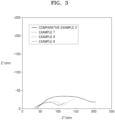
- the impedance characteristics of the torque-cell all-solid secondary batteries of Examples 7 to 9 and Comparative Example 3 were measured.
- the impedances of the all-solid secondary batteries were evaluated by measuring the cell resistance after applying a voltage bias of 10 mV within a frequency range of about 10 6 MHz to about 0.1 MHz at a temperature of about 25 °C according to a 2-probe method utilizing an impedance analyzer (Solartron 1260A Impedance/Gain-Phase Analyzer). Some of the evaluation results are shown in Table 1.
- Table 1 Sample Impedance ( ⁇ ) Example 7 80-130 Example 8 80-130 Example 9 80-130 Comparative Example 3 250-300
- EDX energy dispersive X-ray spectroscopy
- the positive active material of Preparation Example 1 includes a cobalt-rich composition in the shell region.
- a lanthanum-rich composition is localized on a surface of the positive active material of Preparation Example 1.
- the batteries were each charged with a constant current of about 0.1C until a voltage of the battery was about 4.25 V, and then charged with a constant voltage until a current was about 0.05C. The completely charged cell was then rested for about 10 minutes, and discharged with a constant current of about 0.1C until a voltage of the battery was about 2.5 V.
- the battery was charged with a constant current of about 0.2C until a voltage of the battery was about 4.25 V, and then charged with a constant voltage until a current was about 0.05C. The completely charged cell was then rested for about 10 minutes, and discharged with a constant current of about 0.2C until a voltage of the battery was about 2.5 V.
- the lifetime evaluation of the batteries was performed by running 100 cycles, where in each of the 100 cycles, the battery was charged with a constant current of about 1C until a voltage of the battery was about 4.25 V and then charging the battery with a constant voltage until a current was about 0.05C. The completely charged cell was then rested for about 10 minutes, and discharged with a constant current of about 1C until a voltage of the battery was about 2.5 V.
- the all-solid secondary batteries of Examples 1 to 3 had improved lifetime characteristics compared to the all-solid secondary battery of Comparative Example 1.
- the all-solid secondary batteries of Examples 5 and 6 had the same lifetime characteristics as the all-solid secondary battery of Example 1. Also, the all-solid secondary batteries of Examples 5 and 6 had improved lifetime characteristics compared to the all-solid secondary batteries of Reference Examples 1 and 2.
- Each of the all-solid secondary batteries was charged/discharged at 0.33C, 1.0C, and 2.0C in a range of about 2.5 V to about 4.25 V, and the discharge capacity changes according to the C-rates of the batteries are shown in FIG. 7 . Also, a ratio of a discharge capacity when the c-rate was 1.0C to a discharge capacity when the c-rate was 0.33C is shown in Table 2.
- Table 2 Sample Discharge capacity (mAh/g) 1C Rates/0.33C (%) 0.05C 0.33C 0.5C 1.0C
- Example 2 210 185 175 170 96
- Example 3 195 175 170 160 95 Comparative Example 1 250 190 165 150 87
- the all-solid secondary batteries prepared in Examples 1 to 3 had lower resistance of an electrode plate compared to that of the all-solid secondary battery prepared in Comparative Example 1, and thus charge/discharge capacity and lifetime and high-rate characteristics of the all-solid secondary batteries of Examples 1 to 3 were improved compared to the all-solid secondary battery prepared in Comparative Example 1.
- the all-solid secondary battery of Example 4 had charge/discharge capacity and lifetime and high-rate characteristics similar to those of the all-solid secondary battery of Example 1.
- embodiments can provide a positive electrode for an all-solid secondary battery (solid state secondary battery), the positive electrode comprising a positive active material, wherein: the positive active material has a structure containing a core and a shell, the shell comprises a first nickel-based active material containing cobalt (Co), a surface of the positive active material comprises a coating layer comprising at least one lithium ion conductor selected from a lanthanum oxide and a lithium lanthanum oxide, and an amount of the lithium ion conductor is in a range of about 0.1 parts to about 10 parts by weight based on 100 parts by weight of the total weight of the positive active material and the lithium ion conductor.
- the positive active material may comprise particles (with the core and shell) coated with the coating layer.
- Embodiments can provide an all-solid secondary battery (solid state secondary battery) with a positive electrode according to any of the described embodiments,
- an all-solid secondary battery has improved resistance of an electrode and improved current density characteristics, and thus high-rate characteristics and lifetime characteristics as well as capacity characteristics of the all-solid secondary battery may be improved.
- any numerical range recited herein is intended to include all sub-ranges of the same numerical precision subsumed within the recited range.
- a range of "1.0 to 10.0" is intended to include all subranges between (and including) the recited minimum value of 1.0 and the recited maximum value of 10.0, that is, having a minimum value equal to or greater than 1.0 and a maximum value equal to or less than 10.0, such as, for example, 2.4 to 7.6.
- Any maximum numerical limitation recited herein is intended to include all lower numerical limitations subsumed therein and any minimum numerical limitation recited in this specification is intended to include all higher numerical limitations subsumed therein. Accordingly, Applicant reserves the right to amend this specification, including the claims, to expressly recite any sub-range subsumed within the ranges expressly recited herein.
Landscapes
- Chemical & Material Sciences (AREA)
- Chemical Kinetics & Catalysis (AREA)
- Electrochemistry (AREA)
- General Chemical & Material Sciences (AREA)
- Inorganic Chemistry (AREA)
- Engineering & Computer Science (AREA)
- Composite Materials (AREA)
- Manufacturing & Machinery (AREA)
- Materials Engineering (AREA)
- Physics & Mathematics (AREA)
- Condensed Matter Physics & Semiconductors (AREA)
- General Physics & Mathematics (AREA)
- Organic Chemistry (AREA)
- Secondary Cells (AREA)
- Battery Electrode And Active Subsutance (AREA)
Claims (15)
- Électrode positive (10) pour une batterie secondaire entièrement solide,l'électrode positive comprenant un matériau actif positif et un électrolyte solide à base de sulfure (30),dans laquelle :le matériau actif positif possède une structure contenant un coeur (112) et une coque (113), la coque comprend un premier matériau actif à base de nickel contenant du cobalt (Co),une couche de revêtement (114), sur une surface du matériau actif positif, comprenant au moins un conducteur d'ions lithium sélectionné parmi un oxyde de lanthane et un oxyde de lithium et de lanthane, etune quantité du conducteur d'ions lithium est dans une plage d'environ 0,1 partie à environ 10 parties en poids sur la base de 100 parties en poids du poids total du matériau actif positif et du conducteur d'ions lithium.
- Électrode positive selon la revendication 1, dans laquelle une quantité de cobalt dans le premier matériau actif à base de nickel contenant du cobalt (Co) est d'environ 30 % en moles ou plus.
- Électrode positive selon la revendication 1 ou 2, dans laquelle l'oxyde de lithium et de lanthane est représenté par la Formule 1 :
Formule 1 aLi2O-LaO2, et
dans laquelle, dans la Formule 1, 0,1 ≤ a ≤ 2,0. - Électrode positive selon l'une quelconque des revendications 1 à 3, dans laquelle le premier matériau actif à base de nickel contenant du cobalt (Co) est représenté par la Formule 2 :
Formule 2 LiaNi1-x-y-zCoxM1yM2zO2, et
dans laquelle, dans la Formule 2, 0,9 ≤ a ≤ 1,3,M1 est le manganèse (Mn) ou l'aluminium (Al),M2 est le bore (B), le magnésium (Mg), le calcium (Ca), le strontium (Sr), le baryum (Ba), le titane (Ti), le vanadium (V), le chrome (Cr), le fer (Fe), le cuivre (Cu), le zirconium (Zr), l'aluminium (Al), ou une combinaison de ceux-ci,

- Électrode positive selon l'une quelconque des revendications 1 à 4, dans laquelle une quantité de l'électrolyte solide à base de sulfure est dans une plage d'environ 5 parties à environ 15 parties en poids sur la base de 100 parties en poids du poids total de l'électrode positive.
- Électrode positive selon l'une quelconque des revendications 1 à 5, dans laquelle le coeur du matériau actif positif comprend un second matériau actif à base de nickel représenté par la Formule 3 :
Formule 3 Lia(Ni1-x-y-zCOxM1yM2z)O2, et
dans laquelle, dans la Formule 3, M1 est le manganèse (Mn), l'aluminium (Al), ou une combinaison de ceux-ci,M2 est le bore (B), le magnésium (Mg), le calcium (Ca), le strontium (Sr), le baryum (Ba), le titane (Ti), le vanadium (V), le chrome (Cr), le fer (Fe), le cuivre (Cu), le zirconium (Zr), l'aluminium (Al), ou une combinaison de ceux-ci,
- Électrode positive selon la revendication 6, dans laquelle une quantité de nickel dans le second matériau actif à base de nickel représenté par la Formule 3 est dans une plage d'environ 80 % en moles à environ 98 % en moles.
- Électrode positive selon l'une quelconque des revendications 1 à 7, dans laquelle une quantité du premier matériau actif à base de nickel contenant du cobalt (Co) est dans une plage d'environ 0,3 partie à environ 10 parties en poids sur la base de 100 parties en poids du poids total du matériau actif positif ayant la structure contenant le coeur et la coque.
- Électrode positive selon l'une quelconque des revendications 1 à 8, dans laquelle une épaisseur de la couche de revêtement est dans une plage d'environ 0,1 nm à environ 50 nm.
- Batterie secondaire entièrement solide comprenant :l'électrode positive (10) selon l'une quelconque des revendications 1 à 9 ;une électrode négative (20) ; etune couche d'électrolyte solide (30) disposée entre l'électrode positive et l'électrode négative,dans laquelle la couche d'électrolyte solide comprend l'électrolyte solide à base de sulfure.
- Batterie secondaire entièrement solide selon la revendication 10, dans laquelle l'électrolyte solide à base de sulfure est au moins l'un sélectionné parmi Li2S-P2S5, Li2S-P2S5-LiCl, Li2S-P2S5-LiBr, Li2S-P2S5-LiCl-LiBr, Li2S-P2S5-Li2O, Li2S-P2S5-Li2O-LiI, Li2S-SiS2, Li2S-SiS2-LiI, Li2S-SiS2-LiBr, Li2S-SiS2-B2S3-LiI, Li2S-SiS2-P2S5-LiI, Li2S-B2S3, Li2S-P2S5-ZmSn (où m et n sont chacun un nombre positif, et Z est l'un parmi Ge, Zn et Ga), Li2S-GeS2, Li2S-SiS2-Li3PO4, Li2S-SiS2-LipMOq (où p et q sont chacun un nombre positif, et M est l'un parmi P, Si, Ge, B, Al, Ga, et In), Li7-xPS6-xClx (où 0 ≤ x ≤ 2), Li7-xPS6-xBrx (où 0 ≤ x ≤ 2), et Li7-xPS6-xIx (où 0 ≤ x ≤ 2).
- Batterie secondaire entièrement solide selon la revendication 10 ou 11, dans laquelle l'électrode négative comprend un collecteur de courant négatif (21) et une première couche de matériau actif négatif (22) sur le collecteur de courant négatif,la première couche de matériau actif négatif comprend un matériau actif négatif et un liant, le matériau actif négatif se présente sous la forme de particules, etun diamètre particulaire moyen du matériau actif négatif est d'environ 4 µm ou moins.
- Batterie secondaire entièrement solide selon la revendication 12, dans laquelle le matériau actif négatif comprend au moins l'un sélectionné parmi un matériau actif négatif carboné, un matériau actif négatif métallique, et un matériau actif négatif métalloïde.
- Batterie secondaire entièrement solide selon la revendication 13, dans laquelle le matériau actif négatif carboné comprend au moins l'un sélectionné parmi le carbone amorphe et le carbone cristallin.
- Batterie secondaire entièrement solide selon la revendication 13 ou 14, dans laquelle le matériau actif négatif métallique et/ou le matériau actif négatif métalloïde comprend au moins l'un sélectionné parmi le groupe constitué de l'or (Au), du platine (Pt), du palladium (Pd), du silicium (Si), de l'argent (Ag), de l'aluminium (Al), du bismuth (Bi), de l'étain (Sn) et du zinc (Zn).
Applications Claiming Priority (1)
| Application Number | Priority Date | Filing Date | Title |
|---|---|---|---|
| KR1020200026799A KR102862241B1 (ko) | 2020-03-03 | 2020-03-03 | 전고체이차전지용 양극 및 이를 포함하는 전고체이차전지 |
Publications (2)
| Publication Number | Publication Date |
|---|---|
| EP3876312A1 EP3876312A1 (fr) | 2021-09-08 |
| EP3876312B1 true EP3876312B1 (fr) | 2024-07-17 |
Family
ID=74858239
Family Applications (1)
| Application Number | Title | Priority Date | Filing Date |
|---|---|---|---|
| EP21160577.9A Active EP3876312B1 (fr) | 2020-03-03 | 2021-03-03 | Électrode positive pour batterie secondaire entièrement solide et batterie secondaire tout solide la comprenant |
Country Status (4)
| Country | Link |
|---|---|
| US (1) | US11984583B2 (fr) |
| EP (1) | EP3876312B1 (fr) |
| JP (1) | JP7106702B2 (fr) |
| KR (1) | KR102862241B1 (fr) |
Families Citing this family (8)
| Publication number | Priority date | Publication date | Assignee | Title |
|---|---|---|---|---|
| KR102903844B1 (ko) * | 2020-03-18 | 2025-12-23 | 삼성에스디아이 주식회사 | 전고체 이차전지용 양극 및 이를 포함하는 전고체 이차전지 |
| EP4402733A1 (fr) * | 2021-09-13 | 2024-07-24 | Sion Power Corporation | Cellules électrochimiques contenant du lithium à haute tension et procédés associés |
| KR102867393B1 (ko) * | 2021-12-22 | 2025-10-01 | 포스코홀딩스 주식회사 | 전고체전지용 양극 활물질과 이의 제조 방법 |
| JP2023100298A (ja) * | 2022-01-06 | 2023-07-19 | 三星エスディアイ株式会社 | 固体二次電池用正極及び固体二次電池 |
| US20240145698A1 (en) * | 2022-11-01 | 2024-05-02 | Nissan North America, Inc. | Composite Cathode Material and Structure for All-Solid-State Batteries |
| KR20250094293A (ko) * | 2023-12-18 | 2025-06-25 | 포스코홀딩스 주식회사 | 전고체전지용 양극활물질 및 이의 제조 방법 |
| CN118173744A (zh) * | 2024-03-26 | 2024-06-11 | 天津巴莫科技有限责任公司 | 正极材料及其制备方法、正极极片和二次电池 |
| WO2025242664A1 (fr) * | 2024-05-21 | 2025-11-27 | Umicore | Matériau composite d'électrode positive |
Citations (1)
| Publication number | Priority date | Publication date | Assignee | Title |
|---|---|---|---|---|
| CN107732193A (zh) * | 2017-10-09 | 2018-02-23 | 天津理工大学 | 一种应用核壳结构高镍正极材料的全固态锂电池及其制备方法 |
Family Cites Families (30)
| Publication number | Priority date | Publication date | Assignee | Title |
|---|---|---|---|---|
| ES2584027T3 (es) | 2007-03-05 | 2016-09-23 | Toda Kogyo Corporation | Polvo de partículas de óxido complejo de Li-Ni para una batería secundaria de electrolito no acuoso, procedimiento para su producción, y batería secundaria de electrolito no acuoso |
| JP2008234872A (ja) | 2007-03-16 | 2008-10-02 | Sony Corp | 正極活物質および電池 |
| JP5549437B2 (ja) | 2010-07-08 | 2014-07-16 | ソニー株式会社 | 正極活物質、非水電解質電池および正極活物質の製造方法 |
| JP5494572B2 (ja) | 2011-05-30 | 2014-05-14 | トヨタ自動車株式会社 | 全固体電池及びその製造方法 |
| EP3059211B1 (fr) | 2011-06-17 | 2024-08-07 | Umicore | Composés à base d'oxyde de cobalt et de lithium contrôlés de manière stoechiométrique de structure spinell de symmetrie fd-3m |
| KR101669113B1 (ko) | 2012-05-08 | 2016-10-25 | 삼성에스디아이 주식회사 | 복합양극활물질, 이를 채용한 양극 및 리튬 전지 |
| KR20140053451A (ko) | 2012-10-25 | 2014-05-08 | 삼성에스디아이 주식회사 | 복합양극활물질, 그 제조방법 및 이를 채용한 양극과 리튬전지 |
| US10128507B2 (en) | 2012-12-07 | 2018-11-13 | Samsung Electronics Co., Ltd. | Lithium secondary battery |
| JP2014116149A (ja) | 2012-12-07 | 2014-06-26 | Samsung R&D Institute Japan Co Ltd | リチウムイオン二次電池及びリチウム二次電池用正極活物質の製造方法 |
| CN105122501B (zh) * | 2013-03-15 | 2019-02-19 | 锡安能量公司 | 受保护电极结构 |
| JP6738121B2 (ja) | 2014-07-17 | 2020-08-12 | 三星電子株式会社Samsung Electronics Co.,Ltd. | リチウムイオン(lithiumion)二次電池 |
| US9608288B2 (en) * | 2014-07-17 | 2017-03-28 | Samsung Electronics Co., Ltd. | Positive electrode for lithium ion secondary battery and lithium ion secondary battery including the same |
| KR101568263B1 (ko) * | 2014-08-07 | 2015-11-11 | 주식회사 에코프로 | 리튬 이차 전지용 양극활물질 및 이를 포함하는 리튬 이차 전지 |
| JP6667985B2 (ja) * | 2014-08-15 | 2020-03-18 | 三星電子株式会社Samsung Electronics Co.,Ltd. | リチウムイオン(lithiumion)二次電池 |
| US10141566B2 (en) | 2014-08-15 | 2018-11-27 | Samsung Electronics Co., Ltd. | Lithium secondary battery including a coated cathode material and solid electrolyte, and method of preparing the same |
| JP2016062683A (ja) * | 2014-09-16 | 2016-04-25 | 三星電子株式会社Samsung Electronics Co.,Ltd. | リチウムイオン(lithiumion)二次電池 |
| US20160079597A1 (en) | 2014-09-16 | 2016-03-17 | Samsung Electronics Co., Ltd. | All-solid lithium ion secondary battery |
| JP6438281B2 (ja) | 2014-11-28 | 2018-12-12 | 三星電子株式会社Samsung Electronics Co.,Ltd. | リチウムイオン二次電池 |
| US10826057B2 (en) | 2014-12-19 | 2020-11-03 | Lg Chem, Ltd. | Mixed positive electrode active material, positive electrode comprising same, and secondary battery |
| KR101761367B1 (ko) | 2014-12-19 | 2017-07-25 | 주식회사 엘지화학 | 혼합 양극활물질, 이를 포함하는 양극 및 이차전지 |
| JP6601500B2 (ja) | 2015-10-02 | 2019-11-06 | 日立金属株式会社 | 正極材料及びその製造方法並びにリチウムイオン二次電池 |
| JP7127540B2 (ja) | 2016-09-29 | 2022-08-30 | Tdk株式会社 | 全固体リチウムイオン二次電池 |
| KR101897365B1 (ko) | 2016-11-23 | 2018-09-10 | 울산과학기술원 | 리튬 이차전지용 양극 활물질, 이들의 제조방법, 및 이를 포함하는 리튬 이차전지 |
| US11217785B2 (en) | 2017-01-24 | 2022-01-04 | Samsung Electronics Co., Ltd. | Composite cathode active material and secondary battery including the same |
| JP6431236B1 (ja) * | 2017-05-29 | 2018-11-28 | 太平洋セメント株式会社 | リチウムイオン二次電池用正極活物質複合体又はナトリウムイオン二次電池用正極活物質複合体、これらを用いた二次電池、並びにこれらの製造方法 |
| KR102394797B1 (ko) | 2017-09-12 | 2022-05-04 | 현대자동차주식회사 | 파쇄강도가 서로 다른 2 이상의 전극 활물질을 포함하는 전극 조성물 및 이를 포함하는 리튬 이차전지 |
| KR102159243B1 (ko) | 2017-11-22 | 2020-09-23 | 주식회사 에코프로비엠 | 리튬 이차 전지용 양극활물질 |
| JP6936959B2 (ja) | 2017-12-12 | 2021-09-22 | トヨタ自動車株式会社 | 正極合材、正極活物質層、全固体電池および正極活物質層の製造方法 |
| EP3757067A4 (fr) * | 2018-02-22 | 2021-12-15 | Sumitomo Metal Mining Co., Ltd. | Hydroxyde composite de métal et sa méthode de production, substance active d'électrode positive pour batterie secondaire à électrolyte non aqueux et sa méthode de production, et batterie secondaire à électrolyte non aqueux |
| KR102903844B1 (ko) | 2020-03-18 | 2025-12-23 | 삼성에스디아이 주식회사 | 전고체 이차전지용 양극 및 이를 포함하는 전고체 이차전지 |
-
2020
- 2020-03-03 KR KR1020200026799A patent/KR102862241B1/ko active Active
-
2021
- 2021-03-03 EP EP21160577.9A patent/EP3876312B1/fr active Active
- 2021-03-03 JP JP2021033438A patent/JP7106702B2/ja active Active
- 2021-03-03 US US17/190,770 patent/US11984583B2/en active Active
Patent Citations (1)
| Publication number | Priority date | Publication date | Assignee | Title |
|---|---|---|---|---|
| CN107732193A (zh) * | 2017-10-09 | 2018-02-23 | 天津理工大学 | 一种应用核壳结构高镍正极材料的全固态锂电池及其制备方法 |
Also Published As
| Publication number | Publication date |
|---|---|
| US11984583B2 (en) | 2024-05-14 |
| EP3876312A1 (fr) | 2021-09-08 |
| KR20210111951A (ko) | 2021-09-14 |
| US20210280854A1 (en) | 2021-09-09 |
| KR102862241B1 (ko) | 2025-09-19 |
| JP7106702B2 (ja) | 2022-07-26 |
| JP2021141065A (ja) | 2021-09-16 |
Similar Documents
| Publication | Publication Date | Title |
|---|---|---|
| US12308385B2 (en) | All-solid secondary battery and method of preparing same | |
| KR102895756B1 (ko) | 전고체이차전지 및 그 제조방법 | |
| US12278333B2 (en) | Solid electrolyte, electrochemical battery including the solid electrolyte, and method of preparing the solid electrolyte | |
| US11909043B2 (en) | Positive electrode for all-solid secondary battery and all-solid secondary battery including the same | |
| JP7614794B2 (ja) | 全固体二次電池 | |
| EP3883021A1 (fr) | Cathode pour batterie secondaire entièrement solide et batterie secondaire entièrement solide la comprenant | |
| US11984583B2 (en) | Positive electrode for all-solid secondary battery and all-solid secondary battery including the same | |
| US20240194938A1 (en) | Solid electrolyte, electrochemical cell including solid electrolyte, and method of preparing solid electrolyte | |
| EP4068426A1 (fr) | Matériau actif de cathode composite pour batterie à l'état solide, son procédé de préparation, couche de cathode pour batterie à l'état solide, et batterie à l'état solide comprenant la couche de cathode | |
| EP3961781A1 (fr) | Batterie secondaire solide | |
| EP4386881A1 (fr) | Couche d'électrode négative pour batterie secondaire tout solide et batterie secondaire tout solide la comprenant | |
| KR102895753B1 (ko) | 고체 전해질, 이를 포함하는 전기화학전지 및 고체 전해질의 제조방법 | |
| EP4068420B1 (fr) | Matériau actif positif pour batterie secondaire entièrement solide et batterie secondaire entièrement solide le comprenant | |
| EP3872901A1 (fr) | Batterie secondaire solide | |
| US20230327186A1 (en) | Sulfide-based solid electrolyte, method for preparing same, and electrochemical cell comprising same | |
| US12626952B2 (en) | Solid ion conductor compound, electrochemical cell comprising the same, and preparation method thereof |
Legal Events
| Date | Code | Title | Description |
|---|---|---|---|
| PUAI | Public reference made under article 153(3) epc to a published international application that has entered the european phase |
Free format text: ORIGINAL CODE: 0009012 |
|
| STAA | Information on the status of an ep patent application or granted ep patent |
Free format text: STATUS: REQUEST FOR EXAMINATION WAS MADE |
|
| 17P | Request for examination filed |
Effective date: 20210303 |
|
| AK | Designated contracting states |
Kind code of ref document: A1 Designated state(s): AL AT BE BG CH CY CZ DE DK EE ES FI FR GB GR HR HU IE IS IT LI LT LU LV MC MK MT NL NO PL PT RO RS SE SI SK SM TR |
|
| STAA | Information on the status of an ep patent application or granted ep patent |
Free format text: STATUS: EXAMINATION IS IN PROGRESS |
|
| 17Q | First examination report despatched |
Effective date: 20230530 |
|
| GRAP | Despatch of communication of intention to grant a patent |
Free format text: ORIGINAL CODE: EPIDOSNIGR1 |
|
| STAA | Information on the status of an ep patent application or granted ep patent |
Free format text: STATUS: GRANT OF PATENT IS INTENDED |
|
| RIC1 | Information provided on ipc code assigned before grant |
Ipc: H01M 4/02 20060101ALN20240109BHEP Ipc: H01M 10/0562 20100101ALI20240109BHEP Ipc: H01M 4/525 20100101ALI20240109BHEP Ipc: H01M 4/40 20060101ALI20240109BHEP Ipc: H01M 4/36 20060101ALI20240109BHEP Ipc: H01M 4/131 20100101AFI20240109BHEP |
|
| INTG | Intention to grant announced |
Effective date: 20240205 |
|
| GRAS | Grant fee paid |
Free format text: ORIGINAL CODE: EPIDOSNIGR3 |
|
| GRAA | (expected) grant |
Free format text: ORIGINAL CODE: 0009210 |
|
| STAA | Information on the status of an ep patent application or granted ep patent |
Free format text: STATUS: THE PATENT HAS BEEN GRANTED |
|
| AK | Designated contracting states |
Kind code of ref document: B1 Designated state(s): AL AT BE BG CH CY CZ DE DK EE ES FI FR GB GR HR HU IE IS IT LI LT LU LV MC MK MT NL NO PL PT RO RS SE SI SK SM TR |
|
| REG | Reference to a national code |
Ref country code: CH Ref legal event code: EP |
|
| REG | Reference to a national code |
Ref country code: DE Ref legal event code: R096 Ref document number: 602021015668 Country of ref document: DE |
|
| REG | Reference to a national code |
Ref country code: IE Ref legal event code: FG4D |
|
| REG | Reference to a national code |
Ref country code: LT Ref legal event code: MG9D |
|
| REG | Reference to a national code |
Ref country code: NL Ref legal event code: MP Effective date: 20240717 |
|
| PG25 | Lapsed in a contracting state [announced via postgrant information from national office to epo] |
Ref country code: PT Free format text: LAPSE BECAUSE OF FAILURE TO SUBMIT A TRANSLATION OF THE DESCRIPTION OR TO PAY THE FEE WITHIN THE PRESCRIBED TIME-LIMIT Effective date: 20241118 |
|
| REG | Reference to a national code |
Ref country code: AT Ref legal event code: MK05 Ref document number: 1704990 Country of ref document: AT Kind code of ref document: T Effective date: 20240717 |
|
| PG25 | Lapsed in a contracting state [announced via postgrant information from national office to epo] |
Ref country code: NL Free format text: LAPSE BECAUSE OF FAILURE TO SUBMIT A TRANSLATION OF THE DESCRIPTION OR TO PAY THE FEE WITHIN THE PRESCRIBED TIME-LIMIT Effective date: 20240717 |
|
| PG25 | Lapsed in a contracting state [announced via postgrant information from national office to epo] |
Ref country code: PT Free format text: LAPSE BECAUSE OF FAILURE TO SUBMIT A TRANSLATION OF THE DESCRIPTION OR TO PAY THE FEE WITHIN THE PRESCRIBED TIME-LIMIT Effective date: 20241118 Ref country code: NL Free format text: LAPSE BECAUSE OF FAILURE TO SUBMIT A TRANSLATION OF THE DESCRIPTION OR TO PAY THE FEE WITHIN THE PRESCRIBED TIME-LIMIT Effective date: 20240717 |
|
| PG25 | Lapsed in a contracting state [announced via postgrant information from national office to epo] |
Ref country code: NO Free format text: LAPSE BECAUSE OF FAILURE TO SUBMIT A TRANSLATION OF THE DESCRIPTION OR TO PAY THE FEE WITHIN THE PRESCRIBED TIME-LIMIT Effective date: 20241017 |
|
| PG25 | Lapsed in a contracting state [announced via postgrant information from national office to epo] |
Ref country code: GR Free format text: LAPSE BECAUSE OF FAILURE TO SUBMIT A TRANSLATION OF THE DESCRIPTION OR TO PAY THE FEE WITHIN THE PRESCRIBED TIME-LIMIT Effective date: 20241018 Ref country code: FI Free format text: LAPSE BECAUSE OF FAILURE TO SUBMIT A TRANSLATION OF THE DESCRIPTION OR TO PAY THE FEE WITHIN THE PRESCRIBED TIME-LIMIT Effective date: 20240717 Ref country code: PL Free format text: LAPSE BECAUSE OF FAILURE TO SUBMIT A TRANSLATION OF THE DESCRIPTION OR TO PAY THE FEE WITHIN THE PRESCRIBED TIME-LIMIT Effective date: 20240717 |
|
| PG25 | Lapsed in a contracting state [announced via postgrant information from national office to epo] |
Ref country code: BG Free format text: LAPSE BECAUSE OF FAILURE TO SUBMIT A TRANSLATION OF THE DESCRIPTION OR TO PAY THE FEE WITHIN THE PRESCRIBED TIME-LIMIT Effective date: 20240717 |
|
| PG25 | Lapsed in a contracting state [announced via postgrant information from national office to epo] |
Ref country code: LV Free format text: LAPSE BECAUSE OF FAILURE TO SUBMIT A TRANSLATION OF THE DESCRIPTION OR TO PAY THE FEE WITHIN THE PRESCRIBED TIME-LIMIT Effective date: 20240717 |
|
| PG25 | Lapsed in a contracting state [announced via postgrant information from national office to epo] |
Ref country code: IS Free format text: LAPSE BECAUSE OF FAILURE TO SUBMIT A TRANSLATION OF THE DESCRIPTION OR TO PAY THE FEE WITHIN THE PRESCRIBED TIME-LIMIT Effective date: 20241117 Ref country code: AT Free format text: LAPSE BECAUSE OF FAILURE TO SUBMIT A TRANSLATION OF THE DESCRIPTION OR TO PAY THE FEE WITHIN THE PRESCRIBED TIME-LIMIT Effective date: 20240717 |
|
| PG25 | Lapsed in a contracting state [announced via postgrant information from national office to epo] |
Ref country code: HR Free format text: LAPSE BECAUSE OF FAILURE TO SUBMIT A TRANSLATION OF THE DESCRIPTION OR TO PAY THE FEE WITHIN THE PRESCRIBED TIME-LIMIT Effective date: 20240717 |
|
| PG25 | Lapsed in a contracting state [announced via postgrant information from national office to epo] |
Ref country code: ES Free format text: LAPSE BECAUSE OF FAILURE TO SUBMIT A TRANSLATION OF THE DESCRIPTION OR TO PAY THE FEE WITHIN THE PRESCRIBED TIME-LIMIT Effective date: 20240717 Ref country code: RS Free format text: LAPSE BECAUSE OF FAILURE TO SUBMIT A TRANSLATION OF THE DESCRIPTION OR TO PAY THE FEE WITHIN THE PRESCRIBED TIME-LIMIT Effective date: 20241017 |
|
| PG25 | Lapsed in a contracting state [announced via postgrant information from national office to epo] |
Ref country code: RS Free format text: LAPSE BECAUSE OF FAILURE TO SUBMIT A TRANSLATION OF THE DESCRIPTION OR TO PAY THE FEE WITHIN THE PRESCRIBED TIME-LIMIT Effective date: 20241017 Ref country code: PL Free format text: LAPSE BECAUSE OF FAILURE TO SUBMIT A TRANSLATION OF THE DESCRIPTION OR TO PAY THE FEE WITHIN THE PRESCRIBED TIME-LIMIT Effective date: 20240717 Ref country code: NO Free format text: LAPSE BECAUSE OF FAILURE TO SUBMIT A TRANSLATION OF THE DESCRIPTION OR TO PAY THE FEE WITHIN THE PRESCRIBED TIME-LIMIT Effective date: 20241017 Ref country code: LV Free format text: LAPSE BECAUSE OF FAILURE TO SUBMIT A TRANSLATION OF THE DESCRIPTION OR TO PAY THE FEE WITHIN THE PRESCRIBED TIME-LIMIT Effective date: 20240717 Ref country code: IS Free format text: LAPSE BECAUSE OF FAILURE TO SUBMIT A TRANSLATION OF THE DESCRIPTION OR TO PAY THE FEE WITHIN THE PRESCRIBED TIME-LIMIT Effective date: 20241117 Ref country code: HR Free format text: LAPSE BECAUSE OF FAILURE TO SUBMIT A TRANSLATION OF THE DESCRIPTION OR TO PAY THE FEE WITHIN THE PRESCRIBED TIME-LIMIT Effective date: 20240717 Ref country code: GR Free format text: LAPSE BECAUSE OF FAILURE TO SUBMIT A TRANSLATION OF THE DESCRIPTION OR TO PAY THE FEE WITHIN THE PRESCRIBED TIME-LIMIT Effective date: 20241018 Ref country code: FI Free format text: LAPSE BECAUSE OF FAILURE TO SUBMIT A TRANSLATION OF THE DESCRIPTION OR TO PAY THE FEE WITHIN THE PRESCRIBED TIME-LIMIT Effective date: 20240717 Ref country code: ES Free format text: LAPSE BECAUSE OF FAILURE TO SUBMIT A TRANSLATION OF THE DESCRIPTION OR TO PAY THE FEE WITHIN THE PRESCRIBED TIME-LIMIT Effective date: 20240717 Ref country code: BG Free format text: LAPSE BECAUSE OF FAILURE TO SUBMIT A TRANSLATION OF THE DESCRIPTION OR TO PAY THE FEE WITHIN THE PRESCRIBED TIME-LIMIT Effective date: 20240717 Ref country code: AT Free format text: LAPSE BECAUSE OF FAILURE TO SUBMIT A TRANSLATION OF THE DESCRIPTION OR TO PAY THE FEE WITHIN THE PRESCRIBED TIME-LIMIT Effective date: 20240717 |
|
| PG25 | Lapsed in a contracting state [announced via postgrant information from national office to epo] |
Ref country code: SM Free format text: LAPSE BECAUSE OF FAILURE TO SUBMIT A TRANSLATION OF THE DESCRIPTION OR TO PAY THE FEE WITHIN THE PRESCRIBED TIME-LIMIT Effective date: 20240717 Ref country code: RO Free format text: LAPSE BECAUSE OF FAILURE TO SUBMIT A TRANSLATION OF THE DESCRIPTION OR TO PAY THE FEE WITHIN THE PRESCRIBED TIME-LIMIT Effective date: 20240717 Ref country code: DK Free format text: LAPSE BECAUSE OF FAILURE TO SUBMIT A TRANSLATION OF THE DESCRIPTION OR TO PAY THE FEE WITHIN THE PRESCRIBED TIME-LIMIT Effective date: 20240717 |
|
| REG | Reference to a national code |
Ref country code: DE Ref legal event code: R097 Ref document number: 602021015668 Country of ref document: DE |
|
| PG25 | Lapsed in a contracting state [announced via postgrant information from national office to epo] |
Ref country code: EE Free format text: LAPSE BECAUSE OF FAILURE TO SUBMIT A TRANSLATION OF THE DESCRIPTION OR TO PAY THE FEE WITHIN THE PRESCRIBED TIME-LIMIT Effective date: 20240717 |
|
| PG25 | Lapsed in a contracting state [announced via postgrant information from national office to epo] |
Ref country code: CZ Free format text: LAPSE BECAUSE OF FAILURE TO SUBMIT A TRANSLATION OF THE DESCRIPTION OR TO PAY THE FEE WITHIN THE PRESCRIBED TIME-LIMIT Effective date: 20240717 |
|
| PG25 | Lapsed in a contracting state [announced via postgrant information from national office to epo] |
Ref country code: SK Free format text: LAPSE BECAUSE OF FAILURE TO SUBMIT A TRANSLATION OF THE DESCRIPTION OR TO PAY THE FEE WITHIN THE PRESCRIBED TIME-LIMIT Effective date: 20240717 |
|
| PLBE | No opposition filed within time limit |
Free format text: ORIGINAL CODE: 0009261 |
|
| STAA | Information on the status of an ep patent application or granted ep patent |
Free format text: STATUS: NO OPPOSITION FILED WITHIN TIME LIMIT |
|
| 26N | No opposition filed |
Effective date: 20250422 |
|
| PG25 | Lapsed in a contracting state [announced via postgrant information from national office to epo] |
Ref country code: SE Free format text: LAPSE BECAUSE OF FAILURE TO SUBMIT A TRANSLATION OF THE DESCRIPTION OR TO PAY THE FEE WITHIN THE PRESCRIBED TIME-LIMIT Effective date: 20240717 |
|
| PG25 | Lapsed in a contracting state [announced via postgrant information from national office to epo] |
Ref country code: MC Free format text: LAPSE BECAUSE OF FAILURE TO SUBMIT A TRANSLATION OF THE DESCRIPTION OR TO PAY THE FEE WITHIN THE PRESCRIBED TIME-LIMIT Effective date: 20240717 |
|
| REG | Reference to a national code |
Ref country code: CH Ref legal event code: H13 Free format text: ST27 STATUS EVENT CODE: U-0-0-H10-H13 (AS PROVIDED BY THE NATIONAL OFFICE) Effective date: 20251024 |
|
| PG25 | Lapsed in a contracting state [announced via postgrant information from national office to epo] |
Ref country code: LU Free format text: LAPSE BECAUSE OF NON-PAYMENT OF DUE FEES Effective date: 20250303 |
|
| REG | Reference to a national code |
Ref country code: BE Ref legal event code: MM Effective date: 20250331 |
|
| PG25 | Lapsed in a contracting state [announced via postgrant information from national office to epo] |
Ref country code: BE Free format text: LAPSE BECAUSE OF NON-PAYMENT OF DUE FEES Effective date: 20250331 |
|
| PG25 | Lapsed in a contracting state [announced via postgrant information from national office to epo] |
Ref country code: CH Free format text: LAPSE BECAUSE OF NON-PAYMENT OF DUE FEES Effective date: 20250331 |
|
| PG25 | Lapsed in a contracting state [announced via postgrant information from national office to epo] |
Ref country code: IE Free format text: LAPSE BECAUSE OF NON-PAYMENT OF DUE FEES Effective date: 20250303 |
|
| PG25 | Lapsed in a contracting state [announced via postgrant information from national office to epo] |
Ref country code: IT Free format text: LAPSE BECAUSE OF FAILURE TO SUBMIT A TRANSLATION OF THE DESCRIPTION OR TO PAY THE FEE WITHIN THE PRESCRIBED TIME-LIMIT Effective date: 20240717 |
|
| PGFP | Annual fee paid to national office [announced via postgrant information from national office to epo] |
Ref country code: GB Payment date: 20260303 Year of fee payment: 6 |
|
| PGFP | Annual fee paid to national office [announced via postgrant information from national office to epo] |
Ref country code: DE Payment date: 20260305 Year of fee payment: 6 |
|
| PGFP | Annual fee paid to national office [announced via postgrant information from national office to epo] |
Ref country code: FR Payment date: 20260309 Year of fee payment: 6 |