EP3878973B1 - Procédés de détermination de fraction d'acides nucléiques foetaux dans d'échantillons maternels - Google Patents
Procédés de détermination de fraction d'acides nucléiques foetaux dans d'échantillons maternels Download PDFInfo
- Publication number
- EP3878973B1 EP3878973B1 EP21157398.5A EP21157398A EP3878973B1 EP 3878973 B1 EP3878973 B1 EP 3878973B1 EP 21157398 A EP21157398 A EP 21157398A EP 3878973 B1 EP3878973 B1 EP 3878973B1
- Authority
- EP
- European Patent Office
- Prior art keywords
- polymorphic
- fetal
- nucleic acids
- sequencing
- seq
- Prior art date
- Legal status (The legal status is an assumption and is not a legal conclusion. Google has not performed a legal analysis and makes no representation as to the accuracy of the status listed.)
- Active
Links
Images



Classifications
-
- G—PHYSICS
- G16—INFORMATION AND COMMUNICATION TECHNOLOGY [ICT] SPECIALLY ADAPTED FOR SPECIFIC APPLICATION FIELDS
- G16B—BIOINFORMATICS, i.e. INFORMATION AND COMMUNICATION TECHNOLOGY [ICT] SPECIALLY ADAPTED FOR GENETIC OR PROTEIN-RELATED DATA PROCESSING IN COMPUTATIONAL MOLECULAR BIOLOGY
- G16B99/00—Subject matter not provided for in other groups of this subclass
-
- C—CHEMISTRY; METALLURGY
- C12—BIOCHEMISTRY; BEER; SPIRITS; WINE; VINEGAR; MICROBIOLOGY; ENZYMOLOGY; MUTATION OR GENETIC ENGINEERING
- C12Q—MEASURING OR TESTING PROCESSES INVOLVING ENZYMES, NUCLEIC ACIDS OR MICROORGANISMS; COMPOSITIONS OR TEST PAPERS THEREFOR; PROCESSES OF PREPARING SUCH COMPOSITIONS; CONDITION-RESPONSIVE CONTROL IN MICROBIOLOGICAL OR ENZYMOLOGICAL PROCESSES
- C12Q1/00—Measuring or testing processes involving enzymes, nucleic acids or microorganisms; Compositions therefor; Processes of preparing such compositions
- C12Q1/68—Measuring or testing processes involving enzymes, nucleic acids or microorganisms; Compositions therefor; Processes of preparing such compositions involving nucleic acids
-
- C—CHEMISTRY; METALLURGY
- C12—BIOCHEMISTRY; BEER; SPIRITS; WINE; VINEGAR; MICROBIOLOGY; ENZYMOLOGY; MUTATION OR GENETIC ENGINEERING
- C12Q—MEASURING OR TESTING PROCESSES INVOLVING ENZYMES, NUCLEIC ACIDS OR MICROORGANISMS; COMPOSITIONS OR TEST PAPERS THEREFOR; PROCESSES OF PREPARING SUCH COMPOSITIONS; CONDITION-RESPONSIVE CONTROL IN MICROBIOLOGICAL OR ENZYMOLOGICAL PROCESSES
- C12Q1/00—Measuring or testing processes involving enzymes, nucleic acids or microorganisms; Compositions therefor; Processes of preparing such compositions
- C12Q1/68—Measuring or testing processes involving enzymes, nucleic acids or microorganisms; Compositions therefor; Processes of preparing such compositions involving nucleic acids
- C12Q1/6806—Preparing nucleic acids for analysis, e.g. for polymerase chain reaction [PCR] assay
-
- C—CHEMISTRY; METALLURGY
- C12—BIOCHEMISTRY; BEER; SPIRITS; WINE; VINEGAR; MICROBIOLOGY; ENZYMOLOGY; MUTATION OR GENETIC ENGINEERING
- C12Q—MEASURING OR TESTING PROCESSES INVOLVING ENZYMES, NUCLEIC ACIDS OR MICROORGANISMS; COMPOSITIONS OR TEST PAPERS THEREFOR; PROCESSES OF PREPARING SUCH COMPOSITIONS; CONDITION-RESPONSIVE CONTROL IN MICROBIOLOGICAL OR ENZYMOLOGICAL PROCESSES
- C12Q1/00—Measuring or testing processes involving enzymes, nucleic acids or microorganisms; Compositions therefor; Processes of preparing such compositions
- C12Q1/68—Measuring or testing processes involving enzymes, nucleic acids or microorganisms; Compositions therefor; Processes of preparing such compositions involving nucleic acids
- C12Q1/6809—Methods for determination or identification of nucleic acids involving differential detection
-
- C—CHEMISTRY; METALLURGY
- C12—BIOCHEMISTRY; BEER; SPIRITS; WINE; VINEGAR; MICROBIOLOGY; ENZYMOLOGY; MUTATION OR GENETIC ENGINEERING
- C12Q—MEASURING OR TESTING PROCESSES INVOLVING ENZYMES, NUCLEIC ACIDS OR MICROORGANISMS; COMPOSITIONS OR TEST PAPERS THEREFOR; PROCESSES OF PREPARING SUCH COMPOSITIONS; CONDITION-RESPONSIVE CONTROL IN MICROBIOLOGICAL OR ENZYMOLOGICAL PROCESSES
- C12Q1/00—Measuring or testing processes involving enzymes, nucleic acids or microorganisms; Compositions therefor; Processes of preparing such compositions
- C12Q1/68—Measuring or testing processes involving enzymes, nucleic acids or microorganisms; Compositions therefor; Processes of preparing such compositions involving nucleic acids
- C12Q1/6813—Hybridisation assays
- C12Q1/6827—Hybridisation assays for detection of mutation or polymorphism
-
- C—CHEMISTRY; METALLURGY
- C12—BIOCHEMISTRY; BEER; SPIRITS; WINE; VINEGAR; MICROBIOLOGY; ENZYMOLOGY; MUTATION OR GENETIC ENGINEERING
- C12Q—MEASURING OR TESTING PROCESSES INVOLVING ENZYMES, NUCLEIC ACIDS OR MICROORGANISMS; COMPOSITIONS OR TEST PAPERS THEREFOR; PROCESSES OF PREPARING SUCH COMPOSITIONS; CONDITION-RESPONSIVE CONTROL IN MICROBIOLOGICAL OR ENZYMOLOGICAL PROCESSES
- C12Q1/00—Measuring or testing processes involving enzymes, nucleic acids or microorganisms; Compositions therefor; Processes of preparing such compositions
- C12Q1/68—Measuring or testing processes involving enzymes, nucleic acids or microorganisms; Compositions therefor; Processes of preparing such compositions involving nucleic acids
- C12Q1/6869—Methods for sequencing
-
- C—CHEMISTRY; METALLURGY
- C12—BIOCHEMISTRY; BEER; SPIRITS; WINE; VINEGAR; MICROBIOLOGY; ENZYMOLOGY; MUTATION OR GENETIC ENGINEERING
- C12Q—MEASURING OR TESTING PROCESSES INVOLVING ENZYMES, NUCLEIC ACIDS OR MICROORGANISMS; COMPOSITIONS OR TEST PAPERS THEREFOR; PROCESSES OF PREPARING SUCH COMPOSITIONS; CONDITION-RESPONSIVE CONTROL IN MICROBIOLOGICAL OR ENZYMOLOGICAL PROCESSES
- C12Q1/00—Measuring or testing processes involving enzymes, nucleic acids or microorganisms; Compositions therefor; Processes of preparing such compositions
- C12Q1/68—Measuring or testing processes involving enzymes, nucleic acids or microorganisms; Compositions therefor; Processes of preparing such compositions involving nucleic acids
- C12Q1/6869—Methods for sequencing
- C12Q1/6872—Methods for sequencing involving mass spectrometry
-
- C—CHEMISTRY; METALLURGY
- C40—COMBINATORIAL TECHNOLOGY
- C40B—COMBINATORIAL CHEMISTRY; LIBRARIES, e.g. CHEMICAL LIBRARIES
- C40B30/00—Methods of screening libraries
-
- G—PHYSICS
- G16—INFORMATION AND COMMUNICATION TECHNOLOGY [ICT] SPECIALLY ADAPTED FOR SPECIFIC APPLICATION FIELDS
- G16B—BIOINFORMATICS, i.e. INFORMATION AND COMMUNICATION TECHNOLOGY [ICT] SPECIALLY ADAPTED FOR GENETIC OR PROTEIN-RELATED DATA PROCESSING IN COMPUTATIONAL MOLECULAR BIOLOGY
- G16B20/00—ICT specially adapted for functional genomics or proteomics, e.g. genotype-phenotype associations
- G16B20/10—Ploidy or copy number detection
-
- G—PHYSICS
- G16—INFORMATION AND COMMUNICATION TECHNOLOGY [ICT] SPECIALLY ADAPTED FOR SPECIFIC APPLICATION FIELDS
- G16B—BIOINFORMATICS, i.e. INFORMATION AND COMMUNICATION TECHNOLOGY [ICT] SPECIALLY ADAPTED FOR GENETIC OR PROTEIN-RELATED DATA PROCESSING IN COMPUTATIONAL MOLECULAR BIOLOGY
- G16B30/00—ICT specially adapted for sequence analysis involving nucleotides or amino acids
-
- G—PHYSICS
- G16—INFORMATION AND COMMUNICATION TECHNOLOGY [ICT] SPECIALLY ADAPTED FOR SPECIFIC APPLICATION FIELDS
- G16B—BIOINFORMATICS, i.e. INFORMATION AND COMMUNICATION TECHNOLOGY [ICT] SPECIALLY ADAPTED FOR GENETIC OR PROTEIN-RELATED DATA PROCESSING IN COMPUTATIONAL MOLECULAR BIOLOGY
- G16B30/00—ICT specially adapted for sequence analysis involving nucleotides or amino acids
- G16B30/10—Sequence alignment; Homology search
-
- G—PHYSICS
- G16—INFORMATION AND COMMUNICATION TECHNOLOGY [ICT] SPECIALLY ADAPTED FOR SPECIFIC APPLICATION FIELDS
- G16H—HEALTHCARE INFORMATICS, i.e. INFORMATION AND COMMUNICATION TECHNOLOGY [ICT] SPECIALLY ADAPTED FOR THE HANDLING OR PROCESSING OF MEDICAL OR HEALTHCARE DATA
- G16H10/00—ICT specially adapted for the handling or processing of patient-related medical or healthcare data
- G16H10/40—ICT specially adapted for the handling or processing of patient-related medical or healthcare data for data related to laboratory analysis, e.g. patient specimen analysis
-
- C—CHEMISTRY; METALLURGY
- C12—BIOCHEMISTRY; BEER; SPIRITS; WINE; VINEGAR; MICROBIOLOGY; ENZYMOLOGY; MUTATION OR GENETIC ENGINEERING
- C12Q—MEASURING OR TESTING PROCESSES INVOLVING ENZYMES, NUCLEIC ACIDS OR MICROORGANISMS; COMPOSITIONS OR TEST PAPERS THEREFOR; PROCESSES OF PREPARING SUCH COMPOSITIONS; CONDITION-RESPONSIVE CONTROL IN MICROBIOLOGICAL OR ENZYMOLOGICAL PROCESSES
- C12Q1/00—Measuring or testing processes involving enzymes, nucleic acids or microorganisms; Compositions therefor; Processes of preparing such compositions
- C12Q1/68—Measuring or testing processes involving enzymes, nucleic acids or microorganisms; Compositions therefor; Processes of preparing such compositions involving nucleic acids
- C12Q1/6876—Nucleic acid products used in the analysis of nucleic acids, e.g. primers or probes
- C12Q1/6883—Nucleic acid products used in the analysis of nucleic acids, e.g. primers or probes for diseases caused by alterations of genetic material
-
- C—CHEMISTRY; METALLURGY
- C12—BIOCHEMISTRY; BEER; SPIRITS; WINE; VINEGAR; MICROBIOLOGY; ENZYMOLOGY; MUTATION OR GENETIC ENGINEERING
- C12Q—MEASURING OR TESTING PROCESSES INVOLVING ENZYMES, NUCLEIC ACIDS OR MICROORGANISMS; COMPOSITIONS OR TEST PAPERS THEREFOR; PROCESSES OF PREPARING SUCH COMPOSITIONS; CONDITION-RESPONSIVE CONTROL IN MICROBIOLOGICAL OR ENZYMOLOGICAL PROCESSES
- C12Q2545/00—Reactions characterised by their quantitative nature
- C12Q2545/10—Reactions characterised by their quantitative nature the purpose being quantitative analysis
- C12Q2545/101—Reactions characterised by their quantitative nature the purpose being quantitative analysis with an internal standard/control
-
- C—CHEMISTRY; METALLURGY
- C12—BIOCHEMISTRY; BEER; SPIRITS; WINE; VINEGAR; MICROBIOLOGY; ENZYMOLOGY; MUTATION OR GENETIC ENGINEERING
- C12Q—MEASURING OR TESTING PROCESSES INVOLVING ENZYMES, NUCLEIC ACIDS OR MICROORGANISMS; COMPOSITIONS OR TEST PAPERS THEREFOR; PROCESSES OF PREPARING SUCH COMPOSITIONS; CONDITION-RESPONSIVE CONTROL IN MICROBIOLOGICAL OR ENZYMOLOGICAL PROCESSES
- C12Q2600/00—Oligonucleotides characterized by their use
- C12Q2600/106—Pharmacogenomics, i.e. genetic variability in individual responses to drugs and drug metabolism
-
- C—CHEMISTRY; METALLURGY
- C12—BIOCHEMISTRY; BEER; SPIRITS; WINE; VINEGAR; MICROBIOLOGY; ENZYMOLOGY; MUTATION OR GENETIC ENGINEERING
- C12Q—MEASURING OR TESTING PROCESSES INVOLVING ENZYMES, NUCLEIC ACIDS OR MICROORGANISMS; COMPOSITIONS OR TEST PAPERS THEREFOR; PROCESSES OF PREPARING SUCH COMPOSITIONS; CONDITION-RESPONSIVE CONTROL IN MICROBIOLOGICAL OR ENZYMOLOGICAL PROCESSES
- C12Q2600/00—Oligonucleotides characterized by their use
- C12Q2600/112—Disease subtyping, staging or classification
Definitions
- the present invention relates to methods for determining the fraction of cell-free fetal nucleic acid circulating in a maternal sample.
- Maternal blood can contain fetal cells (see e.g., U.S. Patent Application Publication No. 20080070792 ) and cell-free fetal DNA (see e.g., Huang et al. (2008), Methods in Molecular Biology, 444:203-208 ).
- the fraction of fetal DNA in maternal cell-free plasma DNA is usually determined by comparing the amount of fetal-specific locus (such as the SRY locus on chromosome Y in male pregnancies) to that of a locus on any autosome that is common to both the mother and the fetus by using quantitative real-time PCR ( Dahllan et al., Lancet 369:474-481 [2007 ]; Li et al., Clin Chem 1002-1011 [2004 ]; Fan et al., Proc Natl Acad Sci 105:16266-16271 [2008 ]). Li et al. (Clinical Chemistry, 2004, Vol. 50, No.
- the method of the invention fulfills the need in providing the means to determine fetal fraction that is independent of the gender of the fetus.
- the method can be applied for determining simultaneously the presence or absence of a chromosomal aneuploidy or other copy number variation, and may be used in conjunction with nay known methods that are used to determine aneuploidies in maternal sample.
- the invention provides a method for determining the fraction of fetal nucleic acids in a maternal sample comprising a mixture of fetal and maternal genomic DNA, as defined in the claims.
- the plurality of polymorphic nucleic acids are located on a plurality of different chromosomes.
- the plurality of polymorphic nucleic acids can be located on chromosomes 1-22.
- the plurality of polymorphic nucleic acids can be located on different autosomes other than chromosomes 13, 18 and 21.
- the maternal sample is a blood sample, including plasma and serum.
- the maternal sample is a plasma sample.
- Each of the plurality of polymorphic target nucleic acids comprises at least one single nucleotide polymorphism (SNP).
- the at least one SNP is a single SNP selected from rs560681, rs1109037, rs9866013, rs13182883, rs13218440, rs7041158, rs740598, rs10773760, rs4530059, rs7205345, rs8078417, rs576261, rs2567608, rs430046, rs9951171, rs338882, rs10776839, rs9905977, rs1277284, rs258684, rs1347696, rs508485, rs9788670, rs8137254, rs3143, rs2182957, rs3739005, and rs530022.
- the at least one SNP is a tandem SNP selected from tandem SNP pairs rs7277033-rs2110153; rs2822654-rs1882882; rs368657-rs376635; rs2822731-rs2822732; rs 1475881- rs7275487; rs 173597 6-rs28270 16; rs447340-rs2824097; rs418989- rs13047336; rs987980- rs987981; rs4143392- rs4143391; rs1691324-rs13050434; rs11909758-rs9980111; rs2826842-rs232414; rs1980969-rs1980970; rs9978999-rs9979175; rs1034346-rs12481852; rs7509629-rs
- STR short tandem repeats
- CSF1PO CSF1PO
- FGA FGA
- TH01 vWA
- D3S1358 D5S818, D7S820, D8S1179, D13S317, D16S539, D18S51, D21S11, D2S1338, Penta D, Penta E, D22S1045, D20S1082, D20S482, D18S853, D17S1301, D17S974, D14S1434, D12ATA63, D11S4463, D10S1435, D10S1248, D9S2157, D9S1122, D8S1115, D6S1017, D6S474, D5S2500, D4S2408, D4S2364, D3S4529, D3S3053, D2S1776, D2S441, D1S1677, D1S1627, and D1GATA113.
- STR short tandem repeats
- the massively parallel sequencing may be sequencing-by-synthesis with reversible dye terminators.
- the massively parallel sequencing is sequencing-by-ligation or single molecule sequencing.
- compositions for determining the fraction of fetal cfDNA in a maternal sample e.g. a plasma sample
- the composition comprises at least one set of primers for amplifying at least one polymorphic nucleic acid in said mixture.
- the set of primers does not amplify a sequence on the Y chromosome.
- compositions for determining the fraction of fetal cfDNA in a maternal sample e.g. a plasma sample
- the composition comprises at least one set of primers for amplifying at least one polymorphic nucleic acid in said mixture.
- the polymorphic nucleic acid comprises an STR, a SNP and/or a tandem SNP.
- compositions for determining the fraction of fetal cfDNA in a maternal sample e.g. a plasma sample
- the composition comprises at least one set of primers for amplifying at least one polymorphic nucleic acid in said mixture.
- the polymorphic nucleic acid comprises an STR selected from CSF1PO, FGA, TH01, vWA, D3S1358, D5S818, D7S820, D8S1179, D13S317, D16S539, D18S51, D2S1338, Penta D, Penta E, D22S1045, D20S1082, D20S482, D18S853, D17S1301, D17S974, D14S1434, D12ATA63, D11S4463, D10S1435, D10S1248, D9S2157, D9S1122, D8S1115, D6S1017, D6S474, D5S2500, D4S2408, D4S2364, D3S4529, D3S3053, D2S1776, D2S441, D1S1677, D1S1627, and D1GATA113; and/or a SNP selected fromrs560681, rs1109037, r
- compositions for determining the fraction of fetal cfDNA in a maternal sample by massively parallel sequencing the fetal and maternal cfDNA in the maternal sample e.g. a plasma sample
- the composition comprises at least one set of primers for amplifying at least one polymorphic nucleic acid in said mixture.
- compositions for determining the fraction of fetal cfDNA in a maternal sample e.g. a plasma sample
- the composition comprises at least one set of primers for amplifying at least one polymorphic nucleic acid in said mixture.
- the polymorphic nucleic acid comprises an STR, a SNP and/or a tandem SNP.
- compositions for determining the fraction of fetal cfDNA in a maternal sample by massively parallel sequencing the fetal and maternal cfDNA in the maternal sample e.g. a plasma sample
- the composition comprises at least one set of primers for amplifying at least one polymorphic nucleic acid in said mixture.
- the polymorphic nucleic acid comprises an STR selected from CSF1PO, FGA, TH01, vWA, D3S1358, D5S818, D7S820, D8S1179, D13S317, D16S539, D18S51, D2S1338, Penta D, Penta E, D22S1045, D20S1082, D20S482, D18S853, D17S1301, D17S974, D14S1434, D12ATA63, D11S4463, D10S1435, D10S1248, D9S2157, D9S1122, D8S1115, D6S1017, D6S474, D5S2500, D4S2408, D4S2364, D3S4529, D3S3053, D2S1776, D2S441, D1S1677, D1S1627, and D1GATA113; a SNP selected from rs560681, rs1109037, rs98
- compositions for determining the fraction of fetal cfDNA in a maternal sample e.g. a plasma sample
- the composition comprises at least one set of primers for amplifying at least one polymorphic nucleic acid in said mixture.
- the set of primers does not amplify a sequence on the Y chromosome.
- compositions for determining the fraction of fetal cfDNA in a maternal sample e.g. a plasma sample
- the composition comprises at least one set of primers for amplifying at least one polymorphic nucleic acid in the mixture.
- the set of primers does not amplify a sequence on the Y chromosome.
- the polymorphic nucleic acid comprises an STR, a SNP and/or a tandem SNP.
- compositions for determining the fraction of fetal cfDNA in a maternal sample e.g. a plasma sample
- the composition comprises at least one set of primers for amplifying at least one polymorphic nucleic acid in said mixture.
- the polymorphic nucleic acid comprises an STR selected from CSF1PO, FGA, TH01, vWA, D3S1358, D5S818, D7S820, D8S1179, D13S317, D16S539, D18S51, D2S1338, Penta D, Penta E, D22S1045, D20S1082, D20S482, D18S853, D17S1301, D17S974, D14S1434, D12ATA63, D11S4463, D10S1435, D10S1248, D9S2157, D9S1122, D8S1115, D6S1017, D6S474, D5S2500, D4S2408, D4S2364, D3S4529, D3S3053, D2S1776, D2S441, D1S1677, D1S1627, and D1GATA113; a SNP selected from rs560681, rs1109037, rs98
- compositions for determining the fraction of fetal cfDNA in a maternal sample by massively parallel sequencing the fetal and maternal cfDNA in the maternal sample e.g. a plasma sample
- the composition comprises at least one set of primers for amplifying at least one polymorphic nucleic acid in said mixture.
- compositions for determining the fraction of fetal cfDNA in a maternal sample by massively parallel sequencing the fetal and maternal cfDNA in the maternal sample e.g. a plasma sample
- the composition comprises at least one set of primers for amplifying at least one polymorphic nucleic acid in said mixture.
- the polymorphic nucleic acid comprises an STR selected from CSF1PO, FGA, TH01, vWA, D3S1358, D5S818, D7S820, D8S1179, D13S317, D16S539, D18S51, D2S1338, Penta D, Penta E, D22S1045, D20S1082, D20S482, D18S853, D17S1301, D17S974, D14S1434, D12ATA63, D11S4463, D10S1435, D10S1248, D9S2157, D9S1122, D8S1115, D6S1017, D6S474, D5S2500, D4S2408, D4S2364, D3S4529, D3S3053, D2S1776, D2S441, D1S1677, D1S1627, and D1GATA113; a SNP selected from rs560681, rs1109037, rs98
- kits that comprises the composition as described above and in the following.
- the invention provides methods for determining the fraction of fetal nucleic acids in a maternal sample comprising a mixture of fetal and maternal nucleic acids.
- the fraction of fetal nucleic acids can be used in determining the presence or absence of fetal aneuploidy.
- the invention is as set out in the appended claims.
- the practice of the present invention involves conventional techniques commonly used in molecular biology, microbiology, protein purification, protein engineering, protein and DNA sequencing, and recombinant DNA fields, which are within the skill of the art. Such techniques are known to those of skill in the art and are described in numerous standard texts and reference works.
- nucleic acids are written left to right in 5' to 3' orientation and amino acid sequences are written left to right in amino to carboxy orientation, respectively.
- nucleic acids are written left to right in 5' to 3' orientation and amino acid sequences are written left to right in amino to carboxy orientation, respectively.
- portion when used in reference to the amount of sequence information of fetal and maternal nucleic acid molecules in a biological sample herein refers to the amount of sequence information of fetal and maternal nucleic acid molecules in a biological sample that in sum amount to less than the sequence information of ⁇ 1 human genome.
- polynucleotide refers to a covalently linked sequence of nucleotides (i.e., ribonucleotides for RNA and deoxyribonucleotides for DNA) in which the 3' position of the pentose of one nucleotide is joined by a phosphodiester group to the 5' position of the pentose of the next, include sequences of any form of nucleic acid, including, but not limited to RNA, DNA and cfDNA molecules.
- polynucleotide includes, without limitation, single- and doublestranded polynucleotide.
- copy number variation herein refers to variation in the number of copies of a nucleic acid sequence that is 1 kb or larger present in a test sample in comparison with the copy number of the nucleic acid sequence present in a qualified sample.
- a "copy number variant” refers to the 1 kb or larger sequence of nucleic acid in which copy-number differences are found by comparison of a sequence of interest in test sample with that present in a qualified sample.
- Copy number variants/variations include deletions, including microdeletions, insertions, including microinsertions, duplications, multiplications, inversions, translocations and complex multi-site variants.
- CNV encompass chromosomal aneuploidies and partial aneuplodies.
- locus In diploid organisms such as humans, at each autosomal specific chromosomal location or "locus" an individual possesses two alleles, a first inherited from one parent and a second inherited from the other parent, for example one from the mother and one from the father. An individual is "heterozygous” at a locus if it has two different alleles at the locus. An individual is “homozygous” at a locus if it has two identical alleles at that locus.
- enrich refers to the process of amplifying polymorphic target nucleic acids contained in a portion of a maternal sample, and combining the amplified product with the remainder of the maternal sample from which the portion was removed.
- genotyping refers to the determination of the genetic information an individual carries at one or more positions in the genome.
- genotyping may comprise the determination of which allele or alleles an individual carries for a single SNP or the determination of which allele or alleles an individual carries for a plurality of SNPs.
- a particular nucleotide in a genome may be a T in some individuals and a C in other individuals. Those individuals who have a T at the position have the T allele and those who have a C have the C allele.
- the individual will have two copies of the sequence containing the polymorphic position so the individual may have a T allele and a C allele or alternatively two copies of the T allele or two copies of the C allele.
- Those individuals who have two copies of the C allele are homozygous for the C allele, those individuals who have two copies of the T allele are homozygous for the T allele, and those individuals who have one copy of each allele are heterozygous.
- the alleles are often referred to as the A allele, often the major allele, and the B allele, often the minor allele.
- the genotypes may be AA (homozygous A), BB (homozygous B) or AB (heterozygous). Genotyping methods generally provide for identification of the sample as AA, BB or AB.
- chromosome refers to the heredity-bearing gene carrier of a living cell which is derived from chromatin and which comprises DNA and protein components (especially histones).
- the conventional internationally recognized individual human genome chromosome numbering system is employed herein.
- the size of an individual chromosome can vary from one type to another with a given multi-chromosomal genome and from one genome to another. In the case of the human genome, the entire DNA mass of a given chromosome is usually greater than about 100,000,000 bp. For example, the size of the entire human genome is about 3.times.10.sup.9 bp.
- the largest chromosome, chromosome no. 1 contains about 2.4.times.10.sup.8 by while the smallest chromosome, chromosome no. 22, contains about 5.3.times.10.sup.7 bp.
- aneuploidy herein refers to the occurrence of one or more extra or missing chromosomes.
- chromosomal region is a portion of a chromosome.
- the actual physical size or extent of any individual chromosomal region can vary greatly.
- region is not necessarily definitive of a particular one or more genes because a region need not take into specific account the particular coding segments (exons) of an individual gene.
- the term “genetic marker” refers to a sequence of DNA that has a specific location on a chromosome that can be measured in a laboratory.
- the term “genetic marker” can also be used to refer to, e.g., a cDNA and/or an mRNA encoded by a genomic sequence, as well as to that genomic sequence.
- a marker needs to have two or more alleles or variants. Markers can be either direct, that is, located within the gene or locus of interest (i.e., candidate gene), or indirect, that is closely linked with the gene or locus of interest (presumably due to a location which is proximate to, but not inside the gene or locus of interest). Moreover, markers can also include sequences which either do or do not modify the amino acid sequence of a gene.
- maternal sample refers to a biological sample obtained from a pregnant subject, and comprises a mixture of fetal and maternal nucleic acids.
- a "pregnant subject” is not limited to a human being, but may also include other organisms including but not limited to mammals, plants, bacteria or cells derived from any of the above.
- the maternal sample is obtained from a pregnant woman.
- the term "whole genome amplification” or "WGA” as used herein generally refers to a method for amplification of a limited DNA sample in a non-specific manner, in order to generate a new sample that is indistinguishable from the original but with a higher DNA concentration.
- the ideal whole genome amplification technique would amplify a sample up to a microgram level while maintaining the original sequence representation.
- the DNA of the sample may include an entire genome or a portion thereof.
- Degenerate oligonucleotide-primed PCR (DOP), primer extension PCR technique (PEP) including modified improved primer extension preamplification (mIPEP), and multiple displacement amplification (MDA) are examples of whole genome amplification methods.
- STR short tandem repeat
- the term "short tandem repeat” or "STR” as used herein refers to a class of polymorphisms that occurs when a pattern of two or more nucleotides are repeated and the repeated sequences are directly adjacent to each other.
- the pattern can range in length from 2 to 10 base pairs (bp) (for example (CATG)n in a genomic region) and is typically in the non-coding intron region.
- primer refers to an isolated oligonucleotide which is capable of acting as a point of initiation of synthesis when placed under conditions in which synthesis of a primer extension product which is complementary to a nucleic acid strand is induced, (i.e., in the presence of nucleotides and an inducing agent such as DNA polymerase and at a suitable temperature and pH).
- the primer is preferably single stranded for maximum efficiency in amplification, but may alternatively be double stranded. If double stranded, the primer is first treated to separate its strands before being used to prepare extension products.
- the primer is an oligodeoxyribonucleotide.
- the primer must be sufficiently long to prime the synthesis of extension products in the presence of the inducing agent. The exact lengths of the primers will depend on many factors, including temperature, source of primer, use of the method, and the parameters used for primer design, as disclosed herein.
- primer pair refers to a set of primers including a 5' "upstream primer” or “forward primer” that hybridizes with the complement of the 5' end of the DNA sequence to be amplified and a 3' "downstream primer” or “reverse primer” that hybridizes with the 3' end of the sequence to be amplified.
- upstream and downstream or “forward” and “reverse” are not intended to be limiting, but rather provide illustrative orientation in particular embodiments.
- a primer pair is said to be “unique” if it can be employed to specifically amplify a particular target nucleotide sequence in a given amplification mixture.
- a "polymorphic marker” or “polymorphic site” is a locus at which nucleotide sequence divergence occurs. The locus may be as small as one base pair. Illustrative markers have at least two alleles, each occurring at frequency of greater than 1%, and more typically greater than 10% or 20% of a selected population. A polymorphic site may be as small as one base pair. Polymorphic markers include restriction fragment length polymorphism (RFLPs), variable number of tandem repeats (VNTR's), hypervariable regions, minisatellites, dinucleotide repeats, trinucleotide repeats, tetranucleotide repeats, simple sequence repeats, deletions, and insertion elements such as Alu.
- RFLPs restriction fragment length polymorphism
- VNTR's variable number of tandem repeats
- minisatellites dinucleotide repeats
- trinucleotide repeats trinucleotide repeats
- allelic form is arbitrarily designated as the reference form and other allelic forms are designated as alternative or variant alleles.
- allelic form occurring most frequently in a selected population is sometimes referred to as the wild type form. Diploid organisms may be homozygous or heterozygous for allelic forms.
- a diallelic polymorphism has two forms.
- a triallelic polymorphism has three forms.
- a polymorphism between two nucleic acids can occur naturally, or be caused by exposure to or contact with chemicals, enzymes, or other agents, or exposure to agents that cause damage to nucleic acids, for example, ultraviolet radiation, mutagens or carcinogens.
- polymorphic locus and "polymorphic site” are herein used interchangeably.
- polymorphic target nucleic acid refers to a nucleic acid sequence e . g . a DNA sequence, that comprises one or more polymorphic sites e.g one SNP or a tandem SNP.
- Polymorphic sequences according to the present technology can be used to specifically differentiate between maternal and non-maternal alleles in the maternal sample comprising a mixture of fetal and maternal nucleic acids.
- a "single nucleotide polymorphism” occurs at a polymorphic site occupied by a single nucleotide, which is the site of variation between allelic sequences. The site is usually preceded by and followed by highly conserved sequences of the allele (e.g., sequences that vary in less than 1/100 or 1/1000 members of the populations).
- a SNP usually arises due to substitution of one nucleotide for another at the polymorphic site.
- a transition is the replacement of one purine by another purine or one pyrimidine by another pyrimidine.
- a transversion is the replacement of a purine by a pyrimidine or vice versa.
- STR short tandem repeat
- the term "short tandem repeat” or "STR” as used herein refers to a class of polymorphisms that occurs when a pattern of two or more nucleotides are repeated and the repeated sequences are directly adjacent to each other.
- the pattern can range in length from 2 to 10 base pairs (bp) (for example (CATG)n in a genomic region) and is typically in the non-coding intron region.
- miniSTR refers to tandem repeat of four or more base pairs that spans less than about 300 base pairs, less than about 250 base airs, less than about 200 base pairs, less than about 150 base pairs, less than about 100 base pairs, less than about 50 base pairs, or less than about 25 base pairs.
- miniSTRs are STRs that are amplifiable from cfDNA templates.
- polymorphic target nucleic acids comprising at least one polymorphic site e.g. one SNP, such that at least 1, 2, 3, 4, 5, 6, 7, 8, 9, 10, 15, 20, 25, 30, or 40 or more different polymorphic sites are amplified from the polymorphic target nucleic acids to identify and/or quantify fetal alleles present in maternal samples comprising fetal and maternal nucleic acids.
- substantially cell free encompasses preparations of the desired sample from which components that are normally associated with it are removed.
- a plasma sample is rendered essentially cell free by removing blood cells e.g. red cells, that are normally associated with it.
- substantially free samples are processed to remove cells that would otherwise contribute to the desired genetic material that is to be tested for an abnormality
- chromosome refers to the heredity-bearing gene carrier of a living cell which is derived from chromatin and which comprises DNA and protein components (especially histones).
- the conventional internationally recognized individual human genome chromosome numbering system is employed herein.
- the size of an individual chromosome can vary from one type to another with a given multi-chromosomal genome and from one genome to another. In the case of the human genome, the entire DNA mass of a given chromosome is usually greater than about 100,000,000 bp. For example, the size of the entire human genome is about 3.times.10.sup.9 bp.
- the largest chromosome, chromosome no. 1 contains about 2.4.times.10.sup.8 by while the smallest chromosome, chromosome no. 22, contains about 5.3.times.10.sup.7 bp.
- oligonucleotide is used to refer to a nucleic acid that is relatively short, generally shorter than 200 nucleotides, more particularly, shorter than 100 nucleotides, most particularly, shorter than 50 nucleotides. Typically, oligonucleotides are single-stranded DNA molecules.
- primer refers to an oligonucleotide that is capable of hybridizing (also termed “annealing") with a nucleic acid and serving as an initiation site for nucleotide (RNA or DNA) polymerization under appropriate conditions (i.e., in the presence of four different nucleoside triphosphates and an agent for polymerization, such as DNA or RNA polymerase or reverse transcriptase) in an appropriate buffer and at a suitable temperature.
- RNA or DNA nucleotide
- the appropriate length of a primer depends on the intended use of the primer, but primers are typically at least 7 nucleotides long and, more typically range from 10 to 30 nucleotides, or even more typically from 15 to 30 nucleotides, in length. Other primers can be somewhat longer, e.g., 30 to 50 nucleotides long.
- allele call refers to successful characterization of an allele by a given analysis method. If the analysis provides successful characterization of both alleles of a gene locus of a DNA sample, it is said that two allele calls are made. If one allele is characterized while the other allele is not characterized, it is said that one allele call is made. If neither of the two alleles is successfully characterized, no allele calls are made.
- allele is any one of a number of viable DNA codings occupying a given locus (position) on a chromosome. Usually alleles are DNA (deoxyribonucleic acid) sequences that code for a gene, but sometimes the term is used to refer to a non-gene sequence. An individual's genotype for that gene is the set of alleles it happens to possess. In a diploid organism, one that has two copies of each chromosome, two alleles make up the individual's genotype.
- reaction mixture refers to a mixture containing sufficient components to carry out an amplification reaction.
- sequence tag density refers to the number of sequence reads that are mapped to a reference genome sequence e.g. the sequence tag density for chromosome 21 is the number of sequence reads generated by the sequencing method that are mapped to chromosome 21 of the reference genome.
- sequence tag density ratio refers to the ratio of the number of sequence tags that are mapped to a chromosome of the reference genome e . g . chromosome 21, to the length of the reference genome chromosome 21.
- threshold value and “qualified threshold value” herein refer to any number that is calculated using a qualifying data set and serves as a limit of diagnosis of a copy number variation e . g . an aneuploidy, in an organism. If a threshold is exceeded, a subject can be diagnosed with a copy number variation e . g . trisomy 21.
- read refers to a DNA sequence of sufficient length (e.g., at least about 30 bp) that can be used to identify a larger sequence or region, e.g.that can be aligned and specifically assigned to a chromosome or genomic region or gene.
- sequence tag is herein used interchangeably with the term "mapped sequence tag” to refer to a sequence read that has been specifically assigned i.e. mapped, to a larger sequence e.g. a reference genome, by alignment.
- Mapped sequence tags are uniquely mapped to a reference genome i.e. they are assigned to a single location to the reference genome. Tags that can be mapped to more than one location on a reference genome i.e. tags that do not map uniquely, are not included in the analysis.
- aligning refers to one or more sequences that are identified as a match in terms of the order of their nucleic acid molecules to a known sequence from a reference genome. Such alignment can be done manually or by a computer algorithm, examples including the Efficient Local Alignment of Nucleotide Data (ELAND) computer program distributed as part of the Illumina Genomics Analysis pipeline.
- ELAND Efficient Local Alignment of Nucleotide Data
- the matching of a sequence read in aligning can be a 100% sequence match or less than 100% (non-perfect match).
- reference genome refers to any particular known genome sequence, whether partial or complete, of any organism or virus which may be used to reference identified sequences from a subject. For example, a reference genome used for human subjects as well as many other organisms is found at the National Center for Biotechnology Information at www.ncbi.nlm.nih.gov.
- a "genome” refers to the complete genetic information of an organism or virus, expressed in nucleic acid sequences.
- artificial target sequences genome refers to a grouping of known sequences that encompass alleles of known polymorphic sites.
- a "SNP reference genome” is an artificial target sequences genome comprising a grouping of sequences that encompass alleles of known SNPs.
- clinically-relevant sequence refers to a nucleic acid sequence that is known or is suspected to be associated or implicated with a genetic or disease condition. Determining the absence or presence of a clinically-relevant sequence can be useful in determining a diagnosis or confirming a diagnosis of a medical condition, or providing a prognosis for the development of a disease.
- original maternal sample refers to a biological sample obtained from a pregnant subject e.g. a woman, who serves as the source from which a portion is removed to amplify polymorphic target nucleic acids.
- the "original sample” can be any sample obtained from a pregnant subject, and the processed fractions thereof e.g. a purified cfDNA sample extracted from a maternal plasma sample.
- original maternal sample herein refers to a biological sample obtained from a pregnant subject e.g. a woman, who serves as the source from which a portion is removed to amplify polymorphic target nucleic acids.
- original sample can be any sample obtained from a pregnant subject, and the processed fractions thereof e.g. a purified cfDNA sample extracted from a maternal plasma sample.
- biological fluid refers to a liquid taken from a biological source and includes, for example, blood, serum, plasma, sputum, lavage fluid, cerebrospinal fluid, urine, semen, sweat, tears, saliva, and the like.
- blood serum
- plasma sputum
- lavage fluid cerebrospinal fluid
- urine semen
- sweat tears
- saliva saliva
- the terms "blood,” “plasma” and “serum” expressly encompass fractions or processed portions thereof.
- sample expressly encompasses a processed fraction or portion derived from the biopsy, swab, smear, etc.
- maternal nucleic acids and “fetal nucleic acids” herein refer to the nucleic acids of a pregnant female subject and the nucleic acids of the fetus being carried by the pregnant female, respectively.
- corresponding to refers to a nucleic acid sequence e.g. a gene or a chromosome, that is present in the genome of different subjects, and which does not necessarily have the same sequence in all genomes, but serves to provide the identity rather than the genetic information of a sequence of interest e.g. a gene or chromosome.
- group of chromosomes refers to two or more chromosomes.
- subject refers to a human subject as well as a non-human subject such as a mammal, an invertebrate, a vertebrate, a fungus, a yeast, a bacteria, and a virus.
- a non-human subject such as a mammal, an invertebrate, a vertebrate, a fungus, a yeast, a bacteria, and a virus.
- the examples herein concern human cells and the language is primarily directed to human concerns, the concept is applicable to genomes from any plant or animal, and is useful in the fields of veterinary medicine, animal sciences, research laboratories and such.
- the method is applied to a maternal blood sample obtained from a pregnant woman.
- the methods described herein enable the determination of the fraction of the minor fetal nucleic acid component in a sample comprising a mixture of fetal and maternal nucleic acids.
- the method enables the determination of the fraction of cfDNA contributed by a fetus to the mixture of fetal and maternal cfDNA in a maternal sample e.g. a plasma sample.
- the difference between the maternal and fetal fraction is determined by the relative contribution of a polymorphic allele derived from the fetal genome to the contribution of the corresponding polymorphic allele derived from the maternal genome.
- Polymorphic sequences can be used in conjunction with clinically-relevant diagnostic tests as a positive control for the presence of cfDNA in order to highlight false-negative or false-positive results stemming from low levels of cfDNA below the identification limit.
- the methods described are independent of the gender of the fetus, and are useful across a range of gestational ages.
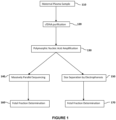
- Figure 1 provides a flow diagram of a method 100 for determining the fraction of fetal nucleic acids in a maternal biological sample by massively parallel sequencing of PCR-amplified polymorphic target nucleic acids.
- a maternal sample comprising a mixture of fetal and maternal nucleic acids is obtained from a subject.
- the sample is a maternal sample that is obtained from a pregnant woman.
- the subject is a human and the sample can be taken in the first or second trimester of pregnancy.
- the biological sample is a peripheral blood sample, or the plasma and/or the serum fractions thereof.
- the sample is a mixture of two or more biological samples e . g .
- a biological sample can comprise two or more of a biological fluid samples.
- the terms "blood,” “plasma” and “serum” expressly encompass fractions or processed portions thereof.
- the biological sample is processed to obtain a sample fraction e . g . plasma, that contains the mixture of fetal and maternal nucleic acids.
- a maternal serum or plasma sample comprising fetal and maternal cell-free nucleic acids (e.g., DNA or RNA) can be used to determine the genotypes of fetal alleles.
- the sample can comprise a fetal cell, e.g., a fetal nucleated red blood cell or a trophoblast.
- the mixture of fetal and maternal nucleic acids is further processed from the sample fraction e.g. plasma, to obtain a sample comprising a purified mixture of fetal and maternal nucleic acids e.g. cfDNA.
- Cell-free nucleic acids including cell-free DNA, can be obtained by various methods known in the art from biological samples including but not limited to plasma, serum and urine ( Fan et al., Proc Natl Acad Sci 105:16266-16271 [2008 ]; Koide et al., Prenatal Diagnosis 25:604-607 [2005 ]; Chen et al., Nature Med.
- sample nucleic acids are obtained as cfDNA.
- the cfDNA is not subjected to fragmentation.
- the sample nucleic acids may be obtained as genomic DNA, which is subjected to fragmentation into fragments of approximately 500 or more base pairs, and to which NGS methods can be readily applied.
- a portion of the purified mixture of fetal and maternal cfDNA is used for amplifying a plurality of polymorphic target nucleic acids each comprising a polymorphic site.
- the target nucleic acids each comprise a SNP.
- each of the target nucleic acids comprises a pair of tandem SNPs.
- each the target nucleic acids comprises an STR.
- Polymorphic sites that are contained in the target nucleic acids include without limitation single nucleotide polymorphisms (SNPs), tandem SNPs, small-scale multi-base deletions or insertions, called IN-DELS (also called deletion insertion polymorphisms or DIPs), Multi-Nucleotide Polymorphisms (MNPs) Short Tandem Repeats (STRs), restriction fragment length polymorphism (RFLP), or a polymorphism comprising any other change of sequence in a chromosome.
- the polymorphic sites that are encompassed by the method of the invention are located on autosomal chromosomes, thereby enabling the determination of fetal fraction independently of sex of the fetus.
- Polymorphisms associated with chromosomes other than chromosome 13, 18, 21 and Y can also be used in the methods described herein.
- Polymorphisms can be indicative, informative, or both.
- Indicative polymorphisms indicate the presence of fetal cell-free DNA in a maternal sample. For example, the more there is of a particular genetic sequence, e . g . a SNP, the more a method will translate its presence into a particular color intensity, density of color, or some other property which is detectable and measurable and indicative of the presence, absence, and quantity of a particular fragment of DNA and/or particular polymorphism e . g . SNP of the embryo.
- Informative polymorphisms yield information about the fetus - for example, the presence or absence of a disease, genetic abnormality, or any other biological information such as the stage of gestation or gender.
- the methods are not conducted using all possible SNPs in a genome, but use those which are said to be “informative”. "Informative SNPs" in this instance are those which identify differences in the sequence of the mother and the fetus. Any polymorphic site that can be encompassed by the reads generated by the sequencing methods described herein can be used to determine the fetal fraction.
- a portion of the mixture of fetal and maternal nucleic acids in the sample i.e. the cfDNA, is used as template for amplifying target nucleic acids that comprise at least one SNP.
- each target nucleic acid comprises a single i.e. one SNP.
- Target nucleic acid sequences comprising SNPs are available from publicly accessible databases including, but not limited to Human SNP Database at world wide web address wi.mit.edu, NCBI dbSNP Home Page at world wide web address ncbi.nlm.nih.gov, world wide web address lifesciences.perkinelmer.com, Applied Biosystems by Life Technologies TM (Carlsbad, CA) at world wide web address appliedbiosystems.com, Celera Human SNP database at world wide web address celera.com, the SNP Database of the Genome Analysis Group (GAN) at world wide web address gan.iarc.fr.
- GAN Genome Analysis Group
- the SNPs chosen for enriching the fetal and maternal cfDNA are selected from the group of 92 individual identification SNPs (IISNPs) described by Pakstis el al. ( Pakstis et el. Hum Genet 127:315-324 [2010 ]), which have been shown to have a very small variation in frequency across populations (F st ⁇ 0.06), and to be highly informative around the world having an average heterozygosity ⁇ 0.4.
- SNPs that are encompassed by the method of the invention include linked and unlinked SNPs. Other useful SNPs applicable or useful for the methods described herein are disclosed in U.S. Pat. Application Nos.
- Each target nucleic acid comprises at least one polymorphic site e.g. a single SNP, that differs from that present on another target nucleic acid to generate a panel of polymorphic sites e . g .
- SNPs that contain a sufficient number of polymorphic sites of which at least 1, at least 2, at least 3, at least 4, at least 5, at least 6, at least 7, at least 8, at least 9, at least 10, at least 11, at least 12, at least 13, at least 14, at least 15, at least 16, at least 17, at least 18, at least 19, at least 20, at least 25, at least 30, at least 40 or more are informative.
- a panel of SNPs can be configured to comprise at least one informative SNP.
- the SNPs that are targeted for amplification are selected from rs560681, rs1109037, rs9866013, rs13182883, rs13218440, rs7041158, rs740598, rs10773760, rs4530059, rs7205345, rs8078417, rs576261, rs2567608, rs430046, rs9951171, rs338882, rs10776839, rs9905977, rs1277284, rs258684, rs1347696, rs508485, rs9788670, rs8137254, rs3143, rs2182957, rs3739005, and rs530022.
- the panel of SNPs comprises at least 3, at least 5, at least 10, at least 13, at least 15, at least 20, at least 25, at least 30 or more SNPs.
- the panel of SNPs comprises rs560681, rs1109037, rs9866013, rs13182883, rs13218440, rs7041158, rs740598, rs10773760, rs4530059, rs7205345, rs8078417, rs576261, and rs2567608.
- the polymorphic nucleic acids comprising the SNPs can be amplified using exemplary primer pairs provided in Example 3, and disclosed as SEQ ID NOs:57-112.
- each target nucleic acid comprises two or more SNPs i.e. each target nucleic acid comprises tandem SNPs.
- each target nucleic acid comprises two tandem SNPs.
- the tandem SNPs are analyzed as a single unit as short haplotypes, and are provided herein as sets of two SNPs.
- the International HapMap Consortium database can be searched ( The International HapMap Project, Nature 426:789-796 [2003 ]). The database is available on the world wide web at hapmap.org.
- tandem SNPs that are targeted for amplification are selected from the following sets of tandem pairs of SNPS rs7277033-rs2110153; rs2822654-rs1882882; rs368657-rs376635; rs2822731-rs2822732; rs1475881-rs7275487; rs1735976-rs2827016; rs447340-rs2824097; rs418989- rs13047336; rs987980- rs987981; rs4143392- rs4143391; rs1691324- rs13050434; rs11909758-rs9980111; rs2826842-rs232414; rs1980969-rs1980970; rs9978999-rs9979175; rs1034346-rs12481852; rs750
- STRBase A comprehensive listing of references, facts and sequence information on STRs, published PCR primers, common multiplex systems, and related population data are compiled in STRBase, which may be accessed via the World Wide Web at ibm4.carb.nist.gov:8800/dna/home.htm. Sequence information from GenBank ® (http://www2.ncbi.nlm.nih.gov/cgi-bin/genbank) for commonly used STR loci is also accessible through STRBase. Commercial kits available for the analysis of STR loci generally provide all of the necessary reaction components and controls required for amplification. STR multiplex systems allow the simultaneous amplification of multiple nonoverlapping loci in a single reaction, substantially increasing throughput.
- STRs polymorphic DNA sequences that are widespread throughout the human genome have made them important genetic markers for gene mapping studies, linkage analysis, and human identity testing. Because of the high polymorphism of STRs, most individuals will be heterozygous i.e. most people will possess two alleles (versions) of each-one inherited from each parent-with a different number of repeats.
- the PCR products comprising the STRs can be separated and detected using manual, semi-automated or automated methods. Semi-automated systems are gel-based and combine electrophoresis, detection and analysis into one unit.
- Amplification of these STR sequences can result in one or two major amplification products corresponding to the maternal alleles (and the maternally inherited fetal allele) and one minor product corresponding to the non-maternally inherited fetal allele.
- This technique was first reported in 2000 ( Pertl et al., Human Genetics 106:45-49 [2002 ]) and has subsequently been developed using simultaneous identification of multiple different STR regions using real-time PCR ( Liu et al., Acta Obset Gyn Scand 86:535-541 [2007 ]).
- the invention provides a method for determining the fraction of fetal nucleic acid in a maternal sample comprising determining the amount of copies of at least one fetal and one maternal allele at a polymorphic miniSTR site, which can be amplified to generate amplicons that are of lengths about the size of the circulating fetal DNA fragments e . g . less than about 250 base pairs.
- the fetal fraction can be determined by a method that comprises sequencing at least a portion of amplified polymorphic target nucleic acids each comprising a miniSTR. Fetal and maternal alleles at an informative STR site are discerned by their different lengths i . e .
- the fraction of fetal nucleic acid in a maternal sample is performed using a method that includes determining the number of copies of the maternal and fetal nucleic acid present in the maternal sample by amplifying at least one autosomal miniSTR chosen from CSF1PO, FGA, TH01, TPOX, vWA, D3S1358,D5S818, D7S820, D8S1179, D13S317, D16S539, D18S51, D21S11, Penta D, Penta E, D2S1338, D1S1677, D2S441, D4S2364, D10S1248, D14S1434, D22S1045, D22S1045, D20S1082, D20S482, D18S853, D17S1301, D17S974, D14S1434, D12ATA63, D11S4463, D10S1435, D10S1248, D9S2157, D9S1122, D8S1115, D6
- the at least one autosomal miniSTR is the group of miniSTRs CSF1PO, FGA, D13S317, D16S539, D18S51, D2S1338, D21S11, D2S1338 and D7S820.
- the method comprises determining the number of copies of at least one fetal and at least one maternal allele at least at one polymorphic miniSTR that is amplified to generate amplicons that are less than about 300 bp, less than about 250 bp, less than about 200 bp, less than about 150 bp, less than about 100 bp, or less than about 50 bp.
- the amplicons that are generated by amplifying the miniSTRs are less than about 300 bp.
- Gender identification in commonly performed in conjunction with STR typing using PCR products generated from the Amelogenin gene that occurs on both the X- and Y-chromosome.
- Amelogenin is not an STR locus, but it produces X and Y chromosome specific PCR products.
- a commonly used PCR primer set first published by Sullivan et al. (1993) ( Sullivan et al., BioTechniques 15:637-641 [1993 ]) targets a 6 bp deletion that occurs on the X-chromosome, which enables amplicons generated from the X- and Y-chromosome to be distinguished from one another when electrophoretic separation is performed to separate STR alleles.
- NGS nucleophilicity-based sequencing
- the sequencing technologies of NGS include pyrosequencing, sequencing-by-synthesis with reversible dye terminators, sequencing by oligonucleotide probe ligation and real time sequencing.
- single molecule sequencing technologies are encompassed by the method of the invention and include the SMRT TM technology of Pacific Biosciences, the Ion Torrent TM technology, and nanopore sequencing being developed for example, by Oxford Nanopore Technologies.
- the DNA sequencing technology that is used in the method of the invention is the single molecule, real-time (SMRT TM ) sequencing technology of Pacific Biosciences.
- SMRT sequencing the continuous incorporation of dye-labeled nucleotides is imaged during DNA synthesis.
- Single DNA polymerase molecules are attached to the bottom surface of individual zero-mode wavelength identifiers (ZMW identifiers) that obtain sequence information while phospolinked nucleotides are being incorporated into the growing primer strand.
- ZMW identifiers are a confinement structure which enables observation of incorporation of a single nucleotide by DNA polymerase against the background of fluorescent nucleotides that rapidly diffuse in an out of the ZMW (in microseconds).
- the DNA sequencing technology that is used in the method of the invention is nanopore sequencing (e . g . as described in Soni GV and Meller A. Clin Chem 53: 1996-2001 [2007 ]).
- Nanopore sequencing DNA analysis techniques are being industrially developed by a number of companies, including Oxford Nanopore Technologies (Oxford, United Kingdom).
- Nanopore sequencing is a single-molecule sequencing technology whereby a single molecule of DNA is sequenced directly as it passes through a nanopore.
- a nanopore is a small hole, of the order of 1 nanometer in diameter. Immersion of a nanopore in a conducting fluid and application of a potential (voltage) across it results in a slight electrical current due to conduction of ions through the nanopore.
- the amount of current which flows is sensitive to the size and shape of the nanopore. As a DNA molecule passes through a nanopore, each nucleotide on the DNA molecule obstructs the nanopore to a different degree, changing the magnitude of the current through the nanopore in different degrees. Thus, this change in the current as the DNA molecule passes through the nanopore represents a reading of the DNA sequence.
- the DNA sequencing technology that is used in the method of the invention is the chemical-sensitive field effect transistor (chemFET) array (e.g., as described in U.S. Patent Application Publication No. 20090026082 ).
- chemFET chemical-sensitive field effect transistor
- DNA molecules can be placed into reaction chambers, and the template molecules can be hybridized to a sequencing primer bound to a polymerase. Incorporation of one or more triphosphates into a new nucleic acid strand at the 3' end of the sequencing primer can be discerned by a change in current by a chemFET.
- An array can have multiple chemFET sensors.
- single nucleic acids can be attached to beads, and the nucleic acids can be amplified on the bead, and the individual beads can be transferred to individual reaction chambers on a chemFET array, with each chamber having a chemFET sensor, and the nucleic acids can be sequenced.
- the DNA sequencing technology that is used in the method of the invention is the Halcyon Molecular's method that uses transmission electron microscopy (TEM).
- the method termed Individual Molecule Placement Rapid Nano Transfer (IMPRNT), comprises utilizing single atom resolution transmission electron microscope imaging of high-molecular weight (150kb or greater) DNA selectively labeled with heavy atom markers and arranging these molecules on ultra-thin films in ultra-dense (3nm strand-to-strand) parallel arrays with consistent base-to-base spacing.
- the electron microscope is used to image the molecules on the films to determine the position of the heavy atom markers and to extract base sequence information from the DNA.
- the method is further described in PCT patent publication WO 2009/046445 . The method allows for sequencing complete human genomes in less than ten minutes.
- the DNA sequencing technology is the Ion Torrent single molecule sequencing, which pairs semiconductor technology with a simple sequencing chemistry to directly translate chemically encoded information (A, C, G, T) into digital information (0, 1) on a semiconductor chip.
- Ion Torrent uses a high-density array of micro-machined wells to perform this biochemical process in a massively parallel way. Each well holds a different DNA molecule. Beneath the wells is an ion-sensitive layer and beneath that an ion sensor.
- a nucleotide for example a C
- a hydrogen ion will be released.
- the charge from that ion will change the pH of the solution, which can be identified by Ion Torrent's ion sensor.
- the Ion personal Genome Machine (PGM TM ) sequencer then sequentially floods the chip with one nucleotide after another. If the next nucleotide that floods the chip is not a match. No voltage change will be recorded and no base will be called. If there are two identical bases on the DNA strand, the voltage will be double, and the chip will record two identical bases called. Direct identification allows recordation of nucleotide incorporation in seconds.
- the hybridization comprises contacting the plurality of polynucleotide sequences with a plurality of polynucleotide probes, wherein each of the plurality of polynucleotide probes can be optionally tethered to a substrate.
- the substrate might be flat surface comprising an array of known nucleotide sequences.
- the pattern of hybridization to the array can be used to determine the polynucleotide sequences present in the sample.
- each probe is tethered to a bead, e.g., a magnetic bead or the like.
- Hybridization to the beads can be identified and used to identify the plurality of polynucleotide sequences within the sample.
- oligonucleotide adapters which have an overhang of a single T base at their 3' end to increase ligation efficiency.
- the adapter oligonucleotides are complementary to the flow-cell anchors.
- adapter-modified, single-stranded template DNA is added to the flow cell and immobilized by hybridization to the anchors.
- Attached DNA fragments are extended and bridge amplified to create an ultra-high density sequencing flow cell with hundreds of millions of clusters, each containing ⁇ 1,000 copies of the same template.
- the cluster amplified DNA molecules are sequenced using a robust four-color DNA sequencing-by-synthesis technology that employs reversible terminators with removable fluorescent dyes.
- the length of the sequence read is associated with the particular sequencing technology. NGS methods provide sequence reads that vary in size from tens to hundreds of base pairs. In some embodiments of the method described herein, the sequence reads are about 20bp, about 25bp, about 30bp, about 35bp, about 40bp, about 45bp, about 50bp, about 55bp, about 60bp, about 65bp, about 70bp, about 75bp, about 80bp, about 85bp, about 90bp, about 95bp, about 100bp, about 110bp, about 120bp, about 130, about 140bp, about 150bp, about 200bp, about 250bp, about 300bp, about 350bp, about 400bp, about 450bp, about 500bp, about 550bp or about 600bp.
- Artificial reference genomes can comprise polymorphic target sequence each comprising one or more different types of polymorphic sequences.
- an artificial reference genome can comprise polymorphic sequences comprising SNP alleles and/or STRs.
- Other sources of public sequence information include GenBank, dbEST, dbSTS, EMBL (the European Molecular Biology Laboratory), and the DDBJ (the DNA Databank of Japan).
- BLAST Altschul et al., 1990
- BLITZ MPsrch
- FASTA Piererson & Lipman
- BOWTIE Landing Technology
- ELAND ELAND
- one end of the clonally expanded copies of the plasma cfDNA molecules is sequenced and processed by bioinformatic alignment analysis for the Illumina Genome Analyzer, which uses the Efficient Large-Scale Alignment of Nucleotide Databases (ELAND) software.
- ELAND ELAND
- a "z score" is generated to represent the difference between the percent genomic representation of the chromosome of interest and the mean percent representation for the same chromosome between a euploid control group, divided by the standard deviation ( Chiu et al., Clin Chem 56:459-463 [2010 ]).
- the sequencing information can be determined as described in U.S. Provisional Patent Application titled “Normalizing Biological Assays," docket no. 32047-768.101, filed January 19, 2010.
- Analysis of sequencing information for the determination of fetal fraction may allow for a small degree of mismatch depending on the polymorphic sequence. For example, a small degree of mismatch may be allowed if the polymorphic sequence is an STR. In cases when the polymorphic sequence is a SNP, all sequences that match exactly to either of the two alleles at the SNP site are counted first and filtered from the remaining reads, for which a small degree of mismatch may be allowed.
- the present method for determining fetal fraction by sequencing of nucleic acids can be used in combination with other methods.
- fetal fraction is determined based on the total number of tags that map to the first allele and the total number of tags that map to second allele at an informative polymorphic site e.g. a SNP, contained in a reference genome.
- the reference genome is an artificial target sequence genome that encompasses the polymorphic sequences that comprise SNPs rs560681, rs1109037, rs9866013, rs13182883, rs13218440, rs7041158, rs740598, rs10773760, rs4530059, rs7205345, rs8078417, rs576261, rs2567608, rs430046, rs9951171, rs338882, rs10776839, rs9905977, rs1277284, rs258684, rs1347696, rs508485, rs9788670, rs8137
- the artificial target genome encompasses polymorphic sequences that comprise STRs selected from CSF1PO, FGA, TH01, TPOX, vWA, D3S1358,D5S818, D7S820, D8S1179, D13S317, D16S539, D18S51, D21S11, Penta D, Penta E, D2S1338, D1S1677, D2S441, D4S2364, D10S1248, D14S1434, D22S1045, D22S1045, D20S1082, D20S482, D18S853, D17S1301, D17S974, D14S1434, D12ATA63, D11S4463, D10S1435, D10S1248, D9S2157, D9S1122, D8S1115, D6S1017, D6S474, D5S2500, D5S2500, D4S2408, D4S2364, D3S4529, D3
- the informative polymorphic site e.g. SNP
- Fetal cfDNA is present at a concentration that is ⁇ 10% of the maternal cfDNA.
- alleles that are derived from the maternal genome are herein referred to as major alleles
- alleles that are derived from the fetal genome are herein referred to as minor alleles.
- Alleles that are represented by similar levels of mapped sequence tags represent maternal alleles.
- the percent fetal fraction is calculated for at least 1, at least 2, at least 3, at least 4, at least 5, at least 6, at least 7, at least 8, at least 9, at least 10, at least 11, at least 12, at least 13, at least 14, at least 15, at least 16, at least 17, at least 18, at least 19, at least 20, at least 25, at least 30, at least 40 or more informative alleles.
- the fetal fraction is the average fetal fraction determined for at least 3 informative alleles.
- Figure 3 shows a flowchart of alternate methods whereby fetal fraction can be determined from amplified target nucleic acids that have been combined with unamplified fetal and maternal cfDNA sample to allow for the simultaneous determination of fetal fraction and the presence or absence of fetal aneuploidy by enriching the maternal sample comprising fetal and maternal nucleic acids for polymorphic target nucleic acids.
- the sample that is enriched is the plasma fraction of a blood sample (a). For example, a portion of an original maternal plasma sample is used for amplifying target nucleic acid sequences. Subsequently, some or all of the amplified product is combined with the remaining unamplified original plasma sample thereby enriching it (see Example 7).
- At least about 3%, at least about 5%, at least about 7%, at least about 10%, at least about 15%, at least about 20%, at least about 25%, at least about 30% or more of the total number of sequence tags obtained from sequencing are mapped to determine the fetal fraction.
- Sequencing of the library generated following any one of the methods depicted in Figure 3 provides sequence tags derived from the amplified target nucleic acids and tags derived from the original unamplified maternal sample.
- Fetal fraction is calculated from the number of tags mapped to an artificial reference genome, and the presence or absence of aneuploidy is determined from the number of tags that map to the subject genome e . g . human genome.
- An alternative method for determining fetal fraction from amplified polymorphic target nucleic acids at step 130 of Figure 1 uses size separation of amplified polymorphic target nucleic acids comprising STRs (step 150 of Figure 1 ).
- the polymorphic character of a STR locus is due to variation in the number of tandemly repeated units between alleles. Because of the high polymorphism of the STRs most individuals will be heterozygous for STRs. Amplification of an STR will result in one or two PCR products in most samples. In samples obtained from pregnant women e . g .
- amplification of an STR will result in one or two major PCR products, which correspond to the one or two maternal alleles including one fetal maternally-inherited allele, and a third paternally-inherited fetal allele that is detected at an informative STR.
- the STRs that are targeted for amplification are miniSTRs as described herein that are less than about 300 base pairs and that are amplified in a multiplex PCR reaction, which allows the simultaneous amplification of multiple loci in a single reaction.
- the primers are labeled with different fluorescent dyes each emitting fluorescence at a different wavelength e.g. 6FAM TM , VIC TM , NED TM , and PET TM , and the number of repeat units for each fluorescently tagged STR in the resulting PCR products is detected following their separation and accurate sizing that is achieved by slab or capillary electrophoresis.
- capillary electrophoresis is used, and it can be performed in microfabricated channels or capillary arrays.
- Multiplex STR analysis can be performed to determine fetal fraction using commercially-available kits e . g . AmpFlSTR ® Identifiler ® PCR Amplification Kit ( Figure 4 ) and AmpFlSTR ® MiniFiler ® PCR Amplification Kit ( Figure 5 ) (Applied Biosystems, Foster City, Calif.).
- the AmpFlSTR ® MiniFiler ® PCR Amplification Kit was designed to amplify as miniSTRs eight of the largest sized loci in the AmpFlSTR ® Identifiler ® PCR Amplification Kit. Together with the gender-identification locus Amelogenin, the nine-locus multiplex enables simultaneous amplification of loci of cfDNA samples (see Example 10).
- multiplex STR analysis for determining fetal fraction is performed by amplifying polymorphic target nucleic acids present in a maternal plasma sample for the panel of miniSTRs: CSF1PO, D13S317, D16S539, D18S51, D21S11, D2S1338, D7S820 and FGA.
- the miniSTRs can be located on the same or on different chromosomes.
- the method is a fetal gender-independent method. Therefore, in some embodiments, the miniSTRs are located on chromosomes other than the Y chromosome. In other embodiments, the miniSTRs are located on chromosomes other than chromosomes 13, 18, 21 or X i.e. chromosomes that might be involved in an aneuploidy.
- Nucleic acid can be amplified for about 1-10 cycles, about 1-20 cycles, about 1-30 cycles, about 1-40 cycles, about 5-15 cycles, about 5-20 cycles, about 5-30 cycles, about 5-40 cycles, about 10-15 cycles, about 10-20 cycles, about 10-30 cycles, about 10-40 cycles, about 20-30 cycles, about 20-40 cycles, or about 30-40 cycles.
- the amount of template nucleic acid that can be amplified can about 10-1000 pg, 25-1000 pg, 50-1000 pg, 100-1000, pg, 200-1000 pg, 300-1000 pg, 400-1000 pg, 500-1000 pg, 600-1000, pg, 700-1000 pg, or 800-1000 pg.
- chromosomal abnormalities include, for example, aneuploidy, monosomy, trisomy, duplication, inversion, deletion, polyploidy, deletion of a part of a chromosome, addition, addition of a part of chromosome, insertion, a fragment of a chromosome, a region of a chromosome, chromosomal rearrangement, and translocation.
- aneuploidy can refer to the occurrence of one or more extra or missing chromosomes in a sample.
- PCR Eighteen cycles of PCR were performed to selectively enrich adaptor-ligated cfDNA using Phusion ® High-Fidelity Master Mix (Finnzymes, Woburn, MA) and Illumina's PCR primers complementary to the adaptors (Part No. 1000537 and 1000537).
- the adaptor-ligated DNA was subjected to PCR (98°C for 30 seconds; 18 cycles of 98°C for 10 seconds, 65°C for 30 seconds, and 72°C for 30 seconds; final extension at 72°C for 5 minutes, and hold at 4°C) using Illumina Genomic PCR Primers (Part Nos.
- the SNPs given in Table 1 were used for the simultaneous amplification of 13 target sequences in a multiplexed assay.
- the panel provided in Table 1 is an exemplary SNP panel. Fewer or more SNPs can be employed to enrich the fetal and maternal DNA for polymorphic target nucleic acids. Additional SNPs that can be used include the SNPs given in Table 2. The SNP alleles are shown in bold and are underlined.
- cfDNA was extracted as described in Example 1.
- a target sequencing library was prepared as follows. cfDNA contained in 5 ⁇ l of purified cfDNA was amplified in a reaction volume of 50 ⁇ l containing 7.5 ⁇ l of a 1 ⁇ M primer mix (Table 1), 10 ⁇ l of NEB 5X Mastermix and 27 ⁇ l water. Thermal cycling was performed with the Gene Amp9700 (Applied Biosystems) using the following cycling conditions: incubating at 95°C for 1 minute, followed by 20-30 cycles at 95°C for 20 seconds, 68°C for 1 minute, and 68°C for 30s, which was followed by a final incubation at 68°C for 5 minutes.
- a final hold at 4°C was added until the samples were removed for combining with the unamplified portion of the purified cfDNA sample.
- the amplified product was purified using the Agencourt AMPure XP PCR purification system (Part No. A63881; Beckman Coulter Genomics, Danvers, MA). A final hold at 4°C was added until the samples were removed for preparing the target library. The amplified product was analyzed with a 2100 Bioanalyzer (Agilent Technologies, Sunnyvale, CA), and the concentration of amplified product determined.
- polymorphic nucleic acid sequences each comprising at least one SNP can be amplified from cfDNA derived from a maternal plasma sample to construct a library that can be sequenced in a massively parallel fashion to determine the fraction of fetal nucleic acids in the maternal sample.
- a portion of a purified cfDNA sample was used for amplifying polymorphic target nucleic acid sequences, and for preparing a sequencing library of amplified polymorphic target nucleic acids, which was used to enrich the fetal and maternal nucleic acid sequences comprised in the primary library.
- a target sequencing library was prepared from a portion of the purified cfDNA as described in Example 2.
- a primary sequencing library was prepared using the remaining portion of the purified cfDNA as described in Example 2.
- Enrichment of the primary library for the amplified polymorphic nucleic acids comprised in the target library was obtained by diluting the primary and the target sequencing libraries to 10nM, and combining the target library with the primary library at a ratio of 1:9 to provide an enriched sequencing library. Sequencing of the enriched library and analysis of the sequencing data was performed as described in Example 2.
- Table 4 provides the number of sequence tags that mapped to the SNP genome for the informative SNPs identified from sequencing an enriched library derived from plasma samples of pregnant women each carrying a T21, a T13, a T18 and a monosomy X fetus, respectively.
- Table 4 also provides the number of the sequence tags mapped to the human reference genome. Tags mapped to the human reference genome were used to determine the presence or absence of aneuploidy using the same plasma sample that was utilized for determining the corresponding fetal fraction. Method for using sequence tags counts for determining aneuploidy are described in U.S. Provisional Applications 61/407,017 and 61/455,849778 .
- a portion of the purified cfDNA was used for amplifying polymorphic target nucleic acid sequences each comprising one SNP chosen from the panel of SNPs given in Table 5.
- the method corresponds to workflow 2 diagrammed in Figure 3 .
- Cell-free plasma was obtained from a maternal blood sample, and cfDNA was purified from the plasma sample as described in Example 1. The final concentration was determined to be 92.8pg/ ⁇ l.
- cfDNA contained in 5 ⁇ l of purified cfDNA was amplified in a reaction volume of 50 ⁇ l containing 7.5 ⁇ l of a 1uM primer mix (Table 1), 10 ⁇ l of NEB 5X Mastermix and 27 ⁇ l water. Thermal cycling was performed with the Gene Amp9700 (Applied Biosystems).
- Table 5 provides the tag counts obtained for each of chromosomes 21, 18, 13, X and Y i.e. sequence tag density, and the tag counts obtained for the informative polymorphic sequences contained in the SNP reference genome .i.e. SNP tag density.
- the data show that sequencing information can be obtained from sequencing a single library constructed from a purified maternal cfDNA sample that has been enriched for sequences comprising SNPs to simultaneously determine the presence or absence of aneuploidy and the fetal fraction. The presence or absence of aneuploidy was determined using the number of tags mapped to chromosomes as described in U.S. Provisional Applications 61/407,017 and 61/455,849 .
- the data show that the fraction of fetal DNA in plasma sample AFR105 was quantifiable from the sequencing results of five informative SNPs and determined to be 3.84%. Sequence tag densities are provided for chromosomes 21, 13, 18, X and Y.
- an original plasma sample derived from a pregnant woman a portion the original plasma sample was used for amplifying polymorphic target nucleic acid sequences each comprising one SNP chosen from the panel of SNPs given in Table 1, and a portion of the amplified product was combined with the remaining original plasma sample.
- cfDNA contained in 15 ⁇ l of cell-free plasma was amplified in a reaction volume of 50 ⁇ l containing 9ul of a 1 ⁇ M mixture of primers (15 plexTable 1), 1 ⁇ l of Phusion blood DNA polymerase, 25ul of the 2X Phusion blood PCR buffer containing deoxynucleotide triphosphates (dNTPs: dATP, dCTP, dGTP and dTTP).
- dNTPs deoxynucleotide triphosphates
- sample SAC2517 was shown by karyotyping to be unaffected for aneuploidies of chromosomes 21, 13, 18, X and Y. Sequence tag densities are provided for chromosomes 21, 13, 18, X and Y. The presence or absence of aneuploidy was determined using tag counts as described in U.S. Provisional Applications 61/407,017 and 61/455,849 .
- the example demonstrates that enriching the mixture of fetal and maternal cfDNA present in a plasma sample for nucleic acid sequences that comprise at least one informative SNP can be used to provide the requisite sequence and SNP tag counts for determining aneuploidy and fetal fraction from a single sequencing process by massively parallel sequencing a library prepared from cfDNA contained in a plasma sample that is enriched for polymorphic nucleic acids.
- target polymorphic nucleic acid sequences each comprising a pair of tandem SNPs are amplified and used for preparing a target library for sequencing in a massively parallel fashion.
- Pairs of tandem SNPs can be selected from rs7277033-rs2110153; rs2822654-rs1882882; rs368657-rs376635; rs2822731-rs2822732; rs 1475881- rs7275487; rs 173597 6-rs28270 16; rs447340-rs2824097; rs418989- rs13047336; rs987980- rs987981; rs4143392- rs4143391; rs1691324-rs13050434; rs11909758-rs9980111; rs2826842-rs232414;
- the primers used for amplifying the target sequences comprising the tandem SNPs are designed to encompass both SNP sites.
- the forward primer is designed to encompass the first SNP
- the reverse primer is designed to encompass the second of the tandem SNP pair i.e. each of the SNP sites in the tandem pair is encompassed within the 36 bp generated by the sequencing method. Paired-end sequencing can be used to identify all sequences encompassing the tandem SNP sites.
- Exemplary sets of primers that are used to amplify the tandem SNPs disclosed herein are rs7277033-rs2110153_F: TCCTGGAAACAAAAGTATT (SEQ ID NO:197) and rs7277033-rs2110153_R: AACCTTACAACAAAGCTAGAA (SEQ ID NO:198), set rs2822654-rs1882882_F: ACTAAGCCTTGGGGATCCAG (SEQ ID NO:199) and rs2822654-rs1882882_R: TGCTGTGGAAATACTAAAAAAGG (SEQ ID NO:200), set rs368657-rs376635_F:CTCCAGAGGTAATCCTGTGA (SEQ ID NO:201) and rs368657-rs376635_R:TGGTGTGAGATGGTATCTAGG (SEQ ID NO:202), rs2822731-rs2822732_F:GTATAATCCAT
- Polynucleotide sequences e.g. GC clamp sequences, can be included to ensure specific hybridization of AT-rich primers (Ghanta et al., PLOS ONE 5(10): doi10.1371/journal.pone.0013184 [2010], available on the world wide web at plosone.org).
- An example of a GC clamp sequence that can be included either 5' of the forward primer or 3' of the reverse primer is GCCGCCTGCAGCCCGCGCCCCCCGTGCCCCCGCCCCGCCGCCGGCCCGGGCGCC (SEQ ID NO:311).
- Polymorphic sequences can be used alone or in combination with unamplified cfDNA to determine either fetal fraction or the presence or absence of aneuploidy and fetal fraction in a maternal sample as described for polymorphic SNP sequences.
- Sample preparation and enrichment of cfDNA sequencing library, a purified cfDNA sample, and a plasma sample is performed according to the method described in Examples 5, 6, and 7, respectively. All sequencing libraries are prepared as described in Example 2a., and sequencing is performed as described in Example 2b. Analysis of the sequencing data for the determination of fetal aneuploidy is performed as described in Example 5. Concomitant to the analysis for determining aneuploidy, the sequencing data is analyzed to determine the fetal fraction as follows.
- the 36bp reads are aligned to a 'tandem SNP genome' using the BOWTIE program.
- the tandem SNP genome is identified as the grouping of the DNA sequences that encompass the alleles of the 58 tandem SNP pairs disclosed above. Only reads that mapped uniquely to the tandem SNP genome are used for the analysis of fetal fraction. Reads that match perfectly to the tandem SNP genome are counted as tags and filtered. Of the remaining reads, only reads having one or two mismatches are counted as tags and included in the analysis.
- the percent fetal fraction is calculated for at least 1, at least 2, at least 3, at least 4, at least 5, at least 6, at least 7, at least 8, at least 9, at least 10, at least 11, at least 12, at least 13, at least 14, at least 15, at least 16, at least 17, at least 18, at least 19, at least 20, or more informative sets of tandem alleles.
- the fetal fraction is the average fetal fraction determined for at least 3 informative sets of tandem alleles.
- target polymorphic nucleic acid sequences each comprising an STR are amplified and used for preparing a target library for sequencing in a massively parallel fashion.
- Peripheral blood samples are obtained from pregnant subjects, and cfDNA is purified from the plasma fraction as described in Examples1 and 2 STRs that are amplified are chosen from the codis and non-codis STRs disclosed in Table 7, and amplification of the polymorphic STR sequences is obtained using the corresponding sets of primers provided.
- the STRs listed in Table 7 are amplified using the corresponding primers (SEQ ID NOs: 113-197), and the amplified product is used to generate a target sequencing library.
- the STR target sequencing library is prepared as described for the preparation of the SNP target library as described in Example 8.
- Sequencing of the library enriched for polymorphic STR sequences is performed using a NGS technology e.g. sequencing by synthesis. Sequence reads of lengths that encompass the STRs e.g. miniSTRs of at least 100 bp, to a reference STR genome consisting of the polymorphic sequences which were amplified in the sample. Informative STR alleles are identified by differences in the length of the repeats, and the number of STR sequence tags are counted, and used to determine the fetal fraction.
- amplification of the polymorphic STR sequences is performed to enrich a plasma sample, a purified cfDNA sample or a cfDNA sequencing library sample, as described in Examples 5, 6, and 7, respectively.
- peripheral blood samples were collected from volunteer pregnant women carrying either male or female fetuses. Peripheral blood samples were obtained and processed to provide purified cfDNA as described in Example 1
- the fluorescently labeled primers are forward primers that are labeled with 6FAM TM , VIC TM , NED TM , and PET TM dyes.
- Thermal cycling was performed with the Gene Amp9700 (Applied Biosystems) using the following cycling conditions: incubating at 95°C for 10 minutes, followed by 30 cycles at 94°C for 20 seconds, 59°C for 2 minute, and 72°C for 1 minute, which was followed by a final incubation at 60°C for 45 minutes. A final hold at 4°C was added until the samples were removed for analysis.
- the amplified product was prepared by diluting 1ul of amplified product in 8.7ul Hi-DiTM formamide (Applied Biosystems) and 0.3 ⁇ l GeneScanTM-500 LIZ_ internal size standard (Applied Biosystems), and analyzed with an ABI PRISM3130xl Genetic Analyzer (Applied Biosystems) using Data Collection HID_G5_POP4 (Applied Biosystems), and a 36-cm capillary array. All genotyping was performed with GeneMapper_ID v3.2 software (Applied Biosystems) using manufacturer provided allelic ladders and bins and panels.
- OL alleles are alleles of a size that is not represented in the AmpF l STR ® MiniFiler TM Allelic Ladder or an allele that does not correspond to an allelic ladder, but whose size is just outside a window because of measurement error.
- the minimum peak height threshold of >50 RFU was set based on validation experiments performed to avoid typing when stochastic effects are likely to interfere with accurate interpretation of mixtures.
- the calculation of fetal fraction is based on averaging all informative markers. Informative markers are identified by the presence of peaks on the electropherogram that fall within the parameters of preset bins for the STRs that are analyzed.
- the fetal fraction for a sample comprising two or more informative STRs would be calculated as the average of the fetal fractions calculated for the two or more informative markers.
- cfDNA can be used for determining the presence or absence of fetal DNA as indicated by the detection of a minor component at one or more STR alleles, for determining the percent fetal fraction, and for determining fetal gender as indicated by the presence or absence of the Amelogenin allele.
- an acceptable false positive rate (sometimes also called "type I error” or "specificity"), is decided, which is the probability of a false positive or falsely calling aneuploidy.
- FP can be at least, or about 0.001, 0.002, 0.003, 0.004, 0.005, 0.006, 0.007, 0.008, 0.009, 0.01, 0.02, 0.03, 0.04, 0.05, 0.06, 0.07, 0.08, 0.09, or 0.1.
Landscapes
- Chemical & Material Sciences (AREA)
- Life Sciences & Earth Sciences (AREA)
- Organic Chemistry (AREA)
- Health & Medical Sciences (AREA)
- Proteomics, Peptides & Aminoacids (AREA)
- Engineering & Computer Science (AREA)
- Zoology (AREA)
- Wood Science & Technology (AREA)
- Analytical Chemistry (AREA)
- Physics & Mathematics (AREA)
- Bioinformatics & Cheminformatics (AREA)
- General Health & Medical Sciences (AREA)
- Biotechnology (AREA)
- Biophysics (AREA)
- Genetics & Genomics (AREA)
- Molecular Biology (AREA)
- Biochemistry (AREA)
- General Engineering & Computer Science (AREA)
- Microbiology (AREA)
- Immunology (AREA)
- Medical Informatics (AREA)
- Spectroscopy & Molecular Physics (AREA)
- Chemical Kinetics & Catalysis (AREA)
- Bioinformatics & Computational Biology (AREA)
- Theoretical Computer Science (AREA)
- Evolutionary Biology (AREA)
- Pathology (AREA)
- Epidemiology (AREA)
- Primary Health Care (AREA)
- Public Health (AREA)
- General Chemical & Material Sciences (AREA)
- Medicinal Chemistry (AREA)
- Measuring Or Testing Involving Enzymes Or Micro-Organisms (AREA)
- Investigating Or Analysing Biological Materials (AREA)
- Algebra (AREA)
- General Physics & Mathematics (AREA)
- Mathematical Analysis (AREA)
- Mathematical Optimization (AREA)
- Mathematical Physics (AREA)
- Pure & Applied Mathematics (AREA)
Claims (15)
- Procédé de détermination de la fraction d'acides nucléiques foetaux dans un échantillon de sang maternel obtenu à partir d'une femme enceinte comprenant un mélange d'ADN génomique foetal et maternel, dans lequel ledit ADN génomique foetal et maternel est de l'ADN sans cellules (ADNcf), ledit procédé comprenant :(a) l'amplification d'une pluralité d'acides nucléiques cibles polymorphes dans ledit mélange, dans lequel chacun de ladite pluralité d'acides nucléiques cibles polymorphes comprend au moins un polymorphisme mononucléotidique (SNP), et dans lequel chaque acide nucléique cible polymorphe comprend au moins un site polymorphe qui diffère de celui présent sur un autre acide nucléique cible polymorphe pour générer un panel de sites polymorphes qui contiennent un nombre suffisant de sites polymorphes dont au moins 1 est informatif ;(b) la conduite d'un séquençage massif en parallèle d'au moins une partie du produit amplifié obtenu dans (a), ledit séquençage comprenant la fourniture d'une pluralité d'étiquettes de séquence ; et(c) sur la base dudit séquençage, la détermination de ladite fraction d'acides nucléiques foetaux, en utilisant ladite pluralité d'étiquettes de séquence pour :(i) identifier au moins un site polymorphe informatif dans lesdits acides nucléiques cibles polymorphes amplifiés, ledit au moins un site polymorphe informatif étant identifié par la différence des séquences alléliques à chaque site polymorphe et du nombre d'étiquettes de séquence associées à chacun des allèles possibles à chaque site polymorphe, et(ii) déterminer ladite fraction d'acides nucléiques foetaux au moyen du nombre total d'étiquettes qui correspondent à un premier allèle à un site polymorphe informatif identifié et du nombre total d'étiquettes qui correspondent à un deuxième allèle au niveau du site polymorphe informatif identifié pour calculer ladite fraction d'acides nucléiques foetaux.
- Procédé selon la revendication 1, dans lequel ledit séquençage massif en parallèle est : (i) un séquençage par synthèse avec des terminateurs de colorant réversible ; (ii) un séquençage par ligature ; or (iii) un séquençage de molécule unique.
- Procédé selon la revendication 1, dans lequel ledit séquençage comprend une amplification.
- Procédé selon la revendication 1, dans lequel ledit échantillon maternel est du plasma ou du sérum.
- Procédé selon la revendication 1, dans lequel la détermination de ladite fraction comprend la détermination du nombre d'étiquettes de séquence foetales et maternelles associées à un génome de référence comprenant ledit au moins un acide nucléique polymorphe.
- Procédé selon la revendication 5, dans lequel le génome de référence est un génome de séquences cibles artificielles qui comprend les séquences des acides nucléiques cibles polymorphes.
- Procédé selon la revendication 6, dans lequel le génome de référence est un génome de référence SNP artificiel.
- Procédé selon la revendication 1, dans lequel les sites polymorphes sont situés sur des chromosomes autosomiques et ledit procédé est un procédé indépendant du sexe foetal.
- Procédé selon la revendication 1, dans lequel :(i) ladite pluralité d'acides nucléiques polymorphes est située sur une pluralité de chromosomes différents ;(ii) ladite pluralité d'acides nucléiques polymorphes est située sur les chromosomes 1 à 22 ; ou(iii) ladite pluralité de sites polymorphes est située sur un chromosome autre que le chromosome 13, 18, 21, X ou Y.
- Procédé selon la revendication 1, dans lequel :(i) ladite pluralité d'acides nucléiques polymorphes comprend au moins 1, 2, 3, 4, 5, 6, 7, 8, 9, 10, 15, 20, 25, 30 ou 40 sites polymorphes ;(ii) au moins 1, 2, 3, 4, 5, 6, 7, 8, 9, 10, 15, 20, 25, 30 ou 40 sites polymorphes différents ou plus sont amplifiés à partir des acides nucléiques cibles polymorphes ;(iii) chacun de ladite pluralité d'acides nucléiques cibles polymorphes comprend un seul site SNP ; ou(iv) le panel de sites polymorphes contient un nombre suffisant de sites polymorphes dont au moins 2, au moins 3, au moins 4, au moins 5, au moins 6, au moins 7, au moins 8, au moins 9, au moins 10, au moins 11, au moins 12, au moins 13, au moins 14, au moins 15, au moins 16, au moins 17, au moins 18, au moins 19, au moins 20, au moins 25, au moins 30, au moins 40 ou plus sont informatifs, et dans lequel, éventuellement, le panel de sites polymorphes est un panel de SNP qui comprend au moins 3, au moins 5, au moins 10, au moins 13, au moins 15, au moins 20, au moins 25, au moins 30 SNP ou plus.
- Procédé selon la revendication 1, dans lequel l'amplification de la pluralité d'acides nucléiques cibles polymorphes est réalisée au moyen d'un procédé PCR.
- Procédé selon la revendication 11, dans lequel l'amplification de la pluralité d'acides nucléiques cibles polymorphes est effectuée au moyen de paires d'amorces dont chacune permet d'amplifier une séquence d'acide nucléique cible comprenant un site SNP dans une réaction PCR multiplexe.
- Procédé selon la revendication 12, le procédé comprenant la combinaison d'au moins 2, au moins 3, au moins 5, au moins 10, au moins 15, au moins 20, au moins 25, au moins 30, au moins 40 ensembles d'amorces ou plus dans la même réaction pour quantifier les acides nucléiques cibles amplifiés comprenant au moins deux, au moins trois, au moins 5, au moins 10, au moins 15, au moins 20, au moins 25, au moins 30, au moins 40 sites polymorphes ou plus dans la même réaction de séquençage.
- Procédé selon la revendication 1, dans lequel la fraction foetale en pourcentage est calculée pour au moins 2, au moins 3, au moins 4, au moins 5, au moins 6, au moins 7, au moins 8, au moins 9, au moins 10, au moins 11, au moins 12, au moins 13, au moins 14, au moins 15, au moins 16, au moins 17, au moins 18, au moins 19, au moins 20, au moins 25, au moins 30, au moins 40 allèles informatifs ou plus, et dans lequel, éventuellement, la fraction foetale est la fraction foetale moyenne déterminée pour au moins 3 allèles informatifs.
- Procédé selon l'une quelconque des revendications 1 à 14, dans lequel l'échantillon maternel est prélevé au cours du premier ou du deuxième trimestre de la grossesse.
Priority Applications (1)
| Application Number | Priority Date | Filing Date | Title |
|---|---|---|---|
| EP24186817.3A EP4450645A3 (fr) | 2010-01-19 | 2010-12-01 | Procédés de détermination de fraction d'acides nucléiques foetaux dans d'échantillons maternels |
Applications Claiming Priority (8)
| Application Number | Priority Date | Filing Date | Title |
|---|---|---|---|
| US29635810P | 2010-01-19 | 2010-01-19 | |
| US36083710P | 2010-07-01 | 2010-07-01 | |
| US45584910P | 2010-10-26 | 2010-10-26 | |
| US40701710P | 2010-10-26 | 2010-10-26 | |
| EP10844163.5A EP2513339B1 (fr) | 2010-01-19 | 2010-12-01 | Procédés pour déterminer une fraction d'acide nucléique f tal dans des échantillons maternels |
| PCT/US2010/058606 WO2011090556A1 (fr) | 2010-01-19 | 2010-12-01 | Procédés pour déterminer une fraction d'acide nucléique fœtal dans des échantillons maternels |
| EP15181244.3A EP3006573B1 (fr) | 2010-01-19 | 2010-12-01 | Procédés de détermination de fraction d'acides nucléiques foetaux dans d'échantillons maternels |
| EP18160303.6A EP3382037B1 (fr) | 2010-01-19 | 2010-12-01 | Procédés de détermination de fraction d'acides nucléiques foetaux dans d'échantillons maternels |
Related Parent Applications (3)
| Application Number | Title | Priority Date | Filing Date |
|---|---|---|---|
| EP10844163.5A Division EP2513339B1 (fr) | 2010-01-19 | 2010-12-01 | Procédés pour déterminer une fraction d'acide nucléique f tal dans des échantillons maternels |
| EP15181244.3A Division EP3006573B1 (fr) | 2010-01-19 | 2010-12-01 | Procédés de détermination de fraction d'acides nucléiques foetaux dans d'échantillons maternels |
| EP18160303.6A Division EP3382037B1 (fr) | 2010-01-19 | 2010-12-01 | Procédés de détermination de fraction d'acides nucléiques foetaux dans d'échantillons maternels |
Related Child Applications (1)
| Application Number | Title | Priority Date | Filing Date |
|---|---|---|---|
| EP24186817.3A Division EP4450645A3 (fr) | 2010-01-19 | 2010-12-01 | Procédés de détermination de fraction d'acides nucléiques foetaux dans d'échantillons maternels |
Publications (2)
| Publication Number | Publication Date |
|---|---|
| EP3878973A1 EP3878973A1 (fr) | 2021-09-15 |
| EP3878973B1 true EP3878973B1 (fr) | 2024-07-10 |
Family
ID=44307118
Family Applications (14)
| Application Number | Title | Priority Date | Filing Date |
|---|---|---|---|
| EP10825822.9A Not-in-force EP2370599B1 (fr) | 2010-01-19 | 2010-12-01 | Procédé pour déterminer des variations de nombre de copies |
| EP10830938.6A Active EP2366031B1 (fr) | 2010-01-19 | 2010-12-01 | Méthodes de séquençage pour le diagnostic prénatal |
| EP10830939.4A Active EP2376661B1 (fr) | 2010-01-19 | 2010-12-01 | Détermination simultanée de l'aneuploïdie et de la fraction foetale |
| EP17180803.3A Revoked EP3260555B1 (fr) | 2010-01-19 | 2010-12-01 | Nouveau protocole de préparation de bibliothèques de séquençage |
| EP15181244.3A Active EP3006573B1 (fr) | 2010-01-19 | 2010-12-01 | Procédés de détermination de fraction d'acides nucléiques foetaux dans d'échantillons maternels |
| EP14192160.1A Withdrawn EP2848703A1 (fr) | 2010-01-19 | 2010-12-01 | Détermination simultanée de l'aneuploïdie et de fraction f'tale |
| EP14192156.9A Not-in-force EP2883965B8 (fr) | 2010-01-19 | 2010-12-01 | Procédé pour déterminer des variations du nombre de copies |
| EP24186817.3A Pending EP4450645A3 (fr) | 2010-01-19 | 2010-12-01 | Procédés de détermination de fraction d'acides nucléiques foetaux dans d'échantillons maternels |
| EP21157398.5A Active EP3878973B1 (fr) | 2010-01-19 | 2010-12-01 | Procédés de détermination de fraction d'acides nucléiques foetaux dans d'échantillons maternels |
| EP18201917.4A Revoked EP3492601B1 (fr) | 2010-01-19 | 2010-12-01 | Nouveau protocole de préparation de bibliothèques de séquençage |
| EP21213836.6A Pending EP4074838A1 (fr) | 2010-01-19 | 2010-12-01 | Nouveau protocole de préparation de bibliothèques de séquençage |
| EP18160303.6A Active EP3382037B1 (fr) | 2010-01-19 | 2010-12-01 | Procédés de détermination de fraction d'acides nucléiques foetaux dans d'échantillons maternels |
| EP10844163.5A Active EP2513339B1 (fr) | 2010-01-19 | 2010-12-01 | Procédés pour déterminer une fraction d'acide nucléique f tal dans des échantillons maternels |
| EP14192165.0A Active EP2848704B1 (fr) | 2010-01-19 | 2010-12-01 | Procédés pour un séquençage du diagnostic prénatal |
Family Applications Before (8)
| Application Number | Title | Priority Date | Filing Date |
|---|---|---|---|
| EP10825822.9A Not-in-force EP2370599B1 (fr) | 2010-01-19 | 2010-12-01 | Procédé pour déterminer des variations de nombre de copies |
| EP10830938.6A Active EP2366031B1 (fr) | 2010-01-19 | 2010-12-01 | Méthodes de séquençage pour le diagnostic prénatal |
| EP10830939.4A Active EP2376661B1 (fr) | 2010-01-19 | 2010-12-01 | Détermination simultanée de l'aneuploïdie et de la fraction foetale |
| EP17180803.3A Revoked EP3260555B1 (fr) | 2010-01-19 | 2010-12-01 | Nouveau protocole de préparation de bibliothèques de séquençage |
| EP15181244.3A Active EP3006573B1 (fr) | 2010-01-19 | 2010-12-01 | Procédés de détermination de fraction d'acides nucléiques foetaux dans d'échantillons maternels |
| EP14192160.1A Withdrawn EP2848703A1 (fr) | 2010-01-19 | 2010-12-01 | Détermination simultanée de l'aneuploïdie et de fraction f'tale |
| EP14192156.9A Not-in-force EP2883965B8 (fr) | 2010-01-19 | 2010-12-01 | Procédé pour déterminer des variations du nombre de copies |
| EP24186817.3A Pending EP4450645A3 (fr) | 2010-01-19 | 2010-12-01 | Procédés de détermination de fraction d'acides nucléiques foetaux dans d'échantillons maternels |
Family Applications After (5)
| Application Number | Title | Priority Date | Filing Date |
|---|---|---|---|
| EP18201917.4A Revoked EP3492601B1 (fr) | 2010-01-19 | 2010-12-01 | Nouveau protocole de préparation de bibliothèques de séquençage |
| EP21213836.6A Pending EP4074838A1 (fr) | 2010-01-19 | 2010-12-01 | Nouveau protocole de préparation de bibliothèques de séquençage |
| EP18160303.6A Active EP3382037B1 (fr) | 2010-01-19 | 2010-12-01 | Procédés de détermination de fraction d'acides nucléiques foetaux dans d'échantillons maternels |
| EP10844163.5A Active EP2513339B1 (fr) | 2010-01-19 | 2010-12-01 | Procédés pour déterminer une fraction d'acide nucléique f tal dans des échantillons maternels |
| EP14192165.0A Active EP2848704B1 (fr) | 2010-01-19 | 2010-12-01 | Procédés pour un séquençage du diagnostic prénatal |
Country Status (11)
| Country | Link |
|---|---|
| US (13) | US9657342B2 (fr) |
| EP (14) | EP2370599B1 (fr) |
| AU (4) | AU2010343278B2 (fr) |
| CA (4) | CA2786357C (fr) |
| CY (1) | CY1124494T1 (fr) |
| DK (6) | DK3382037T3 (fr) |
| ES (6) | ES2870533T3 (fr) |
| GB (5) | GB2479080B (fr) |
| PL (4) | PL3260555T3 (fr) |
| TR (1) | TR201807917T4 (fr) |
| WO (3) | WO2011090559A1 (fr) |
Families Citing this family (262)
| Publication number | Priority date | Publication date | Assignee | Title |
|---|---|---|---|---|
| EP1712639B1 (fr) | 2005-04-06 | 2008-08-27 | Maurice Stroun | Méthode de diagnostic de cancer au moyen de la détection d'ADN et ARN |
| US11111543B2 (en) | 2005-07-29 | 2021-09-07 | Natera, Inc. | System and method for cleaning noisy genetic data and determining chromosome copy number |
| US11111544B2 (en) | 2005-07-29 | 2021-09-07 | Natera, Inc. | System and method for cleaning noisy genetic data and determining chromosome copy number |
| US10083273B2 (en) | 2005-07-29 | 2018-09-25 | Natera, Inc. | System and method for cleaning noisy genetic data and determining chromosome copy number |
| US8532930B2 (en) | 2005-11-26 | 2013-09-10 | Natera, Inc. | Method for determining the number of copies of a chromosome in the genome of a target individual using genetic data from genetically related individuals |
| US10081839B2 (en) | 2005-07-29 | 2018-09-25 | Natera, Inc | System and method for cleaning noisy genetic data and determining chromosome copy number |
| US9424392B2 (en) | 2005-11-26 | 2016-08-23 | Natera, Inc. | System and method for cleaning noisy genetic data from target individuals using genetic data from genetically related individuals |
| EP2351858B1 (fr) * | 2006-02-28 | 2014-12-31 | University of Louisville Research Foundation | Détection d'anomalies chromosomiques du f'tus à l'aide de polymorphismes de nucléotides uniques en tandem |
| WO2009105531A1 (fr) * | 2008-02-19 | 2009-08-27 | Gene Security Network, Inc. | Procédés de génotypage cellulaire |
| EP2271772B1 (fr) | 2008-03-11 | 2014-07-16 | Sequenom, Inc. | Tests adn pour déterminer le sexe d'un bébé avant sa naissance |
| WO2009146335A1 (fr) * | 2008-05-27 | 2009-12-03 | Gene Security Network, Inc. | Procédés de caractérisation d’embryon et de comparaison |
| EP2321642B1 (fr) * | 2008-08-04 | 2017-01-11 | Natera, Inc. | Procédés pour une classification d'allèle et une classification de ploïdie |
| US8476013B2 (en) | 2008-09-16 | 2013-07-02 | Sequenom, Inc. | Processes and compositions for methylation-based acid enrichment of fetal nucleic acid from a maternal sample useful for non-invasive prenatal diagnoses |
| US8962247B2 (en) | 2008-09-16 | 2015-02-24 | Sequenom, Inc. | Processes and compositions for methylation-based enrichment of fetal nucleic acid from a maternal sample useful for non invasive prenatal diagnoses |
| WO2011041485A1 (fr) | 2009-09-30 | 2011-04-07 | Gene Security Network, Inc. | Méthode non invasive de détermination d'une ploïdie prénatale |
| CA2780016C (fr) | 2009-11-06 | 2017-09-19 | The Chinese University Of Hong Kong | Analyse genomique basee sur la taille |
| US8835358B2 (en) | 2009-12-15 | 2014-09-16 | Cellular Research, Inc. | Digital counting of individual molecules by stochastic attachment of diverse labels |
| US9315857B2 (en) | 2009-12-15 | 2016-04-19 | Cellular Research, Inc. | Digital counting of individual molecules by stochastic attachment of diverse label-tags |
| ES2577017T3 (es) | 2009-12-22 | 2016-07-12 | Sequenom, Inc. | Procedimientos y kits para identificar la aneuploidia |
| US9323888B2 (en) | 2010-01-19 | 2016-04-26 | Verinata Health, Inc. | Detecting and classifying copy number variation |
| EP2370599B1 (fr) | 2010-01-19 | 2015-01-21 | Verinata Health, Inc | Procédé pour déterminer des variations de nombre de copies |
| US20120010085A1 (en) | 2010-01-19 | 2012-01-12 | Rava Richard P | Methods for determining fraction of fetal nucleic acids in maternal samples |
| WO2011091063A1 (fr) | 2010-01-19 | 2011-07-28 | Verinata Health, Inc. | Procédés de détection définis par des partitions |
| US20120100548A1 (en) | 2010-10-26 | 2012-04-26 | Verinata Health, Inc. | Method for determining copy number variations |
| EP2513341B1 (fr) | 2010-01-19 | 2017-04-12 | Verinata Health, Inc | Identification de cellules polymorphes dans des mélanges d'adn génomique par séquençage du génome entier |
| US9260745B2 (en) | 2010-01-19 | 2016-02-16 | Verinata Health, Inc. | Detecting and classifying copy number variation |
| US10388403B2 (en) | 2010-01-19 | 2019-08-20 | Verinata Health, Inc. | Analyzing copy number variation in the detection of cancer |
| US20110312503A1 (en) | 2010-01-23 | 2011-12-22 | Artemis Health, Inc. | Methods of fetal abnormality detection |
| CA2799746C (fr) * | 2010-05-17 | 2020-11-24 | Sai Reddy | Isolement rapide d'anticorps monoclonaux a partir d'animaux |
| US12152275B2 (en) | 2010-05-18 | 2024-11-26 | Natera, Inc. | Methods for non-invasive prenatal ploidy calling |
| US11408031B2 (en) | 2010-05-18 | 2022-08-09 | Natera, Inc. | Methods for non-invasive prenatal paternity testing |
| US11339429B2 (en) | 2010-05-18 | 2022-05-24 | Natera, Inc. | Methods for non-invasive prenatal ploidy calling |
| US11332785B2 (en) | 2010-05-18 | 2022-05-17 | Natera, Inc. | Methods for non-invasive prenatal ploidy calling |
| WO2013052557A2 (fr) * | 2011-10-03 | 2013-04-11 | Natera, Inc. | Procédés pour diagnostic génétique préimplantatoire par séquençage |
| US11322224B2 (en) | 2010-05-18 | 2022-05-03 | Natera, Inc. | Methods for non-invasive prenatal ploidy calling |
| US11939634B2 (en) | 2010-05-18 | 2024-03-26 | Natera, Inc. | Methods for simultaneous amplification of target loci |
| US9677118B2 (en) | 2014-04-21 | 2017-06-13 | Natera, Inc. | Methods for simultaneous amplification of target loci |
| WO2011146632A1 (fr) | 2010-05-18 | 2011-11-24 | Gene Security Network Inc. | Procédés de classification de ploïdie prénatale non invasive |
| US12545960B2 (en) | 2010-05-18 | 2026-02-10 | Natera, Inc. | Methods for simultaneous amplification of target loci |
| US11332793B2 (en) | 2010-05-18 | 2022-05-17 | Natera, Inc. | Methods for simultaneous amplification of target loci |
| US11326208B2 (en) | 2010-05-18 | 2022-05-10 | Natera, Inc. | Methods for nested PCR amplification of cell-free DNA |
| US12221653B2 (en) | 2010-05-18 | 2025-02-11 | Natera, Inc. | Methods for simultaneous amplification of target loci |
| US10316362B2 (en) | 2010-05-18 | 2019-06-11 | Natera, Inc. | Methods for simultaneous amplification of target loci |
| US20190010543A1 (en) | 2010-05-18 | 2019-01-10 | Natera, Inc. | Methods for simultaneous amplification of target loci |
| US8700338B2 (en) | 2011-01-25 | 2014-04-15 | Ariosa Diagnosis, Inc. | Risk calculation for evaluation of fetal aneuploidy |
| US11203786B2 (en) | 2010-08-06 | 2021-12-21 | Ariosa Diagnostics, Inc. | Detection of target nucleic acids using hybridization |
| US20130040375A1 (en) | 2011-08-08 | 2013-02-14 | Tandem Diagnotics, Inc. | Assay systems for genetic analysis |
| US10167508B2 (en) | 2010-08-06 | 2019-01-01 | Ariosa Diagnostics, Inc. | Detection of genetic abnormalities |
| US11031095B2 (en) | 2010-08-06 | 2021-06-08 | Ariosa Diagnostics, Inc. | Assay systems for determination of fetal copy number variation |
| US10533223B2 (en) | 2010-08-06 | 2020-01-14 | Ariosa Diagnostics, Inc. | Detection of target nucleic acids using hybridization |
| US20120034603A1 (en) | 2010-08-06 | 2012-02-09 | Tandem Diagnostics, Inc. | Ligation-based detection of genetic variants |
| US20130261003A1 (en) | 2010-08-06 | 2013-10-03 | Ariosa Diagnostics, In. | Ligation-based detection of genetic variants |
| US20140342940A1 (en) | 2011-01-25 | 2014-11-20 | Ariosa Diagnostics, Inc. | Detection of Target Nucleic Acids using Hybridization |
| ES2523140T3 (es) | 2010-09-21 | 2014-11-21 | Population Genetics Technologies Ltd. | Aumento de la confianza en las identificaciones de alelos con el recuento molecular |
| CN105243295B (zh) | 2010-11-30 | 2018-08-17 | 香港中文大学 | 与癌症相关的遗传或分子畸变的检测 |
| CN103608466B (zh) | 2010-12-22 | 2020-09-18 | 纳特拉公司 | 非侵入性产前亲子鉴定方法 |
| US11270781B2 (en) | 2011-01-25 | 2022-03-08 | Ariosa Diagnostics, Inc. | Statistical analysis for non-invasive sex chromosome aneuploidy determination |
| US20230101627A1 (en) * | 2011-01-25 | 2023-03-30 | Ariosa Diagnostics, Inc. | Noninvasive detection of fetal aneuploidy in egg donor pregnancies |
| US10131947B2 (en) | 2011-01-25 | 2018-11-20 | Ariosa Diagnostics, Inc. | Noninvasive detection of fetal aneuploidy in egg donor pregnancies |
| US8756020B2 (en) | 2011-01-25 | 2014-06-17 | Ariosa Diagnostics, Inc. | Enhanced risk probabilities using biomolecule estimations |
| US9994897B2 (en) | 2013-03-08 | 2018-06-12 | Ariosa Diagnostics, Inc. | Non-invasive fetal sex determination |
| RU2671980C2 (ru) | 2011-02-09 | 2018-11-08 | Натера, Инк. | Способы неинвазивного пренатального установления плоидности |
| WO2012129363A2 (fr) | 2011-03-24 | 2012-09-27 | President And Fellows Of Harvard College | Détection et analyse d'acide nucléique d'une cellule isolée |
| AU2012236200B2 (en) | 2011-03-30 | 2015-05-14 | Verinata Health, Inc. | Method for verifying bioassay samples |
| RS57837B1 (sr) | 2011-04-12 | 2018-12-31 | Verinata Health Inc | Razrešavanje genomskih frakcija upotrebom broja kopija polimorfizama |
| AU2011365507A1 (en) * | 2011-04-14 | 2013-05-02 | Verinata Health, Inc. | Normalizing chromosomes for the determination and verification of common and rare chromosomal aneuploidies |
| GB2484764B (en) | 2011-04-14 | 2012-09-05 | Verinata Health Inc | Normalizing chromosomes for the determination and verification of common and rare chromosomal aneuploidies |
| US9411937B2 (en) | 2011-04-15 | 2016-08-09 | Verinata Health, Inc. | Detecting and classifying copy number variation |
| WO2014014498A1 (fr) | 2012-07-20 | 2014-01-23 | Verinata Health, Inc. | Détection et classification de variation du nombre de copies dans un génome foetal |
| EP3495497B1 (fr) | 2011-04-28 | 2021-03-24 | Life Technologies Corporation | Procédés et compositions pour pcr multiplexe |
| US20130059762A1 (en) | 2011-04-28 | 2013-03-07 | Life Technologies Corporation | Methods and compositions for multiplex pcr |
| US20130059738A1 (en) * | 2011-04-28 | 2013-03-07 | Life Technologies Corporation | Methods and compositions for multiplex pcr |
| AU2012249531B2 (en) | 2011-04-29 | 2017-06-29 | Sequenom, Inc. | Quantification of a minority nucleic acid species |
| US20140235474A1 (en) | 2011-06-24 | 2014-08-21 | Sequenom, Inc. | Methods and processes for non invasive assessment of a genetic variation |
| AU2011373694A1 (en) * | 2011-07-26 | 2013-05-02 | Verinata Health, Inc. | Method for determining the presence or absence of different aneuploidies in a sample |
| US8712697B2 (en) | 2011-09-07 | 2014-04-29 | Ariosa Diagnostics, Inc. | Determination of copy number variations using binomial probability calculations |
| AU2012304328B2 (en) * | 2011-09-09 | 2017-07-20 | The Board Of Trustees Of The Leland Stanford Junior University | Methods for obtaining a sequence |
| WO2013040583A2 (fr) * | 2011-09-16 | 2013-03-21 | Complete Genomics, Inc | Détermination de variants dans un génome d'un échantillon hétérogène |
| US9984198B2 (en) | 2011-10-06 | 2018-05-29 | Sequenom, Inc. | Reducing sequence read count error in assessment of complex genetic variations |
| US10196681B2 (en) | 2011-10-06 | 2019-02-05 | Sequenom, Inc. | Methods and processes for non-invasive assessment of genetic variations |
| WO2013052907A2 (fr) | 2011-10-06 | 2013-04-11 | Sequenom, Inc. | Méthodes et procédés pour évaluation non invasive de variations génétiques |
| US9367663B2 (en) | 2011-10-06 | 2016-06-14 | Sequenom, Inc. | Methods and processes for non-invasive assessment of genetic variations |
| JP6073902B2 (ja) | 2011-10-06 | 2017-02-01 | セクエノム, インコーポレイテッド | 遺伝的変異の非侵襲的評価のための方法およびプロセス |
| US10424394B2 (en) | 2011-10-06 | 2019-09-24 | Sequenom, Inc. | Methods and processes for non-invasive assessment of genetic variations |
| ES2624686T3 (es) | 2011-10-11 | 2017-07-17 | Sequenom, Inc. | Métodos y procesos para la evaluación no invasiva de variaciones genéticas |
| US8688388B2 (en) | 2011-10-11 | 2014-04-01 | Sequenom, Inc. | Methods and processes for non-invasive assessment of genetic variations |
| US9845552B2 (en) | 2011-10-27 | 2017-12-19 | Verinata Health, Inc. | Set membership testers for aligning nucleic acid samples |
| CA2861856C (fr) * | 2012-01-20 | 2020-06-02 | Sequenom, Inc. | Processus de diagnostic qui tiennent compte des conditions d'experimentation |
| EP2820174B1 (fr) | 2012-02-27 | 2019-12-25 | The University of North Carolina at Chapel Hill | Procédés et utilisations d'étiquettes moléculaires |
| CA2865575C (fr) | 2012-02-27 | 2024-01-16 | Cellular Research, Inc. | Compositions et trousses pour le comptage moleculaire |
| WO2013128281A1 (fr) | 2012-02-28 | 2013-09-06 | Population Genetics Technologies Ltd | Procédé de fixation d'une contre-séquence à un échantillon d'acides nucléiques |
| EP2820129A1 (fr) | 2012-03-02 | 2015-01-07 | Sequenom, Inc. | Méthodes et procédés d'évaluation non effractive de variations génétiques |
| US9892230B2 (en) | 2012-03-08 | 2018-02-13 | The Chinese University Of Hong Kong | Size-based analysis of fetal or tumor DNA fraction in plasma |
| CA2868836C (fr) * | 2012-03-26 | 2019-08-06 | The Johns Hopkins University | Detection rapide d'aneuploidie |
| CN204440396U (zh) * | 2012-04-12 | 2015-07-01 | 维里纳塔健康公司 | 用于确定胎儿分数的试剂盒 |
| US9920361B2 (en) | 2012-05-21 | 2018-03-20 | Sequenom, Inc. | Methods and compositions for analyzing nucleic acid |
| US10504613B2 (en) | 2012-12-20 | 2019-12-10 | Sequenom, Inc. | Methods and processes for non-invasive assessment of genetic variations |
| EP3978621B1 (fr) | 2012-05-21 | 2023-08-30 | Sequenom, Inc. | Méthodes et procédés d'évaluation non invasive de variations génétiques |
| US10289800B2 (en) | 2012-05-21 | 2019-05-14 | Ariosa Diagnostics, Inc. | Processes for calculating phased fetal genomic sequences |
| CN104053787A (zh) * | 2012-05-23 | 2014-09-17 | 深圳华大基因医学有限公司 | 鉴定双胞胎类型的方法和系统 |
| US11261494B2 (en) * | 2012-06-21 | 2022-03-01 | The Chinese University Of Hong Kong | Method of measuring a fractional concentration of tumor DNA |
| US10497461B2 (en) | 2012-06-22 | 2019-12-03 | Sequenom, Inc. | Methods and processes for non-invasive assessment of genetic variations |
| US20140093873A1 (en) | 2012-07-13 | 2014-04-03 | Sequenom, Inc. | Processes and compositions for methylation-based enrichment of fetal nucleic acid from a maternal sample useful for non-invasive prenatal diagnoses |
| EP2875156A4 (fr) | 2012-07-19 | 2016-02-24 | Ariosa Diagnostics Inc | Détection à base de ligature séquentielle multiplexe de variants génétiques |
| US20140100126A1 (en) | 2012-08-17 | 2014-04-10 | Natera, Inc. | Method for Non-Invasive Prenatal Testing Using Parental Mosaicism Data |
| US11913065B2 (en) | 2012-09-04 | 2024-02-27 | Guardent Health, Inc. | Systems and methods to detect rare mutations and copy number variation |
| US10876152B2 (en) | 2012-09-04 | 2020-12-29 | Guardant Health, Inc. | Systems and methods to detect rare mutations and copy number variation |
| CN104781421B (zh) | 2012-09-04 | 2020-06-05 | 夸登特健康公司 | 检测稀有突变和拷贝数变异的系统和方法 |
| US20160040229A1 (en) | 2013-08-16 | 2016-02-11 | Guardant Health, Inc. | Systems and methods to detect rare mutations and copy number variation |
| US20220411875A1 (en) * | 2012-10-03 | 2022-12-29 | Natera, Inc. | Methods for simultaneous amplification of target loci |
| CA3120521A1 (fr) | 2012-10-04 | 2014-04-10 | Sequenom, Inc. | Procedes et processus d'evaluation non invasive de variations genetiques |
| US10482994B2 (en) | 2012-10-04 | 2019-11-19 | Sequenom, Inc. | Methods and processes for non-invasive assessment of genetic variations |
| US10347361B2 (en) | 2012-10-24 | 2019-07-09 | Nantomics, Llc | Genome explorer system to process and present nucleotide variations in genome sequence data |
| US10643738B2 (en) * | 2013-01-10 | 2020-05-05 | The Chinese University Of Hong Kong | Noninvasive prenatal molecular karyotyping from maternal plasma |
| US20130309666A1 (en) | 2013-01-25 | 2013-11-21 | Sequenom, Inc. | Methods and processes for non-invasive assessment of genetic variations |
| WO2014132244A1 (fr) | 2013-02-28 | 2014-09-04 | The Chinese University Of Hong Kong | Analyse de transcriptome de plasma maternel par séquençage d'arn massivement parallèle |
| US11060145B2 (en) | 2013-03-13 | 2021-07-13 | Sequenom, Inc. | Methods and compositions for identifying presence or absence of hypermethylation or hypomethylation locus |
| WO2014145078A1 (fr) * | 2013-03-15 | 2014-09-18 | Verinata Health, Inc. | Génération de bibliothèques d'adn acellulaire directement à partir du sang |
| WO2014151511A2 (fr) | 2013-03-15 | 2014-09-25 | Abbott Molecular Inc. | Systèmes et procédés pour la détection de changements de nombre de copie de génome |
| US20140278127A1 (en) * | 2013-03-15 | 2014-09-18 | Battelle Memorial Institute | Computer Files and Methods Supporting Forensic Analysis of Nucleotide Sequence Data |
| US10930368B2 (en) | 2013-04-03 | 2021-02-23 | Sequenom, Inc. | Methods and processes for non-invasive assessment of genetic variations |
| KR102665592B1 (ko) | 2013-05-24 | 2024-05-21 | 시쿼넘, 인코포레이티드 | 유전적 변이의 비침습 평가를 위한 방법 및 프로세스 |
| WO2014204991A1 (fr) | 2013-06-17 | 2014-12-24 | Verinata Health, Inc. | Méthode pour déterminer les variations du nombre de copies dans des chromosomes sexuels |
| ES3037160T3 (en) | 2013-06-21 | 2025-09-29 | Sequenom Inc | Methods and processes for non-invasive assessment of genetic variations |
| GB201318369D0 (en) * | 2013-10-17 | 2013-12-04 | Univ Leuven Kath | Methods using BAF |
| KR102758333B1 (ko) | 2013-08-28 | 2025-01-23 | 벡톤 디킨슨 앤드 컴퍼니 | 대량의 동시 단일 세포 분석 |
| US10577655B2 (en) | 2013-09-27 | 2020-03-03 | Natera, Inc. | Cell free DNA diagnostic testing standards |
| US9499870B2 (en) | 2013-09-27 | 2016-11-22 | Natera, Inc. | Cell free DNA diagnostic testing standards |
| US10262755B2 (en) | 2014-04-21 | 2019-04-16 | Natera, Inc. | Detecting cancer mutations and aneuploidy in chromosomal segments |
| KR102384620B1 (ko) | 2013-10-04 | 2022-04-11 | 시쿼넘, 인코포레이티드 | 유전적 변이의 비침습 평가를 위한 방법 및 프로세스 |
| US9582877B2 (en) | 2013-10-07 | 2017-02-28 | Cellular Research, Inc. | Methods and systems for digitally counting features on arrays |
| CN105874082B (zh) | 2013-10-07 | 2020-06-02 | 塞昆纳姆股份有限公司 | 用于非侵入性评估染色体改变的方法和过程 |
| ES2660989T3 (es) | 2013-12-28 | 2018-03-27 | Guardant Health, Inc. | Métodos y sistemas para detectar variantes genéticas |
| EP3736344A1 (fr) | 2014-03-13 | 2020-11-11 | Sequenom, Inc. | Méthodes et procédés d'évaluation non invasive de variations génétiques |
| CA2945962C (fr) | 2014-04-21 | 2023-08-29 | Natera, Inc. | Detection de mutations et de la ploidie dans des segments chromosomiques |
| US12492429B2 (en) | 2014-04-21 | 2025-12-09 | Natera, Inc. | Detecting mutations and ploidy in chromosomal segments |
| US20180173846A1 (en) | 2014-06-05 | 2018-06-21 | Natera, Inc. | Systems and Methods for Detection of Aneuploidy |
| US11783911B2 (en) | 2014-07-30 | 2023-10-10 | Sequenom, Inc | Methods and processes for non-invasive assessment of genetic variations |
| EP3730629A1 (fr) | 2014-10-10 | 2020-10-28 | Sequenom, Inc. | Méthodes et procédés d'évaluation non invasive de variations génétiques |
| US9859394B2 (en) | 2014-12-18 | 2018-01-02 | Agilome, Inc. | Graphene FET devices, systems, and methods of using the same for sequencing nucleic acids |
| US10020300B2 (en) | 2014-12-18 | 2018-07-10 | Agilome, Inc. | Graphene FET devices, systems, and methods of using the same for sequencing nucleic acids |
| US10006910B2 (en) | 2014-12-18 | 2018-06-26 | Agilome, Inc. | Chemically-sensitive field effect transistors, systems, and methods for manufacturing and using the same |
| CA2971589C (fr) | 2014-12-18 | 2021-09-28 | Edico Genome Corporation | Transistor a effet de champ chimiquement sensible |
| US9618474B2 (en) | 2014-12-18 | 2017-04-11 | Edico Genome, Inc. | Graphene FET devices, systems, and methods of using the same for sequencing nucleic acids |
| US9857328B2 (en) | 2014-12-18 | 2018-01-02 | Agilome, Inc. | Chemically-sensitive field effect transistors, systems and methods for manufacturing and using the same |
| HUE058263T2 (hu) | 2015-02-10 | 2022-07-28 | Univ Hong Kong Chinese | Mutációk detektálása rákszûrési és magzatelemzési célból |
| EP3259371B1 (fr) | 2015-02-19 | 2020-09-02 | Becton, Dickinson and Company | Analyse à haut rendement de cellules uniques combinant des informations protéomiques et génomiques |
| KR101533792B1 (ko) * | 2015-02-24 | 2015-07-06 | 대한민국 | Ngs 기반 인간 객체의 상염색체 분석방법 |
| WO2016138496A1 (fr) | 2015-02-27 | 2016-09-01 | Cellular Research, Inc. | Codage à barres moléculaire à adressage spatial |
| WO2016160844A2 (fr) | 2015-03-30 | 2016-10-06 | Cellular Research, Inc. | Procédés et compositions pour codage à barres combinatoire |
| EP4582556A3 (fr) | 2015-04-23 | 2025-10-08 | Becton, Dickinson and Company | Procédés et compositions pour l'amplification de transcriptome entier |
| US10844428B2 (en) * | 2015-04-28 | 2020-11-24 | Illumina, Inc. | Error suppression in sequenced DNA fragments using redundant reads with unique molecular indices (UMIS) |
| US11479812B2 (en) | 2015-05-11 | 2022-10-25 | Natera, Inc. | Methods and compositions for determining ploidy |
| EP3666902B1 (fr) | 2015-05-22 | 2024-07-03 | Medicover Public Co Ltd | Analyse parallèle multiplexée de régions génomiques ciblées pour des tests prénataux non invasifs |
| WO2016196229A1 (fr) | 2015-06-01 | 2016-12-08 | Cellular Research, Inc. | Méthodes de quantification d'arn |
| EP3135770A1 (fr) * | 2015-08-28 | 2017-03-01 | Latvian Biomedical Research and Study Centre | Ensemble d'oligonucléotides et procédé de détection de fraction d'adn foetal dans du plasma maternel |
| US12540351B2 (en) | 2015-09-02 | 2026-02-03 | Guardant Health, Inc. | Identification of somatic mutations versus germline variants for cell-free DNA variant calling applications |
| US11302416B2 (en) | 2015-09-02 | 2022-04-12 | Guardant Health | Machine learning for somatic single nucleotide variant detection in cell-free tumor nucleic acid sequencing applications |
| JP6940484B2 (ja) | 2015-09-11 | 2021-09-29 | セルラー リサーチ, インコーポレイテッド | ライブラリー正規化のための方法および組成物 |
| CA3002449A1 (fr) * | 2015-11-16 | 2017-05-26 | Sequenom, Inc. | Methodes et procedes d'evaluation non invasive de variations genetiques |
| SG11201805119QA (en) | 2015-12-17 | 2018-07-30 | Guardant Health Inc | Methods to determine tumor gene copy number by analysis of cell-free dna |
| US10982286B2 (en) | 2016-01-22 | 2021-04-20 | Mayo Foundation For Medical Education And Research | Algorithmic approach for determining the plasma genome abnormality PGA and the urine genome abnormality UGA scores based on cell free cfDNA copy number variations in plasma and urine |
| US11753682B2 (en) | 2016-03-07 | 2023-09-12 | Father Flanagan's Boys'Home | Noninvasive molecular controls |
| RU2760913C2 (ru) | 2016-04-15 | 2021-12-01 | Натера, Инк. | Способы выявления рака легкого |
| JP7129343B2 (ja) | 2016-05-02 | 2022-09-01 | ベクトン・ディキンソン・アンド・カンパニー | 正確な分子バーコーディング |
| WO2017201081A1 (fr) | 2016-05-16 | 2017-11-23 | Agilome, Inc. | Dispositifs à fet au graphène, systèmes et leurs méthodes d'utilisation pour le séquençage d'acides nucléiques |
| US10301677B2 (en) | 2016-05-25 | 2019-05-28 | Cellular Research, Inc. | Normalization of nucleic acid libraries |
| ES2979395T3 (es) | 2016-05-26 | 2024-09-25 | Becton Dickinson Co | Métodos de ajuste del recuento de etiquetas moleculares |
| EP4043581A1 (fr) | 2016-05-27 | 2022-08-17 | Sequenom, Inc. | Méthode pour générer un système d'essai de paralogue |
| US10640763B2 (en) | 2016-05-31 | 2020-05-05 | Cellular Research, Inc. | Molecular indexing of internal sequences |
| US10202641B2 (en) | 2016-05-31 | 2019-02-12 | Cellular Research, Inc. | Error correction in amplification of samples |
| CA3030894A1 (fr) | 2016-07-27 | 2018-02-01 | Sequenom, Inc. | Procedes d'evaluation non invasive de l'instabilite genomique |
| CA3030890A1 (fr) | 2016-07-27 | 2018-02-01 | Sequenom, Inc. | Classifications de modifications du nombre de copies genetiques |
| WO2018053365A1 (fr) | 2016-09-15 | 2018-03-22 | ArcherDX, Inc. | Procédés de préparation d'échantillon d'acide nucléique pour l'analyse d'adn acellulaire |
| US10704082B2 (en) | 2016-09-15 | 2020-07-07 | ArcherDX, Inc. | Methods of nucleic acid sample preparation |
| US20220282305A1 (en) * | 2016-09-15 | 2022-09-08 | Archerdx, Llc | Methods of nucleic acid sample preparation |
| CN109791157B (zh) | 2016-09-26 | 2022-06-07 | 贝克顿迪金森公司 | 使用具有条形码化的寡核苷酸序列的试剂测量蛋白质表达 |
| WO2018064486A1 (fr) * | 2016-09-29 | 2018-04-05 | Counsyl, Inc. | Dépistage prénatal non invasif utilisant une optimisation de profondeur itérative dynamique |
| US9850523B1 (en) | 2016-09-30 | 2017-12-26 | Guardant Health, Inc. | Methods for multi-resolution analysis of cell-free nucleic acids |
| EP3461274B1 (fr) | 2016-09-30 | 2020-11-04 | Guardant Health, Inc. | Procédés d'analyse multirésolution d'acides nucléiques acellulaires |
| WO2018067517A1 (fr) | 2016-10-04 | 2018-04-12 | Natera, Inc. | Procédés pour caractériser une variation de nombre de copies à l'aide d'un séquençage de ligature de proximité |
| ES2940620T3 (es) * | 2016-11-02 | 2023-05-09 | Archerdx Llc | Métodos de preparación de muestras de ácido nucleico para la secuenciación del repertorio inmunitario |
| GB201618485D0 (en) | 2016-11-02 | 2016-12-14 | Ucl Business Plc | Method of detecting tumour recurrence |
| JP7228510B2 (ja) | 2016-11-08 | 2023-02-24 | ベクトン・ディキンソン・アンド・カンパニー | 細胞標識分類の方法 |
| US11164659B2 (en) | 2016-11-08 | 2021-11-02 | Becton, Dickinson And Company | Methods for expression profile classification |
| US10011870B2 (en) | 2016-12-07 | 2018-07-03 | Natera, Inc. | Compositions and methods for identifying nucleic acid molecules |
| ES2961580T3 (es) | 2017-01-13 | 2024-03-12 | Cellular Res Inc | Revestimiento hidrófilo de canales de fluidos |
| SG11201906428SA (en) | 2017-01-18 | 2019-08-27 | Illumina Inc | Methods and systems for generation and error-correction of unique molecular index sets with heterogeneous molecular lengths |
| CA3049682C (fr) | 2017-01-20 | 2023-06-27 | Sequenom, Inc. | Procedes d'evaluation non invasive d'alterations genetique |
| CA3049457C (fr) | 2017-01-20 | 2023-05-16 | Sequenom, Inc. | Procedes d'evaluation non invasive de variations du nombre de copies |
| CA3049455C (fr) | 2017-01-20 | 2023-06-13 | Sequenom, Inc. | Fabrication et utilisation d'adaptateur de sequencage |
| CA3207879A1 (fr) | 2017-01-24 | 2018-08-02 | Sequenom, Inc. | Methodes et procedes d'evaluation de variations genetiques |
| SG11201906397UA (en) | 2017-01-25 | 2019-08-27 | Univ Hong Kong Chinese | Diagnostic applications using nucleic acid fragments |
| CN110382708A (zh) | 2017-02-01 | 2019-10-25 | 赛卢拉研究公司 | 使用阻断性寡核苷酸进行选择性扩增 |
| WO2018156418A1 (fr) | 2017-02-21 | 2018-08-30 | Natera, Inc. | Compositions, procédés, et kits d'isolement d'acides nucléiques |
| JP7370862B2 (ja) | 2017-03-17 | 2023-10-30 | セクエノム, インコーポレイテッド | 遺伝子モザイク症のための方法およびプロセス |
| JP7170711B2 (ja) * | 2017-04-18 | 2022-11-14 | アジレント・テクノロジーズ・ベルジャム・ナムローゼ・フェンノートシャップ | Dna分析のためのオフターゲット配列の使用 |
| CN110719959B (zh) | 2017-06-05 | 2021-08-06 | 贝克顿迪金森公司 | 针对单细胞的样品索引 |
| ES2920280T3 (es) | 2017-07-07 | 2022-08-02 | Nipd Genetics Public Company Ltd | Enriquecimiento de regiones genómicas blanco para análisis paralelo multiplexado |
| WO2019008172A1 (fr) | 2017-07-07 | 2019-01-10 | Nipd Genetics Public Company Limited | Analyse parallèle multiplexée enrichie en cible pour l'évaluation de biomarqueurs tumoraux |
| PT3649258T (pt) | 2017-07-07 | 2022-05-25 | Nipd Genetics Public Company Ltd | Análise paralela multiplexada enriquecida com alvo para avaliação de amostras de adn fetal |
| ES2925394T3 (es) | 2017-07-07 | 2022-10-17 | Nipd Genetics Public Company Ltd | Análisis paralelo multiplexado con enriquecimiento de blancos para la evaluación del riesgo de portar alteraciones genéticas |
| CN111051536A (zh) | 2017-07-26 | 2020-04-21 | 香港中文大学 | 利用不含细胞的病毒核酸改善癌症筛选 |
| EP3658689B1 (fr) | 2017-07-26 | 2021-03-24 | Trisomytest, s.r.o. | Procédé de détection prénatal non effractif d'aneuploïdie chromosomique f tale à partir du sang maternel sur la base d'un réseau bayésien |
| WO2019025004A1 (fr) | 2017-08-04 | 2019-02-07 | Trisomytest, S.R.O. | Procédé de détection prénatale non invasive d'anomalies chromosomiques du sexe du fœtus et de détermination du sexe du fœtus en vue d'une grossesse unique et d'une grossesse gémellaire |
| CN111094583A (zh) | 2017-08-04 | 2020-05-01 | 十亿至一公司 | 与生物靶相关的定量中利用靶相关分子的测序输出确定和分析 |
| US11519024B2 (en) | 2017-08-04 | 2022-12-06 | Billiontoone, Inc. | Homologous genomic regions for characterization associated with biological targets |
| WO2019028462A1 (fr) | 2017-08-04 | 2019-02-07 | Billiontoone, Inc. | Molécules associées à une cible pour une caractérisation associée à des cibles biologiques |
| US11447818B2 (en) | 2017-09-15 | 2022-09-20 | Illumina, Inc. | Universal short adapters with variable length non-random unique molecular identifiers |
| CN108733982B (zh) * | 2017-09-26 | 2021-02-19 | 上海凡迪基因科技有限公司 | 孕妇nipt结果校正方法、装置及计算机可读存储介质、设备 |
| CN111526793A (zh) | 2017-10-27 | 2020-08-11 | 朱诺诊断学公司 | 用于超低体积液体活检的设备、系统和方法 |
| US12084720B2 (en) | 2017-12-14 | 2024-09-10 | Natera, Inc. | Assessing graft suitability for transplantation |
| EP3728636B1 (fr) | 2017-12-19 | 2024-09-11 | Becton, Dickinson and Company | Particules associées à des oligonucléotides |
| KR102031841B1 (ko) * | 2017-12-22 | 2019-10-15 | 테라젠지놈케어 주식회사 | 모체 시료 중 태아 분획을 결정하는 방법 |
| EP4650456A3 (fr) | 2018-01-05 | 2026-01-21 | BillionToOne, Inc. | Modèles de contrôle de qualité pour garantir la validité d'essais basés sur le séquençage |
| US12398389B2 (en) | 2018-02-15 | 2025-08-26 | Natera, Inc. | Methods for isolating nucleic acids with size selection |
| US12462935B2 (en) | 2018-03-30 | 2025-11-04 | Nucleix Ltd. | Deep learning-based methods, devices, and systems for prenatal testing |
| CN110832086A (zh) | 2018-04-02 | 2020-02-21 | 伊鲁米那股份有限公司 | 用于制造用于基于序列的遗传检验的对照的组合物和方法 |
| US12024738B2 (en) | 2018-04-14 | 2024-07-02 | Natera, Inc. | Methods for cancer detection and monitoring |
| JP7358388B2 (ja) | 2018-05-03 | 2023-10-10 | ベクトン・ディキンソン・アンド・カンパニー | 反対側の転写物末端における分子バーコーディング |
| CN112272710A (zh) | 2018-05-03 | 2021-01-26 | 贝克顿迪金森公司 | 高通量多组学样品分析 |
| IL271454B2 (en) | 2018-05-17 | 2025-04-01 | Illumina Inc | Rapid single-cell genetic sequencing with low Aggregation bias |
| WO2019227015A1 (fr) | 2018-05-25 | 2019-11-28 | Illumina, Inc. | Signatures d'arn circulants spécifiques de la prééclampsie |
| US12234509B2 (en) | 2018-07-03 | 2025-02-25 | Natera, Inc. | Methods for detection of donor-derived cell-free DNA |
| EP3833776A4 (fr) | 2018-08-06 | 2022-04-27 | Billiontoone, Inc. | Marquage par dilution pour la quantification de cibles biologiques |
| JP7535998B2 (ja) | 2018-08-31 | 2024-08-19 | ガーダント ヘルス, インコーポレイテッド | マージされたリードおよびマージされないリードに基づいた遺伝的変異体の検出 |
| ES2992135T3 (es) | 2018-10-01 | 2024-12-09 | Becton Dickinson Co | Determinar secuencias de transcripción 5 |
| US11932849B2 (en) | 2018-11-08 | 2024-03-19 | Becton, Dickinson And Company | Whole transcriptome analysis of single cells using random priming |
| WO2020113577A1 (fr) * | 2018-12-07 | 2020-06-11 | 深圳华大生命科学研究院 | Procédé de construction d'une banque de gènes cibles, dispositif de détection et application de celui-ci |
| US11492660B2 (en) | 2018-12-13 | 2022-11-08 | Becton, Dickinson And Company | Selective extension in single cell whole transcriptome analysis |
| US11371076B2 (en) | 2019-01-16 | 2022-06-28 | Becton, Dickinson And Company | Polymerase chain reaction normalization through primer titration |
| ES2945227T3 (es) | 2019-01-23 | 2023-06-29 | Becton Dickinson Co | Oligonucleótidos asociados con anticuerpos |
| WO2020160414A1 (fr) | 2019-01-31 | 2020-08-06 | Guardant Health, Inc. | Compositions et méthodes pour isoler de l'adn acellulaire |
| WO2020167920A1 (fr) | 2019-02-14 | 2020-08-20 | Cellular Research, Inc. | Amplification de transcriptome entier et ciblé hybride |
| US11965208B2 (en) | 2019-04-19 | 2024-04-23 | Becton, Dickinson And Company | Methods of associating phenotypical data and single cell sequencing data |
| WO2020226528A1 (fr) * | 2019-05-08 | 2020-11-12 | Общество с ограниченной ответственностью "ГЕНОТЕК ИТ" | Procédé pour déterminer le caryotype foetal chez une femme enceinte |
| US12305235B2 (en) | 2019-06-06 | 2025-05-20 | Natera, Inc. | Methods for detecting immune cell DNA and monitoring immune system |
| CN120099137A (zh) | 2019-07-22 | 2025-06-06 | 贝克顿迪金森公司 | 单细胞染色质免疫沉淀测序测定 |
| WO2021037016A1 (fr) * | 2019-08-30 | 2021-03-04 | The Chinese University Of Hong Kong | Méthodes de détection de l'absence d'hétérozygotie par séquençage de génome passe-bas |
| CA3159786A1 (fr) | 2019-10-31 | 2021-05-06 | Sequenom, Inc. | Application d'un rapport du mosaicisme dans des gestations multiftales et evaluation de risque personnalise |
| JP7522189B2 (ja) | 2019-11-08 | 2024-07-24 | ベクトン・ディキンソン・アンド・カンパニー | 免疫レパートリーシーケンシングのための完全長v(d)j情報を得るためのランダムプライミングの使用 |
| US11753685B2 (en) | 2019-11-22 | 2023-09-12 | Illumina, Inc. | Circulating RNA signatures specific to preeclampsia |
| US11649497B2 (en) | 2020-01-13 | 2023-05-16 | Becton, Dickinson And Company | Methods and compositions for quantitation of proteins and RNA |
| WO2021146219A1 (fr) | 2020-01-13 | 2021-07-22 | Becton, Dickinson And Company | Capture de cellules à l'aide d'oligonucléotides contenant de la du |
| WO2021155057A1 (fr) | 2020-01-29 | 2021-08-05 | Becton, Dickinson And Company | Puits à code-barres pour la cartographie spatiale de cellules individuelles par séquençage |
| WO2021173719A1 (fr) | 2020-02-25 | 2021-09-02 | Becton, Dickinson And Company | Sondes bi-spécifiques permettant l'utilisation d'échantillons monocellulaires en tant que contrôle de compensation de couleur unique |
| US12305242B2 (en) | 2020-04-24 | 2025-05-20 | The Johns Hopkins University | Methods and related aspects for quantitative polymerase chain reaction to determine fractional abundance |
| US11661625B2 (en) | 2020-05-14 | 2023-05-30 | Becton, Dickinson And Company | Primers for immune repertoire profiling |
| CN111534604B (zh) * | 2020-05-27 | 2024-01-23 | 广东华美众源生物科技有限公司 | 一种检测人常染色体dip-str遗传标记的荧光复合扩增试剂盒 |
| US12157913B2 (en) | 2020-06-02 | 2024-12-03 | Becton, Dickinson And Company | Oligonucleotides and beads for 5 prime gene expression assay |
| US11932901B2 (en) | 2020-07-13 | 2024-03-19 | Becton, Dickinson And Company | Target enrichment using nucleic acid probes for scRNAseq |
| US12391940B2 (en) | 2020-07-31 | 2025-08-19 | Becton, Dickinson And Company | Single cell assay for transposase-accessible chromatin |
| LT4211260T (lt) | 2020-09-11 | 2025-06-25 | New England Biolabs, Inc. | Imobilizuotų fermentų taikymas nanoporų bibliotekos konstravimui |
| EP4247967A1 (fr) | 2020-11-20 | 2023-09-27 | Becton, Dickinson and Company | Profilage de protéines hautement exprimées et faiblement exprimées |
| JP2023552015A (ja) | 2020-12-02 | 2023-12-14 | イルミナ ソフトウェア, インコーポレイテッド | 遺伝子変異を検出するためのシステム及び方法 |
| CN116685850A (zh) | 2020-12-15 | 2023-09-01 | 贝克顿迪金森公司 | 单细胞分泌组分析 |
| EP4409039A4 (fr) * | 2021-09-29 | 2025-09-03 | Pillar Biosciences Inc | Biopsies liquides personnalisées dans le cadre du cancer en utilisant des amorces provenant d'une banque d'amorces |
| KR20250019610A (ko) | 2022-03-21 | 2025-02-10 | 빌리언투원, 인크. | 치료 모니터링을 위한 메틸화된 세포 유리 dna의 분자 계수 |
| WO2024186778A1 (fr) | 2023-03-03 | 2024-09-12 | Laboratory Corporation Of America Holdings | Procédés et systèmes de criblage d'adncf positif sur des variations génétiques à l'aide d'un rapport de mosaïcisme |
| EP4713926A1 (fr) | 2023-05-15 | 2026-03-25 | Laboratory Corporation of America Holdings | Approches d'apprentissage automatique pour un dépistage pancancéreux dans un séquençage de génome entier |
| CN117965744B (zh) * | 2023-12-12 | 2024-10-11 | 东莞博奥木华基因科技有限公司 | 一种基于多重pcr捕获技术检测胎儿样本倍性和母源细胞污染的试剂盒、引物和方法 |
| IL310301B2 (en) * | 2024-01-21 | 2026-02-01 | Identifai Genetics Ltd | Methods for non-invasive prenatal diagnosis of repeat mutations |
Citations (4)
| Publication number | Priority date | Publication date | Assignee | Title |
|---|---|---|---|---|
| US20040137470A1 (en) | 2002-03-01 | 2004-07-15 | Dhallan Ravinder S. | Methods for detection of genetic disorders |
| WO2010033578A2 (fr) | 2008-09-20 | 2010-03-25 | The Board Of Trustees Of The Leland Stanford Junior University | Diagnostic non effractif d'aneuploïdie foetale par sequençage |
| US20100112590A1 (en) | 2007-07-23 | 2010-05-06 | The Chinese University Of Hong Kong | Diagnosing Fetal Chromosomal Aneuploidy Using Genomic Sequencing With Enrichment |
| WO2011057094A1 (fr) | 2009-11-05 | 2011-05-12 | The Chinese University Of Hong Kong | Analyse génomique foetale à partir d'un échantillon biologique maternel |
Family Cites Families (104)
| Publication number | Priority date | Publication date | Assignee | Title |
|---|---|---|---|---|
| US6270961B1 (en) | 1987-04-01 | 2001-08-07 | Hyseq, Inc. | Methods and apparatus for DNA sequencing and DNA identification |
| US5976790A (en) | 1992-03-04 | 1999-11-02 | The Regents Of The University Of California | Comparative Genomic Hybridization (CGH) |
| WO1994003638A1 (fr) * | 1992-07-30 | 1994-02-17 | Applied Biosystems, Inc. | Methode de detection d'aneuploidie au moyen de repetitions courtes en tandem amplifiees |
| US5776737A (en) | 1994-12-22 | 1998-07-07 | Visible Genetics Inc. | Method and composition for internal identification of samples |
| US6057103A (en) | 1995-07-18 | 2000-05-02 | Diversa Corporation | Screening for novel bioactivities |
| AU735272B2 (en) | 1996-10-04 | 2001-07-05 | Intronn Llc | Sample collection devices and methods using markers and the use of such markers as controls in sample validation, laboratory evaluation and/or accreditation |
| US20010051341A1 (en) | 1997-03-04 | 2001-12-13 | Isis Innovation Limited | Non-invasive prenatal diagnosis |
| GB9704444D0 (en) | 1997-03-04 | 1997-04-23 | Isis Innovation | Non-invasive prenatal diagnosis |
| JP2002503954A (ja) | 1997-04-01 | 2002-02-05 | グラクソ、グループ、リミテッド | 核酸増幅法 |
| US5888740A (en) | 1997-09-19 | 1999-03-30 | Genaco Biomedical Products, Inc. | Detection of aneuploidy and gene deletion by PCR-based gene- dose co-amplification of chromosome specific sequences with synthetic sequences with synthetic internal controls |
| AR021833A1 (es) | 1998-09-30 | 2002-08-07 | Applied Research Systems | Metodos de amplificacion y secuenciacion de acido nucleico |
| US6440706B1 (en) | 1999-08-02 | 2002-08-27 | Johns Hopkins University | Digital amplification |
| EP1290225A4 (fr) | 2000-05-20 | 2004-09-15 | Univ Michigan | Procede de production d'une bibliotheque d'adn utilisant l'amplification positionnelle |
| US7062418B2 (en) | 2000-06-27 | 2006-06-13 | Fluidigm Corporation | Computer aided design method and system for developing a microfluidic system |
| JP2004516813A (ja) | 2000-06-30 | 2004-06-10 | インサイト・ゲノミックス・インコーポレイテッド | 関連腫瘍マーカー |
| US20020142324A1 (en) * | 2000-09-22 | 2002-10-03 | Xun Wang | Fungal target genes and methods to identify those genes |
| AU2002248149A1 (en) | 2000-11-16 | 2002-08-12 | Fluidigm Corporation | Microfluidic devices for introducing and dispensing fluids from microfluidic systems |
| US6691042B2 (en) | 2001-07-02 | 2004-02-10 | Rosetta Inpharmatics Llc | Methods for generating differential profiles by combining data obtained in separate measurements |
| US7226732B2 (en) | 2001-07-16 | 2007-06-05 | Cepheid | Methods, apparatus, and computer programs for verifying the integrity of a probe |
| US6927028B2 (en) | 2001-08-31 | 2005-08-09 | Chinese University Of Hong Kong | Non-invasive methods for detecting non-host DNA in a host using epigenetic differences between the host and non-host DNA |
| US7893248B2 (en) | 2002-02-20 | 2011-02-22 | Sirna Therapeutics, Inc. | RNA interference mediated inhibition of Myc and/or Myb gene expression using short interfering nucleic acid (siNA) |
| IL163600A0 (en) | 2002-03-01 | 2005-12-18 | Ravgen Inc | Methods for detection of genetic disorders |
| US20030194704A1 (en) * | 2002-04-03 | 2003-10-16 | Penn Sharron Gaynor | Human genome-derived single exon nucleic acid probes useful for gene expression analysis two |
| US7727720B2 (en) | 2002-05-08 | 2010-06-01 | Ravgen, Inc. | Methods for detection of genetic disorders |
| EP2359689B1 (fr) | 2002-09-27 | 2015-08-26 | The General Hospital Corporation | Dispositif microfluidique pour la séparation de cellules et usage du dispositif |
| US10229244B2 (en) | 2002-11-11 | 2019-03-12 | Affymetrix, Inc. | Methods for identifying DNA copy number changes using hidden markov model based estimations |
| US20040224331A1 (en) | 2003-01-17 | 2004-11-11 | The Trustees Of Boston University | Haplotype analysis |
| WO2004065629A1 (fr) | 2003-01-17 | 2004-08-05 | The Chinese University Of Hong Kong | Arnm circulant utilises comme marqueurs diagnostiques pour des troubles de la grossesse |
| CA2513899C (fr) | 2003-01-29 | 2013-03-26 | 454 Corporation | Procede d'amplification et de sequencage d'acides nucleiques |
| EP1599608A4 (fr) | 2003-03-05 | 2007-07-18 | Genetic Technologies Ltd | Identification d'adn foetal et de marqueurs de cellule foetale dans du plasma ou du serum maternel |
| US20040209299A1 (en) | 2003-03-07 | 2004-10-21 | Rubicon Genomics, Inc. | In vitro DNA immortalization and whole genome amplification using libraries generated from randomly fragmented DNA |
| WO2005007869A2 (fr) | 2003-07-10 | 2005-01-27 | Third Wave Technologies, Inc. | Analyse permettant la mesure directe d'un dosage genique |
| WO2005023091A2 (fr) | 2003-09-05 | 2005-03-17 | The Trustees Of Boston University | Procede de diagnostic prenatal non effractif |
| US20050221341A1 (en) * | 2003-10-22 | 2005-10-06 | Shimkets Richard A | Sequence-based karyotyping |
| WO2005072133A2 (fr) * | 2004-01-27 | 2005-08-11 | Zoragen, Inc. | Detection d'acides nucleiques |
| US20060046258A1 (en) | 2004-02-27 | 2006-03-02 | Lapidus Stanley N | Applications of single molecule sequencing |
| US20100216153A1 (en) | 2004-02-27 | 2010-08-26 | Helicos Biosciences Corporation | Methods for detecting fetal nucleic acids and diagnosing fetal abnormalities |
| US20100216151A1 (en) | 2004-02-27 | 2010-08-26 | Helicos Biosciences Corporation | Methods for detecting fetal nucleic acids and diagnosing fetal abnormalities |
| US20050282293A1 (en) | 2004-03-03 | 2005-12-22 | Cosman Maury D | System for delivering a diluted solution |
| WO2005116257A2 (fr) | 2004-05-17 | 2005-12-08 | The Ohio State University Research Foundation | Sequences courtes specifiques repetees en tandem et methodes d'utilisation |
| DE102004036285A1 (de) | 2004-07-27 | 2006-02-16 | Advalytix Ag | Verfahren zum Bestimmen der Häufigkeit von Sequenzen einer Probe |
| TW200624106A (en) | 2004-09-07 | 2006-07-16 | Uni Charm Corp | Warming article |
| JP2007327743A (ja) | 2004-09-07 | 2007-12-20 | Univ Of Tokyo | 遺伝子コピーの解析方法及び装置 |
| US20060178835A1 (en) | 2005-02-10 | 2006-08-10 | Applera Corporation | Normalization methods for genotyping analysis |
| US7645576B2 (en) | 2005-03-18 | 2010-01-12 | The Chinese University Of Hong Kong | Method for the detection of chromosomal aneuploidies |
| AU2006256374A1 (en) | 2005-06-08 | 2006-12-14 | Compugen Ltd. | Novel nucleotide and amino acid sequences, and assays and methods of use thereof for diagnosis |
| US20060286558A1 (en) | 2005-06-15 | 2006-12-21 | Natalia Novoradovskaya | Normalization of samples for amplification reactions |
| US8532930B2 (en) | 2005-11-26 | 2013-09-10 | Natera, Inc. | Method for determining the number of copies of a chromosome in the genome of a target individual using genetic data from genetically related individuals |
| DE102005057988A1 (de) | 2005-08-04 | 2007-02-08 | Bosch Rexroth Ag | Axialkolbenmaschine |
| EP3591068A1 (fr) | 2006-02-02 | 2020-01-08 | The Board of Trustees of the Leland Stanford Junior University | Dépistage génétique non invasif du f tus par analyse numérique |
| US20100184043A1 (en) | 2006-02-28 | 2010-07-22 | University Of Louisville Research Foundation | Detecting Genetic Abnormalities |
| EP2351858B1 (fr) * | 2006-02-28 | 2014-12-31 | University of Louisville Research Foundation | Détection d'anomalies chromosomiques du f'tus à l'aide de polymorphismes de nucléotides uniques en tandem |
| US20080064098A1 (en) * | 2006-06-05 | 2008-03-13 | Cryo-Cell International, Inc. | Procurement, isolation and cryopreservation of maternal placental cells |
| WO2007147079A2 (fr) | 2006-06-14 | 2007-12-21 | Living Microsystems, Inc. | analyse de celluleS rareS avec recours au fractionnement d'échantillons et à des marqueurs d'adn |
| EP2029779A4 (fr) | 2006-06-14 | 2010-01-20 | Living Microsystems Inc | Utilisation de génotypage snp fortement parallèle pour diagnostic fétal |
| WO2009035447A1 (fr) | 2006-06-14 | 2009-03-19 | Living Microsystems, Inc. | Diagnostic d'anomalies fœtales par une analyse par hybridation génomique comparative |
| US20080050739A1 (en) * | 2006-06-14 | 2008-02-28 | Roland Stoughton | Diagnosis of fetal abnormalities using polymorphisms including short tandem repeats |
| US8137912B2 (en) | 2006-06-14 | 2012-03-20 | The General Hospital Corporation | Methods for the diagnosis of fetal abnormalities |
| DK2029778T3 (en) | 2006-06-14 | 2018-08-20 | Verinata Health Inc | DIAGNOSIS OF Fetal ABNORMITIES |
| EP2589668A1 (fr) | 2006-06-14 | 2013-05-08 | Verinata Health, Inc | Analyse de cellules rares utilisant la division d'échantillons et les marqueurs d'ADN |
| US20080113358A1 (en) | 2006-07-28 | 2008-05-15 | Ravi Kapur | Selection of cells using biomarkers |
| US9328378B2 (en) * | 2006-07-31 | 2016-05-03 | Illumina Cambridge Limited | Method of library preparation avoiding the formation of adaptor dimers |
| US8262900B2 (en) | 2006-12-14 | 2012-09-11 | Life Technologies Corporation | Methods and apparatus for measuring analytes using large scale FET arrays |
| AU2008213634B2 (en) | 2007-02-08 | 2013-09-05 | Sequenom, Inc. | Nucleic acid-based tests for RhD typing, gender determination and nucleic acid quantification |
| PL2557520T3 (pl) | 2007-07-23 | 2021-10-11 | The Chinese University Of Hong Kong | Określanie zaburzenia równowagi sekwencji kwasu nukleinowego |
| CN101889074A (zh) | 2007-10-04 | 2010-11-17 | 哈尔西恩莫尔丘勒公司 | 采用电子显微镜对核酸聚合物测序 |
| KR101810799B1 (ko) * | 2008-02-01 | 2017-12-19 | 더 제너럴 하스피탈 코포레이션 | 의학적 질환 및 병태의 진단, 예후, 및 치료에 있어서 미세소포체의 용도 |
| EP2271772B1 (fr) | 2008-03-11 | 2014-07-16 | Sequenom, Inc. | Tests adn pour déterminer le sexe d'un bébé avant sa naissance |
| US20090307180A1 (en) | 2008-03-19 | 2009-12-10 | Brandon Colby | Genetic analysis |
| WO2009120808A2 (fr) | 2008-03-26 | 2009-10-01 | Sequenom, Inc. | Détection de séquence polymorphique amplifiée par endonucléase de restriction |
| US20090270601A1 (en) * | 2008-04-21 | 2009-10-29 | Steven Albert Benner | Differential detection of single nucleotide polymorphisms |
| EP2853601B1 (fr) * | 2008-07-18 | 2016-09-21 | TrovaGene, Inc. | Procédés de détection à base de PCR de séquences d'acide nucléique ultracourt |
| US20100285537A1 (en) | 2009-04-02 | 2010-11-11 | Fluidigm Corporation | Selective tagging of short nucleic acid fragments and selective protection of target sequences from degradation |
| WO2011056094A2 (fr) * | 2009-10-26 | 2011-05-12 | Общество С Ограниченной Ответственностью "Апoгeй" | Vanne d'incendie |
| AU2010311535B2 (en) * | 2009-10-26 | 2015-05-21 | Lifecodexx Ag | Means and methods for non-invasive diagnosis of chromosomal aneuploidy |
| CN102597272A (zh) | 2009-11-12 | 2012-07-18 | 艾索特里克斯遗传实验室有限责任公司 | 基因座的拷贝数分析 |
| US9260745B2 (en) | 2010-01-19 | 2016-02-16 | Verinata Health, Inc. | Detecting and classifying copy number variation |
| US20120100548A1 (en) | 2010-10-26 | 2012-04-26 | Verinata Health, Inc. | Method for determining copy number variations |
| EP2513341B1 (fr) | 2010-01-19 | 2017-04-12 | Verinata Health, Inc | Identification de cellules polymorphes dans des mélanges d'adn génomique par séquençage du génome entier |
| US20120270739A1 (en) | 2010-01-19 | 2012-10-25 | Verinata Health, Inc. | Method for sample analysis of aneuploidies in maternal samples |
| WO2011091063A1 (fr) | 2010-01-19 | 2011-07-28 | Verinata Health, Inc. | Procédés de détection définis par des partitions |
| US9323888B2 (en) | 2010-01-19 | 2016-04-26 | Verinata Health, Inc. | Detecting and classifying copy number variation |
| US20120010085A1 (en) | 2010-01-19 | 2012-01-12 | Rava Richard P | Methods for determining fraction of fetal nucleic acids in maternal samples |
| US20120237928A1 (en) | 2010-10-26 | 2012-09-20 | Verinata Health, Inc. | Method for determining copy number variations |
| US10388403B2 (en) | 2010-01-19 | 2019-08-20 | Verinata Health, Inc. | Analyzing copy number variation in the detection of cancer |
| EP2370599B1 (fr) * | 2010-01-19 | 2015-01-21 | Verinata Health, Inc | Procédé pour déterminer des variations de nombre de copies |
| US20110312503A1 (en) | 2010-01-23 | 2011-12-22 | Artemis Health, Inc. | Methods of fetal abnormality detection |
| DK2539450T3 (da) | 2010-02-25 | 2016-05-30 | Advanced Liquid Logic Inc | Fremgangsmåde til fremstilling af nukleinsyrebiblioteker |
| WO2012012037A1 (fr) * | 2010-07-19 | 2012-01-26 | New England Biolabs, Inc. | Adaptateurs oligonucléotidiques : compositions et procédés d'utilisation |
| US20120034603A1 (en) | 2010-08-06 | 2012-02-09 | Tandem Diagnostics, Inc. | Ligation-based detection of genetic variants |
| CN102409043B (zh) | 2010-09-21 | 2013-12-04 | 深圳华大基因科技服务有限公司 | 高通量低成本Fosmid文库构建的方法及其所使用标签和标签接头 |
| CN105243295B (zh) | 2010-11-30 | 2018-08-17 | 香港中文大学 | 与癌症相关的遗传或分子畸变的检测 |
| CN103620055A (zh) | 2010-12-07 | 2014-03-05 | 利兰·斯坦福青年大学托管委员会 | 在全基因组规模非侵入性确定亲本单倍型的胎儿遗传 |
| CN102127818A (zh) | 2010-12-15 | 2011-07-20 | 张康 | 利用孕妇外周血建立胎儿dna文库的方法 |
| WO2012088348A2 (fr) | 2010-12-23 | 2012-06-28 | Sequenom, Inc. | Détection de variations génétiques fœtales |
| US20120190020A1 (en) | 2011-01-25 | 2012-07-26 | Aria Diagnostics, Inc. | Detection of genetic abnormalities |
| RU2671980C2 (ru) | 2011-02-09 | 2018-11-08 | Натера, Инк. | Способы неинвазивного пренатального установления плоидности |
| RS57837B1 (sr) | 2011-04-12 | 2018-12-31 | Verinata Health Inc | Razrešavanje genomskih frakcija upotrebom broja kopija polimorfizama |
| GB2484764B (en) | 2011-04-14 | 2012-09-05 | Verinata Health Inc | Normalizing chromosomes for the determination and verification of common and rare chromosomal aneuploidies |
| US9411937B2 (en) | 2011-04-15 | 2016-08-09 | Verinata Health, Inc. | Detecting and classifying copy number variation |
| WO2014014498A1 (fr) | 2012-07-20 | 2014-01-23 | Verinata Health, Inc. | Détection et classification de variation du nombre de copies dans un génome foetal |
| AU2011373694A1 (en) | 2011-07-26 | 2013-05-02 | Verinata Health, Inc. | Method for determining the presence or absence of different aneuploidies in a sample |
| WO2014081243A1 (fr) | 2012-11-23 | 2014-05-30 | Seoul Viosys Co., Ltd. | Diode électroluminescente comportant une pluralité d'unités électroluminescentes |
| US10114015B2 (en) | 2013-03-13 | 2018-10-30 | Meso Scale Technologies, Llc. | Assay methods |
-
2010
- 2010-12-01 EP EP10825822.9A patent/EP2370599B1/fr not_active Not-in-force
- 2010-12-01 AU AU2010343278A patent/AU2010343278B2/en not_active Ceased
- 2010-12-01 AU AU2010343276A patent/AU2010343276B2/en active Active
- 2010-12-01 EP EP10830938.6A patent/EP2366031B1/fr active Active
- 2010-12-01 EP EP10830939.4A patent/EP2376661B1/fr active Active
- 2010-12-01 PL PL17180803T patent/PL3260555T3/pl unknown
- 2010-12-01 US US12/958,353 patent/US9657342B2/en active Active
- 2010-12-01 GB GB1108794.7A patent/GB2479080B/en active Active
- 2010-12-01 DK DK18160303.6T patent/DK3382037T3/da active
- 2010-12-01 EP EP17180803.3A patent/EP3260555B1/fr not_active Revoked
- 2010-12-01 WO PCT/US2010/058614 patent/WO2011090559A1/fr not_active Ceased
- 2010-12-01 DK DK10844163.5T patent/DK2513339T3/en active
- 2010-12-01 CA CA2786357A patent/CA2786357C/fr active Active
- 2010-12-01 EP EP15181244.3A patent/EP3006573B1/fr active Active
- 2010-12-01 EP EP14192160.1A patent/EP2848703A1/fr not_active Withdrawn
- 2010-12-01 GB GB1118398.5A patent/GB2485645B/en not_active Expired - Fee Related
- 2010-12-01 ES ES18160303T patent/ES2870533T3/es active Active
- 2010-12-01 EP EP14192156.9A patent/EP2883965B8/fr not_active Not-in-force
- 2010-12-01 EP EP24186817.3A patent/EP4450645A3/fr active Pending
- 2010-12-01 EP EP21157398.5A patent/EP3878973B1/fr active Active
- 2010-12-01 AU AU2010343277A patent/AU2010343277B2/en not_active Ceased
- 2010-12-01 ES ES10830939.4T patent/ES2534986T3/es active Active
- 2010-12-01 PL PL10830939T patent/PL2376661T3/pl unknown
- 2010-12-01 ES ES10844163.5T patent/ES2560929T3/es active Active
- 2010-12-01 PL PL18201917T patent/PL3492601T3/pl unknown
- 2010-12-01 WO PCT/US2010/058612 patent/WO2011090558A1/fr not_active Ceased
- 2010-12-01 GB GB1118396.9A patent/GB2485644B/en not_active Expired - Fee Related
- 2010-12-01 US US12/958,356 patent/US20110224087A1/en not_active Abandoned
- 2010-12-01 GB GB1107268.3A patent/GB2479471B/en not_active Expired - Fee Related
- 2010-12-01 DK DK17180803.3T patent/DK3260555T3/en active
- 2010-12-01 EP EP18201917.4A patent/EP3492601B1/fr not_active Revoked
- 2010-12-01 EP EP21213836.6A patent/EP4074838A1/fr active Pending
- 2010-12-01 ES ES17180803T patent/ES2704701T3/es active Active
- 2010-12-01 CA CA2785718A patent/CA2785718C/fr active Active
- 2010-12-01 TR TR2018/07917T patent/TR201807917T4/tr unknown
- 2010-12-01 PL PL10830938T patent/PL2366031T3/pl unknown
- 2010-12-01 GB GB1108795.4A patent/GB2479476B/en not_active Expired - Fee Related
- 2010-12-01 AU AU2010343279A patent/AU2010343279B2/en active Active
- 2010-12-01 WO PCT/US2010/058609 patent/WO2011090557A1/fr not_active Ceased
- 2010-12-01 ES ES18201917T patent/ES2909841T3/es active Active
- 2010-12-01 EP EP18160303.6A patent/EP3382037B1/fr active Active
- 2010-12-01 EP EP10844163.5A patent/EP2513339B1/fr active Active
- 2010-12-01 DK DK10830939.4T patent/DK2376661T3/en active
- 2010-12-01 DK DK18201917.4T patent/DK3492601T3/da active
- 2010-12-01 US US12/958,352 patent/US20110245085A1/en not_active Abandoned
- 2010-12-01 CA CA2786544A patent/CA2786544C/fr active Active
- 2010-12-01 ES ES10830938.6T patent/ES2534758T3/es active Active
- 2010-12-01 EP EP14192165.0A patent/EP2848704B1/fr active Active
- 2010-12-01 DK DK10830938.6T patent/DK2366031T3/en active
- 2010-12-01 CA CA2786351A patent/CA2786351C/fr active Active
-
2011
- 2011-12-21 US US13/333,832 patent/US20120094849A1/en not_active Abandoned
-
2012
- 2012-02-02 US US13/365,240 patent/US20120165203A1/en not_active Abandoned
-
2017
- 2017-05-22 US US15/601,951 patent/US10941442B2/en active Active
- 2017-07-31 US US15/664,008 patent/US11130995B2/en not_active Expired - Fee Related
- 2017-07-31 US US15/664,043 patent/US11286520B2/en active Active
-
2021
- 2021-03-05 US US17/193,279 patent/US11884975B2/en active Active
- 2021-05-17 CY CY20211100424T patent/CY1124494T1/el unknown
- 2021-09-02 US US17/465,163 patent/US11952623B2/en active Active
- 2021-12-17 US US17/554,195 patent/US12553084B2/en active Active
-
2023
- 2023-12-11 US US18/534,929 patent/US12522869B2/en active Active
-
2025
- 2025-12-10 US US19/414,578 patent/US20260098295A1/en active Pending
Patent Citations (4)
| Publication number | Priority date | Publication date | Assignee | Title |
|---|---|---|---|---|
| US20040137470A1 (en) | 2002-03-01 | 2004-07-15 | Dhallan Ravinder S. | Methods for detection of genetic disorders |
| US20100112590A1 (en) | 2007-07-23 | 2010-05-06 | The Chinese University Of Hong Kong | Diagnosing Fetal Chromosomal Aneuploidy Using Genomic Sequencing With Enrichment |
| WO2010033578A2 (fr) | 2008-09-20 | 2010-03-25 | The Board Of Trustees Of The Leland Stanford Junior University | Diagnostic non effractif d'aneuploïdie foetale par sequençage |
| WO2011057094A1 (fr) | 2009-11-05 | 2011-05-12 | The Chinese University Of Hong Kong | Analyse génomique foetale à partir d'un échantillon biologique maternel |
Non-Patent Citations (6)
| Title |
|---|
| CHIU ROSSA W K ET AL: "Non-invasive prenatal diagnosis by single molecule counting technologies", TRENDS IN GENETICS., ELSEVIER SCIENCE PUBLISHERS B.V. AMSTERDAM., NL, vol. 25, no. 7, 8 June 2012 (2012-06-08), NL , pages 324 - 331, XP002677389, ISSN: 0168-9525, DOI: 10.1016/j.tig.2009.05.004 |
| DHALLAN, R. ET AL: "A non-invasive test for prenatal diagnosis based on fetal DNA present in maternal blood: a preliminary study", THE LANCET, ELSEVIER, AMSTERDAM, NL, vol. 369, no. 9560, 8 February 2007 (2007-02-08), AMSTERDAM, NL , pages 474 - 481, XP005879775, DOI: 10.1016/S0140-6736(07)60115-9 |
| LO Y M D, ET AL.: "PRESENCE OF FETAL DNA IN MATERNAL PLASMA AND SERUM", THE LANCET, ELSEVIER, AMSTERDAM, NL, vol. 350, 16 August 1997 (1997-08-16), AMSTERDAM, NL , pages 485 - 487, XP001037118, DOI: 10.1016/S0140-6736(97)02174-0 |
| LUN FIONA M F ET AL: "Microfluidics digital PCR reveals a higher than expected fraction of fetal DNA in maternal plasma.", CLINICAL CHEMISTRY, OXFORD UNIVERSITY PRESS, US, vol. 54, no. 10, 1 October 2008 (2008-10-01), US , pages 1664 - 1672, XP009108983, ISSN: 0009-9147, DOI: 10.1373/clinchem.2008.111385 |
| TIANJIAO CHU ET AL: "A novel approach toward the challenge of accurately quantifying fetal DNA in maternal plasma", PRENETAL DIAGNOSIS, CHICHESTER, SUSSEX, GB, vol. 30, no. 12-13, 1 December 2010 (2010-12-01), GB , pages 1226 - 1229, XP055220898, ISSN: 0197-3851, DOI: 10.1002/pd.2656 |
| Y M DENNIS LO, ET AL: "Digital PCR for the molecular detection of fetal chromosomal aneuploidy.", PROCEEDINGS OF THE NATIONAL ACADEMY OF SCIENCES (PNAS), NATIONAL ACADEMY OF SCIENCES, vol. 104, no. 32, 7 August 2007 (2007-08-07), pages 13116 - 13121, XP002499228, ISSN: 0027-8424, DOI: 10.1073/PNAS.0705765104 |
Also Published As
Similar Documents
| Publication | Publication Date | Title |
|---|---|---|
| US20250109439A1 (en) | Methods for determining fraction of fetal nucleic acids in maternal samples | |
| EP3878973B1 (fr) | Procédés de détermination de fraction d'acides nucléiques foetaux dans d'échantillons maternels | |
| HK40110809A (en) | Methods for determining fraction of fetal nucleic in maternal samples | |
| HK40051798B (en) | Methods for determining fraction of fetal nucleic in maternal samples | |
| HK40051798A (en) | Methods for determining fraction of fetal nucleic in maternal samples | |
| HK1261088A1 (en) | Methods for determining fraction of fetal nucleic acids in maternal samples | |
| HK1261088B (en) | Methods for determining fraction of fetal nucleic acids in maternal samples | |
| HK40073897A (en) | Novel protocol for preparing sequencing libraries | |
| HK1177232B (en) | Methods for determining fraction of fetal nucleic acid in maternal samples |
Legal Events
| Date | Code | Title | Description |
|---|---|---|---|
| PUAI | Public reference made under article 153(3) epc to a published international application that has entered the european phase |
Free format text: ORIGINAL CODE: 0009012 |
|
| STAA | Information on the status of an ep patent application or granted ep patent |
Free format text: STATUS: THE APPLICATION HAS BEEN PUBLISHED |
|
| AC | Divisional application: reference to earlier application |
Ref document number: 2513339 Country of ref document: EP Kind code of ref document: P Ref document number: 3006573 Country of ref document: EP Kind code of ref document: P Ref document number: 3382037 Country of ref document: EP Kind code of ref document: P |
|
| AK | Designated contracting states |
Kind code of ref document: A1 Designated state(s): AL AT BE BG CH CY CZ DE DK EE ES FI FR GB GR HR HU IE IS IT LI LT LU LV MC MK MT NL NO PL PT RO RS SE SI SK SM TR |
|
| REG | Reference to a national code |
Ref country code: HK Ref legal event code: DE Ref document number: 40051798 Country of ref document: HK |
|
| STAA | Information on the status of an ep patent application or granted ep patent |
Free format text: STATUS: REQUEST FOR EXAMINATION WAS MADE |
|
| 17P | Request for examination filed |
Effective date: 20220221 |
|
| RBV | Designated contracting states (corrected) |
Designated state(s): AL AT BE BG CH CY CZ DE DK EE ES FI FR GB GR HR HU IE IS IT LI LT LU LV MC MK MT NL NO PL PT RO RS SE SI SK SM TR |
|
| GRAP | Despatch of communication of intention to grant a patent |
Free format text: ORIGINAL CODE: EPIDOSNIGR1 |
|
| STAA | Information on the status of an ep patent application or granted ep patent |
Free format text: STATUS: GRANT OF PATENT IS INTENDED |
|
| RIC1 | Information provided on ipc code assigned before grant |
Ipc: C12Q 1/6869 20180101ALI20240122BHEP Ipc: C12Q 1/6809 20180101ALI20240122BHEP Ipc: C12Q 1/6806 20180101AFI20240122BHEP |
|
| INTG | Intention to grant announced |
Effective date: 20240213 |
|
| GRAS | Grant fee paid |
Free format text: ORIGINAL CODE: EPIDOSNIGR3 |
|
| GRAA | (expected) grant |
Free format text: ORIGINAL CODE: 0009210 |
|
| STAA | Information on the status of an ep patent application or granted ep patent |
Free format text: STATUS: THE PATENT HAS BEEN GRANTED |
|
| AC | Divisional application: reference to earlier application |
Ref document number: 2513339 Country of ref document: EP Kind code of ref document: P Ref document number: 3006573 Country of ref document: EP Kind code of ref document: P Ref document number: 3382037 Country of ref document: EP Kind code of ref document: P |
|
| AK | Designated contracting states |
Kind code of ref document: B1 Designated state(s): AL AT BE BG CH CY CZ DE DK EE ES FI FR GB GR HR HU IE IS IT LI LT LU LV MC MK MT NL NO PL PT RO RS SE SI SK SM TR |
|
| REG | Reference to a national code |
Ref country code: CH Ref legal event code: EP |
|
| REG | Reference to a national code |
Ref country code: DE Ref legal event code: R096 Ref document number: 602010069449 Country of ref document: DE |
|
| P01 | Opt-out of the competence of the unified patent court (upc) registered |
Free format text: CASE NUMBER: APP_38864/2024 Effective date: 20240628 |
|
| REG | Reference to a national code |
Ref country code: LT Ref legal event code: MG9D |
|
| REG | Reference to a national code |
Ref country code: NL Ref legal event code: MP Effective date: 20240710 |
|
| PG25 | Lapsed in a contracting state [announced via postgrant information from national office to epo] |
Ref country code: PT Free format text: LAPSE BECAUSE OF FAILURE TO SUBMIT A TRANSLATION OF THE DESCRIPTION OR TO PAY THE FEE WITHIN THE PRESCRIBED TIME-LIMIT Effective date: 20241111 |
|
| REG | Reference to a national code |
Ref country code: AT Ref legal event code: MK05 Ref document number: 1702088 Country of ref document: AT Kind code of ref document: T Effective date: 20240710 |
|
| PG25 | Lapsed in a contracting state [announced via postgrant information from national office to epo] |
Ref country code: NL Free format text: LAPSE BECAUSE OF FAILURE TO SUBMIT A TRANSLATION OF THE DESCRIPTION OR TO PAY THE FEE WITHIN THE PRESCRIBED TIME-LIMIT Effective date: 20240710 |
|
| PG25 | Lapsed in a contracting state [announced via postgrant information from national office to epo] |
Ref country code: PT Free format text: LAPSE BECAUSE OF FAILURE TO SUBMIT A TRANSLATION OF THE DESCRIPTION OR TO PAY THE FEE WITHIN THE PRESCRIBED TIME-LIMIT Effective date: 20241111 Ref country code: NL Free format text: LAPSE BECAUSE OF FAILURE TO SUBMIT A TRANSLATION OF THE DESCRIPTION OR TO PAY THE FEE WITHIN THE PRESCRIBED TIME-LIMIT Effective date: 20240710 |
|
| PG25 | Lapsed in a contracting state [announced via postgrant information from national office to epo] |
Ref country code: NO Free format text: LAPSE BECAUSE OF FAILURE TO SUBMIT A TRANSLATION OF THE DESCRIPTION OR TO PAY THE FEE WITHIN THE PRESCRIBED TIME-LIMIT Effective date: 20241010 |
|
| PG25 | Lapsed in a contracting state [announced via postgrant information from national office to epo] |
Ref country code: FI Free format text: LAPSE BECAUSE OF FAILURE TO SUBMIT A TRANSLATION OF THE DESCRIPTION OR TO PAY THE FEE WITHIN THE PRESCRIBED TIME-LIMIT Effective date: 20240710 Ref country code: GR Free format text: LAPSE BECAUSE OF FAILURE TO SUBMIT A TRANSLATION OF THE DESCRIPTION OR TO PAY THE FEE WITHIN THE PRESCRIBED TIME-LIMIT Effective date: 20241011 Ref country code: PL Free format text: LAPSE BECAUSE OF FAILURE TO SUBMIT A TRANSLATION OF THE DESCRIPTION OR TO PAY THE FEE WITHIN THE PRESCRIBED TIME-LIMIT Effective date: 20240710 |
|
| PG25 | Lapsed in a contracting state [announced via postgrant information from national office to epo] |
Ref country code: BG Free format text: LAPSE BECAUSE OF FAILURE TO SUBMIT A TRANSLATION OF THE DESCRIPTION OR TO PAY THE FEE WITHIN THE PRESCRIBED TIME-LIMIT Effective date: 20240710 |
|
| PG25 | Lapsed in a contracting state [announced via postgrant information from national office to epo] |
Ref country code: LV Free format text: LAPSE BECAUSE OF FAILURE TO SUBMIT A TRANSLATION OF THE DESCRIPTION OR TO PAY THE FEE WITHIN THE PRESCRIBED TIME-LIMIT Effective date: 20240710 |
|
| PG25 | Lapsed in a contracting state [announced via postgrant information from national office to epo] |
Ref country code: AT Free format text: LAPSE BECAUSE OF FAILURE TO SUBMIT A TRANSLATION OF THE DESCRIPTION OR TO PAY THE FEE WITHIN THE PRESCRIBED TIME-LIMIT Effective date: 20240710 Ref country code: IS Free format text: LAPSE BECAUSE OF FAILURE TO SUBMIT A TRANSLATION OF THE DESCRIPTION OR TO PAY THE FEE WITHIN THE PRESCRIBED TIME-LIMIT Effective date: 20241110 |
|
| PG25 | Lapsed in a contracting state [announced via postgrant information from national office to epo] |
Ref country code: HR Free format text: LAPSE BECAUSE OF FAILURE TO SUBMIT A TRANSLATION OF THE DESCRIPTION OR TO PAY THE FEE WITHIN THE PRESCRIBED TIME-LIMIT Effective date: 20240710 |
|
| PG25 | Lapsed in a contracting state [announced via postgrant information from national office to epo] |
Ref country code: RS Free format text: LAPSE BECAUSE OF FAILURE TO SUBMIT A TRANSLATION OF THE DESCRIPTION OR TO PAY THE FEE WITHIN THE PRESCRIBED TIME-LIMIT Effective date: 20241010 Ref country code: ES Free format text: LAPSE BECAUSE OF FAILURE TO SUBMIT A TRANSLATION OF THE DESCRIPTION OR TO PAY THE FEE WITHIN THE PRESCRIBED TIME-LIMIT Effective date: 20240710 |
|
| PG25 | Lapsed in a contracting state [announced via postgrant information from national office to epo] |
Ref country code: RS Free format text: LAPSE BECAUSE OF FAILURE TO SUBMIT A TRANSLATION OF THE DESCRIPTION OR TO PAY THE FEE WITHIN THE PRESCRIBED TIME-LIMIT Effective date: 20241010 Ref country code: PL Free format text: LAPSE BECAUSE OF FAILURE TO SUBMIT A TRANSLATION OF THE DESCRIPTION OR TO PAY THE FEE WITHIN THE PRESCRIBED TIME-LIMIT Effective date: 20240710 Ref country code: NO Free format text: LAPSE BECAUSE OF FAILURE TO SUBMIT A TRANSLATION OF THE DESCRIPTION OR TO PAY THE FEE WITHIN THE PRESCRIBED TIME-LIMIT Effective date: 20241010 Ref country code: LV Free format text: LAPSE BECAUSE OF FAILURE TO SUBMIT A TRANSLATION OF THE DESCRIPTION OR TO PAY THE FEE WITHIN THE PRESCRIBED TIME-LIMIT Effective date: 20240710 Ref country code: IS Free format text: LAPSE BECAUSE OF FAILURE TO SUBMIT A TRANSLATION OF THE DESCRIPTION OR TO PAY THE FEE WITHIN THE PRESCRIBED TIME-LIMIT Effective date: 20241110 Ref country code: HR Free format text: LAPSE BECAUSE OF FAILURE TO SUBMIT A TRANSLATION OF THE DESCRIPTION OR TO PAY THE FEE WITHIN THE PRESCRIBED TIME-LIMIT Effective date: 20240710 Ref country code: GR Free format text: LAPSE BECAUSE OF FAILURE TO SUBMIT A TRANSLATION OF THE DESCRIPTION OR TO PAY THE FEE WITHIN THE PRESCRIBED TIME-LIMIT Effective date: 20241011 Ref country code: FI Free format text: LAPSE BECAUSE OF FAILURE TO SUBMIT A TRANSLATION OF THE DESCRIPTION OR TO PAY THE FEE WITHIN THE PRESCRIBED TIME-LIMIT Effective date: 20240710 Ref country code: ES Free format text: LAPSE BECAUSE OF FAILURE TO SUBMIT A TRANSLATION OF THE DESCRIPTION OR TO PAY THE FEE WITHIN THE PRESCRIBED TIME-LIMIT Effective date: 20240710 Ref country code: BG Free format text: LAPSE BECAUSE OF FAILURE TO SUBMIT A TRANSLATION OF THE DESCRIPTION OR TO PAY THE FEE WITHIN THE PRESCRIBED TIME-LIMIT Effective date: 20240710 Ref country code: AT Free format text: LAPSE BECAUSE OF FAILURE TO SUBMIT A TRANSLATION OF THE DESCRIPTION OR TO PAY THE FEE WITHIN THE PRESCRIBED TIME-LIMIT Effective date: 20240710 |
|
| REG | Reference to a national code |
Ref country code: DE Ref legal event code: R026 Ref document number: 602010069449 Country of ref document: DE |
|
| PLBI | Opposition filed |
Free format text: ORIGINAL CODE: 0009260 |
|
| PG25 | Lapsed in a contracting state [announced via postgrant information from national office to epo] |
Ref country code: DK Free format text: LAPSE BECAUSE OF FAILURE TO SUBMIT A TRANSLATION OF THE DESCRIPTION OR TO PAY THE FEE WITHIN THE PRESCRIBED TIME-LIMIT Effective date: 20240710 Ref country code: SM Free format text: LAPSE BECAUSE OF FAILURE TO SUBMIT A TRANSLATION OF THE DESCRIPTION OR TO PAY THE FEE WITHIN THE PRESCRIBED TIME-LIMIT Effective date: 20240710 Ref country code: RO Free format text: LAPSE BECAUSE OF FAILURE TO SUBMIT A TRANSLATION OF THE DESCRIPTION OR TO PAY THE FEE WITHIN THE PRESCRIBED TIME-LIMIT Effective date: 20240710 |
|
| PLAX | Notice of opposition and request to file observation + time limit sent |
Free format text: ORIGINAL CODE: EPIDOSNOBS2 |
|
| PG25 | Lapsed in a contracting state [announced via postgrant information from national office to epo] |
Ref country code: EE Free format text: LAPSE BECAUSE OF FAILURE TO SUBMIT A TRANSLATION OF THE DESCRIPTION OR TO PAY THE FEE WITHIN THE PRESCRIBED TIME-LIMIT Effective date: 20240710 |
|
| PG25 | Lapsed in a contracting state [announced via postgrant information from national office to epo] |
Ref country code: CZ Free format text: LAPSE BECAUSE OF FAILURE TO SUBMIT A TRANSLATION OF THE DESCRIPTION OR TO PAY THE FEE WITHIN THE PRESCRIBED TIME-LIMIT Effective date: 20240710 |
|
| PG25 | Lapsed in a contracting state [announced via postgrant information from national office to epo] |
Ref country code: IT Free format text: LAPSE BECAUSE OF FAILURE TO SUBMIT A TRANSLATION OF THE DESCRIPTION OR TO PAY THE FEE WITHIN THE PRESCRIBED TIME-LIMIT Effective date: 20240710 Ref country code: SK Free format text: LAPSE BECAUSE OF FAILURE TO SUBMIT A TRANSLATION OF THE DESCRIPTION OR TO PAY THE FEE WITHIN THE PRESCRIBED TIME-LIMIT Effective date: 20240710 |
|
| 26 | Opposition filed |
Opponent name: ROCHE DIAGNOSTICS GMBH Effective date: 20250409 |
|
| PG25 | Lapsed in a contracting state [announced via postgrant information from national office to epo] |
Ref country code: MC Free format text: LAPSE BECAUSE OF FAILURE TO SUBMIT A TRANSLATION OF THE DESCRIPTION OR TO PAY THE FEE WITHIN THE PRESCRIBED TIME-LIMIT Effective date: 20240710 |
|
| REG | Reference to a national code |
Ref country code: CH Ref legal event code: PL |
|
| PG25 | Lapsed in a contracting state [announced via postgrant information from national office to epo] |
Ref country code: LU Free format text: LAPSE BECAUSE OF NON-PAYMENT OF DUE FEES Effective date: 20241201 |
|
| PLBB | Reply of patent proprietor to notice(s) of opposition received |
Free format text: ORIGINAL CODE: EPIDOSNOBS3 |
|
| PG25 | Lapsed in a contracting state [announced via postgrant information from national office to epo] |
Ref country code: SE Free format text: LAPSE BECAUSE OF FAILURE TO SUBMIT A TRANSLATION OF THE DESCRIPTION OR TO PAY THE FEE WITHIN THE PRESCRIBED TIME-LIMIT Effective date: 20240710 |
|
| REG | Reference to a national code |
Ref country code: BE Ref legal event code: MM Effective date: 20241231 |
|
| PG25 | Lapsed in a contracting state [announced via postgrant information from national office to epo] |
Ref country code: BE Free format text: LAPSE BECAUSE OF NON-PAYMENT OF DUE FEES Effective date: 20241231 |
|
| PG25 | Lapsed in a contracting state [announced via postgrant information from national office to epo] |
Ref country code: CH Free format text: LAPSE BECAUSE OF NON-PAYMENT OF DUE FEES Effective date: 20241231 |
|
| PG25 | Lapsed in a contracting state [announced via postgrant information from national office to epo] |
Ref country code: IE Free format text: LAPSE BECAUSE OF NON-PAYMENT OF DUE FEES Effective date: 20241201 |
|
| PGFP | Annual fee paid to national office [announced via postgrant information from national office to epo] |
Ref country code: GB Payment date: 20251223 Year of fee payment: 16 |
|
| PGFP | Annual fee paid to national office [announced via postgrant information from national office to epo] |
Ref country code: FR Payment date: 20251230 Year of fee payment: 16 |
|
| PG25 | Lapsed in a contracting state [announced via postgrant information from national office to epo] |
Ref country code: CY Free format text: LAPSE BECAUSE OF FAILURE TO SUBMIT A TRANSLATION OF THE DESCRIPTION OR TO PAY THE FEE WITHIN THE PRESCRIBED TIME-LIMIT; INVALID AB INITIO Effective date: 20101201 |
|
| PGFP | Annual fee paid to national office [announced via postgrant information from national office to epo] |
Ref country code: DE Payment date: 20251229 Year of fee payment: 16 |