EP3947540B1 - Verfahren zur stabilisierung von thermoplastischen kunststoff-rezyklaten sowie stabilisierte kunststoffzusammensetzungen und hieraus hergestellte formmassen und formteile - Google Patents
Verfahren zur stabilisierung von thermoplastischen kunststoff-rezyklaten sowie stabilisierte kunststoffzusammensetzungen und hieraus hergestellte formmassen und formteile Download PDFInfo
- Publication number
- EP3947540B1 EP3947540B1 EP20715790.0A EP20715790A EP3947540B1 EP 3947540 B1 EP3947540 B1 EP 3947540B1 EP 20715790 A EP20715790 A EP 20715790A EP 3947540 B1 EP3947540 B1 EP 3947540B1
- Authority
- EP
- European Patent Office
- Prior art keywords
- tert
- weight
- butyl
- agents
- parts
- Prior art date
- Legal status (The legal status is an assumption and is not a legal conclusion. Google has not performed a legal analysis and makes no representation as to the accuracy of the status listed.)
- Active
Links
Classifications
-
- C—CHEMISTRY; METALLURGY
- C08—ORGANIC MACROMOLECULAR COMPOUNDS; THEIR PREPARATION OR CHEMICAL WORKING-UP; COMPOSITIONS BASED THEREON
- C08J—WORKING-UP; GENERAL PROCESSES OF COMPOUNDING; AFTER-TREATMENT NOT COVERED BY SUBCLASSES C08B, C08C, C08F, C08G or C08H
- C08J11/00—Recovery or working-up of waste materials
- C08J11/04—Recovery or working-up of waste materials of polymers
-
- C—CHEMISTRY; METALLURGY
- C08—ORGANIC MACROMOLECULAR COMPOUNDS; THEIR PREPARATION OR CHEMICAL WORKING-UP; COMPOSITIONS BASED THEREON
- C08K—Use of inorganic or non-macromolecular organic substances as compounding ingredients
- C08K5/00—Use of organic ingredients
- C08K5/16—Nitrogen-containing compounds
- C08K5/20—Carboxylic acid amides
-
- C—CHEMISTRY; METALLURGY
- C08—ORGANIC MACROMOLECULAR COMPOUNDS; THEIR PREPARATION OR CHEMICAL WORKING-UP; COMPOSITIONS BASED THEREON
- C08K—Use of inorganic or non-macromolecular organic substances as compounding ingredients
- C08K5/00—Use of organic ingredients
- C08K5/0008—Organic ingredients according to more than one of the "one dot" groups of C08K5/01 - C08K5/59
- C08K5/005—Stabilisers against oxidation, heat, light, ozone
-
- C—CHEMISTRY; METALLURGY
- C08—ORGANIC MACROMOLECULAR COMPOUNDS; THEIR PREPARATION OR CHEMICAL WORKING-UP; COMPOSITIONS BASED THEREON
- C08J—WORKING-UP; GENERAL PROCESSES OF COMPOUNDING; AFTER-TREATMENT NOT COVERED BY SUBCLASSES C08B, C08C, C08F, C08G or C08H
- C08J3/00—Processes of treating or compounding macromolecular substances
- C08J3/20—Compounding polymers with additives, e.g. colouring
- C08J3/203—Solid polymers with solid and/or liquid additives
-
- C—CHEMISTRY; METALLURGY
- C08—ORGANIC MACROMOLECULAR COMPOUNDS; THEIR PREPARATION OR CHEMICAL WORKING-UP; COMPOSITIONS BASED THEREON
- C08K—Use of inorganic or non-macromolecular organic substances as compounding ingredients
- C08K5/00—Use of organic ingredients
- C08K5/04—Oxygen-containing compounds
- C08K5/06—Ethers; Acetals; Ketals; Ortho-esters
-
- C—CHEMISTRY; METALLURGY
- C08—ORGANIC MACROMOLECULAR COMPOUNDS; THEIR PREPARATION OR CHEMICAL WORKING-UP; COMPOSITIONS BASED THEREON
- C08K—Use of inorganic or non-macromolecular organic substances as compounding ingredients
- C08K5/00—Use of organic ingredients
- C08K5/04—Oxygen-containing compounds
- C08K5/10—Esters; Ether-esters
- C08K5/101—Esters; Ether-esters of monocarboxylic acids
- C08K5/103—Esters; Ether-esters of monocarboxylic acids with polyalcohols
-
- C—CHEMISTRY; METALLURGY
- C08—ORGANIC MACROMOLECULAR COMPOUNDS; THEIR PREPARATION OR CHEMICAL WORKING-UP; COMPOSITIONS BASED THEREON
- C08K—Use of inorganic or non-macromolecular organic substances as compounding ingredients
- C08K5/00—Use of organic ingredients
- C08K5/04—Oxygen-containing compounds
- C08K5/10—Esters; Ether-esters
- C08K5/11—Esters; Ether-esters of acyclic polycarboxylic acids
-
- C—CHEMISTRY; METALLURGY
- C08—ORGANIC MACROMOLECULAR COMPOUNDS; THEIR PREPARATION OR CHEMICAL WORKING-UP; COMPOSITIONS BASED THEREON
- C08K—Use of inorganic or non-macromolecular organic substances as compounding ingredients
- C08K5/00—Use of organic ingredients
- C08K5/04—Oxygen-containing compounds
- C08K5/10—Esters; Ether-esters
- C08K5/12—Esters; Ether-esters of cyclic polycarboxylic acids
-
- C—CHEMISTRY; METALLURGY
- C08—ORGANIC MACROMOLECULAR COMPOUNDS; THEIR PREPARATION OR CHEMICAL WORKING-UP; COMPOSITIONS BASED THEREON
- C08K—Use of inorganic or non-macromolecular organic substances as compounding ingredients
- C08K5/00—Use of organic ingredients
- C08K5/04—Oxygen-containing compounds
- C08K5/13—Phenols; Phenolates
-
- C—CHEMISTRY; METALLURGY
- C08—ORGANIC MACROMOLECULAR COMPOUNDS; THEIR PREPARATION OR CHEMICAL WORKING-UP; COMPOSITIONS BASED THEREON
- C08K—Use of inorganic or non-macromolecular organic substances as compounding ingredients
- C08K5/00—Use of organic ingredients
- C08K5/04—Oxygen-containing compounds
- C08K5/15—Heterocyclic compounds having oxygen in the ring
- C08K5/151—Heterocyclic compounds having oxygen in the ring having one oxygen atom in the ring
-
- C—CHEMISTRY; METALLURGY
- C08—ORGANIC MACROMOLECULAR COMPOUNDS; THEIR PREPARATION OR CHEMICAL WORKING-UP; COMPOSITIONS BASED THEREON
- C08K—Use of inorganic or non-macromolecular organic substances as compounding ingredients
- C08K5/00—Use of organic ingredients
- C08K5/04—Oxygen-containing compounds
- C08K5/15—Heterocyclic compounds having oxygen in the ring
- C08K5/151—Heterocyclic compounds having oxygen in the ring having one oxygen atom in the ring
- C08K5/1545—Six-membered rings
-
- C—CHEMISTRY; METALLURGY
- C08—ORGANIC MACROMOLECULAR COMPOUNDS; THEIR PREPARATION OR CHEMICAL WORKING-UP; COMPOSITIONS BASED THEREON
- C08K—Use of inorganic or non-macromolecular organic substances as compounding ingredients
- C08K5/00—Use of organic ingredients
- C08K5/16—Nitrogen-containing compounds
- C08K5/17—Amines; Quaternary ammonium compounds
-
- C—CHEMISTRY; METALLURGY
- C08—ORGANIC MACROMOLECULAR COMPOUNDS; THEIR PREPARATION OR CHEMICAL WORKING-UP; COMPOSITIONS BASED THEREON
- C08J—WORKING-UP; GENERAL PROCESSES OF COMPOUNDING; AFTER-TREATMENT NOT COVERED BY SUBCLASSES C08B, C08C, C08F, C08G or C08H
- C08J2300/00—Characterised by the use of unspecified polymers
- C08J2300/22—Thermoplastic resins
-
- C—CHEMISTRY; METALLURGY
- C08—ORGANIC MACROMOLECULAR COMPOUNDS; THEIR PREPARATION OR CHEMICAL WORKING-UP; COMPOSITIONS BASED THEREON
- C08K—Use of inorganic or non-macromolecular organic substances as compounding ingredients
- C08K2201/00—Specific properties of additives
- C08K2201/014—Additives containing two or more different additives of the same subgroup in C08K
-
- Y—GENERAL TAGGING OF NEW TECHNOLOGICAL DEVELOPMENTS; GENERAL TAGGING OF CROSS-SECTIONAL TECHNOLOGIES SPANNING OVER SEVERAL SECTIONS OF THE IPC; TECHNICAL SUBJECTS COVERED BY FORMER USPC CROSS-REFERENCE ART COLLECTIONS [XRACs] AND DIGESTS
- Y02—TECHNOLOGIES OR APPLICATIONS FOR MITIGATION OR ADAPTATION AGAINST CLIMATE CHANGE
- Y02P—CLIMATE CHANGE MITIGATION TECHNOLOGIES IN THE PRODUCTION OR PROCESSING OF GOODS
- Y02P20/00—Technologies relating to chemical industry
- Y02P20/141—Feedstock
- Y02P20/143—Feedstock the feedstock being recycled material, e.g. plastics
-
- Y—GENERAL TAGGING OF NEW TECHNOLOGICAL DEVELOPMENTS; GENERAL TAGGING OF CROSS-SECTIONAL TECHNOLOGIES SPANNING OVER SEVERAL SECTIONS OF THE IPC; TECHNICAL SUBJECTS COVERED BY FORMER USPC CROSS-REFERENCE ART COLLECTIONS [XRACs] AND DIGESTS
- Y02—TECHNOLOGIES OR APPLICATIONS FOR MITIGATION OR ADAPTATION AGAINST CLIMATE CHANGE
- Y02W—CLIMATE CHANGE MITIGATION TECHNOLOGIES RELATED TO WASTEWATER TREATMENT OR WASTE MANAGEMENT
- Y02W30/00—Technologies for solid waste management
- Y02W30/50—Reuse, recycling or recovery technologies
- Y02W30/62—Plastics recycling; Rubber recycling
Definitions
- the present invention relates to a method for stabilizing thermoplastic recyclates or previously damaged plastics against oxidative, thermal and/or actinic degradation.
- at least one substituted sugar selected from the group consisting of at least one ester and/or ether of an alditol having at least 4 carbon atoms or of a cyclitol, at least one ester of a sugar acid, at least one amide and/or substituted amine of a Amino sugar, and mixtures and combinations thereof, in a thermoplastic recyclate and, if appropriate, in addition to this at least one primary antioxidant and / or at least one secondary antioxidant introduced into a thermoplastic recyclate.
- the inventive method can plastic recyclates with high effectiveness and very environmentally friendly stabilized against oxidative, thermal and/or actinic degradation in a cost-effective manner.
- the present invention also relates to corresponding recyclate-based plastic compositions and molding compounds and moldings produced therefrom.
- the present invention also relates to stabilizer compositions and their use for stabilizing thermoplastic recyclates against oxidative, thermal and/or actinic degradation.
- Plastic recyclates are a growing market and an important element in the circular economy of raw materials, with recyclates ideally replacing new plastics with an identical or at least comparable property profile.
- irreversible changes in the polymer chain often occur over many years during the first processing steps (e.g. compounding, injection molding) and use as a result of mechano-chemical, chemical or light-induced processes (see e.g. R. Pfaendner et al., Angew. macromole. Chemistry 1995, 232, 193-227 ; J. Pospisil et al., Pol. degr. Rod. 1995, 48, 351-358 ).
- Radical reactions in the presence of oxygen create new chemical groups in the polymer chain and/or change the composition of the polymer.
- concentration of these newly formed groups increases with the time and area of use (UV light, high temperatures, contact media).
- the structural inhomogeneities of a recyclate then influence the plastic properties, such as the mechanical and physical properties as well as the processing behavior.
- thermoplastics by sugar derivatives
- Recyclates have already gone through a life cycle and have already been compounded into plastic moldings and as such have been exposed to mechanical, chemical, actinic and/or oxidative stress, for example. This results in certain defects in the polymer chain, which cause further, disproportionate damage to the underlying plastic material when the recyclates are processed again.
- the existing damage sites in the polymer serve as initiator sites for accelerated and extended degradation of the polymer.
- a reduction in the molecular weight, a broadening of the molecular weight distribution, a reduction in the mechanical properties and an increase in the sensitivity to light are typical phenomena which come to light in the case of recycled plastics, in particular when they are reprocessed. The overall deteriorated profile of properties is therefore rather detrimental to renewed processing.
- thermoplastic recyclates with which the plastic recyclates can be stabilized against oxidative, thermal and/or actinic degradation in a very effective, environmentally friendly and cost-effective manner.
- the substituted sugars used can each be chemically pure esters, ethers and amides. It is also possible that the respective substituted sugars have a mixed substitution pattern. For example, a substituted sugar may have both ester and amide functionalization.
- the substituent(s) of the substituted sugar can be aliphatic, aromatic or cycloaliphatic hydrocarbon groups, optionally interrupted by oxygen, sulfur or nitrogen atoms; groups with at least 4, particularly preferably with at least 6, CH 2 groups are preferred.
- thermoplastics on which the plastic recyclates are based have usually already had primary and/or secondary antioxidants added to them during their production, it is not absolutely necessary when used or already used plastics, i.e. recyclates, are reprocessed to reprocess primary and/or secondary antioxidants add secondary antioxidants. It has surprisingly been found that it is sufficient to incorporate at least one substituted sugar as defined above into the plastic recyclates in order to achieve a stabilizing effect, which is particularly high in a synergistic manner when primary and/or secondary oxidants are present.
- a plastic recyclate is understood to mean a plastic recyclate according to the conceptual definition according to the standard DIN EN 15347:2007.
- DIN EN 15353:2007 is relevant for PET plastic recyclates.
- PS recyclates are described in more detail in DIN EN 15342:2008.
- PE recyclates are dealt with in DIN EN 15344:2008.
- PP recyclates are characterized in DIN EN 15345:2008.
- the present patent application adopts the definitions of these international standards as its own.
- plastic recyclates usually show previous damage, ie new chemical groups are generated on the polymer chain by oxidative or (photo)oxidative processes.
- these are predominantly carbonyl groups, which are not present in new goods or are only present to a very small extent.
- the concentration of the carbonyl groups is therefore at the same time a measure of the pre-damage of the polymer.
- the concentration of carbonyl groups can be determined by known analytical methods such as infrared spectroscopy, as for example in E. Richaud et al. Pole. degr. Rod. 2009, 94, 410-420 is described.
- the absorption of the carbonyl vibrations is measured in the range of 1720 cm -1 .
- the at least one substituted sugar have at least 3, preferably at least 4, free OH groups.
- the at least one substituted sugar is mono- or disubstituted.
- Monosubstituted compounds are very particularly preferred.
- the at least one substituted alditol is derived from alditols selected from the group consisting of threitol, erythritol, galactitol, mannitol, ribitol, sorbitol, xylitol, arabitol, isomalt, lactitol, maltitol, maltotritol, and hydrogenated oligo- and polysaccharides with polyol end groups and mixtures thereof.
- the at least one preferred alditol is particularly preferably selected from the group consisting of erythritol, mannitol, isomalt, maltitol and mixtures thereof.
- the at least one alditol is very particularly preferably mannitol or the cyclitol myo-inositol.
- heptitols and octitols as starting products for the substituted derivatives are: meso-glycero-allo-heptitol, D-glycero-D-altro-heptitol, D-glycero-D-manno-heptitol, meso-glycero-gulo-heptitol, D -glycero-D-galacto-heptitol (perseitol), D-glycero-D-gluco-heptitol, L-glycero-D-gluco-heptitol, D-erythro-L-galacto-octitol, D-threo-L-galacto-octitol
- cyclitols, ie ring-shaped polyols can also be used in the process according to the invention (or for the purposes of the plastic composition according to the invention, the molding material or the molding or the stabilizer composition). become.
- the at least one cyclitol starting material for the production of the substituted sugars is also advantageously selected from the group consisting of inositol, quercitol, viscumitol, bornesitol, conduritol, ononitol, pinitol, pinpollitol, ciceritol, quebrachitol, quinic acid, shikimic acid and valienol, the at least one cyclitol preferably myo-inositol.
- the at least one ester of the sugar acid is also advantageously an aldonic acid or an aldaric acid.
- Starting materials for the production of the substituted sugar acids are, for example, the aldonic acids allonic acid, altronic acid, cluconic acid, mannoic acid, gulonic acid, idonic acid, galactonic acid, talonic acid, ribonic acid, arabic acid, xylonic acid, lyxonic acid, erythronic acid or threonic acid.
- aldar acids are mucic acid or glucaric acid.
- the at least one substituted amine or amide is an amino sugar.
- Starting materials for the production of the substituted amino sugars are, for example, 1-amino-1-deoxy-alditols, such as 1-amino-1-deoxy-galactitol, 1-amino-1-deoxy-mannitol, 1-amino-1-deoxy -sorbitol, 1-amino-1-deoxy-maltitol.
- disubstituted amino sugars are derived, for example, from alpha-omega-diamino-alpha-omega-dideoxyalditols, an example being 1,6-diamino-1,6-dideoxysorbitol.
- Preferred substituents are linear or branched hydrocarbon chains with at least 6 CH 2 groups, such as hexyl, heptyl, octyl, nonyl, decyl, isodecyl, lauryl, stearyl, myristyl, oleyl, cetyl, ceryl, myricyl, palmitoleyl, arachidyl, behenyl, erucyl , lignoceryl, montanyl, linoleyl, isotridecyl
- the at least one substituted sugar is selected from the group consisting of the following compounds: where n is the same or different on each occurrence and is an integer between 1 and 100, preferably 2-50, very particularly preferably 3-20.
- thermoplastic recyclate based on 95.0 to 99.99 parts by weight, preferably 99.0 to 99.98 parts by weight of the thermoplastic recyclate, 0.01 to 5.0 parts by weight, preferably 0.02 to 1 0 parts by weight of the at least one substituted sugar (component (A)) are introduced.
- a preferred embodiment of the method provides that at least one primary antioxidant and/or at least one secondary antioxidant (component (B)) is/are introduced into the thermoplastic recyclate in addition to the at least one substituted sugar.
- Components (A) and (B) can be introduced into the plastic recyclate individually or separately from one another, or components (A) and (B) can be used together in the form of a composition containing components (A) and (B) or be introduced into the plastic recyclate in the form of a composition consisting of components (A) and (B).
- At least one primary antioxidant and at least one secondary antioxidant are used, these can also be introduced into the plastic recyclate individually or separately from one another or together in the form of a mixture.
- component (A) used according to the invention and optionally the component (B) used in addition to component (A) acts or act together as a stabilizer for the thermoplastic recyclate, with the oxidative, thermal and/or actinic degradation of the thermoplastic Recyclate is inhibited or prevented.
- the introduction of component (A) and possibly additionally component (B) into the thermoplastic recyclate stabilizes the plastic against oxidative, thermal and/or actinic degradation.
- the present invention is particularly characterized in that the at least one substituted sugar is used alone or together with primary and/or secondary antioxidants to stabilize thermoplastic recyclates.
- thermoplastic recyclates can be stabilized against oxidative, thermal and/or actinic degradation in a very effective, environmentally friendly and cost-effective manner.
- thermoplastic recyclate used in the process according to the invention is preferably a polyolefin recyclate, e.g. a polypropylene recyclate or a polyethylene recyclate.
- the method according to the invention is also particularly suitable for stabilizing previously damaged recyclates, especially polyolefin recyclates whose carbonyl group content, determined by absorption in the infrared spectrum, is at least 0.01 mol/kg, preferably greater than 0.02 mol/kg and particularly preferably greater than 0.05 mol/kg .
- the at least one primary antioxidant is selected from the group consisting of phenolic antioxidants, amines, lactones and mixtures thereof.
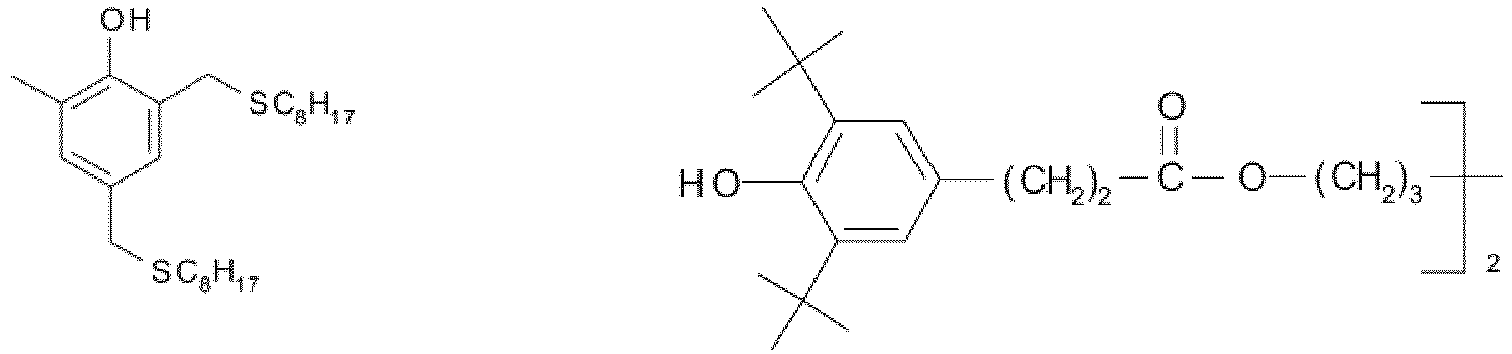
- phenolic antioxidants are the following structures: wherein in the above compounds n is an integer and is between 2 and 10
- phenolic antioxidants are octadecyl 3-(3,5-di-tert-butyl-4-hydroxyphenyl)propionate and pentaerythritol tetrakis(3-(3,5-di-tert-butyl-4-hydroxyphenyl)propionate)
- phenolic antioxidants are based on renewable resources phenolic antioxidants such.
- B. tocopherols (vitamin E), tocotrienols, tocomonoenols, ubiquinol, hydroxytyrosol, flavonoids and flavonols such as chrysin, quercitin, hesperidin, neohesperidin, naringin, morin, kaempferol, fisetin, datiscetin, luteolin, apigenin, taxifolin, isoflavones such as genistein, Genistin, daidzein, daidzin, formononetin, anthocyanins such as delphinidin and malvidin, curcumin, carnosic acid, carnosol, rosmarinic acid, tannin and resveratrol, and carotenoids with alcoholic groups such as beta-cryptoxanthin, lutein, zeaxanthin or astaxanthin Examples of
- p,p'-di-tert-octyldiphenylamine 4-n-butylaminophenol, 4-butyrylaminophenol, 4-nonanoylaminophenol, 4-dodecanoylaminophenol, 4-octadecanoylaminophenol, bis(4-methoxyphenyl)amine, 2,6-di-tert-butyl-4-dimethylaminomethyl-phenol, 2, 4'-diaminodiphenylmethane, 4,4'-diaminodiphenylmethane, N,N,N',N'-tetramethyl-4,4'-diaminodiphenylmethane, 1,2-bis[(2-methyl-phenyl)amino]ethane, 1, 2-bis(phenylamino)propane, (o-tolyl)biguanide, bis[4-(1',3'-dimethylbutyl)phenyl]amine, tert
- Preferred amine antioxidants are: N,N'-Diisopropyl-p-phenylenediamine, N,N'-Di- sec -butyl-p-phenylenediamine, N,N'-Bis(1,4-dimethylpentyl)-p-phenylenediamine, N,N' -bis(1-ethyl-3-methylpentyl)-p-phenylenediamine, N,N'-bis(1-methylheptyl)-p-phenylenediamine, N,N'-dicyclohexyl-p-phenylenediamine, N,N'-diphenyl- p-phenylenediamine, N,N'-bis(2-naphthyl)-p-phenylenediamine, N-isopropyl-N'-phenyl-p-phenylenediamine, N-(1,3-dimethylbutyl)-N'-phenyl-p
- Particularly preferred aminic antioxidants are the structures: where n is an integer between 3 and 100.
- Preferred lactones are: Benzofuranone and indolinones such as 3-(4-(2-acetoxyethoxy)phenyl]-5,7-di-tert-butyl-benzofuran-2-one, 5,7-di-tert-butyl-3-[4-(2-stearoyloxyethoxy)-phenyl]benzofuran-2-one, 3,3'-bis[5,7-di-tert-butyl-3-(4 -(2-hydroxyethoxy]-phenyl)benzofuran-2-one), 5,7-di-tert-butyl-3-(4-ethoxyphenyl)benzofuran-2-one, 3-(4-acetoxy-3,5- dimethylphenyl)-5,7-di-tert-butyl-benzofuran-2-one, 3-(3,5-dimethyl-4-pivaloyloxyphenyl )-5,7-di-tert-butyl-benzo
- antioxidants are isoindolo [2,1-A] quinazolines such as
- a further preferred variant of the method according to the invention is characterized in that the at least one secondary antioxidant is selected from the group consisting of phosphorus compounds, in particular phosphites and phosphonites, organo-sulphur compounds, in particular sulfides and disulfides, and mixtures thereof.
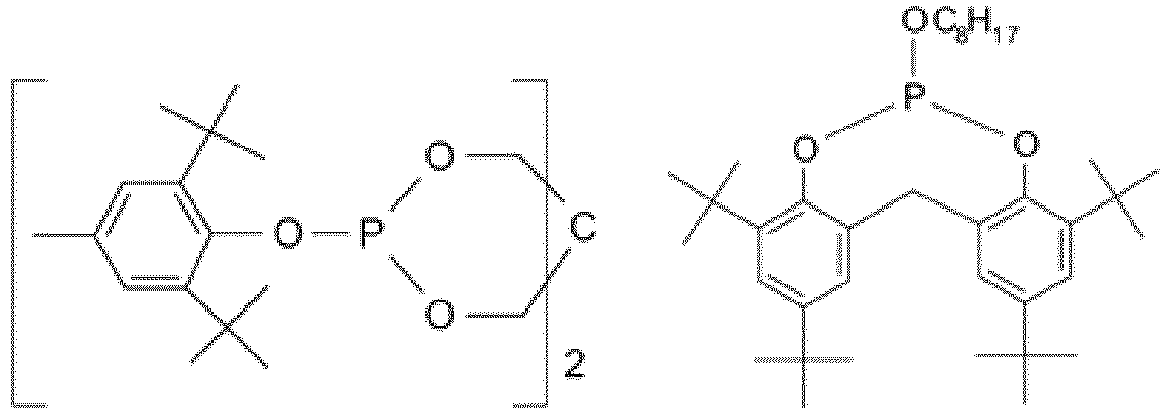
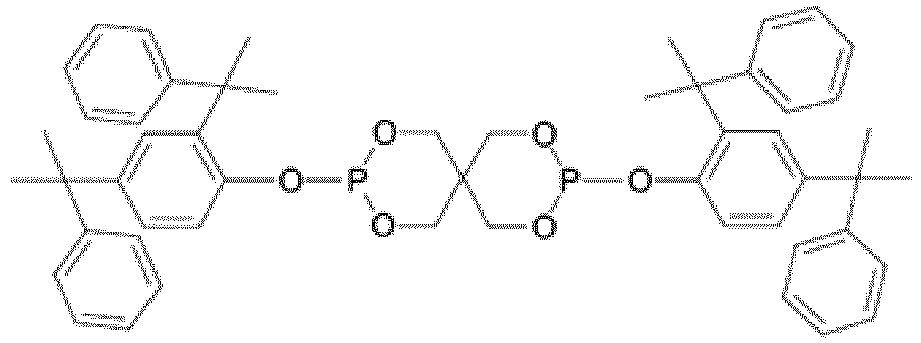
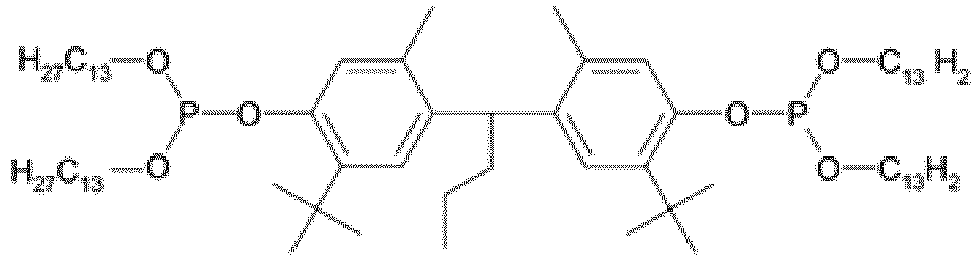
- Suitable secondary antioxidants are in particular phosphites or phosphonites such as triphenyl phosphite, diphenylalkyl phosphites, phenyldialkyl phosphites, tri(nonylphenyl) phosphite, trilauryl phosphites, trioctadecyl phosphite, distearylpentaerythritol diphosphite, tris-(2,4-di- tert -butylphenyl) phosphite, diisodecylpentaerythritol diphosphite phit, bis(2,4 -di- tert -butylphenyl)pentaerythritol diphosphite, bis(2,4-di-cumylphenyl)pentaerythritol diphosphite, bis(2,6-di- tert -butyl
- Particularly preferred phosphites/phosphonites are:
- a preferred phosphonite is:
- the phosphite tris-(2,4-di- tert -butylphenyl) phosphite is very particularly preferably used as the secondary antioxidant.
- Suitable secondary antioxidants are also organo-sulphur compounds such as, for example, sulfides and disulfides, for example distearyl thiodipropionate, dilauryl thiodipropionate; Ditridecyldithiopropionate, Ditetradecylthiodipropionate, 3-(Dodecylthio)-,1,1'-[2,2-bis[[3-(dodecylthio)-1-oxopropoxy]methyl]-1,3-propanediyl]propanoic Acid Ester.
- organo-sulphur compounds such as, for example, sulfides and disulfides, for example distearyl thiodipropionate, dilauryl thiodipropionate; Ditridecyldithiopropionate, Ditetradecylthiodipropionate, 3-(Dodecylthio)-,1,1'-[
- component (B) consists of both a primary antioxidant and a secondary antioxidant.
- component (B) consists of a phenolic antioxidant and a phosphite or phosphonite.
- components (A) and (B) consist of a renewable raw material.
- a particularly preferred variant of the method according to the invention is characterized in that at least one primary antioxidant and at least one secondary antioxidant are incorporated into the thermoplastic.
- component (A) and component (B) are in a weight ratio of from 5:95 to 95:5, preferably from 10:90 to 90:10, particularly preferably from 20:80 to 80 :20, incorporated into the thermoplastic recyclate.
- component (B) consists of both a primary antioxidant and a secondary antioxidant
- the ratio between primary and secondary antioxidant is preferably 90:10 to 10:90, particularly preferably 80:20 to 20:80 and very particularly preferably 70: 30 to 30:70.
- Components (A) and/or (B), which can be in the form of powder, compacted material, granules, solution or flakes, are preferably mixed with the polymer to be stabilized, and the polymer matrix is melted and then cooled.
- the additive it is also possible to introduce the additive into a polymer melt in a molten state.
- thermoplastic recyclate can be added to the polymers separately, in the form of liquids, powders, granules or compacted products, or together with the additive composition according to the invention as described above.
- At least one additive can also be introduced into the thermoplastic recyclate, which is selected from the group consisting of UV absorbers, light stabilizers, metal deactivators, filler deactivators, antiozonants, nucleating agents, antinucleating agents, impact modifiers, plasticizers, lubricants, rheology modifiers, thixotropic agents, chain extenders , optical brighteners, antimicrobial agents, antistatic agents, slip agents, antiblocking agents, coupling agents, crosslinking agents, anticrosslinking agents, hydrophilizing agents, hydrophobicizing agents, adhesion promoters, dispersing agents, compatibilizers, oxygen scavengers, acid scavengers, blowing agents, degradation additives, defoaming agents, odor scavengers, marking agents, antifogging agents, fillers, reinforcing materials and mixtures thereof.
- Suitable acid scavengers are salts of mono, di, tri or tetravalent metals, preferably alkali metals, alkaline earth metals, aluminum or zinc, formed in particular with fatty acids such as calcium stearate, magnesium stearate, zinc stearate, aluminum stearate, calcium laurate, Calcium Behenate, Calcium Lactate, Calcium Stearoyl-2-Lactate.
- hydrotalcites in particular synthetic hydrotalcites based on aluminium, magnesium and zinc, hydrocalumites, zeolites, alkaline earth metal oxides, in particular calcium oxide and magnesium oxide and zinc oxide, alkaline earth metal carbonates, in particular calcium carbonate, magnesium carbonate and dolomite and hydroxides, in particular brucite (magnesium hydroxide),
- Suitable light stabilizers are compounds based on 2-(2'-hydroxyphenyl)benzotriazoles, 2-hydroxybenzophenones, esters of benzoic acids, acrylates, oxamides and 2-(2-hydroxyphenyl)-1,3,5-triazines.
- 2-(2'-hydroxyphenyl)benzotriazoles examples include 2-(2'-hydroxy-5'methylphenyl)benzotriazole, 2-(3',5'-di -tert -butyl-2'-hydroxyphenyl)benzotriazole, 2- (5'- tert -Butyl-2'-hydroxy-phenyl)benzotriazole, 2-(2'-Hydroxy-5'-(1,1,3,3-tetramethylbutyl)phenyl)benzotriazole, 2-(3',5 '-Di- tert -butyl-2'-hydroxyphenyl)-5-chlorobenzotriazole, 2-(3'- tert -butyl-2'-hydroxy-5'-methylphenyl-5-chlorobenzotriazole, 2-(3'-sec- butyl-5'- tert -butyl-2'-hydroxyphenyl)benzotriazole, 2-(2'-hydroxy-4'-oc
- 2-hydroxybenzophenones 4-hydroxy, 4-methoxy, 4-octyloxy, 4-decyloxy, 4-dodecyloxy, 4-benzyloxy, 4,2',4'-trihydroxy and 2'-hydroxy-4 ,4'-dimethyloxy derivatives of 2-hydroxybenzophenones.
- Suitable acrylates are ethyl ⁇ -cyano- ⁇ , ⁇ -diphenyl acrylate, isooctyl ⁇ -cyano- ⁇ , ⁇ -diphenyl acrylate, methyl ⁇ -carbomethoxycinnamate, methyl ⁇ -cyano- ⁇ -methyl-p-methoxycinnamate, butyl ⁇ -cyano- ⁇ -methyl-p-methoxycinnamate, methyl ⁇ -carbomethoxy-p-methoxycinnamate and N-( ⁇ -carbomethoxy- ⁇ -cyanovinyl)-2-methylindoline.
- esters of benzoic acids are 4- tert -butylphenyl salicylate, phenyl salicylate, octylphenyl salicylate, dibenzoylresorcinol, bis(4- tert -butylbenzoyl)resorcinol, benzoylresorcinol, 2,4-di-tert-butylphenyl-3,5-di- tert -butyl- 4-hydroxybenzoate, hexadecyl 3,5-di- tert -butyl-4-hydroxybenzoate, octadecyl 3,5-di -tert -butyl-4-hydroxybenzoate, 2-methyl-4,6-di- tert -butylphenyl- 3,5-di- tert -butyl-4-hydroxybenzoate.
- Suitable oxamides are 4,4'-dioctyloxyoxanilide, 2,2'-diethoxyoxanilide, 2,2'-dioctyloxy-5,5'-di -tert -butoxanilide, 2,2'-didodecyloxy-5,5'-di- tert- butoxanilide, 2-ethoxy-2'-ethyloxanilide, N,N'-bis(3-dimethylaminopropyl)oxamide, 2-ethoxy-5- tert -butyl-2'-ethoxanilide and its mixtures with 2-ethoxy-2 '-ethyl-5,4'-di- tert -butoxanilide, mixtures of o- and p-methoxydisubstituted oxanilides and mixtures of o- and p-ethoxydisubstituted oxanilides.
- 2-(2-hydroxyphenyl)-1,3,5-triazines examples include 2,4,6-tris(2-hydroxy-4-octyloxyphenyl)-1,3,5-triazine, 2-(2-hydroxy- 4-octyloxyphenyl)-4,6-bis(2,4-dimethylphenyl)-1,3,5-triazine, 2-(2,4-dihydroxyphenyl)-4,6-bis(2,4-dimethylphenyl)-1 ,3,5-triazine, 2,4-bis(2-hydroxy-4-propyloxyphenyl)-6-(2,4-dimethylphenyl)-1,3,5-triazine, 2-(2-hydroxy-4-octyloxyphenyl).
- suitable metal deactivators are N,N'-diphenyloxamide, N-salicylal-N'-salicyloylhydrazine, N,N'-bis(salicyloyl)hydrazine, N,N'-bis(3,5-di-tert-butyl-4- hydroxyphenylpropionyl)hydrazine, 3-salicyloylamino-1,2,4-triazole, bis(benzylidene)oxalyldihydrazide, oxanilide, isophthaloyldihydrazide, sebacoylbisphenylhydrazide, N,N'-diacetyladipoyldihydrazide, N,N'-bis(salicyloyl)oxylyldihydrazide, N, N'-bis(salicyloyl)thiopropionyldihydrazide.
- metal deactivators are:
- hindered amines examples include 1,1-bis(2,2,6,6-tetramethyl-4-piperidyl)succinate, bis(1,2,2,6,6-pentamethyl-4-piperidyl)sebazate, bis(1 -octyloxy-2,2,6,6-tetramethyl-4-piperidyl)sebazate, bis(1,2,2,6,6-pentamethyl-4-piperidyl)-n-butyl-3,5-di-tert- butyl 4-hydroxybenzylmalonate, the condensation product of 1-(2-hydroxyethyl)-2,2,6,6-tetramethyl-4-hydroxypiperidine and succinic acid, linear or cyclic condensation products of N,N'-bis(2,2,6,6-tetramethyl-4 -piperidyl)hexamethylenediamine and 4- tert -octylamino-2,6-dichloro-1,3,5-triazine, tris(2,2,6,6,
- N-H N-alkyl such as N-methyl or N-octyl
- N-alkoxy derivatives such as N-methoxy or N-octyloxy
- cycloalkyl derivatives such as N-cyclohexyloxy and the N-(2-hydroxy-2-methylpropoxy) analogs.
- Preferred hindered amines also have the following structures:
- Preferred oligomeric and polymeric hindered amines have the following structures:
- n is in each case from 3 to 100.
- Suitable dispersing agents are: Polyacrylates, eg copolymers with long-chain side groups, polyacrylate block copolymers, alkylamides: eg N,N'-1,2-ethanediylbisoctadecanamide sorbitan esters, eg monostearylsorbitan esters, titanates and zirconates, reactive copolymers with functional groups e.g. B.
- polypropylene-co-acrylic acid polypropylene-co-maleic anhydride, polyethylene-co-glycidyl methacrylate, polystyrene-alt-maleic anhydride-polysiloxanes: eg dimethylsilanediol-ethylene oxide copolymer, polyphenylsiloxane copolymer, amphiphilic copolymers: z.
- Suitable antinucleating agents are azine dyes such as nigrosine.
- plasticizers examples include phthalic acid esters, adipic acid esters, citric acid esters, 1,2-cyclohexanedicarboxylic acid esters, trimellitic acid esters, isosorbide esters, phosphate esters, epoxides such as epoxidized soybean oil or aliphatic polyesters.
- Suitable lubricants and processing aids are, for example, polyethylene waxes, polypropylene waxes, salts of fatty acids such as calcium stearate, zinc stearate or salts of montan waxes, amide waxes such as erucic acid amide or oleic acid amide, fluoropolymers, silicones or neoalkoxy titanates and zirconates.
- Suitable pigments can be inorganic or organic in nature.
- Inorganic pigments are, for example, titanium dioxide, zinc oxide, zinc sulfide, iron oxide, ultramarine, carbon black, organic pigments are, for example, anthraquinones, anthanthrones, benzimidazolones, quinacridones, diketopyrrolopyrroles, dioxazines, indanthrones, isoindolinones, azo compounds, perylenes, phthalocyanines or pyranthrones.
- Other suitable pigments are metal-based effect pigments or metal-oxide-based pearlescent pigments.
- Suitable optical brighteners are, for example, bisbenzoxazoles, phenylcoumarins or bis(styryl)biphenyls and in particular optical brighteners of the formulas:
- Suitable filler deactivators are, for example, polysiloxanes, polyacrylates, in particular block copolymers such as polymethacrylic acid polyalkylene oxide or polyglycidyl (meth)acrylates and their copolymers, for example with styrene, and epoxides, for example of the following structures:
- Suitable antistatic agents are ethoxylated alkylamines, fatty acid esters, alkylsulfonates and polymers such as polyetheramides.
- Suitable antiozonants are the amines mentioned above, such as, for example, N,N'-diisopropyl-p-phenylenediamine, N,N'-di-sec-butyl-p-phenylenediamine, N,N'-bis(1,4-dimethylpentyl)-p -phenylenediamine, N,N'-dicyclohexyl-p-phenylenediamine, N-isopropyl-N'-phenyl-p-phenylenediamine, N-(1,3-dimethylbutyl)-N'-phenyl-p-phenylenediamine, N- (1-methylheptyl)-N'-phenyl-p-phenylenediamine, N-cyclohexyl-N'-phenyl-p-phenylenediamine
- Suitable rheology modifiers for the production of controlled rheology polypropylene are peroxides, alkoxyamine esters, oxyimide sulfonic acid esters and, in particular, the following structures:
- Suitable nucleating agents are talc, alkali metal or alkaline earth metal salts of mono- and polyfunctional carboxylic acids such as.
- Suitable additives for increasing the molecular weight of polycondensation polymers are diepoxides, bis-oxazolines, bis-oxazolones, bis-oxazines, diisocyanates, dianhydrides, bis-acyllactams, bis-maleimides, dicyanates, carbodiimides.
- Other suitable chain extenders are polymeric compounds such as. B. polystyrene-polyacrylate-polyglycidyl (meth)acrylate copolymers, polystyrene-maleic anhydride copolymers and polyethylene-maleic anhydride copolymers.
- Suitable additives for increasing the electrical conductivity are, for example, the antistatic agents mentioned, soot and carbon compounds such as carbon nanotubes and graphene, metal powder such as copper powder and conductive polymers such as bsp. polypyrroles, polyanilines and polythiophenes.
- suitable additives for increasing the thermal conductivity are aluminum nitrides and boron nitrides.
- suitable infrared-active additives are aluminum silicates, hydrotalcites or dyes such as phthalocyanines or anthraquinones.
- Suitable mold release agents are silicones, soaps and waxes such as montan waxes.
- Components (A) and (B) and any additional additives can be incorporated into the plastic recyclate using conventional processing methods, with the polymer being melted and mixed with the additive composition according to the invention and any other additives, preferably using mixers, kneaders and extruders.
- Extruders such as single-screw extruders, twin-screw extruders, planetary roller extruders, ring extruders, co-kneaders, which are preferably equipped with vacuum degassing, are preferred as processing machines.
- the processing can take place under air or, if necessary, under inert gas conditions such as e.g. under nitrogen.
- components (A) and (B) in the form of so-called Masterbatches or concentrates containing, for example, 10-90% of a stabilizer composition consisting of components (A) and (B) in a polymer are produced and introduced.
- the thermoplastic recyclate is particularly preferably selected from the group consisting of polymers made from olefins or diolefins, such as polyethylene, in particular LDPE, LLDPE, VLDPE, ULDPE, MDPE, HDPE and UHMWPE, metallocene PE (m-PE), polypropylene, Polyisobutylene, poly-4-methyl-pentene-1, polybutadiene, polyisoprene, polycyclooctene, polyalkylene-carbon monoxide copolymers, and corresponding copolymers in the form of random or block structures such as polypropylene-polyethylene (EP), EPM or EPDM, ethylene-vinyl acetate ( EVA), ethylene acrylic esters such as ethylene butyl acrylate, ethylene acrylic acid glycidyl acrylate, and corresponding graft polymers such as polypropylene g-maleic anhydride, polypropylene g-acrylic acid and polyethylene g-acryl
- the one thermoplastic material is very particularly preferably a polyolefin recyclate.
- the thermoplastic recyclate can be polypropylene, ie in particular a polypropylene recyclate, or polyethylene, ie in particular a polyethylene recyclate.
- the primary and/or secondary antioxidants contained in the recyclate and their degradation products can, if necessary, be analyzed using standard analytical methods known to those skilled in the art, e.g. using chromatographic methods such as HPLC, if necessary after extraction from the polymer using a suitable solvent and subsequent concentration by removing the Solvent to be determined.
- composition according to the invention preferably contains at least one primary antioxidant and at least one secondary antioxidant.
- the plastic composition according to the invention additionally contains at least one additive which is selected from the group consisting of UV absorbers, light stabilizers, metal deactivators, filler deactivators, antiozonants, nucleating agents, antinucleating agents, impact modifiers, plasticizers, lubricants, rheology modifiers, thixotropic agents, chain extenders, optical brighteners, antimicrobial agents, antistatic agents, slip agents, antiblocking agents, coupling agents, crosslinking agents, anticrosslinking agents, hydrophilizing agents, hydrophobicizing agents, adhesion promoters, dispersing agents, compatibilizers, oxygen scavengers, acid scavengers, blowing agents, degradation additives, defoaming agents, odor scavengers, marking agents, antifogging agents, fillers, reinforcing materials and mixtures thereof.
- at least one additive which is selected from the group consisting of UV absorbers, light stabilizers, metal deactivators, filler deactivators, antio
- the further additive is in particular an acid scavenger.
- Preferred acid scavengers are defined above.
- the plastics composition according to the invention can preferably be produced using a method according to the invention for stabilizing thermoplastics against oxidative, thermal and/or actinic degradation, or was produced using it.
- the present invention also relates to a molding compound or a molded part that can be produced from the plastic composition according to the invention, in particular in the form of injection molded parts, foils, films, paints, coatings, foams, fibers, cables, pipes, profiles, hollow bodies, ribbons, membranes, e.g. geomembranes , lubricants, colorants and/or adhesives that are manufactured via extrusion, injection molding, blow molding, calendering, pressing processes, spinning processes and/or rotomoulding, e.g. for the electrical industry, for the construction industry, for the transport industry (car, plane, ship, train), for medical applications, for household and electrical appliances, for vehicle parts, for consumer items, for packaging, for furniture, and/or for textiles.
- a molding compound or a molded part that can be produced from the plastic composition according to the invention, in particular in the form of injection molded parts, foils, films, paints, coatings, foams, fibers, cables, pipes, profiles, hollow bodies, ribbon
- the present invention also relates to the use of at least substituted sugar for stabilizing thermoplastic recyclates against oxidative, thermal and/or actinic degradation.
- thermoplastics are the same as those mentioned with regard to the method according to the invention or those mentioned with regard to the plastics composition according to the invention.
- the stabilizer composition is particularly preferably used for stabilizing polyolefin recyclates and against oxidative, thermal and/or actinic degradation.
- a post-consumer polypropylene recyclate from battery box ground material (supplier: BSB Braubach) together with the additives specified in the table at 210 ° C in a twin-screw microextruder (MC 5, manufacturer DSM) in conveyed in a continuous mode at 90 revolutions per minute for 30 minutes in the melt in a circle.
- the force absorption is measured after 10, 20 and 30 minutes.
- a stearoyl-substituted mannitol (> 90% monosubstituted) leads to increased processing stabilization compared to a recyclate without the addition, ie to a higher residual strength.
- a further improvement in processing stability is achieved by adding 0.1% primary antioxidant (pentaerythritol tetrakis [3-(3,5-di -tert -butyl-4-hydroxyphenyl)propionate) and 0.1% secondary antioxidant (Tris -(2,4-di- tert -butylphenyl)phosphite) can be added.
- the addition of the distearyl ester of mucic acid in a concentration of 0.1 to 0.5% leads to increased processing stabilization compared to a polypropylene recyclate without an additive, i.e. to a higher residual strength after 30 minutes.
Landscapes
- Chemical & Material Sciences (AREA)
- Health & Medical Sciences (AREA)
- Chemical Kinetics & Catalysis (AREA)
- Medicinal Chemistry (AREA)
- Polymers & Plastics (AREA)
- Organic Chemistry (AREA)
- Life Sciences & Earth Sciences (AREA)
- Sustainable Development (AREA)
- Compositions Of Macromolecular Compounds (AREA)
- Separation, Recovery Or Treatment Of Waste Materials Containing Plastics (AREA)
Description
- Die vorliegende Erfindung betrifft ein Verfahren zur Stabilisierung von thermoplastischen Kunststoff-Rezyklaten bzw. vorgeschädigten Kunststoffen gegen oxidativen, thermischen und/oder aktinischen Abbau. Beim erfindungsgemäßen Verfahren wird als stabilisierende Komponente mindestens ein substituierter Zucker, ausgewählt aus der Gruppe bestehend aus mindestens einem Ester und/oder Ether eines Alditols mit mindestens 4 Kohlenstoffatomen oder eines Cyclitols, mindestens einem Ester einer Zuckersäure, mindestens einem Amid und/oder substiuiertem Amin eines Aminozuckers, sowie Mischungen und Kombinationen hiervon, in ein thermoplastischen Kunststoff-Rezyklat sowie ggf. zusätzlich hierzu mindestens ein primäres Antioxidans und/oder mindestens ein sekundäres Antioxidans in ein thermoplastisches Kunststoff-Rezyklat eingebracht. Durch das erfindungsgemäße Verfahren können Kunststoff-Rezyklate mit hoher Wirksamkeit und auf sehr umweltfreundliche und kostengünstige Weise gegen oxidativen, thermischen und/oder aktinischen Abbau stabilisiert werden. Zudem betrifft die vorliegende Erfindung auch entsprechende Rezyklat-basierte Kunststoffzusammensetzungen sowie hieraus hergestellte Formmassen und Formteile. Ferner betrifft die vorliegende Erfindung auch Stabilisator-Zusammensetzungen sowie deren Verwendung zur Stabilisierung von thermoplastischen Kunststoff-Rezyklaten gegen oxidativen, thermischen und/oder aktinischen Abbau.
- Kunststoff-Rezyklate sind ein wachsender Markt und ein wichtiges Element in der Kreislaufwirtschaft von Rohstoffen, wobei idealerweise Rezyklate dann Neukunststoffe mit einem identischen oder zumindest vergleichbaren Eigenschaftsprofil ersetzen sollen. Allerdings kommt es bei Rezyklaten aus der Produktion oder von Altkunststoffen während der ersten Verarbeitungsschritte (z.B. Compoundierung, Spritzguss) und der Anwendung oft über viele Jahre zu irreversiblen Veränderungen in der Polymerkette durch mechano-chemische, chemische oder lichtinduzierte Prozesse (siehe z.B. R. Pfaendner et al., Angew. Makromol. Chemie 1995, 232, 193-227; J. Pospisil et al., Pol. Degr. Stab. 1995, 48, 351-358). Durch Radikalreaktionen in der Anwesenheit von Sauerstoff werden neue chemische Gruppen in der Polymerkette erzeugt und/oder die Zusammensetzung des Polymeren geändert. Die Konzentration dieser neu formierten Gruppen nimmt mit der Einsatzzeit und dem Einsatzbereich (UV-Licht, hohe Temperaturen, Kontaktmedien) zu. Die strukturellen Inhomogenitäten eines Rezyklates beeinflussen dann die Kunststoff-Eigenschaften, wie z.B. die mechanischen und physikalischen Eigenschaften sowie das Verarbeitungsverhalten.
- Weiterhin gilt, dass Rezyklate oder vorgeschädigte Kunststoffe oxidationsempfindlicher sind als Neumaterial, da Abbauprodukte als Initiatorstellen für eine weitere Oxidation oder als Prodegradantien wirken (A. S. Maxwell, Pol. Eng. Sci. 2008, 381-385; I. H. Craig, J. R. White, J. Mater. Sci . 2006, 41, 993-1006, L. Luzuriaga, J. Kovarova, I. Fortelny, Pol. Degr. Stab. 2006, 91, 1226-1232). Um eine Qualitätsverbesserung von Kunststoff-Rezyklaten zu erreichen, ist die Nachstabilisierung mit ausgewählten Stabilisatoren eine wesentliche Methode. Die eingesetzten Stabilisatoren schützen das Rezyklat vor weiterer oxidativen (oder photooxidativen) Schädigung. Die optimierte Stabilisator-Zusammensetzung für ein Rezyklat unterscheidet sich jedoch aufgrund der beschriebenen strukturellen Abweichungen von der Stabilisierungszusammensetzung der Neuware (siehe z.B. R. Pfaendner, Kunststoffe International 12/2015, 41-44).
- Aufgrund der heute anerkannten Unterschiede zwischen Kunststoff-Neuware und Kunststoff-Rezyklaten sind spezielle Rezyklat-Stabilisator-Zusammensetzungen bekannt und auch als kommerzielle Produkte erhältlich (z.B. Recyclostab Serie der Fa. BYK-Chemie GmbH, Wesel ). Bekannte technische Stabilisierungslösungen, die den Anforderungen von RezyklatenRechnung tragen sind beispielsweise:
- Stabilisierungs-Zusammensetzung bestehend aus einem phenolischen Antioxidans, einem Phosphit und einem Fettsäuresalz (
EP 0662101 ). - Stabilisierungs-Zusammensetzung bestehend aus einem phenolischen Antioxidans, einem Phosphit und einem Metalloxid wie Calciumoxid (
US 6525158 ,US 6251972 ). - Stabilisierungs-Zusammensetzung bestehend aus einem phenolischen Antioxidans und einem polyfunktionellen Epoxid (
EP 0702704 ). - Stabilisierung durch ein makrozyklisches Piperidin (
US 5789470 ). - Stabilisierungs-Zusammensetzung bestehend aus einem sekundären aromatischen Amin und einem polyfunktionellen Epoxid (
WO 97/30112 - Entfärbung von geschädigten Pololefinen durch ein Hydroxylamin (
EP 470048 - Mischung aus Antioxidantien, Gleitmittel, Antiblockmittel, UV-Stabilisatoren und Antistatika für Rezyklatfolien (
DD 288161 - Stabilisierungs-Zusammensetzung für gemischte Kunststoffe bestehend aus einem phenolischen Antioxidans und einem Phosphit/Phosphonit (
EP 0506614 ) - Stabilisierung von Polycarbonat-Blends mit post-consumer Polystyrol Rezyklaten durch Säuren (
WO 2014/141178 ) - Stabilisierung von halogenhaltigen Rezyklaten durch 6-Aminouracile (
EP 1426 406 ) - Weiterhin, ist die Stabilisierung von thermoplastischen Kunststoffe durch Zuckerderivate bekannt (
EP2641933 ). - Trotz der bekannten Lösungen besteht nach wie vor der Bedarf für besonders leistungsfähige bzw. wirkungsvolle, umweltfreundliche und kostengünstige Möglichkeiten zur Stabilisierung von Kunststoffen-Rezyklaten bzw. dafür verwendbare Stabilisator-Zusammensetzungen.
- Rezyklate haben hierbei bereits einen Lebenszyklus durchlaufen und waren bereits zu Kunststoffformteilen kompoundiert und als solche beispielsweise mechanischen, chemischen, aktinischen und/oder oxidativen Belastungen ausgesetzt. Hierdurch resultieren bestimmte Fehlstellen in der Polymerkette, die bei einer erneuten Verarbeitung der Rezyklate eine weitere, überproportionale Schädigung des zugrundeliegenden Kunststoffmaterials bewirken. Die vorhandenen Schädigungsstellen im Polymer dienen hierbei als Initiatorstellen für einen beschleunigten und erweiterten Abbau des Polymers. Insbesondere sind eine Erniedrigung des Molekulargewichts, eine Verbreiterung der Molekulargewichtsverteilung, eine Herabsetzung der mechanischen Eigenschaften und eine Erhöhung der Lichtempfindlichkeit typische Erscheinungsbilder, die bei rezyklierten Kunststoffen, insbesondere bei deren erneuter Verarbeitung zutage treten. Das insgesamt verschlechterte Eigenschaftsprofil ist somit einer erneuten Verarbeitung eher abträglich.
- Ausgehend hiervon war es somit die Aufgabe der vorliegenden Erfindung, ein Verfahren zur Stabilisierung von thermoplastischen Kunststoff-Rezyklaten anzugeben, mit welchem die Kunststoff-Rezyklate auf sehr wirkungsvolle, umweltfreundliche und kostengünstige Weise gegen oxidativen, thermischen und/oder aktinischen Abbau stabilisiert werden können.
- Diese Aufgabe wird hinsichtlich eines Verfahrens zur Stabilisierung von thermoplastischen Kunststoff-Rezyklaten mit den Merkmalen des Patentanspruchs 1, hinsichtlich einer Kunststoffzusammensetzung mit den Merkmalen des Patentanspruchs 19, hinsichtlich eines Formteils, welches aus der Kunststoffzusammensetzung herstellbar ist, mit den Merkmalen des Patentanspruchs 26, hinsichtlich einer Stabilisator-Zusammensetzung mit den Merkmalen des Patentanspruchs 27, hinsichtlich der Verwendung eines substituierten Zuckers mit den Merkmalen des Patentanspruchs 29 sowie hinsichtlich der Verwendung der Stabilisator-Zusammensetzungen mit den Merkmalen des Patentanspruchs 30 gelöst. Dabei stellen die jeweilig abhängigen Patentansprüche vorteilhafte Weiterbildungen dar.
- Erfindungsgemäß wird somit ein Verfahren zur Stabilisierung von thermoplastischen Kunststoff-Rezyklaten gegen oxidativen, thermischen und/oder aktinischen Abbau angegeben, bei welchem mindestens ein substituierter Zucker, ausgewählt aus der Gruppe bestehend aus
- (a1) mindestens einem Ester und/oder Ether eines Alditols mit mindestens 4 Kohlenstoffatomen oder eines Cyclitols,
- (a2) mindestens einem Ester einer Zuckersäure, und/oder
- (a3) mindestens einem Amid und/oder substiuiertem Amin eines Aminozuckers,
- sowie Mischungen und Kombinationen hiervon (nachfolgend auch als "Komponenten (A)" bezeichnet)
- in ein thermoplastischen Kunststoff-Rezyklat eingebracht wird.
- Bei den eingesetzten substituieren Zuckern kann es sich um jeweils chemisch reine Ester, Ether und Amide handeln. Ebenso ist es möglich, dass die jeweiligen substituierten Zucker ein gemischtes Substitutionsmuster aufweisen. Beispielsweise kann es sein, dass ein substituierter Zucker sowohl eine Ester- als auch eine Amid-Funktionalisierung aufweist.
- Der/die Substituenten der substituierten Zucker können aliphatische, aromatische oder cycloaliphatische Kohlenwasserstoffgruppen, gegebenenfalls unterbrochen von Sauerstoff-, Schwefel- oder Stickstoffatomen sein, bevorzugt sind Gruppen mit mindestens 4, besonders bevorzugt mit mindestens 6 CH2-Gruppen sein.
- Die Herstellung der substituierten Zucker kann nach bekannten Methoden, die z.B. in den folgenden Literaturstellen beschrieben sind, erfolgen:
- E. Reinefeld, G. Klaunberg, Tenside 1968, 5 (9-10), 266-270
-
DE 2423278, B.V. Chemie Combinatie Amsterdam C.C.A. - A.F. Artamanov et al. Chemistry of Natural Compounds, 2001, 37, 124-125 Eine bevorzugte Herstellungsmethode ist dabei regioselektiv via enzymatischen Prozessen:
- Y. Watanabe et al., Tetrahedron 2013, 69, 4657-4664
- W. Wei et al. Green Chemistry 2015, 17, 3475-3489
- Da die den Kunststoff-Rezyklaten zugrundeliegenden thermoplastischen Kunststoffe bei deren Herstellung im Regelfall schon primäre und/oder sekundäre Antioxidantien zugesetzt wurden, ist es bei Wiederverarbeitung von gebrauchten oder bereits verwendeten Kunststoffen, also Rezyklaten nicht unbedingt notwendig, bei Aufarbeitung dieser Rezyklate erneut primäre und/oder sekundäre Antioxidantien zuzugeben. Überraschenderweise wurde gefunden, dass es ausreicht, mindestens einen substituierten Zucker wie voranstehend definiert in die Kunststoffrezyklate einzuarbeiten, um eine stabilisierende Wirkung zu erzielen, die bei Vorhandensein von primären und/oder sekundären Oxidantien auf synergistische Weise besonders hoch ausfällt.
- Gemäß der vorliegenden Erfindung wird unter einem Kunststoff-Rezyklat ein Kunststoff-Rezyklat nach der begrifflichen Definition gemäß Norm DIN EN 15347:2007 verstanden. Im Weiteren bestehen für viele Arten von Kunststoff-Rezyklaten einschlägige internationale Normen. Für PET-Kunststoff-Rezyklate ist beispielsweise die DIN EN 15353:2007 einschlägig. PS-Rezyklate werden in DIN EN 15342:2008 näher beschrieben. PE-Rezyklate werden in DIN EN 15344:2008 behandelt. PP-Rezyklate werden in DIN EN 15345:2008 charakterisiert. Zum Zwecke der entsprechenden speziellen Kunststoff-Rezyklate macht sich die vorliegende Patentanmeldung die Definitionen dieser internationalen Normen zu Eigen.
- Kunststoff-Rezyklate weisen im Gegensatz zu Neukunststoffen zumeist eine Vorschädigung auf, d.h. durch oxidative oder (photo)oxidative Prozesse werden neue chemische Gruppen auf der Polymerkette erzeugt. Bei Polyolefinen z.B. sind dies vorwiegend Carbonylgruppen, die bei Neuware nicht oder nur in sehr untergeordnetem Maß vorhanden sind. Die Konzentration der Carbonylgruppen ist daher gleichzeitig ein Maß für die Vorschädigung des Polymeren. Die Konzentration an Carbonylgruppen kann nach bekannten analytischen Verfahren wie z.B. Infrarot-Spektroskopie bestimmt werden, wie sie beispielsweise in E. Richaud et al. Pol. Degr. Stab. 2009, 94, 410-420 beschrieben ist. Hierbei erfolgt eine Messung der Absorption der Carbonylschwingung im Bereich von 1720 cm-1.
- Eine bevorzugte Ausführungsform des erfindungsgemäßen Verfahrens sieh vor, dass der mindestens eine substituierte Zucker mindestens 3, bevorzugt mindestens 4 freie OH-Gruppen aufweisen.
- Vorteilhaft ist ebenso, wenn der mindestens eine substituierte Zucker mono- oder disubstituiert ist. Ganz besonders bevorzugt sind monosubstituierte Verbindungen.
- Gemäß einer weiteren bevorzugten Ausführungsform weist das Alditol, von dem sich die substituierten Zucker ableiten die Summenformel
HOCH2[CH(OH)]nCH2OH,
R1-OCH2[CH(OH)]nCH2OH, oder
HOCH2[CH(OH)]n[CH(OR1)]CH2OH
mit n = 2-6, bevorzugt n = 3-5 auf, wobei R1 ein gegebenenfalls substituierter Zuckerrest ist. - Vorzugsweise leitet sich das mindestens eine substituierte Alditol von Alditolen, ausgewählt aus der Gruppe bestehend aus Threit, Erythrit, Galactit, Mannit, Ribit, Sorbit, Xylit, Arabit, Isomalt, Lactit, Maltit Maltotritol und hydrierte Oligo- und Polysaccharide mit Polyol-Endgruppen und Mischungen hiervon, ab. Besonders bevorzugt ist das mindestens eine bevorzugte Alditol ausgewählt aus der Gruppe bestehend aus Erythrit, Mannit, Isomalt, Maltit und Mischungen hiervon. Ganz besonders bevorzugt ist das mindestens eine Alditol Mannit oder das Cyclitol myo-Inosit.
- Beispiele für Heptitole und Octitole als Ausgangsprodukte für die substituierten Derivate sind: meso-glycero-allo-Heptitol, D-glycero-D-altro-Heptitol, D-glycero-D-manno-Heptitol , meso-glycero-gulo-Heptitol, D-glycero-D-galacto-Heptitol (Perseitol), D-glycero-D-gluco-Heptitol, L-glycero-D-gluco Heptitol, D-erythro-L-galacto-Octitol, D-threo-L-galacto-Octitol
- Alternativ oder zusätzlich zu den zuvor genannten Alditolen als Ausgangsstoffe für die Herstellung der substituierten Zucker können beim erfindungsgemäßen Verfahren (bzw. für die Zwecke der erfindungsgemäßen Kunststoffzusammensetzung, der Formmasse bzw. dem Formteil oder der Stabilisator-Zusammensetzung) auch Cyclitole, d. h. ringförmige Polyole, verwendet werden.
- Weiter vorteilhaft ist das mindestens eine Cyclitol Ausgangsstoff für die Herstellung der substituierten Zucker ausgewählt aus der Gruppe bestehend aus Inositol, Quercitol, Viscumitol, Bornesitol, Conduritol, Ononitol, Pinitol, Pinpollitol, Ciceritol, Quebrachitol, Chinasäure, Shikimisäure und Valienol wobei das mindestens eine Cyclitol vorzugsweise myo-Inosit ist.
- Weiter vorteilhaft ist der mindestens eine Ester der Zuckersäure eine Aldonsäure oder eine Aldarsäure. Ausgangsstoffe für die Herstellung der substituierten Zuckersäuren sind beispielsweise die Aldonsäuren Allonsäure, Altronsäure, cluconsäure, Mannonsäure, Gulonsäure, Idonsäure, Galaktonsäure, Talonsäure, Ribonsäure, Arabonsäure, Xylonsäure, Lyxonsäure, Erythronsäure oder Threonsäure. Beispiele für bevorzugte Aldarsäuren sind Schleimsäure oder Glucarsäure.
- Weiter vorteilhaft ist das mindestens eine substituierte Amin oder Amid ein Aminozucker. Ausgangsstoffe für die Herstellung der substituierten Aminozucker sind beispielsweise 1-Amino-1-deoxy-alditole, wie z.B. 1-Amino-1-de-oxy-galactit, 1-Amino-1-deoxy-mannit, 1-Amino-1-deoxy-sorbit, 1-Amino-1-deoxy-maltit. Beispiele für disubstituierte Aminozucker leiten sich z.B. von alpha-omega-Diamino-alpha-omega-dideoxyalditolen ab, ein Beispiel ist das 1,6-Diamino-1,6-dideoxysorbit.
- Bevorzugte Substituenten sind lineare oder verzweigte Kohlenwasserstoffketten mit midestens 6 CH2-Gruppen, wie z.B. Hexyl, Heptyl, Octyl, Nonyl, Decyl, Isodecyl, Lauryl, Stearyl, Myristyl, Oleyl, Cetyl, Ceryl, Myricyl, Palmitoleyl, Arachidyl, Behenyl, Erucyl, Lignoceryl, Montanyl, Linoleyl, Isotridecyl
- Insbesondere ist der mindestens eine substituierte Zucker ausgewählt ist aus der Gruppe bestehend aus den nachfolgenden Verbindungen:


- Insbesondere wird bezogen auf 95,0 bis 99,99 Gew.-Teile bevorzugt 99,0 bis 99,98 Gew.-Teile des thermoplastischen Kunststoff-Rezyklats 0,01 bis 5,0 Gew.-Teile, bevorzugt 0,02 bis 1,0 Gew.-Teile des mindestens einen substituierten Zuckers (Komponente (A)) eingebracht.
- Eine bevorzugte Ausführungsform des Verfahrens sieht vor, zusätzlich zum mindestens einen substituierten Zucker mindestens ein primäres Antioxidans und/oder mindestens ein sekundäres Antioxidans (Komponente (B)) in das thermoplastische Kunststoff-Rezyklat eingebracht wird/werden. Die Komponenten (A) und (B) können dabei einzeln bzw. getrennt voneinander in das Kunststoff-Rezyklat eingebracht werden oder die Komponenten (A) und (B) können zusammen in Form einer die Komponenten (A) und (B) enthaltenden Zusammensetzung bzw. in Form einer aus den Komponenten (A) und (B) bestehenden Zusammensetzung in das Kunststoff-Rezyklat eingebracht werden.
- Als Komponente (B) wird
- mindestens ein primäres Antioxidans (Komponente (B1)), oder
- mindestens ein sekundäres Antioxidans (Komponente (B2)), oder
- mindestens ein primäres Antioxidans und mindestens ein sekundäres Antioxidans verwendet.
- Für den Fall, dass mindestens ein primäres Antioxidans und mindestens ein sekundäres Antioxidans verwendet werden, können auch diese einzeln bzw. getrennt voneinander oder zusammen in Form einer Mischung in das Kunststoff-Rezyklat eingebracht werden.
- Die erfindungsgemäß eingesetzte Komponente (A) sowie ggf. die zusätzlich zur Komponente (A) eingesetzte Komponente (B) wirkt bzw. wirken zusammen als Stabilisator für das thermoplastische Kunststoff-Rezyklat, wobei der oxidative, thermische und/oder aktinische Abbau des thermoplastischen Kunststoff-Rezyklats gehemmt bzw. verhindert wird. Mit anderen Worten wird durch das Einbringen der Komponente (A) sowie ggf. zusätzlich der Komponente (B) in das thermoplastische Kunststoff-Rezyklat der Kunststoff gegen oxidativen, thermischen und/oder aktinischen Abbau stabilisiert.
- Die vorliegende Erfindung zeichnet sich dabei besonders dadurch aus, dass der mindestens eine substituierte Zucker alleine oder zusammen mit primären und/oder sekundären Antioxidantien zur Stabilisierung von thermoplastischen Kunststoff-Rezyklaten eingesetzt werden.
- Erfindungsgemäß wurde dabei überraschend festgestellt, dass durch das Einbringen von mindestens einem substituiertem Zucker allein sowie zusammen mit mindestens einem primären und/oder mindestens einem sekundären Antioxidans eine sehr wirkungsvolle Stabilisierung von thermoplastischen Kunststoff-Rezyklaten gegen oxidativen, thermischen und/oder aktinischen Abbau erreicht werden kann. Zudem handelt es sich bei substituierten Zuckern um sehr umweltfreundliche und kostengünstige Verbindungen. Somit können mit dem erfindungsgemäßen Verfahren thermoplastische Kunststoff-Rezyklate auf sehr wirkungsvolle, umweltfreundliche und kostengünstige Weise gegen oxidativen, thermischen und/oder aktinischen Abbau stabilisiert werden.
- Die Erfinder vermuten dabei, dass die in das Kunststoff-Rezyklat eingearbeiteten substituierten Zucker hierbei mit den bereits vorhandenen Schädigungsstellen (in der Regel Carbonylgruppen) zu Halb- oder Vollacetalen bei Verarbeitung der Neukompoundierung reagieren können. Somit werden die Schädigungsstellen im Kunststoff effektiv maskiert und stehen als Initiatorstellen für einen weiteren Abbau nicht mehr zur Verfügung. Mit der erfindungsgemäßen Methode bzw. mit den erfindungsgemäßen Additivzusammensetzungen lassen sich somit Schädigungsstellen in Kunststoffrezyklaten beheben. Des weiteren wir vermutet, dass die erfindungsgemäßen substituieretn Zucker als Hydroperoxidzersetzer und/oder als Metalldesaktivatoren wirken können.
- Aus diesem Grund ist auch der Zusatz eines substituierten Zuckers zu einem Kunststoff-Rezyklat allein ein wirksamer Stabilisator, da häufig davon auszugehen ist, dass im Rezyklat aus der ersten Anwendung vorhandene primäre und sekundäre Antioxidantien nicht vollständig während des Einsatzes verbraucht wurden.
- Das im erfindungsgemäßen Verfahren eingesetzte e thermoplastische Kunststoff-Rezyklat ist vorzugsweise ein Polyolefin-Rezyklat, z.B. ein Polypropylen-Rezyklat oder ein Polyethylen-Rezyklat.
- Das erfindungsgemäße Verfahren ist weiterhin besonders geeignet vorgeschädigte Rezyklate zu stabilisieren, insbes. Pololefin-Rezyklate deren Carbonylgruppengehalt, bestimmt durch Absorption im Infrarotspektrum, mindestens 0.01 mol/kg beträgt, bevorzugt größer als 0.02 mol/kg und besonders bevorzugt größer als 0.05 mol/kg ist.
- In einer bevorzugten Variante des erfindungsgemäßen Verfahrens ist das mindestens eine primäre Antioxidans ausgewählt aus der Gruppe bestehend aus phenolischen Antioxidantien, Aminen, Lactonen und Mischungen hiervon.
- Als phenolische Antioxidantien können beispielsweise verwendet werden:
- Alkylierte Monophenole, wie z.B. 2,6-Di-tert-butyl-4-methylphenol, 2-tert-Butyl-4,6-dimethylphenol, 2,6-Di-tert-butyl-4-ethylphenol, 2,6-Di-tert-butyl-4-n-butylphenol, 2,6-Di-tert-butyl-4-isobutylphenol, 2,6-Dicyclopentyl-4-methylphenol, 2-(α-Methylcyclohexyl)-4,6-dimethylphenol, 2,6-Dioctadecyl-4-methylphenol, 2,4,6-Tricyclohexylphenol, 2,6-Di-tert-butyl-4-methoxymethyl-phenol, lineare oder verzweigte Nonylphenole, wie z.B. 2,6-Dinonyl-4-methylphenol, 2,4-Dimethyl-6-(1'-methylundec-1'-yl)phenol, 2,4-Dimethyl-6-(1'-methylheptadec-1'-yl)phenol, 2,4-Dimethyl-6-(1'-methyltridec-1'-yl)phenol und Mischungen hiervon;
- Alkylthiomethylphenole, wie z.B. 2,4-Dioctylthiomethyl-6-tert-butylphenol, 2,4-Dioctylthiomethyl-6-methylphenol, 2,4-Dioctylthiomethyl-6-ethylphenol, 2,6-Didodecylthiomethyl-4-nonylphenol;
- Hydrochinone und alkylierte Hydrochinone, wie z.B. 2,6-Di-tert-butyl-4-methyoxyphenol, 2,5-Di-tert-butylhydrochinon, 2,5-Di-tert-amylhydrochinon, 2,6-Diphenyl-4-octadecyloxyphenol, 2,6-Di-tert-butylhydrochinon, 2,5-Di-tert-butyl-4-hydroxyanisol, 3,5-Di-tert-butyl-4-hydroxyanisol, 3,5-Di-tert-butyl-4-hydroxyphenylstearat, Bis(3,5-di-tert-butyl-4-hydroxylphenyl)adipat;
- Tocopherole, wie z.B. α-, β-, γ-, δ-Tocopherol und Mischungen aus diesen (Vitamin E);
- Hydroxylierte Thiodiphenylether, wie z.B. 2,2'-Thiobis(6-tert-butyl-4-methylphenol), 2,2'-Thiobis(4-octylphenol), 4,4'-Thiobis(6-tert-butyl-3-methylphenol), 4,4'-Thiobis(6-tert-butyl-2-methylphenol), 4,4'-Thiobis(3,6-di-sec-amylphenol), 4,4'-Bis(2,6-dimethyl-4-hydroxyphenyl)disulfid;
- Alkylidenbisphenole, wie z.B. 2,2'Methylenbis(6-tert-butyl-4-methylphenol), 2,2'-Methylenbis(6-tert-butyl-4-ethylphenol), 2,2'-Methylenbis[4-methyl-6-(α-methylcyclohexyl)phenol], 2,2'-Methylenbis(4-methyl-6-cyclhexylphenol), 2,2'-Methylenbis(6-nonyl-4-methylphenol), 2,2'-Methylenbis(4,6-di-tert-butylphenol), 2,2'-Ethylidenbis(4,6-di-tert-butylphenol), 2,2'-Ethylidenbis(6-tert-butyl-4-isobutylphenol), 2,2'-Methylenbis[6-(α-methylbenzyl)-4-nonylphenol], 2,2'-Methylenbis[6-(α,α-dimethylbenzyl)-4-nonylphenol], 4,4'-Methylenbis-(2,6-di-tert-butylphenol, 4,4'-Methylenbis(6-tert-butyl-2-methylphenol), 1,1-bis(5-tert-butyl-4-hydroxy-2-methylphenyl)butan, 2,6-Bis(3-tert-butyl-5-methyl-2-hydroxybenzyl)-4-methylphenol, 1,1,3-Tris(5-tert-butyl-4-hydroxy-2-methylphenyl)butan, 1,1-bis(5-tert-butyl-4-hydroxy-2-methylphenyl)-3-n-do-decylmercaptobutan, Ethylenglycol-bis[3,3-bis(3'-tert-butyl-4'-hydroxy-phenyl)butyrat], Bis(3-tert-butyl-4-hydroxy-5-methylphenyl)dicyclopentadien, Bis[2-(3'-tert-butyl-2'-hydroxy-5'-methylbenzyl)-6-tert-butyl-4-methylphenyl]-terephthalat, 1,1-Bis-(3,5-dimethyl-2-hydroxyphenyl)butan, 2,2-Bis(3,5-di-tert-butyl-4-hydroxyphenyl)propan, 2,2-Bis-(5-tert-butyl-4-hydroxy-2-methylphenyl)-4-n-dodecylmercaptobutan, 1,1,5,5-Tetra(5-tert-butyl-4-hydroxy-2-methylphenyl)pentan;
- O-, N- und S-Benzyl-Verbindungen, wie z.B. 3,5,3',5'-Tetra-tert-butyl-4,4'-dihydroxydibenzylether, Octadecyl-4-hydroxy-3,5-dimethylbenzylmercapto-acetat, Tridecyl-4-hydroxy-3,5-di-tert-butylbenzylmercaptoacetat, Tris(3,5-di-tert-butyl-4-hydroxybenzyl)amin, , Bis(4-tert-butyl-3-hydroxy-2,6-dimethylbenzyl)dithioterephthalat, Bis(3,5-di-tert-butyl-4-hydroxybenzyl)sulfid, Isooctyl-3,5-di-tert-butyl-4-hydroxybenzylmercaptoacetat;
- Hydroxybenzylierte Malonate, wie z.B. Dioctadecyl-2,2-bis(3,5-di-tert-butyl-2-hydroxybenzyl)malonat, Dioctadecyl-2-(3-tert-butyl-4-hydroxy-5-methylbenzyl)malonat, Didodecylmercaptoethyl-2,2-bis(3,5-di-tert-butyl-4-hydroxybenzyl)malonat, Bis[4-(1,1,3,3-tetramethylbutyl)phenyl]-2,2-bis(3,5-di-tert-butyl-4-hydroxybenzyl)malonat;
- Aromatische Hydroxybenzylverbindungen, wie z.B. 1,3,5-Tris(3,5-di-tert-butyl-4-hydroxybenzyl)-2,4,6-trimethylbenzol, 1,4-Bis(3,5-di-tert-butyl-4-hydroxybenzyl)-2,3,5,6-tetramethylbenzol, 2,4,6-Tris(3,5-di-tert-butyl-4-hydroxybenzyl)phenol;
- Triazinverbindungen, wie z.B. 2,4-Bis(octylmercapto)-6-(3,5-di-tert-butyl-4-hydroxyanilino)-1,3,5-triazin, 2-Octylmercapto-4,6-bis(3,5-di-tert-butyl-4-hydroxyanilino)-1,3,5-triazin, 2-Octylmercapto-4,6-bis(3,5-di-tert-butyl-4-hydroxyphenoxy)-1,3,5-triazin, 2,4,6-Tris(3,5-di-tert-butyl-4-hydroxyphenoxy)-1,2,3-triazin, 1,3,5-Tris(3,5-di-tert-butyl-4-hydroxybenzyl)isocyanurat, 1,3,5-Tris(4-tert-butyl-3-hydroxy-2,6-dimethylbenzyl)isocyanurat, 2,4,6-Tris(3,5-di-tert-butyl-4-hydroxphenylethyl)-1,3,5-triazin, 1,3,5-Tris(3,5-di-tert-butyl-4-hydroyphenylpropionyl)hexahydro-1,3,5-triazin, 1,3,5-Tris(3,5-dicyclohexyl-4-hydroxybenzyl)isocyanurat;
- Benzylphosphonate, wie z.B. Dimethyl-2,5-di-tert-butyl-4-hydroxybenzyl-phosphonat, Dietyhl-3,5-di-tert-butyl-4-hydroxybenzylphosphonat, Diocta-decyl-3,5-di-tert-butyl-4-hydroxybenzylphosphonat, Dioctadecyl-5-tert-butyl-4-hydroxy-3-methylbenzylphosphonat, das Calciumsalz des Monoethylesters der 3,5-Di-tert-butyl-4-hydroxybenzylphosphonsäure;
- Acylaminophenole, wie z.B. 4-Hydroxylauranilid, 4-Hydroxystearanilid, Octyl-N-(3,5-di-tert-butyl-4-hydroxyphenyl)carbamat;
- Ester der β-(3,5-Di-tert-butyl-4-hydroxyphenyl)propionsäure mit ein- oder mehrwertigen Alkoholen, z.B. Methanol, Ethanol, n-Octanol, i-Octanol, Octadecanol, 1,6-Hexandiol, 1,9-Nonandiol, Ethylenglycol, 1,2-Propandiol, Neopentylglycol, Thiodiethylenglycol, Diethylenglycol, Triethylenglycol, Pentaerythritol, Tris(hydroxyethyl)isocyanurat, N,N'-Bis(hydroxyethyl)oxamid, 3-Thiaundecanol, 3-Thiapentadecanol, Trimethylhexandiol, Trimethylolpropan, 4-Hydroxymethyl-1-phospha-2,6,7-trioxabicyclo[2.2.2]octan;
- Ester der β-(5-tert-Butyl-4-hydroxy-3-methylphenyl)propionsäure mit ein- oder mehrwertigen Alkoholen, z.B. Methanol, Ethanol, n-Octanol, i-Octanol, Octadecanol, 1,6-Hexandiol, 1,9-Nonandiol, Ethylenglycol, 1,2-Propandiol, Neopentylglycol, Thiodiethylenglycol, Diethylenglycol, Triethylenglycol, Pentaerythritol, Tris(hydroxyethyl)isocyanurat, N,N'-bis(hydroxyethyl)oxamid, 3-Thiaundecanol, 3-Thiapentadecanol, Trimethylhexandiol, Trimethylolpropan, 4-Hydroxymethyl-1-phospha-2,6,7-trioxabicyclo[2.2.2]octan, 3,9-Bis[2-{3-(3-tert-butyl-4-hydroxy-5-methylphenyl)propionyloxy}-1,1-dimethylethyl]-2,4,8,10-tetraoxaspiro[5.5]undecan;
- Ester der β-(3,5-Dicyclohexyl-4-hydroxyphenyl)propionsäure mit ein- oder mehrwertigen Alkoholen, z.B. Methanol, Ethanol, Octanol, Octadecanol, 1,6-Hexandiol, 1,9-Nonandiol, Ethylenglycol, 1,2-Propandiol, Neopentylglycol, Thiodiethylenglycol, Diethylenglycol, Triethylenglycol, Pentaerythritol, Tris-(hydroxyethyl)isocyanurat, N,N'-bis(hydroxyethyl)oxamid, 3-Thiaundecanol, 3-Thiapentadecanol, Trimethylhexandiol, Trimethylolpropan, 4-Hydroxymethyl-1-phospha-2,6,7-trioxabicyclo[2.2.2]octan;
- Ester der (3,5-Di-tert-butyl-4-hydroxyphenyl)essigsäure mit ein- oder mehrwertigen Alkoholen, z.B. Methanol, Ethanol, Octanol, Octadecanol, 1,6-Hexandiol, 1,9-Nonandiol, Ethylenglycol, 1,2-Propandiol, Neopentylglycol, Thiodiethylenglycol, Diethylenglycol, Triethylenglycol, Pentaerythritol, Tris(hydroxyethyl)isocyanurat, N,N'-bis(hydroxyethyl)oxamid, 3-Thiaundecanol, 3-Thiapentadecanol, Trimethylhexandiol, Trimethylolpropan, 4-Hydroxymethyl-1-phospha-2,6,7-trioxabicyclo[2.2.2]octan;
- Amide der β-(3,5-Di-tert-butyl-4-hydroxyphenyl)propionsäure, wie z.B. N,N'-Bis(3,5-di-tert-butyl-4-hydroxyphenylpropionyl)hexamethylendiamid, N,N'-Bis(3,5-di-tert-butyl-4-hydroxyphenylpropionyl)hexamethylendiamid, N,N'-Bis(3,5-di-tert-butyl-4-hydroxyphenylpropionyl)hexamethylendiamid, N,N'-Bis(3,5-di-tert-butyl-4-hydroxyphenylpropionyl)hydrazid, N,N'-Bis[2-(3-[3,5-di-tert-butyl-4-hydroxyphenyl]propionyloxy)ethyl]oxamid (Naugard®XL-1, vertrieben durch Addivant);
- Ascorbinsäure (Vitamin C).
- Besonders bevorzugte phenolische Antioxidantien sind die folgenden Strukturen:




- Weitere bevorzugte phenolische Antioxidantien sind auf nachwachsenden Rohstoffen basierende phenolische Antioxidantien wie z. B. Tocopherole (Vitamin E), Tocotrienole, Tocomonoenole, Ubichinol, Hydroxytyrosol, Flavonoide and Flavonole wie z.B. Chrysin, Quercitin, Hesperidin, Neohesperidin, Naringin, Morin, Kaempferol, Fisetin, Datiscetin, Luteolin, Apigenin, Taxifolin, Isoflavone wie z.B. Genistein, Genistin, Daidzein, Daidzin, Formononetin, Anthocyane, wie z.B. Delphinidin und Malvidin, Curcumin, Carnosolsäure, Carnosol, Rosmarinsäure, Tannin und Resveratrol sowie Carotenoide mit alkoholischen Gruppen wie z.B. beta-Cryptoxanthin, Lutein, Zeaxanthin oder AStaxanthin
Als aminische Antioxidantien können beispielsweise verwendet werden:
N,N'-Di-isopropyl-p-phenylendiamin, N,N'-Di-sec-butyl-p-phenylendiamin, N,N'-Bis(1,4-dimethylpentyl)-p-phenylendiamin, N,N'-Bis(1-ethyl-3-methylpentyl)-p-phenylendiamin, N,N'-Bis(1-methylheptyl)-p-phenylendiamin, N,N'-Dicyclohexyl-p-phenylendiamin, N,N'-Diphenyl-p-phenylendiamin, N,N'-Bis(2-naphthyl)-p-phenylendiamin, N-Isopropyl-N'-phenyl-p-phenylendiamin, N-(1,3-Dimethylbutyl)-N'-phenyl-p-phenylen-diamin, N-(1-Methylheptyl)-N'-phenyl-p-phenylendiamin, N-Cyclohexyl-N'-phenyl-p-phenylendiamin, 4-(p-Toluolsulfamoyl)diphenylamin, N,N'-Dimethyl-N,N'-di-sec-butyl-p-phenylendiamin, Diphenylamin, N-Allyldiphenylamin, 4-Isopropoxydiphenylamin, N-Phenyl-1-naphthylamin, N-(4-tert-Octylphenyl)-1-naphthylamin, N-Phenyl-2-naphthylamin, octyliertes Diphenylamin, z.B. p,p'-Di-tert-octyldiphenylamin, 4-n-Butylaminophenol, 4-Butyrylaminophenol, 4-Nonanoylaminophenol, 4-Dodecanoylaminophenol, 4-Octadecanoylamino-phenol, Bis(4-methoxyphenyl)amin, 2,6-Di-tert-butyl-4-dimethylaminomethyl-phenol, 2,4'-Diaminodiphenylmethan, 4,4'-Diaminodiphenylmethan, N,N,N',N'-Tetramethyl-4,4'-diaminodiphenylmethan, 1,2-Bis[(2-methyl-phenyl)amino]ethan, 1,2-Bis(phenylamino)propan, (o-Tolyl)biguanid, Bis[4-(1',3'-dimethylbutyl)-phenyl]amin, tert-octyliertes N-Phenyl-1-naphthylamin, ein Gemisch aus mono- und dialkylierten tert-Butyl/tert-Octyldiphenylaminen, ein Gemisch aus mono- und dialkylierten Nonyldiphenylaminen, ein Gemisch aus mono- und dialkylierten Dodecyldiphenylaminen, ein Gemisch aus mono- und dialkylierten Isopropyl/Isohexyl-diphenylaminen, ein Gemisch aus mono- und dialkylierten tert-Butyldiphenylaminen, 2,3-Dihydro-3,3-dimethyl-4H-1,4-benzothiazin, Phenothiazin, ein Gemisch aus mono- und dialkylierten tert-Butyl/tert-Octylphenothiazinen, ein Gemisch aus mono- und dialkylierten tert-Octylphenothiazinen, N-Allylphenothiazin, N,N,N',N'-Tetraphenyl-1,4-diaminobut-2-en sowie Mischungen oder Kombinationen hiervon. - Bevorzugte aminische Antioxidantien sind:
N,N'-Di-isopropyl-p-phenylendiamin, N,N'-Di-sec-butyl-p-phenylendiamin, N,N'-Bis(1,4-dimethylpentyl)-p-phenylendiamin, N,N'-Bis(1-ethyl-3-methylpentyl)-p-phenylendiamin, N,N'-Bis(1-methylheptyl)-p-phenylendiamin, N,N'-Dicyclohexyl-p-phenylendiamin, N,N'-Diphenyl-p-phenylendiamin, N,N'-Bis(2-naphthyl)-p-phenylendiamin, N-Isopropyl-N'-phenyl-p-phenylendiamin, N-(1,3-Dimethylbutyl)-N'-phenyl-p-phenylen-diamin, N-(1-Methylheptyl)-N'-phenyl-p-phenylendiamin, N-Cyclohexyl-N'-phenyl-p-phenylendiamin. - Besonders bevorzugte aminische Antioxidantien sind die Strukturen:


- Weitere bevorzugte aminische Antioxidantien sind:
Hydroxylamine bzw. N-oxide (Nitrone), wie z.B. N,N-Dialkylhydroxylamine, N,N-Dibenzylhydroxylamin, N,N-Dilaurylhydroxylamin, N,N-Distearyl-hydroxylamin, N-Benzyl-α-phenylnitron, N-Octadecyl-α-hexadecylnitron, sowie Genox EP (vertrieben durch S! Group) gemäß der Formel:
- Bevorzugte Lactone sind:
Benzofuranone und Indolinone wie z.B. 3-(4-(2-acetoxyethoxy)phenyl]-5,7-di-tert-butyl-benzofuran-2-on, 5,7-di-tert-butyl-3-[4-(2-stearoyloxyethoxy)-phenyl]benzofuran-2-on, 3,3'-bis[5,7-di-tert-butyl-3-(4-(2-hydroxyethoxy]-phenyl)benzofuran-2-on), 5,7-di-tert-butyl-3-(4-ethoxyphenyl)benzofuran-2-on, 3-(4-acetoxy-3,5-dimethylphenyl)-5,7-di-tert-butyl-benzofuran-2-on, 3-(3,5-dimethyl-4-pivaloyloxyphenyl )-5,7-di-tert-butyl-benzofuran-2-on, 3-(3,4-dimethylphenyl)-5,7-di-tert-butyl-benzofuran-2-on, 3-(2,3-di methylphenyl)-5,7-di-tert-butyl-benzofuran-2-on, sowie Lactone, die zusätzlich Phosphitgruppen beinhalten wie z.B.
- Eine weitere geeignete Gruppe von Antioxidantien sind Isoindolo[2,1-A]chinazoline wie z.B.


- Eine weitere bevorzugte Variante des erfindungsgemäßen Verfahrens zeichnet sich dadurch aus, dass das mindestens eine sekundäre Antioxidans ausgewählt ist aus der Gruppe bestehend aus Phosphorverbindungen, insbesondre Phosphiten und Phosphoniten, Organo-Schwefelverbindungen, insbesondere Sulfiden und Disulfiden, sowie Mischungen hiervon.
- Geeignete sekundäre Antioxidantien sind insbesondere Phosphite oder Phosphonite wie z.B. Triphenylphosphit, Diphenylalkylphosphite, Phenyldialkylphosphite, Tri(nonylphenyl)phosphit, Trilaurylphosphite, Trioctadecylphosphit, Distearylpentaerythritoldiphosphit, Tris-(2,4-di-tert-butylphenyl)phosphit, Diisodecylpentaerythritoldiphosphit, Bis(2,4-di-tert-butylphenyl)pentaerythritoldiphosphit, Bis(2,4-di-cumylphenyl)pentaerythritoldiphosphit, Bis(2,6-di-tert-butyl-4-methylphenyl)-pentaerythritoldiphosphit, Diisodecyloxypentaerythritoldiphosphit, Bis(2,4-di-tert-butyl-6-methylphenyl)pentaerythritoldiphosphit, Bis(2,4,6-tris(tert-butylphenyl)pentaerythritoldiphosphit, Tristearylsorbitoltriphosphit, Tetrakis(2,4-di-tert-butylphenyl)-4,4'-biphenylendiphosphonit, 6-Isooctyloxy-2,4,8,10-tetra-tert-butyl-12H-dibenz[d,g]-1,3,2-dioxaphosphocin, Bis(2,4-di-tert-butyl-6-methylphenyl)methylphosphit, Bis(2,4-di-tert-butyl-6-methylphenyl)ethylphosphit, 6-Fluoro-2,4,8,10-tetra-tert-butyl-12-methyl-dibenz-[d,g]-1,3,2-dioxaphosphocin, 2,2'2"-Nitrilo[triethyltris(3,3",5,5'-tetra-tert-butyl-1,1'-biphenyl-2,2'-diyl)phosphit], 2-Ethylhexyl(3,3',5,5'-tetra-tert-butyl-1,1'-biphenyl-2,2'-diyl))phosphit, 5-Butyl-5-ethyl-2-(2,4,6-tri-tert-butyl-phenoxy)-1,3,2-dioxaphosphiran.
-



- Ein bevorzugtes Phosphonit ist:

- Ganz besonders bevorzugt wird das Phosphit Tris-(2,4-di-tert-butylphenyl)phosphit als sekundäres Antioxidans verwendet.
- Geeignete sekundäre Antioxidantien sind weiterhin Organo-Schwefelverbindungen wie z.B. Sulfide und Disulfide z.B. Distearylthiodipropionat, Dilaurylthiodipropionat; Ditridecyldithiopropionat, Ditetradecylthiodipropionat, 3-(Dodecylthio)-,1,1'-[2,2-bis[[3-(dodecylthio)-1-oxopropoxy]methyl]-1,3-propandiyl]propansäureester. Bevorzugt sind die folgenden Strukturen:


- In einer weiterhin bevorzugten Ausführungsform besteht die Komponente (B) sowohl aus einem primären Antioxidans als auch aus einem sekundären Antioxidans. In diesem Fall ist besonders bevorzugt, dass die Komponente (B) aus einem phenolischen Antioxidans und einem Phosphit oder Phosphonit besteht.
- In einer weiteren bevorzugten Ausführungsform bestehen die Komponenten (A) und (B) aus einem nachwachsenden Rohstoff.
- Eine besonders bevorzugte Variante des erfindungsgemäßen Verfahrens ist dadurch gekennzeichnet, dass mindestens ein primäres Antioxidans und mindestens ein sekundäres Antioxidans in den thermoplastischen Kunststoff eingebracht werden. Dies bedeutet, dass als Komponente (B) mindestens ein primäres Antioxidans und mindestens ein sekundäres Antioxidans verwendet werden. Auf diese Weise kann eine noch wirksamere Stabilisierung des thermoplastischen Kunststoffs gegen oxidativen, thermischen und/oder actinischen Abbau erreicht werden.
- In einer weiteren bevorzugten Variante des erfindungsgemäßen Verfahrens werden die Komponente (A) und die Komponente (B) in einem Gewichtsverhältnis von 5:95 bis 95:5, bevorzugt von 10:90 bis 90:10, besonders bevorzugt von 20:80 bis 80:20, in das thermoplastische Kunststoff-Rezyklat eingebracht.
- Besteht die Komponente (B) sowohl aus einem primären Antioxidans als auch aus einem sekundären Antioxidans so ist das Verhältnis zwischen primären und sekundären Antioxidans bevorzugt 90:10 bis 10:90, besonders bevorzugt 80:20 bis 20:80 und ganz besonders bevorzugt 70:30 bis 30:70.
- Eine weitere bevorzugte Variante des erfindungsgemäßen Verfahrens zeichnet sich dadurch aus, dass die Komponenten (A) und/oder (B) dadurch in das thermoplastische Kunststoff-Rezyklat eingebracht werden, dass
- die als Feststoff vorliegenden Komponenten (A) und/oder (B) mit dem als Feststoff vorliegenden thermoplastischen Kunststoff-Rezyklat vermischt werden und die dabei entstehende Mischung geschmolzen und anschließend abgekühlt wird, oder
- die als Feststoff vorliegenden Komponenten (A) und/oder (B) geschmolzen und die dabei entstehende Schmelze in eine Schmelze des thermoplastischen Kunststoff-Rezyklat eingebracht wird.
- Vorzugsweise werden die Komponenten (A) und/oder (B), die als Pulver, kompaktiert, Granulat, Lösung oder Schuppen vorliegen können, mit dem zu stabilisierenden Polymer gemischt, die Polymermatrix in die Schmelze überführt und anschließend abgekühlt. Alternativ hierzu ist es ebenso möglich, das Additiv in einem schmelzflüssigen Zustand in eine Polymerschmelze einzubringen.
- Für den Fall, dass dem thermoplastischen Kunststoff-Rezyklat weitere Bestandteile zugefügt werden, können diese separat, in Form von Flüssigkeiten, Pulvern, Granulaten oder kompaktierten Produkten oder zusammen mit der erfindungsgemäßen Additivzusammensetzung wie zuvor beschrieben den Polymeren zugesetzt werden.
- Vorzugsweise kann in das thermoplastische Kunststoff-Rezyklat zusätzlich mindestens ein Zusatzstoff eingebracht werden, welcher ausgewählt ist aus der Gruppe bestehend aus UV-Absorbern, Lichtstabilisatoren, Metalldesaktivatoren, Füllstoffdesaktivatoren, Antiozonantien, Nukleierungsmitteln, Antinukleierungsmitteln, Schlagzähigkeitsverbesserern, Weichmachern, Gleitmitteln, Rheologiemodifikatoren, Thixotropiemitteln, Kettenverlängerern, optischen Aufhellern, antimikrobiellen Wirkstoffen, Antistatika, Slipmitteln, Antiblockmitteln, Kopplungsmitteln, Vernetzungsmitteln, Antivernetzungsmitteln, Hydrophilisierungsmitteln, Hydrophobisierungsmitteln, Haftvermittlern, Dipergiermitteln, Kompatibilisatoren, Sauerstofffängern, Säurefängern, Treibmitteln, Abbau-Additiven, Entschäumungsmitteln, Geruchsfängern, Markierungsmitteln, Antifoggingmitteln, Füllstoffen, Verstärkungsstoffen und Mischungen hiervon.
- Weiterhin ist es bevorzugt, dass in das thermoplastische Kunststoff-Rezyklat zusätzlich mindestens einen Zusatzstoff eingebracht wird, welcher ausgewählt ist aus der Gruppe bestehend aus
- a) Säurefängern, Lichtstabilisatoren, vorzugsweise Lichtstabilisatoren aus der Gruppe der gehinderten Amine,
- b) Dispergiermitteln,
- c) Füllstoffdesaktivatoren, und
- Geeignete Säurefänger ("Antiacids") sind Salze von ein, zwei, drei oder vierwertigen Metallen, vorzugsweise Alkali-, Erdalkalimetalle, Aluminium oder Zink, insbesondere gebildet mit Fettsäuren, wie z.B. Calciumstearat, Magnesiumstearat, Zinkstearat, Aluminiumstearat, Calciumlaurat, Calciumbehenat, Calciumlactat, Calciumstearoyl-2-lactat. Weitere Klassen geeigneter Säurefänger sind Hydrotalcite, insbesondere synthetische Hydrotalcite auf Aluminium-, Magnesium- und Zinkbasis, Hydrocalumite, Zeolithe, Erdalkalioxide, insbesondere Calciumoxid und Magnesiumoxid sowie Zinkoxid, Erdalkalicarbonate, insbesondere Calciumcarbonat, Magnesiumcarbonat und Dolomit sowie Hydroxide, insbesondere Brucit (Magnesiumhydroxid),
- Geeignete Lichtstabilisatoren sind beispielsweise Verbindungen auf der Basis von 2-(2'-Hydroxyphenyl)benzotriazolen, 2-Hydroxybenzophenonen, Estern von Benzoesäuren, Acrylaten, Oxamiden und 2-(2-Hydroxyphenyl)-1,3,5-Triazinen.
- Geeignete 2-(2'-Hydroxyphenyl)benzotriazole sind beispielsweise 2-(2'-Hydroxy-5'methylphenyl)benzotriazol, 2-(3',5'-Di-tert-butyl-2'-hydroxyphenyl)benzotriazol, 2-(5'-tert-Butyl-2'-hydroxy-phenyl)benzotriazol, 2-(2'-Hydroxy-5'-(1,1,3,3-tetramethylbutyl)phenyl)benzotriazol, 2-(3',5'-Di-tert-butyl-2'-hydroxyphenyl)-5-chlorbenzotriazol, 2-(3'-tert-Butyl-2'-hydroxy-5'-methylphenyl-5-chlorbenzotriazol, 2-(3'-sec-Butyl-5'-tert-butyl-2'-hydroxyphenyl)benzotriazol, 2-(2'-Hydroxy-4'-octyloxyphenyl)benzotriazol, 2-(3',5'-Di-tert-amyl-2'-hydroxyphenyl)benzotriazol, 2-(3',5'-Bis(α,α-dimethylbenzyl)-2'-hydroxyphenyl)benzotriazol, 2-(3'-tert-Butyl-2'-hydroxy-5'-(2-octyloxy-carbonylethyl)phenyl)-5-chlorbenzotriazol, 2-(3'-tert-Butyl-5'-[2-(2-ethyl-hexyloxy)carbonylethyl]-2'-hydroxyphenyl)-5-chlorbenzotriazol, 2-(3'-tert-Butyl-2'-hydroxy-5'-(2-methoxycarbonylethyl)phenyl)-5-chlorbenzotriazol, 2-(3'-tert-Butyl-2'-hydroxy-5'-(2-methoxycarbonylethyl)phenyl)benzotriazol, 2-(3'-tert-Butyl-2'-hydroxy-5'-(2-octyloxycarbonylethyl)phenyl)benzotriazol, 2-(3'-tert-Butyl-5'-[2-(2-ethylhexyloxy)carbonylethyl]-2'-hydroxyphenyl)benzotriazol, 2-(3'-Dodecyl-2'-hydroxy-5'-methylphenyl)benzotriazol, 2-(3'-tert-Butyl-2'-hydroxy-5'-(2-isooctyloxycarbonylethyl)phenylbenzotriazol, 2,2'-Methylenbis[4-(1,1,3,3-tetramethylbutyl)-6-benzotriazol-2-ylphenol]; das Produkt der Umesterung von 2-[3'-tert-Butyl-5'-(2-methoxycarbonylethyl)-2'-hydroxyphenyl]-2H-benzotriazol mit Polyethylenglycol 300; [R-CH2CH2-COO-CH2CH2⁆-2, wobei R = 3'-tert-Butyl-4'-hydroxy-5'-2H-benzotriazol-2-ylphenyl, 2-[2'-Hydroxy-3'-(α,α-dimethylbenzyl)-5'-(1,1,3,3-tetramethylbutyl)-phenyl]benzotriazol, 2-[2'-hydroxy-3'-(1,1,3,3-tetramethylbutyl)-5'-(α,α-dimethylbenzyl)phenyl]benzotriazol.
- Geeignete 2-Hydroxybenzophenone sind beispielsweise 4-Hydroxy-, 4-Methoxy-, 4-Octyloxy-, 4-Decyloxy- 4-Dodecyloxy, 4-Benzyloxy, 4,2',4'-Trihydroxy- und 2'-Hydroxy-4,4'-dimethyoxy-Derivate der 2-Hydroxybenzophenone.
- Geeignete Acrylate sind beispielsweise Ethyl-α-cyano-β,β-diphenylacrylat, Isooctyl-α-cyano-β,β-diphenylacrylat, Methyl-α-carbomethoxycinnamat, Methyl-α-cyano-β-methyl-p-methoxycinnamat, Butyl-α-cyano-β-methyl-p-methoxycinnamat, Methyl-α-carbomethoxy-p-methoxycinnamat und N-(β-carbomethoxy-β-cyanovinyl)-2-methylindolin.
- Geeignete Ester von Benzoesäuren sind beispielsweise 4-tert-Butylphenylsalicylat, Phenylsalicylat, Octylphenylsalicylat, Dibenzoylresorcinol, Bis(4-tert-butylbenzoyl)resorcinol, Benzoylresorcinol, 2,4-Di-tert-butylphenyl-3,5-di-tert-butyl-4-hydroxybenzoat, Hexadecyl-3,5-di-tert-butyl-4-hydroxybenzoat, Octadecyl-3,5-di-tert-butyl-4-hydroxybenzoat, 2-Methyl-4,6-di-tert-butylphenyl-3,5-di-tert-butyl-4-hydroxybenzoat.
- Geeignete Oxamide sind beispielsweise 4,4'-Dioctyloxyoxanilid, 2,2'-diethoxyoxanilid, 2,2'-Dioctyloxy-5,5'-di-tert-butoxanilid, 2,2'-didodecyloxy-5,5'-di-tert-butoxanilid, 2-Ethoxy-2'-ethyloxanilid, N,N'-Bis(3-dimethylaminopropyl)-oxamid, 2-Ethoxy-5-tert-butyl-2'-ethoxanilid und seine Mischungen mit 2-Ethoxy-2'-ethyl-5,4'-di-tert-butoxanilid, Mischungen von o- und p-Methoxydisubstituierten Oxaniliden und Mischungen von o- und p-Ethoxydisubstituierten Oxaniliden.
- Geeignete 2-(2-Hydroxyphenyl)-1,3,5-Triazine sind beispielsweise 2,4,6-Tris(2-hydroxy-4-octyloxyphenyl)-1,3,5-triazin, 2-(2-Hydroxy-4-octyloxyphenyl)-4,6-bis(2,4-dimethylphenyl)-1,3,5-triazin, 2-(2,4-Dihydroxyphenyl)-4,6-bis(2,4-dimethylphenyl)-1,3,5-triazin, 2,4-Bis(2-hydroxy-4-propyloxyphenyl)-6-(2,4-dimethylphenyl)-1,3,5-triazin, 2-(2-Hydroxy-4-octyloxyphenyl)-4,6-bis(4-methylphenyl-1,3,5-triazin, 2-(2-Hydroxy-4-dodecyloxyphenyl)-4,6-bis(2,4-dimethylphenyl)-1,3,5-triazin, 2-(2-Hydroxy-4-tridecyloxyphenyl)-4,6-bis(2,4-dimethylphenyl)-1,3,5-triazin, 2-[2-Hydroxy-4-(2-hydroxy-3-butyloxypropoxy)-phenyl]-4,6-bis(2,4-dimethyl)-1,3,5-triazin, 2-[2-Hydroxy-4-(2-hydroxy-3-octyloxy-propyloxy)phenyl]-4,6-bis(2,4-dimethyl)-1,3,5-triazin, 2-[4-(Dodecyloxy/- Tridecyloxy-2-hydroxypropoxy)-2-hydroxyphenyl]-4,6-bis(2,4-dimethylphenyl)-1,3,5-triazin, 2-[2-Hydroxy-4-(2-hydroxy-3-dodecyloxypropoxy)-phenyl]-4,6-bis(2,4-dimethylphenyl-1,3,5-triazin, 2-(2-Hydroxy-4-hexyloxy)-phenyl-4,6-diphenyl-1,3,5-triazin, 2-(2-Hydroxy-4-methoxyphenyl)-4,6-diphenyl-1,3,5-triazin, 2,4,6-Tris[2-hydroxy-4-(3-butoxy-2-hydroxypropoxy)-phenyl]-1,3,5-triazin, 2-(2-Hydroxyphenyl)-4-(4-methoxyphenyl)-6-phenyl-1,3,5-triazin, 2-{2-Hydroxy-4-[3-(2-ethylhexyl-1-oxy)-2-hydroxypropyloxy]-phenyl}-4,6-bis(2,4-dimethylphenyl-1,3,5-triazin.
- Geeignete Metalldeaktivatoren sind beispielsweise N,N'-Diphenyloxamid, N-Salicylal-N'-salicyloylhydrazin, N,N'-Bis(salicyloyl)hydrazin, N,N'-Bis(3,5-di-tert-butyl-4-hydroxyphenylpropionyl)hydrazin, 3-Salicyloylamino-1,2,4-triazol, Bis(benzyliden)oxalyldihydrazid, Oxanilid, Isophthaloyldihydrazid, Sebacoylbisphenylhydrazid, N,N'-Diacetyladipoyldihydrazid, N,N'-Bis(salicyloyl)oxylyldi-hydrazid, N,N'-Bis(salicyloyl)thiopropionyldihydrazid.
- Besonders bevorzugt als Metalldaktivatoren sind:


- Geeignete gehinderte Amine sind beispielsweise 1,1-Bis(2,2,6,6-tetramethyl-4-piperidyl)succinat, Bis(1,2,2,6,6-pentamethyl-4-piperidyl)sebazat, Bis(1-octyloxy-2,2,6,6-tetramethyl-4-piperidyl)sebazat, Bis(1,2,2,6,6-pentamethyl-4-piperidyl)-n-butyl-3,5-di-tert-butyl-4-hydroxybenzylmalonat, das Kondensationsprodukt aus 1-(2-Hydroxyethyl)-2,2,6,6-tetramethyl-4-hydroxypiperidin und Succinsäure, lineare oder zyklische Kondensationsprodukte von N,N'-Bis(2 ,2,6,6-tetramethyl-4-piperidyl )hexamethylendiamin und 4-tert-Octylamino-2,6-di-chloro-1,3,5-triazin, Tris(2 ,2,6,6-tetramethyl-4-piperidyl)nitrilotriacetat, Tetrakis(2 ,2,6,6-tetra-methyl-4-piperidyl)-1,2,3,4-butantetracarboxylat, 1,1'-(1,2-Ethandiyl)-bis(3,3,5,5-tetramethylpiper-azinon), 4-Benzoyl-2,2,6,6-tetramethylpiperidin, 4-Stearyloxy-2,2,6,6-tetramethylpiperidin, lineare oder zyklische Kondensationsprodukte aus N,N'-Bis(2,2,6,6-tetramethyl-4-piperidyl)hexamethylendiamin und 4-Morpholino-2,6-dichloro-1,3,5-triazin das Reaktionsprodukt von 7,7,9,9-Tetramethyl-2-cycloundecyl-1-oxa-3,8-diaza-4-oxospiro-[4,5]decan und Epichlorhydrin.
- Umfasst in den oben angegebenen Strukturen sind dabei jeweils auch die sterisch gehinderten N-H, N-alkyl wie N-methyl oder N-octyl, die N-alkoxy-Derivate wie N-methoxy oder N-octyloxy, die Cycloalkylderivate wie N-cyclohexyloxy und die N-(2-hydroxy-2-methylpropoxy) Analoga.
- Bevorzugte gehinderte Amine weisen weiterhin die folgenden Strukturen auf:


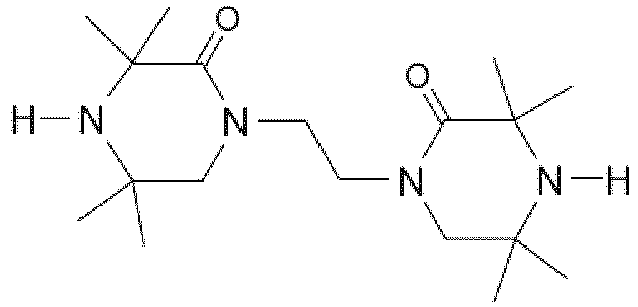


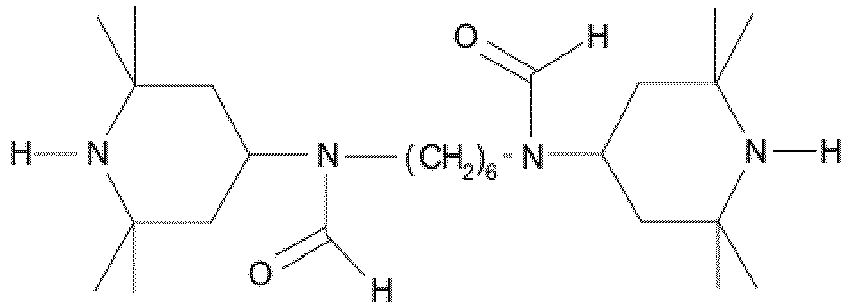


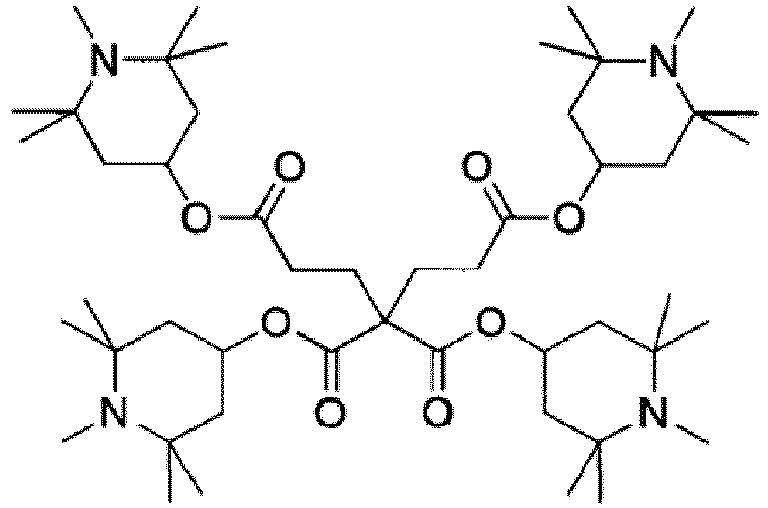
- Bevorzugte oligomere und polymere gehinderte Amine weisen die folgenden Strukturen auf:


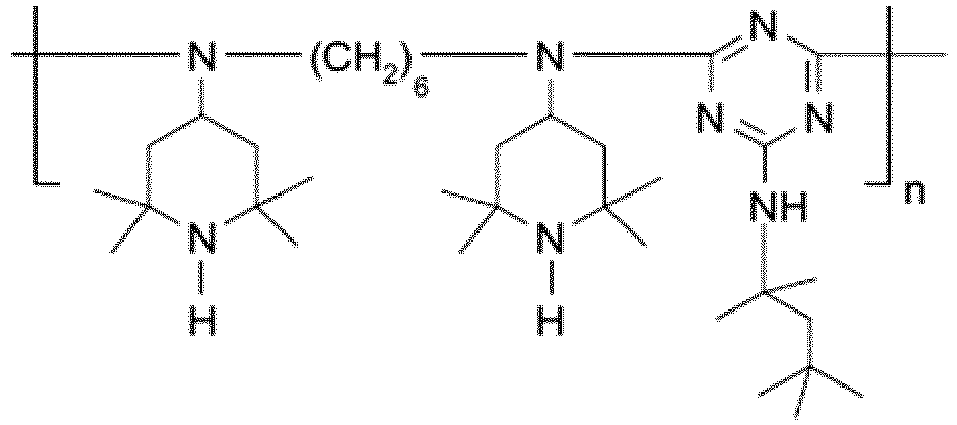

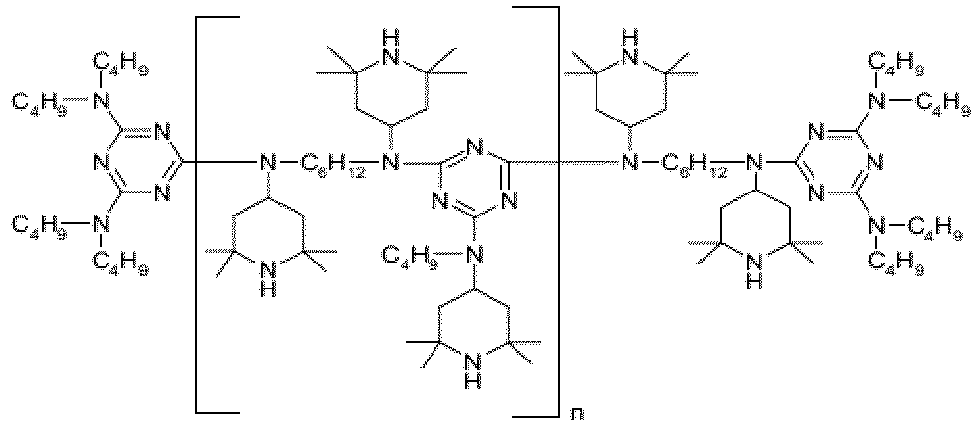

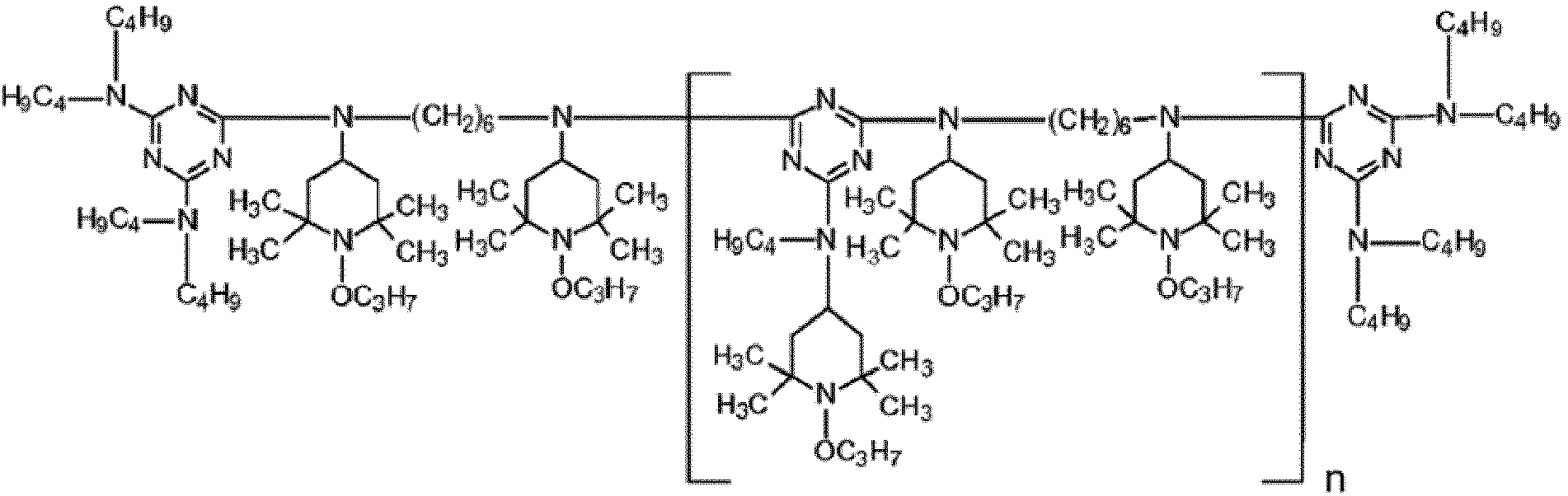


- Bei den zuvor genannten Verbindungen bedeutet n jeweils 3 bis 100.
- Ein weiterer geeigneter Lichtstabilisator ist Hostanox NOW (Hersteller: Clariant SE) mit der folgenden allgemeinen Struktur:

- Geeignete Dispergiermittel sind beispielsweise:
Polyacrylate, z.B. Copolymere mit langkettigen Seitengruppen, Polyacrylat-Blockcopolymere, Alkylamide: z.B. N,N'-1,2-Ethandiylbisoctadecanamid Sorbitanester, z.B. Monostearylsorbitanester, Titanate und Zirconate, reaktive Copolymere mit funktionellen Gruppen z. B. Polypropylen-co-Acrylsäure, Polypropylen-co-Maleinsäureanhydrid, Polyethylen-co-Glycidylmethacrylat, Polystyrol-alt-Maleinsäureanhydrid-Polysiloxane: z.B. Dimethylsilandiol-Ethylenoxid Copolymer, Polyphenylsiloxan Copolymer, Amphiphile Copolymere: z. B. Polyethylen-block-Polyethylenoxid, Dendrimere, z.B. hydroxylgruppenhaltige Dendrimere. - Geeignete Antinukleierungsmittel sind Azinfarbstoffe wie z.B. Nigrosin.
- Geeignete Flammschutzmittel sind insbesondere
- a) Anorganische Flammschutzmittel wie z.B. Al(OH)3, Mg(OH)2, AlO(OH), MgCO3, Schichtsilikate wie z.B. Montmorillonit oder Sepiolit, nicht oder organisch modifiziert, Doppelsalze, wie z.B. Mg-Al-Silikate, POSS-(Polyhedral Oligomeric Silsesquioxane) Verbindungen, Huntit, Hydromagnesit oder Halloysit sowie Sb2O3, Sb2O5, MoO3, Zinkstannat, Zinkhydroxystannat,
- b) Stickstoffhaltige Flammschutzmittel wie z.B. Melamin, Melem, Melam, Melon, Melaminderivate, Melaminkondensationsprodukte oder Melaminsalze, Benzoguanamin, Polyisocyanurate, Allantoin, Phosphacene, insbesondere Melamincyanurat, Melaminphosphat, Dimelaminphosphat, Melaminpyrophosphat, Melaminpolyphosphat, Melamin-Metall-Phosphate wie z.B. Melaminaluminiumphosphat, Melaminzinkphosphat, Melaminmagnesiumphosphat, sowie die entsprechenden Pyrophosphate und Polyphosphate, Poly-[2,4-(piperazin-1,4-yl)-6-(morpholin-4-yl)-1,3,5-triazin], Ammoniumpolyphosphat, Melaminborat, Melaminhydrobromid,
- c) Radikalbildner, wie z. B. Alkoxyamine, Hydroxylaminester, Azoverbindungen, Triazenverbindungen, Disulfide, Polysulfide, Thiole, Thiuramsulfide, Dithiocarbamate, Mercaptobenzthiazole Sulfenamide, Sulfenimide
- d) Dicumyl oder Polycumyl, Hydroxyimide und deren Derivate wie z.B. Hydroxyimidester oder Hydroxyimidether
- e) Phosphorhaltige Flammschutzmitteln wie z.B. roter Phosphor, Phosphate wie z.B. Resorcindiphosphat, Bisphenol-A-diphosphat und ihre Oligomere, Triphenylphosphat, Ethylendiamindiphosphat, Phosphinate wie z.B. Salze der hypophosphorigen Säure und Ihrer Derivate wie Alkylphosphinatsalzen z.B. Diethylphosphinataluminium oder Diethylphosphinat-Zink oder Aluminiumphosphinat, Aluminiumphosphit, Aluminiumphosphonat, Phosphonatester, oligomere und polymere Derivate der Methanphosphonsäure, 9,10-Dihydro-9-oxa-10-phosphorylphenanthren-10-oxid (DOPO) und deren substituierte Verbindungen,
- f) Halogenhaltige Flammschutzmittel auf Chlor- und Brombasis wie z.B. polybrominierte Diphenyloxide, wie z.B. Decabromdiphenyloxid, Tris(3-bromo-2,2-bis(bromomethyl)propyl-phosphat, Tris(tribromneopentyl)phosphat, Tetrabromphthalsäure, 1,2-Bis-(tribromphenoxy)ethan, Hexabromcyclododecan, bromiertes Diphenylethan, Tris-(2,3-dibrompropyl)isocyanurat, Ethylen-bis(tetrabromo-phthalimid), Tetrabromo-bisphenol A, bromiertes Polystyrol, bromiertes Polybutadien bzw, Polystyrol-bromiertes Polybutadien-Copolymere, bromierter Polyphenylenether, bromiertes Epoxidharz, Polypentabrombenzylacrylat, ggf. in Kombination mit Sb2O3 und/oder Sb2O5,
- g) Borate wie z.B. Zinkborat oder Calciumborat, ggf. auf Trägermaterial wie z.B. Silica
- h) Schwefelhaltige Verbindungen wie z.B. elementarer Schwefel, Disulfide und Polysulfide, Thiuramsulfid, Dithiocarbamate, Mercaptobenzthiazol und Sulfenamide,
- i) Antidrip-Mitteln wie z.B. Polytetrafluorethylen,
- j) Siliciumhaltige Verbindungen wie z.B. Polyphenylsiloxane,
- k) Kohlenstoffmodifikationen wie z.B. Carbon-Nanoröhren (CNT), Blähgraphit oder Graphen
- l) sowie Kombinationen oder Mischungen hieraus.
- Ganz besonders bevorzugte Flammschutzmittel sind halogenfrei und sind die folgenden Verbindungen:
Al(OH)3, Mg(OH)2,


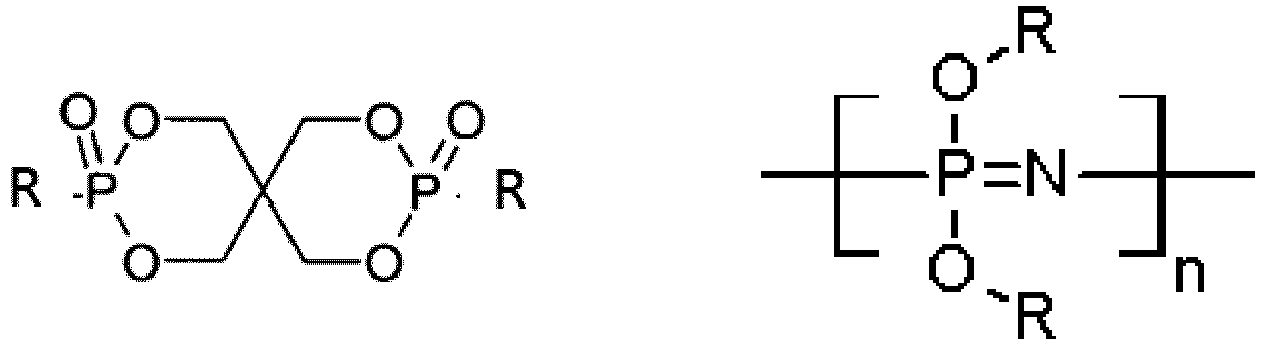


- Geeignete Weichmacher sind beispielsweise Phthalsäureester, Adipinsäureester, Ester der Zitronensäure, Ester der 1,2-Cyclohexandicarbonsäure, Trimellithsäureester, Isosorbidester, Phosphatester, Epoxide wie z.B. epoxidiertes Sojabohnenöl oder aliphatische Polyester.
- Geeignete Gleitmittel und Verarbeitungshilfsmittel sind beispielsweise Polyethylenwachse, Polypropylenwachse, Salze von Fettsäuren wie z.B. Calciumstearat, Zlnkstearat oder Salze von Montanwachsen, Amidwachse wie z.B. Erucasäureamid oder Ölsäureamide, Fluorpolymere, Silikone oder Neoalkoxytitanate- und Zirkonate.
- Geeignete Pigmente können anorganischer oder organischer Natur sein. Anorganische Pigmente sind beispielsweise Titandioxid, Zinkoxid, Zinksulfid, Eisenoxid, Ultramarin, Ruß, organische Pigmente sind beispielsweise Anthrachinone, Anthanthrone, Benzimidazolone, Chinacridone, Diketopyrrolopyrrole, Dioxazine, Indanthrone, Isoindolinone, AzoVerbindungen, Perylene, Phthalocyanine oder Pyranthrone. Weitere geeignete Pigmente sind Effektpigmente auf Metallbasis oder Perlglanzpigmente auf Metalloxid-Basis.
- Geeignete Optische Aufheller sind beispielsweise Bisbenzoxazole, Phenylcumarine oder Bis(styryl)biphenyle und insbesondere optische Aufheller der Formeln:
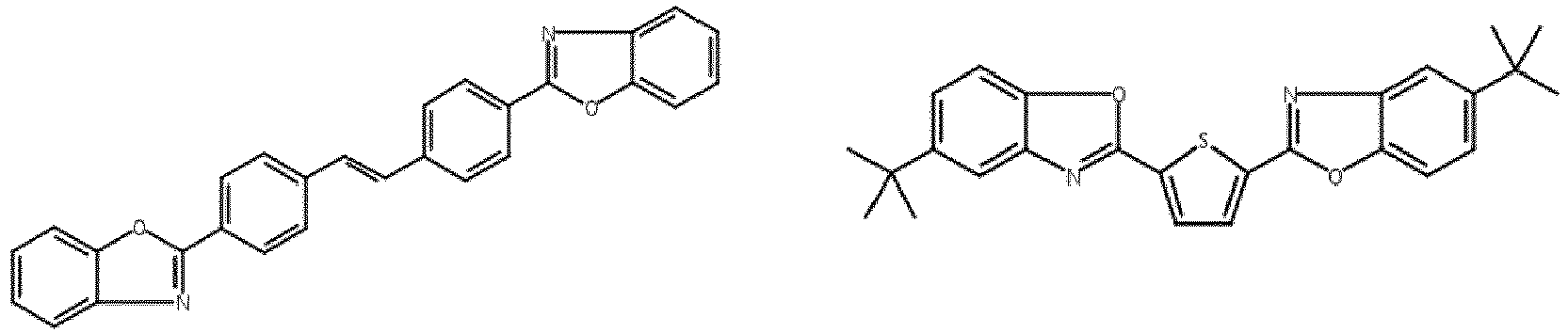


- Geeignete Füllstoffdeaktivatoren sind beispielsweise Polysiloxane, Polyacrylate insbesondere Blockcopolymere wie Polymethacrylsäurepolyalkylenoxid oder Polyglycidyl(meth)acrylate und deren Copolymere z.B. mit Styrol sowie Epoxide z.B. der folgenden Strukturen:


- Geeignete Antistatika sind beispielsweise ethoxylierte Alkylamine, Fettsäureester, Alkylsulfonate und Polymere wie z.B. Polyetheramide.
- Geeignete Antiozonantien sind die oben genannten Amine wie z.B. N,N'-Diisopropyl-p-phenylendiamin, N,N'-Di-sec-butyl-p-phenylendiamin, N,N'-Bis(1,4-dimethylpentyl)-p-phenylendiamin, N,N'-Dicyclohexyl-p-phenylendiamin, N-Isopropyl-N'-phenyl-p-phenylendiamin, N-(1,3-Dimethylbutyl)-N'-phenyl-p-phenylen-diamin, N-(1-Methylheptyl)-N'-phenyl-p-phenylendiamin, N-Cyclohexyl-N'-phenyl-p-phenylendiamin
- Geeignete Rheologiemodifikatoren z.B. für die Herstellung von Controlled rheology Polypropylen (CR-PP) sind beispielsweise Peroxide, Alkoxyaminester, Oxyimidsulfonsäureester und insbesondere die folgenden Strukturen:

- Geeignete Nukleierungsmittel sind Talkum, Alkali oder Erdalkalisalze von mono- und polyfunktionellen Carbonsäuren wie z. B. Benzoesäure, Bernsteinsäure, Adipinsäure, z.B. Natriumbenzoat, Zinkglycerolat, Aluminiumhydroxy-bis(4-tert-butyl)benzoat, 2,2'-Methylen-bis-(4,6-di-tert-butylphenyl)phosphat, sowie Trisamide und Diamide wie z.B. Trimesinsäuretricyclohexylamid, Trimesin-säuretri(4-methylcyclohexylamid), Trimesinsäure tri(tert.butylamid), N,N',N"-1,3,5-Benzoltriyltris(2,2-dimethyl-propanamid) oder 2,6-Naphthalindicarbosäuredicyclohexylamid.
- Geeignete Additive zum Molekulargewichtsaufbau von Polykondensationspolymeren (Kettenverlängerer) sind Diepoxide, Bis-Oxazoline, Bis-Oxazolone, Bis-Oxazine, Diisocyanate, Dianhydride, Bis-Acyllactame, Bis-Maleimide, Dicyanate, Carbodiimide. Weitere geeignete Kettenverlängerer sind polymere Verbindungen wie z. B. Polystyrol-Polyacrylat-Polyglycidyl(meth)acrylat- Copolymere, Polystyrol-Maleinsäureanhydrid-Copolymere und Polyethylen-Maleinsäureanhydrid-Copolymere.
- Geeignete Additive zur Erhöhung der elektrischen Leitfähigkeit sind beispielsweise die erwähnten Antistatika, Ruß und Kohlenstoffverbindungen wie Kohlenstoff-Nanoröhrchen und Graphen, Metallpulver wie z.B. Kupferpulver und leitfähige Polymere wie bsp. Polypyrrole, Polyaniline und Polythiophene. Geignete Additive zur Erhöhung der thermischen Leitfähigkeit sind beispielsweise Aluminumnitride und Bornitride.
- Geeignete Infrarot-aktive Additive sind beispielsweise Aluminumsilikate, Hydrotalcite oder Farbstoffe wie Phthalocyanine oder Anthrachinone.
- Geeignete Entformungshilfsmittel sind beispielsweise Silikone, Seifen und Wachse wie z.B. Montanwachse.
- Die Einarbeitung der Komponenten (A) und (B) sowie ggf. der zusätzlichen Zusatzstoffe in das Kunststoff-Rezyklat kann durch übliche Verarbeitungsmethoden erfolgen, wobei das Polymere aufgeschmolzen und mit der erfindungsgemäßen Additivzusammensetzung und den ggf. weiteren Zusätzen gemischt wird, vorzugsweise durch Mischer, Kneter und Extruder. Als Verarbeitungsmaschinen bevorzugt sind Extruder wie z.B. Einschneckenextruder, Zweischneckenextruder, Planetwalzenextruder, Ringextruder, Co-Kneter, die vorzugsweise mit einer Vakuumentgasung ausgestattet sind. Die Verarbeitung kann dabei unter Luft oder ggf. unter Inertgasbedingungen wie z.B. unter Stickstoff erfolgen.
- Weiterhin können die Komponenten (A) und (B) in Form von sogenannten Masterbatchen oder Konzentraten, die beispielsweise 10-90 % einer Stabilisator-Zusammensetzung bestehend aus den Komponenten (A) und (B) in einem Polymeren enthalten, hergestellt und eingebracht werden.
- Weiterhin ist es bevorzugt, dass das thermoplastische Kunststoff-Rezyklat ausgewählt ist aus der Gruppe bestehend aus
- a) rezyklierten Polymeren aus Olefinen oder Diolefinen, wie z.B. Polyethylen, insbesondere LDPE, LLDPE, VLDPE, ULDPE, MDPE, HDPE und UHMWPE, Metallocen-PE (m-PE), Polypropylen, Poylisobutylen, Poly-4-methyl-penten-1, Polybutadien, Polyisopren, Polycycloocten, Polyalkylen-Kohlenmonoxid-Copolymeren, sowie entsprechenden Copolymeren in Form von statistischen oder Blockstrukturen wie z.B. Polypropylen-Polyethylen (EP), EPM oder EPDM, Ethylen-Vinylacetat (EVA), Ethylen-Acrylester, wie z.B. Ethylen-Butylacrylat, Ethylen-Acrylsäure-Glycidylacrylat, und entsprechenden Propfpolymeren wie z.B. Polypropylen-g-Maleinsäureanhydrid, Polypropylen-g-Acrylsäure und Polyethylen-g-Acrylsäure,
- b) rezykliertem Polystyrol, Polymethylstyrol, Polyvinylnaphthalin, Styrol-Butadien (SB), Styrol-Butadien-Styrol (SBS), Styrol-Ethylen-Butylen-Styrol (SEBS), Styrol-Ethylen-Propylen-Styrol, Styrolisopren, Styrol-Isopren-Styrol (SIS), Styrol-butadien-acrylnitril (ABS), Styrol-acrylnitril-acrylat (ASA), Styrol-Ethylen, Styrol-Maleinsäureanhydrid-Polymeren einschließlich entsprechenden Pfropfcopolymeren wie z.B. Styrol auf Butadien, Maleinsäureanhydrid auf SBS oder SEBS, sowie Pfropfcopolymeren aus Methylmethacrylat, Styrol-Butadien und ABS (MABS),
- c) rezyklierten Polymeren von ungesättigten Estern wie z.B. Polyacrylate und Polymethacrylate wie Polymethylmethacrylat (PMMA), Polybutylacrylat, Polylaurylacrylat, Polystearylacrylat, Polyacrylnitril, Polyacrylamide, und entsprechenden Copolymeren wie z.B. Polyacrylnitril-Polyalkylacrylat,
- d) rezyklierten Polymeren aus ungesättigten Alkoholen und Derivaten, wie z.B. Polyvinylalkohol, Polyvinylacetat, Polyvinylbutyral,
- e) rezyklierten Polyacetalen, wie z.B. Polyoxymethylen (POM), und entsprechenden Copolymeren, wie z.B. Copolymere mit Butanal,
- f) rezyklierten Polyphenylenoxiden und Blends von diesen mit Polystyrol oder Polyamiden,
- g) rezyklierten Polymeren von cyclischen Ethern wie z.B. Polyethylenglycol, Polypropylenglycol, Polyethylenoxid, Polypropylenoxid,
- h) rezyklierten Polyurethanen aus hydroxyterminierten Polyethern oder Polyestern und aromatischen oder aliphatischen Isocyanaten, insbesondere lineare Polyurethane, Polyharnstoffen,
- i) rezyklierten Polyamiden wie z.B. Polyamid-6, 6.6, 6.10, 4.6, 4.10, 6.12, 12.12, Polyamid 11, Polyamid 12 sowie (teil-)aromatische Polyamide wie z.B. Polyphthalamide, z.B. hergestellt aus Terephthalsäure und/oder Isophthalsäure und aliphatischen Diaminen oder aus aliphatischen Dicarbonsäuren wie z.B. Adipinsäure oder Sebazinsäure und aromatischen Diaminen wie z.B. 1,4- oder 1,3-Diaminobenzol,
- j) rezyklierten Polyimiden, Polyamid-imiden, Polyetherimiden, Polyesterimiden, Poly(ether)ketonen, Polysulfonen, Polyethersulfonen, Polyarylsulfonen, Polyphenylensulfid, Polybenzimidazolen, Polyhydantoinen,
- k) rezyklierten Polyestern aus aliphatischen oder aromatischen Dicarbonsäuren und Diolen oder aus Hydroxy-Carbonsäuren wie z.B. Polyethylenterephthalat (PET), Polybutylenterephthalat (PBT), Polypropylenterphthalat, Polyethylennaphthylat, Poly-1,4-di-methylocyclohexanterphthalat, Polyhydroxybenzoat, Polyhydroxynaphthalat, Polymilchsäure,
- l) rezyklierten Polycarbonaten, Polyestercarbonaten, sowie Blends von diesen wie z.B. PC/ABS, PC/PBT, PC/PET/PBT,
- m) rezyclierten halogenhaltigen Poylmeren, wie z.B. PVC, PVDC,
- n) rezyklierten Cellulosederivaten, wie z.B. Cellulosenitrat, Celluloseacetat, Cellulosepropionat, Cellulosebutyrat,
- o) sowie Mischungen, Kombinationen oder Blends aus zwei oder mehr der zuvor genannten Polymere.
- Besonders bevorzugt ist das thermoplastische Kunststoff-Rezyklat ausgewählt aus der Gruppe bestehend aus Polymeren aus Olefinen oder Diolefinen, wie z.B. Polyethylen, insbesondere LDPE, LLDPE, VLDPE, ULDPE, MDPE, HDPE und UHMWPE, Metallocen-PE (m-PE), Polypropylen, Poylisobutylen, Poly-4-methyl-penten-1, Polybutadien, Polyisopren, Polycycloocten, Polyalkylen-Kohlenmonoxid-Copolymeren, sowie entsprechenden Copolymeren in Form von statistischen oder Blockstrukturen wie z.B. Polypropylen-Polyethylen (EP), EPM oder EPDM, Ethylen-Vinylacetat (EVA), Ethylen-Acrylester, wie z.B. Ethylen-Butylacrylat, Ethylen-Acrylsäure-Glycidylacrylat, und entsprechenden Propfpolymeren wie z.B. Polypropylen-g-Maleinsäureanhydrid, Polypropylen-g-Acrylsäure und Polyethylen-g-Acrylsäure.
- Ganz besonders bevorzugt ist der eine thermoplastische Kunststoff ein Polyolefin-Rezyklat. Beispielsweise kann es sich beim thermoplastischen Kunststoff-Rezyklat um Polypropylen, insbesondere also um ein Polypropylen-Rezyklat oder um Polyethylen, insbesondere also ein Polyethylen-Rezyklat, handeln.
- Weiterhin werden vorzugsweise im erfindungsgemäßen Verfahren
- (A) 0,02 bis 3 Gew.-Teile, bevorzugt 0,03 bis 0,5 Gew.-Teile, mindestens eines substituierten Zuckers, und
- (B) 0,04 bis 6 Gew.-Teile, bevorzugt 0,06 bis 1 Gew.-Teile, mindestens eines primären Antioxidans und/oder mindestens eines sekundären Antioxidans,
- Weiterhin ist es bevorzugt, dass
- (A) 0,02 bis 3 Gew.-Teile, bevorzugt 0,03 bis 0,5 Gew.-Teile, mindestens eines substituierten Zuckers
- (B1) 0,02 bis 3 Gew.-Teile, bevorzugt 0,03 bis 0,5 Gew.-Teile, mindestens eines primären Antioxidans,
- (B2) 0,02 bis 3 Gew.-Teile, bevorzugt 0,03 bis 0,5 Gew.-Teile, mindestens eines sekundären Antioxidans, und
- Die vorliegende Erfindung betrifft weiterhin ein Kunststoffzusammensetzung, enthaltend oder bestehend aus
- (A) mindestens einem substituierten Zuckers (Komponente (A)), und
- (B) mindestens einem em thermoplastischem Kunststoff-Rezyklat.
- In diesem Fall sind in der Kunststoffzusammensetzung - mit Ausnahme der ggf. bereits im Rezyklat enthaltenden primären und/oder sekundären Antioxidantien keine weiteren primären und/oder sekundären (frischen) Antioxidantien zugesetzt.
- Die im Rezyklat enthaltenen primären und/oder sekundären Antioxidantien, sowie deren Abbauprodukte können, wenn erforderlich, durch übliche dem Fachmann bekannte Analysenmethoden z.B. durch chromatographische Methoden wie z.B. HPLC, ggf. nach Extraktion aus dem Polymeren mittels einem geeigneten Lösungsmittel und nachfolgende Aufkonzentration durch Entfernung des Lösungsmittels, bestimmt werden.
- Zudem betrifft die vorliegende Erfindung auch eine Kunststoffzusammensetzung, enthaltend oder bestehend aus
- (A) mindestens einen substituierten Zucker,,
- (B) mindestens einem primären Antioxidans und/oder mindestens einem sekundären Antioxidans, und
- (C) mindestens einem thermoplastischen Kunststoff-Rezyklat.
- In einer bevorzugten Ausführungsform zeichnet sich die Kunststoffzusammensetzung dadurch aus, dass die Kunststoffzusammensetzung
- (A) 0,02 bis 3 Gew.-Teile, bevorzugt 0,03 bis 0,5 Gew.-Teile, mindestens eines substituierten Zuckers,
- (B) 0,04 bis 6 Gew.-Teile, bevorzugt 0,06 bis 1 Gew.-Teile, mindestens eines primären Antioxidans und/oder mindestens eines sekundären Antioxidans, und
- (C) 91 bis 99,94 Gew.-Teile, bevorzugt 98,5 bis 99,91 Gew.-Teile, mindestens eines thermoplastischen Kunststoffs
- Vorzugsweise enthält die erfindungsgemäße Zusammensetzung mindestens ein primäres Antioxidans und mindestens ein sekundäres Antioxidans.
- Eine weitere bevorzugte Ausführungsform ist dadurch gekennzeichnet, dass die Kunststoffzusammensetzung
- (A) 0,02 bis 3 Gew.-Teile, bevorzugt 0,03 bis 0,5 Gew.-Teile, mindestens eines substituierten Zuckers,
- (B1) 0,02 bis 3 Gew.-Teile, bevorzugt 0,03 bis 0,5 Gew.-Teile, mindestens eines primären Antioxidans,
- (B2) 0,02 bis 3 Gew.-Teile, bevorzugt 0,03 bis 0,5 Gew.-Teile, mindestens eines sekundären Antioxidans, und
- (C) 91 bis 99,94 Gew.-Teile, bevorzugt 98,5 bis 99,91 Gew.-Teile, mindestens eines thermoplastischen Kunststoff-Rezyklats.
- Gemäß einer weiteren bevorzugten Ausführungsform enthält die erfindungsgemäße Kunststoffzusammensetzung zusätzlich mindestens einen Zusatzstoff, welcher ausgewählt ist aus der Gruppe bestehend aus UV-Absorbern, Lichtstabilisatoren, Metalldesaktivatoren, Füllstoffdesaktivatoren, Antiozonantien, Nukleierungsmitteln, Antinukleierungsmitteln, Schlagzähigkeitsverbesserern, Weichmachern, Gleitmitteln, Rheologiemodifikatoren, Thixotropiemitteln, Kettenverlängerern, optischen Aufhellern, antimikrobiellen Wirkstoffen, Antistatika, Slipmitteln, Antiblockmitteln, Kopplungsmitteln, Vernetzungsmitteln, Antivernetzungsmitteln, Hydrophilisierungsmitteln, Hydrophobisierungsmitteln, Haftvermittlern, Dipergiermitteln, Kompatibilisatoren, Sauerstofffängern, Säurefängern, Treibmitteln, Abbau-Additiven, Entschäumungsmitteln, Geruchsfängern, Markierungsmitteln, Antifoggingmitteln, Füllstoffen, Verstärkungsstoffen und Mischungen hiervon.
- Weiterhin ist es bevorzugt, dass die Kunststoffzusammensetzung zusätzlich mindestens einen Zusatzstoff enthält, welcher ausgewählt ist aus der Gruppe bestehend aus
- a) Säurefängern, vorzugsweise Calciumstearat, Magnesiumstearat, Zinkstearat, Aluminiumstearat, Calciumstearat, Calciumlactat, Calciumstearoyl-2-lactat, Hydrotalcite, insbesondere synthetische Hydrotalciten auf Aluminium-, Magnesium- und Zinkbasis, Hydrocalumite, Zeolithe, Erdalkalioxide, insbesondere Calciumoxid und Magnesiumoxid, Zinkoxid, Erdalkalicarbonate, insbesondere Calciumcarbonat, Magnesiumcarbonat und Dolomit, und Hydroxide, insbesondere Brucit,
- b) Lichtstabilisatoren, vorzugsweise Lichtstabilisatoren aus der Gruppe der gehinderten Amine,
- c) Dispergiermitteln,
- d) Füllstoffdesaktivatoren, und
- Wird dem Rezyklat nur ein substituierter Zucker als Stabilisator hinzugegeben, so ist in einer bevorzugten Ausführungsform insbesondere ein Säurefänger der weitere Zusatzstoff. Bevorzugte Säurefänger sind oben definiert.
- Vorzugweise ist die erfindungsgemäße Kunststoffzusammensetzung mit einem erfindungsgemäßen Verfahren zur Stabilisierung von thermoplastischen Kunststoffen gegen oxidativen, thermischen und/oder aktinischen Abbau herstellbar oder wurde damit hergestellt.
- Sämtliche bereits bezüglich des erfindungsgemäßen Verfahrens beschriebenen bevorzugten Varianten, beispielhaften Ausführungsformen und Kommentare (z.B. bezüglich möglicher zu verwendender Komponenten und Zusatzstoffe) gelten auch entsprechend für die erfindungsgemäße Kunststoffzusammensetzung.
- Die vorliegende Erfindung betrifft auch eine Formmasse oder ein Formteil, die herstellbar aus erfindungsgemäßen Kunststoffzusammensetzung ist, insbesondere in Form von Spritzgussteilen, Folien, Filmen, Lacken, Beschichtungen, Schäumen, Fasern, Kabeln, Rohren, Profilen, Hohlkörpern, Bändchen, Membranen, z.B. Geomembranen, Schmierstoffen, Farbmitteln und/oder Klebstoffen, die über Extrusion, Spritzguss, Blasformen, Kalandrieren, Pressverfahren, Spinnprozesse und/oder Rotomoulding hergestellt werden z.B. für die Elektroindustrie, für die Bauindustrie, für die Transportindustrie (Auto, Flugzeug, Schiff, Bahn), für medizinische Anwendungen, für Haushalts- und Elektrogeräte, für Fahrzeugteile, für Konsumartikel, für Verpackungen, für Möbel, und/oder für Textilien.
- Im Weiteren betrifft die vorliegende Erfindung auch eine Stabilisator-Zusammensetzung zur Stabilisierung von thermoplastischen Kunststoff-Rezyklaten, vorzugsweise thermoplastischen Kunststoff-Rezyklaten, gegen oxidativen, thermischen und/oder aktinischen Abbau, bestehend aus
- (A) mindestens einem substituierten Zucker, und
- (B) mindestens einem primären Antioxidans und/oder mindestens einem sekundären Antioxidans.
- Sämtliche bereits bezüglich des erfindungsgemäßen Verfahrens sowie bezüglich der erfindungsgemäßen Kunststoffzusammensetzung beschriebenen bevorzugten Varianten, beispielhaften Ausführungsformen und Kommentare (z.B. bezüglich möglicher zu verwendender Komponenten und Zusatzstoffe) gelten auch entsprechend für die erfindungsgemäße Stabilisator-Zusammensetzung.
- Die vorliegende Erfindung betrifft auch die Verwendung mindestens substituierten Zuckers zur Stabilisierung von thermoplastischen Kunststoff-Rezyklaten gegen oxidativen, thermischen und/oder aktinischen Abbau.
- Ferner betrifft die vorliegende Erfindung die Verwendung der erfindungsgemäßen Stabilisator-Zusammensetzung oder einer Stabilisator-Zusammensetzung enthaltend oder bestehend aus
- (A) mindestens einem substituierten Zucker und
- (B) mindestens einem primären Antioxidans und/oder mindestens einem sekundären Antioxidans,
- Bevorzugte thermoplastische Kunststoffe sind dabei dieselben wie die bezüglich des erfindungsgemäßen Verfahrens bzw. die bezüglich der erfindungsgemäßen Kunststoffzusammensetzung genannten.
- Besonders bevorzugt wird die Stabilisator-Zusammensetzung zur Stabilisierung von Polyolefin-Rezyklaten und gegen oxidativen, thermischen und/oder aktinischen Abbau verwendet.
- Sämtliche bereits bezüglich des erfindungsgemäßen Verfahrens sowie bezüglich der erfindungsgemäßen Kunststoffzusammensetzung und bezüglich der erfindungsgemäßen Stabilisator-Zusammensetzung beschriebenen bevorzugten Varianten, beispielhaften Ausführungsformen und Kommentare (z.B. bezüglich möglicher zu verwendender Komponenten und Zusatzstoffe) gelten auch entsprechend für die erfindungsgemäße Verwendung einer Stabilisator-Zusammensetzung.
- Die vorliegende Erfindung wird anhand der nachfolgenden Ausführungsbeispiele näher erläutert, ohne die Erfindung auf die dargestellten Beispiele zu beschränken.
- Zur Prüfung der Wirkung der erfindungsgemäßen Stabilisatoren-Zusammensetzung wurde ein post-consumer Polypropylen-Rezyklat aus Batteriekastenmahlgut (Lieferant: BSB Braubach) zusammen mit den in der Tabelle angegebenen Zusätzen bei 210 °C in einem Doppelschnecken-Microextruder (MC 5, Hersteller DSM) im kontinuierlichen Modus bei 90 Umdrehungen pro Minute während 30 Minuten in der Schmelze im Kreis gefördert. Nach 10, 20 und 30 Minuten wird jeweils die Kraftaufnahme gemessen. Die Kraft ist ein Maß für die Zähigkeit der Schmelze und damit für das Molekulargewicht. Je höher die verbliebene Kraft (Nach Aufschmelzzeit von 2 Minuten = 100 %), desto geringer ist der Abbau des Polymeren.
- Der Zusatz von 0.1 bis 0.3 % eines Stearoylsubstituierten Mannits (> 90 % monosubstituiert) führt im Vergleich zu einem Rezyklat ohne Zusatz zu einer erhöhten Verarbeitungsstabilisierung, d.h. zu einer höheren Restkraft. Eine weitere Verbesserung der Verarbeitungsstabilität wird erreicht, indem zu 0.2 % des stearoylsubstituierten Mannits 0.1 % primäres Antioxidans (Pentaerythritol-tetrakis [3-(3,5-di-tert-butyl-4-hydroxyphenyl)propionat) und 0.1 % sekundäres Antioxidans (Tris-(2,4-di-tert-butylphenyl)phosphit) zugegeben werden.
- In analoger Weise führt der Zusatz des Distearylesters der Schleimsäure in einer Konzentration von 0.1 bis 0.5 % im Vergleich zu einem Polypropylen-Rezyklat ohne Zusatz zu einer erhöhten Verarbeitungsstabilisierung, d.h. zu einer höheren Restkraft nach 30 Minuten.
- Weiterhin wurden Kombinationen eines stearoylsubstituierten Mannits in einer Konzentration von 0,2 % in
- 1) LLDPE/LDPE Folienagglomerate aus Industriesammlungen zusammen mit 0,2 % Octadecyl-3-(3,5-di-tert-butyl-4-hydroxyphenyl)propionat bei 210 °C
- 2) Polyethylen/Polypropylen-Mischung aus aufbereiteten Wertstoffsammlungen zusammen mit 0.1 % Pentaerythritol-tetrakis [3-(3,5-di-tert-butyl-4-hydroxyphenyl)propionat) und 0.1 % (Tris-(2,4-di-tert-butylphenyl)phosphit bei 210 °C
- 3) Polylactid (PLA) aus gebrauchten Getränkebechern zusammen mit 0.1 % Pentaerythritol-tetrakis [3-(3,5-di-tert-butyl-4-hydroxyphenyl)propionat bei 200 °C
- 4) Polystyrol aus Wertstoffsammlungen mit 0.1 % Wingstay L (Reaktionsprodukt von 4-Methylphenol mit Dicyclopentadien and isobuten) bei 230°C
Claims (16)
- Verfahren zur Stabilisierung von thermoplastischen Kunststoff-Rezyklaten gegen oxidativen, thermischen und/oder aktinischen Abbau, bei dem(A) mindestens ein substituierter Zucker, ausgewählt aus der Gruppe bestehend ausin ein thermoplastisches Kunststoff-Rezyklat eingebracht werden.(a1) mindestens einem Ester und/oder Ether eines Alditols oder Cyclitols,(a2) mindestens einem Ester einer Zuckersäure, und/oder(a3) mindestens einem Amid und/oder substiuiertem Amin eines Aminozuckers,sowie Mischungen und Kombinationen hiervon,
- Verfahren nach Anspruch 1, dadurch gekennzeichnet, dass der mindestens eine substituierte Zucker mindestens 3, bevorzugt mindestens 4 freie OH-Gruppen aufweist und/oder mono- oder disubstituiert ist.
- Verfahren gemäß einem der vorhergehenden Ansprüche, dadurch gekennzeichnet, dass das mindestens eine Alditol, von dem sich die substituierten Zucker ableiten, die Summenformel
HOCH2[CH(OH)]nCH2OH,
R1-OCH2[CH(OH)]nCH2OH,
oder
HOCH2[CH(OH)]n[CH(OR1)]CH2OH
mit n = 2-6, bevorzugt n = 3-5 aufweist, wobei R1 ein gegebenenfalls substituierter Zuckerrest ist, insbesondere ausgewählt ist aus der Gruppe bestehend aus Threit, Erythrit, Galactit, Mannit, Ribit, Sorbit, Xylit, Arabit, Isomalt, Lactit, Maltit, Maltotritol und hydrierte Oligo- und Polysaccharide mit Polyol-Endgruppen und Mischungen hiervon, wobei das mindestens eine Alditol vorzugsweise ausgewählt ist aus der Gruppe bestehend aus Erythrit, Mannit, Isomalt, Maltit und Mischungen hiervon. - Verfahren nach einem der vorhergehenden Ansprüche, dadurch gekennzeichnet, dassdas mindestens eine Cyclitol, von dem sich die substituierten Zucker ableiten, ausgewählt ist aus der Gruppe bestehend aus Inositol, Quercitol, Viscumitol, Bornesitol, Conduritol, Ononitol, Pinitol, Pinpollitol, Ciceritol, Quebrachitol, Chinasäure, Shikimisäure und Valienol wobei das mindestens eine Cyclitol vorzugsweise myo-Inosit ist,die mindestens eine Zuckersäure, von dem sich die substituierten Zucker ableiten, ausgewählt ist aus der Gruppe bestehend aus Aldonsäuren oder Aldarsäuren, und/oderdas mindestens eine Zuckeramin, von dem sich die substituierten Zucker ableiten, ausgewählt ist aus der Gruppe bestehend aus 1-amino-1-deoxyalditolen oder alpha-omega-diamino-alpha-omega-dideoxyalditolen.
- Verfahren nach einem der vorhergehenden Ansprüche, dadurch gekennzeichnet, dass der mindestens eine substituierte Zucker ausgewählt ist aus der Gruppe bestehend aus den nachfolgenden Verbindungen:


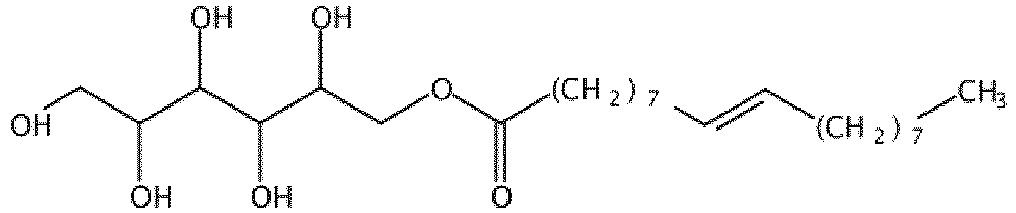






- Verfahren gemäß einem der vorhergehenden Ansprüche, dadurch gekennzeichnet, dass bezogen auf 95,0 bis 99,99 Gew.-Teile bevorzugt 99,0 bis 99,98 Gew.-Teile des thermoplastischen Kunststoff-Rezyklats 0,01 bis 5,0 Gew.-Teile, bevorzugt 0,02 bis 1,0 Gew.-Teile des mindestens einen substituierten Zuckers (Komponente (A)) eingebracht werden.
- Verfahren nach einem der vorhergehenden Ansprüche, dadurch gekennzeichnet, dass zusätzlich zum mindestens einen substituiertes Zucker mindestens ein primäres Antioxidans und/oder mindestens ein sekundäres Antioxidans (Komponente (B)) in das thermoplastische Kunststoff-Rezyklat eingebracht werden, wobei bevorzugtdas mindestens eine primäre Antioxidans ausgewählt ist aus der Gruppe bestehend aus phenolischen Antioxidantien, Aminen, Lactonen und Mischungen hiervon und/oderdas mindestens eine sekundäre Antioxidans ausgewählt ist aus der Gruppe bestehend aus Phosphorverbindungen, insbesondere Phosphiten und Phosphoniten, Organo-Schwefelverbindungen, insbesondere Sulfiden und Disulfiden, sowie Mischungen hiervon.
- Verfahren gemäß vorhergehendem Anspruch, dadurch gekennzeichnet, dass mindestens ein primäres Antioxidans und mindestens ein sekundäres Antioxidans in das thermoplastische Kunststoff-Rezyklat eingebracht werden, insbesondere die Komponente (A) und die Komponente (B) in einem Gewichtsverhältnis von 95:5 bis 5:95, bevorzugt von 90:10 bis 10:90, besonders bevorzugt von 80:20 bis 20:80, in das thermoplastische Kunststoff-Rezyklat eingebracht werden.
- Verfahren gemäß einem der beiden vorhergehenden Ansprüche, dadurch gekennzeichnet, dass die Komponenten (A) und/oder (B) durchMischen der als Feststoff vorliegenden Komponenten (A) und/oder (B) mit dem als Feststoff vorliegenden thermoplastischen Kunststoff-Rezyklat, Aufschmelzen der dabei entstehende Mischung und anschließendem Abkühlen, oderAufschmelzen der als Feststoff vorliegenden Komponenten (A) und/oder (B) und Einbringen der dabei entstehende Schmelze in eine Schmelze des thermoplastischen Kunststoff-Rezyklatsin das thermoplastische Kunststoff-Rezyklat eingebracht werden.
- Verfahren gemäß einem der 7 bis 9, dadurch gekennzeichnet, dass bezogen auf 91 bis 99,94 Gew.-Teile, bevorzugt 98,5 bis 99,91 Gew.-Teile des thermoplastischen Kunststoff-Rezyklats(A) 0,02 bis 3 Gew.-Teile, bevorzugt 0,03 bis 0,5 Gew.-Teile des mindestens einen substituierten Zuckers (Komponente (A)), und(B) 0,04 bis 6 Gew.-Teile, bevorzugt 0,06 bis 1 Gew.-Teile des mindestens einen primären Antioxidans und/oder des mindestens einen sekundären Antioxidans (Komponente (B))eingebracht werden.
- Kunststoffzusammensetzung, enthaltend oder bestehend aus(A) mindestens ein substituierter Zucker, ausgewählt aus der Gruppe bestehend aus(a1) mindestens einem Ester und/oder Ether eines Alditols oder Cyclitols,(a2) mindestens einem Ester einer Zuckersäure, und/oder(a3) mindestens einem Amid und/oder substiuiertem Amin eines Aminozuckers,sowie Mischungen und Kombinationen hiervon, und(B) mindestens einem en thermoplastischem Kunststoff-Rezyklat,wobei die Kunststoffzusammensetzung bevorzugt0,01 bis 5,0 Gew.-Teile, bevorzugt 0,02 bis 1,0 Gew.-Teile des mindestens einen substituierten Zuckers (Komponente (A)) und 95,0 bis 99,99 bevorzugt 99,0 bis 99,98 Teile des thermoplastischen Kunststoff-Rezyklatsenthält oder hieraus besteht.
- Kunststoffzusammensetzung, gemäß vorhergehendem Anspruch, enthaltend oder bestehend ausmindestens einem substituierten Zucker (Komponente (A)),mindestens einem primären Antioxidans und/oder mindestens einem sekundären Antioxidans (Komponente (B)), undmindestens einem thermoplastischem Kunststoff-Rezyklat,wobei die Kunststoffzusammensetzung bevorzugt0,02 bis 3 Gew.-Teile, bevorzugt 0,03 bis 0,5 Gew.-Teile des mindestens eines einen substituierten Zuckers (Komponente (A)),0,04 bis 6 Gew.-Teile, bevorzugt 0,06 bis 1 Gew.-Teile, mindestens eines primären Antioxidans und/oder mindestens eines sekundären Antioxidans (Komponente (B)), insbesondere 0,02 bis 3 Gew.-Teile, bevorzugt 0,03 bis 0,5 Gew.-Teile des mindestens einen primären Antioxidans (Komponente (B1)) und 0,02 bis 3 Gew.-Teile, bevorzugt 0,03 bis 0,5 Gew.-Teile, mindestens eines sekundären Antioxidans (Komponente (B2)), und91 bis 99,94 Gew.-Teile, bevorzugt 98,5 bis 99,91 Gew.-Teile, mindestens eines en thermoplastischen Kunststoff-Rezyklatsenthält oder hieraus besteht.
- Kunststoffzusammensetzung gemäß einem der beiden vorhergehenden Ansprüche, dadurch gekennzeichnet, dass die Kunststoffzusammensetzung zusätzlich mindestens einen Zusatzstoff, ausgewählt aus der Gruppe bestehend aus UV-Absorbern, Lichtstabilisatoren, Metalldesaktivatoren, Füllstoffdesaktivatoren, Antiozonantien, Nukleierungsmitteln, Antinukleierungsmitteln, Schlagzähigkeitsverbesserern, Weichmachern, Gleitmitteln, Rheologiemodifikatoren, Thixotropiemitteln, Kettenverlängerern, optischen Aufhellern, antimikrobiellen Wirkstoffen, Antistatika, Slipmitteln, Antiblockmitteln, Kopplungsmitteln, Vernetzungsmitteln, Antivernetzungsmitteln, Hydrophilisierungsmitteln, Hydrophobisierungsmitteln, Haftvermittlern, Dipergiermitteln, Kompatibilisatoren, Sauerstofffängern, Säurefängern, Treibmitteln, Abbau-Additiven, Entschäumungsmitteln, Geruchsfängern, Markierungsmitteln, Antifoggingmitteln, Füllstoffen, Verstärkungsstoffen und Mischungen hiervon, enthält.
- Formteil herstellbar aus einer Kunststoffzusammensetzung nach einem der Ansprüche 11 bis 13, insbesondere in Form von Spritzgussteilen, Folien, Filmen, Lacken, Beschichtungen, Schäumen, Fasern, Kabeln, Rohren, Profilen, Hohlkörpern, Bändchen, Membranen, z.B. Geomembranen, Schmierstoffen, Farbmitteln und/oder Klebstoffen, die über Extrusion, Spritzguss, Blasformen, Kalandrieren, Pressverfahren, Spinnprozesse und/oder Rotomoulding hergestellt werden z.B. für die Elektroindustrie, für die Bauindustrie, für die Transportindustrie, für medizinische Anwendungen, für Haushalts- und Elektrogeräte, für Fahrzeugteile, für Konsumartikel, für Verpackungen, für Möbel, und/oder für Textilien.
- Stabilisator-Zusammensetzung zur Stabilisierung von thermoplastischen Kunststoff-Rezyklaten gegen oxidativen, thermischen und/oder aktinischen Abbau, bestehend aus(A) mindestens einem substituierter Zucker (Komponente (A)), ausgewählt aus der Gruppe bestehend aus(a1) mindestens einem Ester und/oder Ether eines Alditols oder Cyclitols,(a2) mindestens einem Ester einer Zuckersäure, und/oder(a3) mindestens einem Amid und/oder substiuiertem Amin eines Aminozuckers,sowie Mischungen und Kombinationen hiervon,(B) mindestens einem primären Antioxidans und/oder mindestens einem sekundären Antioxidans(Komponente (B))wobei bevorzugt die Komponente (A) und die Komponente (B) in einem Gewichtsverhältnis von 95:5bis 5:95, weiter bevorzugt von 90:10 bis 10:90, besonders bevorzugt von 80:20 bis 20:80 vorliegen.
- Verwendung mindestens ein substituierter Zucker (Komponente (A)), ausgewählt aus der Gruppe bestehend aus(a1) mindestens einem Ester und/oder Ether eines Alditols oder Cyclitols,(a2) mindestens einem Ester einer Zuckersäure, und/oder(a3) mindestens einem Amid und/oder substiuiertem Amin eines Aminozuckers,sowie Mischungen und Kombinationen hiervon,oder einer Stabilisator-Zusammensetzung nach vorhergehendem Anspruchzur Stabilisierung von thermoplastischen Kunststoff-Rezyklaten gegen oxidativen, thermischen und/oder aktinischen Abbau.
Applications Claiming Priority (2)
| Application Number | Priority Date | Filing Date | Title |
|---|---|---|---|
| DE102019204160.4A DE102019204160A1 (de) | 2019-03-26 | 2019-03-26 | Verfahren zur Stabilisierung von thermoplastischen Kunststoff-Rezyklaten sowie stabilisierte Kunststoffzusammensetzungen und hieraus hergestellte Formmassen und Formteile |
| PCT/EP2020/058188 WO2020193563A1 (de) | 2019-03-26 | 2020-03-24 | Verfahren zur stabilisierung von thermoplastischen kunststoff-rezyklaten sowie stabilisierte kunststoffzusammensetzungen und hieraus hergestellte formmassen und formteile |
Publications (3)
| Publication Number | Publication Date |
|---|---|
| EP3947540A1 EP3947540A1 (de) | 2022-02-09 |
| EP3947540C0 EP3947540C0 (de) | 2023-08-16 |
| EP3947540B1 true EP3947540B1 (de) | 2023-08-16 |
Family
ID=70058324
Family Applications (1)
| Application Number | Title | Priority Date | Filing Date |
|---|---|---|---|
| EP20715790.0A Active EP3947540B1 (de) | 2019-03-26 | 2020-03-24 | Verfahren zur stabilisierung von thermoplastischen kunststoff-rezyklaten sowie stabilisierte kunststoffzusammensetzungen und hieraus hergestellte formmassen und formteile |
Country Status (8)
| Country | Link |
|---|---|
| US (1) | US12398256B2 (de) |
| EP (1) | EP3947540B1 (de) |
| JP (1) | JP2022526925A (de) |
| KR (1) | KR102846980B1 (de) |
| CN (1) | CN113631645A (de) |
| DE (1) | DE102019204160A1 (de) |
| ES (1) | ES2963599T3 (de) |
| WO (1) | WO2020193563A1 (de) |
Cited By (1)
| Publication number | Priority date | Publication date | Assignee | Title |
|---|---|---|---|---|
| US12398256B2 (en) | 2019-03-26 | 2025-08-26 | Fraunhofer-Gesellschaft zur Förderung der angewandten Forschung e.V. | Method for stabilizing thermoplastic recyclates, stabilized plastic compositions, and molding compounds and molded parts produced therefrom |
Families Citing this family (12)
| Publication number | Priority date | Publication date | Assignee | Title |
|---|---|---|---|---|
| DE102019200596A1 (de) | 2019-01-17 | 2020-07-23 | Fraunhofer-Gesellschaft zur Förderung der angewandten Forschung e.V. | Verwendung einer additivzusammensetzung zum kontrollierten beschleunigten abbau von kondensationspolymeren |
| DE102019210040A1 (de) | 2019-07-08 | 2021-01-14 | Fraunhofer-Gesellschaft zur Förderung der angewandten Forschung e.V. | Verwendung von phenolisch substituierten Zuckerderivaten als Stabilisatoren, Kunststoffzusammensetzung, Verfahren zur Stabilisierung von Kunststoffen sowie phenolisch substituierte Zuckerderivate |
| DE102019213606B4 (de) | 2019-09-06 | 2022-04-21 | Fraunhofer-Gesellschaft zur Förderung der angewandten Forschung e.V. | Oligomer oder polymer, zusammensetzung sowie verwendung des oligomers oder polymers |
| US11639437B2 (en) | 2020-09-14 | 2023-05-02 | An-Hsiung Chang | Modified polyvinyl butyral material, and preparation and applications thereof |
| DE102021202103A1 (de) | 2021-03-04 | 2022-09-08 | Fraunhofer-Gesellschaft zur Förderung der angewandten Forschung eingetragener Verein | Verwendung einer Stabilisatorzusammensetzung zur Stabilisierung von halogenfreien thermoplastischen Kunststoff-Recyclaten, eine Stabilisatorzusammensetzung, ein Masterbatch oder Konzentrat, eine stabilisierte Kunststoffzusammensetzung, hier ein Verfahren zur Stabilisierung von halogenfreien thermoplastischen Kunststoff-Recyclaten sowie Verwendung von Zusammensetzungen |
| DE102021202508A1 (de) | 2021-03-15 | 2022-09-15 | Fraunhofer-Gesellschaft zur Förderung der angewandten Forschung eingetragener Verein | Verwendung einer Stabilisatorzusammensetzung zur Stabilisierung von Polyolefin-Recyclaten, Stabilisatorzusammensetzung, Masterbatchkonzentrat, Kunststoffzusammensetzung, Formmasse oder Formteil, Verfahren zur Stabilisierung eines Polyolefin-Recyclats sowie Verwendung einer Kunststoffzusammensetzung |
| DE102021205168A1 (de) | 2021-05-20 | 2022-11-24 | Fraunhofer-Gesellschaft zur Förderung der angewandten Forschung eingetragener Verein | Verwendung mindestens einer Schwefel enthaltenden Aminosäure zur Stabilisierung von thermoplastischen Kunststoff-Recyclaten, stabilisiertes thermo-plastisches Kunststoffrecyclat, Stabilisatorzusammensetzung, Masterbatch sowie Formmasse bzw. Formteil |
| CN114843476B (zh) * | 2022-05-20 | 2024-09-24 | 重庆镁储能科技有限公司 | 一种v3s4@c/g复合电极材料的制备方法及其应用 |
| KR102512820B1 (ko) * | 2022-09-01 | 2023-03-23 | 주식회사 유진유포리아 | 생활용품 폐기물에서 발생한 플라스틱 스크랩을 재활용한 건축용 시트 제조 |
| KR102557878B1 (ko) * | 2023-01-12 | 2023-07-21 | (주)코리아마그네슘 | 재활용 플라스틱을 포함하는 바이오 조성물 및 이를 포함하는 장치 |
| KR20250177286A (ko) * | 2024-06-14 | 2025-12-23 | 롯데케미칼 주식회사 | 친환경 열가소성 수지 조성물 및 이로부터 제조된 성형품 |
| CN119431964B (zh) * | 2025-01-13 | 2025-04-25 | 兴宇汽车零部件股份有限公司 | 一种高发泡低密度复合密封条材料及其制备方法 |
Family Cites Families (52)
| Publication number | Priority date | Publication date | Assignee | Title |
|---|---|---|---|---|
| NL158165B (nl) | 1973-05-15 | 1978-10-16 | Amsterdam Chem Comb | Werkwijze voor de bereiding van carbonzuuresters van lineaire alifatische suikeralcoholen. |
| DD288161A5 (de) | 1989-10-02 | 1991-03-21 | Veb Forschungszentrum Verpackung,De | Verfahren zum stabilisieren von thermoplastfolienabfaellen |
| US5149774A (en) | 1990-07-31 | 1992-09-22 | Ciba-Geigy Corporation | Method for recycling discolored polyolefins |
| ES2132114T3 (es) | 1991-03-27 | 1999-08-16 | Ciba Sc Holding Ag | Procedimiento para estabilizar mezclas de materias plasticas recicladas. |
| AU682008B2 (en) | 1992-09-25 | 1997-09-18 | Ciba Specialty Chemicals Holding Inc. | Process for the stabilization of and stabilizer mixtures forsingle-material recycled plastics |
| JP3885173B2 (ja) | 1992-09-25 | 2007-02-21 | チバ スペシャルティ ケミカルズ ホールディング インコーポレーテッド | 再生されたプラスチック混合物の安定化方法およびそのための安定剤混合物 |
| TW254955B (de) * | 1992-09-25 | 1995-08-21 | Ciba Geigy | |
| EP0702704B1 (de) | 1993-06-09 | 1998-02-25 | Ciba SC Holding AG | Stabilisierung beschädigte Thermoplaste |
| US5789470A (en) | 1994-09-23 | 1998-08-04 | Ciba Specialty Chemicals Corporation | Stabilized recycled plastics |
| JPH09176416A (ja) * | 1995-12-21 | 1997-07-08 | Asahi Denka Kogyo Kk | 塩化ビニル系樹脂組成物 |
| WO1997030112A1 (en) | 1996-02-15 | 1997-08-21 | Ciba Specialty Chemicals Holding Inc. | Stabilisation of polyolefin-recyclates |
| EP0881253A1 (de) * | 1997-05-27 | 1998-12-02 | Akcros Chemicals | Beta-Ketoester zur Verwendung als Stabilisator für Polymere |
| MXPA03007914A (es) | 2001-03-28 | 2003-12-11 | Ciba Sc Holding Ag | Proceso para preparar un poliester estabilizado. |
| EP1426406A1 (de) | 2002-12-02 | 2004-06-09 | Crompton Vinyl Additives GmbH | Monosubstituierte 6-Aminouracile zum Stabilisieren von halogenhaltigen Polymeren |
| JP4346432B2 (ja) * | 2003-12-19 | 2009-10-21 | 株式会社Adeka | 塩化ビニル系樹脂組成物 |
| JP5353026B2 (ja) * | 2008-02-22 | 2013-11-27 | 日本製紙株式会社 | 再生樹脂を配合した積層耐水シート |
| JP2010180395A (ja) * | 2009-01-09 | 2010-08-19 | Sumitomo Chemical Co Ltd | ポリマー安定剤及び該安定剤を含有するポリマー組成物 |
| JP2011122131A (ja) * | 2009-11-12 | 2011-06-23 | Sumitomo Chemical Co Ltd | 熱可塑性樹脂組成物、熱可塑性樹脂用加工安定化剤、及び熱可塑性樹脂の安定化方法 |
| JP5177575B2 (ja) * | 2010-01-28 | 2013-04-03 | 三菱電機株式会社 | 再生ポリオレフィン系樹脂組成物および再生ポリスチレン系樹脂組成物 |
| JP2011207990A (ja) * | 2010-03-29 | 2011-10-20 | Sumitomo Chemical Co Ltd | 樹脂用の加工安定化剤、該加工安定化剤を含む樹脂組成物、および樹脂の加工安定性を向上させる方法 |
| JP2011207798A (ja) * | 2010-03-29 | 2011-10-20 | Sumitomo Chemical Co Ltd | 樹脂用の加工安定化剤、該加工安定化剤を含む樹脂組成物、および樹脂の加工安定性を向上させる方法 |
| EP2641933A1 (de) | 2012-03-21 | 2013-09-25 | LANXESS Deutschland GmbH | Thermoplastische Formmassen |
| DE102012022482A1 (de) | 2012-11-19 | 2014-05-22 | Fraunhofer-Gesellschaft zur Förderung der angewandten Forschung e.V. | Polymerzusammensetzung mit verbesserter Langzeitstabilität, hieraus hergestellte Formteile sowie Verwendungszwecke |
| JP2014173059A (ja) * | 2013-03-12 | 2014-09-22 | Ricoh Co Ltd | 再生樹脂組成物、成形品、画像形成装置及び再生樹脂組成物の製造方法 |
| US9624370B2 (en) | 2013-03-15 | 2017-04-18 | Sabic Global Technologies B.V. | Stablized polycarbonate blend with post consumer recycled plastics |
| DE102013005307A1 (de) | 2013-03-25 | 2014-09-25 | Fraunhofer-Gesellschaft zur Förderung der angewandten Forschung e.V. | Verwendung von organischen Oxyimiden als Flammschutzmittel für Kunststoffe sowie flammgeschützte Kunststoffzusammensetzung und hieraus hergestelltem Formteil |
| DE102014210214A1 (de) | 2014-05-28 | 2015-12-03 | Fraunhofer-Gesellschaft zur Förderung der angewandten Forschung e.V. | Verwendung von Oxyimid-enthaltenden Copolymeren oder Polymeren als Flammschutzmittel, Stabilisatoren, Rheologiemodifikatoren für Kunststoffe, Initiatoren für Polymerisations- und Pfropfprozesse, Vernetzungs- oder Kopplungsmittel sowie solche Copolymere oder Polymere enthaltende Kunststoffformmassen |
| DE102014211276A1 (de) | 2014-06-12 | 2015-12-17 | Fraunhofer-Gesellschaft zur Förderung der angewandten Forschung e.V. | Verwendung von Hydroxybenzotriazol-Derivaten und/oder Hydroxy-Indazol-Derivaten als Flammschutzmittel für Kunststoffe sowie flammgeschützte Kunststoffformmasse |
| DE102014218810B3 (de) | 2014-09-18 | 2016-01-28 | Fraunhofer-Gesellschaft zur Förderung der angewandten Forschung e.V. | Verwendung von organischen Oxyimidsalzen als Flammschutzmittel, flammengeschützte Kunststoffzusammensetzung, Verfahren zur ihrer Herstellung sowie Formteil, Lack oder Beschichtung |
| DE102014218811A1 (de) | 2014-09-18 | 2016-03-24 | Fraunhofer-Gesellschaft zur Förderung der angewandten Forschung e.V. | Verwendung von phosphorhaltigen organischen Oxyimiden als Flammschutzmittel, Radikalgeneratoren und/oder als Stabilisatoren für Kunststoffe, flammgeschützte Kunststoffzusammensetzung, Verfahren zu deren Herstellung sowie Formteile, Lacke und Beschichtungen |
| EP3591001A1 (de) * | 2014-11-20 | 2020-01-08 | Cytec Industries Inc. | Stabilisatorzusammensetzungen und verfahren zur verwendung davon zum schutz organischer materialien vor uv-licht und thermischem abbau |
| DE102014225488A1 (de) | 2014-12-10 | 2016-06-16 | Fraunhofer-Gesellschaft zur Förderung der angewandten Forschung e.V. | Polymerzusammensetzung mit verzögertem Kristallisationsverhalten, das Kristallisationsverhalten beeinflussende Additivzusammensetzung, Verfahren zur Herabsetzung des Kristallisationspunktes sowie Verwendung einer Additivzusammensetzung |
| DE102015211632A1 (de) | 2015-06-23 | 2016-12-29 | Fraunhofer-Gesellschaft zur Förderung der angewandten Forschung e.V. | Polymerzusammensetzung mit verzögertem Kristallisationsverhalten, das Kristallisationsverhalten beeinflussende Additivzusammensetzung, Verfahren zur Herabsetzung des Kristallisationspunktes sowie Verwendung einer Additivzusammensetzung |
| JP6498143B2 (ja) * | 2016-03-23 | 2019-04-10 | 三菱電機株式会社 | 再生熱可塑性樹脂組成物およびその製造方法 |
| DE102016221346A1 (de) | 2016-10-28 | 2018-05-03 | Fraunhofer-Gesellschaft zur Förderung der angewandten Forschung e.V. | Verfahren zur Herstellung eines Polymerisates durch Nitroxyl-kontrollierte Polymerisation sowie Polymerisat |
| DE102017203164A1 (de) | 2017-02-27 | 2018-08-30 | Fraunhofer-Gesellschaft zur Förderung der angewandten Forschung e.V. | Effiziente phosphorhaltige Stabilisatoren auf Basis von Diphenyl-amin und heterocyclischer Diphenylamin-Derivate |
| DE102017212772B3 (de) | 2017-07-25 | 2018-01-25 | Fraunhofer-Gesellschaft zur Förderung der angewandten Forschung e.V. | Halogenfreie Sulfonsäureester und/oder Sulfinsäureester als Flammschutzmittel in Kunststoffen, diese enthaltende Kunststoffzusammensetzungen und deren Verwendung |
| DE102017217312A1 (de) * | 2017-09-28 | 2019-03-28 | Fraunhofer-Gesellschaft zur Förderung der angewandten Forschung e.V. | Verfahren zur Stabilisierung von halogenfreien thermoplastischen Kunststoff-Rezyklaten sowie stabilisierte Kunststoffzusammensetzungen und hieraus hergestellte Formmassen und Formteile |
| CN107805335A (zh) | 2017-11-16 | 2018-03-16 | 李君� | 一种抗菌防腐可降解的塑料及其制备方法 |
| DE102017220555A1 (de) | 2017-11-17 | 2019-05-23 | Fraunhofer-Gesellschaft zur Förderung der angewandten Forschung e.V. | Verbindungen mit stabilisierender Wirkung, Verfahren zu deren Herstellung, Zusammensetzung enthaltend diese stabilisierenden Verbindungen, Verfahren zur Stabilisierung einer organischen Komponente sowie Verwendung von stabilisierenden Verbindungen |
| DE102018218120A1 (de) | 2018-10-23 | 2020-04-23 | Fraunhofer-Gesellschaft zur Förderung der angewandten Forschung e.V. | Verfahren zur Stabilisierung von thermoplastischer Kunststoffneuware sowie stabilisierte Kunststoffzusammensetzungen, hieraus hergestellte Formmassen und Formteile, Stabilisator-Zusammensetzungen sowie Verwendungen hiervon |
| DE102019200596A1 (de) | 2019-01-17 | 2020-07-23 | Fraunhofer-Gesellschaft zur Förderung der angewandten Forschung e.V. | Verwendung einer additivzusammensetzung zum kontrollierten beschleunigten abbau von kondensationspolymeren |
| DE102019200905A1 (de) | 2019-01-24 | 2020-07-30 | Fraunhofer-Gesellschaft zur Förderung der angewandten Forschung e.V. | Verfahren zur Stabilisierung von halogenfreien thermoplastischen Kunststoff-Rezyklaten, Kunststoff-Zusammensetzung, Stabilisator-Zusammensetzung sowie Verwendung der Stabilisator-Zusammensetzung |
| DE102019204160A1 (de) | 2019-03-26 | 2020-10-01 | Fraunhofer-Gesellschaft zur Förderung der angewandten Forschung e.V. | Verfahren zur Stabilisierung von thermoplastischen Kunststoff-Rezyklaten sowie stabilisierte Kunststoffzusammensetzungen und hieraus hergestellte Formmassen und Formteile |
| DE102019210040A1 (de) | 2019-07-08 | 2021-01-14 | Fraunhofer-Gesellschaft zur Förderung der angewandten Forschung e.V. | Verwendung von phenolisch substituierten Zuckerderivaten als Stabilisatoren, Kunststoffzusammensetzung, Verfahren zur Stabilisierung von Kunststoffen sowie phenolisch substituierte Zuckerderivate |
| DE102019213606B4 (de) | 2019-09-06 | 2022-04-21 | Fraunhofer-Gesellschaft zur Förderung der angewandten Forschung e.V. | Oligomer oder polymer, zusammensetzung sowie verwendung des oligomers oder polymers |
| DE102020203987A1 (de) | 2020-03-27 | 2021-09-30 | Fraunhofer-Gesellschaft zur Förderung der angewandten Forschung eingetragener Verein | Verwendung von substituierten Zimtsäureestern als Stabilisatoren für organische Materialien, tabilisiertes organisches Material, Verfahren zur Stabilisierung von organischen Materialien sowie spezifische Zimtsäureester |
| DE102020203988A1 (de) | 2020-03-27 | 2021-09-30 | Fraunhofer-Gesellschaft zur Förderung der angewandten Forschung eingetragener Verein | Verwendung von Hydroxyzimtsäuresalzen zur Stabilisierung von organischen Materialien, stabilisiertes organisches Material, Verfahren zur Stabilisierung von organischen Materialien, spezifische Stabilisatoren sowie Stabilisatorzusammensetzungen |
| DE102020205094A1 (de) | 2020-04-22 | 2021-10-28 | Fraunhofer-Gesellschaft zur Förderung der angewandten Forschung eingetragener Verein | Additivzusammensetzung sowie deren Verwendung, Kondensationspolymerzusammensetzung, Formmasse und hieraus hergestellte Formmassen und Formteile und deren Verwendung |
| DE102020124025A1 (de) | 2020-09-15 | 2022-03-17 | Fraunhofer-Gesellschaft zur Förderung der angewandten Forschung eingetragener Verein | Verwendung von Dieugenol, Oligomeren und/oder Polymeren von Eugenol zur Stabilisierung von organischen Materialien, stabilisiertes organisches Material sowie Verfahren zur Stabilisierung von organischen Materialien |
| DE102020128803A1 (de) | 2020-11-02 | 2022-05-05 | Fraunhofer-Gesellschaft zur Förderung der angewandten Forschung eingetragener Verein | Verwendung von Eugenol-Derivaten als Stabilisatoren, organisches Material sowie Eugenol-Derivate |
| DE102021202102A1 (de) | 2021-03-04 | 2022-09-08 | Fraunhofer-Gesellschaft zur Förderung der angewandten Forschung eingetragener Verein | Verwendung einer Stabilisatorzusammensetzung zur Stabilisierung von organischen Materialien, Stabilisatorzusammensetzung, Masterbatch, Zusammensetzung, Formmasse der Formteile, Verfahren zur oxidativen, thermischen aktinischen Stabilisierung eines thermoplastischen Kunststoffs sowie Verwendung einer Zusammensetzung |
-
2019
- 2019-03-26 DE DE102019204160.4A patent/DE102019204160A1/de not_active Withdrawn
-
2020
- 2020-03-24 CN CN202080024649.0A patent/CN113631645A/zh active Pending
- 2020-03-24 ES ES20715790T patent/ES2963599T3/es active Active
- 2020-03-24 WO PCT/EP2020/058188 patent/WO2020193563A1/de not_active Ceased
- 2020-03-24 JP JP2021557172A patent/JP2022526925A/ja active Pending
- 2020-03-24 EP EP20715790.0A patent/EP3947540B1/de active Active
- 2020-03-24 US US17/441,626 patent/US12398256B2/en active Active
- 2020-03-24 KR KR1020217034877A patent/KR102846980B1/ko active Active
Cited By (1)
| Publication number | Priority date | Publication date | Assignee | Title |
|---|---|---|---|---|
| US12398256B2 (en) | 2019-03-26 | 2025-08-26 | Fraunhofer-Gesellschaft zur Förderung der angewandten Forschung e.V. | Method for stabilizing thermoplastic recyclates, stabilized plastic compositions, and molding compounds and molded parts produced therefrom |
Also Published As
| Publication number | Publication date |
|---|---|
| CN113631645A (zh) | 2021-11-09 |
| KR20210149095A (ko) | 2021-12-08 |
| WO2020193563A1 (de) | 2020-10-01 |
| DE102019204160A1 (de) | 2020-10-01 |
| EP3947540C0 (de) | 2023-08-16 |
| EP3947540A1 (de) | 2022-02-09 |
| US20220162422A1 (en) | 2022-05-26 |
| US12398256B2 (en) | 2025-08-26 |
| JP2022526925A (ja) | 2022-05-27 |
| ES2963599T3 (es) | 2024-04-01 |
| KR102846980B1 (ko) | 2025-08-14 |
Similar Documents
| Publication | Publication Date | Title |
|---|---|---|
| EP3947540B1 (de) | Verfahren zur stabilisierung von thermoplastischen kunststoff-rezyklaten sowie stabilisierte kunststoffzusammensetzungen und hieraus hergestellte formmassen und formteile | |
| EP3194482B1 (de) | Verwendung von phosphorhaltigen organischen oxyimiden als flammschutzmittel für kunststoffe, flammgeschützte kunststoffzusammensetzung, verfahren zu deren herstellung sowie formteile, lacke und beschichtungen | |
| EP3688081A1 (de) | Verfahren zur stabilisierung von halogenfreien thermoplastischen kunststoff-rezyklaten sowie stabilisierte kunststoffzusammensetzungen und hieraus hergestellte formmassen und formteile | |
| EP3870641A1 (de) | Verfahren zur stabilisierung von thermoplastischer kunststoffneuware sowie stabilisierte kunststoffzusammensetzungen, hieraus hergestellte formmassen und formteile, stabilisator-zusammensetzungen sowie verwendungen hiervon | |
| EP3194486B1 (de) | Verwendung von organischen oxyimidsalzen als flammschutzmittel, flammengeschützte kunststoffzusammensetzung, verfahren zu ihrer herstellung sowie formteil, lack oder beschichtung | |
| KR102796672B1 (ko) | 무할로겐 열가소성 재활용품의 안정화 방법, 플라스틱 조성물, 안정화제 조성물 및 안정화제 조성물의 용도 | |
| EP3155041B1 (de) | Verwendung von hydroxybenzotriazol-derivaten und/oder hydroxy-indazol-derivaten als flammschutzmittel für kunststoffe sowie flammgeschützte kunststoffformmasse | |
| DE102021202103A1 (de) | Verwendung einer Stabilisatorzusammensetzung zur Stabilisierung von halogenfreien thermoplastischen Kunststoff-Recyclaten, eine Stabilisatorzusammensetzung, ein Masterbatch oder Konzentrat, eine stabilisierte Kunststoffzusammensetzung, hier ein Verfahren zur Stabilisierung von halogenfreien thermoplastischen Kunststoff-Recyclaten sowie Verwendung von Zusammensetzungen | |
| DE102020203988A1 (de) | Verwendung von Hydroxyzimtsäuresalzen zur Stabilisierung von organischen Materialien, stabilisiertes organisches Material, Verfahren zur Stabilisierung von organischen Materialien, spezifische Stabilisatoren sowie Stabilisatorzusammensetzungen | |
| DE102020124025A1 (de) | Verwendung von Dieugenol, Oligomeren und/oder Polymeren von Eugenol zur Stabilisierung von organischen Materialien, stabilisiertes organisches Material sowie Verfahren zur Stabilisierung von organischen Materialien | |
| DE102020203987A1 (de) | Verwendung von substituierten Zimtsäureestern als Stabilisatoren für organische Materialien, tabilisiertes organisches Material, Verfahren zur Stabilisierung von organischen Materialien sowie spezifische Zimtsäureester | |
| WO2022194672A1 (de) | Verwendung einer stabilisatorzusammensetzung zur stabilisierung von polyolefin-recyclaten, stabilisatorzusammensetzung, masterbatchkonzentrat, kunststoffzusammensetzung, formmasse oder formteil, verfahren zur stabilisierung eines polyolefin-recyclats sowie verwendung einer kunststoffzusammensetzung | |
| WO2021005075A1 (de) | Verwendung von phenolisch substituierten zuckerderivaten als stabilisatoren, kunststoffzusammensetzung, verfahren zur stabilisierung von kunststoffen sowie phenolisch substituierte zuckerderivate | |
| DE102021205168A1 (de) | Verwendung mindestens einer Schwefel enthaltenden Aminosäure zur Stabilisierung von thermoplastischen Kunststoff-Recyclaten, stabilisiertes thermo-plastisches Kunststoffrecyclat, Stabilisatorzusammensetzung, Masterbatch sowie Formmasse bzw. Formteil | |
| DE102021212696A1 (de) | Stabilisatoren auf Basis von Syringasäure, Vanillinsäure, lsovanillinsäure oder 5-Hydroxyveratrumsäure, Kunststoffzusammensetzung, Verfahren zur Stabiliserung einer Kunststoffzusammensetzung sowie Stabilisatorzusammensetzung | |
| WO2023156222A1 (de) | Polymere stabilisatoren auf basis von methoxy-hydroxy-benzoesäuren, kunststoffzusammensetzung, verfahren zur stabiliserung einer kunststoffzusammensetzung sowie stabilisatorzusammensetzung | |
| DE102022206466A1 (de) | Verwendung einer Stabilisatorzusammensetzung zur Stabilisierung von halogenfreier thermoplastischer Kunststoff-Neuware, Stabilisatorzusammensetzung, ein Masterbatch oder Konzentrat, eine stabilisierte Kunststoffzusammensetzung, Verfahren zur Stabilisierung von halogenfreien thermoplastischen Kunststoff-Neuware sowie Verwendung der Zusammensetzung | |
| DE102024110918A1 (de) | Stabilisatorzusammensetzung zur stabilisierung von kunststoffen durch kombination von tannin und hydrotalcit, verfahren zur stabilisierung und stabilisierte kuststoffzusammensetzung |
Legal Events
| Date | Code | Title | Description |
|---|---|---|---|
| STAA | Information on the status of an ep patent application or granted ep patent |
Free format text: STATUS: UNKNOWN |
|
| STAA | Information on the status of an ep patent application or granted ep patent |
Free format text: STATUS: THE INTERNATIONAL PUBLICATION HAS BEEN MADE |
|
| PUAI | Public reference made under article 153(3) epc to a published international application that has entered the european phase |
Free format text: ORIGINAL CODE: 0009012 |
|
| STAA | Information on the status of an ep patent application or granted ep patent |
Free format text: STATUS: REQUEST FOR EXAMINATION WAS MADE |
|
| 17P | Request for examination filed |
Effective date: 20211005 |
|
| AK | Designated contracting states |
Kind code of ref document: A1 Designated state(s): AL AT BE BG CH CY CZ DE DK EE ES FI FR GB GR HR HU IE IS IT LI LT LU LV MC MK MT NL NO PL PT RO RS SE SI SK SM TR |
|
| RAP3 | Party data changed (applicant data changed or rights of an application transferred) |
Owner name: FRAUNHOFER-GESELLSCHAFT ZUR FOERDERUNG DER ANGEWANDTEN FORSCHUNG E.V. |
|
| DAV | Request for validation of the european patent (deleted) | ||
| DAX | Request for extension of the european patent (deleted) | ||
| GRAP | Despatch of communication of intention to grant a patent |
Free format text: ORIGINAL CODE: EPIDOSNIGR1 |
|
| STAA | Information on the status of an ep patent application or granted ep patent |
Free format text: STATUS: GRANT OF PATENT IS INTENDED |
|
| RIC1 | Information provided on ipc code assigned before grant |
Ipc: C08K 5/12 20060101ALI20230309BHEP Ipc: C08K 5/11 20060101ALI20230309BHEP Ipc: C08K 5/00 20060101ALI20230309BHEP Ipc: C08K 5/053 20060101ALI20230309BHEP Ipc: C08K 5/06 20060101ALI20230309BHEP Ipc: C08K 5/103 20060101ALI20230309BHEP Ipc: C08K 5/17 20060101ALI20230309BHEP Ipc: C08K 5/20 20060101ALI20230309BHEP Ipc: C08J 11/04 20060101AFI20230309BHEP |
|
| INTG | Intention to grant announced |
Effective date: 20230405 |
|
| GRAJ | Information related to disapproval of communication of intention to grant by the applicant or resumption of examination proceedings by the epo deleted |
Free format text: ORIGINAL CODE: EPIDOSDIGR1 |
|
| GRAL | Information related to payment of fee for publishing/printing deleted |
Free format text: ORIGINAL CODE: EPIDOSDIGR3 |
|
| GRAS | Grant fee paid |
Free format text: ORIGINAL CODE: EPIDOSNIGR3 |
|
| STAA | Information on the status of an ep patent application or granted ep patent |
Free format text: STATUS: REQUEST FOR EXAMINATION WAS MADE |
|
| GRAP | Despatch of communication of intention to grant a patent |
Free format text: ORIGINAL CODE: EPIDOSNIGR1 |
|
| STAA | Information on the status of an ep patent application or granted ep patent |
Free format text: STATUS: GRANT OF PATENT IS INTENDED |
|
| INTC | Intention to grant announced (deleted) | ||
| GRAA | (expected) grant |
Free format text: ORIGINAL CODE: 0009210 |
|
| STAA | Information on the status of an ep patent application or granted ep patent |
Free format text: STATUS: THE PATENT HAS BEEN GRANTED |
|
| INTG | Intention to grant announced |
Effective date: 20230630 |
|
| AK | Designated contracting states |
Kind code of ref document: B1 Designated state(s): AL AT BE BG CH CY CZ DE DK EE ES FI FR GB GR HR HU IE IS IT LI LT LU LV MC MK MT NL NO PL PT RO RS SE SI SK SM TR |
|
| REG | Reference to a national code |
Ref country code: CH Ref legal event code: EP |
|
| REG | Reference to a national code |
Ref country code: DE Ref legal event code: R096 Ref document number: 502020004751 Country of ref document: DE |
|
| REG | Reference to a national code |
Ref country code: IE Ref legal event code: FG4D Free format text: LANGUAGE OF EP DOCUMENT: GERMAN |
|
| U01 | Request for unitary effect filed |
Effective date: 20230912 |
|
| U07 | Unitary effect registered |
Designated state(s): AT BE BG DE DK EE FI FR IT LT LU LV MT NL PT SE SI Effective date: 20230918 |
|
| PG25 | Lapsed in a contracting state [announced via postgrant information from national office to epo] |
Ref country code: GR Free format text: LAPSE BECAUSE OF FAILURE TO SUBMIT A TRANSLATION OF THE DESCRIPTION OR TO PAY THE FEE WITHIN THE PRESCRIBED TIME-LIMIT Effective date: 20231117 |
|
| PG25 | Lapsed in a contracting state [announced via postgrant information from national office to epo] |
Ref country code: IS Free format text: LAPSE BECAUSE OF FAILURE TO SUBMIT A TRANSLATION OF THE DESCRIPTION OR TO PAY THE FEE WITHIN THE PRESCRIBED TIME-LIMIT Effective date: 20231216 |
|
| PG25 | Lapsed in a contracting state [announced via postgrant information from national office to epo] |
Ref country code: RS Free format text: LAPSE BECAUSE OF FAILURE TO SUBMIT A TRANSLATION OF THE DESCRIPTION OR TO PAY THE FEE WITHIN THE PRESCRIBED TIME-LIMIT Effective date: 20230816 Ref country code: NO Free format text: LAPSE BECAUSE OF FAILURE TO SUBMIT A TRANSLATION OF THE DESCRIPTION OR TO PAY THE FEE WITHIN THE PRESCRIBED TIME-LIMIT Effective date: 20231116 Ref country code: IS Free format text: LAPSE BECAUSE OF FAILURE TO SUBMIT A TRANSLATION OF THE DESCRIPTION OR TO PAY THE FEE WITHIN THE PRESCRIBED TIME-LIMIT Effective date: 20231216 Ref country code: HR Free format text: LAPSE BECAUSE OF FAILURE TO SUBMIT A TRANSLATION OF THE DESCRIPTION OR TO PAY THE FEE WITHIN THE PRESCRIBED TIME-LIMIT Effective date: 20230816 Ref country code: GR Free format text: LAPSE BECAUSE OF FAILURE TO SUBMIT A TRANSLATION OF THE DESCRIPTION OR TO PAY THE FEE WITHIN THE PRESCRIBED TIME-LIMIT Effective date: 20231117 |
|
| PG25 | Lapsed in a contracting state [announced via postgrant information from national office to epo] |
Ref country code: PL Free format text: LAPSE BECAUSE OF FAILURE TO SUBMIT A TRANSLATION OF THE DESCRIPTION OR TO PAY THE FEE WITHIN THE PRESCRIBED TIME-LIMIT Effective date: 20230816 |
|
| REG | Reference to a national code |
Ref country code: ES Ref legal event code: FG2A Ref document number: 2963599 Country of ref document: ES Kind code of ref document: T3 Effective date: 20240401 |
|
| PG25 | Lapsed in a contracting state [announced via postgrant information from national office to epo] |
Ref country code: SM Free format text: LAPSE BECAUSE OF FAILURE TO SUBMIT A TRANSLATION OF THE DESCRIPTION OR TO PAY THE FEE WITHIN THE PRESCRIBED TIME-LIMIT Effective date: 20230816 Ref country code: RO Free format text: LAPSE BECAUSE OF FAILURE TO SUBMIT A TRANSLATION OF THE DESCRIPTION OR TO PAY THE FEE WITHIN THE PRESCRIBED TIME-LIMIT Effective date: 20230816 Ref country code: CZ Free format text: LAPSE BECAUSE OF FAILURE TO SUBMIT A TRANSLATION OF THE DESCRIPTION OR TO PAY THE FEE WITHIN THE PRESCRIBED TIME-LIMIT Effective date: 20230816 Ref country code: SK Free format text: LAPSE BECAUSE OF FAILURE TO SUBMIT A TRANSLATION OF THE DESCRIPTION OR TO PAY THE FEE WITHIN THE PRESCRIBED TIME-LIMIT Effective date: 20230816 |
|
| U20 | Renewal fee for the european patent with unitary effect paid |
Year of fee payment: 5 Effective date: 20240325 |
|
| REG | Reference to a national code |
Ref country code: DE Ref legal event code: R097 Ref document number: 502020004751 Country of ref document: DE |
|
| PLBE | No opposition filed within time limit |
Free format text: ORIGINAL CODE: 0009261 |
|
| STAA | Information on the status of an ep patent application or granted ep patent |
Free format text: STATUS: NO OPPOSITION FILED WITHIN TIME LIMIT |
|
| 26N | No opposition filed |
Effective date: 20240517 |
|
| REG | Reference to a national code |
Ref country code: CH Ref legal event code: PL |
|
| PG25 | Lapsed in a contracting state [announced via postgrant information from national office to epo] |
Ref country code: MC Free format text: LAPSE BECAUSE OF FAILURE TO SUBMIT A TRANSLATION OF THE DESCRIPTION OR TO PAY THE FEE WITHIN THE PRESCRIBED TIME-LIMIT Effective date: 20230816 |
|
| PG25 | Lapsed in a contracting state [announced via postgrant information from national office to epo] |
Ref country code: MC Free format text: LAPSE BECAUSE OF FAILURE TO SUBMIT A TRANSLATION OF THE DESCRIPTION OR TO PAY THE FEE WITHIN THE PRESCRIBED TIME-LIMIT Effective date: 20230816 |
|
| PG25 | Lapsed in a contracting state [announced via postgrant information from national office to epo] |
Ref country code: IE Free format text: LAPSE BECAUSE OF NON-PAYMENT OF DUE FEES Effective date: 20240324 |
|
| PG25 | Lapsed in a contracting state [announced via postgrant information from national office to epo] |
Ref country code: IE Free format text: LAPSE BECAUSE OF NON-PAYMENT OF DUE FEES Effective date: 20240324 Ref country code: CH Free format text: LAPSE BECAUSE OF NON-PAYMENT OF DUE FEES Effective date: 20240331 |
|
| U20 | Renewal fee for the european patent with unitary effect paid |
Year of fee payment: 6 Effective date: 20250325 |
|
| PGFP | Annual fee paid to national office [announced via postgrant information from national office to epo] |
Ref country code: ES Payment date: 20250416 Year of fee payment: 6 |
|
| PG25 | Lapsed in a contracting state [announced via postgrant information from national office to epo] |
Ref country code: CY Free format text: LAPSE BECAUSE OF FAILURE TO SUBMIT A TRANSLATION OF THE DESCRIPTION OR TO PAY THE FEE WITHIN THE PRESCRIBED TIME-LIMIT; INVALID AB INITIO Effective date: 20200324 |
|
| PG25 | Lapsed in a contracting state [announced via postgrant information from national office to epo] |
Ref country code: HU Free format text: LAPSE BECAUSE OF FAILURE TO SUBMIT A TRANSLATION OF THE DESCRIPTION OR TO PAY THE FEE WITHIN THE PRESCRIBED TIME-LIMIT; INVALID AB INITIO Effective date: 20200324 |
|
| PG25 | Lapsed in a contracting state [announced via postgrant information from national office to epo] |
Ref country code: TR Free format text: LAPSE BECAUSE OF FAILURE TO SUBMIT A TRANSLATION OF THE DESCRIPTION OR TO PAY THE FEE WITHIN THE PRESCRIBED TIME-LIMIT Effective date: 20230816 |
|
| PGFP | Annual fee paid to national office [announced via postgrant information from national office to epo] |
Ref country code: GB Payment date: 20260324 Year of fee payment: 7 |