WO2020193563A1 - Verfahren zur stabilisierung von thermoplastischen kunststoff-rezyklaten sowie stabilisierte kunststoffzusammensetzungen und hieraus hergestellte formmassen und formteile - Google Patents
Verfahren zur stabilisierung von thermoplastischen kunststoff-rezyklaten sowie stabilisierte kunststoffzusammensetzungen und hieraus hergestellte formmassen und formteile Download PDFInfo
- Publication number
- WO2020193563A1 WO2020193563A1 PCT/EP2020/058188 EP2020058188W WO2020193563A1 WO 2020193563 A1 WO2020193563 A1 WO 2020193563A1 EP 2020058188 W EP2020058188 W EP 2020058188W WO 2020193563 A1 WO2020193563 A1 WO 2020193563A1
- Authority
- WO
- WIPO (PCT)
- Prior art keywords
- weight
- parts
- recycled
- acid
- thermoplastic
- Prior art date
- Legal status (The legal status is an assumption and is not a legal conclusion. Google has not performed a legal analysis and makes no representation as to the accuracy of the status listed.)
- Ceased
Links
- 0 CC(*)C1C2C1CCC2 Chemical compound CC(*)C1C2C1CCC2 0.000 description 4
- IEHPXENYZRVVGC-UHFFFAOYSA-N CN(C)C(c(cccc1)c1C1=O)N1c1c(C=O)cccc1 Chemical compound CN(C)C(c(cccc1)c1C1=O)N1c1c(C=O)cccc1 IEHPXENYZRVVGC-UHFFFAOYSA-N 0.000 description 1
- XPNVRNJREKKIEX-UHFFFAOYSA-N CON(C(c(cccc1)c1C1=O)N1c1c2cccc1)C2=O Chemical compound CON(C(c(cccc1)c1C1=O)N1c1c2cccc1)C2=O XPNVRNJREKKIEX-UHFFFAOYSA-N 0.000 description 1
Classifications
-
- C—CHEMISTRY; METALLURGY
- C08—ORGANIC MACROMOLECULAR COMPOUNDS; THEIR PREPARATION OR CHEMICAL WORKING-UP; COMPOSITIONS BASED THEREON
- C08K—Use of inorganic or non-macromolecular organic substances as compounding ingredients
- C08K5/00—Use of organic ingredients
- C08K5/16—Nitrogen-containing compounds
- C08K5/20—Carboxylic acid amides
-
- C—CHEMISTRY; METALLURGY
- C08—ORGANIC MACROMOLECULAR COMPOUNDS; THEIR PREPARATION OR CHEMICAL WORKING-UP; COMPOSITIONS BASED THEREON
- C08K—Use of inorganic or non-macromolecular organic substances as compounding ingredients
- C08K5/00—Use of organic ingredients
- C08K5/0008—Organic ingredients according to more than one of the "one dot" groups of C08K5/01 - C08K5/59
- C08K5/005—Stabilisers against oxidation, heat, light, ozone
-
- C—CHEMISTRY; METALLURGY
- C08—ORGANIC MACROMOLECULAR COMPOUNDS; THEIR PREPARATION OR CHEMICAL WORKING-UP; COMPOSITIONS BASED THEREON
- C08J—WORKING-UP; GENERAL PROCESSES OF COMPOUNDING; AFTER-TREATMENT NOT COVERED BY SUBCLASSES C08B, C08C, C08F, C08G or C08H
- C08J11/00—Recovery or working-up of waste materials
- C08J11/04—Recovery or working-up of waste materials of polymers
-
- C—CHEMISTRY; METALLURGY
- C08—ORGANIC MACROMOLECULAR COMPOUNDS; THEIR PREPARATION OR CHEMICAL WORKING-UP; COMPOSITIONS BASED THEREON
- C08J—WORKING-UP; GENERAL PROCESSES OF COMPOUNDING; AFTER-TREATMENT NOT COVERED BY SUBCLASSES C08B, C08C, C08F, C08G or C08H
- C08J3/00—Processes of treating or compounding macromolecular substances
- C08J3/20—Compounding polymers with additives, e.g. colouring
- C08J3/203—Solid polymers with solid and/or liquid additives
-
- C—CHEMISTRY; METALLURGY
- C08—ORGANIC MACROMOLECULAR COMPOUNDS; THEIR PREPARATION OR CHEMICAL WORKING-UP; COMPOSITIONS BASED THEREON
- C08K—Use of inorganic or non-macromolecular organic substances as compounding ingredients
- C08K5/00—Use of organic ingredients
- C08K5/04—Oxygen-containing compounds
- C08K5/06—Ethers; Acetals; Ketals; Ortho-esters
-
- C—CHEMISTRY; METALLURGY
- C08—ORGANIC MACROMOLECULAR COMPOUNDS; THEIR PREPARATION OR CHEMICAL WORKING-UP; COMPOSITIONS BASED THEREON
- C08K—Use of inorganic or non-macromolecular organic substances as compounding ingredients
- C08K5/00—Use of organic ingredients
- C08K5/04—Oxygen-containing compounds
- C08K5/10—Esters; Ether-esters
- C08K5/101—Esters; Ether-esters of monocarboxylic acids
- C08K5/103—Esters; Ether-esters of monocarboxylic acids with polyalcohols
-
- C—CHEMISTRY; METALLURGY
- C08—ORGANIC MACROMOLECULAR COMPOUNDS; THEIR PREPARATION OR CHEMICAL WORKING-UP; COMPOSITIONS BASED THEREON
- C08K—Use of inorganic or non-macromolecular organic substances as compounding ingredients
- C08K5/00—Use of organic ingredients
- C08K5/04—Oxygen-containing compounds
- C08K5/10—Esters; Ether-esters
- C08K5/11—Esters; Ether-esters of acyclic polycarboxylic acids
-
- C—CHEMISTRY; METALLURGY
- C08—ORGANIC MACROMOLECULAR COMPOUNDS; THEIR PREPARATION OR CHEMICAL WORKING-UP; COMPOSITIONS BASED THEREON
- C08K—Use of inorganic or non-macromolecular organic substances as compounding ingredients
- C08K5/00—Use of organic ingredients
- C08K5/04—Oxygen-containing compounds
- C08K5/10—Esters; Ether-esters
- C08K5/12—Esters; Ether-esters of cyclic polycarboxylic acids
-
- C—CHEMISTRY; METALLURGY
- C08—ORGANIC MACROMOLECULAR COMPOUNDS; THEIR PREPARATION OR CHEMICAL WORKING-UP; COMPOSITIONS BASED THEREON
- C08K—Use of inorganic or non-macromolecular organic substances as compounding ingredients
- C08K5/00—Use of organic ingredients
- C08K5/04—Oxygen-containing compounds
- C08K5/13—Phenols; Phenolates
-
- C—CHEMISTRY; METALLURGY
- C08—ORGANIC MACROMOLECULAR COMPOUNDS; THEIR PREPARATION OR CHEMICAL WORKING-UP; COMPOSITIONS BASED THEREON
- C08K—Use of inorganic or non-macromolecular organic substances as compounding ingredients
- C08K5/00—Use of organic ingredients
- C08K5/04—Oxygen-containing compounds
- C08K5/15—Heterocyclic compounds having oxygen in the ring
- C08K5/151—Heterocyclic compounds having oxygen in the ring having one oxygen atom in the ring
-
- C—CHEMISTRY; METALLURGY
- C08—ORGANIC MACROMOLECULAR COMPOUNDS; THEIR PREPARATION OR CHEMICAL WORKING-UP; COMPOSITIONS BASED THEREON
- C08K—Use of inorganic or non-macromolecular organic substances as compounding ingredients
- C08K5/00—Use of organic ingredients
- C08K5/04—Oxygen-containing compounds
- C08K5/15—Heterocyclic compounds having oxygen in the ring
- C08K5/151—Heterocyclic compounds having oxygen in the ring having one oxygen atom in the ring
- C08K5/1545—Six-membered rings
-
- C—CHEMISTRY; METALLURGY
- C08—ORGANIC MACROMOLECULAR COMPOUNDS; THEIR PREPARATION OR CHEMICAL WORKING-UP; COMPOSITIONS BASED THEREON
- C08K—Use of inorganic or non-macromolecular organic substances as compounding ingredients
- C08K5/00—Use of organic ingredients
- C08K5/16—Nitrogen-containing compounds
- C08K5/17—Amines; Quaternary ammonium compounds
-
- C—CHEMISTRY; METALLURGY
- C08—ORGANIC MACROMOLECULAR COMPOUNDS; THEIR PREPARATION OR CHEMICAL WORKING-UP; COMPOSITIONS BASED THEREON
- C08J—WORKING-UP; GENERAL PROCESSES OF COMPOUNDING; AFTER-TREATMENT NOT COVERED BY SUBCLASSES C08B, C08C, C08F, C08G or C08H
- C08J2300/00—Characterised by the use of unspecified polymers
- C08J2300/22—Thermoplastic resins
-
- C—CHEMISTRY; METALLURGY
- C08—ORGANIC MACROMOLECULAR COMPOUNDS; THEIR PREPARATION OR CHEMICAL WORKING-UP; COMPOSITIONS BASED THEREON
- C08K—Use of inorganic or non-macromolecular organic substances as compounding ingredients
- C08K2201/00—Specific properties of additives
- C08K2201/014—Additives containing two or more different additives of the same subgroup in C08K
-
- Y—GENERAL TAGGING OF NEW TECHNOLOGICAL DEVELOPMENTS; GENERAL TAGGING OF CROSS-SECTIONAL TECHNOLOGIES SPANNING OVER SEVERAL SECTIONS OF THE IPC; TECHNICAL SUBJECTS COVERED BY FORMER USPC CROSS-REFERENCE ART COLLECTIONS [XRACs] AND DIGESTS
- Y02—TECHNOLOGIES OR APPLICATIONS FOR MITIGATION OR ADAPTATION AGAINST CLIMATE CHANGE
- Y02P—CLIMATE CHANGE MITIGATION TECHNOLOGIES IN THE PRODUCTION OR PROCESSING OF GOODS
- Y02P20/00—Technologies relating to chemical industry
- Y02P20/141—Feedstock
- Y02P20/143—Feedstock the feedstock being recycled material, e.g. plastics
-
- Y—GENERAL TAGGING OF NEW TECHNOLOGICAL DEVELOPMENTS; GENERAL TAGGING OF CROSS-SECTIONAL TECHNOLOGIES SPANNING OVER SEVERAL SECTIONS OF THE IPC; TECHNICAL SUBJECTS COVERED BY FORMER USPC CROSS-REFERENCE ART COLLECTIONS [XRACs] AND DIGESTS
- Y02—TECHNOLOGIES OR APPLICATIONS FOR MITIGATION OR ADAPTATION AGAINST CLIMATE CHANGE
- Y02W—CLIMATE CHANGE MITIGATION TECHNOLOGIES RELATED TO WASTEWATER TREATMENT OR WASTE MANAGEMENT
- Y02W30/00—Technologies for solid waste management
- Y02W30/50—Reuse, recycling or recovery technologies
- Y02W30/62—Plastics recycling; Rubber recycling
Definitions
- thermoplastic plastic recyclates and stabilized plastic compositions and those produced therefrom
- the present invention relates to a method for stabilizing thermoplastic recycled plastics or previously damaged plastics against oxidative, thermal and / or actinic degradation.
- at least one substituted sugar selected from the group consisting of at least one ester and / or ether of an alditol with at least 4 carbon atoms or a cyclitol, at least one ester of a sugar acid, at least one amide and / or substituted amine of an amino sugar, as well as mixtures and combinations thereof, in a thermoplastic plastic recyclate and optionally additionally at least one primary antioxidant and / or at least one secondary antioxidant in a thermoplastic
- Plastic recyclate introduced With the method according to the invention, recycled plastics can be made highly effective and very environmentally friendly. friendly and inexpensive way to be stabilized against oxidative, thermal and / or actinic degradation.
- the present invention also relates to corresponding recyclate-based plastic compositions and molding compounds and molded parts made therefrom.
- the present invention also relates to stabilizer compositions and their use for stabilizing thermoplastic plastic recyclates against oxidative, thermal and / or actinic degradation.
- Recycled plastics are a growing market and an important element in the circular economy of raw materials, with recyclates ideally then replacing new plastics with an identical or at least comparable property profile.
- irreversible changes in the polymer chain often occur over many years during the first processing steps (e.g. compounding, injection molding) and use due to mechanochemical, chemical or light-induced processes (see e.g. R. Pfaendner et al., Angew. Makromol. Chemie 1995, 232, 193-227; J. Pospisil et al., Pol. Degr. Stab. 1995, 48, 351-358).
- Free radical reactions in the presence of oxygen create new chemical groups in the polymer chain and / or change the composition of the polymer.
- concentration of these newly formed groups increases with the period of use and the area of application (UV light, high temperatures, contact media).
- the structural inhomogeneities of a recyclate then influence the plastic properties, such as the mechanical and physical properties as well as the processing behavior.
- recyclates or previously damaged plastics are more sensitive to oxidation than new material, since degradation products act as initiator sites for further oxidation or as prodegradants (AS Maxwell, Pol. Eng. Sci. 2008, 381-385; IH Craig, JR White, J. Mater. Sci. 2006, 41, 993-1006, L. Luzuriaga, J. Kovarova, I. Fortelny, Pol. Degr. Stab. 2006, 91, 1226-1232).
- Post-stabilization with selected stabilizers is an essential method for improving the quality of recycled plastic materials.
- the stabilizers used protect the recyclate from further oxidative (or photooxidative) damage.
- the optimized stabilization Tor composition for a recycled material differs from the stabilization composition of the new material due to the structural deviations described (see e.g. R. Pfaendner, Kunststoffe International 12/2015, 41-44).
- Stabilizing composition consisting of a phenolic antioxidant, a phosphite and a fatty acid salt (EP 0662101).
- Stabilizing composition consisting of a phenolic antioxidant, a phosphite and a metal oxide such as calcium oxide (US 6525158, US 6251972).
- Stabilizing composition consisting of a phenolic antioxidant and a polyfunctional epoxide (EP 0702704).
- Stabilizing composition consisting of a secondary aromatic amine and a polyfunctional epoxide (WO 97/30112).
- Stabilizing composition for mixed plastics consisting of a phenolic antioxidant and a phosphite / phosphonite (EP 0506614)
- Recycled materials have already passed through a life cycle and were already compounded to form plastic molded parts and, as such, exposed to mechanical, chemical, actinic and / or oxidative loads, for example. This results in certain imperfections in the polymer chain which, if the recyclates are reprocessed, cause further, disproportionate damage to the underlying plastic material.
- the existing damage points in the polymer serve as initiator points for accelerated and extended degradation of the polymer.
- a lowering of the molecular weight, a broadening of the molecular weight distribution, a lowering of the mechanical properties and an increase of the photosensitivity are typical phenomena that come to light with recycled plastics, especially when they are reprocessed.
- the overall deteriorated property profile is therefore rather detrimental to further processing.
- thermoplastic plastic recyclates with which the plastic recyclates can be stabilized against oxidative, thermal and / or actinic degradation in a very effective, environmentally friendly and cost-effective manner.
- This object is with regard to a method for stabilizing thermoplastic plastic recyclates with the features of claim 1, with regard to a plastic composition with the features of claim 19, with regard to a molded part which can be produced from the plastic composition, with the features of claim 26 , with regard to a stabilizer composition with the Merkma len of claim 27, with regard to the use of a substituted sugar with the features of claim 29 and with regard to the use of the stabilizer compositions with the features of claim 30 solved.
- the respective dependent patent applicants Proverbs represent advantageous further training.
- thermoplastic plastic recyclates against oxidative, thermal and / or actinic degradation
- at least one substituted sugar selected from the group consisting of
- components (A) as well as mixtures and combinations thereof (hereinafter also referred to as “components (A)")
- thermoplastic recycled material is introduced into a thermoplastic recycled material.
- the substituted sugars used can each be chemically pure esters, ethers and amides. It is also possible for the respective substituted sugars to have a mixed substitution pattern. For example, it can be that a substituted sugar has both an ester and an amide functionalization.
- the substituent (s) of the substituted sugar can be aliphatic, aromatic or cycloaliphatic hydrocarbon groups, optionally interrupted by oxygen, sulfur or nitrogen atoms, groups with at least 4, particularly preferably at least 6, CH groups are preferred.
- a plastic recyclate is understood to mean a plastic recyclate according to the conceptual definition according to standard DIN EN 15347: 2007. Furthermore, there are relevant international standards for many types of plastic recyclates. For PET plastic recyclates, for example, DIN EN 15353: 2007 is relevant. PS recyclates are described in more detail in DIN EN 15342: 2008. PE recyclates are dealt with in DIN EN 15344: 2008. PP recyclates are characterized in DIN EN 15345: 2008. For the purpose of the corresponding special plastic recyclates, the present patent application adopts the definitions of these international standards.
- recycled plastics In contrast to new plastics, recycled plastics mostly show previous damage, ie by oxidative or (photo) oxidative processes who generate new chemical groups on the polymer chain.
- these are mainly carbonyl groups that are not present in new goods or are only present to a very minor extent.
- the concentration of the carbonyl groups is therefore also a measure of the previous damage to the polymer.
- the concentration of carbonyl groups can be determined by known analytical methods such as infrared spectroscopy, as described, for example, in E. Richaud et al. Pole. Degr. Rod. 2009, 94, 410-420.
- the absorption of the carbonyl vibration is measured in the range of 1720 cm 1 .
- the at least one substituted sugar have at least 3, preferably at least 4 free OH groups.
- the at least one substituted sugar is mono- or disubstituted.
- Monosubstituted compounds are very particularly preferred.
- the alditol from which the substituted sugars are derived has the empirical formula
- Ri is an optionally substituted sugar residue.
- the at least one substituted alditol is preferably derived from alditols selected from the group consisting of threitol, erythritol, galactitol, mannitol, ribitol, sorbitol, xylitol, arabitol, isomalt, lactitol, maltitol, maltotritol and hydrogenated oligo- and polysaccharides with polyol - End groups and mixtures thereof.
- the at least one preferred alditol is particularly preferably selected from the group consisting of erythritol, mannitol, isomalt, maltitol and mixtures thereof.
- the at least one alditol mannitol or the cyclitol myo-inositol is very particularly preferred.
- heptitols and octitols as starting products for the substituted derivatives are: meso-glycero-allo-heptitol, D-glycero-D-altro-heptitol, D-glycero-D-manno-heptitol, meso-glycero-gulo-heptitol, D-glycero-D-galacto- heptitol (Perseitol), D-glycero-D-gluco-heptitol, L-glycero-D-gluco heptitol, D- erythro-L-galacto-octitol, D-threo-L-galacto- Octitol
- alditols as starting materials for the production of the substituted sugars, cyclitols, ie ring-shaped, can also be used in the process according to the invention (or for the purposes of the plastic composition according to the invention, the molding compound or the molding or the stabilizer composition) Polyols, are used the.
- aldaric acids 10 acid or an aldaric acid.
- Starting materials for the production of the substituted sugar acids are, for example, the aldonic acids allonic acid, altronic acid, cluconic acid, mannonic acid, gulonic acid, idonic acid, galactonic acid, talonic acid, ribonic acid, arabonic acid, xylonic acid, lyxonic acid, erythronic acid or threonic acid.
- aldaric acids are mucic acid
- the at least one substituted amine or amide is also advantageously an amino sugar.
- Starting materials for the production of substituted amino sugars are, for example, 1-amino-l-deoxy-alditols, such as e.g. 1-amino-l-de-
- oxy-galactitol 1-amino-l-deoxy-mannitol, 1-amino-l-deoxy-sorbitol, 1-amino-l-deoxy-maltitol.
- disubstituted amino sugars derive e.g. of alpha-omega-diamino-alpha-omega-dideoxyalditols, an example is the 1,6-diamino-1,6-dideoxy sorbitol.
- Preferred substituents are linear or branched hydrocarbon chains with at least 6 CH groups, e.g. Hexyl, heptyl, octyl, nonyl, decyl, isodecyl, lauryl, stearyl, myristyl, oleyl, cetyl, ceryl, myricyl, palmitoleyl, arachidyl, behenyl, erucyl, lignoceryl, montanyl, linoleyl, isotridecyl
- the at least one substituted sugar is selected from the group consisting of the following compounds:
- n is the same or different on each occurrence and is an integer between 1 and 100, preferably 2-50, very particularly preferably 3-20.
- thermoplastic recycled material based on 95.0 to 99.99 parts by weight, preferably 99.0 to 99.98 parts by weight of the thermoplastic recycled material is 0.01 to 5.0 parts by weight, preferably 0.02 to 1 , 0 parts by weight of the at least one substituted sugar (component (A)) introduced.
- a preferred embodiment of the method provides that in addition to the at least one substituted sugar, at least one primary antioxidant and / or at least one secondary antioxidant (component (B)) is / are introduced into the thermoplastic recycled material.
- components (A) and (B) can be introduced into the recycled plastic material individually or separately from one another, or components (A) and (B) can be used together in the form of a composition containing components (A) and (B) or in the form of a composition consisting of components (A) and (B) be introduced into the plastic recyclate.
- At least one primary antioxidant (component (B1)), or at least one secondary antioxidant (component (B2)), or at least one primary antioxidant and at least one secondary antioxidant are used.
- At least one primary antioxidant and at least one secondary antioxidant are used, these can also be introduced into the recycled plastic material individually or separately or together in the form of a mixture.
- the plastic is stabilized against oxidative, thermal and / or actinic degradation.
- the present invention is particularly characterized in that the at least one substituted sugar is used alone or together with primary and / or secondary antioxidants to stabilize thermoplastic recycled plastics.
- thermoplastic plastic recyclates can be stabilized against oxidative, thermal and / or actinic degradation in a very effective, environmentally friendly and inexpensive manner.
- the damage points in the plastic are thus effectively masked and are no longer available as initiator points for further degradation.
- damage points in plastic recyclates can thus be eliminated.
- the substituted sugars according to the invention can act as hydroperoxide decomposers and / or as metal deactivators.
- thermoplastic recycled plastics material used in the process according to the invention is preferably a polyolefin recycled material, e.g. a polypropylene recyclate or a polyethylene recyclate.
- the method according to the invention is also particularly suitable for stabilizing previously damaged recycled materials, in particular pololefin recycled materials whose carbonyl group content, determined by absorption in the infrared spectrum, is at least 0.01 mol / kg, preferably greater than 0.02 mol / kg and particularly preferably greater than 0.05 mol / kg is.
- the at least one primary antioxidant is selected from the group consisting of phenolic antioxidants, amines, lactones and mixtures thereof.
- phenolic antioxidants examples include:
- Alkylated monophenols e.g. 2,6-di-tert-butyl-4-methylphenol, 2-tert-butyl-4,6-dimethylphenol, 2,6-di-tert-butyl-4-ethylphenol, 2,6-di-tert-butyl- 4- n-butylphenol, 2,6-di-tert-butyl-4-isobutylphenol, 2,6-dicyclopentyl-4-methylphenol, 2- (a-methylcyclohexyl) -4,6-dimethylphenol, 2,6- Dioctadecyl-4-methylphenol, 2,4,6-tricyclohexylphenol, 2,6-di-tert-butyl-4-methoxymethylphenol, linear or branched nonylphenols, such as 2,6-dinonyl-4-methylphenol, 2,4-dimethyl-6- (l'-methylundec-l'-yl) phenol, 2,4-dimethyl-6-
- Alkylthiomethylphenols e.g. 2,4-dioctylthiomethyl-6-tert-butylphenol, 2,4-dioctylthiomethyl-6-methylphenol, 2,4-dioctylthiomethyl-6-ethylphenol,
- Hydroquinones and alkylated hydroquinones e.g. 2,6-di-tert-butyl-4-methyoxyphenol, 2,5-di-tert-butylhydroquinone, 2,5-di-tert-amylhydroquinone,
- Tocopherols e.g. a-, ß-, y-, d-tocopherol and mixtures of these (vitamin E);
- Hydroxylated thiodiphenyl ethers e.g. 2,2'-thiobis (6-tert-butyl-4-methyl-phenol), 2,2'-thiobis (4-octyl-phenol), 4,4'-thiobis (6-tert-butyl-3-methyl-phenol ), 4,4'-thiobis (6-tert-butyl-2-methylphenol), 4,4'-thiobis (3,6-di-sec-amylphenol), 4,4'-bis (2,6-dimethyl -4-hydroxyphenyl) disulfide;
- Alkylidenebisphenols such as 2,2'-methylenebis (6-tert-butyl-4-methylphenol), 2,2'-methylenebis (6-tert-butyl-4-ethylphenol), 2,2'-methylenebis [4-methyl- 6- (a-methylcyclohexylphenol], 2,2'-methylenebis (4-methyl-6-cyclhexylphenol), 2,2'-methylenebis (6-nonyl-4-methylphenol), 2,2'-methylenebis (4.6 -di-tert-butylphenol), 2,2'-ethylidenebis (4,6-di-tert-butylphenol), 2,2'-ethylidenebis (6-tert- butyl-4-isobutylphenol), 2,2'-methylenebis [6- (a-methylbenzyl) -4-nonylphenol], 2,2'-methylenebis [6- (a, a-dimethylbenzyl) -4-nonylphenol], 4 , 4
- O-, N- and S-benzyl compounds e.g. 3,5,3 ', 5'-tetra-tert-butyl-4,4'-dihydroxydibenzyl ether, octadecyl-4-hydroxy-3,5-dimethylbenzyl mercapto-acetate, tridecyl-4-hydroxy-3,5-di-tert -butylbenzyl mercaptoacetate, tris (3,5-di- tert-butyl-4-hydroxybenzyl) amine, bis (4-tert-butyl-3-hydroxy-2,6-dimethylbenzyl) dithioterephthalate, bis (3,5- di-tert-butyl-4-hydroxybenzyl) sulfide, iso-octyl-3,5-di-tert-butyl-4-hydroxybenzyl mercaptoacetate;
- Hydroxybenzylated malonates e.g. Dioctadecyl 2,2-bis (3,5-di-tert-butyl-2-hydroxybenzyl) malonate, dioctadecyl 2- (3-tert-butyl-4-hydroxy-5-methylbenzyl) malonate, didodecyl mercaptoethyl-2 , 2-bis (3,5-di-tert-butyl-4-hydroxy-benzyl) malonate, bis [4- (1,1,3,3-tetramethylbutyl) phenyl] -2,2-bis (3, 5 -di-tert-butyl-4-hydroxybenzyl) malonate;
- Hydroxybenzyl aromatic compounds e.g. 1,3,5-Tris (3,5-di-tert-butyl-4-hydroxybenzyl) -2,4,6-trimethylbenzene, 1,4-bis (3,5-di-tert-butyl-4- hydroxybenzyl) -2,3,5,6-tetramethylbenzene, 2,4,6-tris (3,5-di-tert-butyl-4-hydroxybenzyl) phenol;
- Triazine compounds such as, for example, 2,4-bis (octylmercapto) -6- (3,5-di-tert-butyl-4-hydroxyanilino) -1, 3,5-triazine, 2-octylmercapto-4,6-bis (3 , 5-di-tert-butyl-4-hydroxyanilino) -1, 3,5-triazine, 2-octylmercapto-4,6-bis (3,5-di-tert-butyl-4-hydroxyphenoxy) -1, 3 , 5-triazine, 2,4,6-tris (3,5-di-tert-butyl-4-hydroxyphenoxy) -1,2,3-triazine, 1,3,5-tris (3,5-di- tert-butyl-4-hydroxybenzyl) isocyanurate, 1,3,5-tris (4-tert-butyl-3-hydroxy-2,6-dimethylbenzyl) isocyanurate, 2,4,
- Benzyl phosphonates e.g. Dimethyl-2,5-di-te / T-butyl-4-hydroxybenzyl-phosphonate, Dietyhl-3,5-di-te / T-butyl-4-hydroxybenzylphosphonate, dioctadecyl-3,5-di-te / T-butyl-4-hydroxybenzylphosphonate, dioctadecyl-5-te / T-butyl-4-hydroxy-3-methylbenzylphosphonate, the calcium salt of the monoethyl ester of 3,5-di-tert-butyl-4-hydroxybenzylphosphonic acid;
- Acylaminophenols e.g. 4-hydroxylauranilide, 4-hydroxystearanilide, octyl N- (3,5-di-tert-butyl-4-hydroxyphenyl) carbamate;
- Esters of ß- (3,5-di-tert-butyl-4-hydroxyphenyl) propionic acid with mono- or polyhydric alcohols e.g. Methanol, ethanol, n-octanol, i-octanol, octadecanol, 1,6-hexanediol, 1,9-nonanediol, ethylene glycol, 1,2-propanediol, neopentyl glycol, thiodiethylene glycol, diethylene glycol, triethylene glycol, pentaerythritol, tris ( hydroxyethyl) isocyanurate, N, N'-bis (hydroxyethyl) oxamide, 3-thiaundecanol, 3-thiapentadecanol, trimethylhexanediol, trimethylolpropane, 4-hydroxymethyl-1-phospha-2,6,7-trioxabicyclo [2.2.2]
- Esters of ß- (5-tert-butyl-4-hydroxy-3-methylphenyl) propionic acid with mono- or polyhydric alcohols e.g. Methanol, ethanol, n-octanol, i-octanol, octadecanol, 1,6-hexanediol, 1,9-nonanediol, ethylene glycol, 1,2-propanediol, neopentyl glycol, thiodiethylene glycol, diethylene glycol, triethylene glycol, pentaerythritol, tris (hydroxyethyl) isocyanurate, N, N'-bis (hydroxyethyl) oxamide, 3-thiaundecanol, 3-thiapentadecanol, trimethylhexanediol, trimethylolpropane, 4-hydroxymethyl-1-phospha-2,6,7-trioxabicyclo [2.2.2] oc
- Esters of ß- (3,5-dicyclohexyl-4-hydroxyphenyl) propionic acid with mono- or polyhydric alcohols e.g. Methanol, ethanol, octanol, octadecanol, 1,6-hexanediol, 1,9-nonanediol, ethylene glycol, 1,2-propanediol, neopentyl glycol, thiodiethylene glycol, diethylene glycol, triethylene glycol, pentaerythritol, tris (hydroxyethyl) isocyanurate, N, N'- bis (hydroxyethyl) oxamide, 3-thiaundecanol, 3-thiapentadecanol, trimethylhexanediol, trimethylolpropane, 4-hydroxymethyl-1-phospha-2,6,7-trioxabicyclo [2.2.2] octane;
- Esters of (3,5-di-tert-butyl-4-hydroxyphenyl) acetic acid with mono- or polyhydric alcohols e.g. methanol, ethanol, octanol, octadecanol, 1,6-hexane diol, 1,9-nonanediol, ethylene glycol, 1,2-propanediol, neopentyl glycol, thiodiethylene glycol, diethylene glycol, triethylene glycol, pentaerythritol, tris (hydroxyethyl) isocyanurate, N, N'-bis (hydroxyethyl) oxamide, B-thiaundecanol , 3-thiapentadecanol, trimethylhexanediol, trimethylolpropane, 4-hydroxymethyl-1-phospha-2,6,7-trioxabicyclo [2.2.2] octane;
- Amides of ß- (3,5-di-tert-butyl-4-hydroxyphenyl) propionic acid such as N, N'-bis (3,5-di-tert-butyl-4-hydroxyphenylpropionyl) hexamethylene diamide, N, N ' - bis (3,5-di-tert-butyl-4-hydroxyphenylpropionyl) hexamethylene diamide, N, N'-bis (3,5-di-tert-butyl-4-hydroxyphenylpropionyl) hexamethylene diamide, N, N'-bis (3 , 5-di-tert-butyl-4-hydroxyphenylpropionyl) hydrazide, N, N'-bis [2- (3- [3,5-di-tert-butyl-4-hydroxyphenyl] propionyloxy) ethyl] oxamide (Naugard ® XL-1, sold by additive);
- vitamin C Ascorbic acid (vitamin C).
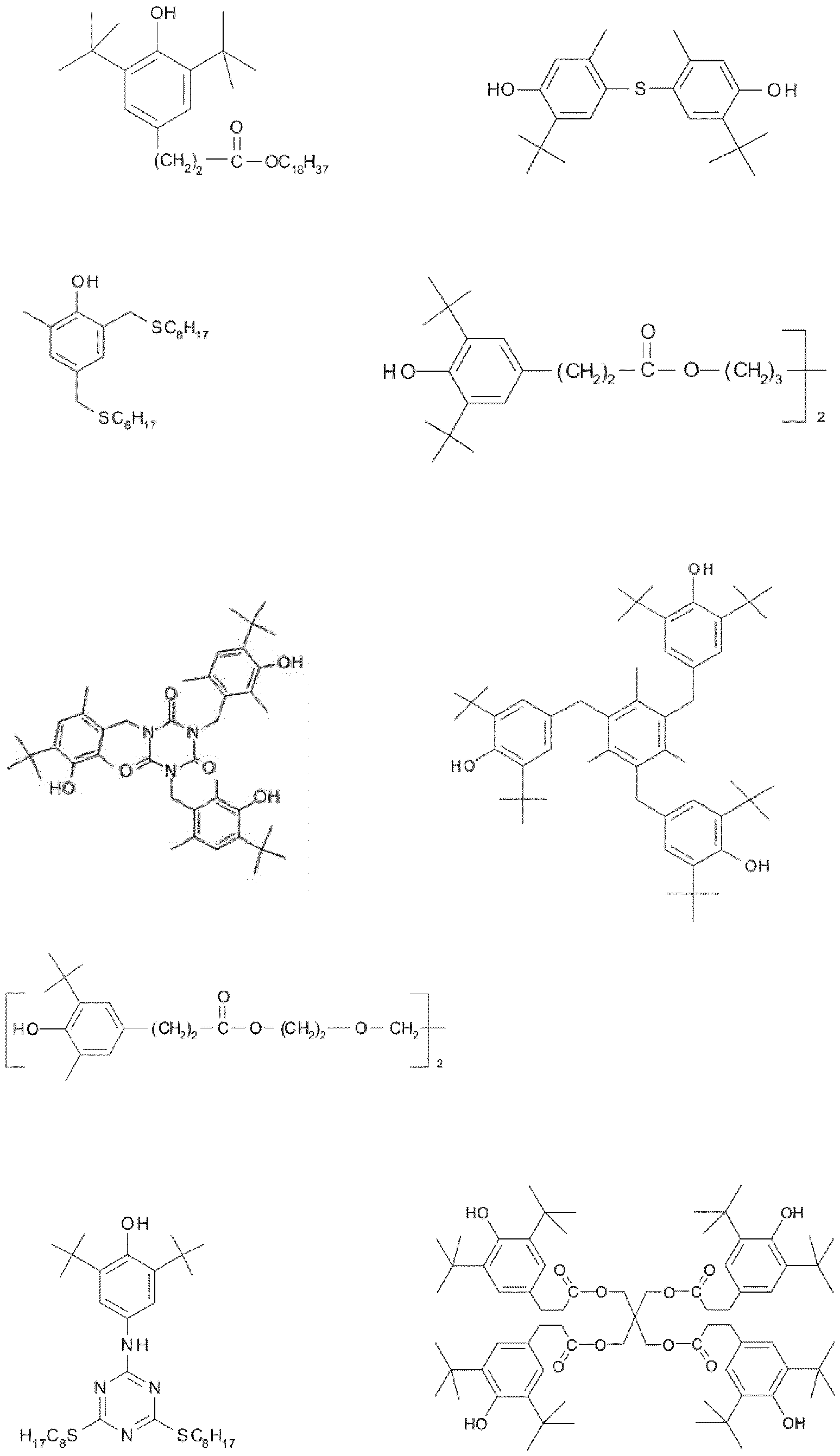
- Particularly preferred phenolic antioxidants are the following structures:
- n is an integer in the aforementioned compounds and is between 2 and 10
- phenolic antioxidants are octadecyl 3- (3,5-di-tert-butyl-4-hydroxyphenyl) propionate and pentaerythritol tetrakis (3- (3,5-di-tert-butyl-4-hydroxyphenyl) propionate)
- phenolic antioxidants are phenolic antioxidants based on renewable raw materials such as. B. tocopherols (vitamin E), tocotrienols, tocomonoenols, ubiquinol, hydroxytyrosol, flavonoids and flavonols such as e.g. Chrysin, quercitin, hesperidin, neohesperidin, naringin, morin, kaempferol, fisetin, datiscetin, luteolin, apigenin, taxifolin, isoflavones such as e.g.
- amine antioxidants can be used, for example:
- Preferred amine antioxidants are:
- Particularly preferred aminic antioxidants are the structures: where n is an integer and is between 3 and 100.
- N-dialkylhydroxylamine N, N-dibenzylhydroxylamine, N, N-dilaurylhydroxylamine, N, N-distearylhydroxylamine, N-benzyl-a-phenylnitrone, N-octadecyl-a-hexadecylnitrone, and Genox EP (sold by Sl Group ) according to the formula:
- Preferred lactones are:
- Benzofuranones and indolinones such as 3- (4- (2-acetoxyethoxy) phenyl] -5,7- di-tert-butyl-benzofuran-2-one, 5,7-di-tert-butyl-3- [4- (2-stearoyloxyethoxy) phenyl] benzofuran-2-one, 3,3'-bis [5, 7-di-tert-butyl-3- (4- (2-hydroxyethoxy] phenyl) benzofuran-2-one), 5,7-di-tert-butyl-3- (4-ethoxyphenyl) benzofuran-2-one , 3- (4-acetoxy-3,5-dimethylphenyl) -5,7-di-tert-butyl-benzofuran-2-one, 3- (3,5-dimethyl-4-pivaloyloxyphenyl) -5,7-di -tert-butyl-benzofuran-2-one,
- antioxidants are isoindolo [2, l-A] quinazolines such as e.g.
- the at least one secondary antioxidant is selected from the group consisting of phosphorus compounds, in particular phosphites and phosphonites, organosulfur compounds, in particular sulfides and disulfides, and mixtures thereof.
- Suitable secondary antioxidants are in particular phosphites or phosphonites such as e.g. Triphenyl phosphite, diphenylalkyl phosphites, phenyl dialkyl phosphites, tri (nonylphenyl) phosphite, trilauryl phosphites, trioctadecyl phosphite, distearylpentaerythritol diphosphite, tris- (2,4-di-tert-butylphenyl) phosphite, bis (2,4-di-tert-butylphenyl) phosphite, bis (2,4-butylphenyl) bisphenyl-bisphenyl-di-phosphitol, diisodecyl-di-phosphitol-tert-phosphite, diisodecylpentaerytiphosphite, bisphenyltip
- a preferred phosphonite is:
- the phosphite tris- (2,4-di-te / t-butylphenyl) phosphite is very particularly preferably used as a secondary antioxidant.
- Suitable secondary antioxidants are also organo-sulfur compounds such as e.g. Sulfides and disulfides e.g. Distearyl thiodipropionate, dilauryl thiodipropionate; Ditridecyldithiopropionate, ditetradecylthiodipropionate, 3- (dodecylthio) -, l, l '- [2,2-bis [[3- (dodecylthio) -l-oxopropoxy] methyl] -l, 3-propanediyl] propanoic acid ester.
- Sulfides and disulfides e.g. Distearyl thiodipropionate, dilauryl thiodipropionate; Ditridecyldithiopropionate, ditetradecylthiodipropionate, 3- (dodecylthio) -, l, l
- component (B) consists of both a primary antioxidant and a secondary antioxidant.
- component (B) consists of a phenolic antioxidant and a phosphite or phosphonite.
- components (A) and (B) consist of a renewable raw material.
- a particularly preferred variant of the method according to the invention is characterized in that at least one primary antioxidant and at least one secondary antioxidant are introduced into the thermoplastic material.
- component (A) and component (B) are used in a weight ratio from 5:95 to 95: 5, preferably from 10:90 to 90:10, particularly preferably from 20:80 to 80:20, incorporated into the thermoplastic recycled material.
- component (B) consists of both a primary antioxidant and a secondary antioxidant
- the ratio between primary and secondary antioxidant is preferably 90:10 to 10:90, particularly preferably 80:20 to 20:80 and very particularly preferably 70: 30 to 30:70.
- thermoplastic recycled material Another preferred variant of the method according to the invention is characterized in that components (A) and / or (B) are introduced into the thermoplastic recycled material in that
- the components (A) and / or (B) present as solids are melted and the resulting melt is introduced into a melt of the thermoplastic recycled material.
- Components (A) and / or (B), which can be in the form of powder, compacted, granulate, solution or flakes, are preferably mixed with the polymer to be stabilized, the polymer matrix is converted into the melt and then cooled. Alternatively, it is also possible to introduce the additive in a molten state in a polymer melt. In the event that further components are added to the thermoplastic plastic recyclate, these can be added to the polymers separately, in the form of liquids, powders, granules or compacted products, or together with the additive composition according to the invention as described above.
- At least one additive selected from the group consisting of UV absorbers, light stabilizers, metal deactivators, filler deactivators, antiozonants, nucleating agents, anti-nucleating agents, impact strength improvers, plasticizers, lubricants, rheology modifiers, can preferably also be introduced into the thermoplastic recycled plastics material,
- Chain extenders optical brighteners, antimicrobial agents, antistatic agents, slip agents, antiblocking agents, coupling agents, crosslinking agents, anti-crosslinking agents, hydrophilizing agents,
- Compatibilizers oxygen scavengers, acid scavengers, blowing agents, degradation additives, defoaming agents, odor scavengers, marking agents, anti-fogging agents, fillers, reinforcing agents and mixtures thereof.
- thermoplastic plastic recyclate which is selected from the group consisting of a) acid scavengers, light stabilizers, preferably light stabilizers from the group of hindered amines,
- Suitable acid scavengers are salts of one, two, three or four valent metals, preferably alkali, alkaline earth metals, aluminum or zinc, in particular formed with fatty acids such as calcium stearate, magnesium stearate, zinc stearate, aluminum stearate, calcium laurate, Calcium behenate, calcium lactate, calcium stearoyl-2-lactate.
- hydrotalcites in particular synthetic hydrotalcites based on aluminum, magnesium and zinc, hydrocalumites, zeolites, alkaline earth oxides, in particular calcium oxide and magnesium oxide and zinc oxide, alkaline earth carbonates, in particular calcium carbonate, magnesium carbonate and dolomite and hydroxides, in particular brucite (magnesium hydroxide) ,
- Suitable light stabilizers are, for example, compounds based on 2- (2 'hydroxyphenyl) benzotriazoles, 2-hydroxybenzophenones, esters of benzoic acids, acrylates, oxamides, and 2- (2-hydroxyphenyl) -l, 3,5-triazines.
- Suitable 2- (2 'hydroxyphenyl) benzotriazoles are for example 2- (2'-hydroxy-5'-methylphenyl) benzotriazole, 2- (3', 5'-di-tert-butyl-2'-hydroxyphenyl) benzotriazole, 2- (5'-tert-butyl-2'-hydroxyphenyl) benzotriazole, 2- (2'-hydroxy-5 '- (l, l, 3,3-tetramethylbutyl) phenyl) benzotriazole, 2- (3' , 5'-di-tert-butyl-2'-hydroxyphenyl) -5-chlorobenzotriazole, 2- (3'-tert-butyl-2'-hydroxy-5'-methylphenyl-5-chlorobenzotriazole, 2- (3'- sec-butyl-5'-tert-butyl-2'-hydroxyphenyl) benzotriazole, 2- (2'-hydroxy-4'-octyloxyphenyl) benzotriazole,
- Suitable 2-hydroxybenzophenones are, for example, 4-hydroxy-, 4-methoxy-, 4-octyloxy-, 4-decyloxy-4-dodecyloxy, 4-benzyloxy, 4, 2 ', 4'-trihydroxy- and 2'-hydroxy-4 , 4'-dimethoxy derivatives of 2-hydroxybenzo- phenones.
- Suitable acrylates are, for example, ethyl a-cyano-ß, ß-diphenyl acrylate, isooctyl-a-cyano-ß, ß-diphenyl acrylate, methyl a-carbomethoxycinnamate, methyl a-cyano-ß-methyl-p-methoxycinnamate, Butyl ⁇ -cyano- ⁇ -methyl-p-methoxycinnamate, methyl- ⁇ -carbomethoxy-p-methoxycinnamate and N- ( ⁇ -carbomethoxy- ⁇ -cyanovinyl) -2-methylindoline.
- Suitable esters of benzoic acids are, for example, 4-tert-butylphenyl salicylate, phenyl salicylate, octylphenyl salicylate, dibenzoyl resorcinol, bis (4-tert-butylbenzoic resorcinol, benzoylresorcinol, 2,4-di-tert-butylphenyl-3,5-di-tert-butyl 4-hydroxybenzoate, hexadecyl-3,5-di-tert-butyl-4-hydroxybenzoate, octadecyl-3,5-di-tert-butyl-4-hydroxybenzoate, 2-methyl-4,6-di-tert- butylphenyl 3,5-di-tert-butyl-4-hydroxybenzoate.
- Suitable oxamides are, for example, 4,4'-dioctyloxyoxanilide, 2,2'-diethoxy-oxanilide, 2,2'-dioctyloxy-5,5'-di-tert-butoxanilide, 2,2'-didodecyloxy-5,5'- di-tert-butoxanilide, 2-ethoxy-2'-ethyloxanilide, N, N'-bis (3-dimethylaminopropyl) -oxamide, 2-ethoxy-5-tert-butyl-2'-ethoxanilide and its mixtures with 2-ethoxy -2'-ethyl-5,4'-di-tert-butoxanilide, mixtures of o- and p-methoxy-disubstituted oxanilides and mixtures of o- and p-ethoxy-disubstituted oxanilides.
- Suitable 2- (2-hydroxyphenyl) -1, 3,5-triazines are, for example, 2,4,6-tris (2-hydroxy-4-octyloxyphenyl) -1, 3,5-triazine, 2- (2-hydroxy -4-octyloxyphenyl) -4,6- bis (2,4-dimethylphenyl) -1, 3,5-triazine, 2- (2,4-dihydroxyphenyl) -4,6-bis (2,4-dimethylphenyl) - 1,3,5-triazine, 2,4-bis (2-hydroxy-4-propyloxyphenyl) -6- (2,4-dimethylphenyl) -1, 3,5-triazine, 2- (2-hydroxy- 4-octyloxyphenyl) -4,6-bis (4-methyl-phenyl-1,3,5-triazine, 2- (2-hydroxy-4-dodecyloxyphenyl) -4,6-bis (2,4-dimethylphenyl )
- Suitable metal deactivators are, for example, N, N'-diphenyloxamide, N-salicylal-N'-salicyloylhydrazine, N, N'-bis (salicyloyl) hydrazine, N, N'-bis (3,5-di-tert-butyl-4- hydroxyphenylpropionyl) hydrazine, 3-salicyloylamino-l, 2,4-triazole, bis (benzylidene) oxalyldihydrazide, oxanilide, isophthaloyldihydrazide, sebacoylbisphenylhydrazide, N, N'-diacetyladipoyldihydrazide, N, N'-bis (salicyloyl) oxyrazide, N, N'-bis (salicyloyl) thiopropionyl dihydrazide.
- metal activators are:
- Suitable hindered amines are, for example, 1,1-bis (2,2,6,6-tetramethyl-4-piperidyl) succinate, bis (1,2,2,6,6-pentamethyl-4-piperidyl) sebacate, bis (l - octyloxy-2,2,6,6-tetramethyl-4-piperidyl) sebazate, bis (1,2,2,6,6-pentamethyl- 4-piperidyl) -n-butyl-3,5-di-tert-butyl-4-hydroxybenzylmalonate, the condensation product of 1- (2-hydroxyethyl) -2,2,6,6-tetramethyl-4-hydroxypiperidine and succinic acid, linear or cyclic condensation products of N, N'-bis (2, 2,6,6-tetramethyl-4-piperidyl) hexamethylenediamine and 4-tert-octylamino-2,6-di-chloro-1,3,5 -triazine, tris
- the structures indicated above also include the sterically hindered NH, N-alkyl such as N-methyl or N-octyl, the N-alkoxy derivatives such as N-methoxy or N-octyloxy, the cycloalkyl derivatives such as N-cyclohexyloxy and the N- (2-hydroxy-2-methylpropoxy) analogs.
- Preferred hindered amines also have the following structures:
- Preferred oligomeric and polymeric hindered amines have the following structures:
- n 3 to 100 in each case.
- Suitable dispersants are, for example:
- Polyacrylates e.g. Copolymers with long-chain side groups, polyacrylate block copolymers, alkylamides: e.g. N, N'-1,2-ethanediylbisoctadecanamide sorbitan esters, e.g. Monostearyl sorbitan esters, titanates and zirconates, reactive copolymers with functional groups such.
- Ethylene oxide copolymer, polyphenylsiloxane copolymer, amphiphilic copolymers re: e.g. Polyethylene block polyethylene oxide, dendrimers, e.g. dendrimers containing hydroxyl groups.
- Suitable antinucleating agents are azine dyes such as nigrosine.
- Suitable flame retardants are in particular a) inorganic flame retardants such as Al (OH) 3 , Mg (OH) 2 , AlO (OH), MgC0 3 , sheet silicates such as montmorillonite or sepiolite, not modified or organically modified, double salts such as Mg-Al- Silicates, POSS (Polyhedral Oligomeric Silsesquioxane) compounds, huntite, hydro magnesite or halloysite as well as Sb 2 0 3 , Sb 2 0 5 , Mo0 3 , zinc stannate, zinc hydroxystannate, b) nitrogen-containing flame retardants such as melamine, melamine, melam,
- Hydroxyimide esters or hydroxyimide ethers Phosphorus-containing flame retardants such as red phosphorus, phosphates such as resorcinol diphosphate, bisphenol A diphosphate and their oligomers, triphenyl phosphate, ethylenediamine diphosphate, phosphinates such as salts of hypophosphorous acid or zinc phosphine phosphinate or its derivatives such as diethosphinate phosphinate, such as diethyl phosphinate, for example Aluminum phosphinate, aluminum phosphite, aluminum phosphonate, phosphonate esters, oligomeric and polymeric derivatives of methanephosphonic acid, 9,10-dihydro-9-oxa-10- phosphorylphenanthrene-10-oxide (DOPO) and its substituted compounds, f) halogen-containing flame retardants based on chlorine and bromine such as polybrominated diphenyl oxides such as decabromodiphenyl
- Particularly preferred flame retardants are halogen-free and are the following compounds:
- Suitable plasticizers are, for example, phthalic acid esters, adipic acid esters, esters of citric acid, esters of 1,2-cyclohexanedicarboxylic acid, trimellitic acid esters, isosorbide esters, phosphates, epoxides such as epoxidized soybean oil or aliphatic polyesters.
- Suitable lubricants and processing aids are, for example, polyethylene waxes, polypropylene waxes, salts of fatty acids such as e.g. Calcium stearate, zinc stearate or salts of montan waxes, amide waxes such as e.g. Erucic acid amide or oleic acid amides, fluoropolymers, silicones or neoalkoxy titanates and zirconates.
- Suitable pigments can be of an inorganic or organic nature.
- Organic pigments are, for example, titanium dioxide, zinc oxide, zinc sulfide, iron oxide, ultramarine, carbon black, organic pigments are, for example, anthraquinones, anthanthrones, benzimidazolones, quinacridones, diketopyrrolopyrroles, dioxazines, indanthrones, isoindolinones, azo compounds, perylenes, phthaloneocyanines or pyranthroneocyanines.
- Further suitable pigments are effect pigments based on metal or pearlescent pigments based on metal oxide.
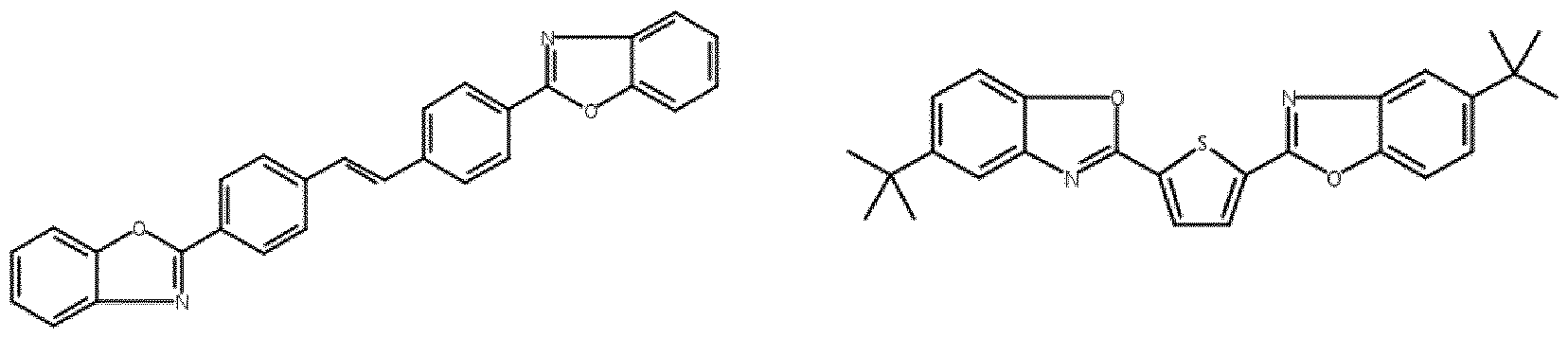
- Suitable optical brighteners are, for example, bisbenzoxazoles, phenylcoumarins or bis (styryl) biphenyls and especially optical brighteners of the formulas:
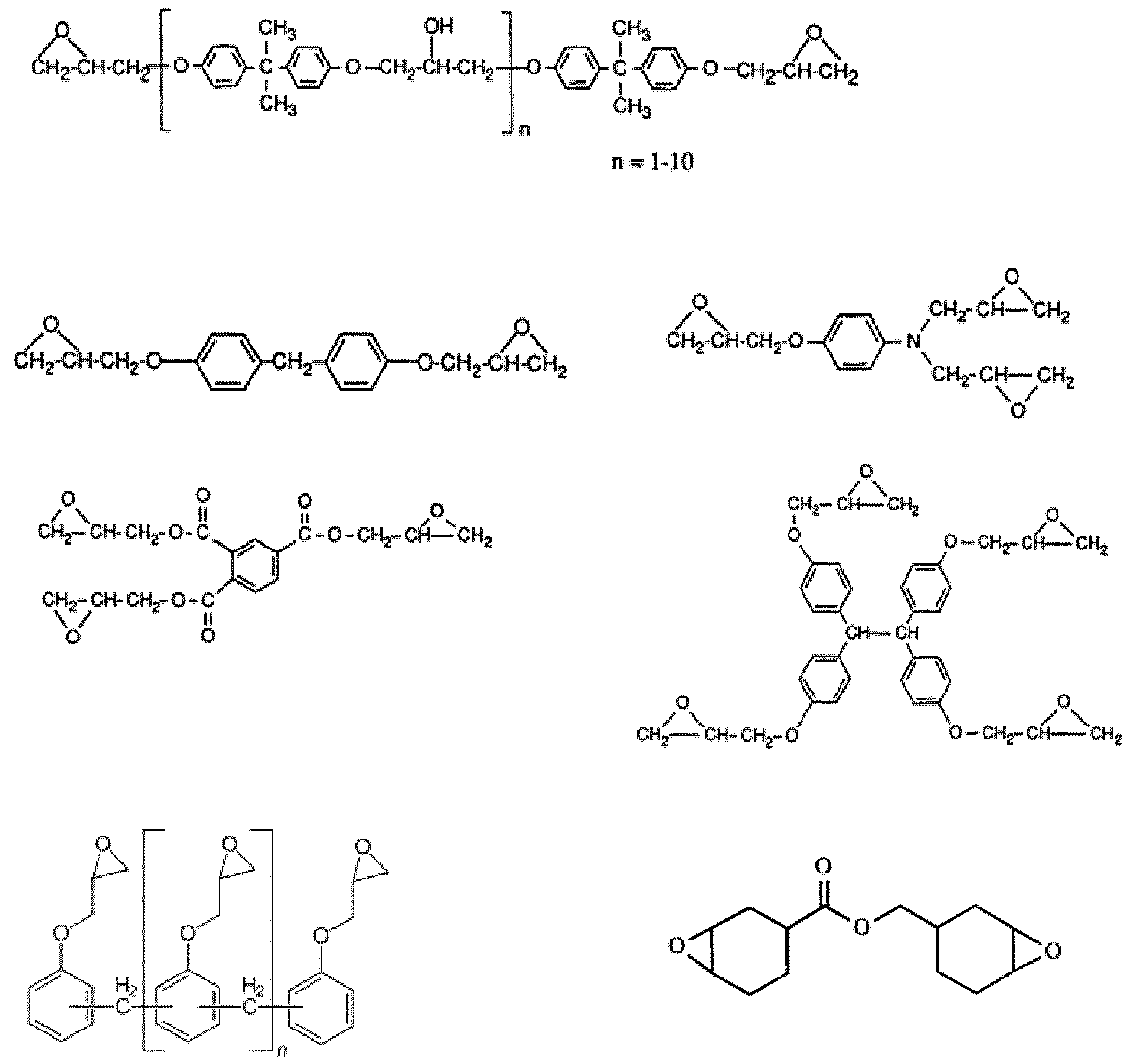
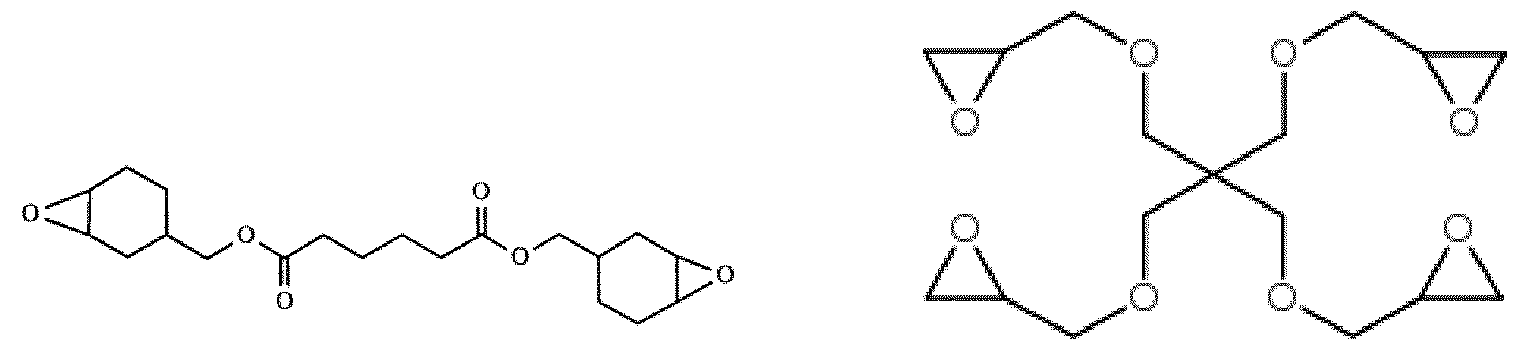
- Suitable filler deactivators are, for example, polysiloxanes, polyacrylates, in particular block copolymers such as polymethacrylic acid polyalkylene oxide or polyglycidyl (meth) acrylates and their copolymers, for example with styrene, and epoxides, for example of the following structures:
- Suitable antistatic agents are, for example, ethoxylated alkylamines, fatty acid esters, alkyl sulfonates and polymers such as e.g. Polyether amides.
- Suitable antiozonants are the above-mentioned amines such as e.g. N, N'-di-isopropyl-p-phenylenediamine, N, N'-di-sec-butyl-p-phenylenediamine, N, N'-bis (1,4-dimethylpentyl) -p-phenylenediamine, N, N ' -Dicyclohexyl-p-phenylenediamine, N-isopropyl-N'-phenyl-p-phenylenediamine, N- (1,3-dimethylbutyl) -N'-phenyl-p-phenylenediamine, N- (l-methylheptyl) -N'-phenyl-p-phenylenediamine, N-cyclohexyl-N'-phenyl-p-phenylenediamine
- Suitable rheology modifiers e.g. for the production of controlled rheology polypropylene (CR-PP), for example, peroxides, alkoxyamine esters, oxyimide sulfonic acid esters and in particular the following structures:
- Suitable nucleating agents are talc, alkali or alkaline earth metal salts of mono- and polyfunctional carboxylic acids such as. Benzoic acid, Bernstein Text acid, adipic acid, for example sodium benzoate, Zinkglycerolat, aluminum hydroxy-bis (4-te / t-butyl) benzoate, 2,2 '-methylene-bis- (4,6-di-te / t-butylphenyl) phosphate, such as trisamides and diamides such as trimesic acid tricyclohexylamide, trimesic acid tri (4-methylcyclohexylamide), trimesic acid tri (tert-butylamide), N, N ' , N " - l, 3,5-Benzoltriyltris (2,2-dimethyl-propanamid) or 2,6-
- Suitable additives for increasing the molecular weight of polycondensation polymers are diepoxides, bis-oxazolines, bis-oxazolones, bis-oxazines, diisocyanates, dianhydrides, bis-acyllactams, bis-maleimides, dicyanates, carbodiimides.
- Other suitable chain extenders are polymeric connec tions such.
- Suitable additives for increasing the electrical conductivity are, for example, the aforementioned antistatic agents, soot and carbon compounds such as carbon nanotubes and graphene, metal powder such as e.g. Copper powder and conductive polymers such as Polypyrroles, polyanilines and polythiophenes.
- Suitable additives for increasing thermal conductivity are, for example, aluminum nitrides and boron nitrides.
- Suitable infrared-active additives are, for example, aluminum silicates, hydrotalcites or dyes such as phthalocyanines or anthraquinones.
- Suitable mold release agents are, for example, silicones, soaps and waxes such as e.g. Montan waxes.
- components (A) and (B) and, if necessary, the additional additives into the recycled plastic material can be carried out by customary processing methods, the polymer being melted and mixed with the additive composition according to the invention and any other additives, preferably by Mixer, kneader and extruder.
- Preferred processing machines are extruders such as e.g. Single-screw extruders, twin-screw extruders, planetary roller extruders, ring extruders, co-kneaders, which are preferably equipped with vacuum degassing. Processing can take place under air or, if necessary, under inert gas conditions such as take place under nitrogen.
- components (A) and (B) in the form of so-called Masterbatches or concentrates that contain, for example, 10-90% of a stabilizer composition consisting of components (A) and (B) in a polymer, are produced and introduced.
- thermoplastic recycled material is selected from the group consisting of
- a) recycled polymers from olefins or diolefins e.g. Polyethylene, in particular LDPE, LLDPE, VLDPE, ULDPE, MDPE, HDPE and UHMWPE, metallocene PE (m-PE), polypropylene, polyisobutylene, poly-4-methyl-pentene-1, polybutadiene, polyisoprene, polycyclooctene, polyalkylene -Carbon monoxide copolymers, and corresponding copolymers in the form of random or block structures such as Polypropylene-polyethylene (EP), EPM or EPDM, ethylene-vinyl acetate (EVA), ethylene-acrylic ester, e.g.
- EP Polypropylene-polyethylene
- EPM EPM
- EVA ethylene-vinyl acetate
- EDA ethylene-acrylic ester
- Ethylene-butyl acrylate, ethylene-acrylic acid-glycidyl acrylate, and corresponding graft polymers such as e.g. Polypropylene-g-maleic anhydride, polypropylene-g-acrylic acid and polyethylene-g-acrylic acid,
- polystyrene polymethylstyrene, polyvinylnaphthalene, styrene-butadiene (SB), styrene-butadiene-styrene (SBS), styrene-ethylene-butylene-styrene (SEBS), styrene-ethylene-propylene-styrene,
- Styrene isoprene styrene-isoprene-styrene (SIS), styrene-butadiene-acrylonitrile (ABS), styrene-acrylonitrile-acrylate (ASA), styrene-ethylene, styrene-maleic anhydride polymers including corresponding graft copolymers such as e.g. Styrene on butadiene, maleic anhydride on SBS or SEBS, as well as graft copolymers of methyl methacrylate, styrene-butadiene and ABS (MABS), c) recycled polymers of unsaturated esters such as e.g.
- Polyacrylates and polymethacrylates such as polymethyl methacrylate (PMMA), polybutyl acrylate, polylauryl acrylate, polystearyl acrylate, polyacrylonitrile, polyacrylamides, and corresponding copolymers such as e.g. Polyacrylonitrile polyalkyl acrylate,
- recycled polymers made from unsaturated alcohols and derivatives, such as polyvinyl alcohol, polyvinyl acetate, polyvinyl butyral, e) recycled polyacetals, such as polyoxymethylene (POM), and corresponding copolymers, such as copolymers with butanal, f) recycled polyphenylene oxides and blends of these with polystyrene or polyamides,
- Polyethylene glycol polypropylene glycol, polyethylene oxide,
- recycled polyamides such as e.g. Polyamide-6, 6.6, 6.10, 4.6, 4.10, 6.12, 12.12, polyamide 11, polyamide 12 and (partially) aromatic polyamides such as e.g. Polyphthalamides, e.g. made from terephthalic acid and / or isophthalic acid and aliphatic diamines or from aliphatic dicarboxylic acids such as e.g. Adipic acid or sebacic acid and aromatic diamines such as e.g. 1,4- or 1,3-diaminobenzene,
- Polyphthalamides e.g. made from terephthalic acid and / or isophthalic acid and aliphatic diamines or from aliphatic dicarboxylic acids such as e.g. Adipic acid or sebacic acid and aromatic diamines such as e.g. 1,4- or 1,3-diaminobenzene,
- Polyesterimides poly (ether) ketones, polysulfones, and
- Polyether sulfones polyarylsulfones, polyphenylene sulfide,
- k) Recycled polyesters from aliphatic or aromatic dicarboxylic acids and diols or from hydroxycarboxylic acids such as e.g. Polyethylene terephthalate (PET), polybutylene terephthalate (PBT), polypropylene terephthalate, polyethylene naphthylate, poly-1,4-dimethylocyclohexane phthalate, polyhydroxybenzoate, polyhydroxynaphthalate, polylactic acid,
- PET Polyethylene terephthalate
- PBT polybutylene terephthalate
- PBT polypropylene terephthalate
- polyethylene naphthylate poly-1,4-dimethylocyclohexane phthalate
- polyhydroxybenzoate polyhydroxynaphthalate
- polylactic acid e.g. Polyethylene terephthalate (PET), polybutylene terephthalate (PBT), polypropylene terephthalate, polyethylene naphthylate, poly-1,4-d
- recycled halogen-containing polymers such as PVC, PVDC, n) recycled cellulose derivatives, such as cellulose nitrate, cellulose acetate, cellulose propionate, cellulose butyrate, o) and mixtures, combinations or blends of two or more of the aforementioned polymers.
- the thermoplastic plastic recyclate is particularly preferably selected from the group consisting of polymers of olefins or diolefins, such as e.g. Polyethylene, in particular LDPE, LLDPE, VLDPE, ULDPE, MDPE, HDPE and UHMWPE, metallocene PE (m-PE), polypropylene, polyisobutylene, poly-4-methyl-pentene-1, polybutadiene, polyisoprene, polycyclooctene, polyalkylene carbon monoxide Copolymers, as well as corresponding copolymers in the form of random or block structures such as Polypropylene-polyethylene (EP), EPM or EPDM, ethylene-vinyl acetate (EVA), ethylene-acrylic ester, e.g.
- Polyethylene in particular LDPE, LLDPE, VLDPE, ULDPE, MDPE, HDPE and UHMWPE
- metallocene PE m-PE
- polypropylene polyis
- Ethylene-butyl acrylate, ethylene-acrylic acid-glycidyl acrylate, and corresponding graft polymers such as e.g. Polypropylene-g-maleic anhydride, polypropylene-g-acrylic acid and polyethylene-g-acrylic acid.
- the one thermoplastic material is very particularly preferably a polyolefin recyclate.
- the thermoplastic plastic recyclate can be polypropylene, in particular a polypropylene recyclate or polyethylene, in particular a polyethylene recyclate.
- thermoplastic recycled material introduced in 91 to 99.94 parts by weight, preferably 98.5 to 99.91 parts by weight, of at least one thermoplastic recycled material.
- thermoplastic recyclate in 91 to 99.94 parts by weight, preferably 98.5 to 99.91 parts by weight, of at least one thermoplastic recyclate.
- the present invention further relates to a plastic composition containing or consisting of
- thermoplastic recyclate at least one em thermoplastic recyclate.
- the primary and / or secondary antioxidants contained in the recyclate, as well as their degradation products, can, if necessary, by customary analytical methods known to the person skilled in the art, e.g. by chromatographic methods such as HPLC, if necessary after extraction from the polymer using a suitable solvent and subsequent concentration by removal of the solvent, can be determined.
- the present invention also relates to a plastic composition containing or consisting of
- thermoplastic plastic recyclate at least one thermoplastic plastic recyclate.
- the plastic composition is characterized in that the plastic composition
- thermoplastic material (C) 91 to 99.94 parts by weight, preferably 98.5 to 99.91 parts by weight, at least one thermoplastic material
- composition according to the invention preferably contains at least one primary antioxidant and at least one secondary antioxidant.
- thermoplastic recyclate contains or consists of it.
- the plastic composition according to the invention additionally contains at least one additive which is selected from the group consisting of UV absorbers, light stabilizers, metal deactivators, filler deactivators, antiozonants, nucleating agents, anti-nucleating agents, impact strength improvers, plasticizers, lubricants, rheology modifiers, thixotropic agents, Chain extenders, optical brighteners, antimicrobial agents, antistatic agents, slip agents, antiblocking agents, coupling agents, crosslinking agents, anti-crosslinking agents, hydrophilizing agents, hydrophobizing agents, adhesion promoters, dispersants, compatibilizers, oxygen scavengers, acid scavengers, pesticides, propellants, odor trapping additives, Anti-fogging agents, fillers, reinforcements agents and mixtures thereof.
- at least one additive which is selected from the group consisting of UV absorbers, light stabilizers, metal deactivators, filler deactivators, antiozonants, nucleating agents, anti-
- the plastic composition additionally contains at least one additive selected from the group consisting of a) acid scavengers, preferably calcium stearate, magnesium stearate, zinc stearate, aluminum stearate, calcium stearate, calcium lactate, calcium stearoyl-2-lactate, hydrotalcites, in particular synthetic hydrotalcites based on aluminum, magnesium and zinc, hydrocalumites, zeolites, alkaline earth oxides, especially calcium oxide and magnesium oxide, zinc oxide, alkaline earth carbonates, especially calcium carbonate, magnesium carbonate and dolomite, and hydroxides, especially brucite,
- a) acid scavengers preferably calcium stearate, magnesium stearate, zinc stearate, aluminum stearate, calcium stearate, calcium lactate, calcium stearoyl-2-lactate
- hydrotalcites in particular synthetic hydrotalcites based on aluminum, magnesium and zinc, hydrocalumites, zeolites, alkaline earth oxides, especially calcium oxide and
- an acid scavenger is the further additive.
- Preferred acid scavengers are defined above.
- the plastic composition according to the invention can preferably be produced using a method according to the invention for stabilizing thermoplastics against oxidative, thermal and / or actinic degradation or was produced therewith.
- the present invention also relates to a molding compound or a molding that can be produced from the plastic composition according to the invention, in particular in the form of injection molded parts, foils, films, paints, coatings, foams, fibers, cables, pipes, profiles, hollow bodies, tapes, membranes, e.g. geomembranes, lubricants, colorants and / or adhesives that are manufactured via extrusion, injection molding, blow molding, calendering, pressing processes, spinning processes and / or rotomoulding e.g. for the electrical industry, for the construction industry, for the transport industry (car, aircraft, ship , Rail), for medical applications, for household and electrical appliances, for vehicle parts, for consumer goods, for packaging, for furniture and / or for textiles.
- a molding compound or a molding that can be produced from the plastic composition according to the invention, in particular in the form of injection molded parts, foils, films, paints, coatings, foams, fibers, cables, pipes, profiles, hollow bodies, tapes, membrane
- the present invention also relates to a stabilizer composition for stabilizing thermoplastic plastic recyclates, preferably thermoplastic plastic recyclates, against oxidative, thermal and / or actinic degradation, consisting of
- the present invention also relates to the use of at least substituted sugar for stabilizing thermoplastic plastic recyclates against oxidative, thermal and / or actinic degradation.
- the present invention further relates to the use of the stabilizer composition according to the invention or a stabilizer composition containing or consisting of
- thermoplastics preferably thermoplastic recyclates
- oxidative, thermal and / or actinic degradation preferably thermoplastic recyclates
- thermoplastics are the same as those mentioned with regard to the method according to the invention or those mentioned with regard to the plastic composition according to the invention.
- the stabilizer composition is particularly preferably used for stabilizing polyolefin recyclates and against oxidative, thermal and / or actinic degradation.
- a post-consumer polypropylene recyclate from battery boxes was ground (supplier: BSB Braubach) together with the additives specified in the table at 210 ° C in a twin-screw micro-extruder (MC 5, Manufacturer DSM) in continuous mode at 90 revolutions per minute for 30 minutes in the melt in a circle.
- the force absorption is measured after 10, 20 and 30 minutes.
- a stearoyl-substituted mannitol (> 90% monosubstituted) leads to increased processing stabilization, ie to a higher residual strength, compared to a recyclate without an addition.
- a further improvement in processing stability is achieved by adding 0.1% primary antioxidant (pentaerythritol tetrakis [3- (3,5-di-tert-butyl-4-hydroxyphenyl) propionate) and 0.1% secondary antioxidant to 0.2% of the stearoyl-substituted mannitol Antioxidant (tris- (2,4-di-tert-butylphenyl) phosphite) can be added.
- the addition of the distearyl ester of mucic acid in a concentration of 0.1 to 0.5% compared to a polypropylene recyclate without addition leads to increased processing stabilization, i.e. to a higher residual strength after 30 minutes.
Landscapes
- Chemical & Material Sciences (AREA)
- Health & Medical Sciences (AREA)
- Chemical Kinetics & Catalysis (AREA)
- Medicinal Chemistry (AREA)
- Polymers & Plastics (AREA)
- Organic Chemistry (AREA)
- Life Sciences & Earth Sciences (AREA)
- Sustainable Development (AREA)
- Compositions Of Macromolecular Compounds (AREA)
- Separation, Recovery Or Treatment Of Waste Materials Containing Plastics (AREA)
Abstract
Description





Claims


Priority Applications (6)
| Application Number | Priority Date | Filing Date | Title |
|---|---|---|---|
| EP20715790.0A EP3947540B1 (de) | 2019-03-26 | 2020-03-24 | Verfahren zur stabilisierung von thermoplastischen kunststoff-rezyklaten sowie stabilisierte kunststoffzusammensetzungen und hieraus hergestellte formmassen und formteile |
| JP2021557172A JP2022526925A (ja) | 2019-03-26 | 2020-03-24 | 熱可塑性プラスチックのリサイクル物の安定化方法、安定化プラスチック組成物、並びに、それから製造される成形材料および成形部品 |
| CN202080024649.0A CN113631645A (zh) | 2019-03-26 | 2020-03-24 | 用于稳定热塑性塑料回收材料的方法、经稳定的塑料组合物和模塑料及由其制备的模塑件 |
| KR1020217034877A KR102846980B1 (ko) | 2019-03-26 | 2020-03-24 | 열가소성 플라스틱 재활용물을 안정화시키는 방법, 안정화된 플라스틱 조성물, 성형 화합물 및 이로부터 생산된 성형품 |
| US17/441,626 US12398256B2 (en) | 2019-03-26 | 2020-03-24 | Method for stabilizing thermoplastic recyclates, stabilized plastic compositions, and molding compounds and molded parts produced therefrom |
| ES20715790T ES2963599T3 (es) | 2019-03-26 | 2020-03-24 | Procedimiento para la estabilización de reciclados termoplásticos y composiciones plásticas estabilizadas y composiciones de moldeo y molduras producidas a partir de las mismas |
Applications Claiming Priority (2)
| Application Number | Priority Date | Filing Date | Title |
|---|---|---|---|
| DE102019204160.4A DE102019204160A1 (de) | 2019-03-26 | 2019-03-26 | Verfahren zur Stabilisierung von thermoplastischen Kunststoff-Rezyklaten sowie stabilisierte Kunststoffzusammensetzungen und hieraus hergestellte Formmassen und Formteile |
| DE102019204160.4 | 2019-03-26 |
Publications (1)
| Publication Number | Publication Date |
|---|---|
| WO2020193563A1 true WO2020193563A1 (de) | 2020-10-01 |
Family
ID=70058324
Family Applications (1)
| Application Number | Title | Priority Date | Filing Date |
|---|---|---|---|
| PCT/EP2020/058188 Ceased WO2020193563A1 (de) | 2019-03-26 | 2020-03-24 | Verfahren zur stabilisierung von thermoplastischen kunststoff-rezyklaten sowie stabilisierte kunststoffzusammensetzungen und hieraus hergestellte formmassen und formteile |
Country Status (8)
| Country | Link |
|---|---|
| US (1) | US12398256B2 (de) |
| EP (1) | EP3947540B1 (de) |
| JP (1) | JP2022526925A (de) |
| KR (1) | KR102846980B1 (de) |
| CN (1) | CN113631645A (de) |
| DE (1) | DE102019204160A1 (de) |
| ES (1) | ES2963599T3 (de) |
| WO (1) | WO2020193563A1 (de) |
Cited By (4)
| Publication number | Priority date | Publication date | Assignee | Title |
|---|---|---|---|---|
| DE102021202103A1 (de) | 2021-03-04 | 2022-09-08 | Fraunhofer-Gesellschaft zur Förderung der angewandten Forschung eingetragener Verein | Verwendung einer Stabilisatorzusammensetzung zur Stabilisierung von halogenfreien thermoplastischen Kunststoff-Recyclaten, eine Stabilisatorzusammensetzung, ein Masterbatch oder Konzentrat, eine stabilisierte Kunststoffzusammensetzung, hier ein Verfahren zur Stabilisierung von halogenfreien thermoplastischen Kunststoff-Recyclaten sowie Verwendung von Zusammensetzungen |
| DE102021202508A1 (de) | 2021-03-15 | 2022-09-15 | Fraunhofer-Gesellschaft zur Förderung der angewandten Forschung eingetragener Verein | Verwendung einer Stabilisatorzusammensetzung zur Stabilisierung von Polyolefin-Recyclaten, Stabilisatorzusammensetzung, Masterbatchkonzentrat, Kunststoffzusammensetzung, Formmasse oder Formteil, Verfahren zur Stabilisierung eines Polyolefin-Recyclats sowie Verwendung einer Kunststoffzusammensetzung |
| DE102021205168A1 (de) | 2021-05-20 | 2022-11-24 | Fraunhofer-Gesellschaft zur Förderung der angewandten Forschung eingetragener Verein | Verwendung mindestens einer Schwefel enthaltenden Aminosäure zur Stabilisierung von thermoplastischen Kunststoff-Recyclaten, stabilisiertes thermo-plastisches Kunststoffrecyclat, Stabilisatorzusammensetzung, Masterbatch sowie Formmasse bzw. Formteil |
| US11639437B2 (en) | 2020-09-14 | 2023-05-02 | An-Hsiung Chang | Modified polyvinyl butyral material, and preparation and applications thereof |
Families Citing this family (9)
| Publication number | Priority date | Publication date | Assignee | Title |
|---|---|---|---|---|
| DE102019200596A1 (de) | 2019-01-17 | 2020-07-23 | Fraunhofer-Gesellschaft zur Förderung der angewandten Forschung e.V. | Verwendung einer additivzusammensetzung zum kontrollierten beschleunigten abbau von kondensationspolymeren |
| DE102019204160A1 (de) | 2019-03-26 | 2020-10-01 | Fraunhofer-Gesellschaft zur Förderung der angewandten Forschung e.V. | Verfahren zur Stabilisierung von thermoplastischen Kunststoff-Rezyklaten sowie stabilisierte Kunststoffzusammensetzungen und hieraus hergestellte Formmassen und Formteile |
| DE102019210040A1 (de) | 2019-07-08 | 2021-01-14 | Fraunhofer-Gesellschaft zur Förderung der angewandten Forschung e.V. | Verwendung von phenolisch substituierten Zuckerderivaten als Stabilisatoren, Kunststoffzusammensetzung, Verfahren zur Stabilisierung von Kunststoffen sowie phenolisch substituierte Zuckerderivate |
| DE102019213606B4 (de) | 2019-09-06 | 2022-04-21 | Fraunhofer-Gesellschaft zur Förderung der angewandten Forschung e.V. | Oligomer oder polymer, zusammensetzung sowie verwendung des oligomers oder polymers |
| CN114843476B (zh) * | 2022-05-20 | 2024-09-24 | 重庆镁储能科技有限公司 | 一种v3s4@c/g复合电极材料的制备方法及其应用 |
| KR102512820B1 (ko) * | 2022-09-01 | 2023-03-23 | 주식회사 유진유포리아 | 생활용품 폐기물에서 발생한 플라스틱 스크랩을 재활용한 건축용 시트 제조 |
| KR102557878B1 (ko) * | 2023-01-12 | 2023-07-21 | (주)코리아마그네슘 | 재활용 플라스틱을 포함하는 바이오 조성물 및 이를 포함하는 장치 |
| KR20250177286A (ko) * | 2024-06-14 | 2025-12-23 | 롯데케미칼 주식회사 | 친환경 열가소성 수지 조성물 및 이로부터 제조된 성형품 |
| CN119431964B (zh) * | 2025-01-13 | 2025-04-25 | 兴宇汽车零部件股份有限公司 | 一种高发泡低密度复合密封条材料及其制备方法 |
Citations (16)
| Publication number | Priority date | Publication date | Assignee | Title |
|---|---|---|---|---|
| DE2423278A1 (de) | 1973-05-15 | 1974-12-05 | Amsterdam Chem Comb | Verfahren zur herstellung von carbonsaeureestern |
| DD288161A5 (de) | 1989-10-02 | 1991-03-21 | Veb Forschungszentrum Verpackung,De | Verfahren zum stabilisieren von thermoplastfolienabfaellen |
| EP0470048A2 (de) | 1990-07-31 | 1992-02-05 | Ciba-Geigy Ag | Verfahren zur Aufarbeitung verfärbter Polyolefine |
| EP0506614A2 (de) | 1991-03-27 | 1992-09-30 | Ciba-Geigy Ag | Verfahren zum Stabilisieren von recyclierten Kunststoffgemischen |
| EP0662101A1 (de) | 1992-09-25 | 1995-07-12 | Ciba SC Holding AG | Verfahren zur stabilisatormischungen für wiederverwendbare kunststoffe |
| EP0702704A1 (de) | 1993-06-09 | 1996-03-27 | Ciba SC Holding AG | Stabilisierung beschädigte Thermoplaste |
| JPH09176416A (ja) * | 1995-12-21 | 1997-07-08 | Asahi Denka Kogyo Kk | 塩化ビニル系樹脂組成物 |
| WO1997030112A1 (en) | 1996-02-15 | 1997-08-21 | Ciba Specialty Chemicals Holding Inc. | Stabilisation of polyolefin-recyclates |
| US5789470A (en) | 1994-09-23 | 1998-08-04 | Ciba Specialty Chemicals Corporation | Stabilized recycled plastics |
| EP0881253A1 (de) * | 1997-05-27 | 1998-12-02 | Akcros Chemicals | Beta-Ketoester zur Verwendung als Stabilisator für Polymere |
| US6251972B1 (en) | 1992-09-25 | 2001-06-26 | Ciba Specialty Chemicals Corp. | Process for the stabilization of and stabilizer mixtures for single-material recycled plastics |
| US6525158B1 (en) | 1992-09-25 | 2003-02-25 | Ciba Specialty Chemicals Corporation | Process for the stabilization of a stabilizer mixtures for recycled plastic mixtures |
| EP1426406A1 (de) | 2002-12-02 | 2004-06-09 | Crompton Vinyl Additives GmbH | Monosubstituierte 6-Aminouracile zum Stabilisieren von halogenhaltigen Polymeren |
| JP2005179517A (ja) * | 2003-12-19 | 2005-07-07 | Asahi Denka Kogyo Kk | 塩化ビニル系樹脂組成物 |
| EP2641933A1 (de) * | 2012-03-21 | 2013-09-25 | LANXESS Deutschland GmbH | Thermoplastische Formmassen |
| WO2014141178A1 (en) | 2013-03-15 | 2014-09-18 | Sabic Innovative Plastics Ip B.V. | Stabilized polycarbonate blend with post consumer recycled plastics |
Family Cites Families (36)
| Publication number | Priority date | Publication date | Assignee | Title |
|---|---|---|---|---|
| MXPA03007914A (es) | 2001-03-28 | 2003-12-11 | Ciba Sc Holding Ag | Proceso para preparar un poliester estabilizado. |
| JP5353026B2 (ja) * | 2008-02-22 | 2013-11-27 | 日本製紙株式会社 | 再生樹脂を配合した積層耐水シート |
| JP2010180395A (ja) * | 2009-01-09 | 2010-08-19 | Sumitomo Chemical Co Ltd | ポリマー安定剤及び該安定剤を含有するポリマー組成物 |
| JP2011122131A (ja) * | 2009-11-12 | 2011-06-23 | Sumitomo Chemical Co Ltd | 熱可塑性樹脂組成物、熱可塑性樹脂用加工安定化剤、及び熱可塑性樹脂の安定化方法 |
| JP5177575B2 (ja) * | 2010-01-28 | 2013-04-03 | 三菱電機株式会社 | 再生ポリオレフィン系樹脂組成物および再生ポリスチレン系樹脂組成物 |
| JP2011207990A (ja) * | 2010-03-29 | 2011-10-20 | Sumitomo Chemical Co Ltd | 樹脂用の加工安定化剤、該加工安定化剤を含む樹脂組成物、および樹脂の加工安定性を向上させる方法 |
| JP2011207798A (ja) * | 2010-03-29 | 2011-10-20 | Sumitomo Chemical Co Ltd | 樹脂用の加工安定化剤、該加工安定化剤を含む樹脂組成物、および樹脂の加工安定性を向上させる方法 |
| DE102012022482A1 (de) | 2012-11-19 | 2014-05-22 | Fraunhofer-Gesellschaft zur Förderung der angewandten Forschung e.V. | Polymerzusammensetzung mit verbesserter Langzeitstabilität, hieraus hergestellte Formteile sowie Verwendungszwecke |
| JP2014173059A (ja) * | 2013-03-12 | 2014-09-22 | Ricoh Co Ltd | 再生樹脂組成物、成形品、画像形成装置及び再生樹脂組成物の製造方法 |
| DE102013005307A1 (de) | 2013-03-25 | 2014-09-25 | Fraunhofer-Gesellschaft zur Förderung der angewandten Forschung e.V. | Verwendung von organischen Oxyimiden als Flammschutzmittel für Kunststoffe sowie flammgeschützte Kunststoffzusammensetzung und hieraus hergestelltem Formteil |
| DE102014210214A1 (de) | 2014-05-28 | 2015-12-03 | Fraunhofer-Gesellschaft zur Förderung der angewandten Forschung e.V. | Verwendung von Oxyimid-enthaltenden Copolymeren oder Polymeren als Flammschutzmittel, Stabilisatoren, Rheologiemodifikatoren für Kunststoffe, Initiatoren für Polymerisations- und Pfropfprozesse, Vernetzungs- oder Kopplungsmittel sowie solche Copolymere oder Polymere enthaltende Kunststoffformmassen |
| DE102014211276A1 (de) | 2014-06-12 | 2015-12-17 | Fraunhofer-Gesellschaft zur Förderung der angewandten Forschung e.V. | Verwendung von Hydroxybenzotriazol-Derivaten und/oder Hydroxy-Indazol-Derivaten als Flammschutzmittel für Kunststoffe sowie flammgeschützte Kunststoffformmasse |
| DE102014218810B3 (de) | 2014-09-18 | 2016-01-28 | Fraunhofer-Gesellschaft zur Förderung der angewandten Forschung e.V. | Verwendung von organischen Oxyimidsalzen als Flammschutzmittel, flammengeschützte Kunststoffzusammensetzung, Verfahren zur ihrer Herstellung sowie Formteil, Lack oder Beschichtung |
| DE102014218811A1 (de) | 2014-09-18 | 2016-03-24 | Fraunhofer-Gesellschaft zur Förderung der angewandten Forschung e.V. | Verwendung von phosphorhaltigen organischen Oxyimiden als Flammschutzmittel, Radikalgeneratoren und/oder als Stabilisatoren für Kunststoffe, flammgeschützte Kunststoffzusammensetzung, Verfahren zu deren Herstellung sowie Formteile, Lacke und Beschichtungen |
| EP3591001A1 (de) * | 2014-11-20 | 2020-01-08 | Cytec Industries Inc. | Stabilisatorzusammensetzungen und verfahren zur verwendung davon zum schutz organischer materialien vor uv-licht und thermischem abbau |
| DE102014225488A1 (de) | 2014-12-10 | 2016-06-16 | Fraunhofer-Gesellschaft zur Förderung der angewandten Forschung e.V. | Polymerzusammensetzung mit verzögertem Kristallisationsverhalten, das Kristallisationsverhalten beeinflussende Additivzusammensetzung, Verfahren zur Herabsetzung des Kristallisationspunktes sowie Verwendung einer Additivzusammensetzung |
| DE102015211632A1 (de) | 2015-06-23 | 2016-12-29 | Fraunhofer-Gesellschaft zur Förderung der angewandten Forschung e.V. | Polymerzusammensetzung mit verzögertem Kristallisationsverhalten, das Kristallisationsverhalten beeinflussende Additivzusammensetzung, Verfahren zur Herabsetzung des Kristallisationspunktes sowie Verwendung einer Additivzusammensetzung |
| JP6498143B2 (ja) * | 2016-03-23 | 2019-04-10 | 三菱電機株式会社 | 再生熱可塑性樹脂組成物およびその製造方法 |
| DE102016221346A1 (de) | 2016-10-28 | 2018-05-03 | Fraunhofer-Gesellschaft zur Förderung der angewandten Forschung e.V. | Verfahren zur Herstellung eines Polymerisates durch Nitroxyl-kontrollierte Polymerisation sowie Polymerisat |
| DE102017203164A1 (de) | 2017-02-27 | 2018-08-30 | Fraunhofer-Gesellschaft zur Förderung der angewandten Forschung e.V. | Effiziente phosphorhaltige Stabilisatoren auf Basis von Diphenyl-amin und heterocyclischer Diphenylamin-Derivate |
| DE102017212772B3 (de) | 2017-07-25 | 2018-01-25 | Fraunhofer-Gesellschaft zur Förderung der angewandten Forschung e.V. | Halogenfreie Sulfonsäureester und/oder Sulfinsäureester als Flammschutzmittel in Kunststoffen, diese enthaltende Kunststoffzusammensetzungen und deren Verwendung |
| DE102017217312A1 (de) * | 2017-09-28 | 2019-03-28 | Fraunhofer-Gesellschaft zur Förderung der angewandten Forschung e.V. | Verfahren zur Stabilisierung von halogenfreien thermoplastischen Kunststoff-Rezyklaten sowie stabilisierte Kunststoffzusammensetzungen und hieraus hergestellte Formmassen und Formteile |
| CN107805335A (zh) | 2017-11-16 | 2018-03-16 | 李君� | 一种抗菌防腐可降解的塑料及其制备方法 |
| DE102017220555A1 (de) | 2017-11-17 | 2019-05-23 | Fraunhofer-Gesellschaft zur Förderung der angewandten Forschung e.V. | Verbindungen mit stabilisierender Wirkung, Verfahren zu deren Herstellung, Zusammensetzung enthaltend diese stabilisierenden Verbindungen, Verfahren zur Stabilisierung einer organischen Komponente sowie Verwendung von stabilisierenden Verbindungen |
| DE102018218120A1 (de) | 2018-10-23 | 2020-04-23 | Fraunhofer-Gesellschaft zur Förderung der angewandten Forschung e.V. | Verfahren zur Stabilisierung von thermoplastischer Kunststoffneuware sowie stabilisierte Kunststoffzusammensetzungen, hieraus hergestellte Formmassen und Formteile, Stabilisator-Zusammensetzungen sowie Verwendungen hiervon |
| DE102019200596A1 (de) | 2019-01-17 | 2020-07-23 | Fraunhofer-Gesellschaft zur Förderung der angewandten Forschung e.V. | Verwendung einer additivzusammensetzung zum kontrollierten beschleunigten abbau von kondensationspolymeren |
| DE102019200905A1 (de) | 2019-01-24 | 2020-07-30 | Fraunhofer-Gesellschaft zur Förderung der angewandten Forschung e.V. | Verfahren zur Stabilisierung von halogenfreien thermoplastischen Kunststoff-Rezyklaten, Kunststoff-Zusammensetzung, Stabilisator-Zusammensetzung sowie Verwendung der Stabilisator-Zusammensetzung |
| DE102019204160A1 (de) | 2019-03-26 | 2020-10-01 | Fraunhofer-Gesellschaft zur Förderung der angewandten Forschung e.V. | Verfahren zur Stabilisierung von thermoplastischen Kunststoff-Rezyklaten sowie stabilisierte Kunststoffzusammensetzungen und hieraus hergestellte Formmassen und Formteile |
| DE102019210040A1 (de) | 2019-07-08 | 2021-01-14 | Fraunhofer-Gesellschaft zur Förderung der angewandten Forschung e.V. | Verwendung von phenolisch substituierten Zuckerderivaten als Stabilisatoren, Kunststoffzusammensetzung, Verfahren zur Stabilisierung von Kunststoffen sowie phenolisch substituierte Zuckerderivate |
| DE102019213606B4 (de) | 2019-09-06 | 2022-04-21 | Fraunhofer-Gesellschaft zur Förderung der angewandten Forschung e.V. | Oligomer oder polymer, zusammensetzung sowie verwendung des oligomers oder polymers |
| DE102020203987A1 (de) | 2020-03-27 | 2021-09-30 | Fraunhofer-Gesellschaft zur Förderung der angewandten Forschung eingetragener Verein | Verwendung von substituierten Zimtsäureestern als Stabilisatoren für organische Materialien, tabilisiertes organisches Material, Verfahren zur Stabilisierung von organischen Materialien sowie spezifische Zimtsäureester |
| DE102020203988A1 (de) | 2020-03-27 | 2021-09-30 | Fraunhofer-Gesellschaft zur Förderung der angewandten Forschung eingetragener Verein | Verwendung von Hydroxyzimtsäuresalzen zur Stabilisierung von organischen Materialien, stabilisiertes organisches Material, Verfahren zur Stabilisierung von organischen Materialien, spezifische Stabilisatoren sowie Stabilisatorzusammensetzungen |
| DE102020205094A1 (de) | 2020-04-22 | 2021-10-28 | Fraunhofer-Gesellschaft zur Förderung der angewandten Forschung eingetragener Verein | Additivzusammensetzung sowie deren Verwendung, Kondensationspolymerzusammensetzung, Formmasse und hieraus hergestellte Formmassen und Formteile und deren Verwendung |
| DE102020124025A1 (de) | 2020-09-15 | 2022-03-17 | Fraunhofer-Gesellschaft zur Förderung der angewandten Forschung eingetragener Verein | Verwendung von Dieugenol, Oligomeren und/oder Polymeren von Eugenol zur Stabilisierung von organischen Materialien, stabilisiertes organisches Material sowie Verfahren zur Stabilisierung von organischen Materialien |
| DE102020128803A1 (de) | 2020-11-02 | 2022-05-05 | Fraunhofer-Gesellschaft zur Förderung der angewandten Forschung eingetragener Verein | Verwendung von Eugenol-Derivaten als Stabilisatoren, organisches Material sowie Eugenol-Derivate |
| DE102021202102A1 (de) | 2021-03-04 | 2022-09-08 | Fraunhofer-Gesellschaft zur Förderung der angewandten Forschung eingetragener Verein | Verwendung einer Stabilisatorzusammensetzung zur Stabilisierung von organischen Materialien, Stabilisatorzusammensetzung, Masterbatch, Zusammensetzung, Formmasse der Formteile, Verfahren zur oxidativen, thermischen aktinischen Stabilisierung eines thermoplastischen Kunststoffs sowie Verwendung einer Zusammensetzung |
-
2019
- 2019-03-26 DE DE102019204160.4A patent/DE102019204160A1/de not_active Withdrawn
-
2020
- 2020-03-24 CN CN202080024649.0A patent/CN113631645A/zh active Pending
- 2020-03-24 ES ES20715790T patent/ES2963599T3/es active Active
- 2020-03-24 WO PCT/EP2020/058188 patent/WO2020193563A1/de not_active Ceased
- 2020-03-24 JP JP2021557172A patent/JP2022526925A/ja active Pending
- 2020-03-24 EP EP20715790.0A patent/EP3947540B1/de active Active
- 2020-03-24 US US17/441,626 patent/US12398256B2/en active Active
- 2020-03-24 KR KR1020217034877A patent/KR102846980B1/ko active Active
Patent Citations (16)
| Publication number | Priority date | Publication date | Assignee | Title |
|---|---|---|---|---|
| DE2423278A1 (de) | 1973-05-15 | 1974-12-05 | Amsterdam Chem Comb | Verfahren zur herstellung von carbonsaeureestern |
| DD288161A5 (de) | 1989-10-02 | 1991-03-21 | Veb Forschungszentrum Verpackung,De | Verfahren zum stabilisieren von thermoplastfolienabfaellen |
| EP0470048A2 (de) | 1990-07-31 | 1992-02-05 | Ciba-Geigy Ag | Verfahren zur Aufarbeitung verfärbter Polyolefine |
| EP0506614A2 (de) | 1991-03-27 | 1992-09-30 | Ciba-Geigy Ag | Verfahren zum Stabilisieren von recyclierten Kunststoffgemischen |
| EP0662101A1 (de) | 1992-09-25 | 1995-07-12 | Ciba SC Holding AG | Verfahren zur stabilisatormischungen für wiederverwendbare kunststoffe |
| US6525158B1 (en) | 1992-09-25 | 2003-02-25 | Ciba Specialty Chemicals Corporation | Process for the stabilization of a stabilizer mixtures for recycled plastic mixtures |
| US6251972B1 (en) | 1992-09-25 | 2001-06-26 | Ciba Specialty Chemicals Corp. | Process for the stabilization of and stabilizer mixtures for single-material recycled plastics |
| EP0702704A1 (de) | 1993-06-09 | 1996-03-27 | Ciba SC Holding AG | Stabilisierung beschädigte Thermoplaste |
| US5789470A (en) | 1994-09-23 | 1998-08-04 | Ciba Specialty Chemicals Corporation | Stabilized recycled plastics |
| JPH09176416A (ja) * | 1995-12-21 | 1997-07-08 | Asahi Denka Kogyo Kk | 塩化ビニル系樹脂組成物 |
| WO1997030112A1 (en) | 1996-02-15 | 1997-08-21 | Ciba Specialty Chemicals Holding Inc. | Stabilisation of polyolefin-recyclates |
| EP0881253A1 (de) * | 1997-05-27 | 1998-12-02 | Akcros Chemicals | Beta-Ketoester zur Verwendung als Stabilisator für Polymere |
| EP1426406A1 (de) | 2002-12-02 | 2004-06-09 | Crompton Vinyl Additives GmbH | Monosubstituierte 6-Aminouracile zum Stabilisieren von halogenhaltigen Polymeren |
| JP2005179517A (ja) * | 2003-12-19 | 2005-07-07 | Asahi Denka Kogyo Kk | 塩化ビニル系樹脂組成物 |
| EP2641933A1 (de) * | 2012-03-21 | 2013-09-25 | LANXESS Deutschland GmbH | Thermoplastische Formmassen |
| WO2014141178A1 (en) | 2013-03-15 | 2014-09-18 | Sabic Innovative Plastics Ip B.V. | Stabilized polycarbonate blend with post consumer recycled plastics |
Non-Patent Citations (11)
| Title |
|---|
| A. S. MAXWELL, POL. ENG. SCI., 2008, pages 381 - 385 |
| A.F. ARTAMANOV ET AL., CHEMISTRY OF NATURAL COMPOUNDS, vol. 37, 2001, pages 124 - 125 |
| E. REINEFELDG. KLAUNBERG, TENSIDE, vol. 5, no. 9-10, 1968, pages 266 - 270 |
| E. RICHAUD ET AL., POL. DEGR. STAB., vol. 94, 2009, pages 410 - 420 |
| I. H. CRAIGJ. R. WHITE, J. MATER. SCI ., vol. 41, 2006, pages 993 - 1006 |
| J. POSPISIL ET AL., POL. DEGR. STAB., vol. 48, 1995, pages 351 - 358 |
| L. LUZURIAGAJ. KOVAROVAI. FORTELNY, POL. DEGR. STAB., vol. 91, 2006, pages 1226 - 1232 |
| R. PFAENDNER ET AL., ANGEW. MAKROMOL. CHEMIE, vol. 232, 1995, pages 193 - 227 |
| R. PFAENDNER, KUNSTSTOFFE INTERNATIONAL, December 2015 (2015-12-01), pages 41 - 44 |
| W. WEI ET AL., GREEN CHEMISTRY, vol. 17, 2015, pages 3475 - 3489 |
| Y. WATANABE ET AL., TETRAHEDRON, vol. 69, 2013, pages 4657 - 4664 |
Cited By (7)
| Publication number | Priority date | Publication date | Assignee | Title |
|---|---|---|---|---|
| US11639437B2 (en) | 2020-09-14 | 2023-05-02 | An-Hsiung Chang | Modified polyvinyl butyral material, and preparation and applications thereof |
| US11732122B2 (en) | 2020-09-14 | 2023-08-22 | An-Hsiung Chang | Modified polyvinyl butyral material, and preparation and applications thereof |
| DE102021202103A1 (de) | 2021-03-04 | 2022-09-08 | Fraunhofer-Gesellschaft zur Förderung der angewandten Forschung eingetragener Verein | Verwendung einer Stabilisatorzusammensetzung zur Stabilisierung von halogenfreien thermoplastischen Kunststoff-Recyclaten, eine Stabilisatorzusammensetzung, ein Masterbatch oder Konzentrat, eine stabilisierte Kunststoffzusammensetzung, hier ein Verfahren zur Stabilisierung von halogenfreien thermoplastischen Kunststoff-Recyclaten sowie Verwendung von Zusammensetzungen |
| WO2022184596A1 (de) | 2021-03-04 | 2022-09-09 | Fraunhofer-Gesellschaft zur Förderung der angewandten Forschung e.V. | Verwendung einer stabilisatorzusammensetzung zur stabilisierung von halogenfreien thermoplastischen kunststoff-recyclaten, eine stabilisatorzusammensetzung, ein masterbatch oder konzentrat, eine stabilisierte kunststoffzusammensetzung, ein verfahren zur stabilisierung von halogenfreien thermoplastischen kunststoff-recyclaten sowie verwendung von zusammensetzungen |
| DE102021202508A1 (de) | 2021-03-15 | 2022-09-15 | Fraunhofer-Gesellschaft zur Förderung der angewandten Forschung eingetragener Verein | Verwendung einer Stabilisatorzusammensetzung zur Stabilisierung von Polyolefin-Recyclaten, Stabilisatorzusammensetzung, Masterbatchkonzentrat, Kunststoffzusammensetzung, Formmasse oder Formteil, Verfahren zur Stabilisierung eines Polyolefin-Recyclats sowie Verwendung einer Kunststoffzusammensetzung |
| WO2022194672A1 (de) | 2021-03-15 | 2022-09-22 | Fraunhofer-Gesellschaft zur Förderung der angewandten Forschung e.V. | Verwendung einer stabilisatorzusammensetzung zur stabilisierung von polyolefin-recyclaten, stabilisatorzusammensetzung, masterbatchkonzentrat, kunststoffzusammensetzung, formmasse oder formteil, verfahren zur stabilisierung eines polyolefin-recyclats sowie verwendung einer kunststoffzusammensetzung |
| DE102021205168A1 (de) | 2021-05-20 | 2022-11-24 | Fraunhofer-Gesellschaft zur Förderung der angewandten Forschung eingetragener Verein | Verwendung mindestens einer Schwefel enthaltenden Aminosäure zur Stabilisierung von thermoplastischen Kunststoff-Recyclaten, stabilisiertes thermo-plastisches Kunststoffrecyclat, Stabilisatorzusammensetzung, Masterbatch sowie Formmasse bzw. Formteil |
Also Published As
| Publication number | Publication date |
|---|---|
| CN113631645A (zh) | 2021-11-09 |
| KR20210149095A (ko) | 2021-12-08 |
| DE102019204160A1 (de) | 2020-10-01 |
| EP3947540C0 (de) | 2023-08-16 |
| EP3947540B1 (de) | 2023-08-16 |
| EP3947540A1 (de) | 2022-02-09 |
| US20220162422A1 (en) | 2022-05-26 |
| US12398256B2 (en) | 2025-08-26 |
| JP2022526925A (ja) | 2022-05-27 |
| ES2963599T3 (es) | 2024-04-01 |
| KR102846980B1 (ko) | 2025-08-14 |
Similar Documents
| Publication | Publication Date | Title |
|---|---|---|
| EP3947540B1 (de) | Verfahren zur stabilisierung von thermoplastischen kunststoff-rezyklaten sowie stabilisierte kunststoffzusammensetzungen und hieraus hergestellte formmassen und formteile | |
| EP3688081A1 (de) | Verfahren zur stabilisierung von halogenfreien thermoplastischen kunststoff-rezyklaten sowie stabilisierte kunststoffzusammensetzungen und hieraus hergestellte formmassen und formteile | |
| EP3194482B1 (de) | Verwendung von phosphorhaltigen organischen oxyimiden als flammschutzmittel für kunststoffe, flammgeschützte kunststoffzusammensetzung, verfahren zu deren herstellung sowie formteile, lacke und beschichtungen | |
| DE102018218120A1 (de) | Verfahren zur Stabilisierung von thermoplastischer Kunststoffneuware sowie stabilisierte Kunststoffzusammensetzungen, hieraus hergestellte Formmassen und Formteile, Stabilisator-Zusammensetzungen sowie Verwendungen hiervon | |
| EP3914641A1 (de) | Verfahren zur stabilisierung von halogenfreien thermoplastischen kunststoff-rezyklaten, kunststoff-zusammensetzung, stabilisator-zusammensetzung sowie verwendung der stabilisator-zusammensetzung | |
| DE102021202103A1 (de) | Verwendung einer Stabilisatorzusammensetzung zur Stabilisierung von halogenfreien thermoplastischen Kunststoff-Recyclaten, eine Stabilisatorzusammensetzung, ein Masterbatch oder Konzentrat, eine stabilisierte Kunststoffzusammensetzung, hier ein Verfahren zur Stabilisierung von halogenfreien thermoplastischen Kunststoff-Recyclaten sowie Verwendung von Zusammensetzungen | |
| JP7793531B2 (ja) | 使用、有機材料、方法、化合物 | |
| WO2021191364A1 (de) | Verwendung von hydroxyzimtsäuresalzen zur stabilisierung von organischen materialien, stabilisiertes organisches material, verfahren zur stabilisierung von organischen materialien, spezifische stabilisatoren sowie stabilisatorzusammensetzungen | |
| DE102019213606B4 (de) | Oligomer oder polymer, zusammensetzung sowie verwendung des oligomers oder polymers | |
| DE102020124025A1 (de) | Verwendung von Dieugenol, Oligomeren und/oder Polymeren von Eugenol zur Stabilisierung von organischen Materialien, stabilisiertes organisches Material sowie Verfahren zur Stabilisierung von organischen Materialien | |
| DE102020128803A1 (de) | Verwendung von Eugenol-Derivaten als Stabilisatoren, organisches Material sowie Eugenol-Derivate | |
| DE102021202508A1 (de) | Verwendung einer Stabilisatorzusammensetzung zur Stabilisierung von Polyolefin-Recyclaten, Stabilisatorzusammensetzung, Masterbatchkonzentrat, Kunststoffzusammensetzung, Formmasse oder Formteil, Verfahren zur Stabilisierung eines Polyolefin-Recyclats sowie Verwendung einer Kunststoffzusammensetzung | |
| WO2021005075A1 (de) | Verwendung von phenolisch substituierten zuckerderivaten als stabilisatoren, kunststoffzusammensetzung, verfahren zur stabilisierung von kunststoffen sowie phenolisch substituierte zuckerderivate | |
| WO2022243354A1 (de) | Verwendung mindestens einer schwefel enthaltenden aminosäure zur stabilisierung von thermoplastischen kunststoff-recyclaten, stabilisiertes thermoplastisches kunststoffrecyclat, stabilisatorzusammensetzung, masterbatch sowie formmasse bzw. formteil | |
| WO2023083884A1 (de) | Stabilisatoren auf basis von syringasäure, vanillinsäure, isovanillinsäure oder 5-hydroxyveratrumsäure, kunststoffzusammensetzung, verfahren zur stabilisierung einer kunststoffzusammensetzung sowie stabilisatorzusammensetzung | |
| WO2023156222A1 (de) | Polymere stabilisatoren auf basis von methoxy-hydroxy-benzoesäuren, kunststoffzusammensetzung, verfahren zur stabiliserung einer kunststoffzusammensetzung sowie stabilisatorzusammensetzung | |
| WO2024002875A1 (de) | Verwendung einer stabilisatorzusammensetzung zur stabilisie-rung von halogenfreier thermoplastischer kunststoff-neuware, stabilisatorzusammensetzung, ein masterbatch oder konzentrat, eine stabilisierte kunststoffzusammensetzung, verfahren zur stabilisierung von halogenfreien thermoplastischen kunststoff-neuware sowie verwendung der zusammensetzung | |
| DE102024110918A1 (de) | Stabilisatorzusammensetzung zur stabilisierung von kunststoffen durch kombination von tannin und hydrotalcit, verfahren zur stabilisierung und stabilisierte kuststoffzusammensetzung |
Legal Events
| Date | Code | Title | Description |
|---|---|---|---|
| 121 | Ep: the epo has been informed by wipo that ep was designated in this application |
Ref document number: 20715790 Country of ref document: EP Kind code of ref document: A1 |
|
| ENP | Entry into the national phase |
Ref document number: 2021557172 Country of ref document: JP Kind code of ref document: A |
|
| NENP | Non-entry into the national phase |
Ref country code: DE |
|
| ENP | Entry into the national phase |
Ref document number: 20217034877 Country of ref document: KR Kind code of ref document: A |
|
| ENP | Entry into the national phase |
Ref document number: 2020715790 Country of ref document: EP Effective date: 20211026 |
|
| WWG | Wipo information: grant in national office |
Ref document number: 17441626 Country of ref document: US |