EP3980497B1 - Trisazoverbindungen für den tintenstrahldruck - Google Patents
Trisazoverbindungen für den tintenstrahldruck Download PDFInfo
- Publication number
- EP3980497B1 EP3980497B1 EP20734318.7A EP20734318A EP3980497B1 EP 3980497 B1 EP3980497 B1 EP 3980497B1 EP 20734318 A EP20734318 A EP 20734318A EP 3980497 B1 EP3980497 B1 EP 3980497B1
- Authority
- EP
- European Patent Office
- Prior art keywords
- coom
- hydrogen
- formula
- weight
- proviso
- Prior art date
- Legal status (The legal status is an assumption and is not a legal conclusion. Google has not performed a legal analysis and makes no representation as to the accuracy of the status listed.)
- Active
Links
Classifications
-
- C—CHEMISTRY; METALLURGY
- C07—ORGANIC CHEMISTRY
- C07C—ACYCLIC OR CARBOCYCLIC COMPOUNDS
- C07C245/00—Compounds containing chains of at least two nitrogen atoms with at least one nitrogen-to-nitrogen multiple bond
- C07C245/02—Azo compounds, i.e. compounds having the free valencies of —N=N— groups attached to different atoms, e.g. diazohydroxides
- C07C245/06—Azo compounds, i.e. compounds having the free valencies of —N=N— groups attached to different atoms, e.g. diazohydroxides with nitrogen atoms of azo groups bound to carbon atoms of six-membered aromatic rings
- C07C245/10—Azo compounds, i.e. compounds having the free valencies of —N=N— groups attached to different atoms, e.g. diazohydroxides with nitrogen atoms of azo groups bound to carbon atoms of six-membered aromatic rings with nitrogen atoms of azo groups bound to carbon atoms of six-membered aromatic rings being part of condensed ring systems
-
- C—CHEMISTRY; METALLURGY
- C07—ORGANIC CHEMISTRY
- C07C—ACYCLIC OR CARBOCYCLIC COMPOUNDS
- C07C309/00—Sulfonic acids; Halides, esters, or anhydrides thereof
- C07C309/63—Esters of sulfonic acids
- C07C309/72—Esters of sulfonic acids having sulfur atoms of esterified sulfo groups bound to carbon atoms of six-membered aromatic rings of a carbon skeleton
- C07C309/77—Esters of sulfonic acids having sulfur atoms of esterified sulfo groups bound to carbon atoms of six-membered aromatic rings of a carbon skeleton containing carboxyl groups bound to the carbon skeleton
-
- C—CHEMISTRY; METALLURGY
- C07—ORGANIC CHEMISTRY
- C07C—ACYCLIC OR CARBOCYCLIC COMPOUNDS
- C07C309/00—Sulfonic acids; Halides, esters, or anhydrides thereof
- C07C309/01—Sulfonic acids
- C07C309/28—Sulfonic acids having sulfo groups bound to carbon atoms of six-membered aromatic rings of a carbon skeleton
- C07C309/45—Sulfonic acids having sulfo groups bound to carbon atoms of six-membered aromatic rings of a carbon skeleton containing nitrogen atoms, not being part of nitro or nitroso groups, bound to the carbon skeleton
- C07C309/46—Sulfonic acids having sulfo groups bound to carbon atoms of six-membered aromatic rings of a carbon skeleton containing nitrogen atoms, not being part of nitro or nitroso groups, bound to the carbon skeleton having the sulfo groups bound to carbon atoms of non-condensed six-membered aromatic rings
-
- C—CHEMISTRY; METALLURGY
- C07—ORGANIC CHEMISTRY
- C07C—ACYCLIC OR CARBOCYCLIC COMPOUNDS
- C07C309/00—Sulfonic acids; Halides, esters, or anhydrides thereof
- C07C309/63—Esters of sulfonic acids
- C07C309/72—Esters of sulfonic acids having sulfur atoms of esterified sulfo groups bound to carbon atoms of six-membered aromatic rings of a carbon skeleton
- C07C309/74—Esters of sulfonic acids having sulfur atoms of esterified sulfo groups bound to carbon atoms of six-membered aromatic rings of a carbon skeleton to carbon atoms of six-membered aromatic rings being part of condensed ring systems
-
- C—CHEMISTRY; METALLURGY
- C07—ORGANIC CHEMISTRY
- C07C—ACYCLIC OR CARBOCYCLIC COMPOUNDS
- C07C309/00—Sulfonic acids; Halides, esters, or anhydrides thereof
- C07C309/63—Esters of sulfonic acids
- C07C309/72—Esters of sulfonic acids having sulfur atoms of esterified sulfo groups bound to carbon atoms of six-membered aromatic rings of a carbon skeleton
- C07C309/75—Esters of sulfonic acids having sulfur atoms of esterified sulfo groups bound to carbon atoms of six-membered aromatic rings of a carbon skeleton containing singly-bound oxygen atoms bound to the carbon skeleton
-
- C—CHEMISTRY; METALLURGY
- C09—DYES; PAINTS; POLISHES; NATURAL RESINS; ADHESIVES; COMPOSITIONS NOT OTHERWISE PROVIDED FOR; APPLICATIONS OF MATERIALS NOT OTHERWISE PROVIDED FOR
- C09B—ORGANIC DYES OR CLOSELY-RELATED COMPOUNDS FOR PRODUCING DYES, e.g. PIGMENTS; MORDANTS; LAKES
- C09B31/00—Disazo and polyazo dyes of the type A->B->C, A->B->C->D, or the like, prepared by diazotising and coupling
- C09B31/16—Trisazo dyes
- C09B31/18—Trisazo dyes from a coupling component "D" containing a directive amine group
-
- C—CHEMISTRY; METALLURGY
- C09—DYES; PAINTS; POLISHES; NATURAL RESINS; ADHESIVES; COMPOSITIONS NOT OTHERWISE PROVIDED FOR; APPLICATIONS OF MATERIALS NOT OTHERWISE PROVIDED FOR
- C09B—ORGANIC DYES OR CLOSELY-RELATED COMPOUNDS FOR PRODUCING DYES, e.g. PIGMENTS; MORDANTS; LAKES
- C09B33/00—Disazo and polyazo dyes of the types A->K<-B, A->B->K<-C, or the like, prepared by diazotising and coupling
- C09B33/18—Trisazo or higher polyazo dyes
- C09B33/22—Trisazo dyes of the type A->B->K<-C
-
- C—CHEMISTRY; METALLURGY
- C09—DYES; PAINTS; POLISHES; NATURAL RESINS; ADHESIVES; COMPOSITIONS NOT OTHERWISE PROVIDED FOR; APPLICATIONS OF MATERIALS NOT OTHERWISE PROVIDED FOR
- C09D—COATING COMPOSITIONS, e.g. PAINTS, VARNISHES OR LACQUERS; FILLING PASTES; CHEMICAL PAINT OR INK REMOVERS; INKS; CORRECTING FLUIDS; WOODSTAINS; PASTES OR SOLIDS FOR COLOURING OR PRINTING; USE OF MATERIALS THEREFOR
- C09D11/00—Inks
- C09D11/16—Writing inks
- C09D11/17—Writing inks characterised by colouring agents
-
- C—CHEMISTRY; METALLURGY
- C09—DYES; PAINTS; POLISHES; NATURAL RESINS; ADHESIVES; COMPOSITIONS NOT OTHERWISE PROVIDED FOR; APPLICATIONS OF MATERIALS NOT OTHERWISE PROVIDED FOR
- C09D—COATING COMPOSITIONS, e.g. PAINTS, VARNISHES OR LACQUERS; FILLING PASTES; CHEMICAL PAINT OR INK REMOVERS; INKS; CORRECTING FLUIDS; WOODSTAINS; PASTES OR SOLIDS FOR COLOURING OR PRINTING; USE OF MATERIALS THEREFOR
- C09D11/00—Inks
- C09D11/30—Inkjet printing inks
- C09D11/32—Inkjet printing inks characterised by colouring agents
- C09D11/328—Inkjet printing inks characterised by colouring agents characterised by dyes
Definitions
- the present invention relates to novel trisazo compounds and their salts, processes for their preparation and their use for dyeing and printing natural and synthetic materials, in particular for use in inkjet printing.
- the dyes C.I. Acid Black 1 or C.I. Direct Black 19 are frequently used.
- EP-A 3 020 770 Black trisazo dyes are known for use in inkjet printing processes.
- the dyes known from the state of the art still need improvement in some respects.
- the dyes known from the state of the art do not have sufficient storage stability, which is noticeable in a change in both the color strength and the color location when the liquid dye solutions are stored.
- the object of the present invention is therefore to provide new dyes for dyeing and printing natural and synthetic materials in black shades, in particular for use in inkjet printing.
- Suitable monovalent metal cations in the meaning of M are, for example, sodium, potassium or lithium ions.
- alkylammonium which is mono- or polysubstituted by identical or different C 1 -C 4 -alkyl are trimethylammonium, triethylammonium, triisopropylammonium, tributylammonium, preferably triethylammonium and triisopropylammonium.
- the trisazo compounds of the general formula (I) can be present as free acid or in the form of inorganic or organic salts. They are preferably present as alkali or ammonium salts, in particular as sodium salts.
- M in the meanings SO 3 M and COOM of the radicals R 1 , R 2 , R 3 , R 5 and R 6 can be the same or different.
- M in the meanings SO 3 M and COOM of the radicals R 1 , R 2 , R 3 , R 5 and R 6 each has the same meaning.
- the trisazo compounds of the formula (I) according to the invention are outstandingly suitable for dyeing and printing various materials, particularly in black shades.
- the trisazo compounds of the formula (I) according to the invention are particularly suitable for dyeing and printing cellulosic materials, in particular paper, cotton, linen and viscose, animal hides and hair, in particular leather and wool, eggshells and nanoporous materials and metals.
- the trisazo compounds according to the invention can preferably be used for the mass or surface dyeing of paper.
- the dyes can also be used for dyeing yarns and piece goods made of cotton, viscose and linen in the exhaust process from a long liquor or in the continuous process.
- the trisazo compounds according to the invention are particularly suitable as dyes for aqueous and organic solvent-based inks, in particular as recording fluids for ink-jet printing and as dyes for writing devices such as pens and stamps. They are particularly suitable for ink-jet printing on porous, in particular nanoporous, recording sheets as well as on metals, paper and other cellulose-containing materials and eggshells.
- Nanoporous recording sheets are, for example, sheets made of nanoporous inorganic compounds such as silicon dioxide, aluminum oxide/hydroxide, aluminum oxide or mixtures thereof.
- the trisazo compounds according to the invention are particularly suitable as colorants for the preparation of liquid formulations for inkjet printing and for writing devices or in the production of color filters for optical and optoelectronic applications.
- the trisazo compounds of the formula (I) according to the invention are characterized in that they have a significantly improved storage stability in aqueous solution. This makes it possible to store the aqueous solutions of the trisazo compounds according to the invention for longer periods of time without the color strength and color location of the solutions changing.
- the present invention further relates to formulations, in particular liquid formulations, comprising at least one trisazo compound of the formula (I) and the use of these formulations as coloring compositions for coloring and printing applications, in particular as recording fluids for inkjet printing and for writing instruments.
- the liquid formulations according to the invention generally contain 0.5 to 25% by weight, preferably 1.0 to 15% by weight and particularly preferably 2.0 to 8.0% by weight of at least one trisazo compound of the formula (I), based on the total formulation.
- the formulations according to the invention are preferably water-based. They generally contain 40 to 99% by weight, preferably 70 to 95% by weight of water and optionally one or more of the following additives from the series N-methyl-2-pyrrolidone, 2-pyrrolidone, 2-hexylpyrrolidone, hydroxyethylpyrrolidone, 2-propanol, ethanediol, 1,2-hexanediol, 1,2-butanediol, trimethylolpropane, diethylene glycol, diethylene glycol monobutyl ether, triethylene glycol monobutyl ether, dipropylene glycol monobutyl ether, glycerin, butyl lactate, urea, sulfolane, glycol ether and biocides, the total amount of all additives being 0.01 to 50% by weight, preferably 0.1 to 20% by weight() based on the entire formulation.
- the liquid formulations according to the invention can also be based on organic solvents.
- the formulations generally contain 40 to 99% by weight, preferably 70 to 95% by weight, of at least one solvent from the series N-methyl-2-pyrrolidone, 2-pyrrolidone, 2-hexylpyrrolidone, hydroxyethylpyrrolidone, 2-propanol, ethanediol, 1,2-hexanediol, 1,2-butanediol, trimethylolpropane, diethylene glycol, diethylene glycol monobutyl ether, triethylene glycol monobutyl ether, dipropylene glycol monobutyl ether, glycerin, butyl lactate and optionally one or more of the following additives from the series urea, sulfolane, glycol ether, biocides, the total amount of all additives being 0.01 to 50% by weight, preferably 0.1 to 20% by weight, based on the entire formulation.
- the formulations according to the invention can be prepared by mixing at least one trisazo compound of the formula (I) according to the invention with water and/or at least one organic solvent and optionally with one or more additives.
- the present invention further relates to the use of a formulation according to the invention as a dyeing composition, in particular ink, recording fluid or textile dye.
- Inorganic and organic nitrites nitrosylsulfuric acid, preferably sodium nitrite or methyl nitrite are suitable as diazotization reagents.
- the diazotization steps of the process according to the invention are carried out in a manner known to those skilled in the art.
- the pH value for the diazotization steps can be varied within a wide range.
- the pH value can usually be in the range from 0 to 12.
- the diazotization reagent can be used individually or in any mixture with one another.
- the preparation process according to the invention is usually carried out in a temperature range from -20°C to +90°C, preferably from -10°C to +60°C.
- the individual steps of the process according to the invention are expediently carried out at ambient pressure, but the reaction can also be carried out in the range from 1000 to 10000 hPa, preferably 10 to 5000 hPa.
- Ambient pressure is understood to mean an air pressure in the range from about 925 hPa to 1070 hPa.
- the trisazo compounds according to the invention are usually not isolated, but are used directly in the resulting aqueous solution. Purification of the product solution, e.g. by using ion exchangers or pressure permeation, is possible but not absolutely necessary. To work up and isolate the trisazo dyes according to the invention, it is possible to precipitate them with ethanol and wash them on a suction filter.
- Example A is the non-inventive dye CI Acid Black 1 according to the formula Commercial product of TCI Chemicals.
- Example B is the non-inventive dye CI Direct Black 19 according to the formula Commercial product of the company Dystar under the trade name Jettex Direct Black 19.
- the filter cake was suspended in 80 equivalents of water and stirred at 4 °C for 40 minutes.
- Example 2 The dye of Example 2 was prepared analogously to Example 1, with the difference that instead of 5-aminoisophthalic acid, an equimolar amount of p-aminobenzoic acid was used. 0.44 mmol of the dye of the formula obtained. Yield: 44%
- Example 3 The dye of Example 3 was prepared analogously to Example 1, with the difference that instead of 5-aminoisophthalic acid, an equimolar amount of aniline-2,4-disulfonic acid and instead of 4-[(4-amino-3-nitrophenyl)amino]-4-oxobutanoic acid, an equimolar amount of 4-nitroaniline-2-sulfonic acid were used. 0.49 mmol of the dye of the formula obtained. Yield 49%
- Example 4 The dye of Example 4 was prepared analogously to Example 1, with the difference that instead of 5-aminoisophthalic acid, an equimolar amount of aniline-2,4-disulfonic acid and instead of 4-[(4-amino-3-nitrophenyl)amino]-4-oxobutanoic acid, an equimolar amount of 2-nitroaniline-4-sulfonic acid were used. 0.50 mmol of the dye of the formula obtained. Yield 50%
- the dye of Example 5 was prepared analogously to Example 1, with the difference that instead of 5-aminoisophthalic acid an equimolar amount of aniline-2,4-disulfonic acid, instead of 4-[(4-amino-3-nitrophenyl)amino]-4-oxobutanoic acid an equimolar amount of 2-nitroaniline-4-sulfonic acid and instead of m -toluidine an equimolar amount of o -toluidine was used. 0.53 mmol of the dye of the formula obtained. Yield 53%
- Example 6 The dye of Example 6 is prepared analogously to Example 1, with the difference that instead of 5-aminoisophthalic acid, an equimolar amount of aniline-2,4-disulfonic acid is used, instead of 4-[(4-amino-3-nitrophenyl)amino]-4-oxobutanoic acid, an equimolar amount of 4-nitroaniline-2-sulfonic acid is used. and instead of m _toluidine an equimolar amount of o -toluidine was used. 0.48 mmol of the dye of the formula obtained. Yield 48%
- Example 7 The dye of Example 7 was prepared analogously to Example 1, with the difference that instead of 5-aminoisophthalic acid, an equimolar amount of aniline-2,5-disulfonic acid was used and instead of 4-[(4-amino-3-nitrophenyl)amino]-4-oxobutanoic acid, an equimolar amount of 4-nitroaniline-2-sulfonic acid was used. 0.42 mmol of the dye of the formula obtained. Yield 42%
- Example 8 The dye of Example 8 was prepared analogously to Example 1, with the difference that instead of 5-aminoisophthalic acid, an equimolar amount of aniline-2,5-disulfonic acid was used and instead of 4-[(4-amino-3-nitrophenyl)amino]-4-oxobutanoic acid, an equimolar amount of 2-nitroaniline-4-sulfonic acid was used. 0.49 mmol of the dye of the formula obtained. Yield 49%
- Example 9 The dye of Example 9 was prepared analogously to Example 1, with the difference that instead of 5-aminoisophthalic acid, an equimolar amount of aniline-2,5-disulfonic acid, instead of 4-[(4-amino-3-nitrophenyl)amino]-4-oxobutanoic acid, an equimolar amount of 2-nitroaniline-4-sulfonic acid and instead of m -toluidine, an equimolar amount of o -toluidine were used. 0.53 mmol of the dye of the formula obtained. Yield 53%
- the dye of Example 10 is prepared analogously to Example 1, with the difference that instead of 5-aminoisophthalic acid, an equimolar amount of aniline-2,5-disulfonic acid is used, instead of of of 4-[(4-amino-3-nitrophenyl)amino]-4-oxobutanoic acid an equimolar amount of 4-nitroaniline-2-sulfonic acid and instead of m -toluidine an equimolar amount of o -toluidine was used. 0.50 mmol of the dye of the formula obtained. Yield 50%
- Example 11 The dye of Example 11 was prepared analogously to Example 1, with the difference that instead of 5-aminoisophthalic acid an equimolar amount of aniline-2,5-disulfonic acid, instead of 4-[(4-amino-3-nitrophenyl)amino]-4-oxobutanoic acid an equimolar amount of 4-nitroaniline-2-sulfonic acid and instead of m -toluidine an equimolar amount of o -toluidine was used. Following the synthesis, 10.0 equivalents of ammonium chloride were added and the reaction mixture was stirred for 2 hours at room temperature. For further purification, the mixture was filtered through a SiO 2 bed (Celite ® ). 0.49 mmol of the dye of the formula obtained. Yield 49%
- Example 11 The dye of Example 11 was prepared analogously to Example 1, with the difference that instead of 5-aminoisophthalic acid an equimolar amount of aniline-2,5-disulfonic acid, instead of 4-[(4-amino-3-nitrophenyl)amino]-4-oxobutanoic acid an equimolar amount of 4-nitroaniline-2-sulfonic acid and instead of m -toluidine an equimolar amount of o -toluidine was used. Following the synthesis, 10.0 equivalents of triethylamine were added and the reaction mixture was stirred for 2 hours at room temperature. For further purification, the mixture was filtered through a SiO 2 bed (Celite ® ). 0.47 mmol of the dye of the formula obtained. Yield 47%
- Example 13 The dye of Example 13 was prepared analogously to Example 1, with the difference that instead of 5-aminoisophthalic acid, an equimolar amount of 4-aminophthalic acid and instead of 4-[(4-amino-3-nitrophenyl)amino]-4-oxobutanoic acid, an equimolar amount of 2-amino-4-nitrobenzoic acid were used. 0.50 mmol of the dye of the formula obtained. Yield 50%
- Example 13 The dye of Example 13 was prepared analogously to Example 1, with the difference that instead of 5-aminoisophthalic acid, an equimolar amount of 4-aminophthalic acid and instead of 4-[(4-amino-3-nitrophenyl)amino]-4-oxobutanoic acid, an equimolar amount of 4-nitroaniline-2-sulfonic acid were used. 0.52 mmol of the dye of the formula obtained. Yield 52%
- the given E1/1 value is a fictitious extinction value that would be obtained if a 1 weight percent solution of the respective compound (dissolved in water) were measured in a cuvette with a path length of 1 cm.
- the change in the E1/1 value and the change in the ⁇ max value serve as a measure of the storage stability of an aqueous dye solution.
- aqueous dye solutions with a concentration of 19% by weight were prepared and these dye solutions were stored in a closed glass vessel at 45 °C for 28 days.
- the E1/1 value was measured after 0 days and after 28 days in accordance with the procedure described above.
- the change in the E1/1 value is a measure of the loss of color strength over the storage period
- the change in the ⁇ max value is a measure of the shift in the color location over the storage period.
Landscapes
- Chemical & Material Sciences (AREA)
- Organic Chemistry (AREA)
- Life Sciences & Earth Sciences (AREA)
- Engineering & Computer Science (AREA)
- Materials Engineering (AREA)
- Wood Science & Technology (AREA)
- Inks, Pencil-Leads, Or Crayons (AREA)
- Organic Low-Molecular-Weight Compounds And Preparation Thereof (AREA)
- Coloring (AREA)
- Optical Filters (AREA)
- Nitrogen Condensed Heterocyclic Rings (AREA)
Description
- Die vorliegende Erfindung betrifft neue Trisazoverbindungen und deren Salze, Verfahren zu deren Herstellung und ihre Verwendung zum Färben und Bedrucken von natürlichen und synthetischen Materialien, insbesondere zum Einsatz für den Tintenstrahldruck.
- Aus dem Stand der Technik sind bereits eine Reihe von schwarzen Farbstoffen für die Anwendung in Tintenstrahldruckverfahren bekannt.
- Im Bereich des industriellen Tintenstrahldrucks werden beispielsweise die Farbstoffe C.I. Acid Black 1 oder C.I. Direct Black 19 häufig eingesetzt.
- Weiterhin sind aus der
EP-A 3 020 770 schwarze Trisazofarbstoffe für den Einsatz in Tintenstrahldruckverfahren bekannt. - Die aus dem Stand der Technik bekannten Farbstoffe sind jedoch in mancher Hinsicht noch verbesserungswürdig. Insbesondere besitzen die aus dem Stand der Technik bekannten Farbstoffe keine ausreichende Lagerstabilität was sich in einer Veränderung sowohl der Farbstärke als auch des Farbortes bei Lagerung der flüssigen Farbstofflösungen bemerkbar macht.
- Es besteht daher weiterhin Bedarf an neuen Farbstoffen für den Tintenstrahldruck, die die oben genannten Nachteile überwinden.
- Aufgabe der vorliegenden Erfindung ist daher die Bereitstellung neuer Farbstoffe zum Färben und Bedrucken von natürlichen und synthetischen Materialien in schwarzen Farbtönen, insbesondere zur Anwendung für den Tintenstrahldruck.
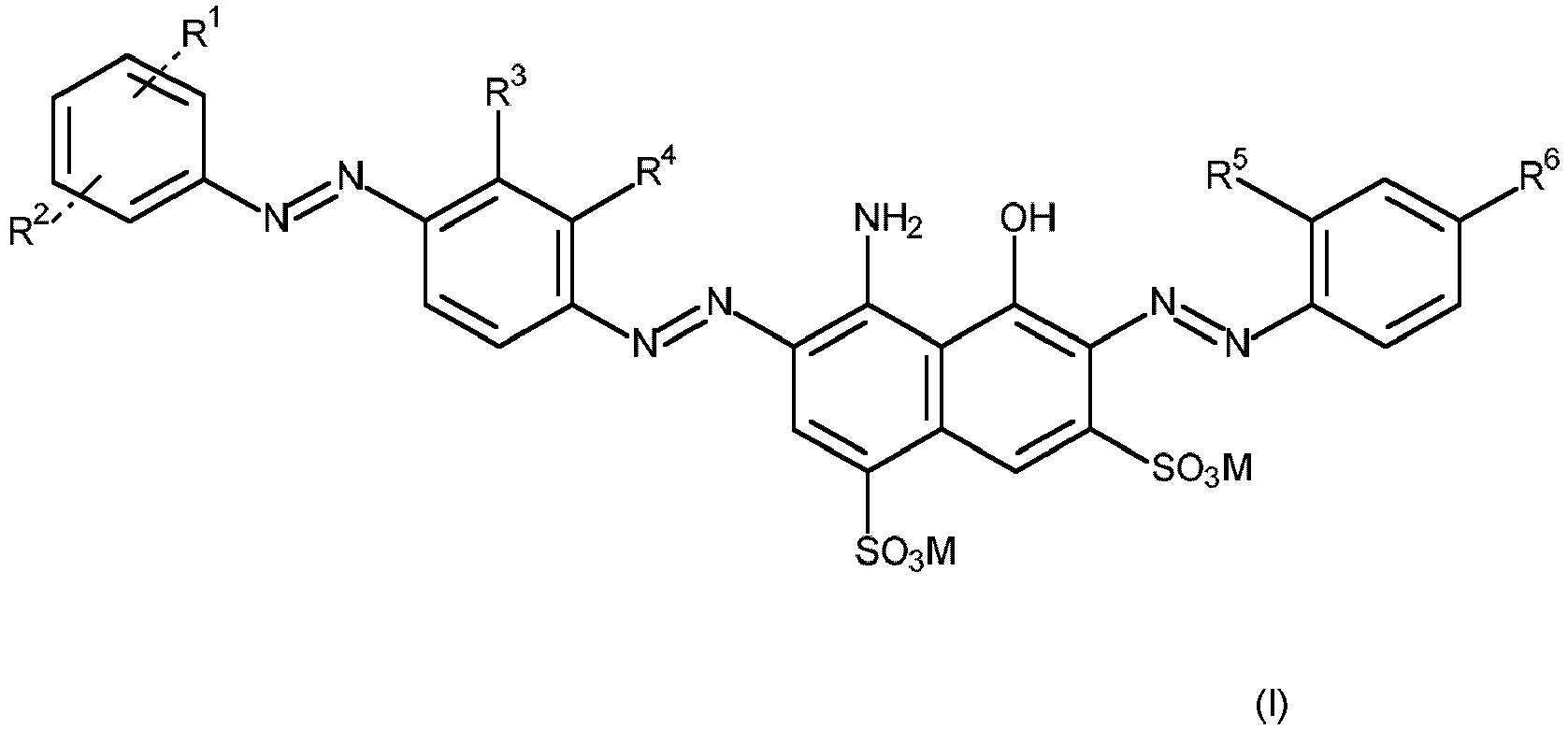
- Gegenstand der vorliegenden Erfindung sind Trisazoverbindungen der Formel (I)

- R1 für SO3M oder COOM steht, und
- R2 für SO3M oder COOM steht,
- R3 und R4 unabhängig voneinander für Wasserstoff oder CH3 stehen,
- R5 und R6 unabhängig voneinander für SO3M, COOM oder NO2 stehen, und
- M für Wasserstoff, ein einwertiges Metallkation, für Ammonium oder für Alkylammonium, welches ein- oder mehrfach, gleich oder verschieden durch C1-C4-Alkyl substituiert ist, steht.
- Bevorzugt sind Trisazoverbindungen der Formel (I), worin einer der Reste R5 oder R6 für NO2 steht, Als einwertige Metallkationen in der Bedeutung von M kommen beispielsweise Natrium-, Kalium-, oder Lithium-Ionen in Frage.
- Als Alkylammonium welches ein- oder mehrfach, gleich oder verschieden durch C1-C4-Alkyl substituiert ist kommen beispielsweise Trimethylammonium, Triethylammonium, Triisopropylammonium, Tributylammonium, in Frage, vorzugsweise Triethylammonium und Triisopropylammonium.
- Die Trisazoverbindungen der allgemeinen Formel (I) können als freie Säure oder in Form von anorganischen oder organischen Salzen. Bevorzugt liegen sie als Alkali- oder Ammoniumsalz, insbesondere als Natriumsalze vor.
- M in den Bedeutungen SO3M und COOM der Reste R1, R2, R3, R5 und R6 kann gleich oder verschieden sein. Vorzugsweise hat M in den Bedeutungen SO3M und COOM der Resten R1, R2, R3, R5 und R6 jeweils die gleiche Bedeutung.
- Bevorzugt sind Trisazoverbindungen der Formel (I) worin
- R1 für SO3M oder COOM steht, und
- R2 für SO3M oder COOM steht.
- R3 und R4 unabhängig voneinander für Wasserstoff oder CH3 stehen, und
- R5 und R6 unabhängig voneinander für SO3M, COOM oder NO2 stehen, mit der Maßgabe, dass einer der Reste R5 oder R6 für NO2 steht, und
- M für Wasserstoff, Natrium, Kalium, Lithium, Ammonium, oder Alkylammonium, welches ein- oder mehrfach, gleich oder verschieden durch C1-C2-Alkyl substituiert ist, steht.
- Besonders bevorzugt sind Trisazoverbindungen der Formel (I), worin
- R1 für SO3M oder COOM steht, und
- R2 für SO3M oder COOM steht.
- R3 und R4 unabhängig voneinander für Wasserstoff oder CH3 stehen, und
- R5 und R6 unabhängig voneinander für SO3M, COOM oder NO2 stehen,
- mit der Maßgabe, dass einer der Reste R5 oder R6 für NO2 steht, und
- M für Wasserstoff, Natrium, Kalium, Lithium, Ammonium, Trimethylammonium oder Triethylammonium steht.
- Ganz besonders bevorzugt sind Trisazoverbindungen der Formel (I), worin
- R1 für SO3M oder COOM steht, und
- R2 für SO3M oder COOM steht.
- R3 und R4 für Wasserstoff oder CH3 stehen,
- mit der Maßgabe, dass R3 und R4 nicht beide gleichzeitig für Wasserstoff und nicht beide gleichzeitig für CH3 stehen,
- R5 und R6 für SO3M, COOM oder NO2 stehen,
- mit der Maßgabe, dass einer der Reste R5 oder R6 für NO2 steht,
und - M für Wasserstoff, Natrium, Kalium, Lithium, Ammonium, Trimethylammonium oder Triethylammonium steht.
- Insbesondere bevorzugt sind solche Verbindungen der Formel (I), die den Formeln (la) oder (Ib)


worin - R1 für SO3M oder COOM steht, und
- R2 für SO3M oder COOM steht,
- R3 und R4 für Wasserstoff oder CH3 stehen,
- mit der Maßgabe, dass R3 und R4 nicht beide gleichzeitig für Wasserstoff und nicht beide gleichzeitig für CH3 stehen,
- R5 und R6 für SO3M, COOM oder NO2 stehen,
- mit der Maßgabe, dass einer der Reste R5 oder R6 für NO2 steht,
und - M für Wasserstoff, Natrium, Kalium, Lithium, Ammonium, Trimethylammonium oder Triethylammonium steht
- Insbesondere bevorzugt sind Verbindungen der Formel (I), (la) und (Ib),
worin - R1 für SO3M steht,
- R2 für SO3M steht,
- R3 und R4 für Wasserstoff oder CH3 stehen,
- mit der Maßgabe, dass R3 und R4 nicht beide gleichzeitig für Wasserstoff stehen und nicht beide gleichzeitig für CH3 stehen,
- R5 und R6 für SO3M, COOM oder NO2 stehen,
- mit der Maßgabe, dass einer der Reste R5 oder R6 für NO2 steht,
und - M für Wasserstoff, Natrium, Kalium, Lithium, Ammonium oder Triethylammonium steht.
- Ebenfalls insbesondere bevorzugt sind Verbindungen der Formel (I), (la) und (Ib),
worin - R1 für COOM steht,
- R2 für COOM steht,
- R3 und R4 für Wasserstoff oder CH3 stehen,
- mit der Maßgabe, dass R3 und R4 nicht beide gleichzeitig für Wasserstoff stehen und nicht beide gleichzeitig für CH3 stehen,
- R5 und R6 für SO3M, COOM oder NO2 stehen,
- mit der Maßgabe, dass einer der Reste R5 oder R6 für NO2 steht,
und - M für Wasserstoff, Natrium, Kalium, Lithium, Ammonium oder Triethylammonium steht.
- Die erfindungsgemäßen Trisazoverbindungen der Formel (I) eignen sich hervorragend zum Färben und Bedrucken unterschiedlicher Materialien, insbesondere in schwarzen Farbtönen.
- Die erfindungsgemäßen Trisazoverbindungen der Fomel (I) eignen sich insbesondere zum Färben und Bedrucken von cellulosehaltigen Materialien, insbesondere Papier, Baumwolle, Leinen und Viskose, von tierischen Häuten und Haaren, insbesondere Leder und Wolle, von Eierschalen sowie nanoporösen Materialien und Metallen..
- Die erfindungsgemäßen Trisazoverbindungen können vorzugsweise zur Massen- oder Oberflächenfärbung von Papier eingesetzt werden. Die Farbstoffe können auch zum Färben von Garnen und Stückwaren aus Baumwolle, Viskose und Leinen im Ausziehverfahren aus einer langen Flotte oder im kontinuierlichen Verfahren verwendet werden.
- Insbesondere eigenen sich die erfindungsgemäßen Trisazoverbindungen als Farbstoffe für wässrige und auf organischen Lösungsmitteln basierte Tinten, insbesondere als Aufzeichnungsflüssigkeiten für den Tintenstrahldruck (Ink-Jet Druck) sowie als Farbstoffe für Schreibvorrichtungen wie z.B Stifte und Stempel. Insbesondere eignen sie sich für den Tintenstrahldruck auf porösen, insbesondere auf nanoporösen Aufzeichnungsblättern sowie auf Metallen, Papier und anderen cellulosehaltien Materialien sowie Eierschalen.
- Nanoporöse Aufzeichnungsblätter sind beispielsweise Blätter aus nanoporösen anorganischen Verbindungen wie zum Beispiel Siliziumdioxid, Aluminiumoxid/Hydroxid, Aluminiumoxid oder deren Mischungen.
- Die erfindungsgemäßen Trisazoverbindungen eignen sich insbesondere als Färbemittel für die Herstellung von flüssigen Formulierungen für den Tintenstrahldruck und für Schreibvorrichtungen. oder bei der Herstellung von Farbfiltern für optische und optoelektonische Anwendungen.
- Die dabei erhaltenen Färbungen und Drucke entsprechen den höchsten qualitativen Anforderungen. Überraschender Weise zeichnen sich die erfindungsgemäßen Trisazoverbindungen der Formel (I) dadurch aus, dass sie in wässriger Lösung eine deutlich verbesserte Lagerstabilität aufweisen. Hierdurch ist es möglich die wässrigen Lösungen der erfindungsgemäßen Trisazoverbindungen über längere Zeiträume zu lagern, ohne dass sich Farbstärke und Farbort der Lösungen verändern.
- Weiterer Gegenstand der vorliegenden Erfindung sind Formulierungen, insbesondere flüssige Formulierungen, enthaltend mindestens eine Trisazoverbindung der Formel (I) und die Verwendung dieser Formulierungen als Färbezusammensetzung für Färbe- und Druckanwendungen, insbesondere als Aufzeichnungsflüssigkeiten für den Tintenstrahldruck und für Schreibgeräte.
- Die erfindungsgemäßen flüssigen Formulierung enthalten im Allgemeinen 0,5 bis 25 Gew.-%, bevorzugt 1,0 bis 15 Gew.-% und besonders bevorzugt 2,0 bis 8,0 Gew.-% an mindestens einer Trisazoverbindung der Formel (I) bezogen auf die gesamte Formulierung.
- Die erfindungsgemäßen Formulierung sind vorzugsweise wasserbasiert. Sie enthalten im Allgemeinen40 bis 99 Gew.-%, vorzugsweise 70 bis 95 Gew.-% Wasser und gegebenenfalls einen oder mehrere der folgenden Zusatzstoffe aus der Reihe N-Methyl-2-pyrrolidon, 2-Pyrrolidon, 2-Hexylpyrrolidon, Hydroxyethylpyrrolidon, 2-Propanol, Ethandiol, 1,2-Hexandiol, 1,2-Butandiol, Trimethylolpropan, Diethylenglykol, Diethylenglykolmonobutylether, Triethylenglycolmonobutylether, Dipropylenglykolmonobutylether, Gylcerin, Butyllactat, Harnstoff, Sulfolan, Gylcolether und Biozide, wobei die Gesamtmenge aller Zusatzstoffe 0.01 bis 50 Gew.-%, vorzugsweise 0.1 bis 20 Gew.-%() bezogen auf die gesamte Formulierung beträgt.
- Die erfindungsgemäßen flüssigen Formulierungen können auch auf organischen Lösungsmitteln basiert sein. In diesem Fall enthalten die Formulierungen im Allgemeinen 40 bis 99 Gew.-%, vorzugsweise 70bis 95 Gew.-% an mindestens einem Lösungsmittel aus der Reihe N-Methyl-2-pyrrolidon, 2-Pyrrolidon, 2-Hexylpyrrolidon, Hydroxyethylpyrrolidon, 2-Propanol, Ethandiol, 1,2-Hexandiol, 1,2-Butandiol, Trimethylolpropan, Diethylenglykol, Diethylenglykolmonobutylether, Triethylenglycolmonobutylether, Dipropylenglykolmonobutylether, Gylcerin, Butyllactat und gegebenenfalls einen oder mehrere der folgenden Zusatzstoffe aus der Reihe Harnstoff, Sulfolan, Gylcolether, Biozide, wobei die Gesamtmenge aller Zusatzstoffe 0.01 bis 50 Gew.-%, vorzugsweise 0.1 bis 20 Gew.-% bezogen auf die gesamte Formulierung beträgt.
- Die erfindungsgemäßen Formulierungen können hergestellt werden indem man mindestens eine erfindungsgemäße Trisazoverbindung der Formel (I) mit Wasser und/oder mindestens einem organischen Lösungsmittel und gegebenenfalls mit einem oder mehreren Zusatzstoffen mischt.
- Weiterer Gegenstand der vorliegenden Erfindung ist die Verwendung einer erfindungsgemäßen Formulierung als Färbezusammensetzung, insbesondere Tinte, Aufzeichnungsflüssigkeit oder Textilfärbemittel.
- Die erfindungsgemäßen Trisazoverbindungen der Formel (I) können hergestellt werden durch Umsetzung mindestens einer Verbindung der Formel (II)

- R1 und R2 die für Formel (I) angegebenen Bedeutungen haben,
- mit einem Diazotierungsreagenz
- und anschließender Umsetzung der Reaktionsmischung mit mindestens einer Verbindung der Formel (III)
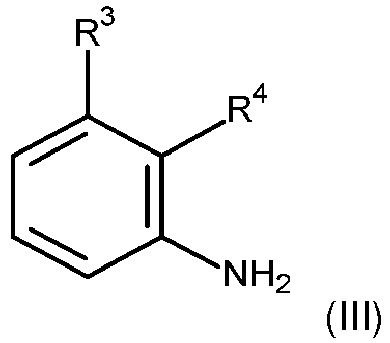
- R3 und R4 die für Formel (I) angegebenen Bedeutungen haben,
- zu dem Zwischenprodukt der (Formel IV)

- R1, R2, R3 und R4 die für Formel (I) angegebenen Bedeutungen haben, und weiterer Umsetzung des Zwischenprodukts der Formel (IV) mit einem Diazotierungsreagenz und anschließender Umsetzung der so erhaltenen Reaktionsmischung mit
- einer Verbindung der Formel (V)

- unter Bildung des Zwischenprodukts der Formel (VI)

- R1, R2, R3 und R4 die für Formel (I) angegebenen Bedeutungen haben,
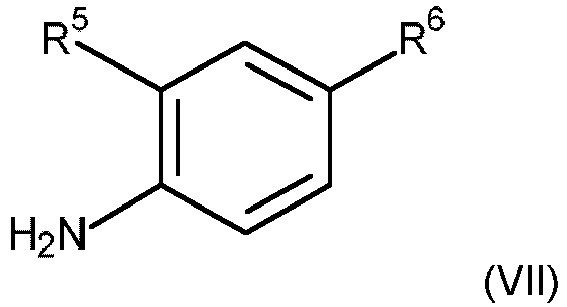
- nachfolgender Umsetzung des Zwischenprodukts der Formel (VI) mit dem Umsetzungsprodukt das erhältlich ist durch Umsetzung einer Verbindung der Formel (VII)

- worin R5 und R6 die für Formel (I) angegebenen Bedeutungen haben, mit einem Diazotierungsreagenz.
- Als Diazotierungsreagenz eignen sich anorganische und organische Nitrite, Nitrosylschwefelsäure vorzugsweise Natriumnitrit oder Methylnitrit.
- Die Durchführung der Diazotierungsschritte des erfindungsgemäßen Verfahrens erfolgt in dem Fachmann bekannter Art und Weise. Der pH-Wert für die Diazotierungschritte kann in einem weiten Bereich variiert werden. Üblicherweise kann der pH-Wert im Bereich von 0 bis 12 liegen.
- Das Diazotierungsreagenz kann einzeln oder in beliebiger Mischung untereinander eingesetzt werden. Das erfindungsgemäße Herstellverfahren wird üblicherweise in einem Temperaturbereich von -20°C bis +90°C, vorzugsweise von -10°C bis +60°C durchgeführt.
- Zweckmäßigerweise werden die einzelnen Schritte des erfindungsgemäßen Verfahrens bei Umgebungsdruck vorgenommen, man kann die Umsetzung jedoch auch im Bereich von 1000 bis 10000 hPa, vorzugsweise 10 bis 5000 hPa durchführen. Unter Umgebungsdruck ist ein Luftdruck im Bereich von etwa 925 hPa bis 1070 hPa zu verstehen.
- Die erfindungsgemäßen Trisazoverbindungen werden üblicherweise nicht isoliert, sondern direkt in der entstehenden, wässrigen Lösung weiterverwendet. Eine Aufreinigung der Produktlösung z.B. durch den Einsatz von Ionentauschern oder Druckpermeation ist möglich aber nicht zwingend notwendig. Zur Aufarbeitung und Isolierung der erfindungsgemäßen Trisazofarbstoffe ist es aber möglich diese mit Ethanol zu fällen und auf einer Filternutsche zu waschen.
- Die folgenden Beispiele sollen die vorliegende Erfindung erläutern ohne sie jedoch darauf zu beschränken.
- Beispiel A ist der nicht erfindungsgemäße Farbstoff C.I. Acid Black 1 entsprechend der Formel

- Beispiel B ist der nicht erfindungsgemäße Farbstoff C.I. Direct Black 19 entsprechend der Formel

- 1,00 mmol 5-Aminoisophtahlsäurewurden in 80 Äquivalenten Wasser suspendiert. Anschließend wurden 2,50 Äquivalente Salzsäure in Form einer 37%igen wässrigen Lösung hinzugefügt und das Reaktionsgemisch auf 2 °C abgekühlt. Eine 40%ige wässrige Natriumnitrit-Lösung wurde in äquimolarer Menge hinzugefügt und die Mischung 1 Stunde bei 3 °C gerührt. Der Nitrit Überschuss wurde durch Zugabe von Amidosulfonsäure entfernt. Anschließend wurde eine äquimolare Menge m-Toluidin in Wasser suspendiert und innerhalb von 60 Minuten zu dem Reaktionsgemisch hinzugefügt. Anschließend wurde der pH-Wert der Reaktionsmischung mit Salzsäure auf pH 1,8 eingestellt und für 30 Minuten gerührt. Der schwarze Niederschlag wurde durch Filtration isoliert und mit salzsaurem Wasser (1%ige wässrige HCl-Lösung) gewaschen.
- Der Filterkuchen wurde in 80 Äquivalenten Wasser suspendiert und bei 4 °C für 40 Minuten gerührt.
- Anschließend wurden 2,75 Äquivalente HCl zugegeben und anschließend über einen Zeitraum von 60 Minuten eine äquimolare Menge einer 40%igen wässrigen Natriumnitrit-Lösung zudosiert. Der Nitrit Überschuss wurde durch Zugabe von Amidosulfonsäure entfernt. Anschließend wurde eine äquimolare Menge 4-Amino-5-hydroxynaphthalin-1,7-disulfonsäure zugegeben und die Suspension für 2 Stunden gerührt. Die Suspension wurde auf 15 °C erwärmt und der pH-Wert durch Zugabe wässriger HCl Lösung auf 1,1 eingestellt. Anschließend wurde das Reaktionsgemisch für 12 Stunden gerührt und der pH-Wert mit einer wässrigen NaOH-Lösung auf 7,7 gestellt (Suspension 1). Eine äquimolaren Menge 4-[(4-Amino-3-nitrophenyl)amino]-4-oxobutansäurewurde in 70 Äquivalenten Wasser suspendiert und 4 Äquivalente Salzsäure hinzugefügt. Anschließend wurde eine äquimolare Menge einer wässrigen Natriumnitrit-Lösung hinzugefügt. Der Nitrit Überschuss wurde durch Zugabe von Amidosulfonsäure entfernt. Zu dieser Suspension wurde die Suspension 1 bei einer Temperatur von 3 °C zudosiert. Der pH Wert wurde mit wässriger NaOH-Lösung auf 8,8 eingestellt. Anschließend wurde das Reaktionsgemisch auf Raumtemperatur erwärmt. Zur weiteren Aufreinigung wurde über ein SiO2-Bett (Celite ®) filtriert.
- Es wurden 0.42 mmol des Farbstoffs der Formel

- Die Herstellung des Farbstoffs des Beispiels 2 erfolgte analog zu Beispiel 1, mit dem Unterschied, dass anstelle von 5-Aminoisophtahlsäure eine äquimolare Mengen p-Aminobenzoesäure eingesetzt wurden. Es wurden 0.44 mmol des Farbstoffes der Formel

- Die Herstellung des Farbstoffs des Beispiels 3 erfolge analog zu Beispiel 1, mit dem Unterschied, dass anstelle von 5-Aminoisophthalsäure eine äquimolare Menge Anilin-2,4-disulfonsäure und anstelle von 4-[(4-Amino-3-nitrophenyl)amino]-4-oxobutansäure eine äquimolare Menge 4-Nitroanilin-2-sulfonsäure eingesetzt wurden. Es wurden 0.49 mmol des Farbstoffes der Formel

- Die Herstellung des Farbstoffs des Beispiels 4 erfolge analog zu Beispiel 1, mit dem Unterschied, dass anstelle von 5-Aminoisophthalsäure eine äquimolare Menge Anilin-2,4-disulfonsäure und anstelle von 4-[(4-Amino-3-nitrophenyl)amino]-4-oxobutansäure eine äquimolare Menge 2-Nitroanilin-4-sulfonsäure eingesetzt wurden. Es wurden 0.50 mmol des Farbstoffes der Formel

- Die Herstellung des Farbstoffs des Beispiel 5 erfolge analog zu Beispiel 1, mit dem Unterschied, dass anstelle von 5-Aminoisophthalsäure eine äquimolare Menge Anilin-2,4-disulfonsäure, anstelle von 4-[(4-Amino-3-nitrophenyl)amino]-4-oxobutansäure eine äquimolare Menge 2-Nitroanilin-4-sulfonsäure und anstelle von m_Toluidin eine äquimolare Menge o-Toluidin eingesetzt wurde. Es wurden 0.53 mmol des Farbstoffes der Formel

- Die Herstellung des Farbstoffs des Beispiels 6 erfolge analog zu Beispiel 1, mit dem Unterschied, dass anstelle von 5-Aminoisophthalsäure eine äquimolare Menge Anilin-2,4-disulfonsäure, anstelle von 4-[(4-Amino-3-nitrophenyl)amino]-4-oxobutansäure eine äquimolare Menge 4-Nitroanilin-2-sulfonsäure und anstelle von m_Toluidin eine äquimolare Menge o-Toluidin eingesetzt wurde. Es wurden 0.48 mmol des Farbstoffes der Formel

- Die Herstellung des Farbstoffs des Beispiels 7 erfolge analog zu Beispiel 1, mit dem Unterschied, dass anstelle von 5-Aminoisophthalsäure eine äquimolare Menge Anilin-2,5-disulfonsäure und anstelle von 4-[(4-Amino-3-nitrophenyl)amino]-4-oxobutansäure eine äquimolare Menge 4-Nitroanilin-2-sulfonsäure eingesetzt wurde. Es wurden 0.42 mmol des Farbstoffes der Formel

- Die Herstellung des Farbstoffs des Beispiels 8 erfolge analog zu Beispiel 1, mit dem Unterschied, dass anstelle von 5-Aminoisophthalsäure eine äquimolare Menge Anilin-2,5-disulfonsäure und anstelle von 4-[(4-Amino-3-nitrophenyl)amino]-4-oxobutansäure eine äquimolare Menge 2-Nitroanilin-4-sulfonsäure eingesetzt wurde. Es wurden 0.49 mmol des Farbstoffes der Formel

- Die Herstellung des Farbstoffs des Beispiels 9 erfolge analog zu Beispiel 1, mit dem Unterschied, dass anstelle von 5-Aminoisophthalsäure eine äquimolare Menge Anilin-2,5-disulfonsäure, anstelle von 4-[(4-Amino-3-nitrophenyl)amino]-4-oxobutansäure eine äquimolare Menge 2-Nitroanilin-4-sulfonsäure und anstelle von m_Toluidin eine äquimolare Menge o-Toluidin eingesetzt wurde. Es wurden 0.53 mmol des Farbstoffes der Formel

- Die Herstellung des Farbstoffs des Beispiels 10 erfolge analog zu Beispiel 1, mit dem Unterschied, dass anstelle von 5-Aminoisophthalsäure eine äquimolare Menge Anilin-2,5-disulfonsäure, anstelle von 4-[(4-Amino-3-nitrophenyl)amino]-4-oxobutansäure eine äquimolare Menge 4-Nitroanilin-2-sulfonsäure und anstelle von m_Toluidin eine äquimolare Menge o-Toluidin eingesetzt wurde. Es wurden 0.50 mmol des Farbstoffes der Formel

- Die Herstellung des Farbstoffs des Beispiels 11 erfolge analog zu Beispiel 1, mit dem Unterschied, dass anstelle von 5-Aminoisophthalsäure eine äquimolare Menge Anilin-2,5-disulfonsäure, anstelle von 4-[(4-Amino-3-nitrophenyl)amino]-4-oxobutansäure eine äquimolare Menge 4-Nitroanilin-2-sulfonsäure und anstelle von m_Toluidin eine äquimolare Menge o-Toluidin eingesetzt wurde. Im Anschluss an die Synthese werden 10.0 Äquivalente Ammoniumchlorid zugesetzt und das Reaktionsgemisch für 2h bei Raumtemperatur gerührt. Zur weiteren Aufreinigung wurde über ein SiO2-Bett (Celite ®) filtriert. Es wurden 0.49 mmol des Farbstoffes der Formel

- Die Herstellung des Farbstoffs des Beispiels 11 erfolge analog zu Beispiel 1, mit dem Unterschied, dass anstelle von 5-Aminoisophthalsäure eine äquimolare Menge Anilin-2,5-disulfonsäure, anstelle von 4-[(4-Amino-3-nitrophenyl)amino]-4-oxobutansäure eine äquimolare Menge 4-Nitroanilin-2-sulfonsäure und anstelle von m_Toluidin eine äquimolare Menge o-Toluidin eingesetzt wurde. Im Anschluss an die Synthese werden 10.0 Äquivalente Triethylamin zugesetzt und das Reaktionsgemisch für 2h bei Raumtemperatur gerührt. Zur weiteren Aufreinigung wurde über ein SiO2-Bett (Celite ®) filtriert. Es wurden 0.47 mmol des Farbstoffes der Formel

- Die Herstellung des Farbstoffs des Beispiels 13 erfolge analog zu Beispiel 1, mit dem Unterschied, dass anstelle von 5-Aminoisophthalsäure eine äquimolare Menge 4-Aminophthalsäure und anstelle von 4-[(4-Amino-3-nitrophenyl)amino]-4-oxobutansäure eine äquimolare Menge 2-Amino-4-nitrobenzoesäure eingesetzt wurden. Es wurden 0.50 mmol des Farbstoffes der Formel

- Die Herstellung des Farbstoffs des Beispiels 13 erfolge analog zu Beispiel 1, mit dem Unterschied, dass anstelle von 5-Aminoisophthalsäure eine äquimolare Menge 4-Aminophthalsäure und anstelle von 4-[(4-Amino-3-nitrophenyl)amino]-4-oxobutansäure eine äquimolare Menge 4-Nitroanilin-2-sulfonsäure eingesetzt wurden. Es wurden 0.52 mmol des Farbstoffes der Formel

- Der angegebene E1/1 Wert ist ein fiktiver Extinktionswert, den man erhalten würde, wenn man eine 1 gewichtsprozentige Lösung der jeweiligen Verbindung (gelöst in Wasser) in einer Küvette der Schichtdicke von 1 cm vermessen würde.
- Die Veränderung des E1/1 Wertes, sowie die Änderung des λmax Wertes dienen als Maß für die Lagerstabilität einer wässrigen Farbstofflösung. Zur Bestimmung der Lagerstabilität der erfindungsgemäßen und nicht erfindungsgemäßen Farbstoffe der Beispiele A und B sowie 1 bis 14 wurden jeweils wässrige Farbstofflösungen mit einer Konzentration von 19 Gew.-% hergestellt und diese Farbstofflösungen für 28 Tage bei 45 °C in einem geschlossenen Glasgefäß gelagert. Der E1/1 Wert wurde jeweils nach 0 Tagen und nach 28 Tagen entsprechend der oben beschriebenen Vorschrift gemessen. Die Veränderung des E1/1 Werts über diesen Zeitraum ergibt den Wert ΔE1/1 = E1/1 (28 Tage) - E1/1 (0 Tage). Die Veränderung des λmax Werts über diesen Zeitraum ergibt den Wert Δλmax = λmax (28 Tage) - λmax (0 Tage).
- Die Veränderung des E1/1 Wertes ist dabei ein Maß für den Farbstärkeverlust über den Lagerungszeitraum, die Veränderung des λmax Wertes ist ein Maß für die Verschiebung des Farbortes über den Lagerungszeitraum.
- Die Ergebnisse sind in Tabelle 1 wiedergegeben.
Tabelle 1 Beispiel erfindungsgemäß λmax Δ E1/1 bei λmax Δ λmax [nm] [nm] A nein 619 -14 5 B nein 618 -11 -6 1 nein 621 -7 -8 2 nein 622 -9 -5 3 ja 596 <-1 0 4 ja 615 -3 -1 5 ja 616 <-1 1 6 ja 595 -3 0 7 ja 596 <-1 1 8 ja 613 -3 -1 9 ja 613 -2 1 10 ja 598 -3 1 11 ja 598 -2 -1 12 ja 600 -2 0 13 ja 625 -3 1 14 ja 619 <-1 -1 Fazit: Wie aus Tabelle 1 ersichtlich ist zeigen die wässrigen Lösungen der erfindungsgemäßen Trisazoverbindungen der Beispiele 3 bis 14 auch nach längerer Lagerung über einen Zeitraum von 28 Tagen bei einer erhöhten Temperatur von 45 °C eine deutlich geringere Veränderung der Extinktionswerte sowie der λmax Werte gegenüber den nicht erfindungsgemäßen Farbstoffen der Beispiele A und B sowie 1 und 2 des Standes der Technik. Das bedeutet, bei den wässrigen Lösungen der erfindungsgemäßen Trisazoverbindungen bleiben Farbstärke und Farbort über einen Zeitraum von 28 Tagen nahezu unverändert, wo hingegen bei den nicht erfindungsgemäßen Farbstoffen deutliche Abweichungen feststellbar sind.
Claims (16)
- Trisazoverbindungen der Formel (I)
 R1 für SO3M oder COOM steht, undR2 für SO3M oder COOM steht,R3 und R4 unabhängig voneinander für Wasserstoff oder CH3 stehen,R5 und R6 unabhängig voneinander für SO3M, COOM oder NO2 stehen,
undM für Wasserstoff, ein einwertiges Metallkation, für Ammonium oder für Alkylammonium, welches ein- oder mehrfach, gleich oder verschieden durch C1-C4-Alkyl substituiert ist, steht. - Trisazoverbindungen gemäß Anspruch 1, dadurch gekennzeichnet, dassR1 für SO3M oder COOM steht,R2 für SO3M oder COOM steht,R3 und R4 unabhängig voneinander für Wasserstoff oder CH3 stehen, undR5 und R6 unabhängig voneinander für SO3M, COOM oder NO2 stehen,mit der Maßgabe, dass einer der Reste R5 oder R6 für NO2 steht,
undM für Wasserstoff, Natrium, Kalium, Lithium, Ammonium, oder Alkylammonium, welches ein- oder mehrfach, gleich oder verschieden durch C1-C2-Alkyl substituiert ist, steht. - Trisazoverbindungen gemäß Anspruch 1 oder 2, dadurch gekennzeichnet, dassR1 für SO3M oder COOM steht,R2 für SO3M oder COOM steht,R3 und R4 unabhängig voneinander für Wasserstoff oder CH3 stehen,
undR5 und R6 unabhängig voneinander für SO3M, COOM oder NO2 stehen,mit der Maßgabe, dass einer der Reste R5 oder R6 für NO2 steht, undM für Wasserstoff, Natrium, Kalium, Lithium, Ammonium, Trimethylammonium oder Triethylammonium steht. - Trisazoverbindungen gemäß einem der Ansprüche 1 bis 3, dadurch gekennzeichnet, dassR1 für SO3M oder COOM steht,R2 für SO3M oder COOM steht,R3 und R4 für Wasserstoff oder CH3 stehen,mit der Maßgabe, dass R3 und R4 nicht beide gleichzeitig für Wasserstoff und nicht beide gleichzeitig für CH3 stehen,R5 und R6 für SO3M, COOM oder NO2 stehen,mit der Maßgabe, dass einer der Reste R5 oder R6 für NOz steht,
undM für Wasserstoff, Natrium, Kalium, Lithium, Ammonium, Trimethylammonium oder Triethylammonium steht. - Trisazoverbindungen gemäß einem der Ansprüche 1 bis 4, dadurch gekennzeichnet, dass sie den Formeln (la) oder (Ib)


worinR1 für SO3M oder COOM steht,R2 für SO3M oder COOM steht,R3 und R4 für Wasserstoff oder CH3 stehen,mit der Maßgabe, dass R3 und R4 nicht beide gleichzeitig für Wasserstoff und nicht beide gleichzeitig für CH3 stehen,R5 und R6 für SO3M, COOM oder NOz stehen,mit der Maßgabe, dass einer der Reste R5 oder R6 für NOz steht,
undM für Wasserstoff, Natrium, Kalium, Lithium, Ammonium, Trimethylammonium oder Triethylammonium steht. - Trisazoverbindungen gemäß einem der Ansprüche 1 bis 5, dadurch gekennzeichnet, dassR1 für SO3M steht,R2 für SO3M steht,R3 und R4 für Wasserstoff oder CH3 stehen,mit der Maßgabe, dass R3 und R4 nicht beide gleichzeitig für Wasserstoff stehen und nicht beide gleichzeitig für CH3 stehen,R5 und R6 für SO3M, COOM oder NOz stehen,mit der Maßgabe, dass einer der Reste R5 oder R6 für NOz steht,
undM für Wasserstoff, Natrium, Kalium, Lithium, Ammonium oder Triethylammonium steht. - Trisazoverbindungen gemäß einem der Ansprüche 1 bis 6, dadurch gekennzeichnet, dassR1 für COOM steht,R2 für COOM steht,R3 und R4 für Wasserstoff oder CH3 stehen,mit der Maßgabe, dass R3 und R4 nicht beide gleichzeitig für Wasserstoff stehen und nicht beide gleichzeitig für CH3 stehen,R5 und R6 für SO3M, COOM oder NOz stehen,mit der Maßgabe, dass einer der Reste R5 oder R6 für NOz steht,
undM für Wasserstoff, Natrium, Kalium, Lithium, Ammonium oder Triethylammonium steht. - Trisazoverbindungen gemäß einem der Ansprüche 1 bis 7, dadurch gekennzeichnet, dass sie der Formel


- Verfahren zum Färben und Bedrucken von cellulosehaltien Materialien, tierischen Häuten, tierischen Haaren, Eierschalen, porösen Materialien und Metallen, dadurch gekennzeichnet, dass als Farbstoff mindestens eine Triazoverbindung gemäß einem der Ansprüche 1 bis 8 verwendet wird.
- Formulierung enthaltend mindestens eine Trisazoverbindung gemäß einem der Ansprüche 1 bis 8.
- Formulierung gemäß Anspruch 10, dadurch gekennzeichnet, dass es sich um eine flüssige Formulierung handelt.
- Formulierung gemäß Anspruch 10 oder 11, dadurch gekennzeichnet, dass sie 0,5 bis 25 Gew.-%, bevorzugt 1,0 bis 15 Gew.-% und besonders bevorzugt 2,0 bis 8,0 Gew.-% an mindestens einer Trisazoverbindung gemäß einem der Ansprüche 1 bis 8, jeweils bezogen auf die gesamte Formulierung, enthält.
- Formulierung gemäß einem der Ansprüche 10 bis 12, dadurch gekennzeichnet, dass sie 40 bis 99 Gew.-%, vorzugsweise 70 bis 95 Gew.-% Wasser und gegebenenfalls einen oder mehrere Zusatzstoffe aus der Reihe N-Methyl-2-pyrrolidon, 2-Pyrrolidon, 2-Hexylpyrrolidon, Hydroxyethylpyrrolidon, 2-Propanol, Ethandiol, 1,2-Hexandiol, 1,2-Butandiol, Trimethylolpropan, Diethylenglykol, Diethylenglykolmonobutylether, Triethylenglycolmonobutylether, Dipropylenglykolmonobutylether, Gylcerin, Butyllactat, Harnstoff, Sulfolan, Gylcolether und Biozide in einer Gesamtmenge von 0.01 bis 50 Gew.-%, vorzugsweise von 0.1 bis 20 Gew.-% bezogen auf die gesamte Formulierung enthält.
- Formulierung gemäß einem der Ansprüche 10 bis 13, dadurch gekennzeichnet, dass sie 40 bis 99 Gew.-%, vorzugsweise 70 bis 95 Gew.-% an mindestens einem Lösungsmittel aus der Reihe N-Methyl-2-pyrrolidon, 2-Pyrrolidon, 2-Hexylpyrrolidon, Hydroxyethylpyrrolidon, 2-Propanol, Ethandiol, 1,2-Hexandiol, 1,2-Butandiol, Trimethylolpropan, Diethylenglykol, Diethylenglykolmonobutylether, Triethylenglycolmonobutylether, Dipropylenglykolmonobutylether, Gylcerin, Butyllactat und gegebenenfalls einen oder mehrere Zusatzstoffe aus der Reihe Harnstoff, Sulfolan, Gylcolether, Biozide in einer Gesamtmenge von 0.01 bis 50 Gew.-%, vorzugsweise von 0.1 bis 20 Gew.-% bezogen auf die gesamte Formulierung enthält.
- Verwendung einer Formulierung gemäß einem der Ansprüche 10 bis 14 als Aufzeichnungsflüssigkeit für den Tintenstrahldruck, als Färbemittel in Schreibvorrichtungen oder bei der Herstellung von Farbfiltern für optische und optoelektonische Anwendungen.
- Verfahren zur Herstellung von Trisazoverbindungen gemäß einem der Ansprüche 1 bis 8, dadurch gekennzeichnet, dass mindestens eine Verbindung der Formel (II)
 R1 und R2 die in Anspruch 1 angegebenen Bedeutungen haben,mit einem Diazotierungsreagenz umgesetzt wird und anschließend die erhaltene Reaktionsmischung mit mindestens einer Verbindung der Formel (III)
 R3 und R4 die in Anspruch 1 angegebenen Bedeutungen haben,zu dem Zwischenprodukt der (Formel IV)
 R1, R2, R3 und R4 die in Anspruch 1 angegebenen Bedeutungen haben,umgesetzt wird und anschließend das Zwischenprodukt der Formel (IV) mit einem Diazotierungsreagenz umgesetzt wird und dann die so erhaltene Reaktionsmischung mit einer Verbindung der Formel (V)
 zu dem Zwischenprodukt der Formel (VI)
 R1, R2, R3 und R4 die in Anspruch 1 angegebenen Bedeutungen haben,umgesetzt wird und nachfolgend das Zwischenprodukt der Formel (VI) weiter umgesetzt wird mit dem Umsetzungsprodukt das erhältlich ist durch Umsetzung einer Verbindung der Formel (VII)
 R5 und R6 die in Anspruch 1 angegebenen Bedeutungen haben,mit einem Diazotierungsreagenz und anschließend die gebildete Trisazoverbindung der Formel (I) durch Filtration der Reaktionsmischung isoliert wird.
Applications Claiming Priority (2)
| Application Number | Priority Date | Filing Date | Title |
|---|---|---|---|
| EP19178667 | 2019-06-06 | ||
| PCT/EP2020/065033 WO2020245052A1 (de) | 2019-06-06 | 2020-05-29 | Trisazoverbindungen für den tintenstrahldruck |
Publications (2)
| Publication Number | Publication Date |
|---|---|
| EP3980497A1 EP3980497A1 (de) | 2022-04-13 |
| EP3980497B1 true EP3980497B1 (de) | 2024-10-23 |
Family
ID=66776177
Family Applications (1)
| Application Number | Title | Priority Date | Filing Date |
|---|---|---|---|
| EP20734318.7A Active EP3980497B1 (de) | 2019-06-06 | 2020-05-29 | Trisazoverbindungen für den tintenstrahldruck |
Country Status (14)
| Country | Link |
|---|---|
| US (1) | US20220235000A1 (de) |
| EP (1) | EP3980497B1 (de) |
| JP (1) | JP7387768B2 (de) |
| KR (1) | KR20220018987A (de) |
| CN (1) | CN113906009B (de) |
| CA (1) | CA3142257A1 (de) |
| ES (1) | ES2998468T3 (de) |
| IL (1) | IL288549B2 (de) |
| MX (1) | MX2021014373A (de) |
| MY (1) | MY208090A (de) |
| PH (1) | PH12021553045A1 (de) |
| PL (1) | PL3980497T3 (de) |
| TW (1) | TWI846880B (de) |
| WO (1) | WO2020245052A1 (de) |
Family Cites Families (5)
| Publication number | Priority date | Publication date | Assignee | Title |
|---|---|---|---|---|
| US4988804A (en) * | 1987-11-10 | 1991-01-29 | Ciba-Geigy Corporation | Polyazo dyes obtained by successive coupling of H-acid and two further anilinic diazo components on resorcinol or the like |
| JP2993161B2 (ja) * | 1991-04-01 | 1999-12-20 | 三菱化学株式会社 | 記録液 |
| CN1095862C (zh) * | 1997-04-24 | 2002-12-11 | 日本化药株式会社 | 水溶性三偶氮化合物和水性油墨组合物 |
| CN102292399A (zh) * | 2008-11-20 | 2011-12-21 | 德司达染料德国有限责任公司 | 环氟化活性染料 |
| EP3020770A1 (de) * | 2014-11-17 | 2016-05-18 | DFI Chem GmbH | Schwarze Trisazofarbstoffe, deren Herstellung und deren Verwendung |
-
2020
- 2020-05-29 PL PL20734318.7T patent/PL3980497T3/pl unknown
- 2020-05-29 WO PCT/EP2020/065033 patent/WO2020245052A1/de not_active Ceased
- 2020-05-29 IL IL288549A patent/IL288549B2/en unknown
- 2020-05-29 EP EP20734318.7A patent/EP3980497B1/de active Active
- 2020-05-29 MY MYPI2021007191A patent/MY208090A/en unknown
- 2020-05-29 CA CA3142257A patent/CA3142257A1/en active Pending
- 2020-05-29 PH PH1/2021/553045A patent/PH12021553045A1/en unknown
- 2020-05-29 MX MX2021014373A patent/MX2021014373A/es unknown
- 2020-05-29 US US17/615,145 patent/US20220235000A1/en not_active Abandoned
- 2020-05-29 CN CN202080041449.6A patent/CN113906009B/zh active Active
- 2020-05-29 JP JP2021572483A patent/JP7387768B2/ja active Active
- 2020-05-29 ES ES20734318T patent/ES2998468T3/es active Active
- 2020-05-29 KR KR1020217042970A patent/KR20220018987A/ko active Pending
- 2020-06-04 TW TW109118752A patent/TWI846880B/zh active
Also Published As
| Publication number | Publication date |
|---|---|
| JP2022535583A (ja) | 2022-08-09 |
| CA3142257A1 (en) | 2020-12-10 |
| IL288549B1 (en) | 2025-06-01 |
| KR20220018987A (ko) | 2022-02-15 |
| CN113906009B (zh) | 2024-01-30 |
| TWI846880B (zh) | 2024-07-01 |
| MX2021014373A (es) | 2022-01-06 |
| PH12021553045A1 (en) | 2022-07-25 |
| TW202106815A (zh) | 2021-02-16 |
| WO2020245052A1 (de) | 2020-12-10 |
| CN113906009A (zh) | 2022-01-07 |
| US20220235000A1 (en) | 2022-07-28 |
| IL288549B2 (en) | 2025-10-01 |
| IL288549A (en) | 2022-02-01 |
| PL3980497T3 (pl) | 2025-02-24 |
| JP7387768B2 (ja) | 2023-11-28 |
| MY208090A (en) | 2025-04-14 |
| EP3980497A1 (de) | 2022-04-13 |
| ES2998468T3 (en) | 2025-02-20 |
Similar Documents
| Publication | Publication Date | Title |
|---|---|---|
| EP0585659B2 (de) | Verwendung von flüssigen Farbstoffpräparationen, enthaltend einen Disazofarbstoff, im Ink-Jet-Verfahren | |
| EP2169009B1 (de) | Anthrapyridon-Farbstoffe, ihre Herstellung und Verwendung | |
| DE102011100935A1 (de) | Blaue, rote und gelbe Farbstoffverbindungen sowie schwarze Tintenzusammensetzung, die sie enthält | |
| EP0971003B1 (de) | Wasserlösliche schwarze Stilbenfarbstoffe, ihre Herstellung und Verwendung | |
| DE2740152A1 (de) | Verfahren zur herstellung von disazofarbstoffen | |
| DE60308404T2 (de) | Farben für tintenstrahldrucker auf basis eines tris-azo farbstoffes | |
| DE2329135C3 (de) | Disazoreaktivfarbstoffe | |
| DE3529495A1 (de) | Waessrige farbstoffzubereitung, ihre herstellung und verwendung | |
| EP2468822B1 (de) | Schwarze Trisazofarbstoffe, ihre Herstellung und Verwendung | |
| EP1031614B1 (de) | Monoazofarbstoffe, deren Herstellung und Verwendung | |
| HK40072462A (en) | Trisazo compounds for ink-jet printing | |
| WO2020245052A1 (de) | Trisazoverbindungen für den tintenstrahldruck | |
| EP0692523B1 (de) | Azofarbstoffe, deren Herstellung und Verwendung | |
| EP0534342A1 (de) | Wasserlösliche Monoazoverbindungen, Verfahren zu deren Herstellung und ihre Verwendung als Farbstoffe | |
| DE60009382T2 (de) | Kationischer Azofarbstoff für Tintenstrahltinte | |
| DE2533428C2 (de) | ||
| EP1403328B1 (de) | Kupferkomplex-Monoazofarbstoffe, deren Herstellung und Verwendung | |
| CH649773A5 (de) | Asymmetrische 1:2-chromkomplexe aromatischer azoverbindungen, verfahren zu ihrer herstellung und diese enthaltende praeparate. | |
| EP0311949A2 (de) | Wasserlösliche gelbe Monoazofarbstoffe | |
| DE4404341A1 (de) | Wasserlösliche Azoverbindungen, Verfahren zu deren Herstellung und ihre Verwendung als Farbstoffe | |
| HK40072462B (en) | Trisazo compounds for ink-jet printing | |
| DE19816553A1 (de) | Azoverbindungen, Verfahren zu ihrer Herstellung und ihre Verwendung als Farbstoffe | |
| DE2329129C3 (de) | Gelbe bis orangefarbene Diazofarbstoffe, und Ihre Verwendung | |
| DE1062367B (de) | Verfahren zur Herstellung von Monoazofarbstoffen | |
| DE1930230A1 (de) | Scharlachroter Farbstoff fuer Nylon mit verbesserter Loeslichkeit |
Legal Events
| Date | Code | Title | Description |
|---|---|---|---|
| STAA | Information on the status of an ep patent application or granted ep patent |
Free format text: STATUS: UNKNOWN |
|
| STAA | Information on the status of an ep patent application or granted ep patent |
Free format text: STATUS: THE INTERNATIONAL PUBLICATION HAS BEEN MADE |
|
| PUAI | Public reference made under article 153(3) epc to a published international application that has entered the european phase |
Free format text: ORIGINAL CODE: 0009012 |
|
| STAA | Information on the status of an ep patent application or granted ep patent |
Free format text: STATUS: REQUEST FOR EXAMINATION WAS MADE |
|
| 17P | Request for examination filed |
Effective date: 20220107 |
|
| AK | Designated contracting states |
Kind code of ref document: A1 Designated state(s): AL AT BE BG CH CY CZ DE DK EE ES FI FR GB GR HR HU IE IS IT LI LT LU LV MC MK MT NL NO PL PT RO RS SE SI SK SM TR |
|
| DAV | Request for validation of the european patent (deleted) | ||
| DAX | Request for extension of the european patent (deleted) | ||
| REG | Reference to a national code |
Ref country code: HK Ref legal event code: DE Ref document number: 40072462 Country of ref document: HK |
|
| GRAP | Despatch of communication of intention to grant a patent |
Free format text: ORIGINAL CODE: EPIDOSNIGR1 |
|
| STAA | Information on the status of an ep patent application or granted ep patent |
Free format text: STATUS: GRANT OF PATENT IS INTENDED |
|
| INTG | Intention to grant announced |
Effective date: 20240722 |
|
| GRAS | Grant fee paid |
Free format text: ORIGINAL CODE: EPIDOSNIGR3 |
|
| GRAA | (expected) grant |
Free format text: ORIGINAL CODE: 0009210 |
|
| STAA | Information on the status of an ep patent application or granted ep patent |
Free format text: STATUS: THE PATENT HAS BEEN GRANTED |
|
| AK | Designated contracting states |
Kind code of ref document: B1 Designated state(s): AL AT BE BG CH CY CZ DE DK EE ES FI FR GB GR HR HU IE IS IT LI LT LU LV MC MK MT NL NO PL PT RO RS SE SI SK SM TR |
|
| REG | Reference to a national code |
Ref country code: GB Ref legal event code: FG4D Free format text: NOT ENGLISH |
|
| REG | Reference to a national code |
Ref country code: CH Ref legal event code: EP |
|
| REG | Reference to a national code |
Ref country code: DE Ref legal event code: R096 Ref document number: 502020009567 Country of ref document: DE |
|
| REG | Reference to a national code |
Ref country code: IE Ref legal event code: FG4D Free format text: LANGUAGE OF EP DOCUMENT: GERMAN |
|
| REG | Reference to a national code |
Ref country code: NL Ref legal event code: FP |
|
| REG | Reference to a national code |
Ref country code: ES Ref legal event code: FG2A Ref document number: 2998468 Country of ref document: ES Kind code of ref document: T3 Effective date: 20250220 |
|
| REG | Reference to a national code |
Ref country code: LT Ref legal event code: MG9D |
|
| P01 | Opt-out of the competence of the unified patent court (upc) registered |
Free format text: CASE NUMBER: APP_4702/2025 Effective date: 20250128 |
|
| PG25 | Lapsed in a contracting state [announced via postgrant information from national office to epo] |
Ref country code: PT Free format text: LAPSE BECAUSE OF FAILURE TO SUBMIT A TRANSLATION OF THE DESCRIPTION OR TO PAY THE FEE WITHIN THE PRESCRIBED TIME-LIMIT Effective date: 20250224 Ref country code: IS Free format text: LAPSE BECAUSE OF FAILURE TO SUBMIT A TRANSLATION OF THE DESCRIPTION OR TO PAY THE FEE WITHIN THE PRESCRIBED TIME-LIMIT Effective date: 20250223 Ref country code: HR Free format text: LAPSE BECAUSE OF FAILURE TO SUBMIT A TRANSLATION OF THE DESCRIPTION OR TO PAY THE FEE WITHIN THE PRESCRIBED TIME-LIMIT Effective date: 20241023 |
|
| PG25 | Lapsed in a contracting state [announced via postgrant information from national office to epo] |
Ref country code: FI Free format text: LAPSE BECAUSE OF FAILURE TO SUBMIT A TRANSLATION OF THE DESCRIPTION OR TO PAY THE FEE WITHIN THE PRESCRIBED TIME-LIMIT Effective date: 20241023 |
|
| PGFP | Annual fee paid to national office [announced via postgrant information from national office to epo] |
Ref country code: BG Payment date: 20250317 Year of fee payment: 6 |
|
| PG25 | Lapsed in a contracting state [announced via postgrant information from national office to epo] |
Ref country code: NO Free format text: LAPSE BECAUSE OF FAILURE TO SUBMIT A TRANSLATION OF THE DESCRIPTION OR TO PAY THE FEE WITHIN THE PRESCRIBED TIME-LIMIT Effective date: 20250123 |
|
| PG25 | Lapsed in a contracting state [announced via postgrant information from national office to epo] |
Ref country code: LV Free format text: LAPSE BECAUSE OF FAILURE TO SUBMIT A TRANSLATION OF THE DESCRIPTION OR TO PAY THE FEE WITHIN THE PRESCRIBED TIME-LIMIT Effective date: 20241023 Ref country code: GR Free format text: LAPSE BECAUSE OF FAILURE TO SUBMIT A TRANSLATION OF THE DESCRIPTION OR TO PAY THE FEE WITHIN THE PRESCRIBED TIME-LIMIT Effective date: 20250124 |
|
| PGFP | Annual fee paid to national office [announced via postgrant information from national office to epo] |
Ref country code: PL Payment date: 20250312 Year of fee payment: 6 |
|
| PG25 | Lapsed in a contracting state [announced via postgrant information from national office to epo] |
Ref country code: RS Free format text: LAPSE BECAUSE OF FAILURE TO SUBMIT A TRANSLATION OF THE DESCRIPTION OR TO PAY THE FEE WITHIN THE PRESCRIBED TIME-LIMIT Effective date: 20250123 |
|
| PGFP | Annual fee paid to national office [announced via postgrant information from national office to epo] |
Ref country code: NL Payment date: 20250409 Year of fee payment: 6 |
|
| PG25 | Lapsed in a contracting state [announced via postgrant information from national office to epo] |
Ref country code: SM Free format text: LAPSE BECAUSE OF FAILURE TO SUBMIT A TRANSLATION OF THE DESCRIPTION OR TO PAY THE FEE WITHIN THE PRESCRIBED TIME-LIMIT Effective date: 20241023 |
|
| PGFP | Annual fee paid to national office [announced via postgrant information from national office to epo] |
Ref country code: DE Payment date: 20250402 Year of fee payment: 6 |
|
| PG25 | Lapsed in a contracting state [announced via postgrant information from national office to epo] |
Ref country code: DK Free format text: LAPSE BECAUSE OF FAILURE TO SUBMIT A TRANSLATION OF THE DESCRIPTION OR TO PAY THE FEE WITHIN THE PRESCRIBED TIME-LIMIT Effective date: 20241023 |
|
| PGFP | Annual fee paid to national office [announced via postgrant information from national office to epo] |
Ref country code: GB Payment date: 20250401 Year of fee payment: 6 Ref country code: ES Payment date: 20250603 Year of fee payment: 6 |
|
| PGFP | Annual fee paid to national office [announced via postgrant information from national office to epo] |
Ref country code: BE Payment date: 20250410 Year of fee payment: 6 Ref country code: IT Payment date: 20250422 Year of fee payment: 6 |
|
| PG25 | Lapsed in a contracting state [announced via postgrant information from national office to epo] |
Ref country code: EE Free format text: LAPSE BECAUSE OF FAILURE TO SUBMIT A TRANSLATION OF THE DESCRIPTION OR TO PAY THE FEE WITHIN THE PRESCRIBED TIME-LIMIT Effective date: 20241023 |
|
| PGFP | Annual fee paid to national office [announced via postgrant information from national office to epo] |
Ref country code: FR Payment date: 20250401 Year of fee payment: 6 |
|
| PGFP | Annual fee paid to national office [announced via postgrant information from national office to epo] |
Ref country code: CH Payment date: 20250601 Year of fee payment: 6 |
|
| PG25 | Lapsed in a contracting state [announced via postgrant information from national office to epo] |
Ref country code: RO Free format text: LAPSE BECAUSE OF FAILURE TO SUBMIT A TRANSLATION OF THE DESCRIPTION OR TO PAY THE FEE WITHIN THE PRESCRIBED TIME-LIMIT Effective date: 20241023 |
|
| PGFP | Annual fee paid to national office [announced via postgrant information from national office to epo] |
Ref country code: AT Payment date: 20250425 Year of fee payment: 6 |
|
| REG | Reference to a national code |
Ref country code: DE Ref legal event code: R097 Ref document number: 502020009567 Country of ref document: DE |
|
| PG25 | Lapsed in a contracting state [announced via postgrant information from national office to epo] |
Ref country code: SK Free format text: LAPSE BECAUSE OF FAILURE TO SUBMIT A TRANSLATION OF THE DESCRIPTION OR TO PAY THE FEE WITHIN THE PRESCRIBED TIME-LIMIT Effective date: 20241023 |
|
| PGFP | Annual fee paid to national office [announced via postgrant information from national office to epo] |
Ref country code: CZ Payment date: 20250521 Year of fee payment: 6 |
|
| PLBE | No opposition filed within time limit |
Free format text: ORIGINAL CODE: 0009261 |
|
| STAA | Information on the status of an ep patent application or granted ep patent |
Free format text: STATUS: NO OPPOSITION FILED WITHIN TIME LIMIT |
|
| PG25 | Lapsed in a contracting state [announced via postgrant information from national office to epo] |
Ref country code: SE Free format text: LAPSE BECAUSE OF FAILURE TO SUBMIT A TRANSLATION OF THE DESCRIPTION OR TO PAY THE FEE WITHIN THE PRESCRIBED TIME-LIMIT Effective date: 20241023 |
|
| 26N | No opposition filed |
Effective date: 20250724 |
|
| PG25 | Lapsed in a contracting state [announced via postgrant information from national office to epo] |
Ref country code: LU Free format text: LAPSE BECAUSE OF NON-PAYMENT OF DUE FEES Effective date: 20250529 |
|
| PG25 | Lapsed in a contracting state [announced via postgrant information from national office to epo] |
Ref country code: MC Free format text: LAPSE BECAUSE OF FAILURE TO SUBMIT A TRANSLATION OF THE DESCRIPTION OR TO PAY THE FEE WITHIN THE PRESCRIBED TIME-LIMIT Effective date: 20241023 |
|
| PG25 | Lapsed in a contracting state [announced via postgrant information from national office to epo] |
Ref country code: IE Free format text: LAPSE BECAUSE OF NON-PAYMENT OF DUE FEES Effective date: 20250529 |