EP3981894A1 - Procédé de traitement thermique pour acier à haute résistance et produit obtenu à partir de celui-ci - Google Patents
Procédé de traitement thermique pour acier à haute résistance et produit obtenu à partir de celui-ci Download PDFInfo
- Publication number
- EP3981894A1 EP3981894A1 EP19932761.0A EP19932761A EP3981894A1 EP 3981894 A1 EP3981894 A1 EP 3981894A1 EP 19932761 A EP19932761 A EP 19932761A EP 3981894 A1 EP3981894 A1 EP 3981894A1
- Authority
- EP
- European Patent Office
- Prior art keywords
- steel
- less
- strength
- equal
- carbide
- Prior art date
- Legal status (The legal status is an assumption and is not a legal conclusion. Google has not performed a legal analysis and makes no representation as to the accuracy of the status listed.)
- Pending
Links
Images

Classifications
-
- C—CHEMISTRY; METALLURGY
- C21—METALLURGY OF IRON
- C21D—MODIFYING THE PHYSICAL STRUCTURE OF FERROUS METALS; GENERAL DEVICES FOR HEAT TREATMENT OF FERROUS OR NON-FERROUS METALS OR ALLOYS; MAKING METAL MALLEABLE, e.g. BY DECARBURISATION OR TEMPERING
- C21D1/00—General methods or devices for heat treatment, e.g. annealing, hardening, quenching or tempering
- C21D1/26—Methods of annealing
-
- C—CHEMISTRY; METALLURGY
- C21—METALLURGY OF IRON
- C21D—MODIFYING THE PHYSICAL STRUCTURE OF FERROUS METALS; GENERAL DEVICES FOR HEAT TREATMENT OF FERROUS OR NON-FERROUS METALS OR ALLOYS; MAKING METAL MALLEABLE, e.g. BY DECARBURISATION OR TEMPERING
- C21D1/00—General methods or devices for heat treatment, e.g. annealing, hardening, quenching or tempering
- C21D1/18—Hardening; Quenching with or without subsequent tempering
-
- C—CHEMISTRY; METALLURGY
- C21—METALLURGY OF IRON
- C21D—MODIFYING THE PHYSICAL STRUCTURE OF FERROUS METALS; GENERAL DEVICES FOR HEAT TREATMENT OF FERROUS OR NON-FERROUS METALS OR ALLOYS; MAKING METAL MALLEABLE, e.g. BY DECARBURISATION OR TEMPERING
- C21D1/00—General methods or devices for heat treatment, e.g. annealing, hardening, quenching or tempering
- C21D1/18—Hardening; Quenching with or without subsequent tempering
- C21D1/19—Hardening; Quenching with or without subsequent tempering by interrupted quenching
-
- C—CHEMISTRY; METALLURGY
- C21—METALLURGY OF IRON
- C21D—MODIFYING THE PHYSICAL STRUCTURE OF FERROUS METALS; GENERAL DEVICES FOR HEAT TREATMENT OF FERROUS OR NON-FERROUS METALS OR ALLOYS; MAKING METAL MALLEABLE, e.g. BY DECARBURISATION OR TEMPERING
- C21D1/00—General methods or devices for heat treatment, e.g. annealing, hardening, quenching or tempering
- C21D1/26—Methods of annealing
- C21D1/28—Normalising
-
- C—CHEMISTRY; METALLURGY
- C21—METALLURGY OF IRON
- C21D—MODIFYING THE PHYSICAL STRUCTURE OF FERROUS METALS; GENERAL DEVICES FOR HEAT TREATMENT OF FERROUS OR NON-FERROUS METALS OR ALLOYS; MAKING METAL MALLEABLE, e.g. BY DECARBURISATION OR TEMPERING
- C21D1/00—General methods or devices for heat treatment, e.g. annealing, hardening, quenching or tempering
- C21D1/78—Combined heat-treatments not provided for above
-
- C—CHEMISTRY; METALLURGY
- C21—METALLURGY OF IRON
- C21D—MODIFYING THE PHYSICAL STRUCTURE OF FERROUS METALS; GENERAL DEVICES FOR HEAT TREATMENT OF FERROUS OR NON-FERROUS METALS OR ALLOYS; MAKING METAL MALLEABLE, e.g. BY DECARBURISATION OR TEMPERING
- C21D6/00—Heat treatment of ferrous alloys
- C21D6/002—Heat treatment of ferrous alloys containing Cr
-
- C—CHEMISTRY; METALLURGY
- C21—METALLURGY OF IRON
- C21D—MODIFYING THE PHYSICAL STRUCTURE OF FERROUS METALS; GENERAL DEVICES FOR HEAT TREATMENT OF FERROUS OR NON-FERROUS METALS OR ALLOYS; MAKING METAL MALLEABLE, e.g. BY DECARBURISATION OR TEMPERING
- C21D6/00—Heat treatment of ferrous alloys
- C21D6/005—Heat treatment of ferrous alloys containing Mn
-
- C—CHEMISTRY; METALLURGY
- C21—METALLURGY OF IRON
- C21D—MODIFYING THE PHYSICAL STRUCTURE OF FERROUS METALS; GENERAL DEVICES FOR HEAT TREATMENT OF FERROUS OR NON-FERROUS METALS OR ALLOYS; MAKING METAL MALLEABLE, e.g. BY DECARBURISATION OR TEMPERING
- C21D6/00—Heat treatment of ferrous alloys
- C21D6/008—Heat treatment of ferrous alloys containing Si
-
- C—CHEMISTRY; METALLURGY
- C21—METALLURGY OF IRON
- C21D—MODIFYING THE PHYSICAL STRUCTURE OF FERROUS METALS; GENERAL DEVICES FOR HEAT TREATMENT OF FERROUS OR NON-FERROUS METALS OR ALLOYS; MAKING METAL MALLEABLE, e.g. BY DECARBURISATION OR TEMPERING
- C21D6/00—Heat treatment of ferrous alloys
- C21D6/02—Hardening by precipitation
-
- C—CHEMISTRY; METALLURGY
- C21—METALLURGY OF IRON
- C21D—MODIFYING THE PHYSICAL STRUCTURE OF FERROUS METALS; GENERAL DEVICES FOR HEAT TREATMENT OF FERROUS OR NON-FERROUS METALS OR ALLOYS; MAKING METAL MALLEABLE, e.g. BY DECARBURISATION OR TEMPERING
- C21D9/00—Heat treatment, e.g. annealing, hardening, quenching or tempering, adapted for particular articles; Furnaces therefor
- C21D9/0075—Heat treatment, e.g. annealing, hardening, quenching or tempering, adapted for particular articles; Furnaces therefor for rods of limited length
-
- C—CHEMISTRY; METALLURGY
- C21—METALLURGY OF IRON
- C21D—MODIFYING THE PHYSICAL STRUCTURE OF FERROUS METALS; GENERAL DEVICES FOR HEAT TREATMENT OF FERROUS OR NON-FERROUS METALS OR ALLOYS; MAKING METAL MALLEABLE, e.g. BY DECARBURISATION OR TEMPERING
- C21D9/00—Heat treatment, e.g. annealing, hardening, quenching or tempering, adapted for particular articles; Furnaces therefor
- C21D9/02—Heat treatment, e.g. annealing, hardening, quenching or tempering, adapted for particular articles; Furnaces therefor for springs
-
- C—CHEMISTRY; METALLURGY
- C22—METALLURGY; FERROUS OR NON-FERROUS ALLOYS; TREATMENT OF ALLOYS OR NON-FERROUS METALS
- C22C—ALLOYS
- C22C38/00—Ferrous alloys, e.g. steel alloys
- C22C38/02—Ferrous alloys, e.g. steel alloys containing silicon
-
- C—CHEMISTRY; METALLURGY
- C22—METALLURGY; FERROUS OR NON-FERROUS ALLOYS; TREATMENT OF ALLOYS OR NON-FERROUS METALS
- C22C—ALLOYS
- C22C38/00—Ferrous alloys, e.g. steel alloys
- C22C38/04—Ferrous alloys, e.g. steel alloys containing manganese
-
- C—CHEMISTRY; METALLURGY
- C22—METALLURGY; FERROUS OR NON-FERROUS ALLOYS; TREATMENT OF ALLOYS OR NON-FERROUS METALS
- C22C—ALLOYS
- C22C38/00—Ferrous alloys, e.g. steel alloys
- C22C38/18—Ferrous alloys, e.g. steel alloys containing chromium
- C22C38/22—Ferrous alloys, e.g. steel alloys containing chromium with molybdenum or tungsten
-
- C—CHEMISTRY; METALLURGY
- C22—METALLURGY; FERROUS OR NON-FERROUS ALLOYS; TREATMENT OF ALLOYS OR NON-FERROUS METALS
- C22C—ALLOYS
- C22C38/00—Ferrous alloys, e.g. steel alloys
- C22C38/18—Ferrous alloys, e.g. steel alloys containing chromium
- C22C38/24—Ferrous alloys, e.g. steel alloys containing chromium with vanadium
-
- C—CHEMISTRY; METALLURGY
- C22—METALLURGY; FERROUS OR NON-FERROUS ALLOYS; TREATMENT OF ALLOYS OR NON-FERROUS METALS
- C22C—ALLOYS
- C22C38/00—Ferrous alloys, e.g. steel alloys
- C22C38/18—Ferrous alloys, e.g. steel alloys containing chromium
- C22C38/26—Ferrous alloys, e.g. steel alloys containing chromium with niobium or tantalum
-
- C—CHEMISTRY; METALLURGY
- C22—METALLURGY; FERROUS OR NON-FERROUS ALLOYS; TREATMENT OF ALLOYS OR NON-FERROUS METALS
- C22C—ALLOYS
- C22C38/00—Ferrous alloys, e.g. steel alloys
- C22C38/18—Ferrous alloys, e.g. steel alloys containing chromium
- C22C38/28—Ferrous alloys, e.g. steel alloys containing chromium with titanium or zirconium
-
- C—CHEMISTRY; METALLURGY
- C22—METALLURGY; FERROUS OR NON-FERROUS ALLOYS; TREATMENT OF ALLOYS OR NON-FERROUS METALS
- C22C—ALLOYS
- C22C38/00—Ferrous alloys, e.g. steel alloys
- C22C38/18—Ferrous alloys, e.g. steel alloys containing chromium
- C22C38/38—Ferrous alloys, e.g. steel alloys containing chromium with more than 1.5% by weight of manganese
-
- C—CHEMISTRY; METALLURGY
- C22—METALLURGY; FERROUS OR NON-FERROUS ALLOYS; TREATMENT OF ALLOYS OR NON-FERROUS METALS
- C22C—ALLOYS
- C22C38/00—Ferrous alloys, e.g. steel alloys
- C22C38/18—Ferrous alloys, e.g. steel alloys containing chromium
- C22C38/40—Ferrous alloys, e.g. steel alloys containing chromium with nickel
- C22C38/44—Ferrous alloys, e.g. steel alloys containing chromium with nickel with molybdenum or tungsten
-
- C—CHEMISTRY; METALLURGY
- C22—METALLURGY; FERROUS OR NON-FERROUS ALLOYS; TREATMENT OF ALLOYS OR NON-FERROUS METALS
- C22C—ALLOYS
- C22C38/00—Ferrous alloys, e.g. steel alloys
- C22C38/18—Ferrous alloys, e.g. steel alloys containing chromium
- C22C38/40—Ferrous alloys, e.g. steel alloys containing chromium with nickel
- C22C38/46—Ferrous alloys, e.g. steel alloys containing chromium with nickel with vanadium
-
- C—CHEMISTRY; METALLURGY
- C22—METALLURGY; FERROUS OR NON-FERROUS ALLOYS; TREATMENT OF ALLOYS OR NON-FERROUS METALS
- C22C—ALLOYS
- C22C38/00—Ferrous alloys, e.g. steel alloys
- C22C38/18—Ferrous alloys, e.g. steel alloys containing chromium
- C22C38/40—Ferrous alloys, e.g. steel alloys containing chromium with nickel
- C22C38/48—Ferrous alloys, e.g. steel alloys containing chromium with nickel with niobium or tantalum
-
- F—MECHANICAL ENGINEERING; LIGHTING; HEATING; WEAPONS; BLASTING
- F16—ENGINEERING ELEMENTS AND UNITS; GENERAL MEASURES FOR PRODUCING AND MAINTAINING EFFECTIVE FUNCTIONING OF MACHINES OR INSTALLATIONS; THERMAL INSULATION IN GENERAL
- F16F—SPRINGS; SHOCK-ABSORBERS; MEANS FOR DAMPING VIBRATION
- F16F1/00—Springs
- F16F1/02—Springs made of steel or other material having low internal friction; Wound, torsion, leaf, cup, ring or the like springs, the material of the spring not being relevant
-
- F—MECHANICAL ENGINEERING; LIGHTING; HEATING; WEAPONS; BLASTING
- F16—ENGINEERING ELEMENTS AND UNITS; GENERAL MEASURES FOR PRODUCING AND MAINTAINING EFFECTIVE FUNCTIONING OF MACHINES OR INSTALLATIONS; THERMAL INSULATION IN GENERAL
- F16F—SPRINGS; SHOCK-ABSORBERS; MEANS FOR DAMPING VIBRATION
- F16F1/00—Springs
- F16F1/02—Springs made of steel or other material having low internal friction; Wound, torsion, leaf, cup, ring or the like springs, the material of the spring not being relevant
- F16F1/021—Springs made of steel or other material having low internal friction; Wound, torsion, leaf, cup, ring or the like springs, the material of the spring not being relevant characterised by their composition, e.g. comprising materials providing for particular spring properties
-
- C—CHEMISTRY; METALLURGY
- C21—METALLURGY OF IRON
- C21D—MODIFYING THE PHYSICAL STRUCTURE OF FERROUS METALS; GENERAL DEVICES FOR HEAT TREATMENT OF FERROUS OR NON-FERROUS METALS OR ALLOYS; MAKING METAL MALLEABLE, e.g. BY DECARBURISATION OR TEMPERING
- C21D2211/00—Microstructure comprising significant phases
- C21D2211/001—Austenite
-
- C—CHEMISTRY; METALLURGY
- C21—METALLURGY OF IRON
- C21D—MODIFYING THE PHYSICAL STRUCTURE OF FERROUS METALS; GENERAL DEVICES FOR HEAT TREATMENT OF FERROUS OR NON-FERROUS METALS OR ALLOYS; MAKING METAL MALLEABLE, e.g. BY DECARBURISATION OR TEMPERING
- C21D2211/00—Microstructure comprising significant phases
- C21D2211/004—Dispersions; Precipitations
-
- C—CHEMISTRY; METALLURGY
- C21—METALLURGY OF IRON
- C21D—MODIFYING THE PHYSICAL STRUCTURE OF FERROUS METALS; GENERAL DEVICES FOR HEAT TREATMENT OF FERROUS OR NON-FERROUS METALS OR ALLOYS; MAKING METAL MALLEABLE, e.g. BY DECARBURISATION OR TEMPERING
- C21D2211/00—Microstructure comprising significant phases
- C21D2211/008—Martensite
Definitions
- the present disclosure relates to a method of heat treating a high strength steel. More particular, the present disclosure relates to a method of heat treating a high strength steel so as to obtain a heat-treated steel exhibiting high strength, high ductility and high toughness simultaneously that is particularly suitable for manufacturing spring members, such as those for vehicle suspension.
- Spring members for vehicle suspension include, for example, leaf springs, stabilizer bars, coil springs, and the like.
- Leaf spring also referred to as leaf-spring, is often installed between the frame and axle.
- the stabilizer bar is a torsion bar spring.
- the stabilizer bar takes advantage of the elastic force of the bar body to prevent the wheels from lifting, prevent excessive lateral roll of the vehicle body, and try to keep the vehicle body balanced.
- the spring members for vehicle suspension bear the stress load repeatedly.
- the steel for preparing the spring members for vehicle suspension may have high strength.
- the Chinese application CN108239726A relates to a steel sheet for a high strength spring having excellent hydrogen embrittlement resistance and a method for preparing the same.
- the steel sheet comprises, by weight, 0.45-0.60% of C, 1.40-1.80% of Si, 0.30-0.80% of Mn, 0.20-0.70% of Cr, 0.05-0.15% of Mo, 0.05-0.20% of V, 0.010-0.030% of Nb, 0.006% or less of N, 0.015% or less of P, 0.015% or less of S.
- the relating process of heat treating includes the steps of: heating the steel to 880-1000°C for a time of 10s-30min, cooling at an average cooling rate of more than 10°C/s, further heating the steel sheet to 380-460 °C for a time of 10s-40min, and then cooling to 60°C or below at an average cooling rate of more than 10°C/s.
- CN108239726A believes that, by adding strong carbide-forming elements such as Nb, V and Mo, an amount of (V, Mo) C or (Nb, V and Mo) C particles with an average grain diameter of 10-60nm precipitate in the steel sheet, and the prior austenite grain size are also refined to a grade of 10 or more.
- the carbide particles have high interface activation energy, which can result in non-diffusive hydrogen capturing without diffusion due to external stress.
- the fine prior austenite grains, as well as the carbide nanoparticles in a sufficient amount ensure the excellent hydrogen embrittlement resistance for the steel sheet for a spring besides a tensile strength of more than 1900 MPa.
- the Chinese application CN106399837A relates to a steel for hot stamping and a hot forming process.
- the steel comprises, by weight, 0.27-0.40% C, 0-0.80% Si, 0.20-3.0% Mn, 0.10-0.4% V, 0-0.8% Si, 0-0.5% Al, 0-2% Cr, 0-0.15% Ti, 0-0.15% Nb, 0-0.004% B, and Mo, Ni and Cu in a total amount of less than 2%.
- the precipitation of nano-sized particles of VC and/or particles of composite carbides of V, Ti and Nb in the hot forming process is controlled, which may facilitate the strengthening by precipitation and grain refinement, reduce the carbon content of martensite and improve the toughness of steels.
- the properties of steels are further optimized.
- the obtained steel has a yield strength of 1350-1800MPa, a tensile strength of 1700-2150MPa, and an elongation of 7-10%.
- the reduction in area of tensile sample (also referred to as percentage reduction in area) is often used as an important indicator to show how good both of ductility and toughness of steels are.
- steels need to have both high ductility and high toughness.
- the ductility and toughness of the currently disclosed steels are not sufficient to meet the requirements on the reduction in area of tensile sample for preparing spring members for vehicle suspension.
- a method of heat treating which leads to a high-strength steel with improved reduction in area of tensile sample.
- a steel obtained by the above method of heat treating wherein the steel may comprise, by area, the microstructures of: greater than or equal to about 90% martensite, less than or equal to about 3% ferrite, less than or equal to about 5% retained austenite, and less than or equal to about 10% bainite;
- a spring member for vehicle suspension prepared from the above steel.
- the high-strength steel comprises, by weight: 0.32-0.42% C, 0.8% or less Si, 0.2-1.5% Cr, 0.2-0.4% Mo, 0.12-0.3% V, and a balance of Fe and other alloy elements and impurities, wherein the above alloy elements make Eq(Mn) of the formula (1) no less than 1.82,
- Carbon is the most effective element for solid solution strengthening in steels. To ensure the tensile strength of steels of more than 1800 MPa, carbon shall be presented in a level of greater than or equal to about 0.30%. If the carbon content exceeds 0.45%, martensite with high carbon content may be formed, which has poor ductility and toughness, as well as substantially decreased hydrogen embrittlement resistance. Therefore, the carbon content of the high-strength steel used in the present disclosure is about 0.30-0.45%, preferably about 0.32-0.42%.
- Silicon is a deoxidizer used in melting steels. Silicon may be presented in solid solution in ferrite matrix and can enhance the strength of substrates. However, excessive silicon not only is harmful to the toughness of steels, but also leads to serious surface oxidation and decarburization during heat treating.
- the thickness of decarburization layer is one of the key control parameters for the fatigue performance of spring components for vehicle suspension. Therefore, the silicon content of the high-strength steel used in the present disclosure is 1.0% or less, preferably 0.8% or less.
- Manganese is an element for improving the hardenability of steels.
- the manganese content is less than about 0.20%, the hardenability of steel is insufficient and thereby it is difficult to obtain high strength.
- the manganese content is too high, the ductility and toughness of steels may be significantly reduced. Therefore, the upper limit of the manganese content of the high-strength steel used in the present disclosure is about 2.5%.
- Chromium is an element for improving the hardenability of steels and has a significant effect on the oxidation resistance of steels.
- the chromium content is less than about 0.20%, the above effects are not significant.
- the chromium content exceeds 2.0%, coarse particles of carbides containing chromium may precipitate, which is unfavorable to the toughness. Therefore, the chromium content range of the high-strength steel used in the present disclosure is about 0.20-2.0%, preferably 0.2-1.5%.
- Molybdenum is one of the strong carbide-forming elements and has great affinity with carbon atoms, which can prevent the diffusion of carbon atoms, reduce the diffusion coefficient of carbon, and thereby effectively inhibit the surface decarburization of steels.
- the thickness of decarburization layer is one of the key control parameters of fatigue performance of spring components for vehicle suspension.
- the addition of molybdenum may improve the hardenability of steels.
- the present application just takes advantage of the precipitation of particles of composite carbides of molybdenum and vanadium in nano size during heat treating. The precipitation of composite carbide particles is advantageous for uniformly distributing carbide particles and obtaining finer carbide particles.
- the molybdenum content in the steel used in the present disclosure is not less than about 0.15%. If the molybdenum content is higher than about 0.50%, the production cost may be significantly increased. Therefore, the molybdenum content is about 0.15-0.50%, preferably about 0.20-0.40%. When the molybdenum content is about 0.20-0.40%, it is possible to effectively inhibit or alleviate the surface decarburization of the spring members, so as to impart good fatigue resistance to the spring members.
- Vanadium (V) about 0.10-0.40%
- Vanadium may form composite carbide particles, which results in strengthening by precipitation and prior austenite grain refinement. If the vanadium content is less than about 0.10%, carbide particles cannot be formed in a sufficient amount, and accordingly the above-mentioned effects are not significant. If the vanadium content is higher than about 0.40%, it may lead to increased production cost and coarse carbide particles, resulting in degradation in the reduction in area of tensile sample. Therefore, the vanadium content is preferably about 0.10-0.40%, preferably 0.12-0.30%.
- Both titanium and niobium may form carbonitrides in steels, which has effects on improving strength and refining grains. Titanium and niobium are among the strong carbide-forming elements. Accordingly, when their content exceeds about 0.20%, carbonitrides may precipitate in a large amount at high temperature. It may lead to coarsening of grains and degradation in the reduction in area of tensile sample. If the precipitation of carbonitrides from titanium or niobium at high temperature is controlled by the heat treating so that the precipitation of carbonitrides at high temperature is minimized, it may facilitate the precipitation of them in combination with molybdenum and vanadium, and the particle size of carbonitrides may be further refined. However, such controlling on processing is too complex. Therefore, the content of titanium is less than or equal to about 0.20%, preferably less than or equal to 0.05%, and the niobium content is less than or equal to about 0.20%, preferably less than or equal to about 0.05%.
- both titanium and niobium are capable of forming carbonitrides in steels and improving the comprehensive properties of steels.
- the present inventor also finds that adding the two in combination may lead to synergistic effects. Therefore, titanium and niobium are presented in a total amount of about 0.20% or less. If the total amount of titanium and niobium exceeds about 0.20%, carbonitrides may precipitate in a large amount at high temperature, resulting in coarsening of grains and degradation in the reduction in area of tensile sample. Therefore, the total amount of titanium and niobium is less than or equal to about 0.20%, preferably less than or equal to about 0.08%
- Phosphorus (P) and Sulfur (S) less than or equal to about 0.025% respectively
- Phosphorus and sulfur may precipitate at the boundary of grains, resulting in degradation in the reduction in area of tensile sample. Therefore, it is desirable to minimize those elements.
- the contents of phosphorus and sulfur are less than or equal to about 0.025%, respectively.
- Eq (Mn) may characterize the hardenability of steels.
- Eq (Mn) may be no less than about 1.82.
- the method of heat treating in accordance with the present invention comprises subjecting the high-strength steel to the steps of: 1) austenitizing, 2) carbide precipitation, and 3) tempering.
- the high-strength steel is subjected to the step of austenitizing by heating the high-strength steel to about Ac3 + 20°Cto about 950°C for a time of about 1-300 min.
- the heating temperature is lower than Ac3 + 20°Cor the heating time is less than 1min, insoluble ferrite and pearlite may remain, resulting in non-uniformity of alloy elements.
- the heating temperature is higher than 950°C or the heating time is more than 60min, surface oxidation and decarburization of the steel may be serious, and the austenite grains may be coarsened.
- the process conditions of the austenitizing are set as heating at Ac3 + 20°C to 950°C for a time of 1-60min, preferably at Ac3 + 30°C to 910°C for a time of 1-30min.
- the austenitizing is realized by heating for a time of 5-310min in a furnace with a furnace temperature of Ac3 + 40°C to about 970°C, preferably for a time of 5-40min in a furnace with a furnace temperature of Ac3 + 50°C to about 930°C.
- the step of austenitizing can also be completed by induction heating or a combination of induction heating and heating in a furnace.
- the step of carbide precipitation may comprise: cooling the high-strength steel to about Ar3-10°C to about 870 °C for a time of about 5-300min.
- the high-strength steel is cooled to about Ar3 + 10°C to 850°C for a time of 5-30min. It is then further cooled to about 100°C or below, wherein the average cooling rate of the further cooling is greater than or equal to about 1°C/s, preferably greater than or equal to about 5°C/s.
- the average cooling rate of the further cooling may be less than or equal to about 100°C/s, preferably less than or equal to about 50°C/s, more preferably less than or equal to about 20 °C /s.
- the cooling may be realized in a furnace with a furnace temperature of about Ar3-20°C to about 870°C for a time of about 5-300min, preferably in a furnace with a furnace temperature of about Ar3 to about 850°C for about a time of 5-30min.
- the further cooling may be completed by oil quenching, brine quenching, and the like. When the temperature of the cooling in the carbide precipitation is lower than Ar3-10°C, too many ferrite may be formed, which may be harmful to the strength and fatigue properties of steels.
- the process conditions of the step of carbide precipitation are set as cooling at about Ar3-10°C to 870°C for a time of about 5-300min, and then further cooling to about 100°C or below.
- the average cooling rate in the cooling is set to be greater than or equal to about 1°C/s.
- the carbide precipitation may be completed in the same furnace for the austenitizing, in different parts of the same furnace, or in a different furnace, or by any other heating methods.
- carbide particles in nano size there are a large number of carbide particles in nano size in the initial microstructures of the high-strength steel treated by the invention. After the step of austenitizing, those carbide particles in nano size are still undissolved in the high-strength steel, which is favorable for controlling the amount and size of carbide particles precipitated in the step of carbide precipitation.
- the high strength steel after the carbide precipitation is subjected to the step of tempering by heating the high-strength steel to about 120-280 °C for a time of about 5-360min.
- the tempering temperature is lower than about 120°C or the time is less than about 5min, the effect of the tempering is insufficient for martensite. In this regard, the internal stress caused by martensite transformation cannot be fully released, and thereby the performance in reduction in area of tensile sample cannot be further improved.
- the tempering temperature is higher than about 280°C or the time is more than about 360min, a large number of iron carbides (Fe-C) may precipitate, which may lead to substantial reducing of the strength of steels and significant carbide coarsening.
- the process of manufacturing automobile components may include the step of baking after coating.
- the baking is carried out by heating at about 150-230 °C for a time of about 10-60 minutes.
- the baking step can play the role of the above tempering, so that no additional tempering step may be required.
- a steel which may comprise, by area, the microstructures of: greater than or equal to about 90% martensite, less than or equal to about 3% ferrite, less than or equal to about 5% retained austenite, and less than or equal to about 10% bainite, preferably may comprise martensite in an amount of greater than or equal to about 97%, and retained austenite, ferrite and bainite in a total amount of less than or equal to about 2.5%.
- the steel may comprise about 0.1-0.5% by weight of carbide particles, wherein the carbide particles may comprise particles of composite carbides of V and Mo, and the average particle size of the carbide particles may be about 1-30 nm.
- the steel may have a yield strength of greater than or equal to about 1400MPa, a tensile strength of greater than or equal to about 1800 MPa, and a reduction in area of tensile sample of greater than or equal to about 38%. More preferably, the steel may have a yield strength of greater than or equal to about 1550MPa, a tensile strength of greater than or equal to about 1900 MPa, and a reduction in area of tensile sample of greater than or equal to about 45%.
- the steel obtained in accordance with the present invention may comprise, by area, the microstructures of greater than or equal to about 90% martensite. Martensite is the microstructure needed for achieving high strength. When the area percentage of martensite is less than about 90%, it means that there are too many ferrite and retained austenite which contribute little to the improvement on the strength. Accordingly, it is difficult to achieve high tensile strength.
- the steel obtained in accordance with the present invention may comprise, by area, the microstructures of greater than or equal to about 90% martensite, so as to ensure the strength for the steel.
- the area percentage of the martensite is preferably greater than or equal to about 97%, and may be more than about 99%.
- the steel obtained in accordance with the present invention may comprise, by area, the microstructures of less than or equal to about 10% bainite.
- the hardness of bainite is lower than that of martensite. Accordingly, the presence of bainite in steel may reduce the strength of the steel. Therefore, area percentage of the bainite should not exceed 10%.
- the bainite content is less than or equal to about 3%, and may be about 0%.
- the steel obtained in accordance with the present invention may comprise, by area, the microstructures of less than or equal to about 3% ferrite.
- Ferrite is a soft phase. When it is presented in steel together with martensite, a large difference in hardness occurs, which may substantially degrade the strength of steel. Therefore, the formation of ferrite should be avoided as much as possible.
- the area percentage of ferrite is less than or equal to about 1%, and may be about 0%.
- the steel obtained in accordance with the present invention may comprise, by area, the microstructures of less than or equal to about 5% retained austenite.
- Retained austenite may enhance the ductility and hydrogen embrittlement resistance for steels. Therefore, the steel in accordance with the present invention may contain an amount of retained austenite.
- retained austenite may reduce the strength of steels. Accordingly, it should not be presented in too large amount. Excessive retained austenite may result in martensite with high carbon content during the plastic deformation of steels, which is harmful to the toughness of the steels.
- the retained austenite is preferably less than or equal to 3%, more preferably less than or equal to 1%.
- the steel obtained in accordance with the present invention may comprise about 0.1-0.5% by weight of carbide particles, wherein the carbide particles may comprise particles of composite carbides of V and Mo, and the average particle size of the carbide particles may be about 1-30 nm.
- the carbide particles may precipitate at austenite grain boundaries and anchor the austenite grains, thus inhibiting the growing of the austenite grains.
- carbide particles may also precipitate in the austenite grains.
- Carbide particles that precipitated inside the austenite grains are those more uniform and finer secondary phase particles, which may cause strengthening by precipitation and improve the strength of steels.
- the average size of the carbide particles is about 1-30 nm, preferably about 1-15 nm.
- the average size of the carbide particles should not be too large, otherwise it is unfavorable to the performance in reduction in area of tensile sample of the steel.
- the precipitation of an amount of carbide particles may significantly reduce the carbon content in martensite, so as to improve the performance in reduction in area of tensile sample associated with martensite.
- About 0.1-0.5% by weight of carbide particles are precipitated in the steel obtained in accordance with the present invention.
- the total amount of precipitated carbide particles should not be too much, otherwise the coarsening of carbide particles is significant, which may reduce the strength of steel and deteriorate the performance in reduction in area of tensile sample.
- N nitrogen
- the precipitated carbide particles are likely to also contain nitrogen.
- the carbide particles may comprise particles of composite carbides of V, Mo, Ti and Nb, which may optionally comprise nitrogen.
- the steel obtained in accordance with the present invention may have a yield strength of greater than or equal to about 1400MPa and preferably greater than or equal to about 1550MPa, a tensile strength of greater than or equal to about 1800 MPa and preferably greater than or equal to about 1900MPa, and a reduction in area of tensile sample of greater than or equal to about 38% and preferably greater than or equal to about 45%.
- a spring member for vehicle suspension prepared from the above steel, including, for example, a leaf spring, a stabilizer bar, a coil spring, and the like.
- the steel after heat treating in accordance with the present invention may have high strength, high ductility and high toughness at the same time, especially improved reduction in area of tensile sample, which is attributable to the selections on the chemical composition of the alloy and on the processing conditions of the heat treating.
- V and Mo By introducing V and Mo into the high-strength steel used in the invention, particles of composite carbides of V and Mo, having controlled average particle size and total amount, are formed in the heat-treated steel.
- the composite carbide particles may further contain nitrogen.
- the composite carbide particles may further contain Ti and Nb. The formation of the composite carbide particles imparts the steel with high strength and improved reduction in area of tensile sample.
- the carbide particles in nano size which are uniformly dispersed in the heat-treated steel have a large surface area, which may become the sites for capturing hydrogen and thereby may be advantageous for improving the delayed cracking resistance of the material.
- V has higher solid solubility product in austenite than other carbide-forming elements. Therefore, at high temperature, i.e., in the step of austenitizing, the particles of V carbides do not precipitate easily. However, when at relatively low temperature, the particles of V carbides can precipitate in a large amount in austenite, and the size of the carbides can be small. Mo is not easy to precipitate in austenite. However, when added together with V, Mo can form composite carbides with V.
- the method of heat treating in accordance with the present invention introduces a step of carbide precipitation.
- This step ensures that not only the particles of composite carbides of V and Mo or the particles of composite carbides of V and Mo, together with Ti and Nb can fully precipitate at austenite grain boundaries and inside the austenite grains, but also the average particle size and total amount of precipitated carbide particles can be controlled.
- Uniformly dispersing of a large number of carbide particles in nano size in the heat-treated steel improves not only the strength of the steel, but also the performance in reduction in area of tensile sample associated with martensite, and is beneficial to the delayed cracking resistance of the material.
- the step of tempering at low temperature may further improve the performance in reduction in area of tensile sample of the steel.
- the U-notch impact energy at -40°C is tested in accordance with GB/T 229-2007 (Metallic Materials-Charpy Pendulum Impact Test), wherein the sample is in a size of 55 ⁇ 10 ⁇ 10 mm 3 .
- the thickness of decarburized layer is tested in accordance with the microhardness test method described in GB/T 224-2008 (Determination of depth of decarburized layer).
- the decarburization layer thickness is defined as the distance from the surface of the sample to the point where 50% hardness of the core is reached.
- phase ratio of martensite (M), ferrite (F) and bainite (B) is determined by quantitative metallography.
- area fraction of retained austenite (RA) is tested by XRD.
- the average particle size and total amount of carbide particles are obtained by randomly photographing 5 fields under transmission electron microscope and then making statistical analysis.
- the chemical composition of carbides is tested via EDS function under transmission electron microscope.
- High strength steels having the chemical composition shown in the following Table 1 were prepared and used in the method of heat treating in accordance with the present invention.
- the high-strength steels were hot-rolled flat steels with a thickness of 16mm, produced by heating the billets with the chemical composition shown in the following Table 1 to 1200°C for 60min, rolling at 900°C and cooling to room temperature at a cooling rate of 30 °C /min.
- A1-A5 were the high-strength steels in accordance with the present invention, and B1-B3 were the comparative steels.
- Table 1 the chemical composition of steels (wt.%, with a balance of Fe and other inevitable impurities other than P and S) steel C Si Mn P S Cr Mo Ni Nb Ti V Nb+Ti Eq(Mn) A1 0.37 0.28 0.57 0.010 0.006 1.10 0.20 0.58 - - 0.15 - 2.642 A2 0.32 0.10 0.70 0.005 0.002 0.90 0.25 0.50 - 0.060 0.21 0.060 2.581 A3 0.41 0.2 1.03 0.015 0.005 1.21 0.205 0.01 0.040 - 0.16 0.040 3.255 A4 0.34 0.65 1.51 0.008 0.004 0.60 0.15 0.01 - 0.021 0.12 0.021 2.888 A5 0.31 0.40 0.9 0.009 0.003 0.80 0.30 0.20 0.025 0.025 0.29 0.050 2.877 B1 0.20 0.74 1.99 0.011 0.008 0.47 0.01 0.36 0.025 0.005 0.01 0.030 2.859 B2 0.
- the above steels A1-A5 and B1-B3 were subjected to heat treating, respectively, according to the process shown in Fig. 1 or similar process, wherein the process conditions of each step of the heat treating were shown in the following Table 2.
- Table 2 the processing conditions of the heat treating steel austenitizing carbide precipitation tempering 1 tempering 2 ⁇ temperature °C time min temperature °C time Min cooling temperature °C time min temperature °C time min EX. 1
- A1 910 10 800 20 190 40 / / EX. 3 A1 900 10 850 10 / / 180 40 EX.
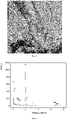
- Fig. 2 showed a metallographic photograph of the heat-treated steel A1 of the Example 1 (EX.1), wherein the microstructure of the heat-treated steel A1 was mainly martensite.
- Fig. 3 showed that the heat-treated steel A1 of the Example 1 comprised carbide particles having an average particle size of 8.2 nm in an amount of about 0.27%. As could be seen from Fig. 4 , the carbide particles included Mo, V and Nb.
- the steels obtained by heat treating the steels A1-A5 in accordance with the present invention comprised the microstructures of more than 93% martensite, less than 4% retained austenite, less than 2% ferrite and less than 3% bainite. Meanwhile, the average particle size of the particles of composite carbides containing V and Mo was 5-15nm, and the amount of carbide particles was 0.15-0.40%. Accordingly, the steels obtained by heat treating the steels A1-A5 in accordance with the present invention could have a yield strength of 1400-1750MPa, a tensile strength of 1850-2150 MPa, and a reduction in area of tensile sample of 45-60%.
- the surface decarburization in those steels could be effectively inhibited after heat treating in accordance with the present invention.
- the thickness of surface decarburization layer could be controlled at 100 ⁇ m or less. It would be advantageous for improving the fatigue performance of the spring member formed from such steels.
- the comparative steel B1 used in the comparative example 1 comprised carbon in an amount lower than the range required in the invention and comprised no Mo and V.
- the heat treating therein did not include the steps of carbide precipitation and tempering used in the present invention.
- the low carbon content could ensure good performance in reduction in area of tensile sample for the steel.
- the comparative steel B1 after the heat treating had a yield strength of only 1214 MPa and a tensile strength of only 1563 MPa, which did not meet the requirements for preparing spring members for vehicle suspension.
- the comparative steel B2 used in the comparative example 2 (CE. 2) comprised carbon in an amount higher than the range required in the invention and comprised no Mo and V.
- the heat treating therein did not include the step of carbide precipitation used in the present invention, and included a step of tempering which is a medium to high temperature tempering process whose temperature exceeds the scope of the invention.
- the high carbon content could ensure high strength for the steel.
- martensite with high carbon content was formed, which resulted in low reduction in area of tensile sample.
- the medium to high temperature tempering process used in the comparative example 2 could improve the performance in reduction in area of tensile sample for the steel to a certain extent, martensite might by softened during such medium to high temperature tempering process, which resulted in a significant reduction in strength.
- the medium to high temperature tempering process might involve the precipitation of cementite, which is harmful to the toughness of steel. Therefore, the strength and the reduction in area of tensile sample of the steel B2 after the heat treating in the comparative example 2 were low, which did not meet the requirements for preparing spring members for vehicle suspension.
- the comparative steel B3 used in the comparative example 3 comprised carbon and silicon in amounts both higher than the ranges required in the invention and comprised Mo in an amount lower than the required range.
- the heat treating therein did not include the step of carbide precipitation used in the present invention, and included a step of tempering which is a medium temperature tempering process whose temperature exceeds the scope of the invention.
- the high carbon content could ensure high strength for the steel.
- the high silicon content could stabilize a large amount of retained austenite in the steel. During plastic deformation, the retained austenite introduced TRIP effects, which improved the ductility of the steel.
- the carbide particles precipitated from martensite were substantially coarsened and presented in too large amount, which was unfavorable to the toughness of the material.
- the fact that more stable retained austenite in the steel lead to TRIP effect during plastic deformation might lead to martensite with high carbon content, which further damaged the toughness of steel. Therefore, although the steel B3 after the heat treating in the comparative example 3 achieved high strength, it showed low reduction in area of tensile sample.
- the comparative steel B3 had a high content of silicon, which caused serious surface decarburization in the steel B3 after the heat treating.
- the thickness of decarburization layer reached 200 ⁇ m or more, which might significantly reduce the fatigue performance of the member.
- the steel B3 after the heat treating in the comparative example 3 was not suitable for the preparation of spring components for vehicle suspension.
- the steel A1 in accordance with the present invention was used.
- the heat treating therein did not include the step of carbide precipitation in accordance with the present invention. Therefore, although carbide particles with small average particle size precipitated, the total amount of carbide particles precipitated was less. Accordingly, the carbon content of martensite was not significantly reduced, resulting in insufficient improvement of ductility and toughness for the steel. At the same time, its effects on strengthening by precipitation were not ideal. Therefore, the strength and reduction in area of tensile sample of the steel A1 after the heat treating in the comparative example 4 were low, which did not meet the requirements for preparing spring members for vehicle suspension.
Landscapes
- Chemical & Material Sciences (AREA)
- Engineering & Computer Science (AREA)
- Mechanical Engineering (AREA)
- Materials Engineering (AREA)
- Metallurgy (AREA)
- Organic Chemistry (AREA)
- Physics & Mathematics (AREA)
- Thermal Sciences (AREA)
- Crystallography & Structural Chemistry (AREA)
- General Engineering & Computer Science (AREA)
- Heat Treatment Of Articles (AREA)
- Heat Treatment Of Steel (AREA)
Applications Claiming Priority (2)
| Application Number | Priority Date | Filing Date | Title |
|---|---|---|---|
| CN201910496707.9A CN112063816B (zh) | 2019-06-10 | 2019-06-10 | 一种高强度钢的热处理方法和由此获得的产品 |
| PCT/CN2019/111796 WO2020248459A1 (fr) | 2019-06-10 | 2019-10-18 | Procédé de traitement thermique pour acier à haute résistance et produit obtenu à partir de celui-ci |
Publications (2)
| Publication Number | Publication Date |
|---|---|
| EP3981894A1 true EP3981894A1 (fr) | 2022-04-13 |
| EP3981894A4 EP3981894A4 (fr) | 2022-11-23 |
Family
ID=73658214
Family Applications (1)
| Application Number | Title | Priority Date | Filing Date |
|---|---|---|---|
| EP19932761.0A Pending EP3981894A4 (fr) | 2019-06-10 | 2019-10-18 | Procédé de traitement thermique pour acier à haute résistance et produit obtenu à partir de celui-ci |
Country Status (8)
| Country | Link |
|---|---|
| US (1) | US12276003B2 (fr) |
| EP (1) | EP3981894A4 (fr) |
| JP (1) | JP7190216B2 (fr) |
| KR (1) | KR102722875B1 (fr) |
| CN (1) | CN112063816B (fr) |
| AU (1) | AU2019450666B2 (fr) |
| CA (1) | CA3142958C (fr) |
| WO (1) | WO2020248459A1 (fr) |
Families Citing this family (11)
| Publication number | Priority date | Publication date | Assignee | Title |
|---|---|---|---|---|
| CN113322365B (zh) * | 2021-05-19 | 2022-05-20 | 北京理工大学 | 一种同时提高低碳低合金钢强度和塑性的方法 |
| CN113699448B (zh) * | 2021-08-27 | 2022-06-10 | 中冶陕压重工设备有限公司 | 一种低合金结构钢SY41CrMnMoNbVTi及其制备方法 |
| CN114395729B (zh) * | 2021-12-13 | 2023-09-01 | 唐山中厚板材有限公司 | Nm450级无需淬火热处理的耐磨钢板及其生产方法 |
| CN114457212B (zh) * | 2021-12-28 | 2023-07-25 | 河钢股份有限公司 | 一种高温轴承钢碳化物细质弥散处理工艺 |
| JP7806936B2 (ja) * | 2022-06-03 | 2026-01-27 | Jfeスチール株式会社 | 水素脆化に対する感受性を低減した高強度冷間圧延鋼板製品及びその製造方法 |
| CN115786902A (zh) * | 2022-11-16 | 2023-03-14 | 福建省五广铸造有限公司 | 一种高锰钢锤头的强化工艺 |
| CN116288061B (zh) * | 2023-03-14 | 2024-07-02 | 钢研晟华科技股份有限公司 | 一种1000MPa级超高强度耐蚀钢筋及其制备方法 |
| CN116445820B (zh) * | 2023-04-23 | 2024-09-27 | 常熟理工学院 | 一种铌钒钛复合微合金化汽车用热成型钢及其制备方法 |
| CN117286409B (zh) * | 2023-09-26 | 2025-11-18 | 本钢板材股份有限公司 | 一种基于商用车应用的1800MPa级热成形钢及制备方法 |
| TWI893533B (zh) * | 2023-11-17 | 2025-08-11 | 中國鋼鐵股份有限公司 | 鋼板的平坦化製程 |
| CN118639131B (zh) * | 2024-08-15 | 2024-11-29 | 鞍钢股份有限公司 | 一种高钒含量的抗氢致开裂容器钢板及其制备方法 |
Family Cites Families (16)
| Publication number | Priority date | Publication date | Assignee | Title |
|---|---|---|---|---|
| JPH0379716A (ja) * | 1989-08-23 | 1991-04-04 | Kawasaki Steel Corp | 溶接性の良好な低降伏比高張力鋼の製造方法 |
| JP3587115B2 (ja) * | 2000-01-24 | 2004-11-10 | Jfeスチール株式会社 | 成形性に優れた高張力溶融亜鉛めっき鋼板の製造方法 |
| WO2002022904A1 (fr) | 2000-09-12 | 2002-03-21 | Nkk Corporation | Plaque en acier ecroui presentant une tres haute resistance a la traction et procede de production |
| CN101144114A (zh) * | 2007-11-01 | 2008-03-19 | 贵州红林机械有限公司 | 一种能提高高温合金弹簧抗高温松弛能力的热处理方法 |
| CN101532076A (zh) * | 2009-03-31 | 2009-09-16 | 宁波通达精密铸造有限公司 | 热处理调质方法 |
| JP5679455B2 (ja) * | 2010-11-30 | 2015-03-04 | 株式会社神戸製鋼所 | ばね用鋼、ばね用鋼線及びばね |
| JP5764383B2 (ja) | 2011-05-12 | 2015-08-19 | Jfe条鋼株式会社 | 車両懸架用ばね部品用鋼、車両懸架用ばね部品およびその製造方法 |
| JP5760972B2 (ja) * | 2011-11-10 | 2015-08-12 | 新日鐵住金株式会社 | 耐遅れ破壊特性に優れた高強度ボルト鋼および高強度ボルト |
| CN102925812B (zh) | 2012-11-16 | 2014-03-26 | 武汉钢铁(集团)公司 | 一种汽车用热轧膜片弹簧钢及其生产方法 |
| WO2017018457A1 (fr) * | 2015-07-27 | 2017-02-02 | 新日鐵住金株式会社 | Acier pour ressort de suspension et son procédé de fabrication |
| CN105112774B (zh) * | 2015-08-28 | 2017-12-01 | 浙江美力科技股份有限公司 | 高强韧性低中碳微合金风冷硬化弹簧钢及其成形和热处理工艺 |
| KR101797316B1 (ko) | 2015-12-21 | 2017-11-14 | 주식회사 포스코 | 고강도 및 우수한 내구성을 가지는 자동차용 부품 및 그 제조방법 |
| CN106399837B (zh) * | 2016-07-08 | 2018-03-13 | 东北大学 | 热冲压成形用钢材、热冲压成形工艺及热冲压成形构件 |
| KR20180074008A (ko) | 2016-12-23 | 2018-07-03 | 주식회사 포스코 | 수소취성 저항성이 우수한 고강도 스프링용 강재 및 그 제조방법 |
| CN108374127A (zh) * | 2018-04-28 | 2018-08-07 | 育材堂(苏州)材料科技有限公司 | 热冲压成形用钢材、热冲压成形工艺及热冲压成形构件 |
| CN109234627B (zh) | 2018-10-17 | 2020-12-18 | 南京钢铁股份有限公司 | 一种高强高韧性非调质圆钢及制备方法 |
-
2019
- 2019-06-10 CN CN201910496707.9A patent/CN112063816B/zh active Active
- 2019-10-18 US US17/617,681 patent/US12276003B2/en active Active
- 2019-10-18 CA CA3142958A patent/CA3142958C/fr active Active
- 2019-10-18 WO PCT/CN2019/111796 patent/WO2020248459A1/fr not_active Ceased
- 2019-10-18 EP EP19932761.0A patent/EP3981894A4/fr active Pending
- 2019-10-18 AU AU2019450666A patent/AU2019450666B2/en active Active
- 2019-10-18 JP JP2021573256A patent/JP7190216B2/ja active Active
- 2019-10-18 KR KR1020227000319A patent/KR102722875B1/ko active Active
Also Published As
| Publication number | Publication date |
|---|---|
| US20220251673A1 (en) | 2022-08-11 |
| JP2022528583A (ja) | 2022-06-14 |
| US12276003B2 (en) | 2025-04-15 |
| JP7190216B2 (ja) | 2022-12-15 |
| WO2020248459A1 (fr) | 2020-12-17 |
| CA3142958A1 (fr) | 2020-12-17 |
| CN112063816B (zh) | 2021-11-19 |
| KR20220019264A (ko) | 2022-02-16 |
| KR102722875B1 (ko) | 2024-10-28 |
| AU2019450666B2 (en) | 2025-02-27 |
| CA3142958C (fr) | 2025-06-17 |
| AU2019450666A1 (en) | 2022-01-06 |
| CN112063816A (zh) | 2020-12-11 |
| EP3981894A4 (fr) | 2022-11-23 |
| BR112021025011A2 (pt) | 2022-01-25 |
Similar Documents
| Publication | Publication Date | Title |
|---|---|---|
| US12276003B2 (en) | Method of heat treating a high strength steel and a product obtained therefrom | |
| EP2746420B1 (fr) | Acier à ressort, et ressort | |
| EP2562283B1 (fr) | Pièce en acier présentant une excellente résistance au ramollissement | |
| WO2001048258A1 (fr) | Produit en barre ou en fil a utiliser dans le forgeage a froid et procede de production de ce produit | |
| JPS5827956A (ja) | 耐へたり性の優れたばね用鋼 | |
| JPH03188217A (ja) | 高炭素薄鋼板の製造方法 | |
| US12529117B2 (en) | Wire rod and component, for cold forging, each having excellent delayed fracture resistance characteristics, and manufacturing methods therefor | |
| JPH0323616B2 (fr) | ||
| EP4063531A1 (fr) | Fil machine pour ressort à ultra-haute résistance, fil d'acier et procédé de fabrication associé | |
| JPS5941502B2 (ja) | 耐へたり性のすぐれたばね用鋼 | |
| DE102016107787A1 (de) | Ultrahochfester Federstahl | |
| JPS5827959A (ja) | 耐へたり性の優れたばね用鋼 | |
| JP4344126B2 (ja) | ねじり特性に優れる高周波焼もどし鋼 | |
| US20060057419A1 (en) | High-strength steel product excelling in fatigue strength and process for producing the same | |
| JP7850800B2 (ja) | ばね用鋼及びばね用鋼線、及びそれらの製造方法 | |
| JPS5827957A (ja) | 耐へたり性の優れたばね用鋼 | |
| JPS6041686B2 (ja) | 耐へたり性の優れたばね用鋼の製造法 | |
| BR112021025011B1 (pt) | Método de tratamento térmico de aço de alta resistência, aço obtido pelo mesmo e membro de mola | |
| JPS6237110B2 (fr) | ||
| KR102448756B1 (ko) | 수소지연파괴 특성이 우수한 고강도 냉간압조용 선재, 열처리부품 및 이들의 제조방법 | |
| JPS6041699B2 (ja) | 焼入性、耐へたり性の優れたばね用鋼 | |
| JP2575711B2 (ja) | 熱間成形用高強度ばね鋼 | |
| JP2024543998A (ja) | 耐遅れ破壊抵抗性が向上した冷間鍛造用線材、鋼部品及びその製造方法 | |
| JPH05179399A (ja) | オーステンパ性および打抜き性に優れたばね用鋼 | |
| JPH05179398A (ja) | オーステンパ性に優れたばね用鋼 |
Legal Events
| Date | Code | Title | Description |
|---|---|---|---|
| STAA | Information on the status of an ep patent application or granted ep patent |
Free format text: STATUS: THE INTERNATIONAL PUBLICATION HAS BEEN MADE |
|
| PUAI | Public reference made under article 153(3) epc to a published international application that has entered the european phase |
Free format text: ORIGINAL CODE: 0009012 |
|
| STAA | Information on the status of an ep patent application or granted ep patent |
Free format text: STATUS: REQUEST FOR EXAMINATION WAS MADE |
|
| 17P | Request for examination filed |
Effective date: 20211221 |
|
| AK | Designated contracting states |
Kind code of ref document: A1 Designated state(s): AL AT BE BG CH CY CZ DE DK EE ES FI FR GB GR HR HU IE IS IT LI LT LU LV MC MK MT NL NO PL PT RO RS SE SI SK SM TR |
|
| RIN1 | Information on inventor provided before grant (corrected) |
Inventor name: WANG, GUODONG Inventor name: XIONG, XIAOCHUAN Inventor name: QIN, HUAJIE Inventor name: YANG, DAPENG Inventor name: ZHOU, SHU Inventor name: YI, HONGLIANG |
|
| DAV | Request for validation of the european patent (deleted) | ||
| DAX | Request for extension of the european patent (deleted) | ||
| REG | Reference to a national code |
Ref country code: DE Ref legal event code: R079 Free format text: PREVIOUS MAIN CLASS: C22C0038020000 Ipc: C21D0001190000 |
|
| A4 | Supplementary search report drawn up and despatched |
Effective date: 20221020 |
|
| RIC1 | Information provided on ipc code assigned before grant |
Ipc: C22C 38/24 20060101ALI20221014BHEP Ipc: C22C 38/02 20060101ALI20221014BHEP Ipc: C22C 38/22 20060101ALI20221014BHEP Ipc: C22C 38/04 20060101ALI20221014BHEP Ipc: C21D 9/02 20060101ALI20221014BHEP Ipc: C21D 9/00 20060101ALI20221014BHEP Ipc: C21D 6/02 20060101ALI20221014BHEP Ipc: C21D 1/28 20060101ALI20221014BHEP Ipc: C21D 1/18 20060101ALI20221014BHEP Ipc: C21D 1/26 20060101ALI20221014BHEP Ipc: C21D 1/19 20060101AFI20221014BHEP |
|
| STAA | Information on the status of an ep patent application or granted ep patent |
Free format text: STATUS: EXAMINATION IS IN PROGRESS |
|
| 17Q | First examination report despatched |
Effective date: 20240918 |
|
| RAP1 | Party data changed (applicant data changed or rights of an application transferred) |
Owner name: EASYFORMING TECHNOLOGY CO., LTD. |
|
| RIC1 | Information provided on ipc code assigned before grant |
Ipc: C21D 1/19 20060101AFI20260112BHEP Ipc: C21D 6/02 20060101ALI20260112BHEP Ipc: C22C 38/02 20060101ALI20260112BHEP Ipc: C22C 38/22 20060101ALI20260112BHEP Ipc: C22C 38/04 20060101ALI20260112BHEP Ipc: C21D 9/02 20060101ALI20260112BHEP Ipc: C21D 9/00 20060101ALI20260112BHEP Ipc: C21D 1/28 20060101ALI20260112BHEP Ipc: C21D 1/18 20060101ALI20260112BHEP Ipc: C21D 1/26 20060101ALI20260112BHEP Ipc: C21D 1/78 20060101ALI20260112BHEP Ipc: C22C 38/24 20060101ALI20260112BHEP Ipc: C22C 38/26 20060101ALI20260112BHEP Ipc: C22C 38/28 20060101ALI20260112BHEP Ipc: C22C 38/38 20060101ALI20260112BHEP Ipc: C22C 38/44 20060101ALI20260112BHEP Ipc: C22C 38/46 20060101ALI20260112BHEP Ipc: C22C 38/48 20060101ALI20260112BHEP |
|
| GRAP | Despatch of communication of intention to grant a patent |
Free format text: ORIGINAL CODE: EPIDOSNIGR1 |
|
| STAA | Information on the status of an ep patent application or granted ep patent |
Free format text: STATUS: GRANT OF PATENT IS INTENDED |
|
| INTG | Intention to grant announced |
Effective date: 20260326 |