EP3989183A1 - Procédé et syst?me de détection optique de la tête d'une personne à vérifier à un poste de contrôle d'accès - Google Patents
Procédé et syst?me de détection optique de la tête d'une personne à vérifier à un poste de contrôle d'accès Download PDFInfo
- Publication number
- EP3989183A1 EP3989183A1 EP21203089.4A EP21203089A EP3989183A1 EP 3989183 A1 EP3989183 A1 EP 3989183A1 EP 21203089 A EP21203089 A EP 21203089A EP 3989183 A1 EP3989183 A1 EP 3989183A1
- Authority
- EP
- European Patent Office
- Prior art keywords
- person
- checked
- camera
- data set
- head
- Prior art date
- Legal status (The legal status is an assumption and is not a legal conclusion. Google has not performed a legal analysis and makes no representation as to the accuracy of the status listed.)
- Pending
Links
Images

Classifications
-
- G—PHYSICS
- G06—COMPUTING OR CALCULATING; COUNTING
- G06V—IMAGE OR VIDEO RECOGNITION OR UNDERSTANDING
- G06V40/00—Recognition of biometric, human-related or animal-related patterns in image or video data
- G06V40/10—Human or animal bodies, e.g. vehicle occupants or pedestrians; Body parts, e.g. hands
- G06V40/16—Human faces, e.g. facial parts, sketches or expressions
- G06V40/161—Detection; Localisation; Normalisation
- G06V40/165—Detection; Localisation; Normalisation using facial parts and geometric relationships
-
- G—PHYSICS
- G06—COMPUTING OR CALCULATING; COUNTING
- G06V—IMAGE OR VIDEO RECOGNITION OR UNDERSTANDING
- G06V10/00—Arrangements for image or video recognition or understanding
- G06V10/10—Image acquisition
- G06V10/12—Details of acquisition arrangements; Constructional details thereof
-
- G—PHYSICS
- G06—COMPUTING OR CALCULATING; COUNTING
- G06V—IMAGE OR VIDEO RECOGNITION OR UNDERSTANDING
- G06V20/00—Scenes; Scene-specific elements
- G06V20/60—Type of objects
- G06V20/64—Three-dimensional [3D] objects
-
- G—PHYSICS
- G06—COMPUTING OR CALCULATING; COUNTING
- G06V—IMAGE OR VIDEO RECOGNITION OR UNDERSTANDING
- G06V40/00—Recognition of biometric, human-related or animal-related patterns in image or video data
- G06V40/10—Human or animal bodies, e.g. vehicle occupants or pedestrians; Body parts, e.g. hands
- G06V40/16—Human faces, e.g. facial parts, sketches or expressions
- G06V40/161—Detection; Localisation; Normalisation
- G06V40/166—Detection; Localisation; Normalisation using acquisition arrangements
-
- G—PHYSICS
- G06—COMPUTING OR CALCULATING; COUNTING
- G06V—IMAGE OR VIDEO RECOGNITION OR UNDERSTANDING
- G06V40/00—Recognition of biometric, human-related or animal-related patterns in image or video data
- G06V40/10—Human or animal bodies, e.g. vehicle occupants or pedestrians; Body parts, e.g. hands
- G06V40/16—Human faces, e.g. facial parts, sketches or expressions
- G06V40/168—Feature extraction; Face representation
- G06V40/171—Local features and components; Facial parts ; Occluding parts, e.g. glasses; Geometrical relationships
-
- G—PHYSICS
- G06—COMPUTING OR CALCULATING; COUNTING
- G06V—IMAGE OR VIDEO RECOGNITION OR UNDERSTANDING
- G06V40/00—Recognition of biometric, human-related or animal-related patterns in image or video data
- G06V40/40—Spoof detection, e.g. liveness detection
Definitions
- the invention relates to a method for optically detecting the head of a person to be checked at an access control station and a corresponding arrangement for carrying out the method.
- Such methods and arrangements are used, for example, to carry out an automated comparison of the reference data stored on an identity document, such as an ID card or a passport.
- the portrait image which is printed on the identity card or personal document, is often used for the comparison.
- this two-dimensional portrait image could be falsified, so that a comparison with other data seems sensible and appropriate.
- a so-called morphing attack could be carried out, in which a "mixture" is generated from a number of different portrait photos that comes close to or resembles the portrait image on the identity document.
- a further alternative to forging the portrait image on the document could be a so-called mask attack, in which a mask comes close to or resembles the portrait image on the identity document in its two-dimensional and thus frontal projection.
- a mask attack in which a mask comes close to or resembles the portrait image on the identity document in its two-dimensional and thus frontal projection.
- there would be the possibility of storing three-dimensional data records on a chip of the identity document although in practice it is difficult to capture the three-dimensional and therefore very data-intensive images in order to use them with the Compare reference data of the identity document.
- the profile picture is captured as a color photo in such a way that the head of the person to be checked stands out from the photo background behind the head due to the contrasting, and that the second data record consists of the course of at least one of the head parts, in particular the course of the forehead and/or or the nose and/or the lips and/or the chin of the person to be examined.
- the curves of the head sections can be supplemented to form the frontally aligned profile picture, which means that access control can be better secured.
- At least one reference point on the face of the person can be checked to be determined or ascertained from the color photo, and for the at least one reference point to be assigned to the second data set and thus form part of the second data set.
- the reference points can be provided with or without dimensions and can be located, for example, at the corner of the mouth, at an eye position or at a prominent point on the ear.
- the reference points are those contained in Appendix C of ISO/IEC 14496-2:2004(E).
- a plurality of reference points or feature points can be used for evaluation and identification at an access control station.
- a silhouette is extracted from the profile picture, and if the second data set is based on the shape of the silhouette of at least one of the head parts, in particular the shape of the forehead and/or the nose and/or the lips and/or the chin.
- At least one reference point on the face of the person to be checked is determined or ascertained from the silhouette, and if the at least one reference point is assigned to the second data set so that it forms part of the second data set.
- distinctive points can also be extracted from the silhouette, which can then be used when comparing the data sets with the depth information and the reference values contained or stored on the identity document for reliable verification of the person to be checked.
- At least one feature point from the portrait image according to Annex C of ISO/IEC 14496-2:2004 is determined and assigned to the first data set so that it forms part of the first data set. It is thus also possible to extract feature points from the portrait image that must also be present on the profile image, such as the feature points of the ears, for example feature points 10.1 to 10.6, or the mouth or cheek areas, such as feature points 5.1 or 5.2.
- the person to be checked is caused to turn his head and if the first camera then captures the portrait image when a symmetry condition of the face of the person to be checked is detected by the processor unit will.
- a symmetry condition can be fulfilled when a detected distance between a tip of the nose of the face of the person to be checked and a first eye essentially corresponds to the detected distance of the tip of the nose from a second eye.
- the fact that the centers of the eyes maintain a distance of 60 by 65 mm from one another can be exploited, which can then be used as a symmetry condition.
- the distance from the tip of the nose to a feature point on the ears can also apply as a symmetry condition.
- the second camera which is offset by 90 degrees with respect to the first camera, captures the at least one profile image of the head of the person to be checked.
- both the portrait image from the first camera and the profile image from the second camera can be captured simultaneously, which is accompanied by a significant reduction in the time required for verification.
- This is particularly advantageous when a large number of people to be checked at the Access control station pending, as can be the case regularly at major events such as soccer games or concerts, or even when boarding an airplane.
- the head movement of the person to be checked is provoked by creating an acoustic and/or visual stimulus, which causes the person to be checked to turn their head in a predetermined direction move or rotate.
- the reference values are stored in the form of data records on a chip of the identity document when the reference values are read out at the access control station when the first data record and the second data record is compared with the data records stored on the chip, and if access or passage at the access control station is granted only if there is a match between the stored data records and the recorded data records.
- the arrangement according to the invention comprises in particular a first camera assigned to the access control station, a processor unit assigned to the access control station, which is designed to communicate with the camera assigned to the access control station via a communication link, the processor unit having an evaluation unit which is designed to process data that is the first camera assigned to the access control station is captured by the person to be checked.
- the processor unit having an evaluation unit which is designed to process data that is the first camera assigned to the access control station is captured by the person to be checked.
- the first camera is set up to capture a frontally aligned portrait image of the head of the person to be checked, with which the processor unit obtains a first two-dimensional data set from the portrait image.
- the arrangement is designed to capture a profile image of at least one of the sides of the head of the person to be checked, with which the processor unit generates a second wins two-dimensional data set from the profile image in order to merge it with the first data set to obtain depth information by means of the evaluation unit.
- the arrangement also includes a reading unit for reading an identity document, with which the evaluation unit is set up to compare the data records and the depth information with reference values contained or stored on or in the identity document.
- the reference values are stored in the form of data records on the chip of the identity document, and that the reference values are encoded on the chip in accordance with ISO/IEC 39794-5 (status: 2019).
- ISO/IEC 39794-5 provides a standard for storing biometric facial image data.
- identity documents the data encoded in this way can be used as a reference for verifying the identity of persons by humans or with the help of automated processes.
- the 2-dimensional or 3-dimensional reference data is also present on the chip in annotated form, for example with landmarks that correspond in particular to MPEG feature points according to ISO/IEC 14496-2.
- This arrangement according to the invention is thus designed in such a way that a verification can be carried out at an access control station of a person to be checked, which goes beyond checking a merely two-dimensional data set. Since no complete three-dimensional data set has to be processed, the arrangement works in a very data-efficient manner.
- the camera is mounted on a pivoting device and is thus set up to capture the portrait image and the profile image.
- the person to be checked can also be prompted to change the head position in order to capture the portrait image and the profile image using the stationary camera.
- suitable deflection mirrors which means that only a single camera is required to record the portrait image and the profile image.
- a second camera assigned to the access control station which is set up, also with the To communicate processor unit via a communication link, and when the optical axis of the second camera is aligned perpendicularly with respect to the optical axis of the first camera, so that the portrait image and the profile image can be captured simultaneously.
- the use of the second camera reduces the time it takes to verify a person to be checked.
- the order of the method steps mentioned is useful, but not mandatory.
- the profile picture can be captured first and then the portrait picture, or vice versa.
- a simultaneous capture of profile picture and portrait picture is also possible.
- FIG 1 an arrangement 100 for the optical detection of a head of a person to be checked 200 at an access control station 104 is shown.
- the access control station 104 shown as an example and the arrangement 100 comprise a first camera 102 and a second camera 112, the optical axes of which are aligned perpendicular to one another and are perpendicular to one another.
- the use of the second camera 112 is expedient but not absolutely necessary since the head of the person 200 to be checked could also be captured twice by the first camera 102 .
- Both cameras 102, 112 are connected via a communication link shown in dotted lines to a processor unit 106, which in turn has an evaluation unit 108 in order to further process the data that is recorded by cameras 102, 112 from the person to be checked 200 so that it can then be a processing result can be cast and, after being transmitted to an output unit 110, can be output by the latter.
- the first camera 102 is set up to capture a frontally aligned portrait image 114 of the person 200 to be checked, with the result that the processor unit 106 obtains a first two-dimensional data set from the portrait image 114 .
- the second camera 112 is set up to capture at least one profile image 116 of the head of the person 200 to be checked, with the processor unit 106 obtaining a second two-dimensional data set from the profile image 116 .
- the processor unit 106 and its evaluation unit 108 are set up to combine the first two-dimensional data set from the portrait image 114 and the second two-dimensional data set from the profile image 116 in order to obtain depth information therefrom. This creates a "quasi" 3D image.
- arrangement 100 additionally comprises a reading unit (not shown in detail) for reading out the identity document, with which evaluation unit 108 is set up to compare the data records and the depth information with reference values contained or stored on or in the identity document in order to transmit the comparison result to output unit 110 issued and then grant or deny access.
- a reading unit (not shown in detail) for reading out the identity document, with which evaluation unit 108 is set up to compare the data records and the depth information with reference values contained or stored on or in the identity document in order to transmit the comparison result to output unit 110 issued and then grant or deny access.
- the points in time at which the respective images should be captured should be chosen appropriately in order to avoid the accumulation of unnecessarily large amounts of data.
- the person to be checked 200 is caused to turn his head, the portrait image 114 being captured by the first camera 102 when a symmetry condition of the face of the person to be checked 200 is detected by the processor unit 106 .
- the head movement of the person 200 to be checked can be provoked, for example, by means of an acoustic and/or optical stimulus.
- a single camera 102 is also possible if there is a mirror arrangement on the left and/or right of person 200 to be checked, the mirrors of which are aligned in such a way that when portrait image 114 is captured, a profile image 116 (with -) is recorded.
- This symmetry condition is based on figure 2 illustrated, this being fulfilled in particular when the detected distance between a tip of the nose of the face of the person to be checked 200 to one of his eyes to one of his pupils essentially corresponds to the detected distance from the tip of the nose to the other eye, in particular to his other pupil .
- a symmetry condition can also be met if a pairing of feature points 10.1 with 10.2 or 10.3 with 10.4 or 10.5 with 10.6 according to Annex C of ISO/IEC 14496-2:2004 is recorded at a point in time.
- Feature points other than those associated with the ears can also be used to check the presence of a symmetry condition, such as the corners of the mouth or points 5.1, 5.2 on the cheek area of the person to be checked 200.
- the second camera 112 which is offset by 90 degrees relative to the first camera 102, captures the at least one profile image 116 of the head of the person to be checked 200, while the first camera 102 captures the portrait image 114 - preferably at the same time.
- the reference values are stored in the form of data records on a chip of the identity document when the reference values are read out at the access control station 104 if the first data set captured by the first camera 102 and the second data set captured by the second camera 112 are compared with the data sets stored on the chip, and that access or passage at the access control station 104 is granted.
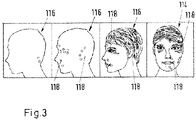
- figure 3 can be seen in the first place on the left that it can be advantageous that only a silhouette is extracted from the profile image 116, as a result of which the second data set can be obtained, for example, from the course of at least one of the head parts. Due to the formation of a silhouette, the data is significantly reduced due to the reduction of the information contained in the photo. From the silhouette, for example, the course of the forehead and/or the nose and/or the lips and/or the chin can be used to obtain the second dataset.
- the silhouette can be seen again in the second place from the left, with at least one reference point 118 on the face of the person to be checked 200 also being determined or ascertained from the (binary) silhouette, with the at least one reference point 118 also being assigned to the second data set so that this forms part of the second data set and can therefore be used for a check.
- This reference point can be a feature point according to Appendix C of ISO/IEC 14496-2:2004.
- the profile image 116 can also be present as a color photo, with the head of the person to be checked standing out from the photo background behind the head due to the contrasting, and with the second data set from the course of at least one of the head parts , in particular from the shape of the forehead and/or the nose and/or the lips and/or the chin.
- This representation also shows that reference points 118 on the face of person 200 to be checked can also be determined or ascertained here, and that reference points 118 are also allocated to the second data set, with which they form part of the second data set. These reference points 118 can at the same time be reference points 118 of the portrait image 114 shown on the far right, as a result of which the person 200 to be checked can be reliably verified.
- the present invention makes it more difficult for masks to defeat facial image-based biometric access control systems without authorization.
- the unauthorized overcoming of biometric access control systems based on facial images with morphed (reference) images is also made more difficult.
- the authentication of people by people is made easier by the additional features provided, in particular due to the depth information obtained according to the invention - possibly supplemented by data relating to the shape of the nose, the shape of the mouth or the shape of the ear - which is particularly advantageous if parts of the face are covered.
- the additional depth information obtained which is supplemented in particular by the feature points from Annex C of ISO/IEC 14486-2:2004, improves the detectability and thus the rate of incorrect rejection. Unauthorized access to the Access control station 104 safely prevented.
Landscapes
- Engineering & Computer Science (AREA)
- Physics & Mathematics (AREA)
- Health & Medical Sciences (AREA)
- Oral & Maxillofacial Surgery (AREA)
- General Physics & Mathematics (AREA)
- Multimedia (AREA)
- Theoretical Computer Science (AREA)
- General Health & Medical Sciences (AREA)
- Human Computer Interaction (AREA)
- Computer Vision & Pattern Recognition (AREA)
- Geometry (AREA)
- Measurement Of The Respiration, Hearing Ability, Form, And Blood Characteristics Of Living Organisms (AREA)
Applications Claiming Priority (1)
| Application Number | Priority Date | Filing Date | Title |
|---|---|---|---|
| DE102020127880.2A DE102020127880A1 (de) | 2020-10-22 | 2020-10-22 | Verfahren und anordnung zur optischen erfassung eines kopfes einer zu überprüfenden person an einer zutrittskontrollstation |
Publications (1)
| Publication Number | Publication Date |
|---|---|
| EP3989183A1 true EP3989183A1 (fr) | 2022-04-27 |
Family
ID=78516486
Family Applications (1)
| Application Number | Title | Priority Date | Filing Date |
|---|---|---|---|
| EP21203089.4A Pending EP3989183A1 (fr) | 2020-10-22 | 2021-10-18 | Procédé et syst?me de détection optique de la tête d'une personne à vérifier à un poste de contrôle d'accès |
Country Status (2)
| Country | Link |
|---|---|
| EP (1) | EP3989183A1 (fr) |
| DE (1) | DE102020127880A1 (fr) |
Citations (2)
| Publication number | Priority date | Publication date | Assignee | Title |
|---|---|---|---|---|
| US20080304716A1 (en) * | 2007-06-07 | 2008-12-11 | Aruze Corp. | Face recognition device |
| CN111652018A (zh) * | 2019-03-30 | 2020-09-11 | 上海铼锶信息技术有限公司 | 一种人脸注册方法和认证方法 |
Family Cites Families (4)
| Publication number | Priority date | Publication date | Assignee | Title |
|---|---|---|---|---|
| US4975969A (en) | 1987-10-22 | 1990-12-04 | Peter Tal | Method and apparatus for uniquely identifying individuals by particular physical characteristics and security system utilizing the same |
| US7421097B2 (en) | 2003-05-27 | 2008-09-02 | Honeywell International Inc. | Face identification verification using 3 dimensional modeling |
| CA2579903C (fr) | 2004-09-17 | 2012-03-13 | Cyberextruder.Com, Inc. | Systeme, procede et appareil de generation d'une representation tridimensionnelle a partir d'une ou plusieurs images bidimensionnelles |
| DE102006036108A1 (de) | 2006-05-19 | 2007-11-22 | Siemens Ag | Vorrichtung und Verfahren zur Kontrolle von Personen |
-
2020
- 2020-10-22 DE DE102020127880.2A patent/DE102020127880A1/de active Pending
-
2021
- 2021-10-18 EP EP21203089.4A patent/EP3989183A1/fr active Pending
Patent Citations (2)
| Publication number | Priority date | Publication date | Assignee | Title |
|---|---|---|---|---|
| US20080304716A1 (en) * | 2007-06-07 | 2008-12-11 | Aruze Corp. | Face recognition device |
| CN111652018A (zh) * | 2019-03-30 | 2020-09-11 | 上海铼锶信息技术有限公司 | 一种人脸注册方法和认证方法 |
Non-Patent Citations (2)
| Title |
|---|
| "Information technology -- Biometric data interchange formats -- Part 5: Face image data", ISO/IEC 19794-5:2011, IEC, 3, RUE DE VAREMB�, PO BOX 131, CH-1211 GENEVA 20, SWITZERLAND, 3 November 2011 (2011-11-03), pages 1 - 111, XP082008962 * |
| ANSARI ET AL: "Automatic facial feature extraction and 3D face modeling using two orthogonal views with application to 3D face recognition", PATTERN RECOGNITION, ELSEVIER, GB, vol. 38, no. 12, 1 December 2005 (2005-12-01), pages 2549 - 2563, XP005081197, ISSN: 0031-3203, DOI: 10.1016/J.PATCOG.2005.04.016 * |
Also Published As
| Publication number | Publication date |
|---|---|
| DE102020127880A1 (de) | 2022-04-28 |
Similar Documents
| Publication | Publication Date | Title |
|---|---|---|
| DE602004005984T2 (de) | Gesichtsidentifikationsverifikation unter verwendung von vorder- und seitenansichten | |
| EP1062640B1 (fr) | Procede pour verifier l'authenticite d'une image enregistree au cours d'un processus d'identification de personne | |
| DE69328982T2 (de) | Gesichtsklassifizierung | |
| EP3047424A2 (fr) | Dispositif, système et procédé d'identification d'une personne | |
| EP3200122B1 (fr) | Capteur optoelectronique et procede de reconnaissance fiable d'objets de taille minimum | |
| EP1147494B1 (fr) | Procede et systeme de protection contre la fraude en cas de reconnaissance biometrique de personnes | |
| EP2584493B1 (fr) | Procédé de distinction entre un visage réel et une représentation bidimensionnelle du visage dans un processus d'enregistrement biométrique | |
| DE102015108330B4 (de) | Elektronisches Zugangskontrollverfahren | |
| EP3629232A1 (fr) | Dispositif de détection d'une manipulation d'image dans une image de visage numérique de référence d'une personne | |
| EP3839815A1 (fr) | Dispositif et procédé de détermination d'une caractéristique biométrique du visage d'une personne | |
| DE102016009619A1 (de) | Verfahren zum Nachweis der räumlichen Ausdehnung eines Kameraobjektes als Bestandteil einer Lebenderkennung für Vorrichtungen zur Erfassung personenspezifischer Daten | |
| CH710713B1 (de) | Authentifizierungsverfahren unter Verwendung von Oberflächenpapiertextur. | |
| EP4075396A1 (fr) | Procédé et agencement de détection optique de la tête d'une personne | |
| EP3944136A1 (fr) | Procédé de personnalisation d'un document d'identité et document d'identité | |
| EP3671543B1 (fr) | Appareil de détection des caractéristiques biométriques d'un visage d'une personne | |
| DE102020211007A1 (de) | Bildverarbeitungseinrichtung und Bildverarbeitungsverfahren, und Bildverarbeitungsprogramm | |
| DE202020103088U1 (de) | Sicherheitsschleuse zur Kontrolle von Personen | |
| EP3989183A1 (fr) | Procédé et syst?me de détection optique de la tête d'une personne à vérifier à un poste de contrôle d'accès | |
| EP2553630B1 (fr) | Procédé et dispositif d'identification de personnes | |
| EP3789916A1 (fr) | Dispositif et procédé de détection des caractéristiques biométriques d'un visage d'une personne | |
| EP4075397A1 (fr) | Procédé d'identification d'une personne en fonction d'une caractéristique biométrique faciale au moyen d'un appareil mobile et appareil mobile | |
| EP2355007A2 (fr) | Système et procédé destinés à la mesure d'objet tridimensionnelle | |
| EP4064221A1 (fr) | Procédé de personnalisation d'un document d'identification, ainsi que procédé d'identification d'une personne en fonction des caractéristiques faciales biométriques et document d'identification | |
| EP3599571B1 (fr) | Dispositif d'identification biométrique d'une personne par reconnaissance faciale et procédé biométrique | |
| EP3651059B1 (fr) | Dispositif de personnalisation d'un document d'identité d'une personne |
Legal Events
| Date | Code | Title | Description |
|---|---|---|---|
| PUAI | Public reference made under article 153(3) epc to a published international application that has entered the european phase |
Free format text: ORIGINAL CODE: 0009012 |
|
| STAA | Information on the status of an ep patent application or granted ep patent |
Free format text: STATUS: THE APPLICATION HAS BEEN PUBLISHED |
|
| AK | Designated contracting states |
Kind code of ref document: A1 Designated state(s): AL AT BE BG CH CY CZ DE DK EE ES FI FR GB GR HR HU IE IS IT LI LT LU LV MC MK MT NL NO PL PT RO RS SE SI SK SM TR |
|
| STAA | Information on the status of an ep patent application or granted ep patent |
Free format text: STATUS: REQUEST FOR EXAMINATION WAS MADE |
|
| 17P | Request for examination filed |
Effective date: 20221025 |
|
| RBV | Designated contracting states (corrected) |
Designated state(s): AL AT BE BG CH CY CZ DE DK EE ES FI FR GB GR HR HU IE IS IT LI LT LU LV MC MK MT NL NO PL PT RO RS SE SI SK SM TR |
|
| P01 | Opt-out of the competence of the unified patent court (upc) registered |
Effective date: 20230526 |
|
| STAA | Information on the status of an ep patent application or granted ep patent |
Free format text: STATUS: EXAMINATION IS IN PROGRESS |
|
| 17Q | First examination report despatched |
Effective date: 20231128 |
|
| RAP3 | Party data changed (applicant data changed or rights of an application transferred) |
Owner name: BUNDESDRUCKEREI GMBH |