EP4064221A1 - Procédé de personnalisation d'un document d'identification, ainsi que procédé d'identification d'une personne en fonction des caractéristiques faciales biométriques et document d'identification - Google Patents
Procédé de personnalisation d'un document d'identification, ainsi que procédé d'identification d'une personne en fonction des caractéristiques faciales biométriques et document d'identification Download PDFInfo
- Publication number
- EP4064221A1 EP4064221A1 EP22162219.4A EP22162219A EP4064221A1 EP 4064221 A1 EP4064221 A1 EP 4064221A1 EP 22162219 A EP22162219 A EP 22162219A EP 4064221 A1 EP4064221 A1 EP 4064221A1
- Authority
- EP
- European Patent Office
- Prior art keywords
- data
- facial
- image
- dimensional
- person
- Prior art date
- Legal status (The legal status is an assumption and is not a legal conclusion. Google has not performed a legal analysis and makes no representation as to the accuracy of the status listed.)
- Pending
Links
Images

Classifications
-
- G—PHYSICS
- G06—COMPUTING OR CALCULATING; COUNTING
- G06V—IMAGE OR VIDEO RECOGNITION OR UNDERSTANDING
- G06V20/00—Scenes; Scene-specific elements
- G06V20/60—Type of objects
- G06V20/64—Three-dimensional [3D] objects
-
- G—PHYSICS
- G06—COMPUTING OR CALCULATING; COUNTING
- G06V—IMAGE OR VIDEO RECOGNITION OR UNDERSTANDING
- G06V40/00—Recognition of biometric, human-related or animal-related patterns in image or video data
- G06V40/10—Human or animal bodies, e.g. vehicle occupants or pedestrians; Body parts, e.g. hands
- G06V40/16—Human faces, e.g. facial parts, sketches or expressions
-
- G—PHYSICS
- G06—COMPUTING OR CALCULATING; COUNTING
- G06V—IMAGE OR VIDEO RECOGNITION OR UNDERSTANDING
- G06V40/00—Recognition of biometric, human-related or animal-related patterns in image or video data
- G06V40/10—Human or animal bodies, e.g. vehicle occupants or pedestrians; Body parts, e.g. hands
- G06V40/16—Human faces, e.g. facial parts, sketches or expressions
- G06V40/168—Feature extraction; Face representation
-
- G—PHYSICS
- G06—COMPUTING OR CALCULATING; COUNTING
- G06V—IMAGE OR VIDEO RECOGNITION OR UNDERSTANDING
- G06V40/00—Recognition of biometric, human-related or animal-related patterns in image or video data
- G06V40/10—Human or animal bodies, e.g. vehicle occupants or pedestrians; Body parts, e.g. hands
- G06V40/16—Human faces, e.g. facial parts, sketches or expressions
- G06V40/172—Classification, e.g. identification
-
- G—PHYSICS
- G06—COMPUTING OR CALCULATING; COUNTING
- G06V—IMAGE OR VIDEO RECOGNITION OR UNDERSTANDING
- G06V40/00—Recognition of biometric, human-related or animal-related patterns in image or video data
- G06V40/50—Maintenance of biometric data or enrolment thereof
Definitions
- the invention relates to a method for personalizing an ID document and a method for identifying a person using biometric facial features and an ID document.
- facial features are derived from two-dimensional facial images and are compared with reference or comparison data that specify facial comparison features in order to identify the person.
- ID - identification For example in a citizens' or residents' registration office, the two-dimensional facial images are provided as an analogue printout or recorded with a 2D camera. It is often difficult here to provide distortion-free two-dimensional images which are then also suitable for determining facial features for the biometric recognition or identification of the person from the captured image data.
- image acquisition parameters are defined, for example distances between camera and person, lighting and background as well as camera properties such as resolution, distortion or color fidelity.
- camera properties such as resolution, distortion or color fidelity.
- other parameters serving the purpose of recognition such as pose, facial expression, open eyes and not covering the eyes with hairstyle, glasses or headgear.
- the object of the invention is to provide a method for personalizing an ID document and an ID document with which the biometric identification of a person based on facial features easier and with improved reliability regarding the detection rate can be performed.
- An improved method for identifying an identifying person based on biometric facial features is also to be created.
- a method for personalizing an ID document and an ID document according to Claims 1 and 14 are created for the solution. Furthermore, a method for identifying a person using biometric facial features according to claim 15 is provided. Configurations are the subject of dependent subclaims.
- a method for personalizing an ID document which has the following: providing image data for a person in a data processing device, the image data comprising image recordings with at least one facial image recording of the person; determining head model data, which represent a three-dimensional head model for the person, and texture data associated with the three-dimensional head model in the data processing device; Determining facial data, which represents a two-dimensional facial image with facial features for the person that can be evaluated for biometric facial recognition, from the head model data and the texture data in the data processing device.
- Determining facial data includes: determining a two-dimensional projected facial image for the person by projecting the three-dimensional head model; and determining the two-dimensional facial image for the person from the two-dimensional projected facial image, wherein at least one image section of the two-dimensional projected facial image is changed taking into account an associated image section in the at least one facial image recording.
- the face data including the two-dimensional face image is stored in a storage medium of an ID document.
- an ID document which has facial data in a storage medium comprised by the ID document, which represent a two-dimensional facial image with facial features that can be evaluated for biometric facial recognition for a person and are determined and stored in accordance with the preceding method.
- a method for identifying a person based on biometric facial features is created, in which image data for a person to be identified is recorded using an image recording device and the following is provided in a data processing device: providing head model data that three-dimensional head model for representing the person to be identified, as well as texture data associated with the three-dimensional head model using the image data; and determining face data from the head model data and the texture data; Determining the facial features from the face data.
- Determining the facial data includes: determining a two-dimensional projected facial image for the person by projecting the three-dimensional head model; and determining the two-dimensional facial image for the person from the two-dimensional projected facial image, wherein at least one image section of the two-dimensional projected facial image is changed taking into account an associated image section in the at least one facial image recording. Furthermore, the following is provided in the method: providing facial comparison data read from a storage medium of an ID document; determining face comparison features from the face comparison data; comparing the facial features and the facial comparison features and identifying the person if the facial features and the facial comparison features at least partially match.
- head model data and the assigned texture data which together form data for a three-dimensional representation (e.g. head model with assigned texture) for at least one front view of the head of the person to be identified, it is possible to determine or calculate a two-dimensional facial image from this , which contains facial features for the person that can be evaluated for biometric facial recognition.
- the two-dimensional projected facial image for the person is generated by projecting the three-dimensional head model in order to calculate or determine the two-dimensional facial image (facial image data) from the two-dimensional projected facial image, with at least one image section of the two-dimensional projected facial image being assigned to an image section is correspondingly changed or adjusted in the at least one facial image recording, in which case the corresponding image data of the associated image section can be partially or fully adopted for the at least one image section.
- converted or averaged pixel values can be formed for individual image pixels of the at least one image section, for example relating to a brightness of the pixel values. It is thus possible to optimize, in particular to complete or replace, in particular faults or defects (areas) in the two-dimensional projected facial image, ie, for example, image sections that are out of focus or image sections that only incompletely display a facial section.
- the two-dimensional face image can thus be provided from the three-dimensional head model and the image data with the desired evaluation quality in a variable manner and in particular without distortion, in order to be used for biometric recognition or identification of the person.
- the two-dimensional image of the person that satisfies the requirements for determining biometric facial features is no longer required.
- the error sources that frequently occur here are avoided. In this way, the identification process for the person can be improved overall, so that the error rate that occurs here is minimized.
- the currently recorded image data are used to (first) determine the head model data and the associated texture data, in order to then derive the face data for the two-dimensional face image from this, in order to then determine the facial features based on this and to compare with reference data to identify the person.
- the image data used in determining the two-dimensional face image from the two-dimensional projected face image can be used beforehand in the process of calculating or determining the three-dimensional head model.
- the image recorded by the image data with the at least one facial image recorded of the person can be an image recorded that was not used when calculating the three-dimensional head model. Rather, this was then determined or calculated using other image recordings for the person.
- the facial data with the two-dimensional facial image can be stored in the storage medium of the ID document before the storage medium, for example a chip or a memory chip, is integrated into a document body of the ID document.
- the storing of the face data can be done after the storage medium is accommodated in the document body.
- the ID document can in particular be an identification, valuable or security document, in particular a sovereign document, for example a paper-based and/or plastic-based document, such as an electronic identification document, in particular a passport, identity card, visa, driver's license, vehicle registration document, vehicle registration document, Health card or company ID card or other ID document like credential.
- a sovereign document for example a paper-based and/or plastic-based document, such as an electronic identification document, in particular a passport, identity card, visa, driver's license, vehicle registration document, vehicle registration document, Health card or company ID card or other ID document like credential.
- the two-dimensional projected face image can be changed using a morphing method.
- a morphing method In the case of morphing in connection with image recordings, intermediate transitions can be calculated between two individual images. In contrast to other implementations such as crossfading, with morphing one image can be converted into another image by using additional, targeted distortions. In this case, an attempt is made to create a transition to a target image that is as realistic as possible, starting from a source image.
- An embodiment of the morphing process can provide for selecting distinctive image elements, for example facial features such as mouth and eyes or object edges, in the source and target image recording and distorting them in such a way that their contours can be made to match. In order to achieve the most realistic effects possible, the source and target image do not differ too much from each other.
- At least one image section of the two-dimensional projected face image which shows a peripheral face section, can be changed according to an associated image section in the face image recording.
- interference or incorrect effects such as fraying can occur, particularly in the edge areas.
- the two-dimensional projected facial image determined by projection then does not have the desired precision, at least in such marginal areas, which can be corrected by changing or digitally processing the marginal areas in order to obtain the two-dimensional facial image with the image quality required for biometric person recognition.
- the three-dimensional head model can be projected with a virtual gaze distance of between about 0.5 m and about 1.5 m, alternatively with a virtual gaze distance of between about 0.8 m and about 1.2 m, and in one embodiment with a virtual gaze distance of about 1, 0m.
- the virtual line of sight is preferably oriented along a predetermined direction, for example looking directly ahead (frontal view). Homogeneous lighting is an advantage.
- Correcting pose errors can be provided when determining the two-dimensional facial image for the person from the two-dimensional projected facial image. Also alternatively or additionally, a correction of facial expressions can be carried out, which can be achieved, for example, by averaging data over time.
- Pose concerns the alignment or orientation of the face or head.
- an orientation of a frontal pose can be selected accordingly, for example in such a way that the image recording axis of the image recording device and the face axis match.
- the face data When determining the face data, it can be checked which face features the face data contain that can be evaluated for biometric face recognition.
- the face data can be checked for face features contained therein that can be used for biometric face recognition while the face data are determined from the head model data and the texture data.
- the check can be carried out after the determination of the facial data has been completed. During the determination or calculation of the face data, the check can be carried out once or several times.
- the check in the data processing device can include checking the facial features for a required quality status (evaluability for biometric face recognition).
- information about the result of the check can be output to the user via an output device connected to the data processing device, for example to the effect which facial features can be determined with sufficient quality from the currently available facial data.
- Providing the image data can include recording the image data using an image recording device, with at least one of the following checks being carried out at least during the recording of the image data: Checking whether image data generated during the recording of the image data are suitable for determining the head model data and the texture data ; and checking whether, during the recording of the image data from previously determined head model data and texture data, certain facial data are suitable for forming the two-dimensional facial image with the facial features that can be evaluated for biometric facial recognition. At least one of the two tests is carried out while the image data is still being recorded. This can be carried out in the data processing device, for example. For example, a user of the image recording device react directly during the acquisition of the image data as a function of the respective test process, for example by changing the lighting for the image recordings and/or informing the person to be identified about their head position relative to the image recording device.
- feedback data can be provided for the check and output via an output device, which display at least one of the following feedbacks: the recording of the image data is to be continued if the image data are not suitable for determining the head model data and the texture data; capturing of the image data can be terminated when the image data is suitable for determining the head model data and the texture data; the recording of the image data is to be continued if the facial data are not suitable for forming the two-dimensional facial image with the facial features that can be evaluated for biometric facial recognition; and the recording of the image data can be ended when the face data are suitable for forming the two-dimensional face image with the face features that can be evaluated for biometric face recognition.
- a user of the image recording device or the data processing device thus receives feedback to continue or end the recording of the image data.
- the recording of the image data (image recordings) must be continued if the image data recorded so far does not allow or is not suitable to determine the head model data and the texture data, so that no three-dimensional head model can be determined or calculated.
- the recording of the image data is to be continued in a comparable manner if, in principle, a three-dimensional head model can be determined, but a two-dimensional facial image cannot (yet) be determined or derived from this, which facial features provide facial features that can be evaluated for biometric facial recognition.
- the employee can carry out the recording process efficiently, since a check is carried out during the recording of the image data and/or afterwards whether head model data/texture data and/or face data can be provided.
- at least one of the checking processes can be carried out after the acquisition of image data has been completed for the first time. Depending on the result of the test process, further image data can be recorded if required.
- the head model data and the texture data can be stored in the storage medium of the ID document.
- the head model data and the texture data are stored in the storage medium of the ID document in addition to the face data. If the ID document (later) is used for personal identification, either the face data and/or the head model data can be read out with the texture data and compared with comparison or reference data. It is possible here to derive additional facial images from the head model data and the texture data, for example in addition to a two-dimensional facial image stored in the storage medium of the ID document, in order to determine (optionally additional) biometric facial features from this, which can be used separately or in combination with facial features from the face data stored on the ID document can be used for personal identification.
- First feature data can be provided in the data processing device, which display information about facial features that can be determined from the two-dimensional facial image.
- the facial features are not only inherent in the face data.
- the first feature data are present, which display information about the facial features, for example so-called landmarks for face recognition.
- the first feature data can be stored in the storage medium of the ID document. In the case of an identification process, this refinement makes it possible to read facial features directly from the storage medium, which can be used for the identification.
- Second feature data can be provided in the data processing device, which display information about facial features that can be determined from the head model data and the texture data.
- the second feature data relate to facial features that can be determined from the three-dimensional head model for the person.
- the second characteristic data can be stored in the storage medium of the ID document. The second feature data can thus be read directly from the storage medium for person identification, in which case the person identifies himself or herself by means of the ID document.
- the facial data can be provided and stored according to one of the following standards: ISO / IEC 19794-5, ISO / IEC 39794-5 and a standard updated thereto.
- the head model data and the texture data can be determined according to one of these standards.
- the facial data can be provided and stored with facial features that can be evaluated for biometric facial recognition in accordance with the ISO/IEC 14496-2:2004 standard and an updated standard for this.
- the ID document can be provided according to the specifications of ICAO Doc 9303.
- the facial data can be stored in the storage medium of the ID document in accordance with the specifications for the logical data structure for storing biometric information in machine-readable travel documents according to ICAO Doc 9303 (7th version, 2015 or more current version). Part 10 of the 7th version of ICAO Doc 9303 regulates the specifications for the logical data structure for storing biometric information.
- a standardized logical data structure is defined with data groups 1 to 16 according to this version.
- a hash value is stored for each data group in a so-called document security object (DSO).
- DSO document security object
- Authenticity and integrity of the face data can be protected by means of an electronic signature of a passive authentication for machine-readable travel documents according to ICAO Doc 9303 (7th version, 2015 or more current version).
- the authenticity and integrity of the data stored in the machine-readable travel document is protected by passive authentication.
- This security mechanism is based on digital signatures and includes the elements of the public key infrastructure (cf. "3. Rolls and Responsibilities" in Part 12 of ICAO Doc 9303, 7th edition, 2015).
- a facial image which is set up to execute facial features for biometric personal identification using facial recognition.
- Face recognition generally refers to the analysis of the characteristics of visible features in the area of the frontal head, given by the geometric arrangement and texture properties of the surface of the frontal head.
- landmarks are used to characterize faces, which refer to characteristic positions in the area of the frontal head. Landmarks as such and their use for face recognition based on two-dimensional face images have been investigated and are known (cf Example Luximon et al.: "The Chinese face: A 3D anthropometric analysis", Proceedings of the TMCE 2010, April 12 - 16, 2010, Ancona, Italy ).
- further personal data can optionally be read out and checked, for example the data provided for machine-readable travel documents according to ICAO Doc 9303.
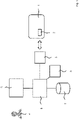
- FIG. 1 shows an arrangement for personalizing an ID document, which is given the reference number 1 below.
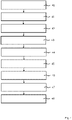
- 2 shows a schematic block diagram for a method for personalizing the ID document 1.
- the ID document 1 has an electronic storage medium 2 in which electronic data can be stored, which is written to the electronic storage medium 2 using a read/write device 3 and can be read from it.
- the electronic storage medium 2 can be embodied by means of a chip component.
- the ID document 1 is, for example, a document in card or book form, in which the storage medium 2 is integrated, for example as a chip component in a plastic card or a plastic page.
- facial data are to be written into the storage medium 2.
- image data is recorded for person 4 with the aid of an image recording device 5 (step 20 in 2 ), such that using of the image data can be calculated or determined with the aid of a data processing device 6, head model data which represent a three-dimensional head model of the person 4, and texture data assigned to the head model data (step 21).
- (Three-dimensional) image recording devices that are suitable for capturing such image data are known as such in various embodiments.
- the technique of structured light can be used, in which, for example, a random pattern of light points is applied to the object to be imaged, i.e. in the present case the face or the entire head of person 4.
- point stack projection or landmark parallax measurement that are known as such can be used.
- the header data is determined which represents the three-dimensional model, for example in the so-called STL format (stereolithography) or in the form of a vertex representation in accordance with ISO-IEC 39794-5 Appendix D.3.
- the texture data are determined, which describe a local texture of the head (RGB image) together with a mapping rule of the individual pixels on the three-dimensional model).
- Determining the facial data includes: determining a two-dimensional projected facial image for the person by projecting the three-dimensional head model (step 23); and determining the two-dimensional facial image for the person from the two-dimensional projected facial image (step 24), wherein at least one image section of the two-dimensional projected facial image is changed in accordance with an associated image section in the at least one facial image recording. Provision can be made here for the determination of the two-dimensional facial image for the person from the two-dimensional projected facial image to be used from the at least one facial image recording that was previously used to determine the three-dimensional head model. Alternatively or in addition, the image recorded by the image data with the at least one facial image recorded of the person can be an image recorded that was not used to calculate the three-dimensional head model. Instead, this was then determined or calculated for the person 4 using other image recordings.
- a morphing process can be used to determine the facial image based on the two-dimensional projected facial image, which then enables the determination of biometric features and is stored on the ID document 1.
- other image processing methods can be used, for example a superimposition of partial image areas.
- the two-dimensional facial image can be determined according to one of the following standards: ISO-IEC 19794-5 and ISO-IEC 39794-5.
- the facial data are then written into the storage medium 2 and are thus available on the ID document 1 for an identification process as readable electronic data (step 25). It can be provided here that the head model data and the texture data assigned to the head model data are stored in the storage medium 2 by means of the read/write device 3 .
- the head model data and the texture data assigned to the head model data can be stored in a database 7 .
- Information can be output to a user and/or user inputs can be received via a user interface 8, for example relating to the process of capturing the images with the image recording device 5.
- the method described makes it possible to determine a standard-compliant two-dimensional facial image for the person 4 in order to then store this in the ID document 1 .
- Biometric facial features can be determined from the two-dimensional face image (face data) in order to carry out a person identification process.
- a plurality of different face images can be determined from the head model data/texture data.
- the process of capturing the image data is simplified for the person 4 using the method created, since the strict requirements associated with capturing two-dimensional facial images suitable for face recognition are not necessary.
- the head model data/texture data allows facial images or photos to be determined or generated from any simulated distance and direction, including a semi-profile. In this way, the use of biometric recognition based on facial features is expanded, for example for logical or physical access control.
- the image data can be recorded as a sequence of image recordings (video stream), in order to to improve the determinability of the three-dimensional head model. Errors in calculating the three-dimensional head model can be reduced using the higher number of mappings.
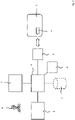
- FIG 3 shows a schematic representation of an arrangement for identifying a person to be identified 4 based on biometric facial features.
- the arrangement can be used in connection with an automatic border or personal control system.
- a system is known which is called "eGate” and is used in particular at airports.
- Image data for the person 4 to be identified is recorded with the aid of the image recording device 5 (step 40) in order to then determine head model data and associated texture data from this (step 41), as explained above.
- head model data and associated texture data Based on the head model data and the texture data, one or more two-dimensional face images (face data) can be determined for the person 4 to be identified (step 42).
- face data is determined in a manner comparable to that explained above with reference to steps 23, 24.
- One or more biometric facial features are then determined from the facial data (step 44).
- face comparison or face reference data are read from the electronic storage medium 2 of the ID document 1 (step 45), which represent a two-dimensional face of the person 4 to be identified.
- the face comparison data can be determined on the basis of two-dimensional image recordings and/or image recordings that were previously used to calculate a three-dimensional head model.
- the data processing device 6 is used to determine face comparison features from the face comparison data (step 46), which are then compared with the facial features (step 47). If the facial features and the facial comparison features match at least partially, the person 4 to be identified is identified (step 48). Otherwise the person 4 will not be identified.
- an access control device 9 can be controlled, be it for example at an airport, for a factory site or any other area to which access is regulated.
- the face data (two-dimensional face image) in the embodiment in FIGS 1 and 2 determined from the head model data / texture data and used to personalize the ID document 1, sees the embodiment according to the 3 and 4 proposes determining the face data for personal identification, for example in connection with an access or entrance control, the two-dimensional face image used for the identification being determined from the head model data and texture data here as well.
Landscapes
- Engineering & Computer Science (AREA)
- Physics & Mathematics (AREA)
- General Physics & Mathematics (AREA)
- Multimedia (AREA)
- Theoretical Computer Science (AREA)
- Health & Medical Sciences (AREA)
- Oral & Maxillofacial Surgery (AREA)
- Human Computer Interaction (AREA)
- General Health & Medical Sciences (AREA)
- Computer Vision & Pattern Recognition (AREA)
- Collating Specific Patterns (AREA)
Applications Claiming Priority (1)
| Application Number | Priority Date | Filing Date | Title |
|---|---|---|---|
| DE102021107204.2A DE102021107204A1 (de) | 2021-03-23 | 2021-03-23 | Verfahren zum Personalisieren eines ID-Dokuments sowie Verfahren zum Identifizieren einer Person anhand biometrischer Gesichtsmerkmale und ID-Dokument |
Publications (1)
| Publication Number | Publication Date |
|---|---|
| EP4064221A1 true EP4064221A1 (fr) | 2022-09-28 |
Family
ID=80780773
Family Applications (1)
| Application Number | Title | Priority Date | Filing Date |
|---|---|---|---|
| EP22162219.4A Pending EP4064221A1 (fr) | 2021-03-23 | 2022-03-15 | Procédé de personnalisation d'un document d'identification, ainsi que procédé d'identification d'une personne en fonction des caractéristiques faciales biométriques et document d'identification |
Country Status (2)
| Country | Link |
|---|---|
| EP (1) | EP4064221A1 (fr) |
| DE (1) | DE102021107204A1 (fr) |
Family Cites Families (1)
| Publication number | Priority date | Publication date | Assignee | Title |
|---|---|---|---|---|
| DE102020119531A1 (de) | 2020-07-23 | 2022-01-27 | Bundesdruckerei Gmbh | Verfahren zum Personalisieren eines ID-Dokuments sowie Verfahren zum Identifizieren einer Person anhand biometrischer Gesichtsmerkmale und ID-Dokument |
-
2021
- 2021-03-23 DE DE102021107204.2A patent/DE102021107204A1/de active Pending
-
2022
- 2022-03-15 EP EP22162219.4A patent/EP4064221A1/fr active Pending
Non-Patent Citations (4)
| Title |
|---|
| ANONYMOUS: "How to Retouch Passport Photos", 31 December 2012 (2012-12-31), pages 1 - 6, XP093350216, Retrieved from the Internet <URL:https://www.youtube.com/watch?v=Nk-22IDnUec> [retrieved on 20260106] * |
| CROLL CHRISTIAN: "3D enrolment improves face recognition", 1 February 2018 (2018-02-01), pages 1 - 13, XP055945595, Retrieved from the Internet <URL:https://platform.keesingtechnologies.com/3d-enrolment-improves-face-recognition/> [retrieved on 20220722] * |
| LUXIMON ET AL.: "The Chinese face: A 3D anthropometric analysis", PROCEEDINGS OF THE TMCE, 12 April 2010 (2010-04-12) |
| SINGH SHILPI ET AL: "Techniques and Challenges of Face Recognition: A Critical Review", PROCEDIA COMPUTER SCIENCE, vol. 143, 31 December 2018 (2018-12-31), AMSTERDAM, NL, pages 536 - 543, XP055946075, ISSN: 1877-0509, DOI: 10.1016/j.procs.2018.10.427 * |
Also Published As
| Publication number | Publication date |
|---|---|
| DE102021107204A1 (de) | 2022-09-29 |
Similar Documents
| Publication | Publication Date | Title |
|---|---|---|
| DE102006005617B4 (de) | Verfahren zur Bewertung der Qualität eines Bildes, Verfahren zur Herstellung eines Dokuments, Computerprogrammprodukt und elektronisches Gerät | |
| EP3047424A2 (fr) | Dispositif, système et procédé d'identification d'une personne | |
| EP3629232A1 (fr) | Dispositif de détection d'une manipulation d'image dans une image de visage numérique de référence d'une personne | |
| EP3889922B1 (fr) | Vérification de l'intégrité d'un document comportant des données à caractère personnel | |
| EP3944136A1 (fr) | Procédé de personnalisation d'un document d'identité et document d'identité | |
| DE2254597B2 (de) | Verfahren zum Identifizieren von Einzelpersonen unter Verwendung ausgewählter Körpermerkmale | |
| DE102016122649B3 (de) | Biometrisches Verfahren | |
| EP4075396A1 (fr) | Procédé et agencement de détection optique de la tête d'une personne | |
| EP4099281B1 (fr) | Procédé et dispositif permettant de déterminer une photo de passeport biométrique numérique pour un document de sécurité, ainsi que procédé de personnalisation d'un document de sécurité | |
| DE102009007412B4 (de) | Verfahren zur Verfolgung wenigstens eines Objekts | |
| EP3024666B1 (fr) | Procédé pour vérifier l'authenticité de documents | |
| EP2678805A2 (fr) | Dispositif d'identification et carte d'identification | |
| DE102014207439A1 (de) | Maskierung von sensiblen Daten bei der Benutzer-Identifikation | |
| EP4075397B1 (fr) | Procédé d'identification d'une personne en fonction d'une caractéristique biométrique faciale au moyen d'un appareil mobile et appareil mobile | |
| CH717006B1 (de) | Verfahren zur Benutzeridentifikation. | |
| DE102021107204A1 (de) | Verfahren zum Personalisieren eines ID-Dokuments sowie Verfahren zum Identifizieren einer Person anhand biometrischer Gesichtsmerkmale und ID-Dokument | |
| EP4184456B1 (fr) | Procédé et dispositif de détermination d'une image biométrique numérique pour un document de sécurité et procédé de personnalisation d'un document de sécurité | |
| EP3357043A1 (fr) | Document et procédé pour vérifier un document | |
| WO2021032248A1 (fr) | Procédé d'identification d'une personne au moyen d'une reconnaissance faciale, appareil d'identification et produit-programme informatique | |
| WO2016034325A1 (fr) | Procédé de reconnaissance de manipulations à un document de valeur et/ou de sécurité | |
| DE10126375B4 (de) | Verfahren und System zur Erkennung von Objekten | |
| EP2355007A2 (fr) | Système et procédé destinés à la mesure d'objet tridimensionnelle | |
| EP3651059B1 (fr) | Dispositif de personnalisation d'un document d'identité d'une personne | |
| DE102023136757A1 (de) | System | |
| EP3989183A1 (fr) | Procédé et syst?me de détection optique de la tête d'une personne à vérifier à un poste de contrôle d'accès |
Legal Events
| Date | Code | Title | Description |
|---|---|---|---|
| PUAI | Public reference made under article 153(3) epc to a published international application that has entered the european phase |
Free format text: ORIGINAL CODE: 0009012 |
|
| STAA | Information on the status of an ep patent application or granted ep patent |
Free format text: STATUS: THE APPLICATION HAS BEEN PUBLISHED |
|
| AK | Designated contracting states |
Kind code of ref document: A1 Designated state(s): AL AT BE BG CH CY CZ DE DK EE ES FI FR GB GR HR HU IE IS IT LI LT LU LV MC MK MT NL NO PL PT RO RS SE SI SK SM TR |
|
| STAA | Information on the status of an ep patent application or granted ep patent |
Free format text: STATUS: REQUEST FOR EXAMINATION WAS MADE |
|
| 17P | Request for examination filed |
Effective date: 20230321 |
|
| RBV | Designated contracting states (corrected) |
Designated state(s): AL AT BE BG CH CY CZ DE DK EE ES FI FR GB GR HR HU IE IS IT LI LT LU LV MC MK MT NL NO PL PT RO RS SE SI SK SM TR |
|
| P01 | Opt-out of the competence of the unified patent court (upc) registered |
Effective date: 20230526 |
|
| STAA | Information on the status of an ep patent application or granted ep patent |
Free format text: STATUS: EXAMINATION IS IN PROGRESS |
|
| 17Q | First examination report despatched |
Effective date: 20240703 |
|
| RAP3 | Party data changed (applicant data changed or rights of an application transferred) |
Owner name: BUNDESDRUCKEREI GMBH |