EP3991990B1 - Lithografiedruckplattenvorläufer mit entwicklung auf der druckpresse, lithografiedruckplattenherstellungsverfahren und lithografiedruckverfahren - Google Patents
Lithografiedruckplattenvorläufer mit entwicklung auf der druckpresse, lithografiedruckplattenherstellungsverfahren und lithografiedruckverfahren Download PDFInfo
- Publication number
- EP3991990B1 EP3991990B1 EP20832892.2A EP20832892A EP3991990B1 EP 3991990 B1 EP3991990 B1 EP 3991990B1 EP 20832892 A EP20832892 A EP 20832892A EP 3991990 B1 EP3991990 B1 EP 3991990B1
- Authority
- EP
- European Patent Office
- Prior art keywords
- group
- compound
- formula
- image
- lithographic printing
- Prior art date
- Legal status (The legal status is an assumption and is not a legal conclusion. Google has not performed a legal analysis and makes no representation as to the accuracy of the status listed.)
- Active
Links
Images


Classifications
-
- G—PHYSICS
- G03—PHOTOGRAPHY; CINEMATOGRAPHY; ANALOGOUS TECHNIQUES USING WAVES OTHER THAN OPTICAL WAVES; ELECTROGRAPHY; HOLOGRAPHY
- G03F—PHOTOMECHANICAL PRODUCTION OF TEXTURED OR PATTERNED SURFACES, e.g. FOR PRINTING, FOR PROCESSING OF SEMICONDUCTOR DEVICES; MATERIALS THEREFOR; ORIGINALS THEREFOR; APPARATUS SPECIALLY ADAPTED THEREFOR
- G03F7/00—Photomechanical, e.g. photolithographic, production of textured or patterned surfaces, e.g. printing surfaces; Materials therefor, e.g. comprising photoresists; Apparatus specially adapted therefor
- G03F7/20—Exposure; Apparatus therefor
- G03F7/2002—Exposure; Apparatus therefor with visible light or UV light, through an original having an opaque pattern on a transparent support, e.g. film printing, projection printing; by reflection of visible or UV light from an original such as a printed image
- G03F7/2014—Contact or film exposure of light sensitive plates such as lithographic plates or circuit boards, e.g. in a vacuum frame
-
- B—PERFORMING OPERATIONS; TRANSPORTING
- B41—PRINTING; LINING MACHINES; TYPEWRITERS; STAMPS
- B41C—PROCESSES FOR THE MANUFACTURE OR REPRODUCTION OF PRINTING SURFACES
- B41C1/00—Forme preparation
- B41C1/10—Forme preparation for lithographic printing; Master sheets for transferring a lithographic image to the forme
- B41C1/1008—Forme preparation for lithographic printing; Master sheets for transferring a lithographic image to the forme by removal or destruction of lithographic material on the lithographic support, e.g. by laser or spark ablation; by the use of materials rendered soluble or insoluble by heat exposure, e.g. by heat produced from a light to heat transforming system; by on-the-press exposure or on-the-press development, e.g. by the fountain of photolithographic materials
- B41C1/1016—Forme preparation for lithographic printing; Master sheets for transferring a lithographic image to the forme by removal or destruction of lithographic material on the lithographic support, e.g. by laser or spark ablation; by the use of materials rendered soluble or insoluble by heat exposure, e.g. by heat produced from a light to heat transforming system; by on-the-press exposure or on-the-press development, e.g. by the fountain of photolithographic materials characterised by structural details, e.g. protective layers, backcoat layers or several imaging layers
-
- B—PERFORMING OPERATIONS; TRANSPORTING
- B41—PRINTING; LINING MACHINES; TYPEWRITERS; STAMPS
- B41C—PROCESSES FOR THE MANUFACTURE OR REPRODUCTION OF PRINTING SURFACES
- B41C1/00—Forme preparation
- B41C1/10—Forme preparation for lithographic printing; Master sheets for transferring a lithographic image to the forme
-
- B—PERFORMING OPERATIONS; TRANSPORTING
- B41—PRINTING; LINING MACHINES; TYPEWRITERS; STAMPS
- B41M—PRINTING, DUPLICATING, MARKING, OR COPYING PROCESSES; COLOUR PRINTING
- B41M1/00—Inking and printing with a printer's forme
- B41M1/06—Lithographic printing
-
- B—PERFORMING OPERATIONS; TRANSPORTING
- B41—PRINTING; LINING MACHINES; TYPEWRITERS; STAMPS
- B41N—PRINTING PLATES OR FOILS; MATERIALS FOR SURFACES USED IN PRINTING MACHINES FOR PRINTING, INKING, DAMPING, OR THE LIKE; PREPARING SUCH SURFACES FOR USE AND CONSERVING THEM
- B41N1/00—Printing plates or foils; Materials therefor
- B41N1/04—Printing plates or foils; Materials therefor metallic
- B41N1/08—Printing plates or foils; Materials therefor metallic for lithographic printing
- B41N1/083—Printing plates or foils; Materials therefor metallic for lithographic printing made of aluminium or aluminium alloys or having such surface layers
-
- B—PERFORMING OPERATIONS; TRANSPORTING
- B41—PRINTING; LINING MACHINES; TYPEWRITERS; STAMPS
- B41N—PRINTING PLATES OR FOILS; MATERIALS FOR SURFACES USED IN PRINTING MACHINES FOR PRINTING, INKING, DAMPING, OR THE LIKE; PREPARING SUCH SURFACES FOR USE AND CONSERVING THEM
- B41N1/00—Printing plates or foils; Materials therefor
- B41N1/12—Printing plates or foils; Materials therefor non-metallic other than stone, e.g. printing plates or foils comprising inorganic materials in an organic matrix
- B41N1/14—Lithographic printing foils
-
- G—PHYSICS
- G03—PHOTOGRAPHY; CINEMATOGRAPHY; ANALOGOUS TECHNIQUES USING WAVES OTHER THAN OPTICAL WAVES; ELECTROGRAPHY; HOLOGRAPHY
- G03F—PHOTOMECHANICAL PRODUCTION OF TEXTURED OR PATTERNED SURFACES, e.g. FOR PRINTING, FOR PROCESSING OF SEMICONDUCTOR DEVICES; MATERIALS THEREFOR; ORIGINALS THEREFOR; APPARATUS SPECIALLY ADAPTED THEREFOR
- G03F7/00—Photomechanical, e.g. photolithographic, production of textured or patterned surfaces, e.g. printing surfaces; Materials therefor, e.g. comprising photoresists; Apparatus specially adapted therefor
-
- G—PHYSICS
- G03—PHOTOGRAPHY; CINEMATOGRAPHY; ANALOGOUS TECHNIQUES USING WAVES OTHER THAN OPTICAL WAVES; ELECTROGRAPHY; HOLOGRAPHY
- G03F—PHOTOMECHANICAL PRODUCTION OF TEXTURED OR PATTERNED SURFACES, e.g. FOR PRINTING, FOR PROCESSING OF SEMICONDUCTOR DEVICES; MATERIALS THEREFOR; ORIGINALS THEREFOR; APPARATUS SPECIALLY ADAPTED THEREFOR
- G03F7/00—Photomechanical, e.g. photolithographic, production of textured or patterned surfaces, e.g. printing surfaces; Materials therefor, e.g. comprising photoresists; Apparatus specially adapted therefor
- G03F7/004—Photosensitive materials
-
- B—PERFORMING OPERATIONS; TRANSPORTING
- B41—PRINTING; LINING MACHINES; TYPEWRITERS; STAMPS
- B41C—PROCESSES FOR THE MANUFACTURE OR REPRODUCTION OF PRINTING SURFACES
- B41C2201/00—Location, type or constituents of the non-imaging layers in lithographic printing formes
- B41C2201/02—Cover layers; Protective layers
-
- B—PERFORMING OPERATIONS; TRANSPORTING
- B41—PRINTING; LINING MACHINES; TYPEWRITERS; STAMPS
- B41C—PROCESSES FOR THE MANUFACTURE OR REPRODUCTION OF PRINTING SURFACES
- B41C2201/00—Location, type or constituents of the non-imaging layers in lithographic printing formes
- B41C2201/12—Location, type or constituents of the non-imaging layers in lithographic printing formes characterised by non-macromolecular organic compounds
-
- B—PERFORMING OPERATIONS; TRANSPORTING
- B41—PRINTING; LINING MACHINES; TYPEWRITERS; STAMPS
- B41C—PROCESSES FOR THE MANUFACTURE OR REPRODUCTION OF PRINTING SURFACES
- B41C2201/00—Location, type or constituents of the non-imaging layers in lithographic printing formes
- B41C2201/14—Location, type or constituents of the non-imaging layers in lithographic printing formes characterised by macromolecular organic compounds, e.g. binder, adhesives
-
- B—PERFORMING OPERATIONS; TRANSPORTING
- B41—PRINTING; LINING MACHINES; TYPEWRITERS; STAMPS
- B41C—PROCESSES FOR THE MANUFACTURE OR REPRODUCTION OF PRINTING SURFACES
- B41C2210/00—Preparation or type or constituents of the imaging layers, in relation to lithographic printing forme preparation
- B41C2210/04—Negative working, i.e. the non-exposed (non-imaged) areas are removed
-
- B—PERFORMING OPERATIONS; TRANSPORTING
- B41—PRINTING; LINING MACHINES; TYPEWRITERS; STAMPS
- B41C—PROCESSES FOR THE MANUFACTURE OR REPRODUCTION OF PRINTING SURFACES
- B41C2210/00—Preparation or type or constituents of the imaging layers, in relation to lithographic printing forme preparation
- B41C2210/08—Developable by water or the fountain solution
-
- B—PERFORMING OPERATIONS; TRANSPORTING
- B41—PRINTING; LINING MACHINES; TYPEWRITERS; STAMPS
- B41C—PROCESSES FOR THE MANUFACTURE OR REPRODUCTION OF PRINTING SURFACES
- B41C2210/00—Preparation or type or constituents of the imaging layers, in relation to lithographic printing forme preparation
- B41C2210/22—Preparation or type or constituents of the imaging layers, in relation to lithographic printing forme preparation characterised by organic non-macromolecular additives, e.g. dyes, UV-absorbers, plasticisers
-
- B—PERFORMING OPERATIONS; TRANSPORTING
- B41—PRINTING; LINING MACHINES; TYPEWRITERS; STAMPS
- B41C—PROCESSES FOR THE MANUFACTURE OR REPRODUCTION OF PRINTING SURFACES
- B41C2210/00—Preparation or type or constituents of the imaging layers, in relation to lithographic printing forme preparation
- B41C2210/24—Preparation or type or constituents of the imaging layers, in relation to lithographic printing forme preparation characterised by a macromolecular compound or binder obtained by reactions involving carbon-to-carbon unsaturated bonds, e.g. acrylics, vinyl polymers
-
- G—PHYSICS
- G03—PHOTOGRAPHY; CINEMATOGRAPHY; ANALOGOUS TECHNIQUES USING WAVES OTHER THAN OPTICAL WAVES; ELECTROGRAPHY; HOLOGRAPHY
- G03F—PHOTOMECHANICAL PRODUCTION OF TEXTURED OR PATTERNED SURFACES, e.g. FOR PRINTING, FOR PROCESSING OF SEMICONDUCTOR DEVICES; MATERIALS THEREFOR; ORIGINALS THEREFOR; APPARATUS SPECIALLY ADAPTED THEREFOR
- G03F7/00—Photomechanical, e.g. photolithographic, production of textured or patterned surfaces, e.g. printing surfaces; Materials therefor, e.g. comprising photoresists; Apparatus specially adapted therefor
- G03F7/004—Photosensitive materials
- G03F7/027—Non-macromolecular photopolymerisable compounds having carbon-to-carbon double bonds, e.g. ethylenic compounds
-
- G—PHYSICS
- G03—PHOTOGRAPHY; CINEMATOGRAPHY; ANALOGOUS TECHNIQUES USING WAVES OTHER THAN OPTICAL WAVES; ELECTROGRAPHY; HOLOGRAPHY
- G03F—PHOTOMECHANICAL PRODUCTION OF TEXTURED OR PATTERNED SURFACES, e.g. FOR PRINTING, FOR PROCESSING OF SEMICONDUCTOR DEVICES; MATERIALS THEREFOR; ORIGINALS THEREFOR; APPARATUS SPECIALLY ADAPTED THEREFOR
- G03F7/00—Photomechanical, e.g. photolithographic, production of textured or patterned surfaces, e.g. printing surfaces; Materials therefor, e.g. comprising photoresists; Apparatus specially adapted therefor
- G03F7/004—Photosensitive materials
- G03F7/027—Non-macromolecular photopolymerisable compounds having carbon-to-carbon double bonds, e.g. ethylenic compounds
- G03F7/028—Non-macromolecular photopolymerisable compounds having carbon-to-carbon double bonds, e.g. ethylenic compounds with photosensitivity-increasing substances, e.g. photoinitiators
- G03F7/029—Inorganic compounds; Onium compounds; Organic compounds having hetero atoms other than oxygen, nitrogen or sulfur
-
- G—PHYSICS
- G03—PHOTOGRAPHY; CINEMATOGRAPHY; ANALOGOUS TECHNIQUES USING WAVES OTHER THAN OPTICAL WAVES; ELECTROGRAPHY; HOLOGRAPHY
- G03F—PHOTOMECHANICAL PRODUCTION OF TEXTURED OR PATTERNED SURFACES, e.g. FOR PRINTING, FOR PROCESSING OF SEMICONDUCTOR DEVICES; MATERIALS THEREFOR; ORIGINALS THEREFOR; APPARATUS SPECIALLY ADAPTED THEREFOR
- G03F7/00—Photomechanical, e.g. photolithographic, production of textured or patterned surfaces, e.g. printing surfaces; Materials therefor, e.g. comprising photoresists; Apparatus specially adapted therefor
- G03F7/004—Photosensitive materials
- G03F7/027—Non-macromolecular photopolymerisable compounds having carbon-to-carbon double bonds, e.g. ethylenic compounds
- G03F7/032—Non-macromolecular photopolymerisable compounds having carbon-to-carbon double bonds, e.g. ethylenic compounds with binders
-
- G—PHYSICS
- G03—PHOTOGRAPHY; CINEMATOGRAPHY; ANALOGOUS TECHNIQUES USING WAVES OTHER THAN OPTICAL WAVES; ELECTROGRAPHY; HOLOGRAPHY
- G03F—PHOTOMECHANICAL PRODUCTION OF TEXTURED OR PATTERNED SURFACES, e.g. FOR PRINTING, FOR PROCESSING OF SEMICONDUCTOR DEVICES; MATERIALS THEREFOR; ORIGINALS THEREFOR; APPARATUS SPECIALLY ADAPTED THEREFOR
- G03F7/00—Photomechanical, e.g. photolithographic, production of textured or patterned surfaces, e.g. printing surfaces; Materials therefor, e.g. comprising photoresists; Apparatus specially adapted therefor
- G03F7/004—Photosensitive materials
- G03F7/038—Macromolecular compounds which are rendered insoluble or differentially wettable
- G03F7/0388—Macromolecular compounds which are rendered insoluble or differentially wettable with ethylenic or acetylenic bands in the side chains of the photopolymer
-
- G—PHYSICS
- G03—PHOTOGRAPHY; CINEMATOGRAPHY; ANALOGOUS TECHNIQUES USING WAVES OTHER THAN OPTICAL WAVES; ELECTROGRAPHY; HOLOGRAPHY
- G03F—PHOTOMECHANICAL PRODUCTION OF TEXTURED OR PATTERNED SURFACES, e.g. FOR PRINTING, FOR PROCESSING OF SEMICONDUCTOR DEVICES; MATERIALS THEREFOR; ORIGINALS THEREFOR; APPARATUS SPECIALLY ADAPTED THEREFOR
- G03F7/00—Photomechanical, e.g. photolithographic, production of textured or patterned surfaces, e.g. printing surfaces; Materials therefor, e.g. comprising photoresists; Apparatus specially adapted therefor
- G03F7/26—Processing photosensitive materials; Apparatus therefor
- G03F7/30—Imagewise removal using liquid means
- G03F7/3035—Imagewise removal using liquid means from printing plates fixed on a cylinder or on a curved surface; from printing cylinders
Definitions
- the present invention relates to an on-press development type lithographic printing plate precursor, a method for preparing a lithographic printing plate, and a lithographic printing method.
- a lithographic printing plate consists of a lipophilic image area that receives ink in a printing process and a hydrophilic non-image area that receives dampening water.
- Lithographic printing is a method exploiting the mutual repulsion of water and oil-based ink, in which the lipophilic image area and the hydrophilic non-image area of a lithographic printing plate are used as an ink-receiving portion and a dampening water-receiving portion (that is, non-ink-receiving portion) respectively, the adhesiveness of ink is varied within the surface of the lithographic printing plate so that only the image area receives the ink, and then printing is performed by the transfer of the ink to a printing substrate such as paper.
- a lithographic printing plate precursor (also called PS plate) has been widely used which is obtained by providing a lipophilic photosensitive resin layer (also called image-recording layer) on a hydrophilic support.
- a lithographic printing plate is obtained by a plate making method of exposing a lithographic printing plate precursor through an original picture such as a lith film, then keeping a portion of an image-recording layer that will be an image area while removing other unnecessary portions of the image-recording layer by dissolving such portions in an alkaline developer or an organic solvent, and forming a non-image area by exposing the hydrophilic surface of a support.
- a method called "on-press development” is being carried out. That is, in this method, after being exposed, a lithographic printing plate precursor is immediately mounted on a printer without being developed as in the related art, and an unnecessary portion of the image-recording layer is removed at an early stage of the ordinary printing step.
- Examples of the printing method using a lithographic printing plate and lithographic printing plate precursor in the related art include those described in JP2013-078851A and JP2019-504780A .
- JP2013-078851A discloses a printing method using a lithographic printing plate precursor having an image-recording layer on an aluminum support, in which the image-recording layer is developed by the supply of at least any of a printing ink or dampening water, and the following steps (i) to (v) are performing in order of (i), (ii), (iii), (iv), and (v) or in order of (i), (iii), (ii), (iv), and (v) at the time of starting printing.
- JP2019-504780A discloses an infrared-sensitive negative tone lithographic printing plate precursor having a substrate that has a hydrophilic surface and an infrared-sensitive image forming layer that is disposed on the hydrophilic surface of the substrate, in which the infrared-sensitive image forming layer contains an initiator composition and a main polymer binder, and the initiator composition contains one or more free radically polymerizable compounds, one or more infrared absorbers, a compound A represented by a specific structure (I), and one or more compounds represented by a specific structure (II) or structure (III) collectively as a compound B and produces free radicals by exposure of the infrared-sensitive image forming layer to infrared.
- the infrared-sensitive image forming layer contains an initiator composition and a main polymer binder, and the initiator composition contains one or more free radically polymerizable compounds, one or more infrared absorbers, a compound A represented by a specific structure (I), and one or more
- WO2019013268 discloses a lithographic printing plate precursor including an image recording layer on a hydrophilic support, in which the image recording layer includes a polymerization initiator, an infrared absorbent, a polymerizable compound, and an acid color former.
- EP3456547 discloses a lithographic printing plate precursor including an image recording layer containing an infrared absorber on a support, and a method of producing a lithographic printing plate and a lithographic printing method using the lithographic printing plate precursor.
- EP3409499 discloses a planographic printing plate precursor including: a support; and an image recording layer provided on the support, in which the image recording layer contains an infrared absorbing agent, a polymerization initiator, a polymerizable compound containing a hydrogen bonding group, and a hard polymer particle containing at least one group selected from the group consisting of a urethane group, a urea group, an imide group, an amide group, and a sulfonamide group on the surface of the hard polymer particle, and a number average primary particle diameter of the hard polymer particle is in a range of 0.01 to 1 ⁇ m.
- WO2018221133 discloses a lithographic printing plate precursor having an image-recording layer on a hydrophilic support, in which the image-recording layer includes a polymer particle including an addition polymerization-type resin having a hydrophilic structure and a crosslinking structure.
- WO2019021828 discloses a lithographic printing plate precursor comprising: an image-recording layer on a support, in which the image-recording layer includes a dye compound having a decomposable group that is decomposed by an acid, heat, or both and a structure in which decomposition of the decomposable group opens a ring or desorbs a leaving group and an electron-donating polymerization initiator.
- WO2018230412 discloses a lithographic printing plate precursor having an image-recording layer on a hydrophilic support, in which the image-recording layer includes an organic polymer particle, and the organic polymer particle is a reaction product obtained by at least reacting an aromatic polyvalent isocyanate compound and water.
- EP2549331 discloses a coloring photosensitive composition containing a microgel encapsulating (A) a polymer having a glass transition temperature of 50°C or more, (B) a photoinitiator, and (C) an infrared absorbing dye, and a lithographic printing plate precursor having an image-recording layer containing the composition.
- EP2690495 discloses a lithographic printing plate precursor which includes a support and an image-recording layer capable of forming an image by removing an unexposed area by supplying printing ink and dampening water on a printing machine after image exposure, and the image-recording layer contains (A) an infrared absorbing agent, (B) a radical generator, (C) a polyrnerizable compound and (D) a mesoporous silica having a color changing compound incorporated in the mesoporous silica.
- An object of an embodiment of the present invention is to provide an on-press development type lithographic printing plate precursor from which a lithographic printing plate having excellent printing durability is obtained even in a case where a UV ink is used and which exhibits excellent temporal stability under white light.
- An object of another embodiment of the present invention is to provide a method for preparing a lithographic printing plate or a lithographic printing method using the on-press development type lithographic printing plate precursor.
- an on-press development type lithographic printing plate precursor from which a lithographic printing plate having excellent printing durability is obtained even in a case where a UV ink is used and which exhibits excellent temporal stability under white light.
- the upper or lower limit of a numerical range may be replaced with the upper or lower limit of another numerical range described in stages. Furthermore, regarding the numerical ranges described herein, the upper or lower limit of a numerical range may be replaced with values described in examples.
- alkyl group includes not only an alkyl group having no substituent (unsubstituted alkyl group) but also an alkyl group having a substituent (substituted alkyl group).
- (meth)acryl is a term used to explain a concept including both the acryl and methacryl
- (meth)acryloyl is a term used to explain a concept including both the acryloyl and methacryloyl.
- step means not only an independent step but also a step that cannot be clearly differentiated from other steps as long as the intended goal of the step is achieved.
- % by mass has the same definition as “% by weight”
- part by mass has the same definition as “part by weight”.
- each of the weight-average molecular weight (Mw) and number-average molecular weight (Mn) is a molecular weight that is detected using a gel permeation chromatography (GPC) analysis device using TSKgel GMHxL, TSKgel G4000HxL, and TSKgel G2000HxL (trade names, manufactured by Tosoh Corporation) as columns, tetrahydrofuran (THF) as a solvent, and a differential refractometer, and expressed in terms of polystyrene as a standard substance.
- GPC gel permeation chromatography
- lithographic printing plate precursor refers not only to a lithographic printing plate precursor but also to a key plate precursor.
- the term “lithographic printing plate” refers not only to a lithographic printing plate prepared by performing operations such as exposure and development as necessary on a lithographic printing plate precursor but also to a key plate.
- the key plate precursor is not necessarily subjected to the operations such as exposure and development.
- the key plate refers to a lithographic printing plate precursor to be mounted on a plate cylinder that is not used, in a case where monochromatic or dichromatic printing is carried out on a part of paper during, for example, color newspaper printing.
- the on-press development type lithographic printing plate precursor according to the present invention (hereinafter, also simply called “lithographic printing plate precursor”) has an aluminum support and an image-recording layer on the aluminum support, in which the image-recording layer contains an infrared-absorbing polymethine colorant having HOMO of -5.2 eV or less, a polymerization initiator, and a polymerizable compound having 7 or more functional groups and contains or does not contain a polymer having a molecular weight of 10,000 or more, and in a case where the image-recording layer contains the polymer having a molecular weight 10,000 or more, a ratio Wp/Wm of a content Wp of the polymer having a molecular weight 10,000 or more to a content Wm of the polymerizable compound having 7 or more functional groups is 1.00 or less.
- the lithographic printing plate precursor can be suitably used as a negative tone lithographic printing plate precursor.
- UV ultraviolet rays
- the UV ink Being able to dry instantly, the UV ink has high productivity. Furthermore, because the UV ink contains a small amount of solvents or contains no solvent, environmental pollution is likely to be reduced. In addition, the UV ink makes it possible to form an image without performing heat drying or by reducing the time of heat drying. Therefore, the UV ink has advantages such as being applicable to printing on a wide variety of objects.
- a lithographic printing plate precursor that can provide a lithographic printing plate exhibiting excellent printing durability even in a case where the UV ink is used is considered to be very useful in industry.
- the inventors of the present invention have found that the lithographic printing plate precursor described in JP2013-078851A or JP2019-504780A provides a lithographic printing plate that exhibits insufficient printing durability (hereinafter, also called UV printing durability) particularly in a case where a UV ink is used as ink.
- insufficient printing durability hereinafter, also called UV printing durability
- the inventors of the present invention have found that adopting the above constitution makes it possible to provide an on-press development type lithographic printing plate precursor that exhibits excellent printing durability (that is, UV printing durability) even in a case where an ultraviolet-curable ink (UV ink) is used, and exhibits excellent temporal stability under white light.
- an on-press development type lithographic printing plate precursor that exhibits excellent printing durability (that is, UV printing durability) even in a case where an ultraviolet-curable ink (UV ink) is used, and exhibits excellent temporal stability under white light.
- the image-recording layer contains a polymethine colorant having a specific oxidation potential
- polymerization initiation efficiency may be increased.
- a polymerizable compound having 7 or more functional groups is also used, a lithographic printing plate having excellent printing durability and UV printing durability may be obtained.
- the polymerizable compound having 7 or more functional groups has a small molecular weight unlike a polymer, the polymerizable compound may be dispersed in the image-recording layer, and the molecules may be distant from each other.
- the image-recording layer contains a polymer having a molecular weight of 10,000 or more, as long as the ratio of the content of such a polymer to the content of the polymerizable compound having 7 or more functional groups is 1.00 or less, under the condition where there are few polymerization initiation species, the polymer having a molecular weight higher than that of the polymerizable compound having 7 or more functional groups is likely to be suppressed from causing polymerization of the polymerizable compound.
- the formation of a three-dimensional crosslink may be suppressed, and developability is unlikely to deteriorate, which may result in excellent temporal stability under white light.
- the image-recording layer used in the present invention contains an infrared-absorbing polymethine colorant having HOMO of -5.2 eV or less, a polymerization initiator, and a polymerizable compound having 7 or more functional groups and contains or does not contain a polymer having a molecular weight of 10,000 or more.
- a ratio Wp/Wm of a content Wp of the polymer having a molecular weight of 10,000 or more to a content Wm of the polymerizable compound having 7 or more functional groups is 1.00 or less.
- the image-recording layer used in the present invention is an on-press development type image-recording layer.
- the image-recording layer in the lithographic printing plate precursor is preferably the outermost layer.
- the image-recording layer contains an infrared-absorbing polymethine colorant having HOMO (highest occupied molecular orbital) of -5.2 eV or less (hereinafter, also called "specific polymethine colorant").
- HOMO highest occupied molecular orbital
- HOMO of the specific polymethine colorant is -5.2 eV or less. From the viewpoint of UV printing durability and on-press developability, HOMO of the specific polymethine colorant is preferably -5.25 eV or less, more preferably -5.3 eV or less, even more preferably -6.0 eV or more and -5.3 eV or less, and particularly preferably -5.6 eV or more and -5.3 eV or less.
- HOMO highest occupied molecular orbital
- LUMO lowest unoccupied molecular orbital
- the structural optimization is carried out by DFT (B3LYP/6-31G(d)) using quantum chemical calculation software Gaussian 09.
- the MO energy Ebare (unit: hartree) obtained by the above MO energy calculation is converted into Escaled (unit: eV) used as the values of HOMO and LUMO.
- Escaled 0 .823168 ⁇ 27.2114 ⁇ Ebare - 1 .07634
- 27.2114 is a simply a coefficient for converting heartree into eV, and 0.823168 and -1.07634 are adjustment coefficients. These are determined such that the calculated values of HOMO and LUMO of the compound as a calculation object match the measured values.
- Examples of the specific polymethine colorant include colorants having a polymethine chain.
- Preferable examples thereof include a cyanine dye, a pyrylium colorant, a thiopyrylium colorant, an azulenium colorant, and the like. From the viewpoint of ease of availability, solubility in a solvent during an introduction reaction, and the like, a cyanine dye is preferable.
- the specific polymethine colorant may be a pigment or a dye.
- the polymethine colorant preferably includes a cyanine dye having an electron-withdrawing group or a heavy atom-containing group in at least one of the aromatic rings at both terminals.
- the polymethine colorant preferably includes a cyanine dye having an electron-withdrawing group or a heavy atom-containing group in each of the aromatic rings at both terminals.
- the polymethine colorant preferably includes a cyanine dye having an electron-withdrawing group in at least one of the aromatic rings at both terminals.
- the electron-withdrawing group containing a heavy atom is regarded as an electron-withdrawing group.
- the polymethine colorant more preferably includes a cyanine dye having a halogen atom, a cyano group, a nitro group, a carbonyl group, an aryl group, or a vinyl group in at least one of the aromatic rings at both terminals, even more preferably includes a cyanine dye having a halogen atom in at least one of the aromatic rings at both terminals, and particularly preferably includes a cyanine dye having a chlorine atom in at least one of the aromatic rings at both terminals.
- the electron-withdrawing group from the viewpoint of UV printing durability, temporal stability under white light, and on-press developability, a group that satisfies ⁇ para ⁇ 0.01 is preferable in which ⁇ para represents a Hammett substituent constant. From the viewpoint of UV printing durability, temporal stability under white light, and on-press developability, the electron-withdrawing group more preferably satisfies ⁇ para ⁇ 0.05, even more preferably satisfies ⁇ para ⁇ 0.20, and particularly preferably satisfies ⁇ para ⁇ 0.30.
- Examples of the group that satisfies ⁇ para ⁇ 0.05 include halogen atoms such as a fluorine atom (0.06), a chlorine atom (0.30), a bromine atom (0.27), and an iodine atom (0.30); carbonyl substituents such as -CHO (0.22), -COCH 3 (0.50), -COC 6 H 5 (0.46), -CONH 2 (0.36), -COO - (0.30), -COOH (0.41),-COOCH 3 (0.39), and -COOC 2 H 5 (0.45); sulfonyl or sulfinyl substituents such as -SOCH 3 (0.49), -SO 2 CH 3 (0.72), -SO 2 C 6 H 5 , -SO 2 CF 3 (0.93), -SO 2 NH 2 (0.57), -SO 2 OC 6 H 5 , -SO 3 - (0.09), and -SO 3 H (0.50);
- suitable examples of such an electron-withdrawing group include a substituent having an unshared electron pair.
- substituent having an unshared electron pair include a halogen atom, a carbonyl group-containing group, a sulfonyl group-containing group, a sulfinyl group-containing group, and an ether bond-containing group.
- a halogen atom or a carbonyl group-containing group is preferable, a halogen atom, an alkoxycarbonyl group, or an aryloxycarbonyl group is more preferable, a halogen atom is even more preferable, and a chlorine atom is particularly preferable.
- the carbonyl group-containing group examples include an acyl group such as an acetyl group or a benzoyl group; an alkoxycarbonyl group or an aryloxycarbonyl group such as a methoxycarbonyl group or a toluyloxycarbonyl group; an amide group such as a diethylaminocarbonyl group; and a carboxy group.
- an acyl group such as an acetyl group or a benzoyl group
- an alkoxycarbonyl group or an aryloxycarbonyl group such as a methoxycarbonyl group or a toluyloxycarbonyl group
- an amide group such as a diethylaminocarbonyl group
- carboxy group examples include an acyl group such as an acetyl group or a benzoyl group; an alkoxycarbonyl group or an aryloxycarbonyl group such as a methoxycarbonyl group or a tol
- a group containing a silicon atom, a phosphorus atom, or a halogen atom is preferable.
- the groups containing the above atoms having an atomic weight of 28 or more act as substituents on the aromatic ring of the cyanine dye, alone or in combination with other atoms. Furthermore, such substituents may be bonded to the aromatic ring of the cyanine dye through a linking group having a valency of 2 or more.
- cyanine dye specifically, for example, the compounds described in paragraphs "0008” and “0009” of JP1993-5005A ( JP-H05-5005A ) and in paragraphs "0022” to “0025” of JP2001-222101A can also be preferably used.
- polymethine colorant that decomposes by exposure to infrared
- those described in JP2008-544322A , WO2016/027886A , WO2017/141882A , or WO2018/043259A can also be suitably used.
- One kind of specific polymethine colorant may be used alone, or two or more kinds of specific polymethine colorants may be used in combination.
- a pigment and a dye may be used in combination.
- the content of the specific polymethine colorant in the image-recording layer with respect to the total mass of the image-recording layer is preferably 0.1% by mass to 10.0% by mass, and more preferably 0.5% by mass to 5.0% by mass.
- the image-recording layer used in the present invention contains a polymerization initiator.
- the polymerization initiator is not particularly limited, and examples thereof include an electron-accepting polymerization initiator, an electron-donating polymerization initiator, and the like.
- the image-recording layer preferably contains an electron-accepting polymerization initiator.
- the electron-accepting polymerization initiator is a compound that generates a polymerization initiation species such as a radical or a cation by either or both of light energy and heat energy, and can be appropriately selected from known thermal polymerization initiators, compounds having a bond that can be dissociated by little energy, photopolymerization initiators, and the like.
- the electron-accepting polymerization initiator is preferably a radical polymerization initiator and more preferably an onium compound.
- an infrared-ray-sensitive polymerization initiator is preferable.
- One kind of electron-accepting polymerization initiator may be used alone, or two or more kinds of electron-accepting polymerization initiators may be used in combination.
- radical polymerization initiator examples include (a) organic halide, (b) carbonyl compound, (c) azo compound, (d) organic peroxide, (e) metallocene compound, (f) azide compound, (g) hexaarylbiimidazole compound, (i) disulfone compound, (j) oxime ester compound, and (k) onium compound.
- organic halide for example, the compounds described in paragraphs "0022" and” 0023" of JP2008-195018A are preferable.
- carbonyl compound for example, the compounds described in paragraph "0024" of JP2008-195018A are preferable.
- azo compound for example, the azo compounds described in JP1996-108621A ( JP-H08-108621A ) and the like can be used.
- organic peroxide for example, the compounds described in paragraph "0025" of JP2008-195018A are preferable.
- metallocene compound for example, the compounds described in paragraph "0026" of JP2008-195018A are preferable.
- Examples of (f) azide compound include compounds such as 2,6-bis(4-azidobenzylidene)-4-methylcyclohexanone.
- hexaarylbiimidazole compound for example, the compounds described in paragraph "0027" of JP2008-195018A are preferable.
- Examples of (i) disulfone compound include the compounds described in JP1986-166544A ( JP-S61-166544A ) and JP2002-328465A .
- oxime ester compound for example, the compounds described in paragraphs "0028" to "0030" of JP2008-195018A are preferable.
- an oxime ester compound and an onium compound are preferable.
- an iodonium salt compound, a sulfonium salt compound, or an azinium salt compound is preferable, an iodonium salt compound or a sulfonium salt compound is more preferable, and an iodonium salt compound is even more preferable.
- a diaryl iodonium salt compound is preferable.
- a diphenyl iodonium salt compound substituted with an electron donating group such as an alkyl group or an alkoxyl group is more preferable.
- an asymmetric diphenyl iodonium salt compound is preferable.
- a triarylsulfonium salt compound for example, a triarylsulfonium salt compound is preferable.
- a triarylsulfonium salt compound is preferable in which at least some of electron-withdrawing groups such as groups on an aromatic ring are substituted with halogen atoms, and a triarylsulfonium salt compound is more preferable in which the total number of halogen atoms as substituents on an aromatic ring is 4 or more.
- a sulfonamide anion or a sulfonimide anion is preferable, and a sulfonimide anion is more preferable.
- an aryl sulfonamide anion is preferable.
- sulfonimide anion a bisaryl sulfonimide anion is preferable.
- the electron-accepting polymerization initiator may include a compound represented by Formula (II).
- X represents a halogen atom
- R 3 represents an aryl group
- examples of X in Formula (II) include a fluorine atom, a chlorine atom, a bromine atom, and an iodine atom.
- a chlorine atom or a bromine atom is preferable because these have excellent sensitivity, and a bromine atom is particularly preferable.
- R 3 in Formula (II) is preferably an aryl group substituted with an amide group.
- electron-accepting polymerization initiator represented by Formula (II) include compounds represented by the following formulas. However, the present invention is not limited thereto.
- the lowest unoccupied molecular orbital (LUMO) of the electron-accepting polymerization initiator is preferably -3.00 eV or less, and more preferably -3.02 eV or less.
- the lower limit of LUMO of the electron-accepting polymerization initiator is preferably -3.80 eV or more, and more preferably -3.60 eV or more.
- the content of the electron-accepting polymerization initiator with respect to the total mass of the image-recording layer is preferably 0.1% by mass to 50% by mass, more preferably 0.5% by mass to 30% by mass, and particularly preferably 0.8% by mass to 20% by mass.
- One kind of electron-accepting polymerization initiator may be used alone, or two or more kinds of electron-accepting polymerization initiators may be used in combination.
- the image-recording layer contains the electron-accepting polymerization initiator and the specific polymethine colorant described above.
- LUMO of the electron-accepting polymerization initiator - LUMO of the specific polymethine colorant is preferably 0.70 eV or less, and more preferably 0.70 eV to -0.10 eV.
- the electron-donating polymerization initiator is preferably an electron-donating radical polymerization initiator.
- the image-recording layer contains a polymer having a molecular weight of 10,000 or more.
- the molecular weight of the polymer is preferably 10,000 to 300,000, and more preferably 10,000 to 100,000.
- the polymer used in the image-recording layer may have molecular weight distribution.
- the weight-average molecular weight (Mw) of the polymer is 10,000 or more
- the content of such a polymer is called "content Wp of the polymer” described above.
- a polymer has a weight-average molecular weight (Mw) of less than 10,000 and has a polymerizable group (for example, an ethylenically unsaturated bond)
- such a polymer is regarded as a polymerizable compound.
- the polymer contained in the image-recording layer in the lithographic printing plate precursor according to the present invention preferably contains a polymer having a constitutional unit formed of an aromatic vinyl compound and a constitutional unit formed of an acrylonitrile compound.
- the polymer contained in the image-recording layer of the lithographic printing plate precursor according to the present invention preferably contains polyvinyl acetal.
- the polymer contained in the image-recording layer of the lithographic printing plate precursor according to the present invention preferably is partially or totally polymer particles.
- the polymer contained in the image-recording layer of the lithographic printing plate precursor according to the present invention preferably has a constitutional unit formed of an aromatic vinyl compound.
- the aromatic vinyl compound has no limitations as long as it has a structure composed of an aromatic ring and a vinyl group bonded thereto.
- the compound include a styrene compound, a vinylnaphthalene compound, and the like. Among these, a styrene compound is preferable, and styrene is more preferable.
- styrene compound examples include styrene, p-methylstyrene, p-methoxystyrene, ⁇ -methylstyrene, p-methyl- ⁇ -methylstyrene, ⁇ -methylstyrene, p-methoxy- ⁇ -methylstyrene, and the like. Among these, for example, styrene is preferable.
- vinylnaphthalene compound examples include 1-vinylnaphthalene, methyl-1-vinylnaphthalene, ⁇ -methyl-1-vinylnaphthalene, 4-methyl-1-vinylnaphthalene, 4-methoxy-1-vinylnaphthalene, and the like. Among these, for example, 1-vinylnaphthalene is preferable.
- constitutional unit formed of an aromatic vinyl compound for example, a constitutional unit represented by Formula A1 is preferable.
- R A1 , R A2 , and R A2 ' each independently represent a hydrogen atom or an alkyl group
- Ar represents an aromatic ring group
- R A3 represents a substituent
- n represents an integer equal to or less than the maximum number of substituents of Ar.
- R A1 , R A2 , and R A2 ' preferably each independently represent a hydrogen atom or an alkyl group having 1 to 4 carbon atoms, more preferably each independently represent a hydrogen atom or a methyl group, and even more preferably both represent a hydrogen atom.
- Ar is preferably a benzene ring or a naphthalene ring, and more preferably a benzene ring.
- R A3 is preferably an alkyl group or an alkoxy group, more preferably an alkyl group having 1 to 4 carbon atoms or an alkoxy group having 1 to 4 carbon atoms, and even more preferably a methyl group or a methoxy group.
- the plurality of R A3 's may be the same as or different from each other.
- n is preferably an integer of 0 to 2, more preferably 0 or 1, and even more preferably 0.
- the content of the constitutional unit formed of an aromatic vinyl compound with respect to the total mass of the polymer is preferably 10% by mass to 90% by mass, more preferably 20% by mass to 80% by mass, even more preferably 35% by mass to 75% by mass, and particularly preferably 30% by mass to 60% by mass.
- the polymer contained in the image-recording layer in the lithographic printing plate precursor according to the present invention preferably has a constitutional unit formed of an acrylonitrile compound.
- acrylonitrile compound examples include (meth)acrylonitrile and the like. Among these, for example, acrylonitrile is preferable.
- constitutional unit formed of an acrylonitrile compound include a constitutional unit represented by Formula B1.
- R B1 represents a hydrogen atom or an alkyl group.
- R B1 is preferably a hydrogen atom or an alkyl group having 1 to 4 carbon atoms, more preferably a hydrogen atom or a methyl group, and even more preferably a hydrogen atom.
- the content of the constitutional unit formed of an acrylonitrile compound with respect to the total mass of the polymer is preferably 10% by mass to 90% by mass, more preferably 20% by mass to 80% by mass, even more preferably 20% by mass to 70% by mass, and particularly preferably 30% by mass to 60% by mass.
- the polymer contained in the image-recording layer of the lithographic printing plate precursor according to the present invention preferably further has a constitutional unit formed of a N-vinyl heterocyclic compound.
- N-vinyl heterocyclic compound examples include N-vinylpyrrolidone, N-vinylcarbazole, N-vinylpyrrole, N-vinylphenothiazine, N-vinylsuccinic acid imide, N-vinylphthalimide, N-vinylcaprolactam, and N-vinylimidazole.
- N-vinylpyrrolidone is preferable.
- constitutional unit formed of a N-vinyl heterocyclic compound for example, a constitutional unit represented by Formula C1 is preferable.
- Ar N represents a nitrogen atom-containing heterocyclic structure, and the nitrogen atom in Ar N is bonded to the carbon atom represented by *.
- the heterocyclic structure represented by Ar N is preferably a pyrrolidone ring, a carbazole ring, a pyrrole ring, a phenothiazine ring, a succinimide ring, a phthalimide ring, a caprolactam ring, or an imidazole ring, and more preferably a pyrrolidone ring.
- heterocyclic structure represented by Ar N may have a known substituent.
- the content of the constitutional unit formed of a N-vinyl heterocyclic compound with respect to the total mass of the polymer is preferably 5% by mass to 40% by mass, and more preferably 10% by mass to 30% by mass.
- the polymer contained in the image-recording layer in the lithographic printing plate precursor according to the present invention may further have an ethylenically unsaturated group-containing constitutional unit.
- the ethylenically unsaturated group is not particularly limited, and examples thereof include a vinyl group, an allyl group, a vinylphenyl group, a (meth)acrylamide group, a (meth)acryloyloxy group, and the like. From the viewpoint of reactivity, the ethylenically unsaturated group is preferably a (meth)acryloyloxy group.
- the ethylenically unsaturated group-containing constitutional unit can be introduced into the polymer by a polymer reaction or copolymerization.
- the ethylenically unsaturated group-containing constitutional unit can be introduced into the polymer, for example, by a method of reacting a compound (such as glycidyl methacrylate) having an epoxy group or an ethylenically unsaturated group with a polymer into which a constitutional unit having a carboxy group such as methacrylic acid is introduced, a method of reacting a compound (such as 2-isocyanatoethyl methacrylate) having an isocyanate group and an ethylenically unsaturated group with a polymer into which a constitutional unit having an active hydrogen-containing group such as a hydroxyl group is introduced, and the like.
- a compound such as glycidyl methacrylate
- an epoxy group or an ethylenically unsaturated group with a polymer into
- the ethylenically unsaturated group-containing constitutional unit may be introduced into the polymer by a method of reacting a compound having a carboxy group and an ethylenically unsaturated group with a polymer into which a constitutional unit having an epoxy group such as glycidyl (meth)acrylate is introduced.
- the ethylenically unsaturated group-containing constitutional unit may be introduced into the polymer, for example, by using a monomer having a partial structure represented by Formula d1 or Formula d2. Specifically, for example, after polymerization is performed using at least the aforementioned monomer, an ethylenically unsaturated group is formed in the partial structure represented by Formula d1 or Formula d2 by a dissociation reaction using a base compound so that the ethylenically unsaturated group-containing constitutional unit is introduced into the polymer.
- R d represents a hydrogen atom or an alkyl group
- a d represents a halogen atom
- X d represents -O- or -NR N -
- R N represents a hydrogen atom or an alkyl group
- * represents a binding site with other structures.
- R d is preferably a hydrogen atom or a methyl group.
- a d is preferably a chlorine atom, a bromine atom, or an iodine atom.
- X d is preferably -O-.
- R N is preferably a hydrogen atom or an alkyl group having 1 to 4 carbon atoms, and more preferably a hydrogen atom.
- Examples of the ethylenically unsaturated group-containing constitutional unit include a constitutional unit represented by Formula D1.
- L D1 represents a single bond or a divalent linking group
- L D2 represents an (m + 1)-valent linking group
- X D1 and X D2 each independently represent -O- or -NR N -
- R N represents a hydrogen atom or an alkyl group
- R D1 and R D2 each independently represent a hydrogen atom or a methyl group
- m represents an integer of 1 or more.
- L D1 is preferably a single bond.
- L D1 represents a divalent linking group
- an alkylene group, an arylene group, or a divalent group in which two or more of these are bonded is preferable, and an alkylene group having 2 to 10 carbon atoms or a phenylene group is more preferable.
- L D2 is preferably a group represented by any of Formula D2 to Formula D6.
- X D1 and X D2 preferably both represent -O-.
- R N is preferably a hydrogen atom or an alkyl group having 1 to 4 carbon atoms, and more preferably a hydrogen atom.
- R D1 is preferably a methyl group.
- At least one of m pieces of R D2 is preferably a methyl group.
- m is preferably an integer of 1 to 4, more preferably 1 or 2, and even more preferably 1.
- L D3 to L D7 each represent a divalent linking group
- L D5 and L D6 may be different from each other
- * represents a binding site with X D1 in Formula D1
- the portion of the wavy line represents a binding site with X D2 in Formula D1.
- L D3 is preferably an alkylene group, an arylene group, or a group in which two or more of these are bonded, and more preferably an alkylene group having 1 to 10 carbon atoms, a phenylene group, or a group in which two or more of these are bonded.
- L D4 is preferably an alkylene group, an arylene group, or a group in which two or more of these are bonded, and more preferably an alkylene group having 1 to 10 carbon atoms, a phenylene group, or a group in which two or more of these are bonded.
- L D5 is preferably an alkylene group, an arylene group, or a group in which two or more of these are bonded, and more preferably an alkylene group having 1 to 10 carbon atoms, a phenylene group, or a group in which two or more of these are bonded.
- L D6 is preferably an alkylene group, an arylene group, or a group in which two or more of these are bonded, and more preferably an alkylene group having 1 to 10 carbon atoms, a phenylene group, or a group in which two or more of these are bonded.
- L D7 is preferably an alkylene group, an arylene group, or a group in which two or more of these are bonded, and more preferably an alkylene group having 1 to 10 carbon atoms, a phenylene group, or a group in which two or more of these are bonded.
- R each independently represents a hydrogen atom or a methyl group.
- the content of the ethylenically unsaturated group-containing constitutional unit with respect to the total mass of the polymer is preferably 10% by mass to 70% by mass, and more preferably 20% by mass to 50% by mass.
- the polymer contained in the image-recording layer in the lithographic printing plate precursor according to the present invention may contain an acidic group-containing constitutional unit. From the viewpoint of on-press developability and ink receptivity, it is preferable that the polymer do not contain an acidic group-containing constitutional unit.
- the content of the acidic group-containing constitutional unit is preferably 40% by mass or less, more preferably 35% by mass or less, and even more preferably 30% by mass or less.
- the lower limit of the content is not particularly limited, and may be 0% by mass.
- the acid value of the polymer is preferably 200 mg KOH/g or less, more preferably 180 mg KOH/g or less, and even more preferably 150 mg KOH/g or less.
- the lower limit of the acid value is not particularly limited, and may be 0 mg KOH/g.
- the acid value is determined by the measurement method based on JIS K0070: 1992.
- the polymer contained in the image-recording layer in the lithographic printing plate precursor according to the present invention may contain a hydrophobic group-containing constitutional unit.
- hydrophobic group examples include an alkyl group, an aryl group, an aralkyl group, and the like.
- hydrophobic group-containing constitutional unit a constitutional unit formed of an alkyl (meth)acrylate compound, an aryl (meth)acrylate compound, or an aralkyl (meth)acrylate compound is preferable, and a constitutional unit formed of an alkyl (meth)acrylate compound is more preferable.
- the alkyl group in the alkyl (meth)acrylate compound preferably has 1 to 10 carbon atoms.
- the alkyl group may be linear or branched or may have a cyclic structure.
- Examples of the alkyl (meth)acrylate compound include methyl (meth)acrylate, ethyl (meth)acrylate, propyl (meth)acrylate, cyclohexyl (meth)acrylate, 2-ethylhexyl (meth)acrylate, dicyclopentanyl (meth)acrylate, and the like.
- the aryl group in the aryl (meth)acrylate compound preferably has 6 to 20 carbon atoms.
- the aryl group is more preferably a phenyl group.
- the aryl group may further have a known substituent.
- As the aryl (meth)acrylate compound for example, phenyl (meth)acrylate is preferable.
- the alkyl group in the aralkyl (meth)acrylate compound preferably has 1 to 10 carbon atoms.
- the alkyl group may be linear or branched or may have a cyclic structure.
- the aryl group in the aralkyl (meth)acrylate compound preferably has 6 to 20 carbon atoms.
- the aryl group is more preferably a phenyl group.
- As the aralkyl (meth)acrylate compound for example, benzyl (meth)acrylate is preferable.
- the content of the hydrophobic group-containing constitutional unit with respect to the total mass of the polymer is preferably 5% by mass to 50% by mass, and more preferably 10% by mass to 30% by mass.
- the polymer contained in the image-recording layer in the lithographic printing plate precursor according to the present invention may further contain other constitutional units.
- the polymer can contain, as those other constitutional units, constitutional units other than the constitutional units described above without particular limitations. Examples thereof include constitutional units formed of an acrylamide compound, a vinyl ether compound, and the like.
- Examples of the acrylamide compound include (meth)acrylamide, N-methyl (meth)acrylamide, N-ethyl (meth)acrylamide, N-propyl (meth)acrylamide, N-butyl (meth)acrylamide, N,N'-dimethyl (meth)acrylamide, N,N'-diethyl (meth)acrylamide, N-hydroxyethyl (meth)acrylamide, N-hydroxypropyl (meth)acrylamide, N-hydroxybutyl (meth)acrylamide, and the like.
- vinyl ether compound examples include methyl vinyl ether, ethyl vinyl ether, propyl vinyl ether, n-butyl vinyl ether, tert-butyl vinyl ether, 2-ethylhexyl vinyl ether, n-nonyl vinyl ether, lauryl vinyl ether, cyclohexyl vinyl ether, cyclohexyl methyl vinyl ether, 4-methylcyclohexyl methyl vinyl ether, benzyl vinyl ether, dicyclopentenyl vinyl ether, 2-dicyclopentenoxyethyl vinyl ether, methoxyethyl vinyl ether, ethoxyethyl vinyl ether, butoxyethyl vinyl ether, methoxyethoxyethyl vinyl ether, ethoxyethoxyethyl vinyl ether, methoxypolyethylene glycol vinyl ether, tetrahydrofurfuryl vinyl ether, 2-hydroxyethyl vinyl ether, 2-hydroxypropyl
- the content of those other constitutional units with respect to the total mass of the polymer is preferably 5% by mass to 50% by mass, and more preferably 10% by mass to 30% by mass.
- the glass transition temperature (Tg) of the polymer contained in the image-recording layer in the lithographic printing plate precursor is preferably 50°C or higher, more preferably 70°C or higher, even more preferably 80°C or higher, and particularly preferably 90°C or higher.
- the upper limit of the glass transition temperature of the polymer is preferably 200°C, and more preferably 120°C or lower.
- polyvinyl acetal is preferable.
- polyvinyl butyral which is obtained by acetalizing (that is, butyralizing) hydroxyl groups of polyvinyl alcohol with butyraldehyde.
- the polyvinyl acetal preferably has a constitutional unit represented by the following (a) which is obtained by acetalizing hydroxyl groups of polyvinyl alcohol with an aldehyde.
- R represents a residue of aldehyde used for acetalization.
- R examples include a hydrogen atom, an alkyl group, and an ethylenically unsaturated group which will be described later.
- the content of the constitutional unit represented by (a) (also described as the amount of ethylene groups in the main chain contained in the constitutional unit represented by (a), which is also called degree of acetalization) with respect to the total content of constitutional units of the polyvinyl acetal (total amount of ethylene groups in the main chain) is preferably 50 mol% to 90 mol%, more preferably 55 mol% to 85 mol%, and even more preferably 55 mol% to 80 mol%.
- the degree of acetalization is a value obtained by dividing the amount of ethylene groups to which acetal groups are bonded (amount of ethylene groups in the main chain contained in the constitutional unit represented by (a)) by the total amount of ethylene groups in the main chain and expressing the thus obtained molar fraction as a percentage.
- the polyvinyl acetal preferably has an ethylenically unsaturated group.
- the ethylenically unsaturated group that the polyvinyl acetal has is not particularly limited.
- the ethylenically unsaturated group is preferably at least one kind of group selected from the group consisting of a vinyl phenyl group (styryl group), a vinyl ester group, a vinyl ether group, an allyl group, a (meth)acryloxy group, and a (meth)acrylamide group.
- a vinyl group, an allyl group, a (meth)acryloxy group, and the like are more preferable.
- the polyvinyl acetal preferably has an ethylenically unsaturated group-containing constitutional unit.
- the ethylenically unsaturated group-containing constitutional unit may be the aforementioned constitutional unit having an acetal ring or a constitutional unit other than the constitutional unit having an acetal ring.
- the polyvinyl acetal is preferably a compound in which an ethylenically unsaturated group is introduced into an acetal ring. That is, it is preferable that the constitutional unit represented by (a) have an ethylenically unsaturated group as R.
- the ethylenically unsaturated group-containing constitutional unit is a constitutional unit other than the constitutional unit having an acetal ring
- the ethylenically unsaturated group-containing constitutional unit may be a constitutional unit having an acrylate group, specifically, a constitutional unit represented by (d).
- the content of the ethylenically unsaturated group-containing constitutional unit (also called amount of acrylate groups) with respect to the total content of constitutional units of the polyvinyl acetal is preferably 1 mol% to 15 mol%, and more preferably 1 mol% to 10 mol%.
- the polyvinyl acetal preferably further has a hydroxyl group-containing constitutional unit. That is, the polyvinyl acetal preferably contains a constitutional unit derived from vinyl alcohol.
- Examples of the hydroxyl group-containing constitutional unit include a constitutional unit represented by (b).
- the content of the constitutional unit represented by (b) (also called amount of hydroxyl groups) with respect to the total content of constitutional units of the polyvinyl acetal is preferably 5 mol% to 50 mol%, more preferably 10 mol% to 40 mol%, and even more preferably 20 mol% to 40 mol%.
- the polyvinyl acetal may further have other constitutional units.
- constitutional unit having an acetyl group specifically, a constitutional unit represented by (c).
- the content of the constitutional unit represented by (c) (also called amount of acetyl groups) with respect to the total content of constitutional units of the polyvinyl acetal is preferably 0.5 mol% to 10 mol%, more preferably 0.5 mol% to 8 mol%, and even more preferably 1 mol% to 3 mol%.
- the degree of acetalization, the amount of acrylate groups, the amount of hydroxyl groups, and the amount of acetyl groups can be determined as follows.
- the content expressed as mol% is calculated from the ratio of peak surface area of protons of a methyl or methylene moiety of acetal, a methyl moiety of an acrylate group, and a methyl moiety of a hydroxyl group and an acetyl group.
- the weight-average molecular weight of the polyvinyl acetal is preferably 10,000 to 150,000.
- the Hansen solubility parameter (also called SP value) of the polyvinyl acetal is preferably 17.5 MPa 1/2 to 20.0 MPa 1/2 , and more preferably 18.0 MPa 1/2 to 19.5 MPa 1/2 .
- the SP value of the compound is expressed as the total SP value obtained by multiplying the SP values of monomer units by molar fractions. Furthermore, in a case where a compound is a low-molecular-weight compound having no monomer unit, the SP value is expressed as the total SP value of the compound.
- the SP value of a polymer may be calculated from the molecular structure of the polymer by the Hoy method described in Polymer Handbook (fourth edition).
- polyvinyl acetal examples include polyvinyl acetal, polyvinyl acetal, and polyvinyl acetal.
- polyvinyl acetal is not limited thereto.
- polyvinyl acetal commercially available products can be used.
- Examples of commercially available products of polyvinyl acetal include S-LEC BL series (specifically, S-LEC BL-10, BL-1, BL-5Z, BL-7Z, and the like), S-LEC BM series (specifically, S-LEC BM-1, BM-S(Z), BM-5, and the like), S-LEC BH series (specifically, S-LEC BH-S, BH-6, and BH-3(Z)), S-LEC BX series (S-LEC BX-L and the like), and S-LEC KS series (S-LEC KS-10 and the like) manufactured by SEKISUI CHEMICAL CO., LTD.
- S-LEC BL series specifically, S-LEC BL-10, BL-1, BL-5Z, BL-7Z, and the like
- S-LEC BM series specifically, S-LEC BM-1, BM-S(Z), BM-5, and the like
- S-LEC BH series specifically, S
- the polymer in the image-recording layer includes polymer particles
- the polymer particles preferably have a hydrophilic group.
- the hydrophilic group is not particularly limited as long as it has a hydrophilic structure, and examples thereof include an acid group such as a carboxy group, a hydroxyl group, an amino group, a cyano group, a polyalkylene oxide structure, and the like.
- hydrophilic groups from the viewpoint of UV printing durability and on-press developability, a group having a polyalkylene oxide structure, a group having a polyester structure, or a sulfonic acid group is preferable, a group having a polyalkylene oxide structure or a sulfonic acid group is more preferable, and a group having a polyalkylene oxide structure is even more preferable.
- the polymer contained in the polymer particles is preferably an addition polymerization-type resin.
- the polymer contained in the polymer particles preferably has a constitutional unit formed of an aromatic vinyl compound and a constitutional unit having a cyano group.
- the polymer is more preferably an addition polymerization-type resin having a constitutional unit formed of an aromatic vinyl compound and a constitutional unit formed of an acrylonitrile compound.
- the constitutional unit formed of an aromatic vinyl compound and the constitutional unit formed of an acrylonitrile compound have the same definition as the constitutional unit formed of an aromatic vinyl compound and the constitutional unit formed of an acrylonitrile compound described above, and preferred aspects thereof are also the same.
- the polyalkylene oxide structure is preferably a polyethylene oxide structure, a polypropylene oxide structure, or a poly(ethylene oxide/propylene oxide) structure.
- the polyalkylene oxide structure preferably has a polypropylene oxide structure, and more preferably has a polyethylene oxide structure and a polypropylene oxide structure.
- the number of alkylene oxide structures in the polyalkylene oxide structure is preferably 2 or more, more preferably 5 or more, even more preferably 5 to 200, and particularly preferably 8 to 150.
- the polymer particles preferably contain, as a hydrophilic group, a group represented by Formula Z, and more preferably contain a polymer having a group represented by Formula Z.
- the polymer particles are even more preferably an addition polymerization-type resin having a constitutional unit having a group represented by Formula Z. -Q-W-Y Formula Z
- Q represents a divalent linking group
- W represents a divalent group having a hydrophilic structure or a divalent group having a hydrophobic structure
- Y represents a monovalent group having a hydrophilic structure or a monovalent group having a hydrophobic structure
- any of W or Y has a hydrophilic structure.
- Q is preferably a divalent linking group having 1 to 20 carbon atoms, and more preferably a divalent linking group having 1 to 10 carbon atoms.
- Q is preferably an alkylene group, an arylene group, an ester bond, an amide bond, or a group formed by combining two or more of these, and more preferably a phenylene group, an ester bond, or an amide bond.
- the divalent group having a hydrophilic structure represented by W is preferably a polyalkyleneoxy group or a group in which -CH 2 CH 2 NR W - is bonded to one terminal of a polyalkyleneoxy group.
- R W represents a hydrogen atom or an alkyl group.
- the divalent group having a hydrophobic structure represented by W is preferably -R WA -, -O-R WA -O-, -R W N-R WA -NR W -, -OOC-R WA -O-, or -OOC-R WA -O-.
- R WA each independently represents a linear, branched, or cyclic alkylene group having 6 to 120 carbon atoms, a haloalkylene group having 6 to 120 carbon atoms, an arylene group having 6 to 120 carbon atoms, an alkarylene group having 6 to 120 carbon atoms (divalent group formed by removing one hydrogen atom from an alkylaryl group), or an aralkylene group having 6 to 120 carbon atoms.
- R W represents a hydrogen atom or an alkyl group.
- the monovalent group having a hydrophilic structure represented by Y in Formula Z is preferably OH, COOH, a polyalkyleneoxy group having a hydrogen atom or an alkyl group on a terminal, or a group in which -CH 2 CH 2 N(R W )- is bonded to one terminal of a polyalkyleneoxy group having a hydrogen atom or an alkyl group on the other terminal.
- R W represents a hydrogen atom or an alkyl group.
- the monovalent group having a hydrophobic structure represented by Y in Formula Z is preferably a linear, branched, or cyclic alkyl group having 6 to 120 carbon atoms, a haloalkyl group having 6 to 120 carbon atoms, an aryl group having 6 to 120 carbon atoms, an alkaryl group having 6 to 120 carbon atoms (alkylaryl group), an aralkyl group having 6 to 120 carbon atoms, OR WB , COOR WB , or OOCR WB .
- R WB represents an alkyl group having 6 to 20 carbon atoms.
- W is more preferably a divalent group having a hydrophilic structure
- Q is more preferably a phenylene group, an ester bond, or an amide bond
- W is more preferably a polyalkyleneoxy group
- Y is more preferably a polyalkyleneoxy group having a hydrogen atom or an alkyl group on a terminal.
- the polymer particles are preferably polymers having a constitutional unit represented by Formula (D).
- L 1d represents an ethylene group or a propylene group
- R 1d represents a hydrogen atom, an alkyl group, or an aryl group
- R 2d represents a hydrogen atom or a methyl group
- mc represents an integer of 2 to 200.
- L 1d is preferably an ethylene group or a 1,2-propylene group.
- R 1d is preferably a hydrogen atom or an alkyl group having 1 to 4 carbon atoms or a phenyl group, more preferably a hydrogen atom or an alkyl group having 1 to 4 carbon atoms, and even more preferably a hydrogen atom or a methyl group.
- mc is preferably an integer of 2 to 200, more preferably an integer of 2 to 100, and even more preferably an integer of 2 to 50.
- hydrophilic group-containing constitutional unit examples include constitutional units represented by Formula D-1 or D-2.
- the hydrophilic group-containing constitutional unit is not limited thereto.
- nc represents an integer of 2 or more, and is preferably an integer of 2 to 200.
- the content of the hydrophilic group-containing constitutional unit with respect to the total mass of the polymer contained in the polymer particles is preferably 1% by mass or more and less than 20% by mass, more preferably 1% by mass to 18% by mass, and particularly preferably 2% by mass to 15% by mass.
- hydrophilic group-containing constitutional unit may be used alone, or two or more kinds of hydrophilic group-containing constitutional units may be used.
- the molecular weight (Mw) of the polymer contained in the polymer particles is not particularly limited. Mw of the polymer is 10,000 or more, and more preferably 10,000 to 2,000,000.
- the content of the polymer contained in the polymer particles with respect to the total mass of the polymer particles is preferably 50% by mass or more, more preferably 60% by mass or more, and particularly preferably 70% by mass to 100% by mass.
- the polymer particles may contain only one kind of polymer or two or more kinds of polymers described above.
- the polymer particles may include particles selected from the group consisting of thermoplastic polymer particles, thermally reactive polymer particles, polymer particles having a polymerizable group, microcapsules encapsulating a hydrophobic compound, and microgel (crosslinked polymer particles).
- polymer particles having a polymerizable group or microgel is preferable.
- the polymer particles have at least one ethylenically unsaturated polymerizable group. The presence of such polymer particles brings about effects of improving the printing durability of an exposed portion and improving the on-press developability of a non-exposed portion.
- the polymer particles are preferably thermoplastic polymer particles.
- thermoplastic polymer particles As the thermoplastic polymer particles, the thermoplastic polymer particles described in Research Disclosure No. 33303 published in January 1992 , JP1997-123387A ( JP-H09-123387A ), JP1997-131850A ( JP-H09-131850A ), JP1997-171249A ( JP-H09-171249A ), JP1997-171250A ( JP-H09-171250A ), EP931647B , and the like are preferable.
- thermoplastic polymer particles include homopolymers or copolymers of monomers of ethylene, styrene, vinyl chloride, methyl acrylate, ethyl acrylate, methyl methacrylate, ethyl methacrylate, vinylidene chloride, acrylonitrile, vinylcarbazole, acrylates or methacrylates having polyalkylene structures, and the like and mixtures of these.
- copolymers having polystyrene, styrene, and acrylonitrile or polymethyl methacrylate are preferable.
- the average particle diameter of the thermoplastic polymer particle is preferably 0.01 ⁇ m to 3.0 ⁇ m.
- thermally reactive polymer particles examples include polymer particles having a thermally reactive group.
- the thermally reactive polymer particles form a hydrophobilized region through crosslinking by a thermal reaction and the accompanying change in functional groups.
- the thermally reactive group in the polymer particles having a thermally reactive group may be a functional group that causes any reaction as long as chemical bonds are formed.
- the thermally reactive group is preferably a polymerizable group.
- the polymerizable group for example, an ethylenically unsaturated group that causes a radical polymerization reaction (for example, an acryloyl group, a methacryloyl group, a vinyl group, an allyl group, and the like), a cationically polymerizable group (for example, a vinyl group, a vinyloxy group, an epoxy group, an oxetanyl group, and the like), an isocyanate group or a blocked isocyanate group that causes an addition reaction, an epoxy group, a vinyloxy group, an active hydrogen atom-containing functional group that is a reaction partner thereof (for example, an amino group, a hydroxyl group, a carboxy group, and the like), a carboxy group that causes a condensation reaction, a hydroxy
- microcapsules examples include microcapsules encapsulating at least some of the constituent components of the image-recording layer as described in JP2001-277740A and JP2001-277742A .
- the constituent components of the image-recording layer can also be incorporated into the exterior of the microcapsules.
- the image-recording layer containing microcapsules is composed so that hydrophobic constituent components are encapsulated in the microcapsules and hydrophilic constituent components are incorporated into the exterior of the microcapsules.
- the microgel (crosslinked polymer particles) can contain some of the constituent components of the image-recording layer, in at least one of the surface or the interior of the microgel. From the viewpoint of sensitivity of the lithographic printing plate precursor to be obtained and printing durability of the lithographic printing plate to be obtained, reactive microgel having a radically polymerizable group on the surface thereof is particularly preferable.
- polymer particles from the viewpoint of printing durability, antifouling properties, and storage stability of the lithographic printing plate to be obtained, polymer particles are preferable which are obtained by a reaction between a polyvalent isocyanate compound that is an adduct of a polyhydric phenol compound having two or more hydroxyl groups in a molecule and isophorone diisocyanate and a compound having active hydrogen.
- polyhydric phenol compound a compound having a plurality of benzene rings having a phenolic hydroxyl group is preferable.
- a polyol compound or a polyamine compound is preferable, a polyol compound is more preferable, and at least one kind of compound selected from the group consisting of propylene glycol, glycerin, and trimethylol propane is even more preferable.
- resin particles obtained by the reaction between a polyvalent isocyanate compound that is an adduct of a polyhydric phenol compound having two or more hydroxyl groups in a molecule and isophorone diisocyanate and a compound having active hydrogen for example, the polymer particles described in paragraphs "0032" to "0095" of JP2012-206495A are preferable.
- the polymer particles preferably have a hydrophobic main chain and include both i) constitutional unit having a pendant cyano group directly bonded to the hydrophobic main chain and ii) constitutional unit having a pendant group including a hydrophilic polyalkylene oxide segment.
- hydrophobic main chain for example, an acrylic resin chain is preferable.
- pendant cyano group for example, -[CH 2 CH(C ⁇ N)-] or -[CHC(CH 3 )(C ⁇ N)-] is preferable.
- constitutional unit having the pendant cyano group can be easily derived from an ethylenically unsaturated monomer, for example, acrylonitrile, or methacrylonitrile, or a combination of these.
- alkylene oxide in the hydrophilic polyalkylene oxide segment ethylene oxide or a propylene oxide is preferable, and ethylene oxide is more preferable.
- the number of repeating alkylene oxide structures in the hydrophilic polyalkylene oxide segment is preferably 10 to 100, more preferably 25 to 75, and even more preferably 40 to 50.
- the resin particles having a hydrophobic main chain and including both i) constitutional unit having the pendant cyano group directly bonded to the hydrophobic main chain and ii) constitutional unit having a pendant group including the hydrophilic polyalkylene oxide segment for example, the particles described in paragraphs "0039" to "0068" of JP2008-503365A are preferable.
- the aforementioned polymer preferably includes polymer particles having a polymerizable group, and more preferably includes polymer particles having a polymerizable group on the particle surface.
- the polymerizable group may be a cationically polymerizable group or a radically polymerizable group. From the viewpoint of reactivity, the polymerizable group is preferably a radically polymerizable group.
- the aforementioned polymerizable group is not particularly limited as long as it is a polymerizable group. From the viewpoint of reactivity, an ethylenically unsaturated group is preferable, a vinylphenyl group (styryl group), a (meth)acryloxy group, or a (meth)acrylamide group is more preferable, and a (meth)acryloxy group is particularly preferable.
- the polymer in the polymer particles having a polymerizable group preferably has a constitutional unit having a polymerizable group.
- the polymerizable group may be introduced into the surface of the polymer particles by a polymer reaction.
- the polymer particles preferably contain a resin having a urea bond, more preferably contain a resin having a structure obtained by reacting at least an isocyanate compound represented by Formula (Iso) with water, and particularly preferably contain a resin that has a structure obtained by reacting at least an isocyanate compound represented by Formula (Iso) with water and has a polyethylene oxide structure and a polypropylene oxide structure as polyalkylene oxide structures.
- the particles containing the resin having a urea bond are preferably microgel.
- n represents an integer of 0 to 10.
- the isocyanate compound represented by Formula (Iso) is reacted with water
- the isocyanate group is partially hydrolyzed by water and generates an amino group.
- the generated amino group reacts with the isocyanate group and generates a urea bond, and a dimer is consequently formed. Furthermore, the following reaction is repeated to form a resin having a urea bond.
- the compounds described above regarding the microgel are preferable.
- the resin having a urea bond preferably has an ethylenically unsaturated group, and more preferably has a group represented by Formula (PETA).
- the particle diameter of the above polymer particles is preferably 0.01 ⁇ m to 3.0 ⁇ m, more preferably 0.03 ⁇ m to 2.0 ⁇ m, and even more preferably 0.10 ⁇ m to 1.0 ⁇ m. In a case where the particle diameter is in this range, excellent resolution and temporal stability are obtained.
- the average primary particle diameter of the polymer particles is measured using a light scattering method or by capturing an electron micrograph of the polymer particles, measuring the particle diameter of a total of 5,000 polymer particles in the photograph, and calculating the average thereof.
- the value of particle diameter of spherical particles having the same area as the area of the particles on the photograph is adopted as the particle diameter.
- the average particle diameter means a volume average particle diameter.
- the image-recording layer may contain only one kind of polymer having a molecular weight of 10,000 or more or two or more kinds of such polymers.
- the image-recording layer may contain, as the polymer having a molecular weight of 10,000 or more, only one kind of particles (preferably polymer particles) or two or more particles.
- the ratio Wp/Wm of the content Wp of the polymer having a molecular weight of 10,000 or more to the content Wm of the polymerizable compound having 7 or more functional groups is 1.00 or less.
- the lower limit of Wp/Wm is not particularly limited, but is preferably 0 or more. In a case where Wp/Wm is 0, this means that the image-recording layer does not contain a polymer having a molecular weight of 10,000 or more. That is, the polymer having a molecular weight of 10,000 or more in the image-recording layer may be an optional component.
- the image-recording layer in a case where the ratio of the content of the polymer having a molecular weight of 10,000 or more to the content of the polymerizable compound having 7 or more functional groups is 1.00 or less, under the condition where there are few polymerization initiation species, the polymer having a molecular weight higher than that of the polymerizable compound having 7 or more functional groups is suppressed from causing polymerization of the polymerizable compound in the image-recording layer.
- the formation of a three-dimensional crosslink may be suppressed, and developability is unlikely to deteriorate, which may result in excellent temporal stability under white light.
- Wp/Wm is preferably 0.8 or less, more preferably 0.7 or less, and even more preferably 0.5 or less.
- the content of the polymer having a molecular weight of 10,000 or more is preferably 0% or the content Wp of such a polymer with respect to the total mass of the image-recording layer is preferably more than 0% by mass and 35% by mass or less.
- the content of the polymer having a molecular weight of 10,000 or more is more preferably 0%, or the content Wp of such a polymer with respect to the total mass of the image-recording layer is more preferably more than 0% by mass and 20% by mass or less. It is even more preferable that the content of the polymer having a molecular weight of 10,000 or more be 0%, or the content Wp of such a polymer with respect to the total mass of the image-recording layer is even more preferably more than 0% by mass and 10% by mass or less.
- the binder polymer is preferably a (meth)acrylic resin, a polyvinyl acetal resin, or a polyurethane resin.
- a binder polymer having an alkylene oxide chain is preferable.
- the binder polymer having an alkylene oxide chain may have a poly(alkylene oxide) moiety in a main chain or side chain.
- the binder polymer may be a graft polymer having poly(alkylene oxide) in a side chain or a block copolymer of a block constituted with a poly(alkylene oxide)-containing repeating unit and a block constituted with an (alkylene oxide)-free repeating unit.
- a polyurethane resin is preferable.
- examples of polymers include a (meth)acrylic resin, a polyvinyl acetal resin, a polyurethane resin, a polyurea resin, a polyimide resin, a polyamide resin, an epoxy resin, a polystyrene resin, a novolac-type phenol resin, a polyester resin, synthetic rubber, and natural rubber.
- a (meth)acrylic resin is particularly preferable.
- a polymer compound is also preferable which has a polyfunctional thiol having 6 or more and 10 or less functional groups as a nucleus and a polymer chain that is bonded to the nucleus by a sulfide bond and has a polymerizable group (hereinafter, this compound will be also called star-shaped polymer compound).
- this compound will be also called star-shaped polymer compound.
- the star-shaped polymer compound for example, the compounds described in JP2012-148555A can be preferably used.
- star-shaped polymer compound examples include the compound described in JP2008-195018A that has a polymerizable group such as an ethylenically unsaturated bond for improving the film hardness of an image area in a main chain or side chain and preferably in a side chain.
- the polymerizable group forms a crosslink between polymer molecules, which facilitates curing.
- an ethylenically unsaturated group such as a (meth)acryloyl group, a vinyl group, an allyl group, or a styryl group, an epoxy group, or the like is preferable, a (meth)acryloyl group, a vinyl group, or a styryl group is more preferable from the viewpoint of polymerization reactivity, and a (meth)acryloyl group is particularly preferable.
- These groups can be introduced into the polymer by a polymer reaction or copolymerization.
- groups may be used in combination.
- the molecular weight of the binder polymer that is a weight-average molecular weight (Mw) expressed in terms of polystyrene by GPC is preferably 2,000 or more, and more preferably 5,000 or more.
- the upper limit of the molecular weight of the binder polymer may be less than 10,000 in terms of weight-average molecular weight.
- hydrophilic polymer such as polyacrylic acid or polyvinyl alcohol described in JP2008-195018A can be used in combination.
- a lipophilic polymer and a hydrophilic polymer can be used in combination.
- one kind of binder polymer may be used alone, or two or more kinds of binder polymers may be used in combination.
- the amount of the binder polymer to be incorporated into the image-recording layer can be randomly set.
- the content of the binder polymer is preferably 0% or more than 0% by mass and 35% by mass or less with respect to the total mass of the image-recording layer, more preferably 0% or more than 0% by mass and 20% by mass or less with respect to the total mass of the image-recording layer, even more preferably 0% or more than 0% by mass and 10% by mass or less with respect to the total mass of the image-recording layer, particularly preferably 0% or more than 0% by mass and 5% by mass or less with respect to the total mass of the image-recording layer, and most preferably 0%.
- the method for manufacturing the polymer contained in the image-recording layer is not particularly limited.
- the polymer can be manufactured by known methods.
- the polymer is obtained by polymerizing a styrene compound, an acrylonitrile compound, and at least one kind of optional compound selected from the group consisting of the aforementioned N-vinyl heterocyclic compound, a compound used for forming the aforementioned ethylenically unsaturated group-containing constitutional unit, a compound used for forming the aforementioned acidic group-containing constitutional unit, a compound used for forming the aforementioned hydrophobic group-containing constitutional unit, and a compound used for forming the aforementioned other constitutional units by known methods.
- the polymer having a molecular weight of 10,000 or more will be shown below.
- the polymer used in the lithographic printing plate precursor according to the present invention is not limited thereto.
- the image-recording layer preferably contains a color developing agent, and more preferably contains an acid color-developing agent. Furthermore, the color developing agent preferably includes a leuco compound.
- Color developing agent means a compound that has a property of developing or removing color by a stimulus such as light or an acid and thus changing the color of the image-recording layer.
- acid color-developing agent means a compound having a property of developing or removing color by being heated in a state of accepting an electron accepting compound (for example, a proton of an acid or the like) and thus changing the color of the image-recording layer.
- the acid color-developing agent is particularly preferably a colorless compound which has a partial skeleton such as lactone, lactam, sultone, spiropyran, an ester, or an amide and allows such a partial skeleton to rapidly open the ring or to be cleaved when coming into contact with an electron accepting compound.
- a partial skeleton such as lactone, lactam, sultone, spiropyran, an ester, or an amide
- Examples of such an acid color-developing agent include phthalides such as 3,3-bis(4-dimethylaminophenyl)-6-dimethylaminophthalide (called “crystal violet lactone"), 3,3-bis(4-dimethylaminophenyl)phthalide, 3-(4-dimethylaminophenyl)-3-(4-diethylamino-2-methylphenyl)-6-dimethylaminophthalide, 3-(4-dimethylaminophenyl)-3-(1,2-dimethylindol-3-yl)phthalide, 3-(4-dimethylaminophenyl)-3-(2-methylindol-3-yl)phthalide, 3,3-bis(1,2-dimethylindol-3-yl)-5-dimethylaminophthalide, 3,3-bis(1,2-dimethylindol-3-yl)-6-dimethylaminophthalide, 3,3-bis(9-ethylc
- the color developing agent is preferably at least one kind of compound selected from the group consisting of a spiropyran compound, a spirooxazine compound, a spirolactone compound, and a spirolactam compound.
- the hue of the colorant after color development is preferably green, blue, or black.
- the acid color-developing agent is preferably a leuco colorant.
- the leuco colorant is not particularly limited as long as it has a leuco structure.
- the leuco colorant preferably has a spiro structure, and more preferably has a spirolactone ring structure.
- the leuco colorant is preferably a leuco colorant having a phthalide structure or a fluoran structure.
- the leuco colorant having a phthalide structure or a fluoran structure is preferably a compound represented by any of Formula (Le-1) to Formula (Le-3), and more preferably a compound represented by Formula (Le-2).
- ERG each independently represents an electron donating group
- X 1 to X 4 each independently represent a hydrogen atom, a halogen atom, or a dialkylanilino group
- X 5 to X 10 each independently represent a hydrogen atom, a halogen atom, or a monovalent organic group
- Y 1 and Y 2 each independently represent C or N
- X 1 does not exist in a case where Y 1 is N
- X 4 does not exist in a case where Y 2 is N
- Ra 1 represents a hydrogen atom, an alkyl group, or an alkoxy group
- Rb 1 to Rb 4 each independently represent an alkyl group or an aryl group.
- an amino group, an alkylamino group, an arylamino group, a dialkylamino group, a monoalkyl monoarylamino group, a diarylamino group, an alkoxy group, an aryloxy group or an alkyl group is preferable, an amino group, alkylamino group, arylamino group, dialkylamino group, monoalkyl monoarylamino group, diarylamino group, alkoxy group, or an aryloxy group is more preferable, a monoalkyl monoarylamino group or a diarylamino group is even more preferable, and a monoalkyl monoarylamino group is particularly preferable.
- X 1 to X 4 in Formula (Le-1) to Formula (Le-3) preferably each independently represent a hydrogen atom or a chlorine atom, and more preferably each independently represent a hydrogen atom.
- X 5 to X 10 in Formula (Le-2) or Formula (Le-3) preferably each independently represent a hydrogen atom, a halogen atom, an alkyl group, an aryl group, an amino group, an alkylamino group, an arylamino group, a dialkylamino group, a monoalkyl monoarylamino group, a diarylamino group, a hydroxyl group, an alkoxy group, an aryloxy group, an acyl group, an alkoxycarbonyl group, an aryloxycarbonyl group, or an cyano group, more preferably each independently represent a hydrogen atom, a halogen atom, an alkyl group, an aryl group, an alkoxy group, or an aryloxy group, even more preferably each independently represent a hydrogen atom, a halogen atom, an alkyl group, or an aryl group, and particularly preferably each independently represent a hydrogen atom, a halogen atom, an
- At least one of Y 1 or Y 2 in Formula (Le-1) to Formula (Le-3) be C, and it is more preferable that both of Y 1 and Y 2 be C.
- Ra 1 in Formula (Le-1) to Formula (Le-3) is preferably an alkyl group or an alkoxy group, more preferably an alkoxy group, and particularly preferably a methoxy group.
- Rb 1 to Rb 4 in Formula (Le-1) to Formula (Le-3) preferably each independently represent a hydrogen atom or an alkyl group, more preferably each independently represent an alkyl group, and particularly preferably each independently represent a methyl group.
- the leuco colorant having a phthalide structure or a fluoran structure is more preferably a compound represented by any of Formula (Le-4) to Formula (Le-6), and even more preferably a compound represented by Formula (Le-5).
- ERG, X 1 to X 4 , Y 1 , Y 2 , Ra 1 , and Rb 1 to Rb 4 in Formula (Le-4) to Formula (Le-6) have the same definitions as ERG, X 1 to X 4 , Y 1 , Y 2 , Ra 1 , and Rb 1 to Rb 4 in Formula (Le-1) to Formula (Le-3) respectively, and preferred aspects thereof are also the same.
- X 1 to X 4 each independently represent a hydrogen atom, a halogen atom, or a dialkylanilino group
- Y 1 and Y 2 each independently represent C or N
- X 1 does not exist in a case where Y 1 is N
- X 4 does not exist in a case where Y 2 is N
- Ra 1 to Ra 4 each independently represent a hydrogen atom, an alkyl group, or an alkoxy group
- Rb 1 to Rb 4 each independently represent an alkyl group or an aryl group
- Rc 1 and Rc 2 each independently represent an aryl group.
- X 1 to X 4 , Y 1 , and Y 2 in Formula (Le-7) to Formula (Le-9) have the same definition as X 1 to X 4 , Y 1 , and Y 2 in Formula (Le-1) to Formula (Le-3) respectively, and preferred aspects thereof are also the same.
- Rb 1 to Rb 4 in Formula (Le-7) to Formula (Le-9) preferably each independently represent an alkyl group or an aryl group substituted with an alkoxy group, more preferably each independently represent an alkyl group, and particularly preferably each independently represent a methyl group.
- Rc 1 and Rc 2 in Formula (Le-7) to Formula (Le-9) preferably each independently represent a phenyl group or an alkylphenyl group, and more preferably each independently represent a phenyl group.
- X 1 to X 4 preferably each represent a hydrogen atom, and Y 1 and Y 2 preferably each represent C.
- Rb 1 and Rb 2 preferably each independently represent an alkyl group or an aryl group substituted with an alkoxy group.
- the alkyl group in Formula (Le-1) to Formula (Le-9) may be linear or branched or may have a ring structure.
- the number of carbon atoms in the alkyl group in Formula (Le-1) to Formula (Le-9) is preferably 1 to 20, more preferably 1 to 8, even more preferably 1 to 4, and particularly preferably 1 or 2.
- the number of carbon atoms in the aryl group in Formula (Le-1) to Formula (Le-9) is preferably 6 to 20, more preferably 6 to 10, and particularly preferably 6 to 8.
- Each of the groups in Formula (Le-1) to Formula (Le-9), such as a monovalent organic group, an alkyl group, an aryl group, a dialkylanilino group, an alkylamino group, and an alkoxy group, may have a substituent.
- substituents examples include an alkyl group, an aryl group, a halogen atom, an amino group, an alkylamino group, an arylamino group, a dialkylamino group, a monoalkyl monoarylamino group, a diarylamino group, a hydroxyl group, an alkoxy group, an aryloxy group, an acyl group, an alkoxycarbonyl group, an aryloxycarbonyl group, a cyano group, and the like. These substituents may be further substituted with these substituents.
- Examples of the leuco colorant having a phthalide structure or a fluoran structure that are suitably used include the following compounds.
- Me represents a methyl group.
- the acid color-developing agent commercially available products can be used. Examples thereof include ETAC, RED500, RED520, CVL, S-205, BLACK305, BLACK400, BLACK100, BLACK500, H-7001, GREEN300, NIRBLACK78, BLUE220, H-3035, BLUE203, ATP, H-1046, and H-2114 (all manufactured by Fukui Yamada Chemical Co., Ltd.), ORANGE-DCF, Vermilion-DCF, PINK-DCF, RED-DCF, BLMB, CVL, GREEN-DCF, and TH-107 (all manufactured by Hodogaya Chemical Co., Ltd.), ODB, ODB-2, ODB-4, ODB-250, ODB-BlackXV, Blue-63, Blue-502, GN-169, GN-2, Green-118, Red-40, and Red-8 (all manufactured by Yamamoto Chemicals, Inc.), crystal violet lactone (manufactured by Tokyo Chemical Industry Co., Ltd.), and the like.
- ETAC, S-205, BLACK305, BLACK400, BLACK100, BLACK500, H-7001, GREEN300, NIRBLACK78, H-3035, ATP, H-1046, H-2114, GREEN-DCF, Blue-63, GN-169, and crystal violet lactone are preferable because these form a film having excellent visible light absorbance.
- One kind of each of these color developing agents may be used alone. Alternatively, two or more kinds of components can be used in combination.
- the content of the color developing agent with respect to the total mass of the image-recording layer is preferably 0.5% by mass to 10% by mass, and more preferably 1% by mass to 5% by mass.
- the image-recording layer may contain a chain transfer agent.
- the chain transfer agent contributes to the improvement of printing durability of the lithographic printing plate.
- a thiol compound is preferable, a thiol having 7 or more carbon atoms is more preferable from the viewpoint of boiling point (low volatility), and a compound having a mercapto group on an aromatic ring (aromatic thiol compound) is even more preferable.
- the thiol compound is preferably a monofunctional thiol compound.
- chain transfer agent examples include the following compounds.
- Only one kind of chain transfer agent may be added to the image-recording layer, or two or more kinds of chain transfer agents may be used in combination.
- the content of the chain transfer agent with respect to the total mass of the image-recording layer is preferably 0.01% by mass to 50% by mass, more preferably 0.05% by mass to 40% by mass, and even more preferably 0.1% by mass to 30% by mass.
- the image-recording layer may contain a low-molecular-weight hydrophilic compound.
- the low-molecular-weight hydrophilic compound is preferably a compound having a molecular weight less than 1,000, more preferably a compound having a molecular weight less than 800, and even more preferably a compound having a molecular weight less than 500.
- Examples of the low-molecular-weight hydrophilic compound include water-soluble organic compounds including glycols such as ethylene glycol, diethylene glycol, triethylene glycol, propylene glycol, dipropylene glycol, and tripropylene glycol, ether or ester derivatives of these glycols, polyols such as glycerin, pentaerythritol, and tris(2-hydroxyethyl)isocyanurate, organic amines and salts thereof such as triethanolamine, diethanolamine, and monoethanolamine, organic sulfonic acids and salts thereof such as alkyl sulfonate, toluene sulfonate, and benzene sulfonate, organic sulfamic acids and salts thereof such as alkylsulfamate, organic sulfuric acids and salts thereof such as alkyl sulfate and alkyl ether sulfate, organic phosphonic acids and salts thereof such as phenyl phosphat
- At least one compound selected from polyols, organic sulfates, organic sulfonates, and betaines is preferably incorporated into the image-recording layer.
- organic sulfonates include alkyl sulfonates such as sodium n-butyl sulfonate, sodium n-hexyl sulfonate, sodium 2-ethylhexyl sulfonate, sodium cyclohexyl sulfonate, and sodium n-octyl sulfonate; alkyl sulfonates having an ethylene oxide chain such as sodium 5,8,11-trioxapentadecane-1-sulfonate, sodium 5,8,11-trioxaheptadecane-1-sulfonate, sodium 13-ethyl-5,8,11-trioxaheptadecane-1-sulfonate, and sodium 5,8,11,14-tetraoxatetracosane-1-sulfonate; aryl sulfonates such as sodium benzenesulfonate, sodium p-toluenesulf
- organic sulfates examples include sulfates of alkyl, alkenyl, alkynyl, aryl, or heterocyclic monoether of polyethylene oxide.
- the number of ethylene oxide units is preferably 1 to 4, and the salt is preferably a sodium salt, a potassium salt, or a lithium salt. Specific examples thereof include the compounds described in paragraphs "0034" to "0038" of JP2007-276454A .
- betaines compounds in which a nitrogen atom is substituted with a hydrocarbon substituent having 1 to 5 carbon atoms are preferable.
- examples thereof include trimethylammonium acetate, dimethylpropylammonium acetate, 3-hydroxy-4-trimethylammoniobutyrate, 4-(1-pyridinio)butyrate, 1-hydroxyethyl-1-imidazolioacetate, trimethylammonium methanesulfonate, dimethylpropylammonium methanesulfonate, 3-trimethylammonio-1-propanesulfonate, 3-(1-pyridinio)-1-propanesulfonate, and the like.
- the low-molecular-weight hydrophilic compound substantially does not have a surface activation action because a hydrophobic portion in this compound has a small structure. Therefore, this compound prevents dampening water from permeating the exposed portion of the image-recording layer (image area) and deteriorating hydrophobicity or film hardness of the image area. Accordingly, the image-recording layer can maintain excellent ink receiving properties and printing durability.
- the content of the low-molecular-weight hydrophilic compound with respect to the total mass of the image-recording layer is preferably 0.5% by mass to 20% by mass, more preferably 1% by mass to 15% by mass, and even more preferably 2% by mass to 10% by mass. In a case where the content is within this range, excellent on-press developability and printing durability can be obtained.
- One kind of low-molecular-weight hydrophilic compound may be used alone, or two or more kinds of low-molecular-weight hydrophilic compounds may be used by being mixed together.
- the image-recording layer may contain an oil sensitizing agent such as a phosphonium compound, a nitrogen-containing low-molecular-weight compound, or an ammonium group-containing polymer.
- an oil sensitizing agent such as a phosphonium compound, a nitrogen-containing low-molecular-weight compound, or an ammonium group-containing polymer.
- these compounds function as a surface coating agent for the inorganic lamellar compound and can inhibit the receptivity deterioration caused in the middle of printing by the inorganic lamellar compound.
- the oil sensitizing agent it is preferable to use a phosphonium compound, a nitrogen-containing low-molecular-weight compound, and an ammonium group-containing polymer in combination, and it is more preferable to use a phosphonium compound, quaternary ammonium salts, and an ammonium group-containing polymer in combination.
- nitrogen-containing low-molecular-weight compound examples include amine salts and quaternary ammonium salts.
- examples thereof also include imidazolinium salts, benzimidazolinium salts, pyridinium salts, and quinolinium salts.
- imidazolinium salts examples include imidazolinium salts, benzimidazolinium salts, pyridinium salts, and quinolinium salts.
- quaternary ammonium salts and pyridinium salts are preferable.
- the ammonium group-containing polymer may have an ammonium group in the structure.
- a polymer is preferable in which the content of (meth)acrylate having an ammonium group in a side chain as a copolymerization component is 5 mol% to 80 mol%. Specific examples thereof include the polymers described in paragraphs "0089" to "0105" of JP2009-208458A .
- the reduced specific viscosity (unit: ml/g) of an ammonium group-containing polymer determined according to the measurement method described in JP2009-208458A is preferably in a range of 5 to 120, more preferably in a range of 10 to 110, and particularly preferably in a range of 15 to 100.
- the weight-average molecular weight is preferably 10,000 to 1,500,000, more preferably 17,000 to 140,000, and particularly preferably 20,000 to 130,000.
- ammonium group-containing polymer Specific examples of the ammonium group-containing polymer will be shown below.
- the content of the oil sensitizing agent with respect to the total mass of the image-recording layer is preferably 0.01% by mass to 30.0% by mass, more preferably 0.1% by mass to 15.0% by mass, and even more preferably 1% by mass to 10% by mass.
- the image-recording layer preferably contains a fluorine-containing copolymer, and more preferably contains a fluorine-containing copolymer having a constitutional unit formed of a fluorine-containing monomer.
- fluorine-containing copolymers a fluoroaliphatic group-containing copolymer is preferable.
- the fluorine-containing copolymer preferably a fluoroaliphatic group-containing copolymer
- the image-recording layer containing the fluorine-containing copolymer (preferably a fluoroaliphatic group-containing copolymer) has high gradation and is highly sensitive, for example, to laser light. Therefore, the obtained lithographic printing plate exhibits excellent fogging properties by scattered light, reflected light, and the like and has excellent printing durability.
- the fluoroaliphatic group-containing copolymer preferably has a constitutional unit formed of a fluoroaliphatic group-containing monomer.
- the fluoroaliphatic group-containing copolymer preferably has a constitutional unit formed of a compound represented by any of Formula (F1) or Formula (F2).
- R F1 each independently represents a hydrogen atom or a methyl group
- X each independently represents an oxygen atom, a sulfur atom, or -N(R F2 )-
- m represents an integer of 1 to 6
- n represents an integer of 1 to 10
- l represents an integer of 0 to 10
- R F2 represents a hydrogen atom or an alkyl group having 1 to 4 carbon atoms.
- the alkyl group having 1 to 4 carbon atoms represented by R F2 in Formulas (F1) and (F2) is preferably a methyl group, an ethyl group, a n-propyl group, or a n-butyl group, and more preferably a hydrogen atom or a methyl group.
- X in Formula (F1) and Formula (F2) is preferably an oxygen atom.
- n in Formula (F1) is preferably 1 or 2, and more preferably 2.
- n in Formula (F1) is preferably 2, 4, 6, 8, or 10, and more preferably 4 or 6.
- l in Formula (F2) is preferably 0.
- fluoroaliphatic group-containing monomer containing the compound represented by any of Formula (F1) or Formula (F2) and the fluorine-containing monomer will be shown below, but the fluoroaliphatic group-containing monomer and the fluorine-containing monomer are not limited thereto.
- the fluorine-containing copolymer further has a constitutional unit formed of at least one kind of compound selected from the group consisting of poly(oxyalkylene) acrylate and a poly(oxyalkylene) methacrylate, in addition to the constitutional unit formed of a fluorine-containing monomer.
- the fluoroaliphatic group-containing copolymer preferably further has a constitutional unit formed of at least one kind of compound selected from the group consisting of poly(oxyalkylene) acrylate and a poly(oxyalkylene) methacrylate, in addition to the constitutional unit formed of a compound represented by any of Formula (F1) or Formula (F2).
- the polyoxyalkylene group in the poly(oxyalkylene) acrylate and poly(oxyalkylene) methacrylate can be represented by -(OR F3 ) x -.
- R F3 represents an alkyl group, and x represents an integer of 2 or more.
- R F3 is preferably a linear or branched alkylene group having 2 to 4 carbon atoms.
- x is preferably an integer of 2 to 100.
- x pieces of "OR F3 " may be the same as or different from each other. That is, the polyoxyalkylene group may be composed of two or more kinds of "OR F3 " that are regularly or irregularly bonded to each other.
- the polyoxyalkylene group may be composed of a linear or branched oxypropylene unit and an oxyethylene unit that are regularly or irregularly bonded to each other. More specifically, the polyoxyalkylene group may be composed of a block of a linear or branched oxypropylene unit and a block of an oxyethylene unit that are bonded to each other.
- the polyoxyalkylene group may have one or more linking groups (for example, -CONH-Ph-NHCO-, -S-, and the like, in which Ph represents a phenylene group).
- linking groups for example, -CONH-Ph-NHCO-, -S-, and the like, in which Ph represents a phenylene group.
- the molecular weight of the polyoxyalkylene group is preferably 250 to 3,000.
- poly(oxyalkylene) acrylate and the poly(oxyalkylene) methacrylate described above commercially available products or synthetic products may be used.
- the poly(oxyalkylene) acrylate and the poly(oxyalkylene) methacrylate can be synthesized, for example, by reacting a hydroxypoly(oxyalkylene) compound with acrylic acid, methacrylic acid, acryloyl chloride, methacryloyl chloride, acrylic acid anhydride, or the like by known methods.
- hydroxypoly(oxyalkylene) compound commercially available products may be used.
- examples thereof include ADEKA (registered trademark) PLURONIC manufactured by ADEKA Corporation, ADEKA polyether manufactured by ADEKA Corporation, Carbowax (registered trademark) manufactured by Union Carbide Corporation, Triton manufactured by The Dow Chemical Company., PEG manufactured by DKS Co. Ltd., and the like.
- poly(oxyalkylene) acrylate and the poly(oxyalkylene) methacrylate poly(oxyalkylene) diacrylate or the like synthesized by known methods may also be used.
- a surfactant As other components, a surfactant, a polymerization inhibitor, a higher fatty acid derivative, a plasticizer, inorganic particles, an inorganic lamellar compound, and the like can be incorporated into the image-recording layer. Specifically, the description in paragraphs "0114" to "0159” of JP2008-284817A can be referred to.
- the image-recording layer in the lithographic printing plate precursor can be formed, for example, by preparing a coating solution by dispersing or dissolving the necessary components described above in a known solvent, coating a support with the coating solution by a known method such as bar coating, and drying the coating solution, as described in paragraphs "0142" and "0143" of JP2008-195018A .
- solvents known solvents can be used. Specific examples thereof include water, acetone, methyl ethyl ketone (2-butanone), cyclohexane, ethyl acetate, ethylene dichloride, tetrahydrofuran, toluene, ethylene glycol monomethyl ether, ethylene glycol monoethyl ether, ethylene glycol dimethyl ether, propylene glycol monomethyl ether, propylene glycol monoethyl ether, acetylacetone, cyclohexanone, diacetone alcohol, ethylene glycol monomethyl ether acetate, ethylene glycol ethyl ether acetate, ethylene glycol monoisopropyl ether, ethylene glycol monobutyl ether acetate, 1-methoxy-2-propanol, 3-methoxy-1-propanol, methoxy methoxyethanol, diethylene glycol monomethyl ether, diethylene glycol monoethyl ether, diethylene
- the coating amount (solid content) of the image-recording layer after coating and drying varies with uses. However, from the viewpoint of obtaining excellent sensitivity and excellent film characteristics of the image-recording layer, the coating amount is preferably about 0.3 g/m 2 to 3.0 g/m 2 .
- a water contact angle on a surface of the outermost layer of the lithographic printing plate precursor that is determined by an airborne water droplet method is preferably 30° to 80°, more preferably 30° to 60°, even more preferably 30° to 50°, and particularly preferably 30° to 40°.
- the surface of the image-recording layer is the surface of the outermost layer on the side provided with the image-recording layer.
- the surface of the protective layer is the surface of the outermost layer on the side provided with the image-recording layer.
- the water contact angle on the surface of the outermost layer that is determined by an airborne water droplet method is measured by the following method.
- a water contact angle on the surface of the outermost layer in the lithographic printing plate precursor is determined by an airborne water droplet method.
- the volume of water droplets used for the measurement is 1 ⁇ L.
- the lithographic printing plate precursor according to the present invention has a protective layer (also called “overcoat layer” in some cases) as the outermost layer on the image-recording layer.
- the protective layer has a function of suppressing the reaction inhibiting image formation by blocking oxygen and a function of preventing the damage of the image-recording layer and preventing ablation during exposure to high-illuminance lasers.
- the protective layer having such characteristics is described, for example, in US3458311A and JP1980-49729B ( JP-S55-49729B ).
- any of water-soluble polymers and water-insoluble polymers can be appropriately selected and used. If necessary, two or more kinds of such polymers can be used by being mixed together.
- examples of such polymers include polyvinyl alcohol, modified polyvinyl alcohol, polyvinylpyrrolidone, a water-soluble cellulose derivative, poly(meth)acrylonitrile, and the like.
- modified polyvinyl alcohol acid-modified polyvinyl alcohol having a carboxy group or a sulfo group is preferably used. Specific examples thereof include modified polyvinyl alcohols described in JP2005-250216A and JP2006-259137A .
- the protective layer contain an inorganic lamellar compound.
- the inorganic lamellar compound refers to particles in the form of a thin flat plate, and examples thereof include mica groups such as natural mica and synthetic mica, talc represented by Formula 3MgO ⁇ 4SiO ⁇ H 2 O, taeniolite, montmorillonite, saponite, hectorite, zirconium phosphate, and the like.
- a mica compound is preferably used as the inorganic lamellar compound.
- the mica compound include mica groups such as natural mica and synthetic mica represented by Formula: A(B, C) 2-5 D 4 O 10 (OH, F, O) 2 [here, A represents any of K, Na, and Ca, B and C represent any of Fe (II), Fe (III), Mn, Al, Mg, and V, and D represents Si or Al.].
- examples of natural mica include white mica, soda mica, gold mica, black mica, and lepidolite.
- examples of synthetic mica include non-swelling mica such as fluorophlogopite KMg 3 (AlSi 3 O 10 )F 2 , potassium tetrasilic mica KMg 2.5 (Si 4 O 10 )F 2 , and, Na tetrasilylic mica NaMg 2.5 (Si 4 O 10 )F 2 , swelling mica such as Na or Li taeniolite (Na, Li)Mg 2 Li(Si 4 O 10 )F2, montmorillonite-based Na or Li hectorite (Na, Li) 1/8 Mg 2/5 Li 1/5 (Si 4 O 10 )F 2 , and the like.
- synthetic smectite is also useful.
- fluorine-based swelling mica is particularly useful. That is, swelling synthetic mica has a laminated structure consisting of unit crystal lattice layers having a thickness in a range of approximately 10 ⁇ to 15 ⁇ (1 ⁇ is equal to 0.1 nm), and metal atoms in lattices are more actively substituted than in any other clay minerals.
- positive charges are deficient in the lattice layers, and positive ions such as Li + , Na + , Ca 2+ , and Mg 2+ are adsorbed between the layers in order to compensate for the deficiency.
- Positive ions interposed between the layers are referred to as exchangeable positive ions and are exchangeable with various positive ions.
- the positive ions between the layers are Li + and Na + , the ionic radii are small, and thus the bonds between lamellar crystal lattices are weak, and mica is significantly swollen by water. In a case where shear is applied in this state, mica easily cleavages and forms a stable sol in water. Swelling synthetic mica is particularly preferably used because it clearly exhibits such a tendency.
- the thickness is preferably thin, and the planar size is preferably large as long as the smoothness and actinic ray-transmitting property of coated surfaces are not impaired. Therefore, the aspect ratio is preferably 20 or higher, more preferably 100 or higher, and particularly preferably 200 or higher.
- the aspect ratio is the ratio of the long diameter to the thickness of a particle and can be measured from projection views obtained from the microphotograph of the particle. The higher the aspect ratio is, the stronger the obtained effect is.
- the average long diameter thereof is preferably 0.3 ⁇ m to 20 ⁇ m, more preferably 0.5 ⁇ m to 10 ⁇ m, and particularly preferably 1 ⁇ m to 5 ⁇ m.
- the average thickness of the particles is preferably 0.1 ⁇ m or less, more preferably 0.05 ⁇ m or less, and particularly preferably 0.01 ⁇ m or less.
- the compound has a thickness of about 1 nm to 50 nm and a surface size (long diameter) of about 1 ⁇ m to 20 ⁇ m.
- the content of the inorganic lamellar compound with respect to the total solid content of the protective layer is preferably 1% by mass to 60% by mass, and more preferably 3% by mass to 50% by mass. Even in a case where two or more kinds of inorganic lamellar compounds are used in combination, the total amount of the inorganic lamellar compounds preferable equals the content described above. In a case where the content is within the above range, the oxygen barrier properties are improved, and excellent sensitivity is obtained. In addition, the deterioration of receptivity can be prevented.
- the protective layer may contain known additives such as a plasticizer for imparting flexibility, a surfactant for improving coating properties, and inorganic particles for controlling surface slipperiness.
- a plasticizer for imparting flexibility
- a surfactant for improving coating properties
- inorganic particles for controlling surface slipperiness.
- the oil sensitizing agent described above regarding the image-recording layer may be incorporated into the protective layer.
- the protective layer may contain a hydrophobic polymer.
- the hydrophobic polymer refers to a polymer that dissolves less than 5 g or does not dissolve in 100 g of pure water at 125°C.
- hydrophobic polymer examples include polyethylene, polystyrene, polyvinyl chloride, polyvinylidene chloride, polyalkyl (meth)acrylate ester (for example, polymethyl (meth)acrylate, polyethyl (meth)acrylate, polybutyl (meth)acrylate, and the like), a copolymer obtained by combining raw material monomers of these resins, and the like.
- the hydrophobic polymer preferably includes a polyvinylidene chloride resin.
- the hydrophobic polymer preferably includes a styrene-acrylic copolymer (also called styrene acrylic resin).
- the hydrophobic polymer is preferably hydrophobic polymer particles.
- hydrophobic polymer may be used alone, or two or more kinds of hydrophobic polymers may be used in combination.
- the content of the hydrophobic polymer with respect to the total mass of the protective layer is preferably 1% by mass to 70% by mass, more preferably 5% by mass to 50% by mass, and even more preferably 10% by mass to 40% by mass.
- the proportion of the area of the hydrophobic polymer occupying the surface of the protective layer is preferably 30 area% or higher, more preferably 40 area% or higher, and even more preferably 50 area% or higher.
- the upper limit of the proportion of the area of the hydrophobic polymer occupying the surface of the protective layer is, for example, 90 area%.
- the proportion of the area of the hydrophobic polymer occupying the surface of the protective layer can be measured as follows.
- the surface of the protective layer is irradiated with Bi ion beams (primary ions) at an acceleration voltage of 30 kV, and the peak of ions (secondary ions) corresponding to a hydrophobic portion (that is, a region formed of the hydrophobic polymer) that are emitted from the surface is measured so that the hydrophobic portion is mapped.
- the proportion of the area occupied by the hydrophobic portion is determined and adopted as "proportion of the area of the hydrophobic polymer occupying the surface of the protective layer".
- the proportion is measured using the peak of C 6 H 13 O - .
- the hydrophobic polymer is polyvinylidene chloride, the proportion is measured using the peak of C 2 H 2 Cl + .
- the proportion of occupied area can be adjusted by the amount of the hydrophobic polymer added or the like.
- the protective layer has a discoloring compound.
- a brightness change ⁇ L in the lithographic printing plate precursor that will be described later can be easily set to 2.0 or more.
- a brightness change ⁇ L between the brightness of the precursor before exposure and the brightness of the precursor after exposure is preferably 2.0 or more.
- the brightness change ⁇ L is more preferably 3.0 or more, even more preferably 5.0 or more, particularly preferably 8.0 or more, and most preferably 10.0 or more.
- An upper limit of the brightness change ⁇ L is, for example, 20.0.
- the brightness change ⁇ L is measured by the following method.
- the exposure is performed in an environment of 25°C and 50%RH.
- the brightness change of the lithographic printing plate precursor before and after exposure is measured.
- the brightness change is measured using a spectrocolorimeter eXact manufactured by X-Rite, Incorporated.
- L* value (brightness) in the L*a*b* color space
- the absolute value of a difference between the L* value of the image-recording layer after the exposure and the L* value of the image-recording layer before the exposure is adopted as the brightness change ⁇ L.
- discoloring compound refers to a compound which undergoes change in absorption in the visible light region (wavelength: 400 nm or more and less than 750 nm) due to the exposure to infrared. That is, in the present invention, “discoloring” means that the absorption in the visible light region (wavelength: 400 nm or more and less than 750 nm) changes due to the exposure to infrared.
- examples of the discoloring compound include (1) compound that absorbs more light in the visible light region due to the exposure to infrared than before the exposure to infrared, (2) compound that is made capable of absorbing light in the visible light region due to the exposure to infrared, and (3) compound that is made incapable of absorbing light in the visible light region due to the exposure to infrared.
- the infrared in the present invention is a ray having a wavelength of 750 nm to 1 mm, and preferably a ray having a wavelength of 750 nm to 1,400 nm.
- the discoloring compound preferably includes a compound that develops color due to the exposure to infrared.
- the discoloring compound is preferably an infrared absorber.
- the discoloring compound preferably includes a decomposable compound that decomposes due to the exposure to infrared, and particularly preferably includes a decomposable compound that decomposes by either or both of heat and electron transfer due to the exposure to infrared.
- the discoloring compound is preferably a compound that decomposes due to the exposure to infrared (more preferably, decomposes by either or both of heat or electron transfer due to the exposure to infrared) and absorbs more light in the visible light region than before the exposure to infrared or is made capable of absorbing light of longer wavelengths and thus capable of absorbing light in the visible light region.
- Decomposes by electron transfer means that electrons of the discoloring compound excited to the lowest unoccupied molecular orbital (LUMO) from the highest occupied molecular orbital (HOMO) by exposure to infrared move to electron accepting groups (groups having potential close to LUMO) in a molecule by means of intramolecular electron transfer and thus result in decomposition.
- the decomposable compound there are no limitations on the decomposable compound as long as it absorbs at least a part of light in the infrared wavelength region (wavelength region of 750 nm to 1 mm, preferably a wavelength region of 750 nm to 1,400 nm) and decomposes.
- the decomposable compound is preferably a compound having maximum absorption wavelength in a wavelength region of 750 nm to 1,400 nm.
- the decomposable compound is preferably a compound that decomposes due to the exposure to infrared and generates a compound having maximum absorption wavelength in a wavelength region of 500 nm to 600 nm.0376
- the decomposable compound is preferably a cyanine dye having a group that decomposes by the exposure to infrared (specifically, R 1 in Formula 1-1 to Formula 1-7).
- the decomposable compound is more preferably a compound represented by Formula 1-1.
- R 1 represents a group that is represented by any of Formula 2 to Formula 4,
- R 11 to R 18 each independently represent a hydrogen atom, a halogen atom, -R a , -OR b , -SR c , or -NR d R e
- R a to R e each independently represent a hydrocarbon group
- a 1 , A 2 , and a plurality of R 11 to R 18 may be linked to each other to form a monocyclic or polycyclic ring
- a 1 and A 2 each independently represent an oxygen atom, a sulfur atom, or a nitrogen atom
- n 11 and n 12 each independently represent an integer of 0 to 5
- the sum of n 11 and n 12 is 2 or more
- n 13 and n 14 each independently represent 0 or 1
- L represents an oxygen atom, a sulfur atom, or -NR 10 -
- R 10 represents a hydrogen atom, an alkyl group, or an aryl group
- Za
- R 20 , R 30 , R 41 , and R 42 each independently represent an alkyl group or an aryl group
- Zb represents a counterion that neutralizes charge
- the wavy line represents a binding site with the group represented by L in Formula 1-1.
- R 1 represents a group represented by any of Formula 2 to Formula 4.
- R 20 represents an alkyl group or an aryl group, and the portion of the wavy line represents a binding site with the group represented by L in Formula 1-1.
- an alkyl group having 1 to 30 carbon atoms is preferable, an alkyl group having 1 to 15 carbon atoms is more preferable, and an alkyl group having 1 to 10 carbon atoms is even more preferable.
- the alkyl group may be linear or branched, or may have a ring structure.
- the aryl group represented by R 20 is preferably an aryl group having 6 to 30 carbon atoms, more preferably an aryl group having 6 to 20 carbon atoms, and even more preferably an aryl group having 6 to 12 carbon atoms.
- R 20 is preferably an alkyl group.
- the alkyl group represented by R 20 is preferably a secondary alkyl group or a tertiary alkyl group, and more preferably a tertiary alkyl group.
- the alkyl group represented by R 20 is preferably an alkyl group having 1 to 8 carbon atoms, more preferably a branched alkyl group having 3 to 10 carbon atoms, even more preferably a branched alkyl group having 3 to 6 carbon atoms, particularly preferably an isopropyl group or a tert-butyl group, and most preferably a tert-butyl group.
- the alkyl group represented by R 20 may be a substituted alkyl group substituted with a halogen atom (for example, a chloro group) or the like.
- ⁇ represents a binding site with the group represented by L in Formula 1-1.
- R 30 represents an alkyl group or an aryl group, and the portion of the wavy line represents a binding site with the group represented by L in Formula 1-1.
- the alkyl group and aryl group represented by R 30 are the same as the alkyl group and aryl group represented by R 20 in Formula 2, and the preferred aspects thereof are also the same.
- the alkyl group represented by R 30 is preferably a secondary alkyl group or a tertiary alkyl group, and more preferably a tertiary alkyl group.
- the alkyl group represented by R 30 is preferably an alkyl group having 1 to 8 carbon atoms, more preferably a branched alkyl group having 3 to 10 carbon atoms, even more preferably a branched alkyl group having 3 to 6 carbon atoms, particularly preferably an isopropyl group or a tert-butyl group, and most preferably a tert-butyl group.
- the alkyl group represented by R 30 is preferably a substituted alkyl group, more preferably a fluoro-substituted alkyl group, even more preferably a perfluoroalkyl group, and particularly preferably a trifluoromethyl group.
- the aryl group represented by R 30 is preferably a substituted aryl group.
- substituents include an alkyl group (preferably an alkyl group having 1 to 4 carbon atoms), an alkoxy group (preferably an alkoxy group having 1 to 4 carbon atoms), and the like.
- ⁇ represents a binding site with the group represented by L in Formula 1-1.
- R 41 and R 42 each independently represent an alkyl group or an aryl group
- Zb represents a counterion that neutralizes charge
- the portion of the wavy line represents a binding site with the group represented by L in Formula 1-1.
- the alkyl group and aryl group represented by R 41 or R 42 are the same as the alkyl group and aryl group represented by R 20 in Formula 2, and preferred aspects thereof are also the same.
- R 41 is preferably an alkyl group.
- R 42 is preferably an alkyl group.
- the alkyl group represented by R 41 is preferably an alkyl group having 1 to 8 carbon atoms, more preferably an alkyl group having 1 to 4 carbon atoms, and particularly preferably a methyl group.
- the alkyl group represented by R 42 is preferably a secondary alkyl group or a tertiary alkyl group, and more preferably a tertiary alkyl group.
- the alkyl group represented by R 42 is preferably an alkyl group having 1 to 8 carbon atoms, more preferably a branched alkyl group having 3 to 10 carbon atoms, even more preferably a branched alkyl group having 3 to 6 carbon atoms, particularly preferably an isopropyl group or a tert-butyl group, and most preferably a tert-butyl group.
- Zb in Formula 4 may be a counterion that neutralizes charge, and may be included in Za in Formula 1-1 in the entirety of the compound.
- Zb is preferably a sulfonate ion, a carboxylate ion, a tetrafluoroborate ion, a hexafluorophosphate ion, a p-toluenesulfonate ion, or a perchlorate ion, and more preferably a tetrafluoroborate ion.
- ⁇ represents a binding site with the group represented by L in Formula 1-1.
- L in Formula 1-1 is preferably an oxygen atom or -NR 10 -, and particularly preferably an oxygen atom.
- R 10 in -NR 10 - is preferably an alkyl group.
- the alkyl group represented by R 10 is preferably an alkyl group having 1 to 10 carbon atoms.
- the alkyl group represented by R 10 may be linear or branched, or may have a ring structure.
- alkyl groups a methyl group or a cyclohexyl group is preferable.
- the aryl group is preferably an aryl group having 6 to 30 carbon atoms, more preferably an aryl group having 6 to 20 carbon atoms, and even more preferably an aryl group having 6 to 12 carbon atoms. These aryl groups may have a substituent.
- R 11 to R 18 preferably each independently represent a hydrogen atom, -R a , -OR b , -SR c , or -NR d R e .
- the hydrocarbon group represented by R a to R e is preferably a hydrocarbon group having 1 to 30 carbon atoms, more preferably a hydrocarbon group having 1 to 15 carbon atoms, and even more preferably a hydrocarbon group having 1 to 10 carbon atoms.
- the hydrocarbon group may be linear or branched or may have a ring structure.
- an alkyl group is particularly preferable.
- the aforementioned alkyl group is preferably an alkyl group having 1 to 30 carbon atoms, more preferably an alkyl group having 1 to 15 carbon atoms, and even more preferably an alkyl group having 1 to 10 carbon atoms.
- the alkyl group may be linear or branched, or may have a ring structure.
- alkyl group examples include a methyl group, an ethyl group, a propyl group, a butyl group, a pentyl group, a hexyl group, a heptyl group, an octyl group, a nonyl group, a decyl group, an undecyl group, a dodecyl group, a tridecyl group, a hexadecyl group, an octadecyl group, an eicosyl group, an isopropyl group, an isobutyl group, an s-butyl group, a tert-butyl group, an isopentyl group, a neopentyl group, a 1-methylbutyl group, an isohexyl group, a 2-ethylhexyl group, a 2-methylhexyl group, a cyclohexyl group, a cyclohe
- alkyl groups a methyl group, an ethyl group, a propyl group, or a butyl group is preferable.
- the above alkyl group may have a substituent.
- substituents examples include an alkoxy group, an aryloxy group, an amino group, an alkylthio group, an arylthio group, a halogen atom, a carboxy group, a carboxylate group, a sulfo group, a sulfonate group, an alkyloxycarbonyl group, an aryloxycarbonyl group, groups obtained by combining these, and the like.
- R 11 to R 14 in Formula 1-1 preferably each independently represent a hydrogen atom or -R a (that is, a hydrocarbon group), more preferably each independently represent a hydrogen atom or an alkyl group, and even more preferably each independently represent a hydrogen atom except in the cases described below.
- each of R 11 and R 13 bonded to the carbon atom that is bonded to the carbon atom to which L is bonded is preferably an alkyl group. It is more preferable that R 11 and R 13 be linked to each other to form a ring.
- the ring to be formed in this way may be a monocyclic or polycyclic ring.
- examples of the ring to be formed include a monocyclic ring such as a cyclopentene ring, a cyclopentadiene ring, a cyclohexene ring, or a cyclohexadiene ring, and a polycyclic ring such as an indene ring or an indole ring.
- R 12 bonded to the carbon atom to which A 1 + is bonded be linked to R 15 or R 16 (preferably R 16 ) to form a ring
- R 14 bonded to the carbon atom to which A 2 is bonded be linked to R 17 or R 18 (preferably R 18 ) to form a ring.
- n 13 is preferably 1, and R 16 is preferably -R a (that is, a hydrocarbon group).
- R 16 be linked to R 12 bonded to the carbon atom to which A 1 + is bonded, so as to form a ring.
- a ring to be formed an indolium ring, a pyrylium ring, a thiopyrylium ring, a benzoxazoline ring, or a benzimidazoline ring is preferable, and an indolium ring is more preferable from the viewpoint of improving visibility of exposed portions.
- These rings may further have a substituent.
- n 14 is preferably 1, and R 18 is preferably -R a (that is, a hydrocarbon group).
- R 18 be linked to R 14 bonded to the carbon atom to which A 2 is bonded, so as to form a ring.
- a ring to be formed an indole ring, a pyran ring, a thiopyran ring, a benzoxazole ring, or a benzimidazole ring is preferable, and an indole ring is more preferable from the viewpoint of improving visibility of exposed portions.
- These rings may further have a substituent.
- R 16 and R 18 in Formula 1-1 be the same group. In a case where R 16 and R 18 each form a ring, it is preferable that the formed rings have the same structure except for A 1 + and A 2 .
- R 15 and R 17 in Formula 1-1 be the same group.
- R 15 and R 17 are preferably -R a (that is, a hydrocarbon group), more preferably an alkyl group, and even more preferably a substituted alkyl group.
- R 15 and R 17 in the compound represented by Formula 1-1 are preferably a substituted alkyl group.
- Examples of the substituted alkyl group represented by R 15 or R 17 include a group represented by any of Formula (a1) to Formula (a4).
- R W0 represents an alkylene group having 2 to 6 carbon atoms
- W represents a single bond or an oxygen atom
- n W1 represents an integer of 1 to 45
- R W5 represents an alkyl group having 1 to 12 carbon atoms
- R W2 to R W4 each independently represent a single bond or an alkylene group having 1 to 12 carbon atoms
- M represents a hydrogen atom, a sodium atom, a potassium atom, or an onium group.
- alkylene group represented by R W0 in Formula (a1) examples include an ethylene group, a n-propylene group, an isopropylene group, a n-butylene group, an isobutylene group, a n-pentylene group, an isopentylene group, a n-hexyl group, an isohexyl group, and the like.
- an ethylene group, a n-propylene group, an isopropylene group, or a n-butylene group is preferable, and a n-propylene group is particularly preferable.
- n W1 is preferably 1 to 10, more preferably 1 to 5, and particularly preferably 1 to 3.
- alkyl group represented by R W1 examples include a methyl group, an ethyl group, a n-propyl group, an isopropyl group, a n-butyl group, an isobutyl group, a tert-butyl group, a n-pentyl group, an isopentyl group, a neopentyl group, a n-hexyl group, a n-octyl group, a n-dodecyl group, and the like.
- a methyl group, an ethyl group, a n-propyl group, an isopropyl group, a n-butyl group, or a tert-butyl group is preferable, a methyl group or an ethyl group is more preferable, and a methyl group is particularly preferable.
- the alkyl group represented by R W5 is the same as the alkyl group represented by R W1 .
- Preferred aspects of the alkyl group represented by R W5 are the same as preferred aspects of the alkyl group represented by R W1 .
- Me represents a methyl group
- Et represents an ethyl group
- * represents a binding site
- alkylene group represented by R W2 to R W4 in Formula (a2) to Formula (a4) include a methylene group, an ethylene group, a n-propylene group, an isopropylene group, a n-butylene group, an isobutylene group, a n-pentylene group, an isopentylene group, a n-hexyl group, an isohexyl group, a n-octylene group, a n-dodecylene group, and the like.
- an ethylene group, a n-propylene group, an isopropylene group, or a n-butylene group is preferable, and an ethylene group or a n-propylene group is particularly preferable.
- two Ms may be the same or different from each other.
- Examples of the onium group represented by M in Formula (a2) to Formula (a4) include an ammonium group, an iodonium group, a phosphonium group, a sulfonium group, and the like.
- All of CO 2 M in Formula (a2), PO 3 M 2 in Formula (a2), and SO 3 M in Formula (a4) may have an anion structure from which M is dissociated.
- the countercation of the anion structure may be A 1 + or a cation that can be contained in R 1 -L in Formula 1-1.
- n 11 and n 12 in Formula 1-1 are preferably the same as each other, and preferably both represent an integer of 1 to 5, more preferably both represent an integer of 1 to 3, even more preferably both represent 1 or 2, and particularly preferably both represent 2.
- a 1 and A 2 in Formula 1-1 each independently represent an oxygen atom, a sulfur atom, or a nitrogen atom. Among these, a nitrogen atom is preferable.
- a 1 and A 2 in Formula 1-1 are preferably the same atoms.
- Za in Formula 1-1 represents a counterion that neutralizes charge.
- Za is a monovalent counteranion.
- R 11 to R 18 and R 1 -L may have an anion structure or a cation structure.
- Za can also be a countercation.
- Za is a counteranion
- examples thereof include a sulfonate ion, a carboxylate ion, a tetrafluoroborate ion, a hexafluorophosphate ion, a p-toluenesulfonate ion, a perchlorate ion, and the like.
- a tetrafluoroborate ion is preferable.
- Za is a countercation
- examples thereof include an alkali metal ion, an alkaline earth metal ion, an ammonium ion, a pyridinium ion, sulfonium ion, and the like.
- a sodium ion, a potassium ion, an ammonium ion, a pyridinium ion, or a sulfonium ion is preferable, and a sodium ion, a potassium ion, or an ammonium ion is more preferable.
- the decomposable compound is more preferably a compound represented by Formula 1-2 (that is, a cyanine dye).
- R 1 represents a group represented by any of Formula 2 to Formula 4,
- R 19 to R 22 each independently represent a hydrogen atom, a halogen atom, -R a , -OR b , -CN, -SR c , or -NR d R e
- R 23 and R 24 each independently represent a hydrogen atom or -R a
- R a to R e each independently represent a hydrocarbon group
- R 19 and R 20 , R 21 and R 22 , or R 23 and R 24 may be linked to each other to form a monocyclic or polycyclic ring
- L represents an oxygen atom, a sulfur atom, or -NR 10 -
- R 10 represents a hydrogen atom, an alkyl group, or an aryl group
- R d1 to R d4 , W 1 , and W 2 each independently represent an alkyl group which may have a substituent
- Za represents a counterion that neutralizes charge.
- R 1 in Formula 1-2 has the same definition as R 1 in Formula 1-1, and preferred aspects thereof are also the same.
- R 19 to R 22 preferably each independently represent a hydrogen atom, a halogen atom, -R a , -OR b , or -CN.
- R 19 and R 21 are preferably a hydrogen atom or -R a .
- R 20 and R 22 are preferably a hydrogen atom, -R a , -OR b , or -CN.
- R 19 to R 22 is preferably an alkyl group or an alkenyl group.
- R 19 and R 20 and R 21 and R 22 be linked to each other to form a monocyclic or polycyclic ring.
- Examples of the ring formed of R 19 and R 20 or R 21 and R 22 linked to each other include a benzene ring, a naphthalene ring, and the like.
- R 23 and R 24 in Formula 1-2 are preferably linked to each other to form a monocyclic or polycyclic ring.
- the ring formed of R 23 and R 24 linked to each other may be a monocyclic or polycyclic ring.
- Specific examples of the ring to be formed include a monocyclic ring such as a cyclopentene ring, a cyclopentadiene ring, a cyclohexene ring, or a cyclohexadiene ring, and a polycyclic ring such as an indene ring.
- R d1 to R d4 in Formula 1-2 are preferably an unsubstituted alkyl group. Furthermore, all of R d1 to R d4 are preferably the same group.
- Examples of the unsubstituted alkyl group include unsubstituted alkyl groups having 1 to 4 carbon atoms. Among these, a methyl group is preferable.
- W 1 and W 2 in Formula 1-2 preferably each independently represent a substituted alkyl group.
- Examples of the substituted alkyl group represented by W 1 and W 2 include a group represented by any of Formula (a1) to Formula (a4) in Formula 1-1, and preferred aspects thereof are also the same.
- W 1 and W 2 preferably each independently represent an alkyl group having a substituent.
- the alkyl group preferably has at least -(OCH 2 CH 2 )-, a sulfo group, a salt of a sulfo group, a carboxy group, or a salt of a carboxy group, as the substituent.
- Za represents a counterion that neutralizes charge in the molecule.
- Za is a monovalent counteranion.
- R 19 to R 22 , R 23 and R 24 , R d1 to R d4 , W 1 , W 2 , and R 1 -L may have an anion structure or a cation structure.
- Za can be a countercation.
- Za is a counteranion
- preferred aspects thereof are also the same.
- examples of the case where Za is a countercation are the same as such examples of Za in Formula 1-1, and preferred aspects thereof are also the same.
- the cyanine dye as a decomposable compound is even more preferably a compound represented by any of Formula 1-3 to Formula 1-7.
- the cyanine dye is preferably a compound represented by any of Formula 1-3, Formula 1-5, or Formula 1-6.
- R 1 represents a group represented by any of Formula 2 to Formula 4, and R 19 to R 22 each independently represent a hydrogen atom, a halogen atom, -R a , -OR b , -CN, -SR c , or -NR d R e , and R 25 and R 26 each independently represent a hydrogen atom, a halogen atom, or -R a , and R a to R e each independently represent a hydrocarbon group, R 19 and R 20 , R 21 and R 22 , or R 25 and R 26 may be linked to each other to form a monocyclic or polycyclic ring, L represents an oxygen atom, a sulfur atom, or -NR 10 -, R 10 represents a hydrogen atom, an alkyl group, or an aryl group, and R d1 to R d4 , W 1 , and W 2 each independently represent an alkyl group which may have a substituent, and Za represents a counter
- R 1 , R 19 to R 22 , R d1 to R d4 , W 1 , W 2 , and L in Formula 1-3 to Formula 1-7 have the same definitions as R 1 , R 19 to R 22 , R d1 to R d4 , W 1 , W 2 , and L in Formula 1-2, and preferred aspects thereof are also the same.
- R 25 and R 26 in Formula 1-7 preferably each independently represent a hydrogen atom or an alkyl group, more preferably each independently represent an alkyl group, and particularly preferably each independently represent a methyl group.
- the cyanine dye which is a decomposable compound the infrared absorbing compound described in WO2019/219560A can be suitably used.
- an acid color-developing agent may also be used.
- acid color-developing agent it is possible to use the compounds described as acid color-developing agents in the image-recording layer, and preferred aspects thereof are also the same.
- One kind of discoloring compound may be used alone, or two or more kinds of components may be combined and used as the discoloring compound.
- the acid color-developing agent described above and a known acid color-developing agent may be used in combination.
- the content of the discoloring compound in the protective layer with respect to the total mass of the protective layer is preferably 0.10% by mass to 50% by mass, more preferably 0.50% by mass to 30% by mass, and even more preferably 1.0% by mass to 20% by mass.
- M X /M Y which is a ratio of a content M X of the discoloring compound in the protective layer to a content M Y of the infrared absorber in the image-recording layer is preferably 0.1 or more, more preferably 0.2 or more, and particularly preferably 0.3 or more and 3.0 or less.
- the protective layer is formed by known coating methods.
- the coating amount of the protective layer (solid content) is preferably 0.01 g/m 2 to 10 g/m 2 , more preferably 0.02 g/m 2 to 3 g/m 2 , and particularly preferably 0.02 g/m 2 to 1 g/m 2 .
- the aluminum support of the lithographic printing plate precursor can be appropriately selected from known aluminum supports for a lithographic printing plate precursor.
- the aluminum support will be also simply called "support”.
- an aluminum support having a hydrophilic surface (hereinafter, also called “hydrophilic aluminum support”) is preferable.
- a water contact angle on a surface of the aluminum support on the image-recording layer side that is determined by an airborne water droplet method is preferably 110° or less, more preferably 90° or less, even more preferably 80° or less, still more preferably 50° or less, particularly preferably 30° or less, more particularly preferably 20° or less, and most preferably 10° or less.
- the water contact angle on a surface of the aluminum support on the image-recording layer side that is determined by an airborne water droplet method is measured by the following method.
- the lithographic printing plate precursor is immersed in a solvent capable of removing the image-recording layer (for example, a solvent used in a coating solution for an image-recording layer), and the image-recording layer is scraped off with at least one of sponge or cotton or dissolved in a solvent, so that the surface of the aluminum support is exposed.
- a solvent capable of removing the image-recording layer for example, a solvent used in a coating solution for an image-recording layer
- the hydrophilic compound which will be described later, on the surface of the aluminum support exposed by the above method. Therefore, the water contact angle on the surface may be adjusted, for example, by the hydrophilic compound remaining on the surface of the aluminum support.
- the water contact angle on a surface of the exposed aluminum support on the image-recording layer side is measured using a measurement device, a fully automatic contact angle meter (for example, DM-501 manufactured by Kyowa Interface Science Co., Ltd.), as a water droplet contact angle on the surface at 25°C (after 0.2 seconds).
- a fully automatic contact angle meter for example, DM-501 manufactured by Kyowa Interface Science Co., Ltd.
- the aluminum support an aluminum plate which has been roughened using a known method and has undergone an anodic oxidation treatment. That is, the aluminum support preferably has an aluminum plate and an aluminum anodic oxide film disposed on the aluminum plate.
- the support (1) has an aluminum plate and an anodic oxide film of aluminum disposed on the aluminum plate, the anodic oxide film is at a position closer to a side of the image-recording layer than the aluminum plate and has micropores extending in a depth direction from the surface of the anodic oxide film on the side of the image-recording layer, the average diameter of the micropores within the surface of the anodic oxide film is more than 10 nm and 100 nm or less, and a value of brightness L* of the surface of the anodic oxide film on the side of the image-recording layer is 70 to 100 in the L*a*b* color space.
- Fig. 1 is a schematic cross-sectional view of an embodiment of an aluminum support 12a.
- the aluminum support 12a has a laminated structure in which an aluminum plate 18 and an anodic oxide film 20a of aluminum (hereinafter, also simply called “anodic oxide film 20a") are laminated in this order.
- the anodic oxide film 20a in the aluminum support 12a is positioned so that the anodic oxide film 20a is closer to the image-recording layer side than the aluminum plate 18. That is, it is preferable that the lithographic printing plate precursor have at least an anodic oxide film, an image-recording layer, and an optionally provided protective layer in this order on an aluminum plate.
- the anodic oxide film 20a is a film prepared on a surface of the aluminum plate 18 by an anodic oxidation treatment. This film has uniformly distributed ultrafine micropores 22a approximately perpendicular to the surface of the film. The micropores 22a extend from a surface of the anodic oxide film 20a on the image-recording layer side (a surface of the anodic oxide film 20a opposite to the aluminum plate 18) along the thickness direction (toward the aluminum plate 18).
- the average diameter (average opening diameter) of the micropores 22a in the anodic oxide film 20a is preferably more than 10 nm and 100 nm or less. Particularly, from the viewpoint of balance between printing durability, antifouling properties, and image visibility, the average diameter of the micropores 22a is more preferably 15 nm to 60 nm, even more preferably 20 nm to 50 nm, and particularly preferably 25 nm to 40 nm.
- the internal diameter of the pores may be larger or smaller than the pore diameter within the surface layer.
- the average diameter is more than 10 nm, printing durability and image visibility are further improved. Furthermore, in a case where the average diameter is 100 nm or less, printing durability is further improved.
- FE-SEM field emission scanning electron microscope
- equivalent circular diameter is a diameter determined on an assumption that the opening portion is in the form of a circle having the same projected area as the projected area of the opening portion.
- the depth of the micropores 22a is not particularly limited, but is preferably 10 nm to 3,000 nm, more preferably 50 nm to 2,000 nm, and even more preferably 300 nm to 1,600 nm.
- the depth is a value obtained by taking a photograph (150,000X magnification) of a cross section of the anodic oxide film 20a, measuring the depths of 25 or more micropores 22a, and calculating the average thereof.
- the shape of the micropores 22a is not particularly limited.
- the micropores 22a have a substantially straight tubular shape (substantially cylindrical shape).
- the micropores 22a may have a conical shape that tapers along the depth direction (thickness direction).
- the shape of the bottom portion of the micropores 22a is not particularly limited, and may be a curved (convex) or flat surface shape.
- the value of brightness L* of the surface of the aluminum support 12a on the image-recording layer side is preferably 70 to 100.
- the value of brightness L* is preferably 75 to 100 and more preferably 75 to 90, because printing durability and image visibility are better balanced in this range.
- the brightness L* is measured using a color difference meter Spectro Eye manufactured by X-Rite, Incorporated.
- the micropores in the support (1) are each constituted with a large diameter portion that extends to a position at a depth of 10 nm to 1,000 nm from the surface of the anodic oxide film and a small diameter portion that is in communication with the bottom portion of the large diameter portion and extends to a position at a depth of 20 nm to 2,000 nm from a communication position, an average diameter of the large diameter portion within the surface of the anodic oxide film is 15 nm to 100 nm, and an average diameter of the small diameter portion at a communication position is 13 nm or less (hereinafter, the support according to this aspect will be also called "support (2)").
- Fig. 2 is a schematic cross-sectional view of an embodiment of the aluminum support 12a that is different from what is shown in Fig. 1 .
- a support B is an aspect of the aluminum support 12a shown in Fig. 2 .
- an aluminum support 12b includes an aluminum plate 18 and an anodic oxide film 20b having micropores 22b each composed of a large diameter portion 24 and a small diameter portion 26.
- the micropores 22b in the anodic oxide film 20b are each composed of the large diameter portion 24 that extends to a position at a depth of 10 nm to 1,000 nm (depth D: see Fig. 2 ) from the surface of the anodic oxide film and the small diameter portion 26 that is in communication with the bottom portion of the large diameter portion 24 and further extends from the communication position to a position at a depth of 20 nm to 2,000 nm.
- the average diameter of the large diameter portion 24 within the surface of the anodic oxide film 20b is the same as the average diameter of the micropores 22a in the aforementioned anodic oxide film 20a within the surface of the anodic oxide film, which is more than 10 nm and 100 nm or less.
- the suitable range thereof is also the same.
- the method for measuring the average diameter of the large diameter portion 24 within the surface of the anodic oxide film 20b is the same as the method for measuring the average diameter of the micropores 22a in the anodic oxide film 20a within the surface of the anodic oxide film.
- the bottom portion of the large diameter portion 24 is in a position at a depth of 10 nm to 1,000 nm (hereinafter, also called depth D) from the surface of the anodic oxide film. That is, the large diameter portion 24 is a pore portion extending to a position at a depth of 10 nm to 1,000 nm from the surface of the anodic oxide film in the depth direction (thickness direction).
- the depth is preferably 10 nm to 200 nm.
- the depth is a value obtained by taking a photograph (150,000X magnification) of a cross section of the anodic oxide film 20b, measuring the depths of 25 or more large diameter portions 24, and calculating the average thereof.
- the shape of the large diameter portion 24 is not particularly limited.
- Examples of the shape of the large diameter portion 24 include a substantially straight tubular shape (substantially cylindrical shape) and a conical shape that tapers along the depth direction (thickness direction). Among these, a substantially straight tubular shape is preferable.
- the small diameter portion 26 is a pore portion that is in communication with the bottom portion of the large diameter portion 24 and further extends from the communication position in the depth direction (thickness direction).
- the average diameter of the small diameter portion 26 at the communication position is preferably 13 nm or less. Particularly, the average diameter is preferably 11 nm or less, and more preferably 10 nm or less. The lower limit thereof is not particularly limited, but is 5 nm or more in many cases.
- the upper portion of the anodic oxide film 20b region where the large diameter portion is located
- equivalent circular diameter is a diameter determined on an assumption that the opening portion is in the form of a circle having the same projected area as the projected area of the opening portion.
- the bottom portion of the small diameter portion 26 is in a position 20 nm to 2,000 nm distant from the communication position with the large diameter portion 24 in the depth direction.
- the small diameter portion 26 is a pore portion that extends further from the communication position with the large diameter portion 24 in the depth direction (thickness direction), and the depth of the small diameter portion 26 is 20 nm to 2,000 nm.
- the depth is preferably 500 nm to 1,500 nm.
- the depth is a value determined by taking a photograph (50,000X magnification) of a cross section of the anodic oxide film 20b, measuring the depths of 25 or more small diameter portions, and calculating the average thereof.
- the shape of the small diameter portion 26 is not particularly limited.
- Examples of the shape of the small diameter portion 26 include a substantially straight tubular shape (substantially cylindrical shape) and a conical shape that tapers along the depth direction. Among these, a substantially straight tubular shape is preferable.
- a manufacturing method is preferable in which the following steps are sequentially performed.
- the roughening treatment step is a step of performing a roughening treatment including an electrochemical roughening treatment on the surface of the aluminum plate. This step is preferably performed before the anodic oxidation treatment step which will be described later. However, in a case where the surface of the aluminum plate already has a preferable shape, the roughening treatment step may not be performed.
- an electrochemical roughening treatment may be performed, or an electrochemical roughening treatment and mechanical roughening treatment and/or a chemical roughening treatment may be performed in combination.
- the method of the mechanical roughening treatment is not particularly limited. Examples thereof include the method described in JP1975-40047B ( JP-S50-40047B ).
- the chemical roughening treatment is not particularly limited, and examples thereof include known methods.
- Examples of the chemical etching treatment include etching with an acid and etching with an alkali.
- One of the examples of particularly efficient etching methods is a chemical etching treatment using an aqueous alkali solution (hereinafter, also called “alkaline etching treatment").
- the alkaline agent used in the aqueous alkali solution is not particularly limited. Examples thereof include caustic soda, caustic potash, sodium metasilicate, sodium carbonate, sodium aluminate, and sodium gluconate.
- the aqueous alkali solution may contain aluminum ions.
- the concentration of the alkaline agent in the aqueous alkali solution is preferably 0.01% by mass or more, and more preferably 3% by mass or more. Furthermore, the concentration of the alkaline agent is preferably 30% by mass or less.
- the alkaline etching treatment in order to remove products generated by the alkaline etching treatment, it is preferable to perform the chemical etching treatment by using a low-temperature aqueous acidic solution (hereinafter, also called “desmutting treatment").
- a low-temperature aqueous acidic solution hereinafter, also called “desmutting treatment”.
- the acid used in the aqueous acidic solution is not particularly limited, and examples thereof include sulfuric acid, nitric acid, and hydrochloric acid.
- the temperature of the aqueous acidic solution is preferably 20°C to 80°C.
- a method is preferable in which the treatments described in an aspect A or an aspect B are performed in the following order.
- (1) mechanical roughening treatment may be performed before the treatment (2) of the aspect A or before the treatment (10) of the aspect B.
- the amount of the aluminum plate dissolved by the first alkaline etching treatment and the fourth alkaline etching treatment is preferably 0.5 g/m 2 to 30 g/m 2 , and more preferably 1.0 g/m 2 to 20 g/m 2 .
- Examples of the aqueous solution containing nitric acid as a main component used in the first electrochemical roughening treatment of the aspect A include aqueous solutions used in the electrochemical roughening treatment using direct current or alternating current. Examples thereof include an aqueous solution obtained by adding aluminum nitrate, sodium nitrate, ammonium nitrate, or the like to a 1 to 100 g/L aqueous nitric acid solution.
- Examples of the aqueous solution containing hydrochloric acid as a main component used in the second electrochemical roughening treatment of the aspect A and in the third electrochemical roughening treatment of the aspect B include aqueous solutions used in the general electrochemical roughening treatment using direct current or alternating current. Examples thereof include an aqueous solution obtained by adding 0 g/L to 30 g/L of sulfuric acid to a 1 g/L to 100 g/L aqueous hydrochloric acid solution. Nitrate ions such as aluminum nitrate, sodium nitrate, and ammonium nitrate; hydrochloric acid ions such as aluminum chloride, sodium chloride, and ammonium chloride may be further added to this solution.
- a sine wave, a square wave, a trapezoidal wave, a triangular wave, and the like can be used as the waveform of an alternating current power source for the electrochemical roughening treatment.
- the frequency is preferably 0.1 Hz to 250 Hz.
- Fig. 3 is an example of a waveform graph of alternating current used for an electrochemical roughening treatment.
- ta represents an anodic reaction time
- tc represents a cathodic reaction time
- tp represents the time taken for current to reach a peak from 0
- Ia represents the peak current on the anodic cycle side
- Ic represents the peak current on the cathodic cycle side
- AA represents current for an anodic reaction of an aluminum plate
- CA represents current for a cathodic reaction of an aluminum plate.
- the time tp taken for current to reach a peak from 0 is preferably 1 ms to 10 ms.
- a ratio tc/ta of the cathodic reaction time tc to the anodic reaction time ta of the aluminum plate is preferably within a range of 1 to 20
- a ratio Qc/Qa of an electricity quantity Qc during the cathodic reaction to an electricity quantity Qa during the anodic reaction of the aluminum plate is preferably within a range of 0.3 to 20
- the anodic reaction time ta is preferably within a range of 5 ms to 1,000 ms.
- the peak current density of the trapezoidal wave is preferably 10 A/dm 2 to 200 A/dm 2 at both the anodic cycle side Ia and the cathodic cycle side Ic of the current.
- Ic/Ia is preferably 0.3 to 20.
- the total quantity of electricity that participates in the anodic reaction of the aluminum plate is preferably 25 C/dm 2 to 1,000 C/dm 2 .
- the electrochemical roughening using alternating current can be performed using the device shown in Fig. 4 .
- Fig. 4 is a lateral view showing an example of a radial cell in an electrochemical roughening treatment using alternating current.
- 50 represents a main electrolytic cell
- 51 represents an alternating current power source
- 52 represents a radial drum roller
- 53a and 53b represent main poles
- 54 represents an electrolytic solution supply port
- 55 represents an electrolytic solution
- 56 represents a slit
- 57 represents an electrolytic solution path
- 58 represents an auxiliary anode
- 60 represents an auxiliary anode tank
- W represents an aluminum plate.
- the arrow A1 represents a supply direction of an electrolytic solution
- the arrow A2 represents a discharge direction of the electrolytic solution.
- the electrolysis conditions may be the same as or different from each other.
- the aluminum plate W is wound around the radial drum roller 52 immersed and disposed in the main electrolytic cell 50. While being transported, the aluminum plate W is electrolyzed by the main poles 53a and 53b connected to the alternating current power source 51. From the electrolytic solution supply port 54, the electrolytic solution 55 is supplied to the electrolytic solution path 57 between the radial drum roller 52 and the main poles 53a and 53b through the slit 56. The aluminum plate W treated in the main electrolytic cell 50 is then electrolyzed in the auxiliary anode tank 60. In the auxiliary anode tank 60, the auxiliary anode 58 is disposed to face the aluminum plate W. The electrolytic solution 55 is supplied to flow in the space between the auxiliary anode 58 and the aluminum plate W.
- the amount of the aluminum plate dissolved by the second alkaline etching treatment is preferably 1.0 g/m 2 or more, and more preferably 2.0 g/m 2 to 10 g/m 2 .
- the amount of the aluminum plate dissolved by the third alkaline etching treatment and the fourth alkaline etching treatment is preferably 0.01 g/m 2 to 0.8 g/m 2 , and more preferably 0.05 g/m 2 to 0.3 g/m 2 .
- an aqueous acidic solution containing phosphoric acid, nitric acid, sulfuric acid, chromic acid, hydrochloric acid, or a mixed acid consisting of two or more of these acids is suitably used.
- the concentration of the acid in the aqueous acidic solution is preferably 0.5% by mass to 60% by mass.
- the procedure of the anodic oxidation treatment step is not particularly limited as long as the aforementioned micropores can be obtained. Examples thereof include known methods.
- an aqueous solution of sulfuric acid, phosphoric acid, oxalic acid, or the like can be used as an electrolytic cell.
- concentration of sulfuric acid is 100 g/L to 300 g/L.
- the conditions of the anodic oxidation treatment are appropriately set depending on the electrolytic solution used.
- the liquid temperature is 5°C to 70°C (preferably 10°C to 60°C)
- the current density is 0.5 A/dm 2 to 60 A/dm 2 (preferably 5 A/dm 2 to 60 A/dm 2 )
- the voltage is 1 V to 100 V (preferably 5 V to 50 V)
- the electrolysis time is 1 second to 100 seconds (preferably 5 seconds to 60 seconds)
- the film amount is 0.1 g/m 2 to 5 g/m 2 (preferably 0.2 g/m 2 to 3 g/m 2 ).
- the pore widening treatment is a treatment of enlarging the diameter of micropores (pore diameter) present in the anodic oxide film formed by the aforementioned anodic oxidation treatment step (pore diameter enlarging treatment).
- the pore widening treatment can be carried out by bringing the aluminum plate obtained by the anodic oxidation treatment step into contact with an aqueous acid solution or an aqueous alkali solution.
- the contact method is not particularly limited, and examples thereof include a dipping method and a spraying method.
- the lithographic printing plate precursor preferably has an undercoat layer (called interlayer in some cases) between the image-recording layer and the support.
- the undercoat layer enhances the adhesiveness between the support and the image-recording layer in an exposed portion, and enables the image-recording layer to be easily peeled from the support in a non-exposed portion. Therefore, the undercoat layer contributes to the improvement of developability without deteriorating printing durability. Furthermore, in the case of exposure to infrared laser, the undercoat layer functions as a heat insulating layer and thus brings about an effect of preventing sensitivity reduction resulting from the diffusion of heat generated by exposure to the support.
- Examples of compounds that are used in the undercoat layer include polymers having adsorbent group that can be adsorbed onto the surface of the support and hydrophilic groups. In order to improve adhesiveness to the image-recording layer, polymers having adsorbent groups and hydrophilic groups plus crosslinking groups are preferable.
- the compounds that are used in the undercoat layer may be low-molecular-weight compounds or polymers. If necessary, as the compounds that are used in the undercoat layer, two or more kinds of compounds may be used by being mixed together.
- the compound used in the undercoat layer is a polymer
- a copolymer of a monomer having an adsorbent group, a monomer having a hydrophilic group, and a monomer having a crosslinking group is preferable.
- adsorbent group groups that can be adsorbed onto the surface of the support, a phenolic hydroxyl group, a carboxy group, -PO 3 H 2 , -OPO 3 H 2 , -CONHSO 2 -, -SO 2 NHSO 2 -, and -COCH 2 COCH 3 are preferable.
- hydrophilic groups a sulfo group or salts thereof and salts of a carboxy group are preferable.
- crosslinking groups an acryloyl group, a methacryloyl group, an acrylamide group, a methacrylamide group, an allyl group, and the like are preferable.
- the polymer may have a crosslinking group introduced by the formation of a salt of a polar substituent of the polymer and a compound that has a substituent having charge opposite to that of the polar substituent and an ethylenically unsaturated bond, or may be further copolymerized with monomers other than the monomers described above and preferably with hydrophilic monomers.
- silane coupling agents having addition polymerizable ethylenic double bond reactive groups described in JP1998-282679A ( JP-H10-282679A ) and phosphorus compounds having ethylenic double bond reactive groups described in JP1990-304441A ( JP-H02-304441A ) are suitable.
- the low-molecular-weight compounds or polymer compounds having crosslinking groups (preferably ethylenically unsaturated bonding groups), functional groups that interact with the surface of the support, and hydrophilic groups described in JP2005-238816A , JP2005-125749A , JP2006-239867A , and JP2006-215263A are also preferably used.
- the high-molecular-weight polymers having adsorbent groups that can be adsorbed onto the surface of the support are more preferable.
- the content of ethylenically unsaturated bonding group in the polymer used in the undercoat layer is preferably 0.1 mmol to 10.0 mmol per gram of the polymer, and more preferably 0.2 mmol to 5.5 mmol per gram of the polymer.
- the weight-average molecular weight (Mw) of the polymer used in the undercoat layer is preferably 5,000 or more, and more preferably 10,000 to 300,000.
- the undercoat layer contain a hydrophilic compound.
- the hydrophilic compound is not particularly limited, and known hydrophilic compounds used for the undercoat layer can be used.
- hydrophilic compounds include phosphonic acids having an amino group such as carboxymethyl cellulose and dextrin, an organic phosphonic acid, an organic phosphoric acid, an organic phosphinic acid, an amino acid, a hydrochloride of amine having a hydroxyl group, and the like.
- hydrophilic compounds include a compound having an amino group or a functional group capable of inhibiting polymerization and a group that interacts with the surface of the support (for example, 1,4-diazabicyclo[2.2.2]octane (DABCO), 2,3,5,6-tetrahydroxy-p-quinone, chloranil, sulfophthalic acid, ethylenediaminetetraacetic acid (EDTA) or a salt thereof, hydroxyethyl ethylenediaminetriacetic acid or a salt thereof, dihydroxyethyl ethylenediaminediacetic acid or a salt thereof, hydroxyethyl iminodiacetic acid or a salt thereof, and the like).
- DABCO 1,4-diazabicyclo[2.2.2]octane
- EDTA ethylenediaminetetraacetic acid
- EDTA ethylenediaminetetraacetic acid
- the hydrophilic compound include hydroxycarboxylic acid or a salt thereof.
- the hydrophilic compound preferably hydroxycarboxylic acid or a salt thereof
- the hydrophilic compound be contained not only in the undercoat layer but also in a layer on the aluminum support.
- the layer on the aluminum support is preferably a layer on the side where the image-recording layer is formed or a layer in contact with the aluminum support.
- the layer on the aluminum support include a layer in contact with the aluminum support, such as the undercoat layer or the image-recording layer.
- a layer other than the layer in contact with the aluminum support for example, the protective layer or the image-recording layer may contain a hydrophilic compound and preferably contains hydroxycarboxylic acid or a salt thereof.
- the image-recording layer contain hydroxycarboxylic acid or a salt thereof.
- an aspect is also preferable in which the surface of the aluminum support on the image-recording layer side is treated with a composition (for example, an aqueous solution or the like) containing at least hydroxycarboxylic acid or a salt thereof.
- a composition for example, an aqueous solution or the like
- at least some of the hydroxycarboxylic acid or a salt thereof used for treatment can be detected in a state of being contained in the layer on the image-recording layer side (for example, the image-recording layer or the undercoat layer) that is in contact with the aluminum support.
- the surface of the aluminum support on the image-recording layer side can be hydrophilized, and it is easy for the surface of the aluminum support on the image-recording layer side to have a water contact angle of 110° or less measured by an airborne water droplet method. Therefore, scratches and contamination are excellently suppressed.
- Hydrocarboxylic acid is the generic term for organic compounds having one or more carboxy groups and one or more hydroxyl groups in one molecule. These compounds are also called hydroxy acid, oxy acid, oxycarboxylic acid, or alcoholic acid (see Iwanami Dictionary of Physics and Chemistry, 5th Edition, published by Iwanami Shoten, Publishers. (1998 )).
- the hydroxycarboxylic acid or a salt thereof is preferably represented by Formula (HC).
- R HC represents an (mhc + nhc)-valent organic group
- M HC each independently represents a hydrogen atom, an alkali metal, or an onium
- mhc and nhc each independently represent an integer of 1 or more.
- Ms may be the same or different from each other.
- Examples of the (mhc + nhc)-valent organic group represented by R HC in Formula (HC) include an (mhc + nhc)-valent hydrocarbon group and the like.
- the hydrocarbon group may have a substituent and/or a linking group.
- hydrocarbon group examples include an (mhc + nhc)-valent group derived from aliphatic hydrocarbon, such as an alkylene group, an alkanetriyl group, an alkanetetrayl group, an alkanepentayl group, an alkenylene group, an alkenetriyl group, an alkenetetrayl group, and alkenepentayl group, an alkynylene group, an alkynetriyl group, alkynetetrayl group, or an alkynepentayl group, an (mhc + nhc)-valent group derived from aromatic hydrocarbon, such as an arylene group, an arenetriyl group, an arenetetrayl group, or an arenepentayl group, and the like.
- aromatic hydrocarbon such as an arylene group, an arenetriyl group, an arenetetrayl group, or an arenepentayl group, and the like.
- substituent other than a hydroxyl group and a carboxy group examples include an alkyl group, an alkenyl group, an alkynyl group, an aralkyl group, an aryl group, and the like.
- substituents include a methyl group, an ethyl group, a propyl group, a butyl group, a pentyl group, a hexyl group, a heptyl group, an octyl group, a nonyl group, a decyl group, an undecyl group, a dodecyl group, a tridecyl group, a hexadecyl group, an octadecyl group, eicosyl group, isopropyl group, isobutyl group, s-butyl group, t-butyl group, isopentyl group, a neopentyl group, a 1-methylbutyl
- the linking group is composed of at least one atom selected from the group consisting of a hydrogen atom, a carbon atom, an oxygen atom, a nitrogen atom, a sulfur atom, and a halogen atom, and the number of atoms is preferably 1 to 50. Specific examples thereof include an alkylene group, a substituted alkylene group, an arylene group, a substituted arylene group, and the like.
- the linking group may have a structure in which a plurality of these divalent groups are linked through any of an amide bond, an ether bond, a urethane bond, a urea bond, and an ester bond.
- Examples of the alkali metal represented by M HC include lithium, sodium, potassium, and the like. Among these, sodium is particularly preferable.
- Examples of the onium include ammonium, phosphonium, sulfonium, and the like. Among these, ammonium is particularly preferable.
- M HC is preferably an alkali metal or an onium, and more preferably an alkali metal.
- the total number of mhc and nhc is preferably 3 or more, more preferably 3 to 8, and even more preferably 4 to 6.
- the molecular weight of the hydroxycarboxylic acid or a salt thereof is preferably 600 or less, more preferably 500 or less, and particularly preferably 300 or less.
- the molecular weight is preferably 76 or more.
- examples of the hydroxycarboxylic acid constituting the hydroxycarboxylic acid or a salt of the hydroxycarboxylic acid include gluconic acid, glycolic acid, lactic acid, tartronic acid, hydroxybutyrate (such as 2-hydroxybutyrate, 3-hydroxybutyrate, or ⁇ -hydroxybutyrate, malic acid, tartaric acid, citramalic acid, citric acid, isocitric acid, leucine acid, mevalonic acid, pantoic acid, ricinoleic acid, ricineraidic acid, cerebronic acid, quinic acid, shikimic acid, a monohydroxybenzoic acid derivative (such as salicylic acid, creosotic acid (homosalicylic acid, hydroxy(methyl) benzoate), vanillic acid, or syringic acid), a dihydroxybenzoic acid derivative (such as pyrocatechuic acid, resorcylic acid, protocatechuic acid, gentisic acid, or orsellinic acid),
- hydroxycarboxylic acid or a hydroxycarboxylic acid constituting a salt of the hydroxycarboxylic acid from the viewpoint of suppressing scratches and contamination, a compound having two or more hydroxyl groups is preferable, a compound having 3 or more hydroxyl groups is more preferable, a compound having 5 or more hydroxyl groups is even more preferable, and a compound having 5 to 8 hydroxyl groups is particularly preferable.
- a hydroxycarboxylic acid having one carboxy group and two or more hydroxyl groups gluconic acid or shikimic acid is preferable.
- hydroxycarboxylic acid having two or more carboxy groups and one hydroxyl group citric acid or malic acid is preferable.
- tartaric acid As hydroxycarboxylic acid having two or more carboxy groups and two or more hydroxyl groups, tartaric acid is preferable.
- gluconic acid is particularly preferable as the aforementioned hydroxycarboxylic acid.
- hydrophilic compound may be used alone, or two or more kinds of hydrophilic compounds may be used in combination.
- the undercoat layer contains a hydrophilic compound which is preferably hydroxycarboxylic acid or a salt thereof
- the content of the hydrophilic compound, preferably the content of hydroxycarboxylic acid and a salt thereof, with respect to the total mass of the undercoat layer is preferably 0.01% by mass to 20% by mass, more preferably 0.01% by mass to 50% by mass, even more preferably 0.1% by mass to 40% by mass, and particularly preferably 1.0% by mass to 30% by mass.
- the undercoat layer may contain a chelating agent, a secondary or tertiary amine, a polymerization inhibitor, and the like, in addition to the following compounds for the undercoat layer.
- the undercoat layer is formed by known coating methods.
- the coating amount (solid content) of the undercoat layer is preferably 0.1 mg/m 2 to 100 mg/m 2 , and more preferably 1 mg/m 2 to 30 mg/m 2 .
- the method for preparing a lithographic printing plate preferably includes a step of exposing the lithographic printing plate precursor in the shape of an image (hereinafter, this step will be also called “exposure step”) and a step of removing the image-recording layer in a non-image area on a printer by supplying at least one material selected from the group consisting of a printing ink and dampening water (hereinafter, this step will be also called “on-press development step”).
- the lithographic printing method preferably includes a step of exposing the lithographic printing plate precursor in the shape of an image (exposure step), a step of removing the image-recording layer in a non-image area on a printer by supplying at least one material selected from the group consisting of a printing ink and dampening water so that a lithographic printing plate is prepared (on-press development step), and a step of performing printing by using the obtained lithographic printing plate (printing step).
- the lithographic printing plate precursor can also be developed using a developer.
- the exposure step in the method for preparing a lithographic printing plate is the same step as the exposure step in the lithographic printing method.
- the on-press development step in the method for preparing a lithographic printing plate is the same step as the on-press development step in the lithographic printing method.
- the method for preparing a lithographic printing plate preferably includes an exposure step of exposing the lithographic printing plate precursor in the shape of an image so that an exposed portion and a non-exposed portion are formed.
- the lithographic printing plate precursor is preferably exposed to a laser through a transparent original picture having a linear image, a halftone dot image, or the like or exposed in the shape of an image by laser light scanning according to digital data or the like.
- the wavelength of a light source to be used is preferably 750 nm to 1,400 nm.
- a solid-state laser or a semiconductor laser that radiates infrared is suitable.
- the output is preferably 100 mW or higher
- the exposure time per pixel is preferably 20 microseconds or less
- the amount of irradiation energy is preferably 10 mJ/cm 2 to 300 mJ/cm 2 .
- a multibeam laser device is preferably used.
- the exposure mechanism may be any one of an in-plane drum method, an external surface drum method, a flat head method, or the like.
- the image exposure can be carried out by a common method using a platesetter or the like.
- image exposure may be carried out on a printer after the lithographic printing plate precursor is mounted on the printer.
- the method for preparing a lithographic printing plate preferably includes an on-press development step of removing the image-recording layer in a non-image area on a printer by supplying at least one material selected from the group consisting of a printing ink and dampening water.
- the lithographic printing plate precursor having undergone image exposure is preferably supplied with an oil-based ink and an aqueous component on a printer, so that the image-recording layer in a non-image area is removed and a lithographic printing plate is prepared.
- a non-cured image-recording layer is removed by either or both of the supplied oil-based ink and the aqueous component by means of dissolution or dispersion, and the hydrophilic surface is exposed in that portion.
- the image-recording layer cured by exposure forms an oil-based ink-receiving portion having a lipophilic surface.
- What is supplied first to the surface of the plate may be any of the oil-based ink or the aqueous component.
- the oil-based ink be supplied first.
- the lithographic printing plate precursor is subjected to on-press development on a printer and used as it is for printing a number of sheets.
- the oil-based ink and the aqueous component ordinary printing ink and ordinary dampening water for lithographic printing are suitably used.
- a light source having a wavelength of 300 nm to 450 nm or 750 nm to 1,400 nm is preferably used.
- a light source of 300 nm to 450 nm is preferable for a lithographic printing plate precursor including an image-recording layer containing sensitizing dye having maximum absorption in such a wavelength range.
- the light source of 750 nm to 1,400 nm those described above are preferably used.
- a semiconductor laser is suitable.
- the method for preparing a lithographic printing plate may be a method including a step of exposing the lithographic printing plate precursor in the shape of an image and a step of preparing a lithographic printing plate by removing the image-recording layer in a non-image area by using a developer (also called "development step using a developer)".
- the lithographic printing method may be a method including a step of exposing the lithographic printing plate precursor in the shape of an image, a step of preparing a lithographic printing plate by removing the image-recording layer in a non-image area by using a developer, and a step of performing printing by using the obtained lithographic printing plate.
- the pH of the developer is not particularly limited, and the developer may be a strongly alkaline developer.
- the developer include a developer having a pH of 2 to 11.
- Preferable examples of the developer having a pH of 2 to 11 include a developer containing at least one kind of component among surfactants and water-soluble polymer compounds.
- Examples of the development treatment using a strongly alkaline developer include a method of removing the protective layer by a pre-rinsing step, then performing development using an alkali, rinsing and removing the alkali by a post-rinsing step, performing a gum solution treatment, and performing drying by a drying step.
- development and the gum solution treatment can be simultaneously performed.
- the post-rinsing step is unnecessary, and it is possible to perform both the development and gum solution treatment by using one solution and to subsequently perform the drying step.
- the removal of the protective layer can be performed simultaneously with the development and the gum solution treatment, the pre-rinsing step is unnecessary as well.
- the lithographic printing method includes a printing step of printing a recording medium by supplying a printing ink to the lithographic printing plate.
- the printing ink is not particularly limited, and various known inks can be used as desired.
- preferable examples of the printing ink include oil-based ink or ultraviolet-curable ink (UV ink).
- dampening water may be supplied.
- the printing step may be successively carried out after the on-press development step or the development step using a developer, without stopping the printer.
- the recording medium is not particularly limited, and known recording media can be used as desired.
- the entire surface of the lithographic printing plate precursor may be heated as necessary before exposure, in the middle of exposure, or during a period of time from exposure to development.
- the lithographic printing plate precursor is heated as above, an image-forming reaction in the image-recording layer is accelerated, which can result in advantages such as improvement of sensitivity and printing durability, stabilization of sensitivity, and the like.
- Heating before development is preferably carried out under a mild condition of 150°C or lower. In a case where this aspect is adopted, it is possible to prevent problems such as curing of a non-image area.
- an extremely severe condition which is preferably in a range of 100°C to 500°C.
- this aspect is adopted, a sufficient image-strengthening action is obtained, and it is possible to inhibit problems such as the deterioration of the support or the thermal decomposition of the image area.
- the molecular weight of a polymer compound is a weight-average molecular weight (Mw), and the ratio of repeating constitutional units of a polymer compound is expressed as molar percentage.
- Mw weight-average molecular weight
- the weight-average molecular weight (Mw) is a value measured by gel permeation chromatography (GPC) and expressed in terms of polystyrene.
- GPC gel permeation chromatography
- the average particle diameter means a volume average particle diameter.
- the value of ⁇ p in the Hansen solubility parameters, HOMO and LUMO of the infrared absorber, LUMO of the electron-accepting polymerization initiator, HOMO of the electron-donating polymerization initiator, the average diameter of micropores, the value of L* of the anodic oxide film, and the value of water contact angle determined by an airborne water droplet method were measured by the methods described above.
- an aqueous solution of caustic soda having a caustic soda concentration of 26% by mass and an aluminum ion concentration of 6.5% by mass was sprayed onto an aluminum plate having a thickness of 0.3 mm at a temperature of 70°C, thereby performing an etching treatment. Then, rinsing was performed by means of spraying. The amount of dissolved aluminum within the surface to be subjected to the electrochemical roughening treatment later was 5 g/m 2 .
- a desmutting treatment was performed using an aqueous acidic solution.
- a 150 g/L aqueous sulfuric acid solution was used as the aqueous acidic solution.
- the liquid temperature was 30°C.
- the desmutting treatment was performed for 3 seconds by spraying the aqueous acidic solution onto the aluminum plate. Then, a rinsing treatment was performed.
- an electrochemical roughening treatment was performed using alternating current and an electrolytic solution having a hydrochloric acid concentration of 14 g/L, an aluminum ion concentration of 13 g/L, and a sulfuric acid concentration of 3 g/L.
- the liquid temperature of the electrolytic solution was 30°C.
- the aluminum ion concentration was adjusted by adding aluminum chloride.
- the waveform of the alternating current was a sine wave in which positive and negative waveforms are symmetrical, the frequency was 50 Hz, the ratio of the anodic reaction time and the cathodic reaction time in one cycle of the alternating current was 1:1, and the current density was 75 A/dm 2 in terms of the peak current value of the alternating current waveform.
- the quantity of electricity was 450 C/dm 2 which was the total quantity of electricity used for the aluminum plate to have an anodic reaction, and the electrolysis treatment was performed 4 times by conducting electricity of 112.5 C/dm 2 for 4 seconds at each treatment session.
- a carbon electrode was used as the counter electrode of the aluminum plate. Then, a rinsing treatment was performed.
- An aqueous solution of caustic soda having a caustic soda concentration of 5% by mass and an aluminum ion concentration of 0.5% by mass was sprayed onto the aluminum plate having undergone the electrochemical roughening treatment at a temperature of 45°C, thereby performing an etching treatment.
- the amount of dissolved aluminum within the surface having undergone the electrochemical roughening treatment was 0.2 g/m 2 . Then, a rinsing treatment was performed.
- a desmutting treatment was performed using an aqueous acidic solution. Specifically, the desmutting treatment was performed for 3 seconds by spraying the aqueous acidic solution onto the aluminum plate.
- an aqueous solution having a sulfuric acid concentration of 170 g/L and an aluminum ion concentration of 5 g/L was used as aqueous acidic solution.
- the liquid temperature was 30°C.
- an anodic oxidation treatment was performed.
- the anodic oxidation treatment was performed using an electrolytic solution having a sulfuric acid concentration 170 g/L under the conditions of a temperature of 50°C and a current density of 30 A/dm 2 , thereby forming an anodic oxide film having a film amount of 2.4 g/m 3 .
- an aluminum plate 616 is transported as indicated by the arrow in Fig. 5 .
- a power supply tank 612 containing an electrolytic solution 618 the aluminum plate 616 is positively (+) charged by a power supply electrode 620.
- the aluminum plate 616 is transported upwards by a roller 622 in the power supply tank 612, makes a turn downwards by a nip roller 624, then transported toward an electrolytic treatment tank 614 containing an electrolytic solution 626, and makes a turn by a roller 628 so as to move in the horizontal direction.
- the aluminum plate 616 is negatively (-) charged by an electrolysis electrode 630.
- an anodic oxide film is formed on the surface of the aluminum plate 616.
- the aluminum plate 616 exits from the electrolytic treatment tank 614 and is then transported for the next step.
- the roller 622, the nip roller 624, and the roller 628 constitute a direction change unit.
- the aluminum plate 616 is transported in a ridge shape and an inverted U shape by the roller 622 and the nip rollers 624 and 628.
- the power supply electrode 620 and the electrolysis electrode 630 are connected to a direct current power source 634.
- the aluminum plate having undergone the above anodic oxidation treatment was immersed in an aqueous solution of caustic soda at a temperature of 40°C and having a caustic soda concentration of 5% by mass and an aluminum ion concentration of 0.5% by mass for 3 seconds, thereby performing a pore widening treatment. Then, the aluminum plate was rinsed with water by a spray, thereby obtaining an aluminum support A.
- An aluminum alloy plate made of a material 1S having a thickness of 0.3 mm was subjected to (A-a) Mechanical roughening treatment (brush grain method) and (A-i) Desmutting treatment in aqueous acidic solution described in paragraphs "0126" to "0134" of JP2012-158022A .
- a rinsing treatment was performed between all the treatment steps. After the rinsing treatment, water was drained using a nip roller.
- FE-SEM field emission scanning electron microscope
- equivalent circular diameter is a diameter determined on an assumption that the opening portion is in the form of a circle having the same projected area as the projected area of the opening portion.
- the depth of the micropores is a value obtained by observing the cross section of the support (anodic oxide film) with FE-SEM (observation of the depth of the large diameter portion: 150,000X magnification, observation of depth of small diameter portion: 50,000X magnification), measuring the depths of 25 random micropores in the obtained image, and calculating the average thereof.
- the value of the brightness L* of the surface of the anodic oxide film (surface of the anodic oxide film opposite to the aluminum plate side) in the obtained aluminum support in the L*a*b* color space was measured using a color difference meter Spectro Eye manufactured by X-Rite, Incorporated.
- a coating solution (1) for an undercoat layer having the following composition was prepared.
- the following photosensitive solution (1) was prepared. Furthermore, according to the description in Table 1 or Table 2, a coating solution (1) for an image-recording layer was prepared. The amount of each material added shown in Table 1 or Table 2 is the amount of solid content.
- the photosensitive solution obtained by mixing together the components described in Table 1 or Table 2 other than polymer particles and a polymer particle dispersion were mixed and stirred together immediately before coating so that the composition described in Table 1 or Table 2 was obtained, thereby preparing a coating solution for an image-recording layer containing polymer particles.
- the support described in Table 1 or Table 2 was coated with the coating solution (1) for an undercoat layer having the above composition so that the dry coating amount was 10 mg/m 2 , thereby forming an undercoat layer.
- the undercoat layer was bar-coated with each coating solution (1) for an image-recording layer having the composition described in Table 1 or Table 2 and dried in an oven at 120°C for 40 seconds, thereby forming an image-recording layer having a dry coating amount of 1.0 g/m 2 .
- the coating solution (1) for an image-recording layer containing polymer particles was prepared by mixing and stirring polymer particles immediately before coating.
- the lithographic printing plate precursor prepared as above was exposed under the conditions of output of 27 W, an outer drum rotation speed of 450 rpm (revolutions per minute), and a resolution of 2,400 dpi (dot per inch, 1 inch is equal to 2.54 cm) (irradiation energy equivalent to 110 mJ/cm 2 ).
- the exposure image included a solid image and a 3% halftone dot chart of Amplitude Modulated Screening (AM screen).
- the obtained exposed precursor was mounted on a Kikuban-sized cylinder of a printer SX-74 manufactured by Heidelberger Druckmaschinen AG without being developed.
- This printer was connected to a 100 L-capacity dampening water circulation tank having a non-woven fabric filter and a temperature control device.
- a circulation device was filled with dampening water (80 L) containing 2.0% dampening water S-Z1 (manufactured by FUJIFILM Corporation), and T&K UV OFS K-HS black GE-M (manufactured by T&K TOKA CO., LTD.) was used as printing ink.
- the dampening water and ink were supplied by a standard automatic printing start method, and then printing was performed on TOKUBISHI art paper (manufactured by MITSUBISHI PAPER MILLS LIMITED., ream weight: 76.5 kg) at a printing rate of 10,000 sheets/hour.
- the area ratio of the 3% halftone dot AM screen was measured using a Gretag density meter (manufactured by GretagMacbeth).
- the number of printing sheets at a point in time when the measured area ratio was 1% lower than the area ratio measured after 500 sheets were printed was adopted as the number of sheets of completed printing and used for evaluation of printing durability.
- the evaluation was based on relative printing durability to 100 which represents the printing durability of a lithographic printing plate precursor capable of printing 50,000 sheets. The higher the numerical value, the better the UV printing durability.
- each of the obtained lithographic printing plate precursors was exposed under the conditions of an outer drum rotation speed of 1,000 rpm, a laser output of 70%, and resolution of 2,400 dpi.
- the exposure image included a solid image, a 50% halftone dot chart of a 20 ⁇ m dot FM screen, and a non-image area.
- the obtained exposed precursor was mounted on a plate cylinder of a printer LITHRONE26 manufactured by KOMORI Corporation, without being subjected to a development treatment.
- dampening water containing Ecolity-2 manufactured by FUJIFILM Corporation
- tap water 2/98 (volume ratio)
- SPACE COLOR FUSION G yellow ink manufactured by DIC Graphics Corporation
- on-press development was performed by supplying the dampening water and ink according to the standard automatic printing start method of a printer LITHRONE26 manufactured by KOMORI Corporation. Thereafter, printing was performed on 500 sheets of TOKUBISHI art paper (manufactured by MITSUBISHI PAPER MILLS LIMITED., ream weight: 76.5 kg) at a printing rate of 10,000 sheets/hour.
- the lithographic printing plate precursor was set at a position of an illuminance of 1,000 lx by using a pocket-type illuminance meter ANA-F9 manufactured by TOKYO PHOTOELECTRIC CO., LTD., and irradiated for 2 hours with white light from a light source, OSRAM FLR40SW fluorescent lamp manufactured by Mitsubishi Electric Corporation, in an environment with a room temperature (25°C) and a humidity of 50%.
- the lithographic printing plate precursor was exposed under the conditions of an outer drum rotation speed of 1,000 rpm, a laser output of 70%, and resolution of 2,400 dpi.
- the exposure image included a solid image and a 50% halftone dot chart of a 20 ⁇ m dot FM screen.
- the exposed lithographic printing plate precursor was mounted on a plate cylinder of a printer LITHRONE26 manufactured by KOMORI Corporation, without being subjected to a development treatment.
- dampening water containing Ecolity-2 manufactured by FUJIFILM Corporation
- tap water 2/98 (volume ratio)
- Values-G(N) black ink manufactured by DIC Graphics Corporation
- printing was performed on 500 sheets of TOKUBISHI art paper (76.5 kg) (manufactured by MITSUBISHI PAPER MILLS LIMITED.) at a printing rate of 10,000 sheets/hour by supplying the dampening water and ink according to the standard automatic printing start method of LITHRONE26.
- Each of the lithographic printing plate precursors obtained in examples or comparative examples was placed in Kodak (registered trademark) Trendsetter 800II Quantum plate setter (830 nm), and exposed to an 830 nm infrared (IR) laser in the shape of an exposure image including a solid image and a 50% halftone dot chart of a 20 ⁇ m dot FM screen.
- the obtained exposed precursor was mounted on a plate cylinder of a printer LITHRONE26 manufactured by KOMORI Corporation, without being subjected to a development treatment.
- the lithographic printing plate precursor was stored for 2 hours in a dark place (25°C), and then color development thereof was measured.
- the measurement was performed by the specular component excluded (SCE) method by using a spectrocolorimeter CM2600d and operation software CM-S100W manufactured by Konica Minolt, Inc.
- SCE specular component excluded
- CM2600d spectrocolorimeter
- CM-S100W manufactured by Konica Minolt, Inc.
- the color developability was evaluated by a difference ⁇ L between an L* value of the exposed portion and an L* value of the non-exposed portion by using L* values (brightness) of the L*a*b* color space. It can be said that the higher the value of ⁇ L, the better the color developability.
- Table 2 The results are shown in Table 2.
- Electron-accepting polymerization initiator means the value of LUMO of the electron-accepting polymerization initiator - LUMO of infrared-absorbing polymethine colorant.
- S-1, S-4, S-6, and S-11 to S-14 used in Table 2 are the same compounds as S-1, S-4, S-6, and S-11 to S-14 that are specific examples of leuco colorant having a phthalide structure or a fluoran structure described above.
- G-1 and G-2 The following compounds
- Methyl ethyl ketone (300 parts) was put in a three-neck flask and heated to 80°C under a nitrogen stream.
- a mixed solution consisting of 83.3 parts of styrene, 16.7 parts of acrylonitrile, 0.7 parts of azobisisobutyronitrile (AIBN), and 100 parts of methyl ethyl ketone was added dropwise to the reaction container for 30 minutes. After dropwise addition ended, the reaction was continued for 7.5 more hours. Then, 0.3 parts of AIBN was added thereto, and the reaction was continued for another 12 hours. After the reaction ended, the reaction solution was cooled to room temperature. In the obtained polymer, the compositional ratio of the constitutional unit formed of styrene and the constitutional unit formed of acrylonitrile was 5: 1 (mass ratio).
- R-1 was prepared in the same manner as in the synthesis of R-2, except that the type and amount of the monomer used were changed.
- Polymer particles 1 Polymer particles 1 obtained by the following method
- Microgel (1) used in the microgel solution (2) was prepared by the following method.
- Bismuth tris(2-ethylhexanoate) (NEOSTAN U-600, manufactured by NITTO KASEI CO., LTD., 0.043 parts) was added to an ethyl acetate (25.31 g) suspension solution of 17.78 parts (80 molar equivalents) of isophorone diisocyanate and 7.35 parts (20 molar equivalents) of the following polyhydric phenol compound (1), and the obtained solution was stirred.
- the reaction temperature was set to 50°C at a point in time when heat release subsided, and the solution was stirred for 3 hours, thereby obtaining an ethyl acetate solution of the polyvalent isocyanate compound (1) (50% by mass).
- the following oil-phase components and water-phase components were mixed together and emulsified at 12,000 rpm for 10 minutes by using a homogenizer.
- the obtained emulsion was stirred at 45°C for 4 hours, a 10% by mass aqueous solution of 5.20 g of 1,8-diazabicyclo[5.4.0]undec-7-ene-octylate (U-CAT SA102, manufactured by San-Apro Ltd.) was added thereto, and the solution was stirred at room temperature for 30 minutes and left to stand at 45°C for 24 hours. Distilled water was added thereto so that the concentration of solid contents was adjusted to 21.8% by mass, thereby obtaining an aqueous dispersion of microgel (1).
- the volume average particle diameter was measured by light scattering method using a dynamic light scattering-type particle size distribution analyzer LB-500 (manufactured by HORIBA, Ltd.), which was 0.28 ⁇ m.
- Polymer particles 18 to 22 Particles 18 to 22 prepared by the following method
- Me represents a methyl group.
- PIONIN A-41-C manufactured by TAKEMOTO OIL & FAT Co., Ltd., 0.45 g
- 14.99 g of the wall material A 7.49 g of SR-399E (dipentaerythritol pentaacrylate, manufactured by Sartomer Company Inc.)
- 3.78 g of the wall material B 3.78 g of the wall material B, and 16.56 g of ethyl acetate were added to an aluminum cup, and stirred at room temperature.
- the ethylenically unsaturated bond valence of the particles 18 was 2.01 mmol/g.
- the particles 18 had a median diameter of 180 nm and a coefficient of variation of 29.1%.
- the resin contained in the particles 18 is shown below.
- a wall material B was synthesized by the same method as that used for synthesizing the wall material B in the particles 18.
- PIONIN A-41-C manufactured by TAKEMOTO OIL & FAT Co., Ltd., 0.45 g
- 14.99 g of the wall material C 7.49 g of SR399E (manufactured by Sartomer Company Inc.)
- 1.89 g of the wall material B 1.89 g of the wall material D
- 16.56 g of ethyl acetate were added to an aluminum cup, and stirred at room temperature.
- the ethylenically unsaturated bond valence of the particles 19 was 2.01 mmol/g.
- the particles 19 had a median diameter of 200 nm and a coefficient of variation of 28.1%.
- the resin contained in the particles 19 is shown below.
- a wall material C was synthesized by the same method as that used for synthesizing the wall material C in the particles 19.
- a wall material D was synthesized by the same method as that used for synthesizing the wall material D in the particles 19.
- the resin contained in the particles 20 is shown below.
Landscapes
- Physics & Mathematics (AREA)
- General Physics & Mathematics (AREA)
- Manufacturing & Machinery (AREA)
- Engineering & Computer Science (AREA)
- Inorganic Chemistry (AREA)
- Chemical & Material Sciences (AREA)
- Thermal Sciences (AREA)
- Spectroscopy & Molecular Physics (AREA)
- Optics & Photonics (AREA)
- Materials For Photolithography (AREA)
- Printing Plates And Materials Therefor (AREA)
- Photosensitive Polymer And Photoresist Processing (AREA)
- Printing Methods (AREA)
Claims (14)
- Lithographischer Druckplattenvorläufer des Auf-Presse-Entwicklungstyps, umfassend:einen Aluminiumträger;eine Bildaufzeichnungsschicht auf dem Aluminiumträger; undeine Schutzschicht als eine äußerste Schicht auf der Bildaufzeichnungsschicht, wobei die Schutzschicht eine Verfärbungsverbindung enthält, wobei die Verfärbungsverbindung ein Infrarotabsorber ist, wobei sich Verfärbungsverbindung auf eine Verbindung bezieht, die aufgrund der Exposition gegenüber Infrarot Änderung von Absorption in dem Bereich von sichtbarem Licht, das heißt einer Wellenlänge von 400 nm oder mehr und weniger als 750 nm, erfährt, und Infrarot ein Strahl mit einer Wellenlänge von 750 nm bis 1 mm ist;wobei die Bildaufzeichnungsschicht einen infrarotabsorbierenden Polymethinfarbstoff, der HOMO von -5,2 eV oder weniger aufweist, einen Polymerisationsinitiator und eine polymerisierbare Verbindung, die 7 oder mehr polymerisierbare Funktionsgruppen aufweist, enthält, wobei die polymerisierbare Verbindung ein Molekulargewicht von weniger als 10.000 aufweist, undwobei, wenn die Bildaufzeichnungsschicht ein Polymer mit einem Molekulargewicht von 10.000 oder mehr enthält, dann ein Verhältnis Wp/Wm nach Masse eines Gehalts Wp des Polymers mit einem Molekulargewicht von 10.000 oder mehr zu einem Gehalt Wm der polymerisierbaren Verbindung, die 7 oder mehr polymerisierbare Funktionsgruppen aufweist, 1,00 oder weniger beträgt.
- Lithographischer Druckplattenvorläufer des Auf-Presse-Entwicklungstyps nach Anspruch 1, wobei ein Wasserkontaktwinkel auf einer Oberfläche einer äußersten Schicht des lithographischen Druckplattenvorläufers des Auf-Presse-Entwicklungstyps, der durch ein Luft-Wassertröpfchen-Verfahren bestimmt wird, 30° bis 80° beträgt.
- Lithographischer Druckplattenvorläufer des Auf-Presse-Entwicklungstyps nach einem der Ansprüche 1 oder 2, wobei die polymerisierbare Verbindung, die 7 oder mehr polymerisierbare Funktionsgruppen aufweist, eine Verbindung, die eine Wertigkeit von ethylenisch ungesättigter Bindung von 5,0 mmol/g oder mehr aufweist, enthält, wobei die Verbindung, die eine Wertigkeit von ethylenisch ungesättigter Bindung von 5,0 mmol/g oder mehr aufweist, mindestens eine Art von Struktur aufweist, die aus der Gruppe ausgewählt wird, die aus einer Adduktstruktur, einer Biuretstruktur und einer Isocyanuratstruktur besteht.
- Lithographischer Druckvorläufer des Auf-Presse-Entwicklungstyps nach einem der Ansprüche 1 bis 3, wobei die Bildaufzeichnungsschicht einen elektronenaufnehmenden Polymerisationsinitiator enthält und LUMO des elektronenaufnehmenden Polymerisationsinitiators - LUMO des infrarotabsorbierenden Polymethinfarbstoffs 0,70 eV oder weniger beträgt.
- Lithographischer Druckplattenvorläufer des Auf-Presse-Entwicklungstyps nach einem der Ansprüche 1 bis 4, wobei der Polymerisationsinitiator einen elektronenaufnehmenden Polymerisationsinitiator enthält, undder elektronenaufnehmende Polymerisationsinitiator eine Verbindung enthält, diedurch Formel (II) dargestellt wird,
 wobei in Formel (II) X ein Halogenatom darstellt und R3 eine Arylgruppe darstellt.
 - Lithographischer Druckplattenvorläufer des Auf-Presse-Entwicklungstyps nach einem der Ansprüche 1 bis 5, wobei die Bildaufzeichnungsschicht einen elektronenabgebenden Polymerisationsinitiator enthält und HOMO des infrarotabsorbierenden Polymethinfarbstoffs - HOMO des elektronenabgebenden Polymerisationsinitiators 0,70 eV oder weniger beträgt.
- Lithographischer Druckplattenvorläufer des Auf-Presse-Entwicklungstyps nach einem der Ansprüche 1 bis 6, wobei das Polymer Polymerteilchen enthält.
- Lithographischer Druckplattenvorläufer des Auf-Presse-Entwicklungstyps nach Anspruch 1, wobei die Bildaufzeichnungsschicht ferner ein Farbentwicklungsmittel enthält, wobei das Farbentwicklungsmittel ein Säurefarbentwicklungsmittel ist, wobei das Säurefarbentwicklungsmittel ein Leukofarbstoff ist.
- Lithographischer Druckplattenvorläufer des Auf-Presse-Entwicklungstyps nach einem der Ansprüche 1 bis 8, wobei die Schutzschicht ein hydrophobes Polymer enthält.
- Lithographischer Druckplattenvorläufer des Auf-Presse-Entwicklungstyps nach einem beliebigen vorhergehenden Anspruch, wobei der Infrarotabsorber eine zersetzbare Verbindung ist, dargestellt durch:(a) Formel 1-1:

 (b) Formel 1-2:
 (c) beliebige von Formel 1-3 bis Formel 1-7:


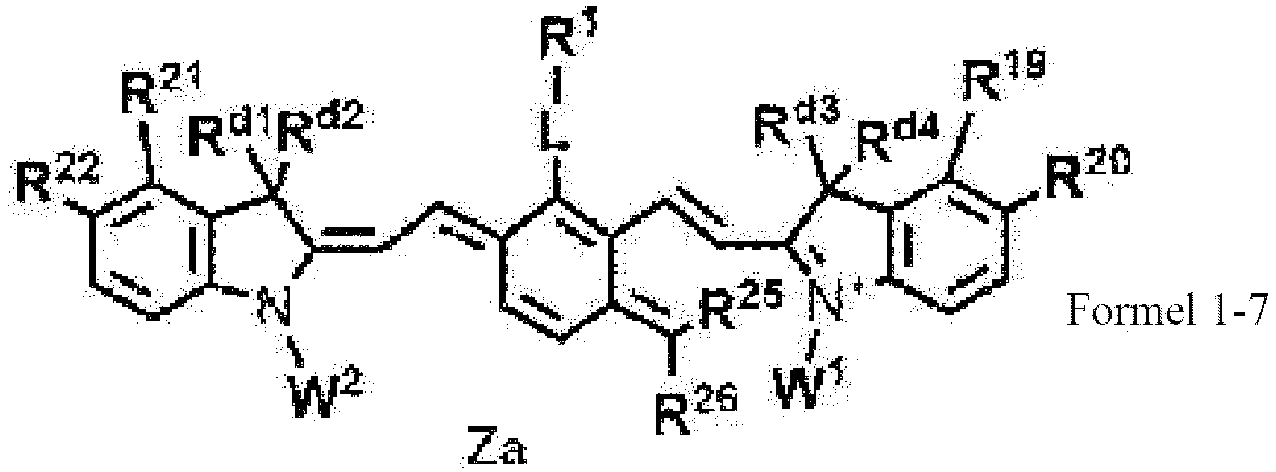
- Lithographischer Druckplattenvorläufer des Auf-Presse-Entwicklungstyps nach einem der Ansprüche 1 bis 10, wobei der Infrarotabsorber eine zersetzbare Verbindung ist, die sich aufgrund von Exposition gegenüber Infrarot zersetzt.
- Lithographischer Druckplattenvorläufer des Auf-Presse-Entwicklungstyps nach Anspruch 1, wobei der Aluminiumträger eine Aluminiumplatte und einen anodischen Oxidfilm von Aluminium, der auf der Aluminiumplatte angeordnet ist, aufweist,sich der anodische Oxidfilm an einer Position, die näher an einer Seite der Bildaufzeichnungsschicht als die Aluminiumplatte liegt, befindet und Mikroporen, die sich in einer Tiefenrichtung von einer Oberfläche des anodischen Oxidfilms auf der Seite der Bildaufzeichnungsschicht erstrecken, aufweist,ein durchschnittlicher Durchmesser der Mikroporen innerhalb der Oberfläche des anodischen Oxidfilms mehr als 10 nm und 100 nm oder weniger beträgt, und in dem L*a*b*-Farbraum ein Wert von Helligkeit L* der Oberfläche des anodischen Oxidfilms auf der Seite der Bildaufzeichnungsschicht 70 bis 100 beträgt,wobei die Mikroporen jeweils aus einem Abschnitt mit großem Durchmesser, der sich zu einer Position in einer Tiefe von 10 nm bis 1.000 nm von der Oberfläche des anodischen Oxidfilms erstreckt, und einem Abschnitt mit kleinem Durchmesser, der mit einem Bodenabschnitt des Abschnitts mit großem Durchmesser in Kommunikation steht und sich zu einer Position in einer Tiefe von 20 nm bis 2.000 nm von einer Kommunikationsposition erstreckt, aufgebaut sind,ein durchschnittlicher Durchmesser des Abschnitts mit großem Durchmesser innerhalb der Oberfläche des anodischen Oxidfilms 15 nm bis 100 nm beträgt, undein durchschnittlicher Durchmesser des Abschnitts mit kleinem Durchmesser an der Kommunikationsposition 13 nm oder weniger beträgt.
- Verfahren zum Herstellen einer lithographischen Druckplatte, umfassend:einen Schritt des Belichtens des lithographischen Druckplattenvorläufers des Auf-Presse-Entwicklungstyps nach einem der Ansprüche 1 bis 12 in der Form eines Bildes; undeinen Schritt des Zuführens von mindestens einem Material, das aus der Gruppe ausgewählt wird, die aus einem Druckfarbe und Feuchtwasser besteht, auf einen Drucker, so dass eine Bildaufzeichnungsschicht in einem Nichtbildbereich entfernt wird.
- Lithographisches Druckverfahren, umfassend:einen Schritt des Belichtens des lithographischen Druckplattenvorläufers des Auf-Presse-Entwicklungstyps nach einem der Ansprüche 1 bis 12 in der Form eines Bildes; einen Schritt des Zuführens von mindestens einem Material, das aus der Gruppe ausgewählt wird, die aus einem Druckfarbe und Feuchtwasser besteht, auf einen Drucker, so dass eine Bildaufzeichnungsschicht in einem Nichtbildbereich entfernt wird und eine lithographische Druckplatte hergestellt wird; undeinen Schritt des Durchführens von Drucken durch Verwenden der erhaltenen lithographischen Druckplatte.
Applications Claiming Priority (4)
| Application Number | Priority Date | Filing Date | Title |
|---|---|---|---|
| JP2019122493 | 2019-06-28 | ||
| JP2019158808 | 2019-08-30 | ||
| JP2019169800 | 2019-09-18 | ||
| PCT/JP2020/025418 WO2020262696A1 (ja) | 2019-06-28 | 2020-06-26 | 機上現像型平版印刷版原版、平版印刷版の作製方法、及び、平版印刷方法 |
Publications (3)
| Publication Number | Publication Date |
|---|---|
| EP3991990A1 EP3991990A1 (de) | 2022-05-04 |
| EP3991990A4 EP3991990A4 (de) | 2022-08-17 |
| EP3991990B1 true EP3991990B1 (de) | 2025-02-26 |
Family
ID=74061287
Family Applications (1)
| Application Number | Title | Priority Date | Filing Date |
|---|---|---|---|
| EP20832892.2A Active EP3991990B1 (de) | 2019-06-28 | 2020-06-26 | Lithografiedruckplattenvorläufer mit entwicklung auf der druckpresse, lithografiedruckplattenherstellungsverfahren und lithografiedruckverfahren |
Country Status (5)
| Country | Link |
|---|---|
| US (1) | US12117729B2 (de) |
| EP (1) | EP3991990B1 (de) |
| JP (1) | JP7372324B2 (de) |
| CN (1) | CN114051454B (de) |
| WO (1) | WO2020262696A1 (de) |
Families Citing this family (6)
| Publication number | Priority date | Publication date | Assignee | Title |
|---|---|---|---|---|
| WO2021241519A1 (ja) * | 2020-05-29 | 2021-12-02 | 富士フイルム株式会社 | 機上現像型平版印刷版原版、平版印刷版の作製方法、及び平版印刷方法 |
| JP7413526B2 (ja) | 2020-05-29 | 2024-01-15 | 富士フイルム株式会社 | 機上現像型平版印刷版原版、平版印刷版の作製方法、及び、平版印刷方法 |
| EP4159455B1 (de) * | 2020-05-29 | 2025-10-29 | FUJIFILM Corporation | Auf der druckpresse entwickelbarer lithographiedruckplattenvorläufer und verfahren zur herstellung einer lithographischen druckplatte |
| EP4159459B1 (de) * | 2020-05-29 | 2025-12-17 | FUJIFILM Corporation | Lithografiedruckplattenvorläufer mit entwicklung auf der druckpresse, lithografiedruckplattenherstellungsverfahren und lithografiedruckverfahren |
| JP7726979B2 (ja) * | 2021-02-26 | 2025-08-20 | 富士フイルム株式会社 | 機上現像型平版印刷版原版、平版印刷版の作製方法、平版印刷方法、及び、呈色剤 |
| US20230091079A1 (en) * | 2021-07-23 | 2023-03-23 | Eastman Kodak Company | Lithographic printing plate precursor and method of use |
Family Cites Families (106)
| Publication number | Priority date | Publication date | Assignee | Title |
|---|---|---|---|---|
| US3458311A (en) | 1966-06-27 | 1969-07-29 | Du Pont | Photopolymerizable elements with solvent removable protective layers |
| JPS4841708B1 (de) | 1970-01-13 | 1973-12-07 | ||
| DE2064079C2 (de) | 1970-12-28 | 1982-09-09 | Hoechst Ag, 6000 Frankfurt | Photopolymerisierbares Gemisch |
| JPS5040047B2 (de) | 1971-09-06 | 1975-12-22 | ||
| JPS5549729B2 (de) | 1973-02-07 | 1980-12-13 | ||
| DE2361041C3 (de) | 1973-12-07 | 1980-08-14 | Hoechst Ag, 6000 Frankfurt | Photopolymerisierbares Gemisch |
| JPS5311314B2 (de) | 1974-09-25 | 1978-04-20 | ||
| DE2822190A1 (de) | 1978-05-20 | 1979-11-22 | Hoechst Ag | Photopolymerisierbares gemisch |
| DE2822189A1 (de) | 1978-05-20 | 1980-04-17 | Hoechst Ag | Photopolymerisierbares gemisch |
| DE3036694A1 (de) | 1980-09-29 | 1982-06-03 | Hoechst Ag, 6000 Frankfurt | Gummielastische, ethylenisch ungesaettigte polyurethane und dieselben enthaltendes durch strahlung polymerisierbares gemisch |
| DE3048502A1 (de) | 1980-12-22 | 1982-07-22 | Hoechst Ag, 6000 Frankfurt | Durch strahlung polymerisierbares gemisch und daraus hergestelltes strahlungsempfindliches aufzeichnungsmaterial |
| JP2525568B2 (ja) | 1985-01-18 | 1996-08-21 | 富士写真フイルム株式会社 | 光可溶化組成物 |
| JPH0714670B2 (ja) * | 1987-02-18 | 1995-02-22 | 富士写真フイルム株式会社 | 感光性平版印刷版用支持体の製造方法 |
| JP2655349B2 (ja) | 1989-05-18 | 1997-09-17 | 富士写真フイルム株式会社 | 感光性平版印刷版 |
| JP2988756B2 (ja) | 1991-04-26 | 1999-12-13 | 協和醗酵工業株式会社 | 光重合開始剤およびこれを含有する光重合性組成物 |
| WO1994017452A1 (en) | 1993-01-20 | 1994-08-04 | Agfa-Gevaert Naamloze Vennootschap | Photopolymerizable composition of high sensitivity and method for obtaining images therewith |
| JPH08108621A (ja) | 1994-10-06 | 1996-04-30 | Konica Corp | 画像記録媒体及びそれを用いる画像形成方法 |
| DE69623140T2 (de) | 1995-10-24 | 2003-03-27 | Agfa-Gevaert, Mortsel | Verfahren zur Herstellung einer lithographischen Druckplatte mit auf der Druckpresse stattfindender Entwicklung |
| EP0770494B1 (de) | 1995-10-24 | 2000-05-24 | Agfa-Gevaert N.V. | Verfahren zur Herstellung einer lithographische Druckplatte mit auf der Druckpresse stattfindenden Entwicklung |
| DE69613078T2 (de) | 1995-11-09 | 2001-11-22 | Agfa-Gevaert N.V., Mortsel | Wärmeempfindliches Aufzeichnungselement und Verfahren zur Herstellung einer Druckform damit |
| DE69608522T2 (de) | 1995-11-09 | 2001-01-25 | Agfa-Gevaert N.V., Mortsel | Wärmeempfindliches Aufzeichnungselement und Verfahren zur Herstellung einer lithographischen Druckform damit |
| JPH09179297A (ja) | 1995-12-22 | 1997-07-11 | Mitsubishi Chem Corp | 光重合性組成物 |
| JPH09179298A (ja) | 1995-12-22 | 1997-07-11 | Mitsubishi Chem Corp | 光重合性組成物 |
| JPH09179296A (ja) | 1995-12-22 | 1997-07-11 | Mitsubishi Chem Corp | 光重合性組成物 |
| JPH10282679A (ja) | 1997-04-08 | 1998-10-23 | Fuji Photo Film Co Ltd | ネガ型感光性平版印刷版 |
| JP3839552B2 (ja) | 1997-06-03 | 2006-11-01 | コダックポリクロームグラフィックス株式会社 | 印刷現像感光性平版印刷版及びその製版方法 |
| DE69812871T2 (de) | 1998-01-23 | 2004-02-26 | Agfa-Gevaert | Wärmeempfindliches Aufzeichnungselement und Verfahren um damit Flachdruckplatten herzustellen |
| US6085656A (en) * | 1998-07-24 | 2000-07-11 | Presstak, Inc. | Method of lithographic imaging with reduced debris-generated performance degradation and related constructions |
| JP3905234B2 (ja) | 1998-12-09 | 2007-04-18 | 富士フイルム株式会社 | 光重合性組成物及びそれを用いた感光感熱記録材料 |
| JP2000250211A (ja) | 1999-03-01 | 2000-09-14 | Fuji Photo Film Co Ltd | 光重合性組成物 |
| JP2001133969A (ja) | 1999-11-01 | 2001-05-18 | Fuji Photo Film Co Ltd | ネガ型平版印刷版原版 |
| JP2001277740A (ja) | 2000-01-27 | 2001-10-10 | Fuji Photo Film Co Ltd | 平版印刷版用原版 |
| JP2001277742A (ja) | 2000-01-27 | 2001-10-10 | Fuji Photo Film Co Ltd | 平版印刷版用原版 |
| JP4092055B2 (ja) | 2000-02-09 | 2008-05-28 | 三菱製紙株式会社 | 感光性組成物および感光性平版印刷版材料 |
| JP3449342B2 (ja) | 2000-03-30 | 2003-09-22 | 三菱化学株式会社 | 光硬化性組成物、低複屈折光学部材及びその製造方法 |
| JP2002023360A (ja) | 2000-07-12 | 2002-01-23 | Fuji Photo Film Co Ltd | ネガ型画像記録材料 |
| JP4156784B2 (ja) | 2000-07-25 | 2008-09-24 | 富士フイルム株式会社 | ネガ型画像記録材料及び画像形成方法 |
| JP4319363B2 (ja) | 2001-01-15 | 2009-08-26 | 富士フイルム株式会社 | ネガ型画像記録材料 |
| JP4414607B2 (ja) | 2001-03-14 | 2010-02-10 | 富士フイルム株式会社 | ラジカル重合性化合物 |
| JP2002287344A (ja) | 2001-03-27 | 2002-10-03 | Fuji Photo Film Co Ltd | 光重合性平版印刷版 |
| US7261998B2 (en) | 2001-04-04 | 2007-08-28 | Eastman Kodak Company | Imageable element with solvent-resistant polymeric binder |
| JP2002328465A (ja) | 2001-04-27 | 2002-11-15 | Fuji Photo Film Co Ltd | 平版印刷版原版 |
| JP2003064130A (ja) | 2001-08-29 | 2003-03-05 | Fuji Photo Film Co Ltd | 光重合性組成物 |
| JP3989270B2 (ja) | 2002-03-25 | 2007-10-10 | 富士フイルム株式会社 | 光重合性組成物 |
| DE50204080D1 (de) | 2002-04-29 | 2005-10-06 | Agfa Gevaert Nv | Strahlungsempfindliches Gemisch, damit hergestelltes Aufzeichnungsmaterial, und Verfahren zur Herstellung einer Druckplatte |
| DE10255663B4 (de) | 2002-11-28 | 2006-05-04 | Kodak Polychrome Graphics Gmbh | Strahlungsempfindliche Elemente |
| JP4299032B2 (ja) | 2003-03-28 | 2009-07-22 | 三菱製紙株式会社 | 感光性平版印刷版材料 |
| ATE491968T1 (de) | 2003-07-22 | 2011-01-15 | Fujifilm Corp | Flachdruckplattenvorläufer und lithographisches druckverfahren |
| JP4644458B2 (ja) | 2003-09-30 | 2011-03-02 | 富士フイルム株式会社 | 平版印刷版原版および平版印刷方法 |
| JP4351933B2 (ja) | 2004-03-05 | 2009-10-28 | 富士フイルム株式会社 | ネガ型平版印刷版原版およびこれを用いた平版印刷版の製版方法 |
| EP1736312B1 (de) | 2005-06-21 | 2008-04-02 | Agfa Graphics N.V. | Wärmeempfindliches Bildaufzeichnungselement |
| US7425406B2 (en) * | 2004-07-27 | 2008-09-16 | Fujifilm Corporation | Lithographic printing plate precursor and lithographic printing method |
| JP2006065210A (ja) | 2004-08-30 | 2006-03-09 | Fuji Photo Film Co Ltd | 感光性平版印刷版 |
| JP2006188038A (ja) | 2004-12-10 | 2006-07-20 | Fuji Photo Film Co Ltd | 平版印刷版原版および製版方法 |
| JP4448781B2 (ja) * | 2005-01-25 | 2010-04-14 | 富士フイルム株式会社 | 機上現像型平版印刷版原版及びそれを用いた平版印刷方法 |
| JP4469734B2 (ja) | 2005-02-03 | 2010-05-26 | 富士フイルム株式会社 | 平版印刷版原版 |
| JP2006239867A (ja) | 2005-02-28 | 2006-09-14 | Fuji Photo Film Co Ltd | 平版印刷版原版および平版印刷方法 |
| JP5172097B2 (ja) | 2005-02-28 | 2013-03-27 | 富士フイルム株式会社 | 平版印刷版原版および平版印刷版原版の製造方法 |
| JP2006243493A (ja) | 2005-03-04 | 2006-09-14 | Fuji Photo Film Co Ltd | 感光性平版印刷版 |
| JP4393408B2 (ja) | 2005-03-16 | 2010-01-06 | 富士フイルム株式会社 | ネガ型平版印刷版原版 |
| US7153632B1 (en) | 2005-08-03 | 2006-12-26 | Eastman Kodak Company | Radiation-sensitive compositions and imageable materials |
| JP4759343B2 (ja) | 2005-08-19 | 2011-08-31 | 富士フイルム株式会社 | 平版印刷版原版および平版印刷方法 |
| JP5170960B2 (ja) | 2005-08-29 | 2013-03-27 | 富士フイルム株式会社 | 平版印刷版原版、及び平版印刷方法 |
| JP2007118587A (ja) * | 2005-09-27 | 2007-05-17 | Fujifilm Corp | 平版印刷版原版および平版印刷方法 |
| JP2007094138A (ja) | 2005-09-29 | 2007-04-12 | Fujifilm Corp | 平版印刷版原版及びその製版方法 |
| JP5238170B2 (ja) | 2006-03-14 | 2013-07-17 | 富士フイルム株式会社 | 平版印刷版原版 |
| JP2007293221A (ja) | 2006-03-31 | 2007-11-08 | Fujifilm Corp | 平版印刷版の作製方法及び平版印刷版原版 |
| JP4796890B2 (ja) | 2006-03-31 | 2011-10-19 | 富士フイルム株式会社 | 平版印刷版原版及び平版印刷方法 |
| JP2008195018A (ja) | 2007-02-15 | 2008-08-28 | Fujifilm Corp | 平版印刷版原版および平版印刷方法 |
| JP4826918B2 (ja) | 2007-04-03 | 2011-11-30 | 三菱化学株式会社 | 光重合性組成物 |
| JP5046744B2 (ja) | 2007-05-18 | 2012-10-10 | 富士フイルム株式会社 | 平版印刷版原版、及びそれを用いた印刷方法 |
| JP2008284858A (ja) | 2007-05-21 | 2008-11-27 | Fujifilm Corp | 平版印刷版原版、及びそれを用いた印刷方法 |
| EP2006738B1 (de) | 2007-06-21 | 2017-09-06 | Fujifilm Corporation | Lithographiedruckplattenvorläufer |
| JP2009090645A (ja) | 2007-09-20 | 2009-04-30 | Fujifilm Corp | 平版印刷版原版、及びそれを用いた印刷方法 |
| JP5322537B2 (ja) | 2007-10-29 | 2013-10-23 | 富士フイルム株式会社 | 平版印刷版原版 |
| EP2293144B1 (de) | 2009-09-04 | 2012-11-07 | Eastman Kodak Company | Verfahren zum Trocknen von Lithographiedruckplatten nach einer Einstufenverarbeitung |
| CN102812402B (zh) * | 2010-03-19 | 2015-08-05 | 富士胶片株式会社 | 着色感光性组合物、平版印刷版原版和制版方法 |
| JP5645743B2 (ja) | 2010-04-30 | 2014-12-24 | 富士フイルム株式会社 | 平版印刷版原版、その製版方法、及び、多価イソシアネート化合物 |
| JP5205505B2 (ja) | 2010-12-28 | 2013-06-05 | 富士フイルム株式会社 | 平版印刷版原版及びその平版印刷方法 |
| JP5205480B2 (ja) | 2011-01-31 | 2013-06-05 | 富士フイルム株式会社 | 平版印刷版用支持体、および平版印刷版原版 |
| JP5740275B2 (ja) | 2011-09-30 | 2015-06-24 | 富士フイルム株式会社 | 機上現像型の平版印刷版原版を用いる印刷方法 |
| JP5699112B2 (ja) * | 2012-07-27 | 2015-04-08 | 富士フイルム株式会社 | 平版印刷版原版及びその製版方法 |
| JP2014079960A (ja) | 2012-10-17 | 2014-05-08 | Eastman Kodak Co | 平版印刷版用組成物及び平版印刷版原版 |
| WO2016027886A1 (ja) | 2014-08-22 | 2016-02-25 | 富士フイルム株式会社 | 発色組成物、平版印刷版原版、平版印刷版の製版方法、及び、発色剤 |
| EP3121008B1 (de) * | 2015-07-23 | 2018-06-13 | Agfa Nv | Lithografiedruckplattenvorläufer mit graphitoxid |
| US20170217149A1 (en) | 2016-01-28 | 2017-08-03 | Eastman Kodak Company | Negatively-working lithographic printing plate precursor and method |
| JP6785295B2 (ja) | 2016-02-19 | 2020-11-18 | 富士フイルム株式会社 | 発色組成物、平版印刷版原版、平版印刷版の作製方法、及び発色性化合物 |
| JP6510726B2 (ja) * | 2016-02-29 | 2019-05-08 | 富士フイルム株式会社 | 平版印刷版原版及び平版印刷版の製版方法 |
| WO2017168831A1 (ja) * | 2016-03-30 | 2017-10-05 | 富士フイルム株式会社 | 機上現像用平版印刷版原版、平版印刷版の作製方法、及び、平版印刷方法 |
| US10960656B2 (en) | 2016-04-01 | 2021-03-30 | Eastman Kodak Company | Negatively-working lithographic printing plate precursor and method |
| JP6865757B2 (ja) | 2016-08-31 | 2021-04-28 | 富士フイルム株式会社 | 発色組成物、平版印刷版原版、平版印刷版の作製方法、及び、化合物 |
| EP3590975B1 (de) * | 2017-02-28 | 2022-05-04 | FUJIFILM Corporation | Härtbare zusammensetzung, lithografischer druckplattenvorläufer, verfahren zur herstellung einer lithografischen druckplatte und verbindung |
| CN109153279B (zh) * | 2017-02-28 | 2020-03-17 | 富士胶片株式会社 | 平版印刷版原版、平版印刷版的制版方法、以及平版印刷方法 |
| CN111361324B (zh) * | 2017-03-31 | 2021-10-19 | 富士胶片株式会社 | 平版印刷版原版、其制造方法、其层叠体、平版印刷方法 |
| EP3632696B1 (de) * | 2017-05-31 | 2023-04-26 | FUJIFILM Corporation | Lithografischer druckplattenvorläufer, herstellungsverfahren für lithografische druckplatte, polymerteilchen und zusammensetzung |
| EP3640039B1 (de) * | 2017-06-12 | 2024-04-24 | FUJIFILM Corporation | Lithographische originalplatte, plattenherstellungsverfahren für lithographische platte und lichtempfindliche harzzusammensetzung |
| JP6621570B2 (ja) * | 2017-07-13 | 2019-12-18 | 富士フイルム株式会社 | 平版印刷版原版、及び、平版印刷版の作製方法 |
| EP3660588B1 (de) * | 2017-07-25 | 2021-08-25 | FUJIFILM Corporation | Lithographiedruckplattenvorläufer, verfahren zur herstellung einer lithographiedruckplatte und farbentwickelnde zusammensetzung |
| CN111051072B (zh) | 2017-08-31 | 2021-08-03 | 富士胶片株式会社 | 平版印刷版原版、平版印刷版的制作方法及平版印刷方法 |
| WO2019064696A1 (ja) * | 2017-09-29 | 2019-04-04 | 富士フイルム株式会社 | 平版印刷版原版、平版印刷版の作製方法及び平版印刷方法 |
| JP6416419B1 (ja) | 2018-01-12 | 2018-10-31 | 株式会社コロプラ | ゲームプログラム、方法、および情報処理装置 |
| JP6931622B2 (ja) | 2018-03-16 | 2021-09-08 | 日立Geニュークリア・エナジー株式会社 | 原子力プラントの炭素鋼部材への貴金属の付着方法及び原子力プラントの炭素鋼部材への放射性核種の付着抑制方法 |
| JP7067173B2 (ja) | 2018-03-22 | 2022-05-16 | 沖電気工業株式会社 | 収音装置、プログラム及び方法 |
| EP3793829B1 (de) | 2018-05-14 | 2023-07-12 | Agfa Offset Bv | Lithographiedruckplattenvorläufer |
| JP7282885B2 (ja) * | 2019-06-28 | 2023-05-29 | 富士フイルム株式会社 | 平版印刷版原版、平版印刷版の作製方法、及び、平版印刷方法 |
| CN115151425A (zh) * | 2020-02-28 | 2022-10-04 | 富士胶片株式会社 | 平版印刷版原版、平版印刷版的制作方法及平版印刷方法 |
-
2020
- 2020-06-26 EP EP20832892.2A patent/EP3991990B1/de active Active
- 2020-06-26 WO PCT/JP2020/025418 patent/WO2020262696A1/ja not_active Ceased
- 2020-06-26 JP JP2021528303A patent/JP7372324B2/ja active Active
- 2020-06-26 CN CN202080046510.6A patent/CN114051454B/zh active Active
-
2021
- 2021-12-22 US US17/558,779 patent/US12117729B2/en active Active
Also Published As
| Publication number | Publication date |
|---|---|
| JPWO2020262696A1 (de) | 2020-12-30 |
| CN114051454B (zh) | 2023-12-15 |
| CN114051454A (zh) | 2022-02-15 |
| US12117729B2 (en) | 2024-10-15 |
| WO2020262696A1 (ja) | 2020-12-30 |
| US20220113629A1 (en) | 2022-04-14 |
| EP3991990A1 (de) | 2022-05-04 |
| EP3991990A4 (de) | 2022-08-17 |
| JP7372324B2 (ja) | 2023-10-31 |
Similar Documents
| Publication | Publication Date | Title |
|---|---|---|
| EP3991986B1 (de) | Auf der druckpresse entwickelbarer negativ arbeitender planographischer druckplattenvorläufer, verfahren zur herstellung einer planographischen druckplatte und planographische druckplatte | |
| US12117729B2 (en) | On-press development type lithographic printing plate precursor, method for preparing lithographic printing plate, and lithographic printing method | |
| EP3991983B1 (de) | Lithografiedruckplattenvorläufer mit entwicklung auf der druckpresse, lithografiedruckplattenherstellungsverfahren und lithografiedruckverfahren | |
| EP3991985A1 (de) | Flachdruckoriginalplatte, verfahren zur herstellung einer flachdruckplatte und flachdruckverfahren | |
| EP3594009A1 (de) | Originalplatte einer lithographischen druckplatte und verfahren zur herstellung einer lithographischen druckplatte | |
| EP4039489B1 (de) | Flachdruckplattenoriginal, verfahren zur herstellung einer flachdruckplatte und flachdruckverfahren | |
| EP3991987A1 (de) | Vorläufer einer lithografischen druckplatte mit druckentwicklung, verfahren zur herstellung einer lithografischen druckplatte und lithografisches druckverfahren | |
| EP3991988B1 (de) | Flachdruckplattenvorläufer, verfahren zur herstellung einer flachdruckplatte und flachdruckverfahren | |
| EP4082791B1 (de) | Flachdruckverfahren | |
| US11874602B2 (en) | Lithographic printing plate precursor, method for preparing lithographic printing plate, and lithographic printing method | |
| EP3904100B1 (de) | Lithographiedruckplattenvorläufer, verfahren zur herstellung einer lithographiedruckplatte und lithographiedruckverfahren | |
| US12122177B2 (en) | Lithographic printing plate precursor, method for preparing lithographic printing plate, and lithographic printing method | |
| EP3991984B1 (de) | Lithografische druckplatte und verfahren zur herstellung einer lithografischen druckplatte | |
| EP4159460B1 (de) | Schichtkörper | |
| WO2020262695A1 (ja) | 機上現像型平版印刷版原版、平版印刷版の作製方法、及び、平版印刷方法 | |
| WO2020262687A1 (ja) | 平版印刷版原版、平版印刷版の作製方法、及び平版印刷方法 | |
| WO2020262688A1 (ja) | 平版印刷版原版、平版印刷版の作製方法、及び、平版印刷方法 |
Legal Events
| Date | Code | Title | Description |
|---|---|---|---|
| STAA | Information on the status of an ep patent application or granted ep patent |
Free format text: STATUS: THE INTERNATIONAL PUBLICATION HAS BEEN MADE |
|
| PUAI | Public reference made under article 153(3) epc to a published international application that has entered the european phase |
Free format text: ORIGINAL CODE: 0009012 |
|
| STAA | Information on the status of an ep patent application or granted ep patent |
Free format text: STATUS: REQUEST FOR EXAMINATION WAS MADE |
|
| 17P | Request for examination filed |
Effective date: 20211222 |
|
| AK | Designated contracting states |
Kind code of ref document: A1 Designated state(s): AL AT BE BG CH CY CZ DE DK EE ES FI FR GB GR HR HU IE IS IT LI LT LU LV MC MK MT NL NO PL PT RO RS SE SI SK SM TR |
|
| REG | Reference to a national code |
Ref country code: DE Ipc: B41C0001100000 Ref country code: DE Ref legal event code: R079 Ref document number: 602020046907 Country of ref document: DE Free format text: PREVIOUS MAIN CLASS: B41N0001140000 Ipc: B41C0001100000 |
|
| A4 | Supplementary search report drawn up and despatched |
Effective date: 20220715 |
|
| RIC1 | Information provided on ipc code assigned before grant |
Ipc: G03F 7/30 20060101ALN20220711BHEP Ipc: G03F 7/038 20060101ALN20220711BHEP Ipc: G03F 7/032 20060101ALN20220711BHEP Ipc: G03F 7/027 20060101ALN20220711BHEP Ipc: G03F 7/029 20060101ALN20220711BHEP Ipc: G03F 7/004 20060101ALN20220711BHEP Ipc: G03F 7/00 20060101ALN20220711BHEP Ipc: B41C 1/10 20060101AFI20220711BHEP |
|
| DAV | Request for validation of the european patent (deleted) | ||
| DAX | Request for extension of the european patent (deleted) | ||
| STAA | Information on the status of an ep patent application or granted ep patent |
Free format text: STATUS: EXAMINATION IS IN PROGRESS |
|
| 17Q | First examination report despatched |
Effective date: 20231201 |
|
| GRAP | Despatch of communication of intention to grant a patent |
Free format text: ORIGINAL CODE: EPIDOSNIGR1 |
|
| STAA | Information on the status of an ep patent application or granted ep patent |
Free format text: STATUS: GRANT OF PATENT IS INTENDED |
|
| RIC1 | Information provided on ipc code assigned before grant |
Ipc: G03F 7/30 20060101ALN20240923BHEP Ipc: G03F 7/038 20060101ALN20240923BHEP Ipc: G03F 7/032 20060101ALN20240923BHEP Ipc: G03F 7/027 20060101ALN20240923BHEP Ipc: G03F 7/029 20060101ALN20240923BHEP Ipc: G03F 7/004 20060101ALN20240923BHEP Ipc: G03F 7/00 20060101ALN20240923BHEP Ipc: B41C 1/10 20060101AFI20240923BHEP |
|
| INTG | Intention to grant announced |
Effective date: 20241028 |
|
| GRAS | Grant fee paid |
Free format text: ORIGINAL CODE: EPIDOSNIGR3 |
|
| GRAA | (expected) grant |
Free format text: ORIGINAL CODE: 0009210 |
|
| STAA | Information on the status of an ep patent application or granted ep patent |
Free format text: STATUS: THE PATENT HAS BEEN GRANTED |
|
| P01 | Opt-out of the competence of the unified patent court (upc) registered |
Free format text: CASE NUMBER: APP_2175/2025 Effective date: 20250113 |
|
| AK | Designated contracting states |
Kind code of ref document: B1 Designated state(s): AL AT BE BG CH CY CZ DE DK EE ES FI FR GB GR HR HU IE IS IT LI LT LU LV MC MK MT NL NO PL PT RO RS SE SI SK SM TR |
|
| REG | Reference to a national code |
Ref country code: GB Ref legal event code: FG4D |
|
| REG | Reference to a national code |
Ref country code: CH Ref legal event code: EP |
|
| REG | Reference to a national code |
Ref country code: DE Ref legal event code: R096 Ref document number: 602020046907 Country of ref document: DE |
|
| REG | Reference to a national code |
Ref country code: IE Ref legal event code: FG4D |
|
| REG | Reference to a national code |
Ref country code: NL Ref legal event code: MP Effective date: 20250226 |
|
| PG25 | Lapsed in a contracting state [announced via postgrant information from national office to epo] |
Ref country code: RS Free format text: LAPSE BECAUSE OF FAILURE TO SUBMIT A TRANSLATION OF THE DESCRIPTION OR TO PAY THE FEE WITHIN THE PRESCRIBED TIME-LIMIT Effective date: 20250526 |
|
| PG25 | Lapsed in a contracting state [announced via postgrant information from national office to epo] |
Ref country code: FI Free format text: LAPSE BECAUSE OF FAILURE TO SUBMIT A TRANSLATION OF THE DESCRIPTION OR TO PAY THE FEE WITHIN THE PRESCRIBED TIME-LIMIT Effective date: 20250226 |
|
| PG25 | Lapsed in a contracting state [announced via postgrant information from national office to epo] |
Ref country code: PL Free format text: LAPSE BECAUSE OF FAILURE TO SUBMIT A TRANSLATION OF THE DESCRIPTION OR TO PAY THE FEE WITHIN THE PRESCRIBED TIME-LIMIT Effective date: 20250226 |
|
| PGFP | Annual fee paid to national office [announced via postgrant information from national office to epo] |
Ref country code: DE Payment date: 20250429 Year of fee payment: 6 |
|
| PG25 | Lapsed in a contracting state [announced via postgrant information from national office to epo] |
Ref country code: ES Free format text: LAPSE BECAUSE OF FAILURE TO SUBMIT A TRANSLATION OF THE DESCRIPTION OR TO PAY THE FEE WITHIN THE PRESCRIBED TIME-LIMIT Effective date: 20250226 |
|
| PGFP | Annual fee paid to national office [announced via postgrant information from national office to epo] |
Ref country code: GB Payment date: 20250508 Year of fee payment: 6 |
|
| REG | Reference to a national code |
Ref country code: LT Ref legal event code: MG9D |
|
| PG25 | Lapsed in a contracting state [announced via postgrant information from national office to epo] |
Ref country code: NO Free format text: LAPSE BECAUSE OF FAILURE TO SUBMIT A TRANSLATION OF THE DESCRIPTION OR TO PAY THE FEE WITHIN THE PRESCRIBED TIME-LIMIT Effective date: 20250526 Ref country code: IS Free format text: LAPSE BECAUSE OF FAILURE TO SUBMIT A TRANSLATION OF THE DESCRIPTION OR TO PAY THE FEE WITHIN THE PRESCRIBED TIME-LIMIT Effective date: 20250626 |
|
| PG25 | Lapsed in a contracting state [announced via postgrant information from national office to epo] |
Ref country code: NL Free format text: LAPSE BECAUSE OF FAILURE TO SUBMIT A TRANSLATION OF THE DESCRIPTION OR TO PAY THE FEE WITHIN THE PRESCRIBED TIME-LIMIT Effective date: 20250226 |
|
| PG25 | Lapsed in a contracting state [announced via postgrant information from national office to epo] |
Ref country code: HR Free format text: LAPSE BECAUSE OF FAILURE TO SUBMIT A TRANSLATION OF THE DESCRIPTION OR TO PAY THE FEE WITHIN THE PRESCRIBED TIME-LIMIT Effective date: 20250226 |
|
| PG25 | Lapsed in a contracting state [announced via postgrant information from national office to epo] |
Ref country code: LV Free format text: LAPSE BECAUSE OF FAILURE TO SUBMIT A TRANSLATION OF THE DESCRIPTION OR TO PAY THE FEE WITHIN THE PRESCRIBED TIME-LIMIT Effective date: 20250226 Ref country code: PT Free format text: LAPSE BECAUSE OF FAILURE TO SUBMIT A TRANSLATION OF THE DESCRIPTION OR TO PAY THE FEE WITHIN THE PRESCRIBED TIME-LIMIT Effective date: 20250626 |
|
| PG25 | Lapsed in a contracting state [announced via postgrant information from national office to epo] |
Ref country code: GR Free format text: LAPSE BECAUSE OF FAILURE TO SUBMIT A TRANSLATION OF THE DESCRIPTION OR TO PAY THE FEE WITHIN THE PRESCRIBED TIME-LIMIT Effective date: 20250527 Ref country code: BG Free format text: LAPSE BECAUSE OF FAILURE TO SUBMIT A TRANSLATION OF THE DESCRIPTION OR TO PAY THE FEE WITHIN THE PRESCRIBED TIME-LIMIT Effective date: 20250226 |
|
| REG | Reference to a national code |
Ref country code: AT Ref legal event code: MK05 Ref document number: 1770269 Country of ref document: AT Kind code of ref document: T Effective date: 20250226 |
|
| PG25 | Lapsed in a contracting state [announced via postgrant information from national office to epo] |
Ref country code: SE Free format text: LAPSE BECAUSE OF FAILURE TO SUBMIT A TRANSLATION OF THE DESCRIPTION OR TO PAY THE FEE WITHIN THE PRESCRIBED TIME-LIMIT Effective date: 20250226 |
|
| PG25 | Lapsed in a contracting state [announced via postgrant information from national office to epo] |
Ref country code: SM Free format text: LAPSE BECAUSE OF FAILURE TO SUBMIT A TRANSLATION OF THE DESCRIPTION OR TO PAY THE FEE WITHIN THE PRESCRIBED TIME-LIMIT Effective date: 20250226 |
|
| PG25 | Lapsed in a contracting state [announced via postgrant information from national office to epo] |
Ref country code: DK Free format text: LAPSE BECAUSE OF FAILURE TO SUBMIT A TRANSLATION OF THE DESCRIPTION OR TO PAY THE FEE WITHIN THE PRESCRIBED TIME-LIMIT Effective date: 20250226 |
|
| PG25 | Lapsed in a contracting state [announced via postgrant information from national office to epo] |
Ref country code: IT Free format text: LAPSE BECAUSE OF FAILURE TO SUBMIT A TRANSLATION OF THE DESCRIPTION OR TO PAY THE FEE WITHIN THE PRESCRIBED TIME-LIMIT Effective date: 20250226 |
|
| PG25 | Lapsed in a contracting state [announced via postgrant information from national office to epo] |
Ref country code: AT Free format text: LAPSE BECAUSE OF FAILURE TO SUBMIT A TRANSLATION OF THE DESCRIPTION OR TO PAY THE FEE WITHIN THE PRESCRIBED TIME-LIMIT Effective date: 20250226 |
|
| PG25 | Lapsed in a contracting state [announced via postgrant information from national office to epo] |
Ref country code: CZ Free format text: LAPSE BECAUSE OF FAILURE TO SUBMIT A TRANSLATION OF THE DESCRIPTION OR TO PAY THE FEE WITHIN THE PRESCRIBED TIME-LIMIT Effective date: 20250226 Ref country code: EE Free format text: LAPSE BECAUSE OF FAILURE TO SUBMIT A TRANSLATION OF THE DESCRIPTION OR TO PAY THE FEE WITHIN THE PRESCRIBED TIME-LIMIT Effective date: 20250226 |
|
| PG25 | Lapsed in a contracting state [announced via postgrant information from national office to epo] |
Ref country code: RO Free format text: LAPSE BECAUSE OF FAILURE TO SUBMIT A TRANSLATION OF THE DESCRIPTION OR TO PAY THE FEE WITHIN THE PRESCRIBED TIME-LIMIT Effective date: 20250226 |
|
| PG25 | Lapsed in a contracting state [announced via postgrant information from national office to epo] |
Ref country code: SK Free format text: LAPSE BECAUSE OF FAILURE TO SUBMIT A TRANSLATION OF THE DESCRIPTION OR TO PAY THE FEE WITHIN THE PRESCRIBED TIME-LIMIT Effective date: 20250226 |
|
| REG | Reference to a national code |
Ref country code: DE Ref legal event code: R097 Ref document number: 602020046907 Country of ref document: DE |
|
| PLBE | No opposition filed within time limit |
Free format text: ORIGINAL CODE: 0009261 |
|
| STAA | Information on the status of an ep patent application or granted ep patent |
Free format text: STATUS: NO OPPOSITION FILED WITHIN TIME LIMIT |
|
| REG | Reference to a national code |
Ref country code: CH Ref legal event code: L10 Free format text: ST27 STATUS EVENT CODE: U-0-0-L10-L00 (AS PROVIDED BY THE NATIONAL OFFICE) Effective date: 20260107 |
|
| REG | Reference to a national code |
Ref country code: CH Ref legal event code: H13 Free format text: ST27 STATUS EVENT CODE: U-0-0-H10-H13 (AS PROVIDED BY THE NATIONAL OFFICE) Effective date: 20260127 |
|
| PG25 | Lapsed in a contracting state [announced via postgrant information from national office to epo] |
Ref country code: MC Free format text: LAPSE BECAUSE OF FAILURE TO SUBMIT A TRANSLATION OF THE DESCRIPTION OR TO PAY THE FEE WITHIN THE PRESCRIBED TIME-LIMIT Effective date: 20250226 |
|
| 26N | No opposition filed |
Effective date: 20251127 |
|
| PG25 | Lapsed in a contracting state [announced via postgrant information from national office to epo] |
Ref country code: LU Free format text: LAPSE BECAUSE OF NON-PAYMENT OF DUE FEES Effective date: 20250626 |
|
| REG | Reference to a national code |
Ref country code: BE Ref legal event code: MM Effective date: 20250630 |
|
| PG25 | Lapsed in a contracting state [announced via postgrant information from national office to epo] |
Ref country code: IE Free format text: LAPSE BECAUSE OF NON-PAYMENT OF DUE FEES Effective date: 20250626 |
|
| PG25 | Lapsed in a contracting state [announced via postgrant information from national office to epo] |
Ref country code: BE Free format text: LAPSE BECAUSE OF NON-PAYMENT OF DUE FEES Effective date: 20250630 |
|
| PG25 | Lapsed in a contracting state [announced via postgrant information from national office to epo] |
Ref country code: FR Free format text: LAPSE BECAUSE OF NON-PAYMENT OF DUE FEES Effective date: 20250630 |
|
| PG25 | Lapsed in a contracting state [announced via postgrant information from national office to epo] |
Ref country code: CH Free format text: LAPSE BECAUSE OF NON-PAYMENT OF DUE FEES Effective date: 20250630 |