EP4001893B1 - Capteur de détection de particules et détecteur de particules - Google Patents
Capteur de détection de particules et détecteur de particules Download PDFInfo
- Publication number
- EP4001893B1 EP4001893B1 EP21199109.6A EP21199109A EP4001893B1 EP 4001893 B1 EP4001893 B1 EP 4001893B1 EP 21199109 A EP21199109 A EP 21199109A EP 4001893 B1 EP4001893 B1 EP 4001893B1
- Authority
- EP
- European Patent Office
- Prior art keywords
- substrate
- condensing lens
- photodetector
- detection sensor
- light
- Prior art date
- Legal status (The legal status is an assumption and is not a legal conclusion. Google has not performed a legal analysis and makes no representation as to the accuracy of the status listed.)
- Active
Links
Images





Classifications
-
- G—PHYSICS
- G01—MEASURING; TESTING
- G01N—INVESTIGATING OR ANALYSING MATERIALS BY DETERMINING THEIR CHEMICAL OR PHYSICAL PROPERTIES
- G01N15/00—Investigating characteristics of particles; Investigating permeability, pore-volume or surface-area of porous materials
- G01N15/06—Investigating concentration of particle suspensions
-
- G—PHYSICS
- G01—MEASURING; TESTING
- G01N—INVESTIGATING OR ANALYSING MATERIALS BY DETERMINING THEIR CHEMICAL OR PHYSICAL PROPERTIES
- G01N15/00—Investigating characteristics of particles; Investigating permeability, pore-volume or surface-area of porous materials
- G01N15/02—Investigating particle size or size distribution
- G01N15/0205—Investigating particle size or size distribution by optical means
-
- G—PHYSICS
- G01—MEASURING; TESTING
- G01N—INVESTIGATING OR ANALYSING MATERIALS BY DETERMINING THEIR CHEMICAL OR PHYSICAL PROPERTIES
- G01N1/00—Sampling; Preparing specimens for investigation
- G01N1/02—Devices for withdrawing samples
- G01N1/22—Devices for withdrawing samples in the gaseous state
- G01N1/2273—Atmospheric sampling
-
- G—PHYSICS
- G01—MEASURING; TESTING
- G01N—INVESTIGATING OR ANALYSING MATERIALS BY DETERMINING THEIR CHEMICAL OR PHYSICAL PROPERTIES
- G01N15/00—Investigating characteristics of particles; Investigating permeability, pore-volume or surface-area of porous materials
- G01N15/10—Investigating individual particles
- G01N15/14—Optical investigation techniques, e.g. flow cytometry
- G01N15/1434—Optical arrangements
- G01N15/1436—Optical arrangements the optical arrangement forming an integrated apparatus with the sample container, e.g. a flow cell
-
- G—PHYSICS
- G01—MEASURING; TESTING
- G01N—INVESTIGATING OR ANALYSING MATERIALS BY DETERMINING THEIR CHEMICAL OR PHYSICAL PROPERTIES
- G01N21/00—Investigating or analysing materials by the use of optical means, i.e. using sub-millimetre waves, infrared, visible or ultraviolet light
- G01N21/17—Systems in which incident light is modified in accordance with the properties of the material investigated
- G01N21/47—Scattering, i.e. diffuse reflection
- G01N21/49—Scattering, i.e. diffuse reflection within a body or fluid
- G01N21/53—Scattering, i.e. diffuse reflection within a body or fluid within a flowing fluid, e.g. smoke
-
- G—PHYSICS
- G01—MEASURING; TESTING
- G01N—INVESTIGATING OR ANALYSING MATERIALS BY DETERMINING THEIR CHEMICAL OR PHYSICAL PROPERTIES
- G01N21/00—Investigating or analysing materials by the use of optical means, i.e. using sub-millimetre waves, infrared, visible or ultraviolet light
- G01N21/84—Systems specially adapted for particular applications
- G01N21/85—Investigating moving fluids or granular solids
-
- G—PHYSICS
- G01—MEASURING; TESTING
- G01N—INVESTIGATING OR ANALYSING MATERIALS BY DETERMINING THEIR CHEMICAL OR PHYSICAL PROPERTIES
- G01N15/00—Investigating characteristics of particles; Investigating permeability, pore-volume or surface-area of porous materials
- G01N15/06—Investigating concentration of particle suspensions
- G01N15/075—Investigating concentration of particle suspensions by optical means
-
- G—PHYSICS
- G01—MEASURING; TESTING
- G01N—INVESTIGATING OR ANALYSING MATERIALS BY DETERMINING THEIR CHEMICAL OR PHYSICAL PROPERTIES
- G01N15/00—Investigating characteristics of particles; Investigating permeability, pore-volume or surface-area of porous materials
- G01N2015/0042—Investigating dispersion of solids
- G01N2015/0046—Investigating dispersion of solids in gas, e.g. smoke
-
- G—PHYSICS
- G01—MEASURING; TESTING
- G01N—INVESTIGATING OR ANALYSING MATERIALS BY DETERMINING THEIR CHEMICAL OR PHYSICAL PROPERTIES
- G01N15/00—Investigating characteristics of particles; Investigating permeability, pore-volume or surface-area of porous materials
- G01N2015/03—Electro-optical investigation of a plurality of particles, the analyser being characterised by the optical arrangement
Definitions
- the present invention relates to a particle detection sensor and a particle detector.
- Examples known as a related art include a particle detection sensor that detects particles contained in a gas.
- Japanese Unexamined Patent Application Publication No. 2016-090349 discloses a particle detection sensor that can detect particles with high accuracy.
- an optical system 20 in a particle detection sensor 1 includes a phototransmitter 120 and a photoreceiver 130 disposed in a detection area DA covered with a housing 10 to have their optical axes (optical axis P and optical axis Q) cross each other.
- the photoreceiver 130 detects particles 2 that pass the detection area DA with light output by the phototransmitter 120.
- the phototransmitter 120 and the photoreceiver 130 are disposed on an inner surface of the housing 10 to have their optical axes cross at a predetermined angle.
- the particle detection sensor 1 is to have a large size, and fails to have a small size.
- EP 3 214 425 A1 discloses another known particle detection sensor which includes: a light projection system that outputs and focuses light on a detection area; a light reception system that receives scattered light, the scattered light being light from the light projection system that has been scattered by a particle in the detection area; and a first light trap disposed across the detection area from the light reception system.
- An aspect of the present disclosure is to provide a particle detection sensor with a small size.
- the present invention relates to a particle detection sensor as defined in claim 1.
- Preferred features of the invention are set out in the dependent claims.
- An aspect of the present disclosure can provide a particle detection sensor with a small size.
- Embodiment 1 of the present disclosure will be described in detail, below.
- FIG. 1 is a perspective view of the appearance of a particle detector 1 according to the present embodiment.
- the particle detector 1 is a device that detects particles in a gas.
- FIG. 2 is an exploded perspective view of a structure of the particle detector 1 according to the present embodiment.
- the particle detector 1 includes a top cover 2, an internal cover 3, a substrate 4, an air-current generation mechanism 5, a detection mechanism (particle detection sensor) 6, and a bottom cover 7.
- the top cover 2 is an upper cover and includes an inlet port 21 and an outlet port 22.
- the inlet port 21 is a port through which gas outside of the particle detector 1 is taken inside.
- the outlet port 22 is a port through which gas inside the particle detector 1 is discharged to the outside, and has a shape corresponding to an exhaust port of the air-current generation mechanism 5.
- the internal cover 3 is a cover located between (in the middle of) the top cover 2 and the bottom cover 7, and includes an inlet port 31 and an outlet port 32.
- the inlet port 31 includes an opening through which a gas outside of the particle detector 1 is taken inside, and a rectangular-prism-shaped inner surface that guides the gas to the detection mechanism 6.
- the outlet port 32 is a port through which gas inside the particle detector 1 is discharged to the outside, and has a shape corresponding to the profile of the air-current generation mechanism 5.
- the substrate 4 is a bed plate receiving components including the air-current generation mechanism 5 and the detection mechanism 6.
- the air-current generation mechanism 5 is a mechanism that is mounted on the substrate 4 and generates an air current to cause outside gas to pass through a path 9 (refer to FIG. 3 ). This mechanism can take in gas outside of the particle detector 1, cause the gas to pass through itself, and discharge the gas to the outside.
- the air-current generation mechanism 5 includes components such as a fan, a temperature regulator, and a pressure regulator. Instead of being installed inside, the air-current generation mechanism 5 may be externally connected to the particle detector 1.
- the detection mechanism 6 is a mechanism that is disposed on the substrate 4 and detects particles in gas taken in through the inlet ports 21 and 31.
- the detection mechanism 6 is described below in detail.
- the bottom cover 7 is a lower cover. As illustrated in FIG. 2 , the internal cover 3 and the bottom cover 7 cover the substrate 4, the air-current generation mechanism 5, and the detection mechanism 6. More specifically, the internal cover 3 covers components such as the air-current generation mechanism 5 and the detection mechanism 6. Screws 8 stand erect on an internal flat surface of the bottom cover 7 to support the substrate 4.
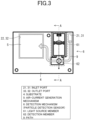
- FIG. 3 is a plan view of the substrate 4, the air-current generation mechanism 5, and the detection mechanism 6 of the particle detector 1 according to the present embodiment. As illustrated in FIG. 3 , the air-current generation mechanism 5 and the detection mechanism 6 are mounted on the substrate 4.
- the air-current generation mechanism 5 When rotating its fan, the air-current generation mechanism 5 generates a flow of gas (flow indicated with a hatched arrow in FIG. 3 ) taken in from the outside of the particle detector 1 through the inlet ports 21 and 31, passing over a detection member 62, passing through the air-current generation mechanism 5, and discharged through the outlet ports 32 and 22 to the outside of the particle detector 1.
- a flow of gas flow indicated with a hatched arrow in FIG. 3
- the detection mechanism 6 includes a light source member 61 and a detection member 62.
- the light source member 61 is disposed parallel to the plane of the substrate 4, and emits light toward above the detection member 62 (in a direction indicated with a broken arrow in FIG. 3 ).
- the detection member 62 is disposed at a position toward which light from the light source member 61 is emitted, and detects scattering light obtained by the emitted light scattered by particles in a gas.
- the particle detector 1 includes a path 9 disposed above at least the detection member 62 (condensing lens), including a space through which light emitted from the light source member 61 (light source) passes, and allowing the outside gas to pass therethrough.
- the gas taken in from the outside of the particle detector 1 with the operation of the air-current generation mechanism 5 receives light emitted from the light source member 61 when passing above the detection member 62. At this time, particles contained in the gas scatter light from the light source member 61.
- the detection member 62 detects part of the scattering light. Thus, particles in the gas can be detected.
- FIG. 4 is a perspective view of a structure of the detection mechanism 6 according to the present embodiment.
- the detection mechanism 6 includes the light source member 61 and the detection member 62.
- the light source member 61 is disposed on the substrate 4, and includes a wall 611, grooves 612, a light source 613, and a projection lens 614.
- the wall 611 forms a housing of the light source member 61.
- the grooves 612 are formed on the inner surface of the wall 611 to hold the projection lens 614 therebetween.
- the light source 613 is disposed on the substrate 4, and emits light toward at least the projection lens 614.
- the projection lens 614 is a lens to converge light emitted from the light source 613 to irradiate a portion above the detection member 62 with the light.
- the projection lens 614 is disposed perpendicularly to the substrate 4 while being held between the grooves 612.
- the detection member 62 is disposed adjacent to the light source member 61, and includes a condensing lens 621, a photodetector 622, a holder 623, and a hole 624.
- the condensing lens 621 is a lens that converges light received from above the condensing lens 621 and to irradiate the photodetector 622 with the light.
- the condensing lens 621 is disposed between the substrate 4 and light emitted from the light source 613. Specifically, the condensing lens 621 is disposed opposite the light source 613 across the projection lens 614, below the light emitted from the light source 613 and that has passed through the projection lens 614, and parallel to the substrate 4. More specifically, the condenser surface of the condensing lens 621 is disposed substantially parallel to the surface of the substrate 4.
- the condensing lens 621 may be removable.
- the condensing lens 621 that is removable is cleanable and replaceable when degraded.
- the condensing lens 621 may be spherical.
- the condensing lens 621 that is spherical less easily allows falling dust to adhere thereto or accumulate thereon.
- the photodetector 622 detects light with which dust (particles) is irradiated when the light travels through the condensing lens 621 from above the condensing lens 621 to below the condensing lens 621.
- the photodetector 622 is disposed on the substrate 4 below the condensing lens 621.
- FIG. 5 is a cross-sectional view illustrating a cross section (cross section taken along line A-A in FIG. 3 ) of the detection mechanism 6 according to the present embodiment. As illustrated in FIG. 5 , the condensing lens 621 and the photodetector 622 are disposed on the substrate 4.
- the photodetector 622 is more likely to become dirty through continuous duty. However, in the above structure, the condensing lens 621 disposed above the photodetector 622 can protect the photodetector 622.
- the condensing lens 621 and the photodetector 622 may be integrated together.
- the positional relationship between the condensing lens 621 and the photodetector 622 is fixed, and thus the accuracy in particle detection is improved.
- this structure eliminates the process of assembling the condensing lens 621 and the photodetector 622 together, and thus simplifies the process of manufacturing the detection mechanism 6.
- the holder 623 is a cover covering the condensing lens 621 and the photodetector 622.
- the hole 624 is formed at an upper portion in the holder 623 to limit light that is to pass through the condensing lens 621.
- providing the holder 623 can narrow light that is to pass through the condensing lens 621, and thus can reduce stray light.
- This structure can block light that fails to be condensed by the condensing lens 621, and thus can improve the detection accuracy. Dust accumulating on the holder 623 is less likely to enter the holder 623, and less likely to cause measurement errors.
- the holder 623 also serves as a cover of the condensing lens 621 and the photodetector 622.
- the holder 623 may include metal.
- the holder 623 including metal has a shielding effect. This structure can thus reduce the effect of electromagnetic wave noise in particle detection.
- the detection member 62 can be fixed. This can improve the positioning accuracy, prevent displacement during manufacturing, and reduce shakes (vibrations) in operation. This structure can also clearly distinguish the detection member 62 and a gas flow path (path 9), and thus can form a flow path through which gas flows smoothly.
- the directivity of the detection member 62 can be further limited. For example, narrowing the hole 624 further than the directivity (for example, ⁇ 60°) of the condensing lens 621 and the photodetector 622 enables further narrowing of the directivity.
- This structure can also block stray light that is incident on the photodetector 622 from a side surface without passing through the condensing lens 621. Forming a recess in the upper surface of the holder 623 can narrow light from the light source 613 to only the directivity of the vertical plane.
- the directivity of a horizontal plane may be as wide as possible.
- the holder 623 has a ground potential to have a shielding effect. This structure can thus reduce the effect of the disturbance noise.
- the condensing lens 621 that does not protrude from the hole 624 of the holder 623 is not directly irradiated with light. Thus, stray light can be reduced.
- the condensing lens 621 protrudes from the hole 624 of the holder 623
- the directivity of the condensing lens 621 is not limited by the hole 624 of the holder 623 (that is, the viewing angle of the condensing lens 621 can be widened).
- the condensing lens 621 closes up the hole 624, and thus prevents accumulation of dust (and, reduction of amount of light received) in the holder 623.
- the detection member 62 may exclude the holder 623. This structure limits the particle detection area not by the holder 623 but by the condensing lens 621, and thus can soften the attachment accuracy. Examples of the attachment accuracy include the position and the angle of the light source 613 and the positional relationship between the holder 623 and the photodetector 622.
- the substrate 4 of the detection mechanism 6 also includes a controller (not illustrated).
- the controller obtains signals from the photodetector 622, and detects the particle density in a gas.
- the method for detecting the particle density has some examples.
- the controller may detect the particle density by counting the light scattered from the particles.
- the controller may detect the particle density at each particle diameter by counting light scattered from the particles at each appropriate peak-value range.
- the controller may detect the particle density by averaging the received signals of the light scattered from particles.
- the light source member 61 and the detection member 62 have a simple positional relationship.
- the particle detector 1 and the detection mechanism 6 can have a small size.
- the condensing lens 621 is disposed above the photodetector 622, and thus can protect the photodetector 622.
- the condensing lens 621 facilitates its maintenance.
- the condensing lens 621 is disposed parallel to the substrate 4 not to detect signals outside of the detection area.
- Embodiment 2 of the present disclosure will be described below.
- components having the same functions as those described in Embodiment 1 are denoted with the same reference signs without being described redundantly.
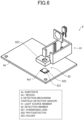
- FIG. 6 is a perspective view of a structure of a detection mechanism 6 according to the present embodiment.
- the detection mechanism 6 includes the light source member 61 and the detection member 62.
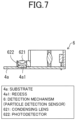
- FIG. 7 is a cross-sectional view illustrating a cross section (cross section taken along line A-A in FIG. 3 ) of the detection mechanism 6 according to the present embodiment.
- a substrate 4a has a recess 4a1.
- the photodetector 622 is embedded in the recess 4a1.
- the photodetector 622 may be a surface-mount photodetector or another type of photodetector.
- the photodetector 622 is embedded in the recess 4a1 of the substrate 4a.
- the particle detector 1 and the detection mechanism 6 can be thinned.
- This structure can secure a gas flow path.
- the photodetector 622 is securely fixed, and thus the positional accuracy of the photodetector 622 can be improved.
- the structure does not include the holder 623, the upper protrusion protruding from the substrate 4a is smaller, and thus less likely to allow dust to accumulate thereon.
- adding a spacer can flexibly adjust the height of the photodetector 622.
- Embodiment 3 of the present disclosure will be described below.
- components having the same functions as those described in Embodiments 1 and 2 are denoted with the same reference signs without being described redundantly.
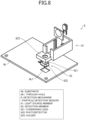
- FIG. 8 is a perspective view of a structure of a detection mechanism 6 according to the present embodiment.
- the detection mechanism 6 includes a light source member 61 and a detection member 62.
- FIG. 9 is a cross-sectional view illustrating a cross section (cross section taken along line A-A in FIG. 3 ) of the detection mechanism 6 according to the present embodiment.
- a substrate 4b has a through-hole 4b1.
- the photodetector 622 extends through the through-hole 4b1.
- the photodetector 622 may be a surface-mount photodetector or another type of photodetector.
- the photodetector 622 extends through the through-hole 4b1 in the substrate 4b.
- the particle detector 1 and the detection mechanism 6 can be further thinned.
- the gas flow path can thus be secured.
- the photodetector 622 can be reliably fixed, and the positional accuracy of the photodetector 622 can thus be improved.
- the photodetector 622 is guided into the through-hole 4b1 in the substrate 4b, and can thus be easily and accurately mounted.
- the upward protrusion protruding from the substrate 4b has its size reduced, and is thus less likely to allow dust to accumulate thereon.
- This structure allows a lead wire of the photodetector 622 to be drawn out from below the substrate 4b, and facilitates electrical connection to be flexible.
- the photodetector 622 may be bonded to the bottom side of the substrate 4b, and only the condensing lens 621 may be protruded from the through-hole 4b1.
- This structure enables an attachment of the photodetector 622 of a lead type, and can improve the productivity.
- the photodetector 622 of a lead type includes a lead wire, and the lead wire and the bottom surface of the substrate 4b are soldered. Thus, a package including the photodetector 622 that is not a surface-mount photodetector can be mounted.
- FIG. 9 illustrates a structure where the condensing lens 621 and the photodetector 622 are integrated, but the condensing lens 621 and the photodetector 622 may not be integrated together as needed.
- the structure where the photodetector 622 and the condensing lens 621 are integrated can thin the detection mechanism 6 further than the structure where the photodetector 622 and the condensing lens 621 are not integrated.
- Embodiment 4 of the present disclosure will be described below.
- components having the same functions as those described in Embodiments 1 to 3 are denoted with the same reference signs without being described redundantly.
- FIG. 10 is a cross-sectional view illustrating a horizontal cross section of a particle detector 1 according to the present embodiment.
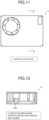
- FIG. 11 is a plan view of the particle detector 1 according to the present embodiment.
- FIG. 12 is a cross-sectional view of a cross section (cross section taken along line B-B in FIG. 11 ) of the detection mechanism 6 according to the present embodiment.
- the upper portion of the holder 623 may be omitted. Omitting the upper portion of the holder 623 simplifies the structure and facilitates the maintenance. In addition, omitting the upper portion widens the viewing angle of the photodetector 622, and widens the detection range (area) of the scattering light.
- a wall of the air-current generation mechanism 5, the wall 611 of the light source member 61, and the holder 623 have different heights. More specifically, the holder 623 is lower than the wall of the air-current generation mechanism 5 and the wall 611 of the light source member 61.
- This structure forms a gas flow path (path 9), and implements a smooth gas flow. This structure can also reduce scattering light (stray light).
- the periphery of the photodetector 622 may be covered with a conductive resin or sheet metal. This structure can reduce the effect of extraneous noise.
Landscapes
- Chemical & Material Sciences (AREA)
- Health & Medical Sciences (AREA)
- Life Sciences & Earth Sciences (AREA)
- Immunology (AREA)
- Analytical Chemistry (AREA)
- Biochemistry (AREA)
- General Health & Medical Sciences (AREA)
- General Physics & Mathematics (AREA)
- Physics & Mathematics (AREA)
- Pathology (AREA)
- Dispersion Chemistry (AREA)
- Engineering & Computer Science (AREA)
- Biomedical Technology (AREA)
- Molecular Biology (AREA)
- Investigating Or Analysing Materials By Optical Means (AREA)
- Investigating Or Analysing Materials By The Use Of Chemical Reactions (AREA)
Claims (11)
- Capteur de détection de particules (6) disposé sur un substrat (4) pour détecter des particules dans un gaz, le capteur de détection de particules (6) comprenant :un substrat (4) ;un élément de source de lumière (61) disposé sur le substrat (4) et configuré pour émettre une lumière parallèlement au substrat (4) et vers un trajet d'écoulement à travers lequel s'écoule un gaz contenant les particules ;une lentille de condensation (621) fixée au substrat (4) et disposée entre le substrat (4) et la lumière émise par l'élément de source de lumière (61) et configurée pour laisser passer la lumière diffusée par les particules ;un photodétecteur (622) disposé sur le substrat (4) et sous la lentille de condensation (621) et configuré pour détecter la lumière qui a traversé la lentille de condensation (621) ;caractérisé en ce que la lentille de condensation (621) est disposée parallèlement au substrat (4).
- Capteur de détection de particules (6) selon la revendication 1, dans lequel le substrat (4) présente un trou d'interconnexion (4b1) configuré pour fixer le photodétecteur (622), et dans lequel le photodétecteur (622) s'étend à travers le trou d'interconnexion (4bl).
- Capteur de détection de particules (6) selon la revendication 1, dans lequel le substrat (4) présente un renfoncement (4a1) configuré pour fixer le photodétecteur (622), et
dans lequel le photodétecteur (622) est encastré dans le renfoncement (4a1). - Capteur de détection de particules (6) selon l'une quelconque des revendications 1 à 3, dans lequel la lentille de condensation (621) et le photodétecteur (622) sont assemblés ensemble de manière à fixer une relation de position entre la lentille de condensation (621) et le photodétecteur (622).
- Capteur de détection de particules (6) selon l'une quelconque des revendications 1 à 4, dans lequel la lentille de condensation (621) peut être retirée du substrat (4).
- Capteur de détection de particules (6) selon l'une quelconque des revendications 1 à 5, dans lequel la lentille à condensation (621) est sphérique.
- Capteur de détection de particules (6) selon l'une quelconque des revendications 1 à 6, comprenant en outre un support (623) qui recouvre la lentille de condensation (621) et le photodétecteur (622) et qui comporte un trou (624) formé pour limiter la lumière qui traverse la lentille de condensation (621).
- Capteur de détection de particules (6) selon la revendication 7, dans lequel le support (623) comporte du métal.
- Capteur de détection de particules (6) selon l'une quelconque des revendications 1 à 8, comprenant en outre une lentille de projection (614) disposée perpendiculairement au substrat (4),
dans lequel la lentille de condensation (621) est disposée à l'opposé de l'élément de source de lumière (61) à travers la lentille de projection (614) et sous la lumière émise par l'élément de source de lumière (61) et qui a traversé la lentille de projection (614). - Capteur de détection de particules (6) selon l'une quelconque des revendications 1 à 9, comprenant en outre un trajet qui est disposé au moins au-dessus de la lentille de condensation (621), qui comporte un espace à travers lequel passe la lumière, et qui permet au gaz de passer à travers lui.
- Détecteur de particules (1), comprenant :le capteur de détection de particules (6) selon la revendication 10 ; etun mécanisme de génération de courant d'air (5) qui génère un courant d'air pour faire passer le gaz à travers le trajet.
Applications Claiming Priority (1)
| Application Number | Priority Date | Filing Date | Title |
|---|---|---|---|
| JP2020166199A JP7440390B2 (ja) | 2020-09-30 | 2020-09-30 | 粒子検出センサおよび粒子検出装置 |
Publications (3)
| Publication Number | Publication Date |
|---|---|
| EP4001893A2 EP4001893A2 (fr) | 2022-05-25 |
| EP4001893A3 EP4001893A3 (fr) | 2022-07-27 |
| EP4001893B1 true EP4001893B1 (fr) | 2023-08-30 |
Family
ID=77998715
Family Applications (1)
| Application Number | Title | Priority Date | Filing Date |
|---|---|---|---|
| EP21199109.6A Active EP4001893B1 (fr) | 2020-09-30 | 2021-09-27 | Capteur de détection de particules et détecteur de particules |
Country Status (5)
| Country | Link |
|---|---|
| US (2) | US11774345B2 (fr) |
| EP (1) | EP4001893B1 (fr) |
| JP (1) | JP7440390B2 (fr) |
| KR (3) | KR102631284B1 (fr) |
| CN (1) | CN114324089A (fr) |
Families Citing this family (1)
| Publication number | Priority date | Publication date | Assignee | Title |
|---|---|---|---|---|
| WO2024073551A1 (fr) * | 2022-09-28 | 2024-04-04 | Dust Company, Inc. | Système de mesure de poussière déposée faisant appel à des photorésistances |
Family Cites Families (35)
| Publication number | Priority date | Publication date | Assignee | Title |
|---|---|---|---|---|
| US3708675A (en) * | 1969-09-19 | 1973-01-02 | Furukawa Electric Co Ltd | Smoke detector in which air entrance and egress are located in oppositely disposed surfaces which are shaped to cause an air velocity differential |
| US4616928A (en) | 1984-06-20 | 1986-10-14 | Kidde, Inc. | Photoelectric smoke detector with adjustable background signal |
| JPH04160696A (ja) * | 1990-10-25 | 1992-06-03 | Matsushita Electric Works Ltd | 光電式煙感知器 |
| US5262841A (en) * | 1991-10-16 | 1993-11-16 | Tsi Incorporated | Vacuum particle detector |
| JPH05190890A (ja) * | 1992-01-16 | 1993-07-30 | Sharp Corp | 光結合装置 |
| JP3460494B2 (ja) | 1997-02-21 | 2003-10-27 | 松下電工株式会社 | 光電式煙感知器 |
| JP4157212B2 (ja) * | 1999-02-15 | 2008-10-01 | 松下電工株式会社 | 光散乱式粒子検知センサ |
| JP3747763B2 (ja) * | 2000-09-29 | 2006-02-22 | 松下電工株式会社 | 光電式煙感知器 |
| JP2002352347A (ja) | 2001-05-28 | 2002-12-06 | Matsushita Electric Works Ltd | 火災感知器 |
| TWI235965B (en) | 2001-04-24 | 2005-07-11 | Matsushita Electric Works Ltd | Fire detector unit |
| JP2003279471A (ja) * | 2002-03-20 | 2003-10-02 | Nippon Sheet Glass Co Ltd | マイクロ化学システム用チップ及びマイクロ化学システム |
| WO2004104959A2 (fr) * | 2003-05-23 | 2004-12-02 | Apollo Fire Detectors Limited | Detecteur de fumee |
| JP4349978B2 (ja) * | 2004-06-17 | 2009-10-21 | シチズン電子株式会社 | 光半導体パッケージ及びその製造方法 |
| JP4241740B2 (ja) * | 2006-01-26 | 2009-03-18 | シスメックス株式会社 | 試料測定方法 |
| JP4877239B2 (ja) * | 2006-03-28 | 2012-02-15 | パナソニック電工株式会社 | 発光装置の製造方法 |
| JP2008159942A (ja) * | 2006-12-25 | 2008-07-10 | Matsushita Electric Works Ltd | 物体検出センサ |
| JP2008250179A (ja) * | 2007-03-30 | 2008-10-16 | Fujinon Corp | 光学機器の防塵構造 |
| JP4621748B2 (ja) * | 2008-02-28 | 2011-01-26 | シャープ株式会社 | 固体撮像装置およびそれを備えた電子機器 |
| JP2014006108A (ja) * | 2012-06-22 | 2014-01-16 | Azbil Corp | 光学式粒子検出装置及び粒子の検出方法 |
| JP2014123014A (ja) * | 2012-12-21 | 2014-07-03 | Casio Comput Co Ltd | 光源装置、プロジェクタ |
| KR101463767B1 (ko) | 2013-04-18 | 2014-11-21 | 주식회사 케이텔 | 광전식 연기 감지 방법 및 그 장치 |
| EP2908298B1 (fr) | 2014-02-13 | 2018-04-18 | Siemens Schweiz AG | Détecteur de fumée fonctionnant selon le principe de la lumière diffusée comprenant une diode lumineuse bicolore dotée de puces LED de différentes tailles |
| JP6252908B2 (ja) * | 2014-09-04 | 2017-12-27 | パナソニックIpマネジメント株式会社 | 粒子検出センサ |
| JP2016090349A (ja) | 2014-10-31 | 2016-05-23 | パナソニックIpマネジメント株式会社 | 粒子検出センサ、ダストセンサ、煙感知器、空気清浄機、換気扇及びエアコン |
| EP3214425B1 (fr) | 2014-10-31 | 2019-09-18 | Panasonic Intellectual Property Management Co., Ltd. | Capteur de détection de particules, capteur de poussière, capteur de fumée, appareil de purification de l'air, ventilateur soufflant, et conditionneur d'air |
| JP6532339B2 (ja) * | 2015-07-28 | 2019-06-19 | 日本電産サンキョー株式会社 | ワーク装着装置およびワーク装着方法 |
| JP6455470B2 (ja) | 2016-03-15 | 2019-01-23 | オムロン株式会社 | 粒子センサ、及びそれを備えた電子機器 |
| CN109844599A (zh) * | 2016-10-14 | 2019-06-04 | 夏普株式会社 | 光学设备 |
| JP2018141679A (ja) * | 2017-02-27 | 2018-09-13 | パナソニックIpマネジメント株式会社 | 粉塵センサ |
| KR102319455B1 (ko) * | 2017-04-19 | 2021-10-28 | 엘지이노텍 주식회사 | 입자 센싱 장치 |
| CN207081658U (zh) | 2017-07-13 | 2018-03-09 | 武汉四方光电科技有限公司 | 一种粉尘浓度检测装置 |
| JP6753424B2 (ja) | 2018-03-15 | 2020-09-09 | オムロン株式会社 | 粒子センサおよび電子機器 |
| JP7110852B2 (ja) | 2018-09-11 | 2022-08-02 | オムロン株式会社 | 粒子センサおよび電子機器 |
| US11137340B2 (en) * | 2018-11-30 | 2021-10-05 | Sharp Kabushiki Kaisha | Particle detection sensor and particle detection apparatus |
| JP7225004B2 (ja) | 2019-03-29 | 2023-02-20 | キヤノン株式会社 | 電子機器及びその制御方法 |
-
2020
- 2020-09-30 JP JP2020166199A patent/JP7440390B2/ja active Active
-
2021
- 2021-09-23 US US17/483,622 patent/US11774345B2/en active Active
- 2021-09-27 CN CN202111136501.9A patent/CN114324089A/zh active Pending
- 2021-09-27 EP EP21199109.6A patent/EP4001893B1/fr active Active
- 2021-09-29 KR KR1020210128680A patent/KR102631284B1/ko active Active
-
2023
- 2023-08-11 US US18/233,063 patent/US12265013B2/en active Active
-
2024
- 2024-01-25 KR KR1020240011575A patent/KR20240017386A/ko not_active Ceased
- 2024-08-09 KR KR1020240107030A patent/KR102933520B1/ko active Active
Also Published As
| Publication number | Publication date |
|---|---|
| KR20240017386A (ko) | 2024-02-07 |
| CN114324089A (zh) | 2022-04-12 |
| KR20240125531A (ko) | 2024-08-19 |
| EP4001893A2 (fr) | 2022-05-25 |
| JP7440390B2 (ja) | 2024-02-28 |
| KR102631284B1 (ko) | 2024-01-31 |
| US11774345B2 (en) | 2023-10-03 |
| KR102933520B1 (ko) | 2026-03-04 |
| US12265013B2 (en) | 2025-04-01 |
| US20230384207A1 (en) | 2023-11-30 |
| KR20220044144A (ko) | 2022-04-06 |
| EP4001893A3 (fr) | 2022-07-27 |
| JP2022057774A (ja) | 2022-04-11 |
| US20220099554A1 (en) | 2022-03-31 |
Similar Documents
| Publication | Publication Date | Title |
|---|---|---|
| US8232885B2 (en) | Photoelectric smoke detector | |
| EP1327966B1 (fr) | Détecteur de fumée à lumière dispersée | |
| JP2020533592A (ja) | 粒子状物質センサーデバイス | |
| US10962462B2 (en) | Particulate matter-sensing sensor assembly | |
| EP4001893B1 (fr) | Capteur de détection de particules et détecteur de particules | |
| JP3747830B2 (ja) | 浮遊微粒子検知装置 | |
| US20190310206A1 (en) | Dust detection apparatus and method of manufacturing the same | |
| WO2012140482A1 (fr) | Dispositif de détection de composant gazeux | |
| JP2011102710A (ja) | 光散乱式粒子検知装置および火災報知器 | |
| CN112585447B (zh) | 颗粒物传感器 | |
| KR102380173B1 (ko) | 입자 센싱 장치 | |
| JP2581838B2 (ja) | 光散乱式粒子検知センサ | |
| JP3842739B2 (ja) | 散乱光式煙感知器 | |
| JP3747763B2 (ja) | 光電式煙感知器 | |
| US20250172474A1 (en) | Detection accuracy enhancing structure of particle detecting module | |
| US20250237591A1 (en) | Particle detecting module | |
| JP3938780B2 (ja) | 散乱光式煙感知器 | |
| WO2019176609A1 (fr) | Capteur de particules et appareil électronique | |
| JP2019207650A (ja) | 煙感知器 | |
| JP2023145735A (ja) | 煙感知器 | |
| TW202424913A (zh) | 煙檢測裝置 | |
| JPS63163696A (ja) | 散乱光式煙感知器 | |
| HK1051732A1 (en) | Detector for scattered light | |
| HK1051732B (en) | Detector for scattered light |
Legal Events
| Date | Code | Title | Description |
|---|---|---|---|
| PUAI | Public reference made under article 153(3) epc to a published international application that has entered the european phase |
Free format text: ORIGINAL CODE: 0009012 |
|
| STAA | Information on the status of an ep patent application or granted ep patent |
Free format text: STATUS: THE APPLICATION HAS BEEN PUBLISHED |
|
| AK | Designated contracting states |
Kind code of ref document: A2 Designated state(s): AL AT BE BG CH CY CZ DE DK EE ES FI FR GB GR HR HU IE IS IT LI LT LU LV MC MK MT NL NO PL PT RO RS SE SI SK SM TR |
|
| PUAL | Search report despatched |
Free format text: ORIGINAL CODE: 0009013 |
|
| AK | Designated contracting states |
Kind code of ref document: A3 Designated state(s): AL AT BE BG CH CY CZ DE DK EE ES FI FR GB GR HR HU IE IS IT LI LT LU LV MC MK MT NL NO PL PT RO RS SE SI SK SM TR |
|
| RIC1 | Information provided on ipc code assigned before grant |
Ipc: G01N 15/14 20060101ALI20220620BHEP Ipc: G01N 1/22 20060101ALI20220620BHEP Ipc: G01N 15/00 20060101ALI20220620BHEP Ipc: G01N 15/02 20060101ALI20220620BHEP Ipc: G01N 15/06 20060101AFI20220620BHEP |
|
| STAA | Information on the status of an ep patent application or granted ep patent |
Free format text: STATUS: REQUEST FOR EXAMINATION WAS MADE |
|
| 17P | Request for examination filed |
Effective date: 20230104 |
|
| RBV | Designated contracting states (corrected) |
Designated state(s): AL AT BE BG CH CY CZ DE DK EE ES FI FR GB GR HR HU IE IS IT LI LT LU LV MC MK MT NL NO PL PT RO RS SE SI SK SM TR |
|
| REG | Reference to a national code |
Ref legal event code: R079 Ref country code: DE Ref legal event code: R079 Ref document number: 602021004686 Country of ref document: DE Free format text: PREVIOUS MAIN CLASS: G01N0015060000 Ipc: G01N0021850000 |
|
| GRAP | Despatch of communication of intention to grant a patent |
Free format text: ORIGINAL CODE: EPIDOSNIGR1 |
|
| STAA | Information on the status of an ep patent application or granted ep patent |
Free format text: STATUS: GRANT OF PATENT IS INTENDED |
|
| RIC1 | Information provided on ipc code assigned before grant |
Ipc: G01N 15/02 20060101ALI20230228BHEP Ipc: G01N 1/22 20060101ALI20230228BHEP Ipc: G01N 15/00 20060101ALI20230228BHEP Ipc: G01N 15/06 20060101ALI20230228BHEP Ipc: G01N 21/85 20060101AFI20230228BHEP |
|
| INTG | Intention to grant announced |
Effective date: 20230317 |
|
| GRAS | Grant fee paid |
Free format text: ORIGINAL CODE: EPIDOSNIGR3 |
|
| GRAA | (expected) grant |
Free format text: ORIGINAL CODE: 0009210 |
|
| STAA | Information on the status of an ep patent application or granted ep patent |
Free format text: STATUS: THE PATENT HAS BEEN GRANTED |
|
| AK | Designated contracting states |
Kind code of ref document: B1 Designated state(s): AL AT BE BG CH CY CZ DE DK EE ES FI FR GB GR HR HU IE IS IT LI LT LU LV MC MK MT NL NO PL PT RO RS SE SI SK SM TR |
|
| REG | Reference to a national code |
Ref country code: GB Ref legal event code: FG4D |
|
| REG | Reference to a national code |
Ref country code: CH Ref legal event code: EP |
|
| REG | Reference to a national code |
Ref country code: DE Ref legal event code: R096 Ref document number: 602021004686 Country of ref document: DE |
|
| REG | Reference to a national code |
Ref country code: IE Ref legal event code: FG4D |
|
| REG | Reference to a national code |
Ref country code: LT Ref legal event code: MG9D |
|
| REG | Reference to a national code |
Ref country code: NL Ref legal event code: MP Effective date: 20230830 |
|
| REG | Reference to a national code |
Ref country code: AT Ref legal event code: MK05 Ref document number: 1606059 Country of ref document: AT Kind code of ref document: T Effective date: 20230830 |
|
| PG25 | Lapsed in a contracting state [announced via postgrant information from national office to epo] |
Ref country code: GR Free format text: LAPSE BECAUSE OF FAILURE TO SUBMIT A TRANSLATION OF THE DESCRIPTION OR TO PAY THE FEE WITHIN THE PRESCRIBED TIME-LIMIT Effective date: 20231201 |
|
| PG25 | Lapsed in a contracting state [announced via postgrant information from national office to epo] |
Ref country code: IS Free format text: LAPSE BECAUSE OF FAILURE TO SUBMIT A TRANSLATION OF THE DESCRIPTION OR TO PAY THE FEE WITHIN THE PRESCRIBED TIME-LIMIT Effective date: 20231230 |
|
| PG25 | Lapsed in a contracting state [announced via postgrant information from national office to epo] |
Ref country code: SE Free format text: LAPSE BECAUSE OF FAILURE TO SUBMIT A TRANSLATION OF THE DESCRIPTION OR TO PAY THE FEE WITHIN THE PRESCRIBED TIME-LIMIT Effective date: 20230830 Ref country code: RS Free format text: LAPSE BECAUSE OF FAILURE TO SUBMIT A TRANSLATION OF THE DESCRIPTION OR TO PAY THE FEE WITHIN THE PRESCRIBED TIME-LIMIT Effective date: 20230830 Ref country code: NO Free format text: LAPSE BECAUSE OF FAILURE TO SUBMIT A TRANSLATION OF THE DESCRIPTION OR TO PAY THE FEE WITHIN THE PRESCRIBED TIME-LIMIT Effective date: 20231130 Ref country code: LV Free format text: LAPSE BECAUSE OF FAILURE TO SUBMIT A TRANSLATION OF THE DESCRIPTION OR TO PAY THE FEE WITHIN THE PRESCRIBED TIME-LIMIT Effective date: 20230830 Ref country code: LT Free format text: LAPSE BECAUSE OF FAILURE TO SUBMIT A TRANSLATION OF THE DESCRIPTION OR TO PAY THE FEE WITHIN THE PRESCRIBED TIME-LIMIT Effective date: 20230830 Ref country code: IS Free format text: LAPSE BECAUSE OF FAILURE TO SUBMIT A TRANSLATION OF THE DESCRIPTION OR TO PAY THE FEE WITHIN THE PRESCRIBED TIME-LIMIT Effective date: 20231230 Ref country code: HR Free format text: LAPSE BECAUSE OF FAILURE TO SUBMIT A TRANSLATION OF THE DESCRIPTION OR TO PAY THE FEE WITHIN THE PRESCRIBED TIME-LIMIT Effective date: 20230830 Ref country code: GR Free format text: LAPSE BECAUSE OF FAILURE TO SUBMIT A TRANSLATION OF THE DESCRIPTION OR TO PAY THE FEE WITHIN THE PRESCRIBED TIME-LIMIT Effective date: 20231201 Ref country code: FI Free format text: LAPSE BECAUSE OF FAILURE TO SUBMIT A TRANSLATION OF THE DESCRIPTION OR TO PAY THE FEE WITHIN THE PRESCRIBED TIME-LIMIT Effective date: 20230830 Ref country code: AT Free format text: LAPSE BECAUSE OF FAILURE TO SUBMIT A TRANSLATION OF THE DESCRIPTION OR TO PAY THE FEE WITHIN THE PRESCRIBED TIME-LIMIT Effective date: 20230830 |
|
| PG25 | Lapsed in a contracting state [announced via postgrant information from national office to epo] |
Ref country code: PL Free format text: LAPSE BECAUSE OF FAILURE TO SUBMIT A TRANSLATION OF THE DESCRIPTION OR TO PAY THE FEE WITHIN THE PRESCRIBED TIME-LIMIT Effective date: 20230830 Ref country code: NL Free format text: LAPSE BECAUSE OF FAILURE TO SUBMIT A TRANSLATION OF THE DESCRIPTION OR TO PAY THE FEE WITHIN THE PRESCRIBED TIME-LIMIT Effective date: 20230830 |
|
| PG25 | Lapsed in a contracting state [announced via postgrant information from national office to epo] |
Ref country code: ES Free format text: LAPSE BECAUSE OF FAILURE TO SUBMIT A TRANSLATION OF THE DESCRIPTION OR TO PAY THE FEE WITHIN THE PRESCRIBED TIME-LIMIT Effective date: 20230830 |
|
| PG25 | Lapsed in a contracting state [announced via postgrant information from national office to epo] |
Ref country code: SM Free format text: LAPSE BECAUSE OF FAILURE TO SUBMIT A TRANSLATION OF THE DESCRIPTION OR TO PAY THE FEE WITHIN THE PRESCRIBED TIME-LIMIT Effective date: 20230830 Ref country code: RO Free format text: LAPSE BECAUSE OF FAILURE TO SUBMIT A TRANSLATION OF THE DESCRIPTION OR TO PAY THE FEE WITHIN THE PRESCRIBED TIME-LIMIT Effective date: 20230830 Ref country code: ES Free format text: LAPSE BECAUSE OF FAILURE TO SUBMIT A TRANSLATION OF THE DESCRIPTION OR TO PAY THE FEE WITHIN THE PRESCRIBED TIME-LIMIT Effective date: 20230830 Ref country code: EE Free format text: LAPSE BECAUSE OF FAILURE TO SUBMIT A TRANSLATION OF THE DESCRIPTION OR TO PAY THE FEE WITHIN THE PRESCRIBED TIME-LIMIT Effective date: 20230830 Ref country code: DK Free format text: LAPSE BECAUSE OF FAILURE TO SUBMIT A TRANSLATION OF THE DESCRIPTION OR TO PAY THE FEE WITHIN THE PRESCRIBED TIME-LIMIT Effective date: 20230830 Ref country code: CZ Free format text: LAPSE BECAUSE OF FAILURE TO SUBMIT A TRANSLATION OF THE DESCRIPTION OR TO PAY THE FEE WITHIN THE PRESCRIBED TIME-LIMIT Effective date: 20230830 Ref country code: SK Free format text: LAPSE BECAUSE OF FAILURE TO SUBMIT A TRANSLATION OF THE DESCRIPTION OR TO PAY THE FEE WITHIN THE PRESCRIBED TIME-LIMIT Effective date: 20230830 Ref country code: PT Free format text: LAPSE BECAUSE OF FAILURE TO SUBMIT A TRANSLATION OF THE DESCRIPTION OR TO PAY THE FEE WITHIN THE PRESCRIBED TIME-LIMIT Effective date: 20240102 |
|
| PG25 | Lapsed in a contracting state [announced via postgrant information from national office to epo] |
Ref country code: LU Free format text: LAPSE BECAUSE OF NON-PAYMENT OF DUE FEES Effective date: 20230927 |
|
| REG | Reference to a national code |
Ref country code: BE Ref legal event code: MM Effective date: 20230930 |
|
| PG25 | Lapsed in a contracting state [announced via postgrant information from national office to epo] |
Ref country code: LU Free format text: LAPSE BECAUSE OF NON-PAYMENT OF DUE FEES Effective date: 20230927 Ref country code: IT Free format text: LAPSE BECAUSE OF FAILURE TO SUBMIT A TRANSLATION OF THE DESCRIPTION OR TO PAY THE FEE WITHIN THE PRESCRIBED TIME-LIMIT Effective date: 20230830 Ref country code: MC Free format text: LAPSE BECAUSE OF FAILURE TO SUBMIT A TRANSLATION OF THE DESCRIPTION OR TO PAY THE FEE WITHIN THE PRESCRIBED TIME-LIMIT Effective date: 20230830 |
|
| REG | Reference to a national code |
Ref country code: DE Ref legal event code: R097 Ref document number: 602021004686 Country of ref document: DE |
|
| REG | Reference to a national code |
Ref country code: IE Ref legal event code: MM4A |
|
| PG25 | Lapsed in a contracting state [announced via postgrant information from national office to epo] |
Ref country code: IE Free format text: LAPSE BECAUSE OF NON-PAYMENT OF DUE FEES Effective date: 20230927 |
|
| PLBE | No opposition filed within time limit |
Free format text: ORIGINAL CODE: 0009261 |
|
| STAA | Information on the status of an ep patent application or granted ep patent |
Free format text: STATUS: NO OPPOSITION FILED WITHIN TIME LIMIT |
|
| PG25 | Lapsed in a contracting state [announced via postgrant information from national office to epo] |
Ref country code: IE Free format text: LAPSE BECAUSE OF NON-PAYMENT OF DUE FEES Effective date: 20230927 Ref country code: FR Free format text: LAPSE BECAUSE OF NON-PAYMENT OF DUE FEES Effective date: 20231030 Ref country code: SI Free format text: LAPSE BECAUSE OF FAILURE TO SUBMIT A TRANSLATION OF THE DESCRIPTION OR TO PAY THE FEE WITHIN THE PRESCRIBED TIME-LIMIT Effective date: 20230830 |
|
| 26N | No opposition filed |
Effective date: 20240603 |
|
| PG25 | Lapsed in a contracting state [announced via postgrant information from national office to epo] |
Ref country code: BE Free format text: LAPSE BECAUSE OF NON-PAYMENT OF DUE FEES Effective date: 20230930 |
|
| PG25 | Lapsed in a contracting state [announced via postgrant information from national office to epo] |
Ref country code: BG Free format text: LAPSE BECAUSE OF FAILURE TO SUBMIT A TRANSLATION OF THE DESCRIPTION OR TO PAY THE FEE WITHIN THE PRESCRIBED TIME-LIMIT Effective date: 20230830 |
|
| PG25 | Lapsed in a contracting state [announced via postgrant information from national office to epo] |
Ref country code: BG Free format text: LAPSE BECAUSE OF FAILURE TO SUBMIT A TRANSLATION OF THE DESCRIPTION OR TO PAY THE FEE WITHIN THE PRESCRIBED TIME-LIMIT Effective date: 20230830 |
|
| REG | Reference to a national code |
Ref country code: CH Ref legal event code: PL |
|
| PG25 | Lapsed in a contracting state [announced via postgrant information from national office to epo] |
Ref country code: CH Free format text: LAPSE BECAUSE OF NON-PAYMENT OF DUE FEES Effective date: 20240930 |
|
| PG25 | Lapsed in a contracting state [announced via postgrant information from national office to epo] |
Ref country code: CY Free format text: LAPSE BECAUSE OF FAILURE TO SUBMIT A TRANSLATION OF THE DESCRIPTION OR TO PAY THE FEE WITHIN THE PRESCRIBED TIME-LIMIT; INVALID AB INITIO Effective date: 20210927 |
|
| PG25 | Lapsed in a contracting state [announced via postgrant information from national office to epo] |
Ref country code: HU Free format text: LAPSE BECAUSE OF FAILURE TO SUBMIT A TRANSLATION OF THE DESCRIPTION OR TO PAY THE FEE WITHIN THE PRESCRIBED TIME-LIMIT; INVALID AB INITIO Effective date: 20210927 |
|
| PGFP | Annual fee paid to national office [announced via postgrant information from national office to epo] |
Ref country code: DE Payment date: 20250919 Year of fee payment: 5 |
|
| PG25 | Lapsed in a contracting state [announced via postgrant information from national office to epo] |
Ref country code: TR Free format text: LAPSE BECAUSE OF FAILURE TO SUBMIT A TRANSLATION OF THE DESCRIPTION OR TO PAY THE FEE WITHIN THE PRESCRIBED TIME-LIMIT Effective date: 20230830 |