EP4003524B1 - Isochinolinderivate und ihre verwendung zur behandlung parasitärer infektionen - Google Patents
Isochinolinderivate und ihre verwendung zur behandlung parasitärer infektionen Download PDFInfo
- Publication number
- EP4003524B1 EP4003524B1 EP20746957.8A EP20746957A EP4003524B1 EP 4003524 B1 EP4003524 B1 EP 4003524B1 EP 20746957 A EP20746957 A EP 20746957A EP 4003524 B1 EP4003524 B1 EP 4003524B1
- Authority
- EP
- European Patent Office
- Prior art keywords
- alkyl
- halogen atoms
- halogenoalkyl
- group
- alkoxy
- Prior art date
- Legal status (The legal status is an assumption and is not a legal conclusion. Google has not performed a legal analysis and makes no representation as to the accuracy of the status listed.)
- Active
Links
Classifications
-
- A—HUMAN NECESSITIES
- A61—MEDICAL OR VETERINARY SCIENCE; HYGIENE
- A61P—SPECIFIC THERAPEUTIC ACTIVITY OF CHEMICAL COMPOUNDS OR MEDICINAL PREPARATIONS
- A61P33/00—Antiparasitic agents
- A61P33/10—Anthelmintics
-
- C—CHEMISTRY; METALLURGY
- C07—ORGANIC CHEMISTRY
- C07D—HETEROCYCLIC COMPOUNDS
- C07D401/00—Heterocyclic compounds containing two or more hetero rings, having nitrogen atoms as the only ring hetero atoms, at least one ring being a six-membered ring with only one nitrogen atom
- C07D401/02—Heterocyclic compounds containing two or more hetero rings, having nitrogen atoms as the only ring hetero atoms, at least one ring being a six-membered ring with only one nitrogen atom containing two hetero rings
- C07D401/12—Heterocyclic compounds containing two or more hetero rings, having nitrogen atoms as the only ring hetero atoms, at least one ring being a six-membered ring with only one nitrogen atom containing two hetero rings linked by a chain containing hetero atoms as chain links
-
- C—CHEMISTRY; METALLURGY
- C07—ORGANIC CHEMISTRY
- C07D—HETEROCYCLIC COMPOUNDS
- C07D405/00—Heterocyclic compounds containing both one or more hetero rings having oxygen atoms as the only ring hetero atoms, and one or more rings having nitrogen as the only ring hetero atom
- C07D405/02—Heterocyclic compounds containing both one or more hetero rings having oxygen atoms as the only ring hetero atoms, and one or more rings having nitrogen as the only ring hetero atom containing two hetero rings
- C07D405/12—Heterocyclic compounds containing both one or more hetero rings having oxygen atoms as the only ring hetero atoms, and one or more rings having nitrogen as the only ring hetero atom containing two hetero rings linked by a chain containing hetero atoms as chain links
-
- C—CHEMISTRY; METALLURGY
- C07—ORGANIC CHEMISTRY
- C07D—HETEROCYCLIC COMPOUNDS
- C07D409/00—Heterocyclic compounds containing two or more hetero rings, at least one ring having sulfur atoms as the only ring hetero atoms
- C07D409/02—Heterocyclic compounds containing two or more hetero rings, at least one ring having sulfur atoms as the only ring hetero atoms containing two hetero rings
- C07D409/12—Heterocyclic compounds containing two or more hetero rings, at least one ring having sulfur atoms as the only ring hetero atoms containing two hetero rings linked by a chain containing hetero atoms as chain links
-
- C—CHEMISTRY; METALLURGY
- C07—ORGANIC CHEMISTRY
- C07D—HETEROCYCLIC COMPOUNDS
- C07D413/00—Heterocyclic compounds containing two or more hetero rings, at least one ring having nitrogen and oxygen atoms as the only ring hetero atoms
- C07D413/14—Heterocyclic compounds containing two or more hetero rings, at least one ring having nitrogen and oxygen atoms as the only ring hetero atoms containing three or more hetero rings
Definitions
- the present invention covers new isoquinoline derivatives of general formula (I) as described and defined herein, methods of preparing said compounds, intermediate compounds useful for preparing said compounds, pharmaceutical compositions and combinations comprising said compounds, and the use of said compounds for manufacturing pharmaceutical compositions for the control, treatment and/or prevention of diseases, in particular for the control, treatment and/or prevention of infections with helminths, more particularly of infections with gastro-intestinal and extra-intestinal nematodes, in animals and humans, formulations containing such compounds.
- Bioorganic & Medicinal Chemistry Letters 2005,15(3), 733-736 describes 1-(Phenyl)isoquinoline-3-carboxamides as a novel class of subtype selective inhibitors of thyrotropin-releasing hormone (TRH) receptors.
- TRH thyrotropin-releasing hormone
- WO 2004099206 claims isoquinoline-3-carboxamides as ⁇ 7 nicotinic acetylcholine receptor agonists.
- WO 2004108681 describes the use of isoquinoline-3-carboxamides in mediating hypoxia inducible factor and increasing endogenous erythropoietin.
- WO 2005014533 claims isoquinoline-3-carboxamides as antagonists of factor IX and / or factor XI.
- WO 2007090068 claims cyanoisoquinoline-3-carboxamides stabilizing hypoxia inducible factor.
- US 20060217416 claims isoquinoline-3-carboxamides suitable for use in mediating hypoxia inducible factor and for treating erythropoietin-associated conditions.
- US 20120101125 relates to substituted isoquinoline-3-carboxamides useful as inhibitors of ⁇ -secretase.
- WO2018087036 describes quinoline-3-carboxamides and their use as anthelmintics in the medical especially veterinary field.
- WO 2019002132 concerns azaquinoline compounds.
- WO 2018087036 describes quinoline compounds.
- WO 2019025341 concerns quinoline compounds.
- the compounds of the present invention have surprisingly been found to effectively interact with Slo-1 calcium-gated potassium channels of nematodes.
- This interaction is characterised by achieving paralysis/inhibition in particular of gastro-intestinal nematodes, of free-living nematodes, and of filariae, for which data are given in the biological experimental section. Therefore the compounds of the present invention may be used as anthelmintics for the control, treatment and/or prevention of gastro-intestinal and extra-intestinal helminth infections, in particular gastro-intestinal and extra-intestinal infections with nematodes, including filariae.
- the new compounds of the present invention further exhibit high stability and are thus advantageous compared to other compounds known from the prior art.
- the present invention covers compounds of general formula (I): in which :
- substituted means that one or more hydrogen atoms on the designated atom or group are replaced with a selection from the indicated group, provided that the designated atom's normal valency under the existing circumstances is not exceeded. Combinations of substituents and/or variables are permissible.
- optionally substituted means that the number of substituents can be equal to or different from zero. Unless otherwise indicated, it is possible that optionally substituted groups are substituted with as many optional substituents as can be accommodated by replacing a hydrogen atom with a non-hydrogen substituent on any available carbon or nitrogen atom. Commonly, it is possible for the number of optional substituents, when present, to be 1, 2, 3, 4 or 5, in particular 1, 2 or 3.
- the term "one or more”, e.g. in the definition of the substituents of the compounds of general formula (I) of the present invention, means "1, 2, 3, 4 or 5, particularly 1, 2, 3 or 4, more particularly 1, 2 or 3, even more particularly 1 or 2".
- an oxo substituent represents an oxygen atom, which is bound to a carbon atom or to a sulfur atom via a double bond.
- ring substituent means a substituent attached to an aromatic or nonaromatic ring which replaces an available hydrogen atom on the ring.
- a ring comprising carbon atoms and optionally one or more heteroatoms, such as nitrogen, oxygen or sulfur atoms for example, be substituted with a substituent
- substituent it is possible for said substituent to be bound at any suitable position of said ring, be it bound to a suitable carbon atom and/or to a suitable heteroatom.
- the position via which a respective subsituent is connected to the rest of the molecule may in a drawn structure be depicted by a hash sign (#) or a dashed line in said substituent.
- halogen atom means a fluorine, chlorine, bromine or iodine atom, particularly a fluorine, chlorine or bromine atom, more preferably fluorine or chlorine.
- C 1 -C 6 -alkyl means a linear or branched, saturated, monovalent hydrocarbon group having 1, 2, 3, 4, 5 or 6 carbon atoms.
- C 1 -C 4 -alkyl means a linear or branched, saturated, monovalent hydrocarbon group having 1, 2, 3, or 4 carbon atoms, e.g. a methyl, ethyl, n-propyl, isopropyl, n-butyl, sec-butyl, isobutyl or a tert-butyl group, or an isomer thereof.
- said group has 1, 2 or 3 carbon atoms (“C 1 -C 3 -alkyl”), e.g. a methyl, ethyl, n-propyl or isopropyl group.
- a tert-butyl group is preferred.
- C 1 -C 4 -hydroxyalkyl means a linear or branched, saturated, monovalent hydrocarbon group in which the term “C 1 -C 4 -alkyl” is defined supra, and in which 1 or 2 hydrogen atoms are replaced with a hydroxy group, e.g.
- -NH(C 1 -C 4 -alkyl) or "-N(C 1 -C 4 -alkyl) 2 " means a linear or branched, saturated, monovalent group in which the term "C 1 -C 4 -alkyl” is as defined supra, e.g. a methylamino, ethylamino, n-propylamino, isopropylamino, N,N-dimethylamino, N-methyl-N-ethylamino or N,N-diethylamino group.
- C 1 -C 4 -halogenoalkyl means a linear or branched, saturated, monovalent hydrocarbon group in which the term "C 1 -C 4 -alkyl” is as defined supra, and in which one or more of the hydrogen atoms are replaced, identically or differently, with a halogen atom.
- said halogen atom is a fluorine atom. More particularly, all said halogen atoms are fluorine atoms ("C 1 -C 4 -fluoroalkyl").
- Said C 1 -C 4 -halogenoalkyl group is, for example, fluoromethyl, difluoromethyl, trifluoromethyl, 2-fluoroethyl, 2,2-difluoroethyl, 2,2,2-trifluoroethyl, pentafluoroethyl, 3,3,3-trifluoropropyl or 1,3-difluoropropan-2-yl.
- C 1 -C 4 -alkoxy means a linear or branched, saturated, monovalent group of formula (C 1 -C 4 -alkyl)-O-, in which the term “C 1 -C 4 -alkyl” is as defined supra, e.g. a methoxy, ethoxy, n -propoxy, isopropoxy, n -butoxy, sec -butoxy, isobutoxy or tert -butoxy group, or an isomer thereof.
- C 1 -C 4 -halogenoalkoxy means a linear or branched, saturated, monovalent C 1 -C 4 -alkoxy group, as defined supra, in which one or more of the hydrogen atoms is replaced, identically or differently, with a halogen atom.
- said halogen atom is a fluorine atom.
- Said C 1 -C 4 -halogenoalkoxy group is, for example, fluoromethoxy, difluoromethoxy, trifluoromethoxy, 2,2,2-trifluoroethoxy or pentafluoroethoxy.
- C 2 -C 4 -alkenyl means a linear or branched, monovalent hydrocarbon group, which contains one double bond, and which has 2, 3 or 4 carbon atoms.
- Said C 2 -C 4 -alkenyl group is, for example, an ethenyl (or "vinyl"), a prop-2-en-1-yl (or “allyl”), prop-1-en-1-yl, but-3-enyl, but-2-enyl, but-1-enyl, prop-1-en-2-yl (or “isopropenyl”), 2-methylprop-2-enyl, 1-methylprop-2-enyl, 2-methylprop-1-enyl or a 1-methylprop-1-enyl, group. Particularly, said group is allyl.
- C 2 -C 4 -alkynyl means a linear monovalent hydrocarbon group which contains one triple bond, and which contains 2, 3 or 4 carbon atoms.
- Said C 2 -C 4 -alkynyl group is, for example, an ethynyl, a prop-1-ynyl, prop-2-ynyl (or “propargyl”), but-1-ynyl, but-2-ynyl, but-3-ynyl or 1-methylprop-2-ynyl, group.
- said alkynyl group is prop-1-ynyl or prop-2-ynyl.
- C 3 -C 6 -cycloalkyl means a saturated, monovalent, monocyclic hydrocarbon ring which contains 3, 4, 5 or 6 carbon atoms ("C 3 -C 6 -cycloalkyl").
- Said C 3 -C 6 -cycloalkyl group is for example, a monocyclic hydrocarbon ring, e.g. a cyclopropyl, cyclobutyl, cyclopentyl or cyclohexyl group.
- C 3 -C 6 -halogenocycloalkyl means a saturated, monovalent, monocyclic hydrocarbon ring in which the term “C 3 -C 6 -cycloalkyl” is as defined supra, and in which one or more of the hydrogen atoms are replaced, identically or differently, with a halogen atom.
- said halogen atom is a fluorine or chlorine atom.
- Said C 3 -C 6 -halogenocycloalkyl group is for example, a monocyclic hydrocarbon ring substituted with one or two fluorine or chlorine atoms, e.g.
- benzo-C 5 -C 6 -cycloalkyl means a monovalent, bicyclic hydrocarbon ring wherein a saturated, monovalent, monocyclic hydrocarbon ring which contains 5 or 6 carbon atoms (“C 5 -C 6 -cycloalkyl”) is annelated to a phenyl ring.
- Said benzo-C 5 -C 6 -cycloalkyl group is for example, a bicyclic hydrocarbon ring, e.g. an indane (i.e. 2,3-dihydro-1 H -indene) or tetraline (i.e. 1,2,3,4-tetrahydronaphthalene) group.
- spirocycloalkyl means a saturated, monovalent bicyclic hydrocarbon group in which the two rings share one common ring carbon atom, and wherein said bicyclic hydrocarbon group contains 5, 6, 7, 8, 9, 10 or 11 carbon atoms, it being possible for said spirocycloalkyl group to be attached to the rest of the molecule via any one of the carbon atoms except the spiro carbon atom.
- Said spirocycloalkyl group is, for example, spiro[2.2]pentyl, spiro[2.3]hexyl, spiro[2.4]heptyl, spiro[2.5]octyl, spiro[2.6]nonyl, spiro[3.3]heptyl, spiro[3.4]octyl, spiro[3.5]nonyl, spiro[3.6]decyl, spiro[4.4]nonyl, spiro[4.5]decyl, spiro[4.6]undecyl or spiro[5.5]undecyl.
- heterocycloalkyl means a monocyclic or bicyclic, saturated or partially saturated heterocycle with 4, 5, 6, 7, 8, 9 or 10 ring atoms in total (a "4- to 10-membered heterocycloalkyl” group), particularly 4, 5 or 6 ring atoms (a “4- to 6-membered heterocycloalkyl” group), which contains one or two identical or different ring heteroatoms from the series N, O and S, it being possible for said heterocycloalkyl group to be attached to the rest of the molecule via any one of the carbon atoms or, if present, a nitrogen atom.
- Said heterocycloalkyl group can be a 4-membered ring, such as azetidinyl, oxetanyl or thietanyl, for example; or a 5-membered ring, such as tetrahydrofuranyl, oxolanyl, 1,3-dioxolanyl, thiolanyl, pyrrolidinyl, imidazolidinyl, pyrazolidinyl, 1,1-dioxidothiolanyl, 1,2-oxazolidinyl, 1,3-oxazolidinyl, 1,3-thiazolidinyl or 1,2,4-triazolidinyl, for example; or a 6-membered ring, such as tetrahydropyranyl, tetrahydrothiopyranyl, piperidinyl, morpholinyl, dithianyl, thiomorpholinyl, piperazinyl, ox
- heterospirocycloalkyl means a bicyclic, saturated heterocycle with 6, 7, 8, 9, 10 or 11 ring atoms in total, in which the two rings share one common ring carbon atom, which "heterospirocycloalkyl” contains one or two identical or different ring heteroatoms from the series: N, O, S; it being possible for said heterospirocycloalkyl group to be attached to the rest of the molecule via any one of the carbon atoms, except the spiro carbon atom, or, if present, a nitrogen atom.
- Said heterospirocycloalkyl group is, for example, azaspiro[2.3]hexyl, azaspiro[3.3]heptyl, oxaazaspiro[3.3]heptyl, thiaazaspiro[3.3]heptyl, oxaspiro[3.3]heptyl, oxazaspiro[5.3]nonyl, oxazaspiro[4.3]octyl, oxaazaspiro[2.5]octyl, azaspiro[4.5]decyl, oxazaspiro[5.5]undecyl, diazaspiro[3.3]heptyl, thiazaspiro[3.3]heptyl, thiazaspiro[4.3]octyl, azaspiro[5.5]undecyl, or one of the further homologous scaffolds such as spiro[3.4]-, spiro[4.4]-, s
- 6- or 10-membered aryl means a monovalent, monocyclic or bicyclic aromatic ring having 6 or 10 carbon ring atoms, e.g. a phenyl or naphthyl group.
- heteroaryl means a monovalent, monocyclic, bicyclic or tricyclic aromatic ring having 5, 6, 9 or 10 ring atoms (a "5- to 10-membered heteroaryl” group), particularly 5 or 6 ring atoms (a “5- to 6-membered heteroaryl” group), which contains at least one ring heteroatom and optionally one, two or three further ring heteroatoms from the series: N, O and/or S, and which is bound via a ring carbon atom or optionally via a ring nitrogen atom (if allowed by valency).
- Said heteroaryl group can be a 5-membered heteroaryl group, such as, for example, thienyl, furanyl, pyrrolyl, oxazolyl, thiazolyl, imidazolyl, pyrazolyl, isoxazolyl, isothiazolyl, oxadiazolyl, triazolyl, thiadiazolyl or tetrazolyl; or a 6-membered heteroaryl group, such as, for example, pyridinyl, dihydropyridinyl, pyridazinyl, pyrimidinyl, tetrahydropyrimidinyl, pyrazinyl or triazinyl.
- a 5-membered heteroaryl group such as, for example, thienyl, furanyl, pyrrolyl, oxazolyl, thiazolyl, imidazolyl, pyrazolyl, isoxazolyl, isothiazoly
- heterocyclyl means a heterocycle selected from the group consisting of heterocycloalkyl and heteroaryl.
- heteroaryl particularly, the term “4- to 6-membered heterocyclyl” means a heterocycle selected from the group consisting of 4- to 6-membered heterocycloalkyl and 5- to 6-membered heteroaryl.
- heteroaryl or heteroarylene groups include all possible isomeric forms thereof, e.g. : tautomers and positional isomers with respect to the point of linkage to the rest of the molecule.
- pyridinyl includes pyridin-2-yl, pyridin-3-yl and pyridin-4-yl; or the term thienyl includes thien-2-yl and thien-3-yl.
- C 1 -C 4 as used in the present text, e.g. in the context of the definition of "C 1 -C 4 -alkyl", “C 1 -C 4 -halogenoalkyl", “C 1 -C 4 -hydroxyalkyl", “C 1 -C 4 -alkoxy” or “C 1 -C 4 -halogenoalkoxy” means an alkyl group having a finite number of carbon atoms of 1 to 4, i.e. 1, 2, 3 or 4 carbon atoms.
- C 3 -C 6 as used in the present text, e.g. in the context of the definition of "C 3 -C 6 -cycloalkyl” or C 3 -C 6 -halogenocycloalkyl, means a cycloalkyl group having a finite number of carbon atoms of 3 to 6, i.e. 3, 4, 5 or 6 carbon atoms.
- the term "leaving group” means an atom or a group of atoms that is displaced in a chemical reaction as stable species taking with it the bonding electrons.
- a leaving group is selected from the group comprising: halide, in particular fluoride, chloride, bromide or iodide, (methylsulfonyl)oxy, [(trifluoromethyl)sulfonyl]oxy, [(nonafluorobutyl)sulfonyl]oxy, (phenylsulfonyl)oxy, [(4-methylphenyl)sulfonyl]oxy, [(4-bromophenyl)sulfonyl]oxy, [(4-nitrophenyl)sulfonyl]oxy, [(2-nitrophenyl)sulfonyl]oxy, [(4-isopropylphenyl)sulfonyl]oxy, [(2,4,6-triisopropylphen
- An oxo substituent in the context of the invention means an oxygen atom, which is bound to a carbon atom via a double bond.
- Isotopic variant of the compound of general formula (I) is defined as a compound of general formula (I) exhibiting an unnatural proportion of one or more of the isotopes that constitute such a compound.
- unnatural proportion means a proportion of such isotope which is higher than its natural abundance.
- the natural abundances of isotopes to be applied in this context are described in " Isotopic Compositions of the Elements 1997", Pure Appl. Chem., 70(1), 217-235, 1998 .
- isotopes examples include stable and radioactive isotopes of hydrogen, carbon, nitrogen, oxygen, phosphorus, sulfur, fluorine, chlorine, bromine and iodine, such as 2 H (deuterium), 3 H (tritium), 11 C, 13 C, 14 C, 15 N, 17 O, 18 O, 32 P, 33 P, 33 S, 34 S, 35 S, 36 S, 18 F, 36 Cl, 82 Br, 123 I, 124 I, 125 I, 129 I and 131 I, respectively.
- stable and radioactive isotopes of hydrogen, carbon, nitrogen, oxygen, phosphorus, sulfur, fluorine, chlorine, bromine and iodine such as 2 H (deuterium), 3 H (tritium), 11 C, 13 C, 14 C, 15 N, 17 O, 18 O, 32 P, 33 P, 33 S, 34 S, 35 S, 36 S, 18 F, 36 Cl, 82 Br, 123 I, 124 I, 125 I, 129 I and 131 I, respectively
- the isotopic variant(s) of the compounds of general formula (I) preferably contain deuterium ("deuterium-containing compounds of general formula (I)").
- Isotopic variants of the compounds of general formula (I) in which one or more radioactive isotopes, such as 3 H or 14 C, are incorporated are useful e.g. in drug and/or substrate tissue distribution studies. These isotopes are particularly preferred for the ease of their incorporation and detectability.
- Positron emitting isotopes such as 18 F or 11 C may be incorporated into a compound of general formula (I).
- These isotopic variants of the compounds of general formula (I) are useful for in vivo imaging applications.
- Deuterium-containing and 13 C-containing compounds of general formula (I) can be used in mass spectrometry analyses in the context of preclinical or clinical studies.
- deuterated reagents and synthetic building blocks are commercially available from companies such as for example C/D/N Isotopes, Quebec, Canada; Cambridge Isotope Laboratories Inc., Andover, MA, USA; and CombiPhos Catalysts, Inc., Princeton, NJ, USA.
- deuterium-containing compound of general formula (I) is defined as a compound of general formula (I), in which one or more hydrogen atom(s) is/are replaced by one or more deuterium atom(s) and in which the abundance of deuterium at each deuterated position of the compound of general formula (I) is higher than the natural abundance of deuterium, which is about 0.015%.
- the abundance of deuterium at each deuterated position of the compound of general formula (I) is higher than 10%, 20%, 30%, 40%, 50%, 60%, 70% or 80%, preferably higher than 90%, 95%, 96% or 97%, even more preferably higher than 98% or 99% at said position(s). It is understood that the abundance of deuterium at each deuterated position is independent of the abundance of deuterium at other deuterated position(s).
- the selective incorporation of one or more deuterium atom(s) into a compound of general formula (I) may alter the physicochemical properties (such as for example acidity [ C. L. Perrin, et al., J. Am. Chem. Soc., 2007, 129, 4490 ], basicity [ C. L. Perrin et al., J. Am. Chem. Soc., 2005, 127, 9641 ], lipophilicity [ B. Testa et al., Int. J. Pharm., 1984, 19(3), 271 ]) and/or the metabolic profile of the molecule and may result in changes in the ratio of parent compound to metabolites or in the amounts of metabolites formed.
- physicochemical properties such as for example acidity [ C. L. Perrin, et al., J. Am. Chem. Soc., 2007, 129, 4490 ], basicity [ C. L. Perrin et al., J. Am. Chem. So
- Kassahun et al., WO2012/112363 are examples for this deuterium effect. Still other cases have been reported in which reduced rates of metabolism result in an increase in exposure of the drug without changing the rate of systemic clearance (e.g. Rofecoxib: F. Schneider et al., Arzneim. Forsch. / Drug. Res., 2006, 56, 295 ; Telaprevir: F. Maltais et al., J. Med. Chem., 2009, 52, 7993 ). Deuterated drugs showing this effect may have reduced dosing requirements (e.g. lower number of doses or lower dosage to achieve the desired effect) and/or may produce lower metabolite loads.
- a compound of general formula (I) may have multiple potential sites of attack for metabolism.
- deuterium-containing compounds of general formula (I) having a certain pattern of one or more deuterium-hydrogen exchange(s) can be selected.
- the deuterium atom(s) of deuterium-containing compound(s) of general formula (I) is/are attached to a carbon atom and/or is/are located at those positions of the compound of general formula (I), which are sites of attack for metabolizing enzymes such as e.g. cytochrome P 450 .
- stable compound' or “stable structure” is meant a compound that is sufficiently robust to survive isolation to a useful degree of purity from a reaction mixture, and formulation into an efficacious therapeutic agent.
- the compounds of the present invention optionally contain one or more asymmetric centres, depending upon the location and nature of the various substituents desired. It is possible that one or more asymmetric carbon atoms are present in the (R) or (S) configuration, which can result in racemic mixtures in the case of a single asymmetric centre, and in diastereomeric mixtures in the case of multiple asymmetric centres. In certain instances, it is possible that asymmetry also be present due to restricted rotation about a given bond, for example, the central bond adjoining two substituted aromatic rings of the specified compounds.
- Preferred compounds are those which produce the more desirable biological activity.
- Separated, pure or partially purified isomers and stereoisomers or racemic or diastereomeric mixtures of the compounds of the present invention are also included within the scope of the present invention.
- the purification and the separation of such materials can be accomplished by standard techniques known in the art.
- Preferred isomers are those which produce the more desirable biological activity.
- These separated, pure or partially purified isomers or racemic mixtures of the compounds of this invention are also included within the scope of the present invention.
- the purification and the separation of such materials can be accomplished by standard techniques known in the art.
- the optical isomers can be obtained by resolution of the racemic mixtures according to conventional processes, for example, by the formation of diastereoisomeric salts using an optically active acid or base or formation of covalent diastereomers.
- appropriate acids are tartaric, diacetyltartaric, ditoluoyltartaric and camphorsulfonic acid.
- Mixtures of diastereoisomers can be separated into their individual diastereomers on the basis of their physical and/or chemical differences by methods known in the art, for example, by chromatography or fractional crystallisation.
- the optically active bases or acids are then liberated from the separated diastereomeric salts.
- a different process for separation of optical isomers involves the use of chiral chromatography (e.g., HPLC columns using a chiral phase), with or without conventional derivatisation, optimally chosen to maximise the separation of the enantiomers.
- Suitable HPLC columns using a chiral phase are commercially available, such as those manufactured by Daicel, e.g., Chiracel OD and Chiracel OJ, for example, among many others, which are all routinely selectable.
- Enzymatic separations, with or without derivatisation are also useful.
- the optically active compounds of the present invention can likewise be obtained by chiral syntheses utilizing optically active starting materials.
- the present invention includes all possible stereoisomers of the compounds of the present invention as single stereoisomers, or as any mixture of said stereoisomers, e.g. (R)- or (S)- isomers, in any ratio.
- Isolation of a single stereoisomer, e.g. a single enantiomer or a single diastereomer, of a compound of the present invention is achieved by any suitable state of the art method, such as chromatography, especially chiral chromatography, for example.
- the present invention includes all possible tautomers of the compounds of the present invention as single tautomers, or as any mixture of said tautomers, in any ratio.
- the compounds of the present invention can exist as N-oxides, which are defined in that at least one nitrogen of the compounds of the present invention is oxidised.
- the present invention includes all such possible N-oxides.
- the present invention also covers useful forms of the compounds of the present invention, such as metabolites, hydrates, solvates, prodrugs, salts, in particular pharmaceutically acceptable salts, and/or co-precipitates.
- the compounds of the present invention can exist as a hydrate, or as a solvate, wherein the compounds of the present invention contain polar solvents, in particular water, methanol or ethanol for example, as structural element of the crystal lattice of the compounds. It is possible for the amount of polar solvents, in particular water, to exist in a stoichiometric or non-stoichiometric ratio.
- polar solvents in particular water
- stoichiometric solvates e.g. a hydrate, hemi-, (semi-), mono-, sesqui-, di-, tri-, tetra-, penta- etc. solvates or hydrates, respectively, are possible.
- the present invention includes all such hydrates or solvates.
- the compounds of the present invention may exist in free form, e.g. as a free base, or as a free acid, or as a zwitterion, or to exist in the form of a salt.
- Said salt may be any salt, either an organic or inorganic addition salt, particularly any pharmaceutically acceptable organic or inorganic addition salt, which is customarily used in pharmacy, or which is used, for example, for isolating or purifying the compounds of the present invention.
- pharmaceutically acceptable salt refers to an inorganic or organic acid addition salt of a compound of the present invention.
- pharmaceutically acceptable salt refers to an inorganic or organic acid addition salt of a compound of the present invention.
- S. M. Berge, et al. “Pharmaceutical Salts,” J. Pharm. Sci. 1977, 66, 1-19 .
- a suitable pharmaceutically acceptable salt of the compounds of the present invention may be, for example, an acid-addition salt of a compound of the present invention bearing a nitrogen atom, in a chain or in a ring, for example, which is sufficiently basic, such as an acid-addition salt with an inorganic acid, or "mineral acid", such as hydrochloric, hydrobromic, hydroiodic, sulfuric, sulfamic, bisulfuric, phosphoric, or nitric acid, for example, or with an organic acid, such as formic, acetic, acetoacetic, pyruvic, trifluoroacetic, propionic, butyric, hexanoic, heptanoic, undecanoic, lauric, benzoic, salicylic, 2-(4-hydroxybenzoyl)-benzoic, camphoric, cinnamic, cyclopentanepropionic, digluconic, 3-hydroxy-2-naphthoic, nico
- an alkali metal salt for example a sodium or potassium salt
- an alkaline earth metal salt for example a calcium, magnesium or strontium salt, or an aluminium or a zinc salt
- acid addition salts of the claimed compounds to be prepared by reaction of the compounds with the appropriate inorganic or organic acid via any of a number of known methods.
- alkali and alkaline earth metal salts of acidic compounds of the present invention are prepared by reacting the compounds of the present invention with the appropriate base via a variety of known methods.
- the present invention includes all possible salts of the compounds of the present invention as single salts, or as any mixture of said salts, in any ratio.
- the present invention includes all possible crystalline forms, or polymorphs, of the compounds of the present invention, either as single polymorph, or as a mixture of more than one polymorph, in any ratio.
- the present invention also includes prodrugs of the compounds according to the invention.
- prodrugs here designates compounds which themselves can be biologically active or inactive, but are converted (for example metabolically or hydrolytically) into compounds according to the invention during their residence time in the body.
- the present invention covers compounds of general formula (I), supra, in which:
- the present invention covers compounds of general formula (I), supra, in which:
- the present invention covers compounds of general formula (I), supra, in which:
- the present invention covers compounds of general formula (I), supra, in which:
- the present invention covers compounds of general formula (I), supra, in which:
- the present invention covers compounds of general formula (I), supra, in which:
- the present invention covers compounds of formula (I), supra in which
- the present invention covers compounds of formula (I), supra in which
- the present invention covers compounds of formula (I), supra, in which
- the present invention covers combinations of two or more of the above mentioned embodiments under the heading "further embodiments of the first aspect of the present invention”.
- the present invention covers any sub-combination within any embodiment or aspect of the present invention of compounds of general formula (I), supra.
- the present invention covers the compounds of general formula (I) which are disclosed in the Example Section of this text, infra.
- the compounds according to the invention of general formula (I) can be prepared according to schemes 1- 2 as shown in the Experimental Section to the present invention (General Procedures).
- the schemes and procedures described illustrate synthetic routes to the compounds of general formula (I) of the invention and are not intended to be limiting. It is clear to the person skilled in the art that the order of transformations as exemplified in schemes 1-2 can be modified in various ways. The order of transformations exemplified in these schemes is therefore not intended to be limiting.
- interconversion of any of the substituents, Q, A, R 1 , R 2 , R 3 , R 4 , R 5 or R 6 can be achieved before and/or after the exemplified transformations.
- the present invention covers methods of preparing compounds of general formula (I) as defined supra, said methods comprising the step of allowing an intermediate compound of general formula 1C: in which A, R 1 , R 2 ,R 3 , R 4 , R 5 , and R 6 are as defined for the compound of general formula (I) as defined supra, and Hal is halogen, particularly chlorine and bromine, to react with a compound of general formula 1D : Q-B(OR) 2 1D
- the present invention covers intermediate compounds which are useful for the preparation of the compounds of general formula (I), supra.
- the invention covers the intermediate compounds of general formula 1C: in which
- the inventions covers the intermediate compounds of general formula 1C infra, preferably those of formula 1C-1 to 1C-9 according to Table 2 infra.
- the present invention covers the use of said intermediate compounds for the preparation of a compound of general formula (I) as defined supra.
- the present invention covers the intermediate compounds which are disclosed in the Example Section of this text, infra.
- the compounds of general formula (I) of the present invention can be converted to any salt, preferably pharmaceutically acceptable salts, as described herein, by any method which is known to the person skilled in the art.
- any salt of a compound of general formula (I) of the present invention can be converted into the free compound, by any method which is known to the person skilled in the art.
- Compounds of general formula (I) of the present invention demonstrate a valuable pharmacological spectrum of action, which could not have been predicted.
- Compounds of the present invention have surprisingly been found to effectively interact with Slo-1 and it is possible therefore that said compounds be used for the treatment or prevention of diseases, preferably helminthic infections, particulary of gastro-intestinal and extra-intestinal helminth infections, more particulary of gastro-intestinal and extra-intestinal infections with nematodes in humans and animals.
- Compounds of the present invention can be utilized to control, treat and/or prevent helminth infections, in particular gastro-intestinal and extra-intestinal helminth infections. Also described herein, but not encompassed by the claims, is a method comprising administering to a mammal in need thereof an amount of a compound of this invention, or a pharmaceutically acceptable salt, isomer, polymorph, metabolite, hydrate, solvate or ester thereof; which is effective to treat the disorder.
- compounds of the present invention are suitable, with favourable toxicity in warm blooded animals, for controlling parasites, in particular helminths, which occur in animal breeding and animal husbandry in livestock, breeding, zoo, laboratory, experimental and domestic animals. They are active against all or specific stages of development of the parasites, in particular of the helminths.
- Agricultural livestock include, for example, mammals, such as, sheep, goats, horses, donkeys, camels, buffaloes, rabbits, reindeers, fallow deers, and in particular cattle and pigs; or poultry, such as turkeys, ducks, geese, and in particular chickens; or fish or crustaceans, e.g. in aquaculture.
- mammals such as, sheep, goats, horses, donkeys, camels, buffaloes, rabbits, reindeers, fallow deers, and in particular cattle and pigs
- poultry such as turkeys, ducks, geese, and in particular chickens
- fish or crustaceans e.g. in aquaculture.
- Domestic animals include, for example, mammals, such as hamsters, guinea pigs, rats, mice, chinchillas, ferrets or in particular dogs, cats; cage birds; reptiles; amphibians or aquarium fish.
- mammals such as hamsters, guinea pigs, rats, mice, chinchillas, ferrets or in particular dogs, cats; cage birds; reptiles; amphibians or aquarium fish.
- treating or “treatment” as used in the present text is used conventionally, e.g., the management or care of a subject for the purpose of combating, alleviating, reducing, relieving, improving the condition of a disease or disorder, such as a nematode infection.
- treating or “treatment” includes prophylactic, metaphylactic or therapeutical treatment.
- Helminths pathogenic for humans or animals include, for example, acanthocephala, nematodes, pentastoma and platyhelmintha (e.g. monogenea, cestodes and trematodes).
- Exemplary helminths include, without any limitation:
- the compounds of the present invention can be used in particular in therapy and prevention, i.e. prophylaxis, of helminth infections, particularly gastro-intestinal and extra-intestinal helminth infections, more particularly gastro-intestinal and extra-intestinal infections with nematodes.
- the compounds of the present invention to control animal parasites, in particular helminths, it is intended to reduce or prevent illness, cases of deaths and performance reductions (in the case of meat, milk, wool, hides, eggs, honey and the like), so that more economical and simpler animal keeping is made possible and better animal well-being is achievable.
- control means that the compounds of the present invention are effective in reducing the incidence of the respective parasite in an animal infected with such parasites to innocuous levels. More specifically, “controlling”, as used herein, means that the compounds of the present invention are effective in killing the respective parasite, inhibiting its growth, or inhibiting its proliferation.
- the present invention covers compounds of general formula (I), as described supra, or stereoisomers, tautomers, N-oxides, hydrates, solvates, and salts thereof, particularly pharmaceutically acceptable salts thereof, or mixtures of same, for use in the treatment or prevention of diseases, in particular of helminth infections, particulary of gastro-intestinal and extra-intestinal helminth infections, more particulary of gastro-intestinal and extra-intestinal infections with nematodes.
- diseases in particular of helminth infections, particulary of gastro-intestinal and extra-intestinal helminth infections, more particulary of gastro-intestinal and extra-intestinal infections with nematodes.
- the pharmaceutical activity of the compounds according to the invention can be explained by their interaction with the Slo-1 ion channel.
- diseases in particular of helminth infections, particulary of gastro-intestinal and extra-intestinal helminth infections, more particulary of gastro-intestinal and extra-intestinal infections with nematodes.
- the present invention covers compounds of general formula (I), as described supra, or stereoisomers, tautomers, N-oxides, hydrates, solvates, and salts thereof, particularly pharmaceutically acceptable salts thereof, or mixtures of same, for use as an antiendoparasitical agent.
- the present invention covers compounds of general formula (I), as described supra, or stereoisomers, tautomers, N-oxides, hydrates, solvates, and salts thereof, particularly pharmaceutically acceptable salts thereof, or mixtures of same, for use as a anthelmintic agent, in particular for use as a nematicidal agent, a platyhelminthicidal agent, an acanthocephalicidal agent, or a pentastomicidal agent.
- anthelmintic agent in particular for use as a nematicidal agent, a platyhelminthicidal agent, an acanthocephalicidal agent, or a pentastomicidal agent.
- the present invention covers pharmaceutical compositions, in particular a veterinary formulation, comprising a compound of general formula (I), as described supra, or a stereoisomer, a tautomer, an N-oxide, a hydrate, a solvate, a salt thereof, particularly a pharmaceutically acceptable salt, or a mixture of same, and one or more excipients), in particular one or more pharmaceutically acceptable excipient(s).
- a veterinary formulation comprising a compound of general formula (I), as described supra, or a stereoisomer, a tautomer, an N-oxide, a hydrate, a solvate, a salt thereof, particularly a pharmaceutically acceptable salt, or a mixture of same, and one or more excipients), in particular one or more pharmaceutically acceptable excipient(s).
- excipients in particular one or more pharmaceutically acceptable excipient(s).
- a method for preparing a pharmaceutical composition comprising the step of mixing a compound of general formula (I), as described supra, or a stereoisomer, a tautomer, an N-oxide, a hydrate, a solvate, a salt thereof, particularly a pharmaceutically acceptable salt, or a mixture of same, with one or more excipients), in particular one or more pharmaceutically acceptable excipient(s).
- a compound of general formula (I) as described supra, or a stereoisomer, a tautomer, an N-oxide, a hydrate, a solvate, a salt thereof, particularly a pharmaceutically acceptable salt, or a mixture of same, with one or more excipients), in particular one or more pharmaceutically acceptable excipient(s).
- a pharmaceutical composition in particular a veterinary formulation, comprising an effective amount of a compound of general formula (I), as described supra, or stereoisomers, tautomers, N-oxides, hydrates, solvates, and salts thereof, particularly pharmaceutically acceptable salts thereof, or mixtures of same.
- the present invention furthermore covers pharmaceutical compositions, in particular veterinary formulations, which comprise at least one compound according to the invention, conventionally together with one or more pharmaceutically suitable excipients, and to their use for the above mentioned purposes.
- the compounds according to the invention can have systemic and/or local activity.
- they can be administered in a suitable manner, such as, for example, via the oral, parenteral, pulmonary, nasal, sublingual, lingual, buccal, rectal, vaginal, dermal, transdermal, conjunctival, otic route or as an implant or stent.
- Such administration can be carried out prophylactically, methaphylactically or therapeutically.
- the compounds according to the invention for oral administration, it is possible to formulate the compounds according to the invention to dosage forms known in the art that deliver the compounds of the invention rapidly and/or in a modified manner, such as, for example, tablets (uncoated or coated tablets, for example with enteric or controlled release coatings that dissolve with a delay or are insoluble), orally-disintegrating tablets, films/wafers, films/lyophylisates, capsules (for example hard or soft gelatine capsules), sugar-coated tablets, granules, pellets, chewables (for example soft chewables), powders, emulsions, suspensions, aerosols or solutions. It is possible to incorporate the compounds according to the invention in crystalline and/or amorphised and/or dissolved form into said dosage forms.
- Parenteral administration can be effected with avoidance of an absorption step (for example intravenous, intraarterial, intracardial, intraspinal or intralumbal) or with inclusion of absorption (for example intramuscular, subcutaneous, intracutaneous, percutaneous or intraperitoneal).
- absorption step for example intravenous, intraarterial, intracardial, intraspinal or intralumbal
- absorption for example intramuscular, subcutaneous, intracutaneous, percutaneous or intraperitoneal.
- Administration forms which are suitable for parenteral administration are, inter alia, preparations for injection and infusion in the form of solutions, suspensions, emulsions, lyophylisates or sterile powders.
- Examples which are suitable for other administration routes are pharmaceutical forms for inhalation [inter alia powder inhalers, nebulizers], nasal drops, nasal solutions, nasal sprays; tablets/films/wafers/capsules for lingual, sublingual or buccal administration; suppositories; eye drops, eye ointments, eye baths, ocular inserts, ear drops, ear sprays, ear powders, ear-rinses, ear tampons; vaginal capsules, aqueous suspensions (lotions, mixturae agitandae), lipophilic suspensions, emulsions, ointments, creams, transdermal therapeutic systems (such as, for example, patches), milk, pastes, foams, spot-ons, dusting powders, implants or stents.
- inhalation inter alia powder inhalers, nebulizers
- nasal drops nasal solutions, nasal sprays
- tablets/films/wafers/capsules for lingual,
- the compounds according to the invention can be incorporated into the stated administration forms. This can be effected in a manner known per se by mixing with pharmaceutically suitable excipients.
- Pharmaceutically suitable excipients include, inter alia,
- the present invention furthermore relates to a pharmaceutical composition which comprise at least one compound according to the invention, conventionally together with one or more pharmaceutically suitable excipient(s), and to their use according to the present invention.
- the present invention covers pharmaceutical combinations, in particular medicaments, comprising at least one compound of general formula (I) of the present invention and at least one or more further active ingredients, in particular for the treatment and/or prevention of an endo- and/or ectoparasiticidal infection.
- endoparasite in the present invention is used as known to persons skilled in the art, and refers in particular to helminths.
- helminths refers in particular to helminths.
- ectoparasite in the present invention is used as known to persons skilled in the art, and refers in particular to arthropods, particularly insects or acarids.
- the present invention covers a pharmaceutical combination, in particular a veterinary combination, which comprises:
- a "fixed combination” in the present invention is used as known to persons skilled in the art and is defined as a combination wherein, for example, a first active ingredient, such as one or more compounds of general formula (I) of the present invention, and a further active ingredient are present together in one unit dosage or in one single entity.
- a “fixed combination” is a pharmaceutical composition wherein a first active ingredient and a further active ingredient are present in admixture for simultaneous administration, such as in a formulation.
- Another example of a "fixed combination” is a pharmaceutical combination wherein a first active ingredient and a further active ingredient are present in one unit without being in admixture.
- a non-fixed combination or "kit-of-parts" in the present invention is used as known to persons skilled in the art and is defined as a combination wherein a first active ingredient and a further active ingredient are present in more than one unit.
- a non-fixed combination or kit-of-parts is a combination wherein the first active ingredient and the further active ingredient are present separately. It is possible for the components of the non-fixed combination or kit-of-parts to be administered separately, sequentially, simultaneously, concurrently or chronologically staggered.
- the compounds of the present invention can be administered as the sole pharmaceutical agent or in combination with one or more other pharmaceutically active ingredients where the combination causes no unacceptable adverse effects.
- the present invention also covers such pharmaceutical combinations.
- the compounds of the present invention can be combined with known ectoparasiticides and/or endoparasiticides.
- ectoparasiticides and/or endoparasiticides are insecticides, acaricides and nematicides, and include in particular:
- Active ingredients with unknown or non-specific mode of action e.g., fentrifanil, fenoxacrim, cycloprene, chlorobenzilate, chlordimeform, flubenzimine, dicyclanil, amidoflumet, quinomethionate, triarathene, clothiazoben, tetrasul, potassium oleate, petroleum, metoxadiazone, gossyplure, flutenzin, bromopropylate, cryolite.
- Active ingredients from other classes e.g. butacarb, dimetilan, cloethocarb, phosphocarb, pirimiphos (-ethyl), parathion (-ethyl), methacrifos, isopropyl o-salicylate, trichlorfon, sulprofos, propaphos, sebufos, pyridathion, prothoate, dichlofenthion, demeton-S-methylsulphone, isazofos, cyanofenphos, dialifos, carbophenothion, autathiofos, aromfenvinfos (-methyl), azinphos (-ethyl), chlorpyrifos (-ethyl), fosmethilan, iodofenphos, dioxabenzofos, formothion, fonofos, flupyrazofos, fensulfothion
- Non-limiting examples of insecticides and acaricides of particular interest for use in animal health are and include in particular [i.e. Mehlhorn et al Encyclpaedic Reference of Parasitology 4th edition (ISBN 978-3-662-43978-4 )]:
- Antiprotozoal active ingredients in the present invention including, without limitation, the following active ingredients:
- All named other or further active ingredients in the present invention can, if their functional groups enable this, optionally form salts with suitable bases or acids.
- the effective dosage of the compounds of the present invention can readily be determined for treatment of each desired indication.
- the amount of the active ingredient to be administered in the treatment of one of these conditions can vary widely according to such considerations as the particular compound and dosage unit employed, the mode of administration, the period of treatment, the age and sex of the subject treated, and the nature and extent of the condition treated.
- the total amount of the active ingredient to be administered will generally range from about 0.001 mg/kg to about 200 mg/kg body weight per day, and preferably from about 0.01 mg/kg to about 20 mg/kg body weight per day.
- Clinically useful dosing schedules will range from one to three times a day dosing to once every four weeks dosing.
- drug holidays in which a subject is not dosed with a drug for a certain period of time, to be beneficial to the overall balance between pharmacological effect and tolerability.
- a unit dosage may contain from about 0.5 mg to about 1500 mg of active ingredient, and can be administered one or more times per day or less than once a day.
- the average daily dosage for administration by injection including intravenous, intramuscular, subcutaneous and parenteral injections, and use of infusion techniques will preferably be from 0.01 to 200 mg/kg of total body weight.
- the average daily rectal dosage regimen will preferably be from 0.01 to 200 mg/kg of total body weight.
- the average daily vaginal dosage regimen will preferably be from 0.01 to 200 mg/kg of total body weight.
- the average daily topical dosage regimen will preferably be from 0.1 to 200 mg administered between one to four times daily.
- the transdermal concentration will preferably be that required to maintain a daily dose of from 0.01 to 200 mg/kg.
- the average daily inhalation dosage regimen will preferably be from 0.01 to 100 mg/kg of total body weight.
- the specific initial and continuing dosage regimen for each subject will vary according to the nature and severity of the condition as determined by the attending diagnostician, the activity of the specific compound employed, the age and general condition of the subject, time of administration, route of administration, rate of excretion of the drug, drug combinations, and the like.
- the desired mode of treatment and number of doses of a compound of the present invention or a pharmaceutically acceptable salt or ester or composition thereof can be ascertained by those skilled in the art using conventional treatment tests.
- the compounds and intermediates produced according to the methods of the invention may require purification. Purification of organic compounds is well known to the person skilled in the art and there may be several ways of purifying the same compound. In some cases, no purification may be necessary. In some cases, the compounds may be purified by crystallization. In some cases, impurities may be stirred out using a suitable solvent. In some cases, the compounds may be purified by chromatography, particularly flash column chromatography, using for example prepacked silica gel cartridges, e.g.
- the compounds may be purified by preparative HPLC using for example a Waters autopurifier equipped with a diode array detector and/or on-line electrospray ionization mass spectrometer in combination with a suitable prepacked reverse phase column and eluents such as gradients of water and acetonitrile which may contain additives such as trifluoroacetic acid, formic acid or aqueous ammonia.
- purification methods as described above can provide those compounds of the present invention which possess a sufficiently basic or acidic functionality in the form of a salt, such as, in the case of a compound of the present invention which is sufficiently basic, a trifluoroacetate or formate salt for example, or, in the case of a compound of the present invention which is sufficiently acidic, an ammonium salt for example.
- a salt of this type can either be transformed into its free base or free acid form, respectively, by various methods known to the person skilled in the art, or be used as salts in subsequent biological assays. It is to be understood that the specific form (e.g. salt, free base etc.) of a compound of the present invention as isolated and as described herein is not necessarily the only form in which said compound can be applied to a biological assay in order to quantify the specific biological activity.
- M+1 (or M+H) means the molecular ion peak, plus or minus 1 a.m.u. (atomic mass unit) respectively, as observed in mass spectroscopy by electrospray ionization (ESI + or -).
- 1 H-NMR data were determined with a Bruker Avance 400 (equipped with a flow cell (60 ⁇ l volume), or with a Bruker A VIII 400 equipped with 1.7 mm cryo CPTCI probe head, or with a Bruker A VIII 400 (400.13MHz) equipped with a 5 mm probe head, or with a Bruker AVII 600 (600.13 MHz) equipped with a 5 mm cryo TCI probe head, or with a Bruker A VIII 600 (601.6 MHz) equipped with a 5 mm cryo CPMNP probe head, or with a Bruker AVIII 500 (500.13MHz) equipped with a 5 mm broadband head or a 5 mm Prodigy TM probe head, or a Bruker Avance NEO 600 MHz (5 mm TCI cryo probe head), with tetramethylsilane as reference (0.00 ppm) and the solvents CD 3 CN, CDCl 3 or DMSO-d 6 .
- Coupling of carboxylic acids 1A with commercially available amines 1E can proceed via conventional peptide coupling procedures.
- This coupling reaction is typically conducted using well-known coupling reagents such as N -(3-dimethylaminoisopropyl)-N'-ethylcarbodiimide-hydrochloride (EDC), dicyclohexylcarbodiimide, 2,4,6-tripropyl-1,3,5,2,4,6-trioxatriphosphinane 2,4,6-trioxide, BOP reagent, N,N'-carbonyldiimidazole, HBTU and the like to give amides 1C. Similar syntheses are described in Chem.
- Suitable solvents are dichloromethane, chloroform, butyl acetate, ethyl acetate, toluene, tetrahydrofuran, dimethoxyethane, 1,4-dioxane, acetonitrile, N,N-dimethylformamide, N,N-dimethylacetamide, dimethyl sulfoxide, nitromethane, pyridine or the like.
- the free carboxylic acids 1A can be converted into an acid chloride 1B which is coupled with commercially available amines 1E to provide intermediate carboxamides 1C.
- the acid halide 1B can be prepared by contacting the free carboxylic acids 1A with an inorganic acid halide such as phosphorus oxychloride, phosphorus oxide bromide, thionyl chloride, phosphorous pentachloride, oxalyl chloride under conventional conditions. Generally, this reaction is conducted using about 1 to 5 molar equivalents of the inorganic acid halide or oxalyl chloride, either neat or in an inert solvent such as dichloromethane, tetrahydrofuran, toluene or the like, at temperatures in the range of about 0°C to about 80°C for about 1 to about 48 hours. A catalyst, such as dimethylformamide, may also be used in this reaction.
- an inorganic acid halide such as phosphorus oxychloride, phosphorus oxide bromide, thionyl chloride, phosphorous pentachloride, oxalyl chloride under conventional conditions.
- this reaction is
- the acid chloride 1B is then contacted with at least one equivalent, preferably about 1.1 to about 1.5 equivalents, of commercially available amines 1E, under basic conditions.
- Suitable bases include, by way of example, tertiary amines such as trimethylamine, or N,N -diisopropylethylamine, N-methylmorpholine, and the like as described in Chemical Biology & Drug Design (2015), 85(5), 549-564 or WO 2007090068 .
- Compound 3 can be cyclized to the isoquinoline ester 4 by treatment with a suitable base, such as, by way of example, sodium methoxide in methanol or potassium tert-butoxide as described in WO 2007090068 .
- a suitable base such as, by way of example, sodium methoxide in methanol or potassium tert-butoxide as described in WO 2007090068 .
- Isoquinoline triflate 5 reacts with commercially available amines 1f to yield intermediates 6. After reduction of the nitro group of intermediate 6 the amino group is then converted via the Sandmeyer reaction into the corresponding bromo ester 8. Similar reactions are performed in the course of synthesising 4,5-dibromo isoquinoline as described in J. Het. Chem., 1967, 410-412 .
- the ester intermediates 8 can be easily hydrolysed to the corresponding carboxylic acids 1A-1 with e.g. aqueous sodium hydroxide or lithium hydroxide in appropriate solvents such as alcohols or cyclic ethers as described in WO 2005014533 for example.
- nitro ester 12 is transformed after hydrogenation and subsequent Sandmeyer reaction of amino ester 13 into the ester intermediates 14 in analogy to J. Het. Chem., 1967, 410-412 .
- esters 14 are finally hydrolysed to the carboxylic acids 1A-2 with e.g. aqueous sodium hydroxide or lithium hydroxide in appropriate solvents such as alcohols or cyclic ethers as described in WO 2005014533 for example.
- aqueous sodium hydroxide or lithium hydroxide in appropriate solvents such as alcohols or cyclic ethers as described in WO 2005014533 for example.
- step 1 Methyl 2-( ⁇ (2-methoxy-2-oxoethyl)[(4-methylphenyl)sulfonyl]amino ⁇ methyl)-3-nitrobenzoate (step 1) (129.0 g, 295.6 mmol, 1 eq) under nitrogen.
- the mixture was stirred at 80 °C for 12 hours.
- the reaction mixture was concentrated under reduced pressure to remove MeOH.
- step 2 To a mixture of compound 4 (step 2) (52.0 g, 209.5 mmol, 1 eq) and pyridine (66.6 g, 842.5 mmol, 68 mL, 4.02 eq) in DCM (260 mL) was added Tf 2 O (118.0 g, 418.2 mmol, 69 mL, 2 eq) dropwise at 0°C under nitrogen. The mixture was stirred at 25 °C for 1 hour. The reaction mixture was diluted with water (800 mL) and extracted three times with DCM (1 L).
- step 3 To a mixture of compound 5 (step 3) (30.0 g, 78.7 mmol, 1 eq) and morpholine (8.23 g, 94.5 mmol, 1.2 eq) in DMF (150 mL) was added TEA (15.9 g, 157.5 mmol, 2 eq) under nitrogen. The mixture was stirred at 80 °C for 2 hours. The reaction mixture was diluted with water (500 mL) and extracted with EtOAc (800 mL).
- step 4 To a solution of compound 6 (step 4) (12.0 g, 37.8 mmol, 1 eq) in THF (60 mL) was added wet Pd/C (10%, 1.20 g) under nitrogen. The suspension was degassed under vacuum and purged with H 2 several times. The mixture was stirred under H 2 (15 psi) at 25°C for 1 hour. The reaction mixture was filtered and the filtrate was concentrated under reduced pressure to give compound 7 (10.0 g, 99.2% purity, 91.3 % of th.) as a brown solid.
- step 5 To a mixture of compound 7 (step 5) (15.0 g, 51.8 mmol, 1 eq) in HBr (75 mL), water (30 mL) and MeCN (75 mL) was added a solution of NaNO 2 (4.64 g, 67.3 mmol, 1.3 eq) in water (30 mL) at 0 °C. The mixture was stirred at 0 °C for 0.5 hour, then was added into a solution of CuBr 2 (6.95 g, 31.1 mmol, 0.6 eq) in HBr (120 mL) at 0 °C. The mixture was stirred at 25°C for 1 hour. The reaction mixture was poured into water (2 L) slowly, and filtered and the filter cake was concentrated under reduced pressure to give compound 8 (13.3 g as HBr salt, 81.1% purity, 48.2 % of th.) as a brown solid.
- step 7 8-bromo-4-(morpholin-4-yl)isoquinoline-3-carboxylic acid (1.0 g, 2.97 mmol) in dry toluene (25 mL) was added 2 drops of DMF. Then thionyl chloride (530 mg, 4.46 mmol) was added tropwise within 2 minutes. After stirring for 3 h at 70°C the mixture was concentrated in vacuo, and after adding THF (25 mL), (S)-chroman-4-amine hydrochloride (550 mg, 2.96 mmol) and N,N-diisopropylethylamine (1.3 g, 10 mmol) stirring was continued overnight at room temperature.
- step 8 A mixture of 8-Bromo-N-[(4S)-3,4-dihydro-2H-chromen-4-yl]-4-(morpholin-4-yl)quinoline-3-carboxamide (step 8) (100 mg, 0.214 mmol) and bis(triphenylphosphine)dichloropalladium(II) (14 mg, 0.02 mmol) in 1,4-dioxane (10 mL) was stirred at room temperature for 2 h. After the addition of (2,3,5-trifluorophenyl)boronic acid (80 mg, 0.455 mmol), sodium carbonate (230 mg, 2.17 mmol) and water (0.85 mL) stirring was continued for 18 h at 90°C.
- step 1 To a solution of compound 12 (step 1) (17.0 g, 69.0 mmol, 1.00 eq ) in THF (63.0 mL)/ MeOH (21.0 mL) was added Pd/C (10.0 g, 10.0% purity). The reaction mixture was degassed under vacuum and purged with hydrogen 3 times. The reaction mixture was stirred at 20°C under H 2 (15 Psi) for 5 hrs. The reaction mixture was filtered through a pad of celite. The filter cake was washed with MeOH (100 mL) and the filtrate was concentrated under vacuum to give compound 13 (15.2 g, 93.6% purity, 95.3 % of th.) as a yellow solid.
- step 2 To a mixture of compound 13 (step 2) (11.4 g, 52.7 mmol, 1.00 eq ) in HBr (50.0 mL, 40% purity)/ water (20.0 mL)/CH 3 CN (50.0 mL) cooled to 0°C, NaNO 2 (4.73 g, 68.6 mmol, 1.30 eq ) in water (20.0 mL) was added and the mixture was stirred at 0°C for 30 minutes, then the mixture was added to CuBr 2 (7.64 g, 34.2 mmol, 1.60 mL, 0.65 eq ) in HBr (75 mL, 40% purity) at 25°C and stirred at 25°C for 1 hr.
- step 3 To a solution of compound 14 (step 3) (3.20 g, 11.4 mmol, 1.00 eq ) in water (30.0 mL)/THF (30.0 mL) was added lithium hydroxide monohydrate (1.92 g, 45.7 mmol, 4.00 eq ) .
- the reaction mixture was stirred at 25 ⁇ 30°C for 3 hrs.
- the reaction mixture was concentrated in vacuo.
- the mixture was filtered and the filter cake was dried in vacuo to give 1A-5 (2.50 g, 99.6 % purity, 82.2% of th.) as a yellow solid.
- step 4 A suspension of 8-bromo-4-methylisoquinoline-3-carboxylic acid (step 4) (400 mg, 1.50 mmol) and di-1H-imidazol-1-ylmethanone (265 mg, 1.63 mmol) in dry THF (15 mL) was stirred overnight at 60°C. After adding (S)-chroman-4-amine hydrochloride (283 mg, 1.52 mmol) and N,N-diisopropylethylamine (900 mg, 6.96 mmol) stirring was continued overnight at 60°C.
- step 5 A mixture of 8-Bromo-N-[(4S)-3,4-dihydro-2H-chromen-4-yl]-4-methylisoquinoline-3-carboxamide (step 5) (150 mg, 0.378 mmol) and bis(triphenylphosphine)dichloropalladium(II) (36 mg, 0.051 mmol) in 1,4-dioxane (20 mL) was stirred at room temperature for 2 h. After the addition of (2,3,5-trifluorophenyl)boronic acid (275 mg, 1.56 mmol), sodium carbonate (730 mg, 6.89 mmol) and water (1.05 mL) stirring was continued for 18 h at 90°C.
- reaction mixture was filtered through a pad of celite.
- the filtrate was concentrated under reduced pressure to leave a residue which was stirred in petroleum ether/ EtOAc (1: 1, 150 mL) for 0.5 hr.
- the precipitate was filtered and dried to give compound 15 (18.5 g, 99.0% purity, 85.3 % of th.) as a brown solid.
- step 1 To a solution of methyl 8-nitro-4-(prop-1-en-2-yl)isoquinoline-3-carboxylate 15 (step 1) (18.0 g, 65.4 mmol, 1 eq ) in THF (90.0 mL) and MeOH (90.0 mL) was added Pd/C (5.00 g, 10% purity, 1.00 eq ) under nitrogen. The suspension was degassed under vacuum and purged with H 2 several times. The mixture was stirred under H 2 (15 psi) at 20°C for 5 hours. The mixture was filtered through a pad of celite and the filtrate was concentrated to give compound 16 (16.5 g, 92,9 % purity, 95.7 of th.) as an orange solid.
- step 2 To a solution of compound 16 (step 2) (16.5 g, 68.1 mmol, 1 eq ) in MeOH (100 mL) and THF (50.0 mL) was added PtO 2 (1.65 g, 7.27 mmol, 0.107 eq ) under nitrogen. The suspension was degassed under vacuum and purged with H 2 several times. The mixture was stirred under H 2 (15 psi) at 35°C for 5 hours. The reaction mixture was filtered through a pad of celite and the filtrate was concentrated under reduced pressure to give compound 17 (16.4 g, 93.0% purity, 91.7 of th.) as a yellow solid.
- step 3 To a solution of compound 17 (step 3) (15.8 g, 64.7 mmol, 1.00 eq ) in HBr (50.0 mL) and CH 3 CN (50.0 mL) was added a solution of NaNO 2 (5.37 g, 77.9 mmol, 1.20 eq ) in water (20.0 mL) at -5 ⁇ 0°C. The mixture was stirred at 0°C for 0.5 hr. Then the reaction mixture was added to a solution of CuBr 2 (7.24 g, 32.4 mmol, 1.52 mL, 0.501 eq ) in HBr (20.0 mL) at 20°C. The resulting mixture was stirred at 20 ⁇ 25°C for 0.5 hr.
- step 4 To a solution of compound 18 (step 4) (6.3 g, 19.26 mmol, 1.00 eq ) in THF (20.0 mL), MeOH (10.0 mL) and water (30.0 mL) was added lithium hydroxide monohydrate (2.42 g, 57.8 mmol, 3.00 eq ). The mixture was stirred at 20 ⁇ 25°C for 2 hr. The reaction mixture was concentrated under reduced pressure to ⁇ 40.0 mL. Water (50.0 mL) and DCM (100 mL) was added. To the resulting mixture was added 4N HCl to adjust to pH 3 ⁇ 4.
- step 5 To a suspension of 8-bromo-4-isopropylisoquinoline-3-carboxylic acid (step 5) (500 mg, 1.70 mmol) in dry toluene (20 mL) was added 2 drops of DMF. Then thionyl chloride (430 mg, 3.61 mmol) was added tropwise within 2 minutes. After stirring for 3 h at 70°C the mixture was concentrated in vacuo, and after adding THF (20 mL), (S)-chroman-4-amine hydrochloride (320 mg, 1.72 mmol) and N,N-diisopropylethylamine (1.0 g, 7.74 mmol) stirring was continued overnight at room temperature.
- step 5 To a suspension of 8-bromo-4-isopropylisoquinoline-3-carboxylic acid (step 5) (500 mg, 1.70 mmol) in dry toluene (20 mL) was added 2 drops of DMF. Then thionyl chloride (
- Examples were synthesized one or more times. When synthesized more than once, data from biological assays represent average values or median values calculated utilizing data sets obtained from testing of one or more synthetic batch.
- a CHO cell line was obtained from ATCC, code ATCC CRL-9096.
- C . elegans Slo-1a accession number AAL28102
- CHO cells were passaged to 40% confluence before adding the transfection solution to the cell culture.
- the transfection medium was exchanged for the selection medium which contains additional G418 (2 mg/ml, Invitrogen, Nr.: 10131) and the cells were seeded into 384 well plates (300 cells/well). After a few weeks, the remaining surviving cells were tested with a voltage sensitive dye (Membrane Potential Assay Kit, Molecular Devices Nr.: R8034) for K+ channel expression. Positive cell clones were purified by the limited dilution technique. For this the clone with the highest and most robust signal in the voltage sensitive dye assay was further subcloned (incubated) in 384 well plates (0.7 cells/ well) in order to obtain clonal purity. This generated a final stable CHO cell line expressing the C . elegans Slo-1a.
- test compounds were added followed by the addition of KCl tyrode (final assay concentration: 70 mM KCl, 2 mM CaCl 2 , 1mM MgCl 2 , 0.8 mM NaH 2 PO 4 , 5mM Glucose, 28 mM Hepes, pH 7.4, including the voltage sensitive dye). The measurement was completed after 7 minutes.
- the data were evaluated by using the ActivityBase XLfit software (IDBS) for curve fitting and calculation of the half-maximal effective concentration (EC 50 ) and are reported as negative decadic logarithm (pE 50 ).
- IDBS ActivityBase XLfit software
- a CHO cell line was obtained from ATCC, code ATCC CRL-9096.
- CHO cells were passaged to 40% confluence before adding the transfection solution to the cell culture.
- the transfection medium was exchanged for the selection medium which contains additional G418 (2 mg/ml, Invitrogen, Nr.: 10131) and the cells were seeded into 384 well plates (300 cells/well). After a few weeks, the remaining surviving cells were tested with a voltage sensitive dye (Membrane Potential Assay Kit, Molecular Devices Nr.: R8034) for K+ channel expression. Positive cell clones were purified by the limited dilution technique. For this the clone with the highest and most robust signal in the voltage sensitive dye assay was further subcloned (incubated) in 384 well plates (0.7 cells/ well) in order to obtain clonal purity. This generated a final stable CHO cell line expressing the D. immitis Slo-1.
- test compounds were added followed by the addition of KCl tyrode (final assay concentration: 70 mM KCl, 2 mM CaCl 2 , 1mM MgCl 2 , 0.8 mM NaH 2 PO 4 , 5mM Glucose, 28 mM Hepes, pH 7.4, including the voltage sensitive dye). The measurement was completed after 7 minutes.
- the data were evaluated by using the ActivityBase XLfit software (IDBS) for curve fitting and calculation of the half-maximal effective concentration (EC 50 ) and are reported as negative decadic logarithm (pE 50 ).
- IDBS ActivityBase XLfit software
- activity reduction of AChE compared to negative control was higher than 80% at 10 ⁇ g/ml: I-1, I-2, I-3, I-4, I-7, I-8, I-9, I-11, I-12, I-13.
- the EC 50 was ⁇ 10 ppm: I-6, I-14, 1C-1, 1C-2, 1C-3, 1C-4, 1C-5, 1C-7, 1C-9.
- the EC 50 was ⁇ 1 ppm: I-5, I-10, I-15.
- the EC 50 was ⁇ 1 ppm: I-5, I-7, I-10, I-13.
- the EC 50 was ⁇ 0.1 ppm: I-1, I-2, 1-3, I-4, I-8, I-9, I-11, I-12, I-15.
- Exemplary formulations consist of the active substance in 10% Transcutol, 10% Cremophor EL and 80% isotonic saline solution. First the active substance is dissolved in Transcutol. After solution in Transcutol, Cremophor and isotonic saline solution are added.
- Examples for a formulation according to the present invention are the following formulation Examples F-1 to F-15.
- an active substance according to Examples I-1 to I-15 is dissolved in Transcutol to form a stock solution A-1 to A-15.
- 0.100 mL of this stock solution A-1 to A-15 are taken and 0.100 mL Cremophor EL and 0.800 mL isotonic saline solution are added.
- the resulting liquid formulations (formulation examples F-1 to F-15) have a volume of 1 mL.
Landscapes
- Organic Chemistry (AREA)
- Chemical & Material Sciences (AREA)
- Health & Medical Sciences (AREA)
- Veterinary Medicine (AREA)
- Nuclear Medicine, Radiotherapy & Molecular Imaging (AREA)
- Chemical Kinetics & Catalysis (AREA)
- General Chemical & Material Sciences (AREA)
- Medicinal Chemistry (AREA)
- Tropical Medicine & Parasitology (AREA)
- Pharmacology & Pharmacy (AREA)
- Life Sciences & Earth Sciences (AREA)
- Animal Behavior & Ethology (AREA)
- General Health & Medical Sciences (AREA)
- Public Health (AREA)
- Pharmaceuticals Containing Other Organic And Inorganic Compounds (AREA)
- Plural Heterocyclic Compounds (AREA)
- Organic Low-Molecular-Weight Compounds And Preparation Thereof (AREA)
Claims (15)
- Verbindungen mit der allgemeinen Formel (I):
 - A A1 oder A2:
 - ∘ 0, 1, 2, 3 oder 4 bedeutet,- R aus der Gruppe ausgewählt ist, die aus Wasserstoff, Halogen, Cyano, Nitro, -OH, C1-C4-Alkyl, C1-C4-Halogenalkyl mit 1 bis 5 Halogenatomen, C1-C4-Alkoxy, C1-C4-Halogenalkoxy mit 1 bis 5 Halogenatomen, C3-C6-Cycloalkyl, -NH2, -NH(C1-C4-Alkyl), -N(C1-C4-Alkyl)2, -S-C1-C4-Alkyl, -S(O)-C1-C4-Alkyl, -SO2-C1-C4-Alkyl, -S-C1-C4-Halogenalkyl, -S(O)-C1-C4-Halogenalkyl und -SO2-C1-C4-Halogenalkyl mit 1 bis 5 Halogenatomen besteht,- Rp aus der Gruppe ausgewählt ist, die aus Wasserstoff und C1-C4-Alkyl besteht,- X, Y unabhängig voneinander aus der Gruppe ausgewählt sind, die aus CR7R8, O, S und N-R9 besteht, worin mindestens einer von X und Y CR7R8 bedeutet, oder- X, Y zusammen ein Ringglied bilden, das aus der Gruppe ausgewählt ist, die aus -C(O)-O-, -C(O)-NR9-, -S(O)-NR9-, -SO2-NR9- und -SO2-O-besteht,- R1 aus der Gruppe ausgewählt ist, die aus Wasserstoff, Cyano, -CHO, -OH, C1-C4-Alkyl, C1-C4-Halogenalkyl mit 1 bis 5 Halogenatomen, C1-C4-Alkoxy, C1-C4-Halogenalkoxy mit 1 bis 5 Halogenatomen, C3-C6-Cycloalkyl, C3-C6-Halogencycloalkyl mit 1 bis 5 Halogenatomen, C3-C4-Alkenyl, C3-C4-Alkinyl, C1-C4-Alkoxy-C1-C4-alkyl, C3-C6-Cycloalkyl-C1-C3-alkyl, Cyano-C1-C4-alkyl, -NH-C1-C4-Alkyl, -N(C1-C4-Alkyl)2, NH2-C1-C4-Alkyl-, C1-C4-Alkyl-NH-C1-C4-alkyl-, (C1-C4-Alkyl)2N-C1-C4-alkyl-, C1-C4-Alkyl-C(O)-, C1-C4-Halogenalkyl-C(O)- mit 1 bis 5 Halogenatomen, C1-C4-Alkoxy-C(O)-, Benzyloxy-C(O)-, C1-C4-Alkoxy-C1-C4-alkyl-C(O)-, -SO2-C1-C4-Alkyl und -SO2-C1-C4-Halogenalkyl mit 1 bis 5 Halogenatomen,Phenyl-C1-C4-alkyl, das wahlweise durch 1, 2, 3, 4 oder 5 Substituenten substituiert ist, die unabhängig voneinander aus der Gruppe ausgewählt sind, die aus Halogen, -OH, -NO2, Cyano, C1-C4-Halogenalkyl mit 1 bis 5 Halogenatomen, C1-C4-Alkoxy, C1-C4-Halogenalkoxy mit 1 bis 5 Halogenatomen, -NH2, -NH(C1-C4-Alkyl), -N(C1-C4-Alkyl)2, -S-C1-C4-Alkyl, -S(O)-C1-C4-Alkyl, -SO2-C1-C4-Alkyl, -S-C1-C4-Halogenalkyl mit 1 bis 5 Halogenatomen, -S(O)-C1-C4-Halogenalkyl mit 1 bis 5 Halogenatomen und -SO2-C1-C4-Halogenalkyl mit 1 bis 5 Halogenatomen besteht, undHeterocyclyl-C1-C4-alkyl, worin der Heterocyclylsubstituent aus der Gruppe ausgewählt ist, die aus 4- bis 10-gliedrigem Heterocycloalkyl, 5-gliedrigem Heteroaryl und 6-gliedrigem Heteroaryl besteht, wobei jedes davon wahlweise durch 1, 2 oder 3 Substituenten substituiert ist, die unabhängig voneinander aus der Gruppe ausgewählt sind, die aus Halogen, -OH, -NO2, Cyano, C1-C4-Halogenalkyl mit 1 bis 5 Halogenatomen, C1-C4-Alkoxy, C1-C4-Halogenalkoxy mit 1 bis 5 Halogenatomen, -NH2, -NH(C1-C4-Alkyl), -N(C1-C4-Alkyl)2, -S-C1-C4-Alkyl, -S(O)-C1-C4-Alkyl, -SO2-C1-C4-Alkyl, -S-C1-C4-Halogenalkyl mit 1 bis 5 Halogenatomen, -S(O)-C1-C4-Halogenalkyl mit 1 bis 5 Halogenatomen und -SO2-C1-C4-Halogenalkyl mit 1 bis 5 Halogenatomen besteht, besteht,- R2 aus der Gruppe ausgewählt ist, die ausWasserstoff, Halogen, Cyano, -COOH, C1-C4-Alkoxy-C(O)-, -C(O)-NH2, -C(O)-NH(C1-C4-Alkyl), -C (O) -N (C1-C4-Alkyl)2,-NR12R13,-OR14,-SR15, -S(O)R15, -SO2R15,C1-C6-Alkyl, C3-C6-Cycloalkyl, C2-C4-Alkenyl, C3-C6-Cycloalkenyl, C2-C4-Alkinyl oder Phenyl-C1-C4-alkyl, wobei jedes davon wahlweise durch 1, 2, 3, 4 oder 5 Substituenten substituiert ist, die unabhängig voneinander aus der Gruppe ausgewählt sind, die aus Halogen, -OH, -NO2, Cyano, C1-C4-Alkyl-C(O)-, C1-C4-Alkoxy-C(O)-, -C(O)-NH2, -C(O)-NH(C1-C4-Alkyl),-C(O)-N(C1-C4-Alkyl)2, C1-C4-Alkyl, C1-C4-Halogenalkyl mit 1 bis 5 Halogenatomen, C1-C4-Alkoxy, -NH2, -NH (C1-C4-Alkyl), -N(C1-C4-Alkyl)2, -NH(C(O)-C1-C4-Alkyl), -N(C1-C4-Alkyl)(C(O)-C1-C4-Alkyl) , -S-C1-C4-Alkyl, -S (O) -C1-C4-Alkyl, -SO2-C1-C4-Alkyl, -S-C1-C4-Halogenalkyl mit 1 bis 5 Halogenatomen, -S(O)-C1-C4-Halogenalkyl mit 1 bis 5 Halogenatomen und -SO2-C1-C4-Halogenalkyl mit 1 bis 5 Halogenatomen besteht,Heterocyclyl-C1-C4-alkyl, worin der Heterocyclylsubstituent aus der Gruppe ausgewählt ist, die aus 4- bis 10-gliedrigem Heterocycloalkyl, 5-gliedrigem Heteroaryl und 6-gliedrigem Heteroaryl besteht, wobei jedes davon wahlweise durch 1, 2 oder 3 Substituenten substituiert ist, die unabhängig voneinander aus der Gruppe ausgewählt sind, die aus Halogen, -OH, -NO2, Cyano, C1-C4-Halogenalkyl mit 1 bis 5 Halogenatomen, C1-C4-Alkoxy, C1-C4-Halogenalkoxy mit 1 bis 5 Halogenatomen, -NH2, -NH(C1-C4-Alkyl), -N(C1-C4-Alkyl)2, -S-C1-C4-Alkyl, -S(O)-C1-C4-Alkyl, -SO2-C1-C4-Alkyl, -S-C1-C4-Halogenalkyl mit 1 bis 5 Halogenatomen, -S(O)-C1-C4-Halogenalkyl mit 1 bis 5 Halogenatomen und -SO2-C1-C4-Halogenalkyl mit 1 bis 5 Halogenatomen besteht,Phenyl, das wahlweise durch 1, 2 oder 3 Substituenten substituiert ist, die unabhängig voneinander aus der Gruppe ausgewählt sind, die aus Halogen, Cyano, Nitro, -OH, C1-C4-Alkyl, C1-C4-Halogenalkyl mit 1 bis 5 Halogenatomen, C1-C4-Alkoxy, C1-C4-Halogenalkoxy mit 1 bis 5 Halogenatomen, C3-C6-Cycloalkyl, -NH2, -NH(C1-C4-Alkyl), -N(C1-C4-Alkyl)2, -S-C1-C4-Alkyl, -S(O)-C1-C4-Alkyl, -SO2-C1-C4-Alkyl, -S-C1-C4-Halogenalkyl mit 1 bis 5 Halogenatomen, -S(O)-C1-C4-Halogenalkyl mit 1 bis 5 Halogenatomen und -SO2-C1-C4-Halogenalkyl mit 1 bis 5 Halogenatomen besteht, undeinem monocyclischen oder bicyclischen Heterocyclus, der aus der Gruppe ausgewählt ist, die aus 4- bis 10-gliedrigem Heterocycloalkyl, Heterospirocycloalkyl, 5-gliedrigem Heteroaryl und 6-gliedrigem Heteroaryl besteht, wobei jedes davon wahlweise durch 1, 2, 3 oder 4 Substituenten substituiert ist, die unabhängig voneinander aus der Gruppe ausgewählt sind, die aus Halogen, Cyano, Nitro, -OH, Oxo, Thiono, -COOH, C1-C4-Alkoxy-C(O)-, -C(O)-NH2, -C(O)-NH(C1-C4-Alkyl), -C(O)-N(C1-C4-Alkyl)2, C1-C4-Alkyl, C1-C4-Alkyl-C(O)--, C1-C4-Halogenalkyl mit 1 bis 5 Halogenatomen, C1-C4-Alkoxy, Hydroxy-C1-C4-alkyl, C1-C4-Alkoxy-C1-C4-alkyl-, C1-C4-Halogenalkoxy mit 1 bis 5 Halogenatomen, C3-C6-Cycloalkyl, -NH2, -NH(C1-C4-Alkyl), -N(C1-C4-Alkyl)2, -S-C1-C4-Alkyl, -S(O)-C1-C4-Alkyl, -SO2-C1-C4-Alkyl, -S-C1-C4-Halogenalkyl mit 1 bis 5 Halogenatomen, -S(O)-C1-C4-Halogenalkyl mit 1 bis 5 Halogenatomen, -SO2-C1-C4-Halogenalkyl mit 1 bis 5 Halogenatomen und 4- bis 10-gliedrigem Heterocycloalkyl besteht, besteht,- R3 Wasserstoff oder C1-C4-Alkyl bedeutet,- R4 aus der Gruppe ausgewählt ist, die aus Wasserstoff, Halogen, -OH, Cyano, C1-C4-Alkyl, C3-C6-Cycloalkyl, C1-C4-Halogenalkyl mit 1 bis 5 Halogenatomen, C1-C4-Alkoxy-C1-C4-alkyl, C1-C4-Alkoxy, C1-C4-Halogenalkoxy mit 1 bis 5 Halogenatomen, C1-C4-Alkyl-C(O)-, -NH2, -NH(C1-C4-Alkyl), -N(C1-C4-Alkyl)2, -S-C1-C4-Alkyl, -S(O)-C1-C4-Alkyl, -SO2-C1-C4-Alkyl, vorzugsweise Wasserstoff und Halogen, und besonders bevorzugt Fluor und Chlor besteht,- R5 aus der Gruppe ausgewählt ist, die aus Wasserstoff, Halogen, -OH, Cyano, C1-C4-Alkyl, C3-C6-Cycloalkyl, C1-C4-Halogenalkyl mit 1 bis 5 Halogenatomen, C1-C4-Alkoxy-C1-C4-alkyl, C1-C4-Alkoxy, C1-C4-Halogenalkoxy mit 1 bis 5 Halogenatomen, C1-C4-Alkyl-C(O)-, -NH2, -NH(C1-C4-Alkyl), -N(C1-C4-Alkyl)2, -S-C1-C4-Alkyl, -S(O)-C1-C4-Alkyl und -SO2-C1-C4-Alkyl besteht,- R6 aus der Gruppe ausgewählt ist, die aus Wasserstoff, Halogen, -OH, Cyano, C1-C4-Alkyl, C3-C6-Cycloalkyl, C1-C4-Halogenalkyl mit 1 bis 5 Halogenatomen, C1-C4-Alkoxy-C1-C4-alkyl, C1-C4-Alkoxy, C1-C4-Halogenalkoxy mit 1 bis 5 Halogenatomen, C1-C4-Alkyl-C(O)-, -NH2, -NH(C1-C4-Alkyl), -N(C1-C4-Alkyl)2, -S-C1-C4-Alkyl, -S(O)-C1-C4-Alkyl und -SO2-C1-C4-Alkyl besteht,- R7 aus der Gruppe ausgewählt ist, die aus Wasserstoff, -OH, Fluor, C1-C4-Alkyl und C1-C4-Alkoxy besteht,- RB aus der Gruppe ausgewählt ist, die aus Wasserstoff, -OH, Fluor, C1-C4-Alkyl und C1-C4-Alkoxy besteht, oder- R7 und R8 zusammen eine Oxo-Gruppe (=O) bilden oder- R7 und R8 zusammen mit dem Kohlenstoffatom, an welches sie gebunden sind, einen 3- bis 6-gliedrigen Ring bilden, der aus der Gruppe ausgewählt ist, die aus C3-C6-Cycloalkyl und 3- bis 6-gliedrigem Heterocycloalkyl besteht,- R9 aus der Gruppe ausgewählt ist, die aus Wasserstoff, C1-C4-Alkyl, C1-C4-Halogenalkyl mit 1 bis 5 Halogenatomen und C1-C4-Alkoxy besteht,- R10 aus der Gruppe ausgewählt ist, die aus Wasserstoff, -OH, C1-C4-Alkyl und C1-C4-Alkoxy besteht,- R11 aus der Gruppe ausgewählt ist, die aus Wasserstoff, C1-C4-Alkyl und C1-C4-Alkoxy besteht, oder- R10 und R11 zusammen mit dem Kohlenstoffatom, an welches sie gebunden sind, einen 3- bis 6-gliedrigen Ring bilden, der aus der Gruppe ausgewählt ist, die aus C3-C6-Cycloalkyl und 3- bis 6-gliedrigem Heterocycloalkyl besteht,- R12 und R13 unabhängig voneinander aus der Gruppe ausgewählt sind, die ausWasserstoff, -OH, -NH2, -NH(C1-C4-Alkyl), -N(C1-C4-Alkyl)2, -NH(-C(O)-C1-C4-Alkyl), -N(C1-C4-Alkyl)(-C(O)-C1-C4-Alkyl), C1-C4-Alkoxy, C1-C4-Alkoxy-C(O)-,C3-C6-Cycloalkyl, Phenyl-C1-C4-alkyl, wobei jedes davon wahlweise durch 1, 2 oder 3 Substituenten substituiert ist, die unabhängig voneinander aus der Gruppe ausgewählt sind, die aus Halogen, -OH, Cyano, -COOH, C1-C4-Alkoxy-C(O)-, -C(O)-NH2, -C(O)-NH(C1-C4-Alkyl), -C(O)-N(C1-C4-Alkyl)2, -NH-C(O)-C1-C4-Alkyl, -N (C1-C4-Alkyl)(-C(O) -C1-C4-alkyl), C1-C4-Alkyl, C1-C4-Halogenalkyl mit 1 bis 5 Halogenatomen, C1-C4-Alkoxy, C1-C4-Halogenalkoxy mit 1 bis 5 Halogenatomen, C3-C6-Cycloalkyl, -NH2, -NH(C1-C4-Alkyl), -N(C1-C4-Alkyl)2, -S-C1-C4-Alkyl, -S (O) -C1-C4-Alkyl, -SO2-C1-C4-Alkyl, -S-C1-C4-Halogenalkyl mit 1 bis 5 Halogenatomen, -S(O)-C1-C4-Halogenalkyl mit 1 bis 5 Halogenatomen, -SO2-C1-C4-Halogenalkyl mit 1 bis 5 Halogenatomen und (C1-C4-Alkoxy)2P(=O) - besteht,Heterocyclyl-C1-C4-alkyl, worin der Heterocyclylsubstituent aus der Gruppe ausgewählt ist, die aus 4- bis 10-gliedrigem Heterocycloalkyl, 5-gliedrigem Heteroaryl und 6-gliedrigem Heteroaryl besteht, wobei jedes davon wahlweise durch 1, 2 oder 3 Substituenten substituiert ist, die unabhängig voneinander aus der Gruppe ausgewählt sind, die aus Halogen, Cyano, Nitro, -OH, Oxo, Thiono, -COOH, C1-C4-Alkoxy-C(O)-, -C(O)-NH2, -C(O)-NH(C1-C4-Alkyl), -C(O)-N(C1-C4-Alkyl)2, C1-C4-Alkyl, C1-C4-Halogenalkyl mit 1 bis 5 Halogenatomen, C1-C4-Alkoxy, Hydroxy-C1-C4-alkyl, C1-C4-Halogenalkoxy mit 1 bis 5 Halogenatomen, C3-C6-Cycloalkyl, -NH2, -NH(C1-C4-Alkyl), -N(C1-C4-Alkyl)2, -S-C1-C4-Alkyl, -S (O) -C1-C4-Alkyl, -SO2-C1-C4-Alkyl, -S-C1-C4-Halogenalkyl mit 1 bis 5 Halogenatomen, -S(O)-C1-C4-Halogenalkyl mit 1 bis 5 Halogenatomen und -SO2-C1-C4-Halogenalkyl mit 1 bis 5 Halogenatomen besteht,Phenyl, Benzo-C5-C6-cycloalkyl, wobei jedes davon wahlweise durch 1, 2 oder 3 Substituenten substituiert ist, die unabhängig voneinander aus der Gruppe ausgewählt sind, die aus Halogen, Cyano, Nitro, -OH, C1-C4-Alkyl, C1-C4-Halogenalkyl mit 1 bis 5 Halogenatomen, C1-C4-Alkoxy, C1-C4-Halogenalkoxy mit 1 bis 5 Halogenatomen, C3-C6-Cycloalkyl, -NH2, -NH(C1-C4-Alkyl), -N(C1-C4-Alkyl)2, -S-C1-C4-Alkyl, -S(O)-C1-C4-Alkyl, -SO2-C1-C4-Alkyl, -S-C1-C4-Halogenalkyl mit 1 bis 5 Halogenatomen, -S(O)-C1-C4-Halogenalkyl mit 1 bis 5 Halogenatomen und -SO2-C1-C4-Halogenalkyl mit 1 bis 5 Halogenatomen besteht, undeinem monocyclischen oder bicyclischen Heterocyclus, der aus der Gruppe aus 4- bis 10-gliedrigem Heterocycloalkyl, 5-gliedrigem Heteroaryl und 6-gliedrigem Heteroaryl ausgewählt ist, wobei jedes davon wahlweise durch 1, 2 oder 3 Substituenten substituiert ist, die unabhängig voneinander aus der Gruppe ausgewählt sind, die aus Halogen, Cyano, Nitro, -OH, Oxo, Thiono, -COOH, C1-C4-Alkoxy-C(O)-, -C (O) -NH2, -C(O)-NH(C1-C4-Alkyl), -C(O)-N(C1-C4-Alkyl)2, C1-C4-Alkyl, C1-C4-Halogenalkyl mit 1 bis 5 Halogenatomen, C1-C4-Alkoxy, Hydroxy-C1-C4-alkyl, C1-C4-Halogenalkoxy mit 1 bis 5 Halogenatomen, C3-C6-Cycloalkyl, -NH2, -NH (C1-C4-Alkyl), -N(C1-C4-Alkyl)2, -S-C1-C4-Alkyl, -S(O) -C1-C4-Alkyl, -SO2-C1-C4-Alkyl, -S-C1-C4-Halogenalkyl mit 1 bis 5 Halogenatomen, -S(O)-C1-C4-Halogenalkyl mit 1 bis 5 Halogenatomen und -SO2-C1-C4-Halogenalkyl mit 1 bis 5 Halogenatomen besteht, besteht,- R14 aus der Gruppe ausgewählt ist, die aus-NH2, -NH(C1-C4-Alkyl), -N(C1-C4-Alkyl)2,C1-C4-Alkyl, C3-C6-Cycloalkyl, Phenyl-C1-C4-alkyl, wobei jedes davon wahlweise durch 1, 2 oder 3 Substituenten substituiert ist, die unabhängig voneinander aus der Gruppe ausgewählt sind, die aus Halogen, -OH, Cyano, -COOH, C1-C4-Alkoxy-C(O)-, -C(O)-NH2, -C(O)-NH(C1-C4-Alkyl), -C(O)-N(C1-C4-Alkyl)2, C1-C4-Alkyl, C1-C4-Halogenalkyl mit 1 bis 5 Halogenatomen, C1-C4-Alkoxy, C1-C4-Halogenalkoxy mit 1 bis 5 Halogenatomen, C3-C6-Cycloalkyl, -NH2, -NH(C1-C4-Alkyl), -N(C1-C4-Alkyl)2, -S-C1-C4-Alkyl, -S(O)-C1-C4-Alkyl, -SO2-C1-C4-Alkyl, -S-C1-C4-Halogenalkyl mit 1 bis 5 Halogenatomen, -S(O)-C1-C4-Halogenalkyl mit 1 bis 5 Halogenatomen und -SO2-C1-C4-Halogenalkyl mit 1 bis 5 Halogenatomen besteht,Heterocyclyl-C1-C4-alkyl, worin der Heterocyclylsubstituent aus der Gruppe ausgewählt ist, die aus 4- bis 10-gliedrigem Heterocycloalkyl, 5-gliedrigem Heteroaryl und 6-gliedrigem Heteroaryl besteht, wobei jedes davon wahlweise durch 1, 2 oder 3 Substituenten substituiert ist, die unabhängig voneinander aus der Gruppe ausgewählt sind, die aus Halogen, Cyano, Nitro, -OH, Oxo, Thiono, -COOH, C1-C4-Alkoxy-C(O)-, -C(O)-NH2, -C(O)-NH(C1-C4-Alkyl), -C(O)-N(C1-C4-Alkyl)2, C1-C4-Alkyl, C1-C4-Halogenalkyl mit 1 bis 5 Halogenatomen, C1-C4-Alkoxy, Hydroxy-C1-C4-alkyl, C1-C4-Halogenalkoxy mit 1 bis 5 Halogenatomen, C3-C6-Cycloalkyl, -NH2, -NH(C1-C4-Alkyl), -N(C1-C4-Alkyl)2, -S-C1-C4-Alkyl, -S (O) -C1-C4-Alkyl, -SO2-C1-C4-Alkyl, -S-C1-C4-Halogenalkyl mit 1 bis 5 Halogenatomen, -S(O)-C1-C4-Halogenalkyl mit 1 bis 5 Halogenatomen und -SO2-C1-C4-Halogenalkyl mit 1 bis 5 Halogenatomen besteht,Phenyl, das wahlweise durch 1, 2 oder 3 Substituenten substituiert ist, die unabhängig voneinander aus der Gruppe ausgewählt sind, die aus Halogen, Cyano, Nitro, -OH, C1-C4-Alkyl, C1-C4-Halogenalkyl mit 1 bis 5 Halogenatomen, C1-C4-Alkoxy, C1-C4-Halogenalkoxy mit 1 bis 5 Halogenatomen, C3-C6-Cycloalkyl, -NH2, -NH(C1-C4-Alkyl), -N(C1-C4-Alkyl)2, -S-C1-C4-Alkyl, -S(O)-C1-C4-Alkyl, -SO2-C1-C4-Alkyl, -S-C1-C4-Halogenalkyl mit 1 bis 5 Halogenatomen, -S(O)-C1-C4-Halogenalkyl mit 1 bis 5 Halogenatomen und -SO2-C1-C4-Halogenalkyl mit 1 bis 5 Halogenatomen besteht, undeinem monocyclischen oder bicyclischen Heterocyclus, der aus der Gruppe ausgewählt ist, die aus 4- bis 10-gliedrigem Heterocycloalkyl, 5-gliedrigem Heteroaryl und 6-gliedrigem Heteroaryl besteht, wobei jedes davon wahlweise durch 1, 2 oder 3 Substituenten substituiert ist, die unabhängig voneinander aus der Gruppe ausgewählt sind, die aus Halogen, Cyano, Nitro, -OH, Oxo, Thiono, -COOH, C1-C4-Alkoxy-C(O)-, -C(O)-NH2, -C(O)-NH(C1-C4-Alkyl), -C(O)-N(C1-C4-Alkyl)2, C1-C4-Alkyl, C1-C4-Halogenalkyl mit 1 bis 5 Halogenatomen, C1-C4-Alkoxy, Hydroxy-C1-C4-alkyl, C1-C4-Halogenalkoxy mit 1 bis 5 Halogenatomen, C3-C6-Cycloalkyl, -NH2, -NH(C1-C4-Alkyl), -N(C1-C4-Alkyl)2, -S-C1-C4-Alkyl, -S (O) -C1-C4-Alkyl, -SO2-C1-C4-Alkyl, -S-C1-C4-Halogenalkyl mit 1 bis 5 Halogenatomen, -S(O)-C1-C4-Halogenalkyl mit 1 bis 5 Halogenatomen und -SO2-C1-C4-Halogenalkyl mit 1 bis 5 Halogenatomen besteht, besteht,- R15 aus der Gruppe ausgewählt ist, die aus Wasserstoff,C1-C4-Alkyl, C3-C6-Cycloalkyl, Phenyl-C1-C4-alkyl, wobei jedes davon wahlweise durch 1, 2 oder 3 Substituenten substituiert ist, die unabhängig voneinander aus der Gruppe ausgewählt sind, die aus Halogen, -OH, Cyano, -COOH, C1-C4-Alkoxy-C(O)-, -C(O)-NH2, -C(O)-NH(C1-C4-Alkyl), -C(O)-N(C1-C4-Alkyl)2, C1-C4-Alkyl, C1-C4-Halogenalkyl mit 1 bis 5 Halogenatomen, C1-C4-Alkoxy, C1-C4-Halogenalkoxy mit 1 bis 5 Halogenatomen, C3-C6-Cycloalkyl, -NH2, -NH(C1-C4-Alkyl), -N(C1-C4-Alkyl)2, -S-C1-C4-Alkyl, -S(O)-C1-C4-Alkyl, -SO2-C1-C4-Alkyl, -S-C1-C4-Halogenalkyl mit 1 bis 5 Halogenatomen, -S(O)-C1-C4-Halogenalkyl mit 1 bis 5 Halogenatomen und -SO2-C1-C4-Halogenalkyl mit 1 bis 5 Halogenatomen besteht,Heterocyclyl-C1-C4-alkyl, worin der Heterocyclylsubstituent aus der Gruppe ausgewählt ist, die aus 4- bis 10-gliedrigem Heterocycloalkyl, 5-gliedrigem Heteroaryl und 6-gliedrigem Heteroaryl besteht, wobei jedes davon wahlweise durch 1, 2 oder 3 Substituenten substituiert ist, die unabhängig voneinander aus der Gruppe ausgewählt sind, die aus Halogen, Cyano, Nitro, -OH, Oxo, Thiono, -COOH, C1-C4-Alkoxy-C(O)-, -C(O)-NH2, -C(O)-NH(C1-C4-Alkyl), -C(O)-N(C1-C4-Alkyl)2, C1-C4-Alkyl, C1-C4-Halogenalkyl mit 1 bis 5 Halogenatomen, C1-C4-Alkoxy, Hydroxy-C1-C4-alkyl, C1-C4-Halogenalkoxy mit 1 bis 5 Halogenatomen, C3-C6-Cycloalkyl, -NH2, -NH(C1-C4-Alkyl), -N(C1-C4-Alkyl)2, -S-C1-C4-Alkyl, -S(O) -C1-C4-Alkyl, -SO2-C1-C4-Alkyl, -S-C1-C4-Halogenalkyl mit 1 bis 5 Halogenatomen, -S(O)-C1-C4-Halogenalkyl mit 1 bis 5 Halogenatomen und -SO2-C1-C4-Halogenalkyl mit 1 bis 5 Halogenatomen besteht,Phenyl, das wahlweise durch 1, 2 oder 3 Substituenten substituiert ist, die unabhängig voneinander aus der Gruppe ausgewählt sind, die aus Halogen, Cyano, Nitro, -OH, C1-C4-Alkyl, C1-C4-Halogenalkyl mit 1 bis 5 Halogenatomen, C1-C4-Alkoxy, C1-C4-Halogenalkoxy mit 1 bis 5 Halogenatomen, C3-C6-Cycloalkyl, -NH2, -NH(C1-C4-Alkyl), -N(C1-C4-Alkyl)2, -S-C1-C4-Alkyl, -S(O)-C1-C4-Alkyl, -SO2-C1-C4-Alkyl, -S-C1-C4-Halogenalkyl mit 1 bis 5 Halogenatomen, -S(O) -C1-C4-Halogenalkyl mit 1 bis 5 Halogenatomen und -SO2-C1-C4-Halogenalkyl mit 1 bis 5 Halogenatomen besteht, undeinem monocyclischen oder bicyclischen Heterocyclus, der aus der Gruppe ausgewählt ist, die aus 4- bis 10-gliedrigem Heterocycloalkyl, 5-gliedrigem Heteroaryl und 6-gliedrigem Heteroaryl besteht, wobei jedes davon wahlweise durch 1, 2 oder 3 Substituenten substituiert ist, die unabhängig voneinander aus der Gruppe ausgewählt sind, die aus Halogen, Cyano, Nitro, -OH, Oxo, Thiono, -COOH, C1-C4-Alkoxy-C(O)-, -C (O) -NH2, -C(O)-NH(C1-C4-Alkyl), -C(O)-N(C1-C4-Alkyl)2, C1-C4-Alkyl, C1-C4-Halogenalkyl mit 1 bis 5 Halogenatomen, C1-C4-Alkoxy, Hydroxy-C1-C4-alkyl, C1-C4-Halogenalkoxy mit 1 bis 5 Halogenatomen, C3-C6-Cycloalkyl, -NH2, -NH(C1-C4-Alkyl), -N(C1-C4-Alkyl)2, -S-C1-C4-Alkyl, -S (O) -C1-C4-Alkyl, -SO2-C1-C4-Alkyl, -S-C1-C4-Halogenalkyl mit 1 bis 5 Halogenatomen, -S(O)-C1-C4-Halogenalkyl mit 1 bis 5 Halogenatomen und -SO2-C1-C4-Halogenalkyl mit 1 bis 5 Halogenatomen besteht, besteht,- Q aus der Gruppe ausgewählt ist, die aus 6- oder 10-gliedrigem Aryl und 5- bis 10-gliedrigem Heteroaryl besteht, wobei jedes davon wahlweise durch 1, 2, 3, 4 oder
5 Substituenten substituiert ist, die aus der Gruppe ausgewählt sind, die aus Halogen, SF5, Cyano, -CHO, Nitro, Oxo, C1-C4-Alkyl, C1-C4-Hydroxyalkyl, C1-C4-Halogenalkyl mit 1 bis 5 Halogenatomen, Hydroxy, C1-C4-Alkoxy, C3-C6-Cycloalkyl-C1-C4-alkoxy, Cyano-C1-C4-alkoxy, C1-C4-Halogenalkoxy mit 1 bis 5 Halogenatomen, -NH (C1-C4-Alkyl), -N(C1-C4-Alkyl)2, -NH-SO2-(C1-C4-Alkyl), -N(SO2-[C1-C4-Alkyl])(C1-C4-alkyl), (C1-C4-Alkoxyimino)-C1-C4-alkyl, 4- bis 6-gliedrigem Heterocyclyl, das wahlweise durch 1 oder 2 Substituenten substituiert ist, die aus der Gruppe ausgewählt sind, die aus Fluor, Chlor, Brom, Methyl und Cyano, -CH2-O-(C1-C4-Alkyl), -CH2-NH(C1-C4-Alkyl), -CH2-N(C1-C4-Alkyl)2, Methyl, substituiert durch ein 4- bis 6-gliedriges Heterocyclyl, das seinerseits wahlweise durch 1 oder 2 Substituenten substituiert ist, die aus der Gruppe ausgewählt sind, die aus Fluor, Chlor, Brom, Methyl und Cyano, -CH2-S-(C1-C4-Alkyl), -CH2-S (O)- (C1-C4-Alkyl), -CH2-SO2-(C1-C4-Alkyl), -S- (C1-C4-Alkyl), -S (O)- (C1-C4-Alkyl), -SO2-(C1-C4-Alkyl), -S-(C1-C4-Halogenalkyl) mit 1 bis 5 Halogenatomen, -S(O)-(C1-C4-Halogenalkyl) mit 1 bis 5 Halogenatomen, -SO2-(C1-C4-Halogenalkyl) mit 1 bis 5 Halogenatomen, -CONH (C1-C4-Alkyl), -CONH(C3-C6-Cycloalkyl), -NHCO (C1-C4-Alkyl), -NHCO(C3-C6-Cycloalkyl) und -NHCO (C1-C4-Halogenalkyl) mit 1 bis 5 Halogenatomen besteht, besteht, besteht,wobei, wenn Y O, S oder N-R9 bedeutet, keiner von R7, R8, R10 und R11 -OH oder C1-C4-Alkoxy bedeutet, undwobei, wenn X O, S oder N-R9 bedeutet, keiner von R7 und R8 -OH oder C1-C4-Alkoxy bedeutet,und Stereoisomere, Tautomere, N-Oxide, Hydrate, Solvate und Salze davon und Gemische daraus. - Die Verbindung nach Anspruch 1, wobei:- A A1 oder A2:
 - o 0, 1, 2, 3 oder 4 bedeutet,- R aus der Gruppe ausgewählt ist, die aus Wasserstoff, Halogen, Cyano, Nitro, -OH, C1-C4-Alkyl, C1-C4-Halogenalkyl mit 1 bis 5 Halogenatomen, C1-C4-Alkoxy, C1-C4-Halogenalkoxy mit 1 bis 5 Halogenatomen, C3-C6-Cycloalkyl, -NH2, -NH(C1-C4-Alkyl), -N(C1-C4-Alkyl)2, -S-C1-C4-Alkyl, -S(O)-C1-C4-Alkyl, -SO2-C1-C4-Alkyl, -S-C1-C4-Halogenalkyl, -S(O)-C1-C4-Halogenalkyl und -SO2-C1-C4-Halogenalkyl mit 1 bis 5 Halogenatomen besteht,- Rp aus der Gruppe ausgewählt ist, die aus Wasserstoff, C1-C4-Alkyl besteht,- X, Y unabhängig voneinander aus der Gruppe ausgewählt sind, die aus CR7R8, O, S und N-R9 besteht, wobei mindestens einer von X und Y CR7R8 bedeutet, oder- X, Y zusammen ein Ringglied bilden, das aus der Gruppe ausgewählt ist, die aus -C(O)-O-, -C(O)-NR9-, -S(O)-NR9-, -SO2-NR9- und -SO2-O-besteht,- R1 aus der Gruppe ausgewählt ist, die aus Wasserstoff, Cyano, -CHO, -OH, C1-C4-Alkyl, C1-C4-Halogenalkyl mit 1 bis 5 Halogenatomen, C1-C4-Alkoxy, C1-C4-Halogenalkoxy mit 1 bis 5 Halogenatomen, C3-C6-Cycloalkyl, C3-C6-Halogencycloalkyl mit 1 bis 5 Halogenatomen, C3-C4-Alkenyl, C3-C4-Alkinyl, C1-C4-Alkoxy-C1-C4-alkyl, C3-C6-Cycloalkyl-C1-C3-alkyl, Cyano-C1-C4-alkyl, -NH-C1-C4-Alkyl, -N(C1-C4-Alkyl)2, NH2-C1-C4-Alkyl-, C1-C4-Alkyl-NH-C1-C4-alkyl-, (C1-C4-Alkyl)2N-C1-C4-alkyl-, C1-C4-Alkyl-C(O)-, C1-C4-Halogenalkyl-C(O)- mit 1 bis 5 Halogenatomen, C1-C4-Alkoxy-C(O)-, Benzyloxy-C(O)-, C1-C4-Alkoxy-C1-C4-alkyl-C(O)-, -SO2-C1-C4-Alkyl und -SO2-C1-C4-Halogenalkyl mit 1 bis 5 Halogenatomen,Phenyl-C1-C4-alkyl, das wahlweise durch 1, 2, 3, 4 oder 5 Substituenten substituiert ist, die unabhängig voneinander aus der Gruppe ausgewählt sind, die aus Halogen, -OH, -NO2, Cyano, C1-C4-Halogenalkyl mit 1 bis 5 Halogenatomen, C1-C4-Alkoxy, C1-C4-Halogenalkoxy mit 1 bis 5 Halogenatomen, -NH2, -NH(C1-C4-Alkyl), -N(C1-C4-Alkyl)2, -S-C1-C4-Alkyl, -S (O) -C1-C4-Alkyl, -SO2-C1-C4-Alkyl, -S-C1-C4-Halogenalkyl mit 1 bis 5 Halogenatomen, -S(O)-C1-C4-Halogenalkyl mit 1 bis 5 Halogenatomen, -SO2-C1-C4-Halogenalkyl mit 1 bis 5 Halogenatomen besteht,Heterocyclyl-C1-C4-alkyl, wobei der Heterocyclylsubstituent aus der Gruppe ausgewählt ist, die aus 4- bis 10-gliedrigem Heterocycloalkyl, 5-gliedrigem Heteroaryl und 6-gliedrigem Heteroaryl besteht, wobei jedes davon wahlweise durch 1, 2 oder 3 Substituenten substituiert ist, die unabhängig voneinander aus der Gruppe ausgewählt sind, die aus Halogen, -OH, -NO2, Cyano, C1-C4-Halogenalkyl mit 1 bis 5 Halogenatomen, C1-C4-Alkoxy, C1-C4-Halogenalkoxy mit 1 bis 5 Halogenatomen, -NH2, -NH(C1-C4-Alkyl), -N(C1-C4-Alkyl)2, -S-C1-C4-Alkyl, -S(O) -C1-C4-Alkyl, -SO2-C1-C4-Alkyl, -S-C1-C4-Halogenalkyl mit 1 bis 5 Halogenatomen, -S(O)-C1-C4-Halogenalkyl mit 1 bis 5 Halogenatomen und -SO2-C1-C4-Halogenalkyl mit 1 bis 5 Halogenatomen besteht, besteht,- R2 aus der Gruppe ausgewählt ist, die ausWasserstoff, Halogen, Cyano, -COOH, C1-C4-Alkoxy-C(O)-, -C(O)-NH2, -C(O)-NH(C1-C4-Alkyl), -C(O)-N(C1-C4-Alkyl)2,-NR12R13,-OR14,-SR15, -S(O) R15, -SO2R15,C1-C6-Alkyl, C3-C6-Cycloalkyl, C2-C4-Alkenyl, C3-C6-Cycloalkenyl, C2-C4-Alkinyl oder Phenyl-C1-C4-alkyl, wobei jedes davon wahlweise durch 1, 2, 3, 4 oder 5 Substituenten substituiert ist, die unabhängig voneinander aus der Gruppe ausgewählt sind, die aus Halogen, -OH, -NO2, Cyano, C1-C4-Alkyl-C(O)-, C1-C4-Alkoxy-C(O)-, -C(O)-NH2, -C(O)-NH(C1-C4-Alkyl), -C(O)-N(C1-C4-Alkyl)2, C1-C4-Alkyl, C1-C4-Halogenalkyl mit 1 bis 5 Halogenatomen, C1-C4-Alkoxy, -NH2, -NH (C1-C4-Alkyl), -N(C1-C4-Alkyl)2, -NH(C(O)-C1-C4-Alkyl), -N(C1-C4-Alkyl) (C(O)-C1-C4-alkyl), -S-C1-C4-Alkyl, -S (O) -C1-C4-Alkyl, -SO2-C1-C4-Alkyl, -S-C1-C4-Halogenalkyl mit 1 bis 5 Halogenatomen, -S(O)-C1-C4-Halogenalkyl mit 1 bis 5 Halogenatomen und -SO2-C1-C4-Halogenalkyl mit 1 bis 5 Halogenatomen besteht,Heterocyclyl-C1-C4-alkyl, wobei der Heterocyclylsubstituent aus der Gruppe ausgewählt ist, die aus 4- bis 10-gliedrigem Heterocycloalkyl, 5-gliedrigem Heteroaryl und 6-gliedrigem Heteroaryl besteht, wobei jedes davon wahlweise durch 1, 2 oder 3 Substituenten substituiert ist, die unabhängig voneinander aus der Gruppe ausgewählt sind, die aus Halogen, -OH, -NO2, Cyano, C1-C4-Halogenalkyl mit 1 bis 5 Halogenatomen, C1-C4-Alkoxy, C1-C4-Halogenalkoxy mit 1 bis 5 Halogenatomen, -NH2, -NH(C1-C4-Alkyl), -N(C1-C4-Alkyl)2, -S-C1-C4-Alkyl, -S(O)-C1-C4-Alkyl, -SO2-C1-C4-Alkyl, -S-C1-C4-Halogenalkyl mit 1 bis 5 Halogenatomen, -S(O)-C1-C4-Halogenalkyl mit 1 bis 5 Halogenatomen und -SO2-C1-C4-Halogenalkyl mit 1 bis 5 Halogenatomen besteht,Phenyl, das wahlweise durch 1, 2 oder 3 Substituenten substituiert ist, die unabhängig voneinander aus der Gruppe ausgewählt sind, die aus Halogen, Cyano, Nitro, -OH, C1-C4-Alkyl, C1-C4-Halogenalkyl mit 1 bis 5 Halogenatomen, C1-C4-Alkoxy, C1-C4-Halogenalkoxy mit 1 bis 5 Halogenatomen, C3-C6-Cycloalkyl, -NH2, -NH(C1-C4-Alkyl), -N(C1-C4-Alkyl)2, -S-C1-C4-Alkyl, -S(O)-C1-C4-Alkyl, -SO2-C1-C4-Alkyl, -S-C1-C4-Halogenalkyl mit 1 bis 5 Halogenatomen, -S(O)-C1-C4-Halogenalkyl mit 1 bis 5 Halogenatomen und -SO2-C1-C4-Halogenalkyl mit 1 bis 5 Halogenatomen besteht, undeinem monocyclischen oder bicyclischen Heterocyclus, der aus der Gruppe ausgewählt ist, die aus 4- bis 10-gliedrigem Heterocycloalkyl, Heterospirocycloalkyl, 5-gliedrigem Heteroaryl und 6-gliedrigem Heteroaryl besteht, wobei jedes davon wahlweise durch 1, 2, 3 oder 4 Substituenten substituiert ist, die unabhängig voneinander aus der Gruppe ausgewählt sind, die aus Halogen, Cyano, Nitro, -OH, Oxo, Thiono, -COOH, C1-C4-Alkoxy-C(O)-, -C(O)-NH2, -C(O)-NH(C1-C4-Alkyl), -C(O)-N(C1-C4-Alkyl)2, C1-C4-Alkyl, C1-C4-Alkyl-C(O)-, C1-C4-Halogenalkyl mit 1 bis 5 Halogenatomen, C1-C4-Alkoxy, Hydroxy-C1-C4-alkyl, C1-C4-Alkoxy-C1-C4-alkyl-, C1-C4-Halogenalkoxy mit 1 bis 5 Halogenatomen, C3-C6-Cycloalkyl, -NH2, -NH(C1-C4-Alkyl), -N(C1-C4-Alkyl)2, -S-C1-C4-Alkyl, -S(O)-C1-C4-Alkyl, -SO2-C1-C4-Alkyl, -S-C1-C4-Halogenalkyl mit 1 bis 5 Halogenatomen, -S(O)-C1-C4-Halogenalkyl mit 1 bis 5 Halogenatomen, -SO2-C1-C4-Halogenalkyl mit 1 bis 5 Halogenatomen und 4- bis 10-gliedrigem Heterocycloalkyl besteht, besteht,- R3 Wasserstoff oder C1-C4-Alkyl bedeutet,- R4 aus der Gruppe ausgewählt ist, die aus Wasserstoff, Halogen, -OH, Cyano, C1-C4-Alkyl, C1-C4-Halogenalkyl mit 1 bis 5 Halogenatomen, C1-C4-Alkoxy, C1-C4-Halogenalkoxy mit 1 bis 5 Halogenatomen, -NH2, -NH (C1-C4-Alkyl), -N(C1-C4-Alkyl)2, vorzugsweise Wasserstoff und Halogen, und besonders bevorzugt Fluor und Chlor besteht,- R5 aus der Gruppe ausgewählt ist, die aus Wasserstoff, Halogen, -OH, Cyano, C1-C4-Alkyl, C1-C4-Halogenalkyl mit 1 bis 5 Halogenatomen, C1-C4-Alkoxy, C1-C4-Halogenalkoxy mit 1 bis 5 Halogenatomen, -NH2, -NH(C1-C4-Alkyl) und -N(C1-C4-Alkyl)2 besteht,- R6 aus der Gruppe ausgewählt ist, die aus Wasserstoff, Halogen, -OH, Cyano, C1-C4-Alkyl, C1-C4-Halogenalkyl mit 1 bis 5 Halogenatomen, C1-C4-Alkoxy, C1-C4-Halogenalkoxy mit 1 bis 5 Halogenatomen, -NH2, -NH(C1-C4-Alkyl) und -N(C1-C4-Alkyl)2 besteht,- R7 aus der Gruppe ausgewählt ist, die aus Wasserstoff, -OH, Fluor, C1-C4-Alkyl und C1-C4-Alkoxy besteht,- R8 aus der Gruppe ausgewählt ist, die aus Wasserstoff, -OH, Fluor, C1-C4-Alkyl und C1-C4-Alkoxy besteht, oder- R7 und R8 zusammen eine Oxo-Gruppe (=O) bilden,- R9 aus der Gruppe ausgewählt ist, die aus Wasserstoff, C1-C4-Alkyl, C1-C4-Halogenalkyl mit 1 bis 5 Halogenatomen und C1-C4-Alkoxy besteht,- R10 aus der Gruppe ausgewählt ist, die aus Wasserstoff, -OH, C1-C4-Alkyl und C1-C4-Alkoxy besteht,- R11 aus der Gruppe ausgewählt ist, die aus Wasserstoff, C1-C4-Alkyl und C1-C4-Alkoxy besteht,- R12 und R13 unabhängig voneinander aus der Gruppe ausgewählt sind, die ausWasserstoff, -OH, -NH2, -NH(C1-C4-Alkyl), -N(C1-C4-Alkyl)2, -NH(-C(O)-C1-C4-Alkyl), C1-C4-Alkoxy,C3-C6-Cycloalkyl, Phenyl-C1-C4-alkyl, wobei jedes davon wahlweise durch 1, 2 oder 3 Substituenten substituiert ist, die unabhängig voneinander aus der Gruppe ausgewählt sind, die aus Halogen, -OH, Cyano, -COOH, C1-C4-Alkoxy-C(O)-, -C(O)-NH2, -C(O)-NH(C1-C4-Alkyl), -C(O)-N(C1-C4-Alkyl)2, -NH-C(O)-C1-C4-Alkyl,-N(C1-C4-Alkyl)-(-C(O)-C1-C4-Alkyl), C1-C4-Alkyl, C1-C4-Halogenalkyl mit 1 bis 5 Halogenatomen, C1-C4-Alkoxy, C1-C4-Halogenalkoxy mit 1 bis 5 Halogenatomen, C3-C6-Cycloalkyl, -NH2, -NH(C1-C4-Alkyl), -N(C1-C4-Alkyl)2, -S-C1-C4-Alkyl, -S(O)-C1-C4-Alkyl, -SO2-C1-C4-Alkyl, -S-C1-C4-Halogenalkyl mit 1 bis 5 Halogenatomen, -S(O)-C1-C4-Halogenalkyl mit 1 bis 5 Halogenatomen, -SO2-C1-C4-Halogenalkyl mit 1 bis 5 Halogenatomen und (C1-C4-Alkoxy)2P(=O) - besteht,Heterocyclyl-C1-C4-alkyl, wobei der Heterocyclylsubstituent aus der Gruppe ausgewählt ist, die aus 4- bis 10-gliedrigem Heterocycloalkyl, 5-gliedrigem Heteroaryl und 6-gliedrigem Heteroaryl besteht, wobei jedes davon wahlweise durch 1, 2 oder 3 Substituenten substituiert ist, die unabhängig voneinander aus der Gruppe ausgewählt sind, die aus Halogen, Cyano, Nitro, -OH, Oxo, Thiono, -COOH, C1-C4-Alkoxy-C(O)-, -C(O)-NH2, -C(O)-NH(C1-C4-Alkyl), -C(O)-N(C1-C4-Alkyl)2, C1-C4-Alkyl, C1-C4-Halogenalkyl mit 1 bis 5 Halogenatomen, C1-C4-Alkoxy, Hydroxy-C1-C4-alkyl, C1-C4-Halogenalkoxy mit 1 bis 5 Halogenatomen, C3-C6-Cycloalkyl, -NH2, -NH(C1-C4-Alkyl), -N(C1-C4-Alkyl)2, -S-C1-C4-Alkyl, -S(O) -C1-C4-Alkyl, -SO2-C1-C4-Alkyl, -S-C1-C4-Halogenalkyl mit 1 bis 5 Halogenatomen, -S(O)-C1-C4-Halogenalkyl mit 1 bis 5 Halogenatomen und -SO2-C1-C4-Halogenalkyl mit 1 bis 5 Halogenatomen besteht,Phenyl, Benzo-C5-C6-cycloalkyl, wobei jedes davon wahlweise durch 1, 2 oder 3 Substituenten substituiert ist, die unabhängig voneinander aus der Gruppe ausgewählt sind, die aus Halogen, Cyano, Nitro, -OH, C1-C4-Alkyl, C1-C4-Halogenalkyl mit 1 bis 5 Halogenatomen, C1-C4-Alkoxy, C1-C4-Halogenalkoxy mit 1 bis 5 Halogenatomen, C3-C6-Cycloalkyl, -NH2, -NH(C1-C4-Alkyl), -N(C1-C4-Alkyl)2, -S-C1-C4-Alkyl, -S(O)-C1-C4-Alkyl, -SO2-C1-C4-Alkyl, -S-C1-C4-Halogenalkyl mit 1 bis 5 Halogenatomen, -S(O)-C1-C4-Halogenalkyl mit 1 bis 5 Halogenatomen und -SO2-C1-C4-Halogenalkyl mit 1 bis 5 Halogenatomen besteht, undeinem monocyclischen oder bicyclischen Heterocyclus, der aus der Gruppe von 4- bis 10-gliedrigem Heterocycloalkyl, 5-gliedrigem Heteroaryl und 6-gliedrigem Heteroaryl ausgewählt ist, wobei jedes davon wahlweise durch 1, 2 oder 3 Substituenten substituiert ist, die unabhängig voneinander aus der Gruppe ausgewählt sind, die aus Halogen, Cyano, Nitro, -OH, Oxo, Thiono, -COOH, C1-C4-Alkoxy-C(O)-, -C(O)-NH2, -C(O)-NH(C1-C4-Alkyl), -C(O)-N(C1-C4-Alkyl)2, C1-C4-Alkyl, C1-C4-Halogenalkyl mit 1 bis 5 Halogenatomen, C1-C4-Alkoxy, Hydroxy-C1-C4-alkyl, C1-C4-Halogenalkoxy mit 1 bis 5 Halogenatomen, C3-C6-Cycloalkyl, -NH2, -NH (C1-C4-Alkyl), -N(C1-C4-Alkyl)2, -S-C1-C4-Alkyl, -S(O) -C1-C4-Alkyl, -SO2-C1-C4-Alkyl, -S-C1-C4-Halogenalkyl mit 1 bis 5 Halogenatomen, -S(O)-C1-C4-Halogenalkyl mit 1 bis 5 Halogenatomen und -SO2-C1-C4-Halogenalkyl mit 1 bis 5 Halogenatomen besteht, besteht,- R14 aus der Gruppe ausgewählt ist, die aus-NH2, -NH(C1-C4-Alkyl), -N(C1-C4-Alkyl)2,C1-C4-Alkyl, C3-C6-Cycloalkyl, Phenyl-C1-C4-alkyl, wobei jedes davon wahlweise durch 1, 2 oder 3 Substituenten substituiert ist, die unabhängig voneinander aus der Gruppe ausgewählt sind, die aus Halogen, -OH, Cyano, -COOH, C1-C4-Alkoxy-C(O)-, -C(O)-NH2, -C(O)-NH(C1-C4-Alkyl), -C(O)-N(C1-C4-Alkyl)2, C1-C4-Alkyl, C1-C4-Halogenalkyl mit 1 bis 5 Halogenatomen, C1-C4-Alkoxy, C1-C4-Halogenalkoxy mit 1 bis 5 Halogenatomen, C3-C6-Cycloalkyl, -NH2, -NH(C1-C4-Alkyl), -N(C1-C4-Alkyl)2, -S-C1-C4-Alkyl, -S(O)-C1-C4-Alkyl, -SO2-C1-C4-Alkyl, -S-C1-C4-Halogenalkyl mit 1 bis 5 Halogenatomen, -S(O)-C1-C4-Halogenalkyl mit 1 bis 5 Halogenatomen und -SO2-C1-C4-Halogenalkyl mit 1 bis 5 Halogenatomen besteht,Heterocyclyl-C1-C4-alkyl, wobei der Heterocyclylsubsitutent aus der Gruppe ausgewählt ist, die aus 4- bis 10-gliedrigem Heterocycloalkyl, 5-gliedrigem Heteroaryl und 6-gliedrigem Heteroaryl besteht, wobei jedes davon wahlweise durch 1, 2 oder 3 Substituenten substituiert ist, die unabhängig voneinander aus der Gruppe ausgewählt sind, die aus Halogen, Cyano, Nitro, -OH, Oxo, Thiono, -COOH, C1-C4-Alkoxy-C(O)-, -C(O)-NH2, -C(O)-NH(C1-C4-Alkyl), -C(O)-N(C1-C4-Alkyl)2, C1-C4-Alkyl, C1-C4-Halogenalkyl mit 1 bis 5 Halogenatomen, C1-C4-Alkoxy, Hydroxy-C1-C4-alkyl, C1-C4-Halogenalkoxy mit 1 bis 5 Halogenatomen, C3-C6-Cycloalkyl, -NH2, -NH(C1-C4-Alkyl), -N(C1-C4-Alkyl)2, -S-C1-C4-Alkyl, -S(O) -C1-C4-Alkyl, -SO2-C1-C4-Alkyl, -S-C1-C4-Halogenalkyl mit 1 bis 5 Halogenatomen, -S(O)-C1-C4-Halogenalkyl mit 1 bis 5 Halogenatomen und -SO2-C1-C4-Halogenalkyl mit 1 bis 5 Halogenatomen besteht,Phenyl, das wahlweise durch 1, 2 oder 3 Substituenten substituiert ist, die unabhängig voneinander aus der Gruppe ausgewählt sind, die aus Halogen, Cyano, Nitro, -OH, C1-C4-Alkyl, C1-C4-Halogenalkyl mit 1 bis 5 Halogenatomen, C1-C4-Alkoxy, C1-C4-Halogenalkoxy mit 1 bis 5 Halogenatomen, C3-C6-Cycloalkyl, -NH2, -NH(C1-C4-Alkyl), -N(C1-C4-Alkyl)2, -S-C1-C4-Alkyl, -S(O)-C1-C4-Alkyl, -SO2-C1-C4-Alkyl, -S-C1-C4-Halogenalkyl mit 1 bis 5 Halogenatomen, -S(O)-C1-C4-Halogenalkyl mit 1 bis 5 Halogenatomen und -SO2-C1-C4-Halogenalkyl mit 1 bis 5 Halogenatomen besteht, undeinem monocyclischen oder bicyclischen Heterocyclus, der aus der Gruppe ausgewählt ist, die aus 4- bis 10-gliedrigem Heterocycloalkyl, 5-gliedrigem Heteroaryl und 6-gliedrigem Heteroaryl besteht, wobei jedes davon wahlweise durch 1, 2 oder 3 Substituenten substituiert ist, die unabhängig voneinander aus der Gruppe ausgewählt sind, die aus Halogen, Cyano, Nitro, -OH, Oxo, Thiono, -COOH, C1-C4-Alkoxy-C(O)-, -C(O)-NH2, -C(O)-NH(C1-C4-Alkyl), -C(O)-N(C1-C4-Alkyl)2, C1-C4-Alkyl, C1-C4-Halogenalkyl mit 1 bis 5 Halogenatomen, C1-C4-Alkoxy, Hydroxy-C1-C4-alkyl, C1-C4-Halogenalkoxy mit 1 bis 5 Halogenatomen, C3-C6-Cycloalkyl, -NH2, -NH(C1-C4-Alkyl), -N(C1-C4-Alkyl)2, -S-C1-C4-Alkyl, -S (O) -C1-C4-Alkyl, -SO2-C1-C4-Alkyl, -S-C1-C4-Halogenalkyl mit 1 bis 5 Halogenatomen, -S(O) -C1-C4-Halogenalkyl mit 1 bis 5 Halogenatomen und -SO2-C1-C4-Halogenalkyl mit 1 bis 5 Halogenatomen besteht, besteht,- R15 aus der Gruppe ausgewählt ist, die aus Wasserstoff,C1-C4-Alkyl, C3-C6-Cycloalkyl, Phenyl-C1-C4-Alkyl, wobei jedes davon wahlweise durch 1, 2 oder 3 Substituenten substituiert ist, die unabhängig voneinander aus der Gruppe ausgewählt sind, die aus Halogen, -OH, Cyano, -COOH, C1-C4-Alkoxy-C(O) -, -C(O)-NH2, -C(O)-NH(C1-C4-Alkyl), -C(O)-N(C1-C4-Alkyl)2, C1-C4-Alkyl, C1-C4-Halogenalkyl mit 1 bis 5 Halogenatomen, C1-C4-Alkoxy, C1-C4-Halogenalkoxy mit 1 bis 5 Halogenatomen, C3-C6-Cycloalkyl, -NH2, -NH(C1-C4-Alkyl), -N(C1-C4-Alkyl)2, -S-C1-C4-Alkyl, -S(O)-C1-C4-Alkyl, -SO2-C1-C4-Alkyl, -S-C1-C4-Halogenalkyl mit 1 bis 5 Halogenatomen, -S(O)-C1-C4-Halogenalkyl mit 1 bis 5 Halogenatomen und -SO2-C1-C4-Halogenalkyl mit 1 bis 5 Halogenatomen besteht,Heterocyclyl-C1-C4-alkyl, wobei der Heterocyclylsubstituent aus der Gruppe ausgewählt ist, die aus 4- bis 10-gliedrigem Heterocycloalkyl, 5-gliedrigem Heteroaryl und 6-gliedrigem Heteroaryl besteht, wobei jedes davon wahlweise durch 1, 2 oder 3 Substituenten substituiert ist, die unabhängig voneinander aus der Gruppe ausgewählt sind, die aus Halogen, Cyano, Nitro, -OH, Oxo, Thiono, -COOH, C1-C4-Alkoxy-C(O)-, -C(O)-NH2, -C(O)-NH(C1-C4-Alkyl), -C(O)-N(C1-C4-Alkyl)2, C1-C4-Alkyl, C1-C4-Halogenalkyl mit 1 bis 5 Halogenatomen, C1-C4-Alkoxy, Hydroxy-C1-C4-alkyl, C1-C4-Halogenalkoxy mit 1 bis 5 Halogenatomen, C3-C6-Cycloalkyl, -NH2, -NH(C1-C4-Alkyl), -N(C1-C4-Alkyl)2, -S-C1-C4-Alkyl, -S (O) -C1-C4-Alkyl, -SO2-C1-C4-Alkyl, -S-C1-C4-Halogenalkyl mit 1 bis 5 Halogenatomen, -S(O)-C1-C4-Halogenalkyl mit 1 bis 5 Halogenatomen und -SO2-C1-C4-Halogenalkyl mit 1 bis 5 Halogenatomen besteht,Phenyl, das wahlweise durch 1, 2 oder 3 Substituenten substituiert ist, die unabhängig voneinander aus der Gruppe ausgewählt sind, die aus Halogen, Cyano, Nitro, -OH, C1-C4-Alkyl, C1-C4-Halogenalkyl mit 1 bis 5 Halogenatomen, C1-C4-Alkoxy, C1-C4-Halogenalkoxy mit 1 bis 5 Halogenatomen, C3-C6-Cycloalkyl, -NH2, -NH(C1-C4-Alkyl), -N(C1-C4-Alkyl)2, -S-C1-C4-Alkyl, -S(O)-C1-C4-Alkyl, -SO2-C1-C4-Alkyl, -S-C1-C4-Halogenalkyl mit 1 bis 5 Halogenatomen, -S(O)-C1-C4-Halogenalkyl mit 1 bis 5 Halogenatomen und -SO2-C1-C4-Halogenalkyl mit 1 bis 5 Halogenatomen besteht, undeinem monocyclischen oder bicyclischen Heterocyclus, der aus der Gruppe ausgewählt ist, die aus 4- bis 10-gliedrigem Heterocycloalkyl, 5-gliedrigem Heteroaryl und 6-gliedrigem Heteroaryl besteht, wobei jedes davon wahlweise durch 1, 2 oder 3 Substituenten substituiert ist, die unabhängig voneinander aus der Gruppe ausgewählt sind, die aus Halogen, Cyano, Nitro, -OH, Oxo, Thiono, -COOH, C1-C4-Alkoxy-C(O)-, -C(O)-NH2, -C(O)-NH(C1-C4-Alkyl), -C(O)-N(C1-C4-Alkyl)2, C1-C4-Alkyl, C1-C4-Halogenalkyl mit 1 bis 5 Halogenatomen, C1-C4-Alkoxy, Hydroxy-C1-C4-alkyl, C1-C4-Halogenalkoxy mit 1 bis 5 Halogenatomen, C3-C6-Cycloalkyl, -NH2, -NH(C1-C4-Alkyl), -N(C1-C4-Alkyl)2, -S-C1-C4-Alkyl, -S (O) -C1-C4-Alkyl, -SO2-C1-C4-Alkyl, -S-C1-C4-Halogenalkyl mit 1 bis 5 Halogenatomen, -S(O)-C1-C4-Halogenalkyl mit 1 bis 5 Halogenatomen und -SO2-C1-C4-Halogenalkyl mit 1 bis 5 Halogenatomen besteht, besteht,- Q einen substituierten Phenylring mit der Formel (Q1):
 Z1, Z2, Z3, Z4 und Z5 unabhängig voneinander aus der Gruppe ausgewählt sind, die besteht aus Wasserstoff, Halogen, SF5, Cyano, -CHO, Nitro, C1-C4-Alkyl, C1-C4-Halogenalkyl mit 1 bis 5 Halogenatomen, Hydroxy, C1-C4-Alkoxy, C3-C6-Cycloalkyl-C1-C4-alkoxy, Cyano-C1-C4-alkoxy, C1-C4-Halogenalkoxy mit 1 bis 5 Halogenatomen, -NH (C1-C4-Alkyl), -N(C1-C4-Alkyl)2, -NH-SO2-(C1-C4-Alkyl), -N(SO2-[C1-C4-Alkyl])(C1-C4-alkyl), (C1-C4-Alkoxyimino)-C1-C4-alkyl, 4- bis 6-gliedrigem Heterocyclyl, das wahlweise durch 1 oder 2 Substituenten substituiert ist, die aus der Gruppe ausgewählt sind, die aus Fluor, Chlor, Brom, Methyl und Cyano, -CH2-O-(C1-C4-Alkyl), -CH2-NH(C1-C4-Alkyl), -CH2-N(C1-C4-Alkyl)2, Methyl, substituiert durch ein 4- bis 6-gliedriges Heterocyclyl, das seinerseits wahlweise durch 1 oder 2 Substituenten substituiert ist, die aus der Gruppe ausgewählt sind, die aus Fluor, Chlor, Brom, Methyl und Cyano, -CH2-S-(C1-C4-Alkyl), -CH2-S(O)-(C1-C4-Alkyl), -CH2-SO2-(C1-C4-Alkyl), -S-(C1-C4-Alkyl), -S(O)-(C1-C4-Alkyl), -SO2-(C1-C4-Alkyl), -S-(C1-C4-Halogenalkyl) mit 1 bis 5 Halogenatomen, -S(O)-(C1-C4-Halogenalkyl) mit 1 bis 5 Halogenatomen, -SO2-(C1-C4-Halogenalkyl) mit 1 bis 5 Halogenatomen, -CONH (C1-C4-Alkyl), -CONH(C3-C6-Cycloalkyl), -NHCO (C1-C4-Alkyl), -NHCO(C3-C6-Cycloalkyl) und -NHCO(C1-C4-Halogenalkyl) mit 1 bis 5 Halogenatomen besteht, besteht, oderZ1 und Z2 zusammen mit den Kohlenstoffatomen, an welche sie gebunden sind, einen 5- oder 6-gliedrigen gesättigten oder teilweise gesättigten heterocyclischen Ring, ein 5-gliedriges Heteroaryl oder ein 6-gliedriges Heteroaryl bilden, wobei jedes davon wahlweise durch ein oder zwei Substituenten substituiert sein kann, die aus der Gruppe ausgewählt sind, die aus Methyl, Fluor und Oxo besteht, undZ3, Z4 und Z5 unabhängig voneinander aus der Gruppe ausgewählt sind, die besteht aus Wasserstoff, Halogen, SF5, Cyano, CHO, Nitro, C1-C4-Alkyl, C1-C4-Halogenalkyl mit 1 bis 5 Halogenatomen, Hydroxy, C1-C4-Alkoxy, C3-C6-Cycloalkyl-C1-C4-alkoxy, Cyano-C1-C4-alkoxy, C1-C4-Alkoxy-C(O)-, C1-C4-Halogenalkoxy mit 1 bis 5 Halogenatomen, -NH(C1-C4-Alkyl), -N(C1-C4-Alkyl)2, -NH-SO2-(C1-C4-Alkyl), -N(SO2-[C1-C4-Alkyl])(C1-C4-Alkyl), (C1-C4-Alkoxyimino)-C1-C4-alkyl, 4- bis 6-gliedrigem Heterocycloalkyl, das wahlweise durch 1 oder 2 Substituenten substituiert ist, die aus der Gruppe ausgewählt sind, die aus Fluor, Methyl oder Cyano, -CH2-O-(C1-C4-Alkyl), -CH2-NH(C1-C4-Alkyl), -CH2-N(C1-C4-Alkyl)2, Methyl, substituiert durch ein 4- bis 6-gliedriges Heterocycloalkyl, das seinerseits wahlweise durch 1 oder 2 Substituenten substituiert ist, die aus der Gruppe ausgewählt sind, die aus Fluor, Methyl oder Cyano, -CH2-S-(C1-C4-Alkyl), -CH2-S(O)-(C1-C4-Alkyl), -CH2-SO2-(C1-C4-Alkyl), -S-(C1-C4-Alkyl), -S(O)-(C1-C4-Alkyl), -SO2-(C1-C4-Alkyl), -S-(C1-C4-Halogenalkyl) mit 1 bis 5 Halogenatomen, -S(O)-(C1-C4-Halogenalkyl) mit 1 bis 5 Halogenatomen, -SO2-(C1-C4-Halogenalkyl) mit 1 bis 5 Halogenatomen, -CONH(C1-C4-Alkyl), -CONH(C3-C6-Cycloalkyl), -NHCO(C1-C4-Alkyl), -NHCO(C3-C6-Cycloalkyl), -NHCO (C1-C4-Halogenalkyl) mit 1 bis 5 Halogenatomen besteht, besteht, oderZ2 und Z3 zusammen mit den Kohlenstoffatomen, an welche sie gebunden sind, einen 5- oder 6-gliedrigen gesättigten oder teilweise gesättigten heterocyclischen Ring, ein 5-gliedriges Heteroaryl oder ein 6-gliedriges Heteroaryl bilden, wobei jedes davon wahlweise durch ein oder zwei Substituenten substituiert sein kann, die aus der Gruppe ausgewählt sind, die aus Methyl, Fluor und Oxo besteht, undZ1, Z4 und Z5 unabhängig voneinander aus der Gruppe ausgewählt sind, die besteht aus Wasserstoff, Halogen, SF5, Cyano, CHO, Nitro, C1-C4-Alkyl, C1-C4-Halogenalkyl mit 1 bis 5 Halogenatomen, Hydroxy, C1-C4-Alkoxy, C3-C6-Cycloalkyl-C1-C4-alkoxy, Cyano-C1-C4-alkoxy, C1-C4-Halogenalkoxy mit 1 bis 5 Halogenatomen, -NH(C1-C4-Alkyl), -N(C1-C4-Alkyl)2, -NH-SO2-(C1-C4-Alkyl), -N(SO2-[C1-C4-Alkyl])(C1-C4-alkyl), (C1-C4-Alkoxyimino)-C1-C4-alkyl, 4- bis 6-gliedrigem Heterocycloalkyl, das wahlweise durch 1 oder 2 Substituenten substituiert ist, die aus der Gruppe ausgewählt sind, die aus Fluor, Methyl oder Cyano, -CH2-O-(C1-C4-Alkyl), -CH2-NH(C1-C4-Alkyl), -CH2-N(C1-C4-Alkyl)2, Methyl, substituiert durch ein 4- bis 6-gliedriges Heterocycloalkyl, das seinerseits wahlweise durch 1 oder 2 Substituenten substituiert ist, die aus der Gruppe ausgewählt sind, die aus Fluor, Methyl oder Cyano, -CH2-S-(C1-C4-Alkyl), -CH2-S(O)-(C1-C4-Alkyl), -CH2-SO2-(C1-C4-Alkyl), -S-(C1-C4-Alkyl), -S(O)-(C1-C4-Alkyl), -SO2-(C1-C4-Alkyl), -S-(C1-C4-Halogenalkyl) mit 1 bis 5 Halogenatomen, -S(O)-(C1-C4-Halogenalkyl) mit 1 bis 5 Halogenatomen, -SO2-(C1-C4-Halogenalkyl) mit 1 bis 5 Halogenatomen, -CONH (C1-C4-Alkyl), -CONH(C3-C6-Cycloalkyl), -NHCO(C1-C4-Alkyl), -NHCO(C3-C6-Cycloalkyl), -NHCO (C1-C4-Halogenalkyl) mit 1 bis 5 Halogenatomen besteht, besteht, oder- Q einen Pyridinring mit der Formel (Q2):
 · Z6, Z7, Z8 und Z9 unabhängig voneinander aus der Gruppe ausgewählt sind, die aus Wasserstoff, Halogen, Cyano, C1-C4-Alkyl, C1-C4-Halogenalkyl mit 1 bis 5 Halogenatomen, C1-C4-Alkoxy, C1-C4-Halogenalkoxy mit 1 bis 5 Halogenatomen, -NH(C1-C4-Alkyl) und -N(C1-C4-Alkyl)2 besteht, oder- Q einen Pyrimidinring mit der Formel (Q3):
 · Z10, Z11 und Z12 unabhängig voneinander aus der Gruppe ausgewählt sind, die aus Wasserstoff, Halogen, Cyano, C1-C4-Alkyl, C1-C4-Halogenalkyl mit 1 bis 5 Halogenatomen, C1-C4-Alkoxy, C1-C4-Halogenalkoxy mit 1 bis 5 Halogenatomen, -NH(C1-C4-Alkyl) und -N(C1-C4-Alkyl)2 besteht, oder- Q einen Pyridinring mit der Formel (Q4):
 · Z13, Z14, Z15 und Z16 unabhängig voneinander aus der Gruppe ausgewählt sind, die aus Wasserstoff Halogen, Cyano, C1-C4-Alkyl, C1-C4-Halogenalkyl mit 1 bis 5 Halogenatomen, C1-C4-Alkoxy, C1-C4-Halogenalkoxy mit 1 bis 5 Halogenatomen, C1-C4-Hydroxyalkyl, NH2, -NH(C1-C4-Alkyl), -N(C1-C4-Alkyl)2, -NH-CO-C1-C4-Alkyl und monocyclischen Heterocyclen, die aus der Gruppe von 4- bis 7-gliedrigem Heterocycloalkyl oder 5-gliedrigen Heteroarylen mit mindestens einem Stickstoffatom, über welches der Heteroarylring mit dem Pyridinring verbunden ist, ausgewählt sind, wobei jedes davon wahlweise durch 1, 2 oder 3 Substituenten substituiert ist, die unabhängig voneinander aus der Gruppe ausgewählt sind, die aus Halogen, Cyano, Nitro, -OH, Oxo, Thiono, C1-C4-Alkyl, C1-C4-Halogenalkyl mit 1 bis 5 Halogenatomen, C1-C4-Alkoxy, C1-C4-Halogenalkoxy mit 1 bis 5 Halogenatomen, C3-C6-Cycloalkyl, -NH2, -NH(C1-C4-Alkyl), -N(C1-C4-Alkyl)2, -S-C1-C4-Alkyl, -S(O)-C1-C4-Alkyl, -SO2-C1-C4-Alkyl, -S-(C1-C4-Halogenalkyl) mit 1 bis 5 Halogenatomen, -S(O)-(C1-C4-Halogenalkyl) mit 1 bis 5 Halogenatomen und -SO2-(C1-C4-Halogenalkyl) mit 1 bis 5 Halogenatomen besteht, besteht, oder- Q einen Pyridinring mit der Formel (Q5):
 · Z17, Z18, Z19 und Z20 unabhängig voneinander aus der Gruppe ausgewählt sind, die aus Wasserstoff, Halogen, Cyano, C1-C4-Alkyl, C1-C4-Halogenalkyl mit 1 bis 5 Halogenatomen, C1-C4-Alkoxy, C1-C4-Halogenalkoxy mit 1 bis 5 Halogenatomen, -NH(C1-C4-Alkyl) und -N(C1-C4-Alkyl)2 besteht, oder- Q einen 5-gliedrigen aromatischen Heterocyclus mit der Formel (Q6):
 · T1 - T4 unabhängig voneinander aus der Gruppe ausgewählt sind, die aus N, O, S, C-Z21 und N-Z22 besteht, wobei nicht mehr als einer von T1 - T4 O bedeutet, nicht mehr als einer von T1 - T4 S bedeutet und nicht mehr als einer von T1 - T4 N-Z22 bedeutet, und wobei· jeder Z21 unabhängig voneinander aus der Gruppe ausgewählt ist, die aus Wasserstoff, Halogen, Cyano, C1-C4-Alkyl, C1-C4-Halogenalkyl mit 1 bis 5 Halogenatomen, C1-C4-Alkoxy und C1-C4-Halogenalkoxy mit 1 bis 5 Halogenatomen besteht, und· jeder Z22 unabhängig voneinander aus der Gruppe ausgewählt ist, die aus Wasserstoff, C1-C4-Alkyl, C1-C4-Halogenalkyl mit 1 bis 5 Halogenatomen, C1-C4-Alkyl-C3-C6-cycloalkyl und C1-C4-Alkoxy-C1-C4-alkyl besteht, oder- Q einen 5-gliedrigen aromatischen Heterocyclus mit der Formel (Q7):
 · U1 - U4 unabhängig voneinander aus der Gruppe ausgewählt sind, die aus N und C-Z23 besteht, wobei nicht mehr als drei von U1 - U4 N bedeuten, und wobei· jeder Z23 unabhängig voneinander aus der Gruppe ausgewählt ist, die aus Wasserstoff, Halogen, Cyano, C1-C4-Alkyl, C1-C4-Halogenalkyl mit 1 bis 5 Halogenatomen, C1-C4-Alkoxy und C1-C4-Halogenalkoxy mit 1 bis 5 Halogenatomen besteht,wobei, wenn Y O, S oder N-R9 bedeutet, keiner von R7, R9, R10 und R11 -OH bedeutet, und wobei, wenn X O, S oder N-R9 bedeutet, keiner von R7 und R8 -OH bedeutet,und Stereoisomere, Tautomere, N-Oxide, Hydrate, Solvate und Salze davon und Gemische daraus.
 - Die Verbindung nach Anspruch 1 oder 2, wobei:- A A1 oder A2:
 - ∘ 0, 1 oder 2 bedeutet,- R aus der Gruppe ausgewählt ist, die aus Halogen, C1-C4-Alkyl und C1-C4-Alkoxy, Cyano und C1-C4-Halogenalkyl mit 1 bis 5 Halogenatomen besteht,- Rp aus der Gruppe ausgewählt ist, die aus Wasserstoff und C1-C4-Alkyl besteht,- X, Y unabhängig voneinander aus der Gruppe ausgewählt sind, die aus CR7R8, O, S und N-R9 besteht, wobei mindestens einer von X und Y CR7R8 bedeutet,- R1 aus der Gruppe ausgewählt ist, die aus Wasserstoff, C1-C4-Alkyl, C3-C6-Cycloalkyl, C3-C4-Alkenyl, C3-C4-Alkinyl, C1-C4-Alkoxy-C1-C4-alkyl, C3-C6-Cycloalkyl-C1-C3-Alkyl und Cyano-C1-C4-Alkyl besteht,- R2 aus der Gruppe ausgewählt ist, die ausWasserstoff, Halogen, Cyano, -COOH, C1-C4-Alkoxy-C(O)-, -C(O)-NH2, -C(O)-NH(C1-C4-Alkyl), -C (O) -N (C1-C4-Alkyl)2,-NR12R13,-OR14,-SR15, -S(O)R15, -SO2R15,C1-C4-Alkyl, C3-C6-Cycloalkyl, C2-C4-Alkenyl, C3-C6-Cycloalkenyl, C2-C4-Alkinyl oder Phenyl-C1-C4-alkyl, wobei jedes davon wahlweise durch 1, 2, 3, 4 oder 5 Substituenten substituiert ist, die unabhängig voneinander aus der Gruppe ausgewählt sind, die aus Halogen, -OH, Cyano, C1-C4-Alkoxy-C(O)-, -C(O)-NH2, -C(O)-NH (C1-C4-Alkyl), -C(O)-N(C1-C4-Alkyl)2, C1-C4-Alkyl, C1-C4-Halogenalkyl mit 1 bis 5 Halogenatomen, C1-C4-Alkoxy, -NH2, -NH(C1-C4-Alkyl), -N(C1-C4-Alkyl)2, -NH(C(O)-C1-C4-Alkyl), -N(C1-C4-Alkyl)(C(O)-C1-C4-alkyl), -S-C1-C4-Alkyl, -S(O)-C1-C4-Alkyl, -SO2-C1-C4-Alkyl, -S-C1-C4-Halogenalkyl mit 1 bis 5 Halogenatomen, -S(O)-C1-C4-Halogenalkyl mit 1 bis 5 Halogenatomen und -SO2-C1-C4-Halogenalkyl mit 1 bis 5 Halogenatomen besteht, undeinem monocyclischen oder bicyclischen Heterocyclus, der aus der Gruppe ausgewählt ist, die aus 4- bis 10-gliedrigem Heterocycloalkyl, Heterospirocycloalkyl, 5-gliedrigem Heteroaryl und 6-gliedrigem Heteroaryl besteht, wobei jedes davon wahlweise durch 1, 2, 3 oder 4 Substituenten substituiert ist, die unabhängig voneinander aus der Gruppe ausgewählt sind, die aus Halogen, Cyano, -OH, Oxo, -COOH, C1-C4-Alkoxy-C(O)-, -C(O)-NH2, -C(O)-NH(C1-C4-Alkyl), -C(O)-N(C1-C4-Alkyl)2, C1-C4-Alkyl, C1-C4-Alkyl-C(O)-, C1-C4-Halogenalkyl mit 1 bis 5 Halogenatomen, C1-C4-Alkoxy, Hydroxy-C1-C4-alkyl, C1-C4-Alkoxy-C1-C4-alkyl-, C1-C4-Halogenalkoxy mit 1 bis 5 Halogenatomen, C3-C6-Cycloalkyl, -NH2, -NH(C1-C4-Alkyl), -N(C1-C4-Alkyl)2 und 4- bis 10-gliedrigem Heterocycloalkyl besteht, besteht,- R3 Wasserstoff oder C1-C4-Alkyl bedeutet,- R4 aus der Gruppe ausgewählt ist, die aus Wasserstoff, Halogen, -OH, Cyano, C1-C4-Alkyl, C1-C4-Halogenalkyl mit 1 bis 5 Halogenatomen, C1-C4-Alkoxy, C1-C4-Halogenalkoxy mit 1 bis 5 Halogenatomen, -NH2, -NH(C1-C4-Alkyl), -N(C1-C4-Alkyl)2, vorzugsweise Wasserstoff und Halogen, und besonders bevorzugt Fluor und Chlor besteht,- R5 aus der Gruppe ausgewählt ist, die aus Wasserstoff, Halogen, -OH, Cyano, C1-C4-Alkyl, C1-C4-Halogenalkyl mit 1 bis 5 Halogenatomen, C1-C4-Alkoxy, C1-C4-Halogenalkoxy mit 1 bis 5 Halogenatomen, -NH2, -NH(C1-C4-Alkyl) und -N(C1-C4-Alkyl)2 besteht,- R6 aus der Gruppe ausgewählt ist, die aus Wasserstoff, Halogen, -OH, Cyano, C1-C4-Alkyl, C1-C4-Halogenalkyl mit 1 bis 5 Halogenatomen, C1-C4-Alkoxy, C1-C4-Halogenalkoxy mit 1 bis 5 Halogenatomen, -NH2, -NH(C1-C4-Alkyl) und -N(C1-C4-Alkyl)2 besteht,- R7 aus der Gruppe ausgewählt ist, die aus Wasserstoff und C1-C4-Alkyl besteht,- R8 aus der Gruppe ausgewählt ist, die aus Wasserstoff und C1-C4-Alkyl besteht, oder- R7 und R8 zusammen eine Oxo Gruppe (=O) bilden,- R9 C1-C4-Alkyl bedeutet,- R10 aus der Gruppe ausgewählt ist, die aus Wasserstoff, -OH, C1-C4-Alkyl und C1-C4-Alkoxy besteht,- R11 Wasserstoff bedeutet,- R12 und R13 unabhängig voneinander aus der Gruppe ausgewählt sind, die ausWasserstoff, -NH(-C(O)-C1-C4-Alkyl), C1-C4-Alkoxy,C3-C6-Cycloalkyl, Phenyl-C1-C4-alkyl, wobei jedes davon wahlweise durch 1, 2 oder 3 Substituenten substituiert ist, die unabhängig voneinander aus der Gruppe ausgewählt sind, die aus Halogen, -OH, Cyano, -COOH, C1-C4-Alkoxy-C(O)-, -C(O)-NH2, -C(O)-NH(C1-C4-Alkyl), -C(O)-N(C1-C4-Alkyl)2, -NH-C(O)-C1-C4-Alkyl, -N(C1-C4-Alkyl)-(-C(O)-C1-C4-Alkyl), C1-C4-Alkyl, C1-C4-Halogenalkyl mit 1 bis 5 Halogenatomen, C1-C4-Alkoxy, C1-C4-Halogenalkoxy mit 1 bis 5 Halogenatomen, C3-C6-Cycloalkyl, -NH2, -NH(C1-C4-Alkyl), -N(C1-C4-Alkyl)2, -S-C1-C4-Alkyl, -S(O)-C1-C4-Alkyl, -SO2-C1-C4-Alkyl, -S-C1-C4-Halogenalkyl mit 1 bis 5 Halogenatomen, -S(O)-C1-C4-Halogenalkyl mit 1 bis 5 Halogenatomen, -SO2-C1-C4-Halogenalkyl mit 1 bis 5 Halogenatomen und (C1-C4-Alkoxy)2P(=O)- besteht,Heterocyclyl-C1-C4-alkyl, wobei der Heterocyclylsubstituent aus der Gruppe ausgewählt ist, die aus 4- bis 10-gliedrigem Heterocycloalkyl, 5-gliedrigem Heteroaryl und 6-gliedrigem Heteroaryl besteht, wobei jedes davon wahlweise durch 1, 2 oder 3 Substituenten substituiert ist, die unabhängig voneinander aus der Gruppe ausgewählt sind, die aus Halogen, Cyano, -OH, Oxo, C1-C4-Alkyl, C1-C4-Halogenalkyl mit 1 bis 5 Halogenatomen, C1-C4-Alkoxy und C1-C4-Halogenalkoxy mit 1 bis 5 Halogenatomen besteht,Phenyl, Benzo-C5-C6-cycloalkyl, wobei jedes davon wahlweise durch 1, 2 oder 3 Substituenten substituiert ist, die unabhängig voneinander aus der Gruppe ausgewählt sind, die aus Halogen, Cyano, C1-C4-Alkyl, C1-C4-Halogenalkyl mit 1 bis 5 Halogenatomen, C1-C4-Alkoxy und C1-C4-Halogenalkoxy mit 1 bis 5 Halogenatomen besteht, undeinem monocyclischen oder bicyclischen Heterocyclus, der aus der Gruppe von 4- bis 10-gliedrigem Heterocycloalkyl, 5-gliedrigem Heteroaryl und 6-gliedrigem Heteroaryl ausgewählt ist, wobei jedes davon wahlweise durch 1, 2 oder 3 Substituenten substituiert ist, die unabhängig voneinander aus der Gruppe ausgewählt sind, die aus Halogen, Cyano, -OH, Oxo, C1-C4-Alkyl, C1-C4-Halogenalkyl mit 1 bis 5 Halogenatomen, C1-C4-Alkoxy und C1-C4-Halogenalkoxy mit 1 bis 5 Halogenatomen besteht, besteht,- R14 aus der Gruppe ausgewählt ist, die ausC1-C4-Alkyl, C3-C6-Cycloalkyl, Phenyl-C1-C4-alkyl, wobei jedes davon wahlweise durch 1, 2 oder 3 Substituenten substituiert ist, die unabhängig voneinander aus der Gruppe ausgewählt sind, die aus Halogen, -OH, Cyano, C1-C4-Alkyl, C1-C4-Halogenalkyl mit 1 bis 5 Halogenatomen, C1-C4-Alkoxy, C1-C4-Halogenalkoxy mit 1 bis 5 Halogenatomen und C3-C6-Cycloalkyl besteht, undHeterocyclyl-C1-C4-alkyl, wobei der Heterocyclylsubsitutent aus der Gruppe ausgewählt ist, die aus 4- bis 10-gliedrigem Heterocycloalkyl, 5-gliedrigem Heteroaryl und 6-gliedrigem Heteroaryl besteht, wobei jedes davon wahlweise durch 1, 2 oder 3 Substituenten substituiert ist, die unabhängig voneinander aus der Gruppe ausgewählt sind, die aus Halogen, Cyano, -OH, Oxo, C1-C4-Alkyl, C1-C4-Halogenalkyl mit 1 bis 5 Halogenatomen, C1-C4-Alkoxy und C1-C4-Halogenalkoxy mit 1 bis 5 Halogenatomen besteht, besteht,- R15 aus der Gruppe ausgewählt ist, die aus Wasserstoff,C1-C4-Alkyl, Phenyl-C1-C4-alkyl, wobei jedes davon wahlweise durch 1, 2 oder 3 Substituenten substituiert ist, die unabhängig voneinander aus der Gruppe ausgewählt sind, die aus Halogen, -OH, Cyano, C1-C4-Alkyl, C1-C4-Halogenalkyl mit 1 bis 5 Halogenatomen, C1-C4-Alkoxy und C1-C4-Halogenalkoxy mit 1 bis 5 Halogenatomen besteht, undHeterocyclyl-C1-C4-alkyl, wobei der Heterocyclylsubstituent aus der Gruppe ausgewählt ist, die aus 4- bis 10-gliedrigem Heterocycloalkyl, 5-gliedrigem Heteroaryl und 6-gliedrigem Heteroaryl besteht, wobei jedes davon wahlweise durch 1, 2 oder3 Substituenten substituiert ist, die unabhängig voneinander aus der Gruppe ausgewählt sind, die aus Halogen, Cyano, C1-C4-Alkyl, C1-C4-Halogenalkyl mit 1 bis 5 Halogenatomen, C1-C4-Alkoxy und C1-C4-Halogenalkoxy mit 1 bis 5 Halogenatomen besteht, besteht,- Q einen substituierten Phenylring mit der Formel (Q1):und Stereoisomere, Tautomere, N-Oxide, Hydrate, Solvate und Salze davon und Gemische daraus.
 · Z1, Z2, Z3, Z4 und Z5 unabhängig voneinander aus der Gruppe ausgewählt sind, die aus Wasserstoff, Halogen, Cyano, C1-C4-Alkyl, C1-C4-Halogenalkyl mit 1 bis 5 Halogenatomen, Hydroxy, C1-C4-Alkoxy, C1-C4-Halogenalkoxy mit 1 bis 5 Halogenatomen, -NH(C1-C4-Alkyl), -N(C1-C4-Alkyl)2, 4- bis 6-gliedrigem Heterocyclyl, das wahlweise durch 1 oder 2 Substituenten substituiert ist, die aus der Gruppe ausgewählt sind, die aus Fluor, Chlor, Brom, Methyl und Cyano, -S-(C1-C4-Alkyl), -S(O)-(C1-C4-Alkyl), -SO2-(C1-C4-Alkyl), S-(C1-C4-Halogenalkyl) mit 1 bis 5 Halogenatomen, -S(O)-(C1-C4-Halogenalkyl) mit 1 bis 5 Halogenatomen und -SO2-(C1-C4-Halogenalkyl) mit 1 bis 5 Halogenatomen besteht, besteht, oder· Z1 und Z2 zusammen mit den Kohlenstoffatomen, an welche sie gebunden sind, ein 5- oder 6-gliedriges Heterocycloalkyl, ein 5-gliedriges Heteroaryl oder ein 6-gliedriges Heteroaryl bilden, wobei jedes davon wahlweise durch ein oder zwei Substituenten substituiert sein kann, die aus der Gruppe ausgewählt sind, die aus Methyl, Fluor und Oxo besteht, und· Z3, Z4 und Z5 unabhängig voneinander aus der Gruppe ausgewählt sind, die aus Wasserstoff, Halogen, Cyano, C1-C4-Alkyl, C1-C4-Halogenalkyl mit 1 bis 5 Halogenatomen, C1-C4-Alkoxy, C1-C4-Alkoxy-C(O)- und C1-C4-Halogenalkoxy mit 1 bis 5 Halogenatomen besteht, oder· Z2 und Z3 zusammen mit den Kohlenstoffatomen, an welche sie gebunden sind, einen 5- oder 6-gliedrigen gesättigten oder teilweise gesättigten heterocyclischen Ring, ein 5-gliedriges Heteroaryl oder ein 6-gliedriges Heteroaryl bilden, wobei jedes davon wahlweise durch ein oder zwei Substituenten substituiert sein kann, die aus der Gruppe ausgewählt sind, die aus Methyl, Fluor und Oxo besteht, und· Z1, Z4 und Z5 unabhängig voneinander aus der Gruppe ausgewählt sind, die aus Wasserstoff, Halogen, Cyano, C1-C4-Alkyl, C1-C4-Halogenalkyl mit 1 bis 5 Halogenatomen, C1-C4-Alkoxy und C1-C4-Halogenalkoxy mit 1 bis 5 Halogenatomen besteht,
 - Die Verbindung nach Anspruch 1, 2 oder 3, wobei:- A A1 oder A2:
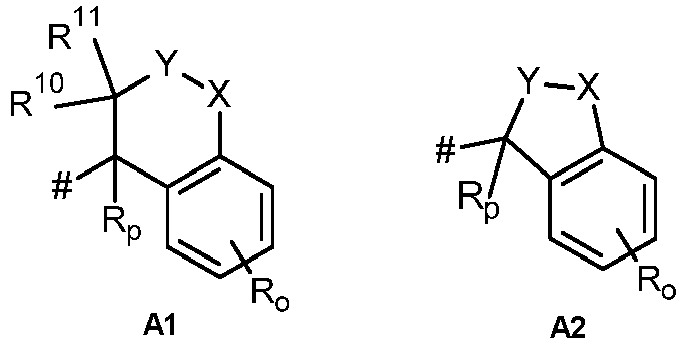 - ∘ 0, 1 oder 2 bedeutet,- R aus der Gruppe ausgewählt ist, die aus Halogen, C1-C4-Alkyl und C1-C4-Alkoxy besteht,- Rp aus der Gruppe ausgewählt ist, die aus Wasserstoff und C1-C4-Alkyl besteht,- X aus der Gruppe ausgewählt ist, die aus CR7R8, O, S und N-R9 besteht,- Y CR7R8 oder O bedeutet,- R1 Wasserstoff oder C1-C4-Alkyl bedeutet,- R2 aus der Gruppe ausgewählt ist, die aus Wasserstoff, Halogen, -C(O)-N(C1-C4-Alkyl)2,-NR12R13,-OR14,-SR15, -S(O)R15, -SO2R15,C1-C4-Alkyl, C3-C6-Cycloalkyl, C2-C4-Alkenyl oder C3-C6-Cycloalkenyl, wobei jedes davon wahlweise durch 1, 2, 3, 4 oder 5 Substituenten substituiert ist, die unabhängig voneinander aus der Gruppe ausgewählt sind, die aus Halogen, -OH, Cyano, C1-C4-Alkoxy-C(O)- und -C(O)-NH2, C1-C4-Alkoxy, -NH2, -N(C1-C4-Alkyl)2 und -N(C1-C4-Alkyl)(C(O)-C1-C4-Alkyl) besteht, undeinem monocyclischen oder bicyclischen Heterocyclus, der aus der Gruppe ausgewählt ist, die aus 4- bis 10-gliedrigem Heterocycloalkyl, Heterospirocycloalkyl, 5-gliedrigem Heteroaryl und 6-gliedrigem Heteroaryl besteht, wobei jedes davon wahlweise durch 1, 2, 3 oder 4 Substituenten substituiert ist, die unabhängig voneinander aus der Gruppe ausgewählt sind, die aus Halogen, -OH, Oxo, -COOH, C1-C4-Alkoxy-C(O)-, -C(O)-NH2, C1-C4-Alkyl, C1-C4-Alkyl-C(O)-, C1-C4-Halogenalkyl mit 1 bis 5 Halogenatomen, Hydroxy-C1-C4-alkyl-, C1-C4-Alkoxy-C1-C4-alkyl-, -NH2, -N(C1-C4-Alkyl)2 und 4- bis 10-gliedrigem Heterocycloalkyl, besteht, besteht,- R3 Wasserstoff oder C1-C4-Alkyl bedeutet,- R4 aus der Gruppe ausgewählt ist, die aus Wasserstoff, Halogen, -OH, Cyano, C1-C4-Alkyl, C1-C4-Halogenalkyl mit 1 bis 5 Halogenatomen, C1-C4-Alkoxy, C1-C4-Halogenalkoxy mit 1 bis 5 Halogenatomen, -NH2, vorzugsweise Wasserstoff und Halogen, und besonders bevorzugt Fluor und Chlor besteht,- R5 aus der Gruppe ausgewählt ist, die aus Wasserstoff, Halogen, -OH, Cyano, C1-C4-Alkyl, C1-C4-Halogenalkyl mit 1 bis 5 Halogenatomen und C1-C4-Alkoxy besteht,- R6 aus der Gruppe ausgewählt ist, die aus Wasserstoff, Halogen, -OH, Cyano, C1-C4-Alkyl, C1-C4-Halogenalkyl mit 1 bis 5 Halogenatomen und C1-C4-Alkoxy besteht,- R7 aus der Gruppe ausgewählt ist, die aus Wasserstoff und C1-C4-Alkyl besteht,- R8 aus der Gruppe ausgewählt ist, die aus Wasserstoff und C1-C4-Alkyl besteht, oder- R7 und R8 zusammen eine Oxo-Gruppe (=O) bilden,- R9 C1-C4-Alkyl bedeutet,- R10 aus der Gruppe ausgewählt ist, die aus Wasserstoff, -OH und C1-C4-Alkyl besteht,- R11 Wasserstoff bedeutet,- R12 und R13 unabhängig voneinander aus der Gruppe ausgewählt sind, die ausWasserstoff, -NH(-C(O)-C1-C4-Alkyl), C1-C4-Alkoxy,C3-C6-Cycloalkyl, Phenyl-C1-C4-alkyl, wobei jedes davon wahlweise durch 1, 2 oder 3 Substituenten substituiert ist, die unabhängig voneinander aus der Gruppe ausgewählt sind, die aus Halogen, -OH, -COOH, C1-C4-Alkoxy-C(O)-, -C(O)-NH2, -C(O)-N(C1-C4-Alkyl)2, -NH-C(O)-C1-C4-Alkyl, C1-C4-Alkyl, C1-C4-Alkoxy, C3-C6-Cycloalkyl, -NH2, -N(C1-C4-Alkyl)2, -S-C1-C4-Alkyl, -S(O)-C1-C4-Alkyl, -SO2-C1-C4-Alkyl und (C1-C4-Alkoxy)2P(=O)-besteht,Heterocyclyl-C1-C4-alkyl, wobei der Heterocyclylsubstituent aus der Gruppe ausgewählt ist, die aus 4- bis 10-gliedrigem Heterocycloalkyl, 5-gliedrigem Heteroaryl und 6-gliedrigem Heteroaryl besteht, wobei jedes davon wahlweise durch 1, 2 oder 3 Substituenten substituiert ist, die unabhängig voneinander aus der Gruppe ausgewählt sind, die aus Halogen, Cyano, -OH, Oxo, C1-C4-Alkyl, C1-C4-Halogenalkyl mit 1 bis 5 Halogenatomen und C1-C4-Alkoxy besteht,Phenyl und Benzo-C5-C6-cycloalkyl, wobei jedes davon wahlweise durch 1, 2 oder 3 Substituenten substituiert ist, die unabhängig voneinander aus der Gruppe ausgewählt sind, die aus Halogen, Cyano, C1-C4-Alkyl, C1-C4-Halogenalkyl mit 1 bis 5 Halogenatomen, C1-C4-Alkoxy und C1-C4-Halogenalkoxy mit 1 bis 5 Halogenatomen besteht, undeinem monocyclischen oder bicyclischen Heterocyclus, der aus der Gruppe von 4- bis 10-gliedrigem Heterocycloalkyl, 5-gliedrigem Heteroaryl und 6-gliedrigem Heteroaryl ausgewählt ist, wobei jedes davon wahlweise durch 1, 2 oder 3 Substituenten substituiert ist, die unabhängig voneinander aus der Gruppe ausgewählt sind, die aus Halogen, -OH, Oxo, Cyano, C1-C4-Alkyl, C1-C4-Halogenalkyl mit 1 bis 5 Halogenatomen, C1-C4-Alkoxy und C1-C4-Halogenalkoxy mit 1 bis 5 Halogenatomen besteht, besteht,- R14 aus der Gruppe ausgewählt ist, die ausC1-C4-Alkyl, C3-C6-Cycloalkyl, Phenyl-C1-C4-alkyl, wobei jedes davon wahlweise durch 1, 2 oder 3 Substituenten substituiert ist, die unabhängig voneinander aus der Gruppe ausgewählt sind, die aus Halogen, -OH, C1-C4-Alkyl, C1-C4-Alkoxy und C3-C6-Cycloalkyl besteht, und4- bis 10-gliedrigem Heterocycloalkyl besteht,- R15 aus der Gruppe ausgewählt ist, die aus Wasserstoff,C1-C4-Alkyl, das wahlweise durch 1, 2 oder 3 Substituenten substituiert ist, die unabhängig voneinander aus der Gruppe ausgewählt sind, die aus -OH und -COOH besteht, undeinem 6-gliedrigen Heteroaryl besteht,- Q einen substituierten Phenylring mit der Formel (Q1):und Stereoisomere, Tautomere, N-Oxide, Hydrate, Solvate und Salze davon und Gemische daraus.
 · Z1 und Z5 unabhängig voneinander aus der Gruppe ausgewählt sind, die aus Wasserstoff, Halogen, C1-C4-Alkyl, C1-C4-Alkoxy und C1-C4-Halogenalkyl mit 1 bis 5 Halogenatomen besteht,· Z2 und Z4 unabhängig voneinander aus der Gruppe ausgewählt sind, die aus Wasserstoff, Halogen, Cyano, -OH, C1-C4-Alkyl, C1-C4-Alkoxy, -NH(C1-C4-Alkyl), -N(C1-C4-Alkyl)2, C1-C4-Halogenalkyl mit 1 bis 5 Halogenatomen, C1-C4-Halogenalkoxy mit 1 bis 5 Halogenatomen, -S-(C1-C4-Alkyl), S-(C1-C4-Halogenalkyl) mit 1 bis 5 Halogenatomen und einem 4- bis 6-gliedrigen Heterocycloalkyl besteht, und· Z3 aus der Gruppe ausgewählt ist, die aus Wasserstoff, Halogen, C1-C4-Alkyl, C1-C4-Alkoxy, C1-C4-Halogenalkoxy mit 1 bis 5 Halogenatomen und -N(C1-C4-Alkyl)2 besteht, oder· Z1 und Z2 zusammen mit den Kohlenstoffatomen, an welche sie gebunden sind, ein 5-gliedriges Heterocycloalkyl oder ein 5-gliedriges Heteroaryl bilden, wobei jedes davon wahlweise durch einen oder zwei Substituenten substituiert sein kann, die aus der Gruppe ausgewählt ist, die aus Methyl, Fluor und Oxo besteht,· Z3 und Z5 Wasserstoff bedeuten und· Z4 aus der Gruppe ausgewählt ist, die aus Wasserstoff und C1-C4-Alkoxy-C(O)- besteht,
 - Die Verbindung nach Anspruch 1, 2, 3 oder 4, wobei:- A aus der Gruppe ausgewählt ist, die aus:


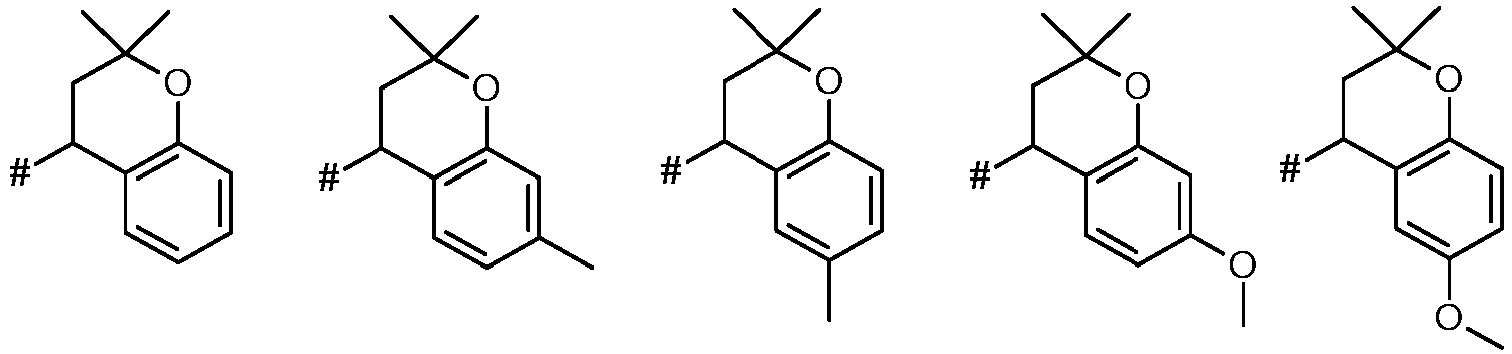

 - R1 Wasserstoff oder Methyl bedeutet,- R2 aus der Gruppe ausgewählt ist, die aus Wasserstoff, Chlor, Iod, -C(O)-N(CH3)2,-NR12R13,-OR14,-SR15, -S(O)R15, -SO2R15,Methyl, Ethyl, Propyl, Isopropyl, Cyclopropyl, Cyclobutyl, Cyclopentyl, Cyclohexyl, Ethenyl, Propenyl, Cyclopentenyl, Cyclohexenyl, wobei jedes davon wahlweise durch 1 oder 2 Substituenten substituiert ist, die unabhängig voneinander aus der Gruppe ausgewählt sind, die aus -OH, Cyano, Ethoxy-C(O)-, -C(O)-NH2, Methoxy, NH2, N(CH3)2 und N(CH3)(C(O)CH3) besteht, undeinem monocyclischen oder bicyclischen Heterocyclus, der aus der Gruppe ausgewählt ist, die aus Azetidin, Oxetan, Pyrrolidin, Tetrahydrofuran, Pyrazolidin, Imidazolidin, 1,2,4-Triazolidin, Piperidin, Piperazin, Tetrahydropyran, Tetrahydropyridin, Dihydro-2H-pyran, 1,2-Oxazolidin, 1,2-Oxazin, Morpholin, Thiomorpholin, 3,4-Dihydroisochinolin, 2,3-Dihydroindol, 1,3-Dihydroisoindol, 3,9-Dioxa-7-azabicyclo[3.3.1]nonan, 6-Oxa-3-azabicyclo[3.1.1]heptan, 8-Oxa-3-azabicyclo[3.2.1]octan, Thiophen, Imidazol, Pyrazol, 1,2,4-Triazol, 1,2,3-Triazol, 1,2,3,4-Tetrazol, Pyridin, Dihydropyridin, Pyrimidin, Tetrahydropyrimidin und 4-Oxa-7-azaspiro[2.5]octan besteht, wobei jedes davon wahlweise durch 1, 2, 3 oder 4 Substituenten substituiert ist, die unabhängig voneinander aus der Gruppe ausgewählt sind, die aus Fluor, Chlor, Cyano, -OH, Oxo, -COOH, Methoxy-C(O)-, Ethoxy-C(O)-, tert.-Butoxy-C(O)-, -C(O)-NH2, Methyl, Methyl-C(O)-, Difluormethyl, Trifluormethyl, Hydroxymethyl-, Methoxymethyl-, -NH2, -NMe2 und Pyrrolidin besteht, besteht,- R3 Wasserstoff oder Methyl bedeutet,- R4 aus der Gruppe ausgewählt ist, die aus Wasserstoff, Fluor, Chlor, -OH, Cyano, Methyl, Methoxy, Trifluormethyl, Trifluormethoxy und NH2, vorzugsweise Wasserstoff, Fluor und Chlor, besteht,- R5 aus der Gruppe ausgewählt ist, die aus Wasserstoff, Fluor, Chlor, -OH, Cyano, Methyl, Methoxy und Trifluormethyl besteht,- R6 aus der Gruppe ausgewählt ist, die aus Wasserstoff, Fluor, Chlor, -OH, Cyano, Methyl und Methoxy besteht,- R12 und R13 unabhängig voneinander aus der Gruppe ausgewählt sind, die ausWasserstoff, -NH(-C(O)-Methyl), Methoxy,Cyclopropyl, Cyclobutyl, Benzyl, 1-Phenylethyl, wobei jedes davon wahlweise durch 1, 2 oder 3 Substituenten substituiert ist, die unabhängig voneinander aus der Gruppe ausgewählt sind, die aus Fluor, -OH, -COOH, Methoxy-C(O)-, Ethoxy-C(O)-, tert.-Butoxy-C(O)-, -C(O)-NH2, -C(O)-NMe2, -NH-C(O)-Methyl, Methyl, Methoxy, Cyclopropyl, -NH2, NMe2, S-Methyl, S(O)-Methyl, SO2-Methyl und (EtO)2P(=O)- besteht,Heterocyclylmethyl, Heterocyclylethyl, wobei der Heterocyclylsubstituent aus der Gruppe ausgewählt ist, die aus Oxetan, Tetrahydrofuran, Tetrahydropyran, Pyrrolidin, Morpholin, Pyrazol, Imidazol, 1,2,4-Oxadiazol und Pyridin besteht, wobei jedes davon wahlweise durch 1 Substituenten substituiert ist, der unabhängig voneinander aus der Gruppe ausgewählt ist, die aus Fluor, Chlor, -OH, Oxo und Methyl besteht,Phenyl,2,3-Dihydro-1H-inden undeinem monocyclischen oder bicyclischen Heterocyclus, der aus der Gruppe von Oxetan, Thietan, Pyrrolidin, Morpholin, Tetrahydropyran, Pyridin und Pyrazol ausgewählt ist, wobei jedes davon wahlweise durch 1 oder 2 Substituenten substituiert ist, die unabhängig voneinander aus der Gruppe ausgewählt sind, die aus Fluor, Chlor, -OH, Oxo und Methyl besteht, besteht,- R14 aus der Gruppe ausgewählt ist, die ausMethyl, Ethyl, Isopropyl, Butyl, Cyclopentyl, Benzyl, wobei jedes davon wahlweise durch 1 oder 2 Substituenten substituiert ist, die unabhängig voneinander aus der Gruppe ausgewählt sind, die aus Fluor, -OH, Methyl, Methoxy und Cyclopentyl besteht, undeinem monocyclischen oder bicyclischen Heterocyclus, der aus der Gruppe ausgewählt ist, die aus Pyrrolidin und Tetrahydropyran besteht, besteht,- R15 aus der Gruppe ausgewählt ist, die ausMethyl und Ethyl, wobei jedes davon wahlweise durch 1 Substituenten substituiert ist, der unabhängig voneinander aus der Gruppe ausgewählt ist, die aus -OH und -COOH besteht, undPyridin besteht,- Q einen substituierten Phenylring mit der Formel (Q1):und Stereoisomere, Tautomere, N-Oxide, Hydrate, Solvate und Salze davon und Gemische daraus.
 · Z1 und Z5 unabhängig voneinander aus der Gruppe ausgewählt sind, die aus Wasserstoff, Fluor, Chlor, Methyl, Trifluormethyl und Methoxy besteht,· Z2 und Z4 unabhängig voneinander aus der Gruppe ausgewählt sind, die aus Wasserstoff, Fluor, Chlor, -OH, Cyano, Methyl, Ethyl, tert.-Butyl, -NHMe, -NMe2, Trifluormethyl, Methoxy, Trifluormethoxy, -SMe, 2,2,2-Trifluorethyl)sulfanyl und Morpholinyl besteht, und· Z3 unabhängig voneinander aus der Gruppe ausgewählt ist, die aus Wasserstoff, Fluor, Chlor, Methyl, Methoxy, Difluormethoxy und -NMe2 besteht,
 - Die Verbindung nach Anspruch 1, 2, 3, 4 oder 5, wobei:- A aus der Gruppe ausgewählt ist, die aus

und Stereoisomere, Tautomere, N-Oxide, Hydrate, Solvate und Salze davon und Gemische daraus. - Die Verbindung nach einem der Ansprüche 1 bis 6, wobei:- R2 aus der Gruppe ausgewählt ist, die ausWasserstoff, Chlor, Iod, -C(O)-N(CH3)2,-NR12R13,-OR14,-SR15, -S(O)R15, -SO2R15,Methyl, Ethyl, Propyl, Isopropyl, Cyclopropyl, Cyclobutyl, Cyclopentyl, Cyclohexyl, Ethenyl, Propenyl, Cyclopentenyl, Cyclohexenyl, wobei jedes davon wahlweise durch 1 oder 2 Substituenten substituiert ist, die unabhängig voneinander aus der Gruppe ausgewählt sind, die aus -OH, Cyano, Ethoxy-C(O)-, -C(O)-NH2, Methoxy, NH2, N(CH3)2, N(CH3)(C(O)CH3) besteht, undeinem monocyclischen oder bicyclischen Heterocyclus, der aus der Gruppe ausgewählt ist, die aus Azetidin, Oxetan, Pyrrolidin, Tetrahydrofuran, Pyrazolidin, Imidazolidin, 1,2,4-Triazolidin, Piperidin, Piperazin, Tetrahydropyridin, Dihydro-2H-pyran, 1,2-Oxazolidin, 1,2-Oxazin, Morpholin, Thiomorpholin, 3,4-Dihydroisochinolin, 2,3-Dihydroindol, 1,3-Dihydroisoindol, 3,9-Dioxa-7-azabicyclo[3.3.1]nonan, 6-Oxa-3-azabicyclo[3.1.1]heptan, 8-Oxa-3-azabicyclo[3.2.1]octan, Thiophen, Imidazol, Pyrazol, 1,2,4-Triazol, 1,2,3-Triazol, 1,2,3,4-Tetrazol, Pyridin, Dihydropyridin, Pyrimidin, Tetrahydropyrimidin und 4-Oxa-7-azaspiro[2.5]octan besteht, wobei jedes davon wahlweise durch 1, 2, 3 oder 4 Substituenten substituiert ist, die unabhängig voneinander aus der Gruppe ausgewählt sind, die aus Fluor, Chlor, Cyano, -OH, Oxo, -COOH, Methoxy-C(O)-, Ethoxy-C(O)-, tert.-Butoxy-C(O)-, -C(O)-NH2, Methyl, Methyl-C(O)-, Difluormethyl, Trifluormethyl, Hydroxymethyl-, Methoxymethyl-, -NH2, -NMe2 und Pyrrolidin besteht, besteht,- R12 und R13 unabhängig voneinander aus der Gruppe ausgewählt sind, die ausWasserstoff, -NH(-C(O)-Methyl), Methoxy,Cyclopropyl, Cyclobutyl, Benzyl, 1-Phenylethyl, wobei jedes davon wahlweise durch 1, 2 oder 3 Substituenten substituiert ist, die unabhängig voneinander aus der Gruppe ausgewählt sind, die aus Fluor, -OH, -COOH, Methoxy-C(O)-, Ethoxy-C(O)-, tert.-Butoxy-C(O)-, -C(O)-NH2, -C(O)-NMe2, -NH-C(O)-Methyl, Methyl, Methoxy, Cyclopropyl, -NH2, NMe2, S-Methyl, S(O)-Methyl, SO2-Methyl und (EtO)2P(=O)- besteht,Heterocyclylmethyl, Heterocyclylethyl, wobei der Heterocyclylsubstituent aus der Gruppe ausgewählt ist, die aus Oxetan, Tetrahydrofuran, Tetrahydropyran, Pyrrolidin, Morpholin, Pyrazol, Imidazol, 1,2,4-Oxadiazol, Pyridin, wobei jedes davon wahlweise durch 1 Substituenten substituiert ist, der unabhängig voneinander aus der Gruppe ausgewählt ist, die aus Fluor, Chlor, -OH, Oxo und Methyl besteht,Phenyl,2,3-Dihydro-1H-inden undeinem monocyclischen oder bicyclischen Heterocyclus, der aus der Gruppe von Oxetan, Thietan, Pyrrolidin, Morpholin, Tetrahydropyran, Pyridin und Pyrazol ausgewählt ist, wobei jedes davon wahlweise durch 1 oder 2 Substituenten substituiert ist, die unabhängig voneinander aus der Gruppe ausgewählt sind, die aus Fluor, Chlor, -OH, Oxo und Methyl besteht, besteht,- R14 aus der Gruppe ausgewählt ist, die ausMethyl, Ethyl, Isopropyl, Butyl, Cyclopentyl, Benzyl, wobei jedes davon wahlweise durch 1 oder 2 Substituenten substituiert ist, die unabhängig voneinander aus der Gruppe ausgewählt sind, die aus Fluor, -OH, Methyl, Methoxy und Cyclopentyl besteht, undeinem monocyclischen oder bicyclischen Heterocyclus, der aus der Gruppe ausgewählt ist, die aus Pyrrolidin und Tetrahydropyran besteht, besteht,- R15 aus der Gruppe ausgewählt ist, die ausMethyl und Ethyl, wobei jedes davon wahlweise durch 1 Substituenten substituiert ist, der unabhängig voneinander aus der Gruppe ausgewählt ist, die aus -OH und -COOH besteht, undPyridin besteht,und Stereoisomere, Tautomere, N-Oxide, Hydrate, Solvate und Salze davon und Gemische daraus.
- Die Verbindung nach einem der Ansprüche 1 bis 7, wobei:- Q einen substituierten Phenylring mit der Formel (Q1):und Stereoisomere, Tautomere, N-Oxide, Hydrate, Solvate und Salze davon und Gemische daraus.
 · Z1, Z2, Z3, Z4 und Z5 unabhängig voneinander aus der Gruppe ausgewählt sind, die aus Wasserstoff, Halogen, Cyano, C1-C4-Alkyl, C1-C4-Halogenalkyl mit 1 bis 5 Halogenatomen, Hydroxy, C1-C4-Alkoxy, C1-C4-Halogenalkoxy mit 1 bis 5 Halogenatomen, -NH(C1-C4-Alkyl), -N(C1-C4-Alkyl)2, 4- bis 6-gliedrigem Heterocyclyl, das wahlweise durch 1 oder 2 Substituenten substituiert ist, die aus der Gruppe ausgewählt sind, die aus Fluor, Chlor, Brom, Methyl und Cyano, -S-(C1-C4-Alkyl), -S(O)-(C1-C4-Alkyl), -SO2-(C1-C4-Alkyl), ), -S- (C1-C4-Halogenalkyl) mit 1 bis 5 Halogenatomen, -S(O)-(C1-C4-Halogenalkyl) mit 1 bis 5 Halogenatomen und -SO2-(C1-C4-Halogenalkyl) mit 1 bis 5 Halogenatomen besteht, besteht, oder· Z1 und Z2 zusammen mit den Kohlenstoffatomen, an welche sie gebunden sind, ein 5- oder 6-gliedriges Heterocycloalkyl, ein 5-gliedriges Heteroaryl oder ein 6-gliedriges Heteroaryl bilden, wobei jedes davon wahlweise durch ein oder zwei Substituenten substituiert sein kann, die aus der Gruppe ausgewählt sind, die aus Methyl, Fluor und Oxo besteht, und· Z3, Z4 und Z5 unabhängig voneinander aus der Gruppe ausgewählt sind, die aus Wasserstoff, Halogen, Cyano, C1-C4-Alkyl, C1-C4-Halogenalkyl mit 1 bis 5 Halogenatomen, C1-C4-Alkoxy, C1-C4-Alkoxy-C(O)- und C1-C4-Halogenalkoxy mit 1 bis 5 Halogenatomen besteht, oder· Z2 und Z3 zusammen mit den Kohlenstoffatomen, an welche sie gebunden sind, einen 5- oder 6-gliedrigen gesättigten oder teilweise gesättigten heterocyclischen Ring, ein 5-gliedriges Heteroaryl oder ein 6-gliedriges Heteroaryl bilden, wobei jedes davon wahlweise durch einen oder zwei Substituenten substituiert sein kann, die aus der Gruppe ausgewählt sind, die aus Methyl, Fluor und Oxo besteht, und· Z1, Z4 und Z5 unabhängig voneinander aus der Gruppe ausgewählt sind, die aus Wasserstoff, Halogen, Cyano, C1-C4-Alkyl, C1-C4-Halogenalkyl mit 1 bis 5 Halogenatomen, C1-C4-Alkoxy und C1-C4-Halogenalkoxy mit 1 bis 5 Halogenatomen besteht,
 - Die Verbindung nach einem der Ansprüche 1 bis 8, wobei:- Q einen substituierten Phenylring mit der Formel (Q1):und Stereoisomere, Tautomere, N-Oxide, Hydrate, Solvate und Salze davon und Gemische daraus.
 · Z1 und Z5 unabhängig voneinander aus der Gruppe ausgewählt sind, die aus Wasserstoff, Fluor, Chlor, Methyl, Methoxy und Trifluormethyl besteht,· Z2 und Z4 unabhängig voneinander aus der Gruppe ausgewählt sind, die aus Wasserstoff, Fluor, Chlor, -OH, Cyano, Methyl, Ethyl, tert.-Butyl, -NHMe, -NMe2, Trifluormethyl, Methoxy, Trifluormethoxy, -SMe, 2,2,2-Trifluorethyl)sulfanyl und Morpholinyl besteht, und· Z3 unabhängig voneinander aus der Gruppe ausgewählt ist, die aus Wasserstoff, Fluor, Chlor, Methyl, Methoxy, Difluormethoxy und -NMe2 besteht,
 - Die Verbindung nach einem der Ansprüche 1 bis 9, wobei:- A A3 oder A4:
 - Rp aus der Gruppe ausgewählt ist, die aus Wasserstoff, C1-C4-Alkyl und vorzugsweise Wasserstoff besteht,und Stereoisomere, Tautomere, N-Oxide, Hydrate, Solvate und Salze davon und Gemische daraus.
 - Ein Verfahren zur Herstellung einer Verbindung mit der allgemeinen Formel (I) nach einem der Ansprüche 1 bis 10, wobei dieses Verfahren den Schritt der Umsetzung eines Zwischenprodukts mit der allgemeinen Formel 1C:
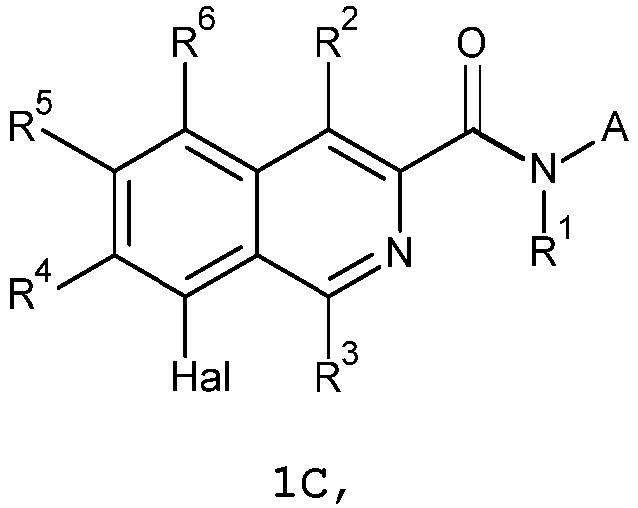 in welcher A, R1, R2, R3, R4, R5 und R6 wie für die Verbindung mit der allgemeinen Formel (I) nach einem der Ansprüche 1 bis 10 definiert sind,mit einer Verbindung mit der allgemeinen Formel 1D:
Q-B(OR)2 1D,
in welcher jeder R einzeln H oder Me sein kann oder beide R Pinakolat bedeuten,was eine Verbindung mit der allgemeinen Formel (I):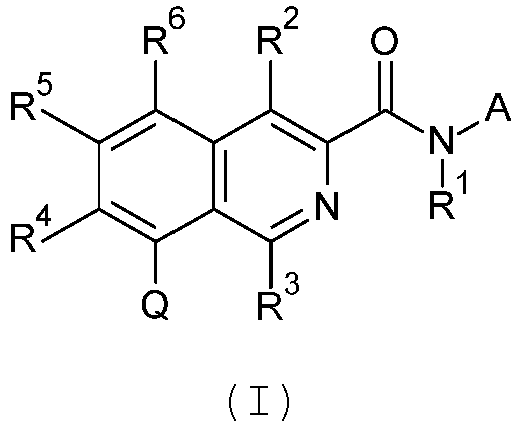 ergibt, in welcher A, R1, R2 , R3, R4, R5, R6 und Q wie für die Verbindung mit der allgemeinen Formel (I) nach einem der Ansprüche 1 bis 10 definiert sind, umfasst.
 - Eine Verbindung mit der allgemeinen Formel 1C:
 in welcher:- R2 wie für die Verbindung mit der allgemeinen Formel (I) nach einem der Ansprüche 1 bis 6 definiert ist,- A, R1, R3, R4, R5 und R6 wie für die Verbindung mit der allgemeinen Formel (I) nach einem der Ansprüche 1 bis 7 und 10 definiert sind, und- Hal Halogen bedeutet,oder ein Stereoisomer, Tautomer, N-Oxid, Hydrat, Solvat oder Salz davon oder ein Gemisch daraus.
 - Eine pharmazeutische Zubereitung, die eine Verbindung mit der allgemeinen Formel (I) nach einem der Ansprüche 1 bis 10 und einen oder mehrere pharmazeutisch verträgliche Hilfsstoffe umfasst.
- Eine Verbindung mit der allgemeinen Formel (I) nach einem der Ansprüche 1 bis 10 oder eine pharmazeutische Zubereitung nach Anspruch 13 für eine Verwendung bei der Bekämpfung, Behandlung und/oder Verhütung einer Krankheit.
- Die Verbindung oder die pharmazeutische Zubereitung für eine Verwendung nach Anspruch 14, wobei die Krankheit eine Helmintheninfektion ist.
Applications Claiming Priority (2)
| Application Number | Priority Date | Filing Date | Title |
|---|---|---|---|
| EP19189099 | 2019-07-30 | ||
| PCT/EP2020/071139 WO2021018839A1 (en) | 2019-07-30 | 2020-07-27 | Isoquinoline derivatives and their use for the treatment of parasitic infections |
Publications (2)
| Publication Number | Publication Date |
|---|---|
| EP4003524A1 EP4003524A1 (de) | 2022-06-01 |
| EP4003524B1 true EP4003524B1 (de) | 2025-04-09 |
Family
ID=67513381
Family Applications (1)
| Application Number | Title | Priority Date | Filing Date |
|---|---|---|---|
| EP20746957.8A Active EP4003524B1 (de) | 2019-07-30 | 2020-07-27 | Isochinolinderivate und ihre verwendung zur behandlung parasitärer infektionen |
Country Status (11)
| Country | Link |
|---|---|
| US (1) | US12391682B2 (de) |
| EP (1) | EP4003524B1 (de) |
| JP (1) | JP7669343B2 (de) |
| CN (1) | CN114423749B (de) |
| AU (1) | AU2020321572B2 (de) |
| BR (1) | BR112022001567A2 (de) |
| CA (1) | CA3147542A1 (de) |
| ES (1) | ES3027846T3 (de) |
| TW (1) | TWI865563B (de) |
| UY (1) | UY38816A (de) |
| WO (1) | WO2021018839A1 (de) |
Families Citing this family (9)
| Publication number | Priority date | Publication date | Assignee | Title |
|---|---|---|---|---|
| US12269822B2 (en) | 2018-07-09 | 2025-04-08 | Boehringer Ingelheim Animal Health USA Inc. | Anthelminthic heterocyclic compounds |
| MX2021011302A (es) | 2019-03-19 | 2022-01-19 | Boehringer Ingelheim Animal Health Usa Inc | Compuestos de aza-benzotiofeno y aza-benzofurano como antihelminticos. |
| US12448391B2 (en) | 2019-06-07 | 2025-10-21 | Elanco Tiergesundheit Ag | Bicyclic derivatives for treating endoparasites |
| KR20230028268A (ko) | 2020-05-29 | 2023-02-28 | 뵈링거 잉겔하임 애니멀 헬스 유에스에이 인코포레이티드 | 구충성 헤테로시클릭 화합물 |
| EP4148052A1 (de) * | 2021-09-09 | 2023-03-15 | Bayer Animal Health GmbH | Neue chinolinderivate |
| US11999742B2 (en) | 2021-11-01 | 2024-06-04 | Boehringer Ingelheim Vetmedica Gmbh | Substituted pyrrolo[1,2-b]pyridazines as anthelmintics |
| WO2024213752A1 (en) | 2023-04-14 | 2024-10-17 | Elanco Animal Health Gmbh | Long-term prevention and/or treatment of a disease by slo-1 inhibitors |
| CN121620507A (zh) | 2023-08-02 | 2026-03-06 | 英特维特国际股份有限公司 | 具有驱虫活性的甲酰胺-4-喹啉化合物 |
| WO2026078157A2 (en) | 2024-10-10 | 2026-04-16 | Elanco Animal Health Gmbh | Slo-1 modulators for prevention and/or treatment of a disease |
Family Cites Families (54)
| Publication number | Priority date | Publication date | Assignee | Title |
|---|---|---|---|---|
| US609373A (en) | 1898-08-16 | Oyster or fish car | ||
| DE3639877A1 (de) | 1986-11-21 | 1988-05-26 | Bayer Ag | Hetarylalkyl substituierte 5- und 6-ringheterocyclen |
| DE19746287A1 (de) | 1997-10-20 | 1999-04-22 | Hoechst Marion Roussel De Gmbh | Substituierte Isochinolin-2-Carbonsäureamide, ihre Herstellung und ihre Verwendung als Arzneimittel |
| RU15525U1 (ru) | 2000-07-04 | 2000-10-20 | Федеральный научно-производственный центр закрытое акционерное общество "Научно-производственный концерн (объединение) "ЭНЕРГИЯ" | Электродвигатель постоянного тока |
| GB0213715D0 (en) | 2002-06-14 | 2002-07-24 | Syngenta Ltd | Chemical compounds |
| TWI312272B (en) | 2003-05-12 | 2009-07-21 | Sumitomo Chemical Co | Pyrimidine compound and pests controlling composition containing the same |
| GB0310867D0 (en) | 2003-05-12 | 2003-06-18 | Novartis Ag | Organic compounds |
| WO2004108681A1 (en) | 2003-06-06 | 2004-12-16 | Fibrogen, Inc. | Nitrogen-containing heteroaryl compounds and their use in increasing endogenous erythropoietin |
| US7544699B2 (en) | 2003-08-08 | 2009-06-09 | Transtech Pharma, Inc. | Aryl and heteroaryl compounds, compositions, and methods of use |
| GB0414438D0 (en) | 2004-06-28 | 2004-07-28 | Syngenta Participations Ag | Chemical compounds |
| JP4970950B2 (ja) | 2004-10-20 | 2012-07-11 | クミアイ化学工業株式会社 | 3−トリアゾリルフェニルスルフィド誘導体及びそれを有効成分として含有する殺虫・殺ダニ・殺線虫剤 |
| MY141762A (en) | 2005-10-06 | 2010-06-30 | Nippon Soda Co | Cross-linked cyclic amine compounds and agents for pest control |
| US7628282B2 (en) | 2005-10-25 | 2009-12-08 | Rtc Industries, Inc. | Product management display system |
| BRPI0707302B8 (pt) | 2006-01-27 | 2021-05-25 | Fibrogen Inc | compostos de cianoisoquinolina que atuam no dano tecidual associado com isquemia, hipóxia e anemia, bem como composição farmacêutica que os compreende |
| AR066879A1 (es) | 2007-06-08 | 2009-09-16 | Novartis Ag | Derivados de quinoxalina como inhibidores de la actividad de cinasa de tirosina de las cinasas janus |
| JP5268461B2 (ja) | 2008-07-14 | 2013-08-21 | Meiji Seikaファルマ株式会社 | Pf1364物質、その製造方法、生産菌株、及び、それを有効成分とする農園芸用殺虫剤 |
| CN101337940B (zh) | 2008-08-12 | 2012-05-02 | 国家农药创制工程技术研究中心 | 具杀虫活性的含氮杂环二氯烯丙醚类化合物 |
| CN101337937B (zh) | 2008-08-12 | 2010-12-22 | 国家农药创制工程技术研究中心 | 具有杀虫活性的n-苯基-5-取代氨基吡唑类化合物 |
| CN101715774A (zh) | 2008-10-09 | 2010-06-02 | 浙江化工科技集团有限公司 | 一个具有杀虫活性化合物制备及用途 |
| EP2184273A1 (de) | 2008-11-05 | 2010-05-12 | Bayer CropScience AG | Halogen-substituierte Verbindungen als Pestizide |
| GB0820344D0 (en) | 2008-11-06 | 2008-12-17 | Syngenta Ltd | Herbicidal compositions |
| ES2468215T3 (es) | 2008-12-12 | 2014-06-16 | Syngenta Participations Ag | N-oxipiperidinas espiroheteroc�clicas como plaguicidas |
| JP2012525389A (ja) | 2009-04-27 | 2012-10-22 | ハイ ポイント ファーマシューティカルズ,リミティド ライアビリティ カンパニー | 置換イソキノリン誘導体、医薬組成物、及びβ−セクレターゼ阻害剤としての使用方法 |
| WO2011085575A1 (zh) | 2010-01-15 | 2011-07-21 | 江苏省农药研究所股份有限公司 | 邻杂环甲酰苯胺类化合物及其合成方法和应用 |
| AR081721A1 (es) | 2010-02-25 | 2012-10-17 | Nippon Soda Co | Compuesto de amina ciclica y acaricida |
| BR112012030408A2 (pt) | 2010-05-31 | 2015-09-29 | Syngenta Participations Ag | método de melhoramento de culturas |
| PH12013500237A1 (en) | 2010-08-31 | 2013-03-11 | Mitsui Chemicals Crop & Life Solutions Inc | Pest control agent |
| CN101967139B (zh) | 2010-09-14 | 2013-06-05 | 中化蓝天集团有限公司 | 一种含一氟甲氧基吡唑的邻甲酰氨基苯甲酰胺类化合物、其合成方法及应用 |
| US8791162B2 (en) | 2011-02-14 | 2014-07-29 | Merck Sharp & Dohme Corp. | Cathepsin cysteine protease inhibitors |
| WO2013030358A1 (en) | 2011-08-31 | 2013-03-07 | Merz Pharma Gmbh & Co. Kgaa | Glycine b antagonists |
| WO2013050317A1 (en) | 2011-10-03 | 2013-04-11 | Syngenta Limited | Polymorphs of an isoxazoline derivative |
| CN102391261A (zh) | 2011-10-14 | 2012-03-28 | 上海交通大学 | 一种n-取代噁二嗪类化合物及其制备方法和应用 |
| TWI566701B (zh) | 2012-02-01 | 2017-01-21 | 日本農藥股份有限公司 | 芳烷氧基嘧啶衍生物及包含該衍生物作為有效成分的農園藝用殺蟲劑及其使用方法 |
| CN104202981B (zh) | 2012-03-30 | 2018-01-30 | 巴斯夫欧洲公司 | 防治动物害虫的n‑取代的吡啶亚基化合物和衍生物 |
| EP2647626A1 (de) | 2012-04-03 | 2013-10-09 | Syngenta Participations AG. | 1-Aza-spiro[4.5]dec-3-en- und 1,8-Diaza-spiro[4.5]dec-3-enderivate als Pestizide |
| CN104822266B (zh) | 2012-04-27 | 2017-12-05 | 陶氏益农公司 | 杀虫组合物和与其相关的方法 |
| US9282739B2 (en) | 2012-04-27 | 2016-03-15 | Dow Agrosciences Llc | Pesticidal compositions and processes related thereto |
| CN103232431B (zh) | 2013-01-25 | 2014-11-05 | 青岛科技大学 | 一种二卤代吡唑酰胺类化合物及其应用 |
| CN103109816B (zh) | 2013-01-25 | 2014-09-10 | 青岛科技大学 | 硫代苯甲酰胺类化合物及其应用 |
| US20140275503A1 (en) | 2013-03-13 | 2014-09-18 | Dow Agrosciences Llc | Process for the preparation of certain triaryl rhamnose carbamates |
| WO2014187846A1 (en) | 2013-05-23 | 2014-11-27 | Syngenta Participations Ag | Tank-mix formulations |
| RU2543374C2 (ru) | 2013-05-30 | 2015-02-27 | государственное бюджетное образовательное учреждение высшего профессионального образования "Пермская государственная фармацевтическая академия" Министерства здравоохранения Российской Федерации (ГБОУ ВПО ПГФА Минздрава России) | Амид 2-(3-метил-6-метокси-7-этокси-3,4-дигидроизохинолил-1)-этановой кислоты гидрохлорид, проявляющий антигельминтное действие |
| CN103265527B (zh) | 2013-06-07 | 2014-08-13 | 江苏省农用激素工程技术研究中心有限公司 | 邻氨基苯甲酰胺化合物及其制备方法和应用 |
| CN103524422B (zh) | 2013-10-11 | 2015-05-27 | 中国农业科学院植物保护研究所 | 苯并咪唑衍生物及其制备方法和用途 |
| WO2015058028A1 (en) | 2013-10-17 | 2015-04-23 | Dow Agrosciences Llc | Processes for the preparation of pesticidal compounds |
| CN105636440A (zh) | 2013-10-17 | 2016-06-01 | 美国陶氏益农公司 | 制备杀虫化合物的方法 |
| WO2016005276A1 (en) | 2014-07-07 | 2016-01-14 | Bayer Cropscience Aktiengesellschaft | Process for preparing fluorinated iminopyridine compounds |
| EA036995B1 (ru) | 2015-02-13 | 2021-01-25 | Оксфорд Драг Дизайн Лимитед | НОВЫЕ N-АЦИЛАРИЛСУЛЬФОНАМИДНЫЕ ПРОИЗВОДНЫЕ В КАЧЕСТВЕ ИНГИБИТОРОВ АМИНОАЦИЛ-тРНК СИНТЕТАЗЫ |
| US10492495B2 (en) | 2015-02-17 | 2019-12-03 | Nippon Soda Co., Ltd. | Agrochemical composition |
| AU2017251155B2 (en) | 2016-04-15 | 2021-08-05 | Elanco Animal Health Gmbh | Pyrazolopyrimidine derivatives |
| SI3538512T1 (sl) * | 2016-11-11 | 2021-09-30 | Bayer Animal Health Gmbh | Novi antihelmintični kinolin-3-karboksamidni derivati |
| US11485733B2 (en) * | 2017-06-30 | 2022-11-01 | Bayer Animal Health Gmbh | Azaquinoline derivatives |
| KR20200036909A (ko) * | 2017-08-04 | 2020-04-07 | 바이엘 애니멀 헬스 게엠베하 | 연충에 의한 감염을 치료하기 위한 퀴놀린 유도체 |
| MX2021007538A (es) | 2018-12-18 | 2021-10-13 | Elanco Tiergesundheit Ag | Derivados biciclicos. |
-
2020
- 2020-07-20 TW TW109124426A patent/TWI865563B/zh active
- 2020-07-27 JP JP2022505591A patent/JP7669343B2/ja active Active
- 2020-07-27 WO PCT/EP2020/071139 patent/WO2021018839A1/en not_active Ceased
- 2020-07-27 CN CN202080068235.8A patent/CN114423749B/zh active Active
- 2020-07-27 BR BR112022001567A patent/BR112022001567A2/pt unknown
- 2020-07-27 EP EP20746957.8A patent/EP4003524B1/de active Active
- 2020-07-27 ES ES20746957T patent/ES3027846T3/es active Active
- 2020-07-27 US US17/630,742 patent/US12391682B2/en active Active
- 2020-07-27 CA CA3147542A patent/CA3147542A1/en active Pending
- 2020-07-27 AU AU2020321572A patent/AU2020321572B2/en active Active
- 2020-07-30 UY UY0001038816A patent/UY38816A/es unknown
Also Published As
| Publication number | Publication date |
|---|---|
| US12391682B2 (en) | 2025-08-19 |
| UY38816A (es) | 2021-02-26 |
| TW202120490A (zh) | 2021-06-01 |
| JP2022542682A (ja) | 2022-10-06 |
| CA3147542A1 (en) | 2021-02-04 |
| AU2020321572B2 (en) | 2026-03-05 |
| JP7669343B2 (ja) | 2025-04-28 |
| US20220274971A1 (en) | 2022-09-01 |
| AU2020321572A1 (en) | 2022-02-17 |
| WO2021018839A1 (en) | 2021-02-04 |
| EP4003524A1 (de) | 2022-06-01 |
| CN114423749B (zh) | 2024-10-01 |
| CN114423749A (zh) | 2022-04-29 |
| ES3027846T3 (en) | 2025-06-17 |
| BR112022001567A2 (pt) | 2022-04-12 |
| TWI865563B (zh) | 2024-12-11 |
Similar Documents
| Publication | Publication Date | Title |
|---|---|---|
| US11505545B2 (en) | Anthelmintic quinoline-3-carboxamide derivatives | |
| US11001590B2 (en) | Pyrazolopyrimidine derivatives | |
| US12435068B2 (en) | Anthelmintic compounds | |
| EP4003524B1 (de) | Isochinolinderivate und ihre verwendung zur behandlung parasitärer infektionen | |
| EP3634959B1 (de) | Chinolinderivate zur behandlung von infektionen mit helminthen | |
| EP3615527B1 (de) | Neue azachinolinderivate | |
| EP3585791B1 (de) | Neue bicyclische pyrazol derivate | |
| EP3790874B1 (de) | Anthelmintische chinolinderivate | |
| US20230174492A1 (en) | Substituted condensed azines as anthelmintic compounds | |
| RU2839897C2 (ru) | Новые производные изохинолина |
Legal Events
| Date | Code | Title | Description |
|---|---|---|---|
| STAA | Information on the status of an ep patent application or granted ep patent |
Free format text: STATUS: UNKNOWN |
|
| STAA | Information on the status of an ep patent application or granted ep patent |
Free format text: STATUS: THE INTERNATIONAL PUBLICATION HAS BEEN MADE |
|
| PUAI | Public reference made under article 153(3) epc to a published international application that has entered the european phase |
Free format text: ORIGINAL CODE: 0009012 |
|
| STAA | Information on the status of an ep patent application or granted ep patent |
Free format text: STATUS: REQUEST FOR EXAMINATION WAS MADE |
|
| 17P | Request for examination filed |
Effective date: 20220125 |
|
| AK | Designated contracting states |
Kind code of ref document: A1 Designated state(s): AL AT BE BG CH CY CZ DE DK EE ES FI FR GB GR HR HU IE IS IT LI LT LU LV MC MK MT NL NO PL PT RO RS SE SI SK SM TR |
|
| DAV | Request for validation of the european patent (deleted) | ||
| DAX | Request for extension of the european patent (deleted) | ||
| STAA | Information on the status of an ep patent application or granted ep patent |
Free format text: STATUS: EXAMINATION IS IN PROGRESS |
|
| 17Q | First examination report despatched |
Effective date: 20231002 |
|
| GRAP | Despatch of communication of intention to grant a patent |
Free format text: ORIGINAL CODE: EPIDOSNIGR1 |
|
| STAA | Information on the status of an ep patent application or granted ep patent |
Free format text: STATUS: GRANT OF PATENT IS INTENDED |
|
| INTG | Intention to grant announced |
Effective date: 20241025 |
|
| RAP3 | Party data changed (applicant data changed or rights of an application transferred) |
Owner name: ELANCO ANIMAL HEALTH GMBH |
|
| GRAS | Grant fee paid |
Free format text: ORIGINAL CODE: EPIDOSNIGR3 |
|
| GRAA | (expected) grant |
Free format text: ORIGINAL CODE: 0009210 |
|
| STAA | Information on the status of an ep patent application or granted ep patent |
Free format text: STATUS: THE PATENT HAS BEEN GRANTED |
|
| AK | Designated contracting states |
Kind code of ref document: B1 Designated state(s): AL AT BE BG CH CY CZ DE DK EE ES FI FR GB GR HR HU IE IS IT LI LT LU LV MC MK MT NL NO PL PT RO RS SE SI SK SM TR |
|
| REG | Reference to a national code |
Ref country code: GB Ref legal event code: FG4D |
|
| REG | Reference to a national code |
Ref country code: CH Ref legal event code: EP |
|
| REG | Reference to a national code |
Ref country code: DE Ref legal event code: R096 Ref document number: 602020049109 Country of ref document: DE |
|
| REG | Reference to a national code |
Ref country code: IE Ref legal event code: FG4D |
|
| P01 | Opt-out of the competence of the unified patent court (upc) registered |
Free format text: CASE NUMBER: APP_19362/2025 Effective date: 20250423 |
|
| REG | Reference to a national code |
Ref country code: NL Ref legal event code: FP |
|
| REG | Reference to a national code |
Ref country code: ES Ref legal event code: FG2A Ref document number: 3027846 Country of ref document: ES Kind code of ref document: T3 Effective date: 20250617 |
|
| PGFP | Annual fee paid to national office [announced via postgrant information from national office to epo] |
Ref country code: GB Payment date: 20250619 Year of fee payment: 6 |
|
| PGFP | Annual fee paid to national office [announced via postgrant information from national office to epo] |
Ref country code: NL Payment date: 20250620 Year of fee payment: 6 |
|
| PGFP | Annual fee paid to national office [announced via postgrant information from national office to epo] |
Ref country code: FR Payment date: 20250620 Year of fee payment: 6 |
|
| REG | Reference to a national code |
Ref country code: AT Ref legal event code: MK05 Ref document number: 1783040 Country of ref document: AT Kind code of ref document: T Effective date: 20250409 |
|
| PG25 | Lapsed in a contracting state [announced via postgrant information from national office to epo] |
Ref country code: PT Free format text: LAPSE BECAUSE OF FAILURE TO SUBMIT A TRANSLATION OF THE DESCRIPTION OR TO PAY THE FEE WITHIN THE PRESCRIBED TIME-LIMIT Effective date: 20250811 Ref country code: FI Free format text: LAPSE BECAUSE OF FAILURE TO SUBMIT A TRANSLATION OF THE DESCRIPTION OR TO PAY THE FEE WITHIN THE PRESCRIBED TIME-LIMIT Effective date: 20250409 |
|
| PGFP | Annual fee paid to national office [announced via postgrant information from national office to epo] |
Ref country code: ES Payment date: 20250801 Year of fee payment: 6 |
|
| PGFP | Annual fee paid to national office [announced via postgrant information from national office to epo] |
Ref country code: DE Payment date: 20250620 Year of fee payment: 6 |
|
| REG | Reference to a national code |
Ref country code: LT Ref legal event code: MG9D |
|
| PG25 | Lapsed in a contracting state [announced via postgrant information from national office to epo] |
Ref country code: GR Free format text: LAPSE BECAUSE OF FAILURE TO SUBMIT A TRANSLATION OF THE DESCRIPTION OR TO PAY THE FEE WITHIN THE PRESCRIBED TIME-LIMIT Effective date: 20250710 Ref country code: NO Free format text: LAPSE BECAUSE OF FAILURE TO SUBMIT A TRANSLATION OF THE DESCRIPTION OR TO PAY THE FEE WITHIN THE PRESCRIBED TIME-LIMIT Effective date: 20250709 |
|
| PG25 | Lapsed in a contracting state [announced via postgrant information from national office to epo] |
Ref country code: PL Free format text: LAPSE BECAUSE OF FAILURE TO SUBMIT A TRANSLATION OF THE DESCRIPTION OR TO PAY THE FEE WITHIN THE PRESCRIBED TIME-LIMIT Effective date: 20250409 |
|
| PGFP | Annual fee paid to national office [announced via postgrant information from national office to epo] |
Ref country code: IT Payment date: 20250619 Year of fee payment: 6 |
|
| PG25 | Lapsed in a contracting state [announced via postgrant information from national office to epo] |
Ref country code: BG Free format text: LAPSE BECAUSE OF FAILURE TO SUBMIT A TRANSLATION OF THE DESCRIPTION OR TO PAY THE FEE WITHIN THE PRESCRIBED TIME-LIMIT Effective date: 20250409 |
|
| PG25 | Lapsed in a contracting state [announced via postgrant information from national office to epo] |
Ref country code: HR Free format text: LAPSE BECAUSE OF FAILURE TO SUBMIT A TRANSLATION OF THE DESCRIPTION OR TO PAY THE FEE WITHIN THE PRESCRIBED TIME-LIMIT Effective date: 20250409 |
|
| PG25 | Lapsed in a contracting state [announced via postgrant information from national office to epo] |
Ref country code: AT Free format text: LAPSE BECAUSE OF FAILURE TO SUBMIT A TRANSLATION OF THE DESCRIPTION OR TO PAY THE FEE WITHIN THE PRESCRIBED TIME-LIMIT Effective date: 20250409 |
|
| PG25 | Lapsed in a contracting state [announced via postgrant information from national office to epo] |
Ref country code: RS Free format text: LAPSE BECAUSE OF FAILURE TO SUBMIT A TRANSLATION OF THE DESCRIPTION OR TO PAY THE FEE WITHIN THE PRESCRIBED TIME-LIMIT Effective date: 20250709 |
|
| PG25 | Lapsed in a contracting state [announced via postgrant information from national office to epo] |
Ref country code: IS Free format text: LAPSE BECAUSE OF FAILURE TO SUBMIT A TRANSLATION OF THE DESCRIPTION OR TO PAY THE FEE WITHIN THE PRESCRIBED TIME-LIMIT Effective date: 20250809 |
|
| PG25 | Lapsed in a contracting state [announced via postgrant information from national office to epo] |
Ref country code: LV Free format text: LAPSE BECAUSE OF FAILURE TO SUBMIT A TRANSLATION OF THE DESCRIPTION OR TO PAY THE FEE WITHIN THE PRESCRIBED TIME-LIMIT Effective date: 20250409 |
|
| REG | Reference to a national code |
Ref country code: DE Ref legal event code: R097 Ref document number: 602020049109 Country of ref document: DE |
|
| PG25 | Lapsed in a contracting state [announced via postgrant information from national office to epo] |
Ref country code: DK Free format text: LAPSE BECAUSE OF FAILURE TO SUBMIT A TRANSLATION OF THE DESCRIPTION OR TO PAY THE FEE WITHIN THE PRESCRIBED TIME-LIMIT Effective date: 20250409 Ref country code: SM Free format text: LAPSE BECAUSE OF FAILURE TO SUBMIT A TRANSLATION OF THE DESCRIPTION OR TO PAY THE FEE WITHIN THE PRESCRIBED TIME-LIMIT Effective date: 20250409 |
|
| PG25 | Lapsed in a contracting state [announced via postgrant information from national office to epo] |
Ref country code: CZ Free format text: LAPSE BECAUSE OF FAILURE TO SUBMIT A TRANSLATION OF THE DESCRIPTION OR TO PAY THE FEE WITHIN THE PRESCRIBED TIME-LIMIT Effective date: 20250409 |
|
| PG25 | Lapsed in a contracting state [announced via postgrant information from national office to epo] |
Ref country code: EE Free format text: LAPSE BECAUSE OF FAILURE TO SUBMIT A TRANSLATION OF THE DESCRIPTION OR TO PAY THE FEE WITHIN THE PRESCRIBED TIME-LIMIT Effective date: 20250409 |
|
| PG25 | Lapsed in a contracting state [announced via postgrant information from national office to epo] |
Ref country code: RO Free format text: LAPSE BECAUSE OF FAILURE TO SUBMIT A TRANSLATION OF THE DESCRIPTION OR TO PAY THE FEE WITHIN THE PRESCRIBED TIME-LIMIT Effective date: 20250409 Ref country code: SK Free format text: LAPSE BECAUSE OF FAILURE TO SUBMIT A TRANSLATION OF THE DESCRIPTION OR TO PAY THE FEE WITHIN THE PRESCRIBED TIME-LIMIT Effective date: 20250409 |
|
| PLBE | No opposition filed within time limit |
Free format text: ORIGINAL CODE: 0009261 |
|
| STAA | Information on the status of an ep patent application or granted ep patent |
Free format text: STATUS: NO OPPOSITION FILED WITHIN TIME LIMIT |
|
| REG | Reference to a national code |
Ref country code: CH Ref legal event code: L10 Free format text: ST27 STATUS EVENT CODE: U-0-0-L10-L00 (AS PROVIDED BY THE NATIONAL OFFICE) Effective date: 20260218 |
|
| REG | Reference to a national code |
Ref country code: CH Ref legal event code: H13 Free format text: ST27 STATUS EVENT CODE: U-0-0-H10-H13 (AS PROVIDED BY THE NATIONAL OFFICE) Effective date: 20260224 |
|
| PG25 | Lapsed in a contracting state [announced via postgrant information from national office to epo] |
Ref country code: LU Free format text: LAPSE BECAUSE OF NON-PAYMENT OF DUE FEES Effective date: 20250727 |
|
| 26N | No opposition filed |
Effective date: 20260112 |
|
| REG | Reference to a national code |
Ref country code: BE Ref legal event code: MM Effective date: 20250731 |
|
| PG25 | Lapsed in a contracting state [announced via postgrant information from national office to epo] |
Ref country code: BE Free format text: LAPSE BECAUSE OF NON-PAYMENT OF DUE FEES Effective date: 20250731 |
|
| PG25 | Lapsed in a contracting state [announced via postgrant information from national office to epo] |
Ref country code: CH Free format text: LAPSE BECAUSE OF NON-PAYMENT OF DUE FEES Effective date: 20250731 |