EP4003757B1 - Reifen mit lauffläche - Google Patents
Reifen mit lauffläche Download PDFInfo
- Publication number
- EP4003757B1 EP4003757B1 EP20757936.8A EP20757936A EP4003757B1 EP 4003757 B1 EP4003757 B1 EP 4003757B1 EP 20757936 A EP20757936 A EP 20757936A EP 4003757 B1 EP4003757 B1 EP 4003757B1
- Authority
- EP
- European Patent Office
- Prior art keywords
- tread
- patterns
- elastomer
- pattern
- tyre according
- Prior art date
- Legal status (The legal status is an assumption and is not a legal conclusion. Google has not performed a legal analysis and makes no representation as to the accuracy of the status listed.)
- Active
Links
Images

Classifications
-
- B—PERFORMING OPERATIONS; TRANSPORTING
- B60—VEHICLES IN GENERAL
- B60C—VEHICLE TYRES; TYRE INFLATION; TYRE CHANGING; CONNECTING VALVES TO INFLATABLE ELASTIC BODIES IN GENERAL; DEVICES OR ARRANGEMENTS RELATED TO TYRES
- B60C11/00—Tyre tread bands; Tread patterns; Anti-skid inserts
- B60C11/03—Tread patterns
- B60C11/0318—Tread patterns irregular patterns with particular pitch sequence
-
- B—PERFORMING OPERATIONS; TRANSPORTING
- B60—VEHICLES IN GENERAL
- B60C—VEHICLE TYRES; TYRE INFLATION; TYRE CHANGING; CONNECTING VALVES TO INFLATABLE ELASTIC BODIES IN GENERAL; DEVICES OR ARRANGEMENTS RELATED TO TYRES
- B60C11/00—Tyre tread bands; Tread patterns; Anti-skid inserts
- B60C11/03—Tread patterns
- B60C11/0302—Tread patterns directional pattern, i.e. with main rolling direction
-
- B—PERFORMING OPERATIONS; TRANSPORTING
- B60—VEHICLES IN GENERAL
- B60C—VEHICLE TYRES; TYRE INFLATION; TYRE CHANGING; CONNECTING VALVES TO INFLATABLE ELASTIC BODIES IN GENERAL; DEVICES OR ARRANGEMENTS RELATED TO TYRES
- B60C1/00—Tyres characterised by the chemical composition or the physical arrangement or mixture of the composition
- B60C1/0016—Compositions of the tread
-
- B—PERFORMING OPERATIONS; TRANSPORTING
- B60—VEHICLES IN GENERAL
- B60C—VEHICLE TYRES; TYRE INFLATION; TYRE CHANGING; CONNECTING VALVES TO INFLATABLE ELASTIC BODIES IN GENERAL; DEVICES OR ARRANGEMENTS RELATED TO TYRES
- B60C11/00—Tyre tread bands; Tread patterns; Anti-skid inserts
- B60C11/0008—Tyre tread bands; Tread patterns; Anti-skid inserts characterised by the tread rubber
-
- B—PERFORMING OPERATIONS; TRANSPORTING
- B60—VEHICLES IN GENERAL
- B60C—VEHICLE TYRES; TYRE INFLATION; TYRE CHANGING; CONNECTING VALVES TO INFLATABLE ELASTIC BODIES IN GENERAL; DEVICES OR ARRANGEMENTS RELATED TO TYRES
- B60C11/00—Tyre tread bands; Tread patterns; Anti-skid inserts
- B60C11/03—Tread patterns
- B60C11/0327—Tread patterns characterised by special properties of the tread pattern
- B60C11/033—Tread patterns characterised by special properties of the tread pattern by the void or net-to-gross ratios of the patterns
-
- B—PERFORMING OPERATIONS; TRANSPORTING
- B60—VEHICLES IN GENERAL
- B60C—VEHICLE TYRES; TYRE INFLATION; TYRE CHANGING; CONNECTING VALVES TO INFLATABLE ELASTIC BODIES IN GENERAL; DEVICES OR ARRANGEMENTS RELATED TO TYRES
- B60C11/00—Tyre tread bands; Tread patterns; Anti-skid inserts
- B60C11/03—Tread patterns
- B60C11/12—Tread patterns characterised by the use of narrow slits or incisions, e.g. sipes
-
- B—PERFORMING OPERATIONS; TRANSPORTING
- B60—VEHICLES IN GENERAL
- B60C—VEHICLE TYRES; TYRE INFLATION; TYRE CHANGING; CONNECTING VALVES TO INFLATABLE ELASTIC BODIES IN GENERAL; DEVICES OR ARRANGEMENTS RELATED TO TYRES
- B60C11/00—Tyre tread bands; Tread patterns; Anti-skid inserts
- B60C11/03—Tread patterns
- B60C11/13—Tread patterns characterised by the groove cross-section, e.g. for buttressing or preventing stone-trapping
-
- C—CHEMISTRY; METALLURGY
- C08—ORGANIC MACROMOLECULAR COMPOUNDS; THEIR PREPARATION OR CHEMICAL WORKING-UP; COMPOSITIONS BASED THEREON
- C08K—Use of inorganic or non-macromolecular organic substances as compounding ingredients
- C08K3/00—Use of inorganic substances as compounding ingredients
- C08K3/34—Silicon-containing compounds
- C08K3/36—Silica
-
- C—CHEMISTRY; METALLURGY
- C08—ORGANIC MACROMOLECULAR COMPOUNDS; THEIR PREPARATION OR CHEMICAL WORKING-UP; COMPOSITIONS BASED THEREON
- C08L—COMPOSITIONS OF MACROMOLECULAR COMPOUNDS
- C08L15/00—Compositions of rubber derivatives
-
- C—CHEMISTRY; METALLURGY
- C08—ORGANIC MACROMOLECULAR COMPOUNDS; THEIR PREPARATION OR CHEMICAL WORKING-UP; COMPOSITIONS BASED THEREON
- C08L—COMPOSITIONS OF MACROMOLECULAR COMPOUNDS
- C08L57/00—Compositions of unspecified polymers obtained by reactions only involving carbon-to-carbon unsaturated bonds
- C08L57/02—Copolymers of mineral oil hydrocarbons
-
- C—CHEMISTRY; METALLURGY
- C08—ORGANIC MACROMOLECULAR COMPOUNDS; THEIR PREPARATION OR CHEMICAL WORKING-UP; COMPOSITIONS BASED THEREON
- C08L—COMPOSITIONS OF MACROMOLECULAR COMPOUNDS
- C08L91/00—Compositions of oils, fats or waxes; Compositions of derivatives thereof
-
- B—PERFORMING OPERATIONS; TRANSPORTING
- B60—VEHICLES IN GENERAL
- B60C—VEHICLE TYRES; TYRE INFLATION; TYRE CHANGING; CONNECTING VALVES TO INFLATABLE ELASTIC BODIES IN GENERAL; DEVICES OR ARRANGEMENTS RELATED TO TYRES
- B60C11/00—Tyre tread bands; Tread patterns; Anti-skid inserts
- B60C11/0008—Tyre tread bands; Tread patterns; Anti-skid inserts characterised by the tread rubber
- B60C2011/0016—Physical properties or dimensions
- B60C2011/0025—Modulus or tan delta
-
- B—PERFORMING OPERATIONS; TRANSPORTING
- B60—VEHICLES IN GENERAL
- B60C—VEHICLE TYRES; TYRE INFLATION; TYRE CHANGING; CONNECTING VALVES TO INFLATABLE ELASTIC BODIES IN GENERAL; DEVICES OR ARRANGEMENTS RELATED TO TYRES
- B60C11/00—Tyre tread bands; Tread patterns; Anti-skid inserts
- B60C11/03—Tread patterns
- B60C11/0311—Patterns comprising tread lugs arranged parallel or oblique to the axis of rotation
- B60C2011/0313—Patterns comprising tread lugs arranged parallel or oblique to the axis of rotation directional type
-
- B—PERFORMING OPERATIONS; TRANSPORTING
- B60—VEHICLES IN GENERAL
- B60C—VEHICLE TYRES; TYRE INFLATION; TYRE CHANGING; CONNECTING VALVES TO INFLATABLE ELASTIC BODIES IN GENERAL; DEVICES OR ARRANGEMENTS RELATED TO TYRES
- B60C11/00—Tyre tread bands; Tread patterns; Anti-skid inserts
- B60C11/03—Tread patterns
- B60C2011/0337—Tread patterns characterised by particular design features of the pattern
- B60C2011/0339—Grooves
- B60C2011/0374—Slant grooves, i.e. having an angle of about 5 to 35 degrees to the equatorial plane
- B60C2011/0376—Slant grooves, i.e. having an angle of about 5 to 35 degrees to the equatorial plane characterised by width
-
- B—PERFORMING OPERATIONS; TRANSPORTING
- B60—VEHICLES IN GENERAL
- B60C—VEHICLE TYRES; TYRE INFLATION; TYRE CHANGING; CONNECTING VALVES TO INFLATABLE ELASTIC BODIES IN GENERAL; DEVICES OR ARRANGEMENTS RELATED TO TYRES
- B60C11/00—Tyre tread bands; Tread patterns; Anti-skid inserts
- B60C11/03—Tread patterns
- B60C11/12—Tread patterns characterised by the use of narrow slits or incisions, e.g. sipes
- B60C2011/129—Sipe density, i.e. the distance between the sipes within the pattern
- B60C2011/1295—Sipe density, i.e. the distance between the sipes within the pattern variable
Definitions
- the present invention relates to a tire for a motor vehicle, the tread of which comprises a plurality of oblique grooves having a strong slenderness.
- the invention is more particularly suitable for a tire intended to equip a passenger vehicle or a van.
- a tire intended to equip a motor vehicle comprises a tread.
- This tread comprises a tread surface and two edges delimiting said tread surface.
- the running surface corresponds to all the points of the tread which come into contact with the ground when the tire, inflated to its reference pressure and crushed by a reference load, rolls on this road.
- the reference inflation pressure and the reference load are defined in the conditions of use of the tire, conditions specified in particular by the ETRTO standard.
- the running surface of the tread includes depressions formed by various grooves, such as oblique grooves.
- the oblique grooves form channels intended to evacuate water on the sides of the tread. It is known from the document GB2240522 a directional tread comprising a plurality of oblique grooves.
- the tread comprises a central axis X and two edges which frame said tread and which determine a tread width, denoted A on the figure 1 .
- the tread also has a central part of width denoted K and which corresponds to approximately 80% of the width A of the tread.
- each oblique groove has a large slenderness, that is to say that the projection in the circumferential direction X of said groove is very close to or even greater than half the width K of this central part.
- the very large slenderness of the oblique grooves improves the evacuation of water out of the tread and therefore improves grip on wet ground.
- the present invention aims to remedy this drawback.
- the present invention aims to improve the grip compromise on snowy ground/wet ground for an all-season tire while improving the wear performance of such a tire.
- the invention relates to a tire comprising a directional tread.
- trimer is understood to mean all types of tire made of rubber material subjected to internal pressure when driving or not subjected to such internal pressure when driving (this is the case of a tire without compressed air, for example, Tweel TM type).
- tread of a tire is meant a quantity of rubber material delimited by a tread surface.
- the area of bearing groups together all the points of the tire which will come into contact with the ground under normal driving conditions.
- the “usual driving conditions” are the conditions of use defined by the ETRTO standard (European Tire and Rim Technical Organisation). These conditions of use specify the reference inflation pressure corresponding to the load capacity of the tire indicated by its load index and its speed code. These conditions of use can also be called “nominal conditions” or “conditions of use”.
- Directional tread means a tread whose tread elements are specifically arranged to optimize the behavioral characteristics as a function of a predetermined direction of rotation. This direction of rotation is conventionally indicated by an arrow on the sidewall of the tire.
- the tread of the invention comprises a central axis and two edges flanking said central axis and determining a tread width W, the width of the tread being greater than or equal to 140 mm.
- This tread width is determined from a dynamically generated footprint.
- black ink is deposited on part of the tread of the tire and this inked part is rolled on a sheet of paper at a certain forward speed.
- the conditions for making such an imprint are at nominal pressure, for a load corresponding to 0.76 times the nominal load and at a forward speed of 100 mm/s. For example, for a tire of size 205/55R16 91V, the conditions for making the footprint will be at a pressure of 2.5 bar and for a load of 480 daN. All the measurements for determining the slenderness E, the density of incisions SD, the average density of incisions SDmoy are then made from an imprint of the tread rolling on a support under the load, pressure and forward speed conditions as described above.
- the tread comprises a plurality of patterns which follow one another in the circumferential direction, each pattern having a pitch P.
- “By pattern” is meant a set of blocks which is repeated in the circumferential direction. This repetition can be done at iso-dimension.
- the tread is then said to be single-step. As a variant, this repetition can be done with different dimensions, in particular different pitch values.
- the tread is then said to be multistep.
- the number of different pitch values for a multi-pitch tread is between 3 and 5 pitches.
- the block assembly of the pattern extends over the entire width W of the tread.
- Each block set includes at least one block.
- “By block” is meant an element in relief delimited by grooves and comprising side walls and a contact face, the latter being intended to come into contact with the ground during rolling.
- Second circumferential direction is meant a direction which is tangent to any circle centered on the axis of rotation. This direction is perpendicular to both an axial direction and a radial direction.
- Axial direction means a direction parallel to the axis of rotation of the tire.
- Ring direction means a direction which is perpendicular to the axis of rotation of the tire (this direction corresponds to the direction of the thickness of the tread at the center of said tread).
- Body groove is meant a cutout whose distance between the walls of material is greater than 2 mm.
- “By oblique groove”, is meant a groove whose main orientation makes an acute angle of between 20° and 70° with the axial direction.
- “Circumferential groove” means a groove whose main orientation is in the circumferential direction.
- “Groove” means a circumferential groove which extends over the entire circumference of the tire.
- “Incision” means a cutout whose distance between the walls of material is less than or equal to 2 mm. It is also determined that the depth of an incision in the tread is greater than or equal to 1 mm. Since then, aesthetic cutouts, of the "barleycorn" type, whose depth is less than 1 mm in the tread are not considered as incisions.
- the patterns delimit a plurality of oblique grooves, each oblique groove extending from one of the edges of the tread in the direction of the central axis but without reaching said central axis. In this way, it is ensured that the center of the tread is reinforced with material, for example by a rib of material which extends circumferentially. The grip on dry ground of the tread is then improved.
- all or part of the oblique grooves of the plurality of oblique grooves has a slenderness of between 0 .85 and 1.5 and preferably between 0.87 and 1.1.
- All or part of the patterns comprises at least one incision.
- An SD incision density in the pattern is between 10 mm -1 and 70 mm -1 .
- the tread comprises different types of patterns Mj, with j greater than or equal to 2, the patterns belonging to the same type of pattern having the same pitch, the pitch between patterns belonging to two types of different motives being different.
- the incision density SD or the mean incision density SDmoy is greater than 25 mm ⁇ 1 and/or less than 50 mm ⁇ 1 .
- the incision density SD or the mean incision density SDmoy is between 30 mm ⁇ 1 and 40 mm ⁇ 1 .
- each pattern comprises a set of blocks comprising at least one block.
- the block has a maximum radial height Hmax in new condition of between 5.5 mm and 9 mm and preferably between 6 mm and 7.5 mm.
- the blocks are made of rubber material.
- rubber material means a polymeric material of the elastomeric mixture type, that is to say a polymeric material obtained by mixing at least one elastomer, at least one reinforcing filler and a crosslinking system .
- a usual physical characteristic of an elastomeric compound is its glass transition temperature Tg, the temperature at which the elastomeric compound changes from a deformable rubbery state to a rigid glassy state.
- the glass transition temperature Tg of an elastomeric mixture is generally determined during measurement of the dynamic properties of the elastomeric mixture, on a viscoanalyzer (Matravib VA4000), according to standard ASTM D 5992-96.
- the measurement of the dynamic properties is carried out on a sample of vulcanized elastomeric mixture, that is to say cured up to a degree of conversion of at least 90%, the sample having the shape of a cylindrical test specimen having a thickness equal to 2 mm and a section equal to 78.5 mm 2 .
- the results used are generally the complex dynamic shear modulus G*, comprising an elastic part G' and a viscous part G", and the dynamic loss tg ⁇ , equal to the ratio G"/G'.
- the glass transition temperature Tg is the temperature at which the dynamic loss tg ⁇ reaches a maximum during the temperature scan.
- the value of G* measured at 60° C. is representative of the rigidity of the rubber material, that is to say of its resistance to elastic deformation.
- the composition of the rubber material of the block or blocks of the pattern has a glass transition temperature Tg of between -40°C and -10°C and preferably between -35°C and -15°C.
- the composition of the rubber material has a dynamic shear modulus measured at 60° C. of between 0.5 MPa and 2 MPa, and preferably between 0.7 MPa and 1.5 MPa.
- the elastomeric mixture of the block(s) comprises 100 phr (parts by weight per hundred parts by weight of elastomer) of a modified dine elastomer.
- a diene elastomer is a homopolymer or a copolymer, derived at least in part from diene monomers, that is to say monomers carrying two carbon-carbon double bonds, whether conjugated or not.
- the elastomeric mixture comprises the modified diene elastomer at a level at least equal to 20 phr.
- the modified diene elastomer comprises at least one functional group comprising a silicon atom, the latter being located within the main chain, including the chain ends.
- the composition of the block preferably comprises an elastomeric mixture, said elastomeric mixture comprising a modified diene elastomer comprising at least one functional group comprising a silicon atom, the latter being located within the main chain of the elastomer including the ends of chain.
- the modified diene elastomer comprising a functional group comprising a silicon atom can be a modified elastomer comprising at least one silanol function located at one end of the main chain of the elastomer.
- Corresponding modified diene elastomers are described in particular in the documents EP 0 778 311 A1 , WO 2011/042507 A1 .
- the functional group is located in the main elastomer chain, it will then be said that the diene elastomer is coupled or else functionalized in the middle of the chain.
- the silicon atom of the functional group then links the two branches of the main chain of the diene elastomer.
- the silicon atom of the functional group can be substituted by at least one alkoxy function, optionally totally or partially hydrolyzed to hydroxyl.
- the modified diene elastomer is predominantly functionalized in the middle of the chain by an alkoxysilane group bonded to the two branches of the modified diene elastomer via the silicon atom.
- the silicon atom of the functional group may be substituted by at least one alkoxy function, optionally totally or partially hydrolyzed to hydroxyl, the silicon atom may also be substituted, directly or via a divalent hydrocarbon radical, by at least one other function comprising at least one heteroatom chosen from N, S, O, P.
- the silicon atom is substituted by at least one other function via a divalent hydrocarbon radical, more preferentially aliphatic linear in C 1 - C 18 .
- the other function is preferably a tertiary amine, more preferably a diethylamino- or dimethylamino- group.
- the alkoxy function is preferably methoxy, ethoxy, butoxy or propoxy. Modified diene elastomers corresponding to these variants are described in particular in the documents WO 2009/133068 A1 , WO 2015/018743 A1 .
- the modification of the diene elastomer by at least one functional group comprising a silicon atom does not exclude another modification of the elastomer, for example at the end of the chain by an amine function introduced during the initiation of the polymerization, as described in WO 2015/018774 A1 , WO 2015/018772 A1 .
- the modified diene elastomer comprising a functional group comprising a silicon atom is advantageously a modified elastomer comprising within its structure at least one alkoxysilane group bonded to the elastomer via the silicon atom, and at least one comprising a nitrogen atom.
- Such modified diene elastomers can be obtained by the process described in the patent application EP 2 285 852 , followed by hydrolysis of the alkoxysilane function to silanol function.
- the hydrolysis reaction of the alkoxysilane function to silanol function can for example be carried out according to the procedure described in the patent application EP 2 266 819 A1 .
- the modified diene elastomer according to the invention is a 1,3-butadiene polymer, more preferably a butadiene-styrene copolymer (SBR).
- SBR butadiene-styrene copolymer
- the modified diene elastomer has a glass transition temperature comprised in a range ranging from -105° C. to -70° C., preferably from -100° C. to -75° C., more preferably from -95° C. at -80°C.
- the modified diene elastomer according to the invention can be, according to different variants, used alone in the elastomeric mixture or in a blend with at least one other diene elastomer conventionally used in tires, whether it is star-shaped, coupled, functionalized for example with tin or silicon, or not.
- the elastomeric mixture of the tread according to the invention comprises a plasticizing resin of the thermoplastic resin type at a rate at least equal to 10 phr, preferably from 10 to 100 phr, preferably from 20 to 50 pc.
- the tire has a 3PMSF winter certification, said certification being indicated on a sidewall of the tire.
- a tire according to a first embodiment of the invention comprises a tread 10 and two sidewalls 11A, 11B framing said tread 10.
- the sidewalls 11A, 11B form the side parts of the tire.
- Each sidewall has at its end a bead intended to sit on a rim of a wheel.
- the sidewalls 11A, 11B delimit the tread 10 at a first edge 14A and a second edge 14B.
- the first edge 14A and the second edge 14B frame a central axis 12 of the tread 10.
- This first edge 14A and this second edge 14B determine a tread width W.
- This tread width is here greater than 140 mm.
- the tread 10 also comprises a central part centered on the central axis 12 and whose width corresponds to 80% of the width W of said tread 10. This central part is delimited by a third edge 15A and a fourth edge 15B.
- the tread 10 comprises a plurality of patterns 13 which follow one another in the circumferential direction X.
- each pattern 13 comprises a set of blocks comprising here a first block 171, a second block 172, a third block 173, a fourth block 174 and a fifth block 175.
- the first block 171 extends from from the first edge 14A of the tread 10 to a first oblique cutout 231.
- the second block 172 extends from the first oblique cutout 231 to a second oblique cutout 232.
- the third block 173 extends on either side of the central axis 12 between the second cutout 232 and a third cutout 233.
- the fourth block 174 extends from the third cutout 233 to a fourth cutout 234.
- the fifth block 175 extends from the fourth cutout 234 to the second edge 14B.
- the first block 171 and the fifth block 175 extend beyond the limits 14A and 14B of the tread 10.
- the first block 171 and fifth block 175 areas which are outside the tread are not intended to come into contact with the ground under normal driving conditions.
- the first block 171, the second block 172, the third block 173, the fourth block 174 and the fifth block 175 are delimited, at least in part, by oblique grooves 16A, 16B.
- the oblique grooves 16A, 16B extend respectively from the first edge 14A and from the second edge 14B in the direction of the central axis 12 but without reaching said central axis. These oblique grooves 16A, 16B promote the evacuation of water from the tread when driving on a wet road surface.
- Each block 171, 172, 173, 174, 175 respectively comprises a first incision 181, a second incision 182, a third incision 183, a fourth incision 184, a fifth incision 185 and a sixth incision 186 to promote the grip of the tire on snowy ground.
- the first incision 181 extends from the first edge 14A to an incision end of the first incision 181.
- the second incision 182 extends from the first oblique cutout 231 to the second oblique cutout 232.
- the third incision 183 extends from the second oblique cutout 232 to one end of the third incision 183.
- the fourth incision 184 extends from one end of fourth incision 184 to third oblique cutout 233.
- Fifth incision 185 extends from third oblique cutout 233 to fourth oblique cutout 234.
- sixth incision 186 extends from one end of sixth incision 186 to reach second edge 14B of the tread.
- Each incision 181, 182, 185, 186 divides the associated block 171, 172, 174, 175 into two parts of generally identical width.
- the length of the incisions 183 and 184 is limited.
- the third incision 183 and the fourth incision 184 do not thus extend to the central axis 12.
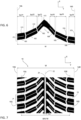
- figure 2 represents an imprint of the tread of the figure 1 .
- This imprint was made dynamically under conditions as described above.
- the recessed elements such as the oblique grooves 16A, 16B, the incisions 181, 182, 183, 184, 185, 186 are represented in white.
- Blocks 171, 172, 173, 174, 175 are shown in black. From this imprint, it is possible to determine a slenderness E of the oblique grooves ( picture 3 ) and a density of SD incisions in blocks 171, 172, 173, 174, 175 ( figure 4 to 6 ).
- a slenderness E of the oblique groove 16A in the central part of the tread that is to say to determine the level of its inclination in this central part.
- the central part is delimited in part by the third edge 15A.
- the median 19 of the oblique groove 16A separates said oblique groove 16A into two oblique half-grooves of the same width.
- Point B is determined at the intersection between the median 19 of the oblique groove 16A and the end of the oblique groove 16A.
- the slenderness E is here between 0.85 and 1.5 and preferably between 0.87 and 1.1.
- Each pattern 13 has a pitch P.
- This pitch P is determined as the distance between the centers of two adjacent oblique grooves framing the blocks 171, 172, 173, 174, 175. It will be noted that in the example of the embodiment of the figure 1 , the tread 10 comprises three pitches P1, P2, P3 of distinct values.
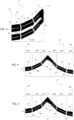
- THE figures 4, 5 And 6 illustrate three patterns of the same tread belonging to three different types of patterns having distinct pitches P1, P2, P3.
- the figure 4 thus illustrates a first pattern having a first step P1.
- the first pattern comprises the first block 171, the second block 172, the third block 173, the fourth block 174 and the fifth block 175.
- the first block 171 comprises the first incision 181.
- the second block 172 comprises the second incision 182.
- the third block 173 here comprises the third incision 183 and the fourth incision 184.
- the fourth block 174 comprises the fifth incision 185.
- the fifth block 175 comprises the sixth incision 186. For each incision, it is possible to determine a projected incision length along the axial direction Y.
- first incision 181 has a first projected length Ipy11
- second incision 182 has a second projected length Ipy12
- third incision 183 has a third projected length Ipy13
- fourth incision 184 has a projected fourth length Ipy14.
- the fifth incision has a projected fifth length Lpy15.
- the sixth incision has a projected sixth length Lpy16. It is possible to determine a first incision density SD1 in the set of pitch blocks P1 comprising the first block 171, the second block 172, the third block 173, the fourth block 174, the fifth block 175.
- FIG. 5 illustrates a second pattern having a second pitch P2.
- the second step P2 has a value greater than the first step P1.
- This second density of incisions SD2 is calculated from the projected lengths Ipy21, Ipy22, Ipy23, Ipy24, Ipy25, Ipy26 of incisions 181, 182, 183, 184, 185, 186 belonging to blocks 171, 172, 173, 174, 175
- FIG. 6 illustrates a third pattern having a third step P3.
- the third step P3 has a value greater than the second step P2.
- This third density of incisions SD3 is calculated from the projected lengths Ipy31, Ipy32, Ipy33, Ipy34, Ipy35, Ipy36 of incisions 181, 182, 183, 184, 185, 186 belonging to blocks 171, 172, 173, 174, 175
- the tread comprises an arrangement of N1 pitch patterns P1, N2 pitch patterns P2 and N3 pitch patterns P3. It is thus possible to determine an average incision density SDmoy corresponding to the average of the incision densities SD1, SD2, SD3 of the patterns of steps P1, P2, P3 over the entire circumference of the tread.
- the pitch patterns P1, P2, P3 are arranged randomly on the tread in order to limit the emergence of noise from the tire when rolling.
- the arrangement between pitch patterns P1, P2 and P3 could be as follows: P1 P1 P2 P1 P2 P2 P2 P2 P1 P1 P2 P1 P1 P1 P2 P2 P3 P2 P2 P3 P2 P1 P2 P2 P1 P1 P1 P1 P2 P1 P1 P1 P1 P2 P1 P1 P1 P1 P2 P1 P1 P1 P2 P2 P3 P3 P3 P2 P2 P3 P3 P3 P3 P3 P3 P3 P3 P2 P2 P1 P2 P2 P3 P2 P1 P2 P2 P1 P2 P2 P1 P1 P2 P2 P1 P1 P1 P2 P3 P2 P1 P1 P1 P2 P3 P2 P1.
- Such an arrangement would then comprise 21 pitch patterns P1, 35 pitch patterns P2 and 13 pitch patterns P3.
- a pitch P is determined as the distance between the centers of two adjacent oblique grooves framing a block.
- these are measured in groups of patterns belonging to the same type of pattern, for example in groups of patterns P1 P1 P1, P2 P2 P2 and P3 P3 P3 .
- the mean incision density SDmoy is between 10 mm ⁇ 1 and 70 mm ⁇ 1 .
- the average incision density SD avg is greater than 25 mm ⁇ 1 and/or less than 50 mm ⁇ 1 .
- the mean incision density SDmoy is between 30 mm ⁇ 1 and 40 mm ⁇ 1 .
- third blocks 173 of the different patterns are linked together. All of these third blocks thus form a rib of material which extends all along the circumference of the tire.
- FIG 7 illustrates a second embodiment of the invention in which the tread 10 further comprises a groove of width Ws.
- the contact surface ratio CSR is less than or equal to 0.15.
- each block is formed from a rubber material.
- the composition of this rubber material has a glass transition temperature of between -40°C and -10°C, and preferably between -35°C and -15°C and a shear modulus measured at 60° C. between 0.5 MPa and 2 MPa, and preferably between 0.7 MPa and 1.5 MPa.
- the solution SBR of this preferred embodiment is a copolymer of styrene and butadiene prepared in solution. It has the characteristic of bearing a silanol function and an amine function.
- the silanol function of the SBR solution bearing a silanol function and an amine function can for example be introduced by hydrosilylation of the elastomer chain by a silane bearing an alkoxysilane group, followed by hydrolysis of the alkoxysilane function into silanol function.
- the silanol function of the SBR solution carrying a silanol function and an amine function can also be introduced by reaction of the living elastomer chains with a cyclic polysiloxane compound as described in EP 0 778 311 .
- the amine function of the SBR solution carrying a silanol function and an amine function can for example be introduced by initiating the polymerization with an initiator carrying such a function.
- An SBR solution bearing a silanol function and an amine function can also be prepared by reacting living elastomer chains with a compound bearing an alkoxysilane function and an amine function according to the procedure described in the patent application EP 2 285 852 , followed by hydrolysis of the alkoxysilane function to silanol function. According to this method of preparation, the silanol function and the amine function are preferentially located inside the chain of the SBR solution, outside the chain ends.
- the hydrolysis reaction of the alkoxysilane function carried by the SBR solution as a silanol function can be carried out according to the procedure described in the patent application EP 2 266 819 A1 or else by a step of stripping the solution containing the SBR solution.
- the amine function can be a primary, secondary or tertiary, preferably tertiary, amine.
- the blocks have a relatively low maximum radial height Hmax when new.
- This radial height is between 5.5 mm and 9 mm and preferably between 6 mm and 7.5 mm.
- This relatively low radial height could penalize grip on wet ground.
- the radial height is compensated by the strong slenderness of the tread and by the characteristics of the material used containing the SBR solution. This makes it possible to ensure good grip of the tire on wet ground over time.
- the tread comprises at least three different types of pitch.
- the tread comprises a single type of pitch P.
- the tire is then said to be single-pitch.
- the incision density is between 10 mm -1 and 70 mm -1 .
- the incision density SD is greater than 25 mm ⁇ 1 and/or less than 50 mm ⁇ 1 .
- the incision density SD is between 30 mm ⁇ 1 and 40 mm ⁇ 1 .
- a tread 10 comprising a single central groove.
- the CSR for a tread comprising at least two grooves is less than or equal to 0.15.
- the central material rib formed by the third blocks generally has a small width.
- the width of this rib of central material corresponds to at least one third of the width W of the tread.
Landscapes
- Chemical & Material Sciences (AREA)
- Engineering & Computer Science (AREA)
- Mechanical Engineering (AREA)
- Health & Medical Sciences (AREA)
- Chemical Kinetics & Catalysis (AREA)
- Medicinal Chemistry (AREA)
- Polymers & Plastics (AREA)
- Organic Chemistry (AREA)
- Oil, Petroleum & Natural Gas (AREA)
- Tires In General (AREA)
Claims (16)
- Reifen mit einem laufrichtungsgebundenen Laufstreifen (10), wobei der Laufstreifen eine zentrale Achse (12) und zwei Ränder (14A, 14B) umfasst, die die zentrale Achse (12) einrahmen und eine Laufstreifenbreite W bestimmen, wobei die Laufstreifenbreite W größer als oder gleich 140 mm ist, wobei der Laufstreifen (10) eine Mehrzahl von Mustern (13) umfasst, die entlang der Umfangsrichtung aufeinander folgen, wobei jedes Muster eine Schrittweite P hat, wobei die Muster (13) eine Mehrzahl von schrägen Nuten (16A, 16B) begrenzen, wobei sich jede schräge Nut von einem der Ränder (14A, 14B) des Laufstreifens in Richtung der zentralen Achse (12) erstreckt, ohne jedoch die zentrale Achse (12) zu erreichen,- wobei in einem zentralen Teil des Laufstreifens, der auf die zentrale Achse (12) zentriert ist und eine Breite entsprechend 80 % der Breite W des Laufstreifens hat, alle oder ein Teil der schrägen Nuten (16A, 16B) der Mehrzahl von schrägen Nuten einen Schlankheitsgrad E zwischen 0,85 und 1,5 und bevorzugt zwischen 0,87 und 1,1 haben, wobei der Schlankheitsgrad dem Verhältnis zwischen einer projizierten Länge Lpx der schrägen Nut entlang der Umfangsrichtung (X) zur Hälfte der Breite des zentralen Teils des Laufstreifens (10) entspricht, so dass
 - alle oder ein Teil der Muster mindestens einen Einschnitt (181, 182, 183, 184, 185, 186) umfassen, wobei eine Einschnittdichte SD in allen oder einem Teil dieser Muster zwischen 10 mm-1 und 70 mm-1 beträgt, wobei die Einschnittdichte SD dem Verhältnis zwischen der Summe der projizierten Länge(n) lpyi des Einschnitts/der Einschnitte entlang einer axialen Richtung (Y) und dem Produkt aus der Schrittweite P des Musters und der Breite W des Laufstreifens entspricht, wobei das Ganze mit 1000 multipliziert wird, so dass

- Reifen nach Anspruch 1, bei dem der Laufstreifen verschiedene Mustertypen Mj mit j größer als oder gleich 2 umfasst, wobei die einem selben Mustertyp angehörenden Muster eine selbe Schrittweite haben, wobei die Schrittweite zwischen Muster, die zwei verschiedenen Mustertypen angehören, verschieden ist, und dadurch, dass die mittlere Einschnittdichte SDmoy zwischen 10 mm-1 und 70 mm-1 beträgt, wobei die mittlere Einschnittdichte SDmoy dem Mittelwert der Einschnittdichten SDj der Muster der verschiedenen Mustertypen Mj über den gesamten Umfang des Laufstreifens entspricht, wobei die mittlere Einschnittdichte SDmoy in Abhängigkeit von der Anzahl von Mustern Nj je Mustertyp Mj und von der Schrittweite Pj der dem Mustertyp Mj angehörenden Muster über den Umfang des Laufstreifens gewichtet wird, so dass

- Reifen nach Anspruch 1 oder Anspruch 2, bei dem die Einschnittdichte SD oder die mittlere Einschnittdichte SDmoy größer als 25 mm-1 und/oder kleiner als 50 mm-1 ist.
- Reifen nach einem der Ansprüche 1 bis 3, bei dem die Einschnittdichte SD oder die mittlere Einschnittdichte SDmoy zwischen 30 mm-1 und 40 mm-1 beträgt.
- Reifen nach einem der Ansprüche 1 bis 4, bei dem der Laufstreifen mindestens eine Rille (21) umfasst und die Breite Ws der Rille(n) so bestimmt wird, dass das Verhältnis (CSR) der Summe der Breiten Ws der Rille(n) zur Breite W des Laufstreifens kleiner als oder gleich 0,15 ist.
- Reifen nach einem der Ansprüche 1 bis 5, wobei jedes Muster (13) eine Blockanordnung mit mindestens einem Block (171, 172, 173, 174, 175) umfasst, in welcher der Block eine maximale radiale Höhe Hmax im Neuzustand zwischen 5,5 mm und 9 mm und bevorzugt zwischen 6 mm und 7,5 mm hat.
- Reifen nach Anspruch 6, wobei der oder die Blöcke (17; 171, 172, 173, 174, 175) aus Kautschukmaterial sind, wobei die Zusammensetzung des Kautschukmaterials eine Glasübergangstemperatur Tg zwischen -40 °C und -10 °C und bevorzugt zwischen -35 °C und -15 °C und einen komplexen dynamischen Schermodul G*, gemessen bei 60 °C, zwischen 0,5 MPa und 2 MPa und bevorzugt zwischen 0,7 MPa und 1,5 MPa hat.
- Reifen nach einem der Ansprüche 6 oder 7, bei dem die Zusammensetzung des Blocks eine Elastomermischung umfasst, wobei die Elastomermischung ein modifiziertes Dienelastomer beinhaltet, das mindestens eine funktionelle Gruppe umfasst, die ein Siliciumatom umfasst, wobei sich Letzteres in der Hauptkette des Elastomers einschließlich der Kettenenden befindet.
- Reifen nach Anspruch 8, bei dem das modifizierte Dienelastomer eine funktionelle Gruppe umfasst, die ein Siliciumatom umfasst, wobei das Elastomer ein modifiziertes Elastomer ist, das mindestens eine Silanolfunktion umfasst, die sich an einem Ende der Hauptkette des Elastomers befindet.
- Reifen nach Anspruch 8, bei dem die funktionelle Gruppe unter einer Silanolfunktion oder einer Polysiloxangruppierung, die ein Silanolende hat, gewählt ist.
- Reifen nach Anspruch 8, bei dem das modifizierte Dienelastomer, das eine funktionelle Gruppe umfasst, die ein Siliciumatom umfasst, ein modifiziertes Elastomer ist, das in seiner Struktur mindestens eine Alcoxysilangruppe umfasst, die an das Elastomer durch das Siliciumatom gebunden ist, und mindestens eine Funktion, die ein Stickstoffatom umfasst.
- Reifen nach Anspruch 10, bei dem das modifizierte Dienelastomer mehrheitlich in der Kettenmitte durch eine Alcoxysilangruppe funktionalisiert ist, die an die beiden Zweige des modifizierten Dienelastomers über das Siliciumatom gebunden ist.
- Reifen nach Anspruch 10 oder Anspruch 11, bei dem das modifizierte Dienelastomer mindestens zwei, bevorzugt alle der folgenden Merkmale aufweist:- die Funktion, die ein Stickstoffatom umfasst, ist ein tertiäres Amin, insbesondere eine Diethylamin- oder Dimethylamingruppierung,- die Funktion, die ein Stickstoffatom umfasst, wird von der Alcoxysilangruppe über eine Spacer-Gruppierung getragen, die als ein aliphatischer C1-C10-Kohlenwasserstoffrest, noch bevorzugter der geradkettige C2- oder C3-Kohlenwasserstoffrest, definiert ist,- die Alcoxysilangruppe ist ein Methoxysilan oder ein Ethoxysilan, gegebenenfalls teilweise oder vollständig zu Silanol hydrolysiert.
- Reifens nach einem der Ansprüche 8 bis 12, bei dem das modifizierte Dienelastomer ein Butadien-StyrolCopolymer ist.
- Reifen nach einem der Ansprüche 8 bis 13, bei dem das modifizierte Dienelastomer eine Glasübergangstemperatur in einem Bereich von -105 °C bis -70 °C aufweist.
- Reifen nach einem der Ansprüche 1 bis 14, bei dem der Reifen eine Winterzertifizierung 3PMSF besitzt, wobei diese Zertifizierung auf einer Flanke des Reifens angegeben ist.
Applications Claiming Priority (2)
| Application Number | Priority Date | Filing Date | Title |
|---|---|---|---|
| FR1908518A FR3099085B1 (fr) | 2019-07-26 | 2019-07-26 | Pneumatique comportant une bande de roulement |
| PCT/FR2020/051373 WO2021019175A1 (fr) | 2019-07-26 | 2020-07-27 | Pneumatique comportant une bande de roulement |
Publications (2)
| Publication Number | Publication Date |
|---|---|
| EP4003757A1 EP4003757A1 (de) | 2022-06-01 |
| EP4003757B1 true EP4003757B1 (de) | 2023-07-05 |
Family
ID=68733286
Family Applications (1)
| Application Number | Title | Priority Date | Filing Date |
|---|---|---|---|
| EP20757936.8A Active EP4003757B1 (de) | 2019-07-26 | 2020-07-27 | Reifen mit lauffläche |
Country Status (5)
| Country | Link |
|---|---|
| US (1) | US20220266634A1 (de) |
| EP (1) | EP4003757B1 (de) |
| CN (1) | CN114126897B (de) |
| FR (1) | FR3099085B1 (de) |
| WO (1) | WO2021019175A1 (de) |
Families Citing this family (6)
| Publication number | Priority date | Publication date | Assignee | Title |
|---|---|---|---|---|
| HUE072518T2 (hu) | 2019-11-06 | 2025-11-28 | Michelin & Cie | Gumiabroncs futófelülettel |
| JP7666027B2 (ja) * | 2021-03-08 | 2025-04-22 | 住友ゴム工業株式会社 | 空気入りタイヤ |
| DE102023200378A1 (de) | 2023-01-18 | 2024-07-18 | Continental Reifen Deutschland Gmbh | Laufstreifen für einen Fahrzeugreifen |
| USD1134137S1 (en) * | 2023-01-26 | 2026-07-14 | Pirelli Tyre S.P.A. | Directional winter tire |
| FR3165689A1 (fr) * | 2024-08-26 | 2026-02-27 | Compagnie Generale Des Etablissements Michelin | Pneumatique à performances durables améliorées |
| FR3165690A1 (fr) * | 2024-08-26 | 2026-02-27 | Compagnie Generale Des Etablissements Michelin | Pneumatique à performances durables maximisées |
Family Cites Families (22)
| Publication number | Priority date | Publication date | Assignee | Title |
|---|---|---|---|---|
| IT1248635B (it) | 1990-01-10 | 1995-01-21 | Uniroyal Englebert Gmbh | Pneumatico radiale per veicoli,con estremita'degli_elementi del profi lo,nella zona cinturata del battistrada,sviluppati a forma di forcella |
| JPH061119A (ja) * | 1992-06-22 | 1994-01-11 | Yokohama Rubber Co Ltd:The | 氷雪路用空気入りタイヤ |
| FR2740778A1 (fr) | 1995-11-07 | 1997-05-09 | Michelin & Cie | Composition de caoutchouc a base de silice et de polymere dienique fonctionalise ayant une fonction silanol terminale |
| AT404339B (de) * | 1995-11-24 | 1998-10-27 | Semperit Ag | Fahrzeugluftreifen |
| JPH09164813A (ja) * | 1995-12-14 | 1997-06-24 | Bridgestone Corp | 方向性傾斜溝を備えた空気入りタイヤ |
| DE102007044435A1 (de) * | 2007-09-18 | 2009-03-19 | Continental Aktiengesellschaft | Fahrzeugluftreifen |
| CN102026826B (zh) | 2008-03-10 | 2015-01-14 | 株式会社普利司通 | 改性共轭二烯(共)聚合物的制造方法、改性共轭二烯(共)聚合物以及使用其的橡胶组合物和轮胎 |
| FR2930554B1 (fr) | 2008-04-29 | 2012-08-17 | Michelin Soc Tech | Melange elastomerique comprenant majoritairement un elastomere dienique couple par un groupe amino-alcoxysilane, composition de caoutchouc le comprenant et leurs procedes d'obtention. |
| WO2010067699A1 (ja) * | 2008-12-12 | 2010-06-17 | 住友ゴム工業株式会社 | 空気入りタイヤ及びその製造方法 |
| FR2951178B1 (fr) | 2009-10-08 | 2012-08-17 | Michelin Soc Tech | Elastomere dienique fonctionnalise et composition de caoutchouc le contenant. |
| KR20140044920A (ko) * | 2011-08-31 | 2014-04-15 | 미쉐린 러쉐르슈 에 떼크니크 에스.에이. | 개선된 눈길/건조 정지마찰력을 갖는 타이어 트레드 |
| US20140230980A1 (en) * | 2011-09-29 | 2014-08-21 | Michelin Recherche Et Technique S.A. | Tire with tread having improved snow and dry traction |
| FR3009559A1 (fr) | 2013-08-08 | 2015-02-13 | Michelin & Cie | Elastomere dienique modifie, son procede de synthese et composition de caoutchouc le comprenant |
| FR3009557B1 (fr) | 2013-08-09 | 2015-09-11 | Michelin & Cie | Elastomere dienique modifie comprenant un elastomere dienique couple par un compose aminoalcoxysilane et fonctionnalise amine en extremite de chaine et composition de caoutchouc le comprenant |
| FR3009558B1 (fr) | 2013-08-09 | 2015-09-04 | Michelin & Cie | Elastomere dienique couple possedant une fonction silanol en milieu de chaine et fonctionnalise amine en extremite de chaine et composition de caoutchouc le comprenant |
| JP6278843B2 (ja) * | 2014-06-12 | 2018-02-14 | 株式会社ブリヂストン | タイヤ |
| USD777649S1 (en) * | 2015-02-13 | 2017-01-31 | Compagnie Generale Des Etablissements Michelin | Tire tread |
| FR3033142B1 (fr) * | 2015-02-27 | 2017-02-24 | Michelin & Cie | Pneumatique avec bande de roulement directionnelle comportant une alternance de blocs et rainures incurves |
| FR3038315B1 (fr) * | 2015-07-02 | 2017-07-21 | Michelin & Cie | Elastomere dienique modifie a ip reduit et composition le contenant |
| FR3039097B1 (fr) * | 2015-07-24 | 2017-07-21 | Michelin & Cie | Bande de roulement pour pneu de poids lourd ameliorant le bruit en roulage |
| FR3042193A1 (fr) * | 2015-10-08 | 2017-04-14 | Michelin & Cie | Elastomere dienique possedant une fonction en milieu de chaine et composition de caoutchouc le contenant |
| WO2019102150A1 (fr) * | 2017-11-24 | 2019-05-31 | Compagnie Generale Des Etablissements Michelin | Pneumatique pour vehicule de tourisme |
-
2019
- 2019-07-26 FR FR1908518A patent/FR3099085B1/fr active Active
-
2020
- 2020-07-27 EP EP20757936.8A patent/EP4003757B1/de active Active
- 2020-07-27 US US17/630,199 patent/US20220266634A1/en active Pending
- 2020-07-27 CN CN202080051527.0A patent/CN114126897B/zh active Active
- 2020-07-27 WO PCT/FR2020/051373 patent/WO2021019175A1/fr not_active Ceased
Also Published As
| Publication number | Publication date |
|---|---|
| CN114126897B (zh) | 2023-11-03 |
| WO2021019175A1 (fr) | 2021-02-04 |
| FR3099085B1 (fr) | 2021-06-25 |
| US20220266634A1 (en) | 2022-08-25 |
| FR3099085A1 (fr) | 2021-01-29 |
| CN114126897A (zh) | 2022-03-01 |
| EP4003757A1 (de) | 2022-06-01 |
Similar Documents
| Publication | Publication Date | Title |
|---|---|---|
| EP4003761B1 (de) | Reifen mit lauffläche | |
| EP4054862B1 (de) | Reifen mit lauffläche | |
| EP4003757A1 (de) | Reifen mit lauffläche | |
| EP4054860B1 (de) | Reifen mit einer lauffläche | |
| EP4054858B1 (de) | Reifen mit einer lauffläche | |
| EP4171971B1 (de) | Reifen mit einer lauffläche, die für die griffigkeit auf nassboden im abgenutzen zustand optimiert ist | |
| EP4054863B1 (de) | Reifen mit einer lauffläche | |
| EP4054859B1 (de) | Reifen mit lauffläche | |
| EP4126566B1 (de) | Reifen mit einer lauffläche mit optimierter griffigkeit auf schneebedecktem grund | |
| EP4054864B1 (de) | Reifen mit einer lauffläche | |
| EP4126565B1 (de) | Reifen mit optimierter lauffläche in bezug auf die haftung auf trockenem boden | |
| FR3161387A1 (fr) | Pneumatique comprenant un sous-creux réduit et une bande de roulement silencieuse | |
| WO2025219093A1 (fr) | Pneumatique à bonne adhérence sur sol mouillé et à grande longévité | |
| WO2025082947A1 (fr) | Pneumatique comportant une bande de roulement recreusable | |
| FR3165690A1 (fr) | Pneumatique à performances durables maximisées | |
| FR3165689A1 (fr) | Pneumatique à performances durables améliorées |
Legal Events
| Date | Code | Title | Description |
|---|---|---|---|
| STAA | Information on the status of an ep patent application or granted ep patent |
Free format text: STATUS: UNKNOWN |
|
| STAA | Information on the status of an ep patent application or granted ep patent |
Free format text: STATUS: THE INTERNATIONAL PUBLICATION HAS BEEN MADE |
|
| PUAI | Public reference made under article 153(3) epc to a published international application that has entered the european phase |
Free format text: ORIGINAL CODE: 0009012 |
|
| STAA | Information on the status of an ep patent application or granted ep patent |
Free format text: STATUS: REQUEST FOR EXAMINATION WAS MADE |
|
| 17P | Request for examination filed |
Effective date: 20220228 |
|
| AK | Designated contracting states |
Kind code of ref document: A1 Designated state(s): AL AT BE BG CH CY CZ DE DK EE ES FI FR GB GR HR HU IE IS IT LI LT LU LV MC MK MT NL NO PL PT RO RS SE SI SK SM TR |
|
| DAV | Request for validation of the european patent (deleted) | ||
| DAX | Request for extension of the european patent (deleted) | ||
| GRAP | Despatch of communication of intention to grant a patent |
Free format text: ORIGINAL CODE: EPIDOSNIGR1 |
|
| STAA | Information on the status of an ep patent application or granted ep patent |
Free format text: STATUS: GRANT OF PATENT IS INTENDED |
|
| INTG | Intention to grant announced |
Effective date: 20230126 |
|
| GRAS | Grant fee paid |
Free format text: ORIGINAL CODE: EPIDOSNIGR3 |
|
| GRAA | (expected) grant |
Free format text: ORIGINAL CODE: 0009210 |
|
| STAA | Information on the status of an ep patent application or granted ep patent |
Free format text: STATUS: THE PATENT HAS BEEN GRANTED |
|
| AK | Designated contracting states |
Kind code of ref document: B1 Designated state(s): AL AT BE BG CH CY CZ DE DK EE ES FI FR GB GR HR HU IE IS IT LI LT LU LV MC MK MT NL NO PL PT RO RS SE SI SK SM TR |
|
| REG | Reference to a national code |
Ref country code: CH Ref legal event code: EP |
|
| REG | Reference to a national code |
Ref country code: AT Ref legal event code: REF Ref document number: 1584523 Country of ref document: AT Kind code of ref document: T Effective date: 20230715 |
|
| REG | Reference to a national code |
Ref country code: DE Ref legal event code: R096 Ref document number: 602020013399 Country of ref document: DE |
|
| REG | Reference to a national code |
Ref country code: IE Ref legal event code: FG4D Free format text: LANGUAGE OF EP DOCUMENT: FRENCH |
|
| REG | Reference to a national code |
Ref country code: LT Ref legal event code: MG9D |
|
| REG | Reference to a national code |
Ref country code: NL Ref legal event code: MP Effective date: 20230705 |
|
| REG | Reference to a national code |
Ref country code: AT Ref legal event code: MK05 Ref document number: 1584523 Country of ref document: AT Kind code of ref document: T Effective date: 20230705 |
|
| PG25 | Lapsed in a contracting state [announced via postgrant information from national office to epo] |
Ref country code: NL Free format text: LAPSE BECAUSE OF FAILURE TO SUBMIT A TRANSLATION OF THE DESCRIPTION OR TO PAY THE FEE WITHIN THE PRESCRIBED TIME-LIMIT Effective date: 20230705 |
|
| PG25 | Lapsed in a contracting state [announced via postgrant information from national office to epo] |
Ref country code: GR Free format text: LAPSE BECAUSE OF FAILURE TO SUBMIT A TRANSLATION OF THE DESCRIPTION OR TO PAY THE FEE WITHIN THE PRESCRIBED TIME-LIMIT Effective date: 20231006 |
|
| PG25 | Lapsed in a contracting state [announced via postgrant information from national office to epo] |
Ref country code: ES Free format text: LAPSE BECAUSE OF FAILURE TO SUBMIT A TRANSLATION OF THE DESCRIPTION OR TO PAY THE FEE WITHIN THE PRESCRIBED TIME-LIMIT Effective date: 20230705 |
|
| PG25 | Lapsed in a contracting state [announced via postgrant information from national office to epo] |
Ref country code: IS Free format text: LAPSE BECAUSE OF FAILURE TO SUBMIT A TRANSLATION OF THE DESCRIPTION OR TO PAY THE FEE WITHIN THE PRESCRIBED TIME-LIMIT Effective date: 20231105 |
|
| PG25 | Lapsed in a contracting state [announced via postgrant information from national office to epo] |
Ref country code: SE Free format text: LAPSE BECAUSE OF FAILURE TO SUBMIT A TRANSLATION OF THE DESCRIPTION OR TO PAY THE FEE WITHIN THE PRESCRIBED TIME-LIMIT Effective date: 20230705 Ref country code: RS Free format text: LAPSE BECAUSE OF FAILURE TO SUBMIT A TRANSLATION OF THE DESCRIPTION OR TO PAY THE FEE WITHIN THE PRESCRIBED TIME-LIMIT Effective date: 20230705 Ref country code: PT Free format text: LAPSE BECAUSE OF FAILURE TO SUBMIT A TRANSLATION OF THE DESCRIPTION OR TO PAY THE FEE WITHIN THE PRESCRIBED TIME-LIMIT Effective date: 20231106 Ref country code: NO Free format text: LAPSE BECAUSE OF FAILURE TO SUBMIT A TRANSLATION OF THE DESCRIPTION OR TO PAY THE FEE WITHIN THE PRESCRIBED TIME-LIMIT Effective date: 20231005 Ref country code: LV Free format text: LAPSE BECAUSE OF FAILURE TO SUBMIT A TRANSLATION OF THE DESCRIPTION OR TO PAY THE FEE WITHIN THE PRESCRIBED TIME-LIMIT Effective date: 20230705 Ref country code: LT Free format text: LAPSE BECAUSE OF FAILURE TO SUBMIT A TRANSLATION OF THE DESCRIPTION OR TO PAY THE FEE WITHIN THE PRESCRIBED TIME-LIMIT Effective date: 20230705 Ref country code: IS Free format text: LAPSE BECAUSE OF FAILURE TO SUBMIT A TRANSLATION OF THE DESCRIPTION OR TO PAY THE FEE WITHIN THE PRESCRIBED TIME-LIMIT Effective date: 20231105 Ref country code: HR Free format text: LAPSE BECAUSE OF FAILURE TO SUBMIT A TRANSLATION OF THE DESCRIPTION OR TO PAY THE FEE WITHIN THE PRESCRIBED TIME-LIMIT Effective date: 20230705 Ref country code: GR Free format text: LAPSE BECAUSE OF FAILURE TO SUBMIT A TRANSLATION OF THE DESCRIPTION OR TO PAY THE FEE WITHIN THE PRESCRIBED TIME-LIMIT Effective date: 20231006 Ref country code: FI Free format text: LAPSE BECAUSE OF FAILURE TO SUBMIT A TRANSLATION OF THE DESCRIPTION OR TO PAY THE FEE WITHIN THE PRESCRIBED TIME-LIMIT Effective date: 20230705 Ref country code: ES Free format text: LAPSE BECAUSE OF FAILURE TO SUBMIT A TRANSLATION OF THE DESCRIPTION OR TO PAY THE FEE WITHIN THE PRESCRIBED TIME-LIMIT Effective date: 20230705 Ref country code: AT Free format text: LAPSE BECAUSE OF FAILURE TO SUBMIT A TRANSLATION OF THE DESCRIPTION OR TO PAY THE FEE WITHIN THE PRESCRIBED TIME-LIMIT Effective date: 20230705 |
|
| PG25 | Lapsed in a contracting state [announced via postgrant information from national office to epo] |
Ref country code: PL Free format text: LAPSE BECAUSE OF FAILURE TO SUBMIT A TRANSLATION OF THE DESCRIPTION OR TO PAY THE FEE WITHIN THE PRESCRIBED TIME-LIMIT Effective date: 20230705 |
|
| REG | Reference to a national code |
Ref country code: CH Ref legal event code: PL |
|
| REG | Reference to a national code |
Ref country code: BE Ref legal event code: MM Effective date: 20230731 |
|
| PG25 | Lapsed in a contracting state [announced via postgrant information from national office to epo] |
Ref country code: LU Free format text: LAPSE BECAUSE OF NON-PAYMENT OF DUE FEES Effective date: 20230727 |
|
| PG25 | Lapsed in a contracting state [announced via postgrant information from national office to epo] |
Ref country code: LU Free format text: LAPSE BECAUSE OF NON-PAYMENT OF DUE FEES Effective date: 20230727 |
|
| REG | Reference to a national code |
Ref country code: DE Ref legal event code: R097 Ref document number: 602020013399 Country of ref document: DE |
|
| REG | Reference to a national code |
Ref country code: IE Ref legal event code: MM4A |
|
| PG25 | Lapsed in a contracting state [announced via postgrant information from national office to epo] |
Ref country code: SM Free format text: LAPSE BECAUSE OF FAILURE TO SUBMIT A TRANSLATION OF THE DESCRIPTION OR TO PAY THE FEE WITHIN THE PRESCRIBED TIME-LIMIT Effective date: 20230705 Ref country code: RO Free format text: LAPSE BECAUSE OF FAILURE TO SUBMIT A TRANSLATION OF THE DESCRIPTION OR TO PAY THE FEE WITHIN THE PRESCRIBED TIME-LIMIT Effective date: 20230705 Ref country code: EE Free format text: LAPSE BECAUSE OF FAILURE TO SUBMIT A TRANSLATION OF THE DESCRIPTION OR TO PAY THE FEE WITHIN THE PRESCRIBED TIME-LIMIT Effective date: 20230705 Ref country code: DK Free format text: LAPSE BECAUSE OF FAILURE TO SUBMIT A TRANSLATION OF THE DESCRIPTION OR TO PAY THE FEE WITHIN THE PRESCRIBED TIME-LIMIT Effective date: 20230705 Ref country code: CZ Free format text: LAPSE BECAUSE OF FAILURE TO SUBMIT A TRANSLATION OF THE DESCRIPTION OR TO PAY THE FEE WITHIN THE PRESCRIBED TIME-LIMIT Effective date: 20230705 Ref country code: SK Free format text: LAPSE BECAUSE OF FAILURE TO SUBMIT A TRANSLATION OF THE DESCRIPTION OR TO PAY THE FEE WITHIN THE PRESCRIBED TIME-LIMIT Effective date: 20230705 Ref country code: CH Free format text: LAPSE BECAUSE OF NON-PAYMENT OF DUE FEES Effective date: 20230731 Ref country code: MC Free format text: LAPSE BECAUSE OF FAILURE TO SUBMIT A TRANSLATION OF THE DESCRIPTION OR TO PAY THE FEE WITHIN THE PRESCRIBED TIME-LIMIT Effective date: 20230705 |
|
| PLBE | No opposition filed within time limit |
Free format text: ORIGINAL CODE: 0009261 |
|
| STAA | Information on the status of an ep patent application or granted ep patent |
Free format text: STATUS: NO OPPOSITION FILED WITHIN TIME LIMIT |
|
| PG25 | Lapsed in a contracting state [announced via postgrant information from national office to epo] |
Ref country code: IT Free format text: LAPSE BECAUSE OF FAILURE TO SUBMIT A TRANSLATION OF THE DESCRIPTION OR TO PAY THE FEE WITHIN THE PRESCRIBED TIME-LIMIT Effective date: 20230705 Ref country code: BE Free format text: LAPSE BECAUSE OF NON-PAYMENT OF DUE FEES Effective date: 20230731 |
|
| 26N | No opposition filed |
Effective date: 20240408 |
|
| PG25 | Lapsed in a contracting state [announced via postgrant information from national office to epo] |
Ref country code: IE Free format text: LAPSE BECAUSE OF NON-PAYMENT OF DUE FEES Effective date: 20230727 |
|
| PG25 | Lapsed in a contracting state [announced via postgrant information from national office to epo] |
Ref country code: IE Free format text: LAPSE BECAUSE OF NON-PAYMENT OF DUE FEES Effective date: 20230727 Ref country code: SI Free format text: LAPSE BECAUSE OF FAILURE TO SUBMIT A TRANSLATION OF THE DESCRIPTION OR TO PAY THE FEE WITHIN THE PRESCRIBED TIME-LIMIT Effective date: 20230705 |
|
| PG25 | Lapsed in a contracting state [announced via postgrant information from national office to epo] |
Ref country code: BG Free format text: LAPSE BECAUSE OF FAILURE TO SUBMIT A TRANSLATION OF THE DESCRIPTION OR TO PAY THE FEE WITHIN THE PRESCRIBED TIME-LIMIT Effective date: 20230705 |
|
| PG25 | Lapsed in a contracting state [announced via postgrant information from national office to epo] |
Ref country code: BG Free format text: LAPSE BECAUSE OF FAILURE TO SUBMIT A TRANSLATION OF THE DESCRIPTION OR TO PAY THE FEE WITHIN THE PRESCRIBED TIME-LIMIT Effective date: 20230705 |
|
| GBPC | Gb: european patent ceased through non-payment of renewal fee |
Effective date: 20240727 |
|
| PG25 | Lapsed in a contracting state [announced via postgrant information from national office to epo] |
Ref country code: GB Free format text: LAPSE BECAUSE OF NON-PAYMENT OF DUE FEES Effective date: 20240727 |
|
| PG25 | Lapsed in a contracting state [announced via postgrant information from national office to epo] |
Ref country code: CY Free format text: LAPSE BECAUSE OF FAILURE TO SUBMIT A TRANSLATION OF THE DESCRIPTION OR TO PAY THE FEE WITHIN THE PRESCRIBED TIME-LIMIT; INVALID AB INITIO Effective date: 20200727 |
|
| PG25 | Lapsed in a contracting state [announced via postgrant information from national office to epo] |
Ref country code: HU Free format text: LAPSE BECAUSE OF FAILURE TO SUBMIT A TRANSLATION OF THE DESCRIPTION OR TO PAY THE FEE WITHIN THE PRESCRIBED TIME-LIMIT; INVALID AB INITIO Effective date: 20200727 |
|
| PGFP | Annual fee paid to national office [announced via postgrant information from national office to epo] |
Ref country code: DE Payment date: 20250722 Year of fee payment: 6 |
|
| PGFP | Annual fee paid to national office [announced via postgrant information from national office to epo] |
Ref country code: FR Payment date: 20250725 Year of fee payment: 6 |
|
| PG25 | Lapsed in a contracting state [announced via postgrant information from national office to epo] |
Ref country code: TR Free format text: LAPSE BECAUSE OF FAILURE TO SUBMIT A TRANSLATION OF THE DESCRIPTION OR TO PAY THE FEE WITHIN THE PRESCRIBED TIME-LIMIT Effective date: 20230705 |