EP4005648B1 - Appareil d'entraînement au tennis - Google Patents
Appareil d'entraînement au tennis Download PDFInfo
- Publication number
- EP4005648B1 EP4005648B1 EP21210708.0A EP21210708A EP4005648B1 EP 4005648 B1 EP4005648 B1 EP 4005648B1 EP 21210708 A EP21210708 A EP 21210708A EP 4005648 B1 EP4005648 B1 EP 4005648B1
- Authority
- EP
- European Patent Office
- Prior art keywords
- ball
- training device
- rod
- tennis training
- tennis
- Prior art date
- Legal status (The legal status is an assumption and is not a legal conclusion. Google has not performed a legal analysis and makes no representation as to the accuracy of the status listed.)
- Active
Links
Images


Classifications
-
- A—HUMAN NECESSITIES
- A63—SPORTS; GAMES; AMUSEMENTS
- A63B—APPARATUS FOR PHYSICAL TRAINING, GYMNASTICS, SWIMMING, CLIMBING, OR FENCING; BALL GAMES; TRAINING EQUIPMENT
- A63B69/00—Training appliances or apparatus for special sports
- A63B69/0073—Means for releasably holding a ball in position; Balls constrained to move around a fixed point, e.g. by tethering
- A63B69/0091—Balls fixed to a movable, tiltable or flexible arm
-
- A—HUMAN NECESSITIES
- A63—SPORTS; GAMES; AMUSEMENTS
- A63B—APPARATUS FOR PHYSICAL TRAINING, GYMNASTICS, SWIMMING, CLIMBING, OR FENCING; BALL GAMES; TRAINING EQUIPMENT
- A63B2102/00—Application of clubs, bats, rackets or the like to the sporting activity ; particular sports involving the use of balls and clubs, bats, rackets, or the like
- A63B2102/02—Tennis
-
- A—HUMAN NECESSITIES
- A63—SPORTS; GAMES; AMUSEMENTS
- A63B—APPARATUS FOR PHYSICAL TRAINING, GYMNASTICS, SWIMMING, CLIMBING, OR FENCING; BALL GAMES; TRAINING EQUIPMENT
- A63B2209/00—Characteristics of used materials
-
- A—HUMAN NECESSITIES
- A63—SPORTS; GAMES; AMUSEMENTS
- A63B—APPARATUS FOR PHYSICAL TRAINING, GYMNASTICS, SWIMMING, CLIMBING, OR FENCING; BALL GAMES; TRAINING EQUIPMENT
- A63B2209/00—Characteristics of used materials
- A63B2209/02—Characteristics of used materials with reinforcing fibres, e.g. carbon, polyamide fibres
Definitions
- the present invention relates to a tennis training device for training racket-ball coordination, in particular for practicing and preparing spin shots such as forward spin, side spin or backward spin.
- the DE 201 14 256 U1 discloses a tennis ball which is arranged on a rod.
- the tennis ball has a continuous sleeve for rotatable storage, the linear position of which is fixed to the rod using two locking screws.
- the forward and backward rotation of the ball is trained.
- this training is inadequate, as experience has shown that a slight linear movement also occurs when hitting. Contact between the sleeve and the locking screws would slow down the rotation and thus not complete the stroke training.
- only two types of stroke can be trained, as it is not possible to transfer combined linear and rotational movements through one hit.
- the US 8 540 584 B1 discloses in Fig. 9 and 10 a "tennis stroke trainer".
- the ball shown here is a solid ball that has little to do with a realistic tennis ball. It only has a tennis ball seam, but is otherwise filled. It can be moved linearly between the tip and the handle.
- the US 2016/0206942 reveals a baseball trainer. Since the power is transferred to the ball using a completely different piece of sports equipment, the training is not comparable.
- the subject matter of the present application deals with the problem of practicing spin shots, for example for self-training or for warming up before a game, in order to further optimize them.
- the present invention solves the above-mentioned problem with a tennis training device having the features of claim 1.
- a tennis training device comprises a rod and a ball which is preferably arranged concentrically to the rod and can rotate about its longitudinal axis.
- the storage can advantageously be carried out by a receiving sleeve, in particular made of POM and/or PVC.
- the ball is arranged along the rod so that it can move in a linear manner. Stop elements are provided to limit the mobility.
- An advantageous design of the rod is a glass fiber rod or fiberglass rod. This has sufficient flexibility on the one hand and stability and mechanical behavior that is particularly close to the game situation of hitting a ball.
- the geometric dimensions of the training device were further optimized with numerous tests and a lot of experience regarding the optimal spin behavior.
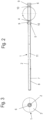
- Fig. 1 , Fig. 2 and Fig. 3 show a variant of a training device 1 according to the invention comprising a rod 2 with a longitudinal axis 11, preferably a glass fiber rod, also called a fiberglass rod, on which a ball 3 with a receiving sleeve 4 is placed and fixed to it.
- the receiving sleeve 4 is shown in detail in Fig. 4 and 5 It is mounted on rod 2 so that it can rotate and move linearly.
- the ball 3 is designed as a tennis ball in order to recreate the playing conditions and the rotation and spin behavior as authentically as possible.
- a tennis ball is hollow and covered with a tennis fleece.
- the receiving sleeve 4 can be made of plastic, in particular of polyoxymethylene and/or PVC, preferably of a polymer mixture, e.g. as a copolymer.
- the receiving sleeve 4 enables an optimal rotation of the tennis ball.
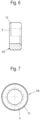
- a defined movement of the tennis ball is limited by two stop elements, preferably stop disks 5, 6, which are described in detail in Fig. 6 and 7 are shown.
- these can be made of polyoxymethylene and/or PVC, preferably of a polymer mixture, e.g. as a copolymer.
- the fiberglass rod 2 has a grip area 7 which is covered with a rubber coating 8, preferably a colored rubber coating. This leads to a good grip and a better feel.
- stop discs and/or the stop sleeve have one and/or more rounded or chamfered peripheral edges 10, in particular on the outer circumference.
- the length dimensions refer to a tennis ball with a typical diameter of 66 mm.
- the total length of the training device 1 can preferably be 9-12 times the diameter of the ball 3.
- the rod 2 has a preferred diameter of 10-22%, preferably 14-19%, of the diameter of the ball 3.
- the choice of material, glass fiber, in combination with the corresponding thickness range of the rod has proven in extensive tests to be suitable for providing a tennis racket with the corresponding counterforce so that the training device can transfer realistic forces to the tennis ball.
- the rod 2 is preferably formed from a solid material, preferably from an extruded solid material.
- the distance between the stop surfaces of the two stop elements 5 and 6 is 112-135%, particularly preferably 115-125% of the diameter of the ball 3.
- This game allows the ball to be set in rotation by the hit and at the same time balanced between the stops.
- One goal of the training can be to set the ball in rotation with a hit without it being moved so much by the hit that it touches the stops. All 4 types of shots can be trained.
- the thickness of the stop elements 5 and 6 in the longitudinal direction of the rod 2 is preferably 8-15%, preferably 10-14% of the diameter of the ball 3.
- the length of the receiving sleeve 4 is preferably 101-109%, preferably 104-108% of the diameter of the ball 3.
- the radial play of the receiving sleeve 4 relative to the rod 1 is preferably less than 5 mm, preferably between 0.05 and 0.35 mm, particularly preferably between 0.1 and 0.25 mm.
- the radial play corresponds to the difference between the inner diameter of the receiving sleeve 4 and the outer diameter of the rod 2 divided by two.
- the outer diameter of the annular stop surface 9 of the receiving sleeve 4 is preferably less than 50% of the diameter of the ball 3, preferably 25-30% of the diameter of the ball 3.
- the polymer and/or rubber coating 8 has a thickness of between 0.2 and 1.5 mm.
- the material can be a shrink tube.
- the tennis training device 1 is compact and light, its length is similar to that of a tennis racket, so that it can easily be carried in any backpack or tennis bag.
- the tennis training device 1 can be used completely independent of location and time and in particular for individual training without other players.
- the tennis training device 1 is used to train and improve different types of spin due to the ball 3 which is arranged so that it can rotate around the fiberglass rod.
- the tennis training device 1 is held in one's own hand and the ball 3 is set into the desired rotation depending on the type of stroke.
- the practitioner By independently observing the desired rotation, the practitioner receives immediate feedback on his hitting technique. The majority of the kinetic energy that is generated when hitting the ball 3 is converted into rotation of the ball 3. This particularly protects the wrist of the hand that is used to hold the tennis training device 1.
- An example of how to use the tennis training device 1 is a forehand topspin shot. If you hit the ball 3 diagonally from bottom to top with the tennis racket, the ball 3 spins forwards (topspin). If you hit the tennis racket from top to bottom with the tennis racket, the ball 3 spins backwards (slice).
- the training device can be used as follows. The user holds the tennis racket with the forehand grip in his hitting hand. In the other hand he holds the tennis training device 1 in front of his right body at pocket height (forehand topspin shot) and hits the ball 3 from bottom to top with the tennis racket. This creates the so-called topspin (forward spin), and the ball 3 is thus set in forward rotation around its own axis.
- the fiberglass rod 2 is held vertically and to the right of the body with the left hand. Then you hit the ball 3 sideways with the hitting hand and also with the hammer handle, which then rotates sideways on its own axis and around the fiberglass rod 2.
- the tennis training device 1 is ideal for warming up before a competition, even in the professional field.
- the wrist, ligaments, tendons and muscles involved in the stroke can be optimally and tennis-specifically prepared for the immediate competition movements within a very short time.
- the tennis training device impresses with its simple design, the small number of components and the exclusive use of plastic parts.
- the tennis stroke technique is also improved by the tennis training device.
- a use according to the invention comprises learning spin strokes by using the training device 1, wherein the ball 3 is set in a predetermined rotational movement by a tennis racket.
Landscapes
- Health & Medical Sciences (AREA)
- General Health & Medical Sciences (AREA)
- Physical Education & Sports Medicine (AREA)
- Rehabilitation Tools (AREA)
Claims (14)
- Appareil d'entraînement au tennis (1), lequel appareil d'entraînement au tennis (1) comporte une barre (2) et une balle (3) disposée avec possibilité de rotation autour de la barre (2), la balle (3) étant disposée avec possibilité de déplacement linéaire sur une plage définie le long de la barre (2) et la plage étant délimitée par deux éléments de butée (5, 6) destinés à limiter la mobilité linéaire de la balle (3), caractérisé en ce que la distance entre les surfaces de butée (9) des deux éléments de butée (5, 6) représente 112 à 135 % par rapport au diamètre de la balle (3) et en ce que la balle (3) est conformée comme une balle de tennis.
- Appareil d'entraînement au tennis selon la revendication 1, caractérisé en ce que la barre (2) est faite d'un matériau plein, de préférence d'un matériau armé de fibres, la barre (2) étant en particulier conformée comme une barre de fibres de verre.
- Appareil d'entraînement au tennis selon l'une des revendications 1 ou 2, caractérisé en ce que la longueur totale de l'appareil d'entraînement (1) représente 9 à 12 fois le diamètre de la balle (3).
- Appareil d'entraînement au tennis selon l'une des revendications précédentes, caractérisé en ce que la barre (2) présente un diamètre de 10 à 22 %, de préférence de 14 à 19 %, par rapport au diamètre de la balle (3).
- Appareil d'entraînement au tennis selon l'une des revendications précédentes, caractérisé en ce que la plage définie de mobilité linéaire le long de la barre (2) se situe dans une moitié antérieure de l'appareil d'entraînement au tennis (1) opposée au manche.
- Appareil d'entraînement au tennis selon l'une des revendications précédentes, caractérisé en ce que la balle est emboîtée sur la barre avec une douille de réception et fixée sur la douille de réception et en ce que la douille de réception (4) dépasse de la balle (3) à l'extrémité et présente à l'extrémité des surfaces d'extrémité destinées à buter sur les éléments de butée (5, 6).
- Appareil d'entraînement au tennis selon l'une des revendications précédentes, caractérisé en ce que la distance entre les surfaces de butée (9) des deux éléments de butée (5, 6) représente 115 à 125 % par rapport au diamètre de la balle (3).
- Appareil d'entraînement au tennis selon l'une des revendications précédentes, caractérisé en ce que l'épaisseur des éléments de butée (5, 6) le long de l'axe longitudinal (11) de la barre (2) représente 8 à 15 %, de préférence 10 à 14 %, par rapport au diamètre de la balle (3).
- Appareil d'entraînement au tennis selon la revendication 6, caractérisé en ce que la longueur de la douille de réception (4) représente 101 à 109 %, de préférence 104 à 108 %, par rapport au diamètre de la balle (3).
- Appareil d'entraînement au tennis selon l'une des revendications 6 ou 9, caractérisé en ce que le jeu radial de la douille de réception (4) par rapport à la barre (2) représente moins de 5 mm, de préférence entre 0,05 et 0,35 mm, en particulier entre 0,1 et 0,25 mm.
- Appareil d'entraînement au tennis selon l'un des revendications 6 ou 9 ou 10, caractérisé en ce que le diamètre extérieur de la surface de butée annulaire (9) de la douille de réception (4) représente moins de 50 % du diamètre de la balle (3), de préférence 25 à 30 %, par rapport au diamètre de la balle (3).
- Appareil d'entraînement au tennis selon l'une des revendications précédentes, caractérisé en ce que la barre (2) comporte une partie de manche (7) avec un revêtement, en particulier un revêtement en polymère et/ou en caoutchouc, lequel revêtement en polymère et/ou en caoutchouc (8) présente en particulier une épaisseur comprise entre 0,2 et 1,5 mm.
- Appareil d'entraînement au tennis selon l'une des revendications 6 ou 9 ou 10 ou 11, caractérisé en ce que la douille de réception (4) et/ou au moins un des éléments de butée (5, 6) comportent un bord (10) arrondi et/ou chanfreiné, en particulier conformé comme un bord circonférentiel (10).
- Appareil d'entraînement au tennis selon l'une des revendications 6 ou 9 ou 10 ou 11 ou 13, caractérisé en ce que la douille de réception (4) et/ou les éléments de butée (5, 6) sont faits de plastique, en particulier de POM et/ou de PVC.
Applications Claiming Priority (1)
| Application Number | Priority Date | Filing Date | Title |
|---|---|---|---|
| DE202020106845.8U DE202020106845U1 (de) | 2020-11-27 | 2020-11-27 | Tennistrainingsgerät |
Publications (4)
| Publication Number | Publication Date |
|---|---|
| EP4005648A1 EP4005648A1 (fr) | 2022-06-01 |
| EP4005648C0 EP4005648C0 (fr) | 2024-10-23 |
| EP4005648B1 true EP4005648B1 (fr) | 2024-10-23 |
| EP4005648B8 EP4005648B8 (fr) | 2024-11-27 |
Family
ID=78806319
Family Applications (1)
| Application Number | Title | Priority Date | Filing Date |
|---|---|---|---|
| EP21210708.0A Active EP4005648B8 (fr) | 2020-11-27 | 2021-11-26 | Appareil d'entraînement au tennis |
Country Status (2)
| Country | Link |
|---|---|
| EP (1) | EP4005648B8 (fr) |
| DE (1) | DE202020106845U1 (fr) |
Citations (1)
| Publication number | Priority date | Publication date | Assignee | Title |
|---|---|---|---|---|
| JPH0847559A (ja) * | 1994-07-25 | 1996-02-20 | Tenchi:Kk | スポーツ器具 |
Family Cites Families (7)
| Publication number | Priority date | Publication date | Assignee | Title |
|---|---|---|---|---|
| US4616834A (en) * | 1985-04-12 | 1986-10-14 | Davis Roy J | Ball-kicking assembly |
| DE20114256U1 (de) | 2001-08-29 | 2002-01-10 | Becker, Petra, 48336 Sassenberg | Übungsgerät für Schlagsportarten zum Üben der Drallschläge |
| US9687718B1 (en) * | 2010-12-27 | 2017-06-27 | James W. Sorenson | Swing speed trainer |
| US8540584B1 (en) | 2010-12-27 | 2013-09-24 | James W. Sorenson | Swing speed trainer |
| US9833676B2 (en) | 2015-01-21 | 2017-12-05 | Robert Frank Smith, JR. | Baseball and softball pitching training aid |
| US10238905B2 (en) * | 2015-10-29 | 2019-03-26 | Christopher J. KAYE | Lacrosse Training Device |
| IT201800009585A1 (it) * | 2018-10-18 | 2020-04-18 | Alessandro Strazza | Dispositivo per esercitare un movimento di impatto tra una racchetta ed una pallina |
-
2020
- 2020-11-27 DE DE202020106845.8U patent/DE202020106845U1/de active Active
-
2021
- 2021-11-26 EP EP21210708.0A patent/EP4005648B8/fr active Active
Patent Citations (1)
| Publication number | Priority date | Publication date | Assignee | Title |
|---|---|---|---|---|
| JPH0847559A (ja) * | 1994-07-25 | 1996-02-20 | Tenchi:Kk | スポーツ器具 |
Also Published As
| Publication number | Publication date |
|---|---|
| DE202020106845U1 (de) | 2022-03-03 |
| EP4005648B8 (fr) | 2024-11-27 |
| EP4005648A1 (fr) | 2022-06-01 |
| EP4005648C0 (fr) | 2024-10-23 |
Similar Documents
| Publication | Publication Date | Title |
|---|---|---|
| US11938374B2 (en) | Wrist and forearm strengthening device | |
| DE4116062C2 (de) | Golfschläger-Griffstück | |
| DE69934721T2 (de) | Einstellung von steifigkeit und flexibilität bei sportausrüstung | |
| DE29720110U1 (de) | Trainingsvorrichtung | |
| DE2928995A1 (de) | Griff fuer sportgeraete | |
| EP1938870B1 (fr) | Aide de mouvement pour joueurs de golf | |
| EP4005648B1 (fr) | Appareil d'entraînement au tennis | |
| US20040229736A1 (en) | Swing trainer | |
| DE3123690A1 (de) | Zusatzgewicht und einrichtung zur schwingungsdaempfung fuer tennisschlaeger und aehnliche sportschlaeger | |
| DE102011117147B4 (de) | Ballsportgerät und Trainingsanlage | |
| DE6923992U (de) | Spiel-, sport- und uebungsgeraet | |
| CH713216A2 (de) | Tennisball zur Ausbildung und zum Training des menschlichen Körpers. | |
| DE102020120963A1 (de) | Griffelement für Sport-/Spielschläger | |
| DE102005040476A1 (de) | Golfschwungübungsgerät | |
| DE961870C (de) | Ballschlaeger fuer Tischspiele | |
| DE19626355A1 (de) | Golfschlägerschaft | |
| DE29512494U1 (de) | Sportgerät zum Trainieren des menschlichen Körpers | |
| DE202010005340U1 (de) | Übungs- und Trainingsmittel für den Sportunterricht | |
| EP3253461B1 (fr) | Dispositif pour machines de sport et machine de sport destinée à entraîner l'appareil musculaire humain | |
| WO2005072829A1 (fr) | Organe de frappe pour jeu de balle | |
| DD148590A1 (de) | Ballspiel | |
| DE202007009687U1 (de) | Golfschwungübungsgerät | |
| DE2931249A1 (de) | Schlaeger in form einer ballkeule | |
| DE8617719U1 (de) | Tennisschläger für Kinder | |
| DE29513466U1 (de) | Schlagstock für Ballspiele, insbesondere für Schlagball (Baseball) |
Legal Events
| Date | Code | Title | Description |
|---|---|---|---|
| PUAI | Public reference made under article 153(3) epc to a published international application that has entered the european phase |
Free format text: ORIGINAL CODE: 0009012 |
|
| STAA | Information on the status of an ep patent application or granted ep patent |
Free format text: STATUS: THE APPLICATION HAS BEEN PUBLISHED |
|
| AK | Designated contracting states |
Kind code of ref document: A1 Designated state(s): AL AT BE BG CH CY CZ DE DK EE ES FI FR GB GR HR HU IE IS IT LI LT LU LV MC MK MT NL NO PL PT RO RS SE SI SK SM TR |
|
| STAA | Information on the status of an ep patent application or granted ep patent |
Free format text: STATUS: REQUEST FOR EXAMINATION WAS MADE |
|
| 17P | Request for examination filed |
Effective date: 20221130 |
|
| RBV | Designated contracting states (corrected) |
Designated state(s): AL AT BE BG CH CY CZ DE DK EE ES FI FR GB GR HR HU IE IS IT LI LT LU LV MC MK MT NL NO PL PT RO RS SE SI SK SM TR |
|
| GRAP | Despatch of communication of intention to grant a patent |
Free format text: ORIGINAL CODE: EPIDOSNIGR1 |
|
| STAA | Information on the status of an ep patent application or granted ep patent |
Free format text: STATUS: GRANT OF PATENT IS INTENDED |
|
| RIC1 | Information provided on ipc code assigned before grant |
Ipc: A63B 102/02 20150101ALI20240429BHEP Ipc: A63B 69/00 20060101AFI20240429BHEP |
|
| INTG | Intention to grant announced |
Effective date: 20240604 |
|
| GRAS | Grant fee paid |
Free format text: ORIGINAL CODE: EPIDOSNIGR3 |
|
| GRAA | (expected) grant |
Free format text: ORIGINAL CODE: 0009210 |
|
| STAA | Information on the status of an ep patent application or granted ep patent |
Free format text: STATUS: THE PATENT HAS BEEN GRANTED |
|
| AK | Designated contracting states |
Kind code of ref document: B1 Designated state(s): AL AT BE BG CH CY CZ DE DK EE ES FI FR GB GR HR HU IE IS IT LI LT LU LV MC MK MT NL NO PL PT RO RS SE SI SK SM TR |
|
| REG | Reference to a national code |
Ref country code: GB Ref legal event code: FG4D Free format text: NOT ENGLISH |
|
| REG | Reference to a national code |
Ref country code: CH Ref legal event code: PK Free format text: BERICHTIGUNG B8 Ref country code: CH Ref legal event code: EP |
|
| RAP4 | Party data changed (patent owner data changed or rights of a patent transferred) |
Owner name: BEBIC, IKO |
|
| RIN2 | Information on inventor provided after grant (corrected) |
Inventor name: BEBIC, IKO |
|
| REG | Reference to a national code |
Ref country code: DE Ref legal event code: R096 Ref document number: 502021005556 Country of ref document: DE |
|
| REG | Reference to a national code |
Ref country code: IE Ref legal event code: FG4D Free format text: LANGUAGE OF EP DOCUMENT: GERMAN |
|
| U01 | Request for unitary effect filed |
Effective date: 20241030 |
|
| U07 | Unitary effect registered |
Designated state(s): AT BE BG DE DK EE FI FR IT LT LU LV MT NL PT RO SE SI Effective date: 20241111 |
|
| U20 | Renewal fee for the european patent with unitary effect paid |
Year of fee payment: 4 Effective date: 20241114 |
|
| PG25 | Lapsed in a contracting state [announced via postgrant information from national office to epo] |
Ref country code: HR Free format text: LAPSE BECAUSE OF FAILURE TO SUBMIT A TRANSLATION OF THE DESCRIPTION OR TO PAY THE FEE WITHIN THE PRESCRIBED TIME-LIMIT Effective date: 20241023 Ref country code: IS Free format text: LAPSE BECAUSE OF FAILURE TO SUBMIT A TRANSLATION OF THE DESCRIPTION OR TO PAY THE FEE WITHIN THE PRESCRIBED TIME-LIMIT Effective date: 20250223 |
|
| PG25 | Lapsed in a contracting state [announced via postgrant information from national office to epo] |
Ref country code: ES Free format text: LAPSE BECAUSE OF FAILURE TO SUBMIT A TRANSLATION OF THE DESCRIPTION OR TO PAY THE FEE WITHIN THE PRESCRIBED TIME-LIMIT Effective date: 20241023 |
|
| PG25 | Lapsed in a contracting state [announced via postgrant information from national office to epo] |
Ref country code: NO Free format text: LAPSE BECAUSE OF FAILURE TO SUBMIT A TRANSLATION OF THE DESCRIPTION OR TO PAY THE FEE WITHIN THE PRESCRIBED TIME-LIMIT Effective date: 20250123 |
|
| PG25 | Lapsed in a contracting state [announced via postgrant information from national office to epo] |
Ref country code: GR Free format text: LAPSE BECAUSE OF FAILURE TO SUBMIT A TRANSLATION OF THE DESCRIPTION OR TO PAY THE FEE WITHIN THE PRESCRIBED TIME-LIMIT Effective date: 20250124 |
|
| PG25 | Lapsed in a contracting state [announced via postgrant information from national office to epo] |
Ref country code: PL Free format text: LAPSE BECAUSE OF FAILURE TO SUBMIT A TRANSLATION OF THE DESCRIPTION OR TO PAY THE FEE WITHIN THE PRESCRIBED TIME-LIMIT Effective date: 20241023 |
|
| PG25 | Lapsed in a contracting state [announced via postgrant information from national office to epo] |
Ref country code: RS Free format text: LAPSE BECAUSE OF FAILURE TO SUBMIT A TRANSLATION OF THE DESCRIPTION OR TO PAY THE FEE WITHIN THE PRESCRIBED TIME-LIMIT Effective date: 20250123 |
|
| PG25 | Lapsed in a contracting state [announced via postgrant information from national office to epo] |
Ref country code: SM Free format text: LAPSE BECAUSE OF FAILURE TO SUBMIT A TRANSLATION OF THE DESCRIPTION OR TO PAY THE FEE WITHIN THE PRESCRIBED TIME-LIMIT Effective date: 20241023 |
|
| PG25 | Lapsed in a contracting state [announced via postgrant information from national office to epo] |
Ref country code: MC Free format text: LAPSE BECAUSE OF FAILURE TO SUBMIT A TRANSLATION OF THE DESCRIPTION OR TO PAY THE FEE WITHIN THE PRESCRIBED TIME-LIMIT Effective date: 20241023 |
|
| PG25 | Lapsed in a contracting state [announced via postgrant information from national office to epo] |
Ref country code: SK Free format text: LAPSE BECAUSE OF FAILURE TO SUBMIT A TRANSLATION OF THE DESCRIPTION OR TO PAY THE FEE WITHIN THE PRESCRIBED TIME-LIMIT Effective date: 20241023 |
|
| PG25 | Lapsed in a contracting state [announced via postgrant information from national office to epo] |
Ref country code: CZ Free format text: LAPSE BECAUSE OF FAILURE TO SUBMIT A TRANSLATION OF THE DESCRIPTION OR TO PAY THE FEE WITHIN THE PRESCRIBED TIME-LIMIT Effective date: 20241023 |
|
| PLBE | No opposition filed within time limit |
Free format text: ORIGINAL CODE: 0009261 |
|
| STAA | Information on the status of an ep patent application or granted ep patent |
Free format text: STATUS: NO OPPOSITION FILED WITHIN TIME LIMIT |
|
| 26N | No opposition filed |
Effective date: 20250724 |
|
| PG25 | Lapsed in a contracting state [announced via postgrant information from national office to epo] |
Ref country code: IE Free format text: LAPSE BECAUSE OF NON-PAYMENT OF DUE FEES Effective date: 20241126 |
|
| REG | Reference to a national code |
Ref country code: CH Ref legal event code: U11 Free format text: ST27 STATUS EVENT CODE: U-0-0-U10-U11 (AS PROVIDED BY THE NATIONAL OFFICE) Effective date: 20251201 |
|
| U20 | Renewal fee for the european patent with unitary effect paid |
Year of fee payment: 5 Effective date: 20251124 |
|
| PGFP | Annual fee paid to national office [announced via postgrant information from national office to epo] |
Ref country code: CH Payment date: 20251201 Year of fee payment: 5 |
|
| PG25 | Lapsed in a contracting state [announced via postgrant information from national office to epo] |
Ref country code: HU Free format text: LAPSE BECAUSE OF FAILURE TO SUBMIT A TRANSLATION OF THE DESCRIPTION OR TO PAY THE FEE WITHIN THE PRESCRIBED TIME-LIMIT; INVALID AB INITIO Effective date: 20211126 |
|
| PG25 | Lapsed in a contracting state [announced via postgrant information from national office to epo] |
Ref country code: CY Free format text: LAPSE BECAUSE OF FAILURE TO SUBMIT A TRANSLATION OF THE DESCRIPTION OR TO PAY THE FEE WITHIN THE PRESCRIBED TIME-LIMIT; INVALID AB INITIO Effective date: 20211126 |