EP4006016A2 - Sondes d'imagerie de la protéine huntingtine - Google Patents
Sondes d'imagerie de la protéine huntingtine Download PDFInfo
- Publication number
- EP4006016A2 EP4006016A2 EP21192872.6A EP21192872A EP4006016A2 EP 4006016 A2 EP4006016 A2 EP 4006016A2 EP 21192872 A EP21192872 A EP 21192872A EP 4006016 A2 EP4006016 A2 EP 4006016A2
- Authority
- EP
- European Patent Office
- Prior art keywords
- pyridin
- alkyl
- mmol
- methoxy
- amino
- Prior art date
- Legal status (The legal status is an assumption and is not a legal conclusion. Google has not performed a legal analysis and makes no representation as to the accuracy of the status listed.)
- Withdrawn
Links
Images
Classifications
-
- C—CHEMISTRY; METALLURGY
- C07—ORGANIC CHEMISTRY
- C07D—HETEROCYCLIC COMPOUNDS
- C07D513/00—Heterocyclic compounds containing in the condensed system at least one hetero ring having nitrogen and sulfur atoms as the only ring hetero atoms, not provided for in groups C07D463/00, C07D477/00 or C07D499/00 - C07D507/00
- C07D513/02—Heterocyclic compounds containing in the condensed system at least one hetero ring having nitrogen and sulfur atoms as the only ring hetero atoms, not provided for in groups C07D463/00, C07D477/00 or C07D499/00 - C07D507/00 in which the condensed system contains two hetero rings
- C07D513/04—Ortho-condensed systems
-
- C—CHEMISTRY; METALLURGY
- C07—ORGANIC CHEMISTRY
- C07D—HETEROCYCLIC COMPOUNDS
- C07D413/00—Heterocyclic compounds containing two or more hetero rings, at least one ring having nitrogen and oxygen atoms as the only ring hetero atoms
- C07D413/02—Heterocyclic compounds containing two or more hetero rings, at least one ring having nitrogen and oxygen atoms as the only ring hetero atoms containing two hetero rings
- C07D413/04—Heterocyclic compounds containing two or more hetero rings, at least one ring having nitrogen and oxygen atoms as the only ring hetero atoms containing two hetero rings directly linked by a ring-member-to-ring-member bond
-
- A—HUMAN NECESSITIES
- A61—MEDICAL OR VETERINARY SCIENCE; HYGIENE
- A61B—DIAGNOSIS; SURGERY; IDENTIFICATION
- A61B5/00—Measuring for diagnostic purposes; Identification of persons
- A61B5/0033—Features or image-related aspects of imaging apparatus, e.g. for MRI, optical tomography or impedance tomography apparatus; Arrangements of imaging apparatus in a room
- A61B5/0035—Features or image-related aspects of imaging apparatus, e.g. for MRI, optical tomography or impedance tomography apparatus; Arrangements of imaging apparatus in a room adapted for acquisition of images from more than one imaging mode, e.g. combining MRI and optical tomography
-
- A—HUMAN NECESSITIES
- A61—MEDICAL OR VETERINARY SCIENCE; HYGIENE
- A61B—DIAGNOSIS; SURGERY; IDENTIFICATION
- A61B6/00—Apparatus or devices for radiation diagnosis; Apparatus or devices for radiation diagnosis combined with radiation therapy equipment
- A61B6/02—Arrangements for diagnosis sequentially in different planes; Stereoscopic radiation diagnosis
- A61B6/03—Computed tomography [CT]
- A61B6/032—Transmission computed tomography [CT]
-
- A—HUMAN NECESSITIES
- A61—MEDICAL OR VETERINARY SCIENCE; HYGIENE
- A61B—DIAGNOSIS; SURGERY; IDENTIFICATION
- A61B6/00—Apparatus or devices for radiation diagnosis; Apparatus or devices for radiation diagnosis combined with radiation therapy equipment
- A61B6/02—Arrangements for diagnosis sequentially in different planes; Stereoscopic radiation diagnosis
- A61B6/03—Computed tomography [CT]
- A61B6/037—Emission tomography
-
- A—HUMAN NECESSITIES
- A61—MEDICAL OR VETERINARY SCIENCE; HYGIENE
- A61K—PREPARATIONS FOR MEDICAL, DENTAL OR TOILETRY PURPOSES
- A61K51/00—Preparations containing radioactive substances for use in therapy or testing in vivo
- A61K51/02—Preparations containing radioactive substances for use in therapy or testing in vivo characterised by the carrier, i.e. characterised by the agent or material covalently linked or complexing the radioactive nucleus
- A61K51/04—Organic compounds
- A61K51/041—Heterocyclic compounds
- A61K51/044—Heterocyclic compounds having nitrogen as a ring hetero atom, e.g. guanethidine, rifamycins
- A61K51/0455—Heterocyclic compounds having nitrogen as a ring hetero atom, e.g. guanethidine, rifamycins having six-membered rings with one nitrogen as the only ring hetero atom
-
- A—HUMAN NECESSITIES
- A61—MEDICAL OR VETERINARY SCIENCE; HYGIENE
- A61K—PREPARATIONS FOR MEDICAL, DENTAL OR TOILETRY PURPOSES
- A61K51/00—Preparations containing radioactive substances for use in therapy or testing in vivo
- A61K51/02—Preparations containing radioactive substances for use in therapy or testing in vivo characterised by the carrier, i.e. characterised by the agent or material covalently linked or complexing the radioactive nucleus
- A61K51/04—Organic compounds
- A61K51/041—Heterocyclic compounds
- A61K51/044—Heterocyclic compounds having nitrogen as a ring hetero atom, e.g. guanethidine, rifamycins
- A61K51/0459—Heterocyclic compounds having nitrogen as a ring hetero atom, e.g. guanethidine, rifamycins having six-membered rings with two nitrogen atoms as the only ring hetero atoms, e.g. piperazine
-
- A—HUMAN NECESSITIES
- A61—MEDICAL OR VETERINARY SCIENCE; HYGIENE
- A61K—PREPARATIONS FOR MEDICAL, DENTAL OR TOILETRY PURPOSES
- A61K51/00—Preparations containing radioactive substances for use in therapy or testing in vivo
- A61K51/02—Preparations containing radioactive substances for use in therapy or testing in vivo characterised by the carrier, i.e. characterised by the agent or material covalently linked or complexing the radioactive nucleus
- A61K51/04—Organic compounds
- A61K51/041—Heterocyclic compounds
- A61K51/044—Heterocyclic compounds having nitrogen as a ring hetero atom, e.g. guanethidine, rifamycins
- A61K51/0463—Heterocyclic compounds having nitrogen as a ring hetero atom, e.g. guanethidine, rifamycins having six-membered rings with at least one nitrogen and one oxygen as the ring hetero atoms, e.g. 1,2-oxazines
-
- C—CHEMISTRY; METALLURGY
- C07—ORGANIC CHEMISTRY
- C07D—HETEROCYCLIC COMPOUNDS
- C07D263/00—Heterocyclic compounds containing 1,3-oxazole or hydrogenated 1,3-oxazole rings
- C07D263/52—Heterocyclic compounds containing 1,3-oxazole or hydrogenated 1,3-oxazole rings condensed with carbocyclic rings or ring systems
- C07D263/54—Benzoxazoles; Hydrogenated benzoxazoles
- C07D263/56—Benzoxazoles; Hydrogenated benzoxazoles with only hydrogen atoms, hydrocarbon or substituted hydrocarbon radicals, directly attached in position 2
- C07D263/57—Aryl or substituted aryl radicals
-
- C—CHEMISTRY; METALLURGY
- C07—ORGANIC CHEMISTRY
- C07D—HETEROCYCLIC COMPOUNDS
- C07D405/00—Heterocyclic compounds containing both one or more hetero rings having oxygen atoms as the only ring hetero atoms, and one or more rings having nitrogen as the only ring hetero atom
- C07D405/14—Heterocyclic compounds containing both one or more hetero rings having oxygen atoms as the only ring hetero atoms, and one or more rings having nitrogen as the only ring hetero atom containing three or more hetero rings
-
- C—CHEMISTRY; METALLURGY
- C07—ORGANIC CHEMISTRY
- C07D—HETEROCYCLIC COMPOUNDS
- C07D413/00—Heterocyclic compounds containing two or more hetero rings, at least one ring having nitrogen and oxygen atoms as the only ring hetero atoms
- C07D413/02—Heterocyclic compounds containing two or more hetero rings, at least one ring having nitrogen and oxygen atoms as the only ring hetero atoms containing two hetero rings
- C07D413/12—Heterocyclic compounds containing two or more hetero rings, at least one ring having nitrogen and oxygen atoms as the only ring hetero atoms containing two hetero rings linked by a chain containing hetero atoms as chain links
-
- C—CHEMISTRY; METALLURGY
- C07—ORGANIC CHEMISTRY
- C07D—HETEROCYCLIC COMPOUNDS
- C07D413/00—Heterocyclic compounds containing two or more hetero rings, at least one ring having nitrogen and oxygen atoms as the only ring hetero atoms
- C07D413/14—Heterocyclic compounds containing two or more hetero rings, at least one ring having nitrogen and oxygen atoms as the only ring hetero atoms containing three or more hetero rings
-
- C—CHEMISTRY; METALLURGY
- C07—ORGANIC CHEMISTRY
- C07D—HETEROCYCLIC COMPOUNDS
- C07D471/00—Heterocyclic compounds containing nitrogen atoms as the only ring hetero atoms in the condensed system, at least one ring being a six-membered ring with one nitrogen atom, not provided for by groups C07D451/00 - C07D463/00
- C07D471/02—Heterocyclic compounds containing nitrogen atoms as the only ring hetero atoms in the condensed system, at least one ring being a six-membered ring with one nitrogen atom, not provided for by groups C07D451/00 - C07D463/00 in which the condensed system contains two hetero rings
- C07D471/04—Ortho-condensed systems
-
- C—CHEMISTRY; METALLURGY
- C07—ORGANIC CHEMISTRY
- C07D—HETEROCYCLIC COMPOUNDS
- C07D498/00—Heterocyclic compounds containing in the condensed system at least one hetero ring having nitrogen and oxygen atoms as the only ring hetero atoms
- C07D498/02—Heterocyclic compounds containing in the condensed system at least one hetero ring having nitrogen and oxygen atoms as the only ring hetero atoms in which the condensed system contains two hetero rings
- C07D498/04—Ortho-condensed systems
Definitions
- PET involves the administration to a subject of a positron-emitting radionuclide tracer followed by detection of the positron emission (annihilation) events in the body.
- the radionuclide tracer is typically composed of a targeting molecule having incorporated therein one or more types of positron-emitting radionuclides.
- a ⁇ amyloid ⁇
- AD Alzheimer's disease
- arylbenzothiazoles stilbenes
- imidazopyridines pyridylbenzothiazoles
- pyridylbenzoxazoles pyridylbenzofurans
- SBIM styrylbenzimidazole
- NFT neurofibrillary tangles
- SBIM-3 4-[( E )-2-(6-iodo-1 H -benzimidazol-2-yl)ethenyl]- N , N -dimethylaniline (SBIM-3) showed higher affinity for the tau aggregates than A ⁇ 1-42 aggregates (ratio of K d values was 2.73).
- [ 125 I]SBIM-3 (or SBIM-3) bound NFT in sections of AD brain tissue.
- all [ 125 I]SBIM derivatives showed high initial uptake into (3.20-4.11%ID/g at 2 min after the injection) and rapid clearance from (0.12-0.33%ID/g at 60 min after the injection) the brain ( Matsumura et al., Bioorganic & Medicinal Chemistry, 21 (2013) 3356-3362 ).
- Huntington's disease is an inherited progressive neurodegenerative disorder, characterized by motor, cognitive, and psychiatric deficits as well as neurodegeneration and brain atrophy beginning in the striatum and the cortex and extending to other subcortical brain regions. It belongs to a family of neurodegenerative diseases caused by mutations in which an expanded CAG repeat tract results in long stretches of polyglutamine (polyQ) in the encoded protein. This family also includes dentatorubral-pallidoluysian atrophy (DRPLA), spinal and bulbar muscular atrophy (SBMA) and the spinocerebellar ataxias (SCAs).
- DRPLA dentatorubral-pallidoluysian atrophy
- SBMA spinal and bulbar muscular atrophy
- SCAs spinocerebellar ataxias
- the proteins involved are unrelated, and although they are all widely expressed in the central nervous system and peripheral tissues, they lead to characteristic patterns of neurodegeneration.
- HD the selective neurodegeneration of the ⁇ -aminobutyric acid-releasing spiny-projection neurons of the striatum is predominant, although loss of neurons in many other brain regions has also been reported.
- the number of CAG repeats in the IT 15 gene that encodes the HD protein huntingtin (HTT protein) varies from 6 to 35; repeats of 36 or more define an HD allele.
- the length of the CAG expansion is inversely correlated with age of disease onset, with cases of juvenile onset characterized by expansions of more than 60 repeats.
- HTT protein is a 348-kDa multidomain protein that contains a polymorphic glutamine/proline-rich domain at its amino-terminus. The longer polyQ domain seems to induce conformational changes in the protein, which causes it to form intracellular aggregates that, in most cases, manifest as nuclear inclusions. However, aggregates can also form outside the nucleus. HTT protein is present in the nucleus, cell body, dendrites and nerve terminals of neurons, and is also associated with a number of organelles including the Golgi apparatus, endoplasmic reticulum and mitochondria.
- an imaging agent comprising a compound of Formula I, or a pharmaceutically acceptable salt thereof, wherein
- Also provided is a method of generating diagnostic images in an individual comprising administering an effective amount of an imaging agent described herein to an individual, and generating an image of at least a part of said individual.
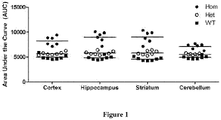
- FIG. 1 shows AUC values for the binding of 11 C-labeled Compound 3 of Method 14 in four regions of the brain in mice which are wild type, or heterozygous or homozygous for the zQ175 knock-in allele.
- a dash (“-") that is not between two letters or symbols is used to indicate a point of attachment for a substituent.
- -CONH 2 is attached through the carbon atom.
- group refers to a functional group or fragment of a molecule attachable to a bond or other fragments of molecules.
- C 1-6 alkyl includes C 1 , C 2 , C 3 , C 4 , C 5 , C 6 , C 1-6 , C 2-6 , C 3-6 , C 4-6 , C 5-6 , C 1-5 , C 2-5 , C 3-5 , C 4-5 , C 1-4 , C 2-4 , C 3-4 , C 1-3 , C 2-3 , and C 1-2 alkyl.
- a moiety When a moiety is defined as being optionally substituted, it may be substituted as itself or as part of another moiety.
- R x is defined as "C 1-6 alkyl or OC 1-6 alkyl, wherein C 1-6 alkyl is optionally subsituted with halogen"
- both the C 1-6 alkyl group alone and the C 1-6 alkyl that makes up part of the OC 1-6 alkyl group may be substituted with halogen.
- alkyl encompasses straight chain and branched chain having the indicated number of carbon atoms, usually from 1 to 20 carbon atoms, for example 1 to 8 carbon atoms, such as 1 to 6 carbon atoms.
- C1-C6 alkyl encompasses both straight and branched chain alkyl of 1 to 6 carbon atoms.
- alkyl groups include methyl, ethyl, propyl, isopropyl, n -butyl, sec -butyl, tert -butyl, pentyl, 2-pentyl, isopentyl, neopentyl, hexyl, 2-hexyl, 3-hexyl, 3-methylpentyl, and the like.
- alkyl residue having a specific number of carbons When an alkyl residue having a specific number of carbons is named, all geometric isomers having that number of carbons are intended to be encompassed; thus, for example, “butyl” is meant to include n -butyl, sec -butyl, isobutyl and tert-butyl; “propyl” includes n -propyl and isopropyl.
- “Lower alkyl” refers to alkyl groups having 1 to 6 carbons.
- alkoxy is meant an alkyl group of the indicated number of carbon atoms attached through an oxygen bridge such as, for example, methoxy, ethoxy, propoxy, isopropoxy, n -butoxy, sec -butoxy, tert -butoxy, pentoxy, 2-pentyloxy, isopentoxy, neopentoxy, hexoxy, 2-hexoxy, 3-hexoxy, 3-methylpentoxy, and the like.
- Alkoxy groups will usually have from 1 to 6 carbon atoms attached through the oxygen bridge.
- “Lower alkoxy” refers to alkoxy groups having 1 to 6 carbons.
- cycloalkoxy is meant a cycloalkyl group that is likewise attached through an oxygen bridge.
- Alkenyl refers to an unsaturated branched or straight-chain alkyl group having the indicated number of carbon atoms (e.g., 2 to 8 or 2 to 6 carbon atoms) and at least one carbon-carbon double bond derived by the removal of a molecule of hydrogen from adjacent carbon atoms of the corresponding alkyl.
- Alkenyl groups include, but are not limited to, ethenyl, propenyl and butenyl.
- “Lower alkenyl” refers to alkenyl groups having 2 to 6 carbons.
- Alkynyl refers to an unsaturated branched or straight-chain alkyl group having the indicated number of carbon atoms (e.g., 2 to 8 or 2 to 6 carbon atoms) and at least one carbon-carbon triple bond derived by the removal of two molecules of hydrogen from adjacent carbon atoms of the corresponding alkyl.
- Alkynyl groups include, but are not limited to, ethynyl, propynyl (e.g., prop-1-yn-1-yl, prop-2-yn-1-yl) and butynyl (e.g., but-1-yn-1-yl, but-1-yn-3-yl, but-3-yn-1-yl).
- “Lower alkynyl” refers to alkynyl groups having 2 to 6 carbons.
- Aryl indicates an aromatic carbon ring having the indicated number of carbon atoms, for example, 6 to 12 or 6 to 10 carbon atoms.
- Aryl groups may be monocyclic or polycyclic (e.g., bicyclic, tricyclic). In some instances, both rings of a polycyclic aryl group are aromatic (e.g., naphthyl). In other instances, polycyclic aryl groups may include a non-aromatic ring (e.g., cycloalkyl, cycloalkenyl, heterocycloalkyl, heterocycloalkenyl) fused to an aromatic ring, provided the polycyclic aryl group is bound to the parent structure via an atom in the aromatic ring.
- a 1,2,3,4-tetrahydronaphthalen-5-yl group (wherein the moiety is bound to the parent structure via an aromatic carbon atom) is considered an aryl group
- 1,2,3,4-tetrahydronaphthalen-1-yl (wherein the moiety is bound to the parent structure via a non-aromatic carbon atom) is not considered an aryl group.
- aryl does not encompass or overlap with "heteroaryl” regardless of the point of attachment (e.g., both quinolin-5-yl and quinolin-2-yl are heteroaryl groups).
- aryl is phenyl or naphthyl. In certain instances, aryl is phenyl.
- Bivalent radicals formed from substituted benzene derivatives and having the free valences at ring atoms are named as substituted phenylene radicals.
- Bivalent radicals derived from univalent polycyclic hydrocarbon radicals whose names end in "-yl” by removal of one hydrogen atom from the carbon atom with the free valence are named by adding "-idene" to the name of the corresponding univalent radical, e.g., a naphthyl group with two points of attachment is termed naphthylidene.
- Cycloalkyl indicates a non-aromatic, fully saturated carbocyclic ring having the indicated number of carbon atoms, for example, 3 to 10, or 3 to 8, or 3 to 6 ring carbon atoms. Cycloalkyl groups may be monocyclic or polycyclic (e.g., bicyclic, tricyclic). Examples of cycloalkyl groups include cyclopropyl, cyclobutyl, cyclopentyl and cyclohexyl, as well as bridged and caged ring groups (e.g., norbornane, bicyclo[2.2.2]octane).
- one ring of a polycyclic cycloalkyl group may be aromatic, provided the polycyclic cycloalkyl group is bound to the parent structure via a non-aromatic carbon.
- a 1,2,3,4-tetrahydronaphthalen-1-yl group (wherein the moiety is bound to the parent structure via a non-aromatic carbon atom) is a cycloalkyl group
- 1,2,3,4-tetrahydronaphthalen-5-yl is not considered a cycloalkyl group.
- Cycloalkenyl indicates a non-aromatic carbocyclic ring, containing the indicated number of carbon atoms (e.g., 3 to 10, or 3 to 8, or 3 to 6 ring carbon atoms) and at least one carbon-carbon double bond derived by the removal of one molecule of hydrogen from adjacent carbon atoms of the corresponding cycloalkyl. Cycloalkenyl groups may be monocyclic or polycyclic (e.g., bicyclic, tricyclic).
- cycloalkenyl groups include cyclopropenyl, cyclobutenyl, cyclopentenyl, cyclopentadienyl, and cyclohexenyl, as well as bridged and caged ring groups (e.g., bicyclo[2.2.2]octene).
- one ring of a polycyclic cycloalkenyl group may be aromatic, provided the polycyclic alkenyl group is bound to the parent structure via a non-aromatic carbon atom.
- inden-1-yl (wherein the moiety is bound to the parent structure via a non-aromatic carbon atom) is considered a cycloalkenyl group
- inden-4-yl (wherein the moiety is bound to the parent structure via an aromatic carbon atom) is not considered a cycloalkenyl group
- halo includes fluoro, chloro, bromo, and iodo
- halogen includes fluorine, chlorine, bromine, and iodine
- Haloalkyl includes straight and branched carbon chains having the indicated number of carbon atoms (e.g., 1 to 6 carbon atoms) substituted with at least one halogen atom. In instances wherein the haloalkyl group contains more than one halogen atom, the halogens may be the same (e.g., dichloromethyl) or different (e.g., chlorofluoromethyl).
- haloalkyl groups include, but are not limited to, chloromethyl, dichloromethyl, trichloromethyl, fluoromethyl, difluoromethyl, trifluoromethyl, chlorofluoromethyl, 2-fluoroethyl, 2,2-difluoroethyl, 2,2,2-trifluoroethyl, 1,2-difluoroethyl, 2-chloroethyl, 2,2-dichloroethyl, 2,2,2-trichloroethyl, 1,2-dichloroethyl, pentachloroethyl, and pentafluoroethyl.
- Heteroaryl indicates an aromatic ring containing the indicated number of atoms (e.g., 5 to 12, or 5 to 10 membered heteroaryl) made up of one or more heteroatoms (e.g., 1, 2, 3 or 4 heteroatoms) selected from N, O and S and with the remaining ring atoms being carbon. Heteroaryl groups do not contain adjacent S and O atoms. In some embodiments, the total number of S and O atoms in the heteroaryl group is not more than 2. In some embodiments, the total number of S and O atoms in the heteroaryl group is not more than 1. Unless otherwise indicated, heteroaryl groups may be bound to the parent structure by a carbon or nitrogen atom, as valency permits.
- pyridyl includes 2-pyridyl, 3-pyridyl and 4-pyridyl groups
- pyrrolyl includes 1-pyrrolyl, 2-pyrrolyl and 3-pyrrolyl groups.
- nitrogen is present in a heteroaryl ring, it may, where the nature of the adjacent atoms and groups permits, exist in an oxidized state (i.e., N + -O - ).
- sulfur when present in a heteroaryl ring, it may, where the nature of the adjacent atoms and groups permits, exist in an oxidized state (i.e., S + -O - or SO 2 ).
- Heteroaryl groups may be monocyclic or polycyclic (e.g., bicyclic, tricyclic).
- a heteroaryl group is monocyclic.
- examples include pyrrole, pyrazole, imidazole, triazole (e.g., 1,2,3-triazole, 1,2,4-triazole, 1,3,4-triazole), tetrazole, furan, isoxazole, oxazole, oxadiazole (e.g., 1,2,3-oxadiazole, 1,2,4-oxadiazole, 1,3,4-oxadiazole), thiophene, isothiazole, thiazole, thiadiazole (e.g., 1,2,3-thiadiazole, 1,2,4-thiadiazole, 1,3,4-thiadiazole), pyridine, pyridazine, pyrimidine, pyrazine, triazine (e.g., 1,2,4-triazine, 1,3,5-triazine) and tetrazine.
- pyrrole pyrazole
- both rings of a polycyclic heteroaryl group are aromatic.
- examples include indole, isoindole, indazole, benzimidazole, benzotriazole, benzofuran, benzoxazole, benzisoxazole, benzoxadiazole, benzothiophene, benzothiazole, benzoisothiazole, benzothiadiazole, 1 H -pyrrolo[2,3- b ]pyridine, 1 H -pyrazolo[3,4- b ]pyridine, 3 H -imidazo[4,5- b ]pyridine, 3 H -[1,2,3]triazolo[4,5- b ]pyridine, 1 H -pyrrolo[3,2- b ]pyridine, 1 H -pyrazolo[4,3- b ]pyridine, 1 H -imidazo[4,5- b ]pyridine, 1 H -[1,2,3]triazolo[4,5- b ]pyr
- polycyclic heteroaryl groups may include a non-aromatic ring (e.g., cycloalkyl, cycloalkenyl, heterocycloalkyl, heterocycloalkenyl) fused to a heteroaryl ring, provided the polycyclic heteroaryl group is bound to the parent structure via an atom in the aromatic ring.
- a non-aromatic ring e.g., cycloalkyl, cycloalkenyl, heterocycloalkyl, heterocycloalkenyl
- a 4,5,6,7-tetrahydrobenzo[ d ]thiazol-2-yl group (wherein the moiety is bound to the parent structure via an aromatic carbon atom) is considered a heteroaryl group
- 4,5,6,7-tetrahydrobenzo[d]thiazol-5-yl (wherein the moiety is bound to the parent structure via a non-aromatic carbon atom) is not considered a heteroaryl group.
- Heterocycloalkyl indicates a non-aromatic, fully saturated ring having the indicated number of atoms (e.g., 3 to 10, or 3 to 7, membered heterocycloalkyl) made up of one or more heteroatoms (e.g., 1, 2, 3 or 4 heteroatoms) selected from N, O and S and with the remaining ring atoms being carbon. Heterocycloalkyl groups may be monocyclic or polycyclic (e.g., bicyclic, tricyclic).
- Examples of monocyclic heterocycloalkyl groups include oxiranyl, aziridinyl, azetidinyl, pyrrolidinyl, imidazolidinyl, pyrazolidinyl, piperidinyl, piperazinyl, morpholinyl and thiomorpholinyl.
- heterocycloalkyl ring When nitrogen is present in a heterocycloalkyl ring, it may, where the nature of the adjacent atoms and groups permits, exist in an oxidized state (i.e., N + -O - ). Examples include piperidinyl N -oxide and morpholinyl- N -oxide. Additionally, when sulfur is present in a heterocycloalkyl ring, it may, where the nature of the adjacent atoms and groups permits, exist in an oxidized state (i.e., S + -O - or -SO 2 -). Examples include thiomorpholine S -oxide and thiomorpholine S,S -dioxide.
- one ring of a polycyclic heterocycloalkyl group may be aromatic (e.g., aryl or heteroaryl), provided the polycyclic heterocycloalkyl group is bound to the parent structure via a non-aromatic carbon or nitrogen atom.
- a 1,2,3,4-tetrahydroquinolin-1-yl group (wherein the moiety is bound to the parent structure via a non-aromatic nitrogen atom) is considered a heterocycloalkyl group
- 1,2,3,4-tetrahydroquinolin-8-yl group is not considered a heterocycloalkyl group.
- Heterocycloalkenyl indicates a non-aromatic ring having the indicated number of atoms (e.g., 3 to 10, or 3 to 7, membered heterocycloalkyl) made up of one or more heteroatoms (e.g., 1, 2, 3 or 4 heteroatoms) selected from N, O and S and with the remaining ring atoms being carbon, and at least one double bond derived by the removal of one molecule of hydrogen from adjacent carbon atoms, adjacent nitrogen atoms, or adjacent carbon and nitrogen atoms of the corresponding heterocycloalkyl.
- Heterocycloalkenyl groups may be monocyclic or polycyclic (e.g., bicyclic, tricyclic).
- heterocycloalkenyl ring When nitrogen is present in a heterocycloalkenyl ring, it may, where the nature of the adjacent atoms and groups permits, exist in an oxidized state (i.e., N + -O - ). Additionally, when sulfur is present in a heterocycloalkenyl ring, it may, where the nature of the adjacent atoms and groups permits, exist in an oxidized state (i.e., S + -O - or -SO 2 -).
- heterocycloalkenyl groups include dihydrofuranyl (e.g., 2,3-dihydrofuranyl, 2,5-dihydrofuranyl), dihydrothiophenyl (e.g., 2,3-dihydrothiophenyl, 2,5-dihydrothiophenyl), dihydropyrrolyl (e.g., 2,3-dihydro-1 H- pyrrolyl, 2,5-dihydro-1 H -pyrrolyl), dihydroimidazolyl (e.g., 2,3-dihydro-1 H -imidazolyl, 4,5-dihydro-1 H -imidazolyl), pyranyl, dihydropyranyl (e.g., 3,4-dihydro-2 H -pyranyl, 3,6-dihydro-2 H -pyranyl), tetrahydropyridinyl (e.g., 1,2,3,4-tetrahydropyridiny
- one ring of a polycyclic heterocycloalkenyl group may be aromatic (e.g., aryl or heteroaryl), provided the polycyclic heterocycloalkenyl group is bound to the parent structure via a non-aromatic carbon or nitrogen atom.
- a 1,2-dihydroquinolin-1-yl group (wherein the moiety is bound to the parent structure via a non-aromatic nitrogen atom) is considered a heterocycloalkenyl group
- 1,2-dihydroquinolin-8-yl group is not considered a heterocycloalkenyl group.
- heterocyclylene refers to a non-aromatic monocyclic di-radical having 3- to 5- ring atoms.
- heterocyclylene include 1,2-oxiranylene, 2,2-oxiranylene, 1,2-aziridinylene, 2,2-aziridinylene, 2,2-oxetanylene, 2,3-oxetanylene, 2,4-oxetanylene, 3,3-oxetanylene, 2,2-azetindinylene, 2,3-azetindinylene, 2,3-azetindinylene, 3,3-azetindinylene, 2,3-tetrahydrofuranylene, and 3,4-tetrahydrofuranylene.
- substituted means that any one or more hydrogens on the designated atom or group is replaced with a selection from the indicated group, provided that the designated atom's normal valence is not exceeded.
- substituents and/or variables are permissible only if such combinations result in stable compounds or useful synthetic intermediates.
- a stable compound or stable structure is meant to imply a compound that is sufficiently robust to survive isolation from a reaction mixture, and subsequent formulation as an agent having at least practical utility.
- substituents are named into the core structure. For example, it is to be understood that when (cycloalkyl)alkyl is listed as a possible substituent, the point of attachment of this substituent to the core structure is in the alkyl portion.
- substituted amino refers to the group -NHR d or -NR d R d where each R d is independently chosen from: optionally substituted alkyl, optionally substituted cycloalkyl, optionally substituted acyl, optionally substituted aryl, optionally substituted heteroaryl, optionally substituted heterocycloalkyl, alkoxycarbonyl, sulfinyl and sulfonyl, wherein substituted alkyl, cycloalkyl, aryl, heterocycloalkyl, and heteroaryl refer respectively to alkyl, cycloalkyl, aryl, heterocycloalkyl, and heteroaryl wherein one or more (such as up to 5, for example, up to 3) hydrogen atoms are replaced by a substituent independently chosen from:
- substituted amino also refers to the group -NR e R f wherein R e and R f , together with the nitrogen to which they are bound, form an optionally substituted 5- to 7-membered nitrogen-containing, non-aromatic, heterocycle which optionally contains 1 or 2 additional heteroatoms chosen from nitrogen, oxygen, and sulfur.
- Compounds described herein include, but are not limited to, their optical isomers, racemates, and other mixtures thereof.
- the single enantiomers or diastereoisomers i . e ., optically active forms
- Resolution of the racemates can be accomplished, for example, by conventional methods such as crystallization in the presence of a resolving agent, or chromatography, using, for example a chiral high- pressure liquid chromatography (HPLC) column.
- isomers refers to different compounds that have the same molecular formula.
- stereoisomers refers to isomers that differ only in the way the atoms are arranged in space.
- enantiomers refers to stereoisomers that are non-superimposable mirror images of each other.
- a 1: 1 mixture of a pair of enantiomers is a "racemic” mixture.
- the symbol “( ⁇ )” may be used to designate a racemic mixture where appropriate.
- diastereoisomers refers to stereoisomers that have at least two asymmetric atoms, but which are not mirror-images of each other.
- the absolute stereochemistry is specified according to the Cahn-Ingold-Prelog R - S system. When a compound is a pure enantiomer the stereochemistry at each chiral carbon can be specified by either R or S .
- Resolved compounds whose absolute configuration is unknown can be designated (+) or (-) depending on the direction (dextro- or levorotatory) which they rotate plane polarized light at the wavelength of the sodium D line.
- the absolute stereochemistry of substituted double bonds may be designated E or Z according to the priority rules of the Cahn-Ingold-Prelog system.
- the term “compound” includes all tautomeric forms of the compound. Such compounds also include crystal forms including polymorphs and clathrates. Similarly, the term “salt” includes all tautomeric forms and crystal forms of the compound.
- tautomers refers to structurally distinct isomers that interconvert by tautomerization. Tautomerization is a form of isomerization and includes prototropic or proton-shift tautomerization, which is considered a subset of acid-base chemistry. Prototropic tautomerization or proton-shift tautomerization involves the migration of a proton accompanied by changes in bond order, often the interchange of a single bond with an adjacent double bond.
- tautomerization is possible (e . g . in solution), a chemical equilibrium of tautomers can be reached.
- An example of tautomerization is keto-enol tautomerization.
- keto-enol tautomerization is the interconversion of pentane-2,4-dione and 4-hydroxypent-3-en-2-one tautomers.
- Another example of tautomerization is phenol-keto tautomerization.
- a specific example of phenol-keto tautomerization is the interconversion of pyridin-4-ol and pyridin-4(1 H )-one tautomers.
- compositions recited herein include pharmaceutically acceptable salts, and mixtures thereof.
- the compounds described herein are in the form of pharmaceutically acceptable salts.
- “Pharmaceutically acceptable salts” include, but are not limited to salts with inorganic acids, such as hydrochlorate, phosphate, diphosphate, hydrobromate, sulfate, sulfinate, nitrate, and like salts; as well as salts with an organic acid, such as malate, maleate, fumarate, tartrate, succinate, citrate, lactate, methanesulfonate, p -toluenesulfonate, 2-hydroxyethylsulfonate, benzoate, salicylate, stearate, haloalkanoate such as trifluoroacetate, and alkanoate such as acetate, HOOC-(CH 2 ) n -COOH where n is 0-4, and like salts.
- inorganic acids such as hydrochlorate, phosphate, diphosphate, hydrobromate, sulfate, sulfinate, nitrate, and like salts
- an organic acid
- pharmaceutically acceptable cations include, but are not limited to sodium, potassium, calcium, aluminum, lithium, and ammonium.
- the free base can be obtained by basifying a solution of the acid salt.
- an addition salt, particularly a pharmaceutically acceptable addition salt may be produced by dissolving the free base in a suitable organic solvent and treating the solution with an acid, in accordance with conventional procedures for preparing acid addition salts from base compounds.
- Those skilled in the art will recognize various synthetic methodologies that may be used to prepare non-toxic pharmaceutically acceptable addition salts.
- administering means administering directly into or onto a target tissue or to administer the diagnostic agent systemically to a patient whereby the diagnostic agent is used to image the tissue or a pathology associated with the tissue to which it is targeted.
- administering a composition may be accomplished by injection, infusion, or by either method in combination with other known techniques.
- Ci is a unit of measurement of radioactivity.
- Ci refers to that amount of any radioactive material that will decay at a rate of 3.7 ⁇ 10 10 disintegrations per second.
- diagnosis imaging refers to the use of electromagnetic radiation to produce images of internal structures of the human or animal body for the purpose of diagnosis.
- an effective amount of a compound is a predetermined amount calculated to achieve a desired effect such as an amount sufficient to enable the acquisition of a desired image of the target organ of an individual.
- the target organ is the brain.
- huntingtin protein or "HTT protein”, as used herein, refers to the protein encoded by the human huntingtin gene (HTT gene) located on the short (p) arm of chromosome 4 at position 16.3. More precisely, the IT 15 gene coding for the HTT protein is located from base pair 3,076,407 to base pair 3,245,686 on chromosome 4.
- HTT protein aggregate refers to an insoluble fibrous amyloid comprising mis-folded HTT protein molecules.
- ⁇ -amyloid aggregate refers to an insoluble fibrous amyloid comprising mis-folded ⁇ -amyloid protein molecules.
- imaging agent refers to a compound as described herein labeled with one or more positron-emitting isotopes or radionuclides.
- a positron-emitter labeled compound need only be enriched with a detectable isotope to a degree that permits detection with a technique suitable for the particular application.
- pathologic process refers to an altered endogenous biological process that may be associated with the aberrant production and/or functioning of proteins, peptides, RNA and other substances associated with such biological process.
- PET imaging refers to the use of a positron-emitter labeled compound to produce images of internal structures of the human or animal body.
- composition refers to a composition comprising at least one imaging agent described herein, whereby the composition is amenable to investigation for a specified, efficacious outcome in a mammal (for example, without limitation, a human).
- a mammal for example, without limitation, a human
- Those of ordinary skill in the art will understand and appreciate the techniques appropriate for determining whether a composition has a desired efficacious outcome based upon the needs of the artisan.
- positron-emitting radionuclide refers to a radio-active isotope that exhibits particular type of radioactive decay referred to as ⁇ + decay, in which a proton inside a radionuclide nucleus is converted into a neutron while releasing a positron and an electron neutrino ( ⁇ e ).
- ⁇ + decay particular type of radioactive decay
- positron-emitting radionuclides include 15 O, 13 N, 11 C, 18 F, 76 Br, and 124 I. These radionuclides have half- lives of about 2, 10, 20, 110 minutes, 16 hours, and 4.2 days respectively.
- tomography refers to a process of imaging by sections.
- the images may be looked at individually, as a series of two-dimensional slices or together, as a computer-generated three-dimensional representation.
- an imaging agent comprising a compound of Formula I, or a pharmaceutically acceptable salt thereof, wherein
- an imaging agent comprising a compound of Formula I, or a pharmaceutically acceptable salt thereof, wherein
- X is O.
- X is S.
- X is NR 4 .
- Y is CR 4 .
- R 4 is hydrogen. In some embodiments, R 4 is halo. In some embodiments, R 4 is bromo. In some embodiments, R 4 is cyano. In some embodiments, R 4 is lower alkyl. In some embodiments, R 4 is methyl.
- Y is N.
- Z 1 , Z 2 , Z 3 , and Z 4 are CH.
- Z 1 is N and Z 2 , Z 3 , and Z 4 are CH.
- Z 2 is N and Z 1 , Z 3 , and Z 4 are CH.
- Z 2 and Z 4 are N and Z 1 and Z 3 are CH.
- R 1 is chosen from phenyl, pyridine-2-yl, pyridine-3-yl, pyridine-3-yl-1-oxide, pyridine-4-yl, 1 H -pyrazol-4-yl, pyrazin-2-yl, pyridazin-3-yl, pyridazin-4-yl, pyrimidin-4-yl, pyrimidin-5-yl, 2,3-dihydropyridazin-3-one-6-yl, 1,2-dihydropyridin-2-one-5-yl, 1,2-dihydropyrazin-2-one-5-yl, 1,3-thiazol-5-yl, 5,6,7,8-tetrahydro-1,7-naphthyridine-7-yl, 1 H -imidazol-1-yl, 1-benzofuran-2-yl, 1-benzofuran-5-yl, 2,3-dihydro-1-benzofuran-2-yl,
- R 1 is wherein
- W is CH. In some embodiments, W is N. In some embodiments, W is N(O).
- p is 0.
- p is 1.
- R 9 is chosen from cyano, halo, methyl, and methoxy.
- R 1 is wherein
- L 1 is -O- and L 2 is -(CR 7 R 8 ) m - or -(CR 7 R 8 ) m -O-. In some embodiments, L 1 is -O- and L 2 is -(CR 7 R 8 ) m -.
- L 1 is -O-
- L 2 is -(CR 7 R 8 ) m - or -(CR 7 R 8 ) m -O-
- R 2 is phenyl, pyridine-2-yl, pyridine-3-yl, pyrazin-2-yl, pyrimidine-5-yl, 1 H -imidazol-4-yl, 1 H -imidazol-2-yl, or 1 H -pyrazol-4-yl, each of which is optionally substituted with one or two groups independent chosen from lower alkyl, hydroxyl, lower alkoxy, lower alkoxy substituted with amino, (alkyl)amino, (dialkyl)amino, or lower alkoxy, lower alkyl, and ower alkyl substituted with hydroxyl, lower alkoxy, amino, (alkyl)amino, or (dialkyl)amino.
- L 1 is -O-
- L 2 is -(CR 7 R 8 ) m - and R 2 is phenyl, pyridine-2-yl, pyridine-3-yl, pyrazin-2-yl, pyrimidine-5-yl, 1 H -imidazol-4-yl, 1 H -imidazol-2-yl, or 1 H- pyrazol-4-yl, each of which is optionally substituted with one or two groups independent chosen from lower alkyl, hydroxyl, lower alkoxy, lower alkoxy substituted with amino, (alkyl)amino, (dialkyl)amino, or lower alkoxy, lower alkyl, and ower alkyl substituted with hydroxyl, lower alkoxy, amino, (alkyl)amino, or (dialkyl)amino.
- L 1 is -NR 3 - and L 2 is -C(O)- or -(CR 7 R 8 ) m -. In some embodiments, L 1 is -NR 3 - and L 2 is -C(O)-. In some embodiments, R 3 is hydrogen.
- L 1 is -NR 3 -
- L 2 is -C(O)- or -(CR 7 R 8 ) m -
- R 2 is phenyl, pyridine-3-yl, or pyrazin-2-yl, each of which is optionally substituted with lower alkyl, hydroxyl or lower alkoxy.
- L 1 is -NR 3 -
- L 2 is -C(O)- or -(CR 7 R 8 ) m -
- R 2 is phenyl, pyridine-3-yl, or pyrazin-2-yl, each of which is optionally substituted with lower alkoxy.
- L 1 is -NR 3 -
- L 2 is -C(O)-
- R 2 is phenyl, pyridine-3-yl, or pyrazin-2-yl, each of which is optionally substituted with lower alkoxy.
- L 1 is -NR 3 - and L 2 is -(CR 7 R 8 ) m where m is 1.
- R 3 is hydrogen.
- L 1 is -NR 3 -
- L 2 is -(CR 7 R 8 ) m where m is 1, and R 2 is phenyl or phenyl substituted with lower alkoxy.
- L 1 is -NR 3 - and L 2 is -(CR 7 R 8 ) m where m is 0.
- R 3 is hydrogen.
- L 1 is -NR 3 -
- L 2 is -(CR 7 R 8 ) m where m is 0, and R 2 is phenyl, [1,2,4]triazolo[4,3- a ]pyridin-3-yl, pyrimidin-4-yl, or pyrimidin-2-yl, each of which is optionally substituted with lower alkoxy.
- L 1 is absent and L 2 is absent.
- L 1 is absent
- L 2 is absent
- R 2 is phenyl, pyrimidin-2-yl, pyridazin-3-yl, pyrazin-2-yl, piperazin-1-yl, 1 H -pyrazol-4-yl, 1,2,3,4-tetrahydroisoquinolin-1-one-2-yl, 2,3-dihydro-1 H -isoindol-1-one-2-yl, 1,2-dihydroisoquinolin-1-one-2-yl, or 5 H ,6 H ,7 H -pyrrolo[3,4- b ]pyridine-7-one-2-yl, each of which is optionally substituted with one or two groups independently chosen from 5-methoxypyrimidin-2-yl, hydroxyl and lower alkoxy.
- R 2 is phenyl or pyridine-3-yl, each of which is optionally substituted with one or two groups independently chosen from hydroxyl and lower alkoxy.
- L 1 taken together with L 2 is heterocyclylene. In some embodiments, L 1 taken together with L 2 is piperazin-1,4-diyl. In some embodiments, L 1 taken together with L 2 is heterocyclylene and R 2 is pyrimidin-2-yl, optionally substituted with one or two groups independently chosen from hydroxyl and lower alkoxy. In some embodiments, L 1 taken together with L 2 is piperazin-1,4-diyl and R 2 is pyrimidin-2-yl, optionally substituted with one or two groups independently chosen from hydroxyl and lower alkoxy
- L 1 is -(CR 7 R 8 ) m - and L 2 is -NR 3 -, -C(O)- or -O-.
- L 1 is -(CR 7 R 8 ) m -
- L 2 is -NR 3 -, -C(O)- or -O-
- R 2 is pyridin-2-yl or pyridin-2-yl substituted with lower alkoxy.
- m is 1 and each occurrence of R 7 and R 8 is hydrogen.
- m is 2 and each occurrence of R 7 and R 8 is hydrogen.
- m is 1, R 7 is hydroxyl, trifluoromethyl, or lower alkyl and R 8 is hydrogen.
- m is 2, one occurrence of R 7 is hydroxyl, trifluoromethyl, or lower alkyl, and the other occurrence of R 7 and each occurrence of R 8 is hydrogen.
- the compounds of Formula I, or a pharmaceutically acceptable salt thereof are labeled with one or more positron-emitting radionuclides.
- Suitable positron-emitting radionuclides that may be incorporated in the compounds of described herein, but are not limited to, 11 C, 13 N, 15 O, 18 F , 52 Fe, 62 Cu, 64 Cu, 68 Ga, 74 As, 82 Rb, 89 Zr, 122 I, and 124 I.
- the one or more positron-emitting radionuclides are selected from: 11 C, 13 N, 15 O, 18 F, 76 Br, and 124 I.
- the one or more positron-emitting radionuclides are selected from 11 C, 13 N, 15 O, and 18 F.
- Non-metal radionuclides may be covalently linked to the compounds described herein by a reaction well known from the state of art.
- the radionuclide is a metallic positron-emitter, it is understood that labeling may require the use of a chelating agent.
- chelating agents are well known from the state of the art.
- a PET imaging agent may be labelled with the positron emitter 11 C or 18 F.
- Methods for the introduction of 11 C may include, but are not limited to, alkylation with [ 11 C]iodomethane or [ 11 C]methyl triflate.
- Carbon-11 has a half-life of approximately 20 minutes, thus 11 C needs to be generated in an on-site cyclotron, and is generally produced as [ 11 C]methyl dioxide.
- the [ 11 C]methyl dioxide is converted to the chemical species appropriate for the radiosynthesis (generally [ 11 C]methyl or the like), and the synthesis of the radiopharmaceutical is completed and used on-site in a PET imaging study after the appropriate radiochemical purity and specific activity have been determined.
- Typical methods of introducing 18 F may include but are not limited to displacement of a halide, tosylate, or other leaving group with [ 18 F]tetrabutylamonium fluoride or [ 18 F]potassium fluoride kryptofix-222.
- Fluorine-18 has a half life of approximately 110 minutes, thus synthesis of [ 11 C]methyl radiopharmaceuticals need not necessarly have to occur at the site of the cyclotron nor proximal to the PET imaging study center.
- General methods for the introduction of these positron emitters are described in the literature ( Miller et al., Angewandte Chemie International Edition, 47 (2008), 8998-9033 ).
- kits for generating diagnostic images in an individual comprising administering an effective amount of an imaging agent described herein to an individual, and generating an image of at least a part of the individual.
- Also provided are methods of generating diagnostic images in a biological sample comprising contacting the biological sample with an effective amount of an imaging agent described herein and generating an image of the positron-emitter labeled compound associated with the biological sample.
- both the contacting and the generating may be conducted in vitro, alternatively the contacting is in vivo and the generating in vitro.
- Also provided are methods for detecting the presence or absence of a neurodegenerative pathologic process associated with huntingtin protein (HTT protein) in an individual comprising: administering an effective amount of a positron-emitter labeled compound described herein; generating an image to detect the presence or absence of HTT protein aggregates in the brain of the individual; anddetecting the presence or absence of the pathologic process.
- theHTT protein aggregates are present in the basal ganglia of the brain of the individual.
- the pathologic process is Huntington's disease (HD).
- the effective amount of theimaging agent comprises from about 0.1 to about 20 mCi. In some embodiments, the effective amount of the imaging agent comprises about 10 mCi.
- generating an image comprises positron emission tomography (PET) imaging, PET with concurrent computed tomography imaging (PET/CT), PET with concurrent magnetic resonance imaging (PET/MRI), or a combination thereof.
- PET positron emission tomography
- PET/CT computed tomography imaging
- PET/MRI PET with concurrent magnetic resonance imaging
- generating an image comprises PET imaging.
- HTT protein huntingtin protein
- methods for detecting the presence or absence of a neurodegenerative pathologic process associated with huntingtin protein (HTT protein) in an individual comprising: administering an effective amount of a positron-emitter labeled compound described herein; generating an image to detect the presence or absence of HTT protein aggregates in the individual; and detecting the presence or absence of the pathologic process.
- the HTT protein monomers or aggegates are present in the brain, liver, heart, or muscle of said individual.
- the HTT protein aggregates are present in the basal ganglia, cortex, hippocampus, or brain stem of the brain of the individual.
- the pathologic process is Huntington's disease (HD).
- the effective amount of the imaging agent comprises from about 0.1 to about 20 mCi. In some embodiments, the effective amount of the imaging agent comprises about 10 mCi. In some embodiments, generating an image comprises positron emission tomography (PET) imaging, PET with concurrent computed tomography imaging (PET/CT), PET with concurrent magnetic resonance imaging (PET/MRI), or a combination thereof. In some embodiments, generating an image comprises PET imaging.
- PET positron emission tomography
- PET/CT concurrent computed tomography imaging
- PET/MRI concurrent magnetic resonance imaging
- generating an image comprises PET imaging.
- Also provided are methods for detecting the presence or absence of a neurodegenerative pathologic process associated with ⁇ -amyloid protein in an individual comprising: administering an effective amount of a positron-emitter labeled compound described herein; generating an image to detect the presence or absence of ⁇ -amyloid protein aggregates in the individual; and detecting the presence or absence of the pathologic process.
- the ⁇ -amyloid protein monomers or aggegates are present in the brain, liver, heart, or muscle of said individual.
- the ⁇ -amyloid protein aggregates are present in the basal ganglia, cortex, hippocampus, or brain stem of the brain of the individual.
- the pathologic process is Alzheimer's Disease (AD).
- the effective amount of the imaging agent comprises from about 0.1 to about 20 mCi. In some embodiments, the effective amount of the imaging agent comprises about 10 mCi.
- generating an image comprises positron emission tomography (PET) imaging, PET with concurrent computed tomography imaging (PET/CT), PET with concurrent magnetic resonance imaging (PET/MRI), or a combination thereof. In some embodiments, generating an image comprises PET imaging.
- HTT protein aggregate or ⁇ -amyloid protein aggregate binding kinetics to function as efficient imaging agents for HTT protein aggregates or ⁇ -amyloid protein aggregates.
- the requirements of the compounds of the invention to function as efficient imaging agents for HTT protein aggregates are: 1) a high affinity for HTT protein aggregates; 2) a low affinity for nearby structures; 3) slow dissociation kinetics from HTT protein aggregates, which may conveniently be expressed as the dissociation rate constant k diss as defined in the following equation, wherein A and B refer to the HTT protein aggregate and the imaging agent, and k assn is the association rate constant.
- d AB /dt k assn A B ⁇ k diss AB
- the basal ganglia organize muscle-driven movements of the body, or "motor movement.”
- the major components of the basal ganglia are the caudate and the putamen (together known as the striatum) and the globus pallidus (external and internal regions).
- the substantia nigra and the subthalamic nucleus are often included as part of the basal ganglia as well.
- basal ganglia refers to a group of subcortical nuclei responsible primarily for motor control, as well as other roles such as motor learning, executive functions and behaviors, and emotions. Disruption of the basal ganglia network forms the basis for several movement disorders. Normal function of the basal ganglia requires fine tuning of neuronal excitability within each nucleus to determine the exact degree of movement facilitation or inhibition at any given moment. This is mediated by the complex organization of the striatum, where the excitability of medium spiny neurons is controlled by several pre- and postsynaptic mechanisms as well as interneuron activity, and secured by several recurrent or internal basal ganglia circuits.
- the motor circuit of the basal ganglia has two entry points, the striatum and the subthalamic nucleus, and an output, the globus pallidus pars interna, which connects to the cortex via the motor thalamus.
- positron-emitter labeled compound described herein administered to the individual, e.g. into the individual's vascular system, from where it passes through the blood-brain barrier, and then generating an image of at least the part of the individual's brain to which the compound has distributed.
- compositions comprising an effective amount of a positron-emitter labeled compound described herein, or a salt thereof, together with one or more pharmaceutically-acceptable adjuvants, excipients or diluents.
- An imaging agent or pharmaceutical composition thereof may be administered to a patient in need of treatment via any suitable route.
- Routes of administration may include, for example, parenteral administration (including subcutaneous, intramuscular, intravenous, by means of, for example a drip patch).
- Further suitable routes of administration include (but are not limited to) oral, rectal, nasal, topical (including buccal and sublingual), infusion, vaginal, intradermal, intraperitoneally, intracranially, intrathecal and epidural administration or administration via oral or nasal inhalation, by means of, for example a nebulizer or inhaler, or by an implant.
- An imaging agent or pharmaceutical composition thereof may also be administered via microspheres, liposomes, other microparticulate delivery systems or sustained release formulations placed in certain tissues including blood.
- sustained release carriers include semi-permeable polymer matrices in the form of shared articles, e.g., suppositories or microcapsules. Examples of the techniques and protocols mentioned above and other techniques and protocols which may be used in accordance with the invention can be found in Remington's Pharmaceutical Sciences, 18th edition, Gennaro, A. R., Lippincott Williams & Wilkins; 20th edition (Dec. 15, 2000) ISBN 0-912734-04-3 and Pharmaceutical Dosage Forms and Drug Delivery Systems; Ansel, N. C. et al. 7th Edition ISBN 0-683305-72-7 , the entire disclosures of which are herein incorporated by reference.
- PET proton emission tomography
- PET involves the administration of a positron-emitting radionuclide tracer to an individual. Once the tracer has had sufficient time to associate with the target of interest, the individual is placed within a scanning device comprising of a ring of scintillation detectors. An emitted positron travels through the individual's tissue for a short (isotope-dependent) distance, until it interacts with an electron. The interaction annihilates both the electron and the positron, producing a pair of photons moving in approximately opposite directions. These are detected when they reach a scintillator in the scanning device. Photons that do not arrive in pairs are ignored.
- Also provided are methods of generating diagnostic images comprising PET with concurrent computed tomography imaging (PET/CT), or with concurrent magnetic resonance imaging (PET/MRI).
- PET computed tomography imaging
- PET/MRI concurrent magnetic resonance imaging
- Computed tomography uses X-rays to show the structure of the brain, while magnetic resonance imaging uses magnetic fields and radio waves.
- UV spectra were recorded at 215 nm using a SPD-M20A photo diode array detector. Mass spectra were obtained over the range m/z 150 to 850 at a sampling rate of 2 scans per second using a LCMS2010EV. Data were integrated and reported using Shimadzu LCMS-Solutions and PsiPort software.
- UV spectra were recorded at 215 nm using a SPD-M20A photo diode array detector. Mass spectra were obtained over the range m/z 100 to 100 at a sampling rate of 2 scans per second using a LCMS2010EV. Data were integrated and reported using Shimadzu LCMS-Solutions and PsiPort software.
- Step 1 4-Methoxy- N -[2-(pyridin-3-yl)-1,3-benzoxazol-5-yl]benzamide
- Step 1 N -[(4-Methoxyphenyl)methyl]-2-(pyridin-3-yl)-1,3-benzoxazol-5-amine
- Step 1 6-Methoxy- N -[2-(3-methylphenyl)-1,3-benzoxazol-5-yl]pyridine-3-carboxamide
- Step 1 N -(5-Bromo-2-chloropyridin-3-yl)-3-methylbenzamide
- Step 4 4-Methoxy- N -[2-(3-methylphenyl)-[1,3]oxazolo[5,4-b]pyridin-6-yl]benzamide
- Step 1 5-(4-Methoxyphenyl)-2-(pyridin-3-yl)-1,3-benzoxazole
- Step 1 N -(4-Methoxyphenyl)-2-(pyridin-3-yl)-1,3-benzoxazol-5-amine
- a pressure tube was charged with 9,9-dimethyl-9H-xanthene-4,5-diyl)bis(diphenylphosphane) (32 mg, 0.055 mmol), tris(dibenzylideneacetone)dipalladium(0) (17 mg, 0.018 mmol) and 1,4-dioxane (2 mL).
- the mixture was degassed using a flow of nitrogen for 10 minutes.
- the mixture was then heated at 110 °C for 1 minute and cooled to room temperature.
- Step 1 2-(Pyridin-3-yl)- N -(pyrimidin-4-yl)-1,3-benzoxazol-5-amine
- Step 1 2-(Pyridin-3-yl)-5-(tetramethyl-1,3,2-dioxaborolan-2-yl)-1,3-benzoxazole
- reaction mixture was diluted with water (10 mL) and extracted with tert-butyl methyl ether (3 ⁇ 40 mL). The combined organic extracts were washed with brine (10 mL), dried over magnesium sulfate, filtered and concentrated. Purification by FCC (silica, 20-80% ethyl acetate in heptane) gave the crude title compound 374 mg (31% yield) as a beige solid which was used in the next step without further purification.
- Step 1 5-Methoxy-2-[2-(pyridin-3-yl)-1,3-benzoxazol-5-yl]-2,3-dihydro-1 H- isoindol-1-one
- Step 1 N -(5-Bromo-2-chloropyridin-3-yl)pyridine-3-carboxamide
- Step 2 Method 11: 3- ⁇ 6-Bromo-[1,3]oxazolo[5,4- b ]pyridin-2-yl ⁇ pyridine
- a pressure tube was charged with N -(5-bromo-2-chloropyridin-3-yl)pyridine-3-carboxamide (318 mg, 0.68 mmol), copper(I) iodide (6.5 mg, 0.034 mmol), N , N'- dimethylethane-1,2-diamine (6.0 mg, 0.068 mmol) and potassium carbonate (0.19 g, 1.36 mmol) in 1,4-dioxane (4 mL). The mixture was degassed using a flow of nitrogen for 10 minutes and heated at 110 °C for 16 hours. The mixture was then diluted with water (30 mL) and extracted with ethyl acetate (3 ⁇ 30 mL).
- Step 3 Method 11: 3- ⁇ 6-[( E )-2-(4-Methoxyphenyl)ethenyl]-[1,3]oxazolo[5,4-b]pyridin-2-yl ⁇ pyridine
- a pressure tube was charged with 3- ⁇ 6-bromo-[1,3]oxazolo[5,4- b ]pyridin-2-yl ⁇ pyridine(95 mg, 0.18 mmol), 4-methoxystyrene (78 mg, 0.58 mmol), triphenylphosphine (15 mg, 0.058 mmol) and potassium carbonate (120 mg, 0.87 mmol) in N,N- dimethylformamide (1 mL). The mixture was degassed using a flow of nitrogen for 5 minutes then heated at 90 °C for 2 hours. The mixture was cooled to room temperature, diluted with water (10 mL) and filtered to give a brown solid which was dried under vacuum (80 mg).
- Step 1 6-Methoxy-2-[2-(pyridin-3-yl)-1,3-benzoxazol-5-yl]-1,2,3,4-tetrahydroisoquinolin-1-one
- Step 1 N -Methoxy- N -methyl-2-[2-(pyridin-3-yl)-1,3-benzoxazol-6-yl]acetamide
- Step 1 Method 16: -6-Methoxy-2-[2-(pyridin-3-yl)-1,3-benzoxazol-5-yl]-1,2 dihydroisoquinolin-1-one
- 6-Methoxyisoquinolin-1(2 H )-one 64 mg, 0.36 mmol
- 5-bromo-2-(pyridin-3-yl)-1,3-benzoxazole 150 mg, 0.55 mmol
- copper(I) iodide 14 mg, 0.07 mmol
- L-proline 17 mg, 0.15 mmol
- anhydrous potassium carbonate 100 mg, 0.73 mmol
- Step 1 2-(Pyridin-3-yl)- N -[2,2,2-trifluoro-1-(4-methoxyphenyl)ethyl]-[1,3] oxazolo [5,4- b ]pyridin-6-amine
- Triethyamine (0.1 mL, 0.75 mmol) was added and the mixture stirred at room temperature for 3 hours.
- the mixture was treated with sodium borohydride (28 mg, 0.75 mmol) and stirred at room temperature overnight.
- the mixture was diluted with water (15 mL) and extracted with ethyl acetate (2 ⁇ 15 mL). The combined organic extracts were dried over sodium sulfate, filtered and concentrated. Purification by preparative HPLC (acetonitrile/water) gave the title compound 1.7 mg (yield 2%) as a brown solid.
- Step 1 3- ⁇ 6-[2-(4-Methoxyphenyl)ethynyl]-[1,3]oxazolo[5,4-b]pyridin-2-yl ⁇ pyridine
- Step 2 Method 18: 3- ⁇ 6-[( Z )-2-(4-Methoxyphenyl)ethenyl]-[1,3]oxazolo[5,4- b ]pyridin-2-yl ⁇ pyridine
- a pressure tube was charged with 9,9-dimethyl-9 H -xanthene-4,5-diyl)bis(diphenylphosphane (189 mg, 0.33 mmol), tris(dibenzylideneacetone)dipalladium(0) (100 mg, 0.11 mmol), 3- ⁇ 6-bromo-[1,3]oxazolo[5,4- b ]pyridin-2-yl ⁇ pyridine (300 mg, 1.09 mmol, prepared by Method 11), diphenylmethanimine (236 mg, 1.30 mmol) and caesium carbonate (1.06 g, 3.26 mmol) in N , N -dimethylacetamide (6 mL).
- the mixture was degassed using a flow of nitrogen for 10 minutes. The mixture was then heated to 110 °C and stirred at this temperature overnight. The mixture was then diluted with water (70 mL) and extracted with ethyl acetate (2 x 70 mL). The combined organic extracts were dried over sodium sulfate, filtered and concentrated. The residue was diluted with tetrahydrofuran (15 mL), 2 M hydrochloric acid was added (6 mL) and the mixture was left standing at room temperature for 1 hour. The mixture was diluted with water (30 mL) and extracted with ethyl acetate (30 mL).
- Step 2 Method 19: 5-Methoxy-2-[2-(pyridin-3-yl)-[1,3]oxazolo[5,4- b ]pyridin-6-yl]-2,3-dihydro-1 H -isoindol-1-one
- Step 4 Method 20: -5-[(5-Methoxypyrazin-2-yl)methoxy]-2-(pyridin-3-yl)-1,3 benzoxazole
- Step 1 3-Methoxy-6-[2-(pyridin-3-yl)-1,3-benzoxazol-5-yl]-5 H ,6 H ,7 H- pyrrolo[3,4- b ]pyridin-7-one
- Methyl 3-(bromomethyl)-5-methoxypyridine-2-carboxylate (50 mg, 0.19 mmol, described in Heterocycles (2013), 87(10), 2071-2079 ) in tetrahydrofuran (1 mL) was then added and the mixture was stirred at 60 °C for 2 hours, then at 70 °C for 2 hours, then at 80 °C for 2 hours, followed by stirring at room temperature for 2 days. The mixture was diluted with water (2 mL) and filtered to give a solid, which was triturated in ethyl acetate (2 mL) to give the title compound 18 mg (26% yield) as a brown powder.
- Step 1 N -(2,4-Dihydroxyphenyl)pyridine-3-carboxamide
- N -(2,4-dihydroxyphenyl)pyridine-3-carboxamide 150 mg, 0.65 mmol
- acetic acid 3 mL
- the mixture was then concentrated in vacuo and the residue was triturated in ethyl acetate (10 mL) to give the title compound 55 mg (40% yield) as a light brown powder.
- Methyl 3-amino-4-hydroxybenzoate (200 mg, 1.2 mmol) was suspended in 1,4-dioxane (3 mL) and pyridine-3-carbonyl chloride hydrochloride (234 mg, 1.32 mmol) was added and the mixture heated to 200 °C for 15 min in a microwave. This procedure was performed 5 times. All reaction mixtures were combined then partitioned between ethyl acetate (100 mL) and saturated aqueous sodium bicarbonate (80 mL). The organic extract was dried over sodium sulfate, filtered and concentrated.
- Step 2 Method 25: 3- ⁇ 6-[1-(5-Methoxypyridin-2-yl)ethoxy]-[1,3]oxazolo[5,4- b ]pyridin-2-yl ⁇ pyridine
- Step 1 4- ⁇ 5-[(5-Methoxypyrazin-2-yl)methoxy]-1-benzofuran-2-yl ⁇ pyridine-3-carbonitrile
- Methyl 5-(methoxymethoxy)pyridine-2-carboxylate (0.39 g, 1.9 mmol) was dissolved in anhydrous tetrahydrofuran (15 mL) and cooled to 0 °C in a nitrogen atmosphere.
- 2.4 M lithium aluminium hydride in tetrahydrofuran (0.87 mL, 2.09 mmol) was added drop-wise over a period of 5 minutes, and the reaction was stirred at 0 °C for 1.5 hours.
- Rochelle's salt solution (1 mL) was added drop-wise with vigorous stirring over 10 minutes and the reaction mixture was warmed to room temperature over 1 hour. An emulsion formed which was filtered through paper.
- Step 4 Method 27: 5- ⁇ [5-(Methoxymethoxy)pyridin-2-yl]methoxy ⁇ -2-(pyridin-3-yl)-1,3-benzoxazole
- Step 1 Prop-2-en-1-yl5-(prop-2-en-1-yloxy)pyrazine-2-carboxylate
- Step 4 Method 28: 5- ⁇ [5-(Prop-2-en-1-yloxy)pyrazin-2-yl]methoxy ⁇ -2-(pyridin-3-yl)-1,3-benzoxazole
- Step 6 Method 28: 1-Methyl-5-( ⁇ [2-(pyridin-3-yl)-1,3-benzoxazol-5-yl]oxy ⁇ methyl)-1,2-dihydropyrazin-2-one
- Step 2 Method 29: 5-[4-(5-Methoxypyrimidin-2-yl)piperazin-1-yl]-2-(pyridin-3-yl)-1,3-benzoxazole
- Step 1 2-(Pyridin-3-yl)-[1,3]oxazolo[5,4- b ]pyridin-6-ol
- Step 2 Method 30: 3- ⁇ 6-[(5-Methoxypyridin-2-yl)methoxy]-[1,3]oxazolo[5,4- b ]pyridin-2-yl ⁇ pyridine
- Step 1 5-(1-Methyl-1 H -pyrazol-4-yl)-2-(pyridin-3-yl)-1,3-benzoxazole
- Step 2 Method 32: 3- ⁇ 6-[(6-Methoxypyridin-3-yl)methoxy]-[1,3]oxazolo[5,4- b ]pyridin-2-yl ⁇ pyridine
- Step 5 N - ⁇ 2-Hydroxy-5-[(5-methoxypyridin-2-yl)methoxy]phenyl ⁇ -1-methyl-1 H -pyrazole-4-carboxamide
- Step 6 Method 33: 5-[(5-Methoxypyridin-2-yl)methoxy]-2-(1-methyl-1H-pyrazol-4-yl)-1,3-benzoxazole
- Step 1 N - ⁇ 2-Hydroxy-5-[(5-methoxypyridin-2-yl)methoxy]phenyl ⁇ -1,3-thiazole-5-carboxamide
- Step 2 Method 34: 5-[(5-Methoxypyridin-2-yl)methoxy]-2-(1,3-thiazol-5-yl)-1,3-benzoxazole
- N - ⁇ 2-Hydroxy-5-[(5-methoxypyridin-2-yl)methoxy]phenyl ⁇ -1,3-thiazole-5-carboxamide (109 mg, 0.30 mmol) and acetic acid (2 mL) were heated at 200 °C for 40 minutes in a microwave. The mixture was concentrated and the residue diluted with saturated aqueous sodium bicarbonate solution (10 mL) and extracted with ethyl acetate (2 ⁇ 10 mL). The combined organic extracts were dried over sodium sulfate, filtered and concentrated. Purification by FCC (silica, 25-80% ethyl acetate in heptane) and preparative HPLC (acetonitrile/water) gave the title compound 32 mg (31% yield) as a white powder.
- Step 3 5-[2-(Pyridin-2-yloxy)ethoxy]-2-(pyridin-3-yl)-1,3-benzoxazole
- Step 1 Method 36: tert -Butyl4-methyl-1 H -pyrazole-1-carboxylate
- Step 3 Method 36: tert-Butyl 4-( ⁇ [2-(3-cyanopyridin-4-yl)-4,5-dihydro-1-benzofuran-5-yl]oxy ⁇ methyl)-1 H -pyrazole-1-carboxylate
- Step 4 Method 36: 4-[5-(1 H -Pyrazol-4-ylmethoxy)-1-benzofuran-2-yl]pyridine-3-carbonitrile
- Step 3 Method 37: 3- ⁇ [(2- ⁇ 5 H ,6 H -Imidazo[2,1- b ][1,3]thiazol-3-yl ⁇ -1-benzofuran-5-yl)oxy]methyl ⁇ pyridine
- Step 1 Method 38: 5-[(5-Methoxypyridin-2-yl)methoxy]-2,3-dihydro-1,3-benzoxazole-2-thione
- Step 3 Method 38: 7- ⁇ 5-[(5-Methoxypyridin-2-yl)methoxy]-1,3-benzoxazol-2-yl ⁇ -5,6,7,8-tetrahydro-1,7-naphthyridine
- Step 1 Methyl 6- ⁇ [( tert -butoxy)carbonyl]amino)pyridine-3-carboxylate
- Step 2 Method 39: 6- ⁇ [( tert -Butoxy)carbonyl]amino)pyridine-3-carboxylic acid
- Step 3 Method 39: tert -Butyl N -[5-( ⁇ 2-hydroxy-5-[(5-methoxypyridin-2-yl)methoxy]phenyl ⁇ carbamoyl)pyridin-2-yl]carbamate
- Step 4 N -(5- ⁇ 5-[(5-Methoxypyridin-2-yl)methoxy]-1,3-benzoxazol-2-yl ⁇ pyridin-2-yl)acetamide and 5- ⁇ 5-[(5-Methoxypyridin-2-yl)methoxy]-1,3-benzoxazol-2-yl ⁇ pyridin-2-amine
- Step 1 Methyl 4-( ⁇ [( tert -butoxy)carbonyl](methyl)amino ⁇ methyl)benzoate
- Step 2 Method 40: tert -Butyl N - ⁇ [4-(hydroxymethyl)phenyl]methyl ⁇ - N- methylcarbamate
- Step 3 Method 40: tert -Butyl N -( ⁇ 4-[(methanesulfonyloxy)methyl]phenyl ⁇ methyl)- N- methylcarbamate
- Step 4 Method 40: tert -Butyl- N -methyl- N - ⁇ [4-( ⁇ [2-(pyridin-3-yl)-1,3-benzoxazol-5- yl] oxy ⁇ methyl)phenyl] methyl ⁇ carbamate
- Step 1 4- ⁇ 5-[(1- ⁇ 2-[( tert -Butyldimethylsilyl)oxy]ethyl ⁇ -1 H -pyrazol-4-yl)methoxy]-1-benzofuran-2-yl ⁇ pyridine-3-carbonitrile
- Step 2 Method 41: 4-(5- ⁇ [1-(2-Hydroxyethyl)-1 H -pyrazol-4-yl]methoxy ⁇ -1-benzofuran-2-yl)pyridine-3-car bo nitrile
- Step 1 Dimethyl( ⁇ 2-[4-( ⁇ [2-(pyridin-3-y
- Lithium aluminium hydride (2.4 M in tetrahydrofuran, 0.93 mL, 2.22 mmol) was added to a stirred solution of methyl 5-(2-methoxyethoxy)pyridine-2-carboxylate (148 mg, 0.53 mmol) in anhydrous tetrahydrofuran (35 mL) under nitrogen. The mixture was stirred at 0 °C for 30 minutes. The mixture was then quenched by cautious addition of water (2 mL) followed by saturated ammonium chloride solution (1 mL). The mixture was stirred at 0 °C for 5 minutes then diluted with water (100 mL), extracted with ethyl acetate (2 ⁇ 100 mL).
- Step 1 4-(5- ⁇ [1-(2-Oxoethyl)-1 H- pyrazol-4-yl]methoxy ⁇ -1-benzofuran-2-yl)pyridine-3-car bonitrile
- Step 2 Method 44: 4-[5-( ⁇ 1-[2-(Dimethylamino)ethyl]-1 H -pyrazol-4-yl ⁇ methoxy)-1-benzofuran-2-yl] pyridine-3-carbonitrile
- Step 1 3- ⁇ [(2- ⁇ 5 H ,6 H -Imidazo[2,1- b ][1,3]thiazol-3-yl ⁇ -1-benzofuran-5-yl)oxy] methyl ⁇ pyridine
- Step 3 Method 47: 5-[(5-Methoxypyrazin-2-yl)methoxy]-2-(pyridin-3-yl)-1 H -1,3-benzodiazole
- Step 4 6-[(5-Methoxypyrazin-2-yl)methoxy]-1-methyl-2-(pyridin-3-yl)-1 H- 1,3-benzodiazole and 5-[(5-Methoxypyrazin-2-yl)methoxy]-1-methyl-2-(pyridin-3-yl)-1 H -1,3-benzodiazole
- Step 1 5-[(5-Methoxypyridin-2-yl)methoxy]-2-(piperazin-1-yl)-1,3-benzoxazole
- 5-Aminopyridine-2-carboxylic acid (2.00 g, 14.5 mmol) was dissolved in anhydrous methanol (20 mL) and cooled to 0 °C.
- Thionyl chloride (3.15 mL, 43.4 mmol) was added drop-wise over 5 minutes and the mixture allowed to warm to room temperature then heated to reflux for 24 hours.
- the reaction mixture was concentrated, partitioned between ethyl acetate (30 mL) and saturated aqueous sodium bicarbonate solution (30 mL). The mixture was sonicated, the layers separated and the aqueous layer extracted with ethyl acetate (2 ⁇ 15 mL).
- Step 2 Methyl 5- ⁇ [( tert -butoxy)carbonyl]amino ⁇ pyridine-2-carboxylate
- Methyl 5-aminopyridine-2-carboxylate 850 mg, 5.59 mmol
- di- tert -butyl dicarbonate (1.34 g, 6.15 mmol)
- 4-dimethylaminopyridine 68 mg, 0.56 mmol
- dichloromethane 10 mL
- the reaction mixture was concentrated to give a white powder.
- the powder was suspended in ethyl acetate (20 mL), sonicated, heated to boiling and then filtered. The filtrate was diluted with additional ethyl acetate (20 mL) and loaded onto silica.
- Step 3 Methyl 5- ⁇ [( tert -butoxy)carbonyl](methyl)aminolpyridine-2-carboxylate
- Methyl 5- ⁇ [( tert -butoxy)carbonyl](methyl)amino ⁇ pyridine-2-carboxylate (170 mg, 0.64 mmol) was dissolved in anhydrous tetrahydrofuran (10 mL) under nitrogen and cooled to 0 °C.
- 1.2 M diisobutylaluminium hydride in toluene (1.06 mL, 1.28 mmol) was added and the mixture stirred for 1.5 hours.
- 1.2 M diisobutylaluminium hydride in toluene (0.13 mL) was added and the mixture stirred at room temperature for 16 hours.
- reaction mixture was quenched with saturated aqueous Rochelle's salt solution (20 mL) and extracted with ethyl acetate (2 ⁇ 20 mL). The combined organic extracts were washed with brine (10 mL), dried over magnesium sulfate, filtered and concentrated to give the title compound 120 mg (63% yield) as a colourless gum.
- Step 5 Method 49: tert -Butyl N - ⁇ 6-[(methanesulfonyloxy)methyl]pyridin-3-yl ⁇ - N- methylcarbamate
- tert-Butyl N -[6-(hydroxymethyl)pyridin-3-yl]- N -methylcarbamate 120 mg, 0.4 mmol was dissolved in dichloromethane (3 mL) under nitrogen and cooled to 0 °C. Triethylamine (84 ⁇ L, 0.60 mmol) and methanesulfonyl chloride (34 ⁇ L, 0.44 mmol) were added and the mixture stirred and warmed to room temperature over 18 hours. The reaction mixture was diluted with dichloromethane (5 mL) and washed with water (5 mL) and brine (5 mL).
- Step 6 Method 49: tert -Butyl N -methyl- N -[5-( ⁇ [2-(pyridin-3-yl)-1,3-benzoxazol-5-yl] oxy ⁇ methyl)pyridin-2-yl] carbamate
- Step 7 N -Methyl-6-( ⁇ [2-(pyridin-3-yl)-1,3-benzoxazol-5-yl] oxy ⁇ methyl)pyridin-3-amine
- Step 3 Ethyl 3-[5-(methoxymethoxy)-1-benzofuran-2-yl]-3-oxopropanoate
- Step 4 Ethyl 2-bromo-3-[5-(methoxymethoxy)-1-benzofuran-2-yl]-3-oxopropanoate and 2-Bromo-3-(4-bromo-5-hydroxy-1-benzofuran-2-yl)-3-oxop ropanoate
- Step 5 Ethyl 3-(5-hydroxy-1-benzofuran-2-yl)-5 H ,6 H -imidazo[2,1- b ][1,3]thiazole-2-carboxylate and Ethyl 3-(4-bromo-5-hydroxy-1-benzofuran-2-yl)-5 H, 6 H -imidazo[2,1- b ][1 , 3]thiazole - 2 - carboxylate
- Step 5 Ethyl 3-[5-(pyridin-3-ylmethoxy)-1-benzofuran-2-yl]-5 H ,6 H- imidazo[2,1- b ][1,3]thiazole-2-carboxylate and Ethyl 3-[4-bromo-5-(pyridin-3-ylmethoxy)-1-benzofuran-2-yl]-5 H ,6 H -imidazo[2,1- b ][1,3]thiazole-2-carboxylate
- Step 6 Method 50: 3-[5-(Pyridin-3-ylmethoxy)-1-benzofuran-2-yl]-5 H ,6 H -imidazo[2,1- b ][1,3]thiazole-2-carboxamide
- Step 7 Method 50: 3-[5-(Pyridin-3-ylmethoxy)-1-benzofuran-2-yl]-5 H ,6 H -imidazo[2,1- b ][1,3]thiazole-2-carbonitrile
- Step 1 5- N - ⁇ 2-Hydroxy-5-[(5-methoxypyridin-2-yl)methoxy]pheny1 ⁇ -2- N- methylpyridine-2,5-dicarboxamide
- Step 2 Method 51: 5- ⁇ 5-[(5-Methoxypyridin-2-yl)methoxy]-1,3-benzoxazol-2-yl ⁇ - N- methylpyridine-2-carboxamide
- Step 1 N - ⁇ 2-Hydroxy-5-[(5-methoxypyridin-2-yl)methoxy]phenyl ⁇ -1-methyl-1 H -imidazole-4-carboxamide
- Step 2 Method 52: 5-[(5-Methoxypyridin-2-yl)methoxy]-2-(1-methyl-1 H -imidazol-4-yl)-1,3-benzoxazole formate salt
- N - ⁇ 2-Hydroxy-5-[(5-methoxypyridin-2-yl)methoxy]phenyl ⁇ imidazole-4-carboxamide (25 mg, 0.07 mmol) was suspended in acetic acid (1 mL) and heated in a microwave at 200 °C for 40 minutes. After cooling the volatiles were removed in vacuo and the residue was partitioned between ethyl acetate (100 mL) and saturated aqueous sodium bicarbonate (50 mL). The organic layer was washed with brine (50 mL), dried over magnesium sulfate, filtered and concentrated. Purification by preparative HPLC (acetonitrile/water+0.1% formic acid) gave the title compound 8.6 mg (32% yield) as off-white solid.
- Step 2 Method 52: 5-[(5-Methoxypyridin-2-yl)methoxy]-2-(1-methyl-1 H -imidazol-4-yl)-1,3-benzoxazole formate salt
- Step 1 5-Methoxy- N - ⁇ [2-(pyridin-3-yl)-1,3-benzoxazol-5-yl]methyl ⁇ pyridin-2-amine
- Step 1 5-( ⁇ 5-[2-(Morpholin-4-yl)ethoxy]pyridin-2-yl ⁇ methoxy)-2-(pyridin-3-yl)-1,3-benzoxazole
- the reaction mixture was poured into water (25 mL) and extracted with diethyl ether (3 ⁇ 20 mL). The combined organics were washed with brine (20 mL), dried over magnesium sulfate, filtered and concentrated under reduced pressure. Dichloromethane (20 mL) was added and the mixture sonicated for 10 minutes. The minimum amount of methanol (ca. 1 mL) was added to fully dissolve the solids and the solution sonicated for 10 minutes. Heptane (20 mL) was added and the precipitated solids collected by vacuum filtration and allowed to dry under vacuum for 2 hours to give the title compound 476 mg (37% yield) as a white solid.
- Step 1 Method 56: 4-(5- ⁇ 5 H ,6 H -Imidazo[2,1- b ][1,3]thiazol-3-ylmethoxy ⁇ -1-benzofuran-2-yl)pyridine-3-carbonitrile hydrochloride
- Step 1 Method 57:2-(3-Bromopyridin-4-yl)-6-methoxy-1,3-benzothiazole
- the residue was purified by FCC (silica, 0-100% ethyl acetate in toluene, then 5-20% methanol in ethyl acetate, then 0-30% methanol in dichloromethane, then acetonitrile).
- the silica of the column was washed with a dichloromethane:isopropanol 4:1 solution (3 ⁇ 100 mL).
- the suspension was filtered.
- the filtrate was combined with the fractions containing the title compound and concentrated.
- the residue was dissolved in hot methanol and filtered.
- the filtrate was allowed to stand at room temperature for 18 hours.
- the precipitate was filtered. 50 mg were sonicated in 2 M aqueous sodium hydroxide (5 mL).
- Step 1 Method 56: tert -Butyl 4-[2-(pyridin-3-yl)-1,3-benzoxazol-5-yl]piperazine-1-carboxylate
- a sealed tube was charged with 5-bromo-2-(pyridin-3-yl)-1,3-benzoxazole (200 mg, 0.73 mmol), tert -butyl piperazine-1-carboxylate (162 mg, 0.87 mmol), caesium carbonate (568 mg, 1.74 mmol), [2',6'-bis(propan-2-yloxy)biphenyl-2-yl](dicyclohexyl)phosphane (17 mg, 0.04 mmol) and tetrahydrofuran (5 mL). The reaction mixture was degassed by bubbling with nitrogen for 20 minutes.
- Step 1 Method 59: 5-[2-(Pyridin-3-yl)-1,3-benzoxazol-5-yl]pyrazin-2-ol
- Step 2 Method 60: 5-[5-(2-Methoxyethoxy)pyrimidin-2-yl]-2-(pyridin-3-yl)-1,3-benzoxazole
- Step 1 6-Fluoro- N - ⁇ 2-hydroxy-5-[(5-methoxypyridin-2-yl)methoxy] phenyl ⁇ pyridine-3-carboxamide
- Step 2 Method 61: 5- ⁇ 5-[(5-Methoxypyridin-2-yl)methoxy]-1,3-benzoxazol-2-yl ⁇ -1,2-dihydropyridin-2-one
- 6-Fluoro- N - ⁇ 2-hydroxy-5-[(5-methoxypyridin-2-yl)methoxy]phenyl ⁇ pyridine-3-carboxamide (278 mg, 0.72 mmol) was suspended in acetic acid (5 mL) the reaction was irradiated in the microwave (200 W power, 250 psi max) at 180 °C for 30 minutes. The reaction was retreated in the microwave at 200 °C for 3 hours.
- Step 3 Method 61: 5- ⁇ 5-[(5-Methoxypyridin-2-yl)methoxy]-1,3-benzoxazol-2-yl ⁇ -1-methyl-1,2-dihydropyridin-2-one
- Step 2 Method 62: 5-[(5-Bromopyridin-2-yl)methoxy]-2-(pyridin-3-yl)-1,3-benzoxazole
- Step 1 2-Phenyl- N -[2-(pyridin-3-yl)-1,3-benzoxazol-5-yl]pyrimidine-5-carboxamide
- Step 1 N -(5-Bromo-2-hydroxyphenyl)-1-methyl-1H-pyrazole-4-carboxamide
- 2-Amino-4-bromophenol (1.4 g, 7.4 mmol), 1-methyl-1 H -pyrazole-4-carboxylic acid (1.4 g, 11.1 mmol) and 1-ethyl-3-(3-dimethylaminopropyl)carbodiimide hydrochloride (3.11 g, 16.2 mmol) were suspended in pyridine (30 mL) and the mixture stirred at room temperature for 64 hours then concentrated to dryness. The residue was partitioned between ethyl acetate (100 mL) and water (100 mL). The layers were separated and the aqueous phase extracted with ethyl acetate (2 ⁇ 50 mL).
- Step 2 Method 64: 5-Bromo-2-(1-methyl-1 H -pyrazol-4-yl)-1,3-benzoxazole
- N -[5-Bromo-2-(sodiooxy)phenyl]-1-methyl-1 H -pyrazole-4-carboxamide (82%, 770 mg, 2.13 mmol) was suspended in acetic acid (10 mL) in a pressure tube.
- N -(5-Bromo-2-hydroxyphenyl)-1-methyl-1 H- pyrazole-4-carboxamide (58%, 718 mg, 2.43 mmol) was suspended in acetic acid (10 mL) in a pressure tube. Both tubes were sealed and the mixtures heated to 180 °C for 18 hours. Each solution was cooled to room temperature then concentrated to dryness.
- Step 3 2-(1-Methyl-1 H -pyrazol-4-yl)-5-(tetramethyl-1,3,2-dioxaborolan-2-yl)-1,3-benzoxazole
- Step 4 2-(1-Methyl-1 H -pyrazol-4-yl)-1,3-benzoxazol-5-o1
- Step 5 Method 64: 5-[(5-Bromopyridin-2-yl)methoxy]-2-(1-methyl-1 H -pyrazo1-4-yl)-1,3-benzoxazole
- Step 6 2-(1-Methyl-1 H -pyrazol-4-yl)-5- ⁇ [5-(tetramethyl-1,3,2-dioxaborolan-2-yl)pyridin-2-yl]methoxy ⁇ -1,3-benzoxazole
- Step 7 Method 64: 6-( ⁇ [2-(1-Methyl-1 H -pyrazol-4-yl)-1,3-benzoxazol-5-yl]oxy ⁇ methyl)pyridin-3-ol
- Step 1 3- ⁇ 6-[(5-Bromopyridin-2-yl)methoxy]-[1,3]oxazolo[5,4- b ]pyridin-2-yl ⁇ pyridine
- Step 2 Method 65: 5-(1-Methyl-1 H -pyrazol-4-yl)-2-( ⁇ [2-(pyridin-3-yl)-[1,3]oxazolo[5,4- b ]pyridin-6-yl]oxy ⁇ methyl)pyridine
- reaction mixture was cooled to room temperature and partitioned between ethyl acetate (100 mL) and water (50 mL), a precipitate was filtered from the mixture and triturated with hot ethanol, filtered and washed with diethyl ether to give the title compound 39 mg (56% yield) as a grey solid.
- Step 1 Method 66: 3- ⁇ 5-[(5-Methoxypyridin-2-yl)methoxy]-1,3-benzoxazol-2-yl ⁇ benzonitrile
- Step 1 3-Methoxy-5-( ⁇ [2-(pyridin-3-y
- Step 1 Method 68: 3-Formyl- N - ⁇ 2-hydroxy-5-[(5-methoxypyridin-2-yl)methoxy]phenyl ⁇ benzamide
- Step 2 Method 68: 3- ⁇ 5-[(5-Methoxypyridin-2-yl)methoxy]-1,3-benzoxazol-2-yl ⁇ benzaldehyde
- Step 3 Method 68: [(3- ⁇ 5-[(5-Methoxypyridin-2-yl)methoxy]-1,3-benzoxazol-2yl ⁇ phenyl)methyl](methyl)amine
- Step 1 (5-Methoxypyridin-2-yl)methyl N -[2-(pyridin-3-yl)-1,3-benzoxazol-5-yl]carbamate
- Step 1 N - ⁇ 2-Hydroxy-5-[(5-methoxypyridin-2-yl)methoxy]phenyl ⁇ -5-methoxypyridine-2-carboxamide
- Step 2 Method 70: 2-(5-Methoxypyridin-2-yl)-5-[(5-methoxypyridin-2-yl)methoxy]-1,3-benzoxazole
- N - ⁇ 2-Hydroxy-5-[(5-methoxypyridin-2-yl)methoxy]phenyl ⁇ -5-methoxypyridine-2-carboxamide (130 mg, 0.27 mmol) was taken up in acetic acid (3 mL) and heated in a microwave at 200 °C for 1 hour. The acetic acid was removed in vacuo and the residue dissolved in dichloromethane (30 mL). The organic layer was washed with saturated sodium hydrogen carbonate solution (2 ⁇ 30 mL), brine (15 mL) and dried over magnesium sulfate. The magnesium sulfate was filtered off and dichloromethane removed in vacuo. Purification by FCC (silica, 0-10% methanol in dichloromethane) followed by recrystalisation from ethanol gave the title compound 6.6 mg, (7% yield) as an off white solid.
Landscapes
- Chemical & Material Sciences (AREA)
- Organic Chemistry (AREA)
- Health & Medical Sciences (AREA)
- Life Sciences & Earth Sciences (AREA)
- Public Health (AREA)
- Physics & Mathematics (AREA)
- Animal Behavior & Ethology (AREA)
- General Health & Medical Sciences (AREA)
- Veterinary Medicine (AREA)
- Optics & Photonics (AREA)
- Medicinal Chemistry (AREA)
- Pharmacology & Pharmacy (AREA)
- Epidemiology (AREA)
- Proteomics, Peptides & Aminoacids (AREA)
- Engineering & Computer Science (AREA)
- Medical Informatics (AREA)
- Nuclear Medicine, Radiotherapy & Molecular Imaging (AREA)
- Biophysics (AREA)
- Pathology (AREA)
- Biomedical Technology (AREA)
- Heart & Thoracic Surgery (AREA)
- Radiology & Medical Imaging (AREA)
- Molecular Biology (AREA)
- Surgery (AREA)
- High Energy & Nuclear Physics (AREA)
- Theoretical Computer Science (AREA)
- Pulmonology (AREA)
- Plural Heterocyclic Compounds (AREA)
- Pharmaceuticals Containing Other Organic And Inorganic Compounds (AREA)
- Nitrogen Condensed Heterocyclic Rings (AREA)
- Medicines Containing Antibodies Or Antigens For Use As Internal Diagnostic Agents (AREA)
- Heterocyclic Carbon Compounds Containing A Hetero Ring Having Nitrogen And Oxygen As The Only Ring Hetero Atoms (AREA)
- Peptides Or Proteins (AREA)
- Nitrogen And Oxygen Or Sulfur-Condensed Heterocyclic Ring Systems (AREA)
- Investigating Or Analysing Biological Materials (AREA)
Applications Claiming Priority (3)
| Application Number | Priority Date | Filing Date | Title |
|---|---|---|---|
| US201462043603P | 2014-08-29 | 2014-08-29 | |
| EP15836321.8A EP3186233B8 (fr) | 2014-08-29 | 2015-08-28 | Sondes d'imagerie de la protéine huntingtine |
| PCT/US2015/047407 WO2016033445A1 (fr) | 2014-08-29 | 2015-08-28 | Sondes d'imagerie de la protéine huntingtine |
Related Parent Applications (2)
| Application Number | Title | Priority Date | Filing Date |
|---|---|---|---|
| EP15836321.8A Division-Into EP3186233B8 (fr) | 2014-08-29 | 2015-08-28 | Sondes d'imagerie de la protéine huntingtine |
| EP15836321.8A Division EP3186233B8 (fr) | 2014-08-29 | 2015-08-28 | Sondes d'imagerie de la protéine huntingtine |
Publications (2)
| Publication Number | Publication Date |
|---|---|
| EP4006016A2 true EP4006016A2 (fr) | 2022-06-01 |
| EP4006016A3 EP4006016A3 (fr) | 2022-11-16 |
Family
ID=55400648
Family Applications (2)
| Application Number | Title | Priority Date | Filing Date |
|---|---|---|---|
| EP21192872.6A Withdrawn EP4006016A3 (fr) | 2014-08-29 | 2015-08-28 | Sondes d'imagerie de la protéine huntingtine |
| EP15836321.8A Active EP3186233B8 (fr) | 2014-08-29 | 2015-08-28 | Sondes d'imagerie de la protéine huntingtine |
Family Applications After (1)
| Application Number | Title | Priority Date | Filing Date |
|---|---|---|---|
| EP15836321.8A Active EP3186233B8 (fr) | 2014-08-29 | 2015-08-28 | Sondes d'imagerie de la protéine huntingtine |
Country Status (20)
| Country | Link |
|---|---|
| US (3) | US10479802B2 (fr) |
| EP (2) | EP4006016A3 (fr) |
| JP (2) | JP6817207B2 (fr) |
| KR (2) | KR102456946B1 (fr) |
| CN (2) | CN116655618B (fr) |
| AU (1) | AU2015308774B2 (fr) |
| BR (1) | BR112017004141B8 (fr) |
| CA (1) | CA2959501C (fr) |
| DK (1) | DK3186233T3 (fr) |
| EA (1) | EA035646B1 (fr) |
| ES (1) | ES2898965T3 (fr) |
| HR (1) | HRP20211778T1 (fr) |
| HU (1) | HUE056957T2 (fr) |
| IL (1) | IL250803B (fr) |
| MX (2) | MX380810B (fr) |
| PL (1) | PL3186233T3 (fr) |
| PT (1) | PT3186233T (fr) |
| SG (1) | SG11201701600QA (fr) |
| SI (1) | SI3186233T1 (fr) |
| WO (1) | WO2016033445A1 (fr) |
Families Citing this family (30)
| Publication number | Priority date | Publication date | Assignee | Title |
|---|---|---|---|---|
| CN107105667B (zh) | 2014-08-29 | 2021-08-17 | Chdi基金会股份有限公司 | 用于成像亨廷顿蛋白的探针 |
| EA035646B1 (ru) * | 2014-08-29 | 2020-07-21 | Сиэйчдиай Фаундэйшн, Инк. | Зонды для визуализации белка хантингтина |
| CA2959505A1 (fr) | 2014-08-29 | 2016-03-03 | Chdi Foundation, Inc. | Sondes d'imagerie de la proteine huntingtine |
| SI3186241T1 (sl) | 2014-08-29 | 2021-03-31 | Chdi Foundation, Inc. | Sonde za slikanje Huntingtonovega proteina |
| MX382156B (es) | 2015-08-28 | 2025-03-13 | Chdi Foundation Inc | Sondas para formar imagenes de proteina de huntingtina. |
| BR112018068066B1 (pt) | 2016-03-11 | 2023-11-28 | Ac Immune Sa | Compostos bicíclicos e seu uso, composição diagnóstica e farmacêutica, misturas, métodos de coleção de dados para diagnóstico, para determinar uma predisposição a, para monitorar transtorno residual e para prever a capacidade de resposta de um paciente sofrendo de transtorno ou anormalidade associado com agregados de alfa-sinucleína, métodos para determinar a quantidade de agregados de alfa-sinucleína e para preparar um composto, kit teste e kit para preparar uma preparação radio farmacêutica |
| CN107056723A (zh) * | 2017-04-21 | 2017-08-18 | 云南大学 | 一种具有抑制血管内皮生长因子受体信号传导的化合物 |
| MY202326A (en) | 2017-09-14 | 2024-04-24 | Daiichi Sankyo Co Ltd | Compound having cyclic structure |
| WO2019201921A1 (fr) | 2018-04-20 | 2019-10-24 | Bayer Aktiengesellschaft | Dérivés hétérocycliques utilisés comme pesticides |
| WO2019234243A1 (fr) | 2018-06-08 | 2019-12-12 | Ac Immune Sa | Nouveaux composés pour diagnostic |
| WO2020132384A1 (fr) | 2018-12-21 | 2020-06-25 | Celgene Corporation | Inhibiteurs thiénopyridine de ripk2 |
| US11389438B2 (en) | 2019-02-25 | 2022-07-19 | Chdi Foundation, Inc. | Compounds for targeting mutant huntingtin protein and uses thereof |
| CN111635400A (zh) | 2019-03-02 | 2020-09-08 | 察略盛医药科技(上海)有限公司 | 吡唑并[1,5-a]吡啶类衍生物、及其制备方法和用途 |
| ES3029867T3 (en) * | 2019-12-18 | 2025-06-25 | Chdi Foundation Inc | Compounds and probes for imaging huntingtin protein |
| TWI885039B (zh) | 2020-01-13 | 2025-06-01 | 美商邊際分析公司 | 經取代吡唑并嘧啶及其用途 |
| KR20230008183A (ko) | 2020-05-07 | 2023-01-13 | 에이씨 이뮨 에스에이 | 진단을 위한 신규한 화합물 |
| MX2023001384A (es) * | 2020-08-06 | 2023-04-26 | Chdi Foundation Inc | Compuestos de heterobiarilo y agentes de imagenologia para imagenologia de proteina huntingtina. |
| US20220339302A1 (en) * | 2021-04-08 | 2022-10-27 | Chdi Foundation, Inc. | Isoindolinone compounds and imaging agents for imaging huntingtin protein |
| MX2023012652A (es) | 2021-04-27 | 2024-01-08 | Chdi Foundation Inc | Compuestos deuterados y agentes de imagen para representar la proteína huntingtina. |
| CA3226162A1 (fr) | 2021-07-09 | 2023-01-12 | Plexium, Inc. | Composes aryle et compositions pharmaceutiques modulant l'ikzf2 |
| CN118215667A (zh) | 2021-11-10 | 2024-06-18 | Ac免疫有限公司 | 用于诊断的4h-咪唑并[1,5-b]吡唑衍生物 |
| AU2022387830A1 (en) | 2021-11-10 | 2024-05-23 | Ac Immune Sa | Dihydropyrrolo[3,4c]-pyrazole derivatives and their use in diagnosis |
| EP4430044A1 (fr) | 2021-11-10 | 2024-09-18 | AC Immune SA | Dérivés du dihydropyrrolo[3,4-c]pyrazole et leur utilisation à des fins de diagnostic |
| TW202425965A (zh) | 2022-09-30 | 2024-07-01 | 日商科研製藥股份有限公司 | 縮環化合物及含有其之醫藥 |
| CN120344535A (zh) | 2022-12-16 | 2025-07-18 | Ac免疫有限公司 | 用于诊断的新化合物 |
| JP2026500311A (ja) | 2022-12-16 | 2026-01-06 | エーシー・イミューン・エス・アー | 診断のための新規化合物 |
| KR20260027149A (ko) * | 2023-05-18 | 2026-02-27 | 엔베다 테라퓨틱스, 인크. | G 단백질 결합 수용체 길항제 |
| WO2025037013A1 (fr) | 2023-08-16 | 2025-02-20 | Ac Immune Sa | Composés de diagnostic se liant à l'alpha-synucléine |
| WO2025106920A1 (fr) * | 2023-11-15 | 2025-05-22 | Yale University | Agents d'imagerie tep de parp et leurs procédés d'utilisation |
| CN119264072B (zh) * | 2024-12-06 | 2025-05-02 | 国科大杭州高等研究院 | 对细胞成像的荧光探针及其合成方法和应用 |
Citations (4)
| Publication number | Priority date | Publication date | Assignee | Title |
|---|---|---|---|---|
| US4198416A (en) | 1976-09-30 | 1980-04-15 | Meiji Seika Kaisha, Ltd. | 5-Alkoxy-picolinic esters and anti-hypertensive composition containing 5-alkoxy-picolinic esters |
| WO2006003378A1 (fr) | 2004-07-01 | 2006-01-12 | Astrazeneca Ab | Azine-carboxamides en tant qu'agent anti-cancer |
| WO2007093366A1 (fr) | 2006-02-15 | 2007-08-23 | Sanofi-Aventis | Nouvelles aryldihydroisoquinolinones a substitution amino-alcool, procede pour les preparer et leur utilisation en tant que medicaments |
| WO2009042907A1 (fr) | 2007-09-27 | 2009-04-02 | The United States Of America, As Represented By The Secretary, Department Of Health And Human Services | Composés d'isoindoline pour le traitement d'une amyotrophie spinale et autres utilisations |
Family Cites Families (46)
| Publication number | Priority date | Publication date | Assignee | Title |
|---|---|---|---|---|
| US3985755A (en) | 1972-06-02 | 1976-10-12 | E. R. Squibb & Sons, Inc. | Pyridine containing isothiocyanobenzoxazoles |
| DE2909754A1 (de) * | 1979-03-13 | 1980-09-18 | Thomae Gmbh Dr K | Neue benzofuran- und benzothiophenderivate, deren herstellung und deren verwendung als arzneimittel |
| FR2524468B1 (fr) | 1982-04-06 | 1985-10-18 | Sandoz Sa | Nouveaux derives condenses du thiophene, leur preparation et leur utilisation comme azurants optiques |
| JP2869561B2 (ja) * | 1989-05-22 | 1999-03-10 | 大塚製薬株式会社 | 血小板粘着抑制剤 |
| US5041453A (en) | 1990-05-30 | 1991-08-20 | Rhone-Poulenc Rorer Pharmaceuticals Inc. | Quinolinyl-benzoheterobicyclic derivatives as antagonists of leukotriene D4 |
| JP2600644B2 (ja) * | 1991-08-16 | 1997-04-16 | 藤沢薬品工業株式会社 | チアゾリルベンゾフラン誘導体 |
| GB9203798D0 (en) * | 1992-02-21 | 1992-04-08 | Fujisawa Pharmaceutical Co | Quinolylbenzofuran derivatives,processes for preparation thereof and pharmaceutical composition comprising the same |
| WO1994022846A1 (fr) * | 1993-03-30 | 1994-10-13 | Pfizer Inc. | Composes stimulant l'activite antitumorale d'autres agents cytotoxiques |
| GB9317949D0 (en) | 1993-08-28 | 1993-10-13 | Stevens Malcolm F G | Benzothiazole compounds |
| SG64896A1 (en) * | 1995-02-28 | 1999-05-25 | Lilly Co Eli | Benzothiophene compounds intermediates compositions and methods |
| JPH08325265A (ja) * | 1995-05-29 | 1996-12-10 | Fujisawa Pharmaceut Co Ltd | チアゾリルベンゾフラン誘導体の製造方法、および該製造方法に用いられる化合物 |
| CN1209809A (zh) | 1996-01-22 | 1999-03-03 | 藤泽药品工业株式会社 | 新化合物 |
| JPH11171886A (ja) | 1997-12-08 | 1999-06-29 | Mitsui Chem Inc | アミジンまたはグアニジンを側鎖にもつピロリルベンズイミダゾール誘導体 |
| US6573264B1 (en) | 2000-10-23 | 2003-06-03 | Cv Therapeutics, Inc. | Heteroaryl alkyl piperazine derivatives |
| AU2002349705A1 (en) * | 2001-12-03 | 2003-06-17 | Japan Tobacco Inc. | Azole compound and medicinal use thereof |
| ATE335477T1 (de) | 2001-12-20 | 2006-09-15 | Wyeth Corp | Indolylalkylamin-derivate als 5-hydroxytryptamin- 6 liganden |
| CA2438032C (fr) | 2003-03-14 | 2013-05-07 | University Of Pittsburgh | Derives de benzothiazole et compositions et utilisations connexes |
| JP2007504283A (ja) | 2003-05-20 | 2007-03-01 | ザ リージェンツ オブ ザ ユニバーシティ オブ カリフォルニア | β−アミロイド斑に作用物質を結合させる方法 |
| WO2005016384A1 (fr) | 2003-08-13 | 2005-02-24 | Bf Research Institute, Inc. | Sonde destinee a une maladie a depot amyloide, agent de coloration d'amyloide, remede et methode de prevention d'une maladie a depot amyloide et sonde de diagnostic et agent de coloration destines a un changement neurofibrille |
| AU2007288124B2 (en) * | 2006-08-24 | 2013-04-04 | Australian Nuclear Science & Technology Organisation | Fluorinated ligands for targeting peripheral benzodiazepine receptors |
| JP5190893B2 (ja) * | 2006-12-25 | 2013-04-24 | 国立大学法人東北大学 | ベンゾキサゾール誘導体 |
| US7858803B2 (en) * | 2007-04-27 | 2010-12-28 | The General Hospital Corporation | Imaging tracers for early detection and treatment of amyloid plaques caused by Alzheimer's disease and related disorders |
| KR101469275B1 (ko) | 2007-06-01 | 2014-12-08 | 재단법인서울대학교산학협력재단 | 베타아밀로이드 침착의 영상화를 위한 헤테로사이클릭 인덴계열의 유도체 및 그의 방사성 동위원소 표지화합물 |
| US20090123373A1 (en) * | 2007-11-05 | 2009-05-14 | Yanming Wang | Amyloid-imaging agents |
| US8153813B2 (en) | 2007-12-20 | 2012-04-10 | Abbott Laboratories | Benzothiazole and benzooxazole derivatives and methods of use |
| WO2009146388A1 (fr) | 2008-05-28 | 2009-12-03 | The Trustees Of Columbia University In The City Of New York | Procédés à base de voxel destinés à évaluer des sujets au moyen de la tomographie par émission de positons |
| WO2009155024A1 (fr) * | 2008-05-30 | 2009-12-23 | Merck & Co., Inc. | Nouveaux indoles substitués |
| AU2009260519A1 (en) * | 2008-05-30 | 2009-12-23 | Merck Sharp & Dohme Corp. | Novel substituted azabenzoxazoles |
| CA2741668A1 (fr) | 2008-10-31 | 2010-05-06 | Merck Sharp & Dohme Corp. | Nouveaux azabenzoxazoles substitues |
| US8691187B2 (en) | 2009-03-23 | 2014-04-08 | Eli Lilly And Company | Imaging agents for detecting neurological disorders |
| GB0905664D0 (en) * | 2009-04-02 | 2009-05-13 | Summit Corp Plc | Compounds for treatment of duchenne muscular dystrophy |
| NZ595674A (en) | 2009-04-02 | 2012-12-21 | Ct Nac Investigaciones Oncologicas Cnio | Imidazo[2,1-b][1,3,4]thiadiazole derivatives |
| US20120263646A1 (en) | 2009-10-15 | 2012-10-18 | Guerbet | Imaging agents and their use for the diagnostic in vivo of neurodegenerative diseases, notably alzheimer's disease and derivative diseases |
| JP2011168515A (ja) | 2010-02-17 | 2011-09-01 | Kowa Co | エリスロポエチン産生促進作用を有する2−アリールベンゾオキサゾール化合物 |
| WO2012007510A1 (fr) * | 2010-07-14 | 2012-01-19 | Bayer Pharma Aktiengesellschaft | Composés destinés à la liaison et à l'imagerie de plaques amyloïdes et leur utilisation |
| ES2536319T3 (es) | 2010-11-30 | 2015-05-22 | Takeda Pharmaceutical Company Limited | Compuestos bicíclicos como inhibidores de acetil-CoA carboxilasa (ACC) |
| CN102391260B (zh) | 2011-09-29 | 2014-12-10 | 上海交通大学 | 3-甲酮-6-取代-苯并呋喃类化合物及其制备方法和用途 |
| SG11201406759YA (en) | 2012-04-26 | 2014-11-27 | Bristol Myers Squibb Co | Imidazothiadiazole derivatives as protease activated receptor 4 (par4) inhibitors for treating platelet aggregation |
| US9370588B2 (en) | 2013-01-04 | 2016-06-21 | University Of Massachusetts | Luciferin amides |
| GB201306248D0 (en) * | 2013-04-05 | 2013-05-22 | Ucl Business Plc | Compounds and their uses |
| AU2014291142B2 (en) | 2013-07-17 | 2018-10-11 | Otsuka Pharmaceutical Co., Ltd. | Cyanotriazole compounds |
| CN107105667B (zh) | 2014-08-29 | 2021-08-17 | Chdi基金会股份有限公司 | 用于成像亨廷顿蛋白的探针 |
| CA2959505A1 (fr) | 2014-08-29 | 2016-03-03 | Chdi Foundation, Inc. | Sondes d'imagerie de la proteine huntingtine |
| SI3186241T1 (sl) | 2014-08-29 | 2021-03-31 | Chdi Foundation, Inc. | Sonde za slikanje Huntingtonovega proteina |
| EA035646B1 (ru) | 2014-08-29 | 2020-07-21 | Сиэйчдиай Фаундэйшн, Инк. | Зонды для визуализации белка хантингтина |
| MX382156B (es) | 2015-08-28 | 2025-03-13 | Chdi Foundation Inc | Sondas para formar imagenes de proteina de huntingtina. |
-
2015
- 2015-08-28 EA EA201790407A patent/EA035646B1/ru unknown
- 2015-08-28 HU HUE15836321A patent/HUE056957T2/hu unknown
- 2015-08-28 JP JP2017530971A patent/JP6817207B2/ja active Active
- 2015-08-28 MX MX2017002703A patent/MX380810B/es unknown
- 2015-08-28 HR HRP20211778TT patent/HRP20211778T1/hr unknown
- 2015-08-28 ES ES15836321T patent/ES2898965T3/es active Active
- 2015-08-28 SG SG11201701600QA patent/SG11201701600QA/en unknown
- 2015-08-28 US US15/507,208 patent/US10479802B2/en active Active
- 2015-08-28 WO PCT/US2015/047407 patent/WO2016033445A1/fr not_active Ceased
- 2015-08-28 PT PT158363218T patent/PT3186233T/pt unknown
- 2015-08-28 BR BR112017004141A patent/BR112017004141B8/pt active IP Right Grant
- 2015-08-28 CN CN202310475134.8A patent/CN116655618B/zh active Active
- 2015-08-28 AU AU2015308774A patent/AU2015308774B2/en active Active
- 2015-08-28 CA CA2959501A patent/CA2959501C/fr active Active
- 2015-08-28 CN CN201580058282.3A patent/CN107108534B/zh active Active
- 2015-08-28 PL PL15836321T patent/PL3186233T3/pl unknown
- 2015-08-28 KR KR1020177008383A patent/KR102456946B1/ko active Active
- 2015-08-28 DK DK15836321.8T patent/DK3186233T3/da active
- 2015-08-28 KR KR1020227035965A patent/KR102586736B1/ko active Active
- 2015-08-28 SI SI201531751T patent/SI3186233T1/sl unknown
- 2015-08-28 EP EP21192872.6A patent/EP4006016A3/fr not_active Withdrawn
- 2015-08-28 EP EP15836321.8A patent/EP3186233B8/fr active Active
-
2017
- 2017-02-27 IL IL250803A patent/IL250803B/en active IP Right Grant
- 2017-02-28 MX MX2021003311A patent/MX2021003311A/es unknown
-
2019
- 2019-08-02 US US16/530,594 patent/US11059836B2/en active Active
-
2020
- 2020-12-24 JP JP2020214504A patent/JP7126541B2/ja active Active
-
2022
- 2022-08-05 US US17/881,895 patent/US12258355B2/en active Active
Patent Citations (4)
| Publication number | Priority date | Publication date | Assignee | Title |
|---|---|---|---|---|
| US4198416A (en) | 1976-09-30 | 1980-04-15 | Meiji Seika Kaisha, Ltd. | 5-Alkoxy-picolinic esters and anti-hypertensive composition containing 5-alkoxy-picolinic esters |
| WO2006003378A1 (fr) | 2004-07-01 | 2006-01-12 | Astrazeneca Ab | Azine-carboxamides en tant qu'agent anti-cancer |
| WO2007093366A1 (fr) | 2006-02-15 | 2007-08-23 | Sanofi-Aventis | Nouvelles aryldihydroisoquinolinones a substitution amino-alcool, procede pour les preparer et leur utilisation en tant que medicaments |
| WO2009042907A1 (fr) | 2007-09-27 | 2009-04-02 | The United States Of America, As Represented By The Secretary, Department Of Health And Human Services | Composés d'isoindoline pour le traitement d'une amyotrophie spinale et autres utilisations |
Non-Patent Citations (12)
| Title |
|---|
| BIOORG. MED. CHEM. LETT., vol. 15, 2005, pages 2891 - 2893 |
| CHITNENI, S.K ET AL.: "Synthesis and biological evaluation of carbon-11-labeled acyclic and furo[2,3-d]pyrimidine derivatives of bicyclic nucleoside analogues (BCNAs) for structure-brain uptake relationship study of BCNA tracers", JOURNAL OF LABELLED COMPOUNDS AND RADIOPHARMACEUTICALS, vol. 51, 2008, pages 159 - 166 |
| GENNARO, A. R.: "Remington's Pharmaceutical Sciences", 15 December 2000, LIPPINCOTT WILLIAMS & WILKINS |
| HARRISION ET AL., ACS MED. CHEM. LETT., vol. 2, 2011, pages 498 - 502 |
| HETEROCYCLES, vol. 87, no. 10, 2013, pages 2071 - 2079 |
| J. MED. CHEM., vol. 46, 2003, pages 2740 |
| JOURNAL OF ORGANIC CHEMISTRY, vol. 71, no. 22, 2006, pages 8614 |
| MATSUMURA ET AL., BIOORGANIC & MEDICINAL CHEMISTRY, vol. 21, 2013, pages 3356 - 3362 |
| MENALLED L.B. ET AL.: "Comprehensive behavioral and molecular characterization of a new knock-in mouse model of Huntington's disease: zQ175", PLOS ONE, vol. 7, 2012, pages e49838 |
| MILLER ET AL., ANGEWANDTE CHEMIE, vol. 47, 2008, pages 8998 - 9033 |
| SCHERZINGER ET AL., CELL, vol. 90, 8 August 1997 (1997-08-08), pages 549 - 558 |
| SWAHNET, BIOORGANIC & MEDICINAL CHEMISTRY LETTERS, vol. 20, 2010, pages 1976 - 1980 |
Also Published As
Similar Documents
| Publication | Publication Date | Title |
|---|---|---|
| US12258355B2 (en) | Probes for imaging huntingtin protein | |
| EP3190888B1 (fr) | Sondes d'imagerie de la protéine huntingtine | |
| EP3186241B1 (fr) | Sondes d'imagerie de la protéine huntington | |
| US11344637B2 (en) | Probes for imaging huntingtin protein | |
| EP3197277B1 (fr) | Sondes d'imagerie de la protéine huntingtine | |
| HK1240583B (en) | Probes for imaging huntingtin protein | |
| HK1241223A1 (en) | Probes for imaging huntingtin protein | |
| HK1241223B (en) | Probes for imaging huntingtin protein | |
| HK1240582B (en) | Probes for imaging huntington protein | |
| HK1240582A1 (en) | Probes for imaging huntington protein | |
| HK1257113B (en) | Probes for imaging huntingtin protein | |
| HK1257113A1 (en) | Probes for imaging huntingtin protein | |
| HK1241224B (en) | Probes for imaging huntingtin protein |
Legal Events
| Date | Code | Title | Description |
|---|---|---|---|
| PUAI | Public reference made under article 153(3) epc to a published international application that has entered the european phase |
Free format text: ORIGINAL CODE: 0009012 |
|
| STAA | Information on the status of an ep patent application or granted ep patent |
Free format text: STATUS: THE APPLICATION HAS BEEN PUBLISHED |
|
| AC | Divisional application: reference to earlier application |
Ref document number: 3186233 Country of ref document: EP Kind code of ref document: P |
|
| AK | Designated contracting states |
Kind code of ref document: A2 Designated state(s): AL AT BE BG CH CY CZ DE DK EE ES FI FR GB GR HR HU IE IS IT LI LT LU LV MC MK MT NL NO PL PT RO RS SE SI SK SM TR |
|
| RIC1 | Information provided on ipc code assigned before grant |
Ipc: C07D 513/04 20060101ALI20220706BHEP Ipc: C07D 498/04 20060101ALI20220706BHEP Ipc: C07D 471/04 20060101ALI20220706BHEP Ipc: C07D 413/12 20060101ALI20220706BHEP Ipc: C07D 413/14 20060101ALI20220706BHEP Ipc: C07D 413/04 20060101ALI20220706BHEP Ipc: C07D 405/14 20060101ALI20220706BHEP Ipc: C07D 263/57 20060101AFI20220706BHEP |
|
| PUAL | Search report despatched |
Free format text: ORIGINAL CODE: 0009013 |
|
| AK | Designated contracting states |
Kind code of ref document: A3 Designated state(s): AL AT BE BG CH CY CZ DE DK EE ES FI FR GB GR HR HU IE IS IT LI LT LU LV MC MK MT NL NO PL PT RO RS SE SI SK SM TR |
|
| RIC1 | Information provided on ipc code assigned before grant |
Ipc: C07D 513/04 20060101ALI20221012BHEP Ipc: C07D 498/04 20060101ALI20221012BHEP Ipc: C07D 471/04 20060101ALI20221012BHEP Ipc: C07D 413/12 20060101ALI20221012BHEP Ipc: C07D 413/14 20060101ALI20221012BHEP Ipc: C07D 413/04 20060101ALI20221012BHEP Ipc: C07D 405/14 20060101ALI20221012BHEP Ipc: C07D 263/57 20060101AFI20221012BHEP |
|
| STAA | Information on the status of an ep patent application or granted ep patent |
Free format text: STATUS: THE APPLICATION IS DEEMED TO BE WITHDRAWN |
|
| 18D | Application deemed to be withdrawn |
Effective date: 20230517 |