EP4006651A1 - Mondphasen-anzeigemechanismus - Google Patents
Mondphasen-anzeigemechanismus Download PDFInfo
- Publication number
- EP4006651A1 EP4006651A1 EP21206648.4A EP21206648A EP4006651A1 EP 4006651 A1 EP4006651 A1 EP 4006651A1 EP 21206648 A EP21206648 A EP 21206648A EP 4006651 A1 EP4006651 A1 EP 4006651A1
- Authority
- EP
- European Patent Office
- Prior art keywords
- mobile
- moon
- wheel
- display
- moon phase
- Prior art date
- Legal status (The legal status is an assumption and is not a legal conclusion. Google has not performed a legal analysis and makes no representation as to the accuracy of the status listed.)
- Granted
Links
Images





Classifications
-
- G—PHYSICS
- G04—HOROLOGY
- G04B—MECHANICALLY-DRIVEN CLOCKS OR WATCHES; MECHANICAL PARTS OF CLOCKS OR WATCHES IN GENERAL; TIME PIECES USING THE POSITION OF THE SUN, MOON OR STARS
- G04B19/00—Indicating the time by visual means
- G04B19/26—Clocks or watches with indicators for tides, for the phases of the moon, or the like
- G04B19/268—Clocks or watches with indicators for tides, for the phases of the moon, or the like with indicators for the phases of the moon
Definitions
- the present invention relates to a moon phase display mechanism for a timepiece, comprising a first mobile having a nocturnal background and at least one lunar background portion and a second mobile superimposed on the first mobile, said second mobile having a nocturnal and moon phase profiles.
- the present invention also relates to a timepiece comprising such a display mechanism.
- the moon phase display mechanism comprises a first moon disk comprising two circles of light color symbolizing the moon, inscribed on a dark background symbolizing the night sky.
- the dial includes an aperture which can be used, in cooperation with the moon disc, to indicate the phases of the moon by concave shaped symbols.
- this second disc is arranged to function as an occultation disc cooperating with the first moon disc and possibly with the window to obscure the circles symbolizing the moon so as to indicate the moon phases in particular by symbols of shape convex.
- the moon disc is rotated to turn 180° per lunation period so that the user follows the daily evolution of the different moon phases from the new moon appearing on the left of the window to the last crescent appearing on the right from the window, during a lunation, in a way classic.
- a program wheel is provided to advance the moon disc each day and to rotate the occultation disc only at the moment of a change in the moon phase so as to come and occult differently one of the moons represented on the disc moon. Then the occultation disc remains motionless, until its next rotation.
- This mechanism makes it possible to obtain, on a timepiece, a display of the phases of the moon which corresponds to a real appearance of the phases of the moon throughout the duration of the lunation by displaying all the phases of increase and decrease of the part visible on earth of the illuminated surface of the moon.
- the configuration of the windows does not make it possible to give the terminator of the different moon phases displayed a realistic appearance.
- the present invention aims to remedy these drawbacks by proposing a new original display of moon phases for a mechanical timepiece, making it possible to display all the phases of increase and decrease of the part visible on earth of the illuminated surface of the moon, with a realistic terminator, on a large sky background, behind a horizon independent of the displayed moon profile.
- the invention relates to a mechanism for displaying n moon phases for a timepiece where n is preferably an odd integer greater than or equal to 3, comprising a first mobile having a nocturnal background and at least one lunar background portion and a second mobile superimposed on the first mobile, said second mobile having a nocturnal background and moon phase profiles and the first and second mobile being pivoted about the same axis.
- said display mechanism is arranged so that the first mobile is able to be driven in rotation at a constant speed, that the second mobile is able to be driven in rotation at the same angular speed and in the same meaning that the first mobile during a moon phase display period during which a lunar background portion of the first mobile and a moon phase profile of the second mobile corresponding to the moon phase to be displayed are superimposed to reveal said moon phase, and so that the second mobile is offset with respect to the first mobile by a repositioning angle during a transitional period between the current display period and the following display period in order to be able to reveal the phase of next moon.
- the first mobile is arranged to be able to be driven by a motor train and to cooperate with a drive device, said drive device being arranged to drive the second mobile in a synchronized manner during the display period of a moon phase and to drive it in relative rotation in order to shift it from said repositioning angle during a transient period.
- the display mechanism according to the invention makes it possible to choose the phase profiles of the moon so as to be able to display, in a realistic manner, all the phases of waxing and waning of the part visible on earth of the illuminated surface of the moon.
- said display mechanism comprises a dial comprising a display aperture of dimensions chosen to reveal the movement of a moon phase during at least part of its display period. More specifically, the display window is of dimensions chosen to display at any time in said window at most one moon phase.
- the display window of the dial has a substantially annular shape, the radial edges of which form a horizon line.
- the first and second mobiles are capable of being able to rotate clockwise so as to represent the displacement of a moon phase between its rising and its setting on the horizon.
- the moon phase profiles appearing on the second mobile are revealed independently of the edges of the display window, so that the different moon phases seem to move on a sky background delimited by the edges of the window, the radial edges that can constitute a customizable horizon line.
- the moon phase profiles of the second mobile have a profile defined by the terminator corresponding to a moon phase and the arc of a circle of the outer edge of the moon.
- the edge of the moon phase profile corresponding to the terminator includes reliefs illustrating details of the moon.
- the present invention also relates to a timepiece comprising a moon phase display mechanism as defined above.
- the present invention relates to a moon phase display mechanism for a timepiece as well as a timepiece, and more particularly a mechanical timepiece, comprising such a display mechanism.
- a timepiece 1 and more particularly a wristwatch comprising in particular a dial 2 and a set of hands 3, 4, 5 in the center of the dial 2, to indicate the time, in a traditional manner .
- the moon phase display mechanism comprises a dial, here constituted by dial 2 to indicate the hours of the watch.
- This dial 2 as shown on the picture 2 , has a display window 6 which will be described in more detail below. It is quite obvious that the moon phase display dial may be different from the hour display dial, by being placed in a chosen zone of said hour display dial of the watch.
- the moon phase display mechanism comprises a first mobile 8 in the form of a disc with center C, comprising a plate 8a and an external toothing 8b.
- Plate 8a has a night background 10 and at least one lunar background portion 12.
- night background 10 occupies the largest surface of plate 8a, the remaining surface being occupied by the lunar background portion(s).
- the night background 10 is a decoration representing the sky at night.
- the first mobile 8 has x lunar background portions 12, x being greater than or equal to 1 and less than n, said x lunar background portions 12 being regularly distributed over the first mobile 8, separated from one another. others by the night background 10.
- the moon background portions are decorations representing a surface of the moon chosen to adapt to all the possible configurations corresponding to the different moon phases to be displayed.
- the moon decor can be reproduced by transfer, printing, engraving or any other suitable technique.
- the moon phase display mechanism comprises a second mobile 14 in the form of a disc with center C′, comprising a plate 14a and an external toothing 14b.
- Plate 14a has a night background 16 and an odd number n of moon phase profiles 18.
- Said second mobile 14 is coaxially superimposed on first mobile 8 along an axis passing through C and C', that is to say positioned above the first mobile 8, seen by a user looking at dial 2.
- the night background 16 of the second mobile 14 is identical to the night background 10 of the first mobile 8, or at least of similar appearance, so that they merge when the night background 10 of the first mobile 8 appears in the profiles moon phase 18 of the second mobile 14 so as not to let said moon phase profiles 18 appear when they are not superimposed on a lunar background 12.
- Moon phase profiles 18 represent the various waxing and waning phases of the earth-visible portion of the moon's illuminated surface. More particularly, the moon phase profiles 18 are configured so as to be able to represent all the growth and waning phases of the part visible on earth of the illuminated surface of the moon, for example by a concave shape for the first and last crescents, a D shape for the first quarter and an inverted D shape for the last quarter, a circular shape for the full moon and a convex shape for the waxing and waning gibbous moons.
- the moon phase profiles 18 can be formed by openings made in the plate 14a of the second mobile 14 comprising the night background 16. It is also possible to provide a second solid mobile 14, and for which at least the portions in which are shown moon phase profiles 18 are at least translucent, and preferably transparent. In particular, it is possible to create gradients in the levels of transparency in order to give a spherical effect to the revealed moon.
- at least said portions, and preferably the second mobile 14, can be made of sapphire or glass provided with a polarizing layer.
- the night background 16 is formed by the deposition, around the moon phase profiles 18, of a thin applied or structured layer, preferably on the underside of the plate 14a of the second mobile 14, in order to minimize the effect of parallax between the first and second mobiles 8, 14.
- the moon phase profiles 18 have a profile corresponding to the shape of the illuminated surface of the moon, defined by the terminator 18a corresponding to the different moon phases that it is desired to be able to display and an arc of circle 18b corresponding to the outer edge of the moon.
- the edge of the moon phase profile corresponding to the terminator includes reliefs illustrating details of the moon. It is thus possible to form by cutting or drawing on the edge of the moon phase profile corresponding to the terminator details of craters or seas, in particular those which are made visible in the raking light of the sun.
- the lunar background portions 12 provided on the first mobile 10 are in the form of circular sectors with an angle substantially equal to 360/n°, regularly distributed on the plate 8a of the first mobile 8, separated from each other by the bottom night 10, while n circular sectors juxtaposed and regularly distributed on the plate 14a of the second mobile 14, with an angle equal to 360/n°, are made available to represent there the n moon phases to be displayed.
- the mechanism for displaying the n moon phases is arranged so that said first and second mobiles 8, 14 are pivoted around the same axis, here the central axis, perpendicular to the first and second mobiles 8 and 14 passing through C and C'.
- the first mobile 8 is capable of being driven in rotation by the movement, at a constant speed.
- the mechanism is arranged so that the second mobile 14 is driven in rotation at the same speed and in the same direction as the first mobile 8 during a moon phase display period during which a lunar background portion 12 of the first mobile 8 and a moon phase profile 18 of the second mobile 14 corresponding to the moon phase to be displayed are superimposed to reveal said moon phase, and so that said second mobile 14 can be offset with respect to the first mobile 8 by a repositioning angle during a transitional period between the current display period and the next display period in order to be able to reveal the next moon phase.
- the moon describes a lunation cycle of 29.5 days in n stages of 29.5/n days during which the displayed moon phase obtained by conjunction of the second mobile 14 with the first mobile 8, does not change, but moves regularly with the night background.
- the position of the moon phase displayed on dial 2 indicates to the user the progress status of the displayed moon phase (beginning, middle or end of the phase). Then, advantageously, the displayed moon phase disappears to allow the following moon phase to appear for 29.5/n days.
- the display window 6 has dimensions chosen to reveal the movement of a moon phase during at least part of its display period. More particularly, the display window 6 is of dimensions chosen to display at any time in said window 6 at most one moon phase. In addition, the display window 6 has dimensions chosen so that the remaining surface of the dial 2 masks the offset between the first and second mobiles 8, 14 during the transitional period.
- the moon phase profiles 18 being independent of the display window 6 but also independent of each other, each of the moon phase profiles 18 can occupy the same circular sector surface of the plate 14b of the second mobile 14. From this In fact, each of the moon profiles 18 appears with large dimensions in an enlarged display window compared to a standard moon phase display window.
- the display window 6 has a substantially annular shape, coaxial with the first and second mobiles 8, 14, and whose radial edges 6a, 6b constitute a horizon line. At least one of the radial edges 6a, 6b of the display window 6 can have a shape chosen to represent for example the profile of a mountain 6c, of a monument or of a city on the horizon, customizable in depending on the wishes of the user or the place of purchase of the timepiece.
- This foreground consisting of a horizon line makes it possible to create a contrast with the moon phase displayed in the sky, which gives the impression of obtaining a large moon.
- the first and second mobiles 8, 14 are capable of being able to rotate clockwise so as to represent the displacement of a moon phase on the horizon between its rising in the east, to the left of the window of display 6, and its western setting, to the right of display window 6.
- the first mobile 8 is arranged to be able to be driven at a constant speed by a motor cog (not shown) of the timepiece, and to cooperate with a drive device, said drive device being arranged to drive the second mobile 14 in a synchronized manner during the display period of a moon phase and to drive it in relative rotation in order to shift it from said repositioning angle during a transient period.
- the moon phase profiles 18 of the second mobile 14 are positioned with respect to each other according to the chosen direction of relative rotation of the second mobile 14 with respect to the first mobile 8 so that the phase of next moon is displayed instead of the current moon phase when the second wheel set 14 is driven in rotation relative to the first wheel set 8 by the drive device in said chosen direction of rotation during the transient period.
- said first and second mobile 8, 14 are arranged to be able to be offset relative to each other by said repositioning angle during the transitional period between the current moon phase display period and the next moon phase display period.
- the shift between the two mobiles 8 and 14 occurs after the moon phase which was displayed hides under the horizon to the west, to make the next moon phase appear to the east.
- the moon phase profiles 18 of the second mobile 14 are positioned relative to each other so that the repositioning angle is equal to 360/2n°.
- the drive device comprises an energy accumulator arranged to be driven by the first mobile 8 which is itself driven by the motor train, and arranged to make the second mobile 14 advance by jumping under the action of said energy accumulator during the transient period.
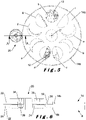
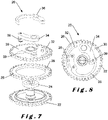
- Such a training device is for example represented on the figures 5 to 8 .
- the drive device with energy accumulator 20 comprises three wheels coaxially superimposed along an axis parallel to the central axis, namely a first toothed wheel 22 arranged to be driven by the first mobile 8 by the intermediary of its outer teeth 8b.
- Said first wheel 22 is integral with a cam 24 which comprises for example here four sectors.
- the drive device with energy accumulator 20 also comprises a second toothed wheel 26 arranged to also be driven by said first mobile 8 by its external toothing 8b, but at a higher speed than the first wheel 22.
- said first and second wheel 22 and 26 have a different number of teeth.
- Said second wheel 26 carries a pin or a tenon 28 whose role is described below.
- the drive device with energy accumulator 20 also comprises a third toothed wheel 30 arranged to drive the second mobile 14 by its external toothing 14b.
- Said third wheel 30 comprises a groove 32 in which the pin or tenon 28 of the second wheel 26 engages, so that the angular freedom of the third wheel 30 with respect to the second wheel 26 is limited by said groove 32 by an abutment effect of said groove 32 with the pin 28.
- the third wheel 30 carries a jumper 34 pivotally mounted and provided with a jumper spring 36, said jumper 34 being arranged to cooperate with the cam 24 of the first wheel 22.
- the jumper 34 may have to its free end a wheel or roller 38 passing through the third wheel 30 through an opening 39 provided in the board of said third wheel 30, said wheel 38 being arranged to cooperate with the profile of the cam 24.
- the difference in speed between the first and second wheels 22, 26 creates an angular offset under the effect of the drive of the mobile 8 which meshes with the two wheels 22 and 26, so that the pin 28 of the second me wheel 26 moves freely in the groove 32 of the third wheel 30.
- Said pin 28 coming into abutment in the groove 32 makes the third wheel 30 integral in rotation with the second wheel 26, so that the jumper 34, forced to move on the profile of the cam 24, stores through its spring 36, energy.
- the profile of the cam 24 is chosen so that the wheel 38 of the jumper 34 is in a hollow bottom of said profile of the cam 24 during the phase of synchronized driving of the two mobiles 8 and 14, until the pin 28 comes to a stop in the groove 32.
- the jumper 34 When the jumper 34 reaches the top of one of the sectors of the profile of the cam 24, it falls from this top to cooperate with the following sector, so that said energy is suddenly restored in such a way to cause the third wheel 30 to pivot and allow it to make a jump so that it drives the second mobile 14 in relative rotation from the repositioning angle by its external toothing 14b, during a transitional period.
- a person skilled in the art knows how to calculate the number of teeth and the dimensions of the various elements of the drive device 20 to obtain the necessary repositioning angle.
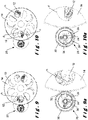
- this first variant of drive device 20 is detailed below, with more particular reference to the figure 5 , 9 , 9a to 12 , 12a , and in relation to a preferred embodiment of the moon phase display mechanism according to the invention.
- the first mobile 8 comprises two lunar background portions 12 symmetrically opposed with respect to the central axis, as represented on the picture 3 , and is capable of being driven by the motor train (not shown) of the timepiece at a constant speed of n half-turns per lunar cycle.
- This speed of rotation is obtained by means, for example, of a moon drive gear well known to those skilled in the art.
- n is equal to 9, so that the first mobile 8 is arranged to be driven by the motor train continuously in a clockwise direction at a constant speed of 9 half-turns per lunation.
- the second mobile 14 includes 9 moon phase profiles 18 which are arranged in the sequence, clockwise, first crescent a, waning moon b, waning gibbous moon c, waxing gibbous moon d, waxing moon e, last crescent f, last quarter g, full moon h, first quarter i, each occupying a circular sector of 40° (360/9), as shown in the figure 5 .
- the display window 6, of annular shape coaxial with the first and second mobiles 8, 14, extends over an angle of approximately 140°.
- the drive device 20 is arranged to drive the second mobile 14 in a synchronized manner during the display period of a moon phase, at the same speed as the first mobile 8, and to drive it in relative rotation, thanks to the energy accumulator, in order to offset it by the necessary repositioning angle during a transient period.
- the second mobile 14 is offset in the clockwise direction by a repositioning angle of 20° (360/2*9) during a transitional period between the display period of a phase of moon and the next moon phase display period, the moon phase display period is about 3.28 days (29.5/9).
- the training device with its energy accumulator 20 is represented on the figure 5 to the left of the first and second superimposed mobiles 8 and 14. It is obvious that it can be positioned at any other place on the periphery of said mobiles 8 and 14.
- the first mobile 8 and the second mobile 14 are positioned so that the moon phase profile 18 of the second mobile 14 corresponding to the full moon h is superimposed on a lunar background portion 12 of the first mobile 8 so as to reveal the full moon, to the left of the display window 6 (not shown in these figures), corresponding to the east.
- the other moon phase profiles 18 which are in the display window 6 are superimposed on the night background 10 of the first mobile 8 so that they are not visible, the night background 10 of the first mobile 8 which appears through said moon phase profiles 18 merging with the night background 16 of the second mobile 14.
- the other moon phase profiles 18, and in particular those through which appears the other portion of lunar background 12 on the other side of the central axis, are hidden under the display window 6. They are therefore not visible to the user.
- the energy accumulator drive device 20 drives the first and second mobiles 8 and 14 at the same speed of 0.5 x 9 revolutions/29.5 days.
- the third wheel 30 is integral in rotation with the first wheel 22 by the jumper 34, its roller 38 being kept pressed by the spring 36 in a hollow bottom of the profile of the cam 24.
- the first mobile 8 driven by the motor train of the basic movement at the constant speed of 0.5 x 9 revolutions/29.5 days drives the first wheel 22 of the drive device 20 via its external toothing 8b and therefore the third wheel 30 which meshes with the second mobile 14, so that this the latter rotates in synchronization with the first mobile 8, at the same speed of 0.5 x 9 revolutions/29.5 days and in the same direction.
- the two mobiles 8 and 14 rotate together so that the full moon displayed in the display window 6 moves in the said window 6, against a night background, consisting of the night background 10 of the first mobile 8 which appears through the moon phase profiles 18 which are present in the window 6 and the night background 16 of the second mobile 14, clockwise, from left to right (from east to west), for 3.28 days (29.5/9).
- the pin 28 of the second wheel 26, which turns more quickly than the first and third wheels 22, 30, shifts without constraint in the groove 32 of the third wheel 30.
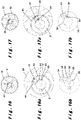
- the full moon has reached the right of display window 6, i.e. the west and on the other side of the axis central, the other portion of lunar background 12 is out of phase both in the moon phase profile d corresponding to the waxing gibbous moon and in the moon phase profile c corresponding to the waning gibbous moon, masked below the left of said window 6, as shown by the figures 10, 10a .
- the pin 28 is then in abutment in the bottom of the groove 32.
- the second wheel 26 still driven by the first mobile 8 and the third wheel 30 are integral in rotation.
- the jumper 34 mounted on the third wheel 30 is therefore forced to come out of its position at the bottom of the hollow of the profile of the cam 24.
- the first and second mobiles 8, 14 each continuing their rotation in the clockwise direction, the full moon h is now hidden on the right under the display window 6.
- the profile of the phase next moon i.e. the waning gibbous moon c
- the lunar background portion 12 approach the left of the display window 6, remaining hidden under said window 6, corresponding to the transitional period between the full moon and the gibbous moon decreasing as shown by figures 11 and 11a .
- the jumper 34 has almost reached the top of the profile of the cam 24, loading its spring 36.
- the energy stored by said spring 36 is sufficient to allow the jump to be made by suddenly restoring the accumulated energy to cause an instantaneous relative rotation or very short of the second mobile 14 relative to the first mobile 8, and be in the position shown on the figures 12, 12a .
- the first mobile 8 keeps a position almost identical to the previous position.
- the third wheel 30 has pivoted through 90° under the discharge of the spring 36 of the jumper 34. In its rotation, the third wheel 30 has driven the second mobile 14 in rotation in the clockwise direction, the gears being sized to drive a shift of one repositioning angle of 20° (360/2*9).
- the lunation cycle thus continues in the same way, for each of the nine moon phases to be displayed.
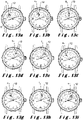
- This produces particularly realistic visual representations of all waxing and waning moon phases, both concave and convex shapes, D and inverted D shapes and a circular shape for the full moon, with realistic terminators, which move from left to right in the widened aperture 6, against a nocturnal background creating a contrast giving the impression of an immense moon, between rising and setting on the horizon, as represented on the figures 13a to 13i : namely successively the full moon h represented on the picture 13a , the waning gibbous moon c depicted on the figure 13b , the last quarter g represented on the figure 13c , the waning moon b (penultimate crescent) depicted on the figure 13d , the last crescent f represented on the figure 13e , the first crescent represented on the figure 13f , the crescent moon e (second crescent) depicted on the figure 13g , the first quarter i
- the moon phases are represented at different times of their display period in window 6, for example the picture 13a shows the full moon h at the beginning of its display period, the figure 13c shows the last quarter g in the middle of its display period, and the figure 13e shows the last crescent f at the end of its display period.
- the other phase profiles of moon are shown in dashed lines for a better understanding of the invention, but in reality, they are not visible to a user, the night backgrounds 10 and 16 of the first and second mobiles 8, 14 merging, as explained below. above.
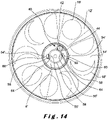
- the drive device comprises a driving wheel set 40 on board the first wheel set 8' which is driven by the motor train, said driving wheel set 40 comprising a drive wheel 42 arranged to cooperate with the second wheel set 14', and a Maltese cross 44, said drive wheel set 40 being arranged to be stationary in rotation relative to said first wheel set 8' for the synchronized driving of the first and second wheel sets 8', 14' via the drive wheel 42 during the period of display, and to be driven in rotation relative to said first wheel set 8' in order to cause the drive wheel 42 to pivot instantaneously so that it drives the second wheel set 14' in relative rotation by the repositioning angle during the transitional period.
- the first mobile 8' comprises a night background 10' and two symmetrically opposite lunar background portions 12', in a manner similar to the example embodiment previously described.
- the first wheel set 8' comprises on its outer periphery an internal toothing 46 arranged to cooperate with the motor train (not shown) so as to drive the first wheel set 8'. This configuration advantageously makes it possible to position the motor train under the mechanism.
- the first wheel set 8' embeds the trainer wheel set 40, which comprises the drive wheel 42 in the form of a toothed pinion, and the Maltese cross 44, integral with the drive wheel 42.
- said drive wheel set 40 rotates with the first mobile 8', like a satellite, around the center of the mechanism.
- the trainer wheel set 40 is pivotally mounted for example in a bearing 48 drilled in the board of the first wheel set 8'.
- the Maltese cross 44 is positioned under the board of the first mobile 8' so as to be able to cooperate with elements of the frame, as described below, and the drive wheel 42 is positioned above the board of the first mobile 8' so as to be able to cooperate with the second mobile 14'.
- the second mobile 14' comprises a night background 16' and moon phase profiles 18' similarly to the example embodiment described above.
- the second mobile 14 ' is provided, on its inner periphery, with a toothing 50 arranged to cooperate with the drive wheel 42.
- various elements for maintaining its positioning are provided on the frame 52 or on the movement plate. More particularly, there is provided on the frame 52 a first outer cam profile 54 and a second inner cam profile 56 arranged coaxially at the centers C and C' of the first and second mobiles 8', 14', so that the said first and second cam profiles 54, 56 cooperate with the edges of the Maltese cross 44, with the exception of two projecting sectors 54' arranged symmetrically with respect to the central axis on the outer cam profile 54 and two sectors in hollow 56' arranged symmetrically with respect to the central axis on the inner cam profile 56.
- the projecting sectors 54' and hollow 56' are dimensioned to be able to authorize the rotation of the Maltese cross 44.
- the projecting sector 54 'of the outer cam profile 54 is substantially offset from the recessed sector 56' of the inner cam profile 56 facing each other, so that the projecting sector 54' still blocks the rotation of the Maltese cross 44 then than the recessed sector 56' opposite would allow the rotation of said Maltese cross 44.
- each rocker 58 pivotally mounted under the frame around a shaft coaxial with the central axis.
- each rocker 58 comprises an opening 60 of oblong shape arranged to be arranged around said shaft so that each rocker 58 is free to deviate from the central axis.
- Each rocker 58 is in contact with a return spring 62 mounted under the frame.
- Each rocker 58 has at its free end a tenon or a pin 64 directed towards the Maltese cross 44 and arranged to pass through the frame by "banana" grooves 66 pierced in said frame in the space between the two cam profiles 54 and 56, this in order to be able to be placed at the bottom of a groove of the Maltese Cross 44 when the rocker 58 which carries it deviates from the central axis.
- Flip-flops 58 are arranged symmetrically from each other with respect to said central axis, the instantaneous jump of the Maltese cross taking place every 180° of rotation of the first mobile 8', as will be explained below.
- the pin 64 can be fixed directly to the end of a arm of the return spring, the rocker being removed.
- the spiral shape of the return spring allows an X and Y offset of the pin.
- the moon phase profile 18' corresponding to the full moon is located to the right of the display window (not shown) indicating the end of the display period of said full moon.
- the second mobile 14' is integral in rotation with the first mobile 8' via the driving mobile 40.
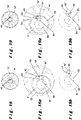
- the Maltese cross 44 is blocked in its orientation by the first profile of outer cam 54 and by the second inner cam profile 56 provided on the frame 52, as shown more specifically in figure 16b .
- the first mobile 8' being driven in the clockwise direction by the motor train by its toothing 46, said first and second mobiles 8', 14' are driven in a synchronized manner, at the same speed and in the same direction, via the wheel of 'drive 42 engaged with the toothing 50 of the second mobile 14' and integral with the Maltese cross 44 on board the first mobile 8'.
- the moon phase therefore moves in the aperture from left to right, as described above for the first embodiment, the first and second mobiles 8', 14' approaching one of the rockers 58.
- the return spring 62 is prestressed to position rocker 58 and its pin 64 at the bottom of its banana groove 66.
- the first mobile 8' has advanced so that the Maltese cross 44 comes into contact with the pin 64, as shown by the figures 17, 17a and 17b .
- said rocker 58 Due to the oblong shape of the opening 60 of the rocker 58, said rocker 58 is free to deviate from the central axis so that its pin 64 also shifts to position itself at the bottom of the groove of the Maltese Cross 44, as shown more precisely in figure 17b .
- said Maltese cross 44 is always blocked in orientation by the outer 54 and inner 56 cam profiles and cannot turn on itself.
- the return spring 62 begins to charge.
- the phase profile 18' of the second mobile 14' corresponding to the full moon has advanced to be hidden under the window.
- the Maltese cross 44 has advanced with the first mobile 8' so that the return spring 62 and the pin 64 are at maximum extension.
- the Maltese cross 44 is positioned at the level of the recessed sector 56' of the inner cam profile 56 so that it is no longer retained by said inner cam profile 56, but remains locked in rotation on itself just retained by the outer cam profile 54, at the edge of its projecting sector 54', ready to jump.
- the Maltese cross 44 continues to advance with the first mobile 8 'so that it is positioned at the level of the projecting sector 54' of the outer cam profile 54, and is therefore free to pivot on it -same.
- the pin 64 rises towards its position of equilibrium causing a rotation of the Maltese cross 44 on itself by 90° relative to the first mobile 8', as shown by the Figures 19, 19a, and 19b .
- This rotation of the Maltese cross 44 causes the drive wheel 42 integral with said Maltese cross 44 to pivot, resulting in a relative rotation of the second mobile 14' in the clockwise direction by a repositioning angle of 20° via its toothing 50 .
- the mechanism is once again ready to display in the aperture the moon phase corresponding to the waning gibbous moon which will then move from left to right, for 3.28 days, as described above.
- the Maltese cross 44 will cooperate with the opposite flip-flop 58.
- the drive device may be a differential, comprising an input wheel meshing with the first mobile 8, an output wheel meshing with the second mobile 14, and a second input arranged to produce the offset between mobiles 8 and 14 during a transitional period.
- first and second mobiles can have other configurations than the examples given above, the number of lunar background portions, moon phase profiles and moon phases to be displayed possibly varying.
- the mechanism of the invention can be adapted so that the relative rotation of the second wheel set in order to offset it by the repositioning angle during the transient period takes place in the anti-clockwise direction.
Landscapes
- Physics & Mathematics (AREA)
- Astronomy & Astrophysics (AREA)
- General Physics & Mathematics (AREA)
- Electromechanical Clocks (AREA)
Applications Claiming Priority (1)
| Application Number | Priority Date | Filing Date | Title |
|---|---|---|---|
| CH01526/20A CH718104A1 (fr) | 2020-11-30 | 2020-11-30 | Mécanisme d'affichage de phases de lune. |
Publications (2)
| Publication Number | Publication Date |
|---|---|
| EP4006651A1 true EP4006651A1 (de) | 2022-06-01 |
| EP4006651B1 EP4006651B1 (de) | 2024-06-26 |
Family
ID=73834132
Family Applications (1)
| Application Number | Title | Priority Date | Filing Date |
|---|---|---|---|
| EP21206648.4A Active EP4006651B1 (de) | 2020-11-30 | 2021-11-05 | Mondphasen-anzeigemechanismus |
Country Status (5)
| Country | Link |
|---|---|
| US (1) | US12025954B2 (de) |
| EP (1) | EP4006651B1 (de) |
| JP (1) | JP7746128B2 (de) |
| CN (1) | CN114578673B (de) |
| CH (1) | CH718104A1 (de) |
Cited By (1)
| Publication number | Priority date | Publication date | Assignee | Title |
|---|---|---|---|---|
| WO2024089541A1 (fr) | 2022-10-18 | 2024-05-02 | Goujon Pierre | Dispositif d'affichage d'indications discrètes |
Families Citing this family (6)
| Publication number | Priority date | Publication date | Assignee | Title |
|---|---|---|---|---|
| EP3779612B1 (de) * | 2019-08-16 | 2026-05-27 | The Swatch Group Research and Development Ltd | Verfahren und system zur verbreitung einer nachricht an einen träger einer armbanduhr |
| USD988898S1 (en) | 2022-02-14 | 2023-06-13 | Richemont International Sa | Watch dial |
| KR102732556B1 (ko) * | 2022-10-07 | 2024-11-21 | 황양민 | 달시계 |
| USD1119621S1 (en) * | 2023-09-27 | 2026-03-24 | Omega Ltd. | Watch |
| USD1082560S1 (en) * | 2023-09-27 | 2025-07-08 | Omega Sa (Omega Ag)(Omega Ltd.) | Watch |
| TWD237436S (zh) * | 2024-05-16 | 2025-04-01 | 瑞士商奧米茄公司 (瑞士) | 手錶 |
Citations (3)
| Publication number | Priority date | Publication date | Assignee | Title |
|---|---|---|---|---|
| EP0107177A1 (de) * | 1982-10-27 | 1984-05-02 | Raoul-Henri Erard | Uhrenteil |
| EP1701227A1 (de) * | 2005-03-11 | 2006-09-13 | The British Masters SA | Vorrichtung zur Anzeige der Mondphasen |
| EP2392976A2 (de) | 2010-06-01 | 2011-12-07 | Société anonyme de la Manufacture d'Horlogerie Audemars Piguet & Cie | Mondphasenanzeigemechanismus |
Family Cites Families (17)
| Publication number | Priority date | Publication date | Assignee | Title |
|---|---|---|---|---|
| CH201875A4 (de) | 1975-02-18 | 1977-07-15 | ||
| FR2614445B1 (fr) * | 1987-04-22 | 1989-06-30 | Ebauches Sa | Mecanisme pour l'affichage des phases de la lune sur une montre, et montre comportant un tel mecanisme |
| CH672223B5 (de) * | 1988-03-31 | 1990-05-15 | Catena S A | |
| EP1475679A1 (de) * | 2003-05-05 | 2004-11-10 | Asulab S.A. | Verfahren zum Anzeigen der Mondphasen, insbesondere in einem Uhrwerk |
| EP1708049B1 (de) * | 2005-03-31 | 2019-05-08 | Richemont International S.A. | Mondphasenanzeigemechanismus |
| CH706094B1 (fr) * | 2012-02-03 | 2016-10-14 | Maurice Lacroix Sa | Dispositif d'affichage de phases de lune. |
| CH706600A1 (fr) * | 2012-06-06 | 2013-12-13 | Manuf Et Fabrique De Montres Et Chronometres Ulysse Nardin Le Locle S A | Mécanisme d'affichage des positions respectives du soleil, de la terre et de la lune. |
| EP3098671B1 (de) * | 2015-05-27 | 2019-10-09 | Montres Breguet S.A. | Mondphasen-anzeigemechanismus einer uhr |
| EP3467596B1 (de) * | 2016-07-04 | 2021-12-22 | Blancpain SA | Anzeigeigemechanismus der mondphasen |
| CH713593A2 (fr) * | 2017-03-20 | 2018-09-28 | Blancpain Sa | Dispositif d'affichage de phases lunaires. |
| EP3379348B1 (de) * | 2017-03-20 | 2023-08-23 | ETA SA Manufacture Horlogère Suisse | Universelle mondphasenanzeige |
| EP3396472B1 (de) * | 2017-04-28 | 2020-05-27 | ETA SA Manufacture Horlogère Suisse | Datums- und mondphasenanzeigemechanismus für armbanduhr |
| EP3483664B1 (de) * | 2017-11-10 | 2020-06-03 | Montres Breguet S.A. | Uhrmechanismus zum anzeigen des mondtags und der mondphase mit korrektursystem mit doppeltem antriebsstrang |
| CH715105A1 (fr) * | 2018-06-18 | 2019-12-30 | Sa De La Manufacture Dhorlogerie Audemars Piguet & Cie | Dispositif d'affichage de phases de lune. |
| JP7251272B2 (ja) * | 2019-04-01 | 2023-04-04 | セイコーエプソン株式会社 | 月齢表示時計 |
| EP3842874B1 (de) * | 2019-12-23 | 2023-09-20 | Blancpain SA | Optische vorrichtung, mit der sich ästhetische und technische optische effekte erzeugen lassen |
| EP4369113B1 (de) * | 2019-12-23 | 2025-10-01 | Blancpain SA | Mechanismus zur anzeige der phasen einer mond |
-
2020
- 2020-11-30 CH CH01526/20A patent/CH718104A1/fr unknown
-
2021
- 2021-11-05 EP EP21206648.4A patent/EP4006651B1/de active Active
- 2021-11-09 JP JP2021182493A patent/JP7746128B2/ja active Active
- 2021-11-26 CN CN202111422549.6A patent/CN114578673B/zh active Active
- 2021-11-29 US US17/537,038 patent/US12025954B2/en active Active
Patent Citations (3)
| Publication number | Priority date | Publication date | Assignee | Title |
|---|---|---|---|---|
| EP0107177A1 (de) * | 1982-10-27 | 1984-05-02 | Raoul-Henri Erard | Uhrenteil |
| EP1701227A1 (de) * | 2005-03-11 | 2006-09-13 | The British Masters SA | Vorrichtung zur Anzeige der Mondphasen |
| EP2392976A2 (de) | 2010-06-01 | 2011-12-07 | Société anonyme de la Manufacture d'Horlogerie Audemars Piguet & Cie | Mondphasenanzeigemechanismus |
Cited By (1)
| Publication number | Priority date | Publication date | Assignee | Title |
|---|---|---|---|---|
| WO2024089541A1 (fr) | 2022-10-18 | 2024-05-02 | Goujon Pierre | Dispositif d'affichage d'indications discrètes |
Also Published As
| Publication number | Publication date |
|---|---|
| US20220171340A1 (en) | 2022-06-02 |
| CN114578673A (zh) | 2022-06-03 |
| EP4006651B1 (de) | 2024-06-26 |
| US12025954B2 (en) | 2024-07-02 |
| JP2022087030A (ja) | 2022-06-09 |
| CN114578673B (zh) | 2024-01-23 |
| CH718104A1 (fr) | 2022-05-31 |
| JP7746128B2 (ja) | 2025-09-30 |
Similar Documents
| Publication | Publication Date | Title |
|---|---|---|
| EP4006651B1 (de) | Mondphasen-anzeigemechanismus | |
| EP2728420B1 (de) | Astronomische Armbanduhr | |
| EP2392976B1 (de) | Mondphasenanzeigemechanismus | |
| EP3842874B1 (de) | Optische vorrichtung, mit der sich ästhetische und technische optische effekte erzeugen lassen | |
| CH712668A2 (fr) | Mécanisme d'affichage de période annuelle ou de saison. | |
| EP3807723B1 (de) | Mondphasenanzeigevorrichtung | |
| EP3477402B1 (de) | Mondphasen-anzeigevorrichtung | |
| EP2527930A1 (de) | Uhr mit einem Mechanismus zum Anzeigen einer Animation | |
| EP4254079B1 (de) | Mechanismus zur anzeige der mondphasen für uhr | |
| EP4523049B1 (de) | Mechanismus zur anzeige der mondphasen für ein uhrwerk | |
| EP1701227A1 (de) | Vorrichtung zur Anzeige der Mondphasen | |
| CH717685B1 (fr) | Montre comprenant un cadran défini par N secteurs. | |
| EP1475680B1 (de) | Verfahren zum Anzeigen der Mondphasen, insbesondere in einem Uhrwerk | |
| CH719559B1 (fr) | Mécanisme d'affichage des phases de lune de pièce d'horlogerie | |
| EP2293156B1 (de) | Mechanische digitale Anzeige | |
| WO2012059887A1 (fr) | Montre comprenant une indication astronomique | |
| CH719397A2 (fr) | Mécanisme d'affichage comportant une pluralité de mobiles d'affichage et un dispositif de correction agencé pour agir sur ces derniers. | |
| CH719613B1 (fr) | Mobile de commande pour dispositif d'affichage horloger, dispositif d'affichage et mouvement horloger correspondants. | |
| WO2024089541A1 (fr) | Dispositif d'affichage d'indications discrètes | |
| CH719560A2 (fr) | Mouvement horloger à fonction chronographe de construction inversée, et pièce d'horlogerie correspondante | |
| CH720473A2 (fr) | Mécanisme d'affichage des phases et de l'âge de la Lune avec représentation sphérique de la Lune | |
| CH705336B1 (fr) | Mécanisme d'affichage des phases de lune. | |
| CH717278A1 (fr) | Mouvement horloger à dispositif d'accélération d'affichage, notamment pour un quantième grande date. | |
| CH715152B1 (fr) | Mécanisme d'affichage du quantième de type grande date. | |
| CH712647A2 (fr) | Mécanisme d'affichage à rouleau pour montre. |
Legal Events
| Date | Code | Title | Description |
|---|---|---|---|
| PUAI | Public reference made under article 153(3) epc to a published international application that has entered the european phase |
Free format text: ORIGINAL CODE: 0009012 |
|
| STAA | Information on the status of an ep patent application or granted ep patent |
Free format text: STATUS: THE APPLICATION HAS BEEN PUBLISHED |
|
| AK | Designated contracting states |
Kind code of ref document: A1 Designated state(s): AL AT BE BG CH CY CZ DE DK EE ES FI FR GB GR HR HU IE IS IT LI LT LU LV MC MK MT NL NO PL PT RO RS SE SI SK SM TR |
|
| STAA | Information on the status of an ep patent application or granted ep patent |
Free format text: STATUS: REQUEST FOR EXAMINATION WAS MADE |
|
| 17P | Request for examination filed |
Effective date: 20221109 |
|
| RBV | Designated contracting states (corrected) |
Designated state(s): AL AT BE BG CH CY CZ DE DK EE ES FI FR GB GR HR HU IE IS IT LI LT LU LV MC MK MT NL NO PL PT RO RS SE SI SK SM TR |
|
| P01 | Opt-out of the competence of the unified patent court (upc) registered |
Effective date: 20230527 |
|
| GRAP | Despatch of communication of intention to grant a patent |
Free format text: ORIGINAL CODE: EPIDOSNIGR1 |
|
| STAA | Information on the status of an ep patent application or granted ep patent |
Free format text: STATUS: GRANT OF PATENT IS INTENDED |
|
| INTG | Intention to grant announced |
Effective date: 20240318 |
|
| GRAS | Grant fee paid |
Free format text: ORIGINAL CODE: EPIDOSNIGR3 |
|
| GRAA | (expected) grant |
Free format text: ORIGINAL CODE: 0009210 |
|
| STAA | Information on the status of an ep patent application or granted ep patent |
Free format text: STATUS: THE PATENT HAS BEEN GRANTED |
|
| AK | Designated contracting states |
Kind code of ref document: B1 Designated state(s): AL AT BE BG CH CY CZ DE DK EE ES FI FR GB GR HR HU IE IS IT LI LT LU LV MC MK MT NL NO PL PT RO RS SE SI SK SM TR |
|
| REG | Reference to a national code |
Ref country code: GB Ref legal event code: FG4D Free format text: NOT ENGLISH |
|
| REG | Reference to a national code |
Ref country code: CH Ref legal event code: EP |
|
| REG | Reference to a national code |
Ref country code: DE Ref legal event code: R096 Ref document number: 602021014775 Country of ref document: DE |
|
| PG25 | Lapsed in a contracting state [announced via postgrant information from national office to epo] |
Ref country code: BG Free format text: LAPSE BECAUSE OF FAILURE TO SUBMIT A TRANSLATION OF THE DESCRIPTION OR TO PAY THE FEE WITHIN THE PRESCRIBED TIME-LIMIT Effective date: 20240626 |
|
| PG25 | Lapsed in a contracting state [announced via postgrant information from national office to epo] |
Ref country code: FI Free format text: LAPSE BECAUSE OF FAILURE TO SUBMIT A TRANSLATION OF THE DESCRIPTION OR TO PAY THE FEE WITHIN THE PRESCRIBED TIME-LIMIT Effective date: 20240626 Ref country code: HR Free format text: LAPSE BECAUSE OF FAILURE TO SUBMIT A TRANSLATION OF THE DESCRIPTION OR TO PAY THE FEE WITHIN THE PRESCRIBED TIME-LIMIT Effective date: 20240626 |
|
| REG | Reference to a national code |
Ref country code: LT Ref legal event code: MG9D |
|
| PG25 | Lapsed in a contracting state [announced via postgrant information from national office to epo] |
Ref country code: GR Free format text: LAPSE BECAUSE OF FAILURE TO SUBMIT A TRANSLATION OF THE DESCRIPTION OR TO PAY THE FEE WITHIN THE PRESCRIBED TIME-LIMIT Effective date: 20240927 |
|
| PG25 | Lapsed in a contracting state [announced via postgrant information from national office to epo] |
Ref country code: LV Free format text: LAPSE BECAUSE OF FAILURE TO SUBMIT A TRANSLATION OF THE DESCRIPTION OR TO PAY THE FEE WITHIN THE PRESCRIBED TIME-LIMIT Effective date: 20240626 |
|
| REG | Reference to a national code |
Ref country code: NL Ref legal event code: MP Effective date: 20240626 |
|
| PG25 | Lapsed in a contracting state [announced via postgrant information from national office to epo] |
Ref country code: NO Free format text: LAPSE BECAUSE OF FAILURE TO SUBMIT A TRANSLATION OF THE DESCRIPTION OR TO PAY THE FEE WITHIN THE PRESCRIBED TIME-LIMIT Effective date: 20240926 Ref country code: LV Free format text: LAPSE BECAUSE OF FAILURE TO SUBMIT A TRANSLATION OF THE DESCRIPTION OR TO PAY THE FEE WITHIN THE PRESCRIBED TIME-LIMIT Effective date: 20240626 Ref country code: HR Free format text: LAPSE BECAUSE OF FAILURE TO SUBMIT A TRANSLATION OF THE DESCRIPTION OR TO PAY THE FEE WITHIN THE PRESCRIBED TIME-LIMIT Effective date: 20240626 Ref country code: GR Free format text: LAPSE BECAUSE OF FAILURE TO SUBMIT A TRANSLATION OF THE DESCRIPTION OR TO PAY THE FEE WITHIN THE PRESCRIBED TIME-LIMIT Effective date: 20240927 Ref country code: FI Free format text: LAPSE BECAUSE OF FAILURE TO SUBMIT A TRANSLATION OF THE DESCRIPTION OR TO PAY THE FEE WITHIN THE PRESCRIBED TIME-LIMIT Effective date: 20240626 Ref country code: BG Free format text: LAPSE BECAUSE OF FAILURE TO SUBMIT A TRANSLATION OF THE DESCRIPTION OR TO PAY THE FEE WITHIN THE PRESCRIBED TIME-LIMIT Effective date: 20240626 Ref country code: RS Free format text: LAPSE BECAUSE OF FAILURE TO SUBMIT A TRANSLATION OF THE DESCRIPTION OR TO PAY THE FEE WITHIN THE PRESCRIBED TIME-LIMIT Effective date: 20240926 |
|
| PG25 | Lapsed in a contracting state [announced via postgrant information from national office to epo] |
Ref country code: NL Free format text: LAPSE BECAUSE OF FAILURE TO SUBMIT A TRANSLATION OF THE DESCRIPTION OR TO PAY THE FEE WITHIN THE PRESCRIBED TIME-LIMIT Effective date: 20240626 |
|
| REG | Reference to a national code |
Ref country code: AT Ref legal event code: MK05 Ref document number: 1698211 Country of ref document: AT Kind code of ref document: T Effective date: 20240626 |
|
| PG25 | Lapsed in a contracting state [announced via postgrant information from national office to epo] |
Ref country code: NL Free format text: LAPSE BECAUSE OF FAILURE TO SUBMIT A TRANSLATION OF THE DESCRIPTION OR TO PAY THE FEE WITHIN THE PRESCRIBED TIME-LIMIT Effective date: 20240626 |
|
| PG25 | Lapsed in a contracting state [announced via postgrant information from national office to epo] |
Ref country code: PT Free format text: LAPSE BECAUSE OF FAILURE TO SUBMIT A TRANSLATION OF THE DESCRIPTION OR TO PAY THE FEE WITHIN THE PRESCRIBED TIME-LIMIT Effective date: 20241028 |
|
| PG25 | Lapsed in a contracting state [announced via postgrant information from national office to epo] |
Ref country code: PT Free format text: LAPSE BECAUSE OF FAILURE TO SUBMIT A TRANSLATION OF THE DESCRIPTION OR TO PAY THE FEE WITHIN THE PRESCRIBED TIME-LIMIT Effective date: 20241028 |
|
| PG25 | Lapsed in a contracting state [announced via postgrant information from national office to epo] |
Ref country code: PL Free format text: LAPSE BECAUSE OF FAILURE TO SUBMIT A TRANSLATION OF THE DESCRIPTION OR TO PAY THE FEE WITHIN THE PRESCRIBED TIME-LIMIT Effective date: 20240626 |
|
| PG25 | Lapsed in a contracting state [announced via postgrant information from national office to epo] |
Ref country code: EE Free format text: LAPSE BECAUSE OF FAILURE TO SUBMIT A TRANSLATION OF THE DESCRIPTION OR TO PAY THE FEE WITHIN THE PRESCRIBED TIME-LIMIT Effective date: 20240626 |
|
| PG25 | Lapsed in a contracting state [announced via postgrant information from national office to epo] |
Ref country code: IS Free format text: LAPSE BECAUSE OF FAILURE TO SUBMIT A TRANSLATION OF THE DESCRIPTION OR TO PAY THE FEE WITHIN THE PRESCRIBED TIME-LIMIT Effective date: 20241026 Ref country code: AT Free format text: LAPSE BECAUSE OF FAILURE TO SUBMIT A TRANSLATION OF THE DESCRIPTION OR TO PAY THE FEE WITHIN THE PRESCRIBED TIME-LIMIT Effective date: 20240626 |
|
| PG25 | Lapsed in a contracting state [announced via postgrant information from national office to epo] |
Ref country code: CZ Free format text: LAPSE BECAUSE OF FAILURE TO SUBMIT A TRANSLATION OF THE DESCRIPTION OR TO PAY THE FEE WITHIN THE PRESCRIBED TIME-LIMIT Effective date: 20240626 |
|
| PG25 | Lapsed in a contracting state [announced via postgrant information from national office to epo] |
Ref country code: RO Free format text: LAPSE BECAUSE OF FAILURE TO SUBMIT A TRANSLATION OF THE DESCRIPTION OR TO PAY THE FEE WITHIN THE PRESCRIBED TIME-LIMIT Effective date: 20240626 Ref country code: SK Free format text: LAPSE BECAUSE OF FAILURE TO SUBMIT A TRANSLATION OF THE DESCRIPTION OR TO PAY THE FEE WITHIN THE PRESCRIBED TIME-LIMIT Effective date: 20240626 |
|
| PG25 | Lapsed in a contracting state [announced via postgrant information from national office to epo] |
Ref country code: SM Free format text: LAPSE BECAUSE OF FAILURE TO SUBMIT A TRANSLATION OF THE DESCRIPTION OR TO PAY THE FEE WITHIN THE PRESCRIBED TIME-LIMIT Effective date: 20240626 Ref country code: ES Free format text: LAPSE BECAUSE OF FAILURE TO SUBMIT A TRANSLATION OF THE DESCRIPTION OR TO PAY THE FEE WITHIN THE PRESCRIBED TIME-LIMIT Effective date: 20240626 |
|
| PG25 | Lapsed in a contracting state [announced via postgrant information from national office to epo] |
Ref country code: SM Free format text: LAPSE BECAUSE OF FAILURE TO SUBMIT A TRANSLATION OF THE DESCRIPTION OR TO PAY THE FEE WITHIN THE PRESCRIBED TIME-LIMIT Effective date: 20240626 Ref country code: SK Free format text: LAPSE BECAUSE OF FAILURE TO SUBMIT A TRANSLATION OF THE DESCRIPTION OR TO PAY THE FEE WITHIN THE PRESCRIBED TIME-LIMIT Effective date: 20240626 Ref country code: RO Free format text: LAPSE BECAUSE OF FAILURE TO SUBMIT A TRANSLATION OF THE DESCRIPTION OR TO PAY THE FEE WITHIN THE PRESCRIBED TIME-LIMIT Effective date: 20240626 Ref country code: PL Free format text: LAPSE BECAUSE OF FAILURE TO SUBMIT A TRANSLATION OF THE DESCRIPTION OR TO PAY THE FEE WITHIN THE PRESCRIBED TIME-LIMIT Effective date: 20240626 Ref country code: IS Free format text: LAPSE BECAUSE OF FAILURE TO SUBMIT A TRANSLATION OF THE DESCRIPTION OR TO PAY THE FEE WITHIN THE PRESCRIBED TIME-LIMIT Effective date: 20241026 Ref country code: ES Free format text: LAPSE BECAUSE OF FAILURE TO SUBMIT A TRANSLATION OF THE DESCRIPTION OR TO PAY THE FEE WITHIN THE PRESCRIBED TIME-LIMIT Effective date: 20240626 Ref country code: EE Free format text: LAPSE BECAUSE OF FAILURE TO SUBMIT A TRANSLATION OF THE DESCRIPTION OR TO PAY THE FEE WITHIN THE PRESCRIBED TIME-LIMIT Effective date: 20240626 Ref country code: CZ Free format text: LAPSE BECAUSE OF FAILURE TO SUBMIT A TRANSLATION OF THE DESCRIPTION OR TO PAY THE FEE WITHIN THE PRESCRIBED TIME-LIMIT Effective date: 20240626 Ref country code: AT Free format text: LAPSE BECAUSE OF FAILURE TO SUBMIT A TRANSLATION OF THE DESCRIPTION OR TO PAY THE FEE WITHIN THE PRESCRIBED TIME-LIMIT Effective date: 20240626 |
|
| REG | Reference to a national code |
Ref country code: DE Ref legal event code: R097 Ref document number: 602021014775 Country of ref document: DE |
|
| PG25 | Lapsed in a contracting state [announced via postgrant information from national office to epo] |
Ref country code: DK Free format text: LAPSE BECAUSE OF FAILURE TO SUBMIT A TRANSLATION OF THE DESCRIPTION OR TO PAY THE FEE WITHIN THE PRESCRIBED TIME-LIMIT Effective date: 20240626 |
|
| PLBE | No opposition filed within time limit |
Free format text: ORIGINAL CODE: 0009261 |
|
| STAA | Information on the status of an ep patent application or granted ep patent |
Free format text: STATUS: NO OPPOSITION FILED WITHIN TIME LIMIT |
|
| 26N | No opposition filed |
Effective date: 20250327 |
|
| PG25 | Lapsed in a contracting state [announced via postgrant information from national office to epo] |
Ref country code: MC Free format text: LAPSE BECAUSE OF FAILURE TO SUBMIT A TRANSLATION OF THE DESCRIPTION OR TO PAY THE FEE WITHIN THE PRESCRIBED TIME-LIMIT Effective date: 20240626 |
|
| PG25 | Lapsed in a contracting state [announced via postgrant information from national office to epo] |
Ref country code: LU Free format text: LAPSE BECAUSE OF NON-PAYMENT OF DUE FEES Effective date: 20241105 |
|
| REG | Reference to a national code |
Ref country code: BE Ref legal event code: MM Effective date: 20241130 |
|
| PG25 | Lapsed in a contracting state [announced via postgrant information from national office to epo] |
Ref country code: SE Free format text: LAPSE BECAUSE OF FAILURE TO SUBMIT A TRANSLATION OF THE DESCRIPTION OR TO PAY THE FEE WITHIN THE PRESCRIBED TIME-LIMIT Effective date: 20240626 |
|
| PG25 | Lapsed in a contracting state [announced via postgrant information from national office to epo] |
Ref country code: BE Free format text: LAPSE BECAUSE OF NON-PAYMENT OF DUE FEES Effective date: 20241130 |
|
| PG25 | Lapsed in a contracting state [announced via postgrant information from national office to epo] |
Ref country code: IE Free format text: LAPSE BECAUSE OF NON-PAYMENT OF DUE FEES Effective date: 20241105 |
|
| REG | Reference to a national code |
Ref country code: CH Ref legal event code: U11 Free format text: ST27 STATUS EVENT CODE: U-0-0-U10-U11 (AS PROVIDED BY THE NATIONAL OFFICE) Effective date: 20251201 |
|
| PGFP | Annual fee paid to national office [announced via postgrant information from national office to epo] |
Ref country code: DE Payment date: 20251119 Year of fee payment: 5 |
|
| PGFP | Annual fee paid to national office [announced via postgrant information from national office to epo] |
Ref country code: GB Payment date: 20251121 Year of fee payment: 5 |
|
| PGFP | Annual fee paid to national office [announced via postgrant information from national office to epo] |
Ref country code: IT Payment date: 20251119 Year of fee payment: 5 |
|
| PGFP | Annual fee paid to national office [announced via postgrant information from national office to epo] |
Ref country code: FR Payment date: 20251126 Year of fee payment: 5 |
|
| PGFP | Annual fee paid to national office [announced via postgrant information from national office to epo] |
Ref country code: CH Payment date: 20251201 Year of fee payment: 5 |
|
| PG25 | Lapsed in a contracting state [announced via postgrant information from national office to epo] |
Ref country code: HU Free format text: LAPSE BECAUSE OF FAILURE TO SUBMIT A TRANSLATION OF THE DESCRIPTION OR TO PAY THE FEE WITHIN THE PRESCRIBED TIME-LIMIT; INVALID AB INITIO Effective date: 20211105 |
|
| REG | Reference to a national code |
Ref country code: CH Ref legal event code: R18 Free format text: ST27 STATUS EVENT CODE: U-0-0-R10-R18 (AS PROVIDED BY THE NATIONAL OFFICE) Effective date: 20260320 |
|
| PG25 | Lapsed in a contracting state [announced via postgrant information from national office to epo] |
Ref country code: CY Free format text: LAPSE BECAUSE OF FAILURE TO SUBMIT A TRANSLATION OF THE DESCRIPTION OR TO PAY THE FEE WITHIN THE PRESCRIBED TIME-LIMIT; INVALID AB INITIO Effective date: 20211105 |
|
| PG25 | Lapsed in a contracting state [announced via postgrant information from national office to epo] |
Ref country code: TR Free format text: LAPSE BECAUSE OF FAILURE TO SUBMIT A TRANSLATION OF THE DESCRIPTION OR TO PAY THE FEE WITHIN THE PRESCRIBED TIME-LIMIT Effective date: 20240626 |
|
| PG25 | Lapsed in a contracting state [announced via postgrant information from national office to epo] |
Ref country code: SI Free format text: LAPSE BECAUSE OF FAILURE TO SUBMIT A TRANSLATION OF THE DESCRIPTION OR TO PAY THE FEE WITHIN THE PRESCRIBED TIME-LIMIT Effective date: 20240626 |
|
| PG25 | Lapsed in a contracting state [announced via postgrant information from national office to epo] |
Ref country code: LT Free format text: LAPSE BECAUSE OF FAILURE TO SUBMIT A TRANSLATION OF THE DESCRIPTION OR TO PAY THE FEE WITHIN THE PRESCRIBED TIME-LIMIT Effective date: 20240626 |