EP4008819B1 - Pièce tricotée - Google Patents
Pièce tricotée Download PDFInfo
- Publication number
- EP4008819B1 EP4008819B1 EP20211940.0A EP20211940A EP4008819B1 EP 4008819 B1 EP4008819 B1 EP 4008819B1 EP 20211940 A EP20211940 A EP 20211940A EP 4008819 B1 EP4008819 B1 EP 4008819B1
- Authority
- EP
- European Patent Office
- Prior art keywords
- knitted
- pulling
- pulling element
- leg
- leg portion
- Prior art date
- Legal status (The legal status is an assumption and is not a legal conclusion. Google has not performed a legal analysis and makes no representation as to the accuracy of the status listed.)
- Active
Links
Images


Classifications
-
- D—TEXTILES; PAPER
- D04—BRAIDING; LACE-MAKING; KNITTING; TRIMMINGS; NON-WOVEN FABRICS
- D04B—KNITTING
- D04B1/00—Weft knitting processes for the production of fabrics or articles not dependent on the use of particular machines; Fabrics or articles defined by such processes
- D04B1/22—Weft knitting processes for the production of fabrics or articles not dependent on the use of particular machines; Fabrics or articles defined by such processes specially adapted for knitting goods of particular configuration
- D04B1/24—Weft knitting processes for the production of fabrics or articles not dependent on the use of particular machines; Fabrics or articles defined by such processes specially adapted for knitting goods of particular configuration wearing apparel
- D04B1/26—Weft knitting processes for the production of fabrics or articles not dependent on the use of particular machines; Fabrics or articles defined by such processes specially adapted for knitting goods of particular configuration wearing apparel stockings
- D04B1/265—Surgical stockings
-
- A—HUMAN NECESSITIES
- A41—WEARING APPAREL
- A41D—OUTERWEAR; PROTECTIVE GARMENTS; ACCESSORIES
- A41D27/00—Details of garments or of their making
-
- D—TEXTILES; PAPER
- D04—BRAIDING; LACE-MAKING; KNITTING; TRIMMINGS; NON-WOVEN FABRICS
- D04B—KNITTING
- D04B1/00—Weft knitting processes for the production of fabrics or articles not dependent on the use of particular machines; Fabrics or articles defined by such processes
- D04B1/14—Other fabrics or articles characterised primarily by the use of particular thread materials
- D04B1/18—Other fabrics or articles characterised primarily by the use of particular thread materials elastic threads
-
- D—TEXTILES; PAPER
- D04—BRAIDING; LACE-MAKING; KNITTING; TRIMMINGS; NON-WOVEN FABRICS
- D04B—KNITTING
- D04B1/00—Weft knitting processes for the production of fabrics or articles not dependent on the use of particular machines; Fabrics or articles defined by such processes
- D04B1/22—Weft knitting processes for the production of fabrics or articles not dependent on the use of particular machines; Fabrics or articles defined by such processes specially adapted for knitting goods of particular configuration
- D04B1/24—Weft knitting processes for the production of fabrics or articles not dependent on the use of particular machines; Fabrics or articles defined by such processes specially adapted for knitting goods of particular configuration wearing apparel
-
- D—TEXTILES; PAPER
- D04—BRAIDING; LACE-MAKING; KNITTING; TRIMMINGS; NON-WOVEN FABRICS
- D04B—KNITTING
- D04B1/00—Weft knitting processes for the production of fabrics or articles not dependent on the use of particular machines; Fabrics or articles defined by such processes
- D04B1/22—Weft knitting processes for the production of fabrics or articles not dependent on the use of particular machines; Fabrics or articles defined by such processes specially adapted for knitting goods of particular configuration
- D04B1/24—Weft knitting processes for the production of fabrics or articles not dependent on the use of particular machines; Fabrics or articles defined by such processes specially adapted for knitting goods of particular configuration wearing apparel
- D04B1/246—Upper torso garments, e.g. sweaters, shirts, leotards
-
- D—TEXTILES; PAPER
- D04—BRAIDING; LACE-MAKING; KNITTING; TRIMMINGS; NON-WOVEN FABRICS
- D04B—KNITTING
- D04B1/00—Weft knitting processes for the production of fabrics or articles not dependent on the use of particular machines; Fabrics or articles defined by such processes
- D04B1/22—Weft knitting processes for the production of fabrics or articles not dependent on the use of particular machines; Fabrics or articles defined by such processes specially adapted for knitting goods of particular configuration
- D04B1/24—Weft knitting processes for the production of fabrics or articles not dependent on the use of particular machines; Fabrics or articles defined by such processes specially adapted for knitting goods of particular configuration wearing apparel
- D04B1/26—Weft knitting processes for the production of fabrics or articles not dependent on the use of particular machines; Fabrics or articles defined by such processes specially adapted for knitting goods of particular configuration wearing apparel stockings
-
- A—HUMAN NECESSITIES
- A41—WEARING APPAREL
- A41D—OUTERWEAR; PROTECTIVE GARMENTS; ACCESSORIES
- A41D2400/00—Functions or special features of garments
- A41D2400/44—Donning facilities
-
- D—TEXTILES; PAPER
- D10—INDEXING SCHEME ASSOCIATED WITH SUBLASSES OF SECTION D, RELATING TO TEXTILES
- D10B—INDEXING SCHEME ASSOCIATED WITH SUBLASSES OF SECTION D, RELATING TO TEXTILES
- D10B2501/00—Wearing apparel
- D10B2501/02—Underwear
- D10B2501/021—Hosiery; Panti-hose
-
- D—TEXTILES; PAPER
- D10—INDEXING SCHEME ASSOCIATED WITH SUBLASSES OF SECTION D, RELATING TO TEXTILES
- D10B—INDEXING SCHEME ASSOCIATED WITH SUBLASSES OF SECTION D, RELATING TO TEXTILES
- D10B2509/00—Medical; Hygiene
- D10B2509/02—Bandages, dressings or absorbent pads
- D10B2509/028—Elastic support stockings or elastic bandages
Definitions
- the invention relates to a knitted part with a leg section to be pulled over at least a section of a leg.
- a knitted part can be designed as a simple calf stocking, for example, or as a longer half-thigh stocking that extends to the knee, or as a thigh stocking that extends over the thigh.
- the design as tights is also known.
- the knitted part can only comprise a leg section that extends only to or over the ankle, but no longer encloses the heel and the foot.
- the knitted part can also have a foot section attached to the leg section, which, as is known with a stocking or tights, surrounds the entire foot.
- such a knitted part can also be designed as an arm stocking, which is only pulled over the forearm, for example, or also extends over the upper arm.
- the arm stocking can, for example, extend with an arm section only to the wrist.
- a hand section can be connected to the arm section, which encloses at least part of the palm or the entire hand with the fingers.
- the knitted part can be a normal item of clothing, i.e. a standard stocking or tights or similar, which does not have a specific function.
- a specific function for example in the form of a compressive knitted part, with which pressure is exerted on the underlying edged fabric, for example for therapeutic purposes, when the knitted part is to be used to care for a person, or when the item of clothing is worn during sport, where a certain amount of pressure can have a beneficial effect.
- the knitted part has a compressive function, i.e. if it is a compressive knitted part.
- the basic knit of the knitted part which is knitted from at least one knitted thread, usually has at least one elastic thread, usually as a weft thread, which gives the knitted part its compressive properties.
- the invention is therefore based on the problem of specifying a knitted part which is improved compared to the above-mentioned one.
- the invention provides that at least one manually grippable pulling element is provided on the inside of the leg section
- the knitted part according to the invention is provided with at least one pulling element on the inside of the leg section, which can be gripped by a person when putting on the knitted part and which can be pulled with corresponding force, for example in the lengthwise direction of the leg, when putting it on.
- This gripping part now enables the person, be it the person wearing the legwear themselves or an assistant or carer, to put on the knitted part much more easily. This is because by gripping the pulling element, a greater pull can be applied along the leg, so that the knitted part can be pulled better along the leg.
- the pulling element is located on the inside of the leg section, and there preferably at a longitudinal position that is spaced from the upper edge of the leg section that is pulled furthest along the leg and the lower edge of the leg section that extends either to the ankle or beyond the ankle to the heel.
- the tubular knitted part which can be knitted as a circular knit or as a flat knit, is usually designed with a varying diameter, with the diameter usually expanding significantly from the lower edge in the area of the ankle or heel to the upper edge.
- leg section area with a larger diameter can be pulled over the narrower leg area without any problems, but also over the heel, while problems can arise when pulling over the narrower leg section area, resulting from the small diameter compared to the given anatomical conditions and the resulting friction of the knitted part on the body part.
- the at least one pulling element is now located in an area closer to the lower end of the leg section than to the upper end, the longitudinal pull can be applied by pulling on the pulling element directly in the leg section area that is difficult to put on, which means that the pull is ultimately directly on the leg section area that is difficult to put on and therefore the pull is greater than if would only be pulled at the upper end of the leg section, resulting in a corresponding stretch of the entire leg section.
- the knitted part can either be a commercially available knitted part, for example a simple stocking or simple tights or the like, i.e. a knitted part without a specific, in particular compressive function.
- it can also be a compressive knitted part, for example a compression leg stocking, whereby such a compressive knitted part is designed in particular in accordance with the provisions of the German industrial standard DIN 58133 (medical compression stockings).
- the knitted part according to the invention can also be one with a foot section that adjoins the leg section, in which case the foot section runs just above the heel and ends below the ankle, where the leg section then adjoins.
- it can also be a knitted part comprising only a leg section that ends above the ankle or below the ankle in the area of the heel, depending on the design.
- an arm sock which is not part of the invention, can only consist of an arm section that extends to the wrist or slightly above the wrist, but does not enclose the palm of the hand and the fingers.
- the arm sock can also be provided with a hand section that then only encloses the palm of the hand, or also the fingers.
- only one pulling element is provided, which is arranged in a ring around the The inner circumference of the leg section is designed all the way around.
- This The ring-shaped pulling element is connected to the leg section at one end and is otherwise free so that it can be easily gripped. It is designed as a closed ring, which is advantageous in that a longitudinal pull can be applied over a large part of the circumference up to the entire circumference when the pulling element is pulled on the adjoining leg section area.
- only one local pulling element can be provided, or preferably two local pulling elements arranged opposite one another on the inner circumference.
- the local pulling element(s) are also arranged and fixed with one end on the inner circumference of the leg section, while the pulling element is otherwise free and can therefore be easily gripped. With such a local, quasi-tab-like pulling element, only a local pull can be exerted, but this is often sufficient to simplify tightening, especially if two pulling elements positioned opposite one another on the inner circumference are provided.
- the pulling element(s) can be knitted elements. This means that, like the knitted part with its knitted base fabric itself, the pulling element(s) are also knitted fabrics consisting of a base fabric knitted with at least one knitted thread. Since the pulling elements are only a few centimeters long, there is no significant stretching of the pulling element knit when the pulling element(s) are pulled, so that the tension is introduced almost directly into the actual leg knit.
- the pulling element(s) are made of a flexible, flat material, in particular a plastic material.
- a flat material in particular in the form of a plastic film or similar, which flat material is suitably is attached to the inner circumference of the leg section.
- This surface material is little to hardly elastic, particularly in the longitudinal direction of the leg section, so that when this material is pulled, no significant stretching occurs, but here too the tension is introduced almost directly into the leg section knit.
- a particularly advantageous development of the invention provides for the knitted pull element(s) to be knitted in one piece with the leg section. This means that the pull element(s) are knitted directly when the leg section is knitted.
- a knitted part according to the invention is either knitted on a circular knitting machine as a circular knit using at least one knitted thread, or on a flat knitting machine as a flat knit, also using at least one knitted thread. With appropriate control, the pull element(s) can now be knitted directly onto the leg section to be knitted.
- one or more separate knitted pull elements which are knitted separately. These are simply firmly attached to the The inner circumference of the leg section can be attached by either sewing or gluing it to the inside of the leg section. In this way, i.e. by sewing or gluing, the The non-knitted pull elements made of a flexible flat material can be attached to the leg section. It is advantageous if the knitted pull element(s), whether they are integrally connected to the leg section, sewn on separately or glued on, are knitted from a thinner thread than the actual base knit. This means that the thickness of the pull element knit can be less than the thickness of the actual base knit of the leg section.
- the pull element(s) are arranged so that they can move freely around the inner circumference, correspondingly thinly knitted pull elements hardly add any bulk when the knitted part is in the wearing position. It is conceivable to work with a thinner knitting thread when the pull element(s) on the leg section are formed as a single piece; it is only necessary to change the thread in the otherwise continuous knitting process to knit the pull element(s). Separately knitted pull elements can be knitted from a thin knitting thread anyway. But even when using a flat material, it is advisable if this is thinner than the base knit of the leg section, so that this also adds little or no bulk. This is easily possible when using a film material in particular.
- the knitted part according to the invention can be designed as a pure item of clothing, without any specific functional equipment.
- at least the leg section can be designed to be compressive, at least in sections.
- the knitted part has compressive properties, at least in sections, in particular in accordance with the specifications and parameters defined in DIN 58133.
- the leg section has a compressive property either over part of its length or over its entire length, thus exerting a relatively high supporting pressure on the underlying fabric. Is this If the knitted part is additionally provided with a foot section, the compressive property can also be present in this area, but this is not mandatory.
- this ring-shaped, circumferential pulling element is to be designed to be compressive, which means that this pulling element itself also has compressive properties, not just the leg section.
- This compressive property in the circumferential direction can in turn be given to a knitted ring-shaped pulling element by introducing an elastic thread or compression thread, for example by introducing it as a weft thread or by knitting it into the base knitted thread to form a loop.
- an elastic thread or compression thread for example by introducing it as a weft thread or by knitting it into the base knitted thread to form a loop.
- a material or plastic material that is elastic at least in the circumferential direction can be used, which offers a corresponding resistance to the circumferential stretch.
- both the ring-shaped pulling element and the leg section can be compressive in the overlap area with the pulling element.
- both the leg section and the pulling element have compressive properties.
- Both overlap in an overlap area which means that there is local compression from both the pulling element and the leg section. Both compressions therefore overlap to form a total compression in the overlap area. In the overlap area, there is then a higher local compression than in adjoining areas in which the compression is only generated by the leg section. This means that an advantageous local increase in compression occurs by superimposing the base compression from the leg section with the compression of the pulling element.
- the compressive pulling element and the leg section compressive in the overlapping area can be at least approximately equally compressive. This means that they have almost or completely the same compressive properties. "Approximately equally compressive” also means a compression difference of up to a maximum of +/- 10%. Alternatively, it is conceivable that the compressive properties of the pulling element and the leg section differ, i.e. differ significantly from one another. This allows the overall compression in the overlap area to be varied over a wide spectrum. This applies both to a target element knitted as a single piece and to a separately knitted pull element, since in each case a less or more compressive elastic thread can be used compared to the elastic thread of the basic knit of the leg section. In the same way, when using a surface material that is elastic at least in the circumferential direction, a variation in the overall compression in the overlap area can of course be achieved by choosing its elasticity.
- the compressive ring-shaped pulling element is arranged in area B or B1 according to DIN 58133.
- DIN 58133 defines specific positions along the leg section for compression stockings (this includes both individual stockings and tights), via which a desired pressure curve along the leg section can be defined.
- a higher compression pressure is usually required at positions B or B1 than in neighboring areas, with position B being very close to the ankle, namely at the ankle, while position B1 is slightly further away from it towards the knee.
- the highest compression pressure is usually required for medical or therapeutic purposes. This can now advantageously be designed to be correspondingly high by superimposing the individual compression pressures of the leg section and the ring-shaped pulling element, thus forming the corresponding gradient along the leg section.
- a further significant advantage of arranging the pulling element in this B or B1 area is that, in the wearing position, the individual pressure superposition results in a total pressure that is greater than the base pressure that would only be generated via the compressive leg section in this overlap area.
- the donning process is simplified in view of the significantly increased total pressure that occurs in the wearing position. This is because if such a high total pressure were generated locally over the leg section alone, it would be significantly less stretchable and would be even more difficult to put on.
- this individual pressure superposition in relation to the overlap area can be used to set a compression pressure that, when worn, is at least one compression class (according to DIN 58133, which defines specific compression classes) higher than the compression class that corresponds to the base pressure given only over the compressive leg section.
- the leg section is equipped with one or more pulling elements at at least two longitudinal positions or longitudinal planes over its length.
- This can be any pulling element as described above, i.e. a knitted pulling element knitted on in one piece, for example, or several such pulling elements, or a pulling element made from a sheet material, etc.
- the arrangement of several such pulling elements at different longitudinal positions advantageously enables a quasi-step-by-step pulling up, since pulling can be carried out in a defined manner, for example, at two different longitudinal positions.
- the leg stocking can first be pulled into a wearing position in relation to the lower area that encloses part of the lower leg using the first pulling element closer to the lower end, after which the leg stocking is pulled into the wearing position up to over the knee using the pulling element(s) at the second longitudinal position, after which the last leg section area is then pulled into the wearing position on the thigh by grasping the upper edge.
- the pull element(s) is/are located below the leg section, so that in this area there is a quasi doubling of layers.
- the inside is additionally equipped with a plush layer, for example, i.e. that the base knit is knitted on the inside as a plush layer.
- This padding or plush extends close to the edge of the pull element, so that the doubling of layers can be at least partially compensated for by the pull element via this padding.
- This padding or plush layer can extend, almost adjacent to the pull element, only over a shorter longitudinal section of the leg section, or over its entire remaining length.
- such padding can be provided on both sides of the pull element, for example the ring-shaped pull element.
- At least one optical marking is provided on the inside of the leg section or on the pulling element, indicating the position of a heel or hand section that is turned in in the basic position.
- the knitted part In the basic position in which the knitted part is before being put on, the knitted part is turned in, i.e. the leg section is turned inside out in sections, starting from the non-turned-in form in which the knitted outside is arranged on the outside and the knitted inside is arranged on the inside, so that ultimately two layers lie one on top of the other are formed.
- the knitted part is provided with a foot section provided, the foot section is in the Inside this inverted arrangement.
- the foot section has a specific geometry.
- the heel is formed on the foot section and, when the toe is closed, a toe geometry corresponding to the shape of the toe is formed there.
- the invention provides for the attachment of an optical marking on the inside of the leg section or on the pull element, by means of which the user can immediately see in which position he has to put the leg stocking etc. so that he can slip it on in the correct position.
- an optical marking can be, for example, a knitted thread or a colored print or something similar. Any form of optical marking that allows easy detection is suitable.
- the pull element is a different color to the leg section. This makes it easy to identify the pull element itself or its position, especially in poor light or with reduced vision, as the pull element is clearly different in color from the basic knit.
- the knitted part itself can, as already described, be designed in different forms. It can be a calf stocking, a half-thigh stocking, a thigh stocking or tights, with a foot section adjoining the leg section if necessary. can be provided, but does not necessarily have to be provided. If such a foot section is provided, it can be closed in the toe area, i.e. cover the toes, or it can be open.
- the knitted part can also be a half-sleeve stocking or an arm stocking, which may have a hand section adjoining the arm section. can, but does not have to, have. This section of the hand can also be closed, meaning it covers both the palm and the fingers, or it can be open, meaning that the fingers are not enclosed.
- the invention further relates to a method for putting on a knitted part of the type described above.
- This method is characterized in that the knitted part in the basic position, in which the leg section, with its inside facing outwards, is turned inside out and optionally pulled over the foot section, if provided, is pulled over the foot by pulling on the at least one pulling element, after which the leg section is either pulled further over the leg into the wearing position by grasping and pulling on an edge section of the leg section, or is pulled further over the leg into the wearing position by grasping and pulling on at least one further pulling element and then pulled into the wearing position by grasping and pulling on an edge section of the leg section.
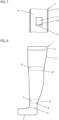
- Fig. 1 shows how the side view according to Figure 2 , a knitted part 1 according to the invention in its turned-over basic position, which is knitted as a circular knit on a circular knitting machine or as a flat knit on a flat knitting machine as a one-piece knitted part. It comprises, see also the figures showing the knitted part 1 in the extended position Figures 3 and 4 , a tubular leg section 2 and a foot section 3 immediately adjacent to this.
- the leg section 2 preferably extends over the ankle to just before the heel, where the foot section 3 then connects. This is shown by way of example via the dashed dividing line 4 in Fig. 4 shown.
- a waistband 5 is knitted onto the upper end of the leg section 2, which can be pulled lengthwise to tighten the knitted part 1, among other things.
- the knitted part 1 is, for example, a compressive knitted part in which the basic knitted fabric forming the leg section 2 and the foot section 3, knitted from at least one basic knitted thread, is at least partially and at least in the leg section 2 with a compressive property.
- the entire knitted part 1 can be compressive in both the leg section 2 and the foot section 3. This is achieved by inserting an elastic thread, for example as a weft thread, into the basic knitted fabric, which offers resistance to the stretching in the circumferential direction, so that compression pressure can be applied to the underlying, overlapping fabric.
- the compression of the knitted part 1, in particular in the leg section 2 (or in the arm section in the case of an arm stocking), can be determined using an appropriate measuring device, as specified, for example, in DIN 58133 or the comparable quality assurance RAL-GZ 387/1 "Medical compression stockings" of the German Institute for Quality Assurance and Labeling eV.
- This measurement is preferably determined using the "HOSY” or "HOSYcan” test device, which is used in particular for measuring compression pressure on compression textiles, in particular medical compression textiles, from Hohenstein Textile Testing Institute GmbH & Co. KG. This applies to all described embodiments.
- At least one pulling element 7 is arranged on the inside 6 of the leg section 2, which serves to pull the knitted part 1 lengthwise.
- Figures 1 and 2 show the knitted part 1 in the basic position in which the knitted part is before being put on. In this position, the leg section 2 is pulled over the foot section 3 so that the inside 6 of the leg section 2 is on the outside. In the basic form shown, the pulling element 7 is free, so it can easily be grasped with two hands.
- the pulling element 7 is designed here as a ring-shaped, circumferential pulling element 7, which is firmly attached to the inner side 6 of the leg section 3 by a lower end 8, while the pulling element 7 is otherwise free or loose, as in the Figures 3 and 4 where the pulling element 7 is shown guided slightly inwards.
- This optical marking 18 shows where the top 9 of the foot part 3 is, so that the user can orientate himself on this and bring the knitted part 1 into a correct position relative to the foot or leg.
- the foot section 3 naturally also has an anatomical shape corresponding to the foot, in that it has a corresponding heel section 10 on the one hand and a corresponding toe section 11 on the other.
- This optical marking 18 can now be used to correctly position the shoe relative to the foot, so that the foot can be correctly slipped into the foot section 3.
- the knitted part 1 When putting on the garment, starting from the basic shape turned inside out, the Figures 1 and 2 , the knitted part 1 is first grasped by the ring-shaped pulling element 7 and pulled with the foot section 3 over the toes and further over the foot.
- pulling over the heel is often very difficult, especially if the knitted part 1 has compressive properties.
- the lower section of the leg section 2 which is significantly reduced in diameter and which is virtually attached to the Fig. 4 shown dividing line, pulled over the heel, which is known and how Fig. 2 indicates that it is relatively wide when viewed from the side. This means that the knitted part 1 or leg section 2 must be stretched considerably in this area, which is sometimes very difficult with a compressive knit.
- the ring-shaped pulling element 7 is arranged on the leg section 2, a strong direct pull can be exerted on the lower region of the leg section 2 and via this on the foot section 3 in the longitudinal direction, which significantly simplifies pulling over the heel area.
- the pulling element 7, which is ring-shaped here, can be a pulling element which, like at least the leg section 2, has compressive properties, i.e. exerts pressure on the overlapping tissue.
- the pulling element 7 can also be knitted and provided with an elastic thread that causes the compression.
- the pulling element 7 can also consist of a surface material that is elastic in the circumferential direction, such as a plastic film or the like, so that a corresponding pressure acting radially inwards can also be generated via this.
- the leg section 2 is also equipped with compression, the two compressive sections overlap in the overlap area, i.e. in which the leg section 2 lies above the pulling element 7. This means that there is a double layer there, consisting of the pulling element 7 and the leg section 2, as well as two separate compressions that overlap. A total pressure is created there, resulting from the pressure exerted via the pulling element 7 and the pressure exerted via the leg section 2.
- the ring-shaped pulling element 7 is preferably arranged in a B area (ankle) defined in accordance with DIN 58133 (alternatively, it can also be arranged in the B1 area in accordance with DIN 58133). If the knitted part 1 is a compression stocking, the highest compression pressure is to be generated in this B area in accordance with DIN 58133. A corresponding pressure can now be generated in a simple manner by superimposing the two individual compressions, whereby the pressure can be varied within a relatively wide range. This is because the greater the additional pressure generated via the pulling element 7, the higher the local total pressure can be set. This means that a relatively high local total pressure is established in the wearing position.
- Fig. 5 shows a partial view of a knitted part 1 according to the invention, wherein the same reference numerals are used for the same parts.
- the knitted part 1 is again a calf stocking.
- this can of course be a different type of knitted part such as a half-thigh stocking, tights or arm stocking, with or without a foot or hand section.
- the tubular leg section 2 which consists of a basic knit made of at least one knit thread. If the leg section 2 is compressive, an elastic thread is also inserted, for example as a weft thread.
- the pulling element 7 is also a knitted pulling element 7, which is knitted in one piece onto the leg section 2 with its end 8. This knitting as a quasi freely hanging, flexible and ring-shaped "rag" is easily possible on both a circular knitting machine and a flat knitting machine.
- the pulling element 7 is either knitted from the same knitted thread as the leg section 2 and, if necessary, also made compressive by introducing an elastic thread.
- a padding 12 preferably in The padding 12 is provided in the form of a plush or a plush layer, which is formed immediately when knitting the leg section 2.
- This padding 12 increases the thickness of the leg section 2. It extends, as Fig. 5 shows, in the example shown, on both sides of the pulling element 7 and connects to it seamlessly or with a small gap. In the carrying position, this padding 12 compensates for the double-layered bulge resulting from the overlap, so that no or only an insignificant corresponding peripheral edge or bead is formed.
- the pulling element 7 is knitted and knitted in one piece to the leg section 2.
- the ring-shaped pulling element 7 is a separate element that can either be knitted from a knitted thread, can optionally also be equipped with compression via an elastic thread, or consists of a surface material that is elastic in the circumferential direction but as rigid as possible in the transverse direction, in particular plastic material.
- This separate pulling element 7 is now connected via a corresponding connection 13, which in Fig. 6 is only indicated schematically, in the area of the lower end 8 of the pulling element 7, it is firmly connected to the tubular leg section 2 on its inner side 6.
- This connection 13 can be a seam, for example, i.e. the pulling element 7 is sewn on. Alternatively, it can also be an adhesive connection. Irrespective of this, the connection 13 is designed in such a way that a high tensile force can be applied to the leg section 2 via the pulling element 7.
- Fig. 7 shows an embodiment of a knitted part 1 according to the invention in the form of a sectional partial view, in which a local pulling element 7 is arranged as a pulling element 7, which is either knitted as a knitted pulling element 7 in one piece on the inner side 6 of the tubular leg section 2 with its lower end 8, or which is attached as a separate, knitted or surface-section-consisting pulling element 7 to the inner side 6 of the leg section 2 via a connection 13, which is shown here only in dashed lines as an example.
- Two such local pulling elements 7 are preferred, which are quasi free-standing tabs are provided diametrically opposite one another on the inner circumference of the leg section 2.
- These local pulling elements 7 are preferably open at the sides, i.e. designed as open tabs, which makes it possible to reach into the tab-shaped or double-layered or ring-shaped pulling element 7 with the finger and thus to be able to grip it manually very well and to apply a high tensile force.
- Fig. 8 shows an embodiment of a knitted part 1 according to the invention, here in the form of a long thigh stocking, again comprising a leg section 2 and a foot section 3 knitted onto it.
- the foot section 3 is shown here as an example with an open toe end.
- the knitted part 1 can be a non-compressive or a compressive knitted part 1, whereby the advantages of the arrangement of the pulling element(s) 7 are of course particularly present in a compressive knitted part 1.
- a first pulling element 7, here again an annular pulling element 7 by way of example, is again attached to the inner side 6 of the tubular leg section 2, preferably in the B area, with its lower end 8, for example knitted in one piece or sewn or glued on separately, as described above.
- a further pulling element 7 ⁇ here again annular by way of example, is provided with its lower end 8', which is of course preferably connected to the inner side 6 of the leg section 2 in the same way as the first pulling element 7, i.e. is also knitted in one piece or is sewn or glued on as a separate pulling element 7'.
- This design with pulling elements 7, 7' provided at two longitudinal positions or in two longitudinal planes enables a multi-stage, optimal putting on of the long thigh stocking.
- the leg section 2 is put over the foot section 3.
- the first pulling element 7 is free at one end and can be gripped so that the foot can be inserted into the Foot section 3 can be inserted or the foot section 3 and the lower end of the leg section 2 can be pulled over the heel.
- the waistband 5 is grasped and then the end area of the leg section 2 is pulled into the end position over the thigh.
- drawing elements 7, 7' in more than two longitudinal positions, just as corresponding local drawing elements 7, 7' can of course also be provided instead of the annular drawing elements 7, 7'.
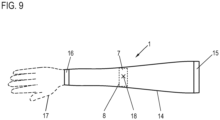
- Fig. 9 finally shows a knitted part 1 in the form of an arm stocking, which is not part of the invention, comprising an elongated, tubular arm section 14, with an upper end with a first waistband 15 and a lower end here with a second waistband 16.
- a hand section 17 can also be knitted in one piece onto the arm section 14, as shown in dashed lines.
- the arm section 14, as well as the hand section 17, is also made from a basic knit made of at least one knitted thread and can optionally be provided with a compressive property via an elastic thread.
- the pulling element 7 can either be knitted in one piece or can be sewn or glued on as a separate, knitted or sheet-material pulling element 7.
- the pulling element 7 can make it easier to put on in the same way as described above for the other embodiments.
- the Fig. 9 The arm section area shown to the right of the pulling element 7 is pulled over the arm section area shown to the left of the pulling element 7, so that the pulling element 7 is exposed and can be grasped to pull it over. After pulling it over the forearm, the waistband 15 can then be grasped and the remaining arm section area pulled over the upper arm.
- the pulling element 7 can have an optical marking 18 that indicates the correct orientation of the knitted part 1 relative to the arm or hand, in particular if a hand section 17 is provided.
Landscapes
- Engineering & Computer Science (AREA)
- Textile Engineering (AREA)
- Socks And Pantyhose (AREA)
Claims (11)
- Pièce tricotée comprenant une portion de jambe (2) à enfiler au moins sur une portion d'une jambe, au moins un élément de traction (7, 7') qui peut être saisi manuellement étant prévu dans une position de port, du côté intérieur (6) de la portion de jambe (2) comportant une portion de bord, afin de tirer la pièce tricotée sur la portion d'une jambe, la portion de jambe (2) étant conçue pour être compressive au moins par portions, l'élément de traction (7, 7') étant conçu de manière à entourer annulairement la circonférence, l'élément de traction annulaire (7, 7') et la portion de jambe (2) étant compressifs dans une zone de chevauchement avec l'élément de traction (7, 7'), caractérisée en ce que l'élément de traction annulaire compressif (7, 7') est disposé du côté intérieur à une position longitudinale qui est espacée d'un bord supérieur et d'un bord inférieur de la portion de jambe (2) .
- Pièce tricotée selon la revendication 1, caractérisée en ce que l'élément de traction ou les éléments de traction (7, 7') sont des éléments tricotés, ou en ce que l'élément de traction ou les éléments de traction (7, 7') sont en une matière flexible sensiblement bidimensionnelle, en notamment en une matière synthétique.
- Pièce tricotée selon la revendication 2, caractérisée en ce que l'élément de traction tricoté ou les éléments de traction tricotés (7, 7') sont tricotés d'une seule pièce avec la portion de jambe (2), ou en ce que l'élément de traction tricoté ou les éléments de traction tricotés (7, 7') ou l'élément de traction tricoté ou les éléments de traction tricotés (7, 7') qui sont en une matière flexible sensiblement bidimensionnelle sont cousus ou collés sur la portion de jambe (2).
- Pièce tricotée selon l'une des revendications précédentes, caractérisée en ce que l'élément de traction compressif (7, 7') et la portion de jambe (2) qui est compressive dans la zone de chevauchement sont compressives au moins de manière à peu près égale, ou en ce qu'ils sont compressifs avec des intensités différentes.
- Pièce tricotée selon l'une des revendications précédentes, caractérisée en ce que l'élément de traction annulaire compressif (7, 7') est disposé dans la zone B ou B1 selon DIN 58133.
- Pièce tricotée selon l'une des revendications précédentes, caractérisée en ce qu'au moins un autre élément de traction (7') est prévu le long de la portion de jambe (2) à au moins une position longitudinale latérale intérieure.
- Pièce tricotée selon l'une des revendications précédentes, caractérisée en ce qu'un rembourrage (12) qui augmente l'épaisseur du tricot est tricoté au moins par portions du côté intérieur (6) de la portion de jambe (2) .
- Pièce tricotée selon l'une des revendications précédentes, caractérisée en ce qu'au moins un marquage optique (18) qui indique la position d'un talon (10) rentré dans la position de base est prévu du côté intérieur (6) de la portion de jambe (2) ou sur l'élément de traction (7, 7').
- Pièce tricotée selon l'une des revendications précédentes, caractérisée en ce que l'élément de traction (7, 7') est conçu dans une couleur différente de celle de la portion de jambe (2).
- Pièce tricotée selon l'une des revendications précédentes, caractérisée en ce qu'il s'agit d'un bas mollet, d'un bas mi-cuisse, d'un bas cuisse ou d'un collant, comprenant éventuellement une portion de pied (3) qui est attenante à la portion de jambe (2) et qui est fermée ou ouverte.
- Procédé d'enfilage d'une pièce tricotée selon l'une des revendications précédentes, caractérisé en ce que la pièce tricotée (1), qui est dans une position de base et dans laquelle la portion de jambe (2) est retournée de sorte que son côté intérieur (6) est tourné vers l'extérieur, est tirée sur le pied par traction sur au moins un élément de traction (7), puis la portion de jambe (2) est tirée davantage sur la jambe jusque dans la position de port par saisie et traction sur la portion de bord (5) de la portion de jambe (2) ou est tirée davantage sur la jambe par saisie et traction sur au moins un autre élément de traction (7'), puis jusque dans la position de port par saisie et traction sur la portion de bord (5) de la portion de jambe (2).
Priority Applications (3)
| Application Number | Priority Date | Filing Date | Title |
|---|---|---|---|
| EP20211940.0A EP4008819B1 (fr) | 2020-12-04 | 2020-12-04 | Pièce tricotée |
| PCT/EP2021/078429 WO2022117252A1 (fr) | 2020-12-04 | 2021-10-14 | Article en tissu tricoté |
| US18/252,867 US20230413931A1 (en) | 2020-12-04 | 2021-10-14 | Knitted fabric article |
Applications Claiming Priority (1)
| Application Number | Priority Date | Filing Date | Title |
|---|---|---|---|
| EP20211940.0A EP4008819B1 (fr) | 2020-12-04 | 2020-12-04 | Pièce tricotée |
Publications (2)
| Publication Number | Publication Date |
|---|---|
| EP4008819A1 EP4008819A1 (fr) | 2022-06-08 |
| EP4008819B1 true EP4008819B1 (fr) | 2025-02-05 |
Family
ID=73726692
Family Applications (1)
| Application Number | Title | Priority Date | Filing Date |
|---|---|---|---|
| EP20211940.0A Active EP4008819B1 (fr) | 2020-12-04 | 2020-12-04 | Pièce tricotée |
Country Status (3)
| Country | Link |
|---|---|
| US (1) | US20230413931A1 (fr) |
| EP (1) | EP4008819B1 (fr) |
| WO (1) | WO2022117252A1 (fr) |
Families Citing this family (1)
| Publication number | Priority date | Publication date | Assignee | Title |
|---|---|---|---|---|
| EP4008819B1 (fr) * | 2020-12-04 | 2025-02-05 | medi GmbH & Co. KG | Pièce tricotée |
Family Cites Families (18)
| Publication number | Priority date | Publication date | Assignee | Title |
|---|---|---|---|---|
| US4005494A (en) * | 1975-10-20 | 1977-02-01 | The Pocket Socks Corporation | Pocket sock and method of knitting same |
| US4373215A (en) * | 1980-06-19 | 1983-02-15 | Wm. G. Leininger Knitting Company | Double sock construction |
| US4856112A (en) * | 1987-06-04 | 1989-08-15 | Effle Michael D | Powder cuff |
| FR2775431B1 (fr) * | 1998-03-02 | 2000-08-04 | Innothera Topic Int | Procede et dispositif pour enfiler sur un membre une orthese compressive tubulaire telle que bas, collant ou chaussette en materiau textile elastique tricote |
| US6192519B1 (en) * | 1999-03-19 | 2001-02-27 | Kathleen L. Coalter | Athletic sports pad |
| US6401247B1 (en) * | 2000-06-06 | 2002-06-11 | Williams, Iv Thomas Conrad | Protective sleeve for garment apparel |
| FR2813323B1 (fr) * | 2000-08-23 | 2003-01-10 | Dim Sa | Article de vetement tubulaire tricote avec partie de maintien, notamment article chaussant |
| US6665876B1 (en) * | 2001-11-01 | 2003-12-23 | James O. Newman | Combination protective sleeve and head wear |
| US6826779B1 (en) * | 2003-08-25 | 2004-12-07 | Mckenzie Mark Christopher | Arm protection device |
| GB0326144D0 (en) * | 2003-11-07 | 2003-12-17 | Np Aerospace Ltd | Protective garments |
| US7076973B1 (en) * | 2005-01-28 | 2006-07-18 | Wigwam Mills, Inc. | Method and apparatus for making a sock having a looped tab |
| FR2926018A1 (fr) * | 2008-01-08 | 2009-07-10 | Thuasne Soc Par Actions Simpli | Article textile tubulaire de compression. |
| US7975886B2 (en) * | 2008-07-08 | 2011-07-12 | Mcallister John J | Sock donning system |
| KR200481379Y1 (ko) * | 2015-12-02 | 2016-09-22 | 정은화 | 보온부가 형성된 방한 의류 |
| US11401636B2 (en) * | 2018-12-28 | 2022-08-02 | Nike, Inc. | Sock with tab |
| US11717033B2 (en) * | 2019-09-05 | 2023-08-08 | Nike, Inc. | Easy Don and Doff sock |
| EP4008819B1 (fr) * | 2020-12-04 | 2025-02-05 | medi GmbH & Co. KG | Pièce tricotée |
| US20240260680A1 (en) * | 2023-02-06 | 2024-08-08 | Nike, Inc. | Sock with assistive pull loops |
-
2020
- 2020-12-04 EP EP20211940.0A patent/EP4008819B1/fr active Active
-
2021
- 2021-10-14 WO PCT/EP2021/078429 patent/WO2022117252A1/fr not_active Ceased
- 2021-10-14 US US18/252,867 patent/US20230413931A1/en active Pending
Also Published As
| Publication number | Publication date |
|---|---|
| EP4008819A1 (fr) | 2022-06-08 |
| US20230413931A1 (en) | 2023-12-28 |
| WO2022117252A1 (fr) | 2022-06-09 |
Similar Documents
| Publication | Publication Date | Title |
|---|---|---|
| DE69912104T2 (de) | Vorrichtung zum anziehen einer kompressionsorthese in form von aus elastischem textilmaterial bestehenden stützstrumpfhose, -kniestrumpf, -socken | |
| DE2629837C2 (de) | Medizinischer Strumpf | |
| DE102013103914B3 (de) | Kompressives Rundgestrick zum Überziehen über eine ein Gelenk aufweisende Extremität | |
| DE60001707T2 (de) | Mehrschichtige kompressionsorthese und verfahren zum anziehen | |
| DE102004036344B4 (de) | Strickware zum Stützen und/oder Komprimieren und/oder Kompressionsbehandlung von Körperteilen und Verfahren zur Herstellung einer solchen Strickware | |
| CH712938B1 (de) | Kompressionskleidungsstück. | |
| EP2364683B1 (fr) | Bandage de compression et son procédé de fabrication | |
| EP3351667B1 (fr) | Corsage de contention ou collant de contention pourvu de corsage permettant le traitement par compression pendant la grossesse | |
| EP3251641A1 (fr) | Article de compression | |
| EP4371541A1 (fr) | Ensemble vêtement de compression | |
| WO2022117252A1 (fr) | Article en tissu tricoté | |
| EP4137626B1 (fr) | Procédé de fabrication d'un article de compression sans couture sur un métier à tricoter rectiligne | |
| DE102016125409A1 (de) | Eingefasste Textilorthese | |
| EP3575463B1 (fr) | Pièce de vêtement pour jambes, en particulier bas | |
| AT525012B1 (de) | Kompressionstextil mit integrierter An- und Ausziehhilfe | |
| EP3647476B1 (fr) | Pièce tricotée médicale et procédé pour sa réalisatiion | |
| DE102016112484B3 (de) | Bandeinheit sowie Verfahren und Verwendung hierzu | |
| EP1791453B1 (fr) | Systeme d'assistance a l'enfilage et au retrait de chaussettes | |
| EP3473760B1 (fr) | Pièce tricotée | |
| DE102018130930A1 (de) | Gestricktes Bekleidungsteil | |
| DE3205109C2 (de) | Zweiteilige Strumpfwarenkombination | |
| EP3831994B1 (fr) | Pièce tricotée | |
| DE19806372C1 (de) | Socke und Verfahren zur Herstellung einer Socke | |
| DE102019119396A1 (de) | Medizinisches Gestrickteil und Verfahren zur Herstellung eines solchen Gestrickteils | |
| DE102004047248A1 (de) | An- und Ausziehhilfe für Strümpfe |
Legal Events
| Date | Code | Title | Description |
|---|---|---|---|
| PUAI | Public reference made under article 153(3) epc to a published international application that has entered the european phase |
Free format text: ORIGINAL CODE: 0009012 |
|
| STAA | Information on the status of an ep patent application or granted ep patent |
Free format text: STATUS: THE APPLICATION HAS BEEN PUBLISHED |
|
| AK | Designated contracting states |
Kind code of ref document: A1 Designated state(s): AL AT BE BG CH CY CZ DE DK EE ES FI FR GB GR HR HU IE IS IT LI LT LU LV MC MK MT NL NO PL PT RO RS SE SI SK SM TR |
|
| STAA | Information on the status of an ep patent application or granted ep patent |
Free format text: STATUS: REQUEST FOR EXAMINATION WAS MADE |
|
| 17P | Request for examination filed |
Effective date: 20221202 |
|
| RBV | Designated contracting states (corrected) |
Designated state(s): AL AT BE BG CH CY CZ DE DK EE ES FI FR GB GR HR HU IE IS IT LI LT LU LV MC MK MT NL NO PL PT RO RS SE SI SK SM TR |
|
| P01 | Opt-out of the competence of the unified patent court (upc) registered |
Effective date: 20230427 |
|
| GRAP | Despatch of communication of intention to grant a patent |
Free format text: ORIGINAL CODE: EPIDOSNIGR1 |
|
| STAA | Information on the status of an ep patent application or granted ep patent |
Free format text: STATUS: GRANT OF PATENT IS INTENDED |
|
| INTG | Intention to grant announced |
Effective date: 20241029 |
|
| GRAS | Grant fee paid |
Free format text: ORIGINAL CODE: EPIDOSNIGR3 |
|
| GRAA | (expected) grant |
Free format text: ORIGINAL CODE: 0009210 |
|
| STAA | Information on the status of an ep patent application or granted ep patent |
Free format text: STATUS: THE PATENT HAS BEEN GRANTED |
|
| AK | Designated contracting states |
Kind code of ref document: B1 Designated state(s): AL AT BE BG CH CY CZ DE DK EE ES FI FR GB GR HR HU IE IS IT LI LT LU LV MC MK MT NL NO PL PT RO RS SE SI SK SM TR |
|
| REG | Reference to a national code |
Ref country code: GB Ref legal event code: FG4D Free format text: NOT ENGLISH |
|
| REG | Reference to a national code |
Ref country code: CH Ref legal event code: EP |
|
| REG | Reference to a national code |
Ref country code: DE Ref legal event code: R096 Ref document number: 502020010352 Country of ref document: DE |
|
| REG | Reference to a national code |
Ref country code: IE Ref legal event code: FG4D Free format text: LANGUAGE OF EP DOCUMENT: GERMAN |
|
| REG | Reference to a national code |
Ref country code: NL Ref legal event code: MP Effective date: 20250205 |
|
| PG25 | Lapsed in a contracting state [announced via postgrant information from national office to epo] |
Ref country code: RS Free format text: LAPSE BECAUSE OF FAILURE TO SUBMIT A TRANSLATION OF THE DESCRIPTION OR TO PAY THE FEE WITHIN THE PRESCRIBED TIME-LIMIT Effective date: 20250505 |
|
| PG25 | Lapsed in a contracting state [announced via postgrant information from national office to epo] |
Ref country code: FI Free format text: LAPSE BECAUSE OF FAILURE TO SUBMIT A TRANSLATION OF THE DESCRIPTION OR TO PAY THE FEE WITHIN THE PRESCRIBED TIME-LIMIT Effective date: 20250205 |
|
| PG25 | Lapsed in a contracting state [announced via postgrant information from national office to epo] |
Ref country code: PL Free format text: LAPSE BECAUSE OF FAILURE TO SUBMIT A TRANSLATION OF THE DESCRIPTION OR TO PAY THE FEE WITHIN THE PRESCRIBED TIME-LIMIT Effective date: 20250205 |
|
| PG25 | Lapsed in a contracting state [announced via postgrant information from national office to epo] |
Ref country code: ES Free format text: LAPSE BECAUSE OF FAILURE TO SUBMIT A TRANSLATION OF THE DESCRIPTION OR TO PAY THE FEE WITHIN THE PRESCRIBED TIME-LIMIT Effective date: 20250205 |
|
| REG | Reference to a national code |
Ref country code: LT Ref legal event code: MG9D |
|
| PG25 | Lapsed in a contracting state [announced via postgrant information from national office to epo] |
Ref country code: NO Free format text: LAPSE BECAUSE OF FAILURE TO SUBMIT A TRANSLATION OF THE DESCRIPTION OR TO PAY THE FEE WITHIN THE PRESCRIBED TIME-LIMIT Effective date: 20250505 Ref country code: IS Free format text: LAPSE BECAUSE OF FAILURE TO SUBMIT A TRANSLATION OF THE DESCRIPTION OR TO PAY THE FEE WITHIN THE PRESCRIBED TIME-LIMIT Effective date: 20250605 |
|
| PG25 | Lapsed in a contracting state [announced via postgrant information from national office to epo] |
Ref country code: NL Free format text: LAPSE BECAUSE OF FAILURE TO SUBMIT A TRANSLATION OF THE DESCRIPTION OR TO PAY THE FEE WITHIN THE PRESCRIBED TIME-LIMIT Effective date: 20250205 |
|
| PG25 | Lapsed in a contracting state [announced via postgrant information from national office to epo] |
Ref country code: HR Free format text: LAPSE BECAUSE OF FAILURE TO SUBMIT A TRANSLATION OF THE DESCRIPTION OR TO PAY THE FEE WITHIN THE PRESCRIBED TIME-LIMIT Effective date: 20250205 |
|
| PG25 | Lapsed in a contracting state [announced via postgrant information from national office to epo] |
Ref country code: LV Free format text: LAPSE BECAUSE OF FAILURE TO SUBMIT A TRANSLATION OF THE DESCRIPTION OR TO PAY THE FEE WITHIN THE PRESCRIBED TIME-LIMIT Effective date: 20250205 Ref country code: PT Free format text: LAPSE BECAUSE OF FAILURE TO SUBMIT A TRANSLATION OF THE DESCRIPTION OR TO PAY THE FEE WITHIN THE PRESCRIBED TIME-LIMIT Effective date: 20250605 |
|
| PG25 | Lapsed in a contracting state [announced via postgrant information from national office to epo] |
Ref country code: GR Free format text: LAPSE BECAUSE OF FAILURE TO SUBMIT A TRANSLATION OF THE DESCRIPTION OR TO PAY THE FEE WITHIN THE PRESCRIBED TIME-LIMIT Effective date: 20250506 Ref country code: BG Free format text: LAPSE BECAUSE OF FAILURE TO SUBMIT A TRANSLATION OF THE DESCRIPTION OR TO PAY THE FEE WITHIN THE PRESCRIBED TIME-LIMIT Effective date: 20250205 |
|
| PG25 | Lapsed in a contracting state [announced via postgrant information from national office to epo] |
Ref country code: SE Free format text: LAPSE BECAUSE OF FAILURE TO SUBMIT A TRANSLATION OF THE DESCRIPTION OR TO PAY THE FEE WITHIN THE PRESCRIBED TIME-LIMIT Effective date: 20250205 |
|
| PG25 | Lapsed in a contracting state [announced via postgrant information from national office to epo] |
Ref country code: SM Free format text: LAPSE BECAUSE OF FAILURE TO SUBMIT A TRANSLATION OF THE DESCRIPTION OR TO PAY THE FEE WITHIN THE PRESCRIBED TIME-LIMIT Effective date: 20250205 |
|
| PG25 | Lapsed in a contracting state [announced via postgrant information from national office to epo] |
Ref country code: DK Free format text: LAPSE BECAUSE OF FAILURE TO SUBMIT A TRANSLATION OF THE DESCRIPTION OR TO PAY THE FEE WITHIN THE PRESCRIBED TIME-LIMIT Effective date: 20250205 |
|
| PG25 | Lapsed in a contracting state [announced via postgrant information from national office to epo] |
Ref country code: EE Free format text: LAPSE BECAUSE OF FAILURE TO SUBMIT A TRANSLATION OF THE DESCRIPTION OR TO PAY THE FEE WITHIN THE PRESCRIBED TIME-LIMIT Effective date: 20250205 Ref country code: CZ Free format text: LAPSE BECAUSE OF FAILURE TO SUBMIT A TRANSLATION OF THE DESCRIPTION OR TO PAY THE FEE WITHIN THE PRESCRIBED TIME-LIMIT Effective date: 20250205 |
|
| PG25 | Lapsed in a contracting state [announced via postgrant information from national office to epo] |
Ref country code: RO Free format text: LAPSE BECAUSE OF FAILURE TO SUBMIT A TRANSLATION OF THE DESCRIPTION OR TO PAY THE FEE WITHIN THE PRESCRIBED TIME-LIMIT Effective date: 20250205 |
|
| PG25 | Lapsed in a contracting state [announced via postgrant information from national office to epo] |
Ref country code: SK Free format text: LAPSE BECAUSE OF FAILURE TO SUBMIT A TRANSLATION OF THE DESCRIPTION OR TO PAY THE FEE WITHIN THE PRESCRIBED TIME-LIMIT Effective date: 20250205 |
|
| REG | Reference to a national code |
Ref country code: DE Ref legal event code: R097 Ref document number: 502020010352 Country of ref document: DE |
|
| PLBE | No opposition filed within time limit |
Free format text: ORIGINAL CODE: 0009261 |
|
| STAA | Information on the status of an ep patent application or granted ep patent |
Free format text: STATUS: NO OPPOSITION FILED WITHIN TIME LIMIT |
|
| REG | Reference to a national code |
Ref country code: CH Ref legal event code: L10 Free format text: ST27 STATUS EVENT CODE: U-0-0-L10-L00 (AS PROVIDED BY THE NATIONAL OFFICE) Effective date: 20251217 |
|
| REG | Reference to a national code |
Ref country code: CH Ref legal event code: U11 Free format text: ST27 STATUS EVENT CODE: U-0-0-U10-U11 (AS PROVIDED BY THE NATIONAL OFFICE) Effective date: 20260101 |
|
| PGFP | Annual fee paid to national office [announced via postgrant information from national office to epo] |
Ref country code: DE Payment date: 20251211 Year of fee payment: 6 |
|
| PGFP | Annual fee paid to national office [announced via postgrant information from national office to epo] |
Ref country code: GB Payment date: 20251219 Year of fee payment: 6 |
|
| 26N | No opposition filed |
Effective date: 20251106 |
|
| PGFP | Annual fee paid to national office [announced via postgrant information from national office to epo] |
Ref country code: IT Payment date: 20251223 Year of fee payment: 6 |
|
| PGFP | Annual fee paid to national office [announced via postgrant information from national office to epo] |
Ref country code: FR Payment date: 20251229 Year of fee payment: 6 |
|
| PGFP | Annual fee paid to national office [announced via postgrant information from national office to epo] |
Ref country code: CH Payment date: 20260101 Year of fee payment: 6 |