EP4014880A1 - Capteur dentaire pour la zone intraorale - Google Patents
Capteur dentaire pour la zone intraorale Download PDFInfo
- Publication number
- EP4014880A1 EP4014880A1 EP20214651.0A EP20214651A EP4014880A1 EP 4014880 A1 EP4014880 A1 EP 4014880A1 EP 20214651 A EP20214651 A EP 20214651A EP 4014880 A1 EP4014880 A1 EP 4014880A1
- Authority
- EP
- European Patent Office
- Prior art keywords
- sensor
- plastic material
- dental sensor
- dental
- area
- Prior art date
- Legal status (The legal status is an assumption and is not a legal conclusion. Google has not performed a legal analysis and makes no representation as to the accuracy of the status listed.)
- Granted
Links
Images


Classifications
-
- A—HUMAN NECESSITIES
- A61—MEDICAL OR VETERINARY SCIENCE; HYGIENE
- A61B—DIAGNOSIS; SURGERY; IDENTIFICATION
- A61B5/00—Measuring for diagnostic purposes; Identification of persons
- A61B5/68—Arrangements of detecting, measuring or recording means, e.g. sensors, in relation to patient
- A61B5/6801—Arrangements of detecting, measuring or recording means, e.g. sensors, in relation to patient specially adapted to be attached to or worn on the body surface
- A61B5/6813—Specially adapted to be attached to a specific body part
- A61B5/6814—Head
- A61B5/682—Mouth, e.g., oral cavity; tongue; Lips; Teeth
-
- A—HUMAN NECESSITIES
- A61—MEDICAL OR VETERINARY SCIENCE; HYGIENE
- A61B—DIAGNOSIS; SURGERY; IDENTIFICATION
- A61B5/00—Measuring for diagnostic purposes; Identification of persons
- A61B5/103—Measuring devices for testing the shape, pattern, colour, size or movement of the body or parts thereof, for diagnostic purposes
- A61B5/107—Measuring physical dimensions, e.g. size of the entire body or parts thereof
- A61B5/1077—Measuring of profiles
- A61B5/1078—Measuring of profiles by moulding
-
- A—HUMAN NECESSITIES
- A61—MEDICAL OR VETERINARY SCIENCE; HYGIENE
- A61B—DIAGNOSIS; SURGERY; IDENTIFICATION
- A61B5/00—Measuring for diagnostic purposes; Identification of persons
- A61B5/45—For evaluating or diagnosing the musculoskeletal system or teeth
- A61B5/4538—Evaluating a particular part of the muscoloskeletal system or a particular medical condition
- A61B5/4542—Evaluating the mouth, e.g. the jaw
- A61B5/4547—Evaluating teeth
-
- A—HUMAN NECESSITIES
- A61—MEDICAL OR VETERINARY SCIENCE; HYGIENE
- A61B—DIAGNOSIS; SURGERY; IDENTIFICATION
- A61B6/00—Apparatus or devices for radiation diagnosis; Apparatus or devices for radiation diagnosis combined with radiation therapy equipment
- A61B6/50—Apparatus or devices for radiation diagnosis; Apparatus or devices for radiation diagnosis combined with radiation therapy equipment specially adapted for specific body parts; specially adapted for specific clinical applications
- A61B6/51—Apparatus or devices for radiation diagnosis; Apparatus or devices for radiation diagnosis combined with radiation therapy equipment specially adapted for specific body parts; specially adapted for specific clinical applications for dentistry
- A61B6/512—Intraoral means
-
- A—HUMAN NECESSITIES
- A61—MEDICAL OR VETERINARY SCIENCE; HYGIENE
- A61B—DIAGNOSIS; SURGERY; IDENTIFICATION
- A61B2562/00—Details of sensors; Constructional details of sensor housings or probes; Accessories for sensors
- A61B2562/12—Manufacturing methods specially adapted for producing sensors for in-vivo measurements
-
- A—HUMAN NECESSITIES
- A61—MEDICAL OR VETERINARY SCIENCE; HYGIENE
- A61B—DIAGNOSIS; SURGERY; IDENTIFICATION
- A61B2562/00—Details of sensors; Constructional details of sensor housings or probes; Accessories for sensors
- A61B2562/16—Details of sensor housings or probes; Details of structural supports for sensors
-
- A—HUMAN NECESSITIES
- A61—MEDICAL OR VETERINARY SCIENCE; HYGIENE
- A61B—DIAGNOSIS; SURGERY; IDENTIFICATION
- A61B5/00—Measuring for diagnostic purposes; Identification of persons
- A61B5/01—Measuring temperature of body parts ; Diagnostic temperature sensing, e.g. for malignant or inflamed tissue
-
- A—HUMAN NECESSITIES
- A61—MEDICAL OR VETERINARY SCIENCE; HYGIENE
- A61B—DIAGNOSIS; SURGERY; IDENTIFICATION
- A61B5/00—Measuring for diagnostic purposes; Identification of persons
- A61B5/145—Measuring characteristics of blood in vivo, e.g. gas concentration or pH-value ; Measuring characteristics of body fluids or tissues, e.g. interstitial fluid or cerebral tissue
- A61B5/14507—Measuring characteristics of blood in vivo, e.g. gas concentration or pH-value ; Measuring characteristics of body fluids or tissues, e.g. interstitial fluid or cerebral tissue specially adapted for measuring characteristics of body fluids other than blood
-
- A—HUMAN NECESSITIES
- A61—MEDICAL OR VETERINARY SCIENCE; HYGIENE
- A61C—DENTISTRY; APPARATUS OR METHODS FOR ORAL OR DENTAL HYGIENE
- A61C19/00—Dental auxiliary appliances
- A61C19/04—Measuring instruments specially adapted for dentistry
-
- B—PERFORMING OPERATIONS; TRANSPORTING
- B29—WORKING OF PLASTICS; WORKING OF SUBSTANCES IN A PLASTIC STATE IN GENERAL
- B29C—SHAPING OR JOINING OF PLASTICS; SHAPING OF MATERIAL IN A PLASTIC STATE, NOT OTHERWISE PROVIDED FOR; AFTER-TREATMENT OF THE SHAPED PRODUCTS, e.g. REPAIRING
- B29C35/00—Heating, cooling or curing, e.g. crosslinking or vulcanising; Apparatus therefor
- B29C35/02—Heating or curing, e.g. crosslinking or vulcanizing during moulding, e.g. in a mould
-
- B—PERFORMING OPERATIONS; TRANSPORTING
- B29—WORKING OF PLASTICS; WORKING OF SUBSTANCES IN A PLASTIC STATE IN GENERAL
- B29L—INDEXING SCHEME ASSOCIATED WITH SUBCLASS B29C, RELATING TO PARTICULAR ARTICLES
- B29L2031/00—Other particular articles
- B29L2031/752—Measuring equipment
-
- B—PERFORMING OPERATIONS; TRANSPORTING
- B29—WORKING OF PLASTICS; WORKING OF SUBSTANCES IN A PLASTIC STATE IN GENERAL
- B29L—INDEXING SCHEME ASSOCIATED WITH SUBCLASS B29C, RELATING TO PARTICULAR ARTICLES
- B29L2031/00—Other particular articles
- B29L2031/753—Medical equipment; Accessories therefor
Definitions
- the present invention relates to a dental sensor for an intraoral area and a method for inserting a dental sensor.
- Sensor housings that are not anatomically correct for use in the intraoral area offer poor wearing comfort, unnecessarily interfere with food intake and are not sufficiently fastened, since the natural shape of the dental arch cannot be used for additional adhesion. There is also a risk that the dental sensor will become detached and be swallowed while being worn.
- a dental sensor for an intraoral area with a fastening area made of plastic material for molding a mouth area when inserting the dental sensor, which can be hardened after molding. Curing can take place inside or outside the oral cavity, ie intraorally or extraorally.
- the mouth area can include a tooth area with one or more teeth, which can optionally be in contact with the gums.
- the dental sensor Due to the shape of the plastic material, the dental sensor can be adapted quickly and individually to the spatial conditions in the intraoral space. As a result, the position of the dental sensor can be fixed better.
- the shaping can, for example, be carried out directly by a dentist in a few minutes. In the case of attachment by means of an anatomically correct shape, it is not necessary to resort to attachment by means of chemical adhesion, which is difficult to remove and damages the teeth.
- the plastic material can be cured by means of light, electromagnetic radiation or heat.
- the plastic material can also be curable by drying, by a chemical reaction with water (hydration) or by addition-crosslinking. This achieves the technical advantage, for example, that curing can be initiated in a targeted manner after molding.
- the plastic material comprises a curable polymer.
- a curable polymer for example, that particularly suitable materials that harden quickly are used.
- the plastic material can retain a residual flexibility or elasticity after curing so that it can be removed more easily, such as silicone-like materials.
- the dental sensor can also be removed if it becomes wedged, for example if the dental sensor is attached to a tooth gap.
- the plastic material is arranged on a sensor housing of the dental sensor.
- the sensor housing can be attached to the tooth area.
- a connection between the attachment area and the dental sensor or the sensor housing is established by means of a positively designed connecting means.
- the positively configured connecting means comprises, for example, one or more protruding nubs or anchors that connect to the plastic material.
- the plastic material deforms, shapes or compresses around this structure. This achieves the technical advantage, for example, that a reliable connection can be achieved between the fastening area and the dental sensor.
- the sensor housing comprises a transparent or thermally conductive material and the transparent or thermally conductive material is in contact with the plastic material.
- the dental sensor comprises an exposure device or a heating device for the plastic material. This achieves the technical advantage, for example, that the plastic material can be cured directly by the dental sensor.
- the exposure device or the heating device can be activated by a user.
- the technical advantage achieved is that the user can control the curing of the plastic material.
- the exposure device or the heating device is activated wirelessly.
- the exposure device or the heating device can be activated, for example, via W-Lan, NFC or Bluetooth using a mobile phone. This achieves the technical advantage, for example, that no actuation actions are required in the intraoral space.
- the fastening area, the dental sensor and/or the sensor housing comprises a prefabricated through opening and/or one or more channels. This achieves the technical advantage, for example, that liquid can be guided from the tooth directly to a sensor that analyzes the liquid.
- the area around the through-opening cannot be hardened. This achieves the technical advantage, for example, that the dental sensor can be easily removed after hardening.
- the plastic material is anatomically preformed.
- the anatomical preforming can include, for example, corresponding tooth-shaped bulges for individual teeth.
- a separating layer for detaching the plastic material from the tooth area is arranged on the plastic material. This achieves the technical advantage, for example, that the dental sensor can be easily removed after the impression has been taken.
- the technical problem is solved by a method for inserting a dental sensor for an intraoral area, with the steps of molding a tooth area when inserting the dental sensor by means of a plastic material; and curing the plastic material after molding.
- curing takes place by means of light, electromagnetic radiation or heat. This also achieves the technical advantage, for example, that curing can be initiated in a targeted manner after molding.
- the dental sensor 100 comprises a sensor housing 107 in which evaluation electronics 117 and a sensor unit are arranged.
- the evaluation electronics 117 and the sensor unit are suitable together for autonomously carrying out measurements of specific physical parameters on the tooth 105 .
- the sensor housing 107 is made of plastic, for example, in a standard form.
- the sensor housing 107 has a flat or approximately anatomically preformed contact surface 123 facing the tooth, which is covered with a flat layer of a malleable and plastic material 103 .
- the plastic material 103 forms a fastening area 101 for fastening the dental sensor 100 in the mouth area.
- a layer thickness of the plastic material 103 is 1 mm to 10 mm, for example.
- a suitable production-side structuring of the contact surface 123 of the sensor housing 107 or an anchoring of the plastic material 103 through holes in the sensor housing 107 can be provided.
- An anatomically shaped contact surface 123 of the sensor housing 107 or in the plastic material 103 has the advantage that the wearing comfort of the dental sensor 100 is improved and it interferes less with food intake.
- the natural shape of the dental arch can be used for additional adhesion of the dental sensor 100.
- the plastic and/or deformable material 103 deforms when it is pressed onto the tooth area 105, which can comprise one or more teeth. In this way, a three-dimensional impression of the tooth area 105 is obtained through the plastic material 103 .
- the plastic material 103 is then hardened so that it loses its deformability. This can be achieved, for example, by means of exposure to UV light, blue light, contact with oxygen or saliva, or by heat. It would also be conceivable to use a material that is first activated and then hardens in the tooth area 105 over time.
- the plastic material 103 is preferably prefabricated, so that the time required for attaching the dental sensor 100 is reduced and possible sources of error during processing are ruled out.
- the plastic material 103 comprises, for example, a hydrophilic vinylpolysiloxane impression material or a polymer based on methacrylates and various fillers linked to silanes, such as a light-curing nanohybrid composite.
- the plastic material 103 comprises, for example, a monomer matrix made up of dimethacrylates (17-18% by weight).
- Fillers include, for example, barium glass, ytterbium trifluoride and/or various oxides and copolymers (82-83% by weight).
- Additives, initiators, stabilizers and pigments can be additional ingredients ( ⁇ 1.0% by weight).
- the total amount of inorganic fillers is, for example, between 53 and 80% by volume.
- the particle sizes of the inorganic fillers are, for example, between 40 nm and 3 ⁇ m.
- the plastic material 103 can have antibiotic properties, such as by incorporating silver particles, copper particles or a mixture with chlorhexidine and chloroxylenol.
- the plastic material may include antibiotics such as penicillin, clindamycin, erythromycin, cefadroxil, metronidazole and/or tetracyclines.
- the plastic material 103 can also be formed by a silicone or a plasticine.
- the dental sensor 100 can, for example, comprise an electronic exposure device 109 which is arranged inside the sensor housing 107 .
- the exposure device 109 emits light by means of a light-emitting diode, which leads to the curing of the light-curing plastic material 103 .
- the sensor case 107 is formed of, for example, an optically transparent material that is in contact with the plastic material 103 .
- a chemical exposure device 109 can also be provided, which is based on the principle of chemiluminescence, is activated once and emits chemically generated light.
- the chemical exposure device 109 can be formed, for example, by a glow stick that can be inserted into the sensor housing 107 .
- the dental sensor 100 can also have a heating device 111 which is arranged inside the sensor housing 107 .
- the heater 111 emits heat by means of a heating coil, for example, which causes the thermosetting plastic material 103 to harden.
- a heating coil for example, which causes the thermosetting plastic material 103 to harden.
- between the heater 111 there is a metal as a heat conductive material between the heater 111 and the plastic material 103.
- a chemical heater 111 may be provided which is activated once and emits chemically generated heat.
- the exposure device 109 or the heating device 111 can be activated manually by actuating a switch or push button on the sensor housing so that they light up or heat for a predetermined period of time. At the end of this period, the plastic material 103 has hardened.
- the exposure device 109 or the heating device 111 can also be activated wirelessly via radio, for example via WLAN, NFC or Bluetooth using a mobile phone or tablet PC.
- a corresponding interface is implemented in the evaluation electronics 117, via which the exposure device 109 or the heating device 111 can be controlled.
- a separating layer 121 can be provided as a separating agent, which facilitates detachment of the dental sensor 100 from the tooth or the tooth area 105 after curing.
- the separating layer 121 is additionally arranged on the plastic material 103 and prevents direct contact between the tooth 105 and the plastic material 103.
- This separating layer 121 can be formed, for example, by a thin film of grease or oil or by a protective membrane made of rubber, Teflon or latex. In this case, the dental sensor 100 can be removed again without leaving any residue even without the hardened plastic material 103 .
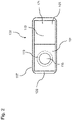
- FIG. 2 shows a schematic top view of the dental sensor 100 and the plastic material 103.
- a cut-out or passage opening 115 in a predetermined shape can be provided on the production side, eg for a built-in sensor unit or any saliva ducts for better supply of saliva from the tooth area 105 to the sensor unit inside the sensor housing 107 during intraoral use.
- the sensor unit can be, for example, a sensor for measuring a pH value, an ethanol concentration, a lactate concentration, a cortisol concentration, a glucose concentration, an ion concentration, for measuring sound waves when biting and/or a sensor for measuring a temperature.
- the sensor unit within the dental sensor 100 can perform an intraoral measurement of different parameters over a longer period of time
- This recess or through-opening 115 provided can be made of plastic material 103, for example, which cannot be hardened in a surrounding region 119 around the through-opening 115. In the case of a light-curing material 103, this can be done, for example, by not introducing any photoinitiators into this surrounding area 119. This surrounding area 119 thus does not harden under the influence of light after the molding and can be removed relatively easily.
- the surrounding region 119 may also include a water soluble material such as sugar, cornstarch, or a water soluble filament.
- An anatomical adaptation of the dental sensor 100 can be achieved, for example, by tooth-shaped or concave bulges 113 in the contact surface 123 of the dental sensor 100, which correspond at least approximately to the tooth area 105. In this way, the dental sensor 100 can be closer are arranged on the tooth area 105. Not only the contact surface 123, but also the plastic material 103 can be anatomically preformed with corresponding tooth-shaped or concave bulges 113.
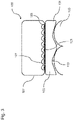
- 3 12 shows a further schematic view through the dental sensor 100.
- the attachment area 101 is attached to the plastic material 103 through a plurality of openings 129 which are arranged in the sensor housing 107.
- An internal curing step can then take place in order to strengthen the plate structures 127 . In this way, the plastic material 103 claws at the sensor housing 107 and can no longer be detached.
- the plastic material 101 supports itself through the mushroom-shaped structures 127 after hardening.
- Another way of attachment can be achieved by microstructuring the contact surface 123, for example by simply grinding it.
- the through-opening 115 can be provided in the plastic material 103 to enable a measurement by the sensor unit.
- the passage opening 115 forms an additional measuring area for the sensor unit next to the channels.
- the through-opening 115 can be made, for example, from plastic material 103 that cannot be hardened in a surrounding area 119 around the through-opening 115 .
- the channels 125 are formed by indentations in the plastic material 103 and are used to conduct or pass through liquid (saliva) to a sensor unit or to allow an exchange of air and ventilation of the measuring area.
- the channels 125 can be arranged in a horizontal, diagonal or vertical direction.
- the channels 125 can be formed, for example, by not introducing a photoinitiator into the light-curing plastic material 103 at the intended locations of the channels 125 . After light-curing, the non-curable plastic material 103 in these locations can be removed, such as with a water jet or spatula, without the photoinitiators, so as to leave the channels 125 in the attachment area 101 .
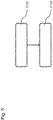
- figure 5 10 shows a block diagram of a method for inserting a dental sensor 100.
- step S101 when inserting the dental sensor 100, the tooth area 105 is molded using a plastic material 103 by pressing it onto the tooth area.
- the plastic material 103 adapts to the shape of the tooth 105 .
- step S102 the plastic material 103 is cured after molding.
- the dental sensor 100 can remain in the oral cavity or be hardened outside of the oral cavity. In this way, the attachment area 101 can be attached to a tooth 105 .
- the individual shaping can be accomplished in a few time-saving work steps directly in the patient's mouth in just one session.
- Such an anatomically individual shaping of an intraoral sensor carrier on the patient makes the dental sensor 100 suitable for permanent wear. This can during food intake, worn during conversations and while sleeping.
- the dental sensor 100 can be shaped and adapted directly by the dentist in a short time.
- a sensor positioning close to the tooth is made possible since the dental sensor 100 is anatomically individually adapted to the patient.
- All method steps can be implemented by means that are suitable for carrying out the respective method step. All functions performed by physical features can be a method step of a method.
Landscapes
- Health & Medical Sciences (AREA)
- Life Sciences & Earth Sciences (AREA)
- Engineering & Computer Science (AREA)
- Veterinary Medicine (AREA)
- Public Health (AREA)
- Physics & Mathematics (AREA)
- Biophysics (AREA)
- General Health & Medical Sciences (AREA)
- Biomedical Technology (AREA)
- Animal Behavior & Ethology (AREA)
- Medical Informatics (AREA)
- Surgery (AREA)
- Molecular Biology (AREA)
- Heart & Thoracic Surgery (AREA)
- Pathology (AREA)
- Oral & Maxillofacial Surgery (AREA)
- Dentistry (AREA)
- Orthopedic Medicine & Surgery (AREA)
- Physical Education & Sports Medicine (AREA)
- Rheumatology (AREA)
- Optics & Photonics (AREA)
- Epidemiology (AREA)
- High Energy & Nuclear Physics (AREA)
- Nuclear Medicine, Radiotherapy & Molecular Imaging (AREA)
- Radiology & Medical Imaging (AREA)
- Dental Tools And Instruments Or Auxiliary Dental Instruments (AREA)
Priority Applications (7)
| Application Number | Priority Date | Filing Date | Title |
|---|---|---|---|
| EP24157317.9A EP4342421A3 (fr) | 2020-12-16 | 2020-12-16 | Capteur dentaire pour la zone intraorale |
| EP20214651.0A EP4014880B1 (fr) | 2020-12-16 | 2020-12-16 | Capteur dentaire pour la zone intraorale |
| KR1020237020065A KR20230118856A (ko) | 2020-12-16 | 2021-11-30 | 구강내 영역을 위한 치과용 센서 |
| JP2023535790A JP7724288B2 (ja) | 2020-12-16 | 2021-11-30 | 口腔内領域用の歯科用センサ |
| CN202180051750.XA CN115884731B (zh) | 2020-12-16 | 2021-11-30 | 用于口内区域的牙科传感器 |
| PCT/EP2021/083511 WO2022128439A1 (fr) | 2020-12-16 | 2021-11-30 | Capteur dentaire pour la région intra-orale |
| US17/541,655 US20220183624A1 (en) | 2020-12-16 | 2021-12-03 | Dental Sensor For The Intraoral Region |
Applications Claiming Priority (1)
| Application Number | Priority Date | Filing Date | Title |
|---|---|---|---|
| EP20214651.0A EP4014880B1 (fr) | 2020-12-16 | 2020-12-16 | Capteur dentaire pour la zone intraorale |
Related Child Applications (1)
| Application Number | Title | Priority Date | Filing Date |
|---|---|---|---|
| EP24157317.9A Division EP4342421A3 (fr) | 2020-12-16 | 2020-12-16 | Capteur dentaire pour la zone intraorale |
Publications (3)
| Publication Number | Publication Date |
|---|---|
| EP4014880A1 true EP4014880A1 (fr) | 2022-06-22 |
| EP4014880B1 EP4014880B1 (fr) | 2024-03-06 |
| EP4014880C0 EP4014880C0 (fr) | 2024-03-06 |
Family
ID=73855123
Family Applications (2)
| Application Number | Title | Priority Date | Filing Date |
|---|---|---|---|
| EP20214651.0A Active EP4014880B1 (fr) | 2020-12-16 | 2020-12-16 | Capteur dentaire pour la zone intraorale |
| EP24157317.9A Withdrawn EP4342421A3 (fr) | 2020-12-16 | 2020-12-16 | Capteur dentaire pour la zone intraorale |
Family Applications After (1)
| Application Number | Title | Priority Date | Filing Date |
|---|---|---|---|
| EP24157317.9A Withdrawn EP4342421A3 (fr) | 2020-12-16 | 2020-12-16 | Capteur dentaire pour la zone intraorale |
Country Status (6)
| Country | Link |
|---|---|
| US (1) | US20220183624A1 (fr) |
| EP (2) | EP4014880B1 (fr) |
| JP (1) | JP7724288B2 (fr) |
| KR (1) | KR20230118856A (fr) |
| CN (1) | CN115884731B (fr) |
| WO (1) | WO2022128439A1 (fr) |
Families Citing this family (3)
| Publication number | Priority date | Publication date | Assignee | Title |
|---|---|---|---|---|
| EP4285863B1 (fr) * | 2020-12-16 | 2025-07-02 | Ivoclar Vivadent AG | Système de fixation dentaire et procédé non thérapeutique de fixation d'un objet dentaire |
| EP4226894A1 (fr) * | 2020-12-16 | 2023-08-16 | Ivoclar Vivadent AG | Objet dentaire doté d'une zone adhésive |
| EP4295767B1 (fr) * | 2022-06-21 | 2025-09-10 | Ivoclar Vivadent AG | Logement de circuit pour une application intrabuccale portable |
Citations (2)
| Publication number | Priority date | Publication date | Assignee | Title |
|---|---|---|---|---|
| US5090047A (en) * | 1990-10-23 | 1992-02-18 | Applied Research Company | Apparatus for reproducibly positioning an image receptor for intraoral diagnostics |
| WO2016105592A1 (fr) * | 2014-12-24 | 2016-06-30 | Chodorow Ingram | Guides d'intervention chirurgicale jetables, procédés et trousses |
Family Cites Families (27)
| Publication number | Priority date | Publication date | Assignee | Title |
|---|---|---|---|---|
| JPS5058895A (fr) * | 1973-09-24 | 1975-05-21 | ||
| JP2000083952A (ja) * | 1998-09-11 | 2000-03-28 | Nikkusu:Kk | 歯科用フイルム/センサ収納具 |
| US7610919B2 (en) * | 2004-05-28 | 2009-11-03 | Aetherworks Ii, Inc. | Intraoral aversion devices and methods |
| US8899976B2 (en) * | 2004-09-24 | 2014-12-02 | Align Technology, Inc. | Release agent receptacle |
| US8023676B2 (en) * | 2008-03-03 | 2011-09-20 | Sonitus Medical, Inc. | Systems and methods to provide communication and monitoring of user status |
| JP2010131181A (ja) | 2008-12-04 | 2010-06-17 | Tokuyama Dental Corp | マウスガードの製造方法 |
| GB201317478D0 (en) * | 2013-10-02 | 2013-11-13 | Provost Fellows Foundation Scholars And The Other Members Of Board Of The | A sensor for an oral appliance |
| CN112767083B (zh) * | 2014-12-23 | 2024-09-13 | 贝洱工艺公司 | 销售涂料的系统和方法 |
| DE102015102058A1 (de) * | 2015-02-12 | 2016-08-18 | Matthias Hodecker | Zahnmedizinische Vorrichtung mit Übertragungsschale |
| US20230181350A1 (en) * | 2015-03-04 | 2023-06-15 | Real 3D Polymers, LLC | Dual purpose orthodontic appliance for alignment, bruxism, and sleep apnea with smart sensors and control module system |
| WO2017100828A1 (fr) * | 2015-12-15 | 2017-06-22 | Zuaiter Omar | Appareil dentaire |
| JP6971235B2 (ja) * | 2015-12-17 | 2021-11-24 | スリーエム イノベイティブ プロパティズ カンパニー | ワンピース状歯科修復物用モールド |
| US10314537B2 (en) * | 2016-06-07 | 2019-06-11 | Peter John Zegarelli | Oral data collecting device for diagnosis or prognosis |
| EP3254641B1 (fr) * | 2016-06-08 | 2020-12-09 | Ivoclar Vivadent AG | Procédé de production d'un appareil de durcissement par rayonnement, d'une fixation et d'un appareil de production de restauration dentaire |
| US20180085059A1 (en) * | 2016-09-29 | 2018-03-29 | Jin Kyun LEE | Wearable apparatus attaching on tooth and the sensing device fixing at tooth |
| US20180177570A1 (en) | 2016-12-28 | 2018-06-28 | Ormco Corporation | Light assisted orthodontic devices and methods of making and using same |
| WO2018140577A1 (fr) * | 2017-01-25 | 2018-08-02 | Dentsply Sirona Inc. | Système dentaire à photodurcissement |
| KR20180115371A (ko) * | 2017-04-12 | 2018-10-23 | 주식회사 비엘시스템 | 마우스피스 타입의 광 치료기 |
| US11504060B2 (en) * | 2017-06-23 | 2022-11-22 | Martha Ann Keels | Dental retainer with pH sensor |
| WO2019005808A1 (fr) * | 2017-06-26 | 2019-01-03 | Align Technology, Inc. | Indicateur de performance de biocapteur pour appareils intrabuccaux |
| WO2019071019A1 (fr) | 2017-10-04 | 2019-04-11 | Align Technology, Inc. | Appareils intra-oraux pour l'échantillonnage de tissu mou |
| US20190175104A1 (en) * | 2017-12-10 | 2019-06-13 | Bela Malik | In-situ salivary component collection, concentration, isolation, analytics, and communication system |
| CN210784761U (zh) * | 2019-08-13 | 2020-06-19 | 上海正雅齿科科技股份有限公司 | 一种自助式附件模板 |
| EP3878400B1 (fr) * | 2020-03-13 | 2023-10-18 | Seiko Group Corporation | Appareil de détection intra-orale et son procédé de fabrication |
| US12390359B2 (en) * | 2021-01-19 | 2025-08-19 | 3 Little Ladies, Inc. | Therapeutic oral device |
| US20230030704A1 (en) * | 2021-07-29 | 2023-02-02 | UCHU Biosensors, Inc. | Systems for measuring patient physiologic parameters |
| US12605091B2 (en) * | 2022-07-27 | 2026-04-21 | Dianyx Innovations, LLC | Systems and methods for intraoral pH monitoring |
-
2020
- 2020-12-16 EP EP20214651.0A patent/EP4014880B1/fr active Active
- 2020-12-16 EP EP24157317.9A patent/EP4342421A3/fr not_active Withdrawn
-
2021
- 2021-11-30 WO PCT/EP2021/083511 patent/WO2022128439A1/fr not_active Ceased
- 2021-11-30 KR KR1020237020065A patent/KR20230118856A/ko active Pending
- 2021-11-30 CN CN202180051750.XA patent/CN115884731B/zh active Active
- 2021-11-30 JP JP2023535790A patent/JP7724288B2/ja active Active
- 2021-12-03 US US17/541,655 patent/US20220183624A1/en active Pending
Patent Citations (2)
| Publication number | Priority date | Publication date | Assignee | Title |
|---|---|---|---|---|
| US5090047A (en) * | 1990-10-23 | 1992-02-18 | Applied Research Company | Apparatus for reproducibly positioning an image receptor for intraoral diagnostics |
| WO2016105592A1 (fr) * | 2014-12-24 | 2016-06-30 | Chodorow Ingram | Guides d'intervention chirurgicale jetables, procédés et trousses |
Also Published As
| Publication number | Publication date |
|---|---|
| EP4342421A3 (fr) | 2024-06-19 |
| KR20230118856A (ko) | 2023-08-14 |
| US20220183624A1 (en) | 2022-06-16 |
| JP2023553464A (ja) | 2023-12-21 |
| CN115884731B (zh) | 2026-03-17 |
| CN115884731A (zh) | 2023-03-31 |
| EP4342421A2 (fr) | 2024-03-27 |
| WO2022128439A1 (fr) | 2022-06-23 |
| JP7724288B2 (ja) | 2025-08-15 |
| EP4014880B1 (fr) | 2024-03-06 |
| EP4014880C0 (fr) | 2024-03-06 |
Similar Documents
| Publication | Publication Date | Title |
|---|---|---|
| WO2022128439A1 (fr) | Capteur dentaire pour la région intra-orale | |
| EP4233785B1 (fr) | Système de blocs de fraisage et procédé de fabrication de prothèses partielles ou totales | |
| DE112015000144B4 (de) | Pressformen eines Zahnersatzes aufweisend Keramik, wie Zirkoniumdioxid, mit einer aufgerauten Oberfläche | |
| EP3242628A1 (fr) | Procédé de fabrication d'une prothèse dentaire | |
| EP3223742A1 (fr) | Fabrication d'une prothèse dentaire par impression de la base prothétique sur les dents prothétiques | |
| EP3169270B1 (fr) | Prothèse dentaire pour la détermination de facettes d'abrasion | |
| WO2016012370A1 (fr) | Procédé de fabrication d'un composant au moyen d'un procédé de fabrication génératif, installation pour la fabrication d'un composant au moyen d'un procédé de fabrication génératif et implant médical généré de manière individuelle à un patient | |
| EP3128944A1 (fr) | Procédé de façonnage de dents prothétiques préconfectionnées | |
| EP4014926B1 (fr) | Objet dentaire destiné à être fixé sur une dent | |
| WO2018219407A2 (fr) | Porte-empreinte dentaire à adaptation individuelle pour le moulage fin dentaire | |
| DE2754278A1 (de) | Abdruckloeffel fuer die herstellung von kieferabdruecken in der zahnmedizin | |
| DE69830729T2 (de) | Mittel zum einbringen von füllmaterial während einer zahnbehandlung | |
| DE4217115A1 (de) | Vorrichtung und Verfahren zur Herstellung keramischer Paßkörper, insbesondere medizinischer Implantate und Zahnrestaurationen | |
| EP3157460A2 (fr) | Base de prothèse et procédé pour relier par liaison de matière au moins une dent artificielle à une base de prothèse | |
| DE102007031229A1 (de) | Dentalprothese | |
| EP3395286B1 (fr) | Procédé de fabrication d'un positionneur | |
| DE10339247A1 (de) | Verfahren zur Herstellung einer Dental-Restauration | |
| DE202025101714U1 (de) | Halter zur Herstellung eines Replikats einer Zahnprothese | |
| CH698803B1 (de) | Tiergebissabformlöffel. | |
| EP4057897A1 (fr) | Dispositif de surveillance d'état d'hygiène buccale et procédé de fabrication d'un dispositif de surveillance d'état d'hygiène buccale | |
| DE102021112178A1 (de) | Verfahren und Vorrichtung zur Herstellung einer Dentalprothese | |
| EP1652492A1 (fr) | Méthode et appareil pour la fabrication d'une dent artificièlle | |
| EP0214950A1 (fr) | Procédé pour améliorer la surface d'appui dans les prothèses dentaires et prothèse ainsi obtenue | |
| WO2020182966A1 (fr) | Ensemble prothèse dentaire | |
| EP0643951A1 (fr) | Dispositif pour la production d'échantillons frittés produisant la colorisation pour prothèses dentaires |
Legal Events
| Date | Code | Title | Description |
|---|---|---|---|
| PUAI | Public reference made under article 153(3) epc to a published international application that has entered the european phase |
Free format text: ORIGINAL CODE: 0009012 |
|
| STAA | Information on the status of an ep patent application or granted ep patent |
Free format text: STATUS: THE APPLICATION HAS BEEN PUBLISHED |
|
| AK | Designated contracting states |
Kind code of ref document: A1 Designated state(s): AL AT BE BG CH CY CZ DE DK EE ES FI FR GB GR HR HU IE IS IT LI LT LU LV MC MK MT NL NO PL PT RO RS SE SI SK SM TR |
|
| STAA | Information on the status of an ep patent application or granted ep patent |
Free format text: STATUS: REQUEST FOR EXAMINATION WAS MADE |
|
| 17P | Request for examination filed |
Effective date: 20220728 |
|
| RBV | Designated contracting states (corrected) |
Designated state(s): AL AT BE BG CH CY CZ DE DK EE ES FI FR GB GR HR HU IE IS IT LI LT LU LV MC MK MT NL NO PL PT RO RS SE SI SK SM TR |
|
| STAA | Information on the status of an ep patent application or granted ep patent |
Free format text: STATUS: EXAMINATION IS IN PROGRESS |
|
| 17Q | First examination report despatched |
Effective date: 20230124 |
|
| REG | Reference to a national code |
Ref country code: DE Ref legal event code: R079 Free format text: PREVIOUS MAIN CLASS: A61B0006140000 Ipc: A61C0019040000 Ref country code: DE Ref legal event code: R079 Ref document number: 502020007233 Country of ref document: DE Free format text: PREVIOUS MAIN CLASS: A61B0006140000 Ipc: A61C0019040000 |
|
| RIC1 | Information provided on ipc code assigned before grant |
Ipc: A61C 19/04 20060101AFI20230725BHEP |
|
| GRAP | Despatch of communication of intention to grant a patent |
Free format text: ORIGINAL CODE: EPIDOSNIGR1 |
|
| STAA | Information on the status of an ep patent application or granted ep patent |
Free format text: STATUS: GRANT OF PATENT IS INTENDED |
|
| INTG | Intention to grant announced |
Effective date: 20231004 |
|
| GRAS | Grant fee paid |
Free format text: ORIGINAL CODE: EPIDOSNIGR3 |
|
| GRAA | (expected) grant |
Free format text: ORIGINAL CODE: 0009210 |
|
| STAA | Information on the status of an ep patent application or granted ep patent |
Free format text: STATUS: THE PATENT HAS BEEN GRANTED |
|
| AK | Designated contracting states |
Kind code of ref document: B1 Designated state(s): AL AT BE BG CH CY CZ DE DK EE ES FI FR GB GR HR HU IE IS IT LI LT LU LV MC MK MT NL NO PL PT RO RS SE SI SK SM TR |
|
| REG | Reference to a national code |
Ref country code: CH Ref legal event code: EP |
|
| REG | Reference to a national code |
Ref country code: DE Ref legal event code: R096 Ref document number: 502020007233 Country of ref document: DE |
|
| REG | Reference to a national code |
Ref country code: IE Ref legal event code: FG4D Free format text: LANGUAGE OF EP DOCUMENT: GERMAN |
|
| U01 | Request for unitary effect filed |
Effective date: 20240311 |
|
| U07 | Unitary effect registered |
Designated state(s): AT BE BG DE DK EE FI FR IT LT LU LV MT NL PT SE SI Effective date: 20240319 |
|
| PG25 | Lapsed in a contracting state [announced via postgrant information from national office to epo] |
Ref country code: GR Free format text: LAPSE BECAUSE OF FAILURE TO SUBMIT A TRANSLATION OF THE DESCRIPTION OR TO PAY THE FEE WITHIN THE PRESCRIBED TIME-LIMIT Effective date: 20240607 |
|
| PG25 | Lapsed in a contracting state [announced via postgrant information from national office to epo] |
Ref country code: RS Free format text: LAPSE BECAUSE OF FAILURE TO SUBMIT A TRANSLATION OF THE DESCRIPTION OR TO PAY THE FEE WITHIN THE PRESCRIBED TIME-LIMIT Effective date: 20240606 Ref country code: HR Free format text: LAPSE BECAUSE OF FAILURE TO SUBMIT A TRANSLATION OF THE DESCRIPTION OR TO PAY THE FEE WITHIN THE PRESCRIBED TIME-LIMIT Effective date: 20240306 |
|
| PG25 | Lapsed in a contracting state [announced via postgrant information from national office to epo] |
Ref country code: ES Free format text: LAPSE BECAUSE OF FAILURE TO SUBMIT A TRANSLATION OF THE DESCRIPTION OR TO PAY THE FEE WITHIN THE PRESCRIBED TIME-LIMIT Effective date: 20240306 |
|
| PG25 | Lapsed in a contracting state [announced via postgrant information from national office to epo] |
Ref country code: RS Free format text: LAPSE BECAUSE OF FAILURE TO SUBMIT A TRANSLATION OF THE DESCRIPTION OR TO PAY THE FEE WITHIN THE PRESCRIBED TIME-LIMIT Effective date: 20240606 Ref country code: NO Free format text: LAPSE BECAUSE OF FAILURE TO SUBMIT A TRANSLATION OF THE DESCRIPTION OR TO PAY THE FEE WITHIN THE PRESCRIBED TIME-LIMIT Effective date: 20240606 Ref country code: HR Free format text: LAPSE BECAUSE OF FAILURE TO SUBMIT A TRANSLATION OF THE DESCRIPTION OR TO PAY THE FEE WITHIN THE PRESCRIBED TIME-LIMIT Effective date: 20240306 Ref country code: GR Free format text: LAPSE BECAUSE OF FAILURE TO SUBMIT A TRANSLATION OF THE DESCRIPTION OR TO PAY THE FEE WITHIN THE PRESCRIBED TIME-LIMIT Effective date: 20240607 Ref country code: ES Free format text: LAPSE BECAUSE OF FAILURE TO SUBMIT A TRANSLATION OF THE DESCRIPTION OR TO PAY THE FEE WITHIN THE PRESCRIBED TIME-LIMIT Effective date: 20240306 |
|
| PG25 | Lapsed in a contracting state [announced via postgrant information from national office to epo] |
Ref country code: IS Free format text: LAPSE BECAUSE OF FAILURE TO SUBMIT A TRANSLATION OF THE DESCRIPTION OR TO PAY THE FEE WITHIN THE PRESCRIBED TIME-LIMIT Effective date: 20240706 |
|
| PG25 | Lapsed in a contracting state [announced via postgrant information from national office to epo] |
Ref country code: SM Free format text: LAPSE BECAUSE OF FAILURE TO SUBMIT A TRANSLATION OF THE DESCRIPTION OR TO PAY THE FEE WITHIN THE PRESCRIBED TIME-LIMIT Effective date: 20240306 |
|
| PG25 | Lapsed in a contracting state [announced via postgrant information from national office to epo] |
Ref country code: CZ Free format text: LAPSE BECAUSE OF FAILURE TO SUBMIT A TRANSLATION OF THE DESCRIPTION OR TO PAY THE FEE WITHIN THE PRESCRIBED TIME-LIMIT Effective date: 20240306 |
|
| PG25 | Lapsed in a contracting state [announced via postgrant information from national office to epo] |
Ref country code: PL Free format text: LAPSE BECAUSE OF FAILURE TO SUBMIT A TRANSLATION OF THE DESCRIPTION OR TO PAY THE FEE WITHIN THE PRESCRIBED TIME-LIMIT Effective date: 20240306 |
|
| PG25 | Lapsed in a contracting state [announced via postgrant information from national office to epo] |
Ref country code: SK Free format text: LAPSE BECAUSE OF FAILURE TO SUBMIT A TRANSLATION OF THE DESCRIPTION OR TO PAY THE FEE WITHIN THE PRESCRIBED TIME-LIMIT Effective date: 20240306 |
|
| PG25 | Lapsed in a contracting state [announced via postgrant information from national office to epo] |
Ref country code: SM Free format text: LAPSE BECAUSE OF FAILURE TO SUBMIT A TRANSLATION OF THE DESCRIPTION OR TO PAY THE FEE WITHIN THE PRESCRIBED TIME-LIMIT Effective date: 20240306 Ref country code: SK Free format text: LAPSE BECAUSE OF FAILURE TO SUBMIT A TRANSLATION OF THE DESCRIPTION OR TO PAY THE FEE WITHIN THE PRESCRIBED TIME-LIMIT Effective date: 20240306 Ref country code: RO Free format text: LAPSE BECAUSE OF FAILURE TO SUBMIT A TRANSLATION OF THE DESCRIPTION OR TO PAY THE FEE WITHIN THE PRESCRIBED TIME-LIMIT Effective date: 20240306 Ref country code: PL Free format text: LAPSE BECAUSE OF FAILURE TO SUBMIT A TRANSLATION OF THE DESCRIPTION OR TO PAY THE FEE WITHIN THE PRESCRIBED TIME-LIMIT Effective date: 20240306 Ref country code: IS Free format text: LAPSE BECAUSE OF FAILURE TO SUBMIT A TRANSLATION OF THE DESCRIPTION OR TO PAY THE FEE WITHIN THE PRESCRIBED TIME-LIMIT Effective date: 20240706 Ref country code: CZ Free format text: LAPSE BECAUSE OF FAILURE TO SUBMIT A TRANSLATION OF THE DESCRIPTION OR TO PAY THE FEE WITHIN THE PRESCRIBED TIME-LIMIT Effective date: 20240306 |
|
| REG | Reference to a national code |
Ref country code: DE Ref legal event code: R097 Ref document number: 502020007233 Country of ref document: DE |
|
| PLBE | No opposition filed within time limit |
Free format text: ORIGINAL CODE: 0009261 |
|
| STAA | Information on the status of an ep patent application or granted ep patent |
Free format text: STATUS: NO OPPOSITION FILED WITHIN TIME LIMIT |
|
| U20 | Renewal fee for the european patent with unitary effect paid |
Year of fee payment: 5 Effective date: 20241227 |
|
| 26N | No opposition filed |
Effective date: 20241209 |
|
| PG25 | Lapsed in a contracting state [announced via postgrant information from national office to epo] |
Ref country code: MC Free format text: LAPSE BECAUSE OF FAILURE TO SUBMIT A TRANSLATION OF THE DESCRIPTION OR TO PAY THE FEE WITHIN THE PRESCRIBED TIME-LIMIT Effective date: 20240306 |
|
| PG25 | Lapsed in a contracting state [announced via postgrant information from national office to epo] |
Ref country code: IE Free format text: LAPSE BECAUSE OF NON-PAYMENT OF DUE FEES Effective date: 20241216 |
|
| PGFP | Annual fee paid to national office [announced via postgrant information from national office to epo] |
Ref country code: GB Payment date: 20251229 Year of fee payment: 6 |
|
| U20 | Renewal fee for the european patent with unitary effect paid |
Year of fee payment: 6 Effective date: 20251205 |
|
| REG | Reference to a national code |
Ref country code: CH Ref legal event code: U11 Free format text: ST27 STATUS EVENT CODE: U-0-0-U10-U11 (AS PROVIDED BY THE NATIONAL OFFICE) Effective date: 20260219 |
|
| PGFP | Annual fee paid to national office [announced via postgrant information from national office to epo] |
Ref country code: CH Payment date: 20260219 Year of fee payment: 6 |
|
| PG25 | Lapsed in a contracting state [announced via postgrant information from national office to epo] |
Ref country code: CY Free format text: LAPSE BECAUSE OF FAILURE TO SUBMIT A TRANSLATION OF THE DESCRIPTION OR TO PAY THE FEE WITHIN THE PRESCRIBED TIME-LIMIT Effective date: 20240306 |