EP4019143A1 - Procédé de remplissage d'un récipient à l'aide une pompe de distribution et cartouche, système de gestion et machine correspondants - Google Patents
Procédé de remplissage d'un récipient à l'aide une pompe de distribution et cartouche, système de gestion et machine correspondants Download PDFInfo
- Publication number
- EP4019143A1 EP4019143A1 EP20383137.5A EP20383137A EP4019143A1 EP 4019143 A1 EP4019143 A1 EP 4019143A1 EP 20383137 A EP20383137 A EP 20383137A EP 4019143 A1 EP4019143 A1 EP 4019143A1
- Authority
- EP
- European Patent Office
- Prior art keywords
- cartridge
- interior
- container
- segment
- piston
- Prior art date
- Legal status (The legal status is an assumption and is not a legal conclusion. Google has not performed a legal analysis and makes no representation as to the accuracy of the status listed.)
- Withdrawn
Links
- 238000000034 method Methods 0.000 title claims abstract description 33
- 239000007788 liquid Substances 0.000 claims abstract description 58
- 238000004891 communication Methods 0.000 claims abstract description 20
- 238000005086 pumping Methods 0.000 claims description 24
- 238000007789 sealing Methods 0.000 claims description 17
- 238000012795 verification Methods 0.000 claims description 8
- 230000000903 blocking effect Effects 0.000 claims description 6
- 238000004519 manufacturing process Methods 0.000 claims description 5
- 230000003313 weakening effect Effects 0.000 claims description 5
- 238000005429 filling process Methods 0.000 claims description 2
- 239000002775 capsule Substances 0.000 description 3
- 230000008569 process Effects 0.000 description 3
- 239000000243 solution Substances 0.000 description 3
- 230000004913 activation Effects 0.000 description 1
- 239000002537 cosmetic Substances 0.000 description 1
- 238000005034 decoration Methods 0.000 description 1
- 238000002347 injection Methods 0.000 description 1
- 239000007924 injection Substances 0.000 description 1
- 230000002427 irreversible effect Effects 0.000 description 1
- 230000000670 limiting effect Effects 0.000 description 1
- 239000000463 material Substances 0.000 description 1
- 239000011159 matrix material Substances 0.000 description 1
- 230000007246 mechanism Effects 0.000 description 1
- 239000002861 polymer material Substances 0.000 description 1
- 230000002829 reductive effect Effects 0.000 description 1
- 230000002787 reinforcement Effects 0.000 description 1
- 230000000717 retained effect Effects 0.000 description 1
- 238000000926 separation method Methods 0.000 description 1
- 238000012546 transfer Methods 0.000 description 1
- 230000007704 transition Effects 0.000 description 1
- 238000003466 welding Methods 0.000 description 1
Images



Classifications
-
- B—PERFORMING OPERATIONS; TRANSPORTING
- B05—SPRAYING OR ATOMISING IN GENERAL; APPLYING FLUENT MATERIALS TO SURFACES, IN GENERAL
- B05B—SPRAYING APPARATUS; ATOMISING APPARATUS; NOZZLES
- B05B11/00—Single-unit hand-held apparatus in which flow of contents is produced by the muscular force of the operator at the moment of use
- B05B11/0005—Components or details
- B05B11/0037—Containers
- B05B11/0054—Cartridges, i.e. containers specially designed for easy attachment to or easy removal from the rest of the sprayer
-
- B—PERFORMING OPERATIONS; TRANSPORTING
- B67—OPENING, CLOSING OR CLEANING BOTTLES, JARS OR SIMILAR CONTAINERS; LIQUID HANDLING
- B67D—DISPENSING, DELIVERING OR TRANSFERRING LIQUIDS, NOT OTHERWISE PROVIDED FOR
- B67D7/00—Apparatus or devices for transferring liquids from bulk storage containers or reservoirs into vehicles or into portable containers, e.g. for retail sale purposes
- B67D7/02—Apparatus or devices for transferring liquids from bulk storage containers or reservoirs into vehicles or into portable containers, e.g. for retail sale purposes for transferring liquids other than fuel or lubricants
- B67D7/0277—Apparatus or devices for transferring liquids from bulk storage containers or reservoirs into vehicles or into portable containers, e.g. for retail sale purposes for transferring liquids other than fuel or lubricants using negative pressure
-
- B—PERFORMING OPERATIONS; TRANSPORTING
- B05—SPRAYING OR ATOMISING IN GENERAL; APPLYING FLUENT MATERIALS TO SURFACES, IN GENERAL
- B05B—SPRAYING APPARATUS; ATOMISING APPARATUS; NOZZLES
- B05B11/00—Single-unit hand-held apparatus in which flow of contents is produced by the muscular force of the operator at the moment of use
- B05B11/0005—Components or details
- B05B11/0097—Means for filling or refilling the sprayer
-
- B—PERFORMING OPERATIONS; TRANSPORTING
- B05—SPRAYING OR ATOMISING IN GENERAL; APPLYING FLUENT MATERIALS TO SURFACES, IN GENERAL
- B05B—SPRAYING APPARATUS; ATOMISING APPARATUS; NOZZLES
- B05B11/00—Single-unit hand-held apparatus in which flow of contents is produced by the muscular force of the operator at the moment of use
- B05B11/01—Single-unit hand-held apparatus in which flow of contents is produced by the muscular force of the operator at the moment of use characterised by the means producing the flow
- B05B11/10—Pump arrangements for transferring the contents from the container to a pump chamber by a sucking effect and forcing the contents out through the dispensing nozzle
- B05B11/1042—Components or details
- B05B11/1052—Actuation means
- B05B11/1053—Actuation means combined with means, other than pressure, for automatically opening a valve during actuation; combined with means for automatically removing closures or covers from the discharge nozzle during actuation
-
- B—PERFORMING OPERATIONS; TRANSPORTING
- B67—OPENING, CLOSING OR CLEANING BOTTLES, JARS OR SIMILAR CONTAINERS; LIQUID HANDLING
- B67D—DISPENSING, DELIVERING OR TRANSFERRING LIQUIDS, NOT OTHERWISE PROVIDED FOR
- B67D7/00—Apparatus or devices for transferring liquids from bulk storage containers or reservoirs into vehicles or into portable containers, e.g. for retail sale purposes
- B67D7/02—Apparatus or devices for transferring liquids from bulk storage containers or reservoirs into vehicles or into portable containers, e.g. for retail sale purposes for transferring liquids other than fuel or lubricants
- B67D7/0288—Container connection means
- B67D7/0294—Combined with valves
-
- B—PERFORMING OPERATIONS; TRANSPORTING
- B67—OPENING, CLOSING OR CLEANING BOTTLES, JARS OR SIMILAR CONTAINERS; LIQUID HANDLING
- B67D—DISPENSING, DELIVERING OR TRANSFERRING LIQUIDS, NOT OTHERWISE PROVIDED FOR
- B67D7/00—Apparatus or devices for transferring liquids from bulk storage containers or reservoirs into vehicles or into portable containers, e.g. for retail sale purposes
- B67D7/06—Details or accessories
- B67D7/38—Arrangements of hoses, e.g. operative connection with pump motor
-
- B—PERFORMING OPERATIONS; TRANSPORTING
- B67—OPENING, CLOSING OR CLEANING BOTTLES, JARS OR SIMILAR CONTAINERS; LIQUID HANDLING
- B67D—DISPENSING, DELIVERING OR TRANSFERRING LIQUIDS, NOT OTHERWISE PROVIDED FOR
- B67D7/00—Apparatus or devices for transferring liquids from bulk storage containers or reservoirs into vehicles or into portable containers, e.g. for retail sale purposes
- B67D7/06—Details or accessories
- B67D7/58—Arrangements of pumps
-
- B—PERFORMING OPERATIONS; TRANSPORTING
- B05—SPRAYING OR ATOMISING IN GENERAL; APPLYING FLUENT MATERIALS TO SURFACES, IN GENERAL
- B05B—SPRAYING APPARATUS; ATOMISING APPARATUS; NOZZLES
- B05B11/00—Single-unit hand-held apparatus in which flow of contents is produced by the muscular force of the operator at the moment of use
- B05B11/0005—Components or details
- B05B11/0037—Containers
- B05B11/0039—Containers associated with means for compensating the pressure difference between the ambient pressure and the pressure inside the container, e.g. pressure relief means
- B05B11/0044—Containers associated with means for compensating the pressure difference between the ambient pressure and the pressure inside the container, e.g. pressure relief means compensating underpressure by ingress of atmospheric air into the container, i.e. with venting means
-
- B—PERFORMING OPERATIONS; TRANSPORTING
- B05—SPRAYING OR ATOMISING IN GENERAL; APPLYING FLUENT MATERIALS TO SURFACES, IN GENERAL
- B05B—SPRAYING APPARATUS; ATOMISING APPARATUS; NOZZLES
- B05B11/00—Single-unit hand-held apparatus in which flow of contents is produced by the muscular force of the operator at the moment of use
- B05B11/01—Single-unit hand-held apparatus in which flow of contents is produced by the muscular force of the operator at the moment of use characterised by the means producing the flow
- B05B11/10—Pump arrangements for transferring the contents from the container to a pump chamber by a sucking effect and forcing the contents out through the dispensing nozzle
- B05B11/1001—Piston pumps
- B05B11/1023—Piston pumps having an outlet valve opened by deformation or displacement of the piston relative to its actuating stem
Definitions
- the invention relates to a method for refilling a container, wherein the container has a neck, a bottom, and an inner volume, wherein the container has a dispensing pump assembled on the neck.
- the dispensing pump is assembled on the neck in an irreversible manner, i.e., in a manner that does not envisage the user disassembling it and assembling it again on the container.
- the dispensing pump comprises:
- this cylindrical surface is a cylindrical surface in the broadest sense, i.e., as any surface generated from the movement of a straight line along a generatrix curve.
- the particular case in which the cylindrical surface is a circular cylindrical surface (or a cylinder with a circular cross-section) is, however, a preferred option for the present invention.
- Another object of the invention is a cartridge suitable for housing a liquid in the interior thereof, comprising a side wall, a base, and an upper portion.
- the cartridge according to the invention can be empty of liquid (for example, before being filled) or full of liquid.
- Another object of the invention is a management system of a cartridge according to the invention.
- Another object of the invention is a machine for performing a method according to the invention.
- Containers for example bottles with a dispensing pump assembled on the neck thereof are commonly used in a plurality of applications.
- containers with a dispensing pump such as the one indicated above are widely known.
- a common use is for the metering of perfumery, cosmetic, hygiene, and similar products.
- the user can unscrew the dispensing pump from the neck of the container and can refill the container.
- a refilling of the containers is not envisaged, said containers therefore being conceived as single-use containers. That is particularly the case when the dispensing pump is assembled on the container in a non-removable manner.
- US 10 399 103 B2 describes a system of refilling a container having a dispensing pump assembled thereon. To that end, the container is positioned upside down and its air passage is fluidically communicated with the interior of a bottle having the refilling liquid through a filling interface, such that a liquid transfer channel is established. A second channel, that is, a gas discharge channel, which allows the exit of the gas contained in the interior of the container, is also established.
- US 9 834 369 B2 describes a method of extracting liquid from a container having a dispensing pump assembled thereon. The method consists of injecting air under pressure into the container and forcing the exit of the liquid through the dispensing pump itself, which has a system of valves that are all open when they have a downstream overpressure.
- This purpose is achieved by a method of the type indicated above, characterized in that it comprises the following steps:
- the method according to the invention thus uses the air passage existing in the pump both for introducing the liquid in the container and for extracting the air accumulated in the interior of the container.
- the liquid gradually fills the inner volume of the container, but the air in the inner volume of the container cannot exit anywhere because, since the container is "right-side up", i.e., with the bottom in the lower position, the free end of the suction tube is below the free surface of the liquid. Therefore, the pressure in the interior of the container gradually increases and, accordingly, it is also necessary to increase the pressure to which the liquid in the interior of the cartridge is subjected for it to continue flowing towards the inner volume of the container.
- the filling of the container is interrupted by reducing the pressure in the interior of the cartridge to a value less than the pressure in the interior of the container.
- the air in the interior of the container can then pass through the air passage towards the interior of the cartridge, thus lowering the pressure in the interior of the container to a desired value.
- the steps of increasing the pressure in the interior of the cartridge and of reducing the pressure are then repeated a plurality of times until reaching the desired filled level.
- steps [1] and [2] and/or at least part of the sub-steps they comprise positioning the container such that the bottom is in the lower position, fluidically connecting the interior of a cartridge comprising a refilling liquid with the air passage, moving the piston to any position between the intermediate position and the retracted position
- steps [1] and [2] and/or at least part of the sub-steps they comprise can be satisfactorily performed in several different sequences and/or some of them can be performed simultaneously. Therefore, the indicated order is not a rigid definition of the sequence in which the steps and sub-steps take place, but rather is a mere indication of the steps comprised in the method according to the invention.
- the pressure is increased between 0.5 and 2 bar above atmospheric pressure. This pressure is high enough so as to allow a refilling with a smaller number of steps but without subjecting the container to such a high excess pressure that may cause said container to break.
- steps [3] and [4] are performed between 2 and 4 times, and preferably between 3 and 4 times.
- the cartridge comprises an individualized identifier for each cartridge and the method comprises a verification step by a user to verify the individualized identifier of the full cartridge, this verification step being performed prior to fluidically connecting the interior of the cartridge comprising a refilling liquid with the air passage.
- An advantageous alternative is presented when the method is performed by means of a machine comprising a reader of the individualized identifier and communication means suitable for establishing communication with a verifying entity of the individualized identifier (and, advantageously, also with other external databases), and the verification step is performed automatically by the machine, in which case the following is particularly advantageous: [a] if said verification gives a positive result, the machine continues with the refilling method and disables the individualized identifier (notifying the verifying entity that it has been used), and/or [b] if the verification gives a negative result, the machine interrupts the refilling method.
- Another advantageous alternative is presented when the verification step is performed by the user with other means, preferably by means of a mobile telephone.
- the inlet valve is a ball valve.
- Another object of the invention is a cartridge of the type indicated above, characterized in that it comprises an inlet with an inlet valve arranged in said upper portion and an outlet arranged on said base.
- the inlet valve is a three-position valve, and very preferably comprises: [a] a conduit, defining a longitudinal axis, with a first segment with a first cross-section, a second segment with a second cross-section different from the first cross-section, and a third segment with a third cross-section different from the second cross-section, and [b] a stopper, housed in the conduit, with a cross-section such that when the stopper is in the first segment or in the third segment the valve is open and when the stopper is in the second segment the valve is closed.
- the first cross-section and the third cross-section are polygonal and the stopper has a circular cross-section, the circular cross-section being of a diameter greater than the diameter of a circle inscribed in any of the polygonal cross-sections, and it is particularly advantageous for the first cross-section and the third cross-section to be triangular.
- the second cross-section it is advantageous for the second cross-section to be circular and for the stopper to also have a circular cross-section, the circular cross-section of the stopper being of a diameter greater than the diameter of the second cross-section.
- An inlet valve of this type is inexpensive to manufacture and can be made entirely of one and the same material. It is very simple for the valve to pass from the open position to the closed position and, subsequently, to the open position again.
- the stopper of the inlet valve is spherical.
- the outlet comprises a perforable film.
- the outlet comprises an outlet valve comprising: [a] a conduit, defining a longitudinal axis, with a first segment with a first cross-section and a second segment with a second cross-section different from the first cross-section, wherein the first segment is oriented towards the interior of the cartridge and the second segment is oriented towards the exterior of the cartridge, and [b] a stopper, housed in the conduit, with a cross-section such that when the stopper is in the first segment the valve is open and when the stopper is in the second segment the valve is closed.
- the first cross-section is polygonal and for the stopper to have a circular cross-section, the circular cross-section being of a diameter greater than the diameter of a circle inscribed in the polygonal cross-section, and it is particularly advantageous for the first cross-section to be triangular.
- the second cross-section is also advantageous for the second cross-section to be circular and for the stopper to also have a circular cross-section, the circular cross-section of the stopper being of a diameter greater than the diameter of the second cross-section.
- the stopper of the outlet valve is spherical.
- the upper portion has a weakening area demarcating a central area, wherein the weakening area has a shape such that the central area has a perimeter equal to the inner surface of the side wall, such that the central area is suitable for being used as a piston running along the side wall.
- Cartridges of this type can thereby be used with machines having a pushing member which pushes the central area, tearing the upper portion in the weakening area, and then pushing the liquid out through the outlet.
- another preferred embodiment consists of injecting air (or any gas in general) into the interior of the cartridge.
- the cartridge comprises axial stiffening means.
- these axial stiffening means comprise a hollow column, with a side opening, wherein the column extends from the base to the upper portion, and the hollow column is advantageously attached to the upper portion.
- the cartridge comprises radial stiffening means.
- these radial stiffening means comprise a plurality of ribs extending between the side wall and the base and/or comprise a plurality of ribs extending radially along the upper portion.
- the base and the side wall are a single part and the upper portion is an independent part assembled on the side wall.
- the manufacturing process is thereby optimized, reducing costs.
- the cartridge is made entirely of one and the same polymer material.
- the assembly can thereby be recycled without the need to perform separation processes.
- the cartridge comprises an individualized identifier for each cartridge.
- the individualized identifier is advantageously a barcode, preferably a matrix barcode and very preferably a QR code.
- Another object of the invention is a management system for managing a cartridge comprising an individualized identifier according to the invention, characterized in that it comprises the following steps:
- the system includes an additional step in which, after the disabling step for disabling the identifier, the appropriate person is informed of the disabling step performed, preferably including information about the type of cartridge, the date on which and location where disabling has taken place.
- Another object of the invention is a machine for performing a method according to the invention, characterized in that it comprises:
- the machine comprises adjustment means for adjusting the distance between the container and the connection means.
- adjustment means for adjusting the distance between the container and the connection means.
- connection means are removable.
- the machine it is of interest the machine to be compatible with a plurality of containers that are different from one another, which will have dispensing pumps different from one another.
- the dispensing pumps must always have the same elements required for the invention, they may vary in regard to other elements that are not indispensable for the invention.
- these differences may require the connection means to be different in the support area with the pump (diameters, heights) depending on the pump in question.
- connection means may also be appropriate for the connection means to be compatible with different families of cartridges. Being able to provide a family of connection means and being able to use one or the other, depending on the container (with the corresponding pump) to be refilled, is therefore of interest.
- connection means comprise, in the upper portion thereof, opening means of an outlet arranged at the base of the cartridge.
- the opening means comprise a needle, and very preferably a collapsible guard of the needle.
- the opening means comprise a rod suitable for pushing a stopper housed in a conduit arranged in the outlet of the cartridge.
- connection means comprise, in the lower portion thereof, a support surface suitable for moving the piston and a closure surface suitable for being supported on the pump and forming a sealed closure between the air passage and the exterior, such that the air passage only in fluidic communication with the interior of the cartridge.
- the machine comprises a reader for reading the individualized identifier and communication means suitable for establishing communication with a verifying entity of the individualized identifier.
- the method according to the invention is performed for refilling containers having a specific type of dispensing pumps, as indicated above.
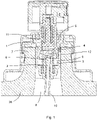
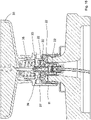
- Figures 1 to 4 show the operation of these pumps. Even though there exist a plurality of similar pump designs, with differences between one another, they all share elements which are essential for the invention, as indicated above. The remaining details are not relevant for the invention and can therefore be different from those shown in Figures 1 to 4 .
- the dispensing pump comprises:
- the piston 11 moves according to the axial direction between an expanded position (shown in Figure 1 ) and a retracted position (shown in Figure 3 ), going through a intermediate position (shown approximately in Figure 2 ), wherein when the piston 11 is in any position between the expanded position and the intermediate position, the side port 4 is arranged between the upper perimetral sealing lip 15 and the lower perimetral sealing lip 16, and when the piston 11 is in any position between the intermediate position and the retracted position, the side port 4 is arranged, in the axial direction, above the upper perimetral sealing lip 15.
- an air passage 22 suitable for establishing a fluidic communication between the exterior and the side port 4 when the piston 11 is in any position between the intermediate position and the retracted position.
- the evacuation means 17 are arranged in the upper portion of the piston 11, and comprise a cannula 23 (usually referred to as "stem"), a movable plug 24 and a head 25.
- the stem 23 is hollow and the lower portion thereof is located inside the piston 11 and the upper portion protrudes out of the piston 11.
- the head 25 is assembled on the upper portion of the stem 23.
- the hollow interior of the stem 23 establishes a fluidic passage between the pumping chamber 6 and the head 25, which in turn has a passage that allows the exit of the pumped liquid to the exterior, through the outlet port 18.
- the movable plug 24 is housed inside the stem 23.
- the lower end of the movable plug 24 protrudes below the stem 23 and is housed inside the piston 11.
- the lower end of the movable plug 24 has a perimetral edge suitable for being housed in a perimetral groove present in the piston 11, both elements thus forming the outlet valve 19.
- the pump is fixed to the container 26 by means of a fixing part 27 and a sleeve 28. These two elements form the fixing means and fix the pump body 1 to the neck 7 of the bottle in a leak-tight manner (thanks to a gasket 29) but allow the movement of the piston 11. More specifically, there is a passage between the piston 11 and the fixing part 27 which allows air to pass between the exterior and an intermediate chamber arranged between the upper portion of the pump body 1 and the piston 11, above the upper perimetral sealing lip 15. Therefore, when the dispensing pump is in its retracted position (see Figure 3 ), an air passage 22 communicating the interior of the container 26 with the exterior is established.
- This air passage 22 envisaged for allowing the entry of air in the container 26 and thus compensating for the vacuum formed by the liquid that is pumped, preventing a lower pressure being generated in the interior of the container 26.
- this air passage 22 is used to introduce the liquid from the cartridge 30 in the interior of the container 26, refilling it. It will also serve to allow the exit of air in the interior of the container 26 which, while refilling, is at an overpressure. Therefore, the air passage 22 transitions to having a triple function: allowing the entry of air during normal use of the pump, allowing the entry of liquid during the refilling method, and allowing the outlet of air during the refilling method.
- the dispensing pump described in the present figures is merely an example of among the existing plurality of pumps and there may be differences in detail between them. What is important for the present invention is that the mentioned air passage 22 (envisaged for allowing the entry of air to compensate for the exit of the pumped liquid) exists, since it is this air passage 22 that will be used by the invention for refilling the container 26.
- the container 26 is positioned in its normal position, i.e., with the bottom 61 in the lower position, such that the liquid in its inner volume 8 accumulates at the bottom 61 and the free end of the suction tube 10 is located below the free surface of the liquid, or at least, even in the event that it is above said free surface, it is so close that it will be immediately below said surface after having refilled a negligible amount of liquid.
- the head 25, which will be again placed at the end of the refilling process, will be extracted.
- connection means 31 are used.
- the connection means 31 have opening means 32 in the upper portion thereof for opening an outlet 33 arranged at the base 34 of the cartridge 30.
- the outlet 33 is a perforable film 35 and the opening means 32 comprise a needle 36 and a collapsible guard 37 of the needle 36.
- the connection means 31 have, in the lower portion thereof, a support surface 38, suitable for being supported on the stem 23 and pushing the piston 11 downwards, and a closure surface 39 suitable for being supported on the fixing part 27, forming a sealed closure, such that the air passage 22 is no longer in communication with the exterior but rather only with the interior of the cartridge 30.
- the piston 11 is moved to any position between the intermediate position (see Figure 2 ) and the retracted position (see Figure 3 ), i.e., to any position in which the side port 4 is arranged, in the axial direction, above the upper perimetral sealing lip 15 and, therefore, the air passage 22 is in fluidic communication with the inner volume 8 of the container 26.
- this step of moving the piston 11 is preferably done in parallel with the fluidic connection step for fluidically connecting the interior of the cartridge 30 with the air passage 22.
- the pressure is increased up to the pressure to which the liquid in the interior of the cartridge 30 is subjected, thereby causing the passage of part of the liquid to the inner volume 8, thereby increasing the pressure in the inner volume 8 (the air in the interior of the inner volume 8 cannot exit anywhere, since the suction tube 10 has its free end below the free surface of the liquid).
- air or any other gas
- air can be injected into the interior of the cartridge 30, for example, through the inlet valve 40 of the cartridge 30, as shown in Figure 7 .
- the upper portion of the cartridge 30 has a weakening area 65 demarcating a central area 66.
- This central area 66 has a perimeter equal to the inner surface of the side wall 41, such that it is suitable for being used as a piston running along the side wall 41.
- Figure 31 shows an external pushing member 67 (for example, that it is part of a machine according to the invention) which is pushing the central area 66, which increases the pressure in the liquid in the interior of the cartridge, such that it exits through the outlet 33.
- the method according to the invention contemplates a step in which the pressure to which the refilling liquid in the interior of the cartridge 30 is subjected is reduced to a value less than the pressure in the inner volume 8, thereby allowing part of the air under pressure in the inner volume 8 to pass into the interior of the cartridge 30 through the air passage 22 (see Figure 8 ). Then the cycle of injecting liquid and decompressing the container 26 is repeated a plurality of times until achieving the desired filled level, after which the cartridge 30 can be disconnected.
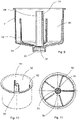
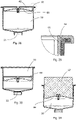
- FIGs 9 to 15 show a cartridge 30 according to the invention.
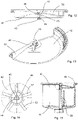
- the cartridge 30 has a main body ( Figures 9 to 11 ), with a side wall 41 and a base 34, and a lid ( Figures 12 to 14 ), which is assembled on the main body (see Figure 15 ), thus forming the upper portion 42 of the cartridge 30.
- the lid is welded to the side wall.
- the lid is formed as a single part with the side wall 41 and it is the base 34 that is configured as an independent part, attached (preferably by welding) to the side wall 41.
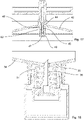
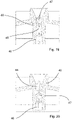
- the inlet valve 40 of the cartridge 30 (see Figures 12 to 14 , 17 , 19, and 20 ) comprises: [a] a conduit 43, defining a longitudinal axis, with a first segment 44 with a first triangular cross-section, a second segment 45 with a second cross-section circular, and a third segment 46 with a third cross-section which is also triangular and equal to the first cross-section, and [b] a spherical stopper 47 housed in the conduit 43.
- the diameter of the stopper 47 is greater than the diameter of the circle inscribed in the triangular cross-sections, such that the stopper is retained both in the first section and in the third section, except if a force greater than a predetermined value is applied thereto.
- the diameter of the stopper 47 is small enough so as to leave free passages at the vertexes of the triangles (see Figure 14 ). Therefore, when the stopper 47 is in the first segment 44 or in the third segment 46, the valve is open.
- the stopper 47 also has a diameter greater than the diameter of the circular cross-section, so the inlet valve 40 is closed when the stopper 47 is in the second segment 45.
- the cartridge 30 is manufactured with the stopper 47 in the first segment 44 (inlet valve 40 open, see Figure 19 ).
- the cartridge 30 can thereby be filled with liquid, after which the stopper 47 is pushed so as to move it towards the second segment 45, where the cartridge 30 is closed (see Figure 20 ).
- the stopper 47 is again pushed until it reaches the third segment 46, at which time the inlet valve 40 is open again (see Figure 17 ) and, for example, air (or any other gas) can be injected into the interior of the cartridge 30 for the purpose of increasing the pressure therein and forcing the exit of liquid through the outlet 33.
- the stopper 47 can be pushed by means of a rod 62, as shown in Figure 17 .
- the outlet 33 which, in the embodiment of Figures 9 to 11 , 15 , 16 , 18 , and 28-31 , is a perforable film 35.
- This perforable film 35 is what will be perforated by the needle 36 of the aforementioned connection means 31 (see Figures 6 to 8 and 18 ).
- the embodiment of Figure 21 shows an outlet 33 which is not a perforable film but rather comprises an outlet valve 48 similar to the inlet valve 40, although with only two segments.
- the outlet valve 48 comprises: [a] a conduit 143, defining a longitudinal axis, with a first segment 144 (the one oriented towards the interior of the cartridge 30) with a first triangular cross-section and a second segment 145 (the one oriented towards the exterior of the cartridge 30) with a second circular cross-section, and [b] a spherical stopper, housed in the conduit 143. Similar to the case of the inlet valve 40, when the stopper is in the first segment 144 the outlet valve 48 is open and when the stopper is in the second segment 145 the outlet valve 48 is closed. In the event that the cartridge 30 has an outlet valve 48 like the one described, the opening means will not have a needle but rather a rod 62 equivalent to the one shown in Figure 17 .
- the cartridge 30 comprises axial stiffening means 49 in the form of a hollow column 50 with a side opening 51.
- the column 50 extends from the base 34 to the upper portion 42, thus offering reinforcement with respect to stressing in the axial direction, particularly the stressing applied on the cartridge 30 during the refilling method.
- the hollow column 50 surrounds the edge of the outlet 33 of the cartridge 30.
- the side opening 51 the origin of which is at the base 34, allows the liquid contained in the cartridge 30 to flow in its entirety towards the outlet 33.
- the cartridge 30 also comprises radial stiffening means 52 in the form of ribs extending, on one hand, between said side wall 41 and said base 34 and, on the other, extending radially along said upper portion 42.
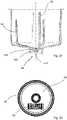
- Figure 22 shows a cartridge 30 with an individualized identifier 53.
- Figures 23 to 26 show an embodiment of a machine according to the invention.
- the machine comprises a housing 54 suitable for housing the container 26 with the bottom 61 oriented downwards, connection means 31 suitable for connecting a cartridge 30 to the container 26, establishing a fluidic communication between the interior of the cartridge 30 and the air passage 22, pressurizing an depressurizing means 55 suitable for changing the pressure in the interior of the cartridge 30, and control means suitable for performing at least two pressurizing and depressurizing cycles, one after the other and automatically.
- the machine also comprises adjustment means 56 for adjusting the distance between the container 26 and the connection means 31.
- the pressurizing and depressurizing means 55 and the adjustment means 56 are a mechanism with several common elements: a servomotor 57 controls the movement of a piston 58 with its sleeve 63 along a vertical axis arranged on the housing 54. Under the sleeve 63 and attached to it there is a cartridge holder 59 suitable for supporting a cartridge 30. The connection means 31 are arranged between the cartridge 30 and the container 26. The activation of the servomotor 57 causes the movement of the piston + sleeve + cartridge holder assembly until the cartridge 30 is under pressure on the connection means 31 which are, in turn, on the dispensing pump. The assembly is thereby adjusted to the height of the container 26.
- the piston 58 which was fixed to the sleeve 63 at the beginning of its stroke, is released and starts to run along the sleeve 63, compressing the air in the interior thereof, which air will be injected into the interior of the cartridge 30.
- the piston 58 In a certain position, the piston 58 is stopped and the servomotor 57 moves it upwards. This causes the pressure to drop, allowing the exit of the air under pressure that is in the inner volume 8 of the container 26 towards the interior of the cartridge 30, as previously discussed.
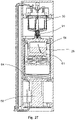
- Figure 27 shows another embodiment of a machine according to the invention.
- the machine comprises a compressor 60 which generates the air under pressure that will be injected into the cartridge 30.
- a threading system 64 carries out the function of the adjustment means 56.
Landscapes
- Engineering & Computer Science (AREA)
- Mechanical Engineering (AREA)
- Containers And Packaging Bodies Having A Special Means To Remove Contents (AREA)
- Basic Packing Technique (AREA)
- Vacuum Packaging (AREA)
Priority Applications (11)
| Application Number | Priority Date | Filing Date | Title |
|---|---|---|---|
| EP20383137.5A EP4019143A1 (fr) | 2020-12-22 | 2020-12-22 | Procédé de remplissage d'un récipient à l'aide une pompe de distribution et cartouche, système de gestion et machine correspondants |
| KR1020237023614A KR20230123488A (ko) | 2020-12-22 | 2021-12-21 | 분배 펌프 및 대응되는 재충전 카트리지로 용기를 재충전하기위한 방법 및 기계 |
| US18/268,412 US12358776B2 (en) | 2020-12-22 | 2021-12-21 | Method for refilling a container with a dispensing pump and corresponding refilling cartridge, and machine |
| PCT/IB2021/062102 WO2022137115A1 (fr) | 2020-12-22 | 2021-12-21 | Procédé pour la recharge d'un récipient doté d'une pompe de distribution et cartouche de recharge et machine correspondantes |
| AU2021407384A AU2021407384B2 (en) | 2020-12-22 | 2021-12-21 | Method for refilling a container with a dispensing pump and corresponding refilling cartridge, and machine |
| ES21836646T ES3029209T3 (en) | 2020-12-22 | 2021-12-21 | Method for refilling a container with a dispensing pump and corresponding refilling cartridge, and machine |
| CN202180087299.7A CN116648408A (zh) | 2020-12-22 | 2021-12-21 | 利用分配泵再填充容器的方法及相应的再填充筒和机器 |
| CA3205632A CA3205632A1 (fr) | 2020-12-22 | 2021-12-21 | Procede pour la recharge d'un recipient dote d'une pompe de distribution et cartouche de recharge et machine correspondantes |
| MX2023007409A MX2023007409A (es) | 2020-12-22 | 2021-12-21 | Procedimiento de rellenado de un contenedor con una bomba dispensadora y cartucho de rellenado y maquina correspondientes. |
| JP2023561933A JP7759670B2 (ja) | 2020-12-22 | 2021-12-21 | 容器を分配ポンプによって再充填するための方法および対応する再充填カートリッジならびに機械 |
| EP21836646.6A EP4267311B1 (fr) | 2020-12-22 | 2021-12-21 | Procédé de remplissage d'un récipient à l'aide une pompe de distribution et cartouche, système de gestion et machine correspondants |
Applications Claiming Priority (1)
| Application Number | Priority Date | Filing Date | Title |
|---|---|---|---|
| EP20383137.5A EP4019143A1 (fr) | 2020-12-22 | 2020-12-22 | Procédé de remplissage d'un récipient à l'aide une pompe de distribution et cartouche, système de gestion et machine correspondants |
Publications (1)
| Publication Number | Publication Date |
|---|---|
| EP4019143A1 true EP4019143A1 (fr) | 2022-06-29 |
Family
ID=74194481
Family Applications (2)
| Application Number | Title | Priority Date | Filing Date |
|---|---|---|---|
| EP20383137.5A Withdrawn EP4019143A1 (fr) | 2020-12-22 | 2020-12-22 | Procédé de remplissage d'un récipient à l'aide une pompe de distribution et cartouche, système de gestion et machine correspondants |
| EP21836646.6A Active EP4267311B1 (fr) | 2020-12-22 | 2021-12-21 | Procédé de remplissage d'un récipient à l'aide une pompe de distribution et cartouche, système de gestion et machine correspondants |
Family Applications After (1)
| Application Number | Title | Priority Date | Filing Date |
|---|---|---|---|
| EP21836646.6A Active EP4267311B1 (fr) | 2020-12-22 | 2021-12-21 | Procédé de remplissage d'un récipient à l'aide une pompe de distribution et cartouche, système de gestion et machine correspondants |
Country Status (10)
| Country | Link |
|---|---|
| US (1) | US12358776B2 (fr) |
| EP (2) | EP4019143A1 (fr) |
| JP (1) | JP7759670B2 (fr) |
| KR (1) | KR20230123488A (fr) |
| CN (1) | CN116648408A (fr) |
| AU (1) | AU2021407384B2 (fr) |
| CA (1) | CA3205632A1 (fr) |
| ES (1) | ES3029209T3 (fr) |
| MX (1) | MX2023007409A (fr) |
| WO (1) | WO2022137115A1 (fr) |
Families Citing this family (1)
| Publication number | Priority date | Publication date | Assignee | Title |
|---|---|---|---|---|
| CN119437343A (zh) * | 2025-01-13 | 2025-02-14 | 上海蕙新医疗科技有限公司 | 基于压力反馈的流量测试系统及方法 |
Citations (10)
| Publication number | Priority date | Publication date | Assignee | Title |
|---|---|---|---|---|
| EP0265270A2 (fr) * | 1986-10-24 | 1988-04-27 | Bespak plc | Pompe à débit indépendant de la pression d'actionnement |
| DE4242009A1 (de) * | 1992-12-12 | 1994-06-16 | Volz Abc Elektrogeraete | Ausstattungseinrichtung für die Haarpflege |
| DE4403755A1 (de) * | 1993-05-05 | 1994-11-10 | Pfeiffer Erich Gmbh & Co Kg | Austragvorrichtung für Medien |
| EP0626210A1 (fr) * | 1993-05-10 | 1994-11-30 | L'oreal | Dispositif de distribution d'une dose de volume déterminé d'un produit liquide ou pâteux |
| US20130068796A1 (en) * | 2011-07-26 | 2013-03-21 | Yi Ming Hui | Portable refillable cream dispenser |
| US20130168468A1 (en) * | 2011-12-30 | 2013-07-04 | Biagio P. Pellegrino | Convertible paint cup assembly with air inlet valve |
| FR3034031A1 (fr) * | 2015-03-23 | 2016-09-30 | Maitrise & Innovation | Raccord pour remplir un flacon de parfum ou similaire, dispositif de remplissage de flacon de parfum ou similaire comprenant ledit raccord et procede de remplissage associe |
| WO2016203167A1 (fr) * | 2015-06-19 | 2016-12-22 | Techniplast | Système et procédé de re-remplissage en liquide d'un flacon |
| FR3049267A1 (fr) * | 2016-03-22 | 2017-09-29 | Techniplast | Systeme et procede de re-remplissage en liquide d'un flacon |
| US9834369B2 (en) | 2014-04-04 | 2017-12-05 | Techniplast | Method for extracting liquid from a liquid dispenser by injecting gas |
Family Cites Families (5)
| Publication number | Priority date | Publication date | Assignee | Title |
|---|---|---|---|---|
| CA2144494C (fr) * | 1994-03-31 | 2000-02-15 | Clark E. Harris | Chambre de precombustion |
| US20070205305A1 (en) | 2006-03-03 | 2007-09-06 | Rbl Products, Inc. | Paint spray system |
| US8313010B2 (en) * | 2008-02-08 | 2012-11-20 | Gojo Industries, Inc. | Bifurcated foam pump assembly |
| EP3977905B1 (fr) * | 2017-07-07 | 2024-10-09 | GOJO Industries, Inc. | Système de distribution |
| DE102019001534A1 (de) | 2018-11-06 | 2020-05-07 | Martin Ruda 1. UG (haftungsbeschränkt). | Farbbecher für eine Spritzpistole und Spritzpistole |
-
2020
- 2020-12-22 EP EP20383137.5A patent/EP4019143A1/fr not_active Withdrawn
-
2021
- 2021-12-21 ES ES21836646T patent/ES3029209T3/es active Active
- 2021-12-21 EP EP21836646.6A patent/EP4267311B1/fr active Active
- 2021-12-21 MX MX2023007409A patent/MX2023007409A/es unknown
- 2021-12-21 WO PCT/IB2021/062102 patent/WO2022137115A1/fr not_active Ceased
- 2021-12-21 CA CA3205632A patent/CA3205632A1/fr active Pending
- 2021-12-21 US US18/268,412 patent/US12358776B2/en active Active
- 2021-12-21 CN CN202180087299.7A patent/CN116648408A/zh active Pending
- 2021-12-21 JP JP2023561933A patent/JP7759670B2/ja active Active
- 2021-12-21 KR KR1020237023614A patent/KR20230123488A/ko active Pending
- 2021-12-21 AU AU2021407384A patent/AU2021407384B2/en active Active
Patent Citations (11)
| Publication number | Priority date | Publication date | Assignee | Title |
|---|---|---|---|---|
| EP0265270A2 (fr) * | 1986-10-24 | 1988-04-27 | Bespak plc | Pompe à débit indépendant de la pression d'actionnement |
| DE4242009A1 (de) * | 1992-12-12 | 1994-06-16 | Volz Abc Elektrogeraete | Ausstattungseinrichtung für die Haarpflege |
| DE4403755A1 (de) * | 1993-05-05 | 1994-11-10 | Pfeiffer Erich Gmbh & Co Kg | Austragvorrichtung für Medien |
| EP0626210A1 (fr) * | 1993-05-10 | 1994-11-30 | L'oreal | Dispositif de distribution d'une dose de volume déterminé d'un produit liquide ou pâteux |
| US20130068796A1 (en) * | 2011-07-26 | 2013-03-21 | Yi Ming Hui | Portable refillable cream dispenser |
| US20130168468A1 (en) * | 2011-12-30 | 2013-07-04 | Biagio P. Pellegrino | Convertible paint cup assembly with air inlet valve |
| US9834369B2 (en) | 2014-04-04 | 2017-12-05 | Techniplast | Method for extracting liquid from a liquid dispenser by injecting gas |
| FR3034031A1 (fr) * | 2015-03-23 | 2016-09-30 | Maitrise & Innovation | Raccord pour remplir un flacon de parfum ou similaire, dispositif de remplissage de flacon de parfum ou similaire comprenant ledit raccord et procede de remplissage associe |
| WO2016203167A1 (fr) * | 2015-06-19 | 2016-12-22 | Techniplast | Système et procédé de re-remplissage en liquide d'un flacon |
| US10399103B2 (en) | 2015-06-19 | 2019-09-03 | Techniplast | System and method for refilling a bottle with liquid |
| FR3049267A1 (fr) * | 2016-03-22 | 2017-09-29 | Techniplast | Systeme et procede de re-remplissage en liquide d'un flacon |
Also Published As
| Publication number | Publication date |
|---|---|
| US12358776B2 (en) | 2025-07-15 |
| MX2023007409A (es) | 2023-06-29 |
| CN116648408A (zh) | 2023-08-25 |
| EP4267311B1 (fr) | 2025-03-19 |
| CA3205632A1 (fr) | 2022-06-30 |
| JP2024504511A (ja) | 2024-01-31 |
| EP4267311A1 (fr) | 2023-11-01 |
| AU2021407384A1 (en) | 2023-07-13 |
| ES3029209T3 (en) | 2025-06-23 |
| US20240034613A1 (en) | 2024-02-01 |
| JP7759670B2 (ja) | 2025-10-24 |
| EP4267311C0 (fr) | 2025-03-19 |
| AU2021407384B2 (en) | 2026-02-26 |
| KR20230123488A (ko) | 2023-08-23 |
| WO2022137115A1 (fr) | 2022-06-30 |
Similar Documents
| Publication | Publication Date | Title |
|---|---|---|
| EP2596870B1 (fr) | Vaporisateur de parfum rechargeable | |
| EP2000219B1 (fr) | Mécanisme de libération sous vide | |
| EP2958851B1 (fr) | Dispositif de remplissage pour machines de remplissage en vue d'un remplissage a niveau de bouteilles avec des liquides alimentaires | |
| RU2652315C2 (ru) | Емкость и клапан для емкости | |
| JP6475230B2 (ja) | 射出装置、ステーション、及び射出装置を洗浄する方法 | |
| JPH0444928A (ja) | 真空充填法 | |
| EP3616881A1 (fr) | Procédé de production d'un récipient contenant un liquide | |
| EP4019143A1 (fr) | Procédé de remplissage d'un récipient à l'aide une pompe de distribution et cartouche, système de gestion et machine correspondants | |
| US20050242118A1 (en) | Dispensing unit | |
| RU2836772C1 (ru) | Способ перезаправки контейнера с дозирующим насосом, а также соответствующие картридж для перезаправки и аппарат | |
| JP3735608B2 (ja) | 流体を定量射出する指操作式噴霧ポンプ | |
| US6102255A (en) | Invertible dispensing means for spray containers | |
| EP4232402B1 (fr) | Soupape de distribution sollicitée par ressort | |
| JPH02127222A (ja) | 弁で閉じられた容器内へ所定量の流体を所定圧力で注入する工業的装置 | |
| US20240326454A1 (en) | Liquid supply container and method of manufacturing the same | |
| KR102625263B1 (ko) | 펌프형 샴푸용기 | |
| KR102590170B1 (ko) | 자동 노즐개폐가 가능한 카트리지 교체형 화장품 용기 | |
| KR20200082978A (ko) | 액체 저장용 용기 및 이의 액체 충전 방법 | |
| KR100484214B1 (ko) | 수동식 분사펌프 | |
| US20190210049A1 (en) | Discharging device for the discharge of liquid media | |
| CN117545695A (zh) | 用于填充注射器的装置和方法 | |
| CN119137047A (zh) | 泵及喷出容器 | |
| KR20250101049A (ko) | 펌프 조립체를 포함하는 내용물 용기 |
Legal Events
| Date | Code | Title | Description |
|---|---|---|---|
| PUAI | Public reference made under article 153(3) epc to a published international application that has entered the european phase |
Free format text: ORIGINAL CODE: 0009012 |
|
| STAA | Information on the status of an ep patent application or granted ep patent |
Free format text: STATUS: THE APPLICATION HAS BEEN PUBLISHED |
|
| AK | Designated contracting states |
Kind code of ref document: A1 Designated state(s): AL AT BE BG CH CY CZ DE DK EE ES FI FR GB GR HR HU IE IS IT LI LT LU LV MC MK MT NL NO PL PT RO RS SE SI SK SM TR |
|
| STAA | Information on the status of an ep patent application or granted ep patent |
Free format text: STATUS: THE APPLICATION IS DEEMED TO BE WITHDRAWN |
|
| 18D | Application deemed to be withdrawn |
Effective date: 20230103 |