EP4043688A1 - Actionneur de porte et procédé de fonctionnement d'un actionneur de porte - Google Patents
Actionneur de porte et procédé de fonctionnement d'un actionneur de porte Download PDFInfo
- Publication number
- EP4043688A1 EP4043688A1 EP21156817.5A EP21156817A EP4043688A1 EP 4043688 A1 EP4043688 A1 EP 4043688A1 EP 21156817 A EP21156817 A EP 21156817A EP 4043688 A1 EP4043688 A1 EP 4043688A1
- Authority
- EP
- European Patent Office
- Prior art keywords
- control parameters
- person
- door
- door leaf
- control
- Prior art date
- Legal status (The legal status is an assumption and is not a legal conclusion. Google has not performed a legal analysis and makes no representation as to the accuracy of the status listed.)
- Pending
Links
Images
Classifications
-
- E—FIXED CONSTRUCTIONS
- E05—LOCKS; KEYS; WINDOW OR DOOR FITTINGS; SAFES
- E05F—DEVICES FOR MOVING WINGS INTO OPEN OR CLOSED POSITION; CHECKS FOR WINGS; WING FITTINGS NOT OTHERWISE PROVIDED FOR, CONCERNED WITH THE FUNCTIONING OF THE WING
- E05F15/00—Power-operated mechanisms for wings
- E05F15/70—Power-operated mechanisms for wings with automatic actuation
- E05F15/73—Power-operated mechanisms for wings with automatic actuation responsive to movement or presence of persons or objects
-
- E—FIXED CONSTRUCTIONS
- E05—LOCKS; KEYS; WINDOW OR DOOR FITTINGS; SAFES
- E05F—DEVICES FOR MOVING WINGS INTO OPEN OR CLOSED POSITION; CHECKS FOR WINGS; WING FITTINGS NOT OTHERWISE PROVIDED FOR, CONCERNED WITH THE FUNCTIONING OF THE WING
- E05F15/00—Power-operated mechanisms for wings
- E05F15/70—Power-operated mechanisms for wings with automatic actuation
- E05F15/79—Power-operated mechanisms for wings with automatic actuation using time control
-
- E—FIXED CONSTRUCTIONS
- E05—LOCKS; KEYS; WINDOW OR DOOR FITTINGS; SAFES
- E05F—DEVICES FOR MOVING WINGS INTO OPEN OR CLOSED POSITION; CHECKS FOR WINGS; WING FITTINGS NOT OTHERWISE PROVIDED FOR, CONCERNED WITH THE FUNCTIONING OF THE WING
- E05F15/00—Power-operated mechanisms for wings
- E05F15/70—Power-operated mechanisms for wings with automatic actuation
- E05F15/73—Power-operated mechanisms for wings with automatic actuation responsive to movement or presence of persons or objects
- E05F2015/767—Power-operated mechanisms for wings with automatic actuation responsive to movement or presence of persons or objects using cameras
-
- E—FIXED CONSTRUCTIONS
- E05—LOCKS; KEYS; WINDOW OR DOOR FITTINGS; SAFES
- E05Y—INDEXING SCHEME ASSOCIATED WITH SUBCLASSES E05D AND E05F, RELATING TO CONSTRUCTION ELEMENTS, ELECTRIC CONTROL, POWER SUPPLY, POWER SIGNAL OR TRANSMISSION, USER INTERFACES, MOUNTING OR COUPLING, DETAILS, ACCESSORIES, AUXILIARY OPERATIONS NOT OTHERWISE PROVIDED FOR, APPLICATION THEREOF
- E05Y2400/00—Electronic control; Electrical power; Power supply; Power or signal transmission; User interfaces
- E05Y2400/10—Electronic control
- E05Y2400/44—Sensors not directly associated with the wing movement
-
- E—FIXED CONSTRUCTIONS
- E05—LOCKS; KEYS; WINDOW OR DOOR FITTINGS; SAFES
- E05Y—INDEXING SCHEME ASSOCIATED WITH SUBCLASSES E05D AND E05F, RELATING TO CONSTRUCTION ELEMENTS, ELECTRIC CONTROL, POWER SUPPLY, POWER SIGNAL OR TRANSMISSION, USER INTERFACES, MOUNTING OR COUPLING, DETAILS, ACCESSORIES, AUXILIARY OPERATIONS NOT OTHERWISE PROVIDED FOR, APPLICATION THEREOF
- E05Y2400/00—Electronic control; Electrical power; Power supply; Power or signal transmission; User interfaces
- E05Y2400/10—Electronic control
- E05Y2400/45—Control modes
-
- E—FIXED CONSTRUCTIONS
- E05—LOCKS; KEYS; WINDOW OR DOOR FITTINGS; SAFES
- E05Y—INDEXING SCHEME ASSOCIATED WITH SUBCLASSES E05D AND E05F, RELATING TO CONSTRUCTION ELEMENTS, ELECTRIC CONTROL, POWER SUPPLY, POWER SIGNAL OR TRANSMISSION, USER INTERFACES, MOUNTING OR COUPLING, DETAILS, ACCESSORIES, AUXILIARY OPERATIONS NOT OTHERWISE PROVIDED FOR, APPLICATION THEREOF
- E05Y2400/00—Electronic control; Electrical power; Power supply; Power or signal transmission; User interfaces
- E05Y2400/10—Electronic control
- E05Y2400/45—Control modes
- E05Y2400/456—Control modes for programming, e.g. learning or AI [artificial intelligence]
-
- E—FIXED CONSTRUCTIONS
- E05—LOCKS; KEYS; WINDOW OR DOOR FITTINGS; SAFES
- E05Y—INDEXING SCHEME ASSOCIATED WITH SUBCLASSES E05D AND E05F, RELATING TO CONSTRUCTION ELEMENTS, ELECTRIC CONTROL, POWER SUPPLY, POWER SIGNAL OR TRANSMISSION, USER INTERFACES, MOUNTING OR COUPLING, DETAILS, ACCESSORIES, AUXILIARY OPERATIONS NOT OTHERWISE PROVIDED FOR, APPLICATION THEREOF
- E05Y2800/00—Details, accessories and auxiliary operations not otherwise provided for
- E05Y2800/20—Combinations of elements
- E05Y2800/205—Combinations of elements forming a unit
-
- E—FIXED CONSTRUCTIONS
- E05—LOCKS; KEYS; WINDOW OR DOOR FITTINGS; SAFES
- E05Y—INDEXING SCHEME ASSOCIATED WITH SUBCLASSES E05D AND E05F, RELATING TO CONSTRUCTION ELEMENTS, ELECTRIC CONTROL, POWER SUPPLY, POWER SIGNAL OR TRANSMISSION, USER INTERFACES, MOUNTING OR COUPLING, DETAILS, ACCESSORIES, AUXILIARY OPERATIONS NOT OTHERWISE PROVIDED FOR, APPLICATION THEREOF
- E05Y2900/00—Application of doors, windows, wings or fittings thereof
- E05Y2900/10—Application of doors, windows, wings or fittings thereof for buildings or parts thereof
- E05Y2900/13—Type of wing
- E05Y2900/132—Doors
Definitions
- the invention relates to a method for operating a door operator of a door system, in particular a swing-wing door, with at least one movable door leaf and with a control device that is designed to control a drive of the door operator coupled to the door leaf, and with a sensor unit that is designed to detect people is formed in an area in front of the door system and transmits information about the person to the control device.
- the EP 3 613 933 A1 discloses a method of operating an automatic door system having a door operator connected to a door leaf. It is stated here that radar motion detectors are used to control the door movement for automatic sliding doors. Radar sensors for detecting monitored areas are not common for swing doors, when the sensors ultimately detect people and transmit the corresponding data to a control unit for controlling the door system.
- Another method for operating an automatic door system is from DE 196 13 178 A1 known, and the door system has a door leaf that can be operated via a door operator. Furthermore, sensor units are proposed, which are equipped with a control unit interact and the control unit can be controlled via sensor data in such a way that the door system is operated optimally.
- Optimum operation of a door system is seen in particular in adapting the opening behavior of the door system to the passage frequency of the people passing by. If a large number of people pass through the door system, the opening behavior should be different than when only one person passes through the door system.
- weather conditions, the time of day, the day of the week and, for example, a temperature difference between the inside and outside of a building should also be taken into account.
- a door only opens as far as is necessary for the passage of a person.
- the door should open and close in the right place, for example when it comes to multi-leaf door systems, especially with regard to sliding doors.
- the aim is to control one or more door leaves in such a way that a person can continue walking in the movement tube unchanged when passing through the door system, but the door leaf does not open earlier than necessary and does not close later than necessary.
- An intelligent door is to be created with which it should be possible to control the opening and closing behavior of a complete door system depending on the traffic situation and environmental conditions such as temperature, wind, pressure difference, air exchange requirement and similar parameters.
- the control for operating an automatic door system can be optimized for access by just one person, but access situations can arise in which two or more people enter the door system and into the detection area of the sensor unit.
- the aim is to achieve optimal control of the movement of the at least one door leaf, even when several people are entering the door system at the same time, so that each person can enter the door system unhindered through the door leaf, but on the other hand the door leaf cannot be accessed even if there are several people leaves the closed position for an unnecessarily long time.
- the object of the invention is therefore to further improve a method for operating a door system and to create such a door system with which the method according to the invention can be carried out.
- the improvement should consist in particular in achieving optimal control of the door leaves of the door system even when several people are walking through the door system, so that each of the people can walk through the door system unhindered, but on the other hand the door leaf is not open for an unnecessarily long time.
- the method has at least the following steps: recognizing a first person; calculating the estimated time of arrival of the first person at the door; calculating first control parameters for controlling the door leaf based on the first person; recognizing at least one second person; calculating the estimated time of arrival of the second person at the door; Calculation of second control parameters related to the control of the door leaf to the second person; Linking the first control parameters with the second control parameters to form a first set of control parameters and controlling the drive of the door leaf on the basis of the first set of control parameters.
- the core idea of the invention is the integrated processing of several control parameters for controlling the drive of the door leaf of a door system, so that even when the door system is inspected by several people, control parameters for the drive of the door leaf can be determined, which do justice to a comfortable inspection of the door system by each individual person .
- the control can take place in such a way that the requirement is met that the door leaf does not remain in an open position for an unnecessarily long time.
- the method initially provides for the detection of a first person and the calculation of first control parameters, so that if the first person remains, the door leaf can be driven optimally accordingly. If a second person is recognized, then second control parameters are generated, and the core of the invention involves linking the first control parameters with the second control parameters to form a set of control parameters, which is ultimately used as a basis for controlling the drive of the door leaf.
- door control can be achieved that is not simply based on the addition of individual values. For example, it is not possible to add an estimated time of arrival for a first person to the time of arrival for a second person. Consequently, it is provided according to the invention that, for example, the arrival time, the speed and/or the direction of movement of the at least two people are compared with one another individually, or respective personal parameter sets from the individual parameters are compared with one another in their entirety, for example as person vectors.
- the method provides in particular that after the calculation of first control parameters for controlling the door leaf related to the first person, the first control parameters are stored in an index memory.
- an index memory is understood to be a memory that has a discrete memory location or a discrete memory location for each control parameter or control parameter set, so that the individual information can already be read from the index memory as to whether a control parameter or a control parameter set has already been stored or not.
- the step of querying whether there are first control parameters in the index memory follows. If this query reveals that no control parameters are present, the door is controlled on the basis of the first control parameters, but if this query reveals that first control parameters are present, the control parameter set is formed and the door is controlled on the basis of the control parameter set.
- the method according to the invention can also be used when more than two people are inspecting the door system. It may be the case that a third person is initially recognized, followed by the estimated time of arrival of the third person at the door leaf is calculated. Third control parameters are then calculated, which are used to control the door leaf, and the third control parameters relate exclusively to the third person. Linking according to the invention then takes place again, but the first control parameter set formed from the first and second control parameters is used in the index memory, so that the first control parameter set is linked to the third control parameters calculated for the third person by means of a comparison to form a new second control parameter set.
- the drive of the door leaf can be controlled on the basis of the new second set of control parameters.
- the second set of control parameters is then stored again as the only set of control parameters in the index memory by replacing the first set of control parameters or by overwriting the first set of control parameters so that the index memory is set to +1 again unchanged.
- the query is used to determine whether control parameters or a set of control parameters are present in the index memory, so that only then is the link made by the corresponding comparison.
- the method can be summarized by the following additional steps: after each determination of further control parameters, query whether control parameters have already been stored. In the event that no control parameters have been saved yet, an index 0 is defined so that the movement of the door leaf is determined based on the first calculated control parameters. In the event that the first control parameters have already been stored, the index is defined in the index memory +1, and the link is made by comparing the previously stored control parameters according to index +1 with the last determined second control parameters according to index +2, so that the movement of the door leaf is controlled with an optimum from the previously stored control parameters according to index +1 and the last stored control parameters according to index +2, with the Optimum at the same time forms the newly saved set of control parameters.
- the index memory of +1 or +2 is finally deleted again and thus set to index 0, so that the control device is reset to the initial state and only activated again when a next person is detected.
- a person vector can be created for the respective person, which is at least determined from a speed of the identified person, which represents the vector length and which is determined from a direction of movement of the identified person , which represents the vector direction, and performing the calculation of the estimated time of arrival of the person at the door leaf based on the person vector.
- the person vectors can be enriched by further features, for example relating to the size of the person or an object linked to the person, such as a wheelchair, a hospital bed or the like.
- a tolerance is checked, in which case, if a deviation of the second control parameters from the first control parameters is within the tolerance, the first control parameters or the second control parameters are used to control the door leaf and the linking of the first control parameters with the second control parameters to a first set of control parameters is omitted.
- the tolerance can relate, for example, to a deviation of the control parameters from one another of approximately 5% to 10%.
- the values from the index memory can be compared be omitted and it can be controlled directly with the first control parameters of the door leaf.
- the invention also relates to a door operator of a door system with a control device that is designed to carry out the method described above.
- a sensor unit is advantageously provided, which is designed as a radar sensor or as a camera with an associated image evaluation unit and with a distance, a Speed and an approach angle of one or more people can be detected.
- the invention is also aimed at a door system for carrying out the method according to the invention.
- the door system can include at least one, in particular several, in particular two, door leaves.
- the door system can also include a door operator according to the invention.
- the door system or the door operator can in particular include a memory and/or a processor for carrying out the method.
- the door system is preferably designed as an in particular automatic sliding door system, as a folding door system, as a pivoting door system or as a revolving door system.
- the invention is also aimed at a software program product for executing the method according to the invention and/or for operating the door operator according to the invention.
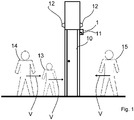
- figure 1 shows the view of a door system with a door operator 1 for operating a door leaf 10.
- a control device 11 is shown as part of the door operator 1, which is mounted on the top of the door.
- Sensor units 12 are located on both sides of the door system to detect the three persons 13, 14 and 15 shown as an example.
- the people 13, 14 and 15 approach the door leaf 10 with the person vectors V1, V2 and V3, for example, from both sides of the door system.
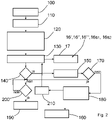
- figure 2 presents the method according to the invention for operating the door operator 1 using a simplified flowchart. First of all, it is assumed that at least one first person has been recognized, with a comparison of calculated control parameters being carried out if several persons are recognized. The reference numbers from figure 1 to be taken accordingly for the following description.
- a first person 13 is recognized, this step being identified by 100 .
- step 110 relating to a calculation of the estimated time of arrival of the first person 13 on the door leaf 10.
- the arrival time can be calculated from a person vector V1, with the person vectors V1, V2 and V3 being determined in step 110.
- the person vector V1 is at least determined from a speed of the recognized person 13, which represents the vector length, and it is determined from a moving direction of the recognized person 13, which represents the vector direction.
- step 120 by the calculation of first control parameters 16', shown as an example stored in index memory 17, and the first control parameters 16' are used to control the door leaf 10 in relation to the first person 13 or based on a first person vector V1, if this is off the first control parameters 16' is calculated.
- the first control parameters 16 ′ are then stored in the index memory 17 as shown, with the storage of the control parameters 16 , in particular an opening time, an opening speed and an opening holding time of the door leaf 10 , taking place in or through step 130 .
- Step 130 of storing the control parameters 16' is followed by step 140, which relates to a query as to whether a control parameter set 16' of a previously recorded person is already stored in the index memory 17. If no set of control parameters 16′ is stored, i.e. the recognized person 13 is the first person, the opening time query 200 finally activates 190 the door operator 1 when the latest time for activating the opening movement of the door leaf 10 has been reached.
- a comparison 150 activated, in which the first control parameters 16' are compared with second control parameters 16" or a first control parameter set 16s1 from the index memory 17 and third control parameters 16'" or a second control parameter set 16s2.
- This comparison step 150 is followed by a tolerance query 170, in which case, if the deviation of the parameters compared to one another as above is within a tolerance, the further opening time query 200 takes place, so that finally on the basis of one of the control parameters 16' or 16" or control parameter set 16s1 or 16s2 an activation 190 of the door operator 1 takes place.
- the deviation of the parameters, as compared above, is not within the tolerance, then only then is a control parameter set 16s1 formed, and if no other person 15 is identified, then the activation 190 of the door operator 1 and the opening time query 200 are carried out on the basis of the first control parameter set 16s1 .
- the generated set of control parameters 16s1 or 16s2 results from the value integration 180, which takes place after the tolerance query 170 if the deviations between the parameters to be compared are not within the tolerance, marked with "no".
- the generated set of control parameters 16s1 or 16s2 then forms the new index 1 or 2 for storage in the index memory 17, so that the new index is formed 210 in the index memory 17 by storing 130 the control parameters.
Landscapes
- Power-Operated Mechanisms For Wings (AREA)
Priority Applications (3)
| Application Number | Priority Date | Filing Date | Title |
|---|---|---|---|
| EP21156817.5A EP4043688A1 (fr) | 2021-02-12 | 2021-02-12 | Actionneur de porte et procédé de fonctionnement d'un actionneur de porte |
| CN202210118463.2A CN114922532A (zh) | 2021-02-12 | 2022-02-08 | 用于操作门致动器的方法 |
| US17/668,112 US12188289B2 (en) | 2021-02-12 | 2022-02-09 | Method for operating a door actuator |
Applications Claiming Priority (1)
| Application Number | Priority Date | Filing Date | Title |
|---|---|---|---|
| EP21156817.5A EP4043688A1 (fr) | 2021-02-12 | 2021-02-12 | Actionneur de porte et procédé de fonctionnement d'un actionneur de porte |
Publications (1)
| Publication Number | Publication Date |
|---|---|
| EP4043688A1 true EP4043688A1 (fr) | 2022-08-17 |
Family
ID=74595142
Family Applications (1)
| Application Number | Title | Priority Date | Filing Date |
|---|---|---|---|
| EP21156817.5A Pending EP4043688A1 (fr) | 2021-02-12 | 2021-02-12 | Actionneur de porte et procédé de fonctionnement d'un actionneur de porte |
Country Status (3)
| Country | Link |
|---|---|
| US (1) | US12188289B2 (fr) |
| EP (1) | EP4043688A1 (fr) |
| CN (1) | CN114922532A (fr) |
Families Citing this family (3)
| Publication number | Priority date | Publication date | Assignee | Title |
|---|---|---|---|---|
| GB202112053D0 (en) * | 2021-08-23 | 2021-10-06 | Safehinge Ltd | Methods and systems for monitoring mental health environment |
| JP7775094B2 (ja) * | 2022-02-02 | 2025-11-25 | オプテックス株式会社 | 戸開閉制御装置 |
| CN117328759A (zh) * | 2023-09-18 | 2024-01-02 | 珠海格力电器股份有限公司 | 伸缩门及其控制方法、装置、存储介质以及电子设备 |
Citations (3)
| Publication number | Priority date | Publication date | Assignee | Title |
|---|---|---|---|---|
| DE19613178A1 (de) | 1996-04-02 | 1997-10-09 | Heinrich Landert | Verfahren zum Betrieb einer Türanlage und eine nach dem Verfahren arbeitende Türanlage |
| WO2018077766A1 (fr) * | 2016-10-24 | 2018-05-03 | Assa Abloy Entrance Systems Ab | Système d'entrée avec capteurs d'image |
| EP3613933A1 (fr) | 2018-08-22 | 2020-02-26 | GEZE GmbH | Dispositif de surveillance de portes, fenêtres ou analogues |
Family Cites Families (4)
| Publication number | Priority date | Publication date | Assignee | Title |
|---|---|---|---|---|
| CN110536854B (zh) * | 2017-04-25 | 2020-12-29 | 三菱电机株式会社 | 电梯的防范运转装置 |
| US10221610B2 (en) * | 2017-05-15 | 2019-03-05 | Otis Elevator Company | Depth sensor for automatic doors |
| JP2019132019A (ja) * | 2018-01-31 | 2019-08-08 | 日本電気株式会社 | 情報処理装置 |
| US20220341247A1 (en) * | 2019-09-13 | 2022-10-27 | Nec Solution Innovators, Ltd. | Automatic door passage assistance apparatus, passage assistance method, program, and recording medium |
-
2021
- 2021-02-12 EP EP21156817.5A patent/EP4043688A1/fr active Pending
-
2022
- 2022-02-08 CN CN202210118463.2A patent/CN114922532A/zh active Pending
- 2022-02-09 US US17/668,112 patent/US12188289B2/en active Active
Patent Citations (3)
| Publication number | Priority date | Publication date | Assignee | Title |
|---|---|---|---|---|
| DE19613178A1 (de) | 1996-04-02 | 1997-10-09 | Heinrich Landert | Verfahren zum Betrieb einer Türanlage und eine nach dem Verfahren arbeitende Türanlage |
| WO2018077766A1 (fr) * | 2016-10-24 | 2018-05-03 | Assa Abloy Entrance Systems Ab | Système d'entrée avec capteurs d'image |
| EP3613933A1 (fr) | 2018-08-22 | 2020-02-26 | GEZE GmbH | Dispositif de surveillance de portes, fenêtres ou analogues |
Also Published As
| Publication number | Publication date |
|---|---|
| CN114922532A (zh) | 2022-08-19 |
| US20220268089A1 (en) | 2022-08-25 |
| US12188289B2 (en) | 2025-01-07 |
Similar Documents
| Publication | Publication Date | Title |
|---|---|---|
| EP0853299B2 (fr) | Procédé et dispositif de commande d'un aménagement pour porte en réponse à la présence des personnes | |
| EP2437962B1 (fr) | Methode et dispositif pour actionner un ouvrnat d'un véhicule | |
| EP2586959B2 (fr) | Dispositif de sécurisation, dispositif de fermeture et unité d'évaluation | |
| DE69505319T2 (de) | Anordnung zum automatischen Öffnen und Schliessen von Türen | |
| EP2753485B1 (fr) | Système de commande | |
| EP3416017A1 (fr) | Système d'un véhicule autonome en mouvement dans un environnement et d'une porte située dans l'environnement | |
| DE19613178A1 (de) | Verfahren zum Betrieb einer Türanlage und eine nach dem Verfahren arbeitende Türanlage | |
| DE102020113501A1 (de) | Verfahren und Vorrichtung zum Betrieb einer automatischen Türanlage | |
| DE102008044990A1 (de) | Verfahren und Vorrichtung zur Ansteuerung und/oder Überwachung eines motorisch angetriebenen Flügels während der Öffnungsphase | |
| DE102015208611A1 (de) | Betätigung eines Schließelements eines Fahrzeugs mit Ultraschallsensor | |
| EP4043683A1 (fr) | Procédé de fonctionnement d'une installation de porte et installation de porte correspondante | |
| EP2531684B1 (fr) | Dispositif d'entraînement de porte, fermeture de bâtiment ainsi équipée, système de porte et procédé de fabrication et d'entraînement | |
| EP4043682A1 (fr) | Procédé de fonctionnement d'une installation de porte | |
| DE102019126718A1 (de) | Einrichtung zur gebäudefesten installation mit wenigstens einem automatisch bewegbaren flügelelement und verfahren hierzu | |
| DE102020210920A1 (de) | Verfahren zur Verstellung eines Verstellteils an einem Fahrzeug und Abspeicherung von Signal- und Messwertverläufen für eine nachträgliche Prüfung | |
| EP3599144A1 (fr) | Détection de l'état d'un portail de garage lors du stationnement autonome | |
| DE19809235C2 (de) | Durchgangsschleuse und Verfahren zum Betrieb einer solchen Durchgangsschleuse | |
| EP3192955A1 (fr) | Procédé d'ouverture et/ou de fermeture d'une porte ou d'un clapet de véhicule automobile | |
| EP3680814B1 (fr) | Procédé de détection des déroulements de mouvements et système de détection correspondant | |
| EP4043687A1 (fr) | Procédé de fonctionnement d'un actionneur de porte | |
| EP0935042B1 (fr) | Procédé et dispositif de commande et/ou de surveillance d'une porte motorisée | |
| DE202013005835U1 (de) | Schließvorrichtung für Türen, Fenster oder dergleichen | |
| EP4043686A1 (fr) | Procédé de fonctionnement d'un actionneur de porte | |
| EP1655434B1 (fr) | Ensemble de porte avec vanteaux déplaçables automatiquement et méthode pour opérer de tels ensembles de porte | |
| EP1416116A1 (fr) | Tourniquet |
Legal Events
| Date | Code | Title | Description |
|---|---|---|---|
| PUAI | Public reference made under article 153(3) epc to a published international application that has entered the european phase |
Free format text: ORIGINAL CODE: 0009012 |
|
| STAA | Information on the status of an ep patent application or granted ep patent |
Free format text: STATUS: THE APPLICATION HAS BEEN PUBLISHED |
|
| AK | Designated contracting states |
Kind code of ref document: A1 Designated state(s): AL AT BE BG CH CY CZ DE DK EE ES FI FR GB GR HR HU IE IS IT LI LT LU LV MC MK MT NL NO PL PT RO RS SE SI SK SM TR |
|
| STAA | Information on the status of an ep patent application or granted ep patent |
Free format text: STATUS: REQUEST FOR EXAMINATION WAS MADE |
|
| 17P | Request for examination filed |
Effective date: 20230215 |
|
| RBV | Designated contracting states (corrected) |
Designated state(s): AL AT BE BG CH CY CZ DE DK EE ES FI FR GB GR HR HU IE IS IT LI LT LU LV MC MK MT NL NO PL PT RO RS SE SI SK SM TR |
|
| STAA | Information on the status of an ep patent application or granted ep patent |
Free format text: STATUS: EXAMINATION IS IN PROGRESS |
|
| 17Q | First examination report despatched |
Effective date: 20251007 |