EP0853299B2 - Procédé et dispositif de commande d'un aménagement pour porte en réponse à la présence des personnes - Google Patents
Procédé et dispositif de commande d'un aménagement pour porte en réponse à la présence des personnes Download PDFInfo
- Publication number
- EP0853299B2 EP0853299B2 EP98100269A EP98100269A EP0853299B2 EP 0853299 B2 EP0853299 B2 EP 0853299B2 EP 98100269 A EP98100269 A EP 98100269A EP 98100269 A EP98100269 A EP 98100269A EP 0853299 B2 EP0853299 B2 EP 0853299B2
- Authority
- EP
- European Patent Office
- Prior art keywords
- image
- door
- door system
- camera
- movement
- Prior art date
- Legal status (The legal status is an assumption and is not a legal conclusion. Google has not performed a legal analysis and makes no representation as to the accuracy of the status listed.)
- Expired - Lifetime
Links
Images

Classifications
-
- G—PHYSICS
- G08—SIGNALLING
- G08B—SIGNALLING SYSTEMS, e.g. PERSONAL CALLING SYSTEMS; ORDER TELEGRAPHS; ALARM SYSTEMS
- G08B13/00—Burglar, theft or intruder alarms
- G08B13/18—Actuation by interference with heat, light, or radiation of shorter wavelength; Actuation by intruding sources of heat, light, or radiation of shorter wavelength
- G08B13/189—Actuation by interference with heat, light, or radiation of shorter wavelength; Actuation by intruding sources of heat, light, or radiation of shorter wavelength using passive radiation detection systems
- G08B13/194—Actuation by interference with heat, light, or radiation of shorter wavelength; Actuation by intruding sources of heat, light, or radiation of shorter wavelength using passive radiation detection systems using image scanning and comparing systems
- G08B13/196—Actuation by interference with heat, light, or radiation of shorter wavelength; Actuation by intruding sources of heat, light, or radiation of shorter wavelength using passive radiation detection systems using image scanning and comparing systems using television cameras
- G08B13/19602—Image analysis to detect motion of the intruder, e.g. by frame subtraction
- G08B13/19604—Image analysis to detect motion of the intruder, e.g. by frame subtraction involving reference image or background adaptation with time to compensate for changing conditions, e.g. reference image update on detection of light level change
-
- G—PHYSICS
- G06—COMPUTING OR CALCULATING; COUNTING
- G06V—IMAGE OR VIDEO RECOGNITION OR UNDERSTANDING
- G06V20/00—Scenes; Scene-specific elements
- G06V20/50—Context or environment of the image
- G06V20/52—Surveillance or monitoring of activities, e.g. for recognising suspicious objects
-
- G—PHYSICS
- G08—SIGNALLING
- G08B—SIGNALLING SYSTEMS, e.g. PERSONAL CALLING SYSTEMS; ORDER TELEGRAPHS; ALARM SYSTEMS
- G08B13/00—Burglar, theft or intruder alarms
- G08B13/18—Actuation by interference with heat, light, or radiation of shorter wavelength; Actuation by intruding sources of heat, light, or radiation of shorter wavelength
- G08B13/189—Actuation by interference with heat, light, or radiation of shorter wavelength; Actuation by intruding sources of heat, light, or radiation of shorter wavelength using passive radiation detection systems
- G08B13/194—Actuation by interference with heat, light, or radiation of shorter wavelength; Actuation by intruding sources of heat, light, or radiation of shorter wavelength using passive radiation detection systems using image scanning and comparing systems
- G08B13/196—Actuation by interference with heat, light, or radiation of shorter wavelength; Actuation by intruding sources of heat, light, or radiation of shorter wavelength using passive radiation detection systems using image scanning and comparing systems using television cameras
- G08B13/19602—Image analysis to detect motion of the intruder, e.g. by frame subtraction
-
- G—PHYSICS
- G08—SIGNALLING
- G08B—SIGNALLING SYSTEMS, e.g. PERSONAL CALLING SYSTEMS; ORDER TELEGRAPHS; ALARM SYSTEMS
- G08B13/00—Burglar, theft or intruder alarms
- G08B13/18—Actuation by interference with heat, light, or radiation of shorter wavelength; Actuation by intruding sources of heat, light, or radiation of shorter wavelength
- G08B13/189—Actuation by interference with heat, light, or radiation of shorter wavelength; Actuation by intruding sources of heat, light, or radiation of shorter wavelength using passive radiation detection systems
- G08B13/194—Actuation by interference with heat, light, or radiation of shorter wavelength; Actuation by intruding sources of heat, light, or radiation of shorter wavelength using passive radiation detection systems using image scanning and comparing systems
- G08B13/196—Actuation by interference with heat, light, or radiation of shorter wavelength; Actuation by intruding sources of heat, light, or radiation of shorter wavelength using passive radiation detection systems using image scanning and comparing systems using television cameras
- G08B13/19602—Image analysis to detect motion of the intruder, e.g. by frame subtraction
- G08B13/19613—Recognition of a predetermined image pattern or behaviour pattern indicating theft or intrusion
- G08B13/19615—Recognition of a predetermined image pattern or behaviour pattern indicating theft or intrusion wherein said pattern is defined by the user
-
- G—PHYSICS
- G08—SIGNALLING
- G08B—SIGNALLING SYSTEMS, e.g. PERSONAL CALLING SYSTEMS; ORDER TELEGRAPHS; ALARM SYSTEMS
- G08B13/00—Burglar, theft or intruder alarms
- G08B13/18—Actuation by interference with heat, light, or radiation of shorter wavelength; Actuation by intruding sources of heat, light, or radiation of shorter wavelength
- G08B13/189—Actuation by interference with heat, light, or radiation of shorter wavelength; Actuation by intruding sources of heat, light, or radiation of shorter wavelength using passive radiation detection systems
- G08B13/194—Actuation by interference with heat, light, or radiation of shorter wavelength; Actuation by intruding sources of heat, light, or radiation of shorter wavelength using passive radiation detection systems using image scanning and comparing systems
- G08B13/196—Actuation by interference with heat, light, or radiation of shorter wavelength; Actuation by intruding sources of heat, light, or radiation of shorter wavelength using passive radiation detection systems using image scanning and comparing systems using television cameras
- G08B13/19639—Details of the system layout
- G08B13/19641—Multiple cameras having overlapping views on a single scene
Definitions
- the invention relates to a method and a device for controlling door systems, wherein a detection and evaluation of persons is performed in front of door systems, with the aim of the door system in response to persons who move in front of the door system to open and close.
- Such a method has become known, for example, with the subject matter of US 4,249,207 A.
- a so-called video penetration alarm is generated when one or more persons enter a particular surveillance area.
- the monitoring area is subdivided into a certain number of sub-areas and it is examined whether persons are in these cell-like sub-areas or not. Depending on the detection situation, a corresponding alarm is then triggered.
- the invention has the object of providing a method and an apparatus of the type mentioned in such a way that with the least possible effort one or more door systems can be controlled on a building depending on the location, the direction of movement and the number of people in front of these door systems ,
- the invention is characterized by the technical teaching of claim 1 or claim 18.
- a feature of the invention is that, in a first method step, the space in front of the door system is first detected with at least one video camera in such a way that only the "empty" space is detected at first.
- the space to be monitored in front of the door is detected by the video camera at a time when there is essentially no movement in that room, for example, in the early morning or late evening, with the fixed objects typically found in that room, such as flower pots, lamp posts, and the like, being detected by the video camera, and the system determining the location and arrangement of those fixed ones Learning objects.
- Empty space is defined here when no movements take place or are detected in the room to be monitored within a period of about 3-4 seconds. It is then obtained from a so-called reference image, which serves as a reference model of the empty space, i. the empty space with all its existing objects is stored as a model in a store and serves as a benchmark.
- the video camera examines every 3-4 seconds whether the room is empty or not and, if so, then creates a new reference model of empty space. It is important that in these time intervals not always a completely new model of the empty space is created, but that in an iterative approximation process this empty space is constantly approximated to the actual conditions. Ie. In practice, if no movement has been detected within the last 3-4 seconds, but new objects in empty space have been identified as stationary, then this model of empty space will only be expanded and supplemented by the newly added fixed object.
- the empty space is constantly and continuously observed with the video camera to determine whether the space is really empty or whether there is movement in this room.
- a movement is detected in this room, which can take place by evaluation of the video image or by adding further signal sources, such as e.g. Infrared detectors, weight sensors and ultrasonic sensors can be found, then at a non-empty space, i. H. in a detected movement, determined in a next step, whether it is the moving object authorized for the use of the door system and intending object, such as a person acts.
- further signal sources such as e.g. Infrared detectors, weight sensors and ultrasonic sensors
- a moving human being is recognized as a human being only if the moving contour covers a certain area and the shape and movement of the detected contour are human-like.
- a moving stroller is not recognized as a moving person, because the shape of the stroller does not correspond to that of a human. However, it recognizes the person pushing the stroller.
- Moving animals eg dog or cat
- the door system is therefore not activated, unless a door use by these animals is intended.
- the movement contour of the human is now analyzed in the third method step, as stated above. If it is recognized that it is a moving person, then in a fourth method step the location of the moving person is determined. Here it is important that first the distance of the human from the video camera is determined. Based on this distance measurement, the exact location in the room can then be calculated, ie it can be specified in coordinates, where exactly the person is in front of the door system.
- the video camera has of course also recorded with the detection of the empty space still a floor plan model of the room with the position of the door and that this plan model is stored in a memory.
- the floor plan model is not detected by the camera (possibly from another camera), but that the floor plan model is written by manual input to a corresponding terminal in the memory of the computer, where it then is laid down.
- the surveillance area is now subdivided into different regions, wherein at least one region is defined, upon entering which the door system is activated, while other regions are present which do not lead to the activation of the door system.
- This regional model has the advantage that the door system is not opened when the video camera in conjunction with the aforementioned regions, eg. B. detects a person walking past the door system, which obviously does not intend to run into the door system due to their direction of movement and their speed of movement. In this way, it is achieved with the novel process model that the door system is only activated for opening or closing when a person moving in front of the door system is heading for the door system with the appropriate speed and direction of movement.
- the opening and closing of the door system takes place from the inside of a building, so that therefore also on the inside of a building a corresponding monitoring system is arranged, which accomplishes an intelligent opening and closing of the door system in dependence on the person leaving the building.
- z. B. are detected, whether the person pushes a stroller, whether it carries several packages or has any other unusual opening requirements for the door.
- a possible shadow of the supervising persons is recognized and eliminated, that one can assign the shadow certain recognition criteria and thus exclude a shadow, so that only the movement contour of the person to be monitored is detected effectively, but not their light shade.
- the camera be approximately diametrically opposed to the door installation, but in a somewhat raised position of e.g. B. 5 m above the ground, because with this elevated position diametrically opposite the door system the advantage is achieved that at a high-mounted camera as possible, a relatively small angle of the camera is achieved on the person to be monitored, d. H. It is a very fine resolution detection of below the camera moving people possible.
- the invention is not limited thereto, it can also be arranged several cameras, the viewing angle also overlaps, the camera image of multiple cameras is evaluated.
- one-eyed video camera and a stereo camera can be used instead of a single, one-eyed video camera and a stereo camera.
- the image of the one camera is converted to the expected image of the second camera assuming a predefined image area and closed by comparison of calculated and effectively received image on presence and / or changes of objects in the image area.
- the predefined image area is adapted or newly selected on the basis of the respective available results. It is also possible to adapt or re-select further parameters such as image detail, frequency of the image analyzes, image resolution in the course of the following image analyzes on the basis of the respective available results, the data of multiply existing elements (eg several cameras) being used to achieve absolute reliability ,
- the z. B. are arranged laterally from the door system.
- a high observation point is achieved in that the camera image is deflected by a high-lying mirror and from this mirror from the surveillance area is detected.
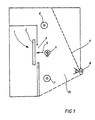
- FIG. 1 an example of a door system 1 of a building is shown, wherein a single-leaf sliding door 2 is used.
- this invention is not limited to the use of such a door system.
- multi-leaf sliding doors can be used, hinged doors, lift doors, revolving doors, swing doors and the like.
- Door models more. It is therefore important in the present invention, one or more entrance openings 3 on a building in an intelligent manner depending on front of the door system 1 persons 4 to open and close.
- the invention provides at least one video camera 8, which is approximately diametrically opposite the door system 1 and which has an observation angle 9, which defines a larger surveillance area 10.
- This monitoring area 10 should advantageously comprise the door system 1 itself and a relatively wide lateral area of about 3 m left and right of the door system to detect laterally on the door system 1 passing people with security and exclude.
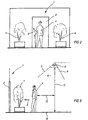
- Figures 2 and 3 show the same situation as Figure 1, wherein it can be seen that the camera 8 can be arranged in a raised position above the floor 13. In this case, the camera 8 has a height 11 above the floor 13 and a distance 12 to the person 4 to be observed.
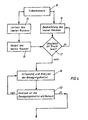
- a model of empty space is then created at position 15 and at the same time the video camera 8 at position 16 monitors this empty space to determine whether movement is taking place or not.
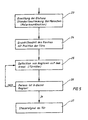
- FIG. 6 where the empty space in the form of a grid is shown as an evaluation model and it can be seen that a multiplicity of cells 19, 20, 21 are present, the cells being arranged in a matrix-like column-by-row arrangement and given as an example is that the cell 20 is filled with a stationary object, z. B. the fixed Item 6, 7.
- the human being 4 to be detected is recognized as a movement cluster covering a series of cells 21, this movement cluster moving in the direction of the arrow 5.
- this cluster can be recognized as a human model.
- the distance 12 of the moving motion cluster is determined with respect to the video camera 8. From this then a determination of the location of the moving man is accomplished, wherein z. B. the location is given in polar coordinates.
- the instantaneous position of the moving person in the surveillance area 10 is determined, and at the same time a prognosis is made from the movement and the speed as to whether or not the person enters the region of the surveillance area 10 assigned to the door opening.
- a floor plan model of the room which also contains the position of the door, is compared with the movement pattern of the moving person.
- this floor plan model was entered either by a manual input on the keyboard or it is detected with a video camera and stored in a memory.
- this region is advantageously located directly in front of the door system, preferably this door region is defined approximately at a distance of 1 m to the left and right of the door opening and in front of the door a distance of about 1.50 m.
- FIG. 7 shows schematically the use of a stereo camera. Based on the image of the first camera 8, it is calculated what the second camera 28 should "see” on the assumption that the viewed image section 29 of the camera 8 effectively lies in the image surface 30 of the camera 28. If the calculated image coincides with the image effectively "seen” by camera 28, then an object is effectively in the image plane captured by both cameras 8, 28.
- the present invention is generally directed to intelligently opening and closing a door system. If several people are detected in the surveillance area 10, then the motion profile is determined for each individual and accordingly the door opening is controlled.
Landscapes
- Engineering & Computer Science (AREA)
- Physics & Mathematics (AREA)
- General Physics & Mathematics (AREA)
- Computer Vision & Pattern Recognition (AREA)
- Multimedia (AREA)
- Theoretical Computer Science (AREA)
- Power-Operated Mechanisms For Wings (AREA)
- Closed-Circuit Television Systems (AREA)
- Image Analysis (AREA)
Claims (21)
- Procédé pour commander des installations de portes en fonction de la présence d'objets/de personnes, selon lequel la zone de l'installation de porte est surveillée en permanence par au moins une caméra vidéo, grâce à la caméra vidéo et/ou à des capteurs adéquats on détecte les mouvements d'objets à l'intérieur de l'espace à surveiller, une analyse a lieu grâce à l'image vidéo, pour voir si l'objet en mouvement est un objet ayant l'intention d'utiliser l'installation de porte, par exemple une personne, étant précisé que si c'est le cas, la position, le sens de mouvement et la vitesse dudit objet sont déterminés, et l'installation de porte est commandée en fonction de la position, du sens de mouvement et de la vitesse de l'objet qui ont été déterminés, caractérisé en ce qu'une analyse supplémentaire a lieu pour voir si l'objet en mouvement est un objet autorisé à utiliser l'installation de porte, et en ce que le contour de l'objet en mouvement est détecté et analysé et l'objet n'est identifié comme étant par exemple une personne que si son contour et sa trajectoire correspondent dans une mesure prédéfinie à ceux d'un être humain.
- Procédé selon la revendication 1, caractérisé en ce que l'espace vide situé devant l'installation de porte est détecté à intervalles prédéfinis grâce à la caméra vidéo et est mis en mémoire comme image de référence.
- Procédé selon la revendication 1 ou 2, caractérisé en ce qu'une image de référence de l'espace vide est établie en permanence ou est actualisée.
- Procédé selon l'une des revendications 1 à 3, caractérisé en ce que pour détecter des mouvements d'objets, une comparaison entre l'image du moment de l'espace à observer et l'image de référence a lieu.
- Procédé selon l'une des revendications 1 à 4, caractérisé en ce que les capteurs supplémentaires sont des détecteurs à infrarouge, des capteurs de poids, des capteurs à ultrasons, etc.
- Procédé selon l'une des revendications 1 à 5, caractérisé en ce que la distance entre l'objet en mouvement et la caméra vidéo est définie et à partir de cette distance est calculée la position de l'objet dans l'espace.
- Procédé selon l'une des revendications 1 à 6, caractérisé en ce qu'un modèle à trois dimensions de l'espace à surveiller ou d'une partie de celui-ci est stocké dans une mémoire.
- Procédé selon l'une des revendications 1 à 7, caractérisé en ce que l'espace à surveiller est divisé en plusieurs régions, une commande de l'installation de porte n'étant déclenchée que par des objets qui se trouvent et se déplacent dans des régions prédéfinies.
- Procédé selon l'une des revendications 1 à 8, caractérisé en ce que la place nécessaire pour que l'objet franchisse l'installation de porte sans être gêné, par exemple la largeur d'une personne, est définie et une adaptation de la largeur de la porte à la largeur de l'objet est ainsi effectuée.
- Procédé selon l'une des revendications 1 à 9, caractérisé en ce que le début et/ou la vitesse de l'ouverture et/ou de la fermeture de la porte sont fonction de l'emplacement, du sens de déplacement et de la vitesse de déplacement de l'objet.
- Procédé selon l'une des revendications 1 à 10, caractérisé en ce que les réflexions de lumière dans le périmètre de surveillance sont éliminées par des filtres adéquats.
- Procédé selon l'une des revendications 1 à 11, caractérisé en ce que les signaux vidéo sont évalués par au moins deux caméras (caméra stéréo) orientées vers le même endroit.
- Procédé selon l'une des revendications 1 à 12, caractérisé en ce que l'on convertit l'image de la première caméra, en supposant une surface d'image prédéfinie, en une image à attendre de la seconde caméra, et en comparant l'image calculée et l'image effectivement reçue, on tire des conclusions quant à la présence et/ou aux variations d'objets dans la surface d'image.
- Procédé selon l'une des revendications 1 à 13, caractérisé en ce que la surface d'image prédéfinie est adaptée ou re-sélectionnée, au cours d'analyses d'image successives, à partir des résultats dont on dispose à chaque fois.
- Procédé selon l'une des revendications 1 à 11, caractérisé en ce que d'autres paramètres comme par exemple le cadrage, la fréquence des analyses d'image, la définition d'image sont adaptés ou re-sélectionnés, au cours d'analyses d'image successives, à partir des résultats dont on dispose à chaque fois.
- Procédé selon l'une des revendications 1 à 11, caractérisé en ce que pour obtenir une sécurité de fonctionnement absolue, on utilise les données d'éléments multiples.
- Dispositif pour mettre en oeuvre le procédé selon l'une des revendications 1 à 16, caractérisé en ce que la caméra vidéo est à peu près diamétralement opposée par rapport à l'installation de porte, son angle de visée étant dirigé vers la zone à surveiller suivant un angle aussi obtus que possible, et en ce que la caméra vidéo est reliée à un dispositif électronique de traitement d'images.
- Dispositif selon la revendication 17, caractérisé en ce que la caméra est équipée d'un filtre de polarisation.
- Dispositif selon la revendication 17 ou 18, caractérisé en ce que plusieurs caméras sont disposées dans des positions différentes.
- Dispositif selon l'une des revendications 17 à 19, caractérisé en ce que la caméra est une caméra stéréo.
- Dispositif selon l'une des revendications 17 à 20, caractérisé en ce que l'angle de visée de la caméra est dévié par un miroir.
Applications Claiming Priority (2)
| Application Number | Priority Date | Filing Date | Title |
|---|---|---|---|
| DE19700811A DE19700811A1 (de) | 1997-01-13 | 1997-01-13 | Verfahren und Vorrichtung zur Ansteuerung von Türanlage in Abhängigkeit von der Anwesenheit von Personen |
| DE19700811 | 1997-01-13 |
Publications (4)
| Publication Number | Publication Date |
|---|---|
| EP0853299A2 EP0853299A2 (fr) | 1998-07-15 |
| EP0853299A3 EP0853299A3 (fr) | 1999-06-09 |
| EP0853299B1 EP0853299B1 (fr) | 2002-07-31 |
| EP0853299B2 true EP0853299B2 (fr) | 2006-04-26 |
Family
ID=7817215
Family Applications (1)
| Application Number | Title | Priority Date | Filing Date |
|---|---|---|---|
| EP98100269A Expired - Lifetime EP0853299B2 (fr) | 1997-01-13 | 1998-01-09 | Procédé et dispositif de commande d'un aménagement pour porte en réponse à la présence des personnes |
Country Status (4)
| Country | Link |
|---|---|
| US (1) | US6496220B2 (fr) |
| EP (1) | EP0853299B2 (fr) |
| JP (1) | JPH10231661A (fr) |
| DE (2) | DE19700811A1 (fr) |
Families Citing this family (50)
| Publication number | Priority date | Publication date | Assignee | Title |
|---|---|---|---|---|
| ES2209291T3 (es) * | 1999-07-17 | 2004-06-16 | Siemens Building Technologies Ag | Dispositivo para la vigilancia de un recinto. |
| US7042492B2 (en) | 1999-12-10 | 2006-05-09 | The Stanley Works | Automatic door assembly with video imaging device |
| US6701005B1 (en) | 2000-04-29 | 2004-03-02 | Cognex Corporation | Method and apparatus for three-dimensional object segmentation |
| SE520075C2 (sv) * | 2000-12-01 | 2003-05-20 | Safenet I Harads Ab | Förfarande vid klämskyddsanordningar samt anordning för genomförande av förfarandet |
| JP2002250607A (ja) * | 2001-02-27 | 2002-09-06 | Optex Co Ltd | 物体検知センサ |
| JP4639293B2 (ja) * | 2001-02-27 | 2011-02-23 | オプテックス株式会社 | 自動ドアセンサ |
| US7154531B2 (en) * | 2001-10-26 | 2006-12-26 | The Chamberlain Group, Inc. | Detecting objects by digital imaging device |
| JP4216021B2 (ja) | 2002-08-30 | 2009-01-28 | 富士重工業株式会社 | 侵入物検出装置 |
| US7920718B2 (en) * | 2002-09-05 | 2011-04-05 | Cognex Corporation | Multi-zone passageway monitoring system and method |
| US7397929B2 (en) * | 2002-09-05 | 2008-07-08 | Cognex Technology And Investment Corporation | Method and apparatus for monitoring a passageway using 3D images |
| US7400744B2 (en) * | 2002-09-05 | 2008-07-15 | Cognex Technology And Investment Corporation | Stereo door sensor |
| US7088243B2 (en) * | 2003-05-26 | 2006-08-08 | S1 Corporation | Method of intruder detection and device thereof |
| JP4267996B2 (ja) * | 2003-09-17 | 2009-05-27 | Thk株式会社 | 自動扉装置 |
| US7623674B2 (en) * | 2003-11-05 | 2009-11-24 | Cognex Technology And Investment Corporation | Method and system for enhanced portal security through stereoscopy |
| US8326084B1 (en) | 2003-11-05 | 2012-12-04 | Cognex Technology And Investment Corporation | System and method of auto-exposure control for image acquisition hardware using three dimensional information |
| TW200525449A (en) * | 2004-01-29 | 2005-08-01 | Lai Jin Ding | Human body image recognition system |
| JP2006118281A (ja) * | 2004-10-22 | 2006-05-11 | Optex Co Ltd | 自動ドア開閉検知システム及び自動ドアの開閉検知方法 |
| DE102004053821B4 (de) * | 2004-11-04 | 2008-12-18 | Dorma Gmbh + Co. Kg | Türanlage mit automatisch verfahrbaren Flügeln sowie ein Verfahren zum Betrieb derartiger Türanlagen |
| DE102005001133A1 (de) * | 2005-01-10 | 2006-07-20 | Siemens Ag | System bzw. Verfahren zur Positionierung von, einem zu behandelnden Patienten in dessen Umgebung zuordbaren, Geräten |
| DE102005002042B4 (de) * | 2005-01-14 | 2009-02-12 | Dorma Gmbh + Co. Kg | Schiebetür mit einem magnetischen Antriebssystem und individuell öffnenden Türflügeln und Verfahren zu deren Ansteuerung |
| DE102005011116B4 (de) * | 2005-03-10 | 2012-03-15 | Agtatec Ag | Vorrichtung zur Ansteuerung und/oder Überwachung eines Flügels |
| US8111904B2 (en) | 2005-10-07 | 2012-02-07 | Cognex Technology And Investment Corp. | Methods and apparatus for practical 3D vision system |
| US8126260B2 (en) * | 2007-05-29 | 2012-02-28 | Cognex Corporation | System and method for locating a three-dimensional object using machine vision |
| DE102007030084A1 (de) * | 2007-06-28 | 2009-01-15 | Geze Gmbh | Verfahren zur Steuerung eines Antriebs einer Tür |
| US8269602B2 (en) * | 2007-08-22 | 2012-09-18 | Utc Fire & Security Americas Corporation, Inc. | Security access control system and method for making same |
| KR101588666B1 (ko) * | 2008-12-08 | 2016-01-27 | 삼성전자주식회사 | 디스플레이 장치 및 그의 표시방법 |
| IL201200A0 (en) * | 2009-09-24 | 2011-07-31 | Elbit Systems Ltd | System and method for long-range surveillance of a scene and alerting of predetermined unusual activity |
| WO2011139734A2 (fr) * | 2010-04-27 | 2011-11-10 | Sanjay Nichani | Procédé de détection d'objet mobile à l'aide d'un capteur d'image et d'une lumière structurée |
| DE102010046220A1 (de) | 2010-09-21 | 2012-03-22 | Hella Kgaa Hueck & Co. | Verfahren zum Konfigurieren eines Überwachungssystems und konfigurierbares Überwachungssystem |
| GB2484668A (en) * | 2010-10-18 | 2012-04-25 | Intelligent Door Solutions Ltd | Motion Sensitive System and Method of Generating a Control Signal |
| CN102454334A (zh) * | 2010-10-29 | 2012-05-16 | 鸿富锦精密工业(深圳)有限公司 | 误夹困防止系统、方法及具有该防止系统的电动门 |
| CN102454335A (zh) * | 2010-10-29 | 2012-05-16 | 鸿富锦精密工业(深圳)有限公司 | 误夹困防止系统、方法及具有该防止系统的电动门 |
| JP5618366B2 (ja) * | 2010-11-18 | 2014-11-05 | Necソリューションイノベータ株式会社 | 監視システム、監視装置、監視方法、及びプログラム |
| DE202011102930U1 (de) * | 2011-06-28 | 2012-10-10 | Grass Gmbh | Möbel und Vorrichtung zur Bewegungskontrolle eines Möbelteils |
| US20140333763A1 (en) * | 2011-11-22 | 2014-11-13 | Schneider Electric Buildings, Llc | Method and system for controlling access using a smart optical sensor |
| CN103726739B (zh) * | 2013-12-31 | 2016-04-27 | 深圳市捷顺科技实业股份有限公司 | 一种电动折叠门的保护方法、保护系统及电动折叠门 |
| US9790690B2 (en) | 2016-03-11 | 2017-10-17 | United Construction Products, Inc. | Peripheral stabilizing system for elevated flooring surface |
| CN107956363A (zh) * | 2017-11-23 | 2018-04-24 | 南宁市生润科技有限公司 | 一种感应门的控制系统及方法 |
| US11085193B2 (en) | 2018-04-09 | 2021-08-10 | United Construction Products, Inc. | Peripheral restraint system for elevated flooring surface |
| CN110381274B (zh) * | 2018-04-12 | 2021-09-28 | Tcl新技术(惠州)有限公司 | 一种执法仪空录指数输出控制方法、系统及存储介质 |
| CN110510486B (zh) | 2018-05-21 | 2023-03-14 | 奥的斯电梯公司 | 电梯门控制系统、电梯系统和电梯门控制方法 |
| US11124390B2 (en) | 2018-05-22 | 2021-09-21 | Otis Elevator Company | Pressure sensitive mat |
| DE102018125736B4 (de) | 2018-10-17 | 2021-02-18 | Sick Ag | Verfahren zum Schutz von Menschen in einer Umgebung einer beweglichen Maschine |
| CN110427887B (zh) * | 2019-08-02 | 2023-03-10 | 腾讯科技(深圳)有限公司 | 一种基于智能的会员身份识别方法及装置 |
| DE102019126718A1 (de) * | 2019-10-02 | 2021-04-08 | Dormakaba Deutschland Gmbh | Einrichtung zur gebäudefesten installation mit wenigstens einem automatisch bewegbaren flügelelement und verfahren hierzu |
| DE102020113501A1 (de) * | 2020-05-19 | 2021-11-25 | Agtatec Ag | Verfahren und Vorrichtung zum Betrieb einer automatischen Türanlage |
| EP4043684A1 (fr) | 2021-02-12 | 2022-08-17 | dormakaba Deutschland GmbH | Procédé de fonctionnement d'une installation de porte |
| EP4043683A1 (fr) * | 2021-02-12 | 2022-08-17 | dormakaba Deutschland GmbH | Procédé de fonctionnement d'une installation de porte et installation de porte correspondante |
| CN113835457B (zh) * | 2021-08-10 | 2022-07-12 | 太原市高远时代科技有限公司 | 一种基于边缘计算的水利一体化智能机柜 |
| EP4265875A1 (fr) * | 2022-04-18 | 2023-10-25 | dormakaba Deutschland GmbH | Procédé de commande d'une installation de porte |
Family Cites Families (27)
| Publication number | Priority date | Publication date | Assignee | Title |
|---|---|---|---|---|
| CA1116286A (fr) * | 1979-02-20 | 1982-01-12 | Control Data Canada, Ltd. | Systeme de surveillance anti-effraction en peripherie |
| US4581634A (en) * | 1982-11-18 | 1986-04-08 | Williams Jarvis L | Security apparatus for controlling access to a predetermined area |
| GB2183878B (en) * | 1985-10-11 | 1989-09-20 | Matsushita Electric Works Ltd | Abnormality supervising system |
| JPH0766446B2 (ja) * | 1985-11-27 | 1995-07-19 | 株式会社日立製作所 | 移動物体像を抽出する方法 |
| US4712103A (en) * | 1985-12-03 | 1987-12-08 | Motohiro Gotanda | Door lock control system |
| FI74556C (fi) * | 1986-04-11 | 1988-02-08 | Valtion Teknillinen | Foerfarande foer tredimensionell oevervakning av ett maolutrymme. |
| EP0344404B1 (fr) * | 1988-06-03 | 1993-05-12 | Inventio Ag | Procédé et dispositif pour commander la position d'une porte automatique |
| DE3825757B4 (de) * | 1988-07-29 | 2004-09-23 | Delphi Automotive Systems Deutschland Gmbh | Verfahren zum Überwachen eines Raumes |
| EP0356734A3 (fr) * | 1988-08-02 | 1990-03-14 | Siemens Aktiengesellschaft | Dispositif détecteur d'intrusion à caméras vidéo |
| JPH0335399A (ja) * | 1989-06-30 | 1991-02-15 | Toshiba Corp | 変化領域統合装置 |
| KR100204101B1 (ko) * | 1990-03-02 | 1999-06-15 | 가나이 쓰도무 | 화상처리장치 |
| EP0445334A1 (fr) * | 1990-03-08 | 1991-09-11 | Siemens Aktiengesellschaft | Procédé de détection d'intrus |
| DE4040811A1 (de) * | 1990-12-14 | 1992-07-09 | Iris Gmbh Infrared & Intellige | Richtungsselektive zaehl- und schaltvorrichtung |
| US5163094A (en) * | 1991-03-20 | 1992-11-10 | Francine J. Prokoski | Method for identifying individuals from analysis of elemental shapes derived from biosensor data |
| DE4110649A1 (de) * | 1991-04-02 | 1992-10-22 | Telefonbau & Normalzeit Gmbh | Fernsehueberwachungsanlage |
| FR2693011B1 (fr) * | 1992-06-29 | 1994-09-23 | Matra Sep Imagerie Inf | Procédé et dispositif de surveillance d'une scène tridimensionnelle, mettant en Óoeuvre des capteurs d'imagerie. |
| DE4335301C1 (de) * | 1993-10-15 | 1994-12-08 | Siemens Ag | Medizinische Anlage |
| DE4402535A1 (de) * | 1994-01-28 | 1995-08-03 | Friedrich Brueck | Vorrichtung zur Überwachung von zu sichernden Bereichen |
| DE4407528C2 (de) * | 1994-03-07 | 1998-04-09 | Sq Services Ag | Bewegungsmelder und Verfahren zur Bewegungsmeldung |
| DE4417128A1 (de) * | 1994-05-16 | 1995-12-14 | Elnic Gmbh | Bilderfassungs- und -verarbeitungsverfahren insbesondere zur Steuerung von Vorrichtungen sowie zugehöriges Bilderfassungs- und -verarbeitungssystem |
| CA2155818C (fr) * | 1994-08-11 | 1998-09-01 | Masahiro Sai | Ouvre-porte automatique |
| US5541585A (en) * | 1994-10-11 | 1996-07-30 | Stanley Home Automation | Security system for controlling building access |
| DE19516662A1 (de) * | 1995-05-05 | 1996-11-14 | Fraunhofer Ges Forschung | Identifizierung dreidimensionaler Objekte, insbesondere Personen |
| DE19522760C2 (de) * | 1995-06-27 | 1999-12-16 | Dorma Gmbh & Co Kg | Automatische Tür und Verfahren zum Betrieb einer automatischen Tür |
| DE19525875A1 (de) * | 1995-07-15 | 1997-01-16 | Dorma Gmbh & Co Kg | Vorrichtung und Verfahren zur Feststellung von Personenzahl und Gegenständen innerhalb eines zu überwachenden Raumes |
| DE19600958A1 (de) * | 1995-07-20 | 1997-01-23 | Fraunhofer Ges Forschung | Interaktives Überwachungssystem |
| DE29602098U1 (de) * | 1996-02-07 | 1996-03-21 | MAN Roland Druckmaschinen AG, 63075 Offenbach | Rollenwechsler |
-
1997
- 1997-01-13 DE DE19700811A patent/DE19700811A1/de not_active Withdrawn
-
1998
- 1998-01-09 EP EP98100269A patent/EP0853299B2/fr not_active Expired - Lifetime
- 1998-01-09 DE DE59804944T patent/DE59804944D1/de not_active Expired - Lifetime
- 1998-01-12 US US09/005,455 patent/US6496220B2/en not_active Expired - Fee Related
- 1998-01-13 JP JP10004906A patent/JPH10231661A/ja active Pending
Also Published As
| Publication number | Publication date |
|---|---|
| JPH10231661A (ja) | 1998-09-02 |
| DE59804944D1 (de) | 2002-09-05 |
| EP0853299B1 (fr) | 2002-07-31 |
| US20010048470A1 (en) | 2001-12-06 |
| DE19700811A1 (de) | 1998-07-16 |
| EP0853299A2 (fr) | 1998-07-15 |
| EP0853299A3 (fr) | 1999-06-09 |
| US6496220B2 (en) | 2002-12-17 |
Similar Documents
| Publication | Publication Date | Title |
|---|---|---|
| EP0853299B2 (fr) | Procédé et dispositif de commande d'un aménagement pour porte en réponse à la présence des personnes | |
| DE60023545T2 (de) | Automatiktüranordnung mit video-erzeugungssystem | |
| EP3701340B1 (fr) | Dispositif de surveillance, équipement industriel, procédé de surveillance et programme informatique | |
| EP0799962A1 (fr) | Méthode d'opération d'un dispositif de porte et dispositif de porte fonctionnant selon ce procédé | |
| DE3634628A1 (de) | Ueberwachungsanordnung zum melden abnormer ereignisse | |
| WO2019162447A1 (fr) | Procédé servant à faire fonctionner un système de porte et système de porte | |
| EP2418517A2 (fr) | Capteur optoélectronique | |
| WO2018069341A1 (fr) | Surveillance d'objet par enregistrement d'image infrarouge et éclairage par impulsion infrarouge | |
| EP3584400A1 (fr) | Porte de protection et procédé de fonctionnement d'une porte de protection | |
| DE102008044990A1 (de) | Verfahren und Vorrichtung zur Ansteuerung und/oder Überwachung eines motorisch angetriebenen Flügels während der Öffnungsphase | |
| DE69424374T2 (de) | Einrichtung zur automatischen Steuerung einer Beleuchtung | |
| WO2018069334A1 (fr) | Commande de corps de fermeture fonction de la situation | |
| EP4043688A1 (fr) | Actionneur de porte et procédé de fonctionnement d'un actionneur de porte | |
| DE102007032091B3 (de) | Verfahren zum Überwachen eines höhengleichen Bahnübergangs | |
| DE102022116065B4 (de) | Ergänzendes Zugangskontrollsystem für eine RFID-gesteuerte Katzenklappe und Verfahren zur ergänzenden Kontrolle des Zugangs durch eine RFID-gesteuerte Katzenklappe | |
| EP0935044A2 (fr) | Procédé et dispositif de commande et/ou de surveillance d'une porte motorisée | |
| DE19641000C2 (de) | Verfahren und Anordnung zur automatischen Erkennung der Anzahl von Personen in einer Personenschleuse | |
| DE102019126718A1 (de) | Einrichtung zur gebäudefesten installation mit wenigstens einem automatisch bewegbaren flügelelement und verfahren hierzu | |
| EP3680814B1 (fr) | Procédé de détection des déroulements de mouvements et système de détection correspondant | |
| DE19804631C2 (de) | Verfahren und Vorrichtung zur Ansteuerung und/oder Überwachung eines motorisch angetriebenen Flügels | |
| DE19600958A1 (de) | Interaktives Überwachungssystem | |
| EP4043682A1 (fr) | Procédé de fonctionnement d'une installation de porte | |
| WO2015078612A1 (fr) | Procédé de vidéosurveillance | |
| EP4420585B1 (fr) | Détermination d'un état d'une fenêtre ou d'une porte dans un foyer | |
| EP3859115B1 (fr) | Porte tournante |
Legal Events
| Date | Code | Title | Description |
|---|---|---|---|
| PUAI | Public reference made under article 153(3) epc to a published international application that has entered the european phase |
Free format text: ORIGINAL CODE: 0009012 |
|
| AK | Designated contracting states |
Kind code of ref document: A2 Designated state(s): CH DE FR GB IT LI NL SE |
|
| AX | Request for extension of the european patent |
Free format text: AL;LT;LV;MK;RO;SI |
|
| PUAL | Search report despatched |
Free format text: ORIGINAL CODE: 0009013 |
|
| AK | Designated contracting states |
Kind code of ref document: A3 Designated state(s): AT BE CH DE DK ES FI FR GB GR IE IT LI LU MC NL PT SE |
|
| AX | Request for extension of the european patent |
Free format text: AL;LT;LV;MK;RO;SI |
|
| RIC1 | Information provided on ipc code assigned before grant |
Free format text: 6G 08B 13/194 A, 6E 05F 15/20 B |
|
| 17P | Request for examination filed |
Effective date: 19991106 |
|
| AKX | Designation fees paid |
Free format text: CH DE FR GB IT LI NL SE |
|
| GRAG | Despatch of communication of intention to grant |
Free format text: ORIGINAL CODE: EPIDOS AGRA |
|
| 17Q | First examination report despatched |
Effective date: 20011129 |
|
| GRAG | Despatch of communication of intention to grant |
Free format text: ORIGINAL CODE: EPIDOS AGRA |
|
| GRAH | Despatch of communication of intention to grant a patent |
Free format text: ORIGINAL CODE: EPIDOS IGRA |
|
| GRAH | Despatch of communication of intention to grant a patent |
Free format text: ORIGINAL CODE: EPIDOS IGRA |
|
| GRAA | (expected) grant |
Free format text: ORIGINAL CODE: 0009210 |
|
| AK | Designated contracting states |
Kind code of ref document: B1 Designated state(s): CH DE FR GB IT LI NL SE |
|
| REG | Reference to a national code |
Ref country code: GB Ref legal event code: FG4D Free format text: NOT ENGLISH Ref country code: CH Ref legal event code: EP |
|
| REF | Corresponds to: |
Ref document number: 59804944 Country of ref document: DE Date of ref document: 20020905 |
|
| REG | Reference to a national code |
Ref country code: CH Ref legal event code: NV Representative=s name: LUCHS & PARTNER PATENTANWAELTE |
|
| GBT | Gb: translation of ep patent filed (gb section 77(6)(a)/1977) |
Effective date: 20021121 |
|
| ET | Fr: translation filed | ||
| PLBI | Opposition filed |
Free format text: ORIGINAL CODE: 0009260 |
|
| PLBF | Reply of patent proprietor to notice(s) of opposition |
Free format text: ORIGINAL CODE: EPIDOS OBSO |
|
| 26 | Opposition filed |
Opponent name: GEZE GMBH Effective date: 20030430 |
|
| NLR1 | Nl: opposition has been filed with the epo |
Opponent name: GEZE GMBH |
|
| PLAX | Notice of opposition and request to file observation + time limit sent |
Free format text: ORIGINAL CODE: EPIDOSNOBS2 |
|
| PLBB | Reply of patent proprietor to notice(s) of opposition received |
Free format text: ORIGINAL CODE: EPIDOSNOBS3 |
|
| PLAB | Opposition data, opponent's data or that of the opponent's representative modified |
Free format text: ORIGINAL CODE: 0009299OPPO |
|
| PLAQ | Examination of admissibility of opposition: information related to despatch of communication + time limit deleted |
Free format text: ORIGINAL CODE: EPIDOSDOPE2 |
|
| PLAR | Examination of admissibility of opposition: information related to receipt of reply deleted |
Free format text: ORIGINAL CODE: EPIDOSDOPE4 |
|
| PLBP | Opposition withdrawn |
Free format text: ORIGINAL CODE: 0009264 |
|
| PLBQ | Unpublished change to opponent data |
Free format text: ORIGINAL CODE: EPIDOS OPPO |
|
| PUAH | Patent maintained in amended form |
Free format text: ORIGINAL CODE: 0009272 |
|
| STAA | Information on the status of an ep patent application or granted ep patent |
Free format text: STATUS: PATENT MAINTAINED AS AMENDED |
|
| 27A | Patent maintained in amended form |
Effective date: 20060426 |
|
| AK | Designated contracting states |
Kind code of ref document: B2 Designated state(s): CH DE FR GB IT LI NL SE |
|
| GBTA | Gb: translation of amended ep patent filed (gb section 77(6)(b)/1977) |
Effective date: 20060503 |
|
| REG | Reference to a national code |
Ref country code: CH Ref legal event code: AEN Free format text: AUFRECHTERHALTUNG DES PATENTES IN GEAENDERTER FORM |
|
| NLR2 | Nl: decision of opposition |
Effective date: 20060426 |
|
| REG | Reference to a national code |
Ref country code: SE Ref legal event code: RPEO |
|
| NLR3 | Nl: receipt of modified translations in the netherlands language after an opposition procedure | ||
| ET3 | Fr: translation filed ** decision concerning opposition | ||
| PGFP | Annual fee paid to national office [announced via postgrant information from national office to epo] |
Ref country code: IT Payment date: 20111222 Year of fee payment: 15 |
|
| PGFP | Annual fee paid to national office [announced via postgrant information from national office to epo] |
Ref country code: GB Payment date: 20121221 Year of fee payment: 16 Ref country code: SE Payment date: 20121129 Year of fee payment: 16 |
|
| PGFP | Annual fee paid to national office [announced via postgrant information from national office to epo] |
Ref country code: DE Payment date: 20121112 Year of fee payment: 16 Ref country code: FR Payment date: 20130124 Year of fee payment: 16 Ref country code: CH Payment date: 20121228 Year of fee payment: 16 |
|
| PGFP | Annual fee paid to national office [announced via postgrant information from national office to epo] |
Ref country code: NL Payment date: 20130122 Year of fee payment: 16 |
|
| REG | Reference to a national code |
Ref country code: DE Ref legal event code: R119 Ref document number: 59804944 Country of ref document: DE |
|
| REG | Reference to a national code |
Ref country code: NL Ref legal event code: V1 Effective date: 20140801 |
|
| REG | Reference to a national code |
Ref country code: CH Ref legal event code: PL |
|
| REG | Reference to a national code |
Ref country code: SE Ref legal event code: EUG |
|
| GBPC | Gb: european patent ceased through non-payment of renewal fee |
Effective date: 20140109 |
|
| PG25 | Lapsed in a contracting state [announced via postgrant information from national office to epo] |
Ref country code: LI Free format text: LAPSE BECAUSE OF NON-PAYMENT OF DUE FEES Effective date: 20140131 Ref country code: CH Free format text: LAPSE BECAUSE OF NON-PAYMENT OF DUE FEES Effective date: 20140131 Ref country code: NL Free format text: LAPSE BECAUSE OF NON-PAYMENT OF DUE FEES Effective date: 20140801 Ref country code: DE Free format text: LAPSE BECAUSE OF NON-PAYMENT OF DUE FEES Effective date: 20140801 |
|
| REG | Reference to a national code |
Ref country code: FR Ref legal event code: ST Effective date: 20140930 |
|
| REG | Reference to a national code |
Ref country code: DE Ref legal event code: R119 Ref document number: 59804944 Country of ref document: DE Effective date: 20140801 |
|
| PG25 | Lapsed in a contracting state [announced via postgrant information from national office to epo] |
Ref country code: FR Free format text: LAPSE BECAUSE OF NON-PAYMENT OF DUE FEES Effective date: 20140131 Ref country code: SE Free format text: LAPSE BECAUSE OF NON-PAYMENT OF DUE FEES Effective date: 20140110 Ref country code: GB Free format text: LAPSE BECAUSE OF NON-PAYMENT OF DUE FEES Effective date: 20140109 |
|
| PG25 | Lapsed in a contracting state [announced via postgrant information from national office to epo] |
Ref country code: IT Free format text: LAPSE BECAUSE OF NON-PAYMENT OF DUE FEES Effective date: 20140109 |