EP4043961A1 - Système 2k - Google Patents
Système 2k Download PDFInfo
- Publication number
- EP4043961A1 EP4043961A1 EP21156623.7A EP21156623A EP4043961A1 EP 4043961 A1 EP4043961 A1 EP 4043961A1 EP 21156623 A EP21156623 A EP 21156623A EP 4043961 A1 EP4043961 A1 EP 4043961A1
- Authority
- EP
- European Patent Office
- Prior art keywords
- kit
- mixture
- dye
- parts
- monomer
- Prior art date
- Legal status (The legal status is an assumption and is not a legal conclusion. Google has not performed a legal analysis and makes no representation as to the accuracy of the status listed.)
- Granted
Links
Images


Classifications
-
- G—PHYSICS
- G03—PHOTOGRAPHY; CINEMATOGRAPHY; ANALOGOUS TECHNIQUES USING WAVES OTHER THAN OPTICAL WAVES; ELECTROGRAPHY; HOLOGRAPHY
- G03F—PHOTOMECHANICAL PRODUCTION OF TEXTURED OR PATTERNED SURFACES, e.g. FOR PRINTING, FOR PROCESSING OF SEMICONDUCTOR DEVICES; MATERIALS THEREFOR; ORIGINALS THEREFOR; APPARATUS SPECIALLY ADAPTED THEREFOR
- G03F7/00—Photomechanical, e.g. photolithographic, production of textured or patterned surfaces, e.g. printing surfaces; Materials therefor, e.g. comprising photoresists; Apparatus specially adapted therefor
- G03F7/004—Photosensitive materials
-
- G—PHYSICS
- G03—PHOTOGRAPHY; CINEMATOGRAPHY; ANALOGOUS TECHNIQUES USING WAVES OTHER THAN OPTICAL WAVES; ELECTROGRAPHY; HOLOGRAPHY
- G03F—PHOTOMECHANICAL PRODUCTION OF TEXTURED OR PATTERNED SURFACES, e.g. FOR PRINTING, FOR PROCESSING OF SEMICONDUCTOR DEVICES; MATERIALS THEREFOR; ORIGINALS THEREFOR; APPARATUS SPECIALLY ADAPTED THEREFOR
- G03F7/00—Photomechanical, e.g. photolithographic, production of textured or patterned surfaces, e.g. printing surfaces; Materials therefor, e.g. comprising photoresists; Apparatus specially adapted therefor
- G03F7/0005—Production of optical devices or components in so far as characterised by the lithographic processes or materials used therefor
- G03F7/001—Phase modulating patterns, e.g. refractive index patterns
-
- C—CHEMISTRY; METALLURGY
- C08—ORGANIC MACROMOLECULAR COMPOUNDS; THEIR PREPARATION OR CHEMICAL WORKING-UP; COMPOSITIONS BASED THEREON
- C08L—COMPOSITIONS OF MACROMOLECULAR COMPOUNDS
- C08L35/00—Compositions of homopolymers or copolymers of compounds having one or more unsaturated aliphatic radicals, each having only one carbon-to-carbon double bond, and at least one being terminated by a carboxyl radical, and containing at least one other carboxyl radical in the molecule, or of salts, anhydrides, esters, amides, imides or nitriles thereof; Compositions of derivatives of such polymers
- C08L35/02—Homopolymers or copolymers of esters
-
- C—CHEMISTRY; METALLURGY
- C08—ORGANIC MACROMOLECULAR COMPOUNDS; THEIR PREPARATION OR CHEMICAL WORKING-UP; COMPOSITIONS BASED THEREON
- C08F—MACROMOLECULAR COMPOUNDS OBTAINED BY REACTIONS ONLY INVOLVING CARBON-TO-CARBON UNSATURATED BONDS
- C08F2/00—Processes of polymerisation
- C08F2/44—Polymerisation in the presence of compounding ingredients, e.g. plasticisers, dyestuffs, fillers
-
- C—CHEMISTRY; METALLURGY
- C08—ORGANIC MACROMOLECULAR COMPOUNDS; THEIR PREPARATION OR CHEMICAL WORKING-UP; COMPOSITIONS BASED THEREON
- C08F—MACROMOLECULAR COMPOUNDS OBTAINED BY REACTIONS ONLY INVOLVING CARBON-TO-CARBON UNSATURATED BONDS
- C08F2/00—Processes of polymerisation
- C08F2/46—Polymerisation initiated by wave energy or particle radiation
- C08F2/48—Polymerisation initiated by wave energy or particle radiation by ultraviolet or visible light
- C08F2/50—Polymerisation initiated by wave energy or particle radiation by ultraviolet or visible light with sensitising agents
-
- C—CHEMISTRY; METALLURGY
- C08—ORGANIC MACROMOLECULAR COMPOUNDS; THEIR PREPARATION OR CHEMICAL WORKING-UP; COMPOSITIONS BASED THEREON
- C08F—MACROMOLECULAR COMPOUNDS OBTAINED BY REACTIONS ONLY INVOLVING CARBON-TO-CARBON UNSATURATED BONDS
- C08F22/00—Homopolymers and copolymers of compounds having one or more unsaturated aliphatic radicals each having only one carbon-to-carbon double bond, and at least one being terminated by a carboxyl radical and containing at least one other carboxyl radical in the molecule; Salts, anhydrides, esters, amides, imides or nitriles thereof
- C08F22/10—Esters
- C08F22/1006—Esters of polyhydric alcohols or polyhydric phenols, e.g. ethylene glycol dimethacrylate
-
- C—CHEMISTRY; METALLURGY
- C08—ORGANIC MACROMOLECULAR COMPOUNDS; THEIR PREPARATION OR CHEMICAL WORKING-UP; COMPOSITIONS BASED THEREON
- C08F—MACROMOLECULAR COMPOUNDS OBTAINED BY REACTIONS ONLY INVOLVING CARBON-TO-CARBON UNSATURATED BONDS
- C08F22/00—Homopolymers and copolymers of compounds having one or more unsaturated aliphatic radicals each having only one carbon-to-carbon double bond, and at least one being terminated by a carboxyl radical and containing at least one other carboxyl radical in the molecule; Salts, anhydrides, esters, amides, imides or nitriles thereof
- C08F22/10—Esters
- C08F22/12—Esters of phenols or saturated alcohols
- C08F22/20—Esters containing oxygen in addition to the carboxy oxygen
-
- C—CHEMISTRY; METALLURGY
- C08—ORGANIC MACROMOLECULAR COMPOUNDS; THEIR PREPARATION OR CHEMICAL WORKING-UP; COMPOSITIONS BASED THEREON
- C08K—Use of inorganic or non-macromolecular organic substances as compounding ingredients
- C08K5/00—Use of organic ingredients
- C08K5/36—Sulfur-, selenium-, or tellurium-containing compounds
- C08K5/45—Heterocyclic compounds having sulfur in the ring
- C08K5/46—Heterocyclic compounds having sulfur in the ring with oxygen or nitrogen in the ring
-
- C—CHEMISTRY; METALLURGY
- C09—DYES; PAINTS; POLISHES; NATURAL RESINS; ADHESIVES; COMPOSITIONS NOT OTHERWISE PROVIDED FOR; APPLICATIONS OF MATERIALS NOT OTHERWISE PROVIDED FOR
- C09B—ORGANIC DYES OR CLOSELY-RELATED COMPOUNDS FOR PRODUCING DYES, e.g. PIGMENTS; MORDANTS; LAKES
- C09B21/00—Thiazine dyes
-
- C—CHEMISTRY; METALLURGY
- C09—DYES; PAINTS; POLISHES; NATURAL RESINS; ADHESIVES; COMPOSITIONS NOT OTHERWISE PROVIDED FOR; APPLICATIONS OF MATERIALS NOT OTHERWISE PROVIDED FOR
- C09K—MATERIALS FOR MISCELLANEOUS APPLICATIONS, NOT PROVIDED FOR ELSEWHERE
- C09K11/00—Luminescent materials, e.g. electroluminescent or chemiluminescent
- C09K11/02—Use of particular materials as binders, particle coatings or suspension media therefor
-
- C—CHEMISTRY; METALLURGY
- C09—DYES; PAINTS; POLISHES; NATURAL RESINS; ADHESIVES; COMPOSITIONS NOT OTHERWISE PROVIDED FOR; APPLICATIONS OF MATERIALS NOT OTHERWISE PROVIDED FOR
- C09K—MATERIALS FOR MISCELLANEOUS APPLICATIONS, NOT PROVIDED FOR ELSEWHERE
- C09K11/00—Luminescent materials, e.g. electroluminescent or chemiluminescent
- C09K11/06—Luminescent materials, e.g. electroluminescent or chemiluminescent containing organic luminescent materials
-
- G—PHYSICS
- G02—OPTICS
- G02B—OPTICAL ELEMENTS, SYSTEMS OR APPARATUS
- G02B5/00—Optical elements other than lenses
- G02B5/18—Diffraction gratings
- G02B5/1847—Manufacturing methods
- G02B5/1857—Manufacturing methods using exposure or etching means, e.g. holography, photolithography, exposure to electron or ion beams
-
- G—PHYSICS
- G03—PHOTOGRAPHY; CINEMATOGRAPHY; ANALOGOUS TECHNIQUES USING WAVES OTHER THAN OPTICAL WAVES; ELECTROGRAPHY; HOLOGRAPHY
- G03F—PHOTOMECHANICAL PRODUCTION OF TEXTURED OR PATTERNED SURFACES, e.g. FOR PRINTING, FOR PROCESSING OF SEMICONDUCTOR DEVICES; MATERIALS THEREFOR; ORIGINALS THEREFOR; APPARATUS SPECIALLY ADAPTED THEREFOR
- G03F7/00—Photomechanical, e.g. photolithographic, production of textured or patterned surfaces, e.g. printing surfaces; Materials therefor, e.g. comprising photoresists; Apparatus specially adapted therefor
- G03F7/004—Photosensitive materials
- G03F7/027—Non-macromolecular photopolymerisable compounds having carbon-to-carbon double bonds, e.g. ethylenic compounds
- G03F7/028—Non-macromolecular photopolymerisable compounds having carbon-to-carbon double bonds, e.g. ethylenic compounds with photosensitivity-increasing substances, e.g. photoinitiators
- G03F7/029—Inorganic compounds; Onium compounds; Organic compounds having hetero atoms other than oxygen, nitrogen or sulfur
-
- G—PHYSICS
- G03—PHOTOGRAPHY; CINEMATOGRAPHY; ANALOGOUS TECHNIQUES USING WAVES OTHER THAN OPTICAL WAVES; ELECTROGRAPHY; HOLOGRAPHY
- G03F—PHOTOMECHANICAL PRODUCTION OF TEXTURED OR PATTERNED SURFACES, e.g. FOR PRINTING, FOR PROCESSING OF SEMICONDUCTOR DEVICES; MATERIALS THEREFOR; ORIGINALS THEREFOR; APPARATUS SPECIALLY ADAPTED THEREFOR
- G03F7/00—Photomechanical, e.g. photolithographic, production of textured or patterned surfaces, e.g. printing surfaces; Materials therefor, e.g. comprising photoresists; Apparatus specially adapted therefor
- G03F7/004—Photosensitive materials
- G03F7/027—Non-macromolecular photopolymerisable compounds having carbon-to-carbon double bonds, e.g. ethylenic compounds
- G03F7/028—Non-macromolecular photopolymerisable compounds having carbon-to-carbon double bonds, e.g. ethylenic compounds with photosensitivity-increasing substances, e.g. photoinitiators
- G03F7/031—Organic compounds not covered by group G03F7/029
-
- G—PHYSICS
- G03—PHOTOGRAPHY; CINEMATOGRAPHY; ANALOGOUS TECHNIQUES USING WAVES OTHER THAN OPTICAL WAVES; ELECTROGRAPHY; HOLOGRAPHY
- G03F—PHOTOMECHANICAL PRODUCTION OF TEXTURED OR PATTERNED SURFACES, e.g. FOR PRINTING, FOR PROCESSING OF SEMICONDUCTOR DEVICES; MATERIALS THEREFOR; ORIGINALS THEREFOR; APPARATUS SPECIALLY ADAPTED THEREFOR
- G03F7/00—Photomechanical, e.g. photolithographic, production of textured or patterned surfaces, e.g. printing surfaces; Materials therefor, e.g. comprising photoresists; Apparatus specially adapted therefor
- G03F7/004—Photosensitive materials
- G03F7/027—Non-macromolecular photopolymerisable compounds having carbon-to-carbon double bonds, e.g. ethylenic compounds
- G03F7/032—Non-macromolecular photopolymerisable compounds having carbon-to-carbon double bonds, e.g. ethylenic compounds with binders
- G03F7/033—Non-macromolecular photopolymerisable compounds having carbon-to-carbon double bonds, e.g. ethylenic compounds with binders the binders being polymers obtained by reactions only involving carbon-to-carbon unsaturated bonds, e.g. vinyl polymers
-
- G—PHYSICS
- G03—PHOTOGRAPHY; CINEMATOGRAPHY; ANALOGOUS TECHNIQUES USING WAVES OTHER THAN OPTICAL WAVES; ELECTROGRAPHY; HOLOGRAPHY
- G03F—PHOTOMECHANICAL PRODUCTION OF TEXTURED OR PATTERNED SURFACES, e.g. FOR PRINTING, FOR PROCESSING OF SEMICONDUCTOR DEVICES; MATERIALS THEREFOR; ORIGINALS THEREFOR; APPARATUS SPECIALLY ADAPTED THEREFOR
- G03F7/00—Photomechanical, e.g. photolithographic, production of textured or patterned surfaces, e.g. printing surfaces; Materials therefor, e.g. comprising photoresists; Apparatus specially adapted therefor
- G03F7/004—Photosensitive materials
- G03F7/09—Photosensitive materials characterised by structural details, e.g. supports, auxiliary layers
- G03F7/105—Photosensitive materials characterised by structural details, e.g. supports, auxiliary layers having substances, e.g. indicators, for forming visible images
-
- G—PHYSICS
- G03—PHOTOGRAPHY; CINEMATOGRAPHY; ANALOGOUS TECHNIQUES USING WAVES OTHER THAN OPTICAL WAVES; ELECTROGRAPHY; HOLOGRAPHY
- G03H—HOLOGRAPHIC PROCESSES OR APPARATUS
- G03H1/00—Holographic processes or apparatus using light, infrared or ultraviolet waves for obtaining holograms or for obtaining an image from them; Details peculiar thereto
- G03H1/02—Details of features involved during the holographic process; Replication of holograms without interference recording
-
- C—CHEMISTRY; METALLURGY
- C09—DYES; PAINTS; POLISHES; NATURAL RESINS; ADHESIVES; COMPOSITIONS NOT OTHERWISE PROVIDED FOR; APPLICATIONS OF MATERIALS NOT OTHERWISE PROVIDED FOR
- C09K—MATERIALS FOR MISCELLANEOUS APPLICATIONS, NOT PROVIDED FOR ELSEWHERE
- C09K2211/00—Chemical nature of organic luminescent or tenebrescent compounds
- C09K2211/10—Non-macromolecular compounds
- C09K2211/1018—Heterocyclic compounds
-
- G—PHYSICS
- G02—OPTICS
- G02B—OPTICAL ELEMENTS, SYSTEMS OR APPARATUS
- G02B5/00—Optical elements other than lenses
- G02B5/32—Holograms used as optical elements
-
- G—PHYSICS
- G03—PHOTOGRAPHY; CINEMATOGRAPHY; ANALOGOUS TECHNIQUES USING WAVES OTHER THAN OPTICAL WAVES; ELECTROGRAPHY; HOLOGRAPHY
- G03H—HOLOGRAPHIC PROCESSES OR APPARATUS
- G03H2260/00—Recording materials or recording processes
- G03H2260/12—Photopolymer
Definitions
- the present invention relates to a two-component system (kit-of-parts) and elements produced therefrom and their use.
- kit-of-parts The photopolymerizable compositions produced from the kit-of-parts are particularly suitable as recording materials for optical elements with refractive index modulation, in particular holograms.
- holograms such as reflection holograms, embossed holograms or transmission holograms or volume holograms are known.
- a volume hologram is produced, for example, by interfering two light waves of the same wavelength, also called object and reference beam, and exposing a holographic recording medium, usually a photographic film, with the resulting interference pattern, which is usually an intensity pattern.
- the holographic exposure process and the duplication of the hologram (replication) are technically complex optical processes that require special application knowledge.
- Methods for generating holograms and the theory are extensively described in the literature [ Howard M Smith, "Principles of Holography", Wiley (1969 )] [ Fred Unterseher, et al. "Holography Handbook: Making Holograms the Easy Way", Ross Books (1982 )] [ Graham Saxby, "Practical Holography”, Inst, of Physics Pub. (2004 )].
- Omnidex materials belongs to the class of self-developing photopolymer films based on radical polymerization and monomer diffusion (see EP 0 324 480 A2 ).
- Omnidex photopolymers have been further developed over the years, primarily with the aim of increasing refractive index contrast and achieving high diffraction efficiency in film (see US4942112A and DE 69032682 T2 ). Nevertheless, the application-technically relevant diffraction efficiencies of well over 2/3 are bought at the expense of a high proportion of thermoplastic binder.
- the binder for the coating must be liquid.
- a solvent is used for this purpose, the evaporation of which leads to a strong reduction in the layer thickness after the coating.
- the wet layer to be applied is therefore significantly thicker than the resulting film layer, depending on the solvent content.
- the proportion of solvent is usually around 80%.
- a wet layer of 100 ⁇ m must be applied in this case.
- the necessary high thickness of the wet layer prevents or complicates the use of known printing processes such as flexographic or gravure printing. When using screen printing, the mesh can become clogged if fast-drying solvents are used.
- the film can only be further processed or wound up once all the solvent has evaporated. In production, therefore, a long drying section with a health and environmentally friendly extraction system and a dust-proof and explosion-proof environment must be set up. This Effort leads to the fact that the film production and the holographic exposure usually take place at separate places and times.
- a thermal post-treatment (annealing) of the exposed and UV-fixed photopolymer is also necessary in order to achieve the maximum refractive index contrast (see DE 68905610 T2 ).
- Tempering is an additional time-consuming processing step that slows down, complicates and increases the cost of hologram production in addition to the expensive film production and also limits the choice of substrates to those that are not temperature-sensitive.
- a more recent and commercially available holographic photopolymer is the "Bayfol HX" film developed by Bayer Materialscience. This does not contain a thermoplastic binder as the polymer matrix, which accommodates the holographically exposable writing monomers, but rather a polyurethane.
- the polyurethane is created by polyaddition of a polyisocyanate and polyol mixture. The reactive components are mixed together shortly before coating and harden on the carrier film.
- a high solvent content as in the The previously described binder-containing materials are not available, but due to the curing time of up to one hour, there is the same problem of providing a sufficiently long, dust-free drying or curing section in the coating system.
- the user cannot freely choose the carrier material and coat it himself, but must process the supplied film structure.
- the carrier film there is also a laminating film on the light-sensitive film layer to prevent sticking and soiling. Peeling off this film can create static electricity that attracts dust particles. Since the film has to be laminated to either glass or a master for exposure, where every particle of dust creates a void, an extremely dust-free environment is required for clean and error-free processing.
- Photopolymer systems containing a polymeric binder or polymeric matrix form a substantially solid film layer.
- binder-free systems have also been presented, which are essentially liquid until exposure (see e.g U.S. Patent 3,993,485 A or N. Smirnova, Optics in Information Systems, February 2004, p. 9 or Xetos (see WO 2003036389 A1 ).
- the storage stability of the known photopolymerizable compositions plays a decisive role, since it is desirable to always provide the same quality.
- a disadvantage of the above liquid photopolymerizable composition EP 1 779 196 B1 is that the borate salt used as a co-initiator, SEC-LCA 1460 from BASF (formerly CGI 7460 from Ciba), tends to crystallize out after a while. It has a melting point of 80°C. Although the borate can be redissolved by heating and stirring, there is a risk of thermally initiated polymerization occurring or the photosensitivity decreasing due to thermal reactions of the dye.
- methylene blue is used as a dye or additives such as NPG (N-phenylglycine) are used to increase photosensitivity, or thermally activatable initiators such as peroxides (tert-butyl peroxybenzoates) are used to increase reaction rates, which react sensitively to higher temperatures, undergo chemical reactions, decompose, fade, cause turbidity, or initiate free-radical polymerization.
- NPG N-phenylglycine
- thermally activatable initiators such as peroxides (tert-butyl peroxybenzoates) are used to increase reaction rates, which react sensitively to higher temperatures, undergo chemical reactions, decompose, fade, cause turbidity, or initiate free-radical polymerization.
- the present invention is therefore based on the object of providing a holographic system which avoids the stated disadvantages of known recording materials and, in particular, allows a longer, improved storage time or useful life and nevertheless allows simple and very rapid processing.
- the holographic elements produced from the recording material should also have the highest possible refractive index modulation and high long-term stability as well as thermal and mechanical stability and be particularly transparent, clear and not hazy.
- the invention should enable the user to coat his own carrier materials or products and to expose them holographically shortly thereafter without any necessary waiting times.
- Preferably over 80%, preferably over 90% and particularly preferably over 98% of all components of the solvent in the kit-of-parts according to the invention or in the dye concentrate have a vapor pressure of ⁇ 2 hPa, preferably ⁇ 1.3 hPa and particularly preferably ⁇ 0 .2 hPa at 20°C.
- more than 80%, preferably more than 90% and particularly preferably 95% of the solvent components have a boiling point of ⁇ 100° C. at standard pressure.
- the percentages result from the weight ratio of the components to the total weight of the solvent.
- a polymer which is liquid under standard pressure is preferably contained in the solvent.
- the polymer preferably comes from the group consisting of polyethylene glycols (PEGs), polycaprolactones, acrylate block copolymers (EFKA) and poly(bisphenol-A-co-epichlorohydrins) (EPI).
- kit-of-parts advantageously enables the photopolymerizable composition to be processed and exposed immediately after it has been mixed.
- the liquid mixture B containing the monomer is liquid at a standard pressure in the range of 15°C to 120°C.
- a dye concentrate A (also called I)) with a solvent, in particular one with a proportion of more than 50% by weight, preferably more than 65% by weight, particularly preferably more than 80% by weight, has proven to be advantageous for the kit-of-parts % by weight of high molecular weight, non-volatile components, including the photoinitiators.
- This is added to the liquid composition II) (also called II)) in order to obtain a photopolymerizable composition (also called photopolymer) which can be applied and exposed immediately after mixing.
- photopolymerizable composition also called photopolymer
- the separate storage of the dye concentrate A as I) and the liquid composition B as II) improves the shelf life and storage can be simplified since components A) and B) are less light- and heat sensitive than the photopolymerizable compositions.
- liquid composition II can be heated and stirred for a long time without any problems in order, for example, to redissolve undissolved or crystallized components such as the borate salt.
- the liquid composition II) is not at all light-sensitive and can be visually inspected, heated and stirred without any precautions, such as maintaining a certain ambient lighting. This facilitates quality control and the detection of undissolved or crystallized components, as well as processing.
- the color is used to set the light to which the kit-of-parts is sensitive.
- the complementary hue of the exposure wavelength is usually chosen. For example, a magenta hue is used for a green light, a blue hue for red and a yellow hue for blue. Combinations are also possible for exposure to different wavelengths.
- the kit-of-part preferably consists of the liquid composition II), which is very particularly preferably a clear, colorless and liquid monomer-containing mixture, and the dye concentrate I).
- the dye concentrate is preferably used in amounts of 0.5-50% by weight, preferably 1-10% by weight and particularly preferably 1-5% by weight, based on the total amount of the kit-of-parts, in particular of liquid composition II) and mixed by stirring, shaking or vortexing.
- the resulting photopolymerizable composition can be exposed to light immediately after application to a substrate.
- the composition can be applied wet to the carrier material by doctor blade, doctor blade or slot dies (slot-dye coating).
- slot-dye coating For thin layers less than 20 microns known printing methods such as screen, gravure, gravure, pad or Flexographic printing can be used.
- the material is preferably laminated directly onto the template (master) to be copied with a transparent and clear film.
- the layer thickness is set either by the contact pressure and the laminating speed or by the slot width.
- a spin coating process can be used.
- Application with an inkjet printing process or with a CNC-controlled dosing device is also possible. Direct injection into cavities is also possible.
- the liquid material is also suitable for application to curved surfaces. It can also be pressed between two mating bodies and used as a kit or glue at the same time.
- kit-of-parts components can take place in the coating plant. All mixing techniques and methods known to those skilled in the art, such as, for example, stirred tanks, magnetic stirrers, stirring rods, speed mixers and both dynamic and static mixers, can be used for mixing.
- the dye concentrate A is diluted to the desired ratio with a dilution mixture.
- the dilution mixture contains the components and monomers known from the liquid composition II) without the critical constituents which, like the borate salt, have to be redissolved by heating after prolonged storage. Instead, the monomer-containing liquid mixture B must then contain a multiple of the otherwise customary amount of the critical components or the borate salts, which corresponds to the ratio.
- the layer After exposure, the layer is solid.
- no thermal or chemical post-treatment is preferably required after exposure.
- the user is also free to choose which carrier materials and layer structures he would like to use, since the coating takes place in the exposure system. After the order can be exposed immediately. Multi-layer exposures are also no problem, since after curing a new layer can be applied and holographically exposed according to the same principle. This can be used, for example, to build true-color holograms from three layers for the primary colors red, green and blue.
- the photopolymerizable composition from the kit-of-parts is particularly suitable for making contact copies. Because the liquid photopolymerizable composition from the kit-of-parts is printed directly onto the master, there is no need for index matching. Below that is the application a liquid between the master and the hologram film with approximately the same refractive index of the two layers. Index matching prevents the occurrence of disturbing interference phenomena (Newton rings) in the normal contact copying process. These are caused by reflections, which occur particularly at the points where the two layers do not touch directly, for example because of a dust inclusion or a small unevenness, and bubbles or air inclusions occur. In addition, the compensation of scratches and other irregularities in the substrate and master improves the optical quality of the copy. Small dust particles with a smaller dimension than the layer thickness are embedded in the liquid and do not create any clear pressure and voids as with the film materials. This significantly reduces rejects and clean room demands on the production environment.
- Newton rings disturbing interference phenomena
- the liquid photopolymerizable composition from the kit-of-parts can thus advantageously also be used as an index match material for the exposure of holographic film materials. Because it hardens when exposed to light, there is no need for cleaning or evaporation.
- the holographic recording is supported and strengthened by the combination of the two holographic recording materials, since a hologram is created in both layers. Due to the free choice of the dye concentrate used, the user can decide which wavelength or color range is pushed in the combination.
- surface structures can be molded and complex-shaped surfaces can be used at the same time as hologram exposure.
- the surface structures can in particular be embossed holograms or Fresnel structures. This makes it possible to physically and holographically copy both the surface structure and the volume holographic or optical information of the master in a single processing step.
- optical elements such as prisms or lenses with integrated hologram structures can also be produced.
- the dye serves as a sensitizer for the co-photoinitiator.
- methylene blue and in the U.S. Patents 3,554,753 A , 3 563 750 A , 3 563 751 A , 3 647 467 A , 3 652 275 A , 4 162 162 A , 4 268 667 A , 4 454 218 A , 4 535 052 A and 4 565 769 A sensitizers disclosed, as well as those in the application WO 2012062655 A2 said dyes and co-photoinitiators, which are expressly referred to herein.
- sensitizers include the following: DBC, ie, 2,5-bis[(4-diethylamino-2-methylphenyl)methylene]cyclopentanone; DEAW, ie, 2,5-bis[(4-diethylaminophenyl)methylene]cyclopentanone; Dimethoxy-JDI, ie, 2,3-dihydro-5,6-dimethoxy-2-[(2,3,6,7-tetrahydro-1H,5H-benzo[i,j]quinolizin-9-yl)methylene] -1H-inden-1-one; and Safranin O, ie, 3,7-diamino-2,8-dimethyl-5-phenyl-phenazinium chloride.
- the dye in the kit-of-parts according to the invention is preferably a fluorescent dye, which can consist, for example, of a cationic dye and an anion.
- the cationic dye can be represented by the formula F + .
- Nonionic radicals are C 1 - to C 4 -alkyl, C 1 - to C 4 -alkoxy, halogen, cyano, nitro, C 1 - to C 4 -alkoxycarbonyl, C 1 - to C 4 -alkylthio, C 1 - to C C 4 -alkanoylamino, benzoylamino, mono- or di-C 1 -C 4 -alkylamino.
- Alkyl, alkoxy, cycloalkyl, aryl and heterocyclic radicals can optionally carry further radicals such as alkyl, halogen, nitro, cyano, CO—NH 2 , alkoxy, trialkylsilyl, trialkylsiloxy or phenyl, the alkyl and alkoxy radicals can be straight-chain or branched be, the alkyl radicals can be partially or perhalogenated, the alkyl and alkoxy radicals can be ethoxylated or propoxylated or silylated, adjacent alkyl and/or alkoxy radicals on aryl or heterocyclic radicals can together form a three- or four-membered bridge and the heterocyclic radicals can benzannelated and/or quaternized.
- Halogen means fluorine, chlorine, bromine or iodine, preferably fluorine, chlorine or bromine.
- substituted alkyl radicals are trifluoromethyl, chloroethyl, cyanomethyl, cyanoethyl, methoxyethyl
- examples of branched alkyl radicals are isopropyl, tert-butyl, 2-butyl, neopentyl
- alkoxy radicals are methoxy, ethoxy, methoxyethoxy.
- Preferred optionally substituted C 1 - to C 4 -alkyl radicals are methyl, ethyl, n-propyl, isopropyl, n-butyl, 2-butyl, isobutyl, tert-butyl, perfluorinated methyl, perfluoroethyl, 2,2-trifluoroethyl, 3,3,3-trifluoroethyl, perfluorobutyl, cyanoethyl, methoxyethyl, chloroethyl.
- aralkyl examples include benzyl, phenethyl or phenylpropyl.
- C 6 to C 10 aryl are phenyl and naphthyl.
- substituted aryl radicals are tolyl, chlorophenyl, dichlorophenyl, methoxyphenyl, nitrophenyl, cyanophenyl, dimethylaminophenyl, diethylaminophenyl.
- heterocyclic radicals in particular five- or six-membered heterocyclic radicals, are indolyl, pyridyl, quinolyl and benzothiazolyl.
- substituted heterocyclic radicals are 1,2-dimethylindol-3-yl, 1-methyl-2-phenylindol-3-yl.
- Anions for the cationic dyes of the formula F + can be, for example, anions from the halogens, sulfates, carbonates or nitrates.
- Particularly suitable cationic dyes are malachite green, methylene blue, safranine O, and rhodamine of the formula III where R a , R b , R c . R d , R e , R f and R g are each H or an alkyl group, and X - represents chloride ion, trifluoromethanesulfonate, naphthalene disulfonate, para-toluenesulfonate, hexafluorophosphate, perchlorate, meta-nitrobenzenesulfonate or meta-aminobenzenesulfonate, e.g. rhodamine B, rhodamine 6G or violamine R, also sulforhodamine B or sulforhodamine G as listed below.
- the dye in the kit-of-parts according to the invention is preferably selected from the group consisting of acriflavins, diaminoacridines, rhodamine B, safranine-O, diethylsafranine and methylene blue.
- Triethanolamine (TEA), castor oil, castor oil glycidyl ether (ricinus oil glycidyl ether), octanoic acid, tert-butyl peroxybenzoate, 2-dimethylaminoethanol, anisole, poly(ethylene glycol)-block-poly(propylene glycol)-block-poly(ethylene glycol), benzyl alcohol, tetrachlorethylene , dipropylene glycol dimethyl ether, dichloromethane, acetic anhydride, propylene carbonate, n-butyl acetate, cyclohexane, cyclopentanone, ethylene glycol, polyethylene glycols, toluene, eucalyptus oil, butyl glycolate (Polysolvan-O), N-methyl-2-pyrrolidone (NMP), propylene glycol monomethyl ether acetate (PGMEA), Poly(bisphenol-A-co-epichlorohydrin
- dimethyl sulfoxide (DMSO), N,N'-dimethylpropylene urea, N-hydroxyethylacrylamide (HEAA), benzaldehyde, polycaprolactone (PolyCLO, Capromer PT-05), polycaprolactone triol, polyethylene glycol (PEG-200), acrylic block copolymer (Efka PX 4701) .
- UV photoinitiators which are required in any case in the photopolymerizing composition, can surprisingly also be used as good solvents for the dyes.
- the solvent preferably contains polymer which is liquid under standard pressure.
- the polymer that is liquid under standard pressure can advantageously be selected from the group consisting of polyethylene glycols (PEGs), polycaprolactones, acrylate block copolymers (EFKA) and poly(bisphenol-A-co-epichlorohydrins) (EPI).
- the photoinitiator in the dye concentrate in the kit-of-parts according to the invention can preferably form free radicals under irradiation with a wavelength between 100 nm and 480 nm, preferably between 150 nm and 460 nm and particularly preferably between 200 nm and 380 nm.
- the kit of parts according to the invention comprises a first mixture A, preferably a first liquid mixture A, comprising at least one photoinitiator which preferably activates the polymerization of the monomer(s) M1 or M2 when exposed to (actinic) radiation.
- a photoinitiator which preferably activates the polymerization of the monomer(s) M1 or M2 when exposed to (actinic) radiation.
- This is preferably a radical-forming polymerization initiator.
- Free-radical polymerization initiators are known, cf Timpe, HJ and S. Neuenfeld, "Dyes in photoinitiator systems", Victor (1990), pp. 28-35 and Jakubiak, J. and JF Rabek, "Photoinitiators for visible light polymerization”, Polimery (Warsaw) (1999), 44, pp. 447-461 .
- Suitable free radical polymerization initiators which can be activated by UV radiation and are generally inactive at temperatures up to 185°C include the substituted or unsubstituted polynuclear quinones; these are compounds with two intracyclic carbon atoms in a conjugated carbocyclic ring system, e.g.
- photoinitiators that are also useful, although some are thermally active at temperatures as low as 85°C, are in U.S. Patent 2,760,663 A and include vicinal ketaldonyl alcohols such as benzoin, pivaloin, acyloin ethers, eg, benzoin methyl and ethyl ether, ⁇ -hydrocarbyl-substituted aromatic acyloins including ⁇ -methylbenzoin, ⁇ -allylbenzoin and ⁇ -phenylbenzoin.
- vicinal ketaldonyl alcohols such as benzoin, pivaloin, acyloin ethers, eg, benzoin methyl and ethyl ether, ⁇ -hydrocarbyl-substituted aromatic acyloins including ⁇ -methylbenzoin, ⁇ -allylbenzoin and ⁇ -phenylbenzoin.
- Photoreducible dyes and reducing agents such as those described in US Pat U.S. Patents 2,850,445 A , 2 875 047 A , 3 097 096 A , 3 097 097 A , 3 145 104 A and 3 579 339 A disclosed, and dyes from the class of phenazines, oxazines and quinones; Michler's ketone, benzophenone, 2,4,5-triphenylimidazolyl dimers with hydrogen donors and mixtures thereof as described in US Pat U.S. Patents 3,427,161 A , 3 479 185 A , 3 549 367 A , 4 311 783 A , 4 622 286 A and 3 784 557 A .
- Useful photoinitiators include CDM-HABI, ie, 2-(o-chlorophenyl)-4,5-bis(m-methoxyphenyl)imidazole dimer; o-CI-HABI, ie, 2,2'-bis(o-chlorophenyl)-4,4',5,5'-tetraphenyl-1,1'-biimidazole; and TCTM-HABI, ie, 2,5-bis(o-chlorophenyl)-4-(3,4-dimethoxyphenyl)-1H-imidazole dimer, each typically used with a hydrogen donor, eg, 2-mercaptobenzoxazole.
- a hydrogen donor eg, 2-mercaptobenzoxazole.
- UV photoinitiators are IRGACURE® OXE-01 (1,2-octanedione-1-[4-(phenylthio)phenyl]-2-(O-benzoyloxime) and IRGACURE® OXE -02 (1-[9-ethyl-6-(2-methylbenzoyl)-9H-carbazol-3-yl]ethanone-O-acetyloxime from BASF AG, as well as OMNIRAD-MBF (methylbenzoyl formate), OMNIRAD-TPO (2.4 ,6-Trimethylbenzoyl-diphenyl-phosphine oxide), OMNIRAD-TPO-L (Ethyl (2,4,6-trimethylbenzoyl)-phenylphosphinate), OMNIRAD-1173 (2-Hydroxy-2-methyl-1-phenylpropanone), OMNIRAD 1000 (Mixture of 2-Hydroxy-2-methyl-1-phenylpropanone (80%)
- the photoinitiators mentioned above can be used alone or in combination.
- the photoinitiator is liquid and/or is selected from the group consisting of 1,2-octanedione-1-[4-(phenylthio)phenyl]-2-(0-benzoyloxime), (1-[9-ethyl -6-(2-methylbenzoyl)-9H-carbazol-3-yl]ethanone-O-acetyloxime, methyl benzoyl formate), 2,4,6-trimethylbenzoyl-diphenyl-phosphine oxide, ethyl-(2,4,6-trimethylbenzoyl)- phenylphosphinate), 2-hydroxy-2-methyl-1-phenylpropanone, a mixture of 2-hydroxy-2-methyl-1-phenylpropanone (80%) and 1-hydroxycyclohexyl phenyl ketone (20%), 1-hydroxycyclohexyl phenyl ketone, bis(2,4,6-trimethylbenzoyl)phenylphosphine oxide, a mixture
- the liquid composition II) of the kit-of-parts comprises a mixture B comprising at least one monomer M1 comprising at least one ethylenically unsaturated group, and preferably a monomer M2 comprising at least two ethylenically unsaturated groups, with M2 preferably differing from M1 only by the second ethylenically unsaturated group differs.
- Suitable monomers M1 are substituted or unsubstituted styrene monomers, acrylic acid, ⁇ -alkylacrylic acid, acrylic esters, ⁇ -alkylacrylic esters, the alcohol component of which can be a substituted or unsubstituted aliphatic or aromatic radical having 2-50 carbon atoms, acrylamide, ⁇ -alkylacrylamide, where alkyl is the has the meaning given above, vinyl esters, vinyl alcohol, vinyl ethers and other substituted vinylic monomers substituted with substituted or unsubstituted aliphatic or aromatic radicals having 2-50 carbon atoms.
- Preferred examples of suitable monomers M1 are butyl (meth)acrylate, phenyl (meth)acrylate, benzyl (meth)acrylate, isobornyl (meth)acrylate, cyclohexyl (meth)acrylate, 2-phenoxyethyl (meth)acrylate, 1H,1H (meth)acrylic acid, 2H,2H-perfluorooctyl ester, 2,2,2-trifluoroethyl (meth)acrylate, heptafluoropropyl (meth)acrylate, 1,1,1,3,3,3-hexyfluoroisopropyl (meth)acrylate, 2,2,3,3-tetrafluoropropyl (meth)acrylate), 2,2,3,3,4,4,4-heptafluorobutyl (meth)acrylate, 2,2,3,3,4,4,5,5 -Octafluoropentyl (meth)acrylate, N,N-diethylamino
- Particularly preferred monomers M1 are N-vinylcarbazole, ethoxyethoxyethyl acrylate, 2-naphthyl acrylate, 2-phenoxyethyl acrylate, 2-phenoxyethyl methacrylate, phenol ethoxylate acrylate, 2-(p-chlorophenoxy)ethyl acrylate, p-chlorophenyl acrylate, phenyl acrylate, 2-phenylethyl acrylate, 2-(1-naphthyloxy).
- the monomer M1 preferably comprises at least two ethylenically unsaturated groups, therefore the monomer is preferably difunctional.
- Difunctional ethylenically unsaturated monomers have two C-C double bonds in the molecule, i.e. they contain, for example, two of the structural units indicated above.
- a difunctional ethylenically unsaturated monomer may contain two acrylate or methacrylate groups.
- the monomer M1 in the monomer-containing liquid mixture B according to the invention can consist exclusively of one or more difunctional or higher-functional monomers, ie the composition can be free from monofunctional ethylenically unsaturated monomers.
- the content of monomers M1 having at least two ethylenically unsaturated groups in the mixture B is preferably more than 10% by weight, more preferably is the content of monomers M1 having at least two ethylenically unsaturated groups is more than 20% by weight.
- difunctional or higher functional monomers leads in particular to a particularly high thermal and mechanical stability of the holographic elements produced and is particularly advantageous in the production of reflection holograms.
- Preferred monomers M1 having at least two ethylenically unsaturated groups are ethoxylated bisphenol A diacrylates, in particular compounds of the following formula wherein R 1 , Q and Ar are as defined above.
- a particularly preferred monomer M1 is the compound of the following structural formula:
- the viscosity of the monomer M1 or monomer mixture at room temperature is preferably at least 900 mPa ⁇ s.
- the viscosity of the liquid composition II) is also at 20° C. at least 900 mPa s, preferably 1500 mPa s and particularly preferably at least 2000 mPa s.
- the co-photoinitiator in the kit-of-parts of the invention is selected from the group consisting of tetrabutylammonium tetrahexyl borate, tetrabutylammonium triphenylhexyl borate, tetrabutylammonium tris-(3-fluorophenyl)hexyl borate and tetrabutylammonium tris-(3-chloro-4-methylphenyl). )-hexylborate or mixtures thereof.
- a co-photoinitiator with the structural formula Ia which was developed under the name "CGI 7460” by Ciba Specialty Chemicals Inc. and is now available under the name SEC LCA 1460 from BASF AG, is very particularly preferred, is represented as follows:
- the liquid composition or the first mixture A can be different per se known additives.
- the colorant concentrate or liquid composition optionally comprises an additive.
- the additives include fillers, dyes, plasticizers, surfactants, customary components used in photopolymer systems, polymeric binders, wetting agents, leveling agents, defoamers, adhesion promoters, surface additives, nanoscale particles, optical brighteners or mixtures thereof.
- Non-volatile substances can even permanently improve the diffraction efficiency in thin layers, in particular by choosing additives that increase the refractive index difference between the ethylenically unsaturated monomer and the other components. Therefore, in this case, in addition to known polymers with a low refractive index such as polyvinyl acetate, fluorinated or silanized polymers are particularly suitable. In order to achieve good diffusion properties, the molecular weight of the additives under consideration should not be too high.
- the additives mentioned above and specified below in detail can generally be used in an amount of 0.01 to 20% by weight, preferably 0.01 to 10% by weight, based on the total amount of the kit-of-parts will.
- the kit-of-parts may contain a plasticizer to enhance the refractive index modulation of the imaged composition.
- Plasticizers can be used in amounts ranging from about 0.01 to about 10 % by weight, preferably 5 to about 10% by weight, based on the total amount of the kit-of-parts.
- Suitable plasticizers include triethylene glycol, triethylene glycol diacetate, triethylene glycol dipropionate, triethylene glycol dicaprylate, triethylene glycol dimethyl ether, triethylene glycol bis(2-ethylhexanoate), tetraethylene glycol diheptanoate, polyethylene glycol, polyethylene glycol methyl ether, isopropyl naphthalene, diisopropyl naphthalene, polypropylene glycol, glyceryl tributyrate, diethyl adipate, diethyl sebacate, dibutyl suberinate, tributyl hexethyl phosphate, tris phosphate, Brij ® 30 [C 12 H 25 (OCH 2 CH 2 ) 4 OH], Brij ® 35 [C 12 H 25 (OCH 2 CH 2 ) 20 OH], and n-butyl acetate.
- plasticizers are polyethylene glycol, triethylene glycol diethylhexanoate (3G8), triethylene glycol dicaprylate, tetraethylene glycol diheptanoate, diethyl adipate, Brij® 30 and tris(2-ethylhexyl) phosphate.
- compositions and elements of this invention can be employed with other conventional components used in photopolymer systems.
- these components include: optical brighteners, ultraviolet absorbers, thermal stabilizers, hydrogen donors, oxygen scavengers, and release agents.
- optical brighteners ultraviolet absorbers
- thermal stabilizers thermal stabilizers
- hydrogen donors oxygen scavengers
- release agents oxygen scavengers
- additives can also include polymers or co-polymers.
- Useful optical brighteners include those im U.S. Patent 3,854,950 A revealed.
- a preferred optical brightener is 7-(4'-chloro-6'-diethylamino-1',3',5'-triazin-4'-yl)amino-3-phenylcoumarin.
- thermal stabilizers include: hydroquinone, phenidone, p-methoxyphenol, alkyl and aryl substituted hydroquinones and quinones, tert-butyl catechol, pyrogallol, copper resinate, naphthylamines, ⁇ -naphthol, cuprous chloride, 2,6- di-tert-butyl-p-cresol, phenothiazine, pyridine, nitrobenzene, dinitrobenzene, p-toluquinone and chloranil. Also usable are the in US patent 4 168 982 A described dinitroso dimers. A thermal polymerization inhibitor is also usually present to increase storage stability of the photopolymerizable composition.
- Hydrogen donor compounds useful as chain transfer agents include: 2-mercaptobenzoxazole, 2-mercaptobenzothioazole, etc., and various types of compounds, eg, (a) ethers, (b) esters, (c) alcohols, (d) compounds that are allylic or benzylic Hydrogen containing such as cumene, (e) acetals, (f) aldehydes, and (g) amides as disclosed at column 12, lines 18 to 58 in U.S. Patent 3,390,996 , which are expressly referred to herein.
- 2-mercaptobenzoxazole 2-mercaptobenzothioazole, etc.
- various types of compounds eg, (a) ethers, (b) esters, (c) alcohols, (d) compounds that are allylic or benzylic Hydrogen containing such as cumene, (e) acetals, (f) aldehydes, and (g) amides as disclosed at column 12, lines 18
- a preferred release agent is polycaprolactone.
- the kit-of-parts may also contain one or more polymeric binders selected from the group consisting of polymethyl methacrylate and polyethyl methacrylate, polyvinyl esters such as polyvinyl acetate, polyvinyl acetate/acrylate, polyvinyl acetate/methacrylate and partially hydrolyzed polyvinyl acetate, ethylene/ Vinyl acetate copolymers, vinyl chloride / carboxylic acid ester copolymers, vinyl chloride / acrylic acid ester copolymers, polyvinyl butyral and polyvinyl formal, butadiene and isoprene polymers and copolymers and polyethylene oxides from polyglycols with an average molecular weight of about 1,000 to 1,000,000 g / mol, epoxides, such as acrylate or epoxides containing methacrylate residues, polystyrenes, cellulose esters such as cellulose acetate, cellulose acetate succinate and
- the kit-of-parts can also contain one or more wetting agents (in particular fluorocarbon polymers, such as Schwego-Fluor 8038 TM , or fluorosurfactants, such as for example 3M Fluorad FC-4430 TM ), leveling agents (particularly butyl glycolate or polyether-modified polydimethylsiloxanes, such as ADDID 130 TM ), defoamers (particularly fluorosilicone oil-based defoamers, such as ADDID 763 TM ), adhesion promoters (particularly diamino Trimethoxy-functional silane coupling agents, such as ADDID 900 TM or glycidyl-trimethoxytrifunctional silane coupling agents, such as ADDID 911 TM , vinyltriethyoxysilane or 3-methacryloxypropyltrimethoxysilane), or surface additives (especially polyether-modified acrylic-functional polydimethylsiloxanes, such as BYK-UV
- kit-of-parts can also contain nanoscale particles such as, for example, TiO 2 , SiO 2 or Au, which can optionally be coupled to monomers (such materials are available, for example, under the trade name “Nanocryl”).
- nanoscale particles such as, for example, TiO 2 , SiO 2 or Au, which can optionally be coupled to monomers (such materials are available, for example, under the trade name “Nanocryl”).
- the additive can be an amine synergist.
- An amine synergist in combination with other photoinitiators can increase the curing speed of UV coatings (see DE 60216490 T2 ).
- the additive can be a peroxide.
- a thermally activatable peroxide, in combination with other photoinitiators, can improve the curing of UV coatings, particularly in shadowed areas (see US5017406A or DE 60030223 T2 ).
- the additive can preferably also be a marker selected from fluorescent pigments or lanthanide compounds.
- Europium or terbium trisdipicolinate complexes for example, can be used as lanthanide compounds.
- a marker is understood to mean a forensically detectable substance via which the authenticity or the origin of a product or its producer or seller can be determined.
- the layers to be created are thick enough to embed the corresponding microparticles, small individualized particles, colorful microplastics also known as taggant, can also be introduced
- the liquid composition may also include a triglyceride and/or a modified triglyceride.
- the useful triglycerides are generally compounds of the following general structural formula wherein each R, independently, is a fatty acid residue; preferably each R contains 6 to 22, more preferably 8 to 18, carbon atoms.
- Naturally occurring oils or fats such as castor oil, coconut oil, palm kernel oil and mixtures thereof can also be used as the triglyceride.
- Derivatives e.g. hydrogenation products
- Such naturally occurring oils or fats are generally mixtures of different triglycerides.
- a particularly preferred triglyceride is the triglyceride of ricinoleic acid, which is a major component of castor oil.
- the triglyceride is chosen such that the magnitude of the difference between the refractive index (n) of the ethylenically unsaturated monomer or monomer mixture and the refractive index of the triglyceride (ie
- modified triglycerides are ethoxylated castor oils or their ricinoleic acids.
- the modified triglyceride comprises ethoxylated triglycerides having 25 to 250 units based on ethylene oxide.
- Hedipin R/2000 also known as "PEG-200 castoir oil” can be used.
- Hedipin R/2000 is manufactured by reacting castor oil with ethylene oxide in a molar ratio of 1:200.
- Castor oil is a mixture of triglycerides extracted from the seeds of Ricinus communis .
- the main component of castor oil (>80%) is the triglyceride of ricinoleic acid.
- Hedipin R/2000 contains a mixture of polyethoxylated triglycerides, the main component being the polyethoxylated products of the triglyceride of ricinoleic acid.
- the polyethoxylated products of ricinoleic acid triglyceride include one or more of the compounds of formulas A, B and C and mixtures thereof, as well as all stereoisomers thereof.
- Hedipin R/2000 can include polyoxyethylene ricinoleates, free polyethylene glycols and ethoxylated glycerols.
- the photopolymerizable composition has reduced surface adhesion and flexibility, since the triglyceride or the modified triglyceride acts simultaneously as a release agent and plasticizer.
- An exposed hologram can therefore be easily and completely removed from a substrate such as glass or metal.
- This property is also very favorable for mass production, because wear-free copy masters, such as conventional nickel shims with a fine holographic surface structure or volume holograms sealed with thin glass, can be used for the production of contact copies. Due to the complete removal of the non-sticky layer, the cleaning effort remains low.
- index matching is also eliminated.
- the uninterrupted contact between recording material and master can also be used to cast existing surface structures on the master.
- Such surface structures can in particular be embossed holograms or Fresnel structures. This makes it possible to copy both the surface structure and the volume holographic or optical information of the master in a single processing step.
- the liquid composition may also include at least one aromatic aldehyde and/or aliphatic aldehyde.
- the aromatic aldehyde is selected from the group consisting of vanillin, coniferyl aldehyde, 2-methoxybenzaldehyde, 3-methoxybenzaldehyde, 4-methoxybenzaldehyde, 2-ethoxybenzaldehyde, 3-ethoxybenzaldehyde, 4-ethoxybenzaldehyde, 4-hydroxy-2,3-dimethoxy- Benzaldehyde, 4-Hydroxy-2,5-dimethoxy-benzaldehyde, 4-Hydroxy-2,6-dimethoxy-benzaldehyde, 4-Hydroxy-2-methyl-benzaldehyde, 4-Hydroxy-3-methyl-benzaldehyde, 4-Hydroxy- 2,3-dimethylbenzaldehyde, 4-hydroxy-2,5-dimethylbenzaldehyde, 4-hydroxy-2,6-dimethylbenzaldehyde, 4-hydroxy-3,5-ddimethyl
- the aromatic aldehyde is particularly preferably selected from the group consisting of 2,3-dihydroxybenzaldehyde, 2,4-dihydroxybenzaldehyde, 2,4-dihydroxy-3-methylbenzaldehyde, 2,4-dihydroxy-5-methylbenzaldehyde, 2 ,4-dihydroxy-6-methyl-benzaldehyde, 2,4-dihydroxy-3-methoxy-benzaldehyde, 2,4-dihydroxy-5-methoxy-benzaldehyde, 2,4-dihydroxy-6-methoxy-benzaldehyde, 2,5 -Dihydroxybenzaldehyde, 2,6-dihydroxybenzaldehyde, 3,4-dihydroxybenzaldehyde, 3,4-dihydroxy-2-methylbenzaldehyde, 3,4-dihydroxy-5-methylbenzaldehyde, 3,4-dihydroxy-6-methylbenzaldehyde , 3,4-dihydroxy-2-methoxybenzal
- the aromatic aldehyde is selected from the group consisting of 2,4-dihydroxybenzaldehyde, 2,5-dihydroxybenzaldehyde, 2,6-dihydroxybenzaldehyde, and 3,5-dihydroxybenzaldehyde.
- the kit-of-parts preferably comprises at most 10% by weight of a first mixture A, based on the total amount of mixture B.
- the kit-of-parts preferably comprises at most 10% by weight of a first mixture A, based on the total amount of mixture B.
- a further subject of the invention is an element containing a component which can be obtained by the action of (actinic) UV/VIS radiation on the photopolymerizable composition produced from the kit-of-parts according to the invention.
- the photopolymerizable composition from the kit-of-parts can advantageously be applied to a substrate, for example a mirror sheet, a surface mirror, a nickel shim with holographic or optical surface structures or to a master hologram and exposed with a laser beam, so that a hologram is formed.
- the photopolymerizable composition from the kit-of-parts is then advantageously also cured with UV light.
- Another object of the invention is the use of the element according to the invention as a film, lens, grid, prism, mirror, beam splitter, diffuser, surface relief, membrane, filter or sensor.
- the element according to the invention for a head-up display, data glasses, a light-guiding system, a spectrometer, a detection system, a security element or a label is preferred.
- the dye concentrate does not attack or alter previously exposed hologram layers.
- the dyes are in powder form. In order for them to be added to the mixture, they must be dissolved. It turned out that they can be easily dissolved in liquid UV photoinitiators. This is advantageous since UV initiators are required anyway after laser exposure for the final UV curing.
- UV initiators which are in powder form at room temperature can also be used if they are melted or dissolved in a second component.
- a mixture of polycaprolactone and a liquid UV photoinitiator is preferably used to dissolve the dyes.
- a UV initiator that is solid at room temperature such as Omnicure TPO, Omnicure 819 and Omnicure 189, can also be dissolved in the low molecular weight polycaprolactone.
- the ratio is chosen so that the UV initiator and the dye later with the desired concentration are present in the photopolymerizable composition from the kit-of-parts.
- the UV initiator concentration in the resulting photopolymerizable composition from the kit-of-parts is 1%. If a different concentration were desired, then the ratio of PCL triol and UV initiator would have to be adjusted accordingly. A maximum photoinitiator concentration of 3% would be possible in this example.
- NPG N-phenylglycine
- PHOTOCRYL A101 from Miwon
- a monomer such as N-hydroxyethylacrylamide
- the dye concentrates FK1 to FK5 were prepared analogously to dye concentrate 1.
- the components are added one after the other to a beaker with a stirring magnet.
- the beaker stands on a scale so that the liquid substances can be added in the right amount.
- everything is heated to 120° C. on a heatable stirring table and stirred.
- the powdery substances are dosed with the help of weighing bowls and under added stirring the mixture.
- the mixture is stirred at 120°C for about 1 hour before the solution is filtered and bottled.
- the liquid compositions MM1 to MM4 were prepared using the same procedure as described for the color concentrates. ⁇ b>Liquid composition MM1 ⁇ /b> Amount[g] Crowd[%] designation 35 79.46% SR 349 7 15.89% castor oil 0.2 0.45% SEC LCA 1460 0.4 0.91% Irgacure OXE01 0.25 0.57% 2,4 dihydroxybenzaldehyde 1.2 2.72% Hedipine R/2000 44.05 100.00% Amount[g] Crowd[%] designation 31.78 63.56% SR 349 6.36 12.72% castor oil 0.18 0.36% SEC LCA 1460 0.36 0.72% Irgacure OXE01 0.23 0.46% 2,4 dihydroxybenzaldehyde 1.09 2.18% Hedipine R/2000 7.00 14.00% EPI 3.00 6.00% PEG-PP-PEG 50.00 100.00% Amount[g] Crowd[%] designation 287.5 57.16% SR 349 212.5 4
- a photopolymerizable composition is formed from the previously described dye concentrates and the monomer-containing liquid compositions, which together form a corresponding kit-of-parts, by mixing (for example by shaking with a speed mixer or stirring with a stirring rod).
- the following photopolymerizable compositions are described: ⁇ b>Photopolymerizable Composition A ⁇ /b> Amount[g] Crowd[%] component Surname 5 97.09% MM2 liquid composition 0.15 1.91% FK1 dye concentrate 5:15 100.00% Amount[g] Crowd[%] component Surname 5 97.09% MM3 liquid composition 0.15 1.91% FK1 dye concentrate 5:15 100.00% Amount[g] Crowd[%] component Surname 5 98.62% MM2 liquid composition 0.07 1.38% FK2 dye concentrate 5.07 100.00% Amount[g] Crowd[%] component Surname 5 98.62% MM3 liquid composition 0.07 1.38% FK2 dye concentrate 5.07 100.00% Amount[g] Crowd
- Exposure was carried out with a wavelength of 577 nm at a temperature of 20°C. The material was stored in an oven at 120°C. Exposure was carried out approximately every 15 minutes until no more hologram could be exposed and the BWG value was 0%. The values given are from the first exposure.
- the monomer-containing mixtures or the liquid composition of the kit-of-parts II were stored at room temperature for at least 3 months. Before use, they were placed in an oven at 120°C for 4 hours to redissolve the crystallized borate salts. Mixture MM2 came from a particularly old batch. It was more than 5 years old and was frequently reheated to 120°C without losing any of its quality.
- the color concentrate FK3 was also very old at over three years. As long as the color concentrates are stored protected from light, they can also be used how the monomer-containing liquid compositions are stored as kit-of-parts for at least 1 year at room temperature.
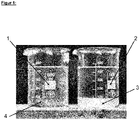
- figure 1 shows a photo of two mixtures of the liquid composition II).
- the left beaker (1) is a liquid composition II) which has been stored at room temperature for more than three months.
- the right-hand beaker (2) is a liquid composition II) which had just been stirred on a hotplate with a magnetic stirrer (3) at 120° C. for three hours. It can be clearly seen that this mixture (2) is clearer than the one stored untreated (1) with the crystallizations (4).
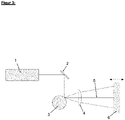
- the laser beam with a measured power of 1.43 W was expanded horizontally with a polygon scanner and focused by a cylindrical lens in such a way that it covered an exposure width of 23 cm.
- figure 3 shows the schematic exposure setup.
- the respective samples were scanned with this line using a movable mirror and exposed.
- the traversing speed was reduced to 9mm/s set.
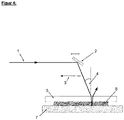
- the laser beam fell on the sample surface at an angle of 22° to the perpendicular.
- the figure 4 shows the path of the rays.
- the sample material was applied to a mirror plate, which reflects the laser light back.
- the interference of the incident and reflected rays creates a line pattern of bright and dark spots parallel to the surface of the mirror.
- This interference pattern is recorded by the material in the form of a refractive index modulation and a so-called Lippmann-Bragg hologram is created.
- the photopolymer layer is located between the mirror plate and a transparent carrier material, e.g. PET film or glass.
- a transparent carrier material e.g. PET film or glass.
- the material is hardened with UV light.
- a UV flash with a power of 3000 WS. This is sufficient to then remove the hologram with the carrier from the sheet. To ensure adhesion to the glass, it should be pretreated with a primer.
- the hologram layer can then be further hardened and bleached under a standard UV lamp with a mercury vapor bulb.
- a UV bridge with an arc length of 70 mm and an output of 120 W/cm. Samples B, D, and H were irradiated with it for 30s, while the other samples remained untreated and were measured after flashing.
- figure 2 shows a device for producing the hologram produced from the claimed kit-of-parts.
- the samples were measured with a spectrometer (CAS 140 B from Instrument Systems) in transmitted light. And with vertical lighting. Since the hologram only reflects the wavelength that satisfies the Bragg condition, a clear absorption peak can be seen in the spectral curve at this point.
- figure 5 shows the measurement curve with the corresponding measurement points of the first exposure of sample H.
- figure 2 shows the schematic structure of a compact roll-to-roll machine for the production of sealed holographic contact copies from the claimed kit-of-parts.
Landscapes
- Physics & Mathematics (AREA)
- Chemical & Material Sciences (AREA)
- General Physics & Mathematics (AREA)
- Organic Chemistry (AREA)
- Chemical Kinetics & Catalysis (AREA)
- Spectroscopy & Molecular Physics (AREA)
- Health & Medical Sciences (AREA)
- Medicinal Chemistry (AREA)
- Polymers & Plastics (AREA)
- Engineering & Computer Science (AREA)
- Optics & Photonics (AREA)
- Materials Engineering (AREA)
- Structural Engineering (AREA)
- Manufacturing & Machinery (AREA)
- Architecture (AREA)
- Inorganic Chemistry (AREA)
- Polymerisation Methods In General (AREA)
- Holo Graphy (AREA)
Priority Applications (10)
| Application Number | Priority Date | Filing Date | Title |
|---|---|---|---|
| ES21156623T ES2963992T3 (es) | 2021-02-11 | 2021-02-11 | Sistema 2K |
| EP21156623.7A EP4043961B1 (fr) | 2021-02-11 | 2021-02-11 | Système 2k |
| KR1020237030591A KR103004710B1 (ko) | 2021-02-11 | 2022-02-11 | 2-구성요소 시스템 |
| PCT/EP2022/053408 WO2022171814A1 (fr) | 2021-02-11 | 2022-02-11 | Système à deux composants |
| JP2023548799A JP2024510875A (ja) | 2021-02-11 | 2022-02-11 | 2k系 |
| CN202280014261.1A CN116830036A (zh) | 2021-02-11 | 2022-02-11 | 双组分体系 |
| MX2023009437A MX2023009437A (es) | 2021-02-11 | 2022-02-11 | Sistema de dos componentes. |
| DE102022103301.5A DE102022103301A1 (de) | 2021-02-11 | 2022-02-11 | 2k-system |
| US18/276,755 US20240150569A1 (en) | 2021-02-11 | 2022-02-11 | 2K-System |
| EP22708501.6A EP4291951A1 (fr) | 2021-02-11 | 2022-02-11 | Système à deux composants |
Applications Claiming Priority (1)
| Application Number | Priority Date | Filing Date | Title |
|---|---|---|---|
| EP21156623.7A EP4043961B1 (fr) | 2021-02-11 | 2021-02-11 | Système 2k |
Publications (3)
| Publication Number | Publication Date |
|---|---|
| EP4043961A1 true EP4043961A1 (fr) | 2022-08-17 |
| EP4043961B1 EP4043961B1 (fr) | 2023-08-16 |
| EP4043961C0 EP4043961C0 (fr) | 2023-08-16 |
Family
ID=74591893
Family Applications (2)
| Application Number | Title | Priority Date | Filing Date |
|---|---|---|---|
| EP21156623.7A Active EP4043961B1 (fr) | 2021-02-11 | 2021-02-11 | Système 2k |
| EP22708501.6A Pending EP4291951A1 (fr) | 2021-02-11 | 2022-02-11 | Système à deux composants |
Family Applications After (1)
| Application Number | Title | Priority Date | Filing Date |
|---|---|---|---|
| EP22708501.6A Pending EP4291951A1 (fr) | 2021-02-11 | 2022-02-11 | Système à deux composants |
Country Status (8)
| Country | Link |
|---|---|
| US (1) | US20240150569A1 (fr) |
| EP (2) | EP4043961B1 (fr) |
| JP (1) | JP2024510875A (fr) |
| CN (1) | CN116830036A (fr) |
| DE (1) | DE102022103301A1 (fr) |
| ES (1) | ES2963992T3 (fr) |
| MX (1) | MX2023009437A (fr) |
| WO (1) | WO2022171814A1 (fr) |
Families Citing this family (3)
| Publication number | Priority date | Publication date | Assignee | Title |
|---|---|---|---|---|
| ES2959027T3 (es) * | 2021-02-11 | 2024-02-19 | Xetos Ag | Blanqueamiento mejorado |
| ES2969163T3 (es) * | 2021-02-11 | 2024-05-16 | Xetos Ag | Composición HOE fotopolimerizable |
| DE102024125289A1 (de) | 2024-09-04 | 2026-03-05 | Carl Zeiss Jena Gmbh | Verfahren zur beschichtung eines trägers mit einem in teilen holografiefähigen photopolymerfilm |
Citations (52)
| Publication number | Priority date | Publication date | Assignee | Title |
|---|---|---|---|---|
| US2760663A (en) | 1953-12-22 | 1956-08-28 | John F Tatum | Automatic hold down structure for fork lift trucks |
| US2850445A (en) | 1955-01-19 | 1958-09-02 | Oster Gerald | Photopolymerization |
| US2875047A (en) | 1955-01-19 | 1959-02-24 | Oster Gerald | Photopolymerization with the formation of coherent plastic masses |
| US3097097A (en) | 1959-02-12 | 1963-07-09 | Gisela K Oster | Photo degrading of gel systems and photographic production of reliefs therewith |
| US3145104A (en) | 1959-08-07 | 1964-08-18 | Gisela K Oster | Photographic processes comprising cross-linking of thiol polymers |
| US3390996A (en) | 1964-04-29 | 1968-07-02 | Du Pont | Photosensitive composition comprising an organic nitrogen-containing color-generator, a photo-oxidant and a redox couple |
| US3427161A (en) | 1965-02-26 | 1969-02-11 | Agfa Gevaert Nv | Photochemical insolubilisation of polymers |
| US3479185A (en) | 1965-06-03 | 1969-11-18 | Du Pont | Photopolymerizable compositions and layers containing 2,4,5-triphenylimidazoyl dimers |
| US3549367A (en) | 1968-05-24 | 1970-12-22 | Du Pont | Photopolymerizable compositions containing triarylimidazolyl dimers and p-aminophenyl ketones |
| US3554753A (en) | 1967-07-20 | 1971-01-12 | Du Pont | Hexaarylbimidazole-carbocyanine dye compositions |
| US3563750A (en) | 1967-07-20 | 1971-02-16 | Du Pont | Hexaarylbiimidazole hydroxyphthalein compositions |
| US3563751A (en) | 1967-07-20 | 1971-02-16 | Du Pont | Hexaarylbiimidazole-acridine dye compositions |
| US3579339A (en) | 1967-05-23 | 1971-05-18 | Du Pont | Photopolymerizable dispersions and elements containing nonmigratory photoreducible dyes |
| US3647467A (en) | 1969-05-22 | 1972-03-07 | Du Pont | Hexaarylbiimidazole-heterocyclic compound compositions |
| US3652275A (en) | 1970-07-09 | 1972-03-28 | Du Pont | HEXAARYLBIIMIDAZOLE BIS (p-DIALKYL-AMINOPHENYL-{60 ,{62 -UNSATURATED) KETONE COMPOSITIONS |
| US3784557A (en) | 1962-03-21 | 1974-01-08 | Du Pont | Phototropic 2,4,5-triphenylimidazolyl radicals and dimers thereof |
| US3854950A (en) | 1972-06-09 | 1974-12-17 | Du Pont | Halation protection for multilayer imaging of photopolymers |
| US3993485A (en) | 1975-05-27 | 1976-11-23 | Bell Telephone Laboratories, Incorporated | Photopolymerization process and related devices |
| US4162162A (en) | 1978-05-08 | 1979-07-24 | E. I. Du Pont De Nemours And Company | Derivatives of aryl ketones and p-dialkyl-aminoarylaldehydes as visible sensitizers of photopolymerizable compositions |
| US4168982A (en) | 1976-06-01 | 1979-09-25 | E. I. Du Pont De Nemours And Company | Photopolymerizable compositions containing nitroso dimers to selectively inhibit thermal polymerization |
| US4268667A (en) | 1980-04-21 | 1981-05-19 | E. I. Du Pont De Nemours And Company | Derivatives of aryl ketones based on 9,10-dihydro-9,10-ethanoanthracene and p-dialkyl-aminoaryl aldehydes as visible sensitizers for photopolymerizable compositions |
| US4311783A (en) | 1979-08-14 | 1982-01-19 | E. I. Du Pont De Nemours And Company | Dimers derived from unsymmetrical 2,4,5,-triphenylimidazole compounds as photoinitiators |
| US4326010A (en) | 1979-06-15 | 1982-04-20 | E. I. Du Pont De Nemours And Company | Additive in a photopolymerizable composition for reducing its adhesion to a support film |
| US4341860A (en) | 1981-06-08 | 1982-07-27 | E. I. Du Pont De Nemours And Company | Photoimaging compositions containing substituted cyclohexadienone compounds |
| US4454218A (en) | 1982-09-13 | 1984-06-12 | E. I. Du Pont De Nemours And Company | N-Alkylindolylidene and N-alkylbenzo-thiazolylidene alkanones as sensitizers for photopolymer compositions |
| EP0123151A1 (fr) | 1983-03-24 | 1984-10-31 | Rorer Pharmaceutical Corporation | Benzobisoxazinetétrones |
| US4535052A (en) | 1983-05-02 | 1985-08-13 | E. I. Du Pont De Nemours And Company | Constrained n-alkylamino aryl ketones as sensitizers for photopolymer compositions |
| US4565769A (en) | 1984-11-21 | 1986-01-21 | E. I. Du Pont De Nemours And Company | Polymeric sensitizers for photopolymer composition |
| US4622286A (en) | 1985-09-16 | 1986-11-11 | E. I. Du Pont De Nemours And Company | Photoimaging composition containing admixture of leuco dye and 2,4,5-triphenylimidazolyl dimer |
| EP0211615A2 (fr) | 1985-08-01 | 1987-02-25 | Nippon Paint Co., Ltd. | Composition photopolymérisable |
| EP0324480A2 (fr) | 1988-01-15 | 1989-07-19 | E.I. Du Pont De Nemours And Company | Compositions photopolymérisables et éléments pour la formation d'image d'indice de réfraction |
| US5017406A (en) | 1988-12-08 | 1991-05-21 | Dow Corning Corporation | UV curable compositions cured with polysilane and peroxide initiators |
| DE68905610T2 (de) | 1988-01-15 | 1993-10-07 | Du Pont | Verfahren zur Herstellung von Reflexionshologrammen in photopolymerisierbaren Schichten. |
| US5759721A (en) | 1995-10-06 | 1998-06-02 | Polaroid Corporation | Holographic medium and process for use thereof |
| DE69032682T2 (de) | 1989-07-14 | 1999-03-25 | E.I. Du Pont De Nemours And Co., Wilmington, Del. | Photopolymerisierbare Zusammensetzungen und Grundstoffe für die holographische Aufzeichnung von Beugungsbildern |
| US20020142227A1 (en) | 1998-03-24 | 2002-10-03 | Lisa Dhar | Optical article and process for forming atricle |
| WO2003036389A1 (fr) | 2001-10-26 | 2003-05-01 | Xetog Ag | Materiau de reproduction holographique et procede de formation d'un hologramme resistant a la lumiere |
| US20050005891A1 (en) | 2003-07-10 | 2005-01-13 | Min-Kyu Oh | Cylinder liner |
| EP1510862A2 (fr) | 2003-08-25 | 2005-03-02 | Fuji Photo Film Co., Ltd. | Procédé d'enregistrement d'hologrammes et matériau pour l'enregistrement d'hologrammes |
| US20050068594A1 (en) | 2003-09-26 | 2005-03-31 | Nissan Chemical Industries, Ltd. | Holographic recording material composition |
| WO2005124456A2 (fr) * | 2004-06-22 | 2005-12-29 | Xetos Ag | Composition photopolymerisable |
| EP1779196A1 (fr) | 2004-06-15 | 2007-05-02 | Andreas Heeschen | Compositions photopolymerisables sans liant |
| DE60216490T2 (de) | 2001-10-18 | 2007-07-05 | Sun Chemical B.V. | Mehrfunktionelle thioxanthon-photoinitiatoren |
| DE60030223T2 (de) | 1999-10-12 | 2007-08-23 | Royal Adhesives And Sealants, Llc | Ultraviolett härtbare Harzzusammensetzungen mit verbesserten Härtungseigenschaften im Schattengebiet |
| EP2219073A1 (fr) | 2009-02-17 | 2010-08-18 | Bayer MaterialScience AG | Nouveaux supports holographiques et photopolymères |
| WO2010091795A1 (fr) | 2009-02-12 | 2010-08-19 | Bayer Materialscience Ag | Procédé de production de photopolymères holographiques sur des films polymères |
| WO2011054793A1 (fr) * | 2009-11-03 | 2011-05-12 | Bayer Materialscience Ag | Procédé pour produire des supports holographiques |
| EP2372454A1 (fr) | 2010-03-29 | 2011-10-05 | Bayer MaterialScience AG | Formulation photopolymère destinée à la fabrication d'un hologramme visible |
| WO2012062655A2 (fr) | 2010-11-08 | 2012-05-18 | Bayer Materialscience Ag | Formulation de photopolymère pour la production de supports holographiques, comprenant des polymères matriciels fortement réticulés |
| US20160320695A1 (en) * | 2013-12-20 | 2016-11-03 | Covertro Deutschland AG | Holographic media with improved light sensitivity |
| US20160362507A1 (en) * | 2014-02-28 | 2016-12-15 | A Et A Mader | Dual-cure cationically polymerisable composition and method for producing a coating or a composite material implementing said composition |
| EP3313827B1 (fr) * | 2015-06-23 | 2019-11-06 | Covestro Deutschland AG | Triazines substituees |
Family Cites Families (13)
| Publication number | Priority date | Publication date | Assignee | Title |
|---|---|---|---|---|
| US4801392A (en) * | 1987-07-02 | 1989-01-31 | The Mead Corporation | Magnetic recording compositions containing ionic dye compounds as initiators |
| JP2701293B2 (ja) * | 1988-03-03 | 1998-01-21 | 大日本インキ化学工業株式会社 | レーザーマーキング用材料及びマーキング方法 |
| JP2004002616A (ja) * | 2002-03-22 | 2004-01-08 | Konica Minolta Holdings Inc | 活性エネルギー線硬化性組成物、インクジェット用インク組成物、それを用いたインクジェット記録方法及び平版印刷版 |
| JP4849362B2 (ja) * | 2008-03-14 | 2012-01-11 | ナガセケムテックス株式会社 | 感放射線性樹脂組成物 |
| KR20110025211A (ko) * | 2008-06-12 | 2011-03-09 | 바스프 에스이 | 술포늄 유도체 및 잠재성 산으로서의 그의 용도 |
| US9754084B2 (en) * | 2012-10-02 | 2017-09-05 | Covestro Deutschland Ag | Method for selecting photoinitiator systems |
| US9128460B2 (en) * | 2012-11-08 | 2015-09-08 | Samsung Electronics Co., Ltd. | Photopolymer composition for recording hologram, and photopolymer layer and hologram recording media including the same |
| KR20160079828A (ko) * | 2013-10-30 | 2016-07-06 | 코베스트로 도이칠란트 아게 | 기재 및 광중합체 필름을 포함하는 복합체 |
| US20180223100A1 (en) * | 2015-06-23 | 2018-08-09 | Covestro Deutschland Ag | Holographic media containing chain-substituted cyanine dyes |
| EP3166109A1 (fr) * | 2015-11-09 | 2017-05-10 | Covestro Deutschland AG | Ensemble de pieces comprenant une couche couvre-n uds et photo-polymere |
| ES2969163T3 (es) * | 2021-02-11 | 2024-05-16 | Xetos Ag | Composición HOE fotopolimerizable |
| EP4043962B1 (fr) * | 2021-02-11 | 2023-06-07 | Xetos AG | Composition photopolymérisable |
| ES2959027T3 (es) * | 2021-02-11 | 2024-02-19 | Xetos Ag | Blanqueamiento mejorado |
-
2021
- 2021-02-11 ES ES21156623T patent/ES2963992T3/es active Active
- 2021-02-11 EP EP21156623.7A patent/EP4043961B1/fr active Active
-
2022
- 2022-02-11 JP JP2023548799A patent/JP2024510875A/ja active Pending
- 2022-02-11 EP EP22708501.6A patent/EP4291951A1/fr active Pending
- 2022-02-11 US US18/276,755 patent/US20240150569A1/en active Pending
- 2022-02-11 WO PCT/EP2022/053408 patent/WO2022171814A1/fr not_active Ceased
- 2022-02-11 CN CN202280014261.1A patent/CN116830036A/zh active Pending
- 2022-02-11 DE DE102022103301.5A patent/DE102022103301A1/de active Pending
- 2022-02-11 MX MX2023009437A patent/MX2023009437A/es unknown
Patent Citations (55)
| Publication number | Priority date | Publication date | Assignee | Title |
|---|---|---|---|---|
| US2760663A (en) | 1953-12-22 | 1956-08-28 | John F Tatum | Automatic hold down structure for fork lift trucks |
| US2850445A (en) | 1955-01-19 | 1958-09-02 | Oster Gerald | Photopolymerization |
| US2875047A (en) | 1955-01-19 | 1959-02-24 | Oster Gerald | Photopolymerization with the formation of coherent plastic masses |
| US3097096A (en) | 1955-01-19 | 1963-07-09 | Oster Gerald | Photopolymerization with the formation of relief images |
| US3097097A (en) | 1959-02-12 | 1963-07-09 | Gisela K Oster | Photo degrading of gel systems and photographic production of reliefs therewith |
| US3145104A (en) | 1959-08-07 | 1964-08-18 | Gisela K Oster | Photographic processes comprising cross-linking of thiol polymers |
| US3784557A (en) | 1962-03-21 | 1974-01-08 | Du Pont | Phototropic 2,4,5-triphenylimidazolyl radicals and dimers thereof |
| US3390996A (en) | 1964-04-29 | 1968-07-02 | Du Pont | Photosensitive composition comprising an organic nitrogen-containing color-generator, a photo-oxidant and a redox couple |
| US3427161A (en) | 1965-02-26 | 1969-02-11 | Agfa Gevaert Nv | Photochemical insolubilisation of polymers |
| US3479185A (en) | 1965-06-03 | 1969-11-18 | Du Pont | Photopolymerizable compositions and layers containing 2,4,5-triphenylimidazoyl dimers |
| US3579339A (en) | 1967-05-23 | 1971-05-18 | Du Pont | Photopolymerizable dispersions and elements containing nonmigratory photoreducible dyes |
| US3563751A (en) | 1967-07-20 | 1971-02-16 | Du Pont | Hexaarylbiimidazole-acridine dye compositions |
| US3563750A (en) | 1967-07-20 | 1971-02-16 | Du Pont | Hexaarylbiimidazole hydroxyphthalein compositions |
| US3554753A (en) | 1967-07-20 | 1971-01-12 | Du Pont | Hexaarylbimidazole-carbocyanine dye compositions |
| US3549367A (en) | 1968-05-24 | 1970-12-22 | Du Pont | Photopolymerizable compositions containing triarylimidazolyl dimers and p-aminophenyl ketones |
| US3647467A (en) | 1969-05-22 | 1972-03-07 | Du Pont | Hexaarylbiimidazole-heterocyclic compound compositions |
| US3652275A (en) | 1970-07-09 | 1972-03-28 | Du Pont | HEXAARYLBIIMIDAZOLE BIS (p-DIALKYL-AMINOPHENYL-{60 ,{62 -UNSATURATED) KETONE COMPOSITIONS |
| US3854950A (en) | 1972-06-09 | 1974-12-17 | Du Pont | Halation protection for multilayer imaging of photopolymers |
| US3993485A (en) | 1975-05-27 | 1976-11-23 | Bell Telephone Laboratories, Incorporated | Photopolymerization process and related devices |
| US4168982A (en) | 1976-06-01 | 1979-09-25 | E. I. Du Pont De Nemours And Company | Photopolymerizable compositions containing nitroso dimers to selectively inhibit thermal polymerization |
| US4162162A (en) | 1978-05-08 | 1979-07-24 | E. I. Du Pont De Nemours And Company | Derivatives of aryl ketones and p-dialkyl-aminoarylaldehydes as visible sensitizers of photopolymerizable compositions |
| US4326010A (en) | 1979-06-15 | 1982-04-20 | E. I. Du Pont De Nemours And Company | Additive in a photopolymerizable composition for reducing its adhesion to a support film |
| US4311783A (en) | 1979-08-14 | 1982-01-19 | E. I. Du Pont De Nemours And Company | Dimers derived from unsymmetrical 2,4,5,-triphenylimidazole compounds as photoinitiators |
| US4268667A (en) | 1980-04-21 | 1981-05-19 | E. I. Du Pont De Nemours And Company | Derivatives of aryl ketones based on 9,10-dihydro-9,10-ethanoanthracene and p-dialkyl-aminoaryl aldehydes as visible sensitizers for photopolymerizable compositions |
| US4341860A (en) | 1981-06-08 | 1982-07-27 | E. I. Du Pont De Nemours And Company | Photoimaging compositions containing substituted cyclohexadienone compounds |
| US4454218A (en) | 1982-09-13 | 1984-06-12 | E. I. Du Pont De Nemours And Company | N-Alkylindolylidene and N-alkylbenzo-thiazolylidene alkanones as sensitizers for photopolymer compositions |
| EP0123151A1 (fr) | 1983-03-24 | 1984-10-31 | Rorer Pharmaceutical Corporation | Benzobisoxazinetétrones |
| US4535052A (en) | 1983-05-02 | 1985-08-13 | E. I. Du Pont De Nemours And Company | Constrained n-alkylamino aryl ketones as sensitizers for photopolymer compositions |
| US4565769A (en) | 1984-11-21 | 1986-01-21 | E. I. Du Pont De Nemours And Company | Polymeric sensitizers for photopolymer composition |
| EP0211615A2 (fr) | 1985-08-01 | 1987-02-25 | Nippon Paint Co., Ltd. | Composition photopolymérisable |
| US4622286A (en) | 1985-09-16 | 1986-11-11 | E. I. Du Pont De Nemours And Company | Photoimaging composition containing admixture of leuco dye and 2,4,5-triphenylimidazolyl dimer |
| EP0324480A2 (fr) | 1988-01-15 | 1989-07-19 | E.I. Du Pont De Nemours And Company | Compositions photopolymérisables et éléments pour la formation d'image d'indice de réfraction |
| US4942112A (en) | 1988-01-15 | 1990-07-17 | E. I. Du Pont De Nemours And Company | Photopolymerizable compositions and elements for refractive index imaging |
| DE68905610T2 (de) | 1988-01-15 | 1993-10-07 | Du Pont | Verfahren zur Herstellung von Reflexionshologrammen in photopolymerisierbaren Schichten. |
| US5017406A (en) | 1988-12-08 | 1991-05-21 | Dow Corning Corporation | UV curable compositions cured with polysilane and peroxide initiators |
| DE69032682T2 (de) | 1989-07-14 | 1999-03-25 | E.I. Du Pont De Nemours And Co., Wilmington, Del. | Photopolymerisierbare Zusammensetzungen und Grundstoffe für die holographische Aufzeichnung von Beugungsbildern |
| US5759721A (en) | 1995-10-06 | 1998-06-02 | Polaroid Corporation | Holographic medium and process for use thereof |
| US20020142227A1 (en) | 1998-03-24 | 2002-10-03 | Lisa Dhar | Optical article and process for forming atricle |
| DE60030223T2 (de) | 1999-10-12 | 2007-08-23 | Royal Adhesives And Sealants, Llc | Ultraviolett härtbare Harzzusammensetzungen mit verbesserten Härtungseigenschaften im Schattengebiet |
| DE60216490T2 (de) | 2001-10-18 | 2007-07-05 | Sun Chemical B.V. | Mehrfunktionelle thioxanthon-photoinitiatoren |
| WO2003036389A1 (fr) | 2001-10-26 | 2003-05-01 | Xetog Ag | Materiau de reproduction holographique et procede de formation d'un hologramme resistant a la lumiere |
| US20050005891A1 (en) | 2003-07-10 | 2005-01-13 | Min-Kyu Oh | Cylinder liner |
| EP1510862A2 (fr) | 2003-08-25 | 2005-03-02 | Fuji Photo Film Co., Ltd. | Procédé d'enregistrement d'hologrammes et matériau pour l'enregistrement d'hologrammes |
| US20050068594A1 (en) | 2003-09-26 | 2005-03-31 | Nissan Chemical Industries, Ltd. | Holographic recording material composition |
| EP1779196A1 (fr) | 2004-06-15 | 2007-05-02 | Andreas Heeschen | Compositions photopolymerisables sans liant |
| EP1779196B1 (fr) | 2004-06-15 | 2013-10-09 | Xetos AG | Compositions photopolymerisables sans liant |
| WO2005124456A2 (fr) * | 2004-06-22 | 2005-12-29 | Xetos Ag | Composition photopolymerisable |
| WO2010091795A1 (fr) | 2009-02-12 | 2010-08-19 | Bayer Materialscience Ag | Procédé de production de photopolymères holographiques sur des films polymères |
| EP2219073A1 (fr) | 2009-02-17 | 2010-08-18 | Bayer MaterialScience AG | Nouveaux supports holographiques et photopolymères |
| WO2011054793A1 (fr) * | 2009-11-03 | 2011-05-12 | Bayer Materialscience Ag | Procédé pour produire des supports holographiques |
| EP2372454A1 (fr) | 2010-03-29 | 2011-10-05 | Bayer MaterialScience AG | Formulation photopolymère destinée à la fabrication d'un hologramme visible |
| WO2012062655A2 (fr) | 2010-11-08 | 2012-05-18 | Bayer Materialscience Ag | Formulation de photopolymère pour la production de supports holographiques, comprenant des polymères matriciels fortement réticulés |
| US20160320695A1 (en) * | 2013-12-20 | 2016-11-03 | Covertro Deutschland AG | Holographic media with improved light sensitivity |
| US20160362507A1 (en) * | 2014-02-28 | 2016-12-15 | A Et A Mader | Dual-cure cationically polymerisable composition and method for producing a coating or a composite material implementing said composition |
| EP3313827B1 (fr) * | 2015-06-23 | 2019-11-06 | Covestro Deutschland AG | Triazines substituees |
Non-Patent Citations (9)
| Title |
|---|
| B. TIMPEH.J. UND S. NEUENFELD: "Dyes in photoinitiator systems", KONTAKTE, 1990, pages 28 - 35 |
| B. VON NECKERS ET AL.: "Part A, Poly. Chem", J. POLYM. SCI., vol. 33, 1995, pages 1691 - 1703 |
| D.F: EATON: "Adv. in Photochemistry", vol. 13, 1986, WILEY-INTERSCIENCE, article "Dye Sensitized Photopolymerization", pages: 427 - 487 |
| FRED UNTERSEHER ET AL.: "Ross Books", 1982, article "Holography Handbook: Making Holograms the Easy Way" |
| GRAHAM SAXBY: "Practical Holography", 2004, INST, OF PHYSICS PUB. |
| HOWARD M. SMITH: "Principles of Holography", 1969, WILEY |
| JAKUBIAK, J.J.F. RABEK: "Photoinitiators for visible light polymisation", POLIMERY (WARSCHAU, vol. 44, 1999, pages 447 - 461 |
| N. SMIRNOVA, OPTICS IN INFORMATION SYSTEMS, February 2004 (2004-02-01), pages 9 |
| S. M. SCHULTZ ET AL.: "Volume grating preferential-order focusing waveguide coupler", OPT. LETT., vol. 24, December 1999 (1999-12-01), pages 1708 - 1710, XP000903974 |
Also Published As
| Publication number | Publication date |
|---|---|
| ES2963992T3 (es) | 2024-04-03 |
| DE102022103301A1 (de) | 2022-08-11 |
| MX2023009437A (es) | 2023-08-15 |
| EP4043961B1 (fr) | 2023-08-16 |
| WO2022171814A1 (fr) | 2022-08-18 |
| EP4043961C0 (fr) | 2023-08-16 |
| JP2024510875A (ja) | 2024-03-12 |
| CN116830036A (zh) | 2023-09-29 |
| EP4291951A1 (fr) | 2023-12-20 |
| KR20230145123A (ko) | 2023-10-17 |
| US20240150569A1 (en) | 2024-05-09 |
Similar Documents
| Publication | Publication Date | Title |
|---|---|---|
| EP4043961B1 (fr) | Système 2k | |
| DE102004030019A1 (de) | Photopolymerisierbare Zusammensetzung | |
| EP4043962B1 (fr) | Composition photopolymérisable | |
| DE3830914A1 (de) | Photopolymerisierbares gemisch, daraus hergestelltes aufzeichnungsmaterial und verfahren zur herstellung von kopien | |
| DE3007212A1 (de) | Lichtempfindliche masse | |
| DE69501865T2 (de) | Fotopolymerisierbare Zusammensetzung und fotoempfindliche lithographische Druckplatte | |
| DE68916332T2 (de) | Bei längeren Wellenlängen wirksamer Photopolymerisations- sensibilisator. | |
| EP0115021B1 (fr) | Procédé pour la réalisation de reliefs et de plaques d'impression positives | |
| EP4291953B1 (fr) | Blanchissement amélioré | |
| EP0239782A2 (fr) | Elément photosensible pour l'enregistrement | |
| EP4291587B1 (fr) | Composition hoe photopolymérisable | |
| EP0291878B1 (fr) | Matériau d'enregistrement photopolymérisable, couches formant photoréserve et plaques pour l'impression planographique à base de ces matériaux d'enregistrement | |
| DE19746932B4 (de) | Neues Photoresist-Copolymer und Photoresistzusammensetzung | |
| EP0143201B1 (fr) | Mélanges photopolymérisables avec des composés particuliers d'aminobenzophénone | |
| EP0360151A2 (fr) | Mélange photopolymérisable et matériau d'enregistrement fabriqué à partir de celui-ci | |
| DE3717034A1 (de) | Photopolymerisierbare aufzeichnungsmaterialien sowie photoresistschichten und flachdruckplatten auf basis dieser aufzeichnungsmaterialien, sowie neue chinazolon-4-verbindungen | |
| DE3824551A1 (de) | Lichtempfindliches aufzeichnungsmaterial, dessen verwendung und dafuer geeignete neue leukoverbindung | |
| DE4135996A1 (de) | Photopolymerisierbare zusammensetzung | |
| DE3717036A1 (de) | Photopolymerisierbare aufzeichnungsmaterialien sowie photoresistschichten und flachdruckplatten auf basis dieser aufzeichnungsmaterialien | |
| EP2526154A2 (fr) | Substance photosensible comprenant des thioxanthones comme photo-initiateur photodésactivable pour la fabrication de petites structures | |
| DE3905765A1 (de) | Lichtempfindliches aufzeichnungselement | |
| WO2026052632A1 (fr) | Procédé de revêtement d'un support avec un film photopolymère partiellement holographique | |
| JPS63311243A (ja) | 光重合可能の記録材料ならびにこの記録材料を主体とするフォトレジスト層及び平版印刷版体 |
Legal Events
| Date | Code | Title | Description |
|---|---|---|---|
| PUAI | Public reference made under article 153(3) epc to a published international application that has entered the european phase |
Free format text: ORIGINAL CODE: 0009012 |
|
| STAA | Information on the status of an ep patent application or granted ep patent |
Free format text: STATUS: REQUEST FOR EXAMINATION WAS MADE |
|
| 17P | Request for examination filed |
Effective date: 20220617 |
|
| AK | Designated contracting states |
Kind code of ref document: A1 Designated state(s): AL AT BE BG CH CY CZ DE DK EE ES FI FR GB GR HR HU IE IS IT LI LT LU LV MC MK MT NL NO PL PT RO RS SE SI SK SM TR |
|
| RBV | Designated contracting states (corrected) |
Designated state(s): AL AT BE BG CH CY CZ DE DK EE ES FI FR GB GR HR HU IE IS IT LI LT LU LV MC MK MT NL NO PL PT RO RS SE SI SK SM TR |
|
| GRAP | Despatch of communication of intention to grant a patent |
Free format text: ORIGINAL CODE: EPIDOSNIGR1 |
|
| STAA | Information on the status of an ep patent application or granted ep patent |
Free format text: STATUS: GRANT OF PATENT IS INTENDED |
|
| RIC1 | Information provided on ipc code assigned before grant |
Ipc: G02B 5/32 20060101ALN20230217BHEP Ipc: G02B 5/18 20060101ALI20230217BHEP Ipc: C08F 2/50 20060101ALI20230217BHEP Ipc: G03F 7/027 20060101ALI20230217BHEP Ipc: G03F 7/105 20060101ALI20230217BHEP Ipc: G03F 7/033 20060101ALI20230217BHEP Ipc: G03F 7/032 20060101ALI20230217BHEP Ipc: G03F 7/031 20060101ALI20230217BHEP Ipc: G03F 7/029 20060101ALI20230217BHEP Ipc: G03F 7/00 20060101AFI20230217BHEP |
|
| INTG | Intention to grant announced |
Effective date: 20230316 |
|
| GRAS | Grant fee paid |
Free format text: ORIGINAL CODE: EPIDOSNIGR3 |
|
| GRAA | (expected) grant |
Free format text: ORIGINAL CODE: 0009210 |
|
| STAA | Information on the status of an ep patent application or granted ep patent |
Free format text: STATUS: THE PATENT HAS BEEN GRANTED |
|
| AK | Designated contracting states |
Kind code of ref document: B1 Designated state(s): AL AT BE BG CH CY CZ DE DK EE ES FI FR GB GR HR HU IE IS IT LI LT LU LV MC MK MT NL NO PL PT RO RS SE SI SK SM TR |
|
| REG | Reference to a national code |
Ref country code: CH Ref legal event code: EP Ref country code: DE Ref legal event code: R096 Ref document number: 502021001232 Country of ref document: DE |
|
| REG | Reference to a national code |
Ref country code: IE Ref legal event code: FG4D Free format text: LANGUAGE OF EP DOCUMENT: GERMAN |
|
| U01 | Request for unitary effect filed |
Effective date: 20230829 |
|
| U07 | Unitary effect registered |
Designated state(s): AT BE BG DE DK EE FI FR IT LT LU LV MT NL PT SE SI Effective date: 20230905 |
|
| U1N | Appointed representative for the unitary patent procedure changed after the registration of the unitary effect |
Representative=s name: KRAUS & WEISERT PATENTANWAELTE PARTGMBB; DE |
|
| PG25 | Lapsed in a contracting state [announced via postgrant information from national office to epo] |
Ref country code: GR Free format text: LAPSE BECAUSE OF FAILURE TO SUBMIT A TRANSLATION OF THE DESCRIPTION OR TO PAY THE FEE WITHIN THE PRESCRIBED TIME-LIMIT Effective date: 20231117 |
|
| PG25 | Lapsed in a contracting state [announced via postgrant information from national office to epo] |
Ref country code: IS Free format text: LAPSE BECAUSE OF FAILURE TO SUBMIT A TRANSLATION OF THE DESCRIPTION OR TO PAY THE FEE WITHIN THE PRESCRIBED TIME-LIMIT Effective date: 20231216 |
|
| PG25 | Lapsed in a contracting state [announced via postgrant information from national office to epo] |
Ref country code: RS Free format text: LAPSE BECAUSE OF FAILURE TO SUBMIT A TRANSLATION OF THE DESCRIPTION OR TO PAY THE FEE WITHIN THE PRESCRIBED TIME-LIMIT Effective date: 20230816 Ref country code: NO Free format text: LAPSE BECAUSE OF FAILURE TO SUBMIT A TRANSLATION OF THE DESCRIPTION OR TO PAY THE FEE WITHIN THE PRESCRIBED TIME-LIMIT Effective date: 20231116 Ref country code: IS Free format text: LAPSE BECAUSE OF FAILURE TO SUBMIT A TRANSLATION OF THE DESCRIPTION OR TO PAY THE FEE WITHIN THE PRESCRIBED TIME-LIMIT Effective date: 20231216 Ref country code: HR Free format text: LAPSE BECAUSE OF FAILURE TO SUBMIT A TRANSLATION OF THE DESCRIPTION OR TO PAY THE FEE WITHIN THE PRESCRIBED TIME-LIMIT Effective date: 20230816 Ref country code: GR Free format text: LAPSE BECAUSE OF FAILURE TO SUBMIT A TRANSLATION OF THE DESCRIPTION OR TO PAY THE FEE WITHIN THE PRESCRIBED TIME-LIMIT Effective date: 20231117 |
|
| PG25 | Lapsed in a contracting state [announced via postgrant information from national office to epo] |
Ref country code: PL Free format text: LAPSE BECAUSE OF FAILURE TO SUBMIT A TRANSLATION OF THE DESCRIPTION OR TO PAY THE FEE WITHIN THE PRESCRIBED TIME-LIMIT Effective date: 20230816 |
|
| U20 | Renewal fee for the european patent with unitary effect paid |
Year of fee payment: 4 Effective date: 20240207 |
|
| REG | Reference to a national code |
Ref country code: ES Ref legal event code: FG2A Ref document number: 2963992 Country of ref document: ES Kind code of ref document: T3 Effective date: 20240403 |
|
| PG25 | Lapsed in a contracting state [announced via postgrant information from national office to epo] |
Ref country code: SM Free format text: LAPSE BECAUSE OF FAILURE TO SUBMIT A TRANSLATION OF THE DESCRIPTION OR TO PAY THE FEE WITHIN THE PRESCRIBED TIME-LIMIT Effective date: 20230816 Ref country code: RO Free format text: LAPSE BECAUSE OF FAILURE TO SUBMIT A TRANSLATION OF THE DESCRIPTION OR TO PAY THE FEE WITHIN THE PRESCRIBED TIME-LIMIT Effective date: 20230816 Ref country code: CZ Free format text: LAPSE BECAUSE OF FAILURE TO SUBMIT A TRANSLATION OF THE DESCRIPTION OR TO PAY THE FEE WITHIN THE PRESCRIBED TIME-LIMIT Effective date: 20230816 Ref country code: SK Free format text: LAPSE BECAUSE OF FAILURE TO SUBMIT A TRANSLATION OF THE DESCRIPTION OR TO PAY THE FEE WITHIN THE PRESCRIBED TIME-LIMIT Effective date: 20230816 |
|
| REG | Reference to a national code |
Ref country code: DE Ref legal event code: R097 Ref document number: 502021001232 Country of ref document: DE |
|
| PLBE | No opposition filed within time limit |
Free format text: ORIGINAL CODE: 0009261 |
|
| STAA | Information on the status of an ep patent application or granted ep patent |
Free format text: STATUS: NO OPPOSITION FILED WITHIN TIME LIMIT |
|
| 26N | No opposition filed |
Effective date: 20240517 |
|
| PG25 | Lapsed in a contracting state [announced via postgrant information from national office to epo] |
Ref country code: MC Free format text: LAPSE BECAUSE OF FAILURE TO SUBMIT A TRANSLATION OF THE DESCRIPTION OR TO PAY THE FEE WITHIN THE PRESCRIBED TIME-LIMIT Effective date: 20230816 |
|
| PG25 | Lapsed in a contracting state [announced via postgrant information from national office to epo] |
Ref country code: IE Free format text: LAPSE BECAUSE OF NON-PAYMENT OF DUE FEES Effective date: 20240211 |
|
| PG25 | Lapsed in a contracting state [announced via postgrant information from national office to epo] |
Ref country code: IE Free format text: LAPSE BECAUSE OF NON-PAYMENT OF DUE FEES Effective date: 20240211 |
|
| U20 | Renewal fee for the european patent with unitary effect paid |
Year of fee payment: 5 Effective date: 20250226 |
|
| PG25 | Lapsed in a contracting state [announced via postgrant information from national office to epo] |
Ref country code: CY Free format text: LAPSE BECAUSE OF FAILURE TO SUBMIT A TRANSLATION OF THE DESCRIPTION OR TO PAY THE FEE WITHIN THE PRESCRIBED TIME-LIMIT; INVALID AB INITIO Effective date: 20210211 |
|
| PG25 | Lapsed in a contracting state [announced via postgrant information from national office to epo] |
Ref country code: HU Free format text: LAPSE BECAUSE OF FAILURE TO SUBMIT A TRANSLATION OF THE DESCRIPTION OR TO PAY THE FEE WITHIN THE PRESCRIBED TIME-LIMIT; INVALID AB INITIO Effective date: 20210211 |
|
| PG25 | Lapsed in a contracting state [announced via postgrant information from national office to epo] |
Ref country code: TR Free format text: LAPSE BECAUSE OF FAILURE TO SUBMIT A TRANSLATION OF THE DESCRIPTION OR TO PAY THE FEE WITHIN THE PRESCRIBED TIME-LIMIT Effective date: 20230816 |
|
| REG | Reference to a national code |
Ref country code: CH Ref legal event code: U11 Free format text: ST27 STATUS EVENT CODE: U-0-0-U10-U11 (AS PROVIDED BY THE NATIONAL OFFICE) Effective date: 20260301 |
|
| U20 | Renewal fee for the european patent with unitary effect paid |
Year of fee payment: 6 Effective date: 20260224 |
|
| PGFP | Annual fee paid to national office [announced via postgrant information from national office to epo] |
Ref country code: GB Payment date: 20260219 Year of fee payment: 6 |
|
| PGFP | Annual fee paid to national office [announced via postgrant information from national office to epo] |
Ref country code: ES Payment date: 20260319 Year of fee payment: 6 |
|
| PGFP | Annual fee paid to national office [announced via postgrant information from national office to epo] |
Ref country code: CH Payment date: 20260301 Year of fee payment: 6 |