EP4066819B1 - Petites liposomes à libération d'arn qui code un immunogène - Google Patents
Petites liposomes à libération d'arn qui code un immunogène Download PDFInfo
- Publication number
- EP4066819B1 EP4066819B1 EP22175210.8A EP22175210A EP4066819B1 EP 4066819 B1 EP4066819 B1 EP 4066819B1 EP 22175210 A EP22175210 A EP 22175210A EP 4066819 B1 EP4066819 B1 EP 4066819B1
- Authority
- EP
- European Patent Office
- Prior art keywords
- rna
- liposome
- liposomes
- immunogen
- lipid
- Prior art date
- Legal status (The legal status is an assumption and is not a legal conclusion. Google has not performed a legal analysis and makes no representation as to the accuracy of the status listed.)
- Active
Links
Images






Classifications
-
- A—HUMAN NECESSITIES
- A61—MEDICAL OR VETERINARY SCIENCE; HYGIENE
- A61K—PREPARATIONS FOR MEDICAL, DENTAL OR TOILETRY PURPOSES
- A61K39/00—Medicinal preparations containing antigens or antibodies
-
- A—HUMAN NECESSITIES
- A61—MEDICAL OR VETERINARY SCIENCE; HYGIENE
- A61K—PREPARATIONS FOR MEDICAL, DENTAL OR TOILETRY PURPOSES
- A61K9/00—Medicinal preparations characterised by special physical form
- A61K9/0012—Galenical forms characterised by the site of application
- A61K9/0019—Injectable compositions; Intramuscular, intravenous, arterial, subcutaneous administration; Compositions to be administered through the skin in an invasive manner
-
- A—HUMAN NECESSITIES
- A61—MEDICAL OR VETERINARY SCIENCE; HYGIENE
- A61K—PREPARATIONS FOR MEDICAL, DENTAL OR TOILETRY PURPOSES
- A61K9/00—Medicinal preparations characterised by special physical form
- A61K9/10—Dispersions; Emulsions
- A61K9/127—Synthetic bilayered vehicles, e.g. liposomes or liposomes with cholesterol as the only non-phosphatidyl surfactant
-
- A—HUMAN NECESSITIES
- A61—MEDICAL OR VETERINARY SCIENCE; HYGIENE
- A61K—PREPARATIONS FOR MEDICAL, DENTAL OR TOILETRY PURPOSES
- A61K9/00—Medicinal preparations characterised by special physical form
- A61K9/10—Dispersions; Emulsions
- A61K9/127—Synthetic bilayered vehicles, e.g. liposomes or liposomes with cholesterol as the only non-phosphatidyl surfactant
- A61K9/1271—Non-conventional liposomes, e.g. PEGylated liposomes or liposomes coated or grafted with polymers
-
- A—HUMAN NECESSITIES
- A61—MEDICAL OR VETERINARY SCIENCE; HYGIENE
- A61K—PREPARATIONS FOR MEDICAL, DENTAL OR TOILETRY PURPOSES
- A61K9/00—Medicinal preparations characterised by special physical form
- A61K9/10—Dispersions; Emulsions
- A61K9/127—Synthetic bilayered vehicles, e.g. liposomes or liposomes with cholesterol as the only non-phosphatidyl surfactant
- A61K9/1271—Non-conventional liposomes, e.g. PEGylated liposomes or liposomes coated or grafted with polymers
- A61K9/1272—Non-conventional liposomes, e.g. PEGylated liposomes or liposomes coated or grafted with polymers comprising non-phosphatidyl surfactants as bilayer-forming substances, e.g. cationic lipids or non-phosphatidyl liposomes coated or grafted with polymers
-
- A—HUMAN NECESSITIES
- A61—MEDICAL OR VETERINARY SCIENCE; HYGIENE
- A61P—SPECIFIC THERAPEUTIC ACTIVITY OF CHEMICAL COMPOUNDS OR MEDICINAL PREPARATIONS
- A61P31/00—Antiinfectives, i.e. antibiotics, antiseptics, chemotherapeutics
- A61P31/04—Antibacterial agents
-
- A—HUMAN NECESSITIES
- A61—MEDICAL OR VETERINARY SCIENCE; HYGIENE
- A61P—SPECIFIC THERAPEUTIC ACTIVITY OF CHEMICAL COMPOUNDS OR MEDICINAL PREPARATIONS
- A61P31/00—Antiinfectives, i.e. antibiotics, antiseptics, chemotherapeutics
- A61P31/10—Antimycotics
-
- A—HUMAN NECESSITIES
- A61—MEDICAL OR VETERINARY SCIENCE; HYGIENE
- A61P—SPECIFIC THERAPEUTIC ACTIVITY OF CHEMICAL COMPOUNDS OR MEDICINAL PREPARATIONS
- A61P31/00—Antiinfectives, i.e. antibiotics, antiseptics, chemotherapeutics
- A61P31/12—Antivirals
-
- A—HUMAN NECESSITIES
- A61—MEDICAL OR VETERINARY SCIENCE; HYGIENE
- A61P—SPECIFIC THERAPEUTIC ACTIVITY OF CHEMICAL COMPOUNDS OR MEDICINAL PREPARATIONS
- A61P33/00—Antiparasitic agents
-
- A—HUMAN NECESSITIES
- A61—MEDICAL OR VETERINARY SCIENCE; HYGIENE
- A61P—SPECIFIC THERAPEUTIC ACTIVITY OF CHEMICAL COMPOUNDS OR MEDICINAL PREPARATIONS
- A61P37/00—Drugs for immunological or allergic disorders
- A61P37/02—Immunomodulators
- A61P37/04—Immunostimulants
-
- C—CHEMISTRY; METALLURGY
- C12—BIOCHEMISTRY; BEER; SPIRITS; WINE; VINEGAR; MICROBIOLOGY; ENZYMOLOGY; MUTATION OR GENETIC ENGINEERING
- C12N—MICROORGANISMS OR ENZYMES; COMPOSITIONS THEREOF; PROPAGATING, PRESERVING, OR MAINTAINING MICROORGANISMS; MUTATION OR GENETIC ENGINEERING; CULTURE MEDIA
- C12N15/00—Mutation or genetic engineering; DNA or RNA concerning genetic engineering, vectors, e.g. plasmids, or their isolation, preparation or purification; Use of hosts therefor
- C12N15/09—Recombinant DNA-technology
- C12N15/87—Introduction of foreign genetic material using processes not otherwise provided for, e.g. co-transformation
- C12N15/88—Introduction of foreign genetic material using processes not otherwise provided for, e.g. co-transformation using microencapsulation, e.g. using amphiphile liposome vesicle
-
- A—HUMAN NECESSITIES
- A61—MEDICAL OR VETERINARY SCIENCE; HYGIENE
- A61K—PREPARATIONS FOR MEDICAL, DENTAL OR TOILETRY PURPOSES
- A61K39/00—Medicinal preparations containing antigens or antibodies
- A61K2039/51—Medicinal preparations containing antigens or antibodies comprising whole cells, viruses or DNA/RNA
- A61K2039/53—DNA (RNA) vaccination
-
- A—HUMAN NECESSITIES
- A61—MEDICAL OR VETERINARY SCIENCE; HYGIENE
- A61K—PREPARATIONS FOR MEDICAL, DENTAL OR TOILETRY PURPOSES
- A61K39/00—Medicinal preparations containing antigens or antibodies
- A61K2039/555—Medicinal preparations containing antigens or antibodies characterised by a specific combination antigen/adjuvant
- A61K2039/55511—Organic adjuvants
- A61K2039/55555—Liposomes; Vesicles, e.g. nanoparticles; Spheres, e.g. nanospheres; Polymers
-
- A—HUMAN NECESSITIES
- A61—MEDICAL OR VETERINARY SCIENCE; HYGIENE
- A61K—PREPARATIONS FOR MEDICAL, DENTAL OR TOILETRY PURPOSES
- A61K9/00—Medicinal preparations characterised by special physical form
- A61K9/10—Dispersions; Emulsions
- A61K9/127—Synthetic bilayered vehicles, e.g. liposomes or liposomes with cholesterol as the only non-phosphatidyl surfactant
- A61K9/1277—Preparation processes; Proliposomes
-
- C—CHEMISTRY; METALLURGY
- C12—BIOCHEMISTRY; BEER; SPIRITS; WINE; VINEGAR; MICROBIOLOGY; ENZYMOLOGY; MUTATION OR GENETIC ENGINEERING
- C12N—MICROORGANISMS OR ENZYMES; COMPOSITIONS THEREOF; PROPAGATING, PRESERVING, OR MAINTAINING MICROORGANISMS; MUTATION OR GENETIC ENGINEERING; CULTURE MEDIA
- C12N2710/00—MICROORGANISMS OR ENZYMES; COMPOSITIONS THEREOF; PROPAGATING, PRESERVING, OR MAINTAINING MICROORGANISMS; MUTATION OR GENETIC ENGINEERING; CULTURE MEDIA dsDNA viruses
- C12N2710/00011—Details
- C12N2710/16011—Herpesviridae
- C12N2710/16111—Cytomegalovirus, e.g. human herpesvirus 5
- C12N2710/16134—Use of virus or viral component as vaccine, e.g. live-attenuated or inactivated virus, VLP, viral protein
-
- C—CHEMISTRY; METALLURGY
- C12—BIOCHEMISTRY; BEER; SPIRITS; WINE; VINEGAR; MICROBIOLOGY; ENZYMOLOGY; MUTATION OR GENETIC ENGINEERING
- C12N—MICROORGANISMS OR ENZYMES; COMPOSITIONS THEREOF; PROPAGATING, PRESERVING, OR MAINTAINING MICROORGANISMS; MUTATION OR GENETIC ENGINEERING; CULTURE MEDIA
- C12N2760/00—MICROORGANISMS OR ENZYMES; COMPOSITIONS THEREOF; PROPAGATING, PRESERVING, OR MAINTAINING MICROORGANISMS; MUTATION OR GENETIC ENGINEERING; CULTURE MEDIA ssRNA viruses negative-sense
- C12N2760/00011—Details
- C12N2760/18011—Paramyxoviridae
- C12N2760/18511—Pneumovirus, e.g. human respiratory syncytial virus
- C12N2760/18534—Use of virus or viral component as vaccine, e.g. live-attenuated or inactivated virus, VLP, viral protein
-
- C—CHEMISTRY; METALLURGY
- C12—BIOCHEMISTRY; BEER; SPIRITS; WINE; VINEGAR; MICROBIOLOGY; ENZYMOLOGY; MUTATION OR GENETIC ENGINEERING
- C12N—MICROORGANISMS OR ENZYMES; COMPOSITIONS THEREOF; PROPAGATING, PRESERVING, OR MAINTAINING MICROORGANISMS; MUTATION OR GENETIC ENGINEERING; CULTURE MEDIA
- C12N2770/00—MICROORGANISMS OR ENZYMES; COMPOSITIONS THEREOF; PROPAGATING, PRESERVING, OR MAINTAINING MICROORGANISMS; MUTATION OR GENETIC ENGINEERING; CULTURE MEDIA ssRNA viruses positive-sense
- C12N2770/00011—Details
- C12N2770/36011—Togaviridae
- C12N2770/36111—Alphavirus, e.g. Sindbis virus, VEE, EEE, WEE, Semliki
- C12N2770/36141—Use of virus, viral particle or viral elements as a vector
- C12N2770/36143—Use of virus, viral particle or viral elements as a vector viral genome or elements thereof as genetic vector
-
- C—CHEMISTRY; METALLURGY
- C12—BIOCHEMISTRY; BEER; SPIRITS; WINE; VINEGAR; MICROBIOLOGY; ENZYMOLOGY; MUTATION OR GENETIC ENGINEERING
- C12N—MICROORGANISMS OR ENZYMES; COMPOSITIONS THEREOF; PROPAGATING, PRESERVING, OR MAINTAINING MICROORGANISMS; MUTATION OR GENETIC ENGINEERING; CULTURE MEDIA
- C12N2770/00—MICROORGANISMS OR ENZYMES; COMPOSITIONS THEREOF; PROPAGATING, PRESERVING, OR MAINTAINING MICROORGANISMS; MUTATION OR GENETIC ENGINEERING; CULTURE MEDIA ssRNA viruses positive-sense
- C12N2770/00011—Details
- C12N2770/36011—Togaviridae
- C12N2770/36111—Alphavirus, e.g. Sindbis virus, VEE, EEE, WEE, Semliki
- C12N2770/36171—Demonstrated in vivo effect
-
- Y—GENERAL TAGGING OF NEW TECHNOLOGICAL DEVELOPMENTS; GENERAL TAGGING OF CROSS-SECTIONAL TECHNOLOGIES SPANNING OVER SEVERAL SECTIONS OF THE IPC; TECHNICAL SUBJECTS COVERED BY FORMER USPC CROSS-REFERENCE ART COLLECTIONS [XRACs] AND DIGESTS
- Y02—TECHNOLOGIES OR APPLICATIONS FOR MITIGATION OR ADAPTATION AGAINST CLIMATE CHANGE
- Y02A—TECHNOLOGIES FOR ADAPTATION TO CLIMATE CHANGE
- Y02A50/00—TECHNOLOGIES FOR ADAPTATION TO CLIMATE CHANGE in human health protection, e.g. against extreme weather
- Y02A50/30—Against vector-borne diseases, e.g. mosquito-borne, fly-borne, tick-borne or waterborne diseases whose impact is exacerbated by climate change
Definitions
- This invention is in the field of non-viral delivery of RNA for immunisation.
- nucleic acids for immunising animals has been a goal for several years.
- Various approaches have been tested, including the use of DNA or RNA, of viral or non-viral delivery vehicles (or even no delivery vehicle, in a "naked” vaccine), of replicating or non-replicating vectors, or of viral or non-viral vectors.
- EP1637144 and JP2007112768 relate to complexes of nucleic acids and liposomes.
- EP0786522 , US5750390 and US5972704 describe the use of ribozymes which may be delivered in a liposome.
- WO99/52503 describes viral liposomes comprising nucleic acid encoding a tumour-associated antigen.
- WO2012/006376 describes liposome-based vaccines.
- nucleic acid vaccines There remains a need for further and improved nucleic acid vaccines and, in particular, for improved ways of delivering nucleic acid vaccines.
- nucleic acid immunisation is achieved by delivering RNA encapsulated within a liposome comprising a lipid with a cationic head group and a lipid with a zwitterionic head group.
- the RNA encodes an immunogen of interest which elicits an immune response against a herpesvirus
- the liposome has a diameter in the range of 60-180nm, and ideally in the range 80-160nm. This size compares with, for example, a diameter of ⁇ 40nm for an unenveloped alphavirus isometric protein capsid.
- the combination of efficient encapsulation of a RNA (particularly a self-replicating RNA) within a small liposome allows for efficient delivery to elicit a strong immune response.
- the invention provides a liposome within which RNA encoding an immunogen of interest is encapsulated, wherein the liposome comprising a lipid with a cationic head group and a lipid with a zwitterionic head group has a diameter in the range of 60-180nm, and wherein the immunogen elicits an immune response against a herpesvirus.
- liposomes are suitable for in vivo delivery of the RNA to a vertebrate cell and so they are useful as components in pharmaceutical compositions for immunising subjects against various diseases.
- the liposome The liposome
- the invention utilises liposomes within which immunogen-encoding RNA is encapsulated.
- the RNA is (as in a natural virus) separated from any external medium. Encapsulation within the liposome has been found to protect RNA from RNase digestion.
- the liposomes can include some external RNA (e.g. on their surface), but at least half of the RNA (and ideally all of it) is encapsulated in the liposome's core. Encapsulation within liposomes is distinct from, for instance, the lipid/RNA complexes disclosed in reference 1, where RNA is mixed with pre-formed liposomes.
- RNA-containing aqueous core can have an anionic, cationic or zwitterionic hydrophilic head group.
- anionic phospholipids dates back to the 1960s, and cationic liposome-forming lipids have been studied since the 1990s.
- Some phospholipids are anionic whereas other are zwitterionic and others are cationic.
- Suitable classes of phospholipid include, but are not limited to, phosphatidylethanolamines, phosphatidylcholines, phosphatidylserines, and phosphatidyl-glycerols, and some useful phospholipids are listed in Table 1.
- Useful cationic lipids include, but are not limited to, dioleoyl trimethylammonium propane (DOTAP), 1,2-distearyloxy-N,N-dimethyl-3-aminopropane (DSDMA), 1,2-dioleyloxy-N,Ndimethyl-3-aminopropane (DODMA), 1,2-di-O-octadecenyl-3-trimethylammonium propane (DOTMA), 1,2-dilinoleyloxy-N,N-dimethyl-3-aminopropane (DLinDMA), 1,2-dilinolenyloxy-N,N-dimethyl-3-aminopropane (DLenDMA).
- DOTAP dioleoyl trimethylammonium propane
- DSDMA 1,2-distearyloxy-N,N-dimethyl-3-aminopropane
- DODMA 1,2-dioleyloxy-N,Ndimethyl-3-aminopropan
- Zwitterionic lipids include, but are not limited to, acyl zwitterionic lipids and ether zwitterionic lipids.
- useful zwitterionic lipids are DPPC, DOPC, DSPC, dodecylphosphocholine, 1,2-dioleoyl-sn-glycero-3-phosphatidylethanolamine (DOPE), and 1,2-diphytanoyl-sn-glycero-3-phosphoethanolamine (DPyPE).
- DOPE 1,2-dioleoyl-sn-glycero-3-phosphatidylethanolamine
- DPyPE 1,2-diphytanoyl-sn-glycero-3-phosphoethanolamine
- the lipids can be saturated or unsaturated. The use of at least one unsaturated lipid for preparing liposomes is preferred.
- both tails can be unsaturated, or it can have one saturated tail and one unsaturated tail.
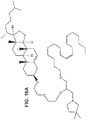
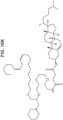
- a lipid can include a steroid group in one tail e.g. as in RV05 (see also FIGS. 16A & C-K).
- the invention provides a liposome having a lipid bilayer encapsulating an aqueous core, wherein: (i) the liposome comprises a lipid with a cationic head group, a lipid with a zwitterionic head group, and has a diameter in the range of 60-180nm; and (ii) the aqueous core includes a RNA which encodes an immunogen wherein the immunogen elicits an immune response against a herpesvirus.
- Liposomes of the invention are formed from a mixture of lipids.
- a a mixture may comprise both saturated and unsaturated lipids.
- a mixture may comprise DSPC (zwitterionic, saturated), DlinDMA (cationic, unsaturated), and/or DMG (anionic, saturated).
- DSPC zwitterionic, saturated
- DlinDMA cationic, unsaturated
- DMG anionic, saturated
- the proportion of those lipids which is cationic should be between 20-80% of the total amount of lipids e.g. between 30-70%, or between 40-60%.
- the remainder can be made of e.g. cholesterol ( e.g . 35-50% cholesterol) and/or DMG (optionally PEGylated) and/or DSPC. Such mixtures are used below. These percentage values are mole percentages.
- a liposome may include an amphiphilic lipid whose hydrophilic portion is PEGylated (i.e . modified by covalent attachment of a polyethylene glycol). This modification can increase stability and prevent non-specific adsorption of the liposomes.
- lipids can be conjugated to PEG using techniques such as those disclosed in reference 2 and 3.
- PEG provides the liposomes with a coat which can confer favourable pharmacokinetic characteristics.
- Various lengths of PEG can be used e.g. between 0.5-8kDa.
- a liposome can be formed from a cationic lipid (e.g. DlinDMA, RV05), a zwitterionic lipid (e.g. DSPC, DPyPE), a cholesterol, and a PEGylated lipid.
- a cationic lipid e.g. DlinDMA, RV05
- a zwitterionic lipid e.g. DSPC, DPyPE
- cholesterol e.g. a zwitterionic lipid
- PEGylated lipid e.g. a mixture of DSPC, DlinDMA, PEG-DMG and cholesterol is used in the examples, as well as several further mixtures.
- Liposomes are usually divided into three groups: multilamellar vesicles (MLV); small unilamellar vesicles (SUV); and large unilamellar vesicles (LUV).
- MLVs have multiple bilayers in each vesicle, forming several separate aqueous compartments.
- SUVs and LUVs have a single bilayer encapsulating an aqueous core; SUVs typically have a diameter ⁇ 50nm, and LUVs have a diameter >50nm.
- Liposomes of the invention are ideally LUVs with a diameter in the range of 60-180nm, and preferably in the range of 80-160nm.
- the liposomes preferably are substantially spherical. If they are not spherical, the term "diameter" refers to a liposome's largest cross-sectional diameter.
- a liposome of the invention can be part of a composition comprising a plurality of liposomes, and the liposomes within the plurality can have a range of diameters.
- a composition comprising a population of liposomes with different diameters (i) at least 80% by number of the liposomes should have diameters in the range of 60-180nm, and preferably in the range of 80-160nm, and/or (ii) the average diameter (by intensity e.g . Z-average) of the population is ideally in the range of 60-180nm, and preferably in the range of 80-160nm.
- the distribution of liposome sizes has only one maximum i.e. there is a single population of liposomes distributed around an average (mode), rather than having two maxima.
- the diameters within a population of liposomes should ideally have a polydispersity index ⁇ 0.2, and sometimes ⁇ 0.1.
- the liposome/RNA complexes of reference 1 are expected to have a diameter in the range of 600-800nm and to have a high polydispersity.
- Apparatuses for determining the average particle diameter in a suspension of liposomes, and the size distribution are commercially available. These typically use the techniques of dynamic light scattering and/or single-particle optical sensing e.g. the Accusizer TM and Nicomp TM series of instruments available from Particle Sizing Systems (Santa Barbara, USA), or the Zetasizer TM instruments from Malvern Instruments (UK), or the Particle Size Distribution Analyzer instruments from Horiba (Kyoto, Japan). Dynamic light scattering is the preferred method by which liposome diameters are determined. For a population of liposomes, the preferred method for defining the average liposome diameter in a composition of the invention is a Z-average i.e .
- the intensity-weighted mean hydrodynamic size of the ensemble collection of liposomes measured by dynamic light scattering is derived from cumulants analysis of the measured correlation curve, wherein a single particle size (liposome diameter) is assumed and a single exponential fit is applied to the autocorrelation function.
- the cumulants analysis algorithm does not yield a distribution but, in addition to an intensity-weighted Z-average, gives a polydispersity index.
- Liposomes of the invention include a RNA molecule which (unlike siRNA) encodes an immunogen which elicits an immune response against a herpesvirus. After in vivo administration of the particles, RNA is released from the particles and is translated inside a cell to provide the immunogen in situ.
- RNA unlike siRNA
- RNA is +-stranded, and so it can be translated by cells without needing any intervening replication steps such as reverse transcription. It can also bind to TLR7 receptors expressed by immune cells, thereby initiating an adjuvant effect.
- Preferred +-stranded RNAs are self-replicating.
- a self-replicating RNA molecule (replicon) can, when delivered to a vertebrate cell even without any proteins, lead to the production of multiple daughter RNAs by transcription from itself (via an antisense copy which it generates from itself).
- a self-replicating RNA molecule is thus typically a +-strand molecule which can be directly translated after delivery to a cell, and this translation provides a RNA-dependent RNA polymerase which then produces both antisense and sense transcripts from the delivered RNA.
- the delivered RNA leads to the production of multiple daughter RNAs.
- RNAs may be translated themselves to provide in situ expression of an encoded immunogen, or may be transcribed to provide further transcripts with the same sense as the delivered RNA which are translated to provide in situ expression of the immunogen.
- the overall result of this sequence of transcriptions is a huge amplification in the number of the introduced replicon RNAs and so the encoded immunogen becomes a major polypeptide product of the cells.
- RNA replicon One suitable system for achieving self-replication is to use an alphavirus-based RNA replicon. These +-stranded replicons are translated after delivery to a cell to give of a replicase (or replicase-transcriptase). The replicase is translated as a polyprotein which auto-cleaves to provide a replication complex which creates genomic --strand copies of the +-strand delivered RNA. These --strand transcripts can themselves be transcribed to give further copies of the +-stranded parent RNA and also to give a subgenomic transcript which encodes the immunogen. Translation of the subgenomic transcript thus leads to in situ expression of the immunogen by the infected cell.
- a replicase or replicase-transcriptase
- the replicase is translated as a polyprotein which auto-cleaves to provide a replication complex which creates genomic --strand copies of the +-strand delivered RNA.
- These --strand transcripts can themselves be transcribed to give further copies of the +-
- Suitable alphavirus replicons can use a replicase from a Sindbis virus, a Semliki forest virus, an eastern equine encephalitis virus, a Venezuelan equine encephalitis virus, etc.
- Mutant or wild-type viruses sequences can be used e.g. the attenuated TC83 mutant of VEEV has been used in replicons [8].
- a preferred self-replicating RNA molecule thus encodes (i) a RNA-dependent RNA polymerase which can transcribe RNA from the self-replicating RNA molecule and (ii) an immunogen.
- the polymerase can be an alphavirus replicase e.g . comprising one or more of alphavirus proteins nsP1, nsP2, nsP3 and nsP4.
- RNA molecules of use in the invention does not encode alphavirus structural proteins.
- a preferred self-replicating RNA can lead to the production of genomic RNA copies of itself in a cell, but not to the production of RNA-containing virions.
- the inability to produce these virions means that, unlike a wild-type alphavirus, the self-replicating RNA molecule cannot perpetuate itself in infectious form.
- alphavirus structural proteins which are necessary for perpetuation in wild-type viruses are absent from self-replicating RNAs of use in the invention and their place is taken by gene(s) encoding the immunogen of interest, such that the subgenomic transcript encodes the immunogen rather than the structural alphavirus virion proteins.
- RNA molecule useful with the invention may have two open reading frames.
- the first (5') open reading frame encodes a replicase; the second (3') open reading frame encodes an immunogen.
- the RNA may have additional ( e.g . downstream) open reading frames e.g . to encode further immunogens (see below) or to encode accessory polypeptides.
- a self-replicating RNA molecule can have a 5' sequence which is compatible with the encoded replicase.
- Self-replicating RNA molecules can have various lengths but they are typically 5000-25000 nucleotides long e.g. 8000-15000 nucleotides, or 9000-12000 nucleotides. Thus the RNA is longer than seen in siRNA delivery.
- a RNA molecule useful with the invention may have a 5' cap (e.g. a 7-methylguanosine). This cap can enhance in vivo translation of the RNA.
- the 5' nucleotide of a RNA molecule useful with the invention may have a 5' triphosphate group. In a capped RNA this may be linked to a 7-methylguanosine via a 5'-to-5' bridge.
- a 5' triphosphate can enhance RIG-I binding and thus promote adjuvant effects.
- a RNA molecule may have a 3' poly-A tail. It may also include a poly-A polymerase recognition sequence (e.g . AAUAAA) near its 3' end.
- a poly-A polymerase recognition sequence e.g . AAUAAA
- RNA molecule useful with the invention will typically be single-stranded.
- Single-stranded RNAs can generally initiate an adjuvant effect by binding to TLR7, TLR8, RNA helicases and/or PKR.
- RNA delivered in double-stranded form can bind to TLR3, and this receptor can also be triggered by dsRNA which is formed either during replication of a single-stranded RNA or within the secondary structure of a single-stranded RNA.
- RNA molecule useful with the invention can conveniently be prepared by in vitro transcription (IVT).
- IVT can use a (cDNA) template created and propagated in plasmid form in bacteria, or created synthetically (for example by gene synthesis and/or polymerase chain-reaction engineering methods).
- a DNA-dependent RNA polymerase such as the bacteriophage T7, T3 or SP6 RNA polymerases
- Appropriate capping and poly-A addition reactions can be used as required (although the replicon's poly-A is usually encoded within the DNA template).
- RNA polymerases can have stringent requirements for the transcribed 5' nucleotide(s) and in some embodiments these requirements must be matched with the requirements of the encoded replicase, to ensure that the IVT-transcribed RNA can function efficiently as a substrate for its self-encoded replicase.
- the self-replicating RNA can include (in addition to any 5' cap structure) one or more nucleotides having a modified nucleobase.
- the RNA can comprise m5C (5-methylcytidine), m5U (5-methyluridine), m6A (N6-methyladenosine), s2U (2-thiouridine), Um (2'-O-methyluridine), m1A (1-methyladenosine); m2A (2-methyladenosine); Am (2'-O-methyladenosine); ms2m6A (2-methylthio-N6-methyladenosine); i6A (N6-isopentenyladenosine); ms2i6A (2-methylthio-N6isopentenyladenosine); io6A (N6-(cis-hydroxyisopentenyl)adenosine); ms2io6A (2-methylthio-N6-(cis-hydroxyisopen
- a self-replicating RNA can include one or more modified pyrimidine nucleobases, such as pseudouridine and/or 5-methylcytosine residues.
- the RNA includes no modified nucleobases, and may include no modified nucleotides i.e . all of the nucleotides in the RNA are standard A, C, G and U ribonucleotides (except for any 5' cap structure, which may include a 7'-methylguanosine).
- the RNA may include a 5' cap comprising a 7'-methylguanosine, and the first 1, 2 or 3 5' ribonucleotides may be methylated at the 2' position of the ribose.
- a RNA used with the invention ideally includes only phosphodiester linkages between nucleosides, but in some embodiments it can contain phosphoramidate, phosphorothioate, and/or methylphosphonate linkages.
- a liposome includes fewer than 10 different species of RNA e.g. 5, 4, 3, or 2 different species; most preferably, a liposome includes a single RNA species i.e. all RNA molecules in the liposome have the same sequence and same length.
- RNA per liposome can vary.
- the number of individual self-replicating RNA molecules per liposome is typically ⁇ 50 e.g. ⁇ 20, ⁇ 10, ⁇ 5, or 1-4 per liposome.
- RNA molecules used with the invention encode a polypeptide immunogen which elicits an immune response against a herpesvirus. After administration of the liposomes the RNA is translated in vivo and the immunogen can elicit an immune response in the recipient.
- the immune response may comprise an antibody response (usually including IgG) and/or a cell-mediated immune response.
- the RNA molecule can encode a single polypeptide immunogen or multiple polypeptides. Multiple immunogens can be presented as a single polypeptide immunogen (fusion polypeptide) or as separate polypeptides. If immunogens are expressed as separate polypeptides from a replicon then one or more of these may be provided with an upstream IRES or an additional viral promoter element. Alternatively, multiple immunogens may be expressed from a polyprotein that encodes individual immunogens fused to a short autocatalytic protease (e.g . foot-and-mouth disease virus 2A protein), or as inteins.
- a short autocatalytic protease e.g . foot-and-mouth disease virus 2A protein
- the RNA encodes an immunogen which elicits an immune response against a herpesvirus.
- the invention does not encompass RNA which encodes a firefly luciferase or which encodes a fusion protein of E.coli ⁇ -galactosidase or which encodes a green fluorescent protein (GFP).
- GFP green fluorescent protein
- Such polypeptides may be useful as markers, or even in a gene therapy context, but the invention concerns delivery of RNA for eliciting an immunological response system.
- the optimum diameter of liposomes for gene therapy can differ from liposomes for immunisation purposes because target cells and tissues differ for these two approaches.
- the immunogen also is not a self protein which is delivered to supplement or substitute for a defective host protein (as in gene therapy).
- the RNA is not total mouse thymus RNA.
- Viral immunogens include, but are not limited to, those derived from a human herpesvirus, such as, by way of example only, Herpes Simplex Viruses (HSV) (e.g . HSV types 1 and 2), Varicella-zoster virus (VZV), Epstein-Barr virus (EBV), Cytomegalovirus (CMV), Human Herpesvirus 6 (HHV6), Human Herpesvirus 7 (HHV7), and Human Herpesvirus 8 (HHV8).
- HSV Herpes Simplex Viruses
- VZV Varicella-zoster virus
- EBV Epstein-Barr virus
- CMV Cytomegalovirus
- HHV6 Human Herpesvirus 6
- HHV7 Human Herpesvirus 7
- HHV8 Human Herpesvirus 8
- Liposomes of the invention are useful as components in pharmaceutical compositions for immunising subjects against various diseases. These compositions will typically include a pharmaceutically acceptable carrier in addition to the liposomes. A thorough discussion of pharmaceutically acceptable carriers is available in reference 29.
- a pharmaceutical composition of the invention may include one or more small molecule immunopotentiators.
- the composition may include a TLR2 agonist (e.g . Pam3CSK4), a TLR4 agonist (e.g. an aminoalkyl glucosaminide phosphate, such as E6020), a TLR7 agonist (e.g. imiquimod), a TLR8 agonist (e.g. resiquimod) and/or a TLR9 agonist (e.g. IC31).
- Any such agonist ideally has a molecular weight of ⁇ 2000Da.
- such agonist(s) are also encapsulated with the RNA inside liposomes, but in other embodiments they are unencapsulated.
- compositions of the invention may include the liposomes in plain water (e.g . w.f.i.) or in a buffer e.g . a phosphate buffer, a Tris buffer, a borate buffer, a succinate buffer, a histidine buffer, or a citrate buffer.
- Buffer salts will typically be included in the 5-20mM range.
- compositions of the invention may have a pH between 5.0 and 9.5 e.g . between 6.0 and 8.0.
- compositions of the invention may include sodium salts (e.g. sodium chloride) to give tonicity.
- sodium salts e.g. sodium chloride
- a concentration of 10 ⁇ 2 mg/ml NaCl is typical e.g . about 9 mg/ml.
- compositions of the invention may include metal ion chelators. These can prolong RNA stability by removing ions which can accelerate phosphodiester hydrolysis.
- a composition may include one or more of EDTA, EGTA, BAPTA, pentetic acid, etc..
- chelators are typically present at between 10-500 ⁇ M e.g. 0.1mM.
- a citrate salt, such as sodium citrate, can also act as a chelator, while advantageously also providing buffering activity.
- compositions of the invention may have an osmolality of between 200 mOsm/kg and 400 mOsm/kg, e.g. between 240-360 mOsm/kg, or between 290-310 mOsm/kg.
- compositions of the invention may include one or more preservatives, such as thiomersal or 2-phenoxyethanol.
- preservatives such as thiomersal or 2-phenoxyethanol.
- Mercury-free compositions are preferred, and preservative-free vaccines can be prepared.
- compositions of the invention are preferably sterile.
- compositions of the invention are preferably non-pyrogenic e.g. containing ⁇ 1 EU (endotoxin unit, a standard measure) per dose, and preferably ⁇ 0.1 EU per dose.
- ⁇ 1 EU endotoxin unit, a standard measure
- compositions of the invention are preferably gluten free.
- compositions of the invention may be prepared in unit dose form.
- a unit dose may have a volume of between 0.1-1.0ml e.g. about 0.5ml.
- compositions may be prepared as injectables, either as solutions or suspensions.
- the composition may be prepared for pulmonary administration e.g . by an inhaler, using a fine spray.
- the composition may be prepared for nasal, aural or ocular administration e.g . as spray or drops. Injectables for intramuscular administration are typical.
- compositions comprise an immunologically effective amount of liposomes, as well as any other components, as needed.
- 'immunologically effective amount' it is meant that the administration of that amount to an individual, either in a single dose or as part of a series, is effective for treatment or prevention. This amount varies depending upon the health and physical condition of the individual to be treated, age, the taxonomic group of individual to be treated (e.g. non-human primate, primate, etc. ), the capacity of the individual's immune system to synthesise antibodies, the degree of protection desired, the formulation of the vaccine, the treating doctor's assessment of the medical situation, and other relevant factors. It is expected that the amount will fall in a relatively broad range that can be determined through routine trials.
- compositions of the invention will generally be expressed in terms of the amount of RNA per dose.
- a preferred dose has ⁇ 100 ⁇ g RNA ( e.g . from 10-100 ⁇ g, such as about 10 ⁇ g, 25 ⁇ g, 50 ⁇ g, 75 ⁇ g or 100 ⁇ g), but expression can be seen at much lower levels e.g. ⁇ 1 ⁇ g/dose, ⁇ 100ng/dose, ⁇ 10ng/dose, ⁇ 1ng/dose, etc
- the invention also provides a delivery device (e.g. syringe, nebuliser, sprayer, inhaler, dermal patch, etc. ) containing a pharmaceutical composition of the invention.
- a delivery device e.g. syringe, nebuliser, sprayer, inhaler, dermal patch, etc.
- This device can be used to administer the composition to a vertebrate subject.
- Liposomes of the invention do not contain ribosomes.
- liposomes and pharmaceutical compositions of the invention are for in vivo use for eliciting an immune response against an immunogen of interest.
- the invention also provides a liposome or pharmaceutical composition of the invention for use in a method for raising an immune response in a vertebrate.
- the liposomes and compositions are immunogenic, and are more preferably vaccine compositions.
- Vaccines according to the invention may either be prophylactic (i.e. to prevent infection) or therapeutic ( i.e. to treat infection), but will typically be prophylactic.
- the vertebrate is preferably a mammal, such as a human or a large veterinary mammal (e.g . horses, cattle, deer, goats, pigs).
- the human is preferably a child (e.g. a toddler or infant) or a teenager; where the vaccine is for therapeutic use, the human is preferably a teenager or an adult.
- a vaccine intended for children may also be administered to adults e.g . to assess safety, dosage, immunogenicity, etc.
- Vaccines prepared according to the invention may be used to treat both children and adults.
- a human patient may be less than 1 year old, less than 5 years old, 1-5 years old, 5-15 years old, 15-55 years old, or at least 55 years old.
- Preferred patients for receiving the vaccines are the elderly (e.g. ⁇ 50 years old, ⁇ 60 years old, and preferably ⁇ 65 years), the young ( e.g. ⁇ 5 years old), hospitalised patients, healthcare workers, armed service and military personnel, pregnant women, the chronically ill, or immunodeficient patients.
- the vaccines are not suitable solely for these groups, however, and may be used more generally in a population.
- compositions of the invention will generally be administered directly to a patient.
- Direct delivery may be accomplished by parenteral injection (e.g . subcutaneously, intraperitoneally, intravenously, intramuscularly, intradermally, or to the interstitial space of a tissue; unlike reference 1, intraglossal injection is not typically used with the present invention).
- Alternative delivery routes include rectal, oral ( e.g . tablet, spray), buccal, sublingual, vaginal, topical, transdermal or transcutaneous, intranasal, ocular, aural, pulmonary or other mucosal administration.
- Intradermal and intramuscular administration are two preferred routes. Injection may be via a needle (e.g. a hypodermic needle), but needle-free injection may alternatively be used.
- a typical intramuscular dose is 0.5 ml.
- the invention may be used to elicit systemic and/or mucosal immunity, preferably to elicit an enhanced systemic and/or mucosal immunity.
- Dosage can be by a single dose schedule or a multiple dose schedule. Multiple doses may be used in a primary immunisation schedule and/or in a booster immunisation schedule. In a multiple dose schedule the various doses may be given by the same or different routes e.g . a parenteral prime and mucosal boost, a mucosal prime and parenteral boost, etc. Multiple doses will typically be administered at least 1 week apart ( e.g . about 2 weeks, about 3 weeks, about 4 weeks, about 6 weeks, about 8 weeks, about 10 weeks, about 12 weeks, about 16 weeks, etc. ) . In one embodiment, multiple doses may be administered approximately 6 weeks, 10 weeks and 14 weeks after birth, e.g.
- two primary doses are administered about two months apart, e.g. about 7, 8 or 9 weeks apart, followed by one or more booster doses about 6 months to 1 year after the second primary dose, e.g. about 6, 8, 10 or 12 months after the second primary dose.
- three primary doses are administered about two months apart, e.g. about 7, 8 or 9 weeks apart, followed by one or more booster doses about 6 months to 1 year after the third primary dose, e.g. about 6, 8, 10, or 12 months after the third primary dose.
- composition comprising X may consist exclusively of X or may include something additional e.g. X + Y.
- TLR3 is the Toll-like receptor 3. It is a single membrane-spanning receptor which plays a key role in the innate immune system.
- Known TLR3 agonists include poly(EC).
- TLR3 is the approved HGNC name for the gene encoding this receptor, and its unique HGNC ID is HGNC:11849.
- the RefSeq sequence for the human TLR3 gene is GI:2459625.
- TLR7 is the Toll-like receptor 7. It is a single membrane-spanning receptor which plays a key role in the innate immune system.
- Known TLR7 agonists include e.g. imiquimod.
- TLR7 is the approved HGNC name for the gene encoding this receptor, and its unique HGNC ID is HGNC:15631.
- the RefSeq sequence for the human TLR7 gene is GI:67944638.
- TLR8 is the Toll-like receptor 8. It is a single membrane-spanning receptor which plays a key role in the innate immune system.
- Known TLR8 agonists include e.g. resiquimod.
- TLR8 is the approved HGNC name for the gene encoding this receptor, and its unique HGNC ID is HGNC:15632.
- the RefSeq sequence for the human TLR8 gene is GI:20302165.
- RLR-1 The RIG-I-like receptor family includes various RNA helicases which play key roles in the innate immune system[37].
- RLR-1 also known as RIG-I or retinoic acid inducible gene I
- RLR-1 helicase has two caspase recruitment domains near its N-terminus.
- the approved HGNC name for the gene encoding the RLR-1 helicase is "DDX58" (for DEAD (Asp-Glu-Ala-Asp) box polypeptide 58) and the unique HGNC ID is HGNC:19102.
- the RefSeq sequence for the human RLR-1 gene is GI:77732514.
- RLR-2 (also known as MDA5 or melanoma differentiation-associated gene 5) also has two caspase recruitment domains near its N-terminus.
- the approved HGNC name for the gene encoding the RLR-2 helicase is "IFIH1" (for interferon induced with helicase C domain 1) and the unique HGNC ID is HGNC:18873.
- the RefSeq sequence for the human RLR-2 gene is GI: 27886567.
- RLR-3 (also known as LGP2 or laboratory of genetics and physiology 2) has no caspase recruitment domains.
- the approved HGNC name for the gene encoding the RLR-3 helicase is "DHX58" (for DEXH (Asp-Glu-X-His) box polypeptide 58) and the unique HGNC ID is HGNC:29517.
- the RefSeq sequence for the human RLR-3 gene is GI:149408121.
- PKR is a double-stranded RNA-dependent protein kinase. It plays a key role in the innate immune system.
- EIF2AK2 for eukaryotic translation initiation factor 2-alpha kinase 2
- HGNC HGNC:9437
- the RefSeq sequence for the human PKR gene is GI:208431825.
- replicons are used below. In general these are based on a hybrid alphavirus genome with non-structural proteins from venezuelan equine encephalitis virus (VEEV), a packaging signal from VEEV, and a 3' UTR from Sindbis virus or a VEEV mutant.
- VEEV venezuelan equine encephalitis virus
- the replicon is about 10kb long and has a poly-A tail.
- Plasmid DNA encoding alphavirus replicons (named: pT7-mVEEV-FL.RSVF or A317; pT7-mVEEV-SEAP or A306; pSP6-VCR-GFP or A50) served as a template for synthesis of RNA in vitro.
- the replicons contain the alphavirus genetic elements required for RNA replication but lack those encoding gene products necessary for particle assembly; the structural proteins are instead replaced by a protein of interest (either a reporter, such as SEAP or GFP, or an immunogen, such as full-length RSV F protein) and so the replicons are incapable of inducing the generation of infectious particles.
- a bacteriophage (T7 or SP6) promoter upstream of the alphavirus cDNA facilitates the synthesis of the replicon RNA in vitro and a hepatitis delta virus (HDV) ribozyme immediately downstream of the poly(A)-tail generates the correct 3'-end through its self-cleaving activity.
- HDV hepatitis delta virus
- run-off transcripts were synthesized in vitro using T7 or SP6 bacteriophage derived DNA-dependent RNA polymerase. Transcriptions were performed for 2 hours at 37°C in the presence of 7.5 mM (T7 RNA polymerase) or 5 mM (SP6 RNA polymerase) of each of the nucleoside triphosphates (ATP, CTP, GTP and UTP) following the instructions provided by the manufacturer (Ambion). Following transcription the template DNA was digested with TURBO DNase (Ambion).
- RNA was precipitated with LiCl and reconstituted in nuclease-free water.
- Uncapped RNA was capped post-transcriptionally with Vaccinia Capping Enzyme (VCE) using the ScriptCap m7G Capping System (Epicentre Biotechnologies) as outlined in the user manual; replicons capped in this way are given the "v" prefix e.g . vA317 is the A317 replicon capped by VCE.
- Post-transcriptionally capped RNA was precipitated with LiCl and reconstituted in nuclease-free water. The concentration of the RNA samples was determined by measuring OD 260nm . Integrity of the in vitro transcripts was confirmed by denaturing agarose gel electrophoresis.
- RNA was encapsulated in liposomes made essentially by the method of references 7 and 38.
- the liposomes were made of 10% DSPC (zwitterionic), 40% DlinDMA (cationic), 48% cholesterol and 2% PEG-conjugated DMG (2kDa PEG). These proportions refer to the % moles in the total liposome.
- DlinDMA (1,2-dilinoleyloxy-N,N-dimethyl-3-aminopropane) was synthesized using the procedure of reference 2.
- DSPC (1,2-Diastearoyl-sn-glycero-3-phosphocholine) was purchased from Genzyme. Cholesterol was obtained from Sigma-Aldrich.
- PEG-conjugated DMG (1,2-dimyristoyl-sn-glycero-3-phosphoethanolamine-N-[methoxy(polyethylene glycol), ammonium salt), DOTAP (1,2-dioleoyl-3-trimethylammonium-propane, chloride salt) and DC-chol (3 ⁇ -[N-(N',N'-dimethylaminoethane)-carbamoyl]cholesterol hydrochloride) were from Avanti Polar Lipids.
- lipids were dissolved in ethanol (2ml), a RNA replicon was dissolved in buffer (2ml, 100mM sodium citrate, pH 6) and these were mixed with 2ml of buffer followed by 1 hour of equilibration. The mixture was diluted with 6ml buffer then filtered. The resulting product contained liposomes, with ⁇ 95% encapsulation efficiency.
- fresh lipid stock solutions were prepared in ethanol.
- 37 mg of DlinDMA, 11.8 mg of DSPC, 27.8 mg of cholesterol and 8.07 mg of PEG-DMG were weighed and dissolved in 7.55 mL of ethanol.
- the freshly prepared lipid stock solution was gently rocked at 37°C for about 15 min to form a homogenous mixture.
- 755 ⁇ L of the stock was added to 1.245 mL ethanol to make a working lipid stock solution of 2 mL. This amount of lipids was used to form liposomes with 250 ⁇ g RNA.
- RNA working solution was also prepared from a stock solution of ⁇ 1 ⁇ g/ ⁇ L in 100 mM citrate buffer (pH 6). Three 20 mL glass vials (with stir bars) were rinsed with RNase Away solution (Molecular BioProducts) and washed with plenty of MilliQ water before use to decontaminate the vials of RNases. One of the vials was used for the RNA working solution and the others for collecting the lipid and RNA mixes (as described later). The working lipid and RNA solutions were heated at 37°C for 10 min before being loaded into 3cc luer-lok syringes. 2 mL citrate buffer (pH 6) was loaded in another 3 cc syringe.
- RNA and the lipids were connected to a T mixer (PEEK TM 500 ⁇ m ID junction, Idex Health Science) using FEP tubing (fluorinated ethylene-propylene; all FEP tubing used had a 2mm internal diameter and a 3mm outer diameter; obtained from Idex Health Science).
- the outlet from the T mixer was also FEP tubing.
- the third syringe containing the citrate buffer was connected to a separate piece of tubing. All syringes were then driven at a flow rate of 7 mL/min using a syringe pump. The tube outlets were positioned to collect the mixtures in a 20 mL glass vial (while stirring).
- the stir bar was taken out and the ethanol/aqueous solution was allowed to equilibrate to room temperature for 1 hour. 4 ml of the mixture was loaded into a 5 cc syringe, which was connected to a piece of FEP tubing and in another 5 cc syringe connected to an equal length of FEP tubing, an equal amount of 100 mM citrate buffer (pH 6) was loaded. The two syringes were driven at 7mL/min flow rate using the syringe pump and the final mixture collected in a 20 mL glass vial (while stirring).
- the mixture collected from the second mixing step were passed through a Mustang Q membrane (an anion-exchange support that binds and removes anionic molecules, obtained from Pall Corporation).
- a Mustang Q membrane an anion-exchange support that binds and removes anionic molecules, obtained from Pall Corporation.
- 4 mL of 1 M NaOH, 4 mL of 1 M NaCl and 10 mL of 100 mM citrate buffer (pH 6) were successively passed through it. Liposomes were warmed for 10 min at 37°C before passing through the membrane.
- liposomes were concentrated to 2 mL and dialyzed against 10-15 volumes of 1X PBS using by tangential flow filtration before recovering the final product.
- TFF system and hollow fiber filtration membranes were purchased from Spectrum Labs (Rancho Dominguez) and were used according to the manufacturer's guidelines. Polysulfone hollow fiber filtration membranes with a 100 kD pore size cutoff and 8 cm 2 surface area were used. For in vitro and in vivo experiments formulations were diluted to the required RNA concentration with 1X PBS.
- FIG. 2 shows an example electron micrograph of liposomes prepared by these methods. These liposomes contain encapsulated RNA encoding full-length RSV F antigen. Dynamic light scattering of one batch showed an average diameter of 141nm (by intensity) or 78nm (by number).
- RNA and RNA concentration were determined by Quant-iT RiboGreen RNA reagent kit (Invitrogen), following manufacturer's instructions. The ribosomal RNA standard provided in the kit was used to generate a standard curve. Liposomes were diluted 10x or 100x in 1X TE buffer (from kit) before addition of the dye. Separately, liposomes were diluted 10x or 100x in 1X TE buffer containing 0.5% Triton X before addition of the dye (to disrupt the liposomes and thus to assay total RNA). Thereafter an equal amount of dye was added to each solution and then ⁇ 180 ⁇ L of each solution after dye addition was loaded in duplicate into a 96 well tissue culture plate. The fluorescence (Ex 485 nm, Em 528 nm) was read on a microplate reader. All liposome formulations were dosed in vivo based on the encapsulated amount of RNA.
- RNA from liposomes was shown to protect RNA from RNase digestion. Experiments used 3.8mAU of RNase A per microgram of RNA, incubated for 30 minutes at room temperature. RNase was inactivated with Proteinase K at 55°C for 10 minutes. A 1:1 v/v mixture of sample to 25:24:1 v/v/v, phenol:chloroform:isoamyl alcohol was then added to extract the RNA from the lipids into the aqueous phase. Samples were mixed by vortexing for a few seconds and then placed on a centrifuge for 15 minutes at 12k RPM. The aqueous phase (containing the RNA) was removed and used to analyze the RNA.
- FIG. 1 shows that RNase completely digests RNA in the absence of encapsulation (lane 3). RNA is undetectable after encapsulation (lane 4), and no change is seen if these liposomes are treated with RNase (lane 4). After RNase-treated liposomes are subjected to phenol extraction, undigested RNA is seen (lane 6).
- RNA Even after 1 week at 4°C the RNA could be seen without any fragmentation ( FIG. 4 , arrow). Protein expression in vivo was unchanged after 6 weeks at 4 °C and one freeze-thaw cycle. Thus liposome-encapsulated RNA is stable.
- RNA a reporter enzyme SEAP; secreted alkaline phosphatase
- SEAP secreted alkaline phosphatase
- Expression levels were measured in sera diluted 1:4 in 1X Phospha-Light dilution buffer using a chemiluminescent alkaline phosphate substrate. 8-10 week old BALB/c mice (5/group) were injected intramuscularly on day 0, 50 ⁇ l per leg with 0.1 ⁇ g or 1 ⁇ g RNA dose. The same vector was also administered without the liposomes (in RNase free 1X PBS) at 1 ⁇ g. Virion-packaged replicons were also tested.
- Virion-packaged replicons used herein were obtained by the methods of reference 39, where the alphavirus replicon is derived from the mutant VEEV or a chimera derived from the genome of VEEV engineered to contain the 3' UTR of Sindbis virus and a Sindbis virus packaging signal (PS), packaged by co-electroporating them into BHK cells with defective helper RNAs encoding the Sindbis virus capsid and glycoprotein genes.
- PS Sindbis virus packaging signal
- encapsulation increased SEAP levels by about 1 ⁇ 2 log at the 1 ⁇ g dose, and at day 6 expression from a 0.1 ⁇ g encapsulated dose matched levels seen with 1 ⁇ g unencapsulated dose.
- day 3 expression levels exceeded those achieved with VRPs (squares).
- VRPs squares
- RNA was formulated in the liposomes relative to the naked RNA control, even at a 10x lower dose. Expression was also higher relative to the VRP control, but the kinetics of expression were very different (see FIG. 5 ). Delivery of the RNA with electroporation resulted in increased expression relative to the naked RNA control, but these levels were lower than with liposomes.
- the replicon was administered in encapsulated form (with two different purification protocols, 0.1 ⁇ g RNA), or mixed with the liposomes after their formation (a non-encapsulated "lipoplex", 0.1 ⁇ g RNA), or as naked RNA (1 ⁇ g).
- FIG. 10 shows that the lipoplex gave the lowest levels of expression, showing that shows encapsulation is essential for potent expression.
- FIG. 7 shows anti-F IgG titers 2 weeks after the second dose, and the liposomes clearly enhance immunogenicity.
- FIG. 8 shows titers 2 weeks later, by which point there was no statistical difference between the encapsulated RNA at 0.1 ⁇ g, the encapsulated RNA at 1 ⁇ g, or the VRP group.
- Neutralisation titers (measured as 60% plaque reduction, "PRNT60") were not significantly different in these three groups 2 weeks after the second dose ( FIG. 9 ).
- FIG. 12 shows both IgG and PRNT titers 4 weeks after the second dose.
- FIG. 13 confirms that the RNA elicits a robust CD8 T cell response.
- liposome-encapsulated RNA induces essentially the same magnitude of immune response as seen with virion delivery.
- FIG. 11 shows IgG titers in mice receiving the replicon in naked form at 3 different doses, in liposomes at 4 different doses, or as VRP (10 6 IU).
- the response seen with 1 ⁇ g liposome-encapsulated RNA was statistically insignificant (ANOVA) when compared to VRP, but the higher response seen with 10 ⁇ g liposome-encapsulated RNA was statistically significant (p ⁇ 0.05) when compared to both of these groups.
- vA317 expresses full-length RSV-F
- vA318 expresses truncated (transmembrane and cytoplasmic tail removed) RSV-F
- vA142 expresses RSV-F with its fusion peptide deleted
- vA140 expresses the truncated RSV-F also without its peptide.
- Control groups received a RSV-F subunit protein vaccine (5 ⁇ g) adjuvanted with alum (8 animals/group), VRPs expressing full-length RSV-F (1 ⁇ 10 6 IU, 8 animals/group), or naive control (4 animals/group). Serum was collected for antibody analysis on days 0, 21 and 34.
- F-specific serum IgG titers and RSV serum neutralizing antibody titers on day 21 and 34 were: Group IgG, day 21 IgG, day 34 NT, day 21 NT, day 34 1 ⁇ g vA317 915 2249 115 459 0.1 ⁇ g vA317 343 734 87 95 1 ⁇ g vA318 335 1861 50 277 0.1 ⁇ g vA318 129 926 66 239 1 ⁇ g vA142 778 4819 92 211 0.1 ⁇ g vA142 554 2549 78 141 1 ⁇ g vA140 182 919 96 194 0.1 ⁇ g vA140 61 332 29 72 5 ⁇ g F trimer subunit/alum 13765 86506 930 4744 1x10 6 IU VRP-F full 1877 19179 104 4528 Naive 5 5 10 15
- All four replicons evaluated in this study were immunogenic in cotton rats when delivered by liposome, although serum neutralization titers were at least ten-fold lower than those induced by adjuvanted protein vaccines or by VRPs.
- the liposome/RNA vaccines elicited serum F-specific IgG and RSV neutralizing antibodies after the first vaccination, and a second vaccination boosted the response effectively.
- F-specific IgG titers after the second vaccination with 1 ⁇ g replicon were 2- to 3-fold higher than after the second vaccination with 0.1 ⁇ g replicon.
- the four replicons elicited comparable antibody titers, suggesting that full length and truncated RSV-F, each with or without the fusion peptide, are similarly immunogenic in cotton rats.
- Cotton rats again used the vA317, vA318 and vA142 replicons.
- Cotton rats, 2-8 animals per group were given intramuscular vaccinations (100 ⁇ L in one leg) on days 0 and 21 with the replicons (0.1 or 1 ⁇ g) encapsulated in RV01 liposomes (with PEG-2000) made by method (D) but with a 150 ⁇ g RNA batch size.
- Control groups received the RSV-F subunit protein vaccine (5 ⁇ g) adjuvanted with alum or VRPs expressing full-length RSV-F (1 ⁇ 10 6 IU, 8 animals/group).
- F-specific serum IgG titers were as follows: Day 21 Day 35 Day 56 Day 70 1 ⁇ g vA318 260 1027 332 14263 0.1 ⁇ g vA318 95 274 144 2017 1 ⁇ g vA142 483 1847 1124 11168 0.1 ⁇ g vA142 314 871 418 11023 1 ⁇ g vA317 841 4032 1452 13852 1x10 6 VRP (F-full) 2075 3938 1596 14574 5 ⁇ g F trimer subunit/alum 12685 54526 25846 48864 Na ⁇ ve 5 5 5 5 5
- Serum neutralisation titers were as follows (60% RSV neutralization titers for 2 pools of 3-4 animals per group, GMT of these 2 pools per group): Day 21 Day 35 Day 56 Day 70 1 ⁇ g vA318 58 134 111 6344 0.1 ⁇ g vA318 41 102 63 6647 1 ⁇ g vA142 77 340 202 5427 0.1 ⁇ g vA142 35 65 56 2223 1 ⁇ g vA317 19 290 200 4189 1x10 6 VRP (F-full) 104 1539 558 2876 5 ⁇ g F trimer subunit/alum 448 4457 1630 3631 Na ⁇ ve 10 10 10 10
- Serum titers and neutralising titers for the extra group were as follows: Day 14 21 28 35 42 56 70 IgG 397 561 535 501 405 295 3589 NT 52 82 90 106 80 101 1348
- the replicons are confirmed as immunogenic in cotton rats, eliciting serum F-specific IgG and RSV neutralizing antibodies after the first vaccination.
- a second vaccination boosted the responses effectively.
- F-specific IgG titers after the second vaccination with 1.0 ⁇ g replicon were 1.5 to 4-fold higher than after the second vaccination with 0.1 ⁇ g replicon.
- the third vaccination did not boost titers in cotton rats previously vaccinated with F trimer subunit + alum, but it did provide a large boost to titers in cotton rats previously vaccinated with replicon.
- the RSV serum neutralization titers after two replicon vaccinations followed by protein boost were equal to or greater than titers induced by two or three sequential protein vaccinations.
- F-specific serum IgG and RSV neutralization titers induced by a single vaccination reached their peak around day 21 and were maintained through at least day 56 (50-70% drop in F-specific IgG titer, little change in RSV neutralization titer).
- a homologous second vaccination was given to these animals on day 56, and boosted antibody titers to a level at least equal to that achieved when the second vaccination was administered on day 21.
- vA368 replicon encodes the full-length wild type surface fusion glycoprotein of RSV with the fusion peptide deleted, with expression driven by the EV71 IRES.
- the liposomes included 2kDa PEG, conjugated to DMG.
- a control group received 5 ⁇ g alum-adjuvanted protein, and a naive control group was also included.
- RNA vaccine reduced the lung viral load by over three logs, from approximately 10 6 PFU/g in unvaccinated control cotton rats to less than 10 3 PFU/g in vaccinated cotton rats.
- RNA vaccines encoded human RSV F whereas the "Triangle 4" vaccine contains bovine RSV F, but the RSV F protein is highly conserved between BRSV and HRSV.
- Serum was collected for antibody analysis on days 0, 14, 21, 35, 42, 56, 63, 86, 100, 107, 114, 121, 128, 135, 146, 160, 167, 174, 181, 188, 195, and 202. If an individual animal had a titer below the limit of detection it was assigned a titer of 5.
- FIG. 14 shows F-specific IgG titers over 210 days. Over the first 63 days the RNA replicon was immunogenic in the cows via liposomes, although it gave lower titers than the licensed vaccine. All vaccinated cows showed F-specific antibodies after the second dose, and titers were very stable from the period of 2 to 6 weeks after the second dose (and were particularly stable for the RNA vaccines).
- Titres up to day 202 were as follows: D0 3wp1 D21 2wp2 D35 5wp2 D56 ⁇ 9wp2 D86 2wp3 D100 5wp3 D121 8wp3 D146 2wp4 D160 5wp4 D181 8wp4 D202 PBS 5 5 5 5 5 5 5 5 46 98 150 Liposome 5 5 12 11 20 768 428 74 20774 7022 2353 Triangle 4 5 5 5 1784 721 514 3406 2786 336 13376 4775 2133
- RSV serum neutralizing antibody titers were as follows: D0 2wp2 D35 5wp2 D56 2wp3 D100 3wp3 D107 4wp3 D114 8wp3 D146 2wp4 D160 3wp4 D167 4wp4 D174 PBS 12 10 10 14 18 20 14 10 10 10 Liposome 13 10 10 20 13 17 13 47 26 21 Triangle 4 12 15 13 39 38 41 13 24 26 15
- the material used for the second liposome dose was not freshly prepared, and the same lot of RNA showed a decrease in potency in a mouse immunogenicity study. Therefore it is possible that the vaccine would have been more immunogenic if fresh material had been used for all vaccinations.
- MF59-adjuvanted RSV-F was able to boost the IgG response in all previously vaccinated calves, and to boost complement-independent neutralization titers of calves previously vaccinated with RNA.
- RNA vaccines in large animals is particularly important in light of the loss in potency observed previously with DNA-based vaccines when moving from small animal models to larger animals and humans.
- a typical dose for a cow DNA vaccine would be 0.5-1 mg [40, 41] and so it is very encouraging that immune responses were induced with only 66 ⁇ g of RNA.
- the syringe/tube method was replaced by a method in which the lipid and RNA solutions are mixed in channels on a microfluidic chip.
- Fresh lipid stock solutions in ethanol were prepared. 37 mg of DlinDMA, 11.8 mg of DSPC, 27.8 mg of cholesterol and 8.07 mg of PEG-DMG were weighed and dissolved in 7.55 mL of ethanol. The freshly prepared lipid stock solution was gently rocked at 37°C for about 15 min to form a homogenous mixture. Then, 226.7 ⁇ L of the stock was added to 1.773 mL ethanol to make a working lipid stock solution of 2 mL. A 4 mL working solution of RNA was also prepared from a stock solution of ⁇ 1 ⁇ g/ ⁇ L in 100 mM citrate buffer (pH 6).
- RNA streams and one lipid stream were driven by syringe pumps and the mixing of the ethanol and aqueous phase was done at the X junction (100 ⁇ m ⁇ 105 ⁇ m) of the chip.
- the flow rate of all three streams was kept at 1.5 mL/min, hence the ratio of total aqueous to ethanolic flow rate was 2:1.
- the tube outlet was positioned to collect the mixtures in a 20 mL glass vial (while stirring). The stir bar was taken out and the ethanol/aqueous solution was allowed to equilibrate to room temperature for 1 hour.
- liposomes prepared using the syringe/tube method with 75 ⁇ g RNA had a Z average diameter of 148nm and a polydispersity index of 0.122
- the chip mixing gave liposomes with a Z average diameter of 97nm and a polydispersity index of 0.086.
- the proportion of encapsulated RNA decreased slightly from 90% to 87%.
- These diameters and polydispersity indices were measured using a Zetasizer Nano ZS (Malvern Instruments, Worcestershire, UK) according to the manufacturer's instructions. Liposomes were diluted in 1X PBS before measurement.
- the liposomes were administered to 8-10 week old BALB/c mice by intramuscular injection on day 0, 50 ⁇ l per leg. Sinus orbital bleeds were taken on days 1&3, and a terminal bleed on day 6. Serum SEAP levels were measured by chemiluminescent assay. As shown in FIG. 3 , the smaller liposomes increased SEAP levels by ⁇ 2-fold at day 1 and by ⁇ 5-fold at day 6.
- Liposomes prepared by the two different methods were also assessed for delivery of a replicon encoding full-length RSV-F protein.
- F-specific serum IgG titers of mice 8 animals per group, were measured after intramuscular vaccinations on days 0 and 21. Sera were collected for antibody analysis on days 14 (2wp1) and 35 (2wp2). If an individual animal had a titer of ⁇ 25 (limit of detection) it was assigned a titer of 5.
- Data are shown below as geometric mean titers of each group: Formulation Naked Syringe/tube liposomes Chip liposomes 2wpl GMT 35 2421 4695 2wp2 GMT 457 10757 19773
- the vA317 self-replicating replicon encoding RSV F protein was administered to BALB/c mice, 4 or 8 animals per group, by bilateral intramuscular vaccinations (50 ⁇ L per leg) on days 0 and 21 with the replicon (1 ⁇ g) alone or formulated as liposomes with DlinDMA ("RV01”) or DOTAP ("RV13") or the lipid shown in FIGS. 16A to 16M (“RV05").
- the RV01 liposomes had 40% DlinDMA, 10%DSPC, 48% cholesterol and 2% PEG-DMG, but with differing amounts of RNA.
- the RV05 liposomes had either 40% RV05, 10% DSPC, 48% cholesterol and 2% PEG-DMG or 60% RV05, 38% cholesterol and 2% PEG-DMG.
- the RV13 liposomes had 40% DOTAP, 10% DOPE, 48% cholesterol and 2% PEG-DMG.
- naked plasmid DNA (20 ⁇ g) expressing the same RSV-F antigen was delivered either using electroporation or with RV01(10) liposomes (0.1 ⁇ g DNA). Four mice were used as a naive control group.
- Liposomes were prepared by method (A) or method (B). For some liposomes made by method (A) a double or half amount of RNA was used. Z average particle diameter and polydispersity index were: RV Zav (nm) pdI Preparation RV01 (10) 158.6 0.088 (A) RV01 (08) 156.8 0.144 (A) RV01 (05) 136.5 0.136 (B) RV01 (09) 153.2 0.067 (A) RV01 (10) 134.7 0.147 (A) RV05 (01) 148 0.127 (A) RV05 (02) 177.2 0.136 (A) RV13 (02) 128.3 0.179 (A)
- F-specific serum IgG titers were as follows: RV Day 14 Day 36 Naked DNA plasmid 439 6712 Naked A317 RNA 78 2291 RV01 (10) 3020 26170 RV01 (08) 2326 9720 RV01 (05) 5352 54907 RV01 (09) 4428 51316 RV05 (01) 1356 5346 RV05 (02) 961 6915 RV01 (10) DNA 5 13 RV13 (02) 644 3616
- the proportion of T cells which are cytokine-positive and specific for RSV F51-66 peptide are as follows, showing only figures which are statistically significantly above zero: RV CD4+CD8- CD4-CD8+ IFN ⁇ IL2 IL5 TNF ⁇ IFN ⁇ IL2 IL5 TNF ⁇ Naked DNA plasmid 0.04 0.07 0.10 0.57 0.29 0.66 Naked A317 RNA 0.04 0.05 0.08 0.57 0.23 0.67 RV01 (10) 0.07 0.10 0.13 1.30 0.59 1.32 RV01 (08) 0.02 0.04 0.06 0.46 0.30 0.51 RV01 (05) 0.08 0.12 0.15 1.90 0.68 1.94 RV01 (09) 0.06 0.08 0.09 1.62 0.67 1.71 RV01 (10) DNA 0.03 0.08 RV13 (02) 0.03 0.04 0.06 1.15 0.41 1.18
- liposome formulations significantly enhanced immunogenicity relative to the naked RNA controls, as determined by increased F-specific IgG titers and T cell frequencies.
- RV01 liposomes were prepared by method (H), using either short (2kDa) or long (5kDa) PEG conjugated to the DMG, and either encapsulating 150 ⁇ g RNA (vA375 replicon encoding surface fusion glycoprotein of RSV) or encapsulating only buffer.
- these liposomes had 40% DlinDMA, 10% DSPC, 48% Chol, and 2% PEG-DMG.
- the liposomes were administered to BALB/c mice (10 per group) by bilateral intramuscular injection (50 ⁇ l per leg) on days 0 & 21. Doses were 0.01, 0.03, 0.1, 0.3 or 1 ⁇ g. F-specific serum IgG and PRNT60 titers (GMT) were as follows, 2 weeks after the first or second injection: RV RNA ( ⁇ g) 2wp1 2wp2 PRNT60 (2wp2) Buffer control 0 - - 10 RV01 (36) 0 - - 10 RV01 (36) 0.01 3399 50691 37 RV01 (36) 0.03 3446 53463 83 RV01 (36) 0.1 8262 76808 238 RV01 (36) 0.3 5913 82599 512 RV01 (36) 1 8213 85138 441 RV01 (43) 0 - - 10 RV01 (43) 0.01 3959 37025 51 RV01 (43) 0.03 5842 50763 180 RV01 (43) 0.1 7559 122555 314 RV01 (43) 0.3 57
- RNAs were delivered either naked or with liposomes made by method (D). Empty liposomes were made by method (D) but without any RNA.
- Liposome formulations had these characteristics: RNA Particle Size Zav (nm) Polydispersity RNA Encapsulation vA317 155.7 0.113 86.6% vA17 148.4 0.139 92% vA336 145.1 0.143 92.9% Empty 147.9 0.147 -
- mice 5 animals per group, were given bilateral intramuscular vaccinations (50 ⁇ L per leg) on days 0 and 21 with:
- Serum was collected for antibody analysis on days 14, 35 and 51.
- F-specific specific serum IgG titers were measured; if an individual animal had a titer of ⁇ 25 (limit of detection), it was assigned a titer of 5.
- spleens were harvested from mice at day 51 for T cell analysis, to determine cells which were cytokine-positive and specific for RSV F51-66 peptide (CD4+) or for RSV F peptides F85-93 and F249-258 (CD8+).
- IgG titers were as follows in the 10 groups and in non-immunised control mice: Day 1 2 3 4 - 14 22 1819 5 5 5 35 290 32533 9 19877 5 51 463 30511 18 20853 5
- RSV serum neutralization titers at day 51 were as follows: Day 1 2 3 4 51 35 50 24 38
- Animals showing RSV F-specific CD4+ splenic T cells on day 51 were as follows, where a number (% positive cells) is given only if the stimulated response was statistically significantly above zero: Cytokine 1 2 3 4 IFN- ⁇ 0.04 IL2 0.02 0.06 0.02 IL5 TNF ⁇ 0.03 0.05
- RNA within the liposomes is necessary for high immunogenicity, as a simple admixture of RNA and the liposomes (group 3) was not immunogenic (in fact, less immunogenic than naked RNA).
- mice 8 per group, were given bilateral intramuscular vaccinations (50 ⁇ L per leg) on days 0 and 21 with naked replicon (1 ⁇ g) or 0.1 ⁇ g encapsulated RNA.
- F-specific serum IgG titers (GMT) 2 weeks after these two injections were as follows: Liposomes Day 14 Day 35 Naked A317 RNA 111 469 A 1834 30519 B 1050 5681 C 430 4127 D 779 4693 E 586 6424 F 121 2568
- lipids (RV03, RV08, RV09, RV14 [42]) were tested in the same way: Name Lipid 1 Other lipids Zav diam (nm) pdI % encap n G DlinDMA, 40% 10% DSPC, 48% cholesterol 158.6 0.088 90.7 H RV03, 40% 10% DSPC, 48% cholesterol 150.3 0.188 83.1 I RV03, 60% 38% cholesterol 161.1 0.239 68.4 J RV08, 40% 10% DSPC, 48% cholesterol 191.1 0.227 51.7 K RV09, 40% 10% DSPC, 48% cholesterol 161.6 0.209 64.5 L RV09, 60% 38% cholesterol 170.7 0.121 82.4 M RV14, 60% 30% DSPC 155.5 0.238 63.3 N RV01,40% 10% DSPC, 48% cholesterol 96.14 0.087 92 Liposomes Day 14 Day 35 Naked A317 RNA 35 457 G 2421 10757 H 15 52 I 16 85 J 991 1921 K 1082 1421 L 146 286 M
- Liposome M (with DC-cholesterol) performed poorly, even below the naked RNA control. In contrast, the remaining cationic lipids gave useful results.
- Liposome N was prepared by a different mixing method (method (G) with a microfluidic chip) from liposome G (method (D)) and this smaller liposome gave better results with approximately the same encapsulation.
- lipids (RV01, RV10, RV11, RV15) were tested in the same way: Name Lipid 1 Other lipids Zav diam (nm) pdI % encap n P DlinDMA, 40% 10% DSPC, 48% cholesterol 158.6 0.088 90.7 Q RV10, 40% 10% DSPC, 48% cholesterol 123.6 0.14 80.3 R RV11, 40% 10% DSPC, 48% cholesterol 137.1 0.155 81 S RV11, 60% 38% cholesterol 135.4 0.175 79.7 T RV15, 40% 38% cholesterol 111 0.167 76.4 Liposomes Day 14 Day 35 Naked A317 RNA 185 982 P 2787 27416 Q 24 161 R 633 1715 S 405 2733 T 761 2459
- the RV10 lipid in liposome Q has a pKa of 7.86 which seems too high to be useful in vivo. Even inside the useful pKa range of 5.0 to 7.6, however, although results were good, none of the lipids with one alkyl tail and one steroid-containing tail gave results as good as RV01.
- mice were tested as before: Injection Day 14 Day 35 Naked RNA 321 915 U 551 955 V 342 2531 W 1127 3881 X 364 1741 Y 567 5679 Z 1251 5303
- Cationic lipids disclosed in reference 43 were also used for preparing liposomes for the vA317 replicon. These cationic lipids have a pKa between 5.8 and 6.1. For comparison DODMA, DlinDMA and DOTMA were also tested. Cationic lipid was always present at 40%. All liposomes included cholesterol and 2% PEGylated DMG (PEG2000, except liposomes E which had PEG5000) and were made by method (H).
- F-specific serum IgG titers were as follows: Group Day 14 Day 35 Naked RNA 28 721 A 2237 12407 B 1107 13981 C 2109 22147 D 2175 24881 E 5654 39927 F 285 6362 G 1058 3467 H 1475 10211 I 557 1363 J 703 1732
- RV05 liposomes were more immunogenic than naked RNA, but less immunogenic than RV01 liposomes.
- the vA317 replicon was administered in liposomes having a variety of different lipids with different PEG lengths.
- the liposomes all had 40% DlinDMA, 10% DSPC and 48% cholesterol, but the remaining 2% was varied, with different PEGylated lipids (e.g. FIGS. 18A to18E) and different PEG lengths.
- mice 8 per group, were given bilateral intramuscular vaccinations (50 ⁇ L per leg) on days 0 and 21 with the replicon, either naked (1 ⁇ g) or encapsulated (0.1 ⁇ g). Serum was collected for antibody analysis on days 14, and 35.
- F-specific serum IgG titers were as follows, 2 weeks after the two injections (2wp1): RV 2wp1 2wp2 Naked RNA 216 1356 A 3271 15659 B 3860 22378 C 1691 7412 D 1025 1767 E 1618 9536 F 2684 11221 G 3514 10566 H 4142 22810 I 952 10410
- liposomes were made with RV05.
- the liposomes all had 40% cationic lipid (RV05) and 2% PEGylated lipid (2kDa PEG), but the remaining components varied (although cholesterol was always included).
- the liposomes were made by method (H) but with pH 5.
- mice 8 per group, were given bilateral intramuscular vaccinations (50 ⁇ L per leg) on days 0 and 21 with the replicon, either naked (1 ⁇ g) or encapsulated (0.1 ⁇ g). Serum was collected for antibody analysis on days 14, and 35.
- F-specific serum IgG titers were as follows, 2 weeks after the two injections (2wp1): RV 2wp1 2wp2 Naked RNA 321 915 A 2761 17040 B 866 3657 C 1734 5209 D 426 2079 E 2696 15794 F 551 955 G 342 2531 H 1127 3881 I 364 1741 J 567 5679 K 1251 5303
- RV01 liposomes with DLinDMA as the cationic lipid were used to deliver RNA replicons encoding cytomegalovirus (CMV) glycoproteins.
- CMV cytomegalovirus
- the "vA160" replicon encodes full-length glycoproteins H and L (gH/gL), whereas the "vA322" replicon encodes a soluble form (gHsol/gL).
- the two proteins are under the control of separate subgenomic promoters in a single replicon; co-administration of two separate vectors, one encoding gH and one encoding gL, did not give good results.
- mice 10 per group, were given bilateral intramuscular vaccinations (50 ⁇ L per leg) on days 0, 21 and 42 with VRPs expressing gH/gL (1 ⁇ 10 6 IU), VRPs expressing gHsol/gL (1 ⁇ 10 6 IU) and PBS as the controls.
- Two test groups received 1 ⁇ g of the vA160 or vA322 replicon formulated in liposomes (40% DlinDMA, 10% DSPC, 48% Chol, 2% PEG-DMG; made using method (D) but with 150 ⁇ g RNA batch size).
- the vA160 liposomes had a Zav diameter of 168.8nm, a pdI of 0.144, and 87.4% encapsulation.
- the vA322 liposomes had a Zav diameter of 162nm, a pdI of 0.131, and 90% encapsulation.
- the replicons were able to express two proteins from a single vector.
- CMV neutralization titers (the reciprocal of the serum dilution producing a 50% reduction in number of positive virus foci per well, relative to controls) were as follows: gH/gL VRP gHsol/gL VRP gH/gL liposome gHsol/gL liposome 4576 2393 4240 10062
- RNA expressing either a full-length or a soluble form of the CMV gH/gL complex thus elicited high titers of neutralizing antibodies, as assayed on epithelial cells.
- the average titers elicited by the liposome-encapsulated RNAs were at least as high as for the corresponding VRPs.
- RNA replicon was able to express two proteins from a single vector.
- the RNA replicon gave a 3wp3 titer of 11457, compared to 5516 with VRPs.
- Table 1 useful phospholipids DDPC 1,2-Didecanoyl-sn-Glycero-3-phosphatidylcholine DEPA 1,2-Dierucoyl-sn-Glycero-3-Phosphate DEPC 1,2-Erucoyl-sn-Glycero-3-phosphatidylcholine DEPE 1,2-Dierucoyl-sn-Glycero-3-phosphatidylethanolamine DEPG 1,2-Dierucoyl-sn-Glycero-3[Phosphatidyl-rac-(1-glycerol%) DLOPC 1,2-Linoleoyl-sn-Glycero-3-phosphatidylcholine DLPA 1,2-Dilauroyl-sn-Glycero-3-
Landscapes
- Health & Medical Sciences (AREA)
- Life Sciences & Earth Sciences (AREA)
- Chemical & Material Sciences (AREA)
- General Health & Medical Sciences (AREA)
- Veterinary Medicine (AREA)
- Public Health (AREA)
- Medicinal Chemistry (AREA)
- Pharmacology & Pharmacy (AREA)
- Animal Behavior & Ethology (AREA)
- Epidemiology (AREA)
- Genetics & Genomics (AREA)
- Organic Chemistry (AREA)
- Engineering & Computer Science (AREA)
- Dispersion Chemistry (AREA)
- Bioinformatics & Cheminformatics (AREA)
- Microbiology (AREA)
- General Engineering & Computer Science (AREA)
- Wood Science & Technology (AREA)
- Zoology (AREA)
- Biomedical Technology (AREA)
- Immunology (AREA)
- Biotechnology (AREA)
- Biophysics (AREA)
- Molecular Biology (AREA)
- General Chemical & Material Sciences (AREA)
- Chemical Kinetics & Catalysis (AREA)
- Nuclear Medicine, Radiotherapy & Molecular Imaging (AREA)
- Mycology (AREA)
- Physics & Mathematics (AREA)
- Biochemistry (AREA)
- Dermatology (AREA)
- Plant Pathology (AREA)
- Oncology (AREA)
- Communicable Diseases (AREA)
- Tropical Medicine & Parasitology (AREA)
- Virology (AREA)
- Medicinal Preparation (AREA)
- Medicines Containing Antibodies Or Antigens For Use As Internal Diagnostic Agents (AREA)
- Pharmaceuticals Containing Other Organic And Inorganic Compounds (AREA)
- Medicines That Contain Protein Lipid Enzymes And Other Medicines (AREA)
Claims (19)
- Liposome dans lequel un ARN codant un immunogène d'intérêt est encapsulé, où le liposome comprend un lipide avec un groupe de tête cationique, un lipide avec un groupe de tête zwitterionique et a un diamètre dans la plage de 60 à 180 nm, et où l'immunogène déclenche une réponse immunitaire contre un herpèsvirus.
- Liposome selon la revendication 1, où l'immunogène est dérivé d'un Herpesvirus humain.
- Liposome selon la revendication 2, où l'immunogène est dérivé d'un virus herpes simplex (HSV), du virus varicelle-zona (VZV), du virus d'Epstein-Barr (EBV), du cytomégalovirus (CMV), de l'herpèsvirus humain 6 (HHV6), de l'herpèsvirus humain 7 (HHV7) ou de l'herpèsvirus humain 8 (HHV8).
- Liposome selon la revendication 2, où l'immunogène est dérivé du virus herpes simplex (HSV).
- Liposome selon la revendication 4, où l'immunogène est dérivé du HSV de type 1.
- Liposome selon la revendication 5, où l'immunogène est dérivé du HSV de type 2.
- Liposome selon la revendication 2, où l'immunogène est dérivé du virus varicelle-zona (VZV).
- Liposome selon la revendication 2, où l'immunogène est dérivé du virus d'Epstein-Barr (EBV).
- Liposome selon la revendication 2, où l'immunogène est dérivé du cytomégalovirus (CMV).
- Liposome selon l'une quelconque des revendications 1 à 9, où le liposome a un diamètre dans la plage de 80 à 160 nm.
- Liposome selon l'une quelconque des revendications 1 à 10, où l'ARN est un ARN à autoréplication.
- Liposome selon la revendication 11, où la molécule d'ARN à autoréplication code (i) une ARN polymérase ARN-dépendante qui peut transcrire un ARN à partir de la molécule d'ARN à autoréplication et (ii) un immunogène.
- Liposome selon la revendication 12, où la molécule d'ARN a deux cadres de lecture ouverts, dont le premier code une réplicase d'alphavirus et dont le second code l'immunogène.
- Liposome selon l'une quelconque des revendications 1 à 13, où la molécule d'ARN est longue de 9 000 à 12 000 nucléotides.
- Composition pharmaceutique comprenant un liposome selon l'une quelconque des revendications 1 à 14.
- Composition pharmaceutique comprenant une population de liposomes, liposomes dans lesquels un ARN codant un immunogène d'intérêt est encapsulé, où les liposomes comprennent un lipide avec un groupe de tête cationique, un lipide avec un groupe de tête zwitterionique, où l'immunogène déclenche une réponse immunitaire contre un herpèsvirus, et où le diamètre moyen Z des liposomes dans la population est entre 60 nm et 180 nm inclus.
- Composition pharmaceutique selon la revendication 16, où les diamètres dans la population de liposomes ont un indice de polydispersité <0,2.
- Liposome selon l'une quelconque des revendications 1 à 14, destiné à être utilisé dans un procédé pour provoquer une réponse immunitaire protectrice chez un vertébré, ledit procédé comprenant l'étape d'administration au vertébré d'une quantité efficace dudit liposome.
- Composition pharmaceutique selon l'une quelconque des revendications 15 à 17, destinée à être utilisée dans un procédé pour provoquer une réponse immunitaire protectrice chez un vertébré, ledit procédé comprenant l'étape d'administration au vertébré d'une quantité efficace de ladite composition pharmaceutique.
Priority Applications (4)
| Application Number | Priority Date | Filing Date | Title |
|---|---|---|---|
| RS20230223A RS64084B1 (sr) | 2010-08-31 | 2011-08-31 | Mali lipozomi za isporuku rnk koja kodira imunogen |
| HRP20230501TT HRP20230501T1 (hr) | 2010-08-31 | 2011-08-31 | Mali liposomi za isporuku rna koja kodira imunogen |
| SM20230144T SMT202300144T1 (it) | 2010-08-31 | 2011-08-31 | Liposomi piccoli per la somministrazione di rna codificante un immunogeno |
| SI201132085T SI4066819T1 (sl) | 2010-08-31 | 2011-08-31 | Mali liposomi za dostavljanje rna, ki kodirajo imunogen |
Applications Claiming Priority (3)
| Application Number | Priority Date | Filing Date | Title |
|---|---|---|---|
| US37883110P | 2010-08-31 | 2010-08-31 | |
| EP11755497.2A EP2611467B1 (fr) | 2010-08-31 | 2011-08-31 | Petites liposomes à libération d'arn qui code un immunogène |
| PCT/US2011/049873 WO2012030901A1 (fr) | 2010-08-31 | 2011-08-31 | Petits liposomes destinés à l'administration d'un arn codant pour un immunogène |
Related Parent Applications (2)
| Application Number | Title | Priority Date | Filing Date |
|---|---|---|---|
| EP11755497.2A Division EP2611467B1 (fr) | 2010-08-31 | 2011-08-31 | Petites liposomes à libération d'arn qui code un immunogène |
| EP11755497.2A Division-Into EP2611467B1 (fr) | 2010-08-31 | 2011-08-31 | Petites liposomes à libération d'arn qui code un immunogène |
Publications (2)
| Publication Number | Publication Date |
|---|---|
| EP4066819A1 EP4066819A1 (fr) | 2022-10-05 |
| EP4066819B1 true EP4066819B1 (fr) | 2023-03-01 |
Family
ID=44645813
Family Applications (6)
| Application Number | Title | Priority Date | Filing Date |
|---|---|---|---|
| EP21208092.3A Active EP4008357B1 (fr) | 2010-08-31 | 2011-08-31 | Petits liposomes destinés à l'administration d'un arn codant pour un immunogène |
| EP23179893.5A Pending EP4233841A3 (fr) | 2010-08-31 | 2011-08-31 | Petits liposomes destinés à l'administration d'un arn codant pour un immunogène |
| EP22190665.4A Pending EP4122451A1 (fr) | 2010-08-31 | 2011-08-31 | Petits liposomes destinés à l'administration d'un arn codant pour un immunogène |
| EP22166818.9A Active EP4043040B1 (fr) | 2010-08-31 | 2011-08-31 | Petits liposomes destinés à l'administration d'un arn codant pour un immunogène |
| EP11755497.2A Revoked EP2611467B1 (fr) | 2010-08-31 | 2011-08-31 | Petites liposomes à libération d'arn qui code un immunogène |
| EP22175210.8A Active EP4066819B1 (fr) | 2010-08-31 | 2011-08-31 | Petites liposomes à libération d'arn qui code un immunogène |
Family Applications Before (5)
| Application Number | Title | Priority Date | Filing Date |
|---|---|---|---|
| EP21208092.3A Active EP4008357B1 (fr) | 2010-08-31 | 2011-08-31 | Petits liposomes destinés à l'administration d'un arn codant pour un immunogène |
| EP23179893.5A Pending EP4233841A3 (fr) | 2010-08-31 | 2011-08-31 | Petits liposomes destinés à l'administration d'un arn codant pour un immunogène |
| EP22190665.4A Pending EP4122451A1 (fr) | 2010-08-31 | 2011-08-31 | Petits liposomes destinés à l'administration d'un arn codant pour un immunogène |
| EP22166818.9A Active EP4043040B1 (fr) | 2010-08-31 | 2011-08-31 | Petits liposomes destinés à l'administration d'un arn codant pour un immunogène |
| EP11755497.2A Revoked EP2611467B1 (fr) | 2010-08-31 | 2011-08-31 | Petites liposomes à libération d'arn qui code un immunogène |
Country Status (21)
| Country | Link |
|---|---|
| US (1) | US9254265B2 (fr) |
| EP (6) | EP4008357B1 (fr) |
| JP (2) | JP2013538569A (fr) |
| CN (1) | CN103179989A (fr) |
| AU (8) | AU2011296062A1 (fr) |
| BR (1) | BR112013004879A2 (fr) |
| CA (1) | CA2809678A1 (fr) |
| DK (4) | DK4043040T3 (fr) |
| ES (4) | ES2923634T3 (fr) |
| FI (3) | FI4066819T3 (fr) |
| HR (4) | HRP20230501T1 (fr) |
| HU (4) | HUE060958T2 (fr) |
| LT (4) | LT4066819T (fr) |
| MX (1) | MX341989B (fr) |
| PL (4) | PL2611467T3 (fr) |
| PT (4) | PT4043040T (fr) |
| RS (4) | RS63404B1 (fr) |
| RU (1) | RU2671482C2 (fr) |
| SI (4) | SI4043040T1 (fr) |
| SM (4) | SMT202300096T1 (fr) |
| WO (1) | WO2012030901A1 (fr) |
Families Citing this family (250)
| Publication number | Priority date | Publication date | Assignee | Title |
|---|---|---|---|---|
| ES2557382T3 (es) | 2010-07-06 | 2016-01-25 | Glaxosmithkline Biologicals Sa | Liposomas con lípidos que tienen un valor de pKa ventajoso para el suministro de ARN |
| EP2591114B1 (fr) | 2010-07-06 | 2016-06-08 | GlaxoSmithKline Biologicals SA | Immunisation de grands mammifères à l'aide de faibles doses d'arn |
| ES2646669T3 (es) | 2010-07-06 | 2017-12-14 | Glaxosmithkline Biologicals Sa | Procedimientos de aumento de una respuesta inmunitaria mediante el suministro de ARN |
| US9770463B2 (en) | 2010-07-06 | 2017-09-26 | Glaxosmithkline Biologicals Sa | Delivery of RNA to different cell types |
| MX342608B (es) * | 2010-07-06 | 2016-10-06 | Novartis Ag * | Particulas de suministro similares a viriones para moleculas de arn de autorreplicacion. |
| WO2012019168A2 (fr) | 2010-08-06 | 2012-02-09 | Moderna Therapeutics, Inc. | Acides nucléiques modifiés et leurs procédés d'utilisation |
| LT4226941T (lt) | 2010-08-31 | 2025-01-10 | Glaxosmithkline Biologicals Sa | Pegilintos liposomos, skirtos imunogeną koduojančios rnr pristatymui |
| SI4043040T1 (sl) | 2010-08-31 | 2023-04-28 | Glaxosmithkline Biologicals Sa | Mali liposomi za dostavo imunogen-kodirajoče RNA |
| EP2625189B1 (fr) | 2010-10-01 | 2018-06-27 | ModernaTX, Inc. | Synthèse d'acides nucléiques et méthodes d'utilisation associées |
| WO2012051211A2 (fr) * | 2010-10-11 | 2012-04-19 | Novartis Ag | Plateformes de délivrance d'antigènes |
| WO2012116715A1 (fr) | 2011-03-02 | 2012-09-07 | Curevac Gmbh | Vaccination chez des nouveaux-nés et des enfants en bas âge |
| WO2012116714A1 (fr) | 2011-03-02 | 2012-09-07 | Curevac Gmbh | Vaccination chez des patients âgés |
| AU2012236099A1 (en) | 2011-03-31 | 2013-10-03 | Moderna Therapeutics, Inc. | Delivery and formulation of engineered nucleic acids |
| RU2013154295A (ru) | 2011-06-08 | 2015-07-20 | Шир Хьюман Дженетик Терапис, Инк. | КОМПОЗИЦИИ ЛИПИДНЫХ НАНОЧАСТИЦ И СПОСОБЫ ДЛЯ ДОСТАВКИ мРНК |
| ES2795110T3 (es) | 2011-06-08 | 2020-11-20 | Translate Bio Inc | Lípidos escindibles |
| CA2841047A1 (fr) | 2011-07-06 | 2013-01-10 | Novartis Ag | Compositions immunogenes et leurs utilisations |
| EP2729165B1 (fr) | 2011-07-06 | 2017-11-08 | GlaxoSmithKline Biologicals SA | Compositions de combinaisons immunogènes et utilisations de celles-ci |
| EP4115875A1 (fr) * | 2011-07-06 | 2023-01-11 | GlaxoSmithKline Biologicals S.A. | Liposomes ayant un rapport n:p utile pour délivrance de molécules d'arn |
| MX366055B (es) * | 2011-08-31 | 2019-06-26 | Novartis Ag | Liposomas pegilados para admistracion de acido ribonucleico (arn) que codifica para inmunogeno. |
| US9464124B2 (en) | 2011-09-12 | 2016-10-11 | Moderna Therapeutics, Inc. | Engineered nucleic acids and methods of use thereof |
| DE19216461T1 (de) | 2011-10-03 | 2021-10-07 | Modernatx, Inc. | Modifizierte nukleoside, nukleotide und nukleinsäuren und verwendungen davon |
| CA3018046A1 (fr) | 2011-12-16 | 2013-06-20 | Moderna Therapeutics, Inc. | Nucleoside, nucleotide, et compositions d'acide nucleique modifies |
| WO2013143555A1 (fr) * | 2012-03-26 | 2013-10-03 | Biontech Ag | Formulation d'arn pour immunothérapie |
| US9283287B2 (en) | 2012-04-02 | 2016-03-15 | Moderna Therapeutics, Inc. | Modified polynucleotides for the production of nuclear proteins |
| CN104411338A (zh) | 2012-04-02 | 2015-03-11 | 现代治疗公司 | 用于产生与人类疾病相关的生物制剂和蛋白质的修饰多核苷酸 |
| US10501513B2 (en) * | 2012-04-02 | 2019-12-10 | Modernatx, Inc. | Modified polynucleotides for the production of oncology-related proteins and peptides |
| US9572897B2 (en) | 2012-04-02 | 2017-02-21 | Modernatx, Inc. | Modified polynucleotides for the production of cytoplasmic and cytoskeletal proteins |
| WO2013151665A2 (fr) | 2012-04-02 | 2013-10-10 | modeRNA Therapeutics | Polynucléotides modifiés destinés à la production de protéines associées à une maladie humaine |
| US9254311B2 (en) | 2012-04-02 | 2016-02-09 | Moderna Therapeutics, Inc. | Modified polynucleotides for the production of proteins |
| WO2014028429A2 (fr) | 2012-08-14 | 2014-02-20 | Moderna Therapeutics, Inc. | Enzymes et polymérases destinées à la synthèse d'arn |
| PL2922554T3 (pl) | 2012-11-26 | 2022-06-20 | Modernatx, Inc. | Na zmodyfikowany na końcach |
| CN109045294A (zh) * | 2013-01-10 | 2018-12-21 | 思齐乐 | 流感病毒免疫原性组合物及其应用 |
| EP2968391A1 (fr) | 2013-03-13 | 2016-01-20 | Moderna Therapeutics, Inc. | Molécules polynucléotidiques à longue durée de vie |
| WO2014152211A1 (fr) | 2013-03-14 | 2014-09-25 | Moderna Therapeutics, Inc. | Formulation et administration de compositions de nucléosides, de nucléotides, et d'acides nucléiques modifiés |
| DK2970948T3 (en) | 2013-03-15 | 2019-04-08 | Glaxosmithkline Biologicals Sa | METHODS OF RNA PURIFICATION |
| US8980864B2 (en) | 2013-03-15 | 2015-03-17 | Moderna Therapeutics, Inc. | Compositions and methods of altering cholesterol levels |
| EP3041934A1 (fr) | 2013-09-03 | 2016-07-13 | Moderna Therapeutics, Inc. | Polynucléotides chimériques |
| WO2015034925A1 (fr) | 2013-09-03 | 2015-03-12 | Moderna Therapeutics, Inc. | Polynucléotides circulaires |
| WO2015048744A2 (fr) | 2013-09-30 | 2015-04-02 | Moderna Therapeutics, Inc. | Polynucléotides codant des polypeptides de modulation immunitaire |
| EP3052521A1 (fr) | 2013-10-03 | 2016-08-10 | Moderna Therapeutics, Inc. | Polynucléotides codant pour un récepteur de lipoprotéines de faible densité |
| EP3798229A1 (fr) | 2014-03-25 | 2021-03-31 | Yale University | Utilisations de facteurs d'inhibition de la migration de macrophages parasites |
| PL4023249T3 (pl) * | 2014-04-23 | 2025-03-10 | Modernatx, Inc. | Szczepionki z kwasem nukleinowym |
| EP2974739A1 (fr) | 2014-07-15 | 2016-01-20 | Novartis AG | Domaines de trimérisation RSVF |
| HUE060907T2 (hu) | 2014-06-25 | 2023-04-28 | Acuitas Therapeutics Inc | Új lipidek és lipid nanorészecske formulációk nukleinsavak bevitelére |
| US20170204152A1 (en) | 2014-07-16 | 2017-07-20 | Moderna Therapeutics, Inc. | Chimeric polynucleotides |
| EP3171895A1 (fr) | 2014-07-23 | 2017-05-31 | Modernatx, Inc. | Polynucléotides modifiés destinés à la production d'anticorps intracellulaires |
| EP3061826A1 (fr) | 2015-02-27 | 2016-08-31 | Novartis AG | Réplicons du flavivirus |
| EP4353257A3 (fr) | 2015-04-13 | 2024-08-07 | CureVac Manufacturing GmbH | Procédé de production de compositions d'arn |
| WO2016197133A1 (fr) | 2015-06-04 | 2016-12-08 | Protiva Biotherapeutics, Inc. | Administration d'agents thérapeutiques crispr avec des nanoparticules de lipide |
| PT3313829T (pt) | 2015-06-29 | 2024-07-08 | Acuitas Therapeutics Inc | Formulações de lípidos e de nanopartículas lipídicas para a administração de ácidos nucleicos |
| US11364292B2 (en) | 2015-07-21 | 2022-06-21 | Modernatx, Inc. | CHIKV RNA vaccines |
| MA42502A (fr) | 2015-07-21 | 2018-05-30 | Modernatx Inc | Vaccins contre une maladie infectieuse |
| JP6948313B6 (ja) | 2015-09-17 | 2022-01-14 | モデルナティエックス インコーポレイテッド | 治療剤の細胞内送達のための化合物および組成物 |
| EP3359670B2 (fr) | 2015-10-05 | 2024-02-14 | ModernaTX, Inc. | Procédés d'administration thérapeutique de médicaments à base d'acide ribonucléique messager |
| WO2017070624A1 (fr) | 2015-10-22 | 2017-04-27 | Modernatx, Inc. | Vaccins contre des maladies tropicales |
| WO2017070601A1 (fr) | 2015-10-22 | 2017-04-27 | Modernatx, Inc. | Vaccins à base d'acide nucléique contre le virus varicelle-zona (vzv) |
| AU2016342376A1 (en) | 2015-10-22 | 2018-06-07 | Modernatx, Inc. | Sexually transmitted disease vaccines |
| EP4011451A1 (fr) | 2015-10-22 | 2022-06-15 | ModernaTX, Inc. | Vaccins contre le virus respiratoire |
| AU2016342045A1 (en) | 2015-10-22 | 2018-06-07 | Modernatx, Inc. | Human cytomegalovirus vaccine |
| HRP20230209T1 (hr) | 2015-10-28 | 2023-04-14 | Acuitas Therapeutics Inc. | Novi lipidi i lipidne formulacije nanočestica za isporuku nukleinskih kiselina |
| PL3386484T3 (pl) | 2015-12-10 | 2022-07-25 | Modernatx, Inc. | Kompozycje i sposoby dostarczania środków terapeutycznych |
| LT3394030T (lt) | 2015-12-22 | 2022-04-11 | Modernatx, Inc. | Junginiai ir kompozicijos terapinei medžiagai teikti intraceliuliniu būdu |
| PL3394093T3 (pl) | 2015-12-23 | 2022-05-16 | Modernatx, Inc. | Metody stosowania polinukleotydów kodujących ligand ox40 |
| MA43587A (fr) | 2016-01-10 | 2018-11-14 | Modernatx Inc | Arnm thérapeutiques codant pour des anticorps anti-ctla-4 |
| WO2017162266A1 (fr) | 2016-03-21 | 2017-09-28 | Biontech Rna Pharmaceuticals Gmbh | Réplicon d'arn pour une expression génique polyvalente et efficace |
| WO2017162265A1 (fr) | 2016-03-21 | 2017-09-28 | Biontech Rna Pharmaceuticals Gmbh | Arn à réplication trans |
| WO2017201342A1 (fr) | 2016-05-18 | 2017-11-23 | Modernatx, Inc. | Polynucléotides codant pour jagged1 pour le traitement du syndrome d'alagille |
| IL263079B2 (en) | 2016-05-18 | 2024-05-01 | Modernatx Inc | Polynucleotides encoding relaxin |
| BE1024796B9 (fr) | 2016-06-02 | 2019-01-08 | Glaxosmithkline Biologicals Sa | Constructions antigeniques du virus zika |
| CN118108847A (zh) | 2016-08-07 | 2024-05-31 | 诺华股份有限公司 | mRNA介导的免疫方法 |
| CN109715205A (zh) | 2016-08-19 | 2019-05-03 | 库瑞瓦格股份公司 | 用于癌症治疗的rna |
| WO2018060288A1 (fr) | 2016-09-29 | 2018-04-05 | Glaxosmithkline Biologicals S.A. | Compositions et méthodes de traitement d'une infection par hpv persistante |
| GB201616904D0 (en) | 2016-10-05 | 2016-11-16 | Glaxosmithkline Biologicals Sa | Vaccine |
| EP3528821A4 (fr) | 2016-10-21 | 2020-07-01 | ModernaTX, Inc. | Vaccin contre le cytomégalovirus humain |
| US12491261B2 (en) | 2016-10-26 | 2025-12-09 | Acuitas Therapeutics, Inc. | Lipid nanoparticle formulations |
| US11583504B2 (en) | 2016-11-08 | 2023-02-21 | Modernatx, Inc. | Stabilized formulations of lipid nanoparticles |
| MA46766A (fr) | 2016-11-11 | 2019-09-18 | Modernatx Inc | Vaccin antigrippal |
| WO2018091540A1 (fr) | 2016-11-17 | 2018-05-24 | Glaxosmithkline Biologicals Sa | Constructions à base d'antigènes du virus zika |
| EP3551230A1 (fr) | 2016-12-08 | 2019-10-16 | CureVac AG | Arn pour le traitement ou la prophylaxie d'une maladie du foie |
| WO2018104540A1 (fr) | 2016-12-08 | 2018-06-14 | Curevac Ag | Arn pour la cicatrisation des plaies |
| WO2018107088A2 (fr) | 2016-12-08 | 2018-06-14 | Modernatx, Inc. | Vaccins à acide nucléique contre des virus respiratoires |
| WO2018115527A2 (fr) | 2016-12-23 | 2018-06-28 | Curevac Ag | Vaccin contre le coronavirus du syndrome respiratoire du moyen-orient |
| US11464847B2 (en) | 2016-12-23 | 2022-10-11 | Curevac Ag | Lassa virus vaccine |
| BR112019015797A2 (pt) * | 2017-02-01 | 2020-03-17 | Modernatx, Inc. | Composições de mrna terapêuticas imunomoduladoras que codificam peptídeos de mutação de oncogene de ativação |
| MA47515A (fr) | 2017-02-16 | 2019-12-25 | Modernatx Inc | Compositions immunogènes très puissantes |
| WO2018170256A1 (fr) | 2017-03-15 | 2018-09-20 | Modernatx, Inc. | Vaccin contre le virus de l'herpès simplex |
| EP4186888B1 (fr) | 2017-03-15 | 2025-11-26 | ModernaTX, Inc. | Composé et compositions pour l'administration intracellulaire d'agents thérapeutiques |
| WO2018170270A1 (fr) | 2017-03-15 | 2018-09-20 | Modernatx, Inc. | Vaccin contre le virus varicelle-zona |
| WO2018170322A1 (fr) | 2017-03-15 | 2018-09-20 | Modernatx, Inc. | Formes cristallines d'aminolipides |
| WO2018170245A1 (fr) | 2017-03-15 | 2018-09-20 | Modernatx, Inc. | Vaccin à large spectre contre le virus de la grippe |
| EP3595713A4 (fr) | 2017-03-15 | 2021-01-13 | ModernaTX, Inc. | Vaccin contre le virus respiratoire syncytial |
| CA3055653A1 (fr) | 2017-03-15 | 2018-09-20 | Modernatx, Inc. | Formulation de nanoparticules lipidiques |
| JP2020514370A (ja) | 2017-03-17 | 2020-05-21 | キュアバック アーゲー | 組合せ抗癌療法のためのrnaワクチン及び免疫チェックポイント阻害剤 |
| EP3595676A4 (fr) | 2017-03-17 | 2021-05-05 | Modernatx, Inc. | Vaccins à base d'arn contre des maladies zoonotiques |
| SG11201906297QA (en) | 2017-03-24 | 2019-10-30 | Curevac Ag | Nucleic acids encoding crispr-associated proteins and uses thereof |
| US11905525B2 (en) | 2017-04-05 | 2024-02-20 | Modernatx, Inc. | Reduction of elimination of immune responses to non-intravenous, e.g., subcutaneously administered therapeutic proteins |
| EP3395365A1 (fr) * | 2017-04-28 | 2018-10-31 | Ajinomoto Co., Inc. | Agent immunostimulant |
| EP3634449A4 (fr) | 2017-05-08 | 2021-03-17 | Gritstone Oncology, Inc. | Vecteurs néoantigéniques alphaviraux |
| JP7285220B2 (ja) | 2017-05-18 | 2023-06-01 | モデルナティエックス インコーポレイテッド | 連結したインターロイキン-12(il12)ポリペプチドをコードするポリヌクレオチドを含む脂質ナノ粒子 |
| US11485972B2 (en) | 2017-05-18 | 2022-11-01 | Modernatx, Inc. | Modified messenger RNA comprising functional RNA elements |
| BR112019025104A2 (pt) * | 2017-05-30 | 2020-06-23 | Glaxosmithkline Biologicals S.A. | Método de fabricar um sistema de entrega não viral, sistema de entrega não viral, e, composição |
| GB2600653B (en) | 2017-05-30 | 2022-11-02 | Glaxosmithkline Biologicals Sa | Novel methods |
| ES3039647T3 (en) | 2017-05-31 | 2025-10-23 | Arcturus Therapeutics Inc | Synthesis and structure of high potency rna therapeutics |
| WO2018232120A1 (fr) | 2017-06-14 | 2018-12-20 | Modernatx, Inc. | Composés et compositions pour l'administration intracellulaire d'agents |
| EP3638292A1 (fr) | 2017-06-14 | 2020-04-22 | ModernaTX, Inc. | Polynucléotides codant pour le facteur viii de coagulation |
| MA49421A (fr) | 2017-06-15 | 2020-04-22 | Modernatx Inc | Formulations d'arn |
| SG11201911430PA (en) | 2017-07-04 | 2020-01-30 | Curevac Ag | Novel nucleic acid molecules |
| CA3073020A1 (fr) | 2017-08-16 | 2019-02-21 | Acuitas Therapeutics, Inc. | Lipides destines a etre utilises dans des formulations nanoparticulaires lipidiques |
| EP3675817A1 (fr) | 2017-08-31 | 2020-07-08 | Modernatx, Inc. | Procédés de fabrication de nanoparticules lipidiques |
| EP3681904A1 (fr) | 2017-09-13 | 2020-07-22 | Biontech Cell&Gene Therapies GmbH | Réplicon d'arn permettant d'exprimer un récepteur de lymphocyte t ou un récepteur de lymphocyte t artificiel |
| EP3681993B1 (fr) | 2017-09-13 | 2026-04-01 | BioNTech SE | Réplicon d'arn pour la reprogrammation de cellules somatiques |
| WO2019055807A1 (fr) | 2017-09-14 | 2019-03-21 | Modernatx, Inc. | Vaccins à arn contre le virus zika |
| EP3461497A1 (fr) | 2017-09-27 | 2019-04-03 | GlaxoSmithKline Biologicals S.A. | Antigènes viraux |
| US20220233568A1 (en) | 2017-10-19 | 2022-07-28 | Curevac Ag | Novel artificial nucleic acid molecules |
| WO2019094702A1 (fr) | 2017-11-10 | 2019-05-16 | Cocoon Biotech Inc. | Applications oculaires de produits à base de soie |
| EP3714045A1 (fr) | 2017-11-22 | 2020-09-30 | Modernatx, Inc. | Polynucléotides codant pour des sous-unités alpha et bêta de propionyl-coa carboxylase pour le traitement de l'acidémie propionique |
| US11939601B2 (en) | 2017-11-22 | 2024-03-26 | Modernatx, Inc. | Polynucleotides encoding phenylalanine hydroxylase for the treatment of phenylketonuria |
| CA3079428A1 (fr) | 2017-11-22 | 2019-05-31 | Modernatx, Inc. | Polynucleotides codant pour l'ornithine transcarbamylase pour le traitement de troubles du cycle de l'uree |
| MX2020007077A (es) | 2018-01-04 | 2020-10-28 | Iconic Therapeutics Inc | Anticuerpos anti-factor tisular, conjugados anticuerpo-farmaco y metodos relacionados. |
| MA51523A (fr) | 2018-01-05 | 2020-11-11 | Modernatx Inc | Polynucléotides codant pour des anticorps anti-virus du chikungunya |
| CA3088485A1 (fr) * | 2018-01-18 | 2019-07-25 | Etherna Immunotherapies Nv | Nanoparticules lipidiques |
| AU2019210204B2 (en) * | 2018-01-18 | 2024-05-16 | EndoProtech, Inc. | Treating microvascular dysfunction |
| EP3746090A4 (fr) | 2018-01-29 | 2021-11-17 | ModernaTX, Inc. | Vaccins à base d'arn contre le vrs |
| EP3773745A1 (fr) | 2018-04-11 | 2021-02-17 | ModernaTX, Inc. | Arn messager comprenant des éléments d'arn fonctionnels |
| WO2019226650A1 (fr) | 2018-05-23 | 2019-11-28 | Modernatx, Inc. | Administration d'adn |
| US20220184185A1 (en) | 2018-07-25 | 2022-06-16 | Modernatx, Inc. | Mrna based enzyme replacement therapy combined with a pharmacological chaperone for the treatment of lysosomal storage disorders |
| US12083174B2 (en) | 2018-08-17 | 2024-09-10 | Glaxosmithkline Biologicals Sa | Immunogenic compositions and uses thereof |
| WO2020047201A1 (fr) | 2018-09-02 | 2020-03-05 | Modernatx, Inc. | Polynucléotides codant pour l'acyl-coa déshydrogénase à très longue chaîne pour le traitement de l'insuffisance en acyl-coa déshydrogénase à très longue chaîne |
| MX2021003015A (es) | 2018-09-13 | 2021-07-15 | Modernatx Inc | Polinucleotidos que codifican glucosa-6-fosfatasa para el tratamiento de la glucogenosis. |
| WO2020056155A2 (fr) | 2018-09-13 | 2020-03-19 | Modernatx, Inc. | Polynucléotides codant pour les sous-unités e1-alpha, e1-beta et e2 du complexe alpha-cétoacide déshydrogénase à chaîne ramifiée pour le traitement de la leucinose |
| JP2022500444A (ja) | 2018-09-14 | 2022-01-04 | モダーナティエックス・インコーポレイテッドModernaTX, Inc. | クリグラー−ナジャー症候群の治療のためのウリジン二リン酸グリコシルトランスフェラーゼ1ファミリー、ポリペプチドa1をコードするポリヌクレオチド |
| WO2020061367A1 (fr) | 2018-09-19 | 2020-03-26 | Modernatx, Inc. | Composés et compositions pour l'administration intracellulaire d'agents thérapeutiques |
| WO2020061295A1 (fr) | 2018-09-19 | 2020-03-26 | Modernatx, Inc. | Lipides peg de haute pureté et leurs utilisations |
| CA3113025A1 (fr) | 2018-09-19 | 2020-03-26 | Modernatx, Inc. | Lipides peg et leurs utilisations |
| WO2020061457A1 (fr) | 2018-09-20 | 2020-03-26 | Modernatx, Inc. | Préparation de nanoparticules lipidiques et leurs méthodes d'administration |
| IL281615B2 (en) | 2018-09-21 | 2026-01-01 | Acuitas Therapeutics Inc | Systems and methods for producing lipid nanoparticles and liposomes |
| EP3856233A1 (fr) | 2018-09-27 | 2021-08-04 | Modernatx, Inc. | Polynucléotides codant pour l'arginase 1 pour le traitement d'une déficience en arginase |
| HRP20240586T1 (hr) | 2018-10-09 | 2024-07-19 | The University Of British Columbia | Sastavi i sustavi koji sadrže transfekcijske sposobne vezikle bez organskih otapala i deterdženta i s njim povezanim postupcima |
| CA3116576A1 (fr) | 2018-10-18 | 2020-04-23 | Acuitas Therapeutics, Inc. | Lipides pour l'administration de nanoparticules lipidiques d'agents actifs |
| WO2020097409A2 (fr) | 2018-11-08 | 2020-05-14 | Modernatx, Inc. | Utilisation d'arnm codant pour ox40l pour traiter le cancer chez des patients humains |
| EP3886901A1 (fr) | 2018-11-29 | 2021-10-06 | GlaxoSmithKline Biologicals S.A. | Procédés de fabrication d'un adjuvant |
| TWI852977B (zh) | 2019-01-10 | 2024-08-21 | 美商健生生物科技公司 | 前列腺新抗原及其用途 |
| WO2020144295A1 (fr) | 2019-01-10 | 2020-07-16 | Biontech Rna Pharmaceuticals Gmbh | Administration localisée de molécules d'arn pour la thérapie |
| PT3908568T (pt) | 2019-01-11 | 2024-09-30 | Acuitas Therapeutics Inc | Lípidos para a administração de agentes ativos por nanopartículas lipídicas |
| US11351242B1 (en) | 2019-02-12 | 2022-06-07 | Modernatx, Inc. | HMPV/hPIV3 mRNA vaccine composition |
| US12070495B2 (en) | 2019-03-15 | 2024-08-27 | Modernatx, Inc. | HIV RNA vaccines |
| JP2022532078A (ja) | 2019-05-08 | 2022-07-13 | アストラゼネカ アクチボラグ | 皮膚及び創傷のための組成物並びにその使用の方法 |
| MX2021014525A (es) | 2019-05-30 | 2022-03-17 | Gritstone Bio Inc | Adenovirus modificados. |
| US20220387628A1 (en) | 2019-06-24 | 2022-12-08 | Modernatx, Inc. | Messenger rna comprising functional rna elements and uses thereof |
| EP3987027A1 (fr) | 2019-06-24 | 2022-04-27 | ModernaTX, Inc. | Arn messager résistant à l'endonucléase et utilisations correspondantes |
| CN112237628A (zh) * | 2019-07-17 | 2021-01-19 | 四川大学华西医院 | 靶向EBV的LMP2-mRNA纳米疫苗 |
| EP3999097B1 (fr) | 2019-07-18 | 2024-05-29 | Institut National de la Santé et de la Recherche Médicale (INSERM) | Mutant de rac2 utilisé pour l'ablation de l'hématopoïèse et le traitement des tumeurs malignes hématopoïétiques |
| US20220273789A1 (en) | 2019-07-21 | 2022-09-01 | Glaxosmithkline Biologicals Sa | Therapeutic viral vaccine |
| EP4021407A1 (fr) | 2019-08-30 | 2022-07-06 | GlaxoSmithKline Biologicals S.A. | Procédé de fabrication de nanoparticules lipidiques mélangées par jet |
| AU2020350759A1 (en) | 2019-09-19 | 2022-03-31 | Modernatx, Inc. | Branched tail lipid compounds and compositions for intracellular delivery of therapeutic agents |
| CA3155015A1 (fr) | 2019-09-19 | 2021-03-25 | Modernatx, Inc. | Composes lipides contenant du carbonate et compositions pour administration intracellulaire d'agents therapeutiques |
| CN114729376A (zh) | 2019-09-23 | 2022-07-08 | 欧米茄治疗公司 | 用于调节肝细胞核因子4α(HNF4α)基因表达的组合物和方法 |
| EP4048807A1 (fr) | 2019-09-23 | 2022-08-31 | Omega Therapeutics, Inc. | Compositions et procédés pour moduler l'expression génique de l'apolipoprotéine b (apob) |
| EP3819377A1 (fr) | 2019-11-08 | 2021-05-12 | Justus-Liebig-Universität Gießen | Arn circulaire et ses utilisations pour l'inhibition de protéines de liaison à l'arn |
| CR20220220A (es) | 2019-11-18 | 2022-09-20 | Janssen Biotech Inc | Vacunas basadas en calr y jak2 mutantes y sus usos |
| US12194089B2 (en) | 2020-02-04 | 2025-01-14 | CureVac SE | Coronavirus vaccine |
| AU2021236068A1 (en) | 2020-03-09 | 2022-10-06 | Arcturus Therapeutics, Inc. | Compositions and methods for inducing immune responses |
| CA3173528A1 (fr) | 2020-03-11 | 2021-09-16 | Omega Therapeutics, Inc. | Compositions et procedes de modulation de l'expression genique de forkhead box p3 (foxp3) |
| WO2021209970A1 (fr) | 2020-04-16 | 2021-10-21 | Glaxosmithkline Biologicals Sa | Construction de protéine s du sras-cov-2 |
| IL297419B2 (en) * | 2020-04-22 | 2025-02-01 | BioNTech SE | Coronavirus vaccine |
| EP4153223A1 (fr) * | 2020-05-20 | 2023-03-29 | Flagship Pioneering Innovations VI, LLC | Compositions immunogènes et leurs utilisations |
| EP4158005A1 (fr) | 2020-06-01 | 2023-04-05 | ModernaTX, Inc. | Variants de la phénylalanine hydroxylase et leurs utilisations |
| JP7769644B2 (ja) | 2020-06-04 | 2025-11-13 | バイオエヌテック エスエー | 多用途かつ効率的な遺伝子発現のためのrnaレプリコン |
| WO2021245611A1 (fr) | 2020-06-05 | 2021-12-09 | Glaxosmithkline Biologicals Sa | Protéines modifiées de spicule de coronavirus bêta |
| WO2022002783A1 (fr) | 2020-06-29 | 2022-01-06 | Glaxosmithkline Biologicals Sa | Adjuvants |
| EP4175664A2 (fr) | 2020-07-06 | 2023-05-10 | Janssen Biotech, Inc. | Néo-antigènes prostatiques et leurs utilisations |
| ES3054438T3 (en) | 2020-07-16 | 2026-02-03 | Acuitas Therapeutics Inc | Cationic lipids for use in lipid nanoparticles |
| CN116438308A (zh) | 2020-08-06 | 2023-07-14 | 磨石生物公司 | 多表位疫苗盒 |
| EP4196128A4 (fr) | 2020-08-14 | 2024-06-12 | Arcturus Therapeutics, Inc. | Méthode de lyophilisation de nanoparticules lipidiques |
| US11406703B2 (en) | 2020-08-25 | 2022-08-09 | Modernatx, Inc. | Human cytomegalovirus vaccine |
| WO2022104131A1 (fr) | 2020-11-13 | 2022-05-19 | Modernatx, Inc. | Polynucléotides codant pour un régulateur de conductance transmembranaire de la mucoviscidose pour le traitement de la mucoviscidose |
| EP4008785A1 (fr) | 2020-12-03 | 2022-06-08 | Justus-Liebig-Universität Gießen | Acides nucléiques circulaires et leurs utilisations pour interférer avec l'expression de génome et la prolifération des coronavirus |
| US11918643B2 (en) | 2020-12-22 | 2024-03-05 | CureVac SE | RNA vaccine against SARS-CoV-2 variants |
| US12263217B2 (en) | 2020-12-23 | 2025-04-01 | Daykin Molecular Systems, LLC | Nucleic acid stabilizing solution for vaccines, therapy, diagnostics, storage, and transport |
| EP4267593A2 (fr) | 2020-12-23 | 2023-11-01 | GlaxoSmithKline Biologicals SA | Arn messager auto-amplifiant |
| CA3208643A1 (fr) | 2021-01-18 | 2022-07-21 | Conserv Bioscience Limited | Compositions immunogenes de coronavirus, methodes et utilisations de celles-ci |
| EP4032546A1 (fr) | 2021-01-20 | 2022-07-27 | GlaxoSmithKline Biologicals S.A. | Vaccin viral thérapeutique |
| US11524023B2 (en) | 2021-02-19 | 2022-12-13 | Modernatx, Inc. | Lipid nanoparticle compositions and methods of formulating the same |
| WO2022204390A1 (fr) | 2021-03-24 | 2022-09-29 | Modernatx, Inc. | Nanoparticules lipidiques contenant des polynucléotides codant pour la phénylalanine hydroxylase et leurs utilisations |
| WO2022204370A1 (fr) | 2021-03-24 | 2022-09-29 | Modernatx, Inc. | Nanoparticules lipidiques et polynucléotides codant pour l'ornithine transcarbamylase pour le traitement d'une déficience en ornithine transcarbamylase |
| US20240207374A1 (en) | 2021-03-24 | 2024-06-27 | Modernatx, Inc. | Lipid nanoparticles containing polynucleotides encoding glucose-6-phosphatase and uses thereof |
| US20240216288A1 (en) | 2021-03-24 | 2024-07-04 | Modernatx, Inc. | Lipid nanoparticles containing polynucleotides encoding propionyl-coa carboxylase alpha and beta subunits and uses thereof |
| US20240226025A1 (en) | 2021-03-24 | 2024-07-11 | Modernatx, Inc. | Polynucleotides encoding methylmalonyl-coa mutase for the treatment of methylmalonic acidemia |
| CA3212653A1 (fr) | 2021-03-26 | 2022-09-29 | Glaxosmithkline Biologicals Sa | Compositions immunogenes |
| CN113230394B (zh) * | 2021-04-30 | 2024-04-30 | 广州源博医药科技有限公司 | 一种用于牛病毒性腹泻的rna疫苗及其构建方法 |
| WO2022248353A1 (fr) | 2021-05-24 | 2022-12-01 | Glaxosmithkline Biologicals Sa | Adjuvants |
| EP4352247A1 (fr) | 2021-06-09 | 2024-04-17 | GlaxoSmithKline Biologicals s.a. | Dosage de libération pour déterminer la puissance d'un produit médicamenteux à base d'arn auto-amplifié et ses procédés d'utilisation |
| EP4355882A2 (fr) | 2021-06-15 | 2024-04-24 | Modernatx, Inc. | Polynucléotides modifiés pour expression spécifique de type cellulaire ou micro-environnement |
| WO2022271776A1 (fr) | 2021-06-22 | 2022-12-29 | Modernatx, Inc. | Polynucléotides codant pour le polypeptide a1, de la famille de l'uridine diphosphate glycosyltransférase 1, pour le traitement du syndrome de crigler-najjar |
| EP4367242A2 (fr) | 2021-07-07 | 2024-05-15 | Omega Therapeutics, Inc. | Compositions et procédés de modulation de l'expression génique de la protéine 1 du récepteur frizzled secrété (sfrp1) |
| US20240342206A1 (en) | 2021-07-30 | 2024-10-17 | CureVac SE | mRNAS FOR TREATMENT OR PROPHYLAXIS OF LIVER DISEASES |
| US20240350410A1 (en) | 2021-08-16 | 2024-10-24 | Glaxosmithkline Biologicals Sa | Freeze-drying of lipid nanoparticles (lnps) encapsulating rna and formulations thereof |
| WO2023020994A1 (fr) | 2021-08-16 | 2023-02-23 | Glaxosmithkline Biologicals Sa | Nouveaux procédés |
| WO2023020993A1 (fr) | 2021-08-16 | 2023-02-23 | Glaxosmithkline Biologicals Sa | Nouveaux procédés |
| EP4387596A1 (fr) | 2021-08-16 | 2024-06-26 | GlaxoSmithKline Biologicals SA | Vaccins à base d'arn lyophilisés à faible dose et leurs procédés de préparation et d'utilisation |
| WO2023020992A1 (fr) | 2021-08-16 | 2023-02-23 | Glaxosmithkline Biologicals Sa | Nouveaux procédés |
| CA3229889A1 (fr) | 2021-09-03 | 2023-03-09 | Glaxosmithkline Biologicals Sa | Substitution de bases nucleotidiques dans des acides ribonucleiques messagers auto-amplificateurs |
| WO2023056044A1 (fr) | 2021-10-01 | 2023-04-06 | Modernatx, Inc. | Polynucléotides codant la relaxine pour le traitement de la fibrose et/ou d'une maladie cardiovasculaire |
| EP4419708A1 (fr) | 2021-10-18 | 2024-08-28 | BioNTech SE | Procédés pour déterminer les mutations permettant d'augmenter la fonction de l'arn modifié réplicable et compositions connexes et leur utilisation |
| EP4419695A1 (fr) | 2021-10-18 | 2024-08-28 | BioNTech SE | Arn réplicable modifié et compositions associées et leur utilisation |
| CA3242402A1 (fr) | 2021-12-16 | 2023-06-22 | Acuitas Therapeutics, Inc. | Lipides destines a etre utilises dans des formulations de nanoparticules lipidiques |
| JP2025502257A (ja) | 2022-01-17 | 2025-01-24 | アンスティチュ ナショナル ドゥ ラ サンテ エ ドゥ ラ ルシェルシュ メディカル | 固形腫瘍細胞の集団の細胞死を誘導する方法 |
| WO2023144193A1 (fr) | 2022-01-25 | 2023-08-03 | CureVac SE | Arnm pour le traitement de la tyrosinémie héréditaire de type i |
| CN116554125B (zh) * | 2022-01-27 | 2024-04-05 | 广州立得生物医药科技有限公司 | 一种阳离子脂质类似物、其组合物及应用 |
| US20250064899A1 (en) | 2022-02-14 | 2025-02-27 | INSERM (Institut National de la Santé et de la Recherche Médicale) | Use of the 15-lipoxygenase for the treatment of lymphedema |
| US20250327041A1 (en) | 2022-02-24 | 2025-10-23 | Io Biotech Aps | Nucleotide delivery of cancer therapy |
| US20250221931A1 (en) | 2022-03-25 | 2025-07-10 | Modernatx, Inc. | Polynucleotides encoding fanconi anemia, complementation group proteins for the treatment of fanconi anemia |
| WO2023213378A1 (fr) | 2022-05-02 | 2023-11-09 | BioNTech SE | Compositions de réplicon et leurs procédés d'utilisation destinés au traitement de maladies |
| WO2023242817A2 (fr) | 2022-06-18 | 2023-12-21 | Glaxosmithkline Biologicals Sa | Molécules d'arn recombinant comprenant des régions ou des segments non traduits codant pour une protéine de spicule à partir de la souche omicron de coronavirus 2 du syndrome respiratoire aigu sévère |
| WO2024017479A1 (fr) | 2022-07-21 | 2024-01-25 | BioNTech SE | Cellules multifonctionnelles exprimant de manière transitoire un récepteur immunitaire et une ou plusieurs cytokines, leur utilisation et leurs procédés de production |
| AU2023316015A1 (en) | 2022-07-25 | 2025-02-13 | Centre Hospitalier Universitaire De Toulouse | Use of apelin for the treatment of lymphedema |
| WO2024026254A1 (fr) | 2022-07-26 | 2024-02-01 | Modernatx, Inc. | Polynucléotides modifiés pour la régulation temporelle de l'expression |
| WO2024044147A1 (fr) | 2022-08-23 | 2024-02-29 | Modernatx, Inc. | Procédés de purification de lipides ionisables |
| WO2024047247A1 (fr) | 2022-09-02 | 2024-03-07 | Institut National de la Santé et de la Recherche Médicale | Approches d'édition de bases pour le traitement de la sclérose latérale amyotrophique |
| CA3267295A1 (fr) | 2022-09-15 | 2024-03-21 | TRON – TRANSLATIONALE ONKOLOGIE AN DER UNIVERSITATSMEDIZIN DER JOHANNES GUTENBERG-UNIVERSITAT MAINZ GEMEINNUTZIGE GMBH-Aysegul YILDIZ | Systèmes et compositions comportant des vecteurs d'arn trans-amplifiants avec miarn |
| AU2023353931A1 (en) | 2022-09-26 | 2025-03-20 | Glaxosmithkline Biologicals Sa | Influenza virus vaccines |
| EP4608442A1 (fr) | 2022-10-28 | 2025-09-03 | GlaxoSmithKline Biologicals S.A. | Vaccin à base d'acide nucléique |
| WO2024102954A1 (fr) | 2022-11-10 | 2024-05-16 | Massachusetts Institute Of Technology | Système d'écrêtage induit par activation (aics) |
| WO2024121378A1 (fr) | 2022-12-09 | 2024-06-13 | Institut National de la Santé et de la Recherche Médicale | Nouveaux gênes antiviraux humains liés aux systèmes procaryotes lamassu et eleos |
| WO2024133160A1 (fr) | 2022-12-19 | 2024-06-27 | Glaxosmithkline Biologicals Sa | Compositions pour le traitement de l'hépatite b |
| JP2026503277A (ja) | 2023-01-09 | 2026-01-28 | アンスティチュ ナショナル ドゥ ラ サンテ エ ドゥ ラ ルシェルシュ メディカル | 心筋梗塞を経験した患者における有害な虚血後心臓リモデリングを処置するためのアンジオポエチン様4の組み換えフィブリノーゲン様ドメインの使用 |
| WO2024153636A1 (fr) | 2023-01-17 | 2024-07-25 | Institut National de la Santé et de la Recherche Médicale | Vasorine en tant que biomarqueur et biocible en néphrologie |
| JP2026503627A (ja) | 2023-01-27 | 2026-01-29 | アンスティチュ ナショナル ドゥ ラ サンテ エ ドゥ ラ ルシェルシュ メディカル | 血管透過性亢進の処置方法におけるアンフィレグリン(areg)の使用 |
| WO2024160936A1 (fr) | 2023-02-03 | 2024-08-08 | Glaxosmithkline Biologicals Sa | Formulation d'arn |
| GB202302092D0 (en) | 2023-02-14 | 2023-03-29 | Glaxosmithkline Biologicals Sa | Analytical method |
| WO2024197033A1 (fr) | 2023-03-21 | 2024-09-26 | Modernatx, Inc. | Polynucléotides codant pour la relaxine pour le traitement de l'insuffisance cardiaque |
| WO2024194484A1 (fr) | 2023-03-23 | 2024-09-26 | Institut National de la Santé et de la Recherche Médicale | Modulation de l'expression et/ou de l'activité de gas7 pour modulation de la réplication virale |
| WO2024223724A1 (fr) | 2023-04-27 | 2024-10-31 | Glaxosmithkline Biologicals Sa | Vaccins contre le virus de la grippe |
| AU2024260120A1 (en) | 2023-04-27 | 2025-11-06 | Glaxosmithkline Biologicals Sa | Influenza virus vaccines |
| EP4704816A1 (fr) | 2023-05-03 | 2026-03-11 | ModernaTX, Inc. | Polynucléotides codant pour un régulateur de conductance transmembranaire de la mucoviscidose pour le traitement de la mucoviscidose |
| EP4716741A2 (fr) | 2023-05-23 | 2026-04-01 | Flagship Labs 114, Inc. | Compositions et procédés de réduction de l'expression du gène cxcl9, cxcl10 et cxcl11 |
| WO2025011529A2 (fr) | 2023-07-07 | 2025-01-16 | Shanghai Circode Biomed Co., Ltd. | Vaccins à arn circulaire contre la grippe saisonnière et procédés d'utilisation |
| IL326711A (en) | 2023-08-24 | 2026-04-01 | BioNTech SE | Systems and compositions comprising highly active trans-amplifying replicases |
| WO2025045142A1 (fr) | 2023-08-29 | 2025-03-06 | Shanghai Circode Biomed Co., Ltd. | Arn circulaires codant pour des polypeptides vegf, formulations et procédés d'utilisation |
| EP4520345A1 (fr) | 2023-09-06 | 2025-03-12 | Myneo Nv | Produit |
| WO2025051381A1 (fr) | 2023-09-08 | 2025-03-13 | BioNTech SE | Procédés et compositions pour l'expression localisée d'arn administré |
| WO2025072482A1 (fr) | 2023-09-27 | 2025-04-03 | Modernatx, Inc. | Polypeptides de protéase d'immunoglobuline a, polynucléotides et leurs utilisations |
| WO2025083211A1 (fr) | 2023-10-20 | 2025-04-24 | Institut National de la Santé et de la Recherche Médicale | Utilisation du facteur h dans le traitement de la démence |
| WO2025132839A1 (fr) | 2023-12-21 | 2025-06-26 | Glaxosmithkline Biologicals Sa | Vaccins contre le virus de la grippe |
| GB202404607D0 (en) | 2024-03-29 | 2024-05-15 | Glaxosmithkline Biologicals Sa | RNA formulation |
| WO2025215072A1 (fr) | 2024-04-10 | 2025-10-16 | Institut National de la Santé et de la Recherche Médicale | Lanthipeptides de classe i ayant une fonction antivirale |
| WO2025229572A1 (fr) | 2024-05-01 | 2025-11-06 | Glaxosmithkline Biologicals Sa | Vaccins à base d'acide ribonucléique messager codant pour l'antigène du virus d'epstein-barr et de protéines antigéniques |
| WO2025235862A1 (fr) | 2024-05-10 | 2025-11-13 | Inndura Therapeutics Inc. | Récepteur de cellule immunitaire modifiée comprenant un domaine de liaison à la cible et le domaine extracellulaire de cd16a |
| WO2025248096A1 (fr) | 2024-05-31 | 2025-12-04 | Institut National de la Santé et de la Recherche Médicale | Peptides antimicrobiens à activités de séparation de phase entre les liquides |
| WO2025255199A1 (fr) | 2024-06-05 | 2025-12-11 | Modernatx, Inc. | Polypeptides et polynucléotides d'argininosuccinate synthase 1 et d'argininosuccinate lyase et leurs utilisations |
Citations (17)
| Publication number | Priority date | Publication date | Assignee | Title |
|---|---|---|---|---|
| WO2002095023A2 (fr) | 2001-05-23 | 2002-11-28 | Institut Pasteur | Replicons derives de genomes viraux a arn brin positif utilises dans la production de proteines heterologues |
| WO2005007689A1 (fr) | 2003-07-11 | 2005-01-27 | Alphavax, Inc. | Vaccins contre cytomegalovirus a base d'alphavirus |
| WO2005121348A1 (fr) | 2004-06-07 | 2005-12-22 | Protiva Biotherapeutics, Inc. | Arn interferant encapsule dans des lipides |
| WO2005120152A2 (fr) | 2004-06-07 | 2005-12-22 | Protiva Biotherapeutics, Inc. | Lipides cationiques et leurs procedes d'utilisation |
| WO2007047749A1 (fr) | 2005-10-18 | 2007-04-26 | Novartis Vaccines And Diagnostics Inc. | Immunisations mucosiques et systemiques avec particules de replicon d’alphavirus |
| WO2011005799A2 (fr) | 2009-07-06 | 2011-01-13 | Novartis Ag | Molécules d'arn autorépliquantes et leurs utilisations |
| WO2011068810A1 (fr) | 2009-12-01 | 2011-06-09 | Shire Human Genetic Therapies | Administration d'arnm pour l'augmentation des protéines et des enzymes dans des maladies génétiques humaines |
| WO2012006376A2 (fr) | 2010-07-06 | 2012-01-12 | Novartis Ag | Particules d'administration de type virion pour des molécules d'arn auto-répliquant |
| WO2012006377A2 (fr) | 2010-07-06 | 2012-01-12 | Novartis Ag | Administration d'arn pour activer de multiples voies immunitaires |
| WO2012006369A2 (fr) | 2010-07-06 | 2012-01-12 | Novartis Ag | Immunisation de grands mammifères à l'aide de faibles doses d'arn |
| WO2012006378A1 (fr) | 2010-07-06 | 2012-01-12 | Novartis Ag | Liposomes à lipides ayant une valeur de pka avantageuse pour la délivrance d'arn |
| WO2012030901A1 (fr) | 2010-08-31 | 2012-03-08 | Novartis Ag | Petits liposomes destinés à l'administration d'un arn codant pour un immunogène |
| WO2014160243A1 (fr) | 2013-03-14 | 2014-10-02 | The Trustees Of The University Of Pennsylvania | Purification et évaluation de la pureté de molécules d'arn synthétisées comprenant des nucléosides modifiés |
| WO2017075531A1 (fr) | 2015-10-28 | 2017-05-04 | Acuitas Therapeutics, Inc. | Nouveaux lipides et nouvelles formulations de nanoparticules de lipides pour l'administration d'acides nucléiques |
| WO2018075980A1 (fr) | 2016-10-21 | 2018-04-26 | Modernatx, Inc. | Vaccin contre le cytomégalovirus humain |
| WO2022137133A1 (fr) | 2020-12-22 | 2022-06-30 | Curevac Ag | Vaccin à arn contre des variants sras-cov-2 |
| EP4066856A1 (fr) | 2010-08-31 | 2022-10-05 | GlaxoSmithKline Biologicals S.A. | Liposomes pegylés pour la délivrance d'arn codant pour un immunogène |
Family Cites Families (51)
| Publication number | Priority date | Publication date | Assignee | Title |
|---|---|---|---|---|
| US6867195B1 (en) | 1989-03-21 | 2005-03-15 | Vical Incorporated | Lipid-mediated polynucleotide administration to reduce likelihood of subject's becoming infected |
| CA2489769A1 (fr) | 1989-03-21 | 1990-10-04 | Philip L. Felgner | Expression des sequences polynocleotides exogenes chez un vertebre |
| US5013556A (en) | 1989-10-20 | 1991-05-07 | Liposome Technology, Inc. | Liposomes with enhanced circulation time |
| US5279833A (en) | 1990-04-04 | 1994-01-18 | Yale University | Liposomal transfection of nucleic acids into animal cells |
| US5750390A (en) * | 1992-08-26 | 1998-05-12 | Ribozyme Pharmaceuticals, Inc. | Method and reagent for treatment of diseases caused by expression of the bcl-2 gene |
| US5693535A (en) * | 1992-05-14 | 1997-12-02 | Ribozyme Pharmaceuticals, Inc. | HIV targeted ribozymes |
| EP0786522A2 (fr) * | 1992-07-17 | 1997-07-30 | Ribozyme Pharmaceuticals, Inc. | Molécules de RNA enzymatiques pour le traitement de conditions sténotiques |
| EP1624068A1 (fr) | 1993-06-01 | 2006-02-08 | Life Technologies Inc. | Vaccination génétique avec des lipides cationiques |
| US6264957B1 (en) * | 1995-09-27 | 2001-07-24 | The United States Of America As Represented By The Department Of Health And Human Services | Product of infectious respiratory syncytial virus from cloned nucleotide sequences |
| US7384923B2 (en) | 1999-05-14 | 2008-06-10 | Lipoxen Technologies Limited | Liposomes |
| AU733310C (en) | 1997-05-14 | 2001-11-29 | University Of British Columbia, The | High efficiency encapsulation of charged therapeutic agents in lipid vesicles |
| US6432925B1 (en) * | 1998-04-16 | 2002-08-13 | John Wayne Cancer Institute | RNA cancer vaccine and methods for its use |
| EP1222289B1 (fr) * | 1999-10-20 | 2008-04-16 | The Johns Hopkins University School Of Medicine | Compositions chimeriques immunogenes et acides nucleiques codant pour de telles compositions |
| US8541008B2 (en) * | 1999-11-19 | 2013-09-24 | Los Angeles Biomedical Research Institute At Harbor-Ucla Medical Center | Pharmaceutical compositions and methods to vaccinate against candidiasis |
| US20030212022A1 (en) | 2001-03-23 | 2003-11-13 | Jean-Marie Vogel | Compositions and methods for gene therapy |
| WO2002061113A2 (fr) | 2001-02-01 | 2002-08-08 | The Johns Hopkins University | Vaccin moleculaire superieur a base d'arn autoreplicatif, d'adn suicide ou de vecteur d'adn nu, qui lie un antigene a un polypeptide qui favorise la presentation de l'antigene |
| RU2294192C2 (ru) * | 2001-05-30 | 2007-02-27 | Дзе Скриппс Рисерч Инститьют | Система доставки нуклеиновых кислот |
| ES2330202T5 (es) * | 2001-09-06 | 2014-01-20 | Alphavax, Inc. | Sistemas vectores basados en replicones de alfavirus |
| AU2003211103A1 (en) | 2002-02-13 | 2003-09-04 | Northeastern University | Intracellular delivery of therapeutic agents |
| EP1499727A1 (fr) * | 2002-04-26 | 2005-01-26 | Pfizer Inc. | Replicon de virus de l'hepatite c contenant un gene rapporteur et un marqueur de selection |
| BR0314236A (pt) | 2002-09-13 | 2005-08-09 | Replicor Inc | Formulação de oligonucleotìdeo, composição farmacêutica, kit, composto antiviral, preparação de oligonucleotìdeo e métodos para seleção de um oligonucleotìdeo antiviral para uso como um agente antiviral, para profilaxia ou tratamento de uma infecção viral em um paciente, para tratamento profilático de câncer causado por oncovìrus, para identificação de um composto que altera a ligação de um oligonucleotìdeo a pelo menos um componente viral, para purificação da ligação de oligonucleotìdeos a pelo menos um componente viral e para enriquecimento de oligonucleotìdeos a partir de um agrupamento de oligonucleotìdeos |
| EP1637144A4 (fr) * | 2003-05-30 | 2010-01-13 | Nippon Shinyaku Co Ltd | Composite contenant un acide oligonucleique et composition pharmaceutique contenant ledit composite |
| US7368537B2 (en) * | 2003-07-15 | 2008-05-06 | Id Biomedical Corporation Of Quebec | Subunit vaccine against respiratory syncytial virus infection |
| US7303881B2 (en) | 2004-04-30 | 2007-12-04 | Pds Biotechnology Corporation | Antigen delivery compositions and methods of use |
| CN1989250B (zh) * | 2004-05-18 | 2013-11-20 | 阿尔法瓦克斯公司 | Tc-83衍生的甲病毒属载体、颗粒和方法 |
| EP2848692B1 (fr) | 2004-05-21 | 2017-08-16 | Novartis Vaccines and Diagnostics, Inc. | Vecteurs d'alphavirus de vaccins contre le virus de la grippe |
| EP1773857A4 (fr) * | 2004-07-02 | 2009-05-13 | Protiva Biotherapeutics Inc | Molecules sirna immunostimulatrices et utilisations de celles-ci |
| US20060051405A1 (en) * | 2004-07-19 | 2006-03-09 | Protiva Biotherapeutics, Inc. | Compositions for the delivery of therapeutic agents and uses thereof |
| JP2007112768A (ja) * | 2005-10-24 | 2007-05-10 | Kyoto Univ | 肝指向性リポソーム組成物 |
| CA2658484A1 (fr) * | 2006-07-20 | 2008-01-24 | Vical Incorporated | Compositions et methodes de vaccination contre le hsv-2 |
| CA2689042A1 (fr) | 2007-02-16 | 2008-08-28 | Merck & Co., Inc. | Compositions et methodes de potentialisation de l'activite de molecules biologiquement actives |
| US8877206B2 (en) | 2007-03-22 | 2014-11-04 | Pds Biotechnology Corporation | Stimulation of an immune response by cationic lipids |
| HUE040417T2 (hu) | 2007-05-04 | 2019-03-28 | Marina Biotech Inc | Aminosavlipidek és alkalmazásuk |
| CA2692546C (fr) * | 2007-07-09 | 2018-03-13 | Esther H. Chang | Procedes de generation d'une reponse immunitaire par administration d'acide nucleique induit par liposome cationique |
| WO2009111088A2 (fr) | 2008-01-02 | 2009-09-11 | The Johns Hopkins University | Immunisation anti-tumorale par une administration liposomique de vaccin à la rate |
| WO2009086558A1 (fr) * | 2008-01-02 | 2009-07-09 | Tekmira Pharmaceuticals Corporation | Compositions et procédés améliorés pour la délivrance d'acides nucléiques |
| CA2721333C (fr) | 2008-04-15 | 2020-12-01 | Protiva Biotherapeutics, Inc. | Nouvelles formulations lipidiques pour l'administration d'acides nucleiques |
| WO2009132259A2 (fr) | 2008-04-24 | 2009-10-29 | National Oilwell Varco, L.P. | Elément de couple pour raccords filetés |
| US20100040650A1 (en) * | 2008-05-30 | 2010-02-18 | Crowe Jr James E | Virus-Like paramyxovirus particles and vaccines |
| CL2008002322A1 (es) | 2008-08-07 | 2009-06-05 | Univ Concepcion | Formulacion farmaceutica veterinaria que comprende un sistema vectorial viral constituido por una particula recombinante de arn que codifica una cu/zn superoxido dismutasa de la bacteria patogena de bovinos brucella abortus, y al menos un alfavirus arn perteneciente a la familia del virus semliki forest (sfv), util como vacuna. |
| WO2010037408A1 (fr) | 2008-09-30 | 2010-04-08 | Curevac Gmbh | Composition comprenant un arnm complexé et un arnm nu pour déclencher ou augmenter une réponse immunostimulante chez un mammifère et utilisations de ladite composition |
| EP2450031B1 (fr) * | 2009-07-02 | 2018-08-29 | Konica Minolta Holdings, Inc. | Méthode de production de liposomes par une méthode d'émulsification en deux étapes en utilisant une phase aqueuse externe contenant un agent de dispersion spécifique, méthode de production d'une dispersion liposomique ou d'une poudre sèche correspondante en utilisant la méthode de production des liposomes et dispersion liposomique ou poudre sèche correspondante produite de cette manière |
| CA2768186A1 (fr) | 2009-07-15 | 2011-01-20 | Novartis Ag | Compositions a base de proteine f du vrs et procedes de fabrication associes |
| AU2010315124B2 (en) | 2009-11-04 | 2016-12-01 | Marina Biotech, Inc. | Activity generating delivery molecules |
| CA3009891C (fr) | 2009-12-23 | 2020-09-15 | Novartis Ag | Lipides, compositions lipidiques, et procedes d'utilisation associes |
| US9770463B2 (en) | 2010-07-06 | 2017-09-26 | Glaxosmithkline Biologicals Sa | Delivery of RNA to different cell types |
| MX2013002332A (es) * | 2010-08-31 | 2013-03-18 | Novartis Ag | Lipidos apropiados para suministro liposomal del arn que codifica la proteina. |
| EP4115875A1 (fr) * | 2011-07-06 | 2023-01-11 | GlaxoSmithKline Biologicals S.A. | Liposomes ayant un rapport n:p utile pour délivrance de molécules d'arn |
| MX366055B (es) | 2011-08-31 | 2019-06-26 | Novartis Ag | Liposomas pegilados para admistracion de acido ribonucleico (arn) que codifica para inmunogeno. |
| PT3313829T (pt) | 2015-06-29 | 2024-07-08 | Acuitas Therapeutics Inc | Formulações de lípidos e de nanopartículas lipídicas para a administração de ácidos nucleicos |
| EP4274607A1 (fr) | 2021-01-11 | 2023-11-15 | ModernaTX, Inc. | Vaccins contre le virus de la grippe à arn saisonnière |
-
2011
- 2011-08-31 SI SI201132083T patent/SI4043040T1/sl unknown
- 2011-08-31 US US13/819,245 patent/US9254265B2/en active Active
- 2011-08-31 SM SM20230096T patent/SMT202300096T1/it unknown
- 2011-08-31 SM SM20230144T patent/SMT202300144T1/it unknown
- 2011-08-31 FI FIEP22175210.8T patent/FI4066819T3/fi active
- 2011-08-31 LT LTEP22175210.8T patent/LT4066819T/lt unknown
- 2011-08-31 DK DK22166818.9T patent/DK4043040T3/da active
- 2011-08-31 ES ES11755497T patent/ES2923634T3/es active Active
- 2011-08-31 EP EP21208092.3A patent/EP4008357B1/fr active Active
- 2011-08-31 EP EP23179893.5A patent/EP4233841A3/fr active Pending
- 2011-08-31 HR HRP20230501TT patent/HRP20230501T1/hr unknown
- 2011-08-31 JP JP2013526206A patent/JP2013538569A/ja active Pending
- 2011-08-31 DK DK21208092.3T patent/DK4008357T3/da active
- 2011-08-31 LT LTEPPCT/US2011/049873T patent/LT2611467T/lt unknown
- 2011-08-31 WO PCT/US2011/049873 patent/WO2012030901A1/fr not_active Ceased
- 2011-08-31 PT PT221668189T patent/PT4043040T/pt unknown
- 2011-08-31 ES ES21208092T patent/ES2935542T3/es active Active
- 2011-08-31 HU HUE21208092A patent/HUE060958T2/hu unknown
- 2011-08-31 RS RS20220689A patent/RS63404B1/sr unknown
- 2011-08-31 RS RS20230136A patent/RS63984B1/sr unknown
- 2011-08-31 PT PT221752108T patent/PT4066819T/pt unknown
- 2011-08-31 PL PL11755497.2T patent/PL2611467T3/pl unknown
- 2011-08-31 LT LTEP22166818.9T patent/LT4043040T/lt unknown
- 2011-08-31 HU HUE11755497A patent/HUE059214T2/hu unknown
- 2011-08-31 MX MX2013002337A patent/MX341989B/es active IP Right Grant
- 2011-08-31 DK DK11755497.2T patent/DK2611467T3/da active
- 2011-08-31 RS RS20230223A patent/RS64084B1/sr unknown
- 2011-08-31 SM SM20220504T patent/SMT202200504T1/it unknown
- 2011-08-31 HR HRP20230326TT patent/HRP20230326T1/hr unknown
- 2011-08-31 BR BR112013004879A patent/BR112013004879A2/pt not_active Application Discontinuation
- 2011-08-31 HR HRP20230017TT patent/HRP20230017T1/hr unknown
- 2011-08-31 SI SI201132085T patent/SI4066819T1/sl unknown
- 2011-08-31 EP EP22190665.4A patent/EP4122451A1/fr active Pending
- 2011-08-31 CN CN2011800511618A patent/CN103179989A/zh active Pending
- 2011-08-31 HU HUE22175210A patent/HUE061275T2/hu unknown
- 2011-08-31 EP EP22166818.9A patent/EP4043040B1/fr active Active
- 2011-08-31 HR HRP20221048TT patent/HRP20221048T1/hr unknown
- 2011-08-31 SI SI201132076T patent/SI4008357T1/sl unknown
- 2011-08-31 PL PL22166818.9T patent/PL4043040T3/pl unknown
- 2011-08-31 CA CA2809678A patent/CA2809678A1/fr not_active Abandoned
- 2011-08-31 ES ES22175210T patent/ES2941244T3/es active Active
- 2011-08-31 LT LTEP21208092.3T patent/LT4008357T/lt unknown
- 2011-08-31 PT PT117554972T patent/PT2611467T/pt unknown
- 2011-08-31 ES ES22166818T patent/ES2939732T3/es active Active
- 2011-08-31 EP EP11755497.2A patent/EP2611467B1/fr not_active Revoked
- 2011-08-31 DK DK22175210.8T patent/DK4066819T3/da active
- 2011-08-31 PL PL22175210.8T patent/PL4066819T3/pl unknown
- 2011-08-31 FI FIEP22166818.9T patent/FI4043040T3/fi active
- 2011-08-31 SI SI201132063T patent/SI2611467T1/sl unknown
- 2011-08-31 HU HUE22166818A patent/HUE061463T2/hu unknown
- 2011-08-31 PL PL21208092.3T patent/PL4008357T3/pl unknown
- 2011-08-31 FI FIEP21208092.3T patent/FI4008357T3/fi active
- 2011-08-31 SM SM20220312T patent/SMT202200312T1/it unknown
- 2011-08-31 AU AU2011296062A patent/AU2011296062A1/en not_active Abandoned
- 2011-08-31 RU RU2013114392A patent/RU2671482C2/ru active
- 2011-08-31 PT PT212080923T patent/PT4008357T/pt unknown
- 2011-08-31 RS RS20230006A patent/RS63890B1/sr unknown
- 2011-08-31 EP EP22175210.8A patent/EP4066819B1/fr active Active
-
2016
- 2016-06-21 JP JP2016122376A patent/JP2016169230A/ja active Pending
- 2016-08-10 AU AU2016213772A patent/AU2016213772A1/en not_active Abandoned
-
2018
- 2018-06-12 AU AU2018204178A patent/AU2018204178B2/en active Active
-
2020
- 2020-07-14 AU AU2020205236A patent/AU2020205236B2/en active Active
-
2022
- 2022-06-24 AU AU2022204487A patent/AU2022204487B2/en active Active
- 2022-06-24 AU AU2022204491A patent/AU2022204491B2/en not_active Ceased
- 2022-07-12 AU AU2022205179A patent/AU2022205179B2/en active Active
- 2022-11-18 AU AU2022271508A patent/AU2022271508A1/en not_active Abandoned
Patent Citations (18)
| Publication number | Priority date | Publication date | Assignee | Title |
|---|---|---|---|---|
| WO2002095023A2 (fr) | 2001-05-23 | 2002-11-28 | Institut Pasteur | Replicons derives de genomes viraux a arn brin positif utilises dans la production de proteines heterologues |
| WO2005007689A1 (fr) | 2003-07-11 | 2005-01-27 | Alphavax, Inc. | Vaccins contre cytomegalovirus a base d'alphavirus |
| WO2005121348A1 (fr) | 2004-06-07 | 2005-12-22 | Protiva Biotherapeutics, Inc. | Arn interferant encapsule dans des lipides |
| WO2005120152A2 (fr) | 2004-06-07 | 2005-12-22 | Protiva Biotherapeutics, Inc. | Lipides cationiques et leurs procedes d'utilisation |
| WO2007047749A1 (fr) | 2005-10-18 | 2007-04-26 | Novartis Vaccines And Diagnostics Inc. | Immunisations mucosiques et systemiques avec particules de replicon d’alphavirus |
| WO2011005799A2 (fr) | 2009-07-06 | 2011-01-13 | Novartis Ag | Molécules d'arn autorépliquantes et leurs utilisations |
| WO2011068810A1 (fr) | 2009-12-01 | 2011-06-09 | Shire Human Genetic Therapies | Administration d'arnm pour l'augmentation des protéines et des enzymes dans des maladies génétiques humaines |
| WO2012006377A2 (fr) | 2010-07-06 | 2012-01-12 | Novartis Ag | Administration d'arn pour activer de multiples voies immunitaires |
| WO2012006376A2 (fr) | 2010-07-06 | 2012-01-12 | Novartis Ag | Particules d'administration de type virion pour des molécules d'arn auto-répliquant |
| WO2012006369A2 (fr) | 2010-07-06 | 2012-01-12 | Novartis Ag | Immunisation de grands mammifères à l'aide de faibles doses d'arn |
| WO2012006378A1 (fr) | 2010-07-06 | 2012-01-12 | Novartis Ag | Liposomes à lipides ayant une valeur de pka avantageuse pour la délivrance d'arn |
| WO2012030901A1 (fr) | 2010-08-31 | 2012-03-08 | Novartis Ag | Petits liposomes destinés à l'administration d'un arn codant pour un immunogène |
| EP4066819A1 (fr) | 2010-08-31 | 2022-10-05 | GlaxoSmithKline Biologicals SA | Petites liposomes à libération d'arn qui code un immunogène |
| EP4066856A1 (fr) | 2010-08-31 | 2022-10-05 | GlaxoSmithKline Biologicals S.A. | Liposomes pegylés pour la délivrance d'arn codant pour un immunogène |
| WO2014160243A1 (fr) | 2013-03-14 | 2014-10-02 | The Trustees Of The University Of Pennsylvania | Purification et évaluation de la pureté de molécules d'arn synthétisées comprenant des nucléosides modifiés |
| WO2017075531A1 (fr) | 2015-10-28 | 2017-05-04 | Acuitas Therapeutics, Inc. | Nouveaux lipides et nouvelles formulations de nanoparticules de lipides pour l'administration d'acides nucléiques |
| WO2018075980A1 (fr) | 2016-10-21 | 2018-04-26 | Modernatx, Inc. | Vaccin contre le cytomégalovirus humain |
| WO2022137133A1 (fr) | 2020-12-22 | 2022-06-30 | Curevac Ag | Vaccin à arn contre des variants sras-cov-2 |
Non-Patent Citations (44)
| Title |
|---|
| AKINC AKIN; MAIER MARTIN A.; MANOHARAN MUTHIAH; FITZGERALD KEVIN; JAYARAMAN MUTHUSAMY; BARROS SCOTT; ANSELL STEVEN; DU XINYAO; HOP: "The Onpattro story and the clinical translation of nanomedicines containing nucleic acid-based drugs", NATURE NANOTECHNOLOGY, vol. 14, no. 12, 1 December 2019 (2019-12-01), London , pages 1084 - 1087, XP036953174, ISSN: 1748-3387, DOI: 10.1038/s41565-019-0591-y |
| ANN ARVIN , GABRIELLA CAMPADELLI-FIUME , EDWARD MOCARSKI , PATRICK S. MOORE , BERNARD ROIZMAN , RICHARD WHITLEY , KOICHI YAMANISHI: "Human Herpesviruses Biology, Therapy, and Immunoprophylaxis", 1 January 2007, article HEINEMAN THOMAS C: "Chapter 71 Human cytomegalovirus vaccines Authors", pages: 1 - 25, XP093147575 |
| ANONYMOUS: "Spikevax ( COVID-19 mRNA Vaccine (nucleoside modified) ) An overview of Spikevax, including its adapted vaccine, and why it is authorised in the EU", EUROPEAN MEDICINES AGENCY SCIENCE MEDICINES HEALTH, NL, 1 January 2022 (2022-01-01), NL, pages 1 - 5, XP093087018, [retrieved on 20230928] |
| BERNSTEIN, D.I. ; REAP, E.A. ; KATEN, K. ; WATSON, A. ; SMITH, K. ; NORBERG, P. ; OLMSTED, R.A. ; HOEPER, A. ; MORRIS, J. ; NEGRI,: "Randomized, double-blind, Phase 1 trial of an alphavirus replicon vaccine for cytomegalovirus in CMV seronegative adult volunteers", VACCINE, ELSEVIER, AMSTERDAM, NL, vol. 28, no. 2, 11 December 2009 (2009-12-11), AMSTERDAM, NL , pages 484 - 493, XP026791388, ISSN: 0264-410X |
| CROOKE STANLEY T: "ANTISENSE DRUG TECHNOLOGY: PRINCIPLES, STRATEGIES, AND APPLICATIONS, 2ND ED.", 1 January 2007, CRC PRESS , US , ISBN: 978-0-8493-8796-8, article MACLACHLAN I.: "Liposomal formulations for nucleic acid delivery", pages: 237 - 270, XP002584305 |
| D92 - First instance opposition decision concerning EP4066856 |
| DAVID V MORRISSEY, JENNIFER A LOCKRIDGE, LUCINDA SHAW, KARIN BLANCHARD, KRISTI JENSEN, WENDY BREEN, KIMBERLY HARTSOUGH, LYNN MACHE: "Potent and persistent in vivo anti-HBV activity of chemically modified siRNAs", NATURE BIOTECHNOLOGY, vol. 23, no. 8, 1 August 2005 (2005-08-01), New York, pages 1002 - 1007, XP008157520, ISSN: 1087-0156, DOI: 10.1038/nbt1122 |
| DEERING RAQUEL P; KOMMAREDDY SUSHMA; ULMER JEFFREY B: "Nucleic acid vaccines: prospects for non-viral delivery of mRNA vaccines.", EXPERT OPINION ON DRUG DELIVERY, INFORMA HEALTHCARE, UK, vol. 11, no. 6, 1 June 2014 (2014-06-01), UK , pages 885 - 899, XP009183535, ISSN: 1744-7593, DOI: 10.1517/17425247.2014.901308 |
| DOLGIN ELIE: "Trial settles debate over best design for mRNA in covid vaccines", NATURE, vol. 613, 19 January 2023 (2023-01-19), pages 419 - 420, XP093134290 |
| F MARTINON , S KRISHNAN, G LENZEN, R MAGNÉ, E GOMARD, J G GUILLET, J P LÉVY, P MEULIEN: "Induction of virus-specific cytotoxic T lymphocytes in vivo by liposome-entrapped mRNA", EUROPEAN JOURNAL OF IMMUNOLOGY, vol. 23, 1 July 1993 (1993-07-01), Hoboken, USA, pages 1719 - 1722, XP002937540, ISSN: 0014-2980, DOI: 10.1002/eji.1830230749 |
| FLEETON ET AL.: "Self-Replicative RNA Vaccines Elicit Protection against Influenza A Virus, Respiratory Syncytial Virus, and a Tickborne Encephalitis Virus", J. INFECTIOUS DISEASES, vol. 183, 2001, XP002224503, DOI: 10.1086/319857 |
| GEALL ANDREW J.; MANDL CHRISTIAN W.; ULMER JEFFREY B.: "RNA: The new revolution in nucleic acid vaccines", SEMINARS IN IMMUNOLOGY, W.B. SAUNDERS COMPANY, PA., US, vol. 25, no. 2, 1 January 1900 (1900-01-01), US , pages 152 - 159, XP028694558, ISSN: 1044-5323, DOI: 10.1016/j.smim.2013.05.001 |
| HASSETT KIMBERLY J., BENENATO KERRY E., JACQUINET ERIC, LEE AISHA, WOODS ANGELA, YUZHAKOV OLGA, HIMANSU SUNNY, DETERLING JESSICA, : "Optimization of Lipid Nanoparticles for Intramuscular Administration of mRNA Vaccines", MOLECULAR THERAPY-NUCLEIC ACIDS, vol. 15, 15 April 2019 (2019-04-15), US , pages 1 - 18, XP093147586, ISSN: 2162-2531, DOI: 10.1016/j.omtn.2019.01.013 |
| HEYES ET AL. NULL: "Cationic lipid saturation influences intracellular delivery of encapsulated nucleic acids", J. CONTROLLED RELEASE, vol. 107, 2005, XP008157522, DOI: 10.1016/j.jconrel.2005.06.014 |
| HEYES ET AL.: "Cationic lipid saturation influences intracellular delivery of encapsulated nucleic acids", J CONTROLLED RELEASE, vol. 107, 2005, XP008157522, DOI: 10.1016/j.jconrel.2005.06.014 |
| HEYES, J. ; PALMER, L. ; BREMNER, K. ; MACLACHLAN, I.: "Cationic lipid saturation influences intracellular delivery of encapsulated nucleic acids", JOURNAL OF CONTROLLED RELEASE, ELSEVIER, AMSTERDAM, NL, vol. 107, no. 2, 3 October 2005 (2005-10-03), AMSTERDAM, NL , pages 276 - 287, XP027664137, ISSN: 0168-3659 |
| IMMORDINO MARIA LAURA, DOSIO FRANCO, CATTEL LUIGI: "Stealth liposomes: review of the basic science, rationale, and clinical applications, existing and potential", INTERNATIONAL JOURNAL OF NANOMEDICINE, vol. 1, no. 3, 1 January 2006 (2006-01-01), Auckland , NZ, pages 297 - 315, XP093146633, ISSN: 1176-9114 |
| JEFFS ET AL NULL: "A Scalable, Extrusion-Free Method for Efficient Liposomal Encapsulation of Plasmid DNA", PHARMACEUTICAL RESEARCH , vol. 22, 2005, XP019370801, DOI: 10.1007/s11095-004-1873-z |
| JEFFS ET AL.: "A Scalable, Extrusion-Free Method for Efficient Liposomal Encapsulation of Plasmid DNA", PHARMACEUTICAL RESEARCH, vol. 22, 2005, pages 3, XP019370801, DOI: 10.1007/s11095-004-1873-z |
| KARIKÓ KATALIN, MURAMATSU HIROMI, WELSH FRANK A, LUDWIG JÁNOS, KATO HIROKI, AKIRA SHIZUO, WEISSMAN DREW: "Incorporation of Pseudouridine Into mRNA Yields Superior Nonimmunogenic Vector With Increased Translational Capacity and Biological Stability", MOLECULAR THERAPY, vol. 16, no. 11, 1 November 2008 (2008-11-01), US , pages 1833 - 1840, XP093147613, ISSN: 1525-0016, DOI: 10.1038/mt.2008.200 |
| KARL-JOSEF KALLEN, REGINA HEIDENREICH, MARGIT SCHNEE, BENJAMIN PETSCH, THOMAS SCHLAKE, ANDREAS THESS, PATRICK BAUMHOF, BIRGIT SCHE: "A novel, disruptive vaccination technology: Self-adjuvanted RNActive® vaccines", HUMAN VACCINES & IMMUNOTHERAPEUTICS, vol. 9, no. 10, 1 October 2013 (2013-10-01), pages 2263 - 2276, XP055126357, ISSN: 21645515, DOI: 10.4161/hv.25181 |
| KOWALSKI ET AL.: "Evaluation of neurovirulence and biodistribution of Venezuelan equine encephalitis replicon particles expressing herpes simplex virus type 2 glycoprotein D", VACCINE, vol. 25, 2007, XP005886449, DOI: 10.1016/j.vaccine.2006.11.063 |
| LLOYD B. JEFFS ; LORNE R. PALMER ; ELLEN G. AMBEGIA ; CORY GIESBRECHT ; SHANNON EWANICK ; IAN MACLACHLAN: "A Scalable, Extrusion-Free Method for Efficient Liposomal Encapsulation of Plasmid DNA", PHARMACEUTICAL RESEARCH, KLUWER ACADEMIC PUBLISHERS-PLENUM PUBLISHERS, NL, vol. 22, no. 3, 1 March 2005 (2005-03-01), NL , pages 362 - 372, XP019370801, ISSN: 1573-904X, DOI: 10.1007/s11095-004-1873-z |
| LLOYD B. JEFFS ; LORNE R. PALMER ; ELLEN G. AMBEGIA ; CORY GIESBRECHT ; SHANNON EWANICK ; IAN MACLACHLAN: "A Scalable, Extrusion-Free Method for Efficient Liposomal Encapsulation of Plasmid DNA", PHARMACEUTICAL RESEARCH, vol. 22, no. 3, 1 March 2005 (2005-03-01), NL , pages 362 - 372, XP019370801, ISSN: 1573-904X, DOI: 10.1007/s11095-004-1873-z |
| LOWE DEREK: "Curevac comes around", 26 January 2023 (2023-01-26), pages 1 - 2, XP093135558, Retrieved from the Internet <URL:https://www.science.org/content/blog-post/curevac-comes-around> [retrieved on 20240227] |
| MINNAERT ET AL.: "Strategies for controlling the innate immune activity of conventional and self-amplifying mRNA therapeutics: Getting the message across", ADVANCED DRUG DISCOVERY REVIEWS, vol. 176, 2021, XP086773295, DOI: 10.1016/j.addr.2021.113900 |
| MORAIS PEDRO, ADACHI HIRONORI, YU YI-TAO: "The Critical Contribution of Pseudouridine to mRNA COVID-19 Vaccines", FRONTIERS IN CELL AND DEVELOPMENTAL BIOLOGY, vol. 9, 4 November 2021 (2021-11-04), pages 1 - 9, XP055885272, DOI: 10.3389/fcell.2021.789427 |
| MORRISON TRUDY G.: "Paramyxoviuses , infection and immunity", ENCYCLOPEDIA OF IMMUNOLOGY, 1 January 1998 (1998-01-01), pages 1909 - 1916, XP093046089 |
| NORBERT MAURER, KIM F. WONG, HOLGER STARK, LENORE LOUIE, DEIRDRE MCINTOSH, TABITHA WONG, PETER SCHERRER, SEAN C. SEMPLE, PIETER R.: "Spontaneous Entrapment of Polynucleotides upon Electrostatic Interaction with Ethanol-Destabilized Cationic Liposomes", BIOPHYSICAL JOURNAL, vol. 80, no. 5, 1 May 2001 (2001-05-01), AMSTERDAM, NL, pages 2310 - 2326, XP055550920, ISSN: 0006-3495, DOI: 10.1016/S0006-3495(01)76202-9 |
| NORBERT PARDI, MICHAEL J. HOGAN, MARTIN S. NARADIKIAN ET AL: "Nucleoside-modified mRNA vaccines induce potent T follicular helper and germinal center B cell responses", JOURNAL OF EXPERIMENTAL MEDICINE, vol. 215, no. 6, 4 June 2018 (2018-06-04), US , pages 1571 - 1588, XP055545604, ISSN: 0022-1007, DOI: 10.1084/jem.20171450 |
| PASCOLO S: "Vaccination with messenger RNA", METHODS IN MOLECULAR MEDICINE, HUMANA PRESS, 1 January 2006 (2006-01-01), pages 23 - 40, XP009117840, ISSN: 1543-1894 |
| PASCOLO STEVE: "Messenger RNA-based vaccines", EXPERT OPINION ON BIOLOGICAL THERAPY, vol. 4, no. 8, 1 August 2004 (2004-08-01), pages 1285 - 1294, XP009095328, ISSN: 1471-2598, DOI: 10.1517/14712598.4.8.1285 |
| PETSCH ET AL.: "Protective efficacy of in vitro synthesized, specific mRNA vaccines against influenza A virus infection", NATURE BIOTECHNOLOGY, vol. 30, 2012, pages 12, XP055051005, DOI: 10.1038/nbt.2436 |
| PREDA MADALINA, MANOLESCU LOREDANA SABINA CORNELIA, CHIVU RAZVAN DANIEL: "Advances in Alpha Herpes Viruses Vaccines for Human", VACCINES, vol. 11, no. 6, 1 January 2023 (2023-01-01), CH , pages 1 - 21, XP093147629, ISSN: 2076-393X, DOI: 10.3390/vaccines11061094 |
| SAHIN ET AL.: "mRNA-based therapeutics - developing a new class of drugs", NATURE REVIEWS DRUG DISCOVER, vol. 13, 2014, XP055544673, DOI: 10.1038/nrd4278 |
| SCHLAKE ET AL.: "Developing mRNA-vaccine technologies", RNA BIOLOGY, vol. 9, 2012, pages 11, XP055126360, DOI: 10.4161/rna.22269 |
| SCHOENMAKER LINDE, WITZIGMANN DOMINIK, KULKARNI JAYESH A., VERBEKE REIN, KERSTEN GIDEON, JISKOOT WIM, CROMMELIN DAAN J.A.: "mRNA-lipid nanoparticle COVID-19 vaccines: Structure and stability", INTERNATIONAL JOURNAL OF PHARMACEUTICS, vol. 601, 1 May 2021 (2021-05-01), NL , pages 1 - 13, XP055828800, ISSN: 0378-5173, DOI: 10.1016/j.ijpharm.2021.120586 |
| SHAYNE COX: "Handbook of Pharmaceutical Biotechnology", 1 June 2007, JOHN WILEY & SONS , ISBN: 978-0-471-21386-4, article STEVE PASCOLO: "Chapter 7.2. Plasmid DNA and Messenger RNA for Therapy", pages: 971 - 1011, XP055626043, DOI: 10.1002/9780470117118.ch07b |
| STANLEY T CROOKE: "Antisense Drug Technology, Second Edition", 1 January 2007, CRC PRESS, article IAN MACLACHLAN: "CHAPTER 9. Liposomal Formulations for Nucleic Acid Delivery", pages: 237 - 270, XP093133162 |
| ULMER ET AL.: "RNA-based vaccines", VACCINE, vol. 30, 2012, XP028520925, DOI: 10.1016/j.vaccine.2012.04.060 |
| W Z ZHOU , D S HOON, S K HUANG, S FUJII, K HASHIMOTO, R MORISHITA, Y KANEDA: "RNA melanoma vaccine: induction of antitumor immunity by human glycoprotein 100 mRNA immunization.", HUMAN GENE THERAPY, vol. 10, no. 16, 1 November 1999 (1999-11-01), GB , pages 2719 - 2724, XP002660042, ISSN: 1043-0342, DOI: 10.1089/10430349950016762 |
| WHITE DAVID O, FENNER FRANK J: "Medical Virology", 1 January 1994, ACADEMIC PRESS, ISBN: 0-12-746642-8, article ANONYMOUS: "Medical Virology Fourth Edition ", pages: 3 - 29, 434-435, 450-459, 538-541, XP093046091 |
| ZHOU X, BERGLUND P, RHODES G, PARKER S.E, JONDAL M, LILJESTRÖM P: "Self-replicating Semliki Forest virus RNA as recombinant vaccine", VACCINE, vol. 12, no. 16, 1 December 1994 (1994-12-01), AMSTERDAM, NL , pages 1510 - 1514, XP093134288, ISSN: 0264-410X, DOI: 10.1016/0264-410X(94)90074-4 |
| ZIMMERMANN TRACY S., LEE AMY C. H., AKINC AKIN, BRAMLAGE BIRGIT, BUMCROT DAVID, FEDORUK MATTHEW N., HARBORTH JENS, HEYES JAMES A.,: "RNAi-mediated gene silencing in non-human primates", NATURE, SPRINGER NATURE LIMITED, vol. 441, 1 January 2006 (2006-01-01), pages 111 - 114, XP093134286, ISSN: 0028-0836, DOI: 10.1038/nature04688 |
Also Published As
Similar Documents
| Publication | Publication Date | Title |
|---|---|---|
| EP4066819B1 (fr) | Petites liposomes à libération d'arn qui code un immunogène | |
| EP4066857B1 (fr) | Liposomes pegylés pour la délivrance d'arn codant pour un immunogène | |
| EP4005592B1 (fr) | Particules d'administration de type virion de molécules d'arn autoréplicatives | |
| HK40082652B (en) | Small liposomes for delivery of immunogen-encoding rna | |
| HK40076055B (en) | Small liposomes for delivery of immunogen-encoding rna | |
| HK40079415B (en) | Small liposomes for delivery of immunogen-encoding rna | |
| HK40081868B (en) | Pegylated liposomes for delivery of immunogen-encoding rna | |
| HK40078743B (en) | Pegylated liposomes for delivery of immunogen-encoding rna | |
| HK40079351B (en) | Pegylated liposomes for delivery of immunogen-encoding rna | |
| HK40062524B (en) | Pegylated liposomes for delivery of immunogen-encoding rna | |
| HK40087666A (en) | Small liposomes for delivery of immunogen-encoding rna | |
| HK40092401A (en) | Small liposomes for delivery of immunogen-encoding rna | |
| HK40082652A (en) | Small liposomes for delivery of immunogen-encoding rna | |
| HK40079415A (en) | Small liposomes for delivery of immunogen-encoding rna | |
| HK40076055A (en) | Small liposomes for delivery of immunogen-encoding rna | |
| HK40071976B (en) | Virion-like delivery particles for self-replicating rna molecules |
Legal Events
| Date | Code | Title | Description |
|---|---|---|---|
| REG | Reference to a national code |
Ref country code: HR Ref legal event code: TUEP Ref document number: P20230501T Country of ref document: HR |
|
| PUAI | Public reference made under article 153(3) epc to a published international application that has entered the european phase |
Free format text: ORIGINAL CODE: 0009012 |
|
| STAA | Information on the status of an ep patent application or granted ep patent |
Free format text: STATUS: REQUEST FOR EXAMINATION WAS MADE |
|
| 17P | Request for examination filed |
Effective date: 20220524 |
|
| AC | Divisional application: reference to earlier application |
Ref document number: 2611467 Country of ref document: EP Kind code of ref document: P |
|
| AK | Designated contracting states |
Kind code of ref document: A1 Designated state(s): AL AT BE BG CH CY CZ DE DK EE ES FI FR GB GR HR HU IE IS IT LI LT LU LV MC MK MT NL NO PL PT RO RS SE SI SK SM TR |
|
| GRAP | Despatch of communication of intention to grant a patent |
Free format text: ORIGINAL CODE: EPIDOSNIGR1 |
|
| STAA | Information on the status of an ep patent application or granted ep patent |
Free format text: STATUS: GRANT OF PATENT IS INTENDED |
|
| GRAS | Grant fee paid |
Free format text: ORIGINAL CODE: EPIDOSNIGR3 |
|
| INTG | Intention to grant announced |
Effective date: 20221223 |
|
| GRAA | (expected) grant |
Free format text: ORIGINAL CODE: 0009210 |
|
| STAA | Information on the status of an ep patent application or granted ep patent |
Free format text: STATUS: THE PATENT HAS BEEN GRANTED |
|
| AC | Divisional application: reference to earlier application |
Ref document number: 2611467 Country of ref document: EP Kind code of ref document: P |
|
| AK | Designated contracting states |
Kind code of ref document: B1 Designated state(s): AL AT BE BG CH CY CZ DE DK EE ES FI FR GB GR HR HU IE IS IT LI LT LU LV MC MK MT NL NO PL PT RO RS SE SI SK SM TR |
|
| REG | Reference to a national code |
Ref country code: GB Ref legal event code: FG4D |
|
| REG | Reference to a national code |
Ref country code: CH Ref legal event code: EP Ref country code: AT Ref legal event code: REF Ref document number: 1550520 Country of ref document: AT Kind code of ref document: T Effective date: 20230315 |
|
| REG | Reference to a national code |
Ref country code: DE Ref legal event code: R096 Ref document number: 602011073703 Country of ref document: DE |
|
| REG | Reference to a national code |
Ref country code: IE Ref legal event code: FG4D |
|
| REG | Reference to a national code |
Ref country code: PT Ref legal event code: SC4A Ref document number: 4066819 Country of ref document: PT Date of ref document: 20230330 Kind code of ref document: T Free format text: AVAILABILITY OF NATIONAL TRANSLATION Effective date: 20230324 |
|
| REG | Reference to a national code |
Ref country code: SE Ref legal event code: TRGR |
|
| REG | Reference to a national code |
Ref country code: NL Ref legal event code: FP |
|
| REG | Reference to a national code |
Ref country code: DK Ref legal event code: T3 Effective date: 20230421 |
|
| REG | Reference to a national code |
Ref country code: ES Ref legal event code: FG2A Ref document number: 2941244 Country of ref document: ES Kind code of ref document: T3 Effective date: 20230519 |
|
| REG | Reference to a national code |
Ref country code: SK Ref legal event code: T3 Ref document number: E 41447 Country of ref document: SK |
|
| REG | Reference to a national code |
Ref country code: NO Ref legal event code: T2 Effective date: 20230301 |
|
| P01 | Opt-out of the competence of the unified patent court (upc) registered |
Effective date: 20230331 |
|
| REG | Reference to a national code |
Ref country code: EE Ref legal event code: FG4A Ref document number: E023242 Country of ref document: EE Effective date: 20230410 |
|
| REG | Reference to a national code |
Ref country code: HK Ref legal event code: DE Ref document number: 40082652 Country of ref document: HK |
|
| REG | Reference to a national code |
Ref country code: HU Ref legal event code: AG4A Ref document number: E061275 Country of ref document: HU |
|
| REG | Reference to a national code |
Ref country code: GR Ref legal event code: EP Ref document number: 20230400635 Country of ref document: GR Effective date: 20230613 |
|
| REG | Reference to a national code |
Ref country code: HR Ref legal event code: T1PR Ref document number: P20230501 Country of ref document: HR |
|
| REG | Reference to a national code |
Ref country code: HR Ref legal event code: ODRP Ref document number: P20230501 Country of ref document: HR Payment date: 20230727 Year of fee payment: 13 |
|
| PG25 | Lapsed in a contracting state [announced via postgrant information from national office to epo] |
Ref country code: AL Free format text: LAPSE BECAUSE OF FAILURE TO SUBMIT A TRANSLATION OF THE DESCRIPTION OR TO PAY THE FEE WITHIN THE PRESCRIBED TIME-LIMIT Effective date: 20230301 |
|
| REG | Reference to a national code |
Ref country code: DE Ref legal event code: R026 Ref document number: 602011073703 Country of ref document: DE |
|
| PLBI | Opposition filed |
Free format text: ORIGINAL CODE: 0009260 |
|
| PLAB | Opposition data, opponent's data or that of the opponent's representative modified |
Free format text: ORIGINAL CODE: 0009299OPPO |
|
| PLBI | Opposition filed |
Free format text: ORIGINAL CODE: 0009260 |
|
| PLAX | Notice of opposition and request to file observation + time limit sent |
Free format text: ORIGINAL CODE: EPIDOSNOBS2 |
|
| 26 | Opposition filed |
Opponent name: BIONTECH SE Effective date: 20231130 Opponent name: SANOFI Effective date: 20231130 Opponent name: WEICKMANN & WEICKMANN PARTMBB Effective date: 20231130 |
|
| PLAF | Information modified related to communication of a notice of opposition and request to file observations + time limit |
Free format text: ORIGINAL CODE: EPIDOSCOBS2 |
|
| 26 | Opposition filed |
Opponent name: JG OPPOSITIONS LIMITED Effective date: 20231201 |
|
| R26 | Opposition filed (corrected) |
Opponent name: BIONTECH SE Effective date: 20231130 Opponent name: SANOFI Effective date: 20231130 Opponent name: WEICKMANN & WEICKMANN PARTMBB Effective date: 20231130 |
|
| PLBB | Reply of patent proprietor to notice(s) of opposition received |
Free format text: ORIGINAL CODE: EPIDOSNOBS3 |
|
| PG25 | Lapsed in a contracting state [announced via postgrant information from national office to epo] |
Ref country code: AL Free format text: LAPSE BECAUSE OF FAILURE TO SUBMIT A TRANSLATION OF THE DESCRIPTION OR TO PAY THE FEE WITHIN THE PRESCRIBED TIME-LIMIT Effective date: 20230301 |
|
| PGRI | Patent reinstated in contracting state [announced from national office to epo] |
Ref country code: AL Effective date: 20230330 |
|
| REG | Reference to a national code |
Ref country code: HR Ref legal event code: ODRP Ref document number: P20230501 Country of ref document: HR Payment date: 20240801 Year of fee payment: 14 |
|
| REG | Reference to a national code |
Ref country code: AT Ref legal event code: UEP Ref document number: 1550520 Country of ref document: AT Kind code of ref document: T Effective date: 20230301 |
|
| PLAB | Opposition data, opponent's data or that of the opponent's representative modified |
Free format text: ORIGINAL CODE: 0009299OPPO |
|
| R26 | Opposition filed (corrected) |
Opponent name: JG OPPOSITIONS LIMITED Effective date: 20231201 |
|
| PGFP | Annual fee paid to national office [announced via postgrant information from national office to epo] |
Ref country code: NL Payment date: 20250723 Year of fee payment: 15 Ref country code: LU Payment date: 20250723 Year of fee payment: 15 |
|
| PLAB | Opposition data, opponent's data or that of the opponent's representative modified |
Free format text: ORIGINAL CODE: 0009299OPPO |
|
| PGFP | Annual fee paid to national office [announced via postgrant information from national office to epo] |
Ref country code: HU Payment date: 20250815 Year of fee payment: 15 |
|
| REG | Reference to a national code |
Ref country code: HR Ref legal event code: ODRP Ref document number: P20230501 Country of ref document: HR Payment date: 20250821 Year of fee payment: 15 |
|
| PGFP | Annual fee paid to national office [announced via postgrant information from national office to epo] |
Ref country code: SM Payment date: 20250724 Year of fee payment: 15 |
|
| PGFP | Annual fee paid to national office [announced via postgrant information from national office to epo] |
Ref country code: ES Payment date: 20250901 Year of fee payment: 15 Ref country code: FI Payment date: 20250723 Year of fee payment: 15 Ref country code: PT Payment date: 20250725 Year of fee payment: 15 |
|
| PGFP | Annual fee paid to national office [announced via postgrant information from national office to epo] |
Ref country code: LT Payment date: 20250723 Year of fee payment: 15 Ref country code: DE Payment date: 20250724 Year of fee payment: 15 Ref country code: DK Payment date: 20250723 Year of fee payment: 15 |
|
| PGFP | Annual fee paid to national office [announced via postgrant information from national office to epo] |
Ref country code: GR Payment date: 20250725 Year of fee payment: 15 Ref country code: MC Payment date: 20250728 Year of fee payment: 15 Ref country code: NO Payment date: 20250725 Year of fee payment: 15 |
|
| PGFP | Annual fee paid to national office [announced via postgrant information from national office to epo] |
Ref country code: TR Payment date: 20250731 Year of fee payment: 15 Ref country code: PL Payment date: 20250729 Year of fee payment: 15 Ref country code: IT Payment date: 20250723 Year of fee payment: 15 |
|
| R26 | Opposition filed (corrected) |
Opponent name: JG OPPOSITIONS LIMITED Effective date: 20231201 |
|
| PGFP | Annual fee paid to national office [announced via postgrant information from national office to epo] |
Ref country code: BG Payment date: 20250724 Year of fee payment: 15 Ref country code: BE Payment date: 20250723 Year of fee payment: 15 Ref country code: GB Payment date: 20250724 Year of fee payment: 15 |
|
| PGFP | Annual fee paid to national office [announced via postgrant information from national office to epo] |
Ref country code: HR Payment date: 20250821 Year of fee payment: 15 |
|
| PGFP | Annual fee paid to national office [announced via postgrant information from national office to epo] |
Ref country code: AL Payment date: 20250827 Year of fee payment: 15 Ref country code: FR Payment date: 20250725 Year of fee payment: 15 Ref country code: AT Payment date: 20250725 Year of fee payment: 15 |
|
| PGFP | Annual fee paid to national office [announced via postgrant information from national office to epo] |
Ref country code: MT Payment date: 20250730 Year of fee payment: 15 Ref country code: SE Payment date: 20250723 Year of fee payment: 15 Ref country code: CH Payment date: 20250901 Year of fee payment: 15 |
|
| PGFP | Annual fee paid to national office [announced via postgrant information from national office to epo] |
Ref country code: RS Payment date: 20250812 Year of fee payment: 15 Ref country code: EE Payment date: 20250806 Year of fee payment: 15 Ref country code: CZ Payment date: 20250730 Year of fee payment: 15 Ref country code: IE Payment date: 20250725 Year of fee payment: 15 |
|
| PGFP | Annual fee paid to national office [announced via postgrant information from national office to epo] |
Ref country code: RO Payment date: 20250804 Year of fee payment: 15 |
|
| PGFP | Annual fee paid to national office [announced via postgrant information from national office to epo] |
Ref country code: SK Payment date: 20250729 Year of fee payment: 15 |
|
| PGFP | Annual fee paid to national office [announced via postgrant information from national office to epo] |
Ref country code: IS Payment date: 20250812 Year of fee payment: 15 |
|
| PGFP | Annual fee paid to national office [announced via postgrant information from national office to epo] |
Ref country code: LV Payment date: 20250723 Year of fee payment: 15 |
|
| PGFP | Annual fee paid to national office [announced via postgrant information from national office to epo] |
Ref country code: SI Payment date: 20250731 Year of fee payment: 15 |
|
| PGFP | Annual fee paid to national office [announced via postgrant information from national office to epo] |
Ref country code: MK Payment date: 20250730 Year of fee payment: 15 |
|
| RDAF | Communication despatched that patent is revoked |
Free format text: ORIGINAL CODE: EPIDOSNREV1 |
|
| PGFP | Annual fee paid to national office [announced via postgrant information from national office to epo] |
Ref country code: CY Payment date: 20250724 Year of fee payment: 15 |
|
| APBP | Date of receipt of notice of appeal recorded |
Free format text: ORIGINAL CODE: EPIDOSNNOA2O |
|
| APAH | Appeal reference modified |
Free format text: ORIGINAL CODE: EPIDOSCREFNO |
|
| APAH | Appeal reference modified |
Free format text: ORIGINAL CODE: EPIDOSCREFNO |