EP4071262A1 - Acier épais à phase composite ayant une excellente durabilité et son procédé de fabrication - Google Patents
Acier épais à phase composite ayant une excellente durabilité et son procédé de fabrication Download PDFInfo
- Publication number
- EP4071262A1 EP4071262A1 EP20896577.2A EP20896577A EP4071262A1 EP 4071262 A1 EP4071262 A1 EP 4071262A1 EP 20896577 A EP20896577 A EP 20896577A EP 4071262 A1 EP4071262 A1 EP 4071262A1
- Authority
- EP
- European Patent Office
- Prior art keywords
- phase
- steel
- relational expression
- hot
- coil
- Prior art date
- Legal status (The legal status is an assumption and is not a legal conclusion. Google has not performed a legal analysis and makes no representation as to the accuracy of the status listed.)
- Pending
Links
Images
Classifications
-
- C—CHEMISTRY; METALLURGY
- C21—METALLURGY OF IRON
- C21D—MODIFYING THE PHYSICAL STRUCTURE OF FERROUS METALS; GENERAL DEVICES FOR HEAT TREATMENT OF FERROUS OR NON-FERROUS METALS OR ALLOYS; MAKING METAL MALLEABLE, e.g. BY DECARBURISATION OR TEMPERING
- C21D9/00—Heat treatment, e.g. annealing, hardening, quenching or tempering, adapted for particular articles; Furnaces therefor
- C21D9/46—Heat treatment, e.g. annealing, hardening, quenching or tempering, adapted for particular articles; Furnaces therefor for sheet metals
-
- C—CHEMISTRY; METALLURGY
- C22—METALLURGY; FERROUS OR NON-FERROUS ALLOYS; TREATMENT OF ALLOYS OR NON-FERROUS METALS
- C22C—ALLOYS
- C22C38/00—Ferrous alloys, e.g. steel alloys
- C22C38/18—Ferrous alloys, e.g. steel alloys containing chromium
- C22C38/26—Ferrous alloys, e.g. steel alloys containing chromium with niobium or tantalum
-
- C—CHEMISTRY; METALLURGY
- C21—METALLURGY OF IRON
- C21D—MODIFYING THE PHYSICAL STRUCTURE OF FERROUS METALS; GENERAL DEVICES FOR HEAT TREATMENT OF FERROUS OR NON-FERROUS METALS OR ALLOYS; MAKING METAL MALLEABLE, e.g. BY DECARBURISATION OR TEMPERING
- C21D1/00—General methods or devices for heat treatment, e.g. annealing, hardening, quenching or tempering
- C21D1/02—Hardening articles or materials formed by forging or rolling, with no further heating beyond that required for the formation
-
- C—CHEMISTRY; METALLURGY
- C21—METALLURGY OF IRON
- C21D—MODIFYING THE PHYSICAL STRUCTURE OF FERROUS METALS; GENERAL DEVICES FOR HEAT TREATMENT OF FERROUS OR NON-FERROUS METALS OR ALLOYS; MAKING METAL MALLEABLE, e.g. BY DECARBURISATION OR TEMPERING
- C21D8/00—Modifying the physical properties of ferrous metals or ferrous alloys by deformation combined with, or followed by, heat treatment
- C21D8/02—Modifying the physical properties of ferrous metals or ferrous alloys by deformation combined with, or followed by, heat treatment during manufacturing of plates or strips
-
- C—CHEMISTRY; METALLURGY
- C21—METALLURGY OF IRON
- C21D—MODIFYING THE PHYSICAL STRUCTURE OF FERROUS METALS; GENERAL DEVICES FOR HEAT TREATMENT OF FERROUS OR NON-FERROUS METALS OR ALLOYS; MAKING METAL MALLEABLE, e.g. BY DECARBURISATION OR TEMPERING
- C21D8/00—Modifying the physical properties of ferrous metals or ferrous alloys by deformation combined with, or followed by, heat treatment
- C21D8/02—Modifying the physical properties of ferrous metals or ferrous alloys by deformation combined with, or followed by, heat treatment during manufacturing of plates or strips
- C21D8/0221—Modifying the physical properties of ferrous metals or ferrous alloys by deformation combined with, or followed by, heat treatment during manufacturing of plates or strips characterised by the working steps
- C21D8/0226—Hot rolling
-
- C—CHEMISTRY; METALLURGY
- C21—METALLURGY OF IRON
- C21D—MODIFYING THE PHYSICAL STRUCTURE OF FERROUS METALS; GENERAL DEVICES FOR HEAT TREATMENT OF FERROUS OR NON-FERROUS METALS OR ALLOYS; MAKING METAL MALLEABLE, e.g. BY DECARBURISATION OR TEMPERING
- C21D8/00—Modifying the physical properties of ferrous metals or ferrous alloys by deformation combined with, or followed by, heat treatment
- C21D8/02—Modifying the physical properties of ferrous metals or ferrous alloys by deformation combined with, or followed by, heat treatment during manufacturing of plates or strips
- C21D8/0247—Modifying the physical properties of ferrous metals or ferrous alloys by deformation combined with, or followed by, heat treatment during manufacturing of plates or strips characterised by the heat treatment
- C21D8/0263—Modifying the physical properties of ferrous metals or ferrous alloys by deformation combined with, or followed by, heat treatment during manufacturing of plates or strips characterised by the heat treatment following hot rolling
-
- C—CHEMISTRY; METALLURGY
- C21—METALLURGY OF IRON
- C21D—MODIFYING THE PHYSICAL STRUCTURE OF FERROUS METALS; GENERAL DEVICES FOR HEAT TREATMENT OF FERROUS OR NON-FERROUS METALS OR ALLOYS; MAKING METAL MALLEABLE, e.g. BY DECARBURISATION OR TEMPERING
- C21D8/00—Modifying the physical properties of ferrous metals or ferrous alloys by deformation combined with, or followed by, heat treatment
- C21D8/02—Modifying the physical properties of ferrous metals or ferrous alloys by deformation combined with, or followed by, heat treatment during manufacturing of plates or strips
- C21D8/0247—Modifying the physical properties of ferrous metals or ferrous alloys by deformation combined with, or followed by, heat treatment during manufacturing of plates or strips characterised by the heat treatment
- C21D8/0273—Final recrystallisation annealing
-
- C—CHEMISTRY; METALLURGY
- C22—METALLURGY; FERROUS OR NON-FERROUS ALLOYS; TREATMENT OF ALLOYS OR NON-FERROUS METALS
- C22C—ALLOYS
- C22C38/00—Ferrous alloys, e.g. steel alloys
- C22C38/02—Ferrous alloys, e.g. steel alloys containing silicon
-
- C—CHEMISTRY; METALLURGY
- C22—METALLURGY; FERROUS OR NON-FERROUS ALLOYS; TREATMENT OF ALLOYS OR NON-FERROUS METALS
- C22C—ALLOYS
- C22C38/00—Ferrous alloys, e.g. steel alloys
- C22C38/04—Ferrous alloys, e.g. steel alloys containing manganese
-
- C—CHEMISTRY; METALLURGY
- C22—METALLURGY; FERROUS OR NON-FERROUS ALLOYS; TREATMENT OF ALLOYS OR NON-FERROUS METALS
- C22C—ALLOYS
- C22C38/00—Ferrous alloys, e.g. steel alloys
- C22C38/18—Ferrous alloys, e.g. steel alloys containing chromium
- C22C38/28—Ferrous alloys, e.g. steel alloys containing chromium with titanium or zirconium
-
- C—CHEMISTRY; METALLURGY
- C22—METALLURGY; FERROUS OR NON-FERROUS ALLOYS; TREATMENT OF ALLOYS OR NON-FERROUS METALS
- C22C—ALLOYS
- C22C38/00—Ferrous alloys, e.g. steel alloys
- C22C38/18—Ferrous alloys, e.g. steel alloys containing chromium
- C22C38/38—Ferrous alloys, e.g. steel alloys containing chromium with more than 1.5% by weight of manganese
-
- C—CHEMISTRY; METALLURGY
- C23—COATING METALLIC MATERIAL; COATING MATERIAL WITH METALLIC MATERIAL; CHEMICAL SURFACE TREATMENT; DIFFUSION TREATMENT OF METALLIC MATERIAL; COATING BY VACUUM EVAPORATION, BY SPUTTERING, BY ION IMPLANTATION OR BY CHEMICAL VAPOUR DEPOSITION, IN GENERAL; INHIBITING CORROSION OF METALLIC MATERIAL OR INCRUSTATION IN GENERAL
- C23C—COATING METALLIC MATERIAL; COATING MATERIAL WITH METALLIC MATERIAL; SURFACE TREATMENT OF METALLIC MATERIAL BY DIFFUSION INTO THE SURFACE, BY CHEMICAL CONVERSION OR SUBSTITUTION; COATING BY VACUUM EVAPORATION, BY SPUTTERING, BY ION IMPLANTATION OR BY CHEMICAL VAPOUR DEPOSITION, IN GENERAL
- C23C2/00—Hot-dipping or immersion processes for applying the coating material in the molten state without affecting the shape; Apparatus therefor
- C23C2/02—Pretreatment of the material to be coated, e.g. for coating on selected surface areas
-
- C—CHEMISTRY; METALLURGY
- C23—COATING METALLIC MATERIAL; COATING MATERIAL WITH METALLIC MATERIAL; CHEMICAL SURFACE TREATMENT; DIFFUSION TREATMENT OF METALLIC MATERIAL; COATING BY VACUUM EVAPORATION, BY SPUTTERING, BY ION IMPLANTATION OR BY CHEMICAL VAPOUR DEPOSITION, IN GENERAL; INHIBITING CORROSION OF METALLIC MATERIAL OR INCRUSTATION IN GENERAL
- C23C—COATING METALLIC MATERIAL; COATING MATERIAL WITH METALLIC MATERIAL; SURFACE TREATMENT OF METALLIC MATERIAL BY DIFFUSION INTO THE SURFACE, BY CHEMICAL CONVERSION OR SUBSTITUTION; COATING BY VACUUM EVAPORATION, BY SPUTTERING, BY ION IMPLANTATION OR BY CHEMICAL VAPOUR DEPOSITION, IN GENERAL
- C23C2/00—Hot-dipping or immersion processes for applying the coating material in the molten state without affecting the shape; Apparatus therefor
- C23C2/04—Hot-dipping or immersion processes for applying the coating material in the molten state without affecting the shape; Apparatus therefor characterised by the coating material
- C23C2/06—Zinc or cadmium or alloys based thereon
-
- C—CHEMISTRY; METALLURGY
- C23—COATING METALLIC MATERIAL; COATING MATERIAL WITH METALLIC MATERIAL; CHEMICAL SURFACE TREATMENT; DIFFUSION TREATMENT OF METALLIC MATERIAL; COATING BY VACUUM EVAPORATION, BY SPUTTERING, BY ION IMPLANTATION OR BY CHEMICAL VAPOUR DEPOSITION, IN GENERAL; INHIBITING CORROSION OF METALLIC MATERIAL OR INCRUSTATION IN GENERAL
- C23C—COATING METALLIC MATERIAL; COATING MATERIAL WITH METALLIC MATERIAL; SURFACE TREATMENT OF METALLIC MATERIAL BY DIFFUSION INTO THE SURFACE, BY CHEMICAL CONVERSION OR SUBSTITUTION; COATING BY VACUUM EVAPORATION, BY SPUTTERING, BY ION IMPLANTATION OR BY CHEMICAL VAPOUR DEPOSITION, IN GENERAL
- C23C2/00—Hot-dipping or immersion processes for applying the coating material in the molten state without affecting the shape; Apparatus therefor
- C23C2/04—Hot-dipping or immersion processes for applying the coating material in the molten state without affecting the shape; Apparatus therefor characterised by the coating material
- C23C2/12—Aluminium or alloys based thereon
-
- C—CHEMISTRY; METALLURGY
- C23—COATING METALLIC MATERIAL; COATING MATERIAL WITH METALLIC MATERIAL; CHEMICAL SURFACE TREATMENT; DIFFUSION TREATMENT OF METALLIC MATERIAL; COATING BY VACUUM EVAPORATION, BY SPUTTERING, BY ION IMPLANTATION OR BY CHEMICAL VAPOUR DEPOSITION, IN GENERAL; INHIBITING CORROSION OF METALLIC MATERIAL OR INCRUSTATION IN GENERAL
- C23C—COATING METALLIC MATERIAL; COATING MATERIAL WITH METALLIC MATERIAL; SURFACE TREATMENT OF METALLIC MATERIAL BY DIFFUSION INTO THE SURFACE, BY CHEMICAL CONVERSION OR SUBSTITUTION; COATING BY VACUUM EVAPORATION, BY SPUTTERING, BY ION IMPLANTATION OR BY CHEMICAL VAPOUR DEPOSITION, IN GENERAL
- C23C30/00—Coating with metallic material characterised only by the composition of the metallic material, i.e. not characterised by the coating process
-
- C—CHEMISTRY; METALLURGY
- C21—METALLURGY OF IRON
- C21D—MODIFYING THE PHYSICAL STRUCTURE OF FERROUS METALS; GENERAL DEVICES FOR HEAT TREATMENT OF FERROUS OR NON-FERROUS METALS OR ALLOYS; MAKING METAL MALLEABLE, e.g. BY DECARBURISATION OR TEMPERING
- C21D2211/00—Microstructure comprising significant phases
- C21D2211/002—Bainite
-
- C—CHEMISTRY; METALLURGY
- C21—METALLURGY OF IRON
- C21D—MODIFYING THE PHYSICAL STRUCTURE OF FERROUS METALS; GENERAL DEVICES FOR HEAT TREATMENT OF FERROUS OR NON-FERROUS METALS OR ALLOYS; MAKING METAL MALLEABLE, e.g. BY DECARBURISATION OR TEMPERING
- C21D2211/00—Microstructure comprising significant phases
- C21D2211/005—Ferrite
-
- C—CHEMISTRY; METALLURGY
- C21—METALLURGY OF IRON
- C21D—MODIFYING THE PHYSICAL STRUCTURE OF FERROUS METALS; GENERAL DEVICES FOR HEAT TREATMENT OF FERROUS OR NON-FERROUS METALS OR ALLOYS; MAKING METAL MALLEABLE, e.g. BY DECARBURISATION OR TEMPERING
- C21D2211/00—Microstructure comprising significant phases
- C21D2211/008—Martensite
-
- C—CHEMISTRY; METALLURGY
- C21—METALLURGY OF IRON
- C21D—MODIFYING THE PHYSICAL STRUCTURE OF FERROUS METALS; GENERAL DEVICES FOR HEAT TREATMENT OF FERROUS OR NON-FERROUS METALS OR ALLOYS; MAKING METAL MALLEABLE, e.g. BY DECARBURISATION OR TEMPERING
- C21D2221/00—Treating localised areas of an article
- C21D2221/01—End parts (e.g. leading, trailing end)
Definitions
- the present invention mainly relates to manufacturing of a high-strength hot-rolled steel sheet having a thickness of 5 mm or more, used for members of a chassis part and a wheel rim of a commercial vehicle, and more particularly, to high-strength thick hot-rolled composite-phase steel in which a product of tensile strength ⁇ fatigue strength and elongation ⁇ fatigue strength of a steel sheet after punching forming is uniform in a lengthwise direction of a coil due to a tensile strength of 650 MPa or more and excellent cross-sectional quality during shear forming and punching forming, and a manufacturing method therefor.
- the conventional high-strength hot-rolled steel sheet having a thickness of 5 mm or more and a tensile strength of 440 to 590 MPa has been used, but recently, a technology of using high-strength steel having a tensile strength of 650 MPa or more is being developed for weight reduction and high strength.
- parts are manufactured by being subjected to shear forming and multiple punching forming during the manufacturing of the parts within a range in which durability is secured, resulting in shortening a durability lifespan of parts with minute cracks formed in punched portions of a steel sheet during the shear and punching forming.
- Patent Documents 1 and 2 a technology (Patent Documents 1 and 2) of using a ferrite phase as a matrix structure by coiling at a high temperature after performing typical hot rolling in austenite region and finely forming precipitates has been proposed.
- Patent Document 3 a technology (Patent Document 3) of performing coiling after cooling a coiling temperature to a temperature at which a bainite phase is formed into a matrix structure so as not to form the coarse pearlite structure, etc., have been proposed.
- Patent Document 4 for refining austenite grains by applying a pressure of 40% or more in a non-recrystallization region during the hot rolling using Ti, Nb, etc., has also been proposed.
- alloy components such as Si, Mn, Al, Mo, and Cr, which are mainly used to manufacture such high-strength steels, are effective in improving the strength of the hot-rolled steel sheet, so it is necessary for thick products for commercial vehicles.
- alloy components such as Si, Mn, Al, Mo, and Cr, which are mainly used to manufacture such high-strength steels, are effective in improving the strength of the hot-rolled steel sheet, so it is necessary for thick products for commercial vehicles.
- alloy components such as Si, Mn, Al, Mo, and Cr, which are mainly used to manufacture such high-strength steels, are effective in improving the strength of the hot-rolled steel sheet, so it is necessary for thick products for commercial vehicles.
- microcracks that are easily generated in the punched portion are easily propagated to fatigue cracks in a fatigue environment, resulting in damage to parts.
- the above-described related art does not take into account fatigue properties of a high-strength thick material.
- it is effective to use precipitate-forming elements such as Ti, Nb, and V to refine grains of the thick material and obtain a precipitation strengthening effect.
- the present invention provides high-strength thick hot-rolled composite-phase steel in which a product of tensile strength ⁇ fatigue strength and elongation ⁇ fatigue strength of a steel sheet after punching forming is uniform in a lengthwise direction of a coil due to a tensile strength of 650 MPa or more and excellent cross-sectional quality during shear forming and punching forming, and a manufacturing method therefor.
- An object of the present invention is not limited to the above-described contents.
- the problems of the present invention will be understood from the overall content of this specification, and those of ordinary skill in the art to which the present invention pertains will have no difficulty in understanding additional problems of the present invention.
- composite-phase steel having excellent material and durability uniformity and a thickness of 5mm or more may include: by wt%, C: 0.05 to 0.15%, Si: 0.01 to 1.0%, Mn: 1.0 to 2.3%, Al: 0.01 to 0.1%, Cr: 0.005 to 1.0%, P: 0.001 to 0.05%, S: 0.001 to 0.01%, N: 0.001 to 0.01%, Nb: 0.005 to 0.07%, Ti: 0.005 to 0.11%, Fe, and inevitable impurities, and
- the area fraction of the ferrite and the bainite may be less than 65%, respectively.
- the composite-phase steel may be a pickled and oiled (PO) steel sheet.
- the composite-phase steel may be a hot-dip galvanized steel sheet having a hot-dip galvanized layer formed on at least one surface thereof.
- the composite-phase steel may have a mixed phase of ferrite and bainite as a base structure, in the base structure, an area fraction of each of a pearlite phase and a martensite and austenite (MA) phase may be less than 5%, and an area fraction of a martensite phase may be less than 10%, and a product of tensile strength, elongation, and fatigue strength of the outer wound portion of the coil, which is the region of the HEAD part and the TAIL part, may be 25 ⁇ 10 5 % or greater, and a product of tensile strength, elongation, and fatigue strength of the inner wound portion of the coil, which is the region of the MID part, may be 24 ⁇ 10 5 % or greater.
- MA martensite and austenite
- the manufacturing method may further include pickling and oiling the coiled steel sheet after the secondary cooling.
- the manufacturing method may further include heating the pickled or oiled steel sheet to a temperature range from 450 to 740°C, and then hot-dip galvanizing the steel sheet.
- the hot-dip galvanizing may be formed using a plating bath including, by wt%, magnesium (Mg): 0.01 to 30%, Al: 0.01 to 50%, the remaining of Zn, and inevitable impurities.
- a high-strength thick composite-phase steel sheet having excellent material and durability uniformity and a tensile strength of 650 MPa or more, and having, as a base structure, a mixed phase of ferrite and bainite phases each having an area fraction of less than 65%, in which, in a microstructure in a center of a thickness, an area fraction of each of a pearlite phase and a martensite and austenite (MA) phase is less than 5% and an area fraction of a martensite phase is less than 10%, and a product of tensile strength, elongation, and fatigue strength of an outer wound portion is 25 ⁇ 10 5 % or greater, and a product of tensile strength, elongation, and fatigue strength of an inner wound portion is 24 ⁇ 10 5 % or greater.
- a mixed phase of ferrite and bainite phases each having an area fraction of less than 65%, in which, in a microstructure in a center of a thickness, an area fraction of each of
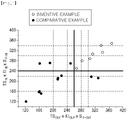
- FIG. 1 is a diagram illustrating a product of tensile strength, elongation, and fatigue strength of an outer wound portion and an inner wound portion of a wound coil according to an embodiment of the present invention.
- the present inventors investigated a crack distribution and durability changes in a shear plane according to characteristics of alloy components and microstructures for thick materials with different microstructures based on various alloy compositions, and as a result, derived Relational Expressions 1 to 4 to be described later.
- the present inventors confirmed that, by controlling a steel alloy composition range and controlling steel manufacturing process conditions to satisfy Relational Expressions 1 to 4, it is possible to manufacture high-strength thick composite-phase steel sheet having excellent material and durability uniformity and a tensile strength of 650 MPa or more, and having, as a base structure, a mixed phase of ferrite and bainite phases in which, in a microstructure in a center of a thickness of a steel sheet, an area fraction of each of a pearlite phase and a martensite and austenite (MA) phase is less than 5% and an area fraction of a martensite phase is less than 10%, and a product of tensile strength, elongation, and fatigue strength of an outer wound portion of a coil is 25 ⁇ 10 5 % or greater, and a product of tensile strength, elongation, and fatigue strength of an inner wound portion is 24 ⁇ 10 5 % or greater, and proposed the present invention.
- the thick composite-phase steel having excellent material and durability uniformity includes, by wt%, C: 0.05 to 0.15%, Si: 0.01 to 1.0%, Mn: 1.0 to 2.3%, Al: 0.01 to 0.1%, Cr: 0.005 to 1.0%, P: 0.001 to 0.05%, S: 0.001 to 0.01%, N: 0.001 to 0.01%, Nb: 0.005 to 0.07%, Ti: 0.005 to 0.11%, Fe, and inevitable impurities, and has a mixed phase of ferrite and bainite as a base structure, wherein, in the base structure, the area fraction of each of a pearlite phase and a martensite and austenite (MA) phase is less than 5%, and the area fraction of a martensite phase is less than 10%, and when a coil in a wound state is divided, in the lengthwise direction, into three parts: HEAD, MID, and TAIL parts, a product of tensile strength, elongation, and fatigue strength of an outer
- C is the most economical and effective element for reinforcing steel, and when the amount added increases, a precipitation strengthening effect or a bainite phase fraction increases, thereby increasing a tensile strength.
- the cooling rate in the center of the thickness during cooling after hot rolling is slow, so coarse carbide or pearlite is easy to form when the content of C is large.
- the content of C is preferably limited to 0.05 to 0.15%. More preferably, the content of C is limited to 0.06 to 0.12%.
- Si deoxidizes a molten steel and has a solid solution strengthening effect, and is advantageous in improving the formability by delaying the formation of the coarse carbide.
- the content is less than 0.01%, the solid solution strengthening effect is small and the effect of delaying the formation of carbide is small, so it is difficult to improve the formability, and when the content exceeds 1.0%, a red scale due to Si is formed on a surface of the steel sheet during the hot rolling, thereby not only reducing the quality of the surface of the steel sheet, but also reducing ductility and weldability. Therefore, in the present invention, it is preferable to limit the content of Si in the range of 0.01 to 1.0%, and more preferably 0.2 to 0.7%.
- Mn is an effective element for solid solution strengthening of steel, and increases hardenability of steel to facilitate the formation of the bainite phase during the cooling after hot rolling.
- the content of Mn is preferably limited to 1.0 to 2.3%. More preferably, the content of Mn is limited to the range of 1.1 to 2.0%.
- the content of Cr is preferably limited to 0.005 to 1.0%. More preferably, the content of Cr is limited to 0.3 to 0.9%.
- P has the effect of strengthening the solid solution and promoting the ferrite transformation at the same time.
- the content is less than 0.001%, it is economically disadvantageous because it requires a lot of manufacturing cost and it is insufficient to obtain strength, and when the content exceeds 0.05%, brittleness occurs due to grain boundary segregation, microcracks are easy to occur during forming, and the formability and durability greatly deteriorate. Therefore, it is preferable to control the content of P in the range of 0.001 to 0.05%.
- S is an impurity present in steel.
- S combines with Mn and the like to form non-metallic inclusions.
- the content is less than 0.001%, it takes a lot of time during a steelmaking operation, resulting in lowering productivity. Therefore, in the present invention, it is preferable to control the content of S in the range of 0.001 to 0.01%.
- Sol.Al is a component mainly added for deoxidation.
- the content is less than 0.01%, the effect of the addition is insufficient, and when the content exceeds 0.1%, the AlN combines with nitrogen to form AlN, so corner cracks are likely to occur in slab during the continuous casting, and defects are likely to occur due to the formation of inclusions. Therefore, in the present invention, it is preferable to control the content of S in the range of 0.01 to 0.1%.
- N is a representative solid solution strengthening element together with C, and forms coarse precipitates together with Ti, Al, and the like.
- the solid solution strengthening effect of N is superior to that of carbon, but there is a problem in that toughness is greatly reduced as the amount of N in steel increases.
- Ti is a representative precipitation strengthening element and forms coarse TiN in steel due to a strong affinity with N.
- TiN has the effect of suppressing a growth of grains during a heating process for hot rolling.
- Ti remaining after reacting with nitrogen is dissolved in steel and combined with carbon to form TiC precipitates, which is a useful component for improving the strength of the steel.
- Nb is a representative precipitation strengthening element together with Ti, and is precipitated during the hot rolling, and thus, effectively improves the strength and impact toughness of steel due to the effect of grain refinement by the delayed recrystallization.
- the content of Nb is less than 0.005%, the above effects may not be obtained, and when the content of Nb exceeds 0.06%, elongated grains are formed due to the excessive recrystallization delay during the hot rolling and the formability and durability deteriorate due to the formation of coarse composite precipitates. Therefore, in the present invention, it is preferable to limit the content of Nb in the range of 0.005 to 0.06%, and more preferably to control the content of Nb in the range of 0.01 to 0.06%.
- the remaining component of the present invention is iron (Fe).
- Fe iron
- unintended impurities may inevitably be mixed from a raw material or the surrounding environment, and thus, these impurities may not be excluded. Since these impurities are known to anyone of ordinary skill in the manufacturing process, all the contents are not specifically described in the present specification.
- the composite-phase steel has a mixed phase of ferrite and bainite as a base structure, and each of the ferrite and bainite may be included in less than 65 area%.
- the pearlite phase and the martensite and austenite (MA) phase in the base structure may be included in an area fraction of less than 5% respectively, and a martensite phase may be included in an area fraction of less than 10%.
- the product of the tensile strength, elongation, and fatigue strength of the outer wound portion of the coil, which is the region of the HEAD part and the TAIL part is 25 ⁇ 10 5 % or greater
- the product of the tensile strength, elongation, and fatigue strength of the inner wound portion of the coil, which is the region of the MID part is 24 ⁇ 10 5 % or greater.
- the manufacturing method of composite-phase steel according to the present invention includes: reheating a steel slab having the composition components as described above at a temperature of 1200 to 1350°C; manufacturing a hot-rolled steel sheet by finish hot rolling the reheated steel slab at a finish hot rolling temperature (FDT) satisfying the following [Relational Expression 1] of steel; primarily cooling the hot-rolled steel sheet to a mid-temperature (MT) range of 550 to 650°C to satisfy the following [Relational Expression 2]; and when the primarily cooled steel sheet is divided, in a lengthwise direction, into three parts: HEAD, MID, and TAIL parts, secondarily cooling a region of the HEAD part and the TAIL part corresponding to an outer wound portion of a coil during coiling to a temperature range from 450 to 550°C to satisfy the following [Relational Expression 3], and secondarily cooling a region of the MID part corresponding to an inner wound portion of the coil to the temperature range from 400 to 500°C to satisfy the following [Relation
- the steel slab having the above composition component is reheated at a temperature of 1200 to 1350°C.
- the reheating temperature is less than 1200°C, the precipitates are not sufficiently re-dissolved, so the formation of the precipitates in the process after the hot rolling decreases, and the coarse TiN remains.
- the reheating temperature exceeds 1350°C, the strength decreases due to abnormal grain growth of austenite grains, so the reheating temperature is preferably limited to 1200 to 1350°C.
- the hot-rolled steel sheet is manufactured by performing the finish hot rolling on the reheated steel slab at the finish hot rolling temperature (FDT) that satisfies the following [Relational Expression 1] of the steel.
- FDT finish hot rolling temperature
- Tn ⁇ 60 ⁇ FDT ⁇ Tn Tn 740 + 92 C ⁇ 80 Si + 70 Mn + 45 Cr + 650 Nb + 410 Ti ⁇ 1.4 t ⁇ 5
- the FDT of the above Relational Expression 1 is a finish hot-rolled temperature (°C)
- the recrystallization delay during the hot rolling promotes the ferrite phase transformation during the phase transformation, thereby contributing to the formation of fine and uniform grains in the center of the thickness and increasing the strength and durability.
- the untransformed phase decreases during the cooling, and the fraction of the coarse MA phase and martensite phase decreases and the coarse carbide or pearlite structure decreases in the center of the thickness where the cooling rate is relatively slow, so the non-uniform structure of the hot-rolled steel sheet is resolved.
- the microstructure of the steel is coarse and non-uniform, and the phase transformation is delayed to form the coarse MA phase and martensite phase, so fine cracks are excessively formed during the shear forming and punching forming, resulting in deteriorating the durability.
- the hot rolling preferably starts at a temperature in the range of 800 to 1000°C.
- the hot rolling starts at a temperature higher than 1000°C
- the temperature of the hot-rolled steel sheet increases, so the grain size becomes coarse and the quality of the surface of the hot-rolled steel sheet deteriorates.
- the hot rolling is performed at a temperature lower than 800°C
- the elongated grains are developed due to the excessive recrystallization delay, resulting in severe anisotropy and poor formability, and when the rolling is performed at a temperature equal to or lower than the austenite temperature range, the non-uniform microstructure may be developed more severely.
- the hot-rolled steel sheet is primarily cooled to a mid-temperature (MT) range of 550 to 650°C to satisfy the following [Relational Expression 2] .
- MT mid-temperature
- CR 1 min 210 ⁇ 850 C + 1.5 Si ⁇ 67.2 Mn ⁇ 59.6 Cr + 187 Ti + 852 Nb
- CR 1 max 240 ⁇ 850 C + 1.5 Si ⁇ 67.2 Mn ⁇ 59.6 Cr + 187 Ti + 852 Nb
- CR 1 of the above Relational Expression 2 is a primary cooling rate (°C/sec) in an FDT to MT (550 to 650°C) section, [C], [Si], [Mn], [Cr], [Ti], and [Nb] in the above Relational Expression 2 are wt% of the corresponding alloy element.
- the cooling rate in the center of the thickness is slower than at the position t/4 under the surface layer of the thickness of the rolled sheet, so the coarse ferrite is formed in the center of the thickness, and the non-uniform microstructure is formed.
- CR2 IN of the Relational Expression 4 is the secondary cooling rate (°C/sec) of the MT to coiling temperature section of the MID part, [C], [Si], [Mn], [Cr], [Ti], and [Nb] in the above Relational Expression 4 are wt% structure of the corresponding alloy element.
- the MID part of the hot-rolled sheet forming the inner wound portion of the coil after the coiling and the HEAD part and the TAIL part of the hot-rolled sheet forming the outer wound portion of the coil after the coiling have a large difference in heat recuperation and recooling behavior in the wound state.
- the MID part it is relatively easy to generate the MA phase, the carbide, and the pearlite phase, and the deterioration phenomenon of the conventional low-temperature phase is also caused, resulting in deteriorating the durability.
- the carbide is easier to form at the ferrite grain boundary than the bainite phase, and may be coarsely grown.
- the cooling rate is very slow, the pearlite phase is formed, which makes it easy to form cracks during the shear forming or punching forming, and to propagate cracks along grain boundaries even with a small external force.
- the region of the HEAD part and the TAIL part corresponding to the outer wound portion of the coil during the coiling is secondarily cooled to a temperature range from 450 to 550°C to satisfy the following [Relational Expression 3]
- the region of the MID part corresponding to the inner wound portion of the coil is secondarily cooled to the temperature range from 400 to 500°C to satisfy the following [Relational Expression 4].
- the wound coil may be air-cooled to a temperature ranging from room temperature to 200°C.
- the air cooling of the coil means cooling in the air at room temperature at a cooling rate of 0.001 to 10°C/hour.
- the cooling rate exceeds 10°C/hour, some untransformed phases in the steel are easily transformed into the MA phase, and thus, the shear formability, punching formability, and durability of the steel deteriorate, and in order to control the cooling rate to less than 0.001°C/hour, it is economically disadvantageous because separate heating and thermal insulation facilities are required.
- the method may further include pickling and oiling the coiled steel sheet after the secondary cooling.
- the method may further include heating the pickled or oiled steel sheet to a temperature range of 450 to 740°C, followed by hot-dip galvanizing.
- the hot-dip galvanizing may use a plating bath including 0.01 to 30% by weight of magnesium (Mg), 0.01 to 50% by weight of aluminum (Al), the remaining of Zn, and inevitable impurities.
- Mg magnesium
- Al aluminum
- the steel slab having the composition components shown in Table 1 was prepared. Then, the steel slab prepared as described above was hot-rolled, cooled and coiled under the conditions shown in Tables 2 and 3 to produce the coiled hot-rolled steel sheet. After the coiling, the cooling rate of the steel sheet was kept constant at 1°C/hour.
- Table 2 showed the thickness t of the hot-rolled steel sheet, a finish hot-rolling temperature (FDT), the mid-temperature (MT), a coiling temperature (CT), a cooling rate CR1 in a first section (FDT to MT) after hot rolling, and cooling rates CR2 OUT and CR2 IN in a second section (MT to CT), respectively.
- Table 3 showed the calculation results of the Relational Expressions 1 to 4, respectively.
- the microstructure of each hot-rolled steel sheet obtained as described above was measured by being divided into the inner wound portion and the outer wound portion of the coil, and the results were shown in Table 4 below.
- the steel microstructure is the result of analysis in the center of the thickness of the hot-rolled sheet, and the phase fractions of martensite (M), ferrite (F), bainite (B), and pearlite (P) were measured from the results of analysis at 3000 and 5000 magnifications using the scanning electron microscope (SEM).
- SEM scanning electron microscope
- the area fraction of the MA phase was analyzed using an optical microscope and an image analyzer after etching by the Repeller etching method, and is the result of analysis at 1000 magnification.
- the above mechanical properties are the results of testing the JIS No. 5 standard specimen by taking the specimen in a direction perpendicular to the rolling direction.
- a test piece with a gauge length part of 40 mm and a width of 20 mm was used as a bending fatigue test, and the result is the result of testing under the conditions of a stress ratio of -1 and a frequency of 15 Hz.
- Comparative Example 1 is a case in which the hot rolling temperature exceeds the range of Relational Expression 1 proposed in the present invention, and showed that the MA phase develops in the microstructure in the center and the area of the grain boundary becomes coarse, and as a result, microcracks are easily formed in the cross section when exposed to the fatigue environment, resulting in deteriorating the fatigue characteristics.
- Comparative Example 2 is a case where hot rolling temperature was less than the range of the above Relational Equation 1, the elongated grains were formed excessively in the center of the thickness due to hot rolling in a low temperature range, and as a result, the fatigue fracture occurs along weak grain boundaries. This is because the microcracks formed in the center of the thickness during the punching forming developed along the elongated ferrite grain boundary.
- Comparative Examples 3 and 4 are cases in which cooling conditions are not satisfied in the outer wound portion of the coil, that is, the HEAD part and the TAIL part of the hot-rolled sheet in the Relational Expression 3 proposed in the present invention. Specifically, Comparative Example 3 could confirm that, due to the relative rapid cooling control, as shown in Table 4, the martensite phase is excessively formed in the structure and the durability deteriorates due to the difference in hardness between the phases. Comparative Example 4 is a case of slow cooling control, and could confirm that it is difficult to secure sufficient bainite phase in the structure, and the pearlite phase fraction is high and the durability deteriorates.
- Comparative Examples 5 and 6 are cases in which the cooling condition of the inner wound portion of the coil, that is, the MID part of the hot-rolled sheet, is not satisfied in Relational Expression 3 proposed in the present invention, and the durability was not good due to a metallurgical phenomenon similar to that of Comparative Examples 3 and 4.
- Comparative Examples 7 and 12 showed steels that did not satisfy the component range of the present invention, and Comparative Example 7 showed a region in which the C content is excessively contained, and thus, the range of CR1 for securing an appropriate fraction of ferrite phase needs to be controlled to 31°C/sec or lower, but may not be controlled when considering the length of the rolling and cooling section of the actual facility. In addition, it was not easy to secure sufficient formability because the elongation decreased due to the formation of the excessive bainite phase in the structure.
- Comparative Example 8 is a case in which the C content was lower than the target, and showed that the low-temperature transformation phases such as bainite, including the martensite phase, were not sufficiently developed in the center of the thickness of the steel sheet, and a relatively coarse ferrite phase was formed, resulting in lowering the fatigue strength.
- the low-temperature transformation phases such as bainite, including the martensite phase
- Comparative Example 9 is a case in which the Si content is excessively high, and showed that the excessive MA phase is formed in the structure, and thus the harddenable property in a local area causes the difference in hardness between the phases and the surrounding base structure, thereby facilitating the occurrence of cracks in the fatigue environment and lowering the fatigue strength.
- excessive Si addition increases the probability of occurrence of red scale on the surface of the thick material, which is undesirable in terms of the use of wheel rim parts.
- Comparative Example 10 is a case in which the Mn content is excessively added, and showed that the martensite phase is developed excessively along the Mn segregation zone developed in the center of the thickness, and the shear and punching quality deteriorates, and thus, it is difficult to secure sufficient fatigue strength.
- Comparative Example 11 is a case in which the Mn content is added low, and could confirm that the composite-phase steel is prepared to satisfy Relational Expressions 1 to 4 for a recrystallization delay effect and a uniform microstructure, and both strength and fatigue strength are low because there are too few untransformed regions after ferrite phase transformation in the center of the thickness, result in making it difficult to secure a sufficient low-temperature transformation phase.
- Comparative Example 12 showed that the Cr content was excessively high, and similarly to Comparative Example 10, a lot of martensite phases formed locally in the center of the thickness were observed, and the fatigue characteristics deteriorate.
- FIG. 1 is a diagram illustrating a product of the tensile strength, elongation, and fatigue strength of the outer wound portion and the inner wound portion according to Inventive Examples and Comparative Examples of the present invention as described above.
- the case of Inventive Examples 1 to 7 of the present invention that satisfy the alloy composition and manufacturing process conditions of the present invention could confirm that the composite-phase steel with excellent material and durability uniformity may be obtained, in which the product of tensile strength, elongation, and fatigue strength of the outer wound portion is 25 ⁇ 10 5 % or greater, and the product of the tensile strength, elongation, and fatigue strength of the inner wound portion is 24 ⁇ 10 5 % or greater.
Landscapes
- Chemical & Material Sciences (AREA)
- Engineering & Computer Science (AREA)
- Materials Engineering (AREA)
- Mechanical Engineering (AREA)
- Metallurgy (AREA)
- Organic Chemistry (AREA)
- Thermal Sciences (AREA)
- Crystallography & Structural Chemistry (AREA)
- Physics & Mathematics (AREA)
- Chemical Kinetics & Catalysis (AREA)
- Heat Treatment Of Steel (AREA)
- Heat Treatment Of Sheet Steel (AREA)
- Coating With Molten Metal (AREA)
Applications Claiming Priority (2)
| Application Number | Priority Date | Filing Date | Title |
|---|---|---|---|
| KR1020190158289A KR102307928B1 (ko) | 2019-12-02 | 2019-12-02 | 내구성이 우수한 후물 복합조직강 및 그 제조방법 |
| PCT/KR2020/016925 WO2021112488A1 (fr) | 2019-12-02 | 2020-11-26 | Acier épais à phase composite ayant une excellente durabilité et son procédé de fabrication |
Publications (2)
| Publication Number | Publication Date |
|---|---|
| EP4071262A1 true EP4071262A1 (fr) | 2022-10-12 |
| EP4071262A4 EP4071262A4 (fr) | 2022-12-28 |
Family
ID=76221008
Family Applications (1)
| Application Number | Title | Priority Date | Filing Date |
|---|---|---|---|
| EP20896577.2A Pending EP4071262A4 (fr) | 2019-12-02 | 2020-11-26 | Acier épais à phase composite ayant une excellente durabilité et son procédé de fabrication |
Country Status (6)
| Country | Link |
|---|---|
| US (2) | US12435400B2 (fr) |
| EP (1) | EP4071262A4 (fr) |
| JP (1) | JP7431325B2 (fr) |
| KR (1) | KR102307928B1 (fr) |
| CN (1) | CN114641587B (fr) |
| WO (1) | WO2021112488A1 (fr) |
Cited By (1)
| Publication number | Priority date | Publication date | Assignee | Title |
|---|---|---|---|---|
| EP4636118A4 (fr) * | 2022-12-12 | 2026-04-01 | Posco Co Ltd | Tôle d'acier et son procédé de fabrication |
Families Citing this family (2)
| Publication number | Priority date | Publication date | Assignee | Title |
|---|---|---|---|---|
| KR20230072050A (ko) | 2021-11-17 | 2023-05-24 | 주식회사 포스코 | 냉간 성형 후 내충격성이 우수한 고항복비형 고강도강 및 그 제조방법 |
| CN117265380B (zh) * | 2022-06-15 | 2026-01-20 | 宝山钢铁股份有限公司 | 一种800MPa级高扩孔热镀锌钢板及其制造方法 |
Family Cites Families (26)
| Publication number | Priority date | Publication date | Assignee | Title |
|---|---|---|---|---|
| JP3042738B2 (ja) | 1992-03-31 | 2000-05-22 | 雪印乳業株式会社 | ガングリオシドgm3組成物及びその製造法 |
| JPH05308808A (ja) | 1992-05-13 | 1993-11-22 | Mitsubishi Agricult Mach Co Ltd | 移動農機の角速度検出装置 |
| JPH08143952A (ja) * | 1994-11-21 | 1996-06-04 | Sumitomo Metal Ind Ltd | 加工性、疲労特性及び表面性状に優れた高強度熱延鋼板の製造方法 |
| JP3477955B2 (ja) | 1995-11-17 | 2003-12-10 | Jfeスチール株式会社 | 極微細組織を有する高張力熱延鋼板の製造方法 |
| JP3885314B2 (ja) | 1997-09-29 | 2007-02-21 | Jfeスチール株式会社 | 形状及び加工性に優れる高強度熱延鋼板の製造方法 |
| JP3767132B2 (ja) | 1997-11-11 | 2006-04-19 | Jfeスチール株式会社 | 高延性を有し、かつ材質均一性に優れた高強度熱延鋼板の製造方法 |
| JPH11310852A (ja) | 1998-02-26 | 1999-11-09 | Nippon Steel Corp | 極めて疲労特性の優れた高強度熱延鋼板及びその製造方法 |
| KR100368831B1 (ko) | 1998-12-29 | 2003-03-17 | 주식회사 포스코 | 연신플랜지성이 우수한 인장강도 70킬로그램/제곱미리미터급 고강도 열연강판의 제조방법 |
| KR100340580B1 (ko) | 1999-12-27 | 2002-06-12 | 이구택 | 가공성이 우수한 인장강도 780㎫급 자동차용 열연강판 및그 제조방법 |
| KR100723200B1 (ko) | 2005-12-16 | 2007-05-29 | 주식회사 포스코 | 연신율-신장플랜지성 및 신장플랜지성-피로특성 발란스가우수한 고강도 열연강판의 제조방법 |
| JP5195469B2 (ja) * | 2009-01-30 | 2013-05-08 | Jfeスチール株式会社 | 低温靭性に優れた厚肉高張力熱延鋼板の製造方法 |
| CN102301026B (zh) | 2009-01-30 | 2014-11-05 | 杰富意钢铁株式会社 | 低温韧性优良的厚壁高强度热轧钢板及其制造方法 |
| JP5724267B2 (ja) | 2010-09-17 | 2015-05-27 | Jfeスチール株式会社 | 打抜き加工性に優れた高強度熱延鋼板およびその製造方法 |
| KR101536422B1 (ko) | 2013-10-10 | 2015-07-13 | 주식회사 포스코 | 굽힘성형성이 우수한 고강도 열연강판 및 이의 제조방법 |
| KR101568519B1 (ko) * | 2013-12-24 | 2015-11-11 | 주식회사 포스코 | 전단변형부 성형이방성 및 내피로특성이 우수한 열연강판 및 그 제조방법 |
| KR20150075541A (ko) * | 2013-12-26 | 2015-07-06 | 주식회사 포스코 | 성형성과 내피로성이 우수한 고강도 열연강판 및 그 제조방법 |
| JP6149778B2 (ja) | 2014-03-31 | 2017-06-21 | Jfeスチール株式会社 | 耐摩耗性に優れた厚鋼板およびその製造方法 |
| BR112016027395B1 (pt) | 2014-05-28 | 2020-05-05 | Nippon Steel & Sumitomo Metal Corp | chapa de aço laminada a quente e método de produção da mesma |
| JP6252499B2 (ja) * | 2015-01-13 | 2017-12-27 | Jfeスチール株式会社 | 熱延鋼帯、冷延鋼帯及び熱延鋼帯の製造方法 |
| JP6202012B2 (ja) | 2015-02-03 | 2017-09-27 | Jfeスチール株式会社 | 成形性に優れた高強度鋼板の製造方法 |
| KR101758485B1 (ko) | 2015-12-15 | 2017-07-17 | 주식회사 포스코 | 표면품질 및 점 용접성이 우수한 고강도 용융아연도금강판 및 그 제조방법 |
| JP2018016873A (ja) | 2016-07-29 | 2018-02-01 | 株式会社神戸製鋼所 | コイル内での強度ばらつきの小さい高強度高加工性冷延鋼板コイル及びその製造方法 |
| KR102186320B1 (ko) | 2016-08-05 | 2020-12-03 | 닛폰세이테츠 가부시키가이샤 | 강판 및 도금 강판 |
| KR101797383B1 (ko) | 2016-08-09 | 2017-11-13 | 주식회사 포스코 | 재질편차가 적고 표면품질이 우수한 고강도 열연강판 및 그 제조방법 |
| JP6354075B1 (ja) | 2016-08-10 | 2018-07-11 | Jfeスチール株式会社 | 高強度薄鋼板およびその製造方法 |
| KR101988765B1 (ko) | 2017-12-21 | 2019-06-12 | 주식회사 포스코 | 내구성이 우수한 열연강판 및 이의 제조방법 |
-
2019
- 2019-12-02 KR KR1020190158289A patent/KR102307928B1/ko active Active
-
2020
- 2020-11-26 WO PCT/KR2020/016925 patent/WO2021112488A1/fr not_active Ceased
- 2020-11-26 JP JP2022532567A patent/JP7431325B2/ja active Active
- 2020-11-26 US US17/779,096 patent/US12435400B2/en active Active
- 2020-11-26 EP EP20896577.2A patent/EP4071262A4/fr active Pending
- 2020-11-26 CN CN202080077393.XA patent/CN114641587B/zh active Active
-
2025
- 2025-10-03 US US19/349,944 patent/US20260028706A1/en active Pending
Cited By (1)
| Publication number | Priority date | Publication date | Assignee | Title |
|---|---|---|---|---|
| EP4636118A4 (fr) * | 2022-12-12 | 2026-04-01 | Posco Co Ltd | Tôle d'acier et son procédé de fabrication |
Also Published As
| Publication number | Publication date |
|---|---|
| US12435400B2 (en) | 2025-10-07 |
| JP7431325B2 (ja) | 2024-02-14 |
| JP2023504150A (ja) | 2023-02-01 |
| KR20210068808A (ko) | 2021-06-10 |
| EP4071262A4 (fr) | 2022-12-28 |
| CN114641587A (zh) | 2022-06-17 |
| US20220403489A1 (en) | 2022-12-22 |
| WO2021112488A1 (fr) | 2021-06-10 |
| CN114641587B (zh) | 2023-08-25 |
| US20260028706A1 (en) | 2026-01-29 |
| KR102307928B1 (ko) | 2021-09-30 |
Similar Documents
| Publication | Publication Date | Title |
|---|---|---|
| EP2053139B1 (fr) | Feuilles d'acier laminees a chaud excellentes a la fois en matiere d'usinabilite et de resistance et robustesse apres un traitement thermique et leur processus de fabrication | |
| US20260028706A1 (en) | Thick composite-phase steel having excellent durability and manufacturing method therefor | |
| EP2653582A1 (fr) | Tôle d'acier zinguée par immersion à chaud et son procédé de production | |
| JP2005126733A (ja) | 高温加工性にすぐれた熱間プレス用鋼板及び自動車用部材 | |
| US20240337003A1 (en) | High-strength steel having high yield ratio and excellent durability, and method for manufacturing same | |
| CN113166893B (zh) | 耐久性优异的高强度钢材及其制造方法 | |
| CN113840934A (zh) | 高强度构件、高强度构件的制造方法和高强度构件用钢板的制造方法 | |
| CN116615570B (zh) | 伸长率优异的高强度厚热轧钢板及其制造方法 | |
| CN115461482B (zh) | 钢板、部件及其制造方法 | |
| EP3822383B1 (fr) | Feuille d'acier revêtue laminée à chaud ayant une résistance élevée, une aptitude élevée au formage, une excellente aptitude au durcissement par cuisson et son procédé de fabrication | |
| EP3964600A1 (fr) | Feuille d'acier très haute résistance offrant une excellente ouvrabilité de cisaillement et son procédé de fabrication | |
| CN108350550B (zh) | 剪切加工性优异的高强度冷轧钢板及其制造方法 | |
| EP3730652B1 (fr) | Tôle d'acier laminée à froid à ultra-haute résistance et son procédé de fabrication | |
| JPH10251794A (ja) | プレス成形性と表面性状に優れた構造用熱延鋼板およびその 製造方法 | |
| CN117616144A (zh) | 冷轧钢板及其制造方法 | |
| EP4234747A1 (fr) | Tôle d'acier à haute résistance ayant une excellente aptitude au façonnage et son procédé de fabrication | |
| EP4234743A1 (fr) | Tôle d'acier à haute résistance présentant une excellente stabilité thermique, et son procédé de fabrication | |
| KR102307927B1 (ko) | 내구성 및 연신율이 우수한 후물 변태조직강 및 그 제조방법 | |
| EP4640883A1 (fr) | Tôle d'acier laminée à froid et son procédé de fabrication | |
| EP4640884A1 (fr) | Tôle d'acier laminée à froid et son procédé de fabrication | |
| KR20230043353A (ko) | 표면 품질이 우수하고 재질 편차가 적은 고강도 냉연강판 및 이의 제조 방법 |
Legal Events
| Date | Code | Title | Description |
|---|---|---|---|
| STAA | Information on the status of an ep patent application or granted ep patent |
Free format text: STATUS: THE INTERNATIONAL PUBLICATION HAS BEEN MADE |
|
| PUAI | Public reference made under article 153(3) epc to a published international application that has entered the european phase |
Free format text: ORIGINAL CODE: 0009012 |
|
| STAA | Information on the status of an ep patent application or granted ep patent |
Free format text: STATUS: REQUEST FOR EXAMINATION WAS MADE |
|
| 17P | Request for examination filed |
Effective date: 20220628 |
|
| AK | Designated contracting states |
Kind code of ref document: A1 Designated state(s): AL AT BE BG CH CY CZ DE DK EE ES FI FR GB GR HR HU IE IS IT LI LT LU LV MC MK MT NL NO PL PT RO RS SE SI SK SM TR |
|
| REG | Reference to a national code |
Ref country code: DE Ref legal event code: R079 Free format text: PREVIOUS MAIN CLASS: C22C0038380000 Ipc: C21D0001020000 |
|
| A4 | Supplementary search report drawn up and despatched |
Effective date: 20221128 |
|
| RAP3 | Party data changed (applicant data changed or rights of an application transferred) |
Owner name: POSCO |
|
| RIC1 | Information provided on ipc code assigned before grant |
Ipc: C23C 30/00 20060101ALI20221122BHEP Ipc: C23C 2/12 20060101ALI20221122BHEP Ipc: C23C 2/02 20060101ALI20221122BHEP Ipc: C23C 2/06 20060101ALI20221122BHEP Ipc: C22C 38/38 20060101ALI20221122BHEP Ipc: C22C 38/28 20060101ALI20221122BHEP Ipc: C22C 38/26 20060101ALI20221122BHEP Ipc: C22C 38/04 20060101ALI20221122BHEP Ipc: C22C 38/02 20060101ALI20221122BHEP Ipc: C21D 9/46 20060101ALI20221122BHEP Ipc: C21D 8/02 20060101ALI20221122BHEP Ipc: C21D 1/02 20060101AFI20221122BHEP |
|
| DAV | Request for validation of the european patent (deleted) | ||
| DAX | Request for extension of the european patent (deleted) |