EP4114825B1 - Photo-initiateurs à base d'ester d'oxime - Google Patents
Photo-initiateurs à base d'ester d'oxime Download PDFInfo
- Publication number
- EP4114825B1 EP4114825B1 EP21709000.0A EP21709000A EP4114825B1 EP 4114825 B1 EP4114825 B1 EP 4114825B1 EP 21709000 A EP21709000 A EP 21709000A EP 4114825 B1 EP4114825 B1 EP 4114825B1
- Authority
- EP
- European Patent Office
- Prior art keywords
- alkyl
- substituted
- halogen
- unsubstituted
- interrupted
- Prior art date
- Legal status (The legal status is an assumption and is not a legal conclusion. Google has not performed a legal analysis and makes no representation as to the accuracy of the status listed.)
- Active
Links
Classifications
-
- C—CHEMISTRY; METALLURGY
- C07—ORGANIC CHEMISTRY
- C07D—HETEROCYCLIC COMPOUNDS
- C07D209/00—Heterocyclic compounds containing five-membered rings, condensed with other rings, with one nitrogen atom as the only ring hetero atom
- C07D209/56—Ring systems containing three or more rings
- C07D209/80—[b, c]- or [b, d]-condensed
- C07D209/82—Carbazoles; Hydrogenated carbazoles
- C07D209/86—Carbazoles; Hydrogenated carbazoles with only hydrogen atoms, hydrocarbon or substituted hydrocarbon radicals, directly attached to carbon atoms of the ring system
-
- C—CHEMISTRY; METALLURGY
- C07—ORGANIC CHEMISTRY
- C07D—HETEROCYCLIC COMPOUNDS
- C07D209/00—Heterocyclic compounds containing five-membered rings, condensed with other rings, with one nitrogen atom as the only ring hetero atom
- C07D209/56—Ring systems containing three or more rings
- C07D209/80—[b, c]- or [b, d]-condensed
- C07D209/82—Carbazoles; Hydrogenated carbazoles
- C07D209/88—Carbazoles; Hydrogenated carbazoles with hetero atoms or with carbon atoms having three bonds to hetero atoms with at the most one bond to halogen, e.g. ester or nitrile radicals, directly attached to carbon atoms of the ring system
-
- C—CHEMISTRY; METALLURGY
- C07—ORGANIC CHEMISTRY
- C07D—HETEROCYCLIC COMPOUNDS
- C07D403/00—Heterocyclic compounds containing two or more hetero rings, having nitrogen atoms as the only ring hetero atoms, not provided for by group C07D401/00
- C07D403/02—Heterocyclic compounds containing two or more hetero rings, having nitrogen atoms as the only ring hetero atoms, not provided for by group C07D401/00 containing two hetero rings
-
- C—CHEMISTRY; METALLURGY
- C07—ORGANIC CHEMISTRY
- C07D—HETEROCYCLIC COMPOUNDS
- C07D405/00—Heterocyclic compounds containing both one or more hetero rings having oxygen atoms as the only ring hetero atoms, and one or more rings having nitrogen as the only ring hetero atom
- C07D405/02—Heterocyclic compounds containing both one or more hetero rings having oxygen atoms as the only ring hetero atoms, and one or more rings having nitrogen as the only ring hetero atom containing two hetero rings
- C07D405/06—Heterocyclic compounds containing both one or more hetero rings having oxygen atoms as the only ring hetero atoms, and one or more rings having nitrogen as the only ring hetero atom containing two hetero rings linked by a carbon chain containing only aliphatic carbon atoms
-
- C—CHEMISTRY; METALLURGY
- C07—ORGANIC CHEMISTRY
- C07D—HETEROCYCLIC COMPOUNDS
- C07D409/00—Heterocyclic compounds containing two or more hetero rings, at least one ring having sulfur atoms as the only ring hetero atoms
- C07D409/02—Heterocyclic compounds containing two or more hetero rings, at least one ring having sulfur atoms as the only ring hetero atoms containing two hetero rings
- C07D409/12—Heterocyclic compounds containing two or more hetero rings, at least one ring having sulfur atoms as the only ring hetero atoms containing two hetero rings linked by a chain containing hetero atoms as chain links
-
- C—CHEMISTRY; METALLURGY
- C07—ORGANIC CHEMISTRY
- C07F—ACYCLIC, CARBOCYCLIC OR HETEROCYCLIC COMPOUNDS CONTAINING ELEMENTS OTHER THAN CARBON, HYDROGEN, HALOGEN, OXYGEN, NITROGEN, SULFUR, SELENIUM OR TELLURIUM
- C07F9/00—Compounds containing elements of Groups 5 or 15 of the Periodic Table
- C07F9/02—Phosphorus compounds
- C07F9/547—Heterocyclic compounds, e.g. containing phosphorus as a ring hetero atom
- C07F9/553—Heterocyclic compounds, e.g. containing phosphorus as a ring hetero atom having one nitrogen atom as the only ring hetero atom
- C07F9/572—Five-membered rings
- C07F9/5728—Five-membered rings condensed with carbocyclic rings or carbocyclic ring systems
-
- C—CHEMISTRY; METALLURGY
- C08—ORGANIC MACROMOLECULAR COMPOUNDS; THEIR PREPARATION OR CHEMICAL WORKING-UP; COMPOSITIONS BASED THEREON
- C08F—MACROMOLECULAR COMPOUNDS OBTAINED BY REACTIONS ONLY INVOLVING CARBON-TO-CARBON UNSATURATED BONDS
- C08F2/00—Processes of polymerisation
- C08F2/44—Polymerisation in the presence of compounding ingredients, e.g. plasticisers, dyestuffs, fillers
-
- C—CHEMISTRY; METALLURGY
- C08—ORGANIC MACROMOLECULAR COMPOUNDS; THEIR PREPARATION OR CHEMICAL WORKING-UP; COMPOSITIONS BASED THEREON
- C08F—MACROMOLECULAR COMPOUNDS OBTAINED BY REACTIONS ONLY INVOLVING CARBON-TO-CARBON UNSATURATED BONDS
- C08F2/00—Processes of polymerisation
- C08F2/46—Polymerisation initiated by wave energy or particle radiation
- C08F2/48—Polymerisation initiated by wave energy or particle radiation by ultraviolet or visible light
- C08F2/50—Polymerisation initiated by wave energy or particle radiation by ultraviolet or visible light with sensitising agents
-
- C—CHEMISTRY; METALLURGY
- C08—ORGANIC MACROMOLECULAR COMPOUNDS; THEIR PREPARATION OR CHEMICAL WORKING-UP; COMPOSITIONS BASED THEREON
- C08K—Use of inorganic or non-macromolecular organic substances as compounding ingredients
- C08K5/00—Use of organic ingredients
- C08K5/0008—Organic ingredients according to more than one of the "one dot" groups of C08K5/01 - C08K5/59
- C08K5/0041—Optical brightening agents, organic pigments
-
- G—PHYSICS
- G03—PHOTOGRAPHY; CINEMATOGRAPHY; ANALOGOUS TECHNIQUES USING WAVES OTHER THAN OPTICAL WAVES; ELECTROGRAPHY; HOLOGRAPHY
- G03F—PHOTOMECHANICAL PRODUCTION OF TEXTURED OR PATTERNED SURFACES, e.g. FOR PRINTING, FOR PROCESSING OF SEMICONDUCTOR DEVICES; MATERIALS THEREFOR; ORIGINALS THEREFOR; APPARATUS SPECIALLY ADAPTED THEREFOR
- G03F7/00—Photomechanical, e.g. photolithographic, production of textured or patterned surfaces, e.g. printing surfaces; Materials therefor, e.g. comprising photoresists; Apparatus specially adapted therefor
- G03F7/0005—Production of optical devices or components in so far as characterised by the lithographic processes or materials used therefor
- G03F7/0007—Filters, e.g. additive colour filters; Components for display devices
-
- G—PHYSICS
- G03—PHOTOGRAPHY; CINEMATOGRAPHY; ANALOGOUS TECHNIQUES USING WAVES OTHER THAN OPTICAL WAVES; ELECTROGRAPHY; HOLOGRAPHY
- G03F—PHOTOMECHANICAL PRODUCTION OF TEXTURED OR PATTERNED SURFACES, e.g. FOR PRINTING, FOR PROCESSING OF SEMICONDUCTOR DEVICES; MATERIALS THEREFOR; ORIGINALS THEREFOR; APPARATUS SPECIALLY ADAPTED THEREFOR
- G03F7/00—Photomechanical, e.g. photolithographic, production of textured or patterned surfaces, e.g. printing surfaces; Materials therefor, e.g. comprising photoresists; Apparatus specially adapted therefor
- G03F7/004—Photosensitive materials
- G03F7/027—Non-macromolecular photopolymerisable compounds having carbon-to-carbon double bonds, e.g. ethylenic compounds
- G03F7/028—Non-macromolecular photopolymerisable compounds having carbon-to-carbon double bonds, e.g. ethylenic compounds with photosensitivity-increasing substances, e.g. photoinitiators
- G03F7/031—Organic compounds not covered by group G03F7/029
-
- G—PHYSICS
- G03—PHOTOGRAPHY; CINEMATOGRAPHY; ANALOGOUS TECHNIQUES USING WAVES OTHER THAN OPTICAL WAVES; ELECTROGRAPHY; HOLOGRAPHY
- G03F—PHOTOMECHANICAL PRODUCTION OF TEXTURED OR PATTERNED SURFACES, e.g. FOR PRINTING, FOR PROCESSING OF SEMICONDUCTOR DEVICES; MATERIALS THEREFOR; ORIGINALS THEREFOR; APPARATUS SPECIALLY ADAPTED THEREFOR
- G03F7/00—Photomechanical, e.g. photolithographic, production of textured or patterned surfaces, e.g. printing surfaces; Materials therefor, e.g. comprising photoresists; Apparatus specially adapted therefor
- G03F7/26—Processing photosensitive materials; Apparatus therefor
- G03F7/30—Imagewise removal using liquid means
- G03F7/32—Liquid compositions therefor, e.g. developers
Definitions
- the present invention relates to novel ⁇ -oxo oxime ester compounds based on carbazole derivatives which have specific substituent groups and their use as photoinitiators in photopolymerizable compositions, particularly in photoresist formulations for display applications, e.g. liquid crystal display (LCD), organic light emitting diode (OLED) and touch panel.
- LCD liquid crystal display
- OLED organic light emitting diode
- Carbazole ⁇ -oxo oxime ester photoinitiators having O-substituted benzoyl group are disclosed in the following patent applications.
- JP2009179619 discloses ⁇ , ⁇ -dioxo oxime ester compounds based on carbazole derivatives having m-cyclohexyloxy- or m-phenoxybenzoyl substituent.
- CN 103130919 discloses carbazole ketoxime ester photoinitiators having a ring-shaped substituent and p-methoxy- or p-phenoxybenzoyl substituent.
- CN 107793502 discloses a fused carbazole ketoxime ester photoinitiator having p-methoxybenzoyl substituent.
- color filters for LCD and white OLED which comprise a black matrix and red, green and blue color pixels on a glass substrate, are manufactured by photolithography using radically photopolymerizable resists.
- high loading of the colorants is required to attain high color quality properties.
- curing of the color resists becomes more difficult because the colorants reduce transmission of the exposed light for photolithography.
- photoinitiators having a high sensitivity are required.
- Examples are methyl, ethyl, propyl, isopropyl, n-butyl, sec-butyl, isobutyl, tert-butyl, pentyl, hexyl, heptyl, 2,4,4-trimethylpentyl, 2-ethylhexyl, octyl, nonyl, decyl, dodecyl, tetradecyl, pentadecyl, hexadecyl, octadecyl and icosyl.
- C 1 - C20 haloalkyl is C 1 -C 20 alkyl and C 1 -C 4 haloalkylis C 1 -C 4 alkyl, which are mono- or poly-substituted by halogen up to the exchange of all H-atoms by halogen.
- Examples are chloromethyl, trichloromethyl, trifluoromethyl or 2-bromopropyl, especially trifluoromethyl or trichloromethyl.
- C 2 -C 20 alkyl interrupted by one or more O, S, NR 16 , CO, SO or SO 2 is for example interrupted 1-9, 1-7 or once or twice by the defined radicals.
- the groups are interrupted by more than one O, said O-atoms are separated from one another by at least one methylene group, i.e. the O-atoms are non-consecutive.
- C 3 -C 20 cycloalkyl or C 3 -C 8 cycloalkyl is a mono- or polycyclic aliphatic ring, for example a mono-, bi- or tricyclic aliphatic ring, e.g. C 3 -C 18 -, C 3 -C 12 -, C 3 -C 10 cycloalkyl.
- monocyclic rings are cyclopropyl, cyclobutyl, cyclopentyl, cyclohexyl, or cycloheptyl, especially cyclopentyl and cyclohexyl.
- polycyclic rings are perhydroanthracyl, perhydrophenyathryl, perhydronaphthyl, perhydrofluorenyl, perhydrochrysenyl, perhydropicenyl, adamantyl, bicyclo[1.1.1]pentyl, bicyclo[4.2.2]decyl, bicyclo[2.2.2]octyl, bicyclo[3.3.2]decyl, bicyclo[4.3.2]undecyl, bicyclo[4.3.3]dodecyl, bicyclo[3.3.3]undecyl, bicyclo[4.3.1]decyl, bicyclo[4.2.1]nonyl, bicyclo[3.3.1]nonyl, bicyclo[3.2.1]octyl, and the like.
- C 2 -C 2 alkenyl is mono or polyunsaturated, linear or branched and is for example C 2 -C 8 -, C 2 -C 6 - or C 2 -C 4 alkenyl.
- Examples are allyl, methallyl, vinyl, 1,1-dimethylallyl, 1-butenyl, 3-butenyl, 2-butenyl, 1,3-pentadienyl, 5-hexenyl or 7-octenyl, especially allyl or vinyl.
- C 1 -C 20 alkoxy is linear or branched and is for example C 1 -C 18 -, C 1 -C 16 -, C 1 -C 12 -, C 1 -C 8 -, C 1 -C 6 - or C 1 -C 4 -alkoxy.
- Examples are methoxy, ethoxy, propoxy, isopropoxy, n-butyloxy, sec-butyloxy, iso-butyloxy, tert-butyloxy, pentyloxy, hexyloxy, heptyloxy, 2,4,4-trimethylpetyloxy, 2-ethylhexyloxy, octyloxy, nonyloxy, decyloxy, dodecyloxy, hexadecyloxy, octadecyloxy or icosyloxy, in particular methoxy, ethoxy, propoxy, isopropoxy, n-butyloxy, sec-butyloxy, iso-butyloxy, tert-butyloxy, especially methoxy.
- C 2 -C 20 alkoxy which is interrupted by one or more O, S, NR 16 , CO, SO or SO 2 is for example interrupted 1-9, 1-7, 1-4 or once or twice by the defined radicals.
- said O-atoms are separated from one another by at least one methylene group, i.e. the O-atoms are non-consecutive.
- C 1 -C 8 alkylsulfanyl is linear or branched, for example, methylsulfanyl, ethylsulfanyl, propylsulfanyl, isopropylsulfanyl, n-butylsulfanyl, sec-butylsulfanyl, isobutylsulfanyl, tert-butylsulfanyl, etc.
- Examples are formyl, acetyl, propionyl, butanoyl, isobutanoyl, pentanoyl, hexanoyl, heptanoyl, octanoyl, nonanoyl, decanoyl, dodecanoyl, tetradecanoyl, pentadecanoyl, hexadecanoyl, octadecanoyl, icosanoyl, preferably acetyl.
- C 3 -C 12 alkenoyl is mono or polyunsaturated.
- Examples are propenoyl, 2-methyl-propenoyl, butenoyl, pentenoyl, 1,3-pentadienoyl, 5-hexenoyl, etc.
- Halogen is fluorine, chlorine, bromine and iodine, especially fluorine, chlorine and bromine, preferably fluorine and chlorine.
- C 1 -C 20 alkylphenyl corresponds to phenyl that is substituted once or more times by alkyl at the phenyl ring and is for example C 1 -C 12 alkyl-, C 1 -C 8 alkyl- or C 1 -C 4 alkylphenyl, wherein the number of the alkyl corresponds to the total number of all C-atoms in all alkyl-subtstituents at the phenyl ring. Examples are tolyl, xylyl, mesityl, ethylphenyl, diethylphenyl, in particular tolyl and mesityl.
- C 1 -C 8 alkoxyphenyl corresponds to phenyl that is substituted once or more times by alkoxyl at the phenyl ring and is for example C 1 -C 4 alkoxyphenyl, wherein the number of the alkoxy corresponds to the total number of all C-atoms in all alkoxy-subtstituents at the phenyl ring. Examples are methoxyphenyl, dimethoxyphenyl, trimethoxyphenyl, ethoxyphenyl, diethoxyphenyl, ect..
- C 6 -C 20 aryl is for example phenyl, naphthyl, anthryl or phenanthryl, in particular phenyl or naphthyl, preferably phenyl.
- Naphthyl corresponds to 1-naphthyl and 2-naphthyl.
- C 6 -C 20 aroyl corresponds to C 6 -C 20 aryl-CO-, wherein C 6 -C 20 aryl is defined as above. Examples are benzoyl, naphthoyl etc..
- C 6 -C 20 aryloxy corresponds to C 6 -C 20 aryl-O-, wherein C 6 -C 20 aryl is defined as above. Examples are phenyoxy, naphthyloxy etc..
- C 3 -C 20 heteroaryl is meant to comprise either a one ring or a multiple ring system, e.g. a fused ring-system.
- Examples are thienyl, benzo[b]thienyl, naphtho[2,3-b]thienyl, thianthrenyl, furyl, dibenzofuryl, benzofuryl, chromenyl, xanthenyl, thioxanthyl, phenoxathiinyl, pyrrolyl, imidazolyl, pyrazolyl, pyrazinyl, pyrimidinyl, pyridazinyl, indolizinyl, isoindolyl, indolyl, indazolyl, purinyl, quinolizinyl, isoquinolyl, quinolyl, phthalazinyl, naphthyridinyl, quinoxalinyl, quinazolinyl, cinnolinyl, pteridinyl, carbazolyl, ⁇ -carbolinyl, phenanthridinyl, acridinyl,
- C 3 -C 20 heteroaryl in particular is thienyl, benzo[b]thienyl, furyl, benzofuryl, thianthrenyl, thioxanthyl, 1-methyl-2-indolyl or 1-methyl-3-indolyl.
- C 3 -C 20 heteroarylcarbonyl corresponds to C 3 -C 20 heteroaryl-CO-, wherein C 3 -C 20 heteroaryl is defined as above.
- C 3 -C 20 heteroaryloxy corresponds to C 3 -C 20 heteroaryl-O-, wherein C 3 -C 20 heteroaryl is defined as above.
- C 1 -C 20 alkylene is linear or branched and is for example , C 1 -C 18 -, C 1 -C 14 -, C 1 -C 12 -, C 1 -C 8 -, C 1 -C 6 - or C 1 -C 4 alkylene.
- Examples are methylene, ethylene, propylene, 1-methylethylene 1,1-dimethylethylene, butylene, 1-methylpropylene, 2-methyl-propylene, pentylene, hexylene, heptylene, octylene, nonylene, decylene, dodecylene, tetradecylene, hexadecylene or octadecylene.
- C 2 -C 20 alkylene interrupted by one or more O, S, NR 5 , CO, SO or SO 2 is, for example, interrupted 1-9 times, for example 1-7 times or once or twice by the defined substituents and the C 2 -C 20 alkylene is linear or branched.
- C 2 -C 12 alkenylene is mono- or polyunsaturated, linear or branched and is, for example, C 1 -C 8 -, C 1 -C 6 - or C 1 -C 4 alkenylene.
- Examples are ethenylene, 1-propenylene, 1-butenylene, 3-butenylene, 2-butenylene, 1,3-pentadienylene, 5-hexenylene, 7-octenylene, etc..
- C 3 -C 20 cycloalkylene consists of a two valent mono- or polycyclic aliphatic ring, for example a mono-, bi- or tricyclic aliphatic ring, e.g. C 3 -C 18 -, C 3 -C 12 -, C 3 -C 10 cycloalkylene.
- Examples are cyclopropylene, cyclopentylene, cyclohexylene, cyclooctylene, cyclododecylene, especially cyclopentylene and cyclohexylene, preferably cyclohexylene.
- C 6 -C 20 arylene is for example phenylene, biphenylene, o-, m- and p-terphenylene, triphenylphenylene, naphthylene, binaphthylene, anthracenylene, phenanthrylene or pyrenylene, in particular phenylene or naphthylene, especially phenylene.
- C 3 -C 20 heteroarylene refers to C 3 -C 20 heteroaryl as defined above however instead of being one-valent C 3 -C 20 heteroarylene groups are two valent.
- R 16 and R 17 together with the N-atom to which they are attached form a 5- or 6-membered saturated or unsaturated ring which is uninterrupted or interrupted by O, S or NR 5a , saturated or unsaturated rings are formed, for example aziridine, pyrrole, thiazole, pyrrolidine, oxazole, pyridine, 1,3-diazine, 1,2-diazine, piperidine or morpholine.
- R 16 and R 17 together with the N-atom to which they are attached form a 5- or 6-membered saturated or unsaturated ring which optionally is interrupted by O, S or NR 6a , 5- or 6-membered saturated rings which are not interrupted or which are interrupted by O or NR 6a , in particular by O, are formed.
- R 16a and R 17a together with the N-atom to which they are attached form a 5- or 6-membered saturated or unsaturated ring which is uninterrupted or interrupted by O, S or N(C 1 -C 8 alkyl), saturated or unsaturated rings are formed as described above for R 5 and R 6 forming a ring with the N-atom.
- aryl radicals phenyl, naphthyl, C 6 -C 20 aryl, C 5 -C 20 heteroaryl, C 6 -C 20 arylene or C 3 -C 20 heteroarylene etc. are substituted 1 to 7, 1 to 6 or 1 to 4 times respectively, in particular one, two or three times. It is evident that a defined aryl or heteroaryl radical cannot have more substituents than free "CH' or " NH' positions are at the defined ring.
- Substituents on the phenyl ring are preferably in positions 4 or in 3,4-, 3,4,5-, 2,6-, 2,4- or 2,4,6-configuration on the phenyl ring.
- Interrupted radicals which are interrupted once or more times are for example interrupted 1-19, 1-15, 1-12, 1-9, 1-7, 1-5, 1-4, 1-3 or once or twice (it is evident, that the number of interrupting atoms depends on the number of C-atoms to be interrupted).
- Substituted radicals which are substituted once or more times have for example 1-7, 1-5, 1-4, 1-3 or one or two identical or different substituents.
- a radical substituted by one or more defined substituents is meant to have either one substituent or more substituents of identical or different definitions as given
- the term "at least" is meant to define one or more than one, for example one or two or three, preferably one or two.
- (meth)acrylate in the context of the present application is meant to refer to the acrylate as well as to the corresponding methacrylate.
- novel oxime ester compounds of the present invention can be synthesized, for example, by the following method, but are not limited to this.
- Oxime esters of formula I are prepared by methods described in the literature.
- Oxime esters of formula II, III or IV can be prepared analogously from the corresponding precursor compounds.
- the compounds according to the invention can be prepared by reaction of the corresponding oximes with an acyl halide, in particular a chloride, or an anhydride in an inert solvent such as for example t-butyl methyl ether (TBME), tetrahydrofurane (THF), dimethoxyethane (DME), dimethylacetamide (DMA), dichloromethane (DCM), ethyl acetate or dimethylformamide (DMF) in the presence of a base or a mixture of bases, for example triethylamine or pyridine, or in a basic solvent such as pyridine.
- a base or a mixture of bases for example triethylamine or pyridine, or in a basic solvent such as pyridine.
- R 1 to R 8 have the meanings as given above, and R 3 is preferably methyl.
- Hal means a halogen atom, in particular CI.
- Such reactions are well known to those skilled in the art such as WO2012045736 , and are generally carried out at temperatures of -15 to +50°C, preferably 0 to 25°C.
- isomers of formulae I, II, III and IV are considered to be in Z configuration if the oxygen atom of the oxime ester group bonded to the N atom in the double bond on the one hand, and the keto group attached to both the C atom of the double bond and the carbazole group on the other hand are cis to each other, while isomers of formulae I, II, III and IV are considered to be in E configuration if the oxygen atom of the oxime ester group bonded to the N atom in the double bond on the one hand, and the keto group attached to both the C atom of the double bond and the carbazole group on the other hand are trans to each other:
- one of the oxime ester groups may be in e.g. E configuration and the other may be in E or Z configuration.
- Z and E isomers can be separated by conventional methods, e.g. by column chromatography on silica gel, as described, for example, in T. Tasso et al., Chem. Eur. J. 2015, 21, 4817-4824 , or Y. Zhang et al., Dyes and Pigments 2016, 133, 354-362 .
- ⁇ -ketoximes required as starting materials can be obtained by a variety of methods described in standard chemistry textbooks (for instance in J. March, Advanced Organic Chemistry, 4th Edition, Wiley Interscience, 1992 ), or in specialized monographs, for example, S.R. Sandler & W. Karo, Organic functional group preparations, Vol. 3, Academic Press .
- One of the most convenient methods is, for example, the nitrosation of "active" methylene groups with nitrous acid or an alkyl nitrite.
- alkaline conditions as described for example in Organic Synthesis coll. Vol. VI (J. Wiley & Sons, New York, 1988), pp 199 and 840 , and acidic conditions, as described, for example, in Organic Synthesis coll. Vol.
- Nitrous acid is usually generated from sodium nitrite.
- the alkyl nitrite can be for example methyl nitrite, ethyl nitrite, isopropyl nitrite, butyl nitrite, amyl nitrite, or isoamyl nitrite.
- ketone intermediates can be synthesized, for example, by the following method, but are not limited to this.
- a plausible synthetic scheme is described as follows. Arylation and acylation of [A], and demethylation reaction of [B] give the corresponding ketone intermediate [C]. Coupling reaction of [C] with [D] gives the corresponding ketone intermediate [E]. Alternatively, introduction of [D] can also be done after the subsequent oximation or oxime esterification (Scheme 1).
- Subject of the invention also is a process for the preparation of a compound of the formula I, II, III or IV as defined above by reacting the corresponding oxime compounds of the formula IA, IIA, IIIA or IVA and wherein
- Intereseting compounds of the formula I, II, III and IV as shown above include compounds of the formula la, Ila, IIIa or IVa: wherein R 1 to R 8 , R 1' , R 2' , R 4' , M , M' and M" are defined as above.
- Preferred compounds of the formula I, II, III and IV according to the present invention include compounds of the formula formula Ib, IIb, IIIb or IVb: wherein
- the compounds of the formula I, II, III and IV are compounds of the above formula Ib, wherein
- the compounds of the formulae I, II, III and IV are suitable as radical photoinitiators. Accordingly, subject of the invention is the use of a compound of the formula I, II, III and IV as defined above for the photopolymerization of a composition comprising at least one ethylenically unsaturated photopolymerizable compound.
- Another subject of the present invention therefore is a photopolymerizable composition
- a photopolymerizable composition comprising
- composition may comprise additionally to the photoinitiator (b) at least one further photoinitiator (c) or other additives (d), or both, at least one further photoinitiator (c) and other additives (d).
- additives (d) for example are one or more components selected from thermal radical initiators, pigments, fillers, dispersants and sensitizers.
- a photopolymerizable composition as described above, comprising 0.05 to 25 % by weight of the photoinitiator (b), or the photoinitiators (b) and (c), based on the composition.
- the unsaturated compounds (a) may include one or more olefinic double bonds. They may be of low (monomeric) or high (oligomeric) molecular mass.
- Component (a) for example comprises a resin obtained by the reaction of a saturated or unsaturated polybasic acid anhydride with a product of the reaction of an epoxy resin and an unsaturated monocarboxylic acid.
- subject of the invention accordingly also is a photopolymerizable composition as described above, wherein the component (a) is a resin obtained by the reaction of a saturated or unsaturated polybasic acid anhydride with a product of the reaction of an epoxy resin and an unsaturated monocarboxylic acid.
- component (a) is a resin obtained by the reaction of a saturated or unsaturated polybasic acid anhydride with a product of the reaction of an epoxy resin and an unsaturated monocarboxylic acid.
- Component (a) for example comprises an alkaline developable resin.
- the polymerizable composition according to the invention preferably comprises the component (a) in an amount of from 2 to 98% by weight, more preferably from 5 to 90% by weight, in particular from 10 to 80% by weight, based on the whole solid contents of the polymerizable composition (i.e. the amount of all components without the solvent(s)).
- the alkaline developable resin has free carboxylic groups.
- the acid number is preferably from 50 to 600 mg KOH/g, more preferably 100 to 300 mg KOH/g.
- the acid numbers stated here are the acid number according to DIN EN 12634.
- alkali developable resins are acrylic polymers having carboxylic acid function as a pendant group, such as copolymers obtained by copolymerizing an ethylenic unsaturated carboxylic acid such as (meth)acrylic acid, 2-carboxyethyl (meth)acrylic acid, 2-carboxypropyl (meth)acrylic acid, itaconic acid, citraconic acid, mesaconic acid, fumaric acid, crotonic acid, maleic acid, maleic anhydride, fumaric anhydride, half-ester of maleic acid, cinnamic acid, mono[2-(meth)acryloyloxyethyl] succinate, mono[2-(meth)acryloyloxyethyl] adipate, mono[2-(meth)acryloyloxyethyl] phthalate, mono[2-(meth)acryloyloxyethyl] hexahydrophthalate, mono[2-(meth)acryloyl
- copolymers are copolymers of acrylates and methacrylates with acrylic acid or methacrylic acid and with styrene or substituted styrene, phenolic resins, for example novolak, (poly)hydroxystyrene, and copolymers of hydroxystyrene with alkyl acrylates, acrylic acid and/or methacrylic acid.
- copolymers are copolymers of methyl (meth)acrylate/(meth)acrylic acid, copolymers of benzyl (meth)acrylate/(meth)acrylic acid, copolymers of methyl (meth)acrylate/ethyl (meth)acrylate/(meth)acrylic acid, copolymers of benzyl (meth)acrylate/(meth)acrylic acid/styrene, copolymers of benzyl (meth)acrylate/(meth)acrylic acid/hydroxyethyl (meth)acrylate, copolymers of benzyl (meth)acrylate/(meth)acrylic acid/glycidyl (meth)acrylate, copolymers of benzyl (meth)acrylate/(meth)acrylic acid/3-(methacryloyloxymethyl)oxetane, copolymers of methyl (meth)acrylate/butyl (meth)acryl
- the functional groups in the compound which result in good alkaline solubility, are preferably carboxylic groups.
- other groups which result in alkaline solubility, are possible. Examples for such groups are phenolic groups, sulfonic acid groups and anhydride groups.
- the novolak type epoxy compounds are represented by phenol novolak type epoxy resins and cresol novolak type epoxy resins. Such compounds are typically produced by reacting epichlorohydrin with a novolak resin.
- Typical examples of the aforementioned acid anhydride are dibasic acid anhydrides such as for example maleic anhydride, succinic anhydride, itaconic anhydride, phthalic anhydride, tetrahydrophthalic anhydride, hexahydrophthalic anhydride, methylhexahydrophthalic anhydride, endo-methylenetetrahydrophthalic anhydride, methyl-endo-methylenetetrahydrophthalic anhydride, chlorendic anhydride, and methyltetrahydrophthalic anhydride; aromatic polycarboxylic anhydrides such as for example trimellitic anhydride, pyromellitic anhydride and benzophenone-tetracarboxylic dianhydride: and polycarboxylic anhydride derivatives such as 5-(2,5-dioxotetrahydrofuryl)-3-methyl-3-cyclohexene-1, 2-dicarboxylic anhydride.
- alkaline developable resins (d) are polymers or oligomers having at least two ethylenically unsaturated groups and at least one carboxyl function within the molecule structure, such as a resin obtained by the reaction of a saturated or unsaturated polybasic acid anhydride with a product of the reaction of an epoxy compound and an unsaturated monocarboxylic acid (for example, EB9696 from UCB Chemicals; KAYARAD TCR1025 from Nippon Kayaku Co.Ltd.; NK OLIGO EA-6340, EA-7440 from Shin-Nakamura Chemical Co.,Ltd.).
- a resin obtained by the reaction of a saturated or unsaturated polybasic acid anhydride with a product of the reaction of an epoxy compound and an unsaturated monocarboxylic acid for example, EB9696 from UCB Chemicals; KAYARAD TCR1025 from Nippon Kayaku Co.Ltd.; NK OLIGO EA-6340, EA-7440
- binders are described in JP2002-206014A , JP2004-69754A , JP2004-302245A , JP2005-77451A , JP2005-316449A , JP2005-338328A and JP3754065B2 .
- alkaline developable resins (d) are the above-mentioned polymers or oligomers having at least one ethylenically unsaturated groups.
- reaction products obtained by adding an epoxy group containing unsaturated compound to a part of the carboxyl groups of a carboxylic acid group containing polymer for ex., ACA200, ACA200M, ACA210P, ACA230AA, ACA250, ACA300, ACA320 from Daicel Co. and Ripoxy SPC-1000 provided by Showa Denko K. K.).
- the abovementioned binder polymers which are resulting from the reaction of an unsaturated carboxylic acid compound with one or more polymerizable compounds, for example, copolymers of (meth)acrylic acid, benzyl (meth)acrylate, styrene and 2-hydroxyethyl (meth)acrylate, copolymers of (meth)acrylic acid, styrene and ⁇ -methylstyrene, copolymers of (meth)acrylic acid, N-phenylmaleimide, styrene and benzyl (meth)acrylate, copolymers of (meth)acrylic acid and styrene, copolymers of (meth)acrylic acid and benzyl (meth)acrylate, copolymers of tetrahydrofurfuryl (meth)acrylate, styrene and (meth)acrylic acid and the like.
- Examples of the unsaturated compounds having an epoxy group are given below in the formula (V-1) - (V-15); wherein R 50 is hydrogen or methyl group, M 3 is substituted or unsubstituted alkylene having 1 to 10 carbon atoms.
- Among these compounds, compounds having alicyclic epoxy groups are particularly preferred, because these compounds have a high reactivity with carboxyl group-containing resins, accordingly the reaction time can be shortened. These compounds further do not cause gelation in the process of reaction and make it possible to carry out the reaction stably.
- glycidyl acrylate and glycidyl methacrylate are advantageous from the viewpoint of sensitivity and heat resistance because they have a low molecular weight and can give a high conversion of esterification.
- Unsaturated compounds having a hydroxy group such as 2-hydroxyethyl (meth)acrylate and glycerol mono(meth)acrylate can be used instead of the abovementioned epoxy group containing unsaturated compounds as the reactant for carboxylic acid group containing polymers.
- half esters of anhydride containing polymers for example reaction products of a copolymer of maleic anhydride and one or more other polymerizable compounds with (meth)acrylates having an alcoholic hydroxyl group such as 2-hydroxyethyl (meth)acrylate or having an epoxy group for example such as the compounds described in the formula (V-1) - (V-15).
- Reaction products of polymers having alcoholic hydroxyl groups such as copolymers of 2-hydroxyethyl (meth)acrylate, (meth)acrylic acid, benzyl (meth)acylate and styrene, with (meth)acrylic acid or (meth)acryl chloride can also be used.
- reaction products of polyester with terminal unsaturated groups which is obtained from the reaction of a dibasic acid anhydride and a compound having at least two epoxy groups followed by further reaction with an unsaturated compound, with a polybasic acid anhydride.
- polyimide resin having ethylenically unsaturated groups and at least one carboxyl function.
- the polyimide binder resin in the present invention can be a polyimide precursor, for example, a poly(amic acid).
- alkaline developable resins are:
- a content of the binder resin may be 2-98%, preferably 5-90% and especially 10-80% by weight based on a total weight of the solid contents in the radically polymerizable composition.
- Component (a) for example comprises an acrylate monomer.
- the acrylate monomer refers to an acrylate monomer or oligomer that contains one or more acryloyl or methacryloyl moieties or combinations thereof.
- Examples of compounds containing a double bond are (meth)acrylic acid, alkyl, hydroxyalkyl or aminoalkyl (meth)acrylates, for example methyl, ethyl, n-butyl, i-butyl, t-butyl, n-propyl, i-propyl, n-hexyl, cyclohexyl, 2-ethylhexyl, isobornyl, benzyl, 2-hydroxyethyl, 2-hydroxypropyl, methoxyethyl, ethoxyethyl, glycerol, phenoxyethyl, methoxydiethylene glycol, ethoxydiethylene glycol, polyethylene glycol, polypropylene glycol, glycidyl, N, N-dimethylaminoethyl, and N, N-diethylaminoethyl (meth)acrylates.
- (meth)acrylonitrile (meth)acrylamide, N-substituted (meth)acrylamides such as N, N-dimethyl (meth)acrylamide, N, N-diethyl (meth)acrylamide, N, N-dibutyl (meth)acrylamide, N-methyl (meth)acrylamide, N-ethyl (meth)acrylamide, N-butyl (meth)acrylamide, and N-(meth)acryloylmorpholine, vinyl esters such as vinyl acetate, vinyl ethers such as i-butyl vinyl ether, styrene, alkyl-, hydroxy- and halostyrenes, N-vinylpyrrolidone, N-vinylcaprolactam, N-vinyl acetoamide, N-vinyl formamide, vinyl chloride and vinylidene chloride.
- vinyl esters such as vinyl acetate
- vinyl ethers such as i-butyl vinyl ether,
- esters of an ethylenically unsaturated carboxylic acid with a polyol or polyepoxide are particularly suitable examples.
- unsaturated carboxylic acids are acrylic acid, methacrylic acid, crotonic acid, itaconic acid, cinnamic acid, and unsaturated fatty acids such as linolenic acid or oleic acid.
- Acrylic and methacrylic acids are preferred.
- Suitable polyols are aromatic, in particular, aliphatic and cycloaliphatic polyols.
- aromatic polyols are hydroquinone, 4,4'-dihydroxybiphenyl, 2,2-bis(4-hydroxyphenyl)ethane, 2,2-bis(4-hydroxyphenyl)propane, 2,2-bis(4-hydroxyphenyl)hexafluoropropane, 9,9-bis(4-hydroxyphenyl)fluorene, novolacs and resols.
- aliphatic and cycloaliphatic polyols are alkylenediols having preferably 2 to 12 carbon atoms, such as ethylene glycol, 1,2- or 1,3-propanediol, 1,2-, 1,3- or 1,4-butanediol, pentanediol, hexanediol, octanediol, dodecanediol, diethylene glycol, triethylene glcyol, polyethylene glycols having molecular weights of preferably from 200 to 1500, 1,3-cyclopentanediol, 1,2-, 1,3- or 1,4-cyclohexanediol, 1,4-dihydroxymethylcyclohexane, glycerol, triethanolamine, trimethylolethane, trimethylolpropane, pentaerythritol, pentaerythritol monooxalate, dipentaerythrito
- polystyrene resin examples include polystyrene resin, polystyrene resin, polystyrene resin, polystyrene resin, polystyrene resin, polystyrene resin, polystyrene resin, polystyrene resin, polystyrene resin, polystyrene resin, polystyrene resin, polystyrene resin, polystyrene resin, polystyrenethacrylates.
- esters and urethanes having hydroxyl end groups.
- the polyols may be partially or completely esterified with one unsaturated carboxylic acid or with different unsaturated carboxylic acids, and in partial esters the free hydroxyl groups may be modified, for example etherified or esterified with other carboxylic acids.
- esters based on polyols are trimethylolpropane tri(meth)acrylate, trimethylolpropane tri(acryloyloxypropyl) ether, trimethylolethane tri(meth)acrylate, ethylene glycol di(meth)acrylate, diethylene glycol di(meth)acrylate, triethylene glycol di(meth)acrylate, tetraethylene glycol di(meth)acrylate, tetramethylene glycol di(meth)acrylate, neopentyl glycol di(meth)acrylate, pentaerythritol di(meth)acrylate, pentaerythritol tri(meth)acrylate, pentaerythritol tetra(meth)acrylate, pentaerythritol tri(meth)acrylate monooxalate, dipentaerythritol di(meth)acrylate, dipentaerythritol tri(meth)acrylate,
- polyepoxides are those based on the abovementioned polyols and epichlorohydrin. Typical examples are bis(4-glycidyloxyphenyl)methane, 2,2-bis(4-glycidyloxyphenyl)propane, 2,2-bis(4-glycidyloxyphenyl)hexafluoropropane, 9,9-bis(4-glycidyloxyphenyl)fluorene, bis[4-(2-glycidyloxyethoxy)phenyl]methane, 2,2-bis[4-(2-glycidyloxyethoxy)phenyl]propane, 2,2-bis[4-(2-glycidyloxyethoxy)phenyl]hexafluoropropane, 9,9-bis[4-(2-glycidyloxyethoxy)phenyl]fluorene, bis[4-(2-glycidyloxypropoxy)phenyl]methane, 2,2-
- Typical examples based on polyepoxides are 2,2-bis[4- ⁇ (2-hydroxy-3-acryloxy)propoxy ⁇ phenyl] propane, 2,2-bis[4- ⁇ (2-hydroxy-3-acryloxy)propoxyethoxy ⁇ phenyl] propane, 9,9-bis[4- ⁇ (2-hydroxy-3-acryloxy)propoxy ⁇ phenyl]fluorene, 9,9-bis[4- ⁇ (2-hydroxy-3-acryl-oxy)propoxyethoxy ⁇ phenyl]fluorene, glycerol 1,3-diglycerolate diacrylate and reaction products of epoxy resins based on novolacs with (meth)acrylic acid.
- Preferred multifunctional (meth)acrylate monomers or oligomers include pentaerythritol tetraacrylate, dipentaerythritol pentaacrylate, dipentaerythritol hexaacrylate, ditrimethylolpropane tetraacrylate, pentaerythritol triacrylate, tris(2-hydroxy ethyl) isocyanurate triacrylate.
- Examples of commercially available acrylate monomer or oligomers having two acryloyl or methacryloyl moieties are Aronix ® M-210, Aronix ® M-240, Aronix ® M-6200 (TOAGOSEI Co., LDT.) KAYARAD HDDA, KAYARAD HX-220, KAYARAD HX-620, KAYARAD R-526, KAYARAD UX-2201, KAYARAD MU-2100 (NIPPON KAYAKU Co., LTD.), VISCOAT-260, VISCOAT-355HP (OSAKA ORGANIC CHEMICAL INDUSTRY LTD.).
- Examples of commercially available acrylate monomer or oligomers having three or more acryloyl or methacryloyl moieties are Aronix ® M-309, Aronix ® M-400, Aronix ® M-1310, Aronix ® M-1960, Aronix ® M-7100, Aronix ® M-8530, Aronix ® TO-1450 (TOAGOSEI Co., LDT.), KAYARAD TMPTA, KAYARAD DPHA, KAYARAD DPCA-20, KAYARAD MAX-3510 (NIPPON KAYAKU Co., LTD.), VISCOAT-295, VISCOAT-300, VISCOAT-GPT, VISCOAT-3PA, VISCOAT-400 (OSAKA ORGANIC CHEMICAL INDUSTRY LTD.).
- urethane acrylate monomer or oligomers having two or more acryloyl or methacryloyl moieties are NEW FRONTIER R-1150 (DAI-ICHI KOGYO SEIYAKU CO., LTD.) KAYARAD DPHA-40H, KAYARAD UX-5000 (NIPPON KAYAKU Co., LTD.), UN-9000H (Negami Chemical Industrial Co., Ltd.)
- the amount of acrylate present in the radiation curable composition ranges from about 2% to 80% and preferably from about 5% to 70% based on the whole solid contents of the composition, i.e. the amount of all components without the solvent(s).
- the photoinitiator is not critical.
- the photoinitiator is for example selected from benzophenones, bis-imidazole, aromatic ⁇ -hydroxyketones, benzylketals, aromatic ⁇ -aminoketones, phenylglyoxalic acid esters, mono-acylphosphinoxides, bis-acylphosphinoxides, tris-acylphosphinoxides, oximesters derived from aromatic ketones and/or oxime esters of the carbazol type.
- photoinitiators are camphor quinone; benzophenone, benzophenone derivatives, such as 2,4,6-trimethylbenzophenone, 2-methylbenzophenone, 3-methylbenzophenone, 4-methylbenzophenone, 2-methoxycarbonylbenzophenone, 4,4'-bis(chloromethyl)benzophenone, 4-chlorobenzophenone, 4-phenylbenzophenone, 3,3'-dimethyl-4-methoxy-benzophenone, [4-(4-methylphenylthio)phenyl]-phenylmethanone, methyl-2-benzoylbenzoate, 3-methyl-4'-phenylbenzophenone, 2,4,6-trimethyl-4'-phenylbenzophenone, 4,4'-bis(dimethylamino)benzophenone, 4,4'-bis(diethylamino)benzophenone, thioxanthones, thioxanthone derivatives, polymeric thioxanthone
- phenylglyoxalic esters and derivatives thereof e.g. methyl ⁇ -oxo benzeneacetate, oxo-phenyl-acetic acid 2-(2-hydroxy-ethoxy)-ethyl ester, dimeric phenylglyoxalic esters, e.g. oxo-phenyl-acetic acid 1-methyl-2-[2-(2-oxo-2-phenyl-acetoxy)-propoxy]-ethyl ester (IRGACURE ® 754); ketosulfones, e.g. ESACURE KIP 1001 M; oximeesters, e.g.
- benzophenone tetracarboxylic peresters as described for example in EP 126541 , monoacyl phosphine oxides, e.g. (2,4,6-trimethylbenzoyl)diphenylphosphine oxide (DAROCURE ® TPO), ethyl (2,4,6 trimethylbenzoyl phenyl) phosphinic acid ester; bisacylphosphine oxides, e.g.
- bis(2,6-dimethoxy-benzoyl)-(2,4,4-trimethyl-pentyl)phosphine oxide bis(2,4,6-trimethylbenzoyl)-phenylphosphine oxide (IRGACURE ® 819), bis(2,4,6-trimethylbenzoyl)-2,4-dipentoxyphenylphosphine oxide, trisacylphosphine oxides, halomethyltriazines, e.g.
- titanocenes e.g. bis(cyclopentadienyl)-bis(2,6-difluoro-3-pyrryl-phenyl)titanium (IRGACURE ® 784).
- borate compounds can be used as coinitiators.
- oligomeric compounds such as for example oligomeric alpha hydroxyl ketones, e.g.
- the composition according to the invention may comprise as component (d) a pigment, or a mixture of pigments, or a dye, or a mixture of dyes, or a mixture of one or more pigments with one or more dyes.
- the pigments which can be comprised in the composition according to the present invention, including a pigmented color filter resist composition, are preferably processed pigments.
- the red pigment comprises, for example, an anthraquinone type pigment alone, a diketopyrolopyrole type pigment alone, a mixture of them or a mixture consisting of at least one of them and a disazo type yellow pigment or an isoindoline type yellow pigment, in particular C. I. Pigment Red 177 alone, C. I. Pigment Red 254 alone, a mixture of C. I. Pigment Red 177 and C. I. Pigment Red 254 or a mixture consisting of at least one member of C. I. Pigment Red 177, C. I. Pigment Red 242 and C. I. Pigment Red 254, and C. I. Pigment Yellow 83 or C. I.
- Pigment Yellow 139 (“ C.I " refers to the Color Index, known to the person skilled in the art and publicly available). Further suitable examples for the pigment are C.I. Pigment Red 9, 97, 105, 122, 123, 144, 149, 168, 176, 179, 180, 185, 202, 206, 207, 209, 214, 222, 224, 244, 255, 264, 272 and C.I. Pigment Yellow 12, 13, 14, 17, 20, 24, 31, 53, 55, 83, 93, 95, 109, 110, 117, 128, 129, 138, 139, 150, 153, 154, 155, 166, 168, 180, 185, 199, 213 and C.I. Pigment Orange 38, 43, 64, 71, 72 and 73.
- Examples of the dyes for red color are C.I. Solvent Red 25, 27, 30, 35, 36, 42, 43, 44, 45, 46, 47, 48, 49, 72, 73, 83, 89, 100, 109, 122, 138, 140, 141, 149, 150, 160, 179, 218, 230, 237, 246, C. I. Direct Red 20, 28, 37, 39, 44, 83 and C. I. Acid Red 6, 8, 9, 13, 14, 18, 26, 27, 37, 51, 52, 87, 88, 89, 92, 94, 97, 111, 114, 115, 134, 145, 151, 154, 180, 183, 184, 186, 198, 289, 388, C. I. Reactive Red 17, 120, C. I. Basic Red 1, 8, 12, 13, 18, C. I. Mordant Red 7, C. I. Disperse Red 5, 7, 13, 17, 58 and 60.
- the Red dyes can be used in combination with yellow and/or orange dyes.
- the green pigment comprises for instance a halogenated phthalocyanine type pigment alone or its mixture with a bisazo type yellow pigment, an quinophthalone type yellow pigment or a metal complex, in particular C. I. Pigment Green 7 alone, C. I. Pigment Green 36 alone, C.I.Pigment 58 alone, C.I.Pigment Green 62 alone, C.I.Pigment Green 63 alone, or a mixture consisting of at least one member of C. I. Pigment Green 7, C. I. Pigment Green 36, C.I.Pigment Green 58, C.I.Pigment Green 59, C.I.Pigment Green 62, C.I.Pigment Green 63 and C. I. Pigment Yellow 83, C. I. Pigment Yellow 138, Pigment Yellow 139 or C. I. Pigment Yellow 150.
- Other suitable green pigments are C.I. Pigment Green 15, 25 and 37.
- Suitable green dyes are C. I. Acid Green 3, 9, 16, 25, C. I. Direct Green 28, 59, C. I. Basic Green 1 and 4.
- suitable blue pigments are phthalocyanine type pigments, used either alone or in combination with an dioxazine type violet pigment, for instance, C. I. Pigment Blue 15:6 alone, a combination of C. I. Pigment Blue 15:6 and C. I. Pigment Violet 23. Further examples for blue pigments are such of C. I. Pigment Blue 15, 15:1, 15:2, 15:3, 15:4, 16, 22, 28, 60, 64 and 66. Other suitable pigments are C. I. Pigment Violet 1, 1:1, 2, 2:2, 3, 3:1, 5, 5:1, 14,15, 16, 19, 23, 25, 27, 29, 31, 32, 37, 39, 42, 44, 47, 49, 50, 177 and C. I. Orange 73.
- the blue dye comprises, for example, a methane type dye, an anthraquinone type dye, an azo type dye, a metal complex azo type dye, a triaryl methane type dye or a phthalocyanine type dye.
- blue dyes examples include C. I. Solvent Blue 11, 25, 37, 45,49, 68, 78, 94, C. I. Direct Blue 25, 86, 90, 108, C.I. Acid Blue 1, 3, 7, 9, 15, 29, 83, 90, 103, 104, 158, 161, 249, C. I. Basic Blue 1, 3, 5, 7, 9, 24, 25, 26, 41, 105, C. I. Reactive Blue 19, 49, and C. I. Disperse Blue 56, 60, 165, 198, C. I. Vat Blue 4, 5, and C.I.Mordant Blue 1.
- the pigment of the photopolymeric composition for black matrix preferably comprises at least one member selected from the group consisting of carbon black, titanium black, iron oxide, lactone, lactam and perylene.
- Preferred example is carbon black.
- a mixture of other pigments which, in total, give the black appearance can also be used.
- C. I. Pigment Black 1, 6, 7, 12, 20, 31 and 32 can be used alone or in combination.
- black dyes examples are C. I. Mordant Black 7 and C. I. Reactive Black 5.
- dyes used for color filter are C. I. Solvent Yellow 2, 5, 14, 15, 16, 19, 21, 33, 56, 62, 77, 83, 93, 162, 104, 105, 114, 129, 130, 162, C. I. Disperse Yellow 3, 4, 7, 31, 42, 54, 61, 64, 201, C. I. Reactive Yellow 2, C. I. Mordant Yellow 5, C. I. Direct Yellow 1, 11, 12, 28, C. I. Acid Yellow 1, 3, 11, 17, 23, 38, 40, 42, 76, 98, C. I. Basic Yellow 1, C. I. Solvent Violet 2, 10, 13, 33, 45, 46, C. I. Disperse Violet 22, 24, 26, 28, 31, C. I. Acid Violet 9, 49, C. I. Basic Violet 1, 2, 3, 7, 10, 14, C.
- color filters complementary colors, yellow, magenta, cyan and optionally green, are used instead of red, green and blue.
- yellow for this type of color filters, the abovementioned yellow pigments and dyes can be employed.
- the colorants suitable for magenta color are C. I. Pigment Red 122, 144, 146, 169, 177, C. I. Pigment Violet 19 and 23.
- cyan color are aluminum phthalocyanine pigments, titanium phthalocyanine pigments, cobalt phthalocyanine pigments, and tin phthalocyanine pigments.
- the pigments in the color filter resist composition have preferably a mean particle diameter smaller than the wavelength of visible light (400 nm to 700 nm). Particularly preferred is a mean pigment diameter of ⁇ 100 nm.
- the concentration of the pigment in the total solid component is for example in the range of 5% to 80% by weight, in particular in the range of 20% to 65 % by weight.
- the concentration of the dye in the total solid component is for example in the range of 0.5% to 95% by weight, in particular in the range of 0.5% to 70% by weight.
- the pigments may be stabilized in the photosensitive composition by pretreatment of the pigments with a dispersant to improve the dispersion stability of the pigment in the liquid formulation. Suitable additives are described below.
- Additives (d) are optionally present in the composition of the invention, such as dispersing agents, surfactant, adhesion promoters, photosensitizer and the like.
- the surface treatment reagents are, for example, surfactants, polymeric dispersants, general texture improving agents, pigment derivatives and mixtures thereof. It is especially preferred when the colorant composition according to the invention comprises at least one polymeric dispersant and/or at least pigment derivative.
- Suitable surfactants include anionic surfactants such as alkylbenzene- or alkylnaphthalene-sulfonates, alkylsulfosuccinates or naphthalene formaldehyde sulfonates; cationic surfactants including, for example, quaternary salts such as benzyl tributyl ammonium chloride; or nonionic or amphoteric surfactants such as polyoxyethylene surfactants and alkyl- or amidopropyl betaines, respectively.
- anionic surfactants such as alkylbenzene- or alkylnaphthalene-sulfonates, alkylsulfosuccinates or naphthalene formaldehyde sulfonates
- cationic surfactants including, for example, quaternary salts such as benzyl tributyl ammonium chloride
- nonionic or amphoteric surfactants such as polyoxyethylene surfactants
- Illustrative examples of the surfactant include polyoxyethylene alkyl ethers such as polyoxyethylene lauryl ether, polyoxyethylene stearyl ether and polyoxyethylene oleyl ether; polyoxyethylene alkylphenyl ethers such as polyoxyethylene octylphenyl ether and polyoxyethylene nonylphenyl ether; polyethylene glycol diesters such as polyethylene glycol dilaurate and polyethylene glycol distearate; sorbitan fatty acid esters; fatty acid modified polyesters; tertiary amine modified polyurethanes; polyethyleneimines; those available under the trade names of KP (a product of Shin-Etsu Chemical Co., Ltd), Polyflow (a product of KYOEISHA CHEMICAL Co., Ltd), F-Top (a product of Tochem Products Co., Ltd), MEGAFAC (a product of Dainippon Ink & Chemicals, Inc.), Fluorad (a product of Sumitomo 3M Ltd), As
- surfactants may be used alone or in admixture of two or more.
- the surfactant is generally used in an amount of 50 parts or less by weight, preferably 0 to 30 parts by weight, based on 100 parts by weight of the colorant composition.
- Polymeric dispersants include high molecular weight polymers with pigment affinic groups. Examples are: statistical co-polymers comprised from, for instance, styrene derivatives, (meth)acrylates and (meth)acrylamides, and such statistical co-polymers modified by post modification; block co-polymers and/or comb polymers comprised from, for instance, styrene derivatives, (meth)acrylates and (meth)acrylamides, and such block co-polymers and/or comb polymers modified by post modification; polyethylenimines, which for instance is crafted with polyesters; polyamines, which for instance is crafted with polyesters; and many kinds of (modified) polyurethanes.
- statistical co-polymers comprised from, for instance, styrene derivatives, (meth)acrylates and (meth)acrylamides, and such statistical co-polymers modified by post modification
- block co-polymers and/or comb polymers comprised from, for
- Polymeric dispersants may also be employed. Suitable polymeric dispersants are, for example, BYK's DISPERBYK ® 101, 115, 130, 140, 160, 161, 162, 163, 164, 166, 168, 169, 170, 171, 180, 182, 2000, 2001, 2009, 2020, 2025, 2050, 2090, 2091, 2095, 2096, 2150, Ciba's Ciba ® EFKA@ 4008, 4009, 4010, 4015, 4046, 4047, 4050, 4055, 4060, 4080, 4300, 4310, 4330, 4340, 4400, 4401, 4402, 4403, 4406, 4500, 4510, 4520, 4530, 4540, 4550, 4560, Ajinomoto Fine Techno's PB ® 711, 821, 822, 823, 824, 827, Lubrizol's SOLSPERSE@ 1320, 13940, 17000, 20000, 21000, 24000, 26
- Suitable texture improving agents are, for example, fatty acids such as stearic acid or behenic acid, and fatty amines such as laurylamine and stearylamine.
- fatty alcohols or ethoxylated fatty alcohols, polyols such as aliphatic 1,2-diols or epoxidized soy bean oil, waxes, resin acids and resin acid salts may be used for this purpose.
- Suitable pigment derivatives are, for example, copper phthalocyanine derivatives such as Ciba's Ciba ® EFKA@ 6745, Lubrizol's SOLSPERSE@ 5000, 12000, BYK's SYNERGIST 2100 and azo derivatives such as Ciba ® EFKA@ 6750, SOLSPERSE@ 22000 and SYNERGIST 2105.
- copper phthalocyanine derivatives such as Ciba's Ciba ® EFKA@ 6745, Lubrizol's SOLSPERSE@ 5000, 12000, BYK's SYNERGIST 2100
- azo derivatives such as Ciba ® EFKA@ 6750, SOLSPERSE@ 22000 and SYNERGIST 2105.
- compositions of the present invention which are used as resist formulations, in particular in color filter formulations.
- Subject of the invention also is a photopolymerizable composition as described above as further additive comprising a dispersant or a mixture of dispersants as well as a photopolymerizable composition as described above as further additive comprising a pigment or a mixture of pigments.
- the content of the dispersing agent is preferably from 1 to 80% by mass, more preferably from 5 to 70% by mass, even more preferably from 10 to 60% by mass, based on the mass of the pigment.
- the curable composition of the invention may contain an adhesion improving agent for increasing adhesion to a hard surface, such as of a support.
- the adhesion improving agent may be a silane coupling agent, a titanium coupling agent or the like.
- Photopolymerization can also be accelerated by adding as component (d) further photosensitizers or coinitiators which shift or broaden the spectral sensitivity.
- further photosensitizers or coinitiators which shift or broaden the spectral sensitivity.
- aromatic compounds for example benzophenone and derivatives thereof, thioxanthone and derivatives thereof, anthraquinone and derivatives thereof, coumarin and phenothiazine and derivatives thereof, and also 3-(aroylmethylene)thiazolines, rhodanine, camphorquinone, but also eosine, rhodamine, erythrosine, xanthene, thioxanthene, acridine, e.g. 9-phenylacridine, 1,7-bis(9-acridinyl)heptane, 1,5-bis(9-acridinyl)pentane, cyanine and merocyanine dyes.
- a photosensitizer may be selected from the group consisting of benzophenone and its derivatives, thioxanthone and its derivatives, anthraquinone and its derivatives, or coumarin and its derivatives.
- amines for example triethanolamine, N-methyldiethanolamine, ethyl-p-dimethylaminobenzoate, 2-(dimethylamino)ethyl benzoate, 2-ethylhexyl-p-dimethylaminobenzoate, octyl-para-N,N-dimethylaminobenzoate, N-(2-hydroxyethyl)-N-methyl-para-toluidine or Michler's ketone.
- the action of the amines can be intensified by the addition of aromatic ketones of the benzophenone type.
- amines which can be used as oxygen scavengers are substituted N,N-dialkylanilines, as are described in EP339841 .
- Other accelerators, coinitiators and autoxidizers are thiols, thioethers, disulfides, phosphonium salts, phosphine oxides or phosphines, as described, for example, in EP438123 , in GB2180358 and in JP KokaiHei 6-68309 .
- thermal curing promoter e.g., oxime sulfonates, as are described, for example, in WO2012/101245 , hydroxylamine esters, as are described, for example, in WO2012/108835 , in WO2001090113 , in WO03029332 and in WO04081100 , peroxides, such as organic peroxides or hydroperoxides, as are described, for example, in JP2003015288 and in JP10010718 , and azo compounds, are described, for example, in JP2003015288 .
- thermal curing promoter e.g., oxime sulfonates
- hydroxylamine esters as are described, for example, in WO2012/108835
- WO2001090113 in WO03029332 and in WO04081100
- peroxides such as organic peroxides or hydroperoxides, as are described, for example, in JP2003015288 and in JP100
- additive(s) The choice of additive(s) is made depending on the field of application and on properties required for this field.
- the additives described above are customary in the art and accordingly are added in amounts which are usual in the respective application.
- Thermal inhibitors as optional further additives (d) are intended to prevent premature polymerization, examples being hydroquinone, hydroquinone derivatives, p-methoxyphenol, ⁇ -naphthol or sterically hindered phenols, such as 2,6-di-t-butyl-p-cresol.
- copper compounds such as copper naphthenate, stearate or octoate
- phosphorus compounds for example triphenylphosphine, tributylphosphine, triethylphosphine, triphenyl phosphate or tribenzyl phosphate
- quaternary ammonium compounds for example tetramethylammonium chloride or trimethylbenzylammonium chloride
- hydroxylamine derivatives for example N-diethylhydroxylamine.
- UV absorbers which can be added in a small quantity are UV absorbers, for example those of the hydroxyphenylbenzotriazole, hydroxyphenyl-benzophenone, oxalamide or hydroxyphenyl-s-triazine type. These compounds can be used individually or in mixtures, with or without sterically hindered amines (HALS).
- HALS sterically hindered amines
- Thermal inhibitors can be used to prevent deterioration of color properties like transparency of the compositions, preferably phenol derivatives or sterically hindered phenols as are described, for example, in US4994628 , in JP6128195 , JP7206771 , and in WO0198249 .
- the latent thermal inhibitors are also used as antioxidant to prevent premature polymerization or discoloration.
- the latent thermal inhibitors are a compound having a protective group capable of being desorbed by heating, which is a compound that develops an antioxidant function by desorption of the protecting group.
- the compounds which synthesized with a combination of phenol derivatives and acid anhydride, Boc reagent such as di-t-butyl dicarbonate, acid chloride, alkyl halide derivatives, allyl ether derivatives or cyclochloride derivatives are known, for example, in WO14021023 , in WO17043353 , in WO2016056290 , in JP2017008219 , in JP2017066370 , in JP201513937 in WO2018062105 .
- compositions according to the invention may also comprise one or more solvents.
- suitable solvents are ketones, ethers and esters, such as methyl ethyl ketone, isobutyl methyl ketone, cyclopentanone, cyclohexanone, N-methylpyrrolidone, dioxane, tetrahydrofuran, ethylene glycol monomethyl ether, ethylene glycol monoethyl ether, ethylene glycol monopropyl ether, ethylene glycol monobutyl ether, ethylene glycol dimethyl ether, ethylene glycol diethyl ether, ethylene glycol dipropyl ether, propylene glycol monomethyl ether, propylene glycol monoethyl ether, propylene glycol monopropyl ether, propylene glycol monobutyl ether, propylene glycol dimethyl ether, propylene glycol diethyl ether, propylene glycol dipropyl ether, diethylene glycol mono
- compositions according to this invention can comprise additionally a compound which generates radical thermally, examples being organic peroxide, azo derivatives, benzoin derivatives, benzoin ether derivatives, acetophenone derivatives, hydroxylamine esters, oxime derivatives and hydrogen peroxides.
- Examples of commercially available peroxide are dilauroyl, 1,1,3,3-tetramethylbutyl peroxy-2-ethylhexanoate, t-butyl peroxy-2-ethylhexanoate, 1,1-di(t-butylperoxy)-2-methylcyclohexane, 1,1-di(t-hexylperoxy)-3,3,5-trimethylcyclohexane, t-butylperoxymaleic acid, t-butyl peroxylaurate, t-butyl peroxy 2-ethylhexyl monocarbonate, t-hexyl peroxybenzoate, t-butyl peroxyacetate, t-butyl peroxybenzoate, Dicymyl peroxide, di-t-butyl peroxide, 2,5-dimethyl-2,5-di(t-butylperoxy)hexyne-3, 1,1,3,3-tetramethylbuty
- Examples of commercially available azo derivatives are 2,2'-azobis(isobutyronitrile), 2,2'-azobis(2-methylbutyronitrile), 1,1'-azobis(cyclohexane-1-1-carbonitrile), (2,4-dimethylvaleronitrile), 1-[(1-cyano-1-methylethyl)azo]formamide, 2,2'-azobis(2-amidinopropane) dihydrochloride, 2,2'-azobis[N-(2-propenyl)-2-methylpropionamide], 2,2'-azobis(N-butyl-2-methylpropionamide), 2,2'-azobis[2-(2-imidazolin-2-yl)propane], 2,2'-azobis[2-methyl-N-(2-hydroxyethyl)propionamide], Dimethyl 2,2'-azobis(isobutyrate), (Wako pure Chemical Industries., LTD.)
- thermal radical initiators are hydroxylamine derivatives, as described, for example, oxime derivatives, in WO10/108835 and oxime derivatives such as oxime sulfonate, as described, for example, in WO12/101245 and WO16/030790 .
- compositions according to this invention can comprise additionally a crosslinking agent which is activated by an acid or a base, for example as described in JP 10 221843-A , and a compound which generates acid or base thermally or by actinic radiation and which activates a crosslinking reaction.
- cationic photo or thermal initiators such as sulfonium-, phosphonium- or iodonium salts, for example IRGACURE ® 250, San-Aid SI series, SI-60L, SI-80L, SI-100L, SI-110L, SI-145, SI-150, SI-160, SI-180L produced by Sanshin Chemical, cyclopentadienyl-arene-iron(II) complex salts, for example ( ⁇ 6 -iso-propylbenzene)( ⁇ 5 -cyclopentadienyl)iron(II) hexafluorophosphate, as well as oxime sulfonic acid esters, for example described in EP 780729 .
- sulfonium-, phosphonium- or iodonium salts for example IRGACURE ® 250, San-Aid SI series, SI-60L, SI-80L, SI-100L, SI-110L, SI-145, SI-150
- pyridinium and i-quinolinium salts as described e.g. in EP 497531 and EP 441232 may be used in combination with the new photoinitiators.
- bases are imidazole and its derivatives for example Curezole OR series and CN series provided by Shikoku Chemicals.
- the crosslinking agents which can be activated by acid or base include compounds having epoxy or oxetane groups. There may be used a solid or liquid known epoxy or oxetane compound and said compound is used depending on required characteristics.
- a preferred epoxy resin is a bisphenol S type epoxy resin such as BPS-200 produced by Nippon Kayaku Co., Ltd., EPX-30 produced by ACR Co., Epiculon EXA-1514 produced by Dainippon Ink & Chemicals Inc., etc.; a bisphenol A type epoxy resin such as Epiculon N-3050, N-7050, N-9050 produced by Dainippon Ink & Chemicals Inc., XAC-5005, GT-7004, 6484T, 6099 ; a bisphenol F type epoxy resin such as YDF-2004, YDF2007 produced by NSCC Epoxy Manufacturing Co., Ltd., etc.
- a bisphenol fluorene type epoxy resin such as OGSOL PG, PG-100, EG, EG-210 produced by Osaka Gas Chemicals
- a diglycidyl phthalate resin such as Blemmer DGT produced by Nippon Oil and Fats Co., Ltd., etc.
- a heterocyclic epoxy resin such as TEPIC produced by Nissan Chemical Industries, Ltd., Araldite PT810 produced by Ciba Specialty Chemicals Inc., etc.
- a bixylenol type epoxy resin such as YX-4000 produced by Yuka Shell Co., etc.
- a biphenol type epoxy resin such as YL-6056 produced by Yuka Shell Co., etc.
- a tetraglycidyl xylenoylethane resin such as ZX-1063 produced by NSCC Epoxy Manufacturing Co., Ltd., etc.
- a novolak type epoxy resin such as EPPN-201, EOCN-103, EOCN-1020, EO
- oxetane compounds are 3-ethyl-3-hydroxymethyloxetane (oxetane alcohol), 2-ethylhexyloxetane, xylene bisoxetane, 3-ethyl-3[[(3-ethyloxetane-3-yl)methoxy]methyl]oxetane (Aron Oxetane series) provided by Toagosei Co., Ltd.
- the photopolymerizable compositions can be used as printing ink, e.g. screen printing inks, inks for offset- or flexo printing, as a clear finish, as a white or colored finish, for example for wood or metal, as powder coating, as a coating material, inter alia for paper, wood, metal or plastic, as a daylight-curable coating for the marking of buildings and roadmarking, for photographic reproduction techniques, for holographic recording materials, for image recording techniques or to produce printing plates which can be developed with organic solvents or with aqueous alkalis, for producing masks for screen printing, as dental filling compositions, as adhesives, as pressure-sensitive adhesives, as laminating resins, as etch resists, solder resists, electroplating resists, or permanent resists, both liquid and dry films, as photostructurable dielectric, for printed circuit boards and electronic circuits, as resists to manufacture color filters for a variety of display applications or to generate structures in the manufacturing process of plasma-display panels and electroluminescence displays
- compositions according to the invention are further suitable for the production of medical equipment, auxiliaries or implants. Further, the compositions according to the invention are suitable for the preparation of gels with thermotropic properties, as for example described in DE19700064 and EP678534 .
- novel photoinitiators may additionally be employed as initiators for emulsion polymerizations, pearl polymerizations or suspension polymerizations, as polymerization initiators for fixing ordered states of liquid-crystalline monomers and oligomers, or as initiators for fixing dyes on organic materials.
- polyunsaturated monomers which may additionally include a monounsaturated monomer as well. It is the prepolymer here which primarily dictates the properties of the coating film, and by varying it the skilled worker is able to influence the properties of the cured film.
- the polyunsaturated monomer functions as a crosslinking agent which renders the film insoluble.
- the monounsaturated monomer functions as a reactive diluent, which is used to reduce the viscosity without the need to employ a solvent.
- Unsaturated polyester resins are usually used in two-component systems together with a monounsaturated monomer, preferably with styrene.
- a monounsaturated monomer preferably with styrene.
- specific one-component systems are often used, for example polymaleimides, polychalcones or polyimides, as described in DE 2308830 .
- the novel photoinitiators can also be used for the polymerization of radiation-curable powder coatings.
- the powder coatings can be based on solid resins and monomers containing reactive double bonds, for example maleates, vinyl ethers, acrylates, acrylamides and mixtures thereof.
- novel photocurable compositions are suitable, for example, as coating materials for substrates of all kinds, for example wood, textiles, paper, ceramics, glass, plastics such as polyesters, polyethylene terephthalate, polyolefins or cellulose acetate, especially in the form of films, and also metals such as Al, Cu, Ni, Fe, Zn, Mg or Co and GaAs, Si or Si02 to which it is intended to apply a protective layer or, by means of imagewise exposure, to generate an image.
- substrates of all kinds for example wood, textiles, paper, ceramics, glass, plastics such as polyesters, polyethylene terephthalate, polyolefins or cellulose acetate, especially in the form of films, and also metals such as Al, Cu, Ni, Fe, Zn, Mg or Co and GaAs, Si or Si02 to which it is intended to apply a protective layer or, by means of imagewise exposure, to generate an image.
- the novel radiation-sensitive compositions further find application as negative resists, having a very high sensitivity to light and being able to be developed in an aqueous alkaline medium without swelling. They are suitable for the production of printing forms for relief printing, planographic printing, photogravure or of screen printing forms, for the production of relief copies, for example for the production of texts in braille, for the production of stamps, for use in chemical milling or as a microresist in the production of integrated circuits.
- the compositions further may be used as photopatternable dielectric layer or coating, encapsulating material and isolating coating in the production of computer chips, printed boards and other electric or electronic components.
- the possible layer supports, and the processing conditions of the coating substrates, are just as varied.
- the novel composition also relates to a photosensitive thermosetting resin composition and a method of forming a solder resist pattern by the use thereof, and more particularly relates to a novel photosensitive thermosetting resin composition useful as materials for the production of printed circuit boards, the precision fabrication of metallic articles, the etching of glass and stone articles, the relief of plastic articles, and the preparation of printing plates and particularly useful as a solder resist for printed circuit boards and to a method of forming a solder resist pattern by the steps of exposing a layer of the resin composition selectively to an actinic ray through a photomask having a pattern and developing the unexposed part of the layer.
- the solder resist is a substance which is used during the soldering of a given part to a printed circuit board for the purpose of preventing molten solder from adhering to irrelevant portions and protecting circuits. It is, therefore, required to possess such properties as high adhesion, insulation resistance, resistance to soldering temperature, resistance to solvents, resistance to alkalis, resistance to acids, and resistance to plating.
- the photocurable compositions according to the invention have a good thermal stability and are sufficiently resistant to inhibition by oxygen, they are particularly suitable for the production of color filters or color mosaic systems, such as described, for example, in EP320264 .
- Color filters usually are employed in the manufacturing of flat panel displays such as LCD's, PDP(plasma panel display), EL (electroluminessence) display, and projection systems, image sensors, CCD (charge coupled device), and CMOS (complementary metal oxide semiconductor) sensors for scanner, digital camera and video camera.
- the color filters usually are prepared by forming red, green and blue pixels and a black matrix on a glass substrate. In these processes photocurable compositions according to the invention can be employed.
- a particularly preferred method of use comprises adding of the coloring matters, dyes and pigments of red, green and blue colors to the light-sensitive resin composition of the present invention, coating of the substrate with the composition, drying of the coating with a short heat treatment, patternwise exposure of the coating to actinic radiation and subsequent development of the pattern in an aqueous alkaline developer solution and optionally a heat treatment.
- a red, green and blue pigmented coating in any desired order, on top of each other with this process a color filter layer with red, green and blue color pixels can be produced.
- the development is carried out by washing out the areas which were not polymerized with a suitable alkali developing solution. This process is repeated to form the image having plural colors.
- the above picture elements can be utilized as a light-shielding mask.
- a position adjustment of a mask gets unnecessary and a concern on a position slippage thereof is removed.
- the composition of the present invention is suitable for, for example, a forming material for a color filter.
- the coloring matters, dyes and pigments of red, green and blue colors are added to the light-sensitive resin composition of the present invention, and the processes for forming an image are repeated to form the picture elements of red, green and blue colors. Then, the light-sensitive resin composition to which, for example, the black coloring materials, dyes and pigments are added is provided on an overall face.
- An overall exposure (or a partial exposure via a light-shielding mask) can be provided thereon to form the picture elements of a black color all over the spaces (or all but a partial region of the light-shielding mask) between the picture elements of red, green and blue colors.
- the light-sensitive resin composition of the present invention can be used as well for a layer transfer material.
- the light-sensitive resin composition is layer-wise provided directly on a temporary support, preferably on a polyethylene terephthalate film, or on a polyethylene terephthalate film on which an oxygen-shielding layer and a peeling layer or the peeling layer and the oxygen-shielding layer are provided.
- a removable cover sheet made of a synthetic resin is laminated thereon for a protection in handling.
- the above cover sheet is removed in use and the light-sensitive resin composition layer is laminated on a permanent support. Subsequently, peeling is carried out between those layer and a temporary support when an oxygen-shielding layer and a peeling layer are provided, between the peeling layer and the oxygen-shielding layer when the peeling layer and the oxygen-shielding layer are provided, and between the temporary support and the light-sensitive resin composition layer when either the peeling layer or the oxygen-shielding layer is not provided, and the temporary support is removed.
- a metal support, glass, ceramics, and a synthetic resin film can be used as a support for a color filter.
- Glass and a synthetic resin film which is transparent and have an excellent dimension stability is particularly preferred.
- the thickness of the light-sensitive resin composition layer is usually 0.1 to 50 micrometers, in particular 0.5 to 5 micrometers.
- the developer solution can be used in all forms known to the person skilled in the art, for example in form of a bath solution, puddle, or a spraying solution.
- the methods such as rubbing with a rotary brush and rubbing with a wet sponge.
- the temperature of the developing solution is preferably at and around room temperature to 40°C.
- the developing time is changeable according to the specific kind of the light-sensitive resin composition, the alkalinity and temperature of the developing solution, and the kind and concentration of the organic solvent in the case where it is added. Usually, it is 10 seconds to 2 minutes. It is possible to put a rinsing step after the development processing.
- a final heat treatment is preferably carried out after the development processing.
- a support having a layer which is photopolymerized by exposing (hereinafter referred to as a photocured layer) is heated in an electric furnace and a drier, or the photocured layer is irradiated with an infrared lamp or heated on a hot plate.
- the heating temperature and time depend on the composition used and the thickness of the formed layer. In general, heating is preferably applied at about 120°C to about 250°C, for about 5 to about 60 minutes.
- color filters especially with respect to the above described combinations of pigments and ionic impurity scavenger are given in EP320264 .
- the photoinitiators according to the present invention i.e. the compounds of the formula I in the color filter formulations described in EP 320264 can replace the triazine initiator compounds.
- Suitable components for a color filter compositions are described above in more detail.
- the photoinitiators of the present invention can be used in color filter resists, for exampie, such as those given as examples above, or can partially or fully replace the known photoinitiators in such resists. It is understood by a person skilled in the art that the use of the new photoinitiators of the present invention is not limited to the specific binder resins, crosslinkers and formulations of the color filter resist examples given hereinbefore but can be used in conjunction with any radically polymerizable component in combination with a dye or color pigment or latent pigment to form a photosensitive color filter ink or color filter resist.
- subject of the invention also is a color filter prepared by providing red, green and blue (RGB) colour elements and, optionally a black matrix, all comprising a photosensitive resin and a pigment on a transparent substrate and providing a transparent electrode either on the surface of the substrate or on the surface of the color filter layer, wherein said photosensitive resin comprises a polyfunctional acrylate monomer, an organic polymer binder and a photopolymerization initiator of the present invention as described above.
- the monomer and binder components, as well as suitable pigments are as described above.
- the transparent electrode layer can either be applied on the surface of the transparent substrate or can be provided on the surface of the red, green and blue picture elements and the black matrix.
- the transparent substrate is for example a glass substrate which can additionally have an electrode layer on its surface.
- the photosensitive compositions of the present invention are also suitable for the preparation of the black matrix of color filters.
- Said black matrix composition for example comprises
- an inorganic black matrix can be formed from deposited (i.e. sputtered) metal (i.e. chromium) film on the transparent substrate by a suitable imaging process, for example utilizing photolithographic patterning by means of an etch resist, etching the inorganic layer in the areas not protected by the etch resist and then removing the remaining etch resist.
- the black matrix can be applied. It can either be applied directly on the transparent substrate prior to formation of the red, green and blue (RGB) colour filter as already mentioned above, or it can be applied after the RGB colour filter is formed on the substrate.
- RGB red, green and blue
- the black matrix can also be applied on the substrate opposite to the RGB color filter element-carrying substrate, which is separated from the former by a liquid crystal layer. If the transparent electrode layer is deposited after applying the RGB color filter elements and - optionally - the black matrix, an additional overcoat film as aprotective layer can be applied on the color filter layer prior to deposition of the electrode layer, for example, as described in US 5650263 .
- photosensitive resin or thermosetting resin compositions are employed.
- the photosensitive composition of the present invention can also be used to form such overcoat layers, because a cured film of the composition is excellent in flatness, hardness, chemical and thermal resistance, transparency especially in a visible region, adhesion to a substrate, and suitability for forming a transparent conductive film, e.g., an ITO film, thereon.
- a protective layer there has been a demand that unnecessary parts of the protective layer, for example on scribing lines for cutting the substrate and on bonding pads of solid image sensors should be removed from the substrate as described in JP57-42009A , JP1-130103A and JP1-134306A .
- the photosensitive composition allows to easily remove the unnecessary parts of the protective layer by photolithography. It is obvious to those skilled in the art, that the photosensitive compositions of the present invention can be used for generating red, green and blue color pixels and a black matrix, for the manufacture of a color filter, regardless of the above described differences in processing, regardless, of additional layers which can be applied and regardless of differences in the design of the color filter.
- the use of a composition according to the present invention to form colored elements shall not be regarded as limited by different designs and manufacturing processes of such color filters.
- the photosensitive composition of the present invention can suitably be used for forming a color filter but will not be limited to this application. It is useful as well for a recording material, a resist material, a protective layer, a dielectric layer, in display applications and display elements, a paint, and a printing ink.
- the photosensitive compositions according to the invention are also suitable for manufacturing interlayer insulating layers or dielectric layers in a liquid crystal display, and more particularly in a reflection type liquid crystal display including an active matrix type display having a thin film transistor (TFT) as a switching device, and a passive matrix type without a switching device.
- TFT thin film transistor
- liquid crystal displays have, for example, been widely used for pocket-type TV sets and terminal devices for communication by virtue of its small thickness and light weight.
- a reflection type liquid crystal display without necessity of using a back light is in particular in demand because it is ultra-thin and light-weight, and it can significantly reduce power consumption.
- a back light is removed out of a presently available transmission type color liquid crystal display and a light reflection plate is added to a lower surface of the display, it would cause a problem in that the efficiency of utilizing lights is low, and it is not possible to have practical brightness.
- various reflection type liquid crystal displays for enhancing an efficiency of utilizing lights.
- a certain reflection type liquid crystal display is designed to include a pixel electrode having reflection function.
- the reflection type liquid crystal display includes an insulating substrate and an opposing substrate spaced away from the insulating substrate. A space between the substrates is filled with liquid crystals.
- a gate electrode is formed on the insulating substrate, and both the gate electrode and the insulating substrate are covered with a gate insulating film.
- a semiconductor layer is then formed on the gate insulating film above the gate electrode.
- a source electrode and a drain electrode are also formed on the gate insulating film in contact with the semiconductor layer. The source electrode, the drain electrode, the semiconductor layer, and the gate electrode cooperate with one another to thereby constitute a bottom gate type TFT as a switching device.
- An interlayer insulating film is formed covering the source electrode, the drain electrode, the semiconductor layer, and the gate insulating film therewith.
- a contact hole is formed throughout the interlayer insulating film on the drain electrode.
- a pixel electrode made of aluminum is formed on both the interlayer insulating film and an inner sidewall of the contact hole.
- the drain electrode of the TFT is eventually in contact with the pixel electrode through the interlayer insulating film.
- the interlayer insulating layer is generally designed to have a roughened surface by which the pixel electrode acts as a reflection plate which diffuses lights to get a wider angle for viewing (angle of visibility).
- the reflection type liquid crystal display remarkably enhances an efficiency of using lights by virtue that the pixel electrode acts as a light reflection plate.
- the interlayer insulating film is designed to have projections and recesses by photolithography.
- photolithography methods using positive and negative photoresists are used.
- the compositions according to the invention are especially suitable.
- the photosensitive compositions according to the invention can further be used for manufacturing spacers, which control a cell gap of the liquid crystal part in liquid crystal display panels.
- a transparent column spacer has been widely used in the LCD technology, but the transparent spacer disturbs polarized light reducing the contrast ratio.
- One of a possible solution is to mix with a black colorant not to scatter but to absorb the polarized light, i.e. a black column spacer.
- Black column spacer is also used in the LCD technology. In case of black column spacer, one or more further black colorants or mixture of other color colorants described above colorant is used.
- the spacing between the substrates in the cell is maintained constant by sparsely distributing glass or polymer spheres about several micrometers in diameter as spacers between the substrates.
- the spacers are thus held between the substrates to maintain the distance between the substrates at a constant value. The distance is determined by the diameter of the spacers.
- the spacers assure the minimum spacing between the substrates; i.e., they prevent a decrease in distance between the substrates. However, they cannot prevent the substrates from being separated apart from each other, i.e.
- the multi-spacer method when cell gap narrows by pressure from the outside, adding to main-spacer that controls the cell gap normally lower sub-spacer supports the cell gap against external stress.
- the multi-spacer can follow the contraction of liquid crystal at low temperature conditions by main-spacer and prevent to generate bubbles inside the liquid crystal.
- the multi-spacer which contains main-spacer and sub-spacer is formed in the same step using, for example, a halftone mask as described in JPA-201 1065133 .
- the photosensitive compositions according to the invention are eligible for manufacturing process using halftone mask.
- photosensitive compositions for producing protective layer with spacers for color filters are disclosed in JP 2000-81701A and dry film type photoresists for spacer materials are also disclosed in JP 11-174459A and JP 11-174464A .
- the photosensitive compositions, liquid and dry film photoresists are comprising at least an alkaline or acid soluble binder polymer, a radically polymerizable monomer, and a radical initiator.
- thermally crosslinkable components such as epoxide and carboxylic acid may additionally be included.
- a photosensitive composition is applied to the substrate, for instance a color filter panel and after the substrate is prebaked, it is exposed to light through a mask. Then, the substrate is developed with a developer and patterned to form the desired spacers.
- a postbaking is carried out to thermally cure the composition.
- the photocurable compositions according to the invention are suitable for producing spacers for liquid crystal displays (as described above) because of their high sensitivity.
- the photosensitive compositions according to the invention are also suitable for manufacturing microlens arrays used in liquid crystal display panels, image sensors and the like.
- Microlenses are microscopic passive optical components that fit on active optoelectronic devices such as detectors, displays, and light emitting devices (light-emitting diodes, transversal and vertical cavity lasers) to improve their optical input or output quality.
- active optoelectronic devices such as detectors, displays, and light emitting devices (light-emitting diodes, transversal and vertical cavity lasers) to improve their optical input or output quality.
- the areas of applications are wide and cover areas such as telecommunications, information technology, audio-visual services, solar cells, detectors, solid-state light sources, and optical interconnects.
- the microlens arrays are used for condensing illuminating light on the picture element regions of a nonluminescent display device, such as a liquid crystal display devices, to increase the brightness of the display, for condensing incident light or as a means for forming an image on the photoelectric conversion regions of a line image sensor used for example in facsimiles and the like to improve the sensitivity of these devices, and for forming an image to be printed on a photosensitive means used in liquid crystal printers or light emitting diode (LED) printers.
- a nonluminescent display device such as a liquid crystal display devices
- CMOS complementary metal-oxide-semiconductor
- CCD charge coupled device
- a detector array the collection of as much light as possible in each detector element or pixel is wanted. If a microlens is put on top of each pixel, the lens collects incoming light and focuses it onto an active area that is smaller than the size of the lens.
- microlens arrays can be produced by a variety of methods; for each of them compositions according to the present invention may be employed.
- thermoplastic resins like photoresist A particular class of techniques concentrates on forming microlenses in thermoplastic resins like photoresist.
- An example is published by Popovic et al. in the reference SPIE 898, pp.23-25 (1988 ).
- the technique named reflow technique, comprises the steps of defining the lenses' footprint in a thermoplastic resin, e.g. by photolithography in a photosensitive resin like a photoresist, and subsequently heating this material above its reflow temperature.
- the surface tension draws the island of photoresist into a spherical cap with a volume equal to the original island before the reflow.
- This cap is a plano-convex microlens.
- Advantages of the technique are, amongst others, the simplicity, the reproducibility, and the possibility of integration directly on top of a light-emitting or light-detecting optoelectronic device.
- an overcoat layer is formed on the patterned lens units with a rectangular shape prior to reflowing to avoid a sagging of the island of the resin in the middle without reflow into a spherical cap in the reflow step.
- the overcoat acts as a permanent protective layer.
- the coating layer is also made of a photosensitive composition. Microlens arrays can also be fabricated by the use of a mold or a stamper as, for example, disclosed in EP0932256 .
- a process of manufacturing the planar microlens array is as follows: a release agent is coated on a shaping surface of a stamper on which convex portions are densely arranged, and a photocurable synthetic resin material having a high refractive index is set on the shaping surface of the stamper. Next, the base glass plate is pushed onto the synthetic resin material, thereby spreading the synthetic resin material, and the synthetic resin material is cured by irradiating with ultraviolet radiation or by heating and is shaped to form the convex microlenses. Thereafter the stamper is peeled off.
- a photocurable synthetic resin material having a low refractive index is additionally coated onto the convex microlenses as an adhesive layer and a glass substrate which is made into a cover glass plate is pushed onto the synthetic resin material, thereby spreading the same.
- the synthetic resin material is then cured and finally the planar microlens array is formed.
- a similar method using a mold is applied for the production of a prism sheet, which is used as a part of backlight units for color liquid crystal display panels to enhance the brightness.
- a prism sheet forming a prism row on one side is mounted on the light-emitting surface of the backlight.
- an active energy ray-curable composition is cast and spread in a lens mold which is made of metal, glass or resin and forms the lens shape of the prism row, etc., after which a transparent substrate sheet is placed onto it and active energy rays from an active energy ray-emitting source are irradiated through the sheet for curing.
- the prepared lens sheet is then released from the lens mold to obtain the lens sheet.
- the active energy ray-curable composition used to form the lens section must have a variety of properties, including adhesion to the transparent substrate, and suitable optical characteristics. Lenses at least with some photoresists in the prior art are not desirable for some applications since the optical transmittance in the blue end of the optical spectrum is poor. Because the photocurable compositions according to the invention have low yellowing properties, both thermally and photochemically, they are suitable for the production of microlens arrays as described above.
- novel radiation-sensitive compositions are also suitable for photo-lithographic steps used in the production process of plasma display panels (PDP), particularly for the imaging forming process of barrier rib, phosphor layer and electrodes.
- PDP plasma display panels
- the PDP is a planar display for displaying images and information by virtue of the emission of light by gas discharge.
- DC direct current
- AC alternating current
- the principle of the DC type color PDP will be briefly explained.
- the space intervening between two transparent substrates (generally glass plates) is divided into numerous minute cells by latticed barrier ribs interposed between the transparent substrates.
- a discharge gas such as He or Xe
- a phosphor layer which, on being excited by the ultraviolet light generated by the discharge of the discharge gas, emits visible light of three primary colors.
- electrodes are disposed as opposed to each other across the relevant cells.
- the cathodes are formed of a film of transparent electroconductive material such as NESA glass.
- the discharge gas which is sealed in the cells induces plasma discharge and, by virtue of the ultraviolet light radiated consequently, incites the fluorescent elements of red, blue, and green colors to emit lights and effect the display of an image.
- the fluorescent elements of red, blue, and green colors In the full-color display system, three fluorescent elements severally of the three primary colors of red, blue, and green mentioned above jointly form one picture element.
- the cells in the DC type PDP are divided by the component barrier ribs of a lattice, whereas those in the AC type PDP are divided by the barrier ribs which are arranged parallel to each other on the faces of the substrates. In either case, the cells are divided by barrier ribs. These barrier ribs are intended to confine the luminous discharge within a fixed area to preclude false discharge or cross talk between adjacent discharge cells and ensure ideal display.
- compositions according to the invention also find application for the production of one- or more-layered materials for the image recording or image reproduction (copies, reprography), which may be mono- or polychromatic. Furthermore the materials are suitable for color proofing systems.
- this technology formulations containing micro-capsules can be applied and for the image production the radiation curing can be followed by a thermal treatment.
- Such systems and technologies and their applications are for example disclosed in US5376459 .
- the compounds of the present invention are also suitable as photoinitiators in the holographic data storage application.
- Said photoinitiators generate radicals and initiate polymerization of monomer upon irradiation with blue laser radiation, suitable for holographic data storage.
- the wavelength range of the blue laser is 390-420 nm, preferably 400-410 nm and particularly 405 nm.
- Holographic storage systems (holographic recording media) are for example used to record and to retrieve a large amount of data with fast access time.
- the photoinitiators of the invention are for example in particular suitable for systems as described for example in WO03/021358 .
- the holographic data storage system is preferably comprised of a matrix network of low-refractive index matrix precursors and high-refractive index photopolymerizable monomers.
- the matrix precursor and photoactive monomer can be selected such that (a) the reaction by which the matrix precursor is polymerized during the cure is independent from the reaction by which the photoactive monomer will be polymerized during writing of a pattern, e.g. data, and (b) the matrix polymer and the polymer resulting from polymerization of the photoactive monomer (the photopolymer) are compatible with each other.
- the matrix is considered to be formed when the photorecording material, i.e. the matrix material plus the photoactive monomer, photoinitiator and/or additives, exhibits an elastic modulus of at least about 10 5 Pa, generally about 10 5 Pa to about 10 9 Pa.
- the media matrix is formed by in-situ polymerization which yields as cross-linked network in the presence of the photopolymerizable monomers which remain "dissolved' and unreacted.
- the matrix containing un-reacted, photopolymerizable monomers can also be formed by other means, for example by using a solid-resin matrix material in which the photoreactive, liquid monomer is homogeneously distributed. Then, monochromatic exposure generates the holographic pattern, which according to the light intensity distribution, polymerizes the photoreactive monomers in the solid pre-formed matrix.
- the unreacted monomers diffuse through the matrix, producing a modulation of the refractive index that is determined by the difference between the refractive indices of the monomer and the matrix and by the relative volume fraction of the monomer.
- the thickness of the recording layer is in the range of several micrometers up to a thickness of one millimeter. Because of such thick holographic data storage layers it is required that the photoinitiator combines high photoreactivity with low absorbance, in order to render the layer transparent at the laser wavelength to assure that the extent of photopolymerization is as little as possible dependent on the exposure depth into the recording layer.
- the photoinitiators of the present invention combine high reactivity with low absorbance at 405 nm and are suitable for this application.
- Dyes and sensitizers can also be added to the formulations. Suitable dyes and sensitizers for blue laser radiation are for example coumarines, xanthones, thioxanthones, see list above.
- the photoinitiators allow photopolymerization of monomers in thick layers, such as required for holographic data storage, with high sensitivity and yield recording layers which are sensitive to blue laser radiation.
- the photoinitiators when applied at a concentration of 2-8 wt% in the photosensitive layer of 20 micron thickness yield an absorbance of the layer which comprises the photoinitiator, of less than 0.4, preferably less than 0.2 at the laser wavelength.
- the photoinitiators are in particular suitable for the preparation of optical articles (for example optical waveguides) or holographic recording media e.g.
- the polymer is formed by polymerizing a material comprising component 1 and component 2, wherein component 1 comprises a NCO-terminated prepolymer and component 2 comprises a polyol.
- Component 1 is, for example, diphenylmethane diisocyanate, toluene diisocyanate, hexamethylene diisocyanate, a derivative of hexamethylene diisocyanate, a methylenebiscyclohexylisocyanate, a derivative of methylenebiscyclohexylisocyanate.
- Component 2 is for example a polyol of propylene oxide.
- the photoactive monomer is an acrylate monomer. In such media the shrinkage induced by writing is usually less than 0.25%.
- Photocuring further is of great importance for printings, since the drying time of the ink is a critical factor for the production rate of graphic products, and should be in the order of fractions of seconds. UV-curable inks are particularly important for screen printing and offset inks.
- the novel mixtures are highly suitable also for producing printing plates.
- This application uses, for example, mixtures of soluble linear polyamides or styrene/butadiene and/or styrene/isoprene rubber, polyacrylates or polymethyl methacrylates containing carboxyl groups, polyvinyl alcohols or urethane acrylates with photopolymerizable monomers, for example acrylamides and/or methacrylamides, or acrylates and/or methacrylates, and a photoinitiator. Films and plates of these systems (wet or dry) are exposed over the negative (or positive) of the printed original, and the uncured parts are subsequently washed out using an appropriate solvent or aqueous solutions.
- Another field where photocuring is employed is the coating of metals, in the case, for example, of the coating of metal plates and tubes, cans or bottle caps, and the photocuring of polymer coatings, for example of floor or wall coverings based on PVC.
- Examples of the photocuring of paper coatings are the colourless varnishing of labels, record sleeves and book covers.
- the composite compound consists of a self-supporting matrix material, for example a glass fibre fabric, or alternatively, for example, plant fibres [cf. K.-P. Mieck, T. Reussmann in Kunststoffe 85 (1995), 366-370 ], which is impregnated with the photocuring formulation.
- compositions and compounds according to the invention can be used for the production of holographies, waveguides, optical switches wherein advantage is taken of the development of a difference in the index of refraction between irradiated and unirradiated areas.
- the layer (wet or dry) applied to the support is irradiated imagewise, e.g. through a photomask, with UV or visible light, and the unexposed areas of the layer are removed by treatment with a developer.
- Application of the photocurable layer to metal can also be carried out by electrodeposition.
- the exposed areas are polymeric through crosslinking and are therefore insoluble and remain on the support. Appropriate colouration produces visible images.
- the support is a metallized layer
- the metal can, following exposure and development, be etched away at the unexposed areas or reinforced by electroplating.
- the novel photoinitiators provide excellent performance in generating so called printout images, whereby a color change is induced due to irradiation.
- printout images different dyes and/or their leuco form are used and examples for such print out image systems can be fount e.g. in WO96/41240 , EP706091 , EP511403 , US3579339 and US4622286 .
- the novel photoinitiator is also suitable for a photopatternable composition for forming a dielectric layer of a multilayer layer circuit board produced by a sequential build-up process.
- the invention provides compositions, as well as a process, for producing pigmented and nonpigmented paints and varnishes, powder coatings, printing inks, printing plates, adhesives, pressure sensitive adhesives, dental compositions, gel coats, photoresists for electronics, etch resists, both liquid and dry films, solder resists, resists to manufacture color filters for a variety of display applications (a color filter resist contains pigments, pigments and dyes (i.e. hybrid systems) or dyes alone), resists to generate structures in the manufacturing processes of plasma-display panels (e.g. barrier rib, phosphor layer, electrode), electroluminescence displays and LCD (e.g.
- interlayer insulating layers spacers, multi-spacers, microlens arrays
- electrical and electronic components for producing magnetic recording materials, micromechanical parts, waveguides, optical switches, plating masks, colour proofing systems, glass fibre cable coatings, screen printing stencils, three-dimensional objects by means of stereolithography, image recording materials for holographic recordings (e.g.
- HDS holographic data storage
- microelectronic circuits for holographic data storage (HDS)
- decolorizing materials for a UV and visible laser direct imaging system and for forming dielectric layers in a sequential build-up layer of a printed circuit board, bank/pixel definition layers for OLED, sealants for LCD and OLED, insulation/passivation layers for LCD and OLED, insulation for metal wiring/transparent conductive films for touch panel, coatings for touch panel, decorative inks for touch panel, protective films for touch panel or etching resists for touch panel; wherein the process comprises irradiating a composition as described abbove with electromagnetic radiation in the range from 150 to 600 nm, or with electron beam or with X-rays.
- Substrates used for photographic information recordings include, for example, films of polyester, cellulose acetate or polymer-coated papers; substrates for offset printing formes are specially treated aluminium, substrates for producing printed circuits are copper-clad laminates, and substrates for producing integrated circuits are, for example, silicon wafers.
- the layer thickness of the photosensitive layer for photographic materials and offset printing forms is generally from about 0.5 ⁇ m to 10 ⁇ m, while for printed circuits it is from 0.1 ⁇ m to about 100 ⁇ m.
- the solvent is removed, generally by drying, to leave a coat of the photoresist on the substrate.
- Coating of the substrates can be carried out by applying to the substrate a liquid composition, a solution or a suspension.
- a liquid composition a solution or a suspension.
- the choice of solvents and the concentration depend principally on the type of composition and on the coating technique.
- the solvent should be inert, i.e. it should not undergo a chemical reaction with the components and should be able to be removed again, after coating, in the course of drying.
- suitable solvents are ketones, ethers and esters, such as methyl ethyl ketone, isobutyl methyl ketone, cyclopentanone, cyclohexanone, N-methylpyrrolidone, dioxane, tetrahydrofuran, 2-methoxyethanol, 2-ethoxyethanol, 1-methoxy-2-propanol, 1,2-dimethoxyethane, ethyl acetate, n-butyl acetate, ethyl 3-ethoxypropionate, 2-methoxypropylacetate, methyl-3-methoxypropionate, 2-heptanone, 2-pentanone, and ethyl lactate.
- ketones such as methyl ethyl ketone, isobutyl methyl ketone, cyclopentanone, cyclohexanone, N-methylpyrrolidone, dioxane, tetrahydrofuran, 2-methoxy
- the solution is applied uniformly to a substrate by means of known coating techniques, for example by spin coating, dip coating, knife coating, curtain coating, brushing, spraying, especially by electrostatic spraying, and reverse-roll coating, and also by means of electrophoretic deposition. It is also possible to apply the photosensitive layer to a temporary, flexible support and then to coat the final substrate, for example a copper-clad circuit board, or a glass substrate by transferring the layer via lamination.
- the quantity applied (coat thickness) and the nature of the substrate (layer support) are dependent on the desired field of application.
- the range of coat thicknesses generally comprises values from about 0.1 ⁇ m to more than 100 ⁇ m, for example 0.1 ⁇ m to 1 cm, preferably 0.5 ⁇ m to 1000 ⁇ m.
- the solvent is removed, generally by drying, to leave an essentially dry resist film of the photoresist on the substrate.
- the photosensitivity of the novel compositions can extend in general from about 150 nm to 600 nm, for example 190-600 nm, (UV-vis region).
- Suitable radiation is present, for example, in sunlight or light from artificial light sources. Consequently, a large number of very different types of light sources are employed. Both point sources and arrays ("lamp carpets”) are suitable.
- Examples are carbon arc lamps, xenon arc lamps, low-, medium-, high- and super high-pressure mercury lamps, possibly with metal halide dopes (metal-halogen lamps), microwave-stimulated metal vapour lamps, excimer lamps, superactinic fluorescent tubes, fluorescent lamps, argon incandescent lamps, electronic flashlights, photographic flood lamps, light emitting diodes (LED, OLED), electron beams and X-rays.
- the distance between the lamp and the substrate to be exposed in accordance with the invention may vary depending on the intended application and the type and output of lamp, and may be, for example, from 2 cm to 150 cm.
- Laser light sources for example excimer lasers, such as F2 excimer lasers at 157 nm exposure, KrF excimer lasers for exposure at 248 nm and ArF excimer lasers for exposure at 193 nm are also suitable. Lasers in the visible region can also be employed.
- excimer lasers such as F2 excimer lasers at 157 nm exposure, KrF excimer lasers for exposure at 248 nm and ArF excimer lasers for exposure at 193 nm are also suitable. Lasers in the visible region can also be employed.
- imagewise exposure includes both, exposure through a photomask comprising a predetermined pattern, for example a slide, a chromium mask, a stencil mask or a reticle, as well as exposure by means of a laser or light beam, which for example is moved under computer control over the surface of the coated substrate and in this way produces an image.
- Suitable UV laser exposure systems for the purpose are, for example, provided by Etec and Orbotech (DP-100 TM DIRECT IMAGING SYSTEM).
- Other examples of laser light sources are, for example excimer lasers, such as F2 excimer lasers at 157 nm exposure, KrF excimer lasers for exposure at 248 nm and ArF excimer lasers for exposure at 193 nm.
- solid state UV lasers e.g. Gemini from ManiaBarco, DI-2050 from PENTAX
- violet laser diodes with 405 nm output DI-2080, DI-PDP from PENTAX
- Lasers in the visible region can also be employed.
- the computer-controlled irradiation can also be achieved by electron beams.
- masks made of liquid crystals that can be addressed pixel by pixel to generate digital images, as is, for example, described by A. Bertsch, J.Y. Jezequel, J.C. Andre in Journal of Photochemistry and Photobiology A: Chemistry 1997, 107, p. 275-281 and by K.-P. Nicolay in Offset Printing 1997, 6, p. 34-37 .
- thermal treatment for a short time.
- a thermal post bake can be performed to harden the composition and to remove all traces of solvents.
- the temperatures employed are generally 50-250°C, preferably 80-220°C; the duration of the thermal treatment is in general between 0.25 and 60 minutes.
- the invention therefore also provides a process for the photopolymerization of compounds containing ethylenically unsaturated double bonds, i.e. monomeric, oligomeric or polymeric compounds containing at least one ethylenically unsaturated double bond, which comprises adding to these compounds at least one photoinitiator of the present invention as described above and irradiating the resulting composition with electromagnetic radiation, in particular light of the wavelength 150 to 600 nm, in particular 190-600 nm, with electron beam, or with X-rays.
- electromagnetic radiation in particular light of the wavelength 150 to 600 nm, in particular 190-600 nm, with electron beam, or with X-rays.
- the invention further provides a coated substrate which is coated on at least one surface with a composition as described above.
- a coated substrate as described above is subjected to imagewise exposure and then the unexposed portions are removed with a developer.
- Imagewise exposure may be effected by irradiating through a mask or by means of a laser or electron beam as already described above.
- laser beam exposure already mentioned above.
- the compounds of the invention have a good thermal stability, low volatility, good storage stability and high solubility, and are also suitable for photopolymerisations in the presence of air (oxygen). Further, the compositions show increased brightness after photopolymerization.
- OE1 is prepared according to the following scheme:
- OE2 is prepared according to the following scheme:
- OE3 is prepared as the following scheme:
- IM3-1 To 3.25g of IM3-1 was added mixture of DMF (40ml) and hydrochloric acid (10ml) at rt. Then, 1.25g of amyl nitrite was added and stirred for 20h. The organic layer was washed with brine and dried over anhydrous sodium sulfate. The solvent was removed under vacuum, and the crude was purified via column chromatography with hexane and DCM (90:10 to 0:100 v/v) as eluent to give 2.55g of IM3-2 as orange resin.
- OE4 is prepared as the following scheme:
- IM4-1 To 20.69g of IM4-1 was added mixture of DMF (100ml), tetrahydrofyran (200ml) and hydrochloric acid (30ml) at rt. Then, 7.45g of amyl nitrite was added and stirred for 4h. The organic layer was washed with brine and dried over anhydrous sodium sulfate. The solvent was removed under vacuum, and the crude was purified via column chromatography with hexane and DCM (90:10 to 0:100 v/v) as eluent to give 19.81g of IM4-2 as yellow powder.
- OES is prepared according to the following scheme:
- reaction mixture was quenched with cold water.
- the reaction mixture was extracted with DCM, and dried over anhydrous MgSO 4 .
- the solvent was removed under reduced pressure and Hexane was added to the crude product.
- the precipitated solid was collected by filtration and dried to give the product (19.5 g, 92%).
- OE6 is prepared according to the following scheme:
- OE7 is prepared according to the following scheme:
- OE8 is prepared as the following scheme:
- IM8-1 To 6.02g of IM8-1 was added mixture of DMF (50ml), tetrahydrofuran (50ml) and hydrochloric acid (10ml) at rt. Then, 1.67g of amyl nitrite was added and stirred for 4h. The organic layer was washed with brine and dried over anhydrous sodium sulfate. The solvent was removed under vacuum, and the crude was purified via column chromatography with hexane and DCM (90:10 to 0:100 v/v) as eluent to give 1.81g of IM8-2 as brown resin.
- OE9 is prepared according to the following scheme:
- OE10 is prepared according to the following scheme:
- OE11 is prepared according to the following scheme:
- reaction mixture was quenched with cold water.
- the reaction mixture was extracted with DCM, and dried over anhydrous MgSO 4 .
- the solvent was removed under reduced pressure and Hexane was added to the crude product.
- the precipitated solid was collected by filtration and dried to give the product (19.5 g, 92%).
- OE12 is prepared according to the following scheme:
- reaction mixture was quenched with cold water.
- the reaction mixture was extracted with DCM, and dried over anhydrous MgSO 4 .
- the solvent was removed under reduced pressure and Hexane was added to the crude product.
- the precipitated solid was collected by filtration and dried to give the product (8.6 g, 81%).
- OE13 is prepared according to the following scheme:
- reaction mixture was quenched with cold water.
- the reaction mixture was extracted with DCM, and dried over anhydrous MgSO 4 .
- the solvent was removed under reduced pressure and Hexane was added to the crude product.
- the precipitated solid was collected by filtration and dried to give the product (8.6 g, 81%).
- OE14 is prepared according to the following scheme:
- reaction mixture was quenched with cold water.
- the reaction mixture was extracted with DCM, and dried over anhydrous MgSO 4 .
- the solvent was removed under reduced pressure and Hexane was added to the crude product.
- the precipitated solid was collected by filtration and dried to give the product (19.5 g, 92%).
- OE15 is prepared according to the following scheme:
- OE16 is prepared according to the procedure described for OE17 below using hexanoyl chloride in place of heptanoyl chloride.
- OE17 is prepared according to the following scheme:
- OE17 was obtained mainly in E configuration.
- Samples of pure E isomer and pure Z isomer were prepared using conventional silica gel chromatography (DCM/Acetone).
- the Z isomer of OE17 (OE17-Z) can be prepared according to the following scheme:
- IM-17-2Z (5.2 g, 9.7 mmol) in TBME (20 ml) was added TEA (2.25 g, 22 mmol) and Acetic anhydride (2.17 g, 21 mmol) at 0 °C, and the mixture was stirred for overnight at rt. The reaction mixture was quenched by water. The mixture was extracted with EtOAc, washed with brine, and dried over anhydrous MgSO 4 . The solvent was removed under reduced pressure and the crude product was purified by silica gel chromatography (DCM/Acetone) to give 3.28 g (54 %) of OE17-Z (Z isomer) as a dark yellow resin.
- DCM/Acetone silica gel chromatography
- OE18 is prepared according to the following scheme:
- OE19 is prepared as the following scheme:
- IM19-1 To 8.44g of IM19-1 was added mixture of DMF (160ml), tetrahydrofuran (110ml) and hydrochloric acid (60ml) at 0 °C. Then, 4.62g of amyl nitrite was added and stirred for 4h at rt. The organic layer was extracted with TBME and washed with brine, then, dried over anhydrous sodium sulfate. The solvent was removed under vacuum, and the crude was purified via column chromatography with hexane and DCM (90:10 to 0:100 v/v) as eluent to give 7.6g of IM19-2 as brown resin.
- OE20 is prepared as the following scheme:
- IM20-1 To 0.50g of IM20-1 was added mixture of DMF (3ml), tetrahydrofuran (3ml) and hydrochloric acid (5ml) at 0°C. Then, 0.32g of amyl nitrite was added and stirred for 4h at rt. The organic layer was extracted with TBME and washed with brine, then, dried over anhydrous sodium sulfate. The solvent was removed under vacuum, and the crude was purified via column chromatography with hexane and acetone (100:0 to 80:20 v/v) as eluent to give 0.34g of IM20-2 as orange resin.
- OE21 is prepared as the following scheme:
- IM21-1 To 4.88g of IM21-1 was added mixture of DMF (100ml), tetrahydrofuran (100ml) and hydrochloric acid (30ml) at 0 °C. Then, 2.53g of amyl nitrite was added and stirred for 4h at rt. The organic layer was extracted with TBME and washed with brine, then, dried over anhydrous sodium sulfate. The solvent was removed under vacuum, and the crude was purified via column chromatography with hexane and DCM (90:10 to 0:100 v/v) as eluent to give 2.65g of IM21-2 as yellow resin.
- OE22 is prepared according to the following scheme:
- OE23 is prepared according to the procedure described for OE22 above using hexanoyl chloride in place of valeryl chloride.
- OE24 is prepared according to the following scheme:
- reaction mixture was quenched with cold water.
- the reaction mixture was extracted with DCM, and dried over anhydrous MgSO 4 .
- the solvent was removed under reduced pressure and Hexane was added to the crude product.
- the precipitated solid was collected by filtration and washed with DCM/Hexane to give the product (17.8 g, 82%).
- OE25 is prepared as the following scheme:
- IM25-2 To 4.47g of IM25-2 was added mixture of DMF (130ml), tetrahydrofuran (40ml) and hydrochloric acid (30ml) at 0 °C. Then, 2.49g of amyl nitrite was added and stirred for 4h at rt. The organic layer was extracted with TBME and washed with brine, then, dried over anhydrous sodium sulfate. The solvent was removed under vacuum, and the crude was purified via column chromatography with hexane and DCM (90:10 to 0:100 v/v) as eluent to give 3.20g of IM25-3 as yellow resin.
- OE26 is prepared as the following scheme:
- IM26-1 To 4.69g of IM26-1 was added mixture of DMF (40ml), tetrahydrofuran (40ml) and hydrochloric acid (30ml) at 0 °C. Then, 2.02g of amyl nitrite was added and stirred for 4h at rt. The organic layer was extracted with TBME and washed with brine, then, dried over anhydrous sodium sulfate. The solvent was removed under vacuum, and the crude was purified via column chromatography with hexane and acetone (100:0 to 80:20 v/v) as eluent to give 2.35g of IM26-2 as yellow resin.
- OE27 is prepared according to the following scheme:
- reaction mixture was quenched with cold water.
- the reaction mixture was extracted with DCM, and dried over anhydrous MgSO 4 .
- the solvent was removed under reduced pressure and Hexane was added to the crude product.
- the precipitated solid was collected by filtration and dried to give the product (19.5 g, 92%).
- OE28 is prepared according to the following scheme:
- IM28-1 To 7.36g of IM28-1 was added mixture of DMF (200ml), tetrahydrofuran (150ml) and hydrochloric acid (40ml) at 0 °C. Then, 4.91g of amyl nitrite was added and stirred for 4h at rt. The organic layer was extracted with TBME and washed with brine, then, dried over anhydrous sodium sulfate. The solvent was removed under vacuum, and the crude was purified via column chromatography with hexane and acetone (100:0 to 80:20 v/v) as eluent to give 1.03g of IM28-2 as yellow oil.
- OE29 is prepared according to the following scheme:
- IM29-3 To 3.04g of IM29-3 was added mixture of DMF (100ml), tetrahydrofuran (100ml) and hydrochloric acid (40ml) at 0 °C. Then, 3.02g of amyl nitrite was added and stirred for 4h at rt. The organic layer was extracted with TBME and washed with brine, then, dried over anhydrous sodium sulfate. The solvent was removed under vacuum, and the crude was purified via column chromatography with hexane and acetone (100:0 to 80:20 v/v) as eluent to give 0.86g of IM29-3 as yellow resin.
- OE30 is prepared according to following scheme:
- IM30-2 and 0.80g of sodium nitrite were added mixture of DMF (20ml) and isopropyl alcohol (10ml) at rt. Then, 4M of hydrochloric acid in dioxane solution (10ml) was dropwise and stirred for 20h. The organic layer was extracted with ethyl acetate, then, washed with brine and dried over anhydrous sodium sulfate. The solvent was removed under vacuum, and the crude was purified via column chromatography with hexane and DCM (90:10 to 0:100 v/v) as eluent to give 0.86g of IM30-3 as orange resin.
- OE31 is prepared according to the following scheme:
- IM31-4 and 0.52g of sodium nitrite were added mixture of DMF (20ml) and isopropyl alcohol (10ml) at rt. Then, 4M of hydrochloric acid in dioxane solution (4ml) was dropwise and stirred for 20h. The organic layer was washed with brine and dried over anhydrous sodium sulfate. The solvent was removed under vacuum, and the crude was purified via column chromatography with DCM and acetone (100:0 to 95:5 v/v) as eluent to give 0.46g of IM31-5 as pale yellow resin.
- OE32 is prepared according to the following scheme:
- IM32-1 and 1.90g of sodium nitrite were added mixture of DMF (50ml) and isopropyl alcohol (10ml) at rt. Then, 4M of hydrochloric acid in dioxane solution (10ml) was dropwise and stirred for 20h. The organic layer was extracted with ethyl acetate, then, washed with brine and dried over anhydrous sodium sulfate. The solvent was removed under vacuum, and the crude was purified via column chromatography with DCM and acetone (100:0 to 97:3 v/v) as eluent to give 1.64g of IM32-2 as yellow solid.
- OE32 was obtained mainly in E configuration. Samples of pure E isomer and pure Z isomer were prepared using conventional silica gel chromatography (DCM/Acetone). The Z isomer of OE32 (OE32-Z) can be prepared according to the following scheme:
- IM32-1 and 1.90g of sodium nitrite were added mixture of DMF (50ml) and isopropyl alcohol (10ml) at rt. Then, 4M of hydrochloric acid in dioxane solution (10ml) was dropwise and stirred for 20h. The organic layer was extracted with ethyl acetate, then washed with brine and dried over anhydrous sodium sulfate. The solvent was removed under vacuum, and the crude product was purified via column chromatography with DCM and acetone (100:0 to 97:3 v/v) as eluent to give 1.64g of IM32-2 as yellow solid.
- OE34 is prepared according to the following scheme:
- IM17-2 (7.82g) and glutaryl chloride (1.30g) in THF (25mL) was added triethylamine (1.71g) in THF (5mL) dropwise under cooling with a water bath. After stirring for 30h at room temperature, water and then EtOAc were added to this reaction mixture. The organic layer was washed with K 2 CO 3 aq. solution, water and brine, followed by drying over anhydrous MgSO 4 . After filtration and concentration, the residue was applied to silica gel column chromatography with CH 2 Cl 2 -hexane mixture as eluent. IM34-1 was obtained as pale yellow resin (2.81g).
- IM34-1 (2.12g) and sodium nitrite (0.32g) in DMF (6mL) was added isopropyl alcohol (0.4mL).
- HCl in dioxane solution (4M, 3.0mL) dropwise at room temperature, and the mixture was stirred for 26.5h.
- EtOAc were added to this reaction mixture, and the organic layer was washed with water and brine, followed by drying over anhydrous MgSO 4 . After filtration and concentration, the residue was applied to silica gel column chromatography with CH 2 Cl 2 -acetone mixture as eluent.
- IM34-2 was obtained as yellow resin (1.41g).
- OE35 is prepared according to the following scheme:
- IM35-1 (0.86g) and 4-bromobutyric acid ethyl ester (0.59g) in DMA (5mL) was added K 2 CO 3 (0.56g). The reaction mixture was stirred at room temperature for 17.5h. Water was added to this reaction mixture, and the products were extracted with EtOAc. The organic layer was washed with water and brine, followed by drying over anhydrous MgSO 4 . After filtration and concentration, the residue was applied to silica gel column chromatography with CH 2 Cl 2 -acetone mixture as eluent. IM35-2 was obtained as pale yellow resin (0.55g).
- IM35-2 (0.54g) and AlCl 3 (0.61g) were combined in chlorobenzene (10mL) and heated at 80 °C for 2h.
- the reaction mixture was poured onto ice, and the product was extracted with EtOAc.
- the organic layer was washed with water and brine, followed by drying over anhydrous MgSO 4 . After filtration and concentration, the crude product (0.52g) was used for the next reaction without further purification.
- OE36 is prepared as the following scheme.
- IM36-1 and 1.09g of sodium nitrite were added mixture of DMF (20ml) and isopropyl alcohol (10ml) at rt. Then, 4M of hydrochloric acid in dioxane solution (10ml) was dropwise and stirred for 20h. The organic layer was extracted with ethyl acetate, then, washed with brine and dried over anhydrous sodium sulfate. The solvent was removed under vacuum, and the crude was purified via column chromatography with DCM and acetone (100:0 to 90:10 v/v) as eluent to give 3.50g of IM36-2 as yellow resin.
- OE36 was obtained mainly in E configuration. Samples of pure E isomer and pure Z isomer were prepared using conventional silica gel chromatography (DCM/Acetone). The Z isomer of OE36 (OE36-Z) can be prepared according to the following scheme:
- IM36-1 and 1.09g of sodium nitrite were added mixture of DMF (20ml) and isopropyl alcohol (10ml) at rt. Then, 4M of hydrochloric acid in dioxane solution (10ml) was dropwise and stirred for 20h. The organic layer was extracted with ethyl acetate, then washed with brine and dried over anhydrous sodium sulfate. The solvent was removed under vacuum, and the crude product was purified via column chromatography with DCM and acetone (100:0 to 90:10 v/v) as eluent to give 0.50g of IM36-2Z as yellow resin.
- OE37 is prepared according to the following scheme:
- IM37-1 and 1.95g of sodium nitrite were added mixture of DMF (50ml) and isopropyl alcohol (10ml) at rt. Then, 4M of hydrochloric acid in dioxane solution (20ml) was dropwise and stirred for 20h. The organic layer was extracted with ethyl acetate, then, washed with brine and dried over anhydrous sodium sulfate. The solvent was removed under vacuum, and the crude was purified via column chromatography with DCM and acetone (100:0 to 97:3 v/v) as eluent to give 2.04of IM37-2 as orange resin.
- OE38 is prepared according to the following scheme:
- OE39 is prepared according to the following scheme:
- IM39-4 (2.25 g, 3.34 mmol) in TBME (100 ml) was added TEA (1.5 ml, 11 mmol) and Acetic anhydride (1.0 ml, 11 mmol) at 0 °C, and the mixture was stirred for overnight at rt. The reaction mixture was quenched by water. The mixture was extracted with TBME, washed with brine, and dried over anhydrous MgSO 4 . The solvent was removed under reduced pressure and the crude product was purified by silica gel chromatography to give the product (1.72 g, 64%).
- OE40 is prepared according to the following scheme:
- IM40-2 (1.62 g, 3.12 mmol) in TBME (30 ml) was added TEA (0.92 ml, 6.6 mmol) and Acetic anhydride (0.62 ml, 6.6 mmol) at 0 °C, and the mixture was stirred for overnight at rt.
- the reaction mixture was quenched by water.
- the mixture was extracted with TBME, washed with brine, and dried over anhydrous MgSO 4 .
- the solvent was removed under reduced pressure and the crude product was purified by silica gel chromatography to give the product (4.16 g, 78%).
- OE41 is prepared according to the following scheme:
- OE42 is prepared as the following scheme.
- OE44 is prepared according to the following scheme:
- IM35-1 (1.28g) and tetrahydrofurfuryl bromide (1.19g) in DMA (11mL) was added K 2 CO 3 (0.56g). The reaction mixture was stirred at room temperature overnight and then heated at 120 °C for 4.5h. Water was added to this reaction mixture, and the products were extracted with EtOAc. The organic layer was washed with water and brine, followed by drying over anhydrous MgSO 4 . After filtration and concentration, the residue was applied to silica gel column chromatography with CH 2 Cl 2 -acetone mixture as eluent. IM44-1 was obtained as white solid (1.27g).
- IM44-1 (1.25g) and AlCl 3 (1.46g) were combined in chlorobenzene (10mL) and heated at 80°C for 2h.
- the reaction mixture was poured onto ice, and the product was extracted with EtOAc.
- the organic layer was washed with water and brine, followed by drying over anhydrous MgSO 4 . After filtration and concentration, the residue was washed with TBME-hexane mixture to give IM44-2 as white solid (1.11g).
- OE45 is prepared according to the following scheme:
- IM35-1 (1.28g) and 1-bromo-3-methoxypropane (0.96g) in DMA (10mL) was added K 2 CO 3 (0.89g). The reaction mixture was heated at 120 °C for 3h. Water was added to this reaction mixture, and the products were extracted with EtOAc. The organic layer was washed with water and brine, followed by drying over anhydrous MgSO 4 . After filtration and concentration, the residue was applied to silica gel column chromatography with CH 2 Cl 2 -acetone mixture as eluent. IM45-1 was obtained as yellow resin (1.03g).
- IM45-1 (1.00g) and AlCl 3 (1.18g) were combined in chlorobenzene (10mL) and heated at 80 °C for 2h.
- the reaction mixture was poured onto ice, and the product was extracted with EtOAc.
- the organic layer was washed with water and brine, followed by drying over anhydrous MgSO 4 . After filtration and concentration, the residue was washed with TBME to give IM45-2 as pale beige solid (0.83g).
- IM45-2 (0.83g) and sodium nitrite (0.15g) in DMF (4.0mL) was added isopropyl alcohol (0.26mL).
- HCl in dioxane solution (4M, 1.3mL) dropwise at room temperature, and the mixture was stirred for 23h.
- Water and then EtOAc were added to this reaction mixture, and the organic layer was washed with water and brine, followed by drying over anhydrous MgSO 4 . After filtration and concentration, the residue was applied to silica gel column chromatography with CH 2 Cl 2 -acetone mixture as eluent.
- IM45-3 was obtained as yellow resin (0.64g).
- OE46 is prepared according to the following scheme:
- OE47 is prepared according to the following scheme:
- OE48 is prepared according to the following scheme:
- OE49 is prepared according to the following scheme:
- OE50 is prepared according to the following scheme:
- OE51 is prepared according to the following scheme.
- IM43-1 (4.27g) and 1-bromo-3-methoxypropane (2.30g) in DMA (20mL) was added K 2 CO 3 (2.22g). The reaction mixture was heated at 120 °C for 21h. Water was added to this reaction mixture, and the products were extracted with EtOAc. The organic layer was washed with water and brine, followed by drying over anhydrous MgSO 4 . After filtration and concentration, the residue was applied to silica gel column chromatography with CH 2 Cl 2 -acetone mixture as eluent. IM51-1 was obtained as white solid (2.58g).
- IM51-1 (2.58g) and AlCl 3 (3.05g) were combined in chlorobenzene (20mL) and heated at 80 °C for 2h.
- the reaction mixture was poured onto ice, and the product was extracted with EtOAc.
- the organic layer was washed with water and brine, followed by drying over anhydrous MgSO 4 . After filtration and concentration, the residue was applied to silica gel column chromatography with CH 2 Cl 2 -acetone mixture as eluent.
- IM51-2 was obtained as white solid (2.39g).
- IM51-3 (0.44g) in THF (4mL) were added acetic anhydride (0.20g) in THF (1mL) and then triethylamine (0.21g) in THF (1mL) dropwise at room temperature. After stirring for 21.5h, water and then EtOAc were added to this reaction mixture. The organic layer was washed with water and brine, followed by drying over anhydrous MgSO 4 . After filtration and concentration, the residue was applied to silica gel column chromatography with CH 2 Cl 2 -acetone mixture as eluent. OE51 was obtained as pale yellow solid (0.42g).
- OE52 is prepared according to the following scheme:
- IM42-2 (0.52g) in THF (5mL) was added acetic anhydride (0.24g) in THF (1mL) at room temperature. After stirring for 21h, water and then EtOAc were added to this reaction mixture. The organic layer was washed with water and brine, followed by drying over anhydrous MgSO 4 . After filtration and concentration, the residue was applied to silica gel column chromatography with CH 2 Cl 2 -acetone mixture as eluent. IM52-1 was obtained as yellow resin (0.48g).
- OE52 was obtained mainly in E configuration. Samples of pure E isomer and pure Z isomer were prepared using conventional silica gel chromatography (DCM/Acetone). The Z isomer of OE52 (OE52-Z) can be prepared according to the following scheme:
- IM42-2 (0.52g), which was (mainly) composed of E-isomer, in THF (5mL) was added acetic anhydride (0.24g) in THF (1mL) at room temperature. After stirring for 21h, water and then EtOAc were added to this reaction mixture. The organic layer was washed with water and brine, followed by drying over anhydrous MgSO 4 . After filtration and concentration, the residue was applied to silica gel column chromatography with CH 2 Cl 2 -acetone mixture as eluent. IM52-1Z was obtained as yellow resin (0.11g).
- OE53 is prepared according to the following scheme:
- IM51-3 (1.28g) in THF (15mL) was added acetic anhydride (0.78g) in THF (2mL) at room temperature. After stirring for 41h, water and then EtOAc were added to this reaction mixture. The organic layer was washed with water and brine, followed by drying over anhydrous MgSO 4 . After filtration and concentration, the residue was applied to silica gel column chromatography with CH 2 Cl 2 -acetone mixture as eluent. IM53-1 was obtained as yellow solid (1.13g).
- OE54 is prepared according to the following scheme:
- OE56 is the same as IM36-1.
- Blue pigment dispersion is prepared by mixing the following components and dispersing them by using a Paint conditioner (SKANDEX).
- Color filter resist (blue) are prepared by further adding the following components to the above dispersion prepared. 6.0 parts by weight alkaline developable binder, 37.8 % solution (Ripoxy SPC-2000, provided by Shoko Highpolymer) 41.9 parts by weight solvent (PGMEA) 5.0 parts by weight multifunctional acrylate (DPHA, provided by Sigma-Aldrich) 0.7 parts by weight Photoinitiator
- compositions are applied to a glass plate using a spincoater.
- the solvent is removed by heating at 80°C for 10 minutes in a convection oven.
- Exposure is carried out using a 250W super high pressure mercury lamp (USHIO, USH-250BY) at a distance of 15 cm.
- a total exposure dose measured by an optical power meter (ORC UV Light Measure Model UV-M02 with UV-35 detector) on the glass filter is 50mJ/cm 2 .
- the exposed film is baked at 230°C for 30 minutes in a forced convention oven.
- the film is measured transmittance from 350nm to 780 nm after drying, exposure and baking using UV-VIS spectrometer (Shimazu, UV-2550).
- Y value at 0.094 of y is calculated from transmittance of the film.
- Y value means brightness of the film after baking 230°C for 30 minutes. Larger Y value indicates higher brightness.
- Table 1 Brightness Example No. PI Y Example A1 OE1 10.47 Example A2 OE2 10.47 Example A3 OE3 10.48 Example A4 OE4 10.49 Example A5 OE5 10.50 Example A6 OE6 10.51 Example A7 OE7 10.50 Example A8 OE8 10.50 Example A9 OE9 10.48 Example A10 OE10 10.48 Example A11 OE11 10.48 Example A12 OE12 10.46 Example A13 OE13 10.46 Example A14 OE14 10.53 Example A15 OE15 10.48 Example A17 OE17 10.5* Example A18 OE18 10.47 Example A19 OE19 10.48 Example A20 OE20 10.5 Example A21 OE21 10.49 Example A22 OE22 10.51 Example A23 OE23 10.5 Example A24 OE24 10.53 Example A25
Landscapes
- Chemical & Material Sciences (AREA)
- Organic Chemistry (AREA)
- Physics & Mathematics (AREA)
- Health & Medical Sciences (AREA)
- General Physics & Mathematics (AREA)
- Chemical Kinetics & Catalysis (AREA)
- Medicinal Chemistry (AREA)
- Polymers & Plastics (AREA)
- General Health & Medical Sciences (AREA)
- Spectroscopy & Molecular Physics (AREA)
- Life Sciences & Earth Sciences (AREA)
- Biochemistry (AREA)
- Molecular Biology (AREA)
- Indole Compounds (AREA)
- Materials For Photolithography (AREA)
- Optical Filters (AREA)
- Plural Heterocyclic Compounds (AREA)
- Inks, Pencil-Leads, Or Crayons (AREA)
- Polymerisation Methods In General (AREA)
Claims (17)
- Composés des formules I, II, III et IV


 R1 est hydrogène, alkyle en C1-C20, (alkyle en C1-C6)-(cycloalkyle en C3-C6), cycloalkyle en C3-C20, alcényle en C2-C12, dans lequel cycloalkyle en C3-C20 ou alcényle en C2-C12 est ininterrompu ou interrompu par un ou plusieurs groupes O, S, CO, NR10 ou COOR4 ; ouR1 est alkyle en C1-C20 qui est non substitué ou substitué par un ou plusieurs groupes halogène, OR4, SR9, NR10R11, COOR4 CONR10R11, CN, PO (OR3a)2, S(O)m-R3a,
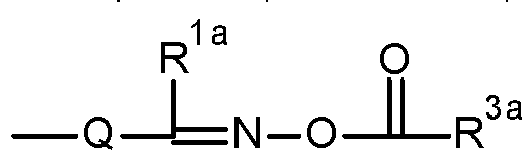 R1 est alkyle en C2-C20 qui est interrompu par un ou plusieurs groupes O, CO, S, C(O)O, OC(O), SO, SO2, phénylène, naphtylène ou NR10, dans lequel l'alkyle en C2-C20 interrompu est non substitué ou substitué par un ou plusieurs groupes halogène, cycloalkyle en C3-C8, OH, SH, OR4, SR9, COOR4, O(CO)-R3a, CONR10R11, NR10R11, aryle en C6-C20, hétéroaryle en C3-C20, aroyle en C6-C20 ou (hétéroaryle en C3-C20) carbonyle, dans lequel aryle en C6-C20, hétéroaryle en C3-C20, aroyle en C6-C20 ou (hétéroaryle en C3-C20)carbonyle est non substitué ou substitué par un ou plusieurs groupes halogène, alkyle en C1-C8, OR4, SR9 ou NR10R11 ; ouR1 est aryle en C6-C20 ou hétéroaryle en C3-C20 dont chacun est non substitué ou substitué par un ou plusieurs groupes alkyle en C1-C20, phényle, halogène, halogénoalkyle en C1-C4, ON, NO2, OR4, SR9, NR10R11, COOR4, (CO) -R3a, (CO) NR10R11, PO(OR3a)2, S(O)m-R3a ou un groupe
 R1 est alcanoyle en C2-C20 ou benzoyle qui est non substitué ou substitué par un ou plusieurs groupes alkyle en C1-C6, phényle, OR4, SR9 ou NR10R11 ; ouR1 est (alcoxy en C2-C12) carbonyle éventuellement interrompu par un ou plusieurs groupes -O- et/ou éventuellement substitué par un ou plusieurs groupes hydroxyle ; ouR1 est phénoxycarbonyle qui est non substitué ou substitué par alkyle en C1-C6, halogène, phényle, OR4, SR9 ou NR10R11 ; ouR1 est CN, (CO)-R3a, COOR4, CONR10R11, NO2, PO(OR3a)2 ou S(O)m-R3a ;R1' est alkylène en C1-C20, alkylène en C1-C20 qui est interrompu par un ou plusieurs groupes O, S, (CO)O, O(CO), phénylène, naphtylène ou NR8, dans lequel l'alkylène en C1-C20 et l'alkylène en C1-C20 interrompu sont non substitués ou substitués par halogène ou OR4, ou R1' est alcénylène en C2-C20, alcénylène en C2-C20 qui est interrompu par un ou plusieurs groupes O, S, (CO)O, O(CO), phénylène, naphtylène ou par NR10, dans lequel l'alcénylène en C2-C20 et l'alcénylène en C2-C20 interrompu sont non substitués ou substitués par halogène ou OR4, ou R1' est cycloalkylène en C5-C8, cycloalcénylène en C5-C8,
 R1a est hydrogène, alkyle en C1-C20, CN, (CO) -R3a, COOR4a, CONR10aR11a, NO2, PO(OR3a)2 ou S(O)m-R3a ; ouR1a est alkyle en C1-C20 substitué par un ou plusieurs groupes halogène, OR4a, SR9a, NR10aR11a, CN, COOR4a, CONR10aR11a, PO(OR3a)2, S(O)m-R3a, cycloalkyle en C3-C8 qui est ininterrompu ou interrompu par un ou plusieurs groupes O, S, CO ou NR10a ; ou par un ou plusieurs groupes aryle en C6-C20, hétéroaryle en C3-C20, aroyle en C6-C20 ou (hétéroaryle en C3-C20) carbonyle, dont chacun est non substitué ou substitué par un ou plusieurs groupes halogène, phényle, (alkyle en C1-C20)phényle, (alcoxy en C2-C8) phényle, halogénoalkyle en C1-C4, CN, NO2, OR4a, SR9a, NR10aR11a, PO(OR3a)2 ou S (O)m-R3a ; ouR1a est alkyle en C1-C20 interrompu par un ou plusieurs groupes O, S, NR10a, CO, SO ou SO2, qui est non substitué ou substitué par cycloalkyle en C3-C8, OH, SH, O(CO)R3a, COOR4a, CONR10aR11a, aryle en C6-C20, hétéroaryle en C3-C20, aroyle en C6-C20 ou (hétéroaryle en C3-C20) carbonyle, dans lequel aryle en C6-C20, hétéroaryle en C3-C20, aroyle en C6-C20 ou (hétéroaryle en C3-C20) carbonyle est non substitué ou substitué par un ou plusieurs groupes halogène, alkyle en C1-C8, OR4a, SR9a ou NR10aR11a ; ouR1a est alcényle en C2-C12 ou cycloalkyle en C3-C20, dont chacun est ininterrompu ou interrompu par un ou plusieurs groupes O, S, CO, NR10a ou COOR4a ; ouR1a est aryle en C6-C20 ou hétéroaryle en C3-C20, dont chacun est non substitué ou substitué par un ou plusieurs groupes halogène, CN, NO2, OR4a, SR9a, NR10aR11a, COOR4a, (CO)-R3a CONR10aR11a, PO(OR3a)2 ou S(O)m-R3a ; ou par un ou plusieurs groupes alkyle en C1-C20 qui sont non substitués ou substitués par un ou plusieurs groupes halogène, COOR4a, CONR10aR11a, phényle, cycloalkyle en C3-C8, hétéroaryle en C3-C20, OR4a, SR9a ou NR10aR11a ; ou par un ou plusieurs groupes alkyle en C2-C20 qui sont interrompus par un ou plusieurs groupes O, S ou NR10a ; ou par un ou plusieurs groupes phényle, naphtyle, benzoyle ou naphtoyle, dont chacun est non substitué ou substitué par OR4a, SR9a ou NR10aR11a ;R2 est hydrogène, alkyle en C1-C20 ou (alkyle en C1-C6)-(cycloalkyle en C3-C6) qui est non substitué ou substitué par un ou plusieurs groupes halogène, OR4, SR9, COOR4 CONR10R11, NR10R21, PO(OR3a)2, COR3a, ouR2 est alkyle en C2-C20 ou (alkyle en C1-C6)-(cycloalkyle en C3-C6) qui est interrompu par un ou plusieurs groupes O, CO, S, C(O)O, OC(O), SO, SO2, phénylène, naphtylène ou NR10, dans lequel l'alkyle en C2-C20 interrompu est non substitué ou substitué par un ou plusieurs groupes halogène, OR4, SR9, COOR4, CONR10R11, NR10R11 ; ouR2 est hydroxyalkyle en C2-C4, alcoxyalkyle en C2-C10, alcényle en C3-C5, cycloalkyle en C3-C8, phényl- (alkyle en C1-C3), alcanoyle en C2-C8, alcénoyle en C3-C12, benzoyle ; ouR2 est aryle en C6-C20 ou hétéroaryle en C3-C20 dont chacun est non substitué ou substitué par un ou plusieurs groupes alkyle en C1-C12, halogénoalkyle en C1-C4, phényle, halogène, CN, NO2, OR4, SR9, NR10R11, (CO) -R3a, ou par alkyle en C2-C20 qui est interrompu par un ou plusieurs groupes O, S ou NR10, ou dont chacun est substitué par un ou plusieurs groupes alkyle en C1-C20 qui sont non substitués ou substitués par un ou plusieurs groupes halogène, COOR4, CONR10R11, phényle, cycloalkyle en C8-C8, hétéroaryle en C3-C20, (aryloxy en C6-C20) carbonyle, hétéroaryloxy en C3-C20carbonyle, OR4, SR9 ou NR10R11 ; ouR2 est un groupe
 R2' est alkylène en C1-C20, alkylène en C1-C20 qui est interrompu par un ou plusieurs groupes O, S, (CO)O, O(CO), phénylène, naphtylène ou NR8, dans lequel l'alkylène en C1-C20 et l'alkylène en C1-C20 interrompu sont non substitués ou substitués par halogène ou OR4, ou R2' est alcénylène en C2-C20, alcénylène en C2-C20 qui est interrompu par un ou plusieurs groupes O, S, (CO)O, O(CO), phénylène, naphtylène ou par NR10, dans lequel l'alcénylène en C2-C20 et l'alcénylène en C2-C20 interrompu sont non substitués ou substitués par halogène ou OR4, ou R2' est cycloalkylène en C5-C8, cycloalcénylène en C5-C8,
 R3 est hydrogène ou alkyle en C1-C20 ; ouR3 est alkyle en C1-C20 substitué par un ou plusieurs groupes halogène, OR4, SR9, NR10R11, CN, COOR4, CONR10R11, cycloalkyle en C3-C8 qui est ininterrompu ou interrompu par un ou plusieurs groupes O, S, CO ou NR10 ; ou par un ou plusieurs groupes aryle en C6-C20, hétéroaryle en C3-C20, aroyle en C6-C20 ou (hétéroaryle en C3-C20) carbonyle, dont chacun est non substitué ou substitué par un ou plusieurs groupes halogène, phényle, (alkyle en C1-C20) phényle, (alcoxy en C1-C8) phényle, halogénoalkyle en C1-C4, CN, NO2, OR4, SR9 ou NR10R11 ; ouR3 est alkyle en C1-C20 interrompu par un ou plusieurs groupes O, S, NR10, CO, SO ou SO2, qui est non substitué ou substitué par cycloalkyle en C3-C8, OH, SH, O(CO)-R3a, COOR4, CONR10R11, aryle en C6-C20, hétéroaryle en C3-C20, aroyle en C6-C20 ou (hétéroaryle en C3-C20) carbonyle, dans lequel aryle en C6-C20, hétéroaryle en C3-C20, aroyle en C6-C20 ou (hétéroaryle en C3-C20) carbonyle est non substitué ou substitué par un ou plusieurs groupes halogène, alkyle en C1-C8, OR4, SR9 ou NR10R11 ; ouR3 est alcényle en C2-C12 ou cycloalkyle en C3-C20, dont chacun est ininterrompu ou interrompu par un ou plusieurs groupes O, S, CO, NR10 ou COOR4 ; ouR3 est aryle en C6-C20 ou hétéroaryle en C3-C20, dont chacun est non substitué ou substitué par un ou plusieurs groupes halogène, alkyle en C1-C20, halogénoalkyle en C1-C4, phényle, (alkyle en C1-C20) phényle, (alcoxy en C1-C8) phényle, CN, NO2, OR4, SR9, NR10R11, COOR4, (CO)-R3a ou SO2-R3a ; ouR3 est alcoxy en C1-C20, qui est non substitué ou substitué par un ou plusieurs groupes alkyle en C1-C10, halogénoalkyle en C1-C4, halogène, phényle, (alkyle en C1-C20) phényle ou (alcoxy en C1-C8)phényle ; ouR3 est alcoxy en C1-C20, qui est interrompu par un ou plusieurs groupes O, S, NR10, CO, SO ou SO2 ; ouR3 est aryloxy en C6-C20 ou hétéroaryloxy en C3-C20, dont chacun est non substitué ou substitué par un ou plusieurs groupes halogène, alkyle en C1-C20, halogénoalkyle en C1-C4, phényle, (alkyle en C1-C20) phényle, (alcoxy en C1-C8)phényle, CN, NO2, OR4, SR9, NR10R11, COOR4, (CO)-R3a ou SO2-R3a ;R3a est hydrogène ou alkyle en C1-C20 ; ouR3a est alkyle en C1-C20 substitué par un ou plusieurs groupes halogène, OR4a, SR9a, NR10aR11a, CN, COOR4a, CONR10aR11a, cycloalkyle en C3-C8 qui est ininterrompu ou interrompu par un ou plusieurs groupes O, S, CO ou NR10a ; ou par un ou plusieurs groupes aryle en C6-C20, hétéroaryle en C3-C20, aroyle en C6-C20 ou (hétéroaryle en C3-C20)carbonyle, dont chacun est non substitué ou substitué par un ou plusieurs groupes halogène, phényle, (alkyle en C1-C20)phényle, (alcoxy en C1-C8)phényle, halogénoalkyle en C1-C4, CN, NO2, OR4a, SR9a ou NR10aR11a ; ouR3a est alkyle en C1-C20 interrompu par un ou plusieurs groupes O, S, NR10a, CO, SO ou SO2, qui est non substitué ou substitué par cycloalkyle en C3-C8, OH, SH, O(CO)-(alkyle en C1-C8), COOR4a, CONR10aR11a, aryle en C6-C20, hétéroaryle en C3-C20, aroyle en C6-C20 ou (hétéroaryle en C3-C20)carbonyle, dans lequel aryle en C6-C20, hétéroaryle en C3-C20, aroyle en C6-C20 ou (hétéroaryle en C3-C20)carbonyle est non substitué ou substitué par un ou plusieurs groupes halogène, alkyle en C2-C8, OR4a, SR9a ou NR10aR11a ; ouR3a est alcényle en C2-C12 ou cycloalkyle en C3-C20, dont chacun est ininterrompu ou interrompu par un ou plusieurs groupes O, S, CO, NR10a ou COOR4a ; ouR3a est aryle en C6-C20 ou hétéroaryle en C3-C20, dont chacun est non substitué ou substitué par un ou plusieurs groupes halogène, alkyle en C1-C20, halogénoalkyle en C1-C4, phényle, (alkyle en C1-C20) phényle, (alcoxy en C1-C8) phényle, CN, NO2, OR4a, SR9a, NR10aR11a, COOR4a, (CO)-(alkyle en C2-C8) ou SO2-(halogénoalkyle en C1-C4) ; ouR3a est alcoxy en C1-C20, qui est non substitué ou substitué par un ou plusieurs groupes alkyle en C2-C10, halogénoalkyle en C1-C4, halogène, phényle, (alkyle en C1-C20) phényle ou (alcoxy en C2-C8) phényle ; ouR3a est alcoxy en C1-C20, qui est interrompu par un ou plusieurs groupes O, S, NR10a, CO, SO ou SO2 ; ouR3a est aryloxy en C6-C20 ou hétéroaryloxy en C3-C20, dont chacun est non substitué ou substitué par un ou plusieurs groupes halogène, alkyle en C1-C20, halogénoalkyle en C1-C4, phényle, (alkyle en C1-C20) phényle, (alcoxy en C1-C8) phényle, CN, NO2, OR4a, SR9a, NR10aR11a, COOR4a, (CO) - (alkyle en C2-C8) ou SO2- (halogénoalkyle en C1-C4) ; ouR3a est un groupe
 R3b est hydrogène ou alkyle en C1-C20 ; ouR3b est alkyle en C1-C20 substitué par un ou plusieurs groupes halogène, OR4a, SR9a, NR10aR11a, CN, COOR4a, CONR10aR11a, cycloalkyle en C3-C8 qui est ininterrompu ou interrompu par un ou plusieurs groupes O, S, CO ou NR10a ; ou par un ou plusieurs groupes aryle en C6-C20, hétéroaryle en C3-C20, aroyle en C6-C20 ou (hétéroaryle en C3-C20) carbonyle, dont chacun est non substitué ou substitué par un ou plusieurs groupes halogène, phényle, (alkyle en C1-C20) phényle, (alcoxy en C1-C8) phényle, halogénoalkyle en C1-C4, CN, NO2, OR4a, SR9a ou NR10aR11a ; ouR3b est alkyle en C1-C20 interrompu par un ou plusieurs groupes O, S, NR10a, CO, SO ou SO2, qui est non substitué ou substitué par cycloalkyle en C3-C8, OH, SH, O(CO)-(alkyle en C1-C8), COOR4a, CONR10aR11a, aryle en C6-C20, hétéroaryle en C3-C20, aroyle en C6-C20 ou (hétéroaryle en C3-C20) carbonyle, dans lequel aryle en C6-C20, hétéroaryle en C3-C20, aroyle en C6-C20 ou (hétéroaryle en C3-C20) carbonyle est non substitué ou substitué par un ou plusieurs groupes halogène, alkyle en C1-C8, OR4a, SR9a ou NR10aR11a ; ouR3b est alcényle en C2-C12 ou cycloalkyle en C3-C20, dont chacun est ininterrompu ou interrompu par un ou plusieurs groupes O, S, CO, NR10a ou COOR4a ; ouR3b est aryle en C6-C20 ou hétéroaryle en C3-C20, dont chacun est non substitué ou substitué par un ou plusieurs groupes halogène, alkyle en C1-C20, halogénoalkyle en C1-C4, phényle, (alkyle en C1-C20) phényle, (alcoxy en C1-C8) phényle, CN, NO2, OR4a, SR9a, NR10aR11a, COOR4a, (CO) - (alkyle en C1-C8) ou SO2- (halogénoalkyle en C1-C4) ; ouR3b est alcoxy en C1-C20, qui est non substitué ou substitué par un ou plusieurs groupes alkyle en C1-C10, halogénoalkyle en C1-C4, halogène, phényle, (alkyle en C1-C20) phényle ou (alcoxy en C1-C8) phényle ; ouR3b est alcoxy en C1-C20, qui est interrompu par un ou plusieurs groupes O, S, NR10a, CO, SO ou SO2 ; ouR3b est aryloxy en C6-C20 ou hétéroaryloxy en C3-C20, dont chacun est non substitué ou substitué par un ou plusieurs groupes halogène, alkyle en C1-C20, halogénoalkyle en C1-C4, phényle, (alkyle en C1-C20) phényle, (alcoxy en C1-C8) phényle, CN, NO2, OR4a, SR9a, NR10aR11a, COOR4a, (CO) - (alkyle en C1-C8) ou SO2- (halogénoalkyle en C1-C4) ;R4 est hydrogène, (CO)-R3a, COOR4a, CONR10R11, S (O) m-R3a ou PO (OR3a) 2 ; ouR4 est alkyle en C1-C20 substitué par un ou plusieurs groupes halogène, OR4a, SR9a, NR10aR11a, CN, COOR4a, CONR10aR11a, PO(OR3a) 2, S(O)m-R3a, cycloalkyle en C3-C8 qui est ininterrompu ou interrompu par un ou plusieurs groupes O, S, CO ou NR10a ; ou par un ou plusieurs groupes aryle en C6-C20, hétéroaryle en C3-C20, aroyle en C6-C20 ou (hétéroaryle en C3-C20) carbonyle, dont chacun est non substitué ou substitué par un ou plusieurs groupes halogène, phényle, (alkyle en C1-C20)phényle, (alcoxy en C1-C8) phényle, halogénoalkyle en C1-C4, CN, NO2, OR4a, SR9a, NR10aR11a, PO(OR3a)2 ou S(O)m-R3a ; ouR4 est alkyle en C1-C20 interrompu par un ou plusieurs groupes O, S, NR10a, CO, SO ou SO2, qui est non substitué ou substitué par cycloalkyle en C3-C8, OH, SH, O(CO)R3a, COOR4a, CONR10aR11a, aryle en C6-C20, hétéroaryle en C3-C20, aroyle en C6-C20 ou (hétéroaryle en C3-C20) carbonyle, dans lequel aryle en C6-C20, hétéroaryle en C3-C20, aroyle en C6-C20 ou (hétéroaryle en C3-C20) carbonyle est non substitué ou substitué par un ou plusieurs groupes halogène, alkyle en C1-C8, OR4a, SR9a ou NR10aR11a ; ouR4 est alcényle en C2-C12 ou cycloalkyle en C3-C20, dont chacun est ininterrompu ou interrompu par un ou plusieurs groupes O, S, CO, NR10a ou COOR4a ; ouR4 est aryle en C6-C20, qui est substitué par un ou plusieurs groupes halogène, CN, NO2, OR4a, SR9a, NR10aR11a, COOR4a, (CO)-R3a, CONR10aR11a, PO(OR3a)2, S(O)m-R3aou un groupe
 R4 est hétéroaryle en C3-C20, dont chacun est non substitué ou substitué par un ou plusieurs groupes halogène, CN, NO2, OR4a, SR9a, NR10aR11a, COOR4a, (CO) -R3a, CONR10aR11a, PO(OR3a)2, S(O)m-R3a ou groupe
 R4, conjointement avec l'un des atomes de carbone de R1, forme un cycle saturé ou insaturé de 5 ou 6 chaînons qui est ininterrompu ou interrompu par O, S ou NR10a, et ledit cycle saturé ou insaturé de 5 ou 6 chaînons est non substitué ou substitué par un ou plusieurs groupes alkyle en C1-C20, OR4a, SR9a, NR10aR11a, (CO)-R3a, NO2, halogène, halogénoalkyle en C1-C4, CN, phényle, (alkyle en C1-C20) phényle, (alcoxy en C1-C8) phényle,
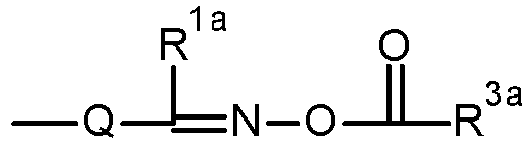 R4' est -(CO)-, -(CO)O-, -(CO)N-, -S(O)m-, -PO(O)2-, ou - OP(O)2 ;R4a est hydrogène, alkyle en C1-C20, (CO)O(alkyle en C1-C8) ou CON (alkyle en C1-C8)2 ; ouR4a est alkyle en C1-C20 substitué par un ou plusieurs groupes halogène, OH, SH, CN, alcénoxy en C3-C8, OCH2CH2CN, OCH2CH2(CO)O (alkyle en C1-C8), O(CO)-(alkyle en C1-C8), O(CO)-(alcényle en C2-C4), O(CO)-phényle, (CO)OH, (CO) O (alkyle en C1-C8), cycloalkyle en C3-C8, SO2-(halogénoalkyle en C1-C4), O(C1-C4haloalkyl), phényle, (alkyle en C1-C8) phényle, (alcoxy en C1-C8) phényle ou cycloalkyle en C3-C8 qui est interrompu par un ou plusieurs groupes O ; ouR4a est alkyle en C2-C20 interrompu par un ou plusieurs groupes O, S, N(alkyle en C1-C8), CO, SO ou SO2, qui est non substitué ou substitué par cycloalkyle en C3-C8, OH, SH, O(CO) (alkyle en C1-C8), (CO) O (alkyle en C1-C8), (CO) N (alkyle en C1-C8)2, aryle en C6-C20, hétéroaryle en C3-C20, aroyle en C6-C20 ou (hétéroaryle en C3-C20)carbonyle, dans lequel aryle en C6-C20, hétéroaryle en C3-C20, aroyle en C6-C20 ou (hétéroaryle en C3-C20)carbonyle est non substitué ou substitué par un ou plusieurs groupes halogène, alkyle en C1-C8, alcoxy en C1-C8, (alkyle en C1-C8)sulfanyle ou N(alkyle en C1-C8)2 ; ouR4a est alcényle en C2-C12, (CO) O(alcényle en C2-C8) ou cycloalkyle en C3-C8, dont chacun est ininterrompu ou interrompu par un ou plusieurs groupes O, S, CO, N(alkyle en C1-C8) ou COO (alkyle en C2-C8) ; ouR4a est aryle en C6-C20, hétéroaryle en C3-C20, aroyle en C6-C20 ou (hétéroaryle en C3-C20)carbonyle, dont chacun est non substitué ou substitué par un ou plusieurs groupes halogène, CN, NO2, OH, alkyle en C1-C8, halogénoalkyle en C1-C4, alcoxy en C1-C8, phényl- (alkyloxy en C1-C3), phénoxy, (alkyle en C1-C8)sulfanyle, phénylsulfanyle, N(alkyle en C1-C8)2, diphénylamino, (CO)O(alkyle en C1-C8), (CO)-(alkyle en C1-C8) ou (CO)N(C1-C8)2, phényle ou benzoyle ; ouR4a est alcanoyle en C1-C20, alcénoyle en C3-C12, dont chacun est non substitué ou substitué par un ou plusieurs groupes halogène, phényle, (alkyle en C1-C8)phényle, (alcoxy en C1-C8) phényle, OH, alcoxy en C1-C8, phénoxy, (alkyle en C1-C8)sulfanyle, phénylsulfanyle, N(alkyle en C1-C8)2 ou diphénylamino ;R5, R6, R7 et R8, indépendamment les uns des autres, sont hydrogène, alkyle en C1-C20, aryle en C6-C20, alcoxy en C1-C20, (aryle en C6-C20) (alkyle en C1-C20) , hydroxy(alkyle en C1-C20), hydroxy(alcoxy en C1-C20) (alkyle en C1-C20), cycloalkyle en C3-C10, amino, CN, NO2, hydroxy,
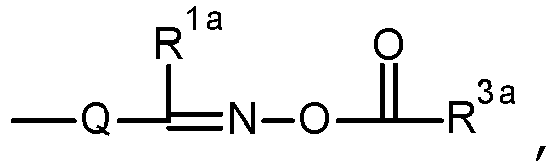 R9 est hydrogène ou alkyle en C1-C20 ; ouR9 est alkyle en C1-C20 substitué par un ou plusieurs groupes halogène, OR4a, SR9a, NR10aR11a, CN, COOR4a, CONR10aR11a, PO(OR3a)2, S(O)m-R3a, cycloalkyle en C3-C8 qui est ininterrompu ou interrompu par un ou plusieurs groupes O, S, CO ou NR10a ; ou par un ou plusieurs groupes aryle en C6-C20, hétéroaryle en C3-C20, aroyle en C6-C20 ou (hétéroaryle en C3-C20) carbonyle, dont chacun est non substitué ou substitué par un ou plusieurs groupes halogène, phényle, (alkyle en C1-C20)phényle, (alcoxy en C1-C8) phényle, halogénoalkyle en C1-C4, CN, NO2, OR4a, SR9a, NR10aR11a, PO(OR3a)2 ou S(O)m-R3a ; ouR9 est alkyle en C1-C20 interrompu par un ou plusieurs groupes O, S, NR10a, CO, SO ou SO2, qui est non substitué ou substitué par cycloalkyle en C3-C8, OH, SH, O(CO)R3a, COOR4a, CONR10aR11a, aryle en C6-C20, hétéroaryle en C3-C20, aroyle en C6-C20 ou (hétéroaryle en C3-C20) carbonyle, dans lequel aryle en C6-C20, hétéroaryle en C3-C20, aroyle en C6-C20 ou (hétéroaryle en C3-C20) carbonyle est non substitué ou substitué par un ou plusieurs groupes halogène, alkyle en C1-C8, OR4a, SR9a ou NR10aR11a ; ouR9 est alcényle en C2-C12 ou cycloalkyle en C3-C20, dont chacun est ininterrompu ou interrompu par un ou plusieurs groupes O, S, CO, NR10a ou COOR4a ; ouR9 est aryle en C6-C20 ou hétéroaryle en C3-C20, dont chacun est non substitué ou substitué par un ou plusieurs groupes halogène, CN, NO2, OR4a, SR9a, NR10aR11a, COOR4a, (CO)-R3a CONR10aR11a, PO(OR3a)2, S(O)m-R3a ou groupe
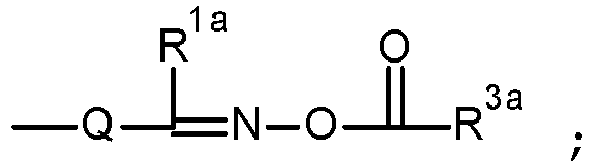 R9, conjointement avec l'un des atomes de carbone de R1, forme un cycle saturé ou insaturé de 5 ou 6 chaînons qui est ininterrompu ou interrompu par O, S ou NR10a, et ledit cycle saturé ou insaturé de 5 ou 6 chaînons est non substitué ou substitué par un ou plusieurs groupes alkyle en C1-C20, OR4a, SR9a, NR10aR11a, (CO)-R3a, NO2, halogène, halogénoalkyle en C1-C4, CN, phényle, (alkyle en C1-C20) phényle, (alcoxy en C2-C8) phényle,
 R9a est hydrogène ou alkyle en C1-C20 ; ouR9a est alkyle en C1-C20 substitué par un ou plusieurs groupes halogène, OH, SH, CN, alcénoxy en C3-C8, OCH2CH2CN, OCH2CH2 (CO) O (alkyle en C1-C8), O(CO)-(alkyle en C1-C8), O(CO)-(alcényle en C2-C4), O(CO)-phényle, (CO)OH, (CO) O (alkyle en C1-C8), cycloalkyle en C3-C8, SO2-(halogénoalkyle en C1-C4), O(C1-C4haloalkyl), phényle, (alkyle en C1-C8) phényle, (alcoxy en C1-C8) phényle ou cycloalkyle en C3-C8 qui est interrompu par un ou plusieurs groupes O ; ouR9a est alkyle en C2-C20 interrompu par un ou plusieurs groupes O, S, N(alkyle en C1-C8), CO, SO ou SO2, qui est non substitué ou substitué par cycloalkyle en C3-C8, OH, SH, O(CO) (alkyle en C1-C8), (CO) O (alkyle en C1-C8), (CO)N(alkyle en C1-C8)2, aryle en C6-C20, hétéroaryle en C3-C20, aroyle en C6-C20 ou (hétéroaryle en C3-C20)carbonyle, dans lequel aryle en C6-C20, hétéroaryle en C3-C20, aroyle en C6-C20 ou (hétéroaryle en C3-C20)carbonyle est non substitué ou substitué par un ou plusieurs groupes halogène, alkyle en C1-C8, alcoxy en C1-C8, (alkyle en C1-C8)sulfanyle ou N (alkyle en C1-C8)2 ; ouR9a est alcényle en C2-C12 ou cycloalkyle en C3-C8, dont chacun est ininterrompu ou interrompu par un ou plusieurs groupes O, S, CO, N(alkyle en C1-C8) ou COO(alkyle en C1-C8) ; ouR9a est aryle en C6-C20, hétéroaryle en C3-C20, aroyle en C6-C20 ou (hétéroaryle en C3-C20)carbonyle, dont chacun est non substitué ou substitué par un ou plusieurs groupes halogène, CN, NO2, OH, alkyle en C1-C8, halogénoalkyle en C1-C4, alcoxy en C1-C8, phényl-(alkyloxy en C1-C3), phénoxy, (alkyle en C1-C8)sulfanyle, phénylsulfanyle, N (alkyle en C1-C8)2, diphénylamino, (CO) O (alkyle en C1-C8), (CO) - (alkyle en C1-C8) ou (CO)N(C1-C8)2, phényle ou benzoyle ; ouR9a est alcanoyle en C1-C20, alcénoyle en C3-C12, dont chacun est non substitué ou substitué par un ou plusieurs groupes halogène, phényle, (alkyle en C1-C8)phényle, (alcoxy en C1-C8) phényle, OH, alcoxy en C1-C8, phénoxy, (alkyle en C1-C8)sulfanyle, phénylsulfanyle, N(alkyle en C1-C8)2 ou diphénylamino ;R10 et R11, indépendamment l'un de l'autre, sont hydrogène, alkyle en C1-C20, S(O)m-R3a, O(CO) -R3a, (CO)-R3a ou CONR10aR11a ; ouR10 et R11, indépendamment l'un de l'autre, sont alkyle en C1-C20 substitué par un ou plusieurs groupes halogène, OR4a, SR9a, NR10aR11a, CN, COOR4a, CONR10aR11a, PO(OR3a)2, S(O) m-R3a, cycloalkyle en C3-C8 qui est ininterrompu ou interrompu par un ou plusieurs groupes O, S, CO ou NR10a ; ou par un ou plusieurs groupes aryle en C6-C20, hétéroaryle en C3-C20, aroyle en C6-C20 ou (hétéroaryle en C3-C20) carbonyle, dont chacun est non substitué ou substitué par un ou plusieurs groupes halogène, phényle, (alkyle en C1-C20) phényle, (alcoxy en C1-C8) phényle, halogénoalkyle en C1-C4, CN, NO2, OR4a, SR9a, NR10aR11a, PO(OR3a)2 ou S(O)m-R3a ; ouR10 et R11, indépendamment l'un de l'autre, sont alkyle en C1-C20 interrompu par un ou plusieurs groupes O, S, NR10a, CO, SO ou SO2, qui est non substitué ou substitué par cycloalkyle en C3-C8, OH, SH, O (CO) -R3a, COOR4a, CONR10aR11a, aryle en C6-C20, hétéroaryle en C3-C20, aroyle en C6-C20 ou (hétéroaryle en C3-C20)carbonyle, dans lesquels aryle en C6-C20, hétéroaryle en C3-C20, aroyle en C6-C20 ou (hétéroaryle en C3-C20) carbonyle est non substitué ou substitué par un ou plusieurs groupes halogène, alkyle en C1-C8, OR4a, SR9a ou NR10aR11a ; ouR10 et R11, indépendamment l'un de l'autre, sont alcényle en C2-C12 ou cycloalkyle en C3-C20, dont chacun est ininterrompu ou interrompu par un ou plusieurs groupes O, S, CO, NR10a ou COOR4a ; ouR10 et R11, indépendamment l'un de l'autre, sont aryle en C6-C20 ou hétéroaryle en C3-C20, dont chacun est non substitué ou substitué par un ou plusieurs groupes halogène, CN, NO2, OR4a, SR9a, NR10aR11a, COOR4a, (CO) - R3aCONR10aR11a, PO(OR3a)2, S(O)m-R3a ou un groupe
 R10 et R11, indépendamment l'un de l'autre, sont alcoxy en C1-C20, qui est non substitué ou substitué par un ou plusieurs groupes halogène, phényle, (alkyle en C1-C8)phényle ou (alcoxy en C1-C8) phényle ; ouR10 et R11, indépendamment l'un de l'autre, sont alcoxy en C1-C20, qui est interrompu par un ou plusieurs groupes O, S, NR10a, CO, SO ou SO2 ; ouR10 et R11, indépendamment l'un de l'autre, sont aryloxy en C6-C20 ou hétéroaryloxy en C3-C20, dont chacun est non substitué ou substitué par un ou plusieurs groupes halogène, alkyle en C1-C8, halogénoalkyle en C1-C4, phényle, (alkyle en C1-C8) phényle, (alcoxy en C1-C8) phényle, CN, NO2, OR4a, SR9a, NR10aR11a, COOR4a, (CO) -R3a ou SO2-R3a ; ouR10, conjointement avec l'un des atomes de carbone de R1, forme un cycle saturé ou insaturé de 5 ou 6 chaînons qui est ininterrompu ou interrompu par O, S ou NR10a, et ledit cycle saturé ou insaturé de 5 ou 6 chaînons est non substitué ou substitué par un ou plusieurs groupes alkyle en C1-C20, OR4a, SR9a, NR10aR11a, (CO) -R3a, NO2, halogène, halogénoalkyle en C1-C4, CN, phényle, (alkyle en C1-C20) phényle, (alcoxy en C1-C8) phényle,
 R10 et R11, conjointement avec l'atome N auquel ils sont liés, forment un cycle saturé ou insaturé de 5 ou 6 chaînons qui est ininterrompu ou interrompu par O, S ou NR10a, et ledit cycle saturé ou insaturé de 5 ou 6 chaînons est non substitué ou substitué par un ou plusieurs groupes alkyle en C1-C20, OR4a, SR9a, NR10aR11a, (CO) -R3a, NO2, halogène, halogénoalkyle en C1-C4, CN, phényle,
 R10a et R11a, indépendamment l'un de l'autre, sont hydrogène, alkyle en C1-C20, S(O)m-(alkyle en C1-C8), O(CO) (alkyle en C1-C8), (CO)(alkyle en C1-C8), (CO)O(alkyle en C1-C8) ou CON (alkyle en C1-C8)2 ; ouR10a et R11a, indépendamment l'un de l'autre, sont alkyle en C1-C20 substitué par un ou plusieurs groupes halogène, OH, SH, CN, alcénoxy en C3-C8, OCH2CH2CN, OCH2CH2(CO)O(alkyle en C1-C8), O(CO)-(alkyle en C1-C8), O(CO) - (C2-C4) alcényle, O(CO)-phényle, (CO)OH, (CO)O(alkyle en C1-C8), cycloalkyle en C3-C8, SO2- (C1-C4haloalkyl), O(halogénoalkyle en C1-C4), phényle, (alkyle en C1-C8)phényle, (alcoxy en C1-C8)phényle ou cycloalkyle en C3-C8 qui est interrompu par un ou plusieurs groupes O ; ouR10a et R11a, indépendamment l'un de l'autre, sont alkyle en C2-C20 interrompu par un ou plusieurs groupes O, S, N(alkyle en C1-C8), CO, SO ou SO2, qui est non substitué ou substitué par cycloalkyle en C3-C8, OH, SH, O(CO) (alkyle en C1-C8), (CO) O (alkyle en C1C8), (CO) N (alkyle en C1C8)2, aryle en C6-C20, hétéroaryle en C3-C20, aroyle en C6-C20 ou (hétéroaryle en C3-C20)carbonyle, dans lesquels aryle en C6-C20, hétéroaryle en C3-C20, aroyle en C6-C20 ou (hétéroaryle en C3-C20)carbonyle est non substitué ou substitué par un ou plusieurs groupes halogène, alkyle en C1-C8, alcoxy en C1-C8, (alkyle en C1-C8)sulfanyle ou N(alkyle en C1-C8)2 ; ouR10a et R11a, indépendamment l'un de l'autre, sont alcényle en C2-C12 ou cycloalkyle en C3-C8, dont chacun est ininterrompu ou interrompu par un ou plusieurs groupes O, S, CO, N(alkyle en C1-C8) ou COO(alkyle en C1-C8) ; ouR10a et R11a, indépendamment l'un de l'autre, sont aryle en C6-C20, hétéroaryle en C3-C20, aroyle en C6-C20 ou (hétéroaryle en C3-C20)carbonyle, dont chacun est non substitué ou substitué par un ou plusieurs groupes halogène, CN, NO2, OH, alkyle en C1-C8, halogénoalkyle en C1-C4, alcoxy en C1-C8, phényl- (alkyloxy en C1-C3), phénoxy, (alkyle en C1-C8)sulfanyle, phénylsulfanyle, N(alkyle en C1-C8)2, diphénylamino, (CO) O (alkyle en C1-C8), (CO)-(alkyle en C1-C8) ou (CO) N (alkyle en C1-C8)2, phényle ou benzoyle ; ouR10a et R11a, indépendamment l'un de l'autre, sont alcanoyle en C1-C20, alcénoyle en C3-C12, dont chacun est non substitué ou substitué par un ou plusieurs groupes halogène, phényle, (alkyle en C1-C8)phényle, (alcoxy en C1-C8) phényle, OH, alcoxy en C1-C8, phénoxy, (alkyle en C1-C8) sulfanyle, phénylsulfanyle, N(alkyle en C1-C8)2 ou diphénylamino ; ouR10a et R11a, indépendamment l'un de l'autre, sont alcoxy en C1-C20, qui est non substitué ou substitué par un ou plusieurs groupes halogène, phényle, (alkyle en C1-C8) phényle ou (alcoxy en C1-C8)phényle ; ouR10a et R11a, indépendamment l'un de l'autre, sont alcoxy en C1-C20, qui est interrompu par un ou plusieurs groupes O, S, N(alkyle en C1-C8), CO, SO ou SO2 ; ouR10a et R11a, indépendamment l'un de l'autre, sont aryloxy en C6-C20 ou hétéroaryloxy en C3-C20, dont chacun est non substitué ou substitué par un ou plusieurs groupes halogène, alkyle en C1-C8, halogénoalkyle en C1-C4, phényle, (alkyle en C1-C8)phényle, (alcoxy en C1-C8) phényle, CN, NO2, alcoxy en C1-C8, (alkyle en C1-C8) sulfanyle, N (alkyle en C1-C8)2, CO(O)(alkyle en C1-C8), (CO) - (alkyle en C1-C8) ou SO2- (alkyle en C1-C8) ; ouR10a et R11a, conjointement avec l'atome N auquel ils sont liés, forment un cycle saturé ou insaturé de 5 ou 6 chaînons qui est ininterrompu ou interrompu par O, S ou N(alkyle en C1-C8), et ledit cycle saturé ou insaturé de 5 ou 6 chaînons est non substitué ou substitué par un ou plusieurs groupes alkyle en C1-C8, alcoxy en C1-C8, (alkyle en C1-C8) sulfanyle, N (alkyle en C1-C8)2, NO2, halogène, halogénoalkyle en C1-C4, CN, phényle ou cycloalkyle en C3-C20 qui est ininterrompu ou interrompu par un ou plusieurs groupes O, S, CO ou N(alkyle en C1-C8) ;R12 et R13, indépendamment l'un de l'autre, sont hydrogène, alkyle en C1-C12 éventuellement substitué par un ou plusieurs groupes halogène, phényle, CN, -OH, -SH, alcoxy en C1-C4, (CO) OH ou (CO)O(alkyle en C1-C4) ; ouR12 et R13 sont phényle éventuellement substitué par un ou plusieurs groupes alkyle en C1-C6, halogène, CN, OR4, SR9 ou NR10R11 ; ouR12 et R13 sont halogène, CN, OR4, SR9, SOR9, SO2R9 ou NR10R11, dans lesquels les substituants OR4, SR9 ou NR10R11 forment éventuellement des cycles de 5 ou 6 chaînons par l'intermédiaire des radicaux R4, R9, R10 et/ou R11 avec l'un des atomes de carbone du groupe phényle, naphtyle, benzoyle ou naphtoyle ou celui du substituant R3a ; ouR12 et R13 sont conjointement un groupe
 R12 et R13 sont conjointement un groupe
 M est une liaison directe ou un groupe de liaison divalent alkylène en C1-C20 ou alkylène en C1-C20 substitué par un ou plusieurs groupes halogène, OR4, SR9, NR10R11, CN, COOR4, CONR10R11, cycloalkyle en C3-C8 qui est ininterrompu ou interrompu par un ou plusieurs groupes O, S, CO ou NR10 ; ou par un ou plusieurs groupes aryle en C6-C20, hétéroaryle en C3-C20, aroyle en C6-C20 ou (hétéroaryle en C3-C20) carbonyle, dont chacun est non substitué ou substitué par un ou plusieurs groupes halogène, phényle, (alkyle en C1-C20)phényle, (alcoxy en C1-C8)phényle, halogénoalkyle en C1-C4, CN, NO2, OR4, SR9 ou NR10R11 ; ouM est alkylène en C1-C20 interrompu par un ou plusieurs groupes O, S, NR10, CO, SO ou SO2, qui est non substitué ou substitué par cycloalkyle en C3-C8, OH, SH, O(CO)-R3a, COOR4, CONR10R11, aryle en C6-C20, hétéroaryle en C3-C20, aroyle en C6-C20 ou (hétéroaryle en C3-C20)carbonyle, dans lequel aryle en C6-C20, hétéroaryle en C3-C20, aroyle en C6-C20 ou (hétéroaryle en C3-C20) carbonyle est non substitué ou substitué par un ou plusieurs groupes halogène, alkyle en C1-C8, OR4, SR9 ou NR10R11 ; ouM est alcénylène en C2-C12 ou cycloalkylène en C3-C20, dont chacun est ininterrompu ou interrompu par un ou plusieurs groupes O, S, CO, NR10 ou COOR4 ; ouM est arylène en C6-C20 ou hétéroarylène en C3-C20, dont chacun est non substitué ou substitué par un ou plusieurs groupes halogène, alkyle en C1-C20, halogénoalkyle en C1-C4, phényle, (alkyle en C1-C20) phényle, (alcoxy en C1-C8)phényle, CN, NO2, OR4, SR9, NR10R11, COOR4, (CO)-R3a ou SO2-R3a ;M' est une liaison directe ou un groupe de liaison divalent choisi parmi alkylène en C1-C20 ou alkylène en C1-C20 substitué par un ou plusieurs groupes halogène, OR4, SR9, NR10R11, CN, COOR4, CONR10R11, cycloalkyle en C3-C8 qui est ininterrompu ou interrompu par un ou plusieurs groupes O, S, CO ou NR10 ; ou par un ou plusieurs groupes aryle en C6-C20, hétéroaryle en C3-C20, aroyle en C6-C20 ou (hétéroaryle en C3-C20) carbonyle, dont chacun est non substitué ou substitué par un ou plusieurs groupes halogène, phényle, (alkyle en C1-C20)phényle, (alcoxy en C1-C8) phényle, halogénoalkyle en C1-C4, CN, NO2, OR4, SR9 ou NR10R11 ; ouM' est alkylène en C1-C20 interrompu par un ou plusieurs groupes O, S, NR10, CO, SO ou SO2, qui est non substitué ou substitué par cycloalkyle en C3-C8, OH, SH, O(CO)-R3a, COOR4, CONR10R11, aryle en C6-C20, hétéroaryle en C3-C20, aroyle en C6-C20 ou (hétéroaryle en C3-C20) carbonyle, dans lequel aryle en C6-C20, hétéroaryle en C3-C20, aroyle en C6-C20 ou (hétéroaryle en C3-C20) carbonyle est non substitué ou substitué par un ou plusieurs groupes halogène, alkyle en C1-C8, OR4, SR9 ou NR10R11 ; ouM' est alcénylène en C2-C12 ou cycloalkylène en C3-C20, dont chacun est ininterrompu ou interrompu par un ou plusieurs groupes O, S, CO, NR10 ou COOR4 ; ouM' est arylène en C6-C20 ou hétéroarylène en C3-C20, dont chacun est non substitué ou substitué par un ou plusieurs groupes halogène, alkyle en C1-C20, halogénoalkyle en C1-C4, phényle, (alkyle en C1-C20) phényle, (alcoxy en C1-C8) phényle, CN, NO2, OR4, SR9, NR10R11, COOR4, (CO)-R3a ou SO2-R3a ;M" est une liaison directe ou un groupe de liaison divalent choisi parmi alkylène en C1-C20 ou alkylène en C1-C20 substitué par un ou plusieurs groupes halogène, OR4, SR9, NR10R11, CN, COOR4, CONR10R31, cycloalkyle en C3-C8 qui est ininterrompu ou interrompu par un ou plusieurs groupes O, S, CO ou NR10 ; ou par un ou plusieurs groupes aryle en C6-C20, hétéroaryle en C3-C20, aroyle en C6-C20 ou (hétéroaryle en C3-C20) carbonyle, dont chacun est non substitué ou substitué par un ou plusieurs groupes halogène, phényle, (alkyle en C1-C20) phényle, (alcoxy en C1-C8) phényle, halogénoalkyle en C1-C4, CN, NO2, OR4, SR9 ou NR10R11 ; ouM" est alkylène en C1-C20 interrompu par un ou plusieurs groupes O, S, NR10, CO, SO ou SO2, qui est non substitué ou substitué par cycloalkyle en C3-C8, OH, SH, O(CO)-R3a, COOR4, CONR10R11, aryle en C6-C20, hétéroaryle en C3-C20, aroyle en C6-C20 ou (hétéroaryle en C3-C20) carbonyle, dans lequel aryle en C6-C20, hétéroaryle en C3-C20, aroyle en C6-C20 ou (hétéroaryle en C3-C20) carbonyle est non substitué ou substitué par un ou plusieurs groupes halogène, alkyle en C1-C8, OR4, SR9 ou NR10R11 ; ouM" est alcénylène en C2-C12 ou cycloalkylène en C3-C20, dont chacun est ininterrompu ou interrompu par un ou plusieurs groupes O, S, CO, NR10 ou COOR4 ; ouM" est arylène en C6-C20 ou hétéroarylène en C3-C20, dont chacun est non substitué ou substitué par un ou plusieurs groupes halogène, alkyle en C1-C20, halogénoalkyle en C1-C4, phényle, (alkyle en C1-C20) phényle, (alcoxy en C1-C8) phényle, CN, NO2, OR4, SR9, NR10R11, COOR4, (CO)-R3a ou SO2-R3a ;m est 1 ou 2 ;Q est CO ou une liaison directe ; etx, y et z, indépendamment les uns des autres, sont un entier 1, 2, 3 ou 4.
 - Composés des formules I, II, III et IV selon la revendication 1, les composés étant des composés de formule Ia, IIa, IIIa ou IVa :
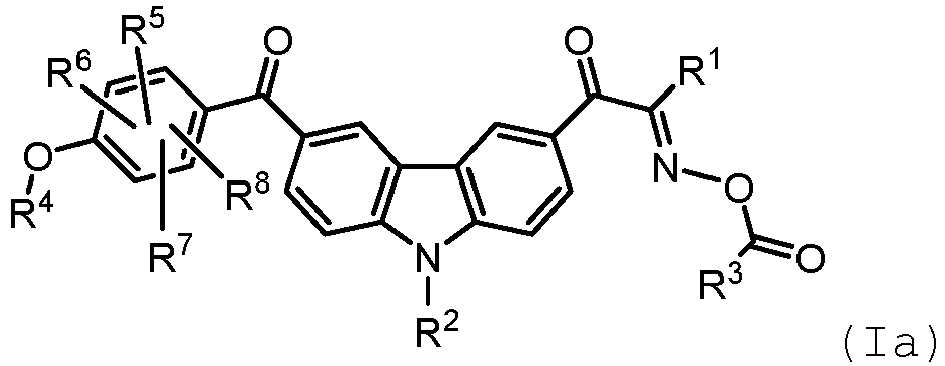


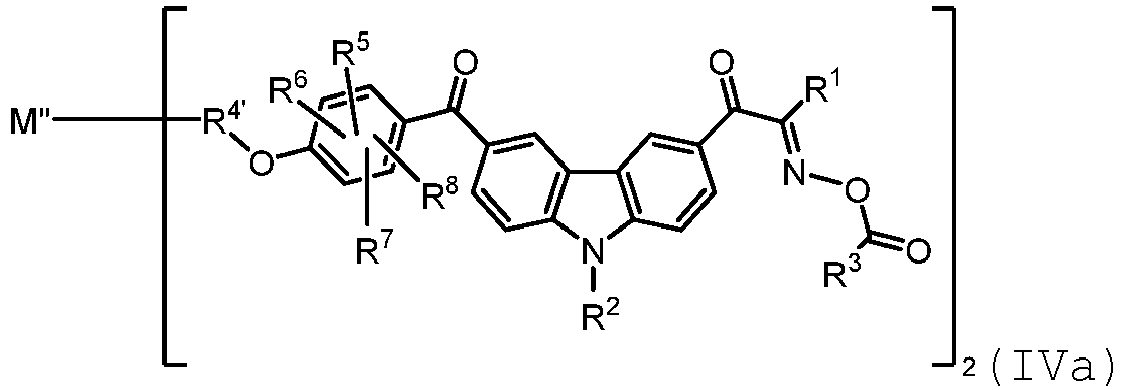
R1 à R8, R1', R2', R4', M, M' et M" sont tels que définis dans la revendication 1. - Composés des formules I, II, III et IV selon la revendication 1 ou 2, les composés étant des composés de formule Ib, IIb, IIIb ou IVb :


 R1 est hydrogène, alkyle en C1-C20, (alkyle en C1-C6) - (cycloalkyle en C3-C6), cycloalkyle en C3-C20, alcényle en C2-C12, dans lequel cycloalkyle en C3-C20 ou alcényle en C2-C12 est ininterrompu ou interrompu par un ou plusieurs groupes O, S, CO, NR10 ou COOR4 ; ouR1 est alkyle en C2-C20 qui est interrompu par un ou plusieurs groupes O, CO, S, C(O)O, OC(O), SO, SO2, phénylène, naphtylène ou NR10, dans lequel l'alkyle en C2-C20 interrompu est non substitué ou substitué par un ou plusieurs groupes halogène, cycloalkyle en C3-C8, OH, SH, OR4, SR9, COOR4, O(CO)-R3a, CONR10R11, NR10R11, aryle en C6-C20, hétéroaryle en C3-C20, aroyle en C6-C20 ou (hétéroaryle en C3-C20) carbonyle, dans lequel aryle en C6-C20, hétéroaryle en C3-C20, aroyle en C6-C20 ou (hétéroaryle en C3-C20)carbonyle est non substitué ou substitué par un ou plusieurs groupes halogène, alkyle en C1-C8, OR4, SR9 ou NR10R11 ; ouR1 est aryle en C6-C20 ou hétéroaryle en C3-C20 dont chacun est non substitué ou substitué par un ou plusieurs groupes alkyle en C1-C20 ;R1' est alkylène en C1-C20, alkylène en C1-C20 qui est interrompu par un ou plusieurs groupes O, S, (CO)O, O(CO), phénylène, naphtylène ou NR8, dans lequel l'alkylène en C1-C20 et l'alkylène en C1-C20 interrompu sont non substitués ou substitués par halogène ou OR4, ouR2 est hydrogène, alkyle en C1-C20 qui est non substitué ou substitué par un ou plusieurs groupes halogène, OR4, SR9, COOR4 CONR10R11, NR10R11, PO(OR3a)2 ; (CO)-R3a, ouR2 est alkyle en C2-C20 ou (alkyle en C1-C6)-(cycloalkyle en C3-C6) qui est interrompu par un ou plusieurs groupes O, CO, S, C(O)O, OC(O), SO, SO2, phénylène, naphtylène ou NR10 ; ouR2 est aryle en C6-C20 ou hétéroaryle en C3-C20 dont chacun est non substitué ou substitué par un ou plusieurs groupes alkyle en C1-C12, (CO)-R3a ;R2' est alkylène en C1-C20, alkylène en C1-C20 qui est interrompu par un ou plusieurs groupes O, S, (CO)O, O(CO), phénylène, naphtylène ou NR8, dans lequel l'alkylène en C1-C20 et l'alkylène en C1-C20 interrompu sont non substitués ou substitués par halogène ou OR4, R3 est hydrogène ou alkyle en C1-C20 ; ouR3 est alkyle en C1-C20 substitué par un ou plusieurs groupes halogène, OR4, SR9, NR10R11, CN, COOR4, CONR10R11, cycloalkyle en C3-C8 qui est ininterrompu ou interrompu par un ou plusieurs groupes O, S, CO ou NR10 ; ou par un ou plusieurs groupes aryle en C6-C20, hétéroaryle en C3-C20, aroyle en C6-C20 ou (hétéroaryle en C3-C20) carbonyle, dont chacun est non substitué ou substitué par un ou plusieurs groupes halogène, phényle, (alkyle en C1-C20)phényle, (alcoxy en C1-C8) phényle, halogénoalkyle en C1-C4, CN, NO2, OR4, SR9 ou NR10R11 ; ouR3a est hydrogène ou alkyle en C1-C20 ; ouR3a est alkyle en C1-C20 interrompu par un ou plusieurs groupes O, S, NR10a, CO, SO ou SO2, qui est non substitué ou substitué par cycloalkyle en C3-C8, OH, SH, O(CO)-(alkyle en C1-C8), COOR4a, CONR10aR11a, aryle en C6-C20, hétéroaryle en C3-C20, aroyle en C6-C20 ou (hétéroaryle en C3-C20)carbonyle, dans lequel aryle en C6-C20, hétéroaryle en C3-C20, aroyle en C6-C20 ou (hétéroaryle en C3-C20)carbonyle est non substitué ou substitué par un ou plusieurs groupes halogène, alkyle en C1-C8, OR4a, SR9a ou NR10aR11a ; ouR3a est aryle en C6-C20 ou hétéroaryle en C3-C20, dont chacun est non substitué ou substitué par un ou plusieurs groupes halogène, alkyle en C1-C20, halogénoalkyle en C1-C4, phényle, (alkyle en C1-C20)phényle, (alcoxy en C1-C8)phényle, CN, NO2, OR4a, SR9a, NR10aR11a, COOR4a, (CO)-(alkyle en C1-C8) ou SO2- (halogénoalkyle en C1-C4) ;R4 est hydrogène, (CO)-R3a, COOR4a, CONR10R11, S(O)m-R3a ou PO(OR3a)2 ;R4' est -(CO)-, -(CO)O-, -(CO)N-, -S(O)m-, -PO(O)2-, ou - OP(O)2 ;R4a est hydrogène, alkyle en C1-C20, (CO)O(alkyle en C1-C8) ou CON (alkyle en C1-C8)2 ; ouR4a est alkyle en C2-C20 interrompu par un ou plusieurs groupes O, S, N(alkyle en C1-C8), CO, SO ou SO2, qui est non substitué ou substitué par cycloalkyle en C3-C8, OH, SH, O(CO)(alkyle en C1-C8), (CO)O (alkyle en C1-C8), (CO)N(alkyle en C1-C8)2, aryle en C6-C20, hétéroaryle en C3-C20, aroyle en C6-C20 ou (hétéroaryle en C3-C20)carbonyle, dans lequel aryle en C6-C20, hétéroaryle en C3-C20, aroyle en C6-C20 ou (hétéroaryle en C3-C20)carbonyle est non substitué ou substitué par un ou plusieurs groupes halogène, alkyle en C1-C8, alcoxy en C1-C8, (alkyle en C1-C8)sulfanyle ou N(alkyle en C1-C8)2 ; ouR4a est aryle en C6-C20, hétéroaryle en C3-C20, aroyle en C6-C20 ou (hétéroaryle en C3-C20)carbonyle, dont chacun est non substitué ou substitué par un ou plusieurs groupes halogène, CN, NO2, OH, alkyle en C1-C8, halogénoalkyle en C1-C4, alcoxy en C1-C8, phényl- (alkyloxy en C1-C3), phénoxy, (alkyle en C1-C8)sulfanyle, phénylsulfanyle, N(alkyle en C1-C8)2, diphénylamino, (CO)O(alkyle en C1-C8), (CO)-(alkyle en C1-C8) ou (CO)N(C1-C8)2, phényle ou benzoyle ;R8 est hydrogène ; alkyle en C1-C20 ; ou aryle en C6-C20 ;R9 est hydrogène ou alkyle en C1-C20 ;R9a est hydrogène ou alkyle en C1-C20 ;R10 et R11, indépendamment l'un de l'autre, sont hydrogène, alkyle en C1-C20, S(O)m-R3a, O(CO)-R3a, (CO)-R3a ou CONR10aR11a ;R10a et R11a, indépendamment l'un de l'autre, sont hydrogène, alkyle en C1-C20, S(O)m-(alkyle en C1-C8), O(CO)(alkyle en C1-C8), (CO)(alkyle en C1-C8), (CO)O(alkyle en C1-C8) ou CON (alkyle en C1-C8)2 ;M est une liaison directe ou un groupe de liaison divalent alkylène en C1-C20 ou alkylène en C1-C20 substitué par un ou plusieurs groupes halogène, OR4, SR9, NR10R11, CN, COOR4, CONR10R11, cycloalkyle en C8-C8 qui est ininterrompu ou interrompu par un ou plusieurs groupes O, S, CO ou NR10 ; ou par un ou plusieurs groupes aryle en C6-C20, hétéroaryle en C3-C20, aroyle en C6-C20 ou (hétéroaryle en C3-C20)carbonyle, dont chacun est non substitué ou substitué par un ou plusieurs groupes halogène, phényle, (alkyle en C3-C20) phényle, (alcoxy en C1-C8) phényle, halogénoalkyle en C1-C4, CN, NO2, OR4, SR9 ou NR10R11 ;M est une liaison directe ou un groupe de liaison divalent choisi parmi alkylène en C3-C20 ou alkylène en C3-C20 substitué par un ou plusieurs groupes halogène, OR4, SR9, NR10R11, CN, COOR4, CONR10R11, cycloalkyle en C3-C8 qui est ininterrompu ou interrompu par un ou plusieurs groupes O, S, CO ou NR10 ; ou par un ou plusieurs groupes aryle en C6-C20, hétéroaryle en C3-C20, aroyle en C6-C20 ou (hétéroaryle en C3-C20)carbonyle, dont chacun est non substitué ou substitué par un ou plusieurs groupes halogène, phényle, (alkyle en C1-C20)phényle, (alcoxy en C1-C8)phényle, halogénoalkyle en C1-C4, CN, NO2, OR4, SR9 ou NR10R11 ;M" est une liaison directe ou un groupe de liaison divalent choisi parmi alkylène en C1-C20 ou alkylène en C1-C20 substitué par un ou plusieurs groupes halogène, OR4, SR9, NR10R11, CN, COOR4, CONR10R11, cycloalkyle en C3-C8 qui est ininterrompu ou interrompu par un ou plusieurs groupes O, S, CO ou NR10 ; ou par un ou plusieurs groupes aryle en C6-C20, hétéroaryle en C3-C20, aroyle en C6-C20 ou (hétéroaryle en C3-C20) carbonyle, dont chacun est non substitué ou substitué par un ou plusieurs groupes halogène, phényle, (alkyle en C1-C20)phényle, (alcoxy en C1-C8)phényle, halogénoalkyle en C1-C4, CN, NO2, OR4, SR9 ou NR10R11 ; etm est 1 ou 2.
 - Composés des formules I, II, III et IV selon la revendication 3, les composés étant des composés de formule Ib, dans lesquelsR1 est alkyle en C1-C20, (alkyle en C1-C8)-(cycloalkyle en C3-C6), cycloalkyle en C3-C20 ; ouR1 est alkyle en C2-C20 qui est interrompu par un ou plusieurs groupes O, CO, S, C(O)O, OC(O), SO, ou SO2 ; ouR1 est aryle en C6-C20 qui est non substitué ou substitué par un ou plusieurs groupes alkyle en C1-C20 ;R2 est alkyle en C1-C20 ; ouR2 est alkyle en C2-C20 ou (alkyle en C1-C6)-(cycloalkyle en C3-C6) qui est interrompu par un ou plusieurs groupes O, CO, S, C(O)O, OC(O), SO ou SO2 ; ouR2 est aryle en C6-C20 qui est non substitué ou substitué par un ou plusieurs groupes alkyle en C1-C12 ou (CO)-R3a ;R3 est alkyle en C1-C20 ;R3a est alkyle en C1-C20, aryle en C6-C20 ou hétéroaryle en C3-C20 ;R4 est (CO)-R3a, COOR4a, CONR10R11, S(O)m-R3a ou PO(OR3a)2 ;R4a est alkyle en C1-C20, aryle en C6-C20 ou hétéroaryle en C3-C20 ;R10 et R11 sont alkyle en C1-C20 ; etm est 1 ou 2.
- Composés des formules I, II, III et IV selon l'une quelconque des revendications 1 à 4, dans lesquels(i) plus de 50 %, de préférence 55 % ou plus, plus préférablement 75 % ou plus, encore plus préférablement 90 % ou plus, tel que 95 % ou plus, des doubles liaisons C=N présentes dans les groupes ester d'oxime dans la molécule sont dans la configuration Z ; ou(ii) plus de 50 %, de préférence 55 % ou plus, plus préférablement 75 % ou plus, encore plus préférablement 90 % ou plus, tel que 95 % ou plus, des doubles liaisons C=N présentes dans les groupes ester d'oxime dans la molécule sont dans la configuration E.
- Composition photopolymérisable comprenant(a) au moins un composé photopolymérisable éthyléniquement insaturé et(b) en tant que photoamorceur, au moins un composé de formule I, II, III ou IV tel que défini dans l'une quelconque des revendications 1 to 5.
- Composition photopolymérisable selon la revendication 6, dans laquelle le composant (a) est une résine obtenue par la réaction d'un anhydride d'acide polybasique saturé ou insaturé avec un produit de la réaction d'une résine époxy et d'un acide monocarboxylique insaturé ; et/ou
dans laquelle, en plus du photoamorceur (b), composition photopolymérisable comprend au moins un photoamorceur supplémentaire (c), et/ou d'autres additifs (d). - Composition photopolymérisable selon la revendication 6, comprenant, en tant qu'additif supplémentaire (d) un pigment, ou un mélange de pigments, ou un colorant, ou un mélange de colorants, ou un mélange d'un ou plusieurs pigments avec un ou plusieurs colorants ; de préférence, comprenant, en tant qu'additif supplémentaire (d) un dispersant ou un mélange de dispersants.
- Composition photopolymérisable selon l'une quelconque des revendications 6 à 8, comprenant 0,05 à 25 % en poids du photoamorceur (b), ou des photoamorceurs (b) et (c), par rapport au poids de la composition ; et/oucomprenant, en tant qu'additif supplémentaire (d) un photosensibilisateur, en particulier un composé choisi dans le groupe constitué par la benzophénone, des dérivés de benzophénone, la thioxanthone, des dérivés de thioxanthone, l'anthraquinone, des dérivés d'anthraquinone, la coumarine et des dérivés de coumarine ; et/oucomprenant en outre un polymère liant (e), en particulier un copolymère de méthacrylate et d'acide méthacrylique.
- Procédé de préparation d'un composé de formule I, II, III ou IV selon la revendication 1 par réaction du composé oxime correspondant avec un halogénure d'acyle de formule I' ou un anhydride de formule I"

- Procédé de photopolymérisation de composés contenant des doubles liaisons éthyléniquement insaturées, qui comprend l'irradiation d'une composition selon l'une quelconque des revendications 6 à 9 avec un rayonnement électromagnétique dans la plage de 150 à 600 nm, ou avec un faisceau d'électrons ou avec des rayons X.
- Procédé selon la revendication 11 pour la production de peintures et de vernis pigmentés et non pigmentés, revêtements en poudre, encres d'impression, plaques d'impression, adhésifs, adhésifs autocollants, compositions dentaires, enduits gélifiés, résines photosensibles pour l'électronique, réserves de galvanoplastie, réserves de gravure, films liquides et secs, réserves de soudure, résines pour la fabrication de filtres de couleur pour diverses applications d'affichage, résines pour la génération de structures dans les processus de fabrication de panneaux d'affichage à plasma, écrans électroluminescents et LCD, espaceurs pour LCD, pour le stockage de données holographiques (HDS), comme composition pour l'encapsulation de composants électriques et électroniques, pour la production de matériaux d'enregistrement magnétique, pièces micromécaniques, guides d'ondes, commutateurs optiques, masques de placage, masques de gravure, systèmes d'épreuves couleur, revêtements de câbles en fibre de verre, pochoirs de sérigraphie, pour la production d'objets tridimensionnels au moyen d'une stéréolithographie, comme matériau d'enregistrement d'image, pour des enregistrements holographiques, circuits microélectroniques, matériaux de décoloration, matériaux de décoloration pour matériaux d'enregistrement d'image, pour des matériaux d'enregistrement d'image utilisant des microcapsules, comme matériau de résine photosensible pour un système d'imagerie directe laser UV et visible, comme matériau de résine photosensible utilisé pour former des couches diélectriques dans une couche de construction séquentielle d'une carte de circuit imprimé.
- Substrat revêtu qui est revêtu sur au moins une surface avec une composition selon l'une quelconque des revendications 6 à 9.
- Procédé de production photographique d'images en relief, dans lequel un substrat revêtu selon la revendication 13 est soumis à une exposition selon une image, puis les parties non exposées sont éliminées avec un révélateur.
- Filtre coloré préparé par fourniture d'éléments d'image rouges, verts et bleus et d'une matrice noire, tous comprenant une résine photosensible et un pigment sur un substrat transparent et fourniture d'une électrode transparente soit sur la surface du substrat, soit sur la surface de la couche de filtre coloré, dans lequel ladite résine photosensible comprend un monomère acrylate polyfonctionnel, un liant polymère organique et un amorceur de photopolymérisation de formule I, II, III ou IV tel que défini dans la revendication 1.
- Utilisation d'un composé de formule I, II, III ou IV tel que défini dans la revendication 1 pour la photopolymérisation d'une composition comprenant au moins un composé photopolymérisable éthyléniquement insaturé.
- Composés des formules IA, IIA, IIIA et IVA


R1, R2, R4 to R8, R1' , R2' , R4' , M, M' et M" sont tels que définis dans l'une quelconque des revendications 1 à 4.
Applications Claiming Priority (3)
| Application Number | Priority Date | Filing Date | Title |
|---|---|---|---|
| EP20160969 | 2020-03-04 | ||
| EP20213955 | 2020-12-14 | ||
| PCT/EP2021/055184 WO2021175855A1 (fr) | 2020-03-04 | 2021-03-02 | Photo-initiateurs à base d'ester d'oxime |
Publications (2)
| Publication Number | Publication Date |
|---|---|
| EP4114825A1 EP4114825A1 (fr) | 2023-01-11 |
| EP4114825B1 true EP4114825B1 (fr) | 2024-11-20 |
Family
ID=74844921
Family Applications (1)
| Application Number | Title | Priority Date | Filing Date |
|---|---|---|---|
| EP21709000.0A Active EP4114825B1 (fr) | 2020-03-04 | 2021-03-02 | Photo-initiateurs à base d'ester d'oxime |
Country Status (7)
| Country | Link |
|---|---|
| US (1) | US20230142648A1 (fr) |
| EP (1) | EP4114825B1 (fr) |
| JP (1) | JP7703554B2 (fr) |
| KR (1) | KR20220149716A (fr) |
| CN (1) | CN115210219A (fr) |
| TW (1) | TWI894219B (fr) |
| WO (1) | WO2021175855A1 (fr) |
Families Citing this family (6)
| Publication number | Priority date | Publication date | Assignee | Title |
|---|---|---|---|---|
| WO2022075452A1 (fr) * | 2020-10-08 | 2022-04-14 | 株式会社Adeka | Composé, initiateur de polymérisation, composition polymérisable, objet durci ainsi que procédé de fabrication de celui-ci, et filtre coloré |
| WO2023238902A1 (fr) * | 2022-06-09 | 2023-12-14 | 三菱ケミカル株式会社 | Composition de résine photosensible, produit durci, paroi de séparation, élément électroluminescent organique et dispositif d'affichage d'image |
| JP2024069149A (ja) * | 2022-11-09 | 2024-05-21 | 住友化学株式会社 | 着色硬化性樹脂組成物、カラーフィルタ、表示装置、及び固体撮像素子 |
| JP2024137666A (ja) * | 2023-03-23 | 2024-10-07 | 住友化学株式会社 | 硬化性組成物 |
| TW202448972A (zh) | 2023-05-12 | 2024-12-16 | 瑞士商羅立克科技股份公司 | 可聚合液晶組成物 |
| WO2025225376A1 (fr) * | 2024-04-23 | 2025-10-30 | 富士フイルム株式会社 | Composition photodurcissable, procédé de production de pixels, film, filtre optique, élément d'imagerie à semi-conducteurs, dispositif d'affichage d'image et initiateur de photopolymérisation |
Family Cites Families (121)
| Publication number | Priority date | Publication date | Assignee | Title |
|---|---|---|---|---|
| US626796A (en) | 1899-06-13 | Corner connection for bed-frames | ||
| US3579339A (en) | 1967-05-23 | 1971-05-18 | Du Pont | Photopolymerizable dispersions and elements containing nonmigratory photoreducible dyes |
| US4160274A (en) | 1976-12-20 | 1979-07-03 | Texas Instruments Incorporated | Single chip molded magnetic bubble memory package |
| JPS5742009A (en) | 1980-08-27 | 1982-03-09 | Matsushita Electric Ind Co Ltd | Formation of protective film for color mosaic filter |
| JPS6038989A (ja) | 1983-08-12 | 1985-02-28 | Nec Corp | 固体撮像装置の製造方法 |
| JPS59197401A (ja) | 1983-04-26 | 1984-11-09 | Nippon Oil & Fats Co Ltd | 光重合開始剤 |
| JPS6072927A (ja) | 1983-09-30 | 1985-04-25 | Omron Tateisi Electronics Co | 高分子マイクロレンズの製造方法 |
| JPS60166946A (ja) | 1983-10-14 | 1985-08-30 | Kyowa Gas Chem Ind Co Ltd | 感光性樹脂組成物およびそれを用いる屈折率差を有するパタ−ンの作成方法 |
| JPH0756547B2 (ja) | 1984-02-08 | 1995-06-14 | 日本電気株式会社 | 透過型表示素子 |
| US4575330A (en) | 1984-08-08 | 1986-03-11 | Uvp, Inc. | Apparatus for production of three-dimensional objects by stereolithography |
| JPS6167003A (ja) | 1984-09-10 | 1986-04-07 | Canon Inc | カラ−イメ−ジセンサ− |
| JPS61153602A (ja) | 1984-12-27 | 1986-07-12 | Matsushita Electronics Corp | マイクロレンズの製造方法 |
| GB2180358B (en) | 1985-07-16 | 1989-10-04 | Mead Corp | Photosensitive microcapsules and their use on imaging sheets |
| US4622286A (en) | 1985-09-16 | 1986-11-11 | E. I. Du Pont De Nemours And Company | Photoimaging composition containing admixture of leuco dye and 2,4,5-triphenylimidazolyl dimer |
| US4977511A (en) | 1985-11-20 | 1990-12-11 | The Mead Corporation | Photosensitive materials containing ionic dye compound as initiators |
| JPS6490516A (en) | 1987-09-30 | 1989-04-07 | Sumitomo Metal Ind | Semiconductor porcelain material |
| JPH01130103A (ja) | 1987-11-16 | 1989-05-23 | Toppan Printing Co Ltd | カラーフィルターの製造方法 |
| JPH01134306A (ja) | 1987-11-19 | 1989-05-26 | Japan Synthetic Rubber Co Ltd | カラーフィルターの製造方法 |
| US4934791A (en) | 1987-12-09 | 1990-06-19 | Matsushita Electric Industrial Co., Ltd. | Color filter |
| US4994628A (en) | 1989-09-25 | 1991-02-19 | Ethyl Corporation | Phenolic antioxidant process |
| EP0438123B1 (fr) | 1990-01-16 | 1995-09-13 | Showa Denko Kabushiki Kaisha | Initiateur de polymérisation utilisable dans l'infrarouge proche |
| EP0441232A3 (en) | 1990-02-09 | 1992-10-14 | Basf Aktiengesellschaft | Cationic photopolymerisation process |
| JP2977265B2 (ja) | 1990-11-19 | 1999-11-15 | 旭化成工業株式会社 | 感光性エラストマー構成体 |
| JP2999274B2 (ja) | 1991-01-28 | 2000-01-17 | 三菱化学株式会社 | エチレン重合体の製造法 |
| JP2794242B2 (ja) | 1991-06-25 | 1998-09-03 | 富士写真フイルム株式会社 | 感光性転写材料及び画像形成方法 |
| JP3672105B2 (ja) | 1991-09-09 | 2005-07-13 | 東レ株式会社 | 感光性導電ペースト |
| JP3218767B2 (ja) | 1992-01-24 | 2001-10-15 | 東レ株式会社 | 感光性導電ペースト |
| US5368976A (en) | 1992-03-27 | 1994-11-29 | Japan Synthetic Rubber Co., Ltd. | Pigment-dispersed color-filter composition comprising an alkali-soluble block copolymer as a binder |
| DE4211060A1 (de) | 1992-04-03 | 1993-10-07 | Roehm Gmbh | Polymerprodukte zur Behandlung von Leder |
| JPH0668309A (ja) | 1992-08-14 | 1994-03-11 | Matsushita Electric Ind Co Ltd | パターン判別用ファジィ推論装置および判別ルール作成装置 |
| JP3218256B2 (ja) | 1993-01-29 | 2001-10-15 | 東洋インキ製造株式会社 | アルカリ現像型感光性着色組成物 |
| US5514502A (en) | 1993-08-16 | 1996-05-07 | Fuji Photo Film Co., Ltd. | Photopolymerizable composition, color filter, and production of color filter |
| EP0645678B1 (fr) | 1993-09-24 | 1998-03-04 | Japan Synthetic Rubber Co., Ltd. | Composition sensible aux radiations |
| DE69418826T2 (de) | 1993-11-22 | 1999-10-21 | Ciba Specialty Chemicals Holding Inc., Basel | Zusammensetzungen zur Herstellung strukturierter Farbbilder und deren Anwendung |
| DE4414088A1 (de) | 1994-04-22 | 1995-10-26 | Basf Ag | Gele mit thermotropen Eigenschaften |
| TW339421B (en) | 1994-09-12 | 1998-09-01 | Sumitomo Kagaku Kk | A photoresist composition comprising a polyfunctional vinyl ether compound |
| CA2158915A1 (fr) | 1994-09-30 | 1996-03-31 | Dekai Loo | Photoresine liquide |
| JP3292434B2 (ja) | 1994-10-17 | 2002-06-17 | 太陽インキ製造株式会社 | プラズマディスプレイパネルの隔壁形成用組成物及びそれを用いた隔壁形成方法 |
| US5840465A (en) | 1995-07-17 | 1998-11-24 | Taiyo Ink Manufacturing Co., Ltd. | Compositions and method for formation of barrier ribs of plasma display panel |
| KR100407736B1 (ko) | 1994-10-18 | 2004-03-24 | 미쯔비시 레이온 가부시끼가이샤 | 활성에너지선경화성조성물을사용하여제조한렌즈시이트 |
| US5882843A (en) | 1994-11-15 | 1999-03-16 | Hoechst Japan Limited | Photosensitive resin composition for color filter production |
| EP0723167A3 (fr) | 1995-01-17 | 1997-04-02 | Mitsubishi Chem Corp | Composition photopolymérisable pour filtre chromatique |
| JPH08305019A (ja) | 1995-05-10 | 1996-11-22 | Fuji Photo Film Co Ltd | 光重合性組成物 |
| WO1996041240A1 (fr) | 1995-06-07 | 1996-12-19 | W.R. Grace & Co.-Conn. | Emulsions aqueuses photosensibles et procedes de fabrication |
| JPH0915857A (ja) | 1995-06-29 | 1997-01-17 | Hitachi Chem Co Ltd | 着色画像形成材料、これを用いた感光液、感光性エレメント及びカラーフィルタの製造法 |
| JP3564836B2 (ja) | 1995-11-22 | 2004-09-15 | Jsr株式会社 | カラーフィルタ用感放射線性組成物およびカラーフィルタ |
| JP3587413B2 (ja) | 1995-12-20 | 2004-11-10 | 東京応化工業株式会社 | 化学増幅型レジスト組成物及びそれに用いる酸発生剤 |
| JPH09179299A (ja) | 1995-12-21 | 1997-07-11 | Fuji Photo Film Co Ltd | 感放射線性組成物 |
| DE69620723T2 (de) | 1995-12-22 | 2002-12-05 | Mitsubishi Chemical Corp., Tokio/Tokyo | Fotopolymerisierbare Zusammensetzung für einen Farbfilter, Farbfilter und Flüssigkristallanzeigevorrichtung |
| DE19700064A1 (de) | 1996-01-13 | 1997-07-17 | Basf Ag | Gele mit thermotropen Eigenschaften |
| JP3641093B2 (ja) | 1996-02-02 | 2005-04-20 | 東京応化工業株式会社 | 緑色カラーフィルタ用感光性組成物及びこれを用いた緑色カラーフィルタの製造方法 |
| JPH09244230A (ja) | 1996-03-07 | 1997-09-19 | Hitachi Chem Co Ltd | 感光性樹脂組成物、これを用いた感光性エレメント及びこの感光性エレメントを用いた蛍光体パターンの製造方法 |
| US5853446A (en) | 1996-04-16 | 1998-12-29 | Corning Incorporated | Method for forming glass rib structures |
| JPH09325209A (ja) | 1996-06-06 | 1997-12-16 | Fuji Photo Film Co Ltd | Lcd表示装置用カラーフィルター |
| JPH1010718A (ja) | 1996-06-25 | 1998-01-16 | Hitachi Chem Co Ltd | 着色画像形成材料、感光液、感光性エレメント、カラーフィルターの製造法及びカラーフィルター |
| TW375759B (en) | 1996-07-10 | 1999-12-01 | Toray Industries | Plasma display and preparation thereof |
| WO1999038035A1 (fr) | 1996-07-22 | 1999-07-29 | Maikurooputo Co., Ltd. | Procede de fabrication d'une mini-lentille plate et mince; mini-lentille ainsi produite |
| JPH1062980A (ja) | 1996-08-23 | 1998-03-06 | Hitachi Chem Co Ltd | 感光性樹脂組成物、感光性エレメント及びこれを用いた蛍光体パターンの製造法 |
| JPH10171119A (ja) | 1996-12-11 | 1998-06-26 | Tokyo Ohka Kogyo Co Ltd | 光重合性樹脂組成物、およびこれを用いた色フィルタの製造方法 |
| JP3849950B2 (ja) | 1997-02-06 | 2006-11-22 | 東京応化工業株式会社 | 色フィルタ用感光性組成物 |
| US5851732A (en) | 1997-03-06 | 1998-12-22 | E. I. Du Pont De Nemours And Company | Plasma display panel device fabrication utilizing black electrode between substrate and conductor electrode |
| DE69803117T2 (de) | 1997-05-12 | 2002-10-02 | Fuji Photo Film Co., Ltd. | Positiv arbeitende Resistzusammensetzung |
| JP3829412B2 (ja) | 1997-05-28 | 2006-10-04 | Jsr株式会社 | カラーフィルタ用感放射線性組成物 |
| DE69828374T2 (de) | 1997-07-03 | 2005-12-08 | Seiko Epson Corp. | Leiterwiderstandsschaltung und digital/analog-wandler und damit ausgerüstete halbleitervorrichtung |
| EP0902327A3 (fr) | 1997-09-09 | 2000-04-05 | JSR Corporation | Composition sensible aux radiations |
| JPH11174459A (ja) | 1997-12-11 | 1999-07-02 | Hitachi Chem Co Ltd | カラー液晶表示装置用スペーサーフィルム |
| JP3951396B2 (ja) | 1997-12-12 | 2007-08-01 | 日立化成工業株式会社 | 樹脂スペーサー形成用感光性フィルム |
| JP2000039503A (ja) | 1998-07-22 | 2000-02-08 | Matsushita Electric Ind Co Ltd | レンズアレイ |
| JP2000081701A (ja) | 1998-09-03 | 2000-03-21 | Jsr Corp | カラーフィルター保護膜用感放射線性樹脂組成物 |
| EP1655303B1 (fr) | 2000-05-19 | 2011-02-23 | Basf Se | Procédé d' augmentation controllé de poids moléculaire de polyethylène ou des melanges de polyéthylène |
| JP4925547B2 (ja) | 2000-06-23 | 2012-04-25 | チバ ホールディング インコーポレーテッド | ヒドロキシフェニルカルボン酸エステルの生成方法 |
| JP4404330B2 (ja) | 2001-01-09 | 2010-01-27 | 東京応化工業株式会社 | 光重合性組成物および該組成物を用いたカラーフィルタの製造方法 |
| EP1395615B1 (fr) * | 2001-06-11 | 2009-10-21 | Basf Se | Photoamorceurs d'oxime ester possedant une structure combinee |
| JP4660986B2 (ja) | 2001-06-28 | 2011-03-30 | Jsr株式会社 | カラー液晶表示装置用感放射線性組成物、およびカラーフィルタ |
| US6780546B2 (en) | 2001-08-30 | 2004-08-24 | Inphase Technologies, Inc. | Blue-sensitized holographic media |
| US7358311B2 (en) | 2001-09-25 | 2008-04-15 | Ciba Specialty Chemicals Corp. | Crosslinking of unsaturated polymers by the use of hydroxylamine-esters |
| JP2004069754A (ja) | 2002-08-01 | 2004-03-04 | Tokyo Ohka Kogyo Co Ltd | 光重合性黒色組成物及び黒色パターンの形成方法 |
| WO2004081100A1 (fr) | 2003-03-12 | 2004-09-23 | Ciba Specialty Chemicals Holding Inc. | Composition de recouvrement contenant des esters d'hydroxylamine |
| JP4443848B2 (ja) | 2003-03-31 | 2010-03-31 | 新日鐵化学株式会社 | カラーフィルター用レジスト材料及びカラーフィルター |
| JP3754065B2 (ja) | 2003-06-10 | 2006-03-08 | 三菱化学株式会社 | 光重合性組成物及びこれを用いたカラーフィルター |
| JP4437651B2 (ja) | 2003-08-28 | 2010-03-24 | 新日鐵化学株式会社 | 感光性樹脂組成物及びそれを用いたカラーフィルター |
| CN101805282B (zh) | 2004-02-23 | 2012-07-04 | 三菱化学株式会社 | 肟酯化合物、光聚合性组合物和使用该组合物的滤色器 |
| JP4570999B2 (ja) | 2004-03-30 | 2010-10-27 | 新日鐵化学株式会社 | 感光性樹脂組成物及びそれを用いたカラーフィルター |
| JP4448381B2 (ja) | 2004-05-26 | 2010-04-07 | 東京応化工業株式会社 | 感光性組成物 |
| KR101402636B1 (ko) * | 2005-12-01 | 2014-06-03 | 시바 홀딩 인크 | 옥심 에스테르 광개시제 |
| WO2007071797A1 (fr) | 2005-12-19 | 2007-06-28 | Uralita Sistemas De Tuberias, S.A. | Systeme distribue de transmission bidirectionnelle d'ondes guidees et/ou irradiees |
| ATE458010T1 (de) | 2005-12-20 | 2010-03-15 | Basf Se | Oximester-photoinitiatoren |
| JP4223071B2 (ja) | 2006-12-27 | 2009-02-12 | 株式会社Adeka | オキシムエステル化合物及び該化合物を含有する光重合開始剤 |
| JP2008231376A (ja) * | 2007-03-23 | 2008-10-02 | Jsr Corp | 無機粉体含有樹脂組成物、転写フィルムおよびフラットディスプレイパネルの製造方法 |
| JP2009109921A (ja) * | 2007-10-31 | 2009-05-21 | Fujifilm Corp | カラーフィルタ用光重合性組成物、カラーフィルタ及びその製造方法、並びに固体撮像素子 |
| JP2009179619A (ja) * | 2008-02-01 | 2009-08-13 | Toyo Ink Mfg Co Ltd | 新規オキシムエステル化合物およびそれを含んでなるラジカル重合開始剤および重合性組成物 |
| JP2009221334A (ja) * | 2008-03-14 | 2009-10-01 | Fujifilm Corp | 光重合開始剤、重合性組成物、カラーフィルタ用重合性組成物、カラーフィルタ、及びその製造方法、並びに、固体撮像素子 |
| JP5494479B2 (ja) | 2008-04-25 | 2014-05-14 | 三菱化学株式会社 | ケトオキシムエステル系化合物及びその利用 |
| JP2010015025A (ja) | 2008-07-04 | 2010-01-21 | Adeka Corp | 特定の光重合開始剤を含有する感光性組成物 |
| JP5685803B2 (ja) | 2008-07-24 | 2015-03-18 | Jsr株式会社 | 感放射線性樹脂組成物および液晶表示素子用スペーサーとその製造法 |
| JP5642150B2 (ja) | 2009-03-23 | 2014-12-17 | ビーエーエスエフ ソシエタス・ヨーロピアBasf Se | フォトレジスト組成物 |
| JP5317809B2 (ja) * | 2009-04-20 | 2013-10-16 | 富士フイルム株式会社 | 着色硬化性組成物、着色パターンの形成方法、カラーフィルタ、および液晶表示装置 |
| JP2011074042A (ja) | 2009-10-01 | 2011-04-14 | Fujifilm Corp | 新規化合物、光重合性組成物、カラーフィルタ、及びその製造方法、固体撮像素子、並びに、平版印刷版原版 |
| WO2012045736A1 (fr) | 2010-10-05 | 2012-04-12 | Basf Se | Dérivés ester d'oxime de benzocarbazoles et leur utilisation comme photoinitiateurs dans des compositions photopolymérisables |
| US9051397B2 (en) * | 2010-10-05 | 2015-06-09 | Basf Se | Oxime ester |
| KR101897842B1 (ko) | 2011-01-28 | 2018-09-12 | 바스프 에스이 | 열 경화제로서 옥심 술포네이트를 포함하는 중합성 조성물 |
| WO2012108835A1 (fr) | 2011-02-10 | 2012-08-16 | Katharos Adhesion Technologies Pte. Ltd. | Procédé de nettoyage permettant d'éliminer les contaminants d'une surface de fixation |
| JP5773782B2 (ja) | 2011-07-03 | 2015-09-02 | 日本化薬株式会社 | 新規(メタ)アクリル樹脂及びそれを用いた樹脂組成物 |
| KR101469519B1 (ko) | 2011-10-07 | 2014-12-08 | (주)경인양행 | 옥심 에스테르 화합물 및 그것을 포함하는 광중합 개시제 |
| KR101406317B1 (ko) | 2012-01-12 | 2014-06-13 | 타코마테크놀러지 주식회사 | 고감도 옥심에스테르 광중합개시제 및 이 화합물을 포함하는 광중합 조성물 |
| KR101225695B1 (ko) | 2012-01-20 | 2013-02-05 | (주)휴넷플러스 | 신규한 고감도 알파키토옥심에스테르 광중합개시제 및 이 화합물을 포함하는 광중합 조성물 |
| EP2881450B1 (fr) | 2012-07-31 | 2020-09-09 | Adeka Corporation | Additif latent et composition le contenant |
| CN103204960B (zh) | 2012-12-28 | 2015-08-19 | 南通缔威化工有限公司 | 三级胺类酮肟酯类光引发剂及其制备方法 |
| CN103130919B (zh) | 2013-02-08 | 2015-02-25 | 常州强力先端电子材料有限公司 | 一种咔唑酮肟酯类高感光度光引发剂 |
| CN104276995A (zh) | 2013-07-01 | 2015-01-14 | 塔科马科技有限公司 | 高感光度肟酯光聚合引发剂及包含该化合物的光聚合组成物 |
| JP5983548B2 (ja) | 2013-07-04 | 2016-08-31 | Jfeスチール株式会社 | コークス炉の更新方法 |
| TWI668210B (zh) | 2013-11-28 | 2019-08-11 | 塔可馬科技股份有限公司 | 光起始劑及包括該光起始劑之光敏性組合物 |
| US10487050B2 (en) | 2014-08-29 | 2019-11-26 | Basf Se | Oxime sulfonate derivatives |
| WO2016056290A1 (fr) | 2014-10-09 | 2016-04-14 | ソニー株式会社 | Contrôleur de mémoire, système de mémoire, dispositif mémoire, système de traitement d'informations et procédé de commande de mémoire |
| JP2017008219A (ja) | 2015-06-23 | 2017-01-12 | 株式会社Adeka | 組成物 |
| CN106444282A (zh) * | 2015-08-13 | 2017-02-22 | 常州强力先端电子材料有限公司 | 一种含肟酯类光引发剂的感光性树脂组合物及其应用 |
| JP6748083B2 (ja) | 2015-09-11 | 2020-08-26 | 株式会社Adeka | 新規化合物、潜在性添加剤及び該添加剤を含有する組成物 |
| JP2017066370A (ja) | 2015-09-30 | 2017-04-06 | 株式会社Adeka | 組成物 |
| CN107793502B (zh) | 2016-09-07 | 2020-12-08 | 常州强力电子新材料股份有限公司 | 肟酯类光引发剂、其制备方法、光固化组合物及其应用 |
| WO2018062105A1 (fr) | 2016-09-30 | 2018-04-05 | 株式会社Dnpファインケミカル | Composition de résine colorée photosensible pour filtre coloré, filtre coloré et dispositif d'affichage |
| JPWO2019088055A1 (ja) * | 2017-10-30 | 2020-12-10 | 株式会社Adeka | 化合物、組成物、硬化物及び硬化物の製造方法 |
-
2021
- 2021-03-02 EP EP21709000.0A patent/EP4114825B1/fr active Active
- 2021-03-02 WO PCT/EP2021/055184 patent/WO2021175855A1/fr not_active Ceased
- 2021-03-02 US US17/908,255 patent/US20230142648A1/en active Pending
- 2021-03-02 KR KR1020227033721A patent/KR20220149716A/ko active Pending
- 2021-03-02 JP JP2022552962A patent/JP7703554B2/ja active Active
- 2021-03-02 TW TW110107337A patent/TWI894219B/zh active
- 2021-03-02 CN CN202180019074.8A patent/CN115210219A/zh active Pending
Also Published As
| Publication number | Publication date |
|---|---|
| US20230142648A1 (en) | 2023-05-11 |
| TWI894219B (zh) | 2025-08-21 |
| CN115210219A (zh) | 2022-10-18 |
| JP7703554B2 (ja) | 2025-07-07 |
| TW202138351A (zh) | 2021-10-16 |
| WO2021175855A1 (fr) | 2021-09-10 |
| JP2023517304A (ja) | 2023-04-25 |
| KR20220149716A (ko) | 2022-11-08 |
| EP4114825A1 (fr) | 2023-01-11 |
Similar Documents
| Publication | Publication Date | Title |
|---|---|---|
| US10793555B2 (en) | Oxime ester photoinitiators | |
| US10234761B2 (en) | Oxime ester photoinitiators | |
| EP2788325B1 (fr) | Photo-initiateurs à base d'ester d'oxime | |
| EP2963014B1 (fr) | Photo-initiateurs à base d'ester d'oxime | |
| EP2625166B1 (fr) | Dérivés ester d'oxime de composés benzocarbazole et leur utilisation comme photoinitiateurs dans des compositions photopolymérisables | |
| EP4114825B1 (fr) | Photo-initiateurs à base d'ester d'oxime | |
| KR102824859B1 (ko) | 특정 아로일 발색단을 갖는 옥심 에스테르 광개시제 |
Legal Events
| Date | Code | Title | Description |
|---|---|---|---|
| STAA | Information on the status of an ep patent application or granted ep patent |
Free format text: STATUS: UNKNOWN |
|
| STAA | Information on the status of an ep patent application or granted ep patent |
Free format text: STATUS: THE INTERNATIONAL PUBLICATION HAS BEEN MADE |
|
| PUAI | Public reference made under article 153(3) epc to a published international application that has entered the european phase |
Free format text: ORIGINAL CODE: 0009012 |
|
| STAA | Information on the status of an ep patent application or granted ep patent |
Free format text: STATUS: REQUEST FOR EXAMINATION WAS MADE |
|
| 17P | Request for examination filed |
Effective date: 20221004 |
|
| AK | Designated contracting states |
Kind code of ref document: A1 Designated state(s): AL AT BE BG CH CY CZ DE DK EE ES FI FR GB GR HR HU IE IS IT LI LT LU LV MC MK MT NL NO PL PT RO RS SE SI SK SM TR |
|
| DAV | Request for validation of the european patent (deleted) | ||
| DAX | Request for extension of the european patent (deleted) | ||
| GRAP | Despatch of communication of intention to grant a patent |
Free format text: ORIGINAL CODE: EPIDOSNIGR1 |
|
| STAA | Information on the status of an ep patent application or granted ep patent |
Free format text: STATUS: GRANT OF PATENT IS INTENDED |
|
| INTG | Intention to grant announced |
Effective date: 20240619 |
|
| GRAS | Grant fee paid |
Free format text: ORIGINAL CODE: EPIDOSNIGR3 |
|
| GRAA | (expected) grant |
Free format text: ORIGINAL CODE: 0009210 |
|
| STAA | Information on the status of an ep patent application or granted ep patent |
Free format text: STATUS: THE PATENT HAS BEEN GRANTED |
|
| AK | Designated contracting states |
Kind code of ref document: B1 Designated state(s): AL AT BE BG CH CY CZ DE DK EE ES FI FR GB GR HR HU IE IS IT LI LT LU LV MC MK MT NL NO PL PT RO RS SE SI SK SM TR |
|
| REG | Reference to a national code |
Ref country code: GB Ref legal event code: FG4D |
|
| REG | Reference to a national code |
Ref country code: CH Ref legal event code: EP |
|
| REG | Reference to a national code |
Ref country code: DE Ref legal event code: R096 Ref document number: 602021022065 Country of ref document: DE |
|
| REG | Reference to a national code |
Ref country code: IE Ref legal event code: FG4D |
|
| REG | Reference to a national code |
Ref country code: LT Ref legal event code: MG9D |
|
| REG | Reference to a national code |
Ref country code: NL Ref legal event code: MP Effective date: 20241120 |
|
| PG25 | Lapsed in a contracting state [announced via postgrant information from national office to epo] |
Ref country code: HR Free format text: LAPSE BECAUSE OF FAILURE TO SUBMIT A TRANSLATION OF THE DESCRIPTION OR TO PAY THE FEE WITHIN THE PRESCRIBED TIME-LIMIT Effective date: 20241120 Ref country code: PT Free format text: LAPSE BECAUSE OF FAILURE TO SUBMIT A TRANSLATION OF THE DESCRIPTION OR TO PAY THE FEE WITHIN THE PRESCRIBED TIME-LIMIT Effective date: 20250320 Ref country code: IS Free format text: LAPSE BECAUSE OF FAILURE TO SUBMIT A TRANSLATION OF THE DESCRIPTION OR TO PAY THE FEE WITHIN THE PRESCRIBED TIME-LIMIT Effective date: 20250320 |
|
| PG25 | Lapsed in a contracting state [announced via postgrant information from national office to epo] |
Ref country code: FI Free format text: LAPSE BECAUSE OF FAILURE TO SUBMIT A TRANSLATION OF THE DESCRIPTION OR TO PAY THE FEE WITHIN THE PRESCRIBED TIME-LIMIT Effective date: 20241120 Ref country code: NL Free format text: LAPSE BECAUSE OF FAILURE TO SUBMIT A TRANSLATION OF THE DESCRIPTION OR TO PAY THE FEE WITHIN THE PRESCRIBED TIME-LIMIT Effective date: 20241120 |
|
| REG | Reference to a national code |
Ref country code: AT Ref legal event code: MK05 Ref document number: 1743473 Country of ref document: AT Kind code of ref document: T Effective date: 20241120 |
|
| PG25 | Lapsed in a contracting state [announced via postgrant information from national office to epo] |
Ref country code: BG Free format text: LAPSE BECAUSE OF FAILURE TO SUBMIT A TRANSLATION OF THE DESCRIPTION OR TO PAY THE FEE WITHIN THE PRESCRIBED TIME-LIMIT Effective date: 20241120 |
|
| PG25 | Lapsed in a contracting state [announced via postgrant information from national office to epo] |
Ref country code: ES Free format text: LAPSE BECAUSE OF FAILURE TO SUBMIT A TRANSLATION OF THE DESCRIPTION OR TO PAY THE FEE WITHIN THE PRESCRIBED TIME-LIMIT Effective date: 20241120 |
|
| PG25 | Lapsed in a contracting state [announced via postgrant information from national office to epo] |
Ref country code: NO Free format text: LAPSE BECAUSE OF FAILURE TO SUBMIT A TRANSLATION OF THE DESCRIPTION OR TO PAY THE FEE WITHIN THE PRESCRIBED TIME-LIMIT Effective date: 20250220 |
|
| PG25 | Lapsed in a contracting state [announced via postgrant information from national office to epo] |
Ref country code: LV Free format text: LAPSE BECAUSE OF FAILURE TO SUBMIT A TRANSLATION OF THE DESCRIPTION OR TO PAY THE FEE WITHIN THE PRESCRIBED TIME-LIMIT Effective date: 20241120 Ref country code: AT Free format text: LAPSE BECAUSE OF FAILURE TO SUBMIT A TRANSLATION OF THE DESCRIPTION OR TO PAY THE FEE WITHIN THE PRESCRIBED TIME-LIMIT Effective date: 20241120 Ref country code: GR Free format text: LAPSE BECAUSE OF FAILURE TO SUBMIT A TRANSLATION OF THE DESCRIPTION OR TO PAY THE FEE WITHIN THE PRESCRIBED TIME-LIMIT Effective date: 20250221 |
|
| PG25 | Lapsed in a contracting state [announced via postgrant information from national office to epo] |
Ref country code: PL Free format text: LAPSE BECAUSE OF FAILURE TO SUBMIT A TRANSLATION OF THE DESCRIPTION OR TO PAY THE FEE WITHIN THE PRESCRIBED TIME-LIMIT Effective date: 20241120 |
|
| PG25 | Lapsed in a contracting state [announced via postgrant information from national office to epo] |
Ref country code: RS Free format text: LAPSE BECAUSE OF FAILURE TO SUBMIT A TRANSLATION OF THE DESCRIPTION OR TO PAY THE FEE WITHIN THE PRESCRIBED TIME-LIMIT Effective date: 20250220 |
|
| PG25 | Lapsed in a contracting state [announced via postgrant information from national office to epo] |
Ref country code: SM Free format text: LAPSE BECAUSE OF FAILURE TO SUBMIT A TRANSLATION OF THE DESCRIPTION OR TO PAY THE FEE WITHIN THE PRESCRIBED TIME-LIMIT Effective date: 20241120 |
|
| PG25 | Lapsed in a contracting state [announced via postgrant information from national office to epo] |
Ref country code: DK Free format text: LAPSE BECAUSE OF FAILURE TO SUBMIT A TRANSLATION OF THE DESCRIPTION OR TO PAY THE FEE WITHIN THE PRESCRIBED TIME-LIMIT Effective date: 20241120 |
|
| PG25 | Lapsed in a contracting state [announced via postgrant information from national office to epo] |
Ref country code: EE Free format text: LAPSE BECAUSE OF FAILURE TO SUBMIT A TRANSLATION OF THE DESCRIPTION OR TO PAY THE FEE WITHIN THE PRESCRIBED TIME-LIMIT Effective date: 20241120 |
|
| PG25 | Lapsed in a contracting state [announced via postgrant information from national office to epo] |
Ref country code: RO Free format text: LAPSE BECAUSE OF FAILURE TO SUBMIT A TRANSLATION OF THE DESCRIPTION OR TO PAY THE FEE WITHIN THE PRESCRIBED TIME-LIMIT Effective date: 20241120 |
|
| PG25 | Lapsed in a contracting state [announced via postgrant information from national office to epo] |
Ref country code: SK Free format text: LAPSE BECAUSE OF FAILURE TO SUBMIT A TRANSLATION OF THE DESCRIPTION OR TO PAY THE FEE WITHIN THE PRESCRIBED TIME-LIMIT Effective date: 20241120 |
|
| PG25 | Lapsed in a contracting state [announced via postgrant information from national office to epo] |
Ref country code: CZ Free format text: LAPSE BECAUSE OF FAILURE TO SUBMIT A TRANSLATION OF THE DESCRIPTION OR TO PAY THE FEE WITHIN THE PRESCRIBED TIME-LIMIT Effective date: 20241120 |
|
| REG | Reference to a national code |
Ref country code: DE Ref legal event code: R097 Ref document number: 602021022065 Country of ref document: DE |
|
| PG25 | Lapsed in a contracting state [announced via postgrant information from national office to epo] |
Ref country code: SE Free format text: LAPSE BECAUSE OF FAILURE TO SUBMIT A TRANSLATION OF THE DESCRIPTION OR TO PAY THE FEE WITHIN THE PRESCRIBED TIME-LIMIT Effective date: 20241120 |
|
| PLBE | No opposition filed within time limit |
Free format text: ORIGINAL CODE: 0009261 |
|
| STAA | Information on the status of an ep patent application or granted ep patent |
Free format text: STATUS: NO OPPOSITION FILED WITHIN TIME LIMIT |
|
| PG25 | Lapsed in a contracting state [announced via postgrant information from national office to epo] |
Ref country code: MC Free format text: LAPSE BECAUSE OF FAILURE TO SUBMIT A TRANSLATION OF THE DESCRIPTION OR TO PAY THE FEE WITHIN THE PRESCRIBED TIME-LIMIT Effective date: 20241120 |
|
| 26N | No opposition filed |
Effective date: 20250821 |
|
| REG | Reference to a national code |
Ref country code: CH Ref legal event code: H13 Free format text: ST27 STATUS EVENT CODE: U-0-0-H10-H13 (AS PROVIDED BY THE NATIONAL OFFICE) Effective date: 20251023 |
|
| PG25 | Lapsed in a contracting state [announced via postgrant information from national office to epo] |
Ref country code: LU Free format text: LAPSE BECAUSE OF NON-PAYMENT OF DUE FEES Effective date: 20250302 |
|
| REG | Reference to a national code |
Ref country code: BE Ref legal event code: MM Effective date: 20250331 |
|
| PG25 | Lapsed in a contracting state [announced via postgrant information from national office to epo] |
Ref country code: BE Free format text: LAPSE BECAUSE OF NON-PAYMENT OF DUE FEES Effective date: 20250331 |
|
| PG25 | Lapsed in a contracting state [announced via postgrant information from national office to epo] |
Ref country code: CH Free format text: LAPSE BECAUSE OF NON-PAYMENT OF DUE FEES Effective date: 20250331 |
|
| PG25 | Lapsed in a contracting state [announced via postgrant information from national office to epo] |
Ref country code: IE Free format text: LAPSE BECAUSE OF NON-PAYMENT OF DUE FEES Effective date: 20250302 |
|
| PGFP | Annual fee paid to national office [announced via postgrant information from national office to epo] |
Ref country code: GB Payment date: 20260319 Year of fee payment: 6 |
|
| PGFP | Annual fee paid to national office [announced via postgrant information from national office to epo] |
Ref country code: DE Payment date: 20260320 Year of fee payment: 6 |
|
| PGFP | Annual fee paid to national office [announced via postgrant information from national office to epo] |
Ref country code: IT Payment date: 20260320 Year of fee payment: 6 |
|
| PGFP | Annual fee paid to national office [announced via postgrant information from national office to epo] |
Ref country code: FR Payment date: 20260323 Year of fee payment: 6 |