EP4130132A1 - Composition de silicone et procédé de fabrication de composition de silicone - Google Patents
Composition de silicone et procédé de fabrication de composition de silicone Download PDFInfo
- Publication number
- EP4130132A1 EP4130132A1 EP21780363.4A EP21780363A EP4130132A1 EP 4130132 A1 EP4130132 A1 EP 4130132A1 EP 21780363 A EP21780363 A EP 21780363A EP 4130132 A1 EP4130132 A1 EP 4130132A1
- Authority
- EP
- European Patent Office
- Prior art keywords
- silicone
- silicone rubber
- compound
- liquid
- silicone composition
- Prior art date
- Legal status (The legal status is an assumption and is not a legal conclusion. Google has not performed a legal analysis and makes no representation as to the accuracy of the status listed.)
- Pending
Links
- 229920001296 polysiloxane Polymers 0.000 title claims abstract description 161
- 239000000203 mixture Substances 0.000 title claims abstract description 105
- 238000000034 method Methods 0.000 title claims abstract description 34
- 238000004519 manufacturing process Methods 0.000 title claims abstract description 26
- 229920002379 silicone rubber Polymers 0.000 claims abstract description 161
- 239000004945 silicone rubber Substances 0.000 claims abstract description 159
- 150000001875 compounds Chemical class 0.000 claims abstract description 136
- 239000007788 liquid Substances 0.000 claims abstract description 101
- 239000000945 filler Substances 0.000 claims description 38
- 239000011231 conductive filler Substances 0.000 claims description 34
- 229920002545 silicone oil Polymers 0.000 claims description 18
- 238000006757 chemical reactions by type Methods 0.000 claims description 17
- 230000008961 swelling Effects 0.000 claims description 13
- 125000000217 alkyl group Chemical group 0.000 claims description 10
- XUIMIQQOPSSXEZ-UHFFFAOYSA-N Silicon Chemical group [Si] XUIMIQQOPSSXEZ-UHFFFAOYSA-N 0.000 claims description 9
- 238000002156 mixing Methods 0.000 claims description 9
- 239000002904 solvent Substances 0.000 claims description 9
- 125000004432 carbon atom Chemical group C* 0.000 claims description 8
- 229910052710 silicon Inorganic materials 0.000 claims description 8
- 150000001338 aliphatic hydrocarbons Chemical class 0.000 claims description 6
- 239000003849 aromatic solvent Substances 0.000 claims description 4
- 239000011159 matrix material Substances 0.000 abstract description 15
- 229920005989 resin Polymers 0.000 abstract description 15
- 239000011347 resin Substances 0.000 abstract description 15
- RYGMFSIKBFXOCR-UHFFFAOYSA-N Copper Chemical compound [Cu] RYGMFSIKBFXOCR-UHFFFAOYSA-N 0.000 description 20
- 229910052802 copper Inorganic materials 0.000 description 20
- 239000010949 copper Substances 0.000 description 20
- 239000000463 material Substances 0.000 description 18
- 235000019589 hardness Nutrition 0.000 description 17
- 125000003342 alkenyl group Chemical group 0.000 description 9
- 230000000052 comparative effect Effects 0.000 description 9
- 238000005259 measurement Methods 0.000 description 9
- 230000017525 heat dissipation Effects 0.000 description 8
- WNROFYMDJYEPJX-UHFFFAOYSA-K aluminium hydroxide Chemical compound [OH-].[OH-].[OH-].[Al+3] WNROFYMDJYEPJX-UHFFFAOYSA-K 0.000 description 7
- 239000002245 particle Substances 0.000 description 7
- OKTJSMMVPCPJKN-UHFFFAOYSA-N Carbon Chemical compound [C] OKTJSMMVPCPJKN-UHFFFAOYSA-N 0.000 description 6
- YXFVVABEGXRONW-UHFFFAOYSA-N Toluene Chemical compound CC1=CC=CC=C1 YXFVVABEGXRONW-UHFFFAOYSA-N 0.000 description 6
- 125000003545 alkoxy group Chemical group 0.000 description 6
- KQAHMVLQCSALSX-UHFFFAOYSA-N decyl(trimethoxy)silane Chemical compound CCCCCCCCCC[Si](OC)(OC)OC KQAHMVLQCSALSX-UHFFFAOYSA-N 0.000 description 6
- YCOZIPAWZNQLMR-UHFFFAOYSA-N heptane - octane Natural products CCCCCCCCCCCCCCC YCOZIPAWZNQLMR-UHFFFAOYSA-N 0.000 description 6
- 125000001424 substituent group Chemical group 0.000 description 6
- 238000005452 bending Methods 0.000 description 5
- 239000003921 oil Substances 0.000 description 5
- 229920002050 silicone resin Polymers 0.000 description 5
- 238000012360 testing method Methods 0.000 description 5
- 239000000654 additive Substances 0.000 description 4
- 239000003054 catalyst Substances 0.000 description 4
- 238000005516 engineering process Methods 0.000 description 4
- 238000000227 grinding Methods 0.000 description 4
- DCAYPVUWAIABOU-UHFFFAOYSA-N hexadecane Chemical compound CCCCCCCCCCCCCCCC DCAYPVUWAIABOU-UHFFFAOYSA-N 0.000 description 4
- FFUAGWLWBBFQJT-UHFFFAOYSA-N hexamethyldisilazane Chemical compound C[Si](C)(C)N[Si](C)(C)C FFUAGWLWBBFQJT-UHFFFAOYSA-N 0.000 description 4
- -1 methylmethoxysiloxane Chemical class 0.000 description 4
- 230000000704 physical effect Effects 0.000 description 4
- BASFCYQUMIYNBI-UHFFFAOYSA-N platinum Chemical compound [Pt] BASFCYQUMIYNBI-UHFFFAOYSA-N 0.000 description 4
- 239000007858 starting material Substances 0.000 description 4
- BGHCVCJVXZWKCC-UHFFFAOYSA-N tetradecane Chemical compound CCCCCCCCCCCCCC BGHCVCJVXZWKCC-UHFFFAOYSA-N 0.000 description 4
- 238000009833 condensation Methods 0.000 description 3
- 230000005494 condensation Effects 0.000 description 3
- 238000001816 cooling Methods 0.000 description 3
- 239000000446 fuel Substances 0.000 description 3
- 238000010438 heat treatment Methods 0.000 description 3
- KUVMKLCGXIYSNH-UHFFFAOYSA-N isopentadecane Chemical compound CCCCCCCCCCCCC(C)C KUVMKLCGXIYSNH-UHFFFAOYSA-N 0.000 description 3
- 239000004033 plastic Substances 0.000 description 3
- 229920003023 plastic Polymers 0.000 description 3
- BANXPJUEBPWEOT-UHFFFAOYSA-N 2-methyl-Pentadecane Chemical compound CCCCCCCCCCCCCC(C)C BANXPJUEBPWEOT-UHFFFAOYSA-N 0.000 description 2
- RJWUMFHQJJBBOD-UHFFFAOYSA-N 2-methylheptadecane Chemical compound CCCCCCCCCCCCCCCC(C)C RJWUMFHQJJBBOD-UHFFFAOYSA-N 0.000 description 2
- YNQLUTRBYVCPMQ-UHFFFAOYSA-N Ethylbenzene Chemical compound CCC1=CC=CC=C1 YNQLUTRBYVCPMQ-UHFFFAOYSA-N 0.000 description 2
- PXHVJJICTQNCMI-UHFFFAOYSA-N Nickel Chemical compound [Ni] PXHVJJICTQNCMI-UHFFFAOYSA-N 0.000 description 2
- CTQNGGLPUBDAKN-UHFFFAOYSA-N O-Xylene Chemical compound CC1=CC=CC=C1C CTQNGGLPUBDAKN-UHFFFAOYSA-N 0.000 description 2
- XLOMVQKBTHCTTD-UHFFFAOYSA-N Zinc monoxide Chemical compound [Zn]=O XLOMVQKBTHCTTD-UHFFFAOYSA-N 0.000 description 2
- 125000003277 amino group Chemical group 0.000 description 2
- OCKPCBLVNKHBMX-UHFFFAOYSA-N butylbenzene Chemical compound CCCCC1=CC=CC=C1 OCKPCBLVNKHBMX-UHFFFAOYSA-N 0.000 description 2
- 238000006243 chemical reaction Methods 0.000 description 2
- 235000014113 dietary fatty acids Nutrition 0.000 description 2
- 239000006185 dispersion Substances 0.000 description 2
- 230000002708 enhancing effect Effects 0.000 description 2
- 125000001301 ethoxy group Chemical group [H]C([H])([H])C([H])([H])O* 0.000 description 2
- 239000000194 fatty acid Substances 0.000 description 2
- 229930195729 fatty acid Natural products 0.000 description 2
- 150000004665 fatty acids Chemical class 0.000 description 2
- 238000011049 filling Methods 0.000 description 2
- NDJKXXJCMXVBJW-UHFFFAOYSA-N heptadecane Chemical compound CCCCCCCCCCCCCCCCC NDJKXXJCMXVBJW-UHFFFAOYSA-N 0.000 description 2
- 125000002887 hydroxy group Chemical group [H]O* 0.000 description 2
- 239000012212 insulator Substances 0.000 description 2
- IQPQWNKOIGAROB-UHFFFAOYSA-N isocyanate group Chemical group [N-]=C=O IQPQWNKOIGAROB-UHFFFAOYSA-N 0.000 description 2
- ZFSLODLOARCGLH-UHFFFAOYSA-N isocyanuric acid Chemical group OC1=NC(O)=NC(O)=N1 ZFSLODLOARCGLH-UHFFFAOYSA-N 0.000 description 2
- FNWWOHKUXFTKGN-UHFFFAOYSA-N isoheptadecane Natural products CCCCCCCCCCCCCCC(C)C FNWWOHKUXFTKGN-UHFFFAOYSA-N 0.000 description 2
- KVQVGSDBGJXNGV-UHFFFAOYSA-N isononadecane Natural products CCCCCCCCCCCCCCCCC(C)C KVQVGSDBGJXNGV-UHFFFAOYSA-N 0.000 description 2
- CJBFZKZYIPBBTO-UHFFFAOYSA-N isotetradecane Natural products CCCCCCCCCCCC(C)C CJBFZKZYIPBBTO-UHFFFAOYSA-N 0.000 description 2
- HGEMCUOAMCILCP-UHFFFAOYSA-N isotridecane Natural products CCCCCCCCCCC(C)C HGEMCUOAMCILCP-UHFFFAOYSA-N 0.000 description 2
- 238000004898 kneading Methods 0.000 description 2
- 125000000956 methoxy group Chemical group [H]C([H])([H])O* 0.000 description 2
- LQERIDTXQFOHKA-UHFFFAOYSA-N nonadecane Chemical compound CCCCCCCCCCCCCCCCCCC LQERIDTXQFOHKA-UHFFFAOYSA-N 0.000 description 2
- RZJRJXONCZWCBN-UHFFFAOYSA-N octadecane Chemical compound CCCCCCCCCCCCCCCCCC RZJRJXONCZWCBN-UHFFFAOYSA-N 0.000 description 2
- 229910052697 platinum Inorganic materials 0.000 description 2
- ODLMAHJVESYWTB-UHFFFAOYSA-N propylbenzene Chemical compound CCCC1=CC=CC=C1 ODLMAHJVESYWTB-UHFFFAOYSA-N 0.000 description 2
- 230000001105 regulatory effect Effects 0.000 description 2
- 239000004065 semiconductor Substances 0.000 description 2
- 238000003756 stirring Methods 0.000 description 2
- YTZKOQUCBOVLHL-UHFFFAOYSA-N tert-butylbenzene Chemical compound CC(C)(C)C1=CC=CC=C1 YTZKOQUCBOVLHL-UHFFFAOYSA-N 0.000 description 2
- 125000003396 thiol group Chemical group [H]S* 0.000 description 2
- IIYFAKIEWZDVMP-UHFFFAOYSA-N tridecane Chemical compound CCCCCCCCCCCCC IIYFAKIEWZDVMP-UHFFFAOYSA-N 0.000 description 2
- 239000008096 xylene Substances 0.000 description 2
- WGGNJZRNHUJNEM-UHFFFAOYSA-N 2,2,4,4,6,6-hexamethyl-1,3,5,2,4,6-triazatrisilinane Chemical compound C[Si]1(C)N[Si](C)(C)N[Si](C)(C)N1 WGGNJZRNHUJNEM-UHFFFAOYSA-N 0.000 description 1
- 229940043268 2,2,4,4,6,8,8-heptamethylnonane Drugs 0.000 description 1
- GTJOHISYCKPIMT-UHFFFAOYSA-N 2-methylundecane Chemical compound CCCCCCCCCC(C)C GTJOHISYCKPIMT-UHFFFAOYSA-N 0.000 description 1
- 238000012935 Averaging Methods 0.000 description 1
- 229910052582 BN Inorganic materials 0.000 description 1
- PZNSFCLAULLKQX-UHFFFAOYSA-N Boron nitride Chemical compound N#B PZNSFCLAULLKQX-UHFFFAOYSA-N 0.000 description 1
- AYDSPSJZGVYVNL-UHFFFAOYSA-N C=1C=CC=CC=1[SiH](N(C)[Si](C)(C)C)C1=CC=CC=C1 Chemical compound C=1C=CC=CC=1[SiH](N(C)[Si](C)(C)C)C1=CC=CC=C1 AYDSPSJZGVYVNL-UHFFFAOYSA-N 0.000 description 1
- SGVYKUFIHHTIFL-UHFFFAOYSA-N Isobutylhexyl Natural products CCCCCCCC(C)C SGVYKUFIHHTIFL-UHFFFAOYSA-N 0.000 description 1
- BQCADISMDOOEFD-UHFFFAOYSA-N Silver Chemical compound [Ag] BQCADISMDOOEFD-UHFFFAOYSA-N 0.000 description 1
- NHOWCIXIMZMPAY-UHFFFAOYSA-N [[[dimethyl-(trimethylsilylamino)silyl]amino]-dimethylsilyl]methane Chemical compound C[Si](C)(C)N[Si](C)(C)N[Si](C)(C)C NHOWCIXIMZMPAY-UHFFFAOYSA-N 0.000 description 1
- 230000001133 acceleration Effects 0.000 description 1
- 239000006230 acetylene black Substances 0.000 description 1
- 125000003647 acryloyl group Chemical group O=C([*])C([H])=C([H])[H] 0.000 description 1
- 238000004220 aggregation Methods 0.000 description 1
- 230000002776 aggregation Effects 0.000 description 1
- 229910052782 aluminium Inorganic materials 0.000 description 1
- XAGFODPZIPBFFR-UHFFFAOYSA-N aluminium Chemical compound [Al] XAGFODPZIPBFFR-UHFFFAOYSA-N 0.000 description 1
- 150000004945 aromatic hydrocarbons Chemical class 0.000 description 1
- 125000003118 aryl group Chemical group 0.000 description 1
- 125000004106 butoxy group Chemical group [*]OC([H])([H])C([H])([H])C(C([H])([H])[H])([H])[H] 0.000 description 1
- 239000006229 carbon black Substances 0.000 description 1
- 235000019241 carbon black Nutrition 0.000 description 1
- 125000003178 carboxy group Chemical group [H]OC(*)=O 0.000 description 1
- 239000006231 channel black Substances 0.000 description 1
- 239000000084 colloidal system Substances 0.000 description 1
- 239000003086 colorant Substances 0.000 description 1
- PMHQVHHXPFUNSP-UHFFFAOYSA-M copper(1+);methylsulfanylmethane;bromide Chemical compound Br[Cu].CSC PMHQVHHXPFUNSP-UHFFFAOYSA-M 0.000 description 1
- SJJCABYOVIHNPZ-UHFFFAOYSA-N cyclohexyl-dimethoxy-methylsilane Chemical compound CO[Si](C)(OC)C1CCCCC1 SJJCABYOVIHNPZ-UHFFFAOYSA-N 0.000 description 1
- 238000010586 diagram Methods 0.000 description 1
- 239000000539 dimer Substances 0.000 description 1
- JJQZDUKDJDQPMQ-UHFFFAOYSA-N dimethoxy(dimethyl)silane Chemical compound CO[Si](C)(C)OC JJQZDUKDJDQPMQ-UHFFFAOYSA-N 0.000 description 1
- 239000004205 dimethyl polysiloxane Substances 0.000 description 1
- 235000013870 dimethyl polysiloxane Nutrition 0.000 description 1
- YYLGKUPAFFKGRQ-UHFFFAOYSA-N dimethyldiethoxysilane Chemical compound CCO[Si](C)(C)OCC YYLGKUPAFFKGRQ-UHFFFAOYSA-N 0.000 description 1
- 239000002270 dispersing agent Substances 0.000 description 1
- SNRUBQQJIBEYMU-UHFFFAOYSA-N dodecane Chemical compound CCCCCCCCCCCC SNRUBQQJIBEYMU-UHFFFAOYSA-N 0.000 description 1
- 230000000694 effects Effects 0.000 description 1
- 125000003700 epoxy group Chemical group 0.000 description 1
- SBRXLTRZCJVAPH-UHFFFAOYSA-N ethyl(trimethoxy)silane Chemical compound CC[Si](OC)(OC)OC SBRXLTRZCJVAPH-UHFFFAOYSA-N 0.000 description 1
- 238000011156 evaluation Methods 0.000 description 1
- 239000003063 flame retardant Substances 0.000 description 1
- 125000000524 functional group Chemical group 0.000 description 1
- 239000006232 furnace black Substances 0.000 description 1
- PCHJSUWPFVWCPO-UHFFFAOYSA-N gold Chemical compound [Au] PCHJSUWPFVWCPO-UHFFFAOYSA-N 0.000 description 1
- 229910052737 gold Inorganic materials 0.000 description 1
- 239000010931 gold Substances 0.000 description 1
- 239000008187 granular material Substances 0.000 description 1
- 229910021389 graphene Inorganic materials 0.000 description 1
- 239000010439 graphite Substances 0.000 description 1
- 229910002804 graphite Inorganic materials 0.000 description 1
- CZWLNMOIEMTDJY-UHFFFAOYSA-N hexyl(trimethoxy)silane Chemical compound CCCCCC[Si](OC)(OC)OC CZWLNMOIEMTDJY-UHFFFAOYSA-N 0.000 description 1
- XLYOFNOQVPJJNP-UHFFFAOYSA-M hydroxide Chemical group [OH-] XLYOFNOQVPJJNP-UHFFFAOYSA-M 0.000 description 1
- VKPSKYDESGTTFR-UHFFFAOYSA-N isododecane Natural products CC(C)(C)CC(C)CC(C)(C)C VKPSKYDESGTTFR-UHFFFAOYSA-N 0.000 description 1
- 239000003273 ketjen black Substances 0.000 description 1
- 229940057995 liquid paraffin Drugs 0.000 description 1
- VTHJTEIRLNZDEV-UHFFFAOYSA-L magnesium dihydroxide Chemical compound [OH-].[OH-].[Mg+2] VTHJTEIRLNZDEV-UHFFFAOYSA-L 0.000 description 1
- 239000000347 magnesium hydroxide Substances 0.000 description 1
- 229910001862 magnesium hydroxide Inorganic materials 0.000 description 1
- 239000000395 magnesium oxide Substances 0.000 description 1
- CPLXHLVBOLITMK-UHFFFAOYSA-N magnesium oxide Inorganic materials [Mg]=O CPLXHLVBOLITMK-UHFFFAOYSA-N 0.000 description 1
- AXZKOIWUVFPNLO-UHFFFAOYSA-N magnesium;oxygen(2-) Chemical compound [O-2].[Mg+2] AXZKOIWUVFPNLO-UHFFFAOYSA-N 0.000 description 1
- AUHZEENZYGFFBQ-UHFFFAOYSA-N mesitylene Substances CC1=CC(C)=CC(C)=C1 AUHZEENZYGFFBQ-UHFFFAOYSA-N 0.000 description 1
- 125000001827 mesitylenyl group Chemical group [H]C1=C(C(*)=C(C([H])=C1C([H])([H])[H])C([H])([H])[H])C([H])([H])[H] 0.000 description 1
- 229910052751 metal Inorganic materials 0.000 description 1
- 239000002184 metal Substances 0.000 description 1
- 229910000000 metal hydroxide Inorganic materials 0.000 description 1
- 150000004692 metal hydroxides Chemical class 0.000 description 1
- 150000002739 metals Chemical class 0.000 description 1
- 125000005641 methacryl group Chemical group 0.000 description 1
- POPACFLNWGUDSR-UHFFFAOYSA-N methoxy(trimethyl)silane Chemical compound CO[Si](C)(C)C POPACFLNWGUDSR-UHFFFAOYSA-N 0.000 description 1
- BFXIKLCIZHOAAZ-UHFFFAOYSA-N methyltrimethoxysilane Chemical compound CO[Si](C)(OC)OC BFXIKLCIZHOAAZ-UHFFFAOYSA-N 0.000 description 1
- 238000000465 moulding Methods 0.000 description 1
- 229940094933 n-dodecane Drugs 0.000 description 1
- 229910052759 nickel Inorganic materials 0.000 description 1
- 150000004767 nitrides Chemical class 0.000 description 1
- MSRJTTSHWYDFIU-UHFFFAOYSA-N octyltriethoxysilane Chemical compound CCCCCCCC[Si](OCC)(OCC)OCC MSRJTTSHWYDFIU-UHFFFAOYSA-N 0.000 description 1
- 239000011368 organic material Substances 0.000 description 1
- 229920001558 organosilicon polymer Polymers 0.000 description 1
- TWNQGVIAIRXVLR-UHFFFAOYSA-N oxo(oxoalumanyloxy)alumane Chemical compound O=[Al]O[Al]=O TWNQGVIAIRXVLR-UHFFFAOYSA-N 0.000 description 1
- 125000004115 pentoxy group Chemical group [*]OC([H])([H])C([H])([H])C([H])([H])C(C([H])([H])[H])([H])[H] 0.000 description 1
- 239000004014 plasticizer Substances 0.000 description 1
- 229920000435 poly(dimethylsiloxane) Polymers 0.000 description 1
- 229920003216 poly(methylphenylsiloxane) Polymers 0.000 description 1
- 238000010248 power generation Methods 0.000 description 1
- 238000003825 pressing Methods 0.000 description 1
- 238000004064 recycling Methods 0.000 description 1
- 239000012779 reinforcing material Substances 0.000 description 1
- 229930195734 saturated hydrocarbon Natural products 0.000 description 1
- 229910052709 silver Inorganic materials 0.000 description 1
- 239000004332 silver Substances 0.000 description 1
- 239000004094 surface-active agent Substances 0.000 description 1
- 239000006234 thermal black Substances 0.000 description 1
- 238000012546 transfer Methods 0.000 description 1
- ALVYUZIFSCKIFP-UHFFFAOYSA-N triethoxy(2-methylpropyl)silane Chemical compound CCO[Si](CC(C)C)(OCC)OCC ALVYUZIFSCKIFP-UHFFFAOYSA-N 0.000 description 1
- WUMSTCDLAYQDNO-UHFFFAOYSA-N triethoxy(hexyl)silane Chemical compound CCCCCC[Si](OCC)(OCC)OCC WUMSTCDLAYQDNO-UHFFFAOYSA-N 0.000 description 1
- CPUDPFPXCZDNGI-UHFFFAOYSA-N triethoxy(methyl)silane Chemical compound CCO[Si](C)(OCC)OCC CPUDPFPXCZDNGI-UHFFFAOYSA-N 0.000 description 1
- NBXZNTLFQLUFES-UHFFFAOYSA-N triethoxy(propyl)silane Chemical compound CCC[Si](OCC)(OCC)OCC NBXZNTLFQLUFES-UHFFFAOYSA-N 0.000 description 1
- QQQSFSZALRVCSZ-UHFFFAOYSA-N triethoxysilane Chemical class CCO[SiH](OCC)OCC QQQSFSZALRVCSZ-UHFFFAOYSA-N 0.000 description 1
- XYJRNCYWTVGEEG-UHFFFAOYSA-N trimethoxy(2-methylpropyl)silane Chemical compound CO[Si](OC)(OC)CC(C)C XYJRNCYWTVGEEG-UHFFFAOYSA-N 0.000 description 1
- HQYALQRYBUJWDH-UHFFFAOYSA-N trimethoxy(propyl)silane Chemical compound CCC[Si](OC)(OC)OC HQYALQRYBUJWDH-UHFFFAOYSA-N 0.000 description 1
- YUYCVXFAYWRXLS-UHFFFAOYSA-N trimethoxysilane Chemical class CO[SiH](OC)OC YUYCVXFAYWRXLS-UHFFFAOYSA-N 0.000 description 1
- 125000000391 vinyl group Chemical group [H]C([*])=C([H])[H] 0.000 description 1
- 239000011787 zinc oxide Substances 0.000 description 1
Images
Classifications
-
- C—CHEMISTRY; METALLURGY
- C08—ORGANIC MACROMOLECULAR COMPOUNDS; THEIR PREPARATION OR CHEMICAL WORKING-UP; COMPOSITIONS BASED THEREON
- C08L—COMPOSITIONS OF MACROMOLECULAR COMPOUNDS
- C08L83/00—Compositions of macromolecular compounds obtained by reactions forming in the main chain of the macromolecule a linkage containing silicon with or without sulfur, nitrogen, oxygen or carbon only; Compositions of derivatives of such polymers
- C08L83/04—Polysiloxanes
-
- C—CHEMISTRY; METALLURGY
- C08—ORGANIC MACROMOLECULAR COMPOUNDS; THEIR PREPARATION OR CHEMICAL WORKING-UP; COMPOSITIONS BASED THEREON
- C08G—MACROMOLECULAR COMPOUNDS OBTAINED OTHERWISE THAN BY REACTIONS ONLY INVOLVING UNSATURATED CARBON-TO-CARBON BONDS
- C08G77/00—Macromolecular compounds obtained by reactions forming a linkage containing silicon with or without sulfur, nitrogen, oxygen or carbon in the main chain of the macromolecule
- C08G77/04—Polysiloxanes
-
- C—CHEMISTRY; METALLURGY
- C08—ORGANIC MACROMOLECULAR COMPOUNDS; THEIR PREPARATION OR CHEMICAL WORKING-UP; COMPOSITIONS BASED THEREON
- C08G—MACROMOLECULAR COMPOUNDS OBTAINED OTHERWISE THAN BY REACTIONS ONLY INVOLVING UNSATURATED CARBON-TO-CARBON BONDS
- C08G77/00—Macromolecular compounds obtained by reactions forming a linkage containing silicon with or without sulfur, nitrogen, oxygen or carbon in the main chain of the macromolecule
- C08G77/04—Polysiloxanes
- C08G77/12—Polysiloxanes containing silicon bound to hydrogen
-
- C—CHEMISTRY; METALLURGY
- C08—ORGANIC MACROMOLECULAR COMPOUNDS; THEIR PREPARATION OR CHEMICAL WORKING-UP; COMPOSITIONS BASED THEREON
- C08G—MACROMOLECULAR COMPOUNDS OBTAINED OTHERWISE THAN BY REACTIONS ONLY INVOLVING UNSATURATED CARBON-TO-CARBON BONDS
- C08G77/00—Macromolecular compounds obtained by reactions forming a linkage containing silicon with or without sulfur, nitrogen, oxygen or carbon in the main chain of the macromolecule
- C08G77/04—Polysiloxanes
- C08G77/20—Polysiloxanes containing silicon bound to unsaturated aliphatic groups
-
- C—CHEMISTRY; METALLURGY
- C08—ORGANIC MACROMOLECULAR COMPOUNDS; THEIR PREPARATION OR CHEMICAL WORKING-UP; COMPOSITIONS BASED THEREON
- C08J—WORKING-UP; GENERAL PROCESSES OF COMPOUNDING; AFTER-TREATMENT NOT COVERED BY SUBCLASSES C08B, C08C, C08F, C08G or C08H
- C08J2300/00—Characterised by the use of unspecified polymers
- C08J2300/30—Polymeric waste or recycled polymer
-
- C—CHEMISTRY; METALLURGY
- C08—ORGANIC MACROMOLECULAR COMPOUNDS; THEIR PREPARATION OR CHEMICAL WORKING-UP; COMPOSITIONS BASED THEREON
- C08J—WORKING-UP; GENERAL PROCESSES OF COMPOUNDING; AFTER-TREATMENT NOT COVERED BY SUBCLASSES C08B, C08C, C08F, C08G or C08H
- C08J2317/00—Characterised by the use of reclaimed rubber
-
- C—CHEMISTRY; METALLURGY
- C08—ORGANIC MACROMOLECULAR COMPOUNDS; THEIR PREPARATION OR CHEMICAL WORKING-UP; COMPOSITIONS BASED THEREON
- C08J—WORKING-UP; GENERAL PROCESSES OF COMPOUNDING; AFTER-TREATMENT NOT COVERED BY SUBCLASSES C08B, C08C, C08F, C08G or C08H
- C08J2383/00—Characterised by the use of macromolecular compounds obtained by reactions forming in the main chain of the macromolecule a linkage containing silicon with or without sulfur, nitrogen, oxygen, or carbon only; Derivatives of such polymers
- C08J2383/04—Polysiloxanes
-
- C—CHEMISTRY; METALLURGY
- C08—ORGANIC MACROMOLECULAR COMPOUNDS; THEIR PREPARATION OR CHEMICAL WORKING-UP; COMPOSITIONS BASED THEREON
- C08K—Use of inorganic or non-macromolecular organic substances as compounding ingredients
- C08K3/00—Use of inorganic substances as compounding ingredients
- C08K3/18—Oxygen-containing compounds, e.g. metal carbonyls
- C08K3/20—Oxides; Hydroxides
- C08K3/22—Oxides; Hydroxides of metals
- C08K2003/2227—Oxides; Hydroxides of metals of aluminium
Definitions
- the present invention relates to a silicone composition and a method for manufacturing a silicone composition.
- cooling parts such as heat sinks are generally used in order to dissipate heat from by heat-generating elements such as semiconductor elements and mechanical parts. It is known that for the purpose of raising the heat-transfer efficiency to cooling parts, a thermally conductive sheet containing a thermally conductive filler blended therein is disposed between a heat-generating element and a heat dissipation element.
- the thermally conductive sheet is usually compressed when disposed in electronic device interiors for use therein, and thus requires high softness.
- a silicone rubber is suitably used because the silicone rubber has high softness and can be filled with a large amount of a thermally conductive filler.
- Reutilization (recycling) of silicone rubber is difficult particularly in the case of having a crosslinked structure, for example, and it is difficult not only to reutilize products thereof but also to reutilize burrs and the like outside the products generated in manufacture.
- Conceivable examples of methods for reutilizing silicone rubber include a method involving decomposing the silicone rubber and a method involving use of a solvent to separate components.
- practical application thereof is difficult because these need corresponding manpower and cost.
- a method of using the silicone rubber as a fuel in thermal power generation there is conceivably a method of using the silicone rubber as a fuel in thermal power generation.
- the proportion of the organic material correspondingly is low, and therefore the efficiency as the fuel is low.
- the filler is a hydroxide, the filler acts endothermically, and thus the silicone rubber is not suitable for use as the fuel.
- Patent Literature 1 describes a technology in which a silicone rubber (silicone resin cured material) is ground and utilized as one component of a heat dissipation member. Specifically, the Patent Literature describes an invention related to the heat dissipation member obtained by molding and curing a mixture of a ground material of a silicone resin cured material containing a thermally conductive filler and an uncured silicone resin containing or not containing a thermally conductive filler.
- the silicone rubber ground material has poor dispersibility in a matrix resin, and hence, the resulting heat dissipation member is poor in physical properties such as mechanical strength in some cases.
- an object of the present invention is to provide a silicone composition that can form a cured body in which a silicone rubber ground material (silicone rubber lump) is well dispersed in a matrix resin, and a method for manufacturing the silicone composition.
- the present invention provides the following [1] to [11].
- a silicone composition that can form a cured body good in the dispersion state of a silicone rubber lump (silicone rubber ground material) in a matrix resin, a cured body thereof, and methods for manufacturing these.
- the silicone composition according to the present invention comprises (A) a liquid silicone compound, (B) a silicone rubber lump, and (C) a liquid compound to swell the silicone rubber lump (B).
- the silicone rubber lump (B) can be well dispersed in a matrix resin to be formed by curing the liquid silicone compound (A).
- the silicone composition according to the present invention comprises the liquid silicone compound (A).
- the liquid silicone compound (A) is a compound capable of being cured and forming the matrix resin.
- liquid silicone compound (A) examples include condensation reaction-type organopolysiloxanes and addition reaction-type organopolysiloxanes.
- an addition reaction-type organopolysiloxane is preferable for the following reasons: (D) a thermally conductive filler described later is easily filled in a large amount, and the curing temperature can easily be regulated by a catalyst and the like.
- the addition reaction-type organopolysiloxane preferably contains an alkenyl group-containing organopolysiloxane and a hydrogenorganopolysiloxane, in view of ease in filling a large amount of a thermally conductive filler.
- liquid refers to being liquid at 23°C and 1 atm.
- the liquid silicone compound (A) after being cured has a hardness, in terms of E hardness, of preferably 90 or lower, more preferably 50 or lower and still more preferably 20 or lower.
- the E hardness is a value measured by a type E durometer according to JIS K6253.
- the content of the liquid silicone compound (A) is not especially limited, but is for example, 1 to 50% by volume and preferably 3 to 30% by volume, based on the total amount of the silicone composition.
- the silicone composition according to the present invention comprises the silicone rubber lump (B).
- the silicone rubber lump contained is swollen with a liquid compound described later, whereby the silicone rubber lump exhibits good dispersibility in a cured body of the silicone composition.
- the silicone rubber lump (B) is a ground material of a silicone rubber manufactured by a known method.
- the silicone rubber is not especially limited as long as it is an organosilicon polymer having siloxane bonds (-Si-O-) as its main chain.
- the silicone rubber preferably includes cured bodies of condensation reaction-type organopolysiloxanes and cured bodies of addition reaction-type organopolysiloxanes.
- the silicone rubber lump is preferably a ground material of a cured body of a condensation reaction-type organopolysiloxane or a ground material of a cured body of an addition reaction-type organopolysiloxane, and more preferably a ground material of a cured body of an addition reaction-type organopolysiloxane.
- the size of the silicone rubber lump is not especially limited, and the silicone rubber lump in a dispersed state in a cured body has an average particle diameter of preferably 50 ⁇ m or smaller, and more preferably 5 to 20 ⁇ m.
- the average particle diameter can be calculated by observing a cured body of the silicone rubber composition containing the silicone rubber lump by scanning electron microscopic observation (SEM observation) in a magnification of about 200x, measuring long diameter of 50 lumpy granules, and averaging the values to obtain an arithmetic average.
- a ground material of a silicone rubber that has once manufactured is thus used as the silicone rubber lump in the silicone composition according to the present invention, and accordingly, the silicone rubber can be effectively reutilized.
- the silicone rubber lump (B) preferably contains at least one filler of thermally conductive fillers and electroconductive fillers.
- the silicone rubber lump containing the filler is manufactured by grinding a silicone rubber, but the silicone rubber is easy to grind since it contains the filler.
- the silicone rubber lump containing a thermally conductive filler is prepared by using a thermally conductive silicone rubber as a starting material, and accordingly, sheets made of a thermally conductive silicone rubber, burrs generated in manufacture of the sheets, and the like can effectively be reutilized as the silicone rubber lump in the present invention.
- the kind of the thermally conductive filler contained in the silicone rubber lump (B) is not especially limited as long as it is a thermally conductive filler used for usual heat dissipation sheets.
- a thermally conductive filler used for usual heat dissipation sheets.
- oxides such as aluminum oxide, magnesium oxide and zinc oxide, nitrides such as boron nitride and aluminum nitride, and metal hydroxides such as aluminum hydroxide and magnesium hydroxide.
- the thermally conductive fillers may be used singly or in combinations of two or more.
- a cured body of the silicone composition according to the present invention when it contains the silicone rubber lump (B) containing the thermally conductive filler can be used as thermally conductive sheets and the like since the silicone composition has thermal conductivity. Furthermore, the dispersibility of the silicone rubber lump in the matrix resin is good in the present invention as described above, and therefore, there can be obtained a cured body having a low variation in the thermal conductivity.
- the silicone rubber lump (B) containing an electroconductive filler is prepared by using an electroconductive silicone rubber as a starting material, and accordingly, sheets made of an electroconductive silicone rubber, burrs generated in manufacture of the sheets, and the like can effectively be reutilized as the silicone rubber lump in the present invention.
- the kind of the electroconductive filler contained in the silicone rubber lump (B) is not especially limited as long as it is an electroconductive filler used for usual electroconductive sheets and the like.
- the electroconductive filler include metals such as gold, silver, copper, aluminum and nickel, carbon blacks such as furnace black, channel black, thermal black, acetylene black and Ketjen black, and graphite and graphene.
- the electroconductive fillers may be used singly or in combinations of two or more.
- a cured body of the silicone composition according to the present invention when it contains the silicone rubber lump containing the electroconductive filler can be used as electroconductive sheets and the like since the silicone composition has electric conductivity. Furthermore, the dispersibility of the silicone rubber lump in the matrix resin is good in the present invention as described above, and therefore, there can be obtained a cured body having a low variation in the electric conductivity.
- the shape of the above-mentioned thermally conductive filler and electroconductive filler is not especially limited, and for example, spherical ones, crushed ones, fibrous ones and flake ones can be used.
- spherical one is preferably used in view of enhancing the filling property.
- the content of the filler in the silicone rubber lump (B) is not especially limited, but is preferably 30 to 90% by volume and more preferably 50 to 80% by volume, in view of ease in grinding when a silicone rubber is ground to manufacture the silicone rubber lump and the dispersibility thereof in the matrix resin.
- the hardness of the silicone rubber lump (B) is preferably 90 or lower, more preferably 40 or lower and still more preferably 20 or lower, in terms of E hardness. There is a tendency that the silicone rubber lump having a hardness in the above range in the matrix resin has good dispersibility.
- the E hardness is a value measured by a type E durometer according to JIS K6253.
- the silicone rubber lump (B) has a hardness of 40 or lower in terms of E hardness, it is easy for the silicone rubber lump (B) to be largely swollen with the liquid compound, and the dispersibility of the silicone rubber lump (B) is thus greatly improved, leading to obtaining a cured body having a remarkably low variation in physical properties such as mechanical strength among positions in the cured body.
- a smaller difference is preferable between the E hardness of the silicone rubber lump (B) and the E hardness of the above-mentioned liquid silicone compound (A) after being cured.
- the absolute value of the difference between the E hardnesses of the both is preferably 50 or smaller, more preferably 20 or smaller and still more preferably 10 or smaller.
- the content of the silicone rubber lump in the silicone composition is not especially limited, and is preferably 50 to 90% by volume and more preferably 70 to 85% by volume.
- the silicone composition according to the present invention comprises the liquid compound (C) to swell the silicone rubber lump (B).
- the liquid compound (C) is not especially limited as long as it is a compound capable of swelling the silicone rubber lump (B).
- a compound capable of swelling means a compound which can be incorporated in the inside of the silicone rubber lump (B) when added to the silicone rubber lump (B) to thereby increase the volume of the silicone rubber lump (B).
- the liquid compound (C) is preferably at least one selected from the group consisting of alkoxysilane compounds, alkoxysiloxane compounds, aliphatic hydrocarbon solvents, aromatic solvents, silicone oils and silazanes.
- alkoxysilane compounds alkoxysiloxane compounds, silicone oils and silazanes.
- the dispersibility of the silicone rubber lump (B) is especially excellent and the mechanical properties such as the bending strength of a cured body are improved. Further in the case where the silicone rubber lump (B) contains the thermally conductive filler, use of the alkoxysilane compound as the liquid compound (C) easily improves the thermal conductivity of a cured body.
- the compounds as the liquid compound (C) may be used singly or in combinations of two or more.
- liquid means being liquid at 23°C and 1 atm.
- the alkoxysilane compound to be used as the liquid compound (C) is a compound having a structure in which 1 to 3 bonds out of 4 bonds of a silicon atom (Si) are each bonded with an alkoxy group and the other bonds are each bonded with an organic substituent.
- Examples of the alkoxy group of the alkoxysilane compound include a methoxy group, an ethoxy group, a protoxy group, a butoxy group, a pentoxy group and a hexatoxy group.
- the alkoxysilane compound may be contained as a dimer in the silicone composition.
- an alkoxysilane compound having a methoxy group or an ethoxy group is preferable in view of availability.
- the number of the alkoxy group the alkoxysilane compound has is preferably 3, because the silicone rubber lump (B) is easily swelled with such an alkoxysilane compound.
- the alkoxysilane compound is more preferably at least one selected from trimethoxysilane compounds and triethoxysilane compounds.
- Examples of a functional group contained in the organic substituent of the alkoxysilane compound include an acryloyl group, alkyl groups, a carboxyl group, a vinyl group, a methacryl group, aromatic groups, an amino group, an isocyanate group, an isocyanurate group, an epoxy group, a hydroxyl group and a mercapto group.
- a functional group contained in the organic substituent of the alkoxysilane compound include an acryloyl group, alkyl groups, a carboxyl group, a vinyl group, a methacryl group, aromatic groups, an amino group, an isocyanate group, an isocyanurate group, an epoxy group, a hydroxyl group and a mercapto group.
- the organic substituent of the alkoxysilane compound should not contain an amino group, an isocyanate group, an isocyanurate group, a hydroxyl group or a mercapto group.
- the alkoxysilane compound is preferably an alkylalkoxysilane compound having an alkyl group bonded to a silicon atom, that is, an alkoxysiloxane compound having an alkyl group as the organic substituent (alkyl group-containing alkoxysiloxane compound).
- the number of carbon atoms of the alkyl group bonded to the silicon atom is preferably 4 or more. Further, the number of carbon atoms of the alkyl group bonded to the silicon atom is preferably 16 or less for the following reasons: the viscosity of the alkoxysilane compound itself is relatively low and the viscosity of the silicone composition is low.
- alkyl group-containing alkoxysilane compound examples include methyltrimethoxysilane, dimethyldimethoxysilane, trimethylmethoxy silane, methyltriethoxysilane, dimethyldiethoxysilane, ethyltrimethoxysilane, n-propyltrimethoxysilane, n-propyltriethoxysilane, isobutyltrimethoxysilane, isobutyltriethoxysilane, n-hexyltrimethoxysilane, n-hexyltriethoxysilane, cyclohexylmethyldimethoxysilane, n-octyltriethoxysilane and n-decyltrimethoxysilane.
- n-decyltrimethoxysilane is especially preferable in view of obtaining good dispersibility of the silicone
- the alkoxysiloxane compound to be used as the liquid compound (C) has two or more siloxane bonds and has a structure in which an alkoxy group is bonded to at least one silicon atom.
- the alkoxysiloxane compound has also a structure in which an organic substituent is bonded to at least one silicon atom among silicon atoms constituting siloxane bonds.
- alkoxy group and the organic substituent of the alkoxysiloxane compound examples include those exemplified for the description of the alkoxysilane compound.
- the alkoxysiloxane compound can enhance the dispersibility of the silicone rubber lump (B) since it has an alkoxy group similarly to the alkoxysilane compound.
- the alkoxysiloxane compounds can be used singly or in combinations of two or more thereof.
- Examples of the alkoxysiloxane compound include methylmethoxysiloxane oligomer, methylphenylmethoxysiloxane oligomer, methylepoxymethoxysiloxane oligomer, methylmercaptomethoxysiloxane oligomer and methylacryloylmethoxysiloxane oligomer.
- aliphatic hydrocarbon solvents having 12 to 19 carbon atoms preferable are straight-chain or branched-chain saturated hydrocarbon solvents having 12 to 19 carbon atoms, and examples thereof include n-dodecane, isododecane, n-tridecane, isotridecane, n-tetradecane, isotetradecane, n-pentadecane, isopentadecane, n-hexadecane, isohexadecane, n-heptadecane, isoheptadecane, n-octadecane, isooctadecane, n-nonadecane and isononadecane.
- n-tetradecane preferable are n-tetradecane, n-pentadecane and n-hexadecane.
- the aromatic solvents to be used as the liquid compound (C) are preferably aromatic hydrocarbon solvents having 6 to 10 carbon atoms, and examples thereof include toluene, xylene, mesitylene, ethylbenzene, propylbenzene, butylbenzene and t-butylbenzene; and preferable are toluene, xylene and the like.
- the silicone oils to be used as the liquid compound (C) include straight silicone oils and modified silicone oils.
- the straight silicone oils include dimethylsilicone oil and methylphenylsilicone oil.
- modified silicone oils examples include polyether-modified silicone oils, aralkyl-modified silicone oils, fluoroalkyl-modified silicone oils, long-chain alkyl-modified silicone oils, higher fatty acid ester-modified silicone oils, higher fatty acid amide-modified silicone oils and phenyl-modified silicone oils.
- silicone oils to be used as the liquid compound (C) straight silicone oils are preferable in view of swelling the silicone rubber lump (B) to improve the dispersibility thereof in the matrix resin, and among these, dimethylsilicone oil is preferable.
- the silazanes to be used as the liquid compound (C) include hexamethyldisilazane, diphenyltetramethyldisilazane, octamethyltrisilazane and hexamethylcyclotrisilazane.
- hexamethyldisilazane is preferable in view of swelling the silicone rubber lump (B) to improve the dispersibility thereof in the matrix resin.
- liquid compounds having a solubility parameter (SP value) of 7 to 10.
- the content of the liquid compound (C) in the silicone composition is not especially limited, and is for example, 1 to 50 parts by mass, preferably 2 to 30 parts by mass and more preferably 5 to 15 parts by mass, with respect to 100 parts by mass of the silicone rubber lump (B).
- the content is preferably as described above, but the liquid compound (C) may be partially evaporated after the kneading.
- the silicone composition according to the present invention may comprise (D) at least one filler selected from thermally conductive fillers and electroconductive fillers.
- the filler (D) is not the above-mentioned filler contained in the silicone rubber lump (B), and is one to be blended in the silicone composition separately from for the silicone rubber lump (B).
- the thermal conductivity of a cured body is high and the cured body can thus be used as thermally conductive sheets and the like.
- the silicone composition contains an electroconductive filler as the filler (D)
- the electric conductivity of a cured body is high and the cured body can thus be used as electroconductive sheets and the like.
- thermally conductive filler and electroconductive filler in the filler (D) are the same as described for the above-mentioned thermally conductive filler and electroconductive filler contained in the silicone rubber lump (B).
- the content of the filler (D) in the silicone composition is not especially limited, and is, for example, preferably 20 to 80 parts by volume and more preferably 50 to 70 parts by volume, with respect to 100 parts by volume of the liquid silicone compound (A).
- the silicone composition can further contain additives, as required.
- additives include reinforcing materials, colorants, heat resistance improvers, surfactants, dispersants, fire retardants, catalysts, curing retarders, antidegradants and plasticizers.
- a method for manufacturing the silicone composition according to the present invention comprising (A) a liquid silicone compound, (B) a silicone rubber lump, and (C) a liquid compound to swell the silicone rubber lump (B), is not especially limited, but the manufacture method preferably comprises a step (1) of swelling the silicone rubber lump (B) with the liquid compound (C). Manufacturing the silicone composition by the manufacture method comprising the step (1) brings about good dispersibility of the silicone rubber lump (B) in a cured body of the silicone composition.
- the silicone rubber lump (B) can be obtained by grinding a silicone rubber manufactured by a known method.
- a method of grinding is not especially limited, and a known grinder or mixer or the like may be used.
- the silicone rubber lump (B) and the liquid compound (C) may be mixed.
- the amount of the liquid compound (C) is for example, 1 to 50 parts by mass, preferably 2 to 30 parts by mass and more preferably 5 to 15 parts by mass, with respect to 100 parts by mass of the silicone rubber lump (B).
- the temperature in the mixing is preferably 20 to 40°C. Further, after the both are mixed, the mixture is preferably allowed to stand still for a certain time to cause the swelling of the silicone rubber lump (B) to be advanced.
- the standing-still time is preferably 0.5 to 24 hours.
- a step (2) of mixing the swollen silicone rubber lump with the liquid silicone compound (A) is preferably carried out.
- the mixing is preferably carried out by stirring using a vibratory mixer or the like. It is conceivable that by the step (2), the liquid silicone compound (A) enters the inside of the swollen silicone rubber lump (for example, the inside of a network structure in which molecular chains are crosslinked), and that the further stirring causes the swollen silicone rubber lump to be partially cut, for example, to thereby be micronized, consequently improving the dispersibility in a cured body.
- the content of the silicone rubber lump in the silicone composition is preferably 50 to 90% by volume and more preferably 70 to 85% by volume.
- the liquid silicone compound (A) is a composition to be cured by mixing two components
- the liquid silicone compound (A) is preferably added in a plural (for example, in two) portions and mixed with the swollen silicone rubber lump.
- the alkenyl group-containing organopolysiloxane and the hydrogenorganopolysiloxane are added in two or more portions in the step (2).
- a liquid component containing the alkenyl group-containing organopolysiloxane may be added, followed by adding a liquid component containing the hydrogenorganopolysiloxane.
- the method for manufacturing the silicone composition according to the present invention is not limited to a method comprising the above step (1) and step (2).
- a method may also be used in which the swelling step (1) is carried out in the presence of at least one of the alkenyl group-containing organopolysiloxane and the hydrogenorganopolysiloxane, and thereafter, the other of the alkenyl group-containing organopolysiloxane and the hydrogenorganopolysiloxane is blended.
- the silicone composition containing the thermally conductive filler, the electroconductive filler, or the additives may be added in the step (1), may be added in the step (2), or may be added in an additional step other than the step (1) or the step (2).
- the cured body of the silicone composition according to the present invention is manufactured by curing the silicone composition manufactured as described above, and specifically, can be obtained by heating the above silicone composition to crosslink the liquid silicone compound.
- the heating may be carried out, for example, at about 50 to 150°C.
- the heating time is, for example, about 10 min to 20 hours.
- the cured body of the silicone composition can be used, for example, as protection films for electric parts and semiconductor materials.
- the cured body of the silicone composition containing the thermally conductive filler it can be used as thermally conductive sheets, which can be disposed between heat-generating elements and heat dissipation elements of electronic devices and used.
- the heat-generating elements include electronic elements
- examples of the heat dissipation elements include heat sinks and heat pipes.
- the cured body of the silicone composition contains the electroconductive filler
- the cured body can be used as electroconductive sheets, electroconductive members such as wiring, and the like.
- the thermal conductivity of a cured body of a silicone composition was measured by a method according to ASTM D5470-06 by using a thermal resistance measurement device.
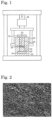
- a thermal resistance measurement device includes a first copper block 22 and a second copper block 23 each covered with a thermal insulator 21 on the side surface thereof.
- the first copper block 22 is disposed in the lower part of the thermal resistance measurement device, and the second copper block 23 is disposed above the first copper block 22.
- the upper surface of the first copper block 22 is a mounting surface Q1 on which a cured body (sample) S2 of a silicone composition is mounted, and the size of the mounting surface Q 1 is 25.4 mm ⁇ 25.4 mm.
- the thermal resistance measurement device further includes a heater 24 to heat the lower surface of the first copper block 22 and a heat sink with a cooling fan, 25, to cool the upper surface of the second copper block 23.
- the thermal resistance measurement device further includes a cylinder 26 connected to the second copper block 23.
- the second copper block 23 is configured so as to compress the sample S2 mounted on the mounting surface Q1 of the first copper block 22 by pressing operation of the cylinder 26.
- the measurement of the thermal conductivity was carried out as follows. First, a sample S2 was applied to the mounting surface Q1 of the first copper block 22, and then compressed by the second copper block 23 so that the thickness of the sample S2 became 1.5 mm. Then, the squeezed-out sample was wiped up and the heater 24 was made to produce heat so that the temperature of the mounting surface Q 1 of the first copper block 22 became 80°C. The state was kept for 15 minutes so that the temperature of the mounting surface Q1 of the first copper block 22 (temperature ⁇ ° j1 ) was steady at 80°C. Thereafter, the temperature of the lower surface Q2 (contact surface contacting with the sample S2) of the second copper block 23 (temperature ⁇ ° j0 ) was measured. Further, the quantity of heat generated (generated heat quantity Q) of the heater 24 at this time, and the exact thickness (thickness T) of the sample S2 were measured.
- a cross section of a cured body of a silicone composition was observed using a scanning electron microscope ("SU3500", manufactured by Hitachi-High-Technologies Corp.) to check the dispersion state of a silicone rubber lump.
- SU3500 manufactured by Hitachi-High-Technologies Corp.
- silicone rubbers 1 and 2 were used which were each obtained by curing an addition reaction-type organopolysiloxane containing an alkenyl group-containing organopolysiloxane and a hydrogenorganopolysiloxane.
- Silicone rubber 1 having a thermal conductivity of 1.3 W/mK and an E hardness of 5; and containing 42% by volume of the organopolysiloxane cured material, and as thermally conductive fillers, 29% by volume of an aluminum hydroxide (crushed form, average particle diameter: 50 ⁇ m) and 29% by volume of an aluminum hydroxide (crushed form, average particle diameter: 10 ⁇ m).
- Silicone rubber 2 having a thermal conductivity of 1.3 W/mK and an E hardness of 70; and containing 42% by volume of the organopolysiloxane cured material, and as thermally conductive fillers, 29% by volume of an aluminum hydroxide (crushed form, average particle diameter: 50 ⁇ m) and 29% by volume of an aluminum hydroxide (crushed form, average particle diameter: 10 ⁇ m).
- An addition reaction-type dimethylpolysiloxane (two-component type composed of a component A and a component B; by mixing these, a reaction occurs between an alkenyl group-containing organopolysiloxane and a hydrogenorganopolysiloxane); having a hardness of 5 in terms of E hardness after being cured
- Aluminum hydroxide crushed form, average particle diameter: 10 ⁇ m
- the silicone rubber 1 was placed in a chopper unit of "Blender Set MIH-MX201-WH", manufactured by Moa Store Co., Ltd., and ground at a speed of "1" for 5 minutes to thereby obtain a silicone rubber lump.
- the silicone rubber lump and a liquid compound (n-decyltrimethoxysilane) were placed and mixed in a plastic container, and thereafter, the mixture was allowed to stand for 1 hour to thereby obtain a swollen silicone rubber lump.
- the swollen silicone rubber lump and the component A of the liquid silicone compound were placed in a plastic container and stirred at a speed of "1" for 5 minutes using a blender unit of "Blender Set MIH-MX201-WH", manufactured by Moa Store Co., Ltd., to thereby obtain a liquid mixture (intermediate). Then, the liquid mixture (intermediate) and the component B of the liquid silicone compound were stirred for 4 minutes using a vibratory mixer to thereby obtain a silicone composition.
- the amounts of the silicone rubber lump, the liquid compound and the liquid silicone compound were adjusted so that respective blend ratios were those indicated in Table 1.
- the obtained silicone composition was applied to a release sheet to a thickness of 2 mm, and heated at 80°C for 15 hours to thereby obtain a sheet-shaped cured body of the silicone composition.
- a sheet-shape cured body of a silicone composition was obtained in the same manner as in Example 1, except for using dimethylsilicone oil as the liquid compound in place of n-decyltrimethoxysilane.
- a cured body of a silicone composition was obtained in the same manner as in Example 2, except for using the silicone rubber 2 in place of the silicone rubber 1.
- a cured body of a silicone composition was obtained in the same manner as in Example 1, except for altering the amount of the liquid silicone compound blended and further adding the thermally conductive filler.
- the silicone rubber 1 was placed in a chopper unit of "Blender Set MIH-MX201-WH", manufactured by Moa Store Co., Ltd., and ground at a speed of "1" for 5 minutes to thereby obtain a silicone rubber lump.
- the silicone rubber lump and the component A of the liquid silicone compound were placed in a plastic container and stirred at a speed of "1" for 5 minutes using a blender unit of "Blender Set MIH-MX201-WH", manufactured by Moa Store Co., Ltd., to thereby obtain a liquid mixture (intermediate). Then, the liquid mixture (intermediate) and the component B of the liquid silicone compound were stirred for 4 minutes using a vibratory mixer to thereby obtain a silicone composition.
- the amounts of the silicone rubber lump and the liquid silicone compound were adjusted so that respective blend ratios became those indicated in Table 1.
- Fig. 2 shows a photograph by scanning electron microscopic observation of a cross section of the cured body obtained in Example 1.
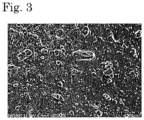
- Fig. 3 shows a photograph by scanning electron microscopic observation of a cross section of the cured body obtained in Comparative Example 1.
- Viewing Fig. 3 photograph of a cross section of the cured body of Comparative Example 1), protruded portions and flat portions are clearly distinguished from each other so that the cross section was nonuniform as a whole, and aggregates of the thermally conductive filler contained in the silicone rubber lump were locally observed.
- viewing Fig. 2 photograph of a cross section of the cured body of Example 1
- no flat portions as in Fig. 3 were observed and it was clear that the silicone rubber lump was well dispersed in the matrix resin.
- the dispersibility of the silicone rubber lumps of Examples 2 and 3 was inferior to Example 1, the silicone rubber lump was better dispersed in Examples 2 and 3 than in Comparative Example 1.
- the dispersibility of the silicone rubber lump of Example 4 was equal to that of Example
Landscapes
- Chemical & Material Sciences (AREA)
- Health & Medical Sciences (AREA)
- Chemical Kinetics & Catalysis (AREA)
- Medicinal Chemistry (AREA)
- Polymers & Plastics (AREA)
- Organic Chemistry (AREA)
- Compositions Of Macromolecular Compounds (AREA)
Applications Claiming Priority (2)
| Application Number | Priority Date | Filing Date | Title |
|---|---|---|---|
| JP2020061210 | 2020-03-30 | ||
| PCT/JP2021/013422 WO2021200879A1 (fr) | 2020-03-30 | 2021-03-29 | Composition de silicone et procédé de fabrication de composition de silicone |
Publications (2)
| Publication Number | Publication Date |
|---|---|
| EP4130132A1 true EP4130132A1 (fr) | 2023-02-08 |
| EP4130132A4 EP4130132A4 (fr) | 2024-05-29 |
Family
ID=77928879
Family Applications (1)
| Application Number | Title | Priority Date | Filing Date |
|---|---|---|---|
| EP21780363.4A Pending EP4130132A4 (fr) | 2020-03-30 | 2021-03-29 | Composition de silicone et procédé de fabrication de composition de silicone |
Country Status (4)
| Country | Link |
|---|---|
| EP (1) | EP4130132A4 (fr) |
| JP (1) | JP7636736B2 (fr) |
| CN (1) | CN115052924B (fr) |
| WO (1) | WO2021200879A1 (fr) |
Cited By (4)
| Publication number | Priority date | Publication date | Assignee | Title |
|---|---|---|---|---|
| WO2025111129A1 (fr) * | 2023-11-20 | 2025-05-30 | Dow Silicones Corporation | Préparation de compositions et de matériaux de silicone |
| WO2025111125A1 (fr) * | 2023-11-20 | 2025-05-30 | Dow Silicones Corporation | Compositions de silicone durcissables par condensation |
| WO2025111126A1 (fr) * | 2023-11-20 | 2025-05-30 | Dow Silicones Corporation | Compositions de caoutchouc de silicone |
| WO2025111127A1 (fr) * | 2023-11-20 | 2025-05-30 | Dow Silicones Corporation | Compositions de caoutchouc de silicone |
Families Citing this family (1)
| Publication number | Priority date | Publication date | Assignee | Title |
|---|---|---|---|---|
| WO2023080234A1 (fr) * | 2021-11-05 | 2023-05-11 | 積水ポリマテック株式会社 | Feuille thermoconductrice |
Family Cites Families (14)
| Publication number | Priority date | Publication date | Assignee | Title |
|---|---|---|---|---|
| US3609104A (en) * | 1968-02-15 | 1971-09-28 | Ercon Inc | Electrically conductive gasket and material thereof |
| US4006207A (en) * | 1975-03-26 | 1977-02-01 | Electrohome Limited | Making silicone rubber molds from reclaimed cured silicone rubber particles and liquid uncured silicone rubber |
| JPH0813926B2 (ja) * | 1989-12-19 | 1996-02-14 | 信越化学工業株式会社 | 多色模様を有するシリコーンゴム製品 |
| JP2001115025A (ja) * | 1999-10-20 | 2001-04-24 | Dow Corning Toray Silicone Co Ltd | 液状シリコーンゴム組成物、その製造方法およびシリコーンゴム発泡体の製造方法 |
| JP2002256078A (ja) * | 2001-02-28 | 2002-09-11 | Hokuriku Biru Bosetsu Kk | 再生シリコーンゴム製品の製造方法 |
| JP4160490B2 (ja) * | 2003-11-14 | 2008-10-01 | 株式会社資生堂 | 油中水型乳化組成物 |
| JP2006131824A (ja) * | 2004-11-09 | 2006-05-25 | Shin Etsu Chem Co Ltd | 室温硬化性オルガノポリシロキサン組成物 |
| JP5007816B2 (ja) * | 2007-08-06 | 2012-08-22 | 信越化学工業株式会社 | 固体高分子電解質膜及びその製造方法 |
| JP5574532B2 (ja) * | 2009-10-08 | 2014-08-20 | 信越化学工業株式会社 | 熱伝導性シリコーンゴム複合シート |
| JP2017101171A (ja) * | 2015-12-03 | 2017-06-08 | 信越化学工業株式会社 | 熱伝導性室温硬化性オルガノポリシロキサン組成物及び部材 |
| JP6565850B2 (ja) * | 2016-09-27 | 2019-08-28 | 信越化学工業株式会社 | 高連泡シリコーンゴムスポンジの製造方法及び高連泡シリコーンゴムスポンジ用液状シリコーンゴム組成物並びにシリコーンゴムスポンジ |
| JP6830866B2 (ja) * | 2017-07-05 | 2021-02-17 | 信越化学工業株式会社 | 低密度シリコーンゴムを製造する方法 |
| US11781052B2 (en) * | 2018-01-31 | 2023-10-10 | Sekisui Polymatech Co., Ltd. | Thermally conductive composition and thermally conductive molded body |
| CN110713719A (zh) * | 2018-07-13 | 2020-01-21 | 国网河南省电力公司电力科学研究院 | 一种硅橡胶组合物及其制备方法 |
-
2021
- 2021-03-29 JP JP2022512253A patent/JP7636736B2/ja active Active
- 2021-03-29 WO PCT/JP2021/013422 patent/WO2021200879A1/fr not_active Ceased
- 2021-03-29 EP EP21780363.4A patent/EP4130132A4/fr active Pending
- 2021-03-29 CN CN202180012759.XA patent/CN115052924B/zh active Active
Cited By (4)
| Publication number | Priority date | Publication date | Assignee | Title |
|---|---|---|---|---|
| WO2025111129A1 (fr) * | 2023-11-20 | 2025-05-30 | Dow Silicones Corporation | Préparation de compositions et de matériaux de silicone |
| WO2025111125A1 (fr) * | 2023-11-20 | 2025-05-30 | Dow Silicones Corporation | Compositions de silicone durcissables par condensation |
| WO2025111126A1 (fr) * | 2023-11-20 | 2025-05-30 | Dow Silicones Corporation | Compositions de caoutchouc de silicone |
| WO2025111127A1 (fr) * | 2023-11-20 | 2025-05-30 | Dow Silicones Corporation | Compositions de caoutchouc de silicone |
Also Published As
| Publication number | Publication date |
|---|---|
| JP7636736B2 (ja) | 2025-02-27 |
| JPWO2021200879A1 (fr) | 2021-10-07 |
| CN115052924B (zh) | 2024-01-16 |
| EP4130132A4 (fr) | 2024-05-29 |
| CN115052924A (zh) | 2022-09-13 |
| WO2021200879A1 (fr) | 2021-10-07 |
Similar Documents
| Publication | Publication Date | Title |
|---|---|---|
| EP4130132A1 (fr) | Composition de silicone et procédé de fabrication de composition de silicone | |
| US10851277B2 (en) | Highly filled high thermal conductive material, method for manufacturing same, composition, coating liquid and molded article | |
| EP1533337B1 (fr) | Matiere thermoconductrice ainsi que procede de preparation | |
| Hong et al. | Effect of dispersion state of carbon nanotube on the thermal conductivity of poly (dimethyl siloxane) composites | |
| EP2847274B1 (fr) | Matrices polymères fonctionnalisées avec des espèces contenant du carbone pour une meilleure conductivité thermique | |
| EP3761355B1 (fr) | Feuille de dissipation de chaleur isolante | |
| TWI885158B (zh) | 矽酮組成物及具有高熱傳導性的熱傳導性矽酮硬化物 | |
| JP4144998B2 (ja) | 放熱用部材 | |
| EP3813103B1 (fr) | Feuille thermoconductrice | |
| EP3878911A1 (fr) | Composition thermoconductrice, élément thermoconducteur, procédé de production d'un élément thermoconducteur, structure de dissipation thermique, élément composite de génération de chaleur, et élément composite de dissipation de chaleur | |
| EP3608384A1 (fr) | Feuille thermoconductrice | |
| WO2018079362A1 (fr) | Composition de silicone thermoconductrice, dispositif à semi-conducteur et procédé de fabrication de dispositif à semi-conducteur | |
| WO1998035360A1 (fr) | Compositions conductrices a base de resine | |
| JP2008266586A (ja) | 低電気伝導性高放熱性高分子材料及び成形体 | |
| EP4105173A1 (fr) | Feuille de dissipation de chaleur et méthode de fabrication d'une feuille de dissipation de chaleur | |
| Permal et al. | Enhanced thermal and mechanical properties of epoxy composites filled with hybrid filler system of aluminium nitride and boron nitride | |
| WO2021166370A1 (fr) | Feuille thermoconductrice, et procédé de fabrication de celle-ci | |
| CN116075547B (zh) | 导热性片、其安装方法及制造方法 | |
| JP4746803B2 (ja) | 熱伝導性電磁波シールドシート | |
| Liu et al. | Studies on 8.4 W/m· K thermally conductive silicone rubber with high compressibility, high electrical insulation, high thermal reliability, and low cost | |
| EP3950850A1 (fr) | Composition thermoconductrice et élément thermoconducteur | |
| Hu et al. | Highly thermal conductivity flexible composite films based on alumina-boron nitride binary fillers | |
| EP4307363A1 (fr) | Feuille de résine thermoconductrice | |
| JP4678969B2 (ja) | 熱伝導材 | |
| EP4223829A1 (fr) | Feuille thermiquement conductrice |
Legal Events
| Date | Code | Title | Description |
|---|---|---|---|
| STAA | Information on the status of an ep patent application or granted ep patent |
Free format text: STATUS: THE INTERNATIONAL PUBLICATION HAS BEEN MADE |
|
| PUAI | Public reference made under article 153(3) epc to a published international application that has entered the european phase |
Free format text: ORIGINAL CODE: 0009012 |
|
| STAA | Information on the status of an ep patent application or granted ep patent |
Free format text: STATUS: REQUEST FOR EXAMINATION WAS MADE |
|
| 17P | Request for examination filed |
Effective date: 20220804 |
|
| AK | Designated contracting states |
Kind code of ref document: A1 Designated state(s): AL AT BE BG CH CY CZ DE DK EE ES FI FR GB GR HR HU IE IS IT LI LT LU LV MC MK MT NL NO PL PT RO RS SE SI SK SM TR |
|
| DAV | Request for validation of the european patent (deleted) | ||
| DAX | Request for extension of the european patent (deleted) | ||
| A4 | Supplementary search report drawn up and despatched |
Effective date: 20240430 |
|
| RIC1 | Information provided on ipc code assigned before grant |
Ipc: C08K 3/013 20180101ALI20240424BHEP Ipc: C08L 83/07 20060101ALI20240424BHEP Ipc: C08L 19/00 20060101ALI20240424BHEP Ipc: C08K 5/5415 20060101AFI20240424BHEP |