EP4133037B1 - Durch direktes katalytisches cracken zu hochwertigen chemikalien veredeltes altöl auf kunststoffbasis - Google Patents
Durch direktes katalytisches cracken zu hochwertigen chemikalien veredeltes altöl auf kunststoffbasis Download PDFInfo
- Publication number
- EP4133037B1 EP4133037B1 EP21716438.3A EP21716438A EP4133037B1 EP 4133037 B1 EP4133037 B1 EP 4133037B1 EP 21716438 A EP21716438 A EP 21716438A EP 4133037 B1 EP4133037 B1 EP 4133037B1
- Authority
- EP
- European Patent Office
- Prior art keywords
- pyrolysis
- hydrocarbon stream
- hydrotreating
- catalyst
- plastic
- Prior art date
- Legal status (The legal status is an assumption and is not a legal conclusion. Google has not performed a legal analysis and makes no representation as to the accuracy of the status listed.)
- Active
Links
Images


Classifications
-
- C—CHEMISTRY; METALLURGY
- C10—PETROLEUM, GAS OR COKE INDUSTRIES; TECHNICAL GASES CONTAINING CARBON MONOXIDE; FUELS; LUBRICANTS; PEAT
- C10G—CRACKING HYDROCARBON OILS; PRODUCTION OF LIQUID HYDROCARBON MIXTURES, e.g. BY DESTRUCTIVE HYDROGENATION, OLIGOMERISATION, POLYMERISATION; RECOVERY OF HYDROCARBON OILS FROM OIL-SHALE, OIL-SAND, OR GASES; REFINING MIXTURES MAINLY CONSISTING OF HYDROCARBONS; REFORMING OF NAPHTHA; MINERAL WAXES
- C10G65/00—Treatment of hydrocarbon oils by two or more hydrotreatment processes only
- C10G65/02—Treatment of hydrocarbon oils by two or more hydrotreatment processes only plural serial stages only
- C10G65/12—Treatment of hydrocarbon oils by two or more hydrotreatment processes only plural serial stages only including cracking steps and other hydrotreatment steps
-
- B—PERFORMING OPERATIONS; TRANSPORTING
- B01—PHYSICAL OR CHEMICAL PROCESSES OR APPARATUS IN GENERAL
- B01J—CHEMICAL OR PHYSICAL PROCESSES, e.g. CATALYSIS OR COLLOID CHEMISTRY; THEIR RELEVANT APPARATUS
- B01J20/00—Solid sorbent compositions or filter aid compositions; Sorbents for chromatography; Processes for preparing, regenerating or reactivating thereof
- B01J20/02—Solid sorbent compositions or filter aid compositions; Sorbents for chromatography; Processes for preparing, regenerating or reactivating thereof comprising inorganic material
- B01J20/06—Solid sorbent compositions or filter aid compositions; Sorbents for chromatography; Processes for preparing, regenerating or reactivating thereof comprising inorganic material comprising oxides or hydroxides of metals not provided for in group B01J20/04
- B01J20/08—Solid sorbent compositions or filter aid compositions; Sorbents for chromatography; Processes for preparing, regenerating or reactivating thereof comprising inorganic material comprising oxides or hydroxides of metals not provided for in group B01J20/04 comprising aluminium oxide or hydroxide; comprising bauxite
-
- B—PERFORMING OPERATIONS; TRANSPORTING
- B01—PHYSICAL OR CHEMICAL PROCESSES OR APPARATUS IN GENERAL
- B01J—CHEMICAL OR PHYSICAL PROCESSES, e.g. CATALYSIS OR COLLOID CHEMISTRY; THEIR RELEVANT APPARATUS
- B01J23/00—Catalysts comprising metals or metal oxides or hydroxides, not provided for in group B01J21/00
- B01J23/70—Catalysts comprising metals or metal oxides or hydroxides, not provided for in group B01J21/00 of the iron group metals or copper
- B01J23/74—Iron group metals
- B01J23/755—Nickel
-
- B—PERFORMING OPERATIONS; TRANSPORTING
- B01—PHYSICAL OR CHEMICAL PROCESSES OR APPARATUS IN GENERAL
- B01J—CHEMICAL OR PHYSICAL PROCESSES, e.g. CATALYSIS OR COLLOID CHEMISTRY; THEIR RELEVANT APPARATUS
- B01J23/00—Catalysts comprising metals or metal oxides or hydroxides, not provided for in group B01J21/00
- B01J23/70—Catalysts comprising metals or metal oxides or hydroxides, not provided for in group B01J21/00 of the iron group metals or copper
- B01J23/76—Catalysts comprising metals or metal oxides or hydroxides, not provided for in group B01J21/00 of the iron group metals or copper combined with metals, oxides or hydroxides provided for in groups B01J23/02 - B01J23/36
- B01J23/84—Catalysts comprising metals or metal oxides or hydroxides, not provided for in group B01J21/00 of the iron group metals or copper combined with metals, oxides or hydroxides provided for in groups B01J23/02 - B01J23/36 with arsenic, antimony, bismuth, vanadium, niobium, tantalum, polonium, chromium, molybdenum, tungsten, manganese, technetium or rhenium
- B01J23/85—Chromium, molybdenum or tungsten
- B01J23/88—Molybdenum
- B01J23/883—Molybdenum and nickel
-
- B—PERFORMING OPERATIONS; TRANSPORTING
- B01—PHYSICAL OR CHEMICAL PROCESSES OR APPARATUS IN GENERAL
- B01J—CHEMICAL OR PHYSICAL PROCESSES, e.g. CATALYSIS OR COLLOID CHEMISTRY; THEIR RELEVANT APPARATUS
- B01J35/00—Catalysts, in general, characterised by their form or physical properties
- B01J35/60—Catalysts, in general, characterised by their form or physical properties characterised by their surface properties or porosity
- B01J35/61—Surface area
- B01J35/615—100-500 m2/g
-
- C—CHEMISTRY; METALLURGY
- C07—ORGANIC CHEMISTRY
- C07C—ACYCLIC OR CARBOCYCLIC COMPOUNDS
- C07C4/00—Preparation of hydrocarbons from hydrocarbons containing a larger number of carbon atoms
- C07C4/02—Preparation of hydrocarbons from hydrocarbons containing a larger number of carbon atoms by cracking a single hydrocarbon or a mixture of individually defined hydrocarbons or a normally gaseous hydrocarbon fraction
- C07C4/04—Thermal processes
-
- C—CHEMISTRY; METALLURGY
- C10—PETROLEUM, GAS OR COKE INDUSTRIES; TECHNICAL GASES CONTAINING CARBON MONOXIDE; FUELS; LUBRICANTS; PEAT
- C10G—CRACKING HYDROCARBON OILS; PRODUCTION OF LIQUID HYDROCARBON MIXTURES, e.g. BY DESTRUCTIVE HYDROGENATION, OLIGOMERISATION, POLYMERISATION; RECOVERY OF HYDROCARBON OILS FROM OIL-SHALE, OIL-SAND, OR GASES; REFINING MIXTURES MAINLY CONSISTING OF HYDROCARBONS; REFORMING OF NAPHTHA; MINERAL WAXES
- C10G1/00—Production of liquid hydrocarbon mixtures from oil-shale, oil-sand, or non-melting solid carbonaceous or similar materials, e.g. wood, coal
- C10G1/002—Production of liquid hydrocarbon mixtures from oil-shale, oil-sand, or non-melting solid carbonaceous or similar materials, e.g. wood, coal in combination with oil conversion- or refining processes
-
- C—CHEMISTRY; METALLURGY
- C10—PETROLEUM, GAS OR COKE INDUSTRIES; TECHNICAL GASES CONTAINING CARBON MONOXIDE; FUELS; LUBRICANTS; PEAT
- C10G—CRACKING HYDROCARBON OILS; PRODUCTION OF LIQUID HYDROCARBON MIXTURES, e.g. BY DESTRUCTIVE HYDROGENATION, OLIGOMERISATION, POLYMERISATION; RECOVERY OF HYDROCARBON OILS FROM OIL-SHALE, OIL-SAND, OR GASES; REFINING MIXTURES MAINLY CONSISTING OF HYDROCARBONS; REFORMING OF NAPHTHA; MINERAL WAXES
- C10G1/00—Production of liquid hydrocarbon mixtures from oil-shale, oil-sand, or non-melting solid carbonaceous or similar materials, e.g. wood, coal
- C10G1/10—Production of liquid hydrocarbon mixtures from oil-shale, oil-sand, or non-melting solid carbonaceous or similar materials, e.g. wood, coal from rubber or rubber waste
-
- C—CHEMISTRY; METALLURGY
- C10—PETROLEUM, GAS OR COKE INDUSTRIES; TECHNICAL GASES CONTAINING CARBON MONOXIDE; FUELS; LUBRICANTS; PEAT
- C10G—CRACKING HYDROCARBON OILS; PRODUCTION OF LIQUID HYDROCARBON MIXTURES, e.g. BY DESTRUCTIVE HYDROGENATION, OLIGOMERISATION, POLYMERISATION; RECOVERY OF HYDROCARBON OILS FROM OIL-SHALE, OIL-SAND, OR GASES; REFINING MIXTURES MAINLY CONSISTING OF HYDROCARBONS; REFORMING OF NAPHTHA; MINERAL WAXES
- C10G11/00—Catalytic cracking, in the absence of hydrogen, of hydrocarbon oils
- C10G11/14—Catalytic cracking, in the absence of hydrogen, of hydrocarbon oils with preheated moving solid catalysts
- C10G11/18—Catalytic cracking, in the absence of hydrogen, of hydrocarbon oils with preheated moving solid catalysts according to the "fluidised-bed" technique
-
- C—CHEMISTRY; METALLURGY
- C10—PETROLEUM, GAS OR COKE INDUSTRIES; TECHNICAL GASES CONTAINING CARBON MONOXIDE; FUELS; LUBRICANTS; PEAT
- C10G—CRACKING HYDROCARBON OILS; PRODUCTION OF LIQUID HYDROCARBON MIXTURES, e.g. BY DESTRUCTIVE HYDROGENATION, OLIGOMERISATION, POLYMERISATION; RECOVERY OF HYDROCARBON OILS FROM OIL-SHALE, OIL-SAND, OR GASES; REFINING MIXTURES MAINLY CONSISTING OF HYDROCARBONS; REFORMING OF NAPHTHA; MINERAL WAXES
- C10G21/00—Refining of hydrocarbon oils, in the absence of hydrogen, by extraction with selective solvents
-
- C—CHEMISTRY; METALLURGY
- C10—PETROLEUM, GAS OR COKE INDUSTRIES; TECHNICAL GASES CONTAINING CARBON MONOXIDE; FUELS; LUBRICANTS; PEAT
- C10G—CRACKING HYDROCARBON OILS; PRODUCTION OF LIQUID HYDROCARBON MIXTURES, e.g. BY DESTRUCTIVE HYDROGENATION, OLIGOMERISATION, POLYMERISATION; RECOVERY OF HYDROCARBON OILS FROM OIL-SHALE, OIL-SAND, OR GASES; REFINING MIXTURES MAINLY CONSISTING OF HYDROCARBONS; REFORMING OF NAPHTHA; MINERAL WAXES
- C10G31/00—Refining of hydrocarbon oils, in the absence of hydrogen, by methods not otherwise provided for
- C10G31/08—Refining of hydrocarbon oils, in the absence of hydrogen, by methods not otherwise provided for by treating with water
-
- C—CHEMISTRY; METALLURGY
- C10—PETROLEUM, GAS OR COKE INDUSTRIES; TECHNICAL GASES CONTAINING CARBON MONOXIDE; FUELS; LUBRICANTS; PEAT
- C10G—CRACKING HYDROCARBON OILS; PRODUCTION OF LIQUID HYDROCARBON MIXTURES, e.g. BY DESTRUCTIVE HYDROGENATION, OLIGOMERISATION, POLYMERISATION; RECOVERY OF HYDROCARBON OILS FROM OIL-SHALE, OIL-SAND, OR GASES; REFINING MIXTURES MAINLY CONSISTING OF HYDROCARBONS; REFORMING OF NAPHTHA; MINERAL WAXES
- C10G33/00—Dewatering or demulsification of hydrocarbon oils
-
- C—CHEMISTRY; METALLURGY
- C10—PETROLEUM, GAS OR COKE INDUSTRIES; TECHNICAL GASES CONTAINING CARBON MONOXIDE; FUELS; LUBRICANTS; PEAT
- C10G—CRACKING HYDROCARBON OILS; PRODUCTION OF LIQUID HYDROCARBON MIXTURES, e.g. BY DESTRUCTIVE HYDROGENATION, OLIGOMERISATION, POLYMERISATION; RECOVERY OF HYDROCARBON OILS FROM OIL-SHALE, OIL-SAND, OR GASES; REFINING MIXTURES MAINLY CONSISTING OF HYDROCARBONS; REFORMING OF NAPHTHA; MINERAL WAXES
- C10G45/00—Refining of hydrocarbon oils using hydrogen or hydrogen-generating compounds
- C10G45/02—Refining of hydrocarbon oils using hydrogen or hydrogen-generating compounds to eliminate hetero atoms without changing the skeleton of the hydrocarbon involved and without cracking into lower boiling hydrocarbons; Hydrofinishing
- C10G45/04—Refining of hydrocarbon oils using hydrogen or hydrogen-generating compounds to eliminate hetero atoms without changing the skeleton of the hydrocarbon involved and without cracking into lower boiling hydrocarbons; Hydrofinishing characterised by the catalyst used
- C10G45/06—Refining of hydrocarbon oils using hydrogen or hydrogen-generating compounds to eliminate hetero atoms without changing the skeleton of the hydrocarbon involved and without cracking into lower boiling hydrocarbons; Hydrofinishing characterised by the catalyst used containing nickel or cobalt metal, or compounds thereof
- C10G45/08—Refining of hydrocarbon oils using hydrogen or hydrogen-generating compounds to eliminate hetero atoms without changing the skeleton of the hydrocarbon involved and without cracking into lower boiling hydrocarbons; Hydrofinishing characterised by the catalyst used containing nickel or cobalt metal, or compounds thereof in combination with chromium, molybdenum, or tungsten metals, or compounds thereof
-
- C—CHEMISTRY; METALLURGY
- C10—PETROLEUM, GAS OR COKE INDUSTRIES; TECHNICAL GASES CONTAINING CARBON MONOXIDE; FUELS; LUBRICANTS; PEAT
- C10G—CRACKING HYDROCARBON OILS; PRODUCTION OF LIQUID HYDROCARBON MIXTURES, e.g. BY DESTRUCTIVE HYDROGENATION, OLIGOMERISATION, POLYMERISATION; RECOVERY OF HYDROCARBON OILS FROM OIL-SHALE, OIL-SAND, OR GASES; REFINING MIXTURES MAINLY CONSISTING OF HYDROCARBONS; REFORMING OF NAPHTHA; MINERAL WAXES
- C10G45/00—Refining of hydrocarbon oils using hydrogen or hydrogen-generating compounds
- C10G45/02—Refining of hydrocarbon oils using hydrogen or hydrogen-generating compounds to eliminate hetero atoms without changing the skeleton of the hydrocarbon involved and without cracking into lower boiling hydrocarbons; Hydrofinishing
- C10G45/04—Refining of hydrocarbon oils using hydrogen or hydrogen-generating compounds to eliminate hetero atoms without changing the skeleton of the hydrocarbon involved and without cracking into lower boiling hydrocarbons; Hydrofinishing characterised by the catalyst used
- C10G45/10—Refining of hydrocarbon oils using hydrogen or hydrogen-generating compounds to eliminate hetero atoms without changing the skeleton of the hydrocarbon involved and without cracking into lower boiling hydrocarbons; Hydrofinishing characterised by the catalyst used containing platinum group metals or compounds thereof
-
- C—CHEMISTRY; METALLURGY
- C10—PETROLEUM, GAS OR COKE INDUSTRIES; TECHNICAL GASES CONTAINING CARBON MONOXIDE; FUELS; LUBRICANTS; PEAT
- C10G—CRACKING HYDROCARBON OILS; PRODUCTION OF LIQUID HYDROCARBON MIXTURES, e.g. BY DESTRUCTIVE HYDROGENATION, OLIGOMERISATION, POLYMERISATION; RECOVERY OF HYDROCARBON OILS FROM OIL-SHALE, OIL-SAND, OR GASES; REFINING MIXTURES MAINLY CONSISTING OF HYDROCARBONS; REFORMING OF NAPHTHA; MINERAL WAXES
- C10G45/00—Refining of hydrocarbon oils using hydrogen or hydrogen-generating compounds
- C10G45/32—Selective hydrogenation of the diolefin or acetylene compounds
-
- C—CHEMISTRY; METALLURGY
- C10—PETROLEUM, GAS OR COKE INDUSTRIES; TECHNICAL GASES CONTAINING CARBON MONOXIDE; FUELS; LUBRICANTS; PEAT
- C10G—CRACKING HYDROCARBON OILS; PRODUCTION OF LIQUID HYDROCARBON MIXTURES, e.g. BY DESTRUCTIVE HYDROGENATION, OLIGOMERISATION, POLYMERISATION; RECOVERY OF HYDROCARBON OILS FROM OIL-SHALE, OIL-SAND, OR GASES; REFINING MIXTURES MAINLY CONSISTING OF HYDROCARBONS; REFORMING OF NAPHTHA; MINERAL WAXES
- C10G45/00—Refining of hydrocarbon oils using hydrogen or hydrogen-generating compounds
- C10G45/32—Selective hydrogenation of the diolefin or acetylene compounds
- C10G45/34—Selective hydrogenation of the diolefin or acetylene compounds characterised by the catalyst used
- C10G45/40—Selective hydrogenation of the diolefin or acetylene compounds characterised by the catalyst used containing platinum group metals or compounds thereof
-
- C—CHEMISTRY; METALLURGY
- C10—PETROLEUM, GAS OR COKE INDUSTRIES; TECHNICAL GASES CONTAINING CARBON MONOXIDE; FUELS; LUBRICANTS; PEAT
- C10G—CRACKING HYDROCARBON OILS; PRODUCTION OF LIQUID HYDROCARBON MIXTURES, e.g. BY DESTRUCTIVE HYDROGENATION, OLIGOMERISATION, POLYMERISATION; RECOVERY OF HYDROCARBON OILS FROM OIL-SHALE, OIL-SAND, OR GASES; REFINING MIXTURES MAINLY CONSISTING OF HYDROCARBONS; REFORMING OF NAPHTHA; MINERAL WAXES
- C10G45/00—Refining of hydrocarbon oils using hydrogen or hydrogen-generating compounds
- C10G45/44—Hydrogenation of the aromatic hydrocarbons
-
- C—CHEMISTRY; METALLURGY
- C10—PETROLEUM, GAS OR COKE INDUSTRIES; TECHNICAL GASES CONTAINING CARBON MONOXIDE; FUELS; LUBRICANTS; PEAT
- C10G—CRACKING HYDROCARBON OILS; PRODUCTION OF LIQUID HYDROCARBON MIXTURES, e.g. BY DESTRUCTIVE HYDROGENATION, OLIGOMERISATION, POLYMERISATION; RECOVERY OF HYDROCARBON OILS FROM OIL-SHALE, OIL-SAND, OR GASES; REFINING MIXTURES MAINLY CONSISTING OF HYDROCARBONS; REFORMING OF NAPHTHA; MINERAL WAXES
- C10G47/00—Cracking of hydrocarbon oils, in the presence of hydrogen or hydrogen- generating compounds, to obtain lower boiling fractions
-
- C—CHEMISTRY; METALLURGY
- C10—PETROLEUM, GAS OR COKE INDUSTRIES; TECHNICAL GASES CONTAINING CARBON MONOXIDE; FUELS; LUBRICANTS; PEAT
- C10G—CRACKING HYDROCARBON OILS; PRODUCTION OF LIQUID HYDROCARBON MIXTURES, e.g. BY DESTRUCTIVE HYDROGENATION, OLIGOMERISATION, POLYMERISATION; RECOVERY OF HYDROCARBON OILS FROM OIL-SHALE, OIL-SAND, OR GASES; REFINING MIXTURES MAINLY CONSISTING OF HYDROCARBONS; REFORMING OF NAPHTHA; MINERAL WAXES
- C10G65/00—Treatment of hydrocarbon oils by two or more hydrotreatment processes only
- C10G65/02—Treatment of hydrocarbon oils by two or more hydrotreatment processes only plural serial stages only
- C10G65/04—Treatment of hydrocarbon oils by two or more hydrotreatment processes only plural serial stages only including only refining steps
- C10G65/06—Treatment of hydrocarbon oils by two or more hydrotreatment processes only plural serial stages only including only refining steps at least one step being a selective hydrogenation of the diolefins
-
- C—CHEMISTRY; METALLURGY
- C10—PETROLEUM, GAS OR COKE INDUSTRIES; TECHNICAL GASES CONTAINING CARBON MONOXIDE; FUELS; LUBRICANTS; PEAT
- C10G—CRACKING HYDROCARBON OILS; PRODUCTION OF LIQUID HYDROCARBON MIXTURES, e.g. BY DESTRUCTIVE HYDROGENATION, OLIGOMERISATION, POLYMERISATION; RECOVERY OF HYDROCARBON OILS FROM OIL-SHALE, OIL-SAND, OR GASES; REFINING MIXTURES MAINLY CONSISTING OF HYDROCARBONS; REFORMING OF NAPHTHA; MINERAL WAXES
- C10G67/00—Treatment of hydrocarbon oils by at least one hydrotreatment process and at least one process for refining in the absence of hydrogen only
- C10G67/02—Treatment of hydrocarbon oils by at least one hydrotreatment process and at least one process for refining in the absence of hydrogen only plural serial stages only
- C10G67/04—Treatment of hydrocarbon oils by at least one hydrotreatment process and at least one process for refining in the absence of hydrogen only plural serial stages only including solvent extraction as the refining step in the absence of hydrogen
-
- C—CHEMISTRY; METALLURGY
- C10—PETROLEUM, GAS OR COKE INDUSTRIES; TECHNICAL GASES CONTAINING CARBON MONOXIDE; FUELS; LUBRICANTS; PEAT
- C10G—CRACKING HYDROCARBON OILS; PRODUCTION OF LIQUID HYDROCARBON MIXTURES, e.g. BY DESTRUCTIVE HYDROGENATION, OLIGOMERISATION, POLYMERISATION; RECOVERY OF HYDROCARBON OILS FROM OIL-SHALE, OIL-SAND, OR GASES; REFINING MIXTURES MAINLY CONSISTING OF HYDROCARBONS; REFORMING OF NAPHTHA; MINERAL WAXES
- C10G67/00—Treatment of hydrocarbon oils by at least one hydrotreatment process and at least one process for refining in the absence of hydrogen only
- C10G67/02—Treatment of hydrocarbon oils by at least one hydrotreatment process and at least one process for refining in the absence of hydrogen only plural serial stages only
- C10G67/06—Treatment of hydrocarbon oils by at least one hydrotreatment process and at least one process for refining in the absence of hydrogen only plural serial stages only including a sorption process as the refining step in the absence of hydrogen
-
- C—CHEMISTRY; METALLURGY
- C10—PETROLEUM, GAS OR COKE INDUSTRIES; TECHNICAL GASES CONTAINING CARBON MONOXIDE; FUELS; LUBRICANTS; PEAT
- C10G—CRACKING HYDROCARBON OILS; PRODUCTION OF LIQUID HYDROCARBON MIXTURES, e.g. BY DESTRUCTIVE HYDROGENATION, OLIGOMERISATION, POLYMERISATION; RECOVERY OF HYDROCARBON OILS FROM OIL-SHALE, OIL-SAND, OR GASES; REFINING MIXTURES MAINLY CONSISTING OF HYDROCARBONS; REFORMING OF NAPHTHA; MINERAL WAXES
- C10G67/00—Treatment of hydrocarbon oils by at least one hydrotreatment process and at least one process for refining in the absence of hydrogen only
- C10G67/02—Treatment of hydrocarbon oils by at least one hydrotreatment process and at least one process for refining in the absence of hydrogen only plural serial stages only
- C10G67/14—Treatment of hydrocarbon oils by at least one hydrotreatment process and at least one process for refining in the absence of hydrogen only plural serial stages only including at least two different refining steps in the absence of hydrogen
-
- C—CHEMISTRY; METALLURGY
- C10—PETROLEUM, GAS OR COKE INDUSTRIES; TECHNICAL GASES CONTAINING CARBON MONOXIDE; FUELS; LUBRICANTS; PEAT
- C10G—CRACKING HYDROCARBON OILS; PRODUCTION OF LIQUID HYDROCARBON MIXTURES, e.g. BY DESTRUCTIVE HYDROGENATION, OLIGOMERISATION, POLYMERISATION; RECOVERY OF HYDROCARBON OILS FROM OIL-SHALE, OIL-SAND, OR GASES; REFINING MIXTURES MAINLY CONSISTING OF HYDROCARBONS; REFORMING OF NAPHTHA; MINERAL WAXES
- C10G69/00—Treatment of hydrocarbon oils by at least one hydrotreatment process and at least one other conversion process
- C10G69/02—Treatment of hydrocarbon oils by at least one hydrotreatment process and at least one other conversion process plural serial stages only
- C10G69/06—Treatment of hydrocarbon oils by at least one hydrotreatment process and at least one other conversion process plural serial stages only including at least one step of thermal cracking in the absence of hydrogen
-
- C—CHEMISTRY; METALLURGY
- C10—PETROLEUM, GAS OR COKE INDUSTRIES; TECHNICAL GASES CONTAINING CARBON MONOXIDE; FUELS; LUBRICANTS; PEAT
- C10G—CRACKING HYDROCARBON OILS; PRODUCTION OF LIQUID HYDROCARBON MIXTURES, e.g. BY DESTRUCTIVE HYDROGENATION, OLIGOMERISATION, POLYMERISATION; RECOVERY OF HYDROCARBON OILS FROM OIL-SHALE, OIL-SAND, OR GASES; REFINING MIXTURES MAINLY CONSISTING OF HYDROCARBONS; REFORMING OF NAPHTHA; MINERAL WAXES
- C10G69/00—Treatment of hydrocarbon oils by at least one hydrotreatment process and at least one other conversion process
- C10G69/02—Treatment of hydrocarbon oils by at least one hydrotreatment process and at least one other conversion process plural serial stages only
- C10G69/08—Treatment of hydrocarbon oils by at least one hydrotreatment process and at least one other conversion process plural serial stages only including at least one step of reforming naphtha
- C10G69/10—Treatment of hydrocarbon oils by at least one hydrotreatment process and at least one other conversion process plural serial stages only including at least one step of reforming naphtha hydrocracking of higher boiling fractions into naphtha and reforming the naphtha obtained
-
- C—CHEMISTRY; METALLURGY
- C10—PETROLEUM, GAS OR COKE INDUSTRIES; TECHNICAL GASES CONTAINING CARBON MONOXIDE; FUELS; LUBRICANTS; PEAT
- C10G—CRACKING HYDROCARBON OILS; PRODUCTION OF LIQUID HYDROCARBON MIXTURES, e.g. BY DESTRUCTIVE HYDROGENATION, OLIGOMERISATION, POLYMERISATION; RECOVERY OF HYDROCARBON OILS FROM OIL-SHALE, OIL-SAND, OR GASES; REFINING MIXTURES MAINLY CONSISTING OF HYDROCARBONS; REFORMING OF NAPHTHA; MINERAL WAXES
- C10G9/00—Thermal non-catalytic cracking, in the absence of hydrogen, of hydrocarbon oils
- C10G9/34—Thermal non-catalytic cracking, in the absence of hydrogen, of hydrocarbon oils by direct contact with inert preheated fluids, e.g. with molten metals or salts
- C10G9/36—Thermal non-catalytic cracking, in the absence of hydrogen, of hydrocarbon oils by direct contact with inert preheated fluids, e.g. with molten metals or salts with heated gases or vapours
-
- C—CHEMISTRY; METALLURGY
- C10—PETROLEUM, GAS OR COKE INDUSTRIES; TECHNICAL GASES CONTAINING CARBON MONOXIDE; FUELS; LUBRICANTS; PEAT
- C10B—DESTRUCTIVE DISTILLATION OF CARBONACEOUS MATERIALS FOR PRODUCTION OF GAS, COKE, TAR, OR SIMILAR MATERIALS
- C10B53/00—Destructive distillation, specially adapted for particular solid raw materials or solid raw materials in special form
- C10B53/07—Destructive distillation, specially adapted for particular solid raw materials or solid raw materials in special form of solid raw materials consisting of synthetic polymeric materials, e.g. tyres
-
- C—CHEMISTRY; METALLURGY
- C10—PETROLEUM, GAS OR COKE INDUSTRIES; TECHNICAL GASES CONTAINING CARBON MONOXIDE; FUELS; LUBRICANTS; PEAT
- C10G—CRACKING HYDROCARBON OILS; PRODUCTION OF LIQUID HYDROCARBON MIXTURES, e.g. BY DESTRUCTIVE HYDROGENATION, OLIGOMERISATION, POLYMERISATION; RECOVERY OF HYDROCARBON OILS FROM OIL-SHALE, OIL-SAND, OR GASES; REFINING MIXTURES MAINLY CONSISTING OF HYDROCARBONS; REFORMING OF NAPHTHA; MINERAL WAXES
- C10G2300/00—Aspects relating to hydrocarbon processing covered by groups C10G1/00 - C10G99/00
- C10G2300/10—Feedstock materials
- C10G2300/1003—Waste materials
-
- C—CHEMISTRY; METALLURGY
- C10—PETROLEUM, GAS OR COKE INDUSTRIES; TECHNICAL GASES CONTAINING CARBON MONOXIDE; FUELS; LUBRICANTS; PEAT
- C10G—CRACKING HYDROCARBON OILS; PRODUCTION OF LIQUID HYDROCARBON MIXTURES, e.g. BY DESTRUCTIVE HYDROGENATION, OLIGOMERISATION, POLYMERISATION; RECOVERY OF HYDROCARBON OILS FROM OIL-SHALE, OIL-SAND, OR GASES; REFINING MIXTURES MAINLY CONSISTING OF HYDROCARBONS; REFORMING OF NAPHTHA; MINERAL WAXES
- C10G2300/00—Aspects relating to hydrocarbon processing covered by groups C10G1/00 - C10G99/00
- C10G2300/10—Feedstock materials
- C10G2300/1037—Hydrocarbon fractions
- C10G2300/104—Light gasoline having a boiling range of about 20 - 100 °C
-
- C—CHEMISTRY; METALLURGY
- C10—PETROLEUM, GAS OR COKE INDUSTRIES; TECHNICAL GASES CONTAINING CARBON MONOXIDE; FUELS; LUBRICANTS; PEAT
- C10G—CRACKING HYDROCARBON OILS; PRODUCTION OF LIQUID HYDROCARBON MIXTURES, e.g. BY DESTRUCTIVE HYDROGENATION, OLIGOMERISATION, POLYMERISATION; RECOVERY OF HYDROCARBON OILS FROM OIL-SHALE, OIL-SAND, OR GASES; REFINING MIXTURES MAINLY CONSISTING OF HYDROCARBONS; REFORMING OF NAPHTHA; MINERAL WAXES
- C10G2300/00—Aspects relating to hydrocarbon processing covered by groups C10G1/00 - C10G99/00
- C10G2300/20—Characteristics of the feedstock or the products
- C10G2300/201—Impurities
-
- C—CHEMISTRY; METALLURGY
- C10—PETROLEUM, GAS OR COKE INDUSTRIES; TECHNICAL GASES CONTAINING CARBON MONOXIDE; FUELS; LUBRICANTS; PEAT
- C10G—CRACKING HYDROCARBON OILS; PRODUCTION OF LIQUID HYDROCARBON MIXTURES, e.g. BY DESTRUCTIVE HYDROGENATION, OLIGOMERISATION, POLYMERISATION; RECOVERY OF HYDROCARBON OILS FROM OIL-SHALE, OIL-SAND, OR GASES; REFINING MIXTURES MAINLY CONSISTING OF HYDROCARBONS; REFORMING OF NAPHTHA; MINERAL WAXES
- C10G2300/00—Aspects relating to hydrocarbon processing covered by groups C10G1/00 - C10G99/00
- C10G2300/20—Characteristics of the feedstock or the products
- C10G2300/201—Impurities
- C10G2300/202—Heteroatoms content, i.e. S, N, O, P
-
- C—CHEMISTRY; METALLURGY
- C10—PETROLEUM, GAS OR COKE INDUSTRIES; TECHNICAL GASES CONTAINING CARBON MONOXIDE; FUELS; LUBRICANTS; PEAT
- C10G—CRACKING HYDROCARBON OILS; PRODUCTION OF LIQUID HYDROCARBON MIXTURES, e.g. BY DESTRUCTIVE HYDROGENATION, OLIGOMERISATION, POLYMERISATION; RECOVERY OF HYDROCARBON OILS FROM OIL-SHALE, OIL-SAND, OR GASES; REFINING MIXTURES MAINLY CONSISTING OF HYDROCARBONS; REFORMING OF NAPHTHA; MINERAL WAXES
- C10G2300/00—Aspects relating to hydrocarbon processing covered by groups C10G1/00 - C10G99/00
- C10G2300/40—Characteristics of the process deviating from typical ways of processing
- C10G2300/4006—Temperature
-
- C—CHEMISTRY; METALLURGY
- C10—PETROLEUM, GAS OR COKE INDUSTRIES; TECHNICAL GASES CONTAINING CARBON MONOXIDE; FUELS; LUBRICANTS; PEAT
- C10G—CRACKING HYDROCARBON OILS; PRODUCTION OF LIQUID HYDROCARBON MIXTURES, e.g. BY DESTRUCTIVE HYDROGENATION, OLIGOMERISATION, POLYMERISATION; RECOVERY OF HYDROCARBON OILS FROM OIL-SHALE, OIL-SAND, OR GASES; REFINING MIXTURES MAINLY CONSISTING OF HYDROCARBONS; REFORMING OF NAPHTHA; MINERAL WAXES
- C10G2300/00—Aspects relating to hydrocarbon processing covered by groups C10G1/00 - C10G99/00
- C10G2300/40—Characteristics of the process deviating from typical ways of processing
- C10G2300/4012—Pressure
-
- C—CHEMISTRY; METALLURGY
- C10—PETROLEUM, GAS OR COKE INDUSTRIES; TECHNICAL GASES CONTAINING CARBON MONOXIDE; FUELS; LUBRICANTS; PEAT
- C10G—CRACKING HYDROCARBON OILS; PRODUCTION OF LIQUID HYDROCARBON MIXTURES, e.g. BY DESTRUCTIVE HYDROGENATION, OLIGOMERISATION, POLYMERISATION; RECOVERY OF HYDROCARBON OILS FROM OIL-SHALE, OIL-SAND, OR GASES; REFINING MIXTURES MAINLY CONSISTING OF HYDROCARBONS; REFORMING OF NAPHTHA; MINERAL WAXES
- C10G2300/00—Aspects relating to hydrocarbon processing covered by groups C10G1/00 - C10G99/00
- C10G2300/40—Characteristics of the process deviating from typical ways of processing
- C10G2300/4018—Spatial velocity, e.g. LHSV, WHSV
-
- C—CHEMISTRY; METALLURGY
- C10—PETROLEUM, GAS OR COKE INDUSTRIES; TECHNICAL GASES CONTAINING CARBON MONOXIDE; FUELS; LUBRICANTS; PEAT
- C10G—CRACKING HYDROCARBON OILS; PRODUCTION OF LIQUID HYDROCARBON MIXTURES, e.g. BY DESTRUCTIVE HYDROGENATION, OLIGOMERISATION, POLYMERISATION; RECOVERY OF HYDROCARBON OILS FROM OIL-SHALE, OIL-SAND, OR GASES; REFINING MIXTURES MAINLY CONSISTING OF HYDROCARBONS; REFORMING OF NAPHTHA; MINERAL WAXES
- C10G2300/00—Aspects relating to hydrocarbon processing covered by groups C10G1/00 - C10G99/00
- C10G2300/70—Catalyst aspects
-
- C—CHEMISTRY; METALLURGY
- C10—PETROLEUM, GAS OR COKE INDUSTRIES; TECHNICAL GASES CONTAINING CARBON MONOXIDE; FUELS; LUBRICANTS; PEAT
- C10G—CRACKING HYDROCARBON OILS; PRODUCTION OF LIQUID HYDROCARBON MIXTURES, e.g. BY DESTRUCTIVE HYDROGENATION, OLIGOMERISATION, POLYMERISATION; RECOVERY OF HYDROCARBON OILS FROM OIL-SHALE, OIL-SAND, OR GASES; REFINING MIXTURES MAINLY CONSISTING OF HYDROCARBONS; REFORMING OF NAPHTHA; MINERAL WAXES
- C10G2300/00—Aspects relating to hydrocarbon processing covered by groups C10G1/00 - C10G99/00
- C10G2300/80—Additives
- C10G2300/805—Water
- C10G2300/807—Steam
-
- C—CHEMISTRY; METALLURGY
- C10—PETROLEUM, GAS OR COKE INDUSTRIES; TECHNICAL GASES CONTAINING CARBON MONOXIDE; FUELS; LUBRICANTS; PEAT
- C10G—CRACKING HYDROCARBON OILS; PRODUCTION OF LIQUID HYDROCARBON MIXTURES, e.g. BY DESTRUCTIVE HYDROGENATION, OLIGOMERISATION, POLYMERISATION; RECOVERY OF HYDROCARBON OILS FROM OIL-SHALE, OIL-SAND, OR GASES; REFINING MIXTURES MAINLY CONSISTING OF HYDROCARBONS; REFORMING OF NAPHTHA; MINERAL WAXES
- C10G2400/00—Products obtained by processes covered by groups C10G9/00 - C10G69/14
- C10G2400/20—C2-C4 olefins
-
- C—CHEMISTRY; METALLURGY
- C10—PETROLEUM, GAS OR COKE INDUSTRIES; TECHNICAL GASES CONTAINING CARBON MONOXIDE; FUELS; LUBRICANTS; PEAT
- C10G—CRACKING HYDROCARBON OILS; PRODUCTION OF LIQUID HYDROCARBON MIXTURES, e.g. BY DESTRUCTIVE HYDROGENATION, OLIGOMERISATION, POLYMERISATION; RECOVERY OF HYDROCARBON OILS FROM OIL-SHALE, OIL-SAND, OR GASES; REFINING MIXTURES MAINLY CONSISTING OF HYDROCARBONS; REFORMING OF NAPHTHA; MINERAL WAXES
- C10G2400/00—Products obtained by processes covered by groups C10G9/00 - C10G69/14
- C10G2400/30—Aromatics
-
- Y—GENERAL TAGGING OF NEW TECHNOLOGICAL DEVELOPMENTS; GENERAL TAGGING OF CROSS-SECTIONAL TECHNOLOGIES SPANNING OVER SEVERAL SECTIONS OF THE IPC; TECHNICAL SUBJECTS COVERED BY FORMER USPC CROSS-REFERENCE ART COLLECTIONS [XRACs] AND DIGESTS
- Y02—TECHNOLOGIES OR APPLICATIONS FOR MITIGATION OR ADAPTATION AGAINST CLIMATE CHANGE
- Y02W—CLIMATE CHANGE MITIGATION TECHNOLOGIES RELATED TO WASTEWATER TREATMENT OR WASTE MANAGEMENT
- Y02W30/00—Technologies for solid waste management
- Y02W30/50—Reuse, recycling or recovery technologies
- Y02W30/62—Plastics recycling; Rubber recycling
Definitions
- the disclosure relates to the purification and treatment of oil produced from the pyrolysis of waste plastic in order to be able to further use this oil in a steam cracker.
- Waste plastics are mostly diverted to landfills or are incinerated, with a smaller fraction being diverted to recycling. There is however a strong need, influenced by the regulations to limit waste plastic in landfills. On the other hand, waste plastics disposal into landfills is becoming increasingly difficult. There is therefore a need for recycling waste plastic.
- Chemical recycling aims to convert plastic waste into chemicals. It is a process where the chemical structure of the polymer is changed and converted into chemical building blocks including monomers that are then used again as a raw material in chemical processes. There are four methods of chemical recycling, which are substantially different in terms of waste input and obtained products:
- the different feedstock recycling methods require each specific feedstock requirements and produce each different product values.
- Gasification requires least pre-treatment amongst these three methods, followed by pyrolysis methods (thermal and catalytic cracking). Intensive pre-treatment is required in case of depolymerisation.
- the low recycling rate stems from the fact that emphasis is mostly on mechanical recycling that is suitable only for homogenous and contaminant free plastic waste, which most of the plastic wastes streams are not.
- Post-consumers waste, end-of-life vehicles, wastes from construction and demolition, and waste electrical and electronic equipment contain large share of plastics that cannot be recycled via mechanical routes.
- pyrolysis can handle any type of organic material, non-organic materials like metals, glass fibres, halogens, additives and often hetero-atomic containing polymers, like PET and PVC, it remains necessary to remove the impurities from the input stream, ideally before the process or through purification of the pyrolysis oil afterwards.
- plastic waste Pyrolysis and gasification transform plastics, and most of their additives and contaminants into vaporous chemicals while most of the non-volatile contaminants or additives end up in the solid by-product, chars or ashes respectively.
- any kind of plastic waste can be converted, although some pre-sorting of non-organic waste is desired and purification of the output material is necessary as some un wanted elements can be present (for instance chlorine, silicon, metals, phosphorous, nitrogen, and other elements).
- plastic waste is a complex and heterogeneous material, due to several factors.
- plastic as material refers to numerous different polymers with different chemical properties that need to be separated from each other prior to recycling.
- the main polymers found in plastic from municipal solid waste are polyethylene terephthalate (PET), polyethylene (PE), polypropylene (PP) and polystyrene (PS).
- Others are polyurethanes, polyamides (Nylons) and polycarbonates or polyesters.
- additives are being introduced during the production phase to adjust or improve the properties of the plastic or to fulfil specific requirements.
- additives such as functional additives (stabilisers, antistatic agents, flame retardants, plasticizers, lubricants, slip agents, curing agents, foaming agents, biocides, antioxidants etc.), colourants, fillers, commonly used in plastic packaging as well as additives such as flame retardants, commonly used in plastic for electronics.
- functional additives stabilizers, antistatic agents, flame retardants, plasticizers, lubricants, slip agents, curing agents, foaming agents, biocides, antioxidants etc.
- colourants fillers
- fillers commonly used in plastic packaging
- additives such as flame retardants, commonly used in plastic for electronics.
- metal compounds are purposely added during plastic production (often as oxides, acids, etc.). Beside metals other hetero-elements additives are used in making plastics, for instance in flame retardants, plasticisers, stabilisers etc.
- Silicon containing organics are used often in plastic formulations. Thanks to their surface characteristics, applications for silicones range from silicone rubbers, used as sealants for joints, to silicone surfactants for cosmetic products while they are increasingly used in the plastics sector, as process enhancing additives (processing aids), and for the modification of polymers.
- the used waste plastics can have been contaminated during use by sticking residuals of contained liquids (beverages, personal-care products, etc) and of food that can also introduce contamination of the plastic.
- pyrolyzed plastic oil contains other components such as halogenated compounds, alkali metals, phosphorous compounds, or even iron.
- halogenate mainly chlorine -Cl
- PVC polyvinylchlorides
- plastic additives entering in the composition of flame retardants or secondary plasticizers for example.
- the organic chlorides may lead to the formation of HCI in downstream processes, which can cause corrosion of equipment and may also act as a poison for catalysts used in the downstream processes.
- Ammonium chloride is formed by reaction of HCI with traces of ammonia formed during pyrolysis. At high temperatures, it is not an issue because the ammonium chloride readily dissociates into HCI and NH3 but once temperatures in sections of the plant drops below 100°C, at atmospheric pressure, the compound is stable as NH4CI and deposits on to equipment.
- alkali metals elements like sodium (Na) can be present.
- Typical sources of sodium include a malfunctioning washing step, sea water contamination or caustic contamination.
- Sodium is found in plastic additives (porogen or blowing agents, thermal stabilizers, ...) as well.
- calcium (Ca) may also be present. Ca can be found in plastic additives (mineral fillers, thermal stabilizers, etc.).
- Phosphorus compounds are often found to originate from injection of corrosion inhibitors or flame retardants in the form of thiophosphorus compounds like thiophosphate esters, thiophosphites and tributyl phosphate or organophosphates such as triphenyl phosphate (TPP), resorcinol bis(diphenylphosphate), bisphenol A diphenyl phosphate, and tricresyl phosphate; phosphonates such as dimethyl methylphosphonate; and phosphinates such as aluminium diethyl phosphinate or compounds containing both phosphorus and a halogen.
- TPP triphenyl phosphate
- resorcinol bis(diphenylphosphate) bisphenol A diphenyl phosphate
- tricresyl phosphate phosphonates
- phosphinates such as aluminium diethyl phosphinate or compounds containing both phosphorus and a halogen.
- Such compounds include tris(2,3-dibromopropyl) phosphate (brominated tris) and chlorinated organophosphates such as tris(1,3-dichloro-2-propyl)phosphate and tetrakis(2-chlorethyl)dichloroisopentyldiphosphate.
- Phosphorus compounds are also found as plastics additives as plasticizers.
- Iron originates from rust and iron scale from corrosion of upstream equipment, as well as from unfiltered particulates present in the feed.
- iron oxides as well as other oxides of metallic salts can be added as insoluble pigments that colour or opacify plastics, or as mineral fillers.
- Iron carboxylate, like naphthenates can form from corrosion due to organic acids, like terephthalic acids or naphthenic acid in the feed, and the iron readily precipitates out in the presence of heat, water and H2S.
- Hetero-element containing volatiles can end up in the gases (e.g. HCI, NH3 etc) or in the liquid product (chloro-aromatic, bromo-aromatics, phenols, carboxylic aromatics, alkyl-amines etc).
- gases e.g. HCI, NH3 etc
- silicones can convert into volatile siloxanes, having boiling points similar to naphtha components.
- WO2015/026592 describes a method for processing hydrocarbons wherein a hydrocarbon stream including chlorides from one or more of a crude, vacuum or coker column is contacted with an adsorbent capable of adsorbing the chlorides in an adsorbent bed to provide a dechlorinated hydrocarbon stream to a hydrotreater reactor.
- US6743746 (B1 ) describes a catalyst used in the low-temperature pyrolysis of hydrocarbon-containing polymer materials and being mainly intended for use in the recycling of rubber waste materials.
- the catalyst is prepared from a carbon-iron component in the form of microscopic carbon particles and ultra-dispersed iron particles.
- EP0823469 discloses the pyrolysis of waste plastic including vinyl chlorine in which the dechlorination is firstly performed prior to the pyrolysis process.
- WO2014040634 describes plastic wastes which for at least 80 wt-% contain a polymer or a mixture of polymers from a group including polymethyl methacrylate, polypropylene, polyethylene, polystyrene, polyethylene terephthalate and/or polytetrafluoroethylene, are recycled using the following steps: (i) heating the plastic wastes to a temperature at which they are flowable; (ii) pyrolyzing the flowable plastics together with a catalyst and/or an adsorber and withdrawing the resulting gases; (iii) condensing the gases.
- US2005165262 describes a low energy method of pyrolysis of rubber or other hydrocarbon material.
- the hydrocarbon material is heated while maintaining a vacuum, using a clay catalyst.
- WO2018025103 describes a process for dechlorination of a hydrocarbon stream comprising the introduction of the hydrocarbon stream together with a first zeolitic catalyst and with a stripping gas to a devolatilization extruder (DE) to produce an extruder effluent.
- the hydrocarbon stream comprises one or more chloride compounds in an amount of equal to or greater than about 10 ppm chloride, based on the total weight of the hydrocarbon stream and the extruder effluent comprises one or more chloride compounds in an amount of less than the chloride amount in the hydrocarbon stream.
- WO2018025104 describes a process for processing mixed plastics comprising simultaneous pyrolysis and dechlorination of the mixed plastics, the process comprising contacting the mixed plastics with a zeolitic catalyst in a pyrolysis unit to produce a hydrocarbon product comprising a gas phase and a liquid phase; and separating the hydrocarbon product into a hydrocarbon gas stream and a hydrocarbon liquid stream, wherein the hydrocarbon gas stream comprises at least a portion of the gas phase of the hydrocarbon product, wherein the hydrocarbon liquid stream comprises at least a portion of the liquid phase of the hydrocarbon product, wherein the hydrocarbon liquid stream comprises one or more chloride compounds in an amount of less than about 100 ppmw chloride, based on the total weight of the hydrocarbon liquid stream, and wherein the hydrocarbon liquid stream is characterized by a viscosity of less than about 400 cP at a temperature of 300 °C.
- CN 101 845 323 discloses a process for producing petrol and diesel oil by plastic oil.
- the plastic oil is used as raw materials to be distilled through catalytic reaction, and then, the hydrogenation refining is carried out for producing high-quality petrol and diesel oil.
- the process comprises firstly, a step of obtaining petrol and diesel oil distillate from the plastic oil through catalytic reaction distillation; then, selecting the hydrogenation reaction of the petrol and diesel oil distillate under the mild conditions on the metal (noble metal or non-noble metal) catalysts to remove diolefine; next, carrying out hydrogenation refining reaction on the sulphide catalysts; removing monoene compounds through monoene hydrogenation saturation reaction; and carrying out desulfurization, denitrification and colloid removal production to obtain extraneous-odor-free and high-quality petrol and diesel oil.
- US 8 911 616 describes an hydrotreating process including providing a first feed stream having a coker naphtha with a bromine number of about 10 to about 120, combining the first feed stream with a second feed stream having a straight run naphtha with a bromine number of less than about 10 to create a combined feed, providing the combined feed to a hydrotreating reactor having at least one catalyst bed, and separating a quench stream from the second feed stream and providing the quench stream after the at least one catalyst bed.
- WO 2018/127813 describes a process for producing propylene and cumene comprising converting plastics to hydrocarbon liquid and pyrolysis gas in pyrolyzer; feeding hydrocarbon liquid to hydro processor to yield hydrocarbon product and first gas stream; introducing hydrocarbon product to second separator to produce first C6 aromatics and refined product; feeding refined product to steam cracker to produce steam cracker product; introducing steam cracker product to third separator to produce second C6 aromatics, third propylene stream, second C2-C4 unsaturated stream, C1-4 saturated gas, and balance hydrocarbons product; introducing pyrolysis gas and/or first gas stream to first separator to produce first propylene stream, first C2-C4 unsaturated stream, and saturated gas stream; feeding first and/or second C2-C4 unsaturated stream to metathesis reactor to produce second propylene stream; feeding first and/or second C6 aromatics, and first, second, and/or third propylene stream to alkylation unit to produce cumene; and conveying balance hydrocarbons product to pyrolyzer
- JP 2005 105027 describes a method comprising mixing 85 % vol. of a straight run naphtha fraction with 15 %vol. of plastic cracked oil prepared by cracking a plastic, followed by subjecting the resultant mixture to hydro-refining.
- the 97% recovered temperature of straight run naphtha fraction is 110-180°C; the 97% recovered temperature of the plastic cracked oil is not higher than the sum of the 97% recovered temperature of straight run naphtha fraction and 45°C; and the end point of the plastic cracking oil is not higher than 200°C.
- JP 2007 077324 describes a method for treating a plastic cracked oil comprises mixing the plastic cracked oil generated by thermal cracking of waste plastic and petroleum fraction and treating the resultant mixture by a petroleum refining process, in which the mixed petroleum stock has a calcium content of ⁇ 2 mass ppm in terms of the metal.
- US2016264874 describes an integrated process for the conversion of waste plastics to high value products. The process allows for operation with a single hydroprocessing reactor which provides simultaneous hydrogenation, dechlorination, and hydrocracking of components of a hydrocarbon stream to specifications which meet steam cracker requirements, with the option to further dechlorinate the treated hydrocarbon stream in a polishing zone.
- the aim of the present disclosure is to provide a purified stream originating from the pyrolysis of plastic wastes, said stream being further used in steam cracking process in order to produce olefins and aromatics that can be further used to produce plastic, as disclosed in the appended claims.
- the pyrolysis plastic oil contains large quantities of olefins and of dienes. Olefins and dienes cannot be sent to a steam cracker. Indeed, olefins and even more dienes are coke precursors. If they are sent to the steam cracker, they will lead to the formation of large quantities of coke inducing reduced heat transfer and pressure drop of the cracker. This will be particularly true in the convection as well in the radiation section of the steam cracker. It is therefore necessary to hydrogenate those olefins and dienes before sending the pyrolysis plastic oil to the steam cracker. Hydrotreatment is therefore performed to saturate olefins and diene.
- the pyrolysis plastic oils contain also large quantities of impurities that block the hydrotreatment catalyst. It is necessary to remove those impurities before performing the hydrogenation of the olefins and of the diene.
- said second hydrotreatment also allows to remove the remaining impurities like amongst other the silicon, metals, halogens, oxygen, sulphur or nitrogen-based impurities.
- the pyrolysis plastic oil may contain impurities such as silicon, halogenated compounds, alkali metals, phosphorous compounds, nitrogen or even iron. It has been indeed discovered that it may be necessary to remove those impurities before performing the optional first hydrotreating step or before the second hydrotreating step.
- impurities such as silicon, halogenated compounds, alkali metals, phosphorous compounds, nitrogen or even iron. It has been indeed discovered that it may be necessary to remove those impurities before performing the optional first hydrotreating step or before the second hydrotreating step.
- silicon is present in the pyrolysis plastic oil, severe problem is also expected during the second hydrotreating steps.
- the catalyst operation time will typically depend on the amount of silicon being present in the pyrolysis plastic oil and on silicon "tolerance" of the applied catalyst system. In absence of silicon, a cycle length of more than three years can be reached for the optional first hydrotreating step and/or for the second hydrotreating step.
- Deposition of silicon in form of a silica gel with a partially methylated surface deactivates the catalyst and reduces the typical cycle lengths often to less than one year.
- the presence of Si has an adverse effect in the subsequent treatment units and poison the catalysts. They also impede regeneration of the contaminated catalysts, by forming a film, of SiO2 on the metallic sites of the catalyst on oxidation of the adsorbed compounds and can hence not be removed by conventional regeneration procedures. It is therefore important to remove the Si before performing the first and/or the second hydrotreating step if Si is present.
- the presence of halogenate (if any) and more precisely the presence of chlorine leads to corrosion problem associated with HCl and also deposition of NH4Cl.
- any organo-chlorides tend to cause issues namely catalyst poisoning in the first and/or the second hydrotreating step.
- catalysts based on nickel, copper and palladium are very susceptible to rapid deactivation by chloride ions.
- elements like sodium (Na) may be present.
- Na is a severe catalyst poison of the catalyst used in the first and/or in the second hydrotreating step. Na can cause significant activity loss even at low levels by promoting sintering of catalytic metals and neutralizing acid sites during the first and/or during the second hydrotreating step.
- calcium (Ca) may also be present. Ca is a similar poison to sodium.
- This type of inorganic alkali or alkaline earth compounds will not easily enter the catalyst's pore system but deposit around the exterior of the catalyst, forming a solid crust between catalyst pellets, which will harm activity and cause pressure drop issues.
- phosphorus compounds they are decomposed in the first and/or in the second hydrotreating step.
- the phosphates react with the alumina support, forming very stable aluminium phosphates. Accumulated amounts of phosphates will reduce accessibility to the active sites of hydrotreating catalysts and lower the activity accordingly.
- Iron (Fe) particulates fill the interstitial spaces in the catalyst bed of the first and/or second hydrotreating steps which will result in a higher than expected pressure drop.
- the catalyst life of the first and of the second hydrotreating steps are often greatly affected by the content of metals in the pyrolysis plastic oils.
- Known contaminants like soluble, dispersed or entrained metals, particulates, and organometallic components or organic metal salts may be present in pyrolysis plastic oils and need to be removed before the first and/or the second hydrotreating step.
- Deactivation by metals occurs along with the deactivation by coke deposition while metals can also enhance coke formation. Deactivation is ascribed to increasing diffusional resistance caused by accumulation of metals compounds on the pore walls and deposition of metals compounds on the active catalyst phase, e.g. dispersed catalytic metal or metal sulphides.
- the Si present in the stream may be in the chemical form of siloxane and/or silanol.
- the siloxanes are decomposed over the hydrotreating function of the catalyst and the product of decomposition are then directly trapped on the catalyst. This allows to completely remove the Si present that would otherwise damage the other process units located downstream.
- the described disclosure is also advantaging in that it can be used to stabilize the pyrolysis plastic oil at the exit of the pyrolysis unit.
- the olefins and dienes are very reactive which can result in gum formation. Consequently, the pyrolysis plastic oil is very reactive. It is therefore advantaging to remove the most reactive species before transporting or storing the pyrolysis plastic oil.
- alkane or “alkanes” as used herein describe acyclic branched or unbranched hydrocarbons having the general formula C n H 2n+2 , and therefore consisting entirely of hydrogen atoms and saturated carbon atoms; see e.g. IUPAC. Compendium of Chemical Terminology, 2nd ed. (1997 ).
- alkanes accordingly describes unbranched alkanes ("normal-paraffins” or “n-paraffins” or “n-alkanes” or “paraffins") and branched alkanes ("iso-paraffins” or “iso-alkanes”) but excludes naphthenes (cycloalkanes). They are sometimes referred to by the symbol "HC-”.
- alkyne as used herein relate to an unsaturated hydrocarbon compound containing at least one carbon-carbon triple bond.
- hydrocarbon refers to the alkanes (saturated hydrocarbons), cycloalkanes, aromatics and unsaturated hydrocarbons together.
- C# alcohols As used herein, the terms “C# alcohols”, “C# alkenes”, or “C# hydrocarbons”, wherein “#” is a positive integer, is meant to describe respectively all alcohols, alkenes or hydrocarbons having # carbon atoms. Moreover, the term “C#+ alcohols”, “C#+ alkenes”, or “C#+ hydrocarbons”, is meant to describe all alcohol molecules, alkene molecules or hydrocarbons molecules having # or more carbon atoms. Accordingly, the expression “C5+ alcohols” is meant to describe a mixture of alcohols having 5 or more carbon atoms.
- Weight hourly space velocity is defined as the hourly weight of flow per unit weight of catalyst and liquid hourly space velocity (LHSV) is defined as the hourly volume of flow per unit of volume of catalyst.
- conversion means the mole fraction (i.e., percent) of a reactant converted to a product or products.
- selectivity refers to the percent of converted reactant that went to a specified product.
- wt.% refers to a weight, volume, or molar percentage of a component, respectively, based on the total weight, the total volume of material, or total moles, that includes the component.
- 10 grams of component in 100 grams of the material is 10 wt. % of components.
- naphtha refers to the general definition used in the oil and gas industry. In particular, it refers a hydrocarbon originating from crude oil distillation having a boiling range from 15 to 250°C as measured by ASTM D2887. Naphtha contains substantially no olefins as the hydrocarbons originates from crude oil. It is generally considered that a naphtha has carbon number between C3 and C11, although the carbon number can reach in some case C15. It is also generally admitted that the density of naphtha ranges from 0.65 to 0.77 g/mL.
- pyrolysis plastic oil refers to the liquid products obtained once waste plastic have been thermally pyrolyzed.
- the pyrolysis process shall be understood as an unselective thermal cracking process.
- the pyrolysis involves the breaking of the polymer chains by heating to moderate temperatures (ca. 400-600°C). Rather than breaking the polymer down to its original monomers, pyrolysis tends to make a range of shorter chain compounds, similar in many ways to the mixtures of hydrocarbons found in crude oil and oil products.
- a catalyst is sometimes used to reduce the operating temperature.
- the plastic being pyrolyzed can be of any type.
- the plastic being pyrolyzed can be polyethylene, polypropylene, polystyrene, polyesters, polyamides, polycarbonates etc.
- These pyrolysis plastic oils contain paraffins, i-paraffins (iso-paraffins), dienes, alkynes, olefins, naphthenes, and aromatic components.
- Pyrolysis plastic oil may also contain impurities such as organic chlorides, organic silicon compounds, metals, salts, sulfur and nitrogen compounds, etc.
- the origin of the plastic lead to pyrolysis plastic oil is the waste plastic without limitation on the origin or on the nature of the plastic.
- the composition of the pyrolysis plastic oil is dependent on the type of plastic pyrolyzed. It is however mainly constituted of hydrocarbons having from 1 to 50 carbon atoms and impurities.
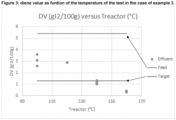
- Diene Value (DV) or Maleic Anhydride Value (MAV) correspond to the amount of maleic anhydride (expressed as equivalents of iodine) which will react with 100 parts of oil under specific conditions. It is a measure of the conjugated double bonds in the oil. One mole of Maleic anhydride corresponds to 1 conjugated double bond.
- Diene Value (DV) refers to the analytical method by titration expressed in g of iodine per 100 g of sample.
- bromine number corresponds to the amount of bromine in grams reacted by 100 grams of a sample. The number indicates the quantity of olefins in a sample. It is determined in grams of Br2 per 100 grams of solution (gBr2/100g) and can be measured for instance according to the method ASTM D1159.
- bromine index is the number of milligrams of bromine that react with 100 grams of sample. It is determined in milli grams of Br2 per 100 g of solution (mg Br2/100g) and can be measured for instance according to the method ASTM D2710.
- boiling point used refers to the boiling point generally used in the oil and gas industry. They are measured at atmospheric pressure.
- the initial boiling point is defined as the temperature value when the first bubble of vapor is formed.
- the final boiling point is the highest temperature that can be reached during a standard distillation. At this temperature, no more vapor can be driven over into the condensing units.
- the determination of the initial and the final boiling point is known per se in the art.
- the boiling range of the mixture they can be determine using various standardized methods such as for instance the ASTM D2887 relating to the boiling range distribution of petroleum fractions by gas chromatography. For compositions containing heavier hydrocarbons the ASTM D7169 can alternatively be used.
- the boiling ranges of the distillates can also advantageously be measure using the ASTM D7500.
- the surface area and porous volume are measured via N2 adsorption using usual surface area measurements.
- surface area measurements such as "BET” measurement can be used (i.e. ASTM D3663 for the surface area and D4365 for the porous volume).
- Other techniques well known in the art can also be considered such as mercury adsorption techniques (ASTM D4284). All measurements and data plots as utilized herein were made with a Micromeritics ® Tristar 3000 ® analyser.
- Surface Area Total surface area was determined by N2 sorption analysis according to ASTM D 4365 - 95 (reapproved 2008). Pore diameter and pore volume were determined according to D4641-94 (reapproved 2006).
- the concentration of metals in the matrix of hydrocarbon can be determined by any method known in the art.
- relevant characterization methods include XRF or ICP-AES methods. The man skilled in the art knows which method is the most adapted to each metal and to which hydrocarbon matrix.
- the hydrocarbon stream can contain a first diluent.
- said hydrocarbon stream contains at least 10 wt% of pyrolysis plastic oil.
- said hydrocarbon stream presents a bromine number of at most 150 g Br2/ 100g, preferably at most 100 g Br2/ 100g even more preferably at most 80 g Br2/ 100g, the most preferred at most 50 g Br2/ 100g as measured according to ASTM D1159.
- said hydrocarbon stream contains at least 25 wt % of pyrolysis plastic oil, preferably at least 50 wt% of pyrolysis plastic oil, even more preferably 75 wt % of pyrolysis plastic oil, in the most preferred embodiment at least 90 wt % of pyrolysis plastic oil. It is also possible to use pure pyrolysis plastic oil. In this latter case, the hydrocarbon stream is only pyrolysis plastic oil.
- the other component of said hydrocarbon stream may include any diluent able to limit the temperature increase at the first and/or second hydrotreating step.
- the diluent used for the first hydrotreating step can be the same or different as the diluent used for the second hydrotreating step.
- a diluent shall contain low amount, acceptable by a steam cracker or neither any olefins nor any diene.
- part of the purified hydrocarbon stream may be recycled and used as diluent.
- a naphtha can also be used as diluent.
- the use of naphtha as diluent is particularly advantaging. Indeed, in a preferred embodiment, the purified hydrocarbon stream is further sent to a steam cracker mixed together with a naphtha.
- the pyrolysis plastic oil is diluted into naphtha having a boiling range from 15 to 250°C, preferably 38 to 150°C, as measured with method ASTM D2887 to form the hydrocarbon stream at a concentration of 50 wt %, preferably 75 wt% of pyrolysis plastic oil is diluted in naphtha, even more preferably 90 wt % of pyrolysis plastic oil is diluted in the naphtha.
- the optional dewatering of the hydrocarbon stream it consists in any method known in the art to remove the water present in a hydrocarbon stream.
- water can be removed by decantation followed by separation. Water can also be removed in a flash drum.
- the hydrocarbon stream can alternatively or in addition to the other methods described, be treated over a desiccant like an alumina or molecular sieve.
- the various method described above can be used independently or in any combination.
- typical desalters comprise one or more tanks into which said hydrocarbon stream and water are added.
- the hydrocarbon stream and water are intensively mixed to enhance the phase interface, typically upstream of the settling tank.
- the salts from the hydrocarbon stream are extracted via the aqueous phase.
- Desalting is a water-washing operation performed because of the negative effect of salts in the downstream processes due to scale formation, corrosion, and catalyst deactivation.
- These salts can be found in two forms: dissolved in emulsified water droplets in the pyrolysis plastic oil, as a water-in-oil emulsion, or suspended amorphous or crystalline solids.
- the negative effects of these salts in downstream processes are: salt deposit formation as scales where water is vaporized and corrosion by hydrochloric acid formation from hydrolysis of magnesium and calcium chlorides at high temperatures (about 350 °C) as follows: CaCl2 + 2H2O ⁇ Ca(OH)2 + 2HCl MgCl2 + 2H2O ⁇ Mg(OH)2 + 2HCl
- Desalting involves mixing pyrolysis plastic oil and/or said hydrocarbon stream with washing water, using a mixing valve or static mixers to ensure a proper contact between the pyrolysis plastic oil and the water, and then passing it to a separating vessel, where separation between the aqueous and hydrocarbon phases is achieved. Since emulsions can be formed in this process, there is a risk of water carryover in the organic phase. In order to overcome this problem chemical demulsifiers are added to promote the emulsion breaking or an electric field across the settling vessel is applied to coalesce the polar salty water droplets, and, therefore, separation of salty water is achieved.
- a mixing valve is used over which a pressure drop result in shear stress over the droplets that promotes an intimate water and oil contact.
- upstream premixing devices can be used, such as spray nozzles or static mixers. The shear stress needs to be optimized to reach the right balance between smaller droplets, which improves the contact among the phases but however result in more stable emulsion.
- the mixture goes to the desalter, a horizontal cylindrical tank that provides long enough residence time to separate the water and oil mixture in two phases.
- Some water droplets diameters are so small that they do not separate by gravity; so, an electrostatic field between two electrodes installed into the desalter is used to promote coalescence.
- demulsifiers When emulsion is too stable and break only slowly, demulsifiers can be used.
- Demulsifiers are surfactants, when present at low concentration, interacts with the interfaces of the system, altering the interfacial free energies of those interfaces.
- lipophilic anionic surfactants can be expected in the pyrolysis plastic oil, resulting from the presence of polyesters, polycarbonate and polyamides and from the presence of additives like, antioxidants and UV stabilizers, containing phenols, other oxygenated aromatics and phosphorus containing compounds and slip agents, like fatty acid amides, fatty acid esters, metallic stearates (for example, zinc stearate).
- An emulsion breaker will lower the interfacial tension and result in coalescence.
- a hydrophilic demulsifiers will balance the lipophilic surfactant.
- the demulsifying agent can be chosen among water, steam, acids, caustic solutions, complexing agents and their mixtures.
- Acids are for example strong acids, in particular inorganic acids, such as phosphoric acid, sulphuric acid.
- Complexing agents are for example weak organic acids (or their corresponding anhydrides) such as acetic acid, citric acid, oxalic acid, tartaric acid, malic acid, maleic acid, fumaric acid, aspartic amino acid, ethylenediaminetetraacetic acid (EDTA).
- the demulsifying agent comprises water, steam, phosphoric acid, acetic acid, citric acid, oxalic acid, tartaric acid, malic acid, fumaric acid, aspartic amino acid, ethylenediaminetetraacetic acid, alkali, salts, chelating agents, crown ethers, or maleic anhydride.
- the traps for silicon and/or metals and/or phosphorous and/or halogenates consists in silica gel, clays, alkaline or alkaline earth metal oxide, iron oxide, ion exchange resins, active carbon, active aluminium oxide, molecular sieves, and/or porous supports containing lamellar double hydroxide modified or not and silica gel, or any mixture thereof used in the fixed bed techniques known in the art.
- the trap is able to capture silicon and/or metals and/or phosphorous and/or halogenates, being preferably chosen among Ca Mg Hg via absorption and/or adsorption or it can also be constituted of one or more active guard bed with an adapted porosity.
- the trap can be constituted of an adsorbent mass such as for instance a hydrated alumina. Molecular sieves can also be used to trap silicon. Other adsorbent can also be used such as silica gel for instance.
- the silicon trap is preferably able to trap organic silicon. Indeed, it is possible that the silicon present in the streams are in the form of organic silicon.
- silicon and/or metals and/or phosphorous and/or halogenates are trapped with activated carbon.
- Activated carbon possesses preferably a high surface area (600-1600 m2/g), and is preferably porous and hydrophobic in nature. Those properties lead to a superior adsorption of non-polar molecules or little ionized molecules. Therefore, activated carbon can be used to reduce for instance siloxane from the liquid feed at temperature from 20 to 150°C, at pressures from 1 to 100 bar or from vaporized feed from 150 to 400°C at pressure from 1 to 100 bar. Regeneration of saturated adsorbent can be performed via heating while using a sweeping gas.
- silicon and/or metals and/or phosphorous and/or halogenates are trapped with silica or silica gel.
- Silica gel is an amorphous porous material, the molecular formula usually as (SiO2) ⁇ nH2O, and unlike activated carbon, silica gel possesses polarity, which is more conducive to the adsorption of polar molecules. Because of -Si-O- Si- bonds, siloxanes exhibit partial polar character, which can contribute to adsorb on silica gel surface. The adsorption force of silica gel is often weak enough allowing regeneration of silica gel by heat treatment above 150 up to 300°C using a sweeping gas.
- silicon and/or metals and/or phosphorous and/or halogenates are trapped with molecular sieves.
- Molecular sieves are hydrous aluminosilicate substance, with the chemical formula Na2O ⁇ Al2O3 ⁇ nSiO2 ⁇ xH2O, which possesses a structure of three-dimensional crystalline regular porous and ionic exchange ability. Compared with silica gel, molecular sieves favour adsorption of high polarity. The regeneration of exhausted absorbents can be achieved via heating at high temperature to remove siloxane. Often, the regeneration is less efficient as the siloxanes might react irreversibly with the molecular sieve.
- the molecular sieves are ion-exchanged or impregnated with a basic element such as Na.
- Na2O impregnation levels range from 3-10% wt typically and the type of sieve are typically of the A or faujasite crystal structure.
- silicon and/or metals and/or phosphorous and/or halogenates are trapped with activated aluminium oxide.
- Activated aluminium oxide possesses large surface area (100-600 m2/g), which shows high affinity for siloxanes but also for polar oxide, organic acids, alkaline salts, and water. It can be an alkaline or alkaline-earth or rare-earth containing promoted alumina, the total weight content of these doping elements being less than 20%wt, the doping elements being preferably selected from Na, K, Ca, Mg, La, or mixture thereof. It can also be a metal promoted alumina where the metal is selected from group VI-B metal with hydrogenating activity such as Mo, W and/or from group VIII metal, such as Ni, Fe, Co
- silicon and/or metals and/or phosphorous and/or halogenates are trapped with alkaline oxide.
- Alkaline oxide for high temperature treatment such as calcium oxide (CaO) has strong activity to breakdown siloxanes and can be used as non-regeneratable adsorbent at temperature between 150 and 400°C.
- silicon and/or metals and/or phosphorous and/or halogenates are trapped with porous supports containing lamellar double hydroxides, being preferably an hydrotalcite.
- the hydrotalcite can comprise one or more metals with hydrogenating capacity selected from group VIB or Group VIII, preferably Mo. Those metals can be supported on the surface of the hydrotalcite, or can have been added to the actual structure of the lamellar double hydroxide, in complete or partial substitution ; as an example, but without limiting the scope of the present invention, the divalent metal, usually Mg, can be exchanged for Ni, or the trivalent metal, substituted by Fe instead of Al.
- solid adsorbents can be used alone or in combination in order to optimize the removal of silicon and/or metals and/or phosphorous and/or halogenates.
- silicon and/or metals and/or phosphorous and/or halogenates are trapped with a multi layered guard bed comprising at least two layers wherein the layer on the top of the bed is selected from silica gel, clays, alkaline or alkaline earth metal oxide, iron oxide, ion exchange resins, active carbon, active aluminium oxide, molecular sieves and wherein the layer on the bottom of the bed is selected from silica gel, clays, alkaline or alkaline earth metal oxide, iron oxide, ion exchange resins, active carbon, active aluminium oxide, molecular sieves. More preferably said layer on the top of the guard bed comprises silica gel and/or active carbon and said layer on the bottom of the guard bed comprises molecular sieves and/or active aluminium oxide.
- adsorbents can be used such as silica, clays - such as bentonite, hydrotalcite - alkaline or alkaline earth metal oxide - such as iron oxides, copper oxides, zinc oxide, sodium oxide, calcium oxide, magnesium oxide- alumina and alkaline or alkaline-earth promoted alumina-, iron oxide (hematite, magnetite, goethite), ion exchange resins or combination thereof.
- silicon and/or metals and/or phosphorous and/or halogenates containing at least 500 ppm wt of HCl based on the total amount of pyrolysis plastic oil are trapped with activated alumina.
- HCl is a polar molecule, it interacts with polar sites on the alumina surface such as hydroxyl groups.
- the removal mechanism relies predominantly on physical adsorption and low temperature and the high alumina surface area is required to maximize the capacity for HCl removal.
- the HCl molecules remain physically adsorbed as a surface layer on the alumina and can be removed reversibly by hot purging.
- Promoted aluminas are a hybrid in which a high alumina surface area has been impregnated with a basic metal oxide or similar salts, often of sodium or calcium.
- the alumina surface removes HCl through the mechanisms previously described, however the promoter chemically reacts with the HCl giving an additional chloride removal mechanism referred to as chemical absorption.
- the HCl is captured by formation of sodium chloride. This chemical reaction is irreversible unlike physical adsorption and its rate is favoured by higher temperature.
- the promoted alumina chloride guards are very effective for liquid feeds due to the irreversible nature and high rate of the chemical reaction once the HCl reaches the reactive site.
- Another class of chemical absorbents combines Na, Zn and Al oxides in which the first two react with HCl to form complex chloride phases, for example Na 2 ZnCl 4 and the chemical reactions are irreversible.
- U.S. 4,639,259 and 4,762,537 relate to the use of alumina-based sorbents for removing HCl from gas streams.
- U.S. 5,505,926 and 5,316,998 disclose a promoted alumina sorbent for removing HCl from liquid streams by incorporating an alkali metal oxide such as sodium in excess of 5% by weight on to an activated alumina base.
- Other Zn-based products range from the mixed metal oxide type composed of ZnO and Na2O and/or CaO. The rate of reaction is improved with an increase in reactor temperature for those basic (mixed) oxides.
- the optional guard bed to trap solid particles is located on the top of said first and/or second hydrotreating, it is placed on the top of said first and/or second hydrotreating to remove the solid particles remaining in the feed such as coke particles coming from heating tubes, iron scales from corrosion, dissolved impurities such as iron, arsenic, calcium-containing compounds, sodium chloride, silicon contained in upstream additives, etc. Grading materials which have high void space to accumulate and 'store' these particulates are frequently used. Effective feed filtration to remove particulates in combination with high void grading provides a longer mitigation of pressure drop buildup.
- said guard bed to trap solid particles has a continuously decreasing particle size including a region 25 to 150 centimeters of particles, having a fraction of 0.3 to 2.0 cm diameter range. Since such guard beds to trap solid particles are designed specifically to handle the contaminants, they help to prolong the life of the hydrotreating catalyst and require fewer total catalyst changeouts.
- the impurities removal treatment step to remove silicon, phosphorous, metals and/or halogenate compounds it consists preferably of a solvent extraction unit.
- the solvent can be water, alcohol, NaOH, KOH, etc.
- the first hydrotreating step it consists mainly in the hydrogenation phase to saturate the conjugated diene and alkynes into mainly olefins.
- the first step hydrotreating is performed either in liquid phase or in trickle bed mode. This step is well known in steam cracking unit as 1 st step hydrogenation of pyrolysis gasoline.
- the first hydrotreating step will hydrogenate the diene and in particularly the conjugated diene and acetylenic bonds.
- the first hydrotreating step will lead to a decrease the diene value.
- the decrease of the diene value observed between the inlet and the outlet of the first hydrotreating step should be of at least 10% preferably at least 25 % as measured according to UOP 326.
- the second hydrotreating step consists in a step at a temperature higher than 200°C, in presence of hydrogen with well-known catalysts to hydrogenate the olefins and to convert sulfur, nitrogen components into respectively H2S and NH3.
- This step can have also a metal trap function, a cracking function, a de-aromatization function depending of the characteristic of the catalyst and the used operating condition.
- This step can be performed in one reactor with different layers of catalysts or several reactors in series depending of the function sought.
- the preferred operating conditions advantageously be the following: the preferred inlet temperature is of at least 200°C and at most 500°C; the preferred LHSV is between 1 to 10h-1, preferably 2 to 4h-1; the preferred pressure ranges from 10 to 90 barg in presence of H2; the ratio H2/hydrocarbon ranges from 200 NUL to 900 NUL, preferably in the presence of at least 0.005 wt %, preferably 0.05 wt % even more preferably 0.5 wt% of sulphur, being preferably H2S or organic sulfur compounds, in the stream.
- mixed plastics e.g., waste plastics
- pyrolysis unit the waste plastic is converted via pyrolysis to a pyrolysis product, wherein the pyrolysis product comprises a gas phase (e.g., pyrolysis gases, such as C1 to C4 gases, hydrogen (H2 ), carbon monoxide (CO), carbon dioxide (CO2) mainly) and a liquid phase being pyrolysis plastic oil.
- a gas phase e.g., pyrolysis gases, such as C1 to C4 gases, hydrogen (H2 ), carbon monoxide (CO), carbon dioxide (CO2) mainly
- the plastic waste may include post-consumer waste plastics, such as mixed plastic waste.
- Mixed plastics can comprise non-chlorinated plastics (e.g., polyolefins, polyethylene, polypropylene, polystyrene, copolymers, etc.), chlorinated plastics (e.g., polyvinylchloride (PVC), polyvinylidene chloride (PVDC), etc.), and the like, or mixtures thereof.
- non-chlorinated plastics e.g., polyolefins, polyethylene, polypropylene, polystyrene, copolymers, etc.
- chlorinated plastics e.g., polyvinylchloride (PVC), polyvinylidene chloride (PVDC), etc.
- waste plastics comprise long chain molecules or polymer hydrocarbons. Waste plastics may also include used tires.
- the pyrolysis unit may be any suitable vessel configured to convert waste plastics into gas phase and liquid phase products (e.g., simultaneously).
- the vessel may be configured for gas phase, liquid phase, vapor-liquid phase, gas-solid phase, liquid-solid phase, or slurry phase operation.
- the vessel may contain one or more beds of inert material or pyrolysis catalyst comprising sand, zeolite, alumina, a catalytic cracking catalyst, or combinations thereof.
- the pyrolysis catalyst is capable of transferring heat to the components subjected to the pyrolysis process in the pyrolysis unit.
- the pyrolysis unit can be operated without any catalyst (e.g., pure thermal pyrolysis).
- the pyrolysis unit may be operated adiabatically, isothermally, nonadiabatically, non-isothermally, or combinations thereof.
- the pyrolysis reactions of this disclosure may be carried out in a single stage or in multiple stages.
- the pyrolysis unit can be two reactor vessels fluidly connected in series.
- the pyrolysis process may be divided into a first stage which is performed in a first vessel and in a second stage fluidly connected downstream of the first stage which is performed in the second vessel.
- the second stage may enhance the pyrolysis of an intermediate pyrolysis product stream flowing from the first stage into the second stage, to yield a pyrolysis product flowing from the second stage.
- the first stage may utilize thermal cracking of the waste plastics
- the second stage may utilize thermal or catalytic cracking of the waste plastics to yield the pyrolysis product flowing from the second stage.
- the first stage may utilize catalytic cracking of the waste plastics
- the second stage may utilize thermal or catalytic cracking of the waste plastics to yield the pyrolysis product flowing from the second stage.
- the pyrolysis unit may include one or more equipment configured to convert mixed plastics into gas phase and liquid phase products.
- the one or more equipment may or may not contain an inert material or pyrolysis catalyst as described above.
- Examples of such equipment include one or more of heated extruders, heated rotating kiln, heated tank-type reactors, packed bed reactors, bubbling fluidized bed reactors, circulating fluidized bed reactors, empty heated vessels, enclosed heated surfaces where plastic flows down along the wall and cracks, vessels surrounded by ovens or furnaces, or any other suitable equipment offering a heated surface to assist in cracking.
- the pyrolysis unit can be configured to pyrolyze (e.g., crack), and in some aspect (e.g., where hydrogen is added to the pyrolysis unit), additionally hydrogenate components of the waste plastic stream fed to the pyrolysis unit.
- reactions which may occur in the pyrolysis unit include, but are not limited to isomerization of one or more normal paraffins to one or more i- paraffins, selective ring opening of one or more cycloparaffins to one or more i-paraffins, cracking of long chain length molecules to short chain length molecules, removal of heteroatoms from heteroatom-containing hydrocarbons (e.g., dechlorination), hydrogenation of coke generated in the process, or combinations thereof.
- a head space purge gas can be utilized in all or a portion of the pyrolysis stage(s) (conversion of waste plastics to a liquid phase and/or gas phase products) to enhance cracking of plastics, produce valuable products, provide a feed for steam cracking, or combinations thereof.
- the head space purge gas may include hydrogen (H2 ), C1 to C4 hydrocarbon gases (e.g., alkanes, methane, ethane, propane, butane, isobutane), inert gases (e.g., nitrogen (N2 ), argon, helium, steam), and the like, or combinations thereof.
- the use of a head space purge gas assists in the dechlorination in the pyrolysis unit, when the waste plastic comprises chlorinated plastics.
- the head space purge gas may be introduced to the pyrolysis unit to aid in the removal of volatiles entrained in the melted mixed plastics present in the pyrolysis unit.
- a hydrogen (H2) containing stream can be added to the pyrolysis unit to enrich the pyrolysis unit environment with H2, assist in stripping entrapped hydrogen chloride in the pyrolysis unit, provide a local environment rich in hydrogen in the pyrolysis melt or liquid, or combinations thereof; for example via a H2 containing stream fed directly to the pyrolysis unit independently of the waste plastic stream.
- H2 can also be introduced along with stream to the pyrolysis unit, with adequate safety measures incorporated for hydrogen handling with plastics feed.
- the pyrolysis unit may facilitate any reaction of the components of the waste plastic stream in the presence of, or with, hydrogen. Reactions may occur such as the addition of hydrogen atoms to double bonds of unsaturated molecules (e.g., olefins), resulting in saturated molecules (e.g., paraffins, i- paraffins, naphthenes). Additionally or alternatively, reactions in the pyrolysis unit may cause a rupture of a bond of an organic compound, with a subsequent reaction and/or replacement of a heteroatom with hydrogen.
- unsaturated molecules e.g., olefins
- saturated molecules e.g., paraffins, i- paraffins, naphthenes
- the use of hydrogen in the pyrolysis unit can have beneficial effects of i) reducing the coke as a result of cracking, ii) keeping the catalyst used (if any) in the process in an active condition, iii) improving removal of chloride from stream such that the pyrolysis product from pyrolysis unit is substantially dechlorinated with respect to waste plastic stream, which minimizes the chloride removal requirement in units downstream of the pyrolysis unit, iv) hydrogenating of olefins, v) reducing diolefins in pyrolysis product, vi) helping operate the pyrolysis unit at reduced temperatures for same levels of conversion of waste plastic stream in the pyrolysis unit, or combinations of i) -vi).
- the pyrolysis processes in the pyrolysis unit may be low severity or high severity.
- Low severity pyrolysis processes may occur at a temperature of less than about 450 °C, alternatively 250 °C to 450 °C, alternatively 275 °C to 425 °C, or alternatively 300 °C to 400 °C, and may produce pyrolysis oils rich in mono- and di-olefins as well as a significant amount of aromatics.
- High severity pyrolysis processes may occur at a temperature of equal to or greater than about 450 °C, alternatively 450 °C to 750 °C, alternatively 500 °C to 700 °C, or alternatively 550 °C to 650 °C, and may produce pyrolysis oils rich in aromatics, as well as more gas products (as compared with low severity pyrolysis).
- a high severity pyrolysis process will lead to the formation of more olefins and diolefins. Those olefins and diolefins cannot easily be recovered. The hydrotreatment of the present disclosure is therefore required.
- a pyrolysis product can be recovered as an effluent from the pyrolysis unit and conveyed (e.g., flowed, for example via pumping, gravity, pressure differential, etc.) to a pyrolysis separating unit.
- the pyrolysis product can be separated in the pyrolysis separating unit into a pyrolysis gas stream and a pyrolysis plastic oil further used in step a) of the present disclosure.
- the pyrolysis separating unit may comprise any suitable gas-liquid separator, such as a vapor-liquid separator, oil-gas separators, gas-liquid separators, degassers, scrubbers, traps, flash drams, compressor suction drams, gravity separators, centrifugal separators, filter vane separators, mist eliminator pads, liquid-gas coalescers, distillation columns, and the like, or combinations thereof.
- a gas-liquid separator such as a vapor-liquid separator, oil-gas separators, gas-liquid separators, degassers, scrubbers, traps, flash drams, compressor suction drams, gravity separators, centrifugal separators, filter vane separators, mist eliminator pads, liquid-gas coalescers, distillation columns, and the like, or combinations thereof.
- the feedstock of the steam cracker in addition to the stream obtained via the inventive process can be ethane, liquefied petroleum gas, naphtha or gasoils.
- Liquefied petroleum gas (LPG) consists essentially of propane and butanes. Gasoils have a boiling range from about 200 to 350°C, consisting of C10 to C22 hydrocarbons, including essentially linear and branched paraffins, cyclic paraffins and aromatics (including mono-, naphtho- and poly-aromatic).
- the cracking products obtained at the exit of the steam cracker may include ethylene, propylene and benzene, and optionally hydrogen, toluene, xylenes, and 1,3-butadiene.
- the outlet temperature of the steam cracker may range from 800 to 1200°C, preferably from 820 to 1 100°C, more preferably from 830 to 950°C, more preferably from 840°C to 920°C.
- the outlet temperature may influence the content of high value chemicals in the cracking products produced by the present process.
- the residence time in the steam cracker, through the radiation section of the reactor where the temperature is between 650 and 1200°C may range from 0.005 to 0.5 seconds, preferably from 0.01 to 0.4 seconds.
- steam cracking is done in presence of steam in a ratio of 0.1 to 1.0 kg steam per kg of hydrocarbon feedstock, preferably from 0.25 to 0.7 kg steam per kg of hydrocarbon feedstock in the steam cracker, preferably in a ratio of 0.35 kg steam per kg of feedstock mixture, to obtain cracking products as defined above.
- the reactor outlet pressure may range from 500 to 1500 mbars, preferably from 700 to 1000 mbars, more preferably may be approx. 850 mbars.
- the residence time of the feed in the reactor and the temperature are to be considered together.
- a lower operating pressure results in easier light olefins formation and reduced coke formation.
- the lowest pressure possible is accomplished by (i) maintaining the output pressure of the reactor as close as possible to atmospheric pressure at the suction of the cracked gas compressor (ii) reducing the pressure of the hydrocarbons by dilution with steam (which has a substantial influence on slowing down coke formation).
- the steam/feedstock ratio may be maintained at a level sufficient to limit coke formation.
- Effluent from the steam cracker contains unreacted feedstock, desired olefins (mainly ethylene and propylene) , hydrogen, methane, a mixture of C4's (primarily isobutylene and butadiene), pyrolysis gasoline (aromatics in the C6 to C8 range), ethane, propane, di-olefins (acetylene, methyl acetylene, propadiene), and heavier hydrocarbons that boil in the temperature range of fuel oil (pyrolysis fuel oil).
- This cracked gas is rapidly quenched to 338-510°C to stop the pyrolysis reactions, minimize consecutive reactions and to recover the sensible heat in the gas by generating high-pressure steam in parallel transfer-line heat exchangers (TLE's).
- the TLE-quenched gas stream flows forward to a direct water quench tower, where the gas is cooled further with recirculating cold water.
- a prefractionator precedes the water quench tower to condense and separate the fuel oil fraction from the cracked gas.
- the major portions of the dilution steam and heavy gasoline in the cracked gas are condensed in the water quench tower at 35-40°C.
- the water-quench gas is subsequently compressed to about 25-35 Bars in 4 or 5 stages.
- the condensed water and light gasoline are removed, and the cracked gas is washed with a caustic solution or with a regenerative amine solution, followed by a caustic solution, to remove acid gases (CO2, H2S and SO2).
- the compressed cracked gas is dried with a desiccant and cooled with propylene and ethylene refrigerants to cryogenic temperatures for the subsequent product fractionation: front-end demethanization, front-end depropanization or front-end deethanization.
- the purification of a hydrocarbon stream comprises the following steps:
- said pyrolysis plastic oil in said hydrocarbon stream may have a starting boiling point of at least 15°C, and a final boiling point of preferably 560°C, more preferably 450°C even more preferably 350°C, the most preferred 250°C, and/or said pyrolysis plastic oil has a diene value of at least 1.5, preferably 2, even more preferably 5 g l2/100 g, to at most 50 gl2/100 g as measured according to UOP 326, and/or contains more than 2 ppm wt of metals and/or said hydrocarbon stream contains preferably at least 25 wt %, even more preferably at least 50 wt %, even more preferably at least 75 wt % of said pyrolysis plastic oil and preferably at most 80 wt % of pyrolysis plastic oil, and/or at most 90 wt % preferably at most 95 wt %, even more preferably at most 100 wt % of said pyr
- the weight concentration of said pyrolysis plastic oil in said hydrocarbon stream may be chosen so that the total content of olefins, alkynes and diolefins in said hydrocarbon stream at the inlet of the second hydrotreatment is at most 20 wt%, preferably at most 15 wt%, most preferably at most 10 wt %.
- said trap of step b) may be a silicon trap working at a temperature ranging from 20 to 100°C and/or a LHSV between 1 to 10h-1, and/or a pressure ranging from 1 to 90 barg and/or said trap of step d) is a silicon trap working at a temperature of at least 200°C, and/or a LHSV between 1 to 10h-1, and/or a pressure ranging from 10 to 90 barg in presence of H2.
- said pyrolysis plastic oil and/or said hydrocarbon stream of step a) may be treated before step b) in one or more of the followed pre-treatment unit:
- a further dilution may be performed with the help of a diluent, said diluent being preferably a second hydrocarbon stream having a boiling range between 50°C and 150°C or a boiling range between 150°C and 250°C or a boiling range between 200°C and 350°C or with the effluent of said first and/or said second hydrotreating or any mixture thereof; said diluent being added to be at a concentration of at most 80 wt %, preferably at most 50 wt % and optionally said diluent is separated at the outlet of said first and/or of said second hydrotreating by a flash, or a distillation and preferably recycled at the inlet of said first and/or of said second hydrotreating and/or said diluent has preferably a bromine number of at most 5 gBr2/100g, and/or a diene value of at most 0.5
- the stream entering the second hydrotreating may be further diluted with any stream containing paraffins with an optional addition of a sulfur component, for instance DMDS, so that the concentration of sulfur is of at least 0.005 wt % of sulfur, preferably 0.05 wt % of sulfur to at most 0.5 wt %.
- a sulfur component for instance DMDS
- said purified hydrocarbon stream obtained at step f) is further mixed with naphtha, gasoil or crude oil to have a pyrolysis plastic oil concentration at the inlet of the steam cracker ranging from 0.01 wt % to at most 50 wt %; preferably 0.1 wt % to 25 wt % even more preferably 1 wt % to 20 wt % and sent to a steam cracker to produce olefins, such as ethylene and propylene, and aromatics.
- olefins such as ethylene and propylene, and aromatics.
- the part of effluent of the second hydrotreating step having an initial boiling point higher than 200°C, preferably higher than 300°C even more preferably higher than 350°C may be sent to a FCC, or an hydrocracking unit, or a coker or a visbreaker or blended in crude oil or crude oil cut to be further refined.
- said pyrolysis plastic oil of step a) may be originating from the stream of pyrolyzed waste plastic for which the C1 to C4 hydrocarbons have been removed and/or the components having a boiling point higher than 350°C have been removed and/or preferably further converted into a FCC, or an hydrocracking unit, a coker or a visbreaker or blended in crude oil or crude oil cut to be further refined.
- the effluent obtained after said second hydrotreating step may be further hydrocracked at a temperature of 350-430°C, a pressure of 30 - 180barg, a LHSV of 0.5-4 h-1, and/or under a H2 to hydrocarbons ratio of 800-2000 NL:L to reduce the final boiling point of with least 10% .
- said first diluent may be selected from a naphtha and/or a paraffinic solvent and/or a diesel or a straight run gasoil, containing at most 1 wt % of sulfur, preferably at most 0.1 wt % of sulfur, and/or an hydrocarbon stream having a boiling range between 50°C and 150°C or a boiling range between 150°C and 250°C or a boiling range between 200°C and 350°C having preferably a bromine number of at most 5 gBr2/100g, and/or a diene value of at most 0.5 gl2/100g even more preferably said first diluent is said purified hydrocarbon stream recovered at step e) or any combination thereof.
- Example 1 2 nd stage hydrotreating with active guard bed to trap silicon compound
- the tests were performed with a sulfided NiMo catalyst by using a mixed feed C6/C7-C9 (60%wt-40%wt) doped with silicon compounds ( ⁇ 10 wppm of hexamethylcyclotrisiloxane (HMCTS) and ⁇ 10 wppm of octamethylcyclotetrasiloxane (OMCTS) representative, according to the literature', of the decomposition of polysiloxanes.
- HMCTS hexamethylcyclotrisiloxane
- OMCTS octamethylcyclotetrasiloxane
- the trap is convenient and efficient, even at higher LHSV.
- Example 2 2 nd stage hydrotreating with active guard bed to trap silicon compound and hydrogenate
- the Pyrolysis oil was diluted in an inert product (Isoparaffinic cut) and characterized. Feed FEED-50% IBP-FBP (°C) 83-427 MV15 (g/ml) 0,7806 S by UV (ppm) 6,2 N (ppm) 103,5 Chlorine (ppm) 44 Metals par ICP-AES (ppm) Fe :4, K:1 Si by XRF (ppm) 35 Br Number_ (gBr/100g) 33 Diene Value (gl2/100g) 1,7
- NiMo catalyst is able to both hydrogenate the olefins and at the same time trapping the siloxanes.
- the tests were performed using a pyrolysis plastic oil cut having a boiling point ranging from 70°C to 460°C, a DV of about 4 gl2/100g, a nitrogen content of about 210 wtppm and a sulfur content of about 20 ppm.
- a Ni on alumina catalyst was used in dilution 1:2 with silicon carbide 0,21 mm as diluent (50 ml of catalyst for 100 ml of SiC).
- the Nickel catalyst was dried under nitrogen (50 NI/h) at 180°C and reduced under hydrogen (minimum 20 NI/h) at about 400°C during min 15h; then the temperature was reduced till 180°C and the hydrogen was replaced by nitrogen to purge the reactor. Finally, the temperature was reduced to 50°C and a paraffinic feed was injected to stabilize the catalyst.
- the pyrolysis plastic oil cut was used pure.
- the tests were performed using a pyrolysis oil cut having a boiling point ranging from 20 to 250°C, a MAV of about 32.
- a sulfided NiMo on alumina catalyst was used in dilution with silicon carbide at equal volumes.
- the pyrolysis oil cut was diluted with a paraffinic diluent to have a MAV at the inlet of about 21 mg anhydride maleic/g (or a DV of about 5,4 gl2/100 g).
- Example 5 Adsorbents used in fixed bed reactor.
- adsorbents will behave as it is presented in the results below.
- the tests were performed using a pyrolysis plastic oil cut having a boiling point ranging from 40°C to 350°C.
- the water is expected to be below 100ppm weight.
- the chlorine content of is expected to be in the range of about 200 ppm
- the silicon content is expected to be in the range of about 100 ppm.
- the oxygen content of is expected in the range of about 1.0 wt%.
- the nitrogen is probably less than 2000 ppm wt.
- the adsorbent is chosen as being a promoted alumina (or active aluminium oxide) of spherical shape with 3.0 mm mean diameter with a surface area of 220 m2/g and a density of 0.75 kg/L.
- the adsorbent is disposed in a fixed bed under a continuous flow. Before the test the adsorbent shall be dried under nitrogen in up flow mode.
- the pyrolysis plastic oil shall be injected up flow. Dilution of the pyrolysis plastic oil with a first diluent can be done prior to the adsorption over the adsorbent. Alternatively, the pyrolysis plastic oil can be passed through the adsorbent without being diluted. This latter option was estimated in this example.
- the pyrolysis oil was injected in up flow mode at 20°C under nitrogen blanketing. Pyrolysis Oil Density @15°C g/mL 0.80 Silicon ppm 100 Oxygen wt% 1.0 Chlorine ppm 200 Nitrogen ppm 2000
- the overall oxygen uptake by the adsorbent is ranging from 2 to 15 wt% depending on operating conditions especially LHSV and the physical-chemical properties and nature of adsorbent used. This overall uptake corresponds to the maximal amount of oxygen containing impurities which can be trapped within the said adsorbent.
- the promoted alumina and silica gel should allow to trap oxygen, chlorine, nitrogen and also silicon to a certain extend too.
Landscapes
- Chemical & Material Sciences (AREA)
- Oil, Petroleum & Natural Gas (AREA)
- Engineering & Computer Science (AREA)
- Organic Chemistry (AREA)
- Chemical Kinetics & Catalysis (AREA)
- General Chemical & Material Sciences (AREA)
- Wood Science & Technology (AREA)
- Life Sciences & Earth Sciences (AREA)
- Thermal Sciences (AREA)
- Physics & Mathematics (AREA)
- Materials Engineering (AREA)
- Inorganic Chemistry (AREA)
- Analytical Chemistry (AREA)
- Production Of Liquid Hydrocarbon Mixture For Refining Petroleum (AREA)
- Separation, Recovery Or Treatment Of Waste Materials Containing Plastics (AREA)
Claims (15)
- Prozess zur Reinigung und Behandlung eines Kohlenwasserstoffstroms, der die folgenden Schritte umfasst:a) Bereitstellen eines Kohlenwasserstoffstroms, der einen Dien-Wert von höchstens 1,5 g 12/100 g, bevorzugt höchstens 1,0, bevorzugt, noch bevorzugter höchstens 0,5 g 12/100 g, nach UOP 326 gemessen, und eine Bromzahl von mindestens 5 g Br2/100 g, nach ASTM D1159 gemessen, aufweist und mindestens 10 Gew.-% Pyrolysekunststofföl enthält, wobei der andere Teil des Kohlenwasserstoffstroms ein erstes Verdünnungsmittel ist, oder alternativ Bereitstellen eines Kohlenwasserstoffstroms, der nur Pyrolysekunststofföl enthält;b) gegebenenfalls Inkontaktbringen des in Schritt a) erhaltenen Abstroms mit Kieselgel, Tonen, Alkali- oder Erdalkalimetalloxid, Eisenoxid, Ionenaustauscherharzen, Aktivkohle, aktivem Aluminiumoxid, Molekularsieben, Alkalioxid und/oder porösen Trägern, die modifiziertes oder nicht modifiziertes lamellares Doppelhydroxid und Kieselgel enthalten, oder einem Gemisch davon, um Silicium und/oder Metalle und/oder Phosphor und/oder Halogenate zu fangen;c) gegebenenfalls Durchführen eines ersten Hydrobehandlungsschritts des in Schritt a) oder b) erhaltenen Abstroms bei einer Temperatur von höchstens 225 °C, bevorzugt 200 °C;d) Inkontaktbringen des im vorhergehenden Schritt erhaltenen Abstroms mit Kieselgel, Tonen, Alkali- oder Erdalkalimetalloxid, Eisenoxid, Ionenaustauscherharzen, Aktivkohle, aktivem Aluminiumoxid, Molekularsieben, Alkalioxid und/oder porösen Trägern, die modifiziertes oder nicht modifiziertes lamellares Doppelhydroxid und Kieselgel enthalten, oder einem Gemisch davon, um Silicium und/oder Metalle und/oder Phosphor und/oder Halogenate zu fangen;e) Durchführen eines zweiten Hydrobehandlungsschritts bei einer Temperatur von mindestens 200 °C,f) Gewinnen eines gereinigten Kohlenwasserstoffstroms,dadurch gekennzeichnet, dass der zweite Hydrobehandlungsschritt über mindestens einem Katalysator durchgeführt wird, der sowohl (i) eine Hydrobehandlungsfunktion, nämlich mindestens ein Metall der Gruppe VIB, wie zum Beispiel Mo, W, in Kombination mit einem Promotor oder nicht, ausgewählt aus mindestens einem Metall der Gruppe VIII und/oder VIIIB, wie zum Beispiel Ni und/oder Co, und/oder einem Gemisch davon, wobei diese Metalle bevorzugt in sulfidierter Form verwendet werden, als auch (ii) eine Fallenfunktion aufweist, nämlich dass der Katalysator eine BET-Oberfläche im Bereich von 150 m2/g bis 400 m2/g aufweist,der in Schritt f) erhaltene gereinigte Kohlenwasserstoffstrom mit Naphtha, Gasöl oder Rohöl gemischt wird, sodass er eine Pyrolysekunststoffölkonzentration im Bereich von 0,01 Gew.-% bis höchstens 50 Gew.-% aufweist; bevor er mindestens teilweise zu einem Dampfcracker weitergeschickt wird, um Olefine, wie etwa Ethylen und Propylen, und Aromaten herzustellen.
- Prozess nach einem der vorstehenden Ansprüche, der die folgenden Schritte umfasst: b) Inkontaktbringen des in Schritt a) erhaltenen Abstroms mit Kieselgel, Tonen, Alkali- oder Erdalkalimetalloxid, Eisenoxid, Ionenaustauscherharzen, Aktivkohle, aktivem Aluminiumoxid, Molekularsieben, Alkalioxid und/oder porösen Trägern, die modifiziertes oder nicht modifiziertes lamellares Doppelhydroxid und Kieselgel enthalten, oder einem Gemisch davon, um Silicium und/oder Metalle und/oder Phosphor und/oder Halogenate zu fangen; und c) Durchführen eines ersten Hydrobehandlungsschritts des in Schritt a) oder b) erhaltenen Abstroms bei einer Temperatur von höchstens 225 °C, bevorzugt 200 °C.
- Prozess nach einem der vorstehenden Ansprüche, wobei das Pyrolysekunststofföl in dem Kohlenwasserstoffstrom einen Anfangssiedepunkt von mindestens 15 °C und einen Endsiedepunkt von höchstens 700 °C, bevorzugt höchstens 600 °C, noch bevorzugter höchstens 560 °C, bevorzugter 450 °C, noch bevorzugter 350 °C, am bevorzugtesten 250 °C aufweist, und/oder das Pyrolysekunststofföl einen Dien-Wert von höchstens 50 g 12/100 g, bevorzugt höchstens 25 g 12/100 g, noch bevorzugter höchstens 10 g 12/100 g, nach UOP 326 gemessen, aufweist und/oder mehr als 2 Gew.-ppm Metalle enthält, und/oder das Pyrolysekunststofföl mindestens 5 Gew.-ppm Si bis bevorzugt höchstens 5000 Gew.-ppm, und/oder mindestens 1 Gew.-ppm Cl bis bevorzugt höchstens 5000 Gew.-ppm und/oder mindestens 1 Gew.-ppm P bis bevorzugt höchstens 5000 Gew.-ppm, bezogen auf das Gesamtgewicht des Pyrolysekunststofföls, umfasst, und/oder der Kohlenwasserstoffstrom bevorzugt mindestens 25 Gew.-%, noch bevorzugter mindestens 50 Gew.-%, noch bevorzugter mindestens 75 Gew.-% des Pyrolysekunststofföls und bevorzugt höchstens 80 Gew.-% Pyrolysekunststofföl und/oder höchstens 90 Gew.-%, bevorzugt höchstens 95 Gew.-%, noch bevorzugter höchstens 100 Gew.-% des Pyrolysekunststofföls enthält.
- Prozess nach einem der vorstehenden Ansprüche, wobei bezüglich des ersten Hydrobehandlungsschritts des Kohlenwasserstoffstroms eine oder mehrere der folgenden Aussagen zutreffen:- die Einlasstemperatur liegt im Bereich von 25 bis 225 °C, bevorzugt 200 °C;- die LHSV liegt im Bereich von 1 bis 10 h-1, bevorzugt von 1 bis 6 h-1, noch bevorzugter von 2 bis 4 h-1;- der Druck liegt im Bereich von 10 bis 90 barg, bevorzugt von 15-50 barg oder bevorzugt von 25 bis 40 barg in Gegenwart von H2 und/oder das Molverhältnis von H2 zur Gesamtmolmenge von Alkinen und Dienen in dem Kohlenwasserstoffstrom beträgt mindestens 1,5, bevorzugt mindestens 2, am bevorzugtesten mindestens 3 bis höchstens 15;- der erste Hydrobehandlungsschritt wird in einem oder mehreren Katalysatorbetten mit bevorzugt einem Gesamttemperaturanstieg von höchstens 150 °C, bevorzugter von höchstens 100 °C, und/oder einem Temperaturanstieg von höchstens 100 °C, bevorzugter von höchstens 50 °C bei jedem Katalysatorbett, mit bevorzugt Zwischenabschreckung zwischen den Katalysatorbetten durchgeführt, wobei die Abschreckung bevorzugt mit H2 oder mit dem in Schritt f) gewonnenen gereinigten Kohlenwasserstoffstrom durchgeführt wird;- der erste Schritt wird in einem Festbettreaktor bevorzugt über einem Katalysator durchgeführt, der mindestens ein Metall der Gruppe VIII umfasst, bevorzugt ausgewählt aus der Gruppe Pt, Pd, Ni und/oder einem Gemisch davon auf einem Träger wie etwa Aluminiumoxid, Titandioxid, Siliciumdioxid, Zirkoniumdioxid, Magnesiumoxid, Kohlenstoff und/oder Gemischen davon; bevorzugt ist der Katalysator ein Katalysator auf Ni-Basis, der nach seiner Reduktion unter Verwendung von bevorzugt Di-Alkyl-Sulfid wie etwa DiMethylSulfid (DMS) oder DiEthylSulfid (DES) oder Thiophenverbindungen passiviert wird;- der erste Schritt kann auch in einem Festbettreaktor durchgeführt werden, bevorzugt über einem Katalysator, der mindestens ein Metall der Gruppe VIB, wie zum Beispiel Mo, W, in Kombination mit einem Promotor oder nicht umfasst, ausgewählt aus mindestens einem Metall der Gruppe VIII und/oder VIIIB, wie zum Beispiel Ni und/oder Co, und/oder einem Gemisch davon, wobei diese Metalle in sulfidierter Form und bevorzugt auf Aluminiumoxid, Titandioxid, Zirkoniumdioxid, Siliciumdioxid, Kohlenstoff und/oder Gemischen davon getragen verwendet werden; und/oder- der am Ende des ersten Hydrobehandlungsschritts erhaltene Abstrom weist einen Dien-Wert von höchstens 1,5 g 12/100 g, bevorzugt höchstens 1,0 g 12/100 g, noch bevorzugter höchstens 0,5 g 12/100 g auf;- in dem Kohlenwasserstoffstrom weisen, bezogen auf das Gesamtgewicht des Kohlenwasserstoffstroms, mindestens 10 Gew.-%, bevorzugt mindestens 15 Gew.-%, bevorzugt mindestens 25 Gew.-%, noch bevorzugter mindestens 50 Gew.-% des Kohlenwasserstoffstroms einen Siedepunkt von mindestens 150 °C auf.
- Prozess nach einem der vorstehenden Ansprüche 1 bis 4, wobei die Falle aus Schritt b) ein Kieselgel, Aktivkohle, aktiviertes Aluminiumoxid und/oder Molekularsiebe ist, die bei einer Temperatur im Bereich von 20 bis 100 °C und/oder einer LHSV zwischen 1 bis 10 h-1 und/oder einem Druck im Bereich von 1 bis 90 barg in Gegenwart von H2 oder in Abwesenheit von H2 arbeiten.
- Prozess nach einem der vorstehenden Ansprüche, wobei die Falle aus Schritt d) ein Kieselgel, Aktivkohle, aktiviertes Aluminiumoxid und/oder Molekularsiebe ist, die bei einer Temperatur von höchstens 250 °C, bevorzugt höchstens 200 °C, und/oder einer LHSV zwischen 1 bis 10 h-1 und/oder einem Druck im Bereich von 1, bevorzugt 10 barg bis 90 barg in Gegenwart von H2 oder in Abwesenheit von H2 arbeiten.
- Prozess nach einem der vorstehenden Ansprüche, wobei bezüglich des zweiten Hydrobehandlungsschritts eine oder mehrere der folgenden Aussagen zutreffen:- nach dem zweiten Hydrobehandlungsschritt beträgt die Olefinkonzentration, über die Bromzahl in dem gereinigten Kohlenwasserstoffstrom gemessen, höchstens 5,0, bevorzugt höchstens 2,0 g Br2/100 g, bevorzugter höchstens 1,5 g Br2/100 g, noch bevorzugter höchstens 0,5 g Br2/100 g, nach ASTM D1159 gemessen;- der zweite Hydrobehandlungsschritt wird in einem oder mehreren Katalysatorbetten mit bevorzugt einem Gesamttemperaturanstieg von höchstens 100 °C und/oder einem Temperaturanstieg von höchstens 50 °C über jedem Katalysatorbett, mit bevorzugt Zwischenabschreckung zwischen den Katalysatorbetten durchgeführt, wobei die Abschreckung bevorzugt mit H2 oder mit dem in Schritt f) gewonnenen gereinigten Kohlenwasserstoffstrom durchgeführt wird;- die Einlasstemperatur beträgt mindestens 200 °C, bevorzugt 230 °C, bevorzugter 250 °C und höchstens 500 °C;- die LHSV liegt zwischen 1 bis 10 h-1, bevorzugt 2 bis 4 h-1;- der Druck liegt im Bereich von 10 bis 90 barg in Gegenwart von H2;- der zweite Hydrobehandlungsschritt wird über einem Katalysator durchgeführt, der mindestens ein Metall der Gruppe VIB, wie zum Beispiel Mo, W, in Kombination mit einem Promotor oder nicht umfasst, ausgewählt aus mindestens einem Metall der Gruppe VIII und/oder VIIIB, wie zum Beispiel Ni und/oder Co, und/oder einem Gemisch davon, wobei diese Metalle bevorzugt in sulfidierter Form und auf Aluminiumoxid, Titandioxid, Zirkoniumdioxid, Siliciumdioxid, Kohlenstoff und/oder Gemischen davon getragen verwendet werden;- das Verhältnis H2/Kohlenwasserstoff liegt im Bereich von 200 NL/L bis 900 NL/L, bevorzugt in Gegenwart von mindestens 0,005 Gew.-%, bevorzugt 0,05 Gew.-%, noch bevorzugter 0,5 Gew.-% Schwefel, bei dem es sich bevorzugt um H2S oder organische Schwefelverbindungen handelt, im Strom; und/oder- oben am zweiten Hydrobehandlungsschritt ist eine Siliciumfalle vorhanden, die bei einer Temperatur von mindestens 200 °C und/oder einer LHSV zwischen 1 bis 10 h-1 und/oder einem Druck im Bereich von 10 bis 90 barg in Gegenwart von H2 arbeitet; gegebenenfalls mit einer Metallfalle, die bei einer Temperatur von mindestens 200 °C, einer LHSV zwischen 1 bis 10 h-1, einem Druck im Bereich von 10 bis 90 barg in Gegenwart von H2 arbeitet.
- Prozess nach einem der vorstehenden Ansprüche, wobei das Pyrolysekunststofföl und/oder der Kohlenwasserstoffstrom aus Schritt a) vor Schritt b) in einer oder mehreren der folgenden Vorbehandlungseinheiten behandelt wird:- in einer Entsalzungseinheit, um wasserlösliche Salze zu entfernen;- in einem Behandlungsschritt zur Entfernung von Verunreinigungen, um Silicium, Phosphor, Metalle und/oder halogenierte Verbindungen über bevorzugt eine Lösungsmittelextraktion oder bevorzugt in einem Schutzbett zu entfernen, wobei das Schutzbett bevorzugt bei einer Temperatur von höchstens 200 °C und/oder einer LHSV zwischen 1 bis 10 h-1 und/oder einem Druck im Bereich von 1 bis 90 barg entweder in Gegenwart von H2 oder in Abwesenheit von H2 arbeitet;- in einer Trenneinheit, um die Partikel und Gummen durch Filtration, Zentrifugation oder eine Kombination der zwei Techniken zu extrahieren; und/oder- in einer Entwässerungseinheit, um Wasser in dem Kohlenwasserstoffstrom zu entfernen, um einen Wassergehalt von weniger als 0,1 Vol.-%, bevorzugt von weniger als 0,05 Vol.-%, nach ASTM D95, zu erreichen.
- Prozess nach einem der vorstehenden Ansprüche, wobei vor dem Durchführen der ersten und/oder der zweiten Hydrobehandlung eine weitere Verdünnung mit Hilfe eines Verdünnungsmittels durchgeführt wird, wobei das Verdünnungsmittel bevorzugt ein zweiter Kohlenwasserstoffstrom ist, der einen Siedebereich zwischen 50 °C und 150 °C oder einen Siedebereich zwischen 150 °C und 250 °C oder einen Siedebereich zwischen 200 °C und 350 °C aufweist, oder mit dem Abstrom der ersten und/oder der zweiten Hydrobehandlung oder einem Gemisch davon; wobei das Verdünnungsmittel bevorzugt so zugegeben wird, dass es sich auf einer Konzentration von höchstens 80 Gew.-%, bevorzugt höchstens 50 Gew.-% befindet, und gegebenenfalls das Verdünnungsmittel am Auslass der ersten und/oder der zweiten Hydrobehandlung durch einen Flash oder eine Destillation abgetrennt und bevorzugt am Einlass der ersten und/oder der zweiten Hydrobehandlung rezykliert wird und/oder das Verdünnungsmittel bevorzugt eine Bromzahl von höchstens 5 g Br2/100 g und/oder einen Dien-Wert von höchstens 0,5 g I2/100 g und/oder einen Schwefelgehalt von höchstens 1000 Gew.-ppm aufweist.
- Prozess nach einem der vorstehenden Ansprüche, wobei der Strom, der in die zweite Hydrobehandlung eintritt, weiter mit einem Strom verdünnt wird, der Paraffine enthält, mit einer eventuellen Zugabe einer Schwefelkomponente, beispielsweise DMDS, sodass die Schwefelkonzentration mindestens 0,005 Gew.-% Schwefel, bevorzugt 0,05 Gew.-% Schwefel bis höchstens 0,5 Gew.-% in dem Strom, der in den zweiten Hydrobehandlungsschritt eintritt, beträgt.
- Prozess nach einem der vorstehenden Ansprüche, wobei der in Schritt f) erhaltene gereinigte Kohlenwasserstoffstrom mit Naphtha, Gasöl oder Rohöl gemischt wird, sodass er eine Pyrolysekunststoffölkonzentration im Bereich von 0,1 Gew.-% bis 25 Gew.-%, noch bevorzugter 1 Gew.-% bis 20 Gew.-%, aufweist, bevor er mindestens teilweise zu einem Dampfcracker weitergeschickt wird, um Olefine, wie etwa Ethylen und Propylen, und Aromaten herzustellen.
- Prozess nach einem der vorstehenden Ansprüche, wobei der in Schritt f) erhaltene Teil des gereinigten Kohlenwasserstoffstroms, d. h. der Abstrom aus dem zweiten Hydrobehandlungsschritt, der einen Anfangssiedepunkt von höher als 200 °C, bevorzugt höher als 300 °C, noch bevorzugter höher als 350 °C aufweist, zu einer FCC- oder einer Hydrocracking-Einheit oder einem Koker oder einem Visbreaker geschickt oder in Rohöl oder Basisöl oder Rohölschnitt gemischt wird, um weiter raffiniert zu werden.
- Prozess nach einem der vorstehenden Ansprüche, wobei der Prozess zur Reinigung den vorbereitenden Schritt a1) des Bereitstellens eines Kunststoffabfallstroms; a2) Pyrolysierens des Kunststoffabfallstroms bei einer Temperatur von mindestens 200 °C; a3) Gewinnens eines Pyrolysierer-Abstroms und Trennens des Pyrolysierer-Abstroms in eine C1- bis C4-Kohlenwasserstofffraktion, eine Fraktion, die einen Siedebereich von höher als 350 °C aufweist, und eine Fraktion, bei der es sich um das Pyrolysekunststofföl handelt; a4) Schickens der Fraktion, die einen Siedebereich von höher als 350 °C aufweist, in eine FCC- oder eine Hydrocracking-Einheit, einen Koker oder einen Visbreaker oder Mischen der Fraktion, die einen Siedebereich von höher als 350 °C aufweist, in Rohöl oder in einen Rohölschnitt, um weiter raffiniert zu werden, umfasst.
- Prozess nach einem der vorstehenden Ansprüche, wobei der nach dem zweiten Hydrobehandlungsschritt erhaltene Abstrom weiter mit Wasser gewaschen, um anorganische Verbindungen wie Schwefelwasserstoff, Chlorwasserstoff, Ammoniak zu entfernen, und bevorzugt weiter hydrogecrackt wird bei einer Temperatur von 350-430 °C, einem Druck von 30-180 barg, einer LHSV von 0,5-4 h-1 und/oder unter einem Verhältnis H2 zu Kohlenwasserstoff von 800-2000 NL:L, um den Endsiedepunkt um mindestens 10 % zu reduzieren, bevor er mindestens teilweise zu einem Dampfcracker geschickt wird.
- Prozess nach einem der vorstehenden Ansprüche, wobei der Kohlenwasserstoffstrom mindestens 25 Gew.-%, bevorzugt mindestens 50 Gew.-%, noch bevorzugter 75 Gew.-%, noch bevorzugter 90 Gew.-% Pyrolysekunststofföl enthält, wobei der andere Teil des Kohlenwasserstoffstroms ein erstes Verdünnungsmittel ist und wobei bevorzugt das erste Verdünnungsmittel ausgewählt ist aus einem Naphtha und/oder einem paraffinischen Lösungsmittel und/oder einem Diesel oder einem direkt destillierten Gasöl, das höchstens 1 Gew.-% Schwefel, bevorzugt höchstens 0,1 Gew.-% Schwefel enthält, und/oder ein Kohlenwasserstoffstrom, der einen Siedebereich zwischen 50 °C und 150 °C oder einen Siedebereich zwischen 150 °C und 250 °C oder einen Siedebereich zwischen 200 °C und 350 °C aufweist, der bevorzugt eine Bromzahl von höchstens 5 g Br2/100 g und/oder einen Dien-Wert von höchstens 0,5 g I2/100 g aufweist, noch bevorzugter das erste Verdünnungsmittel der in Schritt e) gewonnene gereinigte Kohlenwasserstoffstrom, oder eine Kombination davon ist.
Applications Claiming Priority (6)
| Application Number | Priority Date | Filing Date | Title |
|---|---|---|---|
| EP20168568 | 2020-04-07 | ||
| EP20168569 | 2020-04-07 | ||
| EP20168570 | 2020-04-07 | ||
| EP20168565 | 2020-04-07 | ||
| EP20168566 | 2020-04-07 | ||
| PCT/EP2021/058968 WO2021204821A1 (en) | 2020-04-07 | 2021-04-06 | Purification of waste plastic based oil via first a trap and second via an hydrotreatment |
Publications (2)
| Publication Number | Publication Date |
|---|---|
| EP4133037A1 EP4133037A1 (de) | 2023-02-15 |
| EP4133037B1 true EP4133037B1 (de) | 2024-07-17 |
Family
ID=75302603
Family Applications (5)
| Application Number | Title | Priority Date | Filing Date |
|---|---|---|---|
| EP21715664.5A Active EP4133029B1 (de) | 2020-04-07 | 2021-04-06 | Reinigung von altöl auf kunststoffbasis mit einem ersten abscheider und einer ersten hydrobehandlung und einem zweiten abscheider und einer zweiten hydrobehandlung |
| EP21716215.5A Pending EP4133030A1 (de) | 2020-04-07 | 2021-04-06 | Reinigung von altöl auf kunststoffbasis mit einer hochtemperatur-hydroverarbeitung |
| EP21716438.3A Active EP4133037B1 (de) | 2020-04-07 | 2021-04-06 | Durch direktes katalytisches cracken zu hochwertigen chemikalien veredeltes altöl auf kunststoffbasis |
| EP21715662.9A Active EP4133036B1 (de) | 2020-04-07 | 2021-04-06 | Reinigung von abfallkunststoffbasiertem öl über eine zweischrittige hydrobehandlung |
| EP21715663.7A Active EP4133028B1 (de) | 2020-04-07 | 2021-04-06 | Durch direktes katalytisches cracken zu hochwertigen chemikalien veredeltes altöl auf kunststoffbasis |
Family Applications Before (2)
| Application Number | Title | Priority Date | Filing Date |
|---|---|---|---|
| EP21715664.5A Active EP4133029B1 (de) | 2020-04-07 | 2021-04-06 | Reinigung von altöl auf kunststoffbasis mit einem ersten abscheider und einer ersten hydrobehandlung und einem zweiten abscheider und einer zweiten hydrobehandlung |
| EP21716215.5A Pending EP4133030A1 (de) | 2020-04-07 | 2021-04-06 | Reinigung von altöl auf kunststoffbasis mit einer hochtemperatur-hydroverarbeitung |
Family Applications After (2)
| Application Number | Title | Priority Date | Filing Date |
|---|---|---|---|
| EP21715662.9A Active EP4133036B1 (de) | 2020-04-07 | 2021-04-06 | Reinigung von abfallkunststoffbasiertem öl über eine zweischrittige hydrobehandlung |
| EP21715663.7A Active EP4133028B1 (de) | 2020-04-07 | 2021-04-06 | Durch direktes katalytisches cracken zu hochwertigen chemikalien veredeltes altöl auf kunststoffbasis |
Country Status (6)
| Country | Link |
|---|---|
| US (5) | US12203036B2 (de) |
| EP (5) | EP4133029B1 (de) |
| KR (5) | KR20230010198A (de) |
| ES (4) | ES2994698T3 (de) |
| FI (4) | FI4133028T3 (de) |
| WO (5) | WO2021204817A1 (de) |
Families Citing this family (133)
| Publication number | Priority date | Publication date | Assignee | Title |
|---|---|---|---|---|
| WO2021204817A1 (en) * | 2020-04-07 | 2021-10-14 | Total Research & Technology Feluy | Purification of waste plastic based oil via a two steps hydrotreatment |
| WO2021213991A1 (en) | 2020-04-20 | 2021-10-28 | N.V. Desmet Ballestra Engineering S.A. | Versatile method for purifying glyceridic materials |
| US12404457B2 (en) * | 2020-05-26 | 2025-09-02 | Borealis Ag | Process for purifying pyrolyzed plastic waste |
| CN115989305A (zh) | 2020-07-20 | 2023-04-18 | Sabic环球技术有限责任公司 | 由废塑料原料制备丁烯和丁二烯的方法 |
| WO2022017894A1 (en) * | 2020-07-20 | 2022-01-27 | Sabic Global Technologies B.V. | Process for the preparation of polycarbonates from waste plastic feedstocks |
| FR3114598B1 (fr) * | 2020-09-25 | 2023-09-29 | Ifp Energies Now | Procede de traitement d’huiles de pyrolyse de plastiques et/ou de combustibles solides de recuperation chargees en impuretes |
| EP4146772A1 (de) | 2020-09-28 | 2023-03-15 | Chevron Phillips Chemical Company LP | Runde chemikalien oder polymere aus pyrolysierten kunststoffabfällen und verwendung des massenausgleichs zur kreditierung der resultierenden produkte als kreisförmiger gut |
| EP4323474A1 (de) | 2021-04-16 | 2024-02-21 | Chevron Phillips Chemical Company LP | Pyrolyse von kunststoffabfällen zur herstellung von leichten gasförmigen kohlenwasserstoffen und integration in einen ethylencracker |
| KR20220145153A (ko) * | 2021-04-21 | 2022-10-28 | 에스케이이노베이션 주식회사 | 폐유분으로부터 제조된 용제 조성물 및 이의 제조방법 |
| KR20230037842A (ko) * | 2021-09-10 | 2023-03-17 | 에스케이이노베이션 주식회사 | 폐플라스틱 열분해유로부터 고부가 가치 오일을 생산하는 방법과 장치 |
| WO2023049034A1 (en) * | 2021-09-21 | 2023-03-30 | Eastman Chemical Company | Reducing the carbon footprint of chemical recycling facilities |
| EP4170003A1 (de) * | 2021-10-20 | 2023-04-26 | OMV Downstream GmbH | Verfahren zur herstellung eines kohlenwasserstoffprodukts |
| CN116004266B (zh) * | 2021-10-22 | 2025-11-14 | 中国石油化工股份有限公司 | 一种废塑料的热解处理方法和系统 |
| CN116023962B (zh) * | 2021-10-26 | 2024-11-12 | 中国石油化工股份有限公司 | 一种废塑料管式炉热解的方法和系统 |
| CA3236513A1 (en) * | 2021-10-27 | 2023-05-04 | Armin Lange De Oliveira | Process for purifying a pyrolysis oil |
| KR20240093859A (ko) * | 2021-10-27 | 2024-06-24 | 바스프 에스이 | 열분해 생성물의 정제 방법 및 정제된 열분해 오일의 용도 |
| ES2992534T3 (es) * | 2021-10-29 | 2024-12-13 | Neste Oyj | Método de tratamiento de residuos plásticos |
| CN116064068A (zh) * | 2021-10-29 | 2023-05-05 | 中国石油化工股份有限公司 | 废塑料加工工艺 |
| JP7809802B2 (ja) * | 2021-10-29 | 2026-02-02 | ネステ オサケ ユキチュア ユルキネン | 廃プラスチックを処理するための方法 |
| KR20230062030A (ko) * | 2021-10-29 | 2023-05-09 | 에스케이이노베이션 주식회사 | 폐플라스틱 열분해유의 정제 장치 및 정제 방법 |
| FI130219B (en) * | 2021-10-29 | 2023-05-02 | Neste Oyj | METHOD FOR HANDLING WASTE PLASTIC |
| CN116064111B (zh) * | 2021-10-31 | 2024-10-01 | 中国石油化工股份有限公司 | 一种高硅石脑油加氢脱硅的工艺方法 |
| CN116064118B (zh) * | 2021-10-31 | 2024-05-31 | 中国石油化工股份有限公司 | 一种两段加氢裂化装置的开工方法 |
| CN116083119B (zh) * | 2021-11-05 | 2024-04-02 | 中国石油化工股份有限公司 | 一种废塑料油与重油共炼生产丙烯和高芳烃汽油的催化转化方法 |
| WO2023091908A1 (en) * | 2021-11-16 | 2023-05-25 | Sabic Global Technologies B.V. | Methods and systems for decontamination of pyrolysis oil using modular units |
| KR20230071424A (ko) * | 2021-11-16 | 2023-05-23 | 에스케이이노베이션 주식회사 | 황 공급원(sulfur source)과 몰리브덴계 수소화 촉매를 이용한 폐플라스틱 열분해유의 정제 방법및 이의 연속 운전 방법 |
| US20250002795A1 (en) * | 2021-11-23 | 2025-01-02 | Sabic Global Technologies B.V. | Systems and methods for removal of halogenated contaminants from pyrolysis oil by inert gas purging |
| GB2613166B (en) * | 2021-11-25 | 2024-07-17 | Plastic Energy Ltd | A method for the removal of impurities from a pyrolysis oil |
| KR20230078287A (ko) * | 2021-11-26 | 2023-06-02 | 에스케이이노베이션 주식회사 | 폐플라스틱 열분해유의 정제 장치 및 정제 방법 |
| EP4444825A1 (de) * | 2021-12-09 | 2024-10-16 | ExxonMobil Chemical Patents Inc. | Dampfkracken eines arsenhaltigen kohlenwasserstoffstroms |
| WO2023111951A1 (en) * | 2021-12-15 | 2023-06-22 | Sabic Global Technologies B.V. | Systems and methods of valorization of mixed waste plastic oil to light olefins via a catalytic cracking process along with naphtha as a co-feed/blend |
| WO2023117516A1 (en) * | 2021-12-20 | 2023-06-29 | Sabic Global Technologies B.V. | Process for conversion of waste plastics into chemicals |
| EP4453137B1 (de) * | 2021-12-21 | 2025-07-02 | SABIC Global Technologies B.V. | Verfahren zur umwandlung von kunststoffabfällen in chemikalien |
| CN116328820B (zh) * | 2021-12-22 | 2024-07-23 | 中国石油天然气股份有限公司 | 一种废塑料裂解多产轻质油催化剂及其制备方法与应用 |
| IT202100033044A1 (it) * | 2021-12-30 | 2023-06-30 | Versalis Spa | Procedimento per la pirolisi di materiale sostanzialmente plastico di composizione non costante, relativo reattore, apparato e prodotto ottenuto |
| JP2025503025A (ja) * | 2022-01-20 | 2025-01-30 | エクソンモービル ケミカル パテンツ インコーポレイテッド | クラッキング装置供給用の水洗浄リサイクル熱分解油 |
| EP4466326A1 (de) * | 2022-01-20 | 2024-11-27 | ExxonMobil Chemical Patents Inc. | Entfernung von verunreinigungen während des integrierten kunststoffwiederkreislaufs |
| JP2023109380A (ja) * | 2022-01-27 | 2023-08-08 | Eneos株式会社 | 化成品の製造方法 |
| JP2023109381A (ja) * | 2022-01-27 | 2023-08-08 | Eneos株式会社 | 化成品及び炭化物の製造方法 |
| US12281263B2 (en) | 2022-02-10 | 2025-04-22 | Saudi Arabian Oil Company | Plastic pyrolysis oil pretreatment |
| KR20230135765A (ko) * | 2022-03-17 | 2023-09-26 | 에스케이이노베이션 주식회사 | 폐플라스틱 열분해유로부터 항공 연료를 제조하는 방법 및 제조 장치 |
| KR20230146210A (ko) * | 2022-04-12 | 2023-10-19 | 에스케이이노베이션 주식회사 | 폐플라스틱 열분해유의 처리 방법 |
| FR3135274B1 (fr) * | 2022-05-05 | 2025-07-18 | Totalenergies Onetech | Procede de production d’olefines par vapocraquage de charges provenant de dechets plastiques |
| FR3135275B1 (fr) * | 2022-05-05 | 2025-08-22 | Totalenergies Onetech | Procede de production de paraffines par hydrotraitement de charges provenant de dechets plastiques |
| US12060526B2 (en) | 2022-05-27 | 2024-08-13 | Baker Hughes Oilfield Operations, Llc | Additives for removal and fouling mitigation of residua from waste plastics pyrolysis |
| CN119278247A (zh) * | 2022-07-12 | 2025-01-07 | 耐思特公司 | 从解聚油中去除硅 |
| EP4306621A1 (de) * | 2022-07-12 | 2024-01-17 | Neste Oyj | Entfernung von silicium aus depolymerisiertem öl |
| CN119546723A (zh) * | 2022-07-14 | 2025-02-28 | 道达尔能源一技术 | 由热解油经由聚合制成的橡胶产物 |
| CN115093878B (zh) * | 2022-07-15 | 2023-12-05 | 中塑汇鑫科技发展有限公司 | 一种由废塑料制备石脑油的方法 |
| FR3138440A1 (fr) * | 2022-07-29 | 2024-02-02 | Totalenergies Onetech | Procede de purification d’une composition d’huile de liquefaction de plastique en regime turbulent et utilisation |
| DE102022125295A1 (de) * | 2022-09-30 | 2024-04-04 | ARCUS Greencycling Technologies GmbH | Verfahren und Anlage zur Aufbereitung eines Gasstromes aus einer Pyrolyse von kohlenstoffhaltigen Abfällen |
| FR3141185A1 (fr) * | 2022-10-25 | 2024-04-26 | Totalenergies Onetech | Procédé de traitement d’une composition comprenant une huile issue de déchets plastiques |
| KR20240069182A (ko) * | 2022-11-11 | 2024-05-20 | 에스케이이노베이션 주식회사 | 폐플라스틱 열분해유의 경질 올레핀 고수율 전환방법 및 전환장치 |
| CN120265733A (zh) * | 2022-11-28 | 2025-07-04 | Sabic环球技术有限责任公司 | 用于对具有降低的硅含量的聚合物进行化学回收的方法和组合物 |
| KR20240083186A (ko) * | 2022-12-01 | 2024-06-12 | 에스케이이노베이션 주식회사 | 폐플라스틱 열분해유의 경질 올레핀 고수율 전환 방법 및 전환 장치 |
| US12404458B2 (en) * | 2022-12-12 | 2025-09-02 | Chevron U.S.A. Inc. | Process for stable blend of waste plastic with petroleum feed for feeding to oil refinery units and process of preparing same |
| WO2024129372A1 (en) * | 2022-12-13 | 2024-06-20 | ExxonMobil Technology and Engineering Company | Co-processing pyoil through desalter and cracking furnace with integral vapor-liquid separator to generate circular products |
| FR3144152B1 (fr) * | 2022-12-21 | 2026-04-24 | Ifp Energies Now | Procede de traitement d’huiles de pyrolyse pour valorisation dans une unite de vapocraquage |
| FR3144154B1 (fr) * | 2022-12-21 | 2026-04-24 | Ifp Energies Now | Procede de traitement d’huiles de pyrolyse pour valorisation dans une unite de craquage catalytique ou des unites d’hydroraffinage |
| CN120380113A (zh) * | 2022-12-22 | 2025-07-25 | 托普索公司 | 稳定富氮油的方法 |
| KR20250127303A (ko) * | 2022-12-23 | 2025-08-26 | 보레알리스 아게 | 플라스틱 리사이클링 공정 |
| CN120712337A (zh) | 2022-12-23 | 2025-09-26 | 博里利斯股份公司 | 塑料处理方法 |
| WO2024147088A1 (en) * | 2023-01-06 | 2024-07-11 | Nova Chemicals (International) S.A. | Hydrocarbon treatment including pyrolysis oil extraction |
| EP4652238A1 (de) * | 2023-01-19 | 2025-11-26 | Exxonmobil Technology And Engineering Company | Verfahren zur umwandlung von kunststoffmaterial in olefine |
| US20240263087A1 (en) | 2023-01-27 | 2024-08-08 | Res Polyflow Llc | Hydrotreatment of pyrolyzed oil derived from plastic waste stock |
| EP4658732A1 (de) * | 2023-02-03 | 2025-12-10 | Topsoe A/S | Entfernung von arsen bei der herstellung von erneuerbarem brennstoff |
| CN120641531A (zh) * | 2023-02-08 | 2025-09-12 | 托普索公司 | 液态油的低温稳定化 |
| WO2024168433A1 (en) * | 2023-02-16 | 2024-08-22 | Plascred Inc. | Processes and systems for converting polymeric materials to carbon-containing products |
| EP4424798A1 (de) * | 2023-03-01 | 2024-09-04 | OMV Downstream GmbH | Verfahren zur herstellung von kohlenwasserstoffprodukten aus triarylphosphit-verbindung enthaltendem kunststoffmaterial |
| EP4424796A1 (de) | 2023-03-02 | 2024-09-04 | OMV Downstream GmbH | Verfahren zur reinigung eines synthetischen rohölstroms |
| CN120897980A (zh) * | 2023-03-10 | 2025-11-04 | 托普索公司 | 用于加工液态物质的方法 |
| CN116493039B (zh) * | 2023-03-11 | 2025-02-11 | 中国石油化工股份有限公司 | 一种废塑料催化裂解生产烯烃的催化剂及其制备方法和应用 |
| CN116240042B (zh) * | 2023-03-11 | 2024-10-22 | 中国石油化工股份有限公司 | 一种废塑料催化裂解生产烯烃的方法及装置 |
| CN116426308B (zh) | 2023-03-29 | 2024-03-01 | 上海菲利科思新材料有限公司 | 一种废塑料生产乙烯装置蒸汽裂解原料油和纳米炭材料的方法及装置系统 |
| US20240352359A1 (en) * | 2023-04-19 | 2024-10-24 | Sk Innovation Co., Ltd. | Method and system for producing refined hydrocarbons from waste plastics |
| US12570906B2 (en) * | 2023-04-19 | 2026-03-10 | Sk Innovation Co., Ltd. | Method and system for producing refined hydrocarbons from waste plastic pyrolysis oil |
| US20240351869A1 (en) * | 2023-04-19 | 2024-10-24 | Sk Innovation Co., Ltd. | Method and system for producing syngas containing hydrogen from waste plastics |
| US12139674B1 (en) * | 2023-04-19 | 2024-11-12 | Sk Innovation Co., Ltd. | Method and system for producing refined hydrocarbons from waste plastic pyrolysis oil |
| US20240352334A1 (en) * | 2023-04-19 | 2024-10-24 | Sk Innovation Co., Ltd. | Method and system for producing refined hydrocarbons from waste plastics |
| WO2024219933A1 (ko) * | 2023-04-19 | 2024-10-24 | 에스케이이노베이션 주식회사 | 폐플라스틱으로부터 정제 탄화수소의 제조 방법 및 제조 시스템 |
| WO2024219724A1 (ko) * | 2023-04-19 | 2024-10-24 | 에스케이이노베이션 주식회사 | 폐플라스틱으로부터 정제 탄화수소의 제조 방법 및 제조 시스템 |
| WO2024219931A1 (ko) * | 2023-04-19 | 2024-10-24 | 에스케이이노베이션 주식회사 | 폐플라스틱 열분해유로부터 정제 탄화수소의 제조 방법 및 제조 시스템 |
| US20240352333A1 (en) * | 2023-04-19 | 2024-10-24 | Sk Innovation Co., Ltd. | Method and system for producing refined hydrocarbons from waste plastics |
| US12359138B2 (en) * | 2023-04-19 | 2025-07-15 | Sk Innovation Co., Ltd. | Method and system for producing refined hydrocarbons from waste plastic pyrolysis oil |
| WO2024219944A1 (en) * | 2023-04-19 | 2024-10-24 | Sk Innovation Co., Ltd. | Method and system for producing syngas containing hydrogen from waste plastics |
| US20240351870A1 (en) * | 2023-04-19 | 2024-10-24 | Sk Innovation Co., Ltd. | Method and system for producing syngas containing hydrogen from waste plastic pyrolysis oil |
| WO2024219930A1 (ko) * | 2023-04-19 | 2024-10-24 | 에스케이이노베이션 주식회사 | 폐플라스틱 열분해유로부터 정제 탄화수소의 제조 방법 및 제조 시스템 |
| WO2024219943A1 (en) * | 2023-04-19 | 2024-10-24 | Sk Innovation Co., Ltd. | Method and system for producing refined hydrocarbons and solid coke from waste plastics |
| WO2024219722A1 (ko) * | 2023-04-19 | 2024-10-24 | 에스케이이노베이션 주식회사 | 폐플라스틱으로부터 정제 탄화수소의 제조 방법 및 제조 시스템 |
| WO2024219734A1 (en) * | 2023-04-19 | 2024-10-24 | Sk Innovation Co., Ltd. | Method and system for producing refined hydrocarbons from waste plastics |
| US20240352352A1 (en) * | 2023-04-19 | 2024-10-24 | Sk Innovation Co., Ltd. | Method and system for producing refined hydrocarbons from waste plastic pyrolysis oil |
| US20240352323A1 (en) * | 2023-04-19 | 2024-10-24 | Sk Innovation Co., Ltd. | Method and system for producing refined hydrocarbons from waste plastics |
| US20240352322A1 (en) * | 2023-04-19 | 2024-10-24 | Sk Innovation Co., Ltd. | Method and system for producing refined hydrocarbons from waste plastics |
| US20240352327A1 (en) * | 2023-04-19 | 2024-10-24 | Sk Innovation Co., Ltd. | Method and system for producing refined hydrocarbons from waste plastics |
| WO2024219646A1 (en) * | 2023-04-19 | 2024-10-24 | Sk Innovation Co., Ltd. | Method and system for producing refined hydrocarbons from waste plastics |
| US20240352328A1 (en) * | 2023-04-19 | 2024-10-24 | Sk Innovation Co., Ltd. | Method and system for producing refined hydrocarbons from waste plastics |
| US20240352335A1 (en) * | 2023-04-19 | 2024-10-24 | Sk Innovation Co., Ltd. | Method and system for producing refined hydrocarbons from waste plastics |
| WO2024219754A1 (en) * | 2023-04-19 | 2024-10-24 | Sk Innovation Co., Ltd. | Method and system for producing syngas containing hydrogen from waste plastics |
| US12365844B2 (en) * | 2023-04-19 | 2025-07-22 | Sk Innovation Co., Ltd. | Method and system for producing refined hydrocarbons from waste plastic pyrolysis oil |
| US20240352351A1 (en) * | 2023-04-19 | 2024-10-24 | Sk Innovation Co., Ltd. | Method and system for producing refined hydrocarbons from waste plastic pyrolysis oil |
| US20240352326A1 (en) * | 2023-04-19 | 2024-10-24 | Sk Innovation Co., Ltd. | Method and system for producing refined hydrocarbons from waste plastics |
| US20240352345A1 (en) * | 2023-04-19 | 2024-10-24 | Sk Innovation Co., Ltd. | Method and system for producing refined hydrocarbons from waste plastics |
| WO2024219719A1 (ko) * | 2023-04-19 | 2024-10-24 | 에스케이이노베이션 주식회사 | 폐플라스틱으로부터 정제 탄화수소의 제조 방법 및 제조 시스템 |
| WO2024219720A1 (ko) * | 2023-04-19 | 2024-10-24 | 에스케이이노베이션 주식회사 | 폐플라스틱으로부터 정제 탄화수소의 제조 방법 및 제조 시스템 |
| US12258525B2 (en) * | 2023-04-19 | 2025-03-25 | Sk Innovation Co., Ltd. | Method and system for producing refined hydrocarbons from waste plastic pyrolysis oil |
| WO2024219725A1 (ko) * | 2023-04-19 | 2024-10-24 | 에스케이이노베이션 주식회사 | 폐플라스틱으로부터 정제 탄화수소의 제조 방법 및 제조 시스템 |
| US12084621B1 (en) * | 2023-04-19 | 2024-09-10 | Sk Innovation Co., Ltd. | Method and system for producing refined hydrocarbons from waste plastic pyrolysis oil |
| WO2024219756A1 (en) * | 2023-04-19 | 2024-10-24 | Sk Innovation Co., Ltd. | Method and system for producing refined hydrocarbons from waste plastics |
| US12139676B1 (en) | 2023-04-19 | 2024-11-12 | Sk Innovation Co., Ltd. | Method and system for producing refined hydrocarbons from waste plastic pyrolysis oil |
| US20240352325A1 (en) * | 2023-04-19 | 2024-10-24 | Sk Innovation Co., Ltd. | Method and system for producing refined hydrocarbons from waste plastics |
| US20240384184A1 (en) * | 2023-05-18 | 2024-11-21 | Sk Innovation Co., Ltd. | Method of Refining Waste Plastic Pyrolysis Oil Using Waste Tire Pyrolysis Oil and Molybdenum-Based Hydrotreating Catalyst, and Continuous Operation Method Thereof |
| EP4713416A1 (de) * | 2023-05-19 | 2026-03-25 | SABIC Global Technologies B.V. | Systeme und verfahren zur entfernung von siliciumverbindungen aus pyrolyseöl durch inertgasbehandlung |
| EP4713185A2 (de) * | 2023-05-19 | 2026-03-25 | Basf Corporation | Selektive hydrodechlorierung von flüssigen und gasförmigen strömen aus kunststoffpyrolyseverfahren |
| KR20260041090A (ko) * | 2023-07-20 | 2026-03-26 | 다우 글로벌 테크놀로지스 엘엘씨 | 가성 세척액을 활용한 탄화수소 정제 |
| KR20250018602A (ko) * | 2023-07-31 | 2025-02-07 | 에스케이이노베이션 주식회사 | 불순물이 저감된 열분해유의 제조 방법 |
| KR20250021792A (ko) * | 2023-08-07 | 2025-02-14 | 에스케이이노베이션 주식회사 | 폐플라스틱 열분해유의 정제 방법 및 정제 장치 |
| CN117258795B (zh) * | 2023-08-24 | 2025-10-03 | 沈阳工业大学 | 一种铁基稀土催化剂及用于废塑料催化裂解制备方法 |
| EP4516881A1 (de) * | 2023-08-29 | 2025-03-05 | Linde GmbH | Verfahren und anlage zur herstellung von olefinen |
| AU2024355456A1 (en) * | 2023-10-05 | 2026-04-09 | Kellogg Brown & Root Llc | A method for treating hydrocarbon effluent from hydrothermal liquification of plastic waste |
| CN117229810B (zh) * | 2023-10-09 | 2025-08-12 | 辽宁新瑞环保实业有限公司 | 轮胎干馏油加氢制备清洁燃料油的方法 |
| WO2025078577A1 (en) * | 2023-10-13 | 2025-04-17 | Sabic Global Technologies B.V. | Process for decontamination of petrochemical compositions obtained from chemical recycling of polymer materials |
| WO2025119732A1 (en) * | 2023-12-07 | 2025-06-12 | Basf Se | Method and chemical plant for separating a steam cracker feedstock from a liquid stream |
| WO2025119722A1 (en) | 2023-12-07 | 2025-06-12 | Basf Se | Chemical plant and method for separating a steam cracker feedstock from a feedstock stream comprising at least one plastic pyrolysis oil |
| WO2025119731A1 (en) | 2023-12-07 | 2025-06-12 | Basf Se | Method and chemical plant for separating c6−c8 aromatic hydrocarbons from a liquid stream |
| WO2025119733A1 (en) | 2023-12-07 | 2025-06-12 | Basf Se | Chemical plant and method for separating c6−c8 aromatic hydrocarbons from a feedstock stream comprising at least one pyrolysis oil |
| KR20250097066A (ko) * | 2023-12-21 | 2025-06-30 | 한국화학연구원 | 탈수소화 및 크래킹 반응을 통한 폐플라스틱으로부터 경질올레핀을 제조하는 방법 |
| WO2025179164A1 (en) * | 2024-02-21 | 2025-08-28 | Chevron U.S.A. Inc. | Enhanced circularity at enhanced ethylene yield |
| WO2025214947A1 (en) * | 2024-04-08 | 2025-10-16 | Topsoe A/S | Fluorine removal from renewable feedstocks |
| WO2025256928A1 (en) | 2024-06-10 | 2025-12-18 | Basf Se | Process for manufacturing monomers from plastic waste |
| EP4667551A1 (de) | 2024-06-18 | 2025-12-24 | Neste Oyj | Verfahren zur herstellung von propylen |
| FR3164471A1 (fr) * | 2024-07-15 | 2026-01-16 | Totalenergies Onetech | Procede coprocessing d’huile de pneus et d’hydrocarbures d’origine fossile |
| KR20260014715A (ko) * | 2024-07-23 | 2026-02-02 | 한국화학연구원 | 폐플라스틱을 활용하여 고부가가치 화학물질을 제조하는 방법 |
| WO2026047174A1 (en) * | 2024-09-02 | 2026-03-05 | Topsoe A/S | Stabilization and hydrotreatment of reactive feedstock with separate gas loops |
Family Cites Families (54)
| Publication number | Priority date | Publication date | Assignee | Title |
|---|---|---|---|---|
| US3911041A (en) | 1974-09-23 | 1975-10-07 | Mobil Oil Corp | Conversion of methanol and dimethyl ether |
| US4424115A (en) * | 1982-04-09 | 1984-01-03 | Shionogi & Co., Ltd. | Selective removal and recovery of ammonia and hydrogen sulfide |
| US4639259A (en) | 1985-10-09 | 1987-01-27 | Kaiser Aluminum & Chemical Corporation | Promoted scavenger for purifying HCl-contaminated gases |
| US4762537A (en) | 1985-11-07 | 1988-08-09 | Aluminum Company Of America | Adsorbent for HCl comprising alumina and acid-treated Y zeolite |
| ES2090494T3 (es) | 1991-03-05 | 1996-10-16 | Bp Chem Int Ltd | Cracking de polimeros. |
| DE4207976C2 (de) | 1992-03-13 | 2001-03-15 | Rwe Umwelt Ag | Verfahren zur Herstellung Olefinen durch thermische Behandlung von Kunststoffabfällen |
| EP0568913A3 (de) | 1992-05-03 | 1995-03-22 | Dalian Chemical Physics Inst | Verfahren zur Umwandlung von Methanol in leichte Olefine und dafür verwendeter Katalysator. |
| US5316998A (en) | 1992-05-05 | 1994-05-31 | Discovery Chemicals, Inc. | HCl adsorbent and method for making and using same |
| BR9407041A (pt) | 1993-07-20 | 1996-03-12 | Basf Ag | Processo para reciclar plásticos |
| US6011187A (en) | 1996-02-27 | 2000-01-04 | Mitsubishi Heavy Industries, Ltd. | Method and apparatus for reclaiming oil from waste plastic |
| JPH10310778A (ja) | 1997-05-12 | 1998-11-24 | Mitsubishi Oil Co Ltd | 廃プラスチック油化生成油の精製方法及び精製留分 |
| UA45442C2 (uk) | 1998-09-11 | 2002-04-15 | Емануїл Вольфович Прилуцький | Каталізатор низькотемпературного піролізу полімерних матеріалів, що містять вуглеводні |
| AU2001283221A1 (en) | 2000-08-10 | 2002-02-25 | Rj Leegroup, Inc. | Low energy method of pyrolysis of hydrocarbon materials such as rubber |
| US6797851B2 (en) | 2001-08-30 | 2004-09-28 | Exxonmobil Chemical Patents Inc. | Two catalyst process for making olefin |
| US20070080099A1 (en) * | 2003-05-16 | 2007-04-12 | Reid Terry A | Process and catalyst for removal arsenic and one or more other metal compounds from a hydrocarbon feedstock |
| JP4236548B2 (ja) | 2003-09-29 | 2009-03-11 | 株式会社ジャパンエナジー | ナフサ留分の製造方法 |
| JP4382552B2 (ja) | 2004-03-26 | 2009-12-16 | 株式会社ジャパンエナジー | プラスチック分解油の処理方法 |
| JP5246996B2 (ja) | 2005-09-15 | 2013-07-24 | Jx日鉱日石エネルギー株式会社 | プラスチック分解油の処理方法 |
| EP2082802A1 (de) | 2008-01-25 | 2009-07-29 | Total Petrochemicals Research Feluy | Verfahren zur Herstellung eines Katalysatorverbundwerkstoff |
| EP2082801A1 (de) | 2008-01-25 | 2009-07-29 | Total Petrochemicals Research Feluy | Verfahren zur Gewinnung modifizierter molekularer Siebe |
| CN101939277A (zh) | 2008-02-07 | 2011-01-05 | 道达尔石油化学产品研究弗吕公司 | 醇在结晶硅酸盐上的脱水 |
| CN101845323B (zh) | 2010-05-14 | 2013-01-30 | 大连理工大学 | 一种利用塑料油生产汽柴油的工艺 |
| BE1019650A5 (fr) | 2010-11-22 | 2012-09-04 | Comet Traitements Sa | Procede d'elimination de derives a base de silicium d'une phase organique, en particulier dans des residus de craquage catalytique. |
| US8911616B2 (en) | 2011-04-26 | 2014-12-16 | Uop Llc | Hydrotreating process and controlling a temperature thereof |
| US20130261360A1 (en) * | 2012-03-30 | 2013-10-03 | Uop Llc | Methods and apparatuses for processing renewable feedstocks |
| WO2014040634A1 (en) | 2012-09-14 | 2014-03-20 | Outotec Oyj | Method and apparatus for recycling plastic wastes |
| US8895790B2 (en) | 2013-02-12 | 2014-11-25 | Saudi Basic Industries Corporation | Conversion of plastics to olefin and aromatic products |
| US9428695B2 (en) | 2013-02-12 | 2016-08-30 | Saudi Basic Industries Corporation | Conversion of plastics to olefin and aromatic products with product recycle |
| US20150053589A1 (en) | 2013-08-21 | 2015-02-26 | Uop Llc | Hydrocarbon hydrotreating device and method for removing chloride from a hydrocarbon stream |
| CN103980938A (zh) | 2014-05-26 | 2014-08-13 | 大连理工大学 | 一种含氯塑料油生产清洁燃料的方法 |
| WO2016009333A1 (en) | 2014-07-17 | 2016-01-21 | Sabic Global Technologies B.V. | Upgrading hydrogen deficient streams using hydrogen donor streams in a hydropyrolysis process |
| WO2016142808A1 (en) | 2015-03-10 | 2016-09-15 | Sabic Global Technologies, B.V. | An integrated process for conversion of waste plastics to final petrochemical products |
| WO2016142809A1 (en) | 2015-03-10 | 2016-09-15 | Sabic Global Technologies, B.V. | A robust integrated process for conversion of waste plastics to final petrochemical products |
| CN104726134B (zh) * | 2015-03-18 | 2017-05-03 | 大连理工大学 | 一种含氯塑料油生产高品质汽柴油的方法 |
| US10442997B2 (en) | 2016-06-29 | 2019-10-15 | Sabic Global Technologies B.V. | Plastic pyrolysis |
| FR3054557A1 (fr) | 2016-07-27 | 2018-02-02 | Ifp Energies Now | Procede multi-lits en un seul reacteur a lit fixe pour l'hydrogenation selective et l'hydrodesulfuration d'essence de pyrolyse avec separation en amont d'une coupe c5- |
| CN109563414B (zh) | 2016-08-01 | 2021-07-27 | 沙特基础全球技术有限公司 | 使用脱挥挤出和氯化物清除剂对混合塑料热解油的脱氯 |
| JP6999646B2 (ja) | 2016-08-01 | 2022-01-18 | サビック グローバル テクノロジーズ ベスローテン フェンノートシャップ | 混合プラスチックの熱分解と熱分解油の脱塩素と同時に行う触媒プロセス |
| EP3516012B1 (de) * | 2016-09-22 | 2021-01-06 | SABIC Global Technologies B.V. | Integrierte prozesskonfiguration und vorrichtung mit den schritten pyrolyse, hydrocracken, hydrodealkylierung und dampfkracken |
| WO2018127813A1 (en) | 2017-01-05 | 2018-07-12 | Sabic Global Technologies, B.V. | Conversion of waste plastic to propylene and cumene |
| WO2018127817A1 (en) * | 2017-01-05 | 2018-07-12 | Sabic Global Technologies, B.V. | Conversion of waste plastic to propylene and cumene |
| FI128069B2 (en) * | 2018-07-20 | 2024-04-24 | Neste Oyj | Purification of recycled and renewable organic material |
| FI128911B2 (en) | 2018-07-20 | 2025-05-27 | Neste Oyj | Cleaning of recycled and renewable organic material |
| WO2020198212A1 (en) * | 2019-03-27 | 2020-10-01 | Bunge Global Innovation, Llc | Silica adsorbent treatment for removal of chlorophyll derivatives from triacylglycerol-based oils |
| FI20195446A1 (en) * | 2019-05-28 | 2020-11-29 | Neste Oyj | Alkali-enhanced hydrothermal purification of plastic pyrolysis oils |
| FR3103822B1 (fr) | 2019-12-02 | 2022-07-01 | Ifp Energies Now | Procede de traitement d’huiles de pyrolyse de plastiques en vue de leur valorisation dans une unite de vapocraquage |
| CA3164238A1 (en) * | 2019-12-23 | 2021-07-01 | Chevron U.S.A. Inc. | Circular economy for plastic waste to polyethylene via refinery crude unit |
| CN114846117B (zh) * | 2019-12-23 | 2023-12-12 | 雪佛龙美国公司 | 通过炼油厂fcc和异构化脱蜡单元将塑料废物转化为聚丙烯和润滑油的循环经济 |
| FR3107530B1 (fr) * | 2020-02-21 | 2022-02-11 | Ifp Energies Now | Procede optimise de traitement d’huiles de pyrolyse de plastiques en vue de leur valorisation |
| WO2021204817A1 (en) * | 2020-04-07 | 2021-10-14 | Total Research & Technology Feluy | Purification of waste plastic based oil via a two steps hydrotreatment |
| FR3113061B1 (fr) * | 2020-07-30 | 2023-04-21 | Ifp Energies Now | Procede de traitement d’huiles de pyrolyse de plastiques incluant un hydrocraquage en une etape |
| EP4146772A1 (de) * | 2020-09-28 | 2023-03-15 | Chevron Phillips Chemical Company LP | Runde chemikalien oder polymere aus pyrolysierten kunststoffabfällen und verwendung des massenausgleichs zur kreditierung der resultierenden produkte als kreisförmiger gut |
| WO2022122850A1 (en) * | 2020-12-10 | 2022-06-16 | Totalenergies One Tech Belgium | Method for improving feedstock flexibility of steam cracking |
| KR20230146210A (ko) * | 2022-04-12 | 2023-10-19 | 에스케이이노베이션 주식회사 | 폐플라스틱 열분해유의 처리 방법 |
-
2021
- 2021-04-06 WO PCT/EP2021/058963 patent/WO2021204817A1/en not_active Ceased
- 2021-04-06 WO PCT/EP2021/058966 patent/WO2021204820A1/en not_active Ceased
- 2021-04-06 KR KR1020227039005A patent/KR20230010198A/ko not_active Withdrawn
- 2021-04-06 WO PCT/EP2021/058968 patent/WO2021204821A1/en not_active Ceased
- 2021-04-06 ES ES21715662T patent/ES2994698T3/es active Active
- 2021-04-06 WO PCT/EP2021/058965 patent/WO2021204819A1/en not_active Ceased
- 2021-04-06 FI FIEP21715663.7T patent/FI4133028T3/fi active
- 2021-04-06 KR KR1020227039010A patent/KR20230010199A/ko not_active Withdrawn
- 2021-04-06 US US17/917,533 patent/US12203036B2/en active Active
- 2021-04-06 US US17/917,483 patent/US12173241B2/en active Active
- 2021-04-06 KR KR1020227039001A patent/KR20230010197A/ko not_active Withdrawn
- 2021-04-06 US US17/917,473 patent/US12509638B2/en active Active
- 2021-04-06 KR KR1020227038999A patent/KR20230010196A/ko not_active Withdrawn
- 2021-04-06 EP EP21715664.5A patent/EP4133029B1/de active Active
- 2021-04-06 EP EP21716215.5A patent/EP4133030A1/de active Pending
- 2021-04-06 FI FIEP21716438.3T patent/FI4133037T3/fi active
- 2021-04-06 US US17/917,404 patent/US12371626B2/en active Active
- 2021-04-06 KR KR1020227038996A patent/KR20230010195A/ko active Pending
- 2021-04-06 FI FIEP21715662.9T patent/FI4133036T3/fi active
- 2021-04-06 ES ES21716438T patent/ES2986637T3/es active Active
- 2021-04-06 EP EP21716438.3A patent/EP4133037B1/de active Active
- 2021-04-06 FI FIEP21715664.5T patent/FI4133029T3/fi active
- 2021-04-06 ES ES21715664T patent/ES2991374T3/es active Active
- 2021-04-06 WO PCT/EP2021/058964 patent/WO2021204818A1/en not_active Ceased
- 2021-04-06 ES ES21715663T patent/ES2991609T3/es active Active
- 2021-04-06 EP EP21715662.9A patent/EP4133036B1/de active Active
- 2021-04-06 EP EP21715663.7A patent/EP4133028B1/de active Active
- 2021-04-06 US US17/917,488 patent/US20230323224A1/en active Pending
Also Published As
Similar Documents
| Publication | Publication Date | Title |
|---|---|---|
| EP4133036B1 (de) | Reinigung von abfallkunststoffbasiertem öl über eine zweischrittige hydrobehandlung | |
| US20090156876A1 (en) | Apparatus and Process for Cracking Hydrocarbonaceous Feed Treated to Adsorb Paraffin-Insoluble Compounds | |
| KR20240029554A (ko) | 증가된 올레핀 및 감소된 염화물 및 금속을 갖는 재생 중합체로부터의 열분해 오일 및 이의 제조 방법. | |
| KR20240009963A (ko) | 탄화수소 공급원료를 정제하는 방법 및 그 용도 | |
| US20180155640A1 (en) | Mercaptan management in selective hydrodesulfurization of fcc naphtha | |
| JP4787598B2 (ja) | プラスチック分解油の処理方法 | |
| KR102321220B1 (ko) | 나프타로부터의 황의 제거 | |
| KR20240155091A (ko) | 폐플라스틱 열분해유로부터 정제 탄화수소의 제조 방법 및 제조 시스템 | |
| KR20250049543A (ko) | 열분해 플라스틱 오일로부터의 에틸렌 및 프로필렌의 생성 | |
| CN117062897A (zh) | 将烃提质的方法和系统 | |
| KR20260031404A (ko) | 혼합 탄화수소 조성물의 제조 방법 및 제조 시스템 | |
| KR20250043444A (ko) | 난류 유동에서 플라스틱 액화 오일 조성물을 정제하는 방법 및 이의 용도 |
Legal Events
| Date | Code | Title | Description |
|---|---|---|---|
| STAA | Information on the status of an ep patent application or granted ep patent |
Free format text: STATUS: UNKNOWN |
|
| STAA | Information on the status of an ep patent application or granted ep patent |
Free format text: STATUS: THE INTERNATIONAL PUBLICATION HAS BEEN MADE |
|
| PUAI | Public reference made under article 153(3) epc to a published international application that has entered the european phase |
Free format text: ORIGINAL CODE: 0009012 |
|
| STAA | Information on the status of an ep patent application or granted ep patent |
Free format text: STATUS: REQUEST FOR EXAMINATION WAS MADE |
|
| 17P | Request for examination filed |
Effective date: 20221103 |
|
| AK | Designated contracting states |
Kind code of ref document: A1 Designated state(s): AL AT BE BG CH CY CZ DE DK EE ES FI FR GB GR HR HU IE IS IT LI LT LU LV MC MK MT NL NO PL PT RO RS SE SI SK SM TR |
|
| DAV | Request for validation of the european patent (deleted) | ||
| DAX | Request for extension of the european patent (deleted) | ||
| GRAP | Despatch of communication of intention to grant a patent |
Free format text: ORIGINAL CODE: EPIDOSNIGR1 |
|
| STAA | Information on the status of an ep patent application or granted ep patent |
Free format text: STATUS: GRANT OF PATENT IS INTENDED |
|
| INTG | Intention to grant announced |
Effective date: 20230904 |
|
| GRAJ | Information related to disapproval of communication of intention to grant by the applicant or resumption of examination proceedings by the epo deleted |
Free format text: ORIGINAL CODE: EPIDOSDIGR1 |
|
| STAA | Information on the status of an ep patent application or granted ep patent |
Free format text: STATUS: REQUEST FOR EXAMINATION WAS MADE |
|
| INTC | Intention to grant announced (deleted) | ||
| GRAP | Despatch of communication of intention to grant a patent |
Free format text: ORIGINAL CODE: EPIDOSNIGR1 |
|
| STAA | Information on the status of an ep patent application or granted ep patent |
Free format text: STATUS: GRANT OF PATENT IS INTENDED |
|
| INTG | Intention to grant announced |
Effective date: 20240215 |
|
| GRAS | Grant fee paid |
Free format text: ORIGINAL CODE: EPIDOSNIGR3 |
|
| GRAA | (expected) grant |
Free format text: ORIGINAL CODE: 0009210 |
|
| STAA | Information on the status of an ep patent application or granted ep patent |
Free format text: STATUS: THE PATENT HAS BEEN GRANTED |
|
| AK | Designated contracting states |
Kind code of ref document: B1 Designated state(s): AL AT BE BG CH CY CZ DE DK EE ES FI FR GB GR HR HU IE IS IT LI LT LU LV MC MK MT NL NO PL PT RO RS SE SI SK SM TR |
|
| REG | Reference to a national code |
Ref country code: CH Ref legal event code: EP |
|
| REG | Reference to a national code |
Ref country code: DE Ref legal event code: R096 Ref document number: 602021015825 Country of ref document: DE |
|
| REG | Reference to a national code |
Ref country code: IE Ref legal event code: FG4D |
|
| REG | Reference to a national code |
Ref country code: NL Ref legal event code: FP |
|
| REG | Reference to a national code |
Ref country code: FI Ref legal event code: FGE |
|
| REG | Reference to a national code |
Ref country code: LT Ref legal event code: MG9D |
|
| REG | Reference to a national code |
Ref country code: ES Ref legal event code: FG2A Ref document number: 2986637 Country of ref document: ES Kind code of ref document: T3 Effective date: 20241112 |
|
| P01 | Opt-out of the competence of the unified patent court (upc) registered |
Free format text: CASE NUMBER: APP_57831/2024 Effective date: 20241023 |
|
| PG25 | Lapsed in a contracting state [announced via postgrant information from national office to epo] |
Ref country code: PT Free format text: LAPSE BECAUSE OF FAILURE TO SUBMIT A TRANSLATION OF THE DESCRIPTION OR TO PAY THE FEE WITHIN THE PRESCRIBED TIME-LIMIT Effective date: 20241118 |
|
| REG | Reference to a national code |
Ref country code: AT Ref legal event code: MK05 Ref document number: 1704150 Country of ref document: AT Kind code of ref document: T Effective date: 20240717 |
|
| PG25 | Lapsed in a contracting state [announced via postgrant information from national office to epo] |
Ref country code: PT Free format text: LAPSE BECAUSE OF FAILURE TO SUBMIT A TRANSLATION OF THE DESCRIPTION OR TO PAY THE FEE WITHIN THE PRESCRIBED TIME-LIMIT Effective date: 20241118 |
|
| PG25 | Lapsed in a contracting state [announced via postgrant information from national office to epo] |
Ref country code: NO Free format text: LAPSE BECAUSE OF FAILURE TO SUBMIT A TRANSLATION OF THE DESCRIPTION OR TO PAY THE FEE WITHIN THE PRESCRIBED TIME-LIMIT Effective date: 20241017 |
|
| PG25 | Lapsed in a contracting state [announced via postgrant information from national office to epo] |
Ref country code: GR Free format text: LAPSE BECAUSE OF FAILURE TO SUBMIT A TRANSLATION OF THE DESCRIPTION OR TO PAY THE FEE WITHIN THE PRESCRIBED TIME-LIMIT Effective date: 20241018 Ref country code: PL Free format text: LAPSE BECAUSE OF FAILURE TO SUBMIT A TRANSLATION OF THE DESCRIPTION OR TO PAY THE FEE WITHIN THE PRESCRIBED TIME-LIMIT Effective date: 20240717 |
|
| PG25 | Lapsed in a contracting state [announced via postgrant information from national office to epo] |
Ref country code: BG Free format text: LAPSE BECAUSE OF FAILURE TO SUBMIT A TRANSLATION OF THE DESCRIPTION OR TO PAY THE FEE WITHIN THE PRESCRIBED TIME-LIMIT Effective date: 20240717 |
|
| PG25 | Lapsed in a contracting state [announced via postgrant information from national office to epo] |
Ref country code: LV Free format text: LAPSE BECAUSE OF FAILURE TO SUBMIT A TRANSLATION OF THE DESCRIPTION OR TO PAY THE FEE WITHIN THE PRESCRIBED TIME-LIMIT Effective date: 20240717 |
|
| PG25 | Lapsed in a contracting state [announced via postgrant information from national office to epo] |
Ref country code: IS Free format text: LAPSE BECAUSE OF FAILURE TO SUBMIT A TRANSLATION OF THE DESCRIPTION OR TO PAY THE FEE WITHIN THE PRESCRIBED TIME-LIMIT Effective date: 20241117 Ref country code: AT Free format text: LAPSE BECAUSE OF FAILURE TO SUBMIT A TRANSLATION OF THE DESCRIPTION OR TO PAY THE FEE WITHIN THE PRESCRIBED TIME-LIMIT Effective date: 20240717 |
|
| PG25 | Lapsed in a contracting state [announced via postgrant information from national office to epo] |
Ref country code: HR Free format text: LAPSE BECAUSE OF FAILURE TO SUBMIT A TRANSLATION OF THE DESCRIPTION OR TO PAY THE FEE WITHIN THE PRESCRIBED TIME-LIMIT Effective date: 20240717 |
|
| PG25 | Lapsed in a contracting state [announced via postgrant information from national office to epo] |
Ref country code: RS Free format text: LAPSE BECAUSE OF FAILURE TO SUBMIT A TRANSLATION OF THE DESCRIPTION OR TO PAY THE FEE WITHIN THE PRESCRIBED TIME-LIMIT Effective date: 20241017 |
|
| PG25 | Lapsed in a contracting state [announced via postgrant information from national office to epo] |
Ref country code: RS Free format text: LAPSE BECAUSE OF FAILURE TO SUBMIT A TRANSLATION OF THE DESCRIPTION OR TO PAY THE FEE WITHIN THE PRESCRIBED TIME-LIMIT Effective date: 20241017 Ref country code: PL Free format text: LAPSE BECAUSE OF FAILURE TO SUBMIT A TRANSLATION OF THE DESCRIPTION OR TO PAY THE FEE WITHIN THE PRESCRIBED TIME-LIMIT Effective date: 20240717 Ref country code: NO Free format text: LAPSE BECAUSE OF FAILURE TO SUBMIT A TRANSLATION OF THE DESCRIPTION OR TO PAY THE FEE WITHIN THE PRESCRIBED TIME-LIMIT Effective date: 20241017 Ref country code: LV Free format text: LAPSE BECAUSE OF FAILURE TO SUBMIT A TRANSLATION OF THE DESCRIPTION OR TO PAY THE FEE WITHIN THE PRESCRIBED TIME-LIMIT Effective date: 20240717 Ref country code: IS Free format text: LAPSE BECAUSE OF FAILURE TO SUBMIT A TRANSLATION OF THE DESCRIPTION OR TO PAY THE FEE WITHIN THE PRESCRIBED TIME-LIMIT Effective date: 20241117 Ref country code: HR Free format text: LAPSE BECAUSE OF FAILURE TO SUBMIT A TRANSLATION OF THE DESCRIPTION OR TO PAY THE FEE WITHIN THE PRESCRIBED TIME-LIMIT Effective date: 20240717 Ref country code: GR Free format text: LAPSE BECAUSE OF FAILURE TO SUBMIT A TRANSLATION OF THE DESCRIPTION OR TO PAY THE FEE WITHIN THE PRESCRIBED TIME-LIMIT Effective date: 20241018 Ref country code: BG Free format text: LAPSE BECAUSE OF FAILURE TO SUBMIT A TRANSLATION OF THE DESCRIPTION OR TO PAY THE FEE WITHIN THE PRESCRIBED TIME-LIMIT Effective date: 20240717 Ref country code: AT Free format text: LAPSE BECAUSE OF FAILURE TO SUBMIT A TRANSLATION OF THE DESCRIPTION OR TO PAY THE FEE WITHIN THE PRESCRIBED TIME-LIMIT Effective date: 20240717 |
|
| PG25 | Lapsed in a contracting state [announced via postgrant information from national office to epo] |
Ref country code: SM Free format text: LAPSE BECAUSE OF FAILURE TO SUBMIT A TRANSLATION OF THE DESCRIPTION OR TO PAY THE FEE WITHIN THE PRESCRIBED TIME-LIMIT Effective date: 20240717 Ref country code: DK Free format text: LAPSE BECAUSE OF FAILURE TO SUBMIT A TRANSLATION OF THE DESCRIPTION OR TO PAY THE FEE WITHIN THE PRESCRIBED TIME-LIMIT Effective date: 20240717 Ref country code: RO Free format text: LAPSE BECAUSE OF FAILURE TO SUBMIT A TRANSLATION OF THE DESCRIPTION OR TO PAY THE FEE WITHIN THE PRESCRIBED TIME-LIMIT Effective date: 20240717 |
|
| REG | Reference to a national code |
Ref country code: DE Ref legal event code: R097 Ref document number: 602021015825 Country of ref document: DE |
|
| PG25 | Lapsed in a contracting state [announced via postgrant information from national office to epo] |
Ref country code: EE Free format text: LAPSE BECAUSE OF FAILURE TO SUBMIT A TRANSLATION OF THE DESCRIPTION OR TO PAY THE FEE WITHIN THE PRESCRIBED TIME-LIMIT Effective date: 20240717 |
|
| PG25 | Lapsed in a contracting state [announced via postgrant information from national office to epo] |
Ref country code: CZ Free format text: LAPSE BECAUSE OF FAILURE TO SUBMIT A TRANSLATION OF THE DESCRIPTION OR TO PAY THE FEE WITHIN THE PRESCRIBED TIME-LIMIT Effective date: 20240717 |
|
| PG25 | Lapsed in a contracting state [announced via postgrant information from national office to epo] |
Ref country code: SK Free format text: LAPSE BECAUSE OF FAILURE TO SUBMIT A TRANSLATION OF THE DESCRIPTION OR TO PAY THE FEE WITHIN THE PRESCRIBED TIME-LIMIT Effective date: 20240717 |
|
| PGFP | Annual fee paid to national office [announced via postgrant information from national office to epo] |
Ref country code: NL Payment date: 20250418 Year of fee payment: 5 |
|
| PLBE | No opposition filed within time limit |
Free format text: ORIGINAL CODE: 0009261 |
|
| STAA | Information on the status of an ep patent application or granted ep patent |
Free format text: STATUS: NO OPPOSITION FILED WITHIN TIME LIMIT |
|
| 26N | No opposition filed |
Effective date: 20250422 |
|
| PGFP | Annual fee paid to national office [announced via postgrant information from national office to epo] |
Ref country code: FI Payment date: 20250424 Year of fee payment: 5 |
|
| PGFP | Annual fee paid to national office [announced via postgrant information from national office to epo] |
Ref country code: DE Payment date: 20250422 Year of fee payment: 5 |
|
| PGFP | Annual fee paid to national office [announced via postgrant information from national office to epo] |
Ref country code: GB Payment date: 20250423 Year of fee payment: 5 Ref country code: ES Payment date: 20250530 Year of fee payment: 5 |
|
| PGFP | Annual fee paid to national office [announced via postgrant information from national office to epo] |
Ref country code: BE Payment date: 20250418 Year of fee payment: 5 |
|
| PGFP | Annual fee paid to national office [announced via postgrant information from national office to epo] |
Ref country code: FR Payment date: 20250425 Year of fee payment: 5 |
|
| PG25 | Lapsed in a contracting state [announced via postgrant information from national office to epo] |
Ref country code: SE Free format text: LAPSE BECAUSE OF FAILURE TO SUBMIT A TRANSLATION OF THE DESCRIPTION OR TO PAY THE FEE WITHIN THE PRESCRIBED TIME-LIMIT Effective date: 20240717 |
|
| REG | Reference to a national code |
Ref country code: CH Ref legal event code: H13 Free format text: ST27 STATUS EVENT CODE: U-0-0-H10-H13 (AS PROVIDED BY THE NATIONAL OFFICE) Effective date: 20251125 |
|
| PG25 | Lapsed in a contracting state [announced via postgrant information from national office to epo] |
Ref country code: LU Free format text: LAPSE BECAUSE OF NON-PAYMENT OF DUE FEES Effective date: 20250406 |
|
| PG25 | Lapsed in a contracting state [announced via postgrant information from national office to epo] |
Ref country code: MC Free format text: LAPSE BECAUSE OF FAILURE TO SUBMIT A TRANSLATION OF THE DESCRIPTION OR TO PAY THE FEE WITHIN THE PRESCRIBED TIME-LIMIT Effective date: 20240717 |
|
| PG25 | Lapsed in a contracting state [announced via postgrant information from national office to epo] |
Ref country code: CH Free format text: LAPSE BECAUSE OF NON-PAYMENT OF DUE FEES Effective date: 20250430 |
|
| PG25 | Lapsed in a contracting state [announced via postgrant information from national office to epo] |
Ref country code: IT Free format text: LAPSE BECAUSE OF FAILURE TO SUBMIT A TRANSLATION OF THE DESCRIPTION OR TO PAY THE FEE WITHIN THE PRESCRIBED TIME-LIMIT Effective date: 20240717 |
|
| PG25 | Lapsed in a contracting state [announced via postgrant information from national office to epo] |
Ref country code: IE Free format text: LAPSE BECAUSE OF NON-PAYMENT OF DUE FEES Effective date: 20250406 |