EP4148082A1 - Linear polyester bio-polyols and the method of their preparation - Google Patents
Linear polyester bio-polyols and the method of their preparation Download PDFInfo
- Publication number
- EP4148082A1 EP4148082A1 EP21460043.9A EP21460043A EP4148082A1 EP 4148082 A1 EP4148082 A1 EP 4148082A1 EP 21460043 A EP21460043 A EP 21460043A EP 4148082 A1 EP4148082 A1 EP 4148082A1
- Authority
- EP
- European Patent Office
- Prior art keywords
- bio
- acid
- mixture
- glycol
- polyols
- Prior art date
- Legal status (The legal status is an assumption and is not a legal conclusion. Google has not performed a legal analysis and makes no representation as to the accuracy of the status listed.)
- Pending
Links
- 238000000034 method Methods 0.000 title claims abstract description 63
- 229920005862 polyol Polymers 0.000 title claims abstract description 49
- 229920000728 polyester Polymers 0.000 title claims abstract description 32
- 238000002360 preparation method Methods 0.000 title claims description 4
- 239000002253 acid Substances 0.000 claims abstract description 103
- 239000000203 mixture Substances 0.000 claims abstract description 66
- 125000002887 hydroxy group Chemical group [H]O* 0.000 claims abstract description 29
- 239000011261 inert gas Substances 0.000 claims abstract description 29
- 238000006243 chemical reaction Methods 0.000 claims abstract description 24
- 238000006068 polycondensation reaction Methods 0.000 claims abstract description 23
- WERYXYBDKMZEQL-UHFFFAOYSA-N 1,4-butanediol Substances OCCCCO WERYXYBDKMZEQL-UHFFFAOYSA-N 0.000 claims abstract description 14
- YPFDHNVEDLHUCE-UHFFFAOYSA-N 1,3-propanediol Substances OCCCO YPFDHNVEDLHUCE-UHFFFAOYSA-N 0.000 claims abstract description 13
- 229920000166 polytrimethylene carbonate Polymers 0.000 claims abstract description 13
- 239000012298 atmosphere Substances 0.000 claims abstract description 12
- LYCAIKOWRPUZTN-UHFFFAOYSA-N Ethylene glycol Chemical compound OCCO LYCAIKOWRPUZTN-UHFFFAOYSA-N 0.000 claims description 34
- 238000005886 esterification reaction Methods 0.000 claims description 15
- WGCNASOHLSPBMP-UHFFFAOYSA-N hydroxyacetaldehyde Natural products OCC=O WGCNASOHLSPBMP-UHFFFAOYSA-N 0.000 claims description 14
- 230000032050 esterification Effects 0.000 claims description 13
- 239000003054 catalyst Substances 0.000 claims description 11
- 239000001384 succinic acid Substances 0.000 claims description 11
- 150000002334 glycols Chemical class 0.000 claims description 9
- 239000000178 monomer Substances 0.000 claims description 7
- 230000015572 biosynthetic process Effects 0.000 description 54
- 238000003786 synthesis reaction Methods 0.000 description 54
- 239000000047 product Substances 0.000 description 29
- 229920002635 polyurethane Polymers 0.000 description 24
- 239000004814 polyurethane Substances 0.000 description 24
- 125000000524 functional group Chemical group 0.000 description 16
- 229920005906 polyester polyol Polymers 0.000 description 15
- 239000006227 byproduct Substances 0.000 description 13
- KDYFGRWQOYBRFD-UHFFFAOYSA-N succinic acid Chemical compound OC(=O)CCC(O)=O KDYFGRWQOYBRFD-UHFFFAOYSA-N 0.000 description 13
- 230000009975 flexible effect Effects 0.000 description 12
- 150000003077 polyols Chemical class 0.000 description 10
- 238000001157 Fourier transform infrared spectrum Methods 0.000 description 9
- DNIAPMSPPWPWGF-UHFFFAOYSA-N Propylene glycol Chemical compound CC(O)CO DNIAPMSPPWPWGF-UHFFFAOYSA-N 0.000 description 9
- 238000004519 manufacturing process Methods 0.000 description 9
- 239000012429 reaction media Substances 0.000 description 9
- 239000000126 substance Substances 0.000 description 9
- DNIAPMSPPWPWGF-VKHMYHEASA-N (+)-propylene glycol Chemical compound C[C@H](O)CO DNIAPMSPPWPWGF-VKHMYHEASA-N 0.000 description 8
- 229940035437 1,3-propanediol Drugs 0.000 description 8
- 238000004458 analytical method Methods 0.000 description 8
- 238000005227 gel permeation chromatography Methods 0.000 description 8
- 238000003756 stirring Methods 0.000 description 8
- -1 Poly(alkylene Succinate Chemical compound 0.000 description 7
- XLYOFNOQVPJJNP-UHFFFAOYSA-N water Substances O XLYOFNOQVPJJNP-UHFFFAOYSA-N 0.000 description 7
- 229920005830 Polyurethane Foam Polymers 0.000 description 6
- WNLRTRBMVRJNCN-UHFFFAOYSA-N adipic acid Chemical compound OC(=O)CCCCC(O)=O WNLRTRBMVRJNCN-UHFFFAOYSA-N 0.000 description 6
- 239000000463 material Substances 0.000 description 6
- 239000011496 polyurethane foam Substances 0.000 description 6
- FBPFZTCFMRRESA-FSIIMWSLSA-N D-Glucitol Natural products OC[C@H](O)[C@H](O)[C@@H](O)[C@H](O)CO FBPFZTCFMRRESA-FSIIMWSLSA-N 0.000 description 4
- 238000000576 coating method Methods 0.000 description 4
- GHLKSLMMWAKNBM-UHFFFAOYSA-N dodecane-1,12-diol Chemical compound OCCCCCCCCCCCCO GHLKSLMMWAKNBM-UHFFFAOYSA-N 0.000 description 4
- BDJRBEYXGGNYIS-UHFFFAOYSA-N nonanedioic acid Chemical compound OC(=O)CCCCCCCC(O)=O BDJRBEYXGGNYIS-UHFFFAOYSA-N 0.000 description 4
- 229920003023 plastic Polymers 0.000 description 4
- 239000004033 plastic Substances 0.000 description 4
- 239000000600 sorbitol Substances 0.000 description 4
- 239000004433 Thermoplastic polyurethane Substances 0.000 description 3
- 239000000853 adhesive Substances 0.000 description 3
- 230000001070 adhesive effect Effects 0.000 description 3
- KDYFGRWQOYBRFD-NUQCWPJISA-N butanedioic acid Chemical compound O[14C](=O)CC[14C](O)=O KDYFGRWQOYBRFD-NUQCWPJISA-N 0.000 description 3
- 150000001991 dicarboxylic acids Chemical class 0.000 description 3
- 150000002009 diols Chemical class 0.000 description 3
- 239000003973 paint Substances 0.000 description 3
- 229920000642 polymer Polymers 0.000 description 3
- 239000000758 substrate Substances 0.000 description 3
- 229920002803 thermoplastic polyurethane Polymers 0.000 description 3
- VXUYXOFXAQZZMF-UHFFFAOYSA-N titanium(IV) isopropoxide Chemical compound CC(C)O[Ti](OC(C)C)(OC(C)C)OC(C)C VXUYXOFXAQZZMF-UHFFFAOYSA-N 0.000 description 3
- CSCPPACGZOOCGX-UHFFFAOYSA-N Acetone Chemical compound CC(C)=O CSCPPACGZOOCGX-UHFFFAOYSA-N 0.000 description 2
- XKRFYHLGVUSROY-UHFFFAOYSA-N Argon Chemical compound [Ar] XKRFYHLGVUSROY-UHFFFAOYSA-N 0.000 description 2
- IJGRMHOSHXDMSA-UHFFFAOYSA-N Atomic nitrogen Chemical compound N#N IJGRMHOSHXDMSA-UHFFFAOYSA-N 0.000 description 2
- CURLTUGMZLYLDI-UHFFFAOYSA-N Carbon dioxide Chemical compound O=C=O CURLTUGMZLYLDI-UHFFFAOYSA-N 0.000 description 2
- 241000196324 Embryophyta Species 0.000 description 2
- 239000004831 Hot glue Substances 0.000 description 2
- 239000004721 Polyphenylene oxide Substances 0.000 description 2
- TYFQFVWCELRYAO-UHFFFAOYSA-N Suberic acid Natural products OC(=O)CCCCCCC(O)=O TYFQFVWCELRYAO-UHFFFAOYSA-N 0.000 description 2
- 239000001361 adipic acid Substances 0.000 description 2
- 235000011037 adipic acid Nutrition 0.000 description 2
- 230000015556 catabolic process Effects 0.000 description 2
- 238000012512 characterization method Methods 0.000 description 2
- 230000000052 comparative effect Effects 0.000 description 2
- FOTKYAAJKYLFFN-UHFFFAOYSA-N decane-1,10-diol Chemical compound OCCCCCCCCCCO FOTKYAAJKYLFFN-UHFFFAOYSA-N 0.000 description 2
- 238000006731 degradation reaction Methods 0.000 description 2
- TVIDDXQYHWJXFK-UHFFFAOYSA-N dodecanedioic acid Chemical compound OC(=O)CCCCCCCCCCC(O)=O TVIDDXQYHWJXFK-UHFFFAOYSA-N 0.000 description 2
- 229920001971 elastomer Polymers 0.000 description 2
- 239000000806 elastomer Substances 0.000 description 2
- 239000006260 foam Substances 0.000 description 2
- CXMXRPHRNRROMY-UHFFFAOYSA-N n-Decanedioic acid Natural products OC(=O)CCCCCCCCC(O)=O CXMXRPHRNRROMY-UHFFFAOYSA-N 0.000 description 2
- KJFMBFZCATUALV-UHFFFAOYSA-N phenolphthalein Chemical compound C1=CC(O)=CC=C1C1(C=2C=CC(O)=CC=2)C2=CC=CC=C2C(=O)O1 KJFMBFZCATUALV-UHFFFAOYSA-N 0.000 description 2
- 229920000570 polyether Polymers 0.000 description 2
- 238000012667 polymer degradation Methods 0.000 description 2
- 239000007787 solid Substances 0.000 description 2
- 238000004448 titration Methods 0.000 description 2
- 238000005809 transesterification reaction Methods 0.000 description 2
- 239000002966 varnish Substances 0.000 description 2
- 239000004604 Blowing Agent Substances 0.000 description 1
- LFQSCWFLJHTTHZ-UHFFFAOYSA-N Ethanol Chemical compound CCO LFQSCWFLJHTTHZ-UHFFFAOYSA-N 0.000 description 1
- VGGSQFUCUMXWEO-UHFFFAOYSA-N Ethene Chemical compound C=C VGGSQFUCUMXWEO-UHFFFAOYSA-N 0.000 description 1
- OFOBLEOULBTSOW-UHFFFAOYSA-N Malonic acid Chemical compound OC(=O)CC(O)=O OFOBLEOULBTSOW-UHFFFAOYSA-N 0.000 description 1
- UKLDJPRMSDWDSL-UHFFFAOYSA-L [dibutyl(dodecanoyloxy)stannyl] dodecanoate Chemical compound CCCCCCCCCCCC(=O)O[Sn](CCCC)(CCCC)OC(=O)CCCCCCCCCCC UKLDJPRMSDWDSL-UHFFFAOYSA-L 0.000 description 1
- WNLRTRBMVRJNCN-UHFFFAOYSA-L adipate(2-) Chemical compound [O-]C(=O)CCCCC([O-])=O WNLRTRBMVRJNCN-UHFFFAOYSA-L 0.000 description 1
- 229920003232 aliphatic polyester Polymers 0.000 description 1
- 125000003277 amino group Chemical group 0.000 description 1
- 229910052786 argon Inorganic materials 0.000 description 1
- 229920000229 biodegradable polyester Polymers 0.000 description 1
- 239000004622 biodegradable polyester Substances 0.000 description 1
- YHWCPXVTRSHPNY-UHFFFAOYSA-N butan-1-olate;titanium(4+) Chemical compound [Ti+4].CCCC[O-].CCCC[O-].CCCC[O-].CCCC[O-] YHWCPXVTRSHPNY-UHFFFAOYSA-N 0.000 description 1
- 239000001569 carbon dioxide Substances 0.000 description 1
- 229910002092 carbon dioxide Inorganic materials 0.000 description 1
- 125000003178 carboxy group Chemical group [H]OC(*)=O 0.000 description 1
- 239000011248 coating agent Substances 0.000 description 1
- 150000001875 compounds Chemical class 0.000 description 1
- JGFBRKRYDCGYKD-UHFFFAOYSA-N dibutyl(oxo)tin Chemical compound CCCC[Sn](=O)CCCC JGFBRKRYDCGYKD-UHFFFAOYSA-N 0.000 description 1
- 239000012975 dibutyltin dilaurate Substances 0.000 description 1
- 238000005187 foaming Methods 0.000 description 1
- 238000009472 formulation Methods 0.000 description 1
- 238000010438 heat treatment Methods 0.000 description 1
- XXMIOPMDWAUFGU-UHFFFAOYSA-N hexane-1,6-diol Chemical compound OCCCCCCO XXMIOPMDWAUFGU-UHFFFAOYSA-N 0.000 description 1
- 239000012535 impurity Substances 0.000 description 1
- IQPQWNKOIGAROB-UHFFFAOYSA-N isocyanate group Chemical group [N-]=C=O IQPQWNKOIGAROB-UHFFFAOYSA-N 0.000 description 1
- 239000007788 liquid Substances 0.000 description 1
- 229920002521 macromolecule Polymers 0.000 description 1
- 238000005259 measurement Methods 0.000 description 1
- 239000000155 melt Substances 0.000 description 1
- 229910052757 nitrogen Inorganic materials 0.000 description 1
- OEIJHBUUFURJLI-UHFFFAOYSA-N octane-1,8-diol Chemical compound OCCCCCCCCO OEIJHBUUFURJLI-UHFFFAOYSA-N 0.000 description 1
- 239000011541 reaction mixture Substances 0.000 description 1
- 230000002441 reversible effect Effects 0.000 description 1
- 238000007086 side reaction Methods 0.000 description 1
- 239000002904 solvent Substances 0.000 description 1
- KDYFGRWQOYBRFD-UHFFFAOYSA-L succinate(2-) Chemical compound [O-]C(=O)CCC([O-])=O KDYFGRWQOYBRFD-UHFFFAOYSA-L 0.000 description 1
Images


Classifications
-
- C—CHEMISTRY; METALLURGY
- C08—ORGANIC MACROMOLECULAR COMPOUNDS; THEIR PREPARATION OR CHEMICAL WORKING-UP; COMPOSITIONS BASED THEREON
- C08G—MACROMOLECULAR COMPOUNDS OBTAINED OTHERWISE THAN BY REACTIONS ONLY INVOLVING UNSATURATED CARBON-TO-CARBON BONDS
- C08G63/00—Macromolecular compounds obtained by reactions forming a carboxylic ester link in the main chain of the macromolecule
- C08G63/02—Polyesters derived from hydroxycarboxylic acids or from polycarboxylic acids and polyhydroxy compounds
- C08G63/12—Polyesters derived from hydroxycarboxylic acids or from polycarboxylic acids and polyhydroxy compounds derived from polycarboxylic acids and polyhydroxy compounds
- C08G63/16—Dicarboxylic acids and dihydroxy compounds
-
- C—CHEMISTRY; METALLURGY
- C08—ORGANIC MACROMOLECULAR COMPOUNDS; THEIR PREPARATION OR CHEMICAL WORKING-UP; COMPOSITIONS BASED THEREON
- C08G—MACROMOLECULAR COMPOUNDS OBTAINED OTHERWISE THAN BY REACTIONS ONLY INVOLVING UNSATURATED CARBON-TO-CARBON BONDS
- C08G18/00—Polymeric products of isocyanates or isothiocyanates
- C08G18/06—Polymeric products of isocyanates or isothiocyanates with compounds having active hydrogen
- C08G18/28—Polymeric products of isocyanates or isothiocyanates with compounds having active hydrogen characterised by the compounds used containing active hydrogen
- C08G18/40—High-molecular-weight compounds
- C08G18/42—Polycondensates having carboxylic or carbonic ester groups in the main chain
- C08G18/4236—Polycondensates having carboxylic or carbonic ester groups in the main chain containing only aliphatic groups
- C08G18/4238—Polycondensates having carboxylic or carbonic ester groups in the main chain containing only aliphatic groups derived from dicarboxylic acids and dialcohols
-
- C—CHEMISTRY; METALLURGY
- C08—ORGANIC MACROMOLECULAR COMPOUNDS; THEIR PREPARATION OR CHEMICAL WORKING-UP; COMPOSITIONS BASED THEREON
- C08G—MACROMOLECULAR COMPOUNDS OBTAINED OTHERWISE THAN BY REACTIONS ONLY INVOLVING UNSATURATED CARBON-TO-CARBON BONDS
- C08G63/00—Macromolecular compounds obtained by reactions forming a carboxylic ester link in the main chain of the macromolecule
- C08G63/78—Preparation processes
Definitions
- the invention refers to linear polyester bio-polyols and a method of obtaining linear polyester bio-polyols using compounds of natural origin - a mixture of bio-dicarboxylic acids, bio-glycols and their mixtures.
- the invention is to be used in the plastics industry for the production of various types of polyurethanes, especially foams, elastomers, coating materials, paints, varnishes and adhesives.
- Polyols are one of the two main components from which polyurethanes are obtained that influence the properties of the obtained product. They are usually high viscosity liquids terminated with hydroxyl or partially amino groups.
- the group of the most important polyols used in the synthesis of polyurethanes includes polyether and polyester polyols, the most common of which are polyether polyols.
- Polyester polyols, including linear polyols, have a molecular weight from approx. 1000 to approx. 6000 g/mol and are the second group of polyols with the highest global consumption.
- An important step in the process of preparation of linear polyester polyols is the esterification or transesterification reaction between diols and dicarboxylic acids or diols and dicarboxylic acid esters, respectively.
- a by-product - water or alcohol - is released. It is disadvantageous if along with the water, a significant amount of the substrate introduced into the reactor, mainly glycol, is released, as it deteriorates the reaction efficiency and changes the properties of the obtained polyester polyol.
- the esterification and transesterification reactions are reversible, therefore, in order to shift the equilibrium of the reaction towards the main product, the by-product must be removed from the reaction medium.
- a desirable group of polyester polyols for use in the plastics industry for the production of various types of polyurethanes, especially for the preparation of clastomeric materials, foams, paints, coatings and varnishes is the group of linear polyester polyols with a low acid number, especially the group characterized by an acid number below 3 mg KOH/g. Polyester polyols with a high value of this parameter, especially above 3 mg KOH/g, are not suitable for the production of polyurethanes with elastic properties. The higher the acid number, the more likely the carboxyl groups are to react with isocyanate groups to form carbon dioxide as a by-product, which acts as a blowing agent during the reaction. As a result, foamed polyurethane materials are formed.
- the hydroxyl number is high, especially above 40 mg KOH/g.
- the higher the hydroxyl number the greater the applicability for viscoelastic and rigid polyurethane foams, and the lower the applicability for elastomeric polyurethane materials.
- polyester polyols with a high hydroxyl number especially above 100 mg KOH/g, are used to obtain viscoelastic and rigid polyurethane foams.
- they will be linear polyester polyols terminated on both sides of the chain with hydroxyl groups -OH, that is, they should have a functionality of 2 and, moreover, have a low viscosity at the processing temperature.
- succinic acid is esterified with one of the glycols with the aid of titanium butoxide as a catalyst.
- the process is carried out at a temperature of 190°C in an atmosphere of argon, an inert gas.
- the second step of the reaction - polycondensation - is performed.
- the second stage is carried out at a temperature of 140 to 245 °C, under reduced pressure, for 1 hour.
- the products obtained in this way have a high acid number, ranging from 8 to 75 mg KOH/g, and a hydroxyl number ranging from 40 to 150 mg KOH/g.
- Water as a by-product obtained in the first stage of the process, may contain significant amounts of impurities, as a result of the fact that the substrates used, especially glycols, are also transferred into the water.
- the synthesis is carried out with the use of dicarboxylic acids such as natural succinic acid and petrochemical adipic acid, and glycols such as 1,4-butanediol of petrochemical origin and 1,3-propanediol of natural origin.
- dicarboxylic acids such as natural succinic acid and petrochemical adipic acid
- glycols such as 1,4-butanediol of petrochemical origin and 1,3-propanediol of natural origin.
- a specified amount of substrates is added to a three-necked flask, a stirrer and a flow of nitrogen, an inert gas, and then the mixture is heated to 110°C, and 0.1% of the catalyst, i.e. dibutyltin dilaurate or dibutyltin oxide, is added, then the mixture is heated to 180 °C.
- Heating the mixture up to 110 °C allows the dicarboxylic acid to melt and mix with glycols, but it does not allow for removing a significant amount of water.
- the course of the synthesis is monitored by determining the acid number.
- the reaction is carried out without the addition of a catalyst until the temperature of the reaction mixture reaches 110 °C, and then the catalyst is introduced into the mixture.
- the publication does not contain information on the amount of water removed in the process and its purity.
- Furtwengler, Perrin, Redl and Avérous [ P. Furtwengler, R. Perrin, A. Redl, L. Avérous: Synthesis and characterization of polyurethane foams derived of fully renewable polyester polyols from sorbitol, Eur. Polym. J. 97, 319-327, 2017 ] used a sorbitol-based bio-polyol for the synthesis of polyurethane foams.
- the polyols were obtained as a result of a two-stage esterification reaction of sorbitol (of plant origin) with succinic acid and adipic acid (both of petrochemical origin), by also adding appropriate diols such as: ethanediol, 1,3-propanediol, 1,4-butanediol, 1,6-hexanediol, 1,8-octanediol, 1,10-decanediol, 1,12-dodecanediol.
- the reactions were carried out without the use of a catalyst, which allowed to limit side reactions and obtain a linear structure of esterification products.
- the obtained sorbitol-based bio-polyols were characterized by a hydroxyl number ranging from 440 to 680 mg KOH/g, and an acid number ranging from 11 to 49 mg KOH/g.
- Polyols obtained with the use of 1,8-butanediol, 1,10-decanediol and 1,12-dodecanediol exhibited a viscosity value above 50 Pa ⁇ s, which was unfavorable for the foaming process; therefore they were not used for further research.
- the method of obtaining linear polyester bio-polyols is characterized according to the invention, in that in the first step esterification is carried out in such a way that a bio-dicarboxylic acid, such as azelaic acid or succinic acid, or a mixture of bio-dicarboxylic acids such as succinic acid and azelaic acid of natural origin, is mixed with glycol in the form of 1,3-propanediol or 1,4-butanediol of natural origin, or a mixture of 1,3-propanediol of natural origin with 1,4-butanediol of natural origin, maintaining the molar ratio of one or both bio-dicarboxylic acids, as well as one or both glycols, in the ranges from 1:1 to 1:5, where an excess of glycol or a mixture of glycols in relation to the bio-acid or mixture of bio-acids is used in such a way that the molar ratio of bio-azelaic acid or di
- the resulting mixture is then heated: according to the method, in the first step for 5 to 10 hours at a temperature of 140 to 180 °C in an inert gas atmosphere, until the acid number is halved compared to the initial acid number, assuming that the initial acid number is tested after all monomers have completely dissolved.
- the acid number is tested using known methods - currently in accordance with the PN-86/C-4505/05 standard.
- the method is based on direct titration of the tested solute in equal amounts of solvent, which is acetone (30 ml), with standard KOH solution (concentration 0.1 M) against phenolphthalein to a pink color that persists for more than 15 seconds.
- variant 1 1 bio-acid and 1 bio-glycol
- variant 2 2 bio-acids and 2 bio-glycols
- variant 3 1 bio-acid and 2 bio-glycols
- variant 4 2 bio-acids and 1 bio-glycol.
- the second stage i.e. polycondensation
- the second stage i.e. polycondensation
- the second stage i.e. polycondensation
- the mixture of acid and glycol, having an acid number at least 50% lower than the initial one is heated to a temperature of between 160 and 220 °C and the reaction is carried out under reduced pressure, and the polycondensation process is carried out until the product, i.e. the linear polyester bio-polyol, reaches the acid number lower than 3 mg KOH/g, which is tested according to the PN-86/C-4505/05 standard.
- the invention also refers to linear polyester bio-polyols with an acid number of less than 3 mg KOH/g, a hydroxyl number of more than 30 mg KOH/g and a functionality of 2, which are obtained according to the procedure described above.
- the values result from the titration.
- the polycondensation is carried out in the presence of a polycondensation catalyst in an amount of between 0.01 and 1% by weight, in terms of the glycol or glycol mixture.
- the polycondensation catalyst may be added after the completion of the first step of the reaction but before proceeding to the second step.
- the production of linear polyester bio-polyols is carried out until a product with an acid number of less than 1 mg KOH/g is obtained.
- the method according to the invention enables the effective production of linear polyester bio-polyols due to the proper selection of the components of the chemical formulation and appropriate reaction conditions.
- the method makes it possible to obtain linear polyester bio-polyols of various, designed as required, molecular weights.
- the product obtained by using the method can therefore be widely used in industry.
- the use of a mixture of bio-dicarboxylic acids and a mixture of bio-glycols makes it possible to obtain linear polyester bio-polyols with low viscosity at room temperature, which is advantageous especially during their use in the synthesis of polyurethane foams, which in industry takes place at room temperature.
- Higher-viscosity polyester bio-polyols can be used in the synthesis of elastomers and thermoplastic polyurethanes, the synthesis of which takes place at elevated temperatures, so the polyols can be heated to an appropriate temperature before use. Because of this, the method can be used in industry in the production of solid and foamed polyurethanes.
- the linear polyester bio-polyols obtained according to the invention exhibit parameters dedicated to the plastics industry for the production of solid polyurethanes with flexible properties, various types of polyurethane foams (rigid, semi-rigid, flexible), adhesives and coatings.
- the bio-polyols obtained by the process according to the invention show comparable or even better expected values of parameters such as acid number, hydroxyl number or viscosity.
- the invention makes it possible to obtain linear bio-polyols with an acid number below 3 mg KOH/g, a hydroxyl number above 30 mg KOH/g and functionality of 2.
- the linear polyester bio-polyols produced by the process according to the invention have a low acid number, which confirms their applicability in the production of flexible polyurethane materials.
- the acid number indicates the degree of conversion of the polyol. The higher the degree of monomer conversion, the closer the molecular weights of the formed polyester macromolecules are to the designed ones.
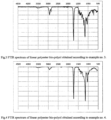
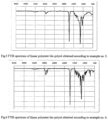
- Figure 1 shows the FTIR spectra of the linear polyester bio-polyols obtained according to particular examples.
- the mixture is gradually heated to 140 °C under an inert gas atmosphere with constant stirring.
- the first step of the synthesis - esterification - is carried out for 9 hours. During the first stage of the synthesis, the change in the acid number is monitored, and on this basis the time and conditions of the reaction are determined. After reaching the acid number equal to half of the initial acid number, the second stage of the synthesis is started. The vacuum is turned on, the inert gas supply is turned off, and the temperature is increased to 160 °C. The second stage of the synthesis - polycondensation - is carried out until the acid number Lk ⁇ 2 mg KOH/g is achieved, which is monitored during the synthesis using a known method, i.e. according to the PN-86/C-4505/05 standard.
- the obtained product has the following characteristics:
- the product can be used to obtain many flexible polyurethanes, e.g. watch straps, phone cases, etc.
- Table 1 FTIR spectrum analysis - identification of functional groups present in the chemical structure of the linear polyester bio-polyol obtained according to example 1. Wavenumber [cm -1 ] Functional group 3600-3200 -OH- 3000-2850 -CH 2 - 1730-1710 -C(O)- 1150 -C-(O)-O- 1030 -C-C-O-
- the mixture is gradually heated to 140-150 °C under an inert gas atmosphere with constant stirring.
- the first step of the synthesis - esterification - is carried out for 7 hours. During the first stage of the synthesis, the change in the acid number is monitored, and on this basis the time and conditions of the reaction are determined. After reaching the acid number equal to half of the initial acid number, the second stage of the synthesis is started.. The vacuum is turned on, and the inert gas supply is turned off, and the temperature is increased to 170 °C. The second stage of the synthesis - polycondensation -is carried out until the acid number Lk ⁇ 1 mg KOH/g is achieved, which is monitored during the synthesis using a known method, i.e. according to the PN-86/C-4505/05 standard.
- the obtained product has the following characteristics:
- the product can be used to obtain many flexible polyurethanes, e.g. watch straps, phone cases, etc.
- Table 2 FTIR spectrum analysis - identification of functional groups present in the chemical structure of the linear polyester bio-polyol obtained according to example 2.
- the mixture is gradually heated to 140°C under an inert gas atmosphere with constant stirring.
- the first step of the synthesis - esterification - is carried out for 9 hours. During the first stage of the synthesis, the change in the acid number is monitored, and on this basis the time and conditions of the reaction are determined. After reaching the acid number equal to half of the initial acid number, the second stage of the synthesis is started.. The vacuum is turned on, and the inert gas supply is turned off, and the temperature is increased to 170 °C. The second stage of the synthesis - polycondensation -is carried out until the acid number Lk ⁇ 1 mg KOH/g is achieved, which is monitored during the synthesis using a known method, i.e. according to the PN-86/C-4505/05 standard.
- the obtained product has the following characteristics:
- the product can be used to obtain many flexible polyurethanes, e.g. watch straps, phone cases, etc.
- Table 3. FTIR spectrum analysis - identification of functional groups present in the chemical structure of the linear polyester bio-polyol obtained according to example 3. Wavenumber [cm -1 ] Functional group 3600-3200 -OH- 3000-2850 -CH 2 - 1730-1710 -C(O)- 1150 -C-(O)-O- 1030 -C-C-O-
- the mixture is gradually heated to 145°C under an inert gas atmosphere with constant stirring.
- the first step of the synthesis - esterification - is carried out for 10 hours. During the first stage of the synthesis, the change in the acid number is monitored, and on this basis the time and conditions of the reaction are determined. After reaching the acid number equal to half of the initial acid number, the second stage of the synthesis is started. The vacuum is turned on, and the inert gas supply is turned off, and the temperature is increased to 175°C. The second stage of the synthesis - polycondensation -is carried out until the acid number Lk ⁇ 1 mg KOH/g is achieved, which is monitored during the synthesis using a known method, i.e. according to the PN-86/C-4505/05 standard.
- the obtained product has the following characteristics:
- the product can be used to obtain many flexible polyurethanes, e.g. watch straps, phone cases, etc.
- Table 4 FTIR spectrum analysis - identification of functional groups present in the chemical structure of the linear polyester bio-polyol obtained according to example 4. Wavenumber [cm -1 ] Functional group 3600-3200 -OH- 3000-2850 -CH 2 - 1730-1710 -C(O)- 1150 -C-(O)-O- 1030 -C-C-O-
- the mixture is gradually heated to 145°C under an inert gas atmosphere with constant stirring.
- the first step of the synthesis - esterification - is carried out for 10 hours. During the first stage of the synthesis, the change in the acid number is monitored, and on this basis the time and conditions of the reaction are determined. After reaching the acid number equal to half of the initial acid number, the second stage of the synthesis is started. The vacuum is turned on, and the inert gas supply is turned off, and the temperature is increased to 175 °C. The second stage of the synthesis - polycondensation -is carried out until the acid number Lk ⁇ 2 mg KOH/g is achieved, which is monitored during the synthesis using a known method, i.e. according to the PN-86/C-4505/05 standard.
- the obtained product has the following characteristics;
- the product can be used to obtain many flexible polyurethanes, e.g. watch straps, phone cases, etc. Table 5.
- the mixture is gradually heated to 145°C under an inert gas atmosphere with constant stirring.
- the first step of the synthesis - esterification - is carried out for 10 hours. During the first stage of the synthesis, the change in the acid number is monitored, and on this basis the time and conditions of the reaction are determined. After reaching the acid number equal to half of the initial acid number, the second stage of the synthesis is started. The vacuum is turned on, and the inert gas supply is turned off, and the temperature is increased to 175°C. The second stage of the synthesis - polycondensation -is carried out until the acid number Lk ⁇ 3 mg KOH/g is achieved, which is monitored during the synthesis using a known method, i.e. according to the PN-86/C-4505/05 standard.
- the obtained product has the following characteristics:
- the product can be used to obtain many flexible polyurethanes, e.g. watch straps, phone cases, etc. Table 6.
- the mixture is gradually heated to 145°C under an inert gas atmosphere with constant stirring.
- the first step of the synthesis - esterification - is carried out for 10 hours. During the first stage of the synthesis, the change in the acid number is monitored, and on this basis the time and conditions of the reaction are determined. After reaching the acid number equal to half of the initial acid number, the second stage of the synthesis is started. The vacuum is turned on, and the inert gas supply is turned off, and the temperature is increased to 175°C. The second stage of the synthesis - polycondensation -is carried out until the acid number Lk ⁇ 1 mg KOH/g is achieved, which is monitored during the synthesis using a known method, i.e. according to the PN-86/C-4505/05 standard.
- the obtained product has the following characteristics:
- the product can be used to obtain many flexible polyurethanes, e.g. watch straps, phone cases, etc.
- Table 7. FTIR spectrum analysis - identification of functional groups present in the chemical structure of the linear polyester bio-polyol obtained according to example 7. Wavenumber [cm -1 ] Functional group 3600-3200 -OH- 3000-2850 -CH 2 - 1730-1710 -C(O)- 1150 -C-(O)-O- 1030 -C-C-O-
- the mixture is gradually heated to 145°C under an inert gas atmosphere with constant stirring.
- the first step of the synthesis - esterification - is carried out for 10 hours. During the first stage of the synthesis, the change in the acid number is monitored, and on this basis the time and conditions of the reaction are determined. After reaching the acid number equal to half of the initial acid number, the second stage of the synthesis is started. The vacuum is turned on, and the inert gas supply is turned off, and the temperature is increased to 175 °C. The second stage of the synthesis - polycondensation -is carried out until the acid number Lk ⁇ 2 mg KOH/g is achieved, which is monitored during the synthesis using a known method, i.e. according to the PN-86/C-4505/05 standard.
- the obtained product has the following characteristics:
- the product can be used to obtain many flexible polyurethanes, e.g. watch straps, phone cases, etc.
- Table 8. FTIR spectrum analysis - identification of functional groups present in the chemical structure of the linear polyester bio-polyol obtained according to example 8. Wavenumber [cm -1 ] Functional group 3600-3200 -OH- 3000-2850 -CH 2 - 1730-1710 -C(O)- 1150 -C-(O)-O- 1030 -C-C-O-
Landscapes
- Chemical & Material Sciences (AREA)
- Health & Medical Sciences (AREA)
- Chemical Kinetics & Catalysis (AREA)
- Medicinal Chemistry (AREA)
- Polymers & Plastics (AREA)
- Organic Chemistry (AREA)
- Polyesters Or Polycarbonates (AREA)
- Polyurethanes Or Polyureas (AREA)
Applications Claiming Priority (1)
| Application Number | Priority Date | Filing Date | Title |
|---|---|---|---|
| PL438914A PL438914A1 (pl) | 2021-09-10 | 2021-09-10 | Liniowe bio-poliole poliestrowe oraz sposób ich otrzymywania |
Publications (1)
| Publication Number | Publication Date |
|---|---|
| EP4148082A1 true EP4148082A1 (en) | 2023-03-15 |
Family
ID=79687083
Family Applications (1)
| Application Number | Title | Priority Date | Filing Date |
|---|---|---|---|
| EP21460043.9A Pending EP4148082A1 (en) | 2021-09-10 | 2021-12-02 | Linear polyester bio-polyols and the method of their preparation |
Country Status (2)
| Country | Link |
|---|---|
| EP (1) | EP4148082A1 (pl) |
| PL (1) | PL438914A1 (pl) |
Citations (6)
| Publication number | Priority date | Publication date | Assignee | Title |
|---|---|---|---|---|
| US20150299373A1 (en) * | 2012-10-26 | 2015-10-22 | Bayer Materialscience Ag | Method for producing soft polyurethane foam based on polyester polyols |
| CN106977707A (zh) * | 2017-05-02 | 2017-07-25 | 中国石油化工股份有限公司 | 一种低粘度聚酯的制备方法 |
| CN109438653A (zh) * | 2018-10-26 | 2019-03-08 | 万华化学集团股份有限公司 | 一种生物型热塑性聚氨酯弹性体及其制备方法 |
| PL234556B1 (pl) * | 2016-09-23 | 2020-03-31 | Politechnika Gdanska | Sposób otrzymywania liniowych biopolioli poliestrowych |
| US20200148817A1 (en) * | 2016-06-28 | 2020-05-14 | Ptt Global Chemical Public Company Limited | Hybrid polyols based on natural oil polyols |
| JP2021127430A (ja) * | 2020-02-17 | 2021-09-02 | サカタインクス株式会社 | ラミネート接着剤組成物及び易引き裂き性積層体 |
-
2021
- 2021-09-10 PL PL438914A patent/PL438914A1/pl unknown
- 2021-12-02 EP EP21460043.9A patent/EP4148082A1/en active Pending
Patent Citations (6)
| Publication number | Priority date | Publication date | Assignee | Title |
|---|---|---|---|---|
| US20150299373A1 (en) * | 2012-10-26 | 2015-10-22 | Bayer Materialscience Ag | Method for producing soft polyurethane foam based on polyester polyols |
| US20200148817A1 (en) * | 2016-06-28 | 2020-05-14 | Ptt Global Chemical Public Company Limited | Hybrid polyols based on natural oil polyols |
| PL234556B1 (pl) * | 2016-09-23 | 2020-03-31 | Politechnika Gdanska | Sposób otrzymywania liniowych biopolioli poliestrowych |
| CN106977707A (zh) * | 2017-05-02 | 2017-07-25 | 中国石油化工股份有限公司 | 一种低粘度聚酯的制备方法 |
| CN109438653A (zh) * | 2018-10-26 | 2019-03-08 | 万华化学集团股份有限公司 | 一种生物型热塑性聚氨酯弹性体及其制备方法 |
| JP2021127430A (ja) * | 2020-02-17 | 2021-09-02 | サカタインクス株式会社 | ラミネート接着剤組成物及び易引き裂き性積層体 |
Non-Patent Citations (9)
| Title |
|---|
| CHIA JUNG TSAI: "Synthesis and Characterization of Polyesters Derived from Succinic Acid, Ethylene Glycol and 1,3-Propanediol", EUROPEAN POLYMER JOURNAL, vol. 44, no. 7, 2008, pages 2339 - 47, XP022853395, DOI: 10.1016/j.eurpolymj.2008.05.002 |
| D. N. BIKIARISD. S. ACHILLAS: "Synthesis of Poly(alkylene Succinate) Biodegradable Polyesters, Part I: Mathematical Modelling of the Esterification Reaction", POLYMER, vol. 47, no. 17, 2006, pages 4851 - 60 |
| DIMITRIOS N. BIKIARISGEORGE Z. PAPAGEORGIOUDIMITRIS S. ACHILIAS: "Synthesis and Comparative Biodegradability Studies of Three Poly(alkylene Succinate)s", POLYMER DEGRADATION AND STABILITY, vol. 91, no. 1, 2006, pages 31 - 43 |
| K. CHRISSAFISK. M. PARASKEVOPOULOSD. N. BIKIARIS: "Thermal Degradation Kinetics of the Biodegradable Aliphatic Polyester, Poly(propylene Succinate", POLYMER DEGRADATION AND STABILITY, vol. 91, no. 1, 2006, pages 60 - 68 |
| K. CHRISSAFISK. M. PARASKEVOPOULOSD. N. BIKIARIS: "Thermal Degradation Mechanism of Poly(ethylene Succinate) and Poly(butylene Succinate): Comparative Study", THERMOCHIMICA ACTA, vol. 435, no. 2, 2005, pages 142 - 50 |
| M. RUANH. LUANG. WANGM. SHEN: "Bio-polyols synthesized from bio-based 1,3-propanediol and applications on polyurethane reactive hot melt adhesives", INDUSTRIAL CROPS AND PRODUCTS, vol. 128, February 2019 (2019-02-01), pages 436 - 444, XP085568055, DOI: 10.1016/j.indcrop.2018.11.045 |
| MARK F. SONNENSCHEIN: "Comparison of Adipate and Succinate Polyesters in Thermoplastic Polyurethanes", POLYMER, vol. 51, no. 16, 2010, pages 3685 - 92, XP027142511 |
| P. FURTWENGLERR. PERRINA. REDLL. AVEROUS: "Synthesis and characterization of polyurethane foams derived of fully renewable polyester polyols from sorbitol", EUR. POLYM. J., vol. 97, 2017, pages 319 - 327 |
| R. MILLER: "Evaluating the Properties and Performance of Susterra@ 1, 3 Propanediol and BiosucciniumTm Sustainable Succinic Acid in TPU Applications", CPI POLYURETHANES 2012 TECHNICAL CONFERENCE, 2012, pages 1 - 19 |
Also Published As
| Publication number | Publication date |
|---|---|
| PL438914A1 (pl) | 2023-03-13 |
Similar Documents
| Publication | Publication Date | Title |
|---|---|---|
| US10611879B2 (en) | Polyester polyols from thermoplastic polyesters and dimer fatty acids | |
| EP3515957B1 (en) | Biorenewable high performance polyester polyols | |
| KR101369237B1 (ko) | 폴리에스테르 폴리올 | |
| KR102135630B1 (ko) | 고분자량의 폴리에스테르 또는 코폴리머 및 이들을 포함하는 폴리머 블렌드를 제조하는 방법 | |
| KR20150113057A (ko) | 재생가능한 원재료를 포함하는 수분-경화성 폴리우레탄 조성물 | |
| WO2011163250A1 (en) | Aqueous polyurethane dispersions | |
| CN113683763B (zh) | 一种半芳香族聚酯及其制备方法和应用 | |
| WO2013138161A1 (en) | Polymer compositions and methods | |
| CN111164122B (zh) | 用于聚氨酯应用的低粘度多元醇 | |
| JP4584622B2 (ja) | 脂肪族オリゴカーボネートポリオールの調製用触媒としてのイッテルビウム(iii)アセチルアセトネート | |
| EP4053185A1 (en) | Biodegradable copolymer polyester resin comprising anhydrosugar alcohol and anhydrousugar alcohol-alkylene glycol and method for preparing same | |
| EP0299068A1 (en) | Process for producing polyurethane | |
| JP2011503272A (ja) | ジシクロヘキシルメタンジイソシアナート、イソホロンジイソシアナート及びポリエーテルポリオールから構成され、減少した結晶化のための傾向を有するnco官能性プレポリマー | |
| WO2001072865A1 (en) | Polyurethane prepared from sorbitol-branched polyesters | |
| EP3436091B1 (en) | Improved biomedical polyurethanes | |
| JP2000336140A (ja) | ポリウレタン用ポリカーボネートジオール | |
| JPH0354967B2 (pl) | ||
| EP4148082A1 (en) | Linear polyester bio-polyols and the method of their preparation | |
| KR20140125806A (ko) | 중합체의 제조 방법 | |
| JP2022513670A (ja) | 放出アルデヒドが低減化されたフォームの製造に適した反応混合物 | |
| ES2911017T3 (es) | Método de producción de polioles de poliéster y su uso en poliuretano | |
| PL234556B1 (pl) | Sposób otrzymywania liniowych biopolioli poliestrowych | |
| EP2074159B1 (en) | Process for the preparation of polyester polyols | |
| JP3395383B2 (ja) | ポリエステルポリオールおよびその製造方法 | |
| JP3365451B2 (ja) | ポリウレタン樹脂 |
Legal Events
| Date | Code | Title | Description |
|---|---|---|---|
| PUAI | Public reference made under article 153(3) epc to a published international application that has entered the european phase |
Free format text: ORIGINAL CODE: 0009012 |
|
| STAA | Information on the status of an ep patent application or granted ep patent |
Free format text: STATUS: REQUEST FOR EXAMINATION WAS MADE |
|
| 17P | Request for examination filed |
Effective date: 20211221 |
|
| AK | Designated contracting states |
Kind code of ref document: A1 Designated state(s): AL AT BE BG CH CY CZ DE DK EE ES FI FR GB GR HR HU IE IS IT LI LT LU LV MC MK MT NL NO PL PT RO RS SE SI SK SM TR |
|
| STAA | Information on the status of an ep patent application or granted ep patent |
Free format text: STATUS: EXAMINATION IS IN PROGRESS |
|
| 17Q | First examination report despatched |
Effective date: 20241128 |