EP4150152B1 - Article résistant aux huiles - Google Patents
Article résistant aux huiles Download PDFInfo
- Publication number
- EP4150152B1 EP4150152B1 EP21726987.7A EP21726987A EP4150152B1 EP 4150152 B1 EP4150152 B1 EP 4150152B1 EP 21726987 A EP21726987 A EP 21726987A EP 4150152 B1 EP4150152 B1 EP 4150152B1
- Authority
- EP
- European Patent Office
- Prior art keywords
- oil resistant
- basesheet
- article
- oil
- resistant article
- Prior art date
- Legal status (The legal status is an assumption and is not a legal conclusion. Google has not performed a legal analysis and makes no representation as to the accuracy of the status listed.)
- Active
Links
Images
Classifications
-
- D—TEXTILES; PAPER
- D21—PAPER-MAKING; PRODUCTION OF CELLULOSE
- D21H—PULP COMPOSITIONS; PREPARATION THEREOF NOT COVERED BY SUBCLASSES D21C OR D21D; IMPREGNATING OR COATING OF PAPER; TREATMENT OF FINISHED PAPER NOT COVERED BY CLASS B31 OR SUBCLASS D21G; PAPER NOT OTHERWISE PROVIDED FOR
- D21H17/00—Non-fibrous material added to the pulp, characterised by its constitution; Paper-impregnating material characterised by its constitution
- D21H17/03—Non-macromolecular organic compounds
- D21H17/05—Non-macromolecular organic compounds containing elements other than carbon and hydrogen only
- D21H17/17—Ketenes, e.g. ketene dimers
-
- D—TEXTILES; PAPER
- D21—PAPER-MAKING; PRODUCTION OF CELLULOSE
- D21H—PULP COMPOSITIONS; PREPARATION THEREOF NOT COVERED BY SUBCLASSES D21C OR D21D; IMPREGNATING OR COATING OF PAPER; TREATMENT OF FINISHED PAPER NOT COVERED BY CLASS B31 OR SUBCLASS D21G; PAPER NOT OTHERWISE PROVIDED FOR
- D21H17/00—Non-fibrous material added to the pulp, characterised by its constitution; Paper-impregnating material characterised by its constitution
- D21H17/20—Macromolecular organic compounds
- D21H17/21—Macromolecular organic compounds of natural origin; Derivatives thereof
- D21H17/24—Polysaccharides
- D21H17/25—Cellulose
- D21H17/26—Ethers thereof
-
- D—TEXTILES; PAPER
- D21—PAPER-MAKING; PRODUCTION OF CELLULOSE
- D21H—PULP COMPOSITIONS; PREPARATION THEREOF NOT COVERED BY SUBCLASSES D21C OR D21D; IMPREGNATING OR COATING OF PAPER; TREATMENT OF FINISHED PAPER NOT COVERED BY CLASS B31 OR SUBCLASS D21G; PAPER NOT OTHERWISE PROVIDED FOR
- D21H17/00—Non-fibrous material added to the pulp, characterised by its constitution; Paper-impregnating material characterised by its constitution
- D21H17/20—Macromolecular organic compounds
- D21H17/21—Macromolecular organic compounds of natural origin; Derivatives thereof
- D21H17/24—Polysaccharides
- D21H17/28—Starch
-
- D—TEXTILES; PAPER
- D21—PAPER-MAKING; PRODUCTION OF CELLULOSE
- D21H—PULP COMPOSITIONS; PREPARATION THEREOF NOT COVERED BY SUBCLASSES D21C OR D21D; IMPREGNATING OR COATING OF PAPER; TREATMENT OF FINISHED PAPER NOT COVERED BY CLASS B31 OR SUBCLASS D21G; PAPER NOT OTHERWISE PROVIDED FOR
- D21H19/00—Coated paper; Coating material
- D21H19/10—Coatings without pigments
- D21H19/14—Coatings without pigments applied in a form other than the aqueous solution defined in group D21H19/12
- D21H19/20—Coatings without pigments applied in a form other than the aqueous solution defined in group D21H19/12 comprising macromolecular compounds obtained by reactions only involving carbon-to-carbon unsaturated bonds
-
- D—TEXTILES; PAPER
- D21—PAPER-MAKING; PRODUCTION OF CELLULOSE
- D21H—PULP COMPOSITIONS; PREPARATION THEREOF NOT COVERED BY SUBCLASSES D21C OR D21D; IMPREGNATING OR COATING OF PAPER; TREATMENT OF FINISHED PAPER NOT COVERED BY CLASS B31 OR SUBCLASS D21G; PAPER NOT OTHERWISE PROVIDED FOR
- D21H19/00—Coated paper; Coating material
- D21H19/10—Coatings without pigments
- D21H19/14—Coatings without pigments applied in a form other than the aqueous solution defined in group D21H19/12
- D21H19/34—Coatings without pigments applied in a form other than the aqueous solution defined in group D21H19/12 comprising cellulose or derivatives thereof
-
- D—TEXTILES; PAPER
- D21—PAPER-MAKING; PRODUCTION OF CELLULOSE
- D21H—PULP COMPOSITIONS; PREPARATION THEREOF NOT COVERED BY SUBCLASSES D21C OR D21D; IMPREGNATING OR COATING OF PAPER; TREATMENT OF FINISHED PAPER NOT COVERED BY CLASS B31 OR SUBCLASS D21G; PAPER NOT OTHERWISE PROVIDED FOR
- D21H19/00—Coated paper; Coating material
- D21H19/80—Paper comprising more than one coating
- D21H19/84—Paper comprising more than one coating on both sides of the substrate
-
- D—TEXTILES; PAPER
- D21—PAPER-MAKING; PRODUCTION OF CELLULOSE
- D21H—PULP COMPOSITIONS; PREPARATION THEREOF NOT COVERED BY SUBCLASSES D21C OR D21D; IMPREGNATING OR COATING OF PAPER; TREATMENT OF FINISHED PAPER NOT COVERED BY CLASS B31 OR SUBCLASS D21G; PAPER NOT OTHERWISE PROVIDED FOR
- D21H21/00—Non-fibrous material added to the pulp, characterised by its function, form or properties; Paper-impregnating or coating material, characterised by its function, form or properties
- D21H21/14—Non-fibrous material added to the pulp, characterised by its function, form or properties; Paper-impregnating or coating material, characterised by its function, form or properties characterised by function or properties in or on the paper
- D21H21/16—Sizing or water-repelling agents
-
- D—TEXTILES; PAPER
- D21—PAPER-MAKING; PRODUCTION OF CELLULOSE
- D21H—PULP COMPOSITIONS; PREPARATION THEREOF NOT COVERED BY SUBCLASSES D21C OR D21D; IMPREGNATING OR COATING OF PAPER; TREATMENT OF FINISHED PAPER NOT COVERED BY CLASS B31 OR SUBCLASS D21G; PAPER NOT OTHERWISE PROVIDED FOR
- D21H27/00—Special paper not otherwise provided for, e.g. made by multi-step processes
- D21H27/10—Packing paper
-
- B—PERFORMING OPERATIONS; TRANSPORTING
- B65—CONVEYING; PACKING; STORING; HANDLING THIN OR FILAMENTARY MATERIAL
- B65D—CONTAINERS FOR STORAGE OR TRANSPORT OF ARTICLES OR MATERIALS, e.g. BAGS, BARRELS, BOTTLES, BOXES, CANS, CARTONS, CRATES, DRUMS, JARS, TANKS, HOPPERS, FORWARDING CONTAINERS; ACCESSORIES, CLOSURES, OR FITTINGS THEREFOR; PACKAGING ELEMENTS; PACKAGES
- B65D65/00—Wrappers or flexible covers; Packaging materials of special type or form
- B65D65/38—Packaging materials of special type or form
- B65D65/42—Applications of coated or impregnated materials
Definitions
- a variety of mechanical and chemical treatments are used in the papermaking industry to impart various properties to the finished paper. Resistance to oil and/or grease penetration is a particularly desirable property for paper products used in many applications. For instance, grease and oil resistance is needed in packaging for fatty or greasy materials, such as fatty or greasy food products. Grease and oil resistant papers are also needed for other food containers, release liners, labels, pet food containers, and the like.
- fluorocarbon compounds have been employed as surface sizes or coatings to impart oil penetration resistance. Fluorocarbons, in general, have very low surface energies and are not wet easily by oil-based materials. Although fluorocarbon compounds are well suited for providing oil resistance, recent government regulations have limited their use.
- silicone polymers and compounds have been used to coat papers in the past.
- Silicone has various drawbacks and disadvantages. For instance, silicone can transfer to adjacent surfaces.
- thermosetting polymers have been used in order to impart oil and chemical resistance. Incorporating thermosetting polymers into the paper, however, prevents the paper product from later being recycled. The presence of thermosetting polymers can significantly interfere with the biodegradable properties of the paper.
- EP 3 253 918 A1 discloses packaging papers for food comprising a coating.
- WO 2018/094130 A1 discloses an oil and grease resistant paperboard.
- WO 03/002342 A1 discloses grease, oil and wax resistant papers.
- US 2016/340833 A1 discloses a compostable paper having oil, grease and moisture resistance.
- the present disclosure is directed to an oil resistant article.
- the oil resistant article can be made almost exclusively from recyclable materials and is free of fluorocarbon compounds.
- the oil resistant article can be made from a coated paper substrate.
- the paper substrate can contain pulp fibers that have not been highly refined making the product economical to produce.
- the construction of the paper layer in combination with one or more coating materials produces an article having excellent oil resistance for use in all different types of applications, such as a food wrap.
- the present disclosure is directed to an oil resistant article that includes a paper basesheet comprising pulp fibers.
- the pulp fibers can have a degree of refining of about 85 °SR or less, and about 50 °SR or more.
- the pulp fibers can contain hardwood fibers in an amount greater than about 60% by weight.
- the pulp fibers for instance, can be a mixture of hardwood fibers and other fibers, such as softwood fibers, or can be made exclusively from hardwood fibers.
- the basesheet can have an inherent Gurley permeability of less than about 5,000 s/100 mL, such as less than about 3,000 s/100 mL, and generally greater than about 1,000 s/100 mL.
- the paper basesheet has a basis weight of from about 18 gsm to about 80 gsm, such as from about 30 gsm to about 50 gsm.
- the basesheet includes a first side and a second and opposite side.
- an oil resistant coating is located on at least one side of the basesheet.
- an oil resistant coating can be applied to the first side and to the second side of the basesheet.
- the oil resistant coating comprises a cellulose derivative, a polyvinyl alcohol polymer, a vegetable protein-based polymer, or mixtures thereof.
- the oil resistant article made in accordance with the present invention is free of fluorocarbon compounds.
- the oil resistant article has a final Gurley permeability of less than about 50,000 s/100 mL and has a permeability of greater than about 3,000 s/100 mL.
- the oil resistant coating is made from a carboxymethyl cellulose.
- the carboxymethyl cellulose can have a viscosity of less than about 800 cPs and generally greater than about 5 cPs.
- the oil resistant coating can be applied to the basesheet in an amount of from about 0.01% to about 10% by weight of the article, such as from about 2% to about 8% by weight of the article.
- the basesheet can contain a binder.
- the binder can comprise a polymer such as a carboxymethyl cellulose, starch or mixtures thereof.
- the article is formed from a basesheet containing a first carboxymethyl cellulose binder and a second carboxymethyl cellulose that is contained in an oil resistant coating that has been topically applied to the basesheet.
- the first carboxymethyl cellulose can be different from the second carboxymethyl cellulose.
- a sizing agent can also be incorporated into the basesheet.
- the sizing agent for instance, can be an alkyl ketene dimer.
- the sizing agent can be incorporated into the basesheet in an amount from about 0.5% to about 4% by weight.
- the oil resistant article of the present disclosure can be formed without incorporating any filler particles either into the basesheet or the oil resistant coating.
- some filler particles may be incorporated into the basesheet, such as in an amount less than about 10% by weight, such as in an amount less than 5% by weight.
- the oil resistant article can also be silicone free and can be produced without any acid treatment, such as used in producing parchment paper.
- the article can have a Kit oil rating of greater than about 3, such as greater than about 4, and less than about 12, such as less than about 11, such as from about 3 to about 8.
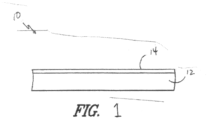
- Figure 1 is a cross-sectional view of one embodiment of an oil resistant article made in accordance with the present disclosure.
- the present disclosure is directed to an oil resistant article well suited for use in many and diverse applications.
- the oil resistant article of the present disclosure can be in the form of a coated paper well suited for use as food packaging where oil and/or grease resistance is desired.
- Oil resistant articles in accordance with the present disclosure can also be used to replace wax coated paper in numerous applications.
- the oil resistant article can be used to produce labels, different types of food wraps, pet food containers, candy wraps, and oven sheets, such as microwave oven sheets.
- the oil resistant articles made in accordance with the present disclosure can also be used in the medical field as part of a patient care wrap or as a wrapping material for medical instruments and devices.
- Oil resistant articles made in accordance with the present disclosure offer various different advantages and benefits.
- the oil resistant articles can be produced without containing any fluorocarbon compounds.
- the article can contain fluorocarbon compounds in an amount less than 0.05% by weight, and, in one embodiment, can be completely free of fluorocarbon compounds.
- Articles made in accordance with the present disclosure can also be silicone-free and can be made without subjecting the product to any acid treatment such as in the production of parchment paper.
- oil resistant articles can be made in accordance with the present disclosure from a paper substrate or basesheet that does not contain highly refined pulp fibers. In the past, in order to improve oil resistance, many prior products contained highly refined pulp fibers which significantly increased the amount of energy needed to produce the product in addition to significantly increasing the cost.
- oil resistant articles can be produced from paper substrates without containing highly refined fibers and can be produced with a combination of elements that provide the desired oil resistant properties.
- oil resistant articles made in accordance with the present disclosure can have a relatively simple or elegant construction without containing multiple layers of paper.
- the oil resistant article of the present disclosure can contain a single paper layer combined with one or two coatings applied to at least one side of the paper substrate. In this manner, the resulting product has low stiffness properties and is easy to manipulate, such as when wrapping other products.
- FIG. 1 represents a cross-sectional view of the product 10.
- the oil resistant article 10 includes a paper basesheet 12 formed from pulp fibers.
- the basesheet 12 for instance, can be a wetlaid paper layer. In other embodiments, however, the basesheet 12 can been air formed, foam formed, or the like.
- the basesheet 12 includes a first surface opposite a second surface. Applied to the first surface of the basesheet 12 is an oil resistant coating 14 as shown in FIG. 1 .
- the oil resistant coating 14 can appear as a separate layer or can be applied so that it becomes impregnated in the top layer of the basesheet 12.
- the oil resistant coating 14 is formed from an oil resistant polymer. Suitable polymers that may be used to coat the basesheet 12 include a cellulose derivative, a polyvinyl alcohol polymer, a starch, a vegetable protein-based polymer (such as derived from soy) or mixtures thereof. As shown in FIG. 1 , the oil resistant article 10 can be made exclusively from a single paper layer or basesheet 12 combined with the oil resistant coating 14. Alternatively, the oil resistant article can include a second coating (not shown) applied to the opposite surface of the basesheet 12.
- the basesheet 12 is a wetlaid pulp fiber paper layer.
- the basesheet 12 can be formed from an aqueous suspension of fibers. Pulp fibers that may be used include hardwood fibers, softwood fibers, thermomechanical pulp, flax fibers, other crop fibers, and plant waste fibers. Bleached pulp and unbleached pulp may be used.
- the aqueous suspension of fibers is deposited onto a porous forming surface (such as a flat wire) that allows water to drain thereby forming the basesheet. As the paper web is formed and dried, the paper can be gathered, crimped, embossed, and/or calendered.
- the basesheet is primarily formed of pulp fibers. For instance, greater than about 90%, such as greater than about 95% by weight of the basesheet can comprise pulp fibers. In one embodiment, relatively short fibers are used to form the basesheet. For example, the average fiber length can be less than about 4 mm, such as less than about 3 mm, such as less than about 2 mm, and generally greater than about 0.2 mm, such as greater than about 0.5 mm. For example, in one embodiment, the fiber furnish used to form the basesheet contains primarily hardwood fibers, which have a shorter fiber length.
- Hardwood fibers can be present in the fiber furnish (based on the total weight percent of fibers present) of greater than about 60% by weight, such as greater than about 70% by weight, such as greater than about 80% by weight, such as greater than about 90% by weight, such as greater than about 95% by weight.
- the fiber furnish contains exclusively hardwood fibers (100% by weight).
- the fiber furnish contains hardwood fibers combined with softwood fibers.
- the softwood fibers can be present in an amount from about 3% to about 40% by weight, such as from about 20% to about 5% by weight.
- the freeness value measures generally the rate at which a dilute suspension of refined fibers may be drained.
- the freeness is measured by the Schopper Riegler Method for drainability. As used herein, freeness is measured according to Test NORM EN ISO 5267-1.
- Pulp fibers used to construct the basesheet of the present disclosure can have a degree of refining of less than about 85 °SR, such as less than about 83 °SR, such as less than about 80 °SR, such as less than about 78 °SR, such as less than about 75 °SR, such as less than about 73 °SR, and generally greater than about 50°SR, such as greater than about 60 °SR, such as greater than about 70 °SR.
- Porosity or permeability is measured according to the Gurley Test, using a Gurley permeability tester, such as Gurley Model 4340. The test can be conducted according to ISO Test 5636.
- Gurley Test measures air permeability as a function of the time required for a specified amount of air to pass through a specified area of a separator under a specified pressure. The units are reported in seconds per 100 mL. Lower numbers therefore can represent substrates with more openness or higher porosity.
- Basesheets made according to the present disclosure can have an inherent Gurley permeability of less than about 5,000 s/100 mL, such as less than about 4,000 s/100 mL, such as less than about 3,000 s/100 mL, such as less than about 2,000 s/100 mL, and generally greater than about 500 s/100 mL, such as greater than about 1,000 s/100 mL.
- the "inherent" permeability of the basesheet is the permeability of the basesheet prior to applying any oil resistant coatings or in any way artificially increasing the permeability through perforations or other similar treatments.
- Basesheets made according to the present disclosure generally have a basis weight of greater than about 18 gsm, such as greater than about 21 gsm, such as greater than about 25 gsm, such as greater than about 30 gsm, such as greater than about 35 gsm, such as greater than about 40 gsm, such as greater than about 45 gsm.
- the basis weight of the basesheet is generally less than about 80 gsm, such as less than about 70 gsm, such as less than about 60 gsm, such as less than about 50 gsm, such as less than about 45 gsm, such as less than about 40 gsm.
- basesheets made according to the present disclosure may be made without containing any filler particles.
- the basesheets can be free of titanium oxide particles, calcium carbonate particles, magnesium oxide particles, or the like.
- the basesheet can be made from pulp fibers alone or in combination with various chemical treatments.
- filler particles can be incorporated into the basesheet.
- the filler particles can be titanium oxide particles, calcium carbonate particles, magnesium oxide particles, or mixtures thereof.
- the filler particles can be present in the basesheet in an amount less than about 10% by weight, such as in an amount of less than about 5% by weight, such as in an amount less than about 3% by weight, and generally in an amount greater than about 0.5% by weight, such as in an amount greater than 2.5% by weight.
- Chemical treatments that can be applied to the basesheet and/or incorporated into the basesheet include binders, sizing agents, and/or wet strength agents.
- a binder can be incorporated into the basesheet that helps increase integrity, increase oil resistance and/or increase runnability.
- the binder can comprise any suitable polymer, such as a film-forming thermoplastic polymer.
- the binder is a natural polymer obtained directly or derived from natural ingredients, such as plants.
- the binder for instance, can be a cellulose derivative, guar gum, pectin, starch, mixtures thereof or the like. Binders can be applied to the basesheet at the wet end of the process if the basesheet is formed through a wetlaid process.
- the binder can be incorporated into the fiber furnish prior to being deposited onto a forming surface or applied prior to drying.
- a cellulose derivative binder such as a carboxymethyl cellulose can be incorporated into the basesheet.
- the carboxymethyl cellulose can be combined with the pulp fibers in relatively small amounts.
- the resulting basesheet can contain the carboxymethyl cellulose binder in an amount less than about 2% by weight, such as in an amount less than about 1.5% by weight, such as in an amount less than about 1% by weight, such as in an amount less than about 0.5% by weight.
- the carboxymethyl cellulose binder can be present in the basesheet in an amount greater than about 0.05% by weight, such as in an amount greater than about 0.08% by weight, such as in an amount greater than about 0.1% by weight.
- the binder incorporated into the basesheet is a starch, such as a cationic starch.
- the starch can be added to the pulp fibers alone or in combination with other binders, such as the carboxymethyl cellulose binder as described above.
- the starch can be incorporated into the basesheet generally in an amount greater than about 0.05% by weight, such as in an amount greater than about 0.1% by weight, such as in an amount greater than about 0.5% by weight, such as in an amount greater than about 1% by weight, such as in an amount greater than about 2% by weight, such as in an amount greater than about 3% by weight.
- the starch can be incorporated into the basesheet in an amount less than about 5% by weight, such as in an amount less than about 4% by weight.
- a cationic starch can be incorporated into the basesheet in an amount from about 3% to about 4% by weight.
- the basesheet contains a carboxymethyl cellulose binder and a starch binder as described above.
- a sizing agent can also be incorporated into the basesheet.
- the sizing agent is also applied at the wet end of the papermaking process. Applying a sizing agent to the basesheet can improve the integrity of the basesheet and improve the liquid repellant properties.
- the sizing agent applied to the basesheet is an alkyl-ketene dimer.
- the amount of sizing agent added to the basesheet can be from about 0.1% to about 2%, preferably from about 0.5% to about 1.5% by dry weight of the basesheet.
- a wet strength agent may reduce the potential for degradation of the basesheet if the latter is placed in contact with a liquid, such as water.
- the wet strength agent may be chosen from polyamides, such as epichlorohydrin resin, a polyamine-epichlorohydrin resin, a poly(aminoamide)-epichlorohydrin resin; an alkylsuccinic anhydride; a polyvinylamine; an oxidized polysaccharide.
- the amount of wet strength agent is from 0.1% to 2%, preferably from 0.5% to 1.5% by dry weight of the basesheet.
- the oil resistant article of the present disclosure further includes at least one oil resistant coating applied to one surface of the basesheet.
- the oil resistant coating is formed from an oil resistant polymer.
- the oil resistant polymer can be a film-forming polymer.
- oil resistant polymers that may be used to form the coating include a cellulose derivative, a polyvinyl alcohol polymer, a starch, a vegetable protein-based polymer or mixtures thereof.
- the oil resistant coating can be formed exclusively from one or more oil resistant polymers without having to incorporate filler particles into the coating.
- the oil resistant coating is formed from a carboxymethyl cellulose polymer.
- the carboxymethyl cellulose can have a viscosity of from about 5 cPs to about 800 cPs.
- a carboxymethyl cellulose polymer can be produced that has relatively shorter molecular chains for better oil resistance.
- a carboxymethyl cellulose polymer can be selected that has a viscosity of less than about 800 cPs, such as less than about 400 cPs, such as less than about 100 cPs, such as less than about 80 cPs.
- the viscosity of the carboxymethyl cellulose polymer is generally greater than about 5 cPs, such as greater than about 15 cPs, such as greater than about 25 cPs, such as greater than about 35 cPs, such as greater than about 45 cPs, such as greater than about 55 cPs, such as greater than about 60 cPs.
- the viscosity of polymer materials disclosed herein including the carboxymethyl cellulose polymer is measured according to test DIN 53019.
- the carboxymethyl cellulose incorporated into the oil resistant coating can an oxidated carboxymethyl cellulose.
- the carboxymethyl cellulose may be used in a highly-purified, cold water-soluble form.
- the oil resistant coating can be formed from a polyvinyl alcohol polymer.
- the polyvinyl alcohol selected has an intermediate degree of hydrolysis.
- polyvinyl alcohol is synthesized from polyvinyl acetate and can be formed into different products that vary in molecular weight and hydrolysis level.
- Polyvinyl alcohol that is well suited for use in the present disclosure typically has a hydrolysis level of greater than about 93% and generally less than about 97%, such as from about 95.5% to about 96.5%.
- the viscosity of the polyvinyl alcohol can generally be less than about 50 cPs, such as less than about 40 cPs, such as less than about 35 cPs, and generally greater than about 10 cPs, such as greater than about 15 cPs, such as greater than about 20 cPs, such as greater than about 25 cPs.
- the viscosity of the polyvinyl alcohol can be measured according to test DIN 53019.
- the polyvinyl alcohol polymer can be combined with a starch in forming the oil resistant coating.
- the oil resistant coating can be formed from a starch.
- Any suitable starch can be applied to one or more surfaces of the basesheet.
- the starch is a modified corn starch having a relatively low viscosity.
- the starch can have a viscosity of from about 20 cPs to about 80 cPs, such as from about 30 cPs to about 55 cPs.
- the starch can be derived from a starch source having at least 90 percent amylopectin, and preferably a waxy maize.
- Starch derivatives include the tertiary amino alkyl ester resulting from the reaction of a starch under alkaline conditions, with a dialkyl amino alkyl halide.
- the oil resistant coating can be formed from a vegetable protein-based polymer.
- the preferred vegetable protein is a soy protein. These materials are built up of a group of about 25 amino acids and derived from processing of soybeans. The protein is derived by removing the oil and hull and processing the soybean. These materials are reduced in size and extracted with an alkaline solution isolating the soy protein in its native form along with low molecular weight sugars. The protein material can be hydrolyzed at high pH and reflux conditions to break the protein into smaller units. The protein is amphoteric having cationic and anionic reactive sites. The combination of hydrophobic and charged regions maintains the globular protein subunits and makes them self-associating.
- the soy protein can be further modified by carboxylating the protein yielding a soy protein of reduced viscosity.
- Preferred vegetable proteins herein have a specific gravity ranging from about 1.007 at a solids content in solution of 5% by weight (30°C) to about 1.05 at 20% solids content (TAPPI TISIO 104-01 Technical Information Sheet). The bulk dry specific gravity is higher. The preferred soy protein herein has a specific gravity dry of about 1.38.
- One vegetable protein herein is a hydrolyzed amphoteric soybean protein.
- This material is hydrolyzed as a 13.5% solids solution in a solution of ammonium hydroxide to yield a solution pH of about 9-10.4. Thereafter the material is acidified.
- the preferred hydrolyzed amphoteric soybean protein has a pH as a 15% slurry around 4.0 to 4.5. The protein is then typically isolated and stored as a dry flake or powder.
- the oil resistant coating is applied to the basesheet in an amount sufficient to provide the necessary oil resistant properties.
- the oil resistant coating comprises greater than about 0.01% by weight, such as greater than about 0.5% by weight, such as greater than about 1% by weight, such as greater than about 3% by weight, such as greater than about 5% by weight, such as greater than about 6% by weight of the oil resistant article.
- the oil resistant coating generally is present on the basesheet in an amount such that the oil resistant coating comprises less than about 10% by weight, such as less than about 8% by weight, such as less than about 6% by weight of the oil resistant article.
- the oil resistant article can contain a single oil resistant coating on one side of the basesheet or can include two oil resistant coatings positioned on opposite sides of the basesheet.
- the oil resistant coating can be applied to the basesheet using any suitable method or technique.
- the oil resistant coating can be applied to the basesheet using a size press.
- a size press By using a size press, the oil resistant article of the present disclosure can be produced in a single process.
- the basesheet can first be formed and later coated with the oil resistant coating.
- Other methods for applying the oil resistant coating include knife coating, gravure printing, and the like.
- the resulting article can be calendered if desired.
- the oil resistant article of the present disclosure maintains a relatively high permeability in relation to past oil resistant sheets, while still having the desired oil resistant properties.
- Gurley permeability of the oil resistant article is less than about 50,000 s/100 mL, such as less than about 40,000 s/100 mL, such as less than about 30,000 s/100 mL, such as less than about 20,000 s/100 mL, and is greater than about 3,000 s/100 mL, such as greater than about 5,000 s/100 mL, such as greater than about 8,000 s/100 mL.
- Oil resistance can be measured using a Kit oil test.
- the Kit oil test for instance, can be measured using TAPPI Test Method T 559 cm-02 (2002).
- TAPPI Test Method T 559 cm-02 (2002).
- 12 test solutions containing different mixtures of toluene,n-heptane, and castor oil are premixed.
- Kit oil is dropped on the substrate to be tested. When any dark spot is formed, the oil resistance is unacceptable. When no spot is formed, the oil resistance is evaluated as acceptable. The oil resistance is expressed in terms of the maximum Kit solution for which the oil resistant is acceptable. The larger the number of mixed solvent, the better the oil resistance of the paper. Oil resistant articles made according to the present disclosure can have a Kit oil test rating of generally greater than 3, such as greater than 4, such as greater than 5, such as greater than 6, such as greater than 7, such as greater than 8, such as greater than 9, such as greater than 10. The Kit oil test rating is generally less than 12, such as less than 11.
- the oil resistant article of the present disclosure is made from recyclable materials.
- the oil resistant article is repulpable.
- the oil resistant article is made without having to use highly refined pulp fibers.
- the oil resistant article can be formed without containing any fluorocarbon compounds or silicone compounds.
- the oil resistant article was made in accordance with the present disclosure and tested for oil resistance.
- the oil resistant article contained a wetlaid basesheet made from 100% hardwood fibers.
- the basesheet also contained a carboxymethyl cellulose binder, a cationic starch binder, and an alkyl ketene dimer sizing agent.
- the pulp fibers used to form the basesheet had a degree of refining of less than 85 °SR.
- the basesheet was coated with an oil resistant coating made from a carboxymethyl cellulose.
- the oil resistant article had a basis weight of about 35 gsm and had a Kit oil rating of 6.
- the Gurley permeability of the oil absorbent article was greater than 5,000 s/100 mL.
Landscapes
- Chemical & Material Sciences (AREA)
- Chemical Kinetics & Catalysis (AREA)
- Paper (AREA)
- Organic Insulating Materials (AREA)
Claims (13)
- Article résistant à l'huile comprenant :une feuille de base en papier comprenant des fibres de pâte à papier, la feuille de base présentant un poids de base allant d'environ 18 g/m2 à environ 80 g/m2, la feuille de base incluant une première face et une seconde face opposée ;un revêtement résistant à l'huile sur au moins une face de la feuille de base, le revêtement résistant à l'huile comprenant un dérivé de cellulose, un polymère d'alcool polyvinylique, un polymère à base de protéines végétales ou un mélange de ceux-ci ; etdans lequel l'article résistant à l'huile est exempt de composés fluorocarbonés, et dans lequel l'article résistant à l'huile présente une perméabilité Gurley inférieure à environ 50 000 s/100 ml et supérieure à environ 3 000 s/100 ml,dans lequel la perméabilité Gurley est mesurée par le test de Gurley, tel que décrit dans la description.
- Article résistant à l'huile selon la revendication 1, dans lequel les fibres de pâte à papier contenues dans la feuille de base présentent un degré de raffinage allant d'environ 85°SR ou moins et environ 50°SR ou plus.
- Article résistant à l'huile selon l'une quelconque des revendications précédentes, dans lequel la feuille de base contient des fibres de bois dur en une quantité supérieure ou égale à environ 60 % en poids.
- Article résistant à l'huile selon l'une quelconque des revendications précédentes, dans lequel le revêtement résistant à l'huile est formé à partir d'un sel sodique d'une carboxyméthylcellulose, le sel sodique de la carboxyméthylcellulose présentant une viscosité inférieure à environ 800 cPs et supérieure à environ 5 cPs.
- Article résistant à l'huile selon l'une quelconque des revendications précédentes, dans lequel le revêtement résistant à huile comprend d'environ 0,01 % à environ 10 % en poids de l'article résistant à l'huile, tel que d'environ 2 % à environ 8 % en poids de l'article résistant à l'huile.
- Article résistant à l'huile selon l'une quelconque des revendications précédentes, dans lequel la feuille de base comprend en outre un liant, en particulier- un liant comprenant une carboxyméthylcellulose, un amidon ou des mélanges de ceux-ci, ou- un liant comprenant une première carboxyméthylcellulose et le revêtement résistant à l'huile comprend une seconde carboxyméthylcellulose, la première carboxyméthylcellulose étant différente de la seconde carboxyméthylcellulose.
- Article résistant à l'huile selon l'une quelconque des revendications précédentes, dans lequel la feuille de base comprend en outre un agent d'encollage, en particulier un agent d'encollage comprenant un dimère d'alkylcétène, le dimère d'alkylcétène étant présent dans la feuille de base en une quantité d'environ 0,5 % à environ 4 % en poids.
- Article résistant à l'huile selon l'une quelconque des revendications précédentes, dans lequel l'article résistant à l'huile inclut un revêtement résistant à l'huile sur la première face de la feuille de base et un revêtement résistant à l'huile sur la seconde face de la feuille de base.
- Article résistant à l'huile selon l'une quelconque des revendications précédentes, dans lequel la feuille de base ne contient pas de particules de charge.
- Article résistant à l'huile selon l'une quelconque des revendications précédentes, dans lequel le revêtement résistant à l'huile ne contient pas de particules de charge.
- Article résistant à l'huile selon l'une quelconque des revendications précédentes, dans lequel l'article affiche un classement en matière d'huile KIT supérieur à environ 3 et inférieur à environ 12, tel que d'environ 4 à environ 12, tel que d'environ 5 à environ 12,
dans lequel le classement en matière d'huile KIT a été mesuré au moyen d'un procédé de test TAPPI T 559 cm-02 (2002). - Article résistant à l'huile selon l'une quelconque des revendications précédentes, dans lequel l'article présente une perméabilité Gurley allant d'environ 5 000 s/100 ml à environ 15 000 s/100 ml.
- Article résistant à l'huile selon l'une quelconque des revendications précédentes, dans lequel l'article résistant à l'huile a été calandré.
Applications Claiming Priority (2)
| Application Number | Priority Date | Filing Date | Title |
|---|---|---|---|
| US202063023047P | 2020-05-11 | 2020-05-11 | |
| PCT/IB2021/054025 WO2021229451A1 (fr) | 2020-05-11 | 2021-05-11 | Article résistant à l'huile |
Publications (2)
| Publication Number | Publication Date |
|---|---|
| EP4150152A1 EP4150152A1 (fr) | 2023-03-22 |
| EP4150152B1 true EP4150152B1 (fr) | 2025-03-26 |
Family
ID=76034914
Family Applications (1)
| Application Number | Title | Priority Date | Filing Date |
|---|---|---|---|
| EP21726987.7A Active EP4150152B1 (fr) | 2020-05-11 | 2021-05-11 | Article résistant aux huiles |
Country Status (11)
| Country | Link |
|---|---|
| US (2) | US11732419B2 (fr) |
| EP (1) | EP4150152B1 (fr) |
| JP (1) | JP7759341B2 (fr) |
| KR (1) | KR20230009925A (fr) |
| AU (1) | AU2021271302A1 (fr) |
| BR (1) | BR112022022940A2 (fr) |
| CA (1) | CA3176806A1 (fr) |
| DK (1) | DK4150152T3 (fr) |
| ES (1) | ES3033762T3 (fr) |
| FI (1) | FI4150152T3 (fr) |
| WO (1) | WO2021229451A1 (fr) |
Families Citing this family (5)
| Publication number | Priority date | Publication date | Assignee | Title |
|---|---|---|---|---|
| JP7553834B2 (ja) * | 2022-10-12 | 2024-09-19 | ダイキン工業株式会社 | 撥水撥油剤 |
| JP7553835B2 (ja) * | 2022-10-12 | 2024-09-19 | ダイキン工業株式会社 | 撥水撥油剤 |
| WO2024190610A1 (fr) * | 2023-03-15 | 2024-09-19 | 王子ホールディングス株式会社 | Papier résistant à l'huile, matériau d'emballage et emballage |
| EP4705575A1 (fr) | 2023-05-05 | 2026-03-11 | SWM Holdco Luxembourg | Produit en feuille résistant à l'huile |
| EP4471210A1 (fr) * | 2023-06-02 | 2024-12-04 | Neenah Gessner GmbH | Papier à faible opacité |
Citations (26)
| Publication number | Priority date | Publication date | Assignee | Title |
|---|---|---|---|---|
| US2251296A (en) | 1938-06-01 | 1941-08-05 | Du Pont | Paper product |
| JPH05279995A (ja) | 1992-03-30 | 1993-10-26 | New Oji Paper Co Ltd | グラシン剥離紙の製造方法 |
| JPH0760905A (ja) | 1993-06-15 | 1995-03-07 | New Oji Paper Co Ltd | グラシン紙の製造方法 |
| JPH1037095A (ja) | 1996-07-17 | 1998-02-10 | Oji Paper Co Ltd | グラシン剥離紙の製造方法 |
| CA2283079A1 (fr) | 1998-05-29 | 1999-11-29 | Oji Paper Co., Ltd. | Papier couche pour impression et procede de fabrication |
| JP2001075303A (ja) | 1999-09-06 | 2001-03-23 | Mishima Paper Co Ltd | 湿式電子写真印刷用紙 |
| US6372361B1 (en) | 2000-07-07 | 2002-04-16 | National Starch And Chemical Investment Holding Corporation | Coating for paper products |
| US20040005341A1 (en) | 2000-08-15 | 2004-01-08 | Dixit Ajit S | Formulation for achievement of oil and grease resistance and release paper properties |
| EP1416087A1 (fr) | 2002-10-15 | 2004-05-06 | Dow Global Technologies Inc. | Procédé de fabricatioon d'un substrat revetu par couches multiples avec propriétés de barriére ameliorées |
| US20040161594A1 (en) | 2003-02-19 | 2004-08-19 | Joyce Margaret K. | Nanoparticle barrier-coated substrate and method for making the same |
| US20080268240A1 (en) | 2005-02-10 | 2008-10-30 | Kousuke Akiyama | Oil-Resistant Sheet Material |
| RO128765A2 (ro) | 2011-11-22 | 2013-08-30 | Ceprohart S.A. | Hârtie cu proprietăţi de barieră, destinată ambalării produselor alimentare, şi procedeu de obţinere a acesteia |
| US20130323368A1 (en) | 2012-05-15 | 2013-12-05 | Mantrose-Haeuser Co., Inc. | Seaweed-based food packaging coating |
| JP2014136840A (ja) | 2013-01-15 | 2014-07-28 | Oji Holdings Corp | 耐油紙および耐油紙の製造方法 |
| JP2014218755A (ja) | 2013-05-02 | 2014-11-20 | 王子ホールディングス株式会社 | 耐油紙及び耐油紙の製造方法 |
| JP5994455B2 (ja) | 2012-07-26 | 2016-09-21 | 王子ホールディングス株式会社 | 耐油紙および耐油紙の製造方法 |
| WO2017178604A1 (fr) | 2016-04-13 | 2017-10-19 | Delfortgroup Ag | Papier d'emballage léger pour produits alimentaires ayant une résistance améliorée vis-à-vis des graisses |
| US20170350074A1 (en) | 2014-12-23 | 2017-12-07 | Delfortgroup Ag | Environment-Friendly Packaging Paper for Food |
| EP3301221A1 (fr) | 2016-09-30 | 2018-04-04 | Drewsen Spezialpapiere GmbH & Co. KG | Papier d'emballage et son procédé de fabrication |
| JP2018053374A (ja) | 2016-09-26 | 2018-04-05 | 王子ホールディングス株式会社 | 耐油紙及びその製造方法 |
| EP3342929A1 (fr) | 2016-12-30 | 2018-07-04 | Mitsubishi HiTec Paper Europe GmbH | Papier barrière |
| US20190062563A1 (en) | 2016-04-25 | 2019-02-28 | Pierre Chevalier | Aqueous coating composition |
| EP3461637A1 (fr) | 2016-09-30 | 2019-04-03 | Nippon Paper Industries Co., Ltd. | Matériau barrière en papier |
| WO2019069963A1 (fr) | 2017-10-04 | 2019-04-11 | 日本製紙株式会社 | Matériau barrière |
| US20190153674A1 (en) | 2015-10-26 | 2019-05-23 | E. I. Du Pont De Nemours And Company | Polysaccharide coatings for paper |
| EP3041374B1 (fr) | 2013-09-05 | 2019-12-18 | Schweitzer-Mauduit International, Inc. | Papier pour filtre revêtu pour un article à fumer |
Family Cites Families (21)
| Publication number | Priority date | Publication date | Assignee | Title |
|---|---|---|---|---|
| JPS5279995A (en) | 1975-12-26 | 1977-07-05 | Fujitsu Ltd | Paper sheet setting device |
| US7833915B2 (en) | 2001-06-29 | 2010-11-16 | Spectra-Kote Corporation | Grease, oil and wax resistant paper composition |
| US6951962B2 (en) * | 2002-04-12 | 2005-10-04 | Hercules Incorporated | Oil/grease- and water-sizing agent for treatment of cellulosics |
| US20040052341A1 (en) | 2002-09-18 | 2004-03-18 | I-Hau Yeh | System for automatic notification of caller ID, e-mail identification and short message |
| JP4520138B2 (ja) | 2003-12-05 | 2010-08-04 | 日本製紙パピリア株式会社 | 耐油紙 |
| CN1934149B (zh) * | 2004-03-23 | 2010-11-24 | 旭硝子株式会社 | 耐水耐油剂组合物 |
| JP5187873B2 (ja) | 2005-04-27 | 2013-04-24 | 特種東海製紙株式会社 | 耐油性シート状物 |
| CA2621110C (fr) * | 2005-07-22 | 2012-12-18 | International Paper Company | Substrat papier contenant un compose comportant du fluor et presentant une impermeabilite a la graisse et une aptitude au collage ameliorees |
| JP2011074535A (ja) | 2009-09-30 | 2011-04-14 | Nippon Paper Industries Co Ltd | 耐油紙 |
| DE102012103775A1 (de) * | 2012-04-27 | 2013-10-31 | PaCon Ltd. & Co.KG | Elektroisolationspapier |
| JP5835093B2 (ja) | 2012-05-14 | 2015-12-24 | 王子ホールディングス株式会社 | 耐油紙および耐油紙の製造方法 |
| JP2016029220A (ja) | 2012-12-21 | 2016-03-03 | 旭硝子株式会社 | 耐水耐油紙およびその製造方法 |
| JP6085524B2 (ja) | 2013-05-31 | 2017-02-22 | 株式会社クラレ | 高い耐油性を有する紙複合体 |
| US9670621B2 (en) | 2015-02-11 | 2017-06-06 | Westrock Mwv, Llc | Compostable paperboard with oil, grease, and moisture resistance |
| US11654662B2 (en) * | 2015-11-27 | 2023-05-23 | Tetra Laval Holdings & Finance S.A. | Laminated packaging material, packaging containers manufactured therefrom |
| EP3394042A1 (fr) | 2015-12-25 | 2018-10-31 | Shionogi & Co., Ltd | Procédé et intermédiaires pour la préparation de dérivés de thiazine |
| JP6846136B2 (ja) | 2016-08-24 | 2021-03-24 | 大王製紙株式会社 | 耐水耐油紙、耐水耐油紙の製造方法及び紙製容器 |
| US11345831B2 (en) | 2016-09-01 | 2022-05-31 | Greentech Global Pte. Ltd. | Biobased carrier coatings |
| US10704200B2 (en) | 2016-11-17 | 2020-07-07 | Westrock Mwv, Llc | Oil and grease resistant paperboard |
| FI3805453T3 (fi) | 2019-10-10 | 2025-04-09 | Billerud Ab Publ | Paperintuotanto |
| CN110670412A (zh) | 2019-10-25 | 2020-01-10 | 广东志造生物科技有限公司 | 一种防油组合物及其用途 |
-
2021
- 2021-05-11 US US17/317,076 patent/US11732419B2/en active Active
- 2021-05-11 EP EP21726987.7A patent/EP4150152B1/fr active Active
- 2021-05-11 ES ES21726987T patent/ES3033762T3/es active Active
- 2021-05-11 AU AU2021271302A patent/AU2021271302A1/en active Pending
- 2021-05-11 JP JP2022565995A patent/JP7759341B2/ja active Active
- 2021-05-11 WO PCT/IB2021/054025 patent/WO2021229451A1/fr not_active Ceased
- 2021-05-11 KR KR1020227042866A patent/KR20230009925A/ko active Pending
- 2021-05-11 DK DK21726987.7T patent/DK4150152T3/da active
- 2021-05-11 BR BR112022022940A patent/BR112022022940A2/pt unknown
- 2021-05-11 CA CA3176806A patent/CA3176806A1/fr active Pending
- 2021-05-11 FI FIEP21726987.7T patent/FI4150152T3/fi active
-
2023
- 2023-08-14 US US18/449,168 patent/US12606958B2/en active Active
Patent Citations (27)
| Publication number | Priority date | Publication date | Assignee | Title |
|---|---|---|---|---|
| US2251296A (en) | 1938-06-01 | 1941-08-05 | Du Pont | Paper product |
| JPH05279995A (ja) | 1992-03-30 | 1993-10-26 | New Oji Paper Co Ltd | グラシン剥離紙の製造方法 |
| JPH0760905A (ja) | 1993-06-15 | 1995-03-07 | New Oji Paper Co Ltd | グラシン紙の製造方法 |
| JPH1037095A (ja) | 1996-07-17 | 1998-02-10 | Oji Paper Co Ltd | グラシン剥離紙の製造方法 |
| CA2283079A1 (fr) | 1998-05-29 | 1999-11-29 | Oji Paper Co., Ltd. | Papier couche pour impression et procede de fabrication |
| JP2001075303A (ja) | 1999-09-06 | 2001-03-23 | Mishima Paper Co Ltd | 湿式電子写真印刷用紙 |
| US6372361B1 (en) | 2000-07-07 | 2002-04-16 | National Starch And Chemical Investment Holding Corporation | Coating for paper products |
| US20040005341A1 (en) | 2000-08-15 | 2004-01-08 | Dixit Ajit S | Formulation for achievement of oil and grease resistance and release paper properties |
| EP1416087A1 (fr) | 2002-10-15 | 2004-05-06 | Dow Global Technologies Inc. | Procédé de fabricatioon d'un substrat revetu par couches multiples avec propriétés de barriére ameliorées |
| US20040161594A1 (en) | 2003-02-19 | 2004-08-19 | Joyce Margaret K. | Nanoparticle barrier-coated substrate and method for making the same |
| US20080268240A1 (en) | 2005-02-10 | 2008-10-30 | Kousuke Akiyama | Oil-Resistant Sheet Material |
| RO128765A2 (ro) | 2011-11-22 | 2013-08-30 | Ceprohart S.A. | Hârtie cu proprietăţi de barieră, destinată ambalării produselor alimentare, şi procedeu de obţinere a acesteia |
| US20130323368A1 (en) | 2012-05-15 | 2013-12-05 | Mantrose-Haeuser Co., Inc. | Seaweed-based food packaging coating |
| JP5994455B2 (ja) | 2012-07-26 | 2016-09-21 | 王子ホールディングス株式会社 | 耐油紙および耐油紙の製造方法 |
| JP2014136840A (ja) | 2013-01-15 | 2014-07-28 | Oji Holdings Corp | 耐油紙および耐油紙の製造方法 |
| JP6075070B2 (ja) | 2013-01-15 | 2017-02-08 | 王子ホールディングス株式会社 | 耐油紙および耐油紙の製造方法 |
| JP2014218755A (ja) | 2013-05-02 | 2014-11-20 | 王子ホールディングス株式会社 | 耐油紙及び耐油紙の製造方法 |
| EP3041374B1 (fr) | 2013-09-05 | 2019-12-18 | Schweitzer-Mauduit International, Inc. | Papier pour filtre revêtu pour un article à fumer |
| US20170350074A1 (en) | 2014-12-23 | 2017-12-07 | Delfortgroup Ag | Environment-Friendly Packaging Paper for Food |
| US20190153674A1 (en) | 2015-10-26 | 2019-05-23 | E. I. Du Pont De Nemours And Company | Polysaccharide coatings for paper |
| WO2017178604A1 (fr) | 2016-04-13 | 2017-10-19 | Delfortgroup Ag | Papier d'emballage léger pour produits alimentaires ayant une résistance améliorée vis-à-vis des graisses |
| US20190062563A1 (en) | 2016-04-25 | 2019-02-28 | Pierre Chevalier | Aqueous coating composition |
| JP2018053374A (ja) | 2016-09-26 | 2018-04-05 | 王子ホールディングス株式会社 | 耐油紙及びその製造方法 |
| EP3461637A1 (fr) | 2016-09-30 | 2019-04-03 | Nippon Paper Industries Co., Ltd. | Matériau barrière en papier |
| EP3301221A1 (fr) | 2016-09-30 | 2018-04-04 | Drewsen Spezialpapiere GmbH & Co. KG | Papier d'emballage et son procédé de fabrication |
| EP3342929A1 (fr) | 2016-12-30 | 2018-07-04 | Mitsubishi HiTec Paper Europe GmbH | Papier barrière |
| WO2019069963A1 (fr) | 2017-10-04 | 2019-04-11 | 日本製紙株式会社 | Matériau barrière |
Non-Patent Citations (13)
Also Published As
| Publication number | Publication date |
|---|---|
| EP4150152A1 (fr) | 2023-03-22 |
| KR20230009925A (ko) | 2023-01-17 |
| AU2021271302A1 (en) | 2022-11-24 |
| DK4150152T3 (da) | 2025-06-30 |
| FI4150152T3 (fi) | 2025-06-27 |
| CA3176806A1 (fr) | 2021-11-18 |
| US12606958B2 (en) | 2026-04-21 |
| JP7759341B2 (ja) | 2025-10-23 |
| US20230383468A1 (en) | 2023-11-30 |
| US20210348336A1 (en) | 2021-11-11 |
| WO2021229451A1 (fr) | 2021-11-18 |
| JP2023524453A (ja) | 2023-06-12 |
| US11732419B2 (en) | 2023-08-22 |
| BR112022022940A2 (pt) | 2022-12-13 |
| ES3033762T3 (en) | 2025-08-07 |
Similar Documents
| Publication | Publication Date | Title |
|---|---|---|
| EP4150152B1 (fr) | Article résistant aux huiles | |
| EP3475485B1 (fr) | Film microfibrillé | |
| WO2002014426A1 (fr) | Formulation assurant une resistance aux graisses et aux huiles et des proprietes anti-adhesives du papier | |
| CN118880663A (zh) | 分散涂布的抗渗透纸 | |
| JP7731383B2 (ja) | 紙および板紙のためのバリアコーティング | |
| CN114599714A (zh) | 表面涂覆的纤维素膜 | |
| EP3746598A1 (fr) | Processus pour la production d'un film comprenant de la cellulose microfibrillée | |
| JP7777453B2 (ja) | 糖脂肪酸エステル無機粒子の組合せ | |
| Islam et al. | Rice straw-based sustainable food packaging material with improved strength and barrier properties: development and characterization | |
| WO2024233087A1 (fr) | Produit en feuille résistant à l'huile | |
| US7176151B2 (en) | Laminate product, method for manufacturing, and article | |
| JP2025534735A (ja) | 水性組成物、その使用、及び少なくとも1つのバリア性を提供するための方法 | |
| JP2004238518A (ja) | 調整塗料、澱粉加工紙及び包装体 | |
| CN116867943A (zh) | 白面牛卡纸,该纸的生产方法,纸的用途和包装 | |
| SE2150729A1 (en) | Barrier coating for paper and paperboard | |
| Vauhkonen | Emerging biobased hydrophobization technologies for fiber-based packaging | |
| Youn et al. | Applications of Nanocellulose in the Paper Industry | |
| CN118510958A (zh) | 特别用于食品工业中使用的完全密封式纸材 |
Legal Events
| Date | Code | Title | Description |
|---|---|---|---|
| STAA | Information on the status of an ep patent application or granted ep patent |
Free format text: STATUS: UNKNOWN |
|
| STAA | Information on the status of an ep patent application or granted ep patent |
Free format text: STATUS: THE INTERNATIONAL PUBLICATION HAS BEEN MADE |
|
| PUAI | Public reference made under article 153(3) epc to a published international application that has entered the european phase |
Free format text: ORIGINAL CODE: 0009012 |
|
| STAA | Information on the status of an ep patent application or granted ep patent |
Free format text: STATUS: REQUEST FOR EXAMINATION WAS MADE |
|
| 17P | Request for examination filed |
Effective date: 20221027 |
|
| AK | Designated contracting states |
Kind code of ref document: A1 Designated state(s): AL AT BE BG CH CY CZ DE DK EE ES FI FR GB GR HR HU IE IS IT LI LT LU LV MC MK MT NL NO PL PT RO RS SE SI SK SM TR |
|
| P01 | Opt-out of the competence of the unified patent court (upc) registered |
Effective date: 20230508 |
|
| DAV | Request for validation of the european patent (deleted) | ||
| DAX | Request for extension of the european patent (deleted) | ||
| STAA | Information on the status of an ep patent application or granted ep patent |
Free format text: STATUS: EXAMINATION IS IN PROGRESS |
|
| TPAC | Observations filed by third parties |
Free format text: ORIGINAL CODE: EPIDOSNTIPA |
|
| 17Q | First examination report despatched |
Effective date: 20230911 |
|
| GRAJ | Information related to disapproval of communication of intention to grant by the applicant or resumption of examination proceedings by the epo deleted |
Free format text: ORIGINAL CODE: EPIDOSDIGR1 |
|
| GRAP | Despatch of communication of intention to grant a patent |
Free format text: ORIGINAL CODE: EPIDOSNIGR1 |
|
| GRAP | Despatch of communication of intention to grant a patent |
Free format text: ORIGINAL CODE: EPIDOSNIGR1 |
|
| STAA | Information on the status of an ep patent application or granted ep patent |
Free format text: STATUS: GRANT OF PATENT IS INTENDED |
|
| TPAC | Observations filed by third parties |
Free format text: ORIGINAL CODE: EPIDOSNTIPA |
|
| TPAC | Observations filed by third parties |
Free format text: ORIGINAL CODE: EPIDOSNTIPA |
|
| GRAJ | Information related to disapproval of communication of intention to grant by the applicant or resumption of examination proceedings by the epo deleted |
Free format text: ORIGINAL CODE: EPIDOSDIGR1 |
|
| STAA | Information on the status of an ep patent application or granted ep patent |
Free format text: STATUS: EXAMINATION IS IN PROGRESS |
|
| INTG | Intention to grant announced |
Effective date: 20240612 |
|
| INTC | Intention to grant announced (deleted) | ||
| GRAP | Despatch of communication of intention to grant a patent |
Free format text: ORIGINAL CODE: EPIDOSNIGR1 |
|
| STAA | Information on the status of an ep patent application or granted ep patent |
Free format text: STATUS: GRANT OF PATENT IS INTENDED |
|
| GRAS | Grant fee paid |
Free format text: ORIGINAL CODE: EPIDOSNIGR3 |
|
| GRAA | (expected) grant |
Free format text: ORIGINAL CODE: 0009210 |
|
| STAA | Information on the status of an ep patent application or granted ep patent |
Free format text: STATUS: THE PATENT HAS BEEN GRANTED |
|
| INTG | Intention to grant announced |
Effective date: 20250122 |
|
| AK | Designated contracting states |
Kind code of ref document: B1 Designated state(s): AL AT BE BG CH CY CZ DE DK EE ES FI FR GB GR HR HU IE IS IT LI LT LU LV MC MK MT NL NO PL PT RO RS SE SI SK SM TR |
|
| REG | Reference to a national code |
Ref country code: GB Ref legal event code: FG4D |
|
| REG | Reference to a national code |
Ref country code: CH Ref legal event code: EP |
|
| REG | Reference to a national code |
Ref country code: DE Ref legal event code: R096 Ref document number: 602021028138 Country of ref document: DE |
|
| REG | Reference to a national code |
Ref country code: IE Ref legal event code: FG4D |
|
| REG | Reference to a national code |
Ref country code: FI Ref legal event code: FGE |
|
| REG | Reference to a national code |
Ref country code: DK Ref legal event code: T3 Effective date: 20250626 |
|
| PG25 | Lapsed in a contracting state [announced via postgrant information from national office to epo] |
Ref country code: RS Free format text: LAPSE BECAUSE OF FAILURE TO SUBMIT A TRANSLATION OF THE DESCRIPTION OR TO PAY THE FEE WITHIN THE PRESCRIBED TIME-LIMIT Effective date: 20250626 |
|
| REG | Reference to a national code |
Ref country code: LT Ref legal event code: MG9D |
|
| PG25 | Lapsed in a contracting state [announced via postgrant information from national office to epo] |
Ref country code: HR Free format text: LAPSE BECAUSE OF FAILURE TO SUBMIT A TRANSLATION OF THE DESCRIPTION OR TO PAY THE FEE WITHIN THE PRESCRIBED TIME-LIMIT Effective date: 20250326 |
|
| PG25 | Lapsed in a contracting state [announced via postgrant information from national office to epo] |
Ref country code: LV Free format text: LAPSE BECAUSE OF FAILURE TO SUBMIT A TRANSLATION OF THE DESCRIPTION OR TO PAY THE FEE WITHIN THE PRESCRIBED TIME-LIMIT Effective date: 20250326 |
|
| PG25 | Lapsed in a contracting state [announced via postgrant information from national office to epo] |
Ref country code: BG Free format text: LAPSE BECAUSE OF FAILURE TO SUBMIT A TRANSLATION OF THE DESCRIPTION OR TO PAY THE FEE WITHIN THE PRESCRIBED TIME-LIMIT Effective date: 20250326 Ref country code: GR Free format text: LAPSE BECAUSE OF FAILURE TO SUBMIT A TRANSLATION OF THE DESCRIPTION OR TO PAY THE FEE WITHIN THE PRESCRIBED TIME-LIMIT Effective date: 20250627 |
|
| REG | Reference to a national code |
Ref country code: SE Ref legal event code: TRGR |
|
| PGFP | Annual fee paid to national office [announced via postgrant information from national office to epo] |
Ref country code: AT Payment date: 20250721 Year of fee payment: 5 |
|
| REG | Reference to a national code |
Ref country code: NL Ref legal event code: MP Effective date: 20250326 |
|
| REG | Reference to a national code |
Ref country code: ES Ref legal event code: FG2A Ref document number: 3033762 Country of ref document: ES Kind code of ref document: T3 Effective date: 20250807 |
|
| PG25 | Lapsed in a contracting state [announced via postgrant information from national office to epo] |
Ref country code: NL Free format text: LAPSE BECAUSE OF FAILURE TO SUBMIT A TRANSLATION OF THE DESCRIPTION OR TO PAY THE FEE WITHIN THE PRESCRIBED TIME-LIMIT Effective date: 20250326 |
|
| PG25 | Lapsed in a contracting state [announced via postgrant information from national office to epo] |
Ref country code: SM Free format text: LAPSE BECAUSE OF FAILURE TO SUBMIT A TRANSLATION OF THE DESCRIPTION OR TO PAY THE FEE WITHIN THE PRESCRIBED TIME-LIMIT Effective date: 20250326 |
|
| PG25 | Lapsed in a contracting state [announced via postgrant information from national office to epo] |
Ref country code: PT Free format text: LAPSE BECAUSE OF FAILURE TO SUBMIT A TRANSLATION OF THE DESCRIPTION OR TO PAY THE FEE WITHIN THE PRESCRIBED TIME-LIMIT Effective date: 20250728 |
|
| PGFP | Annual fee paid to national office [announced via postgrant information from national office to epo] |
Ref country code: FI Payment date: 20250725 Year of fee payment: 5 Ref country code: ES Payment date: 20250801 Year of fee payment: 5 |
|
| PGFP | Annual fee paid to national office [announced via postgrant information from national office to epo] |
Ref country code: DE Payment date: 20250729 Year of fee payment: 5 Ref country code: DK Payment date: 20250725 Year of fee payment: 5 |
|
| PGFP | Annual fee paid to national office [announced via postgrant information from national office to epo] |
Ref country code: NO Payment date: 20250729 Year of fee payment: 5 |
|
| PG25 | Lapsed in a contracting state [announced via postgrant information from national office to epo] |
Ref country code: PL Free format text: LAPSE BECAUSE OF FAILURE TO SUBMIT A TRANSLATION OF THE DESCRIPTION OR TO PAY THE FEE WITHIN THE PRESCRIBED TIME-LIMIT Effective date: 20250326 |
|
| PGFP | Annual fee paid to national office [announced via postgrant information from national office to epo] |
Ref country code: IT Payment date: 20250820 Year of fee payment: 5 |
|
| PGFP | Annual fee paid to national office [announced via postgrant information from national office to epo] |
Ref country code: FR Payment date: 20250725 Year of fee payment: 5 |
|
| PGFP | Annual fee paid to national office [announced via postgrant information from national office to epo] |
Ref country code: SE Payment date: 20250727 Year of fee payment: 5 Ref country code: CH Payment date: 20250728 Year of fee payment: 5 |
|
| PG25 | Lapsed in a contracting state [announced via postgrant information from national office to epo] |
Ref country code: EE Free format text: LAPSE BECAUSE OF FAILURE TO SUBMIT A TRANSLATION OF THE DESCRIPTION OR TO PAY THE FEE WITHIN THE PRESCRIBED TIME-LIMIT Effective date: 20250326 |
|
| PGFP | Annual fee paid to national office [announced via postgrant information from national office to epo] |
Ref country code: CZ Payment date: 20250801 Year of fee payment: 5 |
|
| PG25 | Lapsed in a contracting state [announced via postgrant information from national office to epo] |
Ref country code: RO Free format text: LAPSE BECAUSE OF FAILURE TO SUBMIT A TRANSLATION OF THE DESCRIPTION OR TO PAY THE FEE WITHIN THE PRESCRIBED TIME-LIMIT Effective date: 20250326 |
|
| PG25 | Lapsed in a contracting state [announced via postgrant information from national office to epo] |
Ref country code: SK Free format text: LAPSE BECAUSE OF FAILURE TO SUBMIT A TRANSLATION OF THE DESCRIPTION OR TO PAY THE FEE WITHIN THE PRESCRIBED TIME-LIMIT Effective date: 20250326 |
|
| PG25 | Lapsed in a contracting state [announced via postgrant information from national office to epo] |
Ref country code: IS Free format text: LAPSE BECAUSE OF FAILURE TO SUBMIT A TRANSLATION OF THE DESCRIPTION OR TO PAY THE FEE WITHIN THE PRESCRIBED TIME-LIMIT Effective date: 20250726 |
|
| REG | Reference to a national code |
Ref country code: DE Ref legal event code: R026 Ref document number: 602021028138 Country of ref document: DE |
|
| PLBI | Opposition filed |
Free format text: ORIGINAL CODE: 0009260 |
|
| REG | Reference to a national code |
Ref country code: CH Ref legal event code: L11 Free format text: ST27 STATUS EVENT CODE: U-0-0-L10-L11 (AS PROVIDED BY THE NATIONAL OFFICE) Effective date: 20251217 |
|
| PLAB | Opposition data, opponent's data or that of the opponent's representative modified |
Free format text: ORIGINAL CODE: 0009299OPPO |
|
| REG | Reference to a national code |
Ref country code: CH Ref legal event code: L10 Free format text: ST27 STATUS EVENT CODE: U-0-0-L10-L00 (AS PROVIDED BY THE NATIONAL OFFICE) Effective date: 20251224 |
|
| PLBI | Opposition filed |
Free format text: ORIGINAL CODE: 0009260 |
|
| 26 | Opposition filed |
Opponent name: BILLERUD AKTIEBOLAG (PUBL) Effective date: 20251211 |
|
| REG | Reference to a national code |
Ref country code: CH Ref legal event code: L10 Free format text: ST27 STATUS EVENT CODE: U-0-0-L10-L00 (AS PROVIDED BY THE NATIONAL OFFICE) Effective date: 20260114 |
|
| PG25 | Lapsed in a contracting state [announced via postgrant information from national office to epo] |
Ref country code: LU Free format text: LAPSE BECAUSE OF NON-PAYMENT OF DUE FEES Effective date: 20250511 |
|
| PLAX | Notice of opposition and request to file observation + time limit sent |
Free format text: ORIGINAL CODE: EPIDOSNOBS2 |
|
| R26 | Opposition filed (corrected) |
Opponent name: BILLERUD AKTIEBOLAG (PUBL) Effective date: 20251211 |
|
| REG | Reference to a national code |
Ref country code: BE Ref legal event code: MM Effective date: 20250531 |
|
| PG25 | Lapsed in a contracting state [announced via postgrant information from national office to epo] |
Ref country code: MC Free format text: LAPSE BECAUSE OF FAILURE TO SUBMIT A TRANSLATION OF THE DESCRIPTION OR TO PAY THE FEE WITHIN THE PRESCRIBED TIME-LIMIT Effective date: 20250326 |
|
| 26 | Opposition filed |
Opponent name: DELFORTGROUP AG Effective date: 20260102 |
|
| GBPC | Gb: european patent ceased through non-payment of renewal fee |
Effective date: 20250626 |
|
| PG25 | Lapsed in a contracting state [announced via postgrant information from national office to epo] |
Ref country code: GB Free format text: LAPSE BECAUSE OF NON-PAYMENT OF DUE FEES Effective date: 20250626 |
|
| PG25 | Lapsed in a contracting state [announced via postgrant information from national office to epo] |
Ref country code: IE Free format text: LAPSE BECAUSE OF NON-PAYMENT OF DUE FEES Effective date: 20250511 |
|
| PG25 | Lapsed in a contracting state [announced via postgrant information from national office to epo] |
Ref country code: BE Free format text: LAPSE BECAUSE OF NON-PAYMENT OF DUE FEES Effective date: 20250531 |