EP4201599B1 - Auxiliaire de travail - Google Patents
Auxiliaire de travail Download PDFInfo
- Publication number
- EP4201599B1 EP4201599B1 EP22214691.2A EP22214691A EP4201599B1 EP 4201599 B1 EP4201599 B1 EP 4201599B1 EP 22214691 A EP22214691 A EP 22214691A EP 4201599 B1 EP4201599 B1 EP 4201599B1
- Authority
- EP
- European Patent Office
- Prior art keywords
- stand
- pivoted
- working
- feet
- aid
- Prior art date
- Legal status (The legal status is an assumption and is not a legal conclusion. Google has not performed a legal analysis and makes no representation as to the accuracy of the status listed.)
- Active
Links
Images



Classifications
-
- B—PERFORMING OPERATIONS; TRANSPORTING
- B25—HAND TOOLS; PORTABLE POWER-DRIVEN TOOLS; MANIPULATORS
- B25H—WORKSHOP EQUIPMENT, e.g. FOR MARKING-OUT WORK; STORAGE MEANS FOR WORKSHOPS
- B25H1/00—Work benches; Portable stands or supports for positioning portable tools or work to be operated on thereby
- B25H1/0021—Stands, supports or guiding devices for positioning portable tools or for securing them to the work
Definitions
- the present invention relates to a working aid according to the preamble of claim 1.
- Work aids with a support for a workpiece are used in a variety of ways in trade, industry and the home to enable certain activities to be carried out easily, comfortably and/or at all.
- the object of the present invention is to provide a work aid that can be used for numerous different work cases.
- the work aid should preferably be mobile and easy to transport. In particular, it should be simple in structure, inexpensive in construction and comfortable and easy to understand to use.
- the inventors realized that this task can be solved in a surprising and particularly simple way if the support has two first rotatable elements. This makes it particularly easy to guide workpieces over the support.
- the work aid according to the invention with a stand which has a longitudinal axis, wherein a stand element for placing the work aid on a floor and a support for a workpiece are arranged on the stand, is characterized in that the support has two first rotatable elements.
- the work aid has swivel feet, because it can then be easily adapted to certain floor conditions. In addition, it can be easily reduced in size and thus easily transported.
- the stand element has at least three feet which are arranged so that they can be pivoted from a swiveled-out position to a swiveled-in position in relation to the longitudinal axis. With three feet, the stand can be adapted particularly easily to different, particularly uneven, floors. If there are four or more feet, the load supported by the work aid is distributed particularly well.
- the feet are designed to be fixable in the swung-out position and/or in the swung-in position. This makes the work aid particularly safe to stand on a floor.
- the feet are in a form-fitting position against the stand element in the swiveled-out position. This means that the work aid stands particularly securely on a floor, even when the workpiece is subject to high loads.
- the feet are accommodated in corresponding guides, whereby the feet have an elongated hole through which an axis of the respective guides extends for pivoting the foot accommodated in the guide. This allows pivoting to be carried out very easily and safely.
- the guides in relation to the longitudinal axis have an opening above and below the axis for the passage of the corresponding foot in its pivoted-in position. This makes the work aid particularly compact when the feet are pivoted in, while still ensuring a high load-bearing capacity of the stand element.
- the guides in relation to the axis between the longitudinal axis and the axis below the corresponding foot arranged in its swiveled-out position have a support to prevent the foot from swiveling. This ensures that the work aid stands particularly securely on a floor even when the workpiece is subject to high loads.
- the guides in relation to the axis opposite the longitudinal axis above the corresponding foot arranged in its swiveled-out position have a support to prevent the foot from swiveling. This also ensures that the work aid stands particularly securely on a floor even when the workpiece is subject to high loads.
- the feet are inserted into pockets on the stand element in the swiveled-out position. This ensures that the work aid stands particularly securely on a floor, even when the workpiece is subject to high loads.
- a fixing means is arranged on the axle, which is preferably designed as a nut for clamping the foot in the guide. This makes the stand of the work aid on a floor even safer because it prevents it from swinging in accidentally.
- the guide has two legs that run parallel to the plane, with the foot preferably being designed as a sheet metal part. This makes the stand element particularly simple in construction and at the same time stable.
- the stand is provided with stops for the feet in their swiveled-out position, with the stops preferably being surrounded on all sides by the corresponding guide. This also further improves the stability of the work aid.
- the stand is designed to be telescopic with at least one stand part running into another.
- the work aid can then be easily adapted to many different activities.
- the stand extends beyond the guides to the floor. This makes the work aid particularly stable, even with high workpiece loads and for different heights.
- the stand could be arranged in the same plane as the feet when the feet are swung out, so that the work aid not only stands on the feet, but also on the stand itself.
- the column part running in the other column part has several equally spaced openings and in the other column part there is an opening through which a bolt can be pushed, wherein the bolt is preferably designed to be lockable and preferably has a stop and an opening for a locking pin opposite the stop.
- the distance between the openings is preferably in the range 10 mm to 50 mm, preferably in the range 20 mm to 30 mm and is in particular 25 mm.
- a stand part has a thread in which a threaded rod is arranged, with a nut preferably arranged on the threaded rod for locking against the stand part.
- the thread pitch is preferably in the range 1.0 mm to 5.0 mm, preferably in the range 1.5 mm to 3.0 mm and is in particular 2.5 mm. With a thread pitch of 2.5 mm, there is a particularly fine adjustment, since a stroke of approx. 0.6 mm is achieved with a quarter turn. In addition, a breakthrough distance of 25 mm is compensated for over 10 thread turns.
- the distance between the first rotatable elements is designed to be selectively adjustable. This means that the support can be very easily adapted to workpieces of different sizes.
- the axes of the two first rotatable elements are on one line or on two different lines. If the axes of the rotatable elements are on one line, workpieces can be transported particularly easily over the support between the two rotatable elements. For example, pipes or similar workpieces can be safely guided in this way, particularly for cutting to length, sawing, etc. Examples of applications for this are: cutting, sawing and grinding, as well as the storage of larger and heavier materials during processing for their processing, such as milling.
- workpieces can be rotated around a workpiece's longitudinal axis between the two rotating elements, particularly on the support. This makes it possible, for example, to "roll" the workpiece between the two axes. This makes it possible, for example, to place a pipe on a welding table in order to weld round covers without setting them down using an electrode or using the TIG welding process without setting them down. Furthermore, with this design, the weld seams can then be machined on a grinding machine.
- first rotatable elements there are four first rotatable elements, with two first rotatable elements each lying on a common axis and the two axes being arranged parallel and spaced apart from one another. Then, either a workpiece transport over the support or a workpiece rotation can be carried out, depending on how the workpiece is placed on the first rotatable elements.
- a pivoting element on which a second rotatable element is arranged, the second rotatable element being arranged so as to be pivotable with the aid of the pivoting element from a rest position below the support surface of the first rotatable elements to a working position above the support surface of the first rotatable elements, the rest position and/or the working position preferably being designed to be fixable.
- Workpieces can then be guided on the support in a very defined manner between the first rotatable elements and the second rotatable element.
- workpieces can also be placed directly on the second rotating element and transported. If the second rotating element is designed as a wide roller, materials that are flat and wide, such as flat iron, square tubes, boards, beams, etc., can also be unrolled. These workpieces can then be easily cut to length.
- first rotatable elements and/or the second rotatable element are designed as a wheel or roller. This makes it very easy to store and transport corresponding workpieces on the work aid.
- the pivoting element has two supports, in each of which one, preferably two, elongated hole guides are arranged. This makes it very easy to pivot and/or adjust the alignment of the second rotatable element relative to the first rotatable elements.
- the supports are arranged so that they can pivot on an axis of the support. This also makes it very easy to pivot and/or adjust the alignment of the second rotatable element relative to the first rotatable elements.
- the supports rest on two shelves in the rest position of the pivoting element and are accommodated between the shelves in the working position, with the shelves preferably enclosing the supports in a form-fitting manner. This makes the work aid particularly stable even when the second rotatable element is used.
- the supports in the working position extend upwards beyond the second rotatable element in relation to the longitudinal axis.
- the supports then simultaneously form a guide for the workpiece, so that it can be placed and transported on the work aid more easily and safely. If, on the other hand, the supports in the working position do not extend upwards beyond the second rotatable element in relation to the longitudinal axis, then workpieces that are wider than the second rotatable element can also be placed and transported on the second rotatable element.
- a cover that can be optionally arranged and removed above the first rotatable elements, preferably designed as a cover plate.
- the work aid can also be used to store workpieces that are not to be transported on the work aid, but only to be placed down or supported.
- plasterboard can also be stored and cut to size using several work aids 10.
- the cover has an opening for fastening a pressure stamp, which is preferably provided with a buffer element. This means that even sensitive workpieces can be placed on the work aid. In addition, workpieces can be placed or supported in a defined manner on a relatively small support point.
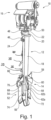
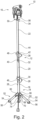
- the work aid 10 has a stand 12 with a longitudinal axis L, wherein a stand element 14 is arranged at the bottom of the stand 12 and a support 16 for a workpiece (not shown) is arranged at the top, i.e. opposite the stand element 14.
- the stand 12 has a first stand part 18, a second stand part 20 and a third stand part 22, which extend telescopically into one another. More precisely, the third stand part 22 runs in a form-fitting manner in the second stand part 22 and the second stand part 20 runs in a form-fitting manner in the first stand part 18.
- the first stand part 18 has a continuous opening 24 through which a bolt 26 can be pushed, which can be secured with a split pin 28.
- a stop 30 on the bolt 26 which rests against the first stand part 18 in the opening 24 when the bolt 26 is inserted.
- the second stand part 20 has continuous openings 32 arranged continuously in a certain grid, which have the same diameter as the opening 24, so that the bolt 26 can reach through both the opening 24 and one of the openings 32.
- the third stand part 22 Between the second stand part 20 and the third stand part 22 there is also a bolt 38 with an opening 39 for a split pin 40 and a stop 42 to determine the extension height.
- the third stand part 22 also has openings 44 arranged in the same notch.
- the first column part 18 has a square external cross-section of 40 mm x 40 mm with a wall thickness of 2 mm
- the second column part 20 has a square external cross-section of 35 mm x 35 mm with a wall thickness of 2 mm
- the third column part 22 has a square external cross-section of 30 mm x 30 mm with a wall thickness of 2 mm.
- the internal thread is on a metric nut M20 x 2.5, so that the threaded rod is also designed as M20 x 2.5, i.e. has a pitch of 2.5 mm for one complete revolution.
- the grid of the openings 32, 44 is 25 mm.
- the first stator part 18 has a square external cross-section of 60 mm x 60 mm with a wall thickness of 2 mm
- the second stator part 20 has a square external cross-section of 55 mm x 55 mm with a wall thickness of 2 mm
- the third stator part 22 has a square external cross-section of 50 mm x 50 mm with a wall thickness of 2 mm.
- the internal thread is on a metric nut M30 x 3.5, so that the threaded rod is also designed as M30 x 3.5, i.e. has a pitch of 3.5 mm for one complete revolution.
- the grid of the openings 32, 44 is 35 mm.
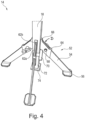
- the stand element 14 comprises four feet 52, each of which has a support element 54 with a support surface 56 arranged thereon. At the end of the feet 52 opposite the support surfaces 56, the support elements 54 are bevelled 58 so that the support elements 54 in the swung-out state (cf. Fig. 2 and 4 ) of the support elements 54 rest positively on the first stand part 18.
- the support elements 54 are each surrounded by a guide 60, which consists of two plane-parallel plates 62a, 62b, which are connected to one another via a web 64. This web 64 forms a stop for the support elements 54 when the support elements 54 are pivoted out.
- the guides 60 are welded to the first stand part 18 in such a way that a frame 66 is formed for the support element 54 which rests positively on the first stand part 18 in the swung-out state.
- These frames 66 thus form insertion pockets 66 for the support elements 54 so that they are additionally supported in the swung-out state.
- the plates 62a, 62b have no direct connection whatsoever, so that the support elements 54 can be freely pivoted between the plates 62a, 62b.
- the plates 62a, 62b have a continuous opening (not shown) through which a clamp 67 in the form of a screw 68 and a toggle nut 70 is guided.
- the support elements 54 have an elongated hole guide (not shown) which extends parallel to the longitudinal extension of the support elements 54 and through which the screw 68 is guided.
- the support elements 54 When fully swung out and inserted into the pockets 66, the support elements 54 rest against the first stand part 18 in a form-fitting manner. They also engage in the pockets 66 in a form-fitting manner and rest against the web 64 (cf. Fig. 2 and 4 ). They can be additionally secured by the clamp 67, whereby the two plates 62a, 62b clamp the support element 54 in a form-fitting manner.
- the feet 52 can support large loads and are still easy to swivel and require only a small amount of space when swivelled in (cf. Fig. 1 and 5 ) on.
- the first stand part 18 projects downwards over the surrounds 66 of the feet 52 and forms another foot 72, which is provided with a buffer 74.
- This foot 72 serves as a safety feature in case the feet 52 cannot withstand a certain load from a supported workpiece, which is why the foot 72 ends slightly above the level of the pivoted-out support surfaces 56 (cf. Fig. 2 ). Alternatively, the foot 72 could also end in the same plane as the pivoted-out shelves 56.
- the support 16 has a base 78 which is designed as a U-shaped channel and is firmly welded to the threaded rod 36.
- Flanges 82 are arranged on both sides of the base plate 80 of the base 78 via screw connections 84. These flanges 82 each have buffers 84 at their ends for safety reasons.
- an opening 86 is arranged centrally in the flanges 82.
- U-shaped holders 90a, 90b are arranged on the side surfaces 88a, 88b of the base 78, with openings (not shown) running through the side surfaces 92.
- a long nut 94 is arranged between the side surfaces 92.
- two elongated holes 96 arranged opposite the holders 90a, 90b are connected to the side surfaces 88a, 88b, with axes 98 being accommodated in opposite elongated holes 96 of the two side surfaces 88a, 88 so as to be displaceable in the longitudinal direction of the elongated holes 96.
- These axes 98 are fixed to one side 100 of legs 102.
- the other side 104 of the legs 102 has an opening (not shown) through which a threaded rod 106 extends, which is fixed on the other side 104 with two nuts 108, 110.
- Opposing threaded rods 106 are each held in the long nut 94, whereby the opposing threaded rods 106 have opposing threads (not shown).
- the distance between the opposing axes 98 can be continuously changed by rotating the long nut 94.
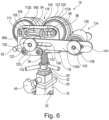
- Two wheels 112a, 112b are arranged on the axles 98 at a distance from each other, so that a gap 114 is formed between the wheels 112a, 112b of an axle 98 (cf. Fig. 7 ). Between the two axes 98, a gap 116 is formed (cf. Fig. 6 ), the width of which can be changed by means of the long nut 94, as described above.
- two shelves 120 are screwed 122 onto each of the two side surfaces 88a, 88b and are connected to one another via a sheet metal 118 and are arranged horizontally adjacent.
- a stop 124 with an internal thread (not shown) into which the threaded rod 126 of a knurled nut 128 can be screwed.
- a support 130a, 130b with an elongated hole 132 is placed on the threaded rod 126 and can be clamped against the stop 124 by means of the knurled nut 128.
- the two opposite supports 130a, 130b form a pivoting element 134 for a roller 136, the axis 138 of which is guided in slots 140 of the supports 130a, 130b.
- the axis 138 has an external thread (not shown) on both sides, onto which Knurled nuts 142 are screwed on so that the position of the axis 138 can be fixed in the elongated holes 140.
- the roller 136 can be moved from a Fig. 6 shown rest position, in which the supports 130a, 130b each rest on the corresponding shelves 120 and the axle 138 is below the support surface of the wheels, are transferred to a working position in which the roller 136 is above the support surface of the wheels 112a, 112b and the supports 130a, 130b are held on both sides in a form-fitting manner between the shelves 120.
- the clamping with the knurled nut 128 is released and the supports 130a, 130b are first pulled with their lower ends 144 up to the threaded rods 126. Then the swivel element 134 is swivelled into the vertical position and then the supports 130a, 130b are lowered onto the threaded rods 126 up to the upper end 146 of the slot 132 and the knurled nuts 1128 are tightened and thereby fixed against the stop 124 by renewed clamping (cf. Fig. 7 ).
- the axis 138 can be aligned with respect to the supports 130a, 130b such that the supports 130a, 130b either protrude vertically over the roller 136 (cf. Fig. 7 , left side) or below the storage level of the roller 136 (cf. Fig. 7 , right side).
- cover 148 designed as a cover plate, which has a central horizontal section 150 and two sections 152a, 152b that run at an angle to it. Threaded rods 154 are welded to the inclined sections 152a, 152b, which extend downwards and can be inserted through the openings 86 of the flanges 82.
- the threaded rods 154 are spaced apart from one another such that they each fit into the gap 114. After inserting the threaded rods 154 The threaded rods 154 can be fixed in the openings 86 by means of corresponding nuts (not shown).
- the cover 148 has a central opening 158 with an internal thread (not shown) into which a pressure stamp 160 can be screwed, which for this purpose has a buffer element 162 which is fixed to a threaded rod 164, wherein the screwing of the threaded rod 164 into the opening 158 can be countered by means of a nut 166 (cf. Fig. 9 ).
- the length of the first stand part 18 is 620 mm up to its upper edge
- the length of the second stand part 20 is 520 mm up to its upper edge
- the length of the third stand part 22 is 730 mm up to the upper edge of the wheels 112a, 112b, 740 mm up to the upper edge of the cover 148, 790 mm up to the upper edge of the roller 136 and 820 mm up to the upper edge of the pressure stamp 160.
- the total height of the device in the fully extended state is 1960 mm.
- the threaded rod 36 is then unscrewed to the maximum. It can be adjusted by a total of 75 mm.
- the working aid 10 In its lowest setting with the feet 52 pivoted out, the working aid 10, with the second stand part 20 and the third stand part 22 each recessed, has a height of 778 mm to the upper edge of the wheels 112a, 112b, 784 mm to the upper edge of the cover 148 and 810 mm to the upper edge of the roller 136.
- a small jack (not shown) can be safely positioned on the surface of the cover plate 148, which is 100 mm x 120 mm.
- the jack is, for example, 150 mm high and has a stroke of 100 mm.
- the base area of the jack is 90 mm x 90 mm and is commercially available in this size.
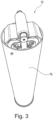
- the tool 10 is now used as follows: When the feet 52 are pivoted in, the entire device 10 with all additional parts can be accommodated and transported in a quiver 76 (cf. Fig. 3 ), whereby a lid serves to close the quiver 76 (in Fig. 3 Not shown).
- the quiver 76 with lid has an outer diameter of 200 mm and a length of 900 mm.
- the height of the working aid 10 in the swivelled-in state of the Stand element 14 up to the wheels 112a, 112b is 775 mm, while the work aid 10 reaches a maximum height of 1,880 mm.
- the working aid 10 is removed and the feet 52 are swung out after loosening the toggle nuts 70, inserted into the enclosures 66 and secured again with the toggle nuts 70.
- the stand 12 is then telescoped to approximately a desired length by loosening the screws 46, 48 and first fixed by inserting the bolts 26, 38 into the openings 24, 32, 44 and then secured by the corresponding locking pins 28, 40 and tightening the locking screws 46, 48.
- the exact height is then determined by screwing the threaded rod 36 in or out of the head 34 of the third stand part 22 and this position is secured using the lock nut 50.
- the pressure stamp 160 can be removed from the cover 148 and the workpiece can be supported directly on the cover 148.
- the roller 136 is used for moving workpieces (not shown) that are flat.
- the swivel element 134 is released by loosening the knurled nuts 128, the lower end 144 of the supports 130a, 130b is pulled towards the threaded rods 126 and the swivel element 134 is swiveled into the vertical position.
- the swivel element 134 is then lowered, whereby the upper end 146 of the elongated holes 132 strikes the threaded rod 126 and the supports 130a, 130b are held in a form-fitting manner between the two shelves 120.
- the knurled screws are tightened again, thus securing the position of the swivel element 134.
- the roller 136 now rests on the wheels 112a, 112b and is supported by them, whereby a rotation of the roller 136 is transmitted to the wheels 112a, 112b.
- the supports 130a, 130b are not placed on the shelves 120 with the upper end 146 of their elongated hole 132, but are moved upwards so far that they protrude upwards above the roller 136.
- the position of the roller 136 in the supports 130a, 130b is determined by moving the axis 138 in the elongated holes 140 and secured by means of the knurled nuts 142.
- support is provided either in the slot 116, the width of which can be specifically adjusted by actuating the long nut 94, or support is provided in the slots 114.
- the first type of support in the slot 116 is suitable, for example, for machining weld seams of a pipe, while the second type of support in the slots 114 is suitable, for example, for cutting pipes or the like to length.
- workpieces can also be clamped between the wheels 112a, 112b and the roller 136.
- two or more work aids 10 can be used to support large workpieces (not shown). This could, for example, be used to lay down plasterboard for cutting to size.
- the present invention provides a work aid 10 that can be used for numerous different work cases.
- the work aid 10 is mobile and easy to transport. In addition, it is simple in structure, inexpensive in construction and comfortable and easy to understand to use.
Landscapes
- Engineering & Computer Science (AREA)
- Mechanical Engineering (AREA)
- Handcart (AREA)
- Agricultural Machines (AREA)
Claims (11)
- Système d'aide au travail (10) avec un montant (12), qui présente un axe longitudinal (L), dans lequel sont disposés sur le montant (12) un élément droit (14) destiné à poser le système d'aide au travail (10) sur un sol et un support (16) pour une pièce à usiner, et le support (16) présente deux premiers éléments rotatifs (112a, 112b),
caractérisé en ce qu'est présent un élément de pivotement (134), sur lequel est disposé un deuxième élément rotatif (136), dans lequel le deuxième élément rotatif (136) est disposé de manière à pouvoir pivoter à l'aide de l'élément de pivotement (134) depuis une position de repos sous la surface de support des premiers éléments rotatifs (112a, 112b) dans une position de travail au-dessus de la surface de support des premiers éléments rotatifs (112a, 112b). - Système d'aide au travail (10) selon la revendication 1, caractérisé en ce que l'élément droit (14) présente au moins trois pieds (52), qui sont disposés de manière à pouvoir pivoter par rapport à l'axe longitudinal (L) depuis une position sortie par pivotement dans une position rentrée par pivotement.
- Système d'aide au travail (10) selon la revendication 2, caractérisé en ce que les pieds (52) sont réalisés de manière à pouvoir être fixés dans la position sortie par pivotement et/ou dans la position rentrée par pivotement,
et/ou
que les pieds (52) sont logés dans des guidages (60) correspondants, dans lequel les pieds (52) présentent un trou oblong, par lequel un axe (68) des guidages (60) respectifs parvient pour faire pivoter le pied (52) logé dans le guidage (60). - Système d'aide au travail (10) selon la revendication 3, caractérisé en ce que les guidages (60) présentent par rapport à l'axe longitudinal (L) au-dessus et en dessous de l'axe (68) un ajour (D) destiné à faire passer le pied (52) correspondant dans sa position rentrée par pivotement, et/ouque les guidages (60) présentent par rapport à l'axe (68) entre l'axe longitudinal (L) et l'axe (68) sous le pied (52) correspondant disposé dans sa position sortie par pivotement un appui (66) pour empêcher tout pivotement du pied (52), et/ou que les guidages (60) présentent par rapport à l'axe (68) en vis-à-vis à l'axe longitudinal (L) au-dessus du pied (52) correspondant disposé dans sa position sortie par pivotement un appui (64) pour empêcher tout pivotement du pied (52) et/ou que les pieds (52) sont enfichés dans des compartiments (66) sur l'élément droit (14) dans la position sortie par pivotement, et/ouque les pieds (52) reposent par complémentarité de forme sur l'élément droit (14) dans la position sortie par pivotement.
- Système d'aide au travail (10) selon la revendication 3 ou 4, caractérisé en ce qu'est disposé sur l'axe (68) un moyen de fixation (70), qui est réalisé de manière préférée en tant qu'écrou pour coincer le pied (52) dans le guidage (60), et/ouque le guidage (60) présente deux branches (62a, 62b), qui s'étendent de manière plane et parallèle, dans lequel le pied (52) est réalisé de manière préférée en tant que pièce de tôle, et/ouque sont présentes sur le montant (12) des butées pour les pieds (52) dans leur position sortie par pivotement, dans lequel les butées sont entourées de manière préférée de toutes parts (66) par le guidage (60) correspondant.
- Système d'aide au travail (10) selon l'une quelconque des revendications 2 à 5, caractérisé en ce que le montant (12) est réalisé de manière télescopique avec au moins une partie de montant (20, 22) allant dans une autre partie de montant (18, 20), et/ou
que le montant (12) est guidé (72) au-delà des guidages (60) vers le sol. - Système d'aide au travail (10) selon la revendication 6, caractérisé en ce que la partie de montant (20, 22) allant dans l'autre partie de montant (18, 20) présente plusieurs ajours (32, 44) espacés les uns des autres du même espacement et un ajour (24) est présent sur l'autre partie de montant (18, 20), par lequel un boulon (26, 38) peut être glissé, dans lequel le boulon (26, 38) est réalisé de manière préférée de manière à pouvoir glisser (28, 40) et présente de préférence une butée (30, 42) et, en vis-à-vis de la butée (30, 42), un ajour (39) pour une goupille de sécurité (28, 40), et/ou
qu'une partie de montant (22) présente un filetage, dans lequel une tige filetée (36) est disposée, dans lequel de manière préférée un écrou (50) destiné au blocage contre la partie de montant (22) est disposé sur la tige filetée (36). - Système d'aide au travail (10) selon l'une quelconque des revendications précédentes, caractérisé en ce que la distance des premiers éléments rotatifs (112a, 112b) est réalisée de manière à pouvoir être réglée au choix (94), et/ou que les axes (98) des deux premiers éléments rotatifs (112a, 112b) se situent sur une ligne ou sur deux lignes différentes, dans lequel en particulier quatre premiers éléments rotatifs (112a, 112b) sont présents, dans lequel deux premiers éléments rotatifs (112a, 112b) se situent respectivement sur un axe commun (98) et les deux axes (98) sont disposés avec un espacement l'un de l'autre parallèlement.
- Système d'aide au travail (10) selon l'une quelconque des revendications précédentes, caractérisé en ceque la position de repos et/ou la position de travail sont réalisées de manière préférée de manière à pouvoir être fixées (128), et/ouqu'un recouvrement (148) pouvant être disposé au choix au-dessus des premiers éléments rotatifs (112a, 112b) et pouvant être retiré, de manière préférée réalisé en tant que tôle de recouvrement, est présent.
- Système d'aide au travail (10) selon l'une quelconque des revendications précédentes, caractérisé en ceque les premiers éléments rotatifs (112a, 112b) et/ou le deuxième élément rotatif (136) sont réalisés en tant que roue ou cylindre, et/ouque l'élément de pivotement (134) présente deux montants (130a, 130b), dans lesquels sont disposés respectivement un, de manière préférée deux guidages à trou oblong (132, 140), et/ouque le recouvrement (148) présente une ouverture (158) destinée à fixer un poinçon de pression (160), qui est pourvu de manière préférée d'un élément tampon (162).
- Système d'aide au travail (10) selon la revendication 10, caractérisé en ce que les montants (130a, 130b) sont disposés de manière à pouvoir pivoter sur un axe (126) du support (16), et/ouque les montants (130a, 130b) reposent sur deux systèmes de réception (120) dans la position de repos de l'élément de pivotement (134) et sont logés de manière préférée par complémentarité de forme entre les systèmes de réception (120) dans la position de travail, dans lequel les systèmes de réception (120) comprennent de manière préférée par complémentarité de forme les montants (130a, 130b),
et/ouque les montants (130a, 130b) dépassent vers le haut le deuxième élément rotatif (136) dans la position de travail par rapport à l'axe longitudinal (L).
Priority Applications (1)
| Application Number | Priority Date | Filing Date | Title |
|---|---|---|---|
| EP24200916.5A EP4474110A3 (fr) | 2021-12-22 | 2022-12-19 | Auxiliaire de travail |
Applications Claiming Priority (2)
| Application Number | Priority Date | Filing Date | Title |
|---|---|---|---|
| DE102021134401.8A DE102021134401A1 (de) | 2021-12-22 | 2021-12-22 | Arbeitshilfsmittel |
| DE102021134402.6A DE102021134402A1 (de) | 2021-12-22 | 2021-12-22 | Arbeitshilfsmittel |
Related Child Applications (2)
| Application Number | Title | Priority Date | Filing Date |
|---|---|---|---|
| EP24200916.5A Division-Into EP4474110A3 (fr) | 2021-12-22 | 2022-12-19 | Auxiliaire de travail |
| EP24200916.5A Division EP4474110A3 (fr) | 2021-12-22 | 2022-12-19 | Auxiliaire de travail |
Publications (3)
| Publication Number | Publication Date |
|---|---|
| EP4201599A1 EP4201599A1 (fr) | 2023-06-28 |
| EP4201599B1 true EP4201599B1 (fr) | 2024-11-27 |
| EP4201599C0 EP4201599C0 (fr) | 2024-11-27 |
Family
ID=84541366
Family Applications (2)
| Application Number | Title | Priority Date | Filing Date |
|---|---|---|---|
| EP22214691.2A Active EP4201599B1 (fr) | 2021-12-22 | 2022-12-19 | Auxiliaire de travail |
| EP24200916.5A Pending EP4474110A3 (fr) | 2021-12-22 | 2022-12-19 | Auxiliaire de travail |
Family Applications After (1)
| Application Number | Title | Priority Date | Filing Date |
|---|---|---|---|
| EP24200916.5A Pending EP4474110A3 (fr) | 2021-12-22 | 2022-12-19 | Auxiliaire de travail |
Country Status (1)
| Country | Link |
|---|---|
| EP (2) | EP4201599B1 (fr) |
Citations (4)
| Publication number | Priority date | Publication date | Assignee | Title |
|---|---|---|---|---|
| US5064156A (en) * | 1990-04-12 | 1991-11-12 | Hirsh Company | Adjustable height work support |
| US5102079A (en) * | 1990-11-23 | 1992-04-07 | Lee Jin Ten | Connecting assembly for a tripod |
| US20050077141A1 (en) * | 2003-10-09 | 2005-04-14 | Lee Robin C. | Roller stand |
| US20050218275A1 (en) * | 2004-04-06 | 2005-10-06 | Allan Keating | Stand |
Family Cites Families (4)
| Publication number | Priority date | Publication date | Assignee | Title |
|---|---|---|---|---|
| US5060894A (en) * | 1991-04-22 | 1991-10-29 | Alltrade, Inc. | Stand with collapsible legs |
| AUPO727597A0 (en) * | 1997-06-12 | 1997-07-03 | Lewin, George | A multi-purpose folding support stand for woodworking and other uses |
| US6007032A (en) * | 1998-09-24 | 1999-12-28 | Kuo; Hua Tsung | Foldable stand assembly for microphones |
| US11065755B2 (en) * | 2019-10-08 | 2021-07-20 | Louis Chuang | Foot-operated bicycle work stand |
-
2022
- 2022-12-19 EP EP22214691.2A patent/EP4201599B1/fr active Active
- 2022-12-19 EP EP24200916.5A patent/EP4474110A3/fr active Pending
Patent Citations (4)
| Publication number | Priority date | Publication date | Assignee | Title |
|---|---|---|---|---|
| US5064156A (en) * | 1990-04-12 | 1991-11-12 | Hirsh Company | Adjustable height work support |
| US5102079A (en) * | 1990-11-23 | 1992-04-07 | Lee Jin Ten | Connecting assembly for a tripod |
| US20050077141A1 (en) * | 2003-10-09 | 2005-04-14 | Lee Robin C. | Roller stand |
| US20050218275A1 (en) * | 2004-04-06 | 2005-10-06 | Allan Keating | Stand |
Also Published As
| Publication number | Publication date |
|---|---|
| EP4474110A3 (fr) | 2025-01-01 |
| EP4474110A2 (fr) | 2024-12-11 |
| EP4201599A1 (fr) | 2023-06-28 |
| EP4201599C0 (fr) | 2024-11-27 |
Similar Documents
| Publication | Publication Date | Title |
|---|---|---|
| EP0541904A1 (fr) | Table, en particulier pour la préparation et le soudage | |
| EP0912299B1 (fr) | Table d'ouvrage pour travaux d'assemblage de pieces | |
| WO2015028109A2 (fr) | Rail, cadre de raccordement et pied à roulettes d'un système à rail pour tables de soudage | |
| DE2729304A1 (de) | Gehrungslade | |
| EP0065036B1 (fr) | Table à dessus réglable | |
| EP4201599B1 (fr) | Auxiliaire de travail | |
| EP0610878B1 (fr) | Armoire de coin, en particulier armoire de coin de cuisine, avec étagères rotatives | |
| EP3030378B1 (fr) | Outil de serrage | |
| DE2252714A1 (de) | Spannfuttertisch fuer werkzeugmaschinen | |
| DE19634156C1 (de) | Vorrichtung zum Handhaben einer Werkzeugmaschine | |
| DE4326387A1 (de) | Maschinengestell und Verfahren zu dessen Herstellung | |
| DE9315178U1 (de) | Linearführung | |
| DE102021134401A1 (de) | Arbeitshilfsmittel | |
| DE102021134402A1 (de) | Arbeitshilfsmittel | |
| DE3233586A1 (de) | Werkbank mit einer schwenkbaren arbeitsplatte | |
| CH635273A5 (de) | Vorrichtung zum loesbaren befestigen von werkstuecken an einem arbeitstisch. | |
| DE4009528A1 (de) | Verbaueinrichtung fuer den grabenverbau | |
| DE3234930C2 (de) | Vorrichtung zum Befestigen eines Auslegers an der zylindrischen Säule einer Säulenbohrmaschine | |
| DE3216935A1 (de) | Trennvorrichtung zum trennen von stangenmaterial | |
| DE102019128638A1 (de) | Vorrichtung zum verbinden eines ersten feststehenden mastteils mit einem gegenüber diesem klappbaren zweiten mastteil | |
| DE102012023901A1 (de) | Trennvorrichtung für Werkstücke, wie Stangen, Rohre und dergleichen, sowie Auflage, insbesondere zur Verwendung mit einer solchen Trennvorrichtung | |
| DE102008045975A1 (de) | Spannvorrichtung | |
| DE202014001223U1 (de) | Traggestell | |
| DE29603128U1 (de) | Spannvorrichtung | |
| DE1477040A1 (de) | Werkzeughalter fuer Walzwerkzeuge |
Legal Events
| Date | Code | Title | Description |
|---|---|---|---|
| PUAI | Public reference made under article 153(3) epc to a published international application that has entered the european phase |
Free format text: ORIGINAL CODE: 0009012 |
|
| STAA | Information on the status of an ep patent application or granted ep patent |
Free format text: STATUS: THE APPLICATION HAS BEEN PUBLISHED |
|
| AK | Designated contracting states |
Kind code of ref document: A1 Designated state(s): AL AT BE BG CH CY CZ DE DK EE ES FI FR GB GR HR HU IE IS IT LI LT LU LV MC ME MK MT NL NO PL PT RO RS SE SI SK SM TR |
|
| P01 | Opt-out of the competence of the unified patent court (upc) registered |
Effective date: 20230712 |
|
| STAA | Information on the status of an ep patent application or granted ep patent |
Free format text: STATUS: REQUEST FOR EXAMINATION WAS MADE |
|
| 17P | Request for examination filed |
Effective date: 20230814 |
|
| RBV | Designated contracting states (corrected) |
Designated state(s): AL AT BE BG CH CY CZ DE DK EE ES FI FR GB GR HR HU IE IS IT LI LT LU LV MC ME MK MT NL NO PL PT RO RS SE SI SK SM TR |
|
| STAA | Information on the status of an ep patent application or granted ep patent |
Free format text: STATUS: EXAMINATION IS IN PROGRESS |
|
| 17Q | First examination report despatched |
Effective date: 20240605 |
|
| GRAP | Despatch of communication of intention to grant a patent |
Free format text: ORIGINAL CODE: EPIDOSNIGR1 |
|
| STAA | Information on the status of an ep patent application or granted ep patent |
Free format text: STATUS: GRANT OF PATENT IS INTENDED |
|
| INTG | Intention to grant announced |
Effective date: 20240821 |
|
| GRAS | Grant fee paid |
Free format text: ORIGINAL CODE: EPIDOSNIGR3 |
|
| GRAA | (expected) grant |
Free format text: ORIGINAL CODE: 0009210 |
|
| STAA | Information on the status of an ep patent application or granted ep patent |
Free format text: STATUS: THE PATENT HAS BEEN GRANTED |
|
| AK | Designated contracting states |
Kind code of ref document: B1 Designated state(s): AL AT BE BG CH CY CZ DE DK EE ES FI FR GB GR HR HU IE IS IT LI LT LU LV MC ME MK MT NL NO PL PT RO RS SE SI SK SM TR |
|
| REG | Reference to a national code |
Ref country code: GB Ref legal event code: FG4D Free format text: NOT ENGLISH |
|
| REG | Reference to a national code |
Ref country code: CH Ref legal event code: EP |
|
| REG | Reference to a national code |
Ref country code: IE Ref legal event code: FG4D Free format text: LANGUAGE OF EP DOCUMENT: GERMAN |
|
| REG | Reference to a national code |
Ref country code: DE Ref legal event code: R096 Ref document number: 502022002228 Country of ref document: DE |
|
| U01 | Request for unitary effect filed |
Effective date: 20241220 |
|
| U07 | Unitary effect registered |
Designated state(s): AT BE BG DE DK EE FI FR IT LT LU LV MT NL PT RO SE SI Effective date: 20250113 |
|
| P04 | Withdrawal of opt-out of the competence of the unified patent court (upc) registered |
Free format text: CASE NUMBER: APP_1216/2025 Effective date: 20250108 |
|
| U20 | Renewal fee for the european patent with unitary effect paid |
Year of fee payment: 3 Effective date: 20250114 |
|
| PG25 | Lapsed in a contracting state [announced via postgrant information from national office to epo] |
Ref country code: IS Free format text: LAPSE BECAUSE OF FAILURE TO SUBMIT A TRANSLATION OF THE DESCRIPTION OR TO PAY THE FEE WITHIN THE PRESCRIBED TIME-LIMIT Effective date: 20250327 Ref country code: HR Free format text: LAPSE BECAUSE OF FAILURE TO SUBMIT A TRANSLATION OF THE DESCRIPTION OR TO PAY THE FEE WITHIN THE PRESCRIBED TIME-LIMIT Effective date: 20241127 |
|
| PG25 | Lapsed in a contracting state [announced via postgrant information from national office to epo] |
Ref country code: ES Free format text: LAPSE BECAUSE OF FAILURE TO SUBMIT A TRANSLATION OF THE DESCRIPTION OR TO PAY THE FEE WITHIN THE PRESCRIBED TIME-LIMIT Effective date: 20241127 |
|
| PG25 | Lapsed in a contracting state [announced via postgrant information from national office to epo] |
Ref country code: NO Free format text: LAPSE BECAUSE OF FAILURE TO SUBMIT A TRANSLATION OF THE DESCRIPTION OR TO PAY THE FEE WITHIN THE PRESCRIBED TIME-LIMIT Effective date: 20250227 |
|
| PG25 | Lapsed in a contracting state [announced via postgrant information from national office to epo] |
Ref country code: GR Free format text: LAPSE BECAUSE OF FAILURE TO SUBMIT A TRANSLATION OF THE DESCRIPTION OR TO PAY THE FEE WITHIN THE PRESCRIBED TIME-LIMIT Effective date: 20250228 |
|
| PG25 | Lapsed in a contracting state [announced via postgrant information from national office to epo] |
Ref country code: PL Free format text: LAPSE BECAUSE OF FAILURE TO SUBMIT A TRANSLATION OF THE DESCRIPTION OR TO PAY THE FEE WITHIN THE PRESCRIBED TIME-LIMIT Effective date: 20241127 |
|
| PG25 | Lapsed in a contracting state [announced via postgrant information from national office to epo] |
Ref country code: RS Free format text: LAPSE BECAUSE OF FAILURE TO SUBMIT A TRANSLATION OF THE DESCRIPTION OR TO PAY THE FEE WITHIN THE PRESCRIBED TIME-LIMIT Effective date: 20250227 |
|
| PG25 | Lapsed in a contracting state [announced via postgrant information from national office to epo] |
Ref country code: SM Free format text: LAPSE BECAUSE OF FAILURE TO SUBMIT A TRANSLATION OF THE DESCRIPTION OR TO PAY THE FEE WITHIN THE PRESCRIBED TIME-LIMIT Effective date: 20241127 |
|
| PG25 | Lapsed in a contracting state [announced via postgrant information from national office to epo] |
Ref country code: SK Free format text: LAPSE BECAUSE OF FAILURE TO SUBMIT A TRANSLATION OF THE DESCRIPTION OR TO PAY THE FEE WITHIN THE PRESCRIBED TIME-LIMIT Effective date: 20241127 |
|
| PG25 | Lapsed in a contracting state [announced via postgrant information from national office to epo] |
Ref country code: CZ Free format text: LAPSE BECAUSE OF FAILURE TO SUBMIT A TRANSLATION OF THE DESCRIPTION OR TO PAY THE FEE WITHIN THE PRESCRIBED TIME-LIMIT Effective date: 20241127 |
|
| PG25 | Lapsed in a contracting state [announced via postgrant information from national office to epo] |
Ref country code: MC Free format text: LAPSE BECAUSE OF FAILURE TO SUBMIT A TRANSLATION OF THE DESCRIPTION OR TO PAY THE FEE WITHIN THE PRESCRIBED TIME-LIMIT Effective date: 20241127 |
|
| PLBE | No opposition filed within time limit |
Free format text: ORIGINAL CODE: 0009261 |
|
| STAA | Information on the status of an ep patent application or granted ep patent |
Free format text: STATUS: NO OPPOSITION FILED WITHIN TIME LIMIT |
|
| PG25 | Lapsed in a contracting state [announced via postgrant information from national office to epo] |
Ref country code: IE Free format text: LAPSE BECAUSE OF NON-PAYMENT OF DUE FEES Effective date: 20241219 |
|
| 26N | No opposition filed |
Effective date: 20250828 |
|
| U20 | Renewal fee for the european patent with unitary effect paid |
Year of fee payment: 4 Effective date: 20251126 |