EP4245467A1 - Appareil de travail portable pour l'utilisation portable - Google Patents
Appareil de travail portable pour l'utilisation portable Download PDFInfo
- Publication number
- EP4245467A1 EP4245467A1 EP23152159.2A EP23152159A EP4245467A1 EP 4245467 A1 EP4245467 A1 EP 4245467A1 EP 23152159 A EP23152159 A EP 23152159A EP 4245467 A1 EP4245467 A1 EP 4245467A1
- Authority
- EP
- European Patent Office
- Prior art keywords
- electric motor
- working device
- frequency
- control
- current
- Prior art date
- Legal status (The legal status is an assumption and is not a legal conclusion. Google has not performed a legal analysis and makes no representation as to the accuracy of the status listed.)
- Granted
Links
Images



Classifications
-
- A—HUMAN NECESSITIES
- A62—LIFE-SAVING; FIRE-FIGHTING
- A62B—DEVICES, APPARATUS OR METHODS FOR LIFE-SAVING
- A62B3/00—Devices or single parts for facilitating escape from buildings or the like, e.g. protection shields, protection screens; Portable devices for preventing smoke penetrating into distinct parts of buildings
- A62B3/005—Rescue tools with forcing action
-
- B—PERFORMING OPERATIONS; TRANSPORTING
- B25—HAND TOOLS; PORTABLE POWER-DRIVEN TOOLS; MANIPULATORS
- B25F—COMBINATION OR MULTI-PURPOSE TOOLS NOT OTHERWISE PROVIDED FOR; DETAILS OR COMPONENTS OF PORTABLE POWER-DRIVEN TOOLS NOT PARTICULARLY RELATED TO THE OPERATIONS PERFORMED AND NOT OTHERWISE PROVIDED FOR
- B25F5/00—Details or components of portable power-driven tools not particularly related to the operations performed and not otherwise provided for
- B25F5/005—Hydraulic driving means
-
- B—PERFORMING OPERATIONS; TRANSPORTING
- B25—HAND TOOLS; PORTABLE POWER-DRIVEN TOOLS; MANIPULATORS
- B25F—COMBINATION OR MULTI-PURPOSE TOOLS NOT OTHERWISE PROVIDED FOR; DETAILS OR COMPONENTS OF PORTABLE POWER-DRIVEN TOOLS NOT PARTICULARLY RELATED TO THE OPERATIONS PERFORMED AND NOT OTHERWISE PROVIDED FOR
- B25F5/00—Details or components of portable power-driven tools not particularly related to the operations performed and not otherwise provided for
- B25F5/02—Construction of casings, bodies or handles
-
- G—PHYSICS
- G01—MEASURING; TESTING
- G01K—MEASURING TEMPERATURE; MEASURING QUANTITY OF HEAT; THERMALLY-SENSITIVE ELEMENTS NOT OTHERWISE PROVIDED FOR
- G01K1/00—Details of thermometers not specially adapted for particular types of thermometer
- G01K1/02—Means for indicating or recording specially adapted for thermometers
- G01K1/026—Means for indicating or recording specially adapted for thermometers arrangements for monitoring a plurality of temperatures, e.g. by multiplexing
-
- G—PHYSICS
- G01—MEASURING; TESTING
- G01K—MEASURING TEMPERATURE; MEASURING QUANTITY OF HEAT; THERMALLY-SENSITIVE ELEMENTS NOT OTHERWISE PROVIDED FOR
- G01K7/00—Measuring temperature based on the use of electric or magnetic elements directly sensitive to heat ; Power supply therefor, e.g. using thermoelectric elements
- G01K7/16—Measuring temperature based on the use of electric or magnetic elements directly sensitive to heat ; Power supply therefor, e.g. using thermoelectric elements using resistive elements
-
- H—ELECTRICITY
- H02—GENERATION; CONVERSION OR DISTRIBUTION OF ELECTRIC POWER
- H02K—DYNAMO-ELECTRIC MACHINES
- H02K11/00—Structural association of dynamo-electric machines with electric components or with devices for shielding, monitoring or protection
- H02K11/20—Structural association of dynamo-electric machines with electric components or with devices for shielding, monitoring or protection for measuring, monitoring, testing, protecting or switching
- H02K11/25—Devices for sensing temperature, or actuated thereby
-
- H—ELECTRICITY
- H02—GENERATION; CONVERSION OR DISTRIBUTION OF ELECTRIC POWER
- H02K—DYNAMO-ELECTRIC MACHINES
- H02K11/00—Structural association of dynamo-electric machines with electric components or with devices for shielding, monitoring or protection
- H02K11/30—Structural association with control circuits or drive circuits
- H02K11/33—Drive circuits, e.g. power electronics
-
- H—ELECTRICITY
- H02—GENERATION; CONVERSION OR DISTRIBUTION OF ELECTRIC POWER
- H02K—DYNAMO-ELECTRIC MACHINES
- H02K7/00—Arrangements for handling mechanical energy structurally associated with dynamo-electric machines, e.g. structural association with mechanical driving motors or auxiliary dynamo-electric machines
- H02K7/14—Structural association with mechanical loads, e.g. with hand-held machine tools or fans
- H02K7/145—Hand-held machine tool
-
- H—ELECTRICITY
- H02—GENERATION; CONVERSION OR DISTRIBUTION OF ELECTRIC POWER
- H02P—CONTROL OR REGULATION OF ELECTRIC MOTORS, ELECTRIC GENERATORS OR DYNAMO-ELECTRIC CONVERTERS; CONTROLLING TRANSFORMERS, REACTORS OR CHOKE COILS
- H02P29/00—Arrangements for regulating or controlling electric motors, appropriate for both AC and DC motors
- H02P29/40—Regulating or controlling the amount of current drawn or delivered by the motor for controlling the mechanical load
-
- H—ELECTRICITY
- H02—GENERATION; CONVERSION OR DISTRIBUTION OF ELECTRIC POWER
- H02P—CONTROL OR REGULATION OF ELECTRIC MOTORS, ELECTRIC GENERATORS OR DYNAMO-ELECTRIC CONVERTERS; CONTROLLING TRANSFORMERS, REACTORS OR CHOKE COILS
- H02P29/00—Arrangements for regulating or controlling electric motors, appropriate for both AC and DC motors
- H02P29/60—Controlling or determining the temperature of the motor or of the drive
- H02P29/68—Controlling or determining the temperature of the motor or of the drive based on the temperature of a drive component or a semiconductor component
Definitions
- the present application relates to an electromechanical or electro-hydraulic working device for portable use, such as a spreader, cutting device or combination device with a cutting and spreading function or a lifting cylinder (or rescue cylinder).
- the aforementioned are preferably used for rescue operations.
- Portable, motor-driven electromechanical or electro-hydraulic work devices or rescue devices of the type of interest here, which can be carried by an operator, are used in a variety of applications.
- spreading devices, cutting devices or so-called combination devices i.e. devices with a cutting and spreading function and rescue cylinders, which are used by emergency services (fire brigade), for example to rescue injured people from accident vehicles or to free earthquake victims.
- the type of work equipment or rescue equipment is diverse.
- electro-hydraulically or electromechanically driven work tools or rescue devices with, preferably hardened, tool inserts for cutting, spreading or pressing Such devices are exposed to extremely high mechanical demands during use and are subject to a wide variety of environmental influences (heat, cold, moisture) depending on the location in which they are used.
- rescue equipment in particular ensures a particularly high level of operational reliability when in use, since rescue operations must always be carried out quickly and unexpected operational failures can therefore have fatal consequences.
- Electro-hydraulic implements do have hydraulic proportional valves. However, this only has a negligible influence on the opening and closing times of the implement.
- the WO 2012/019758 A1 describes a control device for a first and second working device, in which the delivery rate of two pumps connected in parallel is controlled via a single hydraulic switching valve, in that the delivery rate of the two pumps is controlled either exclusively by a first pressure line or exclusively by a second pressure line or by first and second pressure lines together is available in a certain relationship to one another. The selection is made via the respective position of the hydraulic control valve.
- the object of the present invention is to improve the operational effectiveness of a generic hydraulic pump arrangement for a work device for portable use.
- the electronic control and regulating unit in addition to a first operating state in which the electric motor is operated at a first frequency F1, the electronic control and regulating unit defines a second operating state in which the electric motor is operated at a second frequency F2, using manually operable switching means Operating state can be switched between the first and second operating states by the operator of the implement and the speed of the electric motor at the second frequency F2 is higher than at the first frequency F1. This means that, if necessary, the piston rod can be extended or retracted much more quickly than with previous implements by switching to the second frequency F2. This makes it possible to dispense with an arrangement of two separate pumps connected in parallel, each of which must be driven by associated electric motors.
- the function of switching the electric motor to the second frequency F2 can be easily implemented in a portable, battery-operated work device.
- the level of the frequency to be selected determines the speed of the electric motor and can be freely selected. The higher the frequency, the faster the electric motor rotates to drive a downstream mechanical system or a downstream hydraulic pump.
- the electric motor is a brushless direct current motor (or “electronically commutated motor” or “ECM” or “EC motor”).
- Switching from the first frequency F1 to the second frequency F2 is expediently only possible in a partial range of the entire power spectrum of the electric motor.
- switching to the second operating state is no longer possible from a predetermined pressure (eg 500 bar). This avoids mechanical problems in the hydraulic circuit.
- the switching preferably takes place between constant frequencies F1 and F2.
- the possibility of switching from the first frequency F1 to the second frequency F2 is expediently carried out depending on the power requirement.
- a power requirement threshold SW can be specified, above which switching from the first frequency F1 to the second frequency F2 or operating the implement at the second frequency F2 is no longer possible. This measure serves to carry out a plausibility check as to whether there is an operating state in which active work is carried out (cutting, spreading or pressing) or in which only the tools should be opened or closed. If, for example, the cutting tool of the working device has already penetrated the material, switching from the first frequency F1 to the second frequency F2 cannot take place.
- a hydraulic control valve hydraulic multi-way valve
- the operating state is also switched between the first and second operating states, the intuitiveness of using the working device for the operator is maintained, which is important for is an advantage for rescue operations.
- the operator only switches the control valve with regard to the direction of movement of the piston rod and the operating state of the electric motor.
- the operator operates the rescue device as usual. There is only one additional operating function on the otherwise unchanged control valve.
- control valve is a rotary valve, which in particular comprises an annular handle or star handle
- the switching of the operating state between the first and second operating states can be triggered by simply turning the control valve by an additional angular range ⁇ to the actual angular range of actuation of the control valve. The operator thus turns to switch the electric motor from the first to the In the second operating state, the rotary valve only moves by the additional angular range ⁇ .
- the control valve is expediently a so-called proportional valve, in which the transitions of the valve positions are continuous, whereby variable volume flows can be achieved.
- the switching option according to the invention from the first to the second operating state is superimposed on the proportional valve and is comparable to a type of “kick-down” functionality.
- the heat W generated during operation by the drawn current A of the electric motor is recorded and used as a control variable, harmful influences due to excessively long overload operation can be effectively avoided.
- the operator can also "push to the limit" better than before without constantly having to consider whether the current operating state is still on this side or beyond the load limit. This makes the individual experience levels of operators irrelevant. The chances of success of an operation increase.
- the operational effectiveness of the generic hydraulic pump arrangement is hereby significantly improved.
- the heat W generated during operation by the current drawn by the electric motor is recorded in or at least in the local area of the electronic control and regulation unit, in particular in the area of the circuit board or semiconductor assemblies (e.g. in the area of the IGFETs or MOSFETs) of the same. This is where the heat W generated during operation by the current A drawn by the electric motor is generated and can therefore be recorded particularly well there.
- a first temperature sensor or temperature sensor can be provided, which detects the heat W generated during operation by the current drawn by the electric motor and forwards it to the electronic control and regulation unit.
- This can be an electrical or electronic component that delivers an electrical signal as a measure of the temperature.
- these can be components that change their resistance when the temperature changes (e.g. PTCs, NTCs) or components that directly deliver a processable electrical signal (e.g. integrated semiconductor temperature sensors (solid-state circuits) or the temperature dependence of the base-emitter voltage of a device Use a diode connected transistor.
- the electric motor can in particular be designed in such a way that the speed of the electric motor remains, at least essentially, constant during work when a load occurs and only the current drawn by the electric motor increases when a load occurs.
- the ambient temperature T on the implement can also be recorded and included in the control.
- the sum or, if necessary, the ratio of heat W and ambient temperature T generated during operation by the drawn current A of the electric motor can also be used for control purposes.
- the ambient temperature has an additional influence on the heat development of the semiconductor assemblies and, during a switching process, heat development can begin with a time delay due to the current A drawn by the electric motor.
- the heat development can be recorded even more precisely.
- the hydraulic pump arrangement expediently comprises a second temperature sensor for detecting the ambient temperature T.
- This can be an electrical or electronic component that delivers an electrical signal as a measure of the temperature.
- these can be components that change their resistance when the temperature changes (e.g. PTCs, NTCs) or components that directly deliver a processable electrical signal (e.g. integrated semiconductor temperature sensors (solid-state circuits) or use the temperature dependence of the base-emitter voltage of a transistor connected as a diode.
- the current A drawn by the electric motor can be limited and/or the electric motor can be switched off completely. In both cases, this measure leads to a reduction in overheating or heat and thus to an effective protective measure for the operation of the working device.
- the switching process which limits the current A drawn by the electric motor and/or switches off the electric motor expediently takes place taking into account a time delay t. This is an advantage because it means that overheating that occurs with a time delay can be avoided.
- the ambient temperature T can advantageously also be used to determine or determine the time delay t.
- the load display shows the operator whether the implement is in a state where additional load can be generated or whether it is operating at full load.
- the load display can be implemented, for example, as a light bar arrangement.
- the operating status display provides the operator with information about whether the implement is in the first or second operating status.
- the full load operating status display shows that a full load duration has been exceeded, so that the operator can interrupt operation, for example. B. reposition the implement.
- the temperature display gives the operator an indication of the range in which the temperature of the semiconductor assembly is, in particular in which range of a possible overall range the current operating temperature is.
- the load display can include a warning mode that shows that the implement is currently in the overload range. This tells the operator that the work process should be aborted. This significantly increases operational effectiveness.
- Reference number 1 in Fig. 1 denotes the working device according to the invention in its entirety.
- the working device 1 for example an electro-hydraulic, battery-operated cutting device (cutter).
- the working device 1 includes a housing 12 in which an electric motor 3, a hydraulic pump 2 and a hydraulic tank 19 are located.
- a compensation facility 17 is provided for volume compensation of the hydraulic fluid during operation of the implement 1. This can be, for example, a flexible membrane or the like.
- a display 14 and an on/off switch 13 are attached to the housing 12. The operating states can be read by the operator on the display 14.
- FIG. 1 illustrated embodiment On the front of the implement 1 there are two tool halves 11a, 11b, which are shown in FIG Fig. 1 illustrated embodiment are cutting tool halves.
- the two cutting tool halves 11a, 11b are connected via a (in Fig. 1 piston rod (not shown) driven.
- the latter is located in a hydraulic cylinder (also not shown).
- the hydraulic cylinder is located below one Fig. 1 visible cover 28, in the area in which a first handle 15 is located.
- a second handle 16 is provided on the housing 2.
- the working device 1 can thus be guided or operated by the operator with two hands.
- On the back of the housing 12 there is a (in Fig. 1 (not visible) slot for a battery.
- a hydraulic valve 6 the operator can manually control the direction of the hydraulic flow with the hand located on the second handle 16, so that the piston rod is either retracted (whereby the tool halves 11a, 11b are closed) or extended (whereby the tool halves 11a, 11b are opened ) or hydraulic oil is returned to the supply circuit (bypass operation).
- the embodiment of the control valve 6 shown is a control valve which can be rotated in the extension of the axis of the handle 16 and has a so-called star handle, which is rotated by the operator to control the switching positions.
- the work equipment in question here is able to be operated in any spatial arrangement or orientation.
- the invention can also include a spreading device, a combination device with a cutting and spreading function or a lifting or rescue cylinder. All of these devices use a piston rod that is guided in a cylinder, such as a hydraulic cylinder.
- Fig. 2 shows an example of a hydraulic circuit diagram of the implement Fig. 1 .
- the pump 2 is z. B. a piston pump with z. B. four cylinders, with two cylinders for high pressure (HP) and two cylinders for low pressure (LP).
- the respective second strand (HP, LP) is pressurized at a time offset from the first strand in order to generate high pressure (HP) or low pressure (LP).
- the pistons of the pump are driven by the electric motor 3. Hydraulic fluid is kept ready in a hydraulic tank 19, on which a compensation device 17 can be provided for volume compensation of hydraulic fluid during operation, for example in the form of a flexible membrane.
- Each HP and LP output of the pump 2 is connected to the control valve 6, which is, for example, a multi-way valve with three switching positions, and to a controllable relief valve 27a, 27b.
- Each relief valve 27a, 27b is connected to the input side of the control valve 6 via a control line 23a, 23b.
- the middle position of the control valve 6 represents the position in which hydraulic fluid is conveyed in bypass operation without the piston rod 5 being moved.
- the working pressure is divided at a first node 24a in the direction of the control valve 6 and the activated relief valve 27a.
- high pressure HP
- the relief valve 27a is closed via the control line 23a.
- the relief valve 27b is subjected to a control pressure.
- the flow of the low-pressure elements (LP) is also divided at a second node 24b and is guided in the direction of the control valve 6 and relief valve 27b. If the control pressure at the relief valve 27b is now higher than the pressure of the low-pressure elements, the relief valve 27b is opened and the flow of the low-pressure elements is returned to the tank 19.
- the load holding element 26 includes intersecting control lines. If, for example, there is pressure from the pump 2 in the left switching position of the control valve 6, the check valve 25 of the load element 26 is opened via one of the two control lines so that hydraulic fluid can flow back. The same applies to the right switching position of the switching valve 6, only in the opposite direction.
- the control valve 6 is operated manually using a handle and is spring-loaded.
- the spring force for both the left and right positions of the control valve 6 must be overcome via the handle of the control valve 6.
- the control valve 6 automatically returns to the starting position (center position).
- the control valve can expediently be a so-called proportional valve, in which the line cross section for the hydraulic fluid is continuously increased or reduced, ie there are no abrupt transitions.
- the electric motor 3 is in particular a so-called brushless direct current motor, which can be controlled or regulated with regard to its speed via a control and regulation unit.
- Fig. 3 shows a greatly simplified schematic representation of the essential components of an overload protection of the implement 1.
- the components such as hydraulic cylinder 4, piston rod 5, control valve 6, pump 2, electric motor 3 and battery 18 are shown in simplified form.
- Fig. 3 For the sake of clarity, only a single pump symbol is used with regard to the pump 2. Hydraulic return lines to the tank are not shown for clarity.
- a control and regulation unit 7 which has the display 14.
- the control and regulation unit 7 is connected to the electric motor 3 via a control line 32 and to the control valve 6 via a control line 31.
- the control and regulation unit 7 includes a microcontroller 20 and a frequency converter 21.
- the control and regulation unit 7 or the microcontroller 20 can include a memory (not shown).
- the control and regulation unit 7 includes a current detector 22 with which the current drawn by the electric motor 3 can be detected.
- the battery 18 housed on the implement provides the electrical energy for the electric motor 3 in the form of voltage and current.
- the voltage decreases as the battery discharges.
- the electrical energy is fed into the frequency converter 21, which includes a plurality of so-called MOSFETs. These are electronic switches that have a certain electrical resistance.
- the task of the frequency converter 21 is to convert the direct current from the battery 18 into a three-phase current. Three-phase current is characterized by a voltage, a current and a frequency. The level of the frequency determines the speed of the electric motor 3. The higher the frequency, the faster the electric motor 3 rotates. The voltage remains essentially constant. Since a faster rotating engine requires more energy, this occurs when the engine speed increases correspondingly higher power requirements. This in turn results in a power loss that is greater the higher the electrical current drawn by the electric motor 3. The power loss is converted into heat and heats the MOSFETs of the frequency converter 21.
- the electronic control and regulation unit 7 of the electric motor 3 determines a first operating state in which the electric motor 3 is operated at a first frequency F1 or speed. In addition, the electronic control and regulation unit 7 determines a second operating state in which the electric motor 3 is operated at a second frequency F2, the speed of the electric motor being higher at the second frequency F2 than at the first frequency F1. Furthermore, switching means are provided, preferably manually operable, which enable the operator of the implement 1 to switch between the first and second operating states.
- a type of turbo function in the sense of a "kick-down" can be implemented during operation, in which the piston rod 5 of the hydraulic cylinder 4 can be moved particularly quickly in order to bring the tools into the working position as quickly as possible.
- a rescue cylinder can be brought very quickly from a retracted state with a length of, for example, 40cm to an extended state with a length of, for example, 150cm.
- a first temperature sensor 8 In the area of the frequency converter 21 there is a first temperature sensor 8, with which the heat, i.e. heat loss, in the area of the frequency converter 21 or the MOSFETs located therein is detected and fed to a control process.
- control and regulation unit 7 includes a second temperature sensor 9, which is intended to measure the ambient temperature, which can also be included in the control process.
- the second temperature sensor 9 can be positioned in the area of an opening (not shown) in the housing 2.
- the temperature sensors are preferably components that change their resistance when the temperature changes (e.g. PCTs, NTCs), or components that directly produce a processable electrical signal (such as integrated semiconductor temperature sensors (solid-state circuits) or using the temperature dependence of the base-emitter voltage of a transistor connected as a diode).
- the display 14 includes a display device 10, which in turn can include, for example, a load display 10a and/or operating status display 10b and/or temperature display 10c, cf. also Fig. 7 .
- control and regulation unit 7 and the display 14 are preferably arranged on a common circuit board 28. However, they can also be arranged on separate circuit boards.
- the control and regulation unit 7 is connected to the control valve 6 via the control line 31.
- the purpose of this measure is that the operator can use the control valve 6 to control not only the direction of movement of the piston rod (extension, retraction or bypass position), but also the switching of the operating state between the first and second frequency via a control signal triggered by the control valve 6 F1 or F2 can be made. The operator can thus activate or deactivate the turbo function of the implement 1 at any time during operation without releasing the control valve 6.
- Fig. 4 The various switching positions of the control valve 6 of the implement 1 are shown as examples in a simplified schematic representation. With the control valve 6 in Fig. 4 only the actuating element of the same is shown, which in this special case is a so-called rotatable star handle 29.
- the control valve 6 In the in Fig. 4 In the position of the star handle 29 shown, the control valve 6 is in its central position, in which the piston rod 5 is neither retracted nor extended, but only hydraulic fluid is directed back to the tank via the respective relief valve 27a, 27b without the piston rod 5 being moved. If the star handle 29 is now turned to the left by an angle of, for example, 10° Fig. 4 rotated, the control valve 6 is, for example, in the in Fig. 2 Switch position shown on the left.
- the control valve 6 is moved to the in Fig. 2 right Switch position brought.
- the switching of the electric motor from the lower frequency F1 to the higher frequency F2 also takes place by actuating the star handle 29.
- the star handle 29 can preferably be rotated, for example, over an angular range of 20° in order to additionally activate the turbo function when the piston rod 5 is retracted or extended activate. This makes the use of the working device 1 particularly easier. As soon as the operator releases the star handle 29 in the deflected position, the latter is moved into position due to spring force Fig. 4 Turned back to the starting position shown.
- the turbo function is deactivated while the piston rod 5 is being extended or extended.
- a switching point that can be overcome by force can be provided between the angle or angular range of the normal function and the angle or angular range of the turbo function.
- the last measured speed Na is set to the lower limit speed N0 in a first step S1.
- the current speed N, the currently drawn current I and the current temperature in the area of the first temperature sensor 8 are measured.
- a checking step S3 it is checked whether the turbo function is activated or not. If the turbo function is not activated, the parameters N, I and T are measured again after a certain time (step S8) (step S2).
- a further step S4 measures whether the current speed N is smaller than Nmax, the measured current I is smaller than Imax and the measured temperature T is smaller than Tmax. If these relationships are met, a further step S5 checks whether the measured speed is less than a defined speed threshold below Nmax. If this is the case, in a further step S6 the speed is increased by a certain amount and after a certain waiting time (step S7) the measurement of N, I and T is carried out again (step S2).
- a further step S9 determines whether the measured speed N is greater than N0+x, where x is the size of a speed (e.g. 100). If this is the case, in a step S11 the last measured speed is reduced by the speed x (e.g. 100) and stored in the memory as Na, waited for a certain period of time (step S13) and then measured again (step S2). If the condition in step S9 is not met, the lower limit speed N0 is written into the memory as the last measured speed. The speed cannot be reduced any further. In this case, a warning message is issued in a step S12, according to which the drawn current I and/or the measured temperature T are too high.
- an automatic switchover from the second operating state of the higher frequency F2 to the first operating state of the lower frequency F1 preferably takes place.
- This switching can preferably take place taking into account a time delay t, for example by switching off the turbo operation before the parameter Tmax has been reached.
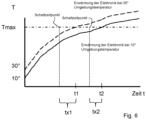
- the ambient temperature should preferably be taken into account when controlling the electric motor, since the ambient temperature in conjunction with the heat generated by the power loss of the MOSFETs depends on the ambient temperature different values are achieved, as in Fig. 6 is shown in simplified form.
- the control and regulation unit 7 has to intervene significantly earlier than at an ambient temperature of 10 ° C, as can be seen Fig. 6 results.
- the switching times must be selected taking into account a time delay tx, such that even after a switch-off process, the system can still heat up slightly additionally due to its thermodynamic inertia without the maximum temperature being exceeded. There is a corresponding time delay Fig. 6 also visible.
- Fig. 7 shows a part of the display device 10 of the working device 1 according to the invention.
- the display device 10 comprises a performance display device 10a, which has a plurality of fields which show the current performance in the manner of a bar chart.
- a numerical number that shows the current performance value in percent can also be displayed in the respective segment of the bar display.
- area 25 corresponds to a pressure of 175 bar, area 50 to a pressure of 350 bar, area 75 to a pressure of 525 bar, area 100 to a pressure of 700 bar.
- additional functionality is provided that shows the operator when a processing step, for example a cut, should be aborted. This can conveniently be done by having the power display show 100% power during full load operation, with the 100% display starting to flash after a certain time has elapsed. This is the signal for the operator to start a new machining cycle.
- an operating status display 10b can also be provided on the display device 10, which shows whether turbo operation is activated or not.
- a temperature display 10c for example in the form of an alphanumeric display or a bar display, can also be provided.
Landscapes
- Engineering & Computer Science (AREA)
- Power Engineering (AREA)
- Mechanical Engineering (AREA)
- General Physics & Mathematics (AREA)
- Microelectronics & Electronic Packaging (AREA)
- Physics & Mathematics (AREA)
- Business, Economics & Management (AREA)
- Emergency Management (AREA)
- General Health & Medical Sciences (AREA)
- Health & Medical Sciences (AREA)
- Fluid-Pressure Circuits (AREA)
- Portable Power Tools In General (AREA)
- Scissors And Nippers (AREA)
Priority Applications (2)
| Application Number | Priority Date | Filing Date | Title |
|---|---|---|---|
| EP23152159.2A EP4245467B1 (fr) | 2018-06-26 | 2018-06-26 | Appareil de travail portable pour l'utilisation portable |
| EP24170421.2A EP4424473B1 (fr) | 2018-06-26 | 2018-06-26 | Appareil de travail portable pour l'utilisation portable |
Applications Claiming Priority (3)
| Application Number | Priority Date | Filing Date | Title |
|---|---|---|---|
| EP23152159.2A EP4245467B1 (fr) | 2018-06-26 | 2018-06-26 | Appareil de travail portable pour l'utilisation portable |
| PCT/EP2018/067010 WO2020001740A1 (fr) | 2018-06-26 | 2018-06-26 | Appareil de travail portatif pour l'utilisation portable |
| EP18735538.3A EP3749489B1 (fr) | 2018-06-26 | 2018-06-26 | Appareil de travail portatif pour l'utilisation portable |
Related Parent Applications (2)
| Application Number | Title | Priority Date | Filing Date |
|---|---|---|---|
| EP18735538.3A Division-Into EP3749489B1 (fr) | 2018-06-26 | 2018-06-26 | Appareil de travail portatif pour l'utilisation portable |
| EP18735538.3A Division EP3749489B1 (fr) | 2018-06-26 | 2018-06-26 | Appareil de travail portatif pour l'utilisation portable |
Related Child Applications (2)
| Application Number | Title | Priority Date | Filing Date |
|---|---|---|---|
| EP24170421.2A Division-Into EP4424473B1 (fr) | 2018-06-26 | 2018-06-26 | Appareil de travail portable pour l'utilisation portable |
| EP24170421.2A Division EP4424473B1 (fr) | 2018-06-26 | 2018-06-26 | Appareil de travail portable pour l'utilisation portable |
Publications (2)
| Publication Number | Publication Date |
|---|---|
| EP4245467A1 true EP4245467A1 (fr) | 2023-09-20 |
| EP4245467B1 EP4245467B1 (fr) | 2024-05-22 |
Family
ID=62791734
Family Applications (3)
| Application Number | Title | Priority Date | Filing Date |
|---|---|---|---|
| EP24170421.2A Active EP4424473B1 (fr) | 2018-06-26 | 2018-06-26 | Appareil de travail portable pour l'utilisation portable |
| EP18735538.3A Active EP3749489B1 (fr) | 2018-06-26 | 2018-06-26 | Appareil de travail portatif pour l'utilisation portable |
| EP23152159.2A Active EP4245467B1 (fr) | 2018-06-26 | 2018-06-26 | Appareil de travail portable pour l'utilisation portable |
Family Applications Before (2)
| Application Number | Title | Priority Date | Filing Date |
|---|---|---|---|
| EP24170421.2A Active EP4424473B1 (fr) | 2018-06-26 | 2018-06-26 | Appareil de travail portable pour l'utilisation portable |
| EP18735538.3A Active EP3749489B1 (fr) | 2018-06-26 | 2018-06-26 | Appareil de travail portatif pour l'utilisation portable |
Country Status (6)
| Country | Link |
|---|---|
| US (2) | US12042677B2 (fr) |
| EP (3) | EP4424473B1 (fr) |
| JP (1) | JP7175332B2 (fr) |
| CN (1) | CN112188948B (fr) |
| PL (2) | PL3749489T3 (fr) |
| WO (1) | WO2020001740A1 (fr) |
Families Citing this family (7)
| Publication number | Priority date | Publication date | Assignee | Title |
|---|---|---|---|---|
| EP3643422B8 (fr) * | 2018-10-25 | 2023-07-26 | Emerson Professional Tools AG | Machine de pressage destinée au pressage d'outils |
| DE102020110406A1 (de) | 2020-04-16 | 2021-10-21 | Liebherr-Werk Ehingen Gmbh | Mobile Bolzenzieheinrichtung |
| US20230105274A1 (en) * | 2021-06-09 | 2023-04-06 | Matthew Speed | De-escalating device |
| CN113671877A (zh) * | 2021-08-23 | 2021-11-19 | 东莞市嘉航实业有限公司 | 一种应用于电动工具的智能语音播报方法及其电动工具 |
| US11703066B2 (en) | 2021-11-11 | 2023-07-18 | Foi Group, Inc. | Hydraulic power pack system |
| US20250276430A1 (en) * | 2024-03-01 | 2025-09-04 | Milwaukee Electric Tool Corporation | Power tool with impulse assembly |
| DE202024105875U1 (de) * | 2024-10-11 | 2026-01-13 | Novopress Gmbh Pressen Und Presswerkzeuge & Co. Kommanditgesellschaft | Pressgerät |
Citations (6)
| Publication number | Priority date | Publication date | Assignee | Title |
|---|---|---|---|---|
| EP1485169A1 (fr) * | 2002-03-21 | 2004-12-15 | B.V. Holmatro Industrial Equipment | Outil de sauvetage hydraulique alimente par une batterie |
| WO2012019758A1 (fr) | 2010-08-12 | 2012-02-16 | Lukas Hydraulik Gmbh & Co. Kg | Dispositif de commande pour un premier et un deuxième outil de travail |
| WO2013127452A1 (fr) | 2012-02-29 | 2013-09-06 | Lukas Hydraulik Gmbh | Procédé d'utilisation d'un ensemble à pompe hydraulique et ensemble à pompe hydraulique |
| WO2014005839A1 (fr) * | 2012-07-05 | 2014-01-09 | Römer Fördertechnik GmbH | Appareil de levage électro-hydraulique et procédé de commande de l'appareil de levage électro-hydraulique |
| WO2017190799A1 (fr) * | 2016-05-06 | 2017-11-09 | Lukas Hydraulik Gmbh | Procédé permettant de faire fonctionner un outil de travail ou un appareil de sauvetage, outil de travail ou appareil de sauvetage et source d'énergie |
| US20180021603A1 (en) * | 2015-01-26 | 2018-01-25 | Lukas Hydraulik Gmbh | Hydraulic implement |
Family Cites Families (18)
| Publication number | Priority date | Publication date | Assignee | Title |
|---|---|---|---|---|
| US5477680A (en) | 1994-09-13 | 1995-12-26 | Burndy Corporation | Motor driven hydraulic tool with variable displacement hydraulic pump |
| JP2005110345A (ja) * | 2003-09-29 | 2005-04-21 | Aisin Seiki Co Ltd | 油圧ポンプ駆動用センサレスブラシレスdcモータの起動制御方法及び制御装置 |
| KR101525372B1 (ko) * | 2005-06-28 | 2015-06-09 | 스트리커 코포레이션 | 슬립 모드 또는 활성 모드로 동작할 수 있는 동력이 있는 수술 도구용 제어 어셈블리 |
| DE602006018510D1 (de) * | 2005-10-21 | 2011-01-05 | Stryker Corp | System und verfahren zum wiederaufladen einer harschen umgebung ausgesetzten batterie |
| US7602137B2 (en) * | 2006-02-20 | 2009-10-13 | Black & Decker Inc. | Electronically commutated motor and control system |
| DE102008003786A1 (de) | 2008-01-10 | 2009-07-16 | Robert Bosch Gmbh | Verfahren zur Detektion einer thermischen Überlastsituation bei einem Elektrohandwerkzeug |
| DE102011077442B4 (de) * | 2011-06-14 | 2025-06-26 | Robert Bosch Gmbh | Getriebelose Handwerkzeugmaschine |
| US20130038148A1 (en) * | 2011-08-11 | 2013-02-14 | Bach Pangho Chen | Hand-held machine tool with improved output efficiency |
| CA2876579C (fr) | 2012-06-12 | 2015-11-17 | Husqvarna Ab | Systeme de coupe electrique |
| EP2839932A1 (fr) | 2013-08-19 | 2015-02-25 | HILTI Aktiengesellschaft | Régime de reprise pour perceuses à âme en diamant après une désactivation de température (surchauffe du moteur) |
| DE102014201435A1 (de) * | 2014-01-27 | 2015-07-30 | Robert Bosch Gmbh | Handwerkzeugmaschine |
| JP6484918B2 (ja) * | 2014-02-28 | 2019-03-20 | 工機ホールディングス株式会社 | 電動作業機 |
| CN107206579B (zh) * | 2015-01-30 | 2020-02-28 | 工机控股株式会社 | 撞击作业机 |
| CN104890722B (zh) * | 2015-05-15 | 2017-11-14 | 郑州宇通客车股份有限公司 | 一种电动液压助力转向控制方法及其实施该方法的系统 |
| DE102015209356B3 (de) * | 2015-05-21 | 2016-08-25 | Danfoss Power Solutions Gmbh & Co. Ohg | Lastabhängige regelung von hydraulikmotoren |
| JP6469557B2 (ja) | 2015-10-05 | 2019-02-13 | 株式会社オグラ | 油圧作動装置 |
| JP2017192347A (ja) | 2016-04-21 | 2017-10-26 | リョービ株式会社 | 電動刈り込み鋏 |
| AT520046B1 (de) * | 2017-06-12 | 2022-10-15 | Weber Hydraulik Gmbh | Hydraulikaggregat für hydraulische Rettungswerkzeuge sowie damit ausgestattetes Rettungswerkzeug |
-
2018
- 2018-06-26 PL PL18735538.3T patent/PL3749489T3/pl unknown
- 2018-06-26 JP JP2020570490A patent/JP7175332B2/ja active Active
- 2018-06-26 CN CN201880093751.9A patent/CN112188948B/zh active Active
- 2018-06-26 WO PCT/EP2018/067010 patent/WO2020001740A1/fr not_active Ceased
- 2018-06-26 PL PL24170421.2T patent/PL4424473T3/pl unknown
- 2018-06-26 EP EP24170421.2A patent/EP4424473B1/fr active Active
- 2018-06-26 EP EP18735538.3A patent/EP3749489B1/fr active Active
- 2018-06-26 US US17/252,440 patent/US12042677B2/en active Active
- 2018-06-26 EP EP23152159.2A patent/EP4245467B1/fr active Active
-
2024
- 2024-06-20 US US18/748,724 patent/US20250001220A1/en active Pending
Patent Citations (6)
| Publication number | Priority date | Publication date | Assignee | Title |
|---|---|---|---|---|
| EP1485169A1 (fr) * | 2002-03-21 | 2004-12-15 | B.V. Holmatro Industrial Equipment | Outil de sauvetage hydraulique alimente par une batterie |
| WO2012019758A1 (fr) | 2010-08-12 | 2012-02-16 | Lukas Hydraulik Gmbh & Co. Kg | Dispositif de commande pour un premier et un deuxième outil de travail |
| WO2013127452A1 (fr) | 2012-02-29 | 2013-09-06 | Lukas Hydraulik Gmbh | Procédé d'utilisation d'un ensemble à pompe hydraulique et ensemble à pompe hydraulique |
| WO2014005839A1 (fr) * | 2012-07-05 | 2014-01-09 | Römer Fördertechnik GmbH | Appareil de levage électro-hydraulique et procédé de commande de l'appareil de levage électro-hydraulique |
| US20180021603A1 (en) * | 2015-01-26 | 2018-01-25 | Lukas Hydraulik Gmbh | Hydraulic implement |
| WO2017190799A1 (fr) * | 2016-05-06 | 2017-11-09 | Lukas Hydraulik Gmbh | Procédé permettant de faire fonctionner un outil de travail ou un appareil de sauvetage, outil de travail ou appareil de sauvetage et source d'énergie |
Non-Patent Citations (1)
| Title |
|---|
| "Betriebsanleitung Akku-Rettungsgeräte E-Force 2", 1 January 2016, WEBER-HYDRAULIK GMBH, XP002809161 * |
Also Published As
| Publication number | Publication date |
|---|---|
| CN112188948A (zh) | 2021-01-05 |
| EP3749489B1 (fr) | 2023-03-22 |
| JP2021534003A (ja) | 2021-12-09 |
| PL4424473T3 (pl) | 2025-11-12 |
| JP7175332B2 (ja) | 2022-11-18 |
| EP4245467B1 (fr) | 2024-05-22 |
| EP4424473A1 (fr) | 2024-09-04 |
| US20210252316A1 (en) | 2021-08-19 |
| PL3749489T3 (pl) | 2023-07-24 |
| WO2020001740A1 (fr) | 2020-01-02 |
| EP4424473B1 (fr) | 2025-06-18 |
| EP3749489A1 (fr) | 2020-12-16 |
| US20250001220A1 (en) | 2025-01-02 |
| US12042677B2 (en) | 2024-07-23 |
| CN112188948B (zh) | 2023-08-22 |
Similar Documents
| Publication | Publication Date | Title |
|---|---|---|
| EP3749489B1 (fr) | Appareil de travail portatif pour l'utilisation portable | |
| DE4127342C2 (de) | Hydraulisches System mit einer Pumpe | |
| DE10216958B3 (de) | Hydraulische Steuerung | |
| DE102015201993A1 (de) | Materialprobenhalter mit Ansteuereinheit | |
| DE4106845C2 (fr) | ||
| EP3012463B1 (fr) | Agregat hydraulique | |
| DE102014211393B4 (de) | Geschwindigkeitskontrolleinrichtung für einen hydrostatischen Antrieb | |
| EP4105496A1 (fr) | Unité hydraulique destinée à l'alimentation d'un appareil de sauvetage à entraînement hydraulique | |
| EP3249241B1 (fr) | Procédé de détermination de la position finale d'un vérin hydraulique d'un système hydraulique d'une machine de travail mobile, en particulier un chariot de manutention | |
| EP3221619A1 (fr) | Procédé pour faire fonctionner un dispositif de boîte de vitesses automatique ainsi que dispositif de boîte de vitesses automatique correspondant | |
| DE102011101714A1 (de) | Verfahren einer elektrohydraulischen Hubwerksregelung und Bedieneinheit für eine elektrohydraulische Hubwerksregelung | |
| DE102004061077B4 (de) | Hydraulische Lenkeinrichtung | |
| DE102006023798B3 (de) | Vorrichtung zur Steuerung einer Papierschneidemaschine | |
| EP3737474B1 (fr) | Procédé permettant de faire fonctionner un outil de travail ou un appareil de sauvetage, outil de travail ou appareil de sauvetage | |
| EP3789612B1 (fr) | Appareil hydraulique portable fonctionnant sur accumulateur pour outils de sauvetage hydraulique | |
| DE10255066A1 (de) | Mehrkreis-Lenksystem | |
| DE69515727T2 (de) | Verfahren und Vorrichtung zur Steuerung der Speisung eines Stellgliedes für ein hydraulisches Werkzeug | |
| DE2947842C2 (de) | Hydraulische Sicherheitssteuerung mit Druckstufenregelventil | |
| EP0565745B1 (fr) | Surveillance d'un changement de signal, en particulier dans des systèmes de pilotage | |
| DE102013205961A1 (de) | Sicherheitssystem für einen Hydraulikkreis | |
| EP1227377A2 (fr) | Procédé de protection d'un actionneur contre la surcharge | |
| DE202021106401U1 (de) | Mechanische Presse zum Umformen eines Materials | |
| EP1800926A2 (fr) | Dispositif d'actionnement sensible à la pression | |
| DE102006024403A1 (de) | Lenkung für ein Flugzeugfahrwerk | |
| DE102009024886B3 (de) | Steuereinrichtung |
Legal Events
| Date | Code | Title | Description |
|---|---|---|---|
| PUAI | Public reference made under article 153(3) epc to a published international application that has entered the european phase |
Free format text: ORIGINAL CODE: 0009012 |
|
| STAA | Information on the status of an ep patent application or granted ep patent |
Free format text: STATUS: REQUEST FOR EXAMINATION WAS MADE |
|
| 17P | Request for examination filed |
Effective date: 20230118 |
|
| AC | Divisional application: reference to earlier application |
Ref document number: 3749489 Country of ref document: EP Kind code of ref document: P |
|
| AK | Designated contracting states |
Kind code of ref document: A1 Designated state(s): AL AT BE BG CH CY CZ DE DK EE ES FI FR GB GR HR HU IE IS IT LI LT LU LV MC MK MT NL NO PL PT RO RS SE SI SK SM TR |
|
| P01 | Opt-out of the competence of the unified patent court (upc) registered |
Effective date: 20230920 |
|
| GRAP | Despatch of communication of intention to grant a patent |
Free format text: ORIGINAL CODE: EPIDOSNIGR1 |
|
| STAA | Information on the status of an ep patent application or granted ep patent |
Free format text: STATUS: GRANT OF PATENT IS INTENDED |
|
| INTG | Intention to grant announced |
Effective date: 20240219 |
|
| GRAS | Grant fee paid |
Free format text: ORIGINAL CODE: EPIDOSNIGR3 |
|
| GRAA | (expected) grant |
Free format text: ORIGINAL CODE: 0009210 |
|
| STAA | Information on the status of an ep patent application or granted ep patent |
Free format text: STATUS: THE PATENT HAS BEEN GRANTED |
|
| AC | Divisional application: reference to earlier application |
Ref document number: 3749489 Country of ref document: EP Kind code of ref document: P |
|
| AK | Designated contracting states |
Kind code of ref document: B1 Designated state(s): AL AT BE BG CH CY CZ DE DK EE ES FI FR GB GR HR HU IE IS IT LI LT LU LV MC MK MT NL NO PL PT RO RS SE SI SK SM TR |
|
| REG | Reference to a national code |
Ref country code: GB Ref legal event code: FG4D Free format text: NOT ENGLISH |
|
| REG | Reference to a national code |
Ref country code: CH Ref legal event code: EP |
|
| REG | Reference to a national code |
Ref country code: DE Ref legal event code: R096 Ref document number: 502018014663 Country of ref document: DE |
|
| REG | Reference to a national code |
Ref country code: IE Ref legal event code: FG4D Free format text: LANGUAGE OF EP DOCUMENT: GERMAN |
|
| REG | Reference to a national code |
Ref country code: NL Ref legal event code: FP |
|
| REG | Reference to a national code |
Ref country code: LT Ref legal event code: MG9D |
|
| PG25 | Lapsed in a contracting state [announced via postgrant information from national office to epo] |
Ref country code: IS Free format text: LAPSE BECAUSE OF FAILURE TO SUBMIT A TRANSLATION OF THE DESCRIPTION OR TO PAY THE FEE WITHIN THE PRESCRIBED TIME-LIMIT Effective date: 20240922 |
|
| PG25 | Lapsed in a contracting state [announced via postgrant information from national office to epo] |
Ref country code: BG Free format text: LAPSE BECAUSE OF FAILURE TO SUBMIT A TRANSLATION OF THE DESCRIPTION OR TO PAY THE FEE WITHIN THE PRESCRIBED TIME-LIMIT Effective date: 20240522 |
|
| PG25 | Lapsed in a contracting state [announced via postgrant information from national office to epo] |
Ref country code: HR Free format text: LAPSE BECAUSE OF FAILURE TO SUBMIT A TRANSLATION OF THE DESCRIPTION OR TO PAY THE FEE WITHIN THE PRESCRIBED TIME-LIMIT Effective date: 20240522 Ref country code: FI Free format text: LAPSE BECAUSE OF FAILURE TO SUBMIT A TRANSLATION OF THE DESCRIPTION OR TO PAY THE FEE WITHIN THE PRESCRIBED TIME-LIMIT Effective date: 20240522 |
|
| PG25 | Lapsed in a contracting state [announced via postgrant information from national office to epo] |
Ref country code: GR Free format text: LAPSE BECAUSE OF FAILURE TO SUBMIT A TRANSLATION OF THE DESCRIPTION OR TO PAY THE FEE WITHIN THE PRESCRIBED TIME-LIMIT Effective date: 20240823 |
|
| PG25 | Lapsed in a contracting state [announced via postgrant information from national office to epo] |
Ref country code: PT Free format text: LAPSE BECAUSE OF FAILURE TO SUBMIT A TRANSLATION OF THE DESCRIPTION OR TO PAY THE FEE WITHIN THE PRESCRIBED TIME-LIMIT Effective date: 20240923 |
|
| PG25 | Lapsed in a contracting state [announced via postgrant information from national office to epo] |
Ref country code: ES Free format text: LAPSE BECAUSE OF FAILURE TO SUBMIT A TRANSLATION OF THE DESCRIPTION OR TO PAY THE FEE WITHIN THE PRESCRIBED TIME-LIMIT Effective date: 20240522 |
|
| PG25 | Lapsed in a contracting state [announced via postgrant information from national office to epo] |
Ref country code: LV Free format text: LAPSE BECAUSE OF FAILURE TO SUBMIT A TRANSLATION OF THE DESCRIPTION OR TO PAY THE FEE WITHIN THE PRESCRIBED TIME-LIMIT Effective date: 20240522 |
|
| PG25 | Lapsed in a contracting state [announced via postgrant information from national office to epo] |
Ref country code: PT Free format text: LAPSE BECAUSE OF FAILURE TO SUBMIT A TRANSLATION OF THE DESCRIPTION OR TO PAY THE FEE WITHIN THE PRESCRIBED TIME-LIMIT Effective date: 20240923 Ref country code: NO Free format text: LAPSE BECAUSE OF FAILURE TO SUBMIT A TRANSLATION OF THE DESCRIPTION OR TO PAY THE FEE WITHIN THE PRESCRIBED TIME-LIMIT Effective date: 20240822 Ref country code: LV Free format text: LAPSE BECAUSE OF FAILURE TO SUBMIT A TRANSLATION OF THE DESCRIPTION OR TO PAY THE FEE WITHIN THE PRESCRIBED TIME-LIMIT Effective date: 20240522 Ref country code: IS Free format text: LAPSE BECAUSE OF FAILURE TO SUBMIT A TRANSLATION OF THE DESCRIPTION OR TO PAY THE FEE WITHIN THE PRESCRIBED TIME-LIMIT Effective date: 20240922 Ref country code: HR Free format text: LAPSE BECAUSE OF FAILURE TO SUBMIT A TRANSLATION OF THE DESCRIPTION OR TO PAY THE FEE WITHIN THE PRESCRIBED TIME-LIMIT Effective date: 20240522 Ref country code: GR Free format text: LAPSE BECAUSE OF FAILURE TO SUBMIT A TRANSLATION OF THE DESCRIPTION OR TO PAY THE FEE WITHIN THE PRESCRIBED TIME-LIMIT Effective date: 20240823 Ref country code: FI Free format text: LAPSE BECAUSE OF FAILURE TO SUBMIT A TRANSLATION OF THE DESCRIPTION OR TO PAY THE FEE WITHIN THE PRESCRIBED TIME-LIMIT Effective date: 20240522 Ref country code: ES Free format text: LAPSE BECAUSE OF FAILURE TO SUBMIT A TRANSLATION OF THE DESCRIPTION OR TO PAY THE FEE WITHIN THE PRESCRIBED TIME-LIMIT Effective date: 20240522 Ref country code: BG Free format text: LAPSE BECAUSE OF FAILURE TO SUBMIT A TRANSLATION OF THE DESCRIPTION OR TO PAY THE FEE WITHIN THE PRESCRIBED TIME-LIMIT Effective date: 20240522 Ref country code: RS Free format text: LAPSE BECAUSE OF FAILURE TO SUBMIT A TRANSLATION OF THE DESCRIPTION OR TO PAY THE FEE WITHIN THE PRESCRIBED TIME-LIMIT Effective date: 20240822 |
|
| PG25 | Lapsed in a contracting state [announced via postgrant information from national office to epo] |
Ref country code: DK Free format text: LAPSE BECAUSE OF FAILURE TO SUBMIT A TRANSLATION OF THE DESCRIPTION OR TO PAY THE FEE WITHIN THE PRESCRIBED TIME-LIMIT Effective date: 20240522 |
|
| PG25 | Lapsed in a contracting state [announced via postgrant information from national office to epo] |
Ref country code: EE Free format text: LAPSE BECAUSE OF FAILURE TO SUBMIT A TRANSLATION OF THE DESCRIPTION OR TO PAY THE FEE WITHIN THE PRESCRIBED TIME-LIMIT Effective date: 20240522 |
|
| PG25 | Lapsed in a contracting state [announced via postgrant information from national office to epo] |
Ref country code: CZ Free format text: LAPSE BECAUSE OF FAILURE TO SUBMIT A TRANSLATION OF THE DESCRIPTION OR TO PAY THE FEE WITHIN THE PRESCRIBED TIME-LIMIT Effective date: 20240522 |
|
| PG25 | Lapsed in a contracting state [announced via postgrant information from national office to epo] |
Ref country code: RO Free format text: LAPSE BECAUSE OF FAILURE TO SUBMIT A TRANSLATION OF THE DESCRIPTION OR TO PAY THE FEE WITHIN THE PRESCRIBED TIME-LIMIT Effective date: 20240522 Ref country code: SK Free format text: LAPSE BECAUSE OF FAILURE TO SUBMIT A TRANSLATION OF THE DESCRIPTION OR TO PAY THE FEE WITHIN THE PRESCRIBED TIME-LIMIT Effective date: 20240522 |
|
| REG | Reference to a national code |
Ref country code: DE Ref legal event code: R082 Ref document number: 502018014663 Country of ref document: DE Representative=s name: 4IP GLEIMPETRI PATENT- UND RECHTSANWALTSPARTNE, DE |
|
| PG25 | Lapsed in a contracting state [announced via postgrant information from national office to epo] |
Ref country code: SK Free format text: LAPSE BECAUSE OF FAILURE TO SUBMIT A TRANSLATION OF THE DESCRIPTION OR TO PAY THE FEE WITHIN THE PRESCRIBED TIME-LIMIT Effective date: 20240522 Ref country code: RO Free format text: LAPSE BECAUSE OF FAILURE TO SUBMIT A TRANSLATION OF THE DESCRIPTION OR TO PAY THE FEE WITHIN THE PRESCRIBED TIME-LIMIT Effective date: 20240522 Ref country code: EE Free format text: LAPSE BECAUSE OF FAILURE TO SUBMIT A TRANSLATION OF THE DESCRIPTION OR TO PAY THE FEE WITHIN THE PRESCRIBED TIME-LIMIT Effective date: 20240522 Ref country code: DK Free format text: LAPSE BECAUSE OF FAILURE TO SUBMIT A TRANSLATION OF THE DESCRIPTION OR TO PAY THE FEE WITHIN THE PRESCRIBED TIME-LIMIT Effective date: 20240522 Ref country code: CZ Free format text: LAPSE BECAUSE OF FAILURE TO SUBMIT A TRANSLATION OF THE DESCRIPTION OR TO PAY THE FEE WITHIN THE PRESCRIBED TIME-LIMIT Effective date: 20240522 |
|
| REG | Reference to a national code |
Ref country code: CH Ref legal event code: PL |
|
| PG25 | Lapsed in a contracting state [announced via postgrant information from national office to epo] |
Ref country code: IT Free format text: LAPSE BECAUSE OF FAILURE TO SUBMIT A TRANSLATION OF THE DESCRIPTION OR TO PAY THE FEE WITHIN THE PRESCRIBED TIME-LIMIT Effective date: 20240522 Ref country code: MC Free format text: LAPSE BECAUSE OF FAILURE TO SUBMIT A TRANSLATION OF THE DESCRIPTION OR TO PAY THE FEE WITHIN THE PRESCRIBED TIME-LIMIT Effective date: 20240522 |
|
| PG25 | Lapsed in a contracting state [announced via postgrant information from national office to epo] |
Ref country code: LU Free format text: LAPSE BECAUSE OF NON-PAYMENT OF DUE FEES Effective date: 20240626 |
|
| REG | Reference to a national code |
Ref country code: DE Ref legal event code: R097 Ref document number: 502018014663 Country of ref document: DE |
|
| PLBE | No opposition filed within time limit |
Free format text: ORIGINAL CODE: 0009261 |
|
| STAA | Information on the status of an ep patent application or granted ep patent |
Free format text: STATUS: NO OPPOSITION FILED WITHIN TIME LIMIT |
|
| PG25 | Lapsed in a contracting state [announced via postgrant information from national office to epo] |
Ref country code: IE Free format text: LAPSE BECAUSE OF NON-PAYMENT OF DUE FEES Effective date: 20240626 |
|
| GBPC | Gb: european patent ceased through non-payment of renewal fee |
Effective date: 20240822 |
|
| PG25 | Lapsed in a contracting state [announced via postgrant information from national office to epo] |
Ref country code: SI Free format text: LAPSE BECAUSE OF FAILURE TO SUBMIT A TRANSLATION OF THE DESCRIPTION OR TO PAY THE FEE WITHIN THE PRESCRIBED TIME-LIMIT Effective date: 20240522 Ref country code: BE Free format text: LAPSE BECAUSE OF NON-PAYMENT OF DUE FEES Effective date: 20240630 Ref country code: CH Free format text: LAPSE BECAUSE OF NON-PAYMENT OF DUE FEES Effective date: 20240630 |
|
| 26N | No opposition filed |
Effective date: 20250225 |
|
| REG | Reference to a national code |
Ref country code: BE Ref legal event code: MM Effective date: 20240630 |
|
| PGFP | Annual fee paid to national office [announced via postgrant information from national office to epo] |
Ref country code: PL Payment date: 20250612 Year of fee payment: 8 Ref country code: DE Payment date: 20250618 Year of fee payment: 8 |
|
| PG25 | Lapsed in a contracting state [announced via postgrant information from national office to epo] |
Ref country code: GB Free format text: LAPSE BECAUSE OF NON-PAYMENT OF DUE FEES Effective date: 20240822 |
|
| PGFP | Annual fee paid to national office [announced via postgrant information from national office to epo] |
Ref country code: NL Payment date: 20250618 Year of fee payment: 8 |
|
| PGFP | Annual fee paid to national office [announced via postgrant information from national office to epo] |
Ref country code: FR Payment date: 20250627 Year of fee payment: 8 |
|
| PGFP | Annual fee paid to national office [announced via postgrant information from national office to epo] |
Ref country code: AT Payment date: 20250620 Year of fee payment: 8 |
|
| PG25 | Lapsed in a contracting state [announced via postgrant information from national office to epo] |
Ref country code: SE Free format text: LAPSE BECAUSE OF FAILURE TO SUBMIT A TRANSLATION OF THE DESCRIPTION OR TO PAY THE FEE WITHIN THE PRESCRIBED TIME-LIMIT Effective date: 20240522 |
|
| PG25 | Lapsed in a contracting state [announced via postgrant information from national office to epo] |
Ref country code: SM Free format text: LAPSE BECAUSE OF FAILURE TO SUBMIT A TRANSLATION OF THE DESCRIPTION OR TO PAY THE FEE WITHIN THE PRESCRIBED TIME-LIMIT; INVALID AB INITIO Effective date: 20180626 |
|
| PG25 | Lapsed in a contracting state [announced via postgrant information from national office to epo] |
Ref country code: CY Free format text: LAPSE BECAUSE OF FAILURE TO SUBMIT A TRANSLATION OF THE DESCRIPTION OR TO PAY THE FEE WITHIN THE PRESCRIBED TIME-LIMIT; INVALID AB INITIO Effective date: 20180626 |
|
| PG25 | Lapsed in a contracting state [announced via postgrant information from national office to epo] |
Ref country code: HU Free format text: LAPSE BECAUSE OF FAILURE TO SUBMIT A TRANSLATION OF THE DESCRIPTION OR TO PAY THE FEE WITHIN THE PRESCRIBED TIME-LIMIT; INVALID AB INITIO Effective date: 20180626 |